Colorado Statesman
Saturday, February 7, 1914
Denver, Colorado
Page text (machine-generated)
PATRONIZE MERCHANTS WHO ADV. IN THE PEOPLE'S PAPER
THE COLORADO STATESMAN
THE JOURNAL OF THE WEST.
LABOR SHALL BE FREE
RACE COUNTRY PARTY
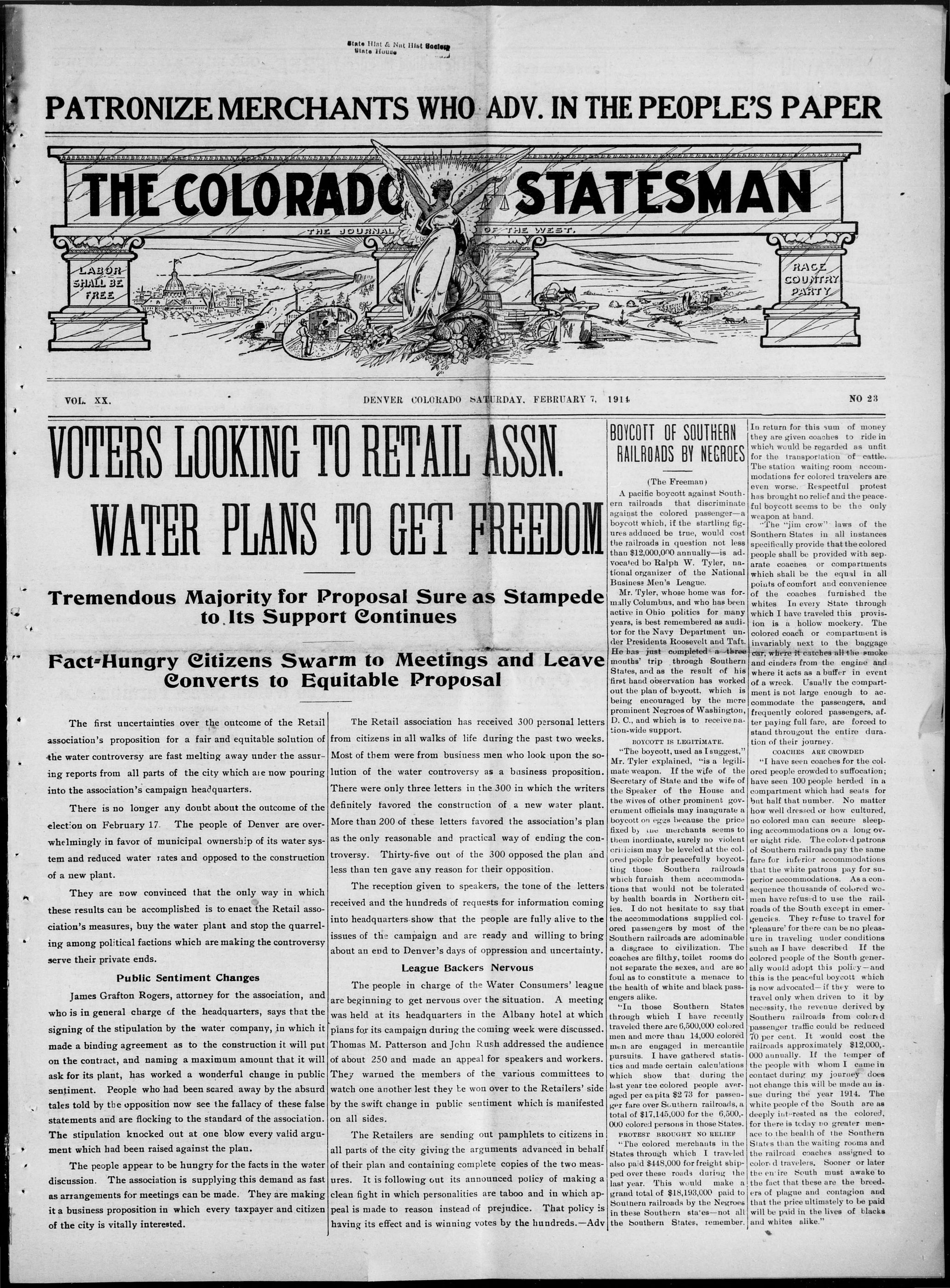
VOTERS LOOKING TO RETAIL ASSN. WATER PLANS TO GET FREEDOM
Tremendous Majority for Proposal Sure as Stampede to Its Support Continues
Fact-Hungry Citizens Swarm to Meetings and Leave Converts to Equitable Proposal
VOL. XX.
The first uncertainties over the outcome of the Retail association's proposition for a fair and equitable solution of the water controversy are fast melting away under the assuring reports from all parts of the city which are now pouring into the association's campaign headquarters.
There is no longer any doubt about the outcome of the election on February 17. The people of Denver are overwhelmingly in favor of municipal ownership of its water system and reduced water rates and opposed to the construction of a new plant.
They are now convinced that the only way in which these results can be accomplished is to enact the Retail association's measures, buy the water plant and stop the quarreling among political factions which are making the controversy serve their private ends.
Public Sentiment Changes
James Grafton Rogers, attorney for the association, and who is in general charge of the headquarters, says that the signing of the stipulation by the water company, in which it made a binding agreement as to the construction it will put on the contract, and naming a maximum amount that it will ask for its plant, has worked a wonderful change in public sentiment. People who had been scared away by the absurd tales told by the opposition now see the fallacy of these false statements and are flocking to the standard of the association. The stipulation knocked out at one blow every valid argument which had been raised against the plan.
The people appear to be hungry for the facts in the water discussion. The association is supplying this demand as fast as arrangements for meetings can be made. They are making it a business proposition in which every taxpayer and citizen of the city is vitally interested.
State Hist & Nat Hist Boclerg
State House
ANTS WHAT
DC
JOURNAL
DENVER COLORADO
TO RETAIL
TO GET
Proposal Sun-
tit Continues
from to Meeting
Suitable Prop
The Retail association
own citizens in all walks of
rest of them were from bu-
dition of the water contri-
dence were only three letters
unitely favored the con-
more than 200 of these let-
the only reasonable and
versy. Thirty-five out-
s than ten gave any reas-
The reception given to
received and the hundreds
to headquarters show tha-
ues of the campaign an-
out an end to Denver's d
S WHO ADVEN
COLORADO SATURDAY.
DETAIL ASSIGNMENT GET FREE
Real Sure as Stats continues
Meetings and Proposal
The association has received 300 from all walks of life during the war from business men who lost water controversy as a business man three letters in the 300 in which the construction of a new bridge of these letters favored the association and practical way of the thirty-five out of the 300 opposed have any reason for their opposition given to speakers, the tone the hundreds of requests for information show that the people are for a campaign and are ready and willing to Denver's days of oppression and
DENVER COLORADO SATURDAY, FEBRUARY 7, 1914
The Retail association has received 300 personal letters from citizens in all walks of life during the past two weeks. Most of them were from business men who look upon the solution of the water controversy as a business proposition. There were only three letters in the 300 in which the writers definitely favored the construction of a new water plant. More than 200 of these letters favored the association's plan as the only reasonable and practical way of ending the controversy. Thirty-five out of the 300 opposed the plan and less than ten gave any reason for their opposition.
The reception given to speakers, the tone of the letters received and the hundreds of requests for information coming into headquarters show that the people are fully alive to the issues of the campaign and are ready and willing to bring about an end to Denver's days of oppression and uncertainty.
League Backers Nervous
The people in charge in beginning to get nervous held at its headquarterns for its campaign during Thomas M. Patterson and J. about 250 and made aney warned the member which one another lest they the swift change in pub
e in charge of the Water Conto get nervous over the situation headquarters in the Albany campaign during the coming week. Atterson and John Rush address and made an appeal for speakers to the members of the various her lest they be won over to the range in public sentiment which
The people in charge of the Water Consumers' league are beginning to get nervous over the situation. A meeting was held at its headquarters in the Albany hotel at which plans for its campaign during the coming week were discussed. Thomas M. Patterson and John Rush addressed the audience of about 250 and made an appeal for speakers and workers. They warned the members of the various committees to watch one another lest they be won over to the Retailers' side by the swift change in public sentiment which is manifested on all sides.
The Retailers are sending out pamphlets to citizens in all parts of the city giving the arguments advanced in behalf of their plan and containing complete copies of the two measures. It is following out its announced policy of making a clean fight in which personalities are taboo and in which appeal is made to reason instead of prejudice. That policy is having its effect and is winning votes by the hundreds.—Adv
BOYCOTT OF SOUTHERN RAILROADS BY NEGROES
BOYCOTT OF SOUTHERN RAILROADS BY NEGROES
(The Freeman)
A pacific boycott against Southern railroads that discriminate against the colored passenger—a boycott which, if the startling figures adduced be true, would cost the railroads in question not less than $12,000,000 annually—is advocated bo Ralph W. Tyler, national organizer of the National Business Men's League.
Mr. Tyler, whose home was formally Columbus, and who has been active in Ohio politics for many years, is best remembered as auditor for the Navy Department under Presidents Roosevelt and Taft. He has just completed a three months' trip through Southern States, and as the result of his first hand observation has worked out the plan of boycott, which is being encouraged by the more prominent Negroes of Washington, D. C., and which is to receive nation-wide support.
BOYCOTT IS LEGITIMATE.
"The boycott, used as I suggest," Mr. Tyler explained, "is a legilimate weapon. If the wife of the Secretary of State and the wife of the Speaker of the House and the wives of other prominent government officials may inaugurate a boycott on eggs because the price fixed by the merchants seems to them inordinate, surely no violent criticism may be leveled at the colored people for peacefully boycotting those Southern railroads which furnish them accommodations that would not be tolerated by health boards in Northern cities. I do not hesitate to say that the accommodations supplied colored passengers by most of the Southern railroads are adominable a disgrace to civilization. The coaches are filthy, toilet rooms do not separate the sexes, and are so foul as to constitute a menace to the health of white and black passengers alike.
"In those Southern States through which I have recently traveled there are 6,500,000 colored men and more than 14,000 colored men are engaged in mercantile pursuits. I have gathered statistics and made certain calculations which show that during the last year the colored people averaged per capita $273 for passenger fare over Southern railroads, a total of $17,145,000 for the 6,500,-000 colored persons in those States. PROTEST BROUGHT NO RELIEF "The colored merchants in the States through which I traveled also paid $448,000 for freight shipped over these roads during the last year. This would make a grand total of $18,193,000 paid to Southern railroads by the Negroes in these Southern states—not all the Southern States, remember.
NO 23
In return for this sum of money they are given coaches to ride in which would be regarded as unfit for the transportation of cattle. The station waiting room accommodations for colored travelers are even worse. Respectful protest has brought no relief and the peaceful boycott seems to be the only weapon at hand.
"The "jim crow" laws of the Southern States in all instances specifically provide that the colored people shall be provided with separate coaches or compartments which shall be the equal in all points of comfort and convenience of the coaches furnished the whites In every State through which I have traveled this provision is a hollow mockery. The colored coach or compartment is invariably next to the baggage car, where it catches all the smoke and cinders from the engine and where it acts as a buffer in event of a wreck. Usually the compartment is not large enough to accommodate the passengers, and frequently colored passengers, after paying full fare, are forced to stand throughout the entire duration of their journey.
COACHES ARE CROWDED
"I have seen coaches for the colored people crowded to suffocation; have seen 100 people herded in a compartment which had seats for but half that number. No matter how well dressed or how cultured, no colored man can secure sleeping accommodations on a long over night ride. The colored patrons of Southern railroads pay the same fare for inferior accommodations that the white patrons pay for superior accommodations. As a consequence thousands of colored women have refused to use the railroads of the South except in emergencies. They refuse to travel for 'pleasure' for there can be no pleasure in traveling under conditions such as I have described. If the colored people of the South generally would adopt this policy—and this is the peaceful boycott which is now advocated—if they were to travel only when driven to it by necessity, the revenue derived by Southern railroads from colored passenger traffic could be reduced 70 per cent. It would cost the railroads approximately $12,000,-000 annually. If the temper of the people with whom I came in contact during my journey does not change this will be made au issue during the year 1914. The white people of the South are as deeply interested as the colored, for there is today no greater menace to the health of the Southern States than the waiting rooms and the railroad coaches assigned to colored travelers. Sooner or later the entire South must awake to the fact that these are the breeders of plague and contagion and that the price ultimately to be paid will be paid in the lives of blacks and whites alike."
CONDENSATION OF FRESH NEWS
THE LATEST IMPORTANT DISP
PATCHES PUT INTO SHORT,
CRISP PARAGRAPHS.
SHOWING THE PROGRESS OF EVENTS IN OUR OWN AND FOREIGN LANDS.
Western Newspaper Union News Service.
WESTERN.
Charles E. Dana, well known as an artist and art critic, died at his home in Philadelphia, aged 71.
Captain Wharton H. Clinton, a veteran of the Mexican and civil wars, died at Indianapolis. He was 88.
Lucius Stannard, the last surviving member of the first Minnesota constitutional convention, died at Taylor's Falls, aged ninety years.
Albert Perrin, a plumber, and unmarried, was fatally burned when a can of gasoline in Jensen's plumbing shop exploded at Lander. Wyo.
Two million pounds of frozen beef and mutton, the first direct shipment of this kind ever sent from Australia to Seattle, arrived on the British steamer Waimate.
Former Congressman A. P. Murphy was found dead in bed at the home of Benson Tyson at Rolla, Mo. He had died of heart disease, according to the verdict of a coroner's jury.
Horace Corbin and Frank Goodale, Toledo aviators, will enter the $300,000 aviation race around the world under the auspices of the Panama-Pacific International Exposition Company in 1915.
George D. Perkins, aged seventy-four, for forty-five years editor and publisher of the Sioux City Journal, died in a hospital at Sioux City, Ia., after several week illness of a complication of diseases.
Operator Ferdinand Kuehne, senior wireless man of the Monroe, who was the hero of the marine disaster off the Virginia coast, gave his life belt to an old negro woman. Her identity has not been established.
Detailed appraisal of the estate of the late Henry H. Rogers, Standard Oil magnate, who died four years ago, shows that the estate is worth about $40,000,000 net, or $6,000,000 more than the value originally estimated.
Dr. Cary E. Logan, an educator, of Washington, D. C., daughter of the late Captain H. C. Logan, U. S. A., and niece of the late General John A. Logan, died at Bremerton, Wash., of heart disease. She was 37 years old and came west in August, 1912, because of ill health.
Brig. Gen. Frederick Funston, U. S. A., recently transferred from command of the troops in the Hawaiian islands to command of the Fifth brigade, now patrolling the Mexican border with headquarters at Omaha, arrived at Omaha and left for Texas City to assume his new command.
WASHINGTON
Senator Bristow of Kansas asked for an appropriation of $1,000,000 for use in investigating irrigation from reservoirs in the west.
The Maryland Steel Company at Sparrows Point, Md., was the lowest bidder for two new navy colliers at a price of $945,000 each.
Figures prepared by experts of the Department of Agriculture, show that the shortage of meat animals in the United States has reached a point of extreme gravity.
President Wilson made these nominations; Consul general at Guatemala City, Stuart K. Lupton of Tennessee, now consul at Karachi; receiver of public monkeys at Santa Fé, N. M., Juan N. Vigil of Talpa, N. M.
Secretary Redfield directed that charges of negligence be preferred against Captain Osman Berry of the Merchants' and Miners' steamship Nantucket, which collided with and sank the Old Dominion liner Monroe, with a loss of forty-one lives, off the Virginia coast.
Prospects for Legislation to change the dates for the beginning of Congress, the term of the President and the inauguration, were checked when the Senate judiciary committee voted to report adversely on a constitutional amendment resolution proposed by Senator Shafroth of Colorado.
President Wilson, by an executive order made public at the White House, removed all restrictions against the exportation of munitions of war into Mexico from the United States, placing the contending elements on a basis of equality with respect to the purchase of arms and supplies in this country.
By the terms of the recent interstate commerce order, the new express rates, which went into effect Feb 1, will be approximately seventeen per cent lower than heretofore. The express companies report a reduction of over twenty-five per cent in their volume of business since the introduction of the parcel post.
The Supreme Court held that provisions of the Arizona law exempting private fortunes of stockholders from liability for an Arizona corporation's debts were not effective in all states where corporations do business.
FOREIGN.
After several weeks of quiet, Yaqui Indians are again raiding ranches in the vicinity of Ures, Sonora, according to reports which reached Douglas, Ariz.
Moritz Sigal, a millionaire merchant of Leipsig, was shot to death when on an automobile ride at San Remo with Longfield Wolff and wife of Santa Rosa, Cal.
Francisco L. Guzman, who figured prominently in the revolt against President Madero in Mexico City, was executed at Juarez in the front yard of a house occupied by General Francisco Villa.
Sharp fighting has occurred at Gonalves between the followers of the two rival revolutionary leaders, Senator Davilmar Theodore and General Orese te Zamor, formerly government delegate at Haitien.
Cardinal Merry del Val, papal secretary of state, was solemnly received by the Chapter of St. Peter's, when he took possession of his post as archpriest in succession to the late Cardinal Rampolla at Rome.
Jose Vera Estanol, a brother of Jorge Vera Estanol, minister of public instruction in the late President Madero's cabinet, was arrested at Mexico City and sent to the penitentiary. The charge against him was not made public.
"The Mexican war will not last much longer." So commented Gen. Francisco Villa and other rebel leaders on the announcement from Washington that President Wilson had decided to lift the embargo against the shipment of arms and ammunition into Mexico.
SPORT.
Johnny Kilbane of Cleveland and Jack White of Chicago have been matched to box ten rounds at Milwaukee on Feb. 18.
"Kid" Lewis, the English featherweight, defeated the Frenchman, Paul Til, in a one-sided contest in London scheduled to go twenty rounds.
William Lakeland, well known on the race tracks of America as "Billy" Lakeland, is reported dying in St. Mary's hospital in Brooklyn, N. Y. He is 61 years old.
Samuel H. Weaver, a famous baseball pitcher thirty years ago, died suddenly at Philadelphia. He was 59 years old. Weaver began his baseball career in 1872 and terrific speed was his greatest asset.
Ed. Kinsella, formerly pitcher with the St. Louis Cardinals, and last season with Venice, Cal., in the Pacific Coast league, signed a contract for 1914 with Des Moines, in the Western league, refusing a flattering offer from the Federal league.
Yale's football schedule for next fall contains nine games, one less than last year. Holy Cross and Lafayette have been dropped and in their places will be University of Virginia and Notre Dame. Yale has never met the two latter colleges in football before.
What is expected to be the longest sociability auto run ever undertaken by so large a number of tourists will start from Pueblo on May 1, when about one hundred Coloradoans will start on a 2,500-mile journey. Before the motorists return they will have passed through six states. The Gulf of Mexico is one of the objective points. The Colorado-to-Gulf road and Santa Fé trail will be followed for a considerable part of the journey.
GENERAL.
General James Grant Wilson, soldier, editor and author, who has been ill in St. Luke's hospital for several weeks, died in New York.
Dr. Garwood H. Atwood, Yale's second oldest living graduate, died at his home in Waterbury, Conn., aged ninety-five. Dr. Atwood was graduated from Yale class of 1840.
The will of Henry M. Gescheldt, who left $150,000, about half his fortune, to establish a bread line where every loaf should bear his name, was attacked in New York by Mr. Gescheldt's widow.
The wedding of Miss Florence Tobin, niece of Mrs. James J. Brown of Denver, and William Harper, Jr., of New York, president of the Harper Manufacturing Company, took place in New York at the home of Mrs. Brown, on Belleview avenue.
Joseph Cassidy, former Democratic leader of Queens county, N. Y., and Louis T. Walter, Jr., his lieutenant, who were found guilty of conspiracy in selling a nomination to the State Supreme Court bench to William Willett, a former congressman, are in jail awaiting sentence.
Congressman Robert G. Bremner of New Jersey, who had radium valued at $100,000 placed in a cancer last December, is dying in a sanitarium at Baltimore. It was announced that complications had arisen and death was a matter of only a few days, perhaps hours. Only the indomitable will of the congressman is keeping him alive.
Frank Chattin was killed and Allen Meadows was seriously injured near Thurmond, W. Va., when a boulder weighing several tons, loosened by recent rains, tore down the mountainside and crushed the motor car in which they were riding on the Chesapeake & Ohio railroad.
Executive officials of the five big express companies met in New York to consider economies in operation which they say will be made necessary by the reduction in rates which went into effect on the order of the Interstate Commerce Commission.
WEEK'S EVENTS IN COLORADO
Western Newspaper Union News Service.
DATES FOR COMING EVENTS.
Feb. 16-17—First annual Municipal Conference at Boulder.
Feb. 19—State Mining Convention at Denver.
Feb. 22—Washington Day banquet at Grand Junction.
Missouri annual conference, Colorado Daughters of American Revolution at Colorado Springs.
July 13-14—Grand Lodge Session, B. P. O. Elks at Denver.
Sept. 7.—Colorado State Fair at Pueblo.
1915.—Last Grand Council of North American Indians at Denver.
President Wilson nominated O. W. Ward to be postmaster at Colorado Springs.
Senator A. B. Cummins of Iowa will be the principal speaker at the Lincoln day banquet which will be held at El Jebel temple in Denver, Feb. 12.
A detail of militia left Florence for Pueblo to escort the thirty-five strikebreakers of the Radiant mine, whose train was fired upon and driven back from Williamsburg.
The eleventh annual conference of the Colorado chapters, Daughters of the American Revolution, will be held at Colorado Springs Tuesday and Wednesday, March 10 and 11.
A campaign to raise $10,000 of the $500,000 endowment fund of Denver university has been launched by the Clarion, the student newspaper, and already over $1,000 has been pledged.
The appointment of a "lady cop" by Commissioner of Safety Niset of Denver to supervise the morals and conduct of the public amusement places will probably be made within the next few days.
Theodore C. Henry, formerly one of the wealthiest men in Kansas and later promoter of large irrigation and industrial projects in Colorado, died at St. Luke's hospital in Denver from the shock of an operation.
The sheriff and police at Pueblo are now working on the theory that Floyd Reed, Vineland ranchman killed from ambush on his way to Pueblo, was shot by mistake for Joseph F. Reilly, agent for a Denver brewery.
the body of Charles E. Randall, sixty years old and well known at Oliney Springs, was found in a water hole on the Hackworth ranch. Although there is a theory of foul play, the coroner's jury returned a verdict of death from accidental drowning.
Sustaining the findings of the state Railway Commission, from which the case was appealed by the railroads, District Judge Perry of Denver ordered a reduction in rates on coal from the northern Colorado fields to Denver.
Judge Denison of the District Court of Denver ordered that the proposed amendment to the city charter for the purpose of abolishing civil service in nearly all city and county departments shall not be place on the ballot at the election, February 17.
The testimony of Esther Osborne of La Junta, arrested at Pueblo with V. F. Imel on a charge of disposing of fake jewelry, will cost Imel thirteen years of liberty, 22 he was arrested one day before his parole from the Kansas penitentiary expired. Imel hanged himself in his cell, but a jailer cut him down.
After six months of married life with the prettiest girl in Texas, Harry R. Coates, twenty years old, filed suit for divorce at Pueblo. He charges that Mrs. Coats is of a quarrelsome nature, that she paid no attention to her household duties and manifested no love for him a short time after having become his bride.
Reduction in the tax levy to offset the increased valuation placed on the city and county by the State Tax Commission and approved by the Supreme Court will be such as to make the tax to be paid by each property owner the same as if the valuation had not been increased, according to the Denver city commissioners who met to take up the new levy.
Judge W. S. Morris of the District Court at Colorado Springs sustained a demurrier filed by the city in the case of Henry Abbey, a Ramona saloon proprietor, and another against the city of Colorado Springs. The case was brought to prevent the city from refusing to supply water to the saloons of the newly incorporated town. The plaintiffs will appeal to the Colorado Supreme Court.
"It was not like that in the olden days, in the days of long ago," said Mrs. Julia A. Houghton, mother of the Rev. John H. Houghton, pastor of St. Mark's Episcopal church of Denver. She said it as one who spoke with authority—from a wealth of experience. It was the ninety-first anniversary of her birth. She spoke of the fads and fancies of the modern social world. "In days gone by, girls used to know how to cook and sew and keep house. Now they know how to play auction bridge. They used to dance the minuet, now they dance the tango. Verily things have changed."
That the government will make a mess of the radium business and that little or nothing will be accomplished if the Foster bill is passed, is the prediction of Thomas F. V. Curran of Paradox Valley, who stopped a few hours in Denver on his way to his mines.
Radium and death ran a strange race in Baltimore, and death won when George W. Mayer, prominent contractor of Denver, died from heart disease before the curing rays of the metal had finished its task of removing a cancerous growth from his hip
THE RADIUM MONOPOLY
GOVERNOR AN SENATOR THOMAS SPEAK AT GRAND JUNCTION.
"East Wants to Take Royalalties on Our Resources," Declares Ammons at Chamber of Commerce
Western Newspaper Union News Service.
Grand Junction.—Senator Charles Thomas and Governor Ammons were guests at a luncheon here. The affair was given by the Chamber of Commerce. Governor Ammons made an attack on the government for its proposal to withdraw the Colorado radium lands.
"I have known for fifteen years," he said, "that these Eastern people want to collect royalties from our mineral, but I don't want it done. I'm afraid this radium proposition is the entering wedge to put all our mines on that basis. If this radium is so good for cancer, let the government offer premiums to prospectors to discover the ores, instead of spending the people's money to pass bills to prevent discoveries.
"I have no confidence in experts the government may send out here to tie up these lands.
"I feel that this state has a right to its own resources."
Senator Thomas' address was devoted chiefly to an explanation of the currency law and its probable effect. He said that he was confident that it would help business. He also predicted that the radium bill, giving the government control of the product would pass.
Governor Ammons in the forenoon addressed the high school students. He had a conference with the county commissioners on turning over of he armory site to the county in exchange for other property.
Highway Association Meeting Called.
Highway Association Meeting Called
Colorado Springs—Plans for the
development of a great ocean-to-ocean
highway, of which the "Pike's Peak
route" of Colorado shall be the link
to cross the state and surmount the
continental divide, will be given
consideration at the annual meeting of
the Lincoln Highway Association of
Colorado, which will be held at Colorado Springs on February 11, according
to the official call issued by President
Austin Gavin of Glenwood
Springs. For some months, this organization
has been in touch with organizations in Kansas, Utah and other
states, east and west, to secure consideration of this project, and something definite is expected to result at the annual convention.
Strikers Jailed in Oak Creek
Oak Creek.—The first military prisoner taken into custody since the arrival of the militia here nearly a month ago is pat Koback, a striker. He was arrested by order of Captain Dorn, who accuses him of being one of a party who, the captain claims, assaulted a striker who announced his intention of returning to work in one of the mines.
Wants State to Mine Coal.
Boulder.—W. B. Casey, superintendent of schools here, produced figures favoring state coal mining in an address before the University Scientific Society. Colorado, he said, could mine coal and sell it at $3 a ton and then have fifty cents on each ton clear for the school fund. His figures were based on reports sent him by operators in neighboring states, he said.
Horse Creek Reservoir Dam Out.
Greeley.—Water worth $75,000 is gone and damage estimated at $50,000 was done when the dam of the Horse Creek reservoir of the Henrylyn system, twenty-seven miles northeast of here, went out. Fifty feet of Chicago, Burlington & Quincy track was washed out, and two passenger trains were detoured to reach Denver.
Mrs. Stanton Gets $10,000 Beguest.
Pueblo.—Just as she was completing her year's residence in Pueblo and was ready to sue him for divorce, J. P. Stanton, husband of Mrs. Josephine Stanton, died in England and left her a tenth interest in a $100,000 estate, according to a cablegram she received.
Exhibit at Texas Corn Show.
Fort Collins.—The Agricultural college and the state of Colorado will be represented at the national corn show in Dallas, beginning Feb. 12. Prof. Alvin Keyser will be in charge of the Colorado exhibit. President Lory of the college will accompany him.
Four Wounded in a Shooting Affray. Silverton.—Four men were wounded when half a dozen Montenegrins in the Iron Mountain saloon engaged in a wholesale shooting affray. Dan Mick and William Dogan quarreled with Louis Ukorich, the bartender, over a girl, it is said.
Portland Shows $604,443 Profits.
Colorado Springs—The net profit of the Portland Gold Mining Company for the year 1913 was $604,443, or more than double the dividends of $300,000 paid during the year, according to the annual report of Thomas F. Burns, issued to stockholders in connection with the annual meeting held in Cheyenne. The company, in addition, has total workings, including crosscuts, drifts, raises, winzes and shafts of forty-eight miles, 3,746 feet. Total dividends paid to date amount to $9,517,080.
FREE FREE
KEYSTON OPEN FOR New D to Key BUSINESS like it Strictly home cooking. Low food. Eastern corn-fed meats
KEYSTONE CAFE
N FOR
BINESS New Dining Room in Connection to Keystone Social Club. Nothing like it ever attempted in Denver. Some cooking. Lowest prices for best quality of eastern corn-fed meats. Your patronage solicited.
OPEN FOR BUSINESS New Dining Room in Connection to Keystone Social Club. Nothing like it ever attempted in Denver. Strictly home cooking. Lowest prices for best quality of food. Eastern corn-fed meats. Your patronage solicited.
FULL DINNER
11:30 a. m.
to
8:30 p. m.
Soup, Fish or Meat, Two Vegetables
Coffee, Tea or Cocoa Desert
25 CENTS
SHORT ORDERS AT ALL HOURS
Syl. Stewart Manager.
1857 Champa St. Phone Ch
ampa St. Phone Champa 3543 Denver, Colo.
1857 Champa St. Phone Champa 3543 Denver, Colo.
ck & Engstrom
WHOLESALE DEALERS IN
Lines, Liquors and
Cigars
for Minneapolis Grain Belt Beer and Carnegie Porter, Pripps
Imported Beer and Bock Ol.
644-46-48-50 Larimer Street
1053 Denver, Colorado
L KINDS OF REPAIR WORK NEATLY DONE.
REFINISHING A SPECIALTY.
Welton Street Furniture Co.
F. R. LINDENMIER, Prop.
2619 WELTON STREET
Second Hand Furniture Bought, Sold
and Exchanged
We Pay the Highest Cash Price for Furniture
8247. DENVER, COLO.
Beck & E
WHOLESALE
Wines, Lic
Cig
Western Agents for Minneapolis Grain
Imported Beer
1644-46-48-50
Phone Main 1053
ALL KINDS OF REPAIR
REFINISHING A
The Welton Street
F. R. LINDEN
2619 WELTO
New and Second Hand
and Exc
We Pay the Highest Cas
Beck & Engstrom
WHOLESALE DEALERS IN Wines, Liquors and Cigars
Western Agents for Minneapolis Grain Belt Beer and Carnegie Porter, Pripps Imported Beer and Bock Ol.
1644-46-48-50 Larimer Street
Phone Main 1053 Denver, Colorado
ALL KINDS OF REPAIR WORK NEATLY DONE. REFINISHING A SPECIALTY.
New and Second Hand Furniture Bought, Sold and Exchanged We Pay the Highest Cash Price for Furniture
```markdown
```
MARKET DEPARTMENT
We are handling nothing but the
poultry. At present we are getting g
caught fish, salmon, trout, cat fish, i
FRESH VEGETABLES
CHAS. HARRIS, Pres. J. M. JOHN
RAILROAD POP
LUNCH ROOM I
DEPARTMENT
We handling nothing but the highest quality meats, fish and
present we are getting by express shipment strictly fresh
salmon, trout, cat fish, hallibut and oysters.
FRESH VEGETABLES EVERY MORNING
RIS, Pres. J. M. JOHNS, Treas. SEIB MILLER, See.
ROAD PORTERS' CLUB
NCH ROOM IN CONNECTION
We are handling nothing but the highest quality meats, fish and poultry. At present we are getting by express shipment strictly fresh caught fish, salmon, trout, cat fish, hallibut and oysters.
FRESH VEGETABLES EVERY MORNING
CHAS. HARRIS, Pres. J. M. JOHNS, Treas. SEIB MILLER, See.
1728% Wazee St. Only one block from Union Depot Phone Main 8416. Denver, Colorado
FULL
DINNER
11:30 a.m.
to
8:30 p.m.
HENRY BECK
PHONE MAIN 8247.
We are the largest Importers and Manufacturers of Colored People's Hair, being the oldest and most reliable firm in this field. Weante perform鉴定 or money We positively guarantee our hair to be superior to any on the market, and our prices are lower than those quoted anywhere else. This hair will stand combing and washing, the same as your own. We sell hair by the piece, the price of hair, also an exceptionally fine line of toilet articles and straightening combs at wholesale prices.
Send 2-cent stamp for Free Book.
Agents Wanted.
HUMANIA HAIR COMPANY
Dept. 105, As 21 Dunnie Street.
NEW YORK CITY.
Soup, Fish or Meat, Two Vegetables Coffee, Tea or Cocoa Desert 25 CENTS
JOHN ENGSTROM
DENVER, COLO.
2700 WELTON STREET
PHONE 8488 MAIN
The Only Up-to-Date Grocery and Market at Five Points
MEATS It will pay you,
if you are not
buying your food supply from us,
to make a change.
AFRO-AMERICAN CULLINGS
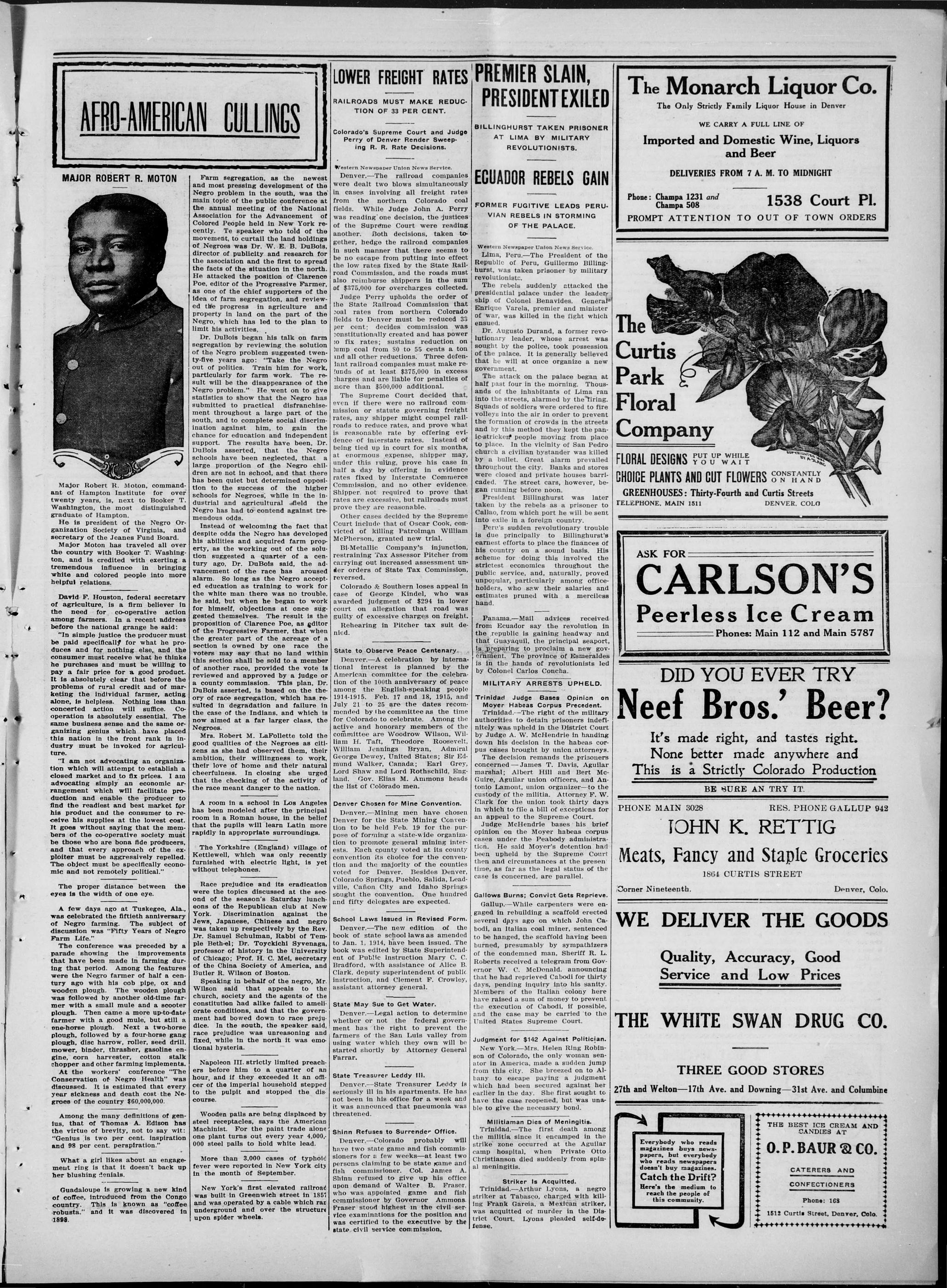
MAJOR ROBERT R. MOTON
[Name]
Major Robert R. Moton, commandant of Hampton Institute for over twenty years, is, next to Booker T. Washington, the most distinguished graduate of Hampton.
He is president of the Negro Organization Society of Virginia, and secretary of the Jeanes Fund Board.
Major Moton has traveled all over the country with Booker T. Washington, and is credited with exerting a tremendous influence in bringing white and colored people into more helpful relations.
David F. Houston, federal secretary of agriculture, is a firm believer in the need for co-operative action among farmers. In a recent address before the national grange he said:
"In simple justice the producer must be paid specifically for what he produces and for nothing else, and the consumer must receive what he thinks he purchases and must be willing to pay a fair price for a good product. It is absolutely clear that before the problems of rural credit and of marketing the individual farmer, acting alone, is helpless. Nothing less than concerted action will suffice. Cooperation is absolutely essential. The same business sense and the same organizing genius which have placed this nation in the front rank in industry must be invoked for agriculture.
"I am not advocating an organization which will attempt to establish a closed market and to fix prices. I am advocating simply an economic arrangement which will facilitate production and enable the producer to find the readiest and best market for his product and the consumer to receive his supplies at the lowest cost. It goes without saying that the members of the co-operative society must be those who are bona fide producers, and that every approach of the exploiter must be aggressively repelled. The object must be specifically economic and not remotely political."
The proper distance between the eyes is the width of one eye.
A few days ago at Tuskegee, Ala., was celebrated the fiftieth anniversary of Negro farming. The subject of discussion was "Fifty Years of Negro Farm Life." The conference was preceded by a parade showing the improvements that have been made in farming during that period. Among the features were the Negro farmer of half a century ago with his cob pipe, ox and wooden plough. The wooden plough was followed by another old-time farmer with a small mule and a scooter plough. Then came a more up-to-date farmer with a good mule, but still a one-horse plough. Next a two-horse plough, followed by a four-horse gang plough, disc harrow, roller, seed drill, mower, binder, thrasher, gasoline engine, corn harvester, cotton stalk chopper and other farming implements.
At the workers' conference "The Conservation of Negro Health" was discussed. It is estimated that every year sickness and death cost the Negroes of the country $60,000,000.
Among the many definitions of genius, that of Thomas A. Edison has the virtue of brevity, not to say wit: "Genius is two per cent. inspiration and 98 per cent. perspiration."
What a girl likes about an engagement ring is that it doesn't back up her blushing denials.
Guadaloupe is growing a new kind of coffee, introduced from the Congo country. This is known as "coffee robusta." and it was discovered in 1898.
Farm segregation, as the newest and most pressing development of the Negro problem in the south, was the main topic of the public conference at the annual meeting of the National Association for the Advancement of Colored People held in New York recently. Te speaker who told of the movement, to curtail the land holdings of Negroes was Dr. W. E. B. DuBols, director of publicity and research for the association and the first to spread the facts of the situation in the north. He attacked the position of Clarence Poe, editor of the Progressive Farmer, as one of the chief supporters of the idea of farm segregation, and reviewed the progress in agriculture and property in land on the part of the Negro, which has led to the plan to limit his activities.
Dr. DuBois began his talk on farm segregation by reviewing the solution of the Negro problem suggested twenty-five years ago: "Take the Negro out of politics. Train him for work, particularly for farm work. The result will be the disappearance of the Negro problem." He went on to give statistics to show that the Negro has submitted to practical disfranchisement throughout a large part of the south, and to complete social discrimination against him, to gain the chance for education and independent support. The results have been, Dr. DuBois asserted, that the Negro schools have been neglected, that a large proportion of the Negro children are not in school, and that there has been quiet but determined opposition to the success of the higher schools for Negroes, while in the industrial and agricultural field the Negro has had to contend against tremendous odds.
Instead of welcoming the fact that despite odds the Negro has developed his abilities and acquired farm property, as the working out of the solution suggested a quarter of a century ago, Dr. DuBois said, the advancement of the race has aroused alarm. So long as the Negro accepted education as training to work for the white man there was no trouble, he said, but when he began to work for himself, objections at once suggested themselves. The result is the proposition of Clarence Poe, as editor of the Progressive Farmer, that when the greater part of the acreage of a section is owned by one race the voters may say that no land within this section shall be sold to a member of another race, provided the vote is reviewed and approved by a judge or a county commission. This plan, Dr. DuBois asserted, is based on the theory of race segregation, which has resulted in degradation and failure in the case of the Indians, and which is now aimed at a far larger class, the Negroes.
Mrs. Robert M. LaFollette told the good qualities of the Negroes as citizens as she had observed them, their ambition, their willingness to work, their love of home and their natural cheerfulness. In closing she urged that the checking of the activity of the race meant danger to the nation.
A room in a school in Los Angeles has been modeled after the principal room in a Roman house, in the belief that the pupils will learn Latin more rapidly in appropriate surroundings.
The Yorkshire (England) village of Kettlewell, which was only recently furnished with electric light, is yet without telephones.
Race prejudice and its eradication were the topics discussed at the second of the season's Saturday luncheons of the Republican club at New York. Discrimination against the Jews, Japanese, Chinese and negro was taken up respectively by the Rev. Dr. Samuel Schulman, Rabbi of Temple Beth-ei; Dr. Toyckichi Syvenaga, professor of history in the University of Chicago; Prof. H. C. Mel, secretary of the China Society of America, and Butler R. Wilson of Boston.
Speaking in behalf of the negro, Mr Wilson said that appeals to the church, society and the agents of the constitution had alike failed to ameliorate conditions, and that the government had bowed down to race prejudice. In the south, the speaker said, race prejudice was unreasoning and fixed, while in the north it was emotional hysteria.
Napoleon III. strictly limited preachers before him to a quarter of an hour, and if they exceeded it an officer of the imperial household stepped to the pulpit and stopped the discourse.
Wooden pails are being displaced by steel receptacles, says the American Machinist. For the paint trade alone one plant turns out every year 4,000,000 steel pails to hold white lead.
More than 3,000 cases of typhoid fever were reported in New York city in the month of September.
New York's first elevated railroad was built in Greenwich street in 1857 and was operated by a cable which ran underground and over the structure upon spider wheels.
LOWER FREIGHT RATES
RAILROADS MUST MAKE REDUCTION OF 33 PER CENT.
Colorado's Supreme Court and Judge Perry of Denver Render Sweeping R. R. Rate Decisions.
Western Newspaper Union News Service.
Denver.—The railroad companies were dealt two blows simultaneously in cases involving all freight rates from the northern Colorado coal fields. While Judge John A. Perry was reading' one decision, the justices of the Supreme Court were reading another. Both decisions, taken together, hedge the railroad companies in such manner that there seems to be no escape from putting into effect the low rates fixed by the State Railroad Commission, and the roads must also reimburse shippers in the sum of $275,000 for overcharges collected.
Judge Perry upholds the order of the State Railroad Commission that coal rates from northern Colorado fields to Denver must be reduced 33 per cent; decides commission was constitutionally created and has power to fix rates; sustains reduction on pump coal from 80 to 55 cents a ton and all other reductions. Three defendant railroad companies must make refunds of at least $375,000 in excess charges and are liable for penalties of more than $500,000 additional.
The Supreme Court decided that, even if there were no railroad commission or statute governing freight rates, any shipper might compel railroads to reduce rates, and prove what is reasonable rate by offering evidence of interstate rates. Instead of being tied up in court for six months, at enormous expense, shipper may, under this ruling, prove his case in half a day by offering in evidence rates fixed by Interstate Commerce Commission, and no other evidence. Shipper, not required to prove that rates are excessive, but railroads must prove they are reasonable.
Other cases decided by the Supreme Court include that of Oscar Cook, convicted of killing Patrolman William McPherson, granted new trial.
Bi-Metallic Company's injunction, restraining Tax Assessor Pitcher from carrying out increased assessment under orders of State Tax Commission, reversed. Colorado & Southern loses appeal in case of George Kindel, who was awarded judgment of $294 in lower court on allegation that road was guilty of excessive charges on freight. Rehearing in Pitcher tax suit denied.
State to Observe Peace Centenary
State to Observe Peace Centenary
Denver.—A celebration by international interest is planned by the American committee for the celebration of the 100th anniversary of peace among the English-speaking people 1914-1915. Feb. 17 and 18, 1915, and July 21 to 25 are the dates recommended by the committee as the time for Colorado to celebrate. Among the active and honorary members of the committee are Woodrow Wilson, William H. Taft, Theodore Roosevelt, William Jennings Bryan, Admiral George Dewey, United States; Sir Edmund Walker, Canada; Earl Grey, Lord Shaw and Lord Rothschild, England. Gov. Elias M. Animons heads the list of Colorado men.
Denver Chosen for Mine Convention.
Denver.—Mining men have chosen Denver for the State Mining Convention to be held Feb. 19 for the purpose of forming a state-wide organization to promote general mining interests. Each county voted at its county convention its choice for the convention and the majority of the counties voted for Denver. Besides Denver, Colorado Springs, Pueblo, Salida, Leadville, Cañon City and Idaho Springs sought the convention. One hundred and fifty delegates are expected.
School Laws Issued in Revised Form
Denver.—The new edition of the book of state school laws as amended to Jan. 1, 1914, have been issued. The book was edited by State Superintendent of Public Instruction Mary C. C Bradford, with assistance of Alice B. Clark, deputy superintendent of public instruction, and Clement F. Crowley, assistant attorney general.
State May Sue to Get Water.
Denver.—Legal action to determine whether or not the federal government has the right to prevent the farmers of the San Luis valley from using water which they own will be started shortly by Attorney General Farrar.
State Treasurer Leddy III.
Denver.—State Treasurer Leddy is seriously ill in his apartments. He has not been in his office for a week and it was announced that pneumonia was threatened.
Shinn Refuses to Surrender Office.
Denver.—Colorado probably will have two state game and fish commissioners for a few weeks—at least two persons claiming to be state game and fish commissioner. Col. James A. Shinn refused to give up his office upon demand of Walter B. Fraser, who was appointed game and fish commissioner by Governor Ammons. Fraser stood highest in the civil service examinations for the position and was certified to the executive by the state civil service commission.
PREMIER SLAIN, PRESIDENT EXILED
BILLINGHURST TAKEN PRISONER
AT LIMA BY MILITARY
REVOLUTIONISTS.
EGUADOR REBELS GAIN
FORMER FUGITIVE LEADS PERUVIAN REBELS IN STORMING OF THE PALACE.
Western Newspaper Union News Service.
Lima, Peru.—The President of the Republic of Peru, Guillermo Billinghurst, was taken prisoner by military revolutionists.
The rebels suddenly attacked the presidential palace under the leadership of Colonel Benavides. General Enrique Varela, premier and minister of war, was killed in the fight which ensued.
Dr. Augusto Durand, a former revolutionary leader, whose arrest was sought by the police, took possession of the palace. It is generally believed that he will at once organize a new government.
The attack on the palace began at half past four in the morning. Thousands of the inhabitants of Lima ran into the streets, alarmed by the firing. Squads of soldiers were ordered to fire volleys into the air in order to prevent the formation of crowds in the streets and by this method they kept the panic-streaker people moving from place to place. In the vicinity of San Pedro church a civilian bystander was killed by a bullet. Great alarm prevailed throughout the city. Banks and stores were closed and private houses barricaded. The street cars, however, began running before noon. President Billinghurst was later taken by the rebels as a prisoner to Callao, from which port he will be sent into exile in a foreign country.
Peru's sudden revolutionary trouble is due principally to Billinghurst's earnest efforts to place the finances of his country on a sound basis. His scheme for doing this involved the strictest economics throughout the public service, and, naturally, proved unpopular, particularly among officeholders, who saw their salaries and estimates pruned with a merciless hand.
Panama.—Mail advices received from Ecuador say the revolution in the republic is gaining headway and that Guayaquil, the principal seaport, is preparing to proclaim a new government. The province of Esmeraldes is in the hands of revolutionists led by Colonel Carlos Concha.
MILITARY ARRESTS UPHELD.
Trinidad Judge Bases Opinion on Moyer Habas Corpus President
Moyer Habeas Corpus Precedent.
Trinidad.—The right of the military authorities to detain prisoners indefinitely was upheld in the District Court by Judge A. W. McHendrie in handing down his decision in the habeas corpus cases brought by union attorneys. The decision remands the prisoners concerned — James T. Davis, Aguilar marshal; Albert Hill and Bert McGuire, Aguilar union officers, and Antonio Lamont, union organizer—to the custody of the militia. Attorney F. W. Clark for the union took thirty days in which to file a bill of exceptions for an appeal to the Supreme Court.
Judge McHendrie bases his brief opinion on the Moyer habeas corpus cases under the Peabody administration. He said Moyer's detention had been upheld by the Supreme Court then and circumstances at the present time, as far as the legal status of the case is concerned, are parallel.
Gallows Burns: Convict Gets Reprieve
Gallows Burns, Convict Gets Repreverse
Gallup.—While carpenters were engaged in rebuilding a scaffold erected several days ago on which John Cabodi, an Italian coal miner, sentenced to be hanged, the scaffold having been burned, presumably by sympathizers of the condemned man, Sheriff R. L. Roberts received a telegram from Governor W. C. McDonald, announcing that he had reprieved Cabodi for thirty days, pending inquiry into his sanity. Members of the Italian colony here have raised a sum of money to prevent the execution of Cabodi, if possible, and the case may be carried to the United States Supreme Court.
Judgment for $142 Against Politician.
Judgment for $142 Against Politician.
New York,—Mrs. Helen Rink Robinson of Colorado, the only woman senator in America, made a sudden jump from this city. She breezed on to Albany to escape paying a judgment which had been secured against her earlier in the day. She first sought to have the case reopened, but was unable to give the necessary bond.
Militiaman Dies of Meningitis
Trinidad.-The first death among the militia since it encamped in the strike zone occurred at the Aguilar camp hospital, when Private Otto Christianson died suddenly from spinal meningitis.
Striker Is Acquitted.
Trinidad.-Arthur Lyons, a negro striker at Tabasco, charged with killing Frank Gareia, a Mexican striker, was acquitted of murder in the District Court. Lyons pleaded self-defense.
The Monarch Liquor Co.
The Only Strictly Family Liquor House in Denver
Imported and Domestic Wine, Liquors and Beer
Phone: Champa 1231 and Champa 508 1538 Court Pl.
PROMPT ATTENTION TO OUT OF TOWN ORDERS
The
Curtis
Park
Floral
Company
FLORAL DESIGNS PUT UP WHILE
YOU WAIT
CHOICE PLANTS AND CUT FLOWERS CONSTANTLY
ON HAND
GREENHOUSES: Thirty-Fourth and Curtis Streets
TELEPHONE, MAIN 1511
DENVER, COLO
CARLSON'S Peerless Ice Cream Phones: Main 112 and Main 5787
It's made right, and tastes right. None better made anywhere and This is a Strictly Colorado Production
JOHN K. RETTIG
Fancy and Staple G
1864 CURTIS STREET
month.
DELIVER THE C
uality, Accuracy, Go
service and Low Price
WHITE SWAN DRU
Meats, Fancy and Staple Groceries 1864 CURTIS STREET
WE DELIVER THE GOODS
Quality, Accuracy, Good Service and Low Prices
THE WHITE SWAN DRUG CO.
THREE GOOD STORES
17th Ave. and Downing—31st Ave.
27th and Welton—17th Ave. and Downing—31st Ave. and Columbine
Everybody who reads magazines buys newspapers, but everybody who reads newspapers doesn't buy magazines.
Catch the Drift?
Here's the medium to reach the people of this community.
THE BEST ICE CREAM AND CANDIES AT
O.P. BAUR & CO.
CATERERS AND
CONFECTIONERS
Phone: 163
1512 Curtis Street, Denver, Colo.
PHONE MAIN 3028
JOH
Meats, Fane
Corner Nineteenth.
WE DELI
Quality
Service
THE WHITE
27th and Welton—17th
BE SURE AN TRY IT.
RES. PHONE GALLUP 942
RETTIG
Staple Groceries
STREET
Denver, Colo.
THE GOODS
Lacy, Good
Low Prices
AN DRUG CO.
ning—31st Ave. and Columbine
THE COLORADO STATESMAN
COME HIGH HAIL WE FREE
COME A COUNTRY PARTY
JOS. L. D. RIVERS.....Proprietor
1824 Curtis Street, Room 25.
Phone Main 7417.
SUBSCRIPTION RATES:
One Year ..... $2.00
Six Months ..... 1.00
Taree Months ..... .60
PAYABLE IN ADVANCE.
Entered as second-class matter at Colorado.
Display advertising, 50 cents per inch.
Reading notices, ten lines or less, 10 over ten lines, 5 cents per line.
No discounts allowed on less than three pany all orders from parties unknown to
Remittances should be made by Ex Order, Registered Letter or Bank Draft, same as cash for the fractional part of a taken.
Communications to receive attention lects, plainly written only upon one side if possible, anyway, not later than Wedn author. No manuscript returned, unless
It occasionally happens that papers in case you do not receive any number we will cheerfully forward a duplicate c
old-class matter at the postoffice
50 cents per inch. An inch contains
ten lines or less, 10 cents per line
per line.
On less than three months' contract parties unknown to us. Further pay
could be made by Express Money Order or Bank Draft. Postage stamps fractional part of a dollar. Only 14 cents.
To receive attention must be news, only upon one side of the paper; not later than Wednesdays, and be not returned, unless stamps are sent.
Appens that papers sent to subscrib
receive any number when due, inform
a duplicate of the missing
Entered as second-class matter at the postoffice in the city of Denver, Colorado.
Display advertising, 50 cents per inch. An inch contains twelve agate lines.
Reading notices, ten lines or less, 10 cents per line. Each additional line over ten lines, 5 cents per line.
No discounts allowed on less than three months' contract. Cash must accompany all orders from parties unknown to us. Further particulars on application.
Remittances should be made by Express Money Order, Postoffice Money Order, Registered Letter or Bank Draft. Postage stamps will be received the same as cash for the fractional part of a dollar. Only 1-cent and 2-cent stamps taken.
Communications to receive attention must be newsy, upon important subjects, plainly written only upon one side of the paper; must reach us Tuesdays, if possible, anyway, not later than Wednesdays, and bear the signature of the author. No manuscript returned, unless stamps are sent for postage.
It occasionally happens that papers sent to subscribers are lost or stolen. In case you do not receive any number when due, inform us by postal card and we will cheerfully forward a duplicate of the missing number.
THE WATER QUESTION.
The Colorado Statesman has always to his individual opinion on the Taxpayer ownership of the water plant. It is the have opinions but to express them. It is by his vote how his money should be spent who came into our beautiful city by the middle vaporings that they should rule or citizens who have the interests of Denver a time and energy in making this the "Quip up and put these renegades to flight, simple. It is universally acknowledged assets is its splendid and ample supply of different parts of the country have testified ver's water from foreign elements inmimic made of this city's supply of water has purest and best supplies in the world.
The Colorado Statesman submits a new water plant; the estimate of the $12,750,000 to install a new plant. It westerest on the first cost for this length minimum period of construction; the co with a new system would be $1,000,000, v618,750. The appraised value of the water was $14,400,000, which by purchasing the of $2,218,750. Will Mr. Voter, will Mr. and govern himself accordingly?
atesman has always conceded the salon on the Taxpayers' Association plant. It is the right of every express them. It is the right of every money should be spent, but these beautiful city by the box-car route they should rule or ruin and it is a meresthes of Denver at heart, who has taking this the "Queen City of the negades to flight. They are obviously acknowledged that one of D and ample supply of pure water, country have testified to the freedom elements inimical to health; e supply of water has demonstrates lies in the world.atesman submits a few figures on the estimate of the city engineer a new plant. It would take five last for this length of time would construction; the cost to the cons would be $1,000,000, which would maid value of the water company's by purchasing there would be a Mr. Voter, will Mr. Taxpayer, ponce accordingly?
The Colorado Statesman has always conceded the right of every citizen to his individual opinion on the Taxpayers' Association plan of municipal ownership of the water plant. It is the right of every citizen not only to have opinions but to express them. It is the right of every taxpayer to say by his vote how his money should be spent, but these loud-mouthed agitators who came into our beautiful city by the box-car route seem to think by their idle vaporings that they should rule or ruin and it is time that all good citizens who have the interests of Denver at heart, who have spent their money, time and energy in making this the "Queen City of the Plains" should wake up and put these renegades to flight. They are obstructionists pure and simple. It is universally acknowledged that one of Denver's most valuable assets is its splendid and ample supply of pure water. Strangengers from different parts of the country have testified to the freedom from germs of Denver's water from foreign elements inimical to health; every chemical analysis made of this city's supply of water has demonstrated it to be one of the purest and best supplies in the world.
The Colorado Statesman submits a few figures on the cost of installing a new water plant; the estimate of the city engineers is that it will cost $12,750,000 to install a new plant. It would take five years to build; the interest on the first cost for this length of time would be $2,868,750 for the minimum period of construction; the cost to the consumers for connecting with a new system would be $1,000,000, which would make the total cost $16,618,750. The appraised value of the water company's system four years ago was $14,400,000, which by purchasing there would be a saving to the taxpayer of $2,218,750. Will Mr. Voter, will Mr. Taxpayer, ponder over these figures and govern himself accordingly?
BUYING FOR THE CHILDREN.
Have you ever stopped to consider the of Municipalities Buy Public Service Inspection purchase should be the same as the real principle involved is exactly the same, can improve his condition and enlarge his with the knowledge that he can sell it a can leave it for the enjoyment of his father the purchase with a laudable and worth for a man to be able to give his children does not purchase what he already has nor that which, after his own beneficialment of his family. There are some the own right. They are the things which the official uses and the things which every enjoying, but which every citizen may not tract. The public welfare demands that the city for the enjoyment of its citizen the public schools, public parks, public common to every citizen and the legitimary individual cannot provide these and, therefore, they become the proper airtation.
But citizens can be provided by prfessary private benefits and comforts, such as the city undertake to provide these things natural cost, or why should the citizen constime that the city may purchase or build fits are already privately supplied?
The citizen who voluntarily taxes for these purchases is not buying anything to the children will have to pay rent for them. The doting father who buys a house the son will reap the benefit, but if he be a joint purchaser of a public water plant, he had before.
There is a wiser way for municipal connection with public service institution that will properly and equitably control provided. By this means every benefit vidual taxpayer and citizen. Private entiient service where private contract and Otherwise the taxpayer is called upon to own and which he will never get through.
copied to consider the question, "What Public Service Institutions?" That the same as the reason for a private exactly the same. If a man is rented and enlarge his profits by purchase he can sell it again at a profit enjoyment of his family, he strives laudable and worthy reason. It also give his children a start in life at he already has nor that which is his own beneficial use, he cannot. There are some things which are the things which the city administers things which every citizen should every citizen may not be able to prepare demands that these latter benefit of its citizens at a nominal public parks, public libraries, which and the legitimate burden of not provide these benefits without become the proper and rightful sub-
be provided by prIVATE contract and comforts, such as heat, light and provide these things unless it shall the citizen consent to increase by purchase or build the plants we likely supplied? voluntarily taxes himself to enable buying anything that he can learnt to pay rent for them the same as the person who buys a house or a farm for benefit, but if he binds himself by public water plant, he gives his son away for municipalities to serve the service institutions. That is by equitably control the terms upon means benefit possible may be citizen. Private enterprise is the private contract and private use is the is called upon to purchase that I never get through paying for.
Have you ever stopped to consider the question, "Why do the Taxpayers of Municipalities Buy Public Service Institutions?" The reason for a public purchase should be the same as the reason for a private purchase; for the principle involved is exactly the same. If a man is renting a property and can improve his condition and enlarge his profits by purchasing that property with the knowledge that he can sell it again at a profit, or when he dies he can leave it for the enjoyment of his family, he strives and saves and makes the purchase with a laudable and worthy reason. It is really a nice thing for a man to be able to give his children a start in life. But a sensible man does not purchase what he already has nor that which will bring him a profit nor that which, after his own beneficial use, he cannot leave to the enjoyment of his family. There are some things which a city should own in its own right. They are the things which the city administrators need for their official uses and the things which every citizen should have the privilege of enjoying, but which every citizen may not be able to provide by private contract. The public welfare demands that these latter benefits be provided by the city for the enjoyment of its citizens at a nominal cost. They include the public schools, public parks, public libraries, which are all a benefit in common to every citizen and the legitimate burden of the taxpayer. The ordinary individual cannot provide these benefits without public intercession, and, therefore, they become the proper and rightful subjects of public administration.
But citizens can be provided by prIVATE contract with means of necessary private benefits and comforts, such as heat, light and water, why should the city undertake to provide these things unless it shall be at a merely nominal cost, or why should the citizen consent to increase his taxes for a lifetime that the city may purchase or build the plants with which these benefits are already privately supplied?
The citizen who voluntarily taxes himself to enable the city to make these purchases is not buying anything that he can leave to his children, for the children will have to pay rent for them the same as the parent did before them. The doting father who buys a house or a farm for his sons knows that the son will reap the benefit, but if he binds himself by his vote to become a joint purchaser of a public water plant, he gives his son nothing more than he had before.
There is a wiser way for municipalities to serve the public interest in connection with public service institutions. That is by enacting ordinances that will properly and equitably control the terms upon which the service is provided. By this means every benefit possible may be saved to the individual taxpayer and citizen. Private enterprise is the proper and most efficient service where private contract and private use is universally possible. Otherwise the taxpayer is called upon to purchase that which he will never own and which he will never get through paying for.
A MOST TOUCHING APPEAL
falls short of its desired effect if addressed to a small crowd of interested listeners. Mr. Business Man, are you wasting your ammunition on the small crowd that would trade with you anyway, or do you want to reach those who are not particularly interested in your business? If you do, make your appeal for trade to the largest and most intelligent audience in your community, the readers of this paper. They have countless wants. Your ads will be read by them, and they will become your customers. Try it and see.
---
---
letter at the postoffice in the city of Denmark
for inch. An inch contains twelve agate lines
for less, 10 cents per line. Each additional line
in three months' contract. Cash must acco-
nume to us. Further particulars on application
by Express Money Order, Postoffice Mone-
k Draft. Postage stamps will be received
start of a dollar. Only 1-cent and 2-cent stamps.
Attention must be newsy, upon important
one side of the paper; must reach us Tuesday
on Wednesdays, and bear the signature of
unless stamps are sent for postage.
Papers sent to subscribers are lost or sto-
number when due, inform us by postal card
of the missing number.
is always conceded the right of every city to the Taxpayers' Association plan of municipality. It is the right of every citizen not only them. It is the right of every taxpayer to be spent, but these loud-mouthed agitation by the box-car route seem to think by the rule or ruin and it is time that all good in Denver at heart, who have spent their money in the "Queen City of the Plains" should fly flight. They are obstructionists pure knowledge that one of Denver's most valuable supply of pure water. Strangens from it testified to the freedom from germs of Denver is inimical to health; every chemical analyzer has demonstrated it to be one of the world.
permits a few figures on the cost of installation of the city engineers is that it will cost. It would take five years to build; the length of time would be $2,868,750 for the cost to the consumers for connect 100,000, which would make the total cost $2,968,750 the water company's system four years using there would be a saving to the taxpayer till Mr. Taxpayer, ponder over these figures.
consider the question, "Why do the Taxpayer Service Institutions?" The reason for a public service institutions? The reason for a private purchase; for the same. If a man is renting a property to large his profits by purchasing that property sell it again at a profit, or when he dies of his family, he strives and saves and man and worthy reason. It is really a nice thing to children a start in life. But a sensible manly has nor that which will bring him a professional use, he cannot leave to the enjoy some things which a city should own in which the city administrators need for that every citizen should have the privileges it may not be able to provide by private corporations that these latter benefits be provided by citizens at a nominal cost. They include public libraries, which are all a benefit legitimate burden of the taxpayer. They are these benefits without public intercession proper and rightful subjects of public administration by private contract with means of needs, such as heat, light and water, why should the things unless it shall be at a merely now then consent to increase his taxes for a life or build the plants with which these be desired? Taxes himself to enable the city to make anything that he can leave to his children, for them the same as the parent did before as a house or a farm for his sons knows that if he binds himself by his vote to beomer plant, he gives his son nothing more than municipalities to serve the public interest in institutions. That is by enacting ordinance control the terms upon which the services benefit possible may be saved to the private enterprise is the proper and most exact and private use is universally possible upon to purchase that which he will never through paying for.
A MOST TOUCHING APPEAL
falls short of its desired effect if addressed to a small crowd of interested listeners. Mr. Business Man, are you wasting your ammunition on the small crowd that would trade with you anyway, or do you want to reach those who are not particularly interested in your business? If you do, make your appeal for trade to the largest and most intelligent audience in your community, the readers C1 this paper. They have countless wants. Your ads will be read by them, and they will become your customers. Try it and see.
---
THE NEWPORT SALOON
ANNEX CAFE AND LUNCH ROOM
1841-45 ARAPAHOE STREET.
WORK CALLED FOR AND
DELIVERED
TELEPHONE
THE CAPITA
REPAIR
SEWED HALF SOLES
HENRY WARD
TELEPHONE MAIN 7377 THE CAPITAL CITY SHOE REPAIRING CO. SEWED HALF SOLES 60 cts. and 75 cts. HENRY WARNECKE, President
SEWED HALF SOLES 60 cts. and 75 cts.
HENRY WARNECKE, President
1511 CHAMPA STREET DENVER, C
C. H. SHIRLEY, Pres. J. C. HAMPSON, Vic
PAUL J. SHIRLEY, Sec. and Treas.
THE ATLAS DRUG CO
Courteous Treatmet. Right Price
Leaders in Prescription
SHIRLEY, Pres. J. C. HAMPSON, Vice Pres PAUL J. SHIRLEY, Sec. and Treas. THE ATLAS DRUG CO. urteous Treatmet. Right Prices Leaders in Prescription
C. H. SHIRLEY, Pres. J. C. HAMPSON, Vice Pres PAUL J. SHIRLEY, Sec. and Treas.
THE ATLAS DRUG CO.
THE ATLAS DRUG CO.
Courteous Treatmet. Right Prices Leaders in Prescription
CHEVROLET
SHOE RE
1023 EIGHT
We Have the Best Equipped Outfit
Sewed Soles ..... 60c 75c, $1.00
Nailed Soles ..... 50c 65c, 75c
Heels ..... 25c, 35c, 50c
Rubber Heels ..... 50c
Turn Rips ..... 15c to 25c
Patches ..... 15c to 25c
We Use the Best Oak Lether.
REPAIRING WE
WALTER CAR
HOE REPAIRING
1023 EIGHTEENTH ST.
Use the Best Equipped Outfit in the West to Produce the Good
Holes .60c 75c, $1.00
Holes .50c 65c, 75c
.25c, 35c, 50c
Heels .50c
Us .15c to 25c
Us .15c to 25c
Use the Best Oak Lether.
Resolving from heel to heel, entire
new bottom
and heel . $1.50
SHOES MADE TO ORDER.
Tallor Made . $10
WE CAN FIT ANY KIND OF
DEFORMED FOOT.
REPAIRING WHILE YOU WAIT
ALTER CAMBERS
1023
Eighteenth St
SHOE REPAIRING
Paper D STEVE TODOROFF and R Fine Wines, Lio
aper Dollar Bar EVE TODOROFF and RAY BRONSON, Proprietors Wines, Liquors and Cigars
Paper Dollar Bar
STEVE TODOROFF and RAY BRONSON, Proprietors
Fine Wines, Liquors and Cigars
1038 NINETEENTH STREET
Corner Nineteenth and Arapahoe Streets, DENVER, COLORADO
Bolden Bros.' Barber Shop
Rufus Bolden, Mgr. W. D.
Smith, G. C. Craig Artists
BATHS AND ELECTRICAL MASSAGE
QUICK SERVICE
PHONE MAIN 4052
Miss M. Cowden
Hair Dressing Parlor
Shampoo, cutting and curling.
Scalp treatment, hair tonics,
hair straightening, manicuring.
926 19th Street Denver. Near Curtis
Before You Buy Property, Let Lawyer W. B. TOWNSEND
EXAMINE THE TITLE AND MAKE YOUR CONTRACT. LAWYER TOWN-SEND MAKES A SPECIALTY OF COLLECTING FROM INSURANCE COMPANIES, ALSO ENDOWMENT MONIES.
OFFICE 313 KITTREDGE BUILDING
---
A. H.
Store No. 1.
2701 WELTON ST.
Main 895 875
Phone Champa 1156
Only Colored Saloon in Denver.
SHORT ORDERS AT ALL HOURS
CHINESE DISHES OF ALL KINDS
Furnished Rooms in Connection
Miss M. Cowden Hair Dressing Parlor
Shampoo, cutting and curling. Scalp treatment, hair tonics, hair straightening, manicuring. Stage wigs for rent; theatrical use and masquerades. Goods delivered out of the city. All shades of hair matched by sending sample of hair; also combings made up.
Cheapest Switches 50 Cents
1219 21st St. Denver, Colo
DENVER, COLORADO
REPAIRING DONE WHILE
YOU WAIT
DENVER, COLO.
Store No. 2.
26TH AND WELTON
Main 4955 4956
PHONE MAIN 6123—Day or Night
RESIDENCE PHONE YORK 7992.
PARLORS, 1830 ARAPAHOE ST.
THE DOUGLASS
UNDERTAKING
COMPANY
J. R. CONTEE
Pres. and Mgr.
Licensed
Embalmer
Frank Rogers
Assistant
Funeral
Director.
CURTIS M.
HARRIS
Asst. Manager
and Funeral
Director.
Lady Assistant
POLITE SERVICE TO ALL.
Ambulance and Carriages Furnished for All Occasion
AGENTS WANTED
FINE CREOLE HAIR
We are the largest dealers in Creo Hair Goods, Raw Hair by the poultry Electric Combs, etc., in this country. We show a larger variety styles and sell more Fine Creo Wigs than any other manufacturer in the United States.
Write for Catalogue. IT IS FROM SAM WILLER
HUMAN HAIR GOODS CO..
P. O. BOX 298 SHREVE PORT, LA.
Drink Capitol Beer
DENVER'S PRIDE
The CAPITOL BREWING COMPANY
The purity of Capitol Beer is demon-
strated by its superior flavor and
strength-giving qualities. It's capital.
P. O. BOX 298
Drink Capitol Beer DENVER'S PRIDE
Drink Capitol Beer DENVER'S PRIDE
The CAPITOL BREWING COMPANY The purity of Capitol Beer is demon- strated by its superior flavor and strength-giving qualities. It's capital.
HAVE A CASE SENT HOME
The Capitol Brewing Co.
Phone Champa 356 - Delivered Anywhere
Phone Champa 356 Delivered Anywhere
BUY YOUR COAL COKE WOOD HAY AND GRAIN From TOM TURNER
COAL COKE WOOD HAY AND GRAIN From
TOM TURNER Full Weight Guaranteed
Full Weight Guaranteed Telephone Main 3762 2601 Arapahoe Street
PHONE CHAMPA 2570
THE MACEO
F. S. DENTON, PROPRIETOR
FOUNTAIN DRINKS OF ALL KINDS. SHORT ORDERS
CHILE, AND SANDWICHES, AT ALL HOURS.
ORDERS SENT OUT ON SHORT NOTICE
BEST OF SERVICE GUARANTEED
F. S. DENTON, PROPRIETOR
FOUNTAIN DRINKS OF ALL KINDS. SHORT ORDERS
CHILE, AND SANDWICHES, AT ALL HOURS.
ORDERS SENT OUT ON SHORT NOTICE
BEST OF SERVICE GUARANTEED
2721 Welton Street Denver.
DAY OR NIGHT. PHONE MAIN 6243
A. M. LAWHORN
Undertakers
A first-class Mortuary establishment. First aid to the bereaved in the
time of death of loved ones. Prices below competitors. Polite service
DAY OR NIGHT. PHONE MAIN 6243
A first-class Mortuary establishment. First aid to the bereaved in the time of death of loved ones. Prices below competitors. Polite service
PARLORS 1925 Arapahoe Street
2721 Welton Street
Catalogue of the Latest Styles of
---
We are the largest dealers in Creole Hair Goods, Raw Hair by the pound, Electric Combs, etc., in this country. We show a larger variety of styles and sell more Fine Creole Wigs than any other manufacturer in the United States. Write for Catalogue. IT IS FREE
Denver.
THE COLORADO STATESMAN
Rev. Joshua Rice of Coffeyville, Kansas, is visiting his parents.
Mrs. Richard Olliver is very ill at her home, 2603 South Pennsylvania.
O. W. Jackson of Omaha, one of the well-to-do citizens, was in the city on business last week.
Hereford a pleasant journey in the wedded life.
A VOTE FOR THE Moffat Tunnel FERDHARY 15TH
Miss Nellie Beckwith of Colorado Springs was a pleasant caller in Denver this week.
L. E. Boyd of Chicago spent a few days in the city this week with a special party.
Miss Lizzie Combs, who died at the County hospital, Jan. 26, religious service will be held Saturday afternoon from parlors of Douglass Undertaking Co., at 2 p. m.
John Finley died at his late residence, 2421 Court Place, Tuesday, Feb. 3rd of dropsy. Mr. Finley was a member of K. of P. lodge of Kansas City, Mo. Funeral notice later.
The sewing circle of Shorters' A. M. E. church met with Mrs. W. B. Townsend Thursday afternoon. After going through their regular business dainty refreshments were served.
Mr. and Mrs. Clark H. Craig returned home Tuesday from Atchison, where they spent several weeks visiting Mrs. Craig's parents. They report having had an enjoyable visit.
Saturday evening, Jan. 31 Mr. and Mrs. J W. Levell of 2546 South Broadway entertained in honor of Prof. Sam Stewart and Mr. Curtis Harris. The professor put everything but quit on our Christmas present, the late Cecillian piano player.
Mr. J. Louis Johnson was highly entertained by Mr. Sylvester Stewart, manager of the Keystone Social Club, on Thursday of last week. He expressed himself as being very much satisfied and promised to do all in his power to cater to the success of the business men in Denver.
Colonel Alex. Rice, who for the past four years has been employed at the Elks' Club in this city, has resigned his position which took effect yesterday and expects to leave in a few days for Pueblo where he has secured a position with Pueblo lodge, No. 90. The "colonel" has made many friends during his residence in Florence who wish him well in his new location.—Florence Daily Citizen.
The Rocky Mountain Athletic Association entertained Mr. S. S. Stewart, noted pianist, on Tuesday evening of last week after his recital at the People's Presbyterian church. Upwards of two hundred people greeted the gentleman and expressed their opinions of his being second to none in his art. After several introductions to Mr. Stewart, Mr. George Anderson, the pianist of the association entertained. The well wishes and the best of enjoyment was engaged in until the wee sma' hours of the morning. Mr. Victor Walker, manager of the association, in his usual manner contributed to the guests with his eatables and drinkables.
CLUB BALL.
The University Club boys gave their first formal ball at Fern hall Wednesday evening, which was a pronounced success. The attendance was good. The ladies' costumes were beautiful and the wearers appeared to the best advantage. The gentlemen looked very swell in full dress. The managers of this, the first ball given by the University Club boys, were: Messrs B. L. Polk, L. B. DcLoache and J. G. Adams The Morrison orchestra furnished the music. Bright cheer predominated and everyone had an enjoyable evening of exquisite pleasure.
HEREFORD-CARRIE MARRIAGE.
Miss Maude Carrie, one of our society ladies and a modiste of unquestioned ability, was wedded to Robert Hereford, late of Chicago, Wednesday evening at the residence of her parents, Mr. and Mrs. J. W. Carrie, 2609 Lafayette street. Rev. D. E. Over united this happy couple. The relatives and a few intimate friends witnessed the ceremony, after which refreshments were served. The Colorado Statesman wishes Mr. and Mrs.
Hereford a pleasant journey in their wedded life.
MEANS MORE BUSINESS AND PROSPERITY FOR DENVER
The Moffat Tunnel is the KEY to the settlement of the largest undeveloped empire in the West.
The assurance of the building of the Moffat Tunnel will make it possible for the Denver & Salt Lake Railroad to finance the road from its present terminus to Salt Lake City.
This will put Denver on a main Trancontinental Railroad line.
It will open up to settlement more than 5,000 new farms, with abundance of water for irrigation, which our citizens are so badly in need of at the present time. It will increase the population of our State over 250,000 people in the next few years, which will mean work for the unemployed and prosperity for the city of Denver.
The building of the Moffat Tunnel will bring to Denver $4,500,.000.00 to build the Tunnel and $15,000,000.00 to complete the Denver & Salt Lake Railroad to Salt Lake City. This will be new capital to be distributed among our working men, factories and merchants.
It will mean the employment of from 1,500 to 4,000 workmen for three to four years in building the Tunnel. The wages of these men will be spent in Denver.
The citizens of Denver will own the Moffat Tunnel the same as they own the city hall, court house, parks, streets or other city property, without it costing them one dollar.
They will also have the right to the use of the tracts of the Denver & Salt Lake Railroad Company for 30 miles east and 75 miles west of the Tunnel for other railroads at a rental of 3 per cent of the cost of construction.
It will increase the value of the 270,000 acres of school lands located in the territory more than enough to build the Tunnel three times, which will benefit the whole State. THE FAMOUS ROCKY MOUNTAIN ATHLETIC ASSOCIATION has
changed management and hereafter this famous rendezvous of Denver's celebrities, long managed by our genial friend, Mr. Victor Walker, will be managed by Mr. Gasaway Walton and Richard Frazier. These gentlemen have a reputation of long standing in catering to the Bohemian spirit and tendencies of our people and want to assure their many friends that the high standard of service that has made the Rocky Mountain Association famous from Denver to Chicago will be maintained. The present officers of the association are Gasaway Walton, president; Richard Frazier, secretary and treasurer. The Colorado Statesman wishes these gentlemen success in their new venture, located at 2014 Champa street.
SHORTER CHAPEL'S NOTES
Shorter is in the midst of a stiring revival; great crowds are flocking to every service and already the work of soul-saving is well on the way. Rev. J. P. Howard will occupy the pulpit at both services tomorrow. At 11 a. m. he will preach on God's Great Love and at 7:30 p. m. his subject will be "Indecision." It is gratifying to note the deep interest that is being manifested in the meeting by members of all the churches. This is as it should be; since the chief aim of this meeting is to bless Denver irrespective of religious proclivity.
Allen Christian Endeavor Day will be observed by our League tomorrow evening at the usual League hour. A splendid literary program will be rendered, when our young people will appear at their best. A full house should be present to enjoy this feast of good things.
COURT NOTES.
Lee Fulbright, charged with burglary in the City Bank & Trust Company, got a sentence of nine months. Sam Beams, who shot his wife, got a sentence of one day and costs. Nolle Smith recovered a judgment of $71 and costs, against Campbell-Sells Baking Company. W. B. Townsend was the lawyer in the cases, and his success in the criminal cases is the subject of much favorable comment.
"SLUMBER PARTY."
Quite the most unique event of the season occurred last Saturday night at the home of Mr. and Mrs. Jos. D. D. Rivers, when the S. S. girls enjoyed a "Slumber Party." The party met at the home of Miss Diette Williams at 9 o'clock and when all preparations had been made, left for Miss Rivers' home.
On arriving, the party proceeded to make themselves comfortable, donning negligees. Progressive whist was played, Miss Montgomery winning the first prize and Miss Chapman the booby. After other diversions, including music and dancing, the girls sat down to a delightful repast prepared by themselves. The candle-lighted table was tastefully decorated. Comic valentines were substituted as place cards and caused much merriment.
At a late hour the party sought their couches to slumber. They arose late Sunday morning and partook of the splendid breakfast prepared by Mrs. Rivers, who was chaperon of the party.
After many futile efforts to leave such lavish hospitality, the party finally reached town at 1 o'clock and departed for their various homes.
The S. S. Club was organized about a month ago for the purpose of promoting mutual benefit and social activities. Miss Chapman was elected as president; Miss Williams, secretary, and Miss Russ as treasurer. Other members are Miss Corrine Atkinson, Miss Hazel Robinson, Miss Edna Belle, Miss Willa Davis, Miss Ruth Montgomery and Miss Vivian Rivers.
Nicely furnished rooms for rent at 2441-43 Lawrence street. Phone Champa 2783.
For rent a five room frame house at 322 24th street. Apply at 1824 Curtis street, room 25.
Three nicely furnished rooms for light housekeeping at 2929 Glenarm Place. Call at 2815 Arapahoe St.
Brickler's New Barber Shop is located at 2208 Larimer street. Shave, 10. Hair cut, 25c; children, 15c.
THE DE LUXE
Furnished apartments. Two and three rooms, with hot and cold water in each kitchen. Also front room, single, electric lights and gas. Modern throughout. Rates very reasonable, 2352-2358 Odgen street, corner Twenty-fourth avenue. Phone 6707 6707. Mrs. R. M. Blakew.
Diogenes' Tub.
The tub in which Diogenes, the cynic, made his home, was a great earthen jar discarded from the Cybele temple. It had been used for wine or oil for the sacrifice of the temple and was sufficiently large to allow the philosopher a reclining place. The truth of the tale has been called into question, although it is said that during the Peloponnesian war the Athenians dwelt in just such vessels, and that even after the death of Diogenes such receptacles were used as dwelling places by the poor.
Evolution of Billiards
The development of the billiard table has been interesting. In those far back days when billiards seem first to have become an indoor game, a billiard table was about the size of a big room. The average table was 30 feet long and 18 feet wide. The size was gradually and irregularly decreased, until the present standard carom table was introduced at a billiard tournament held in Samson hall, Philadelphia, in 1864.
Alabama Advice:
If you have no section harrow, then sell your shotgun and buy one. We are fond of hunting ourselves, but a farmer who is too poor to own a harrow, or a lawyer who is too poor to buy a book, is certainly not in a financial condition to possess the implements of a sportsman. Feel yourself for your fight with fortune, and get a harrow.
Paint.
Paint is used on houses, park setes, fences and faces. It comes in colors. Red paint is used on towns by young college men and old deacons. Fresh paint is used by children when they have their new clothes on. Paint is also used on sign boards which are put up everywhere to improve the scenery. No American scenery is complete without them.—Life.
Serious Indeed!
Gabe—I saw the doctor's auto in front of your house today." "Anything serious?" Steve —"Serious? Should say so. He collected his bill." Cincinnati Enquirer.
THE MOFFAT TUNNEL
The Moffat Tunnel is the KEY to the settlement of the largest undeveloped empire in the West.
It will open up to settlement more than 5,000 new farms, with abundance of water for irrigation. An opportunity for those of our citizens who want land.
It will increase the population of our State over 250,000 people in the next few years, which will mean work for the unemployed and prosperity for the city of Denver.
We want every man
building of the Mof
The Denver & Salt
cash before any bo
antee to pay all of
Denver and to set
when due.
IT WILL NOT
OF DEN
The Moffat Tu
We want every man and woman to
building of the Moffat Tunnel mean
The Denver & Salt Lake Railroad
cash before any bonds are issued by
antee to pay all of the interest on
Denver and to set aside a Sinking
when due.
T WILL NOT COS
OF DENVER A
The Moffat Tunnel Commit
We want every man and woman taxpayer to make a study of what the building of the Moffat Tunnel means to Denver and Colorado.
The Denver & Salt Lake Railroad Company will put up $1,500,000 in cash before any bonds are issued by the City of Denver. They also guarantee to pay all of the interest on the bonds to be issued by the City of Denver and to set aside a Sinking Fund each year to redeem the bonds when due.
IT WILL NOT COST THE TAXPAYERS OF DENVER A SINGLE DOLLAR
The Moffat Tunnel Committee, Headquarters Albany Hotel
H. C. Radcliff has opened a nice, neat barber shop at his old stand, 1226 18th street. The shop has been remodeled in the latest style, and the only colored shop in the city giving artesian baths. Mr. Radcliff is well known and liked by the citizens of Denver. He solicits the trade of all his friends.
13 CENTS A DAY BUYS A PIANO. WITH MUSIC LESSONS FREE. PIANOS FROM $88 UP. COLUMBINE MUSIC CO., 920-924 15th STREET, CHARLES BUILDING.
AGENTS WANTED
To Sell
MAGIC SHAVING POWDER.
A new discovery for shaving the face and head without using razor or shears.
Will send half pound can by mail, postage paid, for 25 cents in stamps.
WKT.
THE SHAVING POWDER CO.
Savannah, Georgia.
J. H. BIGGINS
Furniture Repairing and Upholstering. All work Cash.
PHONE YORK 7602
1417 East 24th Ave Denver
Telephone Main 8698.
1417 East 24th Ave Denver
Telephone Main 8698.
Seth Hoffman Coal Co.
Dealers in
Coal, Wood, Coke, Hay
Grain
Coal from Sack to Carload Delivered
Anywhere in the City.
Office: 2807 Welton Street
DENVER - COLORADO
The WARD AUCTION COMPANY
The WARD AUCTION COMPANY Sales Daily at 2 p.m. Office Furniture a Specialty.
HAVE MOVED TO—
1723-39 GLENARM ST.
PHONE MAIN 1675.
THE TIVOLI UNION BREWING CO.
DENVER, COLOR.
---
---
VOTE FOR
OFFAT
WILL PUT DENVER
SCONTINENTAL
man and woman taxpayer to meet
fat Tunnel means to Denver
Lake Railroad Company w
bonds are issued by the City of
the interest on the bonds th
aside a Sinking Fund each y
T COST T
VER A SING
nnel Committee, Headq
ERNES
Carpenter, J
Paints, Oils and C
Coal, Wo
1021 21st Street.
COAL AND
2958 Welton S
We handle only the
Grain at
Prompt Deliver an
Give Us a trial
G. M. GOEI
SPECIAL
Carpenter, Job and Repair Work. Paints, Oils and Glass. Glazing Done
We handle only the best of Coal, Wood, Hay and Grain at the Lowest Prices. Prompt Deliver and Full Weight Guaranteed Give Us a trial before ordering elsewhere. G. M. GOEHRING, Proprietor.
SPECIAL BRUSHES MADE TO ORDER
Brushes and
SAM
DENVER B
Branch 1408 Curtis St.
REC
2710
Phone Main
Brushes and Janitor Supplies
SAM FRANCIS, Mgr.
DENVER BRUSH FACTORY
Branch 1408 Curtis St. Champa 770 418 Fifteenth St.
Stop!
Did you ever stop ing to pay the when you bu ing this. Pat
Did you ever stop to think that you are helping to pay the big up town rents when you buy without considering this. Patronize Home Industry
N. FERRY
I PAY SMALL RENT
$20 00 A
Best Goods, Best Work
City of Denver. Give me
I give all my customers p
manship and the BEST
How do I Turn Out Succ
account of THE LOW RENT
$20.00 AND $25.00 SUIT IN THE CITY
Best Goods, Best Workmanship, Best for the money in the
City of Denver. Give me a trial and you will be convinced
I give all my customers perfect Satisfaction, Fit, Style, Work-
manship and the BEST FOR THE MONEY.
How do I Turn Out Such Fine suits for the Money? Why? On
1000 count of THE LOW RENT.
ADVERTISEMENT
The citizens of Denver will own the Moffat Tunnel the same as they own the city hall, courthouse, parks, streets or other city property, without it costing them one dollar.
The building of the Moffat Tunnel will bring to Denver $4,500,000.00 to build the Tunnel and $15,000,000.00 to complete the Denver & Salt Lake Railroad to Salt Lake City. This will be new capital to be distributed among our workingmen, factories and merchants.
payer to make a study of what the
to Denver and Colorado.
company will put up $1,500,000 in
the City of Denver. They also guar-
the bonds to be issued by the City of
und each year to redeem the bonds
AT THE TAXPAYER
SINGLE DOLLAR
e, Headquarters Albany Hotel
NEST HOWARD,
enter, Job and Repair Work.
Is and Glass. Glazing Do
al, Wood and Express.
Phone Cham
NEW
AND FEED STO
8 Welton St. Phone Champa 2121.
only the best of Coal, Wood, Hay
rain at the Lowest Prices.
Deliver and Full Weight Guaran-
Us a trial before ordering elsewhere.
GOEHRING, Proprietor
NAL BRUSHES MAD
ORD
ERNEST HOWARD.
Coal, Wood and Express.
Headquarters for All Kinds of
Bis and Janitor Supply
SAM FRANCIS, Mgr.
CR BRUSH FACTOR
Curtis St. Champa 770 418 Fifteen
REO CLUB
2710=12 Welton St
One Main 2759 Denver, Colo.
REO CLUB
2710=12 Welton St
Phone Main 2759 Denver, Colo.
Consider
er stop to think that you are hay the big up town rent you buy without consider- is. Patronize Home Industry
ALL RENT, DELIVER THE BEST
$20.00 AND $25.00 SUIT IN THE CITY
Best Workmanship, Best for the money in the
er. Give me a trial and you will be convinced
customers perfect Satisfaction, Fit, Style, Work
the BEST FOR THE MONEY.
Turn Out Such Fine suits for the Money? Why?
LOW RENT.
what the
0,000 in
so guar-
City of
the bonds
PAYERS
LAR
Hotel
WARD,
air Work.
Glazing Done
express.
Phone Champa 752
OLD STORE
ampa 2121.
Wood, Hay and
Prices.
Right Guaranteed
elsewhere.
Proprietor.
HES MADE TO
ORDER
Supplies
Gr.
FACTORY
418 Fifteenth St.
JB
St
ver, Colo.
Stop!
r
t you are help-
own rents
consider-
Industry
Phone Main 7411
1905 Curtis Street
THE BEST
IN THE CITY
the money in the
will be convinced
Fit, Fit, Style, Work-
KEY.
Money? Why? On
NEW
A VALENTINE HEART
By Joanna Single
HAT night Nancy returned from the office to find her brother's home, which she shared, full of St. Valentine sentiment. Allan had brought Maude a bracelet and theater tickets—his wife liked such attentions. Helen, her sister of eighteen, was blushing and blissful over Jack Har-
T
ian's extravagance in violets; even Baby May had come from the kindergarten with her fat hands full of lace-paper hearts. And it was the maid's afternoon off, so Maude asked Nancy if she would mind washing the dinner things. And would she be lonely if they all went out and left her with May, already asleep?
Nancy did not mind the dishes or being alone—she saw too many people downtown to want them at night. She thought of her unfinished book and a quiet place by the sitting room fire. However, as she buttoned Maude's theater waist up the back, and later helped Helen pin her mass of violets to her white party dress, and saw them all off, she felt alone—the odd one. She had caught a glimpse of her rather worn face in the glass over Maude's shoulder, and missing its fine strength, saw only the record of twenty-nine years in it. What had been ailing her lately?
With her characteristic refusal to procrastinate, she sat down in the dusk to think it out. She was not going to permit herself to grow into a state of discontent or unhappiness. Certainly every one was kind to her at home—and in the office.
Suddenly she frowned. Perhaps she was letting Flossie, the new stenographer, get on her nerves. The girl.
Flossie,
the New
Stenographer
dimpled, curly-headed, silly, was too obviously trying to attract her employer's attention. Nancy reflected that it was none of her business, but no woman likes a sister woman to make a fool of herself—and no woman can be a man's private secretary for six years without having an interest in his welfare. John Steele deserved a better mate than that—and yet Nancy knew that strong men, past their first youth, were prone to make just such a mistake.
She shook herself free of the thought and returned to herself. The plain fact was that her business gave her little time to cultivate her old friends, mostly married now and engaged in their own affairs. Her brother was wrapped up in his business and family. She, Nancy, was too much alone, growing too introspective. She was losing her individuality and independence, and needed to take more care of herself, mentally and physically.
Still in her black office dress, with its white collar and cuffs, she stretched out a little in the big chair by the fireplace where the fire was low, and, not wanting the lights, sat thinking. She put up her hands in a fashion of her childhood and rumpled her heavy brown hair, usually so trim; her sweet, steady gray eyes filled with tears, which she promptly suppressed. Self-pity, she thought, was the last straw of humiliation! Why should she be sorry for herself? If the office frked her, why not take a rest? Her grandmother had, with the year past, left her a little money. She would resign. Why had she not thought of it before? Flossie could take her place, and she would travel and find broader interests.
Then it came upon her how much John Steele had been in her mind, and she fought it out with herself on the spot. She would not, simply because she was lonely, let her fall in love with the only attractive man near her own age whom she saw much of—and her employer, at that. That was too banal! What would he say when—she resigned? Would he care? He was not so foolish! No; he had showed her every courtesy in the office—the same courtesy he showed to all women, but never the little light attentions he showed even to Flossie, to whom, that very morning, he had,
on entering, tossed a smile and a rose as one would a ball to a kitten.
The girl was so soft and pretty—he could not be blamed. But she, Nancy, would straightway resign before she made a fool of herself. It was high time.
It had grown dark in the room, and she was still lost in planning for the coming year when the doorbell roused her. Flushed and startled, not stopping even to smooth her hair, she went into the hall, where the light burned low. She opened the door.
She did not realize that it was John Steele till he asked, with an attempt at lightness, if he might see Miss Stanton, Miss Nancy Stanton.
"She welcomes you," she answered, lightly enough, deciding he had called to talk business—he often asked her advice, and she knew he had some important matters under consideration. She bade him enter, and he followed her into the sitting room, where she turned on the lights, half blinding herself by the sudden glow. She pointed to the big chair where she had been
She Would Resign
sitting, and then began to resuscitate the fire; but in his mastering way he put her aside and went at it himself. Then he turned and faced her, noting her flush, her lovely disordered hair, her bright, steady eyes. But she returned his gaze, making herself rise to the situation, as he questioned her. "What were you doing in the dark? Where is your family?" "It's St. Valentine's day, and they're out junketing. As to what I was doing, Mr. Steele, if you must know, I was resigning my secretaryship with you. Just as you rang I was wording it—wondering whether to be businesslike and polite, or to say simply, I'm tired of working for you. I want to go abroad this spring, and I intend to do it—let Flossle have my place!" She held up her head and smiled at him. Why couldn't the man say something instead of staring at her?
"You anticipate me," he replied gravely. "I came to discharge you. I don't think I can—keep you in the office any longer. In fact, Nancy," he stammered like a boy, "I can't bear the sight of you in that office a moment longer! Oh, can't you see what a sentimental fool you have made of me? What are you going to do with me? See what I did today—wait a moment!"
He went into the hall while she stood half dazed. What was he trying to say, and bungling it, too, this clear-headed man of business? Was he jesting? He returned with a purple box, which he handed her.
"Soe—victels! The thought of you made me buy them and wonder all day if I dared bring them to you! And here!" He drew something from his pocket. "Here is a lace-paper heart surrounded with doves and roses! Would you mind taking that, too, as part of my general silliness? What do you think of me?" She was very pale now, but waited in silence. "I've done even a madder thing—brought you my heart; all I have, all
They stood a Long Time
I am and ever shall be! Could you manage to work with me instead of for me? Couldn't you love me a little?—no, I mean with all your heart, for you're no halfway woman, Nancy! Will you?" She nodded, hoping she was not going to be foolish enough to cry because she was so happy.
"I think I—could," she murmured. "I think I should like that—even better than—my—present position!" He caught her hands in his and looked at her with delight. The violets fell unheeded to the floor and the lace-paper heart fluttered and fell just out of reach of the fire ready to lick out a lean tongue for it.
Then John Steele suddenly clasped her close in his arms as if he never would let her go. They stood a long time before the fire, then they sat down to talk about it—so many things had to be talked over.
(Copyright, by Associated Literary Press.)
NEW YORK'S POLICE COMISSIONER HAS IDEAS
JUSTICE DEPENDS ON JUDGE. SAYS HUGHES
HE TALKED THE HEAD OUT OF THE BOILER
RODIN IS PIQUED AT FRANCE'S CHILLINESS
The man at the head of the police department of New York is no appren-
and of the police York is no apprentice on the job. In this Douglas I. McKay differs from other men who have been put in charge of the branch of municipal government which is always in the limelight. For 30 months he has been an observer of things from the inside. He was made first deputy police commissioner in June, 1911, and since then he has been a careful student of the police prob-
M.
lem, and the policeman himself. Loyal to the last to his chief, Rhinelander Waldo, today saying nothing to his discredit, there is strong reason to believe that many of the fads that were introduced in the government of the police in the last administration may be abolished by the new man. Waldo had had a previous apprenticeship in the police service as deputy commissioner under General Bingham, but Bingham dominated. Waldo's service was brief, and he was not in a position to learn much about the business. McKay, on the other hand, had been conscientiously trying to learn, and he had a direct way of getting at the bottom of things. He is not likely to be swayed by men, inside of the department, who have axes to grind.
"You'll have many counsellors," one of his friends suggested, after he took charge.
"I know," said Mr. McKay. "I'm seeking suggestions, but I'll know the source of them before I adopt any of them. There will be plenty of advisers from the inside of the force."
The new commissioner is quietly observant. It is recalled that when he became a deputy commissioner he had always at hand a very small scratch pad and a ready pencil, and as he went about among the bureaus and in the precincts he made dainty little notes of what he saw. What he did with the random records thus collected no
On the men who were chosen to administer it and not on the Jaw which
on the law which they administer, depends the equitable dispensation of justice among a people. So Justice Charles E. Hughes of the United States Supreme court told the 500 persons gathered at the Waldorf in New York the other night to honor Edgar M. Cullin, retiring chief judge of the court of appeals. The dinner was given by the Brooklyn Bar association.
A. H.
"We are all anxious to get rid of needless technicalities of the law, to hasten the administration of justice, when it can be hastened without fear of working injustice," said Justice
It takes a good deal to fluster Senator Fletcher of Florida; even then, you'll probably need a little more to do it. Last year he delivered an address before the California Society of Washington city in the main hall of a hotel.
PETER H.
Now, in word painting, the senator is an old master, and, when he touched upon the San Francisco earthquake and sketched the scenes of that dreadful dawn, the goose - flesh pimpled up on his audience and folks began to wriggle in the chairs. Right in the middle of it all there
Auguste Rodin, sculptor, who is now in his seventy-fourth year and whose
world renowned
"Homme au Nez
Casse" is just fifty years old, is by
no means pleased
at not having received from the
French government a definite
reply to his offer
made three years ago to bequeath
all his art collections,
all the original plasters of
his works and also
numerous bronzes, antique
and modern, estimated at a value
of several million
"Homme au Nez Casse" is just fifty years old, is by no means pleased at not having received from the French government a definite reply to his offer made three years ago to bequeath all his art collections, all the original plasters of his works and also numerous bronzes, antique and modern, estimated at a value of several million francs, to the French nation on condition that he be allowed to occupy, at
one knows, but there is a belief that he has them filed away somewhere, convenient when necessary.
The new police commissioner has the bearing and dignity of a well-bred man. He has a gentle, but effective, way of giving orders, and he is not given to boasting of extending to his men "a square deal." They get it, and the patrolmen are enthusiastic over the change. The men realize that they will have a fair hearing concerning their complaints. As a deputy commissioner he had instituted many small reforms which worked to great advantage to the members of the force. One of them was of the "mutual transfer system." A patrolman was not required to go to some politician to procure a transfer to some precinct near his home, but if he could find some other man on the force equally situated he was allowed to make an exchange with him. McKay was always accessible to the men, and he treated them as fellow humans. The other day the writer of this sketch of the new man met a partolman who had been called to headquarters and he was enthusiastic over the change.
"Why," said this man, "Commissioner McKay asked me into his office, said: 'Sit down, officer,' in the friendliest way and during our interview he treated me with the same consideration that he would have given to an inspector. It is a pleasure to work for such a man, and take my word for it, the members of the force will do their best for him. He did not get raw beef to eat in his boyhood, as some of us suspect was the case with Waldo."
Commissioner McKay lives in Manhattan, at 1 Lexington avenue, but admits that he is not running the department for Manhattan alone, but for every borough. He was educated in the public schools and in the City college, and he obtained entrance to West Point by competitive examination from the Thirteenth congressional district. He was in the class of 1901 and graduated, eligible for appointment to the engineering corps. He chose the coast artillery instead and was first assigned to military duty at Fort St. Philip, New Orleans; Fort Barrancas, Florida; Fort Caswell, at the mouth of the Cape Fear river, North Carolina, and at Fortress Monroe, Va.
Hughes. "But more depends on the man sitting in trial on a case than on any rules of procedure which you may lay down. More depends on the traditions behind him than on any statutory enactments.
"If the tradition is that the law is just a game, in which the parties are to play their every card and the one who plays most skilfully wins, then you will have contempt for the law, but an impartial judge, knowing the law and insisting that all that is done shall assist in the administration of justice, will make your system, whatever it may be, one can almost say, dignified and worthy of popular support."
Remarkable.
Miriam—Now you are out here at Lonesomehurst you must fairly revel in fresh vegetables, dear!
Millicent (rapturously)—We do. Would you believe it? (inpressively):
We can buy them almost as cheaply here as we could in the hot city!—Puck.
was a sudden jar of the building, a muffled rumble—and out went the electric lights!
A chaotic jumble of squeals and feminine cries of distress, mingled with the bass of the bewildered males, immediately ensued. Then through the darkness came booming the reassurance of the senator—who had swiftly ascertained the cause of the trouble—
"Ladies and gentlemen," he said, "don't be frightened. I've merely talked the head out of the boiler!"
Elephants for the United States. The maharajah of Mysore is presenting an elephant to the Edinburgh zoo, says the London World, and of the 90 captured in the two kheddahs (for his highness gave a second one afterwards for his personal friends, European and Indian, in Mysore and Bangalore) an American syndicate is buying about 60 for show purposes in the United States.
the present rental of $1,800, his quarters in the historic Hotel Biron, in Paris, and at his death that the Hotel Biron be transformed into a Rodin museum.
M. Rodin has recently added to his collection a marvelous primitive statue of St. Sebastian and three Florentine frescos. He contemplates making still more important acquisitions, and today, while affirming that he is a patriotic Frenchman in every way, he talks to his friends about quitting Paris altogether and going to live in Rome, and he even hinted that he might be queach all his works of art and collections to the city of Rome.
Purchasing Powder.
"I wish some powder for a bomb," said the militant suffragette.
"Quite so," murmured the clerk "What kind?"
"Pink, I guess. That's the shade I always use on my face."
---
When You Want
The Heads, Feet, Tails Snouts, Neckbones or Chiterlings or any other part of the hog except the squeal go to
East's Market
2300.6 Larimer Street.
THE ZO
SAMI
1004 Ninetee
1004 Nineteenth Street, Corner of Curtis
FINE WINES, LIQUORS AND CIGARS COORS' CELEBRATED BEER ON TAP
Champa Phar-
Twentieth and Champa,
Is the place to get your
CHEMICALS AND PATENT M
WE SERVE DRINKS.
Descriptions Our Special
and we will deliver the goods to all parts
JAMES E. THRALL, PR
PHONE MAIN 2426.
To Products Patronize
NG'S NEW BE
NOW ON THE MARK
GRANTED ABSOLUTELY
ed Daily to All Parts of t
Ph. Zang Brewin
The Cha
Twe
I
DRUGS, CHEMICAL
WE S
Prescript
Phone us and we will
JAMES
Prescriptions Our Specialty. Phone us and we will deliver the goods to all parts of the city. JAMES E. THRALL, PROPR. PHONE MAIN 2425.
Boost Colorado Products
ZANG'
NOW O
GUARANTEE
Delivered Date
The Ph. Z
Tele
GUARANTEED ABSOLUTELY PURE Delivered Daily to All Parts of the City
The Ph. Zang Brewing Co.
The Ph. Zang Brewing Co.
Telephone Gallup 395 Colorado You Should ONIZE HOME INDU
We Boost for Colorado PATRONIZ
PATRONIZE HOME INDUSTRY!
SATISFACTION GU
We have been making
established. Every Trunk
Best Made.
WE CARRY A COMPLETE
TELESCOPES, ETC. EVE
Second-hand Trunk
We Repair Trunks, Suit C
If you have any Rep
call and give you
The Welt
SATISFACTIONGUARANTEED or MONEYREFUNDED
We have been making Trunks for fifteen years, and our quality is well established. Every Trunk we sell is strictly Hand-Made, Denver-Made, the Best Made.
WE CARRY A COMPLETE LINE OF SUIT CASES, BAGS, COAT CASES, TELESCOPES, ETC. EVERYTHING GUARANTEED AS REPRESENTED.
Second-hand Trunks Taken in Trade Used Trunks for Sale Cheap.
We Repair Trunks, Suit Cases, Ladies' Pocketbooks, Etc., on Short Notice
The Welton Trunk Factory
2253 Welton St. Phone Champa 2048 Denver, Colo.
Family Liquors, Wines, and Corcials Genuine Goods at Popular Prices A glass of good wine will improve your Sunday dinner, and aid digestion. 2727 Welton Street. Phone Main 6363.
Supply Your Home with the Celebrated Tivoli Beer BOTTLED BY THE EMPIRE BOTTLING CO. Phone Gallup 245
DENVER
```markdown
```
OTHERS'
ROOM
ner of Curtis
Pharmacy
mpa,
our
ENT MEDICINES
DRINKS.
Specialty.
all parts of the city.
L, PROPR.
Patronize Home Industry
BEERS
MARKET
UTELY PURE
parts of the City
ewing Co.
395
You Should Boost for Us
INDUSTRY!
COLORADO!
Made Trunk from
BUILD COLORADO!
Buy a Denver Made Trunk from the Factory and You Will Be Money Ahead.
Phone Main 1461
COLORADO
ABRAHAM LINCOLN
DIED APRIL 15, 1865.
Abraham Lincoln
BORN FEBRUARY 12, 1809. DIED APRIL 15, 1865.
LN'S LIFE
AN INSPIRATION
Will for All Time Be Num-
d With the Greatest of
have frowned, and always poor, he
had been numbered with the greatest
of the earth.
Never in his lifetime regarded as
an orator, he is enrolled among the
most gifted pleaders of all ages.
Never educated, never widely read,
never a traveler, he is conceded to
have been one of the wisest of men.
Never a trained soldier, he commanded in war greater armies than any monarch or general.
Never having had more than local celebrity as a lawyer, he had conceptions of justice that were unknown to distinguished jurists of his time.
Never assuming to be a statesman or an economist, and never until his call to the presidency a successful manager of any enterprise, he became a ruler who will be celebrated forever for wisdom, sagacity and firmness.
Never the author of a verse, he has given us poetry in prose that is imperishable.
The humblest, the least assertive of men, it fell to him in an hour of crushing responsibility as commander-in-chief, by the sovereign stroke of a pen, to put human slavery in the way of extinction.
There is no obscurity in the philosophy of such a life. It touches every human being, high or low, rich or poor, wise or simple, strong or weak. It is the flesh and blood life, the life of struggle, sorrow and achievement. Its lessons are for all.
What have Science, Reason and recondite Theory to offer in place of such a life? Nothing but words, most of them meaningless!
That was my first meeting with Abraham Lincoln.
Mr. Lincoln went into the basement where the landlord had a carpenter shop, and returned with two heavy timbers across his shoulders. With them he made a slide between the wagon and the front doorsteps. He got the piano unloaded, with the assistance of Mr. Linder and Mr. Swett, amid the jokes of the crowd.
Before they had screwed the legs into place, dinner was announced, and the men hurried to the back porch, where there were two tin wash basins, a long roller towel and a coarse comb for the guests.
After dinner Mr. Lincoln superintended the setting up of the piano, and even saw to it that it stood square in the center of the wall space. He received my thanks with a polite bow, and asked. "Do you intend to follow court and give concerts?" The immense relief expressed on his countenance when I assured him that he would not be called upon to move the piano again was very amusing.
"Then may we have one tune before we go?" he asked, and I played 'Rosin the Bow,' with variations.
Some one shouted: "Come on, boys, the judge will be waltzing!" After I had assured them that, if they desired it, I would give my "first and only concert on this circuit" when they returned to the hotel in the evening, the crowd dispersed.
That night I played and sang numerous songs, all of which met with applause. As a finale I sang "He Doeth All Things Well," after which Mr. Lincoln, in a very grave manner, thanked me for the evening's entertainment, and said: "Don't let us spoil that song by any other music tonight." Many times afterward I sang that song for Mr. Lincoln; he was always fond of it—Mrs. J. M. John's "Personal Recollections."
---
Why He Will for All Time Be Numbered With the Greatest of
HERE are characters so great that their memorials are tributes to those who read them. It is so with Abraham Lincoln. To preserve a fame that is undying, the appropriation by congress of $2,000,000 was not
HERE are characters so great that their memorials are tributes to those who read them. It is so with Abraham Lincoln. To preserve a fame that is undying, the appropriation by congress of $2,000,000 was not needed. As proof of a nation's grateful appreciation it was wise and generous.
We hear much these days of philosophy, most of it not understandable. There are societies that study profoundly and profess to comprehend. These circles are small and the results that they gain are uncertain.
But the philosophy of a life like Lincoln's takes hold upon millions; it abides in the hearts and minds of men; it influences nations; it inspires whole races. In comparison with it what other is worth while?
Born in wretched poverty, an ill-favored child upon whom and whose parents our learned professors would
Concert Singer Tells How Abraham Lincoln Helped to Move Her Piano.
HEN court was in session in Decatur, Ill., Judge Davis presided. Court week was always looked for with great interest by the people of the county seat. It was customary for the entire bar of the district to fol-
HEN court was in session in Decatur, Ill., Judge Davis presided. Court week was always looked for with great interest by the people of the county seat. It was customary for the entire bar of the district to follow the court from county to county; but although most of the lawyers traveled to only three or four counties, Judge Davis, Mr. Lincoln, and Leonard Swett went the whole circuit; Dav's because he had to, Lincoln because he loved it, and Swett because he loved their company.
It was in court week that my plano arrived in Decatur. The wagon backed up to the steps of the Macon house, where I was staying, but the question how to unload it puzzled the landlord. Just then the court adjourned and a crowd appeared. The men gathered curiously around the wagon that blocked the entrance. "There is a piano in that box that this woman here wants some one to help unload," explained the landlord. "Who will lend a hand?"
A tall gentleman stepped forward, and throwing off a gray Scotch shawl, said, "Come on, Swett, you are the most highest man."
IS A MONEY-MAKER
Big Increase in Coinage Due to "Buffalo Nickel."
Change Made In Dies for Popular Piece—Director of Mint Surprised That Recasting of Coin Should Excite Newspapers.
Washington. — The new "buffalo nickel" has been a money-maker for Uncle Sam.
The credit side of the big ledger in the treasury department devoted to the accounts of the coinage of nickels and pennies in the various mints of the country shows an increase of almost $1,000,000, and the new nickel played a prominent part in this increase. This is according to the figures of the annual report that Director of the mint George E. Roberts is now compiling.
The "profit" in the coinage of nickels and pennies for the past fiscal year was $3,417,667, and that for the year preceding was approximately $2,500,000. In the fiscal year of 1913 the output of nickels was $2,861,768.55. In the year before it was $1,392,188.20, and the increase was due to the coinage of the new pieces, the first of which were issued last February.
"This 'profit' is not really a profit," said Director Roberts the other day. "The proper term is 'seniorage,' and it represents the value of the issue over the cost of the metal."
A new issue of coins has to be run for 25 years before any of the administrative officials can make a change. This is provided by law. Congress
PETER H.
George E. Roberts.
may order a new coin whenever it sees fit, but unless the lawmakers order differently the "buffalo nickel" will continue to be coined for the next quarter century.
Mr. Roberts was surprised at the prominence that the newspapers of the country have given recently to the fact that a change has been made in the dies of the "buffalo nickel."
"The coin is slightly different now from what it was when it first appeared," said Director Roberts, taking up two nickels that lay on his desk.
"This is the coin of the first issue that appeared last February. It was made first in New York. The die was made under the supervision of J. E. Fraser, the artist who designed the coin. When it came out we saw that the outlines of the coin were not as distinct as they might be. Particularly the lettering in the words, five cents,' under the buffalo, was a trifle hazy, and there were certain other places that were not clear cut.
"We were much pleased with the coin, and felt an indisposition to make any change, but at the same time we felt that some changes might be practical.
"So we set the die cutters in the mint to work making the lettering a little more distinct. You can see the difference if you look closely," he said, taking up the second of the coins. "All of the lettering is more clearly cut and even some of the lines in the buffalo and the background were brought out more distinctly.
"But this is not 'news,' it's history, and I'm surprised that the papers should have taken it up at this time. The recutting of the dies was done in April, and the new coins have been coined ever since as you see them now."
a century ago, according to a report just received by the National Geographic society. It tells the story of the remarkable development of those islands since the American flag was unfurled over them.
The report shows their commerce exceeds $300,000,000, or more than that of the United States in any year prior to 1850; American capital invested in them aggregate approximately $400,000,000; they ship to the United States $100,000,000 of their products every year, and take in exchange products of about equal value.
The feature of the report is the development of Porto Rico, Hawaii and the Alaskan islands. It shows when Porto Rico came under American possession 15 years ago there was but one building in the island erected for school purposes, while today there are 1,200 such buildings. There were 25,000 pupils enrolled in the public schools in the first year of American
administration, now there are 175,000.
Then there was but one good road of
40 miles; now there are about 1,000
miles of good roads. Production of
sugar has grown from 65,000 tons a
year to 365,000. The foreign com-
merce was about $25,000,000 a year;
now it is nearly $100,000,000. Then
the island bought about $2,500,000
worth of American products a year;
now nearly $40,000,000.
Do You Know That-
According to the report, Hawaii has been extremely prosperous since it came permanently under the American flag in 1900. The assessed value of property increased one-half, the value of the sugar crop more than doubled, deposits in banks trebled and in savings banks quadrupled. Hawaii's irrigation system is the marvel of the engineering world, and the quantity of sugar produced per acre far exceeds that of any other spot on the globe.
The COLORADO STATESMAN
"The Alaskan islands and mainland," says the report, "cost us $7,500,000, an expenditure that many believed to be quite unjustifiable, yet for many years the annual value of the sealskins alone approximated the cost of the entire area, while at present the value of the canned salmon sent us from Alaska in a single year is twice as much as the entire possession cost."
IS PREPARED TO DO ALL KINDS OF
JOB PRINTING
Only 27 per cent. of the tillable land of the United States is actually under
cultural, based upon reports of 35,000 correspondents. These reports were obtained in order to gain information as to the tillable area of the United States, the amount of land that cannot be used for crops that have to be plowed, but available for pasture or fruits, and the total number of acres that never can be used for agricultural purposes. From the returns, which were generally very consistent, preliminary estimates have been made for each state and for the United States. Further investigation in the far western states may modify somewhat the present estimate for those states.
Commercial, Fraternal, Church, Book and Stationery Jobs A SPECIALTY
The entire United States, excluding foreign possessions, contains about 1,900,000,000 acres. Of this area about 60 per cent, or 1,140,000,000 acres is estimated to be tillable, that is capable of being brought under cultivation by means of the plow. This includes land already under such cultivation and that which in the future may be brought under cultivation by clearing, drainage, irrigation, etc.
Ball and Concert Programs, Bill and Letter Heads, Calling Cards, Wedding Cards, Envelopes and Everything in the Printing Line Turned Out in the Neatest and Best Style Promptly on Short Notice.
Three hundred and sixty-one million acres or 19 per cent., are estimated to be nontillable but valuable for pasture or fruits. Only 21 per cent, or 399,000,000 acres, was estimated to be of no use for agriculture present or future.
According to the census of 1909 the land area in crops where acreage was given was 311,000,000 acres. This is about 16 per cent. of the total land area or about 27 per cent. of the estimated potential tillable area of the United States, excluding foreign possessions.
In other words, for every 100 acres that are now tilled, about 375 acres may be tilled when the country is fully developed. In the development of the agriculture of the country the land which was most easily brought into a state of cultivation as the great Mississippi valley, was the first to be brought into such use. Extension of tilled area will be at greater expense for clearing, drainage, irrigation, etc. The increased production of the future will be the result of increased yields per acre as well as extension of area.
We Have Supplied Our Office with New Job Press & Type of Up-to-Date Style and Our Work Will Be on a Par with the Very Best.
A vocational guidance bureau which will assist school children and other persons to obtain the employment to which they are best adapted has Bureau Will Help Worker.
Give Us a Trial and We Will Give You Satisfaction
Experts will analyze the temperament and capabilities of applicants and advise them as to the calling in which they are likely to succeed. An employment office, operated in connection with the bureau and supported by employers throughout the country, then will find jobs for the applicants in the callings suggested.
This work, which has been founded by a local body of philanthropists, is expected to aid particularly young persons who lack definite alms and parental advice, older persons who are "drifting without getting anywhere" in callings to which, perhaps, they are unsuited, and such "down and outs" as desire to start over again.
Prices as Reasonable as Those of Any Job Office in Denver
Gustave Blumenthal has been engaged as the bureau analyst. He will "size up" the character and attainments of the applicant, who will be required to furnish minute information concerning his education, tastes, attainments and experience. When the analyst determines what calling would afford the best opportunities for the applicant the case will be referred to a board of counselors who are business and professional men and women.
The counselor representing the calling designated by the analyst will judge the applicant and his chances of making good. If the judgment is favorable the applicant will be returned to the bureau with an indorsement and the employment office then will find him a job.
When the applicant obtains employment he will become the subject of the bureau's follow-up system of reports. If he makes good the bureau will be through with him. If he fails to progress the bureau will re-examine him and endeavor to start him along more successful lines.
The Proper Basis of Water Plant Valuation Is the Average Value Per Mile of Mains
Opponents of the Retail Plan for early Mu= nipal Ownersnip Roughly Divide $14,400,000 by the City's Population and Get a Per Capita of $72.
This $14,400,000 is the Highest Possible Price That Can Be Paid Under the Retail Plan. The Arbitrated Price May Fall Short of This by Many Millions.
Opponents of the Retail Plan Say that $24.20 per Person is the Average Cost of Water Plants in 31 American Cities Having a Total Population of 17,000,000.
But, Even if Their Facts and Figures Should Prove True, THE PROPER BASIS OF WATER PLANT VALUATION IS AVERAGE VALUE PER MILE OF MAINS.
Denver Requires Much Greater Pipe Mileage to Supply its Scattered Consumers Than the Densely Settled Centers in Other Sections of the Country.
Denver Covers as Much or Almost as Much Area as St. Louis, But Has Only One-Third the Population of St. Louis.
Only Eight American Cities Have Greater Mileage of Mains than Denver, according to the Latest United States Statistics at Hand.
THE PER MILE VALUATION OF THE DENVER PLANT'S MAINS IS $21,960.19=0r $2,462.81 LESS PER MILE THAN THE AVERAGE OF THE 34 LEADING AMERICAN CITIES. THIS DENVER PER MILE VALUATION IS BASED ON A TOTAL VALUATION OF $14,400,000.
Considerably Larger and More Expensive Pipe is Used in DENVER MAINS than in Other Cities.
DENVER PEOPLE CONSUME AN AVERAGE OF 220 GALLONS OF WATER EVERY DAY FOR EACH INHABITANT. The Average in 34 Cities is Only 113 Gallons--ABOUT ONE-HALF.
Most of These Cities Have No Filtration Systems and Take Their Water From Rivers. In Colorado Every Gallon of Water Has an Increased Value Because of General Irrigation Needs. The Value of Water Rights Around Denver Does Not Enter Into Plant Valuations in Other Cities.
THE RETAIL ASSOCIATION
Owns a Cat With a Long "Recipe."
One of the officers of the Cat club heard that an east side woman has an exceptionally valuable cat which might be exhibited at the forthcoming cat show, and called her on the telephone to inquire about it. "Yes, he's a valuable cat," the woman replied. "We wouldn't take $200 for him. We paid $50 for him when he was a little kitten, and he's got a long recipe."
—Kansas City Star
Room 400 Chamber of Commerce Building
A well-dressed lady having given the signal that she desired to alight, the trolley car was brought to a stop, but just so the rear step was directly over a small mud puddle. The lady looked an instant, and then asked: "How do you think I can get off here?" and the conductor replied: "I can not tell you, madam, but I do know that we can't wait until that puddle dries up."
New Jersey is the only state of any importance as a mineral producer in which the utilization of the clay resources constitutes the chief industry and represents over fifty per cent. of the total output of the state. The clay products of the state have included every variety of brick and tile and every variety of pottery produced in the United States, as classified by the federal survey.
Parnell Loved Washington Girl. Charles Stewart Parnell fell desperately in love with a Washington belle, but she said she would marry no one but an ambassador or some famous man. Within a few years from that time Parnell was carried upon the crested wave of enthusiasm and his fame was worldwide, but no one ever knew the name, outside of political circles, of the man this proud woman married.
Flounced Dresses Are Coming
If you wish to busy yourself preparing for the coming spring and summer, you can be assured of the success of certain new styles in advance. It is wise to be ready for the season which lures us out of doors, and to make the most of it.
Here is the sweetest of summer gowns, made of silk muslin and lace with a fichu and a belt of satin ribbon. Similar gowns are on display made of a variety of materials. There are embroidered cotton crepes, first of all. Nets, with flounces edged with lace, embroidered crepe de chine and volles. But always lace and more lace. Point d'esprit net is found very useful and fine flowered volles, lawns and batiste.
Among the handsomest of gowns are those of white net showing flouncings of the net edged with narrow black chantilly lace. Others of sheer cotton crepe with fold of black maline laid under the edge of flouncings.
Much hand embroidery appears on the gowns of crepe, volle, etc. But it is of a kind that does not try the eyes. Long sprays of flowers of moderate size—like the carnation, for example—are done with heavy floss in long bolt stitches. The effect is beautiful. The gowns are in white or pale colors. White is the loveliest, and the light colored underslip with a lace-trimmed petticoat of net worn under these gowns is beautiful.
It would be hard to find a simpler or prettier model than that shown in the picture, for a flounced gown. The
LACE AND RIBBONS MARK THE STYLES IN UNDER-MUSLINS
LACE AND RIBBONS MARK THE STYLES IN UNDER-MUSLINS
UNDER-MUSLINS in common with other articles for women's wear, have been growing more lace, more bedecked with pretty finishing touches, more diaphanous, with every season, until now, it seems, the limit has been reached. Night dresses are made with yokes of fine net, having lace inserted, or superposed. Or they are made with lace and fine embroidery or all lace yokes. Pretty
14
washable ribbons are always a necessary part of their construction. All together the undergarments now on display in the great stores have all been much influenced by this liking for airy fabrics and the craze for faces. As in outer garments, under-muslins are cut with easy lines, to hang gracefully, not to "fit" the figure. Whatever one may think of the diaphragm materials, it must be conceded
design, too, is appropriate to older women, as well as to the youthful wearer. In fact, the difference in flounced gowns for young or older wearers is discernible in finishing touches, rather than in design. The foundation skirts are plain and straight. The flounces are adjusted in differing poses. Sometimes, as in the gown pictured; they sag toward the back, but in a good number this is reversed and they rise toward the back.
The waist line is about the normal in most of them. While waists are draped, these are set in sleeves as well as drop shoulder and kimono effects. Ribbons are conspicuous, and the "tango" shades, warm nasturtium yellows, are specially liked.
Almost anyone who makes any pretentions to sewing, or has any faith in her own ability, can put together a flounced dress. The trick seems to be in adjusting the flowers at the right slope, with even fullness, and in not getting them too full.
The three flounced skirt, having the flounces shaped, is displayed for heavier fabrics, and is wonderfully attractive.
There is a world of light, airy fabrics, fascinating in design, and a world of filmy laces, moderate in price, so that the flounced gown has a pleasant future before it. Limp fabrics are chosen that fall to the figure, so that flounces do not mean bulkiness. That is tabooed, and is likely to remain so.
JULIA BOTTOMLEY.
that the present styles are exceptionally graceful.
Thin muslins, nainsoooks, and cambrics make up the body of the garments. Much beading is used to carry the ribbons which make gay the several pieces. In the midst of winter, when evenings are long and days are most comfortably spent in the house, underwear for the coming summer should be made up. In fact, the bulk of the summer sewing can be done long before the clothes are needed. Spring goods are on display in January, and by the first of February styles for the coming spring and summer are fairly well settled.
A night dress of cambric and Val lace is shown in the picture. The yoke and very short sleeves are in one and made of Val insertions. There are two patterns of lace, the rows sewed together. The kimono sleeve portion may be lengthened by adding rows of insertion. A narrow edging finishes the opening at the neck, and a wider edge in the same pattern finishes the sleeves.
The rows of lace may be "whipped" together, that is, sewed edge to edge with a short overcast stitch, or sewed on the machine.
The yoke is joined to the skirt of the gown by a narrow band of embroidered beading. Through this a ribbon is run, which ties at the front in a small bow. This ribbon serves to adjust the gown to the figure.
For such pretty night robes, separate bows and rosettes of ribbon are provided. They are to be pinned on with very small safety pins. Little rosettes for the top of the sleeves, matching the other ribbons, but without hanging ends, may be added by way of elaboration. JULIA BOTTOMLEY.