Colorado Statesman
Saturday, July 15, 1916
Denver, Colorado
Page text (machine-generated)
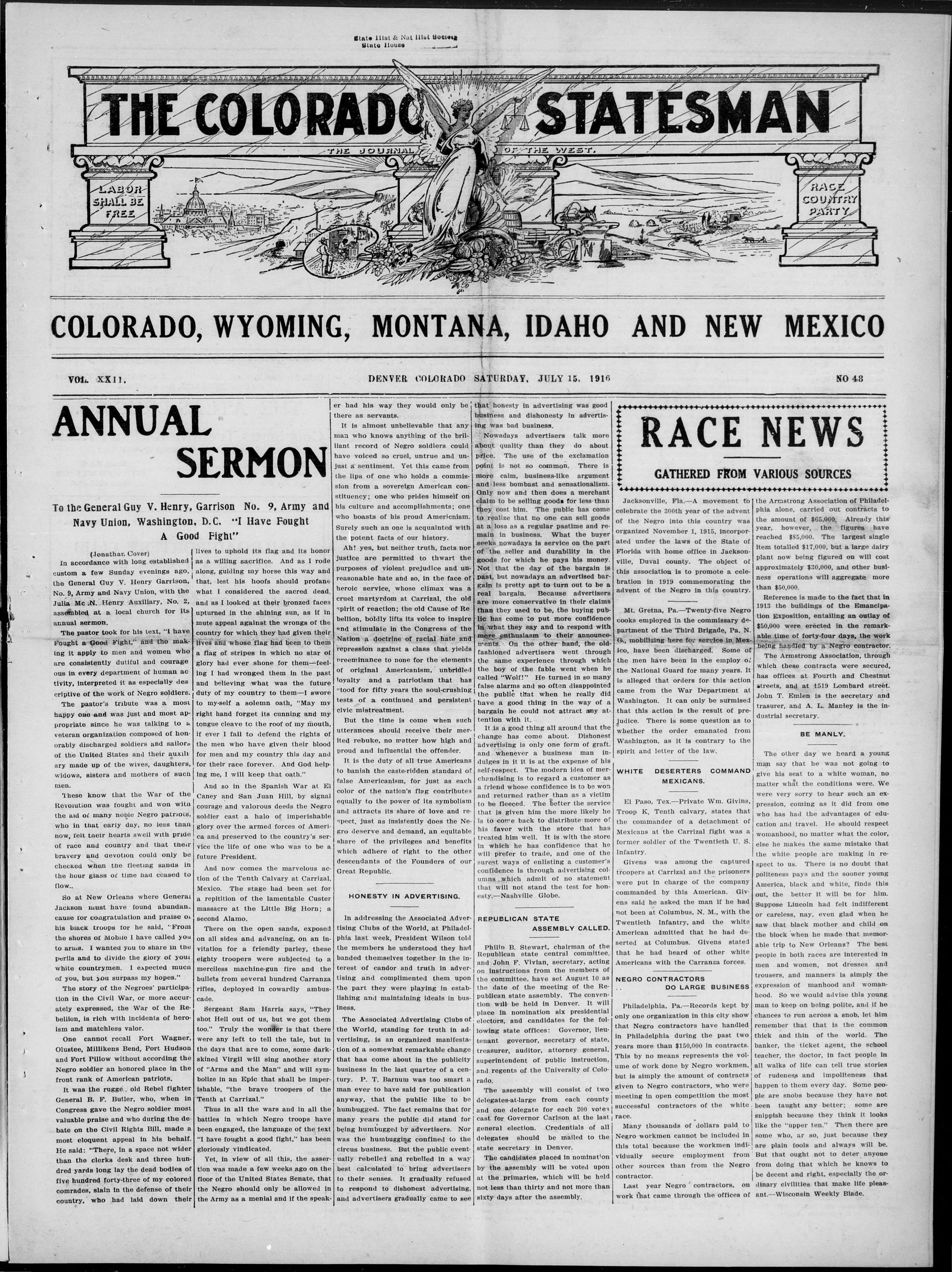
THE COLORADO STATESMAN
THE JOURNAL OF THE WEST.
LABOR SHALL BE FREE
RAGE
COUNTRY
PARTY
COLORADO, WYOMING, MONTANA, IDAHO AND NEW MEXICO
ANNUAL
To the General Guy V. Henry,
Navy Union, Washington
A Good
ANNUAL SERMON
To the General Guy V. Henry, Garrison No. 9, Army and Navy Union, Washington, D.C. "I Have Fought A Good Fight"
(Jenathan Cover)
In accordance with long established custom a few Sunday evenings ago, the General Guy V. Henry Garrison, No. 9, Army and Navy Union, with the Julia Mc N. Henry Auxiliary, No. 2, assembled at a local church for its annual sermon.
The pastor took for his text, "I have Fought a Good Fight," and tho making it apply to men and women who are consistently dutiful and courageous in every department of human activity, interpreted it as especially descriptive of the work of Negro soldiers.
lives to uphold its flag and its honor as a willing sacrifice. And as I rode along, guiding my horse this way and that, lest his hoofs should profane what I considered the sacred dead and as I looked at their bronzed faces upturned in the shining sun, as if in mute appeal against the wrongs of the country for which they had given their lives and whose flag had been to them a flag of stripes in which no star of glory had ever shone for them—feeling I had wronged them in the past and believing what was the future duty of my country to them—I swore
The pastor's tribute was a most happy one and was just and most appropriate since he was talking to a veteran organization composed of honorably discharged soldiers and sailors of the United States and their auxiliary made up of the wives, daughters, widows, sisters and mothers of such men.
These know that the War of the Revolution was fought and won with the aid of many noble Negro patriots, who in that early day, no less than now, felt their hearts swell with pride of race and country and that their bravery and devotion could only be checked when the fleeting sands in the hour glass of time had ceased to flow..
So at New Orleans where General Jackson must have found abundand cause for congratulation and praise on his black troops for he said, "From the shores of Mobile I have called you to arms. I wanted you to share in the perils and to divide the glory of your white countrymen. I expected much of you, but you surpass my hopes."
The story of the Negroes' participation in the Civil War, or more accurately expressed, the War of the Rebellion, is rich with incidents of heroism and matchless valor.
One cannot recall Fort Wagner, Olustee, Millikens Bend, Port Hudson and Fort Pillow without according the Negro soldier an honored place in the front rank of American patriots.
It was the rugge. old Rebel fighter General B. F. Butler, who, when in Congress gave the Negro soldier most valuable praise and who during the debate on the Civil Rights Bill, made a most eloquent appeal in his behalf. He said: "There, in a space not wider than the clerks desk and three hundred yards long lay the dead bodies of five hundred forty-three of my colored comrades, slain in the defense of their country, who had laid down their
V01. XX11.
```markdown
```
lives to uphold its flag and its honor as a willing sacrifice. And as I rode along, guiding my horse this way and that, lest his hoofs should profane what I considered the sacred dead, and as I looked at their bronzed faces upturned in the shining sun, as if in mute appeal against the wrongs of the country for which they had given their lives and whose flag had been to them a flag of stripes in which no star of glory had ever shone for them—feeling I had wronged them in the past and believing what was the future duty of my country to them—I swore to my-self a solemn oath, "May my right hand forget its cunning and my tongue cleave to the roof of my mouth, if ever I fail to defend the rights of the men who have given their blood for men and my country this day and for their race forever. And God helping me, I will keep that oath."
And so in the Spanish War at El Caney and San Juan Hill, by signal courage and valorous deeds the Negro soldier cast a halo of imperishable glory over the armed forces of America and preserved to the country's service the life of one who was to be a future President.
And now comes the marvelous action of the Tenth Calvary at Carrizal, Mexico. The stage had been set for a repitition of the lamentable Custer massacre at the Little Big Horn; a second Alamo.
There on the open sands, exposed on all sides and advancing, on an invitation for a friendly parley, these eighty troopers were subjected to a merciless machine-gun fire and the bullets from several hundred Carranza rifles, deployed in cowardly ambuscade.
Sergeant Sam Harris says, "They shot Hell out of us, but we got them too." Truly the wonder is that there were any left to tell the tale, but in the days that are to come, some darkskined Virgil will sing another story of "Arms and the Man" and will symbolize in an Epic that shall be imperishable, "the brave troopers of the Tenth at Carrizal."
Thus in all the wars and in all the battles in which Negro troops have been engaged, the language of the text "I have fought a good fight," has been gloriously vindicated.
Yet, in view of all this, the assertion was made a few weeks ago on the floor of the United States Senate, that the Negro should only be allowed in the Army as a menial and if the speak-
DENVER COLORADO SATURDAY. JULY 15. 1916
State Hist & Nat Hist Biosci
State House
RADC
THE JOURNAL
G, MONTAN
DENVER COLORADO
er had his way they would only be there as servants.
It is almost unbelievable that any man who knows anything of the brilliant record of Negro soldiers could have voiced so cruel, untrue and unjust a sentiment. Yet this came from the lips of one who holds a commission from a sovereign American constituency; one who prides himself on his culture and accomplishments; one who boasts of his proud Americanism. Surely such an one is acquainted with the potent facts of our history.
Ah! yes, but neither truth, facts nor justice are permitted to thwart the purposes of violent prejudice and unreasonable hate and so, in the face of heroic service, whose climax was a cruel martyrdom at Carrizal, the old spirit of reaction; the old Cause of Rebellion, boldly lifts its voice to inspire and stimulate in the Congress of the Nation a doctrine of racial hate and repression against a class that yields preeminence to none for the elements of original Americanism, unbridled loyalty and a patriotism that has stood for fifty years the soul-crushing tests of a continued and persistent civic mistreatment.
But the time is come when such utterances should receive their merited rebuke, no matter how high and proud and influential the offender.
It is the duty of all true Americans to banish the caste-ridden standard of false Americanism, for just as each color of the nation's flag contributes equally to the power of its symbolism and attracts its share of love and respect, just as insistently does the Negro deserve and demand, an equitable share of the privileges and benefits which adhere of right to the other descendants of the Founders of our Great Republic.
HONESTY IN ADVERTISING
In addressing the Associated Advertising Clubs of the World, at Philadelphia last week, President Wilson told the members he understood they had banded themselves together in the interest of candor and truth in advertising and complimented them upon the part they were playing in establishing and maintaining ideals in business.
The Associated Advertising Clubs of the World, standing for truth in advertising, is an organized manifestation of a somewhat remarkable change that has come about in the publicity business in the last quarter of a century. P. T. Barnum was too smart a man ever to have said for publication anyway, that the public like to be humbugged. The fact remains that for many years the public did stand for being humbugged by advertisers. Nor was the humbugging confined to the circus business. But the public eventually rebelled and rebelled in a way best calculated to bring advertisers to their senses. It gradually refused to respond to dishonest advertising, and advertisers gradually came to see
that honesty in advertising was good business and dishonesty in advertising was bad business.
Nowadays advertisers talk more about quality than they do about price. The use of the exclamation point is not so common. There is more calm, business-like argument and less bombast and sensationalism. Only now and then does a merchant claim to be selling goods for less than they cost him. The public has come to realize that no one can sell goods at a loss as a regular pastime and remain in business. What the buyer seeks nowadays is service on the part of the seller and durability in the goods for which he pays his money. Not that the day of the bargain is past, but nowadays an advertised bargain is pretty apt to turn out to be a real bargain. Because advertisers are more conservative in their claims than they used to be, the buying public has come to put more confidence in what they say and to respond with more enthusiasm to their announcements. On the other hand, the old-fashioned advertisers went through the same experience through which the boy of the fable went when he called "Wolf!" He turned in so many false alarms and so often disappointed the public that when he really did have a good thing in the way of a bargain he could not attract any attention with it.
It is a good thing all around that the change has come about. Dishonest advertising is only one form of graft. and whenever a business man indulges in it it is at the expense of his self-respect. The modern idea of merchandising is to regard a customer as a friend whose confidence is to be won and returned rather than as a victim to be fleeced. The better the service that is given him the more likely he is to come back to distribute more of his favor with the store that has treated him well. It is with the store in which he has confidence that he will prefer to trade, and one of the surest ways of enlisting a customer's confidence is through advertising columns which admit of no statement that will not stand the test for honesty.—Nashville Globe.
REPUBLICAN STATE
Philip B. Stewart, chairman of the Republican state central committee, and John F. Vivian, secretary, acting on instructions from the members of the committee, have set August 10 as the date of the meeting of the Republican state assembly. The convention will be held in Denver. It will place in nomination six presidential electors, and candidates for the following state offices: Governor, lieutenant governor, secretary of state, treasurer, auditor, attorney general, superintendent of public instruction, and regents of the University of Colorado.
The assembly will consist of two delegates-at-large from each county and one delegate for each 200 votes cast for Governor Carlson at the last general election. Credentials of all delegates should be mailed to the state secretary in Denver.
The candidates placed in nomination by the assembly will be voted upon at the primaries, which will be held not less than thirty and not more than sixty days after the assembly.
RACE NEWS
Jacksonville, Fla.—A movement to celebrate the 300th year of the advent of the Negro into this country was organized November 1, 1915, incorporated under the laws of the State of Florida with home office in Jacksonville, Duval county. The object of this association is to promote a celebration in 1919 commemorating the advent of the Negro in this country.
Mt. Gretna, Pa.—Twenty-five Negro cooks employed in the commissary department of the Third Brigade, Pa. N.G., mobilizing here for service in Mexico, have been discharged. Some of the men have been in the employ of the National Guard for many years. It is alleged that orders for this action came from the War Department at Washington. It can only be surmised that this action is the result of prejudice. There is some question as to whether the order emanated from Washington, as it is contrary to the spirit and letter of the law.
WHITE DESERTERS COMMAND
MEXICANS.
El Paso, Tex.—Private Wm. Givins, Troop K, Tenth calvary, states that the commander of a detachment of Mexicans at the Carrizal fight was a former soldier of the Twentieth U. S. Infantry.
Givens was among the captured troopers at Carrizal and the prisoners were put in charge of the company commanded by this American. Givens said he asked the man if he had not been at Columbus, N. M., with the Twentieth Infantry, and the white American admitted that he had deserted at Columbus. Givens stated that he had heard of other white Americans with the Carranza forces.
Philadelphia, Pa.—Records kept by only one organization in this city show that Negro contractors have handled in Philadelphia during the past two years more than $150,000 in contracts. This by no means represents the volume of work done by Negro workmen, but is simply the amount of contracts given to Negro contractors, who were meeting in open competition the most successful contractors of the white race.
Many thousands of dollars paid to Negro workmen cannot be included in this total because the workmen individually secure employment from other sources than from the Negro contractor.
Last year Negro contractors, on work that came through the offices of
NO 48
the Armstrong Association of Philadelphia alone, carried out contracts to the amount of $65,000. Already this year, however, the figures have reached $85,000. The largest single item totalled $17,000, but a large dairy plant now being figured on will cost approximately $30,000, and other business operations will aggregate more than $50,000.
Reference is made to the fact that in 1913 the buildings of the Emancipation Exposition, entailing an outlay of $50,000 were erected in the remarkable time of forty-four days, the work being handled by a Negro contractor.
The Armstrong Association, through which these contracts were secured, has offices at Fourth and Chestnut streets, and at 1519 Lombard street. John T. Emlen is the secretary and trasurer, and A. L. Manley is the industrial secretary.
BE MANLY
The other day we heard a young man say that he was not going to give his seat to a white woman, no matter what the conditions were. We were very sorry to hear such an expression, coming as it did from one who has had the advantages of education and travel. He should respect womanhood, no matter what the color, else he makes the same mistake that the white people are making in respect to us. There is no doubt that politeness pays and the sooner young America, black and white, finds this out, the better it will be for him. Suppose Lincoln had felt indifferent or careless, nay, even glad when he saw that black mother and child on the block when he made that memorable trip to New Orleans? The best people in both races are interested in men and women, not dresses and trousers, and manners is simply the expression of manhood and womanhood. So we would advise this young man to keep on being polite, and if he chances to run across a snob, let him remember that that is the common thick and thin of the world. The banker, the ticket agent, the school teacher, the doctor, in fact people in all walks of life can tell true stories of rudeness and impoliteness that happen to them every day. Some people are snobs because they have not been taught any better; some are snippish because they think it looks like the "upper ten." Then there are some who, ar so, just because they are plain fools and always will be. But that ought not to deter anyone from doing that which he knows to be decent and right, especially the ordinary civilities that make life pleasant.—Wisconsin Weekly Blade.
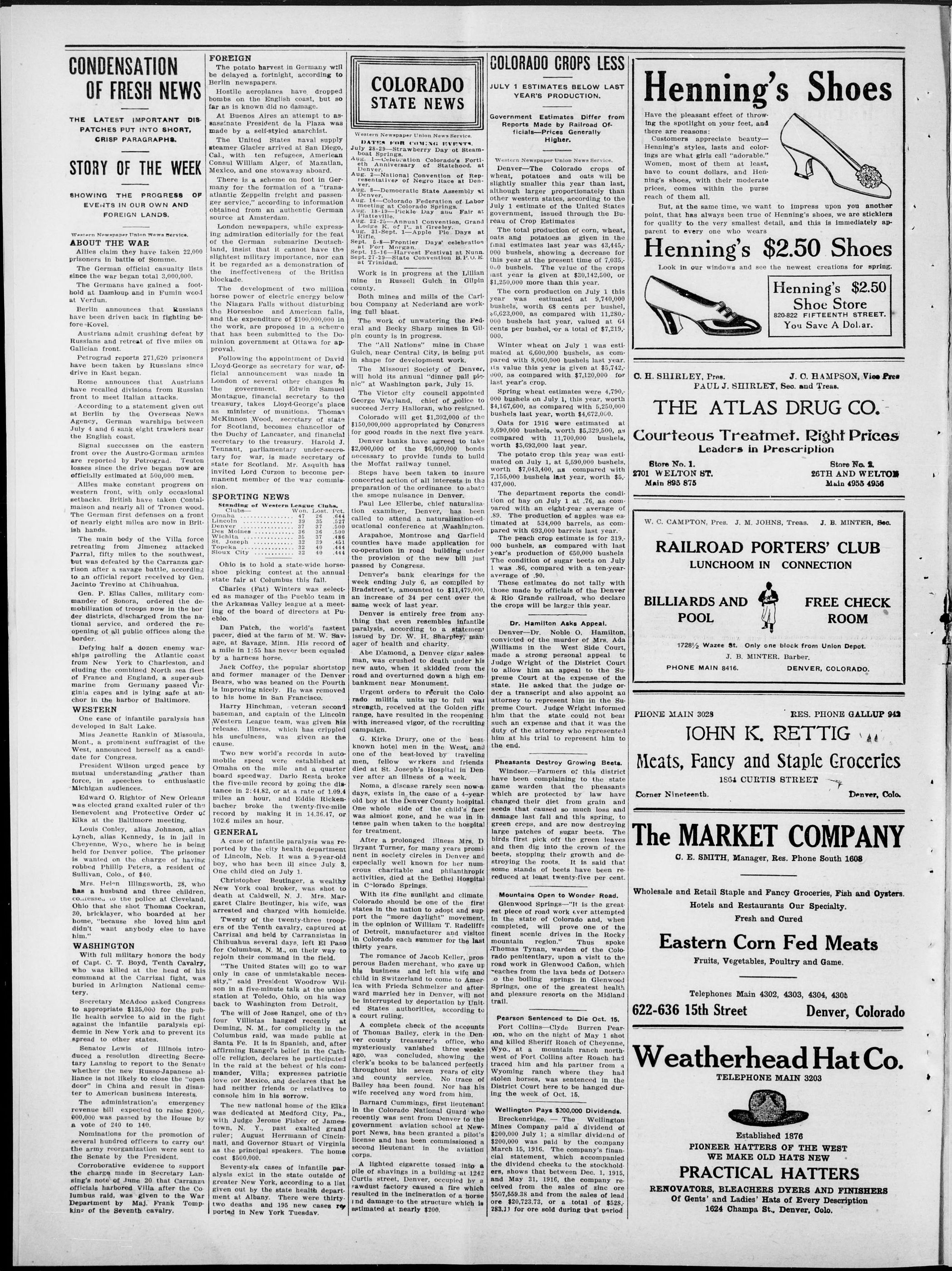
CONDENSATION OF FRESH NEWS
THE LATEST IMPORTANT DIS PATCHES PUT INTO SHORT, CRISP PARAGRAPH8.
STORY OF THE WEEK
SHOWING THE PROGRESS OF EVENTS IN OUR OWN AND FOREIGN LANDS.
Western Newspaper Union News Service.
ABOUT THE WAR
Allies claim they have taken 22,000 prisoners in battle of Somme.
The German official casualty lists since the war began total 3,000,000.
The Germans have gained a foothold at Damboup and in Fumin wood at Verdun.
Berlin announces that Russians have been driven back in fighting before Kovel.
Austrians admit crushing defeat by Russians and retreat of five miles on Galician front.
Petrograd reports 271,620 prisoners have been taken by Russians since drive in East began.
Rome announces that Austrians have recalled divisions from Russian front to meet Italian attacks.
According to a statement given out at Berlin by the Overseas News Agency, German warships between July 4 and 6 sank eight trawlers near the English coast.
Signal successes on the eastern front over the Austro-German armies are reported by Petrograd. Teuton losses since the drive began now are officially estimated at 500,000 men.
Allies make constant progress on western front, with only occasional setbacks. British have taken Contalmaison and nearly all of Trones wood. The German first defenses on a front of nearly eight miles are now in British hands.
The main body of the Villa force retreating from Jimenez attacked Parral, fifty miles to the southwest, but was defeated by the Carranza garrison after a savage battle, according to an official report received by Gen. Jacinto Trevino at Chihuahua.
Gen. P. Elias Calles, military commander of Sonora, ordered the demobilization of troops now in the border districts, discharged from the national service, and ordered the reopening of all public offices along the border.
Defying half a dozen enemy warships patrolling the Atlantic coast from New York to Charleston, and eluding the combined North sea fleet of France and England, a super-submarine from Germany passed Virginia capes and is lying safe at anchor in the harbor of Baltimore.
WESTERN
One case of infantile paralysis has developed in Salt Lake.
Miss Jeanette Rankin of Missoula, Mont., a prominent suffragist of the West, announced herself as a candidate for Congress.
President Wilson urged peace by mutual understanding rather than force, in speeches to enthusiastic Michigan audiences.
Edward O. Rightor of New Orleans was elected grand exalted ruler of the Benevolent and Protective Order of Elks at the Baltimore meeting.
Louis Conley, alias Johnson, alias Lynch, alias Kennedy, is in jail in Cheyenne, Wyo., where he is being held for Denver police. The prisoner is wanted on the charge of having robbed Phillip Peters, a resident of Sullivan, Colo., of $40.
Mrs. Helen Illingsworth, 28, who has a husband and three children, coattessed to the police at Cleveland, Ohio that she shot Thomas Cockran, 30, bricklayer, who boarded at her home, "because she loved him and didn't want anybody else to have him."
WASHINGTON
With full military honors the body of Capt. C. T. Boyd, Tenth Cavalry, who was killed at the head of his command at the Carrizal fight, was buried in Arlington National cemetery.
Secretary McAdoo asked Congress to appropriate $135,000 for the public health service to aid in the fight against the infantile paralysis epidemic in New York and to prevent its spread to other states.
Senator Lewis of Illinois introduced a resolution directing Secretary Lansing to report to the Senate whether the new Russo-Japanese alliance is not likely to close the "open door" in China and result in disaster to American business interests.
The administration's emergency revenue bill expected to raise $200,000,000 was passed by the House by a vote of 240 to 140.
Nominations for the promotion of several hundred officers to carry out the army reorganization were sent to the Senate by the President.
Corroborative evidence to support the charge made in Secretary Lansing's note of June 20 that Carranza officials harbored Villa after the Columbus raid, was given to the War Department by Maj. Frank Tompking of the Seventh cavalry.
FOREIGN
The potato harvest in Germany will be delayed a fortnight, according to Berlin newspapers.
Hostile aeroplanes have dropped bombs on the English coast, but so far as is known did no damage.
At Buenos Aires an attempt to assassinate President de la Plaza was made by a self-styled anarchist.
The United States naval supply steamer Glacier arrived at San Diego, Cal., with ten refugees, American Consul William Alger, of Mazatlan, Mexico, and one stowaway aboard.
There is a scheme on foot in Germany for the formation of a "transatlantic Zeppelin freight and passenger service," according to information obtained from an authentic German source at Amsterdam.
London newspapers, while expressing admiration editorially for the feat of the German submarine Deutschland, insist that it cannot have the slightest military importance, nor can it be regarded as a demonstration of the ineffectiveness of the British blockade.
The development of two million horse power of electric energy below the Niagara Falls without disturbing the Horseshoe and American falls, and the expenditure of $100,000,000 in the work, are proposed in a scheme that has been submitted to the Dominion government at Ottawa for approval.
Following the appointment of David Lloyd-George as secretary for war, official announcement was made in London of several other changes in the government. Edwin Samuel Montague, financial secretary to the treasury, takes Lloyd-George's place as minister of munitions. Thomas McKinnon Wood, secretary of state for Scotland, becomes chancellor of the Duchy of Lancaster, and financial secretary to the treasury. Harold J. Tennant, parliamentary under-secretary for war, is made secretary of state for Scotland. Mr. Asquith has invited Lord Curzon to become permanent member of the war commission.
SPORTING NEWS
Standing of Western League Clubs.
Clubs— Won. Lost. Pct.
Omaha 39 26 44
Lincoln 47 35 527
Denver 37 37 500
Des Moines 36 36 500
Wichita 35 37 486
St Joseph 32 35 451
Toppea 32 40 441
Sloux City 32 40 444
Ohio is to hold a state-wide horseshoe picking contest at the annual state fair at Columbus this fall.
Charles (Fat) Winters was selected as manager of the Pueblo team in the Arkansas Valley league at a meeting of the board of directors at Pueblo.
Dan Patch, the world's fastest pacer, died at the farm of M. W. Savage, at Savage, Minn. His record of a mile in 1:55 has never been equaled by a harness horse.
Jack Coffey, the popular shortstop and former manager of the Denver Bears, who was beamed on the Fourth is improving nicely. He was removed to his home in San Francisco.
Harry Hinchman, veteran second baseman, and captain of the Lincoln Western League team, was given his release. Illness, which has crippled his usefulness, was given as the cause.
Two new world's records in automobile speed were established at Omaha on the mile and a quarter board speedway. Dario Resta broke the five-mile record by going the distance in 2:44.82, or at a rate of 1.09.4 miles an hour, and Eddie Rickenbacher broke the twenty-five-mile record by making it in 14.36.47, or 102.6 miles an hour.
GENERAL
A case of infantile paralysis was reported by the city health department of Lincoln, Neb. It was a 9-year-old boy, who has been ill since July 3. One child died on July 1.
Christopher Beutinger, a wealthy New York coal broker, was shot to death at Caldwell, N. J. Mrs. Margaret Claire Beutinger, his wife, was arrested and charged with homicide.
Twenty of the twenty-three troopers of the Tenth cavalry, captured at Carrizal and held by Carranzistas in Chihuahua several days, left El Paso for Columbus, N. M., on their way to rejoin their command in the field.
"The United States will go to war only in case of unmistakable necessity," said President Woodrow Wilson in a five-minute talk at the union station at Toledo, Ohio, on his way back to Washington from Detroit.
The will of Jose Rangel, one of the four Villistas hanged recently at Deming, N. M., for complicity in the Columbus raid, was made public at Santa Fe. It is in Spanish, and, after affirming Rangel's belief in the Catholic religion, declares he participated in the raid at the behest of his commander, Villa; expresses patriotic love for Mexico, and declares that he had neither friends or relatives to console him in his sorrow.
The new national home of the Elks was dedicated at Medford City, Pa., with Judge Jerome Fisher of Jamestown, N. Y., past exalted grand ruler; August Herrmann of Cincinnati, and Governor Stuart of Virginia as the principal speakers. The home cost $500,000.
Seventy-six cases of infantile paralysis exist in the state outside of greater New York, according to a list given out by the state health department at Albany. There were thirty-two deaths and 195 new cases reported in New York Tuesday.
COLORADO
STATE NEWS
Western Newspaper Union News Service.
DATES FOR COMING EVENTS.
July 28-29—Strawberry Day of Steam-
boat Springs.
Aug. 1—Celebration Colorado's Forti-
th Anniversary of Statehood, at Denver.
Aug. 2—National Convention of Rep-
resentatives of Negro Race at Denver.
Aug. 8—Democratic State Assembly at Denver.
Aug. 11—Colorado Federation of Labor meeting at Colorado Springs.
Aug. 18-19—Pickle Day and Platteville.
Aug. 22-25—Annual Convention, Grand K. of P. at Greeley.
Aug. 31-Sept. 1—Apple Pie Days at Rifle.
Sept. 5-8—Frontier Days' celebration at Fort Morgan.
Sept. 15-16—Harvest Festival at Nunn.
Sept. 27-29—State Convention B.P.O.E. at Trinidad.
Work is in progress at the Lillian mine in Russell Gulch in Gilpin county.
Both mines and mills of the Carlou Company at Nederland are working full blast.
The work of unwatering the Federal and Becky Sharp mines in Gilpin county is in progress.
The "All Nations" mine in Chase Gulch, near Central City, is being put in shape for development work.
The Missouri Society of Denver, will hold its annual "dinner pall picnic" at Washington park, July 15.
The Victor city council appointed George Wayland, chief of police to succeed Jerry Halloran, who resigned.
Colorado will get $1,302,000 of the $150,000,000 appropriated by Congress for good roads in the next five years. Denver banks have agreed to take $2,000,000 of the $6,000,000 bonds necessary to provide funds to build the Moffat railway tunnel. Steps have been taken to insure concerted action of all interests in the preparation of the ordinance to abate the smope nuisance in Denver. Paul Lee Ellerbe, chief naturalization examiner, Denver, has been called to attend a naturalization-educational conference at Washington. Arapahoe, Montrose and Garfield counties have made application for co-operation in road building under the provision of the new bill just passed by Congress.
Denver's bank clearings for the week ending July 6, as compiled by Bradstreet's, amounted to $11,479,000, an increase of 34 per cent over the same week of last year.
Denver is entirely free from anything that even resembles infantile paralysis, according to a statement issued by Dr. W. H. Sharpley, manager of health and charity.
Abe Diamond, a Denver cigar salesman, was crushed to death under his new auto, when it skidded from the road and overturned down a high embankment near Monument.
Urgent orders to recruit the Colorado militia units up to full war strength, received at the Golden rifle range, have resulted in the reopening with increased vigor, of the recruiting campaign.
G. Kirke Drury, one of the best-known hotel men in the West, and one of the best-loved by traveling men, fellow workers and friends died at St. Joseph's Hospital in Denver after an illness of a week.
Noma, a disease rarely seen now-a-days, exists in the case of a 4-year-old boy at the Denver County hospital. One whole side of the child's face was almost gone, and he was in intense pain when taken to the hospital for treatment.
After a prolonged illness Mrs. D Bryant Turner, for many years prominent in society circles in Denver and especially well known for her numerous charitable and philanthropic activities, died at the Bethel Hospital in Colorado Springs.
With its fine sunlight and climate, Colorado should be one of the first states in the nation to adopt and support the "more daylight" movement, in the opinion of William T. Radcliffe of Detroit, manufacturer and visitor in Colorado each summer for the last thirty years.
The romance of Jacob Keller, prosperous Baden merchant, who gave up his business and left his wife and child in Switzerland to come to America with Frieda Schmelzer and afterward married her in Denver, will not be interrupted by deportation by United States authorities, according to a court ruling.
A complete check of the accounts of Thomas Bailey, clerk in the Denver county treasurer's office, who mysteriously vanished three weeks ago, was concluded, showing the clerk's books to be balanced perfectly throughout his seven years of city and county service. No trace of Bailey has been found. Nor has his wife received any word from him.
Barnard Cummings, first lieutenant in the Colorado National Guard who recently was sent from Denver to the government aviation school at Newport News, has been granted a pilot's license and has been commissioned a second lieutenant in the aviation corps.
A lighted cigarette tossed into a pile of shavings in a building at 1242 Curtis street, Denver, occupied by a sawdust factory caused a fire which resulted in the incineration of a horse and damage to the structure which is estimated at nearly $200.
COLORADO CROPS LESS
JULY 1 ESTIMATES BELOW LAST YEAR'S PRODUCTION.
Government Estimates Differ from Reports Made by Railroad Officials—Prices Generally
Western Newspaper Union News Service.
Denver—The Colorado crops of wheat, potatoes and oats will be slightly smaller this year than last, although larger proportionately than other western states, according to the July 1 estimate of the United States government, issued through the Bureau of Crop Estimates
The total production of corn, wheat, oats and potatoes as given in the final estimates last year was 43,445,000 bushels, showing a decrease for this year at the present time of 7,035,000 bushels. The value of the crops last year is given at $30,142,500, or $1,250,000 more than this year.
The corn production on July 1 this year was estimated at 9,740,000 bushels, worth 68 cents per bushel, $6,623,000, as compared with 11,280,000 bushels last year, valued at 64 cents per bushel, or a total of $7,219,000.
Winter wheat on July 1 was estimated at 6,600,000 bushels, as compared with 8,060,000 bushels last year, its value this year is given at $5,742,000, as compared with $7,120,000 for last year's crop.
Spring wheat estimates were 4,790,000 bushels on July 1, this year, worth $4,167,600, as compared with 5,250,000 bushels last year, worth $4,672,000.
Oats for 1916 were estimated at 9,690,000 bushels, worth $5,329,500, as compared with 11,700,000 bushels, worth $5,693,000 last year.
The potato crop this year was estimated on July 1, at 5,590,000 bushels, worth $7,043,400, as compared with 7,155,000 bushels last year, worth $5,437,000.
The department reports the condition of hay on July 1 at .76, as compared with an eight-year average of .89. The production of apples was estimated at 534,000 barrels, as compared with 693,000 barrels last year.
The peach crop estimate is for 319,000 bushels, as compared with last year's production of 650,000 bushels. The condition of sugar beets on July 1 was .86, compared with a ten-year-average of .90.
These estimates do not tally with those made by officials of the Denver & Rio Grande railroad, who declare the crops will be larger this year.
Dr. Hamilton Asks Appeal.
Denver—Dr. Noble O. Hamilton, convicted of the murder of Mrs. Ada Williams in the West Side Court, made a strong personal appeal to Judge Wright of the District Court to allow him an appeal to the Supreme Court at the expense of the state. He asked that the judge order a transcript and also appoint an attorney to represent him in the Supreme Court. Judge Wright informed him that the state could not bear such an expense and that it was the duty of the attorney who represented him at his trial to represent him to the end.
Pheasants Destroy Growing Beets. Windsor.—Farmers of this district have been complaining to the state game warden that the pheasants which are protected by law have changed their diet from grain and seeds that caused so much loss and damage last fall and this spring, to green crops, and are now destroying large patches of sugar beets. The birds first pick off the green leaves and then dig into the crown of the beets, stopping their growth and destroying the roots. It is said that some stands of beets have been reduced at least twenty-five per cent.
Mountains Open to Wonder Road.
Glenwood Springs—"It is the greatest piece of road work ever attempted in the state of Colorado and, when completed, will prove one of the finest scenic drives in the Rocky mountain region." Thus spoke Thomas Tynan, warden of the Colorado penitentiary, upon a visit to the road work in Glenwood Cañon, which reaches from the lava beds of Dotsero to the boiling springs in Glenwood Springs, one of the greatest health and pleasure resorts on the Midland trail.
Pearson Sentenced to Die Oct. 15. Fort Collins—Clyde Burren Pearson, who on the night of May 1 shot and killed Sheriff Roach of Cheyenne, Wyo., at a mountain ranch northwest of Fort Collins after Roach had traced him and his partner from a Wyoming ranch where they had stolen horses, was sentenced in the District Court here to be hanged during the week of Oct. 15.
Wellington Pays $200,000 Dividends
Wellington Pays $200,000 Dividends.
Breckenridge. — The Wellington Mines Company paid a dividend of $200,000 July 1; a similar dividend of $200,000 was paid by the company March 15, 1916. The company's financial statement, which accompanied the dividend checks to the stockholders, shows that between Dec. 1, 1915, and May 31, 1916, the company received from the sales of zinc ore $507,559.38 and from the sales of lead ore $20,723.73, or a total of $282.13 for ore sold during that period
Henning's Shoes
Have the pleasant effect of throwing the spotlight on your feet, and there are reasons:
Customers appreciate beauty—Henning's styles, lasts and colorings are what girls call "adorable." Women, most of them at least, have to count dollars, and Henning's shoes, with their moderate prices, comes within the purse reach of them all.
But, at the same time, we want point, that has always been true of for quality to the very smallest de parent to every one who wears Henning's $
Look in our windows and see
the same time, we want to impress upon you has always been true of Henning's shoes, we are to the very smallest detail, and this is immens every one who wears Henning's $2.50 SH our windows and see the newest creations
But, at the same time, we want to impress upon you another point, that has always been true of Henning's shoes, we are sticklers for quality to the very smallest detail, and this is immediately apparent to every one who wears
Look in our windows and see the newest creations for spring.
Henning's $2.50
Shoe Store
820-822 FIFTEENTH STREET.
You Save A Dollar.
C. H. SHIRLEY, Pres.
PAUL J. SHIRLEY
THE ATLAS
Courteous Treatm
Leaders in P
LEY, Pres. J. O. HAMPSCO
PAUL J. SHIRLEY, Sec. and Treas.
THE ATLAS DRUG CO.
Cous Treatmet. Right to
Leaders in Prescription
1. STORE
ON ST.
1875
26TH AN
Main 4
PTON, Pres. J. M. JOHNS, Treas. J. B. MI
LROAD PORTERS' C
LUNCHOOM IN CONNECTION
C. H. SHIRLEY, Pres. J. C. HAMPSON, Vice Pres PAUL J. SHIRLEY, Sec. and Treas.
Courteous Treatmet. Right Prices Leaders in Prescription
W. C. CAMPTON, Pres. J. M. JOHN
RAILROAD PO
LUNCHOOM IN
W. C. CAMPTON, Pres. J. M. JOHNS, Treas. J. B. MINTER, Sec. RAILROAD PORTERS' CLUB LUNCHOOM IN CONNECTION
BILLIARDS AND POOL
1728½ Wazee St. Only on
J. B. MINTH
PHONE MAIN 8416.
PHONE MAIN 3028
JOHN K.
Meats, Fancy and
1864 CURTIN
Corner Nineteenth.
The MARKET
C. E. SMITH, Manager,
Wholesale and Retail Staple and F
Hotels and Restaura
Fresh and
Eastern Corr
Fruits, Vegetables,
Telephones Main 430
622-636 15th Street
Weatherhe
TELEPHONE
28½ Wazee St. Only one block from Union D
J. B. MINTER. Barber.
NE MAIN 8416. DENVER, COLOR
IN 3028 RES. PHONE C
JOHN K. RETTIG
Fancy and Staple Gro
1864 CURTIS STREET
eenth.
MARKET COMP
E. SMITH, Manager, Res. Phone South 1
d Retail Staple and Fancy Groceries, Fish
Hotels and Restaurants Our Specialty.
Fresh and Cured
Eastern Corn Fed Me
Fruits, Vegetables, Poultry and Game.
Telephones Main 4302, 4303, 4304, 4305
15th Street Denver,
atherhead Ha
TELEPHONE MAIN 3203
1728 $ _{1/2} $ Wazee St. Only one block from Union Depot.
J. B. MINTER. Barber.
PHONE MAIN 8416. DENVER, COLORADO.
PHONE MAIN 3028 RES. PHONE GALLUP 942 JOHN K. RETTIG Meats, Fancy and Staple Groceries 1864 CURTIS STREET Corner Nineteenth. Denver, Colo.
The MARKET COMPANY
C. E. SMITH, Manager, Res. Phone South 1608
Wholesale and Retail Staple and Fancy Groceries, Fish and Oysters. Hotels and Restaurants Our Specialty. Fresh and Cured Eastern Corn Fed Meats Fruits, Vegetables, Poultry and Game.
Telephones Main 4302, 4303, 4304, 4305
622-636 15th Street Denver, Colorado
Weatherhead Hat Co. TELEPHONE MAIN 3203
Established 1876
PIONEER HATTERS OF THE WEST
WE MAKE OLD HATS NEW
PRACTICAL HATTERS
RENOVATORS, BLEACHERS DYERS AND FIL
Of Gents' and Ladies' Hats of Every Descrip
1624 Champa St., Denver, Colo.
PRACTICAL HATTER
ATORS, BLEACHERS DYERS AND FIL
Gents' and Ladies' Hats of Every Descrip
1624 Champa St., Denver, Colo.
RENOVATORS, BLEACHERS DYERS AND FINISHERS
Of Gents' and Ladies' Hats of Every Description
1624 Champa St., Denver, Colo.
Store No. 1.
2701 WELTON ST.
Main 885 875
to impress upon you another
of Henning's shoes, we are sticklers
etail, and this is immediately ap-
$2.50 Shoes
the newest creations for spring.
Henning's $2.50
Shoe Store
820-822 FIFTEENTH STREET.
You Save A Dollar.
J. C. HAMPSON, Vice Pres
Y, Sec. and Treas.
S DRUG CO.
met. Right Prices
Prescription
Store No. 2.
26TH AND WELTON
Main 4953 4956
INS, Treas. J. B. MINTER, Sec.
ORTERS' CLUB
CONNECTION
FREE CHECK
ROOM
one block from Union Depot.
ER. Barber.
DENVER, COLORADO.
RES. PHONE GALLUP 942
RETTIG
Staple Groceries
S STREET
Denver, Colo
T COMPANY
Res. Phone South 1608
Fancy Groceries, Fish and Oysters
ants Our Specialty.
d Cured
Fed Meats
Poultry and Game.
02, 4303, 4304, 4304
Denver, Colorado
Head Hat Co.
MAIN 3203
HATTERS
DYERS AND FINISHERS
ats of Every Description
Denver, Colo.
THE COLORADO STATESMAN
LABOR
SIMULA DE
FAIL
BLACK
COUNTRY
PARTY
1824 Curtis Street, Room 25.
Phone Main 7417.
One Year ..... $ 2.00
Six Months ..... 1.00
Three Months ..... 60
PAYABLE IN ADVANCE.
Entered as second-class matter at the postoffice in the City of Denver, Colo.
Reading notices, ten lines or less, 10 cents per line. Each additional line over ten lines, 5 cents per line. Display advertising 50 cents per inch.
No discounts allowed on less than three months' contract. Cash must accompany all orders from parties unknown to us. Further particulars on application
All communications of a personating nature that are not complimentary will' be withheld from the columns of this paper.
Communications to receive attention must be newsy, upon important subjects, plainly written only upon one side of the paper, must reach us Tuesday, if possible, anyway not later than Wednesday, and bear the signature of the author. No manuscript returned, unless stamps are sent for postage.
Remittances should be made by Express Money Order, Postoffice Money Order, Registered Letter or Bank Draft. Postage stamps will be received the same as cash for the fractional part of a dollar. Only 1c and 2c stamps taken.
RECOGNIZED BY THE RETAIL ASSOCIATION OF THE DENVER CHAMBER OF COMMERCE AS AN ADVERTISING MEDIUM OF THE FIRST CLASS.
NATIONAL NEGRO BUSINESS LEAGUE AND EDUCATION CONGRESS
The annual meeting of the National Negro Business League, to be held in Kansas City, Missouri, August 16-18, 1916, promises to give startling revelations of the persistent efforts and successful results of our business men and women throughout this country, which will lend encouragement and give great inspiration to the race in its "onward and upward" movement. Delegates to this convention will be amply rewarded if a little sacrifice is made to attend this meeting which will be equal to the value of a lifetime. The opportunity to hear from the lips of individuals, and the experience business men will give in overcoming the difficulties that beset them and the struggles to acquire business acumen so as to place them in a position meriting recognition should never be missed. The same must be said of the Education Congress, which meets in Washington, D. C., August 23-26, when the Negroes of America will again show their loyalty as American citizens in returning thanks for the educational benefits received and the proof of a further reduction of illiteracy among the people of our race. These very important events ought surely to impress not only delegates but true lovers and sympathizers with the Negro's cause, and as many persons as can be present should endeavor to be eye witnesses of the proceedings of these institutions which we hope will be perpetuated as is the belief of Our Great Republic.
A PRINCIPLE THAT NEVER FAILS
In offering a reminder to the people of Colorado on the primary election for state officials, there are certain facts to be presented which demand a clearness of brain and thought that will not place us on the brink of the precipice with no way to turn, but open a way of egress from the political complications that have been our unfortunate lot in national and state affairs for four years. With the introduction of improved politics, untainted and uncorrupted elections, reformation of politicians, etc., we are tempted to accept an amalgamation of the various political creeds, parties, organizations, the appearance of which would create a belief that AMERICANISM pure and simple would be our "guiding star," but when we get the proofs that the combined action or get-together spirit is absolutely to suit a temporary convenience, we are compelled to bring forcibly to the people's notice that there is no real coalition between the Republican and Democratic parties, and what may be engaged to run a municipal government does not apply necessarily to state or nation. The result of the Republican convention in Chicago last month shows beyond a doubt that the Progressive Republicans and the old Republicans have fully realized that no more advantage must be given to their opponent, the Democrats, and therefore, having united their forces on the presidential nominee, the same action should be carried out for our state officers. While there are factional troubles in the Democratic party in this state, yet when it comes to a common issue we find them uniting to carry out their aim successfully, and our delegates of the Republican party, profiting by this lesson, should resolve and pledge themselves to abide by the decision of their assemblies and unanimously agree on supporting the candidates chosen. The idea of keeping Progressives and Republicans separated or from combining on vital political questions is well known to be one of the essentials of the Democratic platform of success, and in the face of present conditions and a reflection of four years ago (when they were the beneficiaries of the legacy that made them powerful in the nation), the necessity arises for Republicans to settle their differences and work harmoniously for their success this fall. The best way then, is to stand by the party whether our individual choice for the primaries is successful or not, as it means ultimate destruction to our state issue if we refuse to sacrifice our selfish desires for the good of the whole. The Colorado Statesman specially requests that particular interest be manifested in the primaries, as they fill an important role, and the determination to insure success, against the odds that await us must be shared by all Republicans who still entertain and cherish the thought "that the major includes the minor—the greater the less."
A Republican president for the nation, a Republican governor for the state of Colorado—nothing more, nothing less, is our standard, our motto and our goal. Help us to obtain this principle that never fails.
```markdown
```
K. P. Excursion to Colorado Springs in honor of Grand Lodge, Thursday, July 27th, via Colorado & Southern. Secure your tickets from Harry Jones, 1021 Nineteenth street. Round trip $2.25.
DR. CRUMP ENTERTAINED.
About twenty-five of Denver's well-known young men tendered Dr. Crump a stag last Saturday night, upon the event of his departure to Texas, where he is to practice his profession. Several speeches were made, commanding the doctor for his enviable record in Denver and wishing for him the greatest success in his new field.
FOR RENT—Furnished rooms at 919 Twenty-Second street, strictly modern and within easy reach of Stout and Curtis street car lines. Apply Mrs. Carrie E. Butler.
Americanization of Adult Foreigners Must Be Brought About Through Schools
There is a phase of public education that has not engaged much of our attention heretofore, but that is surely going to demand it in the near future—that is, the education and the Americanization of the adult foreigner.
Among thoughtful people and among lawmakers is growing up the conviction that the presence of the illiterate foreigner is a danger and a menace to us and to our institutions. Under present conditions he may be among us twenty years more, knowing nothing of our language, open to none of the influences that tend to good citizenship. He can be guided and moved by the intriguer and the boss of his own nationality, but cannot be touched by Uncle Sam. Thus, in time of stress or danger, he may become dangerous and threatening in the extreme to the very life of the republic.
It is coming about that the burden of teaching and Americanizing the foreigners is to be laid upon the educational forces of the commonwealth. There are 75,000 illiterates reported in California. There are over half a million foreign-born residents. These classes are becoming so large, as compared with our school population, that the state is taking cognizance of the matter and is moving toward assuming responsibility.
At present the most definite way to reach our adult foreigners is through the night schools. The machinery for organizing night schools is at hand in every school district.
Movement Toward Christian Union Most Significant Trend In the Church Today
The most significant trend in the church today is the movement toward Christian union. This movement is manifested in at least two different, though kindred, ways. First, there is a broad spirit of genuine friendliness, brotherhood and Christian tolerance manifested among the different churches, and this spirit is increasing. There are those who mistake this spirit of tolerance for the unity which the church needs. It is far from unity, and yet it makes possible co-operation in many fields of effort and leads to a better understanding and appreciation of one another, which is necessary in order to bring about the unity that is to come.
The other manifestation of this union movement is seen in the effort, sometimes successful, to unite kindred religious bodies, in the commissions on Christian union appointed by many communions, and in the fact that the ablest writers and thinkers of all religious bodies are discussing the subject on platform and with pen.
If there is to be found an acceptable basis of union it must be found in the New Testament scriptures, for this is the only authority which all accept, and from which there is no appeal, and can be no dissent. Upon the vital things of Christianity the churches are practically agreed, and all can safely trust to the united scholarship of the past and present as to the interpretation of the New Testament upon all essential points.
Measures Must Be Taken to Retain the Foreign Trade Obtained During the War
By W. P. G. HARDING of Birmingham, Ala.
Member of the Federal Reserve Board
Restoration of peace will necessarily bring about important changes in the world's trade, and just what these changes will be and how they will affect business conditions in this country are problems which are being studied carefully by publicists and business men.
These are vital questions here in the South as in other parts of the country, although we may not be as directly affected as other sections, for the reason that a smaller part of our business has come from foreign countries or has been connected with war material.
We should, however, stand ready to support the government in any measures that it may be necessary to adopt in order to retain the legitimate foreign trade that we have already secured, to extend still further our business intercourse with South American countries, besides maintaining a proper balance in our trade relations with the nations now at war.
Security of Tenure in Office Is One of the Greatest Needs of the Minister
By E. C. HAYES, Professor of Sociology, University of Illinois
Churches go where the biggest collections are possible, not where the greatest opportunity for work exists.
If twenty thousand immigrants move into a certain section of a city, twenty churches move out. In proportion as a church is needed in such a neighborhood its existence is rare.
Security of tenure in office is one of the great needs of the minister. The minister must not only please Mrs. Grundy but must also retain the favor of all the other ladies and gentlemen of his parish. The church feels that it must do those things which help to maintain its strength which help to maintain the particular denominations.
Discoveries of Medical Science Should Be Put to Work in Behalf of the People
Discoveries of Medical Science Should Be Put to Work in Behalf of the People
All that is necessary for the public health of a community now is for that community to demand of the government that all of the discoveries of medical science be put to work in its behalf.
Business interests get four times as much from the government for care and protection of hogs and cattle as the public-healtn service gets for the care of human health. We should have skilled men at work everywhere, and each worker should receive a salary equal to the economic value of just one human life. That is only $5,000.
Who Comes There?
The Zion Baptist
Sunday School
--OFF ON THEIR--
Annual Outing and Picnic
WHERE?
DOME ROCK, Colo.
THURSDAY, JULY 20, 1916 Come and join us. Every body invited; all are welcome. Games and athletic sports a specialty. Many new features, with balloon ascension, etc.
Tickets for the round trip: Adults, $1; children, 50 cents.
REV. I. HARRISON WALLACE, Superintendent.
REV. D. E. OVER, D.D., Minister.
The finest, largest and best photo studio in Denver. Our reception room is 40 feet by 50 feet alone. Our styles are exclusive. Picturesque posings and exquisite lightings.
Will H. Nast, Operator.
LAKESIDE
"EVERYBODY'S JOYLAND"
Saturday and Sunday July 15 and 16 STARTING ABOUT 9:30 P.M.
SHOWING THE DESTRUCTION OF THE CITY OF MARTINIQUE BY A RAGING VOLCANO No Expense has been spared by the Lakeside management to make this production — like all Lakeside spectacles — historically correct
CASINO THEATER SUNDAY EVENING and week of JULY 16 THE SANFORD DODGE DRAMATIC PLAYERS IN
THE NEGRO WOMEN'S CLUB
HOME ASSOCIATION WILL HOLD
A MASS MEETING AT SHORTER,
MONDAY, July 17TH.
and Mary Colston.
Our Method of Financing this Campaign—Mrs. Ross.
After all.
After the program, refreshments will be served free.
The meeting marks the opening of their $5,000 campaign, which closes the latter part of September.
It is the object of the association to establish and maintain a Club Home through which social service, charity and other phases of club work will be carried on.
The Association has for its president, Mrs. Amelia Reeves; Mrs. J. R. Contee, Treasurer; Mrs. Effie Waldon, Secretary; and Mrs. Alice Webb, Chairman of the Board of Directors; Mrs. Florence Cooper, Chairman of Public Subscription; Mrs. Gussie Carriss, Chairman of Tag Day; Mrs. Eva Thompkins, Chairman of Entertainment.
HAIR ROOT GROWER
After using others give Hair Root Grower a trial and let us prove to you what it will do. Will grow hair from 1 to 2 inches a month, if used according to directions. For treatments, massage and manicuring, call York 957M, 2333 Ogden St., for appointments. Mrs. Gora Robinson and Mrs. Eliza Rose.
The organization is incorporated for $5,000. Its officers are bonded. The seven clubs forming the rank and file of membership share equally in stock. It has been organized about three months, during which time over a thousand dollars worth of stock has been paid for.
GENTLEMEN, IMPROVE YOUR HAIR. If you have good hair we can make it better; if you have bad hair we can make it good; no need to wear your hair shaved or cut close, wear it long. See Mrs. Robinson and Mrs. Rose; let them keep it straight and looking nice. Phone York 957M or 2333 Ogden for appointments.
The meeting Monday n'ight is free.
The following program will be rendered, "The Negro Women's Club Home Association," Its Origin, Mrs. Amelia Reeves.
Its Purpose—Mrs. Theta Miller.
Vocal Solo—Mrs. Minnie Williams.
What It Means to Club Women—Miss Nelsine Howard.
MEN WANTED
Wanted at the D. & R. G. shops in Burnham, all the colored men that they can employ, on the rip track. Mr. Fry, general car foreman.
Its Influence for Good in the Community—Mrs. Irene Fife.
Duet—Misses Lillian Richardson
THE COLORADO STATESMAN
THE JOURNAL OF THE WEST
LABOR SHOULD BE FREE
NEW COUNTRY PARTY
THE
COLORADO
STATESMAN
THE PEOPLE'S BUREAU
OF INFORMATION
1824 CURTIS STREET
Room 25.
DENVER, COLORADO
Phone:
Main /417.
Mrs. B. Givens, who has been ill is much improved.
Mrs. J. S. Mason will leave Tuesday for Pueblo to attend Grand Lodge of U. B. F. & S. M. T.
Tiny Newman arrived in the city Tuesday evening from Grand Junction.
Frank Moss, who has been employed as chef at the Buckingham Hotel, is taking his annual vacation.
S. H. Baxter of 2727 California street, who has been very very sick for the past two weeks is improving slowly.
Mrs. Edward Davis is improving from her recent attack of illness. Her residence in New Mexico did not seem to be very favorable to her health.
Mr. and Mrs. J. S. Mason have moved from 1431 Glenarm to their beautiful residence, 2352 Humboldt, where they will be glad to welcome their friends.
Mrs. Fate McClain, with her daughters, Ernestine, and Josephine, also Mrs. Susie Granberry of St. Louis, Mo., are spending a few days in Deerfield, Colo.
Mr. Charles Revels of 3510 Prairie avenue, Chicago, Ill., who visited our city some time ago, died at his home Monday last. The Colorado Statesman extends its deepest sympathy to the bereaved family.
Alexander E. Umble, after visiting friends and relatives in Kentucky, stopped in Denver two days en route to Craig, Colo., where he holds the position of chef for the S. P. Hill Stock Raising Company. Mr. Umble was highly entertained by acquaintances of long standing whom he met here during former visits.
Mr. and Mrs. W. M. Pierson of Colorado Springs, are visitors in our city, the guests of Mrs. Ella Saunders. They are stopping at the residence of Mrs. Lane on Welton street. Many social functions have been given in their honor.
Sherman Keene, former Denver resident, arrived in the city July 4 to spend a few days with friends. Mr. Keene is employed by the Great Western Sugar company at Eden, Colo., and reports everything in a prosperous and favorable condition for our people.
Arthur E. Trott, native of Bermuda Islands arrived recently for an indefinite stay in the city. He is a professional painter, decorator and scenic artist, whose work has been highly commended throughout the United States. His residence is 2560 Washington street and the Colorado Statesman wishes him a successful stay in Denver.
Walter Aaron is again employed at the residence of Mr. Dennis Sheedy, vice president of the Colorado National Bank, as butler, for the second summer season. This being the result of entire satisfaction given when he held the job last year. Mr. Aaron was summoned from his home in Texas to serve this family (one of Denver's oldest and leading), his transportation being paid, and good wages. Denver butlers and waiters take heed to what results from GOOD SERVICE AND STRICT ATTENTION TO DUTY.
Solomon Lee, popular and highly respected resident of Chicago, and late employé of the Burlington and Quincy railroad for nearly forty years, died July 6th and was buried on the 9th
inst. The sad news was received by his niece, Mrs. Florence Parker of 1034 Twenty-ninth street, whom he visited a year ago here and was very devoted to her. He leaves a daughter, Miss Pauline J. Lee, one of the leading musicians in Chicago and four other children besides a large circle of friends and relatives to mourn their irreparable loss.
W. F. R. Mills, manager of parks and improvements of the city and county of Denver, is showing marked improvement in his department from the appearance of the playgrounds and the particular attention given the parks by the various employees under him. City park is claiming a larger number of visitors than former years, and the general expression of those who find recreation in boating, tennis and other games is very creditable to this city official. He intends to cement two of the city tennis courts, as well as experiment in paving one or two of the streets across the viaducts with asphalt. If this is successful more streets will be improved with asphalt.
COLORED CITIZENS' LEAGUE. $ ^{6} $
All members of the Colored Citizens' League are requested to be present at meeting to be held Tuesday, July 18, at the rooms, 2566 Washington street, as business of importance will be transacted. J. D. D. RIVERS,
DEATH OF CHARLES NEWMAN
SMITHEA.
Friends and acquaintances of Mr. and Mrs. Charlie Smithea were indeed grieved to hear of the death of their only son, Charles Newman Smithea, which occurred in Detroit, Michigan, June 17th, at the Herman Keiser Hospital of diptheria. "Baby" as he was called by all who knew him leaves a host of friends to mourn his loss. He had a loveable disposition and his quaint sayings which was far beyond his years were often repeated. The many friends of Denver tender Mr. and Mrs. Smithea their sympathy in the loss of this dear child.
VAN DYKE PHOTO STUDIO
This photographic studio at 1229 Sixteenth street, guarantees every satisfaction to the public as its reputation is built on the class of work given to its patrons. The most convincing proof is a trial, which is the means of its being the peer of all other studios. W. H. Nast, the operator, from his long experience, will supply the need of the most critical, and the new and spacious rooms for the delight of patrons will be quite an addition to the business.
PEOPLE'S PRESBYTERIAN
East 23rd Ave. and Washington St. Pastor, J. A. Thos-Hazell, S. T. B. Sermon topics: Sunday, July 16, 11 a.m., "Alone, Yet Not Alone;" 5:30 p. m. "Some Facts About Heaven." Owing to the pastor's inability to occupy the pulpit last Sabbath, Dr. W. M. Campbell of the Presbytery of Denver, and Rev. Thos. Bell, of the Y. M. C. A., respectively, spoke at both services. It is hoped that the minister will be able to preach from the above named subjects tomorrow.
The date for the special offertory has been deferred from the second to the third Sabbath of the month, which is Sunday coming the 16th inst. Those who pledged for this particular cause are requested to make good.
The Sabbath school scholars under the superintendency of Mrs. Mattie Wilson for the home school, and Mrs. M. E. Morrison for the branch school will picnic Saturday, the 15t inst., at Berkeley Park. All interested parties are asked to meet at the chapel of the church on Saturday morning at 9 o'clock.
STATE GRAND LODGE OF U. B. F
& S. M. T.
Will convene at Bethlehem Baptist Church, Pueblo, Colorado, Wednesday, July 19th and continue to July 21st, 1916.
All Lodges and Temples are requested to send the representative early in order to be at the opening which will be promptly at 10 o'clock a.m. sharp. This promises to be the most important and prosperous session ever held in the jurisdiction. Visitors will be welcome.
E. V. CAMMEL, G. M.
DANIEL JONES, G. Secy.
S. D. NICHOLSON COMES
OUT FOR GOVERNORSHIP.
Makes Announcement in Letter to Lake City Editor; Is for Americanism and Dry Law Enforcement.
Formal announcement of his candidacy for the Republican nomination for governor was made today by Samuel D. Nicholson, of Denver and Leadville.
The announcement was contained in a letter to William C. Blair, editor of a Lake City newspaper, who some time ago wrote to all prospective candidates in the Republican party asking them if they would stand by the Republican nominee if defeated for the nomination for governor.
His letter follows:
"William C. Blair, Lake City, Colo.—Dear Sir: Replying to your letter wherein you ask if I am a candidate for governor, and if I will support the nominee of the party should I not receive the nomination, I shall, of course, support the nominee of the Republican party without regard to my own candidacy, and shall support him with the same earnestness and enthusiasm that I shall support our splendid national ticket.
"Yes, I am a candidate for governor and hope to receive the nomination and election. I have but one ambition, and that is to devote my best energies and efforts in giving to Colorado a genuine business-like administration, and to assist in every way in my power in the upbuilding and advancement of our state, materially, morally and educationally.
"I stand, as I always have, for the absolute and impartial enforcement of all the laws of the state. Prohibition is no longer an issue in this state. The people and the legislature settled that question, and any honest executive must and will enforce the law. If elected governor I shall unflinchingly use every power of the office to enforce these laws.
"Our taxes are excessive. They can be substantially reduced by abolishing the unnecessary boards, bureaus and commissions, and I am strongly in favor of legislation to this end.
"And with you, my dear sir, I stand for that 'single Americanism' that means our country first and forever, and a complete and adequate preparedness of both army and navy.
"Very truly yours,
"SAMUEL NIHCOLSON,
"Denver, Colo., July 12, 1916."
FUNERAL NOTICES OF CAMMEL AND COMPANY.
Mr. David White departed this life July $ at the County Hospital, after an illness of some months from general paresis. The funeral services were held from Scott Chapel Sunday at 2:30 p. m. Rev. Dr. Sawyer officiated, assisted by Rev. Bell, secretary of the Colored Y. M. C. A. The song service by the choir was above par. The resolutions by the Ladies of the Tabernacle were well received. Mr. Cammel with Mr. Hawkins were again personally in charge which assured the family the best and courteous attentions.
Mr. Arthur Jones died at the County Hospital, July 8, from general paresis, late of 2530 Clarkson and was survived by a wife and two children. The funeral services were held from the Cammel & Company Chapel Tuesday, July 11 at 2:30 p. m. Rev. Pope, D. D., L. L. D., officiated, also the Mite Missionary Society of Shorter Chapel looked especially to the wants of Mrs. Jones. Mrs. Howard Troutman of 3131 Humboldt street rendered the Cammel Company great service by looking after the family before and after the services. Intermenu at Riverside.
Baby Faucett, late of 611 Twenty-ninth street, died from premature birth. Intermenu at Riverside, Tuesday, July 11.
WOMAN'S DAY, SUNDAY, JULY 16
Shorter Chapel, A. M. E, church Rev. Robert L. Pope, B. D., pastor Mrs. Effie Waldon, chairman; Mrs Irene Fife, secretary. 11 a. m., Mrs R. K. DePriest, presiding; organ vol untyard, Mrs. G. N. Ross, processional, doxology, Scripture responses: hymn 617; invocation, Mrs. Unity Hall; hymn 549; Scripture lesson Mrs. Lydia C. S. Ward; decalogue Mrs. R. K. DePriest; announcements Mrs. J. R. Contee; anthem, selected choir; address, Mrs. Dewey C. Bailey; soprano solo, "In the Secret of His Presence." Miss Kittie Brady; invitation, offertory, baptism, doxology benediction and recessional Trustees, Mesdames Glenn and Derry; treasurer, Mrs. M. A. Turner; ushers Mesdames Starks, Fife, Fallings, Cammel, Richardson, Obvary and Byrd.
8 p. m.—Mrs. Effie Waldon, presi-
ing. Prelude, processional, dovology
Scripture responses; hybrn 483, invo-
ction. Mrs. Olive Elliott; song
"Brighten the Corner." Scripture lea-
son. Mrs. Olive Elliott; announce
ments, Mrs. J. R. Contee; girl's chor
us. (a) "Remember, Thy Creator."
(b) "Somebody Needs You." paper
"Woman in Church." Mrs. Mattie P
King; anthem, selected, choir; paper
"Woman in the Home." Mrs. R L
Pope; piano solo, selected, Miss Verr
Ward; paper, "Woman in Club Life."
Mrs. Amelia Reeves; solo, selected
Mrs. Octavia Dishman; offertory, dov
ology, benediction, recessional; ushers, Mesdames Crummer, Stell, Dishman, Norris, Patterson, Campbell an'
Miss Nelson.
Sandals and Play Shoes
They are made with extra heavy soles (very flexible) and Lotus calf uppers—tan and elk—
Sizes 5 to 8.....$1.25
Sizes $ \frac{8}{1} $ to 11.....$1.50
Sizes $ 11 \frac{1}{2} $ to 2.....$1.75
Sizes $ 2 \frac{1}{2} $ to 6.....$2.25
100 pairs of white Canvas Button Shoes for children.....
At 95c Pair
SHOES—THIRD FLOOR.
The Store Accommodating
CONVENTION POSTPONED.
TO THE AFRICAN RACE IN
AMERICA.
Are We Citizens Or Are We Not
The undersigned feels that it is his duty to issue this call for a Convention to meet in Denver, Colorado, on August the second, Nineteen Hundred and Sixteen. It seems imperative to make this call at this time because representatives of twenty-six states have already signified their intention to attend such a gathering and bring with them large delegations from their respective states.
The most important thing to be considered at this time by the Black people of America is the matter of citizenship. Are we and can we be truly called citizens of the United States? If we are citizens we should and must have all the rights enjoyed by any person of any race or color.
If we are not to have these rights and privileges it is now time for us to know it. This convention is called for the purpose of carefully considering this question in all its bearings and to lay our grievances before the American people and all the world.
We solemnly ask the White race if it is right, fair or just for a people who have served it so long and been so loving, kind and faithful, and so patriotic as we, the Black people have been, to be treated in the way and the manner we have been treated by the American white people?
If we are to remain a subject race the time has now arrived when we should know all the facts and govern our future acts accordingly. We should enter our united protest against discriminating treatment and, if discrimination must continue, we must seek a country where all people of African blood have equal opportunities; where no discrimination can be practiced against us. Liberia is such a country. Africa furnishes a great field for laudable ambition and growing emulation.
We call on all Black people of all the states and territories of the United States to join us in this effort to bring about better conditions for the Afri'can race in this country. It is our privilege to organize in all cities, towns, hamlets and communities and send strong representatives to this convention who have at heart the future welfare of the race.
J. N. WALKER,
Chairman of the National Com.
NOTICE OF POSTPONEMENT.
Denver, Colo., July 12, 1916.
To The African Race in America:
At the request of the representatives of seven states the convention to be held in Denver in August, 1916 has been postponed to June 20, 1917.
The time selected for the convention will permit those engaged in educational work to attend.
J. N. WALKER,
Chairman.
FUNERAL NOTICE, DOUGLASS UN
DERTAKING CO.
Sam Meeks, age 53 yrs, late of 1326 24th st., departed this life Wednesday, July 12. Funeral services to be held Sunday, July 16, 2 p. m., at Campbell church, under auspices of Building Laborers' Union of America. Rev Jas. Washington will officiate. Interment Fairmount cemetery.
It has been impossible to get enough of these wonderful corsets to supply the popular demand. Id to know that we now have medium bust and long skirt, kx hose supporters, and steels of fine batiste.....$1.00 FOURTH FLOOR
Women will be glad to know that we plenty of all sizes. Fancy trimmed model, medium bust and six extra good duplex hose supporters, stitched throut; made of fine batiste.. CORSETS—FOURTH FLOOR
Women will be glad to know that we now have plenty of all sizes. Fancy trimmed model, medium bust and long skirt, six extra good duplex hose supporters, and steels stitched throut; made of fine batiste.....$1.00 CORSETS—FOURTH FLOOR
To Close
—60 Women's Union Suits in size 34 only; regular price 35c each; reduced to 19c each
Fourth Floor
To Close
—12 Girls' Mohair Bathing Suits, with Bloomers; sizes eight, ten and twelve years—reduced from $2.98 to $1.00 each
Fourth Floor
Mer-Made Shirts and $1.50
factory; sport stripes and white,
styles; 300 to choose from.
RTH FLOOR.
300 Denver-Made
98c and $1.50
Made in our own factory; sport stripe
and very attractive styles; 300 to choos
FOURTH FLOOR.
Made in our own factory; sport stripes and white, and very attractive styles; 300 to choose from. FOURTH FLOOR.
& Fisher's
AY for Soppers in
Suit Section---
ce Basement
Silk Dresses, for Today
Only
STORE $10.00
crepe de chine, charmeuse, etc.
to $25.
on---Lawrence Basement
and dark patterns.
ams in stripes, checks and plaids
extra width and extra quality.
Daniels & Fish
A Big Day TODAY for So
Women's Suit Section----
Lawrence Basement
DOWN STAIRS STORE $
Charming Frocks in Georgette, crepe de chine, ch
worth to $25.
Our Wash Goods Section---Lawrence
At 10c---
12½c Percales, in new light and dark patterns
At 12 1-2c---
A new assortment of Ginghams in stripes, chee
At 20c---
New 25c Scotch Ginghams, extra width and ex
At 19c---
Best 25c Galatea Cloths.
A Big Day TODAY for Soppers in
Charming Frocks in Georgette, crepe de chine, charmense, etc. worth to $25.
Our Wash Goods Section---Lawrence Basement
Y. M.C. A. Must Have
$1000 IN CASH and SUB
TION by AUGUST 19
Subscribe To The Fund N
C. D. DeFRANTZ, Chairman. S. A. BONDU
Phone Main 5639 2800 Glenan
and SUBSCRIB
GUST 19, 1916
The Fund Now
S. A. BONDURANT, Trea
2800 Glenarm Place
$1000 IN CASH and SUBSCRIP TION by AUGUST 19,1916 Subscribe To The Fund Now
C. D.DeFRANTZ, Chairman. S. A. BONDURANT, Treas Phone Main 5639 2800 Glenarm Place
```markdown
```
To Close
-60 Women's Union Suits
in size 34 only; regular
price 35c each; reduced to
19c each
Fourth Floor
The Joslin DRY GOODS CO.
The Store of Service.
BAKING POWDER IS MADE OF SAWDUST
Remarkable Result of Experiments Made in Uncle Sam's Laboratory.
FOREST WASTE IS UTILIZED
Silk Socks, Milk Bottles and Other Articles of Commerce Alco Are Being Manufactured Now From Sawmill Refuse.
Biscuits made with sawdust baking powder may be one of the delicacies served upon the American table, if experiments being made by Uncle Sam in his forest products laboratory at Madison, Wis., are successful. The experiments, in fact, already have proved successful, for biscuits made with this new baking powder recently were served to members of the National Lumber Manufacturers' association who visited the laboratory.
This forest products laboratory, which is one of the most remarkable institutions maintained by Uncle Sam, its object being to promote efficiency in the lumber industry by reclamation of part of the present waste, has been rechristened, unofficially, the "sawdust laboratory," in view of the amazing work that is being done for the conversion of sawdust and other lumber waste into valuable articles of commerce, especially the development of methods of reducing the present print paper famine.
Here are some of the lines along which the "sawdust laboratory" is working, in addition to the production of sawdust baking powder:
The improvement of present methods of conversion of mill waste into artificial silk, America's product of sawdust silk socks being valued at $5,500,000 in 1915. In addition the same department of the laboratory is turning sawmill waste into binding twine, rope, woven furniture of the woven willow type, milk bottles, woven matting rugs.
The production of the strongest paper ever made in a simpler manner from the waste of southern pine. The new process, if used generally, would increase paper production in the South 20,000 tons daily.
Making grain alcohol from the wood waste, with acetic and other standard acids and chemicals.
Not the least important demonstration made for the benefit of the lumberman was that of how wooden houses can be made fireproof by retardant chemicals. Two houses of the size of an average office were erected, one with treated wood, the other with untreated. It was shown that despite an enormous heat, the treated building escaped without charring in the face of a temperature of 1,000 degrees. Methods of chemically treating wood to make it noninflammable are being worked on by the laboratory.
It was to make possible experiments on a broader scale, and the working out in the real commercial plants of laboratory methods such as those developed at this demonstration that led the National Association of Lumber Manufacturers to ask congress to add $75,000 to the present $140,000 appropriation for the laboratory. The addition is needed chiefly to expedite experiments in meeting the paper famine, which otherwise would have to be carried on at the expense of work in fireproofing wood, and similar experiments.
ALL TYPES OF FORESTS HERE
Transition From Lowland to Extreme Alpine Character Seen in Mount Rainier National Park.
One of the interesting features of a visit to Mount Rainier National park is the transition of the forset from the lowland to the extreme Alpine type, says G. F. Allen, in a pamphlet entitled "Forests of Mount Rainier National Park," just issued by the department of the Interior. "At the western boundary close to Nisqually river," says Mr. Allen, "the road skirts the base of the lightly timbered ridges and passes into a forest of large and old Douglas fir and western hemlock. After the road crosses the Rainier fork, noble fir and amabilis fir appear, but the Douglas fir and western hemlock are still the prevailing species. Above Longmire Springs the noble and amabilis fir, mixed with western hemlock, become the predominant type. Above Narada Falls the forest is more open and the trees are still smaller. Mountain hemlock and Alpine fir succeed the trees of the tower stope. The glades and mendows become larger and more numerous and the traveler soon enters the open park of Paradise valley, in which are but scattered groves of trees."
The remarkable development of the forests about the base of Mount Rainier results from climatic conditions peculiarly favorable to tree growth. The ocean winds that pass through the gaps of the Coast range are laden with moisture which falls in the form of rain or snow on the west slope of the Cascades. The trees are nourished by this moisture through a long season of annual growth and form an evergreen forest which is, in some respects, the most remarkable in the world.
GREAT SUM REALIZED FROM
SCRAP METAL AND DROSSES
Value of Products Obtained From One Kind of Waste That Is Not Wasted $114,304,930 in 1915.
There is some waste material in the United States that is not wasted, says Uncle Sam.
The value of the copper, lead, zinc, tin, aluminum, and antimony recovered from scrap metals, skimmings, and drosses in 1915 was $114,304,930, against $57,039,706 in 1914, a 100 per cent increase. This large gain was caused by greater recoveries and much higher average values for all metals. Increased traffic on the railroads and a large demand for metal products, made 1915 the most prosperous year in the waste metal trade.
The imperative demand for zinc and copper by munition manufacturers and for foreign trade made spot metal very scarce. Secondary metals not desired for these purposes were generally available for domestic uses when virgin metal could not be purchased for prompt delivery. The incentive of high prices caused all metal wastes to be more carefully saved, segregated, and refined. Many manufacturers who had considered virgin metals only as suitable for their needs found that they could use considerable scrap provided they selected suitable material and used good judgment in its treatment.
The increased output of secondary tin, lead, and aluminum, says a statement issued by the United States geological survey, was normally to be expected under the improved conditions of business, and the proportionally larger increase in the recoveries of zinc, copper, and antimony were due in part to the foreign demand for pig metal or for manufactured goods containing the metals named.
Pretty Custom of Marines May Be Made Law.
The pretty custom of rendering an officer's salute to all veterans of the Civil war when they are recognized on the street, started by enlisted men of the United States marine corps, may be made compulsory for all enlisted men of whatever service arm if the joint resolution introduced into the house by Representative L. C. Dyer of Missouri passes. Sergt. Edward A. Callan of the United States marine corps is the author of the resolution which will require enlisted men of the army, navy and marine corps to salute the veterans of war from 1861 to 1865.
IRON ORE OUTPUT IS LARGE
Production in 1915 Shows Big Increase and Prediction Is for Still Larger Gain This Year.
The iron ore mined in the United States in 1915 reached the great total of 55,525,490 gross tons, the greatest output made in any year except 1910 and 1913, says Uncle Sam. This was an increase of 14,000,000 tons over the output of 1914. The United States geological survey estimates that the production of iron ore from the Lake Superior district alone in 1916 will possibly be 60,000,000 tons and that there will probably be an increase in price of 70 to 75 cents a ton for this ore.
Iron ore was mined in 23 states in 1915. As has been usual during recent years, the five states ranking highest in production in 1915 were Minnesota, Michigan, Alabama, Wisconsin and New York.
The Lake Superior district mined nearly 85 per cent of the total ore in 1915, the Birmingham district about 8.5 per cent, or a little more than one-tenth as much. With the exception of the total for a number of widely separated districts, including those in the western states, a) the iron mining districts showed substantial increases over 1914, the total increase being 34 per cent.
NEW MAP SHOWS YOUR HOUSE
Uncle Sam, in Publications, Has Undertaken to Show Details of Every Settled Locality.
Do you know that Uncle Sam has made a map upon which is shown the exact location of your home—unless you live in a large city where the houses are so close together that it is impossible to show them separately on an ordinary map?
This is a new iden of Uncle Sam's, and one about which little has been said. The government divided the entire United States into small sections and has mapped each section on such a large scale that all roads, forests, streams, schools, churches and dwelling houses are shown. The work has not yet been completed, and not all the United States has been mapped at this time, but the greater part of the settled areas of the country has been covered.
Pottery Industry Prospers.
The pottery industry in the United States made considerable progress in 1915, as compared with 1914, says Uncle Sam. The output of the potteries of the country in 1915 was valued at $37,280,456, an increase of more than five per cent over the previous year, and the largest ever recorded, exceeding 1913.
Greatest Storage Dam in World Built by Uncle Sam's Engineers
General View of Elephant Butte Dam, Which Will Reclaim Thousands of Acres of Desert Land.
Uncle Sam has just completed another engineering achievement that ranks among the "greatest in the world." This is the Elephant Butte dam, the principal engineering feature in what is known as the Rio Grande project in New Mexico and Texas. There are higher dams and wider dams but the Elephant Butte dam is the greatest storage dam in the world. Its reservoir, when full, will contain 856 billion gallons, or enough water to cover the state of Delaware two feet deep. This is a third more than is stored by the $17,000,000 Assuan dam in Egypt and two-thirds more than the combined capacity of all the reservoirs built or projected for Greater New York city.
The Elephant Butte dam is 318 feet high and 1,674 feet wide. It contains 610,000 cubic yards of rubble concrete and weighs a million tons. Placed on a city lot 25 by 125 feet, it would make a solid block of concrete lacking only 50 feet of being a mile high. It cost approximately $5,000,000.
It is estimated that 180,000 acres of land will be irrigated by this great dam.
"Lifting the curtain of the past and looking down the line of twenty years, we are inclined to name this structure "The Peacemaker,"" says C. J.
WHOLE TOWNS MOVED
Uncle Sam Undertakes Task of Clearing Canal Zone.
Government Buys Holdings of Natives and Moves Them to New Locations Provided in Panama.
Uncle Sam is playing after a fashion in the Panama Canal Zone the part that the English played more than a century ago in moving the Acadians bodily from an old to a new home. Twentieth-century methods and American liberality are important elements in the present situation, however, so that satisfaction reigns instead of the heart-burnings and sufferings that marked the enforced migration of Evangeline and her people.
The United States government desires to clear the Canal Zone of all natives, and of practically all other persons, for that matter, not employees of the canal or members of the United States army. This is desirable for both administrative and military reasons.
The matter of buying the little plots of land of individual "farmers" and inducing them to leave the zone has been simple enough, but the villages have presented more serious problems. The plan has been adopted of arranging with the Panama government for sites outside the strip of territory belonging to the United States, of paying the villagers liberally for their holdings, and then moving them, bag and baggage, to the new location.
The latest procedure of this sort is going on now in the transfer of the half a hundred or more souls of the village of Chagres, near the mouth of the river of that name, to a new townsite eight miles outside of the zone, at the mouth of another stream. The American authorities have even built temporary homes for the exiles to occupy during the period required to invest some of the money they have received in the erection of permanent dwellings. The villagers and their effects are loaded on barges and towed to their new homes. When the last of them are gone the old village will be razed.
MARINES SET SPEED RECORD
Cut 33 Hours From Best Previous Time Made in Trip From San Francisco to Peking, China.
A squad of Uncle Sam's marines set a new record for transpacific travel from San Francisco to Peking by the southern route in a recent trip in which 33 hours were clipped off the former record. The squad was composed of Corp. John Alexander and 14 privates of the marine corps, assigned to duty with the American legation guard of marines at Peking. The party left San Francisco on an army transport, and at Guam, Mariana islands, transshipped to the U. S. S. Brooklyn, which took the marines to Shanghai. They traveled from Shanghai to Peking by rail. They made the trip in 34 days, while the best previous record was 35
Blanchard, statistician of the reclamation service. "The initiation of this work brought to an end as nothing else could have done an international and interstate controversy which frequently threatened the comity of nations, and in recurring years of water shortage often resulted in personal violence. The building of the dam quieted a claim of $30,000,000 for damages to Mexican property and brought into close and friendly relations the citizens of the Rio Grande valley in New Mexico and Texas. For this accomplishment alone the dam has well repaid its cost.
The dream of nearly a quarter of a century has now become reality. A turbulent, erratic, and whimsical river has been controlled and through the coming years will be made to minister to the wants of thousands of families. A valley, wherein irrigation began in a period too remote for historical record, where tillage of crops was old when Montezuma sat upon his throne, where war and drouth have often decimated the population in earlier times, is now about to usher in an era of permanent prosperity based upon scientific agriculture. Fertile soil, favorable climate, and assurance of perpetual and abundant water are guarantees that ample rewards will follow industry."
AMERICA'S COTTON CROP TOOK BIG DROP IN 1915
Uncle Sam's Figures, Just Given Out. Show Production Smaller Than in Any Year Since 1909.
The American cotton crop of 1915 was the smallest grown since 1909, according to Uncle Sam's figures. A bulletin just issued by the bureau of census shows the crop of 1915 to have been equivalent to 11,191,820 five-hundred-pound bales. This was nearly 5,000,000 bales, or more than 30 per cent, less than the preceding year's crop. The production in every state showed a decrease, the greatest proportionally being in Oklahoma, where the crop of 1915 was only a trifle more than half as large as that of 1914.
Although cotton is grown in 18 states, the combined product of four—Texas, Georgia, South Carolina, and Alabama—represented nearly two-thirds of the total crop of 1915.
Texas alone produced 3,227,480
bales, or more than one-sixth of the
total. Other states producing large
crops were South Carolina, with 1,133,
919 bales; Alabama, 1,020,839 bales;
Mississippi, 953,965 bales; Arkansas,
816,002 bales; North Carolina, 699,494
bales; and Oklahoma, 639,626 bales.
BAUXITE PRODUCTION GROWS
Output Increases 35 Per Cent in Year Arkansas Supplies More Than 90 Per Cent.
Arkansas produced more than 90 per cent of all the bauxite mined in the United States in 1915. Georgia, Alabama and Tennessee contributed the remainder. Less than 1 per cent of the bauxite consumed in this country was imported. The year was a banner one for the bauxite and aluminum industries.
The production of bauxite was 297,041 long tons, valued at $1,514,834, an increase of 77,723 long tons, or 35 per cent in quantity, and of $445,640, or 41 per cent in value, compared with 1914, according to a statement issued by the United States geological survey. This abnormally large increase in bauxite production is due to the greatly increased activity in the aluminum industry.
In spite of the fact that the metallic aluminum consumed in the United States in 1915 amounted to 99,806,000 pounds, there was a great scarcity of the metal in this country, especially during the later part of the year, according to information gathered by W. C. Phalen of the geological survey. A greatly increased demand, together with the curtailment of imports, were the chief causes of this scarcity. The applications of the metal have been many in the war in Europe. Light aluminum alloys have been largely employed, and the metal itself has found favor in camp equipment and especially in the manufacture of automobile bodies and air craft of all kinds. Aluminum powder has been extensively used in making ammonal, a high explosive, by mixing it with ammonium nitrate. The explosive is reported to be insensitive, very stable, and destructive.
WAGE SCALES HIGHER
Working Hours Also Reduced at Same Time, Says Uncle Sam.
Reports From Many Trades Show Changes in 1915, as Compared With the Previous Year.
A gradual increase in wages and reduction in working hours is shown in a bulletin issued by Uncle Sam, setting forth the union scale of wages and hours of labor for 89 of the principal trades in 47 of the leading cities of the United States prevailing in May, 1915. The scales shown are those of the printing, soft-drink and teaming trades.
The average rate of wages per week for all cities taken collectively was higher on May 1, 1915, than on May 1, 1914, for 44 of the trades reported. In 44 trades there was no change and in only one was it lower.
As to changes in hours of labor, 19 trades showed a reduction of hours between May, 1914, and May, 1915 70 reported no change and none reported an increase. Considering some of the more important trades, the following increases in weekly rates of pay between May, 1914, and May, 1915, are noted: Bakers, 1 per cent; beer bottlers, 3 per cent; carpenters, 1 per cent; hod carriers, 1 per cent; roofers, 4 per cent; steamfitters, 2 per cent; painters (hardwood finishers), 4 per cent; electrotypers (battery men and builders), 3 per cent; electrotypers (finishers and molders), 2 per cent; compositors (book and job), 1 per cent; web pressmen (newspaper), 1 per cent.
The highest scales per hour paid in May, 1915, in a few of the principal trades were as follows: Bricklayers, 87.5 cents, in Dallas, Houston and San Francisco; carpenters, 65 cents in Chicago and Kansas City; portable and hoisting engineers, 75 cents in Chicago, St. Louis and San Francisco; hod carriers, 50 cents, in Portland, St. Louis, Salt Lake City, San Francisco and Spokane; inside wiremen, 75 cents, in St. Louis; painters, 70 cents, in Chicago; plasterers, 87.5 cents, in Dallas, Houston and San Francisco; plumbers and gasfitters, 75 cents, in Birmingham, Chicago, Dallas, Houston, Portland, St. Louis, Salt Lake City, San Francisco and Seattle; stone cutters, 70 cents, in Cleveland and Indianapolis; granite cutters, 68.8 cents, in New York, Salt Lake City, San Francisco and Seattle; linetype operators (Hebrew, book and job), 83.3 cents, in New York; compositors (English newspapers), day work, 75 cents, in Seattle.
In 1915 the union scales in the baking trade show hours in some localities as low as 48 per week, but generally they are higher. The building and stone trades in a great majority of the cities have an eight-hour day and most of these trades also have a Saturday half holiday either for the whole year or part of the year. The hours of labor in the metal trades range from 44 to 60 per week, 54 being the predominant hours. The printing trades in the book and job offices have an eight-hour day in nearly all the cities covered, and in the newspaper offices all trades have an eight-hour day or less.
BIG MINERAL GAIN .IN EAST
Value of Gold, Silver, Copper, Lead and Zinc Produced in 1915 Was Nearly $30,000,000.
Uncle Sam reports that the value of gold, silver, copper, lead and zinc produced at mines in the eastern or Appalachian states in 1915 was $29,968,369, as compared with $11,437,707 in 1914. There was an increase in the production of gold, silver, lead and zinc in 1915, compared with 1914, but a decrease in copper.
The gold output from all mines was 10,848.09 fine ounces, valued at $224,250, an increase of 2,450.73 ounces in quantity and of $50,661 in value from 1914. The silver output recovered in part from placers but mainly as a byproduct in refining the gold and copper produced, was 102,545 fine ounces, valued at $51,987, an increase of 1,818 ounces in quantity but a decrease of $3,715 in value.
The copper production in 1915 was 18,772,734 pounds, valued at $3,285,229, a decrease of 782,627 pounds in quantity and an increase of $684,366 in value.
The production of lead was 607,320 pounds, valued at $32,775, an increase over the 1914 production of 443,320 pounds.
The zinc output, figured as spelter, was 312,498,575 pounds, valued at $26,-374,128, an increase of 142,781,621 pounds in quantity and of $17,776,481 in value.
State Has No Railroads.
In the entire state of Tabasco, in Mexico, there is not a single railroad, but this is due principally to the extent of its navigable waters, says Thomas D. Bowman, United States consul at Frontera, Tabasco. It is doubtful if there is any other district of its size in Mexico that offers such an extent of river transportation as Tabasco does. The state is traversed by a network of streams, most of which converge to form the Rio Tabasco, which is wide, very deep, and four leagues (ten miles) long. At or very near the mouth of the river is the town of Frontera. An examination of the extent of navigation upon the larger rivers leads to the conclusion that the limits were placed, roughly, at the boundaries of the state.
ENDLESS CHAIN OF CURIOS
IS FOUND IN YELLOWSTONE
Geyers Constitute Only One of Many Phenomena to Be Seen in Uncle Sam's Greatest Playground.
Uncle Sam thinks that while it is often said that "everybody knows about Yellowstone Park," there is still much misconception about this greatest playground of the United States. To remove this misconception is the object of a new book issued by the interior department.
Secretary Franklin K. Lane's purpose in issuing the new literature calling attention to the Yellowstone is made plain in the initial pages. "In the first place," states the department, "few look upon the Yellowstone as a reservation that has anything but geysers. Nothing could be further from the truth. While there are, of course, more geysers within its boundaries than in all other parts of the earth combined, so many other features are to be found there that the park cannot properly be exploited solely as a land of geysers.
"There is an endless chain of curios, nature phenomena, multicolored stones, grasses and other things that appeal to all classes in the Yellowstone. In its 3,300 square miles many species of animals abound, and there is no limit to the landscape scenery that delights the red-blooded American. Located in the heart of the Rockies, its plumage is, within, most alluring to nature-lovers, and its interior so abounds in the unusual that it is a place that presents almost every conceivable form of attraction for tourists."
Almost at the very arch separating the outside world from the park, as one leaves Gardiner, the scenic grandeur of the Yellowstone becomes manifest. The trip to mammoth Hot Springs, five miles away, transforms the weary traveler from the open world to what often has been called "the land of fairies." This bewilderment continues for the entire journey through the famous trails and highways that the government has made possible for the education and entertainment of its citizens.
Conducts His Work Through State Department's 'Back Door'
A
Dr. Charles A. Holder.
Until about eight years ago, Dr. Charles A. Holder was curing the acnes and pains of a considerable clientele at Colorado Springs, Colo. Now in his capacity as foreign trade adviser, he is one of the most important cogs in the state department machine. During the past few months, Doctor Holder, through what has come to be known as the "back door of the state department," has secured the release of millions of dollars worth of American goods held up by the British blockade.
Doctor Holder was consul at Cologne, Germany, when the war broke out, but at that time he was desperately ill at Dieppe, France. He was removed on a stretcher to London, where he gradually recovered his health. He was serving as assistant to Robert P. Skinner, United States consul general at London, when offered his present position by Secretary of State Lansing.
SAVING OLD PAPER AND RAGS
Uncle Sam Has Issued Booklet Showing How Waste Material Can Be Sold to Advantage.
Uncle Sam says that anyone may recover a little of the money which he is forced to pay out because of higher prices resulting from the war by saving old paper and rags. These are valuable today because of the fact that the United States cannot now secure papermaking material from Europe.
The government has issued a booklet telling what to save and how to save it, with suggestions as to the best means of disposing of waste paper and rags. This waste material is more valuable east of the Mississippi river and in the cities owing to the smaller expense of getting it into the paper mills.
Agricultural implements to the value of $168,120,632 were manufactured in the United States in 1914, says Uncle Sam. The census of 1909 showed a production valued at $149,318,544, the increase in five years amounting to $18,802,088 or 12.6 per cent.
THE GARDENER
White House Orchids—This Building Is Devoted to Prize Orchids for the President and Family.
THE FOREST
All the Spireas, Herbaceous and Shrub, Are Beautiful and Hardy.
TOO MUCH WATER KILLS
PLANTS
By LIMA R. ROSE.
More plants in the window garden are killed every year by overwatering than in any other way. Some persons labor under the delusion that water must be applied daily, and the consequence is their plants are literally drowned out, unless they happen to have the best drainage.
Others go on the "little-and-often" plan—that is, they apply water in small quantities whenever they happen to think of it.
The result is the surface of the soil is kept moist and from this the owner takes it for granted that the soil beneath must be properly damp.
Nine times out of ten examination will show that an inch or two below the surface the soil is dry. Of course the roots of the plants cannot do their work under such conditions. The plant soon sickens and eventually dies and the owner wonders what caused the trouble.
Now, in watering plants several things have to be considered. First, the nature of the plant. Some like a good deal of water, others only a moderate amount. Second, the soil. A close, loamy soil dries out slowly, therefore it will not require as frequent or as large applications as a light porous soil from which moisture evaporates rapidly. Third, location and exposure must be taken into consideration. Plants in the sun or a very warm place, will need a good deal more water than those in full or partial shade or a low temperature. Fourth, the size of the pot must be reckoned with. The soil in a large pot will not dry out for two or three days, but the soil in a small pot will become quite dry every day.
Fifth, a dormant plant requires but little water. It is not in a condition to make use of much water and an oversupply of it will surely result in harm. When the plant begins to grow then increase the quantity and proportion this to the development made.
All these things must receive due consideration by the amateur who would know how to care for his or her plants intelligently.
Study them. Experiment with them. In this way you soon become familiar with the individuality of each one and you will be able to give to each the care it needs.
We are often asked for some rules for watering plants. It is impossible to make any rule that can be followed strictly.
The only rule I have ever been able to give is this: When the surface of the soil looks dry, water. Use enough to thoroughly saturate all the soil in the pot. You can tell about this by the es-
cape of some at the bottom of the pot. Then wait until the dry look appears on the surface again and apply water as before. But, as I have said, one will have to modify this rule to fit the conditions. It is a general rule, subject to such change as may appear necessary to the intelligent plant grower, who does not believe in treating all the plants exactly alike. Give fertilizers to growing plants only. A plant standing still needs none and will be injured by the applications of the food it is not in condition to make use of.
WORK ON THE LAWN
How are the lawn and home grounds in general? Are they all that should make summer home life enjoyable and a pleasing sight to the passerby?
If the lawn is patchy and bare in spots, keep on seeding it the whole summer through; the seed will finally catch and fill up the bare places.
White clover is a fine lawn plant, but many find that it dies out after a few years. White clover, as all the clovers, is a biennial, completely dying after the second year. If the lawn is kept closely clipped, white clover seed should be sown each fall or spring to insure a permanent stand.
The same result may be secured by not mowing in the fall, allowing the plants to blossom and seed.
PLAN FOR BEAUTY
Plan for beauty, then work unceasingly for the plan.
Let your light shine in the back yard, that there shall be nothing hidden.
Have grass and shrubbery in the back, rather than rubbish.
Some of the prettiest things in the way of plants, vines and shrubs should be in sight of the kitchen window.
Hardy azaleas are among our most brilliant, hardy shrubs.
All the spirea, herbaceous or shrub, are beautiful and hardy.
Let your kitchen window be a picture frame. Let the picture frame be green things growing.
Let the green things be something beside burdock, jimpson weeds or cockle burs.
Plant to screen the ugly views from the back door. Vines will do it.
Get a root of the trumpet-creeper from the woods and plant it in the back yard.
Set a strong stake beside it, and keep the vine cut back until the "shrub" habit is formed. It is beautiful.
The trumpet-creeper will not spread unless you cut its roots. When you do you won't have to import any more.
TRIP OF UNDERSEA CRAFT THRILLING
Story of Voyage of German U Boat Across Ocean Outrivals Fiction.
Submarine, During Hazardous 3,800 Mile Run, Submerged Many Times to Escape Possible Attack From Enemy.
Baltimore, Md.—Pictures of adventure no less thrilling than those which fill the pages of Jules Verne's "Twenty Thousand Leagues Under the Sea," are called up by the amazing story of the trip of the German U-boat Deutschland across the Atlantic ocean—a voyage that has been pronounced the most daring in the history of the sea.
The story of the remarkable voyage made by this submarine—the first to cross the Atlantic ocean—through a maze of hostile warships, has been told simply by Capt. Paul Koenig, commander of the undersea cruft.
Koenig was modest about it all. He had a few words of praise for his crew and none for himself. When he spoke of the fatherland his eyes sparkled and his whole body twitched with eagerness. When he talked of "just dropping down when he saw a destroyer" his voice was calm.
Would He Surrender?
Just once did he display real emotion. That was when toward the end of the interview this question was suddenly shot at him:
"Suppose on your way back, just as you left the Virginia capes, you saw a destroyer bearing merciless down upon you. Suppose there wasn't time to dodge, wasn't time to submerge, what would you do? Would you surrender?
The undersea skipper's face turned a sudden red that looked queer under his thick weather tan. His hands clenched, his eyes flashed, then slowly each word painfully thought out, came the answer:
"Would I surrender? I—couldn't tell about that—positively I can't. I don't know—surrender? I think the moment would bring the decision. Yes, that moment would carry its own decision."
That was the spoken reply, but in every bit of the man's tone, in every set line of his face could be read the real answer—Capt. Paul Koenig has no intention that the Deutschland shall ever fall into enemy hands.
Fears No Enemy Warship.
And he has every confidence that he will take the Deutschland back to Bremen loaded with the rubber and nickel that the Fatherland so craves for its munition factories.
"Six, ten, a dozen, twenty cruisers outside will not stop us," he exclaimed.
"We will go back; we will go back easy. And we will come again, and others will come and trade will go back and forth, and the British blockade—that will be a thing to laugh at.
"The future of the submarine has now been proved to be unlimited," he asserted.
"There is practically no maximum to their capacity; their mechanism has been perfected; we have shown that they do anything any other ship can do, and more besides.
"About that I am positive. The coming of the Deutschland. 3,800 miles to America, and her arrival with a range of almost ten thousand miles left, with fuel and water and supplies and everything for that much travel still aboard, shows that you can go with a submarine simply where you want to go."
Koenig is a small man, ordinarily looking until he begins to talk, when his force and personality become at once apparent.
First Submarine Trip.
One of the first questions asked of him brought one of the most surprising replies of the interview. Requested to tell in detail of all the submarine experience he had before being selected to attempt the crossing, he replied quickly:
"But you see I have not had any. Of course we practiced after we went aboard. We practiced a great deal. Navigation I know. Submarines I think I know now.
"Was it fun? Sometimes, yes. Most it was fun in the English channel. There we lay ten hours on the bottom, snug and comfortable. Some of us slept and some of us read, and most of us listened to our graphophone playing a beautiful song from "Peer Gynt." while above us raged the destroyers and cruisers that would have thought us the very choiceest of prey had they but known what lay hidden there below them. It was not a long ten hours. We drank a little champagne, and we ate and attended to the machinery.
"No, we didn't submerge because of any cruiser chasing us; not once were we chased."
How They Submerged.
Nothing more valid about adventure could be drawn from Koenig than the detailing of these times "we just bank." As far as his words went, that was all there was to it. A vessel was sighted; the Deutschland was quickly submerged; she ran along under water for a time, and then—she came up and opened her hatches for fresh air while officers and men went about their work, their rest, or their play.
"Once each day we submerged as a practice drill," he said, "and besides we submerged, as I remember, five times in the North sea, six in the English channel, and three or four in the open water.
Do You Know That-
"Yes," laughing heartily, "yes, each time there was a reason.
"The longest we actually stayed under was that ten hours in the English channel, but we could stay four days. At the end of that time our batteries would be exhausted, and we would have to rise and recharge them. During the entire trip we traveled a total of ninety miles under water.
"As far as the physical effect on the ship's company is concerned, we could remain forever. We can submerge fifty 'athoms—three hundred feet—but as a matter of fact we never went nearly that deep, and probably never shall."
The COLORADO STATESMAN
Liked the Submerging.
Those on the Deutschland besithed himself were First Mate Krapuhl, Second Mate Gyring, Chief Engineer Klels and a crew of 25 men. Klels, he said, over and over again, was "the most important of all." Then he told how the crew spent the time.
IS PREPARED TO DO ALL KINDS OF
"On board they busied themselves with the machinery, for practically all of them are mechanics. They played cards, and they had their singing and their sleeping and their sitting about, and the time passed.
"Best of all, they—all of us, in fact—liked the submerging. Unpleasant? Indeed it was not. It was just like sinking into a sort of blue nest. We open the portholes, and then through the glass we could see the fish and the formations of the sea, and always we listened, listened, listened.
"How do we listen? There are aboard two microphones, and with them we were able to hear the whistling of a buoy six miles off when we were under water. And just before we came up about thirty miles from the Virginia capes, we were able to hear the ringing of a bell buoy six miles from us.
Commercial, Fraternal, Church, Book and Stationery Jobs A SPECIALTY
"The screw of a ship we could hear quite plainly while it was yet a safe distance from us. More than hearing it, we could tell whether it was a cruiser or a destroyer. It was quite fascinating to listen so.
Details of the Trip.
Captain Koenig did not take the Deutschland around Scotland, as has been conjectured. He came straight throught the Channel, he said.
"We left Bremerhaven at noon on June 14. We proceeded quietly to Helgoland; there we stayed four days. There were three reasons for that: No ship proceeds all the way after starting. It is too easy to calculate when she may be expected at some given place. So we lay in wait a while. Then, too, we wanted to train the men. During those four days we drilled and taught them hard, and when once more we proceeded we had a capable submarine crew.
Ball and Concert Programs, Bill and Letter Heads, Calling Cards, Wedding Cards, Envelopes and Everything in the Printing Line Turned Out in the Neatest and Best Style Promptly on Short Notice.
"Again, we had to trim the corgo. That must always be done after a start is made. We must shift things about and stow them away. And everything needs to be tested. All worked nicely.
"We carried 180 tons of fuel oil. Of that we have 95 tons left—more than enough to take us back—and we shall not ship any more here. Then we carried many tons of oxygen and twenty tons of fresh water, of which we had ten left.
We Have Supplied Our Office with New Job Press & Type of Up-to-Date Style and Our Work Will Be on a Par with the Very Best.
"The last time we submerged was as we were nearing the Virginia capes and we saw an American boat approaching. We thought it was a fruit boat so we just dipped under for the last time. The men were always glad when we did that—It made such smooth traveling. The Deutschland scarecely rolls at all under water.
"And that about completes the story of the voyage. We traveled, we saw ships and submerged, we traveled again on the surface and at last we arrived."
Give Us a Trial and We Will Give You Satisfaction
The Deutschland, built by the Krump
Germania works, cost $500,000. This
voyage will pay for her, he said.
Boat a Mass of Machinery.
As described by Dr. John C. Travers, assistant U. S. health officer, who was taken through the boat by Captain Koenig, the Deutschland's interior appears to be mainly a mass of machinery. She has but one deck below and a seventeen-foot depth of hold for her cargo. Dr. Travers descended through the forward hatch, where he found the crew's quarters, bunks on either side of a narrow passageway leading to compartments occupied by the captain and his two officers. The captain's room is scarcely six feet square and barely high enough for a man to stand.
Prices as Reasonable as Those of Any Job Office in Denver
It is furnished all in metal, with the exception of a small oak desk. Directly beneath the officers' quarters is the dynamo, which stores electrical energy to drive the vessel when submerged.
Next Dr. Travers was taken into the officers' messroom, scarcely larger than the staterooms, with a galley built with all the economy of space of a Pullman dining-car kitchen. Aft the messroom, about one-third the ship's length from her stern, is the submerging machinery and two peris-
Calls It Amazing Sight.
"I never saw such a mass of machinery in my life," said Dr. Travers. "It was an amazing sight and I doubt if it would mean much except to the engineer who designed it. There seemed to be 5,000 different pieces, an inexplicable tangle of burnished copper and glistening steel."
Aft of the submerging machinery were the submarine's two powerful Diesel oil engines which propel her on the surface.
Room 25 Phone Main 7417
Captain Koenig told the doctor that while on the surface the noise of the machinery was almost deafening.
Shorter Chapel's Annual Outing
5
Through picturesqu
ground for trout fishing
Dome Rock.
A variety of sports
winners will be an in
grown-ups as well as th
will be an outing for th
Train will leave Union
GEORGE
ROBERT
THE STAR
Through picturesque Platte Cañon, Colorado's famous ground for trout fishing, to the retreat of pleasure-seekers—Dome Rock.
A variety of sports and games with rewards for the winners will be an interesting feature. Remember, the grown-ups as well as the youths enjoy Shorter's picnics; it will be an outing for the whole family.
Train will leave Union Station at 8:00 A.M.
GEORGE C. KING, Superintendent.
ROBERT L. POPE, Pastor.
THE STAR HAIR GROWER
Through picturesque Platte Cañon, Colorado's famous ground for trout fishing, to the retreat of pleasure-seekers—Dome Rock.
A variety of sports and games with rewards for the winners will be an interesting feature. Remember, the grown-ups as well as the youths enjoy Shorter's picnics; it will be an outing for the whole family.
Train will leave Union Station at 8:00 A.M.
GEORGE C. KING, Superintendent.
ROBERT L. POPE, Pastor.
THE STAR HAIR GROWER
THE STAR HAIR GROWER
A
BUY GOODS M
SURE
THE
A Cream Soap for Toilet, Ba
Touches. Keeps
C. J. T
PHONE CHAMPA 2077
Y GOODS MADE IN COLORADO SURE SKIN SOAP
BUY GOODS MADE IN COLORADO SURE SKIN SOAP
Team Soap for Toilet, Bath and Shampoo. Cleans Everything it Touches. Keeps the Skin Soft and Smooth.
C. J. TOLLIVER, Agent.
A Cream Soap for Toilet, Bath and Shampoo. Cleans Everything it Touches. Keeps the Skin Soft and Smooth. C. J. TOLLIVER. Agent.
A. H.
E. V. Cammel, PRES. @ MGY
You Will Be Delighted With
Little Things That Count
CURTIS M. HARRIS
Assistant Manager and Funeral
OFFICE AND PARLORS
FERN
2711 W
V. Cammel, PRES. & MGR PREFERRED.
You Will Be Delighted With Our Service As We Look After The
Things That Count LADY ATTENDANT.
CURTIS M. HARRIS Auto for Hire
Agent Manager and Funeral Director
VICE AND PARLORS 2807 WELTON ST. DENVER
FERN HALL
2711 Welton Street
We rented for Private or Public Parties. Dances or Gatherings
nature, with latest first-class accommodation.
You Will Be Delighted With Our Service As We Look After The Little Things That Count LADY ATTENDANT.
CURTIS M. HARRIS Auto for Hire
Assistant Manager and Funeral Director
OFFICE AND PARLORS 2807 WELTON ST. DENVER
FERN HALL
Can be rented for Private or Public Parties. Dances or Gatherings of any nature, with latest first-class accommodation.
---
AUG.
3rd
AT
Dome
Rock
Round Trip
$1.00
Children Under
Twelve 50c
A Wonderful Hair Dressing and Grower
A Wonderful Hair Dressing and Grower.
One Thousand Agents Wanted. Good Money Made. We want Agents in every city village to sell THE STAR HAIR GROWER a wonderful preparation. Can be used with or without straightening irons. Sells for 25 cents per cent box will prove its value. Any person who use a 25-cent box will be convinced. No matter what has failed to grow your hair, just give THE STAR HAIR GROWER a trial and be convinced. Send 25 cents for a full size box. You can be an agent, send $1 and we will send you a supply that you can begin work at once; also send the terms. Send all money by Money Order to.
NSTON, ILL. GREENSBORO, N.C. NOTE: Persons living in the South can get their tickets from the East and they will order from THE STAR HIR GROWER MFR, P. O. BOX 812, GREENSBORO, N.C.
DAY OR NIGHT
WE TAKE GREAT PRIDE IN THE FACT THAT WE ARE "THE LEADING FUNERAL DIRECTORS." WE CAN FURNISH ELEGANT ROLLING STOCK. AUTOS IF
Phone Main 2860
R. L. PHYN1X, Manager.
W. F. PLAMBECK
EXPERT WATCH MAKER
1715 CHAMPA STREET
A full line of Watches. Clocks, Diamonds and Jewelry
at lowest prices. Courteous treatment to all
Phone Champa 2211
The Chesapeake
Fish & Oyster
Denver's Only Exclusive Fish and
Fresh Fish, Oysters, Salt, Smoked, Dried
Poultry and Game of All
esapeake Oyster Co. Fish and Oyster House smoked, Dried and Canned Fish name of All Kinds
Denver's Only Exclusive Fish and Oyster House
Fresh Fish, Oysters, Salt, Smoked, Dried and Canned Fish
Poultry and Game of All Kinds
828 Fifteenth Street Denver, Colo
C. F. HALL
HALL
C. F. HALL
THE COAL MAN
Coal, Wood and Exp
COAL $4.25 per ton a
PROMPT DELIVERY TO ANY PART OF THE
Phone Main 8559
121 TWENTY-EIGHTH STREET, Between Glenarm and
and Express
per ton and up
ANY PART OF THE CITY
tain 8559
between Glenarm and Welton, DENVEP
NEGRO YEAR BOOK.
21 TWENTY-EIGHTH STREET, Between Glenarm and Welton, DENVEP
Chronic Grouch.
The subject under discussion was lucky signs, omens and the like. "I must confess to being a firm believer in number seven," remarked a successful tradesman. "For instance, there are just seven letters in the word success." "Yes, and in failure, too," growled the inevitable pessimist.—Exchange.
Should be in the home of every Negro. It contains the achievements the industries and activities of the life of the Negro is discussed. It is a race. Every phase of the economic compendium of useful knowledge, a ready reference book of 450 pages order one today. Copies for sale at the Statesman office, 1824 Curtis street, Room 25. J. H. DONIPHAN, 1721 Marion St.
"I think that cooking is woman's work," said the young wife. "Yes," answered her husband, as he pushed away his share of the turkey, "and I have heard that woman's work is never done."
FOR RENT—3 houses at 2360 Tremont Place; 320 and 322 24th street. Call at the Colorado Statesmen office. 1824 Curtis street. Room 25.
Miserable Happiness.
"Some folks," said Uncle Eben, "is so terrible busy tryin' tc look like dey was happy dat dey makes deirself's pufficky miserable."
When we take people merely as they are we make them worse; when we treat them as if they were what they should be we improve them as far as they can be improved.—Goethe.
Kings in the earliest days were merely the "fathers of families," and the word is derived from the same source as "kin."
Lines to Be Remembered.
Lines to Be Remembered.
It is a fair, even-handed, noble adjustment of things that while there is infection in disease, and sorrow, there is nothing in the world so irresistibly contagious as laughter and good humor.—Dickens.
Knots in Willow Plume. There are more than 3,000 knots in an average willow plume.
Evidently an Untruth.
Consume Much Cacao. This country is the world's largest consumer of cacao.
"That man accuses you of being the greatest grafter on earth." "Yes," replied Senator Sorghum, "but he doesn't mean it. If he believed I was the greatest grafter on earth he'd be right with me in every campaign, trying to get next and make himself useful."
1. **Rough** is the first secret of suc
**egg**. - Emerson
A grain of wheat is composed of four parts: the husk, which consists of five layers of bran; the cereal layer, a thin membrane inclosing the starch cells, and the germ. During the milling process the bran coats and the germs are removed.
Graham flour is made by grinding the entire grain to a moderate grade of fineness. Entire wheat flour is made by grinding the grain and removing the three outer coats. If the germ were not removed from the flour, the color and the keeping qualities would be affected.
"He started life with a shoestring and now he has a million dollars Seems incredible, eh?" "Not at all I should consider that a man who could get anybody to buy one shoe string was inevitably bound to suc ceed"-Judge.
Show Knightly Descent
According to a French scientist, birthmarks in families not now of good social position indicate that they are of knightly descent, the marks being due to the fact that their possessors' ancestors wore armor.
nd of
ter
the doings of the people in this
our own community, that's
ding matter you want. It is
more interesting to you than
The Right Kind of Reading Matter
The home news; the doings of town; the gossip of our own the first kind of reading matter important, more inte that given by the paper or
The Right Kind of Reading Matter
The home news; the doings of the people in this town; the gossip of our own community, that's the first kind of reading matter you want. It is more important, more interesting to you than that given by the paper or magazine from the outside world. It is the first reading matter you should buy. Each issue of this paper gives to you just what you will consider
The Right Kind of Reading Matter
Never Is.
Daily Thought
Graham Flour.
Denver, Colo.
Miserable Happiness.
Derivation of "King."
Composition of Wheat Grain
Had the Elements of Success
Daily Thought.
PHONE
DOUG
INC
J. R. CONTEE
Pres. and Mgr.
RESIDENCE PHONE YORK 7992
FRANK S. REED,
License Embalmer & Director
Lady Assistant
Polite Service
to All
Parlors, 2745 Welton Street
Phone Main 6319
Elegant Auto Service at the
THE DENVER
MRS. J. H. STEELE, Mgr.
Special Auto Service Accommodation
some Cas
For Horse Carriages
Bonded to
BOLDEN B
and LUNC
924 19th Street,
Service at the Popular Price.
DENVER MORT
Mgr. 2 445 Larin
ce Accommodating 10 People
some Casket $50
Horse Carriages We Charge
Bonded to the City.
EN BROS.
LUNCH RO
th Street, Denver, C
Phone Main 6319 Day or Night
Elegant Auto Service at the Popular Price for Carriages.
THE DENVER MORTUARY
MRS. J. H. STEELE, Mgr. 2445 Larimer Street, Denver, Colo.
Special Auto Service Accommodating 10 People Including Handsome Casket $50
For Horse Carriages We Charge $3.50.
Bonded to the City.
924 19th Street, Denver, Colorado
NNER
30 to 2 p.m.
Short Or
at All He
DINNER
11:30 to 2 p.m.
All Kinds of
Bolden Bros.
Kinds of Sandw Bros. Barbe
All Kinds of Sandwiches
Baths, Electric Massage FIRST CLASS SERVICE
R. A. BOLDEN, Mgu
THE PEARL BAY
1021 19th
First-Class Tonsorial Artists in at Tobacco. We solicit your patronage.
HARRY JONES, Prop.
DEN, Mgr. 926 192
PEARL BARBER S
1021 19th Street
Memorial Artists in attendance. Best
your patronage. First-Class w
BOTTLING W
Soda, Seltzer, Ging
eral Water, Root an
D. SIMMONS, P
eet,
R. A. BOLDEN, Mgr. 926 19th St. Denver
THE BARBER'S CAFE
THE PEARL BARBER SHOP
1021 19th Street
First-Class Tonsorial Artists in attendance. Best line of Cigars and Tobacco. We solicit your patronage. First-Class work guaranteed.
HARRY JONES, Prop. DENVER COLO
Established in 1890
EAGLE BOTTLE
Manufacturing Soda, Sel
Mineral Water
A. D. SIMM
EAGLE BOTTLING WORKS
Manufacturing Soda, Seltzer, Ginger Ale, Mineral Water, Root and Birch Beers
A. D. SIMMONS, Prop.
2836 Welton Street,
SHILOH BAPTIST MISSION.
Corner 29th and Larimer streets.
Rev. T. E. Henderson, pastor.
Preaching every Sunday night at 8 o'clock. Regular prayer meeting
Thursday at 7:30 p. m.
---
INCORPORATED AND BONDED
NOTARY PUBLIC
K 7992.
rector.
Day or Night
the Popular Price for Carriages.
ER MORTUARY
2 445 Larimer Street, Denver, Colo.
Modulating 10 People Including Hand-
e Casket $50
Carriages We Charge $3.50.
ed to the City.
BROS. CAFE
NCH ROOM
et, Denver, Colorado
Short Orders at All Hours
of Sandwiches
os. Barber Shop
Mgr. 926 19th St. Denver
BARBER SHOP
19th Street
in attendance. Best line of Cigars and
manage. First-Class work guaranteed.
DENVER, COLO.
TLING WORKS
Seltzer, Ginger Ale,
ater, Root and Birch Beers
IMONS, Prop.
For Rent-Furnished rooms at the Reo Club, 2710 Welton street, E. R. Page, proprietor. Permanent or transient.
Denver, Colorado
Telephone 3673
Denver, Colorado