Colorado Statesman
Saturday, November 18, 1916
Denver, Colorado
Page text (machine-generated)
COLORADO, WYOMING, MONTANA, IDAHO AND NEW MEXICO
THE COLORADO STATESMAN
THE JOURNAL OF THE WEST.
LABOR SHALL BE FREE
RACE COUNTRY PARTY
Southern Represen
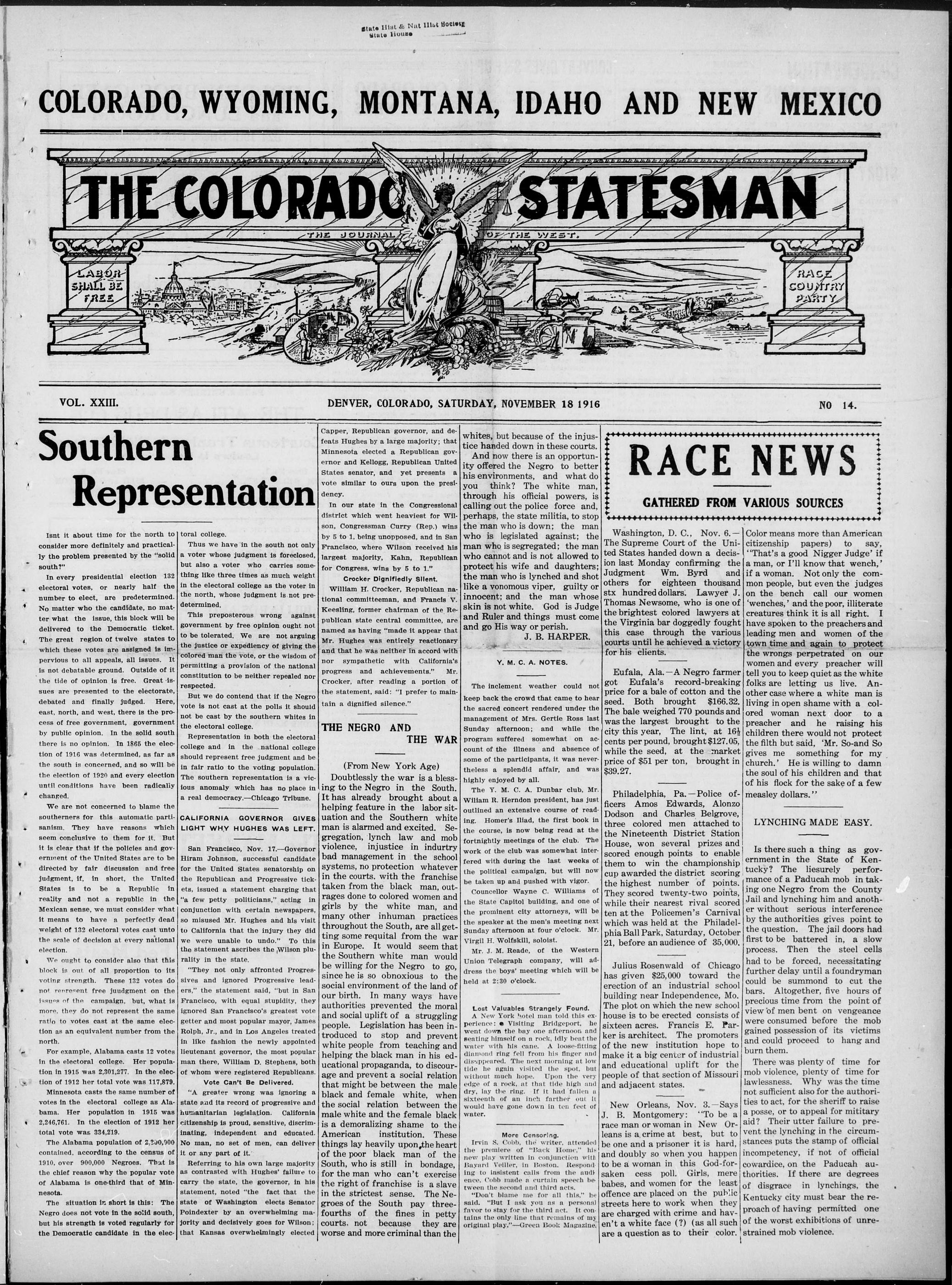
Southern Representation
toral college.
Thus we have in the south not only a voter whose judgment is foreclosed, but also a voter who carries something like three times as much weight in the electoral college as the voter in the north, whose judgment is not predetermined.
This preposterous wrong against government by free opinion ought not to be tolerated. We are not arguing the justice or expediency of giving the colored man the vote, or the wisdom of permitting a provision of the national constitution to be neither repealed nor respected.
But we do contend that if the Negro vote is not cast at the polls it should not be cast by the southern whites in the electoral college.
Representation in both the electoral college and in the national college should represent free judgment and be in fair ratio to the voting population. The southern representation is a vicious anomaly which has no place in a real democracy.—Chicago Tribune.
CALIFORNIA GOVERNOR GIVES LIGHT WHY HUGHES WAS LEFT.
San Francisco, Nov. 17.—Governor Hiram Johnson, successful candidate for the United States senatorship on the Republican and Progressive tickets, issued a statement charging that "a few petty politicians," acting in conjunction with certain newspapers, so misused Mr. Hughes and his visit to California that the injury they did we were unable to undo." To this the statement ascribes the Wilson plurality in the state.
"They not only affronted Progressives and ignored Progressive leaders," the statement said, "but in San Francisco, with equal stupidity, they ignored San Francisco's greatest vote getter and most popular mayor, James Rolph, Jr., and in Los Angeles treated in like fashion the newly appointed lieutenant governor, the most popular man there, William D. Stephens, both of whom were registered Republicans.
"A greater wrong was ignoring a state and its record of progressive and humanitarian legislation. California citizenship is proud, sensitive, discriminating, independent and educated. No man, no set of men, can deliver it or any part of it." Referring to his own large majority as contrasted with Hughes' failure to carry the state, the governor, in his statement, noted "the fact that the state of Washington elects Senator Poindexter by an overwhelming majority and decisively goes for Wilson; that Kansas overwhelmingly elected
---
VOL. XXIII.
Isnt it about time for the north to consider more definitely and practically the problem presented by the "solid south?" In every presidential election 132 electoral votes, or nearly half the number to elect, are predetermined. No matter who the candidate, no matter what the issue, this block will be delivered to the Democratic ticket. The great region of twelve states to which these votes are assigned is impervious to all appeals, all issues. It is not debatable ground. Outside of it the tide of opinion is free. Great issues are presented to the electorate, debated and finally judged. Here, east, north, and west, there is the process of free government, government by public opinion. In the solid south there is no opinion. In 1865 the election of 1916 was determined, as far as the south is concerned, and so will be the election of 1920 and every election until conditions have been radically changed.
We are not concerned to blame the southerners for this automatic partisanism. They have reasons which seem conclusive to them for it. But it is clear that if the policies and government of the United States are to be directed by fair discussion and free judgment, if, in short, the United States is to be a Republic in reality and not a republic in the Mexican sense, we must consider what it means to have a perfectly dead weight of 132 electoral votes cast unto the scale of decision at every national election.
We ought to consider also that this block is out of all proportion to its voting strength. These 132 votes do not represent free judgment on the issues of the campaign, but, what is more, they do not represent the same ratio to votes cast at the same election as an equivalent number from the north.
For example, Alabama casts 12 votes in the electoral college. Her population in 1915 was 2,301,277. In the election of 1912 her total vote was 117,879. Minnesota casts the same number of votes in the electoral college as Alabama. Her population in 1915 was 2,246,761. In the election of 1912 her total vote was 334,219. The Alabama population of 2,200,000 contained, according to the census of 1910, over 900,000 Negroes. That is the chief reason why the popular vote of Alabama is one-third that of Minnesota. The situation in short is this: The Negro does not vote in the solid south, but his strength is voted regularly for the Democratic candidate in the elec-
DENVER, COLORADO, SATURDAY, NOVEMBER 18 1916
State Hist & Nat Hist Society
State House
G, MONTAN
ADO
THE JOURNAL
DENVER, COLORADO, SATU
Capper, Republican governor, and defeats Hughes by a large majority; that Minnesota elected a Republican governor and Kellogg, Republican United States senator, and yet presents a vote similar to ours upon the presidency. In our state in the Congressional district which went heaviest for Wilson, Congressman Curry (Rep.) wins by 5 to 1, being unopposed, and in San Francisco, where Wilson received his largest majority, Kahn, Republican for Congress, wins by 5 to 1."
Crocker Dignifiedly Silent.
William H. Crocker, Republican national committee, and Francis V. Keesling, former chairman of the Republican state central committee, are named as having "made it appear that Mr. Hughes was entirely reactionary and that he was neither in accord with nor sympathetic with California's progress and achievements." Mr. Crocker, after reading a portion of the statement, said: "I prefer to maintain a dignified silence."
THE NEGRO AND
THE WAR
(From New York Age)
Doubtlessly the war is a blessing to the Negro in the South. It has already brought about a helping feature in the labor situation and the Southern white man is alarmed and excited. Segregation, lynch law and mob violence, injustice in industry bad management in the school systems, no protection whatever in the courts, with the franchise taken from the black man, outrages done to colored women and girls by the white man, and many other inhuman practices throughout the South, are all getting some requital from the war in Europe. It would seem that the Southern white man would be willing for the Negro to go, since he is so obnoxious to the social environment of the land of our birth. In many ways have authorities prevented the moral and social uplift of a struggling people. Legislation has been introduced to stop and prevent white people from teaching and helping the black man in his educational propaganda, to discourage and prevent a social relation that might be between the male black and female white, when the social relation between the male white and the female black is a demoralizing shame to the American institution. These things lay heavily upon the heart of the poor black man of the South, who is still in bondage, for the man who can't exercise the right of franchise is a slave in the strictest sense. The Negroes of the South pay three-fourths of the fines in petty courts, not because they are worse and more criminal than the
---
whites, but because of the injustice handed down in these courts. And now there is an opportunity offered the Negro to better his environments, and what do you think? The white man, through his official powers, is calling out the police force and, perhaps, the state militia, to stop the man who is down; the man who is legislated against; the man who is segregated; the man who cannot and is not allowed to protect his wife and daughters; the man who is lynched and shot like a vonomous viper, guilty or innocent; and the man whose skin is not white. God is Judge and Ruler and things must come and go His way or perish. J. B. HARPER.
Y. M. C. A. NOTES.
The inclement weather could not keep back the crowd that came to hear the sacred concert rendered under the management of Mrs. Gertie Ross last Sunday afternoon; and while the program suffered somewhat on account of the illness and absence of some of the participants, it was nevertheless a splendid affair, and was highly enjoyed by all.
The Y. M. C. A. Dunbar club, Mr. William R. Herndon president, has just outlined an extensive course of reading. Homer's Iliad, the first book in the course, is now being read at the fortnightly meetings of the club. The work of the club was somewhat interfered with during the last weeks of the political campaign, but will now be taken up and pushed with vigor.
Councellor Wayne C. Williams of the State Capitol building, and one of the prominent city attorneys, will be the speaker at the men's meeting next Sunday afternoon at four o'clock. Mr. Virgil H. Wolfskill, soloist.
Mr. J. M. Reade, of the Western Union Telegraph company, will address the boys' meeting which will be held at 2:30 o'clock.
Lost Valuables Strangely Found.
A New York hotel man told this experience: • Visiting Bridgeport, he went down the bay one afternoon and seating himself on a rock, idly beat the water with his cane. A loose-fitting diamond ring fell from his finger and disappeared. The next morning at low tide he again visited the spot, but without much hope. Upon the very edge of a rock, at that tide high and dry, lay the ring. If it had fallen a sixteenth of an inch farther out it would have gone down in ten feet of water.
More Censoring.
Irvin S. Cobb, the writer, attended the premiere of "Back Home," his new play written in conjunction with Bayard Veiller, in Boston. Responding to insistent calls from the audience, Cobb made a curtain speech between the second and third acts.
"Don't blame me for all this," he said. "But I ask you as a personal favor to stay for the third act. It contains the only line that remains of my original play."—Green Book Magazine.
RACE NEWS
Washington, D. C., Nov. 6. The Supreme Court of the United States handed down a decision last Monday confirming the Judgment Wm. Byrd and others for eighteen thousand stx hundred dollars. Lawyer J. Thomas Newsome, who is one of the brightest colored lawyers at the Virginia bar doggedly fought this case through the various courts until he achieved a victory for his clients.
Eufala, Ala.—A Negro farmer got Eufala's record-breaking price for a bale of cotton and the seed. Both brought $166.32. The bale weighed 770 pounds and was the largest brought to the city this year. The lint, at 16 1/2 cents per pound, brought $127.05, while the seed, at the market price of $51 per ton, brought in $39.27.
Philadelphia, Pa. —Police officers Amos Edwards, Alonzo Dodson and Charles Belgrove, three colored men attached to the Nineteenth District Station House, won several prizes and scored enough points to enable them to win the championship cup awarded the district scoring the highest number of points. They scored twenty-two points, while their nearest rival scored ten at the Policemen's Carnival which was held at the Philadelphia Ball Park, Saturday, October 21, before an audience of 35,000.
Julius Rosenwald of Chicago has given $25,000 toward the erection of an industrial school building near Independence, Mo. The plot on which the new school house is to be erected consists of sixteen acres. Francis E. Parker is architect. The promoters of the new institution hope to make it a big center of industrial and educational uplift for the people of that section of Missouri and adjacent states.
New Orleans, Nov. 3.—Says J. B. Montgomery: "To be a race man or woman in New Orleans is a crime at best, but to be one and a prisoner it is hard, and doubly so when you happen to be a woman in this God-forsaken cess poll. Girls, mere babes, and women for the least offence are placed on the public streets here to work when they are charged with crime and haven't a white face (?) (as all such are a question as to their color.
NO 14.
Color means more than American citizenship papers) to say, "That's a good Nigger Judge' if a man, or I'll know that wench,' if a woman. Not only the common people, but even the judges on the bench call our women 'wenches,' and the poor, illiterate creatures think it is all right. I have spoken to the preachers and leading men and women of the town time and again to protect the wrongs perpetrated on our women and every preacher will tell you to keep quiet as the white folks are letting us live. Another case where a white man is living in open shame with a colored woman next door to a preacher and he raising his children there would not protect the filth but said, 'Mr. So-and So gives me something for my church.' He is willing to damn the soul of his children and that of his flock for the sake of a few measley dollars."
LYNCHING MADE EASY.
Is there such a thing as government in the State of Kentucky? The lie surely performance of a Paducah mob in taking one Negro from the County Jail and lynching him and another without serious interference by the authorities gives point to the question. The jail doors had first to be battered in, a slow process. Then the steel cells had to be forced, necessitating further delay until a foundryman could be summond to cut the bars. Altogether, five hours of precious time from the point of view of men bent on vengeance were consumed before the mob gained possession of its victims and could proceed to hang and burn them.
There was plenty of time for mob violence, plenty of time for lawlessness. Why was the time not sufficient also for the authorities to act, for the sheriff to raise a posse, or to appeal for mititary aid? Their utter failure to prevent the lynching in the circumstances puts the stamp of official incompetency, if not of official cowardice, on the Paducah authorities. If there are degrees of disgrace in lynchings, the Kentucky city must bear the reproach of having permitted one of the worst exhibitions of unrestrained mob violence.
CONDENSATION OF FRESH NEWS
THE LATEST IMPORTANT DIS
PATCHES PUT INTO SHORT,
CRISP PARAGRAPHS.
STORY OF THE WEEK
SHOWING THE PROGRESS OF EVENTS IN OUR OWN AND FOREIGN LANDS.
Western Newspaper Union News Service.
ABOUT THE WAR
American members of French ambulance corps again cited in dispatches for bravery.
Another advance made by British near the Butte de Warlencourt, three miles south of Bapaume.
Rumanians admit reverse in Transylvania, but claim Teutons were checked on other fronts.
Report from Madrid, via London, appears to confirm claim that German submarine sank American steamer Columbian.
Austro-Germans have occupied the village of Bumbeshti in the Juil valley and forced the Rumanian left wing to retreat near Dragoslavele.
Hard fighting reported from the Macedonian front, where the Serbians apparently have inflicted a severe check on the Bulgar-Germans.
A Petrograd official statement says that a majority of German vessels which took part in a bombardment in the gulf of Finland were sunk.
The British report the capture of another town—Beaucourt—in a new drive on the Ancre. Offensive is being pushed with vigor and more than 5,000 prisoners have been captured.
Germans vigorously shelling French positions in region of Pressoire and the Blaches-La Maisonette sector. French guns responding with equal vigor, says the official Paris statement.
Austrians have driven Rumanians from the right bank of the Danube, allowing a greater measure of freedom for navigation of the river at the junction of the Austrian, Serbian and Rumanian frontiers.
There has been much aerial fighting on the western front. Berlin records the destruction of seventeen entente airplanes and Paris asserts that ten German machines were brought down.
An indiscriminate massacre of nearly 100 women, children and Carranza soldiers who were traveling on a train near Contreras, state of Morelos, which was attacked by Zapata followers, is reported in Mexico City newspapers received at Laredo, Texas.
WESTERN
The enormous increase in Idaho's vote, estimated at about 35,000 over the vote of two years ago, has led to official inquiries and a careful canvass of the entire situation.
Denver postal inspectors received word from Bitter Creek, Wyo., that the postmaster at that place had disappeared some days ago and the department has been asked to search for him.
Warrants for the arrest of State's Attorney Hoyne and the city editors of five Chicago newspapers were asked by Chief Justice Olson of the Chicago Municipal Court, who charged criminal libel.
The price of hides hopped upward again, further intensifying conditions in the American leather industry and lending support to a prediction that within a few months Americans may be paying $15 and $20 for shoes of ordinary quality.
Mr. and Mrs. W. W. J. Bryan departed from Lincoln, Neb., for Miami, Fla. Rumors that the Bryans were going to make their permanent home in the South, presumably North Carolina, were denied by Mayor C. W. Bryan, brother of W. J. Bryan of Lincoln.
WASHINGTON
Former Congressman Henry George, son of Henry George of single tax fame, died in Washington after a long illness.
President Wilson blamed middlemen for the high cost of foodstuffs in a speech welcoming the convention of the National Grange.
The name of Edwin F. Sweet was sent to the president by Secretary of Commerce Redfield for reappointment as assistant secretary. Sweet resigned to run for governor of Michigan and was defeated.
Re-election congratulations have been received by President Wilson from rulers of several foreign nations, but their names will not be given out until the president's re-election is formally conceded by the Republicans.
President Wilson was back at his desk in the White House Monday after an absence of two months, prepared to take up important foreign problems which have been held in abeyance. These included the German submarine situation and the Mexican problem.
Deportation of Belgian civilians into Germany for forced labor has reacquired such serious proportions that American Charge Grew, in Berlin, has been directed by the state department to take the matter up personally with Chancellor von Bethmann-Hollweg.
FOREIGN
Berlin reports destruction of Russian dreadnought by a bomb.
Gen. Sir Sam Hughes has resigned as Canadian minister of militia and defense.
A wireless dispatch from Madrid says it was a German submarine which sank the American steamer Columbian.
A bill providing for uniform bills of exchange between Panama and all other American countries passed the assembly on first reading.
A Reuter's dispatch from Sydney, Australia, reports feverish excitement at the wool sales. The best rates of the season have been recorded.
A conference at Cardiff, Wales in favor of opening peace negotiations which had been arranged by the National Council of Civil Liberties, was broken up.
The Balkan Express, between Constantinople and Berlin, dashed at full-speed into a party of women section hands in a suburb of Berlin. Nineteen women were killed.
Berlin newspapers announce that there will shortly be brought forward a bill for compulsory labor on the part of the civilians of Germany. This report has not been confirmed officially.
The British steamer Taming, which arrived at Manila from Amoy, reports that the British cruiser Cornwall confiscated four sacks of the Manila mall for the purpose of examination at Hong Kong.
Publication of the correspondence between Sir Sam Hughes, who has resigned as minister of militia and defense, and Premier Borden, who requested the resignation, was awaited with great interest at Ottawa because of Hughes' charge that the break resulted from "misstatements" by the premier.
SPORTING NEWS
George (Knockout) Brown of Chicago defeated "Buck" Crouse of Pittsburg on points in a fast six-round no-decision bout at Pittsburg.
While Pierre Macho, aviator, was making a flight at Buenos Aires, with a passenger, his machine fell, the aviator was killed and his passenger injured.
M. Millering, center on the La Grande, Ore., high school's football team, froze two toes while playing in a match on the 11th. He may lose the toes.
Willie Ritchie, former lightweight champion, and Johnny McCarthy of San Francisco fought ten rounds in the Juarez, Mexico, bull ring. The referee declared the fight a draw.
E. L. Cord of Phoenix won the Douglas-Phoenix automobile race, covering the 273-mile course in eight hours and thirteen minutes, according to the unofficial time reported at Phoenix. Fourteen cars started and five finished.
The gridiron clash between the Colorado Springs High School Terrors and the Greeley High school eleven, which is to decide the 1916 championship among the high schools of Colorado, probably will be played at Colorado Springs on Thanksgiving day instead of at Greeley, as first proposed.
GENERAL
The railroads have announced their intention of fighting the Adamson eight-hour bill to the end.
New York's bubbling New Year eve celebration may be sans wine and sans song because the eve falls on a Sabbath.
Directors of the Utah Consolidated Copper Company declared a quarterly dividend of $1.50 a share, doubling the previous rate.
Mrs. Margaret Brown, landlady of the Tourist hotel, was found dead in her room at Spokane, Wash. The police believe she was murdered.
Cotton touched the highest levels since the Civil war on the cotton exchange Monday, when July futures sold at 20.07 cents a pound and May 20.03, making gains of nearly $2 a bale.
Employés in New York federal offices have organized the Federal Employés Union under a charter from the American Federation of Labor, it was announced, and hope to make the organization national in scope.
In a letter to President Wilson, Thomas F. Flaherty, secretary and treasurer of the National Federation of Postoffice Clerks, entered a protest against working postoffice clerks more than eight hours a day.
Six-cent beers were considered a possibility for Milwaukee as a result of several breweries announcing an increase in the price of barrel beer. Just how much of an increase would be made, brewers did not say.
Repudiation of Luis Carbrera of a plan of border control that had been agreed upon by two of his colleagues and the three American members, made doubtful the ability of the Americans on the Mexican-American joint commission to assist Mexico in restoring normal conditions along the frontier.
Committees representing the common and preferred shareholders and debenture bondholders of the Chicago, Rock Island & Pacific Railway Company at New York formally agreed to the plan of reorganization of that company. It provides for an assessment of $40 a share in the form of a subscript to the preferred stock.
Luis De La Rosa, alleged leader of bandit raids in the Brownsville section of Texas a year ago, has been executed in the prison at Monterey, Mex., according to unofficial reports.
CONVERT GIVES SELF UP
SALVATION ARMY MAN CONFESSES CRIMINAL RECORD.
Belleves Himself Guilty of the Murder of a New York Police Officer Five Years Ago.
Western Newspaper Union News Service.
Grand Junction, Colo.—Andrew J. Daniels, 25, became converted at a meeting of the Salvation Army Monday night. Tuesday morning he sought out Salvation Army Captain Ben Debond and confessed a criminal record in New York city, terminating five years ago with the murder of a police officer for which Daniels believes himself to have been responsible. According to Daniels' confession, he was for several years a member of one of the worst gangs operating in New York. He says the gang took part in a street battle with the police five years ago, in which an officer by the name of Thomas Russell was killed. "One of the policemen fell with a shot through the heart," said Daniels, "and I believe it was a bullet from my gun that killed him."
After the fight Daniels says he escaped and entered the army, spending three years in Honolulu. He was married while there. He received an honorable discharge from the army three years ago.
"I am guilty of numerous pickpocketing offenses, for which I deserve punishment," said Daniels, "and I want the matter of the death of that officer cleared up."
Daniels was taken into custody. His confession was telegraphed to New York with a request for particulars.
Court Decides Two Cases.
Denver—Frank Howard and Frank Pasco, sentenced to the penitentiary for blowing the safe of the La Jara State bank a year ago, will have to serve their terms under a decision from the Supreme Court. The court in its opinion holds that the "evidence as to the defendants being guilty is overwhelming" and affirms the judgment of the lower court.
Mrs. Luna C. Thomas, a "Holy Roller" other members of her faith for holding who was arrested with a number of a street meeting at Sixteenna and Champa without a license, lost her suit to recover damages from Detective John Green and Arthur Wagner who arrested her. She said she was not taking part in the meeting. The detectives in defense said that she voluntarily entered the police patrol and was not forcibly arrested as she alleged.
Telephone Line Crosses Range
Telephone Line Crosses Range.
Estes Park—Supervisor L. C. Way has completed a telephone line across the continental divide through the Rocky Mountain National park. This line will unite with the supervisor's office in Estes Park with Grand Lake. The length of the line is twenty-one miles. With the exception of two stretches above the timber line the line is built alongside the trail. Every four or five miles there is a little station and a public telephone. These are for use in an emergency or for the accommodation of travelers along the trail. About two miles of this line is on Flat Top mountain, entirely above the limits of tree growth. It crosses the summit at an altitude of 12,400 feet.
Heavy Storm Damages Crop.
Grand Junction—The heaviest snow storm seen here this early in the season swept the Grand valley. Five inches of snow fell, driving the temperature several degrees below the freezing point. Fruit growers fear the loss of more than $1,000,000 worth of apples that are still on the trees. They have been unable to harvest their crop owing to the shortage in labor.
Wed Twice in Two Months
Pueblo—Henry Brill and Helen Van Duyn were married for the second time within two months. The license for the first wedding was secured with the bride using the name of her stepfather. Thinking that the wedding might be termed illegal because of this fact, the couple obtained another license and were remarried.
Governor Commutes Bulger Sentence, Denver—Col. James C. Bulger is not to die on the gallows. The days which are left to him will be spent in the ward where the insane are kept at the state penitentiary. The state board of pardons so decided and Governor Carlson commuted the sentence of the man who murdered Lloyd F. seven times, to life imprisonment.
Boarder Slays Landlord.
Fort Collins—Jesus Martinez, boarder, and Arigielio Gimeez, landlord, quarreled over the quality of the "grub" in the Gimeez hostelry. Martinez is now sought by the sheriff on the charge of having slain Gimeez.
Teachers Told of Home Influence. Pueblo.—Advancement in citizenship is more the field of the public school than "any other public institution, according to Frank D. Slutz, superintendent of schools of district No. 1, who addressed the general session of the southern division of the State Teachers' Association. His address was entitled "Freedom—A Conquest." He made a plea for more attention to home life and expressed the belief that the home would adjust itself to new interests which now it is evading.
Western Newpaper Union News Service.
DATES FOR COMING EVENTS.
Jan. 1-6—Poultry Show at Denver.
Jan. 13—Poultry Show at Cañon City.
Jan. 20 - Athletic Club boxing contests at Denver.
Lakewood
The Zang Brewing Company plant may be converted into an ice plant. The pickle company commenced work on three new buildings in Brighton.
The funeral of Thomas M. Hyder was held from St. Paul's Methodist church in Denver.
Orders for $4,000,000 worth of tungsten concentrates have been reported placed at Boulder.
The Camfield hotel at Greeley, owned by the D. A. Camfield estate, was sold for $50,000.
An increase of one-tenth of a mill in the municipal tax levy at Loveland for 1917 will be ordered.
A total of twenty-six buildings are being constructed in Pueblo, aggregating an expenditure of $500,000.
Judge Rice sentenced John Golden to thirty days in the Denver jail and to pay a fine of $100 for bootlegging. A new local council for the Boy Scouts of Denver, to supervise and extend the benefits of scouting, has been formed.
The Union Pacific Railroad Company reports 300 outgoing cars of freight from the town of Ault during October.
Armour & Company contemplate an increase in capital stock to $100,000,000 and the declaration of a 400 per cent stock dividend.
Beets are being received at the Loveland sugar factory at the rate of 5,000 tons a day. The plant is slicing 2,000 tons a day.
Assistant District Attorney Frank A. West was appointed major on the judge advocate's staff of the reorganized militia at Denver.
The official canvass of returns from the election will be begun by the state canvassing board Nov. 20, according to Secretary of State Ramer. Increased bonus for sugar company employés at Fort Morgan means an addition of $18,000 to the company's payrolls there for the season. Robert Wallace English, 71, prominent in Denver business and Masonic circles and a resident of Denver for many years, died at his home from uremia. The Hygiene consolidated school district has awarded a contract for the erection of a two-story modern schoolhouse at Hygiene. The cost to be $10,422. Vance C. McCormick, chairman of the Democratic national committee, has telegraphed felicitations to John T. Barnett of the Denver national headquarters.
F. D. Crocker of Pueblo county sold 90 acres of his farm land to O. P. Larson for $14,500, establishing a new valuation for Pueblo county farm lands of $161 per acre.
George R. Lunn, Socialist mayor of Schenectady, N. Y., former Denver boy, and son of Mr. and Mrs. M. A. Lunn of Denver, was elected congressman from his district.
Denver is fortiest in a list of 111 American cities in percentage of gain in amount of building permits issued last month. The average gain is 27 per cent, while Denver shows a gain of 44 per cent.
The campaign for use of Coloradomade goods and the patronizing of home industries scored a point when a Denver firm secured the contract against a score of Eastern competitors for the electrical fixtures for the Weld county court house.
Frank N. Briggs, state director for the fourth annual conference on marketing and rural credits, to be held at the Sherman hotel in Chicago, Dec. 4 to 9, declared in Denver that Colorado ought to have at least 100 representatives at the meeting.
The highest honor given to a student at Lawrenceville, Pa., has been awarded to a Denver boy. Channing Sweet, son of Channing Sweet of Denver and a senior in the school, was elected president of the entire student body at a recent election.
Examinations will be conducted in large cities of the country, including Denver, Dec. 6, for positions of trade commissioners or special agents to make investigation of foreign markets for American goods, under the department of commerce. The salaries to be paid will be not in excess of $10 a day and expenses, with $4 extra for subsistence.
A railway freight car loaded with automobiles has been standing on a side track at Colorado Springs for seven weeks waiting to be unloaded while people all over the country are calling for cars in which to move foodstuffs and perishable freight, according to a report received in Denver.
Demands of Colorado and the entire tungsten producing West for a tariff on the black metal were laid before the state senatorial delegation at a meeting of the tungsten miners with Senators Shafroth and Thomas and Congressman Timberlake at Boulder.
924 19th Street, Denver, Colorado
DINNER
11:30 to 2 p.m.
All Kinds of Sandwiches
Bolden Br
Baths,
FIRST
R. B. BOLDEN,
C. H. SHIRLEY, Pres.
PAUL J. SHI
THE ATL
Courteous Tre
Leaders
Golden Bros. Barber Sh
Baths, Electric Massage
FIRST CLASS SERVICE
S. BOLDEN, Mgr. 926 19th St. D.
LEY, Pres. J. O. HAMPSON,
PAUL J. SHIRLEY, Sec. and Treas.
THE ATLAS DRUG CO.
Fessous Treatmet. Right P
Leaders in Prescription
D. I.
TON ST.
1875
Store No.
26TH AND
Main 495
IPTON, Pres. J. B. MINT
MILROAD PORTERS' CLU
LUNCHOOM IN CONNECTION
Bolden Bros. Barber Shop
Baths, Electric Massage
FIRST CLASS SERVICE
R. B. BOLDEN, Mgr. 926 19th St. Denver
C. H. SHIRLEY, Pres. J. C. BAMPSON, Vice Pres PAUL J. SHIRLEY, Sec. and Treas.
Courteous Treatmet. Right Prices
Leaders in Prescription
Store No. 1.
2701 WELTON ST.
Main 895 875
Store No. 2
26TH AND WELTON
Main 4955 4956
W. C. CAMPTON, Pres.
RAILROAD
LUNCHOOM
RAILROAD PORTERS' CLUB LUNCHOOM IN CONNECTION
BILLIARDS AND
POOL
1728½ Wazee St. C
J. B. I
PHONE MAIN 8416.
28½ Wazee St. Only one block from Union Depot
J. B. MINTER, Barber.
NE MAIN 8416. DENVER, COLORADO
1728 $ \frac{1}{2} $ Wazee St. Only one block from Union Depot.
J. B. MINTER, Barber.
PHONE MAIN 8416. DENVER, COLORADO.
JOHN K. RETTIG
Fancy and Staple Grocery
1864 CURTIS STREET
seventh.
MARKET COMPANY
E. SMITH, Manager, Res. Phone South 1608
and Retail Staple and Fancy Groceries, Fish and
Hotels and Restaurants Our Specialty.
Fresh and Cured
Eastern Corn Fed Meat
Fruits, Vegetables, Poultry and Game.
Telephones Main 4302, 4303, 4304, 4305
15th Street Denver, C
atherhead Hat
TELEPHONE MAIN 3203
Meats, Fancy and Staple Groceries 1864 CURTIS STREET Corner Nineteenth. Denver, Colo.
The MARKET COMPANY
C. E. SMITH, Manager, Res. Phone South 1608
Wholesale and Retail Staple and Fancy Groceries, Fish and Oysters. Hotels and Restaurants Our Specialty. Fresh and Cured Eastern Corn Fed Meats Fruits, Vegetables, Poultry and Game.
Telephones Main 4302, 4303, 4304, 4306
622-636 15th Street Denver, Colorado
Established 1876
PIONEER HATTERS OF THE WEST
WE MAKE OLD HATS NEW
PRACTICAL HATTERS
ATORS, BLEACHERS DYERS AND FINISH
Gents' and Ladies' Hats of Every Descriptio
1624 Champa St., Denver, Colo.
Established 1876
PIONEER HATTERS OF THE WEST
WE MAKE OLD HATS NEW
PRACTICAL HATTERS
RENOVATORS, BLEACHERS DYERS AND FINISHERS
Of Gents' and Ladies' Hats of Every Description
1624 Champa St., Denver, Colo.
Short Orders at All Hours
Barber Shop
Massage
SERVICE
926 19th St. Denver
J. C. HAMPSON, Vice Pres
Sec. and Treas.
DRUG CO.
et. Right Prices
Description
Store No. 2
26TH AND WELTON
Main 4955-4956
J. B. MINTER, Sec.
TERS' CLUB
CONNECTION
FREE CHECK
ROOM
stock from Union Depot.
Barber.
DENVER, COLORADO.
RES. PHONE GALLUP. 942
ETTIG
taple Groceries
STREET
Denver, Colo.
VINE
```markdown
```
---
WEDDING GOWN MADE UP IN
WHITE BRIDAL SATIN.
Exact Copy of First Empire Frock, Introduced by the Empress Josephine—Silver-Thread Embroidery Adds to its Richness.
Both the Grecian and first empire styles are approved by Dame Fashion for the 1916-17 season. So different are the lines expressed by these two "periods" that the fact that they are actually close of kin, branches of the same family tree, is not generally recognized.
The Empress Josephine, wife of the great Napoleon, was during the days
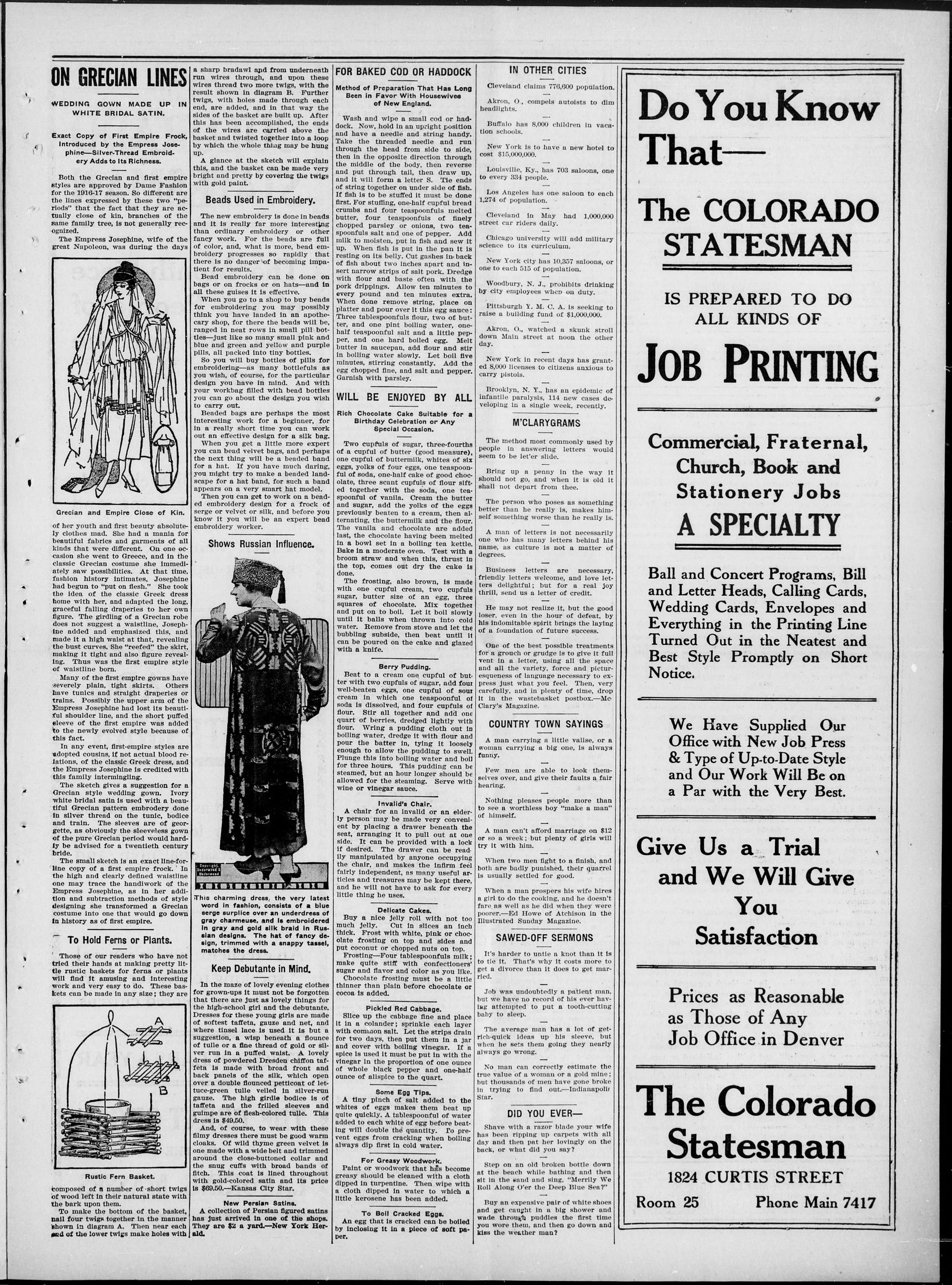
FASHION
Grecian and Empire Close of Kin. of her youth and first beauty absolutely clothes mad. She had a mania for beautiful fabrics and garments of all kinds that were different. On one occasion she went to Greece, and in the classic Grecian costume she immediately saw possibilities. At that time, fashion history intimates, Josephine had begun to "put on flesh." She took the idea of the classic Greek dress home with her, and adapted the long, graceful falling draperies to her own figure. The girdling of a Grecian robe does not suggest a waistline, Josephine added and emphasized this, and made it a high waist at that, revealing the bust curves. She "reefed" the skirt, making it tight and also figure revealing. Thus was the first empire style of waistline born.
Many of the first empire gowns have severely plain, tight skirts. Others have tunics and straight draperies or trains. Possibly the upper arm of the Empress Josephine had lost its beautiful shoulder line, and the short puffed sleeve of the first empire was added to the newly evolved style because of this fact.
In any event, first-empire styles are adopted cousins, if not actual blood relations, of the classic Greek dress, and the Empress Josephine is credited with this family intermingling.
The sketch gives a suggestion for a Grecian style wedding gown. Ivory white bridal satin is used with a beautiful Grecian pattern embroidery done in silver thread on the tunic, bodice and train. The sleeves are of geogette, as obviously the sleeveless gown of the pure Grecian period would hardly be advised for a twentieth century bride.
The small sketch is an exact line-line copy of a first empire frock. In the high and clearly defined waistline one may trace the handiwork of the Empress Josephine, as in her addition and subtraction methods of style designing she transformed a Grecian costume into one that would go down in history as of first empire.
To Hold Ferns or Plants.
Those of our readers who have not tried their hands at making pretty little rustic baskets for ferns or plants will find it amusing and interesting work and very easy to do. These baskets can be made in any size; they are
Rustic Fern Basket.
composed of a number of short twigs of wood left in their natural state with the bark upon them. To make the bottom of the basket, nail four twigs together in the manner shown in diagram A. Then near each end of the lower twigs make holes with
a sharp bradawl and from underneath run wires through, and upon these wires thread two more twigs, with the result shown in diagram B. Further twigs, with holes made through each end, are added, and in that way the sides of the basket are built up. After this has been accomplished, the ends of the wires are carried above the basket and twisted together into a loop by which the whole thing may be hung up.
A glance at the sketch will explain this, and the basket can be made very bright and pretty by covering the twigs with gold paint.
Beads Used in Embroidery.
The new embroidery is done in beads and it is really far more interesting than ordinary embroidery or other fancy work. For the beads are full of color, and, what is more, bead embroidery progresses so rapidly that there is no danger of becoming impatient for results.
Bead embroidery can be done on bags or on frocks or on hats—and in all these guises it is effective.
When you go to a shop to buy beads for embroidering you may possibly think you have landed in an apothecary shop, for there the beads will be, ranged in neat rows in small pill bottles—just like so many small pink and blue and green and yellow and purple pills, all packed into tiny bottles.
So you will buy bottles of pills for embroidering—as many bottlefuls as you wish, of course, for the particular design you have in mind. And with your workbag filled with bead bottles you can go about the design you wish to carry out.
Beaded bags are perhaps the most interesting work for a beginner, for in a really short time you can work out an effective design for a silk bag.
When you get a little more expert you can bead velvet bags, and perhaps the next thing will be a beaded band for a hat. If you have much daring, you might try to make a beaded landscape for a hat band, for such a band appears on a very smart hat model. Then you can get to work on a beaded embroidery design for a frock of serge or velvet or silk, and before you know it you will be an expert bead embroidery worker.
Shows Russian Influence.
Copyright
Independence
Underwood
This charming dress, the very latest word in fashion, consists of a blue serge surplice over an underdress of gray charmeuse, and is embroidered in gray and gold silk braid in Russian designs. The hat of fancy design, trimmed with a snappy tassel, matches the dress.
Keep Debutante in Mind.
In the maze of lovely evening clothes for grown-ups it must not be forgotten that there are just as lovely things for the high-school girl and the debutante. Dresses for these young girls are made of softest taffeta, gauze and net, and where tinsel lace is used it is but a suggestion, a wisp beneath a flounce of tulle or a fine thread of gold or silver run in a puffed waist. A lovely dress of powdered Dresden chiffon taffeta is made with broad front and back panels of the silk, which open over a double founced petticoat of lettuce-green tulle veiled in silver-run gauze. The high girdle bodice is of taffeta and the frilled sleeves and gulmpe are of flesh-colored tulle. This dress is $49.50.
And, of course, to wear with these filmy dresses there must be good warm cloaks. Of wild thyme green velvet is one made with a wide belt and trimmed around the close-buttoned collar and the snug cuffs with broad bands of fitch. This coat is lined throughout with gold-colored satin and its price is $60.50—Kansas City Star.
New Persian Satins.
A collection of Persian figured satins has just arrived in one of the shops. They are $2 a yard.—New York Herald.
FOR BAKED COD OR HADDOCK
Method of Preparation That Has Long Been in Favor With Housewives of New England.
Wash and wipe a small cod or haddock. Now, hold in an upright position and have a needle and string handy. Take the threaded needle and run through the head from side to side, then in the opposite direction through the middle of the body, then reverse and put through tail, then draw up, and it will form a letter S. The ends of string together on under side of fish. If fish is to be stuffed it must be done first. For stuffing, one-half cupful bread crumbs and four teaspoonfuls melted butter, four teaspoonfuls of finely chopped parsley or onions, two teaspoonfuls salt and one of pepper. Add milk to moisten, put in fish and sew it up. When fish is put in the pan it is resting on its belly. Cut gashes in back of fish about two inches apart and insert narrow strips of salt pork. Dredge with flour and baste often with the pork drippings. Allow ten minutes to every pound and ten minutes extra. When done remove string, place on platter and pour over it this egg sauce: Three tablespoonfuls flour, two of butter, and one pint boiling water, one-half teaspoonful salt and a little pepper, and one hard boiled egg. Melt butter in saucepan, add flour and stir in boiling water slowly. Let boil five minutes, stirring constantly. Add the egg chopped fine, and salt and pepper. Garnish with parsley.
WILL BE ENJOYED BY ALL
Rich Chocolate Cake Suitable for a Birthday Celebration or Any Special Occasion.
Two cupfuls of sugar, three-fourths of a cupful of butter (good measure), one cupful of buttermilk, whites of six eggs, yolks of four eggs, one teaspoonful of soda, one-half cake of good chocolate, three scant cupfuls of flour sifted together with the soda, one teaspoonful of vanilla. Cream the butter and sugar, add the yolks of the eggs previously beaten to a cream, then alternating, the buttermilk and the flour. The vanilla and chocolate are added last, the chocolate having been melted in a bowl set in a boiling tea kettle. Bake in a moderate oven. Test with a broom straw and when this, thrust in the top, comes out dry the cake is done.
The frosting, also brown, is made with one cupful cream, two cupfuls sugar, butter size of an egg, three squares of chocolate. Mix together and put on to boll. Let it boll slowly until it balls when thrown into cold water. Remove from stove and let the bubbling subside, then beat until it can be poured on the cake and glazed with a knife.
Berry Pudding.
Beat to a cream one cupful of butter with two cupfuls of sugar, add four well-beaten eggs, one cupful of sour cream in which one teaspoonful of soda is dissolved, and four cupfuls of flour. Stir all together and add one quart of berries, dredged lightly with flour. Wring a pudding cloth out in boiling water, dredge it with flour and pour the batter in, tying it loosely enough to allow the pudding to swell. Plunge this into boiling water and boll for three hours. This pudding can be steamed, but an hour longer should be allowed for the steaming. Serve with wine or vinegar sauce.
Invalid's Chair.
A chair for an invalid or an elderly person may be made very convenient by placing a drawer beneath the seat, arranging it to pull out at one side. It can be provided with a lock if desired. The drawer can be readily manipulated by anyone occupying the chair, and makes the infirm feel fairly independent, as many useful articles and treasures may be kept there, and he will not have to ask for every little thing he uses.
Delicate Cakes
Buy a nice jelly roll with not too much jelly. Cut in slices an inch thick. Frost with white, pink or chocolate frosting on top and sides and put coconut or chopped nuts on top. Frosting—Four tablespoonfuls milk; make quite stiff with confectioners' sugar and flavor and color as you like. Chocolate frosting must be a little thinner than plain before chocolate or cocoa is added.
Pickled Red Cabbage.
Slice up the cabbage fine and place it in a colander; sprinkle each layer with common salt. Let the strips drain for two days, then put them in a jar and cover with boiling vinegar. If a spice is used it must be put in with the vinegar in the proportion of one ounce of whole black pepper and one-half ounce of allspice to the quart.
Some Egg Tips.
A tiny pinch of salt added to the whites of eggs makes them beat up quite quickly. A tablespoonful of water added to each white of egg before beating will double the quantity. To prevent eggs from cracking when boiling always dip first in cold water.
For Greasy Woodwork
Paint or woodwork that has become greasy should be cleaned with a cloth dipped in turpentine. Then wipe with a cloth dipped in water to which a little kerosene has been added.
To Boil Cracked Eggs.
An egg that is cracked can be boiled by inclosing it in a piece of soft paper.
OTHER CITIES
Cleveland claims 776,600 population.
Akron, O., compels autoists to dim headlights.
Buffalo has 8,000 children in vacation schools.
New York is to have a new hotel to cost $15,000,000.
Louisville, Ky., has 703 saloons, one to every 334 people.
Los Angeles has one saloon to each 1,274 of population.
Cleveland in May had 1,000,000 street car riders daily.
Chicago university will add military science to its curriculum.
New York city has 10,357 saloons, or one to each 515 of population.
Woodbury, N. J., prohibits drinking by city employees when on duty.
Pittsburgh Y. M. C. A. is seeking to raise a building fund of $1,000,000.
Akron, O., watched a skunk stroll down Main street at noon the other day.
New York in recent days has granted 8,000 licenses to citizens anxious to carry pistols.
Brooklyn, N. Y., has an epidemic of infantile paralysis, 114 new cases developing in a single week, recently.
M'CLARYGRAMS
The method most commonly used by people in answering letters would seem to be let'er slide.
Bring up a penny in the way it should not go, and when it is old it shall not depart from thee.
The person who poses as something better than he really is, makes himself something worse than he really is.
A man of letters is not necessarily one who has many letters behind his name, as culture is not a matter of degrees.
Business letters are necessary, friendly letters welcome, and love letters delightful; but for a real joy thrill, send us a letter of credit.
He may not realize it, but the good loser, even in the hour of defeat, by his indomitable spirit brings the laying of a foundation of future success.
One of the best possible treatments for a grouch or grudge is to give it full vent in a letter, using all the space and all the variety, force and picture-essueness of language necessary to express just what you feel. Then, very carefully, and in plenty of time, drop it in the wastebasket postbox.—McClary's magazine.
COUNTRY TOWN SAYINGS
A man carrying a little valse, or a woman carrying a big one, is always funny.
Few men are able to look themselves over, and give their faults a fair hearing.
Nothing pleases people more than to see a worthless boy "make a man" of himself.
A man can't afford marriage on $12 or so a week; but plenty of girls will try it with him.
When two men fight to a finish, and both are badly punished, their quarrel is usually settled for good.
When a man prosperps his wife hires a girl to do the cooking, and he doesn't fare as well as he did when they were poorer.—Ed Howe of Atchison in the Illustrated Sunday Magazine.
SAWED-OFF SERMONS
It's harder to untie a knot than it is to tie it. That's why it costs more to get a divorce than it does to get married.
Job was undoubtedly a patient man, but we have no record of his ever having attempted to put a tooth-cutting baby to sleep.
The average man has a lot of get-rich-quick ideas up his sleeve, but when he sets them going they nearly always go wrong.
No man can correctly estimate the true value of a woman or a gold mine; but thousands of men have gone broke in trying to find out.—Indianapollis Star.
DID YOU EVER—
Shave with a razor blade your wife has been ripping up carpets with all day and then pat her lovingly on the back, or what did you say?
Step on an old broken bottle down at the beach while bathing and then sit in the sand and sing, "Merrily We Roll Along O'er the Deep Blue Sea?"
Buy an expensive pair of white shoes and get caught in a big shower and wade through puddles the first time you wore them, and then go down and kiss the weather man?
Do You Know That-
IS PREPARED TO DO ALL KINDS OF
Commercial, Fraternal, Church, Book and Stationery Jobs A SPECIALTY
Ball and Concert Programs, Bill and Letter Heads, Calling Cards, Wedding Cards, Envelopes and Everything in the Printing Line Turned Out in the Neatest and Best Style Promptly on Short Notice.
We Have Supplied Our Office with New Job Press & Type of Up-to-Date Style and Our Work Will Be on a Par with the Very Best.
Give Us a Trial and We Will Give You Satisfaction
Prices as Reasonable as Those of Any Job Office in Denver
Room 25
THE COLORADO STATESMAN
THE ADVOCATE OF THE VARY
CABUN
SHOULD BE
FREE
CABUN
COUNTRY
PARTY
Entered as second-class matter at the postoffice in the City of Denver, Colo.
Reading notices, ten lines or less, 10 cents per line. Each additional line over ten lines, 5 cents per line. Display advertising 50 cents per inch.
Remittances should be made by Express Money Order, Postoffice Money Order, Registered Letter or Bank Draft. Postage stamps will be received the same as cash for the fractional part of a dollar. Only 1c and 2c stamps taken.
No discounts allowed on less than three months' contract. Cash must accompany all orders from parties unknown to us. Further particulars on application.
Communications to receive attention must be newsy, upon important subjects, plainly written only upon one side of the paper, must reach us Tuesdays, if possible, anyway not later than Wednesday, and bear the signature of the author. No manuscript returned, unless stamps are sent for postage. All communications of a personating nature that are not complimentary will
RECOGNIZED BY THE RETAIL ASSOCIATION OF THE CHAMBER OF COMMERCE AS AN ADVERTISING MEDIUM OF THE FIRST CLASS.
ED BY THE RETAIL ASSOCIATION OF THE
CAMBER OF COMMERCE AS AN ADVERTIS
MEDIUM OF THE FIRST CLASS.
RECOGNIZED BY THE RETAIL ASSOCIATION OF THE DENVER CHAMBER OF COMMERCE AS AN ADVERTISING MEDIUM OF THE FIRST CLASS.
EARLY CHRISTMAS SHOPPERS.
'Twas the night before Christmas, and all thru campant, while Dad and his spouse, were arranging aus was ready to start, but why does he pause, and the gifts that were bought, in a hurry, bought, were sure to displease, and sorrow would—regrets are in vain. 'Tis a very long story, agrin took hold where should have been cheer, better this time, and make Santa cheerful, and only, shop wisely—shop now, don't delay, the same way.
night before Christmas, and all thru the house. Dad and his spouse, were arranging the tree, to start, but why does he pause—'Cause gifts that were bought, in a hurry and flurry, sure to displease, and sorrow would reign—to lie in vain. 'Tis a very long story, can't tell, where should have been cheer. But let us come, and make Santa cheerful, and cheerful more simply—shop now, don't delay, the safest—the s
Twas the night before Christmas, and all thru the house—excitement was rampant, while Dad and his spouse, were arranging the tree, and Good Santa Claus was ready to start, but why does he pause—'Cause his joy was not real, and the gifts that were bought, in a hurry and flurry without proper thought, were sure to displease, and sorrow would reign—too late to change 'em—regrets are in vain. 'Tis a very long story, can't tell it all here, how chagrin took hold where should have been cheer. But let us take heed and do better this time, and make Santa cheerful, and cheerful my rhyme. Shop early, shop wisely—shop now, don't delay, the safest—the surest—the sensible way.
ARE WE GROWING?
We cannot be classed among the pessimists in the conditions that we are passing upon to believe that many things which seem hard, as their crushing weight falls upon us, are our development, and therefore blessings come facts, however, connected with the races, which, we believe, are not the rightful success as the years go by, but the actual not altogether what we are prone to come the colored people of the United States in personal property than they ever owned be higher educational standing, a material advantage and moral development and a great industrial forces by which the strength and measured. We are growing along all lines, people worthy of consideration and respect, can feel a high sense of satisfaction over the chance of our advancement. But when we are iterative position which we should occupy as society's associated elements, the expected ratio to a certain point our rights seem to be definite is fixed more by a universal legal need or moral obligation. We are permitted to really to enjoy the fruits of it and of our permitted to share, to a certain extent, in the country and to apply our education to our development. Among ourselves we may institute moral or material movements or labors as my sense of self-improvement.
But in the realm of civil and political life associated governmental and business itself today than we were twenty-five years ago, endured fear of Negro domination is made at almost all political privilege. In the North cursed but no less efficient bias makes our affairs almost as fruitless, and all indication of political benefits which other are hard by a change of political allegiance. On other elements, like those political, are hammering rules of prejudice. In these two success we are at a standstill, and neither in over the wall of racial separation. It does nature tranquility, though, as we stated in the best. At any rate, we will go ahead, we are not hampered. We will increase our end our worth; we will rely more upon our within ourselves.
We are a patient, tolerant people and we not without inherent capabilities which here, lead us to the full enjoyment of a free
not be classed among the pessimists whose conditions that we are passing through, we have that many things which seem monstrous, the crushing weight falls upon us, are, after moment, and therefore blessings in disguise, connected with the race problem. We believe, are not the rightful source of conscience as a hopeful but tolerant people are the making indisputable progress in the case as the years go by, but the actual result of what we are prone to consider it. Indeed people of the United States own more liberty than they ever owned before. The national standing, a material advance along moral development and a greater adapties by which the strength and worth of we are growing along all lines which tend of consideration and respect, and every sense of satisfaction over the realization advancement. But when we attempt to union which we should occupy as citizens and elements, the expected ratio does not point our rights seem to be definitely reduced more by a universal legal necessity than obligation. We are permitted to own the fruits of it and of our labors up share, to a certain extent, in the education and to apply our education to our own life among ourselves we may instigate and social movements or labors as may suggest self-improvement.
The realm of civil and political liberty—the governmental and business intercourse—we were twenty-five years ago. In the self Negro domination is made a pretext to political privilege. In the North a general less efficient bias makes our participants as fruitless, and all indications point to political benefits which other elements are range of political allegiance. Our business, like those political, are hampered and rules of prejudice. In these two great battles at a standstill, and neither individual of racial separation. It does not augur utility, though, as we stated in the beginning. At any rate, we will go ahead along the hampered. We will increase our wealth, much; we will rely more upon ourselves and lives.
In patient, tolerant people and time is put out inherent capabilities which must so to the full enjoyment of a freeman's right.
We cannot be classed among the pessimists who never see any good in the conditions that we are passing through, but we are inclined to believe that many things which seem monstrously unjust and hard, as their crushing weight falls upon us, are, after all, necessary to our development, and therefore blessings in disguise. There are some facts, however, connected with the race problem in the United States, which, we believe, are not the rightful source of so much complacent assurance as a hopeful but tolerant people are inclined to give them. We are making indisputable progress in the channels of material success as the years go by, but the actual result of that progress is not altogether what we are prone to consider it. At the present time the colored people of the United States own more land and more personal property than they ever owned before. They can boast a higher educational standing, a material advance along the lines of intellectual and moral development and a greater adaptation to those industrial forces by which the strength and worth of a people are measured. We are growing along all lines which tend to make a people worthy of consideration and respect, and every sensible Negro can feel a high sense of satisfaction over the realization of this evidence of our advancement. But when we attempt to fix the comparative position which we should occupy as citizens among the country's associated elements, the expected ratio does not hold good. Up to a certain point our rights seem to be definitely recognized. That point is fixed more by a universal legal necessity than by any equitable or moral obligation. We are permitted to own property and generally to enjoy the fruits of it and of our labors upon it. We are permitted to share, to a certain extent, in the educational facilities of the country and to apply our education to our own further class development. Among ourselves we may instigate and carry out such moral or material movements or labors as may suggest themselves to our sense of self-improvement.
But in the realm of civil and political liberty—that great source of associated governmental and business intercourse—we are worse off today than we were twenty-five years ago. In the South the pretended fear of Negro domination is made a pretext to deprive us of almost all political privilege. In the North a general and carefully nursed but no less efficient bias makes our participation in political affairs almost as fruitless, and all indications point to a still greater diminution of political benefits which other elements are able to safeguard by a change of political allegiance. Our business relations with other elements, like those political, are hampered and hedged in by unwavering rules of prejudice. In these two great branches of progress we are at a standstill, and neither individual or race can see over the wall of racial separation. It does not augur well for our future tranquility, though, as we stated in the beginning, it may be for the best. At any rate, we will go ahead along the lines on which we are not hampered. We will increase our wealth, our knowledge and our worth; we will rely more upon ourselves and develop more within ourselves.
We are a patient, tolerant people and time is proving that we are not without inherent capabilities which must some day, somewhere, lead us to the full enjoyment of a freeman's rights.
W. F. PLAMBECK
EXPERT WATCH MAKER
1715 CHAMPA STREET
A full line of Watches, Clocks, Diamonds and Jewelry
at lowest prices. Courteous treatment to all
---
the house—excitement with the tree, and Good Saul—'Cause his joy was and flurry without proclaim—too late to change can't tell it all here, but But let us take heed a cheerful my rhyme. She rest—the surest—the serene?
rists who never see a through, but we are monstrously unjust are, after all, necessary in disguise. There is a problem in the United source of so much people are inclined to go in the channels of real result of that programider it. At the pressown more land and more. They can boastance along the lines; later adaptation to the worth of a people which tend to make and every sensible New realization of this attempt to fix the citizens among the colonies does not hold good. Ultimately recognized. The dignity than by any equiv own property and gathers upon it. We educational facilities our own further class state and carry out so may suggest themselves liberty—that great southercourse—we are woe. In the South the pretext to deprive us a general and careful participation in politics point to a still great elements are able to our business relations we opened and hedged in great branches of individual or race can not augur well for the beginning, it may along the lines on wher wealth, our knowledge ourselves and develop m
time is proving that we must some day, so man's rights.
HONEST GOODS
HONEST WORK
AT HONEST
PRICES
Expert Repairing
By LEONARD CROSS
(Copyright, 1916, by W. G. Chapman.)
"It's true then?" asked the deacon.
"It's quite true that my wife was on the stage before I married her," replied the young minister. Then, raising his head, "I am not prepared to discuss Mrs. Ramsay further."
"No need to," snapped the deacon.
"The church wants your resignation."
"You have it," replied the minister.
The deacon was flustered. "Don't you want to say anything more?" he asked.
"Yes, I will tell you the story," replied the minister. "You people think because a woman has been an actress she is thereby unfitted for work as a minister's wife. Mrs. Ramsay and I were born in the same village. She left home in girlhood with her parents. They died, and she was forced to support herself in the way that she could best—by acting. She had a natural gift. Is there anything degrading in honest work?"
"I don't say there is and I don't say there ain't," the deacon answered. "The story is that you went to New York to find her and reformed her and married her."
"The story is true in this regard—that I went to New York, found her, and married her." "Well, we'll not want you after the quarter." "You need not have me after today." "The contract reads till the end of the quarter, and, while you've received
"I Don't Say There Is and I Don't Say There Ain't"
"I Don't Say There Is and I Don't Say There Ain't."
us, we ain't going to go back on a contract. We require you till we can get another minister," answered the deacon, putting on his hat.
Which meant until they could get another minister cheap. Small Falls was a small-minded, mean, avaricious place. John Ramsay had known that at the beginning.
But he had had to leave his first charge when he brought back pretty Nora Welr from New York as his wife. People would not tolerate in the parsonage a woman who had run away from her home, as gossip falsely said, who had been saved, according to lying reports, by the man who had once been her sweetheart. Since then John Ramsay had to give up two charges for the same reason. Rumor followed him, lying tongues pursued him.
"Well, dear," asked his wife as he went slowly upstairs.
"The same story, Nora," he answered dejectedly.
She put her arms about his neck. "I am a burden to you," she said. "If it were not for me, John, you need never have left Grayling. I have ruined your life."
"You have made my life, dearest," he answered.
For the first few weeks all had gone swimmingly; then the scandalous stories had begun to spread. Nora had been cut by the townspeople; they had looked the other way when John passed along the street; the situation had become unbearable. There was nothing to do but leave.
"Nora," said John that evening, "I have decided to give up the ministry. Let us go west and make ourselves independent; then we'll have nobody to fear, and then—"
"Rlch?" inquired Nora. "You know, I could have made a good deal of money upon the stage."
"Then I'll start a church of my own," answered John grimly.
* * * * * * * *
There were too many churches in Small Falls. They jostled each other upon the main street and in the suburbs. There were perhaps a dozen of them, and most of them were empty. The ministers, struggling along on a bare pittance, partook necessarily of the narrow views of their flock, controlled by the well-to-do, hard-minded men who used these institutions to advance their own interests.
Five years after John Ramsay's disappearance he had been quite forgotten. When John Ramsay and his wife
registered at the hotel, they found hardly a soul they had ever seen.
---
When they bought the finest house in the town, however, there was a fluttering among social leaders. Their wealth seemed to be unlimited. As a matter of fact, John Ramsay had made a cool million in the goldfields, and meant to devote half of it to his purpose.
THE COLORADO STATESMAN
When the story went about that John Ramsay was the discharged minister, everybody began to leave cards out of curiosity. Mrs. Ramsay, who had been snubbed and neglected, found herself a social light in Small Falls. The local newspapers were full of accounts of the "popular minister" who had given up the pastorate to go into business. Only one man doggedly refused to acknowledge him. That was Deacon Crawford. He was the richest man in town, and, in general, his word was law. However, something happened that sent the deacon post haste to John's house. It was an incredible rumor that had gone through Small Falls.
The Mouth-Piece of the People of Colorado and the Entire West
"What's this I hear about your giving salaries to the Small Falls ministers?" he demanded.
"It's true, deacon, and it ought to interest you," said John. "Every minister in Small Falls will be paid a salary of thirty dollars a week out of the capital fund as long as he holds office here, no matter what his denomination."
"What's the game? I don't see it," said the deacon. "You're simply paying it into the church funds. Do you suppose we'll pay out a cent of salary if you do?"
"Does any of the churches pay its ministers thirty dollars a week? Or twenty-five?" asked John warmly.
"Well, what's the game? You ain't throwing your money away for nothing, are you?" inquired the deacon.
"It's this," said John. "When I was your minister you insulted my wife and drove me away because she had been on the stage. Not that you have any principles against the stage or about anything except money making. But it suited your purpose. You and a small gang of you have got a stranglehold on Christianity. You have narrowed it and turned its love into gall; you have used it to keep the town hard and money-bound like yourselves, so that your ways, your views, your doctrines, your worldliness should be identified with the divine teaching. Well, deacon, that's ended.
ARELIABLE chronicle of their doings and progress; a faithful mirror of their wants, their hopes, their best aspirations.
"The ministers in Small Falls, no matter who they are or where they come from, are going to be free men, free to preach and teach according to their hearts. They are going to open their churches to all; they are going to accept all who come to them seeking the truth. They are going to accept men like you, deacon, because somewhere in your system there is the rudiment of a soul, waiting to be saved. And I'm going to be your minister, because Mr. Lumley has consented to retire on a pension."
THE COLORADO STATESMAN
The breaking of the deacon's grip upon Small Falls was the sensation of the day, though it never got into the newspapers. But people began to say that something of a real revival had made itself manifest in Small Falls. The empty churches now proved none too many for the throngs that crowded them every Sunday. And there is a weary, careworn, money-crushed man in many a country parsonage today who has taken heart because of John Ramsay's scheme, who knows that, if not in his lifetime, sometime the shackles will be broken.
Indian Physician of Note.
An Iroquois reservation gave birth to the leading physician of Erie, Pa., Dr. Philip Johnson, says the Christian Herald. Having made his way through high school and business college, Doctor Johnson entered the Cleveland university of medicine. He was graduated as president of his class. A post-graduate course at the Southern Homeopathic hospital followed, during which time he also taught at Johns Hopkins. After spending some time abroad, Doctor Johnson returned and has established a practice second to none. Outside of his profession, the doctor's chief interest is in automobiles. He was one of the pioneer automobile owners of Erie, and has been prominent in the Erie Motor club some years. Doctor Johnson's wife is a Canadian Mohawk, also college trained. They have a daughter now studying in the University of Texas.
Unequaled as an advertising medium for the business of professional men and women.
An excellent family journal speaking to and for many thousand colored citizens.
He Got the Penny.
A neighbor of mine, an uncommonly bright youngster of five years, called on me at noontime on his way home from kindergarten. After a little desultory conversation he remarked: "I have three tops and no string." "Well," I said, "that's too bad, Leslie. You can't spin a top without a string."
TWODOLLARSAYEAR
"No," he answered, "and a string costs a cent." Then hastily, "I don't want anyone to give me a penny, but if anyone wanted me to go to the store for them I can earn it." Thereupon I proceeded to find him a job—Chicago Tribune.
It's an III Wind—
"Rejected you, did she, old man?"
"Yes."
"Too bad! No doubt you had planned to buy her a ring and all that!"
"Yes."
"Had your money all saved up, eh?"
"I should say so. Had fifty dollars ready."
"I say, old man, you — er — you couldn't lend me that $50 till you find some other girl who will have you, could you?"
THE COLORADO STATESMAN
THE ARRIVAL OF THE MARY
CITY SHOULD BE FREE
MASS COLORADO PARTY
is the only Negro paper recognized by the Retail Association of the Denver Chamber of Commerce as an advertising medium of the first class.
Phone:
Main 7417.
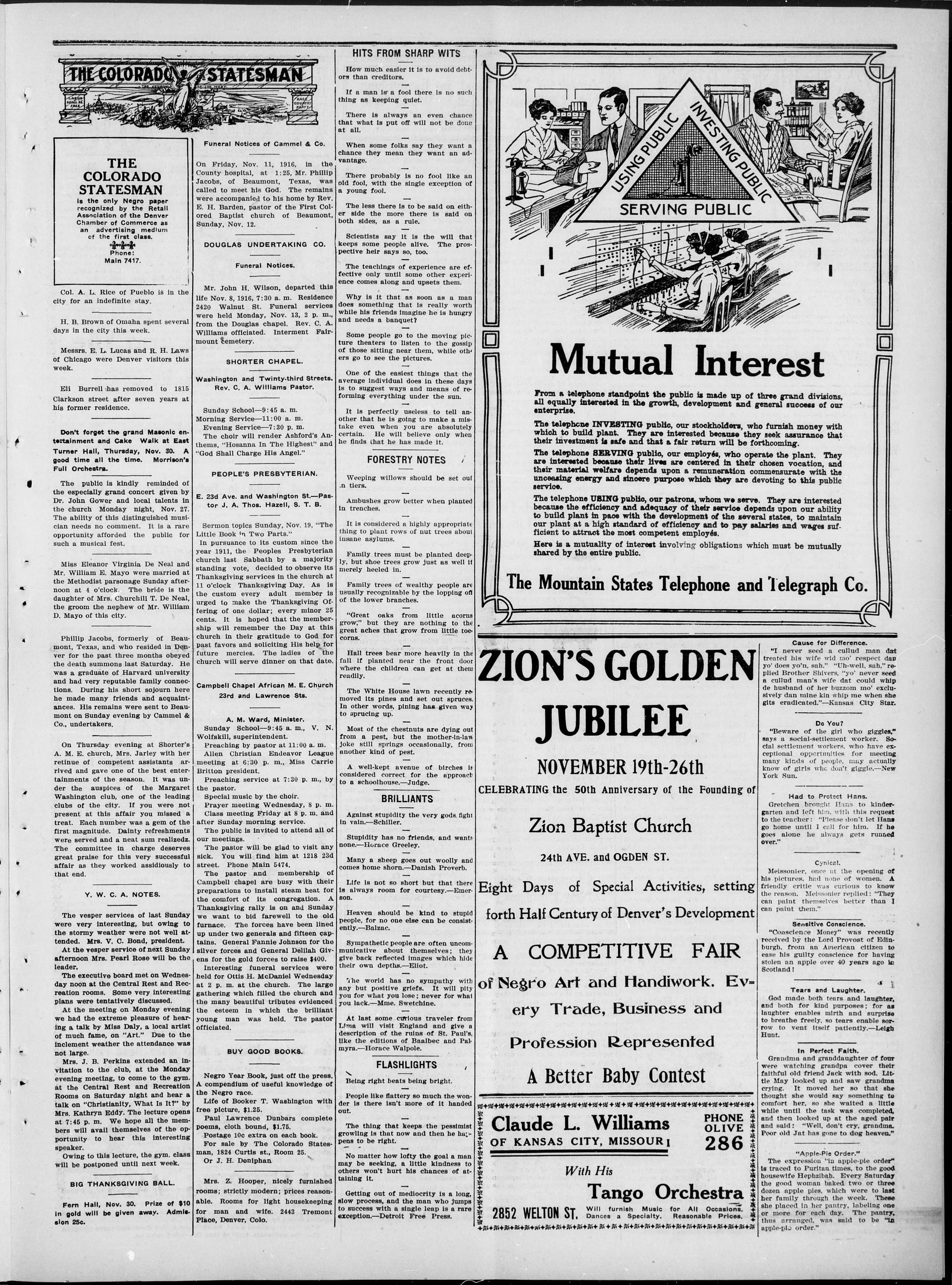
Col. A. L. Rice of Pueblo is in the city for an indefinite stay.
H. B. Brown of Omaha spent several days in the city this week.
Messrs. E. L. Lucas and R. H. Laws of Chicago were Denver visitors this week.
Eli Burrell has removed to 1815 Clarkson street after seven years at his former residence.
Don't forget the grand Masonic entertainment and Cake Walk at East Turner Hall, Thursday, Nov. 30. A good time all the time. Morrison's Full Orchestra.
The public is kindly reminded of the especially grand concert given by Dr. John Gower and local talents in the church Monday night, Nov. 27. The ability of this distinguished musician needs no comment. It is a rare opportunity afforded the public for such a musical fest.
Miss Eleanor Virginia De Neal and Mr. William E. Mayo were married at the Methodist parsonage Sunday afternoon at 4 o'clock. The bride is the daughter of Mrs. Churchill T. De Neal, the groom the nephew of Mr. William D. Mayo of this city.
Phillip Jacobs, formerly of Beaumont, Texas, and who resided in Denver for the past three months obeyed the death summons last Saturday. He was a graduate of Harvard university and had very reputable family connections. During his short sojourn here he made many friends and acquaintances. His remains were sent to Beaumont on Sunday evening by Cammel & Co., undertakers.
On Thursday evening at Shorter's A. M. E. church, Mrs. Jarley with her retinue of competent assistants arrived and gave one of the best entertainments of the season. It was under the auspices of the Margaret Washington club, one of the leading clubs of the city. If you were not present at this affair you missed a treat. Each number was a gem of the first magnitude. Dainty refreshments were served and a neat sum realizedz. The committee in charge deserves great praise for this very successful affair as they worked assidiously to that end.
Y. W. C. A. NOTES.
The vesper services of last Sunday were very interesting, but owing to the stormy weather were not well attended. Mrs. V. C. Bond, president. At the vesper service of next Sunday afternoon Mrs. Pearl Rose will be the leader. The executive board met on Wednesday noon at the Central Rest and Recreation rooms. Some very interesting plans were tentatively discussed. At the meeting on Monday evening we had the extreme pleasure of hearing a talk by Miss Daly, a local artist of much fame, on "Art." Due to the inclement weather the attendance was not large.
Mrs. J. B. Perkins extended an invitation to the club, at the Monday evening meeting, to come to the gym at the Central Rest and Recreation Rooms on Saturday night and hear a talk on "Christianity, What Is It?" by Mrs. Kathryn Eddy. The lecture opens at 7:45 p. m. We hope all the members will avail themselves of the opportunity to hear this interesting speaker. Owing to this lecture, the gym. class will be postponed until next week.
BIG THANKSGIVING BALL.
Fern Hall, Nov. 30. Prize of $10 in gold will be given away. Admission 25c.
Funeral Notices of Cammel & Co.
On Friday, Nov. 11, 1916, in the County hospital, at 1:25, Mr. Phillip Jacobs, of Beaumont, Texas, was called to meet his God. The remains were accompanied to his home by Rev. E. H. Barden, pastor of the First Colored Baptist church of Beaumont, Sunday, Nov. 12.
DOUGLAS UNDERTAKING CO.
Funeral Notices.
Mr. John H. Wilson, departed this life Nov. 8, 1916, 7:30 a.m. Residence 2420 Walnut St. Funeral services were held Monday, Nov. 13, 2 p. m., from the Douglas chapel. Rev. C. A. Williams officiated. Interment Fairmount cemetery.
SHORTER CHAPEL
Washington and Twinty-third Streets
Rev. C. A. Williams Pastor.
Sunday School—9:45 a. m.
Morning Service—11:00 a. m.
Evening Service—7:30 p. m.
The choir will render Ashford's Anthems, "Hosanna In The Highest" and "God Shall Charge His Angel."
PEOPLE'S PRESBYTERIAN
E. 23d Ave. and Washington St.—Pastor J. A. Thos. Hazell, S. T. B.
Sermon topics Sunday, Nov. 19, "The Little Book in Two Parts."
In pursuance to its custom since the year 1911, the Peoples Presbyterian church last Sabbath by a majority standing vote, decided to observe its Thanksgiving services in the church at 11 o'clock Thanksgiving Day. As is the custom every adult member is urged to make the Thanksgiving Offering of one dollar; every minor 25 cents. It is hoped that the membership will remember the Day at this church in their gratitude to God for past favors and soliciting His help for future mercies. The ladies of the church will serve dinner on that date.
Campbell Chapel African M. E. Church
23rd and Lawrence Sts.
Sunday School—9:45 a. m., V. N. Wolfskill, superintendent.
Preaching by pastor at 11:00 a. m.
Allen Christian Endeavor League meeting at 6:30 p. m., Miss Carrie Britton president.
Preaching service at 7:30 p. m., by the pastor.
Special music by the choir.
Prayer meeting Wednesday, 8 p. m.
Class meeting Friday at 8 p. m. and after Sunday morning service.
The public is invited to attend all of our meetings.
The pastor will be glad to visit any sick. You will find him at 1218 23d street. Phone Main 5474.
The pastor and membership of Campbell chapel are busy with their preparations to install steam heat for the comfort of its congregation. A Thanksgiving rally is on and Sunday we want to bid farewell to the old furnace. The forces have been lined up under two generals and fifteen captains. General Fannie Johnson for the silver forces and General Delliah Givens for the gold forces to raise $400. Interesting funeral services were held for Ottis H. McDaniel Wednesday at 2 p. m. at the church. The large gathering which filled the church and the many beautiful tributes evidenced the esteem in which the brilliant young man was held. The pastor officiated.
BUY GOOD BOOKS.
Negro Year Book, just off the press,
A compendium of useful knowledge of
the Negro race.
Life of Booker T. Washington with
free picture, $1.25.
Paul Lawrence Dunbars complete
poems, cloth bound, $1.75.
Postage 10c extra on each book.
For sale by The Colorado States-
man, 1824 Curtis st., Room 25.
Or J. H. Doninphan
Mrs. Z. Hooper, nicely furnished rooms; strictly modern; prices reasonable. Rooms for light housekeeping for man and wife. 2443 Tremont Place, Denver, Colo.
HITS FROM SHARP WITS
How much easier it is to avoid debtors than creditors.
If a man is a fool there is no such thing as keeping quiet.
There is always an even chance that what is put off will not be done at all.
When some folks say they want a chance they mean they want an advantage.
There probably is no fool like an old fool, with the single exception of a young fool.
The less there is to be said on either side the more there is said on both sides, as a rule.
Scientists say it is the will that keeps some people alive. The prospective heir says so, too.
The teachings of experience are effective only until some other experience comes along and upsets them.
Why is it that as soon as a man does something that is really worth while his friends imagine he is hungry and needs a banquet?
Some people go to the moving picture theaters to listen to the gossip of those sitting near them, while others go to see the pictures.
One of the easiest things that the average individual does in these days is to suggest ways and means of reforming everything under the sun.
It is perfectly useless to tell another that he is going to make a mistake even when you are absolutely certain. He will believe only when he finds that he has made it.
FORESTRY NOTES
Weeping willows should be set out in tiers.
Ambushes grow better when planted in trenches.
It is considered a highly appropriate thing to plant rows of nut trees about insane asylums.
Family trees must be planted deeply, but shoe trees grow just as well if merely heeled in.
Family trees of wealthy people are usually recognizable by the lopping off of the lower branches.
"Great oaks from little acorns grow," but they are nothing to the great aches that grow from little toe-corns.
Hall trees bear more heavily in the fall if planted near the front door where the children can get at them readily.
The White House lawn recently removed its pines and set out spruces. In other words, pining has given way to sprucing up.
Most of the chestnuts are dying out from a pest, but the mother-in-law joke still springs occasionally, from another kind of pest.
A well-kept avenue of birches is considered correct for the approach to a schoolhouse.—Judge.
BRILLIANTS
Against stupidity the very gods fight in vain.—Schiller.
Stupidity has no friends, and wants none.—Horace Greeley.
Many a sheep goes out woolly and comes home shorn.—Danish Proverb.
Life is not so short but that there is always room for courtesy.—Emerson.
Heaven should be kind to stupid people, for no one else can be consistently.—Balzac.
Sympathetic people are often uncommunicative about themselves; they give back reflected images which hide their own depths.—Eliot.
The world has no sympathy with any but positive griefs. It will pity you for what you lose; never for what you lack.—Mme. Swetchine.
At last some curious traveler from Lima will visit England and give a description of the ruins of St. Paul's, like the editions of Baalbec and Palmyra.—Horace Walpole.
FLASHLIGHTS
Being right beats being bright.
People like flattery so much the wonder is there isn't more of it handed out.
The thing that keeps the pessimist growling is that now and then he happens to be right.
No matter how lofty the goal a man may be seeking, a little kindness to others won't hurt his chances of attaining it.
Getting out of mediocrity is a long, slow process, and the man who jumps to success with a single leap is a rare exception.—Detroit Free Press.
---
USING PUBLIC INVESTING PUBLIC SERVING PUBLIC
Mutual Interest
From a telephone standpoint the public is made up of three grand divisions, all equally interested in the growth, development and general success of our enterprise.
The telephone INVESTING public, our stockholders, who furnish money with which to build plant. They are interested because they seek assurance that their investment is safe and that a fair return will be forthcoming.
The telephone SERVING public, our employés, who operate the plant. They are interested because their lives are centered in their chosen vocation, and their material welfare depends upon a remuneration commensurate with the unceasing energy and sincere purpose which they are devoting to this public service.
The telephone USING public, our patrons, whom we serve. They are interested because the efficiency and adequacy of their service depends upon our ability to build plant in pace with the development of the several states, to maintain our plant at a high standard of efficiency and to pay salaries and wages sufficient to attract the most competent employés.
Here is a mutuality of interest involving obligations which must be mutually shared by the entire public.
The Mountain States Telephone and Telegraph Co.
ZION'S GOLDEN JUBILEE
CELEBRATING the 50th Anniversary of the Founding of
Zion Baptist Church
24th AVE. and OGDEN ST.
Days of Special Activities
Half Century of Denver's De
COMPETITIVE
Euro Art and Handiwork
Bry Trade, Business
Profession Represent
A Better Baby Conte
ude L. Williams
KANSAS CITY, MISSOUR I
With His
Special Activities, setting
history of Denver's Development
PETITIVE FAIR
and Handiwork. Eve
de, Business and
on Represented
or Baby Contest
Williams
TY, MISSOURI
PHONE
OLIVE
286
h His
forth Half Century of Denver's Development
A COMPETITIVE FAIR
of Negro Art and Handiwork. Every Trade, Business and
Profession Represented
A Better Baby Contest
Claude L. Williams PHONE OLIVE OF KANSAS CITY, MISSOURI 286
Tango Orchestra
WELTON ST. Will furnish Music for A Dances a Specialty. Reason
Will furnish Music for All Occasions. Dances a Specialty. Reasonable Prices.
2852 WELTON ST. Will furnish Music for All Occasions. Dances a Specialty. Reasonable Prices.
With His
Cause for Difference.
"I never seed a cullid man dat treated his wife wid mo' respect dan yo' does yo'n, sah." "Uh-well, sah," replied Brother Shivers, "yo' never seed a cullid man's wife dat could whip de husband of her buzzom mo' exclusively dan mine kin whip me when she gits eradicated."—Kansas City Star.
Do You?
"Beware of the girl who giggles," says a social-settlement worker. Social settlement workers, who have exceptional opportunities for meeting many kinds of people, may actually know of girls who don't giggle.—New York Sun.
Had to Protect Hans
Gretchen brought Hans to kindergarten and left him, with this request to the teacher: "Please don't let Hans go home until I call for him. If he goes alone he always gets runned over."
Cynical.
Meissonier, once at the opening of his pictures, had none of women. A friendly critic was curious to know the reason. Meissonier replied: "They can paint themselves better than I can paint them."
Sensitive Conscience
"Conscience Money" was recently received by the Lord Provost of Edinburgh, from an American citizen to ease his guilty conscience for having stolen an apple over 40 years ago in Scotland!
Tears and Laughter.
God made both tears and laughter, and both for kind purposes; for as laughter enables mirth and surprise to breathe freely, so tears enable sorrow to vent itself patiently.—Leigh Hunt.
In Perfect Faith.
Grandma and granddaughter of four were watching grandpa cover their faithful old friend Jack with sod. Little May looked up and saw grandma crying. It moved her so that she thought she would say something to comfort her, so she waited a little while until the task was completed, and then looked up at the aged pair and said: "Well, don't cry, grandma. Poor old Jat has gone to dog heaven."
"Apple-Pie Order."
The expression "in apple-pie order" is traced to Puritan times, to the good housewife Hephzibah. Every Saturday the good woman baked two or three dozen apple pies, which were to last her family through the week. These she placed in her pantry, labeling one or more for each day. The pantry, thus arranged, was said to be "in apple-pie order."
VV GEASS,
giitinnes | @O
(> je
Files In Library of Congress Well Patronized
Wy carn ane newspaper and periodical division of the Library of
Congress is becoming a more important department of that institution
every year, according to William A. Slade, chief of the division. There is
nothing under the sun in the way of
a) facts or figures that people do not
> come there for, and they generally
Rr ty find what they want. Newspaper
SY NGA ES files dating back 50 or 75 years can be
RN AEP } produced in a minute or two, and the
3 f_ history of those periods can be studied
< i, SED, SE / with greater detail than is afforded in
ae ee any other conceivable kind of literary
NS Se droauction,
Come le Mr. Slade says that he has 26
Bok ers miles of bound newspapers on. file.
Newspapers subscribed to at the pres-
—— facts or figures that people do not
> come there for, and they generally
a >, find what they want. Newspaper
wey < files dating back 50 or 75 years can be
> a" iz y “
LN WE y jt produced in 2 minute or two, and the
Be Naik (_ history of those periods can be studied
4, a = |/{ with greater detail than is afforded in
ame Zee any other conceivable kind of literary
1A o>) — production,
eget : Le Mr. Slade says that he has 26
a miles of bound newspapers on file.
Newspapers subscribed to at the pres-
ent time nysuber 965, of which 849 are American, and the other 116 foreign.
The total number of periodjcals whose issues come into the library is now
8,184, as compared to 7,842 just a year ago, which shows the rapid increase
in the work of this department. Only those are taken which it is thought will
be of value to the public.
Collections of old newspaper files are constantly being acquired by the
periodical division, and the librarian’s report last year referred to the great
volume of files there now as “forming a collection of material which is notably
rich and in ensemble’ nowhere else to be duplicated, constantly used by
students and investigators.”
But the historical value that appeals to students and investigators is not
the only value of the literature of this division, Fashion periodicals have to
be bound in double strength leather to preserve them from the feverish
fingers of thy fashion seekers. Also the Sunday editions of the newspapers,
containing the “funny” sections, show much wear and tear from the grimy
fingers of youngsters.
The division has recently acquired some old files of papers published in
the South during the Civil war, notable among them being the Chattanooga
Daily Rebel.
Washington Cop Twice Arrests Chief’s Father
ce OB” BARBEE, a policeman attached to the First precinct, has made a
mighty blow at the record of the world's bravest “cop.” Barbee has
twice arrested the father of Major Pullman, his chief, within a few weeks,
In a short time Major Pullman
will draw up the list of policemen in HARE YOu. lc
his department whose record entitles PISIEK. Z 99
them to promotion, and Barbee has “9 fy G pc Woe SS
put some finishing touches on his own 7 @YO* AYIA
record which will make ft d'fficult to Ay
overlook him. ROSE
Regulations are regulations, ac) ———— tH
cording to Barbee, and when he found 7 ie 5
that Peter R. Pullman, father of the 3
local police head, had parked his au- Ss
tomobile in a tabooed location, Bar-
thas eavinle ‘tacle “Pathas -Paltinanta
will draw up the list of policemen in HARE YOu. lc
his department whose record entitles PISIEK. y 99
them to promotion, and Barbee has “9 fy G pc Woe SS
put some finishing touches on his own 7 @U* xyliR\(
record which will make ft d'fficult to Ay
overlook him. RO
Regulations are regulations, ae) —=———— (i
cording to Barbee, and when he found 7 ie 5
that Peter R. Pullman, father of the :
local police head, had parked his au- Ss
tomobile in a tabooed location, Bar-
bee calmly took Father Pullman's
number and took the case to court. Pullman paid $2 and let it go at that.
A short time later, the elder Pullman drove his car into the same re-
stricted part of the street, and again Barbee got him, It happened each time
in front of Mr. Pullman's office in G street, between Fourteenth and Fifteenth
streets northwest.
‘The first time Barbee arrested his chief's father, the policeman had no
fdea of the elder Pullman’s identity beyond his name, and three days elapsed
before someone told him what he had done. The second time Barbee caught
Mr. Pullman, however, the latter's identity was no secret at all, but Barbee
didn’t flinch,
So that’s how Barbee came to be a high bidder for the title of the world's
bravest “cop,” and he did it without chasing a burglar, although Barbee's
record shows him a first-class burglar chaser, too.
Barbee has a record that is envied by many of his friends in the police
department. He has acquired it by conscientious and efficient service com-
bined with the quality known as “nerve.” He has a long list of “good cases”
to his credit, meaning that he has recovered much stolen property and caught
numerous violators of the law.
Some New Inventions for Uncle Sam’s Fighters
Hove GAU, a twenty-two-year-old inventor, of Cincinnat!, has come to
Washington to offer to the war department a powderless gun projectile.
He says the new weapon eliminates the detonation and smoke which make
guns easily discoverable by aeroplanes
gente ttt, in the European war.
- Shek He explains that compressed air
Z Tc, is used to discharge the projectiles,
HZ * ~~ which will have a greater range and
YA SPs ponetrating power than any present
Po powder-driven shell. Twenty to thirty
/ Rea Pe miles is the estimated range, Dis-
eS] WO Se charze will be caused by the combined
OS Ag Rouse of liquid air and timers, The
I shell will be constructed in 8, 10, 12
ea ana 14 inch sizes and they will be
ret Ming ae ae Renee ee eR Ra tae
Beene Sey. in the European war.
_ Sie He explains that compressed alr
¢Z ~~ is used to discharge the projectiles,
HZ % ~~ which will have a greater range and
YZ OPS penetrating power than any present
Po powder-driven shell. Twenty to thirty
\) Reng az. miles is the estimated range. Dis-
eS] WO Se charze will be caused by the combined
OS EK Rouse of liquid air and timers, The
————— ——~ shell will be constructed in 8, 10, 12
ea ana 14 inch sizes and they will be
somewhat similar to shells now in use.
Mr. Gau is the son of Dr. H. F. Gau of Cincinnati. He is a graduate of
the Ohio Mechanics’ institute of Cincinnati.
A motorless monoplane capable of reaching a height of 12 miles, out of
range of gunfire, is the invention that A. V. Wilson of Bar Harbor, Me., in-
tends to place before the national board of aviation,
Wilson's aeroplane has been patented and he has been working for the
last five years to solve the problem of keeping the aviator alive at that height
and at a temperature of 120 to 210 degrees below zero, The desired warmth,
he says, can be obtained by a solution of one pound of lime and eight ounces
of water. This warmth will prevent a hydrogen tank from freezing, he says,
and therefore will provide the necessary air for the aviator.
‘The principle of Wilson's plan is to counteract gravity by turning the
planes. On calm days, he admits, the plane would have to be shot Into the air
‘with a catapult. Once in flight, however, he claims that he can stay in the
air indefinitely.
Postmaster Chance Helps Two Lady Motorists
oe CHANCE, the well-known and eminent postmaster of Washing-
ton, was out on a country road during one of the hottest days we ever
had since time began. He was driving an automobile, and there in the road
Pere re, Se CARMEN. Years ante. SERENE eS,
stuck tight. It wouldn't budge. It
seemed to have that stolid, squatty,
immovable attitude of Plymouth
Rock, and in strong contrast to the
silent immovability of the machine
was the fluttering manner of the two
ladies who were the sole passengers.
“May I help you?” suggested Mr.
Chance, and the two Indies were only
too glad.
Whereupon the well-known and
eminent postmaster shed his coat and
stuck tight. It wouldn't budge. It
seemed to have that stolid, squatty, en ee
immovable attitude of Plymouth = I,
Rock, and in strong contrast to the - Te oR
silent immovability of the machine y fe i’
was the fluttering manner of the two q a3 cen
ladies who were the sole passengers. 2 aN)
“May I help you?" suggested Mr. GQ xs 5 a
Chance, and the two ladies were only 2—— — _-5=—
too glad. | = Se re
Whereupon the well-known and Es =e
eminent postmaster shed his coat and
began to crank that machine as if he were endeavoring to start an earth-
quake. He cranked and cranked and cranked, with the thermometer at 108
in the shade, and mighty ttle shade at that. He spun the motor and spun
the motor, until his head spun with it and the perspiration made little pools
at his heels. His arms ached; his head ached; his shoulders ached; his back
ached, and he whs abvut to die and end all his troubles right there when one
of the two ladies sald in a sweet volce:
“Wait a minute. Suppose I try the self-starter.”
Mr. Chance staggered from ip front of the machine, and the Indy touched
fier dainty foot to the self-starter button. ‘There was a grinding noise and
then that blessed whirring which means the engine is going.
“Oh, we never thought of that,” sald the other lady. And as Merritt
Chance passed away into a trance the two bright things motored onward.
Americans Must Lead in Establishing
New Civilization to Follow World War
By HENRY CHURCHILL KING
President of Oberlin College
‘The deeper challenge of life seems to me this year to be twofold. On
the one hand the perpetual challenge to the more serious living, which is
implied in the very undertaking 6f college training, and, on the other
hand, the particular challenge which is contained in the present world
crisis.
In this latter crisis there is a very definite and stirring challenge to
all American youth, whether already trained or in training. First of all,
we must believe in the possibilities of the new civilization, and throw our-
selves into the struggle of its oncoming. We must not be cynics or stand-
patters.
In the second place, we must accept our special obligations ‘as Ameri-
cans today, be intelligent, unselfish, thoughtful American citizens, with
world vision, ashamed not to think in world terms, in terms of humanity.
Remember that no generation since the world began has ever witnessed
such a destruction of youthful leaders as has yours.
In the third place, we must forecast with all the help we can obtain
from the clearest-sighted and farthest-sighted social prophets of our time
the demands of the new age.
Be sure that the nation that means to play its full part in the new
civilization must with stern self-discipline thoroughly reinvigorate the
whole range of its life, physical, political, economic, social, intellectual,
moral and religious. The time for slovenliness of national life in any
realm is gone.
Finally, we must keep our vision of the organic view of truth and
of human society, and so preserve a lively sense of the value of the con-
tribution of every man and class and nation and civilization in that new-
dawning world of co-operating, mutually respecting nations.
As Americans, are we to be satisfied thet our nation should enor-
mously profit financially by this war and count our further duty done by
‘military preparedness of the European sort? Is this titanic conflict—
‘a single incident of which two years ago would have sent a thrill of horror
‘through the whole world—to mean no more than this for the life of Amer-
ica? Are we contented that it should be so?
Laws Needed to Put End to Needless
Waste of Life on American Railroads
In twenty years ended in 1912 there were 86,733 trespassers killed
and 94,646 injured on the railways of the United States. Careful inves-
tigation has shown that the majority of persons thus killed and injured
are citizens living in the vicinity of the accident, and that many are women
and children. From 1901 to 1910 there were approximately 13,000 chil-
dren under fourteen years of age killed and injured while trespassing on
railroads in the United States, enough to make a milepost for every mile
half way around the world. ‘There were 20,000 between the ages of four-
teen and twenty-one years killed during that same period, making 33,000
minors who were victims of this evil. During ten years ended in 1910
there were 103,452 trespassers killed and injured in the United States,
while for the same period in Great Britain and Ireland there were but
5,754 trespassers killed and injured. Of course the mileage of American
railroads is much greater, but it is nevertheless true that the British rail-
ways traverse a more densely populated and congested territory than most
of our American railways. In European countries laws forbid trespassing
cn railways.
Yo the uninformed it will probably be surprising information to
mow that more than half the persons killed on American railroads are
trespassers and that ordinarily there are on our railroads three times as
many trespassers killed each year as there are railroad employees killed.
‘This annual needless killing of more than five thousand American citizens
and the injuring seriously of an equal number, mostly wage earners, can
only be prevented by the co-operation of the public and public officials.
Laws have been made, intended to deal with almost every real or imagi-
nary cause of accident, and yet it has been almost impossible to get passed
or enforced laws which will effectively prohibit railroad trespassing and
the great economic loss to the nation involved in the killing and maiming
of these persons, as well as the suffering to humanity caused thereby.
Changing Conditions of Times Bring
New Problems for School Authorities
By MORTON SNYDER
Assistant Headmaster, Newark Academy, Newark, N. J.
Nearly everyone knows that the times have changed, no one better
than the city schoolmaster. The only persons unconvinced are certain
ultra-conseryatives who still believe that Latin and algebra will help the
children of the poor to solve problems dependent upon the high cost
of living. The rise of cities has deprived thousands of children of their
inheritance in the way of contact with nature, of sense training, and of
normal living. The growth of tenement and apartment life has almost
entirely removed children’s opportunities to interest themselves in educa-
tive home tasks. The factory system has eliminated general industrial
training through the establishment of the stultifying one-task-per-man
organization. Thus the schools have had thrust upon them the duty of
supplying all the stimuli to development which country life, home activity
and a demand far general skill formerly provided.
In addition to these changes there is a marked difference in the sort
vf children who come to the schools. One does not say that they are
inferior; time will tell. But they are different, and this difference is an
element in the situation which makes experiments imperative. The influx
of foreigners, with their divergent personal ideals and antagonistic racial
traits, imposes upon the schools an infinitely difficult problem.
The task is further complicated by the hampering effect of our intel-
lectual traditions and prejudices, These have long been and still are,
to a large degree, literary and academic rather than scientific and prac-
tical. We have believed that every boy should aim to be at least a senator.
Our schools have led youngsters away from honest artisanship. Book
studies and artificial methods are the inherited tools with which we ate
expected to secure new results; abstract processes for concrete products.
The experiments now being tried are mostly in the direction of applying
the realistic sciences and natural methods to the development of produc
‘Live abilities and intellectual power.
INIER lt SING WHE
. ze wy
. NAETS 5” |
| CHAN Adele Heese
UN NSA aL LUE en Ned Et bi ee
2 oda diiisiecehuuses betes 1604 eels Srtie lagi peor"s
eA ing Seine conta’ a i
Baltimore Has Rooster That Is Expert Mouser
BALTIMORE —All the commission houses in the Pratt street viellty find tt
necessary to keep a cat or two to keep down the mice which are brought
up from the country in the produce shipments, Down at the Rappahannock
exchange, they have found a substi-
: tute in a big Plymouth Rock rooster,
<( Zee, Which the employees of the exchange
mS \\ ~ are willing to pit against any cat in
jee SY the city as a mouser.
WEN Dick, as the rooster is called, has
5S CB the freedom of the exchange and holds
eX eS Si) «record of 19 mice killed in one hour.
FF: ee Not only does Dick kill the mice, but
; 5 he swallows them head first.
A a Dick’s mousing abilities were dis-
Pe - O77 accidentally. He came up
from the Rappahannock river in a
y tute in a big Plymouth Rock rooster,
<( Zee, Which the employees of the exchange
—— \ = are willing to pit against any cat in
: Ay pitta, SY the city as a mouser.
WISER Dick, as the rooster is called, has
| PACA A the freedom of the exchange and holds
Cpe’ SS YD 1 record of 19 mice killed in one hour.
lie EP Not only does Dick kill the mice, but
e 5 z WEG he swallows them head first.
Ae ee Dick's mousing abilities were dis-
Fa FES ==gE covered accidentally. He came up
. from the Rappahannock river in a
shipment of chickens about a year ago and, as he seemed to have weathered
the trip badly, was taken out of the coop and thrown into a corner to get
well or die, A day or two later one of the employees was surprised to see
Dick hopping madly across the floor in the wake of a scudding mouse.
Just before a pile of old crates and safety were reached, Dick caught up
with Mr. Mouse, gave {t several shakes in order to squeeze out all the life and
then gulped it down. This was the beginning, and every time a mouse was
cornered thereafter Dick was thrown on the trail.
A year of petting has made Dick quite tame, When he came up from the
country a year ago he weighed only three pounds. Now he tips the beam at
nine. Not only does Dick eat all mice that are pointed out to, him, but he
stalks them just like any cat. He has been known to stand patiently for half
an hour at a spot until a wary mouse poked out its head. ‘Then there was a
snap and one less mouse in the world.
Not only does Dick eat mice, but he is a great lover of oysters. Each
morning the men on the exchange open a dozen raw and serve them to him.
‘That constitutes his breakfast. He also has developed a fondness for cracked
ice, and demands his share every time the iceman comes around,
He is a favorite in the neighborhood and when he is in a good humor does
not mind going through a varlety of simple tricks, such as posing motionless
in any position in which he is placed and playing dead and jumping through
a hoop at command.
Elevated Trains in Gotham Now Play Leapfrog
N=, YORK.—To relieve the swelling traffic on the elevated lines in New
York city trains are now made to play “leapfrog” by an ingenious method
of track laying. A horizontal view of the completed structure would bear a
strange resemblance to the roller
coaster railroads so much in evidence je rp
in nearly all of America’s amusement =— Gr
parks. Nearing a station the express @ Gee eceerre ©) Sp, re
trains for which the new track is be @ et A;
Se )
ing designed, rise swiftly on an in- — >
cline, so that they play at a modified, TRnAR (3 ——s
'|mechanical game of leapfrog. Under ORTnr
the raised tracks, or “humps,” as they vena = bax & ie rrp i
| are technically known, the local sta- rE co) i
tions are situated.
| ~“"mhe reason for the “leap-frogging” >>> aOR
coaster railroads so much in evidence
in nearly all of America’s amusement
parks. Nearing a station the express
trains for which the new track is be-
ing designed, rise swiftly on an in-
cline, so that they play at a modified,
mechanical game of leapfrog. Under
the raised tracks, or “humps,” as they
are technically known, the local sta-
tions are situated.
‘The reason for the “leap-frogging”
ls obvious. There are three tracks
in service already on the elevated lines, but the third track could not be used
for express service unless the trains crossed over and onto the local tracks to
take on and discharge passengers. This would involve delay and a serious
possibility of accident.
The stations selected for the express stops are either re-enforced or re-
newed, and the middle track is raised about 12 feet. The loading platforms
for the “extra elevated” express tracks are built over the existing local tracks,
which are left unchanged. The length of the “hump” is determined by the
grade of the present local tracks at that particular section, as the grade of the
express tracks never exceeds 3 per cent. The new platforms are about 350
feet long.
It is expected that the cost of operation of the express trains will be
somewhat decreased as the headway which they get on the incline wili carry
them some distance before power need be applied. Trains will also be able to
stop quickly and smoothly because of the upward incline as they enter the
station.
Chefs Say Detroit Is a City of Soup Eaters
PETLOT—Petrolt ix a city of soup eaters. ‘The chets say so. They are
always racking their brains for new preparations to please the palate.
‘The waiters admit it. Many times their wives wash shirts spotted with
consommes and chowders. And last
ALL KiNDs g=> of all, the cashiers’ books show it.
one € 733 9 Boston baked beans are advertised
Th \ex and eaten in all parts of the country.
7 in New York sharpens its carving knife,
a fe\ smiles broadly, smacks its lips and
ey a) “digs into” its game—bear, venison,
ale wild ducks, partridges, quall, grouse
and pheasants. Chicago feasts on
—— choice steaks, chops, domestic fowls
g T and stews. Baltimore casts its net
H 1 h and offers galt-water fish, oysters,
of all, the cashiers’ books show it.
Boston baked beans are advertised
and eaten in all parts of the country.
New York sharpens its carving knife,
smiles broadly, smacks its lips and
“digs into” its game—bear, venison,
wild ducks, partridges, quail, grouse
and pheasants. Chicago feasts on
choice steaks, chops, domestic fowls
and stews. Baltimore casts its net
and offers salt-water fish, oysters,
‘lama. and’ ‘athuwe: Qk Bnute lee
Italian delicacies; Denver likes French pastry and other imported sweets.
Memphis and other cities below the Mason-Dixon line are strong for barbecued
squirrel.
But Detroit, um—ah. It is literally flooded with soups, French, German,
Swiss, English and American.
The investigator made his way into the kitchen of one of Detroit's leading
hotels. There were hundreds of cooks, waiters and dishwashers, scurrying in
every direction,
“What is the gastronomical peculiarity of Detroit?” he asked the chef,
“It's soup,” the chef replied.. “I believe there is more soup eaten in
Detroit than in any other city in the country. There are two cooks who do
nothing from morning till night but prepare soup—German pea soup, eream
of tomato soup, chicken gumbo, cream of chicken regence, chicken broth, beef
consomme, French onion soup, clam chowder, mock turtle soup, clam juice and
special French chowder. Those men are conceded to be the best cooks in the
hotel.”
In another hotel the same question was asked. tT gcike
The reply was “soup.” 7 1
New Yorkers Watch a Man Make Dead Fish Flop
N=. YORK.—Crowd at the window. Inside a man in a smock, struggling
with a three-foot eel. One second eel is about to slip through the man's
hands, but he grabs it just in time, and then the eel with another squirm is
loose. Agnin the man grabs it. This
time he gives it a slap and the strug-
gle is over.
‘This is a regular scene on the
West street front of Washington
market. David Tobias, who learned
how to make a dead fish wriggle way
back in 1868, is the performer. He
always has an interested audience.
If you ask him how he makes not
only eels but codfish and flounders—
and, if they are in season, sturgeon—
cut up just as if they were alive, he
time he gives it a slap and the strug-
gle is over. Go |
‘This is a regular scene on the SN ee ex
West street front of Washington rN Oy ae
market. David Tobias, who learned y) a By RAs
how to make a dead fish wriggle way Si eee VW WV
back in 1868, is the performer. He = 4
always has an interested audience. ee) (~~
If you ask him how he makes not a
only eels but codfish and flounders— "> ~—7" i) J
and, if they are in season, sturgeon— Sn
cut up just as if they were alive, he
will tell yon that he has an electrical thingamajig in the palm of his hand
which puts life into the fish; but he is only Joking.
“Making a fish squirm is a trick,” said Tobias. “I learned how to do it
as a boy in the old market, It can’t be explained, and the method can’t be
acquired except by long practice.”
With this he grabbed a cod, which began to flap about and curve its spine,
‘Then the policeman insisted that the crowd move on.
PARIS ADMITS LOSS IN TWO SECTIONS, BUT SAYS ENEMY SUFFERED HEAVILY.
BULGARS FORCED BACK
WARRING NATIONS SUMMON THE LAST OUNCE OF MAN POWER TO CONTINUE FIGHT.
Western Newspaper Union News Service.
London, Nov. 16. "The matter of the destruction of British shipping by German submarines came up in the house of lords. Baron Sydenham invited the government to make a declaration in the nature of a "ton-for-ton" policy in behalf of Great Britain and her allies as a reply to "the monstrous proceedings" of the German submarines. He declared that there was an uneasy feeling in the country that the submarine menace was more serious than the authorities were willing to admit. Admiral Lord Beresford said that Great Britain had arrived at a serious crisis calling for energy and foresight.
Berlin—The finishing touches are now being given to the "man power bill," providing for universal labor for all able-bodied Germans behind the front. This is a form of compulsory service, it is understood, and will not apply directly or specifically to women. A consistent campaign will be made to utilize to the utmost this reserve of labor power. Germany was the first belligerent to establish a food dictatorship.
London—The appointment of a food controller by the British government was forecast by Walter Runciman, president of the board of trade, in announcing in the house of commons that wider powers will be conferred upon the British government by an order in council, dealing with the food question.
The retail prices of foodstuffs compared with a year ago have increased on an average of 27 per cent. Paris.-Under a government decree which is about to be signed, France is to begin a series of war economies. A national board of supervision, presided over by ex-President Armand Fallieres, will be invested with large powers in an effort to stop waste and compel savings in the use of coal, light and provisions. The Journal Officiel published a decree adding a considerable number of articles to the list of goods the exportation of which is prohibited.
London.—While the British were further advancing their front north of the Ancre river or consolidating their newly won positions, the French and Germans have been engaged in violent combats, both north and south of the Somme. In both regions the Germans made gains—in the northern corner and western outskirts of the St. Pierre-Vaast wood, north of the river, and in the eastern part of the village of Pressoire, south of the stream.
Berlin asserts that all British attacks except that which resulted in the capture of Beaucourt were repulsed with heavy casualties.
London claims that 5,678 prisoners have been captured on the Ancre front since Monday in attacks on German lines.
Rumanians and Russians are giving ground before violent attacks of the Austro-German armies on the Transylvanian front.
MISS DIEMER'S BODY FOUND.
Father, Mother and Sister of Slain Girl Calm as Lawyer Blames Murder on Them.
Pontiac, Ill.—Jacob Diemer, wealthy retired farmer, churchman and former county supervisor, waited in calm confidence here with his wife and youngest daughter, while States Attorney F. A. Ortman forged the first links in the chain of evidence on which one or all of them may be indicted for murder. The victim, who now lies in a little cemetery near the Diemer home, in the heart of town, is Miss Christine Diemer, another daughter of the family. A woman in a rowboat found her body in the Vermillion river a week ago. The girl had been missing since Oct. 27.
Because Miss Diemer's neck was dislocated and her skull fractured at the base, her father, a patriarchial figure of 71, has been charged with manslaughter and held to the grand jury; bids of $10,000.
So have the girl's mother and her sister, Magdalena, who was graduated from the University of Chicago.
Mediators to Agree on Border Patrol, Atlantic City, Nov. 16.—Unless new and unexpected opposition develops, members of the Mexican-American joint commission believed last night, an agreement covering the withdrawal of the American punitive expedition and a method of border control will be ready by the end of the week for submission to the two governments. Anouncement that an agreement was in sight was made by Ignacio Bonillas, one of the Mexican representatives, at the close of a session that had lasted until night.
SIX COLORADO CROPS WORTH
$53,637,000.
While Yield Has Fallen Off, Farmers
Will Get Far More for Their
Labor Than Last Year.
Western Newspaper Union News Service.
Denver—Six crops in Colorado on Nov. 1 had a total value of $53,637,400, as compared with a value of $40,730,700 a year ago, an increase of $12,907,640, according to the government's crop report for November. The report shows that while the yield of the six crops in the state this year was less than last year the increased prices give the farmers $12,906,400 more for their labor than the larger crop in 1915.
The department of agriculture estimated the combined yield of all crops in the state this year at 91.9 per cent of the average yield of 100 per cent. This is a little larger yield for the state as a whole than was generally expected and it is believed is far greater than the percentage for the country as a whole.
The corn crop this year is placed at 7,600,000 bushels, worth $5,776,000, against 11,280,000 bushels last year, worth $1,140,000.
Wheat production this year was 10,841,000 bushels, against 13,310,000 last year, but the value this year was $15,177,400, as compared with $11,346,600 a year ago.
This year's production of oats was 9,900,000 bushels, worth $5,335,000, as compared with 11,700,000 bushels in 1915, worth $5,031,000.
The barley crop this year was 4,160,000 bushels, against 4,680,000 last year.
The potato yield in 1916 as given by the government was 6,900,000 bushels, as compared with 7,155,000 bushels last year. The value of the 1916 crop was $8,694,000, against $3,005,100 last year, or almost three times as much.
This year the production of hay was 1,829,000 tons, against 2,134,000 last year, or almost three times as much. The government estimate shows a big decrease in the apple crop, this year's production being 102,000 barrels, against a final estimate last year of 693,000 barrels. The production in the United States on these crops is given as follows:
Potatoes—Estimate this year, 289, 000,000 bushels; production last year (final estimate), 359,103,000 bushels. Hay—September estimate, 86,155,000 tons; production last year (final estimate), 85,225,000 tons. Apples—Estimate this year, 67,700, 000 barrels; production last year (final estimate), 76,670,000 barrels. Sugar Beets—State: Nov. 1 condition, 92; compared with the ten-year average of 92. United States: Nov. 1 condition, 87.0; compared with the ten-year average of 91.4.
Prices.
The first price given below is the average on Nov. 1 this year, and the second the average on Nov. 1 last year:
State—Wheat, 140 and 86 cents per bushel. Corn, 76 and 50. Oats, 55 and 43. Potatoes, 126 and 42. Hay, $10.20 and $7.60 per ton. Eggs, 36 and 30 cents per dozen.
United States—Wheat, 158 and 93.1 cents per bushel. Corn, 85 and 61.9. Oats, 49 and 34.9. Potatoes, 136 and 60. Hay, $10.68 and $10.83 per ton. Cotton, 18 and 11.6 cents per pound. Eggs, 32 and 26.3 cents per dozen.
Convicted of Fraud in Land Deal.
Thru the efforts of the state bureau of immigration, John A. Robert Tracy of Fort Morgan was convicted in the Federal District Court at Lamar for obtaining money under false pretenses from Tillie and Minnie Thiede, two girls living in Nebraska. Tracy, according to the testimony, induced the Thiede sisters to go to Fort Morgan, and in company with his wife, took them in an auto to Denver, and carried them to a section of land south of Lamar. He then accompanied them to the land office and assisted them in filing on another section, it is alleged, several miles distant from the land which they had inspected. The land filed on was worthless. The Thiede sisters paid Tracy $300 for his services in assisting them in locating the land. The state bureau of immigration is making an effort to prosecute all frauds of this character.
Interurban Called Interstate Carrier.
Holding that the Denver & Interurban railway is doing an interstate business and is therefore bound to obey interstate commerce regula.ons the United States Court of Appeals sitting at St. Louis affirmed the decision of the Denver Federal Court in holding the company for a $250 penalty for working a railroad operator more than eight hours in succession.
The violation of the regulation occurred July 4, 1914, and the case of I. L. Ream, an operator at Globeville was the basis for the case.
AFRO-AMERICAN CULLINGS
The Negro Baptist general missionary and educational convention held its forty-fifth annual session at Houson, Tex.
Rev. L. K. Williams, in calling the convention to order, spoke of the opportunities in the South for the Negro, and while he had been called to Chicago to pastor the Olivet Baptist church, one of the largest Negro congregations in the United States, his heart would remain with his people down there.
"If I am anything at all in this world," said Doctor Williams, "I owe it to the South, especially to Texas. It was here where I got my training, and it was in this state where I have put my best efforts. It was my work in Texas which attracted the attention of my people in Chicago."
A feature was a sermon by Rev. L. M. Leonard of Bastrop. "As ye go preach the kingdom of heaven is at hand," were the words of the text used. The speaker declared that the minister of the gospel occupied the highest calling on earth, even greater than that of being president of the United States.
Following the sermon, Rev. Dr. F. L. Lights made an appeal for foreign missions. He said that the Negro with 50 years of freedom should never forget his native land. He spoke in words of praise of Dr. L. G. Jordan, foreign missionary secretary of the National Baptist convention.
"My eyes have been opened, and I will return home with a better conception of the South," said S. A. Griffin, deacon from Olivet Baptist church, Chicago, Ill., who accompanied Dr. L. K. Williams. "This is my first trip to the South, and I was surprised to find such a friendly relation existing between the races. When I picked up the paper this morning and saw what was said about your convention, I could hardly believe myself. This is indeed a wonderful country." Rev. J. B. Green, D. D., of Shreveport, La., field secretary of the National Baptist convention, made a short talk. He referred to the work of the convention last September in Savannah, Ga., which was attended by several thousand representative Negroes from all parts of the country."
"The Negro is not sitting down today waiting, but he is practicing the doctrine of self-help," said Doctor Green, "and in this way he is getting the help from others."
Prof. M. M. Rodgers, secretary of the convention and auditor of the National Baptist convention, the first layman to hold the position, made a few remarks. He said that the two million and a half Negro Baptists were more determined than ever before and would be heard from in this country—in the whole world—Houston Post.
The annual conference of church workers among colored people was held at Philadelphia last month. Bishops Rhinelander and Garland were present and delivered addresses. That of Bishop Garland provoked intense enthusiasm, because of his unqualified indorsement of the contention of the conference with respect to the racial episcopate. The conference was marked by a spirit of hopefulness and intense interest throughout; but the discussion which elicited the most earnest attention was that concerning the racial episcopate. The feeling of the conference was distinctly in favor of the proposal for a missionary jurisdiction
To help Negro boys become practical farmers, and to assist Negro girls to become competent housewives, the United States department of agriculture, in co-operation with the state colleges, is organizing throughout the South Farm Makers' clubs for rural Negro children. This activity, begun experimentally last year by the office of extension work, South, has grown rapidly, and already is thoroughly organized in Virginia, North Carolina, Florida, and Mississippi. The work also is being carried on to some extent in each of the other southern states. The chief object of these clubs is to encourage Negro farmers, particularly in the cotton sections, to raise some food instead of devoting their entire attention to a single crop.
In the clubs for boys the typical plan is to encourage and help the members to use an acre, one-half of which is devoted to corn, one-fourth to potatoes, and one-fourth to peanuts. This teaches a desirable rotation, and at the same time furnishes three food products for home consumption, and two that are useful
The proper meaning of the word "posset," frequently used in Lancashire, is a drink taken before going to bed. Originally it was milk curdled with wine, and comes from the Latin "posen," meaning a drink made with vinegar and water.
As a result of the growing shortage of labor of every kind in Canada, the regulations governing the maximum age of candidates for admission to the Dominion civil service have been dropped.
with a Negro bishop, and this found expression in the spontaneous subscription from the floor of the house of a considerable sum to send two priests to St. Louis, the Rev. Dr. George F. Bragg and the Rev. James K. Satterwhite, as official representatives bearing a memorial to general convention and also a copy of the sermon preached by the Rev. E. W. Daniel.
In the course of the discussion a strong feeling of dissatisfaction was generally manifested over the position taken at the headquarters of the board of missions toward work among colored people. This was especially expressed in view of the proposal to send a white bishop to Liberia to fill the place of the late Bishop Ferguson. The conference adopted a firm protest against this policy, which was felt to be unwise in view of the future welfare of the mission.
For a number of years the conference has urged upon the board of missions the extreme importance of a field secretary, to inspire and help the lonely workers in the missionary field. At this session a commission was constituted, to raise from the colored clergy and congregations a third or one half of the requisite stipend of such officer, and appeal to the Board of missions to supply the remaining portion.—The Living Church.
The first president of the American Colonization society, which founded the republic of Liberia, on the west coast of Africa, was Bushrod Washington, who was born in Virginia 157 years ago, in 1759, and who was a nephew of George Washington. He served as a private soldier in the Revolution, and afterward was elevated to the United States Supreme court. While himself an owner of many slaves, he was deeply interested in the movement for restoring the Africans in America to their native continent. He was one of the pioneers in the organization of the American Colonization society, which was launched just a century ago, in the latter part of 1816. Henry Clay, John Randolph and other men of prominence were also prominent in the movement. In 1820 the society sent 38 Negroes back to Africa in a government vessel, and that year a constitution for the colony, which was named Liberia, was adopted. The colony continued to be in the charge of agents and governors appointed by the society until 1847, when its rights were voluntarily surrendered and the independence of Liberia was proclaimed and was recognized by the United States, Great Britain and France.
Dr. Edward P. Jones of Vicksburg, Miss., president of the National Baptist convention of America, was the principal speaker at the session of the Colored Baptist state convention held in a tent at Waverly street, Houston Heights, Houston, Tex.
His subject was "The Outlook of the Negro Race and How to Make It Brighter." He said, among other things: "No race ever had larger and more favorable opportunities for doing good, especially in the way of building itself up and making a plausible record than the Negro race. The eyes of the world are upon us, to see what there is in us and for what we stand. Don't wander all over America looking for a good place to locate. Go where you please, there is no place in the world where the Negro has better opportunities to make something of himself than here in this Southland."
for cattle or hogs. The girl members of these clubs receive practical instruction in gardening, cooking and housekeeping. According to reports the county superintendents of schools and teachers of Negro elementary schools are supporting the work actively, and state agricultural colleges and the technical schools established for the race are active co-operators in the larger phases of the work.
The colored Young Women's Christian association of Houston, Tex., is to begin a campaign to secure better accommodations, having outgrown its present quarters. Mrs. Stansbury Boyce, who succeeded Mrs. Hettie G. Francis as president of the local branch, is in charge of the movement. Because of the fact that the association has been devoting most of its energies to looking after those girls who were in need of help, the welfare of the more fortunate girls has been to some extent neglected. It is planned to open more dormitories and clubrooms and to form classes in gymnastics.
The Norwegian freighter Tabor, for
Archangel, Russia, had on board 200,
000 miles of binder twine, enough to
lay along her course 16 times, or
enough to tie up the earth at the equator
eight times. In the same ship was
sent $1,000,000 worth of agricultural
equipment, consisting of 800 reapers,
800 binders and 800 horse rakes.
By a loan to the government of $16,
000,000 at 8 per cent, secured on taxes,
the Bank of England started operations
in 1694.
The Curtis Park Floral Company
FLORAL DESIGNS PUT UP WHILE YOU WAIT
CHOICE PLANTS AND CUT FLOWERS CONSTANTLY ON HAND
GREENHOUSES: Thirty-Fourth and Curtis Streets
TELEPHONE, MAIN 1511 DENVER, COLO
The Champa Pharmacy
Twentieth and Champa,
Is the place to get your
DRUGS, CHEMICALS AND PATENT MEDICINES
WE SERVE DRINKS.
Prescriptions Our Specialty.
Phone us and we will deliver the goods to all parts of the city.
JAMES E. THRALL, PROPR.
PHONE MAIN 2426.
When You Want
The Heads, Feet, Tails, Snouts, Neckbones or Chiterlings, or any other part of the hog except the squeal, go to
Sales Daily at 2 p.m. Office Furniture a Specialty.
PRIVATE SALES AT ALL TIMES
HAVE MOVED TO-
1723-39 GLENARM ST.
PHONE MAIN 1675.
THE BEST ICE CREAM AND
CANDIES AT
O.P. BAUR & CO.
CATERERS AND
CONFECTIONERS
Phone: 163.
1512 Curtis Street, Denver, Colo.
JOSEPH CARTER Express, Moving, and Storage
COAL AND WOOD
PROMPT DELIVERY.
Phone Main 6544.
2415 WASHINGTON STREET.
TELEPHONE YORK 6668.
GENERAL FURNITURE REPAIRING AND UPHOLSTERING.
WORK QUARANTEED.
1417 East 24th Avenue, Denver, Colo.
2300-6 Larimer Street Phone Main 1461
Phone Main 4896 1848 Arapahoe
乐绎轩
Miss M. Cowden Hair Dressing Parlor
Shampoo, cutting and curling. Scalp treatment, hair tonics, hair straightening, manicuring. Stage wigs for rent; theatrical use and masquerades. Goods delivered out of the city. All shades of hair matched by sending sample of hair; also combings made up.
Cheapest Switches 50 Cents
1219 21st St. Denver, Colo.
DO IT NOW Subcribe
for THIS
PAPER
Phone Champa 37.
Frank Rogers Undertaker
Carriage or Auto Service, Courtesy and Accommodation a Specialty. We strive to please. Personal supervision of ladies and children, the same kindly care. Lady assistant.
FUNERALS AT $75, $60, $50, $40.
FRANK ROGERS
1849 Arapahoe Street,
RANK ROGERS
napahoe Street, Der
FERN HALL 2711 Welton Street
Can be rented for Private or Public Parties of any nature, with latest first-class accommodation. Phone Main 281 R. L. P.
Keystone C
Up stairs over 2051 Champa street. Lunch every day from 11:30 a. m. to 20c. Short orders at all hours. Give Phone Champa 3498.
Can be rented for Private or Public Parties. Dances or Gathering of any nature, with latest first-class accommodation.
Phone Main 2860
R. L. PHYN1X, Manager.
Keystone Cafe
Up stairs over 2051 Champa street. Merchants'
Lunch every day from 11:30 a. m. to 3:30 p. m.
20c. Short orders at all hours. Give us a trial.
Phone Champa 3498.
the Cafe
mpa street. Merchants'
1:30 a. m. to 3:30 p. m.
hours. Give us a trial.
Up stairs over 2051 Champa street. Merchants'
Lunch every day from 11:30 a. m. to 3:30 p. m.
20c. Short orders at all hours. Give us a trial.
Phone Champa 3498.
BOB CARRU H, Proprietor. Orders taken over phone.
TURKEY
FREE
TURKEY
MICHELSON'S
Corner 15th & La
Soot Mean
Washi
A smudge on table linen, drape
garments involves laundry work
needless expense. All this is avo
Use Genuine
$5.00 a
Coke Is the Cl
THE DENVER GAS & ELECTR
CHELSON'S
Corner 15th & Larimer Sts
Hot Means Ex
Washing
smudge on table linen, draperies or your
armments involves laundry work, time, labor
needless expense. All this is avoided if you
The Genuine Gas O
$5.00 a Ton
Coke Is the Clean Fu
IVER GAS & ELECTRIC LIGHT
N'S
& Larimer Sts.
eans Extra
ashing
linen, draperies or your own
laundry work, time, labor and
this is avoided if you
ine Gas Coke
O a Ton
he Clean Fuel
ELECTRIC LIGHT COMPANY
Corner 15th & Larimer Sts.
Soot Means Extra Washing
A smudge on table linen, draperies or your own garments involves laundry work, time, labor and needless expense. All this is avoided if you
Use Genuine Gas Coke $5.00 a Ton
Coke Is the Clean Fuel
COKE DEPT.—MAIN 4000
Appel=Zizka
Established 1871 Phone Main 2994
---
---
ed 1871 Phone Main 2994 417 Sixte
Main 2994 417 Sixteenth Street
PHONE CHAMPA 2077
CAMMEL AND CO. The Progressive Funeral Directors
A. H.
WE TAKE GREAT PRIDE IN THE FACT THAT WE ARE "THE LEADING FUNERAL DIRECTORS." WE CAN FURNISH ELEGANT ROLLING STOCK. AUTOS IF
E. V. Cammel, PRES. @ MGR PREFERRED
You Will Be Delighted With Our Servi
Little Things That Count. LADY ATTN
CURTIS M. HARRIS
Assistant Manager and Funeral Director
OFFICE AND PARLORS 2418 W
Mmmel, PRES. 2 MGR PREFERRED. I will Be Delighted With Our Service As We Love Things That Count. LADY ATTENDANT. TIS M. HARRIS Auto for Manager and Funeral Director AND PARLORS 2418 WELTON ST.
PREFERRED.
With Our Service As We Look After The
LADY ATTENDANT.
Auto for Hire
Director
2418 WELTON ST. DENVER
You Will Be Delighted With Our Service As We Look After The Little Things That Count. LADY ATTENDANT.
CURTIS M. HARRIS Auto for Hire
Assistant Manager and Funeral Director
OFFICE AND PARLORS 2418 WELTON ST. DENVER
Open Day and Night
Orders taken over phone.
WITH EVERY MAN'S SUIT OR OVERCOAT AT $15 OR MORE
Any Time Before Thanksgiving Eve.
AND FUEL DEALERS
Denver's Best and Larges TAILORS
Denver, Colo.
DAY OR NIGHT
In Woman's Realm
That the One-Piece Frock Has Attracted Popularity Is Evident—Has Been Well Named the "Dressmakers' Dress" — With Proper Accessories It Is Appropriate for Any Occasion—Bags of Every Form and Material Are in Order.
The one-piece frock gains steadily in importance and threatens to displace the formal tailored suit in fashionable wardrobes. This is the day of the dressmakers' dress, and every establishment of authority is designing models for morning as well as afternoon wear. Perhaps all the tailors who devoted time to women's suits in Paris are on the fighting line, and the mak- and most of them of about the same shape as the silk crocheted bag show in the picture. Usually they are close with drawstrings of heavy satin ribbon, but mountings like that picture in the second bag are also used, a well as the convenient "gate" faster.
Faille and moore silk, brocade, and velvet are the materials favored for
I
A
I
ing of clothes falls to the lot of women, and therefore the dressmakers' dress has become the vogue.
In climates that permit, it is worn with fur neckpiece and muff for the street. Where the weather is colder a separate coat, long and warm, covers the one-piece frock.
An afternoon gown of exceptional beauty and elegance is shown here. It is a combination of chiffon velvet, georgette crepe, and satin. The skirt has an overdrape and is set on to a deep plaited yoke of the crepe. A hand-embroidered pattern in leaves is applied to the velvet and crepe where they are joined. The bodice and sleeves of crepe are posed over a sleeveless shopping bags, with black in the lead. All are de steel beads, and prices a beadwork grows elaborate between five and twenty, for really handsome bags, tirely of colored beadwo up to a hundred dollars.
There are less expensit of taffetta or faille silk a with narrow plaitings. These are usually in changeable effects. But est bags are conceded to velvet wrought with ste having bead fringes or to women make them for them they are not in the leas
BAGS FOR SHOPPING
BAGS FOR SHOPPING AND OTHER PURPOSES
60
Leder-bodice of satin. The fullness in the sleeves is gathered into a band of velvet about the wrist, to which embroidery is applied. This forms a soft frill about the hands. The embroidery appears again across the crepe bodice, and it is the touch of distinction which places this gown in the front rank of things fashionable. It is done with heavy silk thread in long stitches, and is like the gown in color.
A frock of this kind, worn with a fur neckpiece and smart velvet hat, is equal to the requirements of any afternoon function. It may be made of blue velvet and worn over a gray underskirt. In the costume pictured the shoes are black with gray tops.
the average needlewoman price of handwork elim comes within reach of the come.
Bags make an easy sol holiday gift problem. The one safest choice.
Colored Vests With
The long undervest of a trasting color and material ored suit is seen in the
There are bags for everything, but principally there is the fancy bag of silk or velvet for shopping. Besides these kinds, the showier bags of beadwork and those crocheted of heavy silk thread and decorated with beads are elegant luxuries for those who have time and money to put into the making of them.
Shopping bags are of moderate size
---
and most of them of about the same shape as the silk crocheted bag shown in the picture. Usually they are closed with drawstrings of heavy satin ribbon, but mountings like that pictured in the second bag are also used, as well as the convenient "gate" fastening. Fallle and molre silk, brocade, and velvet are the materials favored for
I
shopping bags, with black velvet far in the lead. All are decorated with steel beads, and prices ascend as the beadwork grows elaborate. They range between five and twenty-five dollars for really handsome bags, but those entirely of colored beadwork mount or up to a hundred dollars.
There are less expensive bags made of taffetta or fallie silk and decorated with narrow plaitings of the silk These are usually in colors and changeable effects. But the handsomest bags are conceded to be those of velvet wrought with steel beads and having bead fringes or tassels. Many women make them for themselves, and they are not in the least difficult for
AND OTHER PURPOSES
the average needlewoman. With the price of handwork eliminated, they come within reach of the limited income.
Bags make an easy solution of the holiday gift problem. They are the one safest choice.
Julia Bottomley
The long undervest of a bright contrasting color and material to the tailored suit is seen in the new winter models from several of the Paris houses. This vest shows when the coat is opened. When the coat is closed the suit looks like a morning or afternoon simple tailored suit. When it is opened one gilpses the bright color of the satin, which is often adorned with embroidery. These vests are copied after Louis XV and Louis XVI models generally
PHONE MAIN 6123-Day or Night
THE
DOUGLASS UNDERTAKING
COMPANY
RESIDENCE PHONE YORK 7992
FRANK S. REED,
License Embalmer & Director
Lady Assistant
Polite Service
to All
Parlors, 2745 Welton Street
Phone Main 6319
Elegant Auto Service at the
THE DENVER
MRS. J. H. STEELE, Mgr.
Special Auto Service Accommodation
some Cas
For Horse Carriage
Bonded to
W. C. Campton, Pres. W. M. Brev
RAILROAD PO
LUNCH ROOM I
Day or Night
Service at the Popular Price for Carriages.
DINVER MORTUARY
Dr. 2445 Larimer Street, Denver, Colo.
Accommodating 10 People Including Handsome Casket $50.
Use Carriages We Charge $3.50.
Bonded to the City.
W. M. Brewster, Treas. J. W. Minter, Sec.
AD PORTERS' CLUB
ROOM IN CONNECTION
Phone Main 6319 Day or Night
Elegant Auto Service at the Popular Price for Carriages.
THE DENVER MORTUARY
MRS. J. H. STEELE, Mgr. 2445 Larimer Street, Denver, Colo.
Special Auto Service Accommodating 10 People Including Handsome Casket $50.
For Horse Carriages We Charge $3.50.
Bonded to the City.
W. C. Campton, Pres. W. M. Brewster, Treas. J. W. Minter, Sec. RAILROAD PORTERS' CLUB LUNCH ROOM IN CONNECTION
17281/2 Wazee St. Only on J. B. MINTE
St. Only one block from Union Depot. J. B. MINTER. Barber.
1728½ Wazee St. Only one block from Union Depot.
J. B. MINTER. Barber.
PHONE MAIN 8416. DENVER, COLORADO
THE STAR HAIR GROW
R HAIR GROWER A Wonderful Hair Dressing and Grower
THE STAR HAIR GROWER
A Wonderful Hair Dressing and Grower.
One Thousand Agents Wanted. Good Money Made. We want Agents in every city and we want HAIR GROWER. This is a wonderful preparation. Can be used with or without straightening irons. Sells for 25 cents per box—One 25-cent box will prove its value. Any person that will use a 25-cent box will be convinced. No matter how much you grow your hair, just give the STAR HAIR GROWER a box and be convinced. Send 25 cents for a full box. If you wish to be an agent, send $1 and we will send you a full supply that you can begin work at once; also agent's terms.
Send all money by Money Order to
THE STAR HAIR. GROWER, Mfr.
Northern Branch: Southern Branch:
1113 Clark St., P. O. Box 812,
KUINSTON, N.L.L. GREENSBORO, N.C.
NOTHING living there can get their goods three days earlier if they will order from THE STAR HAIR GROWER MFR., P. O. BOX 812, GREENSBORO, N.C.
Phone Champa 2211
The Chesapeake
Fish & Oyster
Denver's Only Exclusive Fish and
Fresh Fish, Oysters, Salt, Smoked, Dried
Poultry and Game of All
Chesapeake & Oyster Co. Exclusive Fish and Oyster House, Salt, Smoked, Dried and Canned Fishtry and Game of All Kinds
The Chesapeake Fish & Oyster Co.
Denver's Only Exclusive Fish and Oyster House Fresh Fish, Oysters, Salt, Smoked, Dried and Canned Fish Poultry and Game of All Kinds 828 Fifteenth Street Denver, Colo.
THE BARBER'S CHAIR
First-Class Tonsorial Artists in attendance. Best line of Cigars and Tobacco. We solicit your patronage. First-Class work guaranteed.
HARRY JONES, Prop. DENVER, COLO
J. R. CONTEE
Pres. and Mgr.
BILLIARDS AND POOL
PHONE MAIN 8416.
A
INCORPORATED AND BONDED
NOTARY PUBLIC
7992
rector.
street Denver, Colorado
```markdown
```
FREE CHECK ROOM
DENVER, COLORADO.