Colorado Statesman
Saturday, December 2, 1916
Denver, Colorado
Page text (machine-generated)
COLORADO, WYOMING, MONTANA, IDAHO AND NEW MEXICO
THE COLORADO STATESMAN
THE JOURNAL OF THE WEST.
LABOR SHALL BE FREE
RACE COUNTRY PARTY
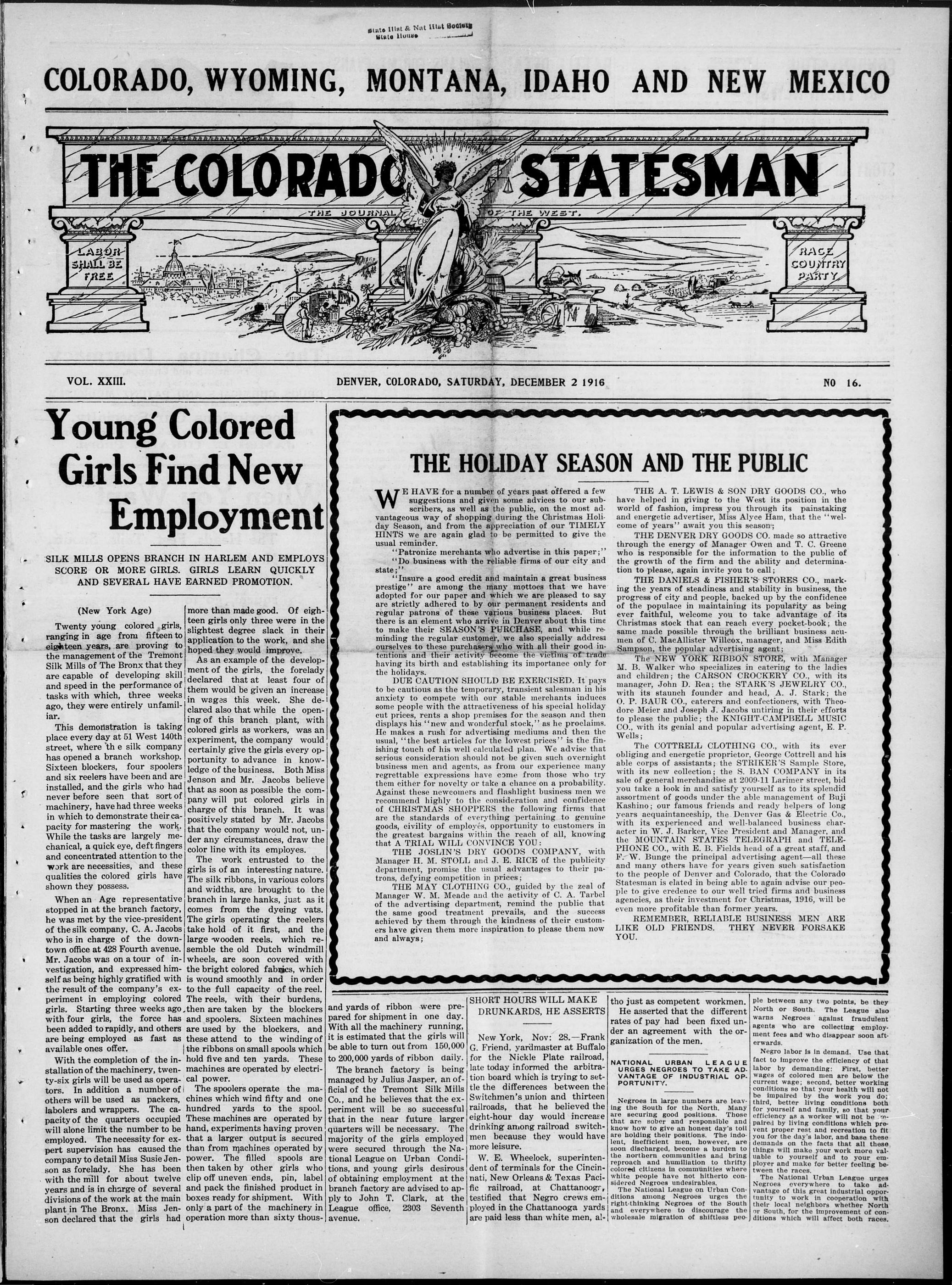
Young Colored Girls Find New Employment
SILK MILLS OPENS BRANCH IN HARLEM AND EMPLOYS SCORE OR MORE GIRLS. GIRLS LEARN QUICKLY AND SEVERAL HAVE EARNED PROMOTION.
VOL. XXIII.
Young' O
Girls Fi
Emp
SILK MILLS OPENS BRANCH
SCORE OR MORE GIRLS.
AND SEVERAL HAVE
(New York Age)
Twenty young colored girls, ranging in age from fifteen to eighteen years, are proving to the management of the Tremont Silk Mills of The Bronx that they are capable of developing skill and speed in the performance of tasks with which, three weeks ago, they were entirely unfamiliar. This demonstration is taking place every day at 51 West 140th street, where the silk company has opened a branch workshop. Sixteen blockers, four spoolers and six reelers have been and are installed, and the girls who had never before seen that sort of machinery, have had three weeks in which to demonstrate their capacity for mastering the work. While the tasks are largely mechanical, a quick eye, deft fingers and concentrated attention to the work are necessities, and these qualities the colored girls have shown they possess.
When an Age representative stopped in at the branch factory, he was met by the vice-president of the silk company, C. A. Jacobs who is in charge of the downtown office at 428 Fourth avenue. Mr. Jacobs was on a tour of investigation, and expressed himself as being highly gratified with the result of the company's experiment in employing colored girls. Starting three weeks ago with four girls, the force has been added to rapidly, and others are being employed as fast as available ones offer.
With the completion of the installation of the machinery, twenty-six girls will be used as operators. In addition a number of others will be used as packers, labolers and wrappers. The capacity of the quarters occupied will alone limit the number to be employed. The necessity for expert supervision has caused the company to detail Miss Susie Jenson as forelady. She has been with the mill for about twelve years and is in charge of several divisions of the work at the main plant in The Bronx. Miss Jenson declared that the girls had
more than made good. Of eighteen girls only three were in the slightest degree slack in their application to the work, and she hoped they would improve. As an example of the development of the girls, the forelady declared that at least four of them would be given an increase in wages this week. She declared also that while the opening of this branch plant, with colored girls as workers, was an experiment, the company would certainly give the girls every opportunity to advance in knowledge of the business. Both Miss Jenson and Mr. Jacobs believe that as soon as possible the company will put colored girls in charge of this branch. It was positively stated by Mr. Jacobs that the company would not, under any circumstances, draw the color line with its employees.
The work entrusted to the girls is of an interesting nature. The silk ribbons, in various colors and widths, are brought to the branch in large hanks, just as it comes from the dyeing vats. The girls operating the reelers take hold of it first, and the large wooden reels, which resemble the old Dutch windmill wheels, are soon covered with the bright colored fabrics, which is wound smoothly and in order to the full capacity of the reel. The reels, with their burdens, then are taken by the blockers and spoolers. Sixteen machines are used by the blockers, and these attend to the winding of the ribbons on small spools which hold five and ten yards. These machines are operated by electrical power.
The spoolers operate the machines which wind fifty and one hundred yards to the spool. These machines are operated by hand, experiments having proven that a larger output is secured than from machines operated by power. The filled spools are then taken by other girls who clip off uneven ends, pin, label and pack the finished product in boxes ready for shipment. With only a part of the machinery in operation more than sixty thous-
DENVER, COLORADO, SATURDAY, DECEMBER 2 1916
THE HOLIDAY SEASON AND THE PUBLIC
WE HAVE for a number of years past offered a few suggestions and given some advices to our subscribers, as well as the public, on the most advantageous way of shopping during the Christmas Holiday Season, and from the appreciation of our TIMELY HINTS we are again glad to be permitted to give the usual reminder.
"Patronize merchants who advertise in this paper;" "Do business with the reliable firms of our city and state;" "Insure a good credit and maintain a great business prestige" are among the many mottoes that we have adopted for our paper and which we are pleased to say are strictly adhered to by our permanent residents and regular patrons of these various business places. But there is an element who arrive in Denver about this time to make their SEASON'S PURCHASE, and while reminding the regular customer, we also specially address ourselves to these purchasers who with all their good intentions and their activity become the victims of trade having its birth and establishing its importance only for the holidays.
DUE CAUTION SHOULD BE EXERCISED. It pays to be cautious as the temporary, transient salesman in his anxiety to compete with our stable merchants induces some people with the attractiveness of his special holiday cut prices, rents a shop premises for the season and then displays his "new and wonderful stock," as he proclaims. He makes a rush for advertising mediums and then the usual, "the best articles for the lowest prices" is the finishing touch of his well calculated plan. We advise that serious consideration should not be given such overnight business men and agents, as from our experience many regrettable expressions have come from those who try them either for novelty or take a chance on a probability. Against these newcomers and flashlight business men we recommend highly to the consideration and confidence of CHRISTMAS SHOPPERS the following firms that are the standards of everything pertaining to genuine goods, civility of employés, opportunity to customers in the greatest bargains within the reach of all, knowing that A TRIAL WILL CONVINCE YOU:
THE JOSLIN'S DRY GOODS COMPANY, with Manager H. M. STOLL and J. E. RICE of the publicity department, promise the usual advantages to their patrons, defying competition in prices;
THE MAY CLOTHING CO., guided by the zeal of Manager W. M. Meade and the activity of C. A. Tarbel of the advertising department, remind the public that the same good treatment prevails, and the success achieved by them through the kindness of their customers have given them more inspiration to please them now and always;
state Hist & Nat Hist Boots
Hist House
WE HAVE for a num-
suggestions and
scribers, as well
vantageous way of shop-
day Season, and from the
HINTS we are again given
usual reminder.
"Patronize merchant
"Do business with the
state;"
"Insure a good creed
prestige" are among the
adopted for our paper a
are strictly adhered to to
regular patrons of these
there is an element who
to make their SEASON
minding the regular cus-
ourselves to these purch-
tions and their active
having its birth and esti-
the holidays.
DUE CAUTION SHOP
to be cautious as the tem-
anxiety to compete with
some people with the atti-
cut prices, rents a shop
displays his "new and w
He makes a rush for ad-
usual, "the best articles
ishing touch of his well
serious consideration she
business men and agent
regrettable expressions
them either for novelty or
Against these newcomers
recommend highly to the
of CHRISTMAS SHOP
are the standards of ev-
goods, civility of emplo-
the greatest bargains wi
that A TRIAL WILL COME
THE JOSLIN'S D
Manager H. M. STOLL
department, promise the
trons, defying competition
THE MAY CLOTH
Manager W. M. Meade
of the advertising depa-
the same good treatme
achieved by them throu-
ers have given them mo-
and always;
and yards of ribbon were prepared for shipment in one day. With all the machinery running, it is estimated that the girls will be able to turn out from 150,000 to 200,000 yards of ribbon daily.
The branch factory is being managed by Julius Jasper, an official of the Tremont Silk Mills Co., and he believes that the experiment will be so successful that in the near future larger quarters will be necessary. The majority of the girls employed were secured through the National League on Urban Conditions, and young girls desirous of obtaining employment at the branch factory are advised to apply to John T. Clark, at the League office, 2303 Seventh avenue.
SHORT HOURS WILL MAKE DRUNKARDS, HE ASSERTS
New York, Nov: 28.—Frank G. Friend, yardmaster at Buffalo for the Nickle Plate railroad, late today informed the arbitration board which is trying to settle the differences between the Switchmen's union and thirteen railroads, that he believed the eight-hour day would increase drinking among railroad switchmen because they would have more leisure. W. E. Wheelock, superintendent of terminals for the Cincinnati, New Orleans & Texas Pacific railroad, at Chattanoogr, testified that Negro crews employed in the Chattanooga yards are paid less than white men, al-
THE A. T. LEWIS & SON DRY GOODS CO., who have helped in giving to the West its position in the world of fashion, impress you through its painstaking and energetic advertiser, Miss Alyce Ham, that the "welcome of years" await you this season;
THE DENVER DRY GOODS CO. made so attractive through the energy of Manager Owen and T. C. Greene who is responsible for the information to the public of the growth of the firm and the ability and determination to please, again invite you to call;
THE DANIELS & FISHER'S STORES CO., marking the years of steadiness and stability in business, the progress of city and people, backed up by the confidence of the populace in maintaining its popularity as being ever faithful, welcome you to take advantage of its Christmas stock that can reach every pocket-book; the same made possible through the brilliant business acumen of C. MacAllister Willeox, manager, and Miss Edith Sampson, the popular advertising agent;
The NEW YORK RIBBON STORE, with Manager M. B. Walker who specializes in catering to the ladies and children; the CARSON CROCKERY CO., with its manager, John D. Rea; the STARK'S JEWELRY CO., with its staunch founder and head, A. J. Stark; the O. P. BAUR CO., caterers and confectioners, with Theodore Meier and Joseph J. Jacobs untiring in their efforts to please the public; the KNIGHT-CAMPBELL MUSIC CO., with its genial and popular advertising agent, E. P. Wells;
Obliging and energetic proprietor, George Cottrell and his able corps of assistants; the STRIKER'S Sample Store, with its new collection; the S. BAN COMPANY in its sale of general merchandise at 2009-11 Larimer street, bid you take a look in and satisfy yourself as to its splendid assortment of goods under the able management of Buji Kashino; our famous friends and ready helpers of long years acquaintanceship, the Denver Gas & Electric Co., with its experienced and well-balanced business character in W. J. Barker, Vice President and Manager, and the MOUNTAIN STATES TELEGRAPH and TELEPHONE CO., with E. B. Fields head of a great staff, and F. W. Bunge the principal advertising agent—all these and many others have for years given such satisfaction to the people of Denver and Colorado, that the Colorado Statesman is elated in being able to again advise our people to give credence to our well tried firms and business agencies, as their investment for Christmas, 1916, will be even more profitable than former years.
REMEMBER, RELIABLE BUSINESS MEN ARE LIKE OLD FRIENDS. THEY NEVER FORSAKE YOU.
to just as competent workmen.
He asserted that the different rates of pay had been fixed under an agreement with the organization of the men.
NATIONAL URBAN LEAGUE
URGES NEGROES TO TAKE ADVANTAGE OF INDUSTRIAL OPPORTUNITY.
Negroes in large numbers are leaving the South for the North. Many are securing good positions. Those that are sober and responsible and know how to give an honest day's toll are holding their positions. The indolent, inefficient men, however, are soon discharged, become a burden to the northern communities and bring reproach and humiliation to thrifty colored citizens in communities where white people have not hitherto considered Negroes undesirables.
The National League on Urban Conditions among Negroes urges the right-thinking Negroes of the South and everywhere to discourage the wholesale migration of shiftless peo-
NO 16.
ple between any two points, be they North or South. The League also warns Negroes against fraudulent agents who are collecting employment fees and who disappear soon afterwards.
Negro labor is in demand. Use that fact to improve the efficiency of that labor by demanding: First, better wages of colored men are below the current wage; second, better working conditions so that your health will not be impaired by the work you do; third, better living conditions both for yourself and family, so that your efficiency as a worker will not be impaired by living conditions which prevent proper rest and recreation to fit you for the day's labor, and base these demands on the facts that all these things will make your work more valuable to yourself and to your employer and make for better feeling between the races.
The National Urban League urges Negroes everywhere to take advantage of this great industrial opportunity to work in cooperation with their local neighbors whether North or South, for the improvement of conditions which will affect both races.
CONDENSATION OF FRESH NEWS
THE LATEST IMPORTANT DIS
PATCHES PUT INTO SHORT,
CRISP PARAGRAPH8.
STORY OF THE WEEK
SHOWING THE PROGRESS OF EVENTS IN OUR OWN AND FOREIGN LANDS.
Western Newspaper Union News Service.
ABOUT THE WAR
Villa is reported moving on Juarez after driving Trevino out of Chihuahua City.
Entente allies have met with a severe check north of Monastir, Berlin reports. Attack over a front of seventeen miles repulsed.
Russian dreadnought Imperatritsa Maria sunk by an internal explosion off the Rumanian Black sea coast, with loss of 200 lives.
The Rumanian government and diplomatic authorities have left Bucharest and gone to Jassy, according to a Havas dispatch from Bucharest.
Russians and Rumanians have taken the offensive in Dobrudja, north of the Tchernavoda-Constanza railway. The Rumanians advance on the whole front and occupied five towns fifteen miles north of the railway.
The entire line of the Alt river now is in the hands of the Austro-Germans and converging armies are making rapid progress in their drive toward Bucharest. Armies cross Topolog river. Mackensen captures Alexandria.
Near Orsova, Rumanian army has been caught between two German forces and 1,200 men, besides a large amount of war supplies, have been captured. Four hundred men taken in similar action near Tigveni, in the Alt region.
The British cruiser Newcastle is reported to have been sunk at the entrance to the Firth of Forth, Scotland, Nov. 15, by coming in contact with a mine, according to the Overseas News agency. The total losses to the British navy with this loss, as far as can be ascertained, have reached 121 ships of 567,950 tons, not counting auxiliary cruisers and auxiliary ships.
With the forces of the central powers in possession—according to German official reports, which hitherto have proved accurate with regard to recent events in Rumania—of Curtea de Arges, an important railway terminus ninety miles from Bucharest, and Gulrgui, on the railway forty miles southwest of the capital, anxiety as to the fate of Bucharest is greatly increased.
WESTERN
Joseph Diovardi, grocer in "Little Italy" in Chicago, lies dead, the thirty-fifth victim this year of the sawed-off shotgun of the "Black Hand."
Nearly 5,000 pies and 2,500 cakes were baked by the housewives of San Antonio for the 15,000 soldiers at Fort Sam Houston and Camp Wilson for Thanksgiving.
Major Bosse announced that he will take steps at once to open wholesale municipal markets at Evansville, Ind., where food products will be sold to the consumers at cost.
A nation-wide movement for an increase in wages for the 1,500,000 railroad employés not recognized in the Adamson eight-hour law was initiated at a meeting held at Denver.
P. H. Morrissey, assistant to the vice president of the Burlington railroad, for many years head of the Brotherhood of Railway Trainmen, and one of the most widely known railroad men in the country, died at the family home in Galesburg, Ill., of tumor of the brain.
Merchants of Leroy, Ill., in order to attract out of town trade, gave away turkeys and other kinds of poultry. The birds were permitted to fly from the roof of a tall building, one at a time, and the persons who seized the birds were declared the owners. Several thousand persons joined the chase.
WASHINGTON
The secretary of state and Mrs. Lansing entertained at dinner in honor of the German ambassador and Countess Von Bernstorff. American bankers were warned by the federal reserve board to avoid locking up their funds by purchasing treasury bills of foreign governments involving long term obligations. President Wilson and his closest personal advisers, in a series of conferences in quick succession, decided not to make any definite movement toward obtaining peace in Europe at this time, it was announced in official circles.
The Polish National Defense committee of Chicago, in a letter to Count von Bernstorff, the German ambassador, made public in Washington, declares that establishment by Germany of the kingdom of Poland is a corner stone for permanent peace in Europe.
A plea for preparedness at coal and metal mines, so that if a disaster comes and imprisons many miners the officials may have a definite plan for action in saving life, is outlined in a report issued by the bureau of mines of the Department of the Interior.
中
FOREIGN
The Chamber of Deputies met in Paris in secret session for the second time since the beginning of the war. The British government has refused to grant a safe conduct to the newly appointed Austrian ambassador to the United States, Count Tarnowski. Rear Admirals Wurmbach, Jasper, Hebbinghaus, Mauve and Behenke, have been promoted to vice admirals says an Overseas News agency announcement from Berlin. A Havis dispatch from Limoges says the city is about to take a census of its inhabitants with a view to instituting family cards for various items of household consumption.
Emperor William will send to President Wilson as a Christmas present a de luxe set of American authors, specially prepared, printed and bound at the Royal Printing works in Berlin, according to the Budapest newspaper, Az Est.
King Constantine at Athens signed a decree naming former Minister Georgios Streit as professor of International law in the University of Athens, the appointment carrying with it the post of legal advisor to the foreign minister.
Robert Griffiths and C. Haley, express messengers, passed through Seward, Alaska, for interior camps to bring out gold shipments. They expect to return to Seward on their way to Seattle in five weeks with at least $1,000,000 in gold dust.
Two Zeppelins which raided the northeast coast and the north midland counties were brought down and destroyed by British airmen. The crews of both airships perished. This makes a total of seven German Zeppelins destroyed in England in the present year, while six have been brought down in other fields of operation.
The removal of the body of the late Emperor Francis Joseph from the Schoenbrunn palace to the Hofburg chapel in Vienna was a most impressive spectacle. Tens of thousands of spectators stood in the cold dampness and filled the windows as a vantage point as the cortege passed through the streets, its way lighted by flickering torches.
Twenty thousand French civilians from the occupied districts of France are about to be returned to France from Germany. Trains, each carrying 500 persons, will effect the transportation before Christmas. A Berlin dispatch of Nov. 24 reported completion of negotiations for the exchange of 20,000 intermed civilians between Germany and France.
SPORTING NEWS
Purdue won the annual cross-country run of the Western Conference at Lafayette, Ind.
Midwinter polo play at Coronado, Cal., will begin Jan. 1, with competition for the Jessop trophy.
Students at the University of Colorado are preparing to turn their football field into a skating pond at the conclusion of the gridiron season.
Gamble field, the playing gridiron of the University of Colorado, at Boulder, may be turned into an ice skating rink at the close of the football season.
Coach M. C. Evans is originator of the idea.
Two new records were set in the middlewest bowling association tournament that closed at St. Louis, both of which were made by Chicago teams. the Rubins rolled 2,955, forty-six pins better than the old middle-west standard five-men team, Ehman and Lea totalled 1,269, seven pins more than the former doubles high mark made in 1911 by Collier and Flenner also of Chicago.
Georges Carpentier, the French champion boxer, has been on leave in Paris after taking part as an aviator at the recapture of Fort Douaumont on the Verdun front. Carpentier was decorated with the military medal for gallantry in action. While in Paris he gave an informal exhibition of boxing at a charity bazar in the Trocadero palace and received an enthusiastic reception from thousands.
GENERAL
Final certification to the election of Democratic presidential electors in California was made at the office of Secretary of State Frank C. Jordan at Sacramento, Cal.
Preliminary plans for the rough riders of Spanish war fame to build and endow a "Commons hall" at Norwich University, Northfield Vt., were announced in New York.
Charlotte Case, widow of Charles Case, actor, who shot himself accidentally in a New York hotel, is dead. Shock at the news of her husband's sudden death killed Mrs. Case, physicians said.
Financial assistance which the government of the city of New York gives annually to charitable, religious, educational and kindred private institutions amounts to approximately $13,902,629, according to a report submitted to Mayor Mitchel by Leonard M. Wallenstein, commissioner of accounts.
Complete official returns, including the soldier vote, received by the secretary of state at Madison, Wis., show that United States Senator Robert M. LaFollette, Republican, received a plurality of 118,162 over his Democratic opponent. William F. Wolfe.
Stray bullets from a rifle fired from the British steamer Scythian of the Leyland line, bound in from Liverpool, pierced the smokestack of the public health service ship Neptune at the mouth of the Mississippi. The Neptune reported the affair at New Orleans.
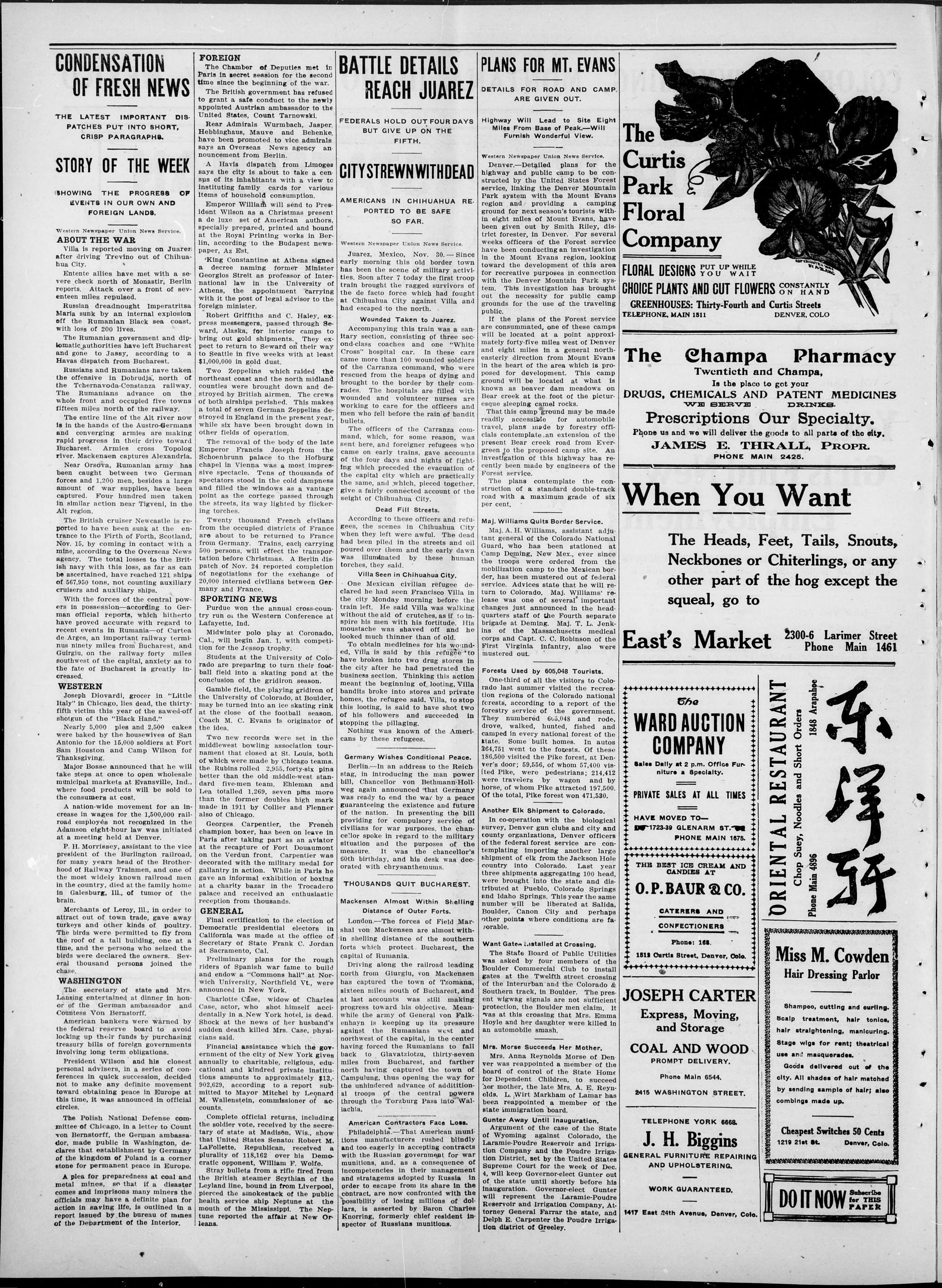
BATTLE DETAILS REACH JUAREZ
FEDERALS HOLD OUT FOUR DAYS BUT GIVE UP ON THE FIFTH.
CITYSTREWNWITHDEAD
AMERICANS IN CHIHUAHUA RE-
PORTED TO BE SAFE
SO FAR.
Western Newspaper Union News Service.
Juarez, Mexico, Nov. 30. — Since early morning this old border town has been the scene of military activities. Soon after 7 today the first troop train brought the ragged survivors of the de facto force which had fought at Chihuahua City against Villa and had escaped to the north.
Wounded Taken to Juarez.
Accompanying this train was a sanitary section, consisting of three second-class coaches and one "White Cross" hospital car. In these cars came more than 100 wounded soldiers of the Carranza command, who were rescued from the heaps of dying and brought to the border by their comrades. The hospitals are filled with wounded and volunteer nurses are working to care for the officers and men who fell before the rain of bandit bullets.
The officers of the Carranza command, which, for some reason, was sent here, and foreigner refugees who came on early trains, gave accounts of the four days and nights of fighting which preceded the evacuation of the capital city which are practically the same, and which, pleced together, give a fairly connected account of the seight of Chihuahua City.
Dead Fill Streets.
According to these officers and refugees, the scenes in Chihuahua City when they left were awful. The dead had been piled in the streets and oil poured over them and the early dawn was illuminated by these human torches, they said.
Villa Seen in Chihuahua City.
One Mexican civilian refugee declared he had seen Francisco Villa in the city Monday morning before the train left. He said Villa was walking without the aid of crutches, as if to inspire his men with his fortitude. His moustache was shaved off and he looked much thinner than of old.
To obtain medicines for his wounded, Villa is said by this refugee to have broken into two drug stores in the city after he had penetrated the business section. Thinking this action meant the beginning of looting, Villa bandits broke into stores and private homes, the refugee said. Villa, to stop this looting, is said to have shot two of his followers and succeeded in stopping the pillaging.
Nothing was known of the Americans by these refugees.
Germany Wishes Conditional Peace.
Berlin.—In an address to the Reichstag, in introducing the man power bill, Chancellor von Bethmann-Hollweg again announced that Germany was ready to end the war by a peace guaranteeing the existence and future of the nation. In presenting the bill providing for compulsory service of civilians for war purposes, the chancellor spoke in regard to the military situation and the purposes of the measure. It was the chancellor's 60th birthday, and his desk was decorated with chrysanthemums.
THOUSANDS QUIT BUCHAREST.
Mackensen Almost Within Shelling Distance of Outer Forts. London.-The forces of Field Marshal von Mackensen are almost within shelling distance of the southern forts which protect. Bucharest, the capital of Rumania.
Driving along the railroad leading north from Giurgiu, von Mackensen has captured the town of Tzomana, sixteen miles south of Bucharest, and at last accounts was still making progress toward his objective. Meanwhile the army of General von Falkenhayn is keeping up its pressure against the Rumanians west and northwest of the capital, in the center having forced the Rumanians to fall back to Glavatziotzu, thirty-seven miles from Bucharest, and farther north having captured the town of Campulung, thus opening the way for the unhindered advance of additional troops of the central powers through the Torzburg Pass into Wallachia.
American Contractors Face Loss. Philadelphia.—That American munitions manufacturers rushed blindly and too eagerly in accepting contracts with the Russian government for war munitions, and, as a consequence of incompetencies in their management and stratagems adopted by Russia in order to escape from its share in the contract, are now confronted with the possibility of losing millions of dollars, is asserted by Baron Charles Knorring, formerly chief resident inspector of Russians munitions.
PLANS FOR MT. EVANS
PLANS FOR MT. EVANS
DETAILS FOR ROAD AND CAMP ARE GIVEN OUT.
Highway Will Lead to Site Eight Miles From Base of Peak.—Will Furnish Wonderful View.
Western Newspaper Union News Service.
Denver.—Detailed plans for the highway and public camp to be constructed by the United States Forest service, linking the Denver Mountain Park system with the Mount Evans region and providing a camping ground for next season's tourists within eight miles of Mount Evans, have been given out by Smith Riley, district forester, in Denver. For several weeks officers of the Forest service have been conducting an investigation in the Mount Evans region, looking toward the development of this area for recreative purposes in connection with the Denver Mountain Park system. This investigation has brought out the necessity for public camp grounds for the use of the traveling public.
If the plans of the Forest service are consummated, one of these camps will be located at a point approximately forty-five miles west of Denver and eight miles in a general northeasternly direction from Mount Evans in the heart of the area which is proposed for development. This camp ground will be located at what is known as beaver dam meadows on Bear creek at the foot of the picturesque sleeping camel rocks. That this camp ground may be made readily accessible for automobile travel, plans made by forestry officials contemplate an extension of the present Bear creek road from Evergreen to the proposed camp site. An investigation of this highway has recently been made by engineers of the Forest service.
The plans contemplate the construction of a standard double-track road with a maximum grade of six per cent.
Mai. Williams Quits Border Service.
Maj. A. H. Williams, assistant adjutant general of the Colorado National Guard, who has been stationed at Camp Deming, New Mex., ever since the troops were ordered from the mobilization camp to the Mexican border, has been mustered out of federal service. Advices state that he will return to Colorado. Maj. Williams' release was one of several important changes just announced in the headquarters staff of the Fourth separate brigade at Deming. Maj. T. L. Jenkins of the Massachusetts medical corps and Capt. C. C. Robinson of the First Virginia infantry, also were mustered out.
Forests Used by 605,048 Tourists.
One-third of all the visitors to Colorado last summer visited the recreation regions of the Colorado national forests, according to a report of the forestry service of the government. They numbered 605,048 and rode, drove, walked, hunted, fished and camped in every national forest of the state. Some built homes. In autos 264,751 went to the forests. Of these 186,500 visited the Pike forest, at Denver's door; 59,556, of whom 57,400 visited Pike, were pedestrians; 214,412 were travelers by wagon and by horse, of whom Pike attracted 197,500. Of the total, Pike forest won 471,530.
Another Elk Shipment to Colorado.
In co-operation with the biological survey, Denver gun clubs and city and county organizations, Denver officers of the federal forest service are contemplating importing another large shipment of elk from the Jackson Hole country into Colorado. Last year three shipments aggregating 100 head, were brought into the state and distributed at Pueblo, Colorado Springs and Idaho Springs. This year the same number will be liberated at Salida, Boulder, Canon City and perhaps other points where conditions are favorable.
Want Gate Installed at Crossing.
The State Board of Public Utilities was asked by four members of the Boulder Commercial Club to install gates at the Twelfth street crossing of the Interurban and the Colorado & Southern track, in Boulder. The present wigwag signals are not sufficient protection, the Boulder men claim. It was at this crossing that Mrs. Emma Hoyle and her daughter were killed in an automobile smash.
Mrs. Morse Succeeds Her Mother.
Mrs. Anna Reynolds Morse of Denver was reappointed a member of the board of control of the State Home for Dependent Children, to succeed her mother, the late Mrs. A, E. Reynolds. L. Wirt Markham of Lamar has been reappointed a member of the state immigration board.
Gunter Away Until Inauguration.
Argument of the case of the State of Wyoming against Colorado, the Laramie-Poudre Reservoir and Irrigation Company and the Poudre Irrigation District, set by the United States Supreme Court for the week of Dec. 4, will keep Governor-elect Gunter out of the state until shortly before his inauguration. Governor-elect Gunter will represent the Laramie-Poudre Reservoir and Irrigation Company, Attorney General Farrar the state, and Delph E. Carpenter the Poudre Irrigation district of Greeley.
The Curtis Park Floral Company
FLORAL DESIGNS PUT UP WHILE YOU WAIT
CHOICE PLANTS AND CUT FLOWERS CONSTANTLY ON HAND
GREENHOUSES: Thirty-Fourth and Curtis Streets
TELEPHONE, MAIN 1511 DENVER, COLO
The Champa Pharmacy
Twentieth and Champa,
Is the place to get your
DRUGS, CHEMICALS AND PATENT MEDICINES
WE SERVE DRINKS.
Prescriptions Our Specialty.
Phone us and we will deliver the goods to all parts of the city.
JAMES E. THRALL, PROPR.
PHONE MAIN 2426.
When You Want
The Heads, Feet, Tails, Snouts, Neckbones or Chiterlings, or any other part of the hog except the squeal, go to
JOSEPH CARTER
2300-6 Larimer Street Phone Main 1461
ORIENTAL RESTAURANT
Chop Suey, Noodles and Short Orders
Phone Main 4896
1848 Arapahoe
乐洋轩
```markdown
```
Miss M. Cowden Hair Dressing Parlor
Shampoo, cutting and curling. Scalp treatment, hair tonics, hair straightening, manicuring. Stage wigs for rent; theatrical use and masquerades. Goods delivered out of the city. All shades of hair matched by sending sample of hair; also combings made up.
Cheapest Switches 50 Cents
1219 21st St. Denver, Colo.
DO IT NOW Subscribe
for THIS
PAPER
AFRO-AMERICAN CULLINGS
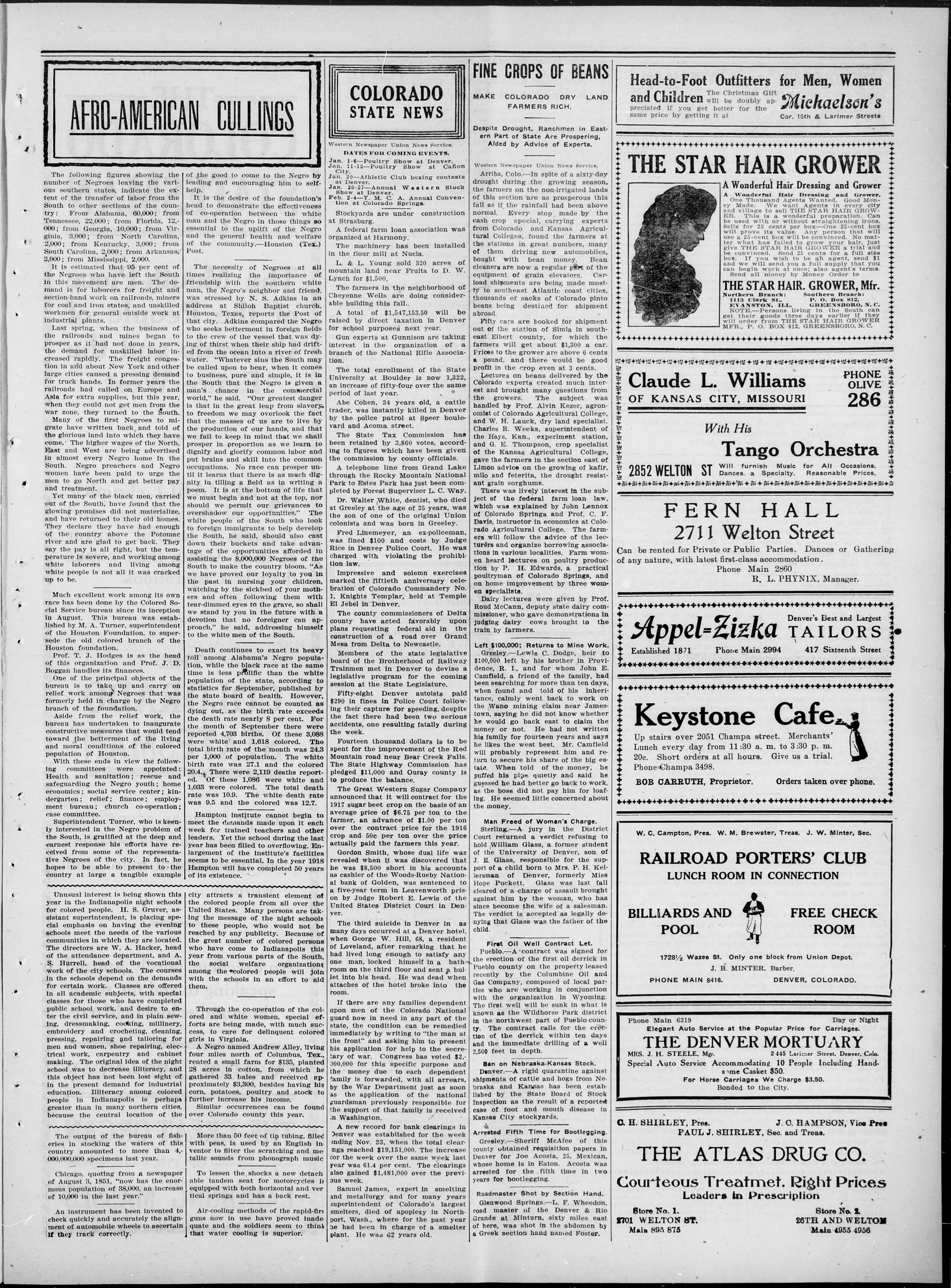
The following figures showing the number of Negroes leaving the various southern states, indicate the extent of the transfer of labor from the South to other sections of the country: From Alabama, 60,000; from Tennessee, 22,000; from Florida, 12,000; from Georgia, 10,000; from Virginia, 3,000; from North Carolina, 2,000; from Kentucky, 3,000; from South Carolina, 2,000; from Arkansas, 2,000; from Mississippi, 2,000.
It is estimated that 95 per cent of the Negroes who have left the South in this movement are men. The demand is for laborers for freight and section-hand work on railroads, miners for coal and iron states, and unskilled workmen for general outside work at industrial plants.
Last spring, when the business of the railroads and mines began to prosper as it had not done in years, the demand for unskilled labor increased rapidly. The freight congestion in aid about New York and other large cities caused a pressing demand for truck hands. In former years the railroads had called on Europe and Asia for extra supplies, but this year, when they could not get men from the war zone, they turned to the South.
Many of the first Negroes to migrate have written back and told of the glorious land into which they have come. The higher wages of the North, East and West are being advertised in almost every Negro home in the South. Negro preachers and Negro women have been paid to urge the men to go North and get better pay and treatment.
Yet many of the black men, carried out of the South, have found that the glowing promises did not materialize, and have returned to their old homes. They declare they have had enough of the country above the Potomac river and are glad to get back. They say the pay is all right, but the temperature is severe, and working among white laborers and living among white people is not all it was cracked up to be.
Much excellent work among its own race has been done by the Colored Social Service bureau since its inception in August. This bureau was established by M. A. Turner, superintendent of the Houston Foundation, to supersede the old colored branch of the Houston foundation.
Prof. T. J. Hodges is as the head of this organization and Prof. J. D. Boggan handles its finances.
One of the principal objects of the bureau is to take up and carry on relief work among Negroes that was formerly held in charge by the Negro branch of the foundation.
Aside from the relief work, the bureau has undertaken to inaugurate constructive measures that would tend toward the betterment of the living and moral conditions of the colored population of Houston.
With these ends in view the following committees were appointed: Health and sanitation; rescue and safeguarding the Negro youth; home economics; social service center; kindergarten; relief; finance; employment bureau; church co-operation; case committee.
Superintendent Turner, who is keenly interested in the Negro problem of the South, is gratified at the deep and earnest response his efforts have received from some of the representative Negroes of the city. In fact, he hopes to be able to present to the country at large a tangible example
Unusual interest is being shown this year in the Indianapolis night schools for colored people. H. S. Gruver, assistant superintendent, is placing special emphasis on having the evening schools meet the needs of the various communities in which they are located. The directors are W. A. Hacker, head of the attendance department, and A. S. Hurrell, head of the vocational work of the city schools. The courses in the schools depend on the demands for certain work. Classes are offered in all academic subjects, with special classes for those who have completed public school work, and desire to enter the civil service, and in plain sewing, dressmaking, cooking, millinery, embroidery and crocheting, cleaning, pressing, repairing and tailoring for men and women, shoe repairing, electrical work, carpentry and cabinet making. The original idea of the night school was to decrease illiteracy, and this object has not been lost sight of in the present demand for industrial education. Illiteracy among colored people in Indianapolis is perhaps greater than in many northern cities, because the central location of the
The output of the bureau of fisheries in stocking the waters of this country amounted to more than 4,000,000,000 specimens last year.
Chicago, quoting from a newspaper of August 3, 1851, "now has the enormous population of 38,000, an increase of 10,000 in the last year."
An instrument has been invented to check quickly and accurately the alignment of automobile wheels to ascertain if they track correctly.
of the good to come to the Negro by leading and encouraging him to self-help.
It is the desire of the foundation's head to demonstrate the effectiveness of co-operation between the white man and the Negro in those things so essential to the uplift of the Negro and the general health and welfare of the community.—Houston (Tex.) Post.
The necessity of Negroes at all times realizing the importance of friendship with the southern white man, the Negro's neighbor and friend, was stressed by N. S. Adkins in an address at Shiloh Baptist church, Houston, Texas, reports the Post of that city. Adkins compared the Negro who seeks betterment in foreign fields to the crew of the vessel that was dying of thirst when their ship had drifted from the ocean into a river of fresh water. "Whatever sins the South may be called upon to bear, when it comes to business, pure and simple, it is in the South that the Negro is given a man's chance in the commercial world," he said. "Our greatest danger is that in the great leap from slavery to freedom we may overlook the fact that the masses of us are to live by the production of our hands, and that we fall to keep in mind that we shall prosper in proportion as we learn to dignify and glorify common labor and put brains and skill into the common occupations. No race can prosper until it learns that there is as much dignity in tilling a field as in writing a poem. It is at the bottom of life that we must begin and not at the top, nor should we permit our grievances to overshadow our opportunities." The white people of the South who look to foreign immigrants to help develop the South, he said, should also cast down their buckets and take advantage of the opportunities afforded in assisting the 8,000,000 Negroes of the South to make the country bloom. "As we have proved our loyalty to you in the past in nursing your children, watching by the sickbod of your mothers and often following them with tear-dimmed eyes to the grave, so shall we stand by you in the future with a devotion that no foreigner can approach," he said, addressing himself to the white men of the South.
Death continues to exact its heavy toll among Alabama's Negro population, while the black race at the same time is less prolific than the white population of the state, according to statistics for September, published by the state board of health. However, the Negro race cannot be counted as dying out, as the birth rate exceeds the death rate nearly 8 per cent. For the month of September there were reported 4,703 births. Of these 3,088 were white and 1,618 colored. The total birth rate of the month was 24.3 per 1,000 of population. The white birth rate was 27.1 and the colored 20.4. There were 2,119 deaths reported. Of these 1,086 were white and 1,033 were colored. The total death rate was 10.9. The white death rate was 9.5 and the colored was 12.7.
Hampton institute cannot begin to meet the demands made upon it each week for trained teachers and other leaders. Yet the school during the last year has been filled to overflowing. Enlargement of the institute's facilities seems to be essential. In the year 1918 Hampton will have completed 50 years of its existence.
city attracts a transient element of the colored people from all over the United States. Many persons are taking the message of the night schools to these people, who would not be reached by any publicity. Because of the great number of colored persons who have come to Indianapolis this year from various parts of the South, the social welfare organizations among the colored people will join with the schools in an effort to aid them.
Through the co-operation of the colored and white women, special efforts are being made, with much success, to care for delinquent colored girls in Virginia.
A Negro named Andrew Alley, living four miles north of Columbus, Tex., rented a small farm for $135, planted 28 acres in cotton, from which he gathered 33 bales and received approximately $3,300, besides having his corn, potatoes, poultry and stock to further increase his income.
Similar occurrences can be found over Colorado county this year.
More than 50 feet of tip tubing, filled with peas, is used by an English inventor to filter the scratching and metallic sounds from phonograph music
To lessen the shocks a new detachable tandem seat for motorcycles is equipped with both horizontal and vertical springs and has a back rest.
Air-cooling methods of the rapid-fire guns now in use have proved inadequate and the soldiers seem to think that water cooling is superior.
Western Newspaper Union News Service.
DATES FOR COMING EVENTS.
Jan. 1-6—Poultry Show at Denver.
Jan. 11-13—Poultry Show at Cafion
City.
Stockyards are under construction at Strasburg.
A federal farm loan association was organized at Harmony.
The machinery has been installed in the flour mill at Nucla.
L. & L. Young sold 320 acres of mountain land near Fruita to D. W. Lynch for $1,500.
The farmers in the neighborhood of Cheyenne Wells are doing considerable building this fall.
A total of $1,547,153.50 will be raised by direct taxation in Denver for school purposes next year.
Gun experts at Gunnison are taking interest in the organization of a branch of the National Rifle Association.
The total enrollment of the State University at Boulder is now 1,322, an increase of fifty-four over the same period of last year. Abe Cohen, 34 years old, a cattle trader, was instantly killed in Denver by the police patrol at Speer boulevard and Acoma street. The State Tax Commission has been retained by 3,860 votes, according to figures which have been given the commission by county officials. A telephone line from Grand Lake through the Rocky Mountain National Park to Estes Park has just been completed by Forest Supervisor L. C. Way. Dr. Walter White, dentist, who died at Greeley at the age of 35 years, was the son of one of the original Union colonists and was born in Greeley.
Fred Linemeyer, an ex-policeman, was fined $100 and costs by Judge Rice in Denver Police Court. He was charged with violating the prohibition law.
Impressive and solemn exercises marked the fiftieth anniversary celebration of Colorado Commandery No. 1, Knights Templar, held at Temple El Jebel in Denver.
The county commissioners of Delta county have acted favorably upon plans requesting federal aid in the construction of a road over Grand Mesa from Delta to Newcastle.
Members of the state legislative board of the Brotherhood of Railway Trainmen met in Denver to devise a legislative program for the coming session at the State Legislature.
Fifty-eight Denver autolists paid $290 in fines in Police Court following their capture for speeding, despite the fact there had been two serious accidents, one resulting fatally during the week.
Fourteen thousand dollars is to be spent for the improvement of the Red Mountain road near Bear Creek Falls. The State Highway Commission has pledged $11,000 and Ouray county is to produce the balance.
The Great Western Sugar Company announced that it will contract for the 1917 sugar beet crop on the basis of an average price of $6.75 per ton to the farmer, an advance of $1.00 per ton over the contract price for the 1916 crop and 50c per ton over the price actually paid the farmers this year.
Gordon Smith, whose dual life was revealed when it was discovered that he was $8,500 short in his accounts as cashier of the Woods-Rueby National bank of Golden, was sentenced to a five-year term in Leavenworth prison by Judge Robert E. Lewis of the United States District Court in Denver.
The third suicide in Denver in as many days occurred at a Denver hotel, when George W. Hill, 68, a resident of Loveland, after remarking that he had lived long enough to satisfy any one man, locked himself in a bathroom on the third floor and sent a bullet into his head. He was dead when attaches of the hotel broke into the room.
If there are any families dependent upon men of the Colorado National guard now in need in any part of the state, the condition can be remedied immediately by writing to "the man at the front" and asking him to present his application for help to the secretary of war. Congress has voted $2,000,000 for this specific purpose and the money due to each dependent family is forwarded, with all arrears, by the War Department just as soon as the application of the national guardsman previously responsible for the support of that family is received in Washington.
A new record for bank clearings in Denver was established for the week ending Nov. 23, when the total clearings reached $19,151,000. The increase for the week over the same week last year was 61.4 per cent. The clearings also gained $1,481,000 over the previous week.
Samuel James, expert in smelting and metallurgy and for many years superintendent of Colorado's largest smelters, died of apoplexy in Northport, Wash., where for the past year he had been in charge of a smelter plant. He was 62 years old.
FINE CROPS OF BEANS
MAKE COLORADO DRY LAND FARMERS RICH.
Despite Drought, Ranchmen in Eastern Part of State Are Prospering, Aided by Advice of Experts.
Arriba, Colo.—In spite of a sixty-day drought during the growing season, the farmers on the non-irrigated lands of this section are as prosperous this fall as if the rainfall had been above normal. Every stop made by the cash crop special, carrying experts from Colorado and Kansas Agricultural Colleges, found the farmers at the stations in great numbers, many of them driving new automobiles, bought with bean money. Bean cleaners are now a regular part of the equipment of grain elevators. Carload shipments are being made mostly to southeast Atlantic coast cities, thousands of sacks of Colorado pinto beans being destined for shipment abroad.
Fifty cars are booked for shipment out of the station of Simla in southeast Elbert county, for which the farmers will get about $1,300 a car. Prices to the grower are about 6 cents a pound, and there would be good profit in the crop even at 3 cents.
Lectures on beans delivered by the Colorado experts created much interest and brought many questions from the growers. The subject was handled by Prof. Alvin Kezer, agronomist of Colorado Agricultural College, and W. H. Lauck, dry land specialist. Charles R. Weeks, superintendent of the Hays, Kan., experiment station, and G. E. Thompson, crop specialist of the Kansas Agricultural College, gave the farmers in the section east of Limon advice on the growing of kafir, milo and feterita, the drought resistant grain sorghums.
There was lively interest in the subject of the federal farm loan law, which was explained by John Lennox of Colorado Springs and Prof. C. F. Davis, instructor in economics at Colorado Agricultural College. The farmers will follow the advice of the lecturers and organize borrowing associations in various localities. Farm women heard lectures on poultry production by P. H. Edwards, a practical poultryman of Colorado Springs, and on home improvement by three women specialists. Dairy lectures were given by Prof. Roud McCann, deputy state dairy commissioner, who gave demonstrations in judging dairy cows brought to the train by farmers.
Left $100,000; Returns to Mine Work.
Greeley.—Lewis C. Dodge, heir to $100,000 left by his brother in Providence, R. I., and for whom John E. Camfield, a friend of the family, had been searching for more than ten days, when found and told of his inheritance, calmly went back to work on the Wano mining claim near Jamestown, saying he did not know whether he would go back east to claim the money or not. He had not written his family for fourteen years and says he likes the west best. Mr. Camfield will probably represent him and return to secure his share of the big estate. When told of the money, he stuffed his pipe quietly and said he guessed he had better go back to work, as the boss did not pay him for loafing. He seemed little concerned about the money.
Man Freed of Woman's Charge.
Sterling.—A jury in the District Court returned a verdict refusing to hold William Glass, a former student of the University of Denver, son of J. E. Glass, responsible for the support of a child born to Mrs. P. H. Kellersman of Denver, formerly Miss Hope Puckett. Glass was last fall cleared of a charge of assault brought against him by the woman, who has since become the wife of a salesman. The verdict is accepted as legally denying that Glass was the father of the child.
First Oil Well Contract Let. Pueblo. A-contract was signed for the erection of the first oil derrick in Pueblo county on the property leased recently by the Columbine Oil and Gas Company, composed of local parties who are working in conjunction with the organization in Wyoming. The first well will be sunk in what is known as the Wildhorse Park district in the northwest part of Pueblo county. The contract calls for the erection of the derrick within ten days and the immediate drilling of a well 2,500 feet in depth.
Ban on Nebraska-Kansas Stock. Denver. A rigid quarantine against shipments of cattle and hogs from Nebraska and Kansas has been established by the State Board of Stock Inspection as the result of a reported case of foot and mouth disease in Kansas City stockyards.
Arrested Fifth Time for Bootlegging.
Greeley.—Sheriff McAfee of this county obtained requisition papers in Denver for Joe Acosta, 25, Mexican, whose home is in Eaton. Acosta was arrested for the fifth time in two years for bootlegging.
Roadmaster Shot by Section Hand.
Glenwood Springs.—L. F. Wheedon, road master of the Denver & Rio Grande at Minturn, sixty miles east of here, was shot in the abdomen by a Greek section hand named Foster.
THE STAR HAIR GROWER
M
Claude L. V
OF KANSAS CITY
With
T
2852 WELTON ST Will
Dan
ude L. Williams
KANSAS CITY, MISSOURI
With His
Tango Orchestra
VELTON ST Will furnish Music for All
Dances, a Specialty. Reasonable
Claude L. Williams
OF KANSAS CITY, MISSOURI
PHONE
OLIVE
286
With His
Tango Orchestra
2852 WELTON ST Will furnish Music for All Occasions.
Dances, a Specialty. Reasonable Prices.
FERN HALL 2711 Welton Street
Can be rented for Private or
of any nature, with latest first
Phone
Appel=Zi
Established 1871 Phone
Keyston
Up stairs over 2051 Cham
Lunch every day from 1
20c. Short orders at all
Phone Champa 3498.
BOB CARRUTH, Propr
W. C. Campton, Pres. W. M.
RAILROAD
LUNCH ROO
Letted for Private or Public Parties. Dances are, with latest first-class accommodation.
Phone Main 2860
R. L. PHYNIX, Man
Appel=Zizka Denver's Best TAILOR
Used 1871 Phone Main 2994 417 Sixteenth
Keystone Cafe
Fairs over 2051 Champa street. Merchants' every day from 11:30 a.m. to 3:30 p.m. Short orders at all hours. Give us a trial. Champa 3498.
JARRUTH, Proprietor. Orders taken over
Campton, Pres. W. M. Brewster, Treas. J. W. Mi
HILROAD PORTERS' CAFE
LUNCH ROOM IN CONNECTION
Can be rented for Private or Public Parties. Dances or Gathering of any nature, with latest first-class accommodation.
Phone Main 2860
R. L. PHYN1X, Manager.
Up stairs over 2051 Champa street. Merchants' Lunch every day from 11:30 a. m. to 3:30 p. m. 20c. Short orders at all hours. Give us a trial. Phone Champa 3498.
W. C. Campton, Pres. W. M. Brewster, Treas. J. W. Minter, Sec. RAILROAD PORTERS' CLUB LUNCH ROOM IN CONNECTION
BILLIARDS AND POOL
1728½ Wazee St. C
J. B.
PHONE MAIN 8416.
Phone Main 6319
Elegant Auto Service a
THE DENV
MRS. J. H. STEELE, Mgr.
Special Auto Service Accor
For Horse Car
Bond
C. H. SHIRLEY, Pres.
PAUL J. SHI
THE ATL
Courteous Tre
Leaders
1728½ Wazee St. Only one block from Union De
J. B. MINTER, Barber.
ONE MAIN 8416. DENVER, COLOR
main 6319 D
ant Auto Service at the Popular Price for Car
THE DENVER MORTUA
Phone Main 6319 Day or Night
Elegant Auto Service at the Popular Price for Carriages.
THE DENVER MORTUARY
MRS. J. H. STEELE, Mgr. 2 445 Larkimer Street, Denver, Colo.
Special Auto Service Accommodating 10 People Including Hand-
some Casket $50.
For Horse Carriages We Charge $3.50.
Bonded to the City.
C. H. SHIRLEY, Pres. J. C. HAMPSON, Vice Pres PAUL J. SHIRLEY, Sec. and Treas.
Courteous Treatmet. Right Prices
Leaders in Prescription
Store No. 1.
2701 WELTON ST.
Main 895 875
Store No. 2.
26TH AND WELTON
Main 4955 4956
A Wonderful Hair Dressing and Grower.
One Thousand Agents Wanted. Good Money Made. We want Agents in every city and village to sell THE STAR HAIR GROWER. This is a wonderful preparation. Can you use it? Sell for 25 cents per box—One 25-cent box will prove its value. Any person that will use a 25-cent box will be convinced. No matter what has failed to grow your hair, just give THE STAR HAIR GROWER a tial and be convinced. Send 25 cents for a full size box and we will sell you a full size box and we will send you a full size that you can begin work at once; also agent's terms. Send all money by Money Order to
1113 Clark St. P. O. Box 812,
EVANSTON, ILL GREENSBORO, N.C.
NOTE.—Persons living in the South can
get their goods three days earlier if they
will order from THE STAR HAIR GROWER
MFR., P. O. Box 812, GREENSBORO, N.C.
Williams
PHONE
OLIVE
TY, MISSOURI
286
With His
Tango Orchestra
Will furnish Music for All Occasions.
Dances, a Specialty. Reasonable Prices.
or Public Parties. Dances or Gathering
first-class accommodation.
Phone Main 2860
R. L. PHYN1X, Manager.
Zizka Denver's Best and Largest
TAILORS
Phone Main 2994 417 Sixteenth Street
One Cafe
Champa street. Merchants'
m 11:30 a. m. to 3:30 p. m.
all hours. Give us a trial.
Opprietor. Orders taken over phone.
W. M. Brewster, Treas. J. W. Minter, Sec.
D PORTERS' CLUB
ROOM IN CONNECTION
FREE CHECK ROOM
Only one block from Union Depot.
B. MINTER, Barber.
DENVER, COLORADO.
Day or Night
at the Popular Price for Carriages.
DENVER MORTUARY
2 445 Larkimer Street, Denver, Colo.
Accommodating 10 People Including Hand-
some Casket $50.
Carriages We Charge $3.50.
Bonded to the City.
J. C. HAMPSON, Vice Pres.
SHIRLEY, Sec. and Treas.
TLAS DRUG CO.
Treatmet. Right Prices
is in Prescription
Store No. 2
26TH AND WELTON
Main 4955 4956
```markdown
```
THE COLORADO STATESMAN
THE FOUNDATION OF THE STATE
KADON SHOULD BE FAKE
BACK COUNTRY PARTY
1824 Curtis Street, Room 25.
Phone Main 7417.
SUBSCRIPTION RATES.
One Year ..... $ 2.00
Six Months ..... 1.00
Three Months ..... 60
PAYABLE IN ADVANCE.
Entered as second-class matter at the postoffice in the City of Denver, Colo.
Reading notices, ten lines or less, 10 cents per line. Each additional line over ten lines, 5 cents per line. Display advertising 50 cents per inch.
Communications to receive attention must be newsy, upon important subjects, plainly written only upon one side of the paper, must reach us Tuesday, if possible, anyway not later than Wednesdays, and bear the signature of the author. No manuscript returned, unless stamps are sent for postage. All communications of a personating nature that are not complimentary will be withheld from the columns of this paper.
Remittances should be made by Express Money Order, Postoffice Money Order, Registered Letter or Bank Draft. Postage stamps will be received the same as cash for the fractional part of a dollar. Only 1c and 2c stamps taken.
No discounts allowed on less than three months' contract. Cash must accompany all orders from parties unknown to us. Further particulars on application.
RECOGNIZED BY THE RETAIL ASSOCIATION OF THE DENVER CHAMBER OF COMMERCE AS AN ADVERTISING MEDIUM OF THE FIRST CLASS.
WE GAVE THANKS.
Thanksgiving day, last Thursday, November 30, seemed a special gift from the clerk of the weather as he believed that we had innumerable blessings to be thankful for during the period 1915-16, and so an ideal day gave every one an opportunity to visit with friends, congregate in churches, or exchange ideas on the best way to celebrate the day. We, like many others, gave thanks for our existence and our continuance in business, also offered gratitude to our patrons and supporters for their timely aid. There were union services among our people, Shorter A. M. E. and Zion Baptist uniting at Shorter Church and the sermon delivered by Rev. D. E. Over, and Bethlehem and Central Baptist uniting with Campbell A. M. E. and Scott M. E. at Central Church. Sermon by Rev. Stirling Sawyer. As a people—a race that is pressing on to reach the goal of success and achieve the highest standards possible, we have to be specially thankful, and our hearts must be glad at the opportunities that are being offered us in establishing our right to American citizenship, liberty and justice, and the recognition that is everywhere evinced by those who refuse to give us fair play, as also those who live in ignorance of our ability for service. Thanksgiving day! Yes, worthy of celebration, as the time has come when every right thinking and honest minded member of the Negro race in this country is beginning to rouse himself to a deeper sense of his manhood and responsibility to his race, to society, to the world at large, and in his aspiration to measure up will remove the shackles that bind him intellectually, throw off the Yoke of Prejudice that dominates him, resulting in his becoming a fearful, cringing coward, and viewing with pride the anxiously sought moments when in the general order of events, he will, by commanding the striking attention and admiration of his so-called superiors, make them bow to the inevitable conditions of all races of the earth. The greater the blessings the more we should be thankful.
THE AMERICAN NEGRO AND THE WAR
The effect of the war on Negro is being plainly evidenced by the various changes in the business activities of the industries of the United States. Laboring for years mentally and physically to achieve the much-coveted position of employment on merit of his white brother, through terrible and cruel war, the devastation of property, the ruthless destruction of humanity, the increased manufacture of necessary articles for living, it is at last presented to us that little or no attention can be given in America to choice of workmen, skilled or unskilled, on the qualification of color, class or creed. In other parts of this issue we have given in details the different phases of work the Negro is performing, and therefore it is unnecessary to repeat, but we can give emphasis to the sudden change, the great reformation that is going on in our country at this day and time—THE MERIT SYSTEM FOR THE SUCCESS OF PROFICIENT LABOR. As a recent writer has put it, "The United States is the Land of Promise." We are compelled to ask the question "Has the American Negro crossed his RED SEA and is he journeying to the promised land?" Think of our girls being employed in the Tremont Silk Mills of the Bronx in the great city of New York. Negro artisans, skilled mechanics, moving from our pent-up and hemmed-in South to other parts of this country, and being employed in every line on the test of ability; the formation of a LACE MANUFACTORY in Alabama to manufacture the finest laces in the world to be operated by Negroes, as well as numerous other activities, and in the end the general acceptance of the once despised black form as a worker, a builder and a most desirable auxiliary to the progress and success of this wonderful and beautiful PROMISE LAND. We cannot, we must not, glory in such a bloody struggle, and on account of our natural human sympathy, we will not justify this European conflict, but if we will remember—or if we can credit history—we know Israel's journey to the PROMISE LAND started with a severe chastisement—the drowning of Pharoah and his hosts, and that lent a great impetus to continuing and completing their journey. If therefore it takes this sort of an action to correct our oppressors, who can tell whether history is not repeating itself, and the deliverance of not only the Negro in America, but the dark races of the world, are journeying to their PROMISE LAND through this agency?
Feared End of World.
During the dark ages it was the common belief that the world was coming to an end in the year 1000, which naturally, had a terrorizing effect on the people.
Whether you be men or women, you will never do anything in the world without courage. It is the greatest quality of the mind—next to honor.—james L. Allen.
Keep the Criminal in Custody Until He Is Pronounced Capable of Citizenship
By H. DOUGLAS SINGER Director State Psychological Institute of Illinois
The prosecuting attorney who demands the utmost penalty provided by law for any given offense does so on the grounds that the crime was atrocious and the defendant "a bad man," inherently vicious and dangerous. In making this statement he is urging that there is something wrong with this man which makes him incorrigible and different from his fellows. Yet he is inclined to resent the entirely similar opinion expressed by the alienist that such offender is in truth defective, even though he appear intelligent.
All recognize that crimes may be committed as it were by accident, such as ignorance due to faulty training, bad associations, poverty and want, temporary intoxication, etc. These account for quite a large proportion of criminals, and though it may strictly be said that such persons are responsible, can it truthfully be claimed that they are solely responsible? Must not society at least share the blame?
If we then admit that, excluding the obviously insane and defective, there are two groups of persons who commit crime, the one vicious or defective and the other criminal by accident, does the question of responsibility really very much matter? Does it not in either case mean that the defendant, if guilty, has demonstrated his present unfitness for unrestricted social life? This self-evident truth being granted, there then follows the question as to what to do with them.
The method consists of punishment and much energy has been spent in trying to make this "fit the crime." This method has been followed since time immemorial and uniformly without result. The associations within the penitentiary, mainly dependent as they are upon chance; the degradation and stigma which attach to such institutions, cannot fail to do harm to the accidental criminal and cannot possibly help the defective
This should be entirely replaced by study of the individual criminal and efforts to remedy the defects which resulted in the crime. The object of the state, even if this is not kept obviously in view, is the reformation of the criminal and not vengeance for a wrong done. It is sometimes alleged that this would mean greater "leniency" toward criminals, and hence an encouragement of crime. But that is certainly not correct.
Under the old system a man is sentenced to a term of years, at the end of which he must be released, even when it is obvious that he will return to a life of crime.
Under the system urged no term is set and the convict is kept under surveillance either inside or outside a colony or institution until properly trained experts, not merely a well-intentioned but uninstructed board of pardons, are satisfied that he is now capable of full citizenship.
Dream of Heating and Cooking by Rays of Sun May Be Realized in the Future
A recent suggestion that sometime in the future we shall be able to heat our houses and cook our meals by heat from the sun is not so much of a fancy. It would be no more wonderful than flying in the air or talking through space without the use of wires. Professor Douglass of the University of Arizona has built a sunshine recorder which enables him to calculate the energy received from the sun and now wasted. In a day of eight hours, it is estimated, there is exerted over the five square miles occupied by the city of Tucson, Ariz., an energy sufficient to produce electricity which at the present price would be worth more than a million dollars.
The instrument which Professor Douglass employed in his experiments is destined, in his opinion, to aid in the solution of the problem of utilizing solar energy as a motive force as well as in other respects. I believe that the recording of the sun's energy in time will have just as much importance in the solution of problems as gauges now have in solving the problems of hydraulic forces.
Arizona offers a wonderful climate for the study of solar energy. Professor Douglass has discovered that there is an apparent relation between solar activity and true growth, and he has suggested that it would be well to establish in different sections of this country stations similar to that at Tucson, where a careful record could be made of solar activity, which in their final use probably would be unsurpassed by any other form of record.
Introduction of Modern Machinery Has Made Farming a Business Undertaking
Introduction of Modern Machinery Has Made Farming a Business Undertaking
By W. E. GRIMES Assistant Professor Farm Management, Kansas Agricultural College
To presume that a man can be a successful farmer, regardless of previous experience or qualifications, is as logical as to say that a man can be a successful lawyer without any legal training, or a successful doctor without any knowledge of medicine.
Farming requires special training the same as any other vocation. This does not mean that failure is certain to befall the inexperienced; that to be a success a farmer must have a college degree, or be an expert accountant. He must, however, be a good business manager.
The reason is plain. The introduction of improved machinery necessitates an outlay of capital. This machinery is indispensable, but it is expensive. To justify the expense the farmer must have sufficient acreage. It takes practically as large an equipment to farm 40 acres as it does to farm 60. This makes farming a business undertaking, which requires business ability to a high degree.
Farming as an occupation has been regarded merely as the process of scattering seeds and waiting for the rain, this process being attended by success or failure in proportion as the land was fertile or the rainfall abundant. These are factors, it is true, but they are factors which can be overcome to a certain extent. The more successful farmers are overcoming them.
There are prospective farmers today—noticeably in the big cities—who would like to try their hands at farming. The slogan "back to the land" has been shouted at them so persistently, that they have become thoroughly disgusted with a life that is bounded by gas bills and check blanks. Yet if their only equipment is a hoe and a muscled arm they had better stay with their garden patch. They might qualify as successful gardeners, but it is doubtful if they would ever make good farmers.
---
COLORADO STATESMAN
---
The Mouth-Piece of the People of Colorado and the Entire West
---
A RELIABLE chronicle of their doings and progress; a faithful mirror of their wants, their hopes, their best aspirations.
THE COLORADO STATESMAN
THE COLORADO STATESMAN
Unequaled as an advertising medium for the business of professional men and women.
An excellent family journal speaking to and for many thousand colored citizens.
TWODOLLARSAYEAR
THE GREAT ORGAN
OF THE
LABORING MASSES
THE COLORADO STATESMAN
COLORADO SHOULD BE FREE
HACK COUNTRY PARTY
THE
COLORADO
STATESMAN
is the only Negro paper
recognized by the Retail
Association of the Denver
Chamber of Commerce as
an advertising medium
of the first class.
Phone:
Main 7417.
Mrs. Rumford from Detroit, Mich, is visiting in the city.
L. C. Connell, who has been very ill for several days, is improving slowly.
J. L. Smith of Paxico, Kan., is a recent arrival in the city. He will locate here.
Mrs. Orlando Gaskins of Cheyenne, Wyo., passed through the city Thursday, en route to Omaha.
Messrs. Randolph and Covington of Kansas City, Mo., are spending a few days in the city.
Edward Plummer has been appointed as regular carrier, to begin duty December first.
Mr. and Mrs. A. G. Travers had as dinner guests Thanksgiving day, Mrs. S. E. Cook of Oakland, and Mr. and Mrs. J. C. Porter.
Little Miss Agnes Smith of 1872 Downing, was operated on at the County Hospital last week for an affection of the throat. At present she is improving nicely.
The football game between the Colored Y. M. C. A. team and a white team, played at Welton and 23rd streets, resulted in a draw. A large crowd was in attendance.
Mrs. J. C. Porter, who recently un-Fred Lankford arrived in the city for a few days from Laramie, Wye. He reports everything favorable and successful for our people in that state. Mr. Lankford is quite a musician, and is establishing a field for real musicians up there.
derwent an operation on her throat and hand, is improving wonderfully under the expert care of Dr. A. L. Bennett. Her sister, Mrs. S. E. Cook of Oakland, Calif., who came here especially to be with her, is proving herself to be an adept as a nurse.
Thanksgiving ball at Fern hall last Thursday evening was a decided success. Manager R. L. Phynix again proved to the public that he guarantees satisfaction whenever he invites the public. "To do your best conscientiously means success," is the motto of Mr. Phynix.
Mrs. Ell Burrell and son Henry arrived from Wiggins last Wednesday evening to spend the Thanksgiving season with Mr. Burrell. She reports that the Deerfield colonists are making very good progress with their claims, and the educational work of Miss White is giving much satisfaction to pupils and parents. Mrs. Burrell thinks the time is not far distant when many Denver families will join the colony.
OLIVER T. JACKSON AGAIN RE-
WARDED.
Oliver T. Jackson, well known to Denverites and other Coloradoans, is again rewarded by being appointed as messenger to the governor-elect, Governor Gunter. This being the fourth time Mr. Jackson will serve in this position, we must extend our appreciation and congratulate him for his success, knowing he not only merits, but is capable of discharging the duties satisfactorily.
THE NEW PRIVATE DANCING SCHOOL.
CHRISTMAS and NEW YEAR'S ball at Fern hall, under the auspices of the New Private Dancing School. Morrison's Full Orchestra. Admission 25 cents.
R. L. PHYNIX, Manager.
FUNERAL NOTICES OF CAMMEL & CO.
The remains of Mrs. Mattle Virginia Johnson were laid to rest Saturday, November 25, from the residence. Interment Fairmount, by auto. Cammel & Co. in charge.
Funeral services for Mr. Garret Harris, and one of Denver's oldest and best-known citizens, who died at his home, 2516 Washington street, Friday, November 24, were held Sunday, November 26, at the parlors of Cammel & Co. Interment Riverside.
Funeral services for Mrs. Lucinda Huntley, beloved wife of Mr. J. W. Huntley, who died at her home Sunday, November 26, were held Wednesday, November 29, from Campbell Chapel, Rev. A. M. Ward, the pastor, officiating. Interment Riverside, Cammel & Co. in charge.
MASONS'. ENTERTAINMENT.
No wonder the stellar system made such a display in the effulgence of light they reflected on the portion of the planet occupied by us in Denver, last Thursday night, when the Masons, under the direction and able leadership of Frank Burnley and his competent committee, determined to prove to the patrons of their unique entertainments that the maintenance of Masonic prestige in this community is a fact indulged in by the fraternity, and the same is substantially supported by a generous public.
Advertised as a great treat, the event won the admiration of the large gathering of pleasure-seekers, and the out-of-town visitors declared that it ranked with the SPECIALS of the East and North.
An exhibition of the CAKE WALK revived the glories attached to this once famous feature of entertainments, and Morrison's full orchestra excelled themselves in delighting the terpsichorean artists with a special Thanksgiving program, which apart from the items of dances formed a souvenir—the same being beautifully gotten up by a local firm.
The Masons! The Masons!
The jolly old bunch!
Just visit such occasions,
And then get the "hunch."
CAMPBELL CHAPEL AFRICAN M
F. CHURCH
23rd and Lawrence Streets.
A. M. Ward. Minister.
Sunday school at 9:45 a. m. V. N.
Wolfskill, superintendent.
Preaching by the pastor at 11 a. m.
Preaching by Rev. C. A. Williams at
3 p. m.
Allen C. E. League at 6:30 p. m.
Miss C. Brittain, President.
Preaching by the pastor at 7:45
p. m.
Sunday is to be our reopening and rally day in Campbell Chapel. The forces have been lined up under General Fannie Johnson and General Delilah Givens in an effort to raise $400 to pay for the installation of our steam heating plant. Rev. C. A. Williams of Shorter Chapel will deliver the sermon at 3 p. m., when we hope to have city pastors and their congregations present. All clubs are expected to report at this service. Communion at 11 a. m.
PEOPLE'S PRESBYTERIAN.
E. 23rd Ave. and Washington St.
Pastor, I. A. Thos, Hazell, S.T.B
Sermon topics, Sunday, Dec. 3:
11 a. m.—"God's Two Witnesses."
5 p. m.—"The Religion of Giving."
Members and congregational worshippers are hereby notified of the change of the hour of our evening services from 5:30 to 5 o'clock. The Y. P. S. C. E. will conduct its sessions at 4:20 p. m.
The Dramatic and Instrumental Recital of Dr. Gower last Monday night was in a class by itself. The audience was quadruply paid by this gentleman's contributions on the organ, piano, as well as his literary features.
The planologue of his wife was a gem, Miss Mabel Cole, a student in the Colorado College of Music, was pronounced effective in her selections.
Her sister, Miss Virgile, made her debut as accompanist to her sister, Mabel, in a concert of such a proportion. The absentees of the recital are losers.
Owing to the activities that will surround the holiday season in December, our third in the series of Winter Recitals is hereby postponed to January 25th, 1917. The effort will be a Young People's one with Miss Cleo Hobson and Miss Virgie Cole as chief demonstrators. Particulars later. The choir and Sabbath school scholars are preparing their music for the Christmas occasion. The program will be up to the standard, as in former years.
Jes I. Hansen, manufacturing watchmaker and jeweler, 428 16th St., offers the best Christmas Present in this line to the public. Prices moderate. Call and see him first.
SMALLEY SPEAKS IN NO UNCERTAIN TERMS. (Robt. Smalley, Jr., Chicago, Ill., Wisconsin, Weekly Blade.)
Wisconsin Weekly Blade.)
We are now facing one of the greatest crises the Republican party has faced in sixty years. A thing that not only hurts the Negro, but the Caucasian as well. The Negro is 100 percent Republican and his vote was cast for the uplift of his race, and for the party that has done so much for him. We have people of all classes coming to this country from out of the bonds of slavery only to bring about trouble. They try to make slaves out of the poor Negro who shed his blood that this country might be free. There never was time that the Negro has failed to answer the call of his country. When the Immortal Lincoln through the gift of God lifted the Negro from the bonds of slavery it was not until every ounce of strength had been used by the white man of the North did he consider the Negro power, and he is still a power.
After the North had restored peace, they came back to their homes in the North and left the poor Negro to wander about on the plains like wild beasts. What happened? The Southern white man with all his hatred fell upon him, took all his belongings and disfranchised him of all his rights. In the South if the Negro had his just dues there would never be a National Democratic administration. We hope when the Republican party returns to power it will see that the Negro is given fair treatment and the 14th and 15th amendments are enforced.
The Negro has always been peaceful and patriotic. And we trust the day is not far distant when this downtrodden, despised and rejected race will come into its own.
EDUCATIONAL RESULTS SHOWN
AT NEGRO FAIR.
Memphis, Tenn.—What applied education is doing for the Negro in Tennessee is illustrated by the displays in the exposition hall at the annual fair for colored people. The most striking of all the displays are those showing work done in the Negro schools. Dresses, hats, quilts, table covers and other practical examples of needlework are shown by the Negro girls. Bread, cake, canned fruit and vegetables, as well as drawings, paintings and applied designs such as for window curtains complete the list. The tools, such as chairs, book racks, benches and similar pieces of furniture.
Several excellent agricultural exhibits shown by individual entrants attract much attention. Corn, long staple cotton, grasses, small grains and garden products show what the Negroes are doing in an agricultural way. One of the best collections of farm and garden products is that shown by a woman farmer who is an annual exhibitor. Plants and flowers grown by a Negro florist, jewelry made by a Negro craftsman and many other examples of work are among the varied displays. More than a score of horses from the farm of a Negro are exhibited.
$10,000 DISCOVERED ON NEGRO'S ESTATE.
Property in All Parts of City Left by Samuel Carter, Plain Hard Worker.
Louisville, Ky., Nov. 10.—The filing for probate yesterday of the will of Samuel Carter, a Negro, who could not sign his own name to the document, disposing of property valued at $10,000, revealed a story of work, thrift and saving.
Most persons who knew Carter, and he was widely known throughout the city and county, thought him a laborer dependent upon the toil of his hands at odd jobs. Instead the aged Negro owned property scattered in various sections of Louisville. The beneficiary is Frances Virginia Owens, a teacher in the Western Colored School, whose family Carter had known for fifty years and who had been kind to him.
Carter worked wherever he could find work to do and at almost anything. He never married and had no regular home, living where he was employed or taking up temporary quarters here and there. For a time he was employed as a herdsman for sheep in Cherokee Park. He usually worked during the spring and summer for truck gardeners in the county, and during the winter months did chores or accepted any kind of employment he could find in the city. No one ever knew him to pass an idle day. He spent almost nothing. More than half a century ago he began buying property. He would mortgage one house or bit of land to buy another, and then pay off and redeem the former. This procedure was repeated many times.
Only a few weeks ago he gave up work when ill health forced him to bed. He was removed to the Red Cross Hospital for Negroes, and attended by the teacher. Carter died Tuesday night. He left no immediate relatives.
COLORED POLICE CARRY OFF HONORS IN "PHILLY."
Philadelphia, Pa. — Police Officers Amos Edwards, Alonzo Dodson and Charles Belgrove, three colored men attached to the Nineteenth District Station House, won several prizes and scored enough points to enable them to win the championship cup awarded the district scoring the highest number of points. They scored twenty-two points, while their nearest rival scored ten at the Policemen's Carnival which was held at Philadelphia Ball Park, Saturday, October 21, before an audience of 35,000.
Mrs. J. J. Brown of 2533 Glenarm Place will serve chitterling every Saturday night and Sunday dinner every Sunday from 1 to 2:30 p. m., Your patronage is solicited. Phone Main 3824.
NOTHING DOWN AND 17 CTS. A DAY BUYS A PIANO. SALE NOW ON. THE PIANO EXCHANGE H. A. TRIGGS, Manager 211 Charles Block. Cor. 15th and Curtis Streets. Phone Champa 3742.
I. Gibson Smith ART DEALER
OLD FARMER HAD $2,000
IN ORDINARY CIGAR BOX
Clarksdale, Miss.—Deputy Sheriff Talbert was given considerable of a surprise a few days ago. An old colored farmer, accompanied by his aged wife, came into the sheriff's office and inquired as to the amount of taxes due on their small holding of farm property. The small amount was in the neighborhood of $50.
The old gentleman pulled out a check which had been paid to him by a wellknown white planter of the Delta section, which called for $399. The sheriff's office force was stumped, not having enough money to cash the check, so the deputy told the old man he would have to go to the bank for it, offering him a note of introduction.
"Never mind," said the old man, "I'll just pay you while I'm here, as I am in a hurry to get home. Come here, old lady, and give me that box." His wife pulled out an ordinary cigar box from under her old shawl and handed it to her husband. When he opened it, the eyes of the officials began to bulge. It was literally packed with bills, from among which he pulled a $50 note and paid his taxes.
"How much money have you in that box?" asked Deputy Sheriff Talbert. "Oh, there is only $2,000 here. I'm going to stop at the bank when I leave here," at the same time refusing the deputy's request that he be allowed to count it for him.
Cambridge, Mass., Nov. 18.—The Brown football team furnished a substantial setting today for a gridiron star, Fred Pollard, its Negro halfback, whose brilliant attack counted most of the 21 points by which the Brunonians defeated Harvard. Brown, undefeated through the season, prevented a crimson score and maintained its record of having held its goal line clear in every game.
Although Pollard was the special object of Harvard's defense, which at times was so forceful as to draw official warnings, and in one instance a penalty for unnecessary roughness, he was effective in every department of play. He rushed from close formations (ran wide and dodged his way through broken fields for gains of from 4 to 40 yards. He received forward passes cleanly not only those of his own team, but also Harvard passes, which he intercepted. Defensively he was a sure tackler, who often downed the runner.
Michaelson's.
Corner of 15th & Larimer Sts.
When you visit Denver, visit Michaelson; you will not only receive a most cordial greeting, but you will find values such as no other store in Denver can or will furnish.
Do your Christmas shopping early, while stocks are more complete.
$15 and up for Adlers Men's Collegian Suits and Overcoats, which you will find the world's best values.
$7.50 for Men's all -wool Mackinaws.
$2.95 for Sweet, Orr & Co. guaranteed Corduroy Trousers.
Mens and Boys Sweater Coats, a complete showing most attractively priced.
Shoes for the family at a guaranteed saving of 25 per cent at least. Christmas Slippers for every member in the family.
A USEFUL CHRISTMAS GIFT.
An immediate reference for everything pertaining to the NEGRO RACE of America and other parts of the world. THE NEGRO YEAR BOOK supplies this want with its over a million facts. Call up the Colorado Statesman, Main 7417 and get your copy.
New Private Dancing School
Every Monday and Thursday nights. Lessons and Social Lessons 25c. Fernhall, 2711 Welton St. Morrison's Orchestra. R. L. Phynix Mgr
Mrs. Z. Hooper, nicely furnished rooms; strictly modern; prices reasonable. Rooms for light housekeeping for man and wife. 2443 Tremont Place, Denver, Colo.
PHONE MAIN 4843
Rurer of Artistic
S, MIRRORS AND NOVELTIES
mont Street
DENVER, COLORADO
WARD MISSION.
3054 Larimer St.
Rev. B. F. McCully, Pastor.
Preaching at 11 o'clock.
Sunday school at 3 oclock.
Preaching at 7:30.
Prayer metting, Wednesday evening.
All are cordially invited.
Mexican Floating Gardens.
The lake of Xochimilco, near the city of Mexico, is nearly covered with floating gardens called chinampas, on which are cultivated vegetables and flowers for the city markets. They are formed of floating masses of water plants covered with soil and secured by poplar stakes. The latter take root and surround the island with living hedges.
Excellent Rule for Life.
In return for the hundred and one annoyances which occur in our homes, on the streets and in the cars and offices let us give back a cheerful word and smile. It will leave about us, in the hearts of those we meet, regret for past rudeness and will spread happiness and good cheer; whereas if we retort angrily it would only augment the irritation round about. Let us try to remember "patience is a virtue," and have it while we can.
Bible Widely Distributed
Within a hundred years more than a hundred million copies of the Bible have been distributed.
Optimistic Thought
National progress is the sum of individual industry, energy and uprightness.
Manna, or gaz, is a white glutinous substance popularly identified with the manna of the Scriptures, which is found upon the branches and leaves of trees in Persia, particularly of the tamarisk, where it is said to be deposited by a small, pale-green insect. The natives scrape it off the leaves and make it sometimes into a paste, but more often into a sweetmeat called gezangebin, which, although cloying to the palate, is agreeable to the taste, resembling a superior and less sticky form of nougat.
Excellent Rule for Life
In return for the hundred and one annoyances which occur in our homes, on the streets and in the cars and offices let us give back a cheerful word and smile. It will leave about us, in the hearts of those we meet, regret for past rudeness and will spread happiness and good cheer; whereas if we retort angrily it would only augment the irritation round about. Let us try to remember "patience is a virtue," and have it while we can.
Powerline LAN
A single gallon of gasoline will mill 300 cows, bale four tons of hay, mix 35 cubic yards of cement, move a ton truck 14 miles, plow three-fifths of an acre of land or generate sufficient electricity to illuminate a farmhouse for 30 hours.
No Joy in Life.
One morning little Bill was uncommunicative, and after his father had watched him for several minutes and had taken note of his protruding upper lip, he said to him: "Brace up, young man; what on earth is troubling you?" For an instant. Bill contracted his brows and then answered, "I ain't glad about nothia!"
Accounting for It
Maxine, aged four, had been told that God made the sun shine. God made the rain. She was very much interested in the weather forecast on the front page of the morning newspaper, which for a week had been very accurate. It had been "fair and warmer." Then came a day when the weather man said "fair"—but the rain came down in torrents. After mother had read the forecast to her, Maxine exclaimed, "Oh, well! Maybe today God's paper wasn't delivered."
Woman Barber Too Leisurely.
An Edmonton barber, who was given temporary exemption, stated that he had tried a woman assistant, but she took half an hour to shave one man.—London Telegraph.
Cultivate Love of Home
Love of home and of what the home stands for converts the drudgery of daily routine into a high order of social service.—Ellen Richards.
Manna.
THE KITCHEN CABINET
GOOD THINGS FOR COMPANY.
During the holiday time one enjoys having some of the old-fashioned and family dishes. Cider Jelly. Take two and a half tablespoonfuls of gelatin. Scald a cupful of cider, add a cupful of sugar and stir until disksed. Brew the
Cider Jelly. Take two and a half tablespoonfuls of gelatin. Scald a cupful of cider, add a cupful of sugar and stir until dissolved. Pour the boiling hot cider over the softened gelatin and mix thoroughly until well dissolved, then add a third of a cupful of lemon juice and a pint of cider; mix, and when nearly cold turn into a mold to set.
Chestnut Dressing for the Turkey—Take a quart of large chestnuts, remove the shell and cook until soft, then remove the inner brown covering, mash and mix with two tablespoonfuls of butter, a teaspoonful of salt, pepper, chopped parsley, a cupful of fresh bread crumbs and stock or milk to moisten. To do away with the sewing up of the turkey, use toothpicks on each side of the vent, lacing a string back and forth as a man's shoes are laced. This is quickly removed after the bird is ready for the table.
Sweet Potatoes, Southern Style—Cook the potatoes in their skins until soft. Cut them, after peeling, in rather thick slices and lay them in a greased baking dish, sprinkling with sugar and adding butter to each layer. Bake half an hour in a slow oven and serve them from the dish in which they were baked.
Chestnut Dainty.—Take a pound of chestnut, one cupful of cream, half a pound of sugar, one lemon, half a teaspoonful of lemon extract, a few drops of red coloring, and some pink and white wafers. Cut a slit across the top of each chestnut, then put them on to cook in boiling water to cover; boil for five minutes then peel them. Put two cupfuls of hot water into a pan, add the sugar and a thinly pared lemon rind; bring to the boiling point, add nuts and cook them until tender. Take out of the stirrup, pound and rub them through a sieve. Whip the cream, add the chestnut purce. Sweeten to taste, add coloring and flavor. Heap in a pretty dish, with the wafers around the edge.
To make good tea for you and me
We'll heat this earthen pot, you see.
Then in it place just one, two, three
Full teaspoons of the fragrant tea,
One each for urn, and me and thee,
And when the water boiling be,
Turn on; then steep it thoroughly
Three minutes to set the 'favor free.
FESTIVE FOODS.
Every housewife is glad to welcome some new dish to tempt the appetite of her family and to lend variety to the diet.
100
Christmas Squares.
Take two heaping tablespoonfuls of chopped candied peel, two tablespoonfuls of preserved cherries, two tablespoonfuls of sultana raisins, two tablespoonfuls of chopped dates, the white of an egg, one tablespoonful of cold water, one teaspoonful of rose extract and some confectioner's sugar. Chop all the fruits very fine. Put the white of the egg into a bowl, add the water, rose flavoring, and stir until smooth. Add the chopped fruits and then stir in the sugar to make a stiff paste. Allow the mixture to dry three hours. Brush over with melted chocolate; when dry turn on to waxed paper and brush with chocolate on the other side. When set, cut in squares.
German Forcemeat.—This is good for goose or roast pig. Mix together one cupful of boiled, bianced chestnuts, a tart apple, a small cupful of celery, a small onion, all chopped very fine. Add one cupful of seeded raisins, a tablespoonful of butter, melted; pepper and salt to taste and milk to moisten. Mix lightly and fill.
Roast Pig.—A six-weeks pig after being carefully cleaned and dried is filled with German forcemeat, or bread and mashed potatoes may be used if preferred. After filling, rub the pig with melted butter, sprinkle with flour, salt and pepper. Roast, basting often in a moderate oven, two and a half to three hours.
Sweetbreads a la Newburg.—Parbott a pair of sweetbreads half an hour in water with two bay leaves. Drain, cool, remove the membranes and cut in small dice. Chop fine a half cupful of mushrooms. Heat a cupful of thick cream in a double boiler, add the sweetbreads and the mushrooms. Heat three egg yolks, add salt, paprika and two tablespoons of lemon juice, one tablespoonful of worcestershire sauce and stir into the cream, stir until somewhat thickened. Put into heated ramekins and serve very hot.
Stuffed Potatoes.—Choose six good-sized, shapely potatoes, scrub them clean and bake in a moderate oven until they are soft. Then cut a piece from each end and scoop out the potato without breaking the skins. Mash the potato, seasoning with butter, chopped ham salt, pepper and egg. Refill the shells and return the potatoes to the oven to reheat.
Nellie Maxwell
Prize Blossoms Exhibited by Uncle Sam at the Chrysanthemum Show
1.
Uncle Sam is one of the great flower-growers of the world. He makes a specialty of chrysanthemums and every year gives an exhibition to show the people of the country what he is doing to promote the propagation of this popular flower. The picture shows a group of the finest blossoms shown in the recent exhibition in the greenhouses of the department of agriculture in Washington. The "Queen Mary," shown in the center of the foreground, was the prize single exhibit. In order to let the people outside of the capital see what Uncle Sam is doing in the way of flower raising, the "movie" men were busy with their cameras, and pictures of the flowers will be shown throughout the country.
HAS YOUR LIFE STORY
Woman in Census Bureau Has "Dope" on Every Citizen.
Handles Cards on Which Are Recorded Essential Facts About 93,000,000 Residents of Country.
It is early to begin thinking about the taking of the census of 1920, but Uncle Sam's aids in the department of commerce are thinking about it and one of the interesting and remarkable women in whom Washington department life abounds, is doing much of the thinking. Miss Olive M. Riddleberger, a Virginia girl of distinguished antecedents, is one of the important, if not conspicuous, figures in the work.
Miss Riddleberger is assistant statistician in the census bureau, of which William C. Hunt has been the chief statistician for many years. She is possessed of the mathematical mind, a possession not usually accorded to those of her sex by those gentlemen who have made a profound study of psychology. She loves figures and statistics and perfected herself for the work of which she has become an important factor by taking a two-year university course in mathematics after her experience as a typist and stenographer in the bureau had opened her eyes to the possibilities of an interesting, useful and out-of-the-ordinary career. Now she presides over a laboratory of figures in the Commerce building, prepared to go at a moment's notice into the life history in outline of every person in the United States whose tabulation was included in the 93,000,000 odd obtained by the censurers in 1910. Such a life history of every person canvassed in that great undertaking is a matter of record, although not open to the scrutiny of the public. It is questionable, however, whether the persons for whom the histories are intended would be able to decipher them in their present form.
The biographical sketches in question are to be found on cards, about the size of an ordinary postal card, which are covered with apparently meaningless abbreviations and penetrated by numerous small circular perforations, each of which has a meaning according to the exact spot it occupies on the card in question. Every abbreviation and every perforation stands for some important fact in relation to the individual.
Electric Tabulators.
The cards themselves are first sorted and then counted by electric machinery that never makes a mistake and which is capable of tabulating from 40,000 to 80,000 of these cards in a working day of seven hours. These tabulating machines record the equivalent of 60 facts at one operation, such for instance as recording the exact number of men of any particular foreign race or the number of white women who work in laundries. At the last federal census, to provide for the manifold detailed classifications required to make the census a work of value, respecting the population, these cards were sorted eight times, counted five times, involving, in these various transactions, the handling of 1,200,000,000 cards, or their equivalent in numbers. Census clerks, working under antiquated methods, could not perform the work in years. The machines do it in a few months. They do it with such incredible perfection that imperfect or improperly adjusted cards are automatically eliminated. And in the perfecting of these machines, as in the other parts of the statistical work,
Miss Riddleberger is acknowledged to have had a part. Her ability to devise means and methods commensurate with the vast and ever-increasing mass of statistics that must be handled with speed and accuracy has been demonstrated on several occasions. She is now assisting in preparing plans for the taking of the next census, whose last details must be perfected before the actual work of enumeration can be undertaken.
Preparing for Next Count.
During the census period the office force of the census bureau will be increased to approximately 4,000 persons, nearly one-half of whom are connected with the population division. This force is further increased by the appointment of 70,000 enumerators and special employees who make the house-to-house visits, and whose reports, when classified, must be tabulated and compiled. With this work particularly, Miss Riddleberger has shown the greatest familiarity, having made herself, through her own efforts and studies, the indispensable "right-hand man" of the chief statistician. It was she who planned the tabulations for the Philippine census of 1902, and she was charged with similar duties in connection with the Cuban census of 1908. Many of the details of the tabulating and compiling work for the census of 1910 were worked out by her.
GREATEST OF ROSE GARDENS
District 80 Miles Long and 30 Miles Wide Devoted to the Ancient Industry in Bulgaria.
Uncle Sam's consul general at Sofia, Bulgaria, gives some interesting information regarding the "Rose valley" of Bulgaria, where the rose thrives as in no other spot in the world. Here is carried on the most ancient and attractive industry of the Bulgarians—the cultivation of the rose from which is distilled the essence "Attar of Rose." Bulgaria's rose fields are on the southern slopes of the Balkan mountains, the rose district being 80 miles in length, 30 miles in width, with an average height above sea level of 1,300 feet.
Several conditions are essential for the cultivation of the rose and the production of the attar: The soil must be easily permeable to water; the bushes must be protected from the cold north winds of the winter; there must be no excess of unseasonable rain and no early and excessive droughts. These conditions all exist in the "Rose valley." After Bulgaria attained its independence from Turkey in 1878, the Ottoman government attempted to establish the rose industry in Asia Minor, many acres of gardens being planted around Brouse, where roses grew in abundance, but upon distillation these roses produced practically none of the attar.
In Bulgaria but two varieties of roses are cultivated, the red, "Rosa Damascena," and the white, "Rosa Alba," which are combined in the process of distillation; but the red rose, which resembles the French "Rosa du Roi," is richer in perfume and essence than the white. In the Rose valley, where there are some 20,000 acres of gardens, the atmosphere of the entire district is charged with perfume when the roses are in bloom. The roses, gathered by women and girls, are carried to the nearby distillery, spread out in cool, cemented chambers, and distilled the same day. The gathering continues from daybreak until 10 or 11 o'clock, or, if the day is cloudy, for an hour or two longer—roses gathered in a hot sun have a comparatively feeble odor and yield but little essence.
NATIONAL CAPITAL AFFAIRS
Washington Taxpayer Slowly Easing Conscience
Washington Taxpayer Slowly Easing Conscience
WASHINGTON.—Who is "H. D. V.?"—Haunted, apparently, by a sense of remorse that demands complete atonement, a person signing these initials is sending every month to the collector of taxes of the District government a five-dollar bill, urging each time that it be credited to the "conscience fund" of the District.
There is never an explanation as to why the sender feels called upon to contribute the money, nor any indication as to how many of these five-dollar bills will have to be sent before full recompense is made.
From the fact that the money is sent in monthly installments, however, officials in the collector's office assure that "H. D. V." is not any too
well off, and that many self-denials must be made to me. Thus far a total of $15 has come from the mysterious of the three installments were sent from Atlantic City Washington. With no other clue as to the address of the sende Prince has been able to do each time is to issue a general Has Funniest Job in District VARIOUS members of the District government may claest, the most irksome, the most complicated, and the su of jobs. Charles F. Nesbit, superintendent of insurance,
must be made to meet the payments. from the mysterious contributor. Two from Atlantic City, and the last from address of the sender, all that Collector is to issue a general "Thank you." District of Columbia government may claim to have the hard-duplicated, and the superlatives of all sorts of insurance, says he has the fun-
well on, and that many送demands must be made to meet the payments.
Thus far a total of $15 has come from the mysterious contributor. Two of the three installments were sent from Atlantic City, and the last from Washington.
With no other clue as to the address of the sender, all that Collector Prince has been able to do each time is to issue a general "Thank you."
Has Funniest Job in District of Columbia
VARIOUS members of the District government may claim to have the hardest, the most irksome, the most complicated, and the superlatives of all sorts of jobs. Charles F. Nesbit, superintendent of insurance, says he has the funniest. Not that he doesn't work—no, he is some claimant there, too—but the leaven of humor is his almost daily.
The other day a series of complaints began coming in against a concern with a high-sounding Biblical name. This was only one of a score of such organizations, claiming to pay sick and accident benefits, which turn up continuously to lighten Nesbit's busy life.
er, red-bow-tied, gentleman of color.
on paying claims. Don't you know you
u haven't any license," the visitor was
coufful. We sure can't seem to do busi-
claims. But we tries to collect mos'
to stop collecting in the absence of a
money?"
he way this govn'ment carries on. Now,
with yet, you-all want me to pay for a
collecting, but has not started paying
port of an inspector. A colored woman
two weeks, and no benefits had been
that no medical certificate had been
the "president" of the concern, a dapper, red-bow-tied, gentleman of color.
the president of the concern, a dapper, red-bow-tied, get "I hear your company hasn't been paying claims, can't do business in the District? You haven't any licen told.
"Now, boss, you're surely said a moufful. We sure cness—that's why we ain't paid them claims. But we regulah, suh."
Nesbit told him he would have to stop collecting license.
"I hear your company hasn't been paying claims. Don't you know you can't do business in the District? You haven't any license," the visitor was told.
"Now, boss, you're surely said a moufful. We sure can't seem to do business—that's why we ain't paid them claims. But we tries to collect mos' regulah, suh."
Nesbit told him he would have to stop collecting in the absence of a license.
"Say, here, does this license cost money?"
"Yes."
"Well, Mister Nesbit, that's jest the way this gov'nment carries on. Now, I ain't got no money to pay claims with yet, you-all want me to pay for a license so I can pay dem claims."
The organization has stopped collecting, but has not started paying claims.
The next laugh came from the report of an inspector. A colored woman complained that she had been ill for two weeks, and no benefits had been paid. The insurance company stated that no medical certificate had been received from her.
"Well, Mister Nesbit, that's jest the way this gov't ment carries on. Now, I ain't got no money to pay claims with yet, you-all want me to pay for a license so I can pay dem claims."
The organization has stopped collecting, but has not started paying claims.
The next laugh came from the report of an inspector. A colored woman complained that she had been ill for two weeks, and no benefits had been paid. The insurance company stated that no medical certificate had been received from her.
The inspector called around to ask her about this.
"Laws, honey, I clean forgot. Just you lift up that scarf on the bureau and there's your certificate."
"Laws, honey, I clean forgot. Just you lift up that and there's your certificate."
The inspector found the certificate, all right, and successive weeks in advance.
Proposed National Forest in Was
THE proposed and planned conservation of the power above Washington, the submergence of many local features long familiar to Washington people, and the co
just you lift up that scarf on the bureau state, all right, and four more, for four last in Washington Area nation of the power of the Potomac river force of many localities and topographic people, and the conversion of the river
The inspector found the certificate, all right, and four more, for four successive weeks in advance.
Proposed National Forest in Washington Area
Proposed National Forest in Washington Area
THE proposed and planned conservation of the power of the Potomac river above Washington, the submergence of many localities and topographic features long familiar to Washington people, and the conversion of the river from Great Falls to a point near the Little Falls into a lake call to mind a plan for conserving the high wooded lands along the river. It was a plan to which considerable publicity was given at and following the National Conservation congress held at St. Paul, Minn., in 1910, and it is still alive.
William M. Elliott of Baltimore suggested the creation of a great naf of Columbia. It was proposed to actional park bordering on the District complish this by acquiring reserva-
tions along the Potomac, Patuxent and Anacostla rivers, covering territory between Washington, Annapolis and Baltimore, and preserving the Pallisades and banks of the Potomac from Mount Vernon to and beyond the Great falls. A committee of the American Institute of Architects on the conservation of natural resources—Glenn Brown, William M. Elliott, James Knox Taylor and Cass Gilbert—drew up a report indorsing this proposition.
tions along the Potomac, Patuxent and Anacostia river between Washington, Annapolis and Baltimore, and press and banks of the Potomac from Mount Vernon to and be A committee of the American Institute of Architects on natural resources—Glenn Brown, William M. Elllcott, and Cass Gilbert—drew up a report indorsing this proposal. It is pointed out that the presence of cleared land boundaries would not be a disadvantage because the bed could be used as experimental farms in co-operation with agriculture, while those less adapted for agriculture in forests. There are many foreign trees that have not been country under forest conditions. The rate of growth of species, under the most favorable conditions as would not been determined at the time of the discussion of the forest, and it was reported that "the field of forest is large and promising one which would find here the ideal fulfillment."
Old Columns Reproduced by National
AT THE National museum a weird and beautiful mode. At the front entrance of the building have been placed surmounted by lintels of wood, the whole forming an
and Anacostia rivers, covering territory Baltimore, and preserving the Palisades Vernon to and beyond the Great falls. Use of Architects on the conservation of William M. Elliott, James Knox Taylor dodging this proposition. Place of cleared lands within the forest age because the best of the farm lands in co-operation with the department of for agriculture could be planted in that have not been fully tried in this rate of growth of most of our native aditions as would result in planting, had the discussion of the Capital National the field of forest experimentation is a find here the ideal conditions for its
Read by National Museum
and beautiful model has been erected. ing have been placed two great columns whole forming an arch. The religious
It is pointed out that the presence of cleared lands within the forest boundaries would not be a disadvantage because the best of the farm lands could be used as experimental farms in co-operation with the department of agriculture, while those less adapted for agriculture could be planted in forests. There are many foreign trees that have not been fully tried in this country under forest conditions. The rate of growth of most of our native species, under the most favorable conditions as would result in planting, had not been determined at the time of the discussion of the Capital National forest, and it was reported that "the field of forest experimentation is a large and promising one which would find here the ideal conditions for its fulfillment."
Old Columns Reproduced by National Museum
AT THE National museum a weird and beautiful model has been erected. At the front entrance of the building have been placed two great columns surmounted by lintels of wood, the whole forming an arch. The religious history of the original columns is a very ancient one. From them has been learned much concerning the aborigines of Central America.
Archeology has disclosed the fact that at the portal of every place of worship two great columns stood guard. No single complete example of these columns has ever been found, and the erection of the model in the museum was made possible under the personal direction of Dr. W. H. Holmes.
"I have eagerly watched the construction of our model of those great-feathered serpent columns found in the neighborhood of Yucatan at the entrance of numerous temples and frequently scattered down the slopes of the pyramids or buried in the great mass of debris about their bases," said Doctor Holmes.
feathered serpent columns found in the face of numerous temples and frequently ramids or buried in the great mass of Holmes. It is a very fascinating one common to the feathered-serpeant God Quetzalcoatl plumaged bird of middle America, and ing deity Kulkulkan of the Maya people first place in the mythology of these the body represented in the column is red element, while the general conformafangs, fear-inspiring eyes and beaded face of the peoples was apparently for it had the readiness to strike character
I have eagerly watched the construction of our model of those great-feathered serpent a neighborhood of Yucatan at the entrance of numerous turtles scattered down the slopes of the pyramids or buried in debris about their bases," said Doctor Holmes.
"The significance of the column is a very fascinanely every branch of native art. The feathered-serpent of the Aztecs (quetzal—a beautifully plumaged bird of coati—the snake), and the corresponding deity Kulkulkan (kulkul—bird, and kan—snake), held first place in the peoples. Nearly the entire surface of the body represen covered with plumage typifying the bird element, while tion, the projecting tongue, bulbous fangs, fear-inspir rattle symbolize the snake. The desire of the peoples is god that like the bird could fly and yet had the readiness little of the snake."
"The significance of the column is a very fascinating one common to nearly every branch of native art. The feathered-serpent god Quetzalcoatl of the Aztecs (quetzal—a beautifully plumaged bird of middle America, and coati—the snake), and the corresponding deity Kulkulkan of the Maya people (kulkul—bird, and kan—snake), held first place in the mythology of these peoples. Nearly the entire surface of the body represented in the column is covered with plumage typifying the bird element, while the general conformation, the projecting tongue, bulbous fangs, fear-inspiring eyes and beaded rattle symbolize the snake. The desire of the peoples was apparently for a god that like the bird could fly and yet had the readiness to strike character tittle of the snake."
THIS WILL EASE
MY CONSCIENCE
niest. Not that he doesn't work—no,
he is some claimant there, too—but
the leaven of humor is his almost
daily.
The other day a series of complaints began coming in against a concern with a high-sounding Biblical name. This was only one of a score of such organizations, claiming to pay sick and accident benefits, which turn up continuously to lighten Nesbit's busy life.
Superintendent Nesbit summoned the threeident of the
```markdown
```
history of the original columns is a very ancient one. From them has been learned much concerning the aborigines of Central America.
Archeology has disclosed the fact that at the portal of every place of worship two great columns stood guard. No single complete example of these columns has ever been found, and the erection of the model in the museum was made possible under the personal direction of Dr. W. H. Holmes.
"I have eagerly watched the con-
For More Than Thirty-Five Years
ESTABLISHED
1879
Stark
JEWELERS
DENVER, COLORADO
709 AND 711 SIXTEENTH STREET, DENVER, COLO
BOLDEN BROS. CAF
and LUNCH ROOM
924 19th Street, Denver, Colorado
Short Orders at All Hours
All Kinds of Sandwiches Bolden Bros. Barber Sh
arber Shop
Baths, Electric Massage
FIRST CLASS SERVICE
R. B. BOLDEN, Mgr. 926 19th St. De
For Christmas Presents
Watches—Diamonds—Jewelry
Repairing a Specialty
428 16TH STREET
DENVER, COLO.
Phone Main 3012.
Jes I. Han
Manufacturing
Watchmaker and Je
926 19th St. Denver
s I. Hansen
Manufacturing
orchmaker and Jeweler
R. B. BOLDEN, Mgr. 926 19th St. Denver
For Christmas Presents
Watches—Diamonds—Jewelry
Repairing a Specialty
428 16TH STREET
DENVER, COLO.
Phone Main 3012.
Jes I. Hansen
Manufacturing
Watchmaker and Jeweler
PHONE MAIN 3028
RES. PHONE GALLUP 942
JOHN K. RETTIG
Meats, Fancy and Staple Groceries
1864 CURTIS STREET
ETTIG
taple Groceries
TREET
Denver, Colo.
COMPANY
The MARKET COMPA
The MARKET COMPANY
The MARKET COMPANY
C. E. SMITH, Manager, Res. Phone South 1608
Wholesale and Retail Staple and Fancy Groceries, Fish and Hotels and Restaurants Our Specialty.
Fresh and Cured
Eastern Corn Fed Meal
Groceries, Fish and Oysters Our Specialty. Fed Meats
Wholesale and Retail Staple and Fancy Groceries, Fish and Oysters Hotels and Restaurants Our Specialty. Fresh and Cured
Eastern Corn Fed Meats
Fruits, Vegetables, Poultry and Game.
Telephones Main 4302,4303,4304,4305 622-636 15th Street Denver,
Denver, olorado
HONEST GOODS
HONEST WORK
AT HONEST
PRICES
Expert Repairing
Weatherhead Hat
d Hat Co. IN 3203
Weatherhead Hat Co.
TELEPHONE MAIN 3203
Established 1876
PIONEER HATTERS OF THE WEST
WE MAKE OLD HATS NEW
PRACTICAL HATTERS
RENOVATORS, BLEACHERS DYERS AND FINISH
Of Gents' and Ladies' Hats of Every Description
1624 Champa St., Denver, Colo.
MATTERS
MATTERS AND FINISHERS
of Every Description
Denver, Colo.
it at home reacts in its benefits
unceasing general profit.
out of town it's life is ended.
is a messenger of continuous
e to the importance of keeping
for it by judicious advertising.
RENOVATORS, BLEACHERS DYERS AND FINISHERS Of Gents' and Ladies' Hats of Every Description 1624 Champa St., Denver, Colo.
Kept with the home merchants it is a messenger of a benefit. Business men should awake to the importance this dollar at home and make a bid for it by judicious ac
Kept with the home merchants it is a messenger of continuous benefit. Business men should awake to the importance of keeping this dollar at home and make a bid for it by judicious advertising.
we have conducted an exclusive Jewelry Store in Denver. Square dealing, conservatism and yet progressive merchandizing is our motto.
ESTABLISHED
1879
Stark
JEWELERS
VINE
DINNER
11:30 to 2 p.m.
PHONE MAIN 3028
Corner Nineteenth.
W. F. PLAMBECK
EXPERT WATCH MAKER
1715 CHAMPA STREET
A full line of Watches, Clocks, Diamonds and Jewelry
at lowest prices. Courteous treatment to all
SUNSHINE
A Dollar
Uncle Sam Opens Other People's Mail in Effort to Deliver It
THE CAFE
The picture shows some of the thousands of pieces of mail that find their way to the dead letter office every year because of illegibly addressed envelopes or because of a fraud order issued against the addressee. A machine used to open the mail which cannot be delivered is shown. The only purpose for opening such mail is to obtain the address of the writer. The greater part of this mail is returned to the writers, but in many cases the address of the writer cannot be ascertained and the letters must be destroyed. The money found in letters which cannot be returned amounts to about $75,000 annually, just about enough to pay the salaries of those connected with the dead letter office.
FEEDING U. S. ARMY GET COAL FROM WASTE
FEEDING U. S. ARMY GET COAL FROM WASTE
Each Soldier Now Costs Uncle Sam 26.8 Cents a Day.
Expense Has Risen Steadily Since 1897 When the Daily Ration Allowance Was $12\frac{1}{2}$ Cents.
Can you buy a pound and a quarter of fresh beef, a pound and an eighth of bread, two and a half ounces of beans, a pound and a quarter of potatoes, an ounce and a quarter of prunes, an ounce and an eighth of coffee, three and a fifth ounces of sugar, half an ounce of milk, half an ounce of butter, slightly more than half an ounce of lard, a third of a gill of sirup, and enough vinegar, salt, pepper, cinnamon and flavoring for a day's food—all this for 27 cents?
Uncle Sam does it! That is how he meets the high cost of living in the United States army. The quantities given above comprise the standard army ration fed to Uncle Sam's soldier boys.
Not that the army eats beef, beans and potatoes every day; but it eats the equivalent of this menu every day. And during the last fiscal year—1916—it cost Uncle Sam just 26.8 cents a day per man to give the army the best food that any army in the world receives.
Each soldier is entitled to approximately four and a quarter pounds of food a day, and the standard ration is so arranged that there is great variety as well as high nutriment in the ration.
In spite of Uncle Sam's superior ability to feed his soldiers cheaply, the cost of living in the army is steadily rising. There was a time, back in 1897, when it cost only 12½ cents a day to feed each soldier! But that time is no more. The lowest figure reached since 1898 was in 1906 and 1907, when it cost a little over 15 cents a day for each man.
The yearly cost of feeding the army is nearly $20,000,000; this is the estimate for the next fiscal year. Under the law the army ration is fixed by the president. The present standard ration was prescribed in 1914. It is the result of long years of study and experience in the army. The army must be as nearly as possible a collection of highly trained athletes, and they must be fed accordingly. Officers in charge of recruiting stations say that the average recruit gains five pounds the first week and seven pounds the second in the army; a total of 12 pounds the first 14 days he is at the barracks. This is due to good food, regular hours and constant exercise in the open air.
JAPANESE GOING TO BRAZIL
Uncle Sam Informed of Plans Formed to Promote Extensive Emigration to South America.
Uncle Sam has been advised by his commercial representative at Rio de Janeiro, Brazil, of plans which have been consummated for the promotion of extensive emigration of Japanese to Brazil. The plans which provide for the establishment of a line of steamers from Japan to Brazil, have been completed, it is said, after nine years of investigations by a representative of the Oriental Navigation company and the Japanese Commercial and Navigation company of Japan.
It is stated that the first steamer, of 6,000 tons register, in addition to special cargo, will bring 900 emigrants. According to arrangements which it is said have been made, Japan is to send every year 5,000 immigrants to be employed in accordance with the regulations of the national authorities in the cultivation of rice, beans, potatoes, onions and coffee.
Norwegian Inventor Utilizes Residue.From Paper Mills.
Uncle Sam's Scientists Discussing Feasibility of Introducing New Methods Into This Country.
Uncle Sam's scientists are much interested in a report received from American Consul General Dennison at Christiania, Norway, of the discovery of a method for manufacturing coal from waste materials of paper factories. The method, which it is pointed out may reduce the price of both paper and coal, is said to have been pronounced practicable and an exploiting corporation has been formed by Norwegian interests.
Uncle Sam's experts are discussing the question as to whether such a project could not be undertaken successfully in the United States, particularly in paper-producing localities, and pointed out that if this were done it might give some relief from the threatened coal famine and prove valuable to paper manufacturers.
The inventor of the coal substitute is named by Consul Dennison as R. V. Strelenert, a Gothenburg engineer. The process is said to be that of producing coal in powder form from sulphite Ive.
"It is stated that this process," the report says, "produces a coal powder almost equal in calorific value to first-class coal—namely 6,900 calories against 7,000 in the case of the best English coal. The process has been tested and proved to the satisfaction of Norwegian interests. A company under the title of Sulphite Coal Ltd, has been formed with a minimum capital of $428,000 to exploit it.
"It is estimated that if the coal powder is made of all the sulphite lye refuse of Norway, 30 per cent of the import coal will be replaced.
"According to Doctor Strelenert's method, the lye will be mixed with some foreign material after the boiling of the sulphite and then it will be transferred to a large kiln where it is boiled again under high pressure. Under this process the lye is changed and the substance, which is converted into coal, sinks to the bottom and is then taken out in the form of a thick black paste.
"The water which remains in the paste is removed in a centrifugal machine and the residue is the coal in a powdered form. The powder will then, in all probability be made into brickettes and used in the same manner as coal.
"It may seem strange that coal can be produced from lye, but the following will explain the reason:
"Under the sulphite process only 45 per cent of the weight of the timber is utilized. The remainder falls as refuse into the lye and it is this (over half of the timber) which Doctor Strelcnert's process transforms into coal."
UNCLE SAM IS RELENTLESS
Wields the Big Stick on Violators of Pure Food and Drug Laws, Recovering $116,430 in Fines.
Uncle Sam's big stick was wielded vigorously upon the heads of violators of pure food and drug laws last year. Federal Solicitor Gaffey announced that rigid enforcement by inspectors resulted in action by the courts being invoked in 2,623 violations. The United States government recovered $116,-430 in fines and damages.
In administering the 28-hour law, which prohibits the confinement of live stock in cars without unloading them for proper periods of rest and feeding, penalties aggregating $52,450 were recovered in 383 cases
THIRD OF DEATHS DUE TO 3 CAUSES
THIRD OF DEATHS DUE TO 3 CAUSES
Heart Disease, Pneumonia and Tuberculosis Take the Most Victims.
CANCER GROWS MORE DEADLY
Death Rate From This Disease Has Increased Almost Continuously Since 1900, as in Case of Diabetes.
Nearly one-third of the deaths in the United States in 1915 were due to three causes—heart diseases, tuberculosis and pneumonia. At least this was the proportion maintained among the 900,155 deaths reported for that year in what is known as the "registration area," which contains approximately 67 per cent of the population of the United States. These figures were compiled by Ucle Sam and given out through the census bureau.
Nearly two-thirds of all the deaths were charged to 12 causes—the three just named, together with Bright's disease and nephritis, cancer, apoplexy, diarrhea and enteritis, arterial diseases, diabetes, influenza, diphtheria and typhoid fever.
The deaths from heart diseases (organic diseases of the heart and endocarditis) in the registration area in 1915 numbered 105,200, or 156.2 per 100,000 population. The death rate from this cause shows a marked increase as compared with 1900, when it was only 123.1 per 100,000.
Tuberculosis in its various forms claimed 98,194 victims in 1915, of whom 85,993 died from tuberculosis of the lungs. In only a little more than a decade, from 1904 to 1915, the death rate from tuberculosis in all its forms fell from 200.7 to 145.8 per 100,000, the decline being continuous from year to year. This is a drop of more than 25 per cent. Even yet, however, tuberculosis has the unenviable distinction of causing more deaths annually than any other form of bodily illness except heart diseases, and about 46 per cent more than all external causes—accidents, homicides and suicides—combined.
Pneumonia Less Deadly.
Pneumonia (including bronchopneumonia) was responsible for 89,326 deaths in the registration area in 1915, or 132.7 per 100,000. The death rate from this disease, like that from tuberculosis, has shown a marked decline since 1900, when it was 180.5 per 100,000.
The only remaining death rate higher than 100 per 100,000 in 1915 was that for Bright's disease and acute nephritis, 104.7. The total number of deaths due to these maladies in 1915 was 70,500; of this number, 64,480 were caused by Bright's disease and 6,020 by acute nephritis.
Next in order of deadliness come cancer and other malignant tumors, which caused 54,584 deaths in 1915. Of these, 21,221, or nearly 39 per cent, resulted from cancers of the stomach and liver. The death rate from cancer has risen from 63 per 100,000 in 1900 to 81.1 in 1915. The increase has been almost continuous, there having been but two years, 1906 and 1911, which showed a decline as compared with the years immediately preceding. It is possible that at least a part of this increase is due to more correct diagnosis and greater care on the part of physicians in making reports to registration officials.
UNCLE SAM REWARDS CANINE
Postmaster General Burleson Provides Handsome Insignia for Faithful Watchdog of Mails.
Uncle Sam, through the agency of Postmaster General Burleson, has adopted an ownerless dog which for a long time has made it its business to attend the parcel-post carrier at Mount Carmel, Pa., and to guard the mail in the absence of the carrier.
Mr. Burleson has dispatched to Mount Carmel a beautifully designed brass-studded and backled leather collar, on which is a brass plate engraved: "U. S. Mail, Presented to Uncle Sam's Faithful Friend by Albert S. Burleson, Postmaster General."
The collar will be locked on the dog's neck and then the key will be thrown away.
A Pennsylvanian wrote to Mr. Burleson of the dog's faithfulness to a self-imposed task and complained that many kicks were the portion, instead of cozening. The postmaster general immediately forgot about official cares long enough to see that proper recognition was given the canine wail.
Buy Fewer Imported Gloves.
The people of the United States are buying fewer imported gloves than formerly, Uncle Sam finds. Imports of leather gloves in the fiscal year 1916 were less than in any year since 1905. In that year, according to the records of the bureau of foreign and domestic commerce, department of commerce, they were valued at $5,095,337. In 1907 they reached their highest level at $1,633,688, and in succeeding years have varied in total value between $7,000,000 and $10,000,000 annually until 1916, when they dropped to $4,793,016.
DEPENDS ON TROPICS
Do You Know That-
United States Increasing Imports Very Rapidly.
More Than Billion Dollars' Worth of Foodstuffs and Raw Materials Purchased in 1916.
Uncle Sam has compiled figures showing the increased dependence of the United States upon the tropics for certain foodstuffs and raw materials for manufactures.
More than a billion dollars' worth of tropical products were brought into this country during the fiscal year 1916. The exact total was $1,060,850,416, according to official figures of the bureau of foreign and domestic commerce of the department of commerce, and this was a decided increase over the $807,642,182 of 1915, the $505,511,552 in 1905, and the $303,476,706 in 1895.
IS PREPARED TO DO ALL KINDS OF
These large and rapidly increasing purchases of tropical products consist mainly of foodstuffs and raw materials not produced in the United States and of certain others grown in our insular territories. Sugar heads the list, with imports valued at $314,000,000 in the fiscal year 1916. That sum represents an increase of $57,000,000 over 1915 and of $156,000,000 over 1914. India rubber, gutta percha, gutta Joolatong and other substitutes for rubber showed imports in 1916 valued at $159,000,000 as against $86,000,000 in the preceding year. Imports of raw silk amounted in value to $124,000,000, a 50 per cent increase over 1915; coffee, $116,000,000, an increase of about 8 per cent over 1915; fibers other than flax, $56,000,000, an increase of almost 50 per cent; fruits and nuts, $55,000,000, a very slight increase; raw cotton, $40,000,000, an increase of about 70 per cent; tobacco and manufactures of $38,000,000, a decrease of about $2,750,000; and cocoa and chocolate, $36,000,000, an increase of 50 per cent over 1915. Other important items in this group are vegetable oils, $34,000,000, against $25,000,000 in 1915; tea, $21,000,000, compared with $18,000,000 last year; gums, $15,000,000, against $12,000,000 in 1915; dyewoods and extracts, $10,000,000, against $5,000,000 in 1915; spices, $9,000,000, against $6,000,000 in 1915; indigo, $8,000,000, against $1,600,000 in the preceding year; rice, $6,200,000, against $0,400,000 in 1915; and cabinet woods, $4,000,000, against $4,300,000 in 1915. Feathers, ivory, sago and tapleon, vanilla beans, llorcire root, opium, quinine-bearing barks, and sponges, in sums varying from about $3,000,000 down to less than $1,000,000 each, complete the list of the more important tropical and subtropical products imported.
Commercial, Fraternal, Church, Book and Stationery Jobs A SPECIALTY
Ball and Concert Programs, Bill and Letter Heads, Calling Cards, Wedding Cards, Envelopes and Everything in the Printing Line Turned Out in the Neatest and Best Style Promptly on Short Notice.
The following shows the remarkable growth in the quantity of specified tropical products imported into the United States from foreign countries and its tropical islands, Porto Rico and Hawaii, given in millions of pounds:
Articles. 1905 1915 1916
Sugar 4,417 7,588 1,916
Coffee 1,051 1,126 1,294
Fibers 665 788 1,066
Rubber, etc. *68 196 304
Cotton 150 196 283
Cotton 196 196 283
Cocoa 74 192 242
Tea' 103 97 110
Spices 53 60 83
Tobacco, leaf 35 53 58
Silk, raw 22 31 42
We Have Supplied Our Office with New Job Press & Type of Up-to-Date Style and Our Work Will Be on a Par with the Very Best.
SMALL AREA IS CULTIVATED
Only 2,000,000 Acres in New Mexico Under Plow—Nearly Half of State Is Public Land.
Give Us a Trial and We Will Give You Satisfaction
Of the 78,485,760 acres of New Mexico nearly half is public land and 14,000,000 acres state land, according to Uncle Sam. Ranches cover 12,000,000 acres, somewhat less than 2,000,000 acres are cultivated, and less than 600,000 acres are irrigated. Of the irrigated area 200,000 acres belong to individuals or partnerships, 50,000 acres to commercial organizations, 300,000 acres to co-operative or community organizations and 30,000 acres to Indians. The remainder is irrigated under government reclamation, and the area so served will be considerably increased when the lands below the Elephant Butte dam are utilized.
One of the greatest mineral resources of New Mexico is coal, which occurs in the large fields west of Raton, at places near Cerrillos, about Gallup, and in several other areas. There are also valuable mines of gold, copper, silver, lead and zinc. The total production of these metals in 1915, according to the United States geological survey, department of the interior, had a value of $19,279,468, of which $13,437,964 was copper, an output that gives New Mexico considerable prominence as a copper producer. The output of gold was $1,461,005. The value of the coal mined in the state in 1915 was $5,481,361.
Prices as Reasonable as Those of Any Job Office in Denver
Activity in Beet-Sugar Industry.
Great activity in the sugar-beet industry in this country is foreshadowed by the recent record-breaking imports of sugar-beet seeds. Figures made public by the bureau of foreign and domestic commerce, of the department of commerce, indicate that for the nine months ended September 30, 1916, the imports of seed reached a total of 18,500,000 pounds, which is 1,000,000 pounds more than were imported during the complete calendar years 1913 and 1914 and nearly double those for the full year 1912
Room 25 Phone Main 7417
For the Schoolgirl
THE HAT
Fashion has approved, year in and year out, the one-piece frock for the young girl, and this piece of good judgment is more than exonerated. It has resulted in cleverly designed dresses that conceal the angles of the miss who has arrived at the awkward age. And now her elders are about to take advantage of the gracefulness of the one-piece frock, for the mode demands this style for everybody—young or old—whose figure will allow it.
The dress for a miss of twelve or more years shown in the picture, is of berge and might be made of any other cloth of about the same weight and texture. A dress of this kind is supported by a plain underbodice of muslã or silk which extends below the waistline and often supports an undergrettcoat. This dress is laid in two single box plaits at the front and back that extend to the waistline. At the
In the Galax
One might as well try to count the stars as to tell of the innumerable styles in bags that have come to the front in fashion's parade. They are here in anticipation of the holidays, and promise to entice more money-out of shoppers than any other one article in a whole galaxy of luxurious things. They are expensive luxuries, but every one concedes their right to be. Handsome beaded bags, in which the background and decorations are entirely of small beads, bring sometimes a hundred dollars; and twenty dollars is a modest price for this particular kind of bag. Others of velvet, embroidered with steel beads, range between five and twenty-five dollars, with few that are less. There are bags partly covered with bead patterns on satin, and many showing combinations of two fabrics, as velvet and brocade or velvet and satin.
They are all made of rich materials, but it is the tedious handwork involved that brings the high price. The practiced needleworker who can do this for herself can save a surprisingly large part of the cost of these sumptuous accessories. In the picture a bag and hat to match and two separate bags are shown. The hat has a wide brim of old lace and a crown covered with a piece of Paisley. The brim edge is bound with seal, and a single pen-sock feather poses the glorious colorings of nature against a background rich enough to correspond with it. The bag is of Paisley with tassel of fur fitted with a small bow of black satin whistle like that in the hangers.
---
front and back of the skirt portion the material is laid in a double box plait. Then four flat panels, and they are joined by side pieces which are shirred in two groups of shirrings. In the shirrings needlework is introduced with colored silk thread, in contrast with the color of the material. Smocking is used, instead of shirring, in other models.
Small buttons, covered with the material of the frock, define the shirrings. Cloth-covered buttons, in a larger size, fasten the girdle, which is slashed into three tabs at the end. A button-hole is worked in each tab. The girdle is wide and does not confine the dress at the waistline, but breaks the length of the figure. It is a feature of many one-piece frocks, where its real use appears to be to make a place for silk embroidery or bead work and to provide a chic finish for the frock.
y of Luxuries
A fairly simple bag of black velvet and satin is wrought with a lattice-work pattern in small steel beads. Small apples, made of satin, are suspended at the bottom, set in a little frill of velvet. They are calculated to tempt the daughters of Eve into extravagance. A more elaborate bag is decorated with beads at the top and bottom in wide border and lattice pattern, and a narrower pattern along the sides. It closes with steel rings, and a beaded hanger is strung through them.
Julia Bottomley
In the old-fashion girl Miss Alcott somewhere drew a pretty picture of her heroine in her little homespun blue frock and her tippet of squirrel. Young girls are wearing the same sort of wide skirted blue frocks and the self-same tippets of squirrel this year. The combination is so very pretty and becoming to youthful complexions that it is no wonder to find it in high favor again.
Snowball Muff.
The very newest muff to be seen in New York is perfectly round with invisible slits in the sides and it is scarcely larger than a good-sized grape fruit. These snowball affairs are made in ermine, white fox and squirrel
The Grafter
By H. M. EGBERT
(Copyright, 1918, by W. G. Chapman.)
The case against Richard Halstein was damning, and it hung on one fact. That fact was the thumb-print.
Here it is:
Lewis Halstein had adopted his nephew Richard in infancy. He was a queer old character; he had brought the boy up in idleness, alleging that work was beneath the dignity of a gentleman. That alone shows that Lewis Halstein was decidedly eccentric. At twenty-four, when his nephew left college, he came home to find his uncle, a millionaire and more eccentric than ever. Remember, Richard had never been trained to work. He was about as capable of earning a living as a Polynesian set down in the streets of New York. Less so, for the Polynesian could go on exhibition as the Wild Man of Borneo and earn his two dollars a day. Richard Halstein could not. He looked the ordinary type of better-class American, and there was nothing about him that would make any man look at him twice in the street.
Richard Halstein came home to fall in love with Mildred James, the daughter of his uncle's neighbor. When Uncle heard of the engagement he was furious. He turned his nephew out of his home penniless.
Richard seems to have had a rather hard time. However, it was the uncle who took the initiative. He asked him back, and the butter testified that he heard the two quarrelling all the evening in the old man's library. He listened, as a servant will do, and heard Lewis Halstein order his nephew out of the house for good. Following this, Richard Halstein stamped out in a rage. At nine the next morning Lew-
W. H. Farrer
"No, Your Honor."
is Halstein was found lying dead in his library, upon the floor. He had evidently fallen from his chair when a shot fired from behind entered his brain. Upon the table were pen and ink and paper, and it was surmised that he had intended to alter his will, which was found to be in his nephew's favor.
Upon the polished mahogany back of the chair on which he had been seated was found a thumb-print. It was Richard's. That was the one fact against him.
The thumb-print could not have been made earlier in the evening, because the butter testified that after Richard's departure he had heard the old man drag the chair from the living room; it was a high chair, such as he used when writing at a table instead of at his desk.
Richard was arrested and placed on trial. There was no other evidence against him, but a thumb-print is always a thumb-print. Only Miss James believed in his innocence—unless his lawyer, Tom Fellowes, did. Fellowes was a queer card. He had studied medicine before the law, and had been expelled from the medical school for some prank. He had not the best reputation as a lawyer. He was fond of tackling dubious cases; but he won them. Perhaps he was the best lawyer Richard could have had. At any rate, he struck a stroke in court which (I was one of the jury-men) dumfounded us and everybody. He produced One-Lamp Ike. One-Lamp Ike was a local character, half-witted, against whom the worst known was robbery, petty thieving which had landed him repeatedly in jail, and had more often still secured him a thrashing and nothing more.
The counsel for the state had produced evidence to show that the finger-print remains through life. Fellowes was cross-examining his last witness.
"You say that only two cases in a hundred million are to be found of similar thumb markings on different men," he said. "Are there a hundred million finger-prints in the world?"
"I don't know," responded the witness testily. "I haven't counted them. There are a good many."
"Name the two cases in which thumb or finger-prints were found be the same."
"I don't know of any two. I lieve there are none."
"Then what is your ground for the statement that two cases occur in hundred million?"
"I suppose that merely means that it only occurs in an impossibly large number," retorted the witness uneasily.
"You admit, then, that you were speaking loosely?"
"I say that there are no two men if less than a hundred millions with similar finger or thumb-prints."
"I will call the man known as One Lamp Ike," said Mr. Fellows.
The court was agog now. Fellowes purpose became evident, and there was a breathless silence as he produced a sheet of paper, a pad coated with lamp-black, or some similar substance and a magnifying glass.
"One-Lamp Ike," said Mr. Fellowes "you have never had your finger-prints taken before?"
"No, your honor," answered the imbecile, grinning.
"You didn't happen to murder Mr Halstein, I suppose?" Fellowes continued.
One-Lamp scratched his head. "I don't remember of it, sir," he said. "I was drunk at the time."
"Your memory is not very good, I think?"
"No, your honor."
It was all the typical conjuror's pattern. Nobody took much notice of it. We were leaning forward in the jury-box, while Mr. Fellowes, having completed his preparations, took One Lamp's thumb, stuck it to the pad and pressed it down hard on the paper.
"Now," he said to the court, "I claim to show that the last witness was mistaken, or else that here we have the two men in a hundred millions with similar thumb-prints. I submit this evidence to the court." And he handed it up, together with the reproduction of Richard's thumb print, and the magnifying glass.
The court looked at it for five minutes, turning the glass this way and that. Then he had it submitted to the jurors. We scanned it. There was no possibility of mistaking that the two prints were identical.
"I propose, your honor," said Fellowes, "that the thumb-print of the prisoner be taken again and superimposed photographically upon this." The court adjourned in the greatest excitement. Nex day, when it recommended, the two prints were found to coincide exactly. They had been magnified a dozen times; the great web of tracings upon the paper, looking like a maze, was perfectly distinct. There was the one and only pattern. And examined separately, not the smallest divergence could be found between the thumb-prints of Richard Halstein and those of One-Lamp Ike. There was only one thing to do Here were two men, one of whom must have committed the murder There was no possibility of collusion There was no further evidence. We acquitted the prisoner by direction of the court, and he left the courtroom a free man.
He married Mildred James the next day, and they went West, where they are reported to be doing well. One-Lamp Ike came into a lot of money in some mysterious fashion a little while later, and was found drowned in a horse-trough, into which he had fallen while intoxicated.
I was frankly puzzled by the coincidence. That some trick had beer played seemed more probable to me than that the two men in a hundred million had really been found in the same town. It was about five years after that, being then a resident in a southern town, I met Fellowes, who was practicing in some other place. We became intimate, and in a burst of confidence he told me the facts.
"Richard Halstein did kill his uncle," he said; "but it was only homicide. Murder is what you would have found in your verdict. The appearances were so much against him that it would not have been safe for him to have told the truth.
"Lewis Halstein had sent for him in the hope of inducing him to give up Mildred James. The uncle had become almost insane over the matter his quarrel with James had been a bitter one, and his mind was probably weakening from old age. He drew a revolver and threatened to kill his nephew.
"Richard grasped it, and the men fought in silence for several seconds. Then his uncle, who was a strong old man, got his finger upon the trigger. Richard swung the revolver round just in the nick of time. Lewis Halstein pressed the trigger, but the bullet went into his own brain.
"Horrified at his action, Richard went away hurriedly. He wavered between confession and denial. That was a fatal policy, for it brought the rope within an inch of his neck."
Hue the chumb-point. I asked.
He shot a laeck look at me. "Quite simple," he replied. "I don't mind telling you now. One-Lamp Ike wasn't such a fool as he looked, and he was quite willing to risk his neck for twenty thousand dollars. You know, I used to study medicine? Well, all that was necessary was to remove the outer cuticle from Richard's thumb, remove the same thing from Ike's, and graft the cuticle from Richard's thumb upon that of Ike. Of course, in time the pattern would reassert itself, but not till the cuticle had become connected with the flesh beneath. Meanwhile, Richard's had grown again. That's all--but if ever such a trick was justified, I think it was to save an innocent mar."
PHONE
DOUG
IN CO
J. R. CONTEE
Pres. and Mgr.
RESIDENCE PHONE YORK 7992
FRANK S. REED,
License Embalmer & Director
Lady Assistant
Polite Service
to All
Parlors, 2745 Welton Street
The MOS
BE
for the L
ALW
at t
A. Bra
1443-1447
The MOST of the
BEST
for the LEAST
ALWAYS
at the
A. Bradshaw
1443-1447 STOUT
---
Yarns, Woolen Underwear, and All Woolen Goods at Reduced Prices
GEORGE BELL, Pres.
A. L. SHELLEY, Vice-Pres.
THE GEORGE BELL
(Incorporated
LAPIDARIES AND MANUFACTURERS
437 SEVENTEENTH STREET
THE PEARL BELL
1021 19TH
First-Class Tonsorial Artists in at
Tobacco. We solicit your patronage.
HARRY JONES, Prop.
BELL, Pres.
MLEY, Vice-Pres.
H. H. ADDENBROOK
M. P. BELL, Secy.
THE GEORGE BELL COMPANY
(Incorporated)
PIDARIES AND MANUFACTURING JEWELERS
NTEENTH STREET
DENVER, CO
THE PEARL BARBER SHOP
1021 19th Street
Class Tonsorial Artists in attendance. Best line of C
We solicit your patronage. First-Class work guard
NES, Prop.
DENY
AMPA 2077
DAY
GEORGE BELL, Pres. H. H. ADDENBROOKE, Treas.
A. L. SHELLEY, Vice-Pres. M. P. BELL, Secy.
THE GEORGE BELL COMPANY
(Incorporated)
LAPIDARIES AND MANUFACTURING JEWELERS
437 SEVENTEENTH STREET DENVER, COLORADO
THE BARBER'S CAFE
First-Class Tonsorial Artista in attendance. Best line of Cigars and Tobacco. We solicit your patronage. First-Class work guaranteed.
HARRY JONES, Prop. DENVER, COLO
PHONE CHAMPA 2077
A. H.
E. V. Cammel, PRES. 2 MGR PR
You Will Be Delighted With Our
Little Things That Count LADY
CURTIS M. HARRIS
Assistant Manager and Funeral Directo
OFFICE AND PARLORS 24
amel, PRES. & MGR PREFERRED.
Be Delighted With Our Service As We Look
Is That Count LADY ATTENDANT.
S M. HARRIS Auto for
Manager and Funeral Director
D PARLORS 2418 WELTON ST.
E. V. Cammel, PRES. @ MGR PREFERRED.
You Will Be Delighted With Our Service As We Look After The
Little Things That Count LADY ATTENDANT.
CURTIS M. HARRIS Auto for Hire
Assistant Manager and Funeral Director
OFFICE AND PARLORS 2418 WELTON ST. DENVER
F
MOST of the
BEST
the LEAST
WAYS
at the
radshaw
1447 STOUT
H. H. ADDENBROOKE, Treas.
M. P. BELL, Secy.
GE BELL COMPANY
(incorporated)
MANUFACTURING JEWELERS
T
DENVER, COLORADO
BARBER SHOP
19th Street
ests in attendance. Best line of Cigars and
onage. First-Class work guaranteed.
DENVER, COLO.
CAMMEL AND CO.
The Progressive
Funeral Directors
WE TAKE GREAT PRIDE IN THE
FACT THAT WE ARE "THE LEAD
ING FUNERAL DIRECTORS."
WE CAN FURNISH ELEGANT
ROLLING STOCK, AUTOS IF
PREFERRED.
With Our Service As We Look After The
LADY ATTENDANT.
Auto for Hire
Director
2418 WELTON ST. DENVER
Denver, Colorado
DAY OR NIGHT