Colorado Statesman
Saturday, January 20, 1917
Denver, Colorado
Page text (machine-generated)
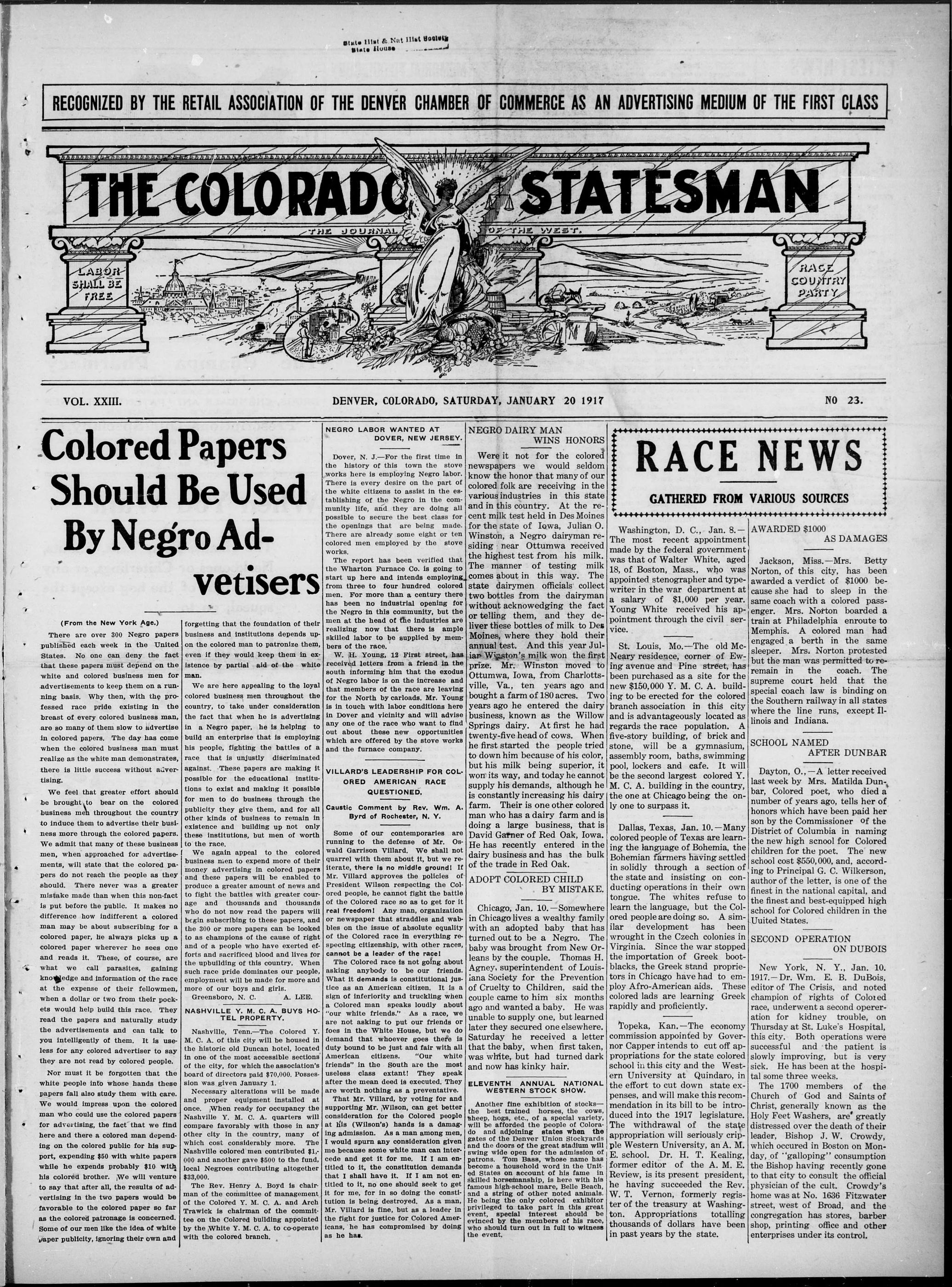
THE COLORADO STATESMAN
THE JOURNAL OF THE WEST.
LABOR SHALL BE FREE
RACE COUNTRY PARTY
Colored Papers Should Be Used By Negro Ad- vetisers
VOL. XXIII. Colored Should By Negi
(From the New York Age.)
There are over 300 Negro papers published each week in the United States. No one can deny the fact that these papers must depend on the white and colored business men for advertisements to keep them on a running basis. Why then, with the professed race pride existing in the breast of every colored business man, are so many of them slow to advertise in colored papers. The day has come when the colored business man must realize as the white man demonstrates, there is little success without advertising.
We feel that greater effort should be brought to bear on the colored business men throughout the country to induce them to advertise their business more through the colored papers. We admit that many of these business men, when approached for advertisements, will state that the colored papers do not reach the people as they should. There never was a greater mistake made than when this non-fact is put before the public. It makes no difference how indifferent a colored man may be about subscribing for a colored paper, he always picks up a colored paper wherever he sees one and reads it. These, of course, are what we call parasites, gaining knowledge and information of the race at the expense of their fellowmen, when a dollar or two from their pockets would help build this race. They read the papers and naturally study the advertisements and can talk to you intelligently of them. It is useless for any colored advertiser to say they are not read by colored people.
Nor must it be forgotten that the white people into whose hands these papers fall also study them with care. We would impress upon the colored man who could use the colored papers for advertising, the fact that we find here and there a colored man depending on the colored public for his support, expending $50 with white papers while he expends probably $10 with his colored brother. We will venture to say that after all, the results of advertising in the two papers would be favorable to the colored paper so far as the colored patronage is concerned. Some of our men like the idea of white paper publicity, ignoring their own and
forgetting that the foundation of their business and institutions depends upon the colored man to patronize them, even if they would keep them in existence by partial aid of the white man.
We are here appealing to the loyal colored business men throughout the country, to take under consideration the fact that when he is advertising in a Negro paper, he is helping to build an enterprise that is employing his people, fighting the battles of a race that is unjustly discriminated against. These papers are making it possible for the educational institutions to exist and making it possible for men to do business through the publicity they give them, and for all other kinds of business to remain in existence and building up not only these institutions, but men of worth to the race.
We again appeal to the colored business men to expend more of their money advertising in colored papers and these papers will be enabled to produce a greater amount of news and to fight the battles with greater courage and thousands and thousands who do not now read the papers will begin subscribing to these papers, and the 300 or more papers can be looked to as champions of the cause of right and of a people who have exerted efforts and sacrificed blood and lives for the upbuilding of this country. When such race pride dominates our people, employment will be made for more and more of our boys and girls.
NASHVILLE Y. M. C. A. BUYS HO-
TEL PROPERTY.
Nashville, Tenn.—The Colored Y. M. C. A. of this city will be housed in the historic old Duncan hotel, located in one of the most accessible sections of the city, for which the association's board of directors paid $70,000. Possession was given January 1.
Necessary alterations will be made and proper equipment installed at once. When ready for occupancy the Nashville Y. M. C. A. quarters will compare favorably with those in any other city in the country, many of which cost considerably more. The Nashville colored men contributed $1,000 and another gave $500 to the fund, local Negroes contributing altogether $33,000.
The Rev. Henry A. Boyd is chairman of the committee of management of the Colored Y. M. C. A. and Arch Trawick is chairman of the committee on the Colored building appointed by the White Y. M. C. A. to co-operate with the colored branch.
DENVER, COLORADO, SATURDAY, JANUARY 20 1917
State Hist & Nat Hist Boots
State House
OF THE DENVER CHAMBER
ADO
E JOURNAL
DENVER, COLORADO, SAT
NEGRO LABOR WANTED AT DOVER, NEW JERSEY.
Dover, N. J.—For the first time in the history of this town the stove works here is employing Negro labor. There is every desire on the part of the white citizens to assist in the establishing of the Negro in the community life, and they are doing all possible to secure the best class for the openings that are being made. There are already some eight or ten colored men employed by the stove works.
The report has been verified that the Wharton Furnace Co. is going to start up here and intends employing from three to four hundred colored men. For more than a century there has been no industrial opening for the Negro in this community, but the men at the head of the industries are realizing now that there is ample skilled labor to be supplied by members of the race.
W. H. Young, 12 First street, has received letters from a friend in the south informing him that the exodus of Negro labor is on the increase and that members of the race are leaving for the North by carloads. Mr. Young is in touch with labor conditions here in Dover and vicinity and will advise any one of the race who want to find out about these new opportunities which are offered by the stove works and the furnace company.
VILLARD'S LEADERSHIP FOR COL
ORED AMERICAN RACE
QUESTIONED.
Caustic Comment by Rev. Wm. A. Byrd of Rochester, N. Y.
Some of our contemporaries are running to the defense of Mr. Oswald Garrison Villard. We shall not quarrel with them about it, but we reiterate, there is no middle ground! If Mr. Villard approves the policies of President Wilson respecting the Colored people, he cannot fight the battle of the Colored race so as to get for it real freedom! Any man, organization or newspaper that straddles and wabbles on the issue of absolute equality of the Colored race in everything respecting citizenship, with other races, cannot be a leader of the race!
The Colored race is not going about asking anybody to be our friends. What it demands is constitutional justice as an American citizen. It is a sign of inferiority and truckling when a Colored man speaks loudly about "our white friends." As a race, we are not asking to put our friends or foes in the White House, but we do demand that whoever goes there is duty bound to be just and fair with all American citizens. "Our white friends" in the South are the most useless class extant! They speak after the mean deed is executed. They are worth nothing as a preventative.
That Mr. Villard, by voting for and supporting Mr. Wilson, can get better consideration for the Colored people at his (Wilson's) hands is a damaging admission. As a man among men, I would spurn any consideration given me because some white man can intercede and get it for me. If I am entitled to it, the constitution demands that I shall have it. If I am not entitled to it, no one should seek to get it for me, for in so doing the constitution is being destroyed. As a man, Mr. Villard is fine, but as a leader in the fight for justice for Colored Americans, he has compromised by doing as he has.
Were it not for the colored newspapers we would seldom know the honor that many of our colored folk are receiving in the various industries in this state and in this country. At the recent milk test held in Des Moines for the state of Iowa, Julian O. Winston, a Negro dairyman residing near Ottumwa received the highest test from his milk. The manner of testing milk comes about in this way. The state dairymen officials collect two bottles from the dairyman without acknowledging the fact or telling them, and they deliver these bottles of milk to Des Moines, where they hold their annual test. And this year Julian Winston's milk won the first prize. Mr. Winston moved to Ottumwa, Iowa, from Charlottsville, Va., ten years ago and bought a farm of 180 acres. Two years ago he entered the dairy business, known as the Willow Springs dairy. At first he had twenty-five head of cows. When he first started the people tried to down him because of his color, but his milk being superior, it won its way, and today he cannot supply his demands, although he is constantly increasing his dairy farm. Their is one other colored man who has a dairy farm and is doing a large business, that is David Garner of Red Oak, Iowa. He has recently entered in the dairy business and has the bulk of the trade in Red Oak.
ADOPT COLORED CHILD
Chicago, Jan. 10. — Somewhere in Chicago lives a wealthy family with an adopted baby that has turned out to be a Negro. The baby was brought from New Orleans by the couple. Thomas H. Agney, superintendent of Louisiana Society for the Prevention of Cruelty to Children, said the couple came to him six months ago and wanted a baby. He was unable to supply one, but learned later they secured one elsewhere. Saturday he received a letter that the baby, when first taken, was white, but had turned dark and now has kinky hair.
ELEVENTH ANNUAL NATIONAL WESTERN STOCK SHOW.
Another fine exhibition of stocks—the best trained horses, the cows, sheep, hogs, etc., of a special variety; will be afforded the people of Colorado and adjoining states when the gates of the Denver Union Stockyards and the doors of the great stadium will swing wide open for the admission of patrons. Tom Bass, whose name has become a household word in the United States on account of his fame in skilled horsemanship, is here with his famous high-school mare, Belle Beach, and a string of other noted animals. He being the only colored exhibitor privileged to take part in this great event, special interest should be evinced by the members of his race, who should turn out in full to witness the event.
RACE NEWS
Washington, D. C., Jan. 8. The most recent appointment made by the federal government was that of Walter White, aged 18, of Boston, Mass., who was appointed stenographer and typewriter in the war department at a salary of $1,000 per year. Young White received his appointment through the civil service.
St. Louis, Mo.—The old McNeary residence, corner of Ewing avenue and Pine street, has been purchased as a site for the new $150,000 Y. M. C. A. building to be erected for the colored branch association in this city and is advantageously located as regards the race population. A five-story building, of brick and stone, will be a gymnasium, assembly room, baths, swimming pool, lockers and cafe. It will be the second largest colored Y. M. C. A. building in the country, the one at Chicago being the only one to surpass it.
Dallas, Texas, Jan. 10. Many colored people of Texas are learning the language of Bohemia, the Bohemian farmers having settled in solidly through a section of the state and insisting on conducting operations in their own tongue. The whites refuse to learn the language, but the Colored people are doing so. A similar development has been wrought in the Czech colonies in Virginia. Since the war stopped the importation of Greek bootblacks, the Greek stand proprietors in Chicago have had to employ Afro-American aids. These colored lads are learning Greek rapidly and proficiently.
Topeka, Kan.—The economy commission appointed by Governor Capper intends to cut off appropriations for the state colored school in this city and the Western University at Quindaro, in the effort to cut down state expenses, and will make this recommendation in its bill to be introduced into the 1917 legislature. The withdrawal of the state appropriation will seriously cripple Western University, an A. M. E. school. Dr. H. T. Kealing, former editor of the A. M. E. Review, is its present president, he having succeeded the Rev. W. T. Vernon, formerly register of the treasury at Washington. Appropriations totalling thousands of dollars have been in past years by the state.
NO 23.
Jackson, Miss.—Mrs. Betty Norton, of this city, has been awarded a verdict of $1000 because she had to sleep in the same coach with a colored passenger. Mrs. Norton boarded a train at Philadelphia enroute to Memphis. A colored man had engaged a berth in the same sleeper. Mrs. Norton protested but the man was permitted to remain in the coach. The supreme court held that the special coach law is binding on the Southern railway in all states where the line runs, except Illinois and Indiana.
SCHOOL NAMED
AFTER DUNBAR
Dayton, O.,—A letter received last week by Mrs. Matilda Dunbar, Colored poet, who died a number of years ago, tells her of honors which have been paid her son by the Commissioner of the District of Columbia in naming the new high school for Colored children for the poet. The new school cost $550,000, and, according to Principal G. C. Wilkerson, author of the letter, is one of the finest in the national capital, and the finest and best-equipped high school for Colored children in the United States.
SECOND OPERATION
ON DUBOIS
New York, N. Y., Jan. 10. 1917.—Dr. Wm. E. B. DuBois, editor of The Crisis, and noted champion of rights of Colored race, underwent a second operation for kidney trouble, on Thursday at St. Luke's Hospital, this city. Both operations were successful and the patient is slowly improving, but is very sick. He has been at the hospital some three weeks.
The 1700 members of the Church of God and Saints of Christ, generally known as the Holy Feet Washers, are greatly distressed over the death of their leader, Bishop J. W. Crowdy, which occurred in Boston on Monday, of "galloping" consumption the Bishop having recently gone to that city to consult the official physician of the cult. Crowdy's home was at No. 1636 Fitzwater street, west of Broad, and the congregation has stores, barber shop, printing office and other enterprises under its control.
LATEST NEWS EPITOMIZED
FROM TELEGRAPHIC REPORTS THAT COVER THE WEEK'S EVENTS.
OF MOST INTEREST
KEEPING THE READER POSTED
ON MOST IMPORTANT
CURRENT TOPICS.
Western Newspaper Union News Service.
About the War
A Turkish official report of Jan. 11
says a British cruiser of the Juno
type was sunk by Turkish gunfire in
the eastern Mediterranean.
A Russian squadron is reported to
have raided the Anatolian coast of the
Black Sea and sunk forty Turkish sai-
ling vessels carrying food to Constanti-
nople.
That Gen. von Falkenhayn and not
Gen. Baron von Falkenhausen, is on
a mission to Greece, is affirmed by the
British accredited correspondent at
Saloni.
According to the London war office the right bank of the Tigris river, except for a small strip northeast of Kut-El-Amara, has been cleared of Ottoman troops.
After defeating Gen, Hernandez and his Carranza command of 1,500 in the vicinity of Satevo, on the wagon road to Parral, Villa drove the defacto column to La Jolla, eleighteen miles north of Satevo, where another defeat was administered and the column was forced to retreat to Santa Ysabel and then to Palomas.
Fierce fighting along the lower Sereh e line resulted in the capture by Turkish troops of the Rumanian town of Mihalea, northwest of Braila, and 400 men of its garrison. Others of the defending force, attempting to escape, were drowned in the Sereh. The Bulgarians have taken a monastery near the confluence of the Buzeu and Sereth rivers.
Aside from Roumania, quiet continues to prevail on all the other fighting fronts, where there have been only bombardments and operations by small detachments. Hard fighting continues in the region of Vadeni, southwest of Galatz, in the Roumanian theafer. The Russians on both sides of Fundeni suffered heavy casualties in two attacks delivered against the German line, according to Berlin.
According to an unconfirmed report received by Lloyd's, the British steamship Brookwood, 3,093 tons, and the Norwegian steamer Tholma, 1,896 tons, have been sunk. The Norwegian steamer Granfeld formerly the Alfred Dumois, 729 tons, has been destroyed through striking a mine. Eight members of her crew lost their lives. The British steamship Martin of 1,940 tons gross and the Swedish steamer Norma of 1,537 tons gross have also been sunk, according to Lloyd's.
Western
The House of Representatives of the Wyoming Legislature passed the senate bill for the submission of a constitutional amendment for prohibition to the people in 1918.
Roy Armour of Hubbard, Neb., left Sloux City for Santa Fé, N. M., to take charge of the body of his brother, Clyde D. Armour, which was found in an arroyo three miles east of Glorieta, N. M.
Nevada, threatened with financial disaster two years ago, now has a full public treasury, having produced $40,000,000 worth of minerals alone in the last year, Gov. Emmett D. Boyle proclaimed at Carson City in his message to the Legislature.
Washington
J. P. Morgan, banker, must tell the House note leak committee what, if anything, he knows about enormous profits gleaned in Wall street from a leak on President Wilson's note to the belligerents.
The House adopted a conference report on the immigration bill, incorporating "gentlemen's agreement" provisions by which Japan restricts immigration from her islands to the United States.
Sovereignty over the Danish West Indies after half a century of negotiation, passed to the United States with the exchange of ratifications of the purchase treaty by Secretary Lansing and Danish Minister Brun.
Chairman Robert L. Henry was named by Thomas W. Lawson as the "congressman in the peace leak," who, he had said, told him a senator and a cabinet official profited through knowledge of the peace note.
The Senate committee on interstate commerce turned down, by a vote of 7 to 3, the first part of the new railroad legislation advocated by President Wilson.
Capt. Matthew A. Batson, U. S. A., in charge of the West Virginia recruiting district with headquarters in Huntington, W. Va., died in a hospital of pneumonia.
Admiral Dewey, the nation's Spanish war hero, and by priority of grade the ranking naval officer of the world, died at his home in Washington Tuesday night in his eightieth year.
Foreign
Sinking of two enemy ships near the Bosporus by a Russian submarine was announced in the Petrograd statement.
The condition of ex-Queen Lilluokalani of Hawaii is again critical, according to advises received at San Francisco from Honolulu.
A Flushing dispatch to Reuter's says that a Dutch warship brought into Flushing a German submarine which was found in Dutch waters.
Frederick Courtney Selous, hunter, explorer and pioneer during the growth of the British empire in Africa, was killed in action against the Kaiser's troops in German East Africa.
The entente powers, through the Italian minister, have insisted on unqualified acceptance of the last entente ultimatum, considering the Greek government's equivocal.
The King of Sweden, addressing the Riksdag, said Sweden had been able thus far to avoid being drawn into the war, but that the Swedish people could not shut their eyes to the profound gravity of the present hour. Dr. Alfred Zimmermann, the German foreign minister, informed the Associated Press at Berlin that, in his opinion, the entente reply to President Wilson's peace note bars the possibility for the present of further German steps to bring about peace. A report from Puerto, Mexico, says several men, among them Spaniards, were executed there after conviction by a court martial of being agents of Jose Isobel Robles, who abandoned Villa, received an amnesty and then revolted from the government.
Volunteers for "Germany's Home army" are many in number and are volunteering so steadily and so fast that compulsion under the terms of the civil service law of November will not have to be resorted to in the near future and may never be necessary, according to Dr. Kurt Sorge, civil chief of staff in the Berlin war bureau.
Sporting News
Dartmouth's basketball team defeated the Cornell five, 34 to 31, in an intercollegiate league game at Hanover, N. H.
The Second Texas infantry football team defeated an all-star eleven from Camp Wilson at San Antonio at Austin, Tex., 34 to 6.
The University of Illinois defeated the University of Chicago, 20 to 10, in a Western conference basket ball game at Urbana, Ill.
Word was received in Denver from New York stating that A. M. Polindexter was elected vice president of the United States Revolver Association.
After two minutes and 35 seconds of furious milling in the first round, Willie Jackson of New York, knocked out Jonnie Dundee in the windup at the Olympia A. A. at Philadelphia.
Billy Miske of St. Paul outfought Jack Dillon of Indianapolis in a ten-room bout in Brooklyn, N. Y. Miske had the better of every round except the seventh, in which Dillon held him even.
That the major league baseball season will open on Wednesday, April 11, was the only information given out in New York after the joint schedule committees from the National and American leagues had concluded their meetings.
General
Two persons were burned to death in a fire which destroyed a North Side dwelling in Chicago. One, Carl Bottcher, 70 years old, was blind. Col. Harry G. Bishop and Lieut. W. A. Robertson, lost U. S. army aviators, may have fallen into the hands of Yaqui Indians more or less hostile to all strangers. Some apprehension on this score is felt at Calexico, Cal., among army officers following the latest report of the last seen of the missing airmen.
In recognition of his services in helping to open up the great West, the California State Assembly paid a tribute to Col. W. F. Cody. In a resolution presented by Assemblyman George C. Watson of Los Angeles, Buffalo Bill was lauded as a man who did more than his share to make the early development of California possible.
An anti-alien bill patterned closely after the California anti-alien law, which at the time of its passage threatened to involve the United States in complication with Japan, was introduced in the Senate at Salem, Ore., by Senator Wilber. The bill strikes at all Japanese and Hindus, forbidding them to inherit real property in Oregon.
A New Mexico school taecher, a mere slip of a girl who was born and reared in the new state, is to christen the dreadnaught New Mexico, now building at the Brooklyn navy yard, and which will be launched some time in the early summer. She is Miss Margaret C. De Baca, daughter of Gov. E. C. De Baca, who has just entered upon his duties of chief executive of the state.
The body of Clyde D. Armour, who disappeared Oct. 23 while on an automobile trip, was found near Glorieta, about twenty miles from Santa Fé, N. M. Withdrawal of the United States troops from Mexico is left entirely at the discretion of President Wilson by formal dissolution of the Mexican commission. The officers of the government aviation squad at Hempstead, L. I., it was announced, are arranging a flight to Washington to witness President Wilson's inauguration.
COLORADO STATE NEWS
Western Newspaper Union News Service.
DATES FOR COMING EVENTS.
Jan. 22—Meeting Colorado Editorial Association and Banquet to Members of Colorado Assembly at Denver.
Jan. 18-27—Annual Food Show at Denver.
Jan. 20-27—Annual Western Stock Show at Denver.
Feb. 2-4—Y. M. C. A. Annual Convention at Colorado Springs.
Thomas A. Vaughn, Colorado poet, died in Denver from apoplexy, at 64 years.
Weld county's first pest inspector is now in full charge of his office, Peter Weber of Grover being the official.
Scores of visitors from all parts of the state already are registering at Denver hotels for stock show week, Jan. 21-27.
An increase of 133 per cent in building operations was shown by Denver during December, 1916, over the record for December, 1915.
Grover C. Bebout, 32, foreman of one of the departments of an iron company, was shot from ambush at Pueblo as he was about to enter his home.
All three members of the Colorado Industrial Commission—appointees of former Governor Carlson — failed drearily of confirmation in the State Senate.
Dr. Ward Slosson Gregory, noted surgeon of New York City, died at Colorado Springs and the body was taken to Denver for cremation. Dr. Gregory was 26 years old.
The eighth annual session of the Colorado Farmers' Congress was called to order at Fort Collins by O. F. Gardner, president, who opened the session by delivering his annual address.
A sweeping opinion, removing approximately 125 clerks and stenographers at the state house from the protection of civil service was rendered by Attorney General Leslie E. Hubbard.
Forty babies were entered at the Woman's Club building in Denver as possible prize winners in the annual baby show to be held in connection with the National Western Livestock Show, Jan. 20-27.
In the death of Harold W. Carver, 15-year-old son of former State Senator B. F. Carver of Jefferson county, another victim of the dangerous habit of dragging a gun from a wagon by the muzzle was claimed.
In a fit of dementia, Lena Lind, 27, attacked her father, J. C. Lind, with a butcher knife, in the Lind home, at Denver, inflicting a deep gash extending from the cheekbone to the point of the chin on the right side of his face.
There were 3,478 fewer police patrol calls in 1916, the first year of prohibition in Denver, than there were in 1915, according to statistics compiled by Acting Sergeant Frank Campbell for Chief of Police Armstrong.
The wedding day of Joseph and Helen Krasovec almost came to a tragic end at Pueblo when the two were almost asphyxiated in a room they had engaged in a hotel. Krasovec is in a local hospital in a serious condition. The bride is at her home, where it is said she will recover.
All danger of a strike being called by the union at the El Paso mine, one of the four affected by the recent demands for an increase in wages, was settled at Colorado Springs when the men employed at the mine voted unanimously to accept a 5 per cent increase in wages offered by the operators.
The divorce trial of Mrs. Hattie Wigton against J. Irving Wigton occupied one of the divisions of the District Court at Pueblo, the greater part of a day being occupied in a selection of a jury. Mrs. Wigton names the correspondent as "a young woman formerly an employé" of her husband, and demands $150,000 alimony.
Deepening snow drifts on the mountain slopes behind Aspen have driven the elk and deer down to the outskirts of the town, according to reports which have been received by W. B. Fraser, state game and fish commissioner. The animals, grown tame by hunger, have become bolder and bolder until now they go to the hay stacks o the farms and ranches and help themselves to food.
Unless attorneys for Mrs. Stella Moore Smith, who shot and killed her husband, John Lawrence Smith, at their home in Denver, are successful in their attempts to obtain her release on bond, the woman, already held for murder by a coroner's jury, will face a two months' stay in the county jail. The crowded condition of the docket would prevent the case being called sooner than two months.
Stock growing received a great impetus in Colorado during the year 1916. A total of 5,700 new brands were issued during the year by the State Board of Livestock Inspection the number being about three times that of any previous year. Among the subjects discussed at the forty-third annual meeting of the Colorado State Grangers at the Denver meeting were herd law recommendations, a "bone-dry" prohibition law better legal protection for irrigation districts, a pure-seed law and tax amendments.
MEMORIAL TO COL.CODY
PROVIDED IN BILL BY SENATOR KLUGE, IN SENATE.
Colorado, Wyoming, Nebraska and City of Denver Each Asked to Contribute $25,000 Toward $500,000 Fund.
Western Newspaper Union News Service.
Denver.—Senator Herman Kluge of Palisade introduced a bill in the State Senate providing for the construction on Lookout mountain of a memorial to Col. Wm. F. Cody ("Buffalo Bill").
The Kluge measure is very broad in its scope and contemplates the raising of a fund of $400,000 or $500,000, to be used in the erection of the memorial, which shall be regarded as the direct work of several states and the indirect work of the entire country. The State of Colorado is asked to contribute $25,000 to the total cost; Wyoming is urged to contribute $25,000 and Nebraska a like amount; Denver also is asked for $25,000, and then the Kluge bill goes on to recite that the remainder may be raised the country over from school children, civic bodies, patriotic societies and other quasi-public organizations. The work of raising the money, over and above what the three states and the City of Denver might give, would be left to a commission and this commission would also have to do with the erection of the memorial.
Stella Smith Kills Mate.
Denver.—Mrs. Stella Moore-Smith shot and killed her husband, John Lawrence Smith, at her home, 4040 Montview boulevard, in the fashionable Park Hill district, at 5:30 o'clock Saturday morning. She is a prisoner in the matron's quarters of the city jail. The shooting followed, Mrs. Smith declared in a statement made after her arrest, three hours of torture, in which her husband, drinkcrazed, forced her to submit to indignities; attempted to shoot her former husband, William A. Moore, Denver attorney and son of the late Bishop David Moore of the Methodist Episcopal church of Colorado, and made threats against her 12-year-old daughter, Mildred Elaine Moore, who was sleeping in the house with her.
Zero Weather Checks Pneumonia.
Pueblo.—Zero weather and a three-inch fall of snow are believed to have combined to end a growing epidemic of pneumonia here, according to the health authorities. Out of forty-four deaths in the city last month, twelve were due to pneumonia. The first twelve days of January registered eleven deaths from the same malady, and physicians were preparing for a scourge. They say that acute danger now is passed, the snow bringing enough needed atmospheric dampness to insure better general health.
Record Land Filings at Pueblo.
Pueblo.—With a record of having received filings on 1,200,500 acres of Colorado land during 1916, the Pueblo land office is rated by the Department of the Interior as having transacted more business, by a wide margin, than any other land office in the United States or colonial possessions, according to a report received from Washington. This year bids fair to eclipse last, as nearly 500,000 acres already have ben filed on during the first two weeks. The rush has been unprecedented, especially since the size of homestead entries to 640 acres.
Mrs Crosier Killed Children and Self. Greeley.—A coroner's inquest into the killing of Mrs. Bessie Crosier, wife of Everett Crosier, a farmer, and their five children at the Crosier home, three miles north of here Jan. 10, resulted in a verdict that the children were shot to death by the mother who then killed herself. The verdict said that Mrs. Crosier was "irresponsible" when the act was committed according to evidence gathered by the jury. It added that she was apparently jealous of her husband without cause.
One-Legged Man Sent to Hospital.
Boulder.—Will T. Wilson's only remaining leg was broken when a terrific gust of wind toppled him over on the ground, doubling the leg under him. He was taken to the Longmont hospital where the leg was set. Wilson lost his other leg several years ago in a railroad accident. He is 60 years old and for many years has been the Colorado & Southern telegraph operator at NiWot.
Pickle Men Getting Acreage Contracts
Greeley.—Agents for two pickle companies are contracting for cucumber acreage this year, the crop to be bought at $1.50 per hundred pounds as against $1.20 paid last year, the cucumbers to range in size from one inch to three and one-half inches and count at least 800 to the bushel.
Gold Hunters Dredge Clear Creek
Golden. — Experiments are being made in the bed of Clear creek above Golden to determine whether there are values enough in the sands of the creek to justify a big boat dredge being installed.
Old Smelter to Be Wresked
Golden.—The Golden smelter, which has had a checkered career ever since it was erected sixteen years ago by Dr. F. R. Carpenter, is to be dismantled.
The Curtis Park Floral Company
FLORAL DESIGNS PUT UP WHILE YOU WAIT
CHOICE PLANTS AND CUT FLOWERS CONSTANTLY ON HAND
GREENHOUSES: Thirty-Fourth and Curtis Streets
TELEPHONE, MAIN 1511
DENVER, COLO
The Champa Pharmacy
When You Want
The Heads, Feet, Tails, Snouts, Neckbones or Chiterlings, or any other part of the hog except the squeal, go to
East's Market
The
WARD AUCTION
COMPANY
Sales Daily at 2 p.m. Office Furniture a Specialty.
PRIVATE SALES AT ALL TIMES
HAVE MOVED TO—
1723-39 GLENARM ST.
PHONE MAIN 1675.
THE BEST ICE CREAM AND CANDIES AT
O.P. BAUR & CO.
CATERERS AND
CONFECTIONERS
Phone: 168.
1512 Curtis Street, Denver, Cole.
JOSEPH CARTER
Express, Moving,
and Storage
COAL AND WOOD
PROMPT DELIVERY.
Phone Main 6544.
2415 WASHINGTON STREET.
TELEPHONE YORK 6668.
J. H. Biggins
GENERAL FURNITURE REPAIRING
AND UPHOLSTERING.
WORK GUARANTEED.
1417 East 24th Avenue, Denver, Colo.
2300-6 Larimer Street Phone Main 1461
ORIENTAL RESTAURANT
Chop Suey, Noodles and Short Orders
Phone Main 4896
1848 Arapahoe
乐缉轩
Miss M. Cowden Hair Dressing Parlor
Shampoo, cutting and curling.
Scalp treatment, hair tonics,
hair straightening, maniouring.
Stage wigs for rent; theatrical
use and masquerades.
Goods delivered out of the
city. All shades of hair matched
by sending sample of hair; also
combings made up.
Cheapest Switches 50 Cents
1219 21st St. Denver, Colo.
DO IT NOW Subscribe for THIS PAPER
AFBO-AMERICAN CULLINGS
In fifteen representative southern cities it was also noticed that the Negro population increased more rapidly than the normal rate of increase all over the country, but during the same period the increase in northern cities was larger. In both cases it is clearly shown that there is a steady flow of Negroes from rural to urban districts. The difference between the increase in the northern cities and in the southern is also emphasized by the observation that in the northern cities the rate of increase among Negro inhabitants exceed that of the white inhabitants, while in the southern cities it was almost the same, indicating that there was nothing unusual about the increase in southern cities.
Churches probably wield more power among the colored people than among any other single class in the United States. Religion is an intimate part of life to most colored persons. The churches are an influence for good citizenship and an educational factor second only to the public schools. They have clergymen powerful as exhorters, and surrounded by thousands of devout followers.
A canvass of all the churches made by the Daily News shows that they claim 42.5 per cent of the city's colored population as church members. Attending church is taken up with enthusiasm and religious services are made a pleasure. Few other churches in Chicago have as large congregations as several of the leading colored churches. From this high standard the congregations diminish in size and influence down to the private ventures where a "brother" or "sister" with a can of paint and a brush has converted a vacant store into a mission. Sometimes a "mission" is started and runs a strong-lunged exhortation, followed by a collection or a rummage sale to make it worth while. The big churches are financially prosperous. They have employment agen-
Behind this movement, says Professor Haynes in a letter to the New York Times, is the reaction of the Negroes toward certain fundamental conditions which have always affected American population. They come North for better wages, better educational opportunities and better living conditions. Most important is the economic reason. Wages in occupations open to Negro employees are in nearly all cases higher in the North than in the South. From a survey made in New York in 1910, it was learned that before they came North, the average wage of 37 Negroes was from $3 to $7 a week. In New York their wages ranged from $9 to $12 a week. Twenty-six Southern Negro women who had received from $3 to $5 a week for domestic work in the South, were able to earn from $5 to $8 a week in New York. Out of 365 Negroes who were asked why they came to New York from the South, over three-fourths gave an economic reason. The skilled Negro workmen find it hard to obtain employment in the North, but it has been found that these man can work
The Berlin electric central station under private ownership paid all its operation costs, set aside reserves and a pension fund, and also turned into the treasury of the city in one year $1,954,868 to cover the usual franchise tax and other levies. The lighting rate charged is Berlin is $9½ cents.
Platinum was formerly employed for the ignition points of spark plugs, but the greatly increased cost of the metal has compelled the use of substitutes, chief among which is metallic tungsten.
cles, day nurseries and classes of various kinds. They do more or less charity work among their own people. Some of them, Walters A. M. E. Zion, at West Thirty-eighth and South Dearborn streets, for one, are open 24 hours a day to give shelter and help to all who call.
In civic life outside their own doors the churches apparently do not have the influence to which they are entitled. Two of them protested in vain against different saloons a few doors distant, whither boys and girls were turning their steps. The Rev. A. J. Carey, one of the leading pastors, has received political preferment and others have been smiled on by the powers that be. But with their thousands of devoted followers, the colored clergyman, as a rule, has not due prominence among those working outside his church to better conditions among his people. Recently several clergymen passed resolutions indorsing the city administration regardless of the wide-open haunts of vice thrown in among their people.—Chicago Daily News.
There is no doubt but that in many various ways a bid for Negro labor by other sections than the South is being made. Thousands of Negroes who went East and West last summer from the lower South did not return the last winter. Most of them went as house servants and hotel help, but remained to work as porters, elevator men, and the like. This summer the traffic has been even greater. To the writer's personal knowledge almost whole neighborhoods have gone to some of the smaller towns of the middle West. For an instance, no less than a score of Negro families have gone in recent months to certain Chicago suburbs, notably Evanston, from one Southern community. Each Negro worker that leaves the South draws at least one other worker with him. The ability to earn a dollar, together with the privilege to spend it largely as one wishes, offers an irresistible inducement to a growing class of blacks.
If this migration increases, which is likely, since the movement is given an added impetus by the rapidly improving condition of this country, the Negro will find himself in the midst of new adjustments which will work in many ways for his good. For one thing, he needs to be more evenly scattered over the country. Kansas will need him, Pennsylvania and New Jersey will need him, Illinois and Iowa will need him.
In the South the poorer whites will be forced to do some of the harder tasks of the shop and field, and will be forced to do what they have never hitherto done: Fit themselves for housework and other work calling for more or less personal service. And it will all work to the Negro's gain. The employer will not be able to get along without the help of both, and the white worker will not be willing to work for the Negro wage—Exchange.
The National Negro Business league, founded by Booker Washington, has inaugurated a nation-wide movement to advertise business enterprises. The plan includes trade-boosting campaigns in all communities where there are any number of Negroes engaged in business. Co-operative advertising methods will be employed to stimulate trade of Negro merchants; prizes will be awarded in some communities for best results; celebrations will be planned in other communities.
as janitors and porters and make more money in the North than they can by following their trades in the South. When the rate of pay is considered, the Negro seldom looks at anything but the money wage as distinguished from the real wage. If he makes $12 a week in a community where it costs him $10 a week to live, he thinks he is doing better than if he made $9 a week in a community where it cost him $5 a week to live. And this tendency is by no means confined to the Negro. Inseparable from this migration is the problem of proper housing, education, social conditions and general welfare. If taken in hand as soon as they arrive in the North and started right, these migrants can be made into good citizens. This requires close-co-operation among the white and colored leaders in every community, and no city can afford to trust to chance in the matter.
In the search of a source of supply of potash it has been said that a ton of banana stalks will make five pounds of pure potash.
The success of the electric vehicle should be greater in South Africa than in most parts of the world, because gasoline there costs from 70 to 75 cents a gallon, three times as much as it is worth in the United States, and twice as much as it costs in any other country in the world.
In Mexico there grows a tree called the "tree of little hands." It is thus called owing to the fact that its five peculiarly-curved antlers look like the fingers of a child.
ADMIRAL DEWEY DIES OF OLD AGE
WORLD'S RANKING NAVAL OFFICER SUCCUMBS AT WASHINGTON AFTER WEEK'S ILLNESS.
ROMANTIC CAREER
TOOK PART IN CIVIL WAR UNDER
FARRAGUT—ASKED TO RUN
FOR PRESIDENT.
Western Newspaper Union News Service.
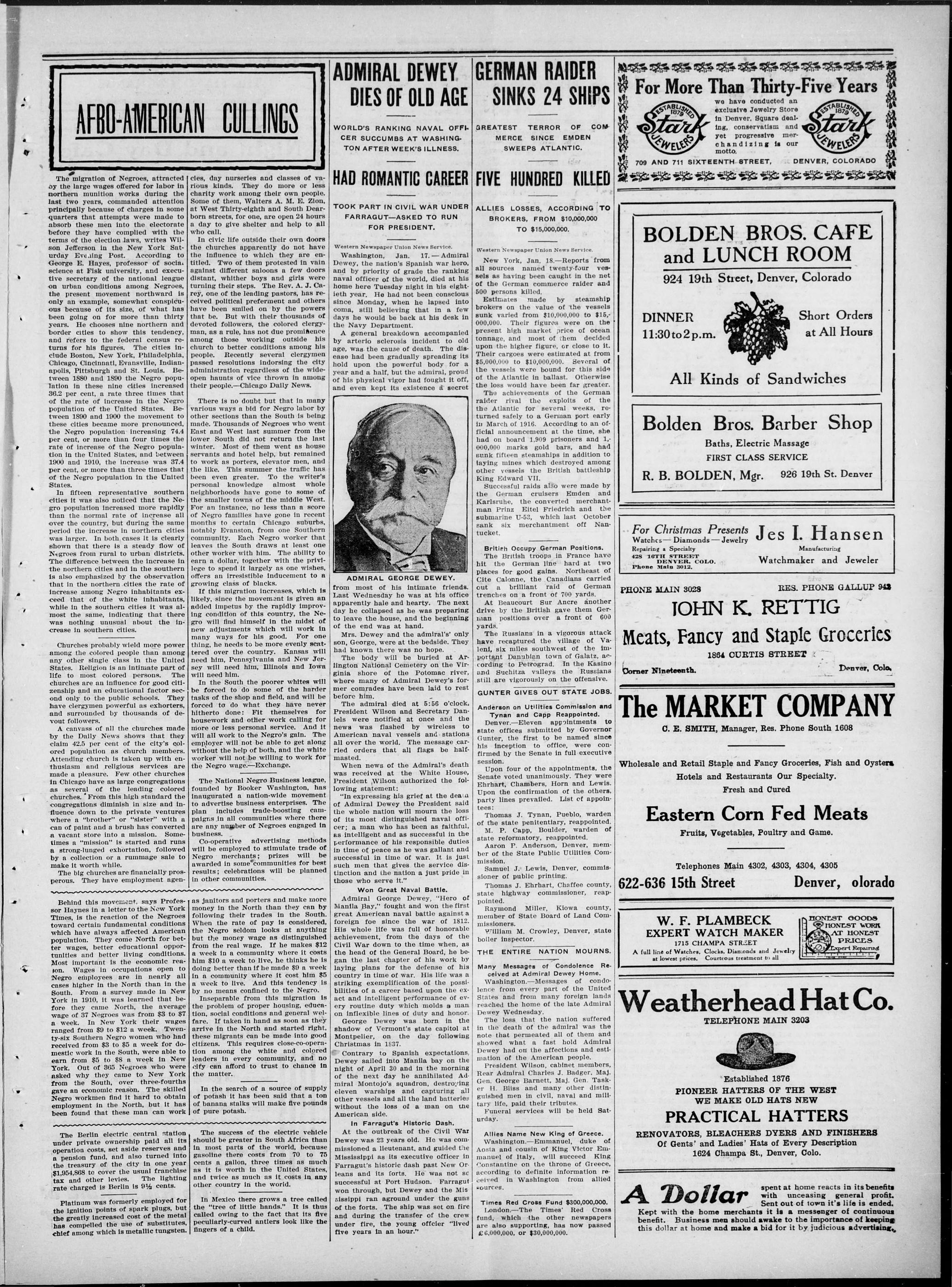
Washington, Jan. 17. — Admiral Dewey, the nation's Spanish war hero, and by priority of grade the ranking naval officer of the world, died at his home here Tuesday night in his eightieth year. He had not been conscious since Monday, when he lapsed into coma, still believing that in a few days he would be back at his desk in the Navy Department.
A general breakdown accompanied by arterio sclerosis incident to old age, was the cause of death. The disease had been gradually spreading its hold upon the powerful body for a year and a half, but the admiral, proud of his physical vigor had fought it off, and even kept its existence a secret
A. B.
ADMIRAL GEORGE DEWEY.
from most of his intimate friends.
Last Wednesday he was at his office apparently hale and hearty. The next day he collapsed as he was preparing to leave the house, and the beginning of the end was at hand.
Mrs. Dewey and the admiral's only son, George, were at the bedside. They had known there was no hope.
The body will be buried at Arlington National Cemetery on the Virginia shore of the Potomac river, where many of Admiral Dewey's former comrades have been laid to rest before him.
The admiral died at 5:56 o'clock. President Wilson and Secretary Daniels were notified at once and the news was flashed by wireless to American naval vessels and stations all over the world. The message carried orders that all flags be half-masted. When news of the Admiral's death was received at the White House, President Wilson authorized the following statement:
"In expressing his grief at the death of Admiral Dewey the President said the whole nation will mourn the loss of its most distinguished naval officer; a man who has been as faithful, as intelligent and as successful in the performance of his responsible duties in time of peace as he was gallant and successful in time of war. It is just such men that gives the service distinction and the nation a just pride in those who serve it."
Admiral George Dewey, "Hero of Manla Bay," fought and won the first great American naval battle against a foreign foe since the war of 1812. His whole life was full of honorable achievement, from the days of the Civil War down to the time when, as the head of the General Board, he began the last chapter of his work by laying plans for the defense of his country in time of war. His life was a striking exemplification of the possibilities of a career based upon the exact and intelligent performance of every routine duty which molds a man on inflexible lines of duty and honor. George Dewey was born in the shadow of Vermont's state capitol at Montpelier, on the day following Christmas in 1837.
Contrary to Spanish expectations, Dewey sailed into Manila bay on the night of April 30 and in the morning of the next day he annihilated Admiral Montojo's squadron, destroying eleven warships and capturing all other vessels and all the land batteries without the loss of a man on the American side.
At the outbreak of the Civil War Dewey was 23 years old. He was commissioned a lieutenant, and guided the Mississippi as its executive officer in Farragut's historic dash past New Orleans and its forts. He was not so successful at Port Hudson. Farragut won through, but Dewey and the Mississippi ran aground under the guns of the forts. The ship was set on fire and during the transfer of the crew under fire, the young offcier "lived five years in an hour."
GERMAN RAIDER SINKS 24 SHIPS
GERMAN RAIDER SINKS 24 SHIPS
GREATEST TERROR OF COM
MERCE SINCE EMDEN
SWEEPS ATLANTIC.
FIVE HUNDRED KILLED
ALLIES LOSSES, ACCORDING TO
BROKERS, FROM $10,000,000
TO $15,000,000.
Western Newspaper Union News Service.
New York, Jan. 18.—Reports from
all sources named twenty-four
vessels as having been caught in the net
of the German commerce raider and
500 persons killed.
Estimates made by steamship brokers on the value of the vessels sunk varied from $10,000,000 to $15,000,000. Their figures were on the present high market price of ocean tonnage, and most of them decided upon the higher figure, or close to it. Their cargoes were estimated at from $5,000,000 to $10,000,000. Several of the vessels were bound for this side of the Atlantic in ballast. Otherwise the loss would have been far greater.
The achievements of the German raider rival the exploits of the the Atlantic for several weeks, returned safely to a German port early in March of 1916. According to an official announcement at the time, she had on board 1,909 prisoners and 1,000,000 marks gold bars, and had sunk fifteen steamships in addition to laying mines which destroyed among other vessels the British battleship King Edward VII.
Successful raids also were made by the German cruisers Emden and Karlsruhe, the converted merchantman Prinz Eitel Friedrich and the submarine U-53, which last October sank six merchantment off Nantucket.
British Occupy German Positions.
The British troops in France have hit the German line hard at two places for good gains. Northeast of Cite Calonne, the Canadians carried out a brilliant raid of German trenches on a front of 700 yards.
At Beaucourt Sur Ancre another drive by the British gave them German positions over a front of 600 yards.
The Russians in a vigorous attack have recaptured the village of Valeni, six miles southwest of the important Danubian town of Galatz, according to Petrograd. In the Kasino and Suchitza valleys the Russians still are vigorously on the offensive.
GUNTER GIVES OUT STATE JOBS.
Anderson on Utilities Commission and Tyssen and Cann Reappointed.
Denver.—Eleven appointments to state offices submitted by Governor Gunter, the first to be named since his inception to office, were confirmed by the Senate in full executive session.
Upon four of the appointments, the Senate voted unanimously. They were Ehrhart, Chambers, Horn and Lewis. Upon the confirmation of the others, party lines prevailed. List of appointees:
Thomas J. Tynan, Pueblo, warden of the state penitentiary, reappointed. M. P. Capp, Boulder, warden of state reformatory, reappointed.
Aaron P. Anderson, Denver, member of the State Public Utilities Commission.
Samuel J. Lewis, Denver, commissioner of public printing.
Thomas J. Ehrhart, Chaffee county, state highway commissioner, reappointed.
Raymond Miller, Kiowa county, member of State Board of Land Commissioners.
William M. Crowley, Denver, state boiler inspector.
THE ENTIRE NATION MOURNS.
Many Messages of Condolence Received at Admiral Dewey Home.
Washington.—Messages of condolence from every part of the United States and from many foreign lands reached the home of the late Admiral Dewey Wednesday.
The loss that the nation suffered in the death of the admiral was the note that permeated all of them and showed what a fast hold Admiral Dewey had on the affections and estimation of the American people.
President Wilson, cabinet members,
Rear Admiral Charles J. Badger, Maj.
Gen. George Barnett, Maj. Gen. Tasker H. Bliss and many other distinguished men in civil, naval and military life, paid their tributes.
Funeral services will be held Saturday.
Allies Name New King of Greece.
Washington.—Emmanuel, duke of Aosta and cousin of King Victor Emmanuel of Italy, will succeed King Constantine on the throne of Greece, according to definite information received in Washington from allied sources.
Times Red Cross Fund $300,000,000.
London.—The Times' Red Cross fund, which the other newspapers are also supporting, has now passed £6,000,000, or $30,000,000.
we have conducted an exclusive Jewelry Store in Denver. Square dealing, conservatism and yet progressive merchandizing is our motto.
ESTABLISHED
1879
Stark
JEWELERS
ROS. CAFE
CH ROOM
Denver, Colorado
709 AND 711 SIXTEENTH STREET
BOLDEN BROS
and LUNCH R
924 19th Street, Denver
711 SIXTEENTH STREET, DENVER, CO
OLDEN BROS. CAFE
and LUNCH ROOM
24 19th Street, Denver, Colorado
BOLDEN BROS. CAFE and LUNCH ROOM
924 19th Street, Denver, Colorado
DINNER
11:30 to 2 p.m.
Short Orders
at All Hours
DINNER
11:30 to 2 p.m.
Sandwiches
Barber Shop
Electric Massage
SERVICE
926 19th St. Denver
Jes I. Hansen
Manufacturing
Watchmaker and Jeweler
All Kinds of San
Bolden Bros. Barb
Baths, Electric Mass
FIRST CLASS SERVI
R. B. BOLDEN, Mgr. 926
For Christmas Presents Jes
Watchcs — Diamonds — Jewelry
Repairing a Specialty
428 16TH STREET
DENVER, COLO.
Phone Main 3012.
All Kinds of Sandwiches
Harden Bros. Barber S
Baths, Electric Massage
FIRST CLASS SERVICE
BOLDEN, Mgr. 926 19th St.
Christmas Presents
Diamonds — Jewelry
specialty
MANUFACTURING
TREET
VER. COLO.
3012.
Jes I. Ha
Watchmaker and
All Kinds of Sandwiches
Bolden Bros. Barber Shop
Baths, Electric Massage
FIRST CLASS SERVICE
R. B. BOLDEN, Mgr. 926 19th St. Denver
For Christmas Presents
Watchches—Diamonds—Jewelry
Repairing a Specialty
428 16TH STREET
DENVER, COLO.
Phone Main 3012.
Jes I. Hansen
Manufacturing
Watchmaker and Jeweler
JOHN K. RETTIGER
Fancy and Staple Grocery
1864 CURTIS STREET
seventh.
MARKET COMPANY
E. SMITH, Manager, Res. Phone South 1
d Retail Staple and Fancy Groceries, Fish
Hotels and Restaurants Our Specialty.
Fresh and Cured
Eastern Corn Fed Me
RETTIG Staple Groceries STREET
JOHN K. RET Meats, Fancy and Stap 1864 CURTIS STREET
T COMPANY
Res. Phone South 1608
Fancy Groceries, Fish and Oysters
ants Our Specialty.
d Cured
n Fed Meats
The MARKET CO
C. E. SMITH, Manager, Res. Pho
Wholesale and Retail Staple and Fancy Gro
Hotels and Restaurants Our
Fresh and Cured
Eastern Corn Fe
The MARKET COMPANY
C. E. SMITH, Manager, Res. Phone South 1608
Wholesale and Retail Staple and Fancy Groceries, Fish and Oysters Hotels and Restaurants Our Specialty. Fresh and Cured
Eastern Corn Fed Meats
Fruits, Vegetables, Poultry and Game.
Telephones Main 4302, 4303, 4304, 430
622-636 15th Street Denver
Telephones Main 4302, 4303, 4304, 4305
15th Street Denver,
02,4303,4304,4305
W. F. PLAMBECK
EXPERT WATCH MAKER
1715 CHAMPA STREET
A full line of Watches, Clocks, Diamonds and Jewelry
at lowest prices. Courteous treatment to all
ead Hat Co.
Weatherhead
atherhead Ha
Weatherhead Hat Co. TELEPHONE MAIN 3203
TELEPHONE MAIN 3203
---
Established 1876
PIONEER HATTERS OF THE WEST
WE MAKE OLD HATS NEW
PRACTICAL HATTER
RENOVATORS, BLEACHERS DYERS AND FIL
Of Gents' and Ladies' Hats of Every Descrip
1624 Champa St., Denver, Colo.
PRACTICAL HATTERS
ATORS, BLEACHERS DYERS AND FINE
Gents' and Ladies' Hats of Every Descrip
1624 Champa St., Denver, Colo.
HATTERS
DYERS AND FINISHERS
Features of Every Description
Denver, Colo.
RENOVATORS, BLEACHERS DYERS AND FINISHERS Of Gents' and Ladies' Hats of Every Description 1624 Champa St., Denver, Colo.
A Dollar
spent at home reacts in its benefits with unceasing general profit. Sent out of town it's life is ended.
Kept with the home merchants it is a benefit. Business men should awake to this dollar at home and make a bid for it
with the home merchants it is a messenger for Business men should awake to the importance at home and make a bid for it by judiciou
s it is a messenger of continuous awake to the importance of keeping bid for it by judicious advertising.
Kept with the home merchants it is a messenger of continuous benefit. Business men should awake to the importance of keeping this dollar at home and make a bid for it by judicious advertising.
PHONE MAIN 3028
Corner Nineteenth.
ESTABLISHED
1879
Stark
JEWELERS
Short Orders at All Hours
RES. PHONE GALLUP 942
Denver, olorado
HONEST GOODS
HONEST WORK
AT HONEST
PRICES
Expert Repairing
Denver, Cola
THE COLORADO STATESMAN
CABON
SINCE DE
1914
BACK
COVINIC
PARTY
Entered as second-class matter at the postoffice in the City of Denver, Colo.
Remittances should be made by Express Money Order, Postoffice Money Order, Registered Letter or Bank Draft. Postage stamps will be received the same as cash for the fractional part of a dollar. Only 1c and 2c stamps taken.
No discounts allowed on less than three months' contract. Cash must accompany all orders from parties unknown to us. Further particulars on application.
THE COLORADO STATESMAN OFFERS DEEPEST SYMPATHY TO THE VETERAN EDITOR, NICK CHILES.
OBEDIENCE to the summons which sooner or later all mankind must engage, closed the career of a beautiful character—a real companion and loving wife, and a mother whose devotion did not stop at her own but extended to others in the community of Topeka, Kan., where for years she established a record and maintained a prestige that insures her reward in the Great Beyond.
To our personal friend and brother editor, Nick Chiles of "The Topeka Plain Dealer," we can only say our sympathy is almost inexpressible, so much do we feel your loss, and must therefore commend you and yours to the gracious keeping of Him Who will give you solace and strength to bear this burden of the mind and soul.
BAPTIST SUNDAY SCHOOL LESSON COMMENTARY FOR 1917.
THE BAPTIST DENOMINATION in its publication of the Sunday School Lesson Commentary for 1917, has again demonstrated that the National Baptist Publishing Board, of Nashville, Tennessee, is working, ever working, to produce a standard that will always find appreciation among its readers and followers. This book, prepared under the careful direction of the Rev. R. H. Boyd and Rev. W. S. Ellington, Secretary of the Board and Editor respectively, furnishes a complete guidance for ministers, teachers and pupils, and so well arranged are the contents, six of these volumes (one per year) give a complete Commentary of the Bible. Besides there are maps giving correct geographical positions of Biblical eventful places. Being acquainted with the publishing company for years we can testify to the good work they do and are only too pleased to offer our congratulations.
PROHIBITION AND THE COLORADO LEGISLATURE.
ACCORDING TO THE TURN things have taken in the House and Senate, a strict dry law or absolute prohibition will present itself to the people of Colorado, and with this improvement of our prohibitory laws we will join the world's forward movement in this particular. In the opinion of Governor Julius C. Gunter in his inaugural address THE PROHIBITION LAW NEEDS ALTERATIONS, and he must have convinced the members of both branches of the government to bring about this recent action, which is no experiment, but broad, bare, naked fact, which will soon assert itself as plainly as the snow-covered mountain peaks of our state that daily meet our vision. Quoting the Governor correctly, he said:
"We have our constitutional amendment and statutes passed in aid of prohibition. This is a question of great interest to our people. The enactment of these laws have worked untold benefit. They are not yet in perfected form. Liquor in great quantities in violation of the purposes of our constitutional amendment and prohibitory statutes is being brought into the state from adjoining states. Various proposed statutes in aid of our prohibition law will be submitted to you for consideration. Give these various proposed bills a hearing, and after being fully advised, we urge upon you such legislation as will make the purpose of our prohibition law effective."
Following closely on the heels of this emphatic declaration of our Chief Executive, comes the sweeping decision of the United States Supreme Court upholding the principle of state rights in supporting the Webb-Kenyon law giving the state the power to enact laws against the importation and use of intoxicants—the same overpowering the Interstate Commerce law or any other part of the Federal Constitution. With Utah, determined to favor absolute prohibition in its Twelfth Legislature; New Mexico, Texas, Tennessee, taking advantage of the Supreme Court decision and Wyoming and other states voting in 1917 and 1918 on prohibition, it seems highly probable that the Colorado Legislature may cease the importation of liquor. After all, there should not be cause for alarm, as Reformation is the order of the day, and statistical accounts proving the great reduction of crime in places that have shunned the "ruby liquid" and cast out this "arch-monster" give an assurance of improved conditions, there is every likelihood of Colorado being a beneficiary of this all-desirable legacy. If the Legislature should enact a law making it illegal to ship liquor into our state, let us as good, law-abiding citizens obey and prove to our sister states that if they can measure up to better achievements and greater success without this artificial aid COLORADO CAN DO LIKEWISE. Who knows but this may bring about peace, wealth and happiness of abnormal proportions?
DANISH WEST INDIES NOW IN POSSESSION OF U. S. A.
WITH THE PAYMENT OF $25,000,000 the islands of St. Thomas, St. Croix and St. John, formerly belonging to Denmark, became an addition to the insular possessions of the United States of America. These islands, possessed by Denmark for quite a number of years, have not been valueless to their former rulers, as some people think, as they rendered quite a service to the world in the manufacture of Bay Rum, which forms one of their staple industries, and from the seventeenth to the nineteenth century made historical records in the part they played during the naval battles between the Spanish, French, Dutch and British. The population is estimated at a little more than 30,000, chiefly Negroes, and the area about 138 square miles. This gives us more matter for our American Geography and we begin to see that our country is expanding by degrees, soon to reach the position of a Republic on which the sun ever shines—somewhere, sometime. What with the Philippines, Porto Rico, Guam, Tutuila (American Samoan island), Wake, the Hawaiian group, the Panama Canal Zone, the protectorate of Haiti and certain naval facilities in Cuba, the acquisition of the Danish islands tends to add another link in the chain of American progressiveness, bringing advantages of an extraordinary nature to the already almost inexhaustible resources the nation possesses. While the administration is to be commended for its success in possessing such strategic points as these islands and the Panama Canal, and while we are beginning to feel ourselves secured on this side of the Atlantic, the Caribbean Sea and the Pacific, we must only hope that the spirit, the true American spirit of BROTHERLY LOVE will be extended to these our brothers of recent birth, who have come into a new Emancipation, who as they read and digest the Articles of the Constitution will be made to realize that the same will be practically applied to their welfare as American citizens, and if they suffered or were deprived of any privileges of a citizen's chance under their former rulers, the doctrine of American democracy and the power of its ideals will manifest themselves in a comparatively short time. This will form another test of America's greatness, America's whole-souled humanitarian attributes, her love of country and her country's sons, her real part in the evangelization of the world, when all people of all races that come under the banner of the Stars and Stripes, whether voluntarily or involuntarily, will demonstrate unflinchingly the old Scriptural motto: "LOVE THY NEIGHBOR AS THYSELF." The Colorado Statesman, believing it is not premature in extending best wishes for success and progress to our brethren beyond the seas will open its columns to correspondence and communication from now until they take THE OATH OF CITIZENSHIP and thereafter during our existence.
Restrictive Measures Needed to Check Flood of Immigration When War Ends
Restrictive Measures Needed to Check Flood of Immigration When War Ends
The highest market for labor after the war will be undoubtedly in the United States. Prices will be high here, too, no doubt, and wages probably will not be so high as they are now. Nevertheless, the United States will be the best country in which to make a living and the European countries will be the worst. So immigration at the rate of something more than a million a year is a reasonable thing to expect.
This flow will come to us principally from Italy and eastern Europe, where the work of reconstruction is not going to be a material factor in holding the laborers. It is a mistake to think of the upbuilding of San Francisco after her earthquake, or of the reconstruction of Baltimore after her fire, as a sample of the things that are going to happen in Europe. San Francisco and Baltimore were rich cities in a rich country, and reconstruction of something better than that which had been destroyed came quickly and as a matter of course.
For a symbol of what is coming in Europe it is better to look to Messina, which was destroyed eight years ago, and is still in ruins because of the comparative poverty of the people of that city and of Italy. They will be much poorer at the end of the war than they were at the time of the Sicilian earthquakes, and the same will be true of Poland and Galicia and, to a great extent, of Serbia and the rest of the Balkans.
Of course any increase in immigration is going to put emphasis once more on the question of whether or no the United States should adopt restrictive measures. Personally I believe that we should. That may sound selfish. But, in a broad way, we cannot do anything in the United States to raise the tone of our citizenship without its reacting favorably on the other countries of the world. People would simply stay at home until they were better prepared to come, and be the sort of citizens that we ought to have, and their home countries would see to it that they were so prepared. With permanent improvement in Europe, they would be less likely to want to come.
We should tell the rest of the world what kind of raw material we want for the making of American citizens and then we will get it.
Crime Can Best Be Reduced by Making Study of Defectives From Childhood
Crime Can Best Be Reduced by Making Study of Defectives From Childhood
The ultimate result of modern methods is that reformatories will become laboratories for the study of defectives. The defective delinquent is the great problem of society today. The mentally normal may, with proper supervision, be brought back to usefulness. The defective seldom can, for some of them, after becoming adults, never acquire greater mentality than a child of twelve. Segregation of the defective delinquent is a desirable method, and probation methods may make it possible to use the present institutions for such segregation, while the normal are kept at work outside.
There is nothing like keeping men at work, earning a living, to keep them out of mischief. The great demand for labor, skilled and unskilled, resulting from the European war, is one of the causes that have lessened the population of the institutions. What will happen when the war ends and the demand for labor has ceased no one can foretell.
Probation, directed by the proper men, by efficient officers, men of experience and judgment, is one of the effective means of dealing with those delinquents who are not defective.
There has been progressiveness in the treatment of offenders. The old idea was vengeance and retribution; then came repression; then reformation, and now prevention. Sanitary science and medicine recognize prevention as a most desirable agency. Actual prevention in criminology can only be effective if it can begin with the child, which is impossible except in the case of defectives who come under control of the state. But repetition of offense may be prevented by a proper system of probation when sentence imposed for the first offense has been served or is suspended.
Universal Military Training Tends to Abolish Senseless Class Distinctions
By LIEUT. GEN. S. B. M. YOUNG
President Association for Universal Military Training
We advocate military training of all young men physically and mentally fit for at least one year with the colors in any year from eighteen to twenty-one, because of its value in building up their health. The physical condition of our young men, as shown by the late examination of National Guardsmen, calls for at least one year of military training and regular living as a necessity on the basis of health, the development of manly and independent qualities, alertness of mind and body, promptness in action, individual hygiene and discipline, respect for authority, obedience to law—a weak point in our national character is our impatience at all legal restraint—and the unifying influence created by the association of young men of all races and all classes.
There is no doubt in my mind that a shoulder-to-shoulder association will tend rapidly toward the decline of our unmanly, un-American and senseless class distinctions.
Strong National Credit Would Result in Saving if Government Owned Roads
Strong National Credit Would Result in Saving if Government Owned Roads
By Col. Smith W. Brookhart
One billion two hundred million "economic saving" would result from government railroad ownership. The saving would be made possible by government credit, since the government can borrow money for less interest than anyone else.
Even if the roads cost the government $15,333,333,000—the full amount of their capitalization, water and all—and even if the interest rate should rise to $3½ per cent, the annual saving to the government would be $500,000,000.
Fifteen governments now own their railroads, in whole or in part. In all these countries labor is treated better than under private ownership. Service is better, and there is more safety.
NOTHING DOWN AND 17 CTS. A DAY
BUYS A PIANO. SALE NOW ON.
THE PIANO EXCHANGE
H. A. TRIGGS, Manager
211 Charles Block. Cor. 15th and Curtis Streets. Phone Champa 3742.
Night and Day Cafe
919 19th street, between Champa and Curtis. Merchants' Lunch every day from 11:30 a. m. to 3:30 p. m., 20c. Short orders at all hours. Give us a trial. Phone Main 6699.
BOB CARRUTH, Proprietor. Orders taken over phone.
Oil Makes Millions
We offer investors an opportunity to share in legitimate oil business in the POWDER RIVER FIELD, where we own 2,560 acres, which adjoins the Mid-West oil field of Salt Creek, who are producing 30,000 barrels daily. HONEST, EXPERIENCED, PROGRESSIVE MANAGEMENT. Will return your money within 33 days after investing, if not satisfied. Capitalization $500,000.00, par value $1.00. Per share 25 cents; 5 per cent discount for cash. Installment, 100 shares, $5.00 down and $5.00 per month. Wire reservation at once.
Northwest Oil & Refining Company
Office, 726 Eighteenth Street,
TEL. CHAMPA 1829. DENVER, COLO.
Misses Cleo I. Hobson and Vigie S. Cole
Who will Appear in
MUSICAL RECITAL
AT
People's Presbyterian Church.
THURSDAY, JAN., 25
Admission: Adults 15 Cents
Children 10 Cents.
Admission: Adults 15 Cents
PORO SCALP
TREATMENT
Braids and Transformations made to
order and from combings.
MRS. SARAH FRANKLIN,
Phone Champa 4113.
2449 Court Pl Denver, Colo
The MARKET COMPANY
C. E. SMITH, Manager, Res. Phone South 1608
Wholesale and Retail Staple and Fancy Groceries, Fish and Oysters.
Hotels and Restaurants Our Specialty.
Fresh and Cured
Eastern Corn Fed Meats
Fruits, Vegetables, Poultry and Game.
Telephones Main 4302, 4303, 4304, 4305
622-636 15th Street Denver, Colorado
The Right Kind of Reading Matter
The home news; the doings of the people in this town; the gossip of our own community, that's the first kind of reading matter you want. It is more important, more interesting to you than that given by the paper or magazine from the outside world. It is the first reading matter you should buy. Each issue of this paper gives to you just what you will consider
The Right Kind of Reading Matter
---
KEEP off the date February 8th. Shriners' entertainment. Fern hall.
Mrs. E. Vaughn of 1050 Logan street has been on the sick list for several weeks.
Mrs. Rosa Beckwith of Colorado Springs spent several days in the city the past week on business.
Huntsville, Ala., where he met Ministerial Alliance, from there went to Baton Rouge, La., to visit aunt; on his return he will stop in Louis and Kansas City for a sh visit. He will return home next we
THE MARIAN HOTEL, 1835 Ara hoe street will be opened under n management within the near futu
Mrs. Virgie Gash has been numbered among the sick for several weeks. Her condition is considered rather serious.
D. H. Williams was in the city last week visiting with his wife. His headquarters are in Cheyenne.
D. E. Lewis, a former resident of Seward, Neb., has come to Denver to make it his future home.
R. L. Vann and wife of Grand Island, Neb., are recent arrivals in the city.
Miss Dette Williams is at the hospital suffering from an aggravated case of rheumatism.
Miss Thelma Thomas, who spent several months at different Texas points, has returned to the city, looking very much improved.
Mrs. Anna Forbush, after spending several months in Chicago with her daughter, Mrs. Nealie Anderson, has returned home.
E. H. Welch of 726 East Sixteenth avenue was called home to be at the bedside of his sister, Mrs. Anna York of Higbee, Mo., who is very ill.
Samuel McClure, a prominent Democratic politician of Pueblo, has been spending several days in the city looking for a plum to fall his way.
James E. Porter, Pullman employé, is now railroading between Buffalo, N. Y., and Cincinnati, Ohio. He expects to remain East all winter.
Thomas Eaton of 2940 High street one of the veteran citizens of Denver, is confined to bed with pneumonia. We wish him a speedy recovery.
Song, violin and literary contributions will feature the piano entertainment of Cleo Hobson and Virgie Cole at People's Presbyterian church Thursday night, January 25. Admission, 15 and 10 cents, respectively.
Richard B. Smith, a veteran of the Civil War and a prominent member of the G. A. R., is quite sick of a complication of diseases at his residence, 1050 Logan. His many old friends should call and see him.
John Denton of 818 22nd street, employé of the Orient hotel, who has been ill since January 2nd, is now convalescent and hopes to return to his job soon.
Mr. and Mrs. Louis May and Mr. and Mrs. Fonzo Dickerson have removed to their new residence, 2829 Lafayette street, where they will be pleased to meet their friends.
The Negro who gets a job in this Legislature can consider himself "a lucky dog." "The colored man and brother" seems to be unlucky this time of year. No home, no friends. Politics certainly makes strange bedfellows.
You can't afford to miss the First Annual Barn Dance, to be given Friday evening, January 26, at East Turner hall by the Smart Set Club. Plenty of fun, extra fine music and handsome prizes; Billy Knight, floor manager, and Ed Jackson, assistant.
Seen Bob Carruth's windows? They are appetizers in themselves, and Stock Show patrons would miss a real treat if they fail to visit this night and day café at 919 19th street, which offers special meals at moderate prices, with the most civil and courteous attendants.
Raymond Clark, popularly termed one of Denver's boys, continues to demonstrate his inherent progressive ability, having purchased an auto delivery wagon, which he drives himself, and is in a contract with the Gano-Downs Clothing Company for delivery service. Well done, Ray! Another example for our young men.
Rev. Charles S. Lightner, the popular and prominent pastor of the Seventh Day Adventist church, after spending the past three weeks in
Huntsville, Ala., where he met the Ministerial Alliance, from there he went to Baton Rouge, La., to visit his aunt; on his return he will stop in St. Louis and Kansas City for a short visit. He will return home next week.
THE MARIAN HOTEL, 1835 Arapahoe street will be opened under new management within the near future. Mr. Victor Walker, business man in Denver for a number of years, promises to offer the most up-to-date hostelry for the patronage of our people this side of Chicago, and being personally interested in the welfare of visitors to our city of perpetual sunshine, he guarantees every desirable comfort at moderate prices that will meet the approval and merit the commendation of both permanent and transient guests.
Complete renovation and the choicest furnishings will be added features in catering to the satisfaction of the public. Announcement of opening will be made in the columns of the Colorado Statesman, THE PEOPLE'S PAPER.
MORRISON'S ORCHESTRA AT STOCK SHOW.
Morrison's orchestra has closed a contract with the Stockmen's Club for morning and afternoon playing during Stock Show week, January 20-27, at the stotkyards, and the popular Albany hotel and exclusive Country Club for evenings. Win your spurs, George; "nothing succeeds like success." "Music hath charms to sooths lovers of stock."
Third of winter musicales at People's Presbyterian church, Thursday night, January 25, by Misses Cleo Hobson and Virgle Cole, supported by others, Admission, 15 and 10 cents.
DOUGLAS UNDERTAKING CO.
Funeral Notice:
Mrs. Margrett Reves, aged 96 years, beloved grandmother of Emma Morris and Clara Morrison of this city, departed this life Sunday, January 14, at residence, Littleton, Colo. Funeral services to be held Sunday, January 21 at 1 p.m. from Campbell church, Rev. Ward in charge. Interment at Fairmount cemetery.
Mrs. Rebecca Ross, aged 60, beloved mother of Hattie Jones Rayford and H. Cunningham; departed this life Monday, January 15, at residence, 2036 Arapahoe street. Funeral services were held at Shorter Chapel, Thursday, January 18. Interment at Fairmount, Rev. Williams officiating.
FUNERAL NOTICES BY CAMMEL & CO.
The funeral services of Mr. Clark C. Culpepper, late of 2427 Washington street, held from the Cammel & Co. parlors Tuesday, January 16. Interment private; Riverside; Rev. C. A. Williams officiating.
CAMPBELL CHAPEL AFRICAN M.
E. CHURCH.
Twenty-third and Lawrence Streets
A. M. Ward Minister, Phone
Main 5474.
Sunday School at 9:45 a. m. V. Ns
Wolfskill superintendent.
Allen C. E. League meeting 6:30 p.
m., Miss Carrie Britton, president.
The second quarterly meeting will be held at Campbell Chapel Sunday. Rev. R. L. Pope, presiding elder in charge, will preach at 11 a. m., and 7:30 p. m. The Holy Communion will occur at 3 p. m., and Rev. C. A. Williams, pastor of Shorter Chapel, will deliver the sermon. The funeral of "Mother Rivers" aged 96 years, will be held at 1 p. m. The two weeks meeting, which has been in progress at our church and proved beneficial in many ways, will close Monday night with an old fashioned love feast. The quarterly conference will be held on Tuesday evening.
OUR BELOVED
In loving memory of GEORGE WILLIAM CROSBY, infant son of Mr. and Mrs. George Morison, who died January 21, 1915, aged two years and one month.
Thy memy lingers, Georgie dear,
Within our heart and mind
MR. AND MRS. GEORGE MORRISON,
2947 Stout St., Denver, Colo.
Tom Bass, the noted horseman of
Mexico, Mo., who has a national reputation, will attend the Stock Show,
which meets here January 20 to 27.
Mr. Bass is without doubt the most prominent Negro horseman in the United States.
January 29, 1917, mask ball at Fern hall, 2711 Welton street. Given by C. A. C. M. Morrison's orchestra. Admission, 25 cents.
The Hobson-Cole piano, violin and song recital Thursday night, January 25, at People's Presbyterian church.
Adults, 15 cents; children, 10 cents.
Joslin's the Home-Like Store Children's Shoes
Sizes 10 to 13 ..... $1.95
Sizes 13½ to 2 ..... $2.25
Sizes 2½ to 6 ..... $2.45
Again! "Black Cat" Hosiery For Girls and Boys
—It has been quite difficult to keep a full run of sizes in stock. Again we have a full line of black, white, pink, and blue fine ribbed “Black Cat” Stockings for girls.
Sizes 5 to 8½.....30c a pair
Sizes 9, 9½ and 10.....35c a pair
—And three weights of “Black Cat” Stockings with triple knees for boys.
Sizes 5 to 8½.....30c a pair
Sizes 9, 9½ and 10.....35c a pair
PEOPLE'S PRESBYTERIAN.
East Twenty-third and Washington Streets; Pastor, J. A. Thos. Hazell, S.T.B.
Sermon topics Sunday, January 21: 11 a. m.—"His Many Crowns." 5 p. m. "The Challenge of Life."
5 p. m.—"The Challenge of Lite."
At the Presbytery of Denver, held at the Hyde Park church last Tuesday, quite a furor raged when the Rev. J. A. Thos. Hazell presented his arguments for the merging of the Freedmen's Board with the Home Mission's Board. Dr. Caldwell of the Mt. View Boulevard church, a Kentuckian in the Northern church, took exception to the arguments as they reflected discredit on the honor of the white South. The Presbytery to a man, sustained the position of Rev. Thos. Hazell. The overture was not only unanimously passed, which action caused Dr. Caldwell to withdraw from the remaining session of Presbytery; but was ordered sent to the other Presbyteries of the church with the request that they join with Denver Presbytery to overture the 129th General Assembly to be held next May at Dallas, Tex. The achievement is regarded as a great moral victory for fairplay and justice in ecclesiastical affairs. The whole address will be published in pamphlet form for the education of the conscience of Negro haters.
Next Thursday night, at 8:30 o'clock, one of the greatest musical recitals will be given at People's Presbyterian church. Miss Cleo Hobson and Miss Virgie Cole will be the chief characters of the program. Vocal, violin and literary selections will supplement the program. The effort is a means to encourage these young ladies in their study of the art of music. Everybody is cordially requested to co-operate in the venture.
Furnished rooms and house for rent at 2358 Tremont Place. Inquire at 1824 Curtis street, Room 25.
For Rent A modern 5-room brick house at 1750 Humboldt street.
Mrs. Z. Hooper, nicely furnished rooms; strictly modern; prices reasonable. Rooms for light housekeeping for man and wife. 2443 Tremont Place, Denver, Colo.
Mrs. J. J. Brown of 2538 Glenarm Place will serve chitterling every Saturday night and Sunday dinner every Sunday from 1 to 2:30 p. m., Your patronage is solicited. Phone Main 3824.
Victorious But Conguered.
Victories are often purchased at great cost. Sometimes the victory becomes a defeat. What tichels the national fancy may drive men to extremes but the extremes may bring consequences little dreamed of. In the midst of the celebrations of victory the collapse of power may begin. No nation is so dangerously near calamity as it is in the moment of its triumphs. Then it is that the bars of restraint are lowered and follies caper in the guise of festive heralds of greatness. One can't rise and by rising tamper with principles. No man can ever get above his honor and remain worthy of himself. The fact that you rise is evidence that you will need all your powers to keep you in high station.
New Private Dancing School
Every Monday and Thursday nights. Lessons and Social Lessons 25c. Fern hall, 2711 Welton St. Morrison's Orchestra. R.L. Phynix Mgr Phone Main 2860
---
EAST TURNER HALL
Smart Set Club,
The Smart Set Club will give its First Annual Barn Dance. Everyone is requested to come out looking their worst. East Turner Hall will be transformed into a big farm.
Hay stacks, Hay Mows, Barns and Scarecrows Galore.
Handsome Prizes for the best Lady and Gentleman Farmer. Also 2nd and 3rd Prizes.
Billy Knight will Manage Floor which means a GOOD TIME. EXTRA FINE MUSIC. ED JACKSON, Asst. Mgr.
THE BARBER'S CHAIR
THE PEARL BARBER SHOP
First-Class Tonsorial Artists in attendance. Best line of Cigars and Tobacco. We solicit your patronage. First-Class work guaranteed.
THE EAST TURNER HALL
Can be rented very reasonable by Societies, Lodges and Organizations. The Hall is suitable for Entertainments, Dances and Athletic Exhibitions.
HARRY JONES, Prop.
—200 pairs of boys' High Top Boots with straps and buckles, heavy soles and viscolized uppers. An exceptionally good boot for rough wear—the style is pictured.
Sizes 9 to 13 ..... $2.50
Sizes 13½ to 2 ..... $3.00
Sizes 2½ to 6 ..... $3.50
Joslin DRY
GOODS
CO.
1917. Admiss
T TURNER H
THE
rt Set C
Admission 35c
URNER HALL
THE
Set Club
BILLY KNIGHT, Mgr.
Smart Set Club will give
turn Dance. Everyone
out looking their w
will be transformed
Rks, Hay Mows, B
carecrows Galor
Prizes for the best Lady
former. Also 2nd and 3rd
will Manage Floor wh
TIME. EXTRA FINE M
SON,
PEARL BARBER SH
1021 19th Street
Consorial Artists in attendance. Best lit
icit your patronage. First-Class work
Prop.
EAST TURNER H
very reasonable by Societies, Lo
The Hall is suitable for Entr
Athletic Exhibitions.
Set Club will give its Fin
ance. Everyone is request
looking their worst. E
be transformed into a
Hay Mows, Barns and
Crows Galore.
for the best Lady and Gent
Also 2nd and 3rd Prizes.
Manage Floor which mean
EXTRA FINE MUSIC.
Asst. M
RL BARBER SHOP
2021 19th Street
Artists in attendance. Best line of Cigars and
atronage. First-Class work guaranteed.
EAST TURNER HALL
very reasonable by Societies, Lodges and Or-
The Hall is suitable for Entertainments,
athletic Exhibitions.
REFRESHMENTS SERVED.
AHOE ST. PHONE MAIN 2449
T. PHONE MAIN 2449
Club
live its First
is requested
worst. Ea
d into a b
Barns and
re.
and Gentle
Prizes.
which means
MUSIC.
Asst. Mg
10P
me of Cigars and
guaranteed.
DENVER, COLO
HALL
bridges and Or-
tertainments,
MAIN 2449
The KITCHEN CABINET
The world would be better and brighter if people were taught the duty of being happy as well as the happiness of doing their duty. To be happy ourselves is a most effectual contribution to the happiness of others.—Sir John Lubbock.
SCOTCH WAYS WITH MUTTON.
The quality of mutton greatly depends upon the way it has been fed.
For roasting, mutton can hardly be too long hung. The length of time depends upon the weather. In cold, dry weather, in an airy, well-kept larder, 21 days is not too long; in damp weather it will not keep half that long. Mutton is seasonable
For roasting, mutton can hardly be too long hung. The length of time depends upon the weather. In cold, dry weather, in an airy, well-kept larder, 21 days is not too long in damp weather it will not keep half that long. Mutton is seasonable all the year round, and those who know say that mutton should be five years old to be in its prime. However, two years is the limit of life for most shears.
Bolled Mutton and Sauce.—Prepare the meat by wiping it with a damp cloth; if the skin be discolored, scrape it with a knife. Good meat should be red in color, elastice to the touch, and have a fresh smell. The fat should be white and hard. Allow twenty minutes to the pound in boiling and an additional twenty minutes for all joints over three pounds. Plunge the meat, outside down, into boiling water to sear it; after that cover and let it simmer for the rest of the time. Prepare a carrot and turnip and put them with the meat, then add an onion.
Sauce for Mutton.—Take two tablespoonfuls each of flour and drippings, cook until smooth, then add a pint of the mutton liquor, a little milk, if liked, and some chopped parsley. Chopped capers, a tablespoonful with a little of the vinegar to a pint of the sauce. Lay the mutton on a platter, pour the sauce over it and serve very hot. The vegetables may be placed neatly at the end of the dish; the onion may be left out if so desired.
Mutton Stew.—Wipe a piece of the neck or a cheap cut from the shoulder and cut into serving-sized pieces. Place in a frying pan with a little hot dripping, turn and brown on all sides, dredge with flour, add a pint of shredded carrots, cut in strips, not slices, an onion and sufficient hot water to cook well, leaving a sauce to serve poured over the meat and vegetables. Set into a fireless cooker and let stand for three hours or simmer on the back part of the stove for two hours. A little meat in such a dish will season a quantity of vegetables, making a most wholesome and economical dish. Potatoes may be added if desired.
Unless we learn to do our duty to those whom we employ, they will never learn to do their duty to us.—David Copperfield.
FEW HOT BREADS.
Contrary to the rules for yeast mixtures, all foods made with baking powder, or cream of tartar and soda must be mixed and baked rapidly. All material should be cold, and handled very lightly. For cornbreads, gems and muffins the short-
der of cream of tartar and soda must be mixed and baked rapidly. All material should be cold, and handled very lightly. For corn-breads, gems and muffins the shortening is melted and added the last thing to assure a velvety texture, but for shortcake, biscuits and such mixtures the fat is cut in with two knives, working quickly, then add the liquid and handle as quickly as possible.
Cornmeal Muffins—Take two cupfuls of cornmeal, a half cupful of flour, a teaspoonful of salt, two tablespoonfuls of sugar, two teaspoonfuls of baking powder, two eggs, two tablespoonfuls of shortening and a cupful and a half of milk. Mix all together, adding the shortening, melted, the last thing.
Currant Biscuit.—Take two cupfuls of sifted pastry flour, two teaspoonfuls of baking powder, a teaspoonful of salt, a fourth of a cupful of well cleaned currants, a cupful of milk and two tablespoonfuls of shortening. Mix together as usual, make in the form of small biscuits, brush with milk and bake in a brisk oven. Eat hot.
Egg Gems.—We may read this and think of the days when eggs were twenty cents a dozen yet refrain from indulging in them while they are 50.
Take two and a half cupfuls of sifted flour, two teaspoonfuls of baking powder, a teaspoonful of salt, a tablespoonful of sugar, four eggs, a cupful of milk, and lastly three tablespoonfuls of melted shortening.
As a shortcake made in two layers, with butter between so that the cake divides easily, using any fresh or canned fruit, there is no dessert more easily baked. If you are hurried and there is no time to roll out biscuit, drop the dough in spoonfuls in a greased pan or in greased gem irons and bake.
Hot gingerbread is delicious with whipped cream for dessert. If you wish to make the dish extremely nice, add a half cupful of grated cheese to the whipped cream. Of the whipped, sweetened and flavored cream may be sprinkled with nuts if the cheese is hot enjoyed.
A delicious warmalade may be made from the pulp after making cranberry jelly. Rub it through a wire sleeve; apple may be added, and orange juice and a few raisins; a pound of sugar will be ample for a pint of pulp with the orange and raisins. Cook until thick. Nellie Maxwell
INSTRUCTION FOR FARM WOMEN NEXT
New Line of Work to Be Undertaken by Uncle Sam's Agricultural Experts.
TEACHERS WILL DODGE FADS
Instruction Will Be Confined to Subjects of Practical Benefit—Would Save Time, Money and Labor.
By ELIZABETH VAN BENTHUYSEN.
Thirty-three northern and western states will get the chief benefit from a new line of work that has been planned by the federal department of agriculture in which the chief consideration is the instruction of farm women in home economics.
Miss Florence E. Ward has been placed at the head of the new task. She has been prominent for many years in educational work and is believed to be thoroughly equipped for the latest venture in which Uncle Sam is embarking to make the farms of the country more profitable and productive. The idea is in line with president Wilson' recent pronouncement before the farmers of the land.
Home demonstration work is the title of the department over which Miss Ward presides. The Smith-Lever act of 1914 made possible the work for the women. The law provided for the use of government funds in aiding the housewife to increase her efficiency and her stock of knowledge. It was the first important concession made to the wife of the farmer and may be taken as a natural outgrowth of the progress that woman's suffrage has made in recent years. Once the farm was run as though it were merely a man's affair. The new order takes woman's work on the farm into thorough and important consideration.
Teach Women to Do Part.
The object of the venture is to prevent women from falling in their part of the communal life. She is to be instructed in the keeping of accounts, in the state of markets, the channels for the purchase of food and clothing and in becoming an efficient aid to the farmer in handling his own work.
In the first study of the new department it is stated that the average work of a farm woman covers ten hours a day—quite an illuminating statement in view of the nation-wide fight by the labor element for an eight-hour day. The demonstrators to be sent out by the government will seek to avoid technical, laboratory terms in their instructions. They will dodge fads and seek to confine themselves to the things that farm women can use today. They will assume that women of the farm have brains as well as hands and are prepared to use them to get more important results.
The government is seeking to get practical women on the roster of demonstrators. Women are wanted who can go into rural schoolhouses, face a dozen practical, able women and teach them something worth while that they do not already know better than the teacher.
Obviously the task is great. Most women raised on a farm are not behind in getting the most from the least. They once had to do so and in many cases have to yet. The new teachers must teach the best things socially and economically and carry the very best light into the rural communities that can be afforded.
Save Time, Labor and Money.
The keynote of the government's venture is to teach women to save time, labor and money.
That means, as a corollary, to make time, to make leisure and to make money.
The program of work calls for this schedule:
March, April and May—Poultry production, gardening, keeping the home grounds and home sanitation.
June, July and August—Canning, food, sanitation, the dairy, home laundry work.
September, October and November—Clothing, food and the co-operative purchase of things needed for each community. December, January and February—Heat in the farm home, community life, education and home management. This is indeed an ambitious program and I shall watch it with peculiar interest, born of many years of effort in this service for the betterment of the farm, the garden and the home.
Nation to Promote Saving.
Uncle Sam announces that the Colombian congress has adopted a measure providing for the appointment, by the minister of public instruction, of a commission to investigate methods for promoting saving throughout the country. This commission will work out a general plan of organization of public and school savings banks, retirement funds, and societies for mutual aid and co-operative buying. In conjunction with the minister the commission will draw up a bill covering its recommendations, for consideration by the congress in its regular session in 1917.
The Consequences.
"The first time he tried, that ambitious aviator flew into a gale."
"What happened then?"
"He flew into a passion."
MINES YIELD FORTUNE
Arizona Produces $34,000,000 in Dividends in Year.
Uncle Sam's Final Figures on Mineral Output in 1916 Expected to Show Total of $3,000,000,000.
Ten mines in Arizona paid $34,000,000 in dividends during the past year. Adding Utah, Montana, Nevada and Idaho dividends to those of Arizona we have a total of over $100,000,000 in dividends paid out of the mines of these five western states in a single year.
There are some of the impressive facts brought out by the report of Uncle Sam's geological survey to Secretary Lane.
"Never before," said Mr. Lane, "has so large a draft been made on the natural resources of our country as during this year, and never before have the metals been extracted from these ores with less waste or utilized to better advantage in advancing the general prosperity of the country. Even as written in the plain figures of 1916 production the wonderful record of our mines sets forth a degree of national industrial independence only hoped for a few years ago.
"Again copper stands out as the best illustration of how American mines can meet a world demand. The output of nearly 2,000,000,000 pounds of the red metal is double that of ten years ago and its value is twice that of the copper produced in 1915. Add to this the facts that in value copper now contends with iron for first place among the metals and that together the amount of these two metals produced last year had a value of more than $1,000,000,000 and we have a measure of what this country can contribute in useful metals.
"The output of zinc from domestic ores increased last year 95,000 tons, which makes a new record for that metal, the total value of spelter from United States ore being $150,000,000. Lead also shows a large increase, the $75,000,000 output being a gain of more than 50 per cent.
"With all this activity in metal production the coal mines have had to meet a heavy demand, so that the bituminous coal output has now passed the 500,000,000 ton mark, an increase of $12\%$ per cent over the previous year. Coke production increased 30 per cent and it is gratifying to note that by-product coke made the largest gain, which means a corresponding gain in benzol and other valuable by-products.
"The reports received from the survey's western offices contain most significant mining records. Every western state shows a large increase in yield of metals, Arizona leading with a gain of $100,000,000 over last year, while Utah and Montana together report another $100,000,000 gain. Alaska also had its best year, contributing a total value of more than $50,000,000 this year, or over 50 per cent in excess of any previous year.
"These advance statements not only show that 1916 marks a new advance for the mineral industry of the country, but this remarkable increase promises to be approximately 25 per cent over the 1915 production, so that we may expect the final figures to show a total of $3,000,000,000."
Uncle Sam's Marines Are To Visit South America
With the prospect of viewing the greatest engineering feat of the century, hundreds of Uncle Sam's marines, now serving with the Atlantic fleet, are eagerly looking forward to the time when battleships, cruisers and destroyers are scheduled to make a five-day trip to the Panama canal. The war in Europe curtailed the customary visits of the sea soldiers to many foreign ports, and, while no formal arrangements have been decided upon, plans are being made to enable the men of the fleet to make an annual visit to South American and other neutral ports, mainly for educational and recreative purposes, until a world-wide peace has been established.
TO DEVELOP COAL MARKETS
Uncle Sam's Commerce Boosters See In This a Means of Building Up American Merchant Marine.
An investigation of South American markets for coal will be undertaken by Uncle Sam's bureau of foreign and domestic commerce. It is held that South America is the most logical market in the world for American coal and that a thriving business in that commodity will be an important factor in building up a merchant marine. British economists are agreed that much of England's success in merchant shipping is due to the fact that Welsh coal has always been available for return cargoes. Latin America is a promising market for coal because it has very limited supplies of its own. Chile, Peru, and Bolivia in particular need coal and have an abundance of minerals to ship in return. Nitrates and iron, copper, and tin ore can be brought to this country more cheaply if full cargoes of coal can be taken back on the return voyage.
HALF MILLION IN CONSCIENCE FUND
Anonymous Payments to Uncle Sam Reach High-Water Mark During Past Year.
$30,000 FROM ONE PERSON
Amounts Sent to Government Vary From One Cent to Many Thousands—Payment Began 105 Years Ago.
Does prosperity prick the public conscience to such an extent that those who have defrauded Uncle Sam are more apt not only to pay in full what they owe but to add interest?
Whatever the cause, the past year has been the greatest one the conscience fund has ever had. The year's receipts, $56,821, bring the conscience fund up to $500,661.
For 105 years people who have defrauded Uncle Sam have coined their remorse into gold and sent it back, invariably without any signature, address or anything to identify the sender.
The first conscience money was received during President Madison's term of office and amounted to $250. Then there was a lull and no more money was received until 1827 in John Quincy Adam's administration, when $6 was received. Not a year has passed since then that money has not been added to the fund.
The $250 did not come in one installment. The first contribution was $5. The writer did not give his name or address. He wrote a note that he owed the money to the government. The newspapers at that time, finding something new, gave much publicity to it. As a result of this publicity the original $5 brought during the Madison administration $245 more. The bookkeeping department puzzled over how to enter it and finally called it "conscience." That is how the fund, which began with $5 105 years ago, has now reached more than half a million dollars.
Next to this year the greatest year was 1002 in the Roosevelt regime, when $35,868 was added to the fund.
Fund Climbs After Civil War.
Doubtless Uncle Sam was defrauded much during the Civil war, for up to that time $2,000 was the highest ever contributed in one year. In 1864 the conscience fund began to climb from $4,118 to $5,073 in 1865, to $11,590 in 1866, to $12,952 in 1867 and $29,155 in 1868.
How the fund has grown in recent years may be seen from the following table:
1907 ..... $ 6,315 1912 ..... $ 6,517
1908 ..... 9,729 1913 ..... 2,944
1909 ..... 7,077 1914 ..... 3,103
1910 ..... 2,942 1915 ..... 6,187
1911 ..... 5,172 1916 ..... 56,821
The money comes to the government in queer ways. On one occasion the treasury department in Washington and Dudley Field Malone, collector of the port of New York, each received in an envelope postmarked Boston three halves of three $100 bills and four halves of $50 bills. That conscience stricken man who contributed to the fund intended that no dishonest man, if such there be in the government service, could possibly make a getaway with his money. With the bills cut in half was the following note to Mr. Malone, undated, unsigned, written in pencil. "For unpaid dues. Other parts sent to Washington, D. C." Not so long ago a woman sent a one-cent postage stamp to the secretary of the treasury, explaining that she had defrauded the government of that amount of postage.
$30,000 Largest Payment.
The largest amount ever received by the government at one time was $30,000, received early in the year in a brown paper envelope. There was no note accompanying it. The envelope was postmarked New York. The brown envelope contained 11 $1,000 bills, 21 $500 bills and 85 $100 bills. In the same mail, addressed to the secretary of the treasury, with a New York postmark on it, came the following letter, dated Philadelphia:
"In a separate package I am sending $30,000 to be added to the conscience fund.
"This amount makes a sum aggregating $80,000 which I have sent to the United States, or four times the amount I stole years ago.
"I have hesitated about sending all this money because I think it does not really belong to the government, but conscience has given me no rest until I have consummated the fourfold return, like the publican of old.
"May every thief understand the awfulness of the sin of stealing is the sincere wish of a penitent. Let no one claim any of this amount on any pretext."
Many Use National Forests
There were cut from the national forests in the fiscal year 1916 604,920,-000 board feet of timber. Of this amount 119,483,000 board feet was cut under free use privilege by 42,055 individuals. In all, 10,840 sales of timber were made, of which 97 per cent were under $100 in value, indicating the extent to which the homesteader, rancher, miner, small millman, and others in need of a limited quantity of timber draw upon the forests.
U. S. GETS PUBLICITY
U. S. GETS PUBLICITY
Department of Agriculture Issues Many Bulletins.
Division of Publication Prints and Distributes 29,571,739 Copies in Course of One Year.
One of the most interesting bureaus of Uncle Sam's department of agriculture is that of the division of publications, through which all of the publications go and by whom all of the "publicity" matter that is sent out by the department originates. During the past fiscal year, say officials of the division, there were 1,038 new bulletins issued by the department, the number of printed copies aggregating 29,571,739. In addition to these new bulletins there were 9,526,500 copies of earlier publications reprinted.
In connection with the publication work of the department it is interesting to note that there is a committee on examination of manuscripts which meets twice a week during the entire year and passes on manuscripts submitted for publication. It is said that as a result of these conferences better understanding has been reached and more satisfactory publications have been secured.
In addition to the thousands that are on the department's list to receive free copies of the bulletins, pamphlets, etc., many thousands of copies are sold annually. Figures have been compiled which show that in 1910 there were 147,327 bulletins sold at $18,398.18, while during this year 327,381 copies have been sold at $22,277.54, showing the increased interest that is being manifested, mostly by farmers, in the work that is being done by the department.
This distribution work in connection with the mailing out of these various publications involves a great amount of clerical work as well as manual labor. An important feature of the former is the correspondence required to intelligently furnish information requested from congressional and miscellaneous sources. In fact, a congressional information service is maintained by the department. The conduct of this correspondence, during the past year, required the preparation of 88.798 communications.
It is said by officials that the demand for farmers' bulletins, one of the largest items of publication, has continued unabated, and, in fact, is on the increase. The number used by the bureaus, offices and divisions is rapidly increasing, caused undoubtedly, the officials of the department say, by the extension work being carried on. The large number of farrers' bulletins sent to schools and other educational institutions for distribution to their pupils represents about one-tenth of the demand from that class of applicants.
DELIVERY COSTS ARE HIGH
Big Factor in Prices Paid by the Consumers, Uncle Sam Finds in Preliminary Survey.
Uncle Sam has discovered, through a preliminary survey of the subject of city cartage or local distribution of commodities, that the cost of delivery is a factor of considerable magnitude in the cost of living. The results of the first investigation, which was made in the city of Washington, were such, in the opinion of Secretary of Commerce Redfield, to justify the census bureau in selecting some other representative cities and detailing experts for the purpose of making a more comprehensive study of the subject of delivery cost in relation to the prices of commodities.
For the four selected classes of merchandise covered by the preliminary survey—ice, coal and wood, milk, and department store merchandise—representing total gross sales of about $6,000,000, the cost of delivery alone amounted to nearly $500,000, or about 8 per cent, according to the figures compiled. It is the secretary's belief that in this single phase of cost great economies are possible; and he also believes that the survey of the selected cities—revealing, as it doubtless will, the very considerable proportion which the cost of cartage contributes to retail prices—will focus the attention of consumers upon the great saving to be effected by eliminating duplication and thus be of distinct aid in reducing the cost of living.
Uncle Sam's Free Seeds Not All That They Seem
Many complaints are reaching the government authorities at Washington over the quality of the seeds that are being shipped to the constituents of the various congressmen. Some of the seeds have developed into strange and wonderful mixtures. In some instances where the label would lead the recipient to imagine that he had a new and fine brand of flower, a meek and lowly cantaloupe has raised its head to reward the astonished patience of the planter. Upon the complaint of a Kansas congressman whose constituents know something about seeds, the federal authorities are making an investigation of the quality of the seeds that are to be given to the public as the result of public expenditures.
NEAR FOOD CRISIS SAYS U. S. EXPERT
Gain in Food Production Not Keeping Pace With Growth of Population.
REMEDY IN NEW METHODS
Increase in Acre Yield Solution of Problem, Declares Chief of Uncle Sam's Farm Management Bureau.
While the war wastage and the world-wide failure of crops of the past year were largely to blame for the high prices of foods, the United States is nearing a crisis in food production outside of these unusual causes, in the opinion of one of Uncle Sam's leading agricultural experts.
This is the conclusion of N. J. Spillman, chief of the bureau of farm management of the department of agriculture. He said the remedy was better methods.
"It is a far cry from the 3,100 pounds of milk of the average American cow to the 27,000 pounds of Duchess Skylark Ormsby; from the 50 or 60 eggs of the average American hen to the 314 of Lady Eglantine," he said, to illustrate the possibilities of intensive production, both of meats and vegetables.
"During the last decade of the last century the average price of farm land in the United States rose 108 per cent," said Mr. Spillman. "During the same time there was an average increase of 67 per cent in the price of farm products. Thus far in the present decade both these rates have been exceeded.
Food Production Falling Short.
"It appears that we have arrived at a period, or are at least rapidly approaching it, when increase in the production of food in this country no longer keeps pace with increase in population.
"The area of our wheat crop for each of the last ten years, ending with 1915, has been, in millions of acres, 47, 45, 47, 46, 50, 54 and 60 respectively. The marked increase in 1915 may be attributed, in the main, to the stimulating effect of the high prices incident to war. If we compare the average of the first two years of the period with that of the last two preceding 1915, there is an increase of 13 per cent for seven years, a rate slightly less than that of increase in population. It must also be remembered that by far the greater portion of the land brought into cultivation during this period lies in the western wheat-producing area. We cannot expect the present increase in the area of new wheat lands to continue much longer. While the production of wheat in 1915 shows that, under the stimulus of high prices, American farmers can still produce a big surplus of this commodity, there is also every reason to believe that such stimulus is necessary. At present we have reached a stage where any great increase in wheat acreage—in fact—where an increase proportional to increase in population—can occur only by decreasing the area of other crops. This means that unless we are to have bread still higher in price we must devise means of increasing the wheat yield per acre.
Corn Yield Stationary.
"While wheat is our most important bread_crop, corn is a far more important crop when considered in its entire relation to our national economy. It occupies nearly twice the acreage of any other crop, has a total value more than twice as great, and is the principal basis of meat production in this country. The per capita production of corn for the last four census years are 35, 34, 35 and 28 bushels respectively. The total production for each of the last ten years preceding 1915 has been, in hundreds of millions of bushels, 27, 29, 26, 27, 28, 29, 35, 21, 24 and 27. These figures indicate practically no increase for the last decade, during which population increased probably about 20 per cent. Even the great crop of last year, not included in the figures above, was smaller than that of three years earlier.
"It is evident that we have reached the point where increase in the production of corn is not nearly keeping pace with increase in population. In fact, the statistics indicate that it requires the stimulus of very high prices to bring about even a small increase in the volume of this our most important crop.
"One reason for this situation is that the West, where most of the lands now being brought into cultivation are found, is not adapted to the production of corn. The acreage of corn is so large that any considerable increase in it can occur only at the expense of other important crops, except as additional land is brought into cultivation in the corn-producing states, and this must, in the nature of the case, be a slow process. We must therefore look very largely to increase in the acre yield for future increases in this highly important crop."
American Hardware Popular.
Uncle Sam informs the world that Peru is the one country of this hemisphere where American hardware outsells all its rivals. It appears that Peru's total imports of hardware in the last normal year, 1913, were valued at $2,617,207 of which the United States furnished $1,040,749. Then came England with $842,357, and Germany with a little less than half a million dollars.
UTES CLAIM BIG SUM
UTES CLAIM BIG SUM
Indians Seek to Collect $3,115,000 From Uncle Sam.
Centenarian Chief of Red Men Asserta Amount Is Due as Result of Treaty Signed in 1880.
A treaty signed in 1880 is the basis of a claim by Ute Indians for $3,115,-000 from Uncle Sam. Century-old McCook, chief of the Federation of the Untah, Southern, White River, Uncompaghre and Tabaquach Utes, has employed lawyers to press the claim in Washington.
McCook is one hundred years old. He is wise and has a reputation for being just. As a leader of his people he has proved a worthy successor to Ouray, even though as a youth he was one who figured conspicuously in the massacre of Meeker and his aides at the White River agency.
He married Chipeta, the squaw whose companionship Ouray knew through all his period of greatness.
In 1880 the Utes occupied reservations in western and southwestern Colorado. They were beginning to interfere with white soldiers who were wanting the lands for stock-growing, mining and agricultural purposes. The White River massacre had occurred but a few years before. There had been other conflicts between the redmen and the incoming whites, and it was agreed between the Indians and the United States government that if the Utes would remove to Utah, they would receive $1.25 per acre for certain lands they would surrender in western Colorado.
The value of these lands then aggregated $3,000,000 and McCook claims it never was paid. The amount has accumulated until now $3,115,000 is demanded.
Besides this, McCook declares it will be shown that there will be due the Indians more than $200,000,000 for lands that have since been entered in Mesa, Delta, Montrose and Garfield counties. For more than twenty years the Utes have made their home in Utah Basin, Utah. A few years ago the white man again became coyotous and certain parts of the basin were thrown open to settlement. This ruling of the interior department so angered the Indians that they threatened to go on the warpath. The government's indebtedness is said to have been disclosed then and there was a quieting promise that the Indians would be given their rights.
President's Flag Now Flies Over White House
The president's flag has been run up on the White House and hereafter will fly when the president is in Washington. The new flag will not replace Old Glory, which will continue to fly from a staff surmounting the center of the White House roof.
An ornamental touch is added to the White House by use of the president's flag. The flag shows a facsimile of the American seal, of which the eagle is the most striking figure, on a blue field. Thirteen stars, representing the original colonies, encircle the seal.
Decision to fly the president's flag to denote his presence in the White House was designed to meet the objections to the present plan of lowering the American flag whenever the president is out of Washington.
Arrangements to fly the new flag from a staff at the front of the White House were made by Col. W. W. Harte, engineer officer in charge of public buildings and grounds.
FRANCE EXPECTING TOURISTS
Is Preparing Actively to Receive an Unprecedented Number of Visitors at Close of War.
France is preparing actively to receive an unprecedented number of tourists at the close of the present war, reports Uncle Sam's commercial attache at Paris. Various new organizations are devoting themselves to the task of improving hotels and railway facilities, of advertising French health resorts, of bettering the innumerable agencies designed to attract foreign visitors and to satisfy their demands in such a manner that they may acquire the habit of visiting France in large numbers.
Perhaps the most interesting of the new offices is the Office National du Tourisme, enlarged and reorganized, which recently held its first meeting at the ministry of public works. At this meeting were represented, under the direction of the minister of public works, the Etats Generaux du Tourisme, the Touring Club of France, the Alpine club, the Automobile club, the General Automobile society, local promoting organizations, and organizations of hotel owners and managers. A former minister of public works and of agriculture has been made president of the administrative council of the new organisation, which proposes to set at work in medially upon the numerous tasks confronting it.
It is not unlikely that the government of France will exercise supervision over the whole subject and may sanction the imposition of "cure" taxes and "sojourn," or visitor's taxes.
NAMED BY SENATE AND HOUSE
OF COLORADO ASSEMBLY.
Memorial to Col, W. F. Cody Passed
by Senate—Few Bills Introduced
First Week of Session.
‘Western Newspaper Union News Service.
Denver.—-With the appointment of
the majority of House committees in
the present Legislature, by Speaker
Boon Best, the lower branch of the
Assembly will get down to business.
‘The only committee which has so far
been active is the elections committee,
at work on the contest of the six Dem-
ocrats who are trying to unseat six
Republican representatives from Den-
ver.
In announcing the forty committees
of the House, Speaker Boon Best
swept aside at least two time-honored
customs. He not only set a pre
cedent in giving the Republicans more
than a one-third representation on
many of the committees, but allotted
the chairmanship of the corporations
committee to a Republican, J, M.
Downing of Pitkin county.
Mr. Downing is blind, Despite this
handicap, he has impressed the speak-
er of thegHouse as being able to as-
sume the responsibility connected
with the deliberations of this import-
ant committee,
Following is a complete list of the
committees:
Banking—Kelley, chairman; Jenkins,
Mishou, Horn, Bronaugh, Baer, Bash:
or, Cross and’ Wilson,
‘remperance—Horton, chairman; An-
derson, Cawifield, Crowley, Friend,
Bashor, Colgate, Harris and ‘Smith
Enroliment—Frisbey, chairman; Ow-
en, Somerville, Foster and. Kramer.
Counties and County Lines—Itoth,
chairman; Weir, Mayer, Barlow, Fur-
Tow, Cross, Shockey, Steele and Kra-
mer,
‘Corporations — Downing, chairman;
Proske, Metz Rodgers, Edmund Rodg-
ers, Somerville, Herzberger, Bronaugh,
Grosawhite, ‘Thompson, Baer, Garcia,
Girard and Linton,
‘Agricultural and Irrigation—Marold,
chairman; Roth, Laube, Cawifield, Can-
on, Bronaugh, Banks, Rockwell,’ Kra-
mer, Graves, Gill, Bashor and Cote,
‘Appropriations and !xpenditures—
Ardourel, chairman; Crowley, Banks,
Ganon, Hautchens, “Kelley, Studzinski,
Wilson, Shockey, Gill, Colgate, Bills
and’ Scott.
Criminal Jurisprudence — Furrow,
chairman;-Friend, lwxers, Frisbey, Du:
cero, Proske, Shockey, Steele, Winters
Ana ‘cole.
Constitutional Amendments — Cross-
white, chairman; Horton, M. Rogers
Studzinski, Lucero, Winters, Harris
Cole and. Baer.
‘Educational — Anderson, chairman;
Cawlficld, Crowley, Frisbey, Hautch-
ens, Somerville, Smith, Bashor and Col-
gate.
‘Denver City Affatrs—Proske, chair-
man; Anderson, Crowley, Meyer, B.
Rogers, Willison, Winters, Steele, ‘Lin-
ton, Harris, Bilis and Baer.
Engrossment—Studzinski, chairman;
‘Weir, Willison, Smith and Scott.
‘Blections and Appointments—Hautch-
ens, chairman; © Anderson, Horton,
Mishou, Welr, Willison, Nagel, Gill and
Bashor, .
Fees and Salaries—Canon, chairman;
Friend, Gallegos, Meyer, Studzinski,
Laube, Colgate, Graves and Harris.
‘Voderal Relations—Lucero, chairman;
DuPraw, Horton, McDonald, | Meyer,
Rockwell, Foster, Sims and Steele.
Finance, Ways and Means—Gallegos,
chairman; Crosswhite, Kelley, Mayer,
= Rogers, Cawifield, Linton, Bills and
ar.
‘House Expenditures—Moyer, chatr-
man; Marold, Lucero, Laube, buPraw,
Cawifield, Kramer, Scott and Smith.
Fish and Game—Thompson, chair-
man; Owen, Furrow, DuPraw, Born,
Barlow, Rockwell, smith and Murphy,
Tnsurance—Owen, chairman; Meyer,
Jenkins, Crosswhite, Canon, Banks,
Boot, Shockey and ‘orbit.
‘Indian and Military Affairs—Bron-
ugh, chairman; Born, Ardourel, Herz~
Berger, Mishou, Murphy, Gill, Bills and
Baer.
Medical Affairs and Public Health—
Cawifield, chairman; Born, Crowley, M.
Rogers, Thompson, Gill, Shockey, Cross
and Winters.
Lator—Born, chairman; Canon,
Laube, M, Rogers, Willison, Sims, Gir-
ard, Foster and Cole.
Judiclary—E. Rogers, chairman;
Proske, Hautchens, Frierid, Somerville,
Znderson, Winters, Sims, Graves,
Downing and Cole.
Stines;and) Mining—DuPraw, | chalr-
man; Jenking, Kelley, Laubo, M. Ros-
Grs, McDonald, Owen, Steele, Nagel, Gi-
fard, Downing, Cross and Torbit.
Mercantile and Manufacturing Inter-
est--Laube, chairman: Hersberger, Hor-
fon, Born, Owen, Bilis, Harris, Nagel,
and Torbit.
nd TorDit. epDonald, chairman; Mey-
Senate Passes Cody Memorial.
Denver—The Senate, on Jan. 11,
paid tribute to the memory of Col.
William F, Cody (Buffalo Bill), who
died in Denver, by adopting a me:
morial, Senator Napier introduced a
resolution, which was seconded in a
short and eloquent address by Senator
Candlish. The resolution is as follows:
“The daring and adventurous spirits,
who, braving the perils and hardships
of pioneer life, founded and shared in
the upbuilding of an imperial West up-
on the crest of this continent, in the
ordinary course of nature are rapidly
passing away. Those who, lured on
by the hopes and ambitions of youth
and early manhood, scaled our rugged
mountain heights, penetrated their
gloomy, forbidding recesses, and
opened those vast treasure vaults
which have added countless millions
to the wealth of the world, have out-
lived their allotted span of life and
are themselves being summoned to the
final ‘crossing of the range.’ Among
these Argonauts of empire builders
was the Hon. William F. Cody, who
has recently been called to answer to
the final trumpet. His death has
Ge MS ee
Dansion of $240 for Aged.
Care for the aged through a pen
sion to be paid by the state out of
the inheritance tax revenues is being
advocated by W. R. Abbott of Denver,
and a bill along this line will be intro-
duced in the present Legislature. The
bill provides that any person who has
passed the age of 65 and wto has an
income of less than $240 a year is en-
titled to the difference between their
income and the annual pension, $240.
[rages earned by the man or woman
‘the sum of $360 shall not be con-
ar, MAOLA Raley, Urro ws Eoweey
Graves, Scott and Smith.
Penitentiary—Welt, chairman: Weight,
Thompson, Furrow, Gallegos, Colgate,
Foster, Linton and’ Rockwell.
Public Bulldings—Willison, chairman;
Studzingki, Jenkins, Gallegos, Mayer,
Garela, Girard, Murphy and Steele.
Public Lands—Somervilie, chairman;
Gallegos, ‘Furrow, Herzberger, Brom-
augh, Bashor, Cole, Garcia and ‘Wilson.
Rallroads—Jenkins, chairman; Ardou-
rel, McDonald, Owen, B. Rogers, Roth,
Thompson, Willison, Garcia, Gill, Lin-
ton, Murphy and Nagel.
Revision and Constitution—Friend,
chairman: Heraberger, Marold, B. Row-
ers, Eriabey, Cole, Winters, Garcia and
Torbit.
State Affairs and Reapportionment—
Mayer, chairman; Lucero, Thompson,
Horton, Crosswhite, Cross, Downing,
Kramet and Torbit.
Toads and Bridges—Mishou, chair-
man; Roth, Mayer, Friend, DuPraw,
Barlow, Colgate, Kramer and Shockey.
State Canale and Reservotrs—Hers-
berger, chairman; Gallegos, Bronaugh,
Ardourel, Lucero, Bashor, Torbit, Sims
and Downing.
Stock—Wright, chairinan; | Marold,
Mayer, Roth, Weir, Barlow, Murphy,
Rockwell and Wilson.
State Institutions—Banks, chairmani
Canon, Friend, Frisbey, Mishou, Barlow,
Willison, Wright, Sims, Scott, Harris,
Girard and Linton,
‘Towns and Citles—Barlow, chairman;
Frisbey, Hautchens, Proske, Sims, W1l-
son, Kramer, Baer'and Foster.
Forest. Reserves and Forestry—M.
Rodgers, chairman; Wright, McDonald,
Crosswhite, Born, Garcia, Murphy, Na-
gel and Rockwell.
Senate Committees.
The following committees were
named and confirmed in the Senate:
Rules—Adams, Reilly and Kluge,
Dem.; Lines and Hayden, Rep.
Finance—West, Adams, Reilly,
Kluge, Dunkiee, Staley, Sohermenhorn:
Dunlap, Napier’ and ‘Andrew, Dem.
Hasty, Dodge and Puffer, Rep.
Banking—Reilly, Kluge, West, Staley
and Napler, Dem.; Mitten and Hayden,
Rep.
orporations—Staley, Lewis, McWil-
Hams and Napier, Dem.; Starkweather,
Lines and Curran, Rep.
Rallroadi—Fincher, Adams, Reilly
and West, Dem; Hayden, Hasty and
Candlish, Rep.
Judielary—Napler, Andrew, Dunklee,
Hetherington, DeBusk, Dunlap, Scher-
merhorn and’ Kluge, Dem.; | Candlish,
Curran, Hayden, Starkweather and
Means,’ Rep.
Industrial Relations—Lewis, DeBusk,
Hamilton, Fincher and Napier, Dem}
Candlish ‘and Hattenbach, Rep.
‘Temperance — Schermerhorn, Staley;
Coldren, Fincher and Reilly, Dem.
Peterson and Hasty, Rep.
Mines” and. Mining—Candlish, Rep,
and Pro, chairman; | Hetherington,
Fincher, Lewis and’ Andrew, Dem.;
Curran ‘and Puffer, Rep.
Reapportionment--Me Williams, Lew-
is, West, Adams, Hamilton, DeBusle,
Dunklee and Coldren, Dem.; _ Elliott,
Mitten, Eaton, Candlish, Hayden and
Puffer, Rep.
Privileges and Elections—Coltman,
Napier, Hamilton and Reilly, Dem.
Lines, Peterson and Wilkin, Rep.
‘The chairman of the committees are
—Kiuge, agriculture and irrigation;
Dunklee, City and County of Denver;
Hetherington, constitutional amend-
ments; DeBusk, county affairs; And-
Tew, education and educational tnstitu-
tions: Dunlap, enrollment; Kluge, fish,
forestry and game; Hasty, _horticul-
ture; Dunklee, insurance; | Schermer-
horn, medical affairs; Hamilton, mill-
tary’ affairs; Hetherington, printing;
Dunklee, revision and engrossment; De
Busk, state affairs and public lands;
Coldren, state institutions and. public
buildings; Coldren, supplies and ex-
a atermaky:
Would Change Divorce Laws.
During the first week of the Legis-
jative session no bills were intro:
duced in the House and only eleven
in the Senate.
Senator Knauss introduced Senate
bill No, 3, providing for changes in the
present divorce law, including an
diimnation of the present six months’
interval which must elapse between
the separation of a couple and the fil-
ing of a divorce suit, and the require:
ment that the suit must be filed in the
same county in which the couple last
lived together,
Senate bill No. 4, introduced by Sen-
ator Hasty, which is concerning water
rights and includes an appropriation,
was referred to the finance committee.
Senate Dill No. 5, to appraise and
classify the public lands, introduced
by Senator Fincher, was at first re-
ferred to the judiciary committee, but
at Senator Fincher’s request was
transferred to the public lands com-
mittee.
Senate bill No. 6, for the protection
of garage keepers, was introduced by
Senator Hamilton. Senate bill No. 7,
which seeks to create a commission
to revise and codify the state laws,
introduced by Senator Curran, was re-
ferred to the judiciar? committee.
brought sorrow to the hearts of many
thousands throughout the state and
nation. He was a man of forcible
cliaracter and preeminent ability. In
all walks of life he was a thorough
‘Westerner, which is the best type of
American citizenship. He was &
maker of history. As a friend he was
always steadfast and true. As a tok-
en of appreciation of his distinguished
services to the great West, be it
“Resolved, by the Senate and House
of Representatives of the Twenty-
first General Assembly, that the re-
mains lie in state in the rotunda of
the capital building between the hours
of 9 and 12 a, m., Sunday, Jan. 14,
1917, and that this memorial be spread
upon the journals of the Senate and
House of Representatives, and that an
engrossed —_y be transmitted to the
family of the deceased.”
Governor Gunter’s First Appointment.
Agnes O'Day, county treasurer of
Boulder county, has been appointed
public trustee by Governor Julius C.
Gunter, Her appointment is the first
which has been announced by the gov-
ernor since he took office.
sidered as a part of his or her income.
One of the other features of the bill
is an arrangement whereby 50 per cent
of the inheritance tax collected from
an estate reverts to the county where
the tax originated. This would serve
torreduce the general taxes and so
benefit all the taxpayers of the county
in which the deceased resided and ob-
tained his wealth. The remaining 50
per cent of the inheritance tax would
be distributed proportionately among
all the counties, to reimburse them
for any pensions they had paid out in
the previous biennial period.
FUNERAL OF COL, CODY
CONDUCTED AT ELKS’ HOME IN
DENVER ON SUNDAY.
Body Viewed by Thousands In Rotunda
of Capitol Building, and Services
Attended by Prominent Peo-
ple From Many States,
PU NSC Reweap et Traian News Berries:
Denver—The largest number that
ever attended a funeral in Dehver
paid their last tribute of respect to
Col. Wm. F. Cody (“Buffalo Bill”) on
Sunday.
‘The body was placed in the rotunda
of the State Capitol building at 10
o'clock, where it was viewed by more
than 10,000 people, and at 1 o'clock,
when the body was escorted to the
Elks’ building, {t seemed as though
as many more were in line.
The remains were followed from the
Capitol to the Elks’ building by thous-
ands, including members of the Pion-
eers’ Society, U. 8. soldiers, the G. A.
R, W. R. C., Elks, Mayons, Cowboy
Rangers, governors and members of
the Legislatures from Colorado, Wy-
oming and Nebraska, and the streets
were lined with people unuable to get
Into the Capitol or Elks’ hall.
The Elks had charge of the funeral,
and their service, as well as that of
the Episcopal Church, was read, and
eloquent tributes were paid the
noted scout, hunter and actor by Hon.
John W. Springer, A. U. Mayfield, Su-
preme Boss of the National Order of
Cowboy Rangers, and by members of
the G. A. R. and W. R. C., in render
ing their funeral service,
SS
LEXS AK
ft A\ GY i
we 7t
Col. Willlam F. Cody.
During the three hours that the
body lay in state in the rotunda of
the state capitol, 18,000 persons
streamed past the casket, and when
the doors of the building—after being
kept open half an hour longer than
was intended—finally had to be shut,
at least 12,000 persons still thronged
the approaches of the place, More
than 3,000 of these men, women and
children followed the procession to
the Elks’ Club and stood in the
streets about the building for two
hours and a half, awaiting the conclu-
sion of the services, so they might file
past the casket and look their last
upon the famous scout.
Although the day's ceremonies had
begun at 9 o'clock in the morning at
the home of Mrs. May Cody Decker,
2932 Lafayette street, where the
colonel died, it was not until after 5
o'clock in the afternoon that Col.
Cody’s body was placed in the vault
at Olinger mortuary, in North Denver,
where it will remain until Memorial
day, when, with splendid ceremony, it
will be laid to its final rest near the
summit. of Lookout mountain.
Following the casket was McKinley,
the white horse that for years was
the favorite mount of Col. Cody, led
by “Pard” Whetstone of the Cowboy
Rangers. The dead scout’s saddle
and bridle were upon the animal—
just as he had left them the last time
he dismounted from its back. Picked
men from three companies of the
regular army stationed at Fort Logan,
a delegation from the National Order
of Cowboy Rangers, five grizzled
members G. A. R. and the Women’s
Relief corps, G, A. R, and the Elks,
Knights Templar and the long list of
honorary pallbearers followed the
casket and the riderless horse,
To most persons present, the most
impressive part of the ceremony was
the singing, by a male quartette, of
Col. Cody’s favorite song, “Tenting
Tonight on the Old Camp Ground.”
‘There was scarcely a dry eye in the
room as the feeling strains of this old,
old war tune drifted through the
hushed apartment,
Make Policy Known Through Action.
Washington.—After Tuesday's’ cab
{net meeting at which Secretary Lane
made his final report on the work of
the Mexican-American joint commis:
sion, it became known that the with.
drawal of Maj. Gen. Pershing’s troops
from Mexico and the sending of Am-
bassador Fletcher to the Mexican cap-
Ital may be expected in the near fu
ture. No formal announcement is ex-
pected,
Files Suit for Deal Over Lots.
Denver—Charging that she was
duped into entering a contract for the
purchase of 1,060 lots near Steamboat
Springs, located in guiches and caflons
and not in town, by fraud and deceit
on the part of James L. Norvell of
Steamboat Springs, J. K. Burton, form-
er United States Senator from Kansas,
and others, Belle W. Sweet, a wealthy
and prominent woman of St. Joseph,
Mo., has filed suit in the Federal Court
te have the contract annulled and to
recover notes and money she already
has given in payment.
INDORSED IN A RESOLUTION
PASSED BY HOUSE.
Two Bills Offered to Name Official
Centennial State Song—Short
Appropriation Bill Reported.
Western Newspaper Union News Service.
Denver. — National prohibition,
through amendment by Congress to
the United States constitution, was in-
dorsed by the House of Representa-
tives in the adoption of a resolution by
Representative Smith of Routt coun-
ty.
‘The short appropriations bill, pro-
viding for the ordinary expenses ot
the executive, legislative and judicial
departments of the state, between
Dec. 1, 1916, and April 1, 1917, was
reported out of committee by Chair
man Ardourel,
Two songs, each of which is en-
titled “Colorado,” and the composers
of which hope that in each case their
effort will result in its authorization
as the official state song, in place of
the present song, “Where the Colum-
bines Grow,” were introduced. Rep-
resentative Owen of Lake county, pre-
sented the song written by W. A. S.
Parker of Leadville. Representative
Steele of Denver presented the other
song, composed by Mrs, Maud McFer-
rin Price of Colorado Springs.
Provision for additional burial
grounds for Grand Army veterans and
Spanish war veterans, in Denver and
Pueblo, is made in House bill No. 29,
by Representative Studzinski.
House bill No. 29, by Representative
Friend, provides for a method where-
by employés of small wages may ob-
tain their money from mining com-
panies and other concerns in legal dif-
ficulties without, court proceedings.
House bill No. 31, by Representative
Banks, amends the law of 1909 by de-
‘tining a “taxpayer” and a “taxpaying
elector” to include only qualified
voters who have paid taxes in the year
previous to the election in which they
participate.
House bill No. $3, by Representative
Furrow, provides for compensation of
county commissioners.
House bill No. 34, by Representative
Colgate, authorizes ® short period ap-
propriation for the maintenance of the
penitentiary.
A THNOEIPANEY 1VU Vv
ALL KINDS OF
Commercial, Fraternal,
Church, Book and
Stationery Jobs
—_—_—_—_—_—_—_————_—_—_—_
Ball and Concert Programs, Bill
and Letter Heads, Calling Cards,
Wedding Cards, Envelopes and
Everything in the Printing Line
Turned Out in the Neatest and
Best Style Promptly on Short
Notice.
We Have Supplied Our
Office with New Job Press
& Type of Up-to-Date Style
and Our Work Will Be on
a Par with the Very Best.
Give Us a Trial
and We Will Give
You
Satisfaction
Prices as Reasonable
as Those of Any
Job Office in Denver
The Colorado
Statesman
1824 CURTIS STREET
Room 25 Phone Main 7417
$4,419,783 for Charity in Biennial Term
For the maintenance of charities,
charitable institutions and correc-
tional institutions, Colorado expended
$4,419,783.24 during the biennial term
which ended June 30, 1916. Figures
compiled by W. H. Thomas, secretary
of the State Board of Charities, show
that the state expended for the sup-
port and maintenance of its five char-
itabie institutions, $805,020; that the
courities spent $1,407,606.60 for the
care of indigent poor and insane and
that sixty licensed private charities in
the state reported the expenditure of
$1,323,120.24. For correctional institu-
tions, the state spent $649,036.03; for
the county jails, $190,000 was spent,
it is estimated, and for city and town
Jails, $45,000.
Blind Man Gets $8 Week for Life.
An award involving the largest pos-
sible payment yet made under the
workmen's compensation law of Colo-
rado was ordered by the State Indas-
trial Commission in disposing of the
case of G. 8, Chamberlain ys. the G.
L. S. Leasing Company of Red Clift
and the Globe Insurance Company.
Chamberlain’ was awarded $8 a week
for life on account of the loss of his
eyesight as a result of an explosion
while in the employ of the leasing
company. As he is only 28 years old,
his life “expectancy” as figured by in-
surance actuary tables renders it pos-
sible for him to receive between $15,
000 and $16,000 in compensation pay-
ments at the rate of $8 per week.
State Treasurer Gets $5,800,332.19.
A total of $5,800,332.19 in cash and
bonds and securities was turned over
to Robert BH. Higgins, state treasurer,
by the outgoing treasurer. In cash,
the state now has on hand $2,179,
153.64 and in bonds and securities,
$3,621,178.58, Two years ago the state
had on hand $4,576,928.79, having in-
creased its fund during the past bien-
nial period by approximately a million
and a quarter dollars.
Senate Announces Legisiative Aides.
‘The following new employés were
appointed by the Senate, upon motion
of Senator Schermerhorn: Chief
clerk of the enrollment committee,
Mrs, C. C. Murray of Trinidad; as-
signable clerks and stenographers,
Clara Wickstrom and Theodore
Ehrier,
Inheritance Taxes $125,222 In Month.
From Dee. 1, 1916, to Jan. 9, 1917,
$125,222 in inheritance tax was col-
lected by the State Inheritance Tax
Department.
Declares Board Can't Rule on Service.
‘The Denver Tramway Company pro-
tests the authority of the State Pub-
lic Utilities Commission to intervene
in the complaint of the East Denver
Property Association that the Tram-
way Company {s not providing ade-
quate service for patrons ot the Seven:
teenth and Highteenth street lines,
and asserts that the complaint fails
20 produce facts to show that effici-
ent service is not furnished on those
thoroughfares, and asks that the cow-
plaint be dismissed. -
Ten Minute Classics Famous Tales and Legends Told in Brief Form
Copyright by J. W. Muller
Dubno, the city of Russian Poland now a vital point on the Russo-German battle line, is the scene of the most tragic chapter in Gogol's great novel, "Taras Bulba," which tells of the invasion of Poland in the fifteenth century by the Cossacks of the Dnieper.
Of all the mad fighters in the Cossack horde that besieged the Polish stronghold of Dubno, none was so gallant as were the two sons of Tarnus Bulba, the famous leader of the Ukraine. His great nostrils expanded with pride when they darted against the Polish cavalry, lashing their beautiful horses like devils.
They were garbed like birds of war. Their multifold trousers, wide as the Black sea and upheld with golden girdles, were thrust into boots of crimson leather with silver heels and spurs. Magnificently wrought Turkish pistols and knives were stuck in embroidered sashes that belted the flaming red coats. Long, gaudy thongs with tassels held the bags that contained their indispensable pipes and smoking materials. Their crooked swords were immense, and on their handsome heads they wore tall, black caps of lambs' wool with ornaments of scarlet and gold.
Taras Bulba almost wept into his brandy as he boasted with tremendous oaths of their deeds. Hardly he knew which he loved the more—the fierce but wise Ostap or the headlong, thoughtless, wholly reckless Andreas,
Dubno held out desperately, though the people were starving. Dawn came to it with the silence of death, for there was not a rooster left to crow in all the land. The only animals alive were the warhorses. Even Dubno's rats and mice had been devoured to the last one.
One night Andreas learned from a spy that the beautiful daughter of the governor of Dubno was perishing in her palace. He had met her once, and since that meeting her picture had been bright in his wild heart. Without pausing to reflect, he gathered provisions secretly and stole into the be-leaguered city.
When he found her he forgot the Ukraine. She was most beautiful, even in that land of beautiful Polish women. In her black eyes burned the flames of romance and intelligence. Over a ravishing white neck and noble shoulders fell hair that a king would have begged to kiss.
Her fiery soul sprang to meet the fiery soul of the Cossack. When she swayed toward him and sobbed of the sorrows of her people, her low, sweet voice shook the man's passionate spirit as a wind shakes the reeds of a river.
"What care I for father and fatherland?" he cried, holding out his strong arms. "I will have none, none, none except thee! Who says that the Ukraine is my country? Thou, thou art my country! For thee I toss away everything; for thee I will die!"
A moment she stared at him, still, frozen, a wondrous marble image. Then she fell into his waiting arms and her scented hair enwrapped his head like a shining silken net. The next day old Taras Bulba lay in the grass and tore at it while he cried out on heaven and hell. A messenger had come to him with this word from his son:
"My father no longer is my father, my brother no more my brother, my comrades no more my comrades! Between them and me is war—war with them all, all!"
It was as if the accession of Andreas had brought fortune to the Poles. A relief expedition broke through the Cossack ring and reprovisioned the city. Thereafter the strengthened defenders made furious sortie after sortie and Cossacks and Poles did each other to death daily under the walls with cannon and long guns, swords and clubs, lassos and spears. Day after ray the indomitable Polish men and women, even the children, cried defiance from their walls and sped insults at their besiegers. Day after day the Cossacks dashed close and vaunted: "Our swords are not yet dull, our powder horns not yet empty, and our hearts not yet weary!"
There came a day of sortie and battle most great and bitter. Tarus Bulba, roaring and slashing in the thick of it, saw a gallant band of Polish hussars break suddenly into the strife. Mounted on glorious red Persian horses, they drove forward fearfully and hewed a road that was of death. Bravest and most murderous of all was their leader, a tall youngster, who wore a gorgeous scarf, plainly a woman's gift for battle.
"Brood of the devil!" screamed Turas Bulba, recognizing his son Andreas. "Get me that one!" he commanded his men. "Lure him into yonder woods and cut him off for me!"
The wily Cossacks detached their willist riders. They attacked, pretended to give way and fled suddenly. Andreas followed desperately, dashed into a wood and found himself alone. A great voice ordered him to stop. He turned and saw his father.
At once the young Cossack's battle frenzy ran from him like water. "Dismount!" said the terrible old man; and Andreas slipped from his saddle, making no motion for defense. His lips, gone suddenly pale, whispered a single word. It was not the name of mother or father. It was the name of the most beautiful Polish woman. "I gave the life!" said Taras Bulba. "I give the death!" He lifted his long gun and fired.
The glorious young head drooped. The lithe body toppled, sank together and fell without a sound into the red-dening grass.
"He lacked nothing to be a noble Cossack!" murmured Taras Bulba, staring down at the beautiful youth. "Yet he has perished as a dog!"
He mounted his horse. One moment he paused, thinking with a great woe in his heart that he would pause and bury his son. Then, with an angry motion, he galloped off and joined the battle with new fury and exulting cries.
But his strong, rough, great heart was broken.
Nikolaus Gogol (1809-1852) often is called the founder of Russian realism, but in "Taras Bulba" he gave the world a historical novel burning with romance. It deals with the time when South Russia was swept continually by war, the Tartars and Moslems making forays into the Ukraine and the Cossacks carrying war by horse and ship as far as Trebizond. Often they fought Tartars in the South and Poles in the North simultaneously. The story is a most vivid and accurate picture of the times and of the people. Those American readers who complain that many Russian novels are somber and heavy will find no such faults in "Taras Bulba." It glitters; and it has the added richness of the same wild humor that distinguishes Gogol's other great novel, "Dead Souls."
FLY HAS ITS OWN TROUBLES
Naturalist Says Problems of Life Are Proportionately the Same in Every Stratum of Life.
To the naturalist or to anyone accustomed to observe nature closely, the fact is apparent that the problems of existence are proportionately the same in every form or stratum of life. Even the common house fly, which seemingly has nothing else to do but to crawl lazily over whatever is left uncovered and then go happily on its way, doing its best to bring about an affiliation between the clean and the unclean, occasionally meets its nemesis in the form of a tiny crablike creature which attaches itself to the fly's legs.
These little creatures are known to the scientist as pseudo-scorpions, or cheilfers. They may sometimes be found between the leaves of old books that have stood unused for a long time, and also beneath the bark of trees and in mosses.
Although they are called false scorpions, they resemble the true scorpion closely in general structure except for their minute size. But they have no poison gland as the true scorpions have. They attach themselves to other insects also, but they seem to be the special pest of the house flies. Scientists suppose that they seine the fly's leg and hold on until the fly dies, either worried or frightened to death by the undesirable presence. When the fly is dead the little creature feeds on the body.—Popular Science Monthly.
A gift of historical interest and importance has recently been received at the Victoria and Albert museum. David Garrick's bed has been presented to the museum by H. E. Trevor, a direct descendant of David Garrick's brother George. The bedstead was made about 1775 for Garrick's villa at Hampton, where it remained after Garrick's death and during Mrs. Garrick's lifetime, and subsequently until the sale of the villa in 1864. The bedstead consists of a wooden canopy with columns decorated with ornaments characteristic of the period, the original green and yellow paint being well preserved.
The hangings of cotton, painted in colors with designs of "The Tree of Life" were made in a factory of the East Indian company at Mesulipatam, Madras, and were presented to Garrick by merchants of Calcutta.—London Times.
Yeast—That's Fred Darling just coming in. You know his wife made him.
Crimsonbeak—You mean that fellow wearing corsets, with the waxed mustache and manicured nails?
"Yes."
"Well, I knew women did fancy-work, but I never knew they did anything as fancy as that."
Garrick Died on His Bed.
Heard at the Club.
In Woman's Realm
Pretty and Sensible Morning Dress Which May Be Made of Linen, but Is More Likely to Be Made of Cotton, Such as Indian Head or Some Other Suitable Weave—Pretty Head- dress for the Opera.
Here is a pretty and sensible morning dress which may be made of linen but is more likely to be made of cotton such as Indian head or some other suitable weave. For it appears that linen is soaring in price, with the end not yet in sight. There is no very good reason for preferring it to substantial and beautifully-woven cotton materials.
Now that the days are short and the evenings long, and while the weather out-of-doors is not inviting, springtime clothes may be got under way.
The dress shown may be cut by a
THE WORLD'S FINEST FASHION
1910
THE FASHION OF THE TWENTIETH CENTURY
EMBROIDERED MORNING DRESS
pattern for a plain skirt and jacket, furnished by any of the standard pattern companies. It has a wide cape collar and a belt with sash ends made of the same material as the dress. The skirt is embroidered near the bottom with occasional sprays of flowers, and this embroidery reappears on the cuffs, collars, and sash ends. The jacket is laid in plaits at each side of the front and across the back. The sleeves are plain. Plain white buttons, either bone or pearl, and buttonholes, are used for fastening the jacket, whether the material of the dress is
I
I
I
HEADDRESSES FOR THE OPERA.
white or a color, and the embroidery is done in white cotton.
The same character of suit is made with a middy blouse. This simplifies the matter of laundering them. Embroidery is left out of the reckoning on these. Among the newest and most satisfactory house dresses are skirts and blouses in one, of unbleached linen or cotton resembling it. In making these clothes, that must stand the wear of everyday and a weekly tubing, goods that will look best in the long run should be chosen.
Even those who have no ear for music find the opera alluring, and one might be stone deaf and still find it
---
mighty well worth while. There is a feast spread there for the eyes, as well as the ears.
The colfires and hair ornaments are enough to engross eyes that love to see woman's crowning glory still further glorified. This season, handsome combs have taken precedence over other hair ornaments. They are made of silver filigree, shell, coral, amber and gold; some of them are enameled, and most of them are set with brilliants and mock jewels. Besides these, there are many pretty opera caps and headaddresses in which mallnes, brightened
THE WORLD'S FIRST WOMEN'S FASHION SHOW
with spangles or rhinestones, make a background for wonderful feathers or other ornaments.
A headaddress of this kind is pictured here. It consists of a fan of plaited malines, set on a headband made of wire, covered with many thicknesses of malines. In front of the fan of malines a smaller fan-shaped ornament of fine rhinestones is set, and bands of rhinestones are slipped over the headband, at short intervals, all the way round it.
Silver cloth and silver lace make headbands that are ornamented with
I
elther strands of pearls or rows of spangles or rhinestones set on them. They are easy to make. The foundation is a narrow band of buckram, covered with silver cloth. Silver lace is placed over this and sewed along the upper edge. In one of these ornaments a strand of pearl beads is sewed along the upper edge, and a disk, covered like the band with silver, is set at the front. Pearl beads are sewed all over its outer surface.
Julia Bottomly
DOUGLASS
CO
INCORPORAT
NOTAI
THE
DOUGLASS UNDERTAKING
COMPANY
INCORPORATED AND BONDED
NOTARY PUBLIC
RESIDENCE PHONE YORK 7992
FRANK S. REED,
License Embalmer & Director
Lady Assistant
Polite Service
to All
Parlors, 2745 Welton Street
THINK
Bach-Benz Cleaners
and Tailors
and McCain, Proprietors
FIRST-CLASS WORK
Dyeing, Dyeing and Remodelling
THLY PRESSING CLUB—$1.50
Phone Main 7376
R HAIR GROWER
A Wonderful Hair Dressing and Grower
THIN
Giant Bach-Bee
and T
Lankford and McC
STRICTLY FIRST
Cleaning, Pressing, Dye
JOIN OUR MONTHLY PR
506 Eighteenth Street
THE STAR HA
THINK
Beach-Benz
and Tailor
ford and McCain, Pro
TLY FIRST-CLASS
Pressing, Dyeing and
NTHLY PRESSING
et
R HAIR
A Wonderful Hair
THE STAR HAIR GROWER
A Wonderful Hair Dressing and Grower.
One The Ground Agents and Good Men
ey Made. We want Agents in every city
and village to sell THE STAR HAIR GROWER.
This is a wonderful preparation. Can
be used with or without straightening irons.
Sells for 25 cents per box—25-cent box
used for hair. We buy it by mail. We use a 25-cent box will be convinced. No matter what has failed to grow your hair, just
give THE STAR HAIR GROWER a trial and
be convinced. Send 25 cents for a full size
and be an art agent. Send $1
and we will send you a copy that you can begin work at once; also agent's terms.
Send all money by Money Order to
THE STAR HAIR. GROWER, Mfr.
Northern Branch: Southern Branch:
1113 Clark St., P. O. Box 812,
EVANSTON, ILL, GREENSBORO, N.C.
N.C. get their goods three days after if they will order from THE STAR HAIR GROWER
MFR., P. O. BOX 812, GREENSBORO, N.C.
Denver Mortuary
MRS. J. H. STEELE, Manager.
Office and Res., 2601 Downing.
Phone, Day or Night—6310 Main.
Service from Better and Spacious
Parlors
Our Prices Most Reasonable.
erhead
TELEPHONE MAIN 3
rhead Hat Co.
PHONE MAIN 3203
Weatherhead Hat Co. TELEPHONE MAIN 3203
HAT
Established
PIONEER HATTERS
WE MAKE OLD
PRACTICAL
RENOVATORS, BLEACHERS
Of Gents' and Ladies' Hats
1624 Champa St.,
GEORGE BELL, Pres.
A. L. SHELLEY, Vice-Pres.
THE GEORGE BELL
(Incorporate
LAPIDARIES AND MANUFACT
437 SEVENTEENTH STREET
Established 1876
R HATTERS OF THE
MAKE OLD HATS THE
TICAL HAT
LEACHERS DYERS
Ladies' Hats of Eve
Champa St., Denver,
H. H. AD
res.
M. P. BB
ARGE BELL CO.
(Incorporated)
ND MANUFACTURING
STREET
D
77
CAMME
The
Funer
ESTABLISHED 1876
HATTERS OF THE WEST
MAKE OLD HATS NEW
MICAL HATTERS
TEACHERS DYERS AND FINISHERS
Radies' Hats of Every Description
Nampa St., Denver, Colo.
H. H. ADDENBROOKE, Treas.
M. P. BELL, Secy.
AGE BELL COMPANY
(Incorporated)
MANUFACTURING JEWELERS
STEET
DENVER, COLORADO
Established 1876
PIONEER HATTERS OF THE WEST
WE MAKE OLD HATS NEW
PRACTICAL HATTERS
RENOVATORS, BLEACHERS DYERS AND FINISHERS
Of Gents' and Ladies' Hats of Every Description
1624 Champa St., Denver, Colo.
GEORGE BELL, Pres. H. H. ADDENBROOKE, Treas.
A. L. SHELLEY, Vice-Pres. M. P. BELL, Secy.
THE GEORGE BELL COMPANY
(Incorporated)
LAPIDARIES AND MANUFACTURING JEWELERS
437 SEVENTEENTH STREET DENVER, COLORADO
CAMMEL AND CO.
The Progressive
Funeral Directors
J. H.
E. V. Cammel, PRES. 2 MGR PRE
You Will Be Delighted With Our
Little Things That Count. LADY A
CURTIS M. HARRIS
Assistant Manager and Funeral Director
OFFICE AND PARLORS 2418
MGR PREFERRED
And With Our Service
nt. LADY ATTEN
ERRIS
General Director
ERS 2418 WELT
MGR PREFERRED.
With Our Service As We Look After The
LADY ATTENDANT.
RIS Auto for Hire
Rural Director
S 2418 WELTON ST. DENVER
J. R. CONTEE
Pres. and Mgr.
A
PHONE CHAMPA 2077
PHONE MAIN 6123—Day or Night
FUNERAL CARRIAGE
TOMB OF THE MAYOR
WE TAKE GREAT PRIDE IN THE FACT THAT WE ARE "THE LEADING FUNERAL DIRECTORS." WE CAN FURNISH ELEGANT ROLLING STOCK. AUTOS IF
Denver, Colorad0
DAY OR NIGHT