Colorado Statesman
Saturday, February 10, 1917
Denver, Colorado
Page text (machine-generated)
Recognized by Denver Civic & Commercial Ass'n As An Advertising Medium of the First Class
THE COLORADO STATESMAN
THE JOURNAL OF THE WEST.
LABOR SHALL BE FREE
RAGE COUNTRY PARTY
Founder's Day Address
Of Robert R. Moton. Principal of Tuskegee Institute, Delivered at Hampton Institute, Sunday, February 4, 1917.
VOL. XXIII.
Founder
Of Robert R. Moton. Principal of at Hampton Institute,
(Address in part:)
In this time of the world's great strife, when there is universal longing for peace, it is well for us here at beautiful, peaceful, restful Hampton Institute, because of the wisdom, patience and sacrifice that have gone into establishing it, to think of its founder who worked out here in concrete form the fundamental principle of universal and lasting peace, equally as applicable to nations as to races.
The angels' song, "Peace on earth; good will toward men," meant good will toward all men, not to our own nation only, not to people of our own social status merely; it meant good will toward all humanity.
General Armstrong was able always to recognize humanity amid ignorance and poverty, as well as beneath race and color lines. It did not matter whether it was with the Kanakas in the Hawaiian Islands, or with the choice youth of New England at Williams College, or as captain of his company of Troy citizens, or whether it was adjusting relations between former master and slave on the Virginia peninsula, or teaching two and perhaps three races the dignity and beauty of labor, and the grandeur and glory of service.
He had faith in all humanity, in the Negro, in the Indian, in the Southern white man. He believed in the ultimate triumph of right and justice and good will, and there could be a wholesome and happy adjustment between races, and he was willing to work unalteringly towards its accomplishment. It was this hopefulness, this zeal, with which he was able to so thoroughly inspire those who were so fortunate as to come under his instruction and influence.
Thus we have this great institution with all that has grown out of it, not only other institutions, but what is more beautiful, its educational ideals—the spirit of Hampton, and the spirit of the larger Hampton as well.
It is sometimes said that the Negro was placed in America and in the South by accident. That may be true. But I believe that the Divine Hand had as much to do with placing the Negro in America and in the South as it had with placing the Jews in Egypt. The Negro's presence may have added something to the annoyance of his white brother. It had certainly added a great deal to his economic, and may be much to his religious and spiritual development.
Dr. Washington frequently expressed his pride in being a Negro. He was fond of telling of what a wonderful chance he had to serve his race and through it the country. He was right. We Negroes of America have a wonderful chance, one almost to be envied, to help in shaping the lives, the destiny, not only of the Negroes of this land, but also of Africa.
Few men saw as did General Armstrong how necessary it was that the two races should be satisfactorily adjusted to the new relationship which
was bound to follow the Emancipation. He said: "Hampton has blessed me in so many ways. Along with it have come the best people of this country for my friends and helpers; and then such a grand chance to do something directly for those set free by war, and indirectly for those who were conquered." His object was not merely to help the Negro, important as that was, but to help the nation, the North and the South, White and Black.
General Armstrong saw, as we today see and understand, that ignorance breeds disease, physical as well as moral. When the infection once starts, it does not stop in the alley or in the cabin of the Negroes, but finds its way to the heights and to the mansions of the white man. He believed that the highest development of the Negro was very necessary to the highest development of the white man.
The Negro is sometimes accused of being a cowardly race. The fact is cited that the Negro did not rise up during the War and massacre the wives and children of the masters who were fighting for their continued enslavement. His accusers forget that the Negro always kept fresh and alive his faith in God. His religion was his beacon light. There are also hundreds of toucing instances that reveal something of the loving tenderness that existed between the slaves and their owners. I hold, and can hold, no brief for slavery; and yet it cannot be denied that there was much of kindness existing during the period, now happily passed, that constrained the Negro slave to protect with his life those left in his care.
It is my belief that kindness today, rather than cruelty, will bring about friendly co-operation between white man and black man, Teuton and Saxon, rich and poor, capital and labor—a co-operation we all so much desire.
Sad and huimiliating as it truly is for the family, friends, yes, and race of those who, charged with crime, are denied an orderly and impartial trial unfortunately fall victims to the mob it is much more unfortunate, in my judgment, for the mob, for their children and friends, yes, and their race also. The vivacious reaction of hatred on the unfortunate possessor is far more to be dreaded than its results upon the humble creature who suffers from it. The white race should not, and will not much longer, I believe, allow such barbarous misrepresentations of our civilization. The world is coming more and more to the point where it will see that you cannot hate out, abuse out, shoot out or lynch out human imperfections, real or imaginary. We are learning that any permanent eradication must come through patience, faith, kindness, and good will.
In the final analysis, the great glory of America will not be tested by its wealth, its learning, its skill, its culture merely, nor yet by its efficiency
State Hist & Nat Hist Hoslst
State House
Commercial Ass'
ADO
E JOURNAL
DENVER, COLORADO, SAT
as important as these are. The real test lies in the ability of average American citizens—of those who make and who execute the laws, of those who have taken to themselves the great responsibility of directing the affairs of government, of those who have been so greatly blessed with wealth and culture and influence, if they love their country—to see that absolute and exact justice is done to every man, rich and poor, learned and unlearned; that justice is done to those who are different physically from themselves; that black men and women are given a fair and equal chance for training and for education, a chance to live in pleasant and wholesome surroundings, are guaranteed life and liberty; that Negroes are taught to respect the courts of this country and not to feel, as the average Negro too often feels, that the court is the place for punishment only rather than the place for justice.
Democracy and Christianity are being tested and tried as by fire, but I firmly believe that democracy, that Christianity, that America will stand this test. After all the misunderstandings, and friction, after all the bitterness and hatred, the sober thought of the educated, Christian white man of the South, as well as that of the educated Christian Negro, has come to the verge of a period when good will, and peace with honor and justice to all concerned, and mutual understanding seem more possible than ever. While there are still prejudices and hatred on the part of some Negroes and white men in the South, it is well to keep in mind the fact that the Negroes of the South are not all lazy and criminal, and that all white men of the South are not Negro haters and lynchers. Such incidents as the following have been happening ever since the War between the states, but they don't always find their way into public print.
I venture to mention here a few of the tangible results which Hampton has led in bringing about. As a general result of Hampton's years of teaching, racial good will in the South is more widespread than ever before.
The demand for Negro labor in the North and the migration of Negroes from the South to meet that demand are crystallizing sentiment looking toward justice and fairness for the black man as perhaps no single incident ever has. General Armstrong, through Hampton Institute, blazed the way and set in motion elements that are today meeting in a practical, Christ-like way this situation, making it easier for white men, as well as black men, to speak out from press and platform as would have been well nigh impossible without his work and influence.
The Jeanes Board belongs among Hampton's "lateral influences." With its limited funds, through Dr. James Hardy Dillard, it is influencing education in the South, not only among Negroes, but among the whites also, in a way that it would be difficult to overestimate.
Then there is the University Commission on Southern Race Questions, representing through certain of their professors all of the Southern State universities in which Southern men of the highest and most intellectual character are willing to study at first hand the condition of the black man and to use the results of their studies in deepening the faith and inspiring the youth of the South with a desire to help and to be just and fair in their dealings with the black man.
We do not need to mention Booker
Washington, who was General Armstrong's most distinguished pupil, and the remarkable influence he had and is still having on the thought and feelings of the South toward the Negro. Think also of what a wonderful work he did in spreading ideas of vocational, practical education throughout the length and breadth of this land! Think, too, of what other students of Hampton in an humbler, but no less effective way have accomplished!
All of these activities, and more, can be credited in part, if not entirely, to the life and work and character and spirit of the founder of Hampton Institute. In this glorious life we have the foundation and the only foundation upon which races and nations can have real peace, the spirit of will toward men, black even as white, North and South. Good will, it is, that the nations of the earth are needing. It is that peace for which so many unnumbered millions of suffering and innocent human beings are warying.
The idea which was crudely expressed by a Carnegie hero student now at Tuskegee Institute who, at the risk of his own life in Waco, Texas, saved the life of a little white girl from an on rushing automobile, is the idea which will bind races and nations together in peace and good will. When asked whether he would have preferred to save a black child rather than a white child, he replied: "You don't stop to think, when an innocent human life is at stake, whether you are helping a white person or a black person. All you know is that it is a human being."
It is that spirit which General Armstrong and Doctor Frissell, through Hampton Institute, have taught throughout all of these years to black man and white man, in the North and in the South. It is only through that spirit which is blind to color and to race and to nationality, when human lives, either physical, mental or moral are at stake—it is only in this spirit that we can conquer racial misunderstanding and strife; it is only in the spirit of Christian service that we can have lasting, universal peace. It is this spirit which General Armstrong so aptly epitomized in this closing sentence of his famous memoranda—"It pays to follow our best light, to put God and country first, ourselves afterwards."
Waycross, Ga., Jan. 24.—A colored farmer whose place is near Waycross brought a couple of hogs into the city yesterday and showed that when it comes to hog raising he knows a thing or two about the business. Ike Lane is the farmer's name and the hogs weighed between 800 and 900 pounds. He has six that won't tip the scales a pound under the 800 mark, and a few that weigh between 600 and 800 pounds. The hogs are 2 years old and cost very little to raise. Ike is satisfied he could feed one of his large hogs a few months longer and take the record for the largest hog in Georgia. One of the immense hogs made a dray load and attracted considerable attention throughout the time it was on exhibition in the city.
RACE NEWS
GATHERED FROM VARIOUS SOURCES
St. Louis, Jan. 23.—Fifty men narrowly escaped death when tons of molten iron exploded in the plant of the Mississippi Iron company here last week and scattered flames throughout the structure. Seven colored employees were trapped in the burning building their escape cut off by the flames, but they were heroically rescued by white workmen. The loss is $40,000.
Austin, Texas.—An unusual sight was witnessed here when Texas State Senators aeose from their seats in the church where they were attending the funeral of E. S. Monroe, a colored man, and paid eloquent tribute to his memory. In addition, a committee of three Senators had been appointed to attend the services held at his home. Mr. Monroe was 74 years old and had been head porter of the State Senate for thirty years. He died at his home, 1001 East Eleventh street. He is survived by the widow and one daughter. He was a prominent member of Pride of Austin Lodge, Knights of Pythias.
TOO MUCH MONEY FOR COLORED PEOPLE TO SHARE
New York, Jan. 24.—By the unanimous decision of the Appellate division of the Supreme court recently, the cause of woman suffrage becomes entitled to the $1,500,000 residuary estate disposed of in the will of Mrs. Frank Leslie, widow of the publisher, and known as the Baroness de Bazus. Court upheld the decree of Surrogate Fowler admit alleges that the decedent was ilting the will to probate and refusing to entertain proceedings brought by the grandchildren of Frank Leslie to establish their right to the bulk of the estate on the ground that Mrs. Leslie's antecedents were such that she could not make a valid will.
The opinion of the Appellate division, written by Justice Scott not only fails to sustain the contention of the Leslie grandchildren that they should have been made parties to the probate proceedings, but removed the stigma thrown around Mrs. Leslie's birth by affidavits filed in behalf of the children. In his opinion Justice Scott said:
"It is conceded that the decedent, who appears to have been born in 1836 or 1837, was the daughter of Charles Follin, who was born in 1779 and died in 1859.
NO 25.
The petitioner (Arthur Leslie) legitimate and was the daughter of a Negro slave. He seems to have selected this particular mother for her because it would not wholly answer his purpose to claim merely that she was illegitimate, for in that case she might have relatives on her mother's side who would inherit from her. Hence the attribution to her of a slave mother, who would have no heritable blood. Of the assertion that the decedent's mother was a Negro slave, we can find no competent proof in the papers before us.
"Ther is an affidavit by a person not of the decedent's family on either side, that the affiant's mother told her that the decedent was the illegitimate daughter of Charles Follin by a Negro slave. This statement, even if true, which seems doubtful, has no probative value because neither the affiant nor her mother is or was of the family of the decedent. We, therefore, are forced to regard petitioner's allegation that Mrs. Leslie was the daughter of a Negro slave demonstrably disproved.
"The evidenced is overwhelming that she was the daughter of Charles Follin and one Susan Danforth with whom he lived for many years and recognized as his wife. It is true that no record of their marriage is produced, or is apparently extant, but this is unimportant in view of the mass of evidence that she was recognized as his wife and Mrs. Leslie was recognized as his and her daughter, not only by Charles Follin himself, but by his mother and other members of his family. If she was the daughter of Susan Danforth it is immaterial whether she was legitimate or not, for she left at least one relative on her mother's side who was represented on the probate of the will."
Mrs. Leslie's will was admitted to probate in December, 1914. Because of the nature of the charges made concerning Mrs. Leslie's birth. Surrogate Cohalan heard the testimony in secret and the allegations were not disclosed until he filed his opinion refusing to permit the Leslie grandchildren to be made parties to the proceedings.
Mrs. Leslie left a total estree of about $1,800,000, and it is believed that the sum turned over eventually to Mrs. Carrie Chapman Catt, named to administer the income for the cause of suffrage, will amount to nearly $1,500,000.
AFRO-AMERICAN CULLINGS
In New York, as here in Chicago, and nearly everywhere else, the poorer and weaker part of the Negro population is forced to live in the most insinatory tenements and in districts on streets to whose cleanliness, healthfulness and moral conditions both property owners and the city administration are most indifferent and careless. It is these neglected and self-neglected districts, in most of which criminals of both races mingle, and disorderly resorts patronized by each are not only permitted to exist, but are forced upon the people, that become the harboring places and the very breeding spots of vice and crime.
These conditions thus dangerously tolerated threaten to become more menacing with the sudden and increasing influx of southern Negroes into Chicago. They will include a smaller element of the worse with a much larger element of the better people of their race. But the pity and the peril will be that both are likely to be crowded together in the already overcrowded and neglected "black belt" of the South side and its offshoot on the West side. The police and the health department should not be left alone, either to prepare for or deal with this impending situation. At their best they cannot be expected to do either. Personal interest, private initiative, voluntary agencies and co-operative effort must be relied upon to grapple with this problem in advance and as it develops.
For this grappling the Daily News has led the way by the timely facts, figures, descriptions and suggestions of Junius B. Wood in his recently published helpful series of articles on the Negro population of Chicago. Their reprint in pamphlet form will greatly aid the effort to promote the understanding and improvement of the conditions of Negro life and labor in Chicago. Fortunately this effort is to be made by the agency best qualified to undertake the task. It is the National League on Urban Conditions Among Negroes. This league consists of able representatives of both races, who have organized to secure the co-operation of all agencies to promote the improvement of Negro life and labor, to protect their women and children, to fit their workers for efficient work, to train and enlist Negro social workers for boys' and girls' clubs, neighborhood centers, probation work, playground direction and for the prevention and relief of dependency, to investigate conditions of city life as a basis for practical work to improve the urban conditions of Negro populations.
This national league is now moving to form such a local branch in Chicago as has been successfully established in New York, Detroit, Pittsburgh, Memphis, Indianapolis, Cincinnati and elsewhere. Among those Chicago citizens who have responded to the call of T. Arnold Hill, national organizer of the league, are Judge Julian W. Mack, Dr. George C. Hall, Miss S. P. Breckinridge, Judge Edward O. Brown, Mrs. Jesse Johnson, Horace J. Bridges, Mrs. Joanna Snowden Porter and A. L. Jackson, together with Jane Addams and Dr. C. E. Bentley, national directors. This local league hopes to ally 400 Negro organizations—religious social, philanthropic, industrial, recreational and educational—in co-operative efforts for their own race. It expects to investigate conditions of employment, housing, delinquency, recreation, education and public administration as they affect the Negro population.
The league deserves far more attention and support from the public-spir-
In its recent article by Junius B. Wood and in editorial comment on those articles, the Chicago Daily News has called attention to the injury done the colored race by its exploitation at the hands of unscrupulous political leaders, who as a means of gaining power for themselves give jobs to unworthy colored men whom they control, the result of the practice being injurious to the colored race as a whole. It is a pleasure to record the honoring of a different type of representative of the colored race.
Col. Franklin A. Denison, who has been appointed an assistant to Attorney General Brundage, stands on his own high character and meritorious achievements. He has striven to help the colored race forward, not to drag it down. His career as a useful citizen not only reflects credit upon the colored race, but furnishes to ambitious youths of that race an example of the way to win deserving success. The general public must commend such an appointment as that of Mr. Denison to a position on the staff of the attorney general of the state. It must continue to condemn efforts of
A St. Louis lumber company with several different plants has them all in constant communication with each other by means of the wireless system.
The latest in moving picture galleries is a double screen, on one of which the picture is shown, with explanatory legends on the other.
A special form of electric fan is made use of in markets to keep the flies from goods on display.
ited citizens of Chicago than the few agencies, such as the Frederick Douglass Center and the Wendell Phillips Settlement, the Y. M. C. A. and the missions and churches, have yet received. Not only for the benefit of the Negro population, but for the safety and progress of the city as a whole, this league should rally to its equipment and direction, its growth and efficiency, both the personal and financial resources adequate to this end. It should be organized in time to be represented at the national conference on Negro migration to be held in New York city January 26 at the Russell Sage Foundation building. It will thoroughly discuss the causes and consequences of the migration, the present condition of those migrating and what is to be done to aid the Negroes' adjustment to their new environment.—Chicago Daily News.
There is no good reason why more of our children should not be in school and remain there for a greater length of time than has been the case. Not only are our rural schools failing to receive the proper consideration at the hands of those who should be most vitally concerned, but our secondary educational institutions are not being utilized and developed as they should be. It seems but logical to conclude in the face of foregoing statistics that many of us are showing the unwisdom of commercializing the most important years of the life of our children at the sacrifice of their future welfare. It is a crime against humanity to take the youth of a race and put it to hard commercial labor just when it should be utilizing the advantages for educational development and preparation for future usefulness. Texas has taken a step forward in passing a compulsory education law. Although it may seem a reflection on a people that they should be forced to enact a law compelling themselves to give their children a chance to fit themselves for life, yet it would be worse than a reflection upon the state if it suffered its youth to grow up in ignorance and unpreparedness. Nothing will do more to complicate the already perplexing problems facing the people than for the people themselves to indulge in the criminally inexpedient policy of depriving the future citizens of the state of a chance to qualify themselves for citizenship. We as a race must quit living to much in the future and begin to live more for the future. Selfishness always brings its consequent evils. It is pure selfishness for any parent to take the school hours, school years of his child and turn them to a meager—this is all it could be—material profit.
The empty cartridge cases from an automatic pistol shot by an aviator may be the cause of serious damage. A new invention is a wire cage built over the ejector side of the weapon to catch these missiles.
The largest chain drive in the world is said to be in use in connection with the Snake river power development in Oregon. Eight chains, each 21 inches wide, transmit 5,000 horse power.
A sanitary engineer of Pasadena, Cal., made a tour of inspection of the city sewers recently seated on the rear of a motorcycle.
A woman has been appointed assistant attorney general of Colorado.
self-seeking politicians to exploit special groups in the community for their own profit by selecting for political honors as representatives of those groups men unworthy of public confidence.
When once the South shall have enabled its 10,000,000 Negroes to become generally efficient, intelligent, thrifty, self-reliant and independent, the fabric of southern industry will rest upon an everlasting foundation and the South will have solved in a spirit of Christian benevolence a problem which has baffled the ages.
These are some things that the white citizenry of the South and the Negroes should never forget, and their importance will become palpably impressed upon the minds of the thinking people of both races before long, when our immigration problems, due to restrictions and to the effect of the war, assume new and more complex phases.—Houston (Texas) Post.
Telephone lines in use in the United States during the year 1912 amounted to 20,248,326 miles.
A 72-inch reflecting telescope, the largest of its type, has been constructed for the Dominion astronomical observatory at Victoria, Canada.
In Sweden articles sold as gold must contain not less than 75 per cent of the pure metal and those sold as silver at least 82 per cent of pure silver.
One English invention for convalescence is a stout cane, from one end of which can be unfolded a projection to rest the user's foot.
PRESIDENT TELLS CONGRESS WHY WE HAVE BROKEN WITH GERMANY
Washington, Feb. 3.—President Wilson, in an address to a joint session of congress, told his reasons for breaking off diplomatic negotiations with Germany. He said:
"To the congress, February 3, 1917. Gentlemen of the Congress:
"The Imperial German government on the 31st of January announced to this government and to the governments of the other neutral nations that on and after the 1st day of February, the present month, it would adopt a policy with regard to the use of submarines against all shipping seeking to pass through certain designated areas of the high seas to which it is clearly my duty to call your attention.
"Let me remind the congress that on the 18th of April last, in view of the sinking on the 24th of March of the cross Channel passenger steamer Sussex by a German submarine, without summons or warning, and the consequent loss of the lives of several citizens of the United States, who were passengers aboard her, this government addressed a note to the Imperial German government in which it made the following declarations:
"If it still be the purpose of the imperial government to prosecute relentless and indiscriminate warfare against vessels of commerce by the use of submarines without regard to what the government of the United States must consider the sacred and indisputable rules of international law and the universally recognized dictates of humanity, the government of the United States is at last forced to the conclusion that there is but one course it can pursue. Unless the imperial government should now and immediately declare and effect an abandonment of its present methods of submarine warfare against passenger and freight carrying vessels, the government of the United States can have no choice but to sever diplomatic relations with the German empire altogether."
"In reply to this declaration the imperial German government gave this government the following assurance: "The German government is prepared to do its utmost to confine the operations of the war for the rest of its duration to the fighting forces of the belligerents, thereby also assuring the freedom of the seas, a principle upon which the German government believes, now as before, to be in agreement with the government of the United States.
"The German government, guided by this idea, notifies the government of the United States that the German naval forces have received the following orders: In accordance with the general principles of visit and search and destruction of merchant vessels recognized by international law, such vessels, both within and without the area declared as naval war zone, declared as naval war zone, shall not be sunk without warning and without saving human lives, unless these ships attempt to escape or offer resistance.
"But,' it added, 'neutrals cannot expect that Germany, forced to fight for her existence, shall, for the sake of neutral interests, restrict the use of an effective weapon if her enemy is permitted to continue to apply at will methods of warfare violating the rules of international law. Such a demand would be incompatible with the character of neutrality, and the German government is convinced that the government of the United States does not think of making such a demand, knowing that the government of the United States has repeatedly declared that it is determined to restore the principle of the freedom of the seas, from whatever quarter it has been violated."
"To this the government of the United States replied on the eighth of May, accepting, of course, the assurance given, but adding:
"The government of the United States feels it necessary to state that it takes it for granted that the imperial German government does not intend it to imply that the maintenance of its newly announced policy is in any way contingent upon the course of results of diplomatic negotiations between the government of the United States and other belligerent governments, notwithstanding the fact that certain passages in the imperial government's note of the fourth instant might appear to be susceptible of that construction. In order, however, to avoid any possible misunderstanding, the government of the United States notifies the imperial government that it cannot for a moment entertain, much less discuss, a suggestion that respect by German naval authorities for the rights of citizens of the United States upon the high seas should in any way in the slightest degree be made contingent upon the conduct of any other government affecting the rights of neutrals and noncombatants.
Charlotte, N. C.—The torpedo boat Bagley, being used as a mine layer, unexpectedly appeared at Morehead City, N. C., and took on a full supply of coal. Her officers refused to discuss a report that the harbor was to be mined.
Patrol San Francisco Harbor.
San Francisco—Collector of the Port J. O. Davis has put the Golden Gate and the lower bay under torpedo boat patrol to insure neutrality.
Responsibility in such matters is single, not joint; absolute, not relative.
"To this note of the eighth of May the imperial German government made no reply. On the thirty-first of January, the Wednesday of the present week, the German ambassador handed to the secretary of state, along with a formal note, a memorandum which contains the following statements:
"The imperial government, therefore, does not doubt that the government of the United States will understand the situation thus forced upon Germany by the entente allies' brutal methods of war and by their determination to destroy the central powers, and that the government of the United states will further realize that the now openly disclosed intentions of the entente allies give back to Germany the freedom of action which she reserved in her note addressed to the government of the United States on May 4, 1916.
"Under these circumstances Germany will meet the illegal measures of her enemies by forcibly preventing after February 1, 1917, in a zone around Great Britain, France, Italy and in the eastern Mediterranean all navigation, that of neutrals included, from and to England and from and to France, etc., etc. All ships met within the zone will be sunk."
"I think that you will agree with me that, in view of this declaration, which suddenly and without prior intimation of any kind deliberately withdraws the solemn assurance given in the imperial government's note of the fourth of May, 1916, this government has no alternative consistent with the dignity and honor of the United States, but to take the course which, in its note of the eighteenth of April, 1916, it announced that it would take in the event that the German government did not declare and effect an abandonment of the methods of submarine warfare which it was then employing and to which it now purposes again to resort.
"I have, therefore, directed the secretary of state to announce to his excellency the German ambassador that all diplomatic relations between the United States and the German empire are severed and that the American ambassador at Berlin will be immediately withdrawn, and in accordance with this decision to hand to his excellency his passports.
"Notwithstanding this unexpected action of the German government, this sudden and deeply deplored renunciation of its assurances, given this government at one of the most critical moments of tension in the relations of the two governments, I refuse to believe that it is the intention of the German authorities to do in fact what they have warned us they will feel at liberty to do. I cannot bring myself to believe that they will indeed pay no regard to the ancient friendship between their people and our own or to the solemn obligations which have been exchanged between them and destroy American ships and take the lives of American citizens in the willful prosecution of the ruthless naval program they have announced their intention to adopt. Only actual overt acts on their part can make me believe it even now.
"If this inveterate confidence on my part in the sobriety and prudent foresight of their purpose should unhappily prove unfounded; if American ships and American lives should in fact be sacrificed by their naval commanders in heedless contravention of the just and reasonable understandings of international law and the obvious dictates of humanity, I shall take the liberty of coming again before the congress, to ask that authority be given me to use any means that may be necessary for protection of our seamen and our people in the prosecution of their peaceful and legitimate errands on the high seas. I can do nothing less. I take it for granted that all neutral governments will take the same course.
"We do not desire any hostile conflict with the imperial German government. We are the sincere friends of the German people and earnestly desire to remain at peace with the government which speaks for them. We shall not believe that they are hostile to us unless and until we are obliged to believe it, and we purpose nothing more than the reasonable defense of the undoubted rights of our people. We wish to serve no selfish ends. We seek merely to stand true allike in thought and in action, to the immemorial principles of our people which I sought to express in my address to the senate only two weeks ago—seek merely to vindicate our right to liberty and an unmolested life. These are the bases of peace, not war. Grant that we shall not be challenged to defend them by acts of wilful injustice on the part of the government of Germany."
Swiss Facing Famine Peril.
Geneva.—The Swiss government held two extraordinary sessions to discuss the German and Austrian notes regarding the submarine blockade.
The new situation is considered serious from an economic point, especially regarding the supply of food, the prices of which have increased nearly 55 per cent since the war began. The federal council announces it is forced to take special measures to cope with the situation and food cards are expected to be issued.
The Curtis Park Floral Company
FLORAL DESIGNS PUT UP WHILE YOU WAIT
CHOICE PLANTS AND CUT FLOWERS CONSTANTLY ON HAND
GREENHOUSES: Thirty-Fourth and Curtis Streets
TELEPHONE, MAIN 1511 DENVER, COLO
The Champa Pharmacy
Twentieth and Champa,
Is the place to get your
DRUGS, CHEMICALS AND PATENT MEDICINES
WE SERVE DRINKS.
Prescriptions Our Specialty.
Phone us and we will deliver the goods to all parts of the city.
JAMES E. THRALL, PROPR.
PHONE MAIN 2425.
When You Want
The Heads, Feet, Tails, Snouts, Neckbones or Chiterlings, or any other part of the hog except the squeal, go to
East's Market
The
WARD AUCTION
COMPANY
Sales Daily at 2 p.m. Office Fur-
niture a Specialty.
HAVE MOVED TO
1723-39 GLENARM ST.
PHONE MAIN 1675.
THE BEST ICE CREAM AND
CANDIES AT
O.P. BAUR & CO.
CATERERS AND
CONFECTIONERS
Phone: 168.
1512 Curtis Street, Denver, Cole.
JOSEPH CARTER
Express, Moving,
and Storage
COAL AND WOOD
PROMPT DELIVERY.
Phone Main 6544.
2415 WASHINGTON STREET.
TELEPHONE YORK 6668.
J. H. Biggins
GENERAL FURNITURE REPAIRING
AND UPHOLSTERING.
WORK GUARANTEED.
1417 East 24th Avenue, Denver, Colo.
2300-6 Larimer Street Phone Main 1461
ORIENTAL RESTAURANT
Chop Suey, Noodles and Short Orders
Phone Main 4896
1848 Arapahoe
乐缉轩
Miss M. Cowden Hair Dressing Parlor
Shampoo, cutting and curling. Scalp treatment, hair tonics, hair straightening, manicuring. Stage wigs for rent; theatrical use and masquerades. Goods delivered out of the city. All shades of hair matched by sending sample of hair; also combings made up.
Cheapest Switches 50 Cents
1219 21st St. Denver, Colo
DO IT NOW Subscribe for THIS PAPER
THE COLORADO STATESMAN
THE COLORADO STATESMAN
CABON BUILD IN FAIR
HACE COUNTRY PARTY
One Year ..... $ 2.00
Six Months ..... 1.00
Three Months ..... .60
PAYABLE IN ADVANCE.
Entered as second-class matter at the postoffice in the City of Denver, Colo.
Remittances should be made by Express Money Order, Postoffice Money Order, Registered Letter or Bank Draft. Postage stamps will be received the same as cash for the fractional part of a dollar. Only 1c and 2c stamps taken.
No discounts allowed on less than three months' contract. Cash must accompany all orders from parties unknown to us. Further particulars on application.
Reading notices, ten lines or less, 10 cents per line. Each additional line over ten lines, 5 cents per line. Display advertising 50 cents per inch.
Communications to receive attention must be newsy, upon important subjects, plainly written only upon one side of the paper, must reach us Tuesday, if possible, anyway not later than Wednesdays, and bear the signature of the author. No manuscript returned, unless stamps are sent for postage.
All communications of a personating nature that are not complimentary will!
THE IMPENDING CRISIS AND THE NEGRO.
"And how can man die better Than facing fearful odds, For the ashes of his fathers And the temples of his gods?"
Little did we dream that our country would have to sever diplomatic relations with Germany and assume a position to assert the rights of neutrals which may lead us into the terrible European struggle, of two and a half years' duration up to the present time, in spite of all the efforts of President Wilson, the Senate and Congress to keep us out of war.
While war is not yet declared, the inevitable seems to confront us, as with Germany's determination not to modify her submarine warfare in the destruction of the ships of neutrals trading with Britain, France and others of her enemy, the United States of America would be shut off competely from her export trade with Europe and then an experience uncommon to this people and nation would justify the protest of our government in such physical measures as to warrant her right to the freedom of the seas.
The Negro a Real Patriot.
WE DO NOT WANT WAR, as from our experience of the Civil War and Spanish-American War, however successful or victorious our country may result, there is always created a void that can never be filled. But our position is too well known for emphasis here, as the records of this country are very certificates of our patriotism, and if the necessity arises to demonstrate once more our devotion to our country's cause by engaging in either military or naval action, we are ready to re-dedicate ourselves and contribute our portion to the opposition of any untoward act interfering with the rights and privileges, liberties, etc., of our nation coming from any foreign source. We re-echo the words of Daniel Webster with the deep realization that we have no other country than the UNITED STATES OF AMERICA; no other flag than the STARS AND STRIPES:
"Let us stand by our country, one, united and entire; let it be a truth engraven on our hearts; let it be borne on the flag under which we rally in every exigency that we have one country, one constitution one destiny!"
The Local Feeling.
In Denver and other parts of Colorado the Negro is particularly interested in the present governmental affairs, and the determination not to yield to any influence that will exhibit him in a false light to both the local as well as the federal government in crucial moments and perilous times is evidenced by the timely and weighty remarks of one of our representative and able leaders in the personality of Rev. David E. Over, pastor of the Zion Baptist Church, Denver, when he says:
"It is with hideous shudder that we realize that at last the inevitable has reached us. That America would be drawn into this awful cataclysm was to have been expected. The severing of diplomatic relations, pending an overt act by Germany, in view of the Kaiser's ruthless submarine policy, is tantamount to a declaration of war. It is an awful thought that probably within a few months the flower of American young manhood will be hurled into the seething carnage which for more than two years has deluged Europe in blood. The vital question which confronts us is whether we will loyally respond to the call. Should we consult our unfortunate experiences at the hands of industrial and political America, the answer might be doubtful; but whatever the eventuality, by his instinct, training and tradition, the black man will in no case forget that he, too, is American."
Coming from a man whose experience among our people covers a number of years and garrisons him with forming correct opinions and making deductions that are generally accepted, the Colorado Statesman in giving its unqualified indorsement to these remarks of the Rev. Over, reminds our people of the obligation to themselves, their country and their citizenship, which puts them on the same plane of patriotism, and which gives another proof to the American government that we join in the spirit of preparedness to meet the enemy; to withstand the invasion of the foe; and, measuring up, as we do, to the full stature of every other American citizen, we expect the same recognition, beginning from the officialdom of this country, down to the smallest municipality in the land. If we must fight, then let us fight with the same spirit that actuated us in former conflicts.
LINCOLN - DOUGLAS ANNIVERSARY.
On Monday, 12th inst., the birthday of the late revered President Abraham Lincoln will be celebrated and, coming at this time, when the peace of our country is threatened, there should be more of deep thought and concern when we reflect upon what he accomplished and the result which gave him the name—the martyred President. The churches and various other organizations of the city have appropriate programs for the day, and every member of this community who is worthy of the name of citizen should not fail to join in this worthy event. One hundred and eight years and his birth is still fresh in our minds, as if it were of yesterday.
"Honor to whom honor is due." We also remember our man of noble and wonderful achievements—Frederick Douglas—and although we are not sure as to the day of his birth, yet the records give us February as the month. This opportunity we take to remind our people, as we are acquainted with the good he did for the race during his lifetime, that though he is dead yet he lives in our memory and his works have helped us materially in this country. Let us fittingly and appropriately celebrate this anniversary.
was crushed to the earth, only to rise again. And only our Heavenly Father has in store sufficient blessings for such a man as Mr. Hall and his armor bearers, whose patience and energy are untiring and accomplished such a task
At last the grand old order has reached the hearts of the people of Denver, Mr. Albert Hall of 4792 Claude court, already a man of distinction, has crowned himself with laurels in being able to organize the Ancient Sons and Daughters of Jerusalem amid such opposition. It is a lodge in which father and daughter, mother and son, husband and wife, all meet together; whose sole aim is, "look up and lift up" by means of education and religion; with but one rule by which to solve all difficult problems which may arise: that is, to "Do unto others as we would have them do to us." The right and just was its cause. It, too,
After an elaborate lunch was served all left the hall saying, "It was good to be here."
PEOPLE'S PRESBYTERIAN.
East Twenty-third avenue and Washington street. J. A. Thos-Hazell. S. T. B., pastor. Sermon topics, Sunday, February 11: 11 a. m., "The Cross of Christ." 5 p. m., "Past, Present and Future of Presbyterian Colleges."
American Manufacturers and Merchants Know Little About Their Own Business
By EDWARD N, HURLEY
Former Chairman of Federal Trade Commission
Are we to have America first or America flabbergasted at the close of the European war?
The answer depends on whether we are willing to learn anything about our own business.
A farmer can write to the department of agriculture and find out how much hay was produced in the country last year, how much is left over from the previous year, and what the market price is, but there is no department of the government to which the manufacturer of steel can go for the same information about his industry.
We know less about our own business than any nation in the world. Ninety per cent of the manufacturers don't know what it costs them to produce their goods. They base their prices upon those the manufacturer around the corner has fixed, and the man around the corner may be headed toward bankruptcy at the rate of sixty miles a minute. Talk about making two blades of grass grow where one grew before! Without a cost-accounting system manufacturers and business men are literally competing for bankruptcy's blue ribbon.
Not one business man in ten knows when he is losing money. If he did, he would stop the leak and confine himself to the profitable end of the business. That is what a cost-accounting system will do.
You hear a lot about our export trade, which now amounts to $5,500,000,000. Do you realize that our domestic trade is valued at $45,000,000,000, and that if there were no lost motion, we could double it in the next ten years?
Limitation of Executive Power Tends to Hamper State and City Governments
We have a thoroughly articulated system in Washington which presents vast advantages over our system of state government. It is remarkable that the states have not done more to imitate federal concentration.
At Washington great executive power is vested in the president, who appoints the heads of important state departments. The president has power to remove departmental heads.
In state government the governor does not name the heads of departments. Boards and commissions are created which result in an overlapping of activities and increased expenditures. These bodies are not responsible to the governor or to the heads of departments. The authority of the state is subdivided and packed away in little boxes which have no relation to one another. It is amazing what good service we get from such boards and commissions.
In city governments the mayor is often mayor in name only. Common councils often appoint committees which usurp the power of the executive.
The remedy for the evils in our present system of government is greater belief in and attention to men; a broader and fuller support of men. We need character, ability and positiveness at the head of our governmental affairs. Democracy might as well make up its mind that it cannot get what it wants through a thousand channels.
System of Scientific Taxation Needed to Eliminate Evils of Present Methods
By JOHN G. LONSDALE President National Bank of Commerce, St. Louis Taxation should be regarded as a sacred right. There has never been a time in the history of this nation when the problem of meeting the burden of excessive taxation has pressed more heavily upon the people.
It seems to me that both federal and state governments ought to revise their systems of taxation so that this injustice should not be continued. When taxation is easy, extravagance increases. If a state or municipality reaches new sources of income each year, in its search for taxable wealth, the chances are that it will soon become committed to forms of extravagance which would not be attempted if the poor taxpayer was not a shining mark and an easy victim. The railroads are taxed almost to death, and the wonder is that they can render the service that they do, under conditions as they are. Our taxation systems each year are becoming more involved, and in these days of thrift campaigns, when the whole nation is trying to practice economies, our attention should be turned to readjusting our facilities of taxation, so as to lighten the burden rather than to increase it.
In these days of enormously increased living expenses it behooves us to develop a system of scientific taxation which shall be free from the growing evils of the present movement to make the few carry the burdens of the many.
Idea That Nation Must Engage in War or Lose Its Virility Is Mistaken One
The biology of which the war enthusiasts make use is essentially antiquated, and the statement that a nation, by not going to war, will lose its virile virtues is not supported by our present knowledge.
Enthusiasts maintain that unless a nation engages occasionally in war, it will lose its courage, which is essential to its survival.
There is a wide difference in the development of instincts and in the powers of inhibition in different individuals, and these differences may be hereditary. Individuals with a strong homicidal mania, who just manage to suppress their tendencies, will welcome war, since it removes for them the burden of constant inhibition. Unfortunately, such poorly balanced individuals have rather too frequently been the leaders of governments.
Since at present the making of war has been left in the hands of statesmen, it may be well to mention that the exact sciences have paved the way for the replacement of the present type of statesmanship by a new one. The new statesman will apply the results of the exact sciences to the improvement of the lot of humanity. We shall then diminish the danger of war.
---
THE COLORADO STATESMAN
---
The Mouth-Piece of the People of Colorado and the Entire West
---
ARELIABLE chronicle of their doings and progress; a faithful mirror of their wants, their hopes, their best aspirations.
THE
COLORADO
STATESMAN
Unequaled as an advertising medium for the business of professional men and women.
An excellent family journal speaking to and for many thousand colored citizens. TWO DOLLARS A YEAR
THE GREAT ORGAN OF THE LABORING MASSES
Walter Huntley is improving from a severe attack of rheumatism.
Mrs. Wm. Burford has been numbered among the sick for several weeks.
Mrs. Lizzie Brandford left Wednesday for Missouri to be at the bedside of her mother, who is very ill.
ter. The attendance was good and a neat sum was realized. Here's holding that the Goosies will again some more quacking.
The Colorado Statesma has been given recognition by the Denver Civ and Commercial Association as a advertising medium of the first class. As we are informed, this is due to
Rev. R. L. Pope left this week on an extended trip to Ogden, Salt Lake City and Cheyenne, Wyo.
Mrs. Hattie Overman is confined to her home with a severe attack of tonsilitis coupled with la gripe.
Mrs. W. H. Lee, who is very ill at her residence, 3741 Williams street, with intral collides, is some better at this writing.
Mrs. Wm. Robinson, after a serious illness, is able to be out again, to the pleasure of her friends.
Mrs. Mae Byrd entertained her Sunday school class of Shorter A. M. E. church Saturday afternoon from 3 to 5. She was assisted by Mrs. Annie Hicks and Mrs. Francis Earley.
Mrs. R. Harris, mother of Mrs. Butler, the modiste, who has been quite ill for several months, is on the improve.
J. Edward Bruce is improving very rapidly from the accident he met with on the Rio Grande Railroad. The burns are healing satisfactorily.
Mrs. Ellen Braxton left the city Tuesday for Des Moines, Iowa, to be at the bedside of her sister, Mrs. Jacob Dulin, who is critically ill.
Mrs. Frank Payne will leave the city soon on a trip of several months' duration. She has rented her house furnished.
Henry L. Brown, the veteran chef on Burlington private cars, was in the city Friday with Superintendent Holdrege. Mr. Brown is a Statesman reader.
David E. Turner has returned to his duties on the U. P. Railway, after attending the funeral of Mrs. Wilson, who died recently at her home in Kansas City, Kan.
Charles Carpue, the well known railroader, has been transferred to Chicago, his future headquarters. Mrs. Carpue will join him later on.
John Allen of Boulder, Colo., who has been visiting relatives in Sedalia, Mo., arrived in the city today, en route to his home.
Mrs. W. A. Coats, a former resident of Denver, died in Juneau, Alaska, a few weeks ago after being operated on for tumors. Her husband is supposed to be living in Kansas City, Kan.
Mrs. Blanche Baker, who recently underwent a serious operation, is getting along nicely. Her mother, Mrs. Boone, will remain with her awhile longer until she is out of danger.
At the Tabor Grand this week, "Mr. Inquisitive," a musical comedy production, is being presented to crowded houses. Messrs. John Rucker and Sam Winfred, two colored comedians, have made quite a hit as entertainers.
Justin W. McKey left the city last Monday for Pasadena, where he will join his family for an indefinite stay. He was an employee of the University club for six years and was very popular among the boys.
Rev. W. B. Nichols, the "Black Spurgeon," of Springfield, Mo., commencing Wednesday night, is conducting evangelistic services at Shorter's A. M. E. church. He is a powerful and convincing pulpiteer. No doubt much good will be accomplished during these meetings.
Miss Maud Adams of 2801 Curtis street returned to the city last Saturday after enjoying a three months' visit with relatives and friends in Dallas, Fort Worth, Texas, and Kansas City, Mo. Miss Adams has added a few pounds to her anatomy and says she feels fully restored to health.
"The Goosie, Goosie Girls" have covered themselves with glory. They are in a class by themselves as up-to-date entertainers. The entertainment they gave at Shorter's last Thursday evening was unique from start to finish. It was one continuous round of laugh-
ter. The attendance was good and a neat sum was realized. Here's hoping that the Goosies will again do some more quacking.
The Colorado Statesma has been given recognition by the Denver Civic and Commercial Association as an advertising medium of the first class. As we are informed, this is due to our continuous advertising of the state's developments and its products and manufactures for many years, also its merchants. MERIT WILL TELL.
We note with pleasure the growth of the business of the Denver Labor Bulletin, the same necessitating their occupying more space on the second floor of the Western Union Newspaper building, 1824 Curtis street. Through the energy and assiduous efforts of Mr. Clint C. Houston, editor and manager, this interesting paper is increasing and assuming such business proportions as to merit larger and more accommodating quarters. Abundant success is the wish of the Colorado Statesman.
SOME CLASS TO THE NORTH
WEST PEOPLE.
The N. A. A. C. P. of Tacoma, through their field agent, Mrs. N. J. Asberry, sent a telegram to the St. Luke's hospital to ascertain the real conditions of Prof. W. E. Dubois, who is reported seriously ill. She also sent two dozen American Beauty roses from Tacoma, to be placed in the sick room.—Tacoma (Wash.) Searchlight. Mrs. Nettie J. Asberry is a former resident of Denver. As Miss Craig she was very popular in social circles. Several of her relatives reside here.
SHRINERS' ENTERTAINMENT.
With a beautiful sky o'erhead and the moonlit rays pouring in abundance on Mother Earth, the Shriners gave to the people of Denver another of their famous mid-winter festivals, exhibiting their real fraternal spirit and race pride in going to Fern Hall, which is under the management of a man of color, for the event of last Thursday evening. Artistically decorated, presenting a vari-colored appearance, the hall presented a magnificent spectacle, relieved here and there by the members of this distinguished organization, in their scarlet headgears, which added to the scene. Jackson's popular orchestra furnished the music for the occasion and the latest dances were exhibited by the lovers of terpsichore, who were loud in praise of the enjoyment afforded them. The management of the event deserves credit for the success attending their efforts and the Shriners have also to feel proud that the public, knowing their specialities in the line of entertainments, still supports and indorses them.
KANSANS SEEK LOCATION
COLORADD.
Arriving in the city of Denver yesterday was a party of Kansans from Russell Springs, Kan., who are visiting Colorado with the idea of locating on state lands. So as to have a thorough view, they came over in automobiles and were privileged to see the Dearfield settlement and adjoining lands and are very favorably impressed. The members of the party are S. E. Cory, ex-county attorney of Logan, Kan.; Dr. W. E. Cory, Albert Wheeler, D. D. Skelton, J. Q. Rice, N. J. Smith, W. Tunley and C. J. Cory, who are satisfied that this is a good opportunity for the bringing of a large number of Kansas farmers and ranchmen who would greatly develop our lands that are untouched. We are glad to see such a movement on the part of our visitors and it ought to serve as a lesson for all time that we should be more interested in the improvement of our state and the acquisition of homesteads, as there are others who know the value and will seize the opportunity when it offers. Welcome, Kansans! May you remain with us.
FUNERAL NOTICES OF CAMMEL & CO.
Naomi, the infant daughter of Mr. and Mrs. Ernest Davis, died at the family home, 1421 East Twenty-fourth street, February 1. Funeral services were held February 2nd at the residence. Rev. A. E. Reynolds, pastor of Bethlehem Baptist church, officiated. Interment, Riverside. Canmel & Co. in charge.
Mr. Jesse Douglass, an expert licensed embalmer of Quincy, Ill., is now with the Canmel Undertaking Company.
Fern Hall, 2711 Welton, R. L. Phynix, Manager. Phone Main 2860.
Famous
for
over
Forty
Years
THE Joslin DRY
GOODS
CO.
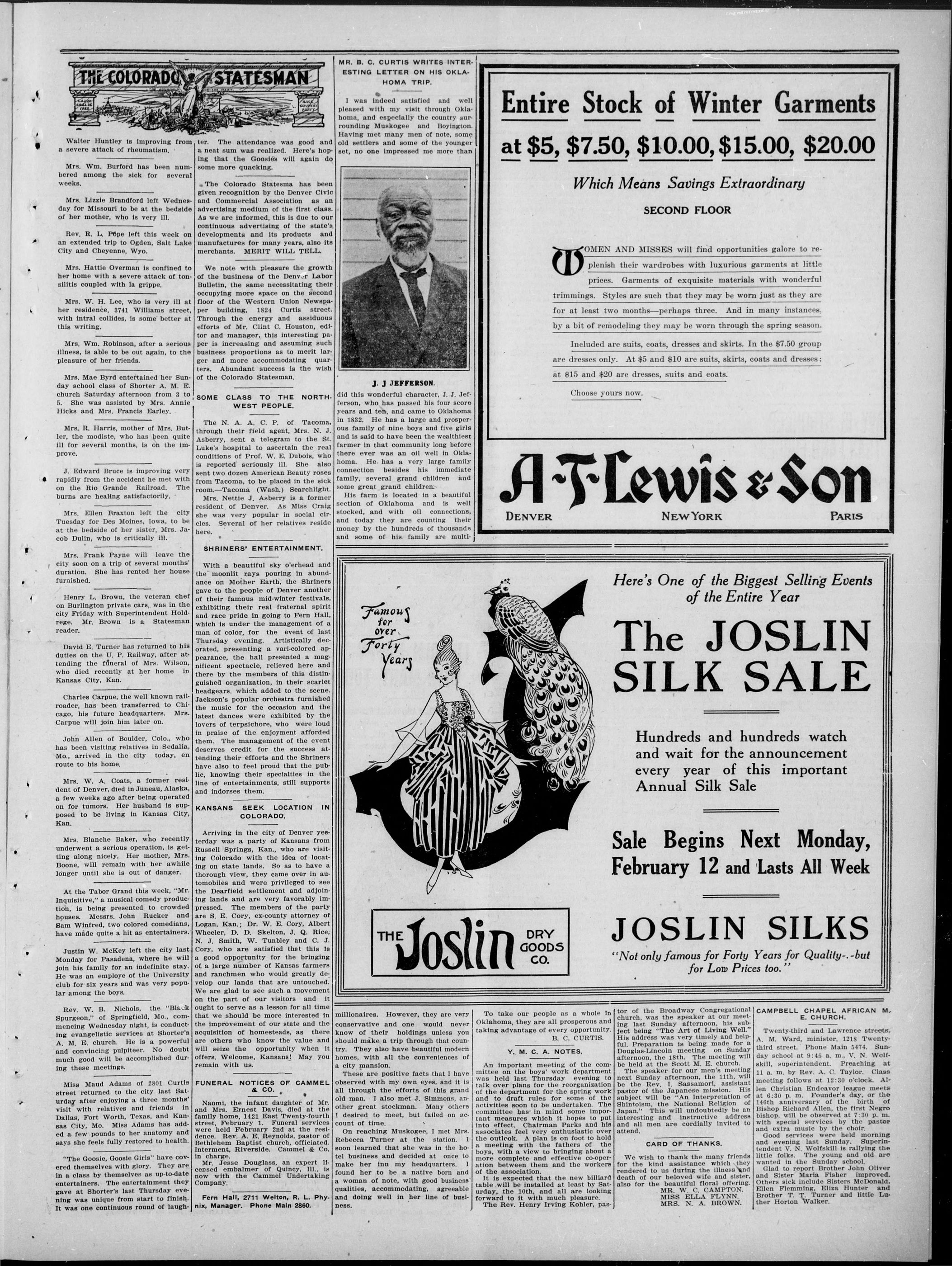
MR. B. C. CURTIS WRITES INTERESTING LETTER ON HIS OKLAHOMA TRIP.
I was indeed satisfied and well pleased with my visit through Oklahoma, and especially the country surrounding Muskogee and Boyington. Having met many men of note, some old settlers and some of the younger set, no one impressed me more than
[Name]
J. J JEFFERSON.
did this wonderful character, J. J. Jefferson, who has passed his four score years and ten, and came to Oklahoma in 1832. He has a large and prosperous family of nine boys and five girls and is said to have been the wealthiest farmer in that community long before there ever was an oil well in Oklahoma. He has a very large family connection besides his immediate family, several grand children and some great grand children.
His farm is located in a beautiful section of Oklahoma and is well stocked, and with oil connections, and today they are counting their money by the hundreds of thousands and some of his family are multi-
Famous
for
over
Forty
Years
THE JOSL
millionaires. However, they are very conservative and one would never know of their holdings unless you should make a trip through that country. They also have beautiful modern homes, with all the conveniences of a city mansion. These are positive facts that I have observed with my own eyes, and it is all through the efforts of this grand old man. I also met J. Simmons, another great stockman. Many others I desired to meet, but failed on account of time.
On reaching Muskogee, I met Mrs. Rebecca Turner at the station. I soon learned that she was in the hotel business and decided at once to make her inn my headquarters. I found her to be a native born and a woman of note, with good business qualities, accommodating, agreeable and doing well in her line of business.
Which Means Savings Extraordinary
prices. Garments of exquisite materials with wonderful trimmings. Styles are such that they may be worn just as they are for at least two months—perhaps three. And in many instances, by a bit of remodeling they may be worn through the spring season.
Included are suits, coats, dresses and skirts. In the $7.50 group are dresses only. At $5 and $10 are suits, skirts, coats and dresses; at $15 and $20 are dresses, suits and coats.
Choose yours now.
ATI
Here
T S
Sale
Feb
J C
"Not
A.T. Lewis & Son
in DRY GOODS CO.
To take our people as a whole in Oklahoma, they are all prosperous and taking advantage of every opportunity. B.C.CURTIS.
An important meeting of the committee on the boys' work department was held last Thursday evening to talk over plans for the reorganization of the department for the spring work and to draft rules for some of the activities soon to be undertaken. The committee has in mind some important measures which it hopes to put into effect. Chairman Parks and his associates feel very enthusiastic over the outlook. A plan is on foot to hold a meeting with the fathers of the boys, with a view to bringing about a more complete and effective co-operation between them and the workers of the association. It is expected that the new billiard table will be installed at least by Saturday, the 10th, and all are looking forward to it with much pleasure. The Rev. Henry Irving Kohler, pas-
---
```markdown
```
DENVER
Y. M. C. A. NOTES.
AND MISSES will find opportunity
in their wardrobes with luxurious
garments of exquisite material.
Styles are such that they may be worn
two months—perhaps three. And in
modeling they may be worn through
are suits, coats, dresses and skirts. I
. At $5 and $10 are suits, skirts,
are dresses, suits and coats.
rers now.
Here's One of the Big
of the Entu
The JO
SILK S
Hundreds and hu
and wait for the
every year of t
Annual Silk Sale
Sale Begins N
February 12 and
JOSLIN
'Not only famous for Forty
for Low Price
Here's One of the Biggest Selling Events of the Entire Year
The JOSLIN SILK SALE
Sale Begins Next Monday, February 12 and Lasts All Week
"Not only famous for Forty Years for Quality--but for Low Prices too."
tor of the Broadway Congregational church, was the speaker at our meeting last Sunday afternoon, his subject being "The Art of Living Well." His address was very timely and helpful. Preparation is being made for a Douglas-Lincoln meeting on Sunday afternoon, the 18th. The meeting will be held at the Scott M. E. church. The speaker for our men's meeting next Sunday afternoon, the 11th, will be the Rev. I. Sassamori, assistant pastor of the Japanese mission. His subject will be "An Interpretation of Shintoism, the National Religion of Japan." This will undoubtedly be an interesting and instructive address and all men are cordially invited to attend.
We wish to thank the many friends for the kind assistance which they rendered to us during the illness and death of our beloved wife and sister also for the beautiful floral offering.
---
Hundreds and hundreds watch and wait for the announcement every year of this important Annual Silk Sale
SECOND FLOOR
NEW YORK
CARD OF THANKS
MR. W. C. CAMPTON
MISS ELLA FLYNN.
MRS. N. A. BROWN.
PARIS
CAMPBELL CHAPEL AFRICAN M. E. CHURCH.
Twenty-third and Lawrence streets. A. M. Ward, minister, 1218 Twenty-third street. Phone Main 5474. Sunday school at 9:45 a. m., V. N. Wolfskill, superintendent. Preaching at 11 a. m. by Rev. A. C. Taylor. Class meeting follows at 12:30 o'clock. Allen Christian Endeavor league meets at 6:30 p. m. Founder's day, or the 146th anniversary of the birth of Bishop Richard Allen, the first Negro bishop, will be observed at 7:30 p. m. with special services by the pastor and extra music by the choir.
Good services were held morning and evening last Sunday. Superintendent V. N. Wolfskill is rallying the little folks. The young and old are wanted in the Sunday school.
Glad to report Brother John Oliver and Sister Maria Fisher improved. Others sick include Sisters McDonald, Ellen Flemming, Eliza Hunter and Brother T. T. Turner and little Luther Horton Walker.
```markdown
```
By Wilbur Nesbit.
(By Permission of P. F. Volland & Co.)
Your flag and my flag,
And how it flies today,
In your land and my land
And half a world away!
Rose-red and blood-red
The stripes forever gleam;
Snow-white and soul-white
The good forefathers' dream.
Sky-blue and true-blue, with stars to
gleam aright—
The gloried guildon of the day; a shel-
ter through the night.
Your flag and my flag!
And oh! how much it holds—
Your land and my land,
Secure within its folds!
Your heart and my heart
Beat quicker at the sight;
Sun-kissed and wind-tossed—
Red and blue and white.
The one flag—the great flag—the flag
for me and you.
Glorified all else beside—the red and
white and blue.
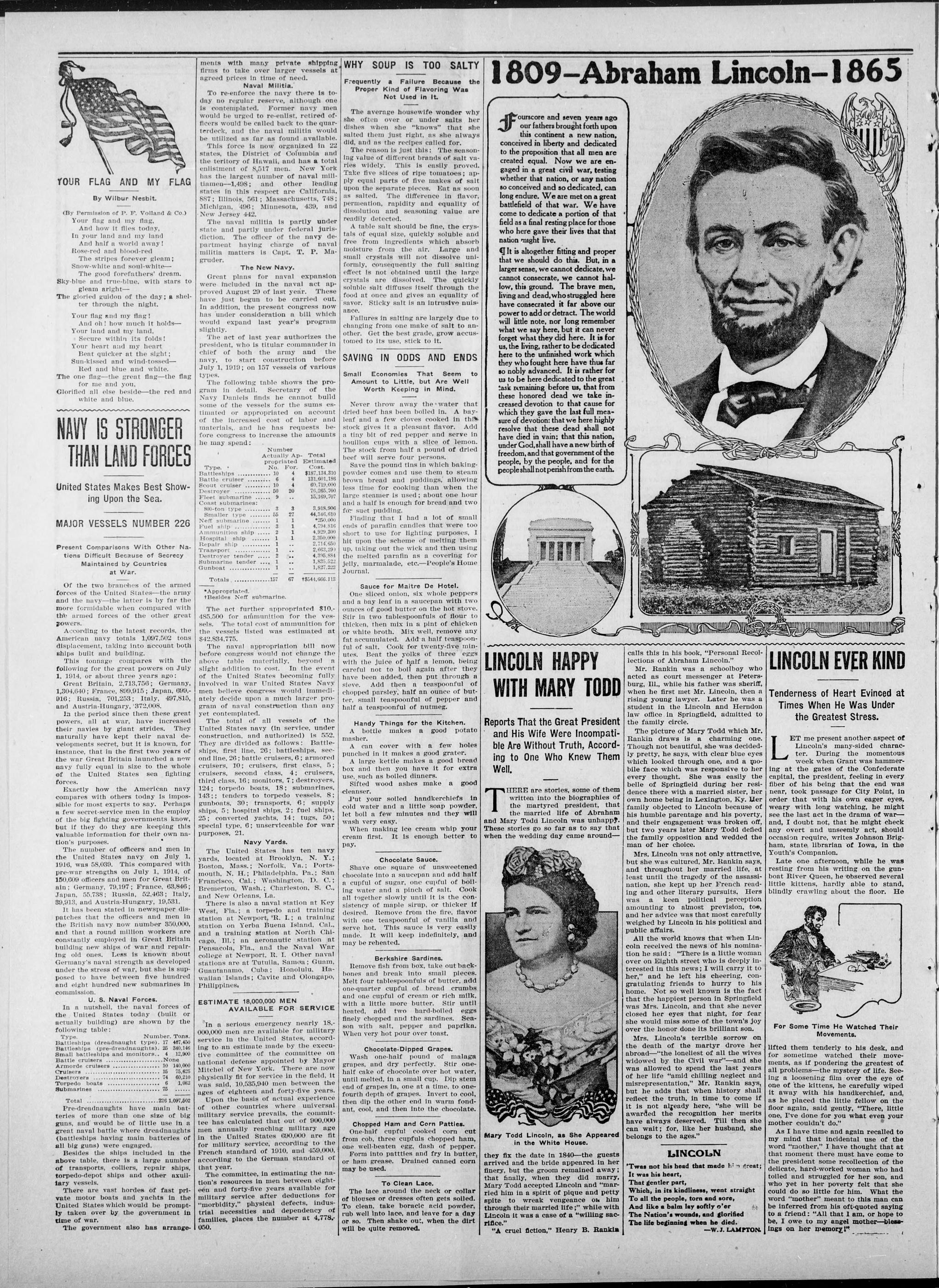
NAVY IS STRONGER THAN LAND FORCES
United States Makes Best Showing Upon the Sea.
MAJOR VESSELS NUMBER 226
Present Comparisons With Other Nations Difficult Because of Secrecy Maintained by Countries at War.
Of the two branches of the armed forces of the United States—the army and the navy—the latter is by far the more formidable when compared with the armed forces of the other great powers.
According to the latest records, the American navy totals 1,097,502 tons displacement, taking into account both ships built and building.
This tonnage compares with the following for the great powers on July 1, 1914, or about three years ago:
Great Britain, 2,713,756; Germany, 1,304,640; France, 899,915; Japan, 699,916; Russia, 701,253; Italy, 497,815, and Austria-Hungary, 372,008.
In the period since then these great powers, all at war, have increased their navies by giant strides. They naturally have kept their naval developments secret, but it is known, for instance, that in the first two years of the war Great Britain launched a new navy fully equal in size to the whole of the United States sea fighting forces.
Exactly how the American navy compares with others today is impossible for most experts to say. Perhaps a few secret-service men in the employ of the big fighting governments know, but if they do they are keeping this valuable information for their own nation's purposes.
The number of officers and men in the United States navy on July 1, 1916, was 58,039. This compared with pre-war strengths on July 1, 1914, of 150,009 officers and men for Great Britain; Germany, 79,197; France, 63,846; Japan, 55,738; Russia, 52,463; Italy, 39,913, and Austria-Hungary, 19,531. It has been stated in newspaper dispatches that the officers and men in the British navy now number 350,000, and that a round million workers are constantly employed in Great Britain building new ships of war and repairing old ones. Less is known about Germany's naval strength as developed under the stress of war, but she is supposed to have between five hundred and eight hundred new submarines in commission.
U. S. Naval Forces.
In a nutshell, the naval forces of the United States today (built or actually building) are shown by the following table:
| Type | Number | Tons. |
| :--- | :--- | :--- |
| Battleships (dreadnaught type) | 17 | 467,450 |
| Battleships (pre-dreadnaught) | 25 | 340,146 |
| Small battleships and monitors | 4 | 2,900 |
| Battleship cruisers | None |
| Armor cruisers | 10 | 140,000 |
| Cruisers | 15 | 75,625 |
| Destroysers | 74 | 60,210 |
| Torpedo boats | 6 | 1,082 |
| Submarines | 75 | - |
Total | 229 | 1,097,502 |
Pre-dreadnaughts have main batteries of more than one size of big guns, and would be of little use in a great naval battle where dreadnaughts (battleships having main batteries of all big guns) were engaged.
Besides the ships included in the above table, there is a large number of transports, collers, repair ships, torpedo-depot ships and other axillary vessels.
There are vast hordes of fast private motor boats and yachts in the United States which would be promptly taken over by the government in time of war. The government also has arrange-
ments with many private shipping firms to take over larger vessels at agreed prices in time of need.
Naval Militia.
To re-enforce the navy there is today no regular reserve, although one is contemplated. Former navy men would be urged to re-enlist, retired officers would be called back to the quarterdeck, and the naval militia would be utilized as far as as found available. This force is now organized in 22 states, the District of Columbia and the territory of Hawaii, and has a total enlistment of 8,517 men. New York has the largest number of naval militiamen—1,498; and other leading states in this respect are California, 887; Illinois, 561; Massachusetts, 748; Michigan, 496; Minnesota, 439, and New Jersey 442.
The naval militia is partly under state and partly under federal jurisdiction. The officer of the navy department having charge of naval militia matters is Capt. T. P. Magruder.
The New Navy.
Great plans for naval expansion were included in the naval act approved August 29 of last year. These have just begun to be carried out. In addition, the present congress now has under consideration a bill which would expand last year's program slightly.
The act of last year authorizes the president, who is titular commander in chief of both the army and the navy, to start construction before July 1, 1919; on 157 vessels of various types.
The following table shows the program in detail. Secretary of the Navy Daniels finds he cannot build some of the vessels for the sums estimated or appropriated on account of the increased cost of labor and materials, and he has requests before congress to increase the amounts he may spend:
Number
Actually App-
propriated
Total
Estimated
Type. No. For.
Cost.
Battleships 10 4 $187,134,310
Battle cruiser 6 4 121,601,188
Scout cruiser 10 4 69,719,700
Destroyer 50 20 76,265,700
Fleet submarine 9 -- 15,169,700
Coast submarines:
800-ton type 3 3 3,918,906
Smaller type 55 27 44,346,610
Neff submarine 1 1 *250,000
Fuel ship 3 1 4,794,816
Ammunition ship 2 1 4,929,300
Hospital ship 1 1 2,350,000
Repair ship 1 -- 2,714,050
Transport 1 -- 2,663,291
Destroyer tender 1 -- 4,396,884
Submarine tender 1 -- 1,835,522
Gunboat 1 -- 1,827,222
Totals 157 67 †$544,661,113
*Appropriated.
*Besides Neff submarine.
The act further appropriated $10,485,500 for ammunition for the vessels. The total cost of ammunition for the vessels listed was estimated at $42,834,775. The naval appropriation bill now before congress would not change the above table materially, beyond a slight addition to cost. In the event of the United States becoming fully involved in war United States Navy men believe congress would immediately decide upon a much larger program of naval construction than any vet contemplated.
The total of all vessels of the United Navy navy (in service, under construction, and authorized) is 552. They are divided as follows: Battleships, first line, 26; battleships, second line, 26; battle cruisers, 6; armored cruisers, 10; cruisers, first class, 5; cruisers, second class, 4; cruisers, third class, 16; monitors, 7; destroyers, 124; torpedo boats, 18; submarines, 143; tenders to torpedo vessels, 8; gunboats, 30; transports, 6; supply ships, 5; hospital ships, 2; fuel ships, 25; converted yachts, 14; tugs, 50; special type, 6; unserviceable for war purposes, 21.
Navy Yards.
The United States has ten navy yards, located at Brooklyn, N. Y.; Boston, Mass.; Norfolk, Va.; Portsmouth, N. H.; Philadelphia, Pa.; San Francisco, Cal.; Washington, D. C.; Bremerton, Wash.; Charleston, S. C., and New Orleans, La.
There is also a naval station at Key West, Fla.; a torpedo and training station at Newport, R. L.; a training station on Yerba Buena Island, Cal., and a training station at North Chicago, Ill.; an aeronautic station at Pensacola, Fla., and the Naval War college at Newport, R. L. Other naval stations are at Tutuila, Samoa; Guam, Guantanamo, Cuba; Honolulu, Hawaiian Islands; Cavite and Olongapo, Philippines.
ESTIMATE 18,000,000 MEN
AVAILABLE FOR SERVICE
In a serious emergency nearly 18,000,000 men are available for military service in the United States, according to an estimate made by the executive committee of the committee on national defense appointed by Mayor Mitchel of New York. There are now physically fit for service in the field, it was said, 10,535,940 men between the ages of eighteen and forty-five years. Upon the basis of actual experience of other countries where universal military service prevails, the committee has calculated that out of 900,000 men annually reaching military age in the United States 600,000 are fit for military service, according to the French standard of 1910, and 459,000, according to the German standard of that year.
The committee, in estimating the nation's resources in men between eighteen and forty-five years available for military service after deductions for "morbidity," physical defects, industrial necessities and dependency of families, places the number at 4,778,050.
WHY SOUP IS TOO SALTY
Frequently a Failure Because the Proper Kind of Flavoring Was Not Used in It.
The average housewife wonder why she often over or under salts her dishes when she "knows" that she salted them just right, as she always did, and as the recipes called for.
The reason is just this: The seasoning value of different brands of salt varies widely. This is easily proved. Take five slices of ripe tomatoes; apply equal parts of five makes of salt upon the separate pieces. Eat as soon as salted. The difference in flavor, permeation, rapidity and equality of dissolution and seasoning value are readily detected.
A table salt should be fine, the crystals of equal size, quickly soluble and free from ingredients which absorb moisture from the air. Large and small crystals will not dissolve uniformly, consequently the full salting effect is not obtained until the large crystals are dissolved. The quickly soluble salt diffuses itself through the food at once and gives an equality of savor. Sticky salt is an intrusive nuisance. Failures in salting are largely due to changing from one make of salt to another. Get the best grade, grow accustomed to its use, stick to it.
SAVING IN ODDS AND ENDS
Small Economies That Seem to Amount to Little, but Are Well Worth Keeping in Mind.
Never throw away the water that dried beef has been boiled in. A bayleaf and a few cloves cooked in this stock gives it a pleasant flavor. Add a tiny bit of red pepper and serve in bouillon cups with a slice of lemon. The stock from half a pound of dried beef will serve four persons.
Save the pound tins in which baking-powder comes and use them to steam brown bread and puddings, allowing less time for cooking than when the large steamer is used; about one hour and a half is enough for bread and two for suet pudding.
Finding that I had a lot of small ends of paraffin candles that were too short to use for lighting purposes, I hit upon the scheme of melting them up, taking out the wick and then using the melted parafin as a covering for jelly, marmalade, etc.—People's Home Journal.
Sauce for Maitre De Hotel.
One sliced onion, six whole peppers and a bay leaf in a saucepan with two ounces of good butter on the hot stove. Stir in two tablespoonfuls of flour to thicken, then mix in a pint of chicken or white broth. Mix well, remove any fat accumulated. Add a half teaspoonful of salt. Cook for twenty-five minutes. Beat the yolks of three eggs with the juice of half a lemon, being careful not to boil again after they have been added, then put through a sieve. Add then a teaspoonful of chopped parsley, half an ounce of butter, small teaspoonful of pepper and half a teaspoonful of nutmeg.
Handy Things for the Kitchen.
A bottle makes a good potato masher.
A can cover with a few holes punched in it makes a good grater.
A large kettle makes a good bread box and then you have it for extra use, such as boiled dinners.
Sifted wood ashes make a good cleanser.
Put your soiled handkerchiefs in cold water and a little soap powder, let boil a few minutes and they will wash very easy.
When making ice cream whip your cream first. It is enough better to pay.
Chocolate Sauce.
Shave one square of unsweetened chocolate into a saucepan and add half a cupful of sugar, one cupful of boiling water and a pinch of salt. Cook all together slowly until it is the consistency of maple sirup, or thicker if desired. Remove from the fire, flavor with one teaspoonful of vanilla and serve hot. This sauce is very easily made. It will keep indefinitely, and may be reheated.
Berkshire Sardines.
Remove fish from box, take out back-bones and break into small pieces. Melt four tablespoonfuls of butter, add one-quarter cupful of bread crumbs and one cupful of cream or rich milk, with a little more butter. Stir until hented, add two hard-boiled eggs finely chopped and the sardines. Season with salt, pepper and paprika. When very hot pour over toast.
Chocolate-Dipped Grapes.
Wash one-half pound of malaga grapes, and dry perfectly. Stir one-half cake of chocolate over hot water, until melted, in a small cup. Dip stem end of grapes in, one at a time, to one-fourth depth of grapes. Invert to cool, then dip the other end in warm fondant, cool, and then into the chocolate.
Chopped Ham and Corn Patties
One-half cupful cooked corn cut from cob, three cupfuls chopped ham, one well-beaten egg, dash of pepper. Form into pattties and fry in butter or ham grease. Drained canned corn may be used.
To Clean Lace.
The lace around the neck or collar of blouses or dresses often gets solled. To clean, take boracic acid powder, rub well into lace, and leave for a day or so. Then shake out, when the dirt will be quite removed.
1809-Abraham Lincoln-1865
this continent a new nation, conceived in liberty and dedicated to the proposition that all men are created equal. Now we are engaged in a great civil war, testing whether that nation, or any nation so conceived and so dedicated, can long endure. We are met on a great battlefield of that war. We have come to dedicate a portion of that field as a final resting place for those who here gave their lives that that nation might live.
It is altogether fitting and proper that we should do this. But, in a larger sense, we cannot dedicate, we cannot consecrate, we cannot halt-hallow, this ground. The brave men, living and dead, who struggled here have consecrated it far above our power to add or detract. The world will little note, nor long remember what we say here, but it can never forget what they did here. It is for us, the living, rather to be dedicated here to the unfinished work which they who fought here have thus far so nobly advanced. It is rather for us to be here dedicated to the great task remaining before us, that from these honored dead we take increased devotion to that cause for which they gave the last full measure of devotion: that we here highly resolve that these dead shall not have died in vain; that this nation, under God, shall have a new birth of freedom, and that government of the people, by the people, and for the people shall not perish from the earth.
Lincoln Memorial
LINCOLN HAPPY WITH MARY TODD
Reports That the Great President and His Wife Were Incompatible Are Without Truth, According to One Who Knew Them Well.
THERE are stories, some of them written into the biographies of the martyred president, that the married life of Abraham and Mary Todd Lincoln was unhappy. These stories go so far as to say that when the wedding day came around—
THE QUEEN OF WALES
Mary Todd Lincoln, as She Appeared in the White House.
they fix the date in 1840—the guests arrived and the bride appeared in her finery, but the groom remained away; that finally, when they did marry, Mary Todd accepted Lincoln and "married him in a spirit of pique and petty spite to wreak vengeance on him through their married life;" while with Lincoln it was a case of a "willing sacrifice."
"A cruel fiction." Henry B. Rankia
A. A. B.
calls this in his book, "Personal Recollections of Abraham Lincoln." Mr. Rankin was a schoolboy who acted as court messenger at Petersburg, Ill., while his father was sheriff, when he first met Mr. Lincoln, then a rising young lawyer. Later he was a student in the Lincoln and Herndon law office in Springfield, admitted to the family circle.
The picture of Mary Todd which Mr. Rankin draws is a charming one. Though not beautiful, she was decidedly pretty, he says, with clear blue eyes which looked through one, and a mobile face which was responsive to her every thought. She was easily the belle of Springfield during her residence there with a married sister, her own home being in Lexington, Ky. Her family objected to Lincoln because of his humble parentage and his poverty, and their engagement was broken off, but two years later Mary Todd defied the family opposition and wedded the man of her choice.
Mrs. Lincoln was not only attractive, but she was cultured, Mr. Rankin says, and throughout her married life, at least until the tragedy of the assassination, she kept up her French reading and other literary pursuits. Hers was a keen political perception amounting to almost prevision, too, and her advice was that most carefully welged by Lincoln in his political and public affairs.
All the world knows that when Lincoln received the news of his nomination he said: "There is a little woman over on Eighth street who is deeply interested in this news; I will carry it to her," and he left his cheering, congratulating friends to hurry to his home. Not so well known is the fact that the happiest person in Springfield was Mrs. Lincoln, and that she never closed her eyes that night, for fear she would miss some of the town's joy over the honor done its brilliant son.
Mrs. Lincoln's terrible sorrow on the death of the martyr drove her abroad—"the loneliest of all the wives widowed by the Civil war"—and she was allowed to spend the last years of her life "amid chilling neglect and misrepresentation," Mr. Rankin says, but he adds that when history shall reflect the truth, in time to come if it is not already here, "she will be awarded the recognition her merits have always deserved. Till then she can wait; for, like her husband, she belongs to the ages."
LINCOLN
Twas not his head that made him great
It was his heart,
That gentler part,
Which, in its kindliness, went straight
To all the people, torn and sore,
And like a balm lay softly o'er
The Nation's wounds, and glorified
The life beginning when he died.
Tenderness of Heart Evinced at Times When He Was Under the Greatest Stress.
LET me present another aspect of Lincoln's many-sided character. During the momentous week when Grant was hammering at the gates of the Confederate capital, the president, feeling in every fiber of his being that the end was near, took passage for City Point, in order that with his own eager eyes, weary with long watching, he might see the last act in the drama of war—and I doubt not, that he might check any overt and unseemly act, should occasion require, writes Johnson Brigham, state librarian of Iowa, in the Youth's Companion.
Late one afternoon, while he was resting from his writing on the gunboat River Queen, he observed several little kittens, hardly able to stand, blindly crawling about the floor. He
For Some Time He Watched Their Movements.
lifted them tenderly to his desk, and for sometime watched their movements, as if pondering the greatest of all problems—the mystery of life. Seeing a loosening film over the eye of one of the kittens, he carefully wiped it away with his handkerchief, and, as he placed the little fellow on the floor again, said gently, "There, little one, I've done for you what even your mother couldn't do."
As I have time and again recalled to my mind that incidental use of the word "mother," I have thought that at that moment there must have come to the president some recollection of the delicate, hard-worked woman who had toiled and struggled for her son, and who yet in her poverty felt that she could do so little for him. What the word "mother" meant to this man can be inferred from his oft-quoted saying to a friend: "All that I am, or hope to be, I owe to my angel mother—blessings on her memory!"
A Valentine
If all the hearts in all the world could just love one another,
If all of us where'er we met would call each man his brother,
How happy each of us would be,
From turmoil and from strife set free,
And then, each day, O heart of mine,
Would be a great big Valentine.
If each of us would do his part and not shirk in the doing,
And mean it, living by his creed Of perfect love; O heart of mine, 'Twould be the world's great Valentine.
If we united tried to walk, the right way, altogether,
Yet halted for the falt'ring ones who felt Fate's stormy weather;
If all the strong would firmly stand For right, and lead the timid band Of weaker ones, oh, heart of mine 'Twould be the world's best Valentine.
Her Helpful Valentine By Lee Shippey
FELDON had found the one girl—Nellie Hastings. Nellie had great, lustrous eyes. When Feldon recited his own poetry she would gaze intently into his face with a rapt expression, as if thinking of a new hat she would like to buy. And probably she was.
When he finished reciting she would be silent a moment and then murmur: "How exquisite!" She didn't say what was exquisite, but Feldon thought he knew. But I would wager a little on the hat.
Feldon's family and I looked on his romance with extreme disfavor. But he would brook no criticism from his relatives. That was why he happened to be lodging with me in the studio, temporarily. Being only a friend I knew Feldon much better than his family did and was wise enough not to show my disfavor for his suit.
I knew Nellie, too, and felt sure her union with Feldon would not be best for all concerned. Feldon was really a fine chap. He was original. He did not even imitate other men in their vices, as most otherwise original men do. He had a fine scorn for philandering and excesses. He did not love to eat and drink or indulge in any other common appetite. His appetites were spiritual. I felt sure the girl for him would have to be a modern Pallas.
But that is just what he thought Nellie was.
"She has a wonderful soul!" he would cry. "It looks out of her eyes. Every glance is a lyric, every steadfast gaze a perfect poem!"
When a man who tells you his love is too deep for words gushes forth like that about thirty times a day it usually ends in a life sentence. There's no saying him.
Still we tried hard, the family and I. The family pleaded, stormed and threatened. I tried sundry strategic moves. But all proved futile. Feldon and Nellie decided to marry in May. They wouldn't be married in June because so many people get married then. It was early in February when they definitely decided on the date, and then the family and I lost hope.
But a few days later he came in looking so agitated I felt hopeful of calamitous news. His hair was disheveled, his collar awry, his tie humpbacked. He paid no attention to me, but began at once to pace the floor feverishly, muttering unintelligibly as he walked and stopping frequently to claw his hair frenziedly. I waited patiently for the floodgates to burst, but nothing happened. Occasionally he would stare at me, but did not seem to see me. Finally he sat and began to write. I could not restrain an exclamation of profound disgust.
"So it's a mere poem you're working on?" I sneered. "I thought something had happened."
He looked up dazedly a moment. Then he seemed to recall where he was and that I was a human being. Then his excitement flooded back.
"A mere poem?" he cried. "This poem should be 'an echo and a light unto eternity.' It should symbolize the most perfect love which existed
between human beings. St. Valentine's day is coming, you dolt. That day I am to pour out my heart in a poem to Nellie and she hers in a poem to me." "The deuce you say!" I exclaimed. "I didn't know she wrote such stuff." "Her every thought is a poem," he declared. For a week, Feldon labored incessantly over that poem. He would hop out of bed in the middle of the night to change a word or put in a comma. He revised it a dozen times every day. It was a truly beautiful thing when he sent it away by messenger the morning of St. Valentine's day. The same messenger brought back Nellie's valentine.
What sounded like the gasps of a dying man called me to Feldon's side five minutes later. He had fallen back pale and limp, on a couch. I propped up his head and ran for a stimulant, but he waved me away.
"Don't save me," he pleaded. "Life is all too taunting a mockery. I thought I had found a soul perfectly responsive to harmony and beauty and symmetry. But just look what she wrote."
He held up Nellie's valentine, and I read:
This valentine
To you doth say
I'm yours all the time
For ever and for aye;
So when this you see
Do not forget
To remember me
Your own
Nel-lee.
I read the valentine through twice, believing I saw possibilities in it. Feldon groaned steadily the while. Feldon shamelessly deserted Nellie, leaving for an extended trip through
D. L.
Would Gaze Intently Into His Face. the West without stopping to say goodbye. Both his family and I felt greatly relieved. Shortly afterward I married Nellie myself. And ever since then the dear girl has made a handsome living for both of us by writing "lyrics" for popular songs.
"Cupid's Morgue."
"Cupid's morgue" in the city post office is not the gruesome place of blasted hopes and affections that one might imagine it to be, but is in reality the most interesting and cheerful department in the mallservice; the greatest amount of trouble is taken in discriminating where the different matter shall be sent, and no books or printed valentines are distributed without first being carefully looked over.
>
VARIOUS BOARDSNAMED
GOVERNOR GUNTER APPOINTS IN
DUSTRIAL COMMISSION.
Joel Grantham, Senator Pearson and D. C. Burns Selected to Replace Board Chosen by Carlson.
Western Newpaper Union News Service.
Denver.—Joel Grantham of Lar Jara, former State Senator John F. Pearson of Pitkin county and D. C. Burns of Denver were named by Governor Gunter as members of the State Industrial Commission to succeed E. E. McLaughlin and Frank P. Lannin, Republicans, and Wayne C. Williams, Democrat, whose appointments by former Governor Carlson were refused confirmation by the Senate three weeks ago. Other appointments were also announced as follows:
State Board of Corrections—Mrs. Helen Grenfell, Democrat, of Denver, six-year term; Frank S. Hoag, Democrat, of Pueblo, four-year term, and Sprigg Shackelford, Republican, of Gunnison county, two-year term.
State Board of Agriculture—John C. Bell of Montrose and former Governor Ellias M. Ammons of Grand county. Both are Democrats, and are reappointed to the board, each for a term of eight years.
Trustee for the Colorado School for the Deaf and Blind—A. J. Lawton; Democrat, of El Paso county, for a term of six years.
Board of Control of State Industrial School for Girls—Edward C. Stimson; Democrat, of Denver, for a term of five years.
Governor Gunter also made the following appointments, which do not need Senate confirmation:
State Board of Stock Inspection Commissioners—Coke Roberts, Routt county; Lem Gammon, El Paso county; E. C. Headles, Alamosa county, all for terms of three years beginning May 1.
Advisory Board, State Highway Commission—Leonard E. Curtis of Colorado Springs, term of five years, beginning April 1. Reappointed. Board of Control, State Home for Dependent Children—Mrs. Parmelia Curtis Porter and Mrs. Clara L. Hunter, both of Denver. Each for a term of six years, beginning May 2. Reappointments. Civil Service Commission—W. W. Grant, Jr., Mrs. Anna Wolcott Vaile and Lawrence Lewis, all of Denver. Two-year terms dating from Jan. 9.
New Measure Also Puts Stock Yards and Smelters Under Utilities Board.
Three large industries in Colorado will come within the jurisdiction of the Public Utilities Commission of the state if a bill sponsored by the Farmers' Union passes the present Legislature. The measure has been introduced by Representative George W. Smith of Routt and Moffat counties and classes the beet sugar industry, the smelting of ores and the stockyards business as public utilities.
Abolition of the State Tax Commission and the transferring of the duties of that board to the State Board of Equalization is provided for in a bill by Representative Garcia of Coneios.
Exemption of farm buildings from taxation is proposed in a bill by Representative Somerville of Lincoln, Kit Carson and Cheyenne.
Extension of the powers of the State Public Utilities Commission to regulate the issuance of transportation by any railroad for use in the state, in payment of advertising to any newspaper and magazine publisher, is authorized in a bill by Representative Furrow of Archuleta and Mineral.
One of the many changes in the election laws proposed by legislators is the elimination of the assembly feature of the primaries, by Representative Cawfield of Pueblo. The proposed plan is similar to the Kansas law, which provides for the qualification of candidates in the primary race by petition instead of by nomination in party assembly.
Several bills have been introduced in both branches of the Assembly to prevent abuse in the exercise of the initiative and referendum. One of the bills, by Representative Gill of Morgan and Washington, prohibits the paid canvasser from getting signatures to petitions. The abolishment of the House of Representatives may come through a bill introduced by Representative Laube of Montezuma and Carl Marold of Saguache county. The bill provides for the consolidation of the House and Senate of the State Legislature. Abolition of primary elections is provided in a bill introduced in the State Senate by Senator B. T. Napier of Glenwood Springs on behalf of the Senate judiciary committee.
Coloradoans Must Enlist if War Comes Colorado's part in the war program to build up the United States army, worked out by the army general staff in Washington, was outlined by Adj. Gen. Harry P. Gamble, and includes an estimate of 18,000 men who, in the event that number fail to enlist, will be drafted. The first step, perhaps, counting on the return from the Mexican border of the Colorado National guard, would be to bring those troops to war strength. This would require the enlistment of about 1,200, making a total of 2,637 men.
BRITISH STEAMER TURINO IS SUNK
Do You Know That-
AN AMERICAN NEGRO FIREMAN,
GEORGE WASHINGTON, RE-
PORTED KILLED.
TEN SHIPS SUNK IN DAY
CALIFORNIA WENT DOWN IN NINE MINUTES WITH A LOSS OF FORTY-ONE LIVES.
Western Newspaper Union News Service.
London, Feb. 9.—The British steamer Turino has been sunk by a submarine. The Turino was a vessel of 2,702 tons. She sailed from Norfolk on Jan. 19 for Liverpool. An American negro fireman, George Washington, was killed. One of the survivors is Calvin Bay, an American, of Fillmore, Utah. Washington was one of three firemen who were killed.
IS PREPARED TO DO ALL KINDS OF
London. — The British passenger steamer California, of the Anchor line, bound from New York for Glasgow, which was torpedoed Wednesday off the Irish coast, sank in nine minutes with the loss of forty-one
Washington, Feb. 9. — Entente and neutral ships aggregating 21,505 tons have been sunk by German submarines during the last 24 hours. Ten vessels in all were sent to the bottom during this period. Six of them were British steamers of an aggregate tonnage of 16,736. The neutrals sunk were a Norwegian ship and a Swedish steamer. A French trawler and a Russian ship were the other victims of U-boats.
Commercial, Fraternal, Church, Book and Stationery Jobs A SPECIALTY
The killing of the following Americans in connection with U-boat attacks was reported Thursday: George Washington, a negro fireman, killed when the British steamer Turnio was torpedoed. James O'Donnell, 9 years old, and Mary O'Donnell, 7, of Philadelphia, among the missing in the sinking of the liner California. Washington Thursday awaited official reports to determine whether latest submarine attacks are overt acts which will bring war.
Ball and Concert Programs, Bill and Letter Heads, Calling Cards, Wedding Cards, Envelopes and Everything in the Printing Line Turned Out in the Neatest and Best Style Promptly on Short Notice.
Ambassador Gerard still in Berlin on Thursday. No denial of report that he is detained as hostage for Count von Bernstorff has been issued by Germany. United States speeds up work on building of new warships and manufacture of torpedoes. President Wilson visits war and navy office to keep close watch on moves of preparedness. Sweden refuses to break off relations with Germany. Twelve passenger ships now on Atlantic. Nine are within area of possible U-boat operations. England will send out trade ships in fleets, under convoy by warships.
We Have Supplied Our Office with New Job Press & Type of Up-to-Date Style and Our Work Will Be on a Par with the Very Best.
Newport News, Va.—British steamers carrying munitions of war are assembling off the Virginia capes and will be conveyed to England by a British warship. Sources that generally are reliable said more than a score of vessels had gathered at the rendezvous.
U. S. Refugee Camp Breaking Up.
Columbus, N. M., Feb. 9.—The refugee camp here is slowly breaking up. The Mormon refugees have gone to Deming, N. M., to found a colony; the Mexicans are finding work on railroads and ranches of the Southwest, and the Chinese probably will be sent in bond to Juarez. Less than 1,000 of the 3,000 refugees are expected to be in camp by the end of the week.
BRITISH CONTINUE SOMME GAINS
Sailly-Saillisel Hill Captured After Taking of Grandcourt. London.-The British troops have captured Sailly-Saillisel, on the Somme front in France, according to an official communication.
Along both sides of the Ancre river west of Bapaume further progress has been made, including the capture of a trench near Grandcourt. On other parts of the front in France and Belgium the fighting continues by means of artillery and small attacks by raiding parties. The Teutonic allies in Macedonia have shown activity along the entire front. On the eastern front comparative calm prevails from the Baltic to the line in Rumania. In the Carpathians, near Kirilibaba, Petrograd reports the capture of first-line Teutonic allied trenches, which were held by the Russians despite counter attacks. Rome reports failure of an Austrian attack against the Italians in the Sugana valley and the smashing by the big guns of the Italians of Austrian batteries on several sectors.
Prices as Reasonable as Those of Any Job Office in Denver
The Colorado Statesman
1824 CURTIS STREET
Room 25 Phone Main 7417
Impressive Ceremonies to Show That America is United.
Washington.—Formal announcement was made that in spite of the foreign situation the public inauguration ceremonies, March 5, will be held as planned. It was stated it will be made impressive "in order to afford an opportunity for a perfectly spontaneous exhibition of the patriotic feeling of the country."
NOTHING DOWN AND 17 CTS. A DAY
BUYS A PIANO. SALE NOW ON.
THE PIANO EXCHANGE
H. A. TRIGGS, Manager
211 Charles Block. Cor. 15th and Curtis Streets. Phone Champa 3742.
Choice of the House
AS A RESULT of our annual inventory-just completed-we have added in this sale hundreds of fancy winter suits and overcoats, so that now the range for selection is unlimited among the finest clothing in America, including such world famous makes as those of Society Brand Clothes, A. B. Kirschbaum Co., Strouse & Bros. and a score of other equally prominent. There are hundreds of garments in every size for slim, stout, tall, short or regularly proportioned men. Alterations made free.
$25, $28, $30 Fancy Suits and Overcoats
$15
THE MAY CO.
THE BARBER'S CAFE
THE PEARL BARBER SHOP
First-Class Tonsorial Artists in attendance. Best line of Cigars and Tobacco. We solicit your patronage. First-Class work guaranteed.
TURKEY
DENVER, COLO.
Big Turkey Dinner
SUNDAY, February 11,
from 12:30 to 6:30 p. m.
35 Cents.
Night and Day Cafe
919 Nineteenth St
Bob Carruth,
Prop
Fads And Fancies
Of
Fashion
If you are about to order a new suit for general wear, you will find an unusual state of things in the matter of styles. There is a sort of go-as-you please situation, and you may have your coat long or short, and your skirt wide or narrow at the bottom. The tailor cannot dictate, because from the
For very little girls plain, white sheer fabrics are made up with fine lingerie laces as usual, in dresses for all their "dress-up" occasions. Plain linen in colors (usually combined with white in the bodice) is a favorite for daily wear, and gingham holds its own as the best of fabrics for play dresses.
I
I
I
PRACTICAL DEMI-SEASON SUITS.
standpoint of fashionableness one thing is not better than another. No one knows just why this state of things has come about, but it may be because no such attention has been given to sports suits and one-piece frocks that the tailor suit has been somewhat neglected by costumers. They refuse to make predictions, and women are left the joyful liberty of choosing whatever style is most becoming. Plain goods are always worn, and checks in very pretty color combinations have already appeared in smart models. Inasmuch as the tailored suit will give way to the sports suit, which
X
A
X
will take its place whenever there is the least excuse for doing so, the tailored suit may be quiet as to color and conservative as to style.
In the picture a shepherd's check and a plain cloth are presented as sensible models for the demi-season. And even if a decided style tendency develops later on these suits will hold their own, for they are built to fulfill all that is required in practical street clothes.
Lent is not far away, and that means that time will soon bring leisure to devote to spring sewing. New fabrics and styles for the coming season are already presented. Those for children interest the home dressmaker most; she feels safe in making wash dresses for little girls because they are not subject to last-minute whims of fashion.
on to it, the edges piped ered cord made from the The sleeves are three-quarter and finished with bands of material as the skirt.
The plaits in the skirt down at the edges for a sleeve below the waistline, say inches. All around the skirt is turned under t and the plaits are press entire length of the skirt, ished with a three-inch slips through small straps of the bodice. They are dark stripe in the goods, and fastens with two smtons.
I will not disclose any personal information.
---
For very little girls plain, white sheer fabrics are made up with fine lingerie laces as usual, in dresses for all their "dress-up" occasions. Plain linen in colors (usually combined with white in the bodice) is a favorite for daily wear, and gingham holds its own as the best of fabrics for play dresses.
I
Nearly all the new styles are rather plain, with plaits featured in skirts and the bodice wholly or in part made of a white cotton material.
For a girl of eleven years or so this combination of materials has been handed with excellent taste in the dress shown in the picture. Cotton poplin or any of the moderately heavy weaves will prove a good selection in the striped material, and the white in the bodice might be of a thinner goods, as India linen or percale or batiste. The bodice is cut quite plain, of the white fabric, and fastens down the front with pearl buttons. Emplacements of the striped goods are stitched
1
on to it, the edges piped with a covered cord made from the dark stripes. The sleeves are three-quarter length and finished with bands of the same material as the skirt.
The plaits in the skirt are caught down at the edges for a short distance below the waistline, say three or four inches. All around the skirt the white stripe is turned under the dark one and the plaits are pressed down the entire length of the skirt, which is finished with a three-inch hem. A belt slips through small straps at the sides of the bodice. They are made of the dark stripe in the goods. It is white and fastens with two small pearl buttons.
Julia Bottomley
---
RESIDENCE PHONE YORK 7992
FRANK S. REED,
License Embalmer & Director.
Lady Assistant
Polite Service
to All
Parlors, 2745 Welton Street
THE STAR HA
E STAR HAIR GROWER
THE STAR HAIR GROWER
THE STAR HAIR GROWER
A Wonderful Hair Dressing and Grower
On a thousand agents in good Money
Made. We want Agents in every city
and village to sell THE STAR HAIR GROWER.
This is a wonderful preparation. Can
be used with or without straightening irons.
Sells for 25 cents per box—One 25-cent box
will use a 25-cent box will be convinced. No matter what has failed to grow your hair, just give THE STAR HAIR GROWER a trial and be convinced. Send 25 cents for a full size box. If you wish to be a agent, we will work with you, a full supply that you can begin work at once; also agent's terms.
Send all money by Money Order to
EVANSTON, ILL. GREENSBORO, N.C.
NOTE.—Persons living in the Southeast
will be listed in the MFR. if they will
order from THE STAR HAIR GROWER
MFR. P. O. BCX 812, GREENSBORO, N.C.
THINK
Giant Bach-Bee
and Tail
Lankford and McCau
STRICTLY FIRST-C
Cleaning, Pressing, Dyein
JOIN OUR MONTHLY PRE
506 Eighteenth Street
THINK
Ant Bach-Benz Cleaners
and Tailors
Lankford and McCain, Proprietors
STRICTLY FIRST-CLASS WORK
Cleaning, Pressing, Dyeing and Remodelling
IN OUR MONTHLY PRESSING CLUB—$1.50
Eighteenth Street Phone Main 7376
Giant Bach-Benz Cleaners and Tailors
Lankford and McCain, Proprietors
STRICTLY FIRST-CLASS WORK
Cleaning, Pressing, Dyeing and Remodelling
JOIN OUR MONTHLY PRESSING CLUB-$1.50
506 Eighteenth Street Phone Main 7376
PORO SCALP TREATMENT
Braids and Transformations made to order and from combings.
MRS. SARAH FRANKLIN,
Phone Champa 4113.
2449 Court Pl Denver, Colo
The Good Groc
e Good Weight Grocery
The Good Weight Grocery
W. T. Fletcher and G. W. Williams, Proprietors. WILL OPEN FEBRUARY 15, 1917.
RETAIL STAPLE AND F
CORN FED MEATS. MO
ANY PART OF THE CITY
2549 Washington St.
Baxter Bldg. G
The MARKET
RETAIL STAPLE AND FRANCY GROCERIES,
CORN FED MEATS. MOTOR DELIVERY TO
ANY PART OF THE CITY.
Washington St. Denver, Colo.
Bldg. G. W. WILLIAMS, Manager
MARKET COMPANY
RETAIL STAPLE AND FRANCY GROCERIES, CORN FED MEATS. MOTOR DELIVERY TO ANY PART OF THE CITY.
2549 Washington St. Denver, Colo. Baxter Bldg. G. W. WILLIAMS, Manager
The MARKET COMPANY
C. E. SMITH, Manager, Res. Phone South 1608
Wholesale and Retail Staple and Fancy Groceries, Fish and Hotels and Restaurants Our Specialty.
Fresh and Cured
Eastern Corn Fed Meal
Fruits, Vegetables, Poultry and Game.
Telephones Main 4302, 4303, 4304, 4305
622-636 15th Street Denver, C
e and Retail Staple and Fancy Groceries, Fish and Oysters.
Hotels and Restaurants Our Specialty.
Fresh and Cured
Eastern Corn Fed Meats
Fruits, Vegetables, Poultry and Game.
Telephones Main 4302, 4303, 4304, 4305
Wholesale and Retail Staple and Fancy Groceries, Fish and Oysters. Hotels and Restaurants Our Specialty. Fresh and Cured
PETER H. BURGESS
J. R. CONTEE Pres. and Mgr.
A
```markdown
```
FUNERAL CARRIAGE
LAURENCE
LAURENCE