Colorado Statesman
Saturday, March 17, 1917
Denver, Colorado
Page text (machine-generated)
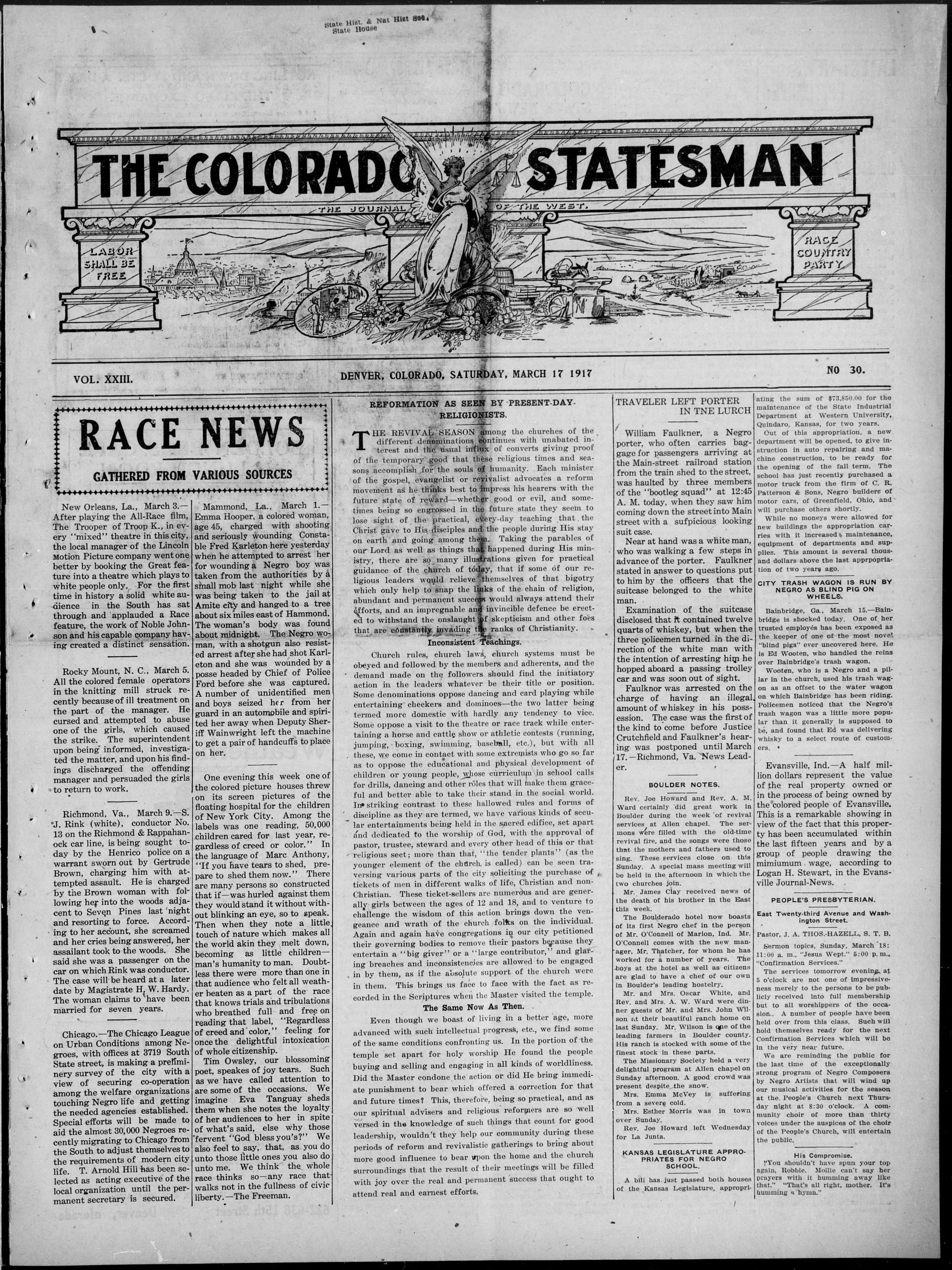
THE COLORADO STATESMAN
THE JOURNAL OF THE WEST.
LABOR SHALL BE FREE
RAGE COUNTRY PARTY
RACE NEWS
VOL. XXIII.
RACE
GATHERED FROM
New Orleans, La., March 3. After playing the All-Race film, The Trooper of Troop K., in every "mixed" theatre in this city, the local manager of the Lincoln Motion Picture company went one better by booking the Great feature into a theatre which plays to white people only. For the first time in history a solid white audience in the South has sat through and applauded a Race feature, the work of Noble Johnson and his capable company having created a distinct sensation.
Rocky Mount, N. C., March 5. All the colored female operators in the knitting mill struck recently because of ill treatment on the part of the manager. He cursed and attempted to abuse one of the girls, which caused the strike. The superintendent upon being informed, investigated the matter, and upon his findings discharged the offending manager and persuaded the girls to return to work.
Richmond, Va., March 9.—S. J. Rink (white), conductor No. 13 on the Richmond & Rappahanock car line, is being sought today by the Henrico police on a warrant sworn out by Gertrude Brown, charging him with attempted assault. He is charged by the Brown woman with following her into the woods adjacent to Seven Pines last night and resorting to force. According to her account, she screamed and her cries being answered, her assailant took to the woods. She said she was a passenger on the car on which Rink was conductor. The case will be heard at a later date by Magistrate H. W. Hardy. The woman claims to have been married for seven years.
Chicago.—The Chicago League on Urban Conditions among Negroes, with offices at 3719 South State street, is making a preliminary survey of the city with a view of securing co-operation among the welfare organizations touching Negro life and getting the needed agencies established. Special efforts will be made to aid the almost 30,000 Negroes recently migrating to Chicago from the South to adjust themselves to the requirements of modern city life. T. Arnold Hill has been selected as acting executive of the local organization until the permanent secretary is secured.
Mammond, La., March 1. Emma Hooper, a colored woman, age 45, charged with shooting and seriously wounding Constable Fred Karleton here yesterday when he attempted to arrest her for wounding a Negro boy was taken from the authorities by a small mob last night while she was being taken to the jail at Amite city and hanged to a tree about six miles east of Hammond. The woman's body was found about midnight. The Negro woman, with a shotgun also resisted arrest after she had shot Karleton and she was wounded by a posse headed by Chief of Police Ford before she was captured. A number of unidentified men and boys seized her from her guard in an automobile and spirited her away when Deputy Sheriff Wainwright left the machine to get a pair of handcuffs to place on her.
One evening this week one of the colored picture houses threw on its screen pictures of the floating hospital for the children of New York City. Among the labels was one reading, 50,000 children cared for last year, regardless of creed or color." In the language of Marc Anthony, "If you have tears to shed, prepare to shed them now." There are many persons so constructed that if—was hurled against them they would stand it without without blinking an eye, so to speak. Then when they note a little touch of nature which makes all the world akin they melt down, becoming as little children—man's humanity to man. Doubtless there were more than one in that audience who felt all weather beaten as a part of the race that knows trials and tribulations who breathed full and free on reading that label, "Regardless of creed and color," feeling for once the delightful intoxication of whole citizenship.
Tim Owsley, our blossoming poet, speakes of joy tears. Such as we have called attention to are some of the occasions. We imagine Eva Tanguay sheds them when she notes the loyalty of her audiences to her in spite of what's said, else why those fervent "God bless you's?" We also feel to say, that, as you do unto those little ones you also do unto me. We think the whole race thinks so—any race that walks not in the fullness of civic liberty.—The Freeman.
REFORMATION AS SEEN BY PRESENT-DAY-RELIGIONISTS.
THE REVIVAL SEASON among the churches of the different denominations continues with unabated interest and the usual influx of converts giving proof of the temporary good that these religious times and seasons accomplish for the souls of humanity. Each minister of the gospel, evangelist or revivalist advocates a reform movement as he thinks best to impress his hearers with the future state of reward—whether good or evil, and sometimes being so engrossed in the future state they seem to lose sight of the practical, every-day teaching that the Christ gave to His disciples and the people during His stay on earth and going among them. Taking the parables of our Lord as well as things that happened during His ministry, there are so many illustrations given for practical guidance of the church of today, that if some of our religious leaders would relieve themselves of that bigotry which only help to snap the links of the chain of religion, abundant and permanent success would always attend their efforts, and an impregnable and invincible defence be erected to withstand the onslaught of skepticism and other foes that are constantly invading the ranks of Christianity.
Inconsistent Teachings.
ines, church laws, church law is followed by the members and also by the followers should fit readers whatever be their nations oppose dancing and creeckers and dominoes—the domestic with hardly any visit to the theatre or race track and cattle show or athletic ring, swimming, baseball, etc. can contact with some extreme educational and physical people, whose curricul-ing and other roles that will enable to take their stand in contrast to these hallowed runes are termed, we have various being held in the sacred to the worship of God, with steward and every other he more than that, "the tenderest of the church is called) parts of the city soliciting in different walks of life. The ticket-sellers are numerous when the ages of 12 and 18, a wisdom of this action bring with of the church folks or have congregations in our bodies to remove their pass- giver" or a "large contrie- inconsistencies are allow- if the absolute support of brings us face to face with scriptures when the Master w
Church rules, church laws, church systems must be obeyed and followed by the members and adherents, and the demand made on the followers should find the initiatory action in the leaders whatever be their title or position. Some denominations oppose dancing and card playing while entertaining checkers and dominoes—the two latter being termed more domestic with hardly any tendency to vice. Some oppose a visit to the theatre or race track while entertaining a horse and cattle show or athletic contests (running, jumping, boxing, swimming, baseball, etc.), but with all these, we come in contact with some extremists who go so far as to oppose the educational and physical development of children or young people, whose curriculum in school calls for drills, dancing and other roles that will make them graceful and better able to take their stand in the social world. In striking contrast to these hallowed rules and forms of discipline as they are termed, we have various kinds of secular entertainments being held in the sacred edifice, set apart and dedicated to the worship of God, with the approval of pastor, trustee, steward and every other head of this or that religious sect; more than that, "the tender plants" (as the younger element of the church is called) can be seen traversing various parts of the city soliciting the purchase of tickets of men in different walks of life, Christian and non-Christian. These ticket-sellers are numerous and are generally girls between the ages of 12 and 18, and to venture to challenge the wisdom of this action brings down the vengeance and wrath of the church folks on the individual. Again and again have congregations in our city petitioned their governing bodies to remove their pastors because they entertain a "big giver" or a "large contributor," and glaring breaches and inconsistencies are allowed to be engaged in by them, as if the absolute support of the church were in them. This brings us face to face with the fact as recorded in the Scriptures when the Master visited the temple.
The Same Now As Then.
which we boast of living in a such intellectual progress, conditions confronting us. In the for holy worship He firing and engaging in all kind
Even though we boast of living in a better age, more advanced with such intellectual progress, etc., we find some of the same conditions confronting us. In the portion of the temple set apart for holy worship He found the people buying and selling and engaging in all kinds of worldliness. Did the Master condone the action or did He bring immediate punishment to bear which offered a correction for that and future times? This, therefore, being so practical, and as our spiritual advisers and religious reformers are so well versed in the knowledge of such things that count for good leadership, wouldn't they help our community during these periods of reform and revivalistic gatherings to bring about more good influence to bear upon the home and the church surroundings that the result of their meetings will be filled with joy over the real and permanent success that ought to attend real and earnest efforts.
TRAVELER LEFT PORTER IN TNE LURCH
William Faulkner, a Negro porter, who often carries baggage for passengers arriving at the Main-street railroad station from the train shed to the street, was hauled by three members of the "bootleg squad" at 12:45 A. M. today, when they saw him coming down the street into Main street with a suspicious looking suit case.
Near at hand was a white man, who was walking a few steps in advance of the porter. Faulkner stated in answer to questions put to him by the officers that the suitcase belonged to the white man.
Examination of the suitcase disclosed that it contained twelve quarts of whiskey, but when the three policemen turned in the direction of the white man with the intention of arresting him he hopped aboard a passing trolley car and was soon out of sight.
Faulkner was arrested on the charge of having an illegal amount of whiskey in his possession. The case was the first of the kind to come before Justice Crutchfield and Faulkner's hearing was postponed until March 17.—Richmond, Va. News Leader.
BOULDER NOTES.
Rev. Joe Howard and Rev. A. M. Ward certainly did great work in Boulder during the week of revival services at Allen chapel. The sermons were filled with the old-time revival fire, and the songs were those that the mothers and fathers used to sing. These services close on this Sunday. A special mass meeting will be held in the afternoon in which the two churches join.
Mr. James Clay received news of the death of his brother in the East this week.
The Boulderado hotel now boasts of its first Negro chef in the person of Mr. O'Connell of Marion, Ind. Mr. O'Connell comes with the new manager, Mr. Thatcher, for whom he has worked for a number of years. The boys at the hotel as well as citizens are glad to have a chef of our own in Boulder's leading hostelry.
Mr. and Mrs. Oscar White, and Rev. and Mrs. A. W. Ward were dinner guests of Mr. and Mrs. John Wilson at their beautiful ranch home on last Sunday. Mr. Wilson is one of the leading farmers in Boulder county. His ranch is stocked with some of the finest stock in these parts.
The Missionary Society held a very delightful program at Allen chapel on Sunday afternoon. A good crowd was present despite the snow.
Mrs. Emma McVey is suffering from a severe cold.
Mrs. Esther Morris was in town over Sunday.
Rev. Joe Howard left Wednesday for La Junta.
KANSAS LEGISLATURE APPROPRIATES FOR NEGRO SCHOOL
A bill has just passed both houses of the Kansas Legislature, appropi-
ating the sum of $73,850.00 for the maintenance of the State Industrial Department at Western University, Quindaro, Kansas, for two years. Out of this appropriation, a new department will be opened, to give instruction in auto repairing and machine construction, to be ready for the opening of the fall term. The school has just recently purchased a motor truck from the firm of C. R. Patterson & Sons, Negro builders of motor cars, of Greenfield, Ohio, and will purchase others shortly. While no moneys were allowed for new buildings the appropriation carries with it increased maintenance, equipment of departments and supplies. This amount is several thousand dollars above the last apprpropriation of two years ago.
CITY TRASH WAGON IS RUN BY NEGRO AS BLIND PIG ON WHEELS.
Bainbridge, Ga., March 15.—Bainbridge is shocked today. One of her trusted employees has been exposed as the keeper of one of the most novel "blind pigs" ever uncovered here. He is Ed Wooten, who handled the reins over Bainbridge's trash wagon. Wooten, who is a Negro and a pillar in the church, used his trash wagon as an offset to the water wagon on which Bainbridge has been riding. Policemen noticed that the Negro's trash wagon was a little more popular than it generally is supposed to be, and found that Ed was delivering whisky to a select route of customers.
Evansville, Ind.—A half million dollars represent the value of the real property owned or in the process of being owned by the colored people of Evansville. This is a remarkable showing in view of the fact that this property has been accumulated within the last fifteen years and by a group of people drawing the mimumum wage, according to Logan H. Stewart, in the Evansville Journal-News.
PEOPLE'S PRESBYTERIAN
East Twenty-third Avenue and Washington Street.
Pastor, J. A. THOS-HAZELL, S. T. B.
Sermon topics, Sunday, March 18:
11:00 a. m., "Jesus Wept." 5:00 p. m.,
"Confirmation Services."
The services tomorrow evening, at 5 o'clock are not one of impressiveness merely to the persons to be publicly received into full membership but to all worshippers of the occasion. A number of people have been held over from this class. Such will hold themselves ready for the next Confirmation Services which will be in the very near future.
We are reminding the public for the last time of the exceptionally strong program of Negro Composers by Negro Artists that will wind up our musical activities for the season at the People's Church next Thursday night at 8:30 o'clock. A community choir of more than thirty voices under the auspices of the choir of the People's Church, will entertain the public.
His Compromise.
"You shouldn't have spun your top again, Robbie. Mollie can't say her prayers with it humming away like that." "That's all right, mother. It's humming a hymn."
LATEST NEWS EPITOMIZED
FROM TELEGRAPHIC REPORTS THAT COVER THE WEEK'S EVENTS.
OF MOST INTEREST
KEEPING THE READER POSTED
ON MOST IMPORTANT
CURRENT TOPICS.
ABOUT THE WAR
Berlin says sixteen hostile aircraft brought down in France.
Bagdad capture includes two-thirds of Turkish army's artillery.
London reports bringing down nine German airplanes in France.
North of the Ancre the left wing of the British in this particular operation has pushed back the Germans. The repulse of an Austrian attack northeast of Lenzumo in the Trentino, is announced by the Rome war office. British cavalry from Bagdad has occupied Kazimain, on the Tigris river five miles above Bagdad, it was officially announced. The First New Mexico infantry will be mustered out at Columbus about March 20, and the First Arizona infantry at Douglas the same date. The Berlin official report for March 11 states that 42,000 tons of shipping were sunk. Together with the reports of March 7 and 8, this gives a total of more than 114,000 tons.
The advance gave King George's troops the village of Grevillers and the Loupart wood, bringing the advanced British forces at the former place to a scant mile and a half from the northwestern outskirts of Bapaume.
According to the British war office communication, under another of the terrific British bombardments the Germans have abandoned their main defensive system west of Bapaume on a front of three and one-half miles to a depth of a mile.
An "armed guard" for the protection of vessels and lives of persons aboard will be placed on all American merchant ships sailing through Germany's barred area, the State Department notified all foreign diplomats in Washington.
Further notable gains have been made by the British forces against the Germans in the operations which have as their objective the capture of Bapaume and a general bending back of the German line eastward in the Somme and Ancre regions of France.
WESTERN
Four tramps were killed, three seriously injured and twenty received minor injuries in a freight wreck two miles south of Medford, Ore.
Hiram W. Johnson, United States senator-elect for California, announced his resignation from the governorship, effective March 15.
Snow and rain through the winter wheat belt saved the winter wheat crop from what seemed certain ruin. They broke a drought that had lasted nearly all winter.
There are 17,022,879 Catholics now in the United States, exclusive of island possessions, according to the Centennial edition of the official Catholic directory.
Half a dozen Mexicans were badly hurt when a truck carrying twenty three Mexicans turned over an embankment on the Ridge road to Bakersfield, twenty miles north of Saugus, Cal. A bill aimed at food price manipulation and empowering a state trade commission to fix reasonable maximum prices for necessities like food and fuel was introduced in the Iowa Legislature.
WASHINGTON
Vance McCormick, chairman of the Democratic national committee, is to be offered the post of ambassador to Japan, according to a well authenticated report.
The sinking of the Cunard nonpassenger liner Folio with one American aboard was reported to the State Department in a preliminary dispatch from Consul Frost at Queenstown.
The Federal Trade Commission notified the country's leading anthracite coal producers that any failure to grant the usual spring price reductions cannot be justified by claims of increased cost of production.
The fluctuating standings of the parties present the prospect that the Democrats will have 215 votes and the Republicans 214 when the special session of Congress convenes. It will require 218 to elect a speaker.
When the government's white book on relations with Germany is published it will contain revelations of the shipment of arms and ammunition from Germany to Huerta and of the unsuccessful efforts of the United States to checkmate the plans.
President Wilson has received applications for pardons for Maury I. Diggs and F. Drew Caminetti, convicted in California of violation of the white slave law, after a long and sensational legal fight, which ended in their convictions being sustained by the Supreme Court.
FOREIGN
The fall of Bagdad caused the greatest surprise in Berlin and Vienna.
Petrograd reports routing of Turks in Persia, driving them to Hadjiab.
The date of the next consistory has been fixed by Pope Benedict as March 22.
Sir Ernest Shackleton, the explorer, who now is at Sydney, Australia, says he is going into active war service.
Carlos Jaeger, Brazilian consul general in Vienna, committed suicide following an abortive attempt at self-destruction by his wife, according to an Amsterdam dispatch.
A Pekin dispatch to Reuter's says that the House of Representatives, at a secret session, approved the government's diplomatic policy, including a rupture with Germany.
The Nizam of Hyderabad, ruler of the largest and most populous of the internal states of India, sent to the British government $500,000 for use in the anti-submarine campaign.
As a special mark of honor to the late George W. Guthrie, American ambassador to Japan, the emperor is expected to detail a Japanese warship to transport the body to the United States.
A memorial service for Mrs. Mary Hoy and her daughter, Miss Elizabeth Hoy of Chicago, who lost their lives by the sinking of the British steamship Laconia by a German submarine, was held in St. Martin's church, Trafalgar Square, in London.
Laden with presents showered upon them by the Swiss, fifty-nine of the Yarrowdale prisoners arrived in Zurich, Switzerland. Although emaciated from their imprisonment and lack of food since their arrival in Germany on Dec. 31, they are in fair condition.
After announcing the fall of Bagdad in the House of Commons, Andrew Bonar Law, chancellor of the exchequer, said there was every reason to believe that two-thirds of the Turks' artillery had fallen into the hands of the British or had been thrown into the Tigris.
One thousand troops of the Sonora command of Gen. Guillermo Chavez left Juarez over the Mexican Central railroad to pursue Gen. José Ynez Salazar and his rebel command which attacked the passenger train at Laguna station March 9, killing forty-five of the de facto train guard and wounding three passengers.
SPORTING NEWS
Otto Wallace of Milwaukee won an easy decision over Kid Mex of Pueblo at the end of their fifteen round battle in Denver. The San Francisco Club of the Pacific Coast league defeated the Chicago National team No. 2 at Marysville, Cal., 7 to 3. The Fort Morgan five defeated the Akron basketball quintet in the final game of the season at Fort Morgan, Colo., by a score of 90 to 7. Miss Alice Johnson, 19 years old, a blonde and inevitably pretty, has drafted Al Mamaux, youthful pitching prodigy of the Pittsburg Pirates, for matrimonial duty in Brooklyn.
Frank A. Marshall, the American chess champion, created what is believed to be a new record for simultaneous play at Buffalo, N. Y. Marshall played against 144 local players, including one woman and five children. The best previous record known was 129. Marshall lost one game and drew twelve.
Twenty-five representatives of commercial clubs and rotary clubs in the eight cities in the Western Baseball league at a meeting, in Omaha as guests of the club owners passed resolutions directing the formation of "boosters' clubs" in each city in the league to "promote the general interest in baseball."
GENERAL
Another shipment of gold amounting to $7,200,000 has been received from Canada at the United States assay office in New York.
The United States has contributed a total of $9,980,602 to Belgium relief, according to a statement made by the commission for relief in Belgium.
Food, clothing and money for the relief of victims of the tornado which destroyed more than $1,000,000 worth of property and took a toll of nineteen lives in Newcastle, Ind., is needed.
Richard Jacobs, a prisoner in the Philadelphia police station, declared he was one of the German sailors who, under orders, wrecked the machinery of the German liner Vaterland at Hoboken, N. J.
A daily average of 29,420,000 telephone calls was recorded in 1916 by the Bell system, which was approximately at the rate of 100 calls a year for every man, woman and child in the United States.
The flood in the rivers at Pittsburgh, Pa., registered twenty-three feet, half a foot above the flood stage. Lower sections of the city are inundated, but reports indicated that the property damage will be small.
The Cuban consulate in New York announced the receipt of official confirmation of the complete evacuation of Santiago de Cuba by the rebel forces.
Plans for averting strikes in case of war were announced in New York by the National Civic Federation, and will be placed before the National Council of Defense.
Gold to the amount of $8,500,000 from Canada was deposited at the assay office in New York, Monday. Gold imports from all sources since Jan. 1 now total $213,500,000.
COLORADO STATE NEWS
Western Newspaper Union News Service.
DATES FOR COMING EVENTS.
March 20.—Auto Show at Denver.
Sept. 17-22—Colorado State Fair at Pueblo.
May 17-20—Convention Colorado Sunday School Association at Colorado Springs.
Denver is to have a fine municipal organ.
A class in citizenship for allies has been formed at Colorado Springs.
Senator Shafroth and Congressman B. C. Hilliard returned to Denver from Washington.
Governor Julius C. Gunter was the principal speaker at the luncheon of the Manufacturers' Bureau in Denver.
A rifle shoot, to rouse interest in better preparedness along these lines, will be held at Littleton on Memorial Day.
A dance and reception for the members of Battery B was given at El Jebel temple in Denver by the Mothers' Club of Battery B.
Forty have applied for the place as superintendent of the Pueblo public schools made vacant by the resignation of F. D. Slutz.
Subscriptions totaling $91,000 were secured by the Y. M. C. A. in their ten-day debt-lifting and improvement fund campaign in Denver.
Loyal Irishmen throughout Denver and the state will join in feasting and celebration in honor of St. Patrick, patron saint of Ireland.
Bootleg raids in North Denver resulted in twelve persons being taken to jail and a large quantity of whisky and beer confiscated.
Word of the death of Thomas Hale Potter, 75, pioneer mining man and banker of Colorado, at Detroit, Mich., was received in Denver.
Pueblo police have been asked to locate a man who wrote a check on a defunct bank and then had the nerve to pass it in a business transaction.
April 7th has been decided upon for the annual state meeting and election of officers for the Colorado division, Travelers' Protective Association.
A resolution to hereafter "disregard absolutely the State Industrial Commission" was unanimously adopted at a meeting of Denver Typographical Union No. 49.
Denver will be represented by two prominent women at the council meeting of the General Federation of Women's Clubs, to be held in New Orleans, April 9 to 13, inclusive.
Changes are pending in the railway mail service in and out of Denver in pursuance of the plan of the Postoffice Department to reorganize the service throughout the country.
The President has appointed the following Colorado postmasters: Colbran, Alderbert E. Humeston; Granada, Charles D. Baldwin; Nederland, Ralph H. Crawford; Springfield, R. O. Casady.
Representatives of the various Colorado chapters of the national society of the Daughters of the American Revolution were in Denver to attend the fourteenth annual conference of the state chapters.
Senator Agnes Riddle entertained the members of the Legislature and their wives at a dance at Glendale Grange hall, at Sullivan. There was a large attendance and the merriment ran to the highest point.
Charles Brown of Denver was elected captain of the University of Colorado baseball team at Boulder to fill the vacancy left by Robert McGraw, who is now in spring training with the New York Americans in Macon, Ga.
Colorado boys and girls enrolled in the Boys' and Girls' Clubs during the year 1916 made a net profit of $5,807.39 for the year, according to figures just issued from the office of the State Leader at the Agricultural College.
A rich and otherwise important strike has been made on the south slope of Battle mountain by the Granite Gold Mining Company in a fractional claim under lease to the Granite Company from the United Gold Mines Company of Victor.
Final arguments in the suit to test the right of the Mountain States Telephone and Telegraph Company to occupy the streets of Denver were completed before the State Supreme Court. The case now rests in the hands of the higher tribunal.
Protests against war and against the high cost of living were voiced at a meeting of the Denver branch of the International Brotherhood Welfare Association, otherwise known as the Migratory and Casual Workers, at the Club building in Denver.
A number of senators expressed their indignation in Denver upon learning that the prow of the cruiser Colorado given to Colorado by the federal government as a relic has remained in boxes unpacked, exposed to rain, snow and all kinds of weather for the last eight years.
Raymond M. Lowe, born in Greeley in 1882, is being held in Java, unable to get back to the United States because the authorities will not issue him a passport until his American citizenship is established.
STATE APPROPRIATIONS
COLORADO EXPENSE FUND WILL
TOTAL $3,000,000.
Chairman Ardourel Declares Measure
Appropriates About $150,000 Less
Than Amount in 1915.
Denver.—When the long appropriation bill for the biennial period of 1917 and 1918 was reported out by Chairman A. P. Ardourel of the House Appropriation Committee it carried items aggregating $3,000,000. The appropriation bill provides for the operation and maintenance of all departments of the state government.
Chaiman Ardourel let it be known that the measure carries approximately $150,000 to $250,000 less for expenditures than was appropriated two years ago.
The long appropriation bill, however, carries no appropriations for the state institutions, the committee recommending that these items be taken care of by special levies provided for in administration bills. The funds raised by special mill levies for institutions will bring the total up to about $6,000,000, it is estimated.
The disposition of the committee is to appropriate larger sums for the penal institutions, and also to turn over to the board of correction $52,000 to buy a convict farm for the penitentiary near Canon City. The total recommended for the Public Utilities Commission, the Industrial Board and the State Immigration bureau is $230,000.
The House passed a measure permitting the pensioning of policemen who have reached the age of 60 and have served 25 years in cities of the first and second class, at half pay. The bill provides for the payment of $30 a month to the widow or parents if dependent, of any policemen killed in the service or who dies while in the service.
The House passed a bill appropriating $3,500 for the compilation of Colorado's corporation laws. The compilation would be made under the direction of the secretary of state.
The Senate passed a modified herd and fence law, said to have the approval of the State Grange, the Farmers' Union, the Colorado Stockgrowers' Association and the State Livestock Board.
The State Senate passed Senator Hasty's bill, amending the initiative and referendum law, by a vote of 23 to 9. Under the provisions of the measure 8 per cent of the vote for secretary of state in each judicial district would be required on petitions for referendum or initiated measures. The House passed Senator West's bill making it possible for the governor to appoint Major General Frank D. Baldwin, U. S. A., retired, adjutant general to succeed H. P. Gamble. The Ardourel measure authorizes the payment of $2,610 by the state for incidental expenses incurred by the State Industrial Commission in the biennial period just closed.
The special Senate and House committee appointed to investigate the need for additional capitol buildings made a report to both Houses. It was recommended that the board of capitol managers be made a permanent institution and that the four members be appointed in the future for eight-year terms without compensation. The Friend bill authorizes a farmer or any other citizen to obtain permission from the State Game Department to kill pheasants when it is shown that they are destroying grain, fruit, or vegetables on his property.
Big Increase in Oil Inspection.
During 1915 and 1916 James Duce, state oil inspector, inspected 45,867,605 gallons of gasoline and refined oil as compared with 29,250,481 gallons for the two preceding years. These give some idea of the expansion of the automobile industry in Colorado They were given in a report submitted to Governor Gunter by the state oil inspector. The revenues from inspection increased from $29,254 during the first biennial period to $45,867 in the last two years. The expenses for the last two years were $15,293, leaving a balance to the state of $30,537. The consumption of gasoline in 1916 was 19,253,000 gallons, an increase of 36 per cent over 1915. The kerosene consumed last year was 5,518,000 gallons against 5,994,000 gallons in 1915. The production of crude oil in the state during the last two years was 16,605,000 gallons in the Florence field and 459,000 gallons in the Boulder field.
Parody of National Anthem Prohibited Singing or playing "The Star Spangled Banner," or any part of it, in a medley or a performance in public is prohibited under the provisions of the bill by Senator Starkweather. The new act has been signed by the governor.
Two Immigration Board Bills.
There are two immigration bills pending. One calls for an appropriation of $77,500 to carry on the work of the board as it is now organized under the immigration act passed in 1909. The other provides for a reorganization of the board, with six members instead of three, putting the power of appointing the commissioners in the hands of the governor. This bill provides salaries of $600 annually for each of the board members. This bill calls for an appropriation of $100,000.
NOTHING DOWN AND 17 CTS. A DAY
BUYS A PIANO. SALE NOW ON.
THE PIANO EXCHANGE
H. A. TRIGGS, Manager
211 Charles Block. Cor. 15th and Curtis Streets. Phone Champa 3742.
Night and Day Cafe
919 19th street, between Champa and Curtis. Merchants' Lunch every day from 11:30 a. m. to 3:30 p. m., 20c. Short orders at all hours. Give us a trial. Phone Main 6699.
Can be rented very reasonable by Societies, Lodges and Organizations. The Hall is suitable for Entertainments, Dances and Athletic Exhibitions.
2132 ARAPAHOE ST.
BOLDEN
and LU
924 19th St
OLDEN BROS. CAFE and LUNCH ROOM 1924 19th Street, Denver, Colorado
924 19th Street, Denver, Colorado
DINNER
11:30 to 2 p.m.
All Kinds of Sandwiches
Bolden Bro
Baths,
FIRST
R. B. BOLDEN,
Weather
TELEPH
Est
PIONEER HA
WE MAKE
PRACTICE
RENOVATORS, BLEAC
Of Gents' and Ladies
1624 Cham
Golden Bros. Barber Sh
Baths, Electric Massage
FIRST CLASS SERVICE
. BOLDEN, Mgr. 926 19th St. D
atherhead Hat
TELEPHONE MAIN 3203
Bolden Bros. Barber Shop
Baths, Electric Massage
FIRST CLASS SERVICE
R. B. BOLDEN, Mgr. 926 19th St. Denver
Weatherhead Hat Co. TELEPHONE MAIN 3208
Established 1876
PIONEER HATTERS OF THE WEST
WE MAKE OLD HATS NEW
PRACTICAL HATTERS
VATORS, BLEACHERS DYERS AND FINE
Gents' and Ladies' Hats of Every Descripti
1624 Champa St., Denver, Colo.
RENOVATORS, BLEACHERS DYERS AND FINISHERS Of Gents' and Ladies' Hats of Every Description 1624 Champa St., Denver, Colo.
Meats, Fancy 1864
JOHN K. RETTIG
Fancy and Staple Gro
1864 CURTIS STREET
eighteenth.
MARKET COMP
S. E. SMITH, Manager, Res. Phone South 160
and Retail Staple and Fancy Groceries, Fish
Hotels and Restaurants Our Specialty.
Fresh and Cured
Eastern Corn Fed Mea
Meats, Fancy and Staple Groceries 1864 CURTIS STREET
The MARK
C. E. SMITH, M
Wholesale and Retail Staple
Hotels and Re
Fred
Eastern C
The MARKET COMPANY
C. E. SMITH, Manager, Res. Phone South 1608
Wholesale and Retail Staple and Fancy Groceries, Fish and Oysters Hotels and Restaurants Our Specialty. Fresh and Cured
Fruits, Vegetables, Poultry and Game.
Telephones Ma
622-636 15th Street
Telephones Main 4302, 4303, 4304, 4305
15th Street Denver,
Telephones Main 4302, 4303, 4304, 4305 622-636 15th Street Denver, olorado
PHONE MAIN 3028
Corner Nineteenth.
ORDERS taken over phone.
NER HALL
Societies, Lodges and Or-
ble for Entertainments,
SERVED.
PHONE MAIN 2449
OS. CAFE
ROOM
ver, Colorado
Short Orders at All Hours
Barber Shop
Massage
SERVICE
926 19th St. Denver
d Hat Co.
IN 3203
1876
OF THE WEST
HATS NEW
HATTERS
HATTERS AND FINISHERS
Of Every Description
Denver, Colo.
RES. PHONE GALLUP 943
ETTIG
Staple Groceries
STREET
Denver, Colo.
COMPANY
Phone South 1608
Groceries, Fish and Oysters
Our Specialty.
red
Fed Meats
303, 4304, 4305
Denver, olorado
VINE
```markdown
```
A
Words of frank cheer, glances of friendly eyes.
Love's smallest coin, which yet to some may give
The morsel that may keep alive a starving heart.
DRIED APRICOTS.
Apricots dried are more valuable as a food than in the fresh stage, the wri
more valuable as fresh stage, the winter is evaporated and sugar is added making a more concentrated food with all the aroma, flavor and color still present.
VINEGAR
Dried apricots stewed and put through a sieve, using sugar and cream, a pinch of salt, then frozen, makes a most dainty ice cream of delicious flavor.
Apricot shortcake is the ordinary shortcake served with stewed apricots and the sauce thickened slightly, with a little butter added for richness.
Raisin Pie de Luxe.—Stew together a cupful of seeded raisins and a quarter of a cupful of currants (drilled) in a pint of apricot juice. Add three tablespoonfuls of butter and two egg yolks and a tablespoonful or two of lemon juice, sugar if needed, cook slightly. Put into a shell, previously baked, cover with a meringue made with the whites of the two eggs and four tablespoonfuls of sugar.
Fifteen-Minute. Pudding.—Take a cupful of flour, a quarter of a teaspoonful of salt and a teaspoonful of baking powder, sift together and add just enough rich milk to make a drop batter. Butter some cups, either custard or any pudding cups, put into each a spoonful of the drop batter, then drop in two or three apricots with a tablespoonful of the juice, add another spoonful of the dough on top, then put into a pan of boiling water to steam, allowing the cups to set in the water, not too deep, as the water will boil into the cups. Cover tightly and cook 15 minutes. Serve with whipped cream with a few chopped apricots stirred into it.
Apricot dumplings may be made as one does apple dumplings: roll two or three pieces of the fruit in a square of biscuit dough, cover the dumplings with the apricot juice with bits of butter and bake for a half hour in a hot oven.
A coffee cake is made quite fancy by rows of stewed apricots placed on top just before it goes into the oven. Such a cake may be served hot with a sauce for a dessert if so desired.
We all know we cannot always make ourselves well, but few perhaps realize how much we can do to keep ourselves well—Sir John Lubbock.
LENTEN DISHES OF SALMON.
If eggs continue at their present high price, dishes of other foods will
of necessity need to be served to save their cost. Salmon is such a favorite fish and either fresh or canned is always to be found on the market. Salmon Cups. — Chop fine the contents of a can of salmon, add to it
served to save their cost. Salmon is such a favorite fish and either fresh or canned is always to be found on the market.
Salmon Cups. — Chop fine the contents of a can of salmon, add to it a half cupful of soft bread crumbs, two tablespoonfuls of melted butter, one of lemon juice, two beaten eggs, salt and pepper to taste and a half cupful of rich milk. Mix until well blended, then pack in greased cups, set into a pan of water and bake until firm. Turn out and serve hot on individual dishes with white sauce.
Salmon Soup. — Cook a grated onion for ten minutes in a quart of milk. Add two tablespoonfuls each of flour and butter, cooked together; add salt and pepper and half a can of salmon. Cook ten minutes, press through a sleeve and serve very hot.
Fried Smoked Salmon.—Make a marinade of four tablespoonfuls of olive oil, two of vinegar, two cloves, a bay leaf and six pepper corns. Pour this over a pound of smoked salmon and let stand for several hours. Then fry the slices in a good salad oil and serve at once, garnished with slices of lemon.
Salmon Souffle.—Flake a can of salmon, add to it the well beaten yolks of three eggs, a half cupful of bread crumbs which have been soaked in warm milk, salt, pepper and a little lemon juice. Beat the whites of the eggs until stiff, then fold them into the mixture. Bake in a moderate oven in a buttered dish set in hot water.
Scalloped Salmon With Peas.—If canned peas are used drain them from the liquor, put a layer of salmon, free from skin and bones, with a cupful of bread crumbs and two $ ^{3} $ cupfuls of thin white sauce in layers with the peas and white sauce, using the crumbs buttered to cover the top. Bake until the crumbs are brown.
Potatoes may be used in place of peas. Salmon made into a loaf and steamed, then garnished with cooked peas with a sauce, makes another delicious and nourishing dish of peas with salmon.
Fish Souffle.—Make a white sauce, using two tablespoonfuls each of butter and flour, adding the flour when the butter is bubbling hot; add a cupful and a half of milk, a teaspoonful of scraped onion, a tablespoonful of minced parsley, and two cupfuls of canned fish. Beat three egg yolks and add to the fish, then fold in the beaten whites and bake in a moderate oven until firm in the center. Serve with a white or tomato sauce.
Nellie Maxwell
SHELL AND SINK AMERICAN SHIP
U-BOAT CREW BOARDS STEAMER ALGONQUIN AND SETS OFF FOUR BOMBS.
TWENTY-SEVEN LANDED
TEN U.S. CITIZENS ON LONDON-BOUND SHIP WITH CARGO VALUED AT $1,700,000.
Western Newspaper Union News Service.
Washington, March 15.—The torpedoing of the American steamer Algonquin without warning and an impressive report made to Secretary of State Lansing by James W. Gerard, the American ambassador, recalled from Germany, have convinced the administration that the Berlin government does not contemplate any modification of ruthless submarine warfare. Mr. Gerard reached Washington Wednesday and delivered at once to the State Department a budget of secret documents which he carried strapped to his arm throughout his journey from Berlin.
London.—The American steamship Algonquin was shelled by a German submarine, without warning, according to a report made by the American consul at Plymouth. The consul states that all on board were saved, including ten Americans.
According to a report from J. G. Stephens, American consul at Plymouth, the captain of the Algonquin stated that his ship was sunk by shell fire without warning.
According to advices from Plymouth the German submarine opened fire upon the Algonquin from a distance of 4,000 yards, firing about twenty shells. These were not sufficient to sink the steamer, so she was boarded by men from the submarine, who placed four bombs, and the Algonquin was blown up. The crew was given plenty of time to leave the vessel.
The Algonquin, owned by the American Star line, sailed from New York for London on Feb. 20.
New York.—The American steamship Algonquin, with ten Americans aboard, was sunk by a German submarine on March 12, with a loss of vessel and cargo valued at $1,700,000. A cable message received here by her owners, and dispatches from London, told of the apparent safety of all the officers and crew, twenty-seven of whom have been landed.
Washington.—The State Department has received confidential reports indicating that Germans are rapidly displacing other foreigners in the advisory councils of the present government of Mexico. The reports indicate that the Germans have enlarged their sphere of influence from the direction of munition plants to the financial, commercial and political fields and that the Mexicans are gladly accepting their assistance.
Costigan Parity Commission Member
Washington.—President Wilson has selected the following men as members of the Tariff Commission; Prof. Frank W. Taussig of Harvard University; former Representative David J. Lewis of Cumberland, Md.; former Representative William Kent of Kentfield, Cal.; Daniel C. Roper of McCall, S. C.; E. P. Costigan of Denver, Colo.; W. S. Culbertson of Emporia, Kan.
Wilson May Appeal to Patriotism.
Washington, March 15.—President Wilson will act promptly and decisively to prevent any general tie-up of the commerce of the country through a great railroad strike while the nation is confronted with the dire possibilities of the present international situation. Convinced that both the railroads and their employés will put aside their own differences to join in the defense of the country, the President is prepared to once more step into the railroad controversy if the threatened strike becomes acute.
Woman Murdered With Hammer, Denver.—John Whitson, a farm hand employed on the Jefferson county estate of Jesse F. Welborn, president of the Colorado Fuel and Iron Company, is under arrest in the Little ton jail, charged with the murder of his wife, whose body was found in her home at Logantown, her face beaten to a pulp and her skull crushed with a claw-hammer. Whitson denies the charge. Fifteen-year-old Beulah Whitson, the eldest of five children in the family, declares her parents had been quarreling.
German Ships in Harbors Seized.
Washington.—China has severed diplomatic relations with Germany, taken possession of all German merchant ships in Shanghai, about six in number, placed their crews under guard and placed armed guards on the vessels.
Obregon Resigns as War Minister.
'Mexico City.'—Gen. Obregon has resigned as minister of war in the Cabinet and shortly will retire 'to private life
GRAIN STOCKS SLUMP
STOCKS ON FARMS MARCH 1
SHOW BIG DECREASE.
Wheat Drops Million Bushels Below
1916—U. S. Report Shows That
Prices Are Higher.
Western Newspaper Union News Service.
Denver.—A summary of the March
crop report for Colorado as compiled
by the Bureau of Crop Estimates,
United States Department of Agriculture,
is as follows:
Wheat—Estimated stocks on farms
March 1, 2,020,000 bushels, compared
with 3,167,000 a year ago, and 2,036,
000 two years ago. Price March 1 to
producers, $1.50 per bushel, compared
with 97 cents a year ago, and $1.20
two years ago.
Corn—Estimated stocks March 1,
1,910,000 bushels, compared with 4,
850,000 a year ago, and 4,038,000 two
years ago. Price March 1 to producers,
91 cents per bushel, compared with
65 cents a year ago and 68 cents
two years ago.
The percentage of the 1916 corn
crop which was of merchantable
quality is estimated at 80 per cent, compared with 69 per cent of the 1915
crop, and 91 per cent of the 1914 crop.
Oats—Estimated stocks March 1,
2,300,000 bushels, compared with 3,
978,000 a year ago, and 4,290,000 two
years ago. Price March 1 to producers,
65 cents per bushel, compared with
48 cents a year ago, and 48 cents
two years ago.
Barley—Estimated stocks March 1, 1,130,000 bushels, compared with 1,166,000 a year ago, and 1,031,000 two years ago. Price March 1 to producers, 88 cents per bushel, compared with 59 cents a year ago, and 69 cents two years ago.
Pastor Arrested During Church Riot.
Greeley.—The town of Windsor, near here, was thrown into a state of excitement by a riot which took place at the usual Sunday morning services at the Evangelical Lutheran church. Sheriff C. A. Finch of Greeley was called upon to quell the disturbance, and at its close the pastor, the Rev. William Wilk, was placed under arrest on a charge of disturbance preferred by members of the congregation. The riot marks the climax to a long series of dissensions within the church. Mr. Wilk has been active in opposition to the proposed beet field child labor law, and has made several trips to Denver at the head of delegations protesting against it. His activities along this line, it is stated, aroused the antagonism of a part of the congregation.
Man Arrested in Sterling as a Spy.
Man Arrested in Sterling as a Spy. Sterling.—A man giving the name of Fred Schroeder was arrested by Sheriff Patterson on a farm near Willard on the charge that he is a German spy. He threatened to burn down a farmer's house and intimated to others that he is in the employ of the German government. He says he came here with another man from New York and has been working on the farm of William Sanstead for five months. The federal authorities in Denver have been informed.
Find Woman Guilty of Perjury.
Buena Vista.—Mary Lena Vaughn, a pretty 20-year-old woman, who was tried in the District Court here on a charge of perjury, was found guilty by a jury after being out only two hours. Mrs. Vaughn, according to the evidence, committed perjury at the July term of the District Court, held here, when she was battling for alimony, during the suit of her husband for divorce.
James Gaughan Dies From Paralysis.
Salida.—James Gaughan, 61, an employe of the Denver and Rio Grande railroad for twenty-nine years and since 1900 supervisor of bridges and buildings for the railroad, was seized with paralysis at Paonia and died after being brought to Salida.
Boulder Pioneer Burned to Death.
Boulder.—Andrew J. Klmber, 81, old-time miner of Boulder county, was burned to death in his log cabin at Spring Gulch, three miles east of Ward, by a fire thought to have been started either from his stove or a candle which he used for light.
To Employ Guardsmen.
Colorado Springs. — Unemployed members of Battery C, which returned from the border service are to be taken care of by a committee appointed by the Chamber of Commerce, to assist in securing employment for them.
Wrecked Wall Falls
Pueblo.—A crowd of several hundred persons gathered to watch the swaying of the east wall of the Central High School had a narrow escape when the wall, struck by a sudden gust of wind collapsed.
Youth Inhales Cold Remedy; Dies.
Boulder.—Chesley B. Yates, 18 years old, was found dead in bed here. The death was caused, officers elieve, by an overdose of chloroform and denatured alcohol, taken to relieve a cold.
Littleton Man Run Down and Injured.
Littleton.—W. E. Coffin was run down and severely injured by a card driven by W. T. Butler of Denver. Mr. Coffin suffered a broken nose, a badly bruised hip and minor bruises.
CZAR FORCED FROM THRONE
DUMA HEADS RUSSIAN REVOLUTION AND IS IN FULL CONTROL OF THE GOVERNMENT.
GRAND DUKE IS REGENT
RICH AND POOR FIGHT SIDE BY
SIDE IN REBEL ARMY THAT
QUITS THE CZAR.
London, March 16.—A Petrograd dispatch to the Daily Chronicle, dated Wednesday, says the Empress of Russia has been placed under guard.
Petrograd, March 16.—The Emperor of Russia has abdicated and Grand Duke Michael Alexandrovitch, his younger brother, has been named as regent for the twelve-year-old Czarevitch. The Russian ministry, charged with corruption and incompetence, has been swept out of office. Alexander Protopopoff, head of the Interior Department, and former minister Sturmer, are reported killed. The other ministers, and the president of the Imperial Council are under arrest. A new Cabinet is announced, with Prince Lvoff as president of the Council and premier, and the other offices held by men close to the Russian people.
For several days Petrograd has been the scene of one of the most remarkable uprisings in history. Beginning with minor food riots and labor strikes, the cry for food reached the hearts of the soldiers, and one by one the regiments rebelled until finally those troops that had for a time stood loyal to the government took up their arms and marched into the ranks of the revolutionists. The president of the Duma, Michael V. Rodzianko, was the leading figure among the deputies who unanimously decided to oppose the imperial order for a dissolution of the house. They continued their sessions and M. Rodzianko informed the Emperor, then at the front, that the hour had struck when the will of the people must prevail.
Even the imperial council realized the gravity of the situation and added its appeal to that of the Duma that the Emperor should take steps to give the people a policy and government in accordance with their desires and in order that there should be no interference with carrying on the war to a victorious ending.
The Emperor hastened back from the front, only to find that the revolution had been successful and that a new government was in control.
The empress, who, it is alleged, has been influential in the councils opposed to the wishes of the people, is reported to have fled or to be in hiding.
Although considerable fighting took place, it is not believed that the casualties are large.
The early period of the uprising bore the character rather of a mock revolution staged for an immense audience. Cossacks charging down the street did so in a half-hearted fashion, plainly without malice or intent to harm the crowds that they playfully dispersed. Until Sunday night this pageant continued without serious interruption. Then in a flash the whole scene lost its theatrical quality, it became a genuine revolution.
STRIKE ORDER ISSUED
Four Hundred Thousand Men Involved in Railroad Walkout to Be in Series 12 and 24 Hours Apart. New York, March 16.—The railway officials and the representatives of their employés parted Thursday evening with both compromise offers refused, and settlement by direct conference seemingly removed from possibility when the "Big Four" Brotherhood chiefs flashed orders for a "progressive" strike to begin at 6 o'clock Saturday night. It will extend to every part of the United States by next Friday morning.
The order to strike was put on the wires a few moments after an ultimatum delivered to the conference committee of railroad managers had been rejected. A compromise proposal offered by the managers was declined without debate. Four hundred thousand and men are affected by the strike order. It is not known generally at what time the "progressive" strike will reach Colorado, but probably it will be Wednesday.
Grayson Confirmed as Rear Admiral. Washington—Dr. Cary T. Grayson, President Wilson's friend and naval aide, was confirmed by the Senate as medical director and rear admiral in the navy after a long fight against him.
Boy Shot as Villa Spy.
Douglas, Ariz.—Felipe Gomez, aged 20, was executed by a firing squad in Agua Prjeta following conviction as a Villa spy. Gomez refused to allow his eyes to be bandaged.
FLORAL DESIGNS PUT UP WHILE YOU WAIT
CHOICE PLANTS AND CUT FLOWERS CONSTANTLY ON HAND
GREENHOUSES: Thirty-Fourth and Curtis Streets
TELEPHONE, MAIN 1511 DENVER, COLO
The Champa Pharmacy
When You Want
When You Want
The Heads, Feet, Tails, Snouts, Neckbones or Chiterlings, or any other part of the hog except the squeal, go to
JOSEPH CARTER
Express, Moving,
and Storage
COAL AND WOOD
PROMPT DELIVERY.
Phone Main 6544.
2415 WASHINGTON STREET.
TELEPHONE YORK 6668.
J. H. Biggins
GENERAL FURNITURE REPAIRING
AND UPHOLSTERING.
WORK GUARANTEED.
1417 East 24th Avenue, Denver, Colo.
2300-6 Larimer Street Phone Main 1461
1848 Arapahoe
Phone Main 4896
Miss M. Cowden
Hair Dressing Parlor
Shampoo, cutting and curling.
Scalp treatment, hair tonics,
hair straightening, manicuring.
Stage wigs for rent; theatrical
use and masquerades.
Goods delivered out of the city. All shades of hair matched by sending sample of hair; also combings made up.
Cheapest Switches 50 Cents
1219 21st St. Denver, Colo.
DO IT NOW Subscribe for THIS PAPER
THE COLORADO STATESMAN
MADE ON SHARE THE FREEDOM
MADE ON COURTINI PARTY
1824 Curtis Street, Room 25.
Phone Main 7417.
SUBSCRIPTION RATES.
One Year ..... $ 2.03
Six Months ..... 1.00
Three Months ..... .60
PAYABLE IN ADVANCE.
No discounts allowed on less than three months' contract. Cash must accompany all orders from parties unknown to us. Further particulars on application.
Reading notices, ten lines or less, 10 cents per line. Each additional line over ten lines, 5 cents per line. Display advertising 50 cents per inch.
Communications to receive attention must be newsy, upon important subjects, plainly written only upon one side of the paper, must reach us Tuesday, if possible, anyway not later than Wednesday, and bear the signature of the author. No manuscript returned, unless stamps are sent for postage. All communications of a personating nature that are not complimentary will be withheld from the columns of this paper.
Remittances should be made by Express Money Order, Postoffice Money Order, Registered Letter or Bank Draft. Postage stamps will be received the same as cash for the fractional part of a dollar. Only 1c and 2c stamps taken.
CLEAN UP FOR SPRING.
"ABSOLUTELY necessary," says the student of cleanliness, and his argument that the medical world backs up the expression, "Clean up," in their special advices—"Clean up your system for Spring," "Purify your blood and put yourself in good shape," finds an answer in the readiness that people engage in to clean the house, the furniture, the premises as a whole, etc. A few days more and we enter the season of spring when everything seems to awake with a joyousness that throws aside the dull cares and actions that seem to beset us in the dreary months of winter, and it is then that we should act in advance of the reminder of our city authorities, who pay their annual visits through their representatives to advise the donning of our spring garb by "cleaning up." We have gotten praise here and there from visitors to our city, and we might say, WELL MERITED, but there is room for improvement, and if we would only realize the benefits to be achieved from each one assigning himself or herself the pleasurable duty of getting into the crevices and corners also polishing the surfaces we would start at once for the all-desirable end.
The psalmist of old could not help from expressing, "How amiable are thy dwellings!" when he beheld the beauty, the grandeur and the cleanliness of the tabernacle, and we can in these days hear similar exclamations if we resolve to adhere to the laws which guide our health and make us the possessors of long life and comfort.
We hope 1917 comments will surpass the previous years, and this will be the banner year in the general cleanliness of home and city.
LABOR ORGANIZATIONS PRESENT A PROBLEM.
We were just about commending the labor organizations for the stand they took through their representatives at Washington this week when they resolved to offer their services in and for this country's cause against any aggression or invasion, when news came to us of an intending strike among the railroad men along the lines proposed shortly before the presidential election of last year—the same to begin today and continue until the heads of the various railroads grant the demand or the government takes possession of the railway. While the Negro comes in for little or no entertainment among these labor unions in the United States, and while serious embarrassments have been his lot by being opposed for service, however competent he may be, he cannot help from giving particular attention and taking special notice of the fast and loose game that is being played by these "patriotic sons of the soil," who would have us believe in their righteous support to be given to this country at this critical period of her history, and at the same time or with the same breath are endeavoring to offer such gigantic obstructions in the shape of tieing up our whole system of transportation. Surely this is a puzzle, and it leads us to venture the questions: Are these organizations sane? Are they serious? Have they any spark of loyalty to our government? Do they preach love of country and all other things that make for honest and true citizenship? What are we to determine from this action of these "American labor specialists," that there will be no chance or opportunity to remedy the national wrongs heaped upon us from without on account of fear of the enemy within? That at last they have become so powerful because the perilous moment faces our door or borders on our threshold as to make a demand to force the highest legal authority of our land to be caught in the meshes of class-justice and compromise-judgment by giving a decision favorable to them, which will then secure their services as supporters of the nation's defensive action? If this is the patriotic act to influence others, then well may the three or four millions of the membership of this special class of labor come forward and boldly declare that any help to be gotten from them in maintaining the rights of this nation and the preservation of every virtue and principle would be CONDITIONAL, and then our heads of government will be thoroughly acquainted with their position and prepared to cope with it.
Incidents of this nature offer tests for qualified citizens of a country, and by this time the President of the U. S. A. is beginning to realize that the program of preparedness must be rushed with the greatest speed and at any cost, so that if it necessitates the two-fold action of fighting the enemy within and without, he will have the satisfaction of viewing the successful results from the band of loyalists among whom will be a class of Americans who, although despised, persecuted and ostracized from many institutions and organizations of this land on account of race and color, will prove now, as in former years, their true and devoted attachment to this country and nation of which they are a component part. It is regrettable that at this time the interests of organizations should be first served in preference to the vital interests of a nation, but these are only lessons which include higher studies, and therefore must take deeper thoughts to solve the problems they present. Should the necessity arise for a call to arms, in spite of these impending obstructions, the slogan, "Your country needs you," will find more millions in response than the few obstructionists. LONG LIVE AMERICA. HONOR TO THE STARS AND STRIPES.
The Woodiot.
Radium Emanations.
The farm woodlot can furnish work for men and teams during the winter months when other work is scarce. Besides aiding the farmer on the labor question, the woodlot can supply a portion of the building material, the bulk of the repair material and a large part if not all, of the fuel used on the average farm. In addition, the well-kept woodlot may be made a source of outside income through sales of timber, ties or fuel wood.
The emanations from radium cannot be stopped, but as scarcely any exhaustion of the material is appreciable, despite the fact that a stream of energy is constantly passing off from it, this is of small consequence. If the rays were allowed to escape promiscuously, however, they might do considerable damage; in order to confine them, therefore, a safe has been constructed with a thick lining of lead inside the steel.
Russia Developing Own Industries But Still Offers Big Field to U. S. Trade
Russia is bound to become a great industrial nation, perhaps a rival of our own. As Russia increases her power of production she is going more and more to protect her own industry. Still, there remains an enormous opportunity for this country. Russia needs so many things and uses so many that for years she cannot begin to make them all herself. For example, they are still using the old wooden plow throughout the land. For modern American farm implements there is an almost limitless field in Russia.
Then the Russians need telephones. Most Americans probably do not realize it, but Russia has a really excellent telephone system. Next to Sweden's, it comes nearest that of the United States, which is the best in the world. But during her Nihilist troubles before the war Russia rather frowned on private telephones. But the war has practically stopped these troubles, because all the people, even the Jews, have united against the foe.
These are two specific things the Russians need. There are any number of others. They want pins, needles, clocks and machines for making machinery. They want machinery for making motors and motor vehicles. There is, I think, only one actually Russian make of motor on the market.
Russia is bound to become a great industrial nation—perhaps a rival of ours. How can America share in the trade her growth is bound to bring, and in the Russian trade, which Germany lost when the war began? The only way to do it is to educate ourselves in the Russian language and in Russian commercial methods. The most important feature of the latter is the fact that Russians are accustomed to long credits. The Russian thinks nothing of letting a bill lie unpaid for six months, and to let it wait a year or eighteen months is not uncommon. The Germans knew that, and they adapted their trading policy to this Russian practice. The fact that the Russians pay their bills in the end is sufficiently attested by the enormous German trade with that country. The Germans are very cautious business people, and would not trade with people who did not pay their bills.
Russia's trade with Germany amounted to $300,000,000 annually before the war started. A lot of that is going begging now. It is up to Americans to grasp their opportunity.
Poverty and Consequent Ill Health As Factors in the Propagation of Crime
By DR. H. E. DEARHOLT Director University of Wisconsin Health Bureau
One cannot meet Thomas Mott Osborne or study the work that he has done in the reform of prison conditions at Sing Sing without feeling that society is making an awful mess of its efforts to solve the problem of the criminal. Osborne has shown that the convicts he has come to know so well are, in many respects, much the same as the general run of people outside of prisons. Others are more like irresponsible children than the vicious individuals we commonly consider criminals to be.
Some time ago a lawyer who has had a great deal of experience with criminals expressed the positive belief that crime is largely an expression of ill health. He stated that the average criminal is fourteen pounds under normal weight. He said, in part, that the ability to resist crime is physical and depends largely on health. With ill health or malnutrition in the young, the first thing to give way is the power of self-control. Poverty causes ill health; ill health causes crime; accidental mutilation creates an aptitude for crime; neglected youth and education cause crime.
In 1870 a Scotch prison physician said that it is frequently a difficult problem for the expert in mental diseases to determine "where badness ends and madness begins. The inmates of asylums and of prisons are so nearly allied that thin partitions do their walls divide." In our Wisconsin prison it has been found that the inmates are uncommonly subject to degenerative diseases which cause a breaking down of mental and moral strength.
It is a well-established fact that criminal classes are especially likely to be drug fiends. Whether drug-taking is merely a form of their general hawless tendency or is responsible for breaking down the ability to resist evil tendencies, is frequently a debatable question in an individual instance. In either case, however, a health problem is presented, the solution of which is sufficiently difficult and sufficiently important to warrant the employment of the most skillful medical brains. And while it is quite possible that mental-disease experts may fall down on the job, also, the evidence that crime is a manifestation of disease, rather than a condition which stands alone, is sufficient to commend the consideration
Newspaper Most Potent of the Three Instruments That Mold Public Opinion
By REV FRANK L. LOVELAND of Indianapolis, Ind.
The founders of our republic painfully learned and plainly saw that only by a free press and free speech could we have a free republic.
If public opinion be wielded in a wrong direction through the newspapers, the church cannot make saints as fast as vice and ignorance can make sinners. So we no longer look on the newspaper, the bank, the business house, as private institutions, but as builders of the national ideals, makers of civilization.
There are three instruments that mold public opinion—the church, the school and the newspaper, and the greatest of these is the newspaper. The church reaches its handful of people twice a week; the school reaches its larger group five times a week, but the newspaper reaches its thousands daily. Less than one-fourth of the people go to church, less than one-fourth graduate from the common schools, and only 2 per cent graduate from college; but thousands find their church, their college and their culture through the newspapers, for 99 per cent read the newspapers, periodicals and magazines, and more so here than any other country on earth.
In the days when I was a boy the newspaper was the expression of the editorial opinion of one man, as instance Horace Greeley and James Gordon Bennett. But now the editor is a supervisor, and the skilled reporter is read more than the writer of editorials.
There are today 30,000 newspapers in this country, 3,000 of them dailies. There are 10,000,000,000 copies in circulation annually, or more than one hundred papers for every man, woman and child in America.
Saturday IS THE Last Day ofStyleSale
EASTER SUNDAY is less than a month away now, and this great style sale offers exceptional chances for the selection of your spring suit. All the newest arrivals in the fashionable colorings, patterns and fabrics are included in this offering, and we guarantee the style and fit of every suit, making no charges for necessary alterations. Remember Saturday is the last day of these price concessions.
$20.00 VALUES IN
NEW SPRING SUITS
$1450
$25 - $28 VALUES IN
NEW SPRING SUITS
$1950
THE MAY CO.
The Home of Society Brand Clothes
THE
B.L. JAMES
M. & M. CO.
PAINTS. OILS. VARNISHES. GLASS.
PAINTING. GRAINING. GLAZING. PAPER MANGING.
DECORATING AND HARD WOOD FINISHING.
WALL
PAPER
1517-23 ARAPAHoe ST. DENVER
ARTISTS
MATERIALS
THE COLORADO STATESMAN
Hewetson Watson is on the sick list this week.
Mrs. Frank S. Reed is numbered among the sick this week.
Dr. J. H. P. Westbrook has purchased a beautiful automobile.
THE FUTURE SCHOOL BOARD
In accordance with an act of the Legislature the numerical strength of the School Board is increased to seven, and within two months from date an election will be held to secure responsible and trustworthy citizens for the position
Miss Hattie Boyer, who is well known here, is quite ill at her home in Coaldale, Colo.
Mrs. W. B. Townsend left today for Pueblo. She will be absent from the city about two weeks.
A divorce was granted March 9th in the County court to Mrs. Tindall Randolph from Robert Randolph.
We regret to note the illness of George D. Hall, who is quite sick with pneumonia.
Mr. Lou Langford of Girard, Kans., is visiting his aunt, Mrs. James Root, of 2217 Clarkson street.
E. V. Cammel, the popular lodge man and undertaker, made a business trip to Pueblo last week.
Mrs. Pearl Rose of 726 East Twenty-fifth avenue returned to the city last week after her sad mission in attending the funeral of her mother, Mrs. Horn, who died recently at Spring field, Mo. The Colorado Statesman offers its sympathy in these hours of her bereavement.
Theodore Marshall of Pueblo, cousin of Mrs. Durham Campbell, has come to the city to reside. His wife will join him as soon as he secures a residence location.
The Knights of Pythias' committee is making great preparations for their annual Thanksgiving services, which takes place at Shorter's A. M. E. Church March 25, 1917. This popular order will no doubt draw a large audience.
Oxdansen and Folk Dance given by Pride of Denver Tabernacle 521 at Old Colony Hall, Thursday, March 29. Willie Knight, manager. Morrison's orchestra. Admission, 25 cents.
POLITICAL PARASITES.
Information has reached us that "professional politicians" have started their usual rounds, giving out the same plasters of the years gone by—"the number of voters they control, their power to deliver them, and the prestige they have in the community to change political views, etc." We can only say as we have always said, "BEWARE." The electors in Denver today are thinking beings and they are thinking deeply, having been deceived so many times by the flattery of so-called leaders. Remember the religious politicians also, who can command congregations and sway them to any side, who make the average voter respond to their beck and call as they assume. These agents held their own before the intelligence of the voting public had reached the present standard, but not keeping abreast of the times they are still great in their own conceit.
DEATHS.
Williams.—Mrs. Lettie Williams, 41, of 3541 Wynkoop street, died at Mercy Sanitarium March 10, 1917. Funeral services will be held Sunday March 18, 1917, from Antioch Baptist Church. Interment, Fairmount. In charge of Cammel & Co.
Britton.—Baby Britton, one-day-old son of Mr. and Mrs. Jno. Britton, 2955 Glenarm Place, died March 14, 1917. Interment, Riverside, March 15, 1917, in charge of Cammel & Co.
Funeral Notice--Douglass Undetaking Company.
Susie Moore, aged 25 years, beloved daughter of Mrs. Margrett Franklin, devoted wife of Arnie Moore, sister of Mrs. Charley Martin, 2944 California street, departed this life Monday, March 12, 1917. Funeral services were held Thursday, March 15th, at 2 p.m., from Shorter's Chapel. Rev. C. A. Williams officiated. Interment, family plot, Fairmount cemetery.
A community choir, under auspices of People's Presbyterian church choir, renders the last of winter musicals of distinctively Negro compositions Thursday night, March 22, at People's church. Twenty-five cents.
---
John W. Masury & Sons Coach Colors, Paints and Varnishes.
Wall Paper, Paints, Oils and Glass, Interior and Exterior
Decorators
WE DO HOUSE PAINTING
1454 Welton St. Phone Main 871. DENVER, COLO.
THE FUTURE SCHOOL BOARD
In accordance with an act of the Legislature the numerical strength of the School Board is increased to seven, and within two months from date an election will be held to secure responsible and trustworthy citizens for the position of members who have the educational welfare of the children at heart and who will eliminate all selfish and narrow tendencies from their minds for the good and wholesome benefit of the pupils of our schools.
Among those mentioned as possible candidates are Mrs. E. P. Costigan and Messrs. Lucius Hallett, David Main, William E. Hutton, Henry V. Johnson and H. P. Ellis, who are being supported by a large number of voters, and it necessarily follows that bearing in mind the series of troubles and interruptions we have had with the present Board, the public ought to be particularly interested in this election and safeguard the interests of the children—the same filling a role of vast importance in the city of Denver and state of Colorado. We will have more to say on this subject in future issues of this paper, and we hope more popular interest will be exhibited this time, as from our experience with the actions of the present members we are deprived of the best to be produced by the individual wrangle that often takes place at their sessions.
Parents especially should begin to know something about these candidates so as to use their vote intelligently, and where there is likely to be any special favors regarding creed or race, you will be in a better position to save yourselves anxiety over the possibility of rulers and ordinances that may be detrimental. Keep posted on the forthcoming school election and do your part conscientiously, which means A GOOD FOR ALL.
Oxdansen and Folk Dance given by Pride of Denver Tabernacle 521 at Old Colony Hall, Thursday, March 29. Willie Knight, manager. Morrison's orchestra. Admission, 25 cents.
Fern Hall, 2711 Welton, R. L. Phynix, Manager. Phone Main 2860.
Twenty-five cents admits you to the program of all Negro compositions at People's Presbyterian church Thursday night, March 22.
All-Star Negro recital; People's Presbyterian; Thursday night, March 22. Admission 25 cents.
We are compelled to notify subscribers who are in arrears for a year and more, that unless some payment of their indebtedness is made be tween now and March 1, 1917, they will be struck off our mailing list after this issue. You need the news. We need the money to give you the news. Let the action be mutual by your paying up.
DIRECTORY.
Pride of Denver Tabernacle 521—Meets 2nd and 4th Tuesday of each month at 2540 Washington St.
Oliver Royal House of S. M. T—Meets 2nd Monday of each month at 2540 Washington St.
FOR RENT.
FOR RENT—A 5-room frame house,
320 24th St. Apply at 1824 Curtis
St., Room 25.
FOR RENT—5-room modern brick,
close in; also 3 partly furnished
front rooms. Apply at this office, 1824
Curtis St., Room 25. Key 1837 Ogden
St. Anderson, Agent.
FOR RENT—Nicely furnished rooms,
strictly modern; prices reasonable.
Rooms for light housekeeping for man
and wife. 2443 Tremont Place, Denver.
Cor. 17th and Curtis, Tel. Main 7416,
Up Stairs Suite 3, 4 and 5.
Res. 822 32d St., Tel. Main 8397.
Dr. Thomas E. McClain, Dentist
PYORRHEA SPECIALIST.
Sundays and Nights by Appointment.
Office Hrs. 9 a.m. to 12 m., 2 to 6 p.m.
DENVER, COLO.
Delta of the Danube.
Delta of the Danube.
Sixty miles from the sea begins the delta of the Danube. The Kilia, the most northern of the branches into which the river divides, carries more than two-thirds of the volume of its water to the sea, but is not deep enough for the more important traffic, which moves by the more direct branch through the middle of the delta to Sullina. Here a natural channel of 7 to 11 feet has been increased to 20, and long dikes stretch out to sea and carry off the slit. Although it discharges less than 7 per cent of the Danube's waters, the Sullina channel carries a shipping which multiplied tenfold between 1861 and 1902. It was steadily increasing with a promise of future prosperity when the war interfered. The Danube Steam Navigation company was reporting 2,000,000 tons a year previous to 1914.
Keep off the date of EASTER Monday, April 9th. Masonic entertainment at East Turner Hall.
Blame Placed on Mothers.
It is a reflection upon mothers that the death rate of babies under one year is near 18 per cent of the entire number of deaths in the United States. Such a percentage of loss in the case of sheep or cattle would engage the attention of the department of agriculture. The baby is entirely dependent upon its mother and the care given it. We should talk less about "race suicide" in the ordinary meaning of the term, and more about the murder that is due to ignorance and indifference of mothers who take up the duties of motherhood with no conception of what they really mean—Exchange.
He Would Wait.
The mother told her little son that he could bring home two little boys after kindergarten. She left three apples for them to eat. Instead of bringing home two little boys, her little son brought home six boys. The maid said: "Well, George, I will have to cut the apples in halves now, because we have not enough for each child." Suddenly one of the children, who had eaten his fill of candy, said: "Well, don't give me a half, I am not hungry now, and tomorrow I will come for a whole one."
What Was Her Reply?
Gibert Stuart, the first great portrait painter of America, had the artist's foible of uneasy personal vanity. He loved especially to dwell upon his social triumphs abroad and at home. When painting the portrait of Isane Hull, a Boston philanthropist, he entertained his sitter with anecdotes of his friends among the aristocracy. Unfortunately, in the midst of his braggadocio, Mrs. Stuart, who did not know that there was a sitter, came in from the kitchen, her apron on, and her head tied up with a handkerchief, and cried out: "Do you menn to have that leg or mutton boiled or roasted?" "Ask your mistress," was Stuart's felicitus reply.
Our Neighbor's Burden.
If a little fairy should appear and make visible the load every mortal carries, some startling discoveries would result, and our sympathes and charity broaden.—New York Evening Sun.
Famous Writers' Beginnings.
Jack London, before he reached the goal of one of the most popular writers of the day, combined the efforts of half a dozen men in various kinds of work ranging all the way from a tramp to a sea captain. Mary Roberts Rinehart was to be a nurse and gained her intimate knowledge of hospital work in the Pittsburgh School for Nurses. Louise Closser Hale had histrionic aspirations, and her familiarity with stage life is due to the fact that she was an actress before she became a writer.
Give Us the First.
First Childhood — "When older friends of the family feel free to ask: 'How old are you?' Second Childhood—"When younger friends of the family feel free to ask: 'How old are you?'
Effect of Shell Fire.
When a 12-inch shell strikes the water it throws up a "splash" higher than a battleship's mast. This splash weighs about 2,000 tons, enough to sink a small ship.
Frequently Is That Way.
When a man gets what he wants
it's lucky if he doesn't put in a lot of
time wondering what he wanted wit
it.
Great Success.
"Was the public dinner you went to?
2 success?" "It was the best dinner ever attended. Every speaker who was down for a speech had tonsillitis."
A. B. CLOW South 4243J
THE DENVER Is Especially Featuring
THE FASHION OF THE TUXEDO
STETSON HATS FOR THE NEW SEASON
THE SPRING SHOWING OF STETSONS IS IN READINESS FOR YOUR INSPECTION
THE COMFORT DERBY—in your size will fit you perfectly—no "breaking-in." Come in today and try on a number of the new hats—it is not necessary that you purchase.
THE DENVER DRY GOODS CO.
5000 Denver Made Aprons
At Prices That are Positively Less Than the Present Cost of the Materials From Which They Are Made.
THE Joslin DRY GOODS CO.
IO
THE COMFORT DERBY—in your size will
today and try on a number of the new
5000 Denver
At Prices That are P
Present Cost of the
They A
Twelve Dif
59c, 85c, $1
Style 1 at 59c
—Is made of a figured and striped percale, buttoned down front to the waist, has pockets and belt that fastens all the way around.
Style 2 at 59c
—Is made up in middy style of figured percale and has pockets and belt.
Style 3 at 59c
—Is a very practical garment, made of figured percale, buttons all the way down the side, has square style neck and novelty pockets.
Style 4 at 59c
—This garment buttons across the shoulders, is made of percale with piping all around belt and novelty pockets.
Style 5 at 59c
—An old fashioned bungalow apron made up in fine figured percale, opens down the back and belted all the way around and, of course, large pockets.
Style 6 at 59c
Is a wonderful garment, has an elastic belt, trimmed in blue and white, buttoned in front to the waist and made up in figured percales. THE JOSE
The suits we are showing at this very moderate figure will appeal to you.
A* noteworthy showing of the new models for Spring, 1917, in ready-to-put-on suits. They are so correct in style, so carefully tailored, and the fabrics are so thoroughly dependable that any man or young man could not be other than pleased with them after a careful inspection.
Second Floor
THE NEW SEASON
IN READINESS FOR YOUR INSPECTION
Block is very large, embracing all desirable mod-
mong the soft Stetsons you will probably take
the interest in the "Town Topic"—the Stetson
Heat. It has a rather flat set brim, slightly
narrow binding; handsome silk band with
edge; bow at the back. Embodying the
note of the day as only a Stetson can. This
it is decidedly becoming to most men.
you perfectly—no "breaking-in." Come in
inlets—it is not necessary that you purchase.
Made Aprons
Actively Less Than the
Materials From Which
Are Made.
Different Styles
100 and $1.25
Style 7 at 85c
Our stock is very large, embracing all desirable models. Among the soft Stettsons you will probably take the most interest in the "Town Topic"—the Stettson Feature Heat. It has a rather flat set brim, slightly curled; narrow binding; handsome silk band with novelty edge; bow at the back. Embodying the style note of the day as only a Stettson can. This new hat is decidedly becoming to most men.
—Buttons down the side to the waist, all around belt, trimmed in blue and novelty pockets, made up in fine figured percale.
Style 8 at 85c
—Is a slip-over style in a figured percale trimmed in white, belted and novelty pockets.
Style 9 at 85c
—Is a panel front apron, black and white trimmed, large pockets, belted all way around and opens down the back.
Style 10 at $1.00
A wonderful garment made of Manchester percale, buttons all the way down the front, black and white piping, all-around belt, novelty pockets and extra size.
Style 11 at $1.00
—Is a two-in-one dress apron, has elastic belt, white trimmed, pockets, square neck and buttons down side to the waist line. Made of fine Manchester percale.
Style 12 at $1.25
—Is the same style as No. 11 and is made up in extra quality gingham. Truly a garment of high quality.
in DRY GOODS CO.
FOREIGN PLANTS BROUGHT TO U. S.
Many Are Being Tested by Uncle Sam Before Being Admitted to Country.
'UNDESIRABLES' ARE BARRED
Gardens Maintained by the Government Are the "Ellis Islands" of the Plant Immigration
A wide variety of promising foreign plants are now being propagated and tested by Uncle Sam in the plant-introduction gardens maintained by the United States department of agriculture in Florida, California, Washington and Maryland. These gardens may be called the "Ellis islands" of the plant-immigration service. In them the plant immigrants are carefully studied, in order to make sure that they carry with them no disease, and only those which are known to be desirable additions are permitted to make a home in this country. The plants which have successfully passed this scrutiny are distributed to the state experiment stations and to thousands of experimenters and breeders throughout the country.
At the present time, says an article by P. H. Dorsett in the 1916 Yearbook of the department, much attention is being bestowed upon recent importations from China. Among these are the jujube. This, it is said, may well prove commercially profitable in California and the semiarid South and Southwest. When prepared with cane sugar, jujubes have as delicate a flavor as many dates. It is also a very good fresh fruit and has long been popular in China.
Chinese Trees for Parks.
The Chinese pistache is another importation which has been suggested for use as an avenue tree. Thousands of young trees have been distributed to parks throughout the country for this purpose. One advantage of this tree is the great age to which it lives. For the production of nuts the variety of pistache found in central and western Asia is being tried. At present the entire supply of the nuts used in the coloring and flavoring of ice cream and, candy comes from abroad, but it is said that there is no reason why this country should not grow its own supply. The Sacramento and San Joaquin valleys in California appear to be well suited to the industry.
Chinese persimmons and Chinese chestnuts are also being tested. It is believed that the Chinese chestnut may prove exceptionally valuable because of its power to resist the chestnut bark disease, which is doing so much damage among the native chestnuts. The persimmon, it is thought, might be grown commercially in California and in those sections in the South where the temperature does not fall much below zero. In China and Japan dried persimmons are a staple food, and there seems to be no reason why they should not be eaten largely in the future in this country.
Early Cherry Is Introduced.
Still another importation is an early sweet cherry which has been introduced from Tangshi, China. This may prove profitable to growers as an early cherry for the eastern markets. A number of new vegetables, too are now being tested in the plant introduction gardens. Among these are the chayote from tropical America. This vine produces pear-shaped fruit in abundance in the fall. They somewhat resemble in flavor summer squash or vegetable marrow, and may be used as a fresh vegetable throughout the winter. The udo is a new salad plant from Japan that may be grown in practically every state. This is grown in much the same way as asparagus and may be cooked as well in the same way. A few plants of udo, says the article, should be in every home garden.
FIELD FOR AMERICAN LUMBER
United States Supplied Little of Imports Into Mediterranean District Before War.
Roumania and Austria-Hungary are the principal competitors American lumbermen will find in the lumber markets of the Mediterranean district and the near East when the war is over, according to a report on the subject just published by Uncle Sam's bureau of foreign and domestic commerce. It is a business that the Roumanians and Austrians have handled successfully and almost exclusively for many years.
The annual value of the lumber imports into these regions before the war is placed at $132,292,000, of which the United States supplied $12,652,000 worth, most of which, however, went to comparatively well-known markets in Spain, France and Italy. American lumber is seldom met with in Turkey, Tunis, Serbia, Persia, Greece, Egypt, Bulgaria and Algeria. The bureau's report is devoted principally to descriptions of each of these markets, giving the source of lumber supplies, the demand and the character of lumber desired and, where possible, the prices obtained before the war.
Uncle Sam Interested in Boys' and Girls' Orders.
Educational Phase of the Movements Is Described in Government Report.
Uncle Sam is taking an active interest in the work of the Boy Scouts, the Girl Scouts and the Campfire Girls. The educational phase of the work being done by these three organizations is discussed in the annual report of the United States commissioner of education. This feature of the Boy Scout movement is described by James E. West, chief scout executive.
"The Boy Scout movement aims to re-enforce all of the agencies which make for right living and character development in the youth of America," says Mr. West. "It does not seek to supersede the home, church or school, but to supplement these institutions largely in the leisure time of the boy; and to impart by means of its own programs and exercises the virtues of chivalry, honor and good citizenship. The character-building work of the movement is presented to boys in what is meant to be an attractive wrapping.
"The movement is non-sectarian and non-political. Its program offers to the boy a well-rounded mental, physical and moral experience, largely out-of-doors, and calculated to develop a love of country, God and neighbor. For its success the movement depends upon the voluntary leadership of men of high ideals, who serve as scout masters and scout commissioners. The educational aspect of the work is emphasized by the fact that of the 7,067 men who held commissions as scout masters on December 31 last, about 65 per cent are college men and over 80 per cent have either a high school or a college education; 1,655 give their occupation as clergymen, and 790 as public school teachers; others are professional men, journalists, students or engaged in mechanical or mercantile pursuits. In practically every one of the 350 chartered councils the public schools are definitely represented through the service of the school superintendent on the executive board, and in many cases the school superintendent serves as president of the council."
In describing the educational work of the Girl Scouts, Monique Gammon, the executive secretary, shows how the movement has grown in a wholesome and normal way from a small beginning in Savannah, Ga., in 1912, to a national organization with troops in 250 communities. He says: "The Girl Scout program, presenting all of its activities in group work, pre-eminently fills a distinct need in the equipment of women for modern life. In its requirements for the three grades of scouting and for the proficiency badges the organization is emphasizing the home-making occupations and virtues. Nursing and first-aid occupy a prominent place in the training.
"While the Girl Scouts organization is non-sectarian, it is distinctly religious. Each girl is expected to live up to the tenets of her particular church. She cannot be a good scout unless she is faithful to her own religion."
Group teaching by mothers is one of the features of the work of the Campfire Girls, as described by Mrs. Cecelia Farwell in the bureau's report. She points out how one mother who is especially good in making bread, will invite all the girls of a group to her home on Saturday, and teach them how to make bread; while another, who excels in sewing, or some other form of home craft, will take them into her home for the next meeting. In speaking of the system of "honors" Mrs. Farwell declares:
"While mothers are encouraged to co-operate in the winning of honors, the honors are actually awarded in the council fire in the presence of the group. This is one of the secrets of the success of Campfire. Each girl knows how difficult it is to do simple home tasks which to an adult appear merely in the light of duty. The girl who 'hates to wash dishes' appreciates the fact that the other girl who stands in her place and receives an honor bead for having 'washed and wiped dishes and left the dining room in order after one meal a day for two months' has won her bead through real effort."
Uncle Sam Wants Men of Iron Nerves as Fliers.
If you were blindfolded, and were chatting with somebody about gentle subjects, and peace seemed to reign supreme, and—Bang!
A revolver crashed out its ugly report within a few inches of your nose.
Would you faint, flee or falter?
If you would, you would be barred from the United States army airplane service, for that is a typical test.
When the eagle screams, Uncle Sam is going to send human eagles up into the clouds to spy on the foe and send bombs bumping and bursting down on his head. And for this work he wants men with
Nerves of steel.
Excellent character.
Full American citizenship.
Perfect physiques.
---
300,000 CHILDREN KILLED NEEDLESSLY IN COUNTRY EVERY YEAR. SAYS U. S. OFFICIAL
What if a foreign nation should invade the United States and kill 300,000 children every year?
What would congress and the people of the country do if such a condition existed or were even threatened?
These questions are propounded by P. P. Claxton, head of Uncle Sam's bureau of education.
Professor Claxton answers his own questions by declaring that the United States would be up in arms ready to fight.
Yet, declares Professor Claxton, that number of children are being killed needlessly every year in this country. Some of them die from improper clothing, others from improper sanitation and lack of medical care and still others actually from starvation.
To remedy these conditions would be a real act of patriotism, in the opinion of Uncle Sam's educational leader. When a country does not protect its children, it is unpatriotic, he declares.
United States Leads World in Sales, Says Uncle Sam.
Apples Comprised One-Third of Total
Shipments Worth $34,230,000
in 1915..
The United States leads the world in the export of fruit, says Uncle Sam. The fruit exports from this country were valued at $18,505,000 in 1910 and $34,230,000 in 1915. Fresh and dried apples comprised one-third of the value of these exports. Italy and Spain are second and third, respectively. During the five years from 1969 to 1913, the average value of the fruit exports from Italy was $21,492,000, and from Spain $21,353,000.
With reference to imports of fruit, the three leading nations are the United Kingdom, Germany and the United States. During the five years, 1909-13, imports of fruit into the United Kingdom averaged $69,827,000 annually, as compared with $41,485,000 for Germany in the same period, and $27,081,000 for the United States in 1915. For the United Kingdom, the chief fruits imported were oranges, apples and bananas; for Germany, apples, grapes and oranges, and for the United States, bananas, canned pineapples and lemons.
Countries which lead in the cultivation for export of some particular kind of fruit are: Asiatic Turkey for dates, raisins and dried figs; Greece for dried currants, Hawaii for canned pineapples, Italy for lemons, Jamaica for bananas, Japan for persimmons, Spain for oranges, table grapes and pickled olives, and the United States for prunes.
Large quantities of grapes and olives are consumed in the form of wine and olive oil. With regard to wine, France produced during the ten years, 1904-13, an annual average of 1,408,000,000 gallons, while Italy and Spain, during the five years, 1909-13, produced an annual average of 1,216,000,000 gallons, and 393,000,000 gallons respectively.
As to olive oil, the average annual production in Italy during the five years, 1909-13, was 47,913,000 gallons, and in Spain, 242,000 short tons annually during the same period.
TO FORCE STUDY OF ENGLISH
Uncle Sam Plans "Big Drive" to Compel Foreign-Speaking Workmen to Learn Language.
Uncle Sam is preparing for a big drive—mostly on the eastern front. He is going to send 3,000,000 foreign-speaking workmen into the trenches, figuratively; into English language schools, literally.
There are, roughly, 3,000,000 adult foreigners in the United States who cannot speak English, and they are not anxious to learn.
It has been up to Philander Claxton, United States commissioner of education, to see that these foreigners are Americanized.
In 1915 and 1916 Commissioner Claxton established many schools to teach English to foreigners, and induced large industrial establishments to start schools. The attendance was negligible.
Now he has determined upon a big effort to literally drive them into the schools.
Practically all of the 3,000,000 foreigners are employed in large industrial establishments.
Practically all of the large establishments in the country have notified Commissioner Claxton, by letter, that they are willing to establish English schools in their plants and make the schooling compulsory, just as soon as Commissioner Claxton outlines a plan.
Representatives of most of these industrial combinations will be in Washington this week, at the convention and just as soon as it closes Commissioner Claxton will open an "Ameri- canization" convention in the Willard. He has persuaded most of these men to remain over for his convention and help him work out plans for this big educational scheme.
Two Detroit automobile plants started some months ago to carry out the commissioner's idea.
The schools will be opened in other plants throughout the country within several months, and will be the most important work ever attempted by the bureau.
Uncle Sam Gives Aid to Greater Number of Women and Girls.
Figures for Year Show That Efforts of Agricultural Department Are Not Confined to Assisting Men.
Fields farmed as demonstrations in agriculture under the supervision of the office of extension work, south, of the department of agriculture, during the past year, returned as a rule yields 100 per cent in excess of the average for the section, according to experts of the department in touch with this particular line of work. This class of work, it is stated, resulted in widespread adoption of better methods particularly in the preparation of land selection of seed and the cultivation of crops.
While it is true that Uncle Sam's agricultural department is for the benefit of the farmer, yet the great amount of good accomplished by most of its bureaues is astonishing. For instance, it is pointed out that in 1915 of the 731 regular county agents, 407 were women, and 26 special boys' club agents were engaged alone in the extension work in the South. They carried on work with 110,000 adult farmers during the year, approximately 63,000 boys, nearly 7,000 women, and about 33,000 girls. In 1916 these figures increased to the same number of adult farmers and boys and to 48,000 girls and 30,000 women.
During the past year the office perfected its organization through the state colleges of agriculture for demonstration work among the negroes, and at the beginning of the last fiscal year had 51 men and 5 woman negro agents at work in 11 states.
While the white agents have from the beginning assisted the negro farmers and tenants, it was found advisable in some counties where there is a large negro population to appoint a negro agent to work entirely with the negroes. There is a close co-operation, it is said, between the negro agents of the department and the negro schools, negro agricultural colleges and other institutions of the state working along the same lines.
In addition to its regular activities, the office of extension work carried on during the past year, it is said, several special campaigns, wherever it deemed advisable, in hog cholera, tick eradication and boll weevil control work. The office is also said to have made progress in its work seeking to make permanent the changes of the past few years for greater crop diversification.
Demonstrations of various kinds were carried on, the experts say, covering nearly a million and a half acres of field crops and more than two million fruit trees. Instruction was given to approximately 29,000 farmers in the care of fertilizer, resulting in the saving of more than 3,300,000 tons.
MARKET LITHOGRAPHIC STONE
American Quarries Report Considerable Production in 1916 for the First Time.
In 1916 for the first time there was a considerable production of lithographic stone in this country. This production, according to information received by G. F. Loughlin of the United States geological survey, department of the interior, was made by the Kentucky Lithograph Stone company, which has quarries at Brandenburg, Ky., and an office at Louisville. In 1916 the company sold 40,000 pounds of finished stone at prices ranging from $2\frac{1}{2}$ to 27 cents a pound. For some years previous small quantities had been sold occasionally in Louisville, but in 1916 the stone was shipped to buyers as far away as Cleveland, Washington, New York and Boston.
The greatest difficulty in the development of lithographic-stone quarries in the United States has been the high cost of quarrying and preparing the stone in competition with the well-known Bavarian stone. Much of this stone is reported to occur in thin layers that require only planning and polishing before use, whereas all known deposits in the United States that are at all suitable for lithographic work occur in more massive beds that must first be sawed into slabs of proper thickness. High cost of labor in the United States and of railroad as compared with ocean transportation have also stood in the way of the domestic industry.
Jncle Sam Declares Publicity Is Essential.
Government Aid Cites Examples of Results Obtained by Advertising in Some Cities.
Uncle Sam believes that public libraries, like any other institution serving the people, should be advertised. Dr. J. D. Wolcott, librarian of the bureau of education of the department of the interior, declares that publicity is an essential part of library work.
"In order to Bring the reader and the book together," declares Doctor Wolcott, "it is necessary to make known to the community the resources of the library and the services which it is prepared to render as a public institution. The American Library association has given official attention to the subject of library publicity since 1906, when a committee on library publicity appointed by the association outlined a program for action. The committee has been renewed from time to time since that year and has continued to study the problem. To the committee on publicity for 1916 the executive board of the American Library association referred all previous American Library association reports on the subject of publicity, and also instructed the committee to study out and report a comprehensive publicity plan for the American Library association, the state library associations and commissions and local libraries."
"A number of libraries have been conspicuous for effective publicity work during the past year. The library committee of the Toledo (O.) Commerce club designated the period of seven days beginning March 1, 1916, as a library publicity week, during which the uses of the public library should be brought in every practicable way to the general notice of the citizens. The undertaking was officially recognized by proclamation of the mayor of Toledo. During the week articles and advertisements about the library appeared each day in the local newspapers. Appropriate cards and other library material were displayed in show windows in various parts of the city and the street cars carried posters relating to the library. Similar posters were placed in many of the large factories. Other methods of advertising employed were the distribution of folders and the inclusion of slips regarding the library in 10,000 laundry packages. After listening to library talks at the schools, the pupils were taken on visits to the public library and its resources explained to them. A result of the campaign has been a marked increase in the number of registered borrowers and of books lent from the public library.
"A similar campaign for the establishment of a business department in the public library was carried on in St. Paul in June, 1915, by the Town Criers, an association of local advertising men. On June 17, which was recognized by proclamation of the mayor as Town Criers' Library day, a special library edition of the St. Paul Daily News was issued and circulated. In July a business men's library, centrally located in a store, was opened to the public by the city library, and means have since been taken by the Town Criers and other organizations of business men to bring the services of this library to the attention of those interested.
"Other cities in which noteworthy publicity work has recently been accomplished by the public libraries are Seattle, Wash.; St. Joseph, Mo., and Utica, N. Y."
"In Wisconsin during the past year public library books were frequently advertised through window displays. This method of publicity was first tried by the larger libraries of the state and is now being adopted by those of the smaller communities. For the most part, merchants' windows on the main streets are borrowed for this purpose, since few libraries have suitable windows in their own buildings. It is reported that these window displays bring good results when made by libraries."
Here's One Kind of Eggs
That Are Not Very Scarce
The hens may strike, but there is no dearth of fish eggs, according to an announcement just made by Uncle Sam, who points out that the collection of fish eggs during the six months ending December 31 last amounted to the grand total of 2,074,868,692 as against 1,812,855,838 during the same period of the last previous year. Put-in-Bay, O., seems to be very near the egg center of the world,\ according to the bureau, which says:
"Whitefish egg collections at the Put-in-Bay (O.) station have been generally successful, the total number obtained during the season amounting to 357,240,000. Of this number 121,000,000 were shipped in the green state direct from the fishing fields to various state fish hatcheries and to other Great Lakes stations of the bureau."
The collection of salmon eggs alone shows a large decrease.
Uncle Sam Seeks to Guard Health of Workers in Munition Plants.
THOROUGH INQUIRY IS MADE
Methods of Preventing Occupational Disease Will Be Devised as Result of Investigation of Many
The new munition manufacturing industry built up in the United States since the beginning of the European war has brought new dangers to industrial workers. Industrial poisons, about which little or nothing was known in this country, have developed and Uncle Sam's experts have just completed an investigation to determine the extent of this danger and the steps that are being, or may be, taken by manufacturers to combat it.
Although the great rush of contracts for the European market has been diminishing during the last few months, there is still a great deal of high explosive manufactured in the United States, and millions of shells are still being filled with explosive charges. Moreover, it would be a mistake, say the experts, to suppose that these plants will close down after the war is over. Many men in the industry believe that the compounds now being manufactured for military purposes can be used for peace explosives or as a basis for the manufacture of dyes and other chemicals for which we formerly depended entirely on Europe.
This is a new and unfamiliar industry in the United States. We have manufactured nitroglycerin and mercury fulminate for many years to a very small extent, and such explosives as guncotton, smokeless powder and nitric acid, but carbolic acid and benzene and toluene and aniline, so necessary in the making of explosives, used to come from Germany, and the new materials for detonators and shells have been made here to a very limited extent. This means that only in a few long-established factories were the problems connected with such work well understood, and there were only a few company physicians who knew anything about the polsons involved in the industry.
Will Propose Remedies.
The experts of the United States bureau of labor statistics have made their investigation in 40 munition plants in the United States and as a result in the near future will formulate methods of prevention and treatment of the polishing incident to work in these factories.
Those who conducted this study say that it has not been possible to discover how much occupational disease has been caused by work in this industry since the war broke out. Some plants, it is said, furnish no medical service to their men, who must go to outside doctors, and if the physician is not familiar with the work in that plant he does not think of classing the illness as occupational.
There are numbers of poisonous gases around the munition plants, but it is said that the two explosives that are attended with the greatest amount of poisoning from nitrous fumes are nitrocellulose and picric acid, and in some ways the latter was found the more dangerous. Picric acid can be made, it is said, with a very simple equipment, provided no attention is paid to the safety of the workmen, and it was found in the investigative work of the bureau that men were nitrating phenol to picric acid in ways which were primitive and very dangerous because of the escape of nitrous fumes. As a matter of fact, the conditions around many of the munition plants, hastily constructed, were very bad for the workmen.
Fear to Frighten Men.
In connection with the very thorough study that was made of these plants in various parts of the country it is said that there is not as a usual thing much, if any, instruction given the men as to how to protect themselves against the dangers of sickness brought on by the work. Indeed, in some no instruction at all seems to be given, perhaps, it is suggested by the experts, because the company fears to frighten away men at a time when labor is scarce. Men working in a large triton-shell plant told the investigators that they had never even been told the stuff was poisonous. On the other hand, a great guncotton plant visited has a regular system of instruction for the force, taking the men, according to departments, and giving them lectures in English and in their own languages, explaining the dangers peculiar to the departments in which they work. So far as possible, it is said, these talks are illustrated by stereocicon pictures. The effect is shown by their report of fume sickness for five months. The first month there were 266 cases among 660 men; the fifth month 24 cases among 621 men.
As a result of the study the officials say that men with lesions in lungs or kidneys will be unduly endangered by work of this character and should be discharged as soon as the condition is discovered. The same is said to be true of alcoholies, their resistance to these poisons being far below the average, and they should not be employed on such work.
ea PEA
oi Fiawers and Shrubbées-—e
CD Their Care and Cultivation Gi
es ee es
ee ee rae spay
Pe eas Cet a
ES os a ca t ‘ tg
% te 3 pe mi Nica :
Be ee ® Aa res ry
> | x on aot AE
4 eA Ma. Ss Ore
rs eS Re ne Ay
Be BR BPS oe a haan
pa a8 eC Spee ct a aR
MB Se an og ee
BS a ge OD mete hoo eo Sena
arse me o Be We area ‘ oe
Rory TNC), wool at rey Fe et te
Pee eT ei Be
i, a mas eg Rie
eas ew
CAN Ga CEs aeons eo eT
A Fine Planting of Rhododendrons—the Effect Is Worth Studying.
Se
: Rot a es
ee ee Hie, te
Mee a heee ee ee ee
ee ae rena ep
Het oe Py GT ae SO os ee
gee SSO eS iL \ Setise seas te
Bs OR ae ae aoe {3 eel een
ey Rae Sage at) Dg sce
Le ea ee ge ie My te
ee ih ve 2 Ti UR ae
obi, FE EET = rl i Wenner
aoe GN Sr ee eee
aehagt ee pack tee ss Bee
Bins tan ee ee ek) SO :
ae aes oe Me
[ae pee ae Pho Se
fag et
“These Madame Testeau Roses Won Second Prize In the Seattle Flower Show
FLORAL WORK IN SEASON
By Yeates ROSE.
Divide and set peony roots now. Fall
planting is best for them.
Mixing compost rough for flower
pots means without sifting it.
Hurry your order for bulbs and
plants. Have your borders and pots
ready for them when they come.
Roman hyacinths are best for gate
potting, as they come into bloom much
earlier than the Dutch varieties. Each
qbulb throws up several flower-spikes.
Are your neighbors’ plants finer and
better than yours? If so, there is a
reason for it, and you should seek to
find out what it {s and profit by the
knowledge.
Fall is the best time to take up, dl-
vide and reset old plants of herbace-
ous perennials, or to plant most new
ones. They should become well-estab-
lished before freezing weather as to
root growth.
More herbaceous perennials are
heavy feeders, and a thorough enrich-
tment of the lower soil is of great im-
‘portance. Top dressing every fall
should be well attended to, and this
should be forked into the soil in the
spring, after the freezing is done.
Winter protection is valuable for all
plants, no matter how hardy they may
be. The object of this is not to keep
the plant roots warm, but to prevent
the sun, especially in the spring, from
warming and thawing the stalks and
ground, thus exposing the plant cells
to alternate thawing and freezing,
which is very hurtful to them.
Lay in a supply of potting soll now,
s0 if the need arises for soil when the
ground is covered with snow or frozen,
{t can be met. Equal parts of good
garden soil, old, well-rotted manure
leaf mold (or wood soil) and sand
should be stirred well together, sifted
through a coarse sieve and stored un-
der shelte® in boxes or barrels.
Do not let the plants intended for
the window garden stay out too long,
Even a slight chill will hurt the ten:
der ones, and do the hardy ones no
good. Do not pinch out the buds after
the first of Noyember.
Do not transfer the plants at once
from the border to the sitting room.
From the open air to the veranda or a
bench on the sunny side of the house;
from there to a shed or cool room as
the frost upproaches, then to some
room where a near fire shall banish the
actual cold; then place them in your
windows and they will not realize the
change so greatly.
Crotons do not need a specially rich
soll. Mix together three parts of leat
mold, one of garden soil and one of
thoroughly rotted manure. Heat and
moist air are essential, Full sunshine
Is liked, except in hot weather.
SOME HINTS IN SEASON
By E, VAN BENYHUYSEN.
Give your garden cro,)s Just the fer-
tilizer they prefer. Hemember that
plants furnish us with edible leaves or
stalks, flourish if given nitrogen; when
the fruit, root kernel or bulb, is the
edible part dose with ashes, potash or
phosphoric acid.
Keep an eye on the hotbed when the
sun shines brightly. ‘Too much heat
will make the plants weak and spindly.
Get the brush for the peas and poles
for the beans when it is too wet to
work in the garden.
If you have no hotbed, sow seeds
in shallow boxes placed in the south
window. Provide drainage, and water
them when the soil feels dry to the
touch,
Do not plow too early in the spring.
Wait until the ground is dry. Follow
with the harrow until the soil is finely
pulverized.
Plant your wind-break in May—
a hemlock hedge is the thing.
Let the rows run north and south;
this gives the most sun exposure,
CYCLAMEN ‘
Given the proper conditions, the cy-
clamen is remarkably easy to grow.
When well-grown it is difficult to find
@ more useful plant for room and win-
dow decoration. ‘The soll best suited
to them 18 a fresh, turfy loam, with a
fourth to a fifth of .well-rotted horse
manure, to which add some clean sand
if the soil is heavy. Plant so as to
leave the top of the bulb just below the
surface. The flowers vary from deep
red to pure white.
PERENNIAL LARKSPUR
| One of the plants which has bene-
fited much of late years from the scl-
entific attention of growers is the del-
phinium, that “perennial larkspur”
which gives sych a grateful bit of
shaded blue when grown correctly.
‘A bed or border of delphintums will
often remain in full flower over a pe-
riod of three months, and they form
one of the small but gallant band of
plants that will endure much bad
weather,
PLANT CANNAS
Plant cannas one to two feet apart,
depending altogether if they be dwart
or the tall-growing sort. They like
very rich soll and plenty of, water dur-
ing the growing season. A mulch of
strawy manure will help to conserve
the water that Js given them. Cut off
all the seed-pods as they form.
Ten Minute Classics |
Famous Tales and Legends Told in Brief Form }
The Lion of Janina, Once Stronghold of the Greek Epirus
i By J. WwW. MULLER i
TT
Pe RROe BENE prveeey new seerere o Sh eee Camere
is as wonderful as anything in ro-
mance. This man, Ali Tepelenti,
known as the Lion of Janina, is the
subject of the novel from which to-
day's story is written—“The Last
Days of Janissaries,” by Maurus Jo-
kai, the great Hungarian writer.
Ali Tepelenti, pasha of Albania, was
hard beset. All the violence that had
reddened his seventy-nine years of life
was rising against him, north, south,
east and west, reincarnated into rebel-
lion and revenge. His own wife had
joined his foes. In Constantinople his
enemies had whispered successfully to
the sultan.
Undismayed, the old lion awaited
the onset in Janina, that faixy city of
minarets and palaces which dominated
Albania and mirrored its gold and
white loveliness in glass-green, deep
Lake Acheruz.
‘There was ample reason for his con-
fidence, His citadel, standing on an
isthmus formed by the lake and the
river that flows from it, was such a
thing as might well defy siege and as-
sault. Its secrets were known to none
but himself, for he had removed the
builders from the earth. Deep ditches,
steep bastions, iron-plated draw-
bridges and portals, fringes of sharp
stakes, a hundred cannon, and a horde
of devoted soldiers made the castle of
Janina impregnable so long as it was
guarded well,
But was it’guarded well? ‘The task
lay on his three sons, Mukhtar Bey,
Sulaiman Bey, and Vely Bey; and Ali
doubted. He had bidden them prepare
for war, each in his own field, and each
had made excuses that the old man ac-
cepted with an indulgent smile on his
mouth and fury in his heart. It was
the time of thé Feast of Bairam, and
Ali knew well that they had planned to
bring their three harems together and
celebrate it in wild revels.
‘That night he stole out and inspect-
ed his fortress. It was as he had
feared. The gates were all but un-
guarded.’ Slaves and officers sat in
hidden corners, drinking. Music and
laughter sounded from the harem. An
army might haye rushed in with flying
bapners.
With a temper cold ag steel Ali
turned to the inner portion of the cita-
del and entered the se-embowered
house of Muklitar Bey through a secret
entrance known to him alone. It led
him to a wall whence he could peer
through a hidden orifice at his son's
banquet chamber.
‘The three brothers were surrounded
by beauties far surpassing any that the
angels Monkar and Nakir could prom-
ise men in the next world. There were
dancers and players. ‘There was for-
bidden wine, All's heart almost stood
still when Makhtar Bey raised his
glass and called aloud on the prophet
to join them and taste of wine and
kisses, challenging him to say that
paradise held damsels lovelier than
theirs.
In the late afternoon of the next day
All commanded the three sons to join
him at food in the inner keep of the
citadel, a grim round building known
as the red tower which looked down
on Lake Acheruz.
‘As they were sipping their coffee,
the sound of oars was heard on the
lake, ‘The sons looked out of the sin-
gle semicircular window and saw
three enormons flat-bottomed barges
being rowed into the middle of the lake
by muscular slaves.
The faces of the three Beys ex-
pressed delight, for all the damsels of
thelr harems were in the boats. ‘They
thought that it was a surprise designed
by their father to please them, and
Mukhtar Bey said gaily that they
should invite the old man to the next
feast.
Ali smiled. “Truly your damsels
are most beauteous,” he said, and
stroked his white beard from end to
end. “I am not surprised that you
like to stay at home here and abstain
from the toil of war. Now, last night
I dreamed a dream. The prophet stood
before me ahd told me that you had
invited him as your guest.” The sons
looked at each other startled, but Ali,
smiling graciously, continued: “The
prophet told me that it was not meet
he should come to your damsels; they
should rather go to him.”
What meanest thou?” asked the
three, almost with one voice.
For answer Ali whistled shrilly. The
oarsmen dropped their oars, flung
themselves to the bottom of the barges
and wrested ont great wooden plugs.
‘Then they jumped overboard and swam
ashore.
‘The water: burst in, spouting in little
fountains. The women shrieked.
“Mukhtar ran to the door. It was
locked. He hurled himself against the
massiye thing impotently, raging. Su~
Only Vely Bey remained silent. He
did not stir or speak, He stared,, mo:
tionless, at the lake,
From its mirror rose one last, ter-
riple wail. Then there was utter si-
lence, more terrible still, "
Sulaiman fell to thg floor, sobbing.
Mukhtar groveled at "the door. Ali
Atha said leh bys -arave, kindly
smile: “Now the bfttlefield will not
sepm 80 terrible to you as it did a few
hours ago. Depart with all speed.
When you return, you shall find new
harems here.” ‘ 5
He unlocked the door and, disap-
peared, Sulaiman atid Mukhtar sent
fearful curses after him, but Vely Bey
remained silent and immobile, looking
down ‘at the water. He stood there
while the dusk eame and pasxed, while
the night came on-and grew black.
Blacker than the night were the
thoughts that he bent upon his father.
All Pasha, In his own chamber,
thought also, He thought of a prophecy
made for him many years before by a
holy man: “Thine own child shall one
day slay thee.”
“So be it!” said the Lion of Janina,
and set his foot undaunted toward that
future, which was to see the destruc-
tion of the fairy city, and to cost the
heads of his sons and himself.
Maurus Jokai is not only the
greatest Hungarian novelist, but
one of the great writers of the world.
His works rank high as literature
alone, and they have an added value
as brilliant records of life and man-
ners. In Jokai’s works there is dis-
played fully the, true writer's fac-
ulty for making history live. “The
Last Days of the Janissaries” is a
minor work compared with such
monuments as “A Hungarian Na-
bob,” “Zoltan Karpathi” and “Black
Diamonds.” His product was al-
most incredible in volume. More
than three hundred works bear his
name as author.
WHAT WE CALL A SYMPHONY
Merely a Series of Ordered Sounds
Produced by Means of Instru-
ments of Different Kinds.
What we call a symphony is merely
a series of ordered sounds produced
by means of instruments of various
kinds, It is sound and nothing else.
Our program books tell us about “first
themes” and “second themes,” and we
make what effort we can to patch to-
gether the various brilliant textures of
symphonie musie¢ into # coherent pat-
tern; but the music we seek les be-
hind these outward manifestations, as,
in a lesser sense, the significance of
great poem lies behind or beneath the
actual words. A symphony is not a
record of something else; it Is not a
picture of something else; you cannot
use the word “else” in connection with
It because it is itself only. Any in-
telligent person, on being shown a dia-
grant or plan of a symphonic move-
ment, could be made to understand
how and why the material was so dis-
posed; for that disposition Is dictated
to the composer by the nature of sound
and by the limitations and capacities
of human beings, and {t conforms to
certain principles which operate ey-
erywhere; but that understanding
would not reveal the symphony to him,
—Thomas W. Surette, in the Atlantic.
IN NEW YORK’S EARLY DAYS
‘Simple Reason Why the First Settle-
ment Grew in Length Instead
of Breadth.
‘The province of New York was ‘In
reality a fringe of settlements on the
Hudson river, Manhattan island and
‘Long island; back of this fringe was a
| waste of trackless forest lund, the land
of mountains and ravines, where
lurked vast hordes of Indians, driven
from the water front by the daring
mariners, to whom, for a song, the
simple savages shad sold thelr birth-
right. The foolish white man, sowing
seeds of cunning and “distrust, had
pushed,the red man into a wightler
stronghold among the crags and
cliffs—but not before he had learned
the use of firearms, and had learned
also the lesson of killing for revenge.
With this menace at their back, it is
no wonder that the territory of New
York grew In length rather than in
breadth, though, as early as 1660, a
handful of dauntless ploneers, led by
Arendt Van Curler or “Brother Cor-
laer’’ as the Iroquois Indians called
him, traveled up to Albyny, through
what Is known as Clinton avenue, un-
til reaching Norman's Kill they struck
a forest trail which led them to thelr
future home on a low plateuu on the
banks of the Mohawk.—From “Heroes
of the American Revolution,” by Oliver
Clay.
Teacher—If a man gets $4 for work-
ing eight hours a day, what would he
get if he worked ten hours a day?
Johnny—Ten hours a day? He'd get
a call-down from de union.—Century.
IS PREPARED TO DO
ALL KINDS OF
Commercial, Fraternal,
Church, Book and
Stationery Jobs
—=—[—=— ISS
Ball and Concert Programs, Bill
and Letter Heads, Calling Cards,
Wedding Cards, Envelopes and
Everything in the Printing Line
Turned Out in the Neatest and
Best Style Promptly on Short
Notice.
eee
We Have Supplied Our
Office with New Job Press
& Type of Up-to-Date Style
and Our Work Will Be on
a Par with the Very Best.
ee
Give Us a Trial
and We Will Give
You
Satisfaction
ee
Prices as Reasonable
as Those of Any
Job Office in Denver
ee
The Colorado
Statesman
1824 CURTIS STREET
Room 25 Phone Main 7417
ae ee ek eth eat
J. R. CONTEE, Pres. and Mgr. Phone Main 6123—Day or Night. Residence Phone York 7992
DOUGLASS UNDERTAKING CO.
INCORPORATED AND BONDED
NOTARY PUBLIC
THE FUNERAL CARRIAGE
Lady Assistant. Polite Service to all.
Parlors, 2745 Welton Street.
R HAIR
A Wonderful Hair
DENVER, COLORADO.
HAIR GROWER
A Wonderful Hair Dressing and Grower
THE STAR HAIR GROWER
A Wonderful Hair Dressing and Grower.
One Thousand Agents Wanted. Good Money
Made. We want Agents in every city
and village to sell THE STAR HAIR GROWER.
This is a wonderful preparation for
Sellers to sell Irons and Sellers
for 25 cents per box—One 25-cent box
will prove its value. Any person that will
use a 25-cent box will be convinced. No matter
what has failed to grow your hair, just
give THE STAR HAIR GROWER a trial and
be convinced. Send 25 cents **fgr** a full stack
box and $1. We will send you a full supply that
you can begin work at once; also agent's terms.
Send all money by Money Order to
EVANSTON, ILL. GREENSBORO, N.C.
NOTE.—Persons living in the South can
get their goods from the STAR HAIR GROWER
WER. P. O. BOX 812. GREENSBORO, N.C.
THINK
Beth-Benz
d Tailor
and McCain, Pro
Y FIRST-CLASS
pressing, Dyeing and
HILLY PRESSING
ARL BARBE
THINK
Bath-Benz Cleaners
and Tailors
and McCain, Proprietors
BY FIRST-CLASS WORK
Curing, Dyeing and Remodelling
HIGHLY PRESSING CLUB—$1.50
Phone Main 7376
ARL BARBER SHOP
THINK =
Giant Bach-Benz
and Tailor
Lankford and McCain, B
STRICTLY FIRST-CLAS
Cleaning, Pressing, Dyeing and
JOIN OUR MONTHLY PRESSING
506 Eighteenth Street
THE PEARL BAR
Lankford and McCain, Proprietors
STRICTLY FIRST-CLASS WORK
Cleaning, Pressing, Dyeing and Remodelling
JOIN OUR MONTHLY PRESSING CLUB-$1.50
606 Eighteenth Street Phone Main 7376
THE PEARL BARBER SHOP
1021 19th Street
First-Class Tonsorial Artists in attendance
Tobacco. We solicit your patronage. First-
Artists in attendance
patronage. First-v
Good Grocer
AND J. W. WILLIAMS
PLE AND FANCY
BEATS. MOTOR
THE CITY.
ington St.
J. W. W
A 3022.
SHOE REPAIR
First-Class Tonsorial Artists in attendance. Best line of Cigars and Tobacco. We solicit your patronage. First-Class work guaranteed.
Good Weight
Grocery
AND J. W. WILLIAMS, Proprietors.
MILE AND FANCY GROCERIES.
MEATS. MOTOR DELIVERY TO
THE CITY.
Boston St. Denver, Colo.
J. W. WILLIAMS, Manage
A 3022.
SHOE REPAIRING
The Good Grocer
W. T. FLETCHER AND J. W. W.
RETAIL STAPLE AND FAN
CORN FED MEATS. MOTOR
ANY PART OF THE CITY.
2549 Washington St.
Faxter Bldg. J. W.
PHONE CHAMPA 3022.
THE NEW WAY SHOE REPA
The Good Weight Grocery
W. T. FLETCHER AND J. W. WILLIAMS, Proprietors.
RETAIL STAPLE AND FANCY GROCERIES.
CORN FED MEATS. MOTOR DELIVERY TO
ANY PART OF THE CITY.
2549 Washington St. Denver, Colo.
Baxter Bldg. J. W. WILLIAMS, Manager
PHONE CHAMPA 3022.
THE NEW WAY SHOE REPAIRING
C. C. DENNIS, Prop.
Kind of matter
Satisfaction Guaranteed.
Phone Main 3737.
1855 Champa St. Denver, Colo.
The Right Kind of
Reading Matter
The home news; the doin
town; the gossip of our
the first kind of reading
Kind of matter
news; the doings
ossip of our ow
d of reading ma
The Right Kind of Reading Matter
The home news; the doings of the people in this town; the gossip of our own community, that's the first kind of reading matter you want. It is more important, more interesting to you than that given by the paper or magazine from the outside world. It is the first reading matter you should buy. Each issue of this paper gives to you just what you will consider
The Right Kind of Reading Matter
FRANK S. REED,
Licensed Embalmer and Director
A
HARRY JONES, Prop
DENVER, COLO
1
One of the new spring suits, with many novel features in its construction to make it interesting, is shown in the accompanying picture. It is trim looking and graceful, to start with, and these commendable characteristics are brought about by the cleverest sort of management in the cutting. It seems for the past three years that tailors have studied the desired silhouette, then bent their energies on accomplishing it, each season, by original methods of cutting.
In the coat pictured the side bodies are cut away under the arms in a curve that is extended into the belt across the front. A panel at the middle of the back terminates a little above the waistline and the short skirt of the coat is gathered under it. At the front the waistline is a trifle lower and the coat skirt is laid in a plait under it at each side. Four wide tucks
Spring Coat for General Wear
H
V
Last season those who make it their business to provide coats for womankind centered their attention on novity in the manner of cutting and drapping the backs of these garments. In the new spring models their energies appear to be concentrated on pockets and collars. The latter are ample in size and the former as varted and novel in design as the untrammeled fancy of designers can make them.
Many of the new coats are in plain colors and a great many of them are plaited. Most of them have a narrow belt, but often it extends only part way about the figure and sometimes merely across the back or front. But however conservative the new coats may be in other things, they go to all sorts of lengths and breadths and turns in pockets.
A very good example of spring modes is pictured above. It is a sand-colored model with inlay of black satin on the collar, and this combination of sand color and black has the endorsement of the highest authorities. It is cut with a deep yoke, to which the body of the coat is plaited, and it reaches almost to the bottom of the
are laid in the lower part of each side body. At the head of each of these tucks, soutache braid, in white, is stitched in a double row, with beautiful exactness. It appears on the back panel, where two large bone buttons, one at each side, form an additional decorative feature. The coat has plain coat sleeves with turned back cuffs and a large collar of white satin trimmed with braid. It fastens with bone buttons at the front. In the skirt the side panels in the coat are repeated and they are finished with tucks headed with braid in the same manner. There are wide inverted plaits at the back and front and the skirt is just long enough to fall an inch below the boot tops. Women have not taken kindly to the lengthened skirt, especially in suits, and the skirt pictured may be accepted as quite long enough.
THE FASHION OF THE TWENTIETH CENTURY
skirt; but in the matter of length there is considerable latitude in choice. The sleeves are shaped into a deep, flaring cuff, headed with a narrow band of the material finished with a button. The all-important pockets are of the saddlebag variety, somewhat more ornamental than useful. But they perform their whole duty by providing a setting for cloth-covered buttons, which no right-minded designer would think of omitting from a top-notch spring coat.
Julia Bottomly
At the Top.
"Old Decker has become known all over town as an expert cardplayer."
"Yes, he seems to have reached the pinchole of fame."—Puck.
Heartless Husband.
"It's a shame how Bigglus lets his wife work?" "Is she supporting the family?" "No. But he lets her stand out all day with a woman suffrage banner instead of giving his time to it."
Revival Meeting's
24th Ave. and Ogden St.
Beginning Sunday, Night for
Come and Hear the Pastor D
Sunday Morning, March 11th.....
Sunday Evening, March 11th.....
Monday Night, March 12th.....
Tuesday Night, March 13th.....
Wednesday Night, March 14th.
Thursday Night, March 15th.
Friday Night, March 16th.....
Sunday Morning, March 18th.
Sunday Afternoon, March 18th
Christ"
Sunday Night, March 18th.....
Monday Night, March 19th.....
Tuesday Night, March 20th.....
Wednesday Night, March 21st.....
Thursday Night, March 22nd
Friday Night, March 23rd.....
Sunday Morning, March 25th.....
Sunday Afternoon, March 25th
(Young Pe
Sunday Night, March 25th
Sunday, March 11th. Every night for Two Weeks
In the Pastor Discuss the Following Subjects:
March 11th.....‘The Church’s Obligation’
March 11th.....‘A Worldly Life’
March 12th.....‘Saved for Service’
March 13th.....‘The Guilt and Power of Sin’
t, March 14th.....‘The Wages of Sin’
March 15th.....‘The Lamb of God’
March 16th.....‘Repentance’
t, March 18th.....‘Influence—Example’
n, March 18th (Men’s Meeting) ‘Manhood for
March 18th.....‘The Faith that Saves’
March 19th.....‘The Great Decision’
March 20th.....‘Accepting and Confessing Christ’
t, March 21st.....‘God’s Power to Save’
t, March 22nd.....‘The Joy of Salvation’
March 23rd.....‘The Call of the Other World’
March 25th.....‘Opportunity—Responsibility’
n, March 25th.....‘A Whole Life for Christ’
(Young People’s Rally)
March 25th.....‘The Fruits of Indecision’
Look! Look!! Look!!!
THE DEARFIELD HOTEL
Beginning Sunday, March 11th. Every
Come and Hear the Pastor Discuss the Following Subjects:
Sunday Morning, March 11th..... "The Church's Obligation"
Sunday Evening, March 11th..... "A Worldly Life"
Monday Night, March 12th..... "Saved for Service"
Tuesday Night, March 13th..... "The Guilt and Power of Sin"
Wednesday Night, March 14th..... "The Wages of Sin"
Thursday Night, March 15th..... "The Lamb of God"
Friday Night, March 16th..... "Repentance"
Sunday Morning, March 18th..... "Influence—Example"
Sunday Afternoon, March 18th (Men's Meeting) "Manhood for Christ"
Sunday Night, March 18th....."The Faith that Saves"
Monday Night, March 19th....."The Great Decision"
Tuesday Night, March 20th....."Accepting and Confessing Christ"
Wednesday Night, March 21st....."God's Power to Save"
Thursday Night, March 22nd....."The Joy of Salvation"
Friday Night, March 23rd....."The Call of the Other World"
Sunday Morning, March 25th....."Opportunity—Responsibility"
Sunday Afternoon, March 25th....."A Whole Life for Christ"
(Young People's Rally)
Sunday Night, March 25th....."The Fruits of Indecision"
Look! Look!! Look!!! THE DEARFIELD HOTEL
Spacious and well Meals at all hours. At your s send out meals on orders. Ro or month at very moderate price Services Guaranteed by Call and be
us and well Ventilated Rooms, ers. At your service day and night. We also on orders. Rooms can be rented by day, week by moderate prices. Guaranteed by the Most Civil Employes. Call and be Convinced.
Spacious and well Ventilated Rooms. Meals at all hours. At your service day and night. We also send out meals on orders. Rooms can be rented by day, week or month at very moderate prices.
Mme. T. D.
SCIENTIFIC SCI
4630 W. 35th Ave.
Madam T. D. Perkins, of Denver
study of the scalp, is now interested
of the hair and scalp. No matter
matchless scalp preparations and a
vating, beautifying and growing the
physical ailment to prevent. Her
all others have failed. Have you
like her own, write her to-day. I
write your name and address very
unless you mean business.
THIS TEXT
COPYR
WOMEN, STOP, W
If a Woman have long hair, it
Every Woman Can Have
A. T. D. PERKINS
Scientific SCALP SPECIALIST
0 W. 35th Avenue, Denver, Colo.
Perkins, of Denver, Colo., who has spent many years in it, is now interesting women all over the globe in the care of scalp. No matter how dark your skin is, Madam Perkins' preparations and scientific method of treatment for cultivating and growing the hair will grow your hair if there is no need to prevent. Her treatments have been successful where failed. Have you written her? If not, and you want hair write her to-day. Be sure to enclose a 4-cent stamp and address very plain if you expect a reply. Don't write business.
THIS TELLS THE STORY
COPYRIGHTED-1910.
STOP, WAIT, LISTEN, READ!
have long hair, it is a Glory to Her: 1 Cor., 11-15.
Woman Can Have that Glory If She Wishes It.
SCIENTIFIC SCALP SPECIALIST 4630 W. 35th Avenue, Denver, Colo.
Madam T. D. Perkins, of Denver, Colo., who has spent many years in study of the scalp, is now interesting women all over the globe in the care of the hair and scalp. No matter how dark your skin is, Madam Perkins' matchless scalp preparations and scientific method of treatment for cultivating, beautifying and growing the hair will grow your hair if there is no physical aliment to prevent. Her treatments have been successful where all others have failed. Have you written her? If not, and you want hair like her own, write her to-day. Be sure to enclose a 4-cent stamp and write your name and address very plain if you expect a reply. Don't write unless you mean business.
THIS TELLS THE STORY
COPYRIGHTED-1910.
THE FILM MAKES A SUCCESS IN THEATRE
raining hair or break ends, removes dandruff and scalp matter how short; soft, no matter it straight from the bulbs, no matter wonderful improvement. Do not wi I give treatments all over the Unit I send booklet concerning the care taking my treatments when a 4-ce agents. I need a personal history of condition. All mail promptly answered w the only woman of the race growing the real length my hair was when I let if you mean business. You can me. None like them made in the Preparation, Madam Perkins, sole ag
ends, removes dandruff and scalp scurf, causes the hair to grow long, no matter how short; soft, no matter how harsh; thick, no matter how thin; straight from the bulbs, no matter how kinky. First treatment will show wonderful improvement. Do not wait if you are interested in your hair. I give treatments all over the United States by mail. Write me at once. I send booklet concerning the care of the hair, and testimonials of those taking my treatments when a 4-cent stamp is enclosed. I do not have agents. I need a personal history of your hair and scalp and your physical condition.
druff and scalp scurf, causes the hair to grow long, no soft, no matter how harsh; thick, no matter how thin; bulbs, no matter how kinky. First treatment will showement. Do not wait if you are interested in your hair, call over the United States by mail. Write me at once. Decreining the care, of the hair, and testimonials of those events when a 4-cent stamp is enclosed. I do not have personal history of your hair and scalp and your physical aptly answered when a 4-cent stamp is enclosed. I am of the race growing hair to-day who can show the public hair was when I first began treating it. Send for bookbusiness. You can secure these preparations only from them made in the world. The T. D. P. Scientific Scalp on Perkins, sole agent.
All mail promptly answered when a 4-cent stamp is enclosed. I am the only woman of the race growing hair to-day who can show the public the real length my hair was when I first began treating it. Send for booklet if you mean business. You can secure these preparations only from me. None like them made in the world. The T. D. P. Scientific Scalp Preparation, Madam Perkins, sole agent.
Old City's Pride.
The pride of Quebec is its citadel hill, from which there is a view that no city in the world can match. It towers, almost sheer, hundreds of feet above the St. Lawrence on one side and the city on the other, giving the vision a wide and sudden range of river and forest and parish and the far purple Lourentians.
```markdown
```
Fruit Bowl
Phone Main 5011.
This is for you but soft, long, beau not be put on the Do you want this write for particular kins, the Scientific Denver, Colo., who world with her won hair.
My own hair is ment. With these grew 17 inches in mained one length years. What I did doing for hundreds do for you with my Scalp Preparations.
2130 Arapahoe Street.
Best Accomodations and
Up-to-date Furniture
P. P. PERSON, Manager.
No more ironed hair, tiful hair that need dresser on retiring, kind of hair? If so, to Madam T. D. PerScalp Specialist of is astonishing the derful art of growing my best adveruse-treatments my hair two years. It had re-(four inches) for 15 for my hair I am of others, and will Matchless Scientific My treatment stops off, cures split
Remarkable Medical Treatment.
Mr. Kelly—"An' how are ye this mornin', Mistress Flynn? Is yer rheumatiz any better?" Mrs. Flynn—"Well, yis, I think it is. I thank ye koolly. The new doctor's treatment is doin' me a worl' av good, I belave. He advoises me to take queen ann eternally, and to rub anarchy on me j'nts. So I'm doin' it, an. I think it's helpin' me wonderfully."