Colorado Statesman
Saturday, June 23, 1917
Denver, Colorado
Page text (machine-generated)
Subscribe for the Only Reliable Negro Paper in Colorado, "The Colorado Statesman"
THE COLORADO STATESMAN
THE JOURNAL OF THE WEST.
LABOR SHALL BE FREE
RACE COUNTRY PARTY
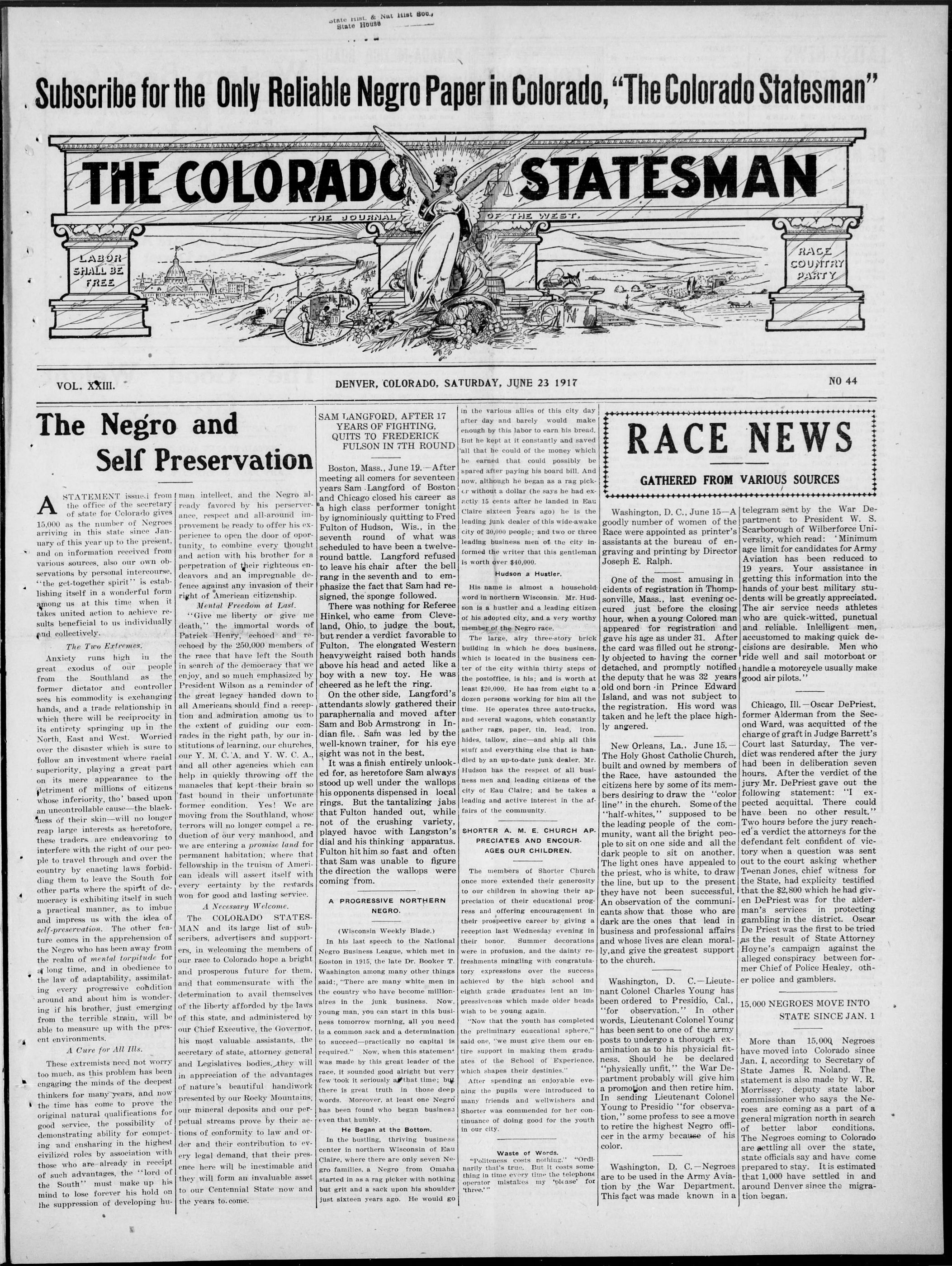
The Negro and Self Preservation
VOL. XXIII.
STATEMENT issue.i from the office of the secretary of state for Colorado gives 15,000 as the number of Negroes arriving in this state since January of this year up to the present, and on information received from various sources, also our own observations by personal intercourse, "the get-together spirit" is establishing itself in a wonderful form among us at this time when it takes united action to achieve results beneficial to us individually and collectively.
The Two Extremes.
Anxiety runs high in the great exodus of our people from the Southland as the former dietator and controller sees his commodity is exchanging hands, and a trade relationship in which there will be reciprocity in its entirety springing up in the North, East and West. Worried over the disaster which is sure to follow an investment where racial superiority, playing a great part on its mere appearance to the detriment of millions of citizens whose inferiority, tho' based upon an uncontrollable cause—the blackness of their skin—will no longer reap large interests as heretofore, these traders are endeavoring to interfere with the right of our people to travel through and over the country by enacting laws forbidding them to leave the South for other parts where the spirit of democracy is exhibiting itself in such a practical manner, as to imbue and impress us with the idea of self-preservation. The other feature comes in the apprehension of the Negro who has been away from the realm of mental torpitude for long time, and in obedience to the law of adaptability, assimilating every progressive condition around and about him is wondering if his brother, just emerging from the terrible strain, will be able to measure up with the present environments.
A Cure for All Iills.
These extremists need not worry too much, as this problem has been engaging the minds of the deepest thinkers for many years, and now the time has come to prove the original natural qualifications for good service, the possibility of demonstrating ability for competing and ensharing in the highest civilized roles by association with those who are already in receipt of such advantages, the "lord of the South" must make up his mind to lose forever his hold on the suppression of developing hu-
man intellect, and the Negro already favored by his perserverance, respect and all-around improvement be ready to offer his experience to open the door of opportunity, to combine every thought and action with his brother for a perpetration of their righteous endeavors and an impregnable defence against any invasion of their right of American citizenship.
Mental Freedom at Last.
"Give me liberty or give me death," the immortal words of Patrick Henry, echoed and reechoed by the 250,000 members of the race that have left the South in search of the democracy that we enjoy, and so much emphasized by President Wilson as a reminder of the great legacy handed down to all Americans should find a reception and admiration among us to the extent of guiding our comrades in the right path, by our institutions of learning, our churches, our Y. M. C. A. and Y. W. C. A., and all other agencies which can help in quickly throwing off the manacles that kept their brain so fast bound in their unfortunate former condition. Yes! We are moving from the Southland, whose terrors will no longer compel a reduction of our very manhood, and we are entering a promise land for permanent habitation; where that fellowship in the truism of American ideals will assert itself with every certainty by the rewards won for good and lasting service.
A Necessary Welcome.
The COLORADO STATESMAN and its large list of subscribers, advertisers and supporters, in welcoming the members of our race to Colorado hope a bright and prosperous future for them, and that commensurate with the determination to avail themselves of the liberty afforded by the laws of this state, and administered by our Chief Executive, the Governor, his most valuable assistants, the secretary of state, attorney general and Legislatives bodies, they will in appreciation of the advantages of nature's beautiful handiwork presented by our Roeky Mountains, our mineral deposits and our perpetual streams prove by their actions of conformity to law and order and their contribution to every legal demand, that their presence here will be inestimable and they will form an invaluable asset to our Centennial State now and the years to come.
SAM LANGFORD, AFTER 17
YEARS OF FIGHTING, QUITS TO FREDERICK FULSON IN 7TH ROUND Boston, Mass., June 19. After meeting all comers for seventeen years Sam Langford of Boston and Chicago closed his career as a high class performer tonight by ignominiously quitting to Fred Fulton of Hudson, Wis., in the seventh round of what was scheduled to have been a twelve-round battle. Langford refused to leave his chair after the bell rang in the seventh and to emphasize the fact that Sam had resigned, the sponge followed. There was nothing for Referee Hinkel, who came from Cleveland, Ohio, to judge the bout, but render a verdict favorable to Fulton. The elongated Western heavyweight raised both hands above his head and acted like a boy with a new toy. He was cheered as he left the ring.
On the other side, Langford's attendants slowly gathered their paraphernalia and moved after Sam and Bob Armstrong in Indian file. Sam was led by the well-known trainer, for his eye sight was not in the best. It was a finish entirely unlooked for, as heretofore Sam always stood up well under the wallops his opponents dispensed in local rings. But the tantalizing jabs that Fulton handed out, while not of the crushing variety, played havoc with Langston's dial and his thinking apparatus. Fulton hit him so fast and often that Sam was unable to figure the direction the wallops were coming from.
A PROGRESSIVE NORTHERN NEGRO.
(Wisconsin Weekly Blade.)
In his last speech to the National Negro Business League, which met in Boston in 1915, the late Dr. Booker T. Washington among many other things said; "There are many white men in the country who have become millionaires in the junk business. Now, young man, you can start in this business tomorrow morning, all you need is a common sack and a determination to succeed—practically no capital is required." Now, when this statement was made by this great leader of the race, it sounded good alright but very few took it seriously as that time; but there is great truth in those deep words. Moreover, at least one Negro has been found who began business even that humbly.
He Began at the Bottom.
In the bustling, thriving business center in northern Wisconsin of Eau Claire, where there are only seven Negro families, a Negro from Omaha started in as a rag picker with nothing but grit and a sack upon his shoulder just sixteen years ago. He would go
in the various allies of this city day after day and barely would make enough by this labor to earn his bread. But he kept at it constantly and saved all that he could of the money which he earned that could possibly be spared after paying his board bill. And now, although he began as a rag picker without a dollar (he says he had exactly 15 cents after he landed in Eau Claire sixteen years ago) he is the leading junk dealer of this wide-awake city of 30,000 people; and two or three leading business men of the city informed the writer that this gentleman is worth over $40,000.
Hudson a Hustler.
His name is almost a household word in northern Wisconsin. Mr. Hudson is a hustler and a leading citizen of his adopted city, and a very worthy member of the Negro race.
The large, airy three-story brick building in which he does business, which is located in the business center of the city within thirty steps of the postoffice, is his; and is worth at least $20,000. He has from eight to a dozen persons working for him all the time. He operates three auto-trucks, and several wagons, which constantly gather rags, paper, tin, lead, iron, hides, tallow, zinc—and ship all this stuff and everything else that is handled by an up-to-date junk dealer. Mr. Hudson has the respect of all business men and leading citizens of the city of Eau Claire; and he takes a leading and active interest in the affairs of the community.
SHORTER A. M. E. CHURCH AP.
PRECIATES AND ENCOUR-
AGES OUR CHILDREN.
The members of Shorter Church once more extended their generosity to our children in showing their appreciation of their educational progress and offering encouragement in their prospective career by giving a reception last Wednesday evening in their honor. Summer decorations were in profusion, and the dainty refreshments mingling with congratulatory expressions over the success achieved by the high school and eighth grade graduates lent an impressiveness which made older heads wish to be young again.
"Now that the youth has completed the preliminary educational sphere," said one, "we must give them our entire support in making them graduates of the School of Experience, which shapes their destinies."
After spending an enjoyable evening the pupils were introduced to many friends and wellwishers and Shorter was commended for her continuance of doing good for the youth in our city.
Waste of Words.
Waste of Words.
"Politeness costs nothing." "Ordnarily that's true. But it costs something in time every time the telephone operator mistakes my 'please' for 'three.'"
RACE NEWS
GATHERED FROM VARIOUS SOURCES
Washington, D. C., June 15—A goodly number of women of the Race were appointed as printer's assistants at the bureau of engraving and printing by Director Joseph E. Ralph.
One of the most amusing in incidents of registration in Thompsonville, Mass., last evening occurred just before the closing hour, when a young Colored man appeared for registration and gave his age as under 31. After the card was filled out he strongly objected to having the corner detached, and promptly notified the deputy that he was 32 years old and born in Prince Edward Island, and was not subject to the registration. His word was taken and he left the place highly angered.
New Orleans, La., June 15. The Holy Ghost Catholic Church, built and owned by members of the Race, have astounded the citizens here by some of its members desiring to draw the "color line" in the church. Some of the "half-whites," supposed to be the leading people of the community, want all the bright people to sit on one side and all the dark people to sit on another. The light ones have appealed to the priest, who is white, to draw the line, but up to the present they have not been successful. An observation of the communicants show that those who are dark are the ones that lead in business and professional affairs and whose lives are clean morally, and give the greatest support to the church.
Washington, D. C.—Lieutenant Colonel Charles Young has been ordered to Presidio, Cal., "for observation." In other words, Lieutenant Colonel Young has been sent to one of the army posts to undergo a thorough examination as to his physicial fitness. Should he be declared "physically unfit," the War Department probably will give him a promotion and then retire him. In sending Lieutenant Colonel Young to Presidio "for observation," some profess to see a move to retire the highest Negro officer in the army because of his color.
Washington, D. C.—Negroes are to be used in the Army Aviation by the War Department. This fact was made known in a
NO 44
telegram sent by the War Department to President W. S. Scarborough of Wilberforce University, which read: 'Minimum age limit for candidates for Army Aviation has been reduced to 19 years. Your assistance in getting this information into the hands of your best military students will be greatly appreciated. The air service needs athletes who are quick-witted, punctual and reliable. Inlelligent men, accustomed to making quick decisions are desirable. Men who ride well and sail motorboat or handle a motorcycle usually make good air pilots.'
Chicago, Ill. —Oscar DePriest, former Alderman from the Second Ward, was acquitted of the charge of graft in Judge Barrett's Court last Saturday. The verdict was rendered after the jury had been in deliberation seven hours. After the verdict of the jury Mr. DePriest gave out the following statement: "I expected acquittal. There could have been no other result." Two hours before the jury reached a verdict the attorneys for the defendant felt confident of victory when a question was sent out to the court asking whether Teenan Jones, chief witness for the State, had explicit testified that the $2,800 which he had given DePriest was for the alderman's services in protecting gambling in the district. Oscar De Priest was the first to be tried as the result of State Attorney Hoyne's campaign against the alleged conspiracy between former Chief of Police Healey, other police and gamblers.
15,000 NEGROES MOVE INTO STATE SINCE JAN. 1
More than 15,000 Negroes have moved into Colorado since Jan. I, according to Secretary of State James R. Noland. The statement is also made by W. R. Morrissey, deputy state labor commissioner who says the Negroes are coming as a part of a general migration north in search of better labor conditions. The Negroes coming to Colorado are settling all over the state, state officials say and have come prepared to stay. It is estimated that 1,000 have settled in and around Denver since the migration began.
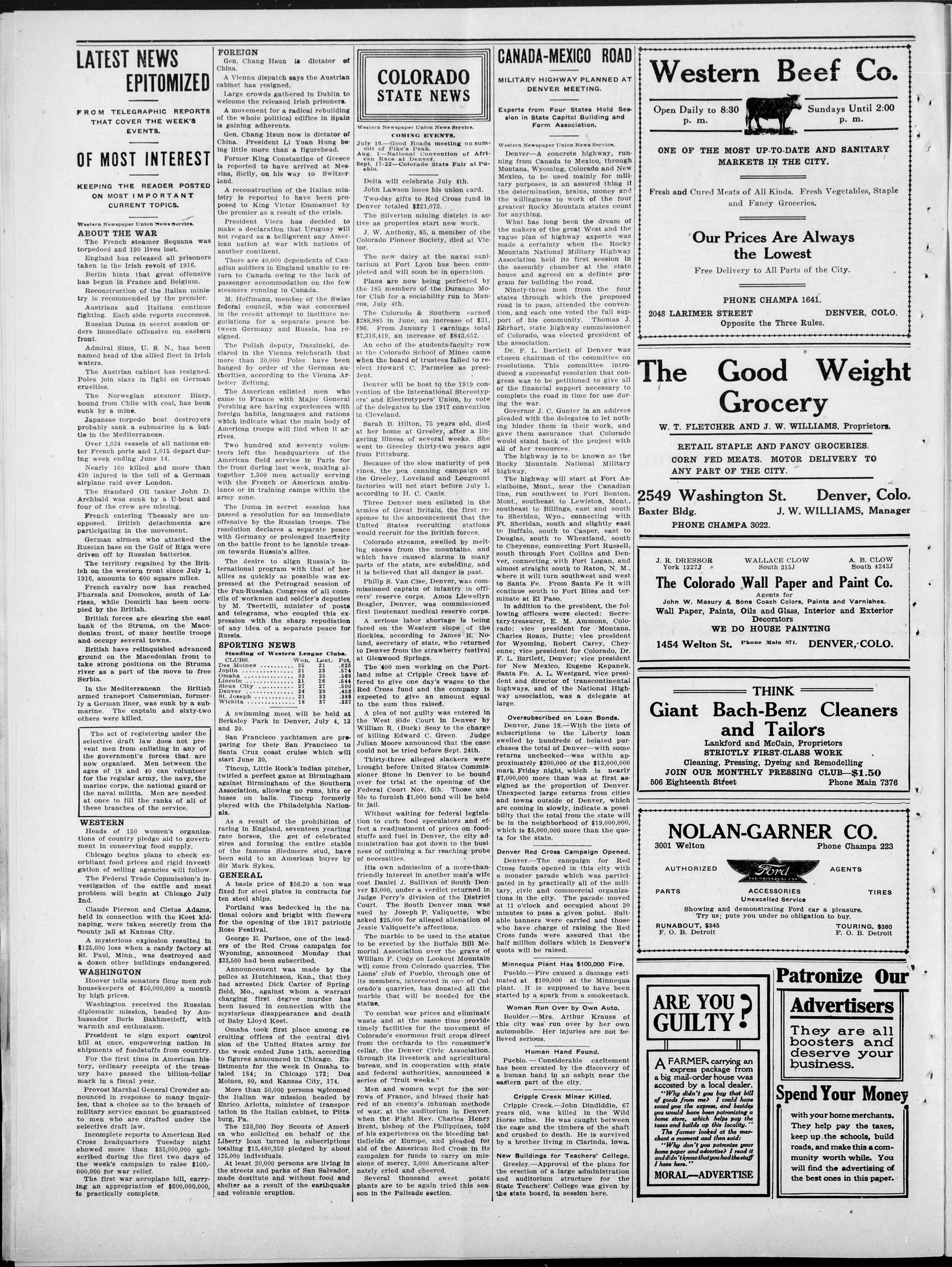
LATEST NEWS EPITOMIZED
FROM TELEGRAPHIC REPORTS THAT COVER THE WEEK'S EVENTS.
OF MOST INTEREST
KEEPING THE READER POSTED ON MOST IMPORTANT CURRENT TOPICS.
Western Newspaper Union News Service.
ABOUT THE WAR
The French steamer Sequana was torpedoed and 190 lives lost.
England has released all prisoners taken in the Irish revolt of 1916.
Berlin hints that great offensive has begun in France and Belgium.
Reconstruction of the Italian ministry is recommended by the premier.
Austrians and Italians continue fighting. Each side reports successes.
Russian Duma in secret session orders immediate offensive on eastern front.
Admiral Sims, U. S. N., has been named head of the allied fleet in Irish waters.
The Austrian cabinet has resigned. Poles join slavs in fight on German cruelties.
The Norwegian steamer Bissy, bound from Chile with coal, has been sunk by a mine.
Japanese torpedo boat destroyers probably sank a submarine in a battle in the Mediterranean.
Over 1,034 vessels of all nations enter French ports and 1,015 depart during week ending June 14.
Nearly 100 killed and more than 430 injured is the toll of a German airplane raid over London.
The Standard Oil tanker John D. Archbald was sunk by a U-boat and four of the crew are missing.
French entering Thessaly are unopposed. British detachments are participating in the movement.
German airmen who attacked the Russian base on the Gulf of Riga were driven off by Russian batteries.
The territory regained by the British on the western front since July 1, 1916, amounts to 600 square miles.
French cavalry now has reached Pharsala and Domokos, south of Larissa, while Demirli has been occupied by the British.
British forces are clearing the east bank of the Struma, on the Macedonian front, of many hostile troops and occupy several towns.
British have relinquished advanced ground on the Macedonian front to take strong positions on the Struma river as a part of the move to free Serbia.
In the Mediterranean the British armed transport Cameronian, formerly a German liner, was sunk by a submarine. The captain and sixty-two others were killed.
The act of registering under the selective draft law does not prevent men from enlisting in any of the government's forces that are now organized. Men between the ages of 18 and 40 can volunteer for the regular army, the navy, the marine corps, the national guard or the naval militia. Men are needed at once to fill the ranks of all of these branches of the service.
WESTERN
Heads of 150 women's organizations of country pledge aid to government in conserving food supply. Chicago begins plans to check exorbitant food prices and rigid investigation of selling agencies will follow. The Federal Trade Commission's investigation of the cattle and meat problem will begin at Chicago July 2nd. Claude Pierson and Cletus Adams, held in connection with the Keet kidnaping, were taken secretly from the County jail at Kansas City. A mysterious explosion resulted in $125,000 loss when a candy factory at St. Paul, Minn., was destroyed and a dozen other buildings endangered. WASHINGTON Hoover tells senators flour men rob housekeepers of $50,000,000 a month by high prices.
Washington received the Russian diplomatic mission, headed by Ambassador Boris Bakhmetieff, with warmth and enthusiasm.
President to sign export control bill at once, empowering nation in shipments of foodstuffs from country.
For the first time in American history, ordinary receipts of the treasury have passed the billion-dollar mark in a fiscal year.
Provost Marshal General Crowder announced in response to many inquiries, that a choice as to the branch of military service cannot be guaranteed to men who are drafted under the selective draft law.
Incomplete reports to American Red Cross headquarters Tuesday night showed more than $35,000,000 subscribed during the first two days of the week's campaign to raise $100,000,000 for war relief.
The first war aeroplane bill, carrying an appropriation of $600,000,000, is practically complete.
FOREIGN
Gen. Chang Hsun is dictator of China.
A Vienna dispatch says the Austrian cabinet has resigned.
Large crowds gathered in Dublin to welcome the released Irish prisoners.
A movement for a radical rebuilding of the whole political edifice in Spain is gaining adherents.
Gen. Chang Hsun now is dictator of China. President Li Yuan Hung being little more than a figurehead.
Former King Constantine of Greece is reported to have arrived at Messina, Sicily, on his way to Switzerland.
A reconstruction of the Italian ministry is reported to have been proposed to King Victor Emmanuel by the premier as a result of the crisis.
President Viera has decided to make a declaration that Uruguay will not regard as a belligerent any American nation at war with nations of another continent.
There are 40,000 dependents of Canadian soldiers in England unable to return to Canada owing to the lack of passenger accommodation on the few steamers running to Canada.
M. Hoffmann, member of the Swiss federal council, who was concerned in the recent attempt to institute negotiations for a separate peace between Germany and Russia, has resigned.
The Polish deputy, Daszinski, declared in the Vienna reichsrath that more than 30,000 Poles have been hanged by order of the German authorities, according to the Vienna Arbeiter Zeitung.
The American enlisted men who came to France with Major General Pershing are having experiences with foreign habits, languages and rations which indicate what the main body of American troops will find when it arrives.
Two hundred and seventy volunteers left the headquarters of the American field service in Paris for the front during last week, making altogether 1,500 men actually serving with the French or American ambulance or in training camps within the army zone.
The Duma in secret session has passed a resolution for an immediate offensive by the Russian troops. The resolution declares a separate peace with Germany or prolonged inactivity on the battle front to be ignoble treason towards Russia's allies.
The desire to align Russia's international program with that of her allies as quickly as possible was expressed at the Petrograd session of the Pan-Russian Congress of all councils of workmen and soldier's deputies by M. Twertelli, minister of posts and telegrams, who coupled this expression with the sharp repudiation of any idea of a separate peace for Russia.
SPORTING NEWS
Standing of Western League Clubs.
CLUBS. Won. Lost. Pct.
Des Moines 35 21 .625
Joplin 31 23 .574
Omaha 33 25 .560
Lincoln 31 26 .544
Sloux City 27 27 .500
Denver 27 29 .453
St. Joseph 24 33 .389
Wichita 18 37 .327
A swimming meet will be held at Berkeley Park in Denver, July 4, 13 and 20.
San Francisco yachtsmen are preparing for their San Francisco to Santa Cruz coast cruise which will start June 30.
Tincup, Little Rock's Indian pitcher, twirled a perfect game at Birmingham against Birmingham of the Southern Association, allowing no runs, hits or bases on balls. Tincup formerly played with the Philadelphia Nationals.
As a result of the prohibition of racing in England, seventeen yearling race horses, the get of celebrated sires and forming the entire stable of the famous Sledmere stud, have been sold to an American buyer by Sir Mark Sykes.
GENERAL
A basis price of $56.20 a ton was fixed for steel plates in contracts for ten steel ships. Portland was bedecked in the national colors and bright with flowers for the opening of the 1917 patriotic Rose Festival. George E. Parisoe, one of the leaders of the Red Cross campaign for Wyoming, announced Monday that $33,500 had been subscribed. Announcement was made by the police at Hutchinson, Kan., that they had arrested Dick Carter of Springfield, Mo., against whom a warrant charging first degree murder has been issued in connection with the mysterious disappearance and death of Baby Lloyd Keet.
Omaha took first place among recruiting offices of the central division of the United States army for the week ended June 14th, according to figures announced in Chicago. Enlistments for the week in Omaha totaled 184; in Chicago 173; Des Moines, 80, and Kansas City, 174. More than 50,000 persons welcomed the Italian war mission headed by Enrico Arlotta, minister of transportation in the Italian cabinet, to Pittsburg, Pa. The 238,000 Boy Scouts of America who solicited on behalf of the Liberty loan turned in subscriptions totaling $15,480,350 pledged by about 125,000 individuals. At least 20,000 persons are living in the streets and parks of San Salvador, made destitute and without food and shelter as a result of the earthquake and volcanic eruption.
Western Newspaper Union News Service.
COMING EVENTS.
July 10.—Good Roads meeting on summit of Pike's Peak.
Aug. 1, National Convention of African Race at Denver.
Sept. 17-22—Colorado State Fair at Pueblo.
Delta will celebrate July 4th.
John Lawson loses his union card.
Two-day gifts to Red Cross fund in Denver totaled $221,072.
The Silverton mining district is active as properties start new work.
J. W. Anthony, 85, a member of the Colorado Pioneer Society, died at Victor.
The new dairy at the naval sanitarium at Fort Lyon has been completed and will soon be in operation.
Plans are now being perfected by the 185 members of the Durango Motor Club for a sociability run to Mancos, July 4th.
The Colorado & Southern earned $288,985 in June, an increase of $31,696. From January 1 earnings total $7,316,419, an increase of $843,652.
An echo of the students-faculty row at the Colorado School of Mines came when the board of trustees failed to relect Howard C. Parmelee as president.
Denver will be host to the 1919 convention of the International Stereotypers' and Electrotypers' Union, by vote of the delegates to the 1917 convention in Cleveland.
Sarah B. Hilton, 75 years old, died at her home at Greeley, after a lingering illness of several weeks. She went to Greeley thirty-two years ago from Pittsburg.
Because of the slow maturity of pea vines, the pea canning campaign at the Greeley, Loveland and Longmont factories will not start before July 1, according to H. C. Canis.
Three Denver men enlisted in the armies of Great Britain, the first response to the announcement that the United States recruiting stations would recruit for the British forces.
Colorado streams, swelled by melting snows from the mountains, and which have caused alarms in many parts of the state, are subsiding, and it is believed that all danger is past.
Philip S. Van Cise, Denver, was commissioned captain of infantry in officers' reserve corps. Amos Llewellyn Beagler, Denver, was commissioned first lieutenant medical reserve corps.
A serious labor shortage is being faced on the Western slope of the Rockles, according to James R. Noland, secretary of state, who returned to Denver from the strawberry festival at Glenwood Springs.
The 400 men working on the Portland mine at Cripple Creek have offered to give one day's wages to the Red Cross fund and the company is expected to give an amount equal to the sum thus raised.
A plea of not guilty was entered in the West Side Court in Denver by William R. (Buck) Seay to the charge of killing Edward C. Green. Judge Julian Moore announced that the case could not be tried before Sept. 24th.
Thirty-three alleged slackers were brought before United States Commissioner Stone in Denver to be bound over for trial at the opening of the Federal Court Nov. 6th. Those unable to furnish $1,000 bond will be held in jail.
Without waiting for federal legislation to curb food speculators and effect a readjustment of prices on foodstuffs and fuel in Denver, the city administration has got down to the business of outlining a far reaching probe of necessities.
His own admission of a more-than-friendly interest in another man's wife cost Daniel J. Sullivan of South Denver $3,000, under a verdict returned in Judge Perry's division of the District Court. The South Denver man was sued by Joseph P. Valiquette, who asked $25,000 for alleged alienation of Jessie Valiquette's affections.
The marble to be used in the statue to be erected by the Buffalo Bill Memorial Association over the grave of William F. Cody on Lookout Mountain will come from Colorado quarries. The Lions' club of Pueblo, through one of its members, interested in one of Colorado's quarries, has donated all the marble that will be needed for the statue.
To combat war prices and eliminate waste and at the same time provide timely facilities for the movement of Colorado's enormous fruit crops direct from the orchards to the consumer's cellar, the Denver Civic Association, through its livestock and agricultural bureau, and in cooperation with state and federal authorities, announced a series of "fruit weeks."
Men and women wept for the sorrows of France, and hissed their hatred of an enemy's inhuman methods of war, at the auditorium in Denver, when the Fight Rev. Charles Henry Brent, bishop of the Philippines, told of his experiences on the bleeding battlefields of Europe, and pleaded for aid of the American Red Cross in its campaign for funds to carry on missions of mercy, 3,000 Americans alternately cried and cheered.
Several thousand sweet potato plants are to be again tried this season in the Palisade section.
CANADA-MEXICO ROAD
CANADA-MEXICO ROAD
MILITARY HIGHWAY PLANNED AT DENVER MEETING.
Experts from Four States Hold Session in State Capitol Building and Form Association.
Western Newspaper Union News Service.
Denver—A concrete highway, running from Canada to Mexico, through Montana, Wyoming, Colorado and New Mexico, to be used mainly for military purposes, is an assured thing if the determination, brains, money and the willingness to work of the four greatest Rocky Mountain states count for anything.
What has long been the dream of the makers of the great West and the vague plan of highway experts was made a certainty when the Rocky Mountain National Military Highway Association held its first session in the assembly chamber at the state house and agreed on a definite program for building the road. Ninety-three men from the four states through which the proposed road is to pass, attended the convention, and each one voted the full support of his community. Thomas J. Ehrhart, state highway commissioner of Colorado, was elected president of the association.
Dr. F. L. Bartlett of Denver was chosen chairman of the committee on resolutions. This committee introduced a successful resolution that congress was to be petitioned to give all of the financial support necessary to complete the road in time for use during the war. Governor J. C. Gunter in an address pleaded with the delegates to let nothing hinder them in their work, and gave them assurance that Colorado would stand back of the project with all of her resources. The highway is to be known as the Rocky Mountain National Military highway.
The highway will start at Fort Assiniboine, Mont., near the Canadian line, run southwest to Fort Benton, Mont., southeast to Lewiston, Mont., southeast to Billings, east and south to Sheridan, Wyo., connecting with Ft. Sheridan, south and slightly east to Buffalo, south to Casper, east to Douglas, south to Wheatland, south to Cheyenne, connecting Fort Russell, south through Fort Collins and Denver, connecting with Fort Logan, and almost straight south to Raton, N. M., where it will turn southwest and west to Santa Fe. From Santa Fe it will continue south to Fort Bliss and terminate at El Paso.
In addition to the president, the following officers were elected: Secretary-treasurer, E. M. Ammons, Colorado; vice president for Montana, Charles Roam, Butte; vice president for Wyoming, Robert Carey, Cheyenne; vice president for Colorado, Dr. F. L. Bartlett, Denver; vice president for New Mexico, Eugene Kepanek, Santa Fe. A. L. Westgard, vice president and director of transcontinental highways, and of the National Highway association, was a delegate at large.
Oversubscribed on Loan Bonds.
Oversubmitted on Loan Bonus.
Denver, June 18.—With the lists of subscriptions to the Liberty loan swelled by hundreds of belated purchases the total of Denver—with some returns unchecked—was within approximately $200,000 of the $13,000,000 mark Friday night, which is nearly $7,000,000 more than was at first assigned as the proportion of Denver. Unexpected large returns from cities and towns outside of Denver, which are coming in slowly, indicate a possibility that the total from the state will be in the neighborhood of $19,000,000, which is $5,000,000 more than the quota for the state.
Denver Red Cross Campaign Opened
Denver.—The campaign for Red Cross funds opened in this city with a monster parade which was participated in by practically all of the military, civic and commercial organizations in the city. The parade moved at 11 o'clock and occupied about 30 minutes to pass a given point. Suitable banners were carried and those who have charge of raising the Red Cross funds were assured that the half million dollars which is Denver's quota will be raised.
Pueblo—Fire caused a damage estimated at $100,000 at the Minnequa plant. It is supposed to have been started by a spark from a smokestack.
Woman Run Over by Own Auto.
Boulder.—Mrs. Arthur Krauss of this city was run over by her own automobile. Her injuries are not believed serious.
Human Hand Found.
Pueblo. — Considerable excitement has been created by the discovery of a human hand in an ashtpit near the eastern part of the city.
Cripple Creek Miner Killed.
Cripple Creek.—John Dindiddie, 67 years old, was killed in the Wild Horse mine. He was caught between the cage and the timbers of the shaft and crushed to death. He is survived by a brother living in Clarinda, Iowa.
New Buildings for Teachers' College. Greeley.—Approval of the plans for the erection of a large administration and auditorium structure for the State Teachers' College was given by the state board, in session here.
Western Beef Co.
Open Daily to 8:30 p. m.
ONE OF THE MOST UP
MARKETS
Fresh and Cured Meats of All
and Fancy
Our Prices
the I
AT THE MOST UP-TO-DATE AND SAL MARKETS IN THE CITY.
Cured Meats of All Kinds. Fresh Vegeta and Fancy Groceries.
Our Prices Are Always the Lowest
ONE OF THE MOST UP-TO-DATE AND SANITARY MARKETS IN THE CITY.
Fresh and Cured Meats of All Kinds. Fresh Vegetables, Staple and Fancy Groceries.
Free Delivery to All Parts of the City.
PHONE C
2048 LARIMER STREET
Opposite th
The Good
Gro
W. T. FLETCHER AND J
RETAIL STAPLE AN
CORN FED MEATS.
ANY PART OF THE C
2549 Washington
Baxter Bldg.
PHONE CHAMPA 3022
J. R. DRESSOR
York 1327J
WALL
So
The Colorado Wall
Age
John W. Masury & Sons Coa
Wall Paper, Paints, Oils and
Dec
WE DO HOU
1454 Welton St. Phone M
THE
Giant Bach-h
and T
Lankford and M
STRICTLY FIRE
Cleaning, Pressing, I
JOIN OUR MONTHLY
506 Eighteenth Street
NOLAN-G
3001 Welton
PHONE CHAMPA 1641.
MER STREET DENVER
Opposite the Three Rules.
Good Wet
Grocery
BETCHER AND J. W. WILLIAMS, P.
DETAIL STAPLE AND FANCY GROCERY
IN FED MEATS. MOTOR DELIVERY
PART OF THE CITY.
Washington St. Denver
J. W. WILLIAM
NE CHAMPA 3022.
SSOR
27J WALLACE CLOW
South 315J
Colorado Wall Paper and Paint
Agents for
Masury & Sons Coach Colors, Paints and
Paper, Paints, Oils and Glass, Interior and
Decorators
WE DO HOUSE PAINTING
Velton St. Phone Main 871. DENVER
THINK
It Bach-Benz Clean
and Tailors
Lankford and McCain, Proprietors
STRICTLY FIRST-CLASS WORK
cleaning, Pressing, Dyeing and Remodell
OUR MONTHLY PRESSING CLUB—
enth Street Phone
DOLAN-GARNER C
ton Phone C
PHONE CHAMPA 1641.
2048 LARIMER STREET DENVER, COLO.
Opposite the Three Rules.
The Good Weight Grocery
W. T. FLETCHER AND J. W. WILLIAMS, Proprietors.
RETAIL STAPLE AND FANCY GROCERIES.
CORN FED MEATS. MOTOR DELIVERY TO
ANY PART OF THE CITY.
2549 Washington St. Denver, Colo.
Baxter Bldg. J. W. WILLIAMS, Manager
PHONE CHAMPA 3022.
J. R. DRESSOR WALLACE CLOW A. B. CLOW
York 1327J South 315J South 4243J
John W. Masury & Sons Coach Colors, Paints and Varnishes. Wall Paper, Paints, Oils and Glass, Interior and Exterior Decorators
THINK
Giant Bach-Benz Cleaners and Tailors
Lankford and McCain, Proprietors
STRICTLY FIRST-CLASS WORK
Cleaning, Pressing, Dyeing and Remodelling
JOIN OUR MONTHLY PRESSING CLUB—$1.50
506 Eighteenth Stfeet Phone Main 7376
Ford
THE UNIVERSAL CAR
PARTS ACCE
Unexcel
Showing and demonstra
Try us; puts you un
RUNABOUT, $345
F. O. B. Detroit
ACCESSORIES
Unexcelled Service
Knowing and demonstrating Ford car a please.
Try us; puts you under no obligation to buy.
UT, $345
TOU
Detroit
F. O.
ARE YOU GUILTY?
A FARMER carrying an express package from a big mail-order house was accosted by a local dealer.
"Why didn't you buy that bill of goods from me? I could have saved you the express, and besides you would have been patronizing a home store, which helps pay the taxes and builds up this locality."
The farmer looked at the merchant a moment and then said:
"Why don't you patronize your home paper and advertise? I read it and didn't know that you had the stuff I have here."
MORAL—ADVERTISE
---
---
Sundays Until 2:00
p. m.
WO-DATE AND SANITARY
IN THE CITY.
inds. Fresh Vegetables, Staple
Groceries.
Are Always
lowest
AMPA 1641.
DENVER, COLO.
Three Rules.
Hard Weight
Grocery
W. WILLIAMS, Proprietors.
FANCY GROCERIES.
MOTOR DELIVERY TO
CITY.
St. Denver, Colo.
J. W. WILLIAMS, Manager
CE CLOW
315J
A. B. CLOW
South 4243J
Paper and Paint Co.
s for
Colors, Paints and Varnishes.
Glass, Interior and Exterior
ators
PAINTING
in 871. DENVER, COLO.
INK
Benz Cleaners
Tailors
Cain, Proprietors
T-CLASS WORK
Being and Remodelling
PRESSING CLUB—$1.50
Phone Main 7376
RNER CO.
Phone Champa 223
SORIES TIRES
d Service
ing Ford car a pleasure.
r no obligation to buy.
TOURING, $360
F. O. B. Detroit
Patronize Our
Advertisers
They are all boosters and deserve your business.
Spend Your Money
with your home merchants. They help pay the taxes, keep up the schools, build roads, and make this a community worth while. You will find the advertising of the best ones in this paper.
```markdown
```
+
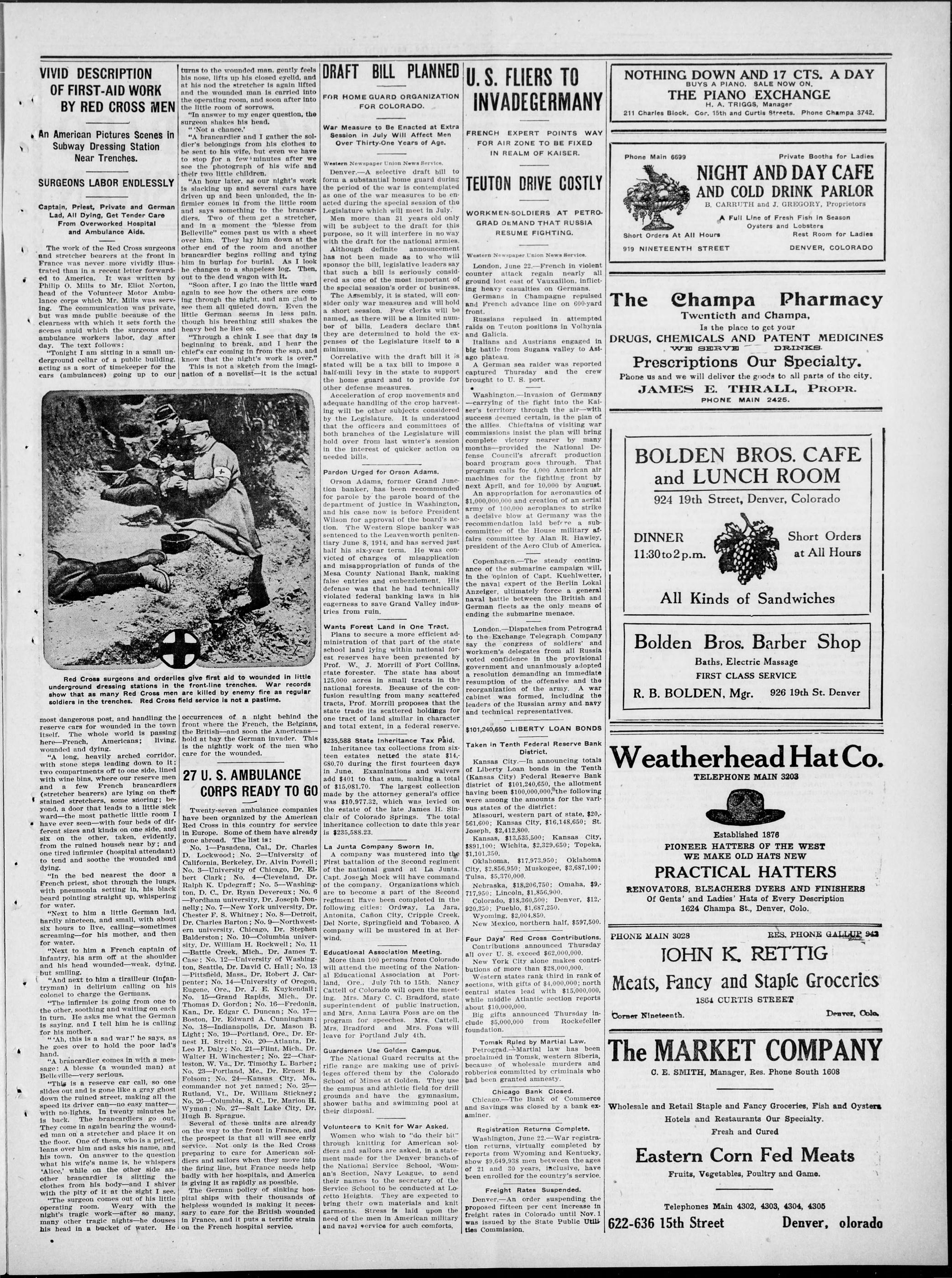
Red Cross surgeons and orderlies give first aid to wounded in little underground dressing stations in the front-line trenches. War records show that as many Red Cross men are killed by enemy fire as regular soldiers in the trenches. Red Cross field service is not a pastime.
VIVID DESCRIPTION OF FIRST-AID WORK BY RED CROSS MEN
- An American Pictures Scenes in Subway Dressing Station Near Trenches.
SURGEONS LABOR ENDLESSLY
Captain, Priest, Private and German Lad, All Dying, Get Tender Care From Overworked Hospital and Ambulance Aids.
The work of the Red Cross surgeons and stretcher bearers at the front in France was never more vividly illustrated than in a recent letter forwarded to America. It was written by Philip O. Mills to Mr. Eliot Norton, head of the Volunteer Motor Ambulance corps which Mr. Mills was serving. The communication was private, but was made public because of the clearness with which it sets forth the scenes amid which the surgeons and ambulance workers labor, day after day. The text follows:
"Tonight I am sitting in a small underground cellar of a public building, acting as a sort of timekeeper for the cars (ambulances) going up to our
Red Cross surgeons and orderly underground dressing stations in the show that as many Red Cross men soldiers in the trenches. Red Cross
most dangerous post, and handling the reserve cars for wounded in the town itself. The whole world is passing here—French, Americans; living, wounded and dying.
"A long, heavily arched corridor, with stone steps leading down to it; two compartments off to one side, lined with wine bins, where our reserve men and a few French brancardiers (stretcher bearers) are lying on their stained stretches, some snoring; beyond, a door that leads to a little sick ward—the most pathetic little room I have ever seen—with four beds of different sizes and kinds on one side, and six on the other, taken, evidently, from the ruined houses near by; and one tired infirmier (hospital attendant) to tend and soothe the wounded and dying.
"In the bed nearest the door a French priest, shot through the lungs, with pneumonia setting in, his black beard pointing straight up, whispering for water.
"Next to him a little German lad, hardly nineteen, and small, with about six hours to live, calling—sometimes screaming—for his mother, and then for water.
"Next to him a French captain of infantry, his arm arm at the shoulder and his head wounded—weak, dying, but smiling.
"And next to him a tirailleur (infantryman) in delirium calling on his colonel to charge the Germans.
"The infirmier is going from one to the other, soothing and waiting on each in turn. He asks me what the German is saying, and I tell him he is calling for his mother.
"Ah, this is a sad war!" he says, as he goes over to hold the poor lad's hand.
"A brancardier comes in with a message: A blesses (a wounded man) at Bellville—very serious.
"This is a reserve car call, so one slides out and is gone like a gray ghost down the ruined street, making all the speed its driver can—no easy matter—with no lights. In twenty minutes he is back. The brancardiers go out. They come in again bearing the wounded man on a stretcher and place it on the floor. One of them, who is a priest, leans over him and asks his name, and his town. On answer to the question what his wife's name is, he whispers 'Alice,' while on the other side another brancardier is slitting the clothes from his body—and I shiver with the pity of it at the sight I see.
"The surgeon comes out of his little operating room. Weary with the night's tragic work-after so many, many other tragic nights-he douses his head in a bucket of water. He
turns to the wounded man, gently feels his nose, lifts up his closed eyelid, and at his nod the stretcher is again lifted and the wounded man is carried into the operating room, and soon after into the little room of sorrows.
"In answer to my eager question, the surgeon shakes his head.
"Not a chance."
"A brancardier and I gather the soldier's belongings from his clothes to be sent to his wife, but even we have to stop for a few minutes after we see the photograph of his wife and their two little children.
"An hour later, as our night's work is slacking up and several cars have driven up and been unloaded, the infirmier comes in from the little room and says something to the brancardiers. Two of them get a stretcher, and in a moment the 'blesse from Belleville' comes past us with a sheet over him. They lay him down at the other end of the room and another brancardier begins rolling and tying him in burlap for burial. As I look he changes to a shapeless log. Then, out to the dead wagon with it.
"Soon after, I go into the little ward again to see how the others are coming through the night, and am glad to see them all quieted down. Even the little German seems in less pain, though his breathing still shakes the heavy bed he lies on.
"Through a chink I see that day is beginning to break, and I hear the chief's car coming in from the sap, and know that the night's work is over." This is not a sketch from the imagination of a novelist—it is the actual
es give first aid to wounded in little
ne front-line trenches. War records
are killed by enemy fire as regular
field service is not a pastime.
occurrences of a night behind the front where the French, the Belgians, the British—and soon the Americans—hold at bay the German invader. This is the nightly work of the men who care for the wounded.
27 U. S. AMBULANCE CORPS READY TO GO
27 U. S. AMBULANCE CORPS READY TO GO
Twenty-seven ambulance companies have been organized by the American Red Cross in this country for service in Europe. Some of them have already gone abroad. The list is:
No. 1—Pasadena, Cal., Dr. Charles D. Lockwood; No. 2—University of California, Berkeley, Dr. Alvin Powell; No. 3—University of Chicago, Dr. Elbert Clark; No. 4—Cleveland, Dr. Ralph K. Updegraff; No. 5—Washington, D. C., Dr. Ryan Devereux; No. 6—Fordham university, Dr. Joseph Donnelly; No. 7—New York university, Dr. Chester F. S. Whitney; No. 8—Detroit, Dr. Charles Barton; No. 9—Northwestern university, Chicago, Dr. Stephen Balderston; No. 10—Columbia university, Dr. William H. Rockwell; No. 11—Battle Creek, Mich., Dr. James T. Case; No. 12—University of Washington, Seattle, Dr. David C. Hall; No. 13—Pittsfield, Mass., Dr. Robert J. Carpenter; No. 14—University of Oregon, Eugene, Ore., Dr. J. E. Kuykendall; No. 15—Grand Rapids, Mich., Dr. Thomas D. Gordon; No. 16—Fredonia, Kan., Dr. Edgar C. Duncan; No. 17—Boston, Dr. Edward A. Cunningham; No. 18—Indianapolis, Dr. Mason B. Light; No. 19—Portland, Ore., Dr. Ernest H. Streit; No. 20—Atlanta, Dr. Leo P. Daly; No. 21—Flint, Mich., Dr. Walter H. Winchester; No. 22—Charleston, W. Va., Dr. Timothy L. Barber; No. 23—Portland, Me., Dr. Ernest B. Folsom; No. 24—Kansas City, Mo., commander not yet named; No. 25—Rutland, Vt., Dr. William Stickney; No. 26—Columbia, S. C., Dr. Marlon H. Wyman; No. 27—Salt Lake City, Dr. Hugh B. Sprague.
Several of these units are already on the way to the front in France, and the prospect is that all will see early service. Not only is the Red Cross preparing to care for American soldiers and sailors when they move into the firing line, but France needs help badly with her hospitals, and America is giving it as rapidly as possible. The German policy of sinking hospital ships with their thousands of helpless wounded is making it necessary to care for the British wounded in France, and it puts a terrific strain on the French hospital service.
DRAFT BILL PLANNED
FOR HOME GUARD ORGANIZATION FOR COLORADO.
War Measure to Be Enacted at Extra Session in July Will Affect Men Over Thirty-One Years of Age.
Western Newspaper Union News Service.
Denver.—A selective draft bill to form a substantial home guard during the period of the war is contemplated as one of the war measures to be enacted during the special session of the Legislature which will meet in July. Men more than 31 years old only will be subject to the draft for this purpose, so it will interfere in no way with the draft for the national armies. Although definite announcement has not been made as to who will sponsor the bill, legislative leaders say that such a bill is seriously considered as one of the most important of the special session's order of business.
The Assembly, it is stated, will consider only war measures and will hold a short session. Few clerks will be named, as there will be a limited number of bills. Leaders declare that they are determined to hold the expenses of the Legislature itself to a minimum.
Correlative with the draft bill it is stated will be a tax bill to impose a half-mill levy in the state to support the home guard and to provide for other defense measures.
Acceleration of crop movements and adequate handling of the crop harvesting will be other subjects considered by the Legislature. It is understood that the officers and committees of both branches of the Legislature will hold over from last winter's session in the interest of quicker action on needed bills.
Pardon Urged for Orson Adams.
Orson Adams, former Grand Junction banker, has been recommended for parole by the parole board of the department of justice in Washington, and his case now is before President Wilson for approval of the board's action. The Western Slope banker was sentenced to the Leavenworth penitentiary June 8, 1914, and has served just half his six-year term. He was convicted of charges of misapplication and misappropriation of funds of the Mesa County National Bank, making false entries and embezzlement. His defense was that he had technically violated federal banking laws in his eagerness to save Grand Valley industries from ruin.
Wants Forest Land in One Tract.
Plans to secure a more efficient administration of that part of the state school land lying within national forest reserves have been presented by Prof. W. J. Morrill of Fort Collins, state forester. The state has about 125,000 acres in small tracts in the national forests. Because of the confusion resulting from many scattered tracts, Prof. Morrill proposes that the state trade its scattered holdings for one tract of land similar in character and total extent, in a federal reserve.
$235,588 State Inheritance Tax Paid.
Inheritance tax collections from sixteen estates netted the state $14,680.70 during the first fourteen days in June. Examinations and waivers add $401 to that sum, making a total of $15,081.70. The largest collection made by the attorney general's office was $10,977.32, which was levied on the estate of the late James H. Sinclair of Colorado Springs. The total inheritance collection to date this year is $235,588.23.
La Junta Company Sworn In.
A company was mustered into the First battalion of the Second regiment of the national guard at La Junta. Capt. Joseph Mock will have command of the company. Organizations which are to become a part of the Second regiment have been completed in the following cities: Ordway, La Jara, Antonita, Cañon City, Cripple Creek, Del Norte, Springfield and Tobasco. A company will be mustered in at Berwind.
Educational Association Meeting.
More than 100 persons from Colorado will attend the meeting of the National Educational Association at Portland, Ore., July 7th to 15th. Nancy Cattell of Colorado will open the meeting. Mrs. Mary C. C. Bradford, state superintendent of public instruction, and Mrs. Anna Laura Foss are on the program for speeches. Mrs. Cattell, Mrs. Bradford and Mrs. Foss will leave for Portland July 4th.
Guardsmen Use Golden Campus.
The National Guard recruits at the rifle range are making use of privileges offered them by the Colorado School of Mines at Golden. They use the campus and athletic field for drill grounds and have the gymnasium, shower baths and swimming pool at their disposal.
Volunteers to Knit for War Asked.
Women who wish to "do their bit" through knitting for American soldiers and sailors are asked, in a statement made for the Denver branch of the National Service School, Women's Section, Navy League, to send their names to the secretary of the Service School to be conducted at Loretto Heights. They are expected to bring their own materials and knit garments. Stress is laid upon the need of the men in American military and naval service for such comforts.
U. S. FLIERS TO INVADEGERMANY
FRENCH EXPERT POINTS WAY FOR AIR ZONE TO BE FIXED IN REALM OF KAISER.
TEUTON DRIVE COSTLY
WORKMEN-SOLDIERS AT PETROGRAD DEMAND THAT RUSSIA RESUME FIGHTING.
Western Newspaper Union News Service.
London, June 22.—French in violent counter attack regain nearly all ground lost east of Vauxaillon, inflicting heavy casualties on Germans.
Germans in Champagne repulsed and French advance line on 600-yard front.
Russians repulsed in attempted raids on Teuton positions in Volhynia and Galicia.
Italians and Austrians engaged in big battle from Sugana valley to Asiago plateau.
A German sea raider was reported captured Thursday and the crew brought to U. S. port.
Washington.—Invasion of Germany—carrying of the fight into the Kaiser's territory through the air—with success deemed certain, is the plan of the allies. Chieftains of visiting war commissions insist the plan will bring complete victory nearer by many months—provided the National Defense Council's aircraft production board program goes through. That program calls for 4,000 American air machines for the fighting front by next April, and for 10,000 by August. An appropriation for aeronautics of $1,000,000,000 and creation of an aerial army of 100,000 aeroplanes to strike a decisive blow at Germany was the recommendation laid before a subcommittee of the House military affairs committee by Alan R. Hawley, president of the Aero Club of America.
Copenhagen.—The steady continuance of the submarine campaign will, in the 'opinion of Capt. Kuehlwetter, the naval expert of the Berlin Lokal Anzeiger, ultimately force a general naval battle between the British and German fleets as the only means of ending the submarine menace.
London.—Dispatches from Petrograd to the Exchange Telegraph Company say the congress of soldiers' and workmen's delegates from all Russia voted confidence in the provisional government and unanimously adopted a resolution demanding an immediate resumption of the offensive and the reorganization of the army. A war cabinet was formed, including the leaders of the Russian army and navy and technical representatives.
$101,240,650 LIBERTY LOAN BONDS
Taken in Tenth Federal Reserve Bank District.
Kansas City.—In announcing totals of Liberty Loan bonds in the Tenth (Kansas City) Federal Reserve Bank district of $101,240,650, the allotment having been $100,000,000, the following were among the amounts for the various states of the district:
Missouri, western part of state, $20,561,600; Kansas City, $16,148,650; St. Joseph, $2,412,800.
Kansas, $13,535,500; Kansas City, $891,100; Wichita, $2,329,650; Topeka, $1,101,350.
Oklaoma, $17,973,950; Oklahoma City, $2,856,950; Muskogee, $2,687,100; Tulsa, $5,370,000.
Nebraska, $18,206,750; Omaha, $9,717,950; Lincoln, $1,856,900.
Colorado, $18,360,500; Denver, $12,
$920,350; Pueblo, $1,687,250.
Wyoming, $2,004,850.
New Mexico, northern half, $597,500.
Four Days' Red Cross Contributions.
Contributions announced Thursday
all over U. S. exceed $62,000,000.
New York City alone makes contributions
of more than $28,000,000.
Western states rank third in rank of
sections, with gifts of $4,000,000; north
central states lead with $15,000,000,
while middle Atlantic section reports
about $10,000,000.
Big gifts announced Thursday include
$5,000,000 from Rockefeller
foundation.
Petrograd.—Martial law has been proclaimed in Tomsk, western Siberia, because of wholesale murders and robberies committed by criminals who had been granted amnesty.
Chicago Bank Closed.
Chicago.—The Bank of Commerce and Savings was closed by a bank examiner.
Washington, June 22.—War registration returns, virtually completed by reports from Wyoming and Kentucky, show $9,649,938 men between the ages of 21 and 30 years, inclusive, have been enrolled for the country's service.
Freight Rates Suspended.
Denver.—An order suspending the proposed fifteen per cent increase in freight rates in Colorado until Nov. 1 was issued by the State Public Utilities Commission.
NOTHING DOWN AND 17 CTS. A DAY
BUYS A PIANO. SALE NOW ON.
THE PIANO EXCHANGE
H. A. TRIGGS, Manager
211 Charles Block. Cor. 15th and Curtis Streets. Phone Champa 3742.
Short Orders At All H
919 NINETEENTH ST
The Cha
Twenty
Is
DRUGS, CHEMICAL
WE S
Prescript
Phone us and we will
JAMES
BOLDE
and L
924 19th
The Champa Pharmacy
Twentieth and Champa,
Is the place to get your
DRUGS, CHEMICALS AND PATENT MEDICINES
WE SERVE DRINKS.
Prescriptions Our Specialty.
Phone us and we will deliver the goods to all parts of the city.
JAMES E. THRALL, PROPR.
PHONE MAIN 2425.
DINNER
11:30 to 2 p.m.
All Kinds of Sandwiches
Bolden
Bat
FI
R. B. BOLDE
Weathe
TE
PIONEER
WE I
PRACT
RENOVATORS, BL
Of Gents' and
1624
Golden Bros. Barber Sh
Baths, Electric Massage
FIRST CLASS SERVICE
L. BOLDEN, Mgr. 926 19th St. D
atherhead Hat
TELEPHONE MAIN 3203
Bolden Bros. Barber Shop
Baths, Electric Massage
FIRST CLASS SERVICE
R. B. BOLDEN, Mgr. 926 19th St. Denver
Weatherhead Hat Co. TELEPHONE MAIN 3203
Established 1876
PIONEER HATTERS OF THE WEST
WE MAKE OLD HATS NEW
PRACTICAL HATTERS
ATORS, BLEACHERS DYERS AND FINI
Gents' and Ladies' Hats of Every Descripti
1624 Champa St., Denver, Colo.
Established 1876
PIONEER HATTERS OF THE WEST
WE MAKE OLD HATS NEW
PRACTICAL HATTERS
RENOVATORS, BLEACHERS DYERS AND FINISHERS
Of Gents' and Ladies' Hats of Every Description
1624 Champa St., Denver, Colo.
JOHN Meats, Fancy 180
JOHN K. RETTIG Fancy and Staple Groc 1864 CURTIS STREET
The MAR
C. E. SMITH,
Wholesale and Retail St
Hotels and
The MARKET COMPANY
C. E. SMITH, Manager, Res. Phone South 1608
Wholesale and Retail Staple and Fancy Groceries, Fish and Oysters Hotels and Restaurants Our Specialty. Fresh and Cured
Telephones Main 4302, 4303, 4304, 4305 622-636 15th Street Denver, olorado
Fruit Bowl
PHONE MAIN 3028
Corner Nineteenth.
Short Orders at All Hours
Barber Shop
Massage
SERVICE
926 19th St. Denver
Bad Hat Co.
AIN 3203
1876
OF THE WEST
HATS NEW
HATTERS
VERS AND FINISHERS
of Every Description
Denver, Colo.
RES. PHONE GALLUP 942 ETTIG taple Groceries
Grapes
```markdown
```
THE COLORADO STATESMAN
SABOR
SUMMER
DE
FREE
RACE
COUNTRY
PARTY
One Year ..... $2.00
Six Months ..... 1.00
Three Months ..... 6.00
PAYABLE IN ADVANCE.
Entered as second-class matter at the City of Denver, Colo.
Reading notices, ten lines or less, 10 cents per line. Each additional line over ten lines, 5 cents per line. Display advertising, 50 cents per inch.
Remittances should be made by Express Money Order, Postoffice Money Order, Registered Letter or Bank Draft. Postage stamps will be received the same as cash for the fractional part of a dollar. Only 1c and 2c stamps taken.
No discounts allowed on less than three months' contract. Cash must accompany all orders from parties unknown to us. Further particulars on application.
Communications to receive attention must be newsy, upon important subjects, plainly written only upon one side of the paper, must reach us Tuesday, if possible, anyway not later than Wednesday, and bear the signature of the author. No manuscript returned, unless stamps are sent for postage. All communications of a personating nature that are not complimentary will be withheld from the columns of this paper.
UNCLE SAM AND THE FOOD SPECULATORS.
WE SAID some time ago that a recurrence of Civil War and Spanish-American War actions, when paupers became millionaires in a day and food speculators ground the people to powder, would not take place again, as the people in their appeal both to their city, state and national heads are determined that America should look after her own adequately while in her graciousness to others. We are therefore glad to be in receipt of the report of Mr. E. J. Blanchard, chief statistician of the government Land Reclamation Bureau, in which he states that the greatest crop in the nation's history is predicted. This statement he basis on information gathered while touring the principal crop-producing states of the country. In striking contrast we hear the FOOD MEN shouting "shortage of crop in the nation's history is predicted. This statement he bases on infor-instructions to his agents in this country as to relieve us in these days of extraordinary profits for the speculators. Read The Colorado Statesman regularly for the latest government information for the control of the food prices and you will be the beneficiaries of normal prices within the reach of all. All sacrifices made by the people will be for OUR COUNTRY'S CAUSE, not the filling of the coffers of FOOD SPECULATORS.
THE SENSE OF SACRIFICE.
AS NEVER before the nation is called on to make sacrifice in the cause of liberty and humanity, for the righting of great wrongs and the ushering in of a new era of international good will. Men by the hundreds of thousands have been called on already and will in time sail for foreign lands and fight for world freedom. Women from all ranks will make up a humane army to assuage the wounded and make death easier for the dying.
Behind the fighting line and the hospital staffs are the multitudes of citizens at home who are not called on to do a great deal. If they fail in that little the loss ultimately will be theirs. There will come a time they will feel as if they were beyond the pale—they failed in the supreme hour to go to the aid of their country and to help the work of alleviating human suffering.
Red Cross Week is an opportunity offered to all of us to do something for nationalism, internationalism and the common cause of humanity. The very least that the humblest among the people can do is to subscribe his or her mite to the Red Cross fund.
This state is called on to raise $1,000,000, the hundredth part of the nation's offering. It will be the duty of the people living here to add considerable to the quota for good measure and as a further proof that the West is heart and soul in the war and for all things that will bring the war to a successful ending.
This is a war against war. The Red Cross society from its foundation to this day, naturally, has been opposed to war. It is not by any means a warlike institution. But when war is forced upon the people by a military autocracy that would overawe civilization, this organization has to accept the inevitable and do its best to make war less brutal and awful in its surroundings.
There ought to be no difficulty in raising the allotted sum and we hope to see millions of names upon the lists. The whole nation is united in this noble cause.—Rocky Mountain News.
The Colorado Statesman urges the people of Denver of the Negro race to do their best in helping to raise this fund as we will have our deserving sons on the firing line who must be taken care of by the Red Cross Society.
PUPILS OF MISS BELLE D' AUTRE-MONT IN PIANO RECITAL AT KNIGHT-CAMPBELL MUSIC HALL
zurka," by Goddard, in which he was accompanied by Miss Cleo Hobson, one of the advanced pupils of the
zurka," by Goddard, in which he was accompanied by Miss Cleo Hobson, one of the advanced pupils of the class. The recital concluded with the singing of the "Star-Spangled Banner."
The rendition of the pupils of Miss Belle d'Autremont in recital last Tuesday evening in the music hall of the Knight-Campbell Co. would do justice to the work and tuition generally given by a regular conservatory. Tots ranging from 6 to 8 years, and juveniles, gave an exhibition of playing that reflected the highest credit on the teacher's ability to grasp the mental largeness and activity imbedded in our children and bringing the same to such a standard of efficiency as to merit the plaudits and commendations of the most critical. The pupils in turn proved their diligence and determination to be the real exponents of the wonderful and imitable art of Music, giving an exhibition which was the result of hard work and study. The grace and ease with which they played and the remarkable touch of which there was a general similarity, brought forth a resonance from the Steinway large grand pianos that were used, as can only be accomplished by specially trained artists, and the ear of the audience that filled the music hall to its capacity could not help from being delighted with the strains that floated in waves throughout the building with its well-equipped acoustics.
PEOPLE'S PRESBYTERIAN.
East 23rd Ave. and Washington Street
Pastor: J. A. Thos-Hazell, S. T. B.
Sermon Topics—Sunday, June 24,
11 a. m.: "What Meant Ye By These
Stones?"
5:30 p. m.: "Renewing Our Covenant."
The Rev. S. F. Kingston, Presbyterian-Charge of the Reformed Presbyterian Church, Selma, Ala., passing through the city from the sessions of the General Synod of his church held at Stirling, Kan., preached a very instructive and inspiring sermon to our congregation last Sabbath morning.
The Hazell Chapter of the Westminster Guild observes a lawn fete with its president, Mrs. Anna Ma Landa next Tuesday night, the 2th inst. at her residence, 420 24th street. Members and friends cordially invited.
Preparatory to the reception of the gospel message by Dr. Kingston last Sabbath morning, the anthem, "Savior of Sinners," adaptation of Gounod's Ave Maria on Bach's First Prelude was most feelingly rendered. Mrs Mary E. Mumlin sang the solo and obligato parts to the satisfaction of the audience. This particular selection has been rendered for the third time since 1913 in this church. At no time in the past has the rendition equalled that of last Sabbath. Mrs. Tumblin is famous for her strength of tones. Her expressions under the direction of the director were in a marked degree almost faultlessly made. Her enunciation of the words and interpretation of the song were among her outstanding features. The choir sustained the chorus work in a most even and harmonious manner. Both the pastor and congregation appreciate such services.
Parents and friends as well as critical observers were convinced that Nature in the bestowal of her gifts has not forgotten the people of color, and with competent teachers of the proficiency of Miss d'Autremont, our youths will contribute to a fair portion of our artistic world. We can only encourage the parents and guardians of these young musicians to continue their material support to both pupil and teacher, establish in the former the wisdom to be ripe and matured to win the world's honors in anything they undertake, and the latter encouragement to continue a work for which generations will award a grateful tribute and a blessing.
The attention of the communicants is again drawn to the Communion of the Lord's Supper to be observed July 1st. Both the sermons tomorrow and that of 11 o'clock the following Sabbath are destined to focus our thoughts on this Eucharistic Feast of the Church. Prepare yourself for this event.
It must be mentioned that Master Atwell Rosé, our rising concert violinist, gave valuable assistance to the program in his selection. "Second Ma-
Better Methods of Transporting Pupils to Rural Schools Needed
Better Methods of Transporting Pupils to Rural Schools Needed
By DR. SAMUEL G. DIXON, Commissioner of Health of Pennsylvania
As we stand on the threshold of the world's war we must not forget that our children, who are soon to take our places and carry on our responsibilities, must still be cared for just as they have been.
A. B.
One of the principal problems concerning the health of children is brought up by their association in school life. During vacation time children do not congregate together indoors as they do when the school term is on, and it is in the vacation season that we have the lowest death rate from communicable diseases. It is a different story, and a sad one, during our school months. The broad question of the advantages and disadvantages of the "consolidated schools" is not to be considered here, but certain of their aspects, as they affect health, are worth looking into.
These larger schoolhouses, of course, draw pupils from over a much larger area than did the little red schoolhouse of the past. The longer distance of travel takes more time, and for this reason, perhaps more than any other, conveyances are provided to transport the children.
Any old trap seems acceptable and its carrying capacity is elastic, so the children, boys and girls, are simply piled in. No caretakers are in charge, and it is just a jam of the strong and weak, the sick and well, the vulgar and gentle of both sexes, and they are packed in as sardines are in boxes.
The air in many of the vehicles soon becomes foul. If one child happens to be at the beginning of the initial symptoms of measles, every child in the conveyance who has not had the disease is likely to go down with it. While it is not generally considered by the public, unfortunately, one of the serious diseases, it often leaves the system in a very susceptible condition, so that tuberculosis or other serious affections may follow in its wake.
The present system of carrying children to and from the larger centers of education is hard on health, morals and life.
Women, by Exercising Thrift, Can Do Much Toward Winning War
The women of America can wield a powerful patriotic influence in the present crisis. War and waste make all the more necessary the practice of thrift. The housewife largely controls the home budget and expenditures, and the women of the United States can save millions of dollars for the common good. We are wasting $700,000,000 a year in our kitchens alone.
In England and Germany not a foot of ground is going to waste. In Austria-Hungary and Italy, too, the conditions are much the same. Thrift comes as the stern necessity of war, and in this respect the women of the United States will play a more important part than will the men.
Our neighbor, Canada, has learned in the stress of war times ways of thrift, of utilizing and conserving every resource and of renouncing its little luxuries cheerfully, that will not be forgotten through generations of peace and prosperity.
Women throughout the Dominion are wearing their old gowns, so that the styles of 1914 are better form than the more recent fashions. They are learning how to cook and buy more economically. And this matter of cooking and buying is now coming to be a nation-wide concern.
A thrift campaign has been launched in Toronto, and various thrift centers have been established in schools and churches throughout the city. Mrs. Caroline Burns is demonstrating economical cooking at ten of these centers.
At the opening of the first one Mrs. Burns said: "Thrift and economy are not the penalty but the privilege of patriotism. Waste is now a crime. If a man does not succeed in business, he looks for leaks. They come from undue extravagance, poor judgment and ignorance in buying. Bad buying is the root of extravagance, just as bad cooking leads to waste. The need for more businesslike housekeeping and thrift is imperative, for the saving of our dollars now means the saving of our men's lives. To the women is falling the conservation of the nation's food supply and the seeing to it that money thus saved goes into the war loans."
Contagious Diseases Big Factor in High Death Rate in Early Years
The contagious diseases of infancy and childhood are big factors in the high death rate during the early years of life. Measles, mumps, chickenpox, diphtheria, whooping cough, scarlet fever and smallpox are the most common contagious diseases, while infantile paralysis and cerebro-spinal meningitis occur less frequently.
All these diseases are transmitted directly from one patient to another through the excretions of the nose and throat, with the exception of smallpox and chickenpox, which can be carried in the scabs.
The scales of scarlet fever are not contagious. Few if any of the diseases are carried through the air, nor are they often transmitted by a third party, such as nurse or physician. Direct contact with the sick is almost always necessary.
The control of these diseases would be easily accomplished by isolation of the patient were it not that many of them, as measles, scarlet fever and whooping cough, are in a contagious state several days before a diagnosis can be made. However, as soon as a diagnosis is made, the patient should be put in a room away from all other members of the family and all attendants should wear a special gown while in the room and wash their hands well with soap and water afterward.
Sunlight and fresh air are the best disinfectants as all the diseases, with the exception of tuberculosis, are quickly killed by these elements.
Science has not found a cure or a preventive for measles, scarlet fever, infantile paralysis, mumps or chickenpox, but whooping cough can be helped by the use of the specific vaccine, smallpox and typhoid fever can be prevented by vaccination and cerebro-spinal meningitis can be aided by the use of serum. The treatment of infantile paralysis is still unsatisfactory.
---
THE COLORADO STATESMAN
---
The Mouth-Piece of the People of Colorado and the Entire West
---
A RELIABLE chronicle of their doings and progress; a faithful mirror of their wants, their hopes, their best aspirations.
THE COLORADO STATESMAN
Unequaled as an advertising medium for the business of professional men and women.
An excellent family journal speaking to and for many thousand colored citizens. TWO DOLLARS A YEAR
THE GREAT ORGAN OF THE LABORING MASSES
THE COLORADO STATESMAN
LAGUN SHINES TIME
RACE COUNTRY PART
Mr. Edgar Williams passed through the city this week en route to Chicago.
MAJOR CAMPBELL OUT IN THE STATE.
James E. Porter was in the city the past week visiting his mother and friends. His headquarters are in New York.
F. E. McKinley of 1022 East Twenty-fourth avenue is improving from an attack of tonsilitis and will soon resume his work.
Messrs. J. H. Turner and John Elett, Chicago, and A. L. Brown, Omaha, were in the city last week with Burlington railway officials.
F. D. Johnson, a teacher of the Lincoln High School, Fort Smith, Ark., arrived in the city last Monday and is the guest of his aunt, Mrs. L. J. Brown.
Miss Georgia Stevens returned to the city Sunday after spending several weeks visiting friends and relatives in Topeka, Kan., and Chicago.
Miss Edna Freeman, daughter of Mrs. Anna Freeman of Twenty-fourth and Ogden streets, arrived a few days ago from Chicago and other points to spend the summer with her mother.
Miss Halcester Hickman, who was bitten by a bulldog belonging to residents of 1862 Emerson street, is making rapid progress and will leave shortly on a trip to Chicago, St. Louis and other cities.
Mrs. Isabel Stewart has been appointed state chairman of the Women's National Service League, by Mrs. James B. Grant. Mrs. Stewart's duties will be to organize clubs throughout the state. The Colorado Statesman congratulates Mrs. Stewart on her appointment.
Pupils of Miss B. Thrashley, in classes 2 and 3, will give a recital Tuesday evening, June 26, 1917, at Bethlehem Baptist Church, corner Thirty-second and Lafayette. This will be the first public appearance of these classes. Admission free.
Mesdames Louis May, Fred Clemens and Fondo Dickerson entertained at tea last Sunday from 3 to 5 p. m., in honor of Miss Ameda Jarrett of Kansas City, Mo. Over one hundred guests responded to the invitation and were delighted to meet the lady of honor.
Damon Lodge No. 5, Knights of Pythias entertainment at Fern Hall last Thursday evening proved again the ability of this lodge to cater to the pleasurable side of the public successfully. Morrison's orchestra did justice to the gay crowd in their merry-making and compliments were offered the management for such satisfactory results.
Mrs. Fondo Dickerson, Mrs. Fred Clemens and Mrs. Louis May entertained at a pink party in honor of Miss Ameda Jarrett of Kansas City, Mo., at 2829 Lafayette street, last Friday night. Decorations were of pink and while, also refreshments. About fifty-five guests were present. Guests dressed in pink, ladies pink shirtwaists and gentlemen pink shirts.
Mr. and Mrs. William Brown of Chapelton, Colo., are visiting in the city for a few days. They came in last Sunday from the ranch, and report very favorably on conditions among our people. A bountiful crop is predicted and Mrs. Brown declares with emphasis that she will take care of the food speculators and the high cost of living. They are in residence at 2209 Welton street.
MASON'S ANNUAL SERMON
SHORTER CHURCH TOMORROW
The members of the Masonic Fraternity of this city will hold their annual thanksgiving service tomorrow afternoon at 2 o'clock at Shorter A. M. E. church. A full turn out is expected. Members of the craft are requested to be punctual.
NOTICE.
The Women's Union Rescue Mission has moved to Thirty-eighth and Blake streets. All women are invited to come and help rescue the fallen. Services every Sunday at 3 p.m. MRS. OLIVE ELLIOTT, Leader.
MAJOR CAMPBELL OUT IN THE STATE.
Major Thos. Campbell of the Colored Battalion left last Sunday for Colorado Springs, where he spent a few days in the interest of the battalion, enrolling men and speaking. From Colorado Springs he went to Pueblo to continue the enrollment of men and further the work of the battalion there. He visited the Baptist State convention in session there and addressed the ministers and delegates upon the subject of the Colored Battalion, and was enthusiastically received and the convention unanimously endorsed the organization of the Colored Battalion and pledged the support of all present to work in the interest of enrolling men for the battalion.
THE STORY OF PETROLEUM.
THE history of oil reads like a fairy tale. It has made more millionaires in ten years than mining made in fifty, and offers an opportunity to the small investor never before equaled in the history of the world. Further information free to any one sending a postal card to The Securities Finance and Investment Co., 329 Foster Bldg., Denver, Colorado.
Y. W. C. A. MEMBERS TAKE HIKE.
High school and eighth grade graduates of 1917, members of the Young Women's Christian Association, took a hike to Fort Logan last Thursday, chaperoned by some of the adult members of the Association. These girls having attained proper physical development from the gymnasium class in connection with this institution, found much pleasure in testing their powers of physical endurance.
CARD OF THANKS
Mrs. Ida V. Hickman desires to express her appreciation for the kind favors and the beautiful floral offerings that came from sympathizing friends and neighbors during the illness and death of her husband, William Hickman.
Carl Franklin of Albuquerque, New Mex., is visiting with friends in this city for the summer.
EMPLOYE REWARDED FOR FAITH
FUL SERVICES.
Remembering the poetic lines of our great writers, "Work will bring its own reward. Then work! work! work!" and working with that spirit and assiduity which fills the employe with love for the occupation rather than the mere remuneration for the situation, Alfred G. Campbell of 2930 Welton street, employ of the Bohm-Allen Jewelry Company, the oldest and one of the largest reliable stores in Denver and the West, after twenty-five years of faithful and uninterrupted service, has been rewarded by his employers with the position of shipping clerk and an increase of salary to $100 per month.
Mr. Campbell, having grown up with the firm, and a living witness to its "growth in business," devoting the energy in his sphere that helps to win success, by his quiet, unassuming qualities and honesty of purpose, sets a standard for our men and boys and a brilliant exame of what is attendant with faithfulness of service and entire devotion to duty.
The Colorado Statesman, knowing this highly respected citizen for nearly three decades as a mark of respect congratulates him on his well-deserved promotion, hoping many years will be added to his life that he may enjoy the fruits of his labor, and in expressing our appreciation of the Bohm-Allen Jewelry Company for the recognition of such an employe. We can only wish the spirit of American manhood that characterizes the firm as men and business men in our community may be reflected in others so as to accord similar good turns for appreciation of services to deserving employés. "Well done, good and faithful servant."
CAMPBELL CHAPEL NOTES.
Twenty-third and Lawrence Sts.
The Builders nad Laborers' Union will have its twenty-sixth annual sermon at Campbell Chapel at 3 p. m., Sunday, June 24. Special services will also be held morning and evening, at which time we hope to have the cooperation of all members and friends. A donation of $1,034.40 will depend upon us raising the full amount. The church cannot afford to fail to meet this challenge.
Miss Rubie C. Pettiford of Sabina, Ohio, arrived Thursday a. m. to appear at Campbell at 8 p. m.
The marriage of Mr. Johnny King and Miss Augusta Fleming was solemnized in the presence of friends of the contracting parties at the residence of Mr. and Mrs. Eubanks, 2845 Glenarm, on Wednesday evening. Rev. A. M. Ward officiated.
—Kayser Extra Fine Doub Gloves First Fl
—Onyx Full Fashioned Silk Boot
—Onyx Silk Fiber Hose, in whi
First Fl
Cool and Comfo
Blous
In a great variety of styles; lace
blue or khaki colors.....
Fourth F
—Some very attractive check
variety of desirable coats we
THE
Mrs. Jennie Washington, late of Sioux City, Iowa, departed this life Thursday, June 14, at the residence of Mrs. Davis, 2932 Stout street. Funeral notice later, Cammel & Co. in charge. The funeral of Mr. Chancey Jones was held Tuesday, June 19, at the Cammel & Co. parlors. Rev. A. M. Ward of Campbell Chapel, A. M. E. Church, officiated. Interment, Riverside.
Baby Windell H. Cooper, the infant son of Mr. and Mrs. Windell P. Cooper of Parker, Colo. departed this life Sunday, June 17. Funeral services were held Tuesday, June 19, at Parker, Colo. Arrangements made by Cammel & Co.
Keep off the date of June 21st.
Damon Lodge No. 5 K. of P. entertainment at Fern Hall.
NATIONAL JUNE SALE OF
and GLASSWARE
city of all classes of
United States, and also
mailing later on, this
secure gifts for the
at very low prices.
play of small dinner
and apartment use.
able by our
e as well as
china
Taking into consideration the scarcity of all classes of china and glassware all over the United States, and also the certainty of higher prices prevailing in this sale is a wonderful opportunity to give gifts for the winter holidays, graduate at very low prices. We are also making a special display of small dinner sets, suitable for summer cottage and apartment use. The prices quoted are made possible by our purchasing power as large wholesale as well as
$1.75 Imported Stein; sale price $2.25 Cracker Jar; sale price $1.50 Cup and Saucer; sale price $37.50 100-piece French Chimera Dinner Set, very near floral spray design, half matt gold haddle; sale price $30
$6.00 42-piece Cottage Set, decorated in a nifty Dutch blue windmill and ship border design; sale price $5.00 $15.55 96-piece White and Gold Porcelain Dinner Set, band and hailline design; sale price $13.75
Electronic Portable Table Lamps, 25 Per Cent. Discount.
Choice of two enamel designs in water glasses; special, 5¢ each. Quantity limited, one dozen to a customer; none sold to dealers.
Our Immense Stock of Beautiful Genuine Cut Glass, 15 Per Cent. Discount.
Choice of one needle-etch and one banded design Water Tumbler; special, 6¢ each. Quantity limited, one dozen to a customer; none sold to dealers.
Genuine Butter Boxes; to hold one pound of butter, special, each 17¢.
High-grade Water Bottle and Glass, suitable for porch or bedroom. Special, complete, 19¢. Colonial Syrup Jug 8-oz. size, removable screw 30¢. Special each 30¢.
High-grade Optic Glass Jug. Special, each 49¢.
CARSONS
MEMBERS OF THE WAR COUNCIL
NAMES OF PERSONS ENLISTED.
The above organization was formed on Monday, May 12th, at the State Capitol by a number of influential citizens whose names appear below as members of a Council of War and enlistments for practical service:
MEMBERS OF THE WAR COUNCIL
Major Thomas Campbell
Rev. D. E. Over
Rev. H. B. Brown
Rev. A. M. Ward
Rev. T. Thos. Hazell
Rev. R. L. Pope
Rev. C. A. Williams
Rev. E. S. Sawyer
Rev. A. E. Reynolds
Rev. R. P. Price
Rev. T. E. Henderson
Rev. Thos. J. Bell
Dr. P. E. Spratlin
Dr. J. H. P. West-brook
Dr. R. A. Randolph
Dr. T. E. McClain
Dr. C. D. DeFrantz
Editor Jos. D. D. Rivers
Arley B. Town-end
MESSRS.
O. T. Jackson
T. S. Rector
E. F. Cantey
E. R. McCoss
J. N. Walker
A. R. Butler
Wm. Robinson
Thomas Martin
Rev. A. W. Ward
Rev. B. P. Boulder
Mr. J. C. Cantie
Mr. Emmett Williams
Mr. Columbus Hill
Mr. Jas, F. Clark
List open for additional members.
J. R. Hanger
C. W. Buford
D. D. H. Strothers
Jno. Waldron
Andrew Riley
The Mcerson
E. M. Nell
F. T. Bruce
Felx wood
George S. Contee
John Kigh
E. H. Lightton
L. H. Lightner
Wm. Sprague
Jno. R. Contee
J. W. Jackson
A. G. Fallings
E. V. Cammel
S. A. Bondell
J. J. Manuel
W. P. Hewetson-Watson
W. H. Vernell
Walke, D. Pablo
Rufus Bolden
Frank Burnley
Geo. C. Sample
E. R. Page
Harry Jones
G. W. McCoss
Charence Holmes Sr.
C. H. Clark
Jas. Cooper
Basil Hill
Rev. A. W. Ward
Boulder.
Rev. B. P. Boulder.
Mr. J. C. Cantie
Mr. Emmett Williams
Mr. Columbus Hill.
Mr. Jas, F. Clark.
List open for additional members.
Anderson, L.B.
Anderson, S.H.
Bradley, Tyler H.
Bryant, Marc
Boyce, T.J.
Season, Jac
Cherubins, Thos.
Green, Frank
Hawthorne, J. W.
Jones, Geo. N.
Nassau, Roy L.
Nel, E.M.
Pinchback
Amos G.
Payne, Robt A.
Baker, Roy L.
Russell, J.E.W.
Brown, Wm.
Brown, Henry
Bell, Geo
Colman, Wm. N.
Geo, Wm.
Davis, Grant
Davis, Leonard
Dotroy, Arthur N.
Eaton, Henry
Gates, Mudle
Gamalore, Jas.
Grey, Jas.
Hill, Wm.
Humphrey, Jas. A.
Jones, C.E.
Henderson, Albert
Hamilton, Albert
Lewis, Richard L.
Lee, Jas.
Fred, R.
Lippins, Thornton G
Lasley, Frank L.
Linzy, Walter
Mathews, C. Clay
Anderson, Robt.
Ogara, Jas.
Buchanan, Travis
Butler, Cecil
Baxter, Levern
Ogara, Jas.
Buchanan, Travis
Culpepper, Henry
Curtis, John W.
Chesough, Wm.
Gross, James
Larson, Jas.
Howard, O. A.
Harris, Jas. C.
Harris, Albert
Kemp, Joe
Kemp, Jas.
Lewis, Jos. A.
Lenoir, Leon J.
Moore, Edw. V. B
Butler, B.F.
Renford, Louis
Smith, Geo. H.
Reynolds, Jesse
Smith, Elmer L.
Smith, Earl B.
Blackwell, Emal-
fmming, Ellis F.
Hammert, Wendell
Johnson, S. H.
Jackson, Arthur
Lacy, Robt.W.
Murphy, Otis
Robinson, Moses
Scanden, Cornelia
Turner, Ira
Tasker, Chas.W.
Winters, James
Lamps, L.
Morton, Nathaniel
Monroe, John
McDaniels, Sam
McCormack, Orna
Morris, Augusta
Neal, James
Officer, James
Oliver, John
Patterson, Percy
Reed, Wm. K.
Sales, John
Simpson, D. O.
Daniel H
Smith, Vivian
Talbert, Gee,
Winn, Cal
Williams, Earl
Williams, Prince
Wright, Ahn
Whitsell, James
Williams, J. T.
Wallace, F. Ward
Webb, Allen N.
Sanders, J. Joe
Simmes, C. E.
Terry, W. T.
Talbert, Harry
Whitsell, James
Williams, J. T.
Eward, E. Ward
Webb, Allen
Wilson, E.
Williams, Ollie
Younger, J. G.
Cooper, R.
Raylor, Ruther
Hillary
Spencer, Clarence
Williams, Earl
Lewis, Williard
Gross, Tom
Limx, William
Johnson, Jeff
Russell, James
Baker, Hallard
Fern Hall, 2711 Welton, R. L. Phynix, Manage, Phone Main 2860.
One Table of Fancy China
Half Price and Less.
The Joslin Dry Goods Company
STORE OPENS 8:35 A.M.
White Gloves
Extra Fine Double Finger T
First Floor
—Kayser Extra Fine Double Finger Tipped Silk
Gloves ..... $1.25
First Floor
White Hosiery
Fashioned Silk Boot Hose, in white
Fiber Hose, in white.....
First Floor
and Comfortable M
Blouses
variety of styles; laced; belted mode
ti colors.....
Fourth Floor
—Onyx Full Fashioned Silk Boot Hose, in white, at... **65¢**
—Onyx Silk Fiber Hose, in white.....**40¢**
First Floor
Cool and Comfortable Middy Blouses
In a great variety of styles; laced; belted models, in white,
blue or khaki colors.....$1.25
Fourth Floor
Men |.
—Some very attractive checked Burella Coats have been added to the good variety of desirable coats we have reduced from higher priced lines at..... $12.50
Men
These Athletic Union Suits Will Add to Your Comfort
They're made of cool nainsook check with knit waistband that prevents them from breaking.
50c a Suit
Men's Shop—Joslin's THE JOS
DEATHS AND FUNERALS.
OF
SWARE
The m
ing th
New Y
at a f
Va
to $
Big
Hemps
Liseres
Imitati
Milans
And H
of Other
Given
We are going b
Trimmed Hat
ufacturing Bus
---
Table Finger Tipped Silk
$1.25
lobr
Not Hose, in white, at...65¢
white...40¢
floor
Portable Middy
uses
ed; belted models, in white,
.....$1.25
Floor
Burrella Coats
—Because they have become slightly soiled.
—They are splendid quality organdie and lace-trimmed violes. A trip to the tub will make them worth their former prices.
W. R. TOWNSEND
W. B. TOWNSEND
Attorney and Counselor at Law,
practice in all Courts, in any
State, makes a specialty of damage
actions, collecting insurance
and endowment money; makes
contracts to buy property and
examines abstracts of title. Free
advice on the new law about divorce.
929 17th St., Rns. 3 and 4.
PHONE MAIN 2797
Reduced to $1.98
You'll be interested if you wear a large size Blouse. There are not a great many in the lot. Second Floor—Joslin's.
STORE NEWS.
STORE CLOSES 5:30 P. M.
Women's
Sport Oxfords
—Women's Sport Oxfords, canvas with patent leather and kid trimmings; rubber soles and heels—
Specially Priced
$2.00
Hats
added to the good
lined lines at..... $12.50
Large Waists
sizes 48 to 58
d to $1.98
one slightly soiled.
quality organdie and lace-trimmed
will make them worth their for-
you wear a large size Blouse.
great many in the lot.
Floor—Joslin's.
DRY
WOODS
CO.
Have You
Attended
Denver's Biggest
ery Sale
Quitting the
wholesale Business
back of fine Millinery includ-
tartest Pattern Hats from
minent designers sacrificed
wholesale prices.
$ 3 to $ 6
Midsummer
Sailors 1.75
Sports 2.95
Street 3.50
Hats .....
FOR RENT.
FOR RENT—Nicely furnished rooms, strictly modern; prices reasonable. Rooms for light housekeeping for man and wife. 2443 Tremont Place, Denver.
FOR RENT—One house at 2358 Tremont Place, 320 and 322 Twenty-fourth street. Apply at 1824 Curtis street, room 25.
HARRIS & EWING
The National Sylvan theater, an outdoor theater built by the United States government, marks the first venture by Uncle Sam into the theatrical field. The structure, which as shown in the picture, is scarcely more than a grassy platform nestling in a graceful hollow at the foot of the Washington monument, was opened with elaborate ceremonies and a great pageant entitled "The Drama Triumphant," in which the country's leading actors and actresses participated.
INDIAN'S MONTHLY INCOME IS $50,000
One of Uncle Sam's Wards Has Nearly $800.000 Cash on Deposit in Banks.
OIL BRINGS GREAT WEALTH
Red Man Shows Little Interest in His Fortune and Seldom Draws More Than $100 a Month for Expenses.
With nearly $800,000 on deposit to his credit in the United States treasury and in a dozen or more banks, and with a monthly income of nearly $50,000 derived from oil lands in Oklahoma which he owns, an income more than seven times that of the president of the United States, Jackson Barnett, sixty-three years old, a full-blood "incompetent" Creek Indian living near Henryetta, Okla., is the Rockefeller of the Indians in the United States.
Barnett sprung into prominence when Carl J. O'Hornett, a leading banker and capitalist of Henryetta, Okla., guardian of the Indian, telegraphed to Senator Robert L. Owen of Oklahoma urging that steps be taken by the United States authorities to invest the greater part, if not all, of Barnett's cash capital in interest-bearing Liberty bonds.
The story of Barnett and his rise to wealth and national prominence is a romantic one. The son of a Creek chief, Barnett lived the life of a nomad of the plains, fishing and hunting and avoiding all contact with the white settlers who were slowly but surely encroaching upon and driving the Indians from their hunting grounds. When Indian Territory became Oklahoma and the Creeks, Chickasawes, Choctaws, Seminoles and Cherokees, the "Five Civilized Tribes," were allotted lands for farming purposes in the eastern section of Oklahoma, Barnett vigorously opposed any movement on the part of the government to improve his condition in life, but the government nevertheless proceeded to execute its plans.
Spurns Land Allotted to Him.
With other Indians of his tribe, Barnett was arbitrarily allotted a parcel of land in the district of Tulsa, which later was to become the famous Cushing oil fields. Barnett indignantly refused to accept the land, which nevertheless was allotted to him, he explaining that it was fit only for coyotes and jackrabbits to starve In, and in nowise suited to the requirements of an humble Indian whose sole desire was to be left alone so that he might hunt and fish and smoke at will.
One day about 1005, oil was discovered in the vicinity of Barnett's land and a few months later a company of Eastern capitalists applied to the department of the interior for a long-term lease of Barnett's allotment which it was discovered, fairly exuded rich oil throughout its length and breadth. In due time the lease was executed and by its terms Barnett ever since has received part of the proceeds of the sale of oil from the wells on his property, the money being deposited in national banks of Oklahoma to his credit.
Pays $52,000 Income Tax.
Reports to Secretary Lane recently showed that Barnett had $755,893.00 deposited to his credit in various financial institutions. Of that sum $115,000 was on deposit in state and private banks in Oklahoma drawing 4 per cent interest, $456,400.74 in nine national banks, drawing 3 per cent, and $184,492.32 in the United States treasury on which no interest is paid. These deposits are increasing at the rate of $47,082.74 a month. Last year Barnett paid an income tax of $52,000 to the government.
The least interested person in the disposition of these funds is Barnett himself. He seldom accepts more than $100 a month of his income which is paid him by his guardian through Gabe E. Parker, the superintendent of the Five Civilized Tribes, but on several occasions he has accepted $125.
MIRRORS GUARD CASH
Ingenious Devices Used to Protect Uncle Sam's Wealth.
Bureau of Engraving and Printing One of the Most Carefully Guarded Buildings in the World.
Uncle Sam uses mirrors, but it isn't because he is vain. He is the world's wealthiest man, and for that reason he isn't taking any chances of permitting anyone surreptitiously to separate him from any of his riches, and uses mirrors to help guard his millions of treasure locked up in his vast vaults.
When you visit the national capital, go to the bureau of engraving and printing, where all paper money, postage stamps and valuable documents are printed. This building is said to be one of the most carefully guarded buildings in the world. It is protected by some of the most modern electrical burglar alarms and 60 armed night watchmen patrol the plant.
Five different signaling systems are installed in the building, including the watchman's time recorder, the electric clock system, the division report system, fire-alarm system and the messenger-call system. The vaults are said to be among the finest in the world. There are four major vaults, all built alike, and a number of smaller ones. These vaults are guarded by a special force of men, headed by the custodian of the vault. No one is allowed near the vaults unless on official business or by special permission of the director of the bureau.
The vaults themselves, separated from the building, are really vaults within vaults. At night, when the doors are closed, two watchmen go completely around them every 15 minutes. By an elaborate series of mirrors, a watchman can, in walking over the grating, see entirely as well as on top of each vault, and if he stands at a certain point he can see all around the vault as well.
The vaults themselves are 40 by 80 feet and some 20 feet high. They are built of concrete, about four feet thick, and are re-enforced with steel railroad ties. The concrete is intermeshed with burglar wires, so that a knife blade cannot penetrate at any place in the entire structure without sounding an automatic alarm in the office of the captain of the watch. The door itself weighs 25 tons, yet it is so perfectly balanced that it can be easily closed with one finger.
Because of the great size of this building and the nature of the work carried on, it is imperative, as Popular Science Monthly points out, that a most complete system be installed to allow the captain of the watch, who is in charge of all the watchmen, to know at all times just where each watchman is and also be able to communicate with him in case of emergency.
SILENT AUCTION IN HOLLAND
Calling for Bids, So Familiar in the United States, Is Not Heard in the Netherlands.
The call of the auctioneer, so familiar in the United States, is not heard in the Netherlands, according to one of Uncle's Sam's commercial attaches who tells in a report to the government of the system of silent auctions used in that country.
At the regular trade auctions, he says, instead of having an auctioneer call for bids there is a large dial provided with an index hand. The face of the dial is marked with prices, increasing in clockwise fashion. The hand is set at a price above that which the goods offered will probably bring, then is slowly moved to lower and lower figures until some trader indicates his willingness to buy.
Electric push buttons are connected with the dial, which the traders press when a price satisfactory to them is shown by the dial. As the trader presses his button his number appears on the face of the dial and the lot of goods is sold to him at the price indicated by the index hand. There is no noise or confusion, and the auctions are finish in a remarkably short space of time.
URGE PUPILS TO REMAIN IN SCHOOL
Uncle Sam's Commissioner of Education Makes Appeal.
WORLD NEEDS TRAINED MEN
Those Who Enter College Will Not Lower Productive Capacity of Nation to Any Extent, It Is Declared.
An urgent appeal to pupils to remain in high school or enter college as a patriotic duty has been issued by Dr. P. P. Claxton, Uncle Sam's commissioner of education. Doctor Claxton points out that there were in the high schools of the United States during the past year more than 1,500,000 boys and girls, and somewhat more than 200,000 of them graduate this year. In an ordinary year 90,000 or more of these would next fall enter college, normal school or technical school, to be prepared for such service to society, state and nation as can be rendered only by those who have received education beyond that which the high schools can give. "Many college presidents and others fear that on account of our entrance into the war few boys and girls will enter college next fall and that the total college attendance will be very small," says Doctor Claxton. "The number ought, however, to be much larger than usual.
Will Not Weaken Nation.
"The more mature young men are, the more serviceable they are in the army. The selective draft will take only those between twenty-one and thirty. In the total of 60,000,000 people of productive age in the United States the 350,000 students in colleges and normal schools and technical and vocational schools of high grade constitute only about one-half of 1 per cent. More than half of these live in cities and cannot be employed in agricultural production except as a few of them may find work on the farms during the summer. Their going to college will not lower the productive capacity of the country as a whole in any appreciable degree. The colleges, normal schools and technical schools will all be open with undiminished income from public funds and endowments, and the expense of their maintenance will continue. It is quite probable that many of the older students will not return next fall and the higher classes will be smaller than usual. The graduates from the high schools should see to it that the lower classes more than make up for this deficiency.
"This appeal is made on the basis of patriotic duty. If the war should be long the country will need all the trained men and women it can get—many more than it now has. There will be men in abundance to fight in the trenches, but there will be a dearth of officers, engineers and men of scientific knowledge and skill in all the industries, in transportation, and in many other places where skill and daring are just as necessary for success as in the trenches.
Must Help Rebuild World.
"When the war is over there will be made upon us such demands for men and women of knowledge and training as have never before come to any country. There will be equal need for a much higher average of general intelligence for citizenship than has been necessary until now. The world will have to be rebuilt and American college men and women must assume a large part of the task. In all international affairs we must play a more important part than we have in the past. For years we must feed our own industrial population and a large part of the population of western and central Europe. We must readjust our industrial and social and civic life and institutions. We must extend our foreign commerce. We must increase our production to pay our large war debts and to carry on all the enterprises for the general welfare which have been begun but many of which will be retarded as the war continues. China and Russia with their new democracies and their new developments which will come as a result will need and ask our help in many ways. England, France, Italy and the central powers will all be going through a process of reconstruction and we should be ready to give them generously every possible help. Their colleges and universities are now almost empty. Their older students, their recent graduates and their younger professors are fighting and dying in the trenches, or are already dead; as are many of their older scientific and literary men, artists and others whose work is necessary for the enlargement of the cultural and spiritual life and for all that makes for higher civilization.
"We must be ready to assume the responsibilities and perform thoroughly and well all the duties that will come to us in the new and more closely related world which will rise out of the ruins of the old world which is now passing away in the destruction of the war. To what extent and how well we may be able to do this will depend upon the young men and women who are this year graduating from our high schools and upon those who will follow in the next few years to a larger degree than upon any other like number of people."
COAL FIELDS OPENED
COAL FIELDS OPENED
Uncle Sam's Railroad in Alaska Causes Development.
Many Mines Already Put in Commission and Supply of Fuel Made Available at Low Prices.
The railroad which Uncle Sam is building in Alaska has already resulted in the opening of several new coal mines, making available large fuel supplies at low prices, it is announced. It has also resulted in the springing up of several good-sized towns where a few years ago there was nothing but small villages or the wilderness.
Since congress authorized construction of this railroad, March 12, 1914, remarkable progress has been made. Much of the road has been cleared and graded, and regular service established from Seward, on Resurrection bay, to Kern creek, on Turnagain Arm. From the thriving town of Anchorage as far as the Matanuska coal fields, where large forces of miners are at work, trains run regularly. Seward in 1914 was an untidy town of 700 or 800 inhabitants. Today its 2,000 permanent residents point with pride to concrete business blocks, comfortable residences and extensive public utilities.
Anchorage in 1914 was an uninhabited wilderness. Today 5,000 people make it their home, and its future is full of promise. It is the nearest tidewater railroad point for the distribution of coal mined in the interior, and ships of any size can be accommodated in its harbors.
The mines that are served by these towns and by the railroad are practically inexhaustible, and their product is of a very high order. Secretary Lane of the interior department has announced that coal mining has been started on a commercial scale in these mines, and a large amount has been contracted for by the Alaska Engineering commission, in charge of the government railroad.
Matanuska coal tested recently by the navy department was found equal to the better grades mined in the Pennsylvania and West Virginia bituminous fields. The first mine opened in this district, known as the "Doherty mine," is at Moose creek, a point of the Matanuska branch line, 50 miles distant by rail from Anchorage.
A 150-foot shaft sunk there has exposed a vein of unusually fine coal, and 60 tons are turned out every 24 hours, even under the present limited conditions.
This Doherty mine is operated under a special permit issued by Secretary Lane, primarily for the purpose of obtaining coal needed as fuel for locomotives, steam shovels and other engines used in connection with the government work.
Before the opening of this mine, the commission had been importing such coal as they could get from Puget sound at a cost of from $16 to $18 per ton delivered at Anchorage. Matanuska coal now sells at $8 per ton.
ALL BORAX FROM CALIFORNIA
Mines of the Far Western States Are the Only Sources of Supply in the United States.
The volcanic deposits on the east side of the Calico mountains, at the edge of the Mohave desert of California, include clays containing colemanite, a crystalline borate of lime, says Uncle Sam's geological survey. Colemanite contains 50.9 per cent of boric acid, 27.2 per cent of lime, and 21.9 per cent of water. The deposits near the Calico mountains are believed to have been formed by replacement of limy beds that were laid down locally during the evaporation of lake waters, at intervals between some of the great outbursts of volcanic ejects which formed so large a part of the tertiary deposits. The boric acid was undoubtedly derived from fresh volcanic materials and carried to its present position by underground waters. The deposits are in two principal beds, each five feet thick and about fifty feet apart. These beds have been mined to a depth of 500 feet. All the borax produced in the United States is obtained from California mines, mainly from Lang, north of Los Angeles, and Death Valley. The value of borate ores produced in 1915 was nearly $1,700,000.—United States Geological Survey, Department of the Interior.
OUTPUT OF COPPER GROWS
Value of Production in Michigan in 1916 Was 45 Per Cent Larger Than in 1915.
The production of copper in Michigan in 1916, as reported by the United States geological survey, was 273,692,525 pounds, valued at $67,328,361, and that of silver was 716,640 fine ounces, valued at $471,549, a combined value of $67,799,910. This is an increase of $21,078,251, or 45 per cent, over the value of the output in 1915.
The average price of copper per pound for 1916 was $0.246, compared with $0.175 in 1915. The average price of silver for 1916 was $0.658 per fine ounce; for 1915 it was $0.507. The average value per ton of "rock" treated was $5.34, compared with $3.76 in 1915.
The smelter production, or the output of refined copper, in 1916 was 269,794,531 pounds, which represents an increase of 30,838,121 pounds over the smelter production for 1915.
The
Curtis
Park
Floral
Company
FLORAL DESIGNS PUT UP WHILE
YOU WAIT
CHOICE PLANTS AND CUT FLOWERS CONSTANTLY
ON HAND
GREENHOUSES: Thirty-Fourth and Curtis Streets
TELEPHONE, MAIN 1511
DENVER, COLO
Sales Daily at 2 p.m. Office Furniture a Specialty.
PRIVATE SALES AT ALL TIMES
HAVE MOVED TO—
1723-39 GLENARM ST.
PHONE MAIN 1675.
THE BEST ICE CREAM AND
CANDIES AT
O.P. BAUR & CO.
CATERERS AND
CONFECTIONERS
Phone: 168
1512 Curtis Street, Denver, Colo.
JOSEPH CARTER
Express, Moving,
and Storage
COAL AND WOOD
PROMPT DELIVERY.
Phone Main 6544.
2415 WASHINGTON STREET.
TELEPHONE YORK 3228.
J. H. Biggins
GENERAL FURNITURE REPAIRING
AND UPHOLSTERING.
WORK GUARANTEED.
1417 East 24th Avenue, Denver, Colo.
Save Pennies Waste Dollars
Some users of printing save pennies by getting inferior work and lose dollars through lack of advertising value in the work they get. Printers as a rule charge very reasonable prices, for none of them get rich although nearly all of them work hard.
Morat: Give your printing to a good printer and save money.
Our Printing Is Unexcelled
PRINTING Of All Kinds not the cheap kind but the good kind done here.
Phone Champa 113
1848 Arapahoe
乐泽轩
ORIENTAL RESTAURANT Chop Suey, Noodles and Short Orders Phone Champa 113 1848 Arrapahoe
Miss M. Cowden Hair Dressing Parlor
Shampoo, cutting and curling. Scalp treatment, hair tonics, hair straightening, manicuring. Stage wigs for rent; theatrical use and masquerades. Goods delivered out of the city. All shades of hair matched by sending sample of hair; also combings made up.
Cheapest Switches 50 Cents
1223 21st St. Denver, Colo
HAS been responsible for thousands of business successes throughout the country. Everybody in town may know you but they don't know what you have to sell.
to serve you with good printing. No matter what the nature of the job may be we are ready to do it at a price that will be
International Film Service
Uncle Sam's jackies have shown in target practice that they are adepts In the use of the deadly torpedo. The picture shows the men aboard one of the big battleships handling the death-dealing sea missile.
Uncle Sam Co-Operates With States and Local Committees.
DRAW WORKERS FROM CITIES
Fundamental Unit of Organization Is "Community Man" Who First Makes Such Adjustments as Are Possible.
Under Uncle Sam's plan for the organization of farm labor, the details of which have been announced by the United States department of agriculture, provision is made for nationwide co-operation in the solution of the farm help problem.
The plan is based on close co-operation on the part of the United States department of agriculture and the United States department of labor with state committees on national defense charged with labor matters, with the state agricultural colleges, with the county agents, and with county and local or township labor committees or representatives established in every locality. The department of agriculture represents the federal authorities in determining farm labor needs and in assisting in organizing all available farm labor in the rural districts. The department of labor devotes its attention to organizing labor in urban communities and industrial regions, and co-operates with the farm labor forces where necessary by obtaining extra labor from the populous centers.
Community Man Most Important.
The plan provides for strictly local handling of all labor problems that can be adjusted locally. The fundamental unit of the organization is the "community man" who, with the assistance of such committees as he may appoint, canvasses his own neighborhood, finds out what farmers need help, and what men are available for supplying the local need, and effects such adjustments as can be made locally. If, after all local adjustments have been made, there remains either a deficit or a surplus of labor, he reports to the "county man," whose business it is to effect adjustments between the several communities in his county. The county man, in turn, reports any deficit or surplus to the "state man," who canvasses the situation for the state as a whole and reports to the department of agriculture, which, in close cooperation with the department of labor, is charged with the distribution of mobile labor for the country as a whole.
Thus each unit in the system acts as a clearing house for its own territory, reporting to the units higher up only when it needs help or has help to offer. The plan provides that supplemental reports shall be submitted by each community man whenever changes in the local labor situation make desirable further adjustments that cannot be met with the material at hand, or when a surplus of labor develops which he cannot use.
To Aid Farm Women.
A great many retired farmers, of whom there are 700,000 in the country, may be available for emergency service under this plan of farm labor mobilization. The plans contemplate also the drawing of emergency labor from the cities under the immediate direction of the department of labor, the effective utilization of college students and school boys, and, if necessary, the assignment of volunteer women and girls to rural tasks connected particularly with feeding and caring for harvest hands or other extra labor, or with farm canning or drying of surplus perishable products. In other words, the plan contemplates supplying assistance not merely for field operations, but to farm women during their season of heaviest domestic duties.
LIKE AMERICAN APPLE
Brazil and Argentina Buy Fruit From United States.
Increase in Trade Began Before War But Cutting Off of Competition Has Also Helped Business.
Brazil and Argentina together now take 80,000 barrels of American apples and 65,000 boxes of American pears each year, and the trade's growing steadily, says a report on South American markets for fresh fruits just issued by Uncle Sam's bureau of foreign and domestic commerce. Trade in other fruits is less important, but since the war started American products have had the market to themselves so far as outside competition is concerned and have made a very good impression.
In both Brazil and Argentina the American apple is supreme in the high-class trade, as it is in all parts of the world, and its sale is limited only by the number of people who are able to pay the rather high prices asked for it. The American pear is especially well liked in Brazil and sells well, also, in Argentina. The Brazil apples and pears appeal to consumers in much the same manner that tropical fruits appeal to Americans, but in Argentina, where the climate in the main closely resembles that of the United States, American fruits of this description sell for two entirely different reasons, first because they come during the off season for the native and New Zealand fruit, and second because of their unquestioned quality.
Walter Fischer, author of the bureau's report, states that practically all of this trade dates from 1910, the greatest increase occurring in 1913-14, so that the war had nothing to do with its early growth. Since the war started shipments from Europe have been largely cut off, and purchases from the United States have increased accordingly. Competition with the cheaper and lower-grade European fruit will become as keen as ever probably when the war is over, but the American shipper need have little fear for his fancy apple and pear trade, it is declared. The west coast of South America is not so good a market for foreign fresh fruits as Brazil and Argentina, but the author states that more business can be obtained if careful attention is given the subject.
LARGE AREA IS IRRIGATED
Uncle Sam Now Furnishes Water for Raising of Crops on at Least 1,000,000 Acres, It Is Estimated.
Secretary Lane of the department of interior announces that the 1916 census of the government reclamation projects shows an irrigable area of land within these projects of 1,426,000 acres. Of this acreage water was actually furnished to and crops harvested on 925,800 acres. The value of the crops was approximately $33,000,000, or an average of $38.25 per acre cropped. The value of the crops as shown by the preceding year's census was $18,000,000, or an average of $24 per acre cropped.
In addition to this, Uncle Sam's reclamation projects also furnish water to outlying areas served by private canals. It is estimated that altogether the government projects are now furnishing water actually used on at least 1,000,000 acres.
Flag Which Inspired Key.
The flag which inspired Francis Scott Key to write the "Star-Spangled Banner" was an immense one, being 30 feet wide and 42 feet long, when it was hoisted over the Old Fort McHenry, near Baltimore, just as the British were about to attack.
More Human Hair Nets Imported.
There were 64,308 gross of human hair nets valued at $143,290 invoiced at the American consulate at Chefoo, China, for the United States during 1916, compared with 10,142 gross valued at $19,331 for 1915.
NATIONAL CAPITAL AFFAIRS
Washington's Clear Right to Title, "City Beautiful"
WASHINGTON.—Washington is the city beautiful. In this second decade of the twentieth century it realizes the dreams of its founders. L'Enfant's plans have not been adhered to literally, but there has been a general
wise, paternalistic care of a proud and generous government. People speak of Washington as "one of the most beautiful cities in the world." There is no exaggeration in such encomium. Indeed, it falls short of full truth or adequate praise. World travelers today unhesitatingly give Washington equal rank with Paris, Berlin, Buenos Aires and Rio, and some of them avow that it eclipses all other capitals.
Beauty, however, is not Washington's solitary charm. The life of the fair city is altogether charming. It is cosmopolitan. In its transformation it has acquired a metropolitan air and carries it naturally. By contrast the provincialism of Gotham stands out prominently, even glaringly. Washington does not go the mad pace of the greater city, does not spend its short days in sordid money-making and its longer, if fleeting, nights dining and dashing to the theaters and patronizing maudlin cabarets. Washington takes time to think.
Congress Takes Care of Banners of "Besiegers"
WHEN the soldiers are relieved from duty in the siege of a town do the seneschals of the watch tower come down to a little postern gate and open a wicket and take in the leaguering ones that they may store their weapons within the walls of their enemy city?
there with their banners day after day, day after day. I doubt if any member of congress or any one of the thousands of men who pass those banners by could repeat properly the words upon the purple and gold cloth, but, of course, everyone knows the women are emulating soldiers standing guard on a battle line; that they are besieging congress and will not raise the siege until congress capitulates and pays a ransom in the shape of universal suffrage.
Well, it was a night or two ago that I saw a skirt switching into a store-room in the house office building, and as I passed the switching skirt I looked further and behold an old employee of the building and the two suffrage sentinels. The employee had just opened the door with his key and the suffrage sentinels were in the act of leaning their banners against the wall, to be stored there for the night.
Which is to laugh! The soldiers stand about the walls all day, besieging congress; and then when night comes, down fall the besiegers' banners, and one of those within the walls opens the postern gate and takes into the bosom of the city the very ones who are besieging it, that their weapons and banners may be safe against the morrow.
Capital Is Waxing Enthusiastic Over Garden Plots
GARDENING will be the principal sport in Washington this summer. At least that is what H. M. Connolly, expert of the department of agriculture, predicts. He says it will be more popular than golf or fishing. Just what the
"The second is soil. Of course, some soils are better than others and make better gardens, but all this talk about soils being too poor to make gardens out of is bosh. A garden can be started on almost any sort of soil. You can have a good garden on the stiffest sort of yellow clay or the most porous sand. There is no such thing as a soil too poor for garden use.
"The third essential is the preparation of the soil. If you have a good, rich loam that makes a fine garden you want to keep it in good condition. You can plant rye on it in the fall, and put on a layer of manure, and then spade it under in the spring. It won't do any good to put this layer on in the spring. If you have a stiff clay soil that will not absorb water quickly you should put coal ashes or something similar in the clay to loosen it up. Then, you must spade it when it will crumble—not when it is soaking wet or hard as a rock. If you have a sandy soil you want to get some loam in it so that it will hold moisture."
Possible Explanation of Old Mare's Queer Name
A RICKETY old colored man had drawn his horse to a curbstone to let the circus go by. The ancient mare stood with a dejected patience that, somehow, implied humiliation at having to force the season in a rakish horse bonnet that had once been blue and red gingham trimmed with used-to-be white fringe.
The person also knows a story when it comes her way, and knows what to do with it, so she remarked that the mare had a rather queer name.
“Well'um, we thinks County Cider got a vehy fine name. It come outer a book. I don't know what it call itself on the kiver, but there was some mouty cur'us folks inside. The fust an' fo'must one of all of 'em called hisse'f a lord—which is mouty scan'lous for a wum of the uth to name hisse'f after the Hebenly Marster, an' I don't care who hehahs me say so, nuther—an' this lord man he wanted to mahy a young widdery lady name of County Cider. But, law, mam, she took to her heels an' run away with a po' gen'man, an' that's how Miss Fan come to chrissen the old because she run away with her one time when the two of 'em was coltish—an' now little Miss Fan an' all the res' of my white family has gone th'oo the pearly gates, an' my fus' wife daid, an' my 'other not nigh the same comfort, no, ma'am—an' me an' County Cider, we jus' pokes along togever. Much obleeged, lady. I'm now'flusy for a little dram."
And the woman, having paid for her thread of yarn, wondered, as she reeled it on a pad, if the pallid old mare's name could have started out as Countess Idal
THE CAPITOL
wise, paternalistic care of a proud and of Washington as "one of the most be no exaggeration in such encomium. adequate praise. World travelers today rank with Paris, Berlin, Buenos Aires it eclipses all other capitals. Beauty, however, is not Washington city is altogether charming. It is cosm acquired a metropolitan air and carri vinclialism of Gotham stands out pro does not go the mad pace of the great in sordid money-making and its longer to the theaters and patronizing maudlin think.
Congress Takes Care of
WHEN the soldiers are relieved from seneschals of the watch tower co open a wicket and take in the league weapons within the walls of their enemy city?
Such thoughts as these ran through my head only a few nights past at something that took place in the house of representatives office building, writes Earl Godwin in the Washington Star.
You know there are always a pair of suffrage sentinels standing guard at the corner of New Jersey avenue and B street—opposite the front door of the house office building. They stand
there with their banners day after day
ber of congress or any one of the thou-
by could repeat properly the words u
course, everyone knows the women ar
a battle line; that they are besieging
until congress capitulates and pays a
frage.
Well, it was a night or two ago the
room in the house office building, an
looked further and beheld an old emp
frage sentinels. The employee had just
suffrage sentinels were in the act of f
to be stored there for the night.
Which is to laugh! The soldiers a
congress; and then when night comes
one of those within the walls opens the
of the city the very ones who are besie
may be safe against the morrow.
Capital Is Waxing Enthus
GARDENING will be the principal
least that is what H. M. Connolly,
predicts. He says it will be more popu
HEY JEN!
COME OUT AN'
LOOK'T TH'
GARDEN—
"The second is soil. Of course, make better gardens, but all this tall gardens out of is bosh. A garden can You can have a good garden on the porous sand. There is no such thing." "The third essential is the prepare rich loam that makes a fine garden y. You can plant rye on it in the fall, and spade it under in the spring. It won the spring. If you have a stiff clay you should put coal ashes or something. Then, you must spade it when it will or hard as a rock. If you have a sand it so that it will hold moisture.
Possible Explanation of
A RICKETY old colored man had d circus go by. The ancient mare somehow, implied humiliation at having bonnet that had once been blue and red gingham trimmed with used-to-be white fringe.
A circus-watching person who happened to stand next, and who knows a gentleman when she sees one, asked the old man if he reckoned his horse knew she had on a midsummer bonnet on a spring day.
"Yes'm. Suttinly she knows she got her bonnet on! County Cider ain't nobody's fool. Yes'm. County Cider knows she gotter bonnet on, an', furthemmo', she knows why—huh, huh!"
The person also knows a story to do with it, so she remarked that the "Well'um, we thinks County Cider a book. I don't know what it call it mouty cur'us folks inside. The fust hisse' a lord—which is mouty scan'ou after the Hebenly Marster, an' I don't this lord man he wanted to mahy a Cider. But, law, mam, she took to her an'—that's how Miss Fan come to ch away with her one time when the two 'Fan an' all the res' of my white fami my fus' wife did, an' my 'other not me an' County Cider, we jus' pokes I'm powf' thusty for a little dram."
And the woman, having paid for reeled it on a pad, if the pallid old m Countess Ida!
hewing to the line in the years of city building and no radical departure from the artistic designs of the great engineer to whom George Washington intrusted the laying out of the nation's seat and its scope of development. It is today the capital they intended it should be—perhaps surpassing in grandeur the most roseate vision of that primitive day. It is the distinctive American city—the city of cities, destined to become increasingly beautiful under the continued prodigal, yet
and generous government. People speak beautiful cities in the world." There is indeed, it falls short of full truth or unhesitatingly give Washington equal land Rio, and some of them avow that it's solitary charm. The life of the fair monopolitan. In its transformation it has dies it naturally. By contrast the prominently, even glaringly. Washington later city, does not spend its short days, if fleeting, nights dining and dashing in cabarets. Washington takes time to
Banners of "Besiegers"
from duty in the siege of a town do the home down to a little postern gate and ering ones that they may store their
TAKE GOOD CARE OF IT 'TIL MORNING
day, day after day. I doubt if any mem-
usands of men who pass those banners
upon the purple and gold cloth, but, of
the emulating soldiers standing guard on
congress and will not raise the siege
transom in the shape of universal suf-
fice.
At I saw a skirt switching into a store-
and as I passed the switching skirt I
employee of the building and the two suf-
t opened the door with his key and the
cleaning their banners against the wall,
stand about the walls all day, besieging
a down fall the besiegers' banners, and
the postern gate and takes into the bosom
enging it, that their weapons and banners
Plastic Over Garden Plots
isport in Washington this summer. At
expert of the department of agriculture,
ular than golf or fishing. Just what the
essentials of a successful garden are
Connolly explains:
"The first essential is a gardener who is enthusiastic, willing and likes the work. I met a man the other day who had a plot 16 feet square and he said if he could only find someone to spade it up for him he would tend to it afterward. It isn't likely that man would be a successful gardener because if he was too indifferent to spade it up he would likely be too indifferent to care for it afterward.
some soils are better than others and
talk about soils being too poor to make
it be started on almost any sort of soil.
It diffest sort of yellow clay or the most
was a soil too poor for garden use.
ation of the soil. If you have a good,
you want to keep it in good condition,
and put on a layer of manure, and then
it do any good to put this layer on in
soil that will not absorb water quickly
similar in the clay to loosen it up.
crumble—not when it is soaking wet
andy soil you want to get some loam in
Old Mare's Queer Name
Drawn his horse to a curbstone to let the
he stood with a dejected patience that,
tug to force the season in a rakish horse
A man and a horse.
when it comes her way, and knows what she mite had a rather queer name. She got a veyh fine name. It come outer use' on the kiver, but there was some an' fo'must one of all of 'em called so for a wum of the uth to name hisse' care who hehhs me say so, nuther—an' young wildery lady name of County cheels an' run away with a po' gen'man, brissen the old mare, because she run of 'em was coltish—an' now little Miss has gone t'hoo the pearly gates, an' high the same comfort, no, ma'am—an' along toever. Much obleeged, lady.
her thread of yarn, wondered, as she mite's name could have started out as
Do You Know That—
The COLORADO STATESMAN
IS PREPARED TO DO ALL KINDS OF
JOB PRINTING
Commercial, Fraternal, Church, Book and Stationery Jobs A SPECIALTY
Ball and Concert Programs, Bill and Letter Heads, Calling Cards, Wedding Cards, Envelopes and Everything in the Printing Line Turned Out in the Neatest and Best Style Promptly on Short Notice.
We Have Supplied Our Office with New Job Press & Type of Up-to-Date Style and Our Work Will Be on a Par with the Very Best.
Give Us a Trial and We Will Give You Satisfaction
Prices as Reasonable as Those of Any Job Office in Denver
The Colorado Statesman
Room 25 Phone Main 7417
J. R. CONTEE, Pres. and Mgr. Phone Main 6123—Day or Night. Residence Phone York 7992
STAR HAIR GRO A Wonderful Hair Dressing
DENVER, COLORADO. HAIR GROWER A Wonderful Hair Dressing and Grower
THE STAR HAIR GROWER
THE STAR HAIR GROWER
A.
A Wonderful Hair Dressing and Grower.
One Thousand Agents Wanted. Good Money Made. We want Agents in every city and village to sell THE STAR HAIR GROWER. Can be used with or without straightening irons Sells for 25 cents per box—One 25-cent box will prove its value. Any person that will use a 25-cent box will be convinced. No matter what has failed to grow your hair, just give THE STAR HAIR GROWER a trial and be convinced. Send 25 cents for a full size haircut. Send 25 cents for a full size haircut and we will send you a full supply that you can begin work at once; also agent's terms. Send all money by Money Order to
THE STAR HAIR. GROW
Northern Branch: Southern
1133 Clark St. P. O. B.
EVANSTON, ILL. GREEN
NOTE—Persons living in the
get their goods three days ea
will order from THE STAR HAIR
MFR., P. O. BCX 812, GREENS
THE STAR HAIR. GROWER, Mfr.
Northern Branch: Southern Branch:
1113 Clark St. P. O. Box 812.
BAYTON HILL GREENSBORO, N.C.
NOTE—Persons living in the South can
get their goods three days earlier if they
will order from THE STAR HAIR GROWER
MFR., P. O. BOX 812, GREENSBORO, N.C.
Comfort—the Nettleton
For Perfect Comf
For Perfect Comfort—the Nettleton
"Tarsic"
Blucher Oxford. Of
kid. Extra durable s
tannage. Wide toe. B
This is the identical "Ta
the last which spells C
dreds of men. In co
Nettleton line, its qua
misingly maintained for
the present costs of pro
THE
BROADHUR
SHO
1616 CHAM
Agent tor Nettleton Men'
Micha
other Oxford. Of soft, long-wearing gloves. Extra durable sole of slow-process
age. Wide toe. Broad, medium-height l
he identical "Tarsic" of previous
which spells C-O-M-F-O-R-T for
of men. In common with the
line, its quality has been unco
maintained for the man willing
sent costs of production.
THE
BROADHURST-YOUN
SHOE CO.
1616 CHAMPA STREET
for Nettleton Men's Shoes—the World's
Michaelson
d. Of soft, long-wearing glazed
ruable sole of slow-process oak
toe. Broad, medium-height heel.
Local "Tarsic" of previous years—
pells C-O-M-F-O-R-T for hun-
In common with the entire
its quality has been uncompro-
ned for the man willing to meet
of production.
THE
DHURST-YOUNG
SHOE CO.
CHAMPA STREET
On Men's Shoes—the World's Ffnest
haelson's
Blucher Oxford. Of soft, long-wearing glazed kid. Extra durable sole of slow-process oak tannage. Wide toe. Broad, medium-height heel.
This is the identical "Tarsic" of previous years—the last which spells C-O-M-F-O-R-T for hundreds of men. In common with the entire Nettleton line, its quality has been uncompromisingly maintained for the man willing to meet the present costs of production.
THE
BROADHURST-YOUNG
SHOE CO.
1616 CHAMPA STREET
Agent for Nettleton Men's Shoes—the World's Finest
Michaelson's
Corner 15th and Larimer
The Store for the People.
DAILY more and more people are learning son of true economy, and consequently ness at this popular establishment grows i ance. Situated out of the high-rent district, buy the mills and factories direct, saving all mid profits, curtail the cost without curtailing that in the account of this store's success
LY more and more people are learning of true economy, and consequently at this popular establishment grows is situated out of the high-rent district, buy and factories direct, saving all mid-curtail the cost without curtailing the secret of this store's success. Er's Collegian Clothes for men; no better
and more people are learning the les- economy, and consequently the busi- popular establishment grows in accord- of the high-rent district, buying from stories direct, saving all middlemen's cost without curtailing quality— this store's success. an Clothes for men; no better at any
DAILY more and more people are learning the lesson of true economy, and consequently the business at this popular establishment grows in accordance. Situated out of the high-rent district, buying from the mills and factories direct, saving all middlemen's profits, curtail the cost without curtailing quality—that's the secret of this store's success.
Adler's Collegian Clothes for men; no better at any price; and this store has the agency. Red Cross Shoes for women; the world's best; and this store has the agency. That's the kind of merchandise this store handles, notwithstanding its low prices. And so you see it is advisable to get acquainted, because such acquaintance is profitable.
THE NEW WAY SHOE REPAIRING
C. C. DENNIS, Prop.
Satisfaction Guaranteed.
Phone Main 3737.
1855 Champa St. Denver, Colo.
Smoke Submarine, Ford, Judge Good, Kaiserhoff or El Omica Cigars
CHARLES LAMB PHONE SOUTH 4405 W.
308 KITTREDGE BUILDING DENVER, COLORADO
Economy Through Quality
O
MISSION
Fads And Fancies
Of
Fashion
A
Just as we come to the conclusion that there is not a possibility of anything new in blouses, something happens in that line that has not happened before. A charming and brilliant design makes its unexpected entry, differently cut, differently constructed or showing a new management of color which sets it apart from all, that have gone before. As long as the unlocked-for comes to pass in this fascinating way we will keep right on buying blouses, come what will in the way of one-piece frocks.
A star among the new arrivals in plousedom is shown in the picture. This blouse is a beautiful and brilliant green in geogetter crepe, with all soams_and edges bound with satin to match.
small, satin-covered button, close intervals, on the hem fasteners doing the real work is a moderately large collar with satin, and the plain slim finished in the same way at
Bits of Paisley embroidery, used, are set on the sleeve neck, and at the front of the look as rich as jewels against green background that seen colors, the best suited to the tourist this is perfection tume blouse, because of which does not soil easily, cause of its brilliance and it will look well with a white or tan skirt and cause the be forget a black one. With a black hat it is equal to all
The sleeves are cut in one with the yoke in a way that is clever and becoming, forming unusual lines that are emphasized by the satin binding. The fastening at the front is managed in the most inconspicuous way with
WHAT CAN WE DO?
Mrs. Edward B. McLean, on the Right, Washing Tin Cups Used at a Lunch Served by the Woman's Motor Corps and the Woman's Refreshment Section of the Washington Red Cross Chapter.
How to Get Red Cross Members.
When a Red Cross chapter has been formally organized, as directed in a former article, then—and never in any case before—should a public meeting be called and a membership campaign begun. In cases where a public meeting is called first, there is usually a great amount of enthusiasm aroused, hundreds and thousands of persons desire to become members and begin work at once—and there is no way to accommodate them. Sometimes the best men are not chosen leaders, and in any case the proper organization is hampered. Then, because the people cannot be enrolled and put at active work at once, their enthusiasm wanes, and by the time the chapter is formally organized and ready to proceed, interest has abated.
But when a chapter has been properly organized, and officered by men and women in whom the community has implicit confidence, and a membership campaign definitely mapped out in advance, public meetings, press notices and all the forms of advertising which a live committee may devise, will be found of great advantage.
In the same way, the officers and members of the executive committee should learn everything possible about the Red Cross, its purposes, its methods and the way in which its work is carried on, and be ready to answer
small, satin-covered buttons, set at close intervals, on the hem and snap fasteners doing the real work. There is a moderately large collar, bound with satin, and the plain sleeves are finished in the same way at the wrist.
Bits of Paisley embroidery, sparingly used, are set on the sleeves, at the neck, and at the front of the belt, and look as rich as jewels against the vivid green background that seems, of all colors, the best suited to them. For the tourist is perfection in a costume blouse, because of its color, which does not sell easily, and because of its brilliance and style. It will look well with a white or gray or tan skirt and cause the beholder to forget a black one. With a handsome black hat it is equal to almost any demand in the way of dress, where something of formality is required. Experience proves these thin, fragile-looking blouses to be as durable as heavier ones and easier than any other to carry along on a journey.
C WARNIS & SWINE
all questions before any public campaign is undertaken.
In the pamphlet on organization and activities (which may be procured from the magazine and information bureau, American Red Cross, Washington, D. C.) we learn that "any resident of the United States, of good character, is eligible for enrollment as a member of the Red Cross." A newly formed chapter therefore may attempt to enroll nearly all the people in its locality as members. In recent campaigns for membership six classes of members are specified as follows:
Annual member, dues.....$1.00
*Subscribing member, dues annually.....2.00
*Contributing member, dues annually.....5.00
*Sustaining member, dues annually.....10.00
*Life member one payment.....25.00
*Patron member, one payment.....100.00
All classes starred above include annual subscription to the American Red Cross Magazine.
In the May issue of the Red Cross Magazine there is an article on "How to Run a Membership Campaign." A letter to Mr. H. J. Hill, director of membership extension, at the nation headquarters, American Red Cross, Washington, D. C., will bring all the necessary information. This is a work in which women can serve America in this time of trial.
Julia Bottomley
Suits, Dresses, Coats and Skirts
A
In This Clearaway Sale at the Following Extreme Reductions.
$60.00 to $75.00 Women's Fine Exclusive Suits .....
$60.00 to $75.00 Women's Fine Exclusive Coats .....
$60.00 to $75.00 Women's Fine Exclusive Dresses .....
Clearaway Price
$39
$39
$39.50 to $57.50 Women's and Misses'
Suits ......
$39.50 to $57.50 Women's and Misses'
Dresses ......
$39.50 to $57.50 Women's and Misses'
Coats .....
Clearaway Price
$29
$29.50 to $37.50 Women's and Misses' Dresses ..... $29.50 to $37.50 Women's and Misses' Suits .....
$19.50 to $27.50 Women's and Misses'
Coats .....
Clearaway Price
$19.50 to $27.50 Women's and Misses' Dresses .....
$19.50 to $27.50 Women's and Misses' Suits .....
$19.50 to $27.50 Women's Separate Dress Skirts .....
$15.00 to $17.50 Women's and Misses' Coats .....
$15.00 to $17.50 Women's and Misses' Dresses .....
Price
$14
Clearaway Price
Clearaway Price
$10
$15.00 to $18.50 Junior Girls' Tailored Suits .....
$15.00 to $17.50 Women's Separate Dress Skirts .....
THE PEARL BARBER SHOP
1021 19th Street
First-Class Tonsorial Artists in attendance.
We solicit your patronage. First-Class work guaranteed.
THE PEARL BARBER SHOP
1021 19th Street
First-Class Tonsorial Artists in attendance.
We solicit your patronage. First-Class work guaranteed.
HARRY JONES, Prop. DENVER
DENVER,OCOL
LOOK! LOOK! LOOK!
The Dearfield Hotel
Fruit Bowl
2130 ARAPAHOE STREET
Best Accommodations and Up-to-Date Furniture
SPACIOUS AND WELL-VENTILATED ROOMS
Meals at all hours. At your service day and night. We also send out meals on orders. Rooms can be rented by day, week or month at very moderate prices.
Services Guaranteed by the Most Civil Employés
Call and Be Convinced
Best Accommodations and Up-to-Date Furniture
SPACIOUS AND WELL-VENTILATED ROOMS
Meals at all hours. At your service day and night. We also send out meals on orders. Rooms can be rented by day, week or month at very moderate prices.
Services Guaranteed by the Most Civil Employés
Call and Be Convinced
PHONE MAIN 5011
P. P. PERSON, Manager