Colorado Statesman
Saturday, February 9, 1918
Denver, Colorado
Page text (machine-generated)
Subscribe for the Only Reliable Negro Paper in Colorado, "The Colorado Statesman"
THE COLORADO STATESMAN
THE JOURNAL OF THE WEST.
LABOR SHALL BE FREE
RACE COUNTRY PARTY
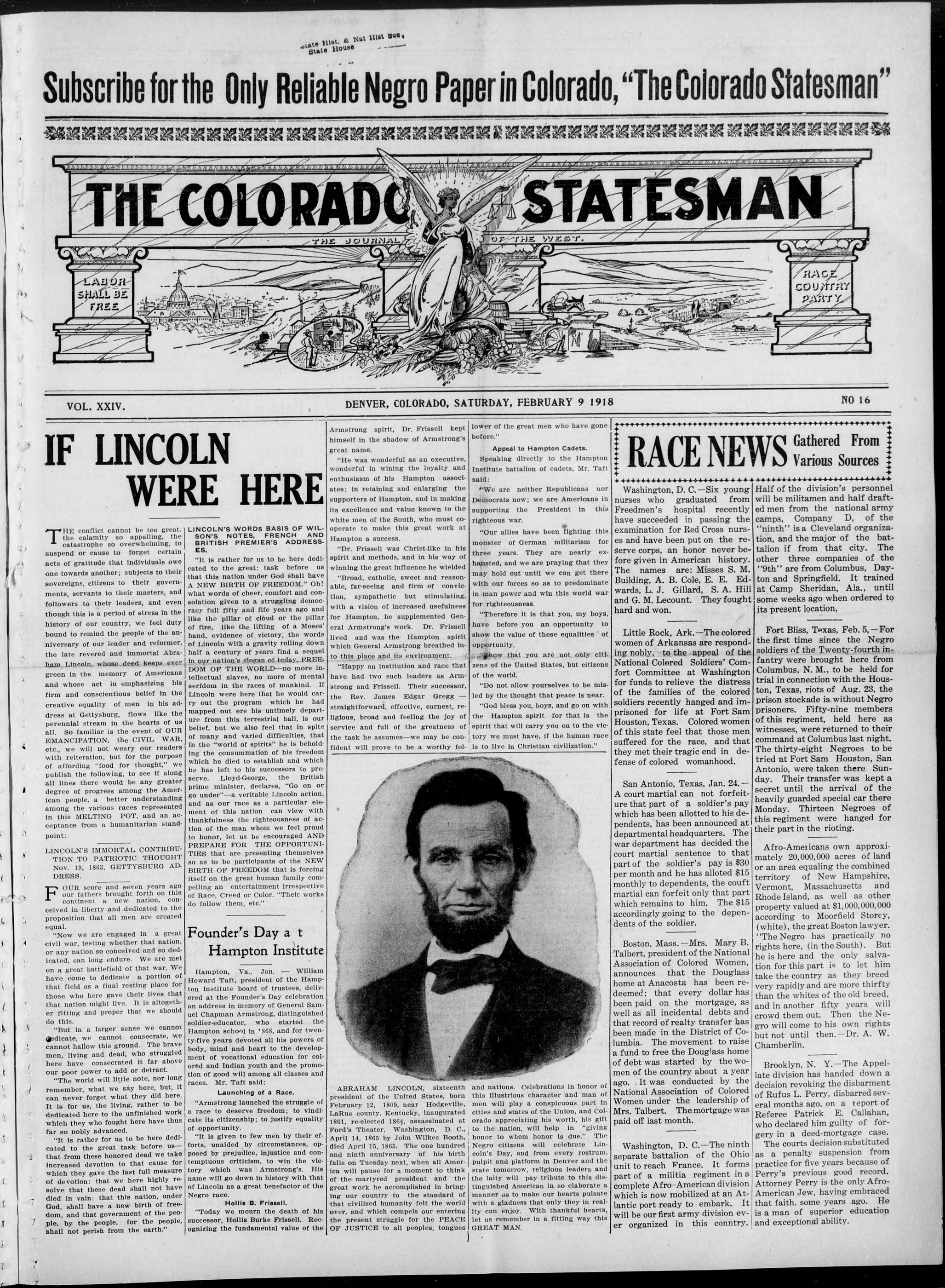
IF LINCOLN WERE HERE
VOL. XXIV. IF LINCO WEI
THE conflict cannot be too great, the calamity so appalling, the catastrophe so overwhelming, to suspend or cause to forget certain acts of gratitude that individuals owe one towards another; subjects to their sovereigns, citizens to their governments, servants to their masters, and followers to their leaders, and even though this is a period of stress in the history of our country, we feel duty bound to remind the people of the anniversary of our leader and reformer, the late revered and immortal Abraham Lincoln, whose deed keeps ever green in the memory of Americans and whose act in emphasizing his firm and conscientious belief in the creative equality of men in his address at Gettysburg, flows like the perennial stream in the hearts of us all. So familiar is the event of OUR EMANCIPATION, the CIVIL WAR, etc., we will not weary our readers with reiteration, but for the purpose of affording "food for thought," we publish the following, to see if along all lines there would be any greater degree of progress among the American people, a better understanding among the various races represented in this MELTING POT, and an acceptance from a humanitarian standpoint:
LINCOLN'S IMMORTAL CONTRIBUTION TO PATRIOTIC THOUGHT Nov. 19, 1863, GETTYSBURG ADDRESS.
FOUR score and seven years ago our fathers brought forth on this continent a new nation, conceived in liberty and dedicated to the proposition that all men are created equal.
"Now we are engaged in a great civil war, testing whether that nation, or any nation so conceived and so dedicated, can long endure. We are met on a great battlefield of that war. We have come to dedicate a portion of that field as a final resting place for those who here gave their lives that that nation might live. It is altogether fitting and proper that we should do this.
"But in a larger sense we cannot dedicate, we cannot consecrate, we cannot hallow this ground. The brave men, living and dead, who struggled here have consecrated it far above our poor power to add or detract.
"The world will little note, nor long remember, what we say here, but, it can never forget what they did here. It is for us, the living, rather to be dedicated here to the unfinished work which they who fought here have thus far so nobly advanced.
"It is rather for us to be here dedicated to the great task before us—that from these honored dead we take increased devotion to that cause for which they gave the last full measure of devotion: that we here highly resolve that these dead shall not have died in vain: that this nation, under God, shall have a new birth of freedom, and that government of the people, by the people, for the people, shall not perish from the earth."
LINCOLN'S WORDS BASIS OF WIL-
SON'S NOTES, FRENCH AND
BRITISH PREMIER'S ADDRESS-
ES.
"It is rather for us to be here dedicated to the great: task before us that this nation under God shall have A NEW BIRTH OF FREEDOM." Oh! what words of cheer, comfort and consolation given to a struggling democracy full fifty and fife years ago and like the pillar of cloud or the pillar of fire, like the lifting of a Moses' hand, evidence of victory, the words of Lincoln with a gravity rolling down half a century of years find a sequel in our nation's slogan of today, FREEDOM OF THE WORLD—no more intellectual slaves, no more of mental serfdom in the races of mankind. If Lincoln were here that he would carry out the program which he had mapped out ere his untimely departure from this terrestrial ball, is our belief, but we also feel that in spite of many and varied difficulties, that in the "world of spirits" he is beholding the consummation of his freedom which he died to establish and which he has left to his successors to preserve. Lloyd-George, the British prime minister, declares, "Go on or go under"—a veritable Lincoln action, and as our race as a particular element of this nation can view with thankfulness the righteousness of action of the man whom we feel proud to honor, let us be encouraged AND PREPARE FOR THE OPPORTUNIES that are presenting themselves so as to be participants of the NEW BIRTH OF FREEDOM that is forcing itself on the great human family compelling an entertainment irrespective of Race, Creed or Color. "Their works do follow them, etc."
Founder's Day a t Hampton Institute
Hampton, Va., Jan. — William Howard Taft, president of the Hampton Institute board of trustees, delivered at the Founder's Day celebration an address in memory of General Samuel Chapman Armstrong, distinguished soldier-educator, who started the Hampton school in 1868, and for twenty-five years devoted all his powers of mind, mind and heart to the development of vocational education for colored and Indian youth and the promotion of good will among all classes and races. Mr. Taft said:
**Launching of a Race.**
"Armstrong launched the struggle of a race to deserve freedom; to vindicate its citizenship; to justify equality of opportunity.
"It is given to few men by their efforts, unaided by circumstances, opposed by prejudice, injustice and contemptuous criticism, to win the victory which was Armstrong's. His name will go down in history with that of Lincoln as a great benefactor of the Negro race.
Hollis B. Frissell.
"Today we mourn the death of his successor, Hollis Burke Frissell. Recognizing the fundamental value of the
Hollis B. Frissell.
State Hist. & Nat Hist Soc
State House
RADO
THE JOURNAL
DENVER, CO
ble Negro Pa
ADC
E JOURNAL
DENVER, COLORADO, SA
DENVER, COLORADO, SATURDAY, FEBRUARY 9 1918
Armstrong spirit, Dr. Frissell kept himself in the shadow of Armstrong's great name.
"He was wonderful as an executive, wonderful in wining the loyalty and enthusiasm of his Hampton associates; in retaining and enlarging the supporters of Hampton, and in making its excellence and value known to the white men of the South, who must cooperate to make this great work at Hampton a success.
"Dr. Frissell was Christ-like in his spirit and methods, and in his way of winning the great influence he wielded.
"Broad, catholic, sweet and reasonable, far-seeing and firm of conviction, sympathetic but stimulating, with a vision of increased usefulness for Hampton, he supplemented General Armstrong's work. Dr. Frissell lived and was the Hampton spirit which General Armstrong breathed into this place and its environment.
"Happy an institution and race that have had two such leaders as Armstrong and Frissell. Their successor, the Rev. James Edgar Gregg — straightforward, effective, earnest, religious, broad and feeling the joy of service and full of the greatness of the task he assumes—we may be confident will prove to be a worthy fol-
which to pre-
British on or
action,
dar ele-
w with
of ac-
proud
and AND
ARTUNI-
mselves
the NEW
forcing
ly com-
poseive
works
t
itute
William
Hamp-
, deliv-
bration
al Sam-
guished
and the
or twen-
wers of
develop-
for col-
promo-
ses and
A. B.
A. B.
ABRAHAM LINCOLN, sixteenth president of the United States, born February 12, 1809, near Hodgeville, LaRue county, Kentucky, inaugurated 1861, re-elected 1864, assassinated at Ford's Theater, Washington, D. C., April 14, 1865 by John Wilkes Booth, died April 15, 1865. The one hundred and ninth anniversary of his birth falls on Tuesday next, when all America will pause for a moment to think of the martyred president and the great work he accomplished in bringing our country to the standard of that civilized humanity felt the world over, and which compels our entering the present struggle for the PEACE OF JUSTICE to all peoples, tongues
---
lower of the great men who have gone before."
Appeal to Hampton Cadets.
Speaking directly to the Hampton Institute battalion of cadets, Mr. Taft said:
"We are neither Republicans nor Democrats now; we are Americans in supporting the President in this righteous war.
"Our allies have been fighting this monster of German militarism for three years. They are nearly exhausted, and we are praying that they may hold out until we can get there with our forces so as to predominate in man power and win this world war for righteousness.
"Therefore it is that you, my boys, have before you an opportunity to show the value of these equalities of opportunity.
"Show that you are not only citizens of the United States, but citizens of the world.
"Do not allow yourselves to be missed by the thought that peace is near.
"God bless you, boys, and go on with the Hampton spirit for that is the spirit that will carry you on to the victory we must have, if the human race is to live in Christian civilization."
C
and nations. Celebrations in honor of this illustrious character and man of men will play a conspicuous part in cities and states of the Union, and Colorado appreciating his worth, his gift to the nation, will help in "giving honor to whom honor is due." The Negro citizens will celebrate Lincoln's Day, and from every rostrum, pulpit and platform in Denver and the state tomorrow, religious leaders and the laity will pay tribute to this distinguished American in so elaborate a manner as to make our hearts pulsate with a gladness that only they in reality can enjoy. With thankful hearts, let us remember in a fitting way this GREAT MAN.
RACENEWS Gathered From Various Sources
Washington, D. C.—Six young nurses who graduated from Freedmen's hospital recently have succeeded in passing the examination for Red Cross nurses and have been put on the reserve corps, an honor never before given in American history. The names are: Misses S. M. Building, A. B. Cole, E. E. Edwards, L. J. Gillard, S. A. Hill and G. M. Lecount. They fought hard and won.
Little Rock, Ark.—The colored women of Arkansas are responding nobly, to the appeal of the National Colored Soldiers' Comfort Committee at Washington for funds to relieve the distress of the families of the colored soldiers recently hanged and imprisoned for life at Fort Sam Houston, Texas. Colored women of this state feel that those men suffered for the race, and that they met their tragic end in defense of colored womanhood.
San Antonio, Texas, Jan. 24. — A court martial can not forfeiture that part of a soldier's pay which has been allotted to his dependents, has been announced at departmental headquarters. The war department has decided the court martial sentence to that part of the soldier's pay is $30 per month and he has alloted $15 monthly to dependents, the court martial can forfeit only that part which remains to him. The $15 accordingly going to the dependents of the soldier.
Boston, Mass.—Mrs. Mary B. Talbert, president of the National Association of Colored Women, announces that the Douglass home at Anacosta has been redeemed; that every dollar has been paid on the mortgage, as well as all incidental debts and that record of realty transfer has been made in the District of Columbia. The movement to raise a fund to free the Douglass home of debt was started by the women of the country about a year ago. It was conducted by the National Association of Colored Women under the leadership of Mrs. Talbert. The mortgage was paid off last month.
Washington, D. C.—The ninth separate battalion of the Ohio unit to reach France. It forms part of a militia regiment in a complete Afro-American division which is now mobilized at an Atlantic port ready to embark. It will be our first army division ever organized in this country.
NO 16
Half of the division's personnel will be militamen and half drafted men from the national army camps, Company D, of the "ninth" is a Cleveland organization, and the major of the battalion if from that city. The other three companies of the "9th" are from Columbus, Dayton and Springfield. It trained at Camp Sheridan, Ala., until some weeks ago when ordered to its present location,
Fort Bliss, Texas, Feb. 5.—For the first time since the Negro soldiers of the Twenty-fourth infantry were brought here from Columbus, N. M., to be held for trial in connection with the Houston, Texas, riots of Aug. 23, the prison stockade is without Negro prisoners. Fifty-nine members of this regiment, held here as witnesses, were returned to their command at Columbus last night. The thirty-eight Negroes to be tried at Fort Sam Houston, San Antonio, were taken there Sunday. Their transfer was kept a secret until the arrival of the heavily guarded special car there Monday. Thirteen Negroes of this regiment were hanged for their part in the rioting.
Afro-Americans own approximately 20,000,000 acres of land or an area equaling the combined territory of New Hampshire, Vermont, Massachusetts and Rhode Island, as well as other property valued at $1,000,000,000 according to Moorfield Storey, (white), the great Boston lawyer. "The Negro has practically no rights here, (in the South). But he is here and the only salvation for this part is to let him take the country as they breed very rapidly and are more thirfty than the whites of the old breed, and in another fifty years will crowd them out. Then the Negro will come to his own rights but not until then.—Dr. A. W. Chamberlin.
Brooklyn, N. Y.—The Appellate division has handed down a decision revoking the disbarment of Rufus L. Perry, disbarred several months ago, on a report of Referee Patrick E. Callahan, who declared him guilty of forgery in a deed-mortgage case. The courts decision substituted as a penalty suspension from practice for five years because of Perry's previous good record. Attorney Perry is the only Afro-American Jew, having embraced that faith, some years ago. He is a man of superior education and exceptional ability.
FOREIGN
by enemy airmen, it was officially an:
nounced,
Austria is absolutely dependent up-
on Hungary and Rumania for grain,
Herr Haefer, the Austrian food min-
ister, sald In an interview in London.
Completé order has been restored
at Lamia, northwest of Athens, where
soldiers of Greek infantry regiments
mutinied, according to an Athens dis-
patch to the London Times,
Cheap and comfortable travel be-
tween the United States and England
will be one of the first steps in post-
war reconstruction, in the opinion of
the American ambassador, Walter H.
Page.
German U-boats, according to a re-
ply given by Andrew Bonar Law, gov-
ernment leader in the House of Com-
mons, have done to death 14,120 non-
combatant British men, women and
children.
Norway's reply to the proposals
from the American War Trade Board
regarding supplies from the United
States to Norway, emphasizes the firm
resolve of the Norwegian people and
government to remain neutral.
Former Grand Duke Nicholas Con-
stantinovitch, nephew of Emperor Ni-
cholas I, and son of the late Grand
Duchess Alexandra Josefowna, is
dead at the age of 68 at Tashkend,
Russian Turkestan, Nicholas was ban-
ished to Tashkend years ago by the
Romanoff family because of a love
affair with an American actress.
Fear that Francisco Villa might
change his plans and strike Juarez
instead of Ojinaga has caused Gener-
al Martinez, acting commander of the
federal forces at Chihuahua -City, to
send reinforcements north from the
state capital to strengthen the garrl-
son at Juarez and assist in patroling
the river near Juarez to prevent Vil-
la’s men from joining him.
A dispatch to the London Exchange
Telegraph from Amsterdam says Dr.
von Kuehlmann, the German _ secre-
tary of foreign affairs, is betrothed to
Frau Friedlaenderfuldt, who after
‘Frau Bertha Krupp von Bohlen und
Halbach, is reported to be the richest
| woman in Germany, Frau yon Fried-
lnenderfuldt is the divorced wife ot
| the Hon. John Mitford, son of the late
Lord Dedesdale,
SPORT
Jimmy Duffy of Lockport, N. Y.
will try to take the welterweight title
away from Ted Lewis in a fitteen:
round bout at Toledo, Ohio on Feb. 18.
‘The Western League will be in the
field this year with Omaha, Des
Moines, Wichita, St. Joseph and Jop-
lin certain of membership, according
to B, W. Dickerson, president of the
league.
Mrs. A. C. Ball of the Eastern Mar
ket ‘Ten Pin team rolled 268 in compe
tition at Detroit, Mich. This is be
Heved to be a record score for women.
Incidentally, she won a ton of coal,
offered as a prize for any woman
making eight consecutive strikes,
John L. Sullivan, formerly world's
heavyweight champion boxer, died at
his home in Abington, Mass. Sullt-
van, who was 59 years of age, had
lived on a farm there for the last ten
years. He was one of the most pic:
turesque characters in the history of
prize fighting. For more than ten
years, from the time he defeated Pad-
dy Ryan in 1882, in a bare knuckle
fight under the London prize ring
rules, until he was defeated by James
J. Corbett in 1892, his personality and
methods of fighting completely dom-
inated sporting circles in the United
States.
GENERAL
Col, Theodore Roosevelt underwent
an operation for abscess a few days
ago.
Mrs, M. Sevanian, 23, wife of an
Armenian grocer, reached Waukegan,
IL, with her brother, Gregor Perzi-
gian, 16, after an 8,000 mile fight of
an entire year to escape the Turks.
Her mother, father and grandmother,
85, were butchered by the Turks, as
were 2,000 more in their caravan, she
said.
Franz von Rintelen, German naval
officer and a reputed member of the
German war staff, was found gullty
with ten other defendants in Federal
Court in New York of conspiracy to
destroy food and munitions ships of
the entente allies by placing “fire
bombs” in their cargoes. Judge Howe
immediately imposed the maximum
penalty of eighteen months imprison:
ment in the federal penitentiary at
Atlanta and a fine of $2,000 on each
of the prisoners,
The gigantic activities of the Red
Cross War Council from the date of
its appointment by President Wilson
to Jan. 9, 1918, are portrayed by the
NEWS TO DATE
IN PARAGRAPHS
DURING THE PAST WEEK
Ee tet Rage Sree SETS OT a OTE
Ing the week ended Feb. 4 totaled
6,354,
From the North sea to the Swiss
frontier the military activity daily
seems to be growing in intensity.
A wireless dispatch received at Ber-
lin from Kiey says that the Poles
have occupied Mohiley, the Russian
main headquarters, and have arrested
Ensign Krylenko, the commander-n-
chief of the Russiah Bolshevik forces,
and his entire staff.
The British armed boarding steam-
er Louvain, Lieut, Com, M. G. Easton
commanding, was torpedoed and sunk
by a German submarine in the east
ern Mediterranean on Jan. 21. Seven
officers and 217 men were lost.
‘The French war office asserts that
the attacks north of the Aisne were
repulsed, but the German war office
says that south of Beaucourt, Baden
storming troops pushed far into the
French front inflicted heavy casual-
ties and returned to thelr own lines
with prisoners.
Tartar forces have occupied Yalta,
in the government of Taurida, and are
advancing on Sebastopol, Russia’s
chief fortress and naval base on the
Black sea, according to a dispateh re:
ceived by the Petrograd Evening Post
from Sebastopol. The dispatch adds
that the Tartars are dealing merciless.
ly with Red Guards, sailors and sol
diers,
Venice and a number of towns on
the Venetian plain have been bombed
by enemy airmen, according to the
Italian official communication. While
no damage and no casualties resulted
from the attack on Venice, consider:
able destruction was wrought in the
towns of Padua, Treviso and Mestre
where a number of civilians were
killed or wounded.
Next in importance to the opera
tions on the American front have
been attacks by the Germans against
the French in the Aisne region and
north of Verdun, near Beaumont.
Heavy casualties are believed to have
been inflicted on the Teutons and con-
siderable damage was done by the
seventy-fives on the German trenches,
due to the accuracy of aim of the
American gunners,
American officers are elated over
the results of the first artillery duel
between American and German gun-
ners, which followed a» preliminary
shelling by the Germans Saturday
evening. In official reports the infan-
try commanders paid tribute to the
promptness with which the artillery
responded to the call for a barrage
and to the effectiveness of the artil-
lery. fire. Aerial reconnaissances
showed that the American gun fire
had had a very destructive effect.
WESTERN
Armed with a search warrant, Spe-
cial Counsel Francis J. Heney of the
Federal Trade Commission seized the
Swift & Co, files in the offices of At:
torney Henry Veeder in Chicago,
All motion picture shows and thea.
ters and other public gathering
places in Bisbee, Ariz. and the War:
ren district were closed by the county
and city health authorities, in estab:
lishing a rigid quarantine against the
further spread of smallpox. There
are twelve cases in the district.
‘The New Mexico Central railroad
was sold at special master’s sale at
Santa Fé to S. C. Munoz of New York
head of the Federal Export Corpora
tion and president of the New Mexico
Central Railway Company, as trustee,
for $300,000. Mr. Munoz said a $500,
000 corporation would rebuild the
road.
WASHINGTON
‘A bill authorizing the appointment
of an additional judge for the District
of Arizona was passed by the Senate.
Belgium was granted another cred-
4t of $3,500,000 by the treasury, mak.
ing her total loans from the United
States $89,900,000.
Developments promise indetinite ex-
tension of the controversy in the Sen:
ate over American war efficiency and
the military committee's pill 1or a war
cabinet and munitions director.
‘Ten months of the war have cost
the United States about $7,100,000,000
—at the rate of $710,000,000 a month,
nearly $24,000,000 a day.
A twoounce bread ration was or.
dered by the Food Administration for
patrons of hotels, restaurants and din:
ing cars. This allowance is about
that now observed in England.
Secretary Tumulty returned to the
capitol after a visit to New Jersey,
where the possibility of his becoming
‘a Democratic candidate for senator is
“wing discussed among political lead:
ers
COLORADO
STATE NEWS
The completed contract for the
Grand Valley drainage district work,
bearing the signature of Franklin K.
Lane, has been received by the recla-
mation office at Grand Junction. Work
will be commenced as soon as matters
concerning the right-of-way can be
settled. The completion of the drain-
age work will require two years, al-
though a large portion of the valley
in the immediate vicinity of Grand
Junction will be drained during the
next few months.
Mrs, Catherine Campbell, Cope,
Washington county, is Colorado's first
United States commissioner—and one
of four in the entire United States.
Mrs. Campbell was named by Judge
Lewis of the Denver division of the
United States District Court, to suc:
ceed her father-in-law, Alexander
Campbell, who died recently. Judge
| Lewis also appointed Leslie M. Bell
| United States commissioner at Dove
| Creek, Dolores county.
In an effort to help move Colorado's
pinto bean crop and also the potato
erop, which is threatened by com-
bined lack of cars and surplus produc-
tion, the Colorado Food Administra-
tion made a ruling that potatoes or
| pinto beans could be substituted to
|the extent of 25 per cent. for the
| cereals which must be purchased un-
der government orders in an amount
|equal to the white wheat flour pur-
| chased.
| A suit brought in the District Court
|at Greeley by Herman EH. Meyers,
deputy county clerk of Weld county,
to recover a commission on a land
deal, when heard brought to light ev-
idence which caused his arrest and
confinement in jail pending an inves-
tigation by United States District At-
torney Harry B. Tedrow into his al-
|leged activity in an attempt to defeat
j the selective draft act.
The Colorado State Board of Exam-
iners cf Architects has elected oftic-
ers as follows: Francis W. Cooper,
Pueblo, president; Thomas F. Walsh,
Denver, vice-president; T. Robert
Weiger, Denver, secretary-treasurer;
F. W. Frewen, Jr., Denver, and Arthur
Saunders, Boulder, completing the
committee.
C, S. McDowell, aged 48, for twenty-
five years an engineer of the Denver
& Rio Grande railroad, fell dead at
La Veta as he stepped into the hotel
at that place, after having completed
his trip pulling a Denver & Rio
Grande passenger train from Pueblo
to that place. He is a resident of
Pueblo.
A reception will be tendered #-the
Rey. Charles L, Mead in Denver on
Feb. 15, prior to his departure for
France. Governor Gunter, Mayor
Speer, Chancellor H. A. Buchtel and
Finlay H. MacFarland will preach at
a noonday service to be held at the
First Baptist church.
It is a useless wear and tear on a
Liberty bond to take it to the collect-
or of internal revenue with the idea
that you may pay your income tax
with it, Such acceptance would be
equivalent to the retirement of the
bonds, which the law does not per-
mit at this time.
Coloradé potato growers produced
in the season just passed 9,310,000
bushels, of which 5,027,000 bushels are
still in the hands of the men who
raised them, Their market price on
the first of December was 91 cents
per bushel.
The Pyramid Shale Products Com-
pany has recently been organized
with a capitalization of $250,000. The
company owns 3,840 acres, three
square miles, on Battlement mesa, fac-
ing the town of Grand Valley.
Fourteen head of deer, bucks, does
and fawns, blocked the auto stage on
McQuire hill about seven miles from
Cripple Creek. The driver had to stop
the machine until the deer broke
away from the road and took to the
hills,
Silverton miners wade through the
deep snow to buy war savings stamps.
‘The postoffice alone sold $1,728 worth
in one day, and a total of $5,215. At
Durango $800 worth were sold in one
day.
Mrs, Loule Fong, American wife of
a wealthy Chinese restaurateur at
Pueblo, took a large sum of money
from the restaurant and fled, accord-
ing to the story told the police by her
husband, Louie Fong.
‘The value of the livestock on the
farms in Colorado increased $31,852,-
500 in 1917, almost 25 per cent, On
Jan, 1, 1918, the total value of all the
livestock on the Colorado farms was
$159,597,000.
Denver bank clearings for the past
week were $20,873,777.13, and those
for the corresponding week of last
year were $12,955,005.73, showing a
COLORADO NEWS NOTES.
Western Beef Co.
cee se er
Open Daily to 8:30 Sundays Until 2:00
p. m. p. m-
eR es nic 23 2a
ONE OF THE MOST UP-TO-DATE AND SANITARY
MARKETS IN THE CITY.
Fresh Oysters, Chitterlings, Pig Tails, Snouts, Ears, Pigs Feet,
Neck Bones, Spare Ribs, Received Fresh Daily.
Fresh and Cured Meats of All Kinds. Fresh Vegetables, Staple
and Fancy Groceries.
Our Prices Are Always
: the Lowest
Free Delivery to All Parts of he City.
PHONE CHAMPA 1641.
2048 LARIMER STREET DENVER, COLO.
Opposite the Three Rules.
dead men are in custody, as is the
man suspected of assaulting another.
One of the murderers is at large. Dur-
ing a quarrel over a woman, Carlos
Pallejo shot and killed Antonio Ar
mez, and succeeded in making his es-
cape, and is still at Uberty. Alexander
Biastete, who shot and dangerously
wounded Mike Lopez, and who was
later arrested, claims he shot in self-
defense, Another Mexican, Amelia
Ortez, was killed, and Anton Rodri-
quez and Herman Licona were ar
rested.
Gordon William Spradlin, “Bad
Man” of Paradox valley, whose bat-
tles with federal authorities in his ef-
forts to resist the draft covered a
period of several months last year,
was sentenced to twenty years in the
military prison at Fort Leavenworth,
Kan., following a trial held by court-
martial at Camp Funston, Kansas. Ol-
iver High, a slacker from Montrose,
who escaped from Camp Logan with
Spradlin last November, sentenced
with Spradlin, was given ten years in
prison,
With the arrest in Sapulpa, Okla,
of Monte Abbott, known to the Den-
yer police as Frank L. Smith, a nation-
wide search extending over the last
five years was brought to a close.
Smith is wanted in Brighton for the
murder of Jesse H. Stingley, a detec-
tive, whose body was found near Utah
Junction on Oct, 23, 1912. William P.
Code, arrested with Smith a few days
after the murder, is now serving a life
sentence in the penitentiary for his
part in the crime,
Mrs. Job Adams Cooper, widow of
former Governor Cooper of Colorado,
died at the home of her daughter, Mrs,
E. S. Kassler in Denver. Mrs. Cooper
fell while fixing a Christmas tree for
Craig Colony, dislocating her shoulder
and breaking her arm. She was 74
years old, and had been ill from the
shock since the accident. The philan-
‘thropie work and devotion of Mrs.
Cooper to the Craig Colony of Denver
has made her known throughout Col-
orado and the country.
F. M. Kattenstrath, Chicago owner
of one of the leading stables of show
horses in the United States, proposes
to make Denver the home of his $100,
000 stable. He has already made a
faney offer for the palatial country
home near Littleton of the late Col.
George S. Newman, and plans, in the
event of purchase, to make the estate
the center of his great string ot
twenty-four horses.
Japanese farmers will grow fully 5
per cent. of the cantaloupe crop of
the Rocky Ford district in the coming
season. An organization of the Jan,
anese Agriculyural Association of
southern Colorado has been effected,
with S$. Shishido, president; M. Tan-
abe, vice president; O. Nakayama,
treasurer; K. Mizuma, secretary.
Col. John B. Colton, one of the two
survivors of the famous Jayhawkers
of 1849 who discovered Death valley
on Christmas Day, 1850, spent a day
in Denver while on his way from
Galesburg, IL, to meet the only other
surviving member of that daring par-
ty, Lorenzo Dow Stephens, 92 years
old, of San Jose, Cal.
The Colorado Board of Health, in
line with the request from the Wash-
ington committee on training camp ac-
tivities, created a bureau of social dis-
eases, the object of which is to proy
tect soldiers as well as civilians from
undue exposure to communicable dis-
eases. ‘
Richard W. Mosley, well known to
many Colorado pioneers and promin-
ent in Masonic circles years ago,
passed away in his 84th year in Den-
yer. In the early days of Colorado he
had resided at Central City and Black
Hawk, where he engaged in gold min-
ing.
Judgment of the El Paso District
Court finding J, Lofton Davidson,
South Denver undertaker, guilty of
having conspired to defraud Eastern
insurance companies out of $15,000,
and sentenced him to from two to
three years in the penitentiary, was
reversed by the Supreme Court. At
the same time the court instructed
the District Court to dismiss the case
against Davidson.
‘The Colorado State Fair for the
year 1918 will be conducted by a com-
mission appointed by Gov. Julius C.
Gunter, and will in the future be main-
tained by a state tax levy. The fol-
lowing comprise the newly appointed
officers: Martin Walter, Jr., of Pueb-
lo, president; J, J. Tobin of Montrose,
secretary; Wyatt Roger of Burlington,
treasurer, and J, L. Beaman of Pueblo,
manager.
In 1918 food production plans of the
Colorado State Council of Defense are
well under way and will be in full
PS Ee oe 6 ee ea ee Pay a
Bolden Bros. Cafe & Lunch Room
924 NINETEENTH STREET, DENVER, COLORADO
DINNER sige Me, Short Orders
11:30 to2 p.m. Soars ~—at all Hours
£5
ALL KINDS OF SANDWICHES _
BOLDEN BROS. BARBER SHOP
Baths, Electric Massage
FIRST-CLASS SERVICE
R. B. BOLDEN, Manager 926 19th St., Denver
The Champa Pharmacy
Twentieth and Champa,
, Is the place to got your
DRUGS, CHEMICALS AND PATENT MEDICINES
WH SERVH ~ DRINES.
Prescriptions Our Specialty.
Phone us and we will deliver the goods to all parts of the city,
JAMES E. THRALL, Propr.
PHONE MAIN 2426.
Weatherhead Hat Co.
TELEPHONE MAIN 3203
=
Established 1876
PIONEER HATTERS OF THE WEST
WE MAKE OLD HATS NEW
PRACTICAL HATTERS
RENOVATORS, BLEACHERS DYERS AND FINISHERS
Of Gents’ and Ladies’ Hats of Every Description
1624 Champa St., Denver, Colo.
PHONE MALDN 3028 i RES. PHONE GALLUP 94
JOHN K. RETTIG
Meats, Fancy and Staple Groceries
ern 1864 CURTIS STREET i fi ies on
The MARKET COMPANY
0. E, SMITH, Manager, Res. Phone South 1608
Wholesale and Retail Staple and Fancy Groceries, Fish and Oystera
Hotels and Restaurants Our Specialty.
Fresh and Cured
Eastern Corn Fed Meats
Fruits, Vegetables, Poultry and Game.
Telephones Main 4302, 4303, 4304, 4305
622-636 15th Street Denver, Colorado
A VALENTINE
ARTHUR GUITERMAN
with drawings by
JOHN WOLCOTT ADAMS
If all be true that wise men say
Of good St. Valentine his day,
Oh, then above the melting snow
The Snowdrops bashful kisses blow;
The silver Trout of lake and linn
Do swim together fin-to-fin;
The furry Hares of heath and shaw
Do make their gambols, paw-to-paw;
The Birds their mating carols sing
And fly together, wing-and-wing.
And all about the wakening land
Go Youths and Maidens, hand-in-hand
Then, Ever-Dearest, hear my plea
And wander hand-in-hand with me.
—From Good Housekeeping.
A
For the boys in France
CUPID STILL RULES
Cynics Who Decry Power of St. Valentine Are Unable to Prove Their Case.
ACYNIC once remarked that the two most irritating days on the calendar were those consecrated to Saints, Swifth and Valentine, because, said he, the first often brought with it a stretch of rain and the second a wretch of a strain; for, of all strains in the world, he argued, the worst was that imposed by having to read a silly lot of footless and useless valentines.
The cynic probably does not stand alone in his opinion of Saint Valentine's day. There are thousands of men like him who believe that the day has degenerated; that, where once Cupid conquered hearts through loving missives sent on February 14, he now merely vavens and falls to heed.
But does he? Have the old valentines, as love messages, really lost their power? Or have new kinds of valentines succeeded the filmsy lace kind of other years? And are they at all effective?
The printed chronicles of the last several years reveal numerous cases that go to disprove the statement of the cynic and his followers.
On Saint Valentine's day, 1908, Arthur Trumbull of Oswego, N. Y., sent a young woman named Alice Cayvan, whom he had been courting with indifferent success for several years, a large heart fashioned out of crimson cardboard. Through the heart he had stuck a papier mache arrow. On it he had written the single interrogatory word "Hopeless?" The next day the heart was returned to him by mail; but the arrow had been removed and the hole in the center had been patched up with a bit of white paper on which Miss Cayvan had written a clearly legible "Yes." They were married soon after.
Not less productive of result was the effort of Albert Hildrummel of Topeka, Kan., who, according to an article printed in Western newspapers, sent the young woman he loved, Clara Sedgwick, a blank marriage certificate on last Valentine's day with these verses on the back:
This is my idea of a valentine,
Practical, indeed, but true.
If you'll write your name in it.
It will be a valentine for two.
It is interesting to note that the recipient did as directed.
An odd valentine was that sent two years ago by Francis Everlin of Chicago to Sarah Collins of Toledo, O. Everlin had asked the latter to marry him on numerous occasions; but the young woman had always asked him to refrain from regarding her otherwise than "a sister." Everlin had no such intention, however, and, biding his time till Valentine's day, sent her a valentine made up to resemble a ballot such as is used in municipal elections. At the top of the ballot was a
```markdown
```
Pablo Picasso
pen and ink picture of a house, and beneath appeared Everlin's name opposite all the offices to be voted for, viz., rentpayer, bundle carrier, loving husband, and so on. A slip was appended asking the voter to vote the straight ticket. Whether it was the humor of it or something else is unknown; but the fact remains that Miss Collins put the matrimonial X under the house.
The "missing-line" puzzle craze gave Herbert Randall of San Francisco his valentine cue in 1907. To his sweetheart, Vera Salison of the same city, he sent this incomplete stanza, asking her to fill out the last line. The verse ran:
"It might have been" are saddest words. It world of love and love and stuff. For these the sladdest words:
The stanza was returned the following day with this line: "Yes, dear, I now will be your wife."
One of the most peculiar valentines on record was the one sent a year ago by Allen Straw of Pittsburgh to Louise Rovayer of Erle. It was nothing more or less than a large roll of white silk, bearing the words: "This is for a wedding dress. Please valentine me with a 'yes.'" The silken valentine was effective.
On Valentine's day three years ago two men sent their sweethearts railroad timetables to Niagara Falls, and another man sent his lady love a trunk tied with white ribbons and strewn inside with rice.
John Thomas Ray of Omnha won a wife through a valentine sent to a young woman living in St. Louis. Ray's valentine took the form of a big red apple, to the stem of which he had attached a card reading: "Love me and a world of happiness shall be yours. Love me not, and all that you will have will be this apple. It is big and red and pretty, but it will not last any more than will the semihappiness you believe you are enjoying while single."
The popular jigsaw puzzles were used as valentines by several wooers last year. One man, named Shaw, of Atlanta, sent one to his sweetheart in the same city and with it the lines: "I've puzzled my brain to guess your answer. Won't you put me in shape again with a 'Yes'?" The girl sent the valentine puzzle back with a note that read: "I do not want this puzzle. I'll give you myself. I have been a puzzle, I admit; but I'm going to solve myself for you." Another man, Stanley Lemoyne of Denver, sent one of the puzzles as a valentine to Rhea Knowles of the same town, with the note: "This will help pass away the dull hours for you in case you refuse to marry me." The girl married him.
Odd valentines, these, indeed; but odder still the valentine sent in 1906 by Reynolds Touhey of New York to May Lindstrom of Brooklyn, a valentine that succeeded in leading the latter to the altar. Touhey's valentine was a Dresden doll baby, and attached to it was a card reading: "Imagine having nothing more real than this all your life!"—The Sunday Magazine.
For the boys at Sea
```markdown
```
A
He is a capitalist—
Who sees the rainbow and the light,
When shadows and the storms appear,
Hath vision far-falth serene and bright—
And meets each task without a fear.
—J. H. Ayers.
GOOD EATING.
As we are forgetting how a frosted cake looks these days, we can without overstepping the bounds of economy occasionally use a rich filling for a layer cake, which is most satisfying.
Baking Pan
Banana Cream
Filling.—Beat the whites of two
eggs until stiff and dry. Mash four bananas until smooth, sprinkle sugar over them to keep them from turning dark, add the bananas to the whites, a spoonful at a time, beating after each addition. A cupful of powdered sugar is used to add to the banana pulp. Sufficient beating will make this cream light and fluffy.
Ginger Rice.—Scald a quart of milk and stir in five tablespoonfuls of washed rice, add salt, three tablespoonfuls of sugar, and a tablespoonful of finely chopped preserved ginger, bake for two hours in a slow oven.
Virginia Spoon Bread.—Stir a cupful of cornmeal into a pint of scalding hot milk, cook five minutes, then add two tablespoonfuls of butter and a cupful of cold milk, then add two well beaten eggs, beat well and gradually add another cupful of milk. Put the mixture into a well buttered granite baking dish and bake a half hour in a hot oven. Serve at once from the baking dish.
Breadcrumb Pancakes.—Two cupfuls of fine bread crumbs soaked in two cupfuls of milk over night, then beat smooth, add two well-beaten eggs, a tablespoonful of melted shortening, and a cupful of flour with two teaspoonfuls of baking powder and a half teaspoonful of salt sifted with the flour. Cook on a hot greased griddle, spreading them very thin and serve hot with maple sirup.
Jugged Soup—Put six potatoes sliced very thin in a bean pot, add a cupful of canned peas, a thinly sliced turnip, a sliced onion and a quarter of a cupful of well washed rice. Season with salt and cayenne and pour over a quart of well seasoned beef broth. Put on the cover and place in the oven, cook three hours and serve with crackers.
The more some people have the more they want, which may explain the secret of borrowing trouble.
SEASONABLE WAR FOODS.
The women all over the land who are trying to conform to the food conservation requisites are having more fun housekeeping than ever before in their lives. Being economical and resourceful is now the fashion and it is developing many latent geniuses. Women are putting the thought that they used to spend on clothes or amusements on the
are having more run housekeeping than ever before in their lives. Being economical and resourceful is now the fashion and it is developing many latent geniuses. Women are putting the thought that they used to spend on clothes or amusements on the proper food for the family, with the result that the importance of food study is finding its proper place.
When possible buy the unpolished rice; it is far more wholesome and can be purchased often enough by the dealer to have it always in good condition. The same is true of any of the butter substitutes; buy of a grocer who sells it so freely that it is sure to be fresh.
Oleomargarine is very palatable if well made and after working in the color and a teaspoonful of sugar, to a pound, with more salt if it is liked, it will take the place most acceptably of 55-cent butter that is none too good. For cake making of various kinds this butter substitute will take the place of butter with no one the wiser.
**Brown Rice.**—Add a teaspoonful of salt to three cupfuls of boiling water and drop in a half cupful of unpolished rice, cook stirring with a fork until well boiling, then cook until tender more slowly. Dry in the oven and serve as a vegetable seasoned with salt, pepper and butter.
Pea Puree.—Wash and soak a cupful of green split peas overnight in three cupfuls of water. In the morning put on to cook in the water, add a large onion sliced, a stalk of celery, both browned in a little hot fat. Add to the peas in the kettle a large slice of bread, a half teaspoonful of salt, a fourth of a teaspoonful of pepper and a half cupful of mashed potato; bring to the boiling point and serve. This may be thinned with hot milk or served as a thick puree.
Nellie Maxwell
Occupy Your Proper Place.
It's continuous confidence in the ideal of your own making that compels success, observes an educator. Some men never question the possibility of defeat. They may have set-backs but not defeats. They are right and know themselves to be right. The rest of the world may be ranged against them for all they care. They have a mission and nothing short of it will satisfy. That's what you should have. Get the proper self-estimate and move up to your place.
44 DEAD BODIES WASHED ASHORE
U-BOAT THAT TORPEDOED THE TRANSPORT TUSCANIA BE-LIEVED SUNK.
DEATHTOTALCUTTO101
TROOPS LEAP TO DECKS OF BRIT.
ISH TRANSPORT SINGING
NATIONAL ANTHEM.
Western Newspaper Union News Service.
An Irish Port, Feb. 8.—The Tuscania, torpedoed and sunk off the north coast of Ireland by a German submarine Feb. 5, carried a total of 2,397. The saved number 2,296, as follows: Troops, 2,106; crew, 190; total lost, 101. Among the American survivors are seventy-six officers. There are eighty-one American troops in hospital. The bodies of forty-four of the missing 101 victims of the Tuscania disaster were washed up Thursday on the rocks fifteen miles from the scene of the torpedoing. All were Americans and their bodies were mutilated beyond recognition.
A pathetic feature is that, although all the victims wore tags, no identification numbers had been put on them because these Americans had not yet been assigned to definite army units. Therefore there is no way to identify them, and they will be buried in one grave.
Londonderry, Ireland, Feb. 8.—The submarine which torpedoed the Tuscania was attacked by a destroyer. An American officer gave an intimation that the submarine was destroyed. This officer was next to last to leave the Tuscania. He gave a vivid account of the disaster. The second torpedo fired by the submarine missed its mark, he said. Thereupon a destroyer which was near the sinking liner dashed off toward the submarine, using a bomb-dropping device. The claim is made that the submarine was "done in" by the bombs thus exploded.
London, Feb. 8.—Sergt. E. C. Dubuque and Sergeant Muller, both of Brooklyn, who were on the Tuscania, were rescued from a raft by a coasting schooner.
The sergeants say that the Tuscania took a tremendous list to starboard almost as soon as she was hit. Almost all the lifeboats on that side were either blown into the air or otherwise rendered useless.
The soldiers were immediately lined up, and while standing at attention as one man, began to sing "My Country, 'Tis of Thee,' and "The Star Spangled Banner." The crew, which lined up on the opposite side, sang "God Save the King."
An Irish Port, Feb. 8.—Most of the Americans were lost through the Tuscania's sudden heavy list after being torpedoed, which caused faulty launching of the lifeboats.
The German torpedo struck the Tuscania a vital blow amidships, causing her to list almost to starboard.
Instead of plowing forward in this fashion, as most vessels do under the circumstances, the Tuscania stopped dead. A shiver ran through her, and she heeled over at a dangerous level. The list to starboard so elevated the lifeboats on the port side as to render them practically useless, and only a few of the boats on that side were launched. The first of these struck the water unevenly, capsizing and throwing the occupants into the sea. Many donned lifebelts and jumped overboard. Hundreds of others were preparing to follow this example when a British destroyer boldly drew up right alongside the Tuscania. When the men saw this many of them leaped from the boat and saloon decks to that of the waiting destroyer.
The destroyer took off several hundred men, all she could carry, and moved away. She had come up along the starboard side of the Tuscania.
As she steamed away with her deck loaded down with Americans, another British destroyer emerged out of the darkness on the Tuscania port, now high out of the water.
All the time this rescue work was progressing cool heads were getting the few other lifeboats afloat. Despite the many difficulties the crew behaved well and the coolness of the American soldiers was the subject of commendation in affidavits by the boats officers.
Forty of the survivors were taken to hospitals. In the majority of cases, they are suffering from injuries as a result of accidents in the lowering of lifeboats or in consequence of sliding down ropes.
Proof of the order which prevailed on the Tuscania is given by the landing of two typhoid and two pneumonia cases without bad effect.
New York, Feb. 8.—The Cunard liner Aurania, 13,400 tons, was torpedoed by a German submarine while bound for the United States, it was learned from officials of the Cunard line. Although badly damaged by the explosion the ship was not sunk and is believed to be making her way back to port.
FLORAL DESIGNS PUT UP WHILE YOU WAIT
CHOICE PLANTS AND CUT FLOWERS CONSTANTLY ON HAND
GREENHOUSES: Thirty-Fourth and Curtis Streets
TELEPHONE, MAIN 1511
DENVER, COLO
A Full Line of Fresh Fish in Season
Oysters and Lobsters
Short Orders At All Hours Rest Room for Ladies
STREET DENVER, COLORADO
MORRISON'S FAMOUS
N'S FAMOUS JAZZ ORCHESTRA
MORRISON'S FAMOUS JAZZ ORCHESTRA
AND ENTERTAINERS
GEO. MORRISON, MANAGER
Music Furnished for
Phone Main 2707. Res. 2947 Store
When You
The Heads, Feet,
Neckbones or
any other part of
the squeal, go to
East's Man
2300-6 Lari
Night and Day
806 15th St., Two Doors From Store
Free Delivery—Shipping
Notice: Open evenings until
NOT
In order to get acquainted aga
friends, we are going to give awa
FF
with this ad. a valuable premium
Let this INFORMATION, for the t
the owner of the
NIGHT AND DAY
I am printing this. I am the man
Company seven years ago at 2038
couple of doors up to a larger st
four years. Now I have been run
CANTILE CO. for three years, an
co-operation of your trade, which
Now I am going to go after your
forces by giving you the advantage
meat and grocery buying. We bu
middleman's profit. We can save
order. SO GIVE US A TRIAL.
MEATS.
Furnished for all Occasions
007. Res. 2947 Stout St. DENVER, COLO.
When You Want
Heads, Feet Tails, Snouts
Bones or Chitlerings, or
other part of the hog except
dual, go to
7's Market Phone Main
1461
800-6 Larimer Street
and Day Mercantile Co.
Two Doors From Stout St. Phones Champa 3018-3673.
Free Delivery—Shipping Orders a Speciality.
Open evenings until 12 o'clock. All day Sundays.
NOTICE
To get acquainted again with our old customers and their
we going to give away
FREE
a valuable premium worth dollars to you.
FORMATION, for the benefit of the people who don't know
the
T AND DAY MERCANTILE CO.
this. I am the man who opened up the Western Market
in years ago at 2038 Larimer Street. I then moved a
arms up to a larger store, at 2048 Larimer, and ran it for
now I have been running the NIGHT AND DAY MER-
FOR three years, and my whole success was through the
of your trade, which we wish to thank you one and all.
I am to go after your business stronger than I ever did be-
f you the advantage of my many years of experience of
very buying. We buy direct in carload lots and save the
profit. We can save you from 20 to 30 per cent on your
WE US A TRIAL.
GROCERIES
Music Furnished for all Occasions
Phone Main 2707. Res. 2947 Stout St. DENVER, COLO.
When You Want
When You Want
The Heads, Feet Tails, Snouts Neckbones or Chitlerings, or any other part of the hog except the squeal, go to East's Market Phone Main 1461 2300-6 Larimer Street
Night and Day Mercantile Co.
806 15th St., Two Doors From Stout St. Phones Champa 3018-3673.
Free Delivery—Shipping Orders a Speciality.
Notice: Open evenings until 12 o'clock. All day Sundays.
NOTICE
In order to get acquainted again with our old customers and their
friends, we are going to give away
FREE
with this ad. a valuable premium worth dollars to you.
Let this INFORMATION, for the benefit of the people who don't know
NIGHT AND DAY MERCANTILE CO.
I am printing this. I am the man who opened up the Western Market Company seven years ago at 2038 Larimer Street. I then moved a couple of doors up to a larger store, at 2048 Larimer, and ran it for four months. No one has been running the NIGHT AND DAY MEETS CANTILE. CO. for three years, and my whole success was through the cooperation of your trade, which we wish to thank you one and all. Now I am going to go after your business stronger than I ever did before by giving you the advantage of my many years of experience of many and grocery buying. I buy direct in carload lots and save the middleman's profit. We can save you from 20 to 30 per cent on your order. SO GIVE US A TRIAL.
MEATS.
Small Eastern Hams... 26¢
Dixie Brand Bacon, lb.....37¢
Fresh Neck Bones, lb.....9¢
Hog Chitterings, lb.....5¢
We handle Fire, Pile Tails, Pig's Feet, Spare Ribs, Miltz, Kidneys, Snouts, Ears, Brains and all other offal.
SUGAR, 13 lbs. for.....$1.00
With every $3.00 purchase.
Macaroni and Spaghetti, pigk.....5¢
Regular sacks Salt: 3 for.....10¢
Large cans Milk, each.....1le
Water White Soap, 6 bars for 25€
Fresh Eggs, doz.....40¢
Swift Levered Soy.....20¢
Dressed Rabbits, Chickens, Turkeys and Ducks.
Best Creamery Butter, lb....45c
Fresh Oysters, pt....30c
We carry a full line of Fresh Veg
Your co-operation of purchasing g
sell you right along from 20 to 2
Taxicab Rates.
Depot, 1 or 2 pass....50c
Depot, each addl-
tional pass.....25c
All line of Fresh Vegetables and Fruits of all kinds.
Action of purchasing goods from us will enable us to under-
elong from 20 to 25 per cent less than any other store.
Rates.
Motto: "Not slow but
pass.50c
addi-
.25c
1....50c
mle.25c
sure." Cash only.
Rates Per Hour.
$1.50 to $2.50.
Phone Maln 6699
We carry a full line of Fresh Vegetables and Fruits of all kinds, and sell them right along from 20 to 25 per cent less than any other store.
Taxicab Rates.
Depot, 1 or 2 pass...50c
Depot, each addi-
tional pass .....25c
One mile radius...50c
Each addition'l mle.25c
Motto: "Not slow but
sure." Cash only.
Rates Per Hour.
$1.50 to $2.50.
Phone Main 6699
Bean Auto Livery
HEATED TAXICAB.
TAXICAB LANDULET AND 7-PASSENGER 1918 LATE
MODEL CARS.
STAND: NIGHT AND DAY CAFE
919 Nineteenth St. Denver, Colorado
S
MEATS.
GROCERIES.
SUGAR, 13 lbs, for.....$1.00
With every $3.00 purchase.
Macaroni and Spaghetti, pkg.....5e
Reg. 5c sacks Salt; 3 for.....10e
Large cans Milk, each.....11e
Water White Soap, 6 bars for 25e
Fresh Eggs, doz.....40e
Swift's Laundry Soap, 3 bars.....10e
15c cans Milk for, each.....11e
Small cans Milk for, each.....6e
10c grade Toilet Paper, roll.....5e
THE COLORADO STATESMAN
LADY HALL IS FREE
BACK COUNTRY PARTY
SUBSCRIPTION RATES.
One Year ..... $2.00
Six Months ..... 1.00
Three Months ..... .60
PAYABLE IN ADVANCE.
Entered as second-class matter in the postoffice in the City of Denver, Colo.
JOS. D. D. RIVERS.....Proprieter
1824 Curtis Street, Room 25.
Phone Main 7417.
Reading notices, ten lines or less, 10 cents-per line. Each additional line over ten lines, 5 cents per line. Display advertising, 50 cents per inch.
Remittances should be made by Express Money Order, Postoffice Money Order, Registered Letter or Bank Draft. Postage stamps will be received the same as cash for the fractional part of a dollar. Only 1c and 2c stamps taken.
No discounts allowed on less than three months' contract. Cash must accompany all orders from parties unknown to us. Further particulars on application.
Communications to receive attention must be newsy, upon important subjects, plainly written, only upon one side of the paper, must reach us Tuesday of the author. No manuscript returned, unless stamps are sent for postage, days, if possible, anyway not later than Wednesdays, and bear the signature. All communications of a personating nature that are not complimentary will be withheld from the columns of this paper.
A LINCOLN REMINDER
THERE are many people who believe in the doctrine of keeping ever before their mind's eye and always in their memory famous world characters, particular domestic incidents, great historical events, etc., and these people are termed travelers along the old road, preservers of the old landmarks, and inspirers of the youth, who must in turn take their places, macadamize the road of life, remove the shrubbery that covers those milestones and decorate them so as to give them conspicuousness, at the same time keeping the hut, the turnstile, the wicket gate, the old well, as proofs of the greater good to be done by presenting the source from which the former good emanated, ever before the newcomer.
Belonging to this class or type of beings we offer herein a gentle reminder to our parents, our teachers and guardians of our youth, of impressing them with the memoirs of our great president, Abraham Lincoln, who, following the teachings of practical Christianity, proved his love for humanity, when an untimely death, by the hand of an assassin snatched from the people of this country one of earth's greatest sons—a man whose aim and the acme of his ambitious life gave proof of the common fraternity that creation's God intended in the highest species of animal life and the humane feeling that should exist in the life of man. But a short time ago, a leading daily of New York said, "If a few incidents of Negro heroism, chivalry and achievements for this country were placed in our textbooks, a better relationship between the Whites and Negroes would exist and an amelioration of conditions would surely follow." And in reference to our great emancipator, we say that our children should ever be impressed with what he has done for this country, its people, and his contribution to the world's civilization. His memory is dear to us and should be greatly cherished.
THE REPUBLICAN PARTY.
WE ARE not dead, neither are we trying to die, but the policy of the Republican Party in giving substantial aid to the present administration, being patriotic at heart, has made some people think that the days of political partisanship are o'er, and that the party at the head of our government today must be of permanent duration. One of the ablest representatives of our party, Senator Boise Penrose—a man whom Pennsylvania has chosen for several years to preserve her loyalty to good government and her unswerving devotion to the politics that is conducive to the betterment of the nation—a man who has won an inestimable reputation among the thinkers of suppression of wrong-doing, class-separation, race-hate, as being a staunch advocate of the practical usages of the CONSTITUTION, comes forward and declares, that the Republican Party in renewing its vow stands out for CONSTRUCTIVE CRITICISM—not the criticism which merely causes embarrassment, inconvenience and obstruction, but one that results in a review of the past, an activity in the grasping of the present situation, and the intelligent provisions to be made to establish permanent constructive institutions to combat with the problems that will come after the war.
In referring to the selection of a chairman to guide the destinies of our party—the event to take place at St. Louis next week—Senator Penrose urged that no FACTIONAL, PERSONAL OR SELFISH ELEMENT should enter into the selection of a chairman of the Republican national committee, and emphasized the necessity of every member of this committee be present, inspired with the single thought of keeping the Republican Party TOGETHER AND UNITED. Said the senator, "We cannot conduct free government without parties, and the mere fact that we are at war is no reason why the Republican Party should be even temporarily suspended or submerged. We are willing to let the Democratic Party conduct the war, but the Republican Party must stand as the party of CONSTRUCTIVE CRITICISM as well as of PATRIOTIC CO-OPERATION. This is the best way to speed up preparedness in which we have been sadly lacking. To those of us who believe in the principles and personnel of the Republican Party it is highly desirable that the government should be restored to Republican control, even if we are at war." This appeal, although addressed to the members of the Republican national committee will readily find acceptance in the believers of Republican administration as it is virtually addressed to all followers and adherents of our party. The wranglings, the disclosures, the petty prejudices, the unconstitutional actions, the disadvantages that have been evidenced on the other side, are sufficient elements to strengthen and inspire us to keep with our party, and in specially impressing the words of Senator Penrose on the colored electors of Colorado and the country at large, the COLORADO STATESMAN strongly advises the united efforts of our people to restore to power the only political party that has caused us to breathe freely this American atmosphere of freedom, and recognized us in the positions that we are capable of filling, irrespective of our appearance or race. There has been a tendency for delusion, and distortion of the truth right here in Denver for a few years about NON-PARTISAN POLITICS—a more absurd idea could never been gotten up, as today some of our Negroes of influence, deluded by this theory, have gone to the Democratic side, and who must remain there, if they must retain their little jobs.
We urge, then, A-COMING-TOGETHER, a getting in croser touch with this policy of Senator Penrose, and let us resolve again to stand firmly on the side of the political party that does not use us as mechanical toys or irresponsible beings, but who will open larger avenues, greater channels, for the further demonstration of our ability to serve and be served in the GREAT UNITED ACTION FOR THE GOOD OF ALL THE PEOPLE.
Protection of Democracy Must Come From Those It Protects
By THEODORE N. VAIL
President of the American Telegraph and Telephone Company
DENNIS BILL
MILITARY ADMINISTRATOR
Two thousand years ago a new era, a new religion, dawned upon the world.
Whatever of civilization, of freedom or of liberty we have and enjoy comes from the subordination by man of human passion and selfishness because of the teachings, the incarnation or reincarnation of the ideals and principles of that religion.
Peace and good will on earth to men. Peace on earth to men of good will is the basis of liberty of mankind.
Our democracy is based on liberty, the liberty of all to live and enjoy life, the fullest liberty to each individual consistent with the same right to all other individuals. More is impossible.
Under this civilization has come greater peace throughout the world. Wider intercommunication and more neighborly feeling toward our fellow men have been developed.
Man's self-dependence, or independence of others, has passed, but in its place have come greater possibilities of life. Dependence of man upon man implies service of man to man.
To maintain democracy, civilization and service, convention, regulation and law, an organized government is necessary.
The difference between the organization of the government by democracy and that by autocracy is that democracy is government by the will of the governed, and not the government of a few acting by usurped power or that of an insurgent minority.
Government by democracy must be enforced as vigorously, impartially, unflinchingly as that by any other government.
They who differ may express their difference, may do all possible to convert others, so long as it is not done in open defiance or in active rebellion, and so long as their actions are subordinated to the will and authority of the majority.
If and when a majority of all cannot be trusted to express the will of a people, cannot be trusted to act wisely, and all are not willing to abide by it, any government except government by force will fail.
Our democracy is now threatened from without and the democracy of the whole world is at stake.
The protection of our democracy must come from those it protects. Every individual to its protection owes all life, liberty, substance. To the protection of that democracy he must if necessary devote all.
Let us dedicate to our country, in whatever way, whenever and wherever we may be called, our unhesitating, unflinching service, implicit in its obedience and subordination to duty and authority.
Build Up the Virtues in Children and the Faults Will Disappear
It pays to have high ideals for our children and to respect their individuality. Much can be accomplished by expecting children to be good, and by showing them that we trust them.
We should never call a child "bad," never wound his self-respect. This does not mean that his naughty actions should be "glossed over," but as one wise educator has expressed it, we should realize that every fault is simply the absence of some virtue, and we should try to build up that quality in which the child is deficient, rather than condemn him for that which he has not.
Build up the virtues and the faults will disappear. If a child is selfish we should dwell on unselfishness; if the child is untidy, on neatness; if slow, on quickness; and we should always remember to praise even the slightest sign of the virtue we are working to cultivate. A child will try to live up to the thing for which he is praised. "How quiet and helpful my little Peggy is today" will do more good than a dozen scoldings about noise and mischief.
Stories can be told to arouse and stimulate high ideals. Stories have a wonderful educational value and almost any lesson can be taught in story form. Tell stories about birds, trees, flowers, animals, great and good men, simple stories of home and family life, stories from history and from the Bible. The eager little minds are ready for anything you wish to give them, and if you are a natural story-teller great indeed is your opportunity. Ideals of right conduct, love of family and sympathy with every living thing can all be given through the right use of stories.
Much has been said and written about parental influence, but volumes more are needed on post-natal influences. One of the first things a baby learns is to "smile back" at his mother, and in all his earliest years the child reflects the attitudes of those around him. He imitates the things which he sees and hears, in order to understand them, and "as the twig is bent the tree's inclined."
To Do Everything Possible to Help Win the War Is Object of Railroads
By R. H. AISHTON, President Chicago & North Western Railroad
To do everything possible to help win the war has been the object of the railroads since the war began and will be their object until the war is won. Everything else must be subordinated to that object. That is why the railroads of this country have eliminated all individual interests and competitive rivalries and have been operated as parts of a single system under the railroads' war board.
With no increase in their facilities, the railroads have transported an enormous volume of government business, including troop movements, in addition to the heaviest commercial freight and passenger traffic ever known. With the continued patriotic co-operation of the public, the railroads will keep on doing what is most necessary to win the war.
They have not broken down and will not break down under the enormous burden imposed on them by war conditions.
They look to the future with confidence and hope in view of the assurances contained in the president's proclamation assuming on behalf of the federal government their control and direction, and will continue to render the best service of which they are capable under the new order of things.
COLORADO STATESMAN
---
The Mouth-Piece of the People of Colorado and the Entire West
---
A RELIABLE chronicle of their doings and progress; a faithful mirror of their wants, their hopes, their best aspirations.
THE COLORADO STATESMAN
Unequaled as an advertising medium for the business of professional men and women.
An excellent family journal speaking to and for many thousand colored citizens.
THE GREAT ORGAN OF THE
LABORING MASSES
THE COLORADO STATESMAN
Mrs. Charles Overton who has been ill for a month is much improved.
Curtis M. Harris is still confined to the house, but is improving slowly.
T. R. Webb has been appointed store-keeper for the Pullman Company in the C. & S. yards.
DEATHS AND FUNERALS.
Payne: Robert A. Payne departed this life Monday, February 4th. at local hospital. Mr. Payne was late on 1623 E. 30th. Ave. and the father of Mrs. D. M. Hudson, the remains in charge of Cammel & Co. Funeral arrangements pending the arrival of relatives.
C. J. Perkins left recently for Casper, Wyo., where he will remain indefinitely.
B. C. Curtis returned Monday from a month's trip to Omaha, Muskogee, Okla., and Kansas City.
Mrs. J. C. Gentry of 3714 Franklin street is suffering with a severe attack of liver trouble this week.
Dr. Huff's Office Phone is York 65191R. If not reached at office or home call Atlas Drug Co., Main 1875.
Mrs. Ada Clemens returned home last week after a visit of several months in Los Angeles, Cal.
Grand Patriotic Ball will be given by Mountain Lodge of Elks, No. 39, I. B. P. O. E. of W., Friday evening, February 22, 1918, at Old Colony Hall, 28th and Downing Streets. Music by Professor Morrison's Orchestra. Admission 25c.
Mrs. Maggie Johnson of Iocu, B. C., sends her best regards to all her friends in Denver. She is enjoying good health.
Sam Winters who has been very seriously ill at Camp Funston is reported convalescent and will soon be returning home on furlough.
Mrs. Frank Burnley and son and Mrs. Mabel DeFrantz and children left last week for Los Angeles, California for an indefinite stay.
James B. Russell and John Brown have been appointed as carriers in the postoffice. Both are very industrious young men and have many friends who will be glad to hear of their new avocation.
Mr. L. J. Manley has been confined to his home with tonsilitis for the last ten days. He was sent to La Junta, Colo., to the hospital for further treatment. Feb. 2nd.
Grand Patriotic Ball will be given by Mountain Lodge of Elks, No. 39, I. B. P. O. E. of W., Friday evening, February 22, 1918, at Old Colony Hall, 28th and Downing Streets. Music by Professor Morrison's Orchestra. Admission 25c.
Secretary Thomas J. Bell of the Colored Branch of the Y. M. C. A. meet with an accident last Saturday evening having been thrown from an automobile when the chauffeur lost control of his steering gear. Fortunately only slight injuries befell our popular and energetic secretary and he is able to pursue his activities again.
Webb Lawson who resided in the city for several years and who left sometime ago to take up residence with his mother in San Diego, California, is visiting with friends and oldtime chums of his youth. Of very ambitious tendency, young Lawson is determined to prove to his associates what can result from energy and thrift and being of scholarly attainments, he expects to be heard from in the near future. Mr. Lawson reports work is in a flourishing condition and our people are taking advantage of same. He looks a picture of health.
REPUBLICAN MEETING BROWN
PALACE TOMORROW 3 P. M.
A meeting of Republicans will be held at the ordinary of the Brown Palace hotel tomorrow (Sunday) afternoon at 3 o'clock. All Republicans are invited, as there will be discussion of party interests.
WANTED
Respectable working woman or girl for a good home, perfectly modern; terms reasonable. Man and wife would be accepted. Two car lines. For information apply at this office. Main 7417.
FOR RENT—5-room frame house at 2360 Tremont Place. Apply at 1824 Curtis street. Room 25.
Payne: Robert A. Payne departed this life Monday, February 4th. at a local hospital. Mr. Payne was late of 1623 E. 30th. Ave. and the father of Mrs. D. M. Hudson, the remains in charge of Cammel & Co. Funeral arrangements pending the arrival of relatives.
Mitchell: Mrs. Mary B. Mitchell, the beloved mother of Mrs. H. Smith, late of 2800 Arapahoe St., departed this life Tuesday 12, 10 a. m. The funeral was held Wednesday at 2 p. m. from Sacred Heart church. Interment Mt. Olivet Cemetery, Cammel & Co., in charge.
Bossy: Henry Bossy late of 119 23rd St. Funeral held from Cammel & Co. Chapel, Tuesday 2 p. m. Interment Riverside, Cammel & Co. in charge.
MRS. MARY BELL MITCHELL, OC
TOGENARIAN, PASSES AWAY.
Mrs. Mary Bell Mitchell, 86 years old, resident of this city, died last Monday at the home of her daughter, Mrs. H. Smith, 2800 Arapahoe street, after being bed-ridden for five years. She was one of the pioneers of Colorado, having lived here more than half a century and dying at the age of 86. She professed belief in the Roman Catholic faith and her funeral was held from the Sacred Heart church on Wednesday, 6th inst., attended by large numbers of friends and acquaintances. Mrs. Mitchell was very popular and made an interesting conversationalist on topics of old and new Denver. She bore her suffering with fortitude and her daughter, unweared in the attention to her and devoted to her mother, offered the best comforts during her life time.
She leaves to mourn her loss, a daughter, Mrs. H. Smith; Mrs. E. Jones and Mrs. M. Barker, *grand-daughters; A. F. Jones, grandson, and three great grandchildren. Interment at Mount Olive cemetery.
DOUGLASS UNDERTAING CO.
DEATH NOTICE.
Henry Vaughn, age 70, 3443 Wynkoop St., departed this life Jan. 31st, 1918. Funeral notice later. John Thomas, 34 years, late of Masters, Colo., departed this life Feb. 6, 1918. Funeral notice later.
CARD OF THANKS
We wish to thank the many friends who so dutifully assisted us during the sickness and death of our father and husband. Also for the beautiful floral offering.
MRS. R. W. WATSON,
MRS. J. L. McWILLIAMS
MRS. L. B. FRANKLIN
MRS. T. D. BRANDON
MR. F. R. WATSON
MISS MABEL WATSON.
Y. M. C. A. NOTES.
The junior Bible class which meets on Monday evenings, has taken up the study of "Men Who Dared." There are seven in the class at present—Roosevelt Abernathy, Earl Anderson, Theodore Anderson, George Biner, Gerald Casey, Cecil Chapman, Theodore Epperson, Charles Pennington and Charles Threat. Mr. Alfred Gardner will have charge of the class. They are to have a picture made and a dinner as soon as they work up to twelve.
The Committee of Management had a very interesting meeting Wednesday evening, at which the secretary read the program as outlined for the present year. The committee thought well of the program, and voted its full approval of it.
Miss Clara Ruth Mozzer, ex-Assistant Attorney General, was the speaker at the Thrift Meeting last Sunday afternoon at four o'clock. Miss Mozzer has a pleasant personality, and is a remarkably good speaker. Secretary of State Nolan and his wife were also present. Mrs. Nolan rendered "The Rosary," which was well received. The Glee Club had a rousing and enthusiastic meeting Wednesday evening. Director Watson did a splendid piece of work with the men. He taught them to tackle high notes and difficult positions, and no one seemed to realize that it was nearly eleven o'clock when they adjourned.
The branch will hold its second annual celebration of the anniversaries of Lincoln and Douglass next Sunday afternoon. A most interesting program has been prepared. Mrs. Alice D. Webb will deliver the principal address on Douglass and Lawyer Blakemore on Lincoln. Dr. Westbrook, Miss Nelsine Howard, Miss Von-Dickersohn and others will also be on the program. The meeting will be held at the branch building, and will begin promptly at 4 o'clock.
BRUTON'S CRAZY CORNER.
Written by C. M. Bruton, playwright.
THE RACE.
(Continued from Last Week.) They are at the first quarter and off for the half mile. Mr. I. R. jumps unexpectedly in first place and Mr. L. H. is close on his heels, but as the latter is so young in the game it looks impossible to pull him over the line a winner. Mr. J. P. is completely out of the race at this time. The little black haired Brown only smiles as she looks on. One of the greatest races for honor ever undertaken in this city. It is true there are others in this race, also, that are going to give a good account of themselves in time. Get me? I said "in time; nothing previous. (To be continued.) You can't saw wood with a hammer, so why try to knock an opportunity today. You can't build a church with a screw driver, so why not boost and say: "I will never try to throw a stone when I can deliver a Beaux Kay."
You can't win a girl with a box of thorns, so why not boost your way.
A certain Mr. Preacher rushed up to me the other day, all out of breath, and said: "Save me, please save me." I waited for the foot racer to rest up a bit, then I inquired into the matter. He told me a story of writing to a certain captain for the acquaintance of a certain little stenographer which resides at a certain home. He says he asked the captain for a furlough At the bottom of his missive he asks for the little brown skin and he departed. He came back for the answer yesterday. Did he get it? No, but he got a clean get away. Who's afraid? He's a Sammie.
Mr. J. A., you wanted to know what to do to be exempt from the draft. As you have some small chickens to look after. "That easy." Stop breathing.
Miss B. C., you wanted to know how to stop your sweet cookie from going to the club. Another easy one, "Camouflage him." I don't know what it means, but I guess its all right. Mr. C. C., you wanted to know how you can win that race for that little cute, teasing brown. Get demagogue, and stay that way. Get me?
If you want to go crazy, don't hesitate; write Bruton some questions, he will answer them if it doesn't require brains. Nevertheless, everybody's going to read the Crazy Corner in time. Subscribe for the Statesman and get with the happy bunch. Keep your eye on the Crazy Corner for fun. Written by Colorado's Negro playwright.
CANON CITY, COLORADO
(Bv C. M. B.)
Prowell's resident Friday afternoon at 2:30 o'clock. They reported a very merry and interesting meeting, although the attendance was small. They decided to hold their monthly programs at the church Valentine day. There was a two course luncheon served and a good time was enjoyed by all. The Mt. Olive Baptist church: Sunday school, 9:30 a.m.; preaching, 10:30 a.m.; subject (morning) "What the Nation and Single Rights Can Do for God." Text, prov. 14:34; John 5:39; B. Y. P. U. at 7 p. m., subject, "Winning Others to Christ;" preaching, 8 p. m., subject, "Christian Loyalty." Text, Luke 22:31. Rev. Prowell, pastor. Mrs. Carrie Harris, Mr. Robert Hoard's family, Captain Cates, Mr. Rev. Prowell are all on the road back to health. We hope a more speedy recovery.
Little Plemmie Baker, after two days of illness, is able to sit up and take notice. We hope little Plemmie a speedy recovery.
The writer gets reports of the illness of Mrs. Anderson's little daughter, but no details. We hope nothing serious.
Mr. Sterling Thompson underwent an operation Friday in Dr. Graves hospital, the nature of the case is unknown to the writer, although last reports brings good news. He is out of danger. We hope a speedy recovery for our Sammie boy.
Mrs. Hattie Gardenshire of Pueblo is to pay our city a visit soon. She will be the guest of Mrs. Trayler, 219 Main street.
Mr. Will Shadittio departed for Pueblo upon receiving the news of the death of his father, Mr. Shadittio, at 2 a. m. Saturday morning. We all feel depressed and certainly share in the sorrow of Mr. Will Shadittio's bereavement.
Mr. Herman Grant of Colorado guards has been promoted to sergeant He has been in Glenwood Springs for the past month, but has been transferred to Florence, Colo., where he takes charge of a detachment of Sammies. Much success, Sergeant Grant, Sergeant Plenton Dann has been transferred to Glenwood Springs. The Willing Workers Club will give a debate, subject, "Which Is the Most Beneficial to the Negro Race, Mixed Schools or Separate Schools," at the Mt. Olive Baptist church Monday night. Affirmative, Miss Josie Wells, Mrs. Minnie Payne, Mr. Will Haley; negative, Mrs. Traylor, Mr. L. Haley, Mr. C. M. Bruton. They were entertained delightfully at Mrs. Holiday's resident last Monday night, and are looking forward to something interesting Monday evening.
CHEYENNE, WYO.
ALLEN A. M. E. CHURCH.
On account of the absence of Pastor Rev. Jeltz, who is now in Casper conducting a ten days revival meeting for Rev. Minor Sunday Rev. Mance occupied the pulpit at 11:00 o'clock and Rev. J. T. Muse at 8:00 p. m. Both services were well attended. There will be a Lincoln Jubilee given at the above named church Feb. 12.
THE SECOND
Sunday at 11:00 o'clock, Praise
Meeting. At 8:00 o'clock p. m. preaching
and communion. Pastor Dr.
Smith in charge.
The touring party that was given at
---
GRAND
PATRIOTIC
BALL
NOTHING
PREVIOUS
WILL BE GIVEN BY
Committee:—Duke Conway, Chairman; Jas. F. Clark, W. E. Stanley. Officers:—W. Evans, Duke Conway, E. R. Page, J. W. Levell. J. R. Contee, A. Hughes, E. Cammel, Dr. J. H. P. Westbrook, R. Frazier, T. Lewis, W. Stanley, J. F. Clark, E. Jackson, M. Robinson.
---
ONLY A FEW DAYS LEFT TO BUY EAGLE OIL
Then pinch yourself for not being wise enough to buy this stock at the lower price.
REMEMBER THE DATE, MARCH 1ST.
SEND FOR OIL MAP, IT'S FREE
Address 215-216 Ideal Bldg., Denver, Colo.
the Second Baptist church on the evening of January 30th was a grand success. The party was the object of which was to discover old divisions of the earth's surface under new and novel conditions. The affair was very interesting and enjoyed by all. Two valuable prizes were given away in the contest. Mrs. D. Dewese, first prize. Mr. Harold Covenington, second. There was a good many tickets sold for the occasion. Mrs. M. C. Vandorf received first honor for the highest number of tickets sold. Mrs. George Maxey, second. Pastor Rev. Smith was much pleased, and complimented the manager and her assistant, and all concerned in their good work. Refreshment committee: Mesdames James Randle, L. Norman, J. T. Muse.
Refreshment committee
James Randle, L. Norman, J. T. Muse,
Mrs. George Ballanger, manager,
ably assisted by her husband, Mr. Ballanger.
Mr. and Mrs. Ballanger came
a few months ago from Arizona.
They both are Christians and great
church workers.
Mrs. George Tayler has returned
from a six weeks visit in Tennessee.
Mrs. E. H. Wright, who underwent
an operation at St. John's Hospital
a little over a week ago, is reported to
continue to improve.
For Rent—Neatly furnished and
unfurnished rooms, permanent and
transient; privilege of kitchen and
other convenience; terms reasonable;
Curtis and Lawrence street, car
passes the door; 2346 Curtis street.
Mrs. Katherine Edwards.
Res. Phone York 37513
FRANK D. TAGGART
Attorney at Law—Notary Public
621-622 Cooper Building
Denver, Colorado
An Antipodean Mr. Blunderby.
An old veteran who was for a long time curator of a college in Australia was noted for his malapropisms. One day he was summoned by two students from different ends of the corridor.
The double summons exasperated him.
"Gentlemen!" he exclaimed. "I really cannot be unalquitous."—Boston Transcript.
PEOPLE'S PRESBYTERIAN.
E. 23 Ave. and Washington st. Presbyter.
J. A. Thos-Hazell, S. T. B.
Sermon Topics: Sunday, Feb. 10.
11 a. m. "PERIL OF THAT VACANT HOUSE."
5 p. m. "WHO IS MY MOTHER?"
and "WHO AR7 MY BRETHREN?"
Next Wednesday night the beginning of a series of mid-week talks will be made during Lent. All the members are urged to be present. The campaigners are specially requested to be on hand. Each worshipper is asked to invite and bring an unsaved person at least. Meetings are open to the public and will last for one hour from 8 to 9 o'clock. Persons desiring to unite with the church are requested to make their wishes known to the minister as soon as possible and join the class for religious instruction along Presbyterial lines. Special messages are being delivered every Sabbath on "personal evangelism." The investment of one hour's time by the public from 5 to 6 o'clock p. m. in these services will reap great returns.
Before Days of Furnaces.
Yule is an Anglo-Saxon word for Christmas, hence Yuletide, meaning Christmas time, and the yule log which used to be piled on the hearth for the making of a big, cheerful fire. The yule log was thought to bring good fortune and bits of its charred remains were saved to start the next year's Christmas fire with. But that was before the days of furnaces or baseburners.
Penalty of Failure.
Failure to profit from our own mistakes, failure to appreciate that we have made mistakes, failure to heed the warnings of people more experienced than we, always carries with it a heavy penalty that must be paid.—Exchange.
How Americans Can Defeat Blood-Crazed Kaiser.
Small Contributions From All Who Love Liberty and Appreciate Its Blessings Will Save World From Grave Danger.
Many are familiar with the fable that appeared in the old school readers about the king who offered a fortune and the hand of his daughter to the man who could tell him a story that would last forever in the telling, with the stipulation, however, that, in case the story came to an end, the person who failed to complete it was to lose his head by the sword.
A number of adventurous spirits lost their heads in the attempt to keep a serial going forever to amuse the eccentric monarch, but one young man finally won the fortune and the daughter by wearing out the very soul of the king with the story about the locusts carrying off the corn. "And then another locust came and carried off another grain of corn," etc., etc., until the king decided he had had enough of the story.
America—in fact, the whole world, is dealing with an "eccentric" monarch today. This monarch wants the impossible, and everyone who refuses to give it to him must lose his head. There is one way to deliver the peoples of the world from this menace.
Kaiser Wilhelm can be worn out, if he cannot be crushed by one tremendous blow. And the government at Washington has pointed out the way.
Money will defeat the kaiser. Small savings, like the locusts, coming along from 110,000,000 American citizens, will wear out the soul of the war-mad monarch. American money can wear out any army in the world, because there is a great deal of American money and there are many Americans who have it. Just a mere matter of a quarter a day from every wage earner in the United States would mean billions of dollars every year to buy guns and food for soldiers, and ships to carry them across the Atlantic to defeat the sinister purposes of the kaiser and his crew.
A quarter, like the grain of corn, is not much in itself, but millions of quarters every day mean victory for righteousness and humanity.
Going Away Off.
Sloane Williams, son of Thomas A. Williams, who recently removed to Montgomery, Ala., from Franklin, and the son of Capt. E. B. Chenoweth, former coroner of Johnson county, who enlisted in the medical corps at Ft. Harrison, and was sent to Honolulu, Hawaiian islands, for base hospital training, were playing.
Sloane started an argument by saying "My papa and mamma and I are going away off."
Young Chenoweth replied: "So are my papa and mamma and me."
Sloane took the matter in hand and announced: "Well, I bet we are going the farthest."
Chenoweth immediately objected, and the argument waged furious. Finally young Chenoweth asked young Williams: "Well, where are you going, anyhow?"
Williams was unable to answer, and the physician's son quick to show his superior knowledge, answered: "Well, wherever it is, I bet it isn't as far as Halleujah, that's where we're going to move to."—Indianapolis News.
Soap for Wounds.
Common yellow soap, the kind used by housewives in washing clothes and dishes, has been found to be a wonderful cure for wounds in French hospitals and its use has spread to the British medical stations. A solution is made from a cake and injected into soldiers' wounds, even in the latest instances into the deepest bullet holes, where it has proved itself to be a superior antiseptic to hydrogen peroxide and most other germ killers, and in addition a strangely effective healer of torn tissues. Wounds treated with soap need fewer dressings and lessen pain far more than do wounds treated with other antiseptics. These facts greatly expedite the work of the surgeons, who can handle more men than when using other solutions.
What the Girl Said.
Being in charge of the complaint department at the local postoffice, I had a rather amusing incident occur a few days ago. The blank used in filing a complaint required answers to about a dozen questions, as, for example, date of mailing, contents, nature of complaint, as loss, damage or rifling. A young lady came to the window and explained that she was to receive a parcel containing medicine from an out-of-town doctor, and same was long overdue, according to advices regarding shipment received from the doctor. So I proceeded to have her answer the several questions on the blank mentioned. When I read the questions, nature of complaint, she replied, "Stomach trouble."—Chicago Herald.
Perfect Explanation.
Little Bobby—What does "knows no bounds" mean, dad? Explain it to me.
Dad (burled in newspaper)—Kangaroo with rheumatism.
More Careful.
"The German submarines have taken again to sinking neutral ships." "Yes, they know the neutrals haven't any guns."
COMMITTEE ON PUBLIC
INFORMATION
Photo From
Western Newspaper Union
Here is a sample of the clever camouflage designed by the American engineers. What seems to be the corpse of a horse killed in battle is really a listening post.
OLD SEA PORTS COME TO LIFE
Revival in Shipping Brings Prosperity to American Sea-board Towns.
ONCE BUSY MARTS OF TRADE
Same Spirit That Made Old Salem Rich Now Seen in Merchant Marines's Development—New Ports Springing Up.
Washington.—One effect of the present rapid expansion of the American merchant marine is a sudden and unprecedented revival of business at certain American ports which a few years ago were thought to have passed their zenith.
Bath, Me., is cited as an example. In the prosperous nineteenth century days of sailing ships Bath was the country's leading shipbuilding port. It declined steadily after the introduction of steel as a building material.
Now Bath, building both steel and wood vessels, is so prosperous that the housing of the workmen taking jobs there is a pressing problem. The same is true of several other North Atlantic ports, while in other sections ports are springing up where none existed before. Close observers of the present revival in shipping say that before the United States shipping board's present construction plan is completed—a plan by which a vast new merchant fleet is to be brought into being—the development of American ports will parallel on a larger scale that which took place in the "good old days of the square riggers."
In earlier times, as at present, everybody in a port touched by the prosperity of seagoing was keenly interested in shipping. Present-day secrecy about contracts, sallings and dividends, had its prototype in the secrecy that enveloped such matters more than a hundred years ago, in a score of American ports, notably in Salem, Mass.
In those days, we are told, "rival merchants sometimes drove the work of preparation for voyages night and day. Ships which set out for foreign ports were watched when they slipped their cables and sailed away by night."
Personal Touch in Voyages
In those times there was a more personal touch in voyage; than now, as every man making a voyage was allowed a certain space in the hold for goods of his own. People in the home port of a ship outward bound intruded their savings to their seafaring neighbors for ventures in far countries.
This spirit of commercial adventure is finding expression today on a larger and less personal scale, say the experts of the shipping board; and these students of conditions trace the present
PERILS OF BIRD SLAUGHTER
National Association of Audubon Societies Points Out Danger of Relaxed Game Laws.
New York.—Grave perils threaten the agriculture of the United States through the indiscriminate slaughter of birds and of wild life, according to a statement issued by the directors of the National Association of Audubon Societies.
Mr. T. Gilbert Pearson, the secretary of the association, in making public resolutions adopted by the board of directors, said that unless every effort is made to enforce all game protection laws, the resulting unrestrained activities of gunners and pot-hunters would soon destroy the natural foes of insects and of rodent pests and of weeds.
"The crops will save the nation." says the official statement, "and the birds will help to save the crops." In this national crisis, America is looked upon by our allies as the granary of the world and the source of food
Italy to Solve the Food Question
enthusiasm of the nation for seafaring to beginnings in definite periods in which our old-time ports were at the height of their prosperity. In so doing, they cite Salem as a good example of what a venturesome people may gain upon the sea.
Salem at one time stood at the head of the cities of the United States in the value of its imports.
In 1812 it had 125 ships in the deep-water trade, and of these, 58 were East Indiamen. These vessels brought home cargoes of fabulous richness—silks, indigo, spices, ivory and other products of the far East.
There are old people living in Salem who remember when the city's ancient warehouses were full of "hemp from
Italy to Solve the Mobilization of Agricultural Forces Planned as Emergency War Measure.
MEN TO BE FORCED TO WORK
Radical Action Rendered Imperative by the Necessity of Providing Larger Landowners With Labor Needed to Handle Crops.
Rome.—The first of a series of emergency war measures tending to improve as much as circumstances will permit the difficult food situation will be announced soon. The mobilization of all the agricultural forces of the country will be ordered and the new army sent to work wherever there exists a scarcity of farm labor.
According to the experts of the ministry of agriculture, the radical measure, for which there is no precedent, was rendered imperative by the necessity of supplying the large landowners and the organizations which have engaged in agricultural enterprises on a large scale with all the labor they need for sowing and taking in the crop. The scarcity of labor also has made imperative the co-ordination of work in farming operations.
Take Census of Farm Labor. The mobilization will take place under the direction of Agricultural Minister Ralnert, who will be assisted by a few of the officers of the Italian general staff. The mayor of each town will be ordered to take the census of all the farm labor of both sexes in his district and state the approximate time needed for local farming work. The next step will be the compulsory enlistment of every man in a new army which will be under the command of regular petty officers.
Active operations will begin early in
which must sustain the fighters in the months of struggle yet to come. Therefore every effort should be made to increase the yield of our fields. "This association points to the grave peril which attends the relaxing of the wise statutes enacted for conserving the wild life of this country, which is more and more recognized as an important economic factor."
NEW INVENTION OF MARINES
It's Called a "Bazooka" and Will Make You "Shake Your Feet" When in Operation.
Port Royal, S. C.—United States marines at this station have a new invention. It's called a "bazooka." No, it isn't a cannon, nor a flying machine, nor a machine gun, but when in operation it will make you "shake your feet." The "bazooka" is a simple contrivance consisting of but two pieces of gas pipe and a funnel, but its secret is the playing. It is said that the Marine Corps Jazz band is the only one in the world that boasts of a "bazooka."
Luzon, pepper from Sumatra, coffee from Arabia, palm oil from the west coast of Africa, cotton from Bombay, duck and iron from the Baltic, tallow from Madagascar, salt from Cadiz, wine from Portugal and the Madelras, figs, raisins and almonds from the Mediterranean; teas and silks from China; rum, sugar and molasses from the West Indies; ivory and gum-copal from Zanzibar; rubber, hides and wool from South America, whale oil from the Arctic and Antarctic, and the sperm from the South Seas."
Salem ships were pioneers in opening new routes of commerce. Salem merchants were the first to bring pepper from Sumatra, rubber from South America and coffee from Mocha. The Salem ship Recovery, Capt. John Ropes, was the coffee pioneer, and between the landing of her first cargo of the fragrant berry in 1798 and 1805, Salem imported not less than 12,000,000, pounds of Mocha coffee. Salem men were perhaps no more active than other American deep-water sailors of the period but their records were better kept.
Examining the causes of Salem's great fame won upon the sea, a recent historian of the merchant marine found that it was "not in her harbor nor in her store of shipbuilding timber. . . It was Salem men. . . Americans of the Americans who built up the romantic commerce that left no sea unvisited, no land unexplored. . . Their business required iron will and iron nerve, a noble imagination, belief in themselves and in their fellow man." The case of old Salem, and of the newer ports now flourishing under the impetus of the country's present commercial expansion, convinces the maritime specialists that the quality which won in both cases is a constant one, being nothing less than American enterprise.
CHICAGO--Miss Victorine Van Dyke, whose home was destroyed when the kaiser's army crushed Belgium and who escaped from German bondage and came to Chicago, is on her way back to her war broken country to aid the Red Cross.
Her mother is in Belgium and her two soldier brothers are prisoners in German prison camps.
March. Thanks to different climatic conditions the harvesting season in the south of Italy and in the islands is a month in advance on that of the North. Consequently the authorities expect to move the different agricultural units from place to place till every crop has been taken in and then repeat the operation next year for the plowing and sowing season.
The general staff has promised its heartiest co-operation provided the military situation at the front improves or, at least, remains stationary. In this case two or three hundred thousand men will be temporarily released from the army and sent to work in the farming districts. The men and the women will be paid the prevailing rate of wages.
Expect No Hitch.
The authorities are confident the plan will work without a hitch, and if the results are as predicted, and if the prize and premium system fails, it is not improbable that compulsory farming will be among the after war measures with which the government expects to solve some of the most distressing problems connected with the resupplying and revictualing of the country.
In connection with the present food situation Premier Orlando announced in the chamber of deputies that it could not be improved even if hostilities ceased tomorrow, that the high cost of living and the scarcity of all the necessaries of life would continue for a long time after the conclusion of peace, and that the solution of the problem of supplies is that, today, the country must resupply itself or be contented with the little that can be imported from abroad.
At the same time the premier said that before long the people will be called upon to make additional sacrifices, and that in order to increase the ration of the men in the trenches new food restrictions would be imposed on the country at large.
New York Physical Director Says It's Due to Improper Handling of Needles.
New York.—Now it's "knitting nerves" caused by concentration of mind and hand on the needles. Thousands of women in New York are afflicted, according to Dr. Louis R. Welzmiller, physical director of the West Side Y. M. C. A., who adds that his only patients that show symptoms of the new war-time complaint have been women. Dr. Welzmiller says that there is liable to be an epidemic of "knitting nerves" unless knitters learn to knit properly.
Dr. C. P. Christenson, president of the Psychological Research society, said: "The women are overworking themselves. Knitting has become a craze. Nerves cannot stand this strain."
Italy possesses rich mines of zinc, but as it is not a coal-producing country the output of the metal is limited.
PERSHING PRAISES HIS FIGHTING MEN
HE SAYS THEY LEAD CLEANER
LIVES THAN EVER DID ANY
SIMILAR BODY OF MEN.
MOTHERS MAY REST ASSURED
Feed Manufacturers and Dealers Must Secure Licenses by February 15—New Courses Added to Medical Training Camps.
(From Committee on Public Information.) Washington.—In a recent communication to Secretary of War Baker, the commander of the American expeditionary forces said:
"There has never been a similar body of men to lead as clean lives as our American soldiers in France. They have entered this war with the highest devotion to duty and with no other idea than to perform these duties in most efficient manner possible. They fully realize their obligation to their own people, their friends, and the country. A rigid program of instruction is carried out daily with traditional American enthusiasm. Engaged in healthy, interesting exercises in the open air, with simple diets, officers and men, like trained athletes, are ready for their tasks. Forbidden the use of strong drink and protected by stringent regulations against sexual evils, and supported by their own moral courage, their good behavior is the subject of most favorable comments, especially by our allies. American mothers may rest assured that their sons are a credit to them and to the nation, and they may well look forward to the proud day when on the battlefield these splendid men will shed a new luster on American manhood."
Manufacturers of and dealers in commercial feeds for live stock, cattle and hogs must secure licenses under the food administration by February 15. This covers baled hay, shelled and ear corn and many other commodities intended for use as feeds or as ingredients in mixed feeds. The only exceptions are for millers manufacturing bran and dealers in coarse grains, who have already been placed under food administration licenses. Applications for license should be addressed to the license division, Food Administration, Washington, D. C., specifying the nature of the business to be licensed.
Ten new sections are included in the courses for officers in medical training camps at Fort Oglethorpe, Ga. and Fort Riley, Kan. Fort Riley has a capacity of 7,000 men, and enlargement of the school at Fort Oglethorpe to the same size has been authorized, its present capacity being 5,500. The ultimate needs of the medical department of the army look to training camps with capacities totaling 35,000 to 40,000 officers and men.
There have been graduated from medical training camps since June 1, or are now under instruction, about 9,000 officers and 20,000 enlisted men. Various groups now in active service have been trained, including officers and men, to operate ambulance companies, field hospitals, evacuation hospitals, base hospitals, and hospital trains.
For work in the enlisted Veterinary corps, 2,000 men not subject to call under the selective-service law, are wanted. They will be assigned to duty in veterinary hospitals and for other purposes in the corps. Service overseas can be expected shortly.
There is particular demand for veterinary and agricultural students, farmers, stablemen and others accustomed to handling horses. A few men of the following occupations will also be accepted: Horseshoers, saddlers, pharmacists, cooks, typists and stenographers.
Pay for enlisted men and noncommissioned officers ranges from $30 to $56 a month, food, clothing, and quarters. Applications for enlistment can be made at any army recruiting office.
One of the functions of the newly established war service exchange will be to answer inquiries of persons desiring to serve in the army. It will also keep informed of needs of the various branches of the service as to personnel, and direct suitable persons as to where and how to apply, and will co-operate with the department of labor and other agencies in locating and supplying men needed for special purposes by various branches of the service.
Inquiries regarding enlistment opportunities, etc., should be addressed to the War Service Exchange, room 529, State, War, and Navy Building, Washington, D. C.
To conserve tin, linseed oil, and othingredients of paint and paint containers necessary for war use, manufacture will be limited to 32 shades of house paint after July 1. Some firms are now making 100 shades of this class of paint.
Enamels will be restricted by the manufacturers to eight shades, floor paint to eight, roof and barn paint to two, shingle stains to 12, carriage paint to eight, architectural varnishes to ten. Half-gallon cans will not be used, and some other sizes will be discontinued.
The overseas service of the American Library association is in operation. Although space is extremely valuable aboard transports, they have been provided with bookcases holding collections of books which are used as circulating libraries on the way over. The cases are emptied at port of debarkation and the books sent to the men in the field. As a means of further increasing the supply of books among the overseas forces, the association plans to have each soldier carry a book in his kit, to be put in circulation when he reaches the other side. Secretary Houston of the department of agriculture has set forth the policy which he thinks should be followed in highway construction during the war:
"So far as it is practicable to do so, this department will urge the maintenance of the highways already constructed; the construction and completion of those highways which are vitally important because of their bearing upon the war situation or for the movement of commodities; the postponement of all highway construction relatively less essential or not based upon important military or economic needs. The department is preparing to suggest to the state highway departments the preparation of a schedule of work for the federal aid projects for 1918 in line with this policy."
Road construction and maintenance in the United States involve an annual expenditure of about $300,000,000.
The department of labor is arranging to bring into the United States 110,000 laborers for railroad and farm work, from Porto Rico and the Virgin islands, according to Louis F. Post, assistant secretary of the department of labor.
Mr. Post declares there is no necessity for importing common labor from Mexico or China. Porto Rico is an agricultural territory and yet has a density of population exceeded by only three states. A considerable surplus of workers exists on the island. It can furnish 100,000 laborers, and the Virgin islands can send 10,000 more. Arrangements are being made to bring over 50,000 men as soon as tonnage is available.
A recent report made by the United States consul in Tasmania, an island state of Australia, includes the following:
"The general scheme for the repatriation of returned soldiers contemplates placing them upon the land. At a recent conference between the commonwealth and the state authorities, it was decided that each state would have to find the land, while the commonwealth government would advance up to $2,433 to improve the holding of each returned soldier and to procure the necessary stock and implements. In this state it was deemed that the crown lands would prove too difficult to improve to attract returned soldiers, and it was decided to purchase large estates and divide them up into small farms and to use the money advanced by the commonwealth government for buildings, fences and tools. The money expended by the state in purchasing the land, as well as the money advanced by the commonwealth for improvements, is a lien upon the property and must be repaid in small annual payments. It was also decided by the commonwealth to advance money to returned soldiers who may desire to rent land. Bills will be introduced into the various parliaments at once so that this scheme can be put into operation throughout Australia."
For purposes of operation railroads of the United States have been placed in three divisions, as follows:
Eastern Railroads.—The railroads in that portion of the United States north of the Ohio and Potomac rivers and east of Lake Michigan and the Indiana-Illinois state line; also those railroads in Illinois extending into it from points east of the Indiana-Illinois state line; also the Chesapeake & Ohio, the Norfolk & Western, and the virginian railways.
Southern Railroads.—All railroads in that portion of the United States south of the Ohio and Potomac rivers and east of the Mississippi river, except the Chesapeake & Ohio, Norfolk & Western, and the Virginian railways, and also those railroads in Illinois and Indiana extending into those states from points south of the Ohio river.
Western Railroads.—All railroads not included in the above definitions and, broadly speaking, all railroads in the territory west of Lake Michigan and of the Indiana-Illinois state line to the Ohio river and west of the Mississippi river from the Ohio river to the Gulf of Mexico, excepting those railroads in Illinois included in eastern territory and those railroads in Illinois and Indiana included in southern territory, as above stated.
According to information received in Washington, butter is selling in Berlin at $2.25 a pound, sugar at 56 cents a pound, ham and bacon at $2.11 a pound, and white soap at five bars for $1.12.
For the unit of women telephone operators to be sent to France a distinctive uniform is being provided. Salaries range from $60 to $125 a month, with allowance for rations and quarters. Successful applicants must speak both French and English with ease.
The department of agriculture estimates that only one-third of the marketable surplus of the potato crop had been moved by January 1, 1918. Last year's potato crop was the largest ever produced in the United States.
Sales Daily at 2 p.m. Office Furniture a Specialty.
PRIVATE SALES AT ALL TIMES
HAVE MOVED TO—
1723-39 GLENARM ST.
PHONE MAIN 1675.
THE BEST ICE CREAM AND
CANDIES AT
O.P. BAUR & CO.
CATERERS AND
CONFECTIONERS
Phone: 168
1512 Curtis Street, Denver, Colo.
JOSEPH CARTER
Express, Moving,
and Storage
COAL AND WOOD
PROMPT DELIVERY.
Phone Main 6544.
2415 WASHINGTON STREET.
Phone Champa 113 1848 Arapahoe
乐泽轩
ORIENTAL RESTAURANT Chop Suey, Noodles and Short Orders Phone Champa 113 1848 Arapahoe
```markdown
```
Miss M. Cowden Hair Dressing Parlor
Shampoo, cutting and curling. Scalp treatment, hair tonics, hair straightening, manicuring. Stage wigs for rent; theatrical use and masquerades. Goods delivered out of the city. All shades of hair matched by sending sample of hair; also combings made up.
Cheapest Switches 50 Cents
1223 21st St. Denver, Colo.
Phone Chama 3977
Don't Take It For Granted
that just because you are in business, everybody is aware of the fact. Your goods may be the finest in the market but they will remain on your shelves unless the people are told about them.
ADVERTISE
if you want to move your merchandise. Reach the buyers in their homes through the columns of THIS PAPER and on every dollar expended you'll reap a handsome dividend.
THE Merchants who advertise in this paper will give you best values for your money.
The Rebuilding of American Cities
How They Have Been Almost Entirely Rebuilt in Two Decades. Financing the First Skyscraper
By S. W. STRAUS
(Prominent New York and Chicago Banker)
"All you need furnish is personal clothes and food—and if you do not wish to bother with the food problem we have an excellent cafe in the building."
The speaker was the manager of a large apartment hotel in Chicago. He was demonstrating the conveniences of his building to some prospective tenants.
"In this two-room suite four people can be accommodated," he continued. "The beds fold up and disappear in the wall; the library table can be quickly converted into a dining table; the kitchenette is revealed by throwing back the doors. Everything is simple, complete yet compact. We furnish your dishes, table linens, gas, ice—even the writing materials in that desk. You are freed from absolutely every bother, and have a home combining the social attractions of a hotel and the privacy of an apartment."
Thus he summed up in a few words the features of a type of building that is revolutionizing American cities. From the ample residence of twenty year ago to this amazing specimen of our tendency to eliminate household duties and make one room do where five existed before is a change that has just about reversed the average American's habits.
And the change has not been confined to dwellings, either. A walk down the prominent street of any large American city today cannot help but impress one. Where once there existed structures of one, two and three stories for the most part, we now find skyscrapers towering eighteen, twenty-five and forty stories into the sky. So completely has the skyscraper supplanted the old-style building that business centers of American cities have been practically rebuilt during the course of only two decades. In no other country has such a revolution occurred. The story of how it came about is interesting.
It was, of course, inevitable that a need should be felt for higher buildings. As cities grew larger and land values scarce, owners of buildings found that their properties were not returning a sufficient income on the investment. It was felt that a parcel of land should be utilized to greater extent than by erecting a three- or
"The American Business Empire"
Business, Not Political, Empire of Future; America's Glorious Destiny Hastened by War
By S. W. STRAUS
(Prominent New York and Chicago Banker)
"History repeats itself." Time-worn, but how universally true!
When Phoenician gold hunters discovered Europe about 2,000 B. C. the land they explored possessed a marked similarity to the America known to Columbus, Marquette and Cabot. At that time aboriginal Europe was covered with prinnval forests. Its natives painted themselves, scaled, worshiped the devil and dressed like the American Indian. And Europe was colonized about the same way as were the Americas. The Phoenicians subjugated the land just as rigorously as the Spaniards did South America and carried home in enormous quantities the treasures gathered in the virgin territory they exploited.
It is even reasonable to assume that the Phoenician small boy who remained at home got many thrills (as did the American boy later in his western tales) reading about "wild and woolly Europe!"
History has certainly repeated itself in not only the case of Europe and America, but with other countries as well. Sit back for a moment and trace mentally the course civilization has taken since the dawn of history. What do you find?
You will probably be impressed, if the thought never occurred to you before, with the uniform tendency westward. You will picture in your mind the rise of ancient India, Assyria and Babylon. You will see their civilization decline and the ascendance of Greece. Greece will surrender supremacy to Rome, Rome to western Europe and western Europe to—but there you will have arrived to the present time.
In this brief survey of the world's progress during 7,000 years you will find illuminating proof of the statement, "Westward the course of empires takes its way." You will notice what seems to be the deliberate planting of that spirit among a people which causes it to become great and virile. You will see a nation under its stimulus rise to a pre-eminent position in world power. And then, as though the spark were removed and given to another people, the nation will steadily decline and her neighbor to the west awaken from slumber.
Lin
Gett
Nat
so c
war
who
that w
B
this g
abov
wh
us
ga
no
th
BRAHAM LINCOLN'S Gettysburg address is today ranked as one of the immortal utterances of man. The truth, the faith that are voiced in it are eternal, historians say.
From the platforms of little white schoolhouses out on the prairie, from the flag-decorated stands at Fourth of July celebrations, from the solemn rostrums of the centers of learning the Gettysburg address has been repeated times without number and doubtless will continue to be as long as the spirit of democracy lives on.
Yet, with the strangely limited view of those at hand, the great address was considered a failure by many at the time it was delivered. Lincoln himself believed that he had failed to speak anything worthy of the occasion and was greatly downcast. The sense of his failure at such a momentous event added no little to the intolerable burdens that welged upon him in 1863.
The daily newspapers of the North generally took little notice of Lincoln's words at Gettysburg, but were lavish in their praise of the long address delivered by Edward Everett, the great Boston orator, on the same occasion. The Patriot and Union, an influential newspaper published at Harrisburg, Pa., with an ability for misjudgment almost beyond all belief, said of the address:
"The president succeeded on this occasion because he acted without sense and without constraint in a panorama that was gotten up for the benefit of his party more than for the glory of the Nation and the honor of the dead. . . . We pass over the silly remarks of the president, for the credit of the Nation we are willing that the veil of oblivion be dropped over them and that they shall no more be repeated or thought of."
Even the usually keen-visioned John Hay, then Mr. Lincoln's assistant secretary, erred in his judgment of the comparative importance of the addresses made that November day at Gettysburg, Said Hay in his diary:
"Everett spoke, as he always does, perfectly; and the president, in a firm, free way, with more grace than is his wont, said his half dozen lines of consecration."
In Mr. Hay's mind, as in the minds of nearly all present, Edward Everett's address overshadowed all else on the program. Yet who today remembers a half dozen lines of the two-hour long speech made by the Massachusetts orator?
Edward Everett, almost alone of all the thousands who had gathered at Gettysburg that day, caught the deathless purport of the president's words. He wrote to Mr. Lincoln a congratulatory note, saying:
"I should be glad if I could flatter myself that I came as near to the central idea of the occasion in my two hours as you did in two minutes."
Even this praise from the man who was considered the master speaker of his day did not wholly convince Mr. Lincoln that his own utterances had not fallen short. In his reply to Mr. Everett he said:
"In our respective parts yesterday you could not have been excused to make a short address, nor I a long one. I am pleased to know that, in your judgment, the little I did say was not entirely a failure."
There is every evidence that the president wrote his address hurriedly and at the scant moments of leisure given him in those troubled days. That he did not complete it until a few hours before it was delivered is certain. In fact, he did not know until about two weeks before the date that he was expected to talk at all. The committee that had charge of the arrangements for the consecration of the national cemetery at Gettysburg asked Mr. Everett a long time in advance and had postponed the date of the consecration from October 19 to November 19 at Mr. Everett's request.
David Wills, a public-spirited citizen of Gettysburg and the originator of the idea of a national cemetery there, wrote to President Lincoln on November 2, six weeks after Mr. Everett had been invited to sneak, as follows:
"The states having soldiers who were killed at Dettsburg have procured grounds on a prominent part of the field for a cemetery and are having the dead removed to them and properly buried. These grounds will be consecrated and set apart to this sacred purpose by appropriate ceremonies on the 19th. Hon. Edward Everett will deliver the oration. I am authorized by the governors of the different states to invite you to be present and participate in these ceremonies, which will be very imposing and solemnly impressive. It is the desire that, after the oration, you, as chief executive, set apart these grounds to their sacred use by a few appropriate remarks. . . ."
four-story building on it, but there were practical difficulties in the way
A building under the old plan of construction could not be much increased in height. The necessity of having enormously thick walls, if height was to be obtained, resulted in loss of light and space, especially on the lower floors, where room was at a premium. Until the advent of the steel skeleton type of construction, therefore, little progress was made in attempting larger buildings. The new idea swept aside at once the construction difficulties.
Then there was another problem to be solved. How were the larger buildings to be financed?
At that time the first mortgage bond issue was practically unknown in America. If a builder desired to secure financial co-operation in erecting a building, it was necessary to enlist the aid of a bank, insurance company or private capitalist, and secure a straight mortgage. But there were limits to the size of loans to be obtained in this manner. Institutions and individuals, even though they were able to invest the money, hardly desired to tie up large sums in one project. A mortgage of $50,000 was difficult to secure. When one considers what a drop in the bucket $50,000 is in financing a skyscraper, some idea of the financial problem confronting builders of that time is gained.
Often times when money was tight or financial institutions had loaned out their limited allotment of capital for the year a builder was actually unable to secure financial co-operation to any extent. As a result of this condition worthy building operations were frequently restricted or abandoned and the development of American cities suffered.
But, almost simultaneous with the introduction of the skyscraper in Chicago, an adequate method of financing was also brought to the attention of the public. The idea was not new, having been borrowed from Europe. The principle was to place a straight mortgage on the property. This mortgage was then to be divided into fractional parts and offered to the public in bonds of convenient denominations. Thus, not one, but many, investors might share in financing a project and loans of almost unlimited size could be secured. The plan was tried out on one of the pioneer skyscrapers in Chicago. The opportunity to share along with the large capitalist in a mortgage on the highest grade property appealed to investors and the bonds were readily sold.
The success of the experiment soon led to the use of first mortgage bond issues in other projects and today it is perhaps the most widely utilized method of financing buildings. Without the introduction of the first mortgage bond issue, it is difficult to conceive how American city building could have progressed as it has during the last twenty years.
Unless all signs fall, history is going to repeat itself and America will be one of the empires of the future. But not, as in the past, a political empire—it will be the American business empire. Its bonds will consist of commercial relations between free nations. Our products and our influence will extend to every corner of the globe.
Can anyone read the facts in regard to our tremendous development of foreign trade without seeing evidence of this future American business empire now taking form?
When the war ends and the period of reconstruction is completed, there will be readjustments. There may even be temporary periods of depression. But the fulfillment of America's glorious destiny cannot be permanently retarded. It cannot be, because America is in every way fitted for a prominent position in world affairs. We have the resources—great undeveloped natural endowments of forest, mine and land. We are a young and progressive people. America has attracted to its shores the strongest men and women of other lands. Dissatisfied with their worldly lot at home they have come to us, eager to work with all their might for improvement.
America's opportunity has been hastened by the war. We have been shaken out of our insular complacency and forced to cast our lot with the nations who will soon form a league of democracy that will be pre-eminent in the world.
The day of the autocratic political empire is gone, but the business empire is coming. Among the foremost of these empires will be America.
James' Disappointment
In Henry James' "The Middle Years" he tells of once hearing Tennyson read from his own works. His disappointment is expressed in true Jamesian style.
"So lucidly all the while I considered, so detachedly I judged, so dissentingly, to tell the whole truth, I listened; pinching myself, as I say, not at all to keep from swooning, but much rather to set up some rush of sensibility. It was all interesting; it was at least all odd; but why in the name of poetic justice had one anciently heaved and flushed with one's own recital of the splendid stuff if one was now only to sigh in secret. Oh, dear; oh, dear. The author lowered the whole pitch, that of expression, that of interpretation above all; I heard him, in cool surprise, take even more out of his verse than he had put in, and bring me back to the point I had immediately and privately made, the point that he wasn't Tennysonian."
No Chance.
"That lawyer made a bald statement in the case."
"Wise lawyer. Then the other side had no opportunity to split hairs over it."
Lincoln's Immortal Gettysburg Address Fell Flat
BRAHAM LINCOLN'S Gettysburg address is today ranked as one of the immortal utterances of man. The truth, the faith that are voiced in it are eternal, historians say. From the platforms of little white schoolhouses out on the prairie, from the flag-decorated stands at Fourth of July celebrations, from the solemn
Four score and seven years ago our fathers brought forth upon this continent a new Nation, conceived in liberty and dedicated to the proposition that all men are created equal.
Now we are engaged in a great civil war, testing whether that Nation, or any nation so conceived and dedicated, can long endure. We are met on a great battlefield of that war. We have come to dedicate a portion of that field as a final resting place for those who here gave their lives that that Nation might endure. It is altogether fitting and proper that we should do this.
But, in a larger sense, we cannot dedicate—we cannot consecrate—we cannot hallow—this ground. The brave men, living and dead, who struggled here, have consecrated it far above our poor power to add or detract. The world will little note nor long remember what we say here, but it can never forget what they did here.
It is rather for us, the living, to be here dedicated to the great task remaining before us—that from the honored dead we take increased devotion to that cause for which they gave their last full measure of devotion; that we here highly resolve that these dead shall not have died in vain; that this Nation shall, under God, have a new birth of freedom, and that government of the people, by the people, for the people shall not perish From the earth.
A few days before the consecration Mr. Everett sent to the president a newspaper containing his speech in full—two whole pages. The president, speaking of this act to a friend, said: "It was very kind of Mr. Everett to send me this. I suppose he was afraid I should say something he wanted to say. He needn't have been alarmed. My speech isn't long. . . It is short, short, short." Mr. Lincoln began his address while at the White House, writing it in ink upon a sheet of executive letter paper. He finished it in pencil upon a sheet of foolscap the morning of the day he spoke at Gettysburg. Some historians have maintained the president wrote his speech while on the train on the way to Gettysburg, but John G. Nicolay, his private secretary, said that this was not the case. Lincoln, he maintained, knew before that time what he should say and was plainly disturbed by the feeling that his address would not prove adequate.
Owing to the presence of thousands of visitors—parents of the dead who were to be buried there, crippled soldiers, sightseers, officials from various states—the president and his party spent the night before the consecration at the Wills home. It was a crystal clear night. From the business section of the village rose the music of many bands that had come to take part in the ceremonies. Crowds of serenaders and glee clubs went from house to house, where there were notables, demanding speeches. Mr. Lincoln responded to a call, but declined to make a speech, saying only:
"In my position it is somewhat important that I should not say any foolish things. It very often happens that the only way to help it is to say nothing at all."
Secretary Seward, who consented to make a speech, made the remarkable error of placing Gettysburg within the state of Maryland. His words rang with reproof, for he believed he was speaking to slaveholders or those who sympathized, at least, with the cause of slavery. David Wills, recalling
Control Trade After War
Extension for a period of three years after the close of the war of the extraordinary powers now exercised by the government in the regulation of imports and exports is the object of a bill now before parliament, according to commerce reports. This measure, entitled imports and exports (temporary control) bill, presented by the president of the board of trade, embodies the most important legislation thus far initiated with a view to protecting and controlling British trade after the war. Unless extended, present powers of control of exports and imports will to a great extent lapse upon the cessation of hostilities.
Section 1, paragraph 1 of the bill reads as follows:
"The lords of the council on the recommendation of the board of trade may by order prohibit the importation or exportation of goods of any class, description, or origin, or produced or manufactured in whole or in part in any country or place specified in the order, either generally or from or to any country or place named in the order, subject in either case to such exceptions (if any) as may be specified in the order, and to any licenses the grant of which may be authorized by the order."
While ordinary legislation has given authority for certain measures of control in times of peace, the particular powers which it is desired to make effective beyond the duration of the war are the following: Prohibition of importation of goods of specified origin; prohibition of exportation of goods of any kind; prohibition of exportation of all goods to any country or place specified.
The desire on the part of British interests for some action of this nature is shown in a resolution in favor of "restriction, by tariff or otherwise, of the trade relations with enemy countries" adopted by the Association of Chambers of Commerce of the United Kingdom in 1916.
CUBAN AVIATORS TO FRANCE.
Col. Manuel Coronado, member of the Cuban senate, recently announced in Havana the organization of an aviation unit which will be offered to France with complete equipment. Since the declaration of war against Germany on April 8 Cuba has been co-operating with the allies in several ways, but it is probable that the Escadrille Cubaine, as the flying unit will be called, will be the first body of fighting men from Cuba to serve on French soil.—Scientific American.
THE NEXT CAMPAIGN.
"Jim, I suppose you are going to vote for me, as usual. My policies—"
"Your policies are all right, senator. But there was a mighty pretty girl around today looking for votes."
Mr. Seward's speech, said that the secretary used the words:
"This is the first time that ever any people or community on this side of Mason and Dixon's line (meaning the Southern side) was found willing to listen to my voice."
The following morning Mr. Lincoln rode at the head of the procession to the platform at the newly prepared cemetery, his tall, ungainly form slumped over his horse, his face set in its pathetic, homely lines. Only once did he relax. That was when a man held up a little girl as the president rode by. Mr. Lincoln grasped the child in his arms, kissed her and handed her back to the proud father. A shadow of a smile, gentle beyond all description, passed over the drawn face of the president, only to be replaced by that sad, absorbed look that had become so typical of him.
A prayer by Rev. Thomas H. Stockton, chaplain of the United States senate, opened the program. It was an eloquent, though somewhat lengthy, effort and it breathed the spirit of victory rather than of humility. It was noon—the serene, sunlit, crisp noon of a perfect fall day—when the venerable Edward Everett arose to speak. His oration was modeled along classical lines, was filled with the eloquence so popular in that day and it held the multitude in rapt silence. Mr. Everett had long been a figure in public life, an ambassador, a member of the cabinet, a governor, a speaker of great renown. Much was expected of him, and he gave all that was anticipated. The carefully chosen, exquisitely polished phrases, delivered in his deep, sonorous voice, fell with great effectiveness upon his hearers. He reviewed the events that led to the war, described the battle and praised the heroes of the North who had died there. But vivid as was the phraseology, penetrating as was his logic, his address lacked the breadth that would have made it undying. There was a note of bitterness in it when he asked: "Which of the two parties to this war is responsible for all the suffering, for the dreadful sacrifice of life—the lawful and constitutional government of the United States or the ambitious men who have rebelled against it?" That same minor spirit crept into his words again and again when he referred to the "dislay slaveholders" and the "aspiring politicians" of the South, and near his conclusion, when he said "the bonds of union are of perennial force and energy, while the causes of alienation are imaginary, fictitious and transient." It was essentially a speech of a Northerner for the North. A long roar of applause followed the close of his speech.
After the singing of a hymn the time came for Mr. Lincoln to speak. He arose slowly and for almost a minute he stood silent, surveying from his great height the waves of upturned faces, beyond them the broken stone walls of the bloody angle where Pickett's charge had failed and past that the undulating brown fields where the shattered brigade of the South had turned back. Farther than these things of the moment he must have gazed, off into the illimitable future of mankind for whose guidance he was soon to pronounce one of the most solemn obligations of history.
Then in the curiously high pitched voice that seemed so oddly fitted to his towering body, he began to speak. The crowd that had relaxed when Mr. Everett closed his long address, began to set itself for another lengthy speech. The brevity and simplicity of the president's words caught the crowd unawares. It had scarcely adjusted itself for listening before he had finished. There was silence as he bowed and turned back to his seat. The silence continued for a full minute, to be broken only by scattering applause. There had been handclapping here and at pauses in his address, but it had not been general. The import of his words had not yet reached those who stood that day at Gettysburg. There must have been a throb of deeper pain in the already aching heart of the big, awkward, sad-faced man who walked with so little grace back across the platform and sank into his seat. Doubtless he felt, as he had feared, that his address had been a failure. The singing of a dirge closed the program, and the president and other notables returned to the village. When the ceemonies were over Mr. Everett was one of the first to reach Lincoln's side.
"Mr. President," he began, "your speech—" but the president interrupted him, that shadow of a smile again crossing his face. He laid his hand upon Mr. Everett's shoulder.
"We'll not talk about my speech, Mr. Everett," he said. "This isn't the first time that I've felt that my dignity ought not to permit me to be a public speaker."
After luncheon a reception was held at the home of David Wills and many of the townpeople and visitors greeted the president. Among those who gathered at the Wills home was Prof. Calvin Hamilton, who remarked afterwards upon the expression of sadness upon Mr. Lincoln's face. The president seemed listless, his thoughts far away, as he shook the hands of the hundreds who passed.
Later in the day he walked with John Burns, the village hero, to the town's little Presbyterian church, where a patriotic service was held. He sat with Burns, the cobbler patriot, in one of the high-backed benches of the church, taking no part in the program. He was not asked to speak again while in Gettysburg. He had uttered the "few appropriate remarks" that had been asked of him.
THE FRONT PAGE OF THIS PAPER.
AGLANCE at the front page of this paper after its reliability, etc., at the top, brings the eye in contact with the pictorial designs—each rehope of the thrifty and far-seeing pioneers who, in the to produce the most and best that our state offers, we beautiful milestones along our Colorado route as to stagger achievements now and in the future.
First comes the Welcome Arch, the center of whith the figure of Justice holding the balances in on snapping the chains of oppression in the dispensation of props or extreme columns in the FREEDOM of LABOR development of RACE, the progress of COUNTRY and in the FRANCHISE in working out our political destiny lay the results of the industrial pursuits brought about dom, there being a large variety of agricultural pro-bearing its burden cheerfully to supply or restock the TILLER of the SOIL who is seen in the distance all his might. On the other side appears the MINERY the performance of his task in supplying that need which plays so great and important a part to man's eye in the distance rising majestically, are the snow-cast successive undolations overlooking the colossal strife whose walls our law-making bodies and government with clock-like systematic action, endeavor to carry out of the people. Adjacent to this building THE STAR with the flag of our country waving to and fro from church edifices, hotels and palatial residences, giving proof of the wonderful improvement among the per- comparatively short period and now offering to the a resort for recuperation of those who have unfortunate victims of poor health, to the business man a greater or extending and expanding himself into various ramifications, and to the honest toiler a fair rate of monetary his labor.
The foregoing we try to make plain, as to reminiscent and subscribers that we are not groping in the dark, fort to set a healthy standard of reading matter for believe in impressing them with truths or facts so to merit their respect and further support for this West—THE COLORADO STATESMAN, that has not and developed with the West, but in its unselfish moth others in improving to a very appreciable extent their circumstances in this great land of the WEST.
ont page of this paper after reading about it, at the top, brings the eye of the reader the pictorial designs—each representing the war-seeing pioneers who, in their resolution, best that our state offers, have left such our Colorado route as to stimulate us for war and in the future.
Welcome Arch, the center of which is adorned by holding the balances in one hand, and depression in the dispensation offered to the man in the FREEDOM of LABOR and the de-progress of COUNTRY and the exercise of taking out our political destiny. At her feet industrial pursuits brought about by this free variety of agricultural products, the ass fully to supply or restock the cupboard of who is seen in the distance plowing with her side appears the MINER, unwearied in task in supplying that necessary element, important a part to man's existence, while majestically, are the snow-capped peaks in overlooking the colossal structure within taking bodies and governmental agencies, action, endeavor to carry out the wishes to this building THE STATE CAPITOL, country waving to and fro from its dome, are palatial residences, giving a substantial improvement among the people within a good and now offering to the world a home, of those who have unfortunately become the business man a greater opportunity for himself into various ramifications of busi-oiler a fair rate of monetary exchange for easy to make plain, as to remind our readers are not groping in the dark, but in our e-fard of reading matter for the people, we seem with truths or facts so invaluable, as and further support for this Journal of the STATESMAN, that has not only grown West, but in its unselfish nature assisted every appreciable extent their conditions and land of the WEST.
R HAIR GROWER
A Wonderful Hair Dressing and Grower
AGLANCE at the front page of this paper after reading about its reliability, etc., at the top, brings the eye of the reader in contact with the pictorial designs—each representing the hope of the thrifty and far-seeing pioneers who, in their resolution to produce the most and best that our state offers, have left such beautiful milestones along our Colorado route as to stimulate us for greater achievements now and in the future.
First comes the Welcome Arch, the center of which is adorned with the figure of Justice holding the balances in one hand, and snapping the chains of oppression in the dispensation offered to the props or extreme columns in the FREEDOM of LABOR and the development of RACE, the progress of COUNTRY and the exercise of the FRANCHISE in working out our political destiny. At her feet lay the results of the industrial pursuits brought about by this freedom, there being a large variety of agricultural products, the ass bearing its burden cheerfully to supply or restock the cupboard of the TILLER of the SOIL who is seen in the distance plowing with all his might. On the other side appears the MINER, unwearied in the performance of his task in supplying that necessary element which plays so great and important a part to man's existence, while in the distance rising majestically, are the snow-capped peaks in successive undolations overlooking the colossal structure within whose walls our law-making bodies and governmental agencies, with clock-like systematic action, endeavor to carry out the wishes of the people. Adjacent to this building THE STATE CAPITOL, with the flag of our country waving to and fro from its dome, are church edifices, hotels and palatial residences, giving a substantial proof of the wonderful improvement among the people within a comparatively short period and now offering to the world a home, a resort for recuperation of those who have unfortunately become victims of poor health, to the business man a greater opportunity for extending and expanding himself into various ramifications of business, and to the honest toiler a fair rate of monetary exchange for his labor.
The foregoing we try to make plain, as to remind our readers and subscribers that we are not groping in the dark, but in our effort to set a healthy standard of reading matter for the people, we believe in impressing them with truths or facts so invaluable, as to merit their respect and further support for this Journal of the West—THE COLORADO STATESMAN, that has not only grown and developed with the West, but in its unselfish nature assisted others in improving to a very appreciable extent their conditions and circumstances in this great land of the WEST.
THE STAR HAIR GROWER
A Wonderful Hair Dressing and Grower.
One Thousand Agents Wanted. Good Money and village to sell THE STAR HAIR GROWER. This is a wonderful product for brightening irons sells for 25 cents per box—One 25-cent box will prove its value. Any person that will use a 25-cent box will be convinced. No matter what has failed to grow your hair, just give THE STAR HAIR GROWER a trial and be convinced. Send 25 cents for a trial box. If you want to sell your money, send $1 we will send you a full supply that you can begin work at once; also agent's terms.
Send all money by Money Order to
EVANSTON, ILL. GREENSBORO, N. C.
NOTE.—Persons living in the South can
get their goods three days earlier if they
will order from THE STAR HAIR GROWER
MFR., P. O. BOX 812, GREENSBORO, N. C.
SHOE REPAIRING
IS, Prop.
eed.
er, Colo.
THE NEW WAY SHOE REPAIRING
C. C. DENNIS, Prop.
Satisfaction Guaranteed.
Phone Main 3737.
1855 Champa St. Denver, Colo.
THE NEW WAY SHOE REPAIRING
C. C. DENNIS, Prop.
Satisfaction Guaranteed.
Phone Main 3737.
1855 Champa St. Denver, Colo.
HENNING'S
Cleanup Sale of
Shoes
We have an accumulation of 550 pairs
ing from 2½ to 4¼ B and C widths.
These shoes are worth from $3.50 to
$4.50 and we are going to close them
as long as they last. As long as we are selling them at such a low price there will be no refunds or exchanges.
HENNING'S
Family Shoe Store
820 and 822 Fifteenth Street
820 and 822 Fifte
```markdown
```
Rural Residents Decrease. Every time in the last half century that a census has been taken it has shown an increase in the percentage of urban dwellers in England and Wales and a decrease in the proportion of rural residents.
EAGLE
We believe we have one of the best oil investments ever offered. We challenge your investigation. Write today for full information.
We want you to thoroughly understand this oil offering before you buy stock in any company.
FREE TO YOU
Oil maps, full information, References, etc.
Bald Eagle Oil & Refining Co.
413-414 Denham Building
DENVER, COLO.
What Well Dressed Women Will Wear
UNDERWOOD &
UNDERWOOD
WHIMSICAL STYLES IN SLEEPING GARMENTS.
THE WINTER COAT
WINTER AND SPRING STYLES COMPARE NOTES.
Having undertaken the wearing of pajamas women proceeded to feminize them. They have developed these sensible sleeping garments into many fairy conceptions of the original and have produced, in the process, attractive new sleeping garments that are neither pajamas nor nightgowns. There are one-piece and two-piece pajamas, pajamas with slipover mandarin coats and others with short jackets like that shown in the picture. Wash satin, crepe de chine and georgette go to make up these very modern conceptions of the originally plain and practical pajamas. They are called boudor pajamas; those with jackets or mandarin coats proving the most dignified and becoming of the several designs.
If one determines upon silk for sleeping garments the soft texture of wash satin and crepe de chine, and the sheerness of georgette along with their dainty colorings, are sure to inspire gay and frivolous affairs like that shown in the picture. Nearly all the boudoir pajamas, however, are less fanciful than these which exaggerate the style in order to call attention to it. The pantalettes are of plain satin with crepe georgette set in at the sides between front and back pieces tied together with satin ribbon bows. The short jacket of satin has sleeves of plaited georgette ending in a ruffle with a ribbon band above it. The collar is of ribbon lengthened into tie ends. Nothing less colorful and fine than adroom slippers of ribbon would do to
WINTER AND SPRING
wear with the magnificence of these pajamas, and they are hardly to be imagined without an attendant cap of lace and ribbon. These extravagant luxuries require accessories to match themselves in daintainess.
Few pajamas are so elaborate. Pantalettes are usually straight and full and gathered into a ruffle about the ankle. Coats or jackets are bordered with satin or crepe in a contrasting color. Sometimes narrow lace edges the collar or the frills at the ankle and sometimes hemstitching is the only decoration.
A trim, fresh-looking and practical tailored suit is the mainstay of the American woman's wardrobe, every
month in the year. Sometimes it happens that she must choose a new one just between seasons, as in February or January. Winter suits are offered at bargain prices then, and early spring styles have appeared, enticingly new and tempting. The shopper is torn between two minds, and no one can settle the matter for her. It must be decided by the climate she lives in, the kind of service she requires of the suit, becomingness of the styles and other personal matters.
Winter and spring styles compare notes in the two suits shown here. At the left an advance model for spring reveals a trim affair of dark-colored cloth, with a plain skirt that does not commit itself to the very narrow style which has been considerably heralded. The coat approves the conservation of wool by being short, enforcing its opinion especially in the back of the garment, which is shorter than the front. This is a fine model for a slender figure, with a yoke to the shoulders and the front and back attached to it, plaited at the sides. The coat sleeves broaden the figure by means of a little fullness at the top. There is a narrow belt and springtime touches in light buttons, in an over-collar of white satin and insert of white in the V-shaped cut-out on the plain cuffs.
A suit of duvetyn at the right, trimmed with chinchilla fur, commends itself for either the northern or southern winter, and has much dis
TYLES COMPARE NOTES.
tinctive style. The skirt is as narrow as it can be, conveniently; the coat hangs as straight as a plumb-line, but tempers its severe simplicity with rounded points at the bottom. The sleeves are allowed a little fullness at the top and finished at the hand with strap and button trimming. A narrow belt of the cloth suggests the waistline, and very large buttons fasten the coat and are lined up on the skirt in a way to emphasize the long, straight line that will commend this model to many women.
Julia Bottomly
A RACE ENTERPRISE Just the Place for You to Feel at Home AWAY FROM THE NOISE OF THE CITY Idlewild Hotel
```markdown
```
South Side Elevated, Indiana Avenue or State St. Cars take you within a block of the hotel. 20 Minutes to Principal Theatres All rooms have hot, and cold running water, Telephone, electric lights, steam heat and elevator service day and night
Owl Oil Co. Statement
FRANK S. REED,
Licensed Embalmer and Director
Lady Assistant. Polite Service
to all.
Parlors, 2745 Welton Street.
1
A RACE ENDU
Just the Place for You
AWAY FROM THE NO
Idlewild
BEAUREGARD F. MO
33rd Street and
CHICAGO
South Side Elevated,
State St. Cars tal
block of th
20 Minutes to Pr
All rooms have hot
water, Telephone, e
heat and elevator se
ALL ROOMS WITH
RATES PER DAY
RATES PER WEEK
20 ROOMS WITH
PHONES: Douglas 4676 an
Owl Oil Co
OIL
COMPANY
---
O
DUCTION OF THE HIGH COST OF LIVING
Lightly worn Clothes and Shoes at and sold.
Us first and you are sure to be used. Latest in Suits from $5.00 up.
es at prices to meet the smallest book.
W. DAVIS and G. C. SAMPLE
Second-Hand Dealers
1834 ARAPAHOE STREET.
Phone Champa 2571.
INTERPRISE
You to Feel at Home
NOISE OF THE CITY
Red Hotel
MOSELEY, MANAGER
Wabash Avenue
GO ILL.
Indiana Avenue or take you within a
the hotel.
Principal Theatres
hot, and cold running
electric lights, steam service day and night
OUTSIDE EXPOSURE
- : $1.00 TO $3.00
- $3.50 TO $12.00
TH PRIVATE BATHS
and 4677; Automatic 74-302
o. Statement
The directors of the company through its president wish to announce that, while there has been a big decline in almost all oil companies, the oil curalties has not been so brisk. The Owl Oil Co. has succeeded in placing over 2,500,000 shares of its stock which has fully paid for the leases purchased in the Chevron oil fields 400 acres in the Electra field of Texas, and has paid for a very successful advertising campaign which has put the Owl Very Oil Company in the forefront. And the company is now offering the last allotment of stock set aside for the development of the leases in which it has a hundred to one chance to secure oil, and the company is securing all of the stockholders as an assurance of dividends.
Send your orders now before it is too late. The stock will advance to 10c or 20c per share soon. Take a chance with a company that has business men at the wheel. Make a profit with yourself. Get in move. This may be your last chance at 5c a share.
President and Genl's Sales Agent,
504 Colorado Bldg.,
Denver, Colo.
Earl C. Heinly, Sec. & Treas. & Director.
G. W. Musser, Dir. & Counsel.
J. T. Lovan, Asst. Sec. & Direc.
J. B. Stephen, Pepresentative.
W. W. Lovan, Pres. & Director.