Colorado Statesman
Saturday, February 23, 1918
Denver, Colorado


Page text (machine-generated)
Subscribe for the Only Reliable Negro Paper in Colorado, "The Colorado Statesman"
THE COLORADO STATESMAN
THE JOURNAL OF THE WEST.
LABOR SHALL BE FREE
RACE COUNTRY PARTY
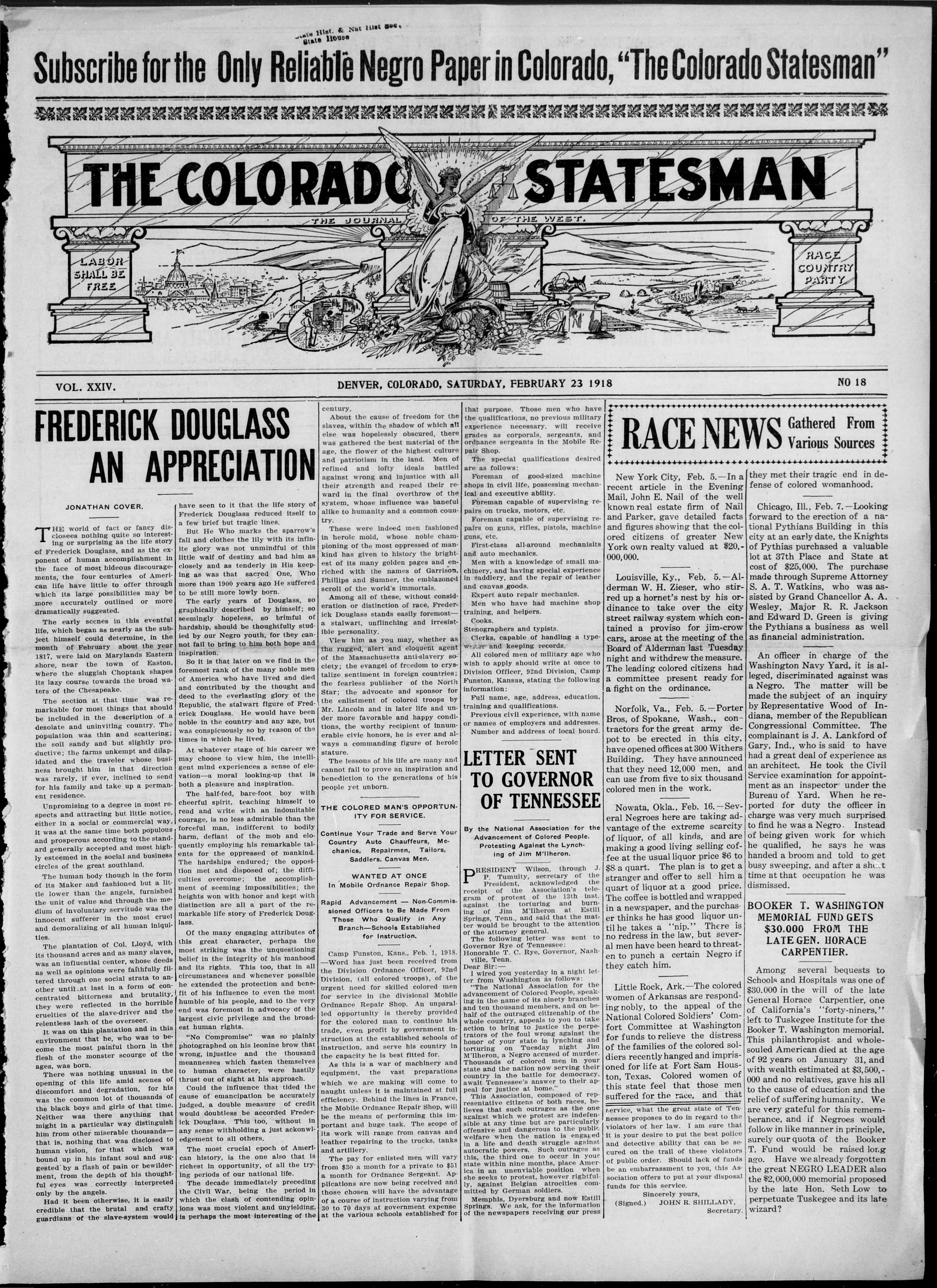
FREDERICK DOUGLASS AN APPRECIATION
VOL. XXIV.
FREDERICK I
AN AP
JONATHAN COVER.
THE world of fact or fancy disclosees nothing quite so interesting or surprising as the life story of Frederick Douglass, and as the exponent of human accomplishment in the face of most hideous discouragements, the four centuries of American life have little to offer through which its large possibilities may be more accurately outlined or more dramatically suggested.
The early scenes in this eventful life, which began as nearly as the subject himself could determine, in the month of February about the year 1817, were laid on Marylands Eastern shore, near the town of Easton, where the sluggish Choptank shapes its lazy course towards the broad waters of the Chesapeake.
The section at that time was remarkable for most things that should be included in the description of a desolate and uninviting country. The population was thin and scattering; the soil sandy and but slightly productive; the farms unkempt and dilapidated and the traveler whose business brought him in that direction was rarely, if ever, inclined to send for his family and take up a permanent residence.
Unpromising to a degree in most respects and attracting but little notice, either in a social or commercial way, it was at the same time both populous and prosperous according to the standard generally accepted and most highly esteemed in the social and business circles of the great southland.
The human body though in the form of its Maker and fashioned but a little lower than the angels, furnished the unit of value and through the medium of involuntary servitude was the innocent sufferer in the most cruel and demoralizing of all human iniquities.
The plantation of Col. Lloyd, with its thousand acres and as many slaves, was an influential center, whose deeds as well as opinions were faithfully filtered through one social strata to another until at last in a form of concentrated bitterness and brutality, they were reflected in the horrible cruelties of the slave-driver and the relentless lash of the overseer.
It was on this plantation and in this environment that he, who was to become the most painful thorn in the flesh of the monster scourge of the ages, was born.
There was nothing unusual in the opening of this life amid scenes of discomfort and degradation, for his was the common lot of thousands of the black boys and girls of that time. Neither was there anything that might in a particular way distinguish him from other miserable thousands—that is, nothing that was disclosed to human vision, for that which was bound up in his infant soul and suggested by a flash of pain or bewilderment, from the depth of his thoughtful eyes was correctly interpreted only by the angels.
Had it been otherwise, it is easily credible that the brutal and crafty guardians of the slave-system would
have seen to it that the life story of Frederick Douglass reduced itself to a few brief but tragic lines.
But He Who marks the sparrow's fall and clothes the illy with its infinite glory was not unmindful of this little waif of destiny and had him as closely and as tenderly in His keeping as was that sacred One, Who more than 1900 years ago He suffered to be still more lowly born.
The early years of Douglass, so graphically described by himself; so seemingly hopeless, so brimful of hardship, should be thoughtfully studied by our Negro youth, for they cannot fail to bring to him both hope and inspiration.
So it is that later on we find in the foremost rank of the many noble men of America who have lived and died and contributed by the thought and deed to the everlasting glory of the Republic, the stalwart figure of Frederick Douglass. He would have been noble in the country and any age, but was conspicuously so by reason of the times in which he lived.
At whatever stage of his career we may choose to view him, the intelligent mind experiences a sense of elevation—a moral looking-up that is both a pleasure and inspiration.
The half-fed, bare-foot boy with cheerful spirit, teaching himself to read and write with an indomitable courage, is no less admirable than the forceful man, indifferent to bodily harm, defiant of the mob and eloquently employing his remarkable talents for the oppressed of mankind. The hardships endured; the opposition met and disposed of; the difficulties overcome; the accomplishment of seeming impossibilities; the heights won with honor and kept with distinction are all a part of the remarkable life story of Frederick Douglass.
Of the many engaging attributes of this great character, perhaps the most striking was the unquestioning belief in the integrity of his manhood and its rights. This too, that in all circumstances and whenever possible he extended the protection and benefit of his influence to even the most humble of his people, and to the very end was foremost in advocacy of the largest civic privilege and the broadest human rights.
"No Compromise" was so plainly photographed on his leonine brow that wrong, injustice and the thousand meannesses which fasten themselves to human character, were hastily thrust out of sight at his approach.
Could the influence that tided the cause of emancipation be accurately judged, a double measure of credit would doubtless be accorded Frederick Douglass. This too, without in any sense withholding a just ackonwledgement to all others.
The most crucial epoch of American history, is the one also that is richest in opportunity, of all the trying periods of our national life.
The decade immediately preceding the Civil War, being the period in which the clash of contending opinions was most violent and unyielding, is perhaps the most interesting of the
DENVER, COLORADO, SATURDAY, FEBRUARY 23 1918
State Hist. & Nat Hist gee
State House
RADC
THE JOURNAL
DENVER, COLORADO, SA
century.
About the cause of freedom for the slaves, within the shadow of which all else was hopelessly obscured, there was gathered the best material of the age, the flower of the highest culture and patriotism in the land. Men of refined and lofty ideals battled against wrong and injustice with all their strength and reaped their reward in the final overthrow of the system, whose influence was baneful alike to humanity and a common country.
These were indeed men fashioned in heroic mold, whose noble championing of the most oppressed of mankind has given to history the brightest of its many golden pages and enriched with the names of Garrison, Phillips and Sumner, the emblazoned scroll of the world's immortals.
Among all of these, without consideration or distinction of race, Frederick Douglass stands easily foremost—a stalwart, unflinching and irresistible personality.
View him as you may, whether as the rugged, alert and eloquent agent of the Massachusetts anti-slavery society; the evangel of freedom to crystalize sentiment in foreign countries; the fearless publisher of the North Star; the advocate and sponsor for the enlistment of colored troops by Mr. Lincoln and in later life and under more favorable and happy conditions, the worthy recipient of innumerable civic honors, he is ever and always a commanding figure of heroic stature.
The lessons of his life are many and cannot fail to prove an inspiration and benediction to the generations of his people yet unborn.
THE COLORED MAN'S OPPORTUNITY FOR SERVICE.
Continue Your Trade and Serve Your Country Auto Chauffeurs, Mechanics, Repairmen, Tailors, Saddlers, Canvas Men.
WANTED AT ONCE
In Mobile Ordnance Repair Shop.
Rapid Advancement — Non-Commissioned Officers to Be Made From Those Who Qualify in Any Branch—Schools Established for Instruction.
Camp Funston, Kans., Feb. 1, 1918.
—Word has just been received from the Division Ordnance Officer, 92nd Division, (all colored troops), of the urgent need for skilled colored men for service in the divisional Mobile Ordnance Repair Shop. An unparalleled opportunity is thereby provided for the colored man to continue his trade, even profit by government instruction at the established schools of instruction, and serve his country in the capacity he is best fitted for.
selves hastily each. And the gratefully credit Frederin in konwl.
Amer-that is the try-ceeding good in opin-elding, of the
As this is a war of machinery and equipment, the vast preparations which we are making will come to naught unless it is maintained at full efficiency. Behind the lines in France, the Mobile Ordnance Repair Shop, will be the means of performing this important and huge task. The scope of its work will range from canvas and leather repairing to the trucks, tanks and artillery.
The pay for enlisted men will vary from $30 a month for a private to $51 a month for Ordnance Sergeant. Applications are now being received and those chosen will have the advantage of a course of instruction varying from 30 to 70 days at government expense at the various schools established for
that purpose. Those men who have the qualifications, no previous military experience necessary, will receive grades as corporals, sergeants, and ordnance sergeants in the Mobile Repair Shop.
The special qualifications desired are as follows:
Foreman of good-sized machine shops in civil life, possessing mechanical and executive ability.
Foreman capable of supervising repairs on trucks, motors, etc.
Foreman capable of supervising repairs on guns, rifles, pistols, machine guns, etc.
First-class all-around mechanisits and auto mechanics.
Men with a knowledge of small machinery, and having special experience in saddlery, and the repair of leather and canvas goods.
Expert auto repair mechanics.
Men who have had machine shop training, and helpers.
Cooks.
Stenographers and typists.
Clerks, capable of handling a typewriter and keeping records.
All colored men of military age who wish to apply should write at once to Division Officer, 92nd Division, Camp Funston, Kansas, stating the following information:
Full name, age, address, education, training and qualifications.
Previous civil experience, with name or names of employers and addresses.
Number and address of local board.
LETTER SENT TO GOVERNOR OF TENNESSEE
By the National Association for the Advancement of Colored People. Protesting Against the Lynching of Jim M'Ilheron.
PRESIDENT Wilson, through J. P. Tumulty, secretary of the President, acknowledged the receipt of the Association's telegram of protest of the 13th inst. against the torturing and burning of Jim M'Ilheron at Estill Springs, Tenn., and said that the matter would be brought to the attention of the attorney general.
The following letter was sent to Governor Rye of Tennessee: Honorable T. C. Rye, Governor, Nashville, Tenn.
Dear Sir:—
I wired you yesterday in a night letter from Washington as follows:
ter from Washington. "The National Association for the advancement of Colored People, speaking in the name of its ninety branches and ten thousand members, and on behalf of the outraged citizenship of the whole country, appeals to you to take action to bring to justice the perpetrators of the foul wrong against the honor of your state in lynching and torturing on Tuesday night Jim M'Iheron, a Negro accused of murder. Thousands of colored men in your state and the nation now serving their country in the battle for democracy, await Tennessee's answer to their appeal for justice at home."
This Association, composed of representative citizens of both races, believes that such outrages as the one against which we protest are indefensible at any time but are particularly offensive and dangerous to the public welfare when the nation is engaged in a life and death struggle against autocratic powers. Such outrages as this, the third one to occur in your state within nine months, place America in an unenviable position when she seeks to protest, however rightfully, against Belgian atrocities committed by German soldiers.
Memphis, Dyersburg and now Estill Springs. We ask, for the information of the newspapers receiving our press
RACENEWS Gathered From Various Sources
New York City, Feb. 5.—In a recent article in the Evening Mail, John E. Nail of the well known real estate firm of Nail and Parker, gave detailed facts and figures showing that the colored citizens of greater New York own realty valued at $20,-000,000.
Louisville, Ky., Feb. 5.—Alderman W. H. Zieser, who stirred up a hornet's nest by his ordinance to take over the city street railway system which contained a proviso for jim-crow cars, arose at the meeting of the Board of Alderman last Tuesday night and withdrew the measure. The leading colored citizens had a committee present ready for a fight on the ordinance.
they met their tragic end in defense of colored womanhood.
Chicago, Ill., Feb. 7.—Looking forward to the erection of a national Pythians Building in this city at an early date, the Knights of Pythias purchased a valuable lot at 37th Place and State at cost of $25,000. The purchase made through Supreme Attorney S. A. T. Watkins, who was assisted by Grand Chancellor A. A. Wesley, Major R. R. Jackson and Edward D. Green is giving the Pythians a business as well as financial administration.
An officer in charge of the Washington Navy Yard, it is alleged, discriminated against was a Negro. The matter will be
Norfolk, Va., Feb. 5.—Porter Bros, of Spokane, Wash., contractors for the great army depot to be erected in this city, have opened offices at 300 Withers Building. They have announced that they need 12,000 men, and can use from five to six thousand colored men in the work.
Nowata, Okla., Feb. 16.—Several Negroes here are taking advantage of the extreme scarcity of liquor, of all kinds, and are making a good living selling coffee at the usual liquor price $6 to $8 a quart. The plan is to get a stranger and offer to sell him a quart of liquor at a good price. The coffee is bottled and wrapped in a newspaper, and the purchaser thinks he has good liquor until he takes a "nip." There is no redress in the law, but several men have been heard to threaten to punch a certain Negro if they catch him.
Little Rock, Ark.—The colored women of Arkansas are responding nobly, to the appeal of the National Colored Soldiers' Comfort Committee at Washington for funds to relieve the distress of the families of the colored soldiers recently hanged and imprisoned for life at Fort Sam Houston, Texas. Colored women of this state feel that those men suffered for the race, and that service, what the great state of Tennessee proposes to do in regard to the violators of her law. I am sure that it is your desire to put the best police and detective ability that can be secured on the trail of these violators of public order. Should lack of funds be an embarrassment to you, this Association offers to put at your disposal funds for this service.
Sincerely yours,
(Signed.) JOHN R. SHILLADY,
Secretary.
NO 18
they met their tragic end in defense of colored womanhood. Chicago, Ill., Feb. 7.—Looking forward to the erection of a national Pythians Building in this city at an early date, the Knights of Pythias purchased a valuable lot at 37th Place and State at cost of $25,000. The purchase made through Supreme Attorney S. A. T. Watkins, who was assisted by Grand Chancellor A. A. Wesley, Major R. R. Jackson and Edward D. Green is giving the Pythians a business as well as financial administration.
An officer in charge of the Washington Navy Yard, it is alleged, discriminated against was a Negro. The matter will be made the subject of an inquiry by Representative Wood of Indiana, member of the Republican Congressional Committee. The complainant is J. A. Lankford of Gary, Ind., who is said to have had a great deal of experience as an architect. He took the Civil Service examination for appointment as an inspector under the Bureau of Yard. When he reported for duty the officer in charge was very much surprised to find he was a Negro. Instead of being given work for which he qualified, he says he was handed a broom and told to get busy sweeping, and after a short time at that occupation he was dismissed.
BOOKER T. WASHINGTON MEMORIAL FUND GETS $30.000 FROM THE LATE GEN. HORACE CARPENTIER.
Among several bequests to Schools and Hospitals was one of $30,000 in the will of the late General Horace Carpentier, one of California's "forty-niners," left to Tuskegee Institute for the Booker T. Washington memorial. This philanthropist and wholesouled American died at the age of 92 years on January 31, and with wealth estimated at $3,500,-000 and no relatives, gave his all to the cause of education and the relief of suffering humanity. We are very gateful for this rememberance, and if Negroes would follow in like manner in principle, surely our quota of the Booker T. Fund would be raised long ago. Have we already forgotten the great NEGRO LEADER also the $2,000,000 memorial proposed by the late Hon. Seth Low to perpetuate Tuskegee and its late wizard?
SLAVS SIGN HUN PACT
FORCED TO CEDE BALTIC STATES AND PAY INDEMNITY.
Notwithstanding Agreement, German Troops Advance Into Russia Over 400-Mile Front.
Western Newspaper Union News Service.
Petrograd.-Guerilla warfare is to be Russia's method of opposing Germany should that nation invade Russia further, according to intimations from Bolshevik sources. In an address to the central executive committee of the Council of Soldiers' and Workmen's delegates, Leon Trotzky, the Bolshevik foreign minister said: "We are not followers of Tolstol. We do not say we will not resist German invasion." Trotzky proceeded to outline a plan by which the Socialistie army would conduct a bushwhacking campaign, hampering the efforts of the Germans should they endeavor to conduct commerce along the border.
Leon Trotzky, Bolshevik foreign minister, in his report upon the breaking off of negotiations at the Brest-Litovsk peace conference, says the German terms included the retention of Poland, Riga, Lithuania, Moon island and indemnity of $4,000,000,000. It is pointed out that the proposed treaty is in direct violation not only of all peace principles laid down by the entente spokesmen and President Wilson, but of the often-quoted Teutonic declaration of "no annexations and no indemnities." The Russian Bolshevik government has capitulated and announced its readiness, although protestingly, to sign a peace compact under the hard terms imposed by Germany.
Notwithstanding this fact, Teutonic troops are advancing eastward into Russia over a front of 400 miles. Apparently, thus far the operation has met with no opposition. The northern reaches of the Dvina river have been crossed by the enemy; the important railroad town of Dvinsk, whence the roads run northeastward to Petrograd and eastward to Smolensk, has been captured, and Lutsk, one of the famous fortresses of the Volhynian triangle and forming the gateway leading eastward to Kiev, has been entered without the Russians attempting to stay the fire.
The official announcement of the capitulation was signed by Nikolai Lenine and Leon Trotzky on behalf of the people's commissaries of Russia. It protests against Germany attacking a country which has declared the war at an end and which is demobilizing its armies on all fronts.
The only indication that the enemy will meet with hindrance comes in an announcement by Ensign Krylenko Bolshevik commander in chief. In his order he instructs the Russians when they encounter German troops to endeavor to persuade them to refrain from hostilities. "If the Germans refuse," he adds, "then you must offer them every possible resistance."
40,000 Chinese at Front by June. New York.—Forty thousand Chinese engineers comprising forty battalions will be at the front in France by June said Lieut. Col. Tang Tche, of the Chinese army's general staff, when speaking of what may be expected from China in the war. Possible transportation difficulties may delay the arrival of the engineers, he added. He said 30,000 Chinese civilians now are employed in French munition factories and 120,000 in road construction work.
Camp Funston, Kans. — George Yeager, Troy, Kan., and Gordon Spraddle, Montrose, Colo., convicted by a military court here on charges of draft evasion, were sentenced to 20 years each in the disciplinary barracks at Fort Leavenworth.
Capt. James Fennimore Cooper Dead.
Albany, N. Y.—Capt. James Fennimore Cooper, Jr., of Albany and Cooperstown, great grandson of James Fennimore Cooper, author of the "Leather Stocking Tales," died at Camp Dix, Wrightstown, N. J., after a nine-day's illness of pneumonia.
Expense of Britain $30,000,000 Daily
London.—Andrew Bonar Law, chancellor of the exchequer, speaking in the house of commons, said the average daily expenditure during the four weeks ending Feb. 16 was £6,384,000
German Drive on Russia Unpopular.
London. — Germany's new war
against Russia apparently is not popular
with the German or Austrian people,
according to comment in the press
of the two countries.
Canadian Woman Dies at 115.
Charlottetown, P. E. I.—Miss Lizzie
Palmer, the oldest person on Prince
Edward's Island, if not in Canada, died
in the provincial infirmary here at the
age of 115.
London.—The British government has instructed its agent at Kiev to make the declaration that Great Britain will not recognize any peace in the East which involves Poland, without a previous consultation with Poland.
Earthquake Causes 2,000 Deaths.
Tokio.—There were 2,000 casualties resulting from the earthquake at Swatow, China, according to information received here.
SCALE OF MILES
1 1744 5 10 15 20
ETAIN
CONFLANS
VERDUN
FRESNES
LES EPARORS
GRAVELOTTE
GOSZE
METZ
LOREAINE
VERNY
VIGNEULLES
HIANCOURT
PONT AMOUSSON
NOMENCY
GELME
ST MHIEL
BLICHEPREV
FUREV
APREMONT
ROUERES
MILLERY
CHATEAU BALINES
COMMERCY
MENIL
TOUL
HANCY
ST AUBIN
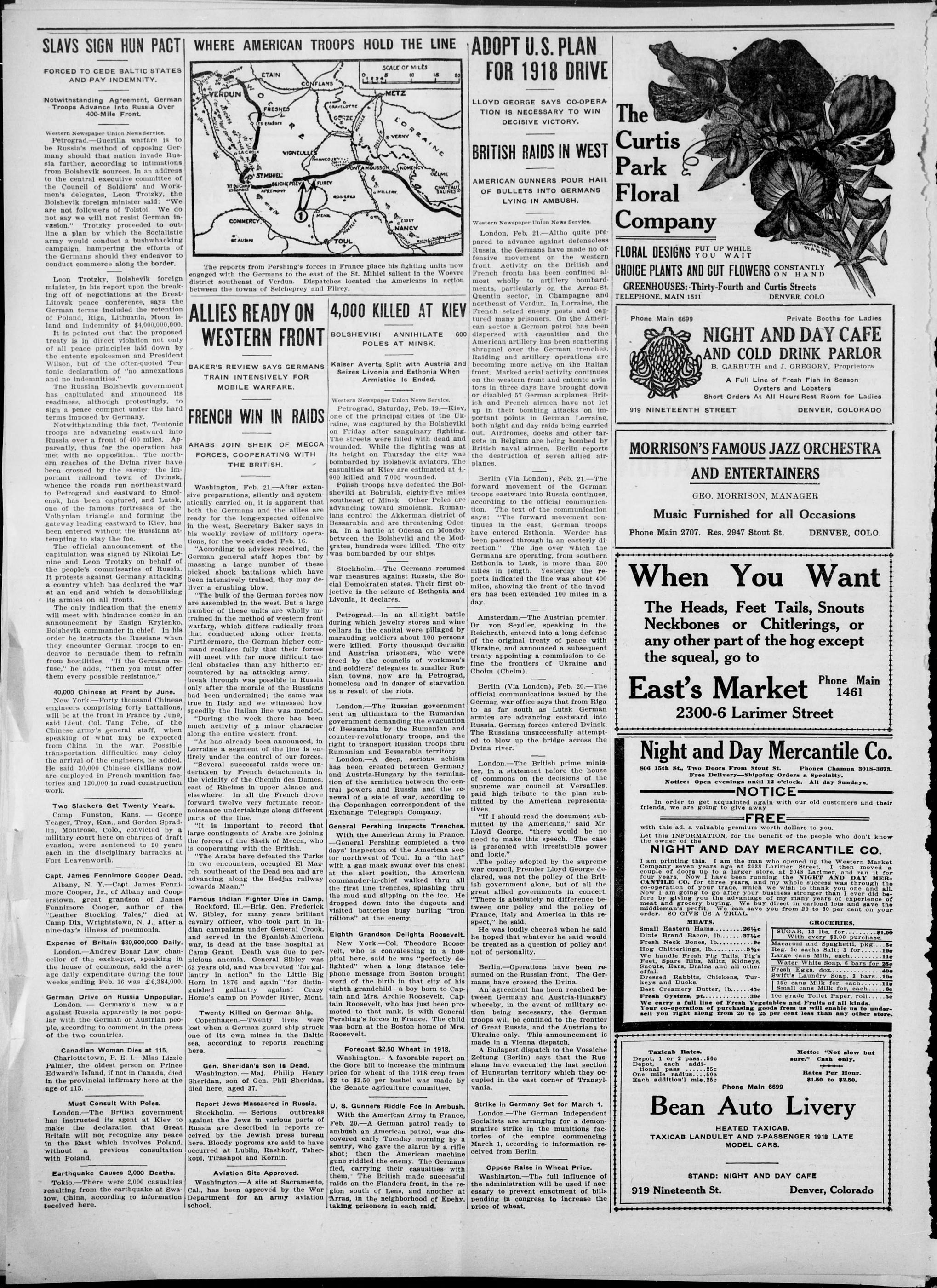
The reports from Pershing's forces in France place his fighting units now engaged with the Germans to the east of the St. Mihiel salient in the Woevre district southeast of Verdun. Dispatches located the Americans in action between the towns of Selcheprey and Filrey.
ALLIES READY ON WESTERN FRONT
BAKER'S REVIEW SAYS GERMANS TRAIN INTENSIVELY FOR MOBILE WARFARE.
FRENCH WIN IN RAIDS
ARABS JOIN SHEIK OF MECCA FORCES, COOPERATING WITH THE BRITISH.
Washington, Feb. 21.—After extensive preparations, silently and systematically carried on, it is apparent that both the Germans and the allies are ready for the long-expected offensive in the west, Secretary Baker says in his weekly review of military operations, for the week ended Feb. 16.
"According to advices received, the German general staff hopes that by massing a large number of these picked shock battalions which have been intensively trained, they may deliver a crushing blow.
"The bulk of the German forces now are assembled in the west. But a large number of these units are wholly untrained in the method of western front warfare, which differs radically from that conducted along other fronts. Furthermore, the German higher command realizes fully that their forces will meet with far more difficult tactical obstacles than any hitherto encountered by an attacking army. break through was possible in Russia only after the morale of the Russians had been undermined; the same was true in Italy and we witnessed how speedily the Italian line was mended.
"During the week there has been much activity of a minor character along the entire western front.
"As has already been announced, in Lorraine a segment of the line is entirely under the control of our forces.
"Several successful raids were undertaken by French detachments in the vicinity of the Chemin des Dames, east of Rheims in upper Alsace and elsewhere. In all the French drove forward twelve very fortunate reconoissance undertakings along different parts of the line.
"It is important to record that large contingents of Arabs are joining the forces of the Sheik of Mecca, who is cooperating with the British.
"The Arabs have defeated the Turks in two encounters, occupied El Mazreh, southeast of the Dead sea and are advancing along the Hedjaz railway towards Maan."
Famous Indian Fighter Dies in Camp.
Rockford, Ill.—Brig. Gen. Frederick W. Sibley, for many years brilliant cavalry officer, who took part in Indian campaigns under General Crook, and served in the Spanish-American war, is dead at the base hospital at Camp Grant. Death was due to pernicious anemia. General Sibley was 63 years old, and was breveted "for gallantry in action" in the Little Big Horn in 1876 and again "for distinguished gallantry against Crazy Horse's camp on Powder River, Mont.
Twenty Killed on German Ship.
Copenhagen.—Twenty lives were lost when a German guard ship struck one of its own mines in the Baltic sea, according to reports reaching here.
Washington. — Maj. Philip Henry Sheridan, son of Gen. Phil Sheridan, died here, aged 37.
Report Jews Massacred in Russia. Stockholm. — Serious outbreaks against the Jews in various parts of Russia are described in reports received by the Jewish press bureau here. Bloody pogroms are said to have occurred at Lublin, Rashkoff, Tsherkop, Tirashpol and Kornin.
Aviation Site Approved.
Washington.-A site at Sacramento, Cal., has been approved by the War Department for an army aviation school.
4,000 KILLED AT KIEV
4,000 KILLED AT KIEV
BOLSHEVIKI ANNIHILATE 600
POLES AT MINSK.
Kaiser Averts Split with Austria and
Seizes Livonia and Esthonia When
Armistice Is Ended.
Western Newspaper Union News Service.
Petrograd, Saturday, Feb. 19.—Kiev, one of the principal cities of the Ukraine, was captured by the Bolshevik on Friday after sanguinary fighting. The streets were filled with dead and wounded. While the fighting was at its height on Thursday the city was bombarded by Bolshevik aviators. The casualties at Kiev are estimated at 4,000 killed and 7,000 wounded. Polish troops have defeated the Bolshevik at Bobruisk, eighty-five miles southeast of Minsk. Other Poles are advancing toward Smolensk. Rumanians control the Akkerman district of Bessarabia and are threatening Odessa. In a battle at Odessa on Monday between the Bolshevik and the Moderates, hundreds were killed. The city was bombarded by our ships.
Stockholm.—The Germans resumed war measures against Russia, the Social Demokraten states. Their first objective is the seizure of Esthonia and Livonia, it declares.
Petrograd.—In an all-night battle during which jewelry stores and wine cellars in the capital were pillaged by marauding soldiers about 100 persons were killed. Forty thousand German and Austrian prisoners, who were freed by the councils of workmen's and soldiers' delegates in smaller Russian towns, now are in Petrograd, homeless and in danger of starvation as a result of the riots.
London.—The Russian government sent an ultimatum to the Rumanian government demanding the evacuation of Bessarabia by the Rumanian and counter-revolutionary troops, and the right to transport Russian troops thru Rumanian and Bessarabia territory. London.—A deep, serious schism has been created between Germany and Austria-Hungary by the termination of the armistice between the central powers and Russia and the renewal of a state of war, according to the Copenhagen correspondent of the Exchange Telegraph Company.
General Pershing Inspects Trenches
With the American Army in France,
—General Pershing completed a two days' inspection of the American sector northwest of Toul. In a "tin hat" with a gas mask swung over his chest at the alert position, the American commander-in-chief walked thru all the first line trenches, splashing thru the mud and slipping on the ice. He dropped down into the dugouts and visited batteries busy hurling "iron rations" at the enemy.
Eighth Grandson Delights Roosevelt.
Eighth Grandson Delights Roosevelt,
New York.—Col. Theodore Roosevelt,
who is convalescing in a hospital here, said he was "perfectly delighted" when a long distance telephone message from Boston brought word of the birth in that city of his eighth grandchild—a boy born to Captain and Mrs. Archie Roosevelt, Captain Roosevelt, who has just been promoted to that rank, is with General Pershing's forces in France. The child was born at the Boston home of Mrs. Roosevelt.
Forecast $2.50 Wheat in 1918.
Washington.—A favorable report on the Gore bill to increase the minimum price for wheat of the 1918 crop from $2 to $2.50 per bushel was made by the Senate agriculture committee.
U. S. Gunners Riddle Foe in Ambush.
With the American Army in France, Feb. 20.—A German patrol ready to ambush an American patrol, was discovered early Tuesday morning by a sentry, who gave the alarm by a rifle shot; then the American machine guns riddled the enemy. The Germans fled, carrying their casualties with them. The British made successful raids on the Flanders front, in the region south of Lens, and another at Arras, in the neighborhood of Epehy, taking prisoners in each raid.
ADOPT U.S. PLAN FOR 1918 DRIVE
ADOPT U.S. PLAN FOR 1918 DRIVE
LLOYD GEORGE SAYS CO-OPERA TION IS NECESSARY TO WIN DECISIVE VICTORY.
BRITISH RAIDS IN WEST
AMERICAN GUNNERS POUR HAIL OF BULLETS INTO GERMANS LYING IN AMBUSH.
Western Newspaper Union News Service.
London, Feb. 21. Altho quite prepared to advance against defenseless Russia, the Germans have made no offensive movement on the western front. Activity on the British and French fronts has been confined almost wholly to artillery bombardments, particularly on the Arras-St Quentin sector, in Champagne and northeast of Verdun, In Lorraine, the French seized enemy posts and captured many prisoners. On the American sector a German patrol has been dispersed with casualties and the American artillery has been scattering shrapnel over the German trenches. Raiding and artillery operations are becoming more active on the Italian front. Marked aerial activity continues on the western front and entente aviators in three days have brought down or disabled 57 German airplanes. British and French airmen have not let up in their bombing attacks on important points in German Lorraine, both night and day raids being carried out. Airdromes, docks and other targets in Belgium are being bombed by British naval airmen. Berlin reports the destruction of seven allied airplanes.
Berlin (Via London), Feb. 21.—The forward movement of the German troops eastward into Russia continues, according to the official communication. The text of the communication says: "The forward movement continues in the east. German troops have entered Esthonia. Werder has been passed through in an easterly direction." The line over which the Germans are operating, from southern Esthonia to Lusk, is more than 500 miles in length. Yesterday the reports indicated the line was about 400 miles, showing the front of the invaders has been extended 100 miles in a day.
Amsterdam.-The Austrian premier, Dr. von Seydler, speaking in the Reichrath, entered into a long defense of the original treaty of peace with Ukraine, and announced a subsequent treaty appointing a commission to define the frontiers of Ukraine and Cholm (Chelm).
Berlin (Via London), Feb. 20.-The official communications issued by the German war office says that from Riga to as far south as Lutsk German armies are advancing eastward into Russia. German forces entered Dvinsk, The Russians unsuccessfully attempted to blow up the bridge across the Dvina river.
London.—The British prime minister, in a statement before the house of commons on the decisions of the supreme war council at Versailles, paid high tribute to the plan submitted by the American representatives.
"If I should read the document submitted by the Americans," said Mr. Lloyd George, "there would be no need to make this speech. The case is presented with irresistible power and logic."
The policy adopted by the supreme war council, Premier Lloyd George declared, was not the policy of the British government alone, but of all the great allied governments in concert.
"There is absolutely no difference between our policy and the policy of France, Italy and America in this respect," he said.
He was loudly cheered when he said he hoped that whatever he said would be treated as a question of policy and not of personality.
Berlin.—Operations have been resumed on the Russian front. The Germans have crossed the Dvina.
An agreement has been reached between Germany and Austria-Hungary whereby, in the event of military action being necessary, the German troops will be confined to the frontier of Great Russia, and the Austrians to Ukraine only. This announcement is made in a Vienna dispatch.
A Budapest dispatch to the Vossiche Zeitung (Berlin) says that the Russians have evacuated the last section of Hungarian territory which they occupied in the east corner of Transylvania.
Strike in Germany Set for March 1.
London.—The German Independent Socialists are arranging for a demonstrative strike in the munitions factories of the empire commencing March 1, according to information received from Berlin.
Oppose Raise in Wheat Price.
Washington.—The full influence of the administration will be used if necessary to prevent enactment of bills pending in congress to increase the price of wheat.
The Curtis Park Floral Company
FLORAL DESIGNS PUT UP WHILE YOU WAIT
CHOICE PLANTS AND CUT FLOWERS CONSTANTLY ON HAND
GREENHOUSES: Thirty-Fourth and Curtis Streets
TELEPHONE, MAIN 1511 DENVER, COLO
919 NINETEENTH STREET
MORRISON'S FAMOUS
MORRISON'S FAMOUS JAZZ ORCHESTRA
AND ENTERTAINERS
GEO. MORRISON, MANAGER
Music Furnished for
Phone Main 2707. Res. 2947 Stock.
When You
The Heads, Feet,
Neckbones or
any other part of
the squeal, go to
East's Man
2300-6 Lari
Night and Day
806 15th St., Two Doors From Store
Free Delivery—Shipping
Notice: Open evenings unit
NOT
In order to get acquainted again
friends, we are going to give away
FF
with this ad. a valuable premium
Let this INFORMATION, for the b
the owner of the
NIGHT AND DAY
I am printing this. I am the man
Company seven years ago at at
couple of doors up to a larger st
four years. Now I have been run
CANTILE CO. for three years, an
co-operation of your trade, which
Now I am going to go after your
force by giving you the advantage
meat and grocery buying. We bu
middleman's profit. We can save
order. SO GIVE US A TRIAL
MEATS.
Furnished for all Occasion
07. Res. 2947 Stout St. DE
When You Wish
Heads, Feet Tails, S
ones or Chitlerin
her part of the hog or
neal, go to
's Market
800-6 Larimer St
and Day Mercant
Two Doors From Stout St. Phone
Free Delivery—Shipping Orders a Spe
Open evenings until 12 o'clock. All
NOTICE
to get acquainted again with our old
we going to give away
Music Furnished for all Occasions
Phone Main 2707. Res. 2947 Stout St. DENVER, COLO.
When You Want
The Heads, Feet Tails, Snouts Neckbones or Chitlerings, or any other part of the hog except the squeal, go to East's Market Phone Main 1461 2300-6 Larimer Street
Night and Day Mercantile Co.
806 15th St. Two Doors From Stout St. Phones Champa 3018-3073.
Free Delivery—Shipping Orders a Specialty.
Notice: Open evenings until 12 o'clock. All day Sundays.
NOTICE
In order to get acquainted again with our old customers and their
friends, we are going to give away
FREE
with this ad. a valuable premium worth dollars to you.
Let this INFORMATION, for the benefit of the people who don't know
the owner of the
NIGHT AND DAY MERCANTILE CO.
I am printing this. I am the man who opened up the Western Market
Company seven years ago at 2038 Larimer Street. I then moved a
couple of doors up to a larger store, at 2048 Larimer, and ran it for
four years. Now I have been mourning the NIGHT AND DAY MERCANTILE CO. for three years, and my whole success was through the co-operation of your trade, which we wish to thank you one and all.
Now I am going to go after your business stronger than I ever did before by giving you the advantage of my many years of experience of
meats and grocery buying. We buy direct in carload lots and save the middleman's profit. We can save you from 20 to 30 per cent on your
order. SO GIVE US A TRIAL.
MEATS
GROCERIES
with this ad. a valuable premium worth dollars to you.
Let this INFORMATION, for the benefit of the people who don't know
NIGHT AND DAY MERCANTILE CO.
I am printing this. I am the man who opened up the Western Market Company seven years ago at 2038 Larimer Street. I then moved a couple of doors up to a larger store, at 2048 Larimer, and ran it for four years. Now I have been running the NIGAR NEW MARK ANTILE CO., for three years, and my whole success was through the co-operation of your trade, which we wish to thank you one and all. Now I am going to go after your business stronger than I ever did before by giving you the advantage of my many years of experience of the man and my buying. We buy direct in Marlor lots and save the middleman's profit. We can save you from 20 to 30 per cent on your order. SO GIVE US A TRIAL.
MEATS.
GROCERIES.
Small Eastern Hams.....26½e
Dixie Brand Bacon, 1b.....37½e
Fresh Neck Bones, 1b.....9e
Hog Chitterlings, 1b.....5½e
We handle Fresh Pig Tails, Pig's Feet, Spare Ribs, Miltz, Kidneys, Snouts, Ears, Brains and all other offal.
Water White Soap, 6 bars or 26
Fresh Eggs, dos., 4 bars, 400
Swift's Laundry Soap, 3 bars, 100
Dressed Rabbitts, Chickens, Turkeys and Ducks.
Best Creamery Butter, lb.... 45c
Fresh Oysters, pt.... 30c
We carry a full line of Fresh Veg
Your co-operation of purchasing g
sell you right along from 20 to 2
Taxicab Rates.
Depot, 1 or 2 pass...50c
Depot, each addl-
tional pass.....25c
One mile radius.....50c
Each addition'l mile.25c
full line of Fresh Vegetables and Fruits
tion of purchasing goods from us will
along from 20 to 25 per cent less tha
Rates. Motto:
mass .50c sure." C
addi.
...25c Rates
s. .50c
mile.25c $1.5
Taxicab Rates.
Depot, 1 or 2 pass...50c
Depot, each additional pass .....25c
One mile radius...50c
Each addition'l mile.25c
Motto: "Not slow but sure." Cash only.
Rates Per Hour.
$1.50 to $2.50.
Phone Main 6699
Bean Auto Livery
HEATED TAXICAB.
TAXICAB LANDULET AND 7-PASSENGER 1918 LATE
MODEL CARS.
STAND: NIGHT AND DAY CAFE
919 Nineteenth St. Denver, Colorado
```markdown
```
MEATS.
for all Occasions
St St. DENVER, COLO.
You Want
Tails, Snouts
Chitlerings, or
the hog except
Market Phone Main
1461
Inner Street
Mercantile Co.
St St. Phones Champa 3018-3078.
Gag Orders a Specialty.
12 o'clock. All day Sundays.
TICE
ain with our old customers and their
EE
north dollars to you.
benefit of the people who don't know
MERCANTILE CO.
who opened up the Western Market
Larimer Street. I then moved a
ce, at 2048 Larimer, and ran it for
ing the NIGHT AND DAY MER-
my whole success was through the
business stronger than I ever did.
of my many years of experience of
direct in carload lots and save the
you from 20 to 30 per cent on your
SUGAR, 13 lbs. for.....$1.00
With every $3.00 purchase.
Macaroni and Spaghetti, pkg....5c
Reg. 5c sacks Salt; 3 for.....10c
Large cans Milk, each.....11c
Water White Soap, 6 bars for 25c
Fresh Eggs, doz.....40c
Swift's Laundry Soap, 3 bars.....10c
15c cans Milk for, each.....11c
Small cans Milk for, each.....16c
10c grade Toilet Paper, roll.....5c
tables and Fruits of all kinds.
ods from us will enable us to under-
per cent less than any other store.
Motto: "Not slow but
sure." Cash only.
Rates Per Hour.
$1.50 to $2.50.
FREE
GROCERIES.
THE COLORADO STATESMAN
THE COLORADO STATESMAN
LABOR
SHAUL
DE
FREK
HACK
COUNTRY
PARTY
Entered as second-class matter at the postoffice in the City of Denver, Colo.
1824 Curtis Street, Room 25.
Phone Main 7417.
Reading notices, ten lines or less, 10 cents per line. Each additional line over ten lines, 5 cents per line. Display advertising, 50 cents per inch.
Remittances should be made by Express Money Order, Postoffice Money Order, Registered Letter or Bank Draft. Postage stamps will be received the same as cash for the fractional part of a dollar. Only 1c and 2c stamps taken.
No discounts allowed on less than three months' contract. Cash must accompany all orders from parties unknown to us. Further particulars on application.
Communications to receive attention must be neway, upon important subjects, plainly written only upon one side of the paper, must reach us Tuesday of the author. No manuscript returned, unless stamps are sent for postage, days, if possible, anyway not later than Wednesdays, and bear the signature. All communications of a personating nature that are not complimentary will be withheld from the columns of this paper.
Reading notices, ten lines or less, 10 cents per line. Each additional line over ten lines, 5 cents per line. Display advertising, 50 cents per inch.
Remittances should be made by Express Money Order, Postoffice Money Order, Registered Letter or Bank Draft. Postage stamps will be received the same as cash for the fractional part of a dollar. Only 1c and 2c stamps taken.
No discounts allowed on less than three months' contract. Cash must accompany all orders from parties unknown to us. Further particulars on application.
Communications to receive attention must be newsy, upon important subjects plainly written only upon one side of the paper, must reach us Tuesday to the letter. No manuscript returned, unless stamps are sent for postage, days, if possible, anyway not later than Wednesday, and bear the signature. All communications of a personating nature that are not complimentary will be withheld from the columns of this paper.
THE APPROACH OF SPRING.
other conditions that we are nowation of an early spring. Not these season will be changed as given up the Vernal Equinox will wear a and night points, but with the back of wind and snow, everything aave" before the day of March 21.
ation that is being made by the ease and luxury enjoyed by usstruggling with a foe that strikerveractively made us stop to realize variation of suffering humanity therequests and solicitations of ourvation plan; listen to the appoGovernment for a fair return formission of the vile profiteers whering through as a means to theirgreatness of the few in vast richerto the multitude of poverty-sthe efforts that are being put out of day the TREACHEROUS Aury of the advantages accruing to tenaciousness to his fatherlandtrips on which our governmentthat is taking such a hold on theirrace, whether in hospital or caring in their quiescence, but thepeople, and an extermination of thethat the practical working of themthe true and only significationand other important measures forfinal moment seem to whisper in ourbeen more fortunate than ourigorous winter, fuel shortage, fred take advantage of these greatservice and activity in thevac-men, to our country's service, tolocate ourselves to HIS service, inthe intent of the Lord of Creatiest objects of and in His worldone hope—a newness of thoughtspecial to all the people.
THE kind of weather conditions that we are now experiencing in Denver is an indication of an early spring. Not that the date of the beginning of the season will be changed as given us by the astronomical calculation, or that the Vernal Equinox will wear a different phase as to its equality of day and night points, but with the balmy days of sunshine and an interspersion of wind and snow, everything appears to be getting ready for a new "drive" before the day of March 21, the first day of the beautiful season.
Note the preparation that is being made by the heads of our nation to convince us that the ease and luxury enjoyed by us for over three years when the world is struggling with a foe that strikes at the root of its civilization, have imperatively made us stop to realize and adopt the best methods for the alleviation of suffering humanity the world over by our acquiescence to the requests and solicitations of our government in the "no waste" or conservation plan; listen to the appeal of the farmer for protection from the government for a fair return for his products and the putting out of commission of the vile profiteers who use such calamities as the world is passing through as a means to their unconscionable end, which result in the greatness of the few in vast riches and wealthy attainments in opposition to the multitude of poverty-stricken members of a population; follow the efforts that are being put forward to hold spicuously to the light of day the TREACHEROUS AMERICAN, who after becoming a beneficiary of the advantages accruing from this democracy, is boldly asserting his tenaciousness to his fatherland or intriguing to overthrow the very principles on which our government is founded; view the get-together action that is taking such a hold on the American public that leaders of the white race, whether in hospital or camp, church or state, are no longer remaining in their quiescence, but declaring justice and right for all the people, and an extermination of the agencies that defy law and honor so that the practical working of the Constitution may at last reflect itself in the true and only signification of AMERICAN DEMOCRACY. These and other important measures forcing themselves on us at this psychological moment seem to whisper in our ears, PREPAREDNESS, and as we have been more fortunate than our eastern and southern citizens to escape a rigorous winter, fuel shortage, foodstuffs at premium prices, etc., we should take advantage of these great benefits, refresh our mentality for greater service and activity in the various spheres of usefulness to our fellow-men, to our country's service, to humanity at large, starting anew to dedicate ourselves to HIS service, in which can be demonstrated the purpose, the intent of the Lord of Creation when He made us the highest and greatest objects of and in His world. With the approach of spring will come one hope—a newness of thought, resulting in a permanent action beneficial to all the people.
LABOR AND THE NEGRO
o, E. P. Booze, of Mount Bayou of the Republican National Court still a victim of pro-slavish tend that darkness blacker than his sk and satisfied with my station, and don't want me to have," we again more activity and keen interest fronting the government and pro time of getting out of our static
UNLIKE that Negro, E. P. Booze, of Mount Bayoud, Mississippi, at the recent meeting of the Republican National Committee at St. Louis, Missouri (who still a victim of pro-slavish tendencies and an inhabitant of the realm of that darkness blacker than his skin) and who recently said, "I am a Negro and satisfied with my station, and don't want nothing that the white folks don't want me to have," we again try to impress our fellow-racemen for more activity and keen interest in the powerful LABOR QUESTION confronting the government and people of America today, and it is not a time of getting out of our station or not wanting or caring to take what the other fellow wants us to have, but it is something of greater importance, something that is so powerful in its nature, seemingly beyond human control, that the great American Nation with its teeming millions, constituting nine-tenths of the population, has at last admitted that ORGANIZATION is the most essential element in its life, the foundation stone of success, and the basic principle for the perpetuity of its institutions—and that organization which measures its standard by the ability to do or act rather than mere accident or appearance. Because of this, racial discrimination greatly against the man of unfortunate black appearance, who with all the proof he has given for united action in this great and grand institution, LABOR, is beginning to give way, especially in the present time and under such grave circumstances; and now an opportunity is being afforded him to take advantage of the repentant action or restitution for the wrong he has suffered all these years.
Numerous avenues are being opened for skilled and unskilled men; a firm in the Northwest can use about 6,000; Denver, in the construction of her RECUPERATION CAMP, will need a number of artisans; other spheres of labor, as garage men, chauffeurs, hotel men and waiters, will be calling, as quite a number of their employees are drafted for war service; telephone and telegraph operators must be on the boards, so that it requires this grit, this manliness capable of grasping the situation, this intelligence keen in its perception to take and to hold, then admission into the organization as a contributory factor, as a desirable component part of the whole will establish itself and the peace and harmony, the very correlationship of the spirit of human beings will be pre-eminent, and Creation's ordinance will in its fulfilment restore to man its oneness, its unity and common brotherhood that EARTH once enjoyed. Measure up, qualify, and while WAR is breaking down the temples of prejudice, injustice and discrimination, let us like the buried seed, sink deeply and so establish our roots, that no future cyclones or hurricanes of MAN'S SELFISHNESS AND CRUELTY can succeed in separating a branch from our trunk.
MAN IS ADVERTISING THAT HE WILL ORGANIZE FARM LOAN ASSOCIATIONS FOR $500.
SMALL TOWNS MAKE RECORD
Ahead of Cities in Buying the Smileage Books—American Soldiers Lost on Tuscania Protected by Government Insurance.
Washington. — Another scheme for swindling the farmers of the United States has been discovered by the federal farm loan board. A man advertising himself as an authorized organizer of national farm-loan associations is sending out advertising matter emblazoned with the national flag, stating that he will organize such associations at $500 each, and will teach others the trick for a certain sum of money. His advertisements have reached farmers and business men over a large part of the United States. He claims to be so busy organizing national farm-loan associations that he needs help, but will take time to teach others for a monetary consideration.
All such representations are fraudulent. In order to borrow under the farm-loan act, it is necessary for farmers to organize co-operative national farm-loan associations in their local communities. It is a violation of a ruling of the federal farm loan board, published more than a year ago, for a national farm-loan association or a joint-stock land bank to spend any money for promotion purposes. Associations thus organized will not be chartered by the federal farm loan board. Farmers are warned therefore against anyone asking a fee for his proffered services in connection with applying for a loan under the federal farm-loan act.
Results of the smileage campaign, which put books of theater admission coupons on sale in nearly every town and city in the country, show the small towns and villages far ahead of the cities in overselling their proportionate quotas of books.
Pilot Rock, Ore., was the first town in the country to send in a check. Laurens, Iowa, a town of 900 population, took in $100 before the first smileage book was received. Titouka, Iowa, with 200 population, bought $63 worth of books, the largest sale in proportion to population yet returned.
The coupons in smileage books are exchanged by the soldiers for admission to entertainments in theaters built in the camps by the commission on training camp activities. Admission charges range from 10 cents to 25 cents, or from two to five smileage coupons.
Any American soldiers lost on the torpedoed transport were protected by United States government insurance and government compensation. Those who had not applied for insurance were covered by automatic insurance, which is payable to a wife, child or widowed mother. The automatic insurance aggregates about $4,300, netting $25 a month for 240 months. Insurance that had been applied for is payable to a much larger class of beneficiaries and can go as high as $10,000, netting $57.50 a month for 240 months.
The compensation in case of death, given by the government without charge and regardless of rank or pay, ranges from $20 to $75 a month, based on the number of dependents. Payments under the compensation feature of the military and naval insurance act in case of death are payable to a widow, children, or dependent widowed mother. The automatic insurance ceased on February 12, but the compensation feature of the act is a separate provision. The scale of compensation in case of death follows: (a) For a widow alone, $25.
(b) For a widow and one child, $35.
(c) For a widow and two children, $47.50, with $5 for each additional child up to two.
(d) If there be no widow, then for one child, $20.
(e) For two children, $30.
(f) For three children, $40, with $5 for each additional child up to two.
(g) For a widowed mother, $20. The amount payable under this subdivision shall not be greater than a sum which when added to the total amount payable to the widow and children, does not exceed $75.
To meet the shortage of small silver change in Norway a large issue of one-crown notes (at normal exchange the Norwegian crown is worth 26.8 cents United States currency) has been put in circulation.
The United States publis health service is carrying on a campaign along sanitary lines in areas adjacent to 28 military camps. Complete sanitary organizations work to prevent the spread of disease from the civilian population to military forces, and to protect civilians from communicable diseases where they have occurred among troops. The organizations include physicians, sanitary engineers, nurses, attendants and laborers. Methods undertaken include inspection of all establishments handling food supplies.
The committee on public information has received the following excerpts from a speech in the German reichstag by Herr Ledebour, joint leader of the independent socialists:
---
THE COLORADO STATESMAN
"Again has an opportunity been neglected to satisfy the world's longing for peace. It is plain that a step backward has been taken and that the political authorities have completely adopted the military views of the conservatives. It is very disquieting for friends of peace to hear the chancellor say that we now have a free hand in the west. Czernin's speech is a striking refutation of Hertling's, for Czernin accepts Wilson's proposals as the basis of understanding, whereas the chancellor rejects them. We hope nevertheless, that we shall soon have the negotiations, which Czernin's action permits us to expect. We cannot agree to Czernin's and Kuehlmann's interpretation of the right of self-determination. We want general peace on a democratic foundation. The pretended popular manifestations in the occupied territory were brought about under the influence of the German administration. The creation on the kingdom of Poland was a tremendous mistake. The German government must give up its false methods, and we shall soon have peace in the east. The true opinions of nations can only be expressed by a referendum after evacuation. The Fatherland party wanted to replace Hertling with Prince Buelow, but that is no longer necessary. Militarism has won the day, and the proletariat must force peace on the basis of the reconciliation of all nations."
The Mouth-Piece of the People of Colorado and the Entire West
Complaints have been made to the pigeon section of the signal corps that carrier pigeons of the racing-homer type, being trained throughout the United States for communication service with the American army, have been shot by persons on hunting expeditions. Because of the important part carrier and homing pigeons are playing in the war, and the need for their breeding and development in this country, the war department has considerably expanded the pigeon section of the signal corps. Homing pigeons constitute one of the most effective means of communication in the army.
ARELIABLE chronicle of their doings and progress; a faithful mirror of their wants, their hopes, their best aspirations.
Any pigeon in the air may be a carrier pigeon flying from a loft under government supervision. Its destruction may be a serious loss to the American army. Anyone coming into possession of pigeons labeled "U. S. A.—18," indicating they are being trained for army purposes, is requested to report the fact at once to the office of the chief signal officer, land division, Washington, D. C.
Special courses of training for athletic instructors have been established at Camp Kearney, Linda Vista, Cal. One lieutenant and one noncommissioned officer from each company have been detailed to take the courses which include boxing, wrestling and callisthenics. The classes are held three times each week, and the officers in turn instruct their men.
THE COLORADO STATESMAN
Two athletic fields have been laid out at Camp Lewis, American Lake, Wash., and stands with seating capacity of from 16,000 to 18,000 persons built at a cost of $3,000 each. The expense was met with funds derived from athletic contests and entertainments given by the men.
Attendance at boxing at Camp Upton, Yaphank, N. Y., to which officers and noncommissioned officers have been assigned, has been made compulsory.
According to a late report, of the 1,800,000 women engaged in agriculture in the United States, 750,000 are under twenty years of age and 1,050,000 are negroes. A majority of the woman workers are found in the Southern states.
Unequaled as an advertising medium for the business of professional men and women.
The lines of work in which women will be likely to increase their farming activities, according to the report, are vegetable gardening, poultry raising, butter making, hog raising, etc. It is suggested that women who know how to operate motorcars may with little additional training operate tractors.
Now that American troops are taking their places in the trenches, attention is again directed to an estimate by the secretary of war, that the losses up to June 1, 1917, of the British expeditionary forces from deaths in action and from wounds amounted to but 7 per cent of the total of all men sent to France since the beginning of the war.
An excellent family journal speaking to and for many thousand colored citizens.
The ratio of losses of this character today, because of improved tactics, in less than 7 to every 100 men.
It is the opinion of the United States food administration that the gross maximum profit for wholesalers in flour should not exceed from 50 to 75 cents per barrel. The profit to retail dealers in original mill packages should not exceed from 80 cents to $1.20 per barrel, depending upon the character of service performed. Where retailers sell in amounts less than the original mill packages, the gross profit should not exceed 1 cent a pound.
TWODOLLARSAYEAR
Women with a fluent knowledge of French are being trained in several cities for work in France as telephone operators with the expeditionary forces. They will not be sent over in one unit, but ordered to go in groups from time to time. No information can be given as to the locality in which they will be stationed.
Men who are capable of handling horses are still wanted for the veterinary corps. They must be physically fit and not of selective-service age.
Mr. William Bryan arrived in the city Tuesday from Pittsburg, Pa., to be with his sister, Mrs. Bertha Robinson who is in Denver in the interest of her health. They are living at 2342 Ogden street.
WILLIAM T. FLETCHER BOWS
THE INEVITABLE.
How common and yet how strang that while we realize the usuality action of the grim monster DEA
Mrs. A. P. Williams of 3063 California street, wife of Albert Williams, employe at the Colorado Building, underwent a successful operation for gallstones at Mercy hospital. She is gradually recovering and we wish her a speedy restoration to health.
JESSE THROWER of the Denver Club served the Father and Sons banquet last week Friday at the El Jebel Temple. Over 800 guests sat down, and with the mothers numbering more than fifty who took the part of waitresses this large group was fed in record time. Mr. and Mrs. Thrower and their corps of workers deserve credit for preparing and serving this sumptuous meal.
Dr. S. A. Huff, believing that everything that can be done to expedite in responding to the call of patients and relief of sufferers should be done, has purchased a fine self-starting Buick car. This addition proves that the doctor has returned to us with ideas of facilitating the public and an insurance of a practice beneficial to the community. The "go ahead" action and pushing qualities of this medico proves what it takes to make a thoroughbred.
APPRECIATION OF OUR COLORED HOME GUARDS.
State of Colorado, Office of the Adjutant General, Denver, January 31.
FROM: The Adjutant General, State of Colorado.
TO: Captain Allen G. Fallings, Company "A," Infantry (Colored).
SUBJECT: Exhibition Drill.
I take pleasure in extending to you and through you to your organization, the extreme gratification of his Excellency, the Governor, for the magnificent appearance of your company at the National Live Stock Show at the Stock Yards on the afternoon of January 25, 1918, and to express also my own satisfaction for the splendid showing made, which could have been accomplished only by the untiring effort of all.
THE LINCOLN CLUB.
This club organized to bring about an united action and to restore harmony among the Republicans of Denver, is composed of very influential members of the community, and in its determination to extend its usefulness to a larger sphere has greatly increased its membership within the past few days. A banquet and patriotic program formed the celebration of Washington's Birthday last evening at the Brown Palace Hotel, and the able addresses from Chancellor Henry A. Buchtel of Denver University and Mr. James H. Pershing on "Lincoln" and "The Relation of the Republican Party to the Nation's War," respectively made a deep impression on the large body of diners and the conclusion seemed evident on a complete restoration of Republican party platforms and principles. We are glad to have this club in our midst as this misnomer and delusion of NON-PARTISAN ACTION will begin to receive its deathblow. Persons interested and wishing to join should send their names to C. J. Morley, 502 Symes Building.
The Mountain Lodge of Elks, Improved Benevolent Protective Order of Elks of the World have again demonstrated their ability to the pleasurable side of the public when they crowded Old Colony Hall last evening at their Grand Patriotic Ball. The efforts of the committee of Management under the chairmanship of Duke Conway, along with his valuable assistants were well rewarded, and the general opinion expressive of the all-round enjoyment afforded them by this Order was heard on all sides. The orchestra played at its best and the gay group of merrymakers departed with reluctance singing the praises of Mountain Lodge and wishing them further success.
For Rent—Neatly furnished and unfurnished rooms, permanent and transient; privilege of kitchen and other convenience; terms reasonable; Curtis and Lawrence street, can passes the door; 2346 Curtis street. Mrs. Katherine Edwards.
```markdown
```
FRANK D. BALDWIN, The Adjutant General
strated their ability to the pleasurable side of the public when they crowded Old Colony Hall last evening at their Grand Patriotic Ball. The efforts of the committee of Management under the
WILLIAM T. FLETCHER BOWS TO THE INEVITABLE.
How common and yet how strange that while we realize the usuality of action of the grim monster DEATH, yet his visitation comes with a newness, an amazement, an horrifying sensation to every home, and in bowing to its mandate on Monday last, February 18, at 1019 Logan street, William T. Fletcher yielded up the life that was given him temporarily and returned to the dust from whence he sprung, death resulting from a complication of maladies. A resident of Denver for nearly 15 years the deceased achieved quite a popularity, and as an artistic watercolor painter and ranked very highly in this community. He was born in Asheville, North Carolina, forty-five years ago and after coming to this city served faithfully as an employe in the family of ex-Attorney General Barnett and A. E. Humphreys, great mining magnate. He was a property owner, having two fine residences very elegantly furnished. He leaves to mourn his demise a loving wife, Mrs. Sarah Fletcher, other relatives and numerous friends here and in North Carolina, Funeral services were held from Zion Baptist church last Thursday, Rev. Over officiating. Interment Riverside cemetery. The Colorado Statesman extends its deepest sympathy to the bereaved.
DOUGLASS UNDERTAKING
DEATH NOTICES.
Denver, Colo., Feb. 20th, 1918. Ida May Jackson, Infant of Mr. and Mrs. Criss Jackson, 819 E. 25th Ave., departed this life February 18th. Interment Riverside cemetery, February 19th. Minnie Jerel, 52 years, departed this life February 18th. Residence 2605 Market St. Funeral notice later. Any person knowing address of Mrs. Edith Cary, Omaha, Neb., kindly notify Douglass Undertaking Co.. Omaha paper please copy. Ben Huron, 1433 Elati Street, died Wednesday, February 20th. Funeral notice later.
Dent—Soul, 36, late of 3130 Downing departed this life Feb. 12th, 1918. Services were held from Cammel & Co. February 16, 2 p. m., Rev. A. F. Reynolds officiating. Interment at Riverside, Cammel & Co. in charge. Floyd—Mrs. Cora, 44, late of 2246 Washington, departed this life at a local hospital, Feb. 16th. The remains were shipped Tuesday, Feb. 19th. to Oxford, Miss., for burial, Cammel & Co. in charge. Fletcher—William T., 45, beloved husband of Mrs. Sarah Fletcher, late of 1019 Logan St., departed this life Feb. 18th. Funeral services were held from Zion Baptist church Feb. 21st., 2 p. m., Rev. Over officiating. Interment at Riverside, Cammel & Co., in charge
Y. M. C. A. NOTES.
The meeting of the Y. M. C. A. last Sunday afternoon was splendidly attended, the audience being large and representative. Secretary Thomas J. Bell was the speaker, his subject being "The Race Question in the Light of the Recent Montgomery Conference. The address was a review of the proceedings of that important conference. After a brief questionnaire on the part of members of the audience, the Rev. C. A. Williams, pastor or Shorter, and the Rev. Dr. Adams of Pueblo made brief and helpful remarks. Dr. Adams spoke of the need of such a work in his city, and trusted the time was near when suitable buildings would be built in both cities.
The work of the Glee Club is progressing nicely. Professor Watson is highly pleased with its work, and declares the members will give a good account of themselves when the time comes for them to appear in public. There seems to be no let-up in the membership business. Secretary Bell says that he is handicapped only in his ability to get around to the men, and not from their lack of interest or inclination to join. The outlook, he says, "was never half so bright."
Chairman Lightner returned last Saturday from an extensive business trip through Texas. He was greatly benefitted by his trip, and speaks highly of conditions as he found them. He will be the speaker at the meeting next Sunday afternoon, his subject being "Observations with Reference to the Race as Gleaned from my Recent Trip Through the State of Texas." The meeting will begin at four o'clock, and will be open to both men and women.
FOR RENT—5-room frame house at 2360 Tremont Place. Apply at 1824 Curtis street. Room 25.
Hours: 11 to 12 a. m. Phone
3 to 5 p. m. York 6191J
And by Appointment
DR. S. A. HUFF
Physician and Surgeon
2538 Washington (5 Points)
Res. 1032 E. 24th Ave
York 7432R Denver, COLO
THE CHURCH OF THE HOLY RE-
DEEMER.
Twenty-second Avenue and Humboldt
Street. Rev. Henry B. Brown, B.D.
Vicar.
Second Sunday in Lent.
9:45 a. m.—Sunday school.
11:15 a. m.—Choral Matins with sermon
7:45 p. m.-Choral Solemn Evensong with sermon-Rev. George H. Holoran, special preacher. The public is cordially invited to attend our Lenten services.
CAMPBELL CHAPEL AFRICAN M.E
CHURCH.
Twenty-third and Lawrence streets.
Phone M5474. A. M. Ward, minister, 1218 Twenty-third street.
Sunday school 9:45 a. m.
Preaching 11 a. m. and 7:30 p. m.
A. C. E. league 6:30 p. m.
Prayer and class meeting Wednesday, 8 p. m.
The Teacher Training Class Friday
7:15 p. m.
The Rev. A. B. Harris preached for us on Sunday, Monday and Tuesday nights when we had good meetings. We had two accessions to the church.
Brother Browning C. Allen, son of Presiding Elder and Sister J. H. Allen, preached a very impressive trial sermon Wednesday night and the church voted unanimously to recommend him to the next quarterly conference for license to preach.
Our second quarterly conference will be held on Tuesday night by Presiding Elder R. L. Pope.
The way the returns are being made for the big mid-winter musical, which is to be given by some of our best musical talent at Campbell Chapel Thursday, February 28, it looks as if it is going to be a great success.
The Masons' Entertainment of last evening was a grand success, having the usual attendance that follows Masonic events. The hall was beautifully and tastefully decorated, and the specially prepared floor lent improvement to greater enjoyment and an in-
sonic events. The pain was beautifully and tastefully decorated, and the specially prepared floor lent improvement to greater enjoyment and an indorsement of the special way the Masons do things. The managing committee must be congratulated on such a successful result, while the orchestra came in for the usual praise.
PEOPLE'S PRESBYTERIAN.
E. Twenty-third Ave. and Washington St. Presbyter; J. A. Thos.-Hazell, S. T. B.
Sermon Topics: Sunday, Feb. 24. 11 a. m.: "THE SECOND TEMPTATION." 5 p. m.: "A TRINITY OF IMPERATIVES."
During these weeks of special study relative the Life, Ministry, Passion and Crucifixion of our Blessed Lord it is hoped that all the members of the church will make the sacrifice to attend the services twice on the Sabbath as well as on Wednesday nights. A cordial invitation is extended to the public.
Persons desirous of uniting with the church on profession of faith or otherwise are requested to make their wishes known as early as possible and join the instruction class for church membership.
CANON CITY, COLO.
Bv C. M. B.
Mrs. Watson, of Pueblo, Colo., was a pleasant visitor in our city last Thursday and Friday. She is a member of the board of directors of the colored orphan home of Pueblo, and is always working for the benefit of the home. She is loved by all whom know her.
The Friendship club gave a very successful entertainment Valentine day, under the direction of our Mrs. Cates. Everybody expressed themselves very much benefited, and after a nice supper the rest of the evening was spent in music, and general good time.
Rev. Prowell preached two elegant sermons Sunday. There were two converts for baptism.
Mr. and Mrs. Horn and son, of Florence, motored to Canon City Sunday to attend church. They were the guests of Mr. and Mrs. D. L. Bruton while in the city.
Mrs. Gardinshire and daughter, of Pueblo, are visiting Canon City. They are the guests of Mr. and Mrs. Fraylor, of 219 Main street.
Captain Cates, of the Polo Guards, is a very busy man nowadays. The writer doesn't even get a glimpse of him to get Sammie news.
The Willing Workers club will meet with Mr. Render and Mr. Wilson at the home of Captain Cates this week. They are looking forward to another delightful time.
Mr. Arthur Walker gave a very swell ball for our Sammie boys Monday night. After three hours of dancing everybody departed for their homes, declaring they had a lovely time.
Mrs. Cates gave a very delightful afternoon tea party in honor of Mrs. Watson, of Pueblo, last Friday. Those present report Mrs. Cates as an ideal and refined entertainer.
What the American Boys are doing for their Country—
START STAMPING YOUR THRIFT CARD TODAY!
What every Citizen of this County can do for his Country
THRIFT STAMPS
This Space Donated to the War Savings Cause by The Mountain StatesTelephone & Telegraph Co.
OGDEN, UTAH, NEWS.
Mr. R. W. Golden, of Chicago, is visiting his brother, of Ogden. Mr. Sam McConnell is able to be out after three weeks' illness with la gripe. The ball on the eleventh for the boys in class A-1 was a grand success. Mr. and Mrs. Johnson, of Las Vegas, are here visiting Mrs. Charles Williams. Chef-cook Bills is out again, after a serious operation, saving "hello."
The social given by the A. M. E. church was well attended and a success. Thanks to all.—Rev. Marque, pastor.
Look for Wahsatch Elks' date in next issue for the annual Easter ball.
CHEYENNE. WYO., NEWS.
Mrs. William Christian has returned after a two months' visit with her sister and brother-in-law, Rev. and Mrs. P. C. Crutchfield of Fort Scott, Kansas. Mrs. Christian reports that she had the time of her life, being entertained in twenty-five different homes. Rev. Crutchfield is one of Fort Scott's progressive pastors in charge and being ably assisted by his wife, Mrs. Crutchfield.
Mrs. W. O. King left last week for Taloto, Cal., where she will join her husband, Mr. King. He was sergeant in the quartermaster corps at Fort Russell, Wyo., and left about a month ago.
Mr. James Randle, Jr., received the sad news a few days ago of the death of his third stepmother at Selma, Ala. Mr. Randle says his father was 90 years of age.
Mrs. Pauline Shelven was taken to the St. John's hospital Sunday very slick. Tuesday at 9 a. m. she underwent an operation and is reported to be in good condition at this writing.
Mrs. Belle Brown is still in the hospital.
Mr. and Mrs. William Smith and little daughter Dorothy were the pleasant afternoon callers of Rev. and Mrs. J. T. Muse Sunday.
Mr. H. Ashberry, the contractor, has four teams and they are kept busy hauling.
If your hair is not looking to suit you, see Madam Ollie Redd, at 913 W. 20th street. She is the hair doctor, and knows her business.
The Second Baptist Church had quite a congregation Sunday night, and Pastor Rev. Smith was at his best.
The B. Y. P. U. had a splendid topic lesson and program Sunday evening.
On account of the absence of the president, Deason McCombs, Mrs. Ida Anderson, the leader of the society, acted as president.
Allan A. M. E. Church enjoyed splendid services Sunday, Pastor Rev. Jeltz in charge. The Young People's Literary Society is still in progress. It meets Thursday night of each week. Mr. A. Palmer has purchased a fancy motorcycle, one of the late style. We are glad to see Mr. Willis in our midst again. Mr. S. L. Willis, cook on the Union Pacific private car, who was transferred from this city to Green River, Wyo., on the western division, six or eight months ago, has been transferred back to Cheyenne on the Wyomig division, where his family is living.
As Balzac Depicted Man.
Balzac's object in writing the numerous volumes that succeeded each other with an astounding regularity was to depict man as he presented himself to his view, and, in fact, in his works he brings to life again the history of the generation to which he belongs, describing his contemporaries, in particular the humble bourgeois of the middle class, with a most striking exactness.
Anything you have in the line of wearing apparel for sale. See Davis & Sample, second-hand dealers, 1834 Arapahoe street.
Drink Buttermilk Freely
The use of buttermilk is largely a matter of habit. Southern cities consume almost as much buttermilk as sweet milk. The difficulty of keeping milk sweet has been largely responsible for the popularity of buttermilk as a beverage.
Dr. Huff's Office Phone is York 6519R. If not reached at office or home call Atlas Drug Co., Main 1875.
A Great Victory.
"Self-mastery is gained by little victories at a time, and every new victory gives us fresh strength for greater victories in the future."—Exchange
Best Diet for Workers.
Following exhaustive research a Paris scientist has recommended a diet equally divided between meats and vegetables as the best for workers.
The Indian Cashew Tree.
Besides the nuts used in confectionery the Indian cashew tree yields an insect-repelling gum, a juice that makes indelible ink, and three kinds of oil, one edible, the others used to tan fishing nets and preserve wood.
WANTED
Respectable working woman or girl for a good home, perfectly modern; terms reasonable. Man and wife would be accepted. Two car lines. For information apply at this office. Main 7417.
Paper From Linen Rags.
When paper was first made from linen, rags is uncertain, but a writer of A. B. 1200 recorded that the linen wrappings round mummies were sold to the scribes to make paper for shop-keepers.
More Convincing.
Valet—"One of your creditors wishes to see you, sir." "Tell him I'm out." Valet—"Yes, sir. And I'll just light one of your best cigars, sir; he'll be more likely to believe me then."
She Was Shy.
Morton, while visiting the ten-cent store, begged for everything he saw, but after being refused said: "Mother, why are you so bashful with your money?"
A Real Anguish Product
The bill that hurts worst each month is the one you had forgotten about.— Claude Callan in Fort Worth Star-Telegram.
5, 10, 20 or 50-acre tracts in new colored colony. BEST TITLE, easy terms. Prices, $50 to $130 an acre, according to location. Ten miles from state capitol, two miles from car line. Call Horace Haskins at noon hour, or 7 p. m. on Fridays. Phone Englewood 293 R. 1. HORACE HASKINS.
Phone Main 8036
Res. Phone York 3751J
FRANK D. TAGGART
Attorney at Law-Notary Public
621-622 Cooper Building
Denver, Colorado
See Davis & Sample when you
have any second-hand clothing to
dispose of. Best prices paid. Phone
Champa 2571, 1834 Arapahoe street.
NOTICE OF STOCKHOLDERS' MEETING.
Notice is hereby given that the deferred annual meeting of the stockholders of The Fletcher and Williams Grocery Company of the city of the company, N. 2549 Washington Street, Denver, Colorado, on Tuesday, March 26, 1918, at 3:00 p. m., for the purpose of transact upon the following amendments to the Articles of Incorporation, to-wit: (1) The election of a Board of Directors for the ensuing year. (2) To change the name of Incorporation by increasing the number of Directors from three to five; and (3) To change the name and objects of the Company so as to authorize the Company to carry on a general merger.
(4) To change the par value of the capital stock of the Company from $10 per share to $5 per share.
THE FLETCHER AND WILLIAMS GOODMAN
By WALTER H. PRICHETTE.
(Corporate Seal). Secretary.
Cleanup Sale of
Shoes
We have an accumulation of 550 pairs of small sizes in Women's Shoes, rang-
ing shoes are worth from $3.50 to $4.50 and we are going to close them
as long as they last. As long as we are selling them at such a low price there will be no refunds or exchanges.
HENNING'S
Family Shoe Store
820 and 822 Fifteenth Street
THE FIRST FOUR WHEELS
The recent cold snap formed an ice path over the Hudson river so lasting and durable that Frederick Koenig, William J. Cannon and Frederick Listman were able to operate a jitney from Nyack to Tarrytown and back, taking passengers and delivering various kinds of goods. The ice was 16 inches thick.
MOST ANNOYING TROUBLES OF CAR
Constant Squeak Is One of First Symptoms of Neglect.
MOST DIFFICULT TO LOCATE
If Noise Comes Only When Brake Is Applied It Is Evidently in Brake Bands—Fault Also May Be Found in Springs.
"On e of the most annoying troubles of an automobile is that constant squeak that cannot be located," says William H. Stewart, Jr., president of a prominent automobile school. "It is one of the symptoms of neglect, and it cries out to you every time the car sways or strikes a rough spot or turns a corner or starts or stops or seemingly does anything else. At every move there is a cry of protest, which is all the more maddening because you cannot locate it. If the squeak comes only when you apply the brakes it is evidently in the brake bands, but other squeaks are not so readily located.
May Be in Springs.
"The next likely place is in the springs and spring shackle bolts. The springs are habitually neglected and so run dry. In order to prevent this the leaves should be greased at least once a month. Jack up the frame to take the weight of the car off the springs. Spread the leaves apart, one by one, prying them open with a cold chisel or metal handled screwdriver driven by a medium-weight hammer. This will chip off some of the paint, but that is unavoidable. Then spread graphite grease between the leaves by means of a thin knife or a hack saw blade. As you cannot reach all the way to the center where the clips hold the springs firmly together, use cylinder oil mixed with a little flake graphite. If springs are badly rusted they should be removed and the rust filed off—a dirty job and a tedious one. They may then be properly greased before replacing.
"There is a special tool on the market which may be used to spread the spring leaves without jacking up the frame. It works as a double wedge and is very satisfactory.
Quick Method Suggested.
Quick Method Suggested.
"If time presses use the following method: Wipe dirt off springs with waste and kerosene, using plenty of kerosene and guiding it down the sides so that it may run in between the leaves. This it does readily, as it is not repelled by the rust. Wipe off the surplus and then pour some medium-bodied cylinder oil over the springs, guiding it down the sides in the same manner. The oil alone would be repelled by the rust, but the kerosene has an affinity for it, thins it and it runs in fairly well. Stand on front spring hangers and rock car or do the same from each running board. This action will help spread the oil and so find the squeak if it is anywhere in the springs.
"Next turn your attention to the hood and mud guards. Raise each side of the hood and see if the strips of rawhide are in place. If they are worn through or missing they must be replaced. A little neatsfoot oil might be rubbed into them as an extra precaution. Close hood and see if metal touches metal at any place. A light touch of graphite grease should be applied here and there and particularly along the hood hinges and where the rod touches dash and radiator. Now shake the car again or try it out on a rough road.
KEEP BREATHING TUBE OPEN
Mold Hand Over Screen While Engine Is Running to Ascertain If Air Is Puffed Out.
Make sure your breathing tube screen is not clogged. Hold your hand over it while the engine is running and see if air is puffed out. If not, investigate and clean out the obstruction. If allowed to remain it will put a harmful back pressure on the pistons, which will cut down the power of the engine.
AUTO USED AS POWER PLANT
Small Machinery May Be Operated Without Altering Car by Use of Rigging Shown.
An automobile may be utilized to furnish power for operating small machinery without altering the car in any way, by the use of the driving rigging shown. All that is necessary is to back the automobile up the slight incline, and leave the gears in mesh with the engine running The tires transmit the power to the 6-inch rollers, and they, in turn, to a belted drive pulley. The wooden rollers are 6 feet long. Each end is fitted with an axle, 1 foot long, sufficiently heavy to bear the weight of the automobile used. Two wooden bearing boxes are built of 3 foot pieces of 2 by 4 inch hard pine, bolted together and bored through the middle, for bearings, where the two
REAR WHEELS OF CAR
6" ROLLERS
RUNWAY
Utilizing Car Power.
faces come together. Small holes are also bored down through the top piece for lubrication. The rollers are assembled with ring washers against their ends and the bearing boxes are bolted together with two braces. The pulley on the projecting end of the driving axle is set with a setscrew.
A slanting platform, as shown, makes it easy to back up the car on the rollers. The distance between the rollers depends on the diameter of the wheel of the car being used, but for general purposes a space of 18 inches between the two sets of bearings will give ample room for the average auto wheel to come well down between the rollers and insure good traction.—Popular Mechanics Magazine.
LESS TIRES USED IN WINTER
Motorist Does Not Let Out Air During Extremely Cold Weather and They Last Longer.
the winter season seems to strength en the properly inflated tire.
Underinflation is responsible for a large percentage of tire expense. Most motorists think that during the summer months they should ride their tires at low pressure to prevent blow-outs. The decreasing of the pressure does not decrease the heating of the tire, but, rather increases it, as the side walls are subjected to a greater bending strain and friction between the layers of fabric generates heat. Due to this excessive flexing, the fabric cracks and loosens up to such an extent that the tire becomes weakened. The cracked and chafed fabric ruins the inner tube. During the winter season the motorist does not let the air out of his tires, as he does in the summer, but allows his tires to have a greater and more constant air pressure; hence, the percentage of tires consigned to the scrap heap is much less in winter than in summer.
KEEPING AUTO ENGINE WARM
Electric Device, Which Consumes One-Tenth of Killowatt an Hour, Solves Problem.
The problem of keeping an automobile engine and radiator warm during the coldest nights, without the necessity of heating the entire garage, has been solved by an electric engine and radiator warmer, which is simply screwed into any lamp socket in the garage and placed down in the hood of the car between engine and radiator.
The body of the heater contains a rugged heating element which consumes one-tenth of a kilowatt—less than one cent an hour—and gives off just enough heat to keep the radiator from freezing and the engine from causing trouble. The hood of the car, however, should be blanketed in severe weather to hold in the heat. The heating element is inclosed in a black enameled metal shell, of a shape and size not unlike the ordinary dry cell, and perforated to allow for circulation of the heated air from within.
PEACE WITH U. S. ASKED IN AUSTRIA
SOCIALISTS DEMAND PREMIER
NEGOTIATE IMMEDIATELY
WITH PRESIDENT.
SHIPS MOVE ON REVAL
HUN TROOPS SWEEP THROUGH RUSSIA, CAPTURING FOOD, GUNS, MUNITIONS.
Western Newspaper Union News Service.
Amsterdam, Feb. 22.—The Austrian Socialist party has submitted an interpellation to Premier von Seydler urging him to accept President Wilson's statement regarding the principles upon which a general peace can be discussed. The Socialists demand that the premier take steps immediately to open negotiations between Austria-Hungary and the United States.
The Austrian premier, Dr. von Seydler, speaking in the Reichrath, said: "The Petrograd government has declared the state of war between Russia and Austria-Hungary at an end, and, so far as human judgment can foresee, a state of war will not again arise between these two countries."
London, Feb. 22.—Forty-five German warships were approaching Reval on Wednesday, according to a message received by the Express from its Petrograd correspondent. Troops have been landed at Reval and the Daily News' Bolshevik correspondent telegraphs that Leon Trotzky, Bolshevik foreign minister, probably will resign.
The German drive into Russia is continuing in full blast, but little distance being found among the Slav armies. Russian forces, however, are reported concentrating at Vitebsk, and a heavy battle in that neighborhood is believed to be imminent.
Two distinct advances have been made toward Petrograd, one from the direction of Riga, on the Baltic sea, west of the Slav capital, and the other from the south, through Poland, and Volhynia province. The Germans report the capture of 1,353 guns, 1,000 cars of food, 5,000 motor cars, one general, several division officers, 425 line officers, 8,700 men, many aeroplanes and an incalculable amount of war materials.
The important railway junction of Molodechno has been occupied by the Boches, and the cities of Hapsal, Werder and Rovno. The entire province of Esthonia has fallen into enemy hands, while an attack on Mohilev, great Russian headquarters, may already have been begun.
Turkish troops have started a drive in the neighborhood of Trebizond. An ultimatum sent by the Bolshevik troops to the Cossacks was received by a volley of rifle fire.
Four steamers loaded with Finnish and German troops have arrived at the port of Vasa, presumably to attempt a strong offensive against Tammersfors and Viborg.
Petrograd.—The Russian armies are concentrating at Vitebsk, under Gen. Bonchbruyevitch, to halt the German invaders. A critical battle is impending at this point.
(Vitebsk is a Russian province, bordering on Courland and Livonia. Its capital of the same name lies about 250 miles east of Riga and 300 miles south of Petrograd.)
BRITISH ARMY NEAR JERICHO.
French Break Through First German Line and Get 525 Prisoners.
London, Feb. 22.—A further advance of three and one-half miles on a front of seven and three-quarters miles has been made by the British forces in Palestine, the war office announces. The British now are within four miles of Jericho.
In a brilliant attack in Lorraine, French troops have gone through the German first line on a lengthy front and captured more than 500 prisoners. This attack, the first of large proportions on the western front in 1918, was carried out north of Bures and east of Moncel, virtually on the Franco-German border south of Chateau Salins.
A German attack at Four de Paris, in the Argonne, has been repulsed with losses bythe French. On the British front in France there has been no increase in the raiding and artillery activity. New Zealand troops carried out a successful raid east of Polygon wood, on the Flanders front, and captured a few prisoners.
Tuscania Dead, 127; Missing, 81.
Washington.—The first official estimate of losses by the torpedoing of the troop ship Tuscania was issued through the committee on public information. It states that there were 2,179 officers and men aboard: 1,971 saved; known dead, 127; still unaccounted for, 81.
U. S. Commandeers Salmon Supply.
Portland, Ore.—The canned salmon supply of the Pacific Northwest was commandeered by the government.
CAPITAL
Department Doing Big War Work
a personal direction of Mrs. Franklin K.
the interior, nearly half a thousand women
every spare minute sewing, knitting and
WAL
C
Sales D
n
PRIVATE
Women of Interior Department Doing Big War Work
Women of Interior Department Doing Big War Work
WASHINGTON.—Under the daily, personal direction of Mrs. Franklin K. Lane, wife of the secretary of the interior, nearly half a thousand women of the interior department are using every spare minute sewing, knitting and
ce, every ten days. The Interior Depart-
auxiliary of the American Red Cross. It
aly after war with Germany was declared,
special organization of the department with
planning for relief work. For a time the
building on Jackson place, and in the early
was distributed through the American-
the wives and daughters of her husband's
and chiefs, manages an organized patrol-
nh where the Alaskan engineering commis-
precious coal deposits; into isolated res-
Indian service are; into the arid plains
vey are working; into the depths of coal
experts gather; into prairie towns where
work; into the green-clad irrigation areas
tion service are constructing canals and
myons and great forests of the big trees
of the national park service climb the
of the bureau of education, the pension
the other branches and divisions of the
back of the women with their money.
aged and paid and the enthusiasm in the
its nature that though the work is only
organization.
Washington's Icy Streets
and was coming along the street early
bottle in one hand and a package in the
Dat sho' was a slippery mornin'. Every-
of which has gone to Neulilly, France, every ten days. The Interior Department War Work association is an auxiliary of the American Red Cross. It had its beginning almost immediately after war with Germany was declared, when the Home club, which is a social organization of the department with nearly a thousand members, began planning for relief work. For a time the association met in the Home Club building on Jackson place, and in the early days of the movement its output was distributed through the American-French clearing house.
of which has gone to Neulilly, France, every ten- ment War Work association is an auxiliary of which had its beginning almost immediately after war, when the Home club, which is a social organizer nearly a thousand members, began planning for association met in the Home Club building on J. day of the movement its output was distrib- French clearing house.
Here Mrs. Lane, surrounded by the wives and assistants, commissioners, directors and chiefs, isism which ramifies into the far North where the ston is pushing a railroad to reach precious co-ervations where the people of the Indian serv- shafts where the bureau of mines' experts gath- the men of the geological survey are work- shafts where the bureau of mines' experts gath- the men of the general land office work; into the where the engineers of the reclamation service ditches; into the mountains and canyons and in- where the rangers and fire fighters of the nat- trails, and to the desks and offices of the bureau, the patent office and all the other be- interior department.
For the men of the service are back of the Thousands of dollars have been pledged and pa- good cause has been so practical in its nature just beyond the stake of initial organization.
Tragic Little Story of Washing
SHE was a large, fat "cullud lady" and was a Monday morning, with a milk bottle in one other. Evidently she was the cook. Dat sho' w- where th
Here Mrs. Lane, surrounded by the wives and daughters of her husband's assistants, commissioners, directors and chiefs, manages an organized patriotism which ramifies into the far North where the Alaskan engineering commission is pushing a railroad to reach precious coal deposits; into isolated reservations where the people of the Indian service are; into the arid plains where the men of the geological survey are working; into the depths of coal shafts where the bureau of mines' experts gather; into prairie towns where the men of the general land office work; into the green-clad irrigation areas where the engineers of the reclamation service are constructing canals and ditches; into the mountains and canyons and great forests of the big trees where the rangers and fire fighters of the national park service climb the trails, and to the desks and offices of the bureau of education, the pension bureau, the patent office and all the other branches and divisions of the interior department.
For the men of the service are back of the women with their money. Thousands of dollars have been pledged and paid and the enthusiasm in the good cause has been so practical in its nature that though the work is only just beyond the stake of initial organization.
Tragic Little Story of Washington's Icy Streets
Tragic Little Story of Washington's Icy Streets
SHE was a large, fat "culldlady" and was coming along the street early Monday morning, with a milk bottle in one hand and a package in the other. Evidently she was the cook. Dat sho' was a slippery mornin'. Every-
time announced," as General Crowder said in his first draft under the selective service act.
Swinging the quart of milk in one hand and the package extended at the full length of her a across the ice a la Eliza.
She came to shore on a trail of sawdust the of an apartment house by a man whose name annals of 1918 as the Abou Ben Adhem of janitor "Uh-uh," sighed the cook, happily, as she I walk."
So firm were her steps that when she got to forgot that the ways of life are slippery when I
her said in his report to congress on the act.
one hand and balancing her lee side with length of her arm, she made her way safely
sawdust thoughtfully sprinkled in front whose name deserves to go down in the room of janitors.
ply, as she hit the sawdust. "Now I kin
en she got to the end of the sawdust she cry when it rains and then freezes.
sawdust.
other foot shot to the right.
went down, and the milk bottle went sky-
wishing into various pieces, the contents around.
and—words.
Pity for Girls From Dixie
Senator Hoke Smith of Georgia, for the girls who have come to Washington to help the Georgia society of the city in special ly
time announced," as General Crowder said in his report to congress on the first draft under the selective service act.
Swinging the quart of milk in one hand and balancing her lee side with the package extended at the full length of her arm, she made her way safely across the ice a la Eliza.
She came to shore on a trail of sawdust thoughtfully sprinkled in front of an apartment house by a man whose name deserves to go down in the annals of 1918 as the Abou Ben Adhem of janitors.
"Uh-uh," sighed the cook, happily, as she hit the sawdust. "Now I kin walk."
So firm were her steps that when she got to the end of the sawdust she forgot that the ways of life are slippery when it rains and then freezes.
She thought she was still on sawdust.
But she wasn't.
One foot went to the left and the other foot shot to the right.
The hand carrying the package went down, and the milk bottle went skyward.
She alighted.
The milk bottle followed, crashing into various pieces, the contents splotching the landscape for yards around.
One foot went to the left and the other foot shot to the right.
The hand carrying the package went down, and the milk bottle went skyward.
She alighted.
The milk bottle followed, crashing into various pieces, the contents splotching the landscape for yards around.
Twas a land flowing with milk and—words. Senator Smith Rouses Pity for SPURRED by a heartfelt appeal by Senator H. hundreds of "lonesome" young girls who have bear the nation's clerical war yoke, the Georgia session laid certain plans to remedy.
Senator Smith Rouses Pity for Girls From Dixie
Senator Smith Rouses Pity for Girls From Dixie
SPURRED by a heartfelt appeal by Senator Hoke Smith of Georgia, for the hundreds of "lonesome" young girls who have come to Washington to help bear the nation's clerical war yoke, the Georgia society of the city in special session laid certain plans to remedy
Id like to shake her hand and talk to her proud of girls who are reared in Georgia. f clerk in each of the government depart- on the names of all the Georgia girls under over to Commissioner of Patents James the special committee, was to apportioned girls. moved over the "lonesome" girl problem in girls were coming to Washington before ent.
to Help Director McAdoo
ess Frances Hawthorne Brady, who gave the debutante set in Washington to help the war, is the first and only woman on
the last six or twelve months. I would like to sh
about her parents." The senator is proud of girl
Senator Smith wrote to the chief clerk in ea
ments asking them to prepare for him the names
his direction. These names he turned over to C
T. Newton, who, as chairman of the special
personal sponsors for each of the listed girls.
Senator Smith seemed deeply moved over the
view of the fact that some Georgia girls were
they had received definite appointment.
Girl Gives Up Society to Help
A WASHINGTON society girl, Miss Frances
up parties, dances, and teas of the debutan
the government during the period of the war, is
the staff
the last six or twelve months. I would like to shake her hand and talk to her about her parents." The senator is proud of girls who are reared in Georgia.
Senator Smith wrote to the chief clerk in each of the government departments asking them to prepare for him the names of all the Georgia girls under his direction. These names he turned over to Commissioner of Patents James T. Newton, who, as chairman of the special committee, was to apportion personal sponsors for each of the listed girls.
Senator Smith seemed deeply moved over the "lonesome" girl problem in view of the fact that some Georgia girls were coming to Washington before they had received definite appointment.
Girl Gives Up Society to Help Director McAdoo
A WASHINGTON society girl, Miss Frances Hawthorne Brady, who gave up parties, dances, and teas of the debutante set in Washington to help the government during the period of the war, is the first and only woman on
Since Washington, Miss Brady, who is but twenty-one, difident about telling her age, has been promising younger set. Her two grown brothers entered a in the first days of the war. She offered her so was appointed a clerk in the Liberty Loan bureau. Miss Brady has no time for teas or parties been working from nine in the morning to alm hours will certainly not be any shorter in the ra
Washington, Miss Brady, who is but twenty-one, and consequently not a bit diffident about telling her age, has been prominent in all of the affairs of the younger set. Her two grown brothers entered the regular army as engineers in the first days of the war. She offered her services to the government and was appointed a clerk in the Liberty Loan bureau.
it twenty-one, and consequently not a bit
seen prominent in all of the affairs of the
ers entered the regular army as engineers
ferred her services to the government and
y Loan bureau.
as or parties now. For months she has
ning to almost any hour at night. The
ter in the railroad office.
Miss Brady has no time for teas or parties now. For months she has been working from nine in the morning to almost any hour at night. The hours will certainly not be any shorter in the railroad office.
When the office day ends they hurry from all parts of official Washington to the rooms in Secretary Lane's big building, where the Interior Department War Work association is continuous session, to turn in finished work and get material for more sweaters, sheets, towels, pajamas, stockings, slippers and the other articles which are packed in big shipping cases, one
STAR
She thought she was still on sawdust. But she wasn't.
She alighted.
this lamentable condition which an emergency has provoked.
Mothering and caring for the Georgia girls, Senator Smith pointed out, is the plan of the organization.
"Pitiful letters are coming to me from parents of these girls," Senator Smith told the Georgians. "They ask me to look out for them, and I am anxious to do that. I would like to meet every Georgia girl who has come to work for the government during
I'M GLAD MR.
MISADOO PICKED
ME FOR HIS
STAFF
Cheapest Switches 50 Cents
1223 21st St. Denver, Colo.
Phone Champa 3977
Don't Take It
For Granted
---
AND THE BOYS IN FRANCE
where the eye could see there was ice. The streets were coated with ice and the sidewalks were glazed as well. As far as the skating quality of the surfaces were concerned, the ice might just as well have been a foot thick. One's propensity to fall down is just as great on a thin coating of ice as on ice two feet deep. It is only possible to skate on the outside of ice, anyway—did you ever think of that?
The large cook was well aware of this natural law, "here for the first
IT WAS VERY KIND OF SENATOR SMITH—I'M SURE—
the staff of Director General of Railroads McAdoo.
Miss Brady was selected because of her ability and efficiency in Liberty Loan work in the treasury, and she was the second appointee of Mr. McAdoo as director general of the railroads.
Miss Brady's official title has not been fixed. She is acting, however, as general assistant in the director's office.
Since leaving a finishing school in
Sales Daily at 2 p.m. Office Furniture a Specialty.
PRIVATE SALES AT ALL TIMES
HAVE MOVED TO-
1723-39 GLENARM ST.
PHONE MAIN 1675.
THE BEST ICE CREAM AND
CANDIES AT
O.P. BAUR & CO.
CATERERS AND
CONFECTIONERS
Phone: 168
1512 Curtis Street, Denver, Colo.
Express, Moving,
and Storage
COAL AND WOOD
PROMPT DELIVERY.
Phone Main 6544.
2415 WASHINGTON STREET.
Phone Champa 113 1848 Arapahoe
乐泽轩
ORIENTAL RESTAURANT Chop Suey, Noodles and Short Orders
Miss M. Cowden Hair Dressing Parlor
Shampoo, cutting and curling. Scalp treatment, hair tonics, hair straightening, manicuring. Stage wigs for rent; theatrical use and masquerades. Goods delivered out of the city. All shades of hair matched by sending sample of hair; also combings made up.
that just because you are in business, everybody is aware of the fact. Your goods may be the finest in the market but they will remain on your shelves unless the people are told about them.
ADVERTISE
if you want to move your merchandise. Reach the buyers in their homes through the columns of THIS PAPER and on every dollar expended you'll reap a handsome dividend.
THE Merchants who advertise in this paper will give you best values for your money.
The Housewife and the War
(Special Information Service, United States Department of Agriculture.) POTATOES, 42,536,000 BUSHELS-EAT THEM.
POTATOES
New Ways May Help You Consume Your Share of This Plentiful Food—Try a Potato Pie (Left) or Potato Puffs (Right) as Described Below.
EAT LIBERALLY OF POTATO CROP
War Duty to Save Large Yield of Tubers by Eating Them. HOW ALL PEOPLE CAN HELP
Heavy Loss of This Perishable Food
May Result If Americans Do Not
Use It More Liberally—Less
Bread Is Needed.
You may know it already, but it will
bear repetition now when it is im-
portant that everybody eat liberally of
the big potato crop; that potatoes are
an excellent food for your body; that
they are good fuel; that one medium-
sized potato gives you as much starch
as two slices of bread; that, like other
vegetables, they give you salts which
you need to build and renew all the
parts of your body and keep it in order.
Potatoes furnish starch which burns
in your muscles to let you work, much
as the gasoline burns in an automobile
engine to make the car go. When you
have potatoes for a meal you need less
bread. Potatoes can save wheat.
An old king is said to have tested
each cook before hiring him by asking
SAVE A LITTLE
Sugar consumption in many households can be easily lowered not only by giving preference to dishes which contain little sugar or with which sugar is not usually served, but also by the use of sweet fruits. For instance, fresh fruits or baked apples may serve instead of sweet puddings, or a salad in place of dessert. Sweet, dried fruits such as dates, raisins or figs served with breakfast cereals will reduce the sugar needs.
him to boll a potato. Even the best potato can be spoiled by a poor cook.
To boil them so that they will be "fit for a king," drop the unpeeled potatoes into boiling salted water and cook 20 to 30 minutes. Drain the water off at once. If they are cooked too long or allowed to stand in the water they get soggy.
Peeling Is Wasteful.
If you peel the potatoes before cooking them you will waste time and potatoes both. You may throw away a sixth or even a quarter of the good part of the potato with the skins. Also, if the potatoes aren't covered up by the skins while cooking, some of the valuable material will soak out into the water. Even very small potatoes can be economically used, if they are boiled in their skins.
For best mashed potatoes: Peel the boiled potatoes, mash and beat until very light, adding salt, butter or oleomargarine and hot milk, a half cup of milk to six potatoes.
1 cupful mashed po- 1½ teaspoonfuls tatoes.
1 cupful ground ½ teaspoonful pepp nuts, fish, or meat. per
1 egg, well beaten. Salt pork, bacon, or other fat.
Mix the mashed potatoes and seasonings with the ground nuts, fish or meat. Add beaten egg. Form into little cakes of sausages, roll in flour and place in greased pan with a small piece of fat or salt pork on each sau-
It is said that there are more than 100 ways to cook potatoes, from the primitive (and still probably the best) methods of boiling or baking with the skins on, to the most complex and seasoned dishes. Here are some of the ways known to the United States department of agriculture. Have you tried them all, or do you know about as many more?
* Bolled Plain fried
* Chips French fried
* Lyonnaise Gauffre
* Mashed Souffle
* Pan browned Riced
* Salad In hash
* In chowders Biscuits
* Baked Saute
* Shoestrings Creamed
* Hashed brown Croquettes
* Mashed fried Au gratin
* Stuffed Soups
* In fish cakes In stews
* In light bread In meat pie crust
sage. Bake in a fairly hot oven until brown.
Scalloped Potatoes and Cheese.
Arrange a layer of sliced raw or boiled potatoes in greased baking dish and sprinkle with grated cheese and a little flour. Repeat until dish is nearly full. Pour milk over the whole, about one-half cupful to every three potatoes. Skim milk is good. Bake in a moderate oven until done. The length of time required depends upon whether the potatoes are raw or boiled and whether the baking dish used is deep or shallow. Boiled potatoes baked in a shallow dish will take only 20 minutes. Raw potatoes in a deep dish may take as much as one and one-half hours.
Potato Puffs.
1 cupful hot mashed ½ teaspoonful salt
potatoes, well seasoned. ½ teaspoonful parsley-leaved flown
Beat volk into the mashed potatoes and add seasonings. Beat the white of egg very stiff and fold into the potatoes. Drop by spoonfuls on a greased pan and bake until a golden brown.
Shepherd's Pie.
Grease a baking dish; cover the bottom with mashed potatoes. Add minced meat or fish seasoned well and mixed with the thickened meat stock or with white sauce. Pile the mashed potatoes lightly over the top to cover. Bake in oven 20 to 30 minutes until a delicate brown on top.
RECORD POTATO CROP MUST BE CONSUMED OR WASTED
Our potato crop last year is estimated to have been 442,536,000 bushels—the largest ever produced in the United States. This crop cannot be carried over the 1918 season. It must be consumed or wasted. The food situation throughout the world demands that it be consumed effectively to relieve the existing strain on the supply of cereals. It is the one great food resource of the world upon which there is now danger of a heavy loss.
The department of agriculture is of the opinion that the situation demands that farmers sell freely; that the larger dealers move their stocks rapidly; that the retailer content himself with the smallest possible margin of profit, realizing that he is now the most important factor in speeding up potato consumption; and that consumers buy and eat liberally of this plentiful food.
The KITCHEN CABINET
Teach me your mood O patient stars
Who climb each night the ancient
star
Leaving no space, no shade, no scars,
No trace of age, no fear to die.
BEANS OF VARIOUS KINDS.
The soy bean has, up to a recent
time, been grown in America only for
bean has, up to a recent grown in America only for the purpose of stock food, but the scarcity of other beans has brought out the value of the bean as a food for the human family.
VINEYARD
The soy bean contains nearly twice as much protein as meat and may be used as a substitute for it, as well as for other beans. They are unlike the navy bean as to starchy content, containing very little which makes them a valuable food for diabetics. The starch may be supplied by flour or cornstarch, making them more nearly like the ordinary navy bean. Soy beans are of several colors, black, green, brown or yellow. They are good cooked in many ways, but must be soaked twelve hours before cooking, then simmer until tender. When baking them the addition of a little flour to supply the starch makes them more palatable.
Baked Soy Beans.—Take one and one-half cupfuls of yellow soy beans, soak twelve hours, then put into a baking dish with a small onion, a piece of pork weighing a fourth of a pound, a fourth of a teaspoonful of mustard and two tablespoonfuls of molasses. Cover with cold water mixed with two tablespoonfuls of flour, put on the lid of the bean pot and place in the oven to bake all day. Add more water if needed. A half a cupful of navy beans may be used with the soy beans; if so, omit the flour.
Cream Soy Bean Soup.—Take a cupful of green soy beans, soak twelve hours, then cook in water four hours, or until tender. Rub through a sieve. Brown a chopped onion in a little butter, add two tablespoonfuls of flour mixed with two tablespoonfuls of butter, to the bean pulp; add a teaspoonful of salt, a dash of cayenne and an eighth of a teaspoonful of pepper, with a quart of milk. Let simmer for ten minutes, stirring occasionally, and serve. Black Soy Bean Soup.—This soup is prepared as above, using onion, celery, a lemon rind and juice, mustard and pepper, with two quarts of water. The lemon may be cut in slices and used as a garnish if preferred.
skies
Are bluer than the depths where salt
waves play?
GOOD THINGS FOR THE FAMILY.
Green vegetables, such as spinach,
chard, lettuce and water cress should
appear as often as possible upon our
tables.
```markdown
```
Meat that is tough may be made more palatable by stewing in water with the addition of a tablespoonful of vinegar, which
softens the fibers of the meat.
A Salt Cod Dinner.—Take a third of a pound of salt codfish, cut in pieces two inches square and one-half inch thick, and then scald in three waters. Boil two large beets until tender, cook four medium-sized potatoes until mealy and dry, and dice two slices of salt pork and fry until the little cubes are brown with plenty of drippings. Have everything ready at the same instant. The true salt cod devotee will first mash the potato with a fork, then shred the fish and mix it with the potato; over this a slice or two of hot beet. Dice the beet and mix with the other two, then add pork dice and drippings and cover with a generous spoonful of thin cream sauce. This is most truly a dish in which the "proof of the pudding is in the eating." This recipe may be doubled or increased to fit the size of the family served.
Orange Salad.—An orange salad is refreshing and not expensive for a winter salad. Peel and let the oranges stand awhile to dry, when the white part may be easily peeled off, and then they may be sliced. Grate a little of the rind, if liked, to add to the dressing. Season with salt and pepper with a little fresh tarragon finely minced, a few shredded chives or finely chopped onion. Squeeze the juice of an orange over the salad or serve with French dressing.
Carrots cooked in a little water, then seasoned with butter, salt and a dash of lemon juice is a dish good for a change.
Try adding cream to season rutabagas instead of butter, as the former seems to remove the strong flavor, which is objectionable to many palates.
Baked Hubbard squash may be cut up in pieces, the seeds removed and baked in the shell. Serve each with dots of butter, salt and pepper. It may be eaten from the shell, saving dishes in serving.
Do You Know That—
The 'world is wide and the world is old,
Its mysteries past our ken.
And only to God are the secrets told,
Which live in the hearts of men.
The COLORADO STATESMAN
LET US USE MORE VEGETABLES
We have such a variety of good things which may be safely stored for
such a variety of good may be safely stored for winter use if conditions are right that monotony should never be feared. Peas, beans and lentils because they are dried are easily cared for. Lentils contain a great deal of nutriment and should be more widely
POTATOES
IS PREPARED TO DO ALL KINDS OF
known and used. Treat as peas, soak over night and make purées or add them to various other dishes as rice, or, spread over cabbage leaves and rolled, then cooked, they make a dish unusual and very good. If cooked in broth they will take little extra seasoning to make the dish palatable.
JOB PRINTING
Oyster plant, or salisfy is another much slighted, good and wholesome vegetable. Scrape the roots, cut them in small bits and boil in salted water. Serve in a white sauce as a vegetable or serve on pieces of buttered toast as a breakfast or luncheon dish. They also make most delicious soup or a chowder when used with codfish, a little pork and potatoes.
Commercial, Fraternal, Church, Book and Stationery Jobs A SPECIALTY
Escalloped Turnips.—Boll the turnips in large pieces until tender, then cut in cubes or if one likes them extra attractive, use a potato scoop. Make a white sauce using a tablespoonful each of butter and flour with a pint of rich milk. Put a layer of the turnip, then a layer of the sauce well seasoned with salt and pepper, repeat until the turnips are all used. Sprinkle with buttered crumbs and place in a hot oven long enough to brown the crumbs. Turnip balls may be added to potato salad, the potatoes also cut into balls. These may be combined in a creamed potato adding a little onion juice for flavor.
Ball and Concert Programs, Bill and Letter Heads, Calling Cards, Wedding Cards, Envelopes and Everything in the Printing Line Turned Out in the Neatest and Best Style Promptly on Short Notice.
Onion and Potato Puffs—Chop fine several cold, boiled onions, mix with mashed potato and bind with a beaten egg. Roll into flat balls, season well and fry a light brown in bacon fat. The potato cakes may be made adding a spoonful of onion on top of each and folding, then fry. Garnish with parsley.
There's a glinting of blue, there's a sprinkle of gold,
There's a haze in the skies over-head,
There's a budding of leaf, there's a stirring of life
In the heart of the hyacinth bed.
MORE MEATS.
Squabs and pigeons can take the place of much of our meat that is
We Have Supplied Our Office with New Job Press & Type of Up-to-Date Style and Our Work Will Be on a Par with the Very Best.
needed abroad.
Rabbits and various game birds in season are also available. Squabs are young pigeons and may be broiled or served in casserole. Prepared as one does young
Rabbits ous gam season available are you and may or serve serole. I one do broilers, they are delicious.
Pigeon en Compote.—Brown a half cupful of sweet fat with four pigeons, browning them all over, then remove them from the saucepan and replace with one-half a pound of salt pork cut into dice and one dozen white onions. When browned, remove most of the fat and add a tablespoonful of flour, stirring until well browned. Add a cupful of bouillon, stir until smooth, then add the pigeons with the rest of the fat, salt, pepper, a sprig of parsley and a bayleaf. Cover and cook one hour. Then add the browned onions, a few mushrooms, and cook thirty minutes longer. Serve with the gravy poured around the pigeons.
Pigeons With Green Peas.—Brown four pigeons in a half a cupful of sweet fat, add one-half cupful of soup stock, salt, pepper and small bunch of parsley and four green onions. Cover and cook for an hour and a half, then add a pint of shelled peas and cook thirty minutes longer. Cook until the peas are tender if it takes longer.
Prices as Reasonable as Those of Any Job Office in Denver
Potted Rabbit—Cut the rabbit into five pieces after it has been carefully cleaned. Remove the saddle, make two pieces of the hind quarters and two of the fore quarters. Fry a quarter of a pound of bacon until the fat is well tried out. Put the rabbit in, turn it until brown, then dust with salt and pepper; cover with another pan and bake in a quick oven for an hour.
Roasted Rabbit—Lard the hind quarters with pork and leave in deep dish covered with salt, pepper, bay leaf, thyme, sliced onion and cloves with a cupful each of water and vinegar. Turn over several times and leave for twenty-four hours. Then drain and bake basting with the spiced vinegar.
Nellie Maxwell
Open Rebellion in Atchison.
Some evangelists tell us to love every person—but to hate the ways of wicked people. It can't be done. One can't separate a man and his ways. His ways are a part of himself. We absolutely refuse to love every ornament cuss that comes along—at least, we refuse to kiss him.—Atchison Globe.
HAIR GROWER A Wonderful Hair Dressing and Grower
THE STAR HAIR GROWER
A Wonderful Hair Dressing and Grower.
One Thousand Agents Wanted. Good Money Made. We want Agents in every city and village to sell THE STAR HAIR GROW BE used with or without straightening irons Sells for 25 cents per box—One 25-cent box will prove its value. Any person that will use a 25-cent box will be convinced. No matter what has failed to grow your hair, just give THE STAR HAIR GROWER a trial and be convinced. Send 25 cents for a full size hair and be an agent, and we will send you a sample that you can begin work at once; also agent's terms. Send all money by Money Order to
THE STAR HAIR GROWER, Mfr.
Northern Branch: Southern Branch:
113 Clark St. P. O. Box 812,
EVANSTON, ILL. GREENSBORO, N.C.
NOTE. Persons living in the South can
get their goods three days earlier if they
will order from THE STAR HAIR GROWER
MFR., P. O. BOX 812, GREENSBORO, N.C.
SHOE REPAIRING
IS, Prop.
eed.
ter, Colo.
NEW DAYS LEFT TO BUY
LE OIL
Treasury Stock At 5 Cents Per Share
March 1st This
Stock Advances To 15 Cents Per Share
not being wise enough to buy this stock
ER THE DATE, MARCH 1ST.
OIL MAP, IT'S FREE
216 Ideal Bldg., Denver, Colo.
THE NEW WAY SHOE REPAIRING
C. C. DENNIS, Prop.
Satisfaction Guaranteed.
Phone Main 3737.
1855 Champa St. Denver, Colo.
ONLY A FEW DAYS LEFT TO BUY
EAGLE OIL
Treasury Stock At 5 Cents Per Share
March 1st This
Stock Advances To 15 Cents Per Share
Then pinch yourself for not being wise enough to buy this stock at the lower price.
REMEMBER THE DATE, MARCH 1ST.
SEND FOR OIL MAP, IT'S FREE
Address 215-216 Ideal Bldg., Denver, Colo.
---
Bruton's Crazy Corner
Written by C. M. Bruton, Playwright.
A certain "hebony" hued gentleman surprised a crowd of ladies and gentlemen the other day when he engaged a Buick limonzine, drove to his own hen house and secured his own twelve hens and his rooster and taken them over the skyline drive for an outing. When asked why he pull such a bone head stunt, he said he received 2 eggs yesterday, the first in 6 months, from his fouls, and he wanted to show his appreciation. Then Mr. So-and-So, taken a hand in the game, paid 60c for a dozen eggs aid slipped them in this gentlemanen hen house just to see him make that beautiful scenic trip to the top of the Gorge. Going some. I say so. The little Denver miss that was talking about expressing those crate of eggs to Mr. So-and-So, then pay Cañon City a early visit. I say there is no chance for you to smell gasoline, because he dedicates to feathered fouls only.
I had the pleasure of paying a certain Cañon organization a visit the other day, but upon arriving at the meeting place I was presented with a pair of boxing gloves, a helmet, a gas mask, and a plate of iron steel for the protection of the chest. They also presented me with a shield, one high-powered rifle, and two good six-shooters. After I was fitted out I asked a member why I had to be fitted out like a
A
THE NEW WAY SHOE
C. C. DENNIS, P.
Satisfaction Guaranteed.
Phone Main 3737.
1855 Champa St. Denver, Colo.
ONLY A FEW DAYS
EAGL
Then pinch yourself for not being at the lower price.
REMEMBER THE
SEND FOR OIL
Address 215-216 Idea
Pride a Strange Thing.
Pride is a strange thing. For instance, a man would much rather be seen by the younger and prettier set of neighbor women filling up the gasoline tank than emptying the garbage, though the latter act is really much more commendable in that he just does it to help his poor, hardworking wife that much.—Columbus (O.) Journal.
Have Abiding Faith.
There are also those who, when they believe anything, don't care whether they know anything about it or not.—Atchison Globe.
Sammie of the front line trench. He told me that they had tried to elect a president for the last six months, and they were going to either elect a president at this meeting or they were going to declare war with the aid of a Krupp gun, about six machine guns, and two cannons. They succeeded. Yes, today this organization has a president for the year of 1918.
Hello, Mr. G. R., of Denver. You wanted me to tell you the meaning of the word "barrel house" in order to give you a clear explanation, kindly spare me a few moments of your time, for instance you and I were going out to spread some joy. After taking in the city, we would decide to wear out some leather. We would venture around certain residences until we heard some kind of strange blues played upon an upright grand. There is where we stop and camp, and after a few tangoes, shimmie sha wabbles and sallas Texas and a few common puppy walks, as we that handle slang pharas, calls them, we take on a few drinks of liquid dynamite. We go home. The next morning call for a barrel of water. That's "barrel house."
The Crazy Corner is written for the young people of our race. In order to make it real interesting, write Bruton some questions. His address is 325 Harrison avenue, Canon City, Colo., and subscribe for the Colorado Statesman. Watch for your answers. Watch for the funny serial story entitled "Watch Your Step," which will be run for the benefit of those who loves to laugh.
To make the sight gauge of a stationary engine readable from a distance an inventor has equipped a gauge with an arrow, the point of which follows the rise and fall of water in the glass tube.
Penalty of Failure.
Failure to profit from our own mistakes, failure to appreciate that we have made mistakes, failure to heed the warnings of people more experienced than we, always carries with it a heavy penalty that must be paid.—Exchange.
Spring Suits Gracefully Economical
Four and a half yards, no more, but as much less as your ingenuity can manage with, that is the edict as to the allowance of wool for this spring's suits. Four and a half yards of 54-inch goods will make a suit on accepted lines for the woman of average figure. It almost goes without saying that skirts are a yard and a half to two yards wide, coats about 28 inches long and furbelows conspicuous by their absence.
The new suits are excellent. Many of them are made of silk and many more of silk and wool combined and in others the accustomed order of things is changed, the suit is of silk and the trimmings and accessories—collar, cuffs, belt—of wool.
Two of the new spring suits, pictured above, are representative models. Since the appearance of the wool suit at the left of the two, coats have
Spring Styles for Children
100
100
In the last exhibitions of styles in the fall there appeared some unusual combinations of cloth in dresses, among them broadcloth and linen in handsome "flapper" frocks, that proved very attractive. The idea is coming to the front again in the displays of spring apparel for little girls, as well as in clothes for their elders. Aside from this there is very little that is altogether new in spring styles for children.
Fancy stitching, French knots and smocking appear to be the main reliance of designers in the matter of decorative touches for the small girl's frock. Volles and the finer chambrays lend themselves to smocking so well that one is always running across it. Narrow frills of white organdie used as a finish on collar and cuffs, pockets and girdle are another strong factor in decorative schemes. The frills have picot edges and are wonderfully dainty. They are used with chambray mostly, and on the plain colors like pink, blue, tan and corn color.
A dress of fine white volle for the little girl of eleven or so is shown in the picture. It is made with a little
---
tended to grow shorter. It was among the earliest arrivals and compromised with the newest ideas by adopting a lengthened back panel which is laid in three shallow, invested plats.
At the right a suit made of peacock satin is handsomely finished with embroidery in the same color of silk. A shaped band of it, about the waist, simulates a very graceful girdle in the coat, and the bottom of the skirt is embellished with it. The liking for large buckles is revealed in a handsome circular one which is placed at the left side where the graceful coat fastens.
One wholly new spring suit in war time may be the meager allowance that our patriotism will concede, along with an easy conscience. But styles point the way to much remodeling and the transformation of last year's leftovers into this year's utility clothes.
1920
jacket or contee effect, with a smocked panel of volle set in at the front. Light blue silk is used in the smocking, the stitches forming bands of color across the short waistline at the front. A collar, cuffs and narrow girdle of the broadcloth are in blue and small white buttons make a pretty finish for them. Volle is durable and dainty and will stand wear and tubbing. The blue broadcloth must be handled with care when the time comes to wash it.
The dress for the little girl of three at the right of the picture is of blue chambray. It has collar and cuffs of heavy white cotton goods and pockets of the chambray. Needlework in black is used to outline a border at the bottom of the pockets. The skirt has a few shallow plaits, but the bodice is plain.
The silver inkstand in Mr. McKenna's room in the British treasury has been used by 44 chancellors of the exchequer. It was presented to Pitt when chancellor of the cabinet.
```markdown
```
BEAUREGARD F. MOSELEY, MANAGER
33rd Street and Wabash Avenue
CHICAGO ILL.
South Side Elevated, Indiana Avenue or
State St. Cars take you within a
block of the hotel.
20 Minutes to Principal Theatres
All rooms have hot, and cold running
water, Telephone, electric lights, steam
heat and elevator service day and night
ALL ROOMS WITH OUTSIDE EXPOSURE
RATES PER DAY - : $1.00 TO $3.00
RATES PER WEEK - $3.50 TO $12.00
20 ROOMS WITH PRIVATE BATHS
PHONES: Douglas 4676 and 4677; Automatic 74-302
Owl Oil Co. Statement
```markdown
```
A RACE ENDU
Just the Place for You
AWAY FROM THE NO
Idlewild
BEAUREGARD F. MO
33rd Street and
CHICAGO
South Side Elevated,
State St. Cars take
block of the
20 Minutes to P
All rooms have hot
water, Telephone, e
heat and elevator se
ALL ROOMS WITH
RATES PER DAY
RATES PER WEEK
20 ROOMS WITH
PHONES: Douglas 4676 an
Owl Oil Co
OIL
COMPANY
---
T
BUCCTION OF THE HIGH COST OF LIVING
Slightly worn Clothes and Shoes and sold.
Us first and you are sure to be fed. Latest in Suits from $5.00 up.
Us at prices to meet the smallest book.
E. DAVIS and G. C. SAMPLE
Second-Hand Dealers
1834 ARAPAHOE STREET.
Phone Champa 2571.
ENTERPRISE
You to Feel at Home
OISE OF THE CITY
Hotel
ROSELEY, MANAGER
Wabash Avenue
GO ILL.
Indiana Avenue or take you within a
the hotel.
Principal Theatres
at, and cold running
electric lights, steam
service day and night
OUTSIDE EXPOSURE
: $1.00 TO $3.00
- $3.50 TO $12.00
PRIVATE BATHS
and 4677; Automatic 74-302
b. Statement
The directors of the company through its president wish to announce that, while there has been a big decline in almost all oil currencies has not been so brisk. The Owl Oil Co. has succeeded in placing over 2,500,000 shares of its stock which has fully paid for the oil purchases. Owl Oil Co. sea, Oklahoma, field and also 160 acres in the Electra field of Texas, and has paid for a very successful advertising campaign which has purchased prominently before the public. And the company is now offering the last allotment of stock set aside for the development of the leases in which it has a hundred percent of the success with the securing of oil the stockholders are assured of dividends.
Send your orders now before it is too late. The stock will advance to 10c or 20c per share. Take a chance with a company that has business men who make what man they them for yourself. Get in now. This may be your last chance at 5c a share.
O. W. LOVAN
President and Gen'l Sales Agent,
504 Colorado Bldg.,
Denver, Colo.
Earl C. Heinly, Sec. & Trens. & Director.
G. W. Musser, Dir. & Counsel.
J. T. Lovan, Asst. Sec. & Director.
J. B. Stephen, Representative.
W. W. Lovan, Pres. & Director.