Colorado Statesman
Saturday, August 10, 1918
Denver, Colorado
Page text (machine-generated)
Subscribe for the Only Reliable Negro Paper in Colorado, "The Colorado Statesman"
THE COLORADO STATESMAN
THE JOURNAL OF THE WEST.
LABOR SHALL BE FREE
RACE COUNTRY PARTY
State Hlat. & Nat Hlat Soo.
State House
Subscribe for
THE
LABOR
SHALL BE
FREE
cribe for the
THE CO
BOR
WILL BE
REE
XIV.
er Draftees
For C
COLORED MEN PRESENT
H TO UNION STATION—
SALS PAY HIGH COMPLI
—GREAT THRONG OF S
SAY AU REVO
VOL. XXIV.
Denver Draft For
270 BRAVE COLORED MEN PRE
ON MARCH TO UNION STATE
OFFICIALS PAY HIGH C
—GREAT THRONG
SAY AU
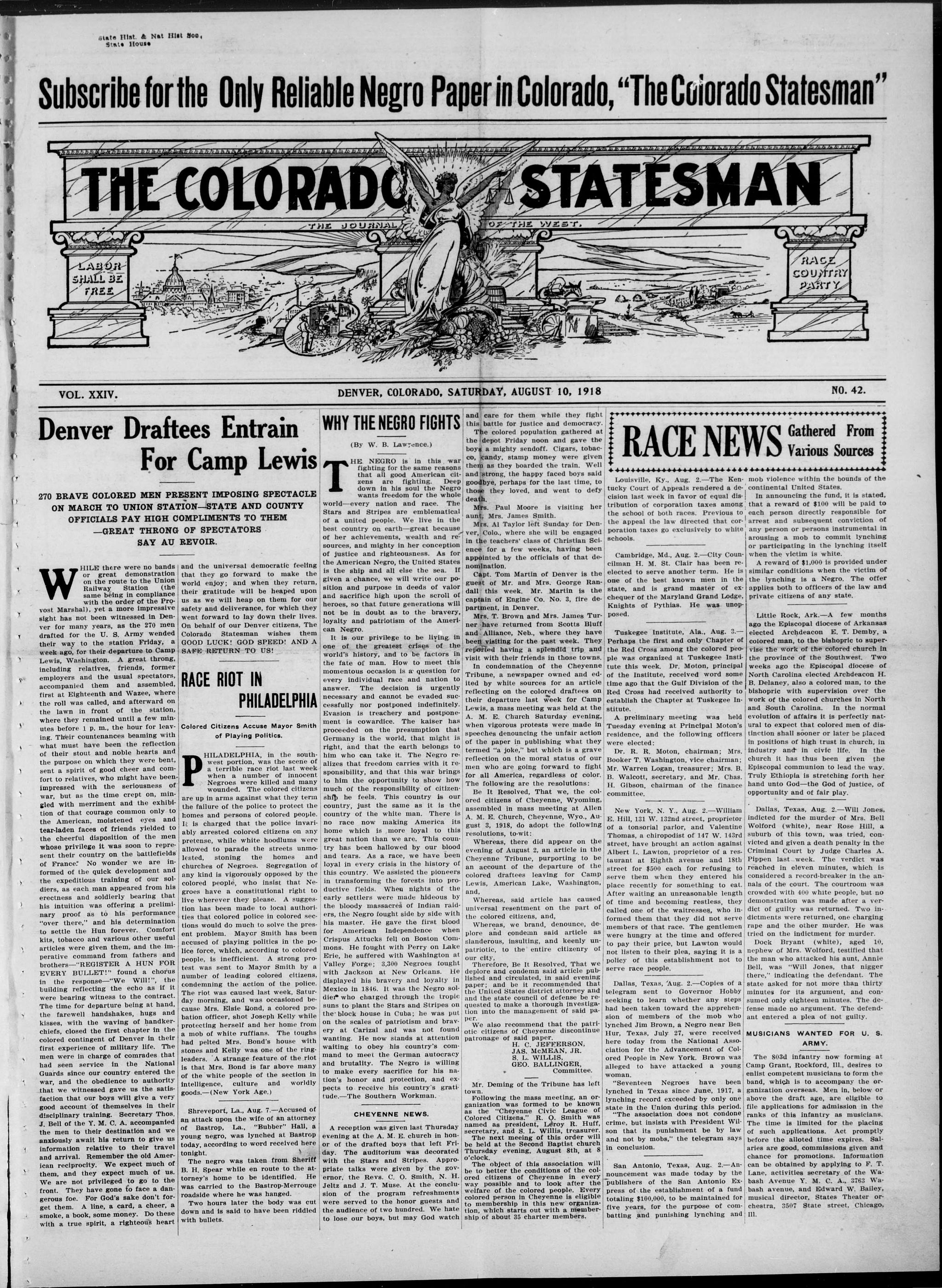
Denver Draftees Entrain For Camp Lewis
270 BRAVE COLORED MEN PRESENT IMPOSING SPECTACLE ON MARCH TO UNION STATION—STATE AND COUNTY OFFICIALS PAY HIGH COMPLIMENTS TO THEM GREAT THRONG OF SPECTATORS SAY AU REVOIR.
W HILE there were no bands or great demonstration on the route to the Union Railway Station (the same being in compliance with the order of the Pro-
vost Marshal), yet a more impressive sight has not been witnessed in Denver for many years, as the 270 men drafted for the U. S. Army wended their way to the station Friday, a week ago, for their departure to Camp Lewis, Washington. A great throng, including relatives, friends, former employers and the usual spectators, accompanied them and assembled, first at Eighteenth and Wazee, where the roll was called, and afterward on the lawn in front of the station, where they remained until a few minutes before 1 p. m., the hour for leaving. Their countenances beaming with what must have been the reflection of their stout and noble hearts and the purpose on which they were bent, sent a spirit of good cheer and comfort to relatives, who might have been impressed with the seriousness of war, but as the time crept on, mingled with merriment and the exhibition of that courage common only to the American, moistened eyes and tear-laden faces of friends yielded to the cheerful disposition of the men whose privilege it was soon to represent their country on the battlefields of France.* No wonder we are informed of the quick development and the expeditious training of our soldiers, as each man appeared from his erectness and soldierly bearing that his intuition was offering a preliminary proof as to his performance "over there," and his determination to settle the Hun forever. Comfort kits, tobacco and various other useful articles were given them, and the imperative command from fathers and brothers—"REGISTER A HUN FOR EVERY BULLET!" found a chorus in the response—"We Will!", the building reflecting the echo as if it were bearing witness to the contract. The time for departure being at hand, the farewell handshakes, hugs and kisses, with the waving of handkerchiefs, closed the first chapter in the colored contingent of Denver in their first experience of military life. The men were in charge of comrades that had seen service in the National Guards since our country entered the war, and the obedience to authority that we witnessed gave us the satisfaction that our boys will give a very good account of themselves in their disciplinary training. Secretary Thos. J. Bell of the Y. M. C. A. accompanied the men to their destination and we anxiously await his return to give us information relative to their travel and arrival. Remember the old American reciprocity. We expect much of them, and they expect much of us. We are not privileged to go to the front. They have gone to face a dangerous foe. For God's sake don't forget them. A line, a card, a cheer, a smoke, a book, some money. Do these with a true spirit, a righteous heart
---
---
```markdown
```
and the universal democratic feeling that they go forward to make the world enjoy; and when they return, their gratitude will be heaped upon us as we will heap on them for our safety and deliverance, for which they went forward to lay down their lives. On behalf of our Denver citizens, The Colorado Statesman wishes them GOOD LUCK! GOD SPEED! AND A SAFE RETURN TO US!
RACE RIOT IN PHILADELPHIA
Colored Citizens Accuse Mayor Smith of Playing Politics.
HILADELPHIA, in the southwest portion, was the scene of a terrible race riot last week when a number of innocent Negroes were killed and many wounded. The colored citizens
are up in arms against what they term the failure of the police to protect the homes and persons of colored people. It is charged that the police invariably arrested colored citizens on any pretense, while white hoodlums were allowed to parade the streets unmolested, stoning the homes and churches of Negroes. Segregation of any kind is vigorously opposed by the colored people, who insist that Negroes have a constitutional right to live wherever they please. A suggestion has been made to local authorities that colored police in colored sections would do much to solve the present problem. Mayor Smith has been accused of playing politics in the police force, which, according to colored people, is inefficient. A strong protest was sent to Mayor Smith by a number of leading colored citizens, condemning the action of the police. The riot was caused last week, Saturday morning, and was occasioned because Mrs. Elsie Bond, a colored probation officer, shot Joseph Kelly while protecting herself and her home from a mob of white ruffians. The toughs had pelted Mrs. Bond's house with stones and Kelly was one of the ringleaders. A strange feature of the riot is that Mrs. Bond is far above many of the white people of the section in intelligence, culture and worldly goods.—(New York Age.)
Shreveport, La., Aug. 7.—Accused of an attack upon the wife of an attorney of Bastrop, La., "Bubber" Hall, a young negro, was lynched at Bastrop today, according to word received here tonight.
The negro was taken from Sheriff B. H. Spear while en route to the attorney's home to be identified. He was carried to the Bastrop-Merrouge roadside where he was hanged.
Two hours later the body was cut down and is said to have been riddled with bullets.
WHY THE NEGRO FIGHTS
THE NEGRO is in this war fighting for the same reasons that all good American citizens are fighting. Deep down in his soul the Negro wants freedom for the whole world—every nation and race. The Stars and Stripes are emblematic of a united people. We live in the best country on earth—great because of her achievements, wealth and resources, and mighty in her conception of justice and righteousness. As for the American Negro, the United States is the ship and all else the sea. If given a chance, we will write our position and purpose in deeds of valor and sacrifice high upon the scroll of heroes, so that future generations will not be in doubt as to the bravery, loyalty and patriotism of the American Negro.
It is our privilege to be lying in one of the greatest crises of the world's history, and to be factors in the fate of man. How to meet this momentous occasion is a question for every individual race and nation to answer. The decision is urgently necessary and cannot be evaded successfully nor postponed indefinitely. Evasion is treachery and postponement is cowardice. The kaiser has proceeded on the presumption that Germany is the world, that might is right, and that the earth belongs to him who can take it. The Negro realizes that freedom carries with it responsibility, and that this war brings to him the opportunity to show how much of the responsibility of citizenship he feels. This country is our country, just the same as it is the country of the white man. There is no race now making America its home which is more loyal to this great nation than we are. This country has been hallowed by our blood and tears. As a race, we have been loyal in every crisis in the history of this country. We assisted the pioneers in transforming the forests into productive fields. When nights of the early settlers were made hideous by the bloody massacres of Indian raiders, the Negro fought side by side with his master. He gave the first blood for American Independence when Crispus Attucks fell on Boston Commons. He fought with Perry on Lake Erie, he suffered with Washington at Valley Forge; 3,300 Negroes fought with Jackson at New Orleans. He displayed his bravery and loyalty in Mexico in 1846. It was the Negro soldier who charged through the tropic suns to plant the Stars and Stripes on the block house in Cuba; he was put on the scales of patriotism and bravery at Carizal and was not found wanting. He now stands at attention waiting to obey his country's command to meet the German autocracy and brutality. The Negro is willing to make every sacrifice for his nation's honor and protection, and expects to receive his country's gratitude.—The Southern Workman.
CHEYENNE NEWS.
A reception was given last Thursday evening at the A. M. E. church in honor of the drafted boys that left Friday. The auditorium was decorated with the Stars and Stripes. Appropriate talks were given by the governor, the Revs. C. O. Smith, N. H. Jeltz and J. T. Muse. At the conclusion of the program refreshments were served to the honor guests and the audience of two hundred. We hate to lose our boys, but may God watch
and care for them while they fight this battle for justice and democracy.
this battle for justice and democracy. The colored population gathered at the depot Friday noon and gave the boys a mighty sendoff. Cigars, tobacco, candy, stamp money were given them as they boarded the train. Well and strong, the happy faced boys said goodbye, perhaps for the last time, to those they loved, and went to defy death.
Mrs. Paul Moore is visiting her aunt, Mrs. James Smith.
Mrs. Al Taylor left Sunday for Denver, Colo., where she will be engaged in the teachers' class of Christian Science for a few weeks, having been appointed by the officials of that denomination.
Capt. Tom Martin of Denver is the guest of Mr. and Mrs. George Randall this week. Mr. Martin is the captain of Engine Co. No. 3, fire department, in Denver.
Mrs. T. Brown and Mrs. James Turner have returned from Scotts Bluff and Alliance, Neb., where they have been visiting for the past week. They reported having a splendid trip and visit with their friends in those towns. In condemnation of the Cheyenne Tribune, a newspaper owned and edited by white sources for an article reflecting on the colored draftees on their departure last week for Camp Lewis, a mass meeting was held at the A. M. E. Church Saturday evening, when vigorous protests were made in speeches denouncing the unfair action of the paper in publishing what they termed "a joke," but which is a grave reflection on the moral status of our men who are going forward to fight for all America, regardless of color. The following are the resolutions: Be It Resolved, That we, the colored citizens of Cheyenne, Wyoming, assembled in mass meeting at Allen A. M. E. Church, Cheyenne, Wyo., August 3, 1918, do adopt the following resolutions, to-wit:
Whereas, there did appear on the evening of August 2, an article in the Cheyenne Tribune, purporting to be an account of the departure of the colored draftees leaving for Camp Lewis, American Lake, Washington, and,
Whereas, said article has caused universal resentment on the part of the colored citizens, and,
Whereas, we brand, denounce, deplore and condemn said article as slanderous, insulting, and keenly unpatriotic, to the entire citizenry of our city,
Therefore, Be It Resolved, That we deplore and condemn said article published and circulated, in said evening paper; and be it recommended that the United States district attorney and the state council of defense be requested to make a thorough investigation into the management of said paper.
We also recommend that the patriotic citizens of Cheyenne discontinue patronage of said paper.
patronage of the
H. C. JEFFERSON,
JAS. McMEAN, JR.
S. L. WILLIS,
GEO. BALLINGER,
Committee.
Mr. Deming of the Tribune has left town.
Following the mass meeting, an organization was formed to be known as the "Cheyenne Civic League of Colored Citizens." R. Q. Smith was named as president, Leroy R. Huff, secretary, and S. L. Willis, treasurer.
The next meeting of this order will be held at the Second Baptist church Thursday evening, August 8th, at 8 o'clock.
The object of this association will be to better the conditions of the colored citizens of Cheyenne in every way possible and to look after the welfare of the colored people. Every colored person in Cheyenne is eligible to membership in this new organization, which starts out with a membership of about 35 charter members.
RACE NEWS Gathered From Various Sources
Louisville, Ky., Aug. 2.—The Kentucky Court of Appeals rendered a decision last week in favor of equal distribution of corporation taxes among the school of both races. Previous to the appeal the law directed that corporation taxes go exclusively to white schools.
Cambridge, Md., Aug. 2.—City Councilman H. M. St. Clair has been reelected to serve another term. He is one of the best known men in the state, and is grand master of exchequer of the Maryland Grand Lodge, Knights of Pythias. He was unopposed.
Tuskegee Institute, Ala., Aug. 3.—Perhaps the first and only Chapter of the Red Cross among the colored people was organized at Tuskegee Institute this week. Dr. Moton, principal of the Institute, received word some time ago that the Gulf Division of the Red Cross had received authority to establish the Chapter at Tuskegee Institute.
mob violence within the bounds of the continental United States.
In announcing the fund, it is stated, that a reward of $100 will be paid to each person directly responsible for arrest and subsequent conviction of any person or persons instrumental in arousing a mob to commit lynching or participating in the lynching itself when the victim is white.
A reward of $1,000 is provided under similar conditions when the victim of the lynching is a Negro. The offer applies both to officers of the law and private citizens of any state.
Little Rock, Ark.—A few months ago the Episcopal diocese of Arkansas elected Archdeacon E. T. Demby, a colored man, to the bishopric to supervise the work of the colored church in the province of the Southwest. Two weeks ago the Episcopal diocese of North Carolina elected Archdeacon H. B. Delaney, also a colored man, to the bishopric with supervision over the work of the colored churches in North and South Carolina. In the normal
A preliminary meeting was held Tuesday evening at Principal Moton's residence, and the following officers were elected:
Dr. R. R. Moton, chairman; Mrs. Booker T. Washington, vice chairman; Mr. Warren Logan, treasurer; Mrs. B. B. Walcott, secretary, and Mr. Chas. H. Gibson, chairman of the finance committee.
New York, N. Y., Aug. 2.—William E. Hill, 131 W. 132nd street, proprietor of a tonsorial parlor, and Valentine Thomas, a chiropodist of 147 W. 143rd street, have brought an action against Albert L. Lawton, proprietor of a restaurant at Eighth avenue and 18th street for $500 each for refusing to serve them when they entered his place recently for something to eat. After waiting an unreasonable length of time and becoming restless, they called one of the waitresses, who informed them that they did not serve members of that race. The gentlemen were hungry at the time and offered to pay their price, but Lawton would not listen to their plea, saying it is a policy of this establishment not to serve race people.
Dallas, Texas, Aug. 2.—Copies of a telegram sent to Governor Hobby seeking to learn whether any steps had been taken toward the apprehension of members of the mob who lynched Jim Brown, a Negro near Ben Hur, Texas, July 27, were received here today from the National Association for the Advancement of Colored People in New York. Brown was alleged to have attacked a young woman.
"Seventeen Negroes have been lynched in Texas since June, 1917, a lynching record exceeded by only one state in the Union during this period.
"The association does not condone crime, but insists with President Wilson that its punishment be by law and not by mobs," the telegram says in conclusion.
San Antonio, Texas, Aug. 2.—Anouncement was made today by the publishers of the San Antonio Express of the establishment of a fund totaling $100,000, to be maintained for five years, for the purpose of combating and punishing lynching and
NO.42.
mob violence within the bounds of the continental United States.
In announcing the fund, it is stated,
that a reward of $100 will be paid to each person directly responsible for arrest and subsequent conviction of any person or persons instrumental in arousing a mob to commit lynching or participating in the lynching itself when the victim is white.
A reward of $1,000 is provided under similar conditions when the victim of the lynching is a Negro. The offer applies both to officers of the law and private citizens of any state.
Little Rock, Ark.—A few months ago the Episcopal diocese of Arkansas elected Archdeacon E. T. Demby, a colored man, to the bishopric to supervise the work of the colored church in the province of the Southwest. Two weeks ago the Episcopal diocese of North Carolina elected Archdeacon H. B. Delaney, also a colored man, to the bishopric with supervision over the work of the colored churches in North and South Carolina. In the normal evolution of affairs it is perfectly natural to expect that colored men of distinction shall sooner or later be placed in positions of high trust in church, in industry and in civic life. In the church it has thus been given the Episcopal communion to lead the way. Truly Ethiopia is stretching forth her hand unto God—the God of justice, of opportunity and of fair play.
Dallas, Texas, Aug. 2.—Will Jones, indicted for the murder of Mrs. Bell Wolford (white), near Rose Hill, a suburb of this town, was tried, convicted and given a death penalty in the Criminal Court by Judge Charles A. Pippen last week. The verdict was reached in eleven minutes, which is considered a record-breaker in the annals of the court. The courtroom was crowded with 400 white people, but no demonstration was made after a verdict of guilty was returned. Two indictments were returned, one charging rape and the other murder. He was tried on the indictment for murder. Dock Bryant (white), aged 10, nephew of Mrs. Wolford, testified that the man who attacked his aunt, Annie Bell, was "Will Jones, that nigger there," indicating the defendant. The state asked for not more than thirty minutes for its argument, and consumed only eighteen minutes. The defense made no argument. The defendant entered a plea of not guilty.
MUSICIANS WANTED FOR U. S. ARMY.
The 803d infantry now forming at Camp Grant, Rockford, Ill., desires to enlist competent musicians to form the band, which is to accompany the organization overseas. Men in, below or above the draft age, are eligible to file applications for admission in the ranks of this infantry as musicians. The time is limited for the placing of such applications. Act promptly before the allotted time expires. Salaries are good, commissions given and chance for promotions. Information can be obtained by applying to F. T. Lane, activities secretary of the Wabash Avenue Y. M. C. A., 3763 Wabash avenue, and Edward W. Bailey, musical director, States Theater or chestra, 3507 State street, Chicago Ill.
PETER H.
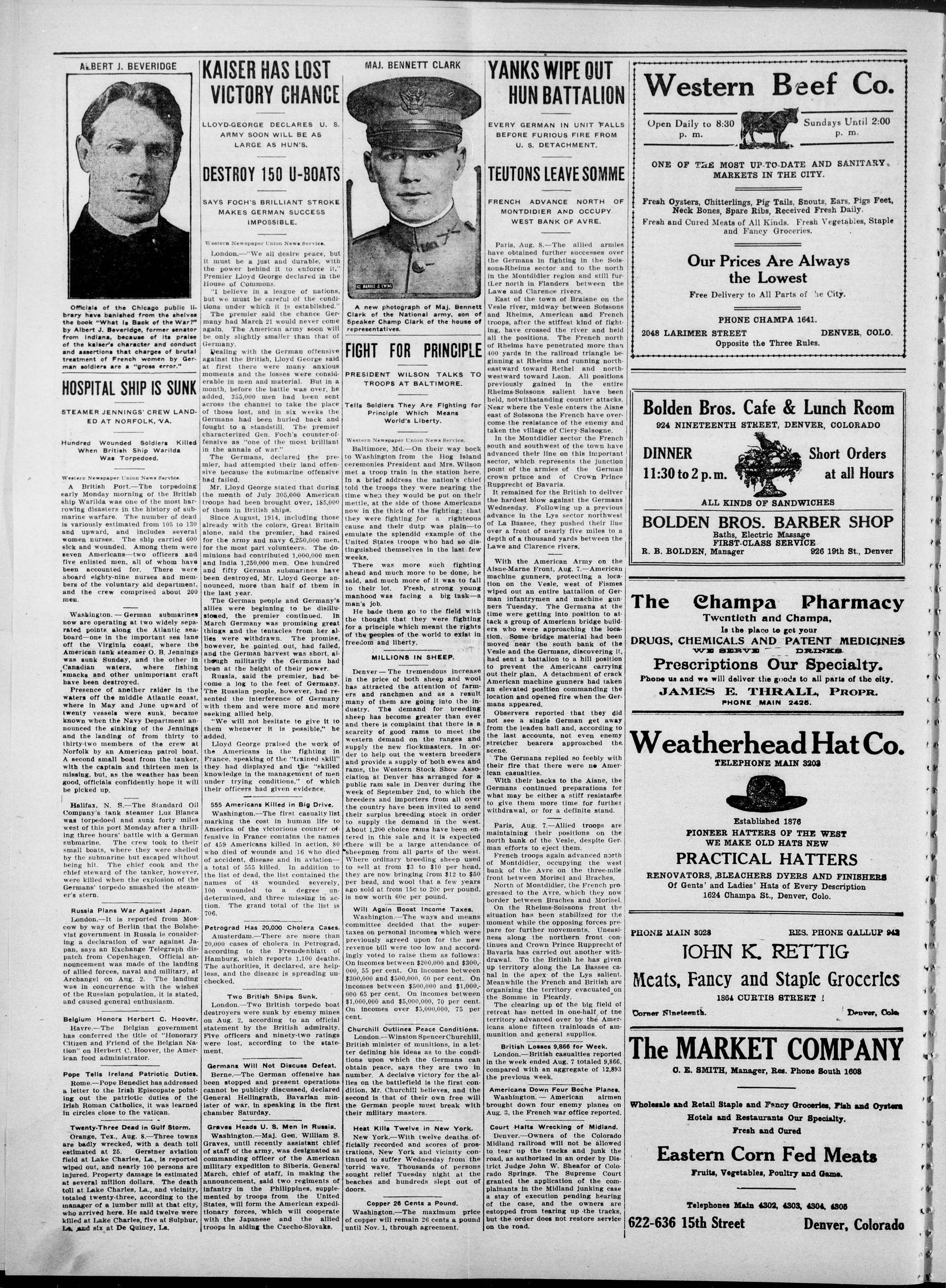
Officials of the Chicago public library have banished from the shelves the book "What Is Back of the War?" by Albert J. Beveridge, former senator from Indiana, because of its praise of the kaiser's character and conduct and assertions that charges of brutal treatment of French women by German soldiers are a "gross error."
HOSPITAL SHIP IS SUNK
HOSPITAL SHIP IS SUNK
STEAMER JENNINGS' CREW LAND
ED AT NORFOLK, VA.
Hundred Wounded Soldiers Killed
When British Ship Warilda
Was Torpedoed.
Western Newspaper Union News Service.
A British Port.—The torpedoing
early Monday morning of the British
ship Warilda was one of the most har-
rowing disasters in the history of sub-
marine warfare. The number of dead
is variously estimated from 105 to 130
and upward, and includes several
women nurses. The ship carried 600
sick and wounded. Among them were
seven Americans—two officers and
five enlisted men, all of whom have
been accounted for. There were
aboard eighty-nine nurses and members
of the voluntary aid department,
and the crew comprised about 200
men.
Washington. — German submarines now are operating at two widely separated points along the Atlantic seaboard—one in the important sea lane off the Virginia coast, where the American tank steamer O. B. Jennings was sunk Sunday, and the other in Canadian waters, where fishing smacks and other unimportant craft have been destroyed.
Presence of another raider in the waters off the middle Atlantic coast, where in May and June upward of twenty vessels were sunk, became known when the Navy Department announced the sinking of the Jennings and the landing of from thirty to thirty-two members of the crew at Norfolk by an American patrol boat. A second small boat from the tanker, with the captain and thirteen men is missing, but, as the weather has been good, officials confidently hope it will be picked up.
Hallifax, N. S.—The Standard Oil Company's tank steamer Luz Blanca was torpedoed and sunk forty miles west of this port Monday after a thrilling three hours' battle with a German submarine. The crew took to their small boats, where they were shelled by the submarine but escaped without being hit. The chief cook and the chief steward of the tanker, however, were killed when the explosion of the Germans' torpedo smashed the steamer's stern.
London. It is reported from Moscow by way of Berlin that the Bolshevist government in Russia is considering a declaration of war against Japan, says an Exchange Telegraph dispatch from Copenhagen. Official anouncement was made of the landing of allied forces, naval and military, at Archangel on Aug. 2. The landing was in concurrence with the wishes of the Russian population, it is stated, and caused general enthusiasm.
Belgium Honors Herbert C. Hoover. Havre. The Belgian government has conferred the title of "Honorary Citizen and Friend of the Belgian Nation" on Herbert C. Hoover, the American food administrator.
Rome.—Pope Benedict has addressed a letter to the Irish Episcopate pointing out the patriotic duties of the Irish Roman Catholics, it was learned in circles close to the vatican.
Twenty-Three Dead in Gulf Storm.
Orange, Tex., Aug. 8.—Three towns are badly wrecked, with a death toll estimated at 25. Gerstner aviation field at Lake Charles, La., is reported wiped out, and nearly 100 persons are injured. Property damage is estimated at several million dollars. The death toll at Lake Charles, La., and vicinity, totaled twenty-three, according to the manager of a lumber mill at that city, who arrived here. He said twelve were killed at Lake Charles, five at Sulphur, La. and sx at De Quincy, La.
KAISER HAS LOST VICTORY CHANCE
LLOYD-GEORGE DECLARES U. S.
ARMY SOON WILL BE AS
LARGE AS HUN'S.
DESTROY 150 U-BOATS
SAYS FOCH'S BRILLIANT STROKE
MAKES GERMAN SUCCESS
IMPOSSIBLE.
Western Newspaper Union News Service.
London.—"We all desire peace, but
it must be a just and durable, with
the power behind it to enforce it."
Premier Lloyd George declared in the
House of Commons.
"I believe in a league of nations,
but we must be careful of the con-
ditions under which it is established."
The premier said the chance Gery-
many had March 21 would never come
again. The American army soon will
be only slightly smaller than that of
Germany.
Dealing with the German offensive against the British, Lloyd George said at first there were many anxious moments and the losses were considerable in men and material. But in a month, before the battle was over, he added, 355,000 men had been sent across the channel to take the place of those lost, and in six weeks the Germans had been hurled back and fought to a standstill. The premier characterized Gen. Foch's counter-offensive as "one of the most brilliant in the annals of war."
The Germans, declared the premier, had attempted their land offensive because the submarine offensive had failed.
Mr. Lloyd George stated that during the month of July 305,000 American troops had been brought over, 185,000 of them in British ships.
Since August, 1914, including those already with the colors, Great Britain alone, said the premier, had raised for the army and navy 6,250,000 men, for the most part volunteers. The dominions had contributed 1,000,000 men and India 1,250,000 men. One hundred and fifty German submarines have been destroyed, Mr. Lloyd George announced, more than half of them in the last year.
The German people and Germany's allies were beginning to be disillusioned, the premier continued. In March Germany was promising great things and the tentacles from her allies were withdrawn. The promise, however, he pointed out, had failed, and the German harvest was short, although militarily the Germans had been at the height of their power.
Russia, said the premier, had become a log to the feet of Germany. The Russian people, however, had resented the interference of Germany with them and were more and more seeking allied help. "We will not hesitate to give it to them whenever it is possible," he added. Lloyd George praised the work of the Americans in the fighting in France, speaking of the "trained skill" they had displayed and the "skilled knowledge in the management of men under trying conditions," of which their officers had given evidence.
555 Americans Killed in Big Drive
Washington.—The first casualty list marking the cost in human life to America of the victorious counter- offensive in France contains the names of 459 Americans killed in action, 80 who died of wounds and 16 who died of accident, disease and in aviation—a total of 555 killed. In addition to the list of dead, the list contained the names of 48 wounded severely, 100 wounded to a degree undetermined, and three missing in action. The grand total of the list is 706.
Petrograd Has 20,000 Cholera Cases. Amsterdam.—There are more than 20,000 cases of cholera in Petrograd, according to the Frendenblatt of Hamburg, which reports 1,100 deaths. The authorities, it declared, are helpless, and the disease is spreading unchecked.
Two British Ships Sunk
London.—Two British torpedo boat destroyers were sunk by enemy mines on Aug. 2, according to an official statement by the British admiralty. Five officers and ninety-two ratings were lost, according to the statement.
Germans Will Not Discuss Defeat. Berne.—The German offensive has been stopped and present operations cannot be publicly discussed, declared General Hellingrath, Bavarian minister of war, in speaking in the first chamber Saturday.
Washington.—Maj. Gen. William S. Graves, until recently assistant chief of staff of the army, was designated as commanding officer of the American military expedition to Siberia. General March, chief of staff, in making the announcement, said two regiments of infantry in the Philippines, supplemented by troops from the United States, will form the American expeditionary forces, which will cooperate with the Japanese and the allied troops in aiding the Czecho-Slovaks.
MAJ. BENNETT CLARK
C HARRIS & LWING
A new photograph of Maj. Bennett Clark of the National army, son of Speaker Champ Clark of the house of representatives.
FIGHT FOR PRINCIPLE
FIGHT FOR PRINCIPLE
PRESIDENT WILSON TALKS TO TROOPS AT BALTIMORE.
Tells Soldiers They Are Fighting for Principle Which Means World's Liberty.
Western Newspaper Union News Service.
Baltimore, Md.—On their way bock to Washington from the Hog Island ceremonies President and Mrs. Wilson met a troop train in the station here. In a brief address the nation's chief told the troops they were nearing the time when they would be put on their mettle, at the side of those Americans now in the thick of the fighting; that they were fighting for a righteous cause and their dutp was plain—to emulate the splendid example of the United States troops who had so distinguished themselves in the last few weeks.
There was more such fighting ahead and much more to be done, he said, and much more of it was to fall to their lot. Fresh, strong young manhood was facing a big task—a man's job.
He bade them go to the field with the thought that they were fighting for a principle which meant the rights of the peoples of the world to exist in freedom and liberty.
MILLIONS IN SHEEP
Denver—The tremendous increase in the price of both sheep and wool has attracted the attention of farmers and ranchmen and as a result many of them are going into the industry. The demand for breeding sheep has become greater than ever and there is complaint that there is a scarcity of good rams to meet the western demand on the ranges and supply the new flockmasters. In order to help out the western breeders and provide a supply of both ewes and rams, the Western Stock Show Association at Denver has arranged for a public ram sale in Denver during the week of September 2nd, to which the breeders and importers from all over the country have been invited to send their surplus breeding stock in order to supply the demand in the west. About 1,200 choice rams have been entered in this sale and it is expected there will be a large attendance of sheepmen from all parts of the west. Where ordinary breeding sheep used to sell at from $3 to $10 per head, they are now bringing from $12 to $50 per head, and wool that a few years ago sold at from 15c to 20c per pound, is now worth 60c per pound.
Will Again Boost Income Taxes.
Will Again Boost Income Taxes.
Washington.—The ways and means committee decided that the super-taxes on personal incomes which were previously agreed upon for the new revenue bill were too low and accordingly voted to raise them as follows:
On incomes between $200,000 and $300,
000, 55 per cent. On incomes between
$300,000 and $500,000, 60 per cent. On
incomes between $500,000 and $1,000,
000 65 per cent. On incomes between
$1,000,000 and $5,000,000, 70 per cent.
On incomes over $5,000,000, 75 per cent.
Churchill Outlines Peace Conditions. London.—Winston Spencer Churchill, British minister of munitions, in a letter defining his ideas as to the conditions upon which the Germans can obtain peace, says they are two in number. A decisive victory for the allies on the battlefield is the first condition, Mr. Churchill believes, and the second is that of their own free will the German people must break with their military masters.
Heat Kills Twelve in New York.
New York.—With twelve deaths officially recorded and scores of prostrations, New York and vicinity continued to suffer Wednesday from the torrid wave. Thousands of persons sought relief Tuesday night at the beaches and hundreds slept out of doors.
Copper 26 Cents a Pound.
Washington.-The maximum price of copper will remain 26 cents a pound until Nov. 1, through agreement.
YANKS WIPE OUT HUN BATTALION
EVERY GERMAN IN UNIT FALLS BEFORE FURIOUS FIRE FROM U. S. DETACHMENT.
TEUTONS LEAVE SOMME
FRENCH ADVANCE NORTH OF MONTDIDIER AND OCCUPY WEST BANK OF AVRE.
Paris, Aug. 8.—The allied armies have obtained further successes over the Germans in fighting in the Soissons-Rheims sector and to the north in the Montdidier region and still further north in Flanders between the Lawe and Clarence rivers.
East of the town of Braise on the Vesle river, midway between Soissons and Rheims, American and French troops, after the stiffest kind of fighting, have crossed the river and held all the positions. The French north of Rheims have penetrated more than 400 yards in the railroad triangle beginning at Rheims and running northeastward toward Rethel and northwestward toward Laon. All positions previously gained in the entire Rheims-Soissons salient have been held, notwithstanding counter attacks. Near where the Vesle enters the Aisne east of Soissons the French have overcome the resistance of the enemy and taken the village of Ciery-Salsogne.
In the Montdidier sector the French south and southwest of the town have advanced their line on this important sector, which represents the junction point of the armies of the German crown prince and of Crown Prince Rupprecht of Bavaria.
It remained for the British to deliver the hardest blow against the Germans Wednesday. Following up a previous advance in the Lys sector northwest of La Bassee, they pushed their line over a front of nearly five miles to a depth of a thousand yards between the Lawe and Clarence rivers.
With the American Army on the Aisne-Marne Front, Aug. 7.—American machine gunners, protecting a location on the Vesle, west of Fismes wiped out an entire battalion of German infantrymen and machine gunners Tuesday. The Germans at the time were getting into position to attack a group of American bridge builders who were approaching the location. Some bridge material had been moved near the south bank of the Vesle and the Germans, discovering it, had sent a battalion to a hill position to prevent the Americans carrying out their plan. A detachment of crack American machine gunners had taken an elevated position commanding the location and opened fire when the Germans appeared.
Observers reported that they did not see a single German get away from the leaden hall and, according to the last accounts, not even enemy stretcher bearers approached the scene.
The Germans replied so feebly with their fire that there were no American casualties.
With their backs to the Aisne, the Germans continued preparations for what may be either a stiff resistance to give them more time for further withdrawal, or for a definite stand.
Paris, Aug. 7.—Allied troops are maintaining their positions on the north bank of the Vesle, despite German efforts to eject them.
French troops again advanced north of Montdidier, occupying the west bank of the Avre on the three-mile front between Morsel and Braches.
North of Montdidier, the French progressed to the Avre, which they now border between Braches and Morisel. On the Rheims-Soissons front the situation has been stabilized for the moment while the opposing forces prepare for further movements. Uneasiness along the northern front continues and Crown Prince Rupprecht of Bavaria has carried out another withdrawal. To the British he has given up territory along the La Bassee canal in the apex of the Lys salient. Meanwhile the French and British are organizing the territory evacuated on the Somme in Picardy. The clearing up of the big field of retreat has netted in one-half, of the territory advanced over by the Americans alone fifteen trainloads of ammunition and general supplies.
London.—British casualties reported in the week ended Aug. 7 totaled 9,866, compared with an aggregate of 12,893 the previous week.
Americans Down Four Boche Planes. Washington.—American airmen brought down four enemy planes on Aug. 3, the French war office reported.
Court Halts Wrecking of Midland. Denver.—Owners of the Colorado Midland railroad will not be allowed to tear up the tracks and junk the road, as authorized in an order by District Judge John W. Sheafer of Colorado Springs. The Supreme Court granted the application of the complainants in the Midland junking case a stay of execution pending hearing of the case, and the owners are estopped from tearing up the tracks, but the order does not restore service on the road.
Western Beef Co.
Open Daily to 8:30
p. m.
ONE OF THE MOST
MARRIED
Fresh Oysters, Chitterl
Neck Bones, Sp
Fresh and Cured Meats
and
Our Pr
OF THE MOST UP-TO-DATE AND SALE MARKETS IN THE CITY.
ters, Chitterlings, Pig Tails, Snouts, Ears,ck Bones, Spare Ribs, Received Fresh Da Cured Meats of All Kinds. Fresh Vegeta and Fancy Groceries.
Our Prices Are Always the Lowest
ONE OF THE MOST UP-TO-DATE AND SANITARY MARKETS IN THE CITY.
Fresh Oysters, Chitterlings, Pig Tails, Snouts, Ears, Pigs Feet, Neck Bones, Spare Ribs, Received Fresh Daily. Fresh and Cured Meats of All Kinds. Fresh Vegetables, Staple and Fancy Groceries.
Free Delivery to All Parts of the City.
PHC
2048 LARIMER STREET
Oppo
Bolden Bros.
924 NINETEENTH
PHONE CHAMPA 1641.
IMER STREET DENVER
Opposite the Three Rules.
In Bros. Cafe & Lunch
INNETEENTH STREET, DENVER, COLL
PHONE CHAMPA 1641.
2048 LARIMER STREET DENVER, COLO.
Opposite the Three Rules.
Bolden Bros. Cafe & Lunch Room 924 NINETEENTH STREET, DENVER, COLORADO
DINNER
11:30 to 2 p.m.
ALL KIN
BOLDEN BR
Baths,
FIRST
R. B. BOLDEN, Manage
The Charm
Twenty
Is the
DRUGS, CHEMICALS
WE SEE
Prescription
Phone us and we will de
JAMES E.
PHC
Weather
TELE
ALL KINDS OF SANDWICHES
DEN BROS. BARBER
Baths, Electric Massage
FIRST-CLASS SERVICE
DEN, Manager 926 19th S
Champa Pharma
Twentieth and Champa,
Is the place to get your
CHEMICALS AND PATENT M
WE SERVE DRINKS
Descriptions Our Special
and we will deliver the goods to all parts o
MES E. THRALL, PR
PHONE MAIN 2425.
fatherhead Ha
TELEPHONE MAIN 3203
BOLDEN BROS. BARBER SHOP
Baths, Electric Massage
FIRST-CLASS SERVICE
R. B. BOLDEN, Manager 926 19th St., Denver
The Champa Pharmacy
Twentieth and Champa,
Is the place to get your
DRUGS, CHEMICALS AND PATENT MEDICINES
WE SERVE DRINKS.
Prescriptions Our Specialty.
Phone us and we will deliver the goods to all parts of the city.
JAMES E. THRALL, PROPR.
PHONE MAIN 2426.
Weatherhead Hat Co. TELEPHONE MAIN 3203
Established 1876
PIONEER HATTERS OF THE WEST
WE MAKE OLD HATS NEW
PRACTICE
RENOVATORS, BLEA
Of Gents' and La
1624 Ch
PRACTICAL HATTERS
ATORS, BLEACHERS DYERS AND FIL
Gents' and Ladies' Hats of Every Descrip
1624 Champa St., Denver, Colo.
RENOVATORS, BLEACHERS DYERS AND FINISHERS Of Gents' and Ladies' Hats of Every Description 1624 Champa St., Denver, Colo.
JOHN K. RETTIG
Fancy and Staple Gro
1864 CURTIS STREET !
eenth.
JOHN Meats, Fancy 1864
Meats, Fancy and Staple Groceries
1864 CURTIS STREET !
Corner Nineteenth. Denver, Cola
The MARKET COMPANY
O. E. SMITH, Manager, Res. Phone South 1608
Wholesale and Retail Staple and Fancy Groceries, Fish and Oysters
Hotels and Restaurants Our Specialty.
Fresh and Cured
The MARKET COMPANY
C. E. SMITH, Manager, Res. Phone South 1608
Wholesale and Retail Staple and Fancy Groceries, Fish and Oysters Hotels and Restaurants Our Specialty. Fresh and Cured Eastern Corn Fed Meats Fruits, Vegetables, Poultry and Game.
Telephones Main 4302, 4303, 4304, 4305
622-636 15th Street Denver, Colorado
PHONE MAIN 3028
Corner Nineteenth.
Sundays Until 2:00 p. m.
DATE AND SANITARY
THE CITY.
Isls, Snouts, Ears, Pigs Feet,
received Fresh Daily.
Fresh Vegetables, Staple
foodies.
Always
vest
A 1641.
DENVER, COLO.
ee Rules.
& Lunch Room
DENVER, COLORADO
Short Orders
at all Hours
ANDWICHES
BARBER SHOP
Massage
SERVICE
926 19th St., Denver
Pharmacy
Champa,
get your
PATENT MEDICINES
DRINKS.
Our Specialty.
binds to all parts of the city.
ALL, PROPR.
2426.
Bad Hat Co.
MAIN 3203
HATTERS
DEVICES AND FINISHERS
Of Every Description
Denver, Colo.
RES. PHONE GALLUP 942
ETTIG
taple Grocerles
STREET !
Denver, Cola
COMPANY
```markdown
```
VINEGAR
```markdown
```
WASHINGTON CITY
SIDELIGHTS
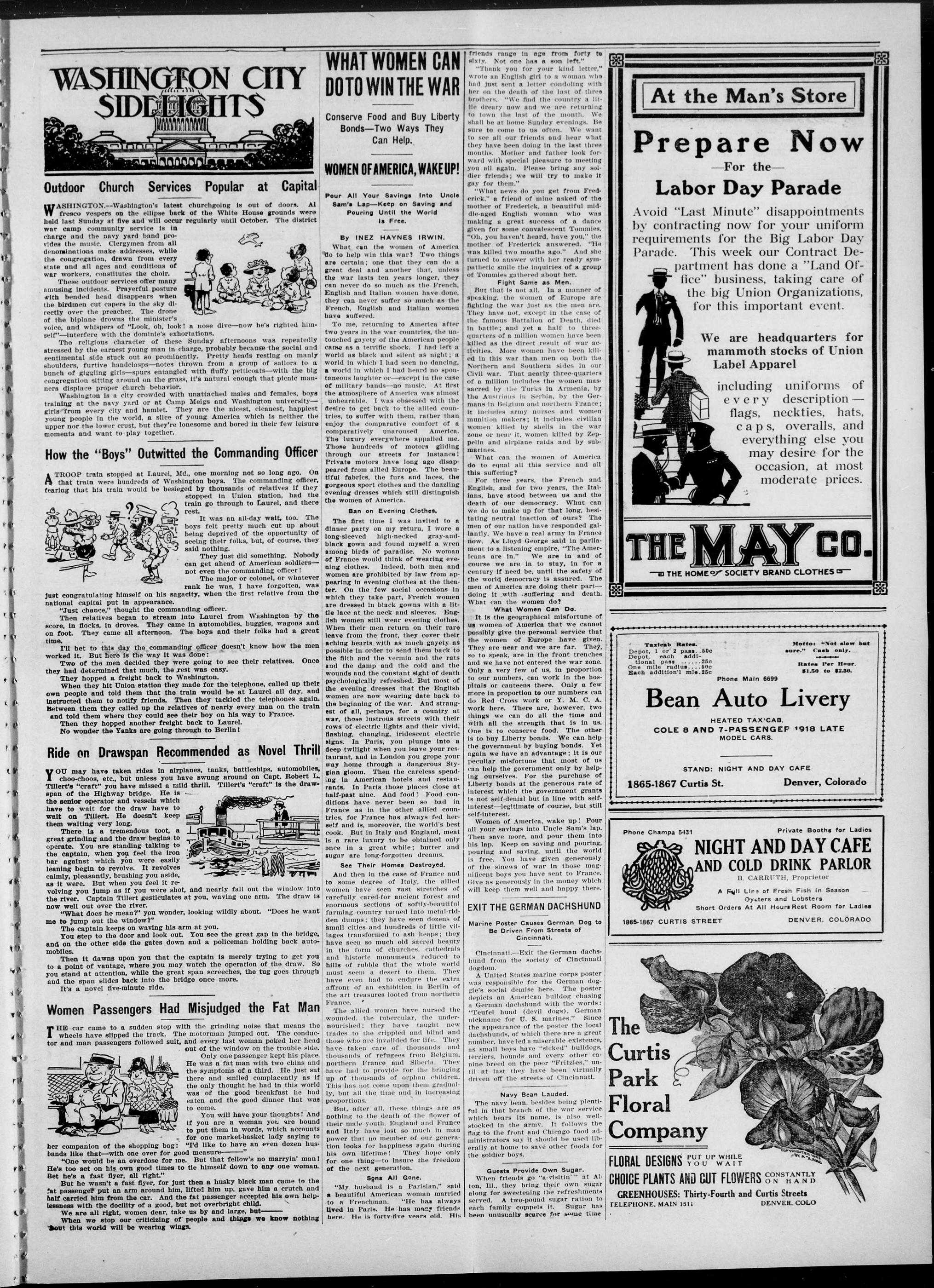
WASHINGTON.—Washington's latest churchgoing is out of doors. Al fresco vespers on the ellipse back of the White House grounds were held last Sunday at five and will occur regularly until October. The district war camp community service is in charge and the navy yard band provides the music. Clergymmen from all denominations make addresses, while the congregation, drawn from every state and all ages and conditions of war workers, constitutes the choir.
These outdoor services offer many amusing incidents. Prayerful posture with bended head disappears when the birdmen cut capers in the sky directly over the preacher. The drone
! a nose dive—now he's righted him-ortations.
Sunday afternoons was repeatedly charge, probably because the social and gently. Pretty heads resting on manly thrown from a group of sailors to a bed with fluffy petticoats—with the big bess, it's natural enough that picnic man-
ish unattached males and females, boys up Meigs and Washington university—they are the nicest, cleanest, happiest young America which is neither the onesome and bored in their few leisure
and the Commanding Officer
did, one morning not so long ago. Onington boys. The commanding officer, aged by thousands of relatives if they
voice, and whispers of "Look, oh, look! a nose dive—now he's righted himself"—interfere with the dominie's exhortations.
voice, and whispers of "Look, oh, look! a nose div self"—interfere with the dominie's exhortations.
The religious character of these Sunday af- stressed by the earnest young man in charge, probab sentimental side stuck out so prominently. Pretty shoulders, furtive hand clasps—notes thrown from bunch of giggling girls—spurs entangled with fluffy congregation sitting around on the grass, it's natural ners displace proper church behavior.
Washington is a city crowded with unattached training at the navy yard or at Camp Meigs and girls from every city and hamlet. They are the young people in the world, a slice of young Amer upper nor the lower crust, but they're lonesome and moments and want to play together.
How the "Boys" Outwitted the Con
A TROOP train stopped at Laurei, Md., one morn that train were hundreds of Washington boys. fearing that his train would be besieged by thou- stopped in
The religious character of these Sunday afternoons was repeatedly stressed by the earnest young man in charge, probably because the social and sentimental side stuck out so prominently. Pretty heads resting on manly shoulders, furtive handclaps—notes thrown from a group of sailors to a bunch of giggling girls—spurs entangled with fluffy petticoats—with the big congregation sitting around on the grass, it's natural enough that picnic manners displace proper church behavior.
Washington is a city crowded with unattached males and females, boys training at the navy yard or at Camp Meigs and Washington university—girls from every city and hamlet. They are the nicest, cleanest, happiest young people in the world, a slice of young America which is neither the upper nor the lower crust, but they're lonesome and bored in their few leisure moments and want to play together.
How the "Boys" Outwitted the Commanding Officer
How the "Boys" Outwitted the Commanding Officer
A TROOP train stopped at Laurel, Md., one morning not so long ago. On that train were hundreds of Washington boys. The commanding officer, fearing that his train would be besieged by thousands of relatives if they stopped in Union station, had the train go through to Laurel, and there rest.
It was an all-day wait, too. The boys felt pretty much cut up about being deprived of the opportunity of seeing their folks, but, of course, they said nothing.
They just did something. Nobody can get ahead of American soldiers—not even the commanding officer!
The major or colonel, or whatever rank he was, I have forgotten, was
just congratulating himself on his sagacity, when the first relative from the national capital put in appearance.
"Just chance" thought the commanding officer.
Then relatives began to stream into Laurel from Washington by the score, in flocks, in droves. They came in automobiles, buggies, wagons and on foot. They came all afternoon. The boys and their folks had a great time.
Then relatives began to stream into Laurel's score, in flocks, in droves. They came in automobile on foot. They came all afternoon. The boys and time.
I'll bet to this day the commanding officer do worked it. But here is the way it was done:
Two of the men decided they were going to a they had determined that much, the rest was easy.
Into Laurel from Washington by the
e in automobiles, buggies, wagons and
The boys and their folks had a great
wing officer doesn't know how the men
is done:
Here going to see their relatives. Once
best was easy.
Washington.
made for the telephone, called up their
train would be at Laurel all day, and
when they tackled the telephones again,
tives of nearly every man on the train
their boy on his way to France.
back to Laurel.
brought to Berlin!
Immended as Novel Thrill
planes, tanks, battleships, automobiles,
save swung around on Capt. Robert L.
old thrill. Tillert's "craft" is the draw-
I'll bet to this day the commanding officer doesn't know how the men worked it. But here is the way it was done: Two of the men decided they were going to see their relatives. Once they had determined that much, the rest was easy.
They hopped a freight back to Washington.
When they hit Union station they made for the telephone, called up their own people and told them that the train would be at Laurel all day, and instructed them to notify friends. Then they tackled the telephones again. Between them they called up the relatives of nearly every man on the train and told them where they could see their boy on his way to France.
When they hit Union station they made for the own people and told them that the train would be instructed them to notify friends. Then they tack Between them they called up the relatives of nearby and told them where they could see their boy on. Then they hopped another freight back to La No wonder the Yanks are going through to Berk
Ride on Drawspan Recommended
YOU may have taken rides in airplanes, tanks, choo-choos, etc., but unless you have swung an Tillert's "craft" you have missed a mild thrill. Till
Then they hopped another height. No wonder the Yanks are going through to Berlin!
Ride on Drawspan Recommended as Novel Thrill
YOU may have taken rides in airplanes, tanks, battleships, automobiles, choo-choos, etc., but unless you have swung around on Capt. Robert L. Tillert's "craft" you have missed a mild thrill. Tillert's "craft" is the drawspan of the Highway bridge. He is the senior operator and vessels which have to wait for the draw have to wait on Tillert. He doesn't keep them waiting very long.
There is a tremendous toot, a great grinding and the draw begins to operate. You are standing talking to the captain, when you feel the iron bar against which you were easily leaning begin to revolve. It revolves calmly, pleasantly, brushing you aside,
at, and nearly fall out the window into
at you, waving one arm. The draw is
er, looking wildly about. "Does he want
arm at you.
You see the great gap in the bridge,
and a policeman holding back auto-
the captain is merely trying to get you
watch the operation of the draw. So
span screeches, the tug goes through
bridge once more.
Misjudged the Fat Man
with the grinding noise that means the
motorman jumped out. The conduct-
and every last woman poked her head
out of the window on the trouble side.
volving you jump as if you were shot, and nearly fall out the window into the river. Captain Tillert gesticulates at you, waving one arm. The draw is now well out over the river.
volving you jump as if you were shot, and nearly the river. Captain Tillert gesticulates at you, wavi now well out over the river.
"What does he mean?" you wonder, looking wily me to jump out the window?"
"What does he mean?" you wonder, looking wildly about. "Does he want me to jump out the window?"
The captain keeps on waving his arm at you.
You step to the door and look out. You see the great gap in the bridge, and on the other side the gates down and a policeman holding back automobiles.
You step to the door and look out. You see the and on the other side the gates down and a polite mobiles.
Then it dawns upon you that the captain is to a point of vantage, where you may watch the o you stand at attention, while the great span scree and the span slides back into the bridge once mo
Then it dawns upon you that the captain is merely trying to get you to a point of vantage, where you may watch the operation of the draw. So you stand at attention, while the great span screeches, the tug goes through and the span slides back into the bridge once more. It's a novel five-minute ride.
Women Passengers Had Misjudged the Fat Man
THE car came to a sudden stop with the grinding noise that means the wheels have slipped the track. The motorman jumped out. The conductor and man passengers followed suit, and every last woman poked her head out of the window on the trouble side.
Women Passengers Had Misjudged the Fat Man
Women Passengers Had Misjudged the Fat Man
THE car came to a sudden stop with the grinding noise that means the wheels have slipped the track. The motorman jumped out. The conductor and man passengers followed suit, and every last woman poked her head out of the window on the trouble side.
Only one passenger kept his place. He was a fat man with two chins and the symptoms of a third. He just sat there and smiled complacently as if the only thought he had in this world was of the good breakfast he had eaten and the good dinner that was to come.
You will have your thoughts! And if you are a woman you are bound to put them in words, which accounts for one market-basket lady saying to
her companion of the shopping bag: "I'd like to o bands like that—with one over for good measure— "One would be an overdose for me. But that He's too set on his own good times to tie himself Bet he's a fast flyer, all right."
But he wasn't a fast flyer, for just then a husk fat passenger put an arm around him, lifted him up half carried him from the car. And the fat passengessness with the docility of a good, but not overbri We are all right, women dear, take us by and When we stop our criticizing of people and bout this world will be wearing wings.
"Id like to have an even dozen hus-
od measure——"
e. But that fellow's no marryin' man!
to tie himself down to any one woman.
but then a husky black man came to the
lifted him up, gave him a crutch and
the fat passenger accepted his own help-
put not overbright child.
we us by and large, but——
people and things we know nothing
ags.
her companion of the shopping bag: "Td like to have an even dozen husbands like that—with one over for good measure—"
"One would be an overdose for me. But that fellow's no marryin' man! He's too set on his own good times to tie himself down to any one woman. Bet he's a fast flyer, all right."
But he wasn't a fast flyer, for just then a husky black man came to the fat passenger put an arm around him, lifted him up, gave him a crutch and half carried him from the car. And the fat passenger accepted his own helplessness with the docility of a good, but not overbright child.
We are all right, women dear, take us by and large, but——
When we stop our criticizing of people and things we know nothing about this world will be wearing wings.
war camp community service is in charge and the navy yard band provides the music. Clergymen from all denominations make addresses, while the congregation, drawn from every state and all ages and conditions of war workers, constitutes the choir. These outdoor services offer many amusing incidents. Prayerful posture with bended head disappears when the birdbirds cut capers in the sky directly over the preacher. The drone of the biplane drowns the minister's
?
span of the Highway bridge. He is the senior operator and vessels which have to wait for the draw have to wait on Tillert. He doesn't keep them waiting very long.
There is a tremendous toot, a great grinding and the draw begins to operate. You are standing talking to the captain, when you feel the iron bar against which you were easily leaning begin to revolve. It revolves calmly, pleasantly, brushing you aside, as it were. But when you feel it re-
It's a novel five-minute ride.
A man in a suit sits on a bench, holding a ticket. Two women in hats sit behind him.
WHAT WOMEN CAN DOTO WIN THE WAR
Conserve Food and Buy Liberty Bonds—Two Ways They Can Help.
WOMEN OF AMERICA, WAKEUP!
Pour All Your Savings Into Uncle Sam's Lap—Keep on Saving and Pouring Until the World Is Free.
By INEZ HAYNES IRWIN.
What can the women of America do to help win this war? Two things are certain; one that they can do a great deal and another that, unless the war lasts ten years longer, they can never do so much as the French, English and Italian women have done, they can never suffer so much as the French, English and Italian women have suffered.
To me, returning to America after two years in the war countries, the untouched gayety of the American people came as a terrific shock. I had left a world as black and silent as night; a world in which I had seen no dancing, a world in which I had heard no spontaneous laughter or—except in the case of military bands—no music. At first the atmosphere of America was almost unbearable. I was obsessed with the desire to get back to the allied countries, to suffer with them, rather than enjoy the comparative comfort of a comparatively unaroused America. The luxury everywhere appalled me. Those hundreds of motors gliding through our streets for instance! Private motors have long ago disappeared from allied Europe. The beautiful fabrics, the furs and laces, the gorgeous sport clothes and the dazzling evening dresses which still distinguish the women of America.
Ban on Evening Clothes.
The first time I was invited to a dinner party on my return, I wore a long-sleeved high-necked gray-and-black gown and found myself a wren among birds of paradise. No woman of France would think of wearing evening clothes. Indeed, both men and women are prohibited by law from appearing in evening clothes at the theater. On the few social occasions in which they take part, French women are dressed in black gowns with a little lace at the neck and sleeves. English women still wear evening clothes. When their men return on their rare leave from the front, they cover their aching hearts with as much gayety as possible in order to send them back to the flath and the vermin and the rats and the damp and the cold and the wounds and the constant sight of death psychologically refreshed. But most of the evening dresses that the English women are now wearing date back to the beginning of the war. And strangest of all, perhaps, for a country at war, those lustrous streets with their rows of electric lights and their vivid, flashing, changing, iridescent electric signs. In Paris, you plunge into a deep twilight when you leave your restaurant, and in London you grope your way home through a dangerous Stygiian gloom. Then the careless spending in American hotels and restaurants. In Paris those places close at half-past nine. And food! Food conditions have never been so bad in France as in the other allied countries, for France has always fed herself and is, moreover, the world's best cook. But in Italy and England, meat is a rare luxury to be obtained only once in a great while; butter and sugar are long-forgotten dreams.
See Their Homes Destroyed.
And then in the case of France and to some degree of Italy, the allied women have seen vast stretches of carefully cared-for ancient forest and enormous sections of softly-beautiful farming country turned into metal-ridden dumps; they have seen dozens of small cities and hundreds of little villages transformed to ash heaps; they have seen so much old sacred beauty in the form of churches, cathedrals and historic monuments reduced to hills of rubble that the whole world must seem a desert to them. They have even had to endure the extra affront of an exhibition in Berlin of the art treasures looted from northern France.
The allied women have nursed the wounded, the tubercular, the undernourished; they have taught new trades to the crippled and blind and those who are invalided for life. They have taken care of thousands and thousands of refugees from Belgium, northern France and Siberia. They have had to provide for the bringing up of thousands of orphan children. This has not come upon them gradually, but all the time and in increasing proportions.
But, after all, these things are as nothing to the death of the flower of their male youth, England and France and Italy have lost so much in man power that no member of our generation looks for happiness again during his own lifetime! They hope only for one thing—to insure the freedom of the next generation.
Sons All Gone.
"My husband is a Parisian," said a beautiful American woman married to a Frenchman. "He has always lived in Paris. He has many friends here. He is forty-five years old. His
friends range in age from forty to sixty. Not one has a son left."
"Thank you for your kind letter," wrote an English girl to a woman who had just sent a letter condoling with her on the death of the last of three brothers. "We find the country a little dreary now and we are returning to town the last of the month. We shall be at home Sunday evenings. Be sure to come to us often. We want to see all our friends and hear what they have been doing in the last three months. Mother and father look forward with special pleasure to meeting you all again. Please bring any soldier friends; we will try to make it gay for them."
"What news do you get from Frederick," a friend of mine asked of the mother of Frederick, a beautiful middle-aged English woman who was making a great success of a dance given for some convalescent Tommies. "Oh, you haven't heard, have you," the mother of Frederick answered. "He was killed two months ago." And she turned to answer with her ready sympathetic smile the inquiries of a group of Tommies gathered about her.
Fight Same as Men.
But that is not all. In a manner of speaking, the women of Europe are fighting the war just as the men are. They have not, except in the case of the famous Battalion of Death, died in battle; and yet a half to three-quarters of a million women have been killed as the direct result of war activities. More women have been killed in this war than men on both the Northern and Southern sides in our Civil war. That nearly three-quarters of a million includes the women massacred by the Turks in Armenia, by the Austrians in Serbia, by the Germans in Belgium and northern France; it includes army nurses and women munition makers; it includes civilian women killed by shells in the war zone or near it, women killed by Zeppelin and airplane raids and by submarines.
What can the women of America do to equal all this service and all this suffering?
For three years, the French and English, and for two years, the Italians, have stood between us and the death of our democracy. What can we do to make up for that long, hesitating neutral inaction of ours? The men of our nation have responded gallantly. We have a real army in France now. As Lloyd George said in parliament to a listening empire, "The Americans are in." We are in and of course we are in to stay, in for a century if need be, until the safety of the world democracy is assured. The men of America are doing their part—doing it with suffering and death. What can the women do?
What Women Can Do.
It is the geographical misfortune of us women of America that we cannot possibly give the personal service that the women of Europe have given. They are near and we are far. They, so to speak, are in the front trenches and we have not entered the war zone. Only a very few of us, in proportion to our numbers, can work in the hospitals or canteens there. Only a few more in proportion to our numbers can do Red Cross work or Y. M. C. A. work here. There are, however, two things we can do all the time and with all the strength that is in us. One is to conserve food. The other is to buy Liberty bonds. We can help the government by buying bonds. Yet again we have an advantage; it is our peculiar misfortune that most of us can help the government only by helping ourselves. For the purchase of Liberty bonds at the generous rate of interest which the government grants is not self-denial but in line with self-interest—legitimate of course, but still self-interest.
Women of America, wake up! Pour all your savings into Uncle Sam's lap. Then save more, and pour them into his lap. Keep on saving and pouring, pouring and saving, until the world is free. You have given generously of the sinews of war in those magnificent boys you have sent to France. Give as generously in the money which will keep them well and happy there.
EXIT THE GERMAN DACHSHUND
Marine Poster Causes German Dog to Be Driven From Streets of Cincinnati.
Cincinnati.—Exit the German dachshund from the society of Cincinnati dogdom.
A United States marine corps poster was responsible for the German doggie's social demise here. The poster depicts an American bulldog chasing a German dachshund with the words: "Teufel hund (devil dogs). German nickname for U. S. marines." Since the appearance of the poster the local dachshunds, of which there are a great number, have led a miserable existence, as small boys have "sicked" bulldogs, terriers, hounds and every other canine breed on the poor "Fritzies," until at last they have been virtually driven off the streets of Cincinnati.
Navy Bean Lauded.
The navy bean, besides being plentiful in that branch of the war service which bears its name, is also well-stocked in the army. It follows the flag to the front and Chicago food administrators say it should be used liberally at home to save other foods for the soldier boys.
Guests Provide Own Sugar.
When friends go "a-visitin'" at Alton, Ill., they bring their own sugar along for sweetening the refreshments served. A two-pound sugar ration to each family compels it. Sugar has been unusually scarce for some time
At the Man's Store
Prepare Now For the
Avoid "Last Minute" disappointments by contracting now for your uniform requirements for the Big Labor Day Parade. This week our Contract De-
Taxicab Rates.
Depot, 1 or 2 pass. .50c
Depot, each addi-
tional pass . .25c
One mile radius. .50c
Each addition'l mle.25c
Motto: "Not slow but
sure." Cash only.
Rates Per Hour.
$1.50 to $2.50.
Phone Main 6699
Bean Auto Livery
HEATED TAX'CAB.
COLE 8 AND 7-PASSENGER 1918 LATE
MODEL CARS.
STAND: NIGHT AND DAY CAFE
1865-1867 Curtis St. Denver, Colorado
The
Curtis
Park
Floral
Company
FLORAL DESIGNS PUT UP WHILE
YOU WAIT
CHOICE PLANTS AND CUT FLOWERS CONSTANTLY
ON HAND
GREENHOUSES: Thirty-Fourth and Curtis Streets
TELEPHONE, MAIN 1511
DENVER, COLO
```markdown
```
We are headquarters for mammoth stocks of Union Label Apparel
including uniforms of every description flags, neckties, hats, caps, overalls, and everything else you may desire for the occasion, at most moderate prices.
THE COLORADO STATESMAN
CABIN
EMULSION
FREE
BACK
COUNTY
PARTY
One Year
$2.00
Six Months
1.00
Three Months
.60
PAYABLE IN ADVANCE.
Communications to receive attention must be neway, upon important subjects, plainly written only upon one side of the paper, must reach us Tuesday of the author. No manuscript returned, unless stamps are sent for postage, if possible, anyway not later than Wednesday, and bear the signature. All communications of a personating nature that are not complimentary will be withheld from the columns of this paper.
No discounts allowed on less than three months' contract. Cash must accompany all orders from parties unknown to us. Further particulars on application.
ten lines, 5 cents per line. Display advertising, 50 cents per inch.
Reading notices, ten lines or less, 10 cents per line. Each additional line over Remittances should be made by Express Money Order, Postoffice Money Order, Registered Letter or Bank Draft. Postage stamps will be received the same as cash for the fractional part of a dollar. Only 1c and 2c stamps taken.
THE POLITICAL SITUATION IN COLORADO.
THERE is a propaganda in the air that, on account of the war, much attention need not be given to politics, as the people are too much worried to bother themselves about candidates, etc. Electors who are fully aware of the power of the franchise as well as candidates who are aspirants for positions know that, while the horrors of war may affect a nation in part, yet their elections go on in the same manner, as so many mistakes are likely to be made, and if we retain such officials in office by suspension of elections, then we are to blame. Now for our Primary, which comes off next month, and which at this time should be of such activity as to merit particular interest individually and collectively. How do our candidates stand and what is our attitude towards them? A little problem presents itself in the following: There have been so many changes of names for certain positions that electors are uncertain as to whom they should throw their forces to, and becoming disgusted, they keep from the polls on election day.
The people are clamoring for a word from candidates as to their platforms, so that they can be guided intelligently. The Primary is of the utmost importance, as on its result candidates are chosen for the final. Let the people of Denver get busy, interrogate the politicians, and then prepare to launch zealously into the game as heretofore. War is war, and we are fighting and preparing. Politics has its part. Let us see to it.
AMERICAN TROOPS PRAISED BY BRITAIN AND FRANCE.
BY THIS TIME the German people ought to rid themselves of the numerous delusions that have been thrust on them, especially in the last few months, and in the drive that is going on since July 18 by the allied forces in France; but a mind warped from infancy by the domination of a military despot does not seem to be able to grasp conditions detrimental to it, even of the present magnitude. The recent successes of our American troops are so overwhelming that they puzzle even the greatest military genius, and the communications from the French commander, General Foch, the British premier, Lloyd George, and French and British statesmen contain praises in the highest form of the wonderful fighting ability of our soldiers. Nor is this all, as special mention is made of the Negro troops who are proving themselves among the most valiant on the battle front. France requests more of such fighting machinery as evidence by the "Yankee Negroes," as she terms them, they having registered high scores in the use of the bayonet in the killing of Germans. Our own American General Pershing does not hesitate in his communique to tell the nation of the great powers of endurance and the daredevil spirit and action of the dark-skinned son of this soil, who is not behind his brother-in-arms one inch in the great drive.
There is, therefore, no fear of the outcome, with the descendants of the men whom Commodore Perry, General Jackson, General Grant, Colonel Roosevelt, General Pershing and many others have praised for their bravery and other soldierlike qualities, so that it is time for us to get busy and do all we can preparing to make life comfortable for them when they return to receive the reward for their labors. LONG LIVE AMERICA! VICTORY FOR HER ARMS! HURRAH FOR HER BRAVE SONS!
THE CRUSHING OF LAWLESSNESS AND MOB RULE.
ALREADY the President's appeal is meeting with favorable response from the well-bred, true-hearted, loyal American in the same South that all these years blotted the pages of our nation's record with barbarism almost unparalleled—the same being evidenced in the declaration made by the San Antonio Express, a Texas newspaper (white) which comes out with an offer to raise a fund of $100,000 to be maintained for five years to award any person or persons detecting the leader of a mob or anyone countenancing lynching. The award as is published in this issue of our paper is $100 where the victim is of the white race and $1,000 where the the victim is of the Negro race. The difference in the awards is as we know due to the fact that the members of our race fill the greater percentage of those victimized, and the tempting reward may help to modify the increase of the crime and finally eradicate it from our midst. But a puzzle presents itself which is not hard to be solved: While Texas, ranking high in the baneful disease of lynching and mob rule, begins to make RESTITUTION for her wrongs, Louisiana still glories in her savagery, and Philadelphia, THE CITY OF BROTHERLY LOVE (?) demonstrates her longing for a change from civilization to barbarism, as in her RACE RIOT of a few days ago, with city officials offering every protection to white citizens and the opposite to blacks, we wonder if the German influence or propaganda has at last fallen on fertile soil.
Reminding our readers of the editorial of last week on "The President's Letter to the Nation," we said: "Now that the test is put up to the LAWLESS and the leaders of MOB RULE, there may be, as attendant with all reformations, a wave of the most atrocious crimes, and an appearance worse than before, but these will only be of short duration," etc. We must advise our people to nerve themselves as never, before in their history, as a larger and broader situation confronts us, and the continuance of these atrocities serves the purpose of distracting our attention from this greater cause in which we are engaged, and if these lawless citizens can succeed in turning us aside from the issue which necessitates our absolute interest, then we will be in the same position prior to the dawn of this NEW AND UNIVERSAL DEMOCRACY.
The Press of the South leads; our former midnight friends of the white race have come out in the noonday of help towards the fostering of AMERICAN DEMOCRACY; the still tongue, the unwielded pen begin to bask in the sunlight of fearless expression of opinion—all pointing to a goal which, when reached, will usher into oblivion these acts that stain the fair name of our country and tend to destroy the very pillars of our democracy. It behooves us, therefore, to encourage ourselves with the thought that decency, lawful actions and righteousness are beginning to lay hold of the majority of Americans, and this minority, conceited in its depravity will soon consign itself to perdition, returning to the dust from whence it sprung, unwept, unhonored and unsung.
We are not ungrateful to those who advocate the principles of the constitution and trust the San Antonio Express is paving the way for the mighty phalanx of that Americanism that will sweep the Huns among us as our gallant men are sweeping them in the lands beyond the seas.
HOW THE MARINES RECEIVED CROSSES
DESCRIPTION OF THE CEREMONY OF THEIR DECORATION BY THE FRENCH NATION.
THEIR HEROISM IS LAUDED
Our Army Needs More Chaplains and Is Training Them—Uniform Physical Standards Adopted by War Department—Hollow Tile an Essential.
(From Committee on Public Information.)
Washington. — Marine corps headquarters gives the committee on public information a graphic account of the decoration of American marines with the French Croix de Guerre for heroic service in battle last May. It says in part:
"Within the sound and range of the German guns, hidden by the sheltering trees of a dense forest, under a heavy morning mist and a driving rain, French veterans of Verdun, the Marne, the Alsne and the Somme honored their younger comrades of America by conferring upon them the Croix de Guerre. Thirty marines, including five officers, were awarded this coveted French decoration for gallant conduct, courage and coolness in action against the enemy during the occupation of a sector by the marine brigade. Of the total number cited in French orders for this decoration only eleven were present, three having been killed in action and sixteen were wounded and in the field hospital.
"A number of French soldiers were decorated at the same time. As is the custom half a company from each of the companies whose men were honored was present and drawn up so as to form a square. The presentation of the decorations took place within this human enclosure. The marines and pollus, side by side, presented a picture symbolical of the close bond existing between America and France in this conflict and particularly so of the manner in which marines have worked and fought with the French soldiers during the period of their instructions in an adjacent sector.
"The French general who pinned the decorations on the breasts of the proud marines eloquently praised their achievements in a short speech in which he summarized their deeds of bravery, remarking on the fine state of discipline and efficiency of the brigade, and congratulating its commanding officer upon his excellent organisation. He then planned the little bronze emblems on the men, and shook each one by the hand with a personal word of congratulation."
Uniform standards of physical examinations governing entrance into all branches of the regular army, the national army and the National Guard have been adopted by the war department and will be observed by the army medical department and the local and medical advisory boards under the selective service regulations.
Observance of the new rules and regulations by the local boards will result, it is believed, in uniform examinations in all parts of the country and should prevent men physically disqualified for military service from being sent out to camps. The new standards also will enable local physicians to make examinations with a better understanding of the needs of the army and will clear any misconceptions and misunderstandings that might result in the sending to camps of men who had been rejected.
Heretofore the physical standards of the three armies have differed and instances have been noted where men who have been rejected for service by the recruiting officers of the regular army have been accepted for military service by draft board physicians. Under the new uniform standards this will not be possible unless the disqualifying defect has been removed. The rule for all three armies is that to make a good soldier a man must be able to see well, have comparatively good hearing, his heart must be able to stand the stress of physical exertion, he must be intelligent enough to understand and execute military maneuvers, obey commands, protect himself, and must be able to transport himself by walking as the exigencies of military life may demand.
Exceptions from the new standard rules are made in the case of men selected for special and limited service.
The experience of the past year has enabled the medical authorities to establish these new standards of examinations which will relieve the local boards of doubt as to decisions in unusual cases. Enough such cases have been examined to establish a policy in determining their military fitness. Instructions are given as to what classes of men may be accepted for limited service, and for treatment for remediable defects.
Nearly every motion-picture theater in the country is enlisted in the campaign of the United States employment service of the department of labor to supply labor to the farms.
Eleven of the largest motion-picture manufacturers are co-operating with the farm service division in its drive for maximum food production. These film producers are releasing to their subscribers—the theaters—moving picture "trailers," calling on all those who possibly can-do so to volunteer for harvest work and other forms of emergency farm labor.
The army is in need of chaplainns says the war department. A chaplain is needed for every 1,200 officers and men. A special kind of chaplain is desired—a sturdy, upstanding brotherly man, between twenty-one and forty-five years, who has deep solicitude for the welfare of the soldiers.
---
COLORADO STATESMAN
There is a special school for army chaplains at Camp Zachary Taylor, near Louisville, Ky. About 200 chaplains come from this school to take up their work with the army after a course lasting five weeks, and the courses go on continuously. Approximately one-fifth of the clergymen who start the course fall to complete it or to qualify for the army.
Candidates for admission to the school must have the endorsement of their denomination superiors and organized religious bureaus and boards recognized by the government authorities, and must pass the physical tests of the local army draft board. At the school the student receives free subsistence, lodging and uniform and $33 a month, which is the pay of a first class private. After completing the course successfully the government returns the student to his home, and when he is appointed to the army he takes the rank and pay of a first lieutenant of the national army, $2,000 a year at home and $2,200 a year abroad.
The Mouth-Piece of the People of Colorado and the Entire West
The training of a chaplain is practical and intensive. His days in school are busy ones. He rises like any common soldier at 5:45 a. m., has fifteen minutes of setting up drill and is required to circle around the parade ground at double time before breakfast. He must police his quarters like any other soldier, undergo an infantry drill without arms of 45 minutes, and then attend lectures and recitations. The latter cover military and international law, service customs, and field service regulations pertaining to a chaplain's duties. The school surgeon instructs him in sanitation and first aid, and experienced chaplains give clinics on actual work with the army. He is given instructions also in horsemanship, because in field service he will be a mounted officer.
RELIABLE chronicle of their doings and progress; a faithful mirror of their wants, their hopes, their best aspirations.
The priorities division of the war industries board has decided that hollow tile manufacture is in part of national importance and continued manufacture of tiles throughout the war period will be safeguarded by giving the industry a place on the preference list for fuel and transportation. Judge Edwin B. Parker, priorities commissioner, in a letter to the hollow tile manufacturers, says: "The priorities board is of the opinion that yours is in part a war industry because your product is used in many of the building operations carried on directly by the war agencies of the government, and in the collateral yet indispensable housing programs which are being and will be prosecuted in communities where soldiers, sailors and war workers are being concentrated.
"In the opinion of the board your industry also is in part one of national importance in that a portion of your product is used in land drainage operations and in ensilage savings processes making possible a higher production per acre and per farmer of foods and feeds, taking into account the labor expended in applying such products to the land."
Hollow tile manufacturers must give a pledge of co-operation with the government that they will not use materials except in the manufacture of products for essential uses as defined and applied by the priorities division of the war industries board, and that they will guard against resale of the product for any except essential uses. There will be permitted, however, sales of small quantities of tiles for repairs or extensions to existing structures involving in the aggregate a cost not exceeding $2,500.
Unequaled as an advertising medium for the business of professional men and women.
The war industries board has decided that motor trucks are war essentials and that in civilian industries they constitute an important transportation medium and their production should be facilitated and not curtailed. But no pledge to see that motor truck manufacturers got all the steel they wanted was given by the priorities division of the board.
Judge Parker, priorities commissioner, observed: "The manufacturers and dealers fully realize that steel is today the world's most needed metal and that, in view of the urgent war demands of this nation and the allies, it is well nigh treasonable to consume a pound of it that can be saved. They pledged themselves to reverse their practices of normal times and, instead of selling through solicitation as many trucks as possible and furnishing new trucks to replace old ones, to use their utmost endeavor to induce owners and operators to repair old ones and use the trucks they have as long as possible, to operate them fully loaded, and, through shifts of drivers and otherwise to keep them in use during the greatest possible portion of the day."
An excellent family journal speaking to and for many thousand colored citizens.
TWODOLLARSAYEAR
The department of agriculture sug gests to farmers a gas attack on bean and pea weevils, which annually destroy millions of dollars' worth of valuable food and feed. Use carbon disulphid. The weevil has not discover the advantage of a gas mask.
THE GREAT ORGAN OF THE
Miss Mary Van Kleeck, director of the women in industry service of the department of labor, announces the creation of a committee of experts. The committee will visit various centers where women have been drawn into industries at work on war contracts. Hazards such as the use of industrial poisons will be inquired into with reference to their effect on the health of the women employed, and whether the effect is so detrimental as to justify an order prohibiting such employment.
THE COLORADO STATESMAN
Mrs. Minnie Adams of Kansas City, Mo., is in the city for a six weeks' stay. She is the guest of Mrs. E. R. Page of 331 Garfield street.
Mrs. Burt Watkins of 1949 Curtis street left the city last Thursday for Springfield, Mo., to visit her son, who will shortly leave for France in the service of Uncle Sam.
Denver, Colo., July 29, 1918.
Mr. Marsh, City Attorney,
E. & C. Building, Denver, Colo.
Sir:
You will remember the little conference between Mr. Leiberman, yourse and me, about Thursday of last week relative to the removal of the "JJ Crow Signs" on the tennis courts in the city park, in which you ask that
Mrs. L. A. McCarty of Prescott, Ariz., arrived in this city en route to Muskogee, Okla. While here she was the guest of Mrs. O. W. Glenn, 2531 Welton street.
W. E. Coleman, the popular interior decorator and house painter of 2802 Welton street, is suffering from a badly wrenched knee. We wish him a speedy recovery.
Mrs. Minerva Tate of Winfield, Kan., is visiting her brother and sister-in-law, Mr. and Mrs. Edward Banks, 2333 Glenarm, for a few weeks. The meeting is a very happy one, as they have not met for several years prior to this.
Booker T. Washington, Jr., son of the founder of Tuskegee Institute, Ala., arrived in Denver with his family last Thursday. He is engaged in war work and will address the colored population of the west at several meetings.
Mrs. Betty Thompson, Mrs. Janie Morrison, the Misses Castella Johnson, Dannia Thompson and Mr. Joseph Morrison are in the city for a few weeks' recreation. They are the guests of Mr. and Mrs. J. F. Sheldon, popular residents of 2420 Welton street. The visitors are from Muskogee, Okla., and are possessors of much wealth, Mr. Morrison owning 19 oil producing wells and Mrs. Thompson two very large farms. We wish them a very pleasant stay in our city.
John Carrie, Jr., popular and well respected member of the community and professional trap drummer of the Jackson's Jazz orchestra, will say good-bye to his relatives and friends next Thursday, as he leaves for Uncle Sam's shipbuilding works in Portland, Oregon. Mr. Carrie is a very energetic young man, residing among us for several years, establishing a good prestige, having entire satisfaction in whatever sphere he is employed. He has given the best services as telephone operator at the exclusive Denver Club and Denver Athletic Club for years, and in volunteering to join the mechanical forces of the nation in its shipbuilding program. Mr. Carrie has the united good wishes of the Colorado Statesman and his many friends, black and white, for a successful career and a safe return. Mrs. Carrie is proud of the assistance she can offer to the government in this particular and encourages her husband in this important step he has taken.
LOOK! IMPORTANT!
The Janitors' Protective Union, No 15,641 meets the first and third Thursday of each month at 401 Club building, 1731 Arapahoe street. In all cities with organizations janitors receive 40% more wages than unorganized ones. A few years ago plumbers received $3 per day. Now they receive $7, and just so with all organized trades and common labor. Unorganized labor is in keen competition with each other for a meager existence. Come, join, and let us help each other.
DOUGLASS UNDERTAKING CO.
Funeral Directors.
Mrs. Georgia Easley, beloved wife of John Easley, departed this life July 30th, at Eskaldle, Colo. Funeral service was held Thursday, Aug. 1st; 3:30 p. m., from Douglass chapel, Rev. C. A. Williams in charge, assisted by Rev. A. M. Ward and Rev. D. E. Over. Interment at Riverside cemetery. Elijah H. Rose, infant son of Mr. and Mrs. E. H. Rose, 2239 Clarkson street, departed this life Wednesday, July 31. Service was held from residence Saturday, Aug. 3, at 2 p. m., Rev. Price officiated. Interment at Riverside cemetery.
Alice Gaylord, 22 years, beloved sister of Mr. Logan Houston, departed this life Aug. 5th, at 2538 Franklin street. Remains were accompanied by Miss Earle Moore, Wednesday Aug. 7th, to Fountain Inn, South Carolina, for interment.
The Sunday school of Campbell Chapel, African M. E. church, will have its Children's day exercises on Sunday, August 11. The pastor will preach at 11 a. m. and the children will render an excellent program at night.
Bishop H. B. Parks of Chicago, Ill., presiding bishop of the Fifth Episcopal district, made his annual visit last Sunday to Campbell chapel and delivered a wonderful sermon to a large audience which crowded the church. Two young women were converted and four joined the church. Bishop Parks was accompanied by his good wife, who, like her husband, is loved by a host of friends. The choir rendered excellent music.
Pastor A. M. Ward is calling upon every loyal member of Campbell Chapel, A. M. E. church, to assist in the preparations for the entertainment of the Colorado Annual Conference, which convenes in this church on Sept. 12, 1918. He is anxious, too, that the members pay their conference claims in at the earliest possible date. The repairs on the church and parsonage are nearly complete. The new bath and new sink with much fresh paint and wall paper make the parsonage attractive, to say the least.
Wanted — Colored porters at the Baur's catering establishment, the largest catering company in the West; wages $15 per week up. Phone Main 397 and 398. 1512 Curtis street.
Denver, Colo., July 29, 1918.
Mr. Marsh, City Attorney,
E. & C. Building, Denver, Colo.
Sir:
You will remember the little conference between Mr. Leiberman, yourself and me, about Thursday of last week, relative to the removal of the "Jim Crow Signs" on the tennis courts at the city park, in which you ask that I should wait until a day or two for a reply relative to your advice to Mr. Burnett regarding this matter
We are satisfied with the legal phase of it being in our favor, and we feel satisfied that during this crisis, the great awakening march of America, toward the goal of pure democracy, that for the sake of peace and harmony and to, in the face of the public denunciation of those degrading principles, leading up to mob violence, as given by our President, through the Associated Press, that our city officials will not permit such things to remain in the public's eyes: a disgrace to humanity. So please send us to my address, your advice to Commissioner Burnett, and your attitude relative to such discriminatory publicities.
Thanking you, I remain,
E. P. BLAKEMORE.
Law Department,
City and County of Denver,
703-707 Ernest and Cranner Building,
July 31, 1918.
39-40 Arapahoe Building, 1622 Arapahoe Street, City.
Dear Sir:
Your letter of July 29th concerning the tennis court signs, over which we talked, has been received. I have had the matter up with Mr. Burnett and understand that the signs have been removed, per advice. Hoping this will be entirely satisfactory, I am
The above correspondence between Attorney E. P. Blakemore, recognized leading lawyer of color in the West, and City Attorney J. Marsh is of much interest. As a lawyer, he is a great importance to the cause we are championing, especially at this point in the history of our nation. Anything savoring of discrimination, whether in state, city or otherwise, will strengthen of the accursed prejudice which our sons are laying down their lives to eradicate from the world, and therefore no time must be lost in suppressing this evil. The N. A. A. C. P., always to the front with an erudite counsel as Mr. Blakemore, fearlessly advocating the right-ousness of our cause, will always support from the community, and the fairness in the dispensing of justice characterizing our city officials at this time is a proof that in a comparatively short time Deaver will host a conference of PURITY, leading to America that she stands 100 per cent American and has surrendered her prejudice for a better and more accepted CIVILIZATION. The signs are removed and we see both sides will remove or cause to remove any further friction—Editor.
DENVER LABOR BULLETIN
ISSUES ANNUAL STATE
CONVENTION NUMBER
We acknowledge with thanks the receipt of the Annual State Convention Number of the Denver Labor Bulletin, consisting of seven sections and containing fifty-six pages, with a beautiful frontispiece representing Labor's contribution to the winning of the war and the development of the nation in the time of peace. Surely organized labor will be proud of this number, the contents of which should lend inspiration to every member attending the convention to be held at Salida, Colo., week of August 12th, as well as strengthen the links that connect all labor in the great and powerful chain of progress and success conducive to the welfare of all humanity. Editor Clint Houston, the genial, energetic head of this paper, and his associates are to be congratulated for this magnificent issue.
MARCH MILITAIRE
A PRIZE WINNER in the National Military March Contest held at Camp Funston recently and assigned to the band of the 341st Field Artillery, composed by W. H. Graham of Denver, Colorado. Mr. Graham, who is in the railway mail service of Uncle Sam, spends his spare time in acquiring the beautiful art of music and endeavoring to specialize in composition, entered the competition among hundreds of composers in a march contest depicting Western life, and secured one of the prizes, along with the famous Arthur Pryor and the popular Neil Innes, classified among America's foremost band and orchestra leaders and composers. The numerous compositions were submitted to a board of judges and finally to Lieut. John Philip Sousa, who highly commended the above march and awarded a prize to the composer. We gratefully acknowledge receipt of a copy for the piano, the front page containing a beautiful portrait of the band, and the music of such merit as to hold its own among the compositions of professionals. The piece is also published for band and orchestra and in the near future, Denver music lovers will have an opportunity of hearing it rendered by the Y. M. C. A. Glee Club orchestra, the Orpheum, Empress and Tabor Grand orchestras. The Knight-Campbell Music Company, the old reliable music firm of the West, offers it to the public, and The Colorado Statesman joins the many well-wishers of Mr. Graham in congratulations on his success and the inspiration this will give to other members of our race who are musically inclined.
Information reached us of the safe arrival of Miss Cleo Hobson in Los Angeles, Cal., Tuesday, a week ago, and already she is showing signs of improvement. She is en residence at 1708 East Seventhenth street, Los Angeles, Cal. Our best wishes are extended to her for a speedy recovery.
PRES, GUNNER APPEALS TO COL- ORED AMERICANS TO ASSEMBLE AT CHICAGO IN SEPTEMB- BER TO DELIBERATE ON OR GANIZATION BY CC LORED AMERICANS TO GET WORLD DEMOCRACY. Hillburn, N. Y., August, 3, 1918. Dear Fellow, Colored Americans:—
The National Liberty Congress, which recently convened in the city of Washington, fully accomplished its avowed aim and object, viz: "To press the just claims of Colored American citizens to share in the world democracy, and to take positive measures to secure from the government guarantee of the abolition of distranchisement and of all caste discriminations, civil and political." Expressed in plain uncompromising English, our just grievances were brought squarely before the House of Representatives, and before the American people, by said Liberty Congress, and were made a prominent and permanent part of the Congressional Records. (June 29, 1918.)
It seems providentially fortunate, therefore, that this note-worthy achievement on the part of the Liberty Congress is to be so soon followed by the eleventh annual convention of the National Equal Rights League, to be held in September, in the city of Chicago.
Our league is to convene in one of the most wide-awake political and social centers in the United States and during a most critical period in the world's conflict. From this important center we shall urge our people to remain loyal to our country and to the cause of humanity. We mean to stand by Old Glory to the death; we intend also to contend to the death, if need be, for an equal share in that same democracy for which so many thousands of brave Colored Americans are cheerfully pouring out their life's blood. To secure these blessings to ourselves we must organize quickly those who are proscribed seeking to combat proscription.
Therefore, let us get together for organization as a race to enforce our claims to world democracy. Every church, civic, educational, fraternal, political and business organizations among our people, without regard to sect, sex or party, are invited to be represented in the Chicago convention by one, two or several delegates to deliberate on the organizing of our race for self-defense. An especial appeal is made for the quick formation of equal rights and democracy leagues or committees for the purpose of sending delegates to this national convention for race organization for liberty.
Let every community join this Colored Liberty Organization Drive. Let us as a race get ready to enforce our claim to world democracy as an issue of this world war.
Yours for democracy now.
Yours for democracy now,
BYRON GUNNER,
Pres. Nat'l Equal Rights League
YANKEE NEGROES TERRORIZE
GERMANS WITH BAYONET
London, Aug. 6.—Officers from the front bring astonishing reports of work done by American colored troops bridaged with General Gouraud's army east of Rheims. Their specialty is a bayonet, in the use of which they excel all others. Their proverbial partiality for a razor as a weapon makes them prefer cold steel, and they have piled up a score in killing Germans which break all previous records. French officers are delighted with their prowess, and will welcome fresh colored drafts to work alongside their own Africans.
Correct Spelling.
One of the most polished and painstaking of English authors regarded correct spelling as a totally unnecessary accomplishment. In his introduction to R. L. Stevenson's letters, Sidney Colvin writes: "I have not held myself bound to reproduce all the author's minor eccentricities of spelling and the like. As all his friends are aware, to spell in a quite accurate and grown-up manner was a thing which this master of English letters was never able to learn."
Michaelson's
The Big Store
CORNER FIFTEENTH AND
LARIMER STREETS.
DENVER, COLORADO.
Expansion Sale
The demand for Michaleson's merchandise at Michaelson's prices is growing daily. These are the times when people can appreciate values—and so we are annexing the' next door store on Fifteenth Street to give us more room for the display of merchandise and to handle more systematically our ever growing patronage.
this means a large, fat fee, for the attorney or claim agent.
Congressman Harold Knutson of Minnesota read a letter in the house showing that certain attorneys had been in correspondence with one of his constituents in regard to the back pay of a soldier who died in France. The amount was $200, not very large, but the Washington attorneys wanted to get a rake-off of 20 per cent, which would mean that the relatives of the soldier would receive $160 instead of $200, and these attorneys would get $40 for services of no account whatever, as in due course of time the payment would be made to the estate of the soldier, to his next of kin, or whoever was designated as the person to whom it should be paid.
Congressman McClintic of Oklahoma also presented letters showing that the same sort of a game was attempted upon soldiers from his state.
It is not likely that the exposures of Knutson and McClintie will have the effect of preventing victims from being held up by attorneys and claim agents, but it may result in deterring many people from becoming dupes of these leeches in Washington who would pick the bones of a dead soldier and deprive his relatives of their just due in order to fatten their own pockets.
With perfect confidence the treasury department is making arrangements for the fourth Liberty loan and no doubt is expressed about putting this over with the same success that has attended every other loan thus far. It is believed that the people have been "getting the habit" of doing whatever is necessary to make the war a success. Money is one of the chief requisites, and while we may have more than a million men in France now, with possibly 3,000,000 a year from now, it is absolutely necessary to pay their expenses and see that they are supplied with everything necessary to beat back the German army. That the fourth Liberty loan is going to be a success there cannot be the slightest doubt.
When John J. Fitzgerald was chairman of the committee on appropriations at the time the United States entered the war he rather startled the country with the statement that the war would cost the United States $25,000,000,000 a year. Many scoffed at the idea, but it was only the other day that Senator Smoot, who is an authority on all kinds of figures, told the senate that for the first year of the war we had appropriated $24,000,000. Fitzgerald was in Washington a short time ago and referred to his prediction and the comments that it caused. "I observe that I was not very far wrong," said the New Yorker, "and if the war goes on we will find that the average cost will be around the figure I gave. But we are a rich country and can find the money."
There is a possibility of water-power legislation, judging from the discussion that took place in the house before the adjournment, although the adjournment has tended to postpone action on the bill. But it does seem as if the special committee on water power had prepared a measure which might get through. At all events less opposition was manifested to it than to any other such bill that has ever been presented. This was noticeable in the discussion of the measure by Western men. As a general thing in the case of representatives of states where there are vast forest reserves, Indian reservations and other large bodies of land withheld from development and settlement, there is nearly always strong opposition to any water-power legislation satisfactory to the representatives of Eastern states. Western men as a general rule claim that the resources of a state, even if they are on public lands, are to a large extent state property and ought to be handled and developed independently of the national government. But the large majority of members of the house have never acquiesced in that view.
At present there is considerable doubt as to what will happen when the bill reaches the senate. The bill now pending in the house is a substitute for one which passed the senate and was agreed to with some reluctance on the part of Western senators, and the changes which have been made may make it obnoxious to them to such an extent as to cause them to use all possible efforts to defeat it. The condition in the senate possibly will make water-power legislation doubtful at this session.
In the senate one day during the consideration of various bills on the calendar the body received a rude shock when the clerk read the title of a bill for a public building at Knoxville, Tennessee.
"I object!"
Everybody turned to a rear seat on the Republiccan side and looked with amazement and some pity upon Senator Lenroot of Wisconsin. As far back as the memory of senators and others connected with the senate goes, no one ever objected to the consideration of a public-building bill. Public-building bills have always been considered sacred to senators. They have been passed as a matter of course, everybody knowing that when the time comes all bills of that character will be finally passed in an omnibus bill. Senator Shields of Tennessee reasoned with Lenroot, but it was no use. The Wisconsin senator insisted that cities in his state were entitled to as much consideration as Knoxville, and would not withdraw his objection.
At the end of the year there were 17,773 miles of railroad, with outstanding securities amounting to $868,936-806 in the hands of receivers.
POLITICIANS LOOK TO PEACE TIMES
REALIZE THAT HEROES OF THE WAR WILL TAKE LEADING PARTS IN PUBLIC LIFE.
MANY WILL BE IN CONGRESS
Opposition to Wire Control Measure Silenced by the Knowledge That German Agents Have Been Using Our Telegraph and Telephone.
BY ARTHUR W. DUNN.
Washington.—Already certain politicians have begun "looking forward" in regard to the political effect of the great war. For the most part this relates to the presidential campaign in 1920, but there are other considerations which are somewhat personal, particularly to the younger element in congress. There is no question about the creation of a large crop of Great War heroes. Men who participate in the present war for democracy and humanity will be heroes in the eyes of the people for many years to come, and they will naturally receive political benefits accordingly.
For years after the Civil war Union army men dominated politics in the North and held most of the offices. In the South only men who had Confederate war records were recognized for any political position. In the North a Union war record, was for 20 to 30 years a great political asset. In all probability for 40 years after the present war ends men who participated in it will reap a political advantage and the time is coming when congress will have a very large representation of men who took part in the greatest war the world has known.
While there was a good deal of opposition to the resolution taking over the telegraph and telephone lines by the government, yet everything yielded to military necessity.
There has been a suspicion for a long time that both the telegraph and the telephone have been used by German agents for the purpose of furnishing information to Germany regarding the movements of troops and the vessels of the United States as well as of merchant shipping. This suspicion grew during the time the U-boats were operating off the Atlantic coast. It was believed that many innocent-sounding messages sent over the telegraph wires and verbally communicated over telephone wires were really notifications of German agents as to the disposition of American troops and of intended movements of American vessels. When this idea was talked about in congress there was not much hesitation in giving the government authority to absolutely control such lines of communication.
In the bill for the stimulation of agriculture, which went over mainly because of the prohibition amendment which it contained, there were many provisions of various kinds. One in regard to rodents caused Senator Penrose of Pennsylvania to make inquiries of Senator Gore of Oklahoma, who had charge of the bill. "I am curious to know why this amendment has been stricken out," said Penrose. "If it had been merely rodents it might have stayed in, but to strike out a noxious rodent struck me rather unfavorably." "People's tastes, of course, change," blandly replied Senator Gore, "and probably we are more fastidious in classing them as noxious rodents." "Can the senator tell me just what varieties of rodents are described as noxious?" asked Penrose.
"I may say to the senator," remarked Gore, "as he seems to have a very statesmanlike curiosity on this subject, that the department intended to make an assault on rats and mice in dwellings. We thought perhaps that was going a little too far in these strenuous times and we would leave the individual and our great individualistic theory to combat the mice, at least for a time."
"They have temporary immunity," commented Penrose.
"Since we are to have woman suffrage," further explained Gore, "it was thought the women ought to combat the mice. At least that was the argument that was made before the committee."
All of which shows that senators can indulge in some very trivial conversation during very strenuous times.
On the last day that the house was in session to do business attention was called to the attempt at profiteering by sharp Washington lawyers and claim agents at the expense of soldiers who die at the front. Most of the soldiers have taken advantage of the generosity of the government in the matter of war risk insurance, and have taken out policies. Then there is usually some back pay due soldiers who die in the service. The beneficiaries of the war risk insurance and those to whom the back pay is due are sure to receive their money from the government without the intervention of any agent or attorney. But the attorneys and claim agents, anxious to make all they can even at the expense of the widows and orphans or other relatives of soldiers who die on the battlefield, seek the earliest opportunity to get in touch with the beneficiaries of the insurance and back pay and offer their services as a collecting agency, and usually demand 20 or 25 per cent of the amount due. Where there is a $10,000 policy
THE KITCHEN CABINET
Oh for a booke and a shady nooke
Either in doors or out;
With the green leaves whispering over-
head
Or the street cryers all about.
Where I male read all at my ease
Both for the newe and olde;
For a jollie good booke whereon to
booke
Is better to me than golde.
Peanuts and peanut butter are foods which take the place of meats and are cheap in price. Various other nuts, when reasonable in price and equally nutritious, should be used often to take the place of meat.
COFFEE
Peanut Loaf
Soak a quart of fine bread crumbs in milk; mix with it a cup of shelled peanuts finely ground; add an egg well beaten, and salt and pepper to taste. Mix as the usual meat loaf and bake about as long. Serve with tomato sauce. Cook a pint of tomatoes with half an onion, four cloves, a piece of bay leaf, sprig of parsley and a blade of mace. When well cooked, strain. Put two tablespoonfuls of butter in a saucepan, add a slice of onion, brown and add two tablespoonfuls of flour. When smooth add the tomato; season with salt and pepper and serve.
Pea Timbales.—Cook a pint of peas until tender, then mash through a colander and beat the pulp to a paste. To this add two well-beaten eggs, two tablespoonfuls of melted fat, onion juice; pepper and salt to season. When well blended, place in buttered molds and bake until done.
Peas on Toast—Prepare a rich, white sauce, stir in a few cooked peas, season well and serve on buttered toast. This is a simple and easy dish to prepare, but most wholesome and nutritious. Asparagus prepared in the same way with a hard-cooked egg or two is a well-rellished dish and very sustaining.
Scalloped Cheese—Cheese in its different forms is an excellent substitute for meat. Cottage cheese, which may be made in the home, is a most versatile one to use in many ways. Take any good flavored cheese, cut in small pieces and use in layers in a baking dish with small cubes of bread; repeat until the dish is full. Beat two eggs, add salt and pepper to taste and mix with pint of milk. Pour this custard over the bread and cheese and bake until set. Serve hot as a lunch-eon or supper dish.
A poem every flower is
And every leaf a-line.
The empty spit, ne'er cherish wit;
Minerva loves the larder.
USES FOR LEFT-OVER CHEESE.
Cheese is so nutritious, an ounce being equal to two ounces of meat, without its waste. Cheese is particularly good with starchy foods and foods lacking in fat and flavor. Cheese should be bought in such quantities that there need be no waste, as it molds very easily. Grate all the
out its waste. Cheese is particularly good with starchy foods and foods lacking in fat and flavor. Cheese should be bought in such quantities that there need be no waste, as it molds very easily. Grate all the small pieces left over and put them in a glass with a tight cover; keep cool and dry. Cooking cheese at too high a temperature makes it difficult of digestion. When possible, cook it at a low temperature or in the hot mixture just long enough to melt it. A tablespoonful of cheese will add flavor to some dish, and not even a scrap should be thrown away. Onions cooked and then baked as an escalloped dish with white sauce and cheese is a very fine dish. Cabbage cooked in the same way is also good.
Fried Cheese Sandwiches.—These are sufficiently sustaining to serve as a main dish with a salad. Take thin slices of cheese, sprinkle with pepper and salt or other seasoning if liked, put as a filling into sandwiches, then brown the sandwiches on both sides in a little hot olive oil.
Cottage cheese with raspberry jam makes delicious sandwich filling. Crackers heaped with grated cheese and browned in the oven or heated until the cheese melts is a most tasty accompaniment to a cup of tea.
Cheese Balls.—Add a dash of tobacco sauce to a small amount of cottage cheese which has been well seasoned; make pink with paprika and roll into small balls. Roll the balls in finely minced black walnut meats. Serve on lettuce with French dressing.
Hashed Brown Potatoes With Cottage Cheese.—Chop cold boiled potatoes fine and season well with salt, pepper and onion juice. Mix with enough milk to help brown when turned into the pan, which is greased with some sweet fat or oil. Cook the potatoes slowly without stirring until they are brown underneath. Meanwhile mix cream with cottage cheese until it spreads easily, adding chopped onion, chives, parsley or pimentos, a little left-over ham, or chill sauce, and spread over the potatoes; then fold like an omelet and turn out on a hot platter at once. The acid flavor, if not liked in the cheese, may be removed by the addition of a pinch of soda when mixing the cheese with the cream.
Potatoes, onions and corn, all roasted in the ashes of the fire, develop untasted flavors.
Nellie Maxwell
The Housewife and the War
(Special Information Service, United States Department of Agriculture.) MAKE MUSH AND MILK POPULAR
A girl with a large bow on her head is sitting at a table with a bowl of cereal in front of her.
A Bowl of Milk and Mush Is a Whole Meal in Itself for the Youngster Who Likes It.
SIMPLE PLAN TO COOK CORN MEAL
Plenty of Good Milk to Take Away Dryness Makes Dish Most Palatable.
CONSERVE WHEAT AND SUGAR
Try Our Mush Recipes Until Knack of Cooking Just Long Enough Has Been Discovered — Dried Fruits Add Variety.
Mush and milk for breakfast on lunch makes a simple dish fit for a king—but like all other simple dishes it must be made just right or the king won't like it. The secret of serving cornealme this way lies in plenty of milk and not too much mush. In the first place see that the mush is not too thick—try out your recipes until you find the knack of cooking it just long enough. No one enjoys dry, thick mush. Then serve moderate portions with a generous amount of milk or cream on top—and have plenty more in the pitcher to add later on. Raisins, dates, figs and other dried fruits give variety to the dish and please the children. They sweeten the mush and save sugar.
The most common way of preparing mush is to allow the water to come to the boiling point and to add the meal slowly, stirring constantly. The objection to this method is that the mush is considerable danger that the mush will become lumpy and oftentimes it is inconvenient and unpleasant to stand over a hot stove and stir the mixture sufficiently to make it smooth. A better method, therefore, is the following:
Put the cornmeal, cold water and salt together in the top of a double boiler. No stirring is necessary. Put the top of the double boiler into the lower part and allow the mush to heat slowly, cooking half an hour, or longer, if convenient. Many people cook it as long as four hours. Just before serving remove the top of the double boiler from the lower part and boil the mush for two or three minutes. In boiling it at this time there is no danger that it will lump.
Cornmeal Mush.
METHOD NO.1
1 cupful corn meal. 1 teaspoonful salt.
3½ cupfuls water.
Bring the salted water to the boiling point in the top of a double boiler. Pour the cornmeal slowly into the water, stirring constantly. Cook three minutes. Put the upper part of the boiler into the lower part and cook the mush half an hour and as much longer as convenient. Long cooking improves the taste and probably adds to the thoroughness with which the mush is digested.
The housewife who has no double boiler can make one by using two saucepans of such size that one can be set inside of the other.
METHOD NO. 2
1 cupful meal. 4 cupfuls milk,
1 teaspoonful salt. whole or skim, or
3½ cupfuls water. 4 cupfuls milk and or water.
Put the ingredients into the top of the double boiler cold and cook one hour or longer. If convenient, just before serving bring the mush to the boiling point. This improves its texture and also its flavor.
Mush in the Fireless Cooker.
1 cupful corn meal. $4\frac{1}{2}$ cupfuls water.
1 teaspoonful salt. milk, or milk and water.
Bring the salted water to the boiling point; add the meal slowly, stirring all the time. Put into the fireless cooker and leave for five to ten hours. If the pail holding the mush is set into another pail containing water before being placed into the cooker, the heat will be retained longer.
Here are three good conservation
puddings which take no wheat and no sugar. They are made chiefly out of milk, cornmeal and molasses.
Indian Pudding.
5 cupfuls milk. 1 teaspoonful salt.
1-3 cup corn meal. 1 teaspoonful gin-
4% cup molasses. ger.
Cook milk and meal in a double boiler 20 minutes; add molasses, salt and ginger; pour into buttered pudding dish and bake two hours in slow oven; serve with cream.
This serves eight people.
Cornmeal and Fig Pudding.
1 cupful corn meal. 1 cupful finely chop 1 cupful molasses (ped figs.
6 cupful milk or 41 teaspoonful salt. of milk and 2 of 2 eggs. cream).
Cook the cornmeal with four cupfuls of the milk, add the molasses, figs and salt.
When the mixture is cool, add the eggs well beaten. Pour into a buttered pudding dish and bake in a moderate oven for three hours or more. When partly cooked add the remainder of the milk without stirring the puddings.
This serves eight or ten people.
This serves eight or ten people.
Cornmeal and Apple Pudding.
For the figs in the above recipe substitute a pint of finely sliced or chopped sweet apples.
This serves eight or ten people.
MUSH AND MILK.
What has become of the old-time bowl of cornmeal mush and milk? It is an American dish, cheap, nourishing and palatable. The older generation loved it; and for economical, sentimental and patricial reasons we should now go back to it and take all America with us. Mush and milk furnishes a balanced ration, ye contains no wheat, no meat, no sugar. It is a whole meal in itself, and while the war lasts it should be used more largely in this country. Its larger use here will release other and more concentrated foods for our armies and the armies of the allies. We are producing an abundance of food; we will save it for our boys across the water; and food will help to win the war. The Austrians, Bulgarians, Turks and Germans are beginning to see this, and the kaiser also believes and trembles.
---
Fruits Save Sugar
All ripe fruits contain sugar. The amount varies from about three ounces or one-fifth cupful per pound in fresh figs and plums to about one-half ounce per pound in watermelon.
If the water is driven off from fruits, as in the drying process, the sugar becomes far more prominent than it is in fresh fruits. Dried fruits, therefore, taste far sweeter than fresh ones and are for this reason often classed among the sweets. It should be remembered, however, that sugar is present in all fresh fruits, even in the most acid ones, and that those persons who wish to do so can economize on other kinds of sugar by eating large amounts of fresh fruits in unsweetened forms.
In warm weather melons and other fruits may be used in place of "made" desserts which usually contain both butter and sugar. Fruit and ice-cold junket, which can be prepared from skim milk, make a refreshing dessert and utilize perishable foods chiefly. Or the dessert course may be omitted entirely and a fruit salad with cottage cheese may be used in its place.
Government Exhibits.
The joint committee on government exhibits, representing the departments of agriculture, war, navy, interior and commerce, the food administration and the committee on public information, has announced a display of exhibits showing the wartime and other activities of the federal agencies. These exhibits will be shown over five circuits of the larger fairs and expositions, covering practically the entire country and running from August 10 to December 6.
By L.T. CURTIS WHEELER of The Vigilantes
(These two pictures of French life are given in a recent letter from France by the author of "Letters from an American Soldier to His Father." Before I turn over for good this one of many other pages, I must draw for you two little pictures.
The first I saw one sunny afternoon when the shadows were beginning to lengthen out. Three of us, Americans all, were walking down a country road that bordered a rolling field. In the distance, at the end of one long straight black furrow, a figure was toiling at a two-horse plow. As it turned and started back, after considerable confusion, we could make out two horses, a steady old white one, and a frisky bay. The old white horse plodded steadily along in the furrow just made, using what little strength he had as cleverly as an aged expressman. But the bay, being little more than a colt, bounded up into draught and back again, to left and right, like a green wheel-horse on a calsson. As the team came closer, we looked with amazement at the figure guiding it. It was a boy of ten.
The French two-horse plow is hung different from ours, and does not require as much weight on the handles; but even so, he had practically to ride it all the way. It was plain that guiding it when it threatened to twist off or up required every ounce of strength the kiddy had. Yet each moment he applied it at just the right moment and just the right place, so the furrow remained deep and true.
As the team came just below us in the field and started to turn for the next furrow, something went wrong. The boy was busy swinging his plow around and didn't see it in time. When he looked at the horses they were all tangled up, the bay lunging desperately into her old team-mate. He had only a single rein to the nigh horse and on this he yanked and shrilled at them valiantly enough. They quieted obediently at the sound of his voice, but seemed unable to move. He fashed forward cracking his whip, but nothing happened.
Never Felt So Ashamed.
Then I saw where the bay had her off hind snarled up in the trace, and hopped off down the road. It was only a second's work to lift her foot out and straighten the trace. As I stood up the youngster came to me, thanked me, and looked at me squarely with his clear blue eyes. I have never felt so ashamed in all my life.
There he stood, the sweat of a long day's work beaded on his brow, in ridiculous big looped-up trousers and huge wooden shoes—his father's. And there we stood, three great hulking, broad-shouldered figures against the sun, who had done no man's work all that day. There might be other days, to be sure, but this day was gone, and here was this boy, plowing for France.
There was an awkward silence and one of the men, moved curiously by I know not what, offered the youngster a package of cigarettes. He smiled and shook his head, saying, obviously enough, "ne fume pas." "For your father," insisted the man, and I wished the words unsaid; "or your brother." The boy said nothing for a minute, his eyes clouding a little, and in the interval he had grown much larger than we. We stood before him like truants. Finally he took the cigarettes, wadded them down into his bagging trousers, chirruped cheerfully enough to his team, and plodded sturdily on across the field. Behind us, on the hill-top, three crosses stood black against the sun.
The second picture I saw but two days before I left, as I was walking up the hill to dinner. The sun had set as I left the village and the frogs in the pond below the horse-trough, where the ducks quacked and dabbled in the mud all day, were beginning to sing their evening song. Suddenly I heard the pitter-patter of many feet. The road ahead was packed as far as the next turn with sheep. On they came, butting each other from side to side and occasionally baning queriously. Their even, gray-white backs seemed to pave the road evenly from side to side, until you began to see, darting back and forth, scores of little lumps.
As I watched, two mongrel dogs, guardians of the flock, came bounding silently along one side. A lamb had strayed up on the bank there and they pounced upon it to turn it back. But one of them bit too deep, and not even pure sheep-dogs are always proof against blood. I saw what would happen in a minute and leaped on the bank. At my approach, the dogs skulked off like a military policeman discovered in a cafe after closing hours. The lamb lay motionless, blood running from its nose.
The Mothers of France.
I called the universal French appeal for someone, anyone—"Dis done!" and was answered immediately. The sheep huddled stupidly in the road below, in sight of home, while a little girl tolled up the bank. She looked at the lamb dispassionately, kicked it, and it rose to its feet immediately and rushed back to the flock, too frightened almost to bleat. Then she called the nearest dog. He pretended not to hear at first, and then crawled up to her on his belly. She held him by one ear, and kicked with all her might at his stomach. He shut
his eyes and screamed for mercy, but never budged. This finished, she let him go, and he squatted behind her, watching what he knew would follow. Then, while it grew darker, she called the other dog, who was now just a shadow on the hillside. She was very, very small, but she was absolutely determined and eventually he came cringing up. The other dog waited till she was through, and then they both raced back to their proper places on either flank of the flock and started to drive the sheep on home.
When the dogs stood on their feet without cringing they came up almost to the little girl's shoulder. I do not think she was more than eight years old. She smiled at me, with the unselfconsciousness of little children, and hastened back to the flock. I stood there for some time watching her tiny figure striding down the road, driving the flock before her. No one could have any doubt that she would handle any situation which might arise. Of such are the mothers of France.
MOTHER OF MEN
BRAVADO AND THE WAR
By ROBERT GRANT of the Vigilantes.
Recently during an intermission at the movies a performer came out and sang with gusto a song, which pleased the audience about "Pershing Crossing the Rhine." Every few days one reads headlines in the newspapers proclaiming that nine Americans have repulsed or vanquished 33 Germans. This is baleful talk. Our delay in the production of ships and airplanes and guns may have been unavoidable, seeing that some people are thanking God that the United States entered the war unprepared, but we should at least refrain from bravado, stop boasting of what we are going to do and recognize the gravity of our undertaking. I heard an American officer high in command say not long ago, "If our troops ever reach Berlin, when they come to a certain building—the quarters of the German military staff, let them lift their hats." He spoke from the point of view of military prowess.
It is meet for Americans to bear in mind that all other wars which they or any other people have fought were child's play compared with this the most terrible and relentless contest in history, and that their part in it has only just begun. Let us cease to hug the delusion that our troops are "over there" to show the others how to fight and that all will soon be over but the shouting. Let us open our minds to the grim truth that this war which we have pledged ourselves to win is likely to be a supreme test of American energy, endurance and self-sacrifice and to cost thousands of American lives. We are all of the belief that no man is braver than an American, but it is indispensable that we appreciate the quality of the foe against whom we are pitted; that he is the arch-friend of military competency and power, the ruthless, unwearying embodiment of mastery force and resistance, a monster of resourcefulness such as the world has never seen.
The prophecy that Pershing will cross the Rhine had better be postponed until he arrives in sight of it, and the confidence that two of Uncle Sam's soldiers can handle three of the enemy be put in cold storage until a later stage of the conflict.
DON'T SELL YOUR BOND
By HAROLD A. LAMB of the Vigilantes.
Your Liberty bond—whether it is for $50 or $5,000—is your savings. To sell it is to lose your savings. The longer you keep your bond, the more valuable it is going to be.
It does no good to Uncle Sam to subscribe to his loan, and then sell the amount of your subscription. Many of us have strained ourselves to buy the bonds, and necessity may force some of us to get the money back. But the way to do this is not to sell a bond. Dishonest sharpers will take your bonds and give you, say, $80 for the $100.
If you must have money, go to a reliable bank or broker. They will lend you $90 on the $100, and the interest on your bond will nearly pay the interest on the money they lend you. Then by paying the loan, you can have the bond back.
Uncle Sam's securities are making money for you while you hold them. Two years after the war ends they will be worth—it is estimated—$110. If the war ends in three years or under you will then be receiving 6% per cent—on the safest investment in the world!
CAN FOOD AND PRESERVE THE NATION
U.S. DEPT. OF AGRICULTURE
JARS
Steps in Canning: Left, Packing Pimentos in Glass; Right, Placing Jars in Processing Vessel.
The first step in home canning of vegetables or fruits is to make sure that all the needed apparatus is handy and in condition for immediate use. As explained, this consists of a hot-water bath outfit (such as a wash boiler with a false bottom), or a steam-pressure canner, glass jars, tops and rubber rings (or cans and soldering outfit), a yard or two of clean cheese-cloth for blanching and dipping, and the usual kitchen equipment of clean enameled pans, knives, spoons, wooden paddle, and sugar, salt and other condiments for flavoring. Tables and all utensils with which the product is to come in contact must be scrupulously clean—preferably scalded with boiling water.
dip into cold bath or place directly in the jars, as directed for the product.
Cold Dipping.
If dipping in a cold water bath is advised for the product, the moment the bag of blanched material is taken from the boiling water plunge it into a vessel of clean cold water—the colder the better. Allow it to remain in the cold water only for the time specified. Do not allow it to soak in the cold water.
Packing the Jar.
Remove from the water bath the jars and covers, which must have beer boiling for at least 15 minutes. As quickly as possible pack the blanched (and dipped) product into the boiled jars. Pack quickly and carefully, us
Use Fresh. Sound Products.
The fruits or vegetables to be canned must be fresh, sound and nelder too green nor too ripe. Young vegetables give better results than old, woody or tough ones. Aim to get the products into the jars as quickly as is practicable. Every minute's delay lessens flavor and adds to the difficulty of canning. Such products as green peas or sweet corn are not fit to can if they are off the vines than a few hours. Peas for canning should be picked early in the morning or during a cool spell and rushed into the cans. Don't let peas stand after they are shelled.
Prepare Water Bath and Empty Jars and Lids.
Start your day's canning operations by putting your wash boiler or hot-water bath with its false bottom to boil on the fire. Before the water in it gets too hot place clean empty jars on their sides and put glass covers or metal caps in the bath, the metal caps preferably in a piece of cloth which may be lifted out conveniently. Cover the jars with water, put the lid on the boiler, and let the jars boll until you are ready to use them. They should be allowed to boll for at least 15 minutes. As it takes time for a big vessel of water to come to a boil, start this boiling of jars some time before you begin actually to prepare your fruit or vegetables. Try not to have your prepared fruits or vegetables wait any length of time to be put into the boiled jars.
Meanwhile start water for blanching to boil in a clean enameled pail.
Use only new rubber rings. Shortly before you will use the rubber rings add a teaspoonful of bicarbonate (cooking) soda to a quart of boiling water. Cleanse the rubber rings just before putting them on the jars by dipping them for one minute in this hot soda water.
Preparing Fruits and Vegetables.
Select sound, fresh fruits and vegetables and carefully wash in cold water. Do not put soft berries into water. Rinse them by pouring water over the berries in a colander, being careful not to mash or bruise them. Sort the product again and discard all bruised or defective pieces.
With clean hands and scalded utensils peel or scrape or cut up large products into pieces of canning size.
If the hot jars are not yet ready—and they must have boiled for at least 15 minutes—cover each dish of prepared product with a clean towel or scalded cover. Better yet, prepare only a small quantity at a time and rush into one or two jars. Then prepare another batch. The quicker the product is prepared and packed into the hot jar the better.
Blanching.
Just before placing in the jars put the prepared product in the center of a clean cheesecloth square. Take the cloth by the corners and plunge the product into the clean boiling water in the blanching vessel. Allow it to remain in the boiling water only for the time specified for the particular product. Remove immediately and either
dip into cold bath or place directly in the jars, as directed for the product. Cold Dipping. If dipping in a cold water bath is advised for the product, the moment the bag of blanched material is taken from the boiling water plunge it into a vessel of clean cold water—the colder the better. Allow it to remain in the cold water only for the time specified. Do not allow it to soak in the cold water.
Packing the Jar.
Remove from the water bath the jars and covers, which must have been boiling for at least 15 minutes. As quickly as possible pack the blanched (and dipped) product jato the boiled jars. Pack quickly and carefully, using a flat and narrow wooden paddle or wooden spoon. Eliminate all bubbles. Pack tightly but not so as to mash or crush the product.
Fill the jar to within one-half inch of the top with hot brine or water or juice if you are canning vegetables, or with hot sip, fruit juice or merely clean hot water if you are canning fruit. Directions for making brines and sipups are included in the bulletin on canning issued for free distribution by the U. S. department of agriculture.
Partial Sealing of Jars.
As each jar is filled and while it is still hot place a rubber ring cleansed in boiling soda and water on the jar. Screw down the boiled top, if a screw-top jar is used, but do not screw it tight. If glass-top jars are used, put on cover and slip wire over it, but do not press down side spring. Do not delay in putting on tops until the jar and top are cool. Do not seal jars tight at this stage. The packed product will expand somewhat when the jars are boiled (processed), and there must be an outlet for the expanding air.
As each jar is partially sealed put it back in the hot-water bath from which some of the hot water has been removed and to which cold water has been added until the water is merely warm. Do not put cold jars directly into hot water. They will crack. Try to have filled jars and the water in the bath about the same temperature at the start.
Fill and partially seal all the jars as rapidly as possible and place them in the bath. See that when all are in the water comes over tops of the jars.
Put a tight cover on the vessel to keep the steam around the tops of the jars.
Allow the jars to remain in the boiling water for the time specified for the product. Begin counting the time for processing when the water around the jars in the water bath starts to boil.
Sealing the Jars.
Remove jars from the bath at the end of the canning period prescribed for the particular vegetable or fruit.
Instantly clamp tightly or screw down the lid on each jar as it is taken out. Make certain there is no leak. Store jars to cool in a draft-free place. Test for leaks again next day. If any jar shows any signs of leaks replace faulty rubber, cap or container and reboll.
Canning in Metal.
Wash the cans carefully and scald with boiling water to make certain that they are absolutely clean. In the case of cans, prepare the product the same as if it were to be packed in jars. Fill the cans. Solder on the tops, leaving open the small hole in the center of the cap.
Boiling (Processing) Filled Cans.
Remove the exhausted cans, tip the air hole with solder, then process in boiling water or in a water-seal or steam-pressure canner for the time specified for the particular product and for the particular outfit.
Bulletins issued for free distribution by the department of agriculture, Washington, D. C., tell all about canning in cans as well as in glass jars.
Copyright
Underwood
Underwood
1
2
© BY COM.
ON PUB. INF.
3
Photo by
Western Newspaper Union
1—Actual destruction of a German U-bont by a depth charge dropped by an American destroyer, the photograph being taken by an officer of one of the troopships attacked. 2—Major R. D. Paddock of the American army, acting division signal officer, who recently won the Croix de Guerre and wears a wound stripe. 3—American troops going through wire entanglements to meet the Huns.
1—Actual destruction of a German U-bont by a depth charge dropped by an American destroyer, the photograph being taken by an officer of one of the troopships attacked. 2—Major R. D. Paddock of the American army, acting division signal officer, who recently won the Croix de Guerre and wears a wound stripe. 3—American troops going through wire entanglements to meet the Huns.
NEWS REVIEW OF THE GREAT WAR
Aisne-Marne Salient Is Wiped Out and Huns Retreat Toward the Chemin des Dames.
YANKEES WIN NEW LAURELS
Defeat Best Division of the Prussian Guard in Desperate Fighting—Germans and Bolsheviki Face Revolts in the Near East.
BY EDWARD W. PICKARD.
The fifth year of the great war opened with the German forces in the Alsne-Marne region on the defensive after the collapse of the drive on Paris and the assumption of the initiative by the allies under General Foch; the British calmly awaiting the promised offensive by Crown Prince Rupprecht; the French and Itallians driving ahead in Albania; Ukraine, Roumania and much of Russia rising against the tyranny of German domination; Turkey quarreling with Bulgaria and Austria with Germany over the spoils of war in the near East; the allies putting into execution their plans to help the anti-German elements in Siberia, and, above all, the American troops in the thick of the fighting in France and winning the plaudits of the world for their splendid work.
---
With the apparent intention of making a stand, at least temporarily, on the Vesle river line, the Germans slowed up their retreat from the Alsine Marne salient last week and brought their heavy artillery into action. Despite the determined and dashing attacks of the allies from the south, west and east, the Huns had withdrawn in most cases with deliberation, choosing the ground for their rearguard actions and saving probably the greater part of their supplies. The possibility of cutting off and capturing any very large number of them passed when it was found that their powerful resistance at the ends of the arc, near Solssons and Reims, prevented any considerable advance of the allies there. At the south front of the salient the Huns fought fiercely for days while their guns and munitions were being transported to the north, and then quickly moved back, the French and Americans following with a rush. This movement carried the battle up to and beyond the River Oureq. There was evidence that the German commander intended to halt south of that river for a time, but he was not allowed to do this.
To the front between Fere-en-Tardenois and Passy were brought the crack divisions of the Prussian guards, to hold back the Americans, but the latter refused to be checked, and with a gallantry that aroused the cheers of the allied nations they met and defeated the best fighters of the kalser's armies. These Prussians, unlike so many of the Huns, fight to the death when told to hold a certain position, and the Americans, also, do not know the word surrender. Consequently the combat was bloody in the extreme. It was centered in and about the villages of Nesles, Sergy and Clerges, and they changed hands repeatedly before the Yankees finally got the upper hand and established themselves firmly in the towns and then pushed on beyond the river, taking Seringes and making a salient in the German lines that threatened what remained of the enemy in the pocket between there and Ville-en-Tardenois.
That it was not an idle threat was proved two days later, when the American and French troops struck hard at this pocket, storming the heights between Sergy and Seringes. They were preceded by a rolling barrage and moved forward behind a smoke cloud. It was announced that this attack was for the purpose of straightening the allied line, but its possibilities were considerable. The advance, which was stubbornly resisted and was made difficult by miles of barbed-wire entanglements, was carried forward with increasing rapidity until, by the close of the week, the Soissons-Reims salient had been virtually wiped out
and the crown prince's armies were north of the Vesle river, hurrying to the Aisne, with a good prospect of being driven clear up to their old positions along the Chemin des Dames. At the same time the French, with the aid of a Scottish division, captured Solissons, Venzel, Buzancy, the Butte Chaulmont and Grand Rozoy and moved eastward along the Aisne to the mouth of the Vesle, establishing crossings for the future. This threatened directly the German positions on the west flank of the Chemin des Dames which runs down to Solissons.
On the eastern side of the rapidly diminishing salient the French and British moved steadily northward until the entire Dormans-Reims road was in their possession; Romigny, Bligny were occupied and Ville-en-Tardenois was captured. From there the line was moved northward swiftly, keeping pace with the part further west, until the Vesle was reached. In this advance, which at first was stubbornly resisted, the Italians had a notable part.
Saturday night American troops were reported to be holding the outskirts of Fismes, and that important city, which had been the German base in the center of the salient, was in flames. The Huns there were trying desperately to destroy the great stores of munitions and other supplies they could not carry away, as they already had done in many towns in the territory they had been forced to yield.
一
German prisoners, it is said, are deeply depressed by the failure of the crown prince's drive and the success of Foch's offensive. They now realize the strength of the American arms, and the people in Germany also are beginning to learn the truth about that, despite the attempts of the leaders and the press to minimize it and to excuse the army's severe reverse.
一 一
Crown Prince Rupprecht, having weakened his forces by sending some ten divisions to the rescue of the crown prince of Germany, was compelled to shorten his lines in Picardy, and consequently retired to the east bank of the Ancre in the Albert region north of Amlens. The British pursued the retreating Huns and made secure their hold on the recovered ground. Earlier in the week Field Marshal Haig's men had struck a hard and swift blow further north, surrounding and taking the town of Merrils.
There was little change in the Albanian situation, though Vienna claimed the Franco-Italian forces had met with a reverse. The Austrians are very sore over the repeated bombing of Pola and other bases and are threatening retaliation on Italian cities, especially Venice.
American troops arrived in Italy last week and were received with Joy that was almost hysterical.
I
Having reached an agreement with Japan, the United States government announced the plan for extending military aid to Russia in Siberia. The other allies assenting, America and Japan will send a few thousand men each to Vladivostok to occupy the city and protect the rear of the Czecho-Slovak, who are moving westward. Later the United States will send a commission of merchants, agricultural experts, Red Cross and Y. M. C. A. agents to help meet the economic needs of the people of Russia.
1 1
In the near East the best news came from Ukraine, where the peasants are reported to be in full revolt against the Huns. Field Marshal Von Elchhorn, the German commander in Ukraine, who had treated the people like slaves, was assassinated by a young Russian social revolutionist in Kiev, and it was said the life of General Skoropadski, the hetman—a tool of Germany—also was threatened.
German correspondents who have been traveling in Russia report that the feeling there against Germany is very strong and widespread and that the business men are all anti-bolshevik. Lenine and Trotzky admit that the bolshevik government is in peril and call for "mass terrorism" against the bourgeoisie, and the repulse of the Czecho-Slovak. A part of that remarkable force has penetrated to the south as far as the Black sea, capturing a port and vessels, and another body has taken Ekaterinberg, an important town in the province of Perm near the Siberian border, the center of a rich mining district.
From northern Russia came the news that a revolution against the bolsheviks had broken out in Archangel and that the soviet troops had fled from the city, which had been occupied by a detachment of allied soldiers. The soviet government of Russia is reported to have renounced all claims to the great provinces of Esthonia and Livonia, and these, together with Courland, probably will be united under a general government under German auspices.
---
From Copenhagen, the source of many lies, came the statement that Turkey had severed relations with Germany and Austria because of the disputes between the Turks and Bulgaria over territory taken from Roumania and Russia. There was every evidence that this was "greatly exaggerated," as Mark Twain said of the report of his death, but there is no doubt that Turkey is tired of the war and is getting all the worst of it. However, Germany, being in control of Turkish finances and in command of Turkish armies, has the whip hand and probably will be able to keep the Turks to their alliance for some time yet.
---
The war department has prepared a bill, with President Wilson's approval, lowering the minimum draft age limit to eighteen years and raising the maximum limit to forty-five years. This measure, to be put on its passage as quickly as possible, not only will provide enough class 1 men to carry out the military man power program, but also will enable the war department to extend the "work or fight" order and thus do much toward solving the labor shortage problem.
---
General March, chief of staff, has been working out the details of a plan by which the American land forces are to be amalgamated into one army, the existing distinctions between the regular army, the National army and the federalized National Guard being wiped out. This will do away with many jealousies concerning promotions and every soldier will wear on his collar the letters "U. S." the "N. A." and "N. G." being removed. The chief of staff also is beginning to "loosen up" some regarding information as to what American units are engaged in certain operations.
---
The war department prepared the country last week for the reception of long casualty lists. The casualties in the Alsne-Marne battle, though not excessive when the magnitude of the struggle is considered, may run as high as 10 per cent, it is stated. It is comforting to know that the vast majority of the wounded are suffering only from clean bullet wounds and will soon be back in the lines.
---
Sir Eric Geddes, first lord of the British admiralty, told the house of commons the naval situation was satisfactory and that the civilized world was gaining steadily on the U-boats, by reducing the sinkings and increasing the building of ships. He said America's program of destroyers and anti-submarine craft is beginning to come along and "will become a veritable torrent."
---
More trouble in realizing the American aircraft program came to light with the information that General Pershing had told the war department to send over no more of the De Haviland-Four planes it had been building until changes were made, as they had proved useless. Secretary Baker half denied this and half admitted it by stating that improvements are being made in the plane that it is hoped will make it satisfactory, and that General Pershing has requested a large shipment of the De Havilands. The senate committee investigating airplanes heard testimony highly praising the work of General Kenly, director of airplane operations, but was told that John D. Ryan, in charge of production, was only beginning to get his bearings in the big task.
While Mr. Hoover is in Europe conferring with other food controllers, the food administration has cut the monthly allowance of sugar to two pounds per person, and warns the country is threatened with a serious sugar famine. The wheat situation is better and citizens are released from the voluntary pledge to do without that cereal.
CENTENNIAL STATE ITEMS
The highest price ever paid in Denver for grass fed stock was received by Coke T. Roberds, when he sold two carloads of horned Herefords at $17 a hundred pounds. A few months ago the top notch in prices was supposed to have been reached at $16.50, but these superior cattle, averaging 1,392 pounds each, were sold at a figure almost equal to that paid for the best corn fed cattle. They were bred in Colorado on a range near Hayden, in Routt county.
Molybdenum ore, carrying 55 to 105 ounces in silver, 36-100th ounces in gold and 11 per cent in lead, has been discovered six miles from Lake Ivanhoe on the Colorado Midland by a party of four prospectors, headed by T. J. Scanlan, an old-time miner of the Cripple Creek district. The molybdenum assays from 7 to 9 per cent and the width of the vein is forty feet. The fissure crops out for 2,000 feet and maintains a general average width of thirty feet.
Acting upon a Washington dispatch stating that President Wilson probably will visit the Pacific coast during the fourth Liberty loan drive, which will occupy three weeks beginning Sept. 28, representatives of Denver and of Colorado Springs dispatched to the President an urgent invitation that he visit Denver on his tour. Governor Gunter, who was in Estes park, wired his concurrence in the joint invitation.
Mayor W. F. R. Mills of Denver is preparing to construct a stone fence around the grave of William F. (Buffalo Bill) Cody on Lookout mountain before the summer ends. The fence will be only temporary and after the war steps will be taken again to raise the money for the proposed memorial to be erected over the grave. It is variously estimated that this memorial will cost from $500,000 to $2,000,000.
Lieuts. Harold Buckley and Richard Smith of Longmont are members of the flying corps in France to which Lieut. Quentin Roosevelt was attached before he fell into German hands. The two Longmont flyers in their letters home have both referred to their acquaintance with young Roosevelt, defining him as being "a fine young fellow."
The Denver thrift house community dehydration plant is now under the competent supervision of two girls. Mrs. B. W. Robbins, who has directed the work since the installation of the plant, resigned because of illness in her family and her two assistants, Miss Helen Redford and Miss Bernice Guggenheim, have been put in charge. Poolrooms, bowling alleys and places where cards or other public games are played in Huerfano and Las Animas counties were placed under federal regulation for three months by W. J. Galligan, Colorado administrator for the United States fuel administration, in the interest of increased fuel production for war needs.
James P. Miller of Boulder, a former official in the Mercantile Bank and Trust Company, which operated in Lafayette and Louisville, has been released by the Supreme Court on $2,000 bond pending the trial of habeas corpus proceedings growing out of an arrest over a banking transaction.
That Colorado Day in wartime is a day of courage, hope, fervor and secrecation and the brave galley which intensifies all these qualities was shown by the spirit with which Denver entered into a patriotic celebration at Washington park.
Claude Bibbe, age 18 years, of Pueblo, died in a Rocky Ford hospital following an automobile accident that occurred between that city and Manzanola, when the auto truck in which he and three young ladies were going to Rocky Ford went into a ditch.
A war garden is a source of great profit. So thinks Henry A. Butler of Georgetown, for while digging in his war garden he uncovered a badly rusted tin can containing four $10 bills and one of $5 denomination. All the bills were issued in 1880, and by banks now defunct.
An acute need for tuberculosis specialists in the medical corps of the army has resulted in the calling of Dr. S. Simon, superintendent of the National Jewish hospital for consumptives in Denver, by the War Department.
Denver's quota for the first half of August, with the exception of a batch of men from Division No. 3 who went to Fort Logan Aug. 5, has been completed. There are 532 names in the list.
It is stated at Greeley that $250,000 is a conservative estimate of the damage which hall done to wheat and bean crops in Weld county during the past two weeks.
Logan county Democrats at Sterling indorsed the state and national administrations, and named a local ticket. Republicans named a ticket, but passed no resolutions.
Provost Marshal John Evans received orders from Washington to entrain during the five-day period beginning Aug. 26 for Camp Lewis, Wash., 800 white men for general military service. Allotments are to be so arranged that the registrants will be taken from class one.
A complete albi was given by George Pelton of Wheatridge at his hearing at Littleton on the charge of attacking with a hatchet John Wlbs, Denver barber, at his ranch home near Littleton.
Pithy News Notes From All Parts of Colorado
Western Newspaper Union News Service.
COMING EVENTS.
Aug. 22-21- Colorado State Firemen's
Convention at Georgetown
Sept. 1—Mining Engineers' meeting in Denver.
Sept. 1—Fifty-sixth annual conference of Colorado M. E. Church at Delta.
Sept. 4-5—Shoe Dealers' Association meeting in Denver.
Sept. 19-Beaver Park fair at Penrose
Sept. 23-28-Colorado State Fair at
Pueblo.
Sept. 26-28-Lincoln County Fair at
Hugo.
The school boards are being used in
Montrose county for formation of com-
munity councils of defense.
Claude A. Jamleson of Denver has
been commissioned a second lieutenant in the quartermaster's corps.
Community councils of defense have been organized at Baldwin and Crested Butte in Gunnison county.
Oliver H. Shoup of Colorado Springs will be a candidate for governor on the Republican ticket in the primary election.
Colorado's Four Minute Men spoke to more than 159,000 people in 134 towns and cities during the War Savings Stamp campaign.
The Gunnison Normal school is devoting two hours every day to war work, the boys drilling and the girls doing Red Cross work.
Lafayette M. Hughes, appointed less than a year ago by Governor Gunter as a member of the State Highway Commission, has resigned.
Lightless nights on Mondays and Tuesdays have been ordered by the Colorado fuel administration, in compliance with orders from Washington.
The will of Mrs. Sarah E. Keener, who died in Denver July 5, was admitted to probate, and leaves an estate valued at $130,000 to her daughter.
Steps are to be taken by the County Council of Defense to prevent trading of Liberty bonds for merchandise, a practice which is becoming common in Denver of late.
A Supreme Court decision ordering that the Midland railway be kept in working condition pending a more detailed hearing on the junking order stopped the junking work that already had been begun.
The harvesting of wheat, rye, hay and other crops is well under way in all of the agricultural communities, according to reports submitted to the Colorado Council of Defense by county agricultural agents.
More than 200 delegates to the biennial convention of the International Union of Mine, Mill and Smelter Workers met for the opening session in Fraternal Union hall in Denver. There were present representatives from Alaska, Canada and all parts of the United States.
Mr. and Mrs. A. M. Raymond, pioneers of Denver since 1882, celebrated their sixtieth wedding anniversary by a reunion of their children, grandchildren and great-grandchildren at their old farm house, 3057 West Bosler court, the first dwellering erected in Denver north of the Platte river.
Mrs. Annie Schmidt, 35 years old, a cook in a boarding house at the Graham mine, Marshall, died five minutes after she arrived at the county hospital in Denver from injuries suffered when the motorcycle and side car in which she was riding with John Sanhoff, a miner in the same mine, rolled over at West Thirty-ninth avenue and Federal boulevard when Sanhoff tried to avoid striking an auto which came suddenly across his path.
The mystery of the disappearance on Dec. 9 last, of Charles Spears, a citizen of Breckenridge and employe of the Wellington mine, was solved by the accidental finding of his badly decomposed body in a thick growth of young timber on the hillside near the mouth of North Barton gulch, about two and a half miles north of Breckenridge.
A large public banquet and an ovation at the station by patriotic citizens was the send-off given eighteen drafted men at Fort Morgan, who left for a period of intensive training at Camp Fremont, Cal. This is the first contingent to leave Fort Morgan in the draft calls for August. Fifty-six men will be sent to the national army from Fort Morgan this month.
To increase motor truck freight service as a relief for railroad congestion, the highways transport committee of the State Council of Defense has established return loads bureaus at Lamar, Las Animas, La Junta, Rocky Ford, Pueblo, Colorado Springs, Denver, Loveland, Berthoud and Longmont. Others will soon be established in eastern counties and on the western slope.
Taking a "dare" from six companions, although he could not swim, Henry Jesser, age 16, leaped from the high bank of Lake Loveland at Loveland and was drowned. Dr. J. W. Craig, formerly of Denver, recovered the body later.
In spite of the heavy rainfall during the month of July, Denver's thirst was greater than any other month of the year, according to the records of the clerk and recorder's office, from which 7,731 licenses to import liquor were issued during the month.
Sales Daily at 2 p.m. Office Furniture a Specialty.
PRIVATE SALES AT ALL TIMES
HAVE MOVED TO
1723-39 GLENARM ST.
PHONE MAIN 1675.
THE BEST ICE CREAM AND CANDIES AT
O.P. BAUR @ CO.
CATERERS AND
CONFECTIONERS
Phone: 168
1512 Curtis Street, Denver, Colo.
JOSEPH CARTER
Express, Moving,
and Storage
COAL AND WOOD PROMPT DELIVERY.
2415 WASHINGTON STREET.
1848 Arapahoe
Phone Champa 113
东泽轩
Miss M. Cowden Hair Dressing Parlor
Shampoo, cutting and curling. Scalp treatment, hair tonics, hair straightening, manicuring. Stage wigs for rent; theatrical use and masquerades. Goods delivered out of the city. All shades of hair matched by sending sample of hair; also combings made up.
Cheapest Switches 50 Cents
1223 21st St. Denver, Colo.
Phone Champa 3977
Don't Take It For Granted
that just because you are in business, everybody is aware of the fact. Your goods may be the finest in the market but they will remain on your shelves unless the people are told about them.
ADVERTISE
if you want to move your merchandise. Reach the buyers in their homes through the columns of THIS PAPER and on every-tollar expended you'll reap a handsome dividend.
THE Merchants who advertise in this paper will give you best values for your money.
BARNES HOTEL
Fruit Bowl
Welton Street
A Most Desirable Place to Ent
BREAKFAST, 6:30 to 10:30 A. M.
Short Orders.
DINNER, 12 M. TO 2 P. M.—30 CENTS.
SUPPER, 6 TO 8 P. M.—30 CENTS.
SUN
BREAKFAST, 7
Short
DINNER, 1 TO 4
TURKEY AND CHICKEN DRI
Sandwiches and Ice Cream W
on S
A Cordial Invitation
Poro Hair Dr
SCIENTIFIC AND SANITARY S
MASSAGING, MANICUL
Motto—"
SUNDAY
BREAKFAST, 7:30 TO 11:30 A. M.
Short Orders.
DINNER, 1 TO 4 P. M.—40 CENTS.
AND CHICKEN DINNERS EVERY SUNDAY
times and Ice Cream Will Be Served Until 10
on Sundays.
A Cordial Invitation Is Extended the Public
Hair Dressing Pa
C AND SANITARY SCALP AND HAIR T
MASSAGING, MANICURING, TOILET ARTIC
Poro Hair Dressing Parlors
SCIENTIFIC AND SANITARY SCALP AND HAIR TREATMENT
MASSAGING, MANICURING, TOILET ARTICLES
Motto—"Efficiency"
Mme. Lexie A. Brooks
2220 OGDEN STREET PHONE YORK 5997W
2220 OGDEN STREET
USTRIAL REALTY
SALES, RENTALS
and INVESTMENTS
Avenue DENVER,
SON'S FAMOUS JAZZ ORC
INDUSTRIAL
SALES, H
and INVES
716 East 26 Avenue
MORRISON'S FAMO
MORRISON'S FAMOUS JAZZ ORCHESTRA
AND ENTERTAINERS
GEO. MORRISON, MANAGER
Music Furnished
Phone Main 2707. Res. 2947 S
NIGHT MERCA
806 15th St., Two Doors from St.
Free Delivery—S
Notice: Open evenings u
Meats-
I have been running the
CO. for three years, and my
operation of your trade, which
Now I am going to go after y
before by giving you the adva-
gement of meat and grocery buying.
the middleman's profit. We
on your order. SO GIVE US
We carry a full line of Fr
Your co-operation of pur
to undersell you right along
other store.
THE NEW WAY SHOE
C. C. DENNIS, P.
Satisfaction Guaranteed.
Phone Main 3737.
1855 Champa St. Denver, Colo.
Music Furnished for all Occasions
on 2707. Res. 2947 Stout St. DENV
NIGHT AND MERCANTILE
St., Two Doors from Stout St. Phones C
Free Delivery—Shipping Orders a Specia
价: Open evenings until 12 o'clock. All day
[Meats--Groceries]
Have been running the NIGHT AND DAY
three years, and my whole success was t
of your trade, which we wish to thank you
going to go after your business stronger
giving you the advantage of my many year
and grocery buying. We buy direct in carloo
cleman's profit. We can save you 200
order. SO GIVE US A TRIAL.
carry a full line of Fresh Vegetables and Fru
or co-operation of purchasing goods from us
sell you right along from 20 to 25 per cent
more.
NEW WAY SHOE REPAIRING
DENNIS, Prop.
Station Guaranteed.
The Main 3737.
St. Denver, Colo.
Music Furnished for all Occasions
Phone Main 2707. Res. 2947 Stout St. DENVER, COLO
NIGHT AND DAY MERCANTILECO.
806 15th St., Two Doors from Stout St. Phones Champa 3018-3673 Free Delivery—Shipping Orders a Speciality Notice: Open evenings until 12 o'clock. All day Sundays.
Meats--Groceries
I have been running the NIGHT AND DAY MERCANTILE CO. for three years, and my whole success was through the cooperation of your trade, which we wish to thank you one and all. Now I am going to go after your business stronger than I ever did before by giving you the advantage of my many years of experience of meat and grocery buying. We buy direct in carload lots and save the middleman's profit. We can save you from 20 to 30 per cent on your order. SO GIVE US A TRIAL.
We carry a full line of Fresh Vegetables and Fruits of all kinds. Your co-operation of purchasing goods from us will enable us to undersell you right along from 20 to 25 per cent less than any other store.
THE NEW WAY SHOE REPAIRING
NOTICE OF EXECUTORS SALE OF REAL ESTATE.
By virtue of an order issued out of the County Court of the City and County of Denver, Colorado, I am directed to sell the following real estate, Lot 24, Block 180, Clement's Addition to Denver, Known as No. 2231 Glennar Place, Lots 22, 23 and 24, Block 19, Deerfield, Weld Co., Colo. Lots 45 and 46, Block 19, Deerfield, Weld Co., Colo. Lots 41, 42, 43 and Weld Co. 6, Kenwood Park, Arapahoe Co., Colo., being part of the estate of the late Francis T. Bruce. Said property has been appraised at a very reasonable value and will be sold at pri vate sale for cash.
SAMUEL A. BONDURANT,
Nicely modern furnished rooms for rent at 2230 Curtis street.
---
Telephone York 4561
716 East 26 Avenue
No.6 East 11th Avenue. Phone Main 3433.
Phone Champa
2833
Three Regular Meals a Day
SUNDAY
3:30 TO 11:30 A. M.
Orders.
P. P. M.—40 CENTS.
NINERS EVERY SUNDAY—40c.
Will Be Served Until 10:30 P. M.
undays.
Is Extended the Public.
Pressing Parlors
LOCALP AND HAIR TREATMENT
BING, TOILET ARTICLES
"Efficiency"
PHONE YORK 5997W
W. H. PRITCHETTE Mgr.
REALTY CO.
RENTALS
INSTMENTS
DENVER, COLORADO
US JAZZ ORCHESTRA
for all Occasions
Stout St. DENVER, COLO.
AND DAY
ENTILECO.
Stout St. Phones Champa 3018-3673.
Shipping Orders a Specialty.
Until 12 o'clock. All day Sundays.
-Groceries
The NIGHT AND DAY MERCANTILE
whole success was through the co-
we wish to thank you one and all.
our business stronger than I ever did.
stage of my many years of experience.
We buy direct in carload lots and save
can save you from 20 to 30 per cent
A TRIAL.
Fresh Vegetables and Fruits of all kinds.
chasing goods from us will enable u-
from 20 to 25 per cent less than any
REPAIRING G
rop.
FOR RENT — Nicely furnished rooms at 709 E. 24th avenue. Mrs. M. Oliver.
Dr. S. A. Huff, Office Phone is York 2313. If not reached at office on Home, York 8374J. Call Atlas Drug Co., Main 875.
FOR RENT—Nicely furnished on unfurnished rooms. Apply 2242 Ogden street.
FOR RENT — Nicely furnished rooms, all modern. 2447 Tremont Place. Phone Champa 1856. Mrs. John Perkins.
DR. C. E. TERRY
Office Hours: 12 to 2 p. m., 6 to 8 p. m., and Appointment.
1021 Twenty-first Street, Denver
I
From about her seventh year until she is well along in the "flapper" stage the growing girl usually requires some special attention to clothe her becomingly. This is "the awkward age" with some children, who are either too angular or too chubby, while others get through it without difficult lines that must be softened. But for all of them the straight line dress seems to be the safe choice—the thin little girl and the fat little girl, with perhaps a little variation in waist line, wear it with equal success.
New frocks for school, and other everyday wear this fall, have been presented, and two of them, shown above, demonstrate how well the specialists who design children's clothes have managed the straight-line iden. These two refined and sensible dresses are pretty and no little girl will look awkward in them. They will interest the mother who must busy herself with her daughter's school frocks. Both these models are adapted to cotton or to wool materials, and both suggest ways for remodelling and "making over" woolen clothes that it is the part of patroltism to pass along from grown-ups to the small fry during war-
Morning Brocks and Aprons
THE WEEKEND'S NEW FASHION
A woman in a plaid dress holding a spoon stands in front of a mirror showing a dining room with a table and chairs.
Where the line lies that marks the division between morning house dresses and all-over aprons, it is a hard matter to determine. They are often very much alike. In house dresses, however, a much greater variety of materials is to be found and also greater variety of design. The prettiest ones are made of printed volles in stripes, plaids, checks and plain patterns, usually finished with collars and cuffs of organdie, dotted swiss or machine-made embroidered swiss. On white organdie collars and cuffs narrow hand-crocheted edges and feather-stitching, in the color that dominates in the dress, have come in as the most appropriate and prettiest finish. Dimity, flowered lawn, printed crepe, dotted swiss and, of course, calico are all available for these frocks.
Aprons are of the heavier cottons, the ginghams, percales and calcoes in colors and in plain white cottons. They are made in the slip-over fashion, which appears to have a strong following in all sorts of garments, and in designs that fasten—by devious ways—at the front. Instead of organdle and other sheer goods, figure
times—or any other times, for that matter.
Any substantial cotton or reliable wool fabric may be made up like the frock pictured of plain goods. The bodice has the effect of a short jacket which buttons under a fly at the front, and the plain skirt—with flat saddle-bag pockets applied—is gathered on to it. The sleeves are three-quarter length and the dress is worn over a lawn or batiste blouse with a small turnover collar. The decoration is the simplest sort of needlework trimming—merely silk floss in outline stitch forming squares that border all edges in the bodice and on the pockets.
Plaid and plain gingham or plaid and plain serge will serve equally well for the other dresses. In this model the skirt is platted and set on to a plain body. There are two narrow belts of the plaid goods, the lower one terminating under a narrow box platt in the front of the skirt and the upper one fastening with a plain button. The white plaque collar and cuffs are separate. Like the under blouse in the other dress, they are the means of freshening up the frock and teaching the little ones the invaluable lesson of daintiness in appearance.
The library is a place of learning and discovery, where books are stored and accessed by students and visitors. It is a space where knowledge is shared and explored, and where ideas are developed and expressed. The library is a place of learning and discovery, where books are stored and accessed by students and visitors. It is a space where knowledge is shared and explored, and where ideas are developed and expressed.
or other heavy cottons are requisitioned for collars, cuffs and pipings. They are all easy enough to put on and they are neat and attractive. The model shown in the picture is a good example which will serve either as a morning dress or an all-over apron. There has been a promising new departure recently in cotton dresses for morning wear. It is likely to be carried, by the high tide of the calico vogue, to a great success. New one-piece morning frocks have been designed in smart coat, or sweater coat, and shirt effects, that seem to be exactly fitted for summer outings. They would not seem out of place on country roads or village streets, or in camp or bungalow.
Julia Bottomley
Crepe meteor and georgette is an other delightful combination for simple autumn frocks, which are made generally on the straightest of lines, with a brilliant dash of color produced by beading or embroidery.
MOTOR VEHICLE
PARLORS, 2745 Welton Street.
DENVER, COLORADO.
AS DRUG COMPANY
TREATMENT—RIGHT PRICES
Readers in Prescription
High's Black and White Toilet Articles
NET Main 875
THE ATLAS DRU
COURTEOUS TREATMENT
Leaders in Pr
Full Line of Plough's Black
2701 WELTON STREET
THE ATLAS DRUG COMPANY
COURTEOUS TREATMENT—RIGHT PRICES
Leaders in Prescription
Full Line of Plough's Black and White Toilet Articles
2701 WELTON STREET Main 875
MADAM C. J. WALKER.
President of the Madam C. J. Walker Manufacturing Co. and the Lelia College, 640 North West Street, Indianapolis, Ind.
HORT, BREAKING OFF, THIN OR FALLING OUT?
szema? Does your Scalp Itch? Have you more Dandruff?
AM C. J. WALKER'S WONDERFUL HAIR
cures all Scalp Diseases, Stops the Hair from at once to growing. These remedies are manu-
J. WALKER M'F'G CO.
IS YOUR HAIR SHORT, BRIE
FALLING
Have you Tetter or Eczema? Does
than a normal amount of Dandruff?
If so, write for MADAM C. J. W.
GROWER, which positively cures all So
Falling Out and starts it at once to g
factured only by
THE MME. C. J. WA
IS YOUR HAIR SHORT, BREAKING OFF, THIN OR FALLING OUT?
Have you Tetter or Eczema? Does your Scalp Itch? Have you more than a normal amount of Dandruff?
If so, write for MADAM C. J. WALKER'S WONDERFUL HAIR GRADE, which positively cures all Scalp Diseases. Stops the Hair from Falling out and starts it at once to growing. These remedies are manufactured only by
THE MME. C. J. WALKER M'F'G CO.
640 North West Street, Indianapolis, Ind.
A SIX WEEKS TRIAL TREATMENT
Sent to any address by mail for $1.50. Make all Money Orde
MME. C. J. WALKER. Send stamp for reply. AGENT
Write for terms.
The V. V. Hair Goods
Millinery Store
ll for $1.50. Make all Money Orders payable to Send stamp for reply. AGENTS WANTED. . Hair Goods and linery Store
Sent to any address by mail for $1.50. Make all Money Orders payable to
AGENTS WANTED. Send stamp for reply. AGENTS WANTED.
Write for terms.
The V. V. Hair Goods and Millinery Store
Hats Made, Trimmed or Remodeled to Order
Mrs. G. W. Anderson, Prop.
Phone 8698 Toilet Articles
2727 WELTON DENVER, COLO.
Straightening and Drying Comb,
Price $1.50.
THE STAR HAI
HAIR GROWER
THE STAR HAIR GROWER
THE STAR HAIR GROWER
A Wonderful Hair Dressing and Grower
A Wonderful Hair Dressing and Grower.
One Thousand Agents Wanted. Good Money Made. We want Agents in every city and village to sell THE STAR HAIR GROWER. This is a wonderful preparation. Can be used with or without straightening irons Sells for 25 cents per box—One 25-cent box will prove its value. Any person that will use a 25-cent box will be convinced. No matter what has failed to grow your hair, just give THE STAR HAIR GROWER a trial and be convinced. Send 25 cents for a full size box. If you wish to be an agent, send $1 and we will send you a full supply that you can begin work at once; also agent's terms.
Send all money by Money Order to
A.
THE STAR HAIR GROWER, Mfr.
GREENSBORO, N. C. BOX 812
Kansas City Casualty
Company
W. J. HIGGINS
General Agent
ACCIDENT AND HEALTH INSUR-
ANCE
Also Life, Fire and Casualty
Insurance
221-222 Commonwealth Building
Cor. 15th and Stout Streets
Phone Champa 2685 Denver, Colo.
Unkind Thrust.
Miss Passay—"Children nowadays do not pay the proper respect to age." Miss Pert—"And I suppose that annoys you a great deal."—Boston Transcript.
---
Licensed Embalmer and Director Lady Assistant. Polite Service to all.
THE WONDERFUL ART OF HAIR GROWING
A Complete Course by Mail or Personal Instruction.
The Peerless Walker System, Ready MONEY and the Doorway to Prosperity.
A Diploma From Lelia College of Hair Culture is the Magic Key.
P.
Phone Main 8036
Res. Phone York 5774W
FRANK D. TAGGART
Attorney at Law—Notary Public
205-206 Cooper Building
Denver, Colorado
22-k. Gold Crowns, $5—Bridge Work
DR. W. K. DAMERON
ALBANY DENTAL PARLORS
17TH AND ARAPAHOE
Telephone Champa 2518
Modern Painless Dental Work at
Reasonable Prices
In the Same Class.
Another little thing that we have noticed is that some girls who spend a great deal of time on their cheeks and lips and eyebrows haven't anything on the bad little boys who refuse to wash behind the ears.