Colorado Statesman
Saturday, August 24, 1918
Denver, Colorado
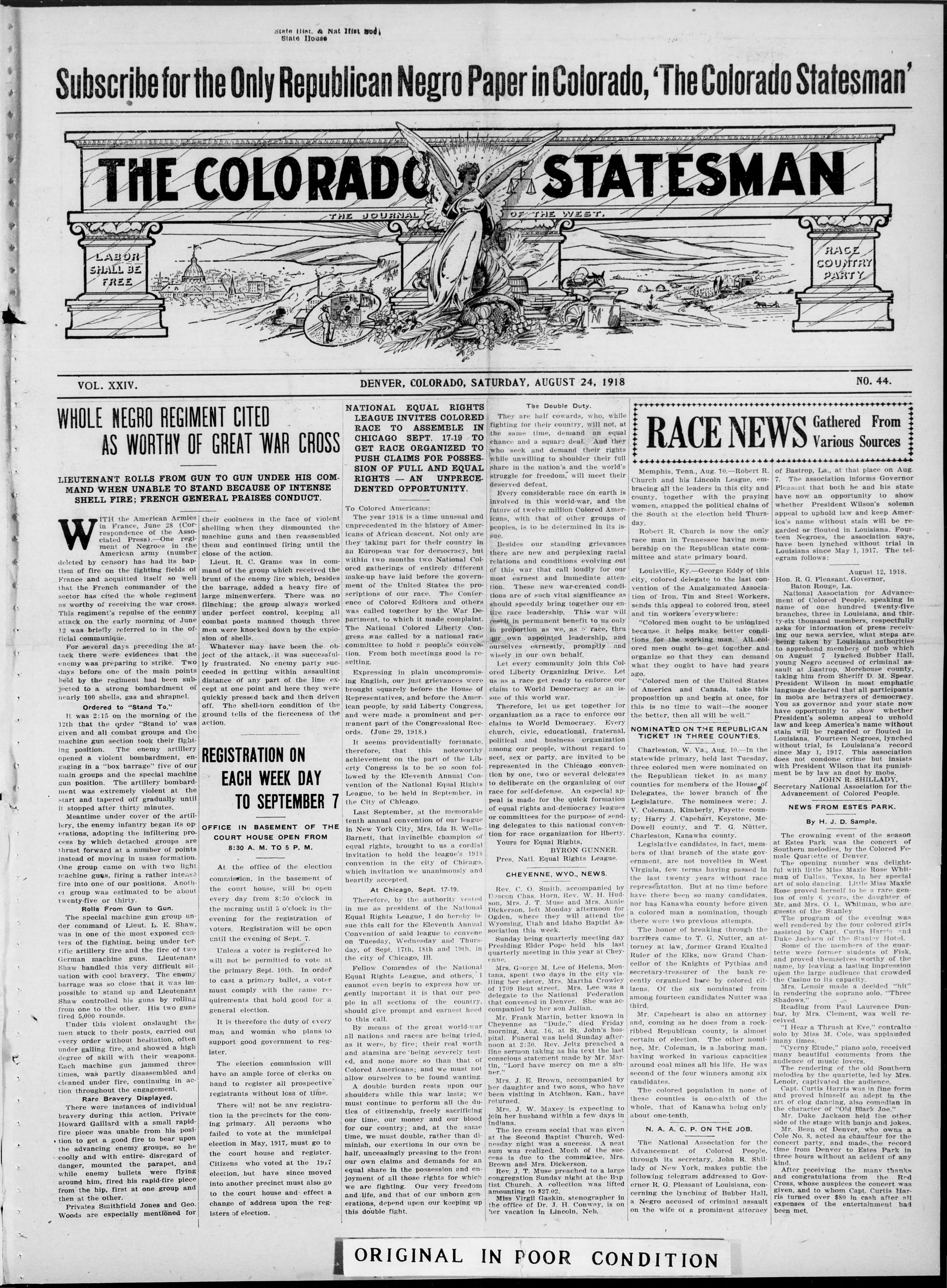
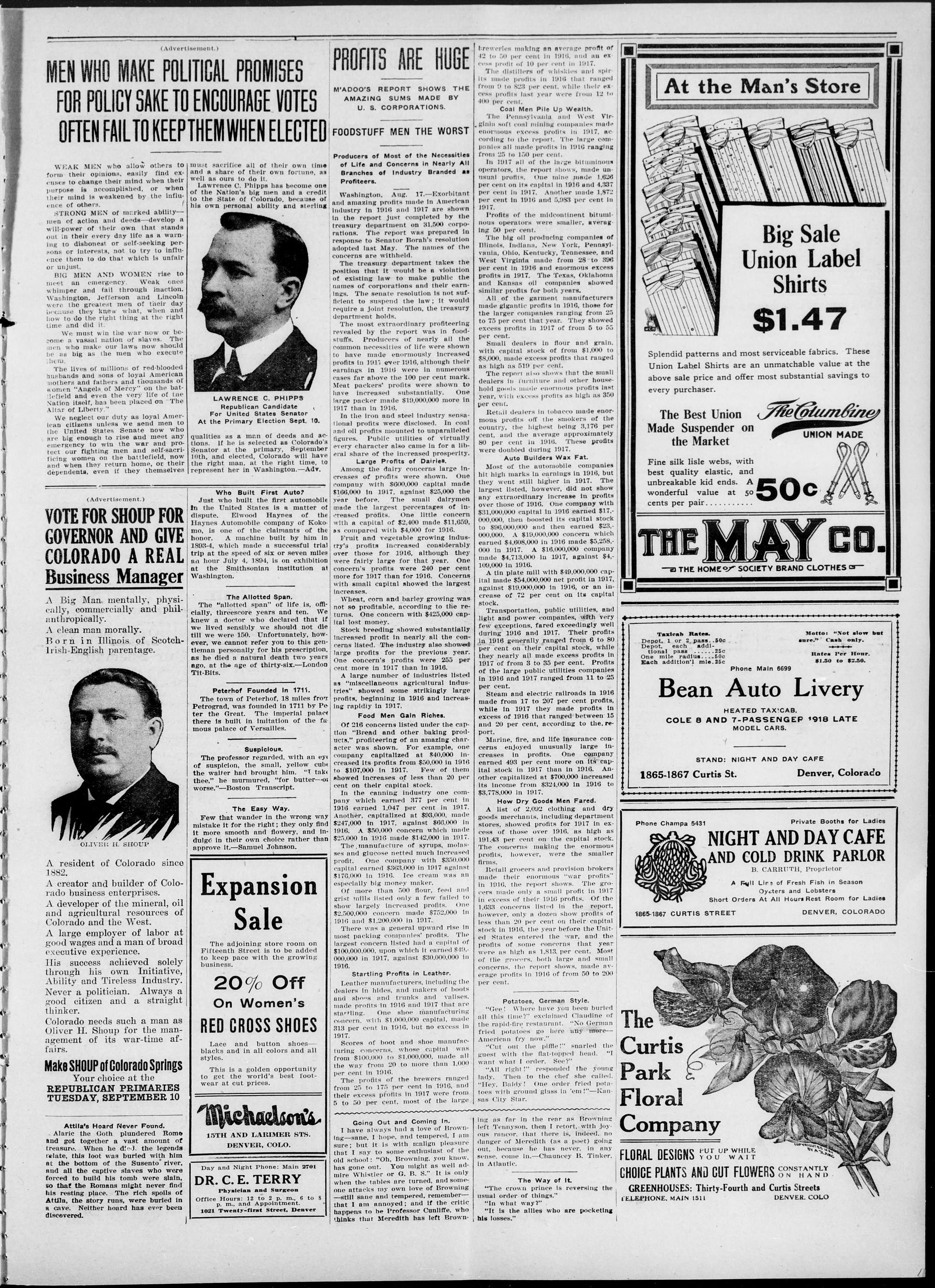
Page text (machine-generated)
Subscribe for the Only Republican Negro Paper in Colorado, 'The Colorado Statesman'
THE COLORADO STATESMAN
THE JOURNAL OF THE WEST.
LABOR SHALL BE FREE
RACE COUNTRY PARTY
WHOLE NEGRO REGIMENT CITED AS WORTHY OF GREAT WAR CROSS
LIEUTENANT ROLLS FROM GUN TO GUN UNDER HIS COMMAND WHEN UNABLE TO STAND BECAUSE OF INTENSE SHELL FIRE; FRENCH GENERAL PRAISES CONDUCT.
VOL. XXIV.
WHOLE NEGRO REGIMEN
AS WORTHY O
LIEUTENANT ROLLS FROM G
MAND WHEN UNABLE TO ST
SHELL FIRE; FRENCH GE
WITH the American Armies
in France, June 28 (Correspondence of the Associated Press).—One regiment of Negroes in the American army (number deleted by censor) has had its baptism of fire on the fighting fields of France and acquitted itself so well that the French commander of the sector has cited the whole regiment as worthy of receiving the war cross. This regiment's repulse of the enemy attack on the early morning of June 12 was briefly referred to in the official communique.
For several days preceding the attack there were evidences that the enemy was preparing to strike. Two days before one of the main points held by the regiment had been subjected to a strong bombardment of nearly 100 shells, gas and shrapnel.
Ordered to "Stand To."
It was 2:15 on the morning of the 12th that the order "Stand to" was given and all combat groups and the machine gun section took their fighting position. The enemy artillery opened a violent bombardment, engaging in a "box barrage" five of our main groups and the special machine gun position. The artillery bombardment was extremely violent at the start and tapered off gradually until it stopped after thirty minutes.
Meantime under cover of the artillery, the enemy infantry began its operations, adopting the infiltrating process by which detached groups are thrust forward at a number of points instead of moving in mass formation. One group came on with two light machine guns, firing a rather intense fire into one of our positions. Another group was estimated to be about twenty-five or thirty.
Rolls From Gun to Gun.
Rolls From Gun to Gun.
The special machine gun group under command of Lieut. L. E. Shaw, was in one of the most exposed centers of the fighting, being under terrific artillery fire and the fire of two German machine guns. Lieutenant Shaw handled this very difficult situation with cool bravery. The enemy barrage was so close that it was impossible to stand up and Lieutenant Shaw controlled his guns by rolling from one to the other. His two guns fired 5,000 rounds.
Under this violent onslaught the men stuck to their posts, carried out every order without hesitation, often under galling fire, and showed a high degree of skill with their weapons. Each machine gun jammed three times, was partly disassembled and cleaned under fire, continuing in action throughout the engagement.
There were instances of individual bravery during this action. Private Howard Gaillard with a small rapid-fire piece was unable from his position to get a good fire to bear upon the advancing enemy groups, so he coolly and with entire-disregard of danger, mounted the parapet, and while enemy bullets were flying around him, fired his rapid-fire piece from the hip, first at one group and then at the other.
Privates Smithfield Jones and Geo. Woods are especially mentioned for
State Hist. & Nat Hist Mod.
State House
the Only Republ
COLORA
ENT CITED
OF GREAT WAR CROSS
UN TO GUN UNDER HIS COM-
MAND BECAUSE OF INTENSE
MATERAL PRAISES CONDUCT.
their coolness in the face of violent shelling when they dismounted the machine guns and then reassembled them and continued firing until the close of the action.
Lieut. R. C. Grame was in command of the group which received the brunt of the enemy fire which, besides the barrage, added a heavy fire of large minenwerfers. There was no flinching; the group always worked under perfect control, keeping all combat posts manned though three men were knocked down by the explosion of shells.
Whatever may have been the object of the attack, it was successfully frustrated. No enemy party succeeded in getting within assaulting distance of any part of the line except at one point and here they were quickly pressed back and then driven off. The shell-torn condition of the ground tells of the fierceness of the action.
REGISTRATION ON EACH WEEK DAY TO SEPTEMBER 7
REGISTRATION ON EACH WEEK DAY TO SEPTEMBER 7
OFFICE IN BASEMENT OF THE COURT HOUSE OPEN FROM 8:30 A. M. TO 5 P. M.
At the office of the election commission, in the basement of the court house, will be open every day from 8:30 o'clock in the morning until 5 o'clock in the evening for the registration of voters. Registration will be open until the evening of Sept. 7.
Unless a voter is registered he will not be permitted to vote at the primary Sept. 10th. In order to cast a primary ballot, a voter must comply with the same requirements that hold good for a general election.
It is therefore the duty of every man and woman who plans to support good government to register.
The election commission will have an ample force of clerks on hand to register all prospective registrants without loss of time.
There will not be any registration in the precincts for the coming primary. All persons who failed to vote at the municipal election in May, 1917, must go to the court house and register. Citizens who voted at the 1917 election, but have since moved into another precinct must also go to the court house and effect a change of address upon the registers of election.
DENVER, COLORADO, SATURDAY, AUGUST 24, 1918
NATIONAL EQUAL RIGHTS LEAGUE INVITES COLORED RACE TO ASSEMBLE IN CHICAGO SEPT. 17-19 TO GET RACE ORGANIZED TO PUSH CLAIMS FOR POSSESSION OF FULL AND EQUAL RIGHTS — AN UNPRECEDENTED OPPORTUNITY.
To Colored Americans:
The year 1918 is a time unusual and unprecedented in the history of Americans of African descent. Not only are they taking part for their country in an European war for democracy, but within two months two National Colored gatherings of entirely different make-up have laid before the government of the United States the proscriptions of our race. The Conference of Colored Editors and others was called together by the War Department, to which it made complaint. The National Colored Liberty Congress was called by a national race committee to hold a people's convention. From both meetings good is resulting.
Expressing in plain uncompromising English, our just grievances were brought squarely before the House of Representatives, and before the American people, by said Liberty Congress, and were made a prominent and permanent part of the Congressional Records. (June 29, 1918.)
It seems providently fortunate, therefore, that this noteworthy achievement on the part of the Liberty Congress is to be so soon followed by the Eleventh Annual Convention of the National Equal Rights League, to be held in September, in the City of Chicago.
Last September, at the memorable tenth annual convention of our league in New York City, Mrs. Ida B. Wells-Barnett, that invincible champion of equal rights, brought to us a cordial invitation to hold the league's 1918 convention in the city of Chicago, which invitation we unanimously and heartily accepted.
Therefore, by the authority vested in me as president of the National Equal Rights League, I do hereby issue this call for the Eleventh Annual Convention of said league to convene on Tuesday, Wednesday and Thursday, of Sept. 17th, 18th and 19th, in the city of Chicago, Ill.
Fellow Comrades of the National Equal Rights League, and others, I cannot even begin to express how urgently important it is that our people in all sections of the country, should give prompt and earnest heed to this call.
By means of the great world-war all nations and races are being tried, as it were, by fire; their real worth and stamina are being severely tested, and none more so than that of Colored Americans; and we must not allow ourselves to be found wanting.
A double burden rests upon our shoulders while this war lasts; we must continue to perform all the duties of citizenship, freely sacrificing our time, our money and our blood for our country; and, at the same time, we must double, rather than diminish, our exertions in our own behalf, unceasingly pressing to the front our own claims and demands for an equal share in the possession and enjoyment of all those rights for which we are fighting. Our very freedom and life, and that of our unborn generations, depend upon our keeping up this double fight.
At Chicago, Sept. 17-19.
They are half cowards, who, while fighting for their country, will not, at the same time, demand an equal chance and a square deal. And they who seek and demand their rights while unwilling to shoulder their full share in the nation's and the world's struggle for freedom, will meet their deserved defeat.
Every considerable race on earth is involved in this world-war, and the future of twelve million Colored Americans, with that of other groups of peoples, is to be determined in its issue.
Besides our standing grievances there are new and perplexing racial relations and conditions evolving out of this war that call loudly for our most earnest and immediate attention. These new war-created conditions are of such vital significance as should speedily bring together our entire race leadership. This war will result in permanent benefit to us only in proportion as we, as race, thrup our own appointed leadership, and ourselves earnestly, promptly and wisely in our own behalf.
Let every community join this Colored Liberty Organizing Drive. Let us as a race get ready to enforce our claim to World Democracy as an issue of this world war.
Therefore, let us get together for organization as a race to enforce our claims to World Democracy. Every church, civic, educational, fraternal, political and business organization among our people, without regard to sect, sex or party, are invited to be represented in the Chicago convention by one, two or several delegates to deliberate on the organizing of our race for self-defense. An especial appeal is made for the quick formation of equal rights and democracy leagues or committees for the purpose of sending delegates to this national convention for race organization for liberty.
Yours for Equal Rights,
BYRON GUNNER.
Pres. Natl. Equal Rights League.
CHEYENNE, WYO., NEWS.
Rev. C. O. Smith, accompanied by Deacon Chas. Horn, Rev. W. H. Hudson, Mrs. J. T. Muse and Mrs. Annie Dickerson, left Monday afternoon for Ogden, where they will attend the Wyoming, Utah and Idaho Baptist Association this week.
Sunday being quarterly meeting day Presiding Elder Pope held his last quarterly meeting in this year at Cheyenne.
Mrs. George M. Lee of Helena, Montana, spent two days in the city visiting her sister, Mrs. Martha Crowley of 1709 Bent street. Mrs. Lee was a delegate to the National Federation that convened in Denver. She was accompanied by her son Julian.
Mr. Frank Martin, better known in Cheyenne as "Dude," died Friday morning, Aug. 16, at St. John's hospital. Funeral was held Sunday afternoon at 2:30. Rev. Jeltz preached a fine sermon taking as his text the last conscious statement made by Mr. Martin, "Lord have mercy on me a sinner."
Mrs. J. E. Brown, accompanied by her daughter and two sons, who have been visiting in Atchison, Kan., have returned.
Mrs. J. W. Maxey is expecting to join her husband within a few days in Indiana.
The ice cream social that was given at the Second Baptist Church, Wednesday night was a success. A neat sum was realized. Much of the success is due to the committee, Mrs. Brown and Mrs. Dickerson.
Rev. J. T. Muse preached to a large congregation Sunday night at the Baptist Church. A collection was lifted amounting to $27.02.
Miss Virgil Gaskin, stenographer in the office of Dr. J. H. Conway, is on her vacation in Lincoln, Neb.
RACE NEWS Gathered From Various Sources
RACE NEWS Gathered From Various Sources
Memphis, Tenn., Aug. 10.—Robert R. Church and his Lincoln League, embracing all the leaders in this city and county, together with the praying women, snapped the political chains of the South at the election held Thursday.
Robert R. Church is now the only race man in Tennessee having membership on the Republican state committee and state primary board.
Louisville, Ky.—George Eddy of this city, colored delegate to the last convention of the Amalgamated Association of Iron, Tin and Steel Workers, sends this appeal to colored iron, steel and tin workers everywhere:
"Colored men ought to be unionized because it helps make better conditions for the working man. All colored men ought to get together and organize so that they can demand what they ought to have had years ago.
"Colored men of the United States of America and Canada, take this proposition up and begin at once, for this is no time to wait—the sooner the better, then all will be well."
of Bastrop, La., at that place on Aug. 7. The association informs Governor Pleasant that both he and his state have now an opportunity to show whether President Wilson's solemn appeal to uphold law and keep America's name without stain will be regarded or flouted in Louisiana. Fourteen Negroes, the association says, have been lynched without trial in Louisiana since May 1, 1917. The telegram follows:
August 12, 1918.
Hon. R. G. Pleasant, Governor,
Baton Rouge,
National Association for Advancement of Colored People, speaking in name of one hundred twenty-five branches, three in Louisiana, and thirty-six thousand members, respectfully asks for information of press receiving our news service, what steps are being taken by Louisiana authorities to apprehend members of mob which on August 7 lynched Bubber Hall, young Negro accused of criminal assault at Eastrop, Morehouse county, taking him from Sheriff D. M. Spear. President Wilson in most emphatic language declared that all participants in mobs are betrayers of democracy. You as governor and your state now have opportunity to show whether President's solemn appeal to uphold
NOMINATED ON THE REPUBLICAN
TICKET IN THREE COUNTIES.
Charleston, W. Va., Aug. 10.—In the statewide primary, held last Tuesday, three colored men were nominated on the Republican ticket in as many counties for members of the House of Delegates, the lower branch of the Legislature. The nominees were: J. V. Coleman, Kimberly, Fayette county; Harry J. Capehart, Keystone, McDowell county, and T. G. Nutter, Charleston, Kanawha county.
Legislative candidates, in fact, members of that branch of the state government, are not novelties in West Virginia, few terms having passed in the last twenty years without race representation. But at no time before have there been so many candidates, nor has Kanawha county before given a colored man a nomination, though there were two previous attempts.
The honor of breaking through the barriers came to T. G. Nutter, an attorney at law, former Grand Exalted Ruler of the Elks, now Grand Chancellor of the Knights of Pythias and secretary-treasurer of the bank recently organized here by colored citizens. Of the six nominated from among fourteen candidates Nutter was third.
Mr. Capeheart is also an attorney and, coming as he does from a rock-ribbed Republican county, is almost certain of election. The other nominee, Mr. Coleman, is a laboring man, having worked in various capacities around coal mines all his life. He was second of the four winners among six candidates. The colored population in none of these counties is one-sixth of the whole, that of Kanawha being only about one-tenth.
N. A. A. C. P. ON THE JOB.
The National Association for the Advancement of Colored People, through its secretary, John R. Shillady of New York, makes public the following telegram addressed to Governor R. G. Pleasant of Louisiana, concerning the lynching of Bubber Hall, a Negro accused of criminal assault on the wife of a prominent attorney
NO. 44.
of Bastrop, La., at that place on Aug. 7. The association informs Governor Pleasant that both he and his state have now an opportunity to show whether President Wilson's solemn appeal to uphold law and keep America's name without stain will be regarded or flouted in Louisiana. Fourteen Negroes, the association says, have been lynched without trial in Louisiana since May 1, 1917. The telegram follows:
National Association for Advancement of Colored People, speaking in name of one hundred twenty-five branches, three in Louisiana, and thirty-six thousand members, respectfully asks for information of press receiving our news service, what steps are being taken by Louisiana authorities to apprehend members of mob which on August 7 lynched Bubber Hall, young Negro accused of criminal assault at Eastrop, Morehouse county, taking him from Sheriff D. M. Spear. President Wilson in most emphatic language declared that all participants in mobs are betrayers of democracy. You as governor and your state now have opportunity to show whether President's solemn appeal to uphold law and keep America's name without stain will be regarded or flouted in Louisiana. Fourteen Negroes, lynched without trial, is Louisiana's record since May 1, 1917. This association does not condone crime but insists with President Wilson that its punishment be by law an dnot by mobs.
JOHN R. SHILLADY.
Secretary National Association for the Advancement of Colored People.
NEWS FROM ESTES PARK.
By H. J. D. Sample.
The crowning event of the season at Estes Park was the concert of Southern melodies, by the Colored Female Quartette of Denver.
The opening number was delightful with little Miss Maxie Rose Whitman of Dallas, Texas, in her special art of solo dancing. Little Miss Maxie Rose proved herself to be a rare genius of only 6 years, the daughter of Mr. and Mrs. O. L. Whitman, who are guests of the Stanley.
The program of the evening was well rendered by the four colored girls assisted by Capt. Curtis Harris and Duke Jackson of the Stanley Hotel.
Some of the members of the quartette were former students of Fisk, and proved themselves worthy of the name, by leaving a lasting impression upon the large audience that crowded the Casino to its capacity.
Mrs. Lenoir made a decided "hit" in rendering the soprano solo. "Three Shadows."
Reading from Paul Laurence Dunbar, by Mrs. Clement, was well received.
"I Hear a Thrush at Eve," contralto solo by Miss M. Cole, was applauded many times.
"Cerynny Etude," piano solo, received many beautiful comments from the audience of music lovers.
The rendering of the old Southern melodies by the quartette, led by Mrs. Lenoir, captivated the audience.
Capt. Curtis Harris was in fine form and proved himself an adept in the art of clog dancing, also comedian in the character of "Old Black Joe."
Mr. Duke Jackson held the other side of the stage with banjo and jokes.
Mr. Bean of Denver, who owns a Cole No. 8, acted as chauffeur for the concert party, and made the record time from Denver to Estes Park in three hours without an accident of any kind.
After receiving the many thanks and congratulations from the Red Cross, whose auspices the concert was given, and to whom Capt. Curtis Harris turned over $80 in cash after all expenses of the entertainment had been met.
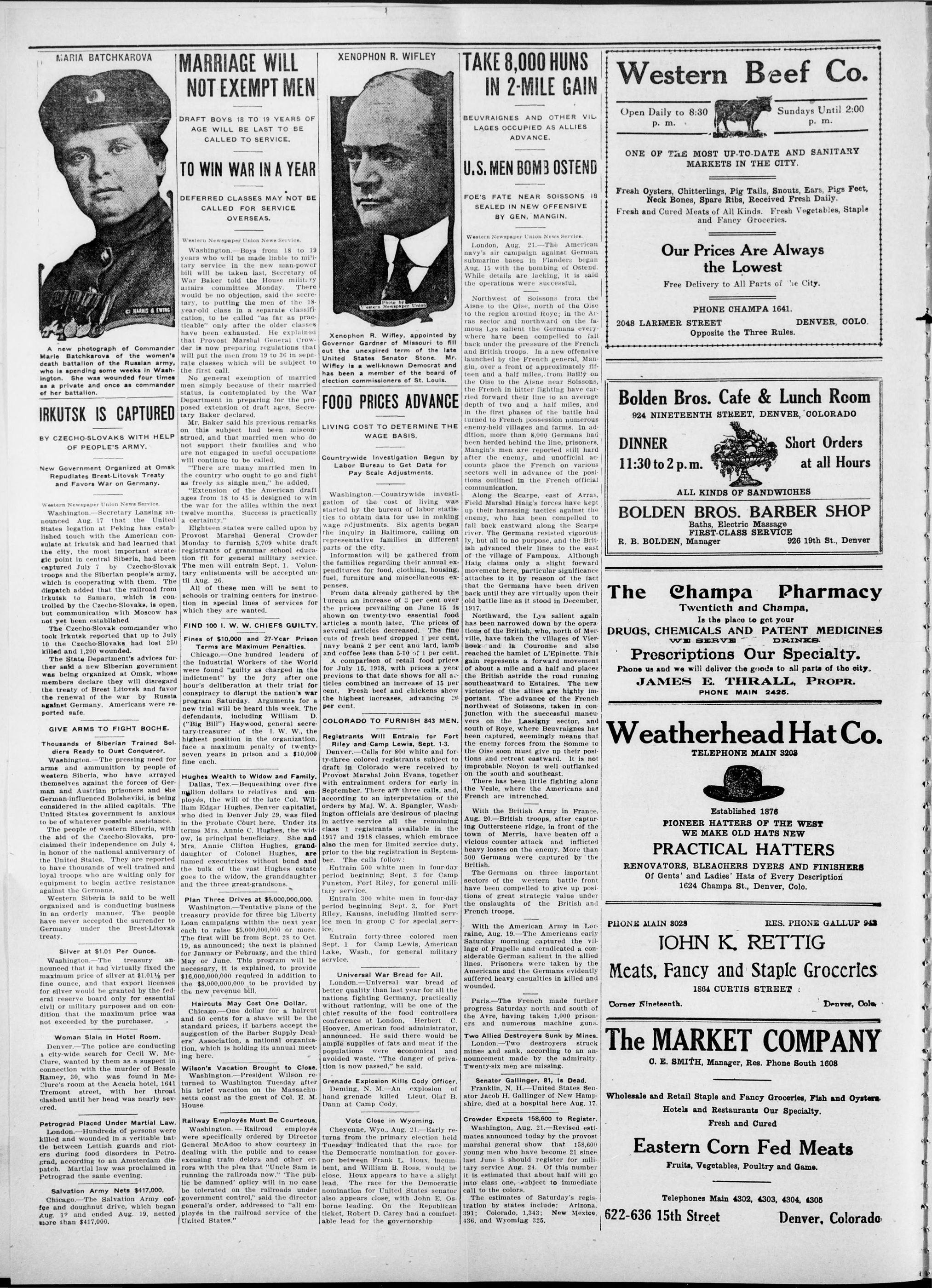
© HARRIS & EWING
A new photograph of Commander Marie Batchkarova of the women's death battalion of the Russian army, who is spending some weeks in Washington. She was wounded four times as a private and once as commander of her battalion.
IRKUTSK IS CAPTURED
IRKUTSK IS CAPTURED
BY CZECHO-SLOVAKS WITH HELP OF PEOPLE'S ARMY.
New Government Organized at Omsk Repudiates Brest-Litovsk Treaty and Favors War on Germany.
Western Newspaper Union News Service.
Washington.—Secretary Lansing announced Aug. 17 that the United States legation at Peking has established touch with the American consulate at Irkutsk and had learned that the city, the most important strategic point in central Siberia, had been captured July 7 by Czecho-Slovak troops and the Siberian people's army, which is cooperating with them. The dispatch added that the railroad from Irkutsk to Samara, which is controlled by the Czecho-Slovaks, is open, but communication with Moscow has not yet been established The Czecho-Slovak commander who took Irkutsk reported that up to July 10 the Czecho-Slovaks had lost 250 killed and 1,200 wounded.
The State Department's advices further said a new Siberian government was being organized at Omsk, whose members declare they will disregard the treaty of Brest Litovsk and favor the renewal of the war by Russia against Germany. Americans were reported safe.
GIVE ARMS TO FIGHT BOCHE.
Thousands of Siberian Trained Soldiers Ready to Oust Conqueror. Washington.—The pressing need for arms and ammunition by people of western Siberia, who have arrayed themselves against the forces of German and Austrian prisoners and the German-influenced Bolshevik, is being considered in the allied capitals. The United States government is anxious to be of whatever possible assistance. The people of western Siberia, with the aid of the Czecho-Slovaks, proclaimed their independence on July 4, in honor of the national anniversary of the United States. They are reported to have thousands of well trained and loyal troops who are waiting only for equipment to begin active resistance against the Germans.
Western Siberia is said to be well organized and is conducting business in an orderly manner. The people have never accepted the surrender to Germany under the Brest-Litovsk treaty.
Silver at $1.01 Per Ounce.
Washington.—The treasury announced that it had virtually fixed the maximum price of silver at $1.011½ per fine ounce, and that export licenses for silver would be granted by the federal reserve board only for essential civil or military purposes and on condition that the maximum price was not exceeded by the purchaser.
Woman Slain in Hotel Room.
Denver.—The police are conducting a city-wide search for Cecil W. McClure, wanted by them as a suspect in connection with the murder of Bessie Ramey, 30, who was found in McClure's room at the Acacia hotel, 1641 Tremont street, with her throat elashed until her head was nearly severed.
Petrograd Placed Under Martial Law. London.—Hundreds of persons were killed and wounded in a veritable battle between Lettish guards and rioters during food disorders in Petrograd, according to an Amsterdam dispatch. Martial law was proclaimed in Petrograd the same evening.
Salvation Army Nets $417,000.
Chicago.—The Salvation Army coffee and doughnut drive, which began Aug. 12 and ended Aug. 19, netted more than $417,000.
MARRIAGE WILL NOT EXEMPT MEN
DRAFT BOYS 18 TO 19 YEARS OF AGE WILL BE LAST TO BE CALLED TO SERVICE.
WIN WAR IN A YEAR
DEFERRED CLASSES MAY NOT BE
CALLED FOR SERVICE
OVERSEAS.
Western Newspaper Union News Service.
Washington.—Boys from 18 to 19 years who will be made liable to military service in the new man-power bill will be taken last, Secretary of War Baker told the House military affairs committee Monday. There would be no objection, said the secretary, to putting the men of the 18-year-old class in a separate classification, to be called "as far as practicable" only after the older classes have been exhausted. He explained that Provost Marshal General Crowder is now preparing regulations that will put the men from 19 to 36 in separate classes which will be subject to the first call.
No general exemption of married men simply because of their married status, is contemplated by the War Department in preparing for the proposed extension of draft ages, Secretary Baker declared.
Mr. Baker said his previous remarks on this subject had been misconstrued, and that married men who do not support their families and who are not engaged in useful occupations will continue to be called.
"There are many married men in the country who ought to go and fight as freely as single men," he added.
"Extension of the American draft ages from 18 to 45 is designed to win the war for the allies within the next twelve months. Success is practically a certainty."
Eighteen states were called upon by Provost Marshal General Crowder Monday to furnish 5,709 white draft registrants of grammar school education fit for general military service. The men will entrain Sept. 1. Voluntary enlistments will be accepted until Aug. 26.
All of these men will be sent to schools or training centers for instruction in special lines of services for which they are wanted.
FIND 100 I. W. W. CHIEFS GUILTY.
Fines of $10,000 and 27-Year Prison
Terms are Maximum Penalties.
Chicago.—One hundred leaders of the Industrial Workers of the World were found "guilty as charged in the indictment" by the jury after one hour's deliberation at their trial for conspiracy to disrupt the nation's war program Saturday. Arguments for a new trial will be heard this week. The defendants, including William D. ("Big Bill") Haywood, general secretary-treasurer of the I. W. W., the highest position in the organization, face a maximum penalty of twenty-seven years in prison and a $10,000 fine each.
Hughes Wealth to Widow and Family,
Dallas, Tex.-Bequeathing over five
million dollars to relatives and em-
ployés, the will of the late Col. Will
iam Edgar Hughes, Denver capitalist,
who died in Denver July 29, was filled
in the Probate Court here. Under its
terms Mrs. Annie C. Hughes, the widow,
is principal beneficiary. She and
Mrs. Annie Clifton Hughes, grand-
daughter of Colonel Hughes, are
named executrixes without bond and
the bulk of the vast Hughes estate
goes to the widow, the granddaughter
and the three great-grandsons.
Plan Three Drives at $5,000,000,000.
Washington—Tentative plans of the treasury provide for three big Liberty Loan campaigns within the next year each to raise $5,000,000,000 or more. The first will be from Sept. 28 to Oct. 19, as announced; the next is planned for January or February, and the third May or June. This program will be necessary, it is explained, to provide $16,000,000,000 required in addition to the $5,000,000,000 to be provided by the new revenue bill.
Haircuts May Cost One Dollar.
Chicago—One dollar for a haircut and 50 cents for a shave will be the standard prices, if barbers accept the suggestion of the Barber Supply Dealers' Association, a national organization, which is holding its annual meeting here.
Wilson's Vacation Brought to Close
Washington.—President Wilson returned to Washington Tuesday after his brief vacation on the Massachussetts coast as the guest of Col. E. M. House.
Railway Employés Must Be Courteous
Washington.—Railroad employés were specifically ordered by Director General McAdoo to show courtesy in dealing with the public and to cease excusing train delays and other errors with the plea that "Uncle Sam is running the railroads now." "The public be damned" opley will in no case be tolerated on the railroads under government control," said the director general's order, addressed to "all employés in the railroad service of the United States."
XENOPHON R. WIFLEY
Photo by
Western Newspaper Union
Xenophon R. Wifley, appointed by Governor Gardner of Missouri to fill out the unexpired term of the late United States Senator Stone. Mr. Wifley is a well-known Democrat and has been a member of the board of election commissioners of St. Louis.
FOOD PRICES ADVANCE
FOOD PRICES ADVANCE
LIVING COST TO DETERMINE THE WAGE BASIS.
Countrywide Investigation Begun by Labor Bureau to Get Data for Pay Scale Adjustments.
Washington.—Countrywide investigation of the cost of living was started by the bureau of labor statistics to obtain data for use in making wage adjustments. Six agents began the inquiry in Baltimore, calling on representative families in different parts of the city.
Information will be gathered from the families regarding their annual expenditures for food, clothing, housing, fuel, furniture and miscellaneous expenses.
From data already gathered by the bureau an increase of 3 per cent over the prices prevailing on June 15 is shown on twenty-two essential food articles a month later. The prices of several articles decreased. The fine cuts of fresh beef dropped 1 per cent, navy beans 2 per cent and lard, lamb and coffee less than 5-10 of 1 per cent. A comparison of retail food prices for July 15, 1918, with prices a year previous to that date shows for all articles combined an increase of 15 per cent. Fresh beef and chickens show the highest increases, advancing 36 per cent.
Registrants Will Entrain for Fort Riley and Camp Lewis, Sept. 1-3. Denver.—Calls for 800 white and forty-three colored registrants subject to draft in Colorado were received by Provost Marshal John Evans, together with entrainment orders for early in September. There are three calls, and, according to an interpretation of the orders by Maj. W. A. Spangler, Washington officials are desirous of placing in active service all the remaining class 1 registrants available in the 1917 and 1918 classes, which embrace also the men for limited service duty, prior to the big registration in September. The calls follow: Entrain 500 white men in four-day period beginning Sept. 3 for Camp Funston, Fort Riley, for general military service.
Entrain 300 white men in four-day period beginning Sept. 3, for Fort Riley, Kansas, including limited service men in group C for special service.
Entrain forty-three colored men Sept. 1 for Camp Lewis, American Lake, Wash., for general military service.
Universal War Bread for All.
London.—Universal war bread of better quality than last year for all the nations fighting Germany, practically without rationing, will be one of the chief results of the food controllers conference at London, Herbert C. Hoover, American food administrator, announced. He said there would be ample supplies of fats and meat if the populations were economical and avoided waste. "The danger of privation is now passed," he said.
Grenade Explosion Kills Cody Officer.
Deming, N. M.—An explosion of
hand grenade killed Lieut. Olaf B.
Dann at Camp Cody.
Vote Close in Wyoming.
Cheyenne, Wyo., Aug. 21.—Early returns from the primary election held Tuesday indicated that the race for the Democratic nomination for governor between Frank L. Houx, incumbent, and William B. Ross, would be close. Houx appears to have a slight lead. The race for the Democratic nomination for United States senator also appears close, with John E. Osborne leading. On the Republican ticket, Robert D. Carey had a comfortable lead for the governorship
TAKE 8,000 HUNS IN 2-MILE GAIN
BEUVRAIGNES AND OTHER VIL
LAGES OCCUPIED AS ALLIES
ADVANCE.
U.S. MEN BOMB OSTEND
U.S. MEN BOMB OSTEND
FOE'S FATE NEAR SOISSONS IS SEALED IN NEW OFFENSIVE BY GEN. MANGIN.
Western Newspaper Union News Service.
London, Aug. 21.—The American navy's air campaign against German submarine bases in Flanders began Aug. 15 with the bombing of Ostend. While details are lacking, it is said the operations were successful.
Northwest of Soissons from the Aisne to the Oise, north of the Oise to the region around Roye; in the Aras sector and northward on the famous Lys salient the Germans everywhere have been compelled to fall back under the pressure of the French and British troops. In a new offensive launched by the French general, Mangin, over a front of approximately fifteen and a half miles, from Bailly on the Oise to the Aisne near Soissons, the French in bitter fighting have carried forward their line to an average depth of two and a half miles, and in the first phases of the battle had turned to French possession numerous enemy-held villages and farms. In addition, more than 8,000 Germans had been herded behind the line, prisoners. Mangin's men are reported still hard after the enemy, and unofficial accounts place the French on various sectors well in advance of the positions outlined in the French official communication.
Along the Scarpe, east of Arras, Field Marshal Haig's forces have kept up their harassing tactics against the enemy, who has been compelled to fall back eastward along the Scarpe river. The Germans resisted vigorously, but all to no purpose, and the British advanced their lines to the east of the village of Fampoux. Although Haig claims only a slight forward movement here, particular significance attaches to it by reason of the fact that the Germans have been driven back until they are virtually upon their old battle line as it stood in December, 1917.
Northward, the Lys salient again has been narrowed down by the operations of the British, who, north of Merville, have taken the villages of Vierboek and Ia Couronne and also reached the hamlet of L'Epinette. This gain represents a forward movement of about a mile and a half and places the British astride the road running southeastward to Estaires. The new victories of the allies are highly important. The advance of the French northwest of Soissons, taken in conjunction with the successful maneuvers on the Lassigny sector, and south of Roye, where Beuvraignes has been captured, seemingly means that the enemy forces from the Somme to the Oise soon must give up their positions and retreat eastward. It is not improbable Noyon is well outflanked on the south and southeast.
There has been little fighting along the Vesle, where the Americans and French are intrenched.
With the British Army in France, Aug. 20.—British troops, after capturing Outtersteene ridge, in front of the town of Merris, have beaten off a vicious counter attack and inflicted heavy losses on the enemy. More than 500 Germans were captured by the British.
The Germans on three important sectors of the western battle front have been compelled to give up positions of great strategic value under the onslaughts of the British and French troops.
With the American Army in Lorraine, Aug. 19.—The Americans early Saturday morning captured the village of Frapelle and eradicated a considerable German salient in the allied lines. Prisoners were taken by the Americans and the Germans evidently suffered heavy casualties in killed and wounded.
Paris.—The French made further progress Saturday north and south of the Avre, having taken 1,000 prisoners and numerous machine guns.
Two Allied Destroyers Sunk by Mines. London.—Two destroyers struck mines and sank, according to an announcement made by the admiralty. Twenty-six men are missing.
Senator Gallinger, 81, Is Dead.
Franklin, N. H.—United States Senator Jacob H. Gallinger of New Hampshire, died at a hospital here Aug. 17.
Crowder Expects 158,600 to Register.
Washington, Aug. 21.—Revised estimates announced today by the provost marshal general show that 158,600 young men who have become 21 since last June 5 should register for military service Aug. 24. Of this number it is estimated that about half will go into class one, subject to immediate call to the colors.
The estimates of Saturday's registration by states include: Arizona, 391; Colorado, 1,343; New Mexico, 436, and Wyoming 325.
Western Beef Co.
Open Daily to 8:30 p.m.
ONE OF THE MOST
MARK
Fresh Oysters, Chitterlh
Neck Bones, Spi
Fresh and Cured Meats
and
OF THE MOST UP-TO-DATE AND SAFE MARKETS IN THE CITY.
Lers, Chitterlings, Pig Tails, Snouts, Ears,
Sk Bones, Spare Ribs, Received Fresh Dairy
Cured Meats of All Kinds. Fresh Vegetable
and Fancy Groceries.
ONE OF THE MOST UP-TO-DATE AND SANITARY MARKETS IN THE CITY.
Fresh Oysters, Chitterlings, Pig Tails, Snouts, Ears, Pigs Feet, Neck Bones, Spare Ribs, Received Fresh Daily. Fresh and Cured Meats of All Kinds. Fresh Vegetables, Staple and Fancy Groceries.
Our Prices Are Always the Lowest Free Delivery to All Parts of the City.
PHC
2048 LARIMER STREET
Oppo
Bolden Bros.
924 NINETEENTH
PHONE CHAMPA 1641.
SUMER STREET DENVER
Opposite the Three Rules.
In Bros. Cafe & Lunch
INNETEENTH STREET, DENVER, COL
PHONE CHAMPA 1641.
2048 LARIMER STREET DENVER, COLO.
Opposite the Three Rules.
Bolden Bros. Cafe & Lunch Room 924 NINETEENTH STREET, DENVER, COLORADO
DINNER
11:30 to 2 p.m.
ALL KINDS OF SANDWICHES
BOLDEN BRE
Baths
FIRST
R. B. BOLDEN, Manage
The Charm
Twenty
Is it
DRUGS, CHEMICALS
WE SEE
Prescription
Phone us and we will do
JAMES E.
PH
Weather
TEL
PIONEER
WE M
PRACTICE
RENOVATORS, BLEED
Of Gents' and L
1624 CH
DEN BROS. BARBER
Baths, Electric Massage
FIRST-CLASS SERVICE
DEN, Manager 926 19th
Champa Pharma
Twentieth and Champa,
Is the place to get your
CHEMICALS AND PATENT M
WE SERVE DRINKS.
Scriptions Our Special
and we will deliver the goods to all parts
JAMES E. THRALL, PR
PHONE MAIN 2425.
atherhead Ha
TELEPHONE MAIN 3208
BOLDEN BROS. BARBER SHOP Baths, Electric Massage FIRST-CLASS SERVICE R. B. BOLDEN, Manager 926 19th St., Denver
Twentieth and Champa,
Is the place to get your
DRUGS, CHEMICALS AND PATENT MEDICINES
WE SERVE DRINKS.
Prescriptions Our Specialty.
Phone us and we will deliver the goods to all parts of the city.
JAMES E. THRALL, PROPR.
PHONE MAIN 2425.
Weatherhead Hat Co. TELEPHONE MAIN 3208
Established 1876
PIONEER HATTERS OF THE WEST
WE MAKE OLD HATS NEW
PRACTICAL HATTERS
ATORS, BLEACHERS DYERS AND FIX
Gents' and Ladies' Hats of Every Descrip
1624 Champa St., Denver, Colo.
Established 1876
PIONEER HATTERS OF THE WEST
WE MAKE OLD HATS NEW
PRACTICAL HATTERS
RENOVATORS, BLEACHERS DYERS AND FINISHERS
Of Gents' and Ladies' Hats of Every Description
1624 Champa St., Denver, Colo.
JOHN K. RETTIGER
Fancy and Staple Grocery
1864 CURTIS STREET
seventh.
MARKET COMPANY
E. SMITH, Manager, Res. Phone South 1
d Retail Staple and Fancy Groceries, Fish
Hotels and Restaurants Our Specialty.
Fresh and Cured
Eastern Corn Fed Me
JOHN Meats, Fancy 1864
Meats, Fancy and Staple Groceries 1864 CURTIS STREET
The MARK
C. E. SMITH,
Wholesale and Retail Stap
Hotels and
Eastern
The MARKET COMPANY
C. E. SMITH, Manager, Res. Phone South 1608
Wholesale and Retail Staple and Fancy Groceries, Fish and Oystera Hotels and Restaurants Our Specialty. Fresh and Cured
Eastern Corn Fed Meats
Fruits, Vegetables, Poultry and Game.
Telephones 622-636 15th Stree
Telephones Main 4302, 4303, 4304, 4305 15th Street Denver.
Telephones Main 4302, 4303, 4304, 4305
622-636 15th Street Denver, Colorado
PHONE MAIN 8028
Corner Nineteenth.
Sundays Until 2:00
p. m.
ATE AND SANITARY
E CITY.
s, Snouts, Ears, Pigs Feet,
Received Fresh Daily.
Fresh Vegetables, Staple
Jeceries.
A 1641.
DENVER, COLO.
e Rules.
& Lunch Room
DENVER, COLORADO
Short Orders
at all Hours
ARBER SHOP
Massage
SERVICE
926 19th St., Denver
Pharmacy
Champa,
get your
PATENT MEDICINES
DRINKS.
Our Specialty.
foods to all parts of tho city.
ALL, PROPR.
2426.
Bad Hat Co.
MAIN 3208
1876
OF THE WEST
BATS NEW
HATTERS
BUYERS AND FINISHERS
of Every Description
Denver, Colo.
RES. PHONE GALLUP 943
ETTIG
taple Groceries
STREET:
COMPANY
Phone South 1608
Groceries, Fish and Oysters.
Our Specialty.
red
Fed Meats
303, 4304, 4305
Denver, Colorado
```markdown
```
VINEGAR
```markdown
```
Denver, Cola
THE COLORADO STATESMAN
CABON HIDE BE PARK
HACK COUNTRY PARTY
One Year $2.00
Six Months $1.00
Three Months $0.60
Reading notices, ten lines or less, 10 cents per line. Each additional line over ten lines, 5 cents per line. Display advertising, $1.00 per inch
PAYABLE IN ADVANCE.
Communications to receive attention must be newsy, upon important subjects, plainly written only upon one side of the paper, must reach us Tuesday of the author. No manuscript returned, unless stamps are sent for postage, days, if possible, anyway not later than Wednesdays, and bear the signature. All communications of a personation nature that are not complimentary will be withheld from the columns of this paper.
No discounts allowed on less than three months' contract. Cash must accompany all orders from parties unknown to us. Further particulars on application.
Remittances should be made by Express Money Order. Postoffice Money Order. Registered Letter or Bank Draft. Postage stamps will be received. The same as cash for the fractional part of a dollar. Only 1c and 2c stamps taken.
THE ADVANTAGES GAINED BY REGISTERING
WHEN a man or woman in Colorado or any other part of this country fails to realize the importance of being fully prepared to make a successful offensive, or present such a defensive as to strike terror in the minds of the foe, that individual is really not performing his or her duty of responsibility to the community in which they live, to their country, their race and nation, and is an incentive of living in ignorance to the advantage to be gained hence the result of "starting from nowhere" with no aim or purpose, only to arrive at the point of "nowhere," where too late to present the credentials necessary to the possession of this GREAT GOOD, the usual termination of loss and ruin envelops them and a possible material help in the school of progress is lost forever to the world. This is about the most practical way we can put before the electors of Denver—the voters of Colorado—the advantage to be gained by registering, and that right NOW, so as to prove a worthy citizen capable of exercising the franchise, the only power that dethrones prejudice and relegates him to oblivion where he can claim his rightful heritage. On the front page of this paper is a notification guiding persons as to registration for election, and it states very clearly how persons must register if they are to become eligible for voting, and emphasizes that UNLESS A VOTER IS REGISTERED HE OR SHE WILL NOT BE PERMITTED TO VOTE IN THE PRIMARY SEPTEMBER 10TH. A reminder is also offered that in order to cast a primary ballot, a voter must comply with the same requirements that hold good for a general election. Read the notice carefully and act accordingly, as it is a duty incumbent upon every man and woman who would share in the principles of good government and become the recipients of the great advantage to be achieved. Let no one deceive you—the PRIMARY ELECTION being all-important and REGISTRATION the only stepping stone to the power invested in the voter. From now to September 7th you can register at the elections commission office, basement of the Court House. BE SURE AND REGISTER!
THE MOST GOOD FOR THE MOST PEOPLE.
THIS is the motto of this paper, and for the number of years that we have published and presented to the public this newspaper, the approval and substantial support given us by the people, makes us conclude that the lack of selfishness and the continuous championing of the larger interest for our people, and the broader spirit in which we uphold a cause when it is productive of good for all the people, and our utter denouncement against the perpetration of wrong towards us, these actuate us to offer a suggestion that may be very helpful during this election campaign.
First, we ask, what can a man gain who has leadership thrust on him without his being qualified for the position—a qualification which necessarily takes every capillary of selfishness out of his anatomy? He may attempt to lead, but watch the composition of his followers and you'll find their attitude—the narrow-gauged, selfish tendency always conspicuously presenting itself. One of the greatest drawbacks among our people is the compromise or defeat of larger interests of our race as a whole against the successful interest of an individual, and this is carried into effect more often than we think of, present issues as elections, etc., being the chief events demonstrating the monster selfishness which is the venom that poisons our whole system of progress. We have been approached a number of times to institute acts for self-benefit, if we would approach candidates aspiring for political honors and bring them before the public with large headlines and comments, informing the people of their good citizenship, their standing in the community, their contribution to government requirements and national aid. These things we would gladly do if they would produce the records showing us the great things they did before the present important event, or their good intentions, and our representation, our endorsement, would be given right away. But when we view the work of unscrupulous leaders of our race who have done much to retard our success by their personal motives, purely, we would be unworthy of your respect to bid you do that which your good judgment and conscience would not warrant.
The broad, liberal, fair-minded leaders of our race are oftimes defeated in the causes they advocate for the good of the people by the smaller agent whose idea of the greater freedom lies in his individual interest which rests with him. He lives the selfish life, dies the selfish death, leaving no legacy, no foundation on which his posterity can build. We say, therefore, profiting by our experiences of the past, let us not give heed to such actors, as the curtain has fallen on them to rise no more, and seeing that the world is now taking a stand for larger, bigger and greater things, we as a journal for the people continue to strongly urge the elimination of small minds and the adoption of strong, courageous leaders whose purpose is THE MOST GOOD THAT CAN BE DONE FOR THE MOST PEOPLE.
AMERICAN NEGRO TROOPS PROVING MOST VALIANT SOLDIERS.
THAT the American Negro soldiers are proving beyond a doubt that they are becoming the most valiant soldiers representing Uncle Sam's war activities and will soon be heralded America's
greatest fighting machinery, is a fact indisputable. Word has come from every source that whenever they get a chance for service they prove themselves not warriors on the savagelike or fanatical basis, but modern soldiers, fully capable of giving service in any part of the military program, and so much above the average are they that special communications from General Pershing, our nation's military leader, the French and British governments, and the various other associates in war are published, and what else in the common order of human nature can we be proud of than to give the LIE to the inferiority of humanity on account of COLOR, CLASS AND CREED.
The article giving in details this almost unparalleled event in the war is to be found on the front page of this paper, and having been passed by the censor, we can take advantage of the AMERICAN LIBERTY in its broadest sense, to express not only our appreciation of the communication having been allowed to reach us, but the spirit of democracy that is being demonstrated as something otherwise than sentiment in the U. S. A.—the same proving that the universal melting pot arising from this conflict will prove the creation of the human family from ONE SOURCE. How our hearts beat with gladness over such incidents we cannot attempt to describe, but we, on behalf of our race, can only say our actions on the battlefield today are the same as one hundred and forty-two years ago, one hundred and four years ago, fifty-three years ago, twenty years ago and NOW.
Surely the senator's daughter could not write to her father anything else but the result of the paralytic mental stroke after witnessing the military prowess of our men in France, after experiencing in her position as Red Cross nurse the genuine characteristic features of the dark-skinned American, she penned the following lines: "Strange but true, the Negro soldier is becoming the most valiant fighter on the front. How unfortunate that I was trained from my youth up that he was everything but a gentleman—stories of his addiction to crime, his seductive and lascivious tendencies being unlimited, created a fear and utter abhorrence for him. After nursing more than fifty with many more coming, a complete transformation has come about me, as not only have my patients proven thorough gentlemen, but their spirit of appreciation is beyond description."
This is helpful, fellow-countrymen, with the numerous comments on our all-round manhood, our part as being the closest, the nearest, the bravest, etc., in this world's strife, can we not begin to ignore the "color scheme" and join our forces so as to be able to meet the new slogan—AFTER THE WAR, THEN WHAT? THE COLORADO STATESMAN FEELS WE CAN, and in saying a word of admiration to the brave Lieutenant and his troops, we continue our shout of "Carry on!" hoping to hear of further successes, the winding up of the game and the safe-return of our boys to their home. "Oh Democracy! thine arms are being extended o'er land and sea."
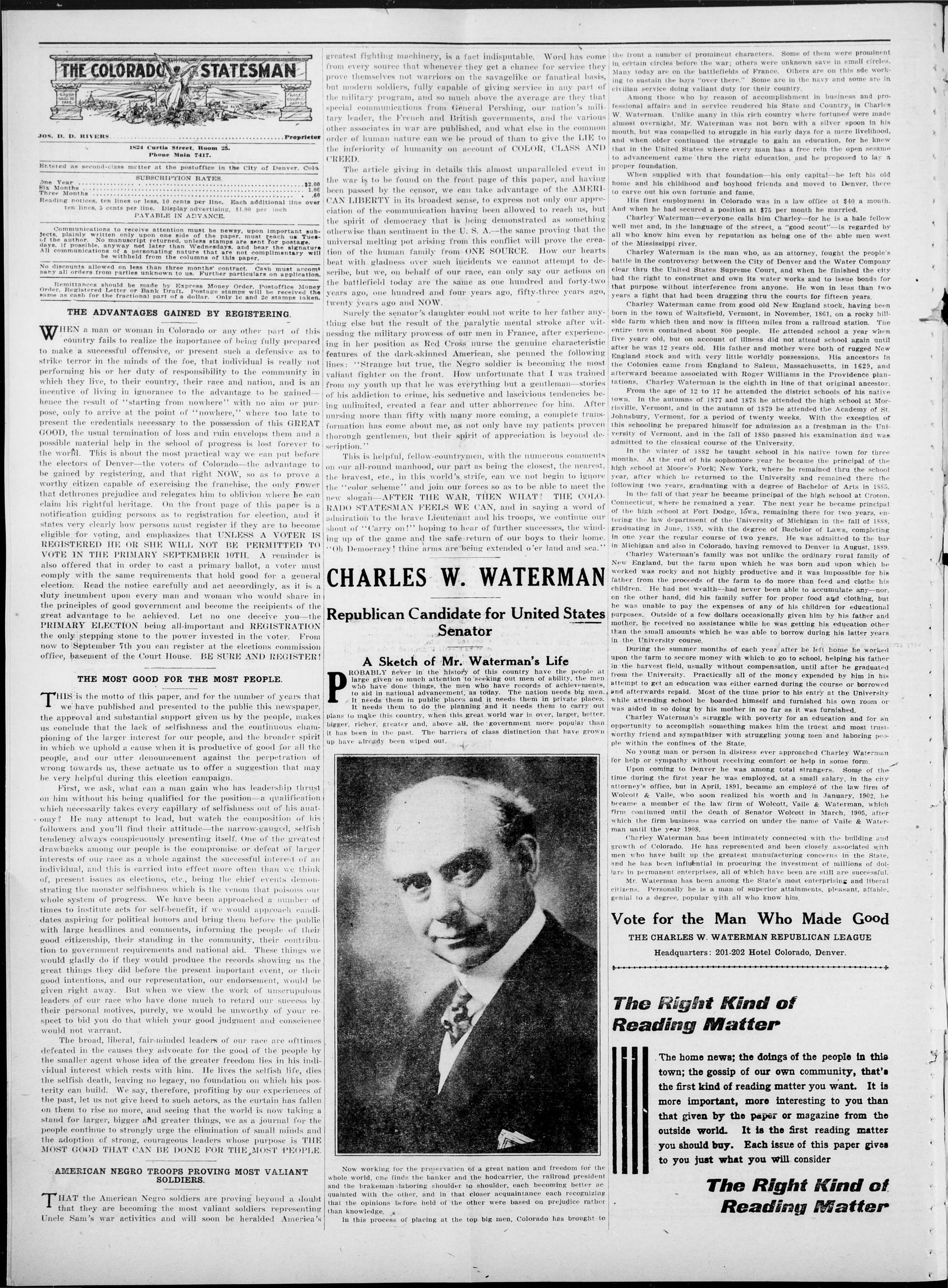
CHARLES W. WATERMAN
Republican Candidate for United States Senator
Republican Candidate for United States Senator
A Sketch of Mr. Waterman's Life
PROBABLY never in the history of this country have the people at large given so much attention to seeking out men of ability, the men who have done things, the men who have records of achievements, to aid in national advancement, as today. The nation needs big men. It needs them in public places and it needs them in private places. It needs them to do the planning and it needs them to carry out plans to make this country, when this great world war is over, larger, better, bigger, richer, greater and, above all, the government more popular than it has been in the past. The barriers of class distinction that have grown up have already been wiped out.
M.
Now working for the preservation of a great nation and freedom for the whole world, one finds the banker and the hodcarrier, the railroad president and the brakeman laboring shoulder to shoulder, each becoming better acquainted with the other, and in that closer acquaintance each recognizing that the opinions before held of the other were based on prejudice rather than knowledge.
In this process of placing at the top big men, Colorado has brought to
the front a number of prominent characters. Some of them were prominent in certain circles before the war; others were unknown save in small circles. Many today are on the battlefields of France. Others are on this sde working to sustain the boys "over there." Some are in the navy and some are in civilian service doing valiant duty for their country.
Among those who by reason of accomplishment in business and professional affairs and in service rendered his State and Country, is Charles W. Waterman. Unlike many in this rich country where fortunes were made almost overnight, Mr. Waterman was not born with a silver spoon in his mouth, but was compelled to struggle in his early days for a mere livelihood, and when older continued the struggle to gain an education, for he knew that in the United States where every man has a free rein the open sesame to advancement came thru the right education, and he proposed to lay a proper foundation.
When supplied with that foundation—his only capital—he left his old home and his childhood and boyhood friends and moved to Denver, there to carve out his own fortune and fame.
His first employment in Colorado was in a law office at $40 a month. And when he had secured a position at $75 per month he married.
Charley Waterman—everyone calls him Charley—for he is a hale fellow well met and, in the language of the street, a "good scout"—is regarded by all who know him even by reputation as being one of the able men west of the Mississippi river.
Charley Waterman is the man who, as an attorney, fought the people's battle in the controversy between the City of Denver and the Water Company clear thru the United States Supreme Court, and when he finished the city had the right to construct and own its water works and to issue bonds for that purpose without interference from anyone. He won in less than two years a fight that had been dragging thru the courts for fifteen years.
Charley Waterman came from good old New England stock, having been born in the town of Waitsfield, Vermont, in November, 1861, on a rocky hillside farm which then and now is fifteen miles from a railroad station. The entire town contained about 800 people. He attended school a year when five years old, but on account of illness did not attend school again until after he was 12 years old. His father and mother were both of rugged New England stock and with very little worldly possessions. His ancestors in the Colonies came from England to Salem, Massachusetts, in 1629, and afterward became associated with Roger Williams in the Providence plantations. Charley Waterman is the eighth in line of that original ancestor.
From the age of 12 to 17 he attended the district schools of his native town. In the autumns of 1877 and 1878 he attended the high school at Morrisville, Vermont, and in the autumn of 1879 he attended the Academy of St. Johnsbury, Vermont, for a period of twenty weeks. With the exception of this schooling he prepared himself for admission as a freshman in the University of Vermont, and in the fall of 1880 passed his examination and was admitted to the classical course of the University.
In the winter of 1882 he taught school in his native town for three months. At the end of his sophomore year he became the principal of the high school at Moore's Fork, New York, where he remained thru the school year, after which he returned to the University and remained there the following two years, graduating with a degree of Bachelor of Arts in 1885.
In the fall of that year he became principal of the high school at Croton, Connecticut, where he remained a year. The next year he became principal of the high school at Fort Dodge, Iowa, remaining there for two years, entering the law department of the University of Michigan in the fall of 1888, graduating in June, 1889, with the degree of Bachelor of Laws, completing in one year the regular course of two years. He was admitted to the bar in Michigan and also in Colorado, having removed to Denver in August, 1889.
Charley Waterman's family was not unlike the ordinary rural family of New England, but the farm upon which he was born and upon which he worked was rocky and not highly productive and it was impossible for his father from the proceeds of the farm to do more than feed and clothe his children. He had not wealth—had never been able to accumulate any—nor, on the other hand, did his family suffer for proper food and clothing, but he was unable to pay the expenses of any of his children for educational purposes. Outside of a few dollars occasionally given him by his father and mother, he received no assistance while he was getting his education other than the small amounts which he was able to borrow during his latter years in the University course.
During the summer months of each year after he left home he worked upon the farm to secure money with which to go to school, helping his father in the harvest field, usually without compensation, until after he graduated from the University. Practically all of the money expended by him in his attempt to get an education was either earned during the course or borrowed and afterwards repaid. Most of the time prior to his entry at the University while attending school he boarded himself and furnished his own room or was aided in so doing by his mother in so far as it was furnished.
Charley Waterman's struggle with poverty for an education and for an opportunity to accomplish something makes him the truest and most trustworthy friend and sympathizer with struggling young men and laboring people within the confines of the State.
No young man or person in distress ever approached Charley Waterman for help or sympathy without receiving comfort or help in some form.
Upon coming to Denver he was among total strangers. Some of the time during the first year he was employed, at a small salary, in the city attorney's office, but in April, 1891, became an employé of the law firm of Wolcott & Vaile, who soon realized his worth and in January, 1902, he became a member of the law firm of Wolcott, Vaile & Waterman, which firm continued until the death of Senator Wolcott in March, 1905, after which the firm business was carried on under the name of Vaile & Waterman until the year 1908.
Charley Waterman has been intimately connected with the building and growth of Colorado. He has represented and been closely associated with men who have built up the greatest manufacturing concerns in the State, and he has been influential in procuring the investment of millions of dollars in permanent enterprises, all of which have been are still are successful. Mr. Waterman has been among the State's most enterprising and liberal citizens. Personally he is a man of superior attainments, pleasant, affable, genial to a degree, popular with all who know him.
Vote for the Man Who Made Good
THE CHARLES W. WATERMAN REPUBLICAN LEAGUE Headquarters: 201-202 Hotel Colorado, Denver.
The Right Kind of Reading Matter
The Right Kind of Reading Matter
The home news; the doings of the people in this town; the gossip of our own community, that's the first kind of reading matter you want. It is more important, more interesting to you than that given by the paper or magazine from the outside world. It is the first reading matter you should buy. Each issue of this paper gives to you just what you will consider
The Right Kind of Reading Matter
THE COLORADO STATESMAN
Miss Myrtle Smith of 3145 Marion is visiting in Colorado Springs.
Mr. and Mrs. Wm. F. Bryant of State Capito! and Shorter Church fame, are at Casper, Wyo., for a few weeks. They will soon return to Denver.
ver with her parents, Mr. and M. George Anderson, 2431 Court pla for several years. She has a beau 5-year-old son whom we are inform has started on his musical career. hope to have the pleasure of hear this talented member of the race in time will be a representative an
Goldie, the young daughter of Mrs. Clara Morrison, 2252 Washington street, is gradually improving after an operation for peritonitis at St. Luke's hospital. The Colorado Statesman extends its sympathy, Miss Morrison being a sufferer since last June.
Oran C. Goens, one of our leading barbers in the city, got severely injured last Thursday when an automobile collided with his at Seventh avenue and Grant street. Mr. Goens is very popular and his many friends join the Colorado Statesman in wishing him a speedy recovery.
Mrs. Lillian Taylor of Toledo, Ohio, passed through the city this week en route to San Francisco where she will remain for about a year. She is the wife of William Taylor, who is an efficient mechanic in tiling and cement working in Toledo. She was a guest of the Barnes Hotel.
Mrs. Geo, Anderson, proprietress of the V. V. Hair Goods and Millinery Store, returned to the city last week Thursday, after spending a few weeks at Casper, Wyo., with her husband. She reports good business but expenses at a premium. Mrs. Anderson looked much improved physically, having enjoyed her outing.
Miss Nelsine Howard, one of Denver's popular efficient citizens, has been called to service in the Y. W. C. A. war work. She left for Camp Funston recently and from reports is right on the job. Miss Howard is well fitted for the work, having received training by the organization and Secretary Bell of the Y. M. C. A. We wish her a very useful and successful career.
Miss Eunice L. Knowles, daughter of Mr. and Mrs. Knowles of Seventh avenue and Delaware street, is with an oil company of which Mr. Fred Burton is manager. Miss Knowles is very proficient in shorthand and typewriting and is giving much satisfaction in the position she now occupies. Her parents are popular residents of Denver for many years and highly respected.
Helena Morrison, the talented daughter of Mrs. Morrison, is home from school at Lincoln Institute, Jefferson City, Missouri. Miss Morrison is an East Denver graduate and was very popular among the members of her class. She also had training at Manual High. Owing to the illness of her mother and sister she will remain here indefinitely. Her many friends welcomed her return home.
Miss Helen E. Hagan of New Haven, Conn., one of the nations' leading concert pianists, will appear Sept. 20th, auspices Y. M. C. A. Glee Club. Winner of the Yale scholarship, Miss Hagan graduated afterwards from the Paris Conservatory of Music and Denver music lovers will have an opportunity before she goes to France as one of the principal entertainers for the soldiers under the direction of the National Y. M. C. A. war workers.
Attorney William S. Peters of Boley, Okla., is visiting in the city as the guest of Attorney E. P. Blake more. Mr. Peters has a very lucrative practice in Oklahoma, becoming famous when he prosecuted a man damus case from the District court through the Supreme court, compelling the Democratic election board to place the election precinct of Boley back in the corporate limits. It had been taken out for several years.
Henry J. York, writing from "somewhere in France," begs to be remembered to all inquiring friends and acquaintances, and states that he's in good health, a soldier in every sense of the word as he is undergoing vigorous and intensive training. Mr. York is pretty well known in Denver circles, having been one of the clerical assistants in the American Woodmen Association, and his many friends delight in receiving information of his safety and hope he will return soon. Mrs. York is brimful of smiles as she after patiently waiting for a long internal, received such encouraging news.
Mrs. Rhoda Chambers, a former Denver piano virtuoso, continues her musical work in Oakland, California. Reports from that musical center are high in appreciation of Mrs. Chambers, who is better known here as Anderson, having lived and grown in Den-
ver with her parents, Mr. and Mrs. George Anderson, 2431 Court place, for several years. She has a beautiful 5-year-old son whom we are informed has started on his musical career. We hope to have the pleasure of hearing this talented member of the race who in time will be a representative artist.
DOUGLASS UNDERTAKING CO.
Funeral Notices.
John W. Brooks, 42 years, beloved husband of Mrs. Lottie Brooks, 2121 Arapahoe street, departed this life Aug. 15th. Funeral services were held Sunday, Aug. 18th, 2 p. m., from Campbell A. M. E. Church. Rev. A. M. Ward officiated. Interment, Riverside, Arthur Walker, 48, late of Farwell, La., departed this life Aug. 17th. Funeral notice later.
FOUR BROWN SKIN HARMONIZ
ERS—DENVER GIRLS IN
VAUDEVILLE.
The former Young Women's Christian Association quartet were billed at the Tabor Grand this week as above and for amateurs they did well. Their act, consisting of Negro melodies and sentimental songs, was well received and their first experience of "behind the footlights" will enable them to become headliners after they have gotten the proper stage coaching and support of a good booking agent. For local attempt every encouragement was given by the increased patronage at the Tabor this week. And now with the splendid harmony they produce and good management, they will in time be real stage representatives of our race. The Colorado Statesman congratulates Mesdames Hicks-Lenoir, Clements, Bray and Miss Cole on their initial appearance in vaudeville and wishes them every success in future engagements.
Phipps Rally
Fern Hall, 27th and Welton streets, by the Colored Republican Club, Thursday, August 29. Morrison's Orchestra.
Refreshments Free.
Come and hear the reasons for supporting Mr. Phipps for Senator.
BE SURE YOU ARE REGISTERED.
Y. M. C. A. NOTES.
A large crowd of men and women gathered at the rooms of the building last Sunday afternoon to hear Secretary Bell tell of his experiences while in the great Northwest on his recent visit to Camp Lewis where he went as a special escort sent by the War Work Council of the $ ^{*} $ Y. M. C. A. and the office of the provost marshal for the large number of men drafted into the service. He told of his visit to Tacoma and Seattle, and of the progress of our people as gleaned for his short stay in those cities.
It is difficult to say just who is leading in the croquet series. This much, however, can be said—the playing is intense and fierce, neither side yielding a single point. Jenkins, with the reputation of a champion in Colorado Springs, and Blakemore, the congenial attorney, both give promise of good work before the season is over. At present King and the two Lightner brothers are competing for the honors. A contest is scheduled for Saturday afternoon which will undoubtedly be a severe one.
The Glee Club is getting in some good work these days, though it has lost some of its members in the recent draft. One of the coming features of its work will be the presentation of Miss Helen E. Hagan, the accomplished concert pianist recently from the Conservatory of Paris, on Sept. 20. Miss Hagan is now on a concert trip across the continent, and will come from California for the concert on that date.
Next Sunday afternoon at 4 o'clock it is expected that Counsellor W. M. F. Peters of Bowley, who was to have spoken last Sunday afternoon but was unable to get here, will be the speaker. Everybody will be welcome.
N. A. A. C. P.
The N. A. A. C. P. will hold a meeting at Campbell Church Tuesday evening, September 3rd. All members are urged to be present, and the public is cordially invited.
MRS. MILDRED ABERNATHY,
Secretary.
CAMPBELL CHAPEL, A. M. E.
General Educational Day will be observed on Sunday, Aug. 25. Sermon at 11 a. m. Addresses will be delivered by Dr. J. H. P. Westbrook and Mr. Browning C. Allen, and papers will be read by Mr. Older N. Jackson and Mr. Wm. E. Miller. The choir will render special music and solos will be rendered by Mrs. Jessie Andrews Zachry and Mr. Yocum Reid at 8 p. m.
Preparations are in progress for the entertainment of the Colorado Annual Conference of the African M. E. Church, which convenes in Campbell Chapel on the morning of Sept. 12, 1918, Bishop H. B. Parks presiding.
Miss Helen E. Hagan of New Haven, Conn., the brilliant young woman pianist who won the $2,000 prize for the best composition in music and her degree while in the Yale Conservatory, and who graduated from the Paris Conservatory, was the guest of Rev. and Mrs. A. Milton Ward for three days in Denver this week. Miss Hagan is en route to the coast and will stop in Denver and give recital on her return about Sept. 20 for the Y. M. C. A.
SCOTT METHODIST EPISCOPAL
CHURCH.
Tomorrow is the great RALLY DAY when Scott Church, with its pastor, Rev. T. S. McMorris, its special preacher, Rev. W. L. Darus, its trustees and stewards will endeavor to wipe out the last debt on the church before erecting a new edifice. At 3 p. m. the special service will be held at Christ M. E. Church, corner Twenty-second avenue and Ogden street, where all pastors and their congregations are invited to attend and help in a worthy cause. The public is cordially invited to attend.
FOR SALE—5-room brick cottage
part modern, near car and school
Intoxicated by Freedom.
Magistrate—"Prisoner, the evidence shows that after being a model husband for twenty years, you throw your wife out of the house and ran amuck, attempting to murder everybody you met." Defendant (sheepishly)—"It was only a peaceful revolution at the start, your honor, but after I had overthrown the autocracy I lost my head."—Puck.
Primitive Plow.
Even at the present time modern plows are practically unknown in Egypt, and all that is used is a log with a wooden hook, the end of which is steel-pointed. Any animals available, from a donkey to a camel, constitute the team, and sometimes even a camel and a bullock are seen pulling together.
First African Explorer.
The first organized attempt to explore the interior of Africa was made by Mungo Park, who set sail on his initial voyage to the Dark Continent 123 years ago. He returned two years and seven months later after having explored a considerable section of Africa never before visited by a white man, although he failed in his main purpose, which was to trace the source of the River Niger.
Dealing With Trouble
Never hunt trouble. However dead a shot one may be, the gun he carries on such expeditions is sure to kick or go off half-cocked. Trouble will come soon enough, and when he does come, receive him as pleasantly as possibly. Like the tax collector, he is a disagreeable chap to have in one's house but the more amiably you greet him the sooner he will go away.—Artemus Ward.
Thoughtful.
"You think too much about yourself," said the Moralist. "The secret of happiness in this world is thinking about other people." "I do think about other people," said the pessimistic person. "but as they all owe me money such thoughts make me feel more gloomy than ever."—Birmingham Age-Herald.
Lantern Fly a Brilliant Insect.
The lantern fly of South America is said to be by far the most brilliant of all luminous insects. It sometimes measures more than 2 inches in length. The shape of the head is very curious. It is furnished with a hollow transparent snout nearly the length of the body, whence comes the lamplike light.
These Days of High Prices.
These Days of High Prices
Robert's grandfather gave him a penny to spend, and Robert said: "Grandma, you must remember everything costs more. I can't get much candy for a penny."
Thackeray Always Late.
An external stimulus sometimes is necessary to bring a writer's ideas to focus, it was the custom with Shackery never to do today what could be put off until tomorrow. He was, therefore, frequently behind with his copy and it was no uncommon thing for him to keep the messenger from his publisher waiting at the door while he wrote the last pages of the book.
CARELESSNESS DELAYS
SUGAR CERTIFICATES,
DECLARES FOOD CHIEF
Improper statements, failure to give addresses, and miss-sent information have been at the bottom of much of the discomfort experienced by consumers of sugar during the past few weeks according to a statement issued by the United States Food Administration recently.
"While some of the errors in issuing sugar certificates have been traced to this office, a large per cent of them have been made by retail dealers," explained Robert J. Grant, executive manager of the Food Administration.
"We try in every way to make all rulings and regulations as easy as possible for the people, but we know that in this particular instance the carelessness of some dealer has worked hardships upon consumers—particularly those in rural communities who were unable to purchase sugar, and we are sorry."
Twenty-seven clerks and stenographers have worked unceasingly since the last week in July in an effort to get the sugar certificates out in good time. It is easy to understand, however, how delays occur, when hundreds of statements came into the Denver office with no address; and dozens of other statements were sent to Washington and had to be returned before they could be cared for.
"Criticism is easy, but it is the fair thing to consider that not all of the mistakes which are made are made by the Food Administration staff," smiled the executive manager.
USE MILK AND CREAM AND SAVE HERDS URGES STATE FOOD OFFICIAL
The necessity for preserving intact the dairy herds of Colorado was reiterated by Clarence Adams, head of the Poultry, Eggs and Dairy Products division of the United States Food Administration in an interview a short time ago.
"The need of saving butter and milk has passed, and unless the public realize that they must use these excellent foods to replace some of the staples, such as the wheat and sugar they have been asked to save, the farmers are going to sell their valuable dairy cows for beef and the country will be swept of its herds," Chairman Adams declared
"At the time of serious curtailment of the sugar supplies, manufacturers of ice cream have been given practically because this is one of the forms in which milk is most readily marketed. A demand for milk, cream and butter must be greatly stimulated if the Food Administration is to be able to prevent the relatively high price of beef from tempting farmers, who are making very little off of their herds at this time, from sending them to market as beef cattle."
Make milk and butter and eggs take the place of the products which the United States must ship overseas to American soldiers and to the soldiers of the allies.
THRESHING CAMPAIGN MEETS WITH SUCCESS THROUGHOUT COLORADO
In spite of the fact that rain has delayed the threshing of wheat and other grains very materially, the Colorado Food Administration feels that the threshermen throughout the state are exerting every effort possible to put through the 1918 threshing program. Various county threshing committees have been extremely zealous in attending to the details which make for the success of any campaign.
"Never before have the threshermen paid so much attention to the efficiency of their machines," declared Howard F. Crocker, chairman of the Threshing Division, "and we feel that the threshermen are working together faithfully to save, to the utmost degree every particle of grain possible."
Headquarters are attaching great importance to the reports which the threshermen are turning in weekly to the County Threshing Committees. It is upon the accuracy and care with which these reports are filled out that the success of the threshing campaign depends, because statistics, thus gathered, will form a basis for crop estimates in future years. Instructions from Washington ask for reports, not only upon the threshing of whe, and other grains, but upon feed grains, fodder and other crops threshed.
DO SUCH LIVE HERE?
"Human nature is very strange. The way some women are wailing over the new sugar regulations is pitiful. To some of them, it seems, a crate of fruit is more than all the starving millions of Europe. They are the abused race over the new canning regulations, and anyone who talked to them about the Hoover regulations a year ago and knew of the scorn with which any suggestions of curtailment were met can realize how hurt they are with the enforced denial. This is only a lack of vision. Women whose men are at war accept the regulations with cheerfulness; they do not weep over the loss in fruit, or the difficulty of canning without sugar. They have other losses to think of. They know that doing without a few pounds of sugar is an easy matter compared to their greater sacrifice."—Spokesman-Review.
Joslin DRY GOODS CO.
School
We're glad to announce brought a splendid lot of wear to school, at savings present-day prices.
hool Sho
lad to announce that unusual for
splendid lot of Shoes for girls an
hool, at savings of 50c to $1.00 a
prices.
School Shoes
School Shoes
—We're glad to announce that unusual foresight has brought a splendid lot of Shoes for girls and boys to wear to school, at savings of 50c to $1.00 a pair from present-day prices.
For Boys
—Tan or black Lace Shoes
soles.
Sizes 9 to 13.....
Sizes $ 1 3^{\frac{1}{2}} $ to 2.....
Sizes $ 2^{\frac{1}{2}} $ to $ 5^{\frac{1}{2}} $ .....
black Lace Shoes, wide or narrow to
9 to 13.....$3
13½ to 2.....$4
2½ to 5½.....$4
—Tan or black Lace Shoes, wide or narrow toes, Neolin soles.
Sizes 9 to 13.....$3.50
Sizes 13½ to 2.....$4.00
Sizes 2½ to 5½.....$4.50
For Girls
—A hand-sewed Calf Shoe, feet fitting, made expressly
Sizes 8½ to 11.....
Sizes 11½ to 2.....
These New Was
Cheerful Sc
—Dress Ginghams, good cheeks, af, yard.....
—Bates Seersuecker Gingham plain colors, stripes, cheeks.....
—New Fall Plaid Suitings, tions of colors, at, yard.....
—Satin Stripe Poplins, suit in light blue, dark blue, ole tle green, at, yard.....
—Shirting Cheviots, the m boys' waists and shirts, at.....
—White Poplin, a splendid yard.....
—Our Kiddie Kloth, Bontes sortment of best quality d rful plaid designs, at, yard.
New Wash Goods to cheerful School Clothes
Bingham, good selection of Plaid, yard.
Persucker Gingham, come in all shades, stripes, checks and plaids, at, yard.
Plaid Suitings, come in pretty colors, at, yard.
Ripe Poplins, suitable for school dress, dark blue, old rose, emerald and at, yard.
Cheviots, the most durable materials and shirts, at, yard.
Poplin, a splendid quality for middles.
Die Kloth, Bontex Galatea and a fine best quality dress ginghams in wivesigns, at, yard.
A hand-sewed Calf Shoe, button or lace, oak soles, perfect fitting, made expressly for Joslin's.
Sizes 8 $1/2 to 11.....$3.50
Sizes 11 $1/2 to 2.....$4.00
•
These New Wash Goods to Make Cheerful School Clothes
—Dress Ginghams, good selection of Plaids and checks, at, yard.....25¢
—Bates Seersucker Ginghams, come in all shades of plain colors, stripes, cheeks and plaids, at, yard.....35¢
—New Fall Plaid Suitings, come in pretty combinations of colors, at, yard.....30¢
—Satin Stripe Poplins, suitable for school dresses, in light blue, dark blue, old rose, emerald and myrtle green, at, yard.....45¢
—Shirting Cheviots, the most durable material for boys' waists and shirts, at, yard.....40¢
—White Poplin, a splendid quality for middies, at yard.....45¢
—Our Kiddie Kloth, Bontex Galatea and a fine assortment of best quality dress ginghams in wonderful plaid designs, at, yard.....50¢
PETER H. BURTON
AND WOMAN
adged and should have opportunity
ing to merits and not according to
ry Election, September
1918
deted, I shall work for the protect
all the people in accordance with t
LIAM N. VA
Republican Candidate for
ONGRESSMAN
EVERY MAN AND WOMAN
Should be judged and should
ment according to merits and
Primary Election
19
When elected, I shall woe
vancement of all the people in
principles.
WILLIAM
Republican C
CONGRE
Should be judged and should have opportunity for advancement according to merits and not according to color.
Primary Election, September 10 1918
When elected, I shall work for the protection and advancement of all the people in accordance with the foregoing principles.
Someone has said that "brevity is the soul of wit." It is, and in these strenuous times it would seem a very good idea to apply the same maxim to other channels of conversation. The man or woman who can handle an important subject briefly is sure of a royal welcome wherever he or she seeks an audience.
Willfulness and Will.
Do not mistake willfulness for will. Very often the girl who is most determined to get her own way in everything, lacks will power. Will is conducive to self-control, willfulness to a lack of it. The difficulty a girl's proper guardian, her parents and her teachers, encounter in bringing her to do what is expected of her is not the measure of her will, but of her willfulness.—Pennsylvania Grit.
---
"Soul of Wit."
ol Shoes
ouncee that unusual foresight has
ot of Shoes for girls and boys to
vings of 50c to $1.00 a pair from
Shoes, wide or narrow toes, Neolin
.....$3.50
.....$4.00
.....$4.50
Shoe, button or lace, oak soles, per-
pressly for Joslin's.
$3.50
$4.00
Wash Goods to Make
School Clothes
Good selection of Plaids and
25¢
Benghams, come in all shades of
checks and plaids, at, yard...35¢
Bings, come in pretty combina-
d...30¢
S, suitable for school dresses,
one, old rose, emerald and myr-
45¢
He most durable material for
s, at, yard...40¢
Blendid quality for middies, at
45¢
Bontex Galatea and a fine as-
ity dress ginghams in wonder-
ward...50¢
(Advertisement.)
Jim Crow Laws
Are un-American and destructive of the principle upon which this nation was founded.
LYNCHING
Is a national disgrace which, if continued, will put us on the same level as the Hun.
should have opportunity for advance-
s and not according to color.
ction, September 10
1918
will work for the protection and ad-
ple in accordance with the foregoing
M N. VAILE
Candidate for
PRESSMAN
Olive Trees Have Long Lives. Eight of the olive trees in the historic Garden of Olives, near Jerusalem are believed to be more than 1,000 years old.
Not in His Line.
Miss Manchuser—"Have you ever considered the bonds of matrimony?" Mr. Stockson-Bonds—"Nops. Nothing doing in bonds that are not listed."
Uncle Ike Murmurs.
"Whenever any man," murmurs Uncle Ike, "commences fer to talk to me about his soul. I sez to myself I've flushed a nut."—Judge.
Daily Optimistic Thought
A good judge will decide according to justice and right in preference to strict law.
Pithy News Notes From All Parts of Colorado
Western Newspaper Union News Service.
COMING EVENTS.
Sent. 1—Mining Engineers' meeting in
Denver.
Sept. 1—Fifty-sixth annual confer-
ence of Colorado M. E. Church at
Dept.
Sept. 4-5—Shoe Dealers' Association meeting in Denver.
Sept. 3-6—Arkansas Valley Fair at Rocky Ford.
Sept. 3-6—Frontier Days' Show at Fort Morgan.
Sept. 19—Beaver Park fair at Penrose
sept. 22-28—Colorado State Fair at
Pueblo.
Sept. 26-28—Lincoln County Fair at
Hugo.
A bank is to be opened in Maybell.
A carload of wool valued at $25,000
was shipped to Boston from Mesita.
A recruiting office for student
nurses has been opened in Fort Collins.
The Bird saw mill has been moved
from Crosho Lake to Newton Gulch,
near Yampa.
Irwin L. Sears, a former Kersey
boy, is named in the casualty list from
the French front.
Dr. F. H. Harrison of Grand county
has been commissioned a captain and
left for Fort Riley, Kan.
A Red Cross sale on Aug. 30 is to be
one of the big features of the Larimer
county fair at Loveland.
Surveys have been made for a new auto road from Elk Springs in Moffat county to the Utah line.
This road from Craig to Blue mountain is open for travel and is said to be to the best of condition.
During the month of July the Alamosa postoffice sold $10,000 worth of War Savings Certificates.
Six months in jail was the sentence pronounced upon Frank Mondragon at Fort Collins, convicted of bootlegging.
During last month the Hayden auxiliary of the Red Cross shipped to the Steamboat chapter 1,747 gauze articles.
M.O. Smith of Evans is suffering from a fractured skull as a result of an auto accident that occurred near Denver.
The John G. Anderson farm east of Mead, a non-irrigated tract, was sold to Walter L. McCaslin of Longmont for $16,000.
A handsome memorial tablet has been completed for the Alamosa Elks Lodge, which contains the names of all deceased members.
Fosty acres of oats on the Ralston ranch on Twelvemile mesa, forty miles west of Craig, it is stated will make sixty bushels to the acre.
Commissioners of Alamosa county are planning to cover all stagnant water of that county with crude oil in order to exterminate mosquitoes.
Peter Engle is the first Grand county ranchman to respond to the call for a Red Cross herd. He will start the herd by branding two heifer calves.
Lieut, Harold F. Maxson, a former student at the Colorado School of Mines at Golden, was killed in an airplane accident at Brinkley Field, N. Y.
The Rt. Rev, Irving P. Johnson, bishop of the Episcopal Diocese of Colorado, has written a prayer for American soldiers for use at noon each day.
The fourth home service institute of the Red Cross for the Rocky Mountain division will be held in Denver beginning Oct. 1 and continuing for six weeks.
Thru the efforts of the recently organized Steamboat Sportsmen's Association, at Steamboat Springs, the streams and lakes in Routt county are being restocked with trout.
Fire destroyed the Gill garage at Gill.
Five hundred Fort Logan boys will be the guests Saturday evening, Aug. 24, of the Women's Council of Defense, Districts K, R and T, comprising the whole of South Denver.
Colorado policyholders to the number of 300,000 paid $17,000,000 in premiums on insurance protection during 1917, according to a statement made by the State Insurance Commissioner.
Five stars—one of them gold for her son, Clarence B. Book, who gave his life in the service of his country—are on the field of the service flag flown by Mrs. Ella Book, a widow living in Denver.
Already $595,000 of the $800,000 pledged to the Denver chapter of the American Red Cross in the second Red Cross drive has been collected. The date for final payments of the pledges expires in October.
The special committee of the State Council of Defense to aid enlistments in the students' army training corps will try to induce every boy who graduated from high school last June to join the corps and go to college.
The accomplishment of the food administration in obtaining loans on potatoes for growers by establishing grades of potatoes will be of a permanent nature, in the opinion of Lou D. Sweet of Colorado, head of the potato division of the food administration.
The government fund of $5,000,000, which is to be loaned to farmers for the purchase of seed wheat or substitute grains, will be so administered that little of it will be available in Colorado, is the opinion of Edward O. Foster, State Immigration Commissioner.
CENTENNIAL STATE ITEMS
Another modification of the ruling that no person may now enlist has been received by Lieut. Col. C. N. Barney, commanding officer of the local recruiting station. The communication states that men between the ages of 46 and 56 may enlist in the ordnance corps or quartermasters' corps, provided they are able-bodied, of good character, English-speaking and not alien enemies. Men between the same ages and governed by the same restrictions may also enlist in stated branches of the signal corps, if qualified by occupation, as cooks, clerks, photographers, chauffeurs and telephone or telegraph operators. Men who are skilled in trades are desired.
Names of candidates for the Republican and Democratic primaries to be held Sept. 10 were sent to county clerks by the secretary of state's office. The certification in Denver went to the city elections commission. There are fifty-one state and county candidates among the Republicans in Denver, and forty-one Democrats, according to the certification sheets.
Thrift Stamps to the total value of $7,300,000 have been sold outright in the state since Jan. 1 last, or pledged to prospective purchasers under promise to buy according to a statement at War Savings headquarters. The statement was supplemented with a request that those who have promised to buy make good the pledge at the earliest opportunity.
Mrs. Kate Christie was killed, Mrs. Albert Jones sustained a broken arm and other injuries, and her 3-year-old son Harold was internally injured when the automobile driven by Albert Jones left the road in Cliff Dwellers' cafon, near Manitou, and rolled down a forty-foot embankment, crushing Mrs. Christie and the Jones boy under the car.
Sheriff John J. Marty raided the town residence of Tony Leverich at Trinidad, where he reported finding considerable liquor, and evidence that led to a further raid. He followed up the clews given and returned with 1,000 pints, found about twelve miles out, and said to be the property of Frank Boccaccio.
The lumber mill and plant at Monarch, which has been idle for seven years, will again be in operation, according to David Schupbach of Columbus, Neb., who, with his associates, has purchased the plant from A. H. Kadetsky of Denver for $400,000. The mill was constructed eight years ago at a cost of more than $1,000,000.
Writing a detailed letter concerning his funeral and carefully laying out the clothes he wished to be buried in, A. C. Lovell, 35, a carpenter, shot himself thrue the head in his room at 1546 Cleveland place, in Denver. He died at the county hospital twenty minutes later.
John Lawson, president of the Independent Union of Mine Workers, has been employed as an associate director by the Americanization committee of the State Council of Defense and is doing Americanization work in the southern coal fields.
The Denver Tramway Company submitted to Charles A. Lammers, City and County Clerk and Recorder, its petitions to be sent to the Denver city council asking for a rate of 6 cents on the street cars. The petitions are alleged to have 7,592 names. J. N. Bundick, chairman of the sugar division of the federal food administration for Colorado, announced there was plenty of sugar for canning and that twenty-five pounds could be obtained by any housewife for canning purposes. A city-wide search was made by the police for Arthur Lockwood, 4 years old, who disappeared while his parents, Mr. and Mrs. Frank Lockwood, of Pueblo, Colo., were waiting for a train in the Union Station in Denver. Colorado's firefighters met in annual convention in Georgetown.
The town board of Flagler has issued an order that the German language shall not be spoken within the town limits. The order concludes: "If you can't talk American, make signs." Homer McCullah, graduate of the Agricultural College at Fort Collins, has been promoted to a captaincy in the army camp to which he is attached in California.
Permission from the Federal Oil Administration, urgently requested by the city of Denver, has been granted for the use of 32,000 gallons of oil for Denver streets.
Her throat cut and her head covered with bruises, a woman about 22 years old, believed to be Betty Ramey, was found dead in a room of a Denver hotel.
More than $800 babies have been weighed, measured and tested in the city of Boulder, which is making splendid progress in the child welfare work.
Miss Loretta Tighe, a former Loveland young lady, is now with the American forces in France serving with the United States army as a dentist.
The Missouri Society of Colorado will hold a patriotic basket picnic at Washington park in Denver, Saturday afternoon and evening, Aug. 31.
At Hayden the church bell will be rung each day, calling attention to a brief time of prayers for the success of America in the war.
Mrs. Anna C. Hoffman, a bride of about a month, is suing her husband, George Hoffman, at Loveland for divorce.
The citizens at Estes Park are planning to build a large log fort there.
GERMANS CHANGE OPINION OF YANKS
DIARY OF A CAPTURED OFFICER
SHOWS QUICK ABANDONMENT
OF CONTEMPTUOUS VIEW.
DEAF NOT GOOD AVIATORS
Tests at Mineola Diapel a Widespread Delusion — Purchasers Now Find Fewer Varieties From Which to Choose, Because of Conservation.
(From Committee on Public Information.) Washington. — The contemptuous opinion of the Germans for the fighting ability of American troops changes overnight as shown by the diary of a German officer who was captured and taken into American lines by the marines.
The writer of the diary, Reserve Lieutenant Tillmanns, belonged to the second battalion of the Fortieth regiment, Twenty-eighth division, the fourth division which the marines had against them in the fighting around Chateau Thierry. The other three divisions were so badly cut up they could not carry out their orders to attack. Lieutenant Tillmanns wrote:
"June 7—At the Front. American troops have made counter-attacks. We have to move to the front again. Route of march over Rocourt Epaux. We are lying in the woods to the right of Etrepilly, for the present in position. In the night of the 8th and 9th we will relieve the front line. It must be a sad outfit which allows itself to be thrown out by the Americans. In the evening of the day of the 8th there was heavy artillery fire. Fortunately the artillery fire did not reach us.
"June 8 to 9—Moved forward at night and relieved the Four Hundred and Sixty-first regiment at four in the morning in the Boise de Belleau. In comprehensibly wide sector. Where there were three companies we have only one.
"June 9 to 10—The worst night of my life. I am lying in the thick woods on an open height in little holes behind rocks—for this is heavy artillery fire—until six o'clock in the morning. It is a wonder that the fellows were all at their posts when the Americans attacked. The attack, thank God, was repulsed. God has again mercifully preserved me."
The dairy ends abruptly here, as the next day the writer was a prisoner in the hands of the Americans.
Deaf mutes will not be accepted for the aviation war service by the division of military aeronautics. Hundreds of young men have been encouraged to seek such enlistments by unauthorized statements which are being investigated because of a suspicion that German propaganda might be at the bottom of the agitation.
The medical research laboratory at Mineola, L. I., conducted a series of tests to ascertain what effect, if any, the absence of the delicate balancing apparatus that exists in normal inner ears has upon persons who are without them. The erroneous idea was circulated that since deaf mutes possess little, if any, sensitivity of the inner ear they would be little subject to dizziness and therefore make good flyers.
Seven deaf mutes who had never flown were blindfolded, seated in planes and told that after reaching a certain level the pilot would execute a number of evolutions which he, the passenger, was to record and to make particular note in which the plane had been turned to the right or left, up or down. The flights included stretches of level flying, climbing, left and right turns, dips and banks.
Being blindfolded and minus the equilibrium of balancing organs in their ears, the deaf mutes failed to note changes of even as much as 90 degrees. They could not differentiate the deepest right from the deepest left banks, nor notice the difference between climbing or diving in a practically vertical position. They were virtually lost in space.
Members of the medical research laboratory have reported officially that the less the sensitivity of individuals to change of position the less efficient would these individuals be in the air; and that it would be ridiculous for deaf mutes to attempt to fly. It has been determined that one who shows by the turning chair tests that he has a normal ear mechanism possesses good detection of movement in the air, and that one who falls to pass this test possesses poor detection of movement in the air.
Wool stocks held by dealers and manufacturers in the United States on June 30 last amounted to 466,490,000 pounds, grease equivalent, as compared with 585,000,000 pounds, grease equivalent, on the corresponding date of last year.
During the first seven months of the present year the army required 1,612,-313 cases of evaporated milk, the equivalent of 77,391,024 quarts of fresh milk.
The United States employment service found positions for 1,861,332 persons during the year ending July 30 last.
The commercial apple crop for the present year is estimated at 25,711,-000 barrels, an increase of 15 per cent over 1917.
When you go to the store nowadays to buy cloth or shoes or a bed or a plow or an automobile tire, you should not be surprised or disappointed if you do not find as great a variety to choose from as in the past. The conservation division of the war industries board is responsible for this condition.
This division has reduced already the number of sizes of automobile tires from 287 to 33 and more are to be cut from time to time. Over 2,000 sizes and types of plows and tillage implements that can be spared without hardship to the farmers have been eliminated in accordance with the plans worked out by the conservation division.
This means that the manufacturers will be able to secure economy in production and the amount of materials and capital tied up in the manufacturers' and dealers' stocks throughout the country will be greatly reduced. This program of elimination, moreover, is making it possible for the steel mills to turn out their product more rapidly and thus the production of steel for ships and munitions is speeding up.
There will be only 30 styles of metal beds made hereafter. There will be only 32 shades of house paint, only 10 kinds of architectural varnish, only one-fourth as many sizes and kinds of stoves and furnaces. Similar plans are being worked out for every industry. These plans are all based on the need of conservation to help supply the men who are in the trenches and the war industries board expects the co-operation of merchants and the public generally in accepting these reductions in variety. The conservation division says we surely can get along during the war without all the frills that we have indulged in during peace times. The purpose of all these plans is to help win the war.
The occupation in which Mexican laborers may engage after being admitted to the United States under the special provisions temporarily modifying the head tax, literacy test and contract labor provision have been extended by Secretary of Labor Wilson.
The first order permitted Mexican laborers coming to this country to engage in agricultural pursuits, railroad maintenance of way and lignite coal mining. To this list has been added mining of all kinds and common labor work in connection with public construction in Texas, New Mexico, Arizona and southern California.
To facilitate the admission of Mexican laborers they will be permitted to enter the United States at all ports of entry along the Gulf of Mexico and on the Atlantic coast as far north as Charleston, S. C., in addition to the entry ports along the Mexican border.
Encouraging reports are being received from the border states as to the effect the influx of Mexican labor is having in alleviating local labor shortage. The demand and supply for farm hands is about balanced, is the report, and any shortage of labor heretofore existing has been relieved. Many of these new immigrants are cutting cotton in the Southwestern states.
The Military Dispatch Riders' organization has been developed by the American expeditionary forces in France as an additional method for transmitting communications. It is picturesque, and has served to knit the army more closely together by the actual physical transmission of official orders and communications.
The riders, successors to the old type of army courtiers and brothers in spirit of the pony express riders of the Western plains, are intrusted with the work of keeping the corps in touch with the divisions, the divisions with the brigade, and the brigade with the regiment for detailed orders, letters and important packages of papers that cannot be transmitted promptly and safely in other ways.
Mounted on motorcycles and burdened with only a pouch or knapsack in which the papers are carried, the military riders cover distances of 100 miles in three hours over the smooth French roads. Each rider is chosen carefully for his expertise in driving a motorcycle, his ability to repair his machine under all conditions and his coolheadedness and resourcefulness in emergencies, as his route may take him over shell-swept roads and the darkness of night may bring him near the enemy positions. The messages he carries must be delivered, and distance, weather conditions, shellfire or enemy raids must not stay him in the completion of his scheduled rounds.
Many of the riders work in pairs, so that when a route is arranged betwo town at a distance of 150 miles or threaboutouts, quarters can be established for both at each town and each rider alternates in occupying the quarters that the daily schedule may be maintained. A complete network of dispatch riders covers the entire military organization of the American expeditionary forces, and is at high point in its motorization. It is strictly a product of American readiness and quickness in adopting all means that will help the army to act as fast as it thinks.
A design for the United States war industries badge, to be worn by deserving civilian war workers, has been approved by Secretary of Labor Wilson, and will be ready for distribution September 1.
The badge will be disk-shaped, slightly larger than a quarter, and will be attached to a red, white and blue enamel bar one and three-quarters inches long. Four consecutive months of uninterrupted service in war production will entitle the worker to the first badge, which will be of bronze.
THE KITCHEN CABINET
He who sedulously attends, pointedly asks, calmly speaks, coolly answers and ceases when he has no more to say, is in possession of some of the best requisites of man.—Lavater.
It is our patriotic duty to save sugar. In many of the dishes needing sweetening some other sweet may just as well be used. Those who have never taken the trouble to care for a hive of bees are finding that one hive, if well cared for, will produce 60 or more pounds of honey, with plenty left for the bees to winter on. Honey takes the place of sugar fairly well, yet the liquid in the dish will need to be reduced one-quarter. Maple sirup is sweeter than sugar, so less is needed, while corn sirup is not as sweet and a larger amount will be necessary to properly sweeten.
Whey Honey.—Boll together one cupful of whey and one-third of a cupful of honey until of the consistency of strained honey. This sirup will keep indefinitely and is fine for waffles or griddle cakes. Use a little thinner for pudding sauces.
Whey Lemonade.—To a quart of whey add six tablespoonfuls of honey, the juice of two lemons and the grated rind or a sliced lemon added for extra flavor. Mix, chill and serve as a beverage. If wanted for punch add any seasonable fruit with fruit juices. Double the amount of honey and fruit juice is about the right proportion for punch.
Bar le Duc Currants.—Remove the seeds from the large cherry currants, using a darning needle. Take equal weights of currants and honey. Bring the honey to the boiling point, then add the currants and cook until the skins are tender, being careful not to destroy the shape by rapid boiling. If the fruit is so juicy that the sirup is thinned remove the currants and reduce the sirup by boiling until of the right consistency. Put into glasses and seal with paraffin.
Honey Charlotte Russe.—Chill one cupful of honey and stir it carefully into a quart of whipped cream. Line a dish with lady fingers and fill with the honey and cream. Set away to chill. Serve very cold.
Honey or maple sirup may be used in place of sugar for boiled frosting. Pour the boiling sirup over the beaten white of the egg and proceed as usual.
Fasten your soul so high, that constantly
The smile of your heroic cheer may
doat
Above the floods of earthly agonies.
Mrs. Browning
Foods highly seasoned with condiments are called deviled food. Such dishes are popular for an appetizer, for late suppers, picnics and luncheons.
Deviled Chicken Legs.
—Take the second joints and the legs of a roosting or a spring chicken, reserving the breast for
remove the bones and tendons and flatten the pieces by striking them with a cleaver. Make incisions lengthwise in the pieces, and fill these with deviled paste, brush with melted fat and broil or fry in fat until cooked. Prepare the paste as follows: Put into a soup plate two tablespoonfuls of salad dressing, half a teaspoonful of mustard, a scant half teaspoonful of curry powder and a half teaspoonful of Worcestershire sauce. Mix and use as above. Steaks, chops or slices of cold roasts may be treated with this paste equally as well. Deviled Bones.—Rub the deviled paste into the meat left on ribs of beef, brush with butter and broil. Serve not too well done.
Deviled Ham.—Cut a moderately thick slice of cold boiled ham, make incisions on both sides of it, rub these with the deviled paste, then with butter, and broil long enough to heat through thoroughly. Serve on a hot platter with a teaspoonful of the paste spread over the ham just as it goes to the table.
Deviled Tripe.—Take well-cooked tripe that is cold, rub into it a liberal quantity of the deviled paste, brush it with sweet fat and broil to a delicate brown. When done serve with a little paste on each piece of tripe while hot.
Deviled Veal Chops.—Take thick chops and into the several gashes made with a sharp knife press as much of the paste as is needed to season each chop. Dredge with crumbs and broil as usual or fry in a little hot fat.
Deviled crabs, oysters or various fresh fish may be seasoned with the paste and cooked in hot fat, making most tasty dishes.
Nerie Maxwell
Not Very Complimentary.
Milton's mother was asking each member of the family which view of the sailor boy they preferred her to keep for them. One said she would like a side view, another a front view, and, when Milton's turn came, he, thinking he ought to say something different, earnestly requested a back view.
BRITISH TROOPS RETAKE ALBERT
GERMANS PUT IN POCKET AND FORCED TO RETREAT IN DISORDER BY HAIG'S DRIVE.
HUN ARMIES DIVIDED
HUN ARMIES DIVIDED
THRUSTS BY TWO ARMIES MEN-
ACE GERMAN LINE OF RE-
TREAT FROM NOYON.
Western Newspaper Union News Service.
With the French Army in France,
Aug. 23.—Gen. Mangin's troops
advanced seven miles during the night
and Thursday morning were rushing
the enemy's rear guard so energetically that the retiring columns were
thrown into confusion.
The German battle line in France is still crumbling under the impetus of the attacks of the British and French. From the region of Solissons around the curve in the front to the vicinity of Lassigny the enemy has been visited with further heavy defeats, while farther north, between the Somme river at Bray to the south of Arras, Field Marshal Haig's men have continued their victorious thrusts. The allies have captured a large number of additional towns and vantage points which in the further prosecution of the offensive are of the utmost strategic value. Nowhere is the enemy being permitted to pause for breath. The armies of Haig, Manglu and Humbert are pressing their advantage with a strength that brooks no denial of their efforts.
Thousands of prisoners, numerous guns and machine guns and large stores of war supplies have been added to the stocks already in allied hands. To the British alone in the last two days of fighting have come more than 5,000 prisoners.
In a new offensive begun by Haig from the north of the Somme to Albert an advance of two miles eastward already has been made over the six-mile front. In this fighting the town of Albert on the Ancre, the keystone of the German defense protecting the Germans north of the Somme, has been taken. Here the British made 1,400 Germans prisoner. The Ancre river to the south of Albert was crossed by the British in their drive, thus forming a serious menace to the enemy around Bray, where at last reports Americans were in the battle line.
Desperate resistance has been offered to the further eastward advance of the British in the sector immediately south of Arras, where the important railroad town of Bapaume seems to be the immediate objective. Particularly heavy fighting occurred at Achieftie Grand, but although the town changed hands numerous times, the vantage belonged to the British at last accounts. Further important penetrations of the enemy line had occurred and the British were operating well to the east of the Bapaume-Arras railway.
Over the entire front the Germans have been further pushed back, at some distances from two to three miles, and in the retrograde movement the enemy was forced to abandon large numbers of guns.
Noyon is now all but enveloped. The Divette river has been reached and both the Oise and the Allette rivers have been crossed and the onward thrust of the French on the eastern end of the line from Soissons northward seems likely to bring about shortly the outflanking of the important town of Laon.
DECLARE AIR PROGRAM FAILURE
Original Appropriation of $640,000,000 Exhausted and More Funds Needed.
Washington.—The long-awaited report of the Senate military subcommittee investigating aircraft production was submitted with a scathing arrangement of delays in the early days of the war, a review of improved conditions and recommendations for the creation of a new separate department of aviation with a cabinet officer at its head.
Failure to adopt successful foreign aeroplanes and motors, waste of millions of dollars of aircraft, appropriations, dominance of the aeroplane program by inexperienced automobile manufacturers, "unsystematic and ineffective" organization and excessive profits to manufacturers are among criticisms made by the subcommittee of which Senator Thomas of Colorado was chairman.
The original $640,000,000 appropriated by Congress for aviation in July, 1917, says the report, has been exhausted and "practically wasted" with $884,000,000 more found necessary.
Bolshevik Declare War With U. S.
Washington.—Because the Bolshevik government has declared a state of war exists between Russia and the United States, Vice Consul Imbrie has lowered the United States flag over the consulate at Petrograd, closed the consulate and placed the affairs of the United States in the charge of the Norwegian government. Americans in Petrograd, of whom there are approximately twenty, have been warned to leave the country by the vice consul.
SUGARLESS SWEETS.
sweetening some other sweet may just as well be used. Those who have never taken the trouble to care for a hive of bees are finding that one hive, if well cared for, will produce 60 or more pounds of honey, with plenty left for the bees to winter
HIGHLY SEASONED DISHES.
dishes are popular for an appetizer, for late suppers, picnics and luncheons.
Deviled Chicken Legs.
—Take the second joints and the legs of a roasting or a spring chicken, reserving the breast for salad. Divide the parts,
The Housewife and the War
(Special Information Service, United States Department of Agriculture.) ACCOUNTS FOR THE FARM HOME.
Records May Be Classified When Made or at the End of Each Month.
FARM HOUSEHOLD ACCOUNTS URGED
Two Simple Methods of Making and Classifying Records of Expenditures.
USE ORDINARY BLANK BOOK
Detaile Encourage Economy and Show Relation of Home Expenses to Farm Business—Ten Divisions Satisfactory.
The modern farmer's wife is no longer satisfied with the old accepted idea that "the farm gives us a living." but she gets out her pencil and paper and asks "How much of a living does it give us?"
Generations ago neither the farm nor the farm household had any but minor dealings with the outside world. Under such conditions the need for accounts was slight. But those conditions no longer exist. The farm household, though still in many cases receiving its major support in farm products consumed at home, purchases far more extensively than ever before from outside sources. Farm household accounts have become essential to economy.
Household expenses on the farm are very intimately associated with the business of the farm itself. The farm normally supplies much material which otherwise would become a household expense. The household, in turn, very often furnishes board for farm labor, which would otherwise be a farm expense. Merely from the standpoint of keeping track of household expenses as related to the farm business, household accounts are desirable and should serve to supplement and round out farm accounts.
Ways of Keeping Records.
Ways of Keeping Records.
There are two methods of keeping a record of household expenditures. One is to record the purchases or money paid out without classifying the expenditures. The other is to classify when the record is made.
The first method is very simple, requires no special form, and gives all necessary information regarding expenditures. At the end of the month or at the end of the year the total expenditures readily may be determined. In order, however, to know the totals for each kind or class it will be necessary to make up a monthly summary, in which the items will be distributed in different columns, by classes. This extra work at the end of each month (or at the end of the year) may cause discouragement and neglect of classification, with the result that the greatest good that could be derived from the records is not realized.
Under the second method, in addition to being entered all together in one column, the items are classified in separate columns. This method has the same advantages as the first method and the additional advantage of allowing for the distribution of the items of expenditure to the proper classes without the inconvenience of turning to some other page. The distribution may be left to moments of leisure if the farmer is busy at the time the entry is made. When the page is filled the next page is begun, the top line next to the heading being reserved for the total carried forward from preceding page. The items may be totaled at the end of the month and these totals carried to the summary page at the end of the book.
Book Not Important.
The kind of book to use is not important. An ordinary blank day-book ledger book with a stiff cover may
be bought at a reasonable price. If the vertical rulings in the book do not serve the purpose others may be inserted with a pen or pencil. Accounts are sometimes kept in a book having small pages. A small page, however, is soon filled, is often crowded, and the information is scattered over too many pages for convenience in recording and studying the expenditures.
In order to simplify accounts it is well to group expenditures. If all individual items were listed in separate columns, it would require a great amount of detail work. The distribution of the different household expenditures into groups is largely a matter of individual viewpoints. The following ten divisions should be satisfactory for the average farm family: Animal food, fruits and vegetables, cereal products, other groceries, clothing, household furnishings, running expenses, advancement, incidentals and savings.
BE THRIFTY
Accounts will show you how.
Know where every dollar comes from and where it goes.
Study your record book and plan ahead.
Buy carefully today and give to Uncle Sam tomorrow.
Save food, fuel and clothing.
---
Peppers and Celery In Brine.
Green peppers and celery can be preserved for future use by brining. If properly done peppers so prepared can be used as substitute for fresh peppers in pickles or salads, or after freshening in water can be used for stuffed pepper. Properly prepared they can hardly be told from fresh peppers. The method of brining is as follows:
Remove the stems and seed and pack nose down into a water-tight, non-metallic receptacle, such as a keg, barrel, crock or glass fruit jar. Cover with a brine made by adding two pounds of salt to each gallon of water. If a keg, barrel or crock is used, suspend a wooden cover in the brine so that it will keep the peppers well below the surface. If the cover is placed on the peppers and weighted without suspension, it will crush the peppers and make them lose their shape. Add more salt to the cover until no more will dissolve. If put in fruit jars or other containers that can be sealed, no more salt need be added. In this case, allow to stand for three or four days to allow gas to escape, then fill perfectly full with brine and seal tight. Kegs or barrels that have a good head can be filled full with peppers and brine and headed up. Fresh peppers can be added from time to time as they mature. Before use, freshen in water to remove salt and then use like fresh peppers.
Celery can be preserved in the same manner, and after freshening is excellent for soups, creamed celery and for flavoring purposes.
Save Sugar.
Use "one teaspoonful to the cupful."
Serve more fruits for dessert.
Make fruit juices and sirups.
Use sirups in general cooking.
Can without sugar.
Dry your fruits and vegetables.
Have less cake and frosting.
Eat less candy.
Increase in Corn Flour.
It is estimated that during the last 18 months the output of corn flour has increased 500 per cent. There is now enough cornmeal being turned out to care for all demands in the United States. The remarkable increase in output, which is certain to become greater each succeeding month, is due in considerable part to the conversion of much wheat-milling machinery into corn-milling machinery.
AMERICAN PEOPLE GREAT SPENDERS
Millions of Dollars Thrown Away for Trifles That Ought to Set Nation Thinking.
SOME WAYS MONEY GOES
Postcard and Cheap Souvenirs Take Big Sum Every Year—Billions Spent for Needless Telephone Calls and Telegrams.
By EDWARD MOTT WOOLLEY.
It seems incongruous that in this rich and wonderful land of ours it should be necessary to conduct mighty selling and advertising campaigns in order to raise money to crush our enemies—cruel and dangerous enemies who are bent on throttling the very liberty on which our country has been built. If we really felt the impulse, we could raise six or eight billion dollars spontaneously and without the blare of salesmanship and publicity; and we would do it so easily that Germany and her allies would stand aghast at our overwhelming resources and purpose.
The trouble is that even yet we do not realize the tragedy that is over us. The war has not sunk into the American consciousness. With a million or more of our boys in France, and the casualty lists coming home every day, we still lack the pulsating fervor of intrepid courage—the courage that wells within one and stirs the soul.
Fighting Impulse Needed.
The one unquestionable evidence of courage is the willingness to sacrifice. A man who sees his child in deadly peril is instantly ready to sacrifice everything, even his life. It takes no argument to "sell" to him the need of courage. He gets it from within. The fighting impulse dominates his every instinct. What we most need in America today is fighting impulse. Once we get it the doom of Germany, as a menace to ourselves and to the world, will be sealed. If we had this valorous, undaunted determination we could raise, this coming year, not merely six or eight billion, but as many billion as our country might need. Let us search our hearts, therefore, and discover why it is that brass-band methods are needed to sell us Liberty bonds. It seems all the more incredible that such should be the case when the money we are asked to contribute is merely money saved for ourselves.
Indeed, we could put through this fourth Liberty loan without even feeling it directly. I am not talking here about great sacrifices. With merely trivial and passing inhibition we can make this fourth loan a glorious manifestation of Americanism.
Never was there such a nation of spenders—we literally throw money to the winds. Cash runs out of our pockets into a hundred channels of extravagance. Tempted at every turn by something that appeals to our pleasure-saturated instincts, we hand out the dimes, quarters and dollars. We work hard, most of us, and we play hard. Many of us play with an amazing abandon that scarcely reckons the cost. And we gratify ourselves not only at plays, but we satisfy our luxury-loving tendencies and our vanity in many of the things that enter into our daily lives.
Let us consider here merely the millions that go for trivial things that do not count as permanent investments either for utility or luxury.
Millions Spent for Cards.
For instance, take our post card mania. This habit, which perhaps we would not criticize in times of peace, is almost universal. A dealer estimates that 50,000,000 people spend an average of a dollar a year on the cheaper kinds of cards, and an additional sum of a hundred million dollars on postage. But on the fancy cards and more expensive sets, sold largely to tourists, the estimate is $200,000,000, in addition to the postage. Including the cards that are kept by the purchasers, it is probable that the total is half a billion dollars. Many men have made fortunes in this business. I know of one former valentine manufacturer who retired with a lot of money.
It is certainly inconsistent that this great sum should go for such a trivial purpose when the nation is involved in this mighty war that calls for cash everlastingly. Here is one expenditure that could be eliminated almost wholly until the war is over. Besides this amount put into Liberty bonds might mean something worth while to the people themselves.
Then there is another class of souvenirs that masquerade as merchandise and absorb an astonishing amount of money. Travelers and tourists especially waste their cash upon these things, and immense quantities are sold to the people everywhere. The bulk of this stuff is useless junk—at least in war time, when conservation is the high need. Why spend our money these days for fancy baskets, card trays, wooden claptrap articles, knickknacks, trinkets, popguns, stuff and whimwhams? The souvenir stores in Atlantic City, Asbury Park, Coney Island, Revere Beach near Boston, Venice near Los Angeles, and similar establishments take more than a hundred million dollars out of our pockets every summer. One small town concern in Atlantic City sells a hundred thousand dollars worth, on which the net profit is over fifty thousand. There are factories that turn out this sort of product in vast quantities, and much
of it is fraud stuff. Wooden articles are reputed to be made from trees that grow on historic spots, but are really bogus. Strings of beads are manufactured by the mille and sold to the public as the work of Indians. The same is true of moccasins, toy canoes, and the like.
At best the bulk of these goods is rubbish, and our outgo for this purpose might well be cut off entirely during the war. To do this requires absolutely no sacrifice. The people engaged in this business will simply have to do what so ruany of us have already done, adjust themselves to war.
Aside from souvenirs, we are wanton spenders for actual merchandise that is inferior or worthless. There is a great class of people to whom cheapness or flashiness appeals, rather than utility and economy. A dealer in cheap goods told me that he netted $25,000 a year from merchandise that was practically worthless. He found it easy to appeal to the spending instincts of his customers.
Unnecessary Phone Calls.
Not many of us ever stop to think of the immense amount of money that's spent for unnecessary telephone calls. Wherever you go the telephone booths are occupied, and when you catch fragments of the conversations you usually find them unimportant. Reginald calls up his best girl to tell her he still loves her, Maude calls Algernon to thank him for the chocolates. No matter how trivial the occasion, our first impulse is to step into a telephone booth.
If five million people would save one five-cent call a day it would mean a total of over ninety million dollars a year. Doubtless several times this sum could be saved very easily by the general public on local and long-distance calls. We are lavishly extravagant in the use of the telephone. I know of business houses that talk several times a day between New York and Chicago, 'ncurring tolls on each occasion that run from five to forty dollars or more. If there is one thing that the Americans haven't learned it is economy of talk—which in these days of war need might well mean millions of dollars In Liberty Bonds. The telephone wires are heavily overtaxed, anyhow.
Then there is the telegraph. We have this habit, too. With a little planning we could commonly use a three-cent stamp instead of a ten-word message. One large wholesale house requires all its traveling men to report daily by telegram, an expenditure that might be eliminated. The telegraph tolls of some of the large industrial and commercial establishments are so big that they seem incredible.
The night letter is, in a measure, a luxury, at least we could do away with the social phase of it and much of the domestic. I happen to know one business man, who on his frequent and long absences from home, gets a night letter from his wife every morning and sends one each night. Nor are these messages confined to fifty words, but often run several times that length. Baby had the colic; Freddy fell downstairs and skinned his knee, Jeannette had her hair washed.
I happen to be acquainted also with with a young man who revels in night letters to his fiancee. They are real letters, too, beginning like this: "Darling Sue—I love you more than ever. I couldn't sleep last night thinking of you. Do you love me still? . . ."
A certain business man, the head of a large concern, goes away at intervals to rest for a week or two, but insists on having a night letter every morning, narrating the substance of the previous day's business. These messages run into hundreds of words every day.
I would not belittle the night letter; but in the present stress we need to curtail whatever part of this expense may be unnecessary, and loan the money to the government.
The Taxicab Mania.
We Americans also have the taxicab mania. There is a very large class of men and women who ride in cabs habitually, and let go immense sums in the aggregate. They take taxicabs to go a few blocks. In a group of twenty leading cities there are about four hundred thousand of these vehicles, and if each of them absorbed ten dollars every day in unnecessary fares the aggregate would be over fourteen million dollars a year. What would be the total for the whole United States? It is a luxury to jump into a cab whenever one wants to move about, but these are stern times and we need to be more iron-minded. The boys in France do not ride in cabs, and the money we waste on this form of luxury might better go into gas masks for them.
We American men saturate ourselves with many kinds of soft indulgences—as in the barber shops. These places in the high class hotels, as well as the better shops outside, take from us immense sums—for what? Here is a typical list: Shave, 25c; haircut, 50c; shampoo, 35c; bay rum, 15c; face massage, 35c; manicure, 50c; shine, 10c; tips, 20c; total $2.40. It is not uncommon for men to go through the whole list, and to pay additional money for hair tonics and other fancy frills.
When we analyze this list we find that the only item really necessary is the haircut — and perhaps the shine. Men can shave themselves at a cost of two or three cents, and save perhaps half an hour in time. Our soldier boys cannot indulge in these effeminacies. Many of them, in those good old days of peace, were in the class that patronized these shops, but today they are made of more Draconian stuff. Why should we ourselves indulge in these costly habits when the nation calls for cannon to back our troops abroad?
If a million men spend an average of
50 cents a day unnecessarily in barber shops we have a total of $182,500,000. under the actual figures, taking into consideration all classes of people. In the less exclusive barber shops one finds a continual stream of men, of the moderate salary class, who indulge in the items I have enumerated. We might guess the total ought to be at least half a billion dollars.
To have our shoes shined we spend at least $100,000,000 a year and a million more than the market price for shoes laces because we wish to avoid the trouble of putting them in ourselves. Some of this expense undoubtedly is necessary, but while the war lasts we need not be ashamed of any form of Spartan economy. We can be tight handed and rigorous with our nickels and dimes without being open to the charge of stinginess—provided we use the money for government needs. We can shine our own shoes for a tenth of this hundred million dollars. There are in New York a number of men who have grown very wealthy from the shoe-shining business. Among them are some large tenement owners—one repuffed to be worth millions. There are more than fifty thousand bootlack places in the United States, some of them employing a dozen or more men. The majority of these bootlacks are within the fighting age, at least they ought to be doing some sort of war service, instead of shining shoes—while American blood runs so freely on the other sida.
Women Big Wasters.
But when it comes to this kind of self-pampering women spend far more money than men. Figures secured from one large department store give some interesting sidelights on possible economies. Its sales of toilet goods last year ran about 1.3 per cent of its total sales. Thus for every million dollars in sales its customers buy $13,000 worth of toilet articles. Apply this rate to all the stores in the United States and you have a total of unnumbered millions. The term toilet goods is very elastic, including both necessary and unnecessary articles, but the conscientious war saver no doubt would class one-third of these items as partly dispensable, such as perfumery, certain soaps, powders, rouge, toilet waters, so-called beauty compounds, and the like.
America's women are highly scented. We live in an atmosphere redolent with ambrosia. From almost every woman one passes on the "parade" streets of the cities there comes an aura of roses, or perhaps violets. Our girls demand scents, in infinite variety, not only in perfumery itself, but in hundreds of products. Merely to gratify our sense of olfactory luxury we spend tens of millions of dollars annually. Yet in France the husbands, brothers and sweethearts of our women and girls are sweating and fighting in noisome places amid the stench of disease and death. The odors they get are of gunpowder and blood. Surely we can spare some of our perfumery money in the cause for which we sent them abroad.
If it were possible to estimate the money spent by women in New York alone for hairdressing and beauty culture it would undoubtedly run into the tens of millions. One hairdresser in the metropolitan district states that within eighteen months, or since America entered the war, he has built up a business that nets him seven hundred dollars a month.
A woman proprietor of a so-called beauty establishment says that fifty customers bring her a revenue of $30,000 a year, that she realized a clear profit of $20,000 on powders, creams and perfumes, that she sold sets of cosmetics at seven hundred dollars each. Thousands of women pay fancy fees for hair waving, tinting and bleaching. One concern announces twelve colors, ranging from black to golden blonde. Much money also goes for removal of freckles, wrinkles treatment, face bleaching and so on. The manicure bill in New York is enormous, and the chiropody outgo large. These places are furnished in the utmost luxury. If only we could impress on women of this class the dreadful hardships our American youths are undergoing in the great cause!
The lesson ought to sink home to all women in America, who in greater or lesser degree, let their good money go for such futile vanities.
It is estimated that a million men and women throughout the country are giving to the Turkish baths an average of a dollar a day. Thus we have a total of $365,000,000 a year. To this we can add perhaps half as much for massage, attendant fees, special treatment and incidentals.
Bathing is commended, but most of us, at least those who have the Turkish bath habit, can take our ablutions at home. The soldiers in Europe don't have Turkish baths. We imagine we need them here. We eat big dinners and fill ourselves with rheumatic deposits, poison ourselves by gormandizing. We contract colds because our systems are too badly clogged to throw off the germs. It is when we are stuffed with rich viands and all sorts of luxuries that we turn to the Turkish bath for relief. Why not discipline ourselves during the war and transfer all these millions of dollars into the fund that is going to beat autocracy and the German peril?
I have touched on merely a few of the items of unnecessary outgo. The list might be extended indefinitely. But there ought to be enough here to set us thinking, and we can make the extensions ourselves. There is no use denying the fact that the people have not yet put themselves on a war basis financially. We are still wasting millions on trifles. The war would be over now if we had taken ourselves in hand at the beginning.
The
WARD AUCTION
COMPANY
Sales Daily at 2 p.m. Office Furniture & Specialty.
PRIVATE SALES AT ALL TIMES
HAVE MOVED TO—
1723-39 GLENARM ST.
PHONE MAIN 1675.
THE BEST ICE CREAM AND
CANDIES AT
O.P. BAUR & CO.
CATERERS AND
CONFECTIONERS
Phone: 168
1512 Curtis Street, Denver, Colo.
JOSEPH CARTER
Express, Moving,
and Storage
COAL AND WOOD
PROMPT DELIVERY.
Phone Main 6544.
2415 WASHINGTON STREET.
ORIENTAL RESTAURANT
Chop Suey, Noodles and Short Orders
Phone Champa 113
1848 Arapahoe
乐洋轩
Miss M. Cowden Hair Dressing Parlor
Shampoo, cutting and curling. Scalp treatment, hair tonics, hair straightening, manicuring. Stage wigs for rent; theatrical use and masquerades. Goods delivered out of the city. All shades of hair matched by sending sample of hair; also combings made up.
Cheapest Switches 50 Cents
1223 21st St. Denver, Colo.
Phone Champa 3977
Don't Take It
For Granted
that just because you are in
business, everybody is aware
of the fact. Your goods may
be the finest in the market
but they will remain on your
shelves unless the people are
told about them.
ADVERTISE
if you want to move your merchandise. Reach the buyers in their homes through the columns of THIS PAPER, and you'll reap a handsome dividend.
THE Merchants who advertise in this paper will give you best values for your money.
RROLL M. BIL
Republican Candidate for
Representative
CARROLL M. BILLS
Member 20th and 21st General = Assemblies. I have supported all war appropriations in the past and will back up our boys and our flag in the future.
PRIMARY ELECT
BARN
Y ELECTION, TUESDAY, SEPTEMBER
ARNES HOTEL
716
On Street
Phone
28
Desirable
to Entr
Three Reg
a
BREAKFAST, 6:30 to 10:30 A. M.
Short Orders.
DINNER, 12 M. TO 2 P. M.—30 CENTS.
SUPPER, 6 TO 8 P. M.—30 CENTS.
SUNDAY
BREAKFAST, 7:30 TO 11:30 A. M.
Short Orders.
DINNER, 1 TO 4 P. M.—40 CENTS.
AND CHICKEN DINNERS EVERY SUNDAY
Ces and Ice Cream Will Be Served Until 10
on Sundays.
A Cordial Invitation Is Extended the Public
Hair Dressing Pa
AND SANITARY SCALP AND HAIR T
MESSAGING, MANICURING, TOILET ARTIC
PRIMARY ELECTION, TUESDAY, SEPTEMBER 10TH
BARNES HOTEL
2716 Welton Street
A Most Desirable Place to Entr
BREAK
DINNER, SUPPER
BREAK
DINNER
TURKEY AND CHICKEN Sandwiches and Ice
A Cordial I
Poro Hair
SCIENTIFIC AND SANITARY MASSAGING,
Poro Hair Dressing Parlors
SCIENTIFIC AND SANITARY SCALP AND HAIR TREATMENT MASSAGING, MANICURING, TOILET ARTICLES
Mme. Lexie A. Brooks
N STREET PHONE Y
2220 OGDEN STREET
Telephone York 4561
USTRIAL REALTY
SALES, RENTALS
and INVESTMENTS
Avenue DENVER,
SON'S FAMOUS JAZZ ORC
INDUSTRY SALI and I
MORRISON'S AND GEO.
MORRISON'S FAMOUS JAZZ ORCHESTRA
AND ENTERTAINERS
GEO. MORRISON, MANAGER
Music Furnished for all Occas
n 2707. Res. 2947 Stout St. DENV
GHT AND
ERCANTILE
St. Two Doors from Stout St. Phones C
Music Furnished for all Occasions
Phone Main 2707. Res. 2947 Stout St. DENVER, COLO.
NIGHT AND DAY MERCANTILECO.
806 15th St., Two Doors from Stout St. Phones Champa 3018-3673.
Free Delivery—Shipping Orders a Specialty.
Notice: Open evenings until 12 o'clock. All day Sundays.
I have been running the NIGHT AND DAY MERCANTILE CO. for three years, and my whole success was through the cooperation of your trade, which we wish to thank you one and all. Now I am going to go after your business stronger than I ever did before by giving you the advantage of my many years of experience of meat and grocery buying. We buy direct in carload lots and save the middleman's profit. We can save you from 20 to 30 per cent on your order. SO GIVE US A TRIAL.
We carry a full line of Fresh Vegetables and Fruits of all kinds. Your co-operation of purchasing goods from us will enable us to undersell you right along from 20 to 25 per cent less than any other store.
716 East 26 Avenue
Y, SEPTEMBER 10TH
HOTEL
Phone Champa
2833
Three Regular Meals
a Day
10:30 A. M.
—30 CENTS.
—30 CENTS.
11:30 A. M.
—40 CENTS.
EVERY SUNDAY—40c.
Reserved Until 10:30 P. M.
Ended the Public.
ing Parlors
AND HAIR TREATMENT
DOILET ARTICLES
PHONE YORK 5997W
W. H. PRITCHETTE Mgr.
REALTY CO.
RENTALS
MENTS
DENVER, COLORADO
AZZ ORCHESTRA
all Occasions
t. DENVER, COLO
ND DAY
TILE CO
(Advertisement.)
PETER H. BURTON
Motto—"Efficiency"
Measures, among others, supported: Child Labor Bill, Susan B. Anthony Resolution, Pioneers' Bill, Teachers' Bills and Bone-Dry Bill.
International Film Service
New Blouse of Printed Vane
Jersey cloth has its adherents all the year round for suits and for frocks, but it seems somehow to belong to summer time—perhaps because it is made up without lining. It has the most clinging quality in the world, which accounts for its making the most graceful suits and dresses. It is a fabric with peculiarities of its own that inspire to new effort the endless ingenuity of designers, who recognize its possibilities for softening angular figures and for helping out those that are too round. Everything depends upon the designer in jersey suits.
Usually the Jersey suit is a smart but informal affair with a flavor of sport styles, but occasionally it is finished up with collar and cuffs in a rich, dignified fabric that robs it of its usual air and places it in the class of dressy suits. An example of this kind appears in the picture where a suit of plain wool jersey in bright color is elaborated with a wide band of cross-stitch embroidery in brown and turned-back collar and cuffs revealing a brown satin facing. It is embellished
New Blouse o
Does anyone know of a better material for any sort of blouse than plain or figured French volle of fine quality? If so let her earn the everlasting gratitude of womanhood by naming her discovery. Fine volle is as delicately beautiful as sheer silk fabrics and as sturdy and enduring as strong linens. It is therefore used for fine, hand-made dressy blouses with much decorative handwork in them, and for the simplest of pretty models for ordinary wear. It is a hardy aristocrat among fabrics—adaptable to any sort of wear and fitting in with every background.
In the picture one of the new printed volles is used for the cleverest and plainest of blouses. It belongs in the company—ever growing in numbers—of the "slip-over" style. In this particular model the round neck is higher than is usual and the fullness of the plouse is gathered over small elastic cords set into casings or tucks in the material. As a finish, bands of ribbon are set between the cords and have the appearance of serving to gather up the material, at first glance. But this is only artistic camouflage which examination reveals. Except for these ribbon bands and little flat bows at the
with a girdle of heavy silk cord finished with tassels.
A suit of this kind is useful for present wear, in the season between summer and winter, and for tourists who plan to sojourn in the South when the coldest weather arrives in northern latitudes. The chances are that jersey cloth in silk and in wool has come to stay. Weaves having the same characteristics are style points that cannot be overlooked in the displays of frocks and suits for fall.
Beaded Bags.
Beaded bags are having, perhaps, a longer life of popularity than would have been the case if beads had not advanced so greatly in price as to make beaded bags a real luxury. At all events, they have never become commonplace enough to make them unpopular with women who wish the unusual. So they are still shown in the shops, in new designs and of new workmanship. Oval bags are especially good just now.
Printed Voile
neck and sleeves there is nothing further to test mount this design. It is a simple story attractive in the degree that the material is pretty—and altogether complete and satisfying. Ribbon for blouses of this kind may be either of silk or velvet, but velvet is the most effective. When the blouse must be washed the ribbon must be taken off, or it should be hand-stitched to the blouse in the first place. The model would not be so effective in a plain voile but it cannot be improved upon for the many lovely printed patterns that may be found in almost any dry goods store.
Following the example of the ri eters, two young London women at Vickers' works worked eleven and a half hours at night and established a record in wave grooving the recess for the copper driving band in 15-pounder shells. One of them averaged 92.6 shells an hour. The highest average previously obtained was 64.3.
THE STAR HA
HAIR GROWER
THE STAR HAIR GROWER
THE STAR HAIR GROWER
A Wonderful Hair Dressing and Grower
A Wonderful Hair Dressing and Grower,
One Thousand Agents Wanted. Good Money
Made. We want Agents in every city
and village to sell THE STAR HAIR GROWER.
This is a wonderful preparation. Can
be used with or without straightening irons
Sells for 25 cents per box—One 25-cent box
will prove its value. Any person that will
use a 25-cent box will be convinced. No matter
what has failed to grow your hair, just
give THE STAR HAIR GROWER a trial and
be convinced. Send 25 cents for a full size
box. If you wish to be an agent, send $1
and we will send you a full supply that
you can begin work at once; also agent's terms.
Send all money by Money Order to
THE STAR HAIR GROWER, Mfr.
GREENSBORO, N. C. BOX 812
Hair Goods andinery Store
The V. V. Hai Millinery
Hats Made, Trimmed or Remodeled to Order
The V. V. Hair Goods and Millinery Store
THE ATLAS DRU
COURTEOUS TREATMENT
Leaders in Pro
Full Line of Plough's Black a
2701 WELTON STREET
AS DRUG COMPANY
TREATMENT—RIGHT PRICES
Leaders in Prescription
John's Black and White Toilet Articles
LET Main 875
Full Line of Plough's Black and White Toilet Articles
2701 WELTON STREET Main 875
HORT, BREAKING OFF, THIN OR
FALLING OUT?
Zemma? Does your Scalp Itch? Have you more
bandruff?
AM C. J. WALKER'S / WONDERFUL HAIR
causes all Scalp Diseases. Stops the Hair from
once to growing. These remedies are manu-
J. WALKER M'F'G CO.
West Street, Indianapolis, Ind.
BEKS TRIAL TREATMENT
All for $1.5.0. Make all Money Orders payable to
Send stamp for reply. AGENTS WANTED.
SHOE REPAIRING
IS, Prop.
Need.
Ver, Colo.
IS YOUR HAIR SHORT, BREAK FALLING
Have you Tetter or Eczema? Does than a normal amount of Dandruff? If so, write for MADAM C. J. WALKER, which positively cures all So Falling Out and starts it at once to gra factured only by THE MME. C. J. WALKER
640 North West Street,
A SIX WEEKS TRIAL
Sent to any address by mail for $1.50.
MME. C. J. WALKER. Send stamp.
Write for terms.
THE NEW WAY SHOE R
C. C. DENNIS, Pro
Satisfaction Guaranteed.
Phone Main 3737.
1855 Champa St. Denver, Colo.
IS YOUR HAIR SHORT, BREAKING OFF, THIN OR FALLING OUT?
Have you Tetter or Eczema? Does your Scalp Itch? Have you more than a normal amount of Dandruff?
If so, write for MADAM C. J. WALKER'S /WONDERFUL, HAIR GROWTH, which positively cures all Scalp Diseases. Stops the Hair from Falling Out and starts it at once to growing. These remedies are manufactured only by
Sent to any address by mail for $1.50. Make all Money Orders payable to
KAKER. Send stamp for reply. AGENTS WANTED.
Write for terms.
THE NEW WAY SHOE REPAIRING
C. C. DENNIS, Prop.
Satisfaction Guaranteed.
Phone Main 3737.
1855 Champa St. Denver, Colo.
---
---
A
Mrs. G. W. Anderson, Prop.
Phone 8698 Toilet Articles
2727 WELTON DENVER, COLO.
Straightening and Drying Comb,
Price $1.50.
MADAM C. J. WALKER.
President of the Madam C. J. Walker Manufacturing Co., and the Lelia College. 640 North West Street, Indianapolis, Ind.
Dr. S. A. Huff, Office Phone is York
2313. If not reached at office or
Home, York 8374J. Call Atlas Drug
Co., Main 875.
Phone Main 8036
Res. Phone York 5774W
FRANK D. TAGGART
Attorney at Law—Notary Public
255-206 Cooper Building
Denver, Colorado
Licensed Embalmer and Director
Lady Assistant. Polite Service
to all.
Parlors, 2745 Welton Street.
DENVER, COLORADO.
2
THE WONDERFUL ART OF HAIR GROWING
A Complete Course by Mail or Personal Instruction.
The Peerless Walker System, Ready MONEY and the Doorway to Prosperity.
A Diploma From Lelia College of Hair Culture is the Magic Key.
FOR RENT — Nicely furnished rooms, all modern. 2447 Tremont Place. Phone Champa 1856. Mrs John Perkins.
22-k. Gold Crowns, $5—Bridge Work
DR. W. K. DAMERON
ALBANY DENTAL PARLORS
17TH AND ARAFAHOE
Telephone Champa 2518
Modern Palmless Dental Work at Reasonable Prices