Colorado Statesman
Saturday, January 11, 1919
Denver, Colorado
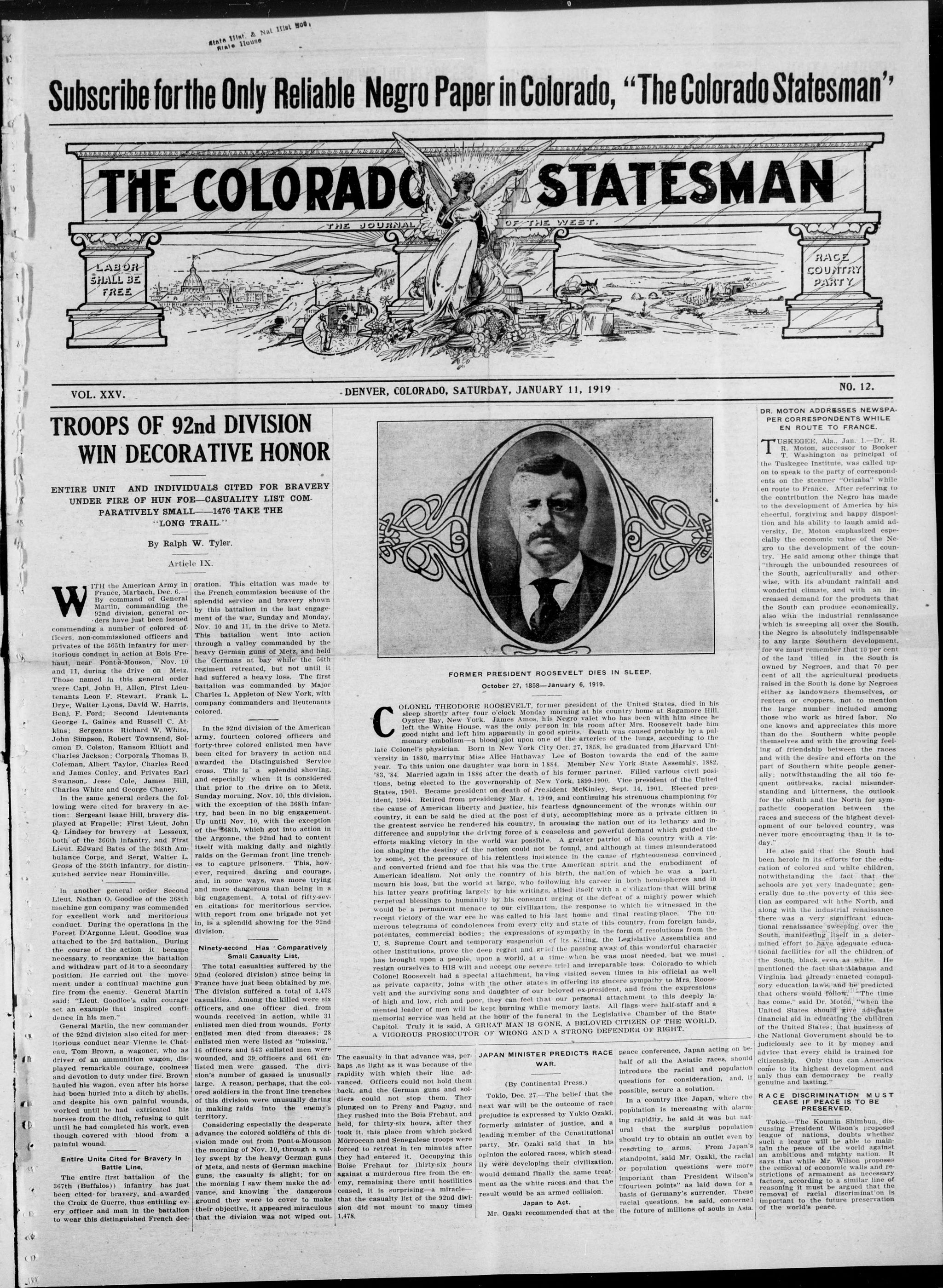
Page text (machine-generated)
Subscribe forthe Only Reliable Negro Paper in Colorado, "The Colorado Statesman"
THE COLORADO STATESMAN
THE JOURNAL OF THE WEST.
LABOR SHALL BE FREE
RACE COUNTRY PARTY
TROOPS OF 92
WIN DECOR
ENTIRE UNIT AND INDIVIDUAL
UNDER FIRE OF HUN FOR
PARATIVELY SMALL
"LONG
TROOPS OF 92nd DIVISION WIN DECORATIVE HONOR
ENTIRE UNIT AND INDIVIDUALS CITED FOR BRAVERY UNDER FIRE OF HUN FOE—CASUALITY LIST COMPARATIVELY SMALL——1476 TAKE THE "LONG TRAIL."
By Ralph W. Tyler.
WITH the American Army in France, Marbach, Dec. 6. By command of General Martin, commanding the 92nd division, general orders have just been issued commending a number of colored officers, non-comissioned officers and privates of the 365th infantry for meritorious conduct in action at Bois Frehaut, near Pont-a-Mouson, Nov. 10 and 11, during the drive on Metz. Those named in this general order were Capt. John H. Allen, First Lieutenants Leon F. Stewart, Frank L. Drye, Walter Lyons, David W. Harris, Benj. F. Ford; Second Lieutenants George L. Gaines and Russell C. Atkins; Sergeants Richard W. White, John Simpson, Robert Townsend, Solomon D. Colston, Ransom Elliott and Charles Jackson; Corporals Thomas B. Coleman, Albert Taylor, Charles Reed and James Conley, and Privates Earl Swanson, Jesse Cole, James Hill, Charles White and George Chaney.
In the same general orders the following were cited for bravery in action: Sergeant Isaac Hill, bravery displayed at Frapelle; First Lieut, John Q. Lindsey for bravery at Lesseux, both of the 366th infantry, and First Lieut. Edward Bates of the 368th Ambulance Corps, and Sergt. Walter L. Gross of the 366th infantry, for distinguished service near Hominville.
In another general order Second Lieut. Nathan O. Goodloe of the 368th machine gun company was commended for excellent work and meritorious conduct. During the operations in the Forest D'Argonne Lieut. Goodloe was attached to the 3rd battalion. During the course of the action it became necessary to reorganize the battalion and withdraw part of it to a secondary position. He carried out the movement under a continual machine gun fire from the enemy. General Martin said: "Lieut. Goodloe's calm courage set an example that inspired confidence in his men."
General Martin, the new commander of the 92nd division also cited for meritorious conduct near Vienne le Chateau, Tom Brown, a wagoner, who as driver of an ammunition wagon, displayed remarkable courage, coolness and devotion to duty under fire. Brown hauled his wagon, even after his horse had been hurled into a ditch by shells, and despite his own painful wounds, worked until he had extricated his horses from the ditch, refusing to quit until he had completed his work, even though covered with blood from a painful wound.
Entire Units Cited for Bravery in Battle Line.
The entire first battalion of the 367th (Buffalos)) infantry has just been cited for bravery, and awarded the Croix de Guerre, thus entitling every officer and man in the battalion to wear this distinguished French dec-
VOL. XXV.
State Illist. & Nat Illist No
State House
The Only Reliable
COLOR
2nd DIVISION
CIVATIVE HONOR
DUALS CITED FOR BRAVERY
E—CASUALITY LIST COM-
L—1476 TAKE THE
TRAIL."
W. Tyler.
e IX.
oration. This citation was made by the French commission because of the splendid service and bravery shown by this battalion in the last engagement of the war, Sunday and Monday, Nov. 10 and 11, in the drive to Metz. This battalion went into action through a valley commanded by the heavy German guns of Metz, and held the Germans at bay while the 56th regiment retreated, but not until it had suffered a heavy loss. The first battalion was commanded by Major Charles L. Appleton of New York, with company commanders and lieutenants colored.
In the 92nd division of the American army, fourteen colored officers and forty-three colored enlisted men have been cited for bravery in action and awarded the Distinguished Service cross. This is a splendid showing, and especially when it is considered that prior to the drive on to Metz, Sunday morning, Nov. 10, this division, with the exception of the 368th infantry, had been in no big engagement. Up until Nov. 10, with the exception of the 368th, which got into action in the Argonne, the 92nd had to content itself with making daily and nightly raids on the German front line trenches to capture prisoners. This, however, required daring and courage, and, in some ways, was more trying and more dangerous than being in a big engagement. A total of fifty-seven citations for meritorious service, with report from one brigade not yet in, is a splendid showing for the 92nd division.
Ninety-second Has 'Comparatively Small Casualty List.
The total casualties suffered by the 92nd (colored division) since being in France have just been obtained by me. The division suffered a total of 1,478 casualties. Among the killed were six officers, and one officer died from wounds received in action, while 31 enlisted men died from wounds. Forty enlisted men died from diseases; 28 enlisted men were listed as "missing," 16 officers and 543 enlisted men were wounded, and 39 officers and 661 enlisted men were gassed. The division's number of gassed is unusually large. A reason, perhaps, that the colored soldiers in the front line trenches of this division were unusually daring in making raids into the enemy's territory.
Considering especially the desperate advance the colored soldiers of this division made out from Pont-a-Mousson the morning of Nov. 10, through a valley swept by the heavy German guns of Metz, and nests of German machine guns, the casualty is slight; for on the morning I saw them make the advance, and knowing the dangerous ground they were to cover to make their objective, it appeared miraculous that the division was not wiped out.
---
Article IX
-DENVER, COLORADO, SATURDAY, JANUARY 11, 1919
[Portrait of a man in formal attire, framed by an ornate decorative border].
COLONEL THEODORE ROOSEVELT, former president of the United States, died in his sleep shortly after four o'clock Monday morning at his country home at Sagamore Hill, Oyster Bay, New York. James Amos, his Negro valet who has been with him since he left the White House, was the only person in his room after Mrs. Roosevelt bade him good night and left him apparently in good spirits. Death was caused probably by a pulmonary embolism—a blood clot upon one of the arteries of the lungs, according to the late Colonel's physician. Born in New York City Oct. 27, 1858, he graduated from Harvard University in 1880, marrying Miss Alice Hathaway Lee of Boston towards the end of the same year. To this union one daughter was born in 1884. Member New York State Assembly, 1882, '83, '84. Married again in 1886 after the death of his former partner. Filled various civil positions, being elected to the governorship of New York, 1899-1900. Vice president of the United States, 1901. Became president on death of President McKinley, Sept. 14, 1901. Elected president, 1904. Retired from presidency Mar. 4, 1909, and continuing his strenuous championing for the cause of American liberty and justice, his fearless denouncement of the wrongs within our country, it can be said he died at the post of duty, accomplishing more as a private citizen in the greatest service he rendered his country, in arousing the nation out of its lethargy and indifference and supplying the driving force of a ceaseless and powerful demand which guided the efforts making victory in the world war possible. A greater patriot of his country with a vision shaping the destiny of the nation could not be found, and although at times misunderstood by some, yet the pressure of his relentless insistence in the cause of righteousness convinced and converted friend and foe that his was the true American spirit and the embodiment of American idealism. Not only the country of his birth, the nation of which he was a part, mourn his loss, but the world at large, who following his career in both hemispheres and in his latter years profiting largely by his writings, allied itself with a civilization that will bring perpetual blessings to humanity by his constant urging of the defeat of a mighty power which would be a permanent menace to our civilization, the response to which he witnessed in the recent victory of the war ere he was called to his last home and final resting place. The numerous telegrams of condolences from every city and state of this country, from foreign lands, potentates, commercial bodies; the expressions of sympathy in the form of resolutions from the U. S. Supreme Court and temporary suspension of its sitting, the Legislative Assemblies and other institutions, prove the deep regret and grief the passing away of this wonderful character has brought upon a people, upon a world, at a time when he was most needed, but we must resign ourselves to HIS will and accept our severe trial and irreparable loss. Colorado to which Colonel Roosevelt had a special attachment, having visited seven times in his official as well as private capacity, joins with the other states in offering its sincere sympathy to Mrs. Roosevelt and the surviving sons and daughter of our beloved ex-president, and from the expressions of high and low, rich and poor, they can feel that our personal attachment to this deeply lamented leader of men will be kept burning while memory lasts. All flags were half-staff and a memorial service was held at the hour of the funeral in the Legislative Chamber of the State Capitol. Truly it is said, A GREAT MAN IS GONE, A BELOVED CITIZEN OF THE WORLD, A VIGOROUS PROSECUTOR OF WRONG AND A STRONG DEFENDER OF RIGHT.
The casualty in that advance was, perhaps, as light as it was because of the rapidity with which their line advanced. Officers could not hold them back, and the German guns and soldiers could not stop them. They plunged on to Preny and Paguy, and they rushed into the Bois Frehaut, and held, for thirty-six hours, after they took it, this place from which picked Morrocan and Senegalese troops were forced to retreat in ten minutes after they had entered it. Occupying this Boise Frehaut for thirty-six hours against a murderous fire from the enemy, remaining there until hostilities ceased, it is surprising—a miracle—that the casualty list of the 92nd division did not mount to many times 1,478.
(By Continental Press.)
Tokio, Dec. 27.—The belief that the next war will be the outcome of race prejudice is expressed by Yukio Ozaki, former minister of justice, and a leading member of the Constitutional party. Mr. Ozaki said that in his opinion the colored races, which steadily were developing their civilization, would demand finally the same treatment as the white races and that the result would be an armed collision.
Japan to Act.
Mr. Ozaki recommended that at the
peace conference, Japan acting on behalf of all the Asiatic races, should introduce the racial and population questions for consideration, and, if possible, secure a solution. In a country like Japan, where the population is increasing with alarming rapidity, he said it was but natural that the surplus population should try to obtain an outlet even by resorting to arms. From Japan's standpoint, said Mr. Ozaki, the racial or population questions were more important than President Wilson's "fourteen points" as laid down for a basis of Germany's surrender. These racial questions, he said, concerned the future of millions of souls in Asia.
NO.12.
DR. MOTON ADDRESSES NEWSPAPER CORRESPONDENTS WHILE EN ROUTE TO FRANCE.
TUSKEGEE, Ala., Jan. 1.—Dr. R. R. Moton, successor to Booker T. Washington as principal of the Tuskegee Institute, was called upon to speak to the party of correspondents on the steamer "Orizaba" while en route to France. After referring to the contribution the Negro has made to the development of America by his cheerful, forgiving and happy disposition and his ability to laugh amid adversity, Dr. Moton emphasized especially the economic value of the Negro to the development of the country. He said among other things that "through the unbounded resources of the South, agriculturally and otherwise, with its abundant rainfall and wonderful climate, and with an increased demand for the products that the South can produce economically, also with the industrial renaissance which is sweeping all over the South, the Negro is absolutely indispensable to any large Southern development; for we must remember that 10 per cent of the land tilled in the South is owned by Negroes, and that 70 per cent of all the agricultural products raised in the South is done by Negroes either as landowners themselves, or renters or croppers, not to mention the large number included among those who work as hired labor. No one knows and appreciates this more than do the Southern white people themselves and with the growing feeling of friendship between the races and with the desire and efforts on the part of Southern white people generally; notwithstanding the all too frequent outbreaks, racial misunderstanding and bitterness, the outlook for the oSouth and the North for sympathetic cooperation between the races and success of the highest development of our beloved country, was never more encouraging than it is today."
He also said that the South had been heroic in its efforts for the education of colored and white children, notwithstanding the fact that the schools are yet very inadequate; generally due to the poverty of this section as compared wit the North, and along with the industrial renaissance there was a very significant educational renaissance sweeping over the South, manifesting itself in a determined effort to have adequate educational facilities for all the children of the South, black even as white. He mentioned the fact that Alabama and Virginia had already enacted compulsory education laws, and he predicted that others would follow. "The time has come," said Dr. Moton, "when the United States should give adequate financial aid in educating the children of the United States; that business of the National Government should be to judiciously see to it by money and advice that every child is trained for citizenship. Only thus can America come to its highest development and only thus can democracy be really genuine and lasting."
RACE DISCRIMINATION MUST CEASE IF PEACE IS TO BE PRESERVED.
Tokio.-The Koumin Shimbun, discussing President Wilson's proposed league of nations, doubts whether such a league will be able to maintain the peace of the world against an ambitious and mighty nation. It says that while Mr. Wilson proposes the removal of economic walls and restrictions of armament as necessary factors, according to a similar line of reasoning it must be argued that the removal of racial discrimination is important to the future preservation of the world's peace.
FOREIGN
A strong movement is developing in Germany to replace the former kaiser on the throne. The Belgian minister of justice announces that all foreigners of enemy origin who had relations with the Germans during the war will be expelled from Belgium. The fourth son of William Hohenzollern, the former Prince August William, has taken a situation with a German automobile firm, according to a Berlin dispatch. President Poincare probably will visit the United States late in June or early in July. This announcement was made by the president himself in Paris this week. Herbert Hoover has been designated director general of food relief measures in restored, neutral and enemy territories, it was officially announced in Paris.
It has been learned in London that a hitch has occurred in the negotiations of the American Shipping Board for the purchase of the White Star line and that probably the proposed transfer will not take place. The Seine is steadily rising under the continuous rain and is threatening Paris with a repetition of the floods of 1910. River transport, which at the present time is more important than in normal times, already is almost suspended. The Dutch government has met favorably the request of the British government that facilities be granted for the transport of provisions for troops of occupation in Germany through Dutch waterways, and for the use of the Scheldt river for the passage on demobilized troops.
Beginning the Russian New Year the Kolchak government removes the prohibition on manufacture and sale of vodka. The prohibition was imposed by former Czar Nicholas. A license system will be adopted with high excise taxes to raise money to defray the cost of the new army.
Count von Bernstorff, former German ambassador to the United States, is working every day at the German foreign office preparing data for the peace conference, according to a Berlin dispatch to the Express. To the Express correspondent Count von Bernstorff said that he indorsed the plan for a league of nations.
SPORT
Willie Jackson of New York knocked out Dick Stoush of Cleveland in the first round of a scheduled six round bout in New York.
The Great Lakes naval basketball team defeated Northwestern university, 32 to 16, in a game characterized by many personal and technical fouls. Jack Dempsey started west to oper a theatrical tour, after having disposed of Gunboat Smith in the second round of their bout at Buffalo N. Y. Pacific Coast International League directors will meet in Seattle to consider a proposal that northwestern cities be included in the Pacific Coast League. Six clubs are in the field for the services of Bobby Roth, Cleveland out fielder. President Dunn is determined to trade Roth before the start of the 1919 season. John J. McGuigan, a widely known boxing referee and matchmaker, is dead at Philadelphia. McGuigan was until recently owner of the National Athletic Club in this city.
Ty Cobb, while passing through Montgomery, denied the report that he would leave the Detroit team. He said that all the players who entered the war were given their release, however, and that he probably will play with Detroit this year.
GENERAL
The Ohio Senate adopted the joint resolution ratifying the national prohibition amendment.
It is not beyond a reasonabl doubt that the former kaiser of Germany will surrender to the American army.
President Wilson was made a member of the Reale Accademia de Lincei, or Royal Academy of Science, in Rome.
John Walter Scott, one of the most widely known stamp collectors in the world, died at his home in New York. He was born in London 75 years ago.
Irvin S. Cobb, writer and humorist, was notified at Detroit by Deputy High Commissioner De Billy of France that he had been made a chevalier of the Legion of Honor.
In order to give permanent expression to "all Colonel Roosevelt stood for," the boys of the nation, 16,000 troops of the Boy Scouts of America, comprising 440,000 members, were instructed to plant one or more trees with suitable inscription and ceremony in memory of the former President.
When Scott Peters, a cleaner at Waukegan, Ill., announced he would clean and press, free of charge, any flag brought to his establishment so that clean bunting would greet the boys on their return from France, he little reckoned on the result. So many flags were brought to his shop that regular work had to be side-tracked.
The death of Theodore Roosevelt has brought sorrow to the heart of every Cuban, as he was regarded as Cuba's staunchest friend and benefactor. The city council of Havana has voted an appropriation of $25,000 for the erection of a monument to his memory.
August A. Busch, president of Anheuser-Busch, announced that he would complete the organization of the Bevo Packing Company which within two weeks will enter the pork packing business in St. Louis on a large scale.
CONDENSATION OF FRESH NEWS
THE LATEST IMPORTANT DISPATCHES PUT INTO SHORT,
CRISP PARAGRAPHS.
STORY OF THE WEEK
SHOWING THE PROGRESS OF EVENTS IN OUR OWN AND FOREIGN LANDS.
Western Newspaper Union News Service.
ABOUT THE WAR
Berlin is in a state of complete anarchy and civil war has begun there.
The port of Riga has been captured by the Bolshevik forces, according to reports.
Serbia's financial losses, due to the war, total 1,997,000,000 francs, according to a Belgrade dispatch to the Temps.
Lodz and other Polish cities are reported in a state of virtual anarchy, with the rougher element doing as it pleases.
In Esthonia, the Bolsheviks are marching on Reval and have reached Charlotenoff, about thirty miles east southeast of Reval. Thirty-three Americans left in a hospital by the Germans when they evacuated Metz cheered and shouted when two American Red Cross nurses arrived to care for them. Baron Haupt, the new Austrian minister at Berne, said that the sentiment in Austria is about evenly divided between the desire to join Germany or to remain an independent republic. Names of three officers and nearly 100 enlisted men who have reached France after being released from German prison camps, have been given out by the War Department at Washington.
Lieut. J. Montfort Schley, Jr., a cousin of the late Admiral Schley, wounded five times in seven hours during the second battle of the Marne, has received the croix de guerre, relatives in New York were informed.
The British government has not the slightest intention of sending any more troops to Russia. Not more than 20,000 British troops are in Russia, a number of which are non-combatant, and these are being brought back as quickly as possible.
Two hundred sailors are believed to have been drowned when the converted yacht Tolaire was dashed against the rocks while entering the harbor of Stornoway, Scotland. The sailors were bound for home on their first furlough of the entire war. A few swam ashore.
WESTERN
On Jan. 13, 14, 15 and 16 the Idaho Irrigation Congress will meet at Twin Falls to consider changes in Idaho's water code, and to make recommendations to the state Legislature for changes in existing irrigation laws. Bottles containing a phosphorescent and highly inflammable matter, discovered after the setting of haystack and other fires in California, were described by Sheriff Trafton of Santa Cruz county, witness in the trial of a group of Industrial Workers of the World, charged with various acts of sabotage in California.
Telegrams were sent to all import ant banks and bond brokers in the United States to watch for the appearance of bonds of the American Falls Securities Company, $54,600 of which were stolen from the desk of R. B. Bothwell at his home in Salt Lake City. The stolen certificates are in denominations of $1,000 and $100 and all are negotiable.
WASHINGTON
Employees of the Kansas City Railways Company, who have been on strike since Dec. 11, voted to offer to return to work.
The Mexican Congress, it was reported in Washington to the State Department, has granted special powers to President Carranza to raise or lower import and export duties at his discretion.
The departure from France of four transports with 2,000 troops was announced in cable advices to the War Department. They are the Toloa, the Ulua, the Abangarez and the Minnesotan.
An effort to send back to the elections committee a report favoring unseating Charles A. Sulzer, Democrat, as Alaskan delegate in the House, was blocked by Republican Leader Mann's refusal to give unanimous consent.
Documentary evidence intended to show that $380,000 worth of munitions shipped in 1915 to agents of Francisco Villa, the Mexican bandit leader, were paid for by F. A. Sommerfeld, now interned as an enemy alien, was presented to the Senate committee investigating German propaganda.
The Webb-Kenyon law forbidding shipment of liquor into a dry state is constitutional and does not violate the constitution in the regulation of interstate commerce, according to ruling just made by the Supreme Court of the United States.
Internal revenue tax collections for five months between July 1 and Dec. 1, 1918, amounted to $621,697,000, the treasury reported. Of this amount $116,892,000 came from whisky and other spirits, $75,988,000 from tobacco and $46,179,000 from beer and other fermented liquors.
SPORT
15,000 MARINE WORKERS OUT
NEW YORK PORT IS PRACTICAL LY PARALYZED AS RESULT OF STRIKE.
REFUSE TO MEDIATE
REFUSE TO MEDIATE
FOOD SUPPLIES WILL BE EX
HAUSTED WITHIN FORTY-EIGHT
HOURS REPORTED.
Western Newspaper Union News Service.
New York, Jan. 10.—The port of New York is practically paralyzed as the result of the strike of approximately 15,000 marine workers. The city and its environs is confronted by a situation which is believed by many to be the most precarious in its history.
Except for a small fleet of ferry-boats, tugs and lighters engaged in debarkation of home-coming troops and loading of perishable supplies for the American expeditionary forces, harbor shipping is at a standstill following the strikers' attempt to force arbitration of their demands for higher wages and an eight-hour day.
Not only privately-owned craft, but the boats of the railroad administration, 1,200 in number, were tied up, and the sailing or berthing of ocean steamships, as well as the ferrying of passengers between Manhattan and its neighboring boroughs and suburbs, was impossible.
A vote will be taken by 45,000 longshoremen today to determine if they will walk out in a sympathetic strike.
Unless railroads can bring food into New York by roundabout routes, the hunger point may be reached within forty-eight hours, and the lives of thousands imperiled as the result of the marine workers' strike, which tied up virtually all traffic in the harbor.
A. H. Smith, regional railroad director, asked for "a forty-eight-hour armistice," and stated if this was granted, the strike could be settled "across the table." At a conference with Mr. Smith, however, the men told him the proposal could not be considered until the general strike committee held a meeting. It was stated at Mr. Smith's office that to avert possible famine, livestock, foodstuffs and milk were being given preference over all other freight coming into the city. The milk situation was described as "even worse than that of solid food," as there were thousands of babies and invalids who must be supplied.
Agree on Income for 1920.
Washington.—The conferees of the Senate and the House on the revenue bill agreed to the Senate amendments on the normal income tax rate, the individual income surtaxes and the exemption of state, county and city bonds from taxation. The normal income tax rate for the ensuing year under the agreement will be 12 per cent of the net income in excess of the personal exemption of $1,000 for a single man and $2,000 for a married man and $200 for each dependent child; upon the first $4,000 of such income, however, the rate will be only 6 per cent.
Cecil Next British Envoy.
Paris.—The earl of Reading will not return to Washington as British high commissioner and special ambassador to the United States, according to a London dispatch. It is said that Lord Robert Cecil, former assistant secretary of state for foreign affairs, will succeed him.
Cancels Fuel Saving Orders.
Washington.—All orders and regulations as to fuel conservation, except one relating to natural gas, are withdrawn by the fuel administration. Regulations as to zones and prices and some others remain in effect, but in accordance with the announced policy of the administration, the question of fuel saving is now once more a matter for individual determination.
May Sign Treaty In February
London.—The initial peace treaty probably will be signed before the end of February. Germany again has a proached the allies with a view to having the negotiations concluded as soon as possible. The feeling in the allied countries appears to favor the utmost expedition possible.
Would Hang Hun Murderers.
Montreal.—"Every German who has committed murder on the high seas must be taken out to sea on a sailing ship and strung up on the yard arm," said Harry Lauder, the Scotch comedian, in an address before the Canadian Club here.
May Destroy Dardanelles.
London.—The allies have served notice on Turkey that, unless the Turkish commander and the garrison at Medina surrender immediately, the forts on the Dardanelles will be destroyed. A British force has been sent into the Caucasus to force the two Turkish army corps there to depart and thus end the fighting between the Georgians, Armenians and others. The evacuation of 80,000 Turkish troops in that region is being carried out slowly, with the soldiers burning and pillaging as they go
SESSION IN FULL SWING
COLORADO LEGISLATURE IS GET-
TING DOWN TO BUSINESS.
Many Bills Have Been Introduced in Both Branches—Recess Appointments Being Considered.
Western Newpaper Union News Service.
The list of recess appointments by Governor Gunter are in the hands of the Senate for confirmation and are as follows:
Member Commission for the Promotion ofUniform State Laws—Fred W. Stow, Fort Collins; appointed in April,1917.
Commissioner State Home and Training School for Mental Defectives—Thomas F. Daly, Denver; appointed April 27, 1917.
Members Board of Commissioners of the Soldiers and Sailors' Home—Mrs. Lora M. Ginders, Monte Vista, appointed June 25, 1917 H. S. Maughn, appointed August 11, 1917.
Irrigation Division Engineers—Hemon C. Getty, Delta, to be irrigation division engineer for Division No. 4, appointed July 6, 1917; E. S. Counselor, Antonito, to be irrigation division engineer for Division No. 3, appointed March 25, 1918.
Member Industrial Commission—Joseph C. Bell, Trinidad, appointed Sept. 1, 1918.
Member Public Utilities Commission—Leroy I. Williams, Central City, appointed Jan. 27, 1918.
Fish and Game Commissioner—Walter B. Fraser, Denver, appointed Feb. 2.
Public Trustee, Weld County—M. J. Walsh, Greeley, appointed May 10, 1918.
Member Board of Control, A. Anderson, Morrison, appointed May 4, A. Anderson, Morrison, appointed May 31, 1918.
Member Colorado Board of Corrections, Charles J. Moynihan, Montrose, appointed May 31, 1918.
Members State Board of Health—Dr. F. P. Hanson, Gunnison, appointed July 5, 1918; Dr. A. J. Monahan, Pueblo, appointed July 5, 1918.
Members Board of Trustees Colorado School for the Denf and Blind—J. Alfred Ritter, Colorado Springs, appointed Sept. 11, 1918; William H. Young, Pueblo, appointed Dec. 24, 1918.
Member State Board of Immigration—Arthur H. King, Sterling, appointed Nov. 8, 1918.
Judges of the District Court—Francis E. Bouck, Leadville, to be judge of the Fifth judicial district, appointed July 25, 1918; G. H. Bradfield, Greeley, to be judge of the Eighth judicial district, appointed Dec. 31, 1918.
Oliver H. Shoup's plurality over Thomas J. Tynan for governor in the November election was 10,296 votes, according to the official canvass of executive officers conducted by the Senate and House of the Legislature in joint session. Leslie E. Hubbard, Democratic candidate for attorney general, was defeated by Victor E. Keyes, the Republican nominee, by only 949 votes, the count showed. The recheck was completed within two hours, which set a record for that work.
House bill No. 1 is identical with Senate bill No. 2. It provides for a "blue sky" law, drawn in accordance with the ideas of the National Association of Securities commissioners, and modeled after the Kansas, Ohio, Minnesota and Michigan "blue sky" statutes, with some modifications. It probably will be one of the first measures to come up on the Senate and House calendars for consideration. Both parties are pledged in their platforms to a "blue sky" law, and there is no clear party line drawn as between the different measures.
The virtual elimination of German language instruction from the public schools of Colorado is sought in one of the bills introduced in the Senate. Languages permitted to be introduced in school curriculums or as the tongue in which other branches may be taught, upon application by twenty or more parents or guardians of school children in any district, are restricted to French, Italian and Spanish. Permission to admit other languages, however, is placed in the discretion of school boards under the proposed measure.
School teachers in Colorado who are more than 60 years old, if men, and 55 years, if women, are to receive a monthly pension of $30 from the school district in which they reside, provided they have been in service twenty-five years and in the district for fifteen years, if a bill introduced in the Senate becomes a law.
House bill No. 2 proposes to place superintendents, supervisors and employés of the state penitentiary and of the other state penal institutions under the operation of the eight-hour law.
Dr. May Bigelow has prepared a bill which amends the present school law concerning medical examination for children of the public schools and provides that no person shall be given a certificate to teach in the public schools of this state who has not given satisfactory evidence of competency to perform the duties of a teacher.
If House bills Nos. 3 and 4 are enacted by the Legislature no hunter may trap a bear and leave it to suffer in the trap and a closed season will be established for the killing of bears.
The Legislature now in session will be given an opportunity to pass the educational code prepared by experts for the Denver Civic and Commercial Association, but turned down by the Legislature of 1917. This code, it is held, will give not only Denver and other cities of the state, but the rural districts as well, a school system excelled nowhere in the country.
In passing the revenue bill members of the Senate were convinced of the unfairness in placing a 5 per cent tax on trucks, tractors, trailers and parts thereof, and they were eliminated, leaving proposed taxes of 5 per cent on the sale of passenger cars by the manufacturers, and 5 per cent on the sale of tires, tubes, parts and accessories for passenger cars.
The papers filed in the Radinsky contest for the seat occupied by the House by W. C. Sweinhart of Adams county were referred to the elections committee.
CENTENNIAL STATE ITEMS.
The mine output of gold, silver, copper, lead and zinc in Colorado for the first eleven months of 1918 and the estimated output for December, according to data compiled by Charles W. Henderson of the United States Geological Survey, Department of the Interior, amounted to $12,950,000 in gold, 7,120,000 ounces of silver, 64,300,000 pounds of lead, 6,450,000 pounds of copper and 85,200,000 pounds of zinc, having a total value of $33,260,000, compared with $15,849,302 in gold, 7,304,350 ounces of silver, 67,990,-000 pounds of lead, 8,122,000 pounds of copper and 118,200,000 pounds of zinc, having a total value of $41,938,935 in 1917. This estimate shows a decrease of $2,900,000 in gold, 184,000 ounces in silver, 3,690,000 pounds in lead, 1,660,000 pounds in copper and 38,500,000 pounds in zinc. At the increased price for silver the value of the silver yield was $880,000 greater than in 1917, but the value of copper decreased $624,000, lead $1,025,000 and zinc $9,520,000.
A vivid dream of the death of Colonel Roosevelt caused Mrs. Sarah Lewis, mother of George Lewis of the mountain division of the Red Cross, extreme anxiety Sunday morning. For many years Mrs. Lewis has been a sincere admirer of the colonel, and his recent illness worried her constantly. When she awoke she said that she had dreamed that the colonel had died while asleep. She insisted on seeing a newspaper at once, and only after reading it did Mrs. Lewis feel more confident that it was but a dream and not a premonition. But twenty-four hours after premonition, however, Mrs. Lewis read in Monday's extras that Colonel Roosevelt had died that morning just as she had dreamed.
The receipts of the State Board of Land Commissioners from transactions in Colorado lands during the biennial period just closed were the greatest ever recorded in the history of the state, aggregating $2,509,238.52, or $720,807.98 in excess of receipts for the preceding biennium. The 1917-18 total is $1,000,000 greater than the receipts for any equal period between 1909 and 1915.
As a headquarters city for federal bureaus, Denver ranks next to Washington, even New York, Chicago and other cities being below Denver. These bureaus in Denver have charge of vast areas in the Western states, notably the forestry, reclamation and grazing bureaus. Denver has been made the center of so many government activities because of its central location.
Hog cholera, which has been raging in Uncompahgre valley for the last few weeks, has been brought entirely under control and no new outbreaks have been reported. H. A. Lindgren government livestock expert, says the disease will end without much further loss to the growers. More than 5,000 hogs have been vaccinated with anticholera serum and 185 herds immunized.
Lute M. Wilcox was re-elected president of the workers for the blind at a meeting in Denver. Miss Katherine L. Craig was elected vice president and Edwin J. Clark secretary and treasurer. The other members of the board of directors are Elias M. Amons, L. C. Jackson, Harley S. Fritchie and A. J. Closson.
More than $50,000,000 was paid out to American farmers in the year 1918 for sugar beets, one-fifth of what they would receive if domestic production equaled consumption. The home production of one ton of beet sugar returns as much to American labor as the refining of eleven tons of foreign raw sugar. The basketball season will open on Jan. 24. The opening Denver date will be the Miners vs. D. U. at University Park.
The twenty-second annual convention of the American National Livestock Association will be held at the Broadway theater Jan. 21, 22 and 23. The program of speakers includes many prominent government officials and livestock men. The convention will be devoted to a discussion of topics of vital importance to the grazing industry. Among the subjects for consideration which are of local interest is the proposed advance in grazing fees on national forests. The advances were ordered by the secretary of agriculture early in December of 1918, and became effective Jan. 1.
William G. McAdoo, director general of railroads, W. F. Thiehoff, acting general manager of the Denver & Salt Lake railroad; Hale Holden, regional director, and Charles Boettcher and W. B. Freeman, receivers of the railroad, are named as defendants in a suit for $30,000 damages brought by Mrs. Bertha A. Bonham for the death of her husband, Charles Pearl Bonham. Bonham was conductor of a freight train which was struck by two cars, running wild, near Tolland, July 3, 1918. He was killed and the caboose in which he was riding was wrecked.
Governor Shoup's address was one of the shortest ever delivered for a Colorado Legislature and was as follows: "I have just been getting acquainted with a lot of new friends, and am ready to become acquainted with a lot of new responsibilities and duties, which I shall endeavor, with your cooperation, to shape into success for Colorado." After experimenting four years the Colorado State Agricultural College has discovered a vaccine that is believed a cure or a preventive of a common plague among sheep.
Pithy News Notes From All Parts of Colorado
Western Newspaper Union News Service.
COMING EVENTS.
Jan. 20-21—Mid-winter meeting of Colorado Editorial Association at Denver.
Jan. 21—Meeting Colorado-County Commissioners at Denver.
Jan. 22—Mountain Growers' Association meeting at Denver.
Jan. 22—Meeting Farmers' Educational Cooperative Union at Denver.
Jan. 21-23—Mountain States Lumber Dealers' Association meeting in Denver.
Jan. 23-24 Hardware and Implement
Dealers' meeting at Denver.
Dealers' meeting at Jan. 23-24 Western Shorthorn Breed- Denver.
ers' Association at Denver. Jan. 23-24—Meeting Oldtime Cowboys'
Association in Denver
Jim Brennan's Association Colorado Horse
Breeders' Association at Denver.
Jan. 26—Meeting Colorado Auctioneers'
Association at Denver.
Jan. 21-26 - Western Stock Show at Denver.
Denver
Jan. 21-23—Meeting American National
Live Stock Association at Denver.
The annual intercollegiate track
and field meet will be held in Denver
on May 21 at Union park.
Mrs. R. D. Shaw, formerly of Denver, died at Fort Collins after a four days' illness with pneumonia.
The kettle has begun to call the pot black in the hearings in progress before the Adams county grand jury.
Farmers in the Hayden district received more money for the 1918 crops per acre than the previous value of the land.
Certificates of honorable service will be given men leaving the naval service before the expiration of their terms of enlistment.
Nearly every city in Colorado will probably get one or two German cannons for park or court house decorations if the present plans work out. Colorado Springs' first wounded war veteran returned last week. He is Earl Kinsman, who lost an arm in the fighting at Chateau Thierry, July 30. Leadville's metal production in 1918 had a value of $478,925,416—a record of which "the highest mining town in the world" may well be proud. Ex-Governor Carlson addressed the meeting of the Denver Manufacturers' Association in conjunction with inviting soldiers to discuss the problem of re-employment. Colorado will have a general revenue surplus of more than $725,000 when the tax inheritance collections for 1918 are all in, according to State Auditor Charles Leekenby.
The federal bank at Wichita, according to a report just issued, made loans during November to eighty-five Colorado farmers, for a total of $201,100. During the same period, twenty-two Colorado loans, for a total of $73,800 were paid off.
Soldiers who have been undeservedly though technically branded on the government records as "deserters," are to have the stigma removed wherever possible. The aid of every loyal citizen in Colorado is asked to see that this is done.
Colorado still has unsold 3,113,607 acres of land belonging mainly to the school fund, but also the property of other state institutions such as the penitentiary. Agricultural College, State University, public buildings and internal improvements.
The State Highway Commission in making up its 1919 budget has laid as extensive a foundation as its funds will permit for a system of permanent roads. In forming a nucleus for this system it has selected a dozen traffic concentration points for the construction of concrete roadway, with the idea of branching out from these centers along the main thoroughfares as rapidly as money can be obtained for the purpose.
Federal, state and city flags have been officially ordered at half staff out of respect to the memory of ex-President Roosevelt. Federal officials are following the example of the authorities at Washington, while Governor Gunter and Mayor Mills issued the instructions for the state and city institutions respectively.
City Commissioner Andrew W. Frandsen was the first Montrose man to be fined for violation of the new quarantine regulations. His children came down town and the commissioner was at once handed a request to appear before Justice W. H. Franklin. He was fined $6.75. A daughter of Mr. Frandsen is ill with influenza.
There are seventeen national forests wholly within the confines of Colorado and two partly within the state with 13,367,598 acres that are inside the borders. Within these forests private owners have 1,510,421 acres, making a total of 14,878,019 acres embraced within the national forests. The largest is the Rio Grande forest with 1,136,884 acres. It is estimated that there are 18,000,000 board feet of timber in these forests worth approximately $36,000,000.
That a dehydrating plant will be located at Greeley within a short time has been assured the manufacturing committee of the Greeley Commercial Club.
C. B. Miller of Denver reported to the police that someone entered his room when he left it for a few minutes and stole his trousers with $95 in the pockets.
Robert Wallace was crushed to death at Boulder when something went wrong with the hoisting machinery of a mine in which he was employed as cage operator.
COL. ROOSEVELT TAKEN BY DEATH
Former President of United States Succumbs Suddenly at Oyster Bay.
HAD BEEN ILL FOR ONE YEAR
His Extraordinary Career as Leader of Men and Maker of History—Noted as Statesman, Soldier. Author and Explorer.
New York—Col. Theodore Roosevelt died suddenly at an early hour Monday morning at his home in Oyster Bay. His physicians said death was caused by pulmonary embolism, or the lodging in the lung of a clot of blood from a broken, vein.
Colonel Roosevelt's last illness may he said to date from last February. On February 5, it was announced that he had been removed from his home in Oyster Bay to the Roosevelt hospital in this city, following an operation on one of his ears. Soon after his arrival at the hospital he underwent two more operations for the removal of diseased tissue in his infected car, and it was admitted at the time that he was seriously ill. He remained at the hospital until March 3.
Early in November the colonel was taken to Roosevelt hospital in this city for the treatment of rheumatism and sciatica.
Was Typical American.
Theodore Roosevelt, who was known as "the most typical American" throughout his career, had been famous for "setting records." He was the youngest president the nation ever had, succeeding to the office on William McKinley's death at the age of forty-two.
Colonel Roosevelt is held to have had as diverse interests and as wide acquaintance with all phases of life as any man in history. In addition to his immense political activities, he was the author of many books on travel, sport, history, politics and other subjects, was a fighter for reform from the moment he first appeared in city politics in New York, a holder of many university degrees, an orator, a lecturer, great hunter, athlete, international peacemaker and militant leader of his followers at all times, whether in or out of office.
Was Born in New York City.
Theodore Roosevelt was born October 27, 1858, in New York city. His father was Theodore Roosevelt and his mother before her marriage was Martha Bullock. The boy began life with a small, frail body and not robust health. His ambition from youth was to be strong, an athlete, a doer of great deeds and a scholar as well. His remarkable mental endowment was shown in the way he accomplished the dual object in life, so that after seven years and a half as president, during which he promulgated innumerable reforms and national issues, he went to Africa and for nearly a year was a hunter in the jungles, undergoing hardships, but coming out more robust and active than ever.
It was predicted that Africa would kill Roosevelt, but in a few days' time he had changed the hunting shirt for the clothes of the diplomat and was being idolized and showered with honors in the courts of Europe.
Starts His Political Career.
Roosevelt completed his education at Harvard university in 1880, and the same year married Alice Hathaway Lee, daughter of George Cabot Lee of New York. She lived only four years and was the mother of the present Mrs. Alice Roosevelt Longworth, wife of Congressman Nicholas Longworth of Cincinnati, O. Colonel Roosevelt's interest in politics dates from the year after his marriage to Miss Lee. Some of the Republican district leaders in New York had taken an interest in him. He seemed a likely young fellow, with vigor, ambition and some money. Two years later he was sent to the state assembly at Albany and began a career which marked him out as a man devoted to the public interest.
After three years of assembly, however, Roosevelt thought he had enough, and for a time withdrew from public life. He stepped out cordially hated by the corrupt politicians, disliked by many wealthy New Yorkers and already hailed as the acknowledged leader of the reform element in his party. The death of his wife also was a factor in his temporary retirement, and he went to a ranch in North Dakota, where he was introduced as "that four-eyed tenderfoot." The tenderfoot, however, put in practice some fundamental rules for honesty in the conduct of the ranch he had purchased and the names of derision were soon dropped. He became popular, a noted hunter, a good shot and provided himself during his years of
"FLU" MANY CENTURIES OLD
Altogether a Mistake to Think That Disease Is in Any Manner Modern.
Most of us think that the influenza is a comparative modern disease, but this is not so. We have records of it as far back as 1173 and from 1510 on it is absolutely identified as the same influenza epidemic that has just swept over the world. In the sixteenth century there were three such epidemics,
roughing it with a good constitution which was to prove invaluable to him later in life.
In 1886 Roosevelt became a candidate for mayor of New York, but ran third. His reputation was enhanced, however, and President Harrison named him for a place on the national civil service commission. He dominated the body and later became its president.
It was in 1886 that Mr. Roosevelt married Miss Edith Kermit Carow while in London. She was the daughter of Charles Carow of New York.
In the Spanish War.
In 1893 Roosevelt resigned from the civil service commission and began a fight on Tammany hall. He served two years as police commissioner of New York city, stirring up the corruptionists, and then President McKinley made him assistant secretary of the navy. When the Maine was blown up he resigned and helped raise the first volunteer regiment of cavalry for the war with Spain. It was the famous rough riders, of which Leonard Wood was made colonel.
Colonel Wood was later given a brigade and Roosevelt promoted to command of the Rough Riders. Colonel Roosevelt was commended for heroic conduct at the battles of Las Guaymas and San Juan hill.
Coming back from the war, Roosevelt was elected governor of New York. But he would not be bossed by the politicians, so instead of giving him a second term they persuaded him to take the nomination for vice president on the ticket with McKinley. When President McKinley, shot by an assassin, died on September 14, 1901, Roosevelt became president.
President Roosevelt served out McKinley's unexpired term and was elected president in 1904 by the largest majority ever given a candidate for the office. In his seven and a half years in the White House he had ample opportunity to show the stuff that was in him. He lived deeply and broadly and was at once the accomplished man of the world, the student of national problems, as well as of books, the adroit politician, the forceful writer of books and eloquent public speaker.
He had the happy knack of inventing or reviving phrases that strayed in the memory of his hearers and those who heard him usually carried away with them an apt summary of conditions so cleverly worded as to be not easily forgotten.
As president, Roosevelt's activities and scope of endeavor were immense; he became a great international figure through his many negotiations with foreign powers and took in hand many problems at home seldom touched by a president.
Booms Taft for Presidency.
Roosevelt declined a second elective term in 1908 and fostered the candidacy of his secretary of war, William H. Taft, who was elected president. When he left office, March 4, 1909, Roosevelt was the unquestioned leader of his party. Taft was his close friend. Roosevelt went to Africa to secure specimens for museums and also, it is understood, to be out of the country and escape possible accusations of attempting to influence the conduct of the new administration.
Colonel Roosevelt was a mighty hunter. His exploits in killing big game in equatorial Africa are well known through the book which he wrote on the subject.
It was in the summer of 1910 that Colonel Roosevelt traveled through the country promulgating his doctrine of of the "new nationalism," and the next year he editorially attacked arbitration treaties with Great Britain and France, proposed by President Taft.
Candidate of Progressives.
At the Republican convention in Chicago, beginning June 18, 1912, Taft was nominated by 21 votes over a majority, but a few hours before the nomination Roosevelt had withdrawn his name as a candidate, and that night at a meeting in Orchestra hall, Chicago, the Progressive party was given its first real impetus in a demonstration for Roosevelt and at which he was named for president by the new party. A formal convention was held later and he ran as the regular candidate of the third party, drawing support from Republicans and Democrats alike. Woodrow Wilson, the Democrat, was elected, however, and the colonel had to be content with defeating Mr. Taft for second place.
In 1914 Colonel Roosevelt led a party of exploration in South America, especially in the interior of Brazil. Then he made another tour of Europe. In 1916 he was again considered as a candidate for the presidential nomination by the Progressives, but at the last minute he declined the honor, declaring his intention of supporting Mr. Hughes, the Republican nominee. Since that time he had devoted his efforts largely to the task of teaching the need of military preparedness and to helping, with his pen, in the war against the central powers. He sought a chance to serve in the army, but was rejected. His three sons were officers in active service, and one, Quentin, was killed in an airplane combat.
in the seventeenth and eighteenth, 12, and in the nineteenth, six. In 1510 historians tell us that hardly a soul in Europe evaded it.
The word influenza shows that the disease has been known a long time, for it is from the Italian and means influence. It was supposed to be caused by some malign influence of the planets or of supernatural beings.
It was not until recently that the germ has been discovered. Great strides in its treatment and cure were made in the recent siege.
TREND IS TOWARD FEDERAL CONTROL
EVIDENCE OF THIS IN KENYON'S RESOLUTION CONCERNING WELFARE OF PEOPLE.
INVOLVES ADVANCE IDEAS
Business Man Who Has Been Working in Washington Tells How Red Tape Hampered—Dodging Blame for Building Locations.
By ARTHUR W. DUNN.
Washington.—As an evidence of the trend toward government control, which was given such an impetus by our entry into the war, a recent resolution introduced by Senator Kenyon of Iowa and adopted by the senate may be cited. This resolution instructed the committee on education and labor to make numerous inquiries and recommendations, which included a tribunal to settle difficulties between employers and workmen; to further the development of the United States employment service; to prevent unemployment among workers; to promote better living conditions; possible extension of the soldiers' insurance law against unemployment, old age, etc.; the feasibility of a national minimum wage law; and the extending of vocational training and education to all people disabled by injury or sickness. The senate committee is already investigating this subject, and it may make a report favoring some, if not all, of the idens outlined in the resolution. There are a great many public men who believe it is the duty of the United States to take into consideration all these questions involving employment and the welfare of people who live by labor. Of course there must be a vast amount of discussion of such a subject as this before it reaches any stage of finality.
The big business men who came to Washington to help run affairs during the war had some troubles of their own, which were explained by one of them about to depart, his work having been finished. He said that when he arrived in Washington he met quite a number of men with whom he had been more or less associated in business affairs and was informed by them that he would meet in Washington either "socialists or stuffed shirts." This phrase was not elaborated, but the business man went on to explain that the average man who came to Washington generally found himself up against a lot of men with salaries of $2,500 or $2,000 a year, who were obstructionists. They were the class of men who had been long in the government service and they always found means to block straightforward business methods; they were the red-tape artists; they were the men who were always digging up laws, rules, regulations, precedents, etc., which would prove to the active business man that he could not pursue what he considered common-sense methods. "Call them, and 90 per cent of them are not there," was the way this business man who had been doing war work sized them up. He said one reason why a great deal of war work had been successful was because the business men disregarded much of the red tape and moth-eaten systems of the past.
There has been quite a long discussion in the senate on the housing proposition and a great deal of criticism of the project which covered the large Union Station plaza with structures intended to house the many clerks that were overcrowding Washington. During this criticism Senator McLean of Connecticut put the flat question to Senator Reed of Missouri as to who was responsible for locating these buildings. The Missouri senator, who is chairman of the committee on public buildings and grounds, remarked that perhaps some member of the committee could answer that question, and Senator Hardwick of Georgia, who felt the heavy hand of the president in his recent contest for the senate, did not hesitate to remark: "Mr. Eidlitz said that he and some of his people went around and finally they got the president and took him around and showed him those lots and he picked out the site. The president of course, did it all, Eidlitz says." Eidlitz is the man who had charge of the housing program. Senator Reed remarked that he "found it generally true that when people do anything that gets unpopular they always, some way or other, say that the president did it."
The enormous program of relief work which the Red Cross has been carrying on in Europe will naturally dwindle as things begin to right themselves. Henry P. Davison, chairman of the Red Cross war council, outlined the situation in a statement as follows; "The great tasks of fighting tuberculosis, promoting child welfare, and caring for refugees, with which the American Red Cross has concerned itself so effectively in France, Italy and Belgium, will at an early date be assumed by the governments, the Red Cross organizations, and the relief societies of those countries, which, now that they are released from the terrific burden of waging war, naturally desire to take care of their own people."
Although it is generally believed by the "drys" that the legislatures which will meet this coming winter will ratify the pending constitutional amendment providing for
prohibition in the United States, there is still a fight being made to prevent such ratification and the opinion is expressed by some that $ ^{14} $ dry laws can be seen in operation for a year or two more it will suffice to prevent the United States from going entirely dry. There is an effort being made to prevent action in legislatures this winter until the country has had an example of being absolutely dry, which will be the case under the law recently passed and signed by President Wilson, which goes into effect July 1, 1919.
There has been quite an object lesson for people in the national capital, which is dry by legislation, but which is rather wet by reason of the various methods that have been adopted to obtain liquors. Since the District of Columbia was made dry by legislation we have become familiar with the terms "bootlegger," "blind pig," "spen's easy" and similar expressions which have always been used for the purpose of designating illegal traffic in intoxicating liquors. Perhaps there will be an opportunity to shut out what is known as the bootlegging process of bringing in liquor, and also the large shipments by express which are now permitted, so long as those who receive the liquor make affidavit that it is for their "personal use." Senator Sheppard of Texas, who is the author of most of the dry legislation, proposes to apply the Reed bone-dry law to the District, which would serve as a good test as to whether the national capital can be made actually dry.
Vigorous language is sometimes used in the senate. Senator King of Utah, for instance, in speaking about Hog Island, remarked that there was "a great deal of vulgar robbery, stealing, thevery, by men engaged in the Hog Island enterprise." Whereupon Senator Vardaman of Mississippi said that "the language employed by Senator King, when we consider the provocation, is very moderate in characterization of the subject." He went on to speak more on the same subject, and said that the enterprise "is the most shameful scheme to rob the public treasury that has been entered into since 1914." Naturally remarks like this have brought back rejoinders from those who are criticized, and a naval officer connected with the Hog Island project has not hesitated to give the lie direct in denying these assertions.
For several months the house of representatives struggled with water power and water conservation bills. Bitter controversies arose over the subject. Finally it was found necessary to appoint a special committee composed of leading members of the committees on interstate and foreign commerce, agriculture and public lands, in order that they might agree upon a bill. Then a bill was sent in by the administration and after a long and tedious debate, it was passed. Another emergency water power bill was brought up and again after the consumption of much time it was passed.
What has become of those bills? They went to sleep safely and calmly in choice pigeonholes somewhere in the senate wing of the capitol. Month after month the senate dawled along, holding sessions of a few hours, and adjourning two or three days at a time, but there never seemed to be any pressure to bring out these water power conservation bills. As a matter of fact there was enough dynamite in those bills to have caused discussion in the senate lasting a year or two. The house seems to have felt that it performed its duty when it sent the bills to the senate, and as the measures were passed the members thought that it was good ridance. These conservation bills which have been before congress for so many years might well be under the heading of "wasted efforts in congress."
Scores of bills have been introduced in both houses of congress providing that the uniforms which the enlisted men of the army have in their possession at the time they are mustered out of the service may be retained by the men. Under present laws and regulations the uniforms of enlisted men must be returned to the nearest quartermaster within 90 days after the soldier has been mustered out. Apparently everybody is in favor of the proposition to allow these soldiers to retain their uniforms and the only thing that is lacking is the legislation.
The senate for several days had been discussing the buildings on what is known as the Union Station plaza, a stretch of ground between the capitol and Union station which has been covered up with a lot of hideous-looking buildings which were to be used for housing war workers if the war had continued. One day when the discussion had been going on for some time Vice President Marshall stopped one of the debaters in the corridor of the senate and remarked: "I am getting a little tired listening to all this debate about these buildings down on the plaza. What you ought to do with those buildings is to make a villa for the vice president. That would settle it." Tom Marshall has about as much use for a villa as for a pair of roller skates, and this was one of his little Jokes.
He Deserves a Stripe.
He Deserves a Corner
Lize—Say, Ras Jackson, ah wants
to ax you one question. Did you all
serve during the wah?
Ras—Why, Lize Johnson, you knows
I did.
Lize—Whar did you serve; I'd like to know?
Ras—Why, I served chill around hyah at Mexican Pete's for nigh five yeahs.
"AT THE MAN'S STORE"
BIG SALE OF MEN'S TROUSERS
TUXEDO
MEN'S $3.50 AND $4.00 TROUSERS—A mammoth selection of good worsted and cheviot fabrics, shown in a wide range of fabrics and colorings. Tailored to retain their shape and give the most lasting service. Extraordinary values at..... $2.75
MEN'S $4.50 AND $5.00 TROUSERS—This big assortment of cheviots, worsteds, cassimeres, etc., comprises many of the best trousers patterns of this season. Every fabric will stand the hardest kind of wear. A big value at..... $3.75
MEN'S $6.00 AND $7.00 TROUSERS—This fine variety of splendid dress trousers, comprising a big assortment of desirable patterns and fabrics, is too varied to describe in detail. The most fastidious dresser will find no difficulty in making his selection from this line. Clearance sale price..... $4.75
Blue Serge Trouser Special, extra quality, fast color, true blue
serge with or without cuff, at..... $5.00
Taxicab Rates.
Depot. 1 or 2 pass...50c
Depot. each addi-
tional pass...25c
One mile radius...50c
Each addition'l mile.25c
Motto: "Not slow but
sure." Cash only.
Rates Per Hour.
$1.50 to $2.50.
Phone Main 6699
Bean Auto Livery
HEATED TAX!CAB.
COLE 8 AND 7-PASSENGEP 1918 LATE
MODEL CARS.
STAND: NIGHT AND DAY CAFE
1865-1867 Curtis St. Denver, Colorado
```markdown
```
FLORAL DESIGNS PUT UP WHILE YOU WAIT
CHOICE PLANTS AND CUT FLOWERS CONSTANTLY ON HAND
GREENHOUSES: Thirty-Fourth and Curtis Streets
TELEPHONE, MAIN 1511 DENVER, COLO
THE COLORADO STATESMAN
CAP ON
HANDS BE
FREE
BACK
COUNTRY
BART
One Year ..... $2.00
Six Months ..... 1.25
Three Months ..... 7.5
MUST BE PAID IN ADVANCE.
Entered as second-class matter at the postoffice in the City of Denver, Colo.
Remittances should be made by Express Money Order, Postoffice Money Order, Registered Letter or Bank Draft. Postage stamps will be received the same as cash for the fractional part of a dollar. Only 1c and 2c stamps taken.
Reading notices, ten lines or less, 15 cents per line. Each additional line over ten lines, 10 cents per line. Display advertising 50c per inch.
No discounts allowed on less than three months' contract. Cash must accompany all orders from parties unknown to us. Further particulars on application.
Communications to receive attention must be newsy, upon important subjects, plainly written only upon one side of the paper, must reach us Tuesdays, if possible, anyway not later than Wednesdays, and bear the signature of the author. No manuscript returned, unless stamps are sent for postage. All communications of a personating nature that are not complimentary will be withheld from the columns of this paper.
DENVER STOCK SHOW.
THE DENVER STOCK SHOW of 1919, to be held from January 20 to 25, bids fair to eclipse all previous events as the management is sparing no efforts to prove to local patrons as well as visitors that the product of the West is equalling if not surpassing any other parts of the country. According to public opinion, extra accommodation may have to be provided for the increased attendance, and if the present favorable weather conditions that Colorado is famous for continue, the directors of the Denver Stock Show will be more than satisfied with the returns which this show of shows will merit.
COMMENT OF THE ROCKY MOUNTAIN NEWS ON LYNCHINGS IN 1918.
BESIDES other things the NEWS goes on to say: The overwhelming predominance of the colored man among the victims and the trivial character of some of the charges again accent the fact that the root of this evil is race hatred. It would be difficult to imagine a white man for instance being lynched for "unwise" or "unruly" remarks which is the characterization of some of the victims' offenses by the records and research bureau of Tuskegee Institute and the authority for these figures. It is perhaps also worthy of note that none of the Negroes lynched so far as the statistics show were charged with disloyalty. This accords well with the war record of the war which was exceptionally good both at home and abroad. Let us hope that this record, after it has filtered into the consciousness of the people of both the North and the South will bring the year to a close with a marked decrease of this hateful and cowardly crime of lynching.—Rocky Mountain News. Another help in time of need.—(Editor.)
THE OPPORTUNE MOMENT
IT is here. But a few days ago our correspondent happened to "look in" at a conference where the discussion grew almost to maximum fever heat on the proposed plans on the care and sustenance of our boys (meaning their boys) when they return. There were some members, who possessing the spirit of fair-play, said a word for us, of course at the same time indulging in the usual slang and nickname, but the unanimous action was significant in the words—"Something must be done even if we have to sacrifice." Our correspondent being seriously impressed thought that if the opportunity had presented itself so forcibly on them that they were determined to lay hold and go right ahead preparing for their side, we ought to learn a lesson and do likewise. So many opportunities are allowed to slip by us, and it seems as if we will not accept the old "time and tide wait for no man," but are satisfied with "the same old story in the same old way." But a few months ago there was an opportunity to place a name on the Republican nomination for the Legislature. Did we do it? Another chance for taxpaying residents to have made themselves known as contributors to the treasury presented itself recently and they allowed it to pass by. Let us wake up! We have proven our ability to think and feel like anybody. Can we go further and ACT? We say YES! Let us start 1919 TODAY.
THEODORE ROOSEVELT'S DEATH A NATIONAL LOSS.
ANOTHER PAGE added to our American history and biography in the sudden death of Colonel Theodore Roosevelt—a man whom America was proud to honor, and one the life and character of whom American historians and commentators will surely do justice to his literary contributions to the supporting of the government in doing the best for its citizens and the suppression of any agency or propaganda that will keep us divided and sub-divided. True, Theodore Roosevelt was not infallible as he confessed at times making mistakes, but what man is there among us the possessor of that quality—infallibility? In reviewing the history of the ancient period up to the present, we discover characters of the type of Roosevelt appear on the scene of life rarely, and the interval seems so long between the passing of one and the birth of another, that unless special effort is made to safeguard their records, posterity may lose the great influence that would affect their lives when they arrive on the scene. Follow briefly the peculiar tendency of the late master-mind to get everything for the most part in the order of first hand knowledge, and note carefully how he would run the risk of his life on many occasions to study the various races of the human family in their original state and home so that he could apply himself as to the entertainment of a prejudicial or no-prejudicial attitude towards the lesser fortunate peoples of the world than Americans. He went to Africa, Asia, South America, Europe, where he received that which made him a man of larger vision—a man who could see at a glance the trend of certain activities long before the average map. Not content with his personal experience, he sent the AMERICAN FLEET around the world, an act which added immensely to their mental store house, and establishing this foundation for a better understanding between peoples and races, a page which will never be blotted from American annals and will be read and understood by generations to come. Fearless as a champion of right, Theodore Roosevelt practically endorsed and emphasized the constitution of equality of American citizenship according to the constitution which gives no special privilege to color or race, and although he was exposed to many harsh criticisms, yet his experience of superior and inferior manhood in all parts of the world irrespective of race, creed or color, caused him to put a higher value on the worth of AMERICAN citizenship, which has furnished a great incentive and wonderful inspiration to the black man of this country, that sooner or later he must face the ARCH ENEMY PREJUDICE squarely and defeat him on his own ground. Roosevelt was a man of a large capacity for gratitude, and always holding conspicuously before him the ever memorable charge up San Juan Hill he was determined that RIGHT and JUSTICE should prevail while he lived on this earth. He is gone. He has played his part. His unfinished work must be taken up. While we shed a tear over his sudden demise, we appeal to our fellow Americans (white) if they would have us believe all the eulogies and expressions of sympathy they have made over this man's death, won't they start now to carry out the wish of the deceased to ameliorate conditions among the people of the U. S. A. and let us accept their truthful and honest statement that COLONEL THEODORE ROOSEVELT, having become an IMMORTALIZED AMERICAN has set a standard worthy of emulation and they will adopt his method out of RESPECT TO HIS MEMORY?
Germany Must Show by Deeds That She Is Entirely Changed in Spirit
Germany Must Show by Deeds That She Is Entirely Changed in Spirit
By LORD READING
Germany in the end gave way not because she had changed her views but because she knew she would be absolutely beaten. The allied countries should continue to be watchful of Germany and the utterances of her statesmen.
PETER H. BURGESS
The Germany which now is anxious to fall in with the views of our country has yet to show by her actions and not merely by one day or two days or a year or two years that the whole spirit of Germany has changed as we wish it to change before we can ever believe in our hearts that Germany has changed from what she was before the war. We must be thoroughly convinced that the events of the past four years will never be repeated.
When reading the German foreign secretary's messages regarding the armistice conditions it should be remembered that the terms of the armistice were more gentle and more merciful than would have been the terms if the war had continued.
Let us continue to be watchful and wary. In peace, as in war, we must remember what has happened. We must take to our hearts the lessons of the past.
We do not require revenge; France has not asked for revenge.
What we did wish and what we were determined to have, both in France and England, and in all the nations associated in the great cause, was that justice should be meted out to those who were responsible for the awful horrors of the last four and one-half years.
Alsace-Lorraine will lead France in the work of reconstruction. The industrial rebirth of France will come from the territory wrested from it in 1870 and now restored. Had it not been for the possession of Alsace-Lorraine the Germans could never have held out as long as they did. Alsace-Lorraine is a storehouse of power and wealth. More than three-quarters of the iron used in Germany all these years, and especially in the war, came out of this territory. The district of Lorraine is the biggest iron field in the world, bigger even than that of the state of Minnesota.
In close proximity to the iron fields, in the district of Saar, we have one of the biggest coal deposits. The combination of these two, the coal and the iron, is what made Germany the industrial power that she became during the last fifty years. It was the Alsatians, however, who were the brains of the industries.
In the question of potash, however, they were not so greatly dependent upon Alsace. Alsace possesses the largest potash fields in existence. The Germans objected to the mining of this product in regions outside their own immediate confines. In order to cut off the output of the Alsatian mines it was arranged so that they were worked to not more than 10 per cent of their capacity.
Germany has been noted for its perfection of aniline dyes. The situation is ironic, to say the least. In Mulhausen, a city in the territory of Alsace, is the most famous chemical college in the world. It is to the work of this college that Germany owes its superiority in the dye industry.
The people of Alsace-Lorraine form the very backbone of industrial France.
I say with perfect faith, as vice president of the American Alsace-Lorraine society, that in the years to come France will rank second only to the United States in the matter of industrial wealth. Not only will she resume all those industries which have been carried on in Alsace-Lorraine during the last half century, but she will also make great strides in the development of those natural resources which have meant so much in the rise of Germany. Iron, steel, potash, chemicals, cottons and woolens are some of the fields in which Alsace-Lorraine will prove its power. And Alsace-Lorraine today means France.
Palestine Too Precious a Conquest to Revert to Any Single Nation
By DR. JOHN H. FINLEY
Our American Red Cross mission numbered about seventy persons. We gave medical aid to an average of about ten thousand a month, and there also were four or five thousand refugees to be looked after.
Palestine is unique among all countries. Neither Jew nor Gentile nor Moslem has any exclusive title to it. Rather it belongs to all the nations of the western world, and it is my hope that it will loom on the horizon of all Americans as it does on mine. All Christendom must take an interest in it.
Redeemed by gallant British arms, it ought to be held in trust for all civilization rather than intrusted to any single nation, race or creed. It should be a home for the Jews if they wish to go there as well as for all others, Christians and Moslems alike.
I believe it should be held in trusteeship when conditions there become normal. I believe the people living in the country should decide the form their government is to take.
As for the Zionists, I am heartily in sympathy with their desires as outlined to me by Doctor Weizmann, leader of the Zionist movement, with whom I talked in London. He told me that the Zionists favored self-determination of the form of the government by the people who live there. In my opinion it is advisable to leave the administration of the country to the British until preliminary reconstruction work is thoroughly under way. The population of Palestine is approximately 600,000. About 100,000 of the inhabitants are Jews. With the introduction of modern methods of agriculture and industry the land could support from three to five million people. I cannot pay too high tribute to the remarkable group of Britons who are now administering affairs in the Holy Land. Every act of these men bore the mark of fine understanding and respect for the native population and their traditions.
---
COLORADO STATESMAN
---
The Mouth-Piece of the People of Colorado and the Entire West
---
A RELIABLE chronicle of their doings and progress; a faithful mirror of their wants, their hopes, their best aspirations.
THE COLORADO STATESMAN
Unequaled as an advertising medium for the business of professional men and women.
An excellent family journal speaking to and for many thousand colored citizens. TWO DOLLARS A YEAR
THE GREAT ORGAN OF THE LABORING MASSES
THE COLORADO STATESMAN
S. A. Bondurant is on the sick list this week.
Miss Thelma Thomas, kho has been on the sick list, is able to be out again.
which the guests departed with a remembrance of a pleasant tree which they wished Mr. and Mrs. son happiness and prosperity for coming year.
Victor Walker resumed his position as messenger to the secretary of state, Hon. James Noland. This is Mr. Walker's second term.
William Parks, who left the city some time ago for Y. M. C. A. work abroad, returned recently looking very healthy.
Installation of officers of Smith Lodge No. 15, K. of P., took place last Tuesday evening. William Forney is the present Chascellor Commander.
Fred Anderson, popular Denverite whom Uncle Sam called for service some months ago, returned Tuesday last from Camp Grant and will soon be demobilized.
Mrs. Harry Barnett, who underwent an operation last Saturday for stomach troubles, is doing nicely towards recovery. She is at the Mercy hospital. Her many friends offer their sympathy.
We acknowledge with thanks the leaflet advertising EDUCATION FOR LIFE, which contains story of Hampton and General Armstrong. Comments from leading reviewers are very favorable to its worth.
Keep off Wednesday, Feb. 12, Lincoln's birthday. Greatest of the season's sportive events. Grand patriotic ball by the Five Points Patriots, Fern Hall. Morrison's wonderful Jazz Orchestra, Duke Conway, doorman.
Installation of the officers of Mountain Lodge of Elks No. 39, I. B. P. O. E. of W. took place last Wednesday evening at their lodge rooms, 2540 Washington street. Duke Conway was re-elected Exalted Ruler.
Joseph D. D. Rivers, editor and proprietor of the Colorado Statesman, who was numbered among the sick for the past three weeks, is now convalescing under the skilful treatment of Doctors Huff and Martin.
Mrs. Willa Morrison, wife of Prof. George Morrison of Morrison's orchestra, became suddenly ill with an attack of appendicitis. She was taken to Mercy hospital last Monday and an operation performed on Tuesday. She is resting comfortably is the last report. We wish her a complete restoration to health.
WE beg to acknowledge with thanks the invitation extended to us by the Editorial Association of the National Western Stock Show to dine with them at the Stockmen's Club on January 20th, 6 p. m.; also the courtesies of the show for the week, thru the kindness of Fred P. Johnson, secretary and manager. We hope to be present and have an enjoyment.
Pythian Lodge No. 11 celebrated their sixteenth anniversary last week, Friday evening at Dania Hall. The celebration was in the form of a banquet and program consisting of songs and speeches, while Morrison's orchestra rendered several selections, and Miss Mabel Cole sang. The other K. P. lodges, Nos. 5 and 15, were represented and the presence of the Uniform Rank in dress attire added to the splendor of the event. The Knights of Pythias organization again demonstrates its being in a class by itself in the order of special entertainments.
WALTER PRITCHETT, popular townsman, has sold his interests in the Industrial Realty Company at Five Points to Messrs, rotter and Norman of this city. Mr. Pritchett intends to devote his time to his recently acquired Dearfield farm as well as the installing and operation of an up-to-date telephone system thruout the colony. Knowing the pushing business qualities of this young man of whom Denver is proud, the Colorado Statesman wishes him good luck and every success in his new venture.
Mr. and Mrs. William Gibson were hosts at a delightful seven-course New Year's dinner at their beautiful home at 3230 Glipin street. The house was beautifully decorated with the holiday greetings. The evening was pleasantly spent with music and song, after
which the guests departed with a long remembrance of a pleasant treat to which they wished Mr. and Mrs. Gibson happiness and prosperity for the coming year.
SMART SET UPHOLDS ITS FAME FOR BEST SOCIAL EVENTS.
Billy Knight, leader and manager of the Smart Set Social Club, whose fame has attracted large crowds to its functions, demonstrated in two successive events which were held Christmas and New Year's evening respectively, their ready-to-please habit, which the populace has indorsed at their several festivities. Each lady of the large assembly that taxed the accommodation of Fern Hall was the gay recipient of a set of vari-colored beauty pins as a Xmas present, while the choicest candies, also light refreshments served to increase the jollity of the event. The management worked very hard to please everyone, and general satisfaction prevailed. It is said Fern Hall on these two occasions eclipsed any previous events in point of numbers and decorations, and all present unanimously declared the Smart Set to be among the best of city entertainers. Morgan Jackson's or chestra furnished the music in its usual catchy style.
DOUGLAS UNDERTAKING CO.S
FUNERAL NOTICES.
Holiday, Estelle, 30 years; devoted wife of Cezor Holiday; res. 2004 W. 12th Ave., departed this life Dec. 12. Funeral services were held 2 p. m. Sunday, Dec. 20, from Douglas Chapel, Rev. A. M. Ward officiating. Interment, Riverside.
Weaks, Thomas, 34 years; beloved son of Mollie Jones, Webster Grove, Mo., brother of Mrs. Nannie Laurance, Chicago, Ill., departed this life suddenly Dec. 19, at local hospital. Funeral services were held 2 p. m. Tuesday, Jan. 7, from Douglass Chapel. Interment, Riverside cemetery.
Vanhorse, Albert J., 45 years; beloved brother of Luther Vanhorse, Tuscaloosa, Ala., departed this life Jan. 3 at residence, 2853 So. Sherman street, Jan. 6. His body was accompanied by his brother, Luther Vanhorse to Tuscaloosa, Ala., where it will be interred by the Masons of that jurisdiction.
PEOPLE'S PRESBYTERIAN.
East 23rd Ave. and Washington St.
Presbyter: J. A. Thos.Hazell, S.
T. B.
Sermon topics, Sunday, Jan. 12:
11 a. m.—"Under Sealed Orders."
5 p. m.—"Yesterdays the Great
Teachers of Tomorrows."
To the members of the People's Presbyterian Church last Sabbath was a great day for us. The year was begun right for us. Our NEW ERA RE-ENLISTMENT COVENANT: "I Covenant with Christ, the Church and my Fellow Members to engage with new faithfulness in PRAYER, SERVICE, STUDY and STEWARDSHIP. I trust in daily help from Christ my Savior and Lord to keep this Covenant." Let the membership who become Covenanters put forth every effort to live up to the spirit and letter of this Covenant.
DATES TO BE OBSERVED during January under the auspices of "THE NEW ERA MOVEMENT of the Presbyterian Church." January 29th, the Synod of Colorado with the Synods of Wyoming, Utah and other Rocky Mountain states will convene in the Central Presbyterian Church for one day. The Synod should have had its three days' session in the First Presbyterian Church, Boulder, since last October. The meeting was postponed on account of the influenza epidemic. January 30-31 "NEW ERA CONFERENCE."
NEGROES TO STAY
Washington, Jan. 4.—Representatives of the Department of Labor employment service have found that many thousands of the Negroes who migrated from Southern states to the North and West during the war will not return to their old homes, but remain where they are, for the higher wages they receive and the better conditions they live under.
It is estimated that more than 300,000 Negroes, principally men, went to New York, New England, Indiana, Ohio, Michigan and other middle western states to take the places of Montenegrans, Italians and others who went back to their native countries to
fight. Immediately after the outbreak of the war the movement of Negro laborers began, and increased in volume until the war closed. As the younger Negroes were drafted into the army older ones left the South for the busier sections of the country for employment at increased wages. The cotton farmers of the South have not started any organized movement to get the Negroes back, but some communities passed laws prohibiting labor agents from soliciting.
GOVERNOR OF MISSISSIPPI RE PLIES TO N. A. A. C. P. LETTER.
The National Association for the Advancement of Colored People, through its Secretary, John R. Shillady of New York, announces the receipt of a reply from the governor of Texas concerning the lynching of Charles Shipman in Fort Bend county, Texas, in November, in which the governor's secretary says that the governor has referred the matter to the adjunct general of the state for investigation
In reply to the inquiry of a Jackson, Miss., paper as to whether he would make any reply to the inquiry of the National Association for the Advancement of Colored People concerning what he was going to do about the lynching of four Negroes, two of them young women, one young girl being 16 and one boy 15 years old, the governor of that state said:
"No, not tonight, but I might give you a little advance information to the effect that I will tell them, in effect, to go to ---"
LEAGUE CABLES WILSON ON LYNCHING OF WOMEN AND COLORED SOLDIER.
Notify U. S. Peace Delegation of Quadruple Lynching at Home—Soldier in Uniform—Ask About Safe Democracy in America.
The Boston branch of the National Equal Rights League sent the following cablegram through its president, Mr. E. T. Morris:
"Boston, Mass., Dec. 21, 1918.—Pres. Wilson, U. S. Peace Delegation, Paris, France. Colored soldier lynched in uniform in Kentucky; four lynched in Mississippi, two of them colored women. Should not America also be made safe for democracy.
"BOSTON EQUAL RIGHTS LEAGUE,
"E. T. Morris."
M. W. Ashbie Hawkins, a prominent attorney of Baltimore, Md., and president of the Baltimore branch of the N. A. A. C. P., will preach at Shorter Chapel, Sunday afternoon, Jan. 12, at 3 p. m. A cordial invitation is extended to the general public.
NEW WAR BOOK.
Our War for Human Rights, being an intensely human and brilliant account of the world war, and why and for what purpose America and the Allies fought.
J. N. Allen of 2642 California street, agent. Phone Main 5037. As a premium a picture of Kelly Miller, size 11x14 inches, or "Where the Color Line Fades," 11x14 inches, or "Colored Man No Slacker," size 16x20 inches, is given free to each purchaser of the book.
Day and Night Phone Main 2701.
DR. C. E. TERRY,
PHYSICIAN AND SURGEON
Office Hours: 12 to 2 p. m., 6 to 8 p. m.,
and appointment.
For Rent—Nicely furnished rooms; permanent or transient, at 1822 Arapahoe St. Apply at 1834 Arapahoe.
Nicely modern furnished rooms for rent or rooms for light hoursekeeping at 2424 Curtis street.
MORRISON'S FAMOUS
AND ENTI
MORRISON'S FAMOUS JAZZ ORCHESTRA
GEO. MORRISON, MANAGER
Music Furnished
Phone Main 2707. Res. 2947 S
THE CHAMPA
TWENTIETH
Is the place
DRUGS, CHEMICALS AND
WE SERVE
PRESCRIPTIONS
Phone Main 2707. Res. 2947 Stout St. DENVER, COLO.
THE CHAMPAPHARMACY
TWENTIETH AND CHAMPA,
Is the place to get your
DRUGS, CHEMICALS AND PATENT MEDICINES
WE SERVE DRINKS.
PRESCRIPTIONS OUR SPECIALTY.
Phone us and we will deliver the goods to all parts of the city.
JAMES E. THRALL, Propr.
PHONE MAIN 2425.
Brother and sister were parted for the first time, he going on on a month's trip with their mother and father and she to spend the month with their grandparents. The leave taking was rather strained, as neither one of them quite knew what to say. Finally little brother walked up and putting his arms around his sister said: "Mardret, I'm your brother an' you're my sister."
Discovery of Rubber
The rubber tree was discovered by a Jesuit missionary, Father Mancelde Esperanza. He found it while on one of his apostolic journeys among the Cambebias Indians of South America and gave it the singular name of the seringueria, because he remarked that the savages used the sap of this tree, which hardens quickly, to make rude bottles that were shaped like a syringe.
Appreciated Cats.
When Mulai Haifd, sultan of Morocco, succeeded to the sultanate he found the sacred city of Fez infested by rats. Without any loss of time he at once nationalized all the cats of Morocco and issued a command that many thousands of them should be brought into Fez for service. For some time a law has existed in Hongkong making it compulsory to keep cats in every house, the number varying according to the size of the house.
A Good Fight.
A good fight is never for its day alone. It is for many days. And it is not alone for him who bears its utmost stress. No man can live his own life bravely and not be an energy of social good, virtue proceeding forth from him to heal some brother's wounded heart. There is a riddle here for us to guess.—John White Chadwick.
A wonderful tree, known as the shea, is beginning to attract commercial attention in western Africa. It supplies the native not only with nuts, which they highly prize, but with a butter that may become an article of commercial importance. It is already exported to Europe, where makers of artificial butter find use for it.
Work and Workers
There is not so much difference in
the world's work as in the world's
workers. It is not so much difference
what we are doing—so long as it is
useful—that counts as the way in
which we are doing it. The work of
which we are ashamed we either have
no right to do, or we are not doing it
as we should.
Dr. S. A. Huff, Office Phone is York
2313. If not reached at office or
Home, Bury 8374J. Call Atlas Drug
Co., Main 875.
Phone Main 8036
Res. Phone York 5774W
FRANK D. TAGGART
Attorney at Law—Notary Public
205-206 Cooper Building
Denver, Colorado
Michaelson's. 15TH & LARIMER STS.
The entire establishment is one big bargain booth.
Men's clothing, Boy's clothing, Women's clothing, price cutting extraordinary, because this is Michaelson's
Semi-Annual Clearance SALE
for all Occasions
out St. DENVER, COLO.
A PHARMACY
AND CHAMPA,
to get your
PATENT MEDICINES
DRINKS.
OUR SPECIALTY.
Enough Said.
Valuable Tree.
TO THE PEOPLE
A Statement of the Tramway's Position
The Tramway management is being criticised by a great number of people who are fair-minded and perfectly sincere in what they say.
Many of them feel that six cents fare should be sufficient and that the additional cent is unreasonable.
Others feel that possibly seven cents fare is justified, but certainly it should immediately result in much better service.
Some even believe, thoroughly sincerely, that the Tramway management is simply trying to "gauge the public" without conscience or excuse.
Now the Tramway management is fully conscious of these criticisms and fully aware of their seriousness. The men who are directing the company's operation feel them just as keenly as any other business men would.
But we are listening for something more.
We are listening for the words of the man who can suggest A REMEDY.
* It is not difficult to find defects in any administration of business affairs, but to point out these defects without suggesting a better, way accomplishes nothing.
The Tramway company has no reserve fund and now is confronted by an order of the U. S. Government, through its War Labor Board, to pay wages that it cannot possibly pay out of the revenues of 6c rides.
In other words, it is ordered to pay wages that it cannot possibly pay out of the revenues of 6c rides.
We are listening for the words of the man who can tell us how this increased cost can be met without increasing the only possible source of revenue, which is fares.
The public wants and not unnaturally expects an improvement of service now that 7c fares are being collected. But these 7c fares, with 1c additional fee, still fail to create a revenue equal to the increase in wages ordered by the Government.
We are listening for the words of the man who can tell how to comply with this order and at the same time buy new cars new motors, new rails, and put on additional crews.
Some will question the accuracy of our statement of the consequences of the decisions we make, and will say that the figures will not bear out these statements. We have printed these figures time and again; we have invited investigation repeatedly; we still invite it.
And we are now listening for the words of the man who can tell us what matters to do toward informing the public of the facts.
Some will suggest, perhaps, as the result of the decision, that the Tramway company ignore the U.S. Government's edict and refuse to pay its men the increased wages. But are those who so readily advise this course of action, that the business system involved in a strike such as Kansas City has experienced with bitterness and business paralyzation with millions of dollars in the business men and the workers of the city?
THE DENVER TRAMWAY CO.
THE DENVER TRAMWAY CO.
The wage expense of the Tramway (entirely aside from the increased cost of materials used in operating the system) during the past year has increased as follows:
Company's increase ..... $225,000
War Labor Board's increase ..... 506,000
Back pay (must be met in 1919 only) ..... 135,000
Total wage expense increase for 1919 ..... $866,000
Based on the experience of other cities, and our own experience, a 1c increase in fare would result in Denver of an annual increase of $325,000 in gross revenues. A penny for a transfer increased revenue—according to the percentage in other cities and our own experience, approximately $80,000 in increase. An additional penny above 6c would result in further increase in revenue here—according to the experience of other cities—of about $300,000. So the 1c fare plus 1c transfer charge may produce $715,000 to meet the $866,000 added wage expense during the present emergency.
Wholesale and Retail Staple and Fancy Groceries, Fish and Oysters. Hotels and Restaurant Our Specialty. Fresh and Cured
Weatherhead Hat Co.
LEPHONE
MAIN 3203
Established 1876
PIONEER HATT
OF THE WEST.
MAKE OLD H
NEW.
RENOVATORS, BLEACHERS, DYERS AND FINISHERS
Of Gents' and Ladies' Hats of Every Description
1624 CHAMPA ST., DENVER, COLO.
But we are listening for more.
We are listening for the the man who can suggest A
Others will say that the matter of wages can be taken care of by reducing "other expenses." But can these advisors designate "other expenses" or upon appointment level 1 per cent of the wage increase total—because if they can, they will be the most welcome callers who ever entered the company's offices.
And some, of course, will say that the company should carry its own burden by borrowing money. We will only do so if we have the vision go out and try to borrow further from any source on the Tramway's present credit.
Don't you see, Mr. Citizen and Mrs. Citizen, that the whole situation resolves itself into simply this: THE TRAMWAY COMPANY HAS BEEN ORDERED TO SELL WHICH IT CANNOT PAY OUT OF 6 REVENUE AND WHICH IT MUST PAY?
Under such circumstances is it any more unreasonable for the Tramway to ask you more for a ride than it is flour or your market man to ask you more for meat, or your shopkeeper to ask you more for clothing, or the theater man to ask you more for admission?
You know that all of them have raised their prices, but you would feel alarmed to see crowds take possession of their stores, assault their employees, and threaten to prevent them from that prevailed three years ago. Why, then, should these things be looked upon any differently when they occur on your transportation system?
The men who led the crowds of the past few days have been men whose wages have been increased enormously, and that is more for their work and still insist that the laboring men of the Tramway system shall have no increase in theirs?
The Tramway company has had to meet enormously increased costs of materials on account of the war. It has had to meet the demand for automobiles for years. It now have to meet a wage increase greater proportionately than probably any other business in Denver.
It has dealt with all of these problems as effectively as it could, and it is still so dealing with them, but it is still not ready to adapt itself to any better course that the public can suggest.
Some citizens suggest that a receivership will solve the problem. But can these advisors point to any city in which receivership that has not RAISED fares and DECREASED service? The resultant setback to the city from a street car company receivership is far worse and more costly to the city. Others will propose municipal ownership or municipal supervision as the best way out.
We are entirely agreeable to any fair and equitable plan that the sound judgment of the community as a whole may better later and are satisfactory plan than the one we are now pursuing, but we have not learned of any plan now used in other cities that has resulted in entire satisfaction or remedied the ends created by any of these plans can be altered to give Denver all that is wanted, no one will be better pleased than this company.
We are listening—as we have said, for the words of the man or man who see the city as being bounded and establish methods that are just and satisfactory to the whole public.
TRAMWAY CO.
NOTE
tramway (entirely aside from the in-
operative the system) during the past
..... $225,000
..... 506,000
1919 only)..... 135,000
Receipt for 1919..... $866,000
mer cities, and our own experience, a
on Denver of an annual increase of
by for a transfer increased revenue—
mer cities and our own experience—
on additional penny above $6 would
be here—according to the experience
to the 7c fare plus 1c transfer charge
$866,000 added wage expense during
Res. Phone South 1608
et Company
Fancy Groceries, Fish and Oysters.
Specialty. Fresh and Cured
Corn Fed Meats
Poultry and Game.
202, 4303, 4304, 4305
DENVER, COLORADO
S, DYERS AND FINISHERS
Mats of Every Description
., DENVER, COLO.
NOTE
PIONEER HATTERS OF THE WEST. WE MAKE OLD HATS NEW.
Kindergarten Helps for Parents
Articles Issued by the Department of the Interior, Bureau of Education and the National Kindergarten Association
PICTURE BOOKS FOR BABY
By FRANCES JENKINS OLCOTT.
"Buy only the best picture books for my baby!" a mother exclaims. "Why, anything will do, if it is bright-colored and will not tear."
But will anything do? Baby's brain is eager and alert. He is taking in a stock of ideas to use when he begins to speak and read. He is imitative, and is learning to do the things he sees done in his pictures. He is developing his sense of color.
Picturps may be made the beginning of baby's education as well as a delight to him. And what a joy he takes in entering into the life he sees in each bright-colored print! But he will not learn from them unless they please him. He likes best, primary colors, and large figures of animals and of children at work or play. His first books should be untearable, so that he will not be able to destroy them whenever the impulse seizes him. The term untearable or indestructible, however, does not guarantee that a book will not be destroyed by rough handling.
The picture books listed below are selected from among the best of their kind. Unfortunately many desirable linen books are out of print on account of the war, while cheaply printed, dull-colored ones are taking their places. The books recommended in this list are still in print, and all are educational—fanciful or humorous—and will delight baby for the first year of his life and until he is four years old and older.
Mother may begin to play with him at choosing objects in the pictures, calling off the name of each object as he points to it. This little game will please him and will teach him new words and their meaning.
Baby's First Picture Books.
"Baby's Moo Cow Book." Indestructible, mounted on boards. Large pictures of cows. "Dutton, publisher."
"Baby's Picture Seaside." Indestructible, mounted on boards. Children playing by the sea. Dutton. "Big Animal Picture Book." Linen. Chickens, rabbits, camels, giraffes, elephants and tigers. McLoughlin. "Goosey Goosey Gander." Linen. Charming pictures by Mary LeFetra Russell, illustrating familiar nursery rhymes. Gabriel.
TOUCH-HUNGER.
By PROF. M. V. O'SHEA.
Psychologists say that every child has a hunger for experiences which are necessary for his development. He is hungry for sounds, sights, tastes, smells and muscular strains and stresses. These are all of fundamental importance in the building of his mind. A child would be an idiot who was not hungry for these sense experiences. The only way he can learn about objects is by investigating them with every sense that will give him any information regarding them.
Many persons who realize that a child must see, hear, taste and smell all the objects around him in order that he may come to understand them do not appreciate that the hunger to touch objects is probably more acute than any other kind of hunger. Frequently people think a child is mischievous or willful when he handles things around him when he is told not to do so. How often one hears parents and policemen and guards at museums and all such folks say to children, "Don't you touch that! Can't you keep your hands off from things? I told you if you touched any of those things again I would punish you," and so. But a child will handle objects, even in the face of certain punishment, because his hunger for touch sensations is so overpowering that he cannot restrain it.
What is to be done about it? In the first place, the child should have as great a variety of objects as possible to touch and use in his play activities. He should be permitted to explore everything around him by means of the sense of touch. If necessary, the parent or the teacher or the guardian the manufacturers: Montessori; apparatus, House of Childhood, New York; kindergarten materials, Milton Bradley Co., Springfield, Mass.; Candoit toys, The Falls Toy Shop, Denver, Colo. A sandpile or gymnasite apparatus out of doors will surely lessen any child's "mischievousness."
Among the marvels of the human machine, memory is, indeed, strangest. The great bewildering fact of memory at all—of the miracle of the brain—is of course, as far beyond our finite apprehension as the starry heavens. But the minor caprices of memory may, littingly enough, engage one's wonder.
The lawlessness of our prehistoric apparatus, for example—the absurdly unreasoning system of selection of such things as are to be permanent—how explain these? And why should memory be subject also to that downward tendency in life which forces us always to fight if we would save the best? It would have been just as easy, at the start, when the whole affair was in the making, to have given an upward impulse. That was not done, but the memory, at any rate, being all spirit, might have been exempted from the general law. But no; as we grow older, not only do we remember with less and less accuracy, but of what we retain much is inferior to that which once we had but now have lost—St. Louis Republic.
"Jungle Book," Lilun. Large pictures of tiger, lion, hippopotamus, leopard and other animals, Gabriel.
"Nohh's Ark." Lilun. Two by two kangaroos, elephants, monkeys, zebras camels and other animals, Gabriel.
"One, Two, Three." Lilun. Teaches little children to count by means of pictures of animals, McLoughlin.
Instructive Picture Books.
"Kindergarten Book of Objects."
Linen. For baby to choose from and learn names. Gabriel.
"Merchant Ships and What They Bring Us." Paper, with covers. For children four years old and older. Pictures of ships with cargoes of ten, cotton, fruits and other commodities, being laden and unladen. Although the book is English its text and pictures give much information for American children. Dutton.
"My Automobile Book." Linen. All kinds of automobiles, for motoring and racing, and including fire engines, autotrucks, autobuses, armored cars, airplane gun cars and Red Cross ambulances. Gabriel.
"My Train Scrapbook." Trains bridges and stations in the United States, Canada, England, Ireland and South Africa. Dutton.
"Tick Tock," "All around the clock!" Linen. Teaches children how to tell the time by means of charming pictures and verses. Gabriel.
Books About the Farm and Woods.
"Book of the Farm." Paper. Farmers shearing sheep, milking cows, haying, etc. Dutton.
"Book of the Farm." Linen. Rabbitts, pigs, horses and other domestic animals at home on the farm. McLonghlin.
"Book of the Woods." Paper. Attractive pictures of foxes, deer and other wild animals. Dutton.
"Buds and Blossoms." Linen. Charming pictures, one for every month, showing children playing with flowers, each flower appropriate to the month; snowdrops, crocuses, pansies, daisies, roses, etc. Gabriel.
Funny Picture Books.
"Animals at Play." Laughter-making book, picturing the antics of animals of all kinds. Dutton.
"Nursery Land." Linen. Humorous and live pictures of the Three Little Kittens and Jack and the Beanstalk. Gabriel.
"Three Little Kittens," Linen. Old nursery rhyme of "the three little kittens who lost their mittens," with colored pictures. McLoughlin.
Santa Claus Linen Books.
"The Night Before Christmas." The famous verses and well-known pictures that have fascinated several generations of children. McLoughlin.
"The Night Before Christmas." Same verses with modern colored pictures. Gabriel.
should stand by and see that no harm is done to valuable objects or to the child himself. But if the typical child be permitted to investigate such objects as books and china until he has discovered how they feel and how they are constituted, until his touch-hunger regarding them is gratified, he will be likely to let them alone thereafter unless he needs to use them in some of his games or plays. A wise parent or teacher would provide books, dishes and the like which could be used in play, and which would make it unnecessary for the child to experiment with delicate things of real value.
If a parent leaves an unoccupied child in a room which is furnished with fragile, delicate furniture which he can reach, and if he is not permitted to gain touch acquaintance with these things under the guidance and supervision of the parent, then there is almost certain to be trouble. The child will handle the furniture when the parent is not looking and accidents will happen. Montessori apparatus, kindergarten materials or Candolt toys in a house will keep a young child out of "mischief" that may result disastrously to valuable books or china or other furnishings. Catalogues describing these various educational playthings may be obtained upon request from the manufacturers: Montessori; apparatus, House of Childhood, New York; kindergarten materials, Milton Bradley Co., Springfield, Mass.; Candolt toys, The Fallis Toy Shop, Denver, Colo. A sandpile or gymnasite apparatus out of doors will surely lessen any child's "mischievousness."
Blood of Apes and Human Beings. Striking is the likeness between the blood crystals of monkeys and human beings and those of any other living species. Blood crystals under the microscope shed a flow of light on Darwin's theory. Doctor Reichert hopes to distinguish between various nationalities by blood tests, to fix race relationship more scientifically than is now possible, and even to trace hereditary traits. He has also directed his attention to the study of the cause and prevention of such phenomena as two-headed children, one-eyed calves, etc.-Popular Science Monthly.
Remarkable
Billy passed twin girls dressed alike on the street the other day. After staring at them in astonishment a minute, he exclaimed: "Why, mamma, it's the same girl!"
Rio De Janeiro has one of the finest natural harbors in the world, and has the distinction of being the best electrically lighted city in South America.
Funny Picture Books.
Up-to-Date City
THE KITCHEN CABINET
If every one were wise and sweet,
And every one were jolly;
If every heart with gladness beat,
And none were melancholy;
If none should grumble or complain,
And nobody should labor
In evil work, but each were fain
To love and help his neighbor
Oh, what a happy world 'twould be
For you and me, for you and me!
OLD-FASHIONED GOOD THINGS.
This is the season of the year when grandmothers' recipes are looked over for the family dishes which in each home are especially cherished. "No one makes mince pie that tastes like our mince pie," and the fruit cake and
F
plum pudding are equally as good. Each cook adds a bit of flavor or seasoning which makes the dish individual, therefore it is often difficult to get just the required taste, if some of the small and important details have been omitted. Most of us have had experience in trying to get a delightful dish put down in terms of cupfuls and tablespoonfuls; it is next to impossible as bowls and cups differ in households as well as hands and pinches. These days with the standard measuring equipment we should be able to pass on a satisfactory recipe.
**Suet Pudding:** Take one cupful each of molasses, sour milk and chopped suet. Add three and one-half cupfuls of flour, one cupful of chopped dried fruit, two eggs, well-beaten, and such spices as one likes. Add one teaspoonful of soda and steam two hours. Serve with:
Foam Sauce.—Beat the whites of one or two eggs to a stiff froth, add one cupful of sugar and then the yolks well-beaten, a pinch of salt, one-half teaspoonful of vanilla. Pour into the pitcher from which it is to be served and just before it goes to the table add one-half cupful of boiling milk.
Prune Pudding.—Soak a pound of choice prunes over night, then mince fine and add one pint of bread crumbs, one-half a cupful of sweetfat, one cupful of sugar, three eggs, one-fourth of a cupful of molasses, half a teaspoonful of cloves, one teaspoonful of cinnamon and one-half teaspoonful of soda dissolved in a tablespoonful of milk. Steam three hours. Serve with any favorite sauce.
Pork Pudding.—Take one cupful of fat salt pork, chopped fine, one cupful of chopped raisins, two cupfuls of honey, three and one-half cupfuls of sifted flour, one and one-half cupfuls of sour milk, one teaspoonful of soda, one teaspoonful of cinnamon and one-half teaspoonful of cloves. Mix and beat well and steam four hours. Serve with a rich fruit sauce.
If love is the greatest thing in the world, then hate is the greatest evil, for hate is the opposite of love. Love attracts, hate repels. Love is life, hate is death. Hate is the worst waste that can enter a human soul—George Matthew Adams.
OYSTERS IN VARIOUS WAYS.
Oysters are usually liked by most people and when reasonable in price add variety to the diet, although the nutritive value of the oyster is not especially high. In using oysters buy the largest you can as they are far more economical
diet, although the nutritive value of the oyster is not especially high. In using oysters buy the largest you can as they are far more economical variety as usually served.
Oyster Toast.—Take half a dozen large, fat oysters; stew them in their own liquor, adding seasoning to taste. Have ready as many rounds of well-toasted bread lightly buttered. Pour the oysters and their broth over the toast. Serve at once.
Stewed Oysters.—Cook a pint of oysters in their own liquor until the edges curl; season well, after removing from the liquor, add rich milk or thin cream to the hot broth and when boiling hot add the oysters and serve. When the oysters are removed from the broth add plenty of seasoning. Then when the milk and broth are added they will be ready to serve.
Steamed Oysters. — Place well-washed oysters in a steamer with the shells placed to save the liquor when open; set over a kettle of boiling water and steam until the shells open, when they are ready to serve. Serve in the shells with butter and salt to season.
Panned Oysters.—Lay in a pie plate or dipping pan a half-plint of oysters; have the dish large enough so that each oyster lays flat on the bottom; add a little oyster liquor and put into the oven; just heat through until thoroughly hot, but not baked, which will be in about five minutes. Prepare toast lightly buttered and molten with the oyster liquor. Pour the oysters over the toast and serve at once.
Oyster Pie.—Line a deep pie tin with paste, put in a pint of oysters, season with salt, pepper and butter, sprinkle with flour and cover with a crust, leaving an opening for steam to escape. Bake until the crust is brown in a quick oven.
Nellie Maxwell
Thirteen Has No Terrors for Woodrow Wilson
WASHINGTON.—Thirteen has no terrors for Woodrow Wilson, president of the United States of America. On the contrary thirteen is his lucky number, he has been known to say. The fact that the president arrived at Brest on December 13 recalls the president's trip from New York to Sea Girt, September 13, 1912, when he was making his speaking tour, just preceding his election as president. He sat in chair No. 13 in the parlor car. Mr. Wilson said:
"Thirteen is my lucky number. I usually get seat 13 or room 13 wherever I go. The number 13 has run through my life constantly. When I was in my thirteenth year as a profes-
teenth president of the university. There are name. I am not afraid of No. 13."
Thirteen played a prominent part in the inteen governors were in line, militia of thirteen s with thirteen educational institutions. The P the ceremony in two trains of thirteen cars each When Miss Jessie W. Wilson and Frances White House it was the thirteenth wedding in names the bride and bridegroom contain thirteen The thirteenth superstition is perhaps as wide notions of this kind. These are many and appear in favor as ever. The name of those who regale legion. Many people think it is a sign of common over the left shoulder. A horseshoe over everybody knows. A child born with a caul is a midwives. Certain crops must be planted at farmers aver. That the actions and condition of the winter weather, the Indians—and some potency in the divinations of Halloween, the you a full-grown man pick up a pin because its pot usual.
teenth president of the university. There are just thirteen letters in my name. I am not afraid of No. 13."
Thirteen played a prominent part in the inaugural plans in 1913. Thirteen governors were in line, militia of thirteen states were represented, along with thirteen educational institutions. The Princeton students traveled to the ceremony in two trains of thirteen cars each.
When Miss Jessie W. Wilson and Frances B. Sayre were married at the White House it was the thirteenth wedding in the historic building, and the names the bride and bridegroom contain thirteen letters each.
The thirteen superstition is perhaps as widespread as any of the popular notions of this kind. These are many and apparently they are just as much in favor as ever. The name of those who regard Friday as an unlucky day is legion. Many people think it is a sign of coming bad luck to see the new moon over the left shoulder. A horseshoe over the door brings good luck, as everybody knows. A child born with a caul is sure to be lucky, according to midwives. Certain crops must be planted at certain stages of the moon, farmers aver. That the actions and condition of animals in the fall foretell the winter weather, the Indians—and some white men—believe. There is potency in the divinations of Halloween, the young people are sure. To see a full-grown man pick up a pin because its point is toward him is not unusual.
Official Statement of the An THE following statement is authorized by the Red Cross: It costs the American Red C
Official Statement of the American Red Cross
THE following statement is authorized by the war council of the American Red Cross: It costs the American Red Cross only two cents of each dollar of the millions appropriated to operate the administrative bureaus in the United States.
dollar of the millions appropriated to operate the administrative bureau in the United States which took a vital part in the management of the greatest relief program the world has ever known. For each dollar contributed by the American people for war relief work more than $1.01 is expended for that purpose, the extra cent being provided by interest on the funds. These are two of the striking statements in the annual financial report of the Red Cross covering the fiscal year ended June 30, 1918.
All the expenses of operating the national and divisional headquarters of the organization whose sheltering arm has embraced a large part of the earth in the 18 months come from a fund provided by membership dues, the war fund not being drawn upon for any but relief expenditures. The total management expense of the organization for the fiscal year was $2,164,865.
national and divisional headquarters of the organ
has embraced a large part of the earth in the
provided by membership dues, the war fund not
relief expenditures. The total management exp
the fiscal year was $2,164,865.
During the year which ended June 30 the
716,348 to carry on its work abroad and at home
went for relief in foreign countries, $7,688,856 for
$4,945,557 for relief work in various countries*o
tors, $26,286,000 was set aside for working capi
other activities of the organization.
This wide distribution of relief was made
11 months the American people gave more than
Red Cross, by far the greatest sum ever con
humanitarian work. This total represents the p
war funds and one membership drive.
New Method of Drying Meats
ANNOUNCEMENT is made of a new process
be kept indefinitely without preservatives and
unimpaired flavor by the application of war
method
During the year which ended June 30 the Red Cross appropriated $107,716,348 to carry on its work abroad and at home. Of this amount, $59,788,672 went for relief in foreign countries, $7,688,856 for work in the United States, $4,945,557 for relief work in various countries on work specified by contributors, $26,286,000 was set aside for working capital, and the balance went for other activities of the organization.
This wide distribution of relief was made possible because in less than 11 months the American people gave more than $300,000,000 to the American Red Cross, by far the greatest sum ever contributed by any nation for humanitarian work. This total represents the proceeds of the two Red Cross war funds and one membership drive.
New Method of Drying Meats Promises Marvels
ANNOUNCEMENT is made of a new process by which meats and fish can be kept indefinitely without preservatives and then restored to full bulk and unimpaired flavor by the application of water. Flesh prepared by this method only fills about 8 per cent of the space it fills when fresh. This would multiply eightfold the facilities for shipping meat, without adding tonnage.
This discovery grows out of researches begun a year ago in the Harriman laboratories at Roosevelt hospital by Drs. K. G. Falk and E. M. Frankel when the laboratory was taken over by the division of nutrition and food of the medical department of the
Lieut. Col. J. R. Murlin. The final steps of the lumbia university in the department of chemical tion of Prof. Frenk H. McKee, who made the a owing to certain legal reasons not all the published at this time, but in the main it con meats in a vacuum even at a low temperature. It is possible to cut a sirloin or porterhouse ard restaurant dimensions, dry it by this recent r cooking and serve it hot, even passably rare, whi it did not come directly from the butcher's bloo It is estimated that the cost of the new pro the expense of keeping meats in refrigeration. be to bring down the prices of meats through and sea.
American Protective League a
THE man who keeps up with the news notes tha is active in the Berger trial, in the inquiry things of importance in various parts of the co
Lieut. Col. J. R. Murlin. The final steps of the test were worked out at Columbia university in the department of chemical engineering under the direction of Prof. Frink H. McKee, who made the announcement.
Owing to certain legal reasons not all the steps of the process can be published at this time, but in the main it consists of drying the prepared meats in a vacuum even at a low temperature.
It is possible to cut a sirloin or porterhouse steak according to the standard restaurant dimensions, dry it by this recent method, and then wet it before cooking and serve it hot, even passably rare, without anybody's knowing that it did not come directly from the butcher's block around the corner.
It is estimated that the cost of the new process will be about the same as the expense of keeping meats in refrigeration. The effect, however, should be to bring down the prices of meats through savings in freight on land and sea.
American Protective League and Its Patriotism
American Protective League and Its Patriotism
THE man who keeps up with the news notes the American Protective league is active in the Berger trial, in the inquiry into high prices and in other things of importance in various parts of the country. Some day the history of the A. P. L. will be written and it
of the A. P. L. will be written and it will be interesting reading. Just now the average citizen knows little about it.
The immense number of pro-Germans working in this country called the A. P. L. into being. For every investigator in government employ in March, 1917, a hundred were needed to meet the crisis. It seemed impossible to get an appropriation for them. Yet their need was vital. How was the problem to be solved? The American
Protective league rose as the answer. Under the direction of the attorney general and A. B. Billaski, chief of the bureau of investigation, a Chicago business man set about working out a remarkable idea. It was nothing more and nothing less than the enlistment of as nearly as possible the best brains of every industry, business and profession in the United States as an auxiliary to the department of justice.
Protective league rose as the answer. Under general and A. B. Billaski, chief of the bureau of business man set about working out a remarkable idea nothing less than the enlistment of as nearly as every industry, business and profession in the U. to the department of justice.
Today there are approximately three hundred American Protective league. They cover the U. ocean and from Canada to the Gulf.
Not one of the members of the A. P. L. receive their own expenses and the league expenses.
Furthermore, there is no glory, no uniform home. For no man is permitted to divulge ever pership in the league or disclose the identity of
Today there are approximately three hundred thousand members of the American Protective league. They cover the United States from ocean to ocean and from Canada to the Gulf.
Not one of the members of the A. P. L. receives one cent of pay, and they pay their own expenses and the league expenses.
Furthermore, there is no glory, no uniform, not even private praise at home. For no man is permitted to divulge even to his best friend his membership in the league or disclose the identity of any of its members.
DIED HERO'S DEATH
American's Tribute to Soldier of the Legion.
Victor Pronounced Typical Member of That Wonderful Body of Men Which Has Made French Military History Glorious.
I have just seen a legionnaire. He happened to be of my company, the Seventh. "Do you know that Victor is dead?" he asked. It seemed to me almost impossible. The legion without Victor! I asked how he had died. "He was killed, but he gave them —," was the answer. Of course he did; that was his habit. "I am one of the five who are left," continued my informant. In April we were 120 strong. There may be more now, but they must be recruits. Victor a short time ago captured ten Germans and received the military medal. Now he is dead, at his post, writes Algernon Santoris in Chicago Daily News.
Sergeant Bouligny, an American legionnaire, has a snapshot of Victor. Underneath is written: "A typical legionnaire." Victor was a Breton, born in Morlaix. He was tattooed all over. There was nothing in his military notebook save records of his numerous campaigns. He was a soldier, pure and simple. As Bouligny says, he was typical of all that was best in the legion—courage, honesty, bravery. His history was written in his heart. He wore the medals of Morocco, Tonkin, the war cross with several palms and finally the military medal—a glorious record. Victor acted always as a stimulant; he was always gay and always kind.
On one of our long marches he saw that I was suffering. He came to me and offered to carry my haversack in addition to his own. I declined his offer, but his courage and kindness went to my heart, and in spite of sore feet I arrived in Mount Meton with my company, thanks to Victor. Among the soldiers Victor's name was proverbial for gallantry. On the banks of the fetid rivers of Annam, on the burning sands of Morocco, Victor was there. In the mud and mire of the trenches of France he was also there. Always kind, always thoughtful of others! Simple and unaffected, he related deeds of valor that would move a stone; deeds that would enrich the already glorious military history of France.
I asked his comrade how many Boches Victor got. He answered:
"When I last saw him he was whirling his gun about his head. There were about a dozen dead Boches around him. I think an officer killed him with a revolver; I couldn't swear to it, but I think so."
When I last saw Victor in Paris a little while ago I asked him how he had won his military medal. "In a fit of bravery," he answered. Victor was always having those fits of bravery; they are common in the legion.
Now he is dead on some lonely battlefield, but his is the death that he would have asked. In the words of Gen. de Castelman: "It is the best possible death," the only possible death for such as he.
Wrong Kind of Animal.
This is the latest Paris boulevard story.
Hindenburg died, and since he was a marshal he went to heaven. But the German functionary at the door said to him:
"Marshal, you must enter on a horse."
Hindenburg descended to hunt for a horse and encountered the German crown prince.
"So you're dead, too?" he said.
"Yes," responded the kaiser's son, "I ate too much Holland cheese. But show me the door to heaven, where, naturally, I go."
Hindenburg took the crown prince by the arm and they got in line behind the other heaven-bound pilgrims. The line moved up and finally they reached the door where the German functionary again blocked Hindenburg.
"Marsal," he said, "I told you to get a horse, not an ass."
Doomed to Disappointment.
Doubted to Disappointment.
On a train, a few evenings ago, two business men were discussing the dining car service which has been established by the railroad administration, when the negro waiter came to take their order.
"How is this dinner tonight—are you proud of it?" one of the men asked the waiter.
"Well," he said. "I ain't ashamed of it—exactly. If a gentleman is hungry enough it will taste good. If he is not very hungry, he will not like it, perhaps. And if he is very hungry so that he likes it, he will still be hungry when he eats all we bring him."
"If I'm not hungry I can't eat the stuff, and if I am, I'll not have enough?" repeated the man.
Find Steel Ladle in Oak Tree.
A steel ladle, seven inches long, supposed to have been used by Indians in melting lead for bullets many years ago, was found imbedded in the heart of a red oak tree sawn up for fire wood at South Algoona, Pa. Rings on the tree indicate that it was more than one hundred years old. The ladle, made of the finest charcoal steel, is believed to have been driven into the tree when it was a sapling.
WASHINGTON SIDELIGHTS
Of course the president is an unusual man.
THE CATHEDRAL
All the expenses of operating the
CAPITOL
Brest on December 13 recalls the president's trip from New York to Sea Girt, September 13, 1912, when he was making his speaking tour, just preceding his election as president. He sat in chair No. 13 in the parlor car, Mr. Wilson said:
"Thirteen is my lucky number. I usually get seat 13 or room 13 wherever I go. The number 13 has run through my life constantly. When I was in my thirteenth year as a professor at Princeton I was elected the thir-There are just thirteen letters in my
in the inaugural plans in 1913. Thirteenth states were represented, along
The Princeton students traveled to
cars each.
Frances B. Sayre were married at the
bedding in the historic building, and the
thirteenth letters each.
as widespread as any of the popular
and apparently they are just as much
who regard Friday as an unlucky day is
an of coming bad luck to see the new
shoe over the door brings good luck, as
a cail is sure to be lucky, according to
anted at certain stages of the moon,
condition of animals in the fall foretell
some white men—believe. There is
men, the young people are sure. To see
use its point is toward him is not un-
usual man.
The American Red Cross
led by the war council of the American
Red Cross only two cents of each
operate the administrative bureaus in
+
of the organization whose sheltering arm in the 18 months come from a fund fund not being drawn upon for any but amount expense of the organization for the 30 the Red Cross appropriated $107, at home. Of this amount, $59,788,672,688,856 for work in the United States, countries on work specified by contribu-king capital, and the balance went for was made possible because in less than more than $300,000,000 to the American ever contributed by any nation for ents the proceeds of the two Red Cross
Meats Promises Marvels
by process by which meats and fish can beives and then restored to full bulk of water. Flesh prepared by this
method only fills about 8 per cent of the space it fills when fresh. This would multiply eightfold the facilities for shipping meat, without adding tonage. This discovery grows out of researches begun a year ago in the Harriman laboratories at Roosevelt hospital by Drs. K. G. Falk and E. M. Frankel when the laboratory was taken over by the division of nutrition and food of the medical department of the United States army, at the instance of
steps of the test were worked out at Cowork chemical engineering under the direc-tude the announcement. Not all the steps of the process can be gain it consists of drying the prepared literature. Carterhouse steak according to the stand-ss recent method, and then wet it before it rare, without anybody's knowing that her's block around the corner. A new process will be about the same as ageration. The effect, however, should be through savings in freight on land.
Lague and Its Patriotism
It notes the American Protective league the inquiry into high prices and in other of the country. Some day the history
ARL
dickens
Under the direction of the attorney
pureau of investigation, a Chicago busi-
markable idea. It was nothing more and
nearly as possible the best brains of
in the United States as an auxiliary
three hundred thousand members of the
over the United States from ocean to
P. L. receives one cent of pay, and they
expenses.
No uniform, not even private praise at
vulge even to his best friend his mem-
identity of any of its members.
The Housewife and Her Work
THE WORK OF THE CHEF
Cutting Up the Pork—Placing Cooked Meat in Cans Ready to Sterilize.
GOOD SUPPLY OF CANNED MEATS
Of Great Importance to Use Nothing but Absoluteiy Fresh and Clean Product.
CARE IS NEEDED WITH PORK
Directions Given for Preserving Surplus in Jars for Future Emergencies—Preservatives of Any Kind Are Not Required.
Meat is too expensive to be allowed to spoil or to be "saved" by the family over-eating. The solution is to put the surplus at butchering time into jars for future use. In this way the enjoyment and food value is distributed throughout the year. A more varied diet is possible for the family with a supply of canned meats, and a palatable meal can be served on short notice.
It is of utmost importance that only meat known to be absolutely fresh and clean can be used for canning. Canning will not make "safe" meat out of meat in which putrefaction has begun. No preservatives of any kind are needed if the accompanying directions are followed. Salt may be added or the meat may be smoked for flavoring, but neither is necessary for preservation. These instructions require the use of a steam-pressure canner which should be able to develop at least 15 to 20 pounds of steam pressure, and should test for a considerably higher pressure to insure the safety of the operator.
Meats are ready for preparation for the canner as soon as the animal heat has disappeared. They must be handled in as cleanly manner as possible. For home canning, meats should be cooked first—fried, broiled, roasted, baked or stewed—just as would be done for immediate serving, to preserve not only the meat, but the home-cooked flavor as well. The meat is seasoned according to taste, and is heated until it is entirely cooked through without needing to be cooked tender, before placing it in the cans. All parts of the animal should be used.
Canning in Tin Cans.
For canning meat, tin cans in many respects are superior to glass. The same supplies are required for canning meat in tin cans as for vegetables or fruit, and the same care and directions may be used. Full directions for doing this may be had by writing to the department of agriculture and asking for the circular on home canning of meats and sea foods with the steam-pressure canner. Directions are also given for canning in glass.
The following recipes are given to show how home-butchered pork may be made into palatable and economical dishes and canned for future use. The recipes are merely guides and may be changed to suit the individual taste. The time and temperature for sterilizing, however, should not be changed. The time given is for tin cans; plint jars require the same time for processing as the No. 2 tin cans, and quart jars the same time as the No. 3 tin cans.
Recipes for Canning Pork—Roast Meat
Select the piece of meat wanted for roast, trim, and wipe with a damp cloth. Heat some grease in a roasting pan, put in the meat and sear quickly, turning the meat so all sides are seared (preventing the loss of meat juice during cooking). As soon as
well seared sprinkle with salt and pepper to taste. Add some boiling water to the grease in the roasting, pan. Baste frequently. Turn the meat from time to time and roast so it is nicely browned. Cook until meat is done (it should not be red in the center) without cooking it entirely tender. Slice and pack in cans to within one-half inch from top of can. Add the gravy from the roasting pan, with boiling water, so it barely covers the meat. (Leave at least one-quarter inch between gravy and top of can.) If ham is used and skin is left on, cut with point of knife just through skin, so as to dice and trim with cloves and little tufts of parsley (if desired). Add two small turnips to roasting pan. Leave skin-side up (do not turn), baste frequently, and cook until skin is nicely browned and crisp.
Cap (exhaust five minutes if meat and gravy have cooled; if cold, exhaust ten minutes; if hot, exhausting is not necessary), tip, and process in steam-pressure canner:
No. 1 cans 40 minutes at 250 degrees F. or 15 pounds of steam pressure.
No. 2 cans 46 to 50 minutes at 250 degrees F. or 15 pounds of steam pressure.
No. 3 cans 55 to 60 minutes at 250 degrees F. or 15 pounds of steam pressure.
In case meat is fat, time of processing must be prolonged 10 minutes.
Spare Ribs.
Roast the spare ribs in the usual way, seasoning to taste. Cook until done, browning them nicely. With a sharp knife cut down the inside of each rib, remove the rib bone, and cut meat into pieces that can pass through the can openings. Make gravity by adding water to the pan grease. Pack meat in cans and add the boiling hot gravy to within one-half inch from top of can. Cap, tip, and process:
No. 2 cans 45 minutes at 250 degrees F. or 15 pounds of steam pressure.
4 pounds lean pork
2 pounds fat pork
2 or 3 tablespoonfuls salt, or salt to bread
1 teaspoonful red pepper
1 teaspoonful chile pepper (to fast)
½ teaspoonful all-spice
2 teaspoonful sage (or poultry seasoning)
1 clove of garlic,
minced (may be omitted)
2 bay leaves powder in small pieces
1 teaspoonful celery seed, crushed (may be omitted)
6 to 12 tablespoon-final crumber or cracker dumbs
2 eggs beaten to-
Knead well, form in cakes, fry in deep fat until nicely browned, pour off excess of grease, add water and make gravy. Two or three cookings may be made in one lot of grease. Pack in cans, fill with hot gravy to within one-half inch of top of can. Cap, exhaust five minutes (exhausting is not necessary if packed hot in cans and sealed at once), tip, and process:
No. 2 cans 45 minutes at 250 degrees F. or 15 pounds of steam pressure.
No. 3 cans 55 minutes at 250 degrees F. or 15 pounds of steam pressure.
CANNING PRESERVATIVES DANGEROUS
The use of "commercial preservatives" of any kind in canning is not only unnecessary but may be dangerous. The most commonly known preservatives and "canning powders" usually contain one or more of the chemicals known as borax, boric acid or salicylic acid. Harmful results are especially likely to follow the use of food containing these preservatives by the very young, the aged and feeble, and others of weak digestion—U. S. Department of Agriculture.
PRESIDENT PAYS HOMAGETO ALLIES
WILSON SAYS STATESMEN AT
PEACE TABLE WILL SET
NEW LEVEL.
NEW TIES THAT BIND
JOINT RECEPTION WAS GIVEN BY BOTH MEMBERS OF SENATE AND CHAMBER DEPUTIES.
Western Newspaper Union News Service.
Rome, Jan. 4.—A big ovation was given President Wilson at the joint reception of the Italian Parliament, and listened with deep interest to the President's short speech as follows:
"You are bestowing upon me an unprecedented honor which I accept because I believe that it is extended to me as the representative of the great people for whom I speak. And I am going to take this first opportunity to say how seriously the heart of the American people has been with the great people of Italy.
"We have seemed, no doubt, indifferent at times, but our hearts have never been far away. All sorts of ties have long bound the people of our America to the people of Italy, and when the people of the United States have witnessed its sacrifices, its heroic actions upon the battlefield and its heroic endurance at home—its steadfast endurance at home touching us more nearly to the quick even than its heroic action on the battlefield—we have been bound by a new tie of profound admiration.
"Then back of it all, and through it all, running like the golden thread that wove it together, was our knowledge that the people of Italy had gone into this war for the same exalted principle of right and justice that moved our own people.
"But we cannot stand in the shadow of this war without knowing there are things which are in some senses more difficult than those we have undertaken, because, while it is easy to speak of right and justice, it is sometimes difficult to work them out in practice and there will be required a purity of motives and disinterestedness of object which the world has never witnessed before in the councils of nations.
"It is for that reason that it seems to me you will forgive me if I lay some of the elements of the new situation before you for a moment. The distinguished fact of this war is that great empires have gone to pieces. And the characteristics of those empires are that they held different peoples reluctantly together under the coercion of force and the guidance or intrigue.
"The great difficulty among such states as those of the Balkans has been that they were always accessible to secret influence; and they were always being penetrated by intrigue of some sort or another; that north of them lay disturbed populations which were held together not by history and friendship, but by the coercive force of military power.
"Now the intrigue is checked and the bands are broken, and what we are going to provide is a new cement to hold the people together. They have not been accustomed to being independent. They must now be independent.
"I am sure that you recognize the principle as I do—that it is not our privilege to say what sort of a government they should set up. But we are friends of those people, and it our duty as their friends to see to that some kind of protection is thrown around them.
Friendship and Good Will.
"There is only one thing that holds nations together, if you exclude force, and that is friendship and good will. Therefore our task at Paris is to organize the friendship of the world—to see to it that all the moral forces that make for right and justice and liberty are united and are given a vital organization to which the peoples of the world will readily and gladly respond.
Desire to Do Justice.
"In other words, our task is no less colossal than this: To set up a new international psychology; to have a new real atmosphere. I am happy to say that in my dealings with the distinguished gentlemen who lead your nation and those who lead France and England, I feel that atmosphere gathering, that desire to do justice, that desire to establish friendliness, that desire to make peace rest upon right, and with this common purpose, no obstacles need be formidable.
"We know that there cannot be another balance of power. That has been tried and found wanting, for the best of all reasons that it does not stay balanced inside itself."
United League of Nations.
"Therefore there must be something substituted for the balance of power, and I am happy to find everywhere in the air of these great nations the conception that that thing must be a thoroughly united league or nations.
"What men once considered theoretical and idealistic turns out to be a practical necessity. We stand at the opening of a new age in which a new statesmanship will, I am confident, lift mankind to new levels of endeavor and achievement."
COLORADO'S WAR WORK COLORADO IN 1918
STATE PROVES LOYALTY, GOV
ERNOR TELLS GILLSLATURE.
Gunter Praises Soldiers and Urges Highway Development in Outgoing Message.
Western Newspaper Union News Service. Denver.—Recounting the events of a commonwealth which under his administration had put on the armor of war and eighteen months later laid it aside again for peaceful pursuits, Gov. Julius C. Gunter suggested in his outgoing message Jan. 3 that the period of construction is only less important than the period involving the very life of the state and nation. The chief executive addressed the Twenty-second General Assembly in the afternoon during a joint session of senators and House members in the representatives' chamber. His message, which contained 10,000 words and reviewed the many phases of an unusually active administration, required more than an hour in the delivery.
The governor urged that Colorado keep abreast of other great commonwealths in the reconstruction period, thereby paralleling the equally enviable record of service rendered in facing the perils of war.
Many of the constructive measures which Republicans have prepared for enactment in the present Legislature and execution under the Shoup regime were touched upon by the outgoing governor as representing sound principles of prosperity and efficiency to which the commonwealth is entitled.
In his concluding remarks he touched upon the financial obligations as follows:
"I understand your difficulties, the many meritorious calls, the limitations on your resources. In meeting the many financial obligations of the state, the constitution places limitations upon your powers.
"The total levy last year for all state purposes was a little less than $2\%$ mills. Our constitutional limit is 4 mills. The levy of an additional mill—$100 on $100,000—would provide an additional revenue of approximately $1,500,000.
"You will regret to lay it, but if it be necessary in meeting our duties to the unfortunate, if necessary in the wise development of our state, if necessary in providing vocational training for the returning soldiery, the reclamation of our lands and the construction of needed highways, to go to this 4-mill limit, then let us reach that limit."
"If the bond issue is necessary for the development of our state in highways and otherwise, let us move with other great progressive commonwealths and make that bond issue. The period of reconstruction in our state is only less important than the period involving the very life of the state and the nation.
"Let us meet the great responsibilities of this reconstruction period—as generous in meeting the duties of peace as in meeting the perils of war—and make our commonwealth, as its resources and its splendid citizenship justify, one of the greatest—and in time the greatest—commonwealth of the American union."
The governor outlined for the benefit of the legislators the many preliminaries which had been accomplished prior to the call to the extraordinary session, and the resultant war activities that included passage of a $2,500,000 bond issue. The session convened July 18, 1917, and among other things, gave official recognition to the war council which the governor had organized at the moment the declaration of war was proclaimed by the President.
His tribute to the men and women on the two war councils was voiced in eloquence.
He spoke of the able direction which manifested itself in the handling of the selective service system, the food and fuel departments, and the many other calls made upon officials and individuals in private life and by them answered with untiring zealousness.
Of the Colorado National Guard and its part in the regular army which later made history at St. Mihiel and at Chateau Thierry, the governor spoke in the highest terms of praise.
Contest Papers Filed.
Aside from the hearing of Governor Gunter's message, followed by a unanimous vote of thanks by the joint assembly to the outgoing executive for his "able, comprehensive and instructive" address, the principal features marking the Jan. 3. session in the House were the passage of a resolution memorializing Congress to pass the Susan B. Anthony amendment and the filing of the contest papers of A.D. Radinsky, who is contesting the seat of W. C. Sweinhart of Adams county.
Urge Passage of Anthony Amendment The first constructive act of the State Legislature in its twenty-second session was the passage of a joint resolution urging the Senate of the United States to pass the Susan B. Anthony amendment to the federal constitution, granting the franchise to women in the United States. The measure came from the House of Representatives and was immediately passed by the Senate, the vote being 31 to 1. Senator Siewers Fincher of Breckenridge was the only objector.
WONDERFUL ACHIEVEMENT DUR
ING THE PAST YEAR MAY BE
EXCEEDED IN 1919.
Output of State's Farms in 1918 Totals
$147,373,630 Compared with $144,
795,520 in 1917—Decrease in Mining,
but Gain in Live Stock.
COLORADO'S 1915 OUTPUT.
1918. 1917.
Agriculture ..... $ 147,774,620 $144,755,520
Iquip ..... 42,974,000 42,592,320
Wheat ..... 25,781,680 25,312,320
Beans ..... 5,851,000 6,150,000
Peaches ..... 1,508,000 2,110,000
Sugar Beets ..... 14,122,000 13,862,000
Beet Sugar ..... 30,554,000 30,784,700
Tons (tons) ..... 12,713,237 12,513,230
Gold ..... 12,944,600 16,000,000
Silver ..... 6,850,569 9,918,000
Copper ..... 1,553,263 2,376,000
Lead ..... 4,793,032 5,936,000
Molybdenum,
Van a dium,
Tung t sen,
U r a n i l u m,
Madh u m
..... 5,500,000 5,000,000
Denver Bank
Deposits ..... 125,408,052 120,000,000
Denver bank
clearings ..... 1,344,076,468 870,998,201
Liberty Bonds
Bond in
State ..... 72,927,600 42,273,030
Mfd. Products ..... 240,000,000 200,000,000
Total Livestock prod. ..... 346,544,570 317,520,000
Denver.—Despite the payment in 1918 of $10 per ton for sugar beets by factories of northern Colorado, the acreage failed by 20 per cent to equal that planted by the growers in 1917. An increased yield per acre, however, reduced the shrinkage in output of sugar to 15 per cent. The average was close to thirteen tons per acre of nearly 16 per cent beets, a slightly higher sugar content than preceding years.
In 1918, the story shows for the year the total farm crops of Colorado valued at $147,000,000; it would show 4,125,000 acres under cultivation and it would dwell on the future in citing 10,000,000 acres of arable land unbroken. It would show a wheat crop value of $25,787,680 for the one year; it would show sixty-three counties in the state with a combined revenue of $24,657,787.41 and an assessed valuation of $1,307,904,702.
The dairy industry in Colorado shows a substantial growth each year. The United States Department of Agriculture estimates that in 1918 there were 254,000 head of dairy cattle in the state, compared with 257,000 head in 1917. The value of products, such as butter, condensed milk, ice cream and cheese, amounts to about $7,500,000 a year.
There has been a rapid development of dairy in the nonirrigated sections, especially in eastern Colorado, in the last year. Forage crops are being grown and silos are rapidly appearing.
The story of the development of Colorado will not be complete without the story of the construction of the railroads, the telephone and the telegraph, with an assessed valuation of $169,796,900 for railroads, $12,890,130 for telephones and $2,050,320 for telegraph.
There are forty-four railroad companies represented in Colorado, with 5,586.96 miles of trackage, with valuation of approximately $170,000,000. There are eighty-nine telephone companies, with a total of 276,506 miles of telephone wire.
In 1918 one gets a glimpse of the mining industry by the assessed valuation in the fifteen principal counties of mining property at $141,379,117.
In 1918 the number of horses in Colorado increased 19,000 head, with an average price from $93 to $97 a head. The total value of horses in Colorado is $38,703,000. The demand for heavy draft horses is still large.
Twenty-eight Colorado counties employ agricultural agents who work in conjunction with the federal government and the State Agricultural College at Fort Collins.
Wages for working people have, generally speaking, advanced materially in the biennial period of 1917 and 1918, according to the official report for the period by William R. Morrissey, commissioner of labor of Colorado. While the report deals with organized labor, yet all classes of tollers are drawing larger wages today than ever before. There were nineteen strikes, of which eleven were successful, five were compromised, one was arbitrated and one was lost.
Facts Tersely Told.
Population of Colorado—1,000,000.
Population of Denver—268,439.
Revenue of counties—24,657,787.41.
Government land in Colorado—10,
271,955 acres.
Seed crop in Colorado—37,000 acres.
Assessed valuation of counties—
$1,307,904,702.
Value of farm crops—$147,771,630.
Amount of money spent by tourists
—$30,000,000.
Cultivation* in Colorado—4,125,000
acres.
Arable land unbroken in Colorado
—10,000,000 acres.
Value of wheat crop in Colorado—
$25,787,680.
Colorado's subscription to Liberty
Bonds—$115,010,900.
Colorado's subscription to war activities—$140,000,000.
Colorado's war business—$7,000,000.
Bank deposits in Colorado—$258,
005,257.66.
Value of Colorado manufacturing
output—$210 000,000.
Value of Denver packing house products—$24,619,519.
Value of livestock in Colorado—
$173,288,000.
Value of precious metals produced
in Colorado—$46,915,470.
Sales Daily at 2 p.m. Office Furniture a Specialty.
PRIVATE SALES AT ALL TIMES
HAVE MOVED TO—
1723-39 GLENARM ST.
PHONE MAIN 1675.
THE BEST ICE CREAM AND CANDIES AT.
O.P. BAUR & CO.
CATERERS AND
CONFECTIONERS
Phone: 168
1512 Curtis Street, Denver, Cole.
JOSEPH CARTER
Express, Moving,
and Storage
COAL AND WOOD
PROMPT DELIVERY.
Phone Main 6544.
2415 WASHINGTON STREET.
1848 Arapahoe
Phone Champa 113
乐泽轩
Miss M. Cowden Hair Dressing Parlor
Shampoo, cutting and curling. Scalp treatment, hair tonics, hair straightening, manicuring. Stage wigs for rent; theatrical use and masquerades. Goods delivered out of the city. All shades of hair matched by sending sample of hair; also combings made up.
Cheapest Switches 50 Cents
1223 21st St. Denver, Cole
Phoca Chama 2077
Phone Champa 39/7
Don't Take It For Granted
that just because you are in business, everybody is aware of the fact. Your goods may be the finest in the market but they will remain on your shelves unless the people are told about them.
ADVERTISE
If you want to move your merchandise. Reach the buyers in their homes through the columns of THIS PAPER and on every dollar expended you'll reap a handsome dividend.
THE Merchants who advertise in this paper will give you best values for your money.
---
NIGHT AND DAY MERCANTILE CO.
S06 15th St. 2 doors from Stout St.
PRICES TALK
Bacon Squares, lb. 29½¢
Pork Roasts, lb. 27½¢
Short Cut Steaks, each 15¢
Calf Brains, dish. 15¢
Liver, sliced, lb. 10¢
Mackerel, reg. 29¢ vtl., each 10¢
Troco Butter Substitute, lb. 25¢
Troco Butter Cheese, lb. 50¢
Salt Pork, lb. 25¢
Mince Meat, pkg. 15¢
Sugar Corn, Peas, Stringg Beans,
Lima Beans, regular 20c value,
16 cans, per
case..... $3.83
NEW YORK 4561 R.
INDUSTRIAL REALTY
RENTALS, INVESTMENTS AND EMPLOY
E. Trotter
Telephone York 4561
INDUSTRIAL REALTY
SALES, RENTALS, INVESTMENTS AND EMPL
Hermione L. Jones
Notary Public
716 East 26 Avenue
DENVER, C
WESTERN BEEF
WESTERN
WESTERN BEEF CO.
```markdown
```
Open Daily to 830 p. m.
Sundays Until 2:00 p. m.
Fresh Oysters, Chitterlings, Pig Tailless
Bones, Spare Ribs Recipe
Fresh and Cured Meats of All Kinds
Fancy Grocery
Our Prices Are Alive
Free Delivery to All
Phone Cham
2048 LARIMER STREET
Opposite the T
Bolden Bar
Ars, Chitterlings, Pig Tails, Snouts, Ears, Pigs
Bones, Spare Ribs Received Fresh Daily.
Tured Meats of All Kinds., Fresh Vegetables
Fancy Groceries.
Our Prices Are Always the Lowest
Free Delivery to All Parts of the City.
Phone Champa 1641.
MER STREET DENT
Opposite the Three Rules.
Golden Barber Sh
Fresh Oysters, Chitterlings, Pig Tails, Snouts, Ears, Pigs Feet, Neck Bones, Spare Ribs Received Fresh Daily.
Fresh and Cured Meats of All Kinds. Fresh Vegetables, Staple and Fancy Groceries.
Bolden Barber Shop
Baths, Electric Massages FIRST-CLASS SERVICE
R. B. BOLDEN, Proprietor
I. GIBSON
Art De
and Manufacture
. GIBSON SMITH Art Dealer and Manufacturer of Artistic
I. GIBSON SMITH
Screens, Dressing Tables, Mirrors and Novelties
1638 Tremont Street.
MAIN 4843 DENVER, CO
When You Wear
Feet, Tails, Snouts, Neckbones or Chips
other part of the hog except the squeal,
EAST'S MARKET
Timber Street Phone
Hair Dressing Pa
C AND SANITARY SCALP AND HAIR T
ASSAGING, MANICURING, TOILET ARTICL
PHONE MAIN 4843
When You
The Heads, Feet, Tails, Snouts, I
any other part of the hog
EAST'S M
When You Want
The Heads, Feet, Tails, Snouts, Neckbones or Chiterlings, or any other part of the hog except the squeal, go to
2300-6 Larimer Street
Poro Hair Dress
SCIENTIFIC AND SANITARY SCAL
MASSAGING, MANICURING
Poro Hair Dressing Parlors
SCIENTIFIC AND SANITARY SCALP AND HAIR TREATMENT
MASSAGING, MANICURING, TOILET ARTICLES
Motto—"Efficiency"
Mme. Lexie A. Brooks
2220 OGDEN STREET
PHONE YORK 5997W
THE NEW WAY SHOE REPAIRING
C. C. DENNIS, Prop.
Satisfaction Guaranteed.
Phone Main 3737.
1855 Champa St. Denver, Colo.
Mme. Lexie A. Brooks
ON STREET PHONE YO
NEW WAY SHOE REPAIRING
DENNIS, Prop.
Section Guaranteed.
Gene Main 3737.
A St. Denver, Colo.
THE NEW WAY SHOE REPAIRING
MEATS
716 East 26 Avenue
Campbell's Soups, can, 10¢
Laundry Soups, 7 bars for, 25¢
Onions, best grade, 10 lbs, 25¢
Prunes, reg, 15¢ grain, 25¢
Large cans milk, reg, 20¢ can, can
at, 13¢/£
Karro Syrup, gallon cans, can, 82¢
Jello, reg, 15¢ pkg., at, 82¢
Jello, reg, 15¢ pkg., for, 25¢
Nythahtn, bar, 15¢
Raisins, new stock, pkg, 11¢
Maceroni, reg, 5¢ pkg., 5¢
Crystal White and Water White
Soap, 10¢ size, bar ..... 5¢
Pumpkin and Tomatoes, can. 16¢
Log Cabin Syrup, can ..... 2¢
R. L. Norman
EALTY CO.
ENTS AND EMPLOYMENT
Jones
lic
DENVER, COLORADO
BEEF CO.
One of the Most Up-to-
Date and Sanitary Mark-
ets in the City.
Snouts, Ears, Pigs Feet, Neck
ed Fresh Daily.
Fresh Vegetables, Staple and
ries.
ays the Lowest
arts of the City.
1641.
ber Shop
926 19th St., Denver
SMITH
taller
of Artistic
DENVER, COLORADO. You Want
checkbones or Chiterlings, or
accept the squeal, go to
MARKET
Messing Parlors
HELP AND HAIR TREATMENT
TOILET ARTICLES
fency"
A. Brooks
PHONE YORK 5997W
EPAIRING
p.
Phone C. 3018-3673.
R. L. Norman
DENVER, COLO
Phone Main 1461
THE FASHION OF THE TWENTIETH CENTURY
New Arrivals in Straight-Line Frocks
New Arrivals in Straight-Line Trous
It would not be easy to think up more useful "going about" garments than the chic coats of velvet on heavy silks, introduced to meet the needs of tourists and of the active, up-to-date woman of many interests who spends the winter at home. Along with these are separate skirts of the same kind of materials. In the case of velvet a coat and skirt to match, worn together, tone up the wardrobe with a formal suit. Its usefulness is widened by providing a fashionable skirt to be worn with blouses of various kinds and a coat to be worn with handsome sport skirts.
One of the new skirts of velvet, in company with a blouse of white batiste, is shown in the illustration above. It is in dark brown and employs satin of the same color as a means of neat finishing—after the manner of this season's velvet frocks. The front panel of this skirt is extended above the waistline to the width of the rather wide belt, which it joffs at each side, butting over satin-covered buttons. The sides of the panel are curved outward to join the side seams, and its edges are
New Arrivals in S
For those who like the plainest of frocks and the simplest of lines, above all things, here is an example of fine designing that shows how much can be done, with these ends in view. It is a frock which may be in two pieces, or may not. It is impossible to tell, this season, merely by looking, just how these beautiful but misleading garments are made. Apparently it is a plain, straight-hanging skirt under an equally plain and straight-hanging over-dress which opens in a wide panel at the front.
The vogue of the waistcoat and the vestee has saved the day for these puritanical frocks, that will not depart from the straight and narrow paths in unswerving lines. In the vestees and waistcoats one can indulge in lively color or graceful decoration and redeem the frock from uninteresting severity. Navy blue serge, in the frock pictured, looks especially well with a vestee of beige-colored georgette, braided at the bottom with navy blue soutache. There is a small
piped with satin. Two curved, slit pockets reveal exquisite tailoring and are an essential item to the completion of a skirt that is to play several roles. Velvet skirts and others of broadcloth, velours and goods of like character usually have a special blouse of gorgette crepe, matching them in color, made to complete an afternoon or dinner toilette. These are more or less elaborate, according to the requirements and taste of their wearers. But these skirts are just as much at home with a dainty blouse of volle or batiste, simply made, such as is pictured here.
Short-Sleeved Suits?
Sleeves go up and then they come down, and then, of course, they go up again. They do anything this season to make themselves different from what they were last season. Hence it is that there is already interest in possible street frocks and even coats with short sleeves, and there is some indication that three-quarter length sleeves will be seen on suit coats.
straight-Line Frocks
turned-back collar of georgette. At the bottom of the side pieces in the over-dress there are parallel rows of silk braid stitched on with exquisite evenness. There is nothing that inspires admiration more surely than such perfection or workmanship.
Among late arrivals in frocks there are some stunning models of tricolette and satin with long skirts narrowed at the bottom and over these very long panels, falling from neck to hem, and sometimes embroidered or covered with narrow braid, or they are unadorned except for long tassels placed at each side of the hem at the bottom. These may be of silk or jet, and they weight the panels sufficiently to make them hang gracefully. Short Chinese coats with plain necks and sleeves that flare at the hand, in fur or fur-fabric, make the smartest of new coats for outdoor wear, with these chic dresses.
Julia Bottomly
T
Parlors, 2745 Welton Street. DENVER, COLORADO. Hair Goods and linery Store
The V. V. Hair Millinery Hats Made, Trimmed or Remodeled to Order
V. V. Hair Goods Millinery Store
The V. V. Hair Goods and Millinery Store
Mrs. G. W. Anderson, Prop.
Out of Town Orders Received.
244 N. CENTRAL, CASPER, WYO.
Straightening and Drying Comb,
Price $1.50.
PHONE MAIN 3023
John K. Rettig
MEATS, FANCY AND STAPLE GROCERIES
1864 CURTIS STREET
Nineteenth Denver
GEORGE BELL, Pres.
A. L. SHELLEY, V.-Pres.
The George BELL
(Incorporated
LAPIDARIES AND M
437 Seventeenth Street
THE STAR HALL
George Bell Comp
(Incorporated)
LAPIDARIES AND MFG. JEWELERS
Seventh Street Denver
STAR HAIR GROW
Edge Bell Company
(Incorporated)
BRIES AND MFG. JEWELERS
Denver, Colorado
HAIR GROWER
---
THE STAR HAIR GROWER
A
A Wonderful Hair Dressing and Grower
A Wonderful Hair Dressing and Grower.
One Thousand Agents Wanted. Good Money Made. We want Agents in every city and village to sell THE STAR HAIR GROWER. This is a wonderful preparation. Can be used with or without straightening irons Sells for 25 cents per box—One 25-cent box will prove its value. Any person that will use a 25-cent box will be convinced. No matter what has failed to grow your hair, just give THE STAR HAIR GROWER a trial and be convinced. Send 25 cents for a full size box. If you wish to be an agent, send $1 and we will send you a full supply that you can begin work at once; also agent's terms.
Send all money by Money Order to
THE STAR HAIR GROWER, Mfr.
GREENSBORO, N. C. BOX 812
THE ATLAS DRUG COMPANY
SURTEOUS TREATMENT—RIGHT PRICE
Leaders in Prescription
line of Plough's Black and White Toilet A
BELTON STREET
AS DRUG COMPANY
TREATMENT—RIGHT PRICES
Leaders in Prescription
H's Black and White Toilet Articles
ET Main 875
THE ATLAS DRU
COURTEOUS TREATMENT
Leaders in Pr
Full Line of Plough's Black
2701 WELTON STREET
THE ATLAS DRUG COMPANY
Full Line of Plough's Black and White Toilet Articles
2701 WELTON STREET Main 875
MADAM C. J. WALKER.
President of the Madam C. J. Walker Manufacturing Co., and the Lella College, 640 North West Street, Indianapolis, Ind.
MORT, BREAKING OFF, THIN OR FALLING OUT?
zema? Does your Scalp Itch? Have you more bandruff?
AM C. J. WALKER'S WONDERFUL HAIR
curces all Scalp Diseases, Stops the Hair from
t once to growing. These remedies are manu-
J. WALKER M'F'G CO.
IS YOUR HAIR SHORT, BRIT
FALLING
Have you Tetter or Eczema? Does
than a normal amount of Dandruff?
If so, write for MADAM C. J. W.
GROWER, which positively cures all S
Falling out and starts it at once to g
factured only by
THE MME. C. J. WA
OUR HAIR SHORT, BREAKING OFF, THE
FALLING OUT?
Is Tetter or Eczema? Does your Scalp Itch? Has
a small amount of Dandruff?
Write for MADAM C. J. WALKER'S WONDER
which positively cures all Scalp Diseases, Stops t
and starts it at once to growing. These remed
by
ME.C. J. WALKER M'F
than a normal amount of Dandruff. I so write for MADAM C. J. WALKER'S WONDERFUL HAIR GROWER, possibly curse all Scalp Diseases, Stops the Hair from Falling Out and starts it at once to growing. These remedies are manufactured only by
640 North West Street, Indianapolis, Ind.
A SIX WEEKS TRIAL TREATMENT
Sent to any address by mail for $1.50. Make all Money Order
MME. C. J. WALKER. Send stamp for reply. AGENT
Write for terms.
address by mail for $1.50. Make all Money Order J. WALKER. Send stamp for reply. AGENT terms.
all for $1.50. Make all Money Orders payable to Send stamp for reply. AGENTS WANTED.
Sent to any address by mail for $1.50. Make all Money Orders payable to AGENTS.KER. Send stamp for reply. AGENTS WANTED. Write for terms.
Corner Nineteenth
FRANK S. REED,
Licensed Embalmer and Director
Lady Assistant. Polite Service to all.
---
RES. PHONE GALLUP 942
H. H. ADDENBROOKE, Treas.
M. P. Bell, See'y.
THE WONDERFUL ART OF HAIR GROWING
A Complete Course by Mail or Personal Instruction.
The Peerless Walker System, Ready MONEY and the Doorway to Prosperity.
A Diploma From Lelia College of Hair Culture is the Magic Key.
Denver, Colo.