Colorado Statesman
Saturday, March 8, 1919
Denver, Colorado
Page text (machine-generated)
Subscribe forthe Only Reliable Negro Paper in Colorado "The Colorado Statesman"
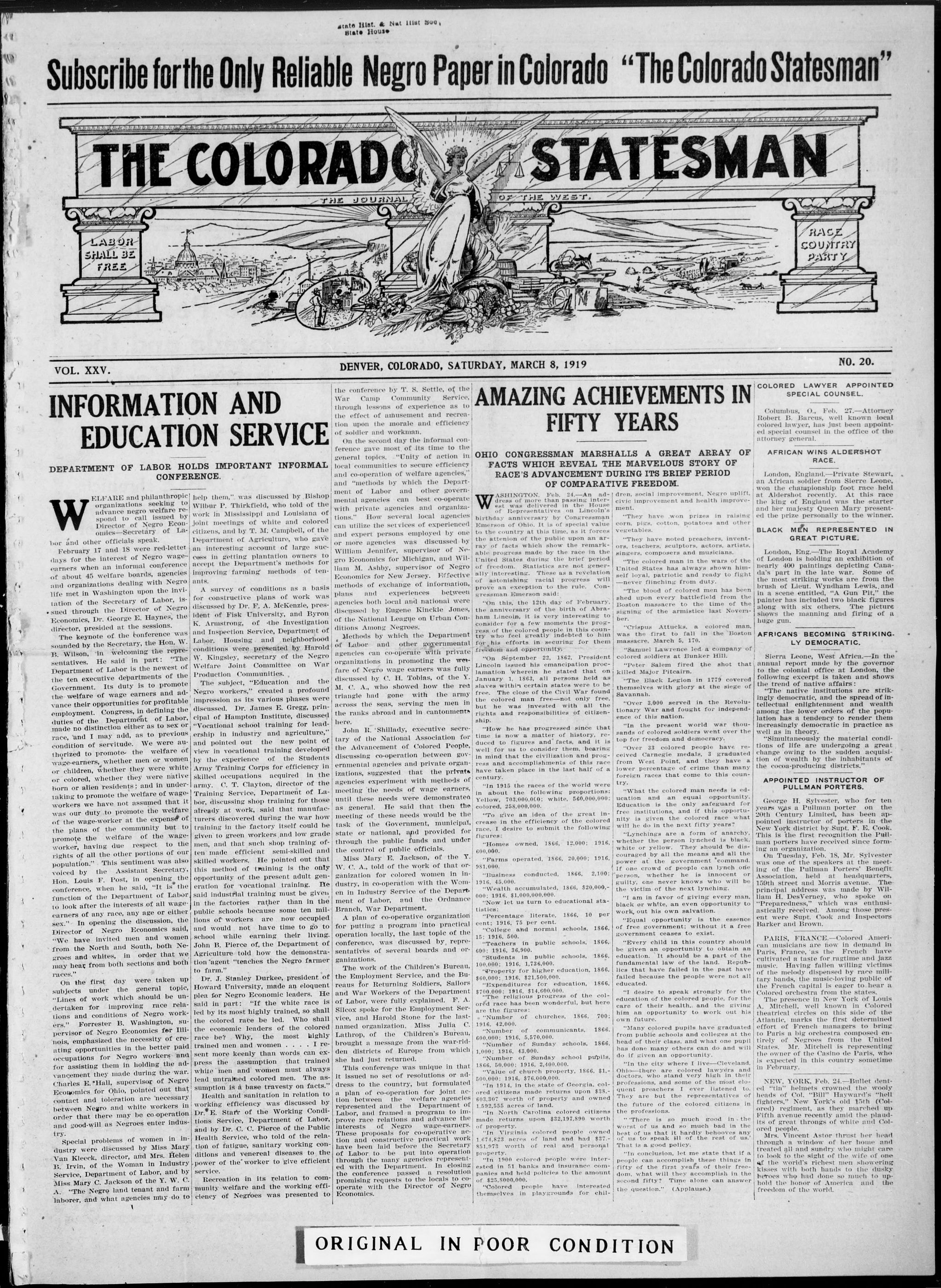
THE COLORADO STATESMAN
THE JOURNAL OF THE WEST.
LABOR SHALL BE FREE
RACE COUNTRY PARTY
INFORMATION AND EDUCATION SERVICE
DEPARTMENT OF LABOR HOLDS IMPORTANT INFORMAL CONFERENCE.
```markdown
```
VOL. XXV.
WELFARE and philanthropic organizations seeking to advance negro welfare respond to call issued by Director of Negro Economics—Secretary of Labor and other officials speak. February 17 and 18 were red-letter days for the interest of Negro wage earners when an informal conference of about 45 welfare boards, agencies and organizations dealing with Negro life met in Washington upon the invitation of the Secretary of Labor, issued through the Director of Negro Economics, Dr. George E. Haynes, the director presided at the sessions.
On the first day were taken up subjects under the general topic, "Lines of work which should be undertaken for improving race relations and conditions of Negro workers." Forrester B. Washington, supervisor of Negro Economics for Illinois, emphasized the necessity of creating opportunities in the better paid occupations for Negro workers and for assisting them in holding the advancement they made during the war. Charles E. "Hall, supervisor of Negro Economics for Ohio, pointed out that contact and toleration are necessary between Negro and white workers in order that there may be co-operation and good-will as Negroes enter industry. Special problems of women in industry were discussed by Miss Mary Van Kleeck, director, and Mrs. Helen B. Irvin, of the Woman in Industry Service, Department of Labor, and by Miss Mary C. Jackson of the Y. W. C. A. "The Negro land tenant and farm laborer, and what agencies may do to
help them," was discussed by Bishop Wilbur P. Thirkfield, who told of the work in Mississippi and Louisiana of joint meetings of white and colored citizens, and by T. M. Campbell, of the Department of Agriculture, who gave an interesting account of large success in getting plantation owners to accept the Department's methods for improving farming methods of tenants.
A survey of conditions as a basis for constructive plans of work was discussed by Dr. F. A. McKenzie, president of Fisk University, and Byron K. Armstrong, of the Investigation and Inspection Service, Department of Labor, Housing and neighborhood conditions were presented by Harold W. Kingsley, secretary of the Negro Welfare Joint Committee on War Production Communities.
The subject, "Education and the Negro workers," created a profound impression as its various phases were discussed. Dr. James E. Gregg, principal of Hampton Institute, discussed "Vocational school training for leadership in industry and agriculture," and pointed out the new point of view in vocational training developed by the experience of the Students Army Training Corps for efficiency in skilled occupations acquired in the army. C. T. Clayton, director of the Training Service, Department of Labor, discussing shop training for those already at work, said that manufacturers discovered during the war how training in the factory itself could be given to green workers and low grade men, and that such shop training often made efficient semi-skilled and skilled workers. He pointed out that this method of training is the only opportunity of the present adult generation for vocational training. He said industrial training must be given, in the factories rather than in the public schools because some ten millions of workers are now occupied and would not have time to go to school while earning their living. John B. Pierce of, the Department of Agriculture told how the demonstration agent "teaches the Negro farmer to farm."
Dr. J. Stanley Durkee, president of Howard University, made an eloquent plea for Negro Economic leaders. He said in part: "If the white race is led by its most highly trained, so shall the colored race be led. Who shall the economic leaders of the colored race be? Why, the most highly trained men and women . . . I present more keenly than words can express the assumption that trained white men and women must always lead untrained colored men. The assumption is a base travesty on facts."
Health and sanitation in relation to working efficiency was discussed by Dr. E. Starr of the Working Conditions Service, Department of Labor, and by Dr. C. C. Pierce of the Public Health Service, who told of the relation of fatigue, sanitary working conditions and venereal diseases to the power of the worker to give efficient service.
Recreation in its relation to community welfare and the working efficiency of Negroes was presented to
DENVER, COLORADO, SATURDAY, MARCH 8, 1919
ORIGINAL IN FOOR CONDITION
state Hist. & Nat Hist Soo
State House
ble Negro Pap
ADO
THE JOURNAL
DENVER, COLORADO, SATU
the conference by T. S. Settle, of the War Camp Community Service, through lessons of experience as to the effect of amusement and recreation upon the morale and efficiency of soldier and workman. On the second day the informal conference gave most of its time to the general topics. "Unity of action in local communities to secure efficiency and co-operation of welfare agencies," and "methods by which the Department of Labor and other governmental agencies can best co-operate with private agencies and organizations." How several local agencies can utilize the services of experienced and expert persons employed by one or more agencies was discussed by William Jennifer, supervisor of Negro Economics for Michigan, and William M. Ashby, supervisor of Negro Economics for New Jersey. Effective methods of exchange of information, plans and experiences between agencies both local and national were discussed by Eugene Kinckle Jones, of the National League on Urban Conditions Among Negroes.
Methods by which the Department of Labor and other governmental agencies can co-operate with private organizations in promoting the welfare of Negro wage earners was fully discussed by C. H. Tobias, of the Y. M. C. A., who showed how the red triangle had gone with the army across the seas, serving the men in the ranks abroad and in cantonments here.
John R. Shillady, executive secretary of the National Association for the Advancement of Colored People, discussing co-operation between governmental agencies and private organizations, suggested that the private agencies experiment with methods of meeting the needs of wage earners, until these needs were demonstrated as general. He said that then the meeting of these needs would be the task of the Government, municipal state or national, and provided for through the public funds and under the control of public officials.
Miss Mary E. Jackson, of the Y. W. C. A., told of the work of that organization for colored women in industry, in co-operation with the Women in Industry Service of the Department of Labor, and the Ordnance Branch, War Department.
A plan of co-operative organization for putting a program into practical operation locally, the last topic of the conference, was discussed by, representatives of several boards and organizations.
The work of the Children's Bureau, the Employment Service, and the Bureauus for Returning Soldiers, Sailors and War Workers of the Department of Labor, were fully explained. F. A. Silcox spoke for the Employment Service, and Harold Stone for the last-named organization. Miss Julia C. Lathrop, of the Children's Bureau, brought a message from the war-ridden districts of Europe from which she had just returned.
This conference was unique in that it issued no set of resolutions or address to the country, but formulated a plan of co-operation for joint action between the welfare agencies represented and the Department of Labor, and framed a program to improve race relations and advance the interests of Negro wage-earners. These proposals for co-operative action and constructive practical work have been laid before the Secretary of Labor to be put into operation through the many agencies represented with the Department. In closing the conference passed a resolution promising requests to the locals to co-operate with the Director of Negro Economics.
AMAZING ACHIEVEMENTS IN FIFTY YEARS
OHIO CONGRESSMAN MARSHALLS A GREAT ARRAY OF FACTS WHICH REVEAL THE MARVELOUS STORY OF RACE'S ADVANCEMENT DURING ITS BRIEF PERIOD OF COMPARATIVE FREEDOM.
WASHINGTON, Feb. 24.—An address of more than passing interest was delivered in the House of Representatives on Lincoln's birthday anniversary by Congressman Emerson of Ohio. It is of special value to the country at this time, as it forces the attention of the public upon an array of facts which show the remarkable progress made by the race in the United States during the brief period of freedom. Statistics are not generally interesting. These as a revelation of astonishing racial progress will prove an exception to the rule. Congressman Emerson said:
"On this, the 12th day of February, the anniversary of the birth of Abraham Lincoln, it is very interesting to consider for a few moments the progress of the colored people in this country who feel greatly indebted to him for his efforts in securing for them freedom and opportunity.
"On September 22, 1862, President Lincoln issued his emancipation proclamation wherein he stated that on January 1, 1863, all persons held as slaves within certain states were to be free. The close of the Civil War found the colored man free—not only free, but he was invested with all the rights and responsibilities of citizenship.
"How he has progressed since that time is now a matter of history, reduced to figures and facts, and it is well for us to consider them, bearing in mind that the civilization and progress and accomplishments of this race have taken place in the last half of a century.
"In 1915 the races of the world were in about the following proportions: Yellow, 703,000,000; white, 560,000,000; colored, 258,000,000.
"To give an idea of the great increase in the efficiency of the colored race. I desire to submit the following figures:
"Homes owned, 1866, 12,000; 1916, 600,000.
"Farms operated, 1866, 20,000; 1916, 981,000.
"Business conducted, 1866, 2,100; 1916, 45,000."
"Wealth accumulated, 1866, $20,000,
000; 1916, $1,000,000,000.
'Now let us turn to educational statistics:
'Percentage literate, 1866, 10 per cent; 1916, 75 per cent.
*College and normal schools, 1866,*
15; 1916, 500.
*Teachers in public schools, 1866,*
600; 1916, 36,900.
"Students in public schools, 1866,
100,000; 1916, 1,736,000.
"Property for higher education, 1866,
$60,000; 1916, $21,500,000.
"Expenditures for education, 1866,
$700,000; 1916, $14,600,000.
"The religious progress of the colored race has been wonderful, but here are the figures:
* "Number of churches, 1866, 700;
1916, 42,000.
* "Number of communicants, 1866
600,000; 1916, 5,570,000.
*Number of Sunday schools, 1866,
1,000; 1916, 43,000.
*Number of Sunday school pupils,
1866, 50,000; 1916, 2,400,000.
*Value of church property, 1866, $1,500,000; 1916, $76,000,000.
"In 1914, in the state of Georgia, colored citizens made returns upon $603,307 worth of property and owned 1,592,555 acres of land.
"In North Carolina colored citizens made returns upon $32,197,890 worth of property.
"In Virginia colored people owned 1,674,823 acres of land and had $37,851,973 worth of real and personal property.
"In 1900 colored people were interested in 51 banks and insurance companies and held policies to the amount of $25,800,000.
"Colored people have interested themselves in playgrounds for chil-
dren, social improvement, Negro uplift, civic improvement and health improvement.
"They have won prizes in raising corn, pig, cotton, potatoes and other vegetables.
"They have noted preachers, inventors, teachers, sculptors, actors, artists, singers, composers and musicians.
"The colored man in the wars of the United States has always shown himself loyal, patriotic and ready to fight—never finching from duty.
"The blood of colored men has been shed upon every battlefield from the Boston massacre to the time of the signing of the armistice last November.
"Crispus Attucks, a colored man, was the first to fall in the Boston massacre, March 5, 170.
"Samuel Lawrence led a company of colored soldiers at Bunker Hill.
"Peter Salem fired the shot that killed Major Pitcairn.
"The Black Legion in 1779 covered themselves with glory at the siege of Savannah.
"Over 3,000 served in the Revolutionary War and fought for independence of this nation.
"In the present world war thousands of colored soldiers went over the top for freedom and democracy.
"Over 33 colored people have received Carnegie medals, 3 graduated from West Point, and they have a lower percentage of crime than many foreign races that come to this country.
"What the colored man needs is education and an equal opportunity. Education is the only safeguard for free institutions, and if this opportunity is given the colored race what will he do in the next fifty years?
"Lynchings are a form of anarchy, whether the person lynched is black, white or yellow. They should be discouraged by all the means and all the power at the government command. If one crowd of people can lynch one person, whether he is innocent or guilty, one never knows who will be the victim of the next lynching.
"I am in favor of giving every man, black or white, an even opportunity to work, out his own salvation.
"Equal opportunity is the essence of free government; without it a free government ceases to exist.
"Every child in this country should be given an opportunity to obtain an education. It should be a part of the fundamental law of the land. Republics that have failed in the past have failed because the people were not all educated.
"I desire to speak strongly for the education of the colored people, for the care of their health, and the giving him an opportunity to work out his own future.
"Many colored pupils have graduated from public schools and colleges at the head of their class, and what one pupil has done many others can do and will do if given an opportunity.
"In the city where I live—Cleveland, Ohio—there are colored lawyers and doctors, who stand very high in their professions, and some of the most eloquent preachers I ever listened to. They are but the representatives of the future of the colored citizens in the professions.
"There is so much good in the worst of us and so much bad in the best of us that it hardly behooves any of us to speak ill of the rest of us. That is a good policy.
"In conclusion, let me state that if a people can accomplish these things in fifty of the first years of their freedom, what will they accomplish in the second fifty? Time alone can answer the question." (Applause.)
NO. 20.
COLORED LAWYER APPOINTED
SPECIAL COUNSEL.
Columbus, O., Feb. 27.—Attorney Robert B. Barcus, well known local colored lawyer, has just been appointed special counsel in the office of the attorney general.
AFRICAN WINS ALDERSHOT RACE.
London, England.-Private Stewart, an African soldier from Sierra Leone, won the championship foot race held at Aldershot recently. At this race the king of England was the starter and her majesty Queen Mary presented the prize personally to the winner.
BLACK MEN REPRESENTED IN GREAT PICTURE.
London, Eng.—The Royal Academy of London is holding an exhibition of nearly 400 paintings depicting Canada's part in the late war. Some of the most striking works are from the brush of Lieut. Wyndham Lewis, and in a scene entitled, "A Gun Pit," the painter has included two black figures along with six others. The picture shows the manning and firing of a huge gun.
AFRICANS BECOMING STRIKINGLY DEMOCRATIC.
Sierra Leone, West Africa.—In the annual report made by the governor to the colonial office at London, the following excerpt is taken and shows the trend of native affairs:
"The native institutions are strikingly democratic, and the spread of intellectual enlightenment and wealth among the lower orders of the population has a tendency to render them increasingly democratic in practice as well as in theory.
"Simultaneously the material conditions of life are undergoing a great change owing to the sudden acquisition of wealth by the inhabitants of the cocoa-producing districts."
APPOINTED INSTRUCTOR OF PULLMAN PORTERS.
George H. Sylvester, who for ten years was a Pullman porter on the 20th Century Limited, has been appointed instructor of porters in the New York district by Supt. F. E. Cook. This is the first recognition the Pullman porters have received since forming an organization. On Tuesday, Feb. 18, Mr. Sylvester was one of the speakers at the meeting of the Pullman Porters' Benefit Association, held at headquarters, 159th street and Morris avenue. The principal address was made by William H. DesVerney, who spoke on "Preparedness," which was enthusiastically received. Among those present were Supt. Cook and Inspectors Barker and Brown.
PARIS, FRANCE—Colored American musicians are now in demand in Paris, France, as the French have cultivated a taste for ragtime and jazz music. Having fallen willing victims of the melody dispensed by race military bands, the music-loving public of the French capital is eager to hear a Colored orchestra from the states. The presence in New York of Louis A. Mitchell, well known in Colored theatrical circles on this side of the Atlantic, marks the first determined effort of French managers to bring to Paris a big orchestra composed entirely of Negroes from the United States. Mr. Mitchell is representing the owner of the Casino de Paris, who is expected in this country sometime in February.
NEW, YORK, Feb. 24.—Bullet dented "tin" helmets crowned the wooly heads of Col. "Bill" Hayward's "hell fighters," regiment, as they marched up Fifth avenue recently amid the plaudits of great throngs of white and Colored people.
Mrs. Vincent Astor thrust her head through a window of her home and treated gil and sundry who might care to look to the sight of the wife of one of the world's richest men showering kisses with both hands to the dusky heroes who had done so much to uphold the honor of America and the freedom of the world.
FOREIGN
Premier Clemenceau has resumed his official tasks.
The German legation at Libau reports that Bolsheviki have occupied the island of Oesel and assassinated the secretary of the German legation, his wife and a courier.
An American airman, Second Lieut. Lee Cossing, was killed instantly near London. The machine in which he was flying nose-dived, crashing to the earth on the Haddingtonshire coast.
Typhus is spreading at an alarming rate in Russia and the food situation is very bad. Such food as is available is held at prohibitive prices, according to advices reaching this country.
The radical party of Chile has drawn up a petition to the government asking it to follow the example of the United States and prohibit the consumption of alcoholic beverages in Chile.
The entente has promised military support to Crown Prince Alexander of Serbia in the event of any republican movement, according to a dispatch from Vienna, quoting information which was said to have been received from Belgrade.
The Overseas club in London is approaching its members in all parts of the globe with a view to their co-operation in securing a world-wide illumination by means of a chain of bonfires on peace night—the night of the signing of the peace treaty.
"Not guilty" was the verdict spoken by three judges in the assizes court of the department Seine-et-Marne, France, and Marie Lescont, a dressmaker, 22, knelt down and prayed. She had severed a vein in the child's foot and let the babe bleed to death, because, taken prisoner at Maubenge, she had unwillingly become the mother of a German child.
Marshal Foch now has completed armistice terms to Germany, which are expected to approximate the military and naval conditions of the peace treaty, and they will result in the complete demobilization of the German army, disarmament throughout Germany and inspection of German munitions works by an interallied commission. Germany's armed strength for the purpose of meeting internal disorders is expected to be fixed at about twenty-five divisions.
SPORT
Johnny Dundee of New York defeated Johnny Mealey of Philadelphia in a six-round fight at Philadelphia.
Willie Meehan of San Francisco won a decision over Sam Langford, the Boston heavyweight, in a four-round bout at San Francisco. Minnesota won its tenth straight Western conference basketball victory by defeating Illinois 26 to 9. Minnesota's strong defense held Illinois to one field goal. Pitcher Harry Halle of the New York National league club was purchased by the Cincinnati club, according to an announcement at the office of the latter club. J. Franklin Baker, star third baseman of the New York Americans, will not return to the club next season, according to a letter received from him by Manager Huggins in New York.
GENERAL
Two men were shot and probably fatally wounded and a third slightly hurt in an outbreak of insurgency in a meeting of about 500 members of a plumbers' union in Chicago.
Twenty-five dollars a glass—which is merely at the rate of $100 a quart—will be the price of imported champagne after July 30—if there happens to be any left then—according to an announcement of local dealers of New York.
Two persons were killed and several injured when the Catholic Home for the Aged was destroyed by fire at Fon du Lac, Wis. Mary Weinard, aged 80, and John Matthews, aged 75, the latter a cripple, were suffocated in their rooms.
The Victory Liberty Loan bill was passed by the House with just three dissenting votes.
"Jerry Doc" Koehler, 68, said to have been the originator of the first flea circus in the United States, is dead at Evansville, Ind. Koehler for many years traveled over the country with his flea circus, exhibiting the fleas, which had been taught to do tricks, under magnifying glass.
Short line railroads will be reimbursed for competitive traffic diverted to government-controlled railroads between April 1 and Nov. 1, 1918, and hereafter will be given the same proportion of competitive traffic that they averaged during the years 1915, 1916 and 1917, Railways Director Hines announced this week.
Three of the suffragists who were sent to the Charles street jail in Boston because they refused to pay fines imposed as a result of a demonstration while President Wilson was there, were forcibly ejected from the jail after E. H. Howe had paid their fines of $5 each. The state law provides that prisoners must be released immediately after fines are paid.
Six soldiers of company 6, 161st depot brigade, were burned at Camp Grant, three perhaps fatally, when a can of lard exploded in the company's kitchen. Four gallons of the lard had hardened in a metal container. The can burst, throwing boiling oil among a detachment of soldiers.
Virginia Pearson, motion picture star, was injured at New Rochelle when her limousine, driven by a chauffeur, skidded and overturned in Mahl street. Miss Pearson received deep cuts on the face and neck from which she may be permanently disfigured.
CONDENSATION OF FRESH NEWS
THE LATEST IMPORTANT DISP
PATCHES PUT INTO SHORT,
CRISP PARAGRAPHS.
SHOWING THE PROGRESS OP
EVENTS IN OUR OWN AND
FOREIGN LANDS.
The House of the Montana Legislature has gone on record as favoring the return of the railroads to private ownership.
James Withercombe, governor of Oregon, died at his home in Salem. He had been ill for many months, but had continued to transact official business until a short time ago. He was 65 years old.
After ten years of experiments the state of Idaho gave up the direct primary system of nominations and returned to the convention plan. Governor Davis signed the amended new election law, which repeals the direct primary.
Visiting cattlemen, attending the Panhandle Southwestern Stockmen's Association convention at El Paso, were permitted to cross to Juarez only during the afternoon of one day. It was announced the port would be open during the entire week of the convention.
A watchman was killed and damage estimated by fire department officials at more than $500,000 was caused by a fire which practically destroyed a seven-story warehouse of Morris & Co. in the Union stockyards in Chicago. Four firemen were overcome by smoke and were rescued by fellow firemen.
An amendment was proposed to the State Senate bill-providing for the confiscation of liquor brought into the state of Nebraska. It authorizes the seizure and search of airplanes suspected of being engaged in the illegal transportation of liquor. The bill as it now stands authorizes state agents to seize and search automobiles, boats, airplanes and other vehicles.
Charles Perry Dale entered a plea of guilty in the United States District Court at Spokane when arraigned on a charge of using the mails to defraud in connection with the operation of one of a chain of brokerage offices through operation of which it is alleged the public was defrauded of $100,000. Robert R. Riddell, alias Austin J. Hill, was arraigned at the same time on the same charge and pleaded not guilty.
Invitations for a mass meeting in Chicago on May 1 have been sent to various parts of the country from Socialist headquarters in that city. According to the invitations, the meeting is to be a "convention for amnesty and free speech," and its purported objects are to bring about the release of all "political prisoners," such as William D. Haywood and others of the Industrial Workers of the World, convicted of disloyalty; cause the repeal of the espionage act and "take such other steps as shall be found wise to establish freedom of action and speech."
WASHINGTON
Casualties on American railroads during 1917 resulted in the death of 9,567 persons and the injury of 70,970, the Interstate Commerce Commission reported. During the previous year 9,476 lives were lost and 66,982 persons were injured.
Three men were arrested at Des Moines in connection with the second expose of graft in the sale of army salvage goods. The men are J. Rhoades, Norfolk, Va., broker; Arthur Koerner and A. Gross of Minneapolis.
Service and wound chevrons have been authorized by the War Department for telephone operators and similar female employes with the expeditionary forces. The chevrons may be worn when the employes are in the prescribed uniforms.
The first woman to win the American army's distinguished service medal is Miss Beatrice MacDonald of the reserve nurse corps, who was seriously wounded while remaining at her post with wounded men at a British casualty station during a German night raid.
Of the total of 3,918 distinguished service crosses awarded for gallantry in action to American soldiers, General March announced today, 664, or more than double the number given to any other division, went to the Second regulars. The First division of regulars came next with 300 crosses awarded to its members. The Third regulars with 233 was third.
Arrest of two additional naval reservists in connection with the investigation of charges of bribery in the third naval district are announced by Secretary Daniels. This makes a total of five men now held. They are Lieut. Benjamin S. Davis and Benoit James Ellert; Ensign Paul Beck and Chief Boatswains Lloyd G. Casey and Frederick A. Jones.
Three men attached to the naval aviation station at Rockaway beach were killed by the explosion of a depth bomb they were carrying.
SPORT
Pithy News Notes
From All Parts of
Colorado
Western Newspaper Union News Service.
Albert J. Burdick, who shot and killed Willard Cope last summer, was convicted of second degree murder at Akron.
Two machines, driven by M. E. Lafferty of Leadville and M. J. Hedke of Denver hold the honor of being the first to make the trip from Denver to Leadville this year.
De Beque is preparing for a big building boom this spring as the development of the oil shale field this year is going to be enormous and De Beque is the center, according to reports.
Hundreds of residents of Fort Collins turned out to see Lieut. Otto E. Benell, one of their home heroes, decorated with the distinguished service cross by order of the Secretary of War.
H. M. Watkins and Carl Sherry of Merino were arrested at Willard, northwest of Sterling, when they alighted from a Cheyenne train with a suitcase. It contained thirty-seven pints.
Five thousand dollars damage was done and ten nuns were forced to flee hurriedly in their night clothing when fire caused by an overheated furnace partly destroyed the school conducted at Sterling by the Sisters of St. Francis.
Eleven hundred jobs for returned soldiers and sailors have been obtained through the Rocky Mountain Auto Trades Association. This statement was made by Harrison Goldsmith, secretary, at the annual convention in Pueblo.
A 15-year-old negro boy surrendered to the police the other night at Pueblo and asked that he be sent to the State Reformatory because he feared that his mania for stealing anything he could get his hands upon would finally land him in the penitentiary.
Recruiting for the army is to begin at once in Colorado and Wyoming. Lieutenant Barney received instructions from the War Department to resume the task of finding men in the Denver district to fill the standing army.
Dr. Livingston Farrand of Colorado, recently appointed chairman of the central committee and ex-officio head of the national executive committee of the Red Cross, has assumed active leadership of that body. Dr. Farrand succeeds Henry P. Davidson.
Building is on the increase in Denver, judging by the number of building permits issued for the month of February. During the last month permits totaling 141 and valued at $219,500 were issued. For the same month a year ago, 132 permits valued at $173,630 were taken out.
Lieut. Edward Smith, Tiger quarterback in 1916, has returned to Colorado Springs from France, where he brought down two German airplanes while serving on the French front in the American aviation forces. Smith will re-enter colleges and will try out for the football team next fall.
The Great Western Sugar Company will build a Steffens plant in connection with its Fort Morgan factory which will cost about $200,000. The work of construction will start in April and material has already arrived for the building, which will be completed for the fall campaign.
A banquet, reception and ball in honor of the soldiers and sailors of eastern Fremont county was given at the Elks' home in Florence. The Chamber of Commerce gave the banquet and the Florence lodge, No. 611, B. P. O. Elks, gave the dance. The reception was given by the citizens of Florence,
A. D. Kenyon and associates of Denver have bought in Red Mountain Incline railway at Manitou from Richard Clough of Colorado Springs. The consideration was not made public, but it understood to be approximately $25,000. The sale includes the right of way up Red mountain, the terminals and all the cars and trackage of the company.
Finding little to do since the cessation of hostilities the Women's Council of Defense of Trinidad has formed itself into a Community Welfare League. The business men of the city have set out to raise $1,000 as a sinking fund necessary to equip the headquarters of the organization. Late reports show that considerably more than the desired amount had been raised.
It has become known at Leadville that between 400 and 500 unnaturalized allens, most of them Austrians, intend to return to their native land as soon as the government lifts the bars on emigration. "The minute the government raises the bars, between 400 and 500 unnaturalized men in Leadville district will start back to Austria and Italy," stated Michael D. Phillips, local clerk of that city.
Einer Jensen won the amateur ski jumping contest at the close of the big winter sports carnival at Steamboat Springs with a 241-point and a long jump of 128 feet which he rode. Jensen is the ski crack from the Great Lakes training station. Murphy Combs of Steamboat Springs was second, with 181 points. In the class for boys under 16, Hollis Merrell of Steamboat, 13 years old, was first, with 170 points, and Lewis Dalpez of Steamboat second. A third class jump for younger boys was won by Willard Smith of Steamboat with 141 points.
3
The Colorado State Agricultural college, together with Yale, Harvard and Columbia, have been designated by the War Department as a field artillery training school and $250,000 in equipment will be sent to Fort Collins. The school will open with the fall term in September and the work will be compulsory a certain number of hours a week with all men except seniors. This action of the War Department follows conferences between President Lory and A. A. Edwards, president of the board, with Brigadier General Dunforth and Col. Thomas Sloan, and a recent visit of inspection to the school by Colonel Sloan. The battery equipment for the school will consist of five guns, including a howitzer and a French 75, two tractors, two trucks and ninety-six horses, with a number of noncommissioned officers and instructors.
THE COLORADO STATESMAN
Five employés of the Denver & Rio Grande, Walter E. Robertson, Ira Davis, Harold Foster, Ray H. Bartiett and Alva Brown, are prisoners in the county jail at Grand Junction on a charge of robbing a merchandise car of a large amount of whisky December 18th. Robertson, it is said, confessed his part in the robbery, implicating the others. The men are charged with burglarizing a car of whisky en route to California. According to the confession of Robertson the car was entered through an end door, the head was knocked out of a barrel of whisky and the men carried the whisky away in milk cans, later bottling it.
The Mouth-Piece of the People of Colorado and the Entire West
The Bigelow House bill regulating the practice of dentistry in Colorado was the subject of a lively debate when efforts were made to amend certain of its provisions. Senator W. F. O'Brien, who introduced an identical bill in the Senate, took the lead in support of the measure. He is a dentist. The bill amends in a number of respects the present law regulating dentistry, bringing under its provisions dental hygienists as well as regularly licensed dentists, and providing legal machinery for procedure in cases where licenses are revoked by the State Board of Dental Examiners.
ARELIABLE chronicle of their doings and progress; a faithful mirror of their wants, their hopes, their best aspirations.
The establishment in Colorado of an immense hospital for discharged soldiers by the United States public health service is an assured fact. Word has been received from Washington by the officers of the Colorado Development federation that both Senate and House have agreed upon a bill which assures the hospital to Colorado and that $1,500,000 will be available for the institution. The hospital will be conducted separately from the recuperation camp at Aurora.
The dream of the American doughboy that some day he might sleep in the Kaiser's bed has almost been realized by Lieut. Gilbert H. Osincup, son of Dr. and Mrs. C. H. Osincup, Colorado Springs, who is in the medical corps in the army of occupation. Lieutenant Osincup is occupying the room of the crown prince in his country estate near Cologne. He has bathed in the prince's Turkish bathroom and he has "pounded his ear" on the pillows that the crown prince used.
THE COLORADO STATESMAN
Dr. Frost Craft, secretary of the corporation of the University of Denver, died at his home, 2052 South Fillmore street, in Denver, while he was preparing for breakfast. Members of the family heard Dr. Craft choking and his sister-in-law, Miss Annie McKeen Shuler, dean of women at the university, went to him. He was dead in ten minutes, of apoplexy. Death came in a similar way to Dr. Henry M. Mayo of the university on February 1st.
Unequaled as an advertising medium for the business of professional men and women.
Clifford Sproules, aged 24, a negro, must hang for slaying W. W. Green, turnkey at the Pueblo county jail, October 15th, when Sproules endeavored to make his escape from the jail. Green died after being shot twice by the negro in the corridor of the jail. A jury brought in a verdict of first degree murder, with death penalty recommended.
The contract to build the new road between Georgetown and Silver Plume, for which $5,200 had been appropriated by the state, the county and the two towns, was let to August Swanson of Georgetown, whose bid was $4,675. The road will form part of the state highway from Denver to Leadville and the Lincoln highway on the Western slope, by way of the old Loveland pass stage route.
An excellent family journal speaking to and for many thousand colored citizens.
The Allen bill to submit a constitutional amendment exempting the property of civil war veterans of the Union army or navy from taxation to the extent of $2,000, has passed the House as was also the Colgate bill to establish a department of social diseases in the state board of health.
The La Junta Industrial Association staged a record get-together meeting recently. More than 100 were present. Plans were discussed for the betterment of the city. Among these is one for a new high school building, which would include an auditorium suitable for public gatherings.
TWODOLLARSAYEAR
Jimmy Hanlon of Denver defeated Bobby Waugh at Hot Springs, Ark. Hanlon had the fight his own way from the start.
THE GREAT ORGAN OF THE LABORING MASSES
The necessity of an investigation to determine whether the Colorado Milland can be operated under normal conditions without loss was brought out in conference held in the office of Attorney General Victor E. Keyes. It was pointed out that before the state can take any definite action looking to the salvation of the Midland from dismantling operations, facts and figures must be brought to bear to show that the continuation of the road would be warranted from a business standpoint as well as from a standpoint of public need and convenience.
WASHINGTON CITY
SIDELIGHTS
Navy Department to Bring Home Its Heroic Dead
WASHINGTON.—Plans for bringing home the bodies of all navy officers, sailors and marines now buried on foreign soil are being worked out by the navy department and the actual work will be undertaken within the next
military honors would be accorded, and that where private interment was desired the navy would prepay all expenses up to delivery of the casket to relatives and that the war risk insurance bureau of the bureau of the treasury would refund actual burial expenses not exceeding $100 in each case upon presentation of the claims.
Relatives of the dead of the navy and naval reserves were requested to write the bureau of medicine and surgery as to their wishes, and those of the dead of the marine corps were invited to communicate with the commandant of the corps.
It is believed that many good Americans will take advantage of the arrangement announced by the department. The feeling of the average American parent whose son has given his all to his country is a combination of pride and grief. To many there is comfort in the public ceremonies of a funeral.
And many will wish to have the grave of the loved one near at hand.
Debutante Slouch Gone; Automobile Slump Going
Debutante Slouch Gone; Automobile Slump Going
TWO war casualties have not yet been recorded. They are the death of the debutante slouch and the near demise of the automobile slump. Since women have driven ambulances, scrubbed canteen floors, fetched and carried
War has done for women in months what physicians, lecturers and well-intentioned maiden aunts have not been able to do in hundreds of years. Women have been scolded, warned, threatened and even laughed at for misshaping their poor bodies and playing hob with their health at the behest of fashion.
Came the war and the splendid response by women to its demands for hard work and incessant service. What has happened? Has it overtaxed or hurt their bodies? Just the opposite. It has given them new physiques. It has broadened the diaphragm on an average of two to three inches, melted the fat from the hips as if by magic, replaced adipose with muscle on arms and legs, flattened the ugly "old woman's hump" at the back of the neck and symmetrized the chest and bust lines.
Verily, slimness and shapelliness are the reward of the woman who dedicated herself, body and soul, to war work. The canteenette has accomplished without realizing it results for which formerly she spent large wads of husband's gold at health studios and reducing parlors, not to mention gyms and Turkish baths. In many cases she has actually grown taller from reaching and bending, and the straight, even swaybacked, carriage that comes from toting trays of fried eggs, coffee and custard pie.
War has taught women to work. They will never enjoy idleness again. Nor will they ever return to unsanitary, uncomfortable and unsightly fashions.
Form Clothes for Men; Sprightly, Inspirational
Form Clothes for Men; Sprightly, Inspirational
FORM clothes will be the vogue during the present year. So decrees the National Association of Merchant Tailors. All delegates emphasize the form-fitting trend of the times. Some of them go so far as to suggest that
line, and other delicate fabrics. Even the prosalic sack suit of business is to have a "swing" imparted to it by a high waistline and a long vent back.
But it is in sporty toggery that the styles are going to go the limit. Coats will be strapped and tabbed and plaited. Riding coats are to have flaring skirts, a back vent running to the high waistline, diagonal jetted pockets, and upon both sides with an additional outside pocket, neatly flapped, to carry change.
So there is every opportunity for the shapely tenderfoot to go the limit this year by the seashore and in the mountains in the way of fearful and wonderful costumes; this should be a glad season for him.
Out in the Rockies the natives swear that some of the outfits adorning the tourist from the East and the middle West actually make the grim granite peaks shake with mirth. This is probably an exaggeration, but veteran guides assert that the mountain sheep in Rocky Mountain National park never will learn to trust man until something is done to tone down the renderfoot.
No Great Rush of Foreign Laborers to Europe
FEARS of employers that a great horde of foreign residents of this country would race back to Europe with the signing of the armistice have not only failed to materialize, figures of the local bureau of the immigration department
Italians, the remainder being scattered among natives of Scandinavian countries and of Greece and Great Britain. No permits are granted to enemy aliens. "The applications for permits are but a mere drop in the bucket," says H. R. Landis, immigration agent in charge. "After the armistice the applications for permits were rather heavy, but they have dwindled day by day. "One reason, perhaps, is the exceptional difficulty in obtaining ship transportation. As far as I can see, business in this section has no need to worry for fear of a shortage in unskilled labor due to an outflow of foreigners back to their native countries."
Heroic Dead
of
Iave
military honors would be accorded, a desired the navy would prepay all expenses and that the war risk insurance would refund actual burial expense presentation of the claims.
Relatives of the dead of the navy write the bureau of medicine and surge dead of the marine corps were invited of the corps.
It is believed that many good A arrangement announced by the depa American parent whose son has given of pride and grief. To many there is funeral.
And many will wish to have the gr
Debutante Slouch Gone;
TWO war casualties have not yet been debutante slouch and the near de women have driven ambulances, scrubb
as the nurses' assistants and conductoretted the fighting mob known as the traveling public, the physical slouch and slump have passed into oblivion. The feminine figure has changed. It has thinned and strengthened. By actual measurements taken in hundreds of cases during the past three years by a woman whose business it is to cloth the female form divine, it is found that hips are going down and chests are going up.
War has done for women in months what physicians, lecturers and been able to do in hundreds of years threatened and even laughed at for mobs hob with their health at the behest of Came the war and the splendid hard work and incessant service. Who hurt their bodies? Just the opposite, has broadened the diaphragm on an ear the fat from the hips as if by magic, relegs, flattened the ugly "old woman's symmetrized the chest and bust lines. Verily, slimness and shapeliness are cated herself, body and soul, to war without realizing it results for which band's gold at health studios and redu Turkish baths. In many cases she has and bending, and the straight, even a toting trays of fried eggs, coffee and c War has taught women to work. Nor will they ever return to unsanitary
Form Clothes for Men
FORM clothes will be the vogue du National Association of Merchant form-firting trend of the times. Some
2014
line, and other delicate fabrics. Ever to have a "swing" imparted to it by it. But it is in sporty toggery that the will be strapped and tabbed and plait skirts, a back vent running to the high upon both sides with an additional change. So there is every opportunity for this year by the seashore and in the more derful costumes; this should be a glad. Out in the Rockies the natives sw the tourist from the East and the granite peaks shake with mirth. This eran guides assert that the mountain park never will learn to trust man un tenderfoot.
No Great Rush of Fore
FEARS of employers that a great ho would race back to Europe with the failed to materialize, figures of the loca show, but such anxiety as is being displayed to leave the shores of the U. S. A. does not indicate that any great rush may be expected.
Only 2,524 applications for permits to go back to European countries have been received from aliens by the immigration department here since the armistice was signed. Of this number more than one-half of those applying either did not obtain permits or did not return to take them up.
Of those applying, about 2,000 were Italians, the remainder being scattered tries and of Greece and Great Britain.
"The applications for permits are H. R. Landis, immigration agent in chions for permits were rather heavy, b
"One reason, perhaps, is the excep portation. As far as I can see, busine for fear of a shortage in unskilled lab to their native countries."
few months. The wishes of relatives will govern the return of the bodies, and also the final disposition. Those brought home either will be sent forward for private interment or buried in the Arlington or some other national cemetery, as relatives may decide. The department's announcement expressed a preference for bringing home all bodies. The department's statement said that where bodies were brought home for burial in national cemeteries full
and that where private interment was expenses up to delivery of the casket toounce bureau of the bureau of the treasures not exceeding $100 in each case upon and naval reserves were requested togery as to their wishes, and those of the1 to communicate with the commandant Americans will take advantage of the department. The feeling of the average his all to his country is a combination is comfort in the public ceremonies of a grave of the loved one near at hand.
Automobile Slump Going
then recorded. They are the death of the premise of the automobile slump. Since obed canteen floors, fetched and carried
C. L. S.
well-intentioned maiden aunts have not
urs. Women have been scolded, warned,
mishaping their poor bodies and playing
of fashion.
response by women to its demands for
what has happened? Has it overtaxed or
it has given them new physiques. It
average of two to three inches, melted
replaced adipose with muscle on arms and
is hump" at the back of the neck and
share the reward of the woman who dedi-
work. The canteenette has accomplished
formerly she spent large wads of hus-
ducing parlors, not to mention gyms and
has actually grown taller from reaching
swaybacked, carriage that comes from
custard pie.
They will never enjoy idleness again.
uncomfortable and unsightly fashions.
; Sprightly, Inspirational
during the present year. So decrees the
best Tailors. All delegates emphasize the
use of them go so far as to suggest that
mature gentlemen of a plump, if not corpulent, tendency will need "stays" to get away with the newest things in masculine adornment. According to the terms of the trade masculine.styles for the ensuing twelve months are to be sprightly without conspicuousness; dashing without verging on extremes; youthful in temperament and inspirational. In place of the inevitable summer flannels of the past men will wear recreational raiment, fashioned of silk, fine
when the proslae sack suit of business is
a high waistline and a long vent back,
the styles are going to go the limit. Coats
aited. Riding coats are to have flaring
waistline, diagonal jetted pockets, and
outside pocket, neatly flapped, to carry
for the shapely tenderfoot to go the limit
mountains in the way of fearful and won-
l season for him.
wear that some of the outfits adorning
middle West actually make the grim
is probably an exaggeration, but vet-
tain sheep in Rocky Mountain National
until something is done to tone down the
Foreign Laborers to Europe
corde of foreign residents of this country
the signing of the armistice have not only
bureau of the immigration department
TO EUROPE
I DON'T SEE ANY RUSH TO EUROPE
ed among natives of Scandinavian coun-
No permits are granted to enemy aliens.
He but a mere drop in the bucket," says
charge. "After the armistice the applica-
but they have dwindled day by day.
optional difficulty in obtaining ship trans-
sess in this section has no need to worry
door due to an outflow of foreigners back
WORKING TOWARD END
LEGISLATURE WILL ADJOURN
ABOUT MARCH 29.
Much Important Work Yet Unfinished
With Only Few Days Left.
Western Newspaper Union News Service Denver.—Legislators are looking forward to the time of final adjournment, which, it is believed, will be either March 29 or April 5. There is a general feeling that about twenty days more is sufficient to pass the reconstruction measures advocated by the administration, and, in many instances, by both Republicans and Democrats. Up to date none of the big issues, including a good roads program, the budget system of expenditures by the state, a soldiers' settlement plan and blue-sky legislation, has been passed by either House. The Steele bill, calling for a railroad commission to take over the Moffat railroad and build the James peak tunnel, is an important bit of legislation to be considered. There is the general money pay bill for administration expenses for the next two years, and the consideration of legislation to make operative the civil service amendment to the constitution adopted by the voters last November.
Passage of the Booth bill for colonization and soldier settlement on Colorado lands is demanded by the people of southern Colorado, according to Secretary David W. Thomas of the agricultural and livestock bureau of the Denver Civic and Commercial Association. Colorado is assured of getting a $1,500,000 federal hospital within the next year, according to a telegram received by the Colorado Development federation from W. MacDonald Lee, an influential Virginia newspaper publisher, now in Washington co-operating with Executive Secretary Carl Hinton of the federation. The hospital will be built and operated by the United States Public Health Service, and will be for discharged soldiers under the war risk insurance act.
The Senate passed on final reading the Warren-Andrew bill creating a game refuge out of parts of Larimer and Boulder counties, as well as the Napier bill to validate purchases of Liberty bonds made with state funds by Robert H. Higgins, former treasurer. The Thompson House bill, providing for an exchange of tracts owned respectively by the normal school and the high school in Gunnison county, was given final approval. Measures adopted on second reading included the Andrew-Peterson classification bill for fees of county officials, the Knauss bill, providing an increase in the percentage of gross premiums of foreign fire insurance companies for the maintenance of the firemen's pension fund, and the Riddle-Tobin bill calling for additional facilities for the State Dairy Commissioner's Department.
The House considered favorably, on final reading, the Stephen bill prohibiting the display of the "red flag" in public. There was no discussion, the representatives being a unit in guarding against the encouragement of anarchistic propaganda through the waving of the red flag of terrorism. Colorado is on the point of getting away from the "hoodoo" of thirteen judicial districts, the House giving final approval to the Girard House bill for establishment of another district to comprise the county of Boulder. The court will sit in Boulder. The Dunlap-Hattenbach Senate bill to compel corporations to pay employees twice a month, was adopted on second reading, after it was amended to read that employers could pay on any two days they chose, and not on the 5th and 20th, as was provided in the original bill.
The lower House of the Assembly gave its final approval to a bill for a constitutional amendment which, if adopted by the voters two years hence, will revolutionize to a considerable extent the administration of educational affairs in Colorado. The proposed amendment provides for the establishment of a state board of education to be composed of seven members, which will take the place of the present ex-officio board and will be empowered to appoint a state commissioner of education, who will take over the duties at present performed by the state superintendent of public instruction, thus abolishing as an elective position the office of state superintendent.
The needs of the various state institutions during the biennial period, which began Dec. 1 last, were under discussion at a meeting of the Senate finance committee. The demands of the heads of the various institutions for money were gone over in detail, as were the recommendations of the special Senate visiting committee, composed of Senators Puffer and Dunklee, who visited the various institutions and investigated the claims advanced.
The House has passed on third reading Senate bill No. 67, by Senator Hetherington, granting officials of the Gunnison State Normal school the power to issue diplomas independent of the Greeley Normal school; Senate bill No. 19, by Senator Coldren, empowering school census takers to require an oath, or affirmation, as to the truth of statements made by parents concerning the age of their children, and House bill No. 457, by Representatives Sutton, Godsman and McGinnis, affecting the redemption of lands sold for delinquent taxes.
ADDRESS BIG CROWD IN THE
METROPOLITAN OPERA HOUSE
IN NEW YORK.
POWERS WANT LEAGUE
POWERS WANT LEAGUE
PRESIDENTIAL PARTY SAILS FOR EUROPE AGAIN ABOARD THE GEORGE WASHINGTON.
Western Newspaper Union News Service
New York, March 4.—On the eve of his return to the peace conference, President Wilson delivered an address it the Metropolitan Opera House, New York, urging establishment of a League of Nations. Former President Daft, speaking from the same platform, also outlined his reasons for believing that a league should be formed to prevent future wars. Governor Smith of New York presided at the meeting.
Governor Smith opened his speech by paying tribute to the part the New York soldiers had played in the war. "The war is not yet won," he said, "and will not be won until the Golden Rule is written into the international law of the world."
He introduced Mr. Taft as the man who had written the purple of the President of the United States and with grace and honor.
As the President and ex-President Taft emerged from the room in which they conferred and walked through the thronged wings onto the stage, Taft saluted the audience on the side of the room. I should walk, Mr. President." He was on the left, and the President smiled and nodded. Mr. Taft was greeted with loud handclapping.
"A League of Nations covenant is dispensable to the treaty of peace. Mr. war is to accomplish the purpose of this of this and the world." former President William Howard Taft told the audience at the Metropolitan Opera House in an exhaustive discussion of the league principles, preceding the address of President Wilson.
An adherent of Washington could not be applied to the present international status, Mr. Taft declared, "because the interests of the United States are inevitably involved in the preservation of Europe. We should not withdraw from the project, he asserted, would make the League of Nations merely "a return to the system of alliances and the balance of power, with a speedy recurrence of events." He would certainly be involved, as it was in the present struggle."
The rank and file of the American people are standing firmly behind President Wilson, declared Governor Smith in presenting "the world leader away"—the President of the United States.
The President began speaking at 9:50 o'clock.
The President declared he was convinced he was unmistakable evidences from all parts of the country" that the nation was in favor of the League of Nations.
I am more happy because this means that it is not a party issue," he said. "This is not a party issue and no party in the long run will dare oppose it."
The President said an effective working agreement for League of Nations cannot be abroad. Intolerance cannot stand publicity, and if the League of Nations were nothing but a big debating society it would kill intrigue.
"And the covenant, he said, it is the 'friendly right' of all nation to call attention of other nations to anything which endangers peace. Germany would have gone to war if she had first discussed the situation with
"I am amazed—that there should be in some quarters such a comprehensive ignorance of the state of the world," said I am amazed. "Those gentlemen do not know what the mind of men is just now. Everybody else does. "I do not know where they have been closed; I do not know by what influences they have been held; but I do not have been separated from the general currents of the thought of mankind. "And I want to utter this solemn warning, not in the way of a threat; the forces of the world do not give notice of the world do not give notice that they are going to rise and run; they rise in their majesty and overwhelming in might, and those who stand in the way are overwhelmed. "And the heart of the world must be satisfied.
"What are we to say, then, as to future? I think, my fellow citizens, that we can look forward to it with hardiness and hardiness since I came to this side of the water about the progress that is being made in Paris towards the discussion and clarification of a great many difficult matters; and I believe that we can be better be made rather rapidly from this time on at those conferences.
"But what I believe—what I know as well as believe, is this: That the men engaged in those conferences are not losing it; that they are finding community of purpose and community of ideal to an extent that perhaps they did not expect; and that amidst all the interplay of influence — amidst all the interplay of influence, there is a forward movement which is running towards the right. Men have at last perceived that the only permanent thing in the world is the community is bound to be a temporary settlement—bound to be a temporary settlement, for the very best reason of all, that it ought to be a temporary settlement, and the spirits of men will rebel against the spirits of men are in the saddle.
"God give us strength and vision to do it wisely. God give us the privilege of knowing that we did it without counting the cost, and because we were Americans, lovers of liberty and of doing right." President Wilson went aboard the U. S. S. George Washington at 12:05 o'clock this morning with Mrs. Wilson. The steamship is scheduled to sail for France at 8:15 a. m. Wednesday.
Must Report Allowances.
Washington.—Salesmen and other employés receiving per diem allowances in addition to regular salaries are required to report these allowances in in come tax returns, the internal revenue board announced. Living expenses are not allowable deductions, even though incurred in carrying on a business, and amounts paid for board and lodging by persons who travel in the course of their employment are considered living expenses.
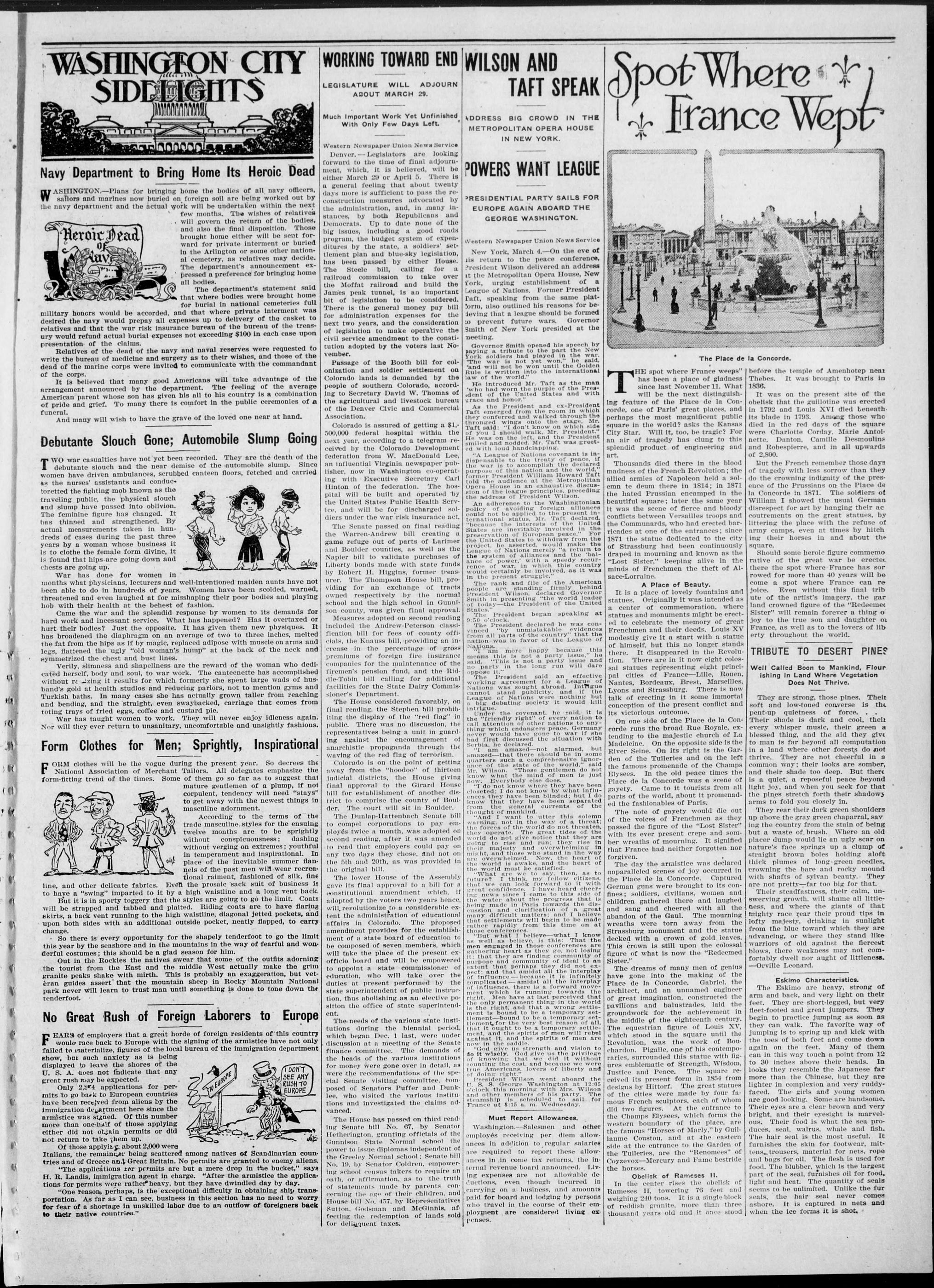
Spot Where France Wept
PALACE OF THE PALACE
The Place de la Concorde.
THE spot where France weeps" has been a place of gladness since last November 11. What will be the next distinguishing feature of the Place de la Concorde, one of Paris' great places, and perhaps the most magnificent public square in the world? asks the Kansas City Star. Will it, too, be tragic? For an air of tragedy has clung to this splendid product of engineering and art.
Thousands died there in the blood madness of the French Revolution; the allied armies of Napoleon held a solemn te deum there in 1814; in 1871 the hated Prussian encamped in the beautiful square; later the same year it was the scene of fierce and bloody conflicts between Versailles troops and the Communards, who had erected barricades at one of the entrances; since 1871 the statue dedicated to the city of Strassburg had been continuously draped in mourning and known as the "Lost Sister," keeping alive in the minds of Frenchmen the theft of Alsace-Lorraine.
It is a place of lovely fountains and statues. Originally it was intended as a center of commemoration, where statues and monuments might be erected to celebrate the memory of great Frenchmen and their deeds. Louis XV modestly give it a start with a statue of himself, but this no longer stands there. It disappeared in the Revolution. There are in it now eight colossal statues representing eight principal cities of France—Lille, Rouen, Nantes, Bordeaux, Brest, Marsseilles, Lyons and Strassburg. There is now talk of erecting in it some immortal conception of the present conflict and its victorious outcome.
On one side of the Place de la Concorde runs the broad Rue Royale, extending to the majestic church of La Madeleine. On the opposite side is the River Seine. On its right is the Garden of the Tuileries and on the left the famous promenade of the Champs Elysees. In the old peace times the Place de la Concorde was a scene of gayety. Came to it tourists from all parts of the world, about it promenaded the fashionables of Paris.
The note of gayety would die out of the voices of Frenchmen as they passed the figure of the "Lost Sister" with its ever present crepe and somber wreaths of mourning. It signified that France had neither forgotten nor forgiven.
The day the armistice was declared unparalleled scenes of joy occurred in the Place de la Concorde. Captured German guns were brought to its confines; soldiers, civilians, women and children gathered there and laughed and sang and cheered with all the abandon of the Gaul. The mourning wreaths were torn away from the Strassburg monument and the statue decked with a crown of gold leaves. This crown is still upon the colossal figure of what is now the "Redeemed Sister."
The dreams of many men of genius have gone into the making of the Place de la Concorde. Gabriel, the architect, and an unnamed engineer of great imagination, constructed the pavilions and balustrades, laid the groundwork for the achievement in the middle of the eighteenth century. The equestrian figure of Louis XV, which stood in the square until the Revolution, was the work of Bouchardon. Pigalle, one of his contemporaries, surrounded this statue with figures emblematic of Strength, Wisdom, Justice and Peace. The square received its present form in 1854 from designs by Hittorf. The great statues of the cities were made by four famous French sculptors, each of whom did two figures. At the entrance to the Champs Elysees, which forms the western boundary of the place, are the famous "Horses of Marly," by Guillaume Couston, and at the eastern side at the entrance to the Garden of the Tulleries, are the "Renomees" of Coyzevox—Mercury and Fame bestride the horses.
Obolisk of Rameses II.
In the center rises the obelisk of Rameses II, towering 76 feet and weighing 240 tons. It is a single block of reddish granite, more than three thousand years old and it once stood
A Place of Beauty
before the temple of Amenhotep near Thebes. It was brought to Paris in 1836.
It was on the present site of the obelisk that the guillotine was erected in 1792 and Louis XVI died beneath its blade in 1793. Among those who died in the red days of the square were Charlotte Corday, Marie Antolinette, Danton, Camille Desmoulins and Robespierre, and in all upwards of 2,800.
But the French remember those days of tragedy with less sorrow than they do the crowning indignity of the presence of the Prussians on the Place de la Concorde in 1871. The soldiers of William I showed the usual German disrespect for art by hanging their accoutrements on the great statues, by littering the place with the refuse of army camps, even at times by hitching their horses in and about the square.
Should some heroic figure commemorate of the great war be erected there the spot where France has sorrowed for more than 40 years will be come a spot where France can rejoice. Even without this final tribute of the artist's imagery, the gar land crowned figure of the "Redeemed Sister" will remain forever a thing o joy to the true son and daughter of France, as well as to the lovers of liberty throughout the world.
TRIBUTE TO DESERT PINES
Well Called Boon to Mankind, Flourishing in Land Where Vegetation Does Not Thrive.
They are strong, those pines. Their soft and low-toned converse is the pent-up quietness of force. . .
Their shade is dark and cool, their every whisper music, their green a blessed thing, and the aid they give to man is far beyond all computation in a land where other forests do not thrive. They are not cheerful in a common way; their looks are somber, and their shade too deep. But there is a quiet, a reposeful peace beyond light joy, and when you seek for that the pines stretch forth their shadowy arms to fold you closely in.
They rear their dark green shoulders up above the gray green chaparral, saving the country from the stain of being but a waste of brush. Where an old placer dump would lie an ugly scar on nature's face springs up a clump of straight brown boles holding aloft thick plumes of long-green needles, crowning the bare and rocky mound with shafts of sylvan beauty. They are not pretty—far too big for that.
Their steadfastness, their calm, unswerving growth, will shame all littleness, and where the giants of that mighty race rear their proud tips in lofty majesty, drinking in sunlight from the blue toward which they are advancing, or where they stand like warriors of old against the fiercec blows, there weakness may not comfortably dwell nor aught of littleness.—Orville Leonard
The Eskimo are heavy, strong of arm and back, and very light on their feet. They are short-legged, but very fleet-footed and great jumpers. They begin to practice jumping as soon as they can walk. The favorite way of jumping is to spring up and kick with the toes of both feet and come down again on the feet. Many of them can in this way touch a point from 12 to 30 inches above their heads. In looks they resemble the Japanese far more than the Chinese, but they are lighter in complexion and very ruddy-faced. The girls and young women are good looking. Some are handsome. Their eyes are a clear brown and very bright, and their eyesight is marvelous. Their food is what the sea produces, seal, walrus, whale and fish. The hair seal is the most useful. It furnishes the skin for footwear, mittens, trousers, material for nets, rope and bags for oil. The flesh is used for food. The blubber, which is the largest part of the seal, furnishes oil for food, light and heat. The quantity of seals seems to be unlimited. Unlike the fur seals, the hair seal never comes ashore. It is captured in nets and when the ice forms it is shot.
Eskimo Characteristics.
anna ANE eae ners ARE
PINE COLORADG\s7 STATESMAN -
ia re Oe 4. Pree
SI —— Say eve? Gamal?
eet kee , 2 ae
| eeaiones SF yeaa re ge ad
Jit eiPigcie Ta Ba tes ree
a WS BA Oe ee eae)
Z Ae AR DIRE SUE pee
Beer a una 2) RE oa. o soccer
eras ae
erates anata
Bg Bert once ores! Geeeeenies | EEE
SUBSCRIPTION RATES.
One Year MEER TN Pe SAN ES oe tye Oi UN) ee POETS hes nd
rae Moats co st gait esi weenie ein ee
MUST BE PAID IN ADVANCE. |
Ne Oa re MURR OU Aamo bs ara
Entered as second-class matter at the postoffice in the City of Denver, Colo,
anateres i epeeclene mast tebins Wy Peete pealncre gar one eae
Remittances should be made by Express Money Order, Postoffice Money
Order, Registered Letter or Bank Draft. Postage stamps will be received the
same as cash for the fractional part of a dolllar. Only 1c and 2c stamps taken.
same aa cash for the fractional part of a dolliar. Only Xe and 2e stamps taken
Reading notices, ten lines or less, 15 cents per line. Each addditional line over
gi ha Te oe ee oes ee ev arrate progs ac in
doses ey sean Re Pa See ee
No discounts allowed on less than three months’ contract. Cash must accom-
pany all orders from parties unknown to us. Further particulars on application.
Communications to receive attention must be newsy, upon important sub-
Bees eae ben to eee eat en re, a er rane reac cn
gpetespiststy iran only ron oh BS 90 E8e vente Cae tue iguetiea er Ud
Po ee ee ee Meee p ge are eae Coeneetaae <All
communications of a personating nature that are not complimentary will be
perp alpatiane ot ie meacne ae eee
: THE LEAGUE OF NATIONS.
alee QUESTION, which is the all-important topic of the day, is creating
a stir in America, and in fact, nearly every other continent of the
world, No one seems to oppose the forination of the League as a means
to prevent war, but presenting it foremost or giving it priority of considera-
tion before hastening and concluding the signing of the peace treaty with
Germany seems to cause grave doubts: in the minds of our American stiutes-
men a6 to its successful operation. Nor are we alone in the idea of the
surrender of some of the original institutions on which our nation is founded,
but Japan, one of our associates in the war, continues to champion the cause
of the darker races, and if her appeals are thrust aside, she will conclude
that the League will resolve itself to a farce. The Evening Telegraph, one
of our leading news journals of the state, in an editorial entitled “The Crisis,”
is very apprehensive oyer the success at this time of the President's propa:
ganda, and asks: “Shall we lightly throw overboard the chart and compass
by which the Ship of State has been guided during these years, and lay om
course by a nebulous and newly discovered star?”
Seeing, therefore, that so many and great difficulties are presenting
themselves, we are of the opinion that there will not be very smooth sailing
in the bringing about of this international peace league, and as for our part
we can only pray that Japan keeps on the job and continues to press het
just and righteous claim which will materially aid in correcting many of the
ills to which we have been associated for all the years of our existence.
WHAT WILL THE HARVEST BE?
UR READERS and others of the public who have been following through |
O the colunns of THE COLORADO STATESMAN what is being done for)
the anielioration of the conditions relative to the colored population oe
this country, are again requested to continue their interest in following |
closely the events occurring during the recent months and up to the present,
as by so doing there can be no other deduction made but that, the harvest
will be bountiful, and we are bound to be the reapers.
‘Phe article on our front page of this Issue is another record of the eta
‘of conferences directed by Dr, Haynes, director of Negro economies, and when
we note the government departmental heads that have found it a pleasure to
he present at these meetings to discuss freely und assert fearlessly that to
being about a successful, harmonious working among the various races com
posing this nation, the strictest adherence to the Constitution must engage:
us, we cannot help from beginning to feel joyous over the fact that the won:
der-working power of the Mighty Unseen is determined to create a bond of |
unity that will prove the human creation stands for something fur above
and higher than the lower or any other portion of living objects. This is not
the first occasion that efforts have been successful through Dr, Haynes’ ine
strnmentality, and the Secretary of Labor, Who finds pleasure in his addresses:
from time to time to remind us that there must be no longer A DIVIDED
AMBRICA, regarding superiority of sex, race, creed or color, when It comes
to the operation of forces that promote the welfare of the people. Re
‘The following quotations from the Secretary of Labor, also the Assistant
Secretary, at the conference held at Washington, February 17 and 18, where
representatives from Welfare and Philanthropic organizations to advance
Negro welfare met and discussed so important 'a subject, must sink deeply
into our hearts, for it appeuts to us that the signs of the times point to the
liberty of the human soul and mind from the thraldom encountered these
several years. Suid these government officials, in part, speaking of their
department: “The Department of Labor Is the newest of the ten executive
departments of the government. Its duty Is to promote the welfitre of waxe-
earners and adyance their opportunities for profitable employment, Congress
in defining the duties of the’ Department of Labor made no distinction as to
sex or race, and, I may add, as to previous condition of servitude. We were
authorized to promote the welfare of wage-earners, whether men or women
or children, whether they were white or colored, whether they were native:
born or ALIEN RESIDENTS.” Mark the term “alien residents”—something
that the black hound dog and his body of clever and roguishs saungsters de-
lighted to emphasize and reflect on in their recent escapade with state posl-
tions last January in Colorado, when with all their knowledge of the incom-
petency, criminal record, moral depravity of some of the native-born, they
Were advocating for positions, they could not see into the larger usefulness
that the American of worth offers to both home and foreign residents. Truly,
in the words of Dr, Stanley Durkee, president of Howard University, “If the
white race is led by its most highly trained, so shall the colored race be led.
Who shall the economic leaders of the colored race be? Why the most highly
trained men and women?", These are men with visions of today and the
future, in striking contrast to some of the misfits we have among some of
the members of our race in Denver, Colorado, who cloak themselves behind
professional garbs, offering delusions to the people, Inciting to disturbance
our gentler sex by presenting the rose with its hidden thorns, and with their
greed for gain, voracious appetites for fame politically and otherwise, will
place as leaders and patrons men in our community and of our race that have
‘established for years everythimg but good—the same being done in defiance
to society because they can be used as political tools to feather the nests of
broken-down poltticians.
We heartily approve of such conferences for sane and sober adjustment
‘of the momentous questions of the day, and realizing that the white man is
beginning to show signs of the spirit of fair play, and his readiness to
demonstrate, we should begin to prepare to weed out everything from among
ourgelyes that will be disadvantageous to the reaping of a good crop. THE
HARVEST SEEMS PLENTEOUS, BUT THE LABORERS ARE FEW. Let
us endeavor to get sound and honest sowers and reapers.
Leopard Has Not Changed His Spots;
Hun Quit, but Waits His Chance
By GENERAL GOURAUD, Fourth French Army
In 1871 Bismarck said in the reichstag that the
war just finished was child’s play compared with what
the next would be. He was right. ‘The war we have
passed through is but child’s play compared to the
next if it comes. Therefore we have got to see to it
that Germany does not start the next war.
I know it is altogether natural for American sol-
iers to be impressed with the beauties of the Rhine.
It is altogether natural for them to be impressed with
one of the garden spots of the world. But they must
not forget that out of these beautiful valleys and down
a\\\e
=
\ aay
Ni \
from these beautiful hills came the band of Drigands anteew:,—
tried to ruin civilization.
It is now an open secret that on Noveniber 14 the allies were to have
Jaunched an attack on Lorraine which would have brought disaster to
the German army. The Germans knew that, and so they surrendered.
Did they in their hearts eurrender? Their army has been received not as
a.conquered army. I ask if anyone has heard the Germans express any real
repentance for waging history’s most brutal war?
Now, when peace is signed, the Americans are going home across the
seas. The English are going home, too. But France stays where she is.
Marshal Foch has said that France is a barrier protecting civilization,
and so France and civilization must be protected.
We know the character of the Germans along the Rhine. We know
there is no democracy in their hearts. We know their feeling attitude
is as false as it can be. France wants no such people in her republic. We
do not want to annex Germany up to the Rhine, but we do intend to see
that the German military machine stays behind the river. That is what
Marshal Foch meant.
Tf we don’t have that protection France must maintain always an
enormous army to guard civilization. With our great loss of life in the
war that would be a terrible burden for France. “We must have a natural
barrier or else it would be madness to demobilize our armies. I hope
the Americans will see it the same way. I hope the soft words of the
Germans will not convince the Americans that the leopard has changed
his spots.
So far I am not convinced that the Germans of today are not the
Germans of yesterday, the.foes of the ideals of America, the ideals of
France, the ideals of civilization, the foes of all that is desired in the
hearts of mankind.
German Coal Will Help Pay Huge War
Indemnity Demanded by Allies
By JOHN J. ARNOLD, Chicago Banker
NS as ae
Germany can probably pay an indemnity of $3,500,000,000 annually.
But if the financial demands of the victors in the war are too heavy they
‘will result in Germany’s ruin and the spread of anarchy throughout that
country and eventually over a still greater part of Europe.
In estimating Germany's wealth I find that the question of her raw
materials, with which she is abundantly supplied, is not taken into consid-
eration by those who discuss this subject. ‘They base their estimates all
on the developed wealth of the country, which is far less than the value
of its undeveloped resonrces. Let us take, for example, Germany's coal
supply. This is estimated to be arcund 409,000,000,000 tons, while
France has only about 17,000,000,000 tons. Of this total Germany may
Jose 20 per cent through the taking of Alsace-Lorraine by France. Sho
may lose some coal deposits on the left bank of the Rhine also, but assume
that she will have left 300,000,000,000 tons in her mines and place a
conservative estimate of $1 a ton on this and you will begin to get some
idea of the value of the country’s great natural resources. ‘This one item
amounts to $300,900,000,000, Suppose the allies should decide to take
one-fourth of this coal supply of Germany and apply it on their bill for
damages. This would reduce their claims by more than $72,000,000,000.
‘The nation which has a big supply of coal is bound to be a great
industrial nation, because coal is the basis of all industrial development.
‘The biggest coal fields of Germany are in Westphalia. France and the
yest of continental Europe would be much better off in the long run if
Germany were called upon to give up a part of her + :stphalian coal fields.
‘And what applies to her coal supply applies as well to her potash industry.
Like Prohibition, Movement for Good
Roads Now Sweeps the Country
By W. G. EDENS, Pres’t Illinois Highway Improvement Association
Just as prohibition, once started, spread so quickly over the nation
that the states rushed to get on the “dry” bandwagen, so the good-roads
movement is sweeping over the country. ‘The vigorous manner in which
the states have taken up she ery to pull themselves out of the mud indi-
cates that at last the public has come to a realization of the sound eco-
nomic basis of improved highways.
Illinois, once the most backward of states, has come suddenly to the
forefront. [llinois, in its $60,000,000 bond issue project, solved a ques-
tion that has puzzled good-roads enthusiasts from the beginning of their
propaganda for better highways. This was the question of a sound, eco-
nomical and fair method of financing a state system of main highways
to which all other roads could be tributary.
‘The taxation problem always is with us, and if an attempt were made
right now to levy a general tax for good roads it would be met with very
serious and powerful opposition.
But Ilinois got around this question through the expedient of the
applicatton of the automobile license fees to the principal and interest
of a bond issue. Motorists generally co-operated in advocating this
method of taxing themselves, realizing that the saving in depreciation
and running expenses would more than meet the burden.
Thus the “Illinois plan” was evolved and today we have dozens of
sister states looking into it and preparing to adopt it all, or so much of it
as their constitution or other local conditions will permit.
‘There is a general disposition to await price readjustment before
ambitious construction plans are put under way for 1919. I believe that
proad-visioned business men will go half way in meeting public officials.
PHONE CHAMPA 575 QUICK SERVICE
Universal Tailors and Cleaners
R. G. MARTIN, Mer.
LADIES AND GENTS SUITS TO ORDER
Cleaning, Pressing, Dyeing and Repairing
Our Car Calls Everywhere
2785 WELTON ST. DENVER, COLO.
4 ~
é
Weatherhead Hat Co.
TELEPHONE fre cs A PIONEER HATTERS
MAIN 3203 i: 4 ot OF THE WEST.. WE
, at a! MAKE OLD HATS
Established 1876 hs af NEW.
RENOVATORS, BLEACHERS, DYERS AND FINISHERS
Of Gents’ and Ladies’ Hats of Every Description
1624 CHAMPA ST., DENVER, COLO. -
MORRISON'S FAMOUS JAZZ ORCHESTRA
AND ENTERTAINERS
GEO, MORRISON, MANAGER
Music Furnished for all Occasions
Phone Main 2707. Res. 2947 Stout St. DENVER, COLO.
Office Hours: 12 to 1 and3 to 8p. m. Res. Phone: Olive 2752
w# #& CHIROPODIST #
MME. H. B. WILLIAMS
Treatment at YourHome. Engagements by Appointment.
2913 Glenarm Place. Denver, Colorado
THE ATLAS DRUG COMPANY
COURTEOUS TREATMENT—RIGHT PRICES
Leaders in Prescription
Full Line of Plough’s Black and White Toilet Articles
2701 WELTON STREET MAIN 875
Taxicab Rates, Motte: “Not slow but
Depot, 1 or 2 pass. .50e ware.” Cash only.
Depot, ‘eacn "agai: 2
One mile” radius... 606 Rates Per Hour.
Bach addition’) mie:36e $1.50 to $250.
Phone Main 6699
B Auto Livery
HEATED TAXICAB,
COLE 8 AND 7-PASSENGEP 1918 LATE
MODEL CARS.
} STAND: NIGHT AND DAY CAFE
1865-1867 Curtis St. Denver, Colorado
Phone Champa 5481 Private Boothe for Ladies
Tie NIGHT AND DAY CAFE
DLS
apne .AND COLD DRINK PARLOR
eS) B. CARRUTH, Proprietor
7 Sens ha A full Line of Fresh Fish In Season
Wed eS Oysters and Lobsters
OSA Short Orders At All Hours Rest Room for Ladies
1968-1867 CURTIS STREET DENVER, COLORADO
= LW e% >
The Se NR Wa tr
Curtis gg , Ne rao,
ye ‘ i Sa
Park Nye
Floral Seah.
; SS ENING j
Company A xy .
‘FLORAL DESIGNS S"= MN
CHOICE PLANTS AND CUT FLOWERS oN’ NS °
| GREENHOUSES: Thirty-Fourth and Curtis Streets
| TELEPHONE, MAIN 1511 DENVER. COLO
THE COLORADO STATESMAN
CAPITAL SHALL BE FREE
HASKELL COUNTRY PARTY
Mrs. Mary Jackson, wife of Homer Jackson, died last Wednesday. She was a resident of Denver for several years.
CHARLES O. WEST DIES.
Another Link Snapped in the Cha-
of Old and New Denver.
William Salem Franklin, aged 40 years, departed this life Thursday, March 6th. Funeral services will be held 2 p. m., Sunday, March 9, from his late residence, 2022 Glenarm place. Interment, Littleton cemetery. Douglass Undertaking Co. in charge.
Miss Nelsine Howard, our popular and highly cultured resident, takes another stroll—this time for Louisville, Kentucky, where she will enter the Young Women's Christian Association Training School for work among our women throughout the country. She left Denver last Monday evening with the best wishes of friends and associates and the desire of the Colorado Statesman for a very successful career.
Keep off the date of March 26th. Dance by the Jolly Farmers' Club.
James C. Brooks was called to Raton, New Mexico, to attend the funeral of his father, Benjamin Brooks, who died a few days ago. The Colorado Statesman extends its sincere condolence to the relatives of the deceased. Mr. J. C. Brooks is the husband of our popular Hair Culturist, Madam Lexie Brooks of 2220 Ogden street.
Willard K. Childress, one of our promising young men who responded to Uncle Sam's call, and who left his native shores for "over there," returned to the U. S. A. on February 11 after an uneventful voyage from St. Nazaire, France. The Frenchman feels that there is no better associate in honor, in war, in peace, than the American Negro, and Private Childress is under the impression that if more of his people would travel to foreign parts the racial discrimination in this country would be short-lived. Willard's friends are glad to see him safely returned, and in response to their compliments with emphasis he says, "And I am mighty glad to get back, too."
Grand concert, Central Baptist Church, California and Twenty-fourth streets, Thursday, March 20, under the auspices Woman's Home Missionary Society. Best city talent.
PLEASURE SEEKERS' CLUB
MAKE MERRY.
"There is no life like this;" and so the Pleasure Seekers' Club, consisting of the younger social element of our community, adhering to this motto, go on enjoying life judiciously and wisely in the best manner possible, appealing to Nature in the most apologetic forms for a bestowal of the necessary provisions for health, so as not to be deprived of the happiness that results from such social gatherings which must be of lasting benefit in the training of the young, in estimating at the highest value what society demands of them, if they must become representative citizens and leaders. Saturday last marked another occasion when fifteen of these young folks gathered around the festive board in a most unique fashion to enjoy courses of the most refined and epicurean dishes, so starting at the home of Mrs. George Gross, 2315 Franklin, with the first course of what is termed a Community Dinner, they afterwards repaired to the home of Mrs. William Slade, 2937 Welton street, where they enjoyed the main and sumptuous portion of the repast, leaving thence for Mrs. C. A. Hall, 2329 Lafayette, where they applied the dessert, the same being the preliminary to the artistic finish provided at the home of Mrs. Diette Gross, 2612 Downing street, where the terpsichorean art reigned supreme, until in obedience to respect for the day of Holy Ordinances, the chimes of the midnight bell reminded the jolly laddies and their lassies that all good things must temporarily cease. Parents and relatives viewing this agreeable social act of those whose good fortune it was to participate, approve of this expression of cheer and good will, and at last we begin to put aside the days of FOGEYISM and adopt the MODERN TURN "more of success and keeping in the right path," is the best wish for these young folks offered by the Colorado Statesman—an ardent advocate of THE PROGRESSIVE ERA.
E. P. BLAKEMORE, Attorney and Counsellor at Law. Office, Rooms 39 and 40 Arapahoe Bldg., 1622 Arapahoe Street. Phone Champa 5450.
TWO AMENDMENTS ARE TO BE SUBMITTED AT MAY ELECTION
CITIZENS TO DECIDE QUESTION OF 16 COUNCILMEN AT POLLS—SECOND PLAN WOULD MAKE ALL OFFICES ELECTIVE.
CHARLES O. WEST DIES
Another Link Snapped in the Chain of Old and New Denver.
CHARLES O. WEST, a real connection between the old and new Denver, is no more, having passed from this world some time last Wednesday morning at his late residence, 2822 Glenarm place, and it can be truly said of him that he has lived his time on earth and lived it well. Nearly reaching the biblical allotment of three score years and ten, the husband of Mrs. Georgia G. West, and father of James, Otis, Charles and John West, also a daughter who pre-deceased him. Charles West was not deceased for his quiet, unassuming and inoffensive ways, and was credited in the community as a man who never failed to say a kind word or do a good turn to every one whether friend, acquaintance or stranger. His genial disposition won for him an admiration that made him popular with young and old, and his unceasing support to any good cause (a quality which he seems to have inculcated in his boys), made the name of our departed friend an household word among our citizens. He passes out to enter into the rest that awaits all humanity, and at his funeral services at the Douglass Undertaking parlors tomorrow, 2 p. m., Denver citizens will pay their last respects to a man who will be missed from among us. The Colorado Statesman offers its deepest sympathy to the surviving relatives.
DOUGLASS UNDERTAKING CO.
Funeral Notice:
West—Chas. O., beloved husband of Mrs. Georgia G. West; father of Chas Otis, James and Johnnie West; residence, 2822 Glenarm street, departed this life 11:15 a. m., Wednesday, March 5th. Funeral services Sunday, March 9th, 2 p. m., from Douglass Chapel.
CARD OF THANKS.
We wish to extend deepest appreciation to the many friends for their solitude and sympathy during the illness and death of our beloved wife, mother and grandmother.
ALEX. A. EALY.
MR. AND MRS. M. KEELAN.
ALEX. E. KEELAN.
HEAR THE NEW PASTOR OF CAMPBELL CHAPEL TO. MORROW MORNING.
Campbell Chapel will doubtless be at its best tomorrow morning for the purpose of extending cordial welcome to the newly assigned pastor. The following telegram was received this week which explains itself:
Chicago, Ill., March 4, 1919.
Rev. R. L. Pope, B. D.,
1818 E. Thirty-Second Ave.,
Denver, Colo.:
The pastor of Campbell Chapel will arrive in Denver Saturday morning,
March 8th. H. B. PARKS.
For employment see the Industrial Realty Co. Employment Agency, 716 East Twenty-sixth Ave. York 4561.
TWO AMENDMENTS SUBMITTED A
CITIZENS TO DECIDE QUEST
POLLS—SECOND PLAN
OFFICES
ONE petition to amend the charter providing for sixteen councilmen and a mayor, and another petition to amend the charter to make all city offices elective, will be submitted at the city election May 20. There are indications of a dozen more propositions being put up to the voters. Dewey C. Bailey, manager of safety and excise, has announced his candidacy on the Speer charter. This is the present charter and the one upon which Mr. Speer was elected mayor. This announcement, officially, by Mr. Bailey definitely states that the Speer charter will be put to the test, and it is taken by politicians to mean that it is also an announcement that Mr. Bailey will be a nonpartisan candidate, as the Speer charter calls for, and not of the Republican party.
The petitions to amend the charter are submitted with the statement that the signers believe that the officers of the city should be elected. There is a report current that Maj. J. Foster Symes will be named as candidate for mayor by those back of one of the petitions. Fred W. Bailey, commissioner of
Y. M. C. A. NOTES.
A very successful meeting of the Committee of Management was held on Tuesday evening. Alfred V. Gardner was chosen acting recording secretary in the place of William E. Parks, who has gone overseas under the auspices of the War Work Council of the Y. M. C. A.
The boys in the city over the ages of 14 years are being organized into a Working Boys' Club. About forty-five at present are eligible for the club, and more will be added from week to week. A "High Y" Club is also being organized. It is the plan to form other organizations as these are developed.
The Glee Club will have its first meeting next Wednesday evening, the 12th. It is hoped that all members will be present.
Tomorrow (Sunday) afternoon at 4 o'clock a meeting of soldiers will be held. Different soldiers who are in the city will be the speakers, each one giving incidents of his experience in the war. The meeting will be free for all.
PEOPL'E'S PRESBYTERIAN.
East Twenty-third avenue and Washington street. Presbyter: J. A. Thos, Hazell, S. T. B. Sermon topics, Sunday, March 9:
11 a. m.—"Lenten Meditations."
5 p. m.—"The Sacrifice of Sacrifices."
The minister on account of sickness was not able to deliver his pulpit messages last Sabbath. While he is still unwell he hopes to accommodate his people with the two above stated sermons tomorrow, the "First Sabbath of Lent." We are specially appealing to the communicants of the church to attend all these services during Lent, morning or evening on the Sabbath day as well as the Wednesday night lectures. As far as it is possible and practicable it is hoped that the larger children of the Sabbath school will also attend the Sunday services.
The class for membership is now opened. Every Wednesday night at 7:15 o'clock, also every Sunday night, 6:30 to 7:15. All candidates are requested to make these classes. Confirmation services Palm Sunday, April 13. Reports from all the departments of the church must be sent to the session not later than the last of this month.
Session meets Monday night, 7:30, in the Vestry. Docket: Recommendations to the congregation of names of persons eligible to fill vacancies on the (a) Eldership, (b) Deaconate, (c) Deaconness, (d) Sabbath School Boards of the church. 2. To decide on some definite feature of community work outside of parish work of the People's Church, in the narrower meaning of the term. 3. To pass on the annual budget for the coming church year for local and benevolent purposes.
The Annual Congregational meeting will be held in the chapel Monday night, March 17, at 8 o'clock. All members in good and regular standing are urged to be present to participate in the doings of the church.
Nicely furnished rooms for rent, all modern. 2346 Curtis street. Phone Champa 5665.
Day and Night Phone Main 2701.
DR. C. E. TERRY,
PHYSICIAN AND SURGEON
Office Hours: 12 to 2 p. m., 6 to 8 p. m. and appointment.
LEAVE CALLS AT ELITE DRUG STORE.
1027 21st St., Denver, Colo.
For Rent—Nicely furnished rooms; permanent or transient, at 1822 Arapahoe St. Apply at 1834 Arapahoe.
ITS ARE TO BE
IT MAY ELECTION
TION OF 16 COUNCILMEN AT
N WOULD MAKE ALL
ELECTIVE.
supplies, is becoming mixed in this mayoralty fight through the candidacy of Dewey C. Bailey. The men are not related, and the only reason for the mixup is the name and the fact that both are city officers. Fred W. Bailey wants it understood that he isn't a candidate.
Indications are that there will be two or more candidates for council in seven of the nine districts, the two exceptions being those of Councilmen Conlon and Straub. Up to the present time no man has come out against either of these men. In the South Side Councilman Joseph Rees will run for mayor, which opens his district to some six or eight prospective candidates.
Councilman Madden faces two more candidates now, with prospects of two additional men entering the race. Councilman Hawkins will not be a candidate, which lets down the bars to at least three candidates in his district.
It is doubtful if President Bartels of the council has any opposition, though it is said that there is a possibility of there being one man out against him.
There Will Be No More Joy and Satisfaction at 1505 Lawrence St. INSTEAD-
WE WILL DEPOSIT OUR JOY AND SATISFACTION IN THE CENTRAL SAVINGS BANK BUILDING, WHERE IT WILL BEAR COMPOUND INTEREST IN SERVICE AND QUALITY.
We have long been handicapped for more room and our large patronage has demanded it, so we have secured the best location in the city, where we will serve you.
Our new establishment will be the most modern and fully equipped in the country.
You will enjoy coming there as it will be convenient, beautifully lighted and artistic, a pleasant place to meet your friends as nearly all car lines enter the Loop, alongside the display windows of the new Joy shop.
In our new establishment the most courteous service (for which Joy's employés are noted) will be extended to you.
JOY'S BUTTER SHOP Is Moving to the Central Savings Bank Building on Fifteenth Street, between Lawrence and Arapahoe.
MEET ME AT
THE JO
JOY S
THE JOY SHOP
ADDRESS: TRAMWAY LOOP
FIVE P
WHY YOU
DANCE AT
POINT ONE—Morrison's Full
POINT TWO—Thursday is in
POINT THREE—We don't to
tions at our c
POINT FOUR—Dancing is he
POINT FIVE—You can meet
world at
Fern Hall Every
FIVE POINTS
RHODA ANDER
THE POINT
WHY YOU SHOULD
AT FERRE
Prison's Full Orchestra
tuesday is in the middle.
We don't tolerate any
ans at our dance.
Dancing is healthy. Sci
u can meet the prettie
world at
Every Thursday
POINTS DANCING
ANDERSON
---
FIVE POINTS
WHY YOU SHOULD
DANCE AT FERN HALL
POINT ONE—Morrison's Full Orchestra furnishes the music.
POINT TWO—Thursday is in the middle of the week.
POINT THREE—We don't tolerate anything but decent actions at our dance.
POINT FOUR—Dancing is healthy. Science has proven it.
POINT FIVE—You can meet the prettiest girls in the whole world at
Fern Hall Every Thursday Night
FIVE POINTS DANCING CLUB.
RHODA ANDERSON CHAMBERS
RHODA ANDERSON CHAMBERS
A.
THE CHAMPA
TWENTIETH
Is the place
DRUGS, CHEMICALS AND
WE SERVE
PRESCRIPTIONS
Phone us and we will deliver to
JAMES E. TH
PHONE M
AMPA PHAR
TENTIETH AND CHAM
Is the place to get your
CHEMICALS AND PATENTS
WE SERVE DRINKS.
SCRIPTIONS OUR SPECIAL
will deliver the goods to
JAMES E. THRALL, Pr
PHONE MAIN 2425.
THE CHAMPAPHARMACY
PRESCRIPTIONS OUR SPECIALTY. Phone us and we will deliver the goods to all parts of the city. JAMES E. THRALL, Propr. PHONE MAIN 2425.
Elliott Temple No. 15 meets every 2nd and 4th Thursday nights in each month. Elks Hall, 2540 Washington Street.
Dr. S. A. Huff, physician and surgeon, 2538 Washington street; office hours 11 to 12 a.m., 3 to 5 p.m.
Phone York 2313. Out of office,
Main 875. Residence Phone York
4101.
STOCKHOLDERS' MEETING.
Notice is hereby given that the annual meeting of the stockholders of The Colored American Mercantile Co. will be held at its office, 720 East Twenty-sixth Avenue, Denver, Colorado, on the 28th day of March, 1919, to observe that for the election of directors for the ensuing year and for the transaction of such other business as may properly come before said meeting.
Denver, Colo., February 13, 1919.
WALTER H. PRITCHETTE.
Secretary.
Phone Main 8036
Res. Phone York 5774W
FRANK D. TAGGART
Attorney at Law—Notary Public
205-206 Cooper Building
Denver, Colorado
---
REMEMBER
Arapahoe Street
Joys Shop Trainway Loop.
Y SHOP
POINTS
YOU SHOULD
FERN HALL
All Orchestra furnishes the music.
in the middle of the week.
tolerate anything but decent ac-
dance.
healthy. Science has proven it.
at the prettiest girls in the whole
y Thursday Night
DANCING CLUB.
PERSON CHAMBERS
Teacher of
Artistic Piano
Playing
From Elementary to Highest Grades
Phone Champa 1174
2431 COURT PLACE
A PHARMACY
AND CHAMPA,
to get your
AND PATENT MEDICINES
DRINKS.
IS OUR SPECIALTY.
the goods to all parts of the city.
THRALL, Propr.
MAIN 2425.
Michaelson's
15TH & LARIMER STS.
About Men's Clothing
Will you, kind reader, bear in mind that we sell
Alder Collegian Suits
Which for elegance of cloth, perfection of fit — and general worth, are not surpassed by any clothing made or sold anywhere. And these fine suits are so moderately priced here, because this store can, and does undersell.
PHONE MAIN·6453
THIS TELLS HOW TO FIGURE INCOME TAX
Squarely Up to Every Individual to Get Busy by March 15 or Suffer Penalty.
"Don't wait until the final due date, March 15th, for paying your Income Tax and making your return. Avoid the last minute rush. Any person can figure out his liability today as well as he can next week, and if there is any point on which he needs advice he can now get in touch with a Revenue man."
This word of advice is from Mark A. Skinner, Collector of Internal Revenue, Denver, Colo., who is collecting the Income Tax in Colorado and Wyoming. Collector Skinner is giving without charge every aid of his office and his enlarged field force to help the people get their payments and their returns in by March 15th.
But the Income Tax men will not pull your door-bell or your coat-tails, according to the Collector's announcement. It is squarely up to every individual to figure out his own case and to get busy if he comes within the scope of the new Revenue law.
Did You Earn This Much?
Every unmarried person who received income averaging $19.25 a week during 1918 and every married couple who jointly received income averaging $38.50 a week should secure at once from the nearest Deputy Collector or the nearest bank a blank 1040 A. That form contains the information he will need to enable him to figure his correct net income and any tax that he owes the Government.
The law requires that every unmarried person who had a net income of $1,000 or over and every married person whose net income was $2,000 or over (including the income of husband or wife, and the earnings of minor children, if any) must make a return on or before March 15th. And this requirement does not hinge on whether the person owes a tax.
Taxable Income.
An individual must include under gross income all gains, profits and income derived from salaries, wages, or compensation for personal service of whatever kind and in whatever form paid, or from professions, vocations, business, sales or dealings in property of all kinds, interest, rent, dividends, or profits derived from any source whatever. Very few items of income are exempt.
Deductions include ordinary and necessary business expenses, interest paid or accrued on indebtedness, taxes of all kinds except Federal income and excess profits taxes and assessments for local benefits, losses actually sustained, debts ascertained to be worthless, and depreciation on buildings, machinery, fixtures, etc., used in business. A further deduction is allowed for contributions to corporations operated for religious, charitable, scientific or educational purposes or for the prevention of cruelty to children or animals to an amount not exceeding 15 per cent of the taxpayer's net income as computed without the benefit of the contribution deduction. The taxpayer is not allowed to deduct any personal, living or family expense, any amount spent for improving property, or any expense of restoring property or making good its exhaustion for which an allowance is claimed under depreciation.
Figuring the Tax.
Before figuring the normal tax the dividends are deducted as credits from net income, together with the personal exemption. As in previous years, dividends of domestic corporations are exempt from normal tax when received by the stockholder. The normal tax rates for citizens and residents are as follows: On the first $4,000 of net income in excess of the credits the rate is 6 per cent; on any further taxable income the rate is 12 per cent.
The surtax rates apply to net income of each individual in excess of $5,000. The personal exemption and the dividends are not deductible before computing surtax. In the case of returns by husband and wife, the net income of each is considered separately in computing any surtax that may be due. Form 1040 should be used for making returns of net income exceeding $5,000, and the instructions on that form will show how to figure the surtax.
Business House Returns.
Employers and others who paid wages, salaries, rents, interest or similar determinable gains in an amount of $1,000 or over during 1918 to any person must file an information return with the Government. Blanks may be secured from the Collector. Every partnership must file a return showing its income and deductions and the name and address of each partner, with his share of the profits or losses during the past year. Personal service corporations will file similar information for 1918.
INCOME TAX PAYS
FOR PUBLIC BENEFITS.
"Viewed in its largest and truest sense, the payment of taxes is payment for benefits received or expected. Only from a narrow and essentially selfish and shortsighted viewpoint can the individual propose to himself the evasion of tax liability as a desirable course of action."
—Daniel C. Roper, Commissioner of Internal Revenue.
Durable Clothes Made of Waste
International Film Service
At last! The high cost of dressing is to be brought to its knees. It has been proven that new clothes can be made from the odds and ends of whatever you may have around the house. Such are the allegations of the Longwood War Relief Unit of Boston, which is busily engaged in making garments for refugees. More than 1,500 garments are made weekly and at the great cost of—nothing. Miss Bonnie Belle Smith, daughter of Mrs. Eugene Smith, secretary of the Longwood unit, is shown with some of the clothes she wears, all made from salvaged waste materials.
What Chevrons Mean
Guide to Different Stripes Worn on Soldiers' Sleeves
"You can't tell the players without a score card," the familiar cry at the baseball parks, could almost be applied to soldiers returning from France, according to army officers. To aid the public in determining a man's time in the war zone and the number of times wounded, the following has been prepared:
War Service Chevron—A "V"-shaped bar of gold lace, worn on lower part of left sleeve of all uniform coats, except fatigue coats, by officers, field clerks and enlisted men who have served six months in the war zone. This chevron is worn point down. An additional chevron is allowed for each six months service.
Wound Chevron—Also a "V"-shaped bar of gold lace, worn point down, on the right sleeve. Not more than one wound chevron can be worn if two or more wounds are sustained at the same time.
Silver Chevron—For officers, field clerks and enlisted men who served six months outside the theater of operations a silver chevron (worn the same as the gold chevron) is allowed. For each additional six months another chevron is worn.
Sealet Chevron—Soldiers honorably discharged wear a scarlet chevron, point vp. on the left sleeve above the elbow. These are in addition to the usual service stripes.
Service Stripe—Enlisted men who served three years will wear service stripe of the corps or department of service. The stripes are worn diagonally on both sleeves of the dress coat below elbow. Sky-Blue Cloth Chevron—Service of less than six months in theater of war is indicated by a sky-blue cloth worn as the gold war service chevron.
Half-Inch Spider Is Victor Over Fish Two Inches Long
The amazing strength of spiders is shown in a number of instances. Thus we have an instance of a half-inch spider catching a two-inch fish. It was of the ground or wolf family. A scientist came upon it struggling with a fish on the edge of a little pool. Its claws were buried in the fish's tail; it had the tail out of the water, but the head still remained underneath. The spider struggled to pull the fish up the bank and the fish struggled desperately to pull the spider into the water. For ten minutes the scientist watched this silent and deadly fight. Then he hurried away for a bottle in which to put the combatants when he captured them. He was gone about half an hour, and on his return the end had come. The fish was dead and the spider was slowly dragging its victim away.
WISE AND OTHERWISE
When it comes to saving penies a woman will save a dollar before a man has saved ten cents.
When you see a pretty maid in a home it's a sure sign that the head of the house is not henpecked.
Occasionally a barber combs a man's hair the way he combs it himself, but a tonsorial artist never does.
A wise old tiller of the soil, speaking of the relative value of grains, says grains of common sense are the most valuable.
North Carolina Forests to Be Tapped for a Supply of Ties for Railroad Tracks
How many ties in a railroad track?
Did you ever ask yourself that question while riding on a train? North Carolina forests are to be tapped for a new supply, says Crete Hutchinson, who writes in American Forestry Magazine of Washington, as follows:
"At the present time the railroad administration is facing a shortage in the production. West of the Mississippi 50,000,000 cross ties are required annually for replacement; east of the Mississippi 80,000,000 with approximately 20,000,000 additional ties for street railways and other industrial needs. A grand total of 150,000,000 cross ties or 4,500,000,000 board feet of timber.
"Against a shortage of 65 per cent six months ago the present shortage is only 40 per cent and probably will be reduced to 30 per cent by the end of the year, due to better understanding of specifications. Thirty-four per cent of the timber used by the railroad purchasing committee is white oak. Large areas of the forested section of North Carolina in Transylvania, Jackson, Graham and Clay counties contain this timber and a road 40 miles long is being put in to get this timber out.
HAVE A LAUGH
Working Both Ways.
"What is the object of these statistics you are compiling?"
"They are for the purpose of proving that the conclusions drawn from statistics previously compiled on the same subject are all wrong."
She Knew.
"Men are such brutes."
"Aren't they? What was it your husband refused to buy for you today?"
"Men are such brutes."
"Aren't they? What was it your husband refused to buy for you today?"
"Why have you quarreled with Jack?"
"Because he proposed to me last night."
"Well, there's no harm in that, is there?"
"But I had accepted him the night before."
Being Good for Nothing.
She—Doctor's bllls? Oh, my father's a doctor, so I can be ill for nothing.
He—My father's a parson, so I can be good for nothing.
Bill (reading the paper) — Do you know what they mean by a Stradivarius?
NEWSPAPER
Bob—Goodness,
you're ignorant!
A Stradivarius is
the Latin name
for a fiddle.
"Girls are more graceful with their hands than men."
"They can't dodge the issue by keeping their hands in their pockets."
"Farming Is a Business."
Large numbers of farmers have more money in their business than the business men in their county sent towns have invested in their stores. Farmers are slowly coming to realize the truth of this comparison and that farming is a business, in connection with which business methods must be used.
BOHEMIA LAND of GREAT RESOURCES
N examination of the map of Europe, one on which the outlines of the new, or rather revived, state of Bohemia may be traced, impresses one with the apparent conviction that the republic cannot long economically exist unless it depends and draws on the resources of her neighboring peoples, the peoples who, almost without exception, are antagonistic to the ambitions and aspirations of the Czecho-Slovaks.
Hungary, Austria and Germany border on the south, west and partly on the north. Poland forms the balance of the northern boundary, while Bukovina and Transylvania adjoin on the east. The inhabitants of the Magyar and German states are bitter opponents of the peoples of Bohemia. What attitude the Poles will assume is difficult, at present, to predict.
Therefore, the only possible friendly neighbors are in the east, the Ruthenians of Bukovina and the Roumanians of Transylvania, writes E. F. Pratner in the New York Herald. But even their policy is unsettled. The Mid-European union, so auspiciously and so recently organized in historic Independence hall, Philadelphia, is in danger of disintegration due to the differences arising among the delegates of the numerous peoples represented. The possibilities are that what seem to be insurmountable obstacles will be satisfactorily adjusted, and the Czecho-Slovaks will enjoy at least the friendship of these peoples.
Bohemia is an economically independent country. This sounds as rather a bold assertion in the face of the enumerated handicaps. She is not dependent, economically, on her neighbors, but they, in turn, must draw upon the Bohemian resources for their many shortcomings in agriculture and industry.
If we give consideration to the impression made on the iron chancellor of Germany, Bismarck, the economic position of Bohemia may be more readily appreciated, for he once stated that whoever is "the master of Bohemia is the master of Europe." Today these words are not accepted or even put forth as trulsms, but they have a tendency to induce a more comprehensive estimate of Bohemia's commanding position in the commercial world.
The Czecho-Slovaks, or the other Slavs of Europe, for that matter, have not sought and have no intention of seeking in the future the mastery of the European continent. Their only desire is that they be permitted to freely develop along economic and cultural lines in their own lands as free peoples living under independent governments.
On East-to-West Routes.
During all the ages the commercial routes from the west and east, as well as from the north and south of Europe led through Bohemia. Her position has not been altered in the slightest even in this day. The Berlin-Bagdad railroad runs through Bohemia. Two of its most important stations are in Prague and Brno. With Bohemia a free state the German "su
WHITE HOUSE LIVE STOCK
In Simpler Days Domestic Animals Were Common on the Grounds Around Executive Mansion. Inspired by the innocent, well-advertized sheep that last summer grazed on the White House lawn, an investigator has been looking up the bucolic history of the White House grounds. President Taft kept a cow, hardly less well advertised than President Wilson's sheep, and the fact that most peo-
First Penny Postage Trial Inaugurated in England in 1840—Long After in Canada
The first trial of cheap postage was the system of penny postage inaugurated in England January 10, 1840. The idea that letters could be forwarded to any part of England and delivered for only a penny seemed absurd to most Englishmen, and they predicted speedy failure for the project. It is unnecessary to point out that they proved to be poor prophets, observes a writer in the New York World.
On this side of the Atlantic the much greater distances seemed to preclude the adoption of any such measure as a low, flat rate for letters. At the time Great Britain adopted penny postage, the rates in the United States were: For 30 miles and under, 6 cents; 30 to 60 miles, 8 cents; 60 to 100 miles, 10 cents, and over 100 miles a proportionate increase, so that a letter dispatched a distance of 450 miles cost 25 cents.
With the adoption of Rowland Hill's penny postage system, England also adopted his suggestion that the difficulties attending prepayment of postage "might be overcome by using a bit of paper large enough to bear the stamp, and covering the back with a glutinous wash, which by applying a little moisture, might be attached to the back of the letter." Thus the postage stamp was born, and there came into existence those little scraps of paper which are now collected by millions of men and boys the world over, and some of which, because of their rarity, are worth thousands of dollars.
An approach to the penny postage of Great Britain was made in 1851, when 3-cent postage was adopted in the United States. Adhesive postage stamps had previously been introduced on this side of the Atlantic in 1847. Later postage was reduced to 2 cents in the United States in 1883, but it was not until some years later that Canada followed the example of her mother country by instituting the penny postage.
THE UNKNOWN DEAD
They loved the English hedgerows
And scented English lanes;
They loved the sunlight on their downs
And the soft English rains.
And now they sleep in Flanders
and now they sleep in Flanders,
a bleak white cross above their heads;
Their names, ah, no one knows!
That sped too swiftly by;
They left their schools and cricket
And came out here—to die.
And some were shining poets,
And some were simple boys
Who loved the Surrey fields and all
Substantial English joys.
From Eton and from Oxford,
From many English town.
They came to save a world from shame
And lay their young lives down.
And laugh as once they used to laugh,
Play as they used to play.
Tis we who weep for young lads gone;
But they—they are not dead.
Though simple crosses stand above
Each brave young English head.
These young, and bright, and brave.
—Charles Hanson Towne, Saturday Evening
Eve.
His Suicide Frustrated,
Poet Wrote Famous Hymn
The origin of the well-known hymn, "God moves in a mysterious way, his wonders to perform," was a curious incident in the life of its author, William Cowper, the English poet, notes a writer in the People's Home Journal. Cowper, a deeply religious man, was subject to attacks of the blackest melancholy. During one of these attacks he determined to end his life by throwing himself into the Thames river. He hired a cab to take him to the river, but a dense fog so confused the cabman that, after driving about for an hour, he admitted to his passenger that he was lost. Cowper, alighting from the cab in order to give the driver more careful directions for reaching the bridge, found that his wanderings had brought him back to his own door. Strongly affected by what seemed to him almost a divine interposition, Cowper dismissed the cab, hurried to his room and wrote his famous hymn.
Spider's Web Is One of the Simplest Barometers
One of the simplest of nature's barometers is a spider's web. When there is a prospect of wind or rain the spider shortens the filaments by which its web is sustained and leaves it in this state as long as the weather is variable. If it elongates its threads it is a sign of fine, calm weather, the duration of which may be judged by the length to which the threads are let out. If the spider remains inactive it is a sign of rain; if it keeps at work during rain the downpour will not last long, and will be followed by fine weather, says an exchange. Observation has taught that the spider makes changes in its web every twenty-four hours, and that if such changes are made in the evening just before sunset the night will be clear and beautiful.
NEW
CZECHO-SLOVAK
REPUBLIC,
ECONOMICALLY
INDEPENDENT,
WILL TAKE
RIGHTFUL PLACE
AMONG
NATIONS OF
WORLD
N examination of the map of Europe, one on which the outlines of the new, or rather revived, state of Bohemia may be traced, impresses one with the apparent conviction that the republic cannot long economically exist unless it depends and draws on the resources of her neighboring peoples, the peoples who, almost
YEW OF DRAGON, BEAUTIFUL CAPITAL OF BOHEMIA, WITH CITY HALL IN FOREGROUND
per dream" instantly vanishes, for the Czecho-Slovak control within their territory this vital line of communication between Germany and the Balkan peninsula.
It is an elementary axiom of economics that the prime factor necessary to the successful existence of a country is its capacity to produce a sufficiency from the soil to properly sustain its people. Bohemia fulfills this prerequisite; nay, it does more, it reaps such bumper crops that her neighbors are dependent on her to supplement their meager and insufficient harvests.
tion is smelted in local furries domestic uses, while the balsold. Gold, graphite, wolff source of tungsten; silver, uranium, a very rare mineral found in limited quantities, these answer the country's needs.
The famous Skoda works on which, heretofore converted to the Bohemian ore into field for the Austro-Hungarian and armies, and it is well to remember these shops were operated only during the present war by mechanics, will hereafter develop energies to the production
More than 50 per cent of the total area of the country is devoted to agricultural pursuits. The well-kept meadows and the intensively cultivated fields, particularly those known as the Garden of Bohemia, remind one in beauty and productiveness, of the Mohawk valley of the empire state. The yield of grains is so abundant that it meets the domestic requirements and allows for large quantities to be exported. As a matter of fact, the other countries of the former Austro-Hungarian empire invariably depended upon the Bohemian surplus cereals to supplement their scanty crops, which at all times are far short of satisfying the people's needs.
For its supply of refined sugar Bohemia looks to her beets. The annual bountieous yields are such that they supply the Czechs with sugar and permit the export of approximately five hundred thousand tons, or about 75 per cent of the total. In England the Bohemian sugar finds a ready market; here it has been favorably known for many years. Potatoes are a staple food of the country and the return of the soil is such that none are imported.
Cattle raising is another major industry. The model country in this field, in Europe, is Denmark, therefore a comparison is permissible. Denmark maintains about seventy-three head of cattle to the square mile, while Bohemia boasts of 67 head. But this important distinction must be borne in mind that Denmark is an exclusively cattle-raising country, while Bohemia is both a cattle-raising and agricultural community. Therefore this phase of the natural productiveness of Bohemia is strikingly illustrated.
In the poorer lands, those unsuitable for tillage, the rearing of sheep is a thriving industry. The supply of wool is but slightly less than the requirements of the people. Hog raising is another important factor and those raised annually answer the country's needs, and the surplus, which is immense, is eagerly absorbed by foreign consumers.
Bohemian hops have a world-wide reputation. They are one of the most important ingredients of a popular, though at present much banned, beverage—beer.
The climate of Bohemia is well suited to horticulture and the wines and fruits of its orchards, especially the plums, enjoy extensive and favorable markets. The annual yields are plentiful. After providing for the domestic demands the excess is disposed of to less fortunate people, for these are entirely dependent upon the Bohemian production.
Directing attention to the mineral deposits of the country we are astounded by the lavishness of nature, for it endowed the country with nearly every useful metal and mineral except salt, which is entirely absent. The tonnage yielded by the Bohemian collieries is of considerable importance, for it satisfies the coal requirements of the homes and of the domestic industries, while the surplus, which is large, is absorbed in foreign markets. The iron ore deposits of Bohemia are extensive and are one of the most valuable of its natural resources. About one-half of the yearly produc
ple have already forgotten that animal shows how fleeting is publicity. Before the Grant administration the White House maintained a small dairy, too matter-of-course to be advertised, and the wife of President Andrew Jackson used to get up early in the morning, put on a white apron and skim the milk herself. Those were simpler days, and there was more space around the White House for live stock. Land now occupied by the treasury and war, state and navy buildings, was a part of the White House
tion is smelted in local furnaces for domestic uses, while the balance is sold. Gold, graphite, wolframite, a source of tungsten; silver, tin and uranium, a very rare mineral, are found in limited quantities, but even these answer the country's demands. The famous Skoda works of Pilsen, which, heretofore converted most of the Bohemian ore into field pieces for the Austro-Hungarian and German armies, and it is well to remember that these shops were operated exclusively during the present war by German mechanics, will hereafter devote their energies to the production of industrially useful machinery. The same is true of the extensive machine shops of Prague. Thus the foremost domestic industry is supplied with raw materials from its own lands, an advantage of very considerable economic value, which, in turn, will furnish machinery to local industries.
Economists throughout the world are focusing their attention to the subject of conserving the forests and for providing from them a satisfactory timber supply. The range of the Bohemian forests equals about 30 per cent of the country's area. This, indeed, is a considerable asset and a creditable showing, one of which the country may well be proud. From the existing forests the supply of lumber will be equal to the necessary drain for years to come because they are under scientific management.
In the manufacturing field the Bohemian output maintained a position second to none. For example, Bohemian cut glassware, in design, in quality and in execution, is universally acknowledged as being without a peer. It never had a rival or an equal; it is in a class by itself.
Porcelain and pottery works are numerous and their products are excellent. The factories of Carlsbad are justly famous and they supply the external markets. The large shoe factories turn out footwear that compares favorably with the standards of the world. Lacemaking is an ancient industry which has been brought to a very high degree of perfection.
Textile Industry Important.
The textile industry of the Lower Elbe is a very important factor in the life of Bohemia. Before the war more than 400,000 persons earned their livelihood in the numerous mills. The value of the annual output was in excess of $150,000,000. The cotton required for the spindles, almost all, was imported from the United States and yearly aggregated about 500,000 bales.
The highways of Bohemia are excellent, and criss-cross the country, connecting important cities. They are suitable for pleasure as well as commercial transportation. Their mileage, proportionately, exceeds that of any of the lands of the former dual monarchy.
During the period of hostilities just closed the Czecho-Slovaks absolutely refused to, and in fact did not, cultivate the Bohemian fields, because to have done so would have aided the enemy. If they did raise any crops they were immediately appropriated by the Austro-Hungarian or German authorities. Everything of value belonging to the people has been seized or confiscated. Now they are as poor as the proverbial church mouse—in fact, destitute. They are a courageous people. They will secure live stock (cattle, sheep and hogs) and seeds for spring planting, and retrieve their former industries.
The prejudices against Czecho-Slovaks, Bohemians and Bohemia will disappear, for these were purely mythical and imaginary—they are unwarranted. The republic and her people will take their rightful place among the nations of the world. Their products and manufactures will find ready and welcome markets.
grounds, and the time not far past when the road leading to the front door was, at times, so muddy that guests had difficulty in getting from their carriages into the executive mansion without wetting their feet.
"Pat, here's the dollar I borrowed of ye last wake."
"Bedad, Mike, I'd forgotten all about it."
"Och, why the divil didn't ye say so?"—Boston Transcript.
U.S. Forces 4,791,172 at End of War
R reserve of 2,340,000 Class 1 Men Waiting to Be Mobilized When Armistice Was Signed
The United States was ready for 7,131,172 men during 1919 if the war General Crowder stated in his annuity. A reserve of 2,340,000 class 18 when the armistice was signed, the of the nation then being 4,791,172 armed strength was 378,619 men.
Two out of every three men in draft, Crowder stated, the total number 2,810,296. Every one was taken from only 18 per cent of the men of service, the report stated, while Engl. available fighters.
In all 24,234,021 men were regular military service.
Seven per cent was the maximum any one industry.
The farmers were treated better cent of those registered being grazed paratively few married men were ten per cent of them were deferred.
Physically the nation is 70 per examiners. This is the percentage of include the limited service men or the highest percentages of phys. West. Oklahoma led the nation with Arkansas, Kansas, Nebraska, Wyoming Island and Arizona show the largest Connecticut, Massachusetts, Vermont close. Rhode Island had only 53 per Liquor was the smallest factor percentage being only one-tenth of tuberculosis and mental defects brought each claiming more than 19 per cent took only 1.3 per cent.
Gen. Crowder's "work or fight" the army or useful work and his d 123,000 men to class one. Eighthed their work, as did 17,000 clerical was classed as deserters by the provost men to answer calls or register. About Eight thousand convicts or exec records show they have made fine men. Gen. Crowder closes his report make the draft a success. The total c and Gen. Crowder had $38,000,000 to the treasury. The per capita c as compared with $217 in the '60s was $28.95 during the operation of
The United States was ready to increase its fighting force to 7,131,172 men during 1919 if the war had continued, Provost Marshal General Crowder stated in his annual report to congress.
A reserve of 2,340,000 class 1 men was waiting to be mobilized when the armistice was signed, the report stated, the armed strength of the nation then being 4,791,172 men. When war was declared the armed strength was 378,619 men.
Two out of every three men in uniform were raised through the draft, Crowder stated, the total number inducted during the war being 2,810,296. Every one was taken from class 1.
Only 18 per cent of the men of military age, 18 to 45, were in the service, the report stated, while England contributed 62 per cent of her available fighters.
In all 24,234,021 men were registered by the great draft system for military service.
Seven per cent was the maximum percentage of men taken from any one industry.
The farmers were treated better than any other workers, 69 per cent of those registered being granted deferred classification. Comparatively few married men were taken, the records showing that 89 per cent of them were deferred. Physically the nation is 70 per cent perfect, according to the draft examiners. This is the percentage of the men found fit. This does not include the limited service men or those whose defects could be remedied. The highest percentages of physical fitness come from the middle West. Oklahoma led the nation with 82 per cent, closely followed by Arkansas, Kansas, Nebraska, Wyoming, Texas and North Dakota. Rhode Island and Arizona show the largest percentages of physically unfit, with Connecticut, Massachusetts, Vermont, New York and Washington close. Rhode Island had only 53 per cent fit and New York 60 per cent. Liquor was the smallest factor in causing physical rejections, the percentage being only one-tenth of 1 per cent. Heart troubles, eyes, tuberculosis and mental defects brought the largest number of rejections, each claiming more than 19 per cent of the total disqualified. Flat feet took only 1.3 per cent.
Gen. Crowder's "work or fight" order forced 120,000 men either into the army or useful work and his drive on the slacker marriages added 123,000 men to class one. Eighteen thousand waiters alone changed their work, as did 17,000 clerical workers. More than 295,000 are still classed as deserters by the provost marshal general's office, having failed to answer calls or register. About 67,000 have been apprehended.
Eight thousand convicts or ex-prisoners were inducted and their records show they have made fine fighting men.
Gen. Crowder closes his report with a tribute to all who helped make the draft a success. The total cost of the draft was only $16,000,000 and Gen. Crowder had $38,000,000 in appropriations waiting to go back to the treasury. The per capita cost of the inductees was $6.52, as compared with $217 in the '60s. The cost of enlisting a volunteer was $28.95 during the operation of the draft.
TIPS FOR THE POULTRY GROWER
That laying hens will increase their production if fed a properly proportioned ration has been demonstrated in Missouri this winter. And the ration costs ne more than some of the carelessly compounded rations many flocks receive. Here is the ration expressed in quantities sufficient to feed 100 hens one day:
Scratch Feed—Ten pounds shelled corn or kaffir and 5 pounds thrashed oats or barley. Feed in deep litter morning and evening.
Dry Mash—Three pounds bran or 3 pounds cornmeal, 3 pounds short or 3 pounds ground oats, and $1\frac{1}{2}$ pounds beefscrap or 1 pound tankage. Three gallons of milk may be substituted for the beefscrap or tankage. Keep this mash before the birds at all times.
In addition to this feed, supply green feed in some form, plenty of fresh water and grit and shell.
The use of the foregoing ration has been advocated by the extension service of the University of Missouri college of agriculture.
Ten communities have reported results for 30 days which shows a percentage increase of 173. This means that all communities reporting are receiving a double return in number of eggs laid, and one community reports that the yield has been increased seven-fold. This is conclusive evidence that the ration is practical, and that a laying hen, well fed, will respond to good feed.
First Discovery of Gold in California Was in 1848
The first gold in California was discovered 71 years ago, on January 24, 1848, by James Wilson Marshall. He was a native of New Jersey who had gone West and settled on the site of Sacramento. Blasting away some rocks to make a foundation for a building, he observed grains of what seemed to be gold scattered about in the excavated earth. A test revealed that it really was the precious metal Wild excitement followed the discovery, and the immortal rush of the "forty-niners" brought thousands of miners and adventurers to the golden state. Marshall, the discoverer, did not profit from his find and would have spent his last days in poverty except for a small pension granted him by the state of California.
Active Volcano.
The most active volcano in the world is Mt. Sangay. It is 17,196 feet high, situated on the eastern chain of the Andes, South America. It has been in constant eruption since 1728.
to increase its fighting force to war had continued, Provost Marshal's report to congress.
The men was waiting to be mobilized in a report stated, the armed strength women. When war was declared the uniform were raised through the barber inducted during the war being in class 1.
The military age, 18 to 45, were in the land contributed 62 per cent of her mastered by the great draft system for a cum percentage of men taken from more than any other workers, 69 per cent deferred classification. Com-maken, the records showing that 89 per cent perfect, according to the draft of the men found fit. This does not chose whose defects could be remedied. Physical fitness come from the middle with 82 per cent, closely followed by rug, Texas and North Dakota. Rhode percentages of physically unfit, with mont, New York and Washington cent fit and New York 60 per cent. in causing physical rejections, the 1 per cent. Heart troubles, eyes, sight the largest number of rejections, cent of the total disqualified. Flat order forced 120,000 men either into active on the slacker marriages added men thousand waiters alone changed workers. More than 295,000 are still marshal general's office, having failed 7,000 have been apprehended. Prisoners were inducted and their fighting men.
With a tribute to all who helped cost of the draft was only $16,000,000 appropriations waiting to go back cost of the inductments was $6.52. The cost of enlisting a volunteer of the draft.
Immense Food Supplies for Brave Yanks Across Seas The Daily Stocks in Hand
Whoever goes hungry in Europe this winter it will not be the American soldiers, notes a correspondent. The daily stocks in hand reported by the quartermaster's department of the American expeditionary forces gives an idea of supplies only when it is remembered they represent reserves held between daily consumption and arrivals known to be en route. Potatoes furnish a striking example. The stock in hand at the last report was 8,200,000 pounds, and yet the American forces are receiving 30,000 tons of potatoes a month, which makes 60,000,000 pounds, chiefly from Ireland. Potatoes being perishable, it would not be wise to keep double the daily stocks in hand. Others were as follows:
Fresh beef, 16,600,000 pounds;
tinned beef, 23,700,000 pounds; tinned
bacon, 26,300,000 pounds; tinned salmon,
9,440,000 pounds; flour, 166,000,
000 pounds; oatmeal, 2,000,000 pounds;
cornmeal, 6,000,000 pounds; dry beans,
26,000,000 pounds; baked beans, 27,
000,000 pounds; rice, 8,000,000 pounds;
onions, 1,000,000 pounds; tomatoes,
36,000,000 pounds; jams, 2,000,000
pounds; prunes, 2,000,000 pounds;
sugar, 28,000,000 pounds.
This list does not include other
foods running beyond a million pounds,
like dried vegetables, syrup, bacon in
bulk, hardtack, hominy, dried and
fresh fruits, as well as cheese, maca-
roni, butter and lard.
U. S. January Expenses
Totaled $1,962,350,000
Big payments to allies under credits previously established, as reported by the treasury, raised the total of allied advances in January to $290,250,000, and aggregate government expenses for the month to $1,962,350,000. This is $97,000,000 less than the record of December. War savings sales reached $70,960,000.
WITH THE SAGES
It is a proof of boorishness to confer a favor with a bad grace. How little does a smile cost!—Bruyere.
Without thought there can be nothing done that can be truly called a work.—T. A. Edison.
Ill fortune never crushed that man whom good fortune deceived not.—Ben Johnson.
We should be ashamed to think what we should be ashamed to do.—W. Pickford.
Middle West Farmers Assert That "Hour-Earlier" Scheme Makes Them Lose 60 Minutes
Opposition to the repetition of the daylight saving scheme next summer is developing in unexpected quarters, according to reports from the local farm bureaus in the middle West. The farmers do not want to see the clock turned ahead next spring. They complain that the change of time makes them lose an hour's work during the haying and wheat harvesting season, because of the heavy dews that do not dry in time for them to start the day's work until half-past nine o'clock in the morning.
Under the old system it was possible for them to begin work in the fields at half-past eight o'clock, but under the new scheme they cannot start until an hour later. This, they say, causes them the entire loss of an hour, because no matter at what time they start work the hired hands insist on quitting for the day promptly at six o'clock in the evening. They urge that instead of forcing them to lose this hour during the most important season, it would be better for the workers in the cities, who wish to save the hour of daylight, to report for work an hour early. They propose to fight a reenactment of the time-changing law in congress.
Monument for Apple Tree Erected by the Farmers of Dundas County, in Ontario
One of the most novel monuments in existence has been built in Canada by the farmers of Dundas county, Ontario. They have erected a marble pillar to mark the site on which grew a famous apple tree. More than a century ago a settler in Canada named Macintosh, when clearing a space in which to make a home in the wilderness, discovered among a number of wild apple trees one which bore fruit so superior to the rest that he cultivated it and named it the Macintosh Red. The apple became famous; seeds and cuttings were distributed to all parts of Canada, so that now the Macintosh Red flourishes wherever apples grow in the great Dominion. In 1890 the original tree from which this enormous family sprang was injured by fire, but it continued to bear fruit until a few years ago. Then after 115 years, it died, and the grateful farmers have raised a marble pillar in honor of the tree which has done so much for the fruit-growing industry of their land.
Mother's Cook Book
"Thrift and economy in the kitchen mean palmstaking treatment of supplies from start to finish. In cooking, nutritive value and flavor are to be retained; flour is to be intensified or added when absent; succulence and juiciness must be pressed; the clean plate so good that the gossip of the clean plate needs no teaching."—Janet M. Hill.
Seasonable Foods.
A nice way to prepare a thick slice of ham is to sear it well on both sides in a hot iron frying pan, then add a cupful of cider and let it simmer until the cider is nearly absorbed, using care not, to scorch it. Serve with the cider sauce and finely minced parsley.
Cider Sauce.
Melt three tablespoonfuls of butter, add four of flour and two cupfuls of the ham liquor, all fat removed. Bring to boiling point, add four tablespoonfuls of cider and pepper to taste.
Hot Roast Ham, Cider Sauce.
Soak ham in cold water, wash and put into a kettle with one-half cup each of chopped onion, carrot and two sprigs of parsley and four cloves. Cover with cold water, bring to the boiling point and simmer until tender. After two hours, add one quart of cider. Allow the ham to cool in the liquor, remove, take off skin and bake one hour.
Bread Pudding.
Pour one quart of scalded milk over two cupfuls of stale bread crumbs, cover and let stand fifteen minutes. Add the yolks of four eggs, well beaten, two tablespoonfuls of melted butter, a few gratings of nutmeg, and one-fourth teaspoonful of soda dissolved in two teaspoonfuls of hot water; then fold in the whites of four eggs, beaten stiff. Turn into a buttered pudding dish and bake in a moderate oven forty-five minutes.
Baked Larded Liver.
Tie and lard upper surface of calf's liver. Place in a pan and spread with the following mixture: Cream three tablespoonfuls of butter and add one and one-fourth teaspoonfuls each of ground cloves and pepper. Pour around one-half cup of boiling water and cook in a moderate oven one hour, basting every ten minutes. Remove to serving dish, skim off fat from liquor and add one cupful of acid fruit juice and strain sauce around the liver.
Nevie Maxwell
Salt Production.
Production of salt from sea water by electricity has become so successful in Norway that two plants, each with an annual capacity of 50,000 tons, will be established.
When you get into a tight place and everything goes against you, till it seems as if you couldn't hold out a minute longer, never give up then, for that is just the place and time that the tide will turn. -H. B. Stowe.
COLLEGE SANDWICHES.
There is no place where a sandwich is more appreciated than at a college
girls' luncheon
They may be prepared from countless combinations, costly or otherwise. The brand for sandwiches should be a day or two old and sliced very thin. When
They may be prepared from countless combinations, costly or otherwise. The bread for sandwiches should be a day or two old and sliced very thin. When butter is used for the first spreading, it is best creamed, as it may be thus spread very thin.
Sandwich de Luxe.—Mix a few stalks of shredded mint with quince jelly and spread this mixture on slices of stale sponge cake cut very thin and put together sandwich fashion.
Nuts With Dates.—Take equal quantities of dates and nuts, run through a meat chopper and add to each cupful of the mixture one-quarter of a cup of maple sugar with enough cream to make a mixture to spread. Use as a filling on bread, toasted sponge cake, or any laaf cake.
Japanese Sandwiches.—Use equal quantities of almonds and preserved cherries, chop the cherries or grind them and pound the almonds to a paste, mix with a little almond extract and if mofsture is needed, a little cream.
Mexican Hots.—Chop one tomato, one onion and one green pepper, season with salt, red pepper and vinegar; spread on wafers or bread.
Unusual Sandwich—Chop equal parts of dates and raisins in a meat chopper; to each cupful add two tablespoonfuls of honey and one of orange juice.
Preserved ginger chopped yery fine and blended with cream makes a most gingery sandwich.
Chocolate, two squares, melted and partly cooled, then add one-half cup of brown sugar and two tablespoonfuls of cream. Flavor with vanilla and add a few chopped nut meats.
This makes an unusual sandwich.
Spread thinly cut rusks, with peanut butter, then with melted sweet chocolate.
Spread wafers with nut butter, add a marshmallow and toast in the oven.
Ability is often buried deep in content and indifference. A blow in the face has more than once stirred a good-natured, easygoing gazer into a realization of his real strength.—Kaufman.
SEASONABLE FOOD.
is are not expensive and make a most savory meat. Calves' hearts may be cut in slices and cooked in hot fat until well browned and served with baked potatoes.
Beef hearts are not expensive and when stuffed make a most savory meat. Calves' hearts may be cut in slices and cooked in hot fat until well browned and served with baked potatoes. Lamb Goulash. — Take two lamb's hearts well washed and all the ar-
tiest ones cut in
Lamb Goulash.—Take two lamb's hearts well-washed and all the arteries removed, cut in inch-sized pieces and parboll. Mince very fine, eight onions, three green peppers, place in a deep saucepan and add the prepared hearts, one teaspoonful of thyme, a pinch of sage, and a quart of boiling water; cook until the meat is tender then add a dozen dumplings made as follows: one beaten egg, a half-teaspoonful of salt, a cupful of buttermilk, a teaspoonful of baking powder sifted with a cupful of flour; add enough flour to make a soft drop batter and steam eight minutes if the dumplings are dropped from a teaspoon.
Veal Cutlets.—Cut veal steak into pieces two by three inches and flatten well, dip in egg then in bread crumbs and fry a golden brown in hot fat. Place in the oven to finish cooking for twenty minutes. Drain the fat from the pan, and add two tablespoonfuls of flour. Brown quickly and add a cupful of water. Bring to a boil and cook five minutes. Add a teaspoonful of salt, one teaspoonful of paprika, one tablespoonful of grated onion and two tablespoonfuls of minced green pepper. Place the meat on a platter and pour the sauce around it.
Lamb or Mutton With Carrots.--The woolly flavor of mutton which is so objectionable to many palates, may be almost wholly removed by care in preparation, provided the butcher has been careful. The meat should never be touched by hands that have handled the wool. The wool grows on the skin, and if the skin is carefully removed it takes with it that woolly flavor. Brown a slice of mutton, cut in serving-sized pieces, and sprinkle with a generous dredging of flour; season well, add a finely-minced onion and a pint of carrots cut in shoestrings, with water to simmer for two or three hours on the back of the stove or in a casserole. The flour will thicken the liquor enough for a gravy. Serve the meat with the vegetable and gravy.
A fresh ham where one can afford to use one, roasted whole, is a most savory dish. Have the bones removed and stuff with chestnut stuffing. Baste with a mixture of one tablespoonful of butter, two of honey and the juice of half a lemon. Serve with apple sauce. Nellie Maxwell
TERMS MUST BE SEVERE
DELGIUM MAY GET SMALL PIECE OF GERMAN TERRITORY PLANNED.
WILL RUSH PEACETERMS
LEAGUE MAY BE SIDETRACKED UNTIL PEACE TREATY AND TERMS ARE SIGNED. Western Newspaper Union News Service.
Paris, March 7.—What may be regarded as the official French view of the military terms was expressed by Capt. Tardieu, when he said to the peace delegates: "It is almost unanimous that the terms should be even more severe than those proposed." Capt. Tardieu said the commission on Belgian affairs had agreed on the revision of the treaty of 1839. It is understood that the commission favors the addition of Malmedy and Moresnet (on the Belgian-Prussian border) to Belgium. The League of Nations covenant as it stands in the present draft may not be formally adhered to by the allied associated powers before the preliminary peace is signed with Germany. Everything to hasten peace is the slogan of every commission and subcommission, and rather than suffer delays, through further deliberations on the League of Nations the matter may be left over until after the hostilities with Germany are officially ended.
All of the powers unofficially will adhere to the league covenant, as all were represented and consulted during its draft and all are cognizant of its features. But it is realized that all sorts of discussions of armaments and proposals for changes and amendments will be brought up when the plenary session is asked formally to adopt the pact.
Germany May Get Soviet Rule.
Germany May Get Soviet Rule. Berlin.-Debate on the resolution calling for a soviet government in Germany was continued at the convention of the Independent Socialists. Hugo Haase said he was not opposed to the German National Assembly, but believed that the principle of soviet rule should be incorporated in the legislative organization. Herr Dalumig demanded a pure soviet government. Herr Breitscheid, former Prussian minister of the interior, declared it was commonly reported that the big Berlin banks had contributed 30,000,000 marks to various parties in the recent elections, the majority Socialists receiving a liberal share. He said that the election, having been influenced by the capitalists, could not claim to be an expression of popular will.
Italians Have Trouble.
Detroit, Mich.-Five persons were shot, two of them probably fatally, in whit police believe to be another of a series of Sicilian feudist fights that have resulted in the death of six Italians here in the past month. The wounded were patrons of a restaurant whose proprietor was fired upon by men who drove up in an automobile and then escaped.
Arrest Adjutant General.
Boise, Idaho.—Charles S. Moody, adjutant general of Idaho's old National Guard regiment, was arrested here on a felony charge. The specific charge against Moody is that he "willfully, unlawfully and feloniously" made a false certificate on a certain voucher on which money has since been paid to him from the state militia fund.
Wilson Grants Pardons.
Washington. — Unduly harsh sentences imposed on a number of persons convicted during the war emergency of violating the espionage act will be corrected from time to time through executive clemency by President Wilson, it was announced, simultaneously with the commutation of sentences in fifty-two cases, and the complete parion in one. As fast as the Department of Justice can review the 150 cases still awaiting examination, recommendations for the shortening of sentences will be sent to the President.
Typhus May Delay Yanks.
Paris.—Advices from Rotterdam indicate a serious typhus situation there. This may have an immediate bearing on the plans and homecoming movements of American troops, with the possibility that Rotterdam may be abandoned as an embarkation port. It is quite possible that the entire program of the American expeditionary force troop movement from Germany and the food transmission business may be transferred to Antwerp.
French Fight High Prices.
Paris.—The French government's offensive against the high cost of living started when nine barracks were opened for the sale of foodstuffs direct from the government to the consumer. The barracks are situated in the most congested and populous poorer quarters of the city. A correspondent visited several of them, outside of which long lines of women, hattles, with disheveled hair and blue from cold, awaited patiently their turn to be served.
Sales Daily at 2 p.m. Office Furniture a Specialty.
PRIVATE SALES AT ALL TIMES
HAVE MOVED TO-
1723-39 GLENARM ST.
PHONE MAIN 1675.
THE BEST ICE CREAM AND
CANDIES AT
O.P. BAUR & CO.
CATERERS AND
CONFECTIONERS
Phone: 163
1512 Curtis Street, Denver, Cole.
JOSEPH CARTER Express, Moving, and Storage
Phone Main 6544.
2415 WASHINGTON STREET.
ORIENTAL RESTAURANT
Chop Suey, Noodles and Short Orders
Phone Champa 113
1848 Arapahoe
东洋轩
Miss M. Cowden Hair Dressing Parlor
Shampoo, cutting and curling. Scalp treatment, hair tonics, hair straightening, manicuring. Stage wigs for rent; theatrical use and masquerades.
Goods delivered out of the city. All shades of hair matched by sending sample of hair; also combings made up.
Cheapest Switches 50 Cents
1223 21st St. Denver, Colo.
Phone Champa 3977
Don't Take It For Granted
that just because you are in business, everybody is aware of the fact. Your goods may be the finest in the market but they will remain on your shelves unless the people are told about them.
ADVERTISE
If you want to move your merchandise. Reach the buyers in their homes through the columns of THIS PAPER and on every dollar expended you'll reap a handsome dividend.
THE Merchants who advertise in this paper will give you best values for your money.
at th tt th th tne tet tt tt teeta treatin
‘OUR LEADER
,
: 4.2
; Lump CoalPer Tone... Hs
} Sack Coal, 30c, 4 for.... oo bi pjaie ain ke o APACER
Sack Wood, 20¢, 5 for. .-.. 20200022 +8100
, Blocks, Per Face Cord...+.....0. ..-++ +++ $3.50
, Ideal Coal, 5 Saoks...............5 «++. 81.00
, Nice Clean, Nut Coal, Per Sack....-.....+-.25¢
~~ Star Fuel, Feed 8 Express Co.
LEWIS & SCOTT
Phone, Main 8407 619 Twenty-seventh St
‘1 AEE eae een nee ew ke
ISTERN BEEF C
{F CO
WES’ 1 ;
Open Daily to 830 p.m. One of the Most ‘Up-to-
Date) and’ Betiltary aia
Sundays Until 2:00 p. m. kets in the City.
Fresh Oysters, Chitterlings, Pig Tails, Snouts, Ears, Pigs Feet, Neck
Bones, Spare Ribs Received Fresh Daily.
Fresh and Cured Meats of All Kinds., Fresh Vegetables, Staple and
Fancy Groceries.
Our Prices Are Always the Lowest
Free Delivery to All Parts of the City.
Phone Champa 1641.
2048 LARIMER STREET DENVER, COLO.
Opposite the Three Rules.
-INDUSTRIALREALTY CO.
“SALES, RENTALS, INVESTMENTS EMPLOYMENT
stone a ave ove, coronene
I. GIBSON SMITH
Art Dealer
and Manufacturer of Artistic
Screens, Dressing Tables, Mirrors
and Novelties
1638 Tremont Street.
PHONE MAIN 4843 DENVER, COLORADO.
Bolden Barber Shop
Baths, Electric
_ Massages
FIRST-CLASS SERVICE
R. B. BOLDEN, Proprietor 926 19th St., Denver
When You Want
The Heads, Feet, Tails, Snouts, Neckbones or Chiterlings, or
any other part of the hog except the squeal, go to
EAST’S MARKET
2300-6 Larimer Street Phone Main 1461
se i na a i th i et a a ana aee)
-Poro Hair Dressing Parlors |
j SCIENTIFIC AND SANITARY SCALP AND HAIR TREATMEN’. ,
: MASSAGING, MANICURING, TOILET ARTICLES ;
Motto—"Efficiency””
e
Mme. Lexie A. Brooks
| 2220 OGDEN STREET PHONE YORK 5997W
|
erecer ian mis; ai aca ai simi ar acai es BiB ins Rimini ni ais anes aac mL ae mt RR RRMA ANAL
THE NEW WAY SHOE REPAIRING J
Cc c. DENNIS, Prop. a
i eee eal
Coats for All Weathers
$y. Met
; Se a
£ C =) :
y a a.
oe
. eee
After a winter of voluminous wraps
und a great showing of ample eapes
for spring, some trim and very prac-
tical coats live appeared among new
arrivals in outer garments, ‘These pur-
‘poseful and businesslike wraps have
no superfluous fullness. ‘Lo see one Is
to begrudge Its wearer the Joys It
suggestr—sea voyages, motor tours,
tramps afield, all sorts of outdoor ac:
tivities, to be enjoyed without fear of
sind or weather. And they are more
chan presentable. They have a good
style all their own,
‘An example of smartness In a good
«oat for general wear {3 pictured
above, It is double-breasted, with panel
fvont, full enough to be comfortable,
no cutter what the demands upon It.
lt ix of heavy cheviot in a gray mlx-
ture, and has everything to recom-
miend It to the active, outdoor woman,
In point of style, its neatness and fine
adjustment place {t at the head of its
cinss. It is eut cleverly and on orig:
inal lines, and It {s faultlessly finished.
A moderately wide belt is tacked to
the coat and fastens with @ big bone
button at the left of the center, ba.
anced by a sister button at the right.
‘The coat fastens with two of these
large buttons, and two smaller ones
give a good account of themselves on
the cozy, convertible collar, where
they do duty in fastening it up about
the neck when needed, ‘There are two
set-in pockets, one at each side.
Coats of this kind are from four to
six Inches shorter than the dress un-
der them. They are equal to several
‘seasons’ wear, and are therefore con-
servative In style. They do not vary
much from year to year, but bear com-
parison with more fanciful garments
without disadvantage to themselves.
When Off Duty.
Nervous girls, even in the comfor-
table corsets. and loose one-piece
dresses that are the style now, are apt
to feel restrained in street clothes.
However, about the house there is a
chance to relax and every opportun-
ity to do so should be taken. Loose
smocks, mfddies or even negligees
should be indulged in, particularly by
‘the business girl when “off duty.”
QUITS BUVELY B91UUSS9
ie ™.
@ @
Bs mi 2 a
ONAN VS :
SBRAN SEI AS yak
“\@ ow is lew
a 2 iv : A a he oe
ys aN me
ys iL ee,
necks and are simply trimmed with
bend and silk embroidery. The blouse
at the left achieves an individual touch
by its novel neck flnish of square tabs,
and that at the right has a little set-
in chemisette In cream color that
makes a lovely contrast with blue or
apricot or orchid pink or whatever col-
or Is chosen. ‘The beads used In the
odd embroidered designs are dark in
color.
if i were not for ever varying
blouses, that lend the spice of varlety
{» thestallored sult, we mfght finally
grow tired of that mainstay of the
American woman's wardrobe. " But
with the incoming of each new sea-
sen comes a glorious company of new
blouses and each time we are con-
vineed that they are the lovllest ever
seen. The business of selecting one's
new suit ts settled, once and for all,
«nd this out of the way, the matter
of selecting blouses begins, and Is
never settled once and for all. We
gather them in at short intervals,
month after month, and part company
with some of them reluctantly after
they have seen long service.
Hand-made blouses, elegantly de-
signed and beautifully finished, never
Joose their charm for gentlewomen.
And they are among her prerogatives,
be she rich or not; for she can learn
to make them for herself. Even when
bought in the shops the simplest ones
are not very high priced. But blouses
run through a wide range of matert-
als and prices; all the way from filmy
georgette and fine batiste to wash sill:
and satins, with prices varying as
much as materials,
In materials, georgette crepe has
won, and held for some time, first
place in the esteem of women. It 18
incomparably dainty, and a more beau-
-tiful fabric hts not yet been imagined.
It is too durable to be classed among
the luxuries; nothing stands the test
of constant wear better. Here are
two new georgette blouses, among
many others, that Haye characteris-
$es that are just now demanded of
blouses. They are patterned after the
slip-over style, they button in the
ack, are long-sleeved, have round
Tulle for the Slender.
It is somewhat of a gift to know
one’s limitations, but if you happen to
be stout, don’t try to look like a rose
or a butterfly. Use a little will power
and cut tulle and airy materials out of
your wardrobe. Have you ever seen a
stout woman sailing along the street
with a wind-inflated silk dress? From
a distance she looks Ike a circus bal-
loon that has landed in thd wrong
place. Flowing military capes should
also be debarred from the stout wom-
an’s wardrobe. These garments are
hard to wear and none save tall, slen-
der women, with beautifully graceful
carriages, and young Red Riding Hood
types of girls look well in them,
Made With Deep Hems.
Many of the new organdie and other
sheer frocks are made with hems so
deep as to meet midway from the
ankles to the waistline. This makes
the frock set rather better than other-
wise, because of the added welght at
the lower half of the ‘skirt, and also
renders a skirt made of transparent
materiai less transparent,
re ae eee eee Cr ee Sh he ee a 2
J. RLCONTEE, Pres. and Mar Phone Main 6123—Day or Night
THE OLD RELIABLE
DOUGLASS UNDERTAKING CO.
INCORPORATED AND BONDED
NOTARY PUBLIC !
ie - FRANK 8S, REED,
ee ae ___ Licensed Embalmer and Director +
f re ODN Ps By . Lady Assistant. Polite Service
ley tg Parlors, 2745 Welton Street.
| ne nn DENVER, COLORADO.
feet alee a oc eae ae
‘The V. V. Hair Goods and
| Millinery Store
Hats Made, Trimmed _ ~~ |
or Remodeled to Tt on |
| ‘ Order (gh a 2
Mrs. G, W. Anderson, Prop. if ee. me 4 ed |
a Ben ecceeh ae age, c=. e
mye NY
Straightening, and Drying Comb, S) y\ Hi \ >) py |
PHONE MAIN 3023 RES. PHONE GALLUP 942
a :
John Kk. Rettig
MEATS, FANCY AND STAPLE GROCERIES
1864 CURTIS STREET
Corner Nineteenth Denver, Colo.
FFEFEFEFEFFTFF +H FTTH FFF ttt TF H FFF rH TFT T+ +++ FP o++ sts te
3
;
}
THE STAR HAIR GROWER |;
3
a “A Wonderful Hair Dressing and Grower 5
Geers |A Wonderrul Halr Dressing and Grower. 4
° yi One Thousand Agents Wanted, Good Mon: 4
4 ey Made. We want Agents in every city
and village to sel! THE STAR HAIR GROW- 3
ied ER. This is a wonderful preparation. Can 4
BMY [ve used with or without straightening trons. 3
ae Sells for 25 cents per box—One 25-cent box 4
r bi will prove its value, Any person that will (J
tise a 25-cent box will be convinced. No mat-
ter what has failed to grow your hair, just 3
[sive TRE STAR HATR GROWER a trial and
ss be convinced. Send 25 cents for a full size 4
i box. If you wish to be an agent, send $1 4
>, Jand we will send you a full supply that you 3
a jean begin work at once; also agent's terms. 4
5 Send all money by Money Order to 3
» 3
‘ we THE STAR HAIR GROWER, Mfr. 3
il GREENSBORO, N. C. BOX 812 3
3
Cc. E. SMITH, Manager, Res. Phone South 1608
The Market C
a»
he Market Company
Wholesale and Retail Staple and Fancy Groceries, Fish and Oysters.
Hotels and Restaurants Our Specialty. Fresh and Cured
Eastern Corn Fed Meats
Fruits, Vegetables, Poultry and Game.
Telephones Main 4302, 4303, 4304, 4305
622-636 15TH STREET DENVER, COLORADO
THE WONDERFUL
ae
> | ART OF HAIR
iS eae
a
Fe x —|. GROWING
| J ——
] 4 a: 4. Complete Course by Mail
bs or Personal Instructien.
i =o Eas The Peerless Walker , Sys-
I aie tem, Ready MONEY and the
I ee eee) Doorway to Prosperity.
MADAM ©. J. WALKER. A Diploma From Lelia Col-
MW aller aianufaeturing Covani lege of Hair Culture is the
West Street, Indianapolis, ina. Magic Key.
IS YOUR HAIR SHORT, BREAKING OFF, THIN OR
FALLING OUT?
Have you, Tetter or Fezema? Does your Scalp Itch? Have you more
than @ normal amount of Dandrutt?
If #9, write for MADAM. J, WALKER'S WONDERFUL HATR
GROWER, which positively cures ail Scalp. Diseasea Stone the Hate ions
Falling Out and starts it at once to growing. ‘these remedies are manus
facturea only by
77D?
THE MME. C. J. WALKER M’F’G CO.
40 North Went Street, Indlanapolts, Ind.
. A SIX WEEKS TRIAL TREATMENT
Pontaat G5, WALICER. Bend wae one MIN RaRRTe BER a tants
Write for terms. 3