Colorado Statesman
Saturday, March 19, 1921
Denver, Colorado
Page text (machine-generated)
THE COLORADO STATESMAN
THE JOURNAL OF THE WEST.
LABOR SHALL BE FREE
RAGE COUNTRY PARTY
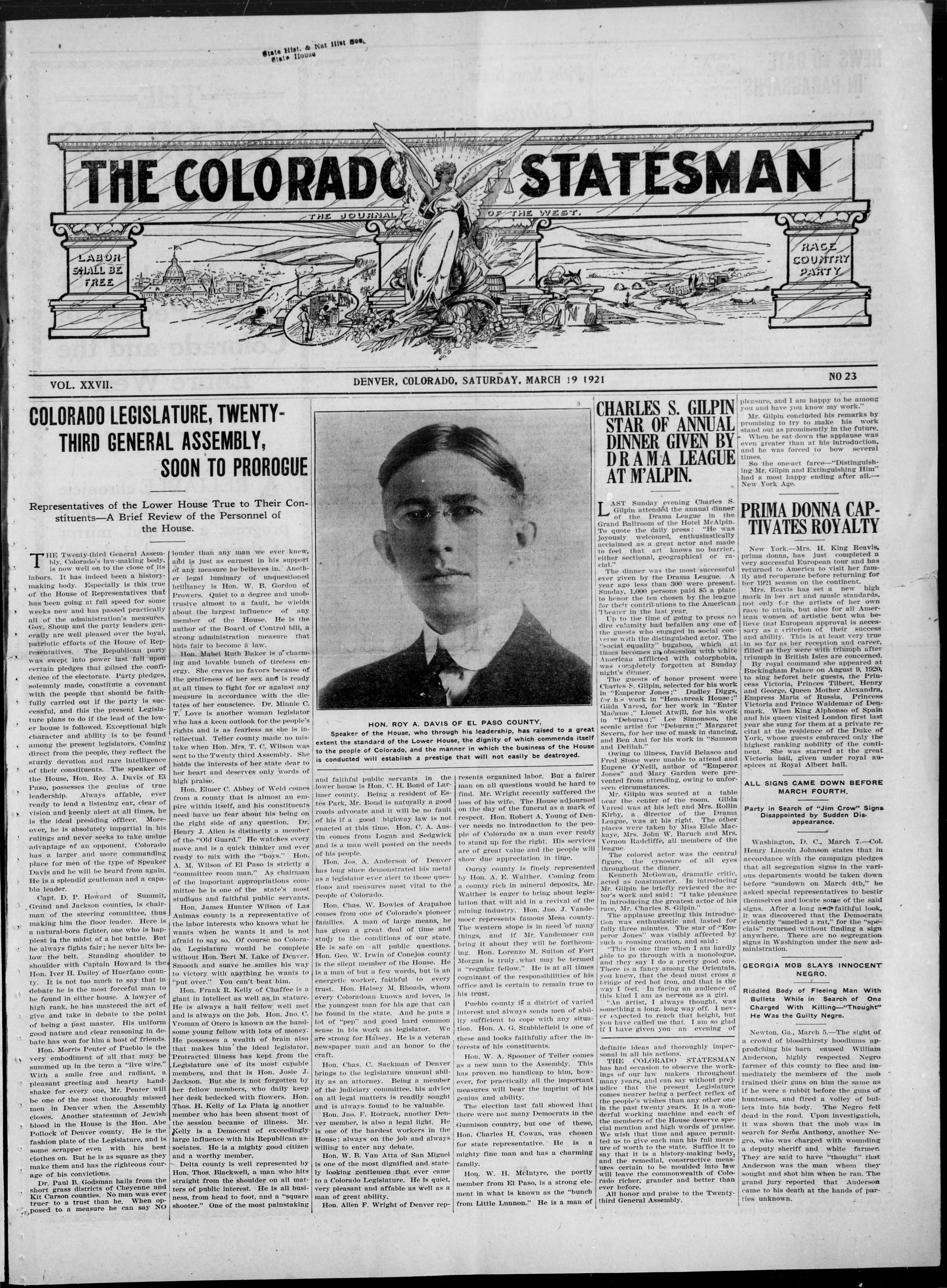
COLORADO LEGISLATURE, TWENTY- THIRD GENERAL ASSEMBLY, SOON TO PROROGUE
Representatives of the Lower House True to Their Constituents—A Brief Review of the Personnel of the House.
VOL. XXVII.
COLORADO LEGISLATION
THIRD GENERAL
Representatives of the Lower
stituents—A Brief Revea
the H
THE Twenty-third General Assembly, Colorado's law-making body, is now well on to the close of its labors. It has indeed been a history-making body. Especially is this true of the House of Representatives that has been going at full speed for some weeks now and has passed practically all of the administration's measures. Gov. Shoup and the party leaders generally are well pleased over the loyal, patriotic efforts of the House of Representatives. The Republican party was swept into power last fall upon certain pledges that gained the confidence of the electorate. Party pledges, solemnly made, constitute a covenant with the people that should be faithfully carried out if the party is successful, and this the present Legislature plans to do if the lead of the lower house is followed. Exceptional high character and ability is to be found among the present legislators. Coming direct from the people, they reflect the sturdy devotion and rare intelligence of their constituents. The speaker of the House, Hon. Roy A. Davis of El Paso, possesses the genius of true leadership. Always affable, ever ready to lend a listening ear, clear of vision and keenly alert at all times, he is the ideal presiding officer. Moreover, he is absolutely impartial in his rulings and never seeks to take undue advantage of an opponent. Colorado has a larger and more commanding place for men of the type of Speaker Davis and he will be heard from again. He is a splendid gentleman and a capable lender.
Capt. D. P. Howard of Summit, Grand and Jackson counties, is chairman of the steering committee, thus making him the floor leader. Here is a natural-born fighter, one who is happiest in the midst of a hot battle. But he always fights fair; he never hits below the belt. Standing shoulder to shoulder with Captain Howard is the Hon. Iver H. Dailey of Huergano county. It is not too much to say that in debate he is the most forceful man to be found in either house. A lawyer of high rank, he has mastered the art of give and take in debate to the point of being a past master. His uniform good nature and clear reasoning in debate has won for him a host of friends.
Hon. Morris Penter of Pueblo is the very embodiment of all that may be summed up in the term a "live wire." With a smile free and radiant, a pleasant greeting and hearty handshake for every one, Mr. Penter will be one of the most thoroughly missed men in Denver when the Assembly closes. Another statesman of Jewish blood in the House is the Hon. Abe Pollock of Denver county. He is the fashion plate of the Legislature, and is some scrapper even with his best clothes on. But he is as square as they make them and has the righteous courage of his convictions.
Dr. Paul B. Godsman hails from the short grass districts of Cheyenne and Kit Carson counties. No man was ever truer to a trust than he. When opposed to a measure he can say NO
louder than any man we ever knew, and is just as earnest in his support of any measure he believes in. Another legal luminary of unquestioned brilliancy is Hon. W. B. Gordon of Prowers. Quiet to a degree and unobtrusive almost to a fault, he wields about the largest influence of any member of the House. He is the author of the Board of Control bill, a strong administration measure that bids fair to become a law.
Hon. Mabel Ruth Baker is a charming and lovable bunch of tireless energy. She craves no favors because of the gentleness of her sex and is ready at all times to fight for or against any measure in accordance with the dictates of her conscience. Dr. Minnie C. T. Love is another woman legislator who has a keen outlook for the people's rights and is as fearless as she is intellectual. Teller county made no mistake when Hon. Mrs. T. C. Wilson was sent to the Twenty third Assembly. She holds the interests of her state dear to her heart and deserves only words of high praise.
Hon. Elmer C. Abbey of Weld comes from a county that is almost an empire within itself, and his constituents need have no fear about his being on the right side of any question. Dr. Henry J. Allen is distinctly a member of the "Old Guard." He watches every move and is a quick thinker and ever ready to mix with the "boys." Hon. A. M. Wilson of El Paso is strictly a "committee room man." As chairman of the important appropriations committee he is one of the state's most studious and faithful public servants. Hon. James Hunter Wilson of Las Animas county is a representative of the labor interests who knows what he wants when he wants it and is not afraid to say so. Of course no Colorado Legislature would be complete without Hon. Bert M. Lake of Denver. Smooth and suave he smiles his way to victory with anything he wants to "put over." You can't beat him.
Hon. Frank R. Kelly of Chaffee is a giant in intellect as well as in stature. He is always a hail fellow well met and is always on the job. Hon. Jno. C. Vroman of Otero is known as the handsome young fellow with lots of money. He possesses a wealth of brain also that makes him the ideal legislator. Protracted illness has kept from the Legislature one of its most capable members, and that is Hon. Josie J. Jackson. But she is not forgotten by her fellow members, who daily keep her desk bedecked with flowers. Hon. Thos. H. Kelly of La Plata is another member who has been absent most of the session because of illness. Mr. Kelly is a Democrat of exceedingly large influence with his Republican associates. He is a mighty good citizen and a worthy member.
Delta county is well represented by Hon. Thos. Blackwell, a man who hits straight from the shoulder on all matters of public interest. He is all business, from head to foot, and a "square shooter." One of the most palstaking
DENVER, COLORADO, SATURDAY, MARCH 19 1921
6
and faithful public servants in the lower house is Hon. C. H. Bond of Limer county. Being a resident of Estes Park, Mr. Bond is naturally a good roads advocate and it will be no fault of his if a good highway law is not enacted at this time. Hon. C. A. Austin comes from Logan and Sedgwick and is a man well posted on the needs of his people.
Hon. Jos. A. Anderson of Denver has long since demonstrated his metal as a legislator ever alert to those questions and measures most vital to the people of Colorado.
resents organized labor. But a fairer man on all questions would be hard to find. Mr. Wright recently suffered the loss of his wife. The House adjourned on the day of the funeral as a mark of respect. Hon. Robert A. Young of Denver needs no introduction to the people of Colorado as a man ever ready to stand up for the right. His services are of great value and the people will show due appreciation in time.
Ouray county is finely represented by Hon. A. E. Walther. Coming from a county rich in mineral deposits, Mr. Walther is eager to bring about legis-
Hon. Chas. W. Bowles of Arapahoe comes from one of Colorado's pioneer families. A man of large means, he has given a great deal of time and study to the conditions of our state. He is safe on all public questions. Hon. Geo. W. Irwin of Conejos county is the silent member of the House. He is a man of but a few words, but is an energetic worker, faithful to every trust. Hon. Halsey M. Rhonds, whom every Coloradoan knows and loves, is the youngest man for his age that can be found in the state. And he puts a lot of "pep" and good hard common sense in his work as legislator. We are strong for Halsey. He is a veteran newspaper man and an honor to the craft.
Hon. Chas. C. Sackman of Denver brings to the legislature unusual ability as an attorney. Being a member of the judiciary committee, his advice on all legal matters is readily sought and is always found to be valuable.
Hon. Juo. F. Rotruck, another Denver member, is also a legal light. He is one of the hardest workers in the House; always on the job and always willing to enter any debate.
Hon. W. B. Van Atta of San Miguel is one of the most dignified and stately looking gentlemen that ever came to a Colorado Legislature. He is quiet, very pleasant and affable as well as a man of great ability. Hon. Allen F. Wright of Denver rep-
resents organized labor. But a fairer man on all questions would be hard to find. Mr. Wright recently suffered the loss of his wife. The House adjourned on the day of the funeral as a mark of respect. Hon. Robert A. Young of Denver needs no introduction to the people of Colorado as a man ever ready to stand up for the right. His services are of great value and the people will show due appreciation in time.
Ouray county is finely represented by Hon. A. E. Walther. Coming from a county rich in mineral deposits, Mr. Walther is eager to bring about legislation that will aid in a revival of the mining industry. Hon. Jno. J. Vandemoer represents famous Mesa county. The western slope is in need of many things, and if Mr. Vandemoer can bring it about they will be forthcoming. Hon. Lorenzo M. Sutton of Fort Morgan is truly what may be termed a "regular fellow." He is at all times cognizant of the responsibilities of his office and is certain to remain true to his trust.
Pueblo county is a district of varied interest and always sends men of ability sufficient to cope with any situation. Hon. A. G. Stubblefield is one of these and looks faithfully after the interests of his constituents.
Hon. W. A. Spooner of Teller comes as a new man to the Assembly. This has proven no handicap to him, however, for practically all the important measures will bear the imprint of his genius and ability.
The election last fall showed that there were not many Democrats in the Gunnison country, but one of these, Hon. Charles H. Cowan, was chosen for state representative. He is a mighty fine man and has a charming family.
Hon. W. H. McIntyre, the portly member from El Paso, is a strong element in what is known as the "bunch from Little Lunnon." He is a man of
CHARLES S. GILPIN STAR OF ANNUAL DINNER GIVEN BY DRAMA LEAGUE AT M'ALPIN.
LAST Sunday evening Charles S. Glipin attended the annual dinner of the Drama League in the Grand Ballroom of the Hotel McAlpin. To quote the daily press; "He was joyously welcomed, enthusiastically acclaimed as a great actor and made to feel that art knows no barrier, either sectional, geographical or racial."
The dinner was the most successful ever given by the Drama League. A year ago less than 300 were present. Sunday, 1,000 persons paid $5 a plate to honor the ten chosen by the league for their contributions to the American Theater in the last year.
Up to the time of going to press no dire culamity had befallen any one of the guests who engaged in social converse with the distinguished actor. The "social equality" bugaboo, which at times becomes an obsession with white American afflicted with colorphobia, was completely forgotten at Sunday night's dinner.
The guests of honor present were Charles S. Glipin, selected for his work in "Emperor Jones;" Dudley Diggs, for his work in "Hea'break House;" Glida Varesi, for her work in "Enter Machine;" Lionel Atwill, for his work in "Deburau;" Lee Simonson, the scenic artist for "Deburau;" Margaret Severn, for her use of mask in dancing, and Ben Ami for his work in "Samson and Delilah."
Owing to illness, David Belasco and Fred Stone were unable to attend and Eugene O'Nell, author of "Emperor Jones" and Mary Garden were prevented from attending, owing to unforeseen circumstances.
Mr. Gilpin was seated at a table near the center of the room. Glida Varelis was at his left and Mrs. Rollin Kirby, a director of the Drama League, was at his right. The other places were taken by Miss Elsie Mackaye, Mrs. John W. Baruch and Mrs. Vernon Radcliffe, all members of the league.
The colored actor was the central figure, the cynosure of all eyes throughout the dinner.
Kenneth McGowan, dramatic critic, acted as toastmaster. In introducing Mr. Gilpin he briefly reviewed the actor's work and said: "I take pleasure in introducing the greatest actor of his race, Mr. Charles S. Gilpin."
The applause greeting this introduction was enthusiastic and lasted for fully three minutes. The star of "Emperor Jones" was visibly affected by such a rousing ovation, and said: "This is one time when I am hardly able to go through with a monologue, and they say I do a pretty good one. There is a fancy among the Orientals, you know, that the dead must cross a bridge of red hot iron, and that is the way I feel. In facing an audience of this kind I am as nervous as a girl.
"An artist, I always thought, was something a long, long way off. I never expected to reach that height, but you have called me that. I am so glad if I have given you an evening of definite ideas and thoroughly imperial in all his actions.
THE COLORADO STATESMAN has had occasion to observe the workings of our law makers throughout many years, and can say without prejudice that the present Legislature comes nearer being a perfect reflex of the people's wishes than any other one in the past twenty years. It is a wonderful working machine and each of the members of the House deserve special mention and high words of praise. We wish that time and space permitted us to give each man his full measure of worth to the state. Suffice it to say that it is a history-making body, and the remedial, constructive measures certain to be moulded into law will leave the commonwealth of Colorado richer, grander and better than ever before. All honor and praise to the Twenty-third General Assembly.
NO 23
pleasure, and I am happy to be among you and have you know my work."
Mr. Glipin concluded his remarks by promising to try to make his work stand out as prominently in the future. When he sat down the applause was even greater than at his introduction, and he was forced to bow several times.
So the one-act farce—"Distinguishing Mr. Glipin and Extinguishing Him" had a most happy ending after all.—New York Age.
PRIMA DONNA CAP-
TIVATES ROYALTY
New York.—Mrs. H. King Reavis, prima donna, has just completed a very successful European tour and has returned to America to visit her family and recuperate before returning for her 1921 season on the continent. Mrs. Reavis has set a new high mark in her art and music standards, not only for the artists of her own race to attain, but also for all American women of artistic bent who believe that European approval is necessary as a criterion of their success and ability. This is at least very true in so far as her reception and career, filled as they were with triumph after triumph in British Isles are concerned. By royal command she appeared at Buckingham Palace on August 9, 1920, to sing beforeet her guests, the Princess Victoria, Princes Tilbert, Henry and George, Queen Mother Alexandra, Empress Maria of Russia, Princess Victoria and Prince Waldemar of Denmark. When King Alphonso of Spain and his queen visited London first last year she sung for them at a private recital at the residence of the Duke of York, whose guests embraced only the highest ranking nobility of the continent. She was starred at the great Victoria ball, given under royal auspices at Royal Albert hall.
ALL SIGNS CAME DOWN BEFORE
MARCH FOURTH.
Party in Search of "Jim Crow" Signs Disappointed by Sudden Disappearance.
Washington, D. C., March 7.—Col. Henry Lincoln Johnson states that in accordance with the campaign pledges that all segregation signs in the various departments would be taken down before "sundown on March 4th," he asked special representatives to bestir themselves and locate some of the said signs. After a long a=d faithful look, it was discovered that the Democrats evidently "smelled a rat," for the "specials" returned without finding a sign anywhere. There are no segregation signs in Washington under the new administration.
GEORGIA MOB SLAYS INNOCENT
NEGRO.
Riddled Body of Fleeing Man With Bullets While in Search of One Charged With Killing—"Thought" He Was the Guilty Negro.
Newton, Ga., March 5.—The sight of a crowd of bloodthirsty hoodlums approaching his barn caused William Anderson, highly respected Negro farmer of this county to flee and immediately the members of the mob trained their guns on him the same as if he were a rabbit before the guns of huntsmen, and fired a volley of bullets into his body. The Negro fell dead in the road. Upon investigation, it was shown that the mob was in search for Senha Anthony, another Negro, who was charged with wounding a deputy sheriff and white farmer. They are said to have "thought" that Anderson was the man whom they sought and shot him when he ran. The grand jury reported that Anderson came to his death at the hands of parties unknown.
FOREIGN
Col. Angel Gaxiola, chief clerk in the Department of the Interior of Mexico, and chief of staff under former Provisional President Adolpo de la Huerta, has been assassinated in Mexico City.
Prince Danielo, heir to the throne of Montenegro, has abdicated in favor of Prince Michael, son of the late Prince Mirko. Queen Milena, widow of King Nicholas, who died March 1, has assumed the regency.
Four American sailors from the steamship Sazon were drowned in Tampaico bay by a band of masked men who attacked them as they were returning to their ship, according to information received from Tampaico. The United States consul has started an investigation.
Anti-Jewish disorders which broke out in Vienna threatened for a time to develop into a serious situation, but the police succeeded in dispersing street crowds and in preventing possible loss of life. Shops owned by Jews were damaged by stones thrown by riotous crowds, and in a few cases Jews were beaten.
Inability of the German security police officers to compel privates to salute French officers caused General Degoutte to order the disarmament and disbandment of 1,500 security police in Dusseldorf and command them to leave the city. An officer, a member of whose squad refused to salute a French major, has been fined 3,000 marks.
Police officials have discovered a second underground passage connecting the Swiss and German borders and used for smuggling. Illeit traffic in German and Austrian gold and silver coins and in narcotics was said to have made large profits for the band that invested large capital in constructing the passage, which runs through a frontier forest.
Discovery of the details of a conspiracy which caused disorders in Tuscania has been announced by the police, who declared the ring leader was an anarchist named Chelli, editor of the revolutionary pamphlet, "The Cry of Revolt." Chelli had a supply of bombs, the police assert, which he distributed for anarchistic attempts. Chelli and five others have been arrested.
GENERAL
One life was lost and considerable property damage done by a storm which deluged southern California for three days.
Saved by his finger prints, Miner F. Crawford of Hutchinson, Kan., held by federal officials of Boston, Mass., for a train robbery and murder in Minnesota, has been released. Finger prints of the train robber was sent from Minnesota, and were found to differ from those of Crawford
Gov. Edwin P. Morrow of Kentucky has offered a reward of $500 each for the arrest and conviction of each member of the mob that took from the Woodford county jail and lynched Richard James, negro. He also issued a proclamation relieving from office John H. Edger, jailer of Woodford county.
A concurrent resolution, introduced in the lower house of the Michigan Legislature at Lansing, by Representative Walter Henze of Iron Mountain, would call upon Congress to divide Michigan into two states, the lower peninsula to retain the present name and government, and a new commonwealth to be known as "Superior" to be created of the upper peninsula.
The government will be required to return $1,655,000 tax to the estate of Mrs. Potter Palmer, under a ruling by Judge George T. Page in the United States District Court at Chicago. Judge Page ruled that Potter Palmer had died before the federal estate tax became a law, and that Mrs. Palmer never had received any benefit from the $7,000,000 trust, her half of the Palmer estate.
California rice growers, who raise the second largest crop of rice in the United States, have a surplus of approximately 2,000,000 bags of paddy rice on their hands.
Little Italy section of Chicago was deeply stirred by the arrest of Samuel Amatuna, proprietor of the Blue Bird cabaret, and Frank Compino, saloon keeper, as suspects in the slaying of Paul A. Labriola, recent victim of an alleged political feud in the Nineteenth ward. Police say that three witnesses to the shooting of Labriola have identified Amatuna and Compino as two of the five men who participated in the slaying.
Representatives of the National Wheat Growers' Association and of the Agricultural Committee of Seventeen at a meeting in Kansas City, agreed the advisability of the pooling of grain under a national sales agency was advisable, but they disagreed as to the method of carrying out the plan. The conference was adjourned to meet in Chicago March 28. The main point of dissension was whether or not the pool should be voluntary or compulsory. Effective fire fighting in New York City thwarted a repetition of the disastrous oil fire that swept the Stone and Fleming works of the Standard Oil Company in Brooklyn in September, 1919. Flames that for a time threatened to lay waste scores of 25,000-gallon tanks broke out but firemen restricted the conflagration to five tanks and stopped its spread. When the city council of Oxford Junction, In., keeping up the general movement for wage reduction, cut the salary of Mayor E. L. Magruder from $10 a month to $1, the mayor resigned.
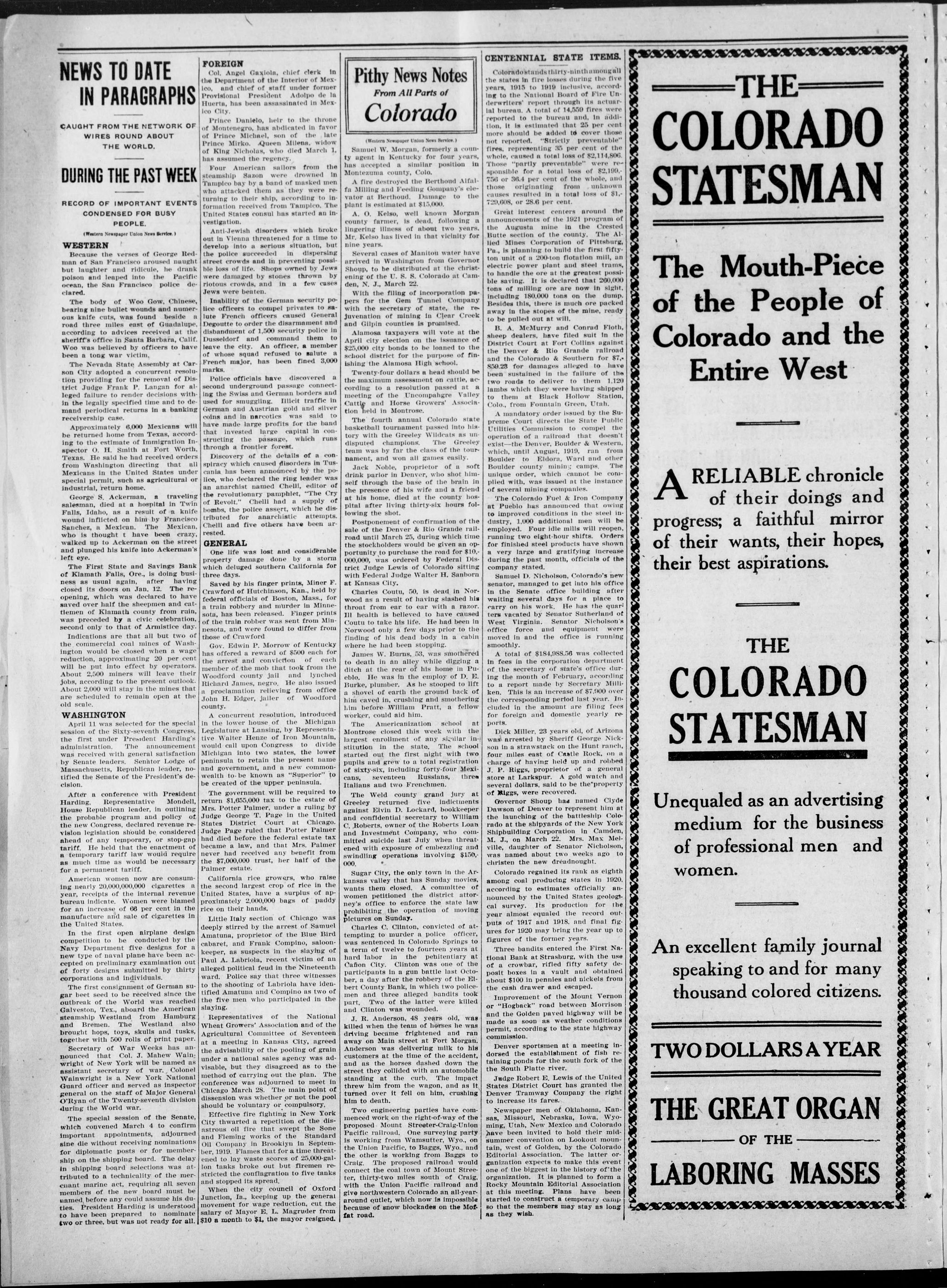
NEWS TO DATE IN PARAGRAPHS
CAUGHT FROM THE NETWORK OF WIRES ROUND ABOUT THE WORLD.
DURING THE PAST WEEK
RECORD OF IMPORTANT EVENTS
CONDENSED FOR BUSY
PEOPLE.
(Western Newspaper Union News Service.)
WESTERN
Because the verses of George Redman of San Francisco aroused naught but laughter and ridicule, he drank poison and leaped into the Pacific ocean, the San Francisco police declared.
The body of Woo Gow, Chinese, bearing nine bullet wounds and numerous knife cuts, was found beside a road three miles east of Guadalupe, according to advises received at the sheriff's office in Santa Barbara, Calif. Woo was believed by officers to have been a tong war victim.
The Nevada State Assembly at Carson City adopted a concurrent resolution providing for the removal of District Judge Frank P. Langan for alleged failure to render decisions within the legally specified time and to demand periodical returns in a banking receivership case.
Approximately 6,000 Mexicans will be returned home from Texas, according to the estimate of Immigration Inspector O. H. Smith at Fort Worth, Texas. He said he had received orders from Washington directing that all Mexicans in the United States under special permit, such as agricultural or industrial, return home.
George S. Ackerman, a traveling salesman, died at a hospital in Twin Falls, Idaho, as a result of a knife wound inflicted on him by Francisco Sanchez, a Mexican. The Mexican, who is thought t have been crazy, walked up to Ackerman on the street and plunged his knife into Ackerman's left eye.
The First State and Savings Bank of Klamath Falls, Ore., is doing business as usual again, after having closed its doors on Jan. 12. The re-opening, which was declared to have saved over half the sheepmen and cattlemen of Klamath county from ruin, was preceded by a civic celebration, second only to that of Armistice day.
Indications are that all but two of the commercial coal mines of Washington would be closed when a wage reduction, approximating 20 per cent will be put into effect by operators. About 2,500 miners will leave their jobs, according to the present outlook. About 2,000 will stay in the mines that are scheduled to remain open at the old scale.
WASHINGTON
April 11 was selected for the special session of the Sixty-seventh Congress, the first under President Harding's administration. The announcement was received with general satisfaction by Senate leaders, Senator Lodge of Massachusetts, Republican leader, notified the Senate of the President's decision.
After a conference with President Harding, Representative Mondell, House Republican leader, in outlining the probable program and policy of the new Congress, declared revenue revision legislation should be considered ahead of any temporary, or stop-gap tariff. He held that the enactment of a temporary tariff law would require as much time as would be necessary for a permanent tariff.
American women now are consuming nearly 20,000,000,000 cigarettes a year, receipts of the internal revenue bureau indicate. Women were blamed for an increase of 66 per cent in the manufacture and sale of cigarettes in the United States.
In the first open airplane design competition to be conducted by the Navy Department five designs for a new type of naval plane have been accepted on preliminary examination out of forty designs submitted by thirty corporations and individuals.
The first consignment of German sugar beet seed to be received since the outbreak of the World was reached Galveston, Tex., aboard the American steamship Westland from Hamburg and Bremen. The Westland also brought hops, toys, skulls and tusks, together with 500 rolls of print paper. Secretary of War Weeks has announced that Col. J. Mahew Wainwright of New York will be named as assistant secretary of war, Colonel Wainwright is a New York National Guard officer and served as inspector general on the staff of Major General O'Ryan of the Twenty-seventh division during the World war.
The special session of the Senate, which convened March 4 to confirm important appointments, adjourned sine die without receiving nominations for diplomatic posts or for membership on the shipping board. The delay in shipping board selections was attributed to a technicality of the mercant marine act, requiring all seven members of the new board must be named before any could assume his duties. President Harding is understood to have been prepared to nominate two or three, but was not ready for all.
Pithy News Notes
From All Parts of
Colorado
Samuel W. Morgan, formerly a county agent in Kentucky for four years, has accepted a similar position in Montezuma county, Colo.
A fire destroyed the Berthoud Alfalfa Milling and Feeding Company's elevator at Berthoud. Damage to the plant is estimated at $15,000.
A. O. Kelso, well known Morgan county farmer, is dead, following a lingering illness of about two years. Mr. Kelso has lived in that vicinity for nine years.
Several cases of Manitou water have arrived in Washington from Governor Shoup, to be distributed at the christening of the U. S. S. Colorado at Camden, N. J., March 22.
With the filing of incorporation papers for the Gem Tunnel Company with the secretary of state, the rejuvenation of mining in Clear Creek and Gilpin counties is promised.
Alamosa taxpayers will vote at the April city election on the issuance of $25,000 city bonds to be loaned to the school district for the purpose of finishing the Alamosa High school.
Twenty-four dollars a head should be the maximum assessment on cattle, according to a resolution passed at a meeting of the Uncompahgre Valley Cattle and Horse Growers' Association held in Montrose.
The fourth annual Colorado state basketball tournament passed into history with the Greeley Wildcats as undisputed champions. The Greeley team was by far the class of the tournament, and won all games easily.
Jack Noble, proprietor of a soft drink parlor in Denver, who shot himself through the base of the brain in the presence of his wife and a friend at his home, died at the county hospital after living thirty-six hours following the shot.
Postponement of confirmation of the sale of the Denver & Rio Grande railroad until March 25, during which time the stockholders would be given an opportunity to purchase the road for $10,000,000, was ordered by Federal District Judge Lewis of Colorado sitting with Federal Judge Walter H. Sanborn at Kansas City.
Charles Coutu, 50, is dead in Norwood as a result of having slashed his throat from ear to ear with a razor. Ill health is believed to have caused Coutu to take his life. He had been in Norwood only a few days prior to the finding of his dead body in a cabin where he had been stopping.
James W. Burns, 53, was smothered to death in an alley while digging a ditch at the rear of his home in Pueblo. He was in the employ of D. E. Burke, plumber. As he stooped to lift a shovel of earth the ground back of him caved in, crushing and smothering him before William Pratt, a fellow worker, could aid him.
The Americanization school at Montrose closed this week with the largest enrollment of any singular institution in the state. The school started out the first night with two pupils and grew to a total registration of sixty-six, including forty-four Mexicans, seventeen Russians, three Italians and two Frenchmen.
The Weld county grand jury at Greeley returned five indictments against Elvin D. Lockard, bookkeeper and confidential secretary to William C. Roberts, owner of the Roberts Loan and Investment Company, who committed suicide last July when threatened with exposure of embezzling and swindling operations involving $150,000.
Sugar City, the only town in the Arkansas valley that has Sunday movies, wants them closed. A committee of women petitioned the district attorney's office to enforce the state law prohibiting the operation of moving pictures on Sunday.
Charles C. Clinton, convicted of attempting to murder a police officer, was sentenced in Colorado Springs to a term of twelve to fourteen years at hard labor in the pehteniary at Cafon City. Clinton was one of the participants in a gun battle last October, a day after the robbery of the Elbert County Bank, in which two policemen and three alleged bandits took part. Two of the latter were killed and Clinton was wounded.
J. R. Anderson, 48 years old, was killed when the team of horses he was driving became frightened and ran away on Main street at Fort Morgan. Anderson was delivering milk to his customers at the time of the accident, and as the horses dashed down the street they collided with an automobile standing at the curb. The impact threw him from the wagon, and as it turned over it fell on him, crushing him to death.
Two engineering parties have commenced work on the right-of-way of the proposed Mount Streeter-Craig-Union Pacific railroad. One surveying party is working from Wamsutter, Wyo., on the Union Pacific, to Baggs, Wyo., and the other is working from Baggs to Craig. The proposed railroad would connect the coal town of Mount Streeter, thirty-two miles south of Craig, with the Union Pacific railroad and give northwestern Colorado an all-year-around outlet, which now is impossible because of snow blockades on the Moffat road.
CENTENNIAL STATE ITEMS.
Coloradostands thirty-ninthamongall the states in fire losses during the five years, 1915 to 1919 inclusive, according to the National Board of Fire Underwriters' report through its actuarial bureau. A total of 14,559 fires were reported to the bureau and, in addition, it is estimated that 25 per cent more should be added to cover those not reported. "Strictly preventable" fires, representing 35 per cent of the whole, caused a total loss of $2,114,806. Those "partly preventable" were responsible for a total loss of $2,199.756 or 36.4 per cent of the whole, and those originating from unknown causes resulted in a total loss of $1.729,608, or 28.6 per cent.
THE COLORADO STATESMAN
Great interest centers around the announcements of the 1921 program of the Augusta mine in the Crested Butte section of the county. The Allied Mines Corporation of Pittsburg, Pa., is planning to build the first fiftyton unit of a 200-ton flotation mill, an electric power plant and steel trams, to handle the ore at the greatest possible saving. It is declared that 260,000 tons of milling ore are now in sight, including 180,000 tons on the dump. Besides this, there is much ore packed away in the stopes of the mine, ready to be pulled out at will.
The Mouth-Piece of the People of Colorado and the Entire West
B. A. McMurry and Conrad Floth, sheep dealers, have filed suit in the District Court at Fort Collins against the Denver & Rio Grande railroad and the Colorado & Southern for $7,859.23 for damages alleged to have been sustained in the failure of the two roads to deliver to them 1,120 lambs which they were having shipped to them at Black Hollow Station, Colo., from Fountain Green, Utah.
A mandatory order issued by the Supreme Court directs the State Public Utilities Commission to compel the operation of a railroad that doesn't exist—the Denver, Boulder & Western, which, until August, 1919, ran from Boulder to Eldora, Ward and other Boulder county mining camps. The unique order, which cannot be compiled with, was issued at the instance of several mining companies.
A RELIABLE chronicle of their doings and progress; a faithful mirror of their wants, their hopes, their best aspirations.
The Colorado Fuel & Iron Company at Pueblo has announced that owing to improved conditions in the steel industry, 1,000 additional men will be employed. Four idle mills will reopen, running two eight-hour shifts. Orders for finished steel products have shown a very large and gratifying increase during the past month, officials of the company stated. Samuel D. Nicholson, Colorado's new senator, managed to get into his office in the Senate office building after waiting several days for a place to carry on his work. He has the quarters vacated by Senator Sutherland of West Virginia. Senator Nicholson's office force and equipment were moved in and the office is running smoothly.
THE COLORADO STATESMAN
THE COLORADO STATESMAN
A total of $184,988.56 was collected in fees in the corporation department of the secretary of state's office during the month of February, according to a report made by Secretary Milliken. This is an increase of $7,900 over the corresponding period last year. Included in the amount are filing fees for foreign and domestic yearly reports.
Dick Miller, 23 years old, of Arizona was arrested by Sheriff George Nickson in a strawstack on the Hunt ranch, four miles east of Castle Rock, on a charge of having held up and robbed J. P. Riggs, proprietor of a general store at Larkspur. A gold watch and several dollars, said to be the property of Miggs, were recovered.
Unequaled as an advertising medium for the business of professional men and women.
Governor Shoup has named Clyde Dawson of Denver to represent him at the launching of the battleship Colorado at the shipyards of the New York Shipbuilding Corporation in Camden, M. J., on March 22. Mrs. Max Melville, daughter of Senator Nicholson, was named about two weeks ago to christen the new dreadnought.
Colorado regained its rank as eighth among coal producing states in 1920, according to estimates officially announced by the United States geological survey. Its production for the year almost equaled the record outputs of 1917 and 1918, and final figures for 1920 may bring the year up to figures of the former years.
An excellent family journal speaking to and for many thousand colored citizens.
Three bandits entered the First National Bank at Strasburg, with the use of a crowbar, rifled fifty safety deposit boxes in a vault and obtained about $100 in pennies and nickels from the cash drawer and escaped.
Improvement of the Mount Vernon or "Hogback" road between Morrison and the Golden paved highway will be made as soon as weather conditions permit, according to the state highway commission.
TWODOLLARSAYEAR
Denver sportsmen at a meeting indorsed the establishment of fish retaining ponds for the south fork of the South Platte river. Judge Robert E. Lewis of the United States District Court has granted the Denver Tramway Company the right to increase its fares.
THE GREAT ORGAN OF THE
Newspaper men of Oklahoma, Kansas, Missouri, Nebraska, Iowa, Wyoming, Utah, New Mexico and Colorado have been invited to hold their midsummer convention on Lookout mountain, west of Golden, by the Colorado Editorial Association. The latter organization expects to make this event one of the biggest in the history of the organization. It is planned to form a Rocky Mountain Editorial Association at this meeting. Plans have been started to construct a temporary camp so that the members may stay as long as they wish.
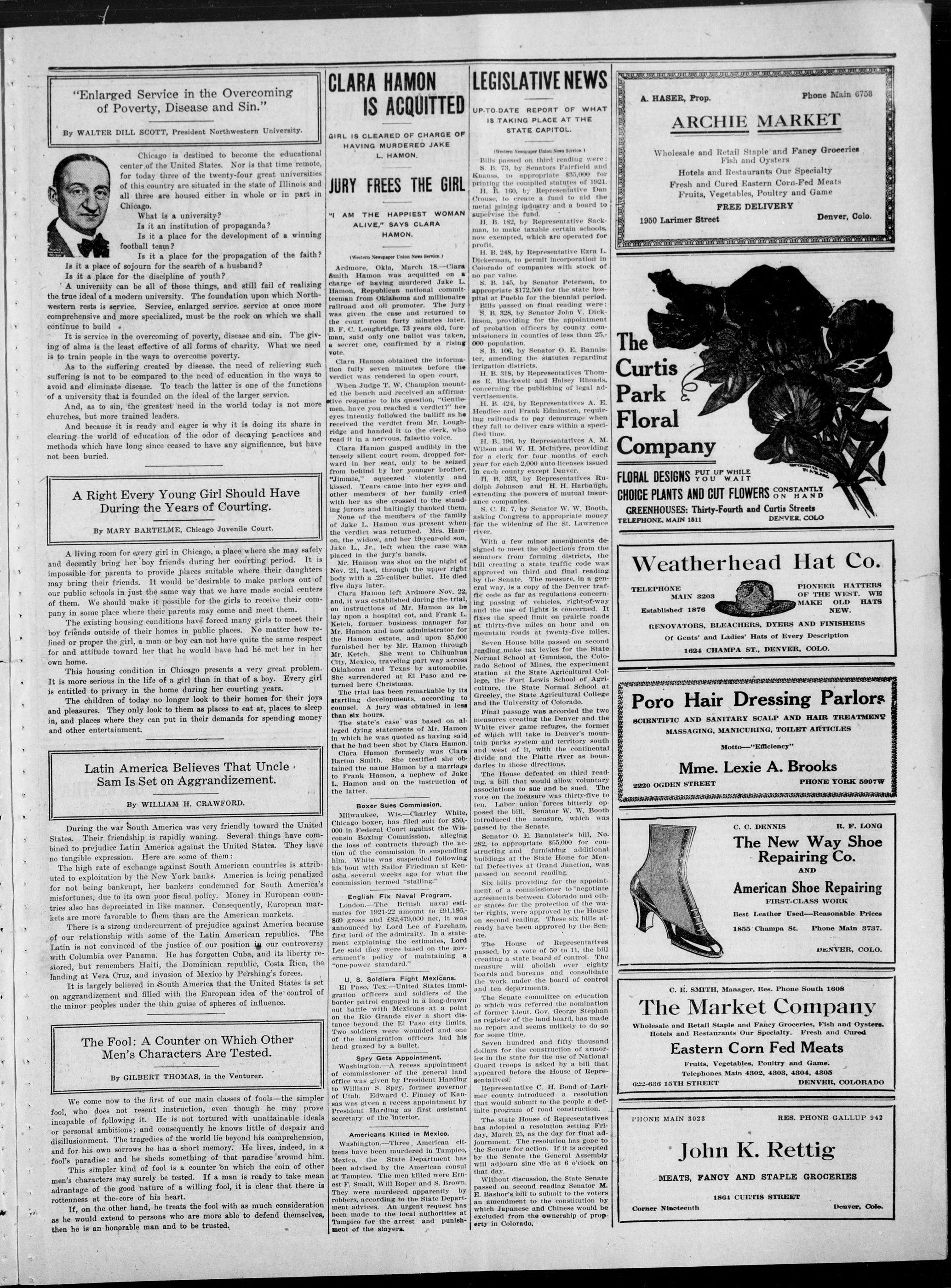
"Enlarged Service in the Overcoming of Poverty, Disease and Sin."
By WALTER DILL SCOTT, President Northwestern University.
Marcus
Bernard K.
Bernard
Is it a place for the development football team?
Is it a place for the propagation
Is it a place of sojourn for the search of a husband?
Is it a place for the propagation of the faith?
Is it a place of sojourn for the search of a husband?
Is it a place for the discipline of youth?
A university can be all of those things, and still fail to true ideal of a modern university. The foundation upon eastern rests is service. Service, enlarged service, service, compressive and more specialized, must be the rock on whichinue to build.
It is service in the overcoming of poverty, disease and sick of alms is the least effective of all forms of charity. We do train people in the ways to overcome poverty.
As to the suffering created by disease, the need of rearing is not to be compared to the need of education in aid and eliminate disease. To teach the latter is one of the university that is founded on the ideal of the larger society. And, as to sin, the greatest need in the world today is orchards, but more trained leaders.
And because it is ready and eager is why it is doing the world of education of the odor of decaying schools which have long since ceased to have any significance been buried.
A Right Every Young Girl Should Have During the Years of Courting.
By MARY BARTELME, Chicago Juvenile Court
A living room for every girl in Chicago, a place where she decently bring her boy friends during her courting possible for parents to provide places suitable where they bring their friends. It would be desirable to make public schools in just the same way that we have made them. We should make it possible for the girls to receive in some place where their parents may come and meet. The existing housing conditions have forced many girls friends outside of their homes in public places. No need or proper the girl, a man or boy can not have quite the and attitude toward her that he would have had he made home.
This housing condition in Chicago presents a very girl is more serious in the life of a girl than in that of a boy entitled to privacy in the home during her courting year. The children of today no longer look to their homes for pleasures. They only look to them as places to eat at, play and places where they can put in their demands for spare other entertainment.
Latin America Believes That Un Sam Is Set on Aggrandizement
A university can be all of those things, and still fail of realizing the true ideal of a modern university. The foundation upon which Northwestern rests is service. Service, enlarged service. service at once more comprehensive and more specialized, must be the rock on which we shall continue to build.
It is service in the overcoming of poverty, disease and sin. The giving of alms is the least effective of all forms of charity. What we need is to train people in the ways to overcome poverty.
As to the suffering created by disease, the need of relieving such suffering is not to be compared to the need of education in the ways to avoid and eliminate disease. To teach the latter is one of the functions of a university that is founded on the ideal of the larger service.
And, as to sin, the greatest need in the world today is not more churches, but more trained leaders.
And because it is ready and eager is why it is doing its share in clearing the world of education of the odor of decaying practices and methods which have long since ceased to have any significance, but have not been buried.
A Right Every Young Girl Should Have During the Years of Courting.
A living room for every girl in Chicago, a place where she may safely and decently bring her boy friends during her courting period. It is impossible for parents to provide places suitable where their daughters may bring their friends. It would be desirable to make parlors out of our public schools in just the same way that we have made social centers of them. We should make it possible for the girls to receive their company in some place where their parents may come and meet them.
The existing housing conditions have forced many girls to meet their boy friends outside of their homes in public places. No matter how refined or proper the girl, a man or boy can not have quite the same respect for and attitude toward her that he would have had he met her in her own home.
This housing condition in Chicago presents a very great problem. It is more serious in the life of a girl than in that of a boy. Every girl is entitled to privacy in the home during her courting years.
The children of today no longer look to their homes for their joys and pleasures. They only look to them as places to eat at, places to sleep in, and places where they can put in their demands for spending money and other entertainment.
Latin America Believes That Uncle Sam Is Set on Aggrandizement.
During the war South America was very friendly toward States. Their friendship is rapidly waning. Several things need to prejudice Latin America against the United States: untangible expression. Here are some of them:
The high rate of exchange against South American countries led to exploitation by the New York banks. America is being not being bankrupt, her bankers condemned for South fortunes, due to its own poor fiscal policy. Money in Europe also has depreciated in like manner. Consequently, Europe is more favorable to them than are the American man. There is a strong undercurrent of prejudice against American relationship with some of the Latin American republic is not convinced of the justice of our position in our South Columbia over Panama. He has forgotten Cuba, and freed, but remembers Haiti, the Dominican republic, Coeding at Vera Cruz, and invasion of Mexico by Pershing's. It is largely believed in South America that the United aggrandizement and filled with the European idea of a minor peoples under the thin guise of spheres of influence.
The Fool: A Counter on Which Our Men's Characters Are Tested.
During the war South America was very friendly toward the United States. Their friendship is rapidly waning. Several things have combined to prejudice Latin America against the United States. They have no tangible expression. Here are some of them:
The high rate of exchange against South American countries is attributed to exploitation by the New York banks. America is being penalized for not being bankrupt, her bankers condemned for South America's misfortunes, due to its own poor fiscal policy. Money in European countries also has depreciated in like manner. Consequently, European markets are more favorable to them than are the American markets.
There is a strong undercurrent of prejudice against America because of our relationship with some of the Latin American republics. The Latin is not convinced of the justice of our position in our controversy with Columbia over Panama. He has forgotten Cuba, and its liberty restored, but remembers Haiti, the Dominican republic, Costa Rica, the landing at Vera Cruz, and invasion of Mexico by Pershing's forces.
It is largely believed in South America that the United States is set on aggrandizement and filled with the European idea of the control of the minor peoples under the thin guise of spheres of influence.
We come now to the first of our main classes of fools, who does not resent instruction, even though he capable of following it. He is not tortured with unattractive personal ambitions; and consequently he knows little of illusionment. The tragedies of the world lie beyond his cool for his own sorrows he has a short memory. He lives his paradise: and he sheds something of that paradise. This simpler kind of fool is a counter on which the man's characters may surely be tested. If a man is ready advantage of the good nature of a willing fool, it is clear tenness at the core of his heart. If, on the other hand, he treats the fool with as much
We come now to the first of our main classes of fools—the simpler fool, who does not resent instruction, even though he may prove incapable of following it. He is not tortured with unattainable ideals or personal ambitions; and consequently he knows little of despair and disillusionment. The tragedies of the world lie beyond his comprehension, and for his own sorrows he has a short memory. He lives, indeed, in a fool's paradise: and he sheds something of that paradise around him. This simpler kind of fool is a counter on which the coin of other men's characters may surely be tested. If a man is ready to take mean advantage of the good nature of a willing fool, it is clear that there is rottenness at the core of his heart.
If, on the other hand, he treats the fool with as much consideration as he would extend to persons who are more able to defend themselves, then he is an honorable man and to be trusted.
Chicago is destined to become the educational center of the United States. Nor is that time remote, for today three of the twenty-four great universities of this country are situated in the state of Illinois and all three are housed either in whole or in part in Chicago.
What is a university?
Is it an institution of propaganda?
Is it a place for the development of a winning football team?
By WILLIAM H. CRAWFORD.
By GILBERT THOMAS, in the Venturer.
GIRL IS CLEARED OF CHARGE OF HAVING MURDERED JAKE L. HAMON.
JURY FREES THE GIRL
"I AM THE HAPPIEST WOMAN ALIVE," SAYS CLARA
Ardmore, Okla, March 18.—Clara Smith Hamon was acquitted on a charge of having murdered Jake L. Hamon, Republican national committee from Oklahoma and millionaire railroad and oil promoter. The jury was given the case and returned to the court room forty minutes later. B. F. C. Loughridge, 73 years old, foreman, said only one ballot was taken, a secret one, confirmed by a rising vote.
Clara Hamon obtained the information fully seven minutes before the verdict was rendered in open court.
When Judge T. W. Champion mounted the bench and received an affirmative response to his question, "Gentlemen, have you reached a verdict?" her eyes intently followed the balliff as he received the verdict from Mr. Loughridge and handed it to the clerk, who read it in a nervous, falsetto voice.
Clara Hamon gasped audibly in the tensely silent court room, dropped forward in her seat, only to be seized from behind by her younger brother, "Jimmie," squeezed violently and kissed. Tears came into her eyes and other members of her family cried with her as she crossed to the standing jurors and haltingly thanked them. None of the members of the family of Jake L. Hamon was present when the verdict was returned. Mrs. Hamon, the widow, and her 19-year-old son, Jake L., Jr., left when the case was placed in the jury's hands. Mr. Hamon was shot on the night of Nov. 21, last, through the upper right body with a .25-caliber bullet. He died five days later.
Clara Hamon left Ardmore Nov. 22, and, it was established during the trial, on instructions of Mr. Hamon as he lay upon a hospital cot, and Frank L Ketch, former business manager for Mr. Hamon and now administrator for the Hamon estate, and upon $5,000 furnished her by Mr. Hamon through Mr. Ketch. She went to Chihuahua City, Mexico, traveling part way across Oklahoma and Texas by automobile. She surrendered at El Paso and returned here Christmas. The trial has been remarkable by its startling developments, according to counsel. A jury was obtained in less than six hours.
The state's case was based on alleged dying statements of Mr. Hamon in which he was quoted as having said that he had been shot by Clara Hamon. Clara Hamon formerly was Clara Barton Smith. She testified she obtained the name Hamon by a marriage to Frank Hamon, a nephew of Jake L. Hamon and on the instruction of the latter.
Milvaukee, Wis.—Charley White, Chicago boxer, has filed suit for $50,000 in Federal Court against the Wisconsin Boxing Commission, alleging the loss of contracts through the action of the commission in suspending him. White was suspended following his bout with Sailor Friedman at Kenosha several weeks ago for what the commission termed "stalling."
English Fix Naval Program
London.—The British naval estimates for 1921-22 amount to £91,186,890 gross and £82,479,000 net, it was announced by Lord Lee of Fareham, first lord of the admiralty. In a statement explaining the estimates, Lord Lee said they were based on the government's policy of maintaining a "one-power standard."
U. S. Soldiers Eight Mexicans.
El Paso, Tex—United States immigration officers and soldiers of the border patrol engaged in a long-drawn out battle with Mexicans at a point on the Rio Grande river a short distance beyond the El Paso city limits. Two soldiers were wounded and one of the immigration officers had his head grazed by a bullet.
Spry Gets Appointment.
Washington.—A recess appointment of commissioner of the general land office was given by President Harding to William S. Spry, former governor of Utah. Edward C. Finney of Kansas was given a recess appointment by President Harding as first assistant secretary of the Interior.
Americans Killed in Mexico.
Washington.—Three American citizens have been murdered in Tampico, Mexico, the State Department has been advised by the American consul at Tampico. The men killed were Ernest F. Small, Will Roper and S. Brown. They were murdered apparently by robbers, according to the State Department advices. An urgent request has been made to the local authorities at Tampico for the arrest and punishment of the slayers.
LEGISLATIVE NEWS
UP-TO-DATE REPORT OF WHAT IS TAKING PLACE AT THE STATE CAPITOL.
Bills passed on third reading were:
S. B. 73, by Senators Fairfield and Knauss, to appropriate $35,000 for printing the compiled statutes of 1921.
H. B. 160, by Representative Dan Crouse, to create a fund to aid the metal mining industry and a board to supervise the fund.
H. B. 182, by Representative Sackman, to make taxable certain schools, now exempt, which are operated for profit.
H. B. 248, by Representative Ezra L. Dickerman, to permit incorporation in Colorado of companies with stock of no par value.
S. B. 145, by Senator Peterson, to appropriate $172,500 for the state hospital at Pueblo for the biennial period.
passed on April 14th.
S. B. 328, by Senator John V. Dickinson, providing for the appointment of probation officers by county commissioners in counties of less than 25,000 population.
S. B. 106, by Senator O. E. Bannister, amending the statutes regarding irrigation districts.
H. B. 318, by Representatives Thomas E. Blackwell and Halsey Roads, concerning the publishing of legal advertisements.
H. B. 424, by Representatives A. E. Headlee and Frank Edminsten, requiring railroads to pay demurrage when they fail to deliver cars within a specified time.
H. B. 196, by Representatives A. M. Wilson and W. H. McIntyre, providing for a clerk for four months of each year for each 2,000 auto licenses issued in each county except Denver.
H. B. 333, by Representatives Rudolph Johnson and H. H. Harbaugh, extending the powers of mutual insurance companies. S. C. R. 7, by Senator W. W. Booth, asking Congress to appropriate money for the widening of the St. Lawrence river. With a few minor amendments designed to meet the objections from the senators from farming districts, the bill creating a state traffic code was approved on third and final reading by the Senate. The measure, in a general way, is a copy of the Denver traffic code as far as regulations concerning passing of vehicles, right-of-way and the use of lights is concerned. It fixes the speed limit on prairie roads at thirty-five miles an hour and on mountain roads at twenty-five miles.
Seven House bills passed on second reading make tax levies for the State Normal School at Gunnison, the Colorado School of Mines, the experiment station at the State Agricultural College, the Fort Lewis School of Agriculture, the State Normal School at Greeley, the State Agricultural College and the University of Colorado.
Final passage was accorded the two measures creating the Denver and the White river game refuges, the former of which will take in Denver's mountain parks system and territory south and west of it, with the continental divide and the Platte river as boundaries in those directions.
The House defeated on third reading, a bill that would allow voluntary associations to sue and be sued. The vote on the measure was thirty-five to ten. Labor union forces bitterly opposed the bill. Senator W. W, Booth introduced the measure, which was passed by the Senate.
Senator O. E. Bannister's bill, No. 282, to appropriate $55,000 for constructing and furnishing additional buildings at the State Home for Mental Defectives at Grand Junction, was passed on second reading.
Six bills providing for the appointment of a commissioner to negotiate agreements between Colorado and other states for the protection of the water rights, were approved by the House on second reading. These six bills already have been approved by the Senate.
The House of Representatives passed, by a vote of 50 to 11, the bill creating a state board of control. The measure will abolish over eighty boards and bureaus and consolidate the work under the board of control and ten departments.
The Senate committee on education to which was referred the nomination of former Lieut. Gov. George Stephan as register of the land board, has made no report and seems unlikely to do so for some time.
Seven hundred and fifty thousand dollars for the construction of armories in the state for the use of National Guard troops is asked by a bill that appeared before the House of Representatives.
Representative C. H. Bond of Larimer county introduced a resolution that would submit to the people a definite program of road construction.
The state House of Representatives has adopted a resolution setting Friday, March 25, as the day for final adjournment. The resolution has gone to the Senate for action. If it is accepted by the Senate the General Assembly will adjourn sine die at 6 o'clock on that day.
Without discussion, the State Senate passed on second reading Senator M. E. Bashor's bill to submit to the voters an amendment to the constitution by which Japanese and Chinese would be excluded from the ownership of property in Colorado.
ARCHIE MARKET
Wholesale and Re
Hotels and
Fresh and Cuc
Fruits, Veg
Holesale and Retail Staple and Fancy Grocery
Fish and Oysters
Hotels and Restaurants Our Specialty
Fresh and Cured Eastern Corn-Fed Meats
Fruits, Vegetables, Poultry and Game
FREE DELIVERY
Primer Street Denver
IS
al
pany
DESIGNS PUT UP WHILE
YOU WAIT
FLOWERS AND CUT FLOWERS CONSTANTLY
ON HAND
USES: Thirty-Fourth and Curtis Streets
MAIN 1511 DENVER, COLO
atherhead Hat
Wholesale and Retail Staple and Fancy Groceries Fish and Oysters Hotels and Restaurants Our Specialty Fresh and Cured Eastern Corn-Fed Meats Fruits, Vegetables, Poultry and Game FREE DELIVERY 1950 Larimer Street Denver, Co
The Curtis Park Floral Company
FLORAL DESIGNS PUT UP YOUR CHOICE PLANTS AND CUTS
GREENHOUSES: Thirty-Feet Telephone, MAIN 1511
Weather
TELEPHONE
MAIN 3203
Established 1876
RENOVATORS, BLEED
Of Gents' and Lovers
1624 CHAIR
Poro Hair
SCIENTIFIC AND SANITARY
MASSAGING, MAIN
Mme.
2220 OGDEN STREET
The
Curtis
Park
Floral
Company
FLORAL DESIGNS PUT UP WHILE
YOU WAIT
CHOICE PLANTS AND CUT FLOWERS CONSTANTLY
ON HAND
GREENHOUSES: Thirty-Fourth and Curtis Streets
TELEPHONE, MAIN 1511
DENVER, COLO
Weatherhead Hat Co.
ADVATORS, BLEACHERS, DYERS AND FINISHERS of Gents' and Ladies' Hats of Every Description
1624 CHAMPA ST., DENVER, COLO.
No Hair Dressing Pad
ATIC AND SANITARY SCALP AND HAIR THERMAL MASSAGING, MANICURING, TOILET ARTICLES
RENOVATORS, BLEACHERS, DYERS AND FINISHERS Of Gents' and Ladies' Hats of Every Description 1624 CHAMPA ST., DENVER, COLO.
SCIENTIFIC AND SANITARY SCALP AND HAIR TREATMENT MASSAGING, MANICURING, TOILET ARTICLES
Mme. Lexie A. Brooks
EN STREET PHONE YO
1
C. E. SMITH, M
The Mar
Wholesale and Retail Sta
Hotels and Restauran
Eastern
Fruits, Veg
Telephones
622-636 15TH STREET
C. E. SMITH, Manager, Res. Phone South 1608
The Market Company
and Retail Staple and Fancy Groceries, Fish a
s and Restaurants Our Specialty. Fresh and
Eastern Corn Fed Meats
Fruits, Vegetables, Poultry and Game.
Telephones Main 4302, 4303, 4304, 4305
5TH STREET DENVER, C
Wholesale and Retail Staple and Fancy Groceries, Fish and Oysters.
Hotels and Restaurants Our Specialty. Fresh and Cured
PHONE MAIN 3023
John K. Rettig
BEATS, FANCY AND STAPLE GROCER
1864 CURTIS STREET
nteenth De
John
MEATS, FANCY
180
Corner Nineteenth
MEATS, FANCY AND STAPLE GROCERIES
Phone Main 6758
ail Staple and Fancy Groceries
fish and Oysters
Restaurants Our Specialty
ed Eastern Corn-Fed Meats
tables, Poultry and Game
EE DELIVERY
WHILE WAIT
FLOWERS CONSTANTLY ON HAND
arth and Curtis Streets
DENVER, COLO
head Hat Co.
```markdown
```
PIONEER HATTERS OF THE WEST. WE MAKE OLD HATS NEW.
LEACHERS, DYERS AND FINISHERS
Ladies' Hats of Every Description
AMPA ST., DENVER, COLO.
For Dressing Parlors
UNITARY SCALP AND HAIR TREATMENT
MANICURING, TOILET ARTICLES
Motto—"Efficiency"
Lexie A. Brooks
PHONE YORK 5997W
C. C. DENNIS R. F. LONG
The New Way Shoe
Repairing Co.
AND
American Shoe Repairing
FIRST-CLASS WORK
Best Leather Used—Reasonable Prices
1855 Champa St. Phone Main 3737.
DENVER, COLO.
Manager, Res. Phone South 1608
Market Company
Meats and Fancy Groceries, Fish and Oysters.
Us Our Specialty. Fresh and Cured
Corn Fed Meats
Potatoes, Poultry and Game.
Main 4302, 4303, 4304, 4305
DENVER, COLORADO
RES. PHONE GALLUP 942
K. Rettig
AND STAPLE GROCERIES
CURTIS STREET
Denver, Cole.
Denver, Colo.
THE COLORADO STATESMAN
CAROL SUNNIE FREE
FRANCE COMMUNITY PARTY
Entered as second-class matter at the postoffice in the City of Denver, Colo.
JOSEPH D. D. RIVERS. Proprietor
P. O. Box 116 1824 Curtis Street, Room 25 Phone Main 7417
SUBSCRIPTION RATES.
One year ..... $2.50
Six months ..... 1.50
Three months ..... 75
MUST BE PAID IN ADVANCE,
Reading notices, ten lines or less, 15 cents per line. Each additional line over ten lines, 12 cents per line. Display advertising, 75 cents per inch for first insertion and 50 cents per inch for each additional insertion.
Remittances should be made by express money order, postoffice money order, registered letter or bank draft. Postage stamps will be received the same as cash for the fractional part of a dollar. Only 1c and 2c stamps taken.
No discounts allowed on less than three months' contract. Cash must accompany all orders from parties unknown to us. Further particulars on application.
THE HOUSE OF REPRESENTATIVES NEARING THE CLOSE OF A GOOD SESSION.
A FEW DAYS MORE and the Lower House of the Colorado Legislature, Twenty-third General Assembly, will close another chapter in its governmental life, subjected to resumption when an emergency arises in the opinion of the chief executive of the state. With the large amount of bills presented, the period of readjustment confronting them, the various petitions, etc., to be granted relief, the enacting of laws beneficial to the people and the development of the industrial features of the state, the House of Representatives has been not only faithful to their trust, but worked harmoniously and efficiently, being fully awaken to their responsibility and safeguarding the trust reposed in them by their constituents. An observer was heard to remark, "A splendid session; everyone seems to be bent on business, and realizing what there is to be accomplished is desirous of discharging their duty fearlessly and honorably without engaging undue delay."
The members of this body of the government must have adopted the motto of "SERVICE"—that service which the people are determined to get from their representatives, as they have fully resolved on a practical application of "government of the people, by the people," and in their actions from day to day offer unmistakable evidence of strictly adhering to the oath of service, of which there can be no better or greater, especially when men dedicate themselves to a cause that will in time be more than advantageous to a body of citizens.
The Speaker of the House, Hon. Roy A. Davis, has been fair-and impartial in his rulings, at the same time paying the usual respect to his fellow legislators, and exhibiting such calmness of action that results in his creating a very favorable impression on his associates. Though in many instances when it requires a well-balanced mind or level-headed character to cope with the onrush of interrogations, etc., that characterize these assemblies, presiding officers have found their test, yet the Speaker, in the tactful performance of his duty, has by his decisions given satisfaction to all concerned and merited the commendation of his associates. We are, therefore, proud of the manner in which the present session is being conducted, and now that the task set our lawmakers will soon be completed, we have every reason to be satisfied that a very successful session has been carried on and the representatives of the people have measured up to expectation, having set a very good example for aspirants for legislative honors in the future.
HONOR TO WHOM HONOR IS DUE. THE COLORADO STATESMAN congratulates the House.
THE INDUSTRIAL REVOLUTION AND THE NEGRO
WE QUOTE some extracts taken from the Scribner's Magazine for March on the above topic by John L. Sewall (white), which go to show that more than passing attention is being given to the Negro of the present day in this country, who not content with the treatment he is receiving at the hand of the white population, and being fully awakened from his slumber, he resolves to work out his own salvation, and in the words of the Good Book, "If I perish, I perish!"
Whether it is the Garvey Movement or any other propaganda that is responsible for the feverish anxiety among our people at this time, and which is so noticeable by the other side, as they are repeatedly and forcibly bringing to the knowledge of the masses of their race, we cannot tell, but this we are certain of, that the Negro has at last resolved to prove the righteousness of his claim to citizenship and contend for the citizen's right with all the ability that God has given him, engaging and entertaining every action at his command until he gets his reward or be exterminated in his efforts to succeed.
Newspaper men, magazine writers and publishers—yea, government heads, both federal and state—are viewing the handwriting on the wall and wonderingly questioning, whether the Negro's patience is exhausted or he will still have a hope in the white man's promises which seem so far off the GOAL OF FULFILLMENT. Discussing "The Industrial Revolution and the Negro in This Country," Mr. Sewall, rigidly setting to one side all considerations of altruism, or sentiment, or inherited social prejudice, or convention, seeks to discuss the question on the basis of DOLLARS AND CENTS, and leaves it to the fair-minded white American to determine whether the Negro merits a square deal, whether he has contributed largely to the success of this nation along industrial lines. "No one can dispute the fact," says Mr. Sewall,, "that through many decades of their history Negroes have been workers. Emancipation left them owning little but themselves,, which at first was quite a liability as an asset.. Forced by necessity they continued universal habits of tail as when slaves. The fact that in half a century they have come to a race-status where 30 per cent of those over 10 years of age are reported by government statisticians as independent of gainful occupation suggests a race power of productivity which may well be our foundation for further inquiry as to their economic value in coming years, when more widely distributed and tested by a greater variety of tasks."
The writer goes on and in bearing out the proof of his argument quotes Governor C. H. Brough of Arkansas, a man well qualified to voice the views of a section of the country in which he has had large experience: "To the Negro the South owes a debt of real gratitude for her rapid agricultural growth, and in no less degree does every true son of the South owe him a debt of gratitude for his unselfishness, his faithfulness and his devotion to the white people of Dixieland, not only during the dark and bloody days of the Civil War, but during the trying days of our industrial and political Renaissance."
With reference to the deep chasm that separates 1921 from 1910, and the change that has come upon the industrial situation, the writer proceeds: "If out of the chaos of the hour we are to get order and satisfying progress in world-rebuilding, there must be exact ganging and frank acceptance of the Negro's possibilities in the coming industrial schedule of the nation. And to do this we must look below the pigment of the skin and measure brain and brawn together precisely as in the case of the Scandinavian or Slav. On the one hand we must put aside sentimentialism and harping on wrongs done the Negro in the past; and on the other we must put aside prejudice rooted in inherited traditions and ignorance of all but inferior types of the race that sets itself stubbornly and sometimes jealously against any admission of enlarging values in Negro labor. We must all revise our estimate of the Negro. The past two years have wrought in him a change, and the orthodox ideas on Negro psychology must be revised to fit. We cannot expect a Negro to accept from fellow workmen the treatment dealt to a vassal or serf, and then at the same time take the same interest as a white workman. In the case of a Negro he is just what he is made to feel. If in his work he is accorded equal consideration with others, he will nearly always try to justify and deserve such treatment and consideration."
serve such treatment, and we will be very grateful to you.
We thank Mr. Sewall for his broad-minded view of our people and the many courage that he possesses to tell his fellow white Americans the plain and naked truth—the whole truth, and nothing but the truth. Every Negro should get a copy of Scribner's for March.
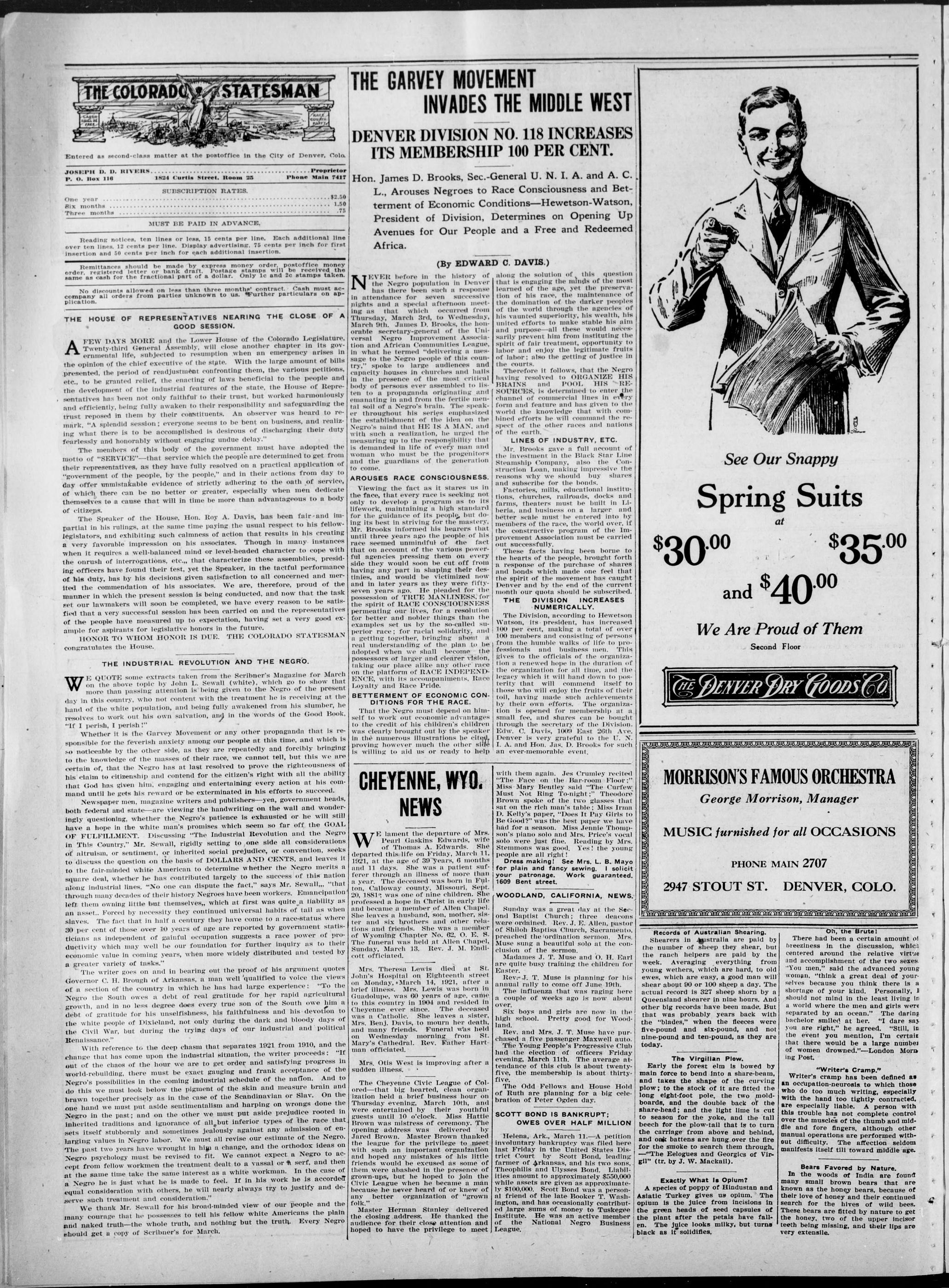
THE GARVEY MOVEMENT INVADES THE MIDDLE WEST
DENVER DIVISION NO. 118 INCREASES ITS MEMBERSHIP 100 PER CENT. Hon. James D. Brooks, Sec.-General U. N. I. A. and A. C. L., Arouses Negroes to Race Consciousness and Betterment of Economic Conditions—Hewetson-Watson, President of Division, Determines on Opening Up Avenues for Our People and a Free and Redeemed Africa.
(Bv EDWARD C. DAVIS.)
NEVER before in the history of the Negro population in Denver has there been such a response in attendance for seven successive nights and a special afternoon meeting as that which occurred from Thursday, March 3rd, to Wednesday, March 9th, James D. Brooks, the honorable secretary-general of the Universal Negro Improvement Association and African Communities League, in what he termed "delivering a message to the Negro people of this country," spoke to large audiences and capacity houses in churches and halts in the presence of the most critical body of persons ever assembled to listen to a propaganda originating and emanating in and from the fertile mental soil of a Negro's brain. The speaker throughout his series emphasized the establishment of the idea on the Negro's mind that HE IS A MAN, and with such a realization, he urged the measuring up to the responsibility that is demanded in life of every man and woman who must be the progenitors and the guardians of the generation to come.
AROUSES RACE CONSCIOUSNESS.
Viewing the fact as it stares us in the face, that every race is seeking not only to develop a program as to its lifework, maintaining a high standard for the guidance of its people, but doing its best in striving for the mastery, Mr. Brooks informed his hearers that until three years ago the people of his race seemed unmindful of the fact that on account of the various powerful agencies pressing them on every side they would soon be cut off from having any part in shaping their destinies, and would be victimized now and in later years as they were fifty-seven years ago. He plended for the possession of TRUE MANLINESS, for the spirit of RACE CONSCIOUSNESS permeating our lives, for a resolution for better and nobler things than the examples set us by the so-called superior race; for racial solidarity, and a getting together, bringing about a real understanding of the plan to be adopted when we shall become the possessors of larger and clearer vision, taking our place alike any other race on the platform of RACE INDEPENDENCE, with its accompaniments, Race Loyalty and Race Pride.
BETTERMENT OF ECONOMIC CONDITIONS FOR THE RACE.
That the Negro must depend on himself to work out economic advantages to the credit of his children's children was clearly brought out by the speaker in the numerous illustrations he cited, proving however much the other side is willing to aid us or ready to help
CHEYENNE, WYO. NEWS
WE lament the departure of Mrs. Pearl Gaskins Edwards, wife of Thomas A. Edwards. She departed this life on Friday, March 11, 1921, at the age of 39 years, 6 months and 11 days. She was a patient sufferer through an illness of more than a year. The deceased was born in Fulton, Calloway county, Missouri, Sept. 20, 1881; was one of nine children. She professed a hope in Christ in early life and became a member of Allen Chapel. She leaves a husband, son, mother, sister and six brothers and other relations and friends. She was a member of Wyoming Chapter No. 62, O. E. S. The funeral was held at Allen Chapel, Sunday, March 13. Rev. J. M. Endicott officiated.
Mrs. Theresa Lewis died at St. John's Hospital on Eighteenth street on Monday, *March 14, 1921, after a brief illness. Mrs. Lewis was born in Guaduolope, was 60 years of age, came to this country in 1904 and resided in Cheyenne ever since. The deceased was a Catholic. She leaves a sister, Mrs. Benj. Davis, to mourn her death, and many friends. Funeral was held on Wednesday morning from St. Mary's Cathedral. Rev. Father Hartman officiated.
Mrs. Otis West is improving after a sudden illness.
The Cheyenne Civic League of Colored—that big hearted, clean organization held a brief business hour on Thursday evening, March 10th, and were entertained by their youthful guests until 10 o'clock. Miss Hattie Brown was mistress of ceremony. The opening address was delivered by Jared Brown. Master Brown thanked the league for the privilege to meet with such an important organization and hoped any mistakes of his little friends would be excused as some of them were abashed in the presence of grown-ups, but he hoped to join the Civic League when he became a man because he never heard of or knew of any better organization of "grown folk." Master Herman Stanley delivered the closing address. He thanked the audience for their close attention and hoped to have the privilege to meet
along the solution of, this question that is engaging the minds of the most learned of the age, yet the preservation of his race, the maintenance of the domination of the darker peoples of the world through the agencies of his vaunted superiority, his wealth, his united efforts to make stable his aim and purpose—all these would necessarily prevent him from instituting the spirit of fair treatment, opportunity to labor and enjoy the legitimate fruits of labor; also the getting of justice in the courts.
Therefore it follows, that the Negro having resolved to ORGANIZE HIS BRAINS and POOL HIS RESOURCES, is determined to enter the channel of commercial lines in every form and feature and has given to the world the knowledge that with combined efforts he will command the respect of the other races and nations of the earth.
LINES OF INDUSTRY, ETC.
Mr. Brooks gave a full account of the investment in the Black Star Line Steamship Company, also the Construction Loan, making impressive the reasons why we should buy shares and subscribe for the bonds. Factories, mills, educational institutions, churches, railroads, docks and farms, theaters must be built in Liberia, and business on a larger and better scale must be entered into by members of the race, the world over, if the constructive program of the Improvement Association must be carried out successfully. These facts having been borne to the hearts of the people, brought forth a response of the purchase of shares and bonds which made one feel that the spirit of the movement has caught Denver and by the end of the current month our quota should be subscribed.
THE DIVISION INCREASES NUMERICALLY.
The Division, according to Hewetson Watson, its president, has increased 100 per cent, making a total of over 100 members and consisting of persons from the humble walks of life to professionals and business men. This gives to the officials of the organization a renewed hope in the duration of the organization for all time, and the legacy which it will hand down to posterior that will commend itself to those who will enjoy the fruits of their toil, having made such achievements by their own efforts. The organization is opened for membership at a small fee, and shares can be bought through the secretary of the Division. Edw. C. Davis, 1009 East 26th Ave, Denver is very grateful to the U. N. I. A. and Hon. Jas, D. Brooks for such an ever-memorable event.
with them again. Jes Crumley recited
"The Face on the Bar-room Floor";
Miss Mary Bentley said "The Curtew,
Must Not Ring To-night"; Theodore
Brown spoke of the two glasses that
sat on the rich man's table; Miss Irma
D. Kelly's paper, "Does It Play Girls to
Be Good?" was the best paper we have
had for a season. Miss Jennie Thompson's piano solo and Mrs. Price's vocal
solo were just fine. Reading by Mrs.
Stemmons was good. Yes! the young
people are all right!
Dress making! See Mrs. L. B. Mayo
for plain and fancy sewing. I solicit
your patronage. Work guaranteed,
1609 Bent street.
WOODLAND, CALIFORNIA, NEWS.
Sunday was a great day at the Second Baptist Church; three deacons were ordained. Rev. J. E. Allen, pastor of Shiloh Baptisa Church, Sacramento, preached the ordination sermon. Mrs. Muse sung a beautiful solo at the conclusion of the sermon.
Madames J. T. Muse and O. H. Earl are quite busy training the children for Easter.
Rev. J. T. Muse is planning for his annual rally to come off June 19th.
The influenza that was raging here a couple of weeks ago is now about over.
Six boys and girls are now in the high school. Pretty good for Woodland.
Rev. and Mrs. J. T. Muse have purchased a five passenger Maxwell auto.
The Young People's Progressive Club had the election of officers Friday evening, March 11th. The average attendance of this club is about twenty-five, the membership is about thirty-five.
The Odd Fellows and House Hold of Ruth are planning for a big celebration of Peter Ogden day.
SCOTT BOND IS BANKRUPT;
OWES OVER HALF MILLION
Helena, Ark., March 11. A petition involuntary bankruptcy was filed here last Friday in the United States District Court by Scott Bond, leading farmer of Arkansas, and his two sons, Theophilis and Ulysses Bond. Liabilities amount to approximately $550,000 while assets are given as approximately $100,000. Scott Bond was a personal friend of the late Booker T. Washington, and has occasionally contributed large sums of money to Tuskegee Institute. He was an active member of the National Negro Business League.
See Our Snappy
Spring Suits
at
$30.00 $35.00
and $40.00
We Are Proud of Them
Second Floor
THE DENVER DRY GOODS CO.
MORRISON'S FAMOUS ORCHESTRA
George Morrison, Manager
MUSIC furnished for all OCCASIONS
PHONE MAIN 2707
2947 STOUT ST. DENVER, COLO.
Records of Australian Shearing. Shearers in Australia are paid by the number of sheep they shear, but the ranch helpers are paid by the week. Averaging everything from young wethers, which are hard, to old ewes, which are easy, a good man will shear about 90 or 100 sheep a day. The actual record is 327 sheep shorn by a Queensland shearer in nine hours. And other big records have been made. But that was probably years back with the "blades," when the fleeces were five-pound and six-pound, and not nine-pound and ten-pound, as they are today.
The Virgilian Plow.
Early the forest elm is bowed by main force to bend into a share-beam, and takes the shape of the curving plow; to the stock of it are fitted the long eight-foot pole, the two moldboards, and the double back of the share-head; and the light lime is cut to season for the yoke, and the tall beech for the plow-tail that is to turn the carriage from above and behind, and oak battens are hung over the fire for the smoke to search them through. — "The Eelogues and Georgics of Virgil" (tr, by J. W. Mackall).
Exactly What Is Opium?
A species of poppy of Hindustan and Asiatic Turkey gives us opium. The opium is the juice from incisions in the green heads of seed capsules of the plant after the petals have fallen. The juice looks milky, but turns black as it solidifies.
Oh, the Brute!
There had been a certain amount of breeziness in the discussion, which centered around the relative virtue and accomplishment of the two sexes. "You men," said the advanced young woman, "think a great deal of yourselves because you think there is a shortage of your kind. Personally, I should not mind in the least living in a world where the men and girls were separated by an ocean." The daring bachelor smiled at her. "I dare say you are right," he agreed. "Still, in the event you mention, I'm certain that there would be a large number of women drowned."—London Morning Post.
"Writer's Cramp."
Writer's cramp has been defined as an occupation-neurosis to which those who do too much writing, especially with the hand too tightly contracted, are especially liable. A person with this trouble has not complete control over the muscles of the thumb and middle and fore fingers, although other manual operations are performed without difficulty. The affection seldom manifests itself till toward middle age.
Bears Favored by Nature
In the woods of India are found many small brown bears that are known as the honey bears, because of their love of honey and their continued search for the hives of wild bees. These bears are fitted by nature to get the honey, two of the upper incisor teeth being missing, and their lips are very extensile.
THE COLORADO STATESMAN
The little daughter of Prof. and Mrs. George Morrison., who was quite sick last week, is much improved.
Charlie Green, a well known town-sman, has secured a position with the Colorado National Bank, in the safe deposit vault department.
elected. Mrs. Gertie Ross was named chairman of the house committee. Mrs. Amelia Reeves as trutee and M. Myrtle Moore as corresponding secretary.
The Self Improvement and Soo Service Club entertained Monday
Mr. and Mrs. S. P. McBeth are now living in their new home at 1832 Marion street, where they will be pleased to welcome their friends.
See the Modern Girls of '76 in "December's May," March 30th, at Fern hall.
J. B. Contee, president of the Douglass Undertaking Co., entertained the employés of the company and their families at 4 o'clock dinner Sunday, March 6.
Mrs. Basil Cook, who has been very sick for several months, passed away at 12 o'clock Thursday. Funeral will take place from Shorter Chapel, Sunday at 1:30, Rev. W. H. Thomas officiating.
MUNROE TROTTER, the editor of the Boston Guardian and president of the National Equal Rights League, addressed a fairly large audience at Shorter Church last Monday evening on "The Negro's Responsibility and Republican Victory." Mr. Trotter was very interesting.
Mr. A. Harry Plummer, who died suddenly March 7th, in Los Angeles, Calif., was buried here Sunday, March 13th. The funeral was preached from Shorter Chapel, A. M. E. Church, by Rev. A. Milton Ward, who accompanied the remains here. Having come to Denver in the early '90s, Mr. Plummer was well known to the older residents of the city.
Mrs. Hopkins, mother of Mrs. Spencer Burns, and well known resident of this city, is very ill at her residence, 2503 Clarkson street. The family of Mr. and Mrs. Spencer Burns have been popular with Denver citizens for several years and we join with the public in extending our sympathies and hope their mother will be restored to health.
March 30th, what? "December's May!" Where? Fern hall, by the Modern Girls of '76. Morrison's Orchestra (Himself.)
Mesdames Robt. Mitchell of 2744 Marion street and Samuel Bond of 2346 Emerson street attended nearly all the series of lectures of the Hon. Jas. D. Brooks on the Garvey Movement, and the impressions made on them have stirred the idea of real constructive work among our women, which will soon take a practical form. "Come in and work for the best interests of ourselves," say these women, "and we will not have to follow the old route of 'servants, obey your masters,' much longer." This is very commendable and shows the women of our race are ready to do all in their power to foster any organization that has for its purpose—the 'uplift of the Negro.
The drive for members of the Universal Negro Improvement continues: 200 members and $500 shares in Steam ship and Construction Loan is the slogan of the Denver division, No. 118.
Messrs. J. R. Contee, Oglesbie Lawson and J. C. Cooper were hosts to a lovely dinner given complimentary to the Men's Club of the Redeemer at the Cooper residence, Wednesday night. There were thirty-eight present and enjoyed an evening highly intellectual and interesting. Attorney S. E. Cary was the speaker for the evening, and his treatise of his subject, "The Inefficiency of the Church," was masterful in oratory and logic, and historically instructive. Following this address the meeting was turned into a round table affair and splendid talks were given by Fr. Rahming, Dr. Terry, Mr. Stell, Mr. Townsend and Dr. Westbrook. The hosts were ably assisted by Mesdames Skillern, Contee, Lawson, Cooper and Walker.
The Negro Woman's Club Home Association held an enthusiastic and enjoyable monthly meeting. Reports for the year ending March 1st were received from the chairman of the departments and the president, secretary and treasurer. The treasurer, Mrs. Venzie Witt, was especially commended for her very excellent report. Election of officers was in order and all officers of the past year were re-
elected. Mrs. Gertie Ross was named as chairman of the house committee. Mrs. Amelia Reeves as trutee and Mrs. Myrtle Moore as corresponding secretary.
The Self Improvement and Social Service Club entertained Monday afternoon at the home of Mrs. Mary Gross, as a parting compliment to Mrs. Alice Webb, who left Wednesday for her future home in Chicago. The presidents of the federated clubs were guests. The president, Mrs. Westbrook, in her pleasing manner, conducted an impromptu program. Instrumental and vocal music: Mrs. Coila Payne and Virginia Gash; short talks, bidding Mrs. Webb farewell and God-speed, by Mesdames Ross, Carey, Caldwell, Barnes, McBeth and Reeves. Mrs. Webb responded.
Y. M. C. A. NOTES.
These fine spring days are beginning to call the outof doors—the boys and the men. Less attention is being paid to billiards, carroms, checkers and other indoor games and sports, and baseball, marbles and other outdoor games are becoming popular. And the popular game of croquet is calling the fans again. Indeed, as early as the last of February players had begun to flock around the court, and the familiar ring of the round balls began to be heard. Never before has the season opened so early. Of course they all know that they are likely any morning to see the ground covered with six inches of snow, but they are determined to make the best of its while it lasts. Sims has already challenged the ever-ready King, even if the season closed on him last fall twenty games behind King.
The drum corps is progressing splendidly. To hear them from a distance one would be led to believe that he was listening to regular players. Their instructor is greatly pleased with their progress.
The Bible class, which meets every Thursday evening, promises to do well, provided spring does not come too early.
The Rev. Dr. Bainbridge, pastor of the Asbury M. E. Church, was the speaker at the meeting last Sunday afternoon. His subject was "Watch." His address was very interesting.
Tomorrow (Sunday) afternoon, being Palm Sunday, a program befitting the day will be rendered. The Rev. Dr. Stewart D. White, pastor of the Washington Park M. E. Church, will deliver the address. The program will begin at 4 o'clock, and all will be welcome.
CAMPBELL A. M. E. CHURCH.
Twenty-third and Lawrence Streets
Rev. I. S. Wilson, Pastor; Resi-
dence, 2331 Arapahoe Street;
Phone Main 1312.
9:45 a. m.—Sunday School.
11:00 a. m.—Preaching.
6:30 p. m.—Christian Endeavor.
7:30 p. m.—Preaching.
From Monday until Friday, Rev.
Collins of Pueblo, Colo., will conduct
Passion Week meetings, starting at 8
o'clock.
On Easter Sunday the pastor will deliver an Easter sermon in the morning services; at 3 in the afternoon the Sunday school, under the direction of Mrs. Kromwell, Mrs. Wilson and Miss Stella Reed, will give a program.
At 7:30 the choir will render Fred W. Peace's cantata, "From Cross to Crown."
Last Sunday evening Rev. A. M. Ward delivered a needful sermon. His text was taken from Mark 11.9.
We expect to have the pipe organ in by Easter; if not, we will certainly get it in before April is gone.
DEATHS AND FUNERALS
Flemming, Vidy, the beloved husband of Mrs. Nina Flemming of 2732 California street, departed this life March 10 at a local hospital in Pueblo, Colo. Remains were shipped to Denver by the branch office of the Cammel Undertaking Co. of Pueblo. Services were held Monday, March 14, from the residence under the auspices of Syrceur Lodge No. 10, K of P. Rev. D. E. Over officiated. Interment at Riverside.
Bryant, Manana, infant of Mr. and Mrs. S. Bryant of 322 Twenty-fourth street; departed this life March 15. Services were held Thursday, March 17th, from the Cammel Undertaking Co. parlors at 2 o'clock. Rev. John Perkins officiated. Interment at Riverside.
Goodall, Henry, departed this life at a local hospital. Services were held Thursday, March 17, at 10 o'clock from the Cammel Undertaking parlors. Interment at Riverside.
FUNERAL NOTICES.
Douglass Undertaking Company.
Smith, Miss Annie, 78 years; residence 2550 Clarkson street; departed this life March 12th. Services were held 2 p. m. Tuesday, March 15th, from Shorters Chapel. Rev. W. H. Thomas officiated. Arrangements were made by Mrs. Alfred Froman and Mrs. Geo. Gross for the many friends who contributed. Interment Riverside cemetery.
NOTICE.
The Universal Negro Improvement Association and African Communities League meets every first and third Tuesdays in the month at 609 Twenty-seventh street, 8:15 p. m. sharp. Visitors welcome. EDWARD C. DAVIS, Secretary.
DENVER BRANCH OF N. A. A. C. P.
GIVES LIST OF CONTRIBUTORS
TO MEMBERSHIP CAMPAIGN
FUND
When Miss Mary White Ovington delivered her memorable address in Denver last month, she started a revival of interest in the great work of the N. A. A. C. P. that bids fair to place the Denver branch far in the lend as one of the strongest in the country. The membership campaign for a quarter of a million members—an irresistible force—opens April 24th. Below we publish a list of those who have already generously answered the appeal:
Mr. William Sprague. $10.00
Mr. U. G. Brown. 10.00
Mr. Victor Walker. 10.00
Mr. Leon DeLouch. 10.00
Mrs. Emma Davis. 6.00
Mr. Geo. W. Gross. 5.00
Dr. P. E. Spratlin. 5.00
Mr. O. Dishman. 5.00
Mrs. I. M. McGuire. 5.00
Mrs. S. A. McGuire. 5.00
Mrs. Jessie Zackery. 5.00
Mrs. M. D. Davis. 5.00
Mrs. C. A. Burton. 5.00
Mrs. G. A. Michael. 5.00
Mrs. S. E. Williams. 5.00
Mr. E. V. Cammel. 5.00
Mr. J. T. Hammond. 5.00
Father H. L. Rahmung. 5.00
Mr. S. A. Bondurant. 5.00
Mrs. L. M. Froman. 5.00
Dr. J. H. P. Westbrook. 5.00
Mr. Walter Vernell. 5.00
Mrs. Carrie McClain. 5.00
Mr. W. L. Arrington. 5.00
Mrs. Ella Price. 5.00
Mr. Jas. C. Cooper. 5.00
Mrs. C. J. Wallace. 5.00
Miss Josephine Davis. 5.00
Mr. A. A. Bledsoe. 5.00
Mr. H. W. Townsend. 5.00
Mr. E. Lewis. 5.00
Mr. Thos. Campbell. 5.00
Mr. Frank Osborne. 5.00
Dr. C. F. Holmes. 5.00
Mrs. Ida DePriest. 5.00
Mr. J. P. Perkins. 5.00
Mr. L. R. Owens. 5.00
Hon. E. P. Blakemore. 5.00
We are much pleased to receive the above five and ten dollar members. With thanks and best wishes, we are,
Sincerely yours,
GEO. W. GROSS,
President.
CARRIE S. McCLAIN,
Secretary.
Your Easter Suit Is Here
A complete selection in all the latest models for men and young
$35
Fineest fabrics in all the wanted shades grays and browns in hemp bagging offers dark colors in shades of gray and plain and dark colors in worsted.
Stein-Block and Hirsh-Wickwire
Hand-tailored suits in finest all-wool fabrics. Stylish 3-button models for men who prefer distinctiveness, at
You will not be able to duplicate these suits later.
Stetson Hats for Easter
A chance to get a Stetson Hat
at a great saving over last
year's prices.
The newest tans, grays, and
other popular shades.
$9, $10, $12.50
Cottrell
CLOTHING CO.
621 - 1022 ST.
A. E.
Children's Day---at Joslin's
Bodice Skirts
—Attractive navy blue skirts,
knife pleated; bodice waist;s;
sizes for girls 8 to 14 years.....$3.95
Gymnastium Bloomers
—Good grade all-wool serge bloomers;
cut full; sizes for girls 8 to
20 years.....$5.95
—Made of galatea' with bodice
waist; sizes 6 to 12 years.....$1.95
Girls' Wash Dresses
—As attractive and as youthful in style
as any wash dresses we have had for
some time. Many are hand-embroidered,
and they all are unusual in style.
—Sizes for girls 6 to 14 years.....$3.95
—Sizes for girls 12 to 16 years.....$6.95
Dainty White Dresses for Girls
For Confirmation and Graduation
—They are simple, youthful styles—especially designed for the girl in her 'teens.
—Some trimmed with ruffles, some plain tunic styles; nearly all have sashes.
—Georgette crepes, taffetas, organdles and nets.
Boys' Hats Specially Priced
for Easter.
You'll find good values for him in cloth hats— at Joslin's. There are checks and novelty mixtures.
A group at $1.19, and another at $1.95.
Bovs' caps in plain colors and mixtures at $1.45.
Sale of Boys' Shoes
Sale of Boys' Shoes
For Boys 8 to 12 Years
—A wide toe shoe with crome elk
uppers and heavy, durable soles.
Sizes 11½ to 2, at, pair.....$3.45
—Third Floor, Joslin's—
You Are In
The Telephone
We welcome an oppose how their telephone calls the central office.
Every patron who witnessed a switchboard be a very interesting experience.
The knowledge you do when you ask for a new person wanted makes for tween us.
The quiet yet swift calls are handled can only tion of the central office.
We are anxious for we have a duty to perform we would be pleased to how we do it, in perform
Such a visit should m able to you and should aid you with the best telepho
The Mountain States T
Noslin Dry Good
You Are Invited to Visit
Telephone Centr
welcome an opportunity to show o
telephone calls are received and
al office.
by patron who has visited an exci
a switchboard in operation has the
interesting experience.
knowledge you gain as to what th
you ask for a number and how th
printed makes for a better underst
quiet yet swift manner in which
handled can only be appreciated by
central office.
are anxious for you to know that
duty to perform in serving the
be pleased to have you see what
to it, in performing that duty.
a visit should make the telephone
u and should aid us in our efforts
the best telephone service.
States Telephone and
You Are Invited to Visit The Telephone Central Office
We welcome an opportunity to show our patrons how their telephone calls are received and handled in the central office.
Every patron who has visited an exchange and witnessed a switchboard in operation has found it to be a very interesting experience.
The knowledge you gain as to what the operators do when you ask for a number and how they get the person wanted makes for a better understanding between us.
The quiet yet swift manner in which telephone calls are handled can only be appreciated by an inspection of the central office.
We are anxious for you to know that we realize we have a duty to perform in serving the public, and we would be pleased to have you see what we do and how we do it, in performing that duty.
Such a visit should make the telephone more valuable to you and should aid us in our efforts to furnish you with the best telephone service.
The Mountain States Telephone and Telegraph Co.
Gave Them What They Asked For.
Deacons seeking ministers for their churches often applied to Mr. Spurgeon, famous English pulpit orator. One asked him to send a student who could "fill the chapel," and got an answer saying that Mr. Spurgeon had not one big enough, but he thought he could send one who might fill the pulpit. A reply came that that was really what they wanted, and a minister was accordingly sent. It was Mr. Whale.
---
Middies
A San Francisco man went to sleep in his automobile early one morning recently and when he woke up his machine had gone two miles from the last landmark which he remembered. The machine stuck to the road and behaved very properly during the chauffeur's nap.
On Life's Sea.
Having araft of friends is the only thing that keeps some people afloat. Boston Transcript.
You'll find girlish, youthful styles—many of them the popular wrappy models that girls are so fond of, and there are plenty of the always well-liked polo styles, too. Bring daughter in to see them. They're very attractive.
—Sizes for girls 3 to 6 years. $ 6.95
—Sizes for girls 6 to 12 years. $ 15.00
Wool Sweaters for Girls 3 to 8 Years
A splendid sweater to wear to school this spring.
Belted cont style.
Comes in green, brown, maroon and heather.
—Splendid sweaters for such a low price ..... $3.95
—Third Floor, Joslin's—
The Children Need Light Underwear These War Days
For Girls
—"M" union suits of medium weight cotton sleeves, low neck, knee length.
—Sizes 2 to 10 years.
—Sizes 12 to 16 years.
—A "Merode" union suit for girls; fine weft, low neck, sleeveless, knee length.
—Sizes 4 to 17 years.
—Girls' ribbed cotton vests, band top—
—Sizes 2 to 16 years.
For Boys
—The well-known "M" union suits, medium cotton, no sleeves, knee length.
—Sizes 2 to 10 years.
—Sizes 12 to 16 years.
—Fourth Floor, Joslin's—
The Children Need Lighter Underwear These Warmer Days
For Girls
—“M” union suits of medium weight cotton; no sleeves, low neck, knee length.
—Sizes 2 to 10 years.....75c
—Sizes 12 to 16 years.....85c
—A “Merode” union suit for girls; fine weave cotton, low neck, steeless, knee length.
—Sizes 4 to 17 years.....85c
—Girls’ ribbed cotton vests, band top—
—Sizes 2 to 16 years.....35c
For Boys
—The well-known “M” union suits, medium weight cotton, no sleeves, knee length.
—Sizes 2 to 10 years.....75c
—Sizes 12 to 16 years.....85c
—Fourth Floor, Joslin's—
For Boys 12 to 14 Years
—Good, heavy chrome elk uppers and double oak soles, wide toe styles.
Sizes $2½ to 6, at, pair.....$3.95
Very Goods Co.
invited to Visit
Central Offi
unity to show our patrons
we received and handled in
visited an exchange and
operation has found it to
ence.
as to what the operators
ber and how they get the
better understanding be-
banner in which telephone
be appreciated by an inspec-
to know that we realize
in serving the public, and
we see what we do and
that duty.
the telephone more valu-
us in our efforts to furnish
service.
telephone and Telegraph
---
Faren Need Lighter
for These Warmer
Days
For Girls
of medium weight cotton; no
knee length.
years.....75c
years.....85c
in suit for girls; fine weave cot-
veless, knee length.
years.....85c
on vests, band top—
years.....35c
For Boys
"M" union suits, medium weight
knee length.
years.....75c
years.....85c
th Floor, Joslin's—
Round
to 11. at pair .....$2.95
Visit
General Office
w our patrons
and handled in
exchange and
was found it to
the operators
they get the
understanding be-
each telephone
by an inspec-
at we realize
the public, and
at we do and
one more valu-
rt to furnish
d Telegraph Co.
Little Jean was filled with love and admiration for the tiny baby sister who, she had been told, had been sent her from heaven. The love and admiration changed to disgust, however, when the new arrival discovered that she possessed a strong pair of lungs which she exercised unceasingly. The other day Jean was overheard to remark to a little playmate "Just listen to her whoop it up! I bet she yelled like that in heaven and the angels chucked her out."
White lily, abloom in the sweet, warm light Of the Easter dawn, today,
With thy sweet, warm breath, like a drift exhaled From a seraph's mouth, ah, say,
Art thou only a flower, though thou build'st a bridge O'er the awful cleft of the grave,
That Reason may cross upon, surely, and Grief,
Seeing this, may look up and be brave?
Christ's lilies, abloom in far, overseas lands, O'er the graves of young heroes, today, How your message of life's immortality thrills As you spring from the grave's icy clay; Oh, lilies of Easter, shine out and shine on, "Life from death" for your message and sign. Till the red of the poppies of Flanders field fades, Quenched by radiant light, all divine! HELEN CHASE
Tyrolean Easter Service
The Greatest Promise Ever Made Mankind
Death is probably the most startling episode that life encounters on its journey.
It came so palpably as a direct punishment, for wrong done, that it alarmed men with a distinct fear of perfect loss.
Many things have their periods of death and of coming to life again. Numbers of plants die every year and come to life again every spring. Some insects have their change to death and a rising again. Many plants die and leave the seeds of fresh life behind.
Men might, therefore, have thought little of death, but for the fact that their being shrinks from it as something new, unforeseen, when they were made and set a-going in this world.
Is it not significant that of all the writings inspired by the Great War, the three grandest, according to all agreements, are poems with death for their subject?
When you consider the glorious victory we won, and think upon its possible results of long peace, and a new era of contentment, you go a very short distance before you stand with choking voice and streaming eyes before the little crosses thick as buttercups and daisies ought to be, on the battlefields.
What justice is there in the management of life, if the hundreds of thousands of our dead lying there have been snuffed out of life and being for evermore, while others who shirked their duty to loyalty, live on in the enjoyment of being?
Where is eternal fairness if those who have had no prosperity, fortune, comfort and ease in the world lie down in death and cease forever to be, just as do the unfortunate, the beaten, the poverty-stricken, the unresting toilers of life?
Are there to be no compensations for the unhealthy, the sufferers, the mourners, the never-comforted, for whom life was one long, unaltered misery? Are the unjust, the extortionate,
the robbing crowd who live upon their fellows' need, who thrive, fouly, but greatly, in this world, to fare as well at the end as those others?
Easter, the queen of festivals, comes with a certain answer to such questions, founded upon the well-proved, historical fact of the resurrection of man's body, as well as of his soul.
Man is to come back again to life, for the adjusting of accounts. Justice does rule in the affairs of men!
Justice and loving kindness and mercy for the little babies who died before they bloomed, for the gallant men who did nobly in battle, but never reaped the fruits of victory, for the weeping mothers, wives, children, who saw the joy of others' overjoyed ones returning from whence theirs' could not return, is the promise of Easter.
New growth, fresh blooming, continued life, these are Easter joys.
"For as in Adam, all die, even so in Christ shall all be made alive!" Alleluia! Amen!
AN EASTER POSY.
The Flowers that grace the Springtime Festival.
In the different countries various flowers are given the place of honor in the Easter services. In England the Easter illy is first favorite, and its pure white blossoms may be noted in many old pictures. Two centuries ago many a little English girl bore to church on Easter Sunday a bunch of golden daffodils.
In some Warwickshire villages nosegays of primroses set round with willow are presented by lovers to their lassies, and these are as much appreciated by them as the rainbow-colored Easter eggs of their childhood.
In Ireland also old-world bouquets of primroses are still in vogue. They are elaborately fashioned in intersecting triangles round a centerpiece of the Paschal flower, namely, a white six-leaved anemone.
In Holland the demure Dutch maldens would never dream of going to church without a stiff handful of an emones, the first flowers to bloom after the snow and ice have fled.
The flower of Whitsunday is the pink azalea, and figures very largely in the floral decorations of the home at that season.
OUR GREAT PRE-EASTER SALE NOW IN FULL SWING
Society Brand Clothes
TH
Prof. W. M. Mackey
FIRST CLASS TONSORIAL WORK
Hair Cutting a Specialty
Satisfaction Guaranteed
2244 LARIMER ST., DENVER
YOU COULD WELL AFFORD TO BUY
AN OVERCOAT
in midsummer, and you would find it a good invest- ment at this price—
$24 for values up to $60
100 of them sent to us by Adler, Milwaukee, makes
of Collegian Clothes for men, who billed us these
Dvcreats at considerably less than one-half the
season's prices.
Michaelson's
15th and Larimer Streets
Men's and Young Men's
$30 and $35 Values
$38 and $40 Values
$29
$45 and $48 Values $34
$50 and $60 Values $39
OPEN THE SHOP
SQUARE DEAL
FOR
ALL
AMERICANISM
W. K. HUNT
Phone Champa 3522 2962 Welton Street
LOOK AT THESE SPECIALS
Ranch Eggs, doz.....35c
Del Monte Blackberries, can.....25c
Toilet Paper, 6 rolls for.....25c
Fresh Tomatoes, lb.....20c
Onion Sets, quart.....10c
All 10c Package Seeds.....9c
Polishing Outfit and 1 Can Polish.....50c
FREE
COURSE IN
HAIR AND BEAUTY
CULTURE
MAILED FREE UPON RECEIPT
OF YOUR NAME AND ADDRESS
"SEND NO MONEY"
THE OZONIZED OX MARROW CO.
46 W. KINZIE ST. CHICAGO, ILL.
WE HANDLE DRESSED CHIX AND MEATS
DR. CLARENCE F. HOLMES, JR.
B.S., D.D.S.
B.S., DDS.
Invites the public of Denver to
inspect his modern, electrically
equipped dental suite, 2602 Welton
St. Hours $ a, m, to 12 noon;
by appointment and on days
by appointment. Office
phone Champa 2807. Residence
phone Champa 1536.
DR. WESTBROOK, Physician and Surgeon, office 25 Good Block, 16th and Larimer St. Phone Main 5595. Hours 10 to 11 a.m. 2 to 4 and 7 to 8 p.m. Residence 2555 Glenarm place. Phone Champa 6148. Hours at residence by appointment. Cal. Physicians and Surgical Telephone Exchange: Main 1624. night or day. R-ray examination and treatments a speciality.
C. E. TERRY, M.D.
1627 Twenty-first St. Denver Office Phone Main 2701. Hours 12 to 2 and 6 to 8 p.m. or by appointment. Res. 2337 Glenarm Place. Phone Champa 3303.
E. P. BLAKEMORE.
Attorney and Counselor at Law
Office, Rooms 39 and 40 Arapahoe
Bldg. 1622 Arapahoe St.
Phone Champa 5450.
DR. HUFF'S office phone is
Champa 6001. And his residence
Phone York 4101. When not
reached at office or phone, call
Dr. Company 875, Office
Suite 5, 6 and 7, 2701 Wetton St.
over Atlas Drug Store. Office
hours, 11 to-12 a. m., and 3 to 5
p. m.
Office 600 27th St. Ph. Champa 1142
S. E. CARY
ATTORNEY-AT-LAW
Six Years City and County Attorney
at Russell Springs, Logan
County, Kansas
Office Hours
9:00 A.M. to 12:00 M.
2:00 P.M. to 4:00 P.M.
DENVER, COLO.
THE
WARD AUCTION
COMPANY
Sales Daily at 2 p.m. Office Purs-
niture a Specialty.
PRIVATE SALES AT ALL TIMES
HAVE MOVED TO—
1728-39 GLENARM ST.
PHONE MAIN 1678.
Phone Main 8086
Res. Phone York 5774W
FRANK D. TAGGART
Attorney at Law—Notary Public
205-206 Cooper Building
Denver, Colorado
JOSEPH CARTER
Express, Moving,
and Storage
COAL AND WOOD
PROMPT DELIVERY.
Phone Main 8544.
2415 WASHINGTON STREET.
ORIENTAL RESTAURANT
Chop Suey, Noodles and Short Orders
Phone Champa 113
1848 Arapahoe
Do You Use Good Paper When You Write? We Can Print Anything and Do It Right.
NEEDS OF CHILD IN WAY OF FOOD
Basket Lunches Require Thought and Care in Preparing to Prevent Sameness.
BREAD IS QUITE IMPORTANT
Simplest Contrivances Are Often Better Than Boxes With Compartments—Heavy Napkins Are Very Convenient in Packing.
(Prepared by the United States Department of Agriculture.)
What went into Jane's and Jack's lunch boxes at your house this morning? Were they filled the last minute with what remained on the table after breakfast, supplemented by some of last night's meat and pie, or were the boxes filled with dainty, appetizing lunches, carefully planned and packed?
Growing children have certain special needs in the way of food. Like grown people, they must be supplied with what is necessary for health and strength, but in addition, they must be given, also, what is necessary for growth.
Even when children eat all their meals at home, it is no easy matter to see that they are properly fed; but when they eat part of their meals at school, the difficulty is much greater. It is not easy to make food attractive and to keep it clean when it must be packed and carried in a lunch basket.
Filling Lunch Basket.
The basket lunch is harder to plan and to prepare than the lunch at home. To begin with, many foods cannot be included in it, either because they are not good cold or because they cannot be conveniently packed or easily carried. This leaves fewer foods to choose from, and extra care is necessary to prevent sameness.
Paraffin paper, parchment paper, jelly glasses, and the paper cups and containers for moist foods are a great help in packing lunches. With these helps, foods can be kept from sticking to each other, and such half-solid foods as sliced raw fruits, stewed fruits, custards, and cottage cheese, can be carried in perfect condition.
Good Bread Important.
The quality of the bread used in the basket lunch is especially important because it is commonly served in the form of sandwiches and is, therefore,
1
Off to School, Lunch Box in Hand.
to be considered, not only as a food in itself, but also as a means of keeping other much needed foods in appetizing and attractive condition.
Variety in breads, too, is more important at this than at other meals, because of the danger of monotony. Wheat bread, whole-wheat bread, corn, rye, or oatmeal breads; nut, raisin, and date breads; beaten biscuit, rolls, crisp baking powder or soda biscuit, toast, zw'ebach, and crackers may be used in turn to give variety. Rolls hollowed out can be made to hold a large amount of sandwich fillings, which is an advantage at times.
Packing the Lunch.
Many kinds of lunch boxes, pails and baskets are now on the market. Because they can be washed and scaled easily, the simplest boxes and baskets are often better than the more elaborate ones with compartments in which to keep dishes, knives, forks and spoons. With the increase in automobile travel, well-constructed boxes and baskets which can be easily cleaned have come on the market with compartments for keeping food hot or cold and for holding liquids. These are, of course, suitable only for children who ride back and forth, and particularly suitable where several lunches are put up in one household.
The precautions which must be taken to keep the foods clean and safe differ with circumstances. In dusty seasons they should be wrapped particularly well. In hot weather, the use of soft, moist foods in which molds and bacteria are most likely to grow rapidly, should be avoided. Although chopped meat moistened with a dressing of some kind makes a good sandwich filling, such foods are less desirable in hot weather than slices of meat, peanut butter, or other foods less liable to spoil. Paper napkins or the somewhat
THE KITCHEN CABINET
(@ 1921, Western Newspaper Union.)
A man's true greatness lies in the consciousness of an honest purpose in life, founded on a just estimate of himself and everything else, on frequent self-examination and a steady obedience to the rule which he knows to be right, without troubling himself about what others may think or say or whether they do, or do not do, that which he thinks and says and does.—George Long.
A good homely dish which is sufficiently satisfying for the hard-working head of a family is: Dumplings and Steak, —Cook the steak first on one side, then on the other in a smoking hot, lightly greased frying pan. Season well and cover with boiling water. Drop on dumplings made by using one cupful of flour, two teaspoonfuls of baking powder, one-third of a cupful of sweet milk, one-third of a teaspoonful of salt and one tablespoonful of fat. Drop by spoonfuls on the steak and cover tightly and steam for twenty minutes.
Tuna Fish Loaf.—Take a pound can of tuna fish, two whole eggs or whites of four, one-half cupful of water, one-fourth teapoonful of celery salt, one cupful of stale bread crumbs, one teapoonful of baking powder, one teapoonful of salt, the juice of half a lemon and a speck of cayenne. Mix well, season to taste. Pack in a bread tin and brown. Turn out on a serving platter and pour parsley sauce over the loaf.
Parsley Sauce.—Wash and cover with boiling water one bunch of parsley to which a pinch of salt and soda has been added. Cook ten minutes, strain and add to a cupful of thick white sauce and stir in one tablespoonful of fresh minced parsley. Garnish with sprigs of fresh parsley.
Mock Lobster Chowder—Take one cupful of flaked and soaked codfish, six medium-sized potatoes, three onions, two cupfuls of stewed tomato, one tablespoonful of salt, one-eighth of a teaspoonful of pepper, two tablespoonfuls of butter, one-half dozen milk crackers, two cupfuls of milk, one-half teaspoonful of soda. Put freshened codfish, sliced potatoes and onions into a kettle, cover with boiling water and cook until soft. Add the tomato, seasoning, heat well, add the soda to the milk and add the crackers. Bring to the boiling point and serve.
Ox-Tail Stew.—Cut one and one-half pounds of ox-tail into small pieces, cover with water, add shlt and cook two hours. Then add two cupfuls of minced carrots, one cupful of minced onions, more seasoning, if needed, and cook one more hour. The last half hour before serving add one pint of strained tomato. If it seems too thin add a little flour and cook until smooth.
When men and women are rightly occupied, their amusement grows out of their work as the color petals out or a fruitful flower—John Ruskin.
Many of the wonderful fruits of the tropics which have no keeping qualities can never be tasted unless one is privileged to visit the zone, as the flavor is lost or entirely spoiled by the ocean travel. Some of the dishes common. in that clime are possible to produce and are well worth trying.
Coconut Pudding—Grate one coconut and beat eight eggs, reserving three whites for a meringue. Beat in one cupful of sugar and the eggs and coconut, put into a buttered baking dish and bake until nearly done, then cover with the meringue prepared from the three whites and three tablespoonfuls of powdered sugar, spread over the pudding and brown. Serve at once. This amount will serve eight
Coconut and Tapioca Budding. Take one-half cupful of tapioca, one pint of milk, two eggs, one-quarter of a pound of granulated sugar (one-half cupful), one teaspoonful of butter, three heaping tablespoonfuls of grated coconut. Mix the tapioca and coconut, add the milk, beat the yolks of two eggs with the sugar and mix with the rest; stir in the butter and bake in a well-buttered baking dish set in a dish of water. When nearly done beat the two whites with two tablespoonfuls of powdered sugar; spread over the top of the pudding and bake a light brown. Serve hot or cold.
Coconut Biscuits.—Grate one coconut fine. Beat the whites of two eggs until stiff; mix in gradually one cupful of granulated sugar and by degrees the grated coconut, beating all the while. With the hands lightly floured, roll this mixture into little balls the size of a walnut and bake them on a greased baking sheet. Bake at first in a moderate oven then increase the heat to brown and harden at the bottom or they will crumble when handled.
Fried Noodles.—Cook noodles in boiling water for fifteen minutes. Drain, pour on cold water and cook in a little hot fat in a frying pan until well seasoned.
heavier paper towels of much the same size are very useful for packing lunches, and, like paraffin and parchment paper, may now be obtained at a low price, particularly if bought in rather large quantities. If no provision is made in the school for serving lunches, an extra napkin, either of paper or cloth, should be put in the basket, to be spread over the school desk when the lunch is eaten. Napkins can be made out of cotton crepe at a cost of a very few cents each. The crepe may be bought by the yard, and should be cut into squares and fringed. Such napkins have the advantage of not needing to be ironed. In packing the lunch basket, put at the bottom the things least likely to crush, and wrap the sandwiches, etc., into neat parcels, not all in one.
OLD DRY-GOODS BOX AIDS BREAD MAKING
Kerosene Lamp or 16-Candlepower Light May Be Used for Heating— Shallow Pan of Water on Lower Shelf Keeps Air Moist.
(Prepared by the United States Department of Agriculture.)
In making bread the housekeeper often finds it difficult, particularly in the winter months, to hold her sponge or dough at the right temperature so that it will rise in a shorter period of time. She will find a sponge box or bread raiser a great help in keeping the proper temperature. Such a box can be made from an ordinary dry-goods packing box. The following directions for making one are given by the United States Department of Agriculture in Farmers' Bulletin 927, "Farm Home Conveniences."
A box 26 by 20 by 20 inches is a convenient size. About 10 inches from the bottom of the box a shelf made of slats or strips of wood rests on cleats fastened to the sides of the box. A second shelf is placed 4 inches above the lower one. The shelves can be removed when cleaning the box. Below the lower shelf a sheet of galvanized iron, slightly wider than the shelf, is inserted. It is curved in order to make it slip in and stay in place securely. This prevents scorching of the lower shelf when a lamp is placed below and also helps to distribute the heat more evenly. The door is hinged and fastened with a thumb latch or hook and staple.
Several small holes are bored in the lower and upper parts of the sides and in the top of the box to promote circulation of air. A cork, bored through the center to admit a straight thermometer, is inserted in one of the holes in the top of the box. A Fahrenheit chemical thermometer that registers as high as 100 degrees can be used. Such a thermometer may be ordered through a hardware dealer or directly from an instrument dealer. To avoid all danger of fire, the box should be lined with asbestos or tin when a kerosene lamp is used for heating. A 16-candlepower light will heat the box well, or a small, inexpensive night lamp may be placed in the bottom. A shallow pan of water should be put on the lower shelf so that the air will be kept moist.
The bowl of sponge or pans of dough are placed on the upper shelf. The temperature of the box should be kept as near 86 degrees F. as possible (80 to 88 degrees F.) when bread is made in the quick way. If a sponge is set overnight, 65 to 70 degrees F. is the better temperature until the dough is made in the morning, after which the temperature may be increased to 86 degrees F. The temperature in the box may be varied by raising or lowering the flame of the lamp or by using warm or cold water in the shallow pan.
GOOD TEST OF CHILD'S DIET
If Children Are Strong, Well Developed and Free From Alliments, Food Is Suitable.
The health and appearance of children are a good test of the wholesomeness of their diet. If they are strong, well developed for their ages, free from alliments and full of energy and ambition, one may safely say their food agrees with them. But if they are listless and ailing, or not so well developed either physically or mentally as they should be, and if a competent physician finds that there is no special disease to account for these bad symptoms, a mother may well ask herself if the food is right, and if not, how she can make it so.
Household Questions
Prunes are richer and more nourishing cooked in the oven.
* * *
A teaspoonful of baking powder will make fudge more creamy.
* * *
One of the nicest ways to cook onions, from every point of view, is to bake them in the skin.
* * *
A good aluminum polish is a mixture of borax, ammonia, and water. Apply with a soft brush.
* * *
To bake potatoes quickly, let them stand in boiling water for a few minutes before putting them in the oven.
SOME GOOD MAIN DISHES.
Dumplings and Steak,
—Cook the steak first on one side, then on the other in a smoking hot, lightly greased frying pan. Season well and cover with boiling water. Drop on dumplings made by using one cup teapotfuls of bak-
DISHES FROM JAMAICA.
ties can never be tasted unless one is privileged to visit the zone, as the flavor is lost or entirely spoiled by the ocean travel. Some of the dishes common, in that clime are possible to produce and are well worth trying.
FIRST CLASS
MEALS SERVED
HOME COOKING
J. GIBSC
PHONES: DENVER, CO.
DAY
The Old Undertak
HOME FUN
2418 Welton St., Denver.
Motto: Service, efficiency
out. Consult us. We can
Your cares and sorrows are the
LICENSED EMBALMER
LADY A
E. V. CAMMEL, PRESIDENT
DENVER
WESTER
PHONES: DENVER, CHAMPA 2077; PUEBLO, 864;
DAY OR NIGHT.
E. V. CAMMEL, PRESIDENT AND GENERAL MANAGER, DENVER AND PUEBLO.
WESTERN BEEF CO.
Fresh Oysters, Chitterlings, P
Bones, Spare Ri
Fresh and Cured Meats of All
Fans
Our Prices Are
Free Delivery to
Phone
2048 LARIMER STREET
Opposite
THE CHAM
TWENTIETH
Is the p
DRUGS, CHEMICALS
WE SEE
PRESCRIPTION
Phone us and we will deliver
JAMES E.
PHONE
Fresh Oysters, Chitterlings, Pig Tails, Snouts, Ears, Pigs Feet, Neck Bones, Spare Ribs Received Fresh Daily.
Fresh and Cured Meats of All Kinds.. Fresh Vegetables, Staple and Fancy Groceries.
TWENTIETH AND CHAMPA,
Is the place to get your
DRUGS, CHEMICALS AND PATENT MEDICINES
WE SERVE DRINKS.
PRESCRIPTIONS OUR SPECIALTY.
Phone us and we will deliver the goods to all parts of the city.
JAMES E. THRALL, Propr.
PHONE MAIN 2425.
P. H.
PRACTICAL PLUMBER.
Jobbing Promptly Attended to-
tion and Sewerage
2018 CURTIS STREET.
A FUL
Black and W
Ane a Full Line of MME. C
BUT WE KNOW
Jones West H
Atlas
PRACTICAL PLUMBER.—LICENSED DRAIN LAYER. Jobbing Promptly Attended to—Special Attention Given to Ventilation and Sewerage—All Work Guaranteed. 2018 CURTIS STREET. DENVER, COLO.
GRANBERRY
Office 27
OFFICE
PHONE
CHAMPA
87
Quick and prompt Service Day
on Out-
OFFICE
PHONE
CHAMPA
87
OFFICE
PHONE
CHAMPA
5060
Phone Main 4843
1638 Tremont St.
Open Daily to 830 p. m.
Sundays Until 2:00 p. m.
Telephone Main 207
2701 Welton St
Fairbanks Hotel and Cafe
(Formerly Barnes Hotel)
2716 Welton St., Denver, Colo.
SON S
Art Dealer
R, CHAMPA 20
DAY OR NIGHT
The Camma
Making Co
FUNERAL PAR
945 R
liency and modu
can save you th
are treated as the
MERS, FUNER
BY ATTENDANT
IDENT AND G
ER AND PUER
RN B
N SMITH
Dealer
MAMPA 2077; PUEBLO, 864.
FOR NIGHT.
Cammel
ing Company
Though
Just as
Reliable
PERAL PARLORS.
945 Routt Ave., Pueblo, Colo.
and modern conditions through-
ave you time, worry and money.
created as though they were our own.
FUNERAL DIRECTORS AND
ATTENDANTS.
NT AND GENERAL MANAGER,
AND PUEBLO.
N BEEF CO.
```markdown
```
Tails, Snouts, Ears, Pigs Feet, Neck
Received Fresh Daily.
Kinds.. Fresh Vegetables, Staple and
Groceries.
Always the Lowest
All Parts of the City.
Champa 1641.
DENVER, COLO.
the Three Rules.
PA PHARMACY
HAND AND CHAMPA,
face to get your
AND PATENT MEDICINES
DRINKS.
IS OUR SPECIALTY.
the goods to all parts of the city.
THRALL, Propr.
MAIN 2425.
S, Pig Tails, Snow
Ribs Received
All Kinds... Free
Fancy Groceries
Are Always
Ready to All Parts
one Champa 160
site the Three R
MPA PIC
NIETH AND CH
the place to get the
BILLS AND PAT
SERVE DRINK
CONS OUR S
deliver the goods.
E. THRALL,
ONE MAIN 242
Residence Phone Champa 328.
H. BALK
ER.—LICENSE
to—Special At-
torage—All Work
BALFE
-LICENSED DRAIN LAYER.
-Special Attention Given to Ventila-
-All Work Guaranteed.
DENVER, COLO.
L LINE OF
White Remedies
J. WALKER'S Toilet Articles.
N YOU WILL LIKE
Hair Pomade Best.
Drug C.
TAXI COMPANY
St Welton Street.
OFFICE
PHONE
CHAMPA
5060
and Night. Call Us for Special Rates
-Town Trips.
N. FAIRBANKS
Denver
One of the Most Up-to-Date and Sanitary Markets in the City.
Phone Main 875
Aiding Nature in Her Work
TO repair the damage done by destructive forces is a process of no short time. But to prevent these bad effects is but the routine of a few precious moments.
In either case, Madam C. J. Walker's Superfine Toilettes stand ready to aid you in the task at hand.
FOR PREMATURELY OLD COMPLEXIONS—
Madam C. J. Walker's Vanishing Cream
Superfine Face Powder
(white, rose-flesh, brown)
Compact Rouge
TO PREVENT THE ON-RUSH OF OLD AGE—
Madam C. J. Walker's Cleansing Cream
Witch Hazel Jelly
Floral Cluster Talc
The Madam C. J. Walker Mfg. Co.
640 North West Street
Indianapolis, Ind.
Makers of 18 superfine preparations for the
hair and skin
WANTED
to place in each of the fifteen thousand homes of our people in Denver; a copy of Scott's Official History of the American Negro and the World War
SCOTTS OFFICIAL HISTORY
of the
AMERICAN NEGRO
IN
THE WORLD WAR
EMMETT J. SCOTT
SPECIAL ASSISTANT TO SECRETARY OF WAR
A complete and authentic narration of the participation of American soldiers of the Negro race in the great fight for democracy. Illustrated with official and personal photographs of over two hundred in number, this work offers delightful reading of its 600 pages for the youth, the middle-aged and the old, and each home will add dignity and loyalty to our race and country by being provided with a copy of this commendable work. A very desirable gift in and out of season. This book is being offered at the very reasonable price of
$3.00
at the office of
THE COLORADO STATESMAN
P. O. Box 116 Room 25, 1824 Curtis St.
at the office of
Arrangements can also be made over phone. Call Main 7417
PRESS COMMENT: No library is complete without Scott's History of "The American Negro in the World War," and no better legacy could be left to posterity than this great work of Negro heroism and patriotism.
SOMETHING NEW
GARDNER THE TAILOR
Is giving a United Certificate for each 25 cents spent with him for cleaning, pressing, repairing or tailoring.
These Certificates are good for Community Silverware, or may be exchanged for cash at the Globe National Bank of Denver.
Get your share of them by calling Champa 1019.
1025 21ST STREET.
I
these assurances, the designer of lace frocks has everything to encourage him.
ONE thing we may be sure of, and that is the continued vogue of the lace gown. Everything conspires to make this mode certain of long life. To begin with, women love laces, and lace makers stimulate their devotion by constantly turning out new and alluring varieties of lace. More than all else, the general usefulness of lace gowns is a factor in their favor—they fit in for formal and informal wear, according to the accessories worn with them, and are at home either in afternoon or evening affairs.
In the lovely frock pictured we have all these style points emphasized in a dress of ecru lace and changeable taffeta which may be imagined in tan and rose. A wide net top lace is arranged in a long tunic with points at the bottom falling below the hem of the skirt. This hem, it should be noted, makes no pretentions to evenness. The tunic is shortened at the sides. In the bodice the pattern in the lace sweeps across the front in diagonal lines, but over the right shoulder in straight lines. The net sleeves show the top portion of the lace pattern. The wide and long sush would be of ecru colored ribbon. Such a gown might be chosen by maid or matron of honor; in company with a hat as distinctive as that pictured, it could not fall to triumph.
Black, brown and ecru laces are in demand just now, at the beginning of a season that may see the list of colors increased. They are made up with silks or satins, usually in the same color, but with contrasting color notes in girdles and sashes, or in trimmings, which are sparingly used with lace. Paris says, "longer and wider skirts," and all the world says, "ribbons." With
Styles Matrons Will Admire
THE FASHION OF THE TWENTIETH CENTURY
the left the needs of the stout woman have been considered. It has an underslip, and long overdress of silk, woven with a drop-stitch stripe, that are unbroken in line. The overdress is split at the left side as far as the hip line and bound at the bottom with a soft ribbon. The sleeves are long and flaring, the neck round with ribbon binding. Panels of embroidery at each side and a narrow girdle, tell the brief story of its decoration.
NOW that style creators have proclaimed and reiterated their intention to lengthen skirts, to advocate simplicity, to pay much attention to becoming draperies, we may expect to see many lovely and dignified afternoon frockes that will delight the hearts of smart matrons. The tunic is assured and in the interest of graceful draperies, both the tunic and the underskirt are privileged to be uneven in length at the bottom. Straight hems will disappear to be replaced by lines that deviate from evenness and make a vague finish for the bottom of the skirt.
The dress of gray Canton crepe at the right is also very simple. Its bodice and sleeve edges are finished with silk floss in a stitchery that appears again on the lower edge of the long sash. A few large dots are embroidered on the bodice, sleeves and sash. A deep fringe of beads finishes the last. Either of the gowns is recommended for formal day wear, as at the celebration of a wedding, for instance.
The new Canton crepe, crepe-dechine, and other supple weaves of silk, lend themselves to all these style innovations so well that it seems as if they were made for each other. When fabrics fit the mode so perfectly one is inclined to believe that the styles were created for the fabrics. Two handsome frocks for afternoon wear, as shown above, employ the crepey weaves in silks and are dignified types suited to older women than the models posing in them. In the frock at
Julia Bottomley
FRANK S. REED,
Licensed Embalmer and Director
Lady Assistant. Polite Service
to all.
Parlors, 2745 Welton Street.
DENVER, COLORADO.
1910
THE BARBER'S CAFE
Bolden Barber Shop
Baths, Electric Massages
FIRST CLASS SERVICE
R. B. BOLDEN, Proprietor 926 19th St., Denver
R. B. BOLDEN, Proprietor 926 19th St., Denver
THE
STAR HAIR GROWER
A Wonderful Hair Dressing and Grower.
1,000 AGENTS WANTED.
Good Money
THE WORLD'S FINEST HAIRDRESSER
send $1.00 and we will send you a full supply that you can begin work with at once; also agent's terms.
Send all money by money order to
THE STAR HAIR GROWER MF'R.,
P. O. Box 812,
Greensboro, N. C.
Phone York 3786 720 East Twenty-sixth Avenue
SERVICE TAILORING COMPANY
Is offering best creations in their spring and summer opening at Five Points District.
WM. WILSON, Prop.
LADIES' AND GENTS' TAILORING
Cleaning, Pressing and Repairing
Work Called for and Delivered
H. ANDERSON, Tailor and Manager
DENVER, COLO.
```markdown
```