The Freeman
Saturday, March 14, 1908
Indianapolis, Indiana
Page text (machine-generated)
AGENTS WANTED! WHY NOT LET US INTEREST YOU IN EARNING SOME MONEY DURING YOUR SPARE TIME? SEND YOUR NAME AND ADDRESS WITHOUT DELAY.
ANAPOLIS
AR 141908
LIC LIBRARY
THE FREEMAN
A NATIONAL
ILLUSTRATED COLORED NEWSPAPER
VOLUME XXI
NUMBER 11
HOMPSON'S REVIEW
ALPH W. TYLER HONORED AT WASHINGTON
any Prominent Persons Present at Complimentary Dinner--Freedman's Hospital in Full Operation--Notes of Interest.
WASHINGTON, D. C., March 10—the nation's capital is not slow to indicate its appreciation of "the ranger within its gates" when that ranger proves by his daily walk at he has character, capacity, love of his people, a mind to conceive great things and the courage to do these things that make for racial advancement. In demonstration of this act, one hundred representative men, halling from nearly every State and territory in the Union, participated in a complimentary dinner Monday evening, the 2d, at Gray's elegant cafe, 1313 E stret northwest, a honor of Mr. Ralph W. Tyler of Columbus, O., the Auditor of the treasury for the Navy Department, to express their hearty approval of is conduct as an officer of the United States Government and of his worth is a man and citizen.
Quite a number of special guests from abroad were in attendance, among them ex-Governor P. B. S. Binnback, of new York, who served as the chief executive of Louisiana during the most critical period of the reconstruction era; Mr. J. C. Napier, an attorney and banker of Nashville, tenn.; Mr. Fred R. Moore, Harry S. Cummings, an attorney and member of the Common Council of the city of Baltimore. Letters regretting their inability to be present were read from Dr. Booker T. Washington and Mr. Emmett J. Scott of Tuskegee Institute, Alabama; Charles W. Anderson and Jeone B. Peterson of New York; N. D. Brasher, T. W. Fleming, T. Blue and George A. Myers of Cleveland, Ohio; C. J. Perry of Philadelphia; W. T. Vernon, register of the Treasury, and others.
Justice Robert H. Terrell of the district court acted as toastmaster, and his ready wit and happy introductions added much to the enjoyment of the evening. The addresses were all of an unusually high character, touching more seriously upon the problems of the hour than is customary on a festal occasion, but there was intermingled a flow of wit, infervescent humor and variety of incident that "leavened the whole amp" of didactic political and economic discussion that made the event both profitable and pleasurable.
The complimentary references made by each speaker to the life and labors of Mr. Tyler—his literary accomplishments, his business ability, his long and useful career as a journalist, his efficiency in discharging the exacting duties of his responsible position, his zeal for the appointment, promotion and protection of members of his race, and his own modest, unassuming demeanor in public and private course with his fellow-man — all gave testimony to his personal popularity with his race throughout the country, and convinced the universal satisfaction with the proud record he has made here and elsewhere. President Roosevelt was warmly commended for having appointed him to a position of such national importance and where he could be of such signal service to all the people. Not only is Mr. Tyler in charge of an immense bureau, carrying many employees on the rolls, but is entrusted with the responsible work of auditing and certifying to the accounts of the great Navy Department of the United States, involving the expenditure of millions of dollars annually. It will be remembered that Mr. Tyler is the second colored man to occupy this position, the place having been filled during the administration of President Harrison by Major John R. Lynch of Mississippi, now a paymaster in the regular army, stationed at Manila in the Philippine Islands. It is a notable coincidence that Justice Murrell, the toastmaster on this occasion, was chief assistant to Major Lynch during his term of office and was afterwards his law partner for several years in this city.
A Feast of Reason. The wide range of topics discussed
by the speakers will be observed by a survey of the following toasts and their quality can best be determined by a study of the men of national prominence who made the responses. The program included: "The Old Guard," Gov. P. S. B. Pinchback, New York; "The Republican Party," Harry S. Cummings, Maryland; "News From the South," J. C. Napler, Tennessee; "Our Public Schools," Roscoe C. Bruce, District of Columbia; "The Negro Press," R. W. Thompson, Indiana; "The Negro in Law," James A. Cobb, District of Columbia; "The Impending Conflict," Thomas L. Jones, Virginia; "Our Attitude on the Issues," Fred R. Moore, New York; "The Negro in Medicine," Dr. E. D. Williston, District of Columbia; "Our Guest," John C. Dancy, North Carolina.
Mr. Charles W. Anderson, collector of internal revenue, New York City, who was to have responded to the toast, "The President of the United States," was unable to be present on account of the serious illness of his wife. A silent toast, however, was drunk to the chief executive of the nation, in which all joined heartily, followed by enthusiastic applause.
Auditor Tyler's Address
Mr. Tyler, the guest of honor, being introduced, was given the Chautauqua salute, and a moment later was presented with a mammoth bouquet of Princess Beatrice roses for Mrs. Tyler, the company rising as a tribute of gallant respect to his gracious and beloved helpmeet. The roses were of rare beauty and were specially selected from a leading florist's establishment by Messrs. R. C. and J. C. Powell, who, as his assistants, provide the floral designs for the elite of Washington society.
Mr. Tyler delivered an earnest and eloquent address, in which he modestly stated that he had come to the national capital to contribute his mite to the fund of race development and was deeply touched by the welcome his humble offering had received. He disclaimed any intention of assuming the role of leader, but was trying as best he could to do his whole duty and to leave behind him a record that shall be splendid because of his loyalty to the Government he serves, his respect for the President who appointed him, and his fidelity to the race which he represents.
Motive Prompting Race Recognition.
Among many other significant utterances, Mr. Tyler said:
"There is one point that particularly impresses itself upon me, and that is, any and all political representation given to the race must be construed as a recognition of the right of the race to participate in the administration of the laws. Such recognition cannot be attributed to any motive save one prompted by a deep, sincere and helpful interest in the race.
"We as a race have a duty to perform for ourselves. We cannont expect to be the white man's burden any longer. As soon as a child can walk, the parent feels absolved from the duty of carrying the child. (Cries of "That's so!")
"As long as we remain a part of this government and citizens of it, we must be for it. The man who is against his government because of a single act, is too narrow to make a useful citizen. History fails to record a single Negro leader, recognized as such, even in the dark days of slavery, who assumed an aranchistic stand against the government. (Applause.)
Bitter Denunciation Akin to Anarchy.
"Bitter and continued denunciation of men whom the great majority of voters have placed in a position to interpret or execute the law do not constitute patriotism, and that unreasonable and violent abuse of men chosen by your peers to execute the law is dangerously close to anarchy. There is a wide difference between honest difference and abuse. (Applause.)"
After pointing out the superior effectiveness of persuasion over threats of violence, and declaring the belief that upright, honest and industrious living will ultimately bring us the rights and immunies we seek, Mr. Tyler continued:
"The man who is looking for trouble is always sure to find it. The man who is seeking peace and harmony will always get that which he seeks, and without surrendering one jot of his manhood.
President Roosevelt Is Fair to the Negro Race.
"I am an optimist and believe and know that conditions are brighter for us. We have pessimists who think and say different, but the pessimists live in the house without windows. We have too many of these.
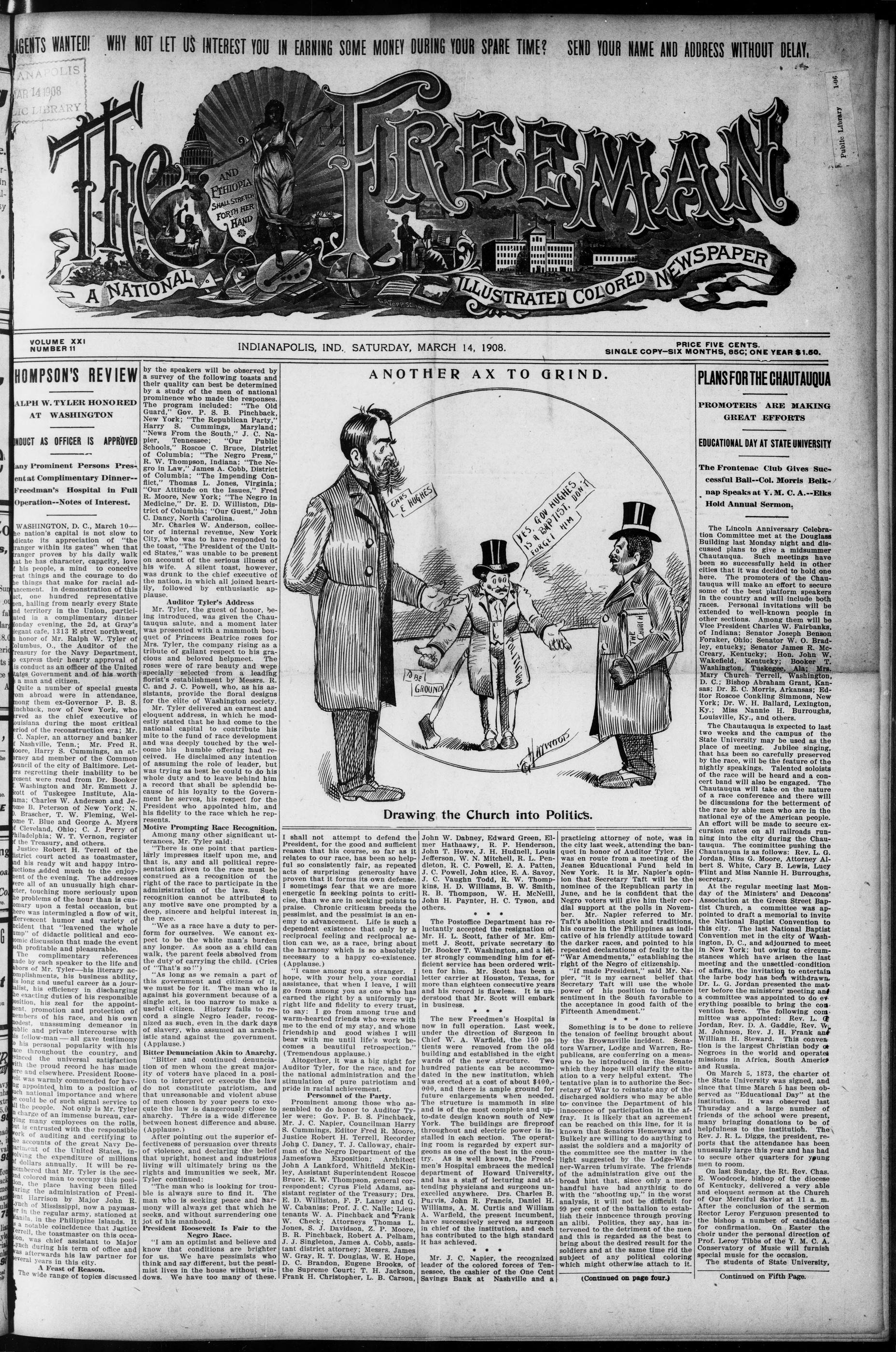
ANOTHER AX TO GRIND.
CHRIS E HUGHES
YES, GOV HUGHES, IS A BAPTIST, DON'T FORGET HIM
TO BE GROUND
THE CHURCH
HAYWOOD
Drawing the Church into Politics.
I shall not attempt to defend the President, for the good and sufficient reason that his course, so far as it relates to our race, has been so helpful so consistently fair, as repeated acts of surprising generosity have proven that it forms its own defense. I sometimes fear that we are more energetic in seeking points to criticise, than we are in seeking points to praise. Chronic criticism breeds the pessimist, and the pessimist is an enemy to advancement. Life is such a dependent existence that only by a reciprocal feeling and reciprocal action can we, as a race, bring about the harmony which is so absolutely necessary to a happy co-existence. (Applause.)
"I came among you a stranger. I hope, with your help, your cordial assistance, that when I leave, I will go from among you as one who has earned the right by a uniformly upright life and fidelity to every trust, to say: I go from among true and warm-hearted friends who were with me to the end of my stay, and whose friendship and good wishes I will bear with me until life's work becomes a beautiful retrospection." (Tremendous applause.)
Altogether, it was a big night for Auditor Tyler, for the race, and for the national administration and the stimulation of pure patriotism and pride in racial achievement.
Personnel of the Party.
Prominent among those who assembled to do honor to Auditor Tyler were: Gov. P. B. S. Pinchback, Mr. J. C. Napier, Councilman Harry S. Cummings, Editor Fred R. Moore, Justice Robert H. Terrell, Recorder John C. Dancy, T. J. Calloway, chairman of the Negro Department of the Jamestown Exposition; Architect John A Lankford, Whitfield McKenzie, Assistant Superintendent Roscoe Bruce; R. W. Thompson, general correspondent; Cyrus Field Adams, assistant register of the Treasury; Drs. E. D. Williston, F. P. Laney and G. W. Cabaniss; Prof. J. C. Nalle; Lieutenants W. A. Pinchback and Frank W. Check; Attorneys Thomas L. Jones, S. J. Davidson, Z. P. Moore, B. R. Pinchback, Robert A. Pelham, J. J. Singleton, James A. Cobb, assistant district attorney; Messrs. W. Gray, R. T. Douglas, W. E. Hope, D. C. Brandon, Eugene Brooks, of the Supreme Court; T. H. Jackson, Frank H. Christopher, L. B. Carson.
John W. Dabney, Edward Green, Elmer Hathaawy, R. P. Henderson, John T. Howe, J. H. Hudnell, Louis Jefferson, W. N. Mitchell, R. L. Pendleton, R. C. Powell, E. A. Patten, J. C. Powell, John rice, E. A. Savoy, J. C. Vaughn Todd, R. W. Thompkins, H. D. Williams, B. W. Smith, R. B. Thompson, W. H. McNeill, John H. Paynter, H. C. Tyson, and others
***
The Postoffice Department has reluctantly accepted the resignation of Mr. H. L. Scott, father of Mr. Emmett J. Scott, private secretary to Dr. Booker T. Washington, and a letter strongly commending him for efficient service has been ordered written for him. Mr. Scott has been a letter carrier at Houston, Texas, for more than eighteen consecutive years and his record is flawless. It is understood that Mr. Scott will embark in business.
***
The new Freedmen's Hospital is now in full operation. Last week, under the direction of Surgeon in Chief W. A. Warfield, the 150 patients were removed from the old building and established in the eight wards of the new structure. Two hundred patients can be accommodated in the new institution, which was erected at a cost of about $400-000, and there is ample ground for future enlargements when needed. The structure is mammoth in size and is of the most complete and up-to-date design known south of New York. The buildings are fireproof throughout and electric power is installed in each section. The operating room is regarded by expert surgeons as one of the best in the country. As is well known, the Freedmen's Hospital embraces the medical department of Howard University, and has a staff of lecturing and attending physicians and surgeons unexcelled anywhere. Drs. Charles B. Purvis, John R. Francis, Daniel H. Williams, A. M. Curtis and William A. Warfield, the present incumbent, have successively served as surgeon in chief of the institution, and each has contributed to the high standard it has achieved.
* * *
Mr. J. C. Napier, the recognized leader of the colored forces of Tennessee, the cashier of the One Cent Savings Bank at Nashville and a
PRICE FIVE CENTS.
SINGLE COPY-SIX MONTHS, 85C; ONE YEAR $1.50.
practicing attorney of note, was in the city last week, attending the banquet in honor of Auditor Tyler. He was en route from a meeting of the Jeanes Educational Fund held in New York. It is Mr. Napier's opinion that Secretary Taft will be the nominee of the Republican party in June, and he is confident that the Negro voters will give him their cordial support at the polls in November. Mr. Napier referred to Mr. Taft's abolition stock and traditions, his course in the Philippines as indicative of his friendly attitude toward the darker races, and pointed to his repeated declarations of fealty to the "War Amendments," establishing the right of the Negro of citizenship.
"It if made President," said Mr. Napier, "it is my earnest belief that Secretary Taft will use the whole power of his position to influence sentiment in the South favorable to the acceptance in good faith of the Fifteenth Amendment."
***
Something is to be done to relieve the tension of feeling brought about by the Brownsville incident. Senators Warner, Lodge and Warren, republicans, are conferring on a measure to be introduced in the Senate which they hope will clarify the situation to a very helpful extent. The tentative plan is to authorize the Secretary of War to reinstate any of the discharged soldiers who may be able to convince the Department of his innocence of participation in the affray. It is likely that an agreement can be reached on this line, for it is known that Senators Hemenway and Bulkley are willing to do anything to assist the soldiers and a majority of the committee see the matter in the light suggested by the Lodge-Warner-Warren trumvivrate. The friends of the administration give out the broad hint that, since only a mere handful have had anything to do with the "shooting up," in the worst analysis, it will not be difficult for 99 per cent of the battalion to establish their innocence through proving an albi. Politics, they say, has intervened to the detriment of the men and this is regarded as the best to bring about the desired result for the soldiers and at the same time rid the subject of any political coloring which might otherwise attach to it.
(Continued on page four.)
PLANS FOR THE CHAUTAUQUA
PROMOTERS ARE MAKING GREAT EFFORTS
The Frontenac Club Gives Successful Ball--Col. Morris Belknap Speaks at Y. M. C. A.-Elks Hold Annual Sermon.
The Lincoln Anniversary Celebration Committee met at the Douglass Building last Monday night and discussed plans to give a midsummer Chautauqua. Such meetings have been so successfully held in other cities that it was decided to hold one here. The promoters of the Chautauqua will make an effort to secure some of the best platform speakers in the country and will include both races. Personal invitations will be extended to well-known people in other sections. Among them will be Vice President Charles W. Fairbanks, of Indiana; Senator Joseph Benson Foraker, Ohio; Senator W. O. Bradley, entucky; Senator James R. McCreary, Kentucky; Hon. John W. Wakefield, Kentucky; Booker T. Washington, Tuskegee, Ala; Mrs. Mary Church Terrell, Washington, D.C.; Bishop Abraham Grant, Kansas; Dr. E. C. Morris, Arkansas; Editor Roscoe Conkling Simmons, New York; Dr. W. H. Ballard, Lexington, Ky.; Miss Nannie H. Burroughs, Louisville, Ky., and others.
The Chautauqua is expected to last two weeks and the campus of the State University may be used as the place of meeting. Jubilee singing, that has been so carefully preserved by the race, will be the feature of the nightly speakings. Talented soloists of the race will be heard and a concert band will also be engaged. The Chautauqua will take on the nature of a race conference and there will be discussions for the betterment of the race by able men who are in the national eye of the American people. An effort will be made to secure excursion rates on all railroads running into the city during the Chautauqua. The committee pushing the Chautauqua is as follows: Rev. L. G. Jordan, Miss G. Moore, Attorney Albert S. White, Cary B. Lewis, Lucy Flint and Miss Nannie H. Burroughs, secretary.
At the regular meeting last Monday of the Ministers' and Deacons' Association at the Green Street Baptist Church, a committee was appointed to draft a memorial to invite the National Baptist Convention to this city. The last National Baptist Convention met in the city of Washington, D. C., and adjourned to meet in New York; but owing to circumstances which have arisen the last meeting and the unsettled condition of affairs, the invitation to entertain the larbe body has been withdrawn Dr. L. G. Jordan presented the matter before the ministers' meeting and a committee was appointed to do everything possible to bring the convention here. The following committee was appointed: Rev. L. G Jordan, Rev. D. A. Gaddie, Rev. W. M. Johnson, Rev. J. H. Frank and William H. Steward. This convention is the largest Christian body of Negroes in the world and operates missions in Africa, South America and Russia.
On March 5, 1873, the charter of the State University was signed, and since that time March 5 has been observed as "Educational Day" at the institution. It was observed last Thursday and a large number of friends of the school were present, many bringing donations to be of helpfulness to the institution. The Rev. J. R. L. Diggs, the president, reports that the attendance has been unusually large this year and has had to secure other quarters for young men to room.
On last Sunday, the Rt. Rev. Chas. E. Woodcock, bishop of the diocese of Kentucky, delivered a very able and eloquent sermon at the Church of Our Merciful Savior at 11 a. m. After the conclusion of the sermon Rector Leroy Ferguson presented to the bishop a number of candidates for confirmation. On Easter the choir under the personal direction of Prof. Leroy Tibbs of the Y. M. C. A. Conservatory of Music will furnish special music for the occasion.
The students of State University,
Continued on Fifth Page.
IN THE WOMAN'S WORLD.
BY "DOROTHY"
This column is devoted to the interests of all women and their organizations also. Address all communications to Dorothy. The Freeman Indianapolis, Ind.
IF WE BUT KNEW.
If we knew the woe and heartache
Waiting for us down the road,
If our lips could taste the wormwood,
I would have a head bait,
Would we waste the day in wishing
For a time that neer can be?
Would we wait with much impatience
For our ship to come from sea?
If we knew the baby fingers
Holding the pane pane pane,
Would be cold and stiff tomorrow,
Never trouble us again;
Would the bright eyes of our darling
Grow so now?
Would the print of rosy fingers
Vex us then as they do now?
Ah, those little ice-cold fingers!
How they point our memory back
To the hasty words and actions
Sucking out the crack!
How those little hands remind us,
As in snowy grace they lie,
Not to scatter thorns, but roses,
For our reaping by and by.
Strange we never prize the music
To the hasty words and actions
Strange that we should slight the violets
Till the lovely flowers are gone;
Strange that summer skies and sunshine
Never seem one-half so fair,
As we see the flowers shake their white down in the air.
Let us gather up the sunbeams
Lying all around our path;
Let us keep the wheat and roses,
Casting out the thorns and chaff;
Let us find our sweetest comfort
of the day;
With a patient hand removing
All the briers from our way.
—Anonymous
WILL YOU HELP US?
About one-third of the amount necessary to purchase the artificial limb for little Florence has been raised in a short time. The condition of a little girl so hindered is appealing to the hearts of our many readers and friends. If you feel that your financial state will not allow you to give as much as you would wish, you can contribute the "widow's mite." If you do not wish your name published, we will say "A Friend." This is an opportunity to help a poor, unfortunate child. It is a sad plight and your heart will surely go out to her. Those who have had misfortunes in their own family of various kinds, can sympathize in every way. Those who have children in their own families sound of limb and body, know the joy and pleasure of the blessing and no doubt will show their thanks by giving (be it ever so little) to one upon whom affection has showed its hand.
We feel that the amount will be raised in a short time. Will you help us? Give us your prayers, your assistance in any way that you can.
A USEFUL WOMAN PASSES AWAY
In the death of Mrs. Ida D. Bailey, which took place last Tuesday morning, the race and community loses a most estimable woman and an infatigable worker for humanity. Positive of conviction, courageous in the expression of opinion, loyal to every principle she believed to be right, faithful to every trust reposed in her, generous in her dealings with friend and foe and sincerely devoted to the uplift of the masses and the civic development of the race at large, Mrs. Bailey was a factor of vast influence in the life of Washington, and her passing will be sorely felt by all. She combined a rare force of character with a charming personality, and could differ radically without making an enemy. She was a member of the Fifteenth Street Presbyterian Church, the head center of the local Niagara Movement, a leader in the Woman's League, promoter of the Day Nursery movement, and treasurer of an organization for the relief of destitute women and children and the industrial training of girls.
All these admirable points in Mrs. Bailey's career were brought out at the funeral by Dr. Francis J. Grimke in one of the most illuminating and inspiring sermons ever heard on such an occasion in Washington. The services were marked by a depth of grief, a silent pathos and dignified impressiveness seldom witnessed anywhere. The stately Fifteenth Street Church was crowded with sorrowing friends, many coming from abroad to pay a last tribute to the departed. Prior to Dr. Grimke's powerful analysis of Mrs. Bailey's life and character, Rev. J. Milton Waldron of Shiloh Baptist Church offered prayer and Rev. A. C. Garner of Plymouth Congregational Church read the Scripture lesson. Rev. W. Howard of Zion Baptist Church offered the closing prayer. The choir sang "Face to Face," "Abide With Me" and, as the procession filed out, "One Sweetly Solemn Thought" was rendered softly on the organ, all by request of the deceased. The Psalm read by Dr. Garner was also selected by Mrs. Bailey as she neared the end.
The floral offerings were numerous and unusually beautiful. The pall-bearers were Messrs. William Monroe Trotter of Boston, L. M. Hershaw, G. W. Jackson and Dr. W. S. Lofton. Mrs. Bailey was a native of North Carolina, was educated at Shaw University, taught school in her own State and in Virginia, and was the wife of Dr. Henry L. Bailey, supervising principal of the Washington public schools.
NOTED LONDON WRITER WHO'1S
NOW A SUFFRAGIST.
LONDON, March 3—Beatrice Harradem, the author of "Ships That Pass in the Night" and other novels, is championing the cause of the suffragists with voice and pen. The imprisoning of Mrs. Pankhurst for her
attempted raid on Parliament roused her to issue this rallying call to women:
"If Mrs. Pankhurst spoke the truth—and there is no reason to believe that a woman of her character and ideals would stand in the dock and lie like a trooper—she not only was wrongfully arrested, but wrongfully imprisoned. I was present in court and was greatly impressed by the dignified bearing of all the suffragists and by the quiet stateliness with which Mrs. Pankhurst insisted that she obeyed all the orders of the police. Her assertion, of course, was entirely ignored by the magistrate. But Mrs. Pankhurst will not mind whether she was legally or illegally imprisoned. She and her brave followers are in Holloway for a principle. It would be cowardly in us who believe in the same principle not to rally round her."
ARTIFICIAL LIMB FOR FLORENCE HARPER.
Subscriptions to Be Taken by The Freeman.
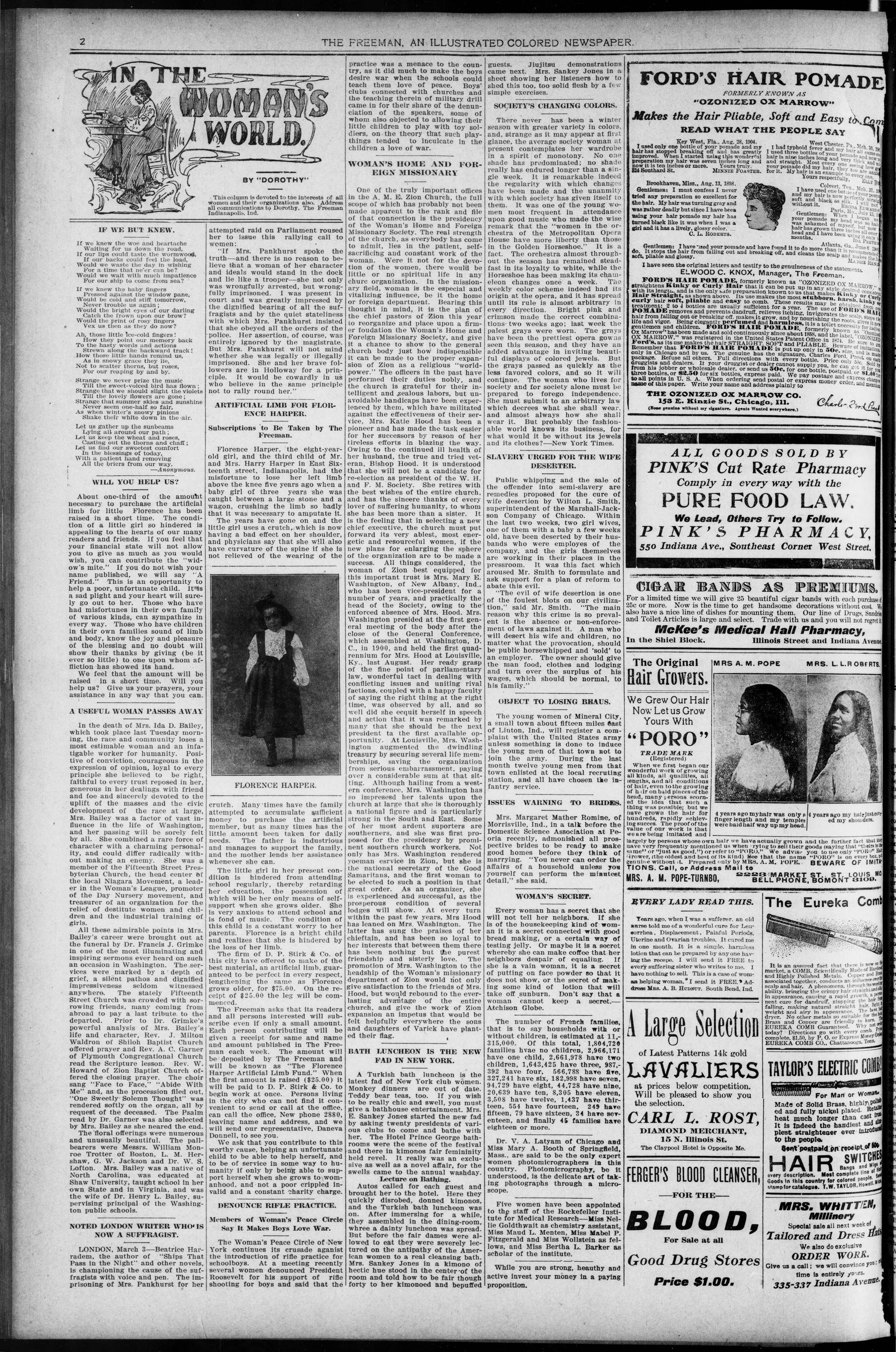
Florence Harper, the eight-year-old girl, and the third child of Mr. and Mrs. Harry Harper in East Sixteenth street, Indianapolis, had the misfortune to lose her left limb above the knee five years ago when a baby girl of three years she was caught between a large stone and a wagon, crushing the limb so badly that it was necessary to amputate it. The years have gone on and the little girl uses a crutch, which is now having a bad effect on her shoulder, and physicians say that she will also have curvature of the spine if she is not relieved of the wearing of the
1900
FLORENCE HARPER.
crutch. Many times have the family attempted to accumulate sufficient money to purchase the artificial member, but as many times has the little amount been taken for daily needs. The father is industrious and manages to support the family, and the mother lends her assistance whenever she can.
The little girl in her present condition is hindered from attending school regularly, thereby retarding her education, the possession of which will be her only means of self-support when she grows older. She is very anxious to attend school and is fond of music. The condition of this child is a constant worry to her parents. Florence is a bright child and realizes that she is hindered by the loss of her limb.
The firm of D. P. Stirk & Co. of this city have offered to make of the best material, an artificial limb, guaranteed to be perfect in every respect, lengthening the same as Florence grows older, for $75.00. On the receipt of $25.00 the leg will be commenced.
The Freeman asks that its readers and all persons interested will subscribe even if only a small amount. Each person contributing will be given a receipt for same and name and amount published in The Freeman each week. The amount will be deposited by The Freeman and will be known as "The Florence Harper Artificial Limb Fund." When the first amount is raised ($25.00) it will be paid to D. P. Stirk & Co. to begin work at once. Persons living in the city who can not find it convenient to send or call at the office, can call the office, New phone 2880, leaving name and address, and we will send our representative, Daneva Donnell, to see you.
We ask that you contribute to this worthy cause, helping an unfortunate child to be able to help herself, and to be of service in some way to humanity if only by being able to support herself when she grows to womanhood, and not a poor crippled invalid and a constant charity charge.
DENOUNCE RIFLE PRACTICE.
Members of Woman's Peace Circle Say It Makes Boys Love War.
The Woman's Peace Circle of New York continues its crusade against the introduction of rifle practice for schoolboys. At a meeting recently several women denounced President Roosevelt for his support of rifle shooting for boys and said that the
practice was a menace to the country, as it did much to make the boys desire war when the schools could teach them love of peace. Boys' clubs connected with churches and the teaching therein of military drill came in for their share of the denunciation of the speakers, some of whom also objected to allowing their little children to play with toy soldiers, on the theory that such playthings tended to inculcate in the children a love of war.
guests. Jiujitsu demonstrations came next. Mrs. Sankey Jones in a sheet showing her listeners how to shed this too, too solid flesh by a few simple exercises.
SOCIETY'S CHANGING COLORS.
There never has been a winter season with greater variety in colors, and, strange as it may appear at first glance, the average society woman at present contemplates her wardrobe
WOMAN'S HOME AND FOREIGN MISSIONARY
One of the truly important offices in the A. M. E. Zion Church, the full scope of which has probably not been made apparent to the rank and file of that connection is the presidency of the Woman's Home and Foreign Missionary Society. The real strength of the church, as everybody has come to admit, lies in the patient, self-sacrificing and constant work of the woman. Were it not for the devotion of the women, there would be little or no spiritual life in any churge organization. In the missionary field, woman is the especial and vitalizing influence, be it the home or foreign department. Bearing this thought in mind, it is the plan of the chief pastors of Zion this year to reorganize and place upon a firmer foundation the Woman's Home and Foreign Missionary Society, and give it a chance to show to the general church body just how indispensable it can be made to the proper expansion of Zion as a religious "world-power." The officers in the past have performed their duties nobly, and the church is grateful for their intelligent and zealous labors, but unavoidable handicaps have been experienced by them, which have militated against the effectiveness of their service. Mrs. Katie Hood has been a pioneer and has made the task easier for her successors by reason of her efforts in blazing the way. Owing to the continued ill health of her husband, the true and tried veteran, Bishop Hood. it is understood that she will not be a candidate for re-election as president of the W. H. and F. M. Society. She retires with the best wishes of the entire church, and has the sincere thanks of every lover of suffering humanity, to whom she has been more than a sister. It is the feeling that in selecting a new chief executive, the church must put forward its very ablest, most energetic and resourceful women, if the new plans for enlarging the sphere of the organization are to be made a success. All things considered, the woman of Zion best equipped for this important trust is Mrs. Mary E. Washington, of New Albany, Ind., who has been vice-president for a number of years, and practically the head of the Society, owing to the enforced absence of Mrs. Hood. Mrs. Washington presided at the first general meeting of the body after the close of the General Conference, which assembled at Washington, D. C., in 1900, and held the first quadrennium for Mrs. Hood at Louisville, Ky., last August. Her ready grasp of the fine point of parliamentary law, wonderful tact in dealing with conflicting issues and uniting rival factions, coupled with a happy faculty of saying the right thing at the right time, was observed by all, and so well did she herself in speech and action that it was remarked by many that she should be the next president at the first available opportunity at Louisville, Mrs. Washington augmented the dwindling treasury by securing several life memberships, saving the organization, paying over a considerable sum at that sitting. Although hailing from a western conference, Mrs. Washington has so impressed her talents upon the church at large that she is thoroughly a national figure and is particularly strong in the South and East. Some of her most ardent supporters are southerners, and she was first proposed for the presidency by prominent southern church workers. Not only has Mrs. Washington rendered yoeman service in Zion, but she is the national secretary of the Good Samaritans, and the first woman to be elected to such a position in that great order. As an organizer, she is experienced and successful, as the prosperous condition of several lodges will show. At every turn within the past few years, Mrs Hood has leaned on Mrs. Washington. The latter has sung the praises of her chieftain, and has been so loyal to her interests that between them there has been nothing but the purest friendship and sisterly love. The promotion of Mrs. Washington to the headship of the Woman's missionary department of Zion would not only give satisfaction to the friends of Mrs. Hood, but would rebound to the everlasting advantage of the entire church, and give the work of Zion expansion an impetus that would be felt helpfully everywhere the sons and daughters of Varick have planted their flag.
BATH LUNCHHEON IS THE NEW
FAD IN NEW YORK.
A Turkish bath luncheon is the latest fad of New York club women. Monkey dinners are out of date. Teddy bear teas, too. If you wish to be really chic and swell, you must give a bathhouse entertainment. Mrs. E. Sankey Jones started the new fad by asking twenty presidents of various clubs to come and bathe with her. The Hotel Prince George bathrooms were the scene of the festival and there in kimonos fair femininity held revel. It really was an exclusive as well as a novel affair, for the swells came to the annual washday.
Autos called for each guest and brought her to the hotel. Here they quickly disrobed, donned kimonos, and the Turkish bath luncheon was on. After immersing for a while, they assembled in the dining-room, whree a dainty luncheon was spread. But before the fair dames were allowed to eat they were severely lectured on the antipathy of the American women to a real cleansing bath. Mrs. Sankey Jones in a kimoon of hectic hue stood in the center of the room and told how to be fair though forty to her kimooned and beuffed
guests. Jiujitsu demonstrations came next. Mrs. Sankey Jones in a sheet showing her listeners how to shed this too, too solid flesh by a few simple exercises.
SOCIETY'S CHANGING COLORS.
There never has been a winter season with greater variety in colors, and, strange as it may appear at first glance, the average society woman at present contemplates her wardrobe in a spirit of monotony. No one shade has predominated; no shade really has endured longer than a single week. It is remarkable indeed the regularity with which changes have been made and the unamity with which society has given itself to them. It was one of the young women most frequent in attendance upon good music who made the wise remark that the "women in the orchestra of the Metropolitan Opera House have more liberty than those in the Golden Horseshoe." It is a fact. The orchestra almost throughout the season has remained steadfast in its loyalty to white, while the Horseshoe has been making its chameleo changes once a week. The weekly color scheme indeed had its origin at the opera, and it has spread until its rule is almost arbitrary in direction. Bright pink and crimson made the correct combinations two weeks ago; last week the palest grays were worn. The grays have been the prettiest opera gowns seen this season, and they have an displayed advantage in inviting beautiful displays of colored jewels. But the grays passed as quickly as the less favored colors, and so it will continue. The woman who lives for society and for society alone must be prepared to forego independence. She must submit to an arbitrary law which decrees what she shall wear, and almost always how she shall wear it. But probably the fashionable world knows its business, for what would it be without its jewels and its clothes?—New York Times.
SLAVERY URGED FOR THE WIFE DESERTER.
Public whipping and the sale of the offender into semi-slavery are remedies proposed for the cure of wife desertion by Wilton L. Smith, superintendent of the Marshall-Jackson Company of Chicago. Within the last two weeks, two girl wives, one of them with a baby a few weeks old, have been deserted by their husbands who were employees of the company, and the girls themselves are working in their places in the pressroom. It was this fact which aroused Mr. Smith to formulate and ask support for a plan of reform to abate this evil.
"The evil of wife desertion is one of the foulest blots on our civilization," said Mr. Smith. "The main reason why this crime is so prevalent is the absence or non-enforcement of laws against it. A man who will desert his wife and children, no matter what the provocation, should be public horsewhipped and 'sold' to an employer. The owner should give the man food, clothes and lodging and turn over the surplus of his wages, which should be normal, to his family."
OBJECT TO LOSING BEAUS.
The young women of Mineral City, a small town about fifteen miles east of Linton, Ind., will register a complaint with the United States army unless something is done to induce the young men of that town not to join the army. During the last month twelve young men from that town enlisted at the local recruiting station, and all have chosen the infantry service.
ISSUES WARNING TO BRIDES.
Mrs. Margaret Mather Romine, of Morrisville, Ind., in a talk before the Domestic Science Association at Pereoria recently, admonished all prospective brides to be ready to make good homes before they think of marrying. "You never can order the affairs of a household unless you yourself can perform the minutest detail," she said.
WOMAN'S SECRET.
Every woman has a secret that she will not tell her neighbors. If she is of the housekeeping kind of woman it is a secret connected with good bread making, or a certain way of testing jelly. Or maybe it is a secret whereby she can make coffee that her neighbors despair of equaling. If she is a vain woman, it is a secret of putting on face powder so that it does not show, or the secret of making some kind of lotion that will take off sunburn. Don't say that a woman cannot keep a secret.—Atchison Globe.
The number of French families, that is to say households with or without children, is estimated at 11,715,000. Of this total, 1,804,720 families have no children, 2,966,171 have one child, 2,661,978 have two children, 1,643,425 have three, 987,392 have four, 566,788 have five, 327,241 have six, 182,998 have seven, 94,729 have eight, 44,728 have nine, 20,639 have ten, 3,305 have eleven, 3,508 have twelve, 1,437 have thirteen, 554 have fourteen, 249 have fifteen, 79 have sixteen, 34 have seventeen, and finally 45 families have eighteen or more.
Dr. V. A. Latyam of Chicago and Miss Mary A. Booth of Springfield, Mass., are said to be the only expert women photomicrographers in this country. Photomicrography, be it understood, is the delicate art of taking photographs through a microscope.
Five women have been appointed to the staff of the Rockefeller Institute for Medical Research—Miss Nellie Goldthwait as chemistry assistant, Miss Maud L. Menten, Miss Mabel P. Fitzgerald and Miss Wollstein as fellows, and Miss Bertha L. Barker as scholar of the institute.
While you are strong, heathy and active invest your money in a paying proposition.
FORD'S HAIR POMADE
Key West, Fla. Aug. 28, 1904.
I used only one bottle of your pomade and my hair has stopped breaking off and has greatly improved. When I started using this wonderful hair it was even more severe and now it is ten inches or more. Yours truly.
311 South St. B.
MINN FOOSTER.
West Chester, Pa., Mch. 36, 38.
I had typhoid and my hair all my hair.
I used three bottles of pomade and now my hair is nine inches long and nai and nai and straight. Most every one sees you now for it. My hair is an inch every one.
Yours respectfully.
Brookhaven, Miss., Aug. 13, 1898.
Gentleman: I must confess I never tried any preparation so excellent for the hair. My hair was turning gray and was rather deadly but since I have been using your hair pomade my hair has turned black like it was when I was a girl and it has a liveliness. C. L. ROBERTS.
Brookhaven, Miss., Aug. 13, 1888.
Gentlemen: I must confess I never tried any preparation so excellent for the hair. My hair was turning gray and was rather deadly but since I have been using your hair pomade my hair has turned black like it was when I was a girl and it has a lively, glossy color.
C. L. ROEDETS.
Gentlemen: I have used your pomade and have found it to do more than it is recommended do. It stops the hair from falling out and breaking off, and cleans the scalp and makes the soft, pliable and glossy.
I have seen the original letters and testify to the gentleness of the statements.
ELWOOD C. KNOX, Manager, The Freeman
FORD'S HAIR POMADE, formerly known as "OZONIZED OX MARROW," is straightenskiny or Curly Hair that it can be put up in any style design. It is prepared in combination to that makes Kinky or Curly Hair Straight, as shown above. It is prepared in harsh, kinky or curly hair soft, pliable and easy to comb. These results may be from our treatment. 2 to 4 bottles are usually sufficient for a year. The use of FORD'S HAIR POMADE and prevents dandruff, relieves itching, invigorates the scalp, and helps the hair from falling out. It nourishes the roots, gives in to life and vigor. Being elegantly perfumed and humilious, the use of FORD'S HAIR POMADE has been made and sold continuously since about 1888, and the label "OZONIZED OX MARROW" is the United States Patent Office in 1874. Be sure to use of imitation. Ford's, as its uses make the hair STRAIGHT, is easy to apply. Remember that FORD'S HAIR POMADE is put up only in 50 cans and is made only in Chicago and by us. The genuine has the signature, Charles Ford, and is made in Chicago and by us. The genuine has the signature, Charles Ford, and is made in Chicago and by us. The genuine has the signature, Charles Ford, and is made in Chicago and by us. If your dandruff, with every bottle, Price only see. You can get it for you from his jobber or wholesale dealer, or send us 50c, for one bottle, or $1.40 for three bottles, or $2.50 for six bottles, express paid. We pay postage and express charges to all points in U. S. A. When ordering send postal or express money order, and mention name of this paper. Write your name and address plainly to
THE OZONIZED OX MARROW CO.
153 E. Kinzie St., Chicago, Ill.
(None genuine without my signature. Agents Wanted everywhere.)
ALL GOODS SOLD BY PINK'S Cut Rate Pharmacy Comply in every way with the PURE FOOD LAW. We Lead, Others Try to Follow. PINK'S PHARMACY, 550 Indiana Ave., Southeast Corner West Street.
CIGAR BANDS AS PREMIUMS
For a limited time we will give 25 beautiful cigar bands with each purchase of 25c or more. Now is the time to get handsome decorations without cost. We also have a nice line of dishes for mounting them. Our line of Drugs, Sundries and Toilet Articles is large and select. Trade with us and you will not regret it.
The Original Hair Growers.
MRS A. M. POPE MRS. L. L. ROBERTS.
We Grew Our Hair
Now Let us Grow
Yours With
When we first began our wonderful work of growing all kinds, all qualities, all lengths, and all conditions of hair, even to the growing of hair on bald places of the head, we realized the idea that such a thing was possible; but we have grown the hair for hundreds, rapidly achieving success. The proof of the value of our work is that
4 years ago my hair was only a finger length and my temples were bald half way up my head.
4 years ago my hair just
ed my shoulders.
largely by persons whose own hair we have actually grown and the further fact that they have very frequently mentioned us when trying to sell their goods (saying that "theirs hair is same" or "just as good") or refer to "HURO." We advise you to use only "PORO" to grower, the oldest and best of its kind) See that the name "PORO" is on every box and genuine without it. Prepared only by MRS. A. M. POPE. BEWARE OF IMITIONS. Call, or Address Mail to MRS. A. M. POPE-TURNBO, 2223 MARKET ST. ST. LOUIS MO. BELL PHONE, BOMONT 8109.
EVERY LADY READ THIS.
Years ago, when I was a sufferer, an old nurse told me of a wonderful cure for Leucoirrhea, Displacement, Painful Periods, Uterine and Ovarian troubles. I cured me in one month. It is a simple, harmless lotion that can be prepared by any one haw
EVERY LADY READ THIS.
Years ago, when I was a sufferer, an old nurse told me of a wonderful cure for Leurorrhea. Displacement, Painful Periods, Uterine and Ovarian troubles. It cured me in one month. It is a simple, harmless lotion that can be prepared by any one having the recipe. I will send it FREE to every suffering sister who writes to me. I have nothing to sell. This is a case of woman helping me. I send it FREE. ^2 Address Mrs. A. B. H. Burch, South Bend, Ind
It is an assured fact that there is now a market, a COMB, Scientifically Made of Hair. It is a new product that is associated and together, conducts an influence over scalp and hair. A phenomena, through its ability, bringing the crimp hair straightening and smoothing hair, provides a cure for dandruff, stopping the hair from falling, making natural straight hair, and drying hair. No other metals so suitable for the Brass and Copper are friendly to horn, EUREKA COMB Guaranteed, EUREKA COMB, EUREKA com. Complete complete, $1.50, by P. O, or Express Money Gift EUREKA COMB Co., Chattanooga, Tenn.
A Large Selection
of Latest Patterns 14k gold
LAVALIERS
at prices below competition.
Will be pleased to show you
the selection.
CARL L. ROST,
DIAMOND MERCHANT,
15 N. Illinois St.
The Claypool Hotel is Opposite Me.
FERGER'S BLOOD CLEANSER,
—FOR THE—
BLOOD,
For Sale at all
Good Drug Stores
Price $1.00.
For Man or Woman
Made of Solid Brass, highly polished and fully nickel plated. Retains heat much longer than cast from it. It is indeed the handiest and most plast straightener ever introduced to the people.
Special sale all next week of
Tailored and Dress Hats
We also do exclusive
ORDER WORK.
Give us a call; we will convince you;
time is entirely yours.
335-337 Indiana Avenue.
More Money for Colored People
This is one of the objects of this great Bench-
clad and Protection Institution, the L-LH Grand Lodge aims to improve
infrastructure, in a financial way, as well as morally
and industrially, of every member, as
whose work is to be done in the Hours,
Opportunities, Self Betterment
and Protection generally, are among the things
for which our L-LH Grand Lodge Shorter Hours,
Cooperative Society in every sense
of the term. No matter where you live, or what
your occupation, be you married or single, employ-
er or manager, you are greatly to your ad-
miration in the L-LU Grand Lodge. Members
and their unemployed brothers and sisters to secure
work, help them sick or disabled, and where
Big Cash Benefits
Admitted to member, $100 cash is paid to benefit. At death of wife, or other beneficiary, member secures Bldg. A month of number of child Bldg. There are many other benefits not awarded to other organizations.
Membership is open to both sexes, including boys and girls, without discrimination, color, or religion. Over 50,000 men and women have already joined our organization, most uplifting Beneficial Protection in existence. We invite you to join. Send our copy of official paper to Home. We will send a full particular. If you join promptly, we will give you authority to represent us in your locality. You can disguise your spare hours to securing a position in which we will pay you liberty. We need a new Travel Representatives who can give their entire time to this work; good pay, including traveling expenses. Write at once!
The I-L-U Grand Lodge
115 I-L-U Bldg., Dayton, Ohio.
THREE GREAT PAMPHLETS
In Defense of the Race.
Howard University, Washington, D. C.
1. "As to the Leopard's Spots,"
(open letter to Thomas Dixon.)
2. "An Appeal to Reason,"
(open letter to John Temple Graves.)
3. "Roosevelt and the Negro,"
(Discussion of the Brownsville issue.)
Price 10 cents each, the three for a
quarter. Circulation over sixty
thousand. Agents wanted. Commission 4c per copy. Address the author.
The Freeman gains each week because it publishes only real live news.
The Fighting Chance.
BY ROBERT W. CHAMBERS.
Copyright, 1906, by the Curtis Publishing Company.
Copyright, 1906, by Robert W. Chambers.
[CONTINUED.]
"Miles and I could chair you over," suggested Siward.
"Is that fair—under the rules?"
"Oh, yes, miss, as long as you go straight," said the keeper.
He lay aside the guns and the guide's gamesack, and formed a chair with their hands, and, bearing the girl between them, they waded out along the driven aider stakes, knee deep in brown water.
Her arm, lightly resting around his neck, tightened a trifle as the water rose to his thighs; then the faint pressure relaxed as they thrashed shoreward through the shallows, ankle deep once more, and landed among the dry reeds on the farther bank.
Miles, the keeper, went back for the guns. Siward stamped about in the sun, shaking the drops from waterproof breeches and gaiters, only to be half drenched again when Sagamore shook himself vigorously.
"I suppose," said Sylvia, looking sideways at Stward, "your contempt for my sporting accomplishments has not decreased. I'm sorry. I don't like to walk in wet shoes even to gain your approval." And as the keeper came splashing across the shallows: "Miles, you may carry my gun. I shall not need it any longer."
The upward roar of a bevy of grouse drowned her voice. Poor Sagamore, pointing madly in the blackberry thicket all unperceived, cast a dismused glance aloft where the sunlit air quivered under the winnowing rush of heavy wings. Bigward flung up his gun, heading a big quartering bird. Steadily the glittering barrels swept in the arc of fire, hesitated, wavered, then the possibility passed. The young yellow lowered the gun slowly, gravely, stood a moment motionless with pen head until the rising color in his face had faded.
And that was all for awhile. The customized and disusted keeper stared into the thicket. The dog lay quivering, impatient for signal. Sylvia's heart, which had seemed to stop with her voice, silenced in the gusty thunder of heavy wings, began beating too fast. For the ringing crack of a gun shot could have spoken no louder to her than the glittering silence of the suspended barrels nor any promise of his voice sound as the startled stillness sounded now about her, for he had made something a trifle more than mere amends for his rudeness. He was overlying everything a little. He stood on the thicket's edge, abently unloading the weapon, scarcely understanding what he had done and that he had not done. A moment later a far hall sounded across the uplands, and against the sky figures moved distantly. "Alderdene and Marion Page," said
---
Slward. "I believe we lunch yonder, do we not, Miles?" They climbed the hill in silence, arriving after a few minutes to find others already at luncheon—the Page boys, eager, enthusiastic, recounting adventure by flood and field; Rena Bonnesdel, tired and frankly bored and decorated with more than her share of mud; Eileen Shannon, very pretty, very effective, having done more execution with her eyes than with the dainty fowling piece beside her.
Marion Page nodded to Sylvia and Slward with a crisp, businesslike question or two, then went over to inspect their bag, nodding approbation as Miles laid the game on the grass.
"Eight full brace," she commented. "We have five and an odd cock peasant—from Black Fells, I suppose. The people to our left have been blazing away like Coney Island, but Kena's guide says the ferns are full of rabbits that way, and Major Welbether can't hit fur afoot. You," she added frankly to Siward, "ought to take the cup. The birches ahead of you are full of woodcock. If you don't Howard Quarrier will. He's into a flight of jack sniple, I hear."
Siward's eyes had suddenly narrowed; then he laughed, patting Sagmore's cheeks. "I don't believe I shall shoot very steadily this afternoon," he said, turning toward the group at luncheon under the trees. "I wish Quarrier well with the cup."
"Nonsense!" said Marion Page curtly. "You are the cleanest shot I ever knew." And she raised her glass to him frankly and emptied it with the precision characteristic of her: "Your cup! With all my heart!"
"I also drink to your success, Mr. Siward," said Sylvia in a low voice, lifting her champagne glass in the sunlight. "To the Shotover cup—if you wish it."
In the little gust of hand clapping and laughter he turned again to Sylvia smiling, saying under his breath, "As though winning the cup would compensate me now for losing it!"
She leaned involuntarily nearer, "You mean that you will not try for it?"
"Yes."
"That is not fair to me!"
"Why not?"
"Because—because I do not ask it of you."
"You need not, now that I know your wish."
"Mr. Siward. I—my—wish"—
Mr. Siward, I—my wish—
But she had no chance to finish. Already Rena Bonnesnel was looking at them, and there was a hint of amused surprise in Eileen Shannon's mischievous eyes, averted instantly, with malicious ostentation.
Then Marion Page took possession of him so exclusively, so calmly, that something in her cool certainty vaguely irritated Sylvia, who had never liked her. Besides, the girl showed too plainly her indifference to other people, which other people seldom find amusing.
"Stephen," called out Alderdene anxiously counting the web loops in his khakl vest, "what do you call fair shooting at these ruffed grouse? You needn't be civil about it, you know."
"Five shells to a bird is good shooting," answered Siward. "Don't you think so, Miss Page?"
"You have a better score, Mr. Slward," said Marion Page, with a hostile glance at Alderdene, who had not made good. Impatient to start, she had turned her tailor made back to the company and was instructing his crestfallen lordship very plainly: "You fire too quickly, Blinky. Two seconds is what you must count when a grouse flushes. You must say, 'Mark, right,' or 'Mark, left, bang!'" And so the luncheon party, lord and lady, twins and maidens, guildes and dogs, trailed away across the ridge, distant silhouettes present against the sky, then gone. And after a little while the far dry, accentless report of smokeless powder announced that the opening of the season had been resumed and the birds were dying fast in the glory of a perfect day.
"Are you ready, Mr. Siward?" She stood waiting for him at the edge of the thicket. Miles resumed his game sack and her fowling piece. The dog came up, looking him anxiously in the eyes.
So he walked forward beside her into the dappled light of the thicket. Within a few minutes the dog stood twice, and twice the whirring twitter of woodcock startled her, echoed by the futile crack of his gun.
"Beg pardon, sir."
"Yes, Miles," with a glint of humor.
"Overshot, sir, excusin' the liberty, Mr. Siward. Both marked down forty yard to the left if you wish to start 'em again."
"Miles," he said, "my nerve is gone. Such things happen. I'm all in. Come over here, my friend, and look at the sun with me."
The discomfited keeper obeyed.
"Where ought that refulgent luminary to scintillate when I face Osprey Ledge?"
"Sir?"
"The sun. How do I hold it?"
"On the p'int of your right shoulder, sir. You ain't quittin', Mr. Siward, sir?' anxiously. That 'Shotover cup is easy yours, sir' eagerly. 'Wot's a miss on a old drummer, Mr. Siward? Wot's twice overshootin' cock, sir, when a blind dropper can see you are the cleanest, fastest, hard shootin' shot in the hull county?"
But Siward shook his head, with an absent glance at the dog, and motioned the astonished keeper forward.
"Line the easiest trail for us," he said. "I think we are already a trifle tired. Twigs we will do in short cover. Use a hatchet in the big timber. And go slow till we join you."
And when the unwilling and perplexed keeper had started, Siward, unlocking his gun, drew out the smooth yellow cartridges and pocketed them. Sylvia looked up as the sharp metal-
THE FREEMAN AN ILLUSTRATED COLORED NEWSPAPER
lic click of the locked breech rang out in the silence. "Mr. Sward!" in quick displeasure. "Yes?"
"What you do for your amusements cannot concern me."
"Right, as usual," he said, so gayly that a reluctant smile trembled on her lips.
"Then why have you done this? It is unreasonable if you don't feel as I do about killing things that are having a good time in the world."
He stood silent, absently looking at the fowling piece cradled in his left arm. "Shall we sit here a moment and talk it over?" he suggested listlessly. Her blue gaze swept him. His vague smile was indifferently bland.
"If you are determined not to shoot we might as well start for Osprey Ledge," she suggested. "Otherwise, what reason is there for our being here together, Mr. Siward?"
Awaiting his comment, perhaps expecting a counter proposition, she leaned against the tree beside which he stood, and after awhile, as his absent-minded preoccupation continued:
"Do you think the leaves are dry enough to sit on?"
He slipped off his shooting coat and placed it at the base of the tree. She seated herself, and, as he continued to remain standing, she stripped off her shooting gloves and glanced up at him inquiringly. "Well, Mr. Siward, I am literally at your feet."
"Which redresses the balance a little," he said, finding a place near her. He sat there, chin propped on his linked fingers, elbows on knees and, though there was always the hint of a smile in his pleasant eyes, always the indefinable charm of breeding in voice and attitude, something now was lacking. And after a moment she concluded that it was his attention. Certainly his wits were woolgathering again. His eyes, edged with the shadow of a smile, saw far beyond her, far beyond the sunlit shadows where they sat.
In his preoccupation she had found him negatively attractive. She gianced at him now from time to time, her eyes returning always to the beauty of the subdued light where all about them silver stemmed birches clustered like slim shining pillars crowned with their autumn canopy of crumpled gold.
"Enchantment!" she said under her breath. "Surely an enchanted sleeper lies here somewhere."
"You," he observed, "unawakened."
"Asleep? I?" She looked around at him. "You are the dreamer here. Your eyes are full of dreaming even now. What is your desire?"
He leaned on one arm, watching her. She had dropped her unloved hand, searching among the newly fallen gold of the birch leaves drifted into heaps. On the third finger a jewel glittered. He saw it, conscious of its meaning, but his eyes followed the hand idly heaping up autumn gold—a white slim hand, smoothly fascinating. Then the little restless hand swept near to his, almost touching it, and then instinctively he took it in his own curiously, lifting it a little to consider its near loveliness. Perhaps it was the unexpectedness of it, perhaps it was sheer amazement, that left her hand lying idly relaxed like a white petaled blossom in his.
After a little while the consciousness of the contact disconcerted her. She withdrew her fingers, with an involuntary sliver.
"Is there no chance for me, Miss Landis?"
The very revulsion of self possession returned chilling her; then anger came quick and hot; then pride. She deliberated, choosing her words coolly enough, "What chance do you mean, Mr. Siward?"
"A fighting chance. Can you give it to me?"
"A fighting chance? For what?" very low, very dangerous.
"For you."
Then in spite of her her senses became unsteady. A sudden ringing confusion seemed to deafen her, through which his voice, as if very far away, sounded again:
"Men who are worth a fighting chance ask for it sometimes, but take it always. I take it."
Her pallor faded under the flood of bright color. The blue of her eyes darkened ominously to velvet.
"Mr. Siward," she said very distinctly and slowly, "I am not—even—sorry—for you."
"Then my chance is desperate indeed," he retorted coolly.
"Chance! Do you imagine"— Her anger choked her.
"Are you not a little hard?" he said, paling under his tan. "I suppose women dismissed men more gently—even such a man as I am."
For a full minute she strove to comprehend.
"Such a man as you!" she repeated vaguely. "You mean"— A crimson wave dyed her skin to the temples, and she leaned toward him in horror stricken contrition. "I didn't mean that, Mr. Slward! I—I never thought of that! It had no weight. It was not in my thoughts. I meant only that you had assumed what is unwarranted—that you—your question humiliated me, knowing that I am engaged—knowing me so little—so"—
"Yes, I knew everything. Ask yourself why I risk everything to say this to you? There can be only one answer." Then, after a long silence, "Have I ever," she began tremblingly—"ever by word or look"— "No." "Have I even"— "No. I've simply discovered how I feel. That's what I was dreaming about when you asked me. I was afraid I might do this too soon, but I meant to do it anyway before it became too late." "It was too late from the very moment we met, Mr. Siward." And, as he reddened painfully again, she added
quickly, "I mean that I had already decided."
And, as he said nothing: "You were a little rough, a little sudden with me, Mr. Siward. Men have asked me that question—several times, but never so soon, so unreasonably soon—never without some preliminary of some sort, so that I could foresee—be more or less prepared. But you gave me no warning. I—if you had I would have known how to be gentle. I—I wish to be now."
Still he said nothing. He sat there listlessly studying the sun spots glowing, waxing, waning, on the carpet of dead leaves at his feet.
"As for what you have said," she added, a little smile curving the sensitive mouth, "it is impulsive, unconsidered, a trifle boyish, Mr. Siward. I pay myself the compliment of your sincerity. It is rather nice to be a girl who can awaken the romance in a man within a diy or two's acquaintance. We shall not misunderstand each other again, shall we?" He raised his head, considering her, forcing the smile to meet her own. "We shall be better friends than ever," she asserted confidently.
"Because what you have done means the nicest sort of friendship, you see. You can't escape its duties and responsibilities now, Mr. Slward. I shall expect you to spend the greater part of your life in devotedly doing things for me. Besides, I am now privileged to worry you with advice. Oh, you have invested me with all sorts of powers now!"
He nodded.
She sprang to her feet, flushed, smiling, a trifle excited.
"It is all over, and are we the very ideals of friends?" she asked.
"The very ideals."
"You are nice!" she said impulsively, holding out both glovesless hands. He held them, she looking at him very sweetly, very confidently. "And you are content?" persuasively.
"Of course not," he said.
"Then I am sorry for you. Look at that!" turning her left hand in his so that the jewel on the third finger caught the light.
"I see it."
"And yet"—
"And yet."
"That," she observed, with composure, "is sheer obstinacy. How can you really care for me? Do you actually believe that devotion comes like that?"
"Exactly like that."
"So suddenly? It is impossible!" with a twist of her pretty shoulders.
"How did it come to you?" he asked between his teeth.
Then her face grew scarlet, and her eyes grew dark, and her hands con-
scarlet, and her
her hands contracted in his—
tightened, twisted fingers
entangled, until, with a little
sob, she swayed toward him,
and he caught
her. An instant,
a minute—more
perhaps she did not know—she
half lay in his
arms, her untaught lipsclose
against his.
Lassitude, faint
consciousness,
then tiny shock
on shock came
the burning revulsion, and her
voice came
back, too,
She swayed toward him, and he caught her.
sounding strangely to her, a colorless, monotonous voice. He had freed her. She remembered that somebody had asked him to—perhaps herself. That was well. She needed to breathe, to summon strength and common sense, find out what had been done, what reasonless madness she had committed in the half light of the silver stemmed trees clustering in shameful witness on every hand.
Suddenly the hot humiliation of it overwhelmed her, and she covered her face with her hands, standing, almost swaying, as wave on wave of incredulous shame seemed to sweep her from knee to brow. That phase passed after awhile. Out of it she emerged flushed, outwardly composed, into another phase, in full self possession once more, able to understand what had happened without the disproportion of emotional exaggeration. After all, she had only been kissed. Besides, she was a novice, which probably accounted in a measure for the unreasonable emotion coincident with a caress to which she was unaccustomed. Without looking up at him she found herself saying coolly enough to surprise herself: "I never supposed I was capable of that. It appears that I am. I haven't anything to say for myself except that I feel fearfully humiliated. Don't say anything now. I do not blame you; truly I do not. It was contemptible of me—to do it—wearing this"—She stretched out her slender left hand, not looking at him. "It was contemptible." She slowly raised her eyes, summoning all her courage to face him.
But he only saw in the pink confusion of her lovely face the dawning challenge of a coquette saluting her adversary in gay acknowledgment of his fleeting moment of success. And as his face fell, then hardened into brightness, instantly she divined how he rated her and in a flash realized her weapons and her security and that the control of the situation was hers, not in the control of this irresolute young man who stood so silently considering her. Strange that she should be ashamed of her own innocence, willing that he believe her accomplished in such arts, enchanted that he no longer perhaps suspected genuine emotion in the swift, confused sweetness of her first kiss.
"Why do you take it so seriously?" she said, laughing and studying him, certain new of herself in this new disguise.
"Do you take it lightly?" he asked, striving to smile.
"I? As I must, you know. You don't expect to marry me, do you, Mr. Slward?"
"I'— He choked up at that grimly for awhile.
Walking slowly forward together she fell into step frankly beside him, near him—too near. "Try to be sensible," she was saying gayly. "I like you so much, and it would be horrid to have you mope, you know. And, besides, even if I cared for you there are reasons, you know—reasons for any girl to marry the man I am going to marry. So, you see, I could not marry you even if I"—her voice was inclined to tremble, but she controlled it; would she never learn her role?—"even if I loved you."
Then her tongue stumbled and was silent, and they walked on side by side through the fading splendor of the year, exchanging no further speech.
Toward sunset their guide halted them, standing high among the rocks, a silhouette against the sky. And beyond him they saw the poles crowned with the huge nests of the fishhawks, marking the last rendezvous at Osprey Ledge.
(Continued next week.)
NOTED COLORED MAN GONE
THE DEATH OF THE HON. D.
AUGUSTUS STRAKER.
Scholar, Teacher and Orator--Highly Respected by His Associates at the Bar--Meeting Held in His Memory.
With regret we note the death of Hon. D. Augustus Straker, one of the foremost Negroes of this day. For years he had made his home in Detroit, Mich., where his many abilities gained him distinction at his home, and even further. The country has long since known of D. Augustus Straker as scholar, teacher, orator, author, official and lawyer. He was in the truest sense a many-sided individual. Appearing to great advantage in whatever he undertook. Some dozen or more years ago, contributions from his pen were seen in a number of the leading race papers. These reflected breadth of views and evidences of scholarship which gave him his value.
Straker was of judicial temperament —ran to law— was admitted to the Detroit bar where he was highly esteemed. As a token of regard for the distinguished deceased a meeting was called by the president of the Detroit bar where speeches eulogistic of his life and services were made, and befitting resolutions read and adopted. The resolutions were headed: “Resolutions on the death of Honorable D. Augustus Straker, LL. D.” A biographical sketch of his life was set forth, short but complete, and ample for the archives of the association, when information may be desired as to who Straker was. It is in part as follows: David Augustus Straker was born in Barbadores, West Indies, in 1840, where he remained until after the Civil War; he then came to the States, located in Kentucky with the intention of entering the Protestant Episcopal ministry. He changed his mind: entered the newly established schools of Louisville, Ky., where he felt that he could be of greater service to his race. He taught for a few years, after which he entered Howard University, at Washington, D. C., where he graduated with high honors as a lawyer.
After his graduation, Mr. Straker filled clerkships in the department, finally going South as a custom official; this was in 1875. While of that State he was a member of the legislature. Afterwards he was a professor in Allen University for a short period. About this time he decided the North was his field; so in 1887 Mr. Straker was found in Detroit, becoming at once a member of the bar association.
In 1892 he was elected circuit court commissioner for this county and served two terms with great credit to himself and to the entire satisfaction of the profession and the public. For 21 years he had thus been an honored member of this bar, and he has left an enviable impress upon its history and its progress.
His longa and useful life and exceptional talents were consecrated to and given for the benefit and uplift of humanity, and stand as a splendid example of the possibilities open to the youth of to-day, of whatever branch of the human family.
His residence in our midst and membership in our association has been marked by great usefulness. The purity of his personal character, the courtesy of his manners, the attainments of his professional life, are worthy of imitation. They show that a career is always open to talent, honesty and energy, regardless of rate.
Therefore, Be It Resolved, That it is with profound sadness that we chronicle the decease of our distinguished brother and fellow citizen, and be it further resolved, that these resolutions be spread upon the minutes of our association and copies be presented to the family of our deceased brother, and to the press, and presented to the supreme court of the state, the United States Court for the eastern district of Michigan, southern division, to the circuit court for this county and the recorder's court for Detroit.
Alfred J. Murphy, Circuit Judge.
Jas. Phelan, Recorder.
Flavius L. Broke, Circuit Judge.
Jas. H. Pound.
Wm. C. Swan.
President Wilkinson then appointed Judge Alfred J. Murphy, Judge James Phelan, James H. Pound, Adam Bloom, Adolph Sloman a committee to attend the funeral as honorary pallbearers.
COOKS
Waiters and Cooks
Prefer our Make
Jackets and Linen
because they have found them
satisfactory.
Write for Complete Catalogue FREE
giving full instructions
to order.
Marcus Ruben, Inc.,
300 State St., CHICAGO, ILL.
FUNERAL DIRECTORS.
G. W. Frierson & Co, from Nashville,
Tenn., have opened a
Funeral Parlor
633 Indiana Avenue, between California and
West Streets.
Polite attention and
prompt service. Calls
answered day and night.
G. W. Frierson & Co, from Nashville, Tenn., have opened a Funeral Parlor 653 Indiana Avenue, between Call fornia and West Streets. Polite attention and prompt service. Calls answered day and night. Lady Attendant, Are now at your service. Prices below all competitors. Fifteen years in Nashville; ten years in Louisville Ky. Phone 3227.
BEFORE ORDERING YOUR
Spring Suit
Call and See our
NEWEST
and
LATEST
FADS.
We satisfy others, why not
you? Ask your friends.
SUITS $20.00 AND UP.
Deutsch
Tailoring Company
41
S. ILLINOIS ST.
THE MAGIC SHAMPOO
HAIR DRIER
A Lady's Hair improves her
skin by treating it
complete without a Shampoo
Hair Drier, that will
make your hair shine and
it a natural appearance. The
1907 LATEST IMPROVED Model
is lighter in weight and more
protect in color. $5 for
it today. Prepaid by mail, $1.00
MAGIC SHAMPOO DRIER MGY. COMPANY
45 Century Blvd.
Minneapolis, Minn.
Nicelle
OLIVE OIL
Has Been
Proven
Superior
Miselle
To all Other
BRAND
TESTED BY THE
United States
Bureau of CHEMISTRY
At Your GROCERS
OR WRITE
NICELLE OLIVE OIL CO
New York City.
134 West Market Street.
MONEY
Loaned on Diamonds, Watches,
Jewelry, Gems, Revolvers and
all articles of value, at
203 Ind. Ave., - Shiel Blk.
THE FREEMAN
A NATIONAL ILLUSTRATED
COLORED NEWSPAPER.
SUBSCRIPTION RATES:
Agents wanted in every town and city not now occupied, and liberal indocuments will be given to the same. Send for our extraordinary inducements.
ADVERTISING RATES:
Five cents per line. Base of measure—solid
agate, 14 lines to an in. $272 lines in a column.
14 lines to an in. $272 lines in a column.
advertisement inserted on first page. Special
rates on standing professional and business
space. Discount for long time and
space. Reading notices per line. Special
rates on "write ups."
Entered at the postoffice at Indianapolis,
Ind. as second class matter.
New Phone 2880.
GEORGE L. KNOX,
Publisher and Managing Editor.
ELWOOD C. KNOX,
Business Manager.
SATURDAY, MAR. 14, 1908.
Will you contribute to the "Florence
Harper Artificial Limb Fund?"
Guess they will have to get a new
jury in the Brunaugh case.
Weather—booming. Everybody is
afraid of it because it looks to have
a string to it.
And just to think, Mr. Carnegie and
Mr. Rockefeller fell out about an old
game of golf. What are we coming
to, anyhow?
Mr. Conn, aspirant for the nomination for Governor on the Democratic ticket, it would have more show if he would ask the legislature to change his name.
The A. M. E. Church General Conference will divide the honors with the National Republican Convention with a great class of our more prominent men.
Senator Fairbanks is favorably mentioned all over the country. If there gets to be any unusual bucking at the National Convention, business will pick up for the Vice President.
The Czar has commuted the death sentence of General Stoessel to ten years of imprisonment for the surrender of Port Arthur. His freedom is thought to be only a matter of a short time. The Czar will be considered at least normal in his attitude to ward the unfortunate general.
The odds and ends of the recent Negro exhibit at Jamestown, Va., are being disposed of by Mr. T. J. Callow in Washington, D. C. He ought to do a driving business in choice bric-a-brac, and such like, as souvenirs of the great and successful undertaking.
Mrs. Portia Washington Pittman, Booker T. Washington's daughter, is an aspirant for honors as a pianist; she will make her debut in May. Mrs. Pittman received much of her instruction in European conservatories and apparently is qualified to come up to what is expected of her.
Houston, Texas, reports one hundred grocery stores among the colored people, four of which are wholesale; it reports only two billiard parlors. Indianapolis Negroes ought to take notice. We have fairly a reversed condition. There perhaps can nothing be said against innocent billiard parlors, but there should be other corresponding business interests. We say it again, lest we forget, that 35,000 Negroes can do pretty much what they choose.
If colored men may not rival "The Potato King" in his line, they may yet raise that most staple vegetables, and most useful. They can take to other crops as specialties, becoming authorities, as Groves is on potatoes—valued and sought out for information—insuring a reputation that means the ready disposal of crops. A corn king, a wheat king, an onion king or any other would also be proud titles. Half a king or any part, will be in the interest of that phase of race life.
Last year, Groves, the "Negro Potato King" succeeded in getting from his farm in Kansas 72,150 bushels of potatoes. So far as it is known, no other individual in the country has done so well. He is deserving the title, and wears it proudly. Mr. Groves is an eminent example of the prospects in the field of agriculture; he has done exceptionally well, and of course he will not be rivalled very soon by any of his own race. In fact, white men with all of their opportunities may well sit up and take notice of what Mr. Groves is doing. Mr. Carnegie, in his Scotland speech, referred to this industrious Negro, who has only to live a few years when he will be among the really rich men of America.
Rev. G. C. Parker, in discussing the welfare of the C. M. E. church in a recent number of the Christian Index, incidentally let fall the following expressions regarding the needs of the church, "Money to go into Chicago; money to go to Indianapolis; men and money to build a great Miles Memorial in Cincinnati, O." The C. M. E. Church is much younger than the other stronger denominations. Only within the last few years has it been known in the North. It appears to have the element of growth and before many more years it bids fair to be established in the larger cities, having a considerable Negro population. The mission in Indianapolis is receiving attention by those that have
the shaping of things and the prospects of a good flourishing church looks good.
It appears that Mr. Bryan will not have his own sweet way at Denver. Governor Johnson, of Minnesota, will contest the honor of the nomination for the presidency on the Democratic ticket with him, and with a show of compelling the Bryanites to sit up and take notice. The chances are that Mr. Johnson has entered the game just a little too late to win to himself the needed support. But there's no telling what a political convention may do. Mr. Bryan himself was nominated in a moment of enthusiasm, showing that your most carefully laid plans sometimes fall to carry. What happened to Mr. Bryan and to other candidates that were "afterthoughts" can happen to the Governor of Minnesota. Such happenings, however, are rare. It looks to the disinterested observer that when the curtain falls on the scene of the National Democratic Convention at Denver, Mr. Bryan will again be the nominee of his party.
THE TUSKEGEE CONFERENCE.
Something like four hundred delegates representing the public and private schools of the South met in conference in Tuskegee last week. The object was to show the progress of the year, for the exchange of thought, the giving of experiences, having in mind the promotion of the work in the future.
"One of the most interesting reports was that made from Mount Meigs, where the Federation of Negro Women of Alabama has established a reformatory. Last August about twenty acres of land in the woods near Cornelia Bowen's School, at Mount Meigs, was purchased, and a five-room cottage was erected upon it. B. W. Tyrrell, a full-blooded 'Negro who was born in Virginia, but highly educated, having studied for the ministry in London, Eng., finally graduating from a German university at Bonn, was put in charge of the institution. He gave a very interesting report upon the work of the reformatory, describing the manner in which the money to run the school and the clothing for the pupils was raised by the women's clubs of the State."
This report was interesting because of the penal aspect of the institution, supported by private means, at once proving to what straits the race is driven in order to build up successfully and how nobly the conditions are met. According to the report bolts and bars are no part of the institution, yet there have been but very few attempts at escape, demonstrating the sway of love.
Again: Rev. W. G. Johnson, president of the Negro Baptist Convention of Georgia, described the reformatory that had been started by the Negroes of Georgia. They have purchased 350 acres of land at Macon, Ga., and are erecting a $10,000 building, the money for which has already been paid in except about $2,000. The Negro Baptist churches of Georgia raise about $4,000 a year to maintain this institution.
Many more reports were given during the conference that spoke the conditions surrounding the schools proper. President L. J. Rowan, of Alcorn, Miss., spoke of the coming land advantages about that school, since many of the white planters were moving into the cities. He thought it was the Negroes' opportunity to come in and build up an industrial community. Principal W. J. Edwards is conducting Snow Hill University, on the plantation where he was born. He has seen the Negroes twenty' acres of land grow until they now have five thousand acres under cultivation. Mrs. S. T. Pollard spoke of the efforts along temperance lines by the women connected with Selma University. She spoke triumphantly of the band proceeding to town and putting one hundred and eight temperances badges in a single day.
The agricultural school on wheels was described by President Merserve, of Shaw University, and which was intended for the white people, but owing to the interest manifested in it by the colored people they were permitted to profit by it.
Other teachers described the work that is being done in the village of Tuskegee where classes are taught in five different trades, including that of plastering, brick-laying, carpentering and others. An afternoon cooking class has been started for the instruction of the servants employed in the homes of towns people.
THE LATE HON. D. AUGUSTUS
STRAKER.
The touching tribute of respect paid by the citizens of Detroit and by the bar association of that city was an indication of the great worth of the late D. Augustus Straker, who died February 14. Perhaps no Negro of eminence in the North has been so honored, so esteemed by the citizens without distinction. The praises heaped on him were well merited when living, teaching again the lesson that the grave is not the final of the great and good. The good that men do live after them, in principle, in precept, leave an impress in kind, adding to the store of the good and wholesome which must ever be to check the balances of the baleful and blighting. Here then is the truer monuments of men than were ever done in stone or bronze—when men sing the deeds of men as of spontaneous heart, telling them down the ages as heirlooms arched down, as matters of soul and mind, and therefore no more to pass away than ye spires that pierce the sky in membrane also of those long distinguished and dead. Entalured then, in the hearts, if not elsewhere will the memories of the great and worthy be kept. What more should be expected? Why not think in some such manner of D. Augustus Strakers whose life was rounded out with years and good deeds? The citizens of Detroit tell of him; they have seen his comings and going for many years; they virtually say, "Behold, the man!" We will not be one whit behind them, if we are wise, in honoring our own dead.
Really we should truly mourn the passing of our great men, knowing that the gan in the ranks is so diffi-
THE FREEMAN. AN ILLUSTRATED COLORED NEWSPAPER.
cult to fill. The present age is sending forth its multiplicity, but it is only once in a great while that a Napoleon or a L'Overture is in the process. And what's more, we do not often recognize them until it is entirely too late, excepting to officiate at the obsequues. We too often wait to take our cue from some other kind of man before we are willing to concede what is due. Our greater men are beginning to feel the effect of this indifference, especially in the North, where the certain tendency is to bear the market of self-respect and dignity. Titled people of attainments of office, of church, of bar, of bench are entitled that respect paid anything good and meritorious as above the common and ordinary. Even in the purest Democracies the republic of letters swayed and must continue to do so, if we are to have intelligence and direction in the front of affairs. We oppose the idea of inconoclasm, when it comes to the rule of the fitted. We need the great in front, and we need to follow them in the event of greatness. It is the history of the world over—honoring the great in life, in death; and by which greatness manifested through achievements is civilization measured. The fight should be to sustain our foremost men rather than dragging them down. And yet if it were all told, what would many of our leading men have to say? Not that they are always vigorously opposed; there is that cold indifference, sometimes studious, but mostly the result of ignorance which can not see the degrees of attainment in men. Sometimes they are vigorously opposed, with no other thought than of dwelling all to the plane of mediocrity—a refined phase of jealousy that looks with impatience on the progress of others even where there is equal opportunity.
Frederick Douglass, in his latter days, felt the lash of criticism within his own race, saw diminishing respect. Timely death, if we may say so, intervened, stepped in and saved from obloquy the grandest character that it has pleased God to give the Negro race. We are not so sure but what Straker saw some decline in race love; not because he proved unworthy, but because of who he was, and because he had been long before the people. We merely conjecture this case, judging by what is seen and known elsewhere. But happily those of real worth impress themselves on the age, and as if in accordance with the law of adjustment. Where these may not show the proper appreciation, those make good; and note of their deeds are spread on the broad minutes of life, where those that run may read. We feel that some such reference is due to the late D. Augustus Straker, whom the white people of Detroit would not permit to pass unnoticed in the article of the grave; giving him such funeral rites as they appropriate to themselves, serving notice on delinquents, that in such and such manner we honor the worthy among us, the hue of the skin counting for naught.
We will not be understood as meaning that the colored people of Detroit were any less respectful, any less concerned about the fallen Straker than the white people. They were a part of what was done to show respect. We simply saw a lesson in the life and death of such a man and made note of it.
THE STATUS OF EIGHT DISCHARGED SOLDIERS.
Senator Hemenway, of Indiana, in submitting a minority report on the discharged Negro soldiers' situation espouses the cause of the discharged men. He is of the opinion that there was not conclusive evidence of the guilt of the men and without which they were entitled to the consideration due men not proven guilty. The conclusions of the report are in accord with the views of most thoughtful Negroes, a and justice-loving men generally. It is hoped that in the end such views will prevail. It is known by either side, or at least admitted that only a few men could have been engaged in the "shooting up" of Brownsville, an admission for the sake of argument, placing the situation in its worst light. The report brings this out clearly, showing that beyond the few in point of numbers, the others were not suspected. It is for these that consideration is expected. It is for these that Senators Hemenway and Foraker are asking Congress to restore to their places in the army. As we view it, it is but a matter of simple justice, and aside from any political advantage hoped for or expected it is not too much to say that President Roosevelt, justice loving man as he is known to be, would not have allowed his term to have expired without reviewing the case with the object or rendering justice to those to whom it was due. What may be done under the pressure is quite another question. It is hoped that the President may see his way clear to make peace out of the confusion, as he is able to do, even without resorting to the aid of Congress. If the relief comes from Congress, it means the threshing out of the Negro problem before that body and before the public, a and perhaps in such a way that would not help the race. Are we quite prepared to test our popularity?
We simply plead for the Presidents disposition in the matter over that of any other source, knowing that behind the act would follow a trial of of peace, whereas, other methods, especially those forceful in aspect would more than likely be at the expense of friends and friendship. Here is no surrendering of the position that the innocent be not confounded with the guilty; it means the most satisfactory disposal of a case in which there resides elements of great danger to the race, and to the country in the sense of restlessness, vague and unsettled convictions as to policies and courses to pursue by the Negroes and towards the Negroes. Then Congress, if needs be if results are not forthcoming from other sources.
NEGRO ENFRANCHISEMENT.
The Southern Christian Advocate, in answering those that insist that the enfranchisement of the Negro at the close of the war was a colossal blunder, says: "It was not a colossal blunder," and further, "That the
States that had seceded were easier reconstructed with the political enfranchisement of the Negro; and it was this reason that led to the placing of the ballot in the Negro's hands and not primarily the consideration of the Negro's rights or his privileges."
The Freeman has insisted in the view of what has happened, and basing the happenings on color and previous prejudices that the enfranchisement of the Negroes at that time was a very wise move, since the enfranchisement would never have come. It is not a case of speculation to insist that it would not have come. The evidences are with us to-day. There has been a steady growing disregard for Negroes along political lines, and it stands to reason that the thing of gradual enfranchisement would not have come about. However, there is an element of doubt; it may have been that the opposition sprang up and thrived because of the sudden enfranchising, setting up a new condition that would have been otherwise. The view, however, will not be seriously considered, because it is race and "previous condition" that make for prejudice and discriminations, and not the fact of prematurely becoming full-fledged citizens. It will be understood that the political liberty given has helped in the matter of prejudice, but it was not its source.
The Negroes were extremely lucky in the matter of enfranchisement at that day. It may have come about more as a means as rebuilding the nation and according to the law of numbers as it is sometimes urged, or it may have been the direct intent to fix it at once so that he Negroes could not be robbed of the fruits of the war, which is also urged, that brought it about. Be that as it may, yet it is safe to say that whatever the motive, it has proved the thing that should have happened, since the thing of gradual enfranchisement would never have come about, or if so, not for very many years.
The Freeman has also insisted that a right in abeyance is not a right that is lost; it is only a question of time when the laws will clam their own. The temporary defect should mean the gathering of strength and it is usually the case where wrong and right are the question. Of course this means where and when everything else is equal; the condition of Negroes measuring up to date that of the white people, and such like.
THE FLORENCE HARPER FUND.
Among those contributing to the Florence Hooper Limb Fund is a Wm. Crawford, now confined in prison in Waupun, Wis. His letter is as follows:
The Freeman Publishing Co.,
Indianapolis, Ind.
Gentlemen—In reading an account of the unfortunate predicament of Florence Harper, I feel prompted to make a contribution which I hope will be of benefit to her. I am unfortunate myself, and realize the handicap some of us may suffer, so it is not hard to analyze the feeling of experience of another in distress.
Trusting your efforts will be successful, as I am sure they will be, I will close with my regards.
Enclosed find $5.00.
The misfortunes of the two are not of a kind, but they are either unfortunate, and out of the condition of little Miss Harper comes this strange sympathy. One will not stop to question the source of the coming, but will ponder long over the intent. This prisoner, one will say, judging by his heart, is not an ordinary mortal. Perhaps he is not where he belongs. Of course, we are talking to the act, deeming that it is in accord, and not a mere artifice to win sympathy. In the event he is a genuine man, and not playing on our credulity not angling for mercy that comes of the very noble unexpected, then worse people than he is on the outside of prison walls.
Let us hope that the author of the gift is a good, sincere man, who was moved to do what he did out of compassion for affliction in whatever form. If he is such a man, then we may well say, "Behold the man, and implore the powers to restore him to citizenship and a man's estate. The Governor of Wisconsin can well afford ot look into the case of Wm. Crawford.
The little lady and her parents will be touched, owing to the strange answering of the appeal. They will see the heart of the individual, which after all, is the best test of the individual, who is governed by what it registers, true or false, and accordingly as it is true or false. The outside world has its notions, but it is not wise always. Most times it is wise enough, but there are rules and there are exceptions. The intent of Crawford's heart, regulated by his "code" of right and wrong, and if of right intent, will preserve him at least for himself—strong for the emergencies whatever they be. Viewing the contribution from this angle, it might be more highly prized. No holier money has ever been spent if Crawford is what his act proclaims. It is enough that he is penitent, avowedly so. His gift blessed in the sanctuary of reflection where only God were besides. And we must think God in it under the prescribed conditions of man.
We have no means of knowing of what race Mr. Crawford is, but suspect he is a colored man. But it does not matter. We would not have jot or title to change in either ascertained event. And we are confident that most people will have some such views as we have expressed concerning Crawford's gift to the Florence Harper fund. The $5.00 is gratefully received and acknowledged; it will be placed as the other donations, for the purchasing of an artificial limb for Florence Harper. His name will be found among others and while not perhaps at the very head of the list, but so far as recognition and gracious acknowledgment, it, like that of Abou, Ben Adhem, will lead it.
OUR HOOSIERS AT THE CAPITAL
An Indiana Society is to be organized among the resident Indianians in Washington, so 'tis said. Such a move would certainly be a good one. The national capital is graced by the presence of a brilliant aggregation of
POLITICAL NEWS
Favorable mention is made of John Allen for county commissioner.
The Democrats think they see of prospects also, and are improving the opportunity of bringing out good men.
young and promising, and Harry O. Chamberlain, well known at the bar. Others are to be heard from, more than likely.
Lawyers have a kind of hankering
Mr. Michael Jefferson has appointed a goodly batch of the colored boys to the association's force. It was the result of the "gittin'" together, one will survive.
Roger R. Shiel prefers running for state auditor; his friends insist that he run for county commissioner. His friends, viewing it from the money end have the "longest head." But 'tis glory Mr. Shiel cares for.
Peter Travers is also for township trustee. He is a thorough-going business man and as such feels that he merits the people's consideration for that office. Mr. Travers is kindly, genial and of good address.
Among the candidates for the office of township trustee of Marion County is Dr. B. A. Brown, who has views as to how the business of the important office of trustee should be done. He was formerly connected with the School Board of Brightwood and is now a member of the City Council.
Inspector of Weights and Measures Wulfson is before the voters of Marion County for consideration for the nomination of township trustee, subject to decision at the forthcoming Republican primary. Wulfson is well known for his battle with the Standard Oll Company, and in the interest of the citizens. His success in office, he feels, insures his success in the office he seeks.
The aspirants for coroner are as usual, hopeful, determined to win. When the other dear charmer is away the one looks the it. Dr. Petersdorf is a bright, fairly youngish man who has served a term as coroner. He feels to have made good; he runs on his record. Dr. E. E. Hodgin is a popular city employee, who feels to have served the city well in his round of duty. He wants to be coroner and is putting up a vigorous campaign for the office.
一
A number of candidates aspire to be the nominee for Prosecutor of Marion County. Among those is A. R. Hovey, one of the leading members of the bar, and with his recommendable qualities makes him a very favorable candidate. The others are Ira M. Holmes, a very energetic young legal light who has been Prosecuting Attorney in the Police Court. John Weaver, also
Hoosiers, and they would exert a degree of influence more commensurate with their capabilities if they were united and made their political power more apparent to the leaders of the party. Although there are no ennities or jealousies in the ranks of our Indiana contingent at Washington as there is among the representatives of certain other States, indifference seems to be keeping them apart, with the result that not a single important national berth has been accorded us for many years, and the outlook for such recognition, under present conditions, is not very bright. Vice President Fairbanks, Sen. Hemenway, Controller Tracewell, Auditor Lawson and other official friends are heartily in favor of the organization idea, and will cooperate most substantially to aid their colored adherents to get together for the good of all. Social intercourse of our Hoosier delegates will thus be promoted, a comprehensive record of our voters could be kept, and our political and personal status would in many ways be vastly improved if a compact organization is formed at the capital. Here is a job worthy of the steel of such potent factors in Washington as R. W. Thompson, G. W. Jackson, W. C. Brown, Charles E. W. Brown, Albert J. Farley, Alexander Freeman, Harry C. Reynolds, Joseph Blakey and others.
FLORENCE, ALA.
This week is going to be a very interesting week for the colored people of this section. The colored people of this section are fast learning what education is and whita a great help it is to the race...Rev. Warren, presiding elder of the A. M. E. Church, was here Sunday and preached a good sermon to the members of the church and friends...The Heart and Hand Club will give a leap year entertainment at St. Mark's Baptist Church Friday night, March 13, 1908. All are invited to come. This being leap year we would be glad for the most prominent bachelors to get married...The ladies of the Missionary Society of the A. M. E. Church are going to give a bazaar in the basement of the church, beginning at 2 p. m. and continuing until 11 p. m.
THOMPSON'S WEEKLY REVIEW
(Continued from first page.)
A prominent administration leader states that the President is anxious to dispose of the controversy on lines of justice, and that he may give this measure his indorsement. It is argued that the compromise will be, in practical effect, a reinstatement of
young and promising, and Harry O. Chamberlain, well known at the bar. Others are to be heard from, more than likely.
Lawyers have a kind of hankering for office of Prosecuting Attorney. They have a kindly regard for the Judge's bench also, but to most this proposition is a vague dream. Amid the splendid array of talent, it takes nerve to want to be a judge; yet judges we must have, and they come right from the ranks. But a judge when a judge is so long a judge that his position seems inviolable. Even in retired life, a judge is yet judge. A judge, in fact, is a rara avis, so when the bird is got, he is generally kept. Marion county sometimes changes its judges, not often.
Merle N. A. Walker, Chas. T. Hanna, Lawson M. Harvey, Henry Clay are popular and representative. They are before the voters of Marion county for nominees on the Republican ticket.
A generous crop of candidates is always considered an indication of the faith in party prospects. If the crop this year is in keeping with the nation, Marion County will still be in the Republican column when the voters are counted this fall. All sorts of candidates are met in these days, the hopeful, the more hopeful, the most hopeful are in evidence, and in some instances expect to "pull down" same office. The small grafter is among them whispering soothingly, "you can't lose." As a matter of fact, all are not going to win. But after it is good to have an excellent stock of faith on hand, for if it were other, wise, there would be absolutely no hope for him without it. The friends of the candidates know this and they are plied with the "function oil—salve, in every-day parlance—and the candidates like it. If they don't, they are made to like it.
Regardless of the number of candidates, there is some little anxiety manifested over the recent "happiness." Candidates are insisting with the more thoughtful of the party that the best men will be none too good this year. They seem to have confidence that Marion County is theirs, but rather suspect that it might be otherwise if the best judgment is not exercised in making up the ticket. However, the array of candidates before the party for consideration at the primary stand for as many representable men; some, of course, are of more standing, having more experience, are qualified in greater degree than others, making it reasonably sure that a good, strong ticket is selected for presentation to the voters of Marion County.
the men, but as individuals rather than as a battalion, and this method ought to be satisfactory to all concerned.
```markdown
```
The protest filed by the Methodist bishops against the filth, poorly finished and altogether inadequate cars in which colored people are compelled to ride in the South, is likely to bring about a better state of things if the matter is pushed with the vigor that its importance deserves. The Interstate Commerce Commission, by agreeing to allow the railroads to separate their passengers by races, on the condition that the accommodation be equal as sums jurisdiction which places the adjustment of the difficulty squared up to that body. Under a recent rating, it is our understanding that an railroad which refuses to provide equal accommodations for the same fare, may be adjudged in content of court. If this is true, the railroads should be held to the full letter of the law and the Interstate Commerce Commission should be allowed no loophole through which it may shirk its responsibility. The bishops, the Afro-American Council, the Niagara Movement and other organizations of similar character, now have their opportunity to "make good."
The coming of Dr. Booker T. Washington on the 18th is to make an international event, according to the plans outlined by the main agement. Invitations have been extended to the President of the United States, the Supreme Court and local judiciary, the Cabinet members of both branches of Congress and the diplomatic corps. Acceptances ready received indicate that an endeance unparalleled in the annals of the capital will greet the eminent T. kegeean at Metropolitan Church.
***
The Negro Department of the Jamestown Exposition has secured quarters in the Cox Building, when Chairman T. J. Calloway is winding up the odds and ends of the great enterprise. Practically all the others have been returned to their owners. f the more than 11,000 articles no losses have been reported. The appropriation granted by the Government has been honestly administered every dollar being satisfactorily counted for through the administrative system worked out by Mr. A. F. Heyer and Mrs. A. M. Curtis, secretary and fiscal agent. Chairman Calloway is being assisted by Mrs. T. Calloway, Mr. W. E. Hope and Mr. Mattie E. Tyler. Mr. Calloway is also placed a book on the mark giving a succinct history of the position and its effect upon the world being of the race. It covers a much historic ground, and as a compulsor dum of race achievement it is a valuable contribution to the literature the times. R. W. THOMPSON
THE STAGE
Have you contributed to the "Florence Harper Artificial Limb Fund?"
Send in your contribution to the "Florence Harper Artificial Limb Fund."
Miss Rosie Lee Hall at Paducah, Ks., wishes to hear from Miss Lola McGronda at Kansas City, Kan., or Mo.
"Make some other heart rejoice" by sending in your contribution to the Florence Harper Artificial Limb Fund.
Earl Burton has joined hands with Ian Van, a white performer. The two will do a turn in vaudeville at an early date.
The Philadelphia Treble Cef Mandolin and Guitar Club will give its seventh annual concert April 23 at St. Peter Claver Auditorium.
Nettie and Lovie Taylor left March 12 for a two weeks' engagement at French Lick Springs. Lovie Taylor sends her best wishes to Slim Henderson. Home address, 904 West Green street, Louisville.
William Nichols, the famous mime of Gideon's Hottest Coon in Dixie company, who shot and injured a foreigner at Girardsville, Pa., at the instance of one of the girls in the company, has been released from the Pottsville (Pa.) prison.
Frank (Chinee) Walker, the cleaner character comedian, while at the Windsor Theatre, St. Paul, Minn., was the guest of the Elks at a smoker given in their beautiful hall week of March 2nd. This week at Gem Family Theatre, Minneapolis, Minn.
Madam Cecil Watts, who has been appearing with Black Patti Troubadours and other companies, presented "The Queen of the Congo" at Topela, Kan., last week with much success. Madam Watts was formerly Kollie Williams, the prima donna of the Sunflower State.
Sim Mason, who closed a successful season with the Wallace-Hagen-beck shows, is booked for this season with the same show. He sends regards to P. G. Lowery and Smart et bunch and all friends in and out of the profession. He has been spending the winter in Louisville, Ky., at his home, 1108 Congress street.
NOTES FROM COLE & JOHNSON'S
SHOO-FLY REGIMENT
John Jackson is now carrying an extra suit case. No, it doesn't belong to him.
Henry Gant can be found at his old moments reading up the baseball dope. Yes, Henry is a real ball player. He claims to be in better condition now than ever.
Sam Lucas is feeling much better after his attack of la gripe. But Sam will have that cigar.
Mrs. Elizabeth Williams has become quite a seamstress lately. The wardrobe mistress is rather happy.
Arthur Ray has the habit of just making the train. A Garrison finish like. Sometimes, Arthur, the train won't be late.
Frank De Lyons is studying to play Hamlet. Well, stranger things than that have happened.
Gee. Brown is at himself again. The old cold just left before March and George is singing the real tenor again.
Mary Corker Jr. made a flying visit to Port Huron Monday from Detroit. Well, Sam delivered one of his famous sermons before his departure. Ask Edgar Connor.
Sleigh riding has been the fad among the girls in the company up in these parts of chilly Michigan.
Bessie Tribble, Maine Butler, Daisy Brown, Andrew Tribble and Johnnie Livingston too their daily sleigh ride in Port Huron, Mich.
Now how is it Daisy Brown laughs every time she sees an automobile trying to pull through the snow. No, Daisy, the snow will not last always. You will have an auto fit again soon. Harry Williams keeps very busy these writing something. No, I can't say whether it is music or not.
Don't ask C. W. Barnes where he is going to stop, for he always has some old friend in these towns.
Miss Leona Marshall has no more thoughts of old Chicago. My heart's tonight in the Shoo-Fly Regiment.
The man who invariably looks before he leaps never acquires much of a reputation as a leaper.—Fannie Wise.
Bob Cole told Rosamond Johnson that a girl wasn't necessarily stunning because she throws a man down. Have you ever been to Paris, Ky?
Arthur Talbert took a trip to Canada from Port Huron, Mich. Well, Arthur don't think as much of Canada as in the olden days.
And I see by the papers Allen and Tribble are to star next season. Tribble doesn't seem to know anything about it. How strange!
On arriving in Toledo, Ohio, last Sunday a gentleman rushed up to Theo. Pankey and said: "Isn't this Theodore Pankey from Little Rock, Ark?" "Yes, this is me," answered Pankey. "Well, I haven't seen you in thirty-five years," replied the
stranger. Just then Pankey recognized his old chum and schoolmate and then a hearty handshake between them, as Bob Cole stepped up and was introduced to Pankey's friend, who told Bob how many years it had been since seeing Pankey and when they were boys and left home together at the tender age of 18 years. Now Bob Cole wants to know how old Pankey really is. Rosamond Johnson said, "I told you Pankey was over 26." How old is Pankey? Oriene Howard and Bessie Tribble are easily the bureau of information for every five and ten cent store between New York and St. Louis, Mo. Some of the one-night stands they are very much disappointed in not finding one in the town. Then they will tell you, "This old town ain't nothing." Miss Ethel James was sick for a little while in Bay City, Mich. Ethel is all right now—just as happy and smiling as ever.
Lewis Mitchell is slated to be one of the pitchers on the Cole & Johnson baseball team. He says he can pitch some more ball. Well, we will all wait and see.
Miss Belle Morgan went to see "East Lynn" in Saginaw, Mich. When you see Belle ask her how she liked the show.
Mr. Phillip Robson, our manager, has been suffering with the rheumatism the past few days, but says he will be all right when we get off the one night stands.
Pearl Taylor is thinking of spending the summer in Jacksonville, Fla. As a rule people generally go North to spend the summer. Pearl, you don't know how hot it gets in Jacksonville in the summer. Perhaps she can stand it though.
Bessie Sims is well and doing well, thank you. With best wishes to New York town.
LINCOLN THEATRE, KNOXVILLE,
TENNESSEE.
"The Kentucky Minstrels" was the bill for the first half of the week, and everything went all to the merry under our new stage manager, Sam P. Gardner, who has taken charge of the stage and drew up three bills to follow the minstrels in one hour's time.
Edward L. Howard, our conversationalist, was a great help to the first part. The management can't guise Mr. Howard, as he only let out a little at a time.
The work of all of the artists was superb in every detail. Sam P. Gardner and Geo. C. Centers, our extreme end men, were compelled to respond to several encores nightly. Sank Sims and Geo. Lewis held their own on the second ends. All of the vocal selections sang by Hallie Dean, Nettie Howard, Blanch Sims, E. L. Howard, Mabel Brown, and Annie Centers went big.
The house is doing better business each week. The olio was opened by that versatile comedian Ed L. Howard with a pleasing monologue, followed by Sims, Gardner and Sims. They mopped. Then came Center, who never fails to please. Sank Sims was there with his funny afterpiece "Sambo in China Town," which was a howling, screaming success.
"Lucy Long's Lawn Party" held the boards the last half of the week, which was a winner. Nettie Howard sang "He's My Friend From My Home," "When the Moon Shines," by Hallie Dean; "Save It for Me," by Blanch Sims.
The Merry Howards, Edward L. and Nettie M., closed March 7th at the Lincoln Theatre. They are booked out again this season with Downey's Big Uncle Tom's Cabin Company, which opens at Medina, N. Y., on St. Patrick's Day for a forty-five weeks' tour through California. They send regards to all friends in and out.
J. Ed. Green's Reply.
Mr. Elwood C. Knox,
Indianapolis Freema
Indianapolis, Ind.
My Dear Mr. Knox—Being very busy I have not had the pleasure of writing you personally for quite a while, but at divers times I always find a moment to glance through the columns of your much-famed Freeman, which I always feel a kindly interest in. For I consider The Freeman one of the rounds of the ladder of success I have climbed (although the top seems far off), it being with me at all times in any little or big undertaking. I have noticed through the columns of your paper any number of times reference to me by one of your writers, Mr. Sylvester Russell. I have had the pleasure of meeting Mr. Russell a number of times, however my first time to meet and know him personally since an episode in the minstrel days, which I will quote a little later in these columns, was when I was with the "Smart et."
Quite a number of times Mr. Russell has said about me through these columns has been quite amusing, only I did not find them interesting enough to cut them out and keep, although I have had the good fortune to cut out some by Messrs. O. L. Hall, Hubbard, Mrs. Mollie Morris, Amy Leslie, in fact all of the Chicago critics. Quite a few of the New York critics have laid the lash on me rather heavily, but I always consider that a child never gets the lash unless he deserves it. This long introduction is to bring out one point and that is as long as the writer speaks of what he knows while welding the pen he is safe, but when he resorts to deliberate and contemptible lies the best name he can get, or if a person does not like to pollute his
mouth, then the best reward he can get would be a good strong horse-whip. Now, if the writer, Mr. Russell, does not think that the quoter, Mr. Green, means what he says, at the first opportunity when either of the above gentlemen meet each other, the latter will show the former what he means by quick action unless Mr. Russell is gentleman enough to take back what I consider slander.
suit, so that when it was finished it would fit perfectly.
"Here we were all getting off the car and I was invited to have a drink by these gentlemen, so we repaired to a nearby place, where one of them said he had never drank with a nigger before, but would make this an exception."
"I thank you very much for the kind invitation," said I, "but I can
Mr. Lucas is the oldest performer in the show business, and I have as much respect for him as I would my father. Mr. Hogan and I are personal friends, as my correspondence with him will show, as I hear from him quite frequently since his sojourn in the hospital in Massachusetts. I desire you to send either a copy of this letter or the article, should you print it in full, to Mr. Lucas, care of the Cole and Johnson show; also send him a copy containing Mr. Russell's article in your issue of Saturday, March 7th, and he in person will at once contradict this article, for he and I never had a controversy in our lives.
Unless the writer is dense or malicious, he must be insane. I had refrained from answering any number of things Mr. Russell has said about me for the simple reason that the season of '98 and '99, when I first joined Oliver Scott's Minstrels, I was at once installed as stage director, interlocutor and director of all singing. When I at once took charge of the show I was told by the manager to go front, look over the performance, and all that I thought was essential to keep in the show to do so, and what changes I thought necessary to at once make, as I was relied upon as being capable of judging. Among the many things that I did not think beneficial to the show or even as much as entertaining was the double-voiced balladist Mr. Sylvester Russell. I did not know him at that time; I simply knew that he would not do to sing on the minstrel first part, so among the number of "cast-offs" Mr. Russell's name was found, and as I gradually began to spring into the limelight I noticed little crossings of wires every now and then and I find them to be conducted by Mr. Russell. I have paid no attention to them and really shall pay no attention to them hereafter, only to deny the one assertion that Mr. Lucas, "the dean of the profession," and myself, only a small factor, have never had two cross words in our lives.
You will do me the honor, Mr. Editor, to publish this letter in full, as it is the first favor I have asked of you. I desire my professional friends to see this. It has taken quite a bit of my time to compose myself to dictate this to my stenographer, having seventy people to rehearse each day takes nearly all the time one man can spare. Of course should I not be able to stand up under the strain I can easily step down and out and fold my mantle of defeat about me, and can always say that I have done no man or woman in the show business one lota of harm.
Thanking you in advance for your kindness to tolerate such a lengthy letter, I beg leave to remain.
Very respectfully yours.
J. ED GREEN,
Managing Director for Robt. T.
Mott's Enterprises.
Dict. J.E.G.—A.C.
GEORGE WALKER
Explains His Reasons for Indulging in Exeravagant and Costly Stage Costumes and Expensive Street Clothes.
George W. Walker of the team of Williams & Walker, the well known colored comedians, in an interview recently explained his reasons for extravagant and costly stage costumes and expensive street clothes. Dress is George Walker's stock in trade. It is part of his method of making business. He believes in the modern American ideal that the most successful men in the country are the men who know how to advertise their business to advantage, and he contends that clothes help to advertise his and his partner's theatrical business.
During the interview Mr. Walker recalled an incident that happened to him a short time before, that goes to show how he makes friends as well as business everywhere with his flashy raiment and gentlemanly conversation.
"Riding on the street car the other day," said Mr. Walker, "two gentlemen, whose audible remarks I could not fail to hear, were arguing as to who I was.
"One said to the other, 'Who is that swell darky standing there? It must be Joe Gans or a racehorse coon. Look at his face. Look at that flash on his hand. Gee whiz he is a swell darky."
"And his friend said, 'Why that's George Walker, of Williams & Walker. If you don't believe me, go over and ask him. I'll bet it's him."
"The first speaker almost immediately addressed me with the question, 'Are you George Walker?' And I answered him, 'Yes."
I should explain that is not unusual for a white man to ask a darky what would seem to many as rather personal questions, and I was not surprised at his next question, for I could see that he was interested.
"May I ask, why do you wear such flashy clothes and that large diamond ring?" And I told him that in many cases white people would not believe I was not George Walker, if I did not wear them. The general public expects to see me as a flashy sort of a darky and I do not disappoint them as far as appearance goes.
"I do not wear these fancy clothes and diamonds alone because I can afford them, but wear them as a matter of business as well as personal pride or vanity, as you might call it. I admire nice clothes and like to take pride in the wearing of them; but I do hope I don't create a false or haughty impression on any one who sees me or with whom I come in contact.
"My clothes are all created or built from my own ideas, by the best tailors in New York City. Why, I have stood from two to three hours more than once for the fitting of one
suit, so that when it was finished it would fit perfectly.
"Here we were all getting off the car and I was invited to have a drink by these gentlemen, so we repaired to a nearby cafe, where one of them said he had never drank with a nigger before, but would make this an exception."
"I thank you very much for the kind invitation," said I, "but I can only drink with you as a man and not an exception." This being agreeable, I offered the following:
"Right is right, if a man is a man, If human feeling is just the same, If you have in that to the highest degree, It is a pleasure, I'll assure you, to drink with thee."
THE NEGRO IN VAUDEVILLE.
By Shepard N. Edmonds.
It is too bad that the public in general is gradually being deprived of its right and desire of being entertained by one of the most potent forces in the amusement world in the person of the Negro in vaudeville, but such are the bare facts with no "ifs" nor and's" about it, and it is not altogether the desire of the public at that.
Were I to express my views on the Negro's future in vaudeville, or in any other theatrical work, I should say that his is a most promising future, providing he is let alone and dealt with fairly and squarely from his managerial ends and is placed according to his actual value, which should be reckoned from the public's point of view.
The Negro in vaudeville of today is too much like his ancestors of former decades; it takes him too long to hear the thunder, consequently lightning strikes him before he sees the storm approaching. I know of a recent incident where a certain New York agent wrote several letters to Negro vaudevillians and even wrote to a colored newspaper, asking them to express their views on the Negro's future in vaudeville. Now, I know of no replies being made by either of these parties who received such letters, possibly because of the simple fact that it did not concern them as much; but if this same agent will kindly explain why all colored acts, as a rule, are forced to open the bill on almost every engagement in which they appear, it may be that we can ALL tell what the Negro's future in vaudeville will be.
As a matter of fact there should be no such question as the Negro's future in vaudeville or any other line of the theatrical profession; the Negro is as much a fixture in this line of work as the work itself is a fixture in the hearts of the American public. We have no visible proof that the public is tired of the Negro as an entertainer, neither have we any plausible reasons why he should have such a so-called questionable future, but we have, though, most conspicuous evidence to the contrary notwithstanding. The Negro is certainly original in his work as a black-faced entertainer and he makes no effort to deviate from this line, but we have seen many black-faced entertainers who were not Negroes and who made no efforts in any other line.
Stop invading the Negro's territorial rights and deal with him on the standpoint of merit and there will be no such question as the Negro's future in vaudeville or any other branch of the theatrical profession. The Negro in the theatrical business as well as the Negro in any other business which he undertakes, reminds me of a story of a homeless canine. It doesn't matter how fat a bone he may find any time, he has to fight to retain that bone; he leaves that bone alone, still, it is not because he is a coward that he refuses to fight for this bone, neither is it because he does not think the bone worth fighting for, but it is because he knows he is neither in condition nor position to fight.
Why should the Negro's future in vaudeville be questioned any more than others if he is treated from any degree of merit? He is invariably placed in the most difficult spot on a bill, does more work for less money and makes as big a "hit." So far as his reliability is concerned, the public in general know that the entire theatrical world has but a limited amount of this. Why should he be held up as a particular specimen? Yet, while we individually may find many objections to the subject matter herein contained, seeing it as we sometimes do, from an impulse of passion, we should not forget, however, the fact that our adversary may be a thoroughly organized body, bound together for protection and mutual beenfits, having for its main object the elimination of any and all conditions contrary to the progress and welfare of its chosen profession and we should all praise them in their work to this extent; but we should certainly not be with them when they are technical in the extreme and prejudicial in the least to creed or color.
Organization is a grand idea, symbolic of the phrase, "In union there is strength," and its progress and aim in general should be to obtain results, beneficial in common, to all the parties concerned. Keeping always in mind, that in organization you must have public confidence and to secure confidence you must display self-satisfaction. Organization does not always meet with public approval, neither does public approval always give self-satisfaction, but there is some justification as well as self-satisfaction in organization so long as it produces satisfactory results from objectionable conditions.
Now to organize, in a sense means, first, that all parties concerned must agree and understand that someone must lead; second, that after a leader has been chosen to lead that someone must follow; and, third, that those who do follow shall have the right to say from time to time why they shall follow and hwo they shall follow him.
Then to be effective and produce harmonious results, let the leader lead, and the followers follow, and let each see that both are done correctly.
The affiliation of organizations is oftimes the most dangerous mistake.
WANTED AT ALL TIMES
MERGLE & LEVY, Props. RICHARD SIMMONS, Mgr 161 South Third Street, Memphis, Tenn. The Hoosier Comedians, Authors, Composers and Vocalists.
"Good Night My Honey, Good Night Marie," "O Come to Me," "In the Sweet Bye and Bye," "The Lady of Quality," and others.
especially is this true where the experienced hardship of the one is bridged by the inexperience of the other. Two separate and distinct organizations, composed of members in the same profession, having for its aim and purpose the welfare of its profession and refusing to affiliate in its effective forms of legislation, carry on its face a deceptive intent and display beyond a doubt a degree of bad faith.
Any collective body of individuals have a social right to organize, but no organization has the legal right to deprive any individual of his right to earn a livelihood. Yet a few citations in verification of the Negro's claim to recognition, especially in cases where a reasonably fair and equal opportunity has afforded itself, follows: As a statesman and a leader, Booker T. Washington. As a soldier, Mingo Saunders. As physical combatants, George Dixon and Joe Gans and W. A. Taylor. In turf history, Isaac Murphy, and last but not least, in the theatrical profession, Williams and Walker. And I dare say that future and equal opportunities may produce many others, for until merit is accepted as the foundation of recognition, the world will continue to face a most embarrassing problem.
PLANS FOR THE CHAUTAUOUA
(Continued from first page.)
712 West Kentucky street, were very much gratified last Thursday when it was announced that the building committee would meet on March 11 to consider plans for the erection of the girls' dormitory building.
Prof. James R. Harris of the Central High School contemplates taking a trip to New York and to London, England, to meet his friend Dr. James H. Fitzbutler, a Louisville boy who has been in the Philippines in the Government service for the last three years. Both hope to make a tour through the world and they hope to have accompany them Cary B. Lewis of this city. While on the trip Mr. Lewis hopes to send correspondence to the papers with which he is connected.
Charter Day was observed Thursday and exercises were held in the chapel of the school. Bishop George W. Clinton of Charlotte, N. C., and bishop of the A. M. E. Zion Church, delivered an address. The Rev. D. Graddy of Madisonville, O., was one of the principal speakers. The Rev. J. L. R. Diggs, president of the institution, said: "The university has reasons to be thankful. The work is gradually assuming better form and the students and teachers are encouraged. Students are doing their part to make the work a success. They are a working class of young people and will be heard from some day. There are 278 pupils enrolled and the spirit of service is among them. We ask our friends to help us." The celebration was largely in the nature of a rally. Many gave sums that will be of help to the school.
The Frontenac Club gave their annual Mardi Gras Ball last week at their hall, 920 West Walnut street. It was the largest ever given by the club. Over 1200 tickets were sold. The club is in a most prosperous condition and is doing nicely in meeting the payments on their fine hall. The officers are as follows: Frank Flemmings, president; Flex Broon, vicepresident; arry Sahby, secretary; James Stringer, treasurer; Clay Kennedy, chairman Board of Finance
The teachers' institute held their monthly meeting last Friday in the chapel of the Central High School. The Rev. J. C. Anderson, pastor of Quinn Chapel A. M. E. Church, was the principal speaker of the occasion. "The Teacher's Task" was his subject and he emphasized the companionship of teacher and pupil. He urged a larger co-operation between teacher and parent. T. H. Parks, the truant officer, spoke of his observations since his appointment. The institute was visited by Bishop George W. Clinton of the A. M. E. Zion Church, who delivered a short address.
Col. Morris Belknap, the largest hardware business man in the State, was the principal speaker last Sunday at the Y. M. C. A. at the Congregational Church. Mr. Belknap being one of those white men who has a white heart, he made an eloquent address and pledged his support to do all he could to help foster the best interests of the association. He was given a rising vote of thanks for the very helpful and instructive address. The association's quartet furnished the music for the afternoon. On Tuesday night Bishop George W. Clinton, who has been hereabouts for the past week, was the principal speaker at the members' meeting. This affair was a rare treat to the members and all were highly pleased with efforts of Secretary Bullock in making it altogether enjoyable.
Special services were held at the Episcopal Church of Our Merciful Savior last Sunday, where the Rt. Rev. Charles E. Woodcock, bishop of the diocese of Kentucky, spoke on the subject "If Any Man Love Me, Let Him Follow Me." After the very brilliant and illuminating discourse
and yet helpful and instructive, he confirmed twelve. Two alter candle-sticks were dedicated in memory of Miss Elizabeth Davenport, given by Prof. James R. Harris. Miss Davenport gave ten years of her service as organist of the church freely. Her death occurred several years ago. The music at the morning service was among the best heard in the church for years. During the Lenten season, the Rev. Leroy Ferguson, rector of the church, has engaged a number of minister of the city to deliver addresses on Wednesday and Friday nights. In the midst of the bishop's sermon he paid a glowing tribute to the church's endeavor to become self-supporting and the deep interest taken in the welfare of the church by the rector, Leroy Ferguson, and the members.
Mrs. Lillian Morris Furnis, formerly of this city, was in the city Sunday and attended the confirmation of her nephew, little Morris Taylor, at the Episcopal Church of Our Merciful Savior.
The Young Mens League, which aims to become a social factor in the city, is making rapid progress. They have a large sum in the treasury and at an early date expect to make a payment on a club house. Mr. Gray of the Summer League of Indianapolis was a guest of the club last week and made a short address full of encouragement and he was responded to by President Lattimore.
The Elks of this city held their annual sermon at the Chestnut Street Baptist Church and a very large number were in attendance. The Rev. W. M. Johnson, pastor of the church, delivered an eloquent sermon on "Fidelity." The minister naid
on "Fidelity." The minister paid a high tribute to the members of the order and urged them to continue being of service to their fellowman. Ed. Willis, residing in West Walnut street, who has been ill the past three weeks with tonsilitis, is much improved and hopes to be out soon. Misses Clara Harns, Edna Tanner, Mary Collins and Olivia Mills, boarders at 1213 West Walnut street, were out to the dancing class Thursday night of last week at Odd Fellows Hall and had a delightful time. E. J. Carlisle, watchman of L. and P. Canal, has been reading The Freeman for fifteen years and will do all that he can to further the circulation among his friends. George Slaughter is The Freeman agent, 514 Lampton street. Dr. Stowen is quite ill at $639\frac{1}{2}$ Green street. ber. CARY B. LEWIS.
WANTED
For Brown's Tennessee Minstrels, trombone player, who doubles stage and cornet act. Address
W. A. BROWN,
Owner and Manager. Holden, Missouri.
WANTED
Performers, Musicians, both Ladies and Gentlemen for my Three Shows,
A Rabbit's Foot Co.,
Funny Folks Comedy,
— AND —
HARRISON BROS. MINSTREL.
All three shows under canvas, traveling in my own cars. Tickets advanced to right parties. Address
Owner and General Manager of all three Shows. 1054 W. Church St., Jacksonville, Fla. P. S. Minstrel Show under canvas for rent.
THE SMART SET
PRESENTING
S. H. DUDLEY
IN THE
Black Politician.
Note the following exceptionally
strong cast this season:
MISS JENNIE PEARL,
as Palora.
MADAM ROSA LEE TYLER,
as Flossie Conn.
MRS. ALBERTA O. DUDLEY,
as Mrs. Grindle.
JAMES BURRIS,
as Walker Ties, the Theatrica
Promoter.
TOM LOGAN,
as Remus Boreland, an Unscrupu-
lous Candidate for Mayor.
IRVIN ALLEN,
also a Candidate for the
Mayorality.
WILL CARRINGTON
as Maj. Jackson, a War Relio.
ALL TIMES
Performers and Teams.
ire at once
RICHARD SIMMONS, Mgr
eet, Memphis, Tenn.
mors, Composers and Vocalists,
Whitney,
stage Mgr. Black Patti Co.
SPORTING GOSSIP of the WEEK.
FINAL MEETING AT LOUISVILLE.
League Delegates to Gather at Fall City April 12.
Perhaps the largest of any yet held by ball fans will be the meeting to be held at Louisville, Ky., April 12, 1908. A very large delegation is expected to attend this meeting, as the final arrangements for the coming season will be made, comprising the franchise and schedule understanding. There is every reason to believe that the meeting will be well attended, as a greater number of the magnates who were ill during the last month will be able to put in an appearance. The season is to open early in May so some very speedy work will have to be done. A playing form is now being put up by the president and will be placed before the league to be passed upon. In the meantime a great deal of business will be transacted between the different managers and officials of the league.
Within a few days the president may appoint his advisory board if he so desires. Everybody is requested to make ready for this meeting, as it will be the greatest and strongest, as the first campaign of the National Colored Baseball League is expected to start immediately afterward.
LEAGUE RULES TO BE DISTRIBUTED.
Within a few days the rules and regulations of the National Colored Baseball League will be distributed to each manager and club owner by order of the newly elected president, Conrad Kuebler of St. Louis, Mo. It is expected that each club will abide strictly by these rules or else be subject to a fine. The president finds it necessary to place a heavy fine upon any club violating any one or part of the rules laid down. Arrangements for the coming season are being made daily, although the progress has been slow on account of their being some who are not in favor of opening the league games this season, but favor holding it over until next season, but the stronger number are in favor of beginning early in May and prospects look very bright in that direction for a successful season of games. Cleveland, Columbus, Louisville and Danville, Ill., are in favor because they have gone to the expense of erecting new parks and other things of the like. About every other fan thinks this season would be a splendid one to begin with, as such eager interest has been aroused among so many hundreds of baseball lovers over the country.
Other Leagues to Be Organized.
Other Leagues to Be Organized. Should this league prove successful the officials will make efforts to organize a National Association of Colored Leagues, beginning by organizing Eastern, Western and Southern leagues. These leagues will come under the head of one national agreement and one board. It will be impossible for the league now organized to take in, just now, such cities as New York, Boston, Philadelphia, or New Orleans, Atlanta, Ga., Charleston, W. Va., or Buxton, Ia., Salt Lake City, Utah, and Dallas, Tex., because of their distance. But there is every reason to believe that these cities may be reached by the formation of leagues for every section of the country and this will put the colored ball player on the top round of opportunities, for there will then be enough teams to keep the many idle good ball players, that we have, busy, and very busy during the season. Just think, winter will be a charm for good baseball in the far South to excellent business. But of course the idea of such things is a mere dream just now, but to the hard worker it does not look impossible, and for that matter it will take some very hard work to accomplish this.
M'FARLAND THINKS GANS EASY
By John L. Footslug
What is Packey McFarland rushing to in his wold dash to the Pacific coast?
He aims to get on a match with Jimmy Britt—thinks already that it is as good as on, and it undoubtedly is. But what will happen to him in the hands of the shrewd manipulators of the boxing game in San Francisco?
Without any desire to pose as an alarmist, I cannot see any rosy path out there for the young Chicago fighter. Against Britt, even with the natural advantages not favoring the local man, he will have his own troubles. They will cause him a lot of trouble before he gets into the ring. There will be hagging over a referee, the promoters will have plenty to say before some lucky one is finally given the match, and then will come the fight itself.
There is no doubt in my mind that Packey can whip Britt in a battle of six rounds or ten rounds or twenty rounds. In fact, the farther it goes, the easier will be the task of the Chicago man. Unless it is framed for Packey to get the worst of it in some subtle manner, he will be returned the winner. It will be in the preliminary arrangements that McFarland will get the worst of it, if anywhere.
When Packey pulled out of the city he left behind him another happy lightweight fighter, the enthusiastic and optomastic Unholz.
Rudy is nothing if not a little ray of sunshine. Now that the squatty little chap is up in the world and with the prospects of a mighty remunerative match with Joe Gans in insight, the sun is shining on both sides of the street and he is good cheer right down to his heels.
Rudolph is entirely sincere in what he says and does. He has an idea that McFarland will whip Britt and also that he will whip Joe Gans when they meet, and his various processes of reasoning out his own dope is interesting and unique.
It is a study of jawbones with Unholz and he digs terribly deep into
the subject once he projects his intellect at it.
"One thing is mighty certain," Rudy says, "and that is that Gans hasn't the iron jaw that Nelson masticates his food with. I doubt if I ever hit a man so hard as I hit Nelson, and right on the peak of the chin, too. Did he go down? He did and in a heap, too. Did he stay down? Well, I should say not!
"He got right up, shook that big mane of his at me and after a second or so seemed to be all right, just the same as if I hadn't hit him.
"Now, if I should be lucky enough to get in one of those punches on Gans' jaw, what would happen? He would go down and in a heap, and he would stay down. He hasn't any such stick-to-it-all-the-time force as Nelson has, let me tell you that.
"I'm not afraid of Gans, that's one thing in my favor. His cleverness and hitting power will not make me turn white at any stage.
"And I have consolation. If Joe beats me I will always have the second raters to fall back on. Yes, I agree with you. It's a gay life all right, and for Rudy sunshine once again, as they say in the fourth act of the cheap' dramas."
DIXON MONUMENT TO BE UNVEILED MEMORIAL DAY.
To Cost $1,500—Boxer's Body to Be
Moved to New Grave.
The monument that was subscribed for by the sporting men of the country to mark the resting place of George Dixon, the great colored boxer, will be unveiled Memorial day. Joe Mumphries of New York, chairman of the committee that raised and received the fund, went to Boston recently and contracted with A. M. Dean of Quincy for the monument.
The base, which will be six feet square, will be made of dark granite. The statue of the great little boxer will be made of standard bronze, 6 feet 6 inches in height. It will show Dixon full length, attired in boxing clothes with the right hand resting on the big and the left hanging by the side.
On the bronze plate, which will be placed on the base, will be the following inscription:
"Erected in memory of George Dixon by the sport-loving public of America."
The names of the committee will also be on the plate. The cost of the monument will be $1,500.
Mr. Humphreys also purchased a plot 7 by 12 feet on the corner of Maple and Lake avenue in Mt. Hope cemetery, and Dixon's body will be removed to this plot, at the head of which will stand the monument.
There will be ceremonies at the unveiling and Mr. Humphries will have charge of them. It is expected that there will be a large gathering of friends and sporting men present.
ANOTHER COLORED PUG WANTS BURNS.
Parisian Victories Encourage McVey to Issue Challenge.
LONDON. — Special. — It is published here that Bill Squires will not be the only challenger to the winner of the Burns-Roche battle on St. Patrick's day. Sam McVey, the American colored boxer, who has made such a hit in Paris, also intends to be at the ringside and hurl a defi at the winner.
McVey recently knocked out Henry Shearing, an English heavyweight, in the fourth round of their go before the Pelican Club of Paris. The bout was attended by many women and the crowd of 3,000 paid from 30 francs down to 5 francs for admission ($7.50 to $1.25 American money). Bouts are held every Saturday evening, and the club, which has headquarters in Wagram Hall, is making money. Incidentally, McVey's steady run of victories has made him comparatively affluent and he is ready to make a side bet if he can get on a go with Burns.
Bill Squires witnessed the bout in Paris and is now in light training in Wexford.—Henry A. Carter.
GANS PICKS WHITE MAN TO WIN.
Joe Says Tommy Burns Can Lick Jack Johnson in Finish Fight.
BALTIMORE—Special—Joe Gans, discussing the chance Jack Johnson would have in a fight with Tommy Burns, said:
"I think Jack Johnson is the cleverest heavyweight in the world today. He is as clever as Jim Corbett was in his prime. If Johnson and Burns ever meet in a limited-round bout I look to see Johnson get the chance. But if they ever meet in a finish fight I think Burns will win.
"Tommy Burns is a better man than the public gives him credit for being. I don't think that even Tommy himself knows how good he is. Burns, besides being clever, is a rugged fellow. In a finish fight he would wear down the other fellow and win out.
"I have not retired permanently from the ring. I will don the gloves again when a good man is secured to meet me."
BASEBALL IN THE PHILIPPINES
Filipinos Attend the Games in Large Numbers.
Baseball is catching on in the Philippines, says Geo. W. Moore, superintendent of education for the province of Masbete in southern Luzon. Mr. Moore has spent the last six years in the islands. He is well known in athletics in this country, having been a record man and coach at the University of Indiana. He is back in this country on a vacation. In relating his experiences in teaching the game to his wards, Mr. Moore said: "When I went over to Masbete the game was not known to the Filipinos, but after I had explained its possibilities they took to it with great enthu-
THE FREEMAN. AN ILLUSTRATED COLORED NEWSPAPER
slasm. Before long we had many students who were able to play as well as the average American youth. Soon they began to organize teams in the various towns in the provinces and now we have a regular baseball season in Masbete. In the capital of the province we have one team that was only scored against in one inning in three games. "As for fans, the Fillipinos have the Americans backed off the boards. It is nothing for the spectators to swarm upon the diamond to express their appreciation of some brilliant play. At one game 5,000 persons were on the field congratulating a player and it was nearly an hour before the game could be again started. Everybody in town turns out for the games and there is a spirit of rivalry that reminds one of the league games in this country.
"An American umpire would have an easy time of it in Luzon, for the players never treat the arbiter of the game to the criticism and sarcasm that he receives in this country. The umpire's decisions are always received without kicking and the official is accorded a respect that would seem impossible to the men who decide the games over here.
"The American colored soldier is often seen in the games as a star player. Most generally they play on the opposite teams of the Filipinos and always manage to outplay the islanders. The Filipinos always take their defeat good naturally, playing stronger each succeeding game
UNHOLZ AND GANS MAY MEET.
Joe Gans has expressed his willingness to take on Rudolph Unholz before Jimmy Coffroth's club at Colma. Unholz is in New York and ready to sign, so the matter of whether these two men should clash in the ring rests entirely with the coast promoter.
In a telegram to the sporting eautof of the American, the colored fighter, who is at home in Baltimore, wired that he is ready to fight Unholz or any other lightweight, provided satisfactory inducements are offered.
Joe in his wire declared that he is perfectly willing to sign with the Boer on a 75 and 25 per cent basis, and feels that should Coffroth hold the fight while the fleet is in the West, they would draw a record house.
Rans Ready to Sign.
Gans is ready to sign at once and start for the West, but he wants some sort of assurance, for he remembers only too well his former trips to the Golden West, trips that have been fruitless.
"I am longing for a fight and since Unholz has beaten Memisic, who stayed twenty rounds with me and almost put Nelson out of business, I feel that he will prove a worthy opponent for me. That I will win I am certain of, but expect a hard fight," said Gans.
A wire was sent Coffroth at San Francisco, informing him that Gans was ready to sign and that the matter now rested with him, but Jimmy is somewhere between Los Angeles and Frisco and his reply will not come until later.
Since he has offered Gans the match and since Berger has clinched the Britt-McFarland fight, it looks certain that he will sign the colored fighter and the Boer for his next big fight.
ON THE SPORTING LINE.
President Kuebler seems to have a love for doing things right.
COLUMBUS IN GREAT SHAPE
The Columbus Giants of Columbus, O., of which J. H. Settles is manager, has formed a stock company with a capital stock of about $15,000 and have erected a first-class park in that city. It is stated by many that Columbus has one of the fastest teams in the country.
ABE ATTELL MAY FIGHT GANS
It was announced at the ringside of the Britt-Nelson battle that Joe Gans had accepted an offer to fight Abe Attell at 133 pounds ringside and it is probable that the match will be pulled off at a date not far distant. Sporting men think that the match would attract much attention because of both fighters being two of the very best in the business today of their class.
LANGFORD-JEANETTE FIERCE
ONE.
Fought as Though They Had a Grudge.
BOSTON. — Special. — Sam Langford of Boston and Joe Jeanette of New York, both Negroes, battered each other for twelve rounds before a big crowd in the Armory Athletic Association rooms and when the first gong sounded Referee Jack Sheehan declared the bout a draw. The two dusky hard hitters went at each other as if they had a long-standing grudge to settle, and every round was full of excitement.
TAYLOR MUST QUIT
TRACK FOR MONTHS.
Great Negro Runner of Pennsylvania Advised by Physician to Give Up
J. B. Taylor, the great Negro runner of Pennsylvania, is out of athletics for many months, according to information received this week. Taylor has suffered a very severe strain of the muscles of the stomach, and has been advised by a physician to quit athletics until he is back in shape. The first symptoms of a breakdown occurred while Taylor was in
training for the cross-country championship last November. After a few weeks of rest the Negro star became the hero at a number of indoor meets and the great strain proved too much for him. If Taylor follows the advice of the physician he will not be able to go to Europe as a member of the American Olympic team. The loss of so a man as he is will greatly lessen the chances for a sweeping American victory, especially as Harry Hillman, Taylor's greatest rival, has been showing similar signs of a breakdown.
It was announced about a week ago by the management of the Pennsylvania track team that Taylor would have to quit running for a while, but it was not known at that time that he was injured as seriously as the case now proves to be.
ANOTHER BASEBALL LEAGUE.
Plans for Organization Completed.
MEMPHIS, TENN.—Special.—All preliminary plans for organization of a colored man's league have been completed by the launching here of the Memphis Giants, with Manager Palmer in control. A new park will be built and games will be played with New Orleans, Dallas, Louisville, Atlanta, the All Cubans and other Northern and Southern teams.
WALCOTT PUTS UP GOOD FIGHT.
Fights Ten Rounds to a Draw.
On Wednesday night, March 4, Joe Walcott of Boston, Mass., and Mike Donovan of Rochester, N. Y., fought a ten-round draw at Canandaigua, which was seen by over 500 local sports from surrounding towns. Walcott seemed to have revived once more and fought desperately during every round of the fight. His wounded left hand seemed to be in the best of condition from the way he knocked Donovan about. The fight was a lucky one for Walcott and many think he won it by odds.
THE FREEMAN AND BASEBALL
The coming season will be a strong one for colored ball players, so The Freeman is going to furnish an account of all important games from everywhere. A regular schedule will be kept of the league and other games. We will ask you to send your advertisement at one cent a word, those of you wanting games and also news items pertaining to the sport. So get The Freeman at five cents a copy or $1.50 a year or you will miss reading of what is going on.
PADUCAH HAS STRONG LINEUP
The Paducah (Ky.) baseball team will be managed by A. McDougal this season and will carry a strong lineup of scientific ball players in the South. They have a park called the Wallace Park and a headquarters at 915 Boyd street. The lineup is as follows: Shortstop, A. McDougal, C. Grogan and Boyd; first base, Brown; second base, Thomas; left field, Head; pitcher, Right, Hayle, Geer and Florence; center field, Robinson; second base, Jackson; third base, Williams.
SPORTS SHOULD CONTRIBUTE.
Miss Florence Harper, an eight-year-old child of this city, who lost her left limb when three years of age, is much in need of an artificial limb because of a crutch that she uses that has had bad effect on her shoulder. The Freeman is making efforts to raise $75 to purchase this limb by asking the sporting fraternity as well as all classes to contribute funds be it ever so small for this purpose. In sending your money address it "Dorothy," in care of The Freeman, Indianapolis, Ind. The sporting class has always been known for rallying to such things, and it is hoped that they will keep up the pace.
CHARLES D. MARSHALL.
ST. LOUIS MAN IS PRESIDENT
Mr. Conrad Kuebler of St. Louis, Mo., who is the new president of the National Colored Baseball League, is a man who has had much experience in running a league, having been connected with the Western Sporting League for some time. Mr. Kuebler has begun making plans for the coming season by setting all of his supporters at work. In St. Louis Mr. Kuebler is the owner of the St. Louis Giants and two large ball parks. He recently built a new park, which he intends to use for league games. He has had the league incorporated and the treasurer palced under a $1,000 bond. The president is a hard worker and a strict one and will see to it that every order is carried out to the letter.
SPOKANE FORMS BASEBALL CLUB
Say They Have a Speedy Aggregation.
SPOKANE, Wash.—Special.—The Intrepids, a baseball team of Colored Americans, have organized for the ensuing season with J. Dolbert Hawkins as manager. It is said among the followers of the game and especially here in this city that the team is out for the championship of the Northwest in the amateur line. Manager Hawkins plans a trip to the coast over the N. P., and would like to hear from all teams wishing to cross bats with his team. Address 115 South Monroe street, Spokane.
JOHNSON'S HOLDBACK IS EXPENSES.
Jack Is Ready to Post Forfeit.
Sam Fitzpatrick, Jack Johnson's manager, has wired the promoters of the proposed Burns-Johnson fight that the only conditions he will insist on is that the Kelly syndicate, mentioned as the promoters of the fight, shall post $1,000 for expenses for Jack on the trip.
"This," said Fitzpatrick, "will show sincerity on the part of the Englishmen, and I will post $2,500 as a guarantee of our end of the bargain. I believe Johnson can beat Burns any time, and have in mind
the financial results of the victory in accepting the $5,000 win, lose or draw inducement."
The Freeman is on sale in Louisville at 922 West Walnut street. George Slaughter, agent.
MAJOR DID NOT FINISH.
Stood Chances of Being Worked On.
Before the largest crowd ever assembled in the Park Square Coliseum Iver Lawson of Salt Lake City won the six-day races at New York on the night of February 23.
Late in the afternoon the Halligan-Connolly team lost a lap and at 6 o'clock the Taylor-Butter team was officially declared out of the contest. Nat and Taylor could not agree as to which was doing the greater share of the riding.
Taylor said after dismounting that six-day racing was not his game, and hereafter he would confine himself to sprint racing. He challenged the winner of the race, but was accepted by Fogler.
During the day special prizes were offered for the leader at the end of each hour. Taylor won the first hour.
GANS'S WIFE SEEKS DIVORCE.
Pugilist's Spouse Wants Separation but Not from Salary and Auto.
BALTIMORE—Special—Joe Gans is in the divorce courts of this city again. His wife yesterday filed a bill for partial divorce and the court signed an order giving the pugilist until March 19 to show why a counsel fee of $200 and alimony of $50 a week should not be paid while the trial is pending.
Gans sued his wife for a divorce two years ago, but the bill was dismissed.
Gans, it is claimed, is at present under a five-week theatrical engagement at a salary of $1,000 a week. The wife further claims his hotel, known as the Goldfield Hotel, in this city, is worth $25,000; that he owns an automobile worth $5,000, and that his income amounts to $25,000 a year.
LABORING WORK IS HONORABLE AND UPLIFTING, REPLIES GRAND PRESIDENT CRITCHLOW.
DAYTON, O., March, 1908.—Special.—Grand President Critchlow of the I-L-U today made public a carefully drawn and powerful reply to a critic who had stated that laboring work, such as is performed by the members of the I-L-U Grand Lodge, was degrading and of a low character.
President Critchlow assails his critic and upholds his organization in a masterly manner. He states that the work performed by the most common laborer is honorable, uplifting and elevating in every way. What would we do, he says, without the woman who scrubs, washes and does all the hard and unclean work of our present day? And the man who tills the soil, digs the trenches, builds the buildings and all the many thousands of other things which are done that have made our country the wonder of the civilized world. This work is necessary and were it to stop, our country could not exist. Everything depends upon the brawn and muscle of the hearty, hard-handed laboring man, and the person who belittles him, says President Critchlow, is an ungrateful cur.of the most degraded type.
Mr. Critchlow is the Grand President of the I-L-U Grand Lodge, an immense organization of laboring people, giving equal rights to both white and colored members, and it is growing like everything, since its principles have become generally known among the colored people, who are joining it in large numbers. The order occupies extensive quarters at No. 115 I-L-U Building, Dayton, Ohio, where all of our readers should address a letter or postal card of inquiry to obtain more information of this world-famed and fast-growing I-L-U order.
BUTLER, MO.
Rev. W. H. H. Brown was in Harrissonville last Sunday...There is a great deal of sickness now. The most serious are Mrs. Abbie Leonard and Jackson Riggsatoe...Mrs. Goff is in Sedalia visiting her daughter, Mrs. Drake...Mrs. Carson has returned to her home in Dawson, I. T...S. W. Crouch, our local minister, preached a most excellent sermon last Sunday morning...Will Brown has a new motorcycle...Mrs. W. W. Kendy has a fine brood of chickens...Rev. Wallace has been carrying on a revival meeting for several weeks. There have been several conversions...Prof. W. W. Kendy last Saturday on his farm. He says the wheat is looking fine...Lester Sweets and wife of Appleton City spent Sunday with Mrs. Rosa Jones.
The Freeman is on sale at Savannah, Ga., by Wm. Boyd Jr., 416 West Broad.
Brooks' Appliance is a new scientific discovery with automatic air cushioning that helps parts together and blinds them as you would a broken limb. It absolutely absorbs and never slips; always light and cool and conforms to every movement without chasing or hurting it.
BENNETH H.
it to your measure and send it to you on a strict
antee of satisfaction or money refunded and I have
put my price so low that anybody, rich or poor, can
buy it. Remember, I make it to your order—send it
to you—you wear it—and if it doesn't satisfy you, you
send it back to me and I will refund your money.
The banks or any responsible citizen in Marshall will
tell you that is the way I do business—always abso-
bate. I will not be responsible for people this
past five years. Remember. I use no salves, no harms, no lices, no fakes. I
give you a straight business deal at a reasonable price.
C. E. BROWS 6872 Brooks Bldd., Marshall, Mich
RECEIPT THAT CURES WEA MEN-FREE.
Send Name and Address Today
You Can Have it Free and be
Strong and Vigorous.
I have in my possession a prescription for nervous debility, lack of vigor, weakened mood, failing memory and lame back, brought on by excesses, unnatural drains or the follies of youth, that has cured so many worn and nervous men right in their own homes—without any additional help or medicine—that I think every man who wishes to regain his manly power and virility, quickly and quietly, should have a copy. So, I have determined to send a copy of the prescription, free of charge, in a plain, ordinary sealed envelope, to any man who will write me for it.
This prescription comes from a physician who has made a special study of men, and I am one of the few who are successfully teaching continuation for the cure of deficient mindhood and vigor failure ever put together.
I think I owe it to my fellow man to send me this prescription, that any man anywhere who is weak and disengaged with repeated failures may stop drugging and with harmful patent medicines, secure what is the quickest-acting, restorative or building medicine ever developed, and so, cure himself at home quickly. Just drop me a line like this: Mr E. Robinson. 3831 Luck Building, Detroit Mich.
I will send you a copy of this splendid receipt, in a plain, ordinary sealed envelope, of charge.
Bar-Keeper's Friend
Metal Polish
AN INFALLIBLE
UP-TO-DATE
ARTICLE
USED BY
MORE
PEOPLE
THAN ALL OTHER
METAL POLISHES
COMBINED
GROW HOFFMAN & MARK
NEW YORK
One Pound Boxes 25 cts., at Druggists
and Dealers
One Pound Boxes 25 cts., at Druggists and Dealers
SANTAL-MIDY
Standard remedy for Gleet,
Gonorrhea and Runnings
IN 48 HOURS. Cures Kid-
ney and Bladder Troubles.
DRINK METZGER'S
MARYLAND
Old 1877 Style
Pure Rye
Aged in wood and carefully bottled by
Jac, Metzger & Co.,
Indianapolis, Indiana.
BLEND* Guaranteed under the National Pur
Food and Drug Act. June 30, 1906.
JAS. N. SHELTON. LUCAS B WILLIE
Phones—New 3058.
Old, Main, 4694.
Shelton & Willis,
(Licensed Embalmers)
FUNERAL DIRECTORS
AND EMBALMERS
Best Service.
Lady Attendant.
Lowest Prices.
418 Indiana Ave.
Open all Night.
PURITAN LAUNDRY
Newest and Best
First-Class Colored Help
Always Wanted.
526 Indiana Ave.
New Phone 3894.
PAWNBROKER
We loan money on
DIAMONDS,
WATCHES,
JEWELRY
and all articles of value at lowest rates.
Ertel's Loan Office,
209 Massachusetts Avenue. Private
office 108 E Ohio Street.
New Phone 1780
KARSTADT
BROS',
DYE-WORKS
Indiana's Best and Most
Modern Dyeing and Cleaning Establishment.
218 N. ILLINOIS ST.
and 205 INDIANA AVE.
Phone New. 2532; Old main 3888
PRESSING PARLOR.
Cut Rate Grocery
And Meat Market. A fine line of fresh fruit, vegetables, groceries, meats, oysters, fish and game. Poultry dressed while you wait.
J. B. DOOLITTLE,
Old Phone. 754 Indiana AW
Hadley Bros.
DRUGGISTS.
755-757 Indiana Avenue.
Near St. Clair St. Indianapolis.
Newport Hotel
W. T. CURTIS, Prop.
2321 2823 MARKET STREET
CAFE
2321 Market St.
In three Squares of Union Station.
PHONES
BELL, Bonomont 65
KINLOCH, C-1199
ST. LOUIS, MISSOURI.
Boys and girls can earn more than
what it requires to keep them in
school books and clothes by selling
The Freeman every Saturday.
---
SHORT FLIGHTS.
BY R. W. THOMPSON.
If men would hand their honeys
Throughout the lifelong year
Their pay, without extracting
male labor or small beer.
Would come home in the evening
And by the fireside sit,
For want of paying business
Divorce courts all might quit.
—Nashville American.
Evidently Mr. Bryan has no views
on the race problem.
* * * *
The Negro sticks to the Republican
party largely because of what he
wishes to avoid.
* * * *
The "knocker" is getting a fresh
grip on his hammer as the heyday of
the campaign approaches.
* * * *
These are the times when every
suspect hikes to a public meeting
inadverted with a speech or a set of reso-
tations.
Female agitators are arguing that woman should get man's wages. Who is getting them if it isn't woman—lovely woman?
* * * *
"Sit tight!" says the fellow on the band wagon, "and let the outsiders make the fiery speeches and pass the super-heated resolutions."
* * * *
The colored Republicans are showing their generosity by dividing their favor between Fairbanks and Taft. They can't lose whichever way the cat jumps.
* * * *
The high-tariff whites as "stand-patters" do not excel the colored "sit-tighters" in the matter of holding on to what they have, before risking their pile on another throw.
Bishop Turner, with prophetic vision, sees an American revolution just over the horizon. To his argument it looks as if the friends and foes of civil equality are reaching the final parting of the ways.
* * * *
Notwithstanding the fears of Messrs. Heflin, Hardwick, Burleson and other "patriots," there is no friction between the races in the mixed schools of Chicago, Cleveland, Philadelphia and New York.
* * * *
Ferent emotionalism in religion or politics brings excellent results, until they swing past the median line of sanity and approach fanaticism. Keep cool, talk little and be guided by sense rather than sentiment, if you would advance the fortunes of the race.
The Fioneer Press seems to think that Editor Love of the Texas Freeman is a good judge of what he wishes to insert in his enterprising paper. We have seen some mighty poor theorists pointing out to successful business man how the latter can get rich quick. * * * *
The Colored Bankers' Association managed to adiurne its convention in Mississippi without indorsing anybody or denouncing anything foreign to the purposes embodied in the call. The delegates come together to discuss banking and high finance and stuck strictly to the business in hand. * * * *
Mobile, Ala., will be the site of the next great national exposition of the Negro's progress in the arts of civilization. It is in the heart of the South that these demonstrations are most needed, and Mobile is easy of access from every point of the compass. A fair on a large scale cannot fail to succeed in a center of so much genuine race enterprise.
* * *
A Mississippi correspondent sends the following as his guess of the result at Norfolk in May: For Bishops: Dr. F. W. Lampion, J. H. Parks, J. M. Conner and L. H. Reynolds, for the home work, with J. Albert Johnson for South Africa. For editor of the Christian Recorder: Dr. A. L. Gaines. For secretary of the Sunday School Union, Prof. Ira T. Bryant.
Charles Stewart, the widely known newspaper correspondent, is putting up a fine series of articles on "Modern Journalism" for the readers of the Baltimore Afro-American Ledger, Mr. Stewart is in the prime of his literary powers and is now doing "the work of his life," both with his voice and pen—for, he it known, he is one of the generation's brightest platform orators and lecturers.
The A. M. E. Bishops have put the problem of equal accommodations for the races on Southern railroads squarely up to the Interstate Commerce Commission. If the folks down in Dixie want separation, they can have it, but we must have the same comforts they enjoy, or somebody will know the reason why. Color discrimination will be found to be an expensive luxury by-and-by.
Business leagues are being organized everywhere, auxiliary to the national body. The business men seem determined not to wait this year until convention time before getting down to work. The national body generates the enthusiasm, but it is the local organization, meeting every month, that stimulates the various communities to do the work for which the league was formed.
The Oklahoma leaders are men after our own heart. We like their plack and never-failing manhood. They are after the Jim Crow laws with a big stick, and somebody will get hurt before the fight is over. Oklahoma needs a good spanking while it is young, and Messrs. Twine, Hume, Sango, Harrison, Love, Page, and Guy are the kind of men to put the licks where they will do the most good.
The Bishops' Council, in session at Washington, did not pass any resolutions denouncing the administration or indorsing Senator Foraker. Individuals expressed themselves freely, as individuals, but no set resolutions either way were adopted by the body, reports to the contrary notwithstanding. The only official utterance of
Divorce Cure.
* * *
* * *
the council was the address to the country and it contained no partisan or personal matter.
* * *
The finger of fate continues to point to Dr. A. L. Gaines as the next editor of the Christian Recorder. He is a trained writer, has had large experience in editorial work and is thoroughly conversant with the great questions affecting the well-being of the A. M. E. Church. He has a happy knack of getting on the progressive side of all issues, denominational or racial, and can defend his position against all opponents.
What the A. M. E. Sunday School Union stands most in need of is not a theologian at its head, but a thorough-going business man, who understands how to develop a massive printing plant. The skilled theologians who have been preparing the Sunday school lessons and editing the minor publications of the department for lo these many years can go on with the work just as well under Mr. Ira T. Bryant as under Drs. Smith and Chappelle.
The unholy effort of one Heflin of Alamaba to fasten the odious Jim Crow law to the street railway systems of Washington is an earnest of what the Southern bourbons would do if they once secured control of the national government. Since that that passage of arms in Congress on this question, with the Democrats lined up for separation of the races, the jabber about "bolting" any nominee of the Chicago convention has subsided to less than a whisper.
A few nights ago in New York, former Governor P. B. S. Pinchback, accompanied by Editor Roscoe Conkling Simmons, of the National Review, entered a box at the Majestic Theater to witness "In Bandana Land," as the guests of Williams & Walker. The great audience mistaking the silver-haired Louisianian for Andrew Carnegie, began a storm of applause which would not be stayed until it had spent its natural force. When it was explained that the distinguished visitor was the beloved Pinchback, a "big hand" was given him on his own account.
Roscoe Conkling Simmons, who is a leader in Mississippi, the State of his birth and constant affiliation, although in business in New York, gives it out talt the Republicans of Mississippi have agreed upon a program which will send from each Congressional district to the Chicago convention one colored delegate and one white, except in the Issaquena county district, where there isn't a single white Republican to send. It is being whispered about the Capitol at Washington that Mr. Simmons will be selected to second the nomination of Senator Foraker, to whose cause he is ardently devoted.
It is gratifying to note that Sylvester Russell is to remain as the dramatic correspondent and critic of The Freeman. Mr. Russell possesses an accurate eye for detail, impartial judgment, giving everybody a square deal according to the measure of their merit, and above all, has the courage to voice honest convictions, tickle or offend whomever he may. The Freeman's stage feature is one of its most inviting offerings, and Editor Knox does well to keep so clever a writer as Mr. Russell as the principal contributor to the ever-popular dramatic page of his great paper.
The death of Crosby Stuart Noyes, the fairest-minded and most courageous moulder of public sentiment in Washington, who made the Evening Star a power in the land by reason of its shoulder-hitting logic and soundness of its views on all problems, leaves a gap in the ranks of the nation's truly great editors. He was one of the few editors who were worthy to rank with Horace Greeley, Henry J. Raymond and James Gordon Bennett, and his passing leaves Henry Watterson as practically "the last of the Mohicans" of sturdy, broad-visioned journalists of the brand that our fathers knew.
Bethel Literary and Historical Association of Washington is twenty-five years old, and is admittedly the foremost organization of the race in the land devoted exclusively to literary and scientific research. Under the progressive leadership of Miss Marie A. D. Madre, a graduate of the law department of Howard and a teacher in the public schools of the capital, who is now serving her second term as presiding officer, the organization is enjoying an era of unexampled prosperity. A fine library is being installed, the books being donated by interested friends. Among the recent contributions was an autograph copy of "Up From Slavey," presented by Dr. Booker T. Washington.
In all probability, Mrs. Mary E. Washington, who has rendered such faithful service as vice president and general representative of the Woman's Home and Foreign Missionary Society of the A. M. E. Zion Church for several years, will be promoted to the presidency of that useful organization by the next general conference, to succeed Mrs. K. P. Hood, who is to retire on account of pressing domestic obligations, due to the enfeebled condition of her distinguished husband, Bishop J. W. Hood. Mrs. Washington is a woman of energy and ingenuity, and would make an ideal leader for the work that the society is planning to push forward during the coming quadrennium.
Strong men like Judge M. W. Gibbs, John E. Bush of the federal service; Dr. H. C. Beasley, pastor of Bethel A. M. E. Church at Little Rock, Ark., and Drs. T. H. Jackson and A. H. Hill, of Shorter College, leaders of educational thought in that State, are sending convincing letters all over the country, urging the claims and capacity of Dr. J. M. Conner for the A. M. E. Bishopric.
* * *
appello:
in account.
***
Fathers
```markdown
```
* * *
to the artisan
Dr. Jackson is dean of theology of Shorter College, and chairman of the Arkansas Conference delegations. He indicates that the delegates of the entire State are a unit for the election of Dr. Conner, and that enough pledges have been received from the outside to insure his election early in the balloting.
trying to cover up President Roosevelt's faults and sins, ought to read the speech that was made by ex-Governor Black of New York, a few days ago, says an exchange. In this speech Mr. Black portrays the true character of the man who, in word, has advocated a "square deal" and an "open door of hope" for Negroes;
***
A Bryantite, writing to the Afro-American Ledger, with reference to the A. M. E. Sunday School Union, "hits the bull's-eye" when he says: "Now, let the secretaries past and present deny that almost every progressive Sunday school finds it necessary to use other publications than those furnished by the Sunday School Union of its own church. One of the things we shall have with Prof. Ira T. Bryant as the next secretary is that we shall have a man who knows something about Sunday schools, while neither of those who managed affairs heterofore knew anything about them, even to the successful management of a single school, to say nothing of running a great department." The business sense of the A. M. E. Church continues beautifully in evidence.
If the expansion of the A. M. E. Zion Church 'becomes an accomplished fact, it will be largely through the wholesome agitation of Dr. Jesse B. Colbert, who is preaching the "extension of God's church" on every highway and byway from the Atlantic Seaboard to the Rocky Mountains. The great and productive West is almost virgin soil to the children of Marick, and can only be brought to its proper development by the election of a resident Bishop who understands Western people, their aspirations, their possibilities and their needs. If the leaders of Zion are wise and have a true conception of the business side of the proposition, they will place the Bishop's toga upon the shoulders of Dr. Colbert and tell him to go ahead with the work that lies nearest to his heart. A new Bishop in a new territory is not an expense; it is an investment.
Race Gleanings
The Negro of America pays taxes on $354,000,000 worth of property.
* * * *
There are 16,000 colored ministers in the United States.
* * * *
We own and occupy over 500,000 homes and farms.
* * * *
We have over 24,000 churches and $27,000,000 worth of church property.
* * * *
King Menelik has purchased an automobile and will go on a long tour shortly.
* * *
It is understood that the government is resisting these demands, and is determined, if necessary, to resign. As King Leopold could not, under such circumstances, find any one to form a new ministry, it is pointed out that this would mean elections, which would result in the return of a majority most hostile to the King.
* * *
The stockholders of the Negro State Fair of South Carolina met on February 18 and a number of shares of stock were taken and paid for. It is said that the association intends to have a large fair this year and every effort will be made to make it greater and better than ever before. Richard Carroll, president; R. W. Wesbury, secretary; T. A. Williams, treasurer.
* * *
The situation about the annexation to Belgium of the Congo Independent State is again assuming a disquieting aspect. It is said that King Leopold has taken back all his fair promises and now demands that the special fund which was to replace the crown domain be placed under his control and not under that of the Parliament, as originally agreed. He asks also that $50,000,000 be placed at his disposal for various projects.
A Negro bank has been started at Atlanta, Ga., with a capital of $25,000. William Driskell was the first and only one to take 1,600 shares, equal to a $10,000 capital stock. Officers were elected as follows: Dr. H. R. Butler, president; William Driskell, vice president; W. A. Wynn, cashier, H. L. Johnson, attorney. The following board of directors was elected: T. W. Walker, B. J. Davis, J. O. Ross, A. D. Williams and Dr. W. F. Penn.
Mr. C. F. Briggs, business manager of the Hampton Normal School, who was a few days before stricken with paralysis, died at the institute on Monday afternoon, March 2. Mr. Briggs had for more than twenty years been connected with the school, and on account of his self-sacrificing interest in the work generally, was loved by all who knew him. His funeral took place from Memorial Chapel on the school grounds on Wednesday afternoon, March 4.
John B. Snowden, G. C., and Brig-Gen. of the K. of P. of Kentucky, has sent out notices for the Grand Lodge and encampment for the domain. The meeting will be at Lexington, convening on Monday, July 27, and lasting all week. Five hundred dollars in prizes is offered. This is expected of be the banner meeting for our sister jurisdiction. Kentucky reports 66 lodges with 3,546 members and an endowment fund of $26-661.39.
* * *
The largest colored woman in the world was Emma Dillard, aged 37 years, who weighed 650 pounds. She dropped dead at her home in Fort Worth, Tex., February 15. Because of her enormous size she was unable to walk farther than across her room and much of the time was confined to her bed. A daughter, aged 6, of normal development, survives her. A coffin 7 feet long and 3 feet deep was ordered. Mrs. Dillard had weighed over 600 pounds since she was 30 years old.
Those few Negroes who are still
trying to cover up President Roosevelt's faults and sins, ought to read the speech that was made by ex-Governor Black of New York, a few days ago, says an exchange. In this speech Mr. Black portrays the true character of the man who, in word, has advocated a "square deal" and an "open door of hope" for Negroes; but who in deed has been most unjust in his dealings with the race. The Negroes to whom we refer will be surprised to learn that Mr. Black is a white man, and that it was he who made the nominating speech for President Roosevelt four years ago.
* * *
"Realizing that no right-minded American can answer back in terms of bitterness to the President, Abraham Lincoln never permitted himself in the exercise of the great prerogative to be harsh or severe," said Col. Clark E. Carr of Illinois, former American minister to Denmark, in an address before the students of Cornell University.
"President Lincoln never placed a man in position merely because he was a personal favorite.
"Such a thing as throwing scores of brave, worthy men out of the army 'without honor' because half a dozen had been accused of resenting what they regarded as insults to the uniforms they wore, would never have been permitted by President Lincoln."
串串串
Last week there was ag reat gathering of colored Ancient and Accepted Scottish Rite Masons at Washington, D. C. It was the annual election of the officers of the John G. Jones Consistory of the 32d degree Ancient and Accepted Scottish Rite Masons working under the jurisdiction of the United Supreme Council of the 33d degree of the Southern and Western jurisdiction of the United States of America. The officers for the John G. Jones Consistory were elected and installed. The illustrious John M. Washington, 33d degree, was elected and installed as commander in chief, together with a joint list of other officers. The officers were installed by Illustrious Henry C. Scott, 33d degree, deputy inspector general for the District of Columbia. After the installation of officers several short speeches were made and a grand banquet served.
* * *
The Supreme Court of Mississippi has decided, same as Florida, that Negroes are fit for jury duty, and must be permitted to serve as such, or all decisions are subject to writ of error, or lawful challenge. Read the following:
Jackson, Miss., Feb. 17.—Chief Justice Whitfield handed down a decision in the case of Arthur Payne, a Negro, today that is of far-reaching importance, especially in those States where the Negro has been eliminated as a political factor and never placed on juries. Ferrer killed a white man in Tate county and was convicted and sentenced to be hanged. The defense moved to quash the indictment and also the venire on the ground that the jury was composed entirely of white men and that Negroes were purposely excluded. The court sustained the motion to quash the special venire, but overruled the one to quash the indictment, which the Supreme Court says was a "fatal error." This is the first time this question of mixed juries has been decided here.
Write for information concerning College Heights.
If You Are Sick
It is because some of the organs of the body are not doing their work well. There is a lack of that nervous energy that gives them motion. Consequently you are weak, worn-out, nervous, irritable, cannot sleep; have headache, indigestion, etc. because there is not sufficient nerve force to keep the organs active and allow them to perform their natural functions. Dr. Miles' Nervine restores health because it restores
this nervous energy.
"I have been sick for a year, and did not know what was the matter with me. I tried many remedies and heard of Dr. Miles Nervine's procedure a bottle, and before I had taken half of it I was better. I would have had nervous prostration if I had not been trained to take it until I was entirely well. I have since recommended it to five of my lady friends, and they have all thanked me for doing so, for it benefited them. Mrs. ROSE OTTO, 189. 2d S. St. Columbus, Ohio. Dr. Miles' Nervine is sold by your company. I am sure that the first bottle will benefit. If it fails, he will refund your money. Miles Medical Co., Elkhart. Ind
The mostelegan preparation in the world for chapped hands, face and lips, or any roughness of the skin. It removes sun-burn, tan, freckles and wrinkles. It is also smooth. It is not sticky or greasy; gloves can be worn immediately after using. Ladies pronounce it perfection. Gentlemen will find it excellent to use after shaving. It is far superior to use, camphor ice, cold cream, vaseline, etc.
JOHN W. HAWTHORNE,
48 NORTH SENATE AVE.
-$3.00 16x19
LIFESIZE PORTRAIT FREE.
to advertise our work. All we ask of you is to
have it framed and hang it up, so your neigh-
bors can see it. A limited number made only.
Indianapolis Portrait Co.,
(Incorporated.)
839% MASSACHUSETTS AVE.
SUPERIOR
SUPERIOR
COPYRIGHT
Offers the Safest and most Profitable Investment of any of the Stock Corporations.
Capital Stock $1,000,000.
Stock $25.00 Per Share Over 8,000 Stockholders.
OPERATING IN TWENTY-ONE STATES.
Principal Securities are Improved Real Estate in the Leading Cities.
Stock bought for $100 in 1903 is worth $500 to-day. Why? It combines Banking, Merchant-
dise, Insurance and Real Estate. Truly up-to-date and Progressive.
Seven Per Cent Dividends Paid Annually.
A few hundred shares on the market. Subscribe at once.
The Metropolitan Mercantile and Realty Company,
46th Street and 8th Avenue, New York City.
New Phone 641
Frank W. Flanner. Chas. J. Buchanan.
FUNERAL DIRECTORS,
320 N. Illinois St., Indianapolis, Ind.
Proprietors Indianapolis Crematory.
D. P. STIRK & CO., ESTABLISHED 1878.
Artificial Limbs and Braces,
Abdominal Supporters and Crutche
Trusses Made and Adjusted in Bad Cases.
Work Guaranteed. 208 N. EAST STREET Indianapolis, Ind.
Lady Attendant.
Old Phone Main 2485 Take East Michigan Street Car to N. East and Ohio Streets
New Phone 3670 MORE ORDERS TAKEN.
HOOSIER POET
Club Room Londres,
10 Cent Cigar.
We deliver goods direct to consumers and pay all express charges.
Give us a Trial Order.
John Rauch Cigar Co. - Indianapolis, Ind.
MONEY TO LOAN The Borrowing Question.
Nobody questions the fact that it is often very convenient to borrow money. The only question is, which company? We are satisfying you on every point and have some interesting facts and figures to offer. You'll find the "Indianapolis" a reasonable and reliable firm. Loans on furniture, pianos, horses, carriages, wagons, etc., is our line. Any sum, any time, most any size payments to suit your pocket book. Intending borrowers should see us before closing a deal; all others should bear us in mind—they may need money later. A good enough reference for most people is the fact that we've been established nineteen years.
Indianapolis Mortgage and Loan Co.,
210 Unity Building. 147 E. Market St.
Old. Main. 841-TELPHONES-New. 1419.
Picture Frames
½ Off
Made to Order.
MONDAY SPECIAL
All Mouldings that sell from 7c to 18c per foot, today at just ¾. 8¾c to 9c per foot.
223 Ind. Ave. R. E. WELL'S PICTURE PLACE. Shiel Blk.
SPECIAL ATTENTION GIVEN TO BANQUETS. RECEPTIONS. CATERING IN ALL ITS BRANCHES.
Hotel Allen.
506 S. Seventeenth Street,
Philadelphia, Pa.
Phones—Keverey, Race 6410 D
Bell; Spurce, 6488 D
Empire Hotel.
9 R. Kentucky Avenue.
Atlantic City, N. J.
Telephone Atlantic Coast 1061.
GREEN & WARREN, Proprietors.
Handsomely appointed rooms for Permanent and Transient Guests with Modern appliances
HOTEL MOUNT VERNON
New and handsomely appointed with all modern improvements. Buffet and Cafe attachments. Service and cuisine the best. Thirty-two elegantly furnished rooms. Lounging parlor for ladies. Hot and cold baths. Steam heat and electric lights. Rooms reserved by wire. Location only a few minutes ride to the central portion of the city. The only fire proof colored hotel in America. Rates consistent.
L. W BRIGH4T Prop. 353 Queen St., Norfolk, Va.
Hotel Rudolf The Finest and Modern Equipped HOSTLERY For the Accommodation of the TRAVELING GUESTS To be found anywhere in the East
Table DeHote Dinners. FAMILY COOKING A Specialty.
Additional Extension now under Construction which, when completed, will Accommodate Fifty.
JASPER EVANS, Proprietor.
528 and 528½ and 530 S, 16th Street, Philadelphia, Pa.
Ayres facilities for interior decorating are now surpassed by none, the wherewith is abundant, the workmen capable and artistically bent.
Wallpaper Upward from 10 cents.
We show wallpaper in every quality above 10c a roll, all selected with care and good taste.
At your suggestion color sketches and estimate of cost will be furnished for the decorating of home or business room.
See what's here.
L. S. Ayres & Co., Indiana's Greatest Distributors of Dry Goods.
CITY AND SOCIETY.
John Goodall is sick at the home of his parent, in Wood street.
A musical program will be rendered at Flanner Guild tomorrow.
Charles A. Parker, formerly of this city is very ill at Denver., Colo.
The Woman's Club will meet at Flanner Guild Monday afternoon.
Rev. T. T. Carpenter, of Rushville, Ind., was in the city this week on business.
Miss Carrie Goins, of Keokuk, Ia., is visiting with her sister, Mrs. Harry Bailey at the Parker House.
Mr. Ralph Tyler, auditor of the treasury for the Navy department, was in the city a few hours Monday, enroute from Chicago to Washington.
The Skidoo Club will give a Leap Year dance and prize two-step at Masonic hall, March 23. Bert Mitchell's orchestra will furnish the music.
John Starling, the well-known and popular barber of the Star Barber Shop died at his home in West Vermont street, Monday, His remains were shipped to Evansville for burial.
George White, the well known proprietor of the Log Cabin sample room, of Louisville, Ky., was in the city last Friday on business. He was entertained by Messrs. A. L. Burley and Bistow Morris.
The "Calumets," a club composed of many popular young men of the city, entertained their friends with a dance at Odd Fellows' hall Wednesday evening. The hall was tastily decorated and a "real" good time was had by all.
Theodore Bronson gave a theatre party at English Opera House Monday evening, the 9th inst., to witness the performance of "A Temperance Town." His guests were F. C. Smith, George P. Gregory, Harry R. Farley, Burrell Echols, Harry Wyatt and Philip Lyttle. After the show an elegant lunch was served at the Sumner League.
EUREKA DRUG STORE
The Eureka Drug Store has now opened business at 638 Indiana avenue. Shaffer and Chavis, proprietors. Carl W. Shaffer, Phar. D. is a graduate of Howard Medical College, Washington, D. C. He was for years in the business at Kansas City and St. Joseph, Mo., and is well known throughout the United States, being one of the best in his profession. His partner, Dr. Chavis is well-known here and has always had the respect and confidence of the entire community. When you wish anything in their line call upon these gentlemen and you will have no complaint to make. New phone 5223.
DOMB BROTHERS
The Domb Brothers are again announcing their splendid bargains in ladies suits and general effects. This firm sprang into popularity last summer with the colored ladies of the city who were loud in their praises over the quality, design and make-up of the goods offered by this house. The courteous treatment extended to their colored patrons together with the astonishingly low prices quoted made this house lastingly popular with our people. The Domb Brothers are in the game to stay and they feel there is no surer way of obtaining and holding the trade of the people than by offering them the most for their money. In addition to
SUITS High grade goods at pop SKIRTS
WAISTS ular price. No charge JACKETS
MILLINERY for alterations. PETTICOATS
S. L. KISER & CO.,
Washington and Delaware Sts.
this they are sincere well wishers of the colored people and have emphasized this by their continuous support of the colored press. We take pleasure in calling the attention of our readers to display advertisement each week in The Freeman where the women will find the "latest wrinkles" in all female finery quoted at the lowest prices.
WILL YOU HELP US?
About one-third of the amount necessary to purchase the artificial limb for little Florence has been raised in a short time. The condition of a little girl so hindered is appealing to the hearts of our many readers and friends. If you feel that your financial state will not allow you to give as much as you would wish, you can contribute the "widow's mite." If you do not wish your name published, we will say "A Friend." This is an opportunity to help a poor, unfortunate child. It is a sad plight and your heart will surely go out to her. Those who have had misfortunes in their own family of various kinds, can sympathize in every way. Those who have children in their own families sound of limb and body, know the joy and pleasure of the blessing and no doubt will show their thanks by giving (be it ever so little) to one upon whom affection has showed its hand.
We feel that the amount will be raised in a short time. Will you help us? Give us your prayers, your assistance in any way that you can. Particulars are given on page 2, this issue.
At this time we are pleased to announce the following subscriptions:
The Freeman ..... $5.00
Samuel Welch ..... $5.00
Isaac Wilson, Atlantic City ..... $1.00
Jeff Derrickson, Newton, Ill. ..... $1.00
Hugh Rice ..... $1.00
Mrs. Ella Settles ..... $5.00
Richard Jackson ..... $6.00
A Friend ..... $5.00
Cash ..... $10.00
A Friend ..... $10.00
Mrs. Ella Todd ..... $5.00
Friend ..... $20.00
Mrs. W. C. Bates, Woodstock, Ill. ..... $5.00
Wm. Crawford, Waquin, Wis ..... $5.00
John Lewis ..... $10.00
Lincoln Theatre, Knoxville ..... $1.70
Mike Wells ..... $5.00
Mrs. H. Black, Evansville ..... $1.00
Jerome Collins, Jacksonville, Ill. ..... $5.00
Wm. Triplett, Jacksonville ..... $25.00
Mrs. Archie Greathouse ..... $1.50
The total amount of Mar. 12. $26.25
THE PARKER HOUSE.
The old reliable Parker House as usual is in the lead. When visiting in Indianapolis bear in mind that your visit is not complete until you have visited that hotel. If you have no relatives or friends in the city it is the place for you. Special arrangements for the arrivaled people. After party suppers prepared for on short notice. Regular meals and by card. Good sleeping rooms, bath, etc. J, W. Holiman, prop., 317-321 W. Michigan, New 'phone 4972.
Business Locals
Woodbine Perfume, Oh! how fragrant exquisite, enchanting, bewitching. Only at Blodau's Drug Store.
'Phone your wants to us. We call for and deliver prescriptions. Anything ordered by 'phone will be selected as carefully as if you called in person. No extra charges, Gauld's Pharmacy, New 1178; Old, Main 4032.
If you want the best photos, go to Bennett's, 36 E. Washington street.
HATTIESBURG, MISS.
The Hattiesburg Big Four String Band was entertained the first of March again by Mrs. Birdie Mason. The spread was grand. The table was furnished with the best that the market affords. Mrs. Mason has a beautiful voice and she sang several popular airs. W. M. Tinsel and his band enjoyed themselves most grand.
...Holly and Johnson send greards to C. C. Henderson...N. Shackelford opened his skating rink the 29th to a fair crowd...F. L. Sutton is a royal tailor and has a swell line of goods...F. C. Cox will visit friends at Chicago this summer...Howell Literary Club met Sunday, March 1, and reneded the following program: Song, the club; invocation by chapain; song, the club; Scripture reading, R. L. Hand; solo, Mrs. E. L. Allen; address, G. Hardaway; duett, Mrs. Williams and Mrs. Donald; recitation, Miss Viva Seals; debate affirmative, L. S. Smith, S. K. Kinnard; negative, T. R. Smith, M. N. Craft. S. K. Kinnard is president and L. A. B. Griffin secretary...“The Noble Outcast” played to a fair crowd...The Freeman is on sale every Saturday at Shackelford’s place.
CORSICANA. TEX.
It is a pleasure for us to speak of the success we are meeting with in regard to the circulation of The Freeman in Corsicana. We will not be satisfied until we are able to leave a copy in each home. We have many things of interest of which we hope to speak in regard to the good people of Corsicana from time to time. We shall speak of the opportunity you have to worship in our city. At the First Baptist Church you will find Rev. C. T. Sykes with the largest congregation in the city as a following. You are welcome there at any time. The C. M. E. Church is blessed to have Dr. J. W. S. Lowe as their gallant leader. For him we bespeak success. He is preparing for a big rally March 15. You are invited to go over and help him. We want to make special mention of
the 31st Street Baptist Church. They are known as workers with but a handful of members, so to speak. They have built a beautiful little church that is a credit to the city. Rev. J. C. Clefton of Bremand, Tex., preached for them last Sunday. You miss a rare treat not to worship at the A. M. E. Church and hear the faithful, scolarly Dr. Morton at some service each Sunday...We are glad to say that many of our good people own their own homes...Rev. R. S. Jenkins, P. E., of the Corsicana District A. M. E. Church, passed through our city Sunday...T. L. DuBose and wife, of Rice, visited Mr. and Mrs. John White last Sunday...Will G. Ross was in Dallas on the 23d...Dr. G. Phipps went to Ft. Worth on political business on the 22nd...Ben Lowe was out of town Sunday.
CLASSIFIED COLUMN
FOR SALE.
The genuine Carter's Rheumatic Remedy sent by mail on receipt of price 50 cts (stamps) Has cured others; will cure you. Address R.P. Biodan, druggest, Indianapolis, Ind.
MISCELLANEOUS
For Sale—8-room house, 1421 N. Senate Ave., cheap if sold quick. Hodge, 536 Indiana Ave.
Call at 609 1-2 North West street and see Dr Langston's Dental and Manicuring Perlors.
Situation Wanted—Clerk and Stenographer. Experience. Can furnish reference. Address Miss Sayde Ogle, Somerset, O.
Bennett Bros. Transfer, Coal, Kindling, Flour, and Feed, 417 Indiana Avenue, New
CLARKSVILLE, TENN.
Our city is alive again with tobacco. There are 200 loads delivered daily, and the colored laborers are making good their time...Our colored citizens are waking up to the sense of their duties in every respect. ...Our Church Union is accomplishing its mission and doing a great deal of good. It is drawing our people together more and more every day. The Union was held at St. Peter's A. M. E. Church on the 8th at 3 p. m. Bro. Sam Dabney presided and it was one of the most successful of any held since the Union began. The rining address of Wm McDonald of Texas in replying to W. E. King's request is the topic of the day in this city and we has changed a good many of the Roosevelt-Taft men to Foraker and Fairbanks. We trust that all of the delegates to the Chicago convention will take notice and govern themselves accordingly, for the eyes of the world are upon them, and their race is upon them...Mrs. Dr. Colman is our lady physician and we are proud of her and trust she will have a pleasant stay...Wm. Moore is the leading shipping clerk of the laftest warehouse in the world (the Grainey House) here. He has been with his present proprietor, Mr. Polk Smith, for ten years, and Mr. Moore is trusted with any part of the work...S. M. Steele, the mail carrier, has recovered from la gripe...John Oakley has recovered from a severe spell of illness...Little Whynell Steele has gotten well of burns received a few days ago. She thanks her little sister, Violet Belle, for saving her life. Violet Belle is five years old; Whynell is three years old. They were playing about the fire grate while their mother was asleep, and Whynell fell in and Violet Belle pulled her out before their mother could reach them...There is a good deal of sickness and death in the city...We highly indorse the actions of our bishops at their council held in Washington on the 26th. At last we are doing what God desires of us.
PITTSBURG, PA.
The dinner given by Mr. R. M. Booker and Mr. and Mrs. David Jackson, at the home of Mr. and Mrs. W. A. Clay, 219 38th street, was an entire success. It was given in honor of a part of the Smart Set company and was attended by Mr. and Mrs. Allen. Mrs. Rosa Lee Tyler, Miss Jenie Hillman, Mr. Rush Shelton and Mr. Arthur Hammond. Miss E. A. Lillison assisted Mrs. W. A. Clay, together with Mrs. David Jackson at the piano. After a luncheon in courses was served the remainder of the afternoon, Mr. devoted to music and literature. A delightful time was enjoyed by all.
PRESCOTT, ARIZ.
The dedication of the A. M. E. Zion Church of this city took place at p. m. March 1, 1908. A large gathering of church members and citizens were present. Rev. H. L. McKinney, the pastor, preached an able sermon from the third chapter of Exodus, third verse. Subject: "Irrepresible Conflict and Final Triumph of the Church." Mrs. McKinney presided at the organ with a coterie of good singers, and the occasion was made one f spiritual uplift and enjoyment to all. The church is located on one of the most prominent streets in the city at No. 25 South Montazuma avenue, one block of the public plaza....A literary and church aid society will be organized at the church Friday evening, March 5....Several newcomers are in the city this week seeking to make Prescott their future home. We wish them one and all success.
KEYSTONE, W. VA.
The Freeman has found its way into the coal fields of West Virginia through Mr. R. Hamilton and is welcomed in the homes of twenty families in one week's time and is said to be the best colored paper published. Harry Sims, William Cobbs, John Redd, John Bryant, Robert A. Barnett and R. L. Lord line up Saturday morning at the postoffice to catch the agent, Mrs. Josephine Toliver. The leading soprano singer of this city buys two copies.
JACKSONVILLE, ILL.
A chitterterling supper was given recently at the home of Mrs. Underwood on South Ebey street...Mrs. Alice Early and Charles Tinsley of South Hardin avenue, who have been quite ill, are slowly improving...Mrs. Elizabeth Damon does not seem to improve much...The new chair which was organized recently at the Second Christian Church is doing some fine music work...Lucile Stewart and Samuel Abbington are able to be around again...The Lend a Hand Sewing Circle of the Bethel A. M. E. Church met recently with Mrs. Mary Thomas on South West street. Rev. Goff of the M. E. Church delivered an able sermon at Brooklyn Church recently...D. D. Thomas has bought part of the barber shop on West State street. It is known as Gray and Thomas' Barber Shop and Mr. Thomas desires the patronage of all his old friends and also many new ones...Miss Cliota Dealy, who has been quite ill, is able to attend
The genuine Carter's Rheumatic Remedy sent by mail on receipt of price 50 cts (stamps) has cured others; will cure you. Address R.P. Blodan, druggest, Indianapolis. Ind
MISCELLANEOUS
For Sale—8-room house, 1421 N. Senate Ave. cheap if sold quick. Hodge, 536 Indiana Ave.
Call at 609 1-2 North West street and see Dr Langston's Dental and Manicuring Parlors.
Situation Wanted—Clerk and Stenographer. Experience. Can furnish reference. Address Miss Sayde Ogle, Somerset, O.
Bennett Bros.: Transfer, Coal, Kindling, Flour, and Feed, 417 Indiana Avenue, New Phone 2977.
Dr. Langston, the dentist at 609 1-2 North West street makes a specialty of good plates, crowns, bridges, repairs and regulating children's teeth.
Would like to correspond with some lady between the ages of 18 and 30 years; any height not exceeding 5 feet 6 inches. Now girls this is leap year. Address W. W., 26 N. Third street, Terre Haute, Ind.
Would like to hear from some lady who will consider marriage with gentleman, age 30; well able to work and support wife; christian lady preferred. E. A. Jones, 1018 Brooklyn avenue, Algiers, La.
Wanted—Every colored lady and gentleman to write us for large samples of Stra-Ko Hair Tonic, the best hair dressing used with comb and brush only, no pressing, and Creole Face Cream, made especially for our race. Send ten two cent stamps to cover packing and postage. Agents wanted everywhere. The Burton Toilet Goods Co., St. Joseph, Mich.
Easter Sale.
Fiast class Tailor-made Suits, Skirts and Waists are going to be displayed and sold to patrons of our store within the ramification of the manufacturer's price.
SKIA78
Black voiles, and black, blue and brown Panamas, (see illustration). These are particularly fine, stylish, wall-made $7.50 skirts. At the approach of the spring season we cut the price in two to close them out—
$3.25
Worth $7.50.
DOMB BROS.
134 W. Washington St.
MME. L. C. PARRISH HAIR CULTURIST 95 Camden Street. Boston
A. E.
The largest manufacturer of Hair preparations in Boston. Dealer in Pure Human Hair Goods.
For growing hair on bald heads and bare temples, use Parrish's Never Fail Hair Food. Per jar 50c.
For developing and beautifying the skin, use Parrish's Orange Flower Skin Food. Per jar 25c.
For cleansing and softening the skin, use Parrish's Velvet Liquid Powder. Per bottle 50c.
For stimulating the growth of the hair, use Parrish's Wonderful Hair Tonic. Per bottle 50c.
For cleansing, beautifying, and preserving the teeth, use Parrish's Pearl Top Tooth Powder 25c.
Parrish's Never Fail Hair Food is absolutely one of the best preparations on the market. It stops the hair from falling out or breaking off. It beautifies and enriches it, and makes it grow.
Send 10 cents for a sample jar.
Agents wanted. Write for terms.
MME. L. C. PARRISH,
95 Camden St., Boston, Mass.
school...Mrs. Charles Reed of Wolcott street was a Springfield visitor recently...Mrs. J. H. Higgins was indisposed a few days...Many persons attended the big ball in Springfield Thursday night, March 5... Mrs. Lizzie Bates, Samuel Rhodes and Miss Hazel Belle are on on the sick list...Charley Moore does not seem to improve much...Mr. Pullman died recently at his home in
GET YOUR GAS RANGE NOW.
The Indianapolis Gas Co. 45 South Pennsylvania Street.
A WOMAN IN A WORKING HOUSE
GET YOUR GAM
The Indiana
45 South Penn
VOTE FOR
Peter T. Travers
For Township Trustee
At Republican Primaries.
VOTE FOR
Dr. D. A. Brown
FOR TRUSTEE
Of Center Township.
MERLE N. A. WALKER FOR Probate Judge.
For Prosecuting Attorney
JOHN WEAVER
Subject to Republican Primaries.
For Judge Superior Court,
Room 5.
Charles T. Hanna,
Subject to Marion County Repub-
lican Primary, 1908.
ONE GOOD TURN DESERVES ANOTHER.
VOTE FOR
Dr. G. A. Petersdorf,
Candidate for Coroner at Primary Election
Lawson M. Harvey,
For Judge Superior Court,
Room 4.
"The Oath of Office is my Platform."
Harry O. Chamberlin,
Republican Candidate
For Prosecuting Attorney.
For Judge of Marion Circuit Court
Henry Clay Allen
Subject to Republican Primary. 1908.
VOTE FOR
For Prosecuting Attorney At Marion County Republican Primary.
Ira M. Holmes
For Prosecuting Attorney
Republican Nominating Primaries.
I want your vote to nominate me
Republican candidate for prosecuting attorney
Attorney for Marion county.
My platform in brief :
Honest administration of office.
Official duties well performed.
Laws outforced without favoritism.
Mercy to effect reform.
Earnest endeavor to serve the people.
Such is my pledge.
I SOLICIT YOUR VOTE.
INDIANA ELECTROTYPE CO.
DESIGNERS, ENGRAVERS.
ELECTROTYPES
23
West Pearl
Street
INDIANAPOLIS
Both
Phones
1820
We can save you "MANY A DOLLAR" if you will purchase your Household Specialties, Rugs, Lace Curtains, Musical Instruments, Jewelry, Novelties, etc., from us. Write TO-DAY for particulars and new illustrated catalogue sent free.
BARNES MERCANTILE CO.
MORGAN PARK, ILLINOIS.
Louisiana, Mo...Misses Lena Redding won the first prize in the wood sawing contest which was held recently at the M. E. Church, and Miss Matilda Smith won the second prize.
A. Rouse & Co. Merchant Tailors, 5 South Illinois Street.
Don't order your Spring and Summer Suitings until you see our elegant spring and summer fabrics. We have the latest and largest line. Our $17.00 and $18.00 Tailor Made Suits are far superior to any $25.00 Tailor Made Suits in the city. We have one price to all, and are strictly made. All suitings guaranteed.
HAZEL,
Fashionable Tailor.
Taste is the dominating element in the selection as well as the make-up of a Suit of Clothes.
To combine those properly is A High Art,
one part is yours, one part is mine.
Come let us join hands. Prices right.
333 INDIANA AVENUE
NEW PHONE 4681.
IN THE LEAD.
Cafe, Restaurant, Oyster Bay,
Open Day and Night-
Private Dining Room in Connection,
C. Raines, 416 Indiana Ave.
J. C. THOMPSON
Laundry solicitor asks your patronage. My service in the past I hope will recommend me in the future. Representing the
KENO LAUNDRY,
New Phone, 6047.
Old. Main. 923
Coal, Wood, Kindling.
We sell the famous
Kentucky Black Jack Coal
—Basket or Ton.—
Renihan Coal and Ice Co.
New Phone 4657.
523 Indiana Ave.
SPRING HOUSE CLEANING
IS NOW AT HAND.
Don't forget that cheap wall paper at the
Wall Paper Store.
Nothing higher. The same goods you pay 3¢ for anywhere in the city.
4232 MASS AVE
JOUNHEIDCHAM J. JEAM DIST.
GOLDEN ILLINOIS ST.
Cor. Pensacola, FL.
First Class Dyeing, Cleaning, Repairing
of Ladies and Gent's Clothing. All work
guaranteed. Suits made to order. Prioris
reasonable.
THE GRAND LEADER
COPPENHEIM
338-340E.WASH.ST.
BIG BARGAINS
Cornet Covers for ladies long cloth, lace trimmed and drawn ribbon, regular 2ce grade, 3 for 40c each. 14c
Panama Suits $9.75
Suits for ladies of Panama, in the leading Spring shades, plaid, suit shoes, hip length jackets, up to $14.5c price. $9.75
Ruffled Curtains 49c Swiss Ruffled Curtains good length and width, regular 75c values, sale price, a pair. 49c
Muslin Petticoats 69c Petticoats for women, made of good muslin, which has dust flounce, regular $1.00 values. choice. 69c
---