The Recorder
Saturday, August 11, 1900
Indianapolis, Indiana
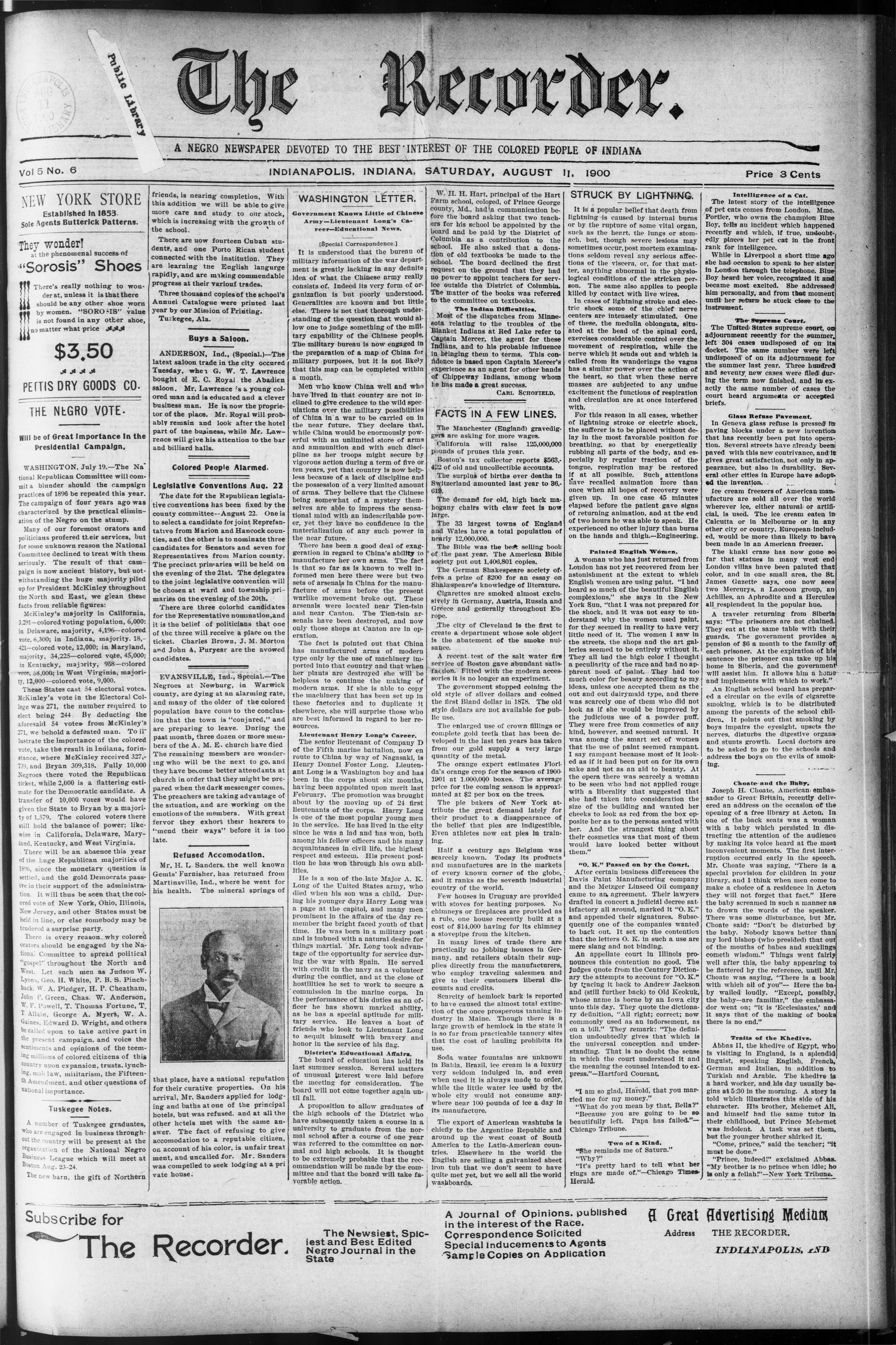
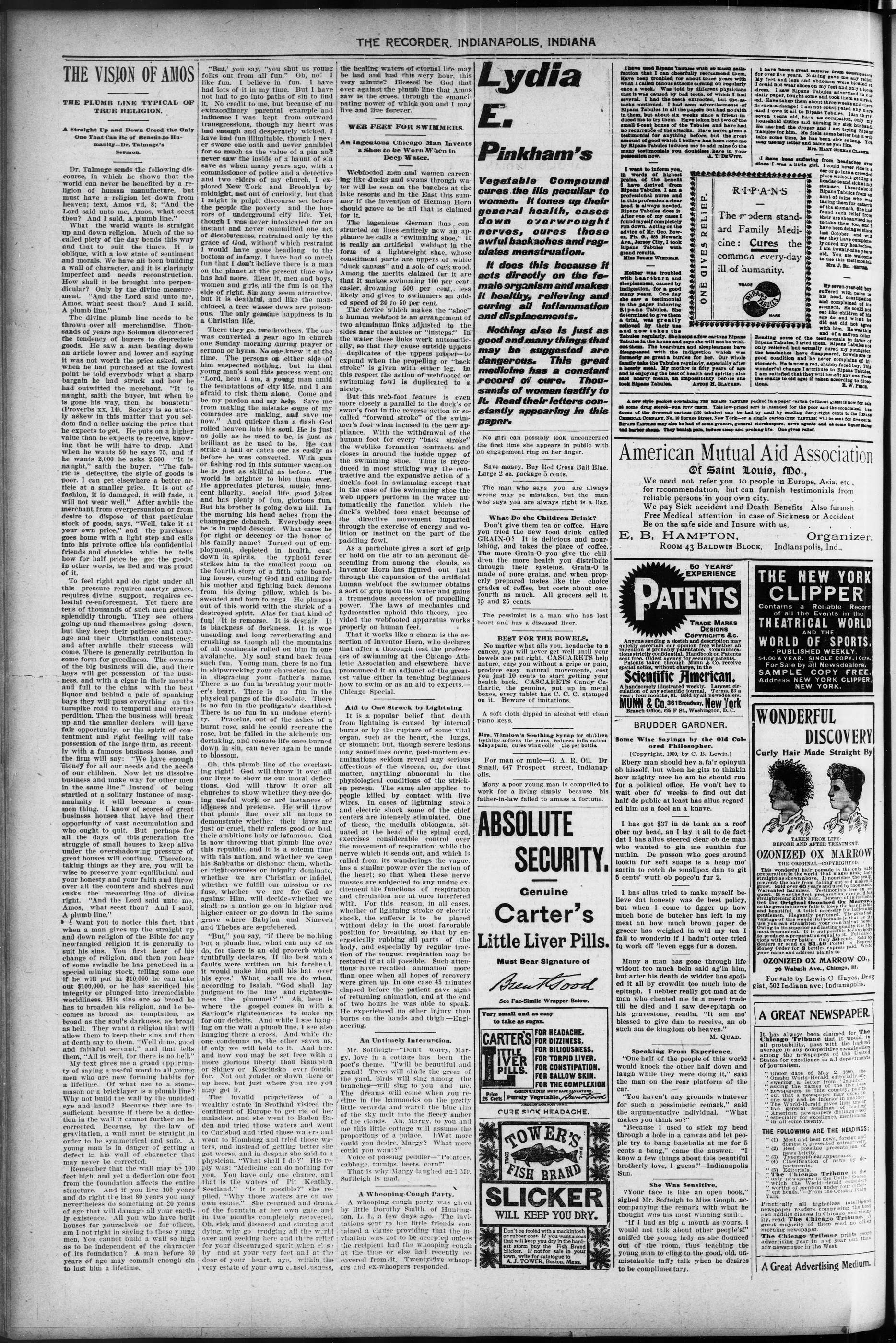
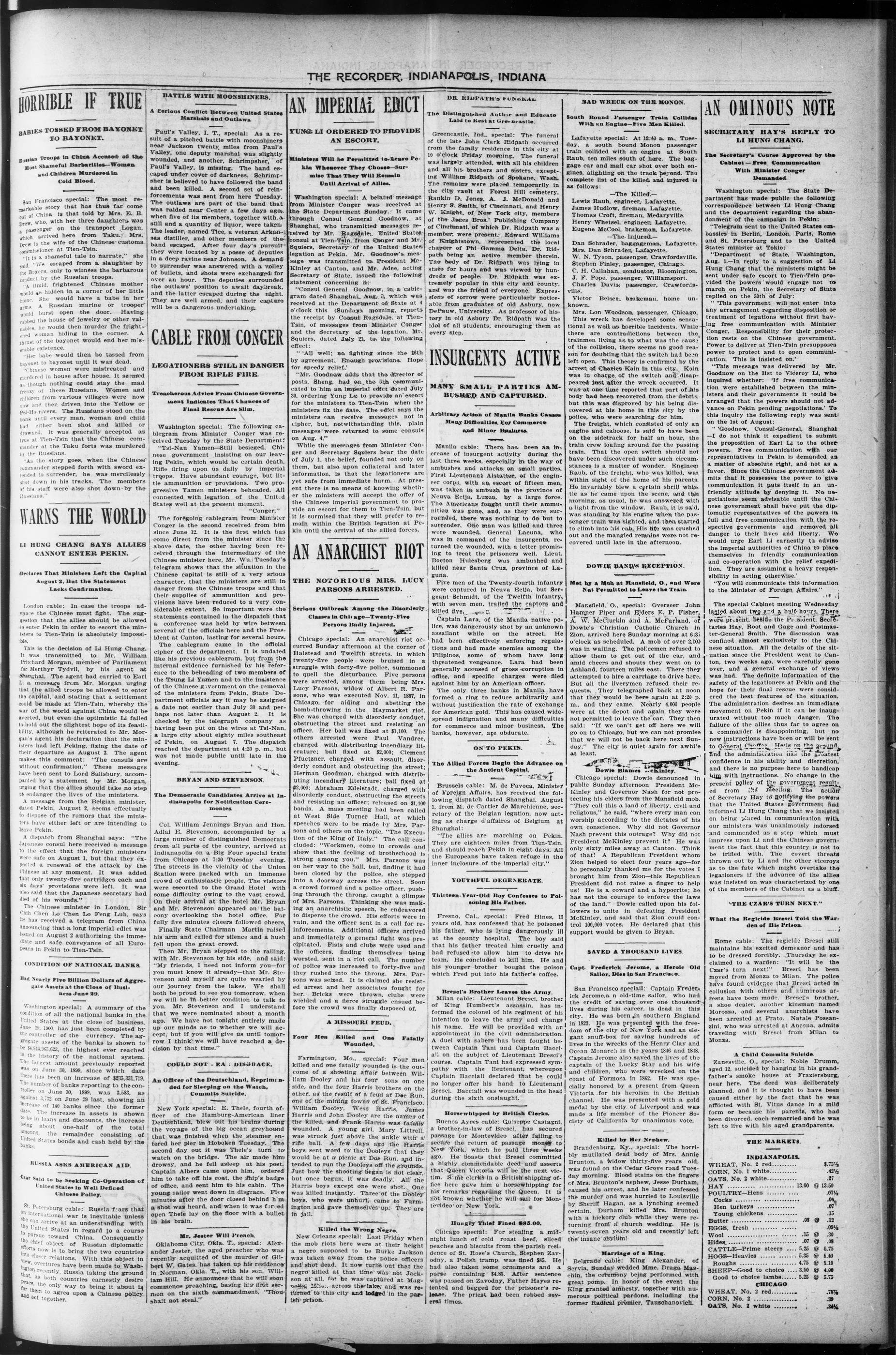
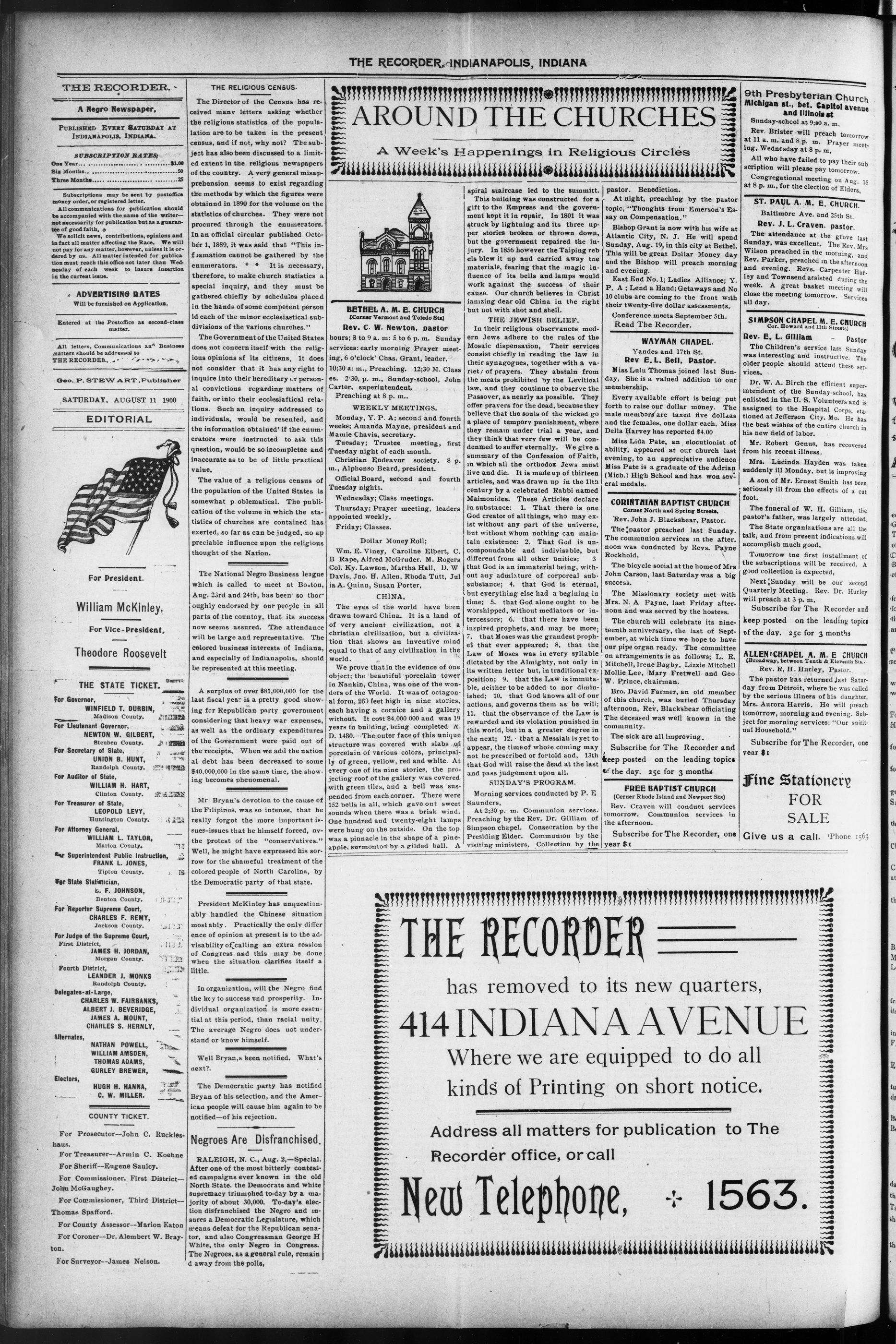
Page text (machine-generated)
NEW YORK STORE
Established in 1853.
Sole Agents Butterick Patterns.
They wonder!
at the phenomenal success of
"Sorosis" Shoes
There's really nothing to wonder at, unless it is that there should be any other shoe worn by women. "SOROSIS" value is not found in any other shoe, no matter what price
$3.50
PETTIS DRY GOODS CO.
THE NEGRO VOTE.
Will be of Great Importance In the
Presidential Campaign,
WASHINGTON, July 19.—The Na-
tional Republican Committee will commit a blunder should the campaign
practices of 1896 be repeated this year.
The campaign of four years ago was
characterized by the practical elimi-
nation of the Negro on the stump.
Many of our foremost orators and politicians proffered their services, but for some unknown reason the National Committee declined to treat with them seriously. The result of that campaign is now ancient history, but notwithstanding the huge majority piled up for President McKinley throughout the North and East, we glean these facts from reliable figures:
McKinley's majority in California, 3,291-colored voting population, 6,000; in Delaware, majority, 4,196-colored vote, 6,300; in Indiana, majority, 18,421-colored vote, 12,000; in Maryland, majority, 34,225-colored vote, 45,000; in Kentucky, majority, 958-colored vote, 58,000; in West Virginia, majority, 12,000-colored vote, 9,000.
These States cast 54 electoral votes. McKinley's vote in the Electoral College was 271, the number required to elect being 244. By deducting the aforesaid 54 votes from McKinley's 271, we behold a defeated man. To it illustrate the importance of the colored vote, take the result in Indiana, for instance, where McKinley received 327,739, and Bryan 309,318. Fully 10,000 Negroes there voted the Republican ticket, while 2,000 is a flattering estimate for the Democratic candidate. A transfer of 10,000 votes would have given the State to Bryan by a majority of 1,579. The colored voters there still hold the balance of power; likewise in California, Delaware, Maryland, Kentucky, and West Virginia.
There will be an absence this year of the huge Republican majorities of 180%, since the monetary question is settled, and the gold Democrats passive in their support of the administration. It will thus be seen that the colored vote of New York, Ohio, Illinois, New Jersey, and other States must be held in line, or else somebody may be tendered a surprise party.
There is every reason why colored orators should be engaged by the National Committee to spread political "gospel" throughout the North and West. Let such men as Judson W. Lyons, Geo. H. White, P. B. S. Pinchback, W. A. Pledger, H. P. Cheatham, John P. Green, Chas. W. Anderson, W. F. Powell, T. Thomas Fortune, T. T Allain, George A. Myers, W. A. Gaines, Edward D. Wright, and others be called upon to take active part in the present campaign, and voice the sentiments and opinions of the teeming millions of colored citizens of this country upon expansion, trusts, lynching, mob law, militarism, the Fifteenth Amendment, and other questions of national importance.
A number of Tuskegee graduates, who are engaged in business throughout the country will be present at the organization of the National Negro Business League which will meet at Boston Aug. 23-24. The new barn, the gift of Northern
Subscribe for The
friends, is nearing completion. With this addition we will be able to give more care and study to our stock, which is increasing with the growth of the school.
There are now fourteen Cuban students, and one Porto Rican student connected with the institution. They are learning the English language rapidly, and are making commendable progress at their varionf trades.
Three thousand copies of the school's Annual Catalogue were printed last year by our Mission of Printing.
Buys a Saloon.
ANDERSON, Ind., (Special.)—The latest saloon trade in the city occurred Tuesday, whe1 G. W. T. Lawrence bought of E. C. Royal the Abadien saloon. Mr. Lawrence is a young colored man and is educated and a clever business man. He is now the proprietor of the place. Mr. Royal will probably remain and look after the hotel part of the business, while Mr. Lawrence will give his attention to the bar and billiard halls.
Colored People Alarmed
Legislative Conventions Aug. 22
Legislative Conventions Aug. 22
The date for the Republican legislative conventions has been fixed by the county committee--August 22. One is to select a candidate for joint Representative from Marion and Hancock counties, and the other is to nominate three candidates for Senators and seven for Representatives from Marion county. The precinct primaries will be held on the evening of the 21st. The delegates to the joint legislative convention will be chosen at ward and township primaries on the evening of the 20th.
There are three colord candidates for the Representative nomination, and it is the belief of politicians that one of the three will receive a place on the ticket. Charles Brown, J. M. Morton and John A, Puryear are the avowed candidates.
EVANSVILLE, Ind., Special.—The Negroes at Newburg, in Warwick county, are dying at an alarming rate, and many of the older of the colored population have come to the conclusion that the town is "conjured," and are preparing to leave. During the past month, three dozen or more members of the A. M. E. church have died. The remaining members are wondering who will be the next to go, and they have become better attendants at church in order that they might be prepared when the dark messenger comes. The preachers are taking advantage of the situation, and are working on the emotions of the members. With great fervor they exhort their hearers to "mend their ways" before it is too late.
Refused Accomodation.
Mr, H. L. Sanders, the well known Gems' Furnisher, has returned from Martinsville, Ind., where he went for his health. The mineral springs of
A. B.
that place, have a national reputation for their curative properties. On his arrival, Mr. Sanders applied for lodging and baths at one of the principal hotels, but was refused. and at all the other hotels met with the same answer. The fact of refusing to give accommodation to a reputable citizen, on account of his color, is unfair treatment, and uncalled for. Mr. Sanders was compelled to seek lodging at a private house.
Recorder.
INDIANAPOLIS, INDIANA, SATURDAY, AUGUST 11, 1900
WASHINGTON LETTER.
Government Knows Little of Chinese Army—Lieutenant Long's Career—Educational News.
[Special Correspondence.]
It is understood that the bureau of military information of the war department is greatly lacking in any definite idea of what the Chinese army really consists of. Indeed its very form of organization is but poorly understood. Generalities are known and but little else. There is not that thorough understanding of the question that would allow one to judge something of the military capability of the Chinese people. The military bureau is now engaged in the preparation of a map of China for military purposes, but it is not likely that this map can be completed within a month.
Men who know China well and who have lived in that country are not inclined to give credence to the wild speculations over the military possibilities of China in a war to be carried on in the near future. They declare that, while China would be enormously powerful with an unlimited store of arms and ammunition and with such discipline as her troops might secure by vigorous action during a term of five or ten years, yet that country is now helpless because of a lack of discipline and the possession of a very limited amount of arms. They believe that the Chinese being somewhat of a mystery themselves are able to impress the sensational mind with an indescribable power, yet they have no confidence in the materialization of any such power in the near future.
There has been a good deal of exaggeration in regard to China's ability to manufacture her own arms. The fact is that so far as is known to well informed men here there were but two sets of arsenals in China for the manufacture of arms before the present warlike movement broke out. These arsenals were located near Tien-tsin and near Canton. The Tien-tsin arsenals have been destroyed, and now only those shops at Canton are in operation.
The fact is pointed out that China has manufactured arms of modern type only by the use of machinery imported into that country and that when her plants are destroyed she will be helpless to continue the making of modern arms. If she is able to copy the machinery that has been set up in these factories and to duplicate it elsewhere, she will surprise those who are best informed in regard to her resources.
Lieutenant Henry Long's Career.
The senior lieutenant of Company D of the Fifth marine battalion, now en route to China by way of Nagasaki, is Henry Donnel Foster Long. Lieutenant Long is a Washington boy and has been in the corps about six months, having been appointed upon merit last February. The promotion was brought about by the moving up of 24 first lieutenants of the corps. Harry Long is one of the most popular young men in the service. He has lived in the city since he was a lad and has won, both among his fellow officers and his many acquaintances in civil life, the highest respect and esteem. His present position he has won through his own abilities.
He is a son of the late Major A. K. Long of the United States army, who died when his son was a child. During his younger days Harry Long was a page at the capitol, and many men prominent in the affairs of the day remember the bright faced youth of that time. He was born in a military post and is imbued with a natural desire for things martial. Mr. Long took advantage of the opportunity for service during the war with Spain. He served with credit in the navy as a volunteer during the conflict, and at the close of hostilities he set to work to secure a commission in the marine corps. In the performance of his duties as an officer he has shown marked ability, as he has a special aptitude for military service. He leaves a host of friends who look to Lieutenant Long to acquit himself with bravery and honor in the service of his flag.
District's Educational Affairs.
The board of education has held its last summer session. Several matters of unusual interest were laid before the meeting for consideration. The board will not come together again until fall.
A proposition to allow graduates of the high schools of the District who have subsequently taken a course in a university to graduate from the normal school after a course of one year was referred to the committee on normal and high schools. It is thought to be extremely probable that the recommendation will be made by the committee and that the board will take favorable action.
The Newsiest, Spiciest and Best Edited Negro Journal in the State
A Journal of Opinions, published in the interest of the Race. Correspondence Solicited Special Inducements to Agents Sample Copies on Application
W. H. H. Hart, principal of the Hart Farm school, colored, of Prince George county, Md., had a communication before the board asking that two teachers for his school be appointed by the board and be paid by the District of Columbia as a contribution to the school. He also asked that a donation of old textbooks be made to the school. The board declined the first request on the ground that they had no power to appoint teachers for service outside the District of Columbia. The matter of the books was referred to the committee on textbooks.
The Indian Difficulties.
Most of the dispatches from Minnesota relating to the troubles of the Blanket Indians at Red Lake refer to Captain Mercer, the agent for these Indians, and to his probable influence in bringing them to terms. This confidence is based upon Captain Mercer's experience as an agent for other bands of Chippeway Indians, among whom he has made a great success.
CARL SCHOFIELD.
FACTS IN A FEW LINES.
The Manchester (England) gravediggers are asking for more wages. California will raise 125,000,000 pounds of prunes this year.
Boston's tax collector reports $563,422 of old and uncollectible accounts. The surplus of births over deaths in Switzerland amounted last year to 36,612. The demand for old, high back mahogany chairs with claw feet is now large. The 33 largest towns of England and Wales have a total population of nearly 12,000,000. The Bible was the best selling book of the past year. The American Bible society put out 1,406,801 copies. The German Shakespeare society offers a prize of $200 for an essay on Shakespeare's knowledge of literature. Cigarettes are smoked almost exclusively in Germany, Austria, Russia and Greece and generally throughout Europe.
The city of Cleveland is the first to create a department whose sole object is the abatement of the smoke nuisance.
A recent test of the salt water fire service of Boston gave abundant satisfaction. Fitted with the modern accessories it is no longer an experiment.
The government stopped coling the old style of silver dollars and coined the first Bland dollar in 1878. The old style dollars are not available for public use.
The enlarged use of crown fillings or complete gold teeth that has been developed in the last ten years has taken from our gold supply a very large quantity of the metal.
The orange expert estimates Florida's orange crop for the season of 1900-1901 at 1,000,000 boxes. The average price for the coming season is approximated at $2 per box on the trees.
The pie bakers of New York attribute the great demand lately for their product to a disappearance of the belief that pies are indigestible. Even athletes now eat pies in training.
Half a century ago Belgium was scarcely known. Today its products and manufactures are in the markets of every known corner of the globe, and it ranks as the seventh industrial country of the world.
Few houses in Uruguay are provided with stoves for heating purposes. No chimneys or fireplaces are provided as a rule, one house recently built at a cost of $14,000 having for its chimney a stovepipe from the kitchen.
In many lines of trade there are practically no jobbing houses in Germany, and retailers obtain their supplies directly from the manufacturers, who employ traveling salesmen and give to their customers liberal discounts and credits.
Scarcity of hemlock bark is reported to have caused the almost total extinction of the once prosperous tanning industry in Maine. Though there is a large growth of hemlock in the state it is so far from practicable tannery sites that the cost of hauling prohibits its use.
Soda water fountains are unknown in Bahia, Brazil, ice cream is a luxury very seldom indulged in, and even when used it is always made to order, while the little water ice used by the whole city would not consume anywhere near 100 pounds of ice a day in its manufacture.
The export of American washtubs is chiefly to the Argentine Republic and around up the west coast of South America to the Latin-American countries. Elsewhere in the world the English are selling a galvanized sheet iron tub that we don't seem to have quite met yet, but we sell all the world washboards.
STRUCK BY LIGHTNING
It is a popular belief that death from lightning is caused by internal burns or by the rupture of some vital organ, such as the heart, the lungs or stomach, but, though severe lesions may sometimes occur, post mortem examinations seldom reveal any serious affections of the viscera, or, for that matter, anything abnormal in the physiological conditions of the stricken person. The same also applies to people killed by contact with live wires.
In cases of lightning stroke and electric shock some of the chief nerve centers are intensely stimulated. One of these, the medulla oblongata, situated at the head of the spinal cord, exercises considerable control over the movement of respiration, while the nerve which it sends out and which is called from its wanderings the vagus has a similar power over the action of the heart, so that when these nerve masses are subjected to any undue excitement the functions of respiration and circulation are at once interfered with.
For this reason in all cases, whether of lightning stroke or electric shock, the sufferer is to be placed without delay in the most favorable position for breathing, so that by energetically rubbing all parts of the body, and especially by regular traction of the tongue, respiration may be restored if at all possible. Such attentions have recalled animation more than once when all hopes of recovery were given up. In one case 45 minutes elapsed before the patient gave signs of returning animation, and at the end of two hours he was able to speak. He experienced no other injury than burns on the hands and thigh.—Engineering.
Painted English Women.
Painted English Women.
A woman who has just returned from London has not yet recovered from her astonishment at the extent to which English women are using paint. "I had heard so much of the beautiful English complexions," she says in the New York Sun, "that I was not prepared for the shock, and it was not easy to understand why the women used paint, for they seemed in reality to have very little need of it. The women I saw in the streets, the shops and the art galleries seemed to be entirely without it. They all had the high color I thought a peculiarity of the race and had no apparent need of paint. They had too much color for beauty according to my ideas, unless one accepted them as the out and out dairymaid type, and there was scarcely one of them who did not look as if she would be improved by the judicious use of a powder puff. They were free from cosmetics of any kind, however, and seemed natural. It was among the smart set of women that the use of paint seemed rampant. I say rampant because most of it looked as if it had been put on for its own sake and not as an aid to beauty. At the opera there was scarcely a woman to be seen who had not applied rouge with a liberality that suggested that she had taken into consideration the size of the building and wanted her cheeks to look as red from the box opposite her as to the persons seated with her. And the strangest thing about their cosmetics was that most of them would have looked better without them."
"O. K." Passed on by the Court.
After certain business differences the Davis Paint Manufacturing company and the Metzger Linseed Oil company came to an agreement. Their lawyers drafted in concert a judicial decree satisfactory all around, marked it "O. K." and appended their signatures. Subsequently one of the companies wanted to back out. It set up the contention that the letters O. K. in such a use are mere slang and not binding.
An appellate court in Illinois pronouns this contention no good. The judges quote from the Century Dictionary the attempts to account for "O. K." by tracing it back to Andrew Jackson and (still further back) to Old Keokuk, whose name is borne by an Iowa city unto this day. They quote the dictionary definition, "All right; correct; now commonly used as an indorsement, as on a bill." They remark: "The definition undoubtedly gives that which is the universal conception and understanding. That is no doubt the sense in which the court understood it and the meaning the counsel intended to express."—Hartford Courant.
"I am so glad, Harold, that you married me for my money."
"What do you mean by that, Bella?"
"Because you are going to be so beautifully left. Papa has failed"—Chicago Tribune.
Two of a Kind.
"It's pretty hard to tell what her rings are made of."—Chicago Times-Herald.
Price 3 Cents
Intelligence of a Cat.
The latest story of the intelligence of pet cats comes from London. Mme. Portier, who owns the champion Blue Boy, tells an incident which happened recently and which, if true, undoubtedly pines her pet cat in the front rank for intelligence.
While in Liverpool a short time ago she had occasion to speak to her sister in London through the telephone. Blue Boy heard her voice, recognized it and became most excited. She addressed him personally, and from that moment until her return he stuck close to the instrument.
The Supreme Court.
The United States supreme court, on adjournment recently for the summer, left 304 cases undisposed of on its docket. The same number were left undisposed of on its adjournment for the summer last year. Three hundred and seventy, new cases were filed during the term now finished, and in exactly the same number of cases the court heard arguments or accepted briefs.
Glass Refuse Pavement.
In Geneva glass refuse is pressed in paving blocks under a new invention that has recently been put into operation. Several streets have already been paved with this new contravariance, and it gives great satisfaction, not only in appearance, but also in durability. Several other cities in Europe have adopted the invention.
Ice cream freezers of American manufacture are sold all over the world wherever ice, either natural or artificial, is used. The Ice cream eaten in Calcutta or in Melbourne or in any other city or country. European included, would be more than likely to have been made in an American freezer. The khaki craze has now gone so far that statuses in many west end London villas have been painted that color, and in one small area, the St. James Gazette says, one now sees two Mercuryys, a Laocoon group, an Achilles, an Aphrodite and a Hercules all resplendent in the popular hue.
A traveler returning from Siberia says: "The prisoners are not chained. They eat at the same table with their guards. The government provides a pension of $0 a month to the family of each prisoner. At the expiration of his sentence the prisoner can take up his home in Siberia, and the government will assist him. It allows him a home and implements with which to work."
An English school board has prepared a circular on the evils of cigarette smoking, which is to be distributed among the parents of the school children. It points out that smoking by boys impairs the eyesight, upsets the nerves, disturbs the digestive organs and stunts growth. Local doctors are to be asked to go to the schools and address the boys on the evils of smoking.
Choate and the Baby.
Joseph H. Choate, American embassador to Great Britain, recently delivered an address on the occasion of the opening of a free library at Acton. In one of the back seats was a woman with a baby which persisted in distracting the attention of the audience by making its voice heard at the most inconvenient moments. The first interruption occurred early in the speech. Mr. Choate was saying. "There is a special provision for children in your library, and I think when men come to make a choice of a residence in Acton they will not forget that fact." Here the baby screamed in such a manner as to drown the words of the speaker. There was some disturbance, but Mr. Choate said: "Don't be disturbed by the baby. Nobody knows better than my lord bishop (who presided) that out of the mouths of babes and sucklings cometh wisdom." Things went fairly well after this, the baby appearing to be flattered by the reference, until Mr. Choate was saying. "There is a book with which all of you"—Here the baby wailed loudly. "Except, possibly, the baby—are familiar," the embassador went on; "it is 'Ecclesiastes', and it says that of the making of books there is no end."
Traits of the Khedive:
Abbas II, the khedive of Egypt, who is visiting in England, is a splendid linguist, speaking English, French, German and Italian, in addition to Turkish and Arabic. The khedive is a hard worker, and his day usually begins at 5:30 in the morning. A story is told which illustrates this side of his character. His brother, Mehemet All, and himself had the same tutor in their childhood, but Prince Mehemet was indolent. A task was set them, but the younger brother shirked it.
"Come, prince," said the teacher; "it must be done."
"Prince, indeed!" exclaimed Abbas.
"My brother is no prince when idle; he is only a fellah!"—New York Tribune.
INDIANAPOLIS, RND
THE VISION OF AMOS
THE PLUMB LINE TYPICAL OF
TRUE BELIGION.
A Straight Up and Down Creed the Only
One That Can Be of Benefit-to Humanity—Dr. Talmage's
Dr. Talmage sends the following discourse, in which he shows that the world can never be benefited by a religion of human manufacture, but must have a religion let down from heaven; text, Amos vii, 8; "And the Lord said unto me, Amos, what seest thou? And I said, A plumb line." What the world wants is straight up and down religion. Much of the so called plety of the day bends this way and that to suit the times. It is oblique, with a low state of sentiment and morals. We have all been building a wall of character, and it is glaringly imperfect and needs reconstruction. How shall it be brought into perpendicular? Only by the divine measurement. "And the Lord said unto me, Amos, what seest thou? And I said, A plumb line."
The divine plumb line needs to be thrown over all merchandise. Thousands of years ago Solomon discovered the tendency of buyers to depreciate goods. He saw a man beating down an article lower and lower and saying it was not worth the price asked, and when he had purchased at the lowest point he told everybody what a sharp bargain he had struck and how he had outwitted the merchant. "It is naught, saith the buyer, but when he is gone his way, then he boasteth" (Proverbs xx, 14). Society is so utterly askew in this matter that you seldom find a seller asking the price that he expects to get. He puts on a higher value than he expects to receive, knowing that he will have to drop. And when he wants 50 he says 75, and if he wants 2,000 he asks 2,500. "It is naught," saith the buyer. "The fabric is defective, the style of goods is poor. I can get elsewhere a better article at a smaller price. It is out of fashion, it is damaged, it will fade, it will not wear well." After awhile the merchant, from overpersuasion or from desire to dispose of that particular stock of goods, says. "Well, take it at your own price," and the purchaser goes home with a light step and calls into his private office his confidential friends and chuckles while he tells how for half price he got the goods. In other words, he lied and was proud of it.
To feel right and do right under all this pressure requires martyr grace, requires divine support, requires celestial re-enforcement. Yet there are tens of thousands of such men getting splendidly through. They see others going up and themselves going down, but they keep their patience and courage and their Christian consistency, and after awhile their success will come. There is generally retribution in some form for greediness. The owners of the big business will die, and their boys will get possession of the business, and with a cigar in their mouths and full to the chins with the best liquor and behind a pair of spanking bays they will pass everything on the turnpike road to temporal and eternal perdition. Then the business will break up and the smaller dealers will have fair opportunity, or the spirit of contentment and right feeling will take possession of the large firm, as recently with a famous business house, and the firm will say: "We have enough money for all our needs and the needs of our children. Now let us dissolve business and make way for other men in the same line." Instead of being startled at a solitary instance of magnanimity it will become a common thing. I know of scores of great business houses that have had their opportunity of vast accumulation and who ought to quit. But perhaps for all the days of this generation the struggle of small houses to keep alive under the overshadowing pressure of great houses will continue. Therefore, taking things as they are, you will be wise to preserve your equilibrium and your honesty and your faith and throw over all the counters and shelves and casks the measuring line of divine right. "And the Lord said unto me, Amos, what seest thou? And I said, A plumb line."
4 want you to notice this fact, that when a man gives up the straight up and down religion of the Bible for any newfangled religion it is generally to suit his sins. You first hear of his change of religion, and then you hear of some swindle he has practiced in a special mining stock, telling one one if he will put in $10,000 he can take out $100,000, or he has sacrificed his integrity or plunged into irreademable worldliness. His sins are so broad he has to broaden his religion, and he becomes as broad as temptation, as broad as the soul's darkness, as broad as hell. They want a religion that will allow them to keep their sins and then at death say to them, "Well done, good and faithful servant," and that tells them, "All is well, for there is no hell."
My text gives me a grand opportunity of saying a useful word to all young men who are now forming habits for a lifetime. Of what use to a stone-mason or a bricklayer is a plumb line? Why not build the wall by the unaided eye and hand? Because they are insufficient, because if there be a deflection in the wall it cannot further on be corrected. Because, by the law of gravitation, a wall must be straight in order to be symmetrical and safe. A young man is in danger of getting a defect in his wall of character that may never be corrected.
Remember that the wall may be 100 feet high, and yet a deflection one foot from the foundation affects the entire structure. And if you live 100 years and do right the last 80 years you may nevertheless do something at 20 years of age that will damage all your earthly existence. All you who have built houses for yourselves or for others, am I not right in saying to these young men, You cannot build a wall so high as to be independent of the character of its foundation? A man before 30 years of age may commit enough sin to last him a lifetime.
"But,' you say, 'you shut us young folks out from all fun." Oh, no! I like fun. I believe in fun. I have had lots of it in my time. But I have not had to go into paths of sin to find it. No credit to me, but because of an extraordinary parental example and influence I was kept from outward transgressions, though my heart was bad enough and desperately wicked. I have had fun illuminated, though I never swore one oath and never gambled for so much as the value of a pin and never saw the inside of a haunt of sin save as when many years ago, with a commissioner of police and a detective and two elders of my church, I explored New York and Brooklyn by midnight, not out of curiosity, but that I might in pulp discourse set before the people the poverty and the horrors of underground city life. Yet, though I was never intoxicated for an instant and never committed one act of dissoluteness, restrained only by the grace of God, without which restraint I would have gone headlong to the bottom of infamy. I have had so much fun that I don't believe there is a man on the planet at the present time who has had more. Near it, men and boys, women and girls, all the fun is on the side of right. Sin may seem attractive, but it is deathful, and like the manchuel, a tree whose dews are poisonous. The only genuine happiness is in a Christian life.
There they go, two brothers. The one was converted a year ago in church one Sunday morning during prayer or sermon or hymn. No one knew it at the time. The persons on either side of him suspected nothing, but in that young man's soul this process went on; "Lord, here I am, a young man amid the temptations of city life, and I am afraid to risk them alone. Come and be my pardon and my help. Save me from making the mistake some of my comrades are making, and save me now." And quicker than a flash God rolled heaven into his soul. He is just as jolly as he used to be, is just as brilliant as he used to be. He can strike a ball or catch one as easily as before he was converted. With gun or fishing rod in this summer vacation he is just as skillful as before. The world is brighter to him than ever. He appreciates pictures, music, innocent hilarity, social life, good jokes and plenty of fun, glorious fun. But his brother is going down hill. In the morning his head aches from the champagne debauch. Everybody sees he is in rapid descent. What cares of his family name? Turned out of employment, depleted in health, cast down in spirits, the typhoid fever strikes him in the smallest room on the fourth story of a fifth rate boarding house, cursing God and calling for his mother and fighting back demons from his dying pillow, which is be sweated and torn to rags. He plunges out of this world with the shriek of a destroyed spirit. Alas for that kind of fun! It is remorse. It is despair. It is blackness of darkness. It is woe unending and long reverberating and crushing as though all the mountains of all continents rolled on him in one avalanche. My soul, stand back from such fun. Young man, there is no fun in shipwrecking your character, no fun in disgracing your father's name. There is no fun in breaking your mother's heart. There is no fun in the physical pangs of the dissolute. There is no fun in the profligate's deathbed. There is no fun in an undone eternity. Praeluc, out of the ashes of a burnt rose, said he could recreate the rose, but he failed in the alchemic undertaking, and rosace life once burned down in sin, can never again be made to blossom.
Oh, this plumb line of the everlasting right! God will throw it over all our lives to show us our moral defections. God will throw it over all churches to show whether they are doing useful work or are instances of idleness and pretense. He will throw that plumb line over all nations to demonstrate whether their laws are just or cruel, their rulers good or bad, their ambitions holy or infamous. God is now throwing that plumb line over this republic, and it is a solemn time with this nation, and whether we keep his Sabbaths or dishonor them, whether righteousness or iniquity dominate, whether we are Christian or infidel, whether we fulfill our mission or refuse, whether we are for God or against Him, will decide—whether we shall as a nation go on in higher and higher career or go down in the same grave where Babylon and Nineveh and Thebes are sepulchered.
"But," you say, "if there be no thing but a plumb line, what can any of us do, for there is an old proverb which truthfully declares, 'If the best man's faults were written on his forehead, it would make him pull his hat over his eyes.' What, shall we do when, according to Isaiah, "God shall lay judgment to the line and righteousness the plummet?" Ah, here is where the gospel comes in with a Saviour's righteousness to make up for our deficits. And while I see hanging on the wall a plumb line, I see also hanging there a cross. And while the one condemns us, the other saves us, if only we will hold to it. And here and now you may be set free with a more glorious liberty than Hampden or Sidney or Koscinsko ever fought for. Not out younder or down there or up here, but just where you are you may get it.
The invalid proprietress of a wealthy estate in Scotland visited the continent of Europe to get rid of her maladies, and she went to Baden Baden and tried those waters and went to Carlsbad and tried those waters and went to Homburg and tried those waters, and instead of getting better she got worse, and in despair she said to a physician. "What shall I do?" His reply was: "Mediche can do nothing for you. You have only one chance, and that is the waters of Pit Keathly, Scotland." "Is it possible?" she replied. "Why those waters are on my own estate." She returned and drank of the fountain at her own gate and in two months completely recovered, Ooh, sick and diseased and simming and dying, why go trudging all the world over and seeking here and there relief for your discouraged spirit when eloibly and at your very feet and at the door of your heart, aye, within the very estate of your own consciousness,
THE RECORDER, INDIANAPOLIS, INDIANA
the healing waters of eternal life may be bead and had this very hour, this very minute? Blessed be God that over against the plumb line that Amos saw is the cross, through the emancipating power of which you and I may live and live forever.
WEB FEET FOR SWIMMERS
An ingenious Chicago Man Invents a Shoe to be Worn When in Deep Water.
Webfooted men and women careening like ducks and swans through water will be seen on the beaches at the lake resorts and in the East this summer if the invention of Herman Horn should prove to be all that is claimed for it.
The ingenious German has constructed on lines entirely new an appliance he calls a "swimming shoe." It is really an artificial webfoot in the form of a lightweight shoe, whose constituent parts are uppers of white "duck canvas" and a sole of cark wood. Among the merits claimed for it are that it makes swimming 100 per cent. easier, drowning 500 per cent. less likely and gives to swimmers an added speed of 30 to 50 per cent.
The device which makes the "shoe" a human webfoot is an arrangement of two aluminum links adjusted to the sides near the ankles or "insteps". In the water these links work automatically, so that they cause outside uppers—duplicates of the uppers proper—to expand when the propelling or "back stroke" is given with either leg. In this respect the action of webfooted or swimming fowl is duplicated to an alceety.
But this web-foot feature is even more closely a parallel to the duck's or swan's foot in the reverse action or so-called "forward stroke" of the swimmer's foot when incased in the new appliance. With the withdrawal of the human foot for every "back stroke" the weblike formation contracts and closes in around the inside upper of the swimming shoe. Thus is reproduced in most striking way the contractive and the expansive action of a duck's foot in swimming except that in the case of the swimming shoe the web uppers perform in the water automatically the function which the duck's webbed toes enact because of the directive movement imparted through the exercise of energy and volition or instinct on the part of the paddling fowl.
As a parachute gives a sort of grip or hold on the air to an aeronaut descending from among the clouds, so Inventor Horn has figured out that through the expansion of the artificial human webfoot the swimmer obtains a sort of grip upon the water and gains a tremendous accession of propelling power. The laws of mechanics and hydrostatics uphold this theory, provided the webfooted apparatus works properly on human feet. That it works like a charm is the assertion of Inventor Horn, who declares that after a thorough test the professors of swimming at the Chicago Athletic Association and elsewhere have pronounced it an adjunct of the greatest value either in teaching beginners how to swim or as an aid to experts.—Chicago Special.
Aid to One Struck by Lightning
Aid to One Struck by Lightning
It is a popular belief that death from lightning is caused by internal burns or by the rupture of some vital organ, such as the heart, the lungs, or stomach; but, though severe lesions may sometimes occur, post-mortem examinations seldom reveal any serious affections of the viscera, or, for that matter, anything abnormal in the physiological conditions of the stricken person. The same also applies to people killed by contact with live wires. In cases of lightning stroke and electric shock some of the chief centers are intensely stimulated. One of these, the medulla oblongata, situated at the head of the spinal cord, exercises considerable control over the movement of respiration; while the nerve which it sends out, and which is called from its wanderings the vague, has a similar power over the action of the heart; so that when these nerve masses are subjected to any undue excitement the functions of respiration and circulation are at once interfered with. For this reason, in all cases, whether of lightning stroke or electric shock, the sufferer is to be placed without delay in the most favorable position for breathing, so that by energetically rubbing all parts of the body, and especially by regular traction of the tongue, respiration may be restored if at all possible. Such attention have recalled animation more than once when all hopes of recovery were given up. In one case 45 minutes elapsed before the patient gave signs of returning animation, and at the end of two hours he was able to speak. He experienced no other injury than burns on the hands and thigh—Engineering.
An Untimely Interruption.
Mr. Softleigh—"Don't worry, Margy, love in a cottage has been the poet's theme. 'Twill be beautiful and grand!' Trees will shade the green of the yard, birds will sing among the branches—will sing to you and me. The dreams will come when you recline in the hammocks on the pretty little veranda and watch the blue rim of the sky melt into the fleece amber of the clouds. Ah, Margy, to you and me this little cottage will assume the proportions of a palace. hWat more could you desire, Margy? What more could you want?"
Voice of passing peddler—"Potatoes, cabbage, turnips, beets, corn"
That is why Margy laughed and Mr. Softleigh is mad.
A Whooping-Cough Party.
A whooping cough party was given by little Dorothy Sullah, of Huntington. L. L. a few days ago. The invitations sent to her little friends contained a clause providing that the invitation was not to be accepted unless the recipient had the whooping cough at the time or else had recently recovered from it. Twenty-five whoopers and ex-whoopers responded.
Lydia E. Pinkham's
Vegetable Compound oures the illis peculiar to women. It tones up their general health, eases down overwrought nerves, oures those awful backaches and regulates menstruation. It does this because it acts directly on the female organism and makes it healthy, relieving and curing all inflammation and displacements.
Nothing else is just as good and many things that may be suggested are dangerous. This great medicine has a constant record of cure. Thousands of women testify to it. Read their letters constantly appearing in this paper.
No girl can possibly look unconcerned the first time she appears in public with an engagement ring on her finger.
Save money. Buy Red Cross Ball Blue. Large 2 oz. package 5 cents.
The man who says you are always wrong may be mistaken, but the man who says you are always right is a liar.
What Do the Children Drink?
Don't give them tea or coffee. Have you tried the new food drink called GRAIN-O? It is delicious and nourishing, and takes the place of coffee. The more Grain-O you give the children the more health you distribute through their systems. Grain-O is made of pure grains, and when properly prepared tastes like the choice grades of coffee, but costs about one-fourth as much. All grocers sell it 15 and 25 cents.
The pessimist is a man who has lost heart and has a diseased liver.
BEST FOR THE BOWELS.
No matter what ails you, headache to a cancer, you will never get well until your bowels are put right. CASCARETS help nature, cure you without a gripe or pain, produce easy natural movements, cost you just 10 cents to start getting your health back. CASCARETS Candy Catholic, the peeling pump up in metal boxes, every tablet has C. C. C. stamped on it. Beware of imitations.
A soft cloth dipped in alcohol will clean plano keys.
Mrs. Winston's Soothing Syrup for children teething, softens the gums, reduces inflammation ala's pain, cures wind colic 1.50 per bottle.
For man or mule—G. A. R. Oil. Dr Smail, 647 Prospect street, Indianapolis.
Many a poor young man is compelled to work for a living simply because his father-in-law failed to amass a fortune.
ABSOLUTE SECURITY.
Genuine Carter's
Little Liver Pills.
Must Bear Signature of
Brantwood
See Fac-Simile Wrapper Below.
Very small and as easy
to take as sugar.
CARTER'S
LITTLE
LIVER
PILLS.
FOR HEADACHE.
FOR DIZZINESS.
FOR BILIOUSNESS.
FOR TORPID LIVER.
FOR CONSTIPATION.
FOR SALLOW SKIN.
FOR THE COMPLEXION
Price
25 Cents
GENUINE
MUST HAVE SIGNATURE.
Purely Vegetable.
CURE SICK HEADACHE.
TOWER'S
YEARS
MARK
FISH BRAND
SLICKER
WILL KEEP YOU DRY.
Don't be fooled with a mackintosh or rubber coast. If you want to cool that will keep you dry in the hardest storm buy the Fish Brand Slicker. It not for sale in your town, write for catalogue to A. J. TOWER, Boston, Mass.
I have used Ripans tapes with so much satisfaction that I can cheerfully recommend them. Have been troubled for about three years with the Ripan tape, and I have been on a once a week. Was told by different physicians that it was caused by bad teeth, of which I had several. I had the teeth extracted, but the atachytrichia was still present. I used Ripans Tables in all the papers but had no tits in them, but about six weeks since a friend induced me to try them. Have taken but two of the tits, and I have been in a mine for no recurrence of the attacks. Have never given a testimonial for anything before, but the great amount of good which I believe has been on me has induced me to introduce me to many testimonials you doubted. A. T. D. WEWRIT. possession now.
ONE GIVES RELIEF.
R.I.P.A.N.S
The modern standard Family Medicine: Cures the common every-day ill of humanity.
TRADE
R.I.P.A.N.S
AGUILS
MARK
---
Tabulus regularly. Shops keep a few cartons Ripan Tabulus in the house and says she will not be with the children. The headache has disappeared with the indigestion which was formerly so great a burden for her. Our whole family can take the Tabulus regularly, especially after a meal. We are so happy to bring the headaches have disappeared, but are in good condition and he never complained to the stomach. He is now a red, chubby-faced boy. Tabulus and is enjoying the best of health and spirit; also is eager to have meals, an impossibility before she took Ripan Tabulus. ATON H. BLACKEN.
A new style pack containing TEN RIPAN TABULUS packed in a paper carton (without glass) is now for sale at some drug stores FOR FIVE CHILDREN. This low-priced sort is intended for the poor and the economical. Each dose of the five-cents carton (130 cartons) can be had by mail by sending forty-eight cents to the Ripan CHEMICAL COMPANY, No. 16 Spruce Street, New York—or a single carton (TEN TABULUS) will be sent for five cents. The carton is made from a plastic bag and all some liquor stores and barber shops. It paints health, induces and prolong life. One gives relief.
American Mutual Aid Association
We need not refer you to people in Europe, Asia, etc. for recommendation, but can furnish testimonials from reliable persons in your own city.
E. B. HAMPTON,
ROOM 43 BALDWIN BLOCK, Indianapolis, Ind.,
50 YEARS' EXPERIENCE
PATENTS
TRADE MARKS DESIGNS
COPYRIGHTS & C.
Anyone sending a sketch and description may quickly ascertain our opinion free whether an transaction is strictly confidential. Handbook on Patents seals, please agency, for securing patents. Patents taken through Mum & Co. receive special notice, without charge, in the Scientific American.
A handsomely illustrated weekly. Largest circulation of any scientific journal. Terms, $4 a year; four months, $1. Sold by all newsealers.
MUM & Co. 361 Broadway, New York
Branch Office, 65 F. St., New York, D.C.
THE NEW YORK CLIPPER
Contains a Reliable Record of all the Events in the THEATRICAL WORLD AND THE WORLD OF SPORTS.
PUBLISHED WEEKLY.
$4.00 A YEAR. SINGLE COPY, 10cts.
For Sale by all Newsealers.
SAMPLE COPY FREE.
Address NEW YORK CLIPPER, NEW YORK.
BRUDDER GARDNER.
Some Wise Sayings by the Old Colored Philosopher.
[Copyright, 1900, by C. B. Lewis.]
Ebery man should hev a. fa'r opinyun ob hisself, but when he gits to thinkin how mighty nice he am he should run fur a political office. He won't hev to wait ober fo' weeks to find out dat half de public at least has allus regarded him as a fool an a knave.
I has got $37 in de bank an a roof ober my head, an I lay it all to de fact dat I has allus steered clear ob de man who wanted to gin me sunthin fur nuthin. De pusson who goes around lookin fur soft snaps is a heap mo' sartin to cutch de smallpox dan to git 5 cents' with ob popo'n fur 2.
I has allus tried to make myself believe dat honesty was de best policy, but when I come to figger up how much bone de butcher has left in my meat an how much brown paper de grocer has weighed in wid my tea I fall to wonderin if I hadn't otter tried to work off 'leven eggs fur a dozen.
Many a man has gone through life widout too much bein said ag'in him, but arter his death de widder has spoiled it all by crowdin too much into de epitaph. I nebber really got mad at de man who cheated me in a mewl trade till he died and I saw de epitaph on his gravestone, readin. "It am mo' blessed to give dan to receive, an ob such am de kingdom ob heaven."
M. QUAD.
"One half of the people of this world would knock the other half down and laugh while they were doing it," said the man on the rear platform of the car.
"You haven't any grounds whatever for such a pessimistic remark," said the argumentative individual. "What makes you think so?
"Because I used to stick my head through a hole in a canvas and let people try to bang baseballs at me for 5 cents a bang." came the answer. "I know a few things about this beautiful brotherly love, I guess!"—Indianapolis Sun.
She Was Sensitive:
"Your face is like an open book," sighed Mr. Softeigh to Miss Gooph, accompanying the remark with what he thought was his most winning smile. "If I had as big a mouth as yours, I would not talk about other people's!" sniffed the young lady as she flounced out of the room, thus teaching the young man to cling to the good, old, unmistakable taffy talk when he desires to be complimentary.
I want to inform you, in words of highest importance, that I have derived from our Ripan Tables. I am a professional nurse and in this profession a clean dressing gown is required for Ripan Tables does it after one of my cases I run down. Acting on the advice of Mr. Geo. Bowers, Ph. G., 688 Newark, Ripan Tables has been indicated, for a good many years. One day she saw a testimonial from Ripan Tables. She determined to give them a trial, was greatly impressed and now takes the
I have been a great survivor from consequence for 25 years. Nothing gave me any real feet. My feet and knees were bleached by a lot of wet shoes on my feet and a lot of dress. I could not wear shoes on my feet without dress. I saw Piana Tables advertisements. I bought some and took them as weeks and there. Have you ever seen these weeks and there is such a change? I am not convinced they are any more and I own it all to Piana Tables. I have no occupation, only my household duties. I have no sick student. He has had the droopy and I am a tablier. Tables for him. He feels some better but I am so sick time, he has been sick so long. You may have letters and I have a picture. M.M. MARY GORMAN CLARER
I have been suffering from headaches ever since I was a little girl. I lost
Reading some of the testimonials in the text, Ripana Tabula notes Ripana Tabula, I tried them. Ripana Tabula notes the headaches have dislaced my younger, the headaches have dislaced my younger, are in good condition and he never complains to stomach. He is now a red, chubby face boy. The wonderful change I attribute to Ripana Tabula. The headaches will benefit any one from the cradle to old age) if he scorns these protections. E. W. Pruitt.
THE NEW YORK
CLIPPER
Contains a Reliable Record
of all the Events in the
THEATRICAL WORLD
AND THE
WORLD OF SPORTS,
PUBLISHED WEEKLY.
$4.00 A YEAR. SINCLE COPY, 10cts.
For Sale by all Newsdealers.
SAMPLE COPY FREE.
Address NEW YORK CLIPPER,
NEW YORK.
```markdown
```
This wonderful hair pomade is the only safe preparation in the world that makes kinky hair prevent it shows alopecia, prevents it falls out and makes it grow. Sold over 40 years and used by thousands, it is the first preparation ever sold for the Original Ozonicized OX Marrow, as the genuine never fails to keep the hair healthy and gentlemen. Elegantly perfumed. The greatest vanity item you can straighten your hair at home. Owing to its superior and lasting quality, you can produce a preparation equal to it. Full service by delivery or send us $1.40 Postal or Express Money Order for 3 bottles, express pay. Write your name and address plainly.
OZONIZED OX MARROW CO.,
76 Wabash Ave., Chicago, III.
For sale by Lewis C Hayes, Drugist, 502 Indiana ave: Indianapolis.
It has always been claimed for The Chicago Tribune that it would, in all probability, pass with ease to two examinations among the newspapers of the United States for excellence in a.l departments of journalism.
"Under date of May 2, 1860, the Omaha World-Herald wrote a letter from 'Inquirer,' asking the names of the five best newspapers of the United States, the newspaper may excel in one way and be inferior in another. The World-Herald wrote a heading of leading American newspapers distinguished especially for excellence, mentioning
THE FOLLOWING ARE THE HEADINGS
(1) Most and best news, foreign and
(2) Best, possible presentation of
news briefly.
(3) Geographical appearance.
(4) Classification of news by de-
partments.
(5) Citizenship.
The Chicago Tribune is the
only newspaper in the United States
worthy of mention under four dif-
ferent heads." -From the October Plain
Prairie.
Practically all high-class intelligent
paper readers, comprising the best
and middle classes in Chicago and vi-
city, read The Chicago Tribune.
A newspaper read no other
morning newspaper.
The Chicago Tribune prints more
advertising year in and year out than
any newspaper in the West.
A Great Advertising Medium.
from headaches ever
we never ride in a car or go
around without covered
place without getting
headache and sick at
headache. I boarded a
Ramaphil from as an
aunt of mum of seven
taking them for saturations
of the stomach. She had
relied from relief
from their use
to take them too, and
have been bologne since
mayber they, and will
mayber they, completely
cured my head.
I am twenty nine years old. You are welcome
to use this testimonial.
N.Y. J. B. HENRY
My sixteen-year-old boy
suffered from his
head, constipation
and complained of his
head. He could not
eat like children. He
did age and he did
eat did not agree
with him. He was this
HORRIBLE IF TRUE
BABIES TOSSED FROM BAYONET
TO BAYONET.
Russian Troops in China Accused of the
Most Shameful Barbaric—Women
and Children Murdered in
San Francisco special: The most remarkable story that has thus far come out of China is that told by Mrs. E. B. Drew, who, with her three daughters was a passenger on the transport Logan, which arrived here from Taku. Mrs. Drew is the wife of the Chinese customs commissioner at Tien-Tsin.
"It is a shameful tale to narrate," she said. "We escaped from a slaughter by the Boxers, only to witness the barbarous conduct by the Russian troops.
"A timid, frightened Chinese mother would be hidden in a corner of her little home. She would have a babe in her arms. A Russian marine or trooper would burst open the door. Having robbed the house of jewelry or other valuables, he would murder the frightened woman hiding in the corner. A thrust of the bayonet would end her misguild existence.
"Her babe would then be tossed from bayonet to bayonet until it was dead."
"Chinese women were mistreated and murdered in house after house. It seemed as though nothing could stay the mad frenzy of these Russians. Women and children from various villages were now now and then driven into the Yellow or Pal-Ho rivers. The Russians stood on the bank until every man, woman and child had either been shot and killed or drowned. It was generally accepted as true at Tien-Tsin that the Chinese commander at the Taku forts was murdered by the Russians.
"As the story goes, when the Chinese commander stepped forth with sword exe-eded to surrender, he was merclessly shot down in his tracks. The members of his staff were also shot down by the Russians."
WARNS THE WORLD
LI HUNG CHANG SAYS ALLIES CANNOT ENTER PEKIN.
Declares That Ministers Left the Capital August 2, But the Statement Lacks Confirmation.
London cable: In case the troops advance the Chinese must fight. The suggestion that the allies should be allowed to enter Pekin in order to escort the ministers to Tien-Tsin is absolutely impossible.
This is the decision of Li Hung Chang. It was transmitted to Mr. William Pritchard Morgan, member of Parliament for Merthyr Tydyll, by his agent at Shanghai. The agent had carried to Earl Li a message from Mr. Morgan urging that the allied troops be allowed to enter the capital, and stating that a settlement could be made at Tien-Tsin, whereby the war of the world against China would be averted, but even the optimistic Li failed to out the slightest hope of its feasibility, although he reiterated to Mr. Morgan's agent his declaration that the ministers had left Peking, fixing the date of their departure as August 2. The agent makes this comment: "The consuls are without confirmation." These messages have been sent to Lord Salisbury, accompanied by a statement by Mr. Morgan, urging that the allies should take no step to endanger the lives of the ministers. A message from the Belgian minister, dated Pekin, August 2, seems effectually to dispose of the rumors that the ministers have either left or are intending to leave Pekin.
A dispatch from Shanghai says: "The Japanese consul here received a message to the effect that the foreign ministers were safe on August 1, but that they expected a renewal of the attack by the Chinese at any moment. It was added that only twenty-five cartridges each and six days' provisions were left. It was also said that the Japanese secretary had died of his wounds." The Chinese minister in London, Sir Chin Chen Lo Chen Lo Feng Luh, says he has received a telegram from China announcing that a long imperial edict was issued on August 2 authorizing the immediate and safe conveyance of all Europeans in Pekin to Tien-Tsin.
CONDITION OF NATIONAL BANKS.
Bad Nearly Five Billion Dollars of Aggregate Assets at the Close of Business June 29.
Washington special: A summary of the condition of all the national banks in the United States at the close of business, June 29, 1900, has just been completed by the controller of the currency. The aggregate assets of the banks is shown to be $4,944,965,623, the highest ever reached in the history of the national system. The largest amount previously reported was on June 20, 1899, since which date there has been an increase of $235,321,719. The number of banks reporting to the controller on June 20, 1899, was 3,533, as against 3,732 on June 29 last, showing an increase of 140 banks since the former date. The increase in assets is shown to be in loans and discounts, the increase being about one-half of the total amount, the remainder consisting of United States bonds and cash held by the banks.
RUSSIA ASKS AMERICAN AID
Car Said to be seeking Co-Operation of United States in Well Defined
St. Petersburg cable: Russia fears that an international war is inevitable unless she can arrive at an understanding with the United States in regard to a course to pursue toward China. Consequently the chief object of Russian diplomatic efforts now is to bring the two countries into closer relations. With this object in view, overtures have been made to Washington recently. Russia taking that, as both countries earnestly desire peace, the only way to bring it about is for them to agree upon a Chinese policy and act together.
BATTLE WITH MOONSHINERS.
A Fortious Conflict Between United States
Marshals and Outlaws.
Paul's Valley, I. T., special: As a result of a pitched battle with moonshiners near Jackson twenty miles from Paul's Valley, one deputy marshal was slightly wounded, and another, Schrimpsher, of Paul's Valley, is missing. The band escaped under cover of darkness. Schrimpsher is believed to have followed the band and been killed. A second set of reinforcements was sent from here Tuesday. The outlaws are part of the band that was raided near Center a few days ago, when five of its members, together with a still and a quantity of liquor, were taken. The leader, named Tice, a veteran Arkansas distiller, and other members of the band escaped. After four day's pursuit they were located by a posse of deputies in a deep ravine near Johnson. A demand to surrender was answered with a volley of bullets, and shots were exchanged for an hour. The deputies surrounded the outlaws' position to await daybreak, and the latter escaped during the night. They are well armed, and their capture will be a dangerous undertaking.
CABLE FROM CONGER
LEGATIONERS STILL IN DANGER FROM RIFLE FIRE.
Treacherous Advice From Chinese Government Indicates That Chances of Final Rescue Are Slim.
Washington special: The following cablegram from Minister Conger was received Tuesday by the State Department: "Tsi-Nan Yamen—Still besieged. Chinese government insisting on our leaving Pekin, which would be certain death. Rifle firing upon us daily by imperial troops. Have abundant courage, but little ammunition or provisions. Two progressive Yamen ministers beheaded. All connected with legation of the United States well at the present moment.
The foregoing cablegram from Minister Conger is the second received from him since June 12. It is the first which has come direct from the minister since the above date, the other having been received through the intermediary of the Chinese minister here, Mr. Wu. Tuesday's telegram shows that the situation in the Chinese capital is still of a very serious character, that the ministers are still in danger from the Chinese troops and that their supplies of ammunition and provisions have been reduced to a very considerable extent. So important were the statements contained in the dispatch that a conference was held by wire between several of the officials here and the President at Canton, lasting for several hours.
The cablegram came in the official cipher of the department. It is undated like his previous cablegram, but from the internal evidence furnished by his reference to the beheaded of two members of the Tsung Li Yamen and to the insistence of the Chinese government on the removal of the ministers from Pekin, State Department officials say it may be assigned a date not earlier than July 30 and perhaps not later than August 2. It is checked by the telegraph company as having been put on the wires at Tsi-Lan, a large city about eighty miles southeast of Pekin, on August 7. The dispatch reached the department at 4:20 p. m., but was not made public until late in the evening.
The Democratic Candidates Arrive at Indianapolis for Notification Cere-
Col. William Jennings Bryan and Hon. Adalian E. Stevenson, accompanied by a large number of distinguished Democrats from all parts of the country, arrived at Indianapolis on a Big Four special train from Chicago at 7:30 Tuesday evening. The streets in the vicinity of the Union Station were packed with an immense crowd of enthusiastic people. The visitors were escorted to the Grand Hotel with some difficulty owing to the vast crowd. On their arrival at the hotel Mr. Bryan and Mr. Stevenson appeared on the balcony overlooking the hotel office. For fully five minutes cheers followed cheers, Finally State Chairman Martin raised his arm and called for silence and a hush fell upon the great crowd.
Then Mr. Bryan stepped to the railing, with Mr. Stevenson by his side, and said: "My friends, I need not inform you—for you must know it already—that Mr. Stevenson and myself are quite wearied by our journey from the lakes. We shall both be proud to see you tomorrow, when we will be in better condition to talk to you. Mr. Stevenson and I understand that we were nominated about a month ago. We have not tonight entirely made up our minds as to whether we will accept, but if you will give us until tomorrow I think we will have reached a decision by that time."
COULD NOT . EA : DISGACE.
New York special: E. Thele, fourth officer of the Hamburg-American liner Deutschland, blew out his brains during the voyage of the big ocean greyhound that was finished when the steamer entered her pier in Hoboken Tuesday. The second day out it was Thele's turn to watch on the bridge. The air made him drowsy, and he fell asleep at his post. Captain Albers came upon him, ordered him to take off his coat, the ship's badge of office, and sent him to his cabin. The young sailor went down in disgrace. Five minutes after the door closed behind him a shot was heard, and when it was forced open Thele lay on the floor with a bullet in his brain.
Mr. Jester Will Preach.
Oklahoma City, Okla. T., special; Alexander Jester, the aged preacher who was recently acquitted of the murder of Gilbert W. Gates, has taken up his residence in Norman, Okla. T., with his son, William Hill. He announces that he will soon commence preaching, basing his first sermon on the sixth commandment, "Thou shalt not steal."
THE RECORDER, INDIANAPOLIS, INDIANA
AN. IMPERIAL EDICT
YUNG LI ORDERED TO PROVIDE AN ESCORT.
Ministers Will be Permitted to Leave Pekin Whenever They Choose—Surprise That They Will Remain Until Arrival of Allies.
Washington special: A belated message from Minister Conger was received at the State Department Sunday. It came through Consul General Goodnow, at Shanghai, who transmitted messages received by Mr. Ragsdale, United States consul at Tien-Tsun, from Conger and Mr. Squiers, Secretary of the United States legation at Pekin. Mr. Goodnow's message was transmitted to President McKinley at Canton, and Mr. Adee, acting Secretary of State, issued the following statement concerning it:
"Consul General Goodnow, in, a cablegram dated Shanghai, Aug. 5, which was received at the Department of State at 4 o'clock this (Sunday) moning, reports the receipt by Consul Ragdule, at Tlen-Tsin, of messages from Minister Conger and the Secretary of the legation, Mr. Squiers, dated July 21, to the following effect:
"All well; no fighting since the 16th by agreement. Enough provisions. Hope for speedy relief."
"Mr. Goodnow adds that the director of posts, Sheng, had on the 5th communicated to him an imperial edict dated July 30, ordering Yung Lu to provide an escort for the ministers to Tlen-Tsin when the ministers fix the date. The edict says the ministers can receive messages not in cipher, but, notwithstanding this, plain messages were returned to some consuls on Aug. 4."
While the messages from Minister Conger and Secretary Squiers bear the date of July 1, the belief, founded not only on them, but also upon collateral and later information, is that the legationers are yet safe from immediate harm. At present there is no means of knowing whether the ministers will accept the offer of the Chinese imperial government to provide an escort for them to Tien-Tsin, but it is surmised that they will prefer to remain within the British legation at Pekin until the arrival of the allied forces.
AN ANARCHIST RIOT
AN ANARCHIST RIOT
THE NOFORIOUS MRS. LUCY PARSONS ARRESTED.
Serious Outbreak Among the Disorderly Classes in Chicago—Twenty-Five Persons Badly Injured.
Chicago special: An anarchist riot occurred Sunday afternoon at the corner of Halstead and Twelfth streets, in which twenty-five people were bruised in a struggle with forty-five police, summoned to quell the disturbance. Five persons were arrested, among them being Mrs. Lucy Parsons, widow of Albert R. Parsons, who was executed Nov. 11, 1887, in Chicago, for aliding and abetting the bomb-throwing in the Haymarket riot. She was charged with disorderly conduct, obstructing the street and resisting an officer. Her ball was fixed at $1,100. The others arrested were Paul Vandree, charged with distributing incendiary literature; ball fixed at $2,000: Abraham Edelstadt, charged with disorderly conduct, obstructing the streets and resisting an officer; released on $1,100 bonds. A mass meeting had been called at West Side Turner Hall, at which speeches were to be made by Mrs. Parsons and others on the topic: "The Execution of the King of Italy." The call concluded: "Workmen, come in the crowd and show that the feeling of brotherhood is strong among you." Mrs. Parsons was on her way to the hall, but, finding it had been closed by the hall, she stepped into a doorway across the street. Soon a crowd formed and a police officer, pushing through the throng, caught a gilmpe of Mrs. Parsons. Thinking she was making an anarchistic speech, he endeavored to disperse the crowd. His efforts were in vain, and the officer sent in a call for reinforcements. Additional officers arrived and immediately a general fight was precipitated. Fists and clubs were used and the officers, finding themselves being worsted, sent in a riot call. The number of police was increased to forty-five and they rushed into the throng. Mrs. Parsons was seized. It is claimed she resisted arrest and her associates fought for her. Bricks were thrown, clubs were wielded and a fierce struggle ensured before the crowd was finally disposed of.
Four Men Killed and One Fatally Wounded.
Farmington, Mo., special: Four men killed and one fatally wounded is the outcome of a shooting affair between William Dooley and his four sons on one side, and the four Harris brothers on the other, as the result of a feud at Dae Run, one of the mining towns of St. Francisco, William Dooley, Wess Harris, James Harris and John Dooley are the names of the killed, and Frank Harris was fatally wounded. A young girl, Mary Littrell, was struck just above the ankle with a rifle ball. A few days ago the Harris boys sent word to the Dooleys that they would be at a picnic at Dae Run, and intended to run the Dooleys off the grounds. Just how the shooting began is not clear, but once begun, it was deadly. All the Harris boys except one were shot. One was killed instantly. Three of the Dooley boys, who were unhurt, came to Farmington and gave themselves up; They are in jail.
Killed the Wrong Negro.
New Orleans special: Last Friday when the mob riots here were at their height a negro supposed to be Burke Jackson was taken away from the police officers and shot dead. It now turns out that the negro killed at that time was not Jackson at all, for he was captured at Magnolia, Illinois, across the lake, and was returned to this city and lodged in the parish prison.
DR. KIDPATH'S FUNKAL
The Distinguished Author and Educato
Lald to Kest at Great-neck.
Greencastle, Ind., special: The funeral of the late John Clark Ridpath occurred from the family residence in this city at 10 o'clock Friday morning. The funeral was largely attended, with all his children and all his brothers and sisters, excepting William Ridpath of Spokane, Wash. The remains were placed temporarily in the city vault at Forest Hill cemetery. Ranklin D. Jones, A. J. McDonald and Henry S. Smith, of Cincinnati, and Henry W. Knight, of New York city, members of the Jones Bros., Publishing Company of Cluhnnatt, of which Dr. Ridpath was a member, were present. Edward Williams of Knightstown, represented the local chapter of Phi Gamma Delta, Dr. Ridpath being an active member therein. The body of Dr. Ridpath was lying in state for hours and was viewed by hundreds of people. Dr. Ridpath was extremely popular in this city and county, and was the friend of everyone. Expressions of sorrow were particularly noticeable from graduates of old Asbury, now DePauw, University. As professor of history in old Asbury Dr. Ridpath was the idol of all students, encouraging them at every step.
INSURGENTS ACTIVE
MANY SMALL PARTIES AMBUSSED AND CAPTURED.
Arbitrary Action of Manila Banks Causes Many Difficulties, For Commerce and Minor Business.
Manila cable: There has been an increase of insurgent activity during the last three weeks, especially in the way of ambushes and attacks on small parties. First Lieutenant Alstatter, of the engineer corps, with an escort of fifteen men, was taken in ambush in the province of Neuva Ectia, Luzon, by a large force. The Americans fought until their ammunition was gone, and, as they were surrounded, there was nothing to do but to surrender. One man was killed and three were wounded. General Lacuna, who was in command of the insurgents, returned the wounded, with a letter promising to treat the prisoners well. Lieut. Bocton Hulesberg was ambushed and killed near Santa Cruz, province of Laguna.
Five men of the Twenty-fourth infantry were captured in Neuva Ectia, but Sergeant Schmidt, of the Twelfth infantry, with seven men, trailed the captors and killed five.
Captain Lara, of the Manila native police, was dangerously shot by an unknown assailant while on the street. He had been effectively enforcing regulations and had made enemies among the Fillipinos, some of whom have long threatened vengeance. Lara had been generally accused of gross corruption in office, and specific charges were filed against him by an American officer. The only three banks in Manila have formed a ring to reduce arbitrarily and without justification the rate of exchange for American gold. This has caused widespread indignation and many difficulties for commerce and minor business. The banks, however, are obdurate.
The Allied Forces Begin the Advance on the Ancient Capital.
Brussels cable: M. de Favoca, Minister of Foreign Affairs, has received the following dispatch dated Shanghai, August 1, from M. de Cartler de Marchienne, secretary of the Belgian legation, now acting as charge d'affaires of Belgium at Shanghai:
"The allies are marching on Pekin. They are eighteen miles from Tien-Tsin, and should reach Pekin in eight days. All the Europeans have taken refuge in the inner enclosure of the imperial city."
YOUTHFUL DEGENERATE
Thirteen-Year-Old Boy Confesses to Poisoning His Father.
Fresno, Cal., special: Fred Hines, 12 years old, has confessed that he poisoned his father, who is lying dangerously ill at the county hospital. The boy said that his father treated him cruelly and had refused to allow him to drive his team. He concluded to kill him. He and his younger brother bought the poison which Fred put into his father's coffee.
Bresci's Brother Leaves the Army.
Milan cable: Lieutenant Bresci, brother of King Humbert's assassin, has informed the colonel of his regiment of his intention to leave the army and change his name. He will be provided with an appointment in the civil administration. A duel with sabers has been fought between Captain Tani and Captain Baccali on the subject of Lieutenant Bresci's course. Captain Tani had expressed sympathy with the Lieutenant, whereupon Captain Baccali declared that he could no longer offer his hand to Lieutenant Bresci. Baccali was wounded in the head during the sixth onslaught.
Horsewhipped by British Clerks.
Buenos Ayres cable: Guiseppo Castanagli, a brother-in-law of Bresci, has secured passage for Montevideo after falling to secure the return of passage money to New York, which he paid three weeks ago. He boasts that Bresci committed a highly commendable deed and asserts that Queen Victoria will be the next victim. Sine clerks in a British shipping office here gave him a horsewhipping for his remarks regarding the Queen. It is not known whether he will sail for Montevideo or New York.
Hungry Thief Flued $85.00.
Chicago special: For stealing a midnight lunch of cold roast beef, sliced peaches and biscuits from the parish residence of St. Rose's Church, Stephen Zavodny, a Polish tramp, was fined $5. He had also taken some ornaments and a purse containing $4.55. After sentence was passed on Zavodny, Father Hayes relented and begged for the prisoner's release. The priest had been robbed several times.
South Bound Passenger Train Collides
With an Engine—Five Men Killed.
Lafayette special: At 12:40 a.m. Tuesday, a south bound Monon passenger train collided with an engine at South Raub, ten miles south of hare. The baggage car and mall car shot over both engines, alighting on the track beyond. The complete list of the killed, and injured is as follows:
—The Killed—
Lewis Raub, engineer, Lafayette.
James Hudlow, fireman, Lafayette.
Thomas Cwytel, fireman, Medaryville.
Henry Whetsel, engineer, Lafayette.
Eugene McCool, brakeman, Lafayette.
—The Injured—
Dan Schrader, baggageman, Lafayette.
Mrs. Dan Schrader, Lafayette.
W. N. Tyson, passenger, Crawfordsville.
Stephen Finley, passenger, Chicago.
C. H. Callahan, conductor, Bloomington.
J. F. Poe, passenger, Williamsport.
Charles Davis, passenger, Crawfordsville.
Victor Belsen, brakeman, home unknown.
Mrs. Lon Woodsom, passenger, Chicago.
This wreck has developed some sensational as well as horrible incidents. While there are contradictions between the trainmen living as to what was the cause of the collision, there seems no good reason for doubling that the switch had been left open. This theory is confirmed by the arrest of Charles Kain in this city. Kain was in charge of the switch and disappeared just after the wreck occurred. It was at one time reported that part of his body had been recovered from the debris, but this was disproved by his being discovered at his home in this city by the police, who were searching for him.
The freight, which consisted of only an engine and caboose, is said to have been on the sidetrack for half an hour, the train crew loafing around for the passing train. That the open switch should not have been discovered under such circumstances is a matter of wonder. Engineer Raub, of the freight, who was killed, was within sight of the home of his parents. He invariably blew a certain shrill whistle as he came upon the scene, and this morning, as usual, he was answered with a light from the window. Raub, it is said, was standing by his engine when the passenger train was sighted, and then started to climb into his cab. His life was crushed out and the mangled remains were not recovered until late in the afternoon.
DOWIE BANDS RECEPTION
Met hy a Moh at Mansfield, O, and Were
Nat Permitted to Leave the Train.
Marsfield, O., special: Overserer John Hamper Piper and Elders F. P. Fisher, A. W. McClurklin and A. M. McFarland, of Dowle's Christian Catholic Church in Zion, arrived here Sunday morning at 6:33 o'clock as scheduled. A mob of over 2,000 was in waiting. The policemen refused to allow them to get out of the car, and amid cheers and shouts they went on to Ashland, fourteen miles east. There they attempted to hire a carriage to drive here. But all the livymen refused their requests. They telegraphed back at noon that they would be here again at 2:20 p.m., and they came. Nearly 4,000 people were at the depot and again they were not permitted to leave the car. They then said: "If we can't get off here we will go on to Chicago, but we can not promise that we will not be back here next Sunday." The city is quiet again for awhile at least.
Chicago special: Dowle denounced in public Sunday afternoon President McKinley and Governor Nash for not protecting his elders from the Mansfield mob. "They call this a land of liberty, civil and religious," he said, "where every man can worship according to the dictates of his own conscience. Why did not Governor Nash prevent this outrage? Why did not President McKinley prevent it? He was only sixty miles away at Canton. Think of that! A Republican President whom Zion helped to elect four years ago—for he personally thanked me for the votes I brought him from Zion—this Republican President did not raise a finger to help us! He is a coward and a hypocrite; he has not the courage to enforce the laws of the land." Dowle called upon his followers to unite in defeating President McKinley, and said that Zion could control 100,000 votes. He declared that this support would be given to Bryan.
SAVED A THOUSAND LIVES
Capt. Frederick Jerome, a Heroic Old
Sailor. Bles in San Francisco.
San Francisco special: Captain Frederick Jerome, a old-time sailor, who had the credit of saving over one thousand lives during his career, is dead in this city. He was born in southern England in 1823. He was presented with the freedom of the city of New York and an elegant snuff-box for saving hundreds of lives in the wrecks of the Henry Clay and Ocean Monarch in the years 1846 and 1818. Captain Jerome also saved the lives of the captain of the Lucky Star and his wife and children, who were wrecked on the coast of Formosa in 1862. He was specially honored by a present from Queen Victoria for his heroism in the British channel. He was presented with a gold medal by the city of Liverpool and was made a life member of the Pioneer Society of California by unanimous vote.
Killed by Her Nephew.
Brandenburg, Ky., special: The horribly mutilated dead body of Mrs. Annie Brunton, a widow thirty-five years old, was found on the Cedar Grove road Tuesday morning. Blood stains on the fingers of Mrs. Brunton's nephew, Jesse Durham, caused his arrest, and he later confessed the murder and was hurried to Louisville by Sheriff Hagan, as a lynching seemed certain. Durham killed Mrs. Brunton with a hickory club while they were returning from a church wedding. He is twenty-seven years old and recently left the 'insane' skylim!
Marriages of a King
Belgrade cable: King Alexander, of Servia, Sunday wedded Mme. Draga Maschin, the ceremony being performed with great pomp. In honor of the event the King granted amnesty, together with numerous political pardons, including the former Radical premier, Tauschanovich.
AN OMINOUS NOTE
SECRETARY HAY'S REPLY TO LI HUNG CHANG.
The Secretary's Course Approved by the Cabinet — Free Communication With Minister Conger Demanded.
Washington special: The State Department has made public the following correspondence between Li Hung Chang and the department regarding the abandonment of the campaign in Pekin:
"Telegram sent to the United States embassies in Berlin, London, Paris, Rome and St. Petersburg and to the United States minister at Tokio:
"Department of State, Washington, Aug. 1.—In reply to a suggestion of Li Hung Chang that the ministers might be sent under safe escort to Tien-Tsin provided the powers would engage not to march on Pekin, the Secretary of State replied on the 30th of July:
"This government will not enter into any arrangement regarding disposition or treatment of legations without first having free communication with Minister Conger. Responsibility for their protection rests on the Chinese government. Power to deliver at Tien-Tsin presupposes power to protect and to open communication. This is insisted on." "This message was delivered by Mr. Goodnow on the 31st to Viceroy Li, who inquired whether: 'If free communication were established between the ministers and their governments it could be arranged that the powers should not advance on Pekin pending negotiations.' To this inquiry the following reply was sent on the 1st of August:
"Goodnow, Consult-General, Shanghai—I do not think it expedient to submit the proposition of Earl Li to the other powers. Free communication with our representatives in Pekin is demanded as a matter of absolute right, and not as a favor. Since the Chinese government admits that it possesses the power to give communication it puts itself in an unfriendly attitude by denying it. No negotiations seem advisable until the Chinese government shall have put the diplomatic representatives of the powers in full and free communication with the respective governments and removed all danger to their lives and liberty. We would urge Earl Lil earnestly to advise the imperial authorities of China to place themselves in friendly communication and co-operation with the relief expedition. They are assuming a heavy responsibility in acting otherwise."
"You will communicate this information to the Minister of Foreign Affairs."
The special Cabinet meeting Wednesday lasted about two and a half hour. There were present, beside the President, Secretaries Hay, Root and Gage and Postmaster-General Smith. The discussion was confined almost exclusively to the Chinese situation. All the details of the situation since the President went to Canton, two weeks ago, were carefully gone over, and a general exchange of views was had. The definite information of the safety of the legalators at Pekin and the hope for their final rescue were considered the best features of the situation. The administration desires an immediate movement on Pekin if it can be inaugurated without too much danger. The failure of the allies thus far to agree on a commander is disappointing, but no new instructions have been or will be sent to General Chinfei. He is on the ground, and the administration has the greatest confidence in his ability and discretion, and there is no purpose here to handicap him with instructions. No change in the present policy of the government resulted from the meeting. The action of Secretary Hay notifying the powers that the United States government had informed Li Hung Chang that we insisted on being placed in communication with our ministers was unanimously indorsed and commended as a step which must impress upon Li and the Chinese government the fact that this country is not to be trifled with. The covert threats thrown out by Li and the other viceroyas as to the fate which might overtake the legationers if the advance of the allies was insisted on was characterized by one of the members of the Cabinet as a bluff.
"THE CZAR'S TURN NEXT."
What the Regicide Bresci Told the Warden of His Prison.
Rome cable: The regicide Bresci still maintains his excited demeanor and has to be dressed forcibly. Thursday he exclaimed to a warden: "It will be the Czar's turn next". Bresci has been moved from Monza to Milan. The police have found evidence that Bresci acted in collusion with others and numerous arrests have been made. Bresci's brother, a shoe dealer, another kinsman named Morozza, and several anarchists have been arrested at Prato. Natalie Possanzini, who was arrested at Ancona, admits traveling with Bresci from Milan to Monza.
A Child Commits Suicide
Zanesville, O., special: Noble Drumm, aged 12, suicided by hanging in his grandfather's smoke house at Fraziersburg, near here. The deed was deliberately planned, and it is thought to have been caused either by the fact that he was afflicted with St. Vitus dance in a mild form or because his parents, who had been divorced, each remarried and he was left to live with his aged grandparents.
THE MARKETS.
INDIANAPOLIS.
WHEAT, No. 2 red..... $.75½
CORN, No. 1 white..... $.42½
OATS, No. 2 white..... .27
HAY..... 13.00 @ 13.50
POULTRY—Hens..... .07½
Cocks..... .04
Hen turkeys..... .07
Young chickens..... .15
Butter..... .08 @ 12
EGGS, fresh..... .09½
Wool..... .15 @ 30
Hides..... .07 @ 08
CATTLE—Prime steers..... 5.25 @ 5.75
HOGS—Heavies..... 5.35 @ 5.40
Roughs..... 4.75 @ 5.10
SHEEP—Good to choice..... 3.50 @ 4.08
Good to choice lambs..... 5.25 @ 5.75
CHICAGO
WHEAT, No. 2 red..... .78%
CORN, No. 2..... .39
OATS, No. 2 white..... .24%
A Negro Newspaper,
PUBLISHED EVERY SATURDAY AT
INDIANA POLIS, INDIAA.
SUBSCRIPTION RATES;
SUBSCRIPTION RATES:
One Year... $1.00
Six Months... 50
Three Months... 25
Subscriptions may be sent by postoffice money order, or registered letter.
All communications for publication should be accompanied with the name of the writer—not necessarily for publication but as a guarantee of good faith.
We solicit news, contributions, opinions and in fact all matter affecting the Race. We will not pay for any matter, however, unless it is ordered by us. All matter intended for publication must reach this office not later than Wednesday of each week to insure insertion in the current issue.
ADVERTISING RATES
Will be furnished on Application.
Entered at the Postoffice as second-class matter.
All letters, Communications and Business matters should be addressed to THE RECORDER.
Geo. P. STEWART, Publisher
SATURDAY, AUGUST 11 1900
EDITORIAL
```markdown
```
For President.
William McKinley.
For Vice-President,
Theodore Roosevelt
THE STATE TICKET.
For Governor,
WINFIELD T. DURBIN,
Madison County.
For Lieutenant Governor,
NEWTON W. GILBERT,
Steuben County.
For Secretary of State,
UNION B. HUNT,
Randolph County.
For Auditor of State,
WILLIAM H. HART,
Clinton County.
For Treasurer of State,
LEOPOLD LEVY,
Huntington County.
For Attorney General,
WILLIAM L. TAYLOR,
Marion County.
For Superintendent Public Instruction,
FRANK L. JONES,
Tipton County.
For State Statistician,
E. F. JOHNSON,
Benton County.
For Reporter Supreme Court,
CHARLES F. REMY,
Jackson County.
For Judge of the Supreme Court,
First District,
JAMES H. JORDAN,
Morgan County.
Fourth District,
LEANDER J. MONKS
Randolph County.
Delegates-at-Large,
CHARLES W. FAIRBANKS,
ALBERT J. BEVERIDGE,
JAMES A. MOUNT,
CHARLES S. HERNLY.
Alternates,
NATHAN POWELL,
WILLIAM AMSDEN,
THOMAS ADAMS,
GURLEY BREWER.
Electors,
HUGH H. HANNA,
C. W. MILLER.
For Prosecutor--John C. Ruckless
haus.
For Treasurer--Armin C. Koehne
For Sheriff--Eugene Saulcy.
For Commissioner, First District--
John McGaughey.
For Commissioner, Third District--
Thomas Spafford.
For County Assessor--Marion Eaton
For Coroner--Dr. Alembert W. Brayton.
For Surveyor--James Nelson.
---
THE RELIGIOUS CENSUS.
The Director of the Census has received many letters asking whether the religious statistics of the population are to be taken in the present census, and if not, why not? The subject has also been discussed to a limited extent in the religious newspapers of the country. A very general misapprehension seems to exist regarding the methods by which the figures were obtained in 1890 for the volume on the statistics of churches. They were not procured through the enumerators. In an official circular published October 1, 1889, it was said that "This information cannot be gathered by the enumerators. * * It is necessary, therefore, to make church statistics a special inquiry, and they must be gathered chiefly by schedules placed in the hands of some competent person id each of the minor ecclesiastical subdivisions of the various churches."
The Government of the United States does not concern itself with the religious opinions sf its citizens. It does not consider that it has any right to inquire into their hereditary or personal convictions regarding matters of faith, or into their ecclesiastical relations. Such an inquiry addressed to individuals, would be resented, and the information obtained' if the enumerators were instructed to ask this question, would be so incomplete and inaccurate as to be of little practical value.
The value of a religious census of the population of the United States is somewhat p. oblematical. The publication of the volume in which the statistics of churches are contained has exerted, so far as can be judged, no ap preciable influence upon the religious thought of the Nation.
The National Negro Business league which is called to meet at Boston, Aug. 23rd and 24th, has been so thoroughly endorsed by our people in all parts of the county, that its success now seems assured. The attendance will be large and representative. The colored business interests of Indiana, and especially of Indianapolis, should be represented at this meeting.
A surplus of over $81,000,000 for the last fiscal year is a pretty good showing for Republican party government considering that heavy war expenses, as well as the ordinary expenditures of the Government were paid out of the receipts. When we and the nation al debt has been decreased to some $40,000,000 in the same time, the showing becomes phenomenal.
Mr. Bryan's devotion to the cause of the Filipinos, was so intense, that he really forgot the more important issues-issues that he himself forced, ovethe protest of the "conservatives." Well, he might have expressed his sorrow for the shameful treatment of the colored people of North Carolina, by the Democratic party of that state.
President McKinley has unquestionably handled the Chinese situation mostably. Practically the only difference of opinion at present is to the advisability of calling an extra session of Congress and this may be done when the situation clarifies itself a little.
In organization, will the Negro find the key to success and prosperity. Individual organization is more essential at this period, than racial unity. The average Negro does not understand or know himself.
Well Bryan,s been notified. What's next?
The Democratic party has notified Bryan of his selection, and the American people will cause him again to be notified—of his rejection.
Negroes Are Disfranchised.
RALEIGH, N. C., Aug. 2.—Special. After one of the most bitterly contested campaigns ever known in the old North State, the Democrats and white supremacy triumphed to-day by a majority of about 30,000. To-day's election disfranchised the Negro and insures a Democratic Legislature, which means defeat for the Republican senator, and also Congressman George H White, the only Negro in Congress. The Negroes, as a general rule, remain d away from the polls.
THE RECORDER, INDIANAPOLIS, INDIANA
AROUND THE CHURCHES
THE RECORDER
has removed to its new quarters,
414 INDIANA AVENUE
Where we are equipped to do all kinds of Printing on short notice.
Address all matters for publication to The Recorder office, or call
New Telephone, * 1563.
THE BISHOP'S HALL
BETHEL A. M. E. CHURCH
(Corner Vermont and Tolteo Sial
Rev. C. W. Newton, pastor
hours; 8 to 9 a. m.; 5 to 6 p. m. Sunday
services: early morning Prayer meet-
ing, 6 o'clock' Chas. Grant, leader.
10;30 a. m., Preaching. 12;30 M. Class
es. 2:30, p. m., Sunday-school, John
Carter, superintendent.
Preaching at 8 p. m.
WEEKLY MEETINGS.
Monday, Y. P. A; second and fourth
weeks; Amanda Mayne, president and
Mamie Chavis, secretary.
Tuesday; Trustee meeting, first
Tuesday night of each month.
Christian Endeavor society. 8 p.
m., Alphonso Beard, president.
Official Board, second and fourth
Tuesday nights.
Wednesday; Class meetings.
Thursday; Prayer meeting, leaders appointed weekly.
Dollar Money Roll:
Wm. E. Viney, Caroline Elbert, C. B Rape, Alfred McGruder. M. Rogers Col. Ky. Lawson, Martha Hall, D. W Davis, Jno. H. Allen, Rhoda Tutt, Julia A. Quinn, Susan Porter,
CHINA.
The eyes of the world have been drawn toward China. It is a land of of very ancient civilization, not a christian civilization, but a civilization that shows an inventive mind equal to that of any civilization in the world.
We prove that in the evidence of one object; the beautiful porcelain tower in Nankin, China, was one of the wonders of the World. It was of octagonal form, 26) feet high in nine stories, each having a cornice and a gallery without. It cost $4,000 000 and was 19 years in building, being completed A.D. 1480. The outer face of this unique structure was covered with slabs of porcelain of various colors, principally of green, yellow, red and white. At every one of its nine stories, the projecting roof of the gallery was covered with green tiles, and a bell was suspended from each corner. There were 152 bells in all, which gave out sweet sounds when there was a brisk wind. One hundred and twenty-eight lamps were hung on the outside. On the top was a pinnacle in the shape of a pineapple, surmounted by a gilded ball. A
spiral staircase led to the summit. This building was constructed for a gift to the Empress and the government kept it in repair. In 1801 it was struck by lightning and its three upper stories broken or thrown down, but the government repaired the injury. In 1856 however the Taiping rebels blew it up and carried away the material, fearing that the magic influence of its bells and lamps would work against the success of their cause. Our church believes in Christ anizing dear old China in the right but not with shot and shell.
THE JEWISH BELIEF.
THE JEWISH BELIEF.
In their religious observances modern Jews adhere to the rules of the Mosaic dispensation. Their services consist chiefly in reading the law in their synagogues, together with a variety of prayers. They abstain from the meats prohibited by the Levitical law, and they continue to observe the Passover, as nearly as possible. They offer prayers for the dead, because they believe that the souls of the wicked go a place of tempory punishment, where they remain under trial a year, and they think that very few will be condemned to suffer eternally. We give a summary of the Confession of Faith, in which all the orthodox Jews must live and die. It is made up of thirteen articles, and was drawn up in the 11th century by a celebrated Rabbi Malimonides. These Articles declare in substance: 1. That there is one God creator of all things, who exist without any part of the universe, but without whom nothing can maintain existence: 2. That God is uncompoundable and indivisible, but different from all other unities; 3. that God is an immaterial being, without any admixture of corporeal subsistence; 4. that God is eternal, but everything else had a beginning in time; 5. that God alone ought to be worshipped, without mediators or intercessors; 6. that there have been inspired prophets, and may be more; 7. that Moses was the grandest prophet that ever appeared; 8. that the Law of Moses was in every syllable dictated by the Almighty, not only in its written letter but, in traditional exposition; 9. that the Law is immutable, neither to be added to nor diminished; 10. that God knows all of our actions, and governs them as he will; 11. that the observance of the Law is rewarded and its violation punished in this world, but in a greater degree in the next; 12. that a Messiah is yet to appear, the time of whose coming may not be prescribed or fortold and, 13th that God will raise the dead at the last and pass judgement upon all.
SUNDAY'S PROGRAM.
Morning services conducted by P. E.
Saunders,
At 2:30 p. m. Communion services.
Preaching by the Rev. Dr. Gilliam of
Simpson chapel. Consecration by the
Presiding Elder. Communion by the
visiting ministers. Collection by the
pastor. Benediction.
At night, preaching by the pastor
topic, "Thoughts from Emerson's Essay
on Compensation."
Bishop Grant is now with his wife at
Atlantic City, N. J. He will spend
Sunday, Aug. 19, in this city at Bethel.
This will be great Dollar Money day
and the Bishop will preach morning
and evening.
East End No. 1; Ladies Alliance; Y.
P. A; Lend a Haud; Getaways and No
10 clubs are coming to the front with
their twenty-five dollar assessments.
Conference meets September 5th.
Read The Recorder.
WAYMAN CHAPEL.
Miss Lulu Thomas joined last Sunday. She is a valued addition to our membership.
Every available effort is being put forth to raise our dollar money. The male members are taxed five dollars and the females, one dollar each. Miss Della Harvey has reported $4.00
Miss Lida Pate, an elocutionist of ability, appeared at our church last evening, to an appreciative audience Miss Pate is a graduate of the Adrian (Mich.) High School and has won several medals.
CORINTHIAN BAPTIST CHURCH
Corner North and Spring Streets.
Rev. John J. Blacksnear, Pastor.
The pastor preached last Sunday.
The communion services in the afternoon was conducted by Revs. Payne Rockhold.
The bicycle social at the home of Mrs John Carson, last Saturday was a big success.
The Missionary society met with Mrs. N. A Payne, last Friday afternoon and was served by the hostess.
The church will celebrate its nineteenth anniversary, the last of September, at which time we hope to have our pipe organ ready. The committee on arrangements is as follows; L. R. Mitchell, Irene Bagby, Lizzie Mitchell Mollie Lee, Mary Fretwell and Geo W. Prince, chairman.
Bro. David Farmer, an old member of this church, was buried Thursday afternoon, Rev. Blackshear officiating The deceased was well known in the community. The sick are all improving.
Subscribe for The Recorder and keep posted on the leading topics of the day. 25c for 3 months
FREE BAPTIST CHURCH
(Corner Rhode Island and Newport Sts)
Rev. Craven will conduct services tomorrow. Communion services in the afternoon.
Subscribe for The Recorder, one year $1
9th Presbyterian Church
Michigan st., bet. Capitol avenue
and Illinois st.
Sunday-school at 9:80 a. m.
Rev. Brister will preach tomorrow
at 11 a. m. and 8 p. m. Prayer meet-
ing, Wednesday at 8 p. m.
All who have failed to pay their sub
scription will please pay tomorrow.
Congregational meeting on Aug. 15
at 8 p. m., for the election of Elders.
ST. PAUL A. M. E. CHURCH.
Baltimore Ave. and 25th St.
Rev. J. L. Craven. pastor.
The attendance at the grove last Sunday, was excellent. The Rev. Mrs Wilson preached in the morning, and Rev. Parker, preached in the afternoon and evening. Revs. Carpenter Hurley and Townsend assisted during the week. A great basket meeting will close the meeting tomorrow. Services all day.
SIMPSON CHAPEL M. E. CMURCH
Coron, Howard and 11th Streets)
Rev. E. L. Gilliam
Dastor
The Children's service last Sunday was interesting and instructive. The older people should attend these services.
Dr. W. A. Birch the efficient superintendent of the Sunday-school, has enlisted in the U. S. Volunteers and is assigned to the Hospital Corps, stationed at Jefferson City, Mo. He has the best wishes of the entire church in his new field of labor.
Mr. Robert Genus, has recovered from his recent illness.
Mrs. Lucinda Hayden was taken suddenly ill Monday, but is improving.
A son of Mr. Ernest Smith has been seriously ill from the effects of a cut foot.
The funeral of W. H. Gilliam, the pastor's father, was largely attended. The State organizations are all the talk, and from present indications will accomplish much good.
Tomorrow the first installment of the subscriptions will be received. A good collection is expected.
Next Sunday will be our second Quarterly Meeting. Rev. Dr. Hurley will preach at 3 p. m.
Subscribe for The Recorder and keep posted on the leading topics of the day. 25c for 3 months
ALLEN*CHAPEL A. M. E. CHURCH
(Broadway, between Tenth & Eleventh St.)
The pastor has returned Jast Saturday from Detroit, where he was called by the serious illness of his daughter, Mrs. Aurora Harris. He will preach tomorrow, morning and evening. Subject for morning services: "Our spiritual Household."
Subscribe for The Recorder, one year $1
Fine Stationery
SALE
Give us a call. 'Phone 1563
OUR CORRESPONDENTS,
News, Incidents, Social * and * Personal Activities
```markdown
```
The Recorder
A Representative Paper Read by 20,000 Afro-Americans each week Subscription price
One Year $1.00
Will be sent to any address in the United States on receipt of subscription price
Agents Wanted.
Wesley Gray and wife entertained Monday evening in honor of George Hodge and wife, who left Tuesday for New York. The out-of town guests were Mrs Henry Clay, of Cincinnati, mr. Jackson, of Bloomington, Ill., and Homer Tutt of Indianapolis.
George Hodge and wife arrived from Kokomo on monday enroute for New York. While in the city they were the guests of John Taylor and wife.
The Dunbar Club picniced at Pike Creek Falls Thursday. All report a good time.
Chas. Harding, of Hoopston, Ill., was in the city the first of this week.
mrs John Taylor gave a luncheon Friday evening in honor of mrs. Henry Clay, of Cincinnati.
miss Manna Stewart left Tuesday for her home in Clarkswille, Tenn.
mrs Stella Ford left Thursday for Chicago.
Grandmaster Roberts was the guest of John Taylor and wife Sunday.
miss Floretta Turner is spending the week at Kenneth.
miss Seretta Wilson is home from Chicago.
Miss myrtle Smith of Hartford City is in the city, the guest of relatives. Geo. Parker was out of the city this week.
Seymour Sights.
Mesdames McKee and Jane Brown accompanied by Miss Rosie Maddox and Albert Case were in Louisville last Sunday.
Milton Booker is on the sick list.
Miss Emma Lamb has returned from North Vernon, where she visited relatives.
Mr. William Phillips is attending the State meeting of the U. B. F. at Indianapolis this week.
Quarterly meeting at the A. M. E. Church Sunday.
Prof. D. W. Cain, G. M., has returned from Muncie and Alexandria.
Madames Margaret Cain and Belle Goens visited relatives in Bedford last Sunday. Indiana's Best Negro Newspaper
Rushville Notes.
Mrs. Jane Gentry died last Thursday and was buried Sunday under the auspices of the Daughters of Tabernacle, of which organization she was a member.
Rev. Clark, of Shelbyville, was the guest of Rev. Johnson last week. Read The Recorder.
Miss Hickman, of Indianapolis, attended the funeral of Mrs. Gentry this week.
Will Keys is cooking at the hotel.
The band boys gave a concert at Carthage last Saturday night. A good time was enjoyed by all present.
Miss Blanche Milton has returned from visiting friends at Indianapolis.
Won' Ward, of Louisville, was in the city last Sunday. William Pettiford is on the sick list.
Frankfort Notes.
Mr. J. Jones, of Toledo, has taken permanent residence in this city. Five native African students of Wilberforce gave two concerts here last week. Rev. J. W. Harper, of Jeffersonville, is visiting his family this week. Miss Delia Walker is visiting friends in this city. Rev. Johnson is visiting his mother in Indianapolis. The Busy Bees are busy working in the interest of the church.
Charlestown Notes
The rally at the Second Baptist Church Sunday was a grand success. The report of the various clubs was as follows: No. 4. Capt. Martha Downs, $10.59; No. 3. Capt. Phenia ——, $16.95; No. 2. Capt. Sallie Garrison, $21.90; No. 1. Capt. Alice Wilson, $30.00. Total, $79.54. Collection for the day, $82.39.
Rally at the Methodist Church Sunday.
B. Harris is recovering from his illness.
Mr. Samuel Young, Miss Maggie Green and Musett Sims spent Sunday in Jeffersonville.
Revs. Harper and Sanders were the guests of Rev. Keliy Monday. Mr. Albert Lambert and Miss Taylor were joined in wedlock at Jeffersonville, Tuesday.
Greensburg Notes
Miss Lulu Saunders is seriously ill.
Miss Josie Easton is visiting friends in Indianapolis.
Mrs. Melvina Good has been called to North Vernon on account of the serious illness of her grandmother.
Mr. Andy Meadows spent Sunday in the city.
Mr. Easton was in the city last week.
On account of the absence of the instructor the vocal class will not meet Friday evening.
Mr. Wm. Fieldings, of Cincinnati is the guest of Wm. Davis.
A new choir has been organized with Misses Josie Easton leader, and Georgia Edwards organist.
Mr. Henry Rhun and family spent Sunday in the city.
The vocal class gave a concert at Hope last Thursday.
The Junior Endeavor has one more new member.
Kalamazoo, Mich., News.
Mr. Charles Smith and wife attended the celebration at South Bend, August 3d. Delegates to the Convention at Benton Harbor from Second Baptist Church Sunday School are H. Bailey, Supt., Mrs. Allen Thompson, Rev. T. C. Johnson, Miss Hattie Powers and Rev. K. Warren.
THE RECORDER, INDIANAPOLIS, INDIANA
Mrs. Brown, of Richmond, Ind., is the guest at Mrs. Edwards, North Pitcher street.
Mrs. Nora Waters, of Chicago, is visiting her mother, Mrs. J. W. Phillips, of Sheldon street.
Mr, A. B. Ash and son will leave about the 16th for Benton Harbor, and there join his wife. From there they go to the National Encampment at Chicago.
Excursions will run from all points to Kalamazoo Labor Day.
LaFayette Vaporings.
Mrs. W. C. Graves is visiting friends and relatives in Rising Sun.
Mr. G. Milton Carter is attending District Lodge in Bloomington this week.
Mrs. Ada Chambers has returned from a visit in Henderson, Ky.
Don't miss the K. T. Conclave in this city August 27-31.
Miss Minnie Hale, of Crawfordsville, visited Miss Pearl Powell Sunday.
Subscribe for The Recorder.
South Bend Notes.
The big celebration is past.
Joe Stewart and family will move to Pickletown, Ohio, in a few weeks.
Rev. R. Gillard occupied the pulpit at the Mt. Zion Baptist Church Sunday.
John Ortis left for Detroit, Mich., Tuesday.
Wilbert Myers has gone to Chicago to make it his future home.
Rev. Spotts, of Detroit, Mich., is in the city visiting relatives and friends.
Miss Gertrude Howard, of Chicago, is in the city, visiting Mr. and Mrs. Rasburn Curtis, on Longley Avenue.
George Powell, of Calvin, Mich. spent Sunday in the city. visiting his sisters, Mrs. Higgins and Mrs. Howard.
The Masonics will give a grand ball at the Occidental Hall on Labor Day, Sept. 3d.
Richard Brewn was found dead in bed in Michigan City one day last week, and was brought to this city by J S. Mitchell and Newton Sanders, from which place his body was sent to Bay City for burial.
Mrs. Sadie McCleland has returned home to Benton Harbor, after spending several days in this city visiting Mr. and Mrs. Curtis.
The Odd Fellows' celebration passed quietly without a jar, and everybody went home happy.
George Harper, wife and daughter, of Verlinia, Mich., spent Sunday with Mr. and Mrs. A. Price, 505 S. Scott St.
Mabel and Jesse James spent Sunday with their father, John James, 505 Scott street.
The Masonics will give a big celebration in Calvin, Cass County, Mich.. beginning August 20th, and continuing for five days.
Many strangers were in the city last week attending the celebration.
Samuel Johnson was in the city last week visiting his brother.
Edinburg Notes.
Preaching at the First Baptist Church morning and evening by Rev Leonard, of Indianapolis He was greeted with a full house at each service. Mrs. Malinda Benson, of Columbus, spent Sunday here.
Mr. Johnson, of Flat Rock Sundayed in this city.
Mr. Harvey Watts and wife, of Louisville, came up Sunday to visit her mother, Mrs. Edwards.
Rev. John R. Miller filled his pulpit in Columbus Sunday.
Shelbyville Notes.
Mrs. Laura Goode visited relatives in Columbus, Saturday.
Mr. Joseph Robinson visited in Bloomington this week.
Mr. and Mrs. Henry Chelf visited in Indianapolis Saturday and Sunday.
Mr. Tellis Carter visited in Indianapolis Saturday and Sunday.
Mrs. Arthur Allen attended the convention of the Grand Lodge of the U. B. F. and S. M. T., which was held in Indianapolis this week.
Mrs. Mary Robinson and children are the guests of relatives in Indianapolis.
Mrs. Nanie Green visited in Bloomington this week.
Miss Mamie Johnson visited in Indianapolis Sunday.
Mr. Ernest Montgomery is visiting friends and relatives in Indianapolis.
Miss Stella Johnson returned to her home in this city Sunday.
Mrs. Jennie Reed and daughter, Laura, visited in Indianapolis Sunday.
Miss Josie Eston, of Indianapolis, was the guest of Miss Estella Johnson Monday and Tuesday.
Miss Bertha Reed and Mr. Harry Taylor was in the city Monday.
Messs N. Grissom, Charles Bell and Bud Maize are on the sick list
Benton Harbor, Mich., Notes
Rev. F. P. Green and J. W. Sanders, accompanied by a number of people from St. Joseph and Benton Harbor, attended the Emancipation celebration at South Bend, Ind., and had the pleasure of hearing and seeing one of the greatest men the world ever knew--Booker T. Washington.
Quite a number of people from Chicago are visiting in Benton Harbor.
Mr. Farrow is very sick at his home.
Mrs. H. A. Woodson, of Bolden Green, Ohio, has returned to her home. She was the guest of Mrs. Carter.
Mrs. Collies is spending a few days at Paw Paw Lake.
Mrs. Mattie Wims, who has been quite ill at her home, is much better.
Mr. Holems, who was taken suddenly ill Saturday, is much improved.
Mrs. Mattie S. Davis was pleasantly surprised Sunday morning. On the arrival of the boat was her sister and husband accompanied by her friend, Mrs. Laura Overton.
Mrs. Minnie Quarrels, of Chicago, is visiting her cousin and aunt, Mrs. Holland and Woodruff.
Mrs. M. S. Benson, of Chicago, is the guest of Mrs. Copeland and daughter.
Mr. Clarance Daily, of Grand Rapids, spent Sunday with old friends in St. Joe and Benton Harbor.
Mr. Clarence Busby is visiting in Chicago.
Rev. F. P. Green received a telegram to come to Rushville, Ind., to preach the funeral of Mrs. Gentry.
Miss Myrtle Moore left on the morning of the 6th to spend a few days in Chicago.
Mr. Squire Watson was in the city Sunday visiting friends and relatives.
Mrs. Nancy Myres, nee Busby, is the guest of her son.
Mrs. Mattie Mason and Miss Mattie Wheeler, John Gaskin and
Fred Peterson, of Chicago, were the guests of Effie Gaskin Sunday.
Noblesville.
Mrs. Woodard Stewart gave a six o'clock dinner and porch party to her many friends at her beautiful home on Federal Hill. Thursday evening, in honor of Mrs. H. E. Boone, of Dayton, Ohio, and Mrs. Caroline Gray, of Cinciunati. Miss White, of Muncie, was one of the out of town guests. About twenty-five of the leading society ladies of color of this city were present, and it is reported that many encomiums have been heard of the hospitality of the hostess.
Subscribe for The Recorder, one year $1
Marion Flashes.
The Rev. F, G. Snelson and wife assisted Rev. C. W. Mossell, in his church rally last Sunday. The morning collection was $97.95.
Frank Gill, Dr. W. T. Thomas and J. M. Nickles represented the local lodges at the District Meeting at Bloomington this week. They report an enthuisistic meeting.
Mr and Mrs. W. E. Weaver visited in Anderson this week.
Mrs. Martha J. Collins attended the District Meeting of the Household of Ruth, at Bloomington, this week.
The Emancipation Celebration at Marion on Wednesday was certainly a credit, not only to that city and the state of Indiana, but to the whole United State. It was a great affair and fully success in every sense of the word. Three thousand people or more, of all colors and classes, made up of the very best citizens, participated in the most friendly manner. The management who had this affair in hand and the committee of arrangements, are deserving of compliments from every citizen in the state. The procession was fully one mile long, headed by a platoon of six police mounted on on milk-horses. The escort consisted of two full brass bands of music. The route was through the city to the Fair Grounds. Too much praise cannot be given to the white citizens of Marion for their splendid hospitality to the visiting guest and their active support to bring about the success of the entertainment. The community of Marion proved to be fully civilized and intelligent. The principal speeches were delivered by Messrs Gurley Brewer and W. Allison Sweeney, of Indianapolis.
Mrs. Retta Curry, of Greenfield, is visiting Mr. and Mrs. Madison Knox, 104 Lonox street,
Mrs. Frank Gill is visiting her parents at Newcastle, Ind.
Subscribe for The Recorder and keep posted on the leading topics of the day. 25c for 3 months
BROKEN BRIC-A BRCHS
Mr. Major, the famous cement man. J New York, explains some very interesting facts about Major's Cement.
The multitudes who use this standard article know that it is many hundred per coat, better than other cements for which similar claims are made, but a great many do not know the reason why. The simple reason is that Mr MajorNases the best materials ever discovered and other manufacturers do not use them, because they are too expensive and do not allow large profits. Mr. Major tells us that one of the elements of his cement costs $3.75 a pound and another costs $2.65 a gallon, while a large share of the so-called cements and liquid glue upon the market are nothing more than sixteen-cent glue, dissolved in water or citric acid, and in some cases altered slightly in color and odor by the addition of cheap and useless materials.
Major's cement retails at fifteen cents and twenty-five cents a bottle, and when a dealer tries to sell a substitute you can depend upon it that his only object is to make larger profit
The profit on Major's cement is as much as any dealer ought to make on any cement. And this is doubly true in View of the fact that each dealer gets his share of the benefit of Mr Major's advertising, which now amounts to over $5000 a month, throughout the country.
Established in 1876.
Insist on having Major's. Don't accept any offhand advice from a druggist.
If you are at all handy (and you will be likely to find that you are a good deal more so than you imagine) you can repair your rubber shoes and family shoes, and any other rubber and leather articles, with Major's Rubber Cement and Major's Leather Cement.
And you will be surprised at how many dollars a year you will save.
If your druggist can't supply you, it will be forwarded by mail; either kind. Free of post.
PATENTS
GUARANTEED
DESIGNED, TRANSFORMED
OWNED, COPYRIGHTS B. O.
Our fee returned if we fail. Any one sending sketch and description of any invention will promptly receive our opinion free concerning the patentability of same. "How to Obtain a Patent" sent upon request. Patents secured through advertised for sale at our expense. Patents taken out through us receive a patent notice, without charge, in "THE PATENT RECORD," an illustrated and widely circulated journal, consulted by Manufacturers and Investors.
Send for sample copy FREE. Address.
VICTOR J. EVANS & CO.,
(Patent Attorneys),
Evans Building, WASHINGTON, D. C.
C. M. C. WILLIS
Funeral Director
Old and New Phones 1173
536 Indiana Ave
Indianapolis, Ind
Where to Locate?
LOUISVILLE & NASHVILLE RAILROAD,
The Great Central Southern Trunk
—Line in—
Kentucky, Tennessee, Alabama
Mississippi, Florida,
—Where—
FARMERS, FRUIT GROWERS.
STOCK RAISERS, MANUFAC-
TURERS, INVESTORS, SPECU-
LATORS AND MONEY LENDERS
will find the greatest chances in the United
States to make "big money" by reason of the
abundance and cheapness of
LABOR-EVERYTHING
Free sites, financial assistance, and Freedom from taxation for the
Stock raising in the Gulf Coast District will make enormous profits.
Half Fare Excursions the First and Third
TUESDAYS of each month.
Let us know what you want, and we will tell you where and how to get it -but don't delay, as the country is filling up rapidly.
Printed matter, maps and information free.
Address,
S J. WEMYSS.
General Immigration and Industrial Agent, Louisville, Ky.
The Frederick...
...Douglass Watch.
A Premium Watch which Breaks The Record. Read carefully our Offer Below.
.
FREE FOR ONE DAYS' WORK.
A GENTLEMAN's watch with the bust of Hon. Frederick Douglass on the case. We have secured for our friends the most serviceable and stem setters, having all understated pliances known to the watchmaker's art. The cases are nickel silver. They are made on the selenite of the watch, but not a small clock commonly called a watch, but a highly jeweled, nickel movement, made by one of the celebrated watch manufacturers in America on our order. These watches are found exactly as the watch is called, found exactly as represented this guarantee in assumed by us. Watches like these a generation ago would have cost $2 if they could have been properly adjusted and will be sent in runing order. Its character: They have a jewel balance wheel. The cases are nickel silver. Are stem winding and stem setting. They have a duplex movement. Free to any one sending $4 for two yearly subscriptions, or $2 for one yearly and $1-$3 in all. This watch and The Colored American, one year for $3. The watch as a special inducement, postpaid, to any one sending $2.25.
It will be seen therefore from the above that no one need be without a watch equal for timekeeping to any in the neighborhood, a single change. Indeed it will not take a day for any one to get a small club of subscribers for The Colored American, the national newspaper of the race and the newsletter and best race journal published. Try it once and see for yourself how easy it is to get this watch and to get only two subscribers for The Colored American. Don't lose time but attend to this matter as soon as you see this notice. Money can be sent by Post Office Money Order Express Order, Bank Check, or Registered Letter. Address:
...THE COLORED AMERICAN
459 C St., N. W. Washington, D. C.
AGED FARMER KILLED
SHOCKING TRAGEDY AS A RESULT OF A QUARREL IN A BERRY PATCH NEAR CENTERVILLE.
A Girl's Phenomenal Power—The Lawyers Blundered—"The Rough Rider" Newspaper—Death of Gen. Grose— Shot From Ambush—State Notes.
'Aged Farmer Killed
Centerville special: James R. Meek, aged seventy-eight years, a wealthy farmer living south of Centerville, was killed Sunday by a man belonging to a party of blackberry pickers. He had driven them out of his berry patch, and followed them to the road, where their conveyance was standing, when one of the men struck him a blow on the mouth, and the party drove away. A neighbor, who saw him fall, found him dead when the reached him. The assailants live at Richmond, and are under arrest.
Richmond special: There were developments of interest Monday in the case of James Rariden Meek, the resident of Wayne county who Sunday met a violent death at the hands of William Gates, a young man of this city. Coroner Watts viewed the body, but did not hold an autopsy until Monday. Monday morning, accompanied by Dr. Charles S. Bond, of this city, and Dr. King, of Centerville, he went to the Meek home and held the autopsy. It was thought remarkable that a blow from Gates's first should have produced death. Gates claims that he struck with his open left hand, being right-handed. It was found that the blow caused the rupture of a blood vessel at the base of the brain, and that a cerebral hemorrhage had been the immediate cause of death. The heart was found to be in a healthy condition. Gates and George Jenkins, who was his companion, but who took no part in the killing, made sworn statements before the prosecutor. Their stories agree pretty well. Gates says he was greatly provoked by Meek's remark to himself and to his Jenkins's wives, they also being members of the party, and that it was while in this fit of anger that he struck the blow; that he was simply too angry to control himself. They say they did not know the extent of Meek's injury when they drove away. The preliminary hearing has not been arranged for. The charge against Gates probably will be involuntary manslaughter. There is no case against Jenkins or the women. The death of Meek removes a prominent and influential man. He was a native of Wayne county, having been born in 1823. He was well educated, and taught for many years. He also served as Abington township assessor and constable.
Muncie special: Miss Cora, the sixteen-year-old daughter of Mr. and Mrs. Cyrus Hines, prominent residents of Oakville, possesses a mysterious power, which was but recently discovered by accident. The girl, it is said, is able to move a heavy stand or any heavy article of furniture, by simply laying her hand on it. She has cured a number of people who have been long afflicted by rubbing their bodies with her hands. Her parents object to her exercising the mysterious gift, as it appears to be a strain upon her nerves, and it is only by persisting that the girl can be induced to exhibit her remarkable power. The gift was discovered recently, when a number of young people were playing "spiritualists." To the astonishment of all, the Himes girl was able to cause a large stand to move about the room at will by laying her hand upon it. She was terrified and refrained from practicing it again. Her parents are wealthy and object to their daughter exhibiting her power, unless some afflicted person prevails upon her.
The Lawyers Blundered.
Portland special: A peculiar state of affairs exists in Adams county. Last spring contracts were left for two stone roads—in both about ten miles—in Wash-township, just over the Jay county line. One contract—this for a road three miles in length—was awarded to Frost & Lally, of this city, and the other—from the Jay county line to Berne, a distance of seven miles in length—was let to Hoffman, Augsburgker & Reynolds, of Linn Grove. Both companies have already been at an expense of several thousand dollars. Monday morning the two road-building firms were notified to suspend work at once. The reason for this was that in putting the bonds on the market it was discovered that the publication, election and letting of contracts had all been executed illegally. The contract between the Adams county commissioners and the contractors held the county responsible for mishaps, and the county attorney must share a portion of the blame.
"The Rough Rider"-Newspaper.
Portland special: Hon. Charles Finley, of Kentucky, will issue a newspaper, "The Rough Rider," from the office of the Pennville Corn and Glass, the first number appearing August 9. In the advance notice, Mr. Finley states his as follows: "The Rough Rider, a we-kly, seven-column follo, all home print, edited by the Hon. Charles Finley, ex-Secretary of State of Kentucky, but now a fugitive from injustice and a resident of the loyal State of Indiana: It will be devoted to Republicanism, justice, liberty and the retention of office by those chosen by the suffrages of the people; for the repeal of the most infamous election law ever fastened on an intelligent people. It will be dedicated to the memory of those loyal Republicans who sleep on every hillside and in every valley of the grand old commonwealth. From the Cumberland gap to the Mississippi river. Loyal Republicans who have died fighting with their boots on, fighting in the harness, the battles of freedom. It will advocate the election of McKinley and Roosevelt.
Death of Gen. Grose.
*New Castle special: Gen. Wm. Grose*
aged 88 years, died, Monday afternoon, from a second stroke of paralysis. Helived in Henry county since 1829. Jacob Grose, his grandfather, was killed in the revolutionary war, and his father served under Gen. W. H. Harrison in 1828. Gen. Grose taught school, later practiced law, took part in organizing the Republican party, and was a judge. He organized the Thirty-sixth Indiana Infantry, was appointed colonel, and afterward made brigade commander in Gen. Nelson's division. He took part in all battles of the Army of the Cumberland from Shiloh to Nashville. Madison Grose, Indianapolis, is his son.
She Died For Love
Bloomington special: Maud Percefell, whose parents refused to permit her to keep company with a young man of her choice, was found hanging to a rafter in her father's barn Tuesday night. She had dled of strangulation. In the girl's dress was found a picture of herself and that of Alva Skirvin. With them was a note which read as follows:
"I am going to hang myself this morning. I would like to be with you, Alva, but I can't, so come and see me when I am dead, for I will love you till the last breath is gone out of my body. Goodbye, and love to all."
MAUD."
This is the third similar suicide from similar reasons in this locality in the last two years.
Drowned in Cedar Lake
Hammond special: C. L. Marvin, a clerk in the employ of Hibbard, Spencer & Bartlett, of Chicago, was drowned at Cedar lake Saturday evening. The body was not recovered until Tuesday morning. Marvin came out from Chicago to spend Sunday at the lake. The same evening he went out for a row, but never returned. Later in the evening the boat and his hat were found floating on the water. No search was made until one was instituted by the Chicago friends. Monday evening. Efforts were fruitless until Tuesday morning. Deputy Coroner Osinski returned a verdict of accidental drowning. The remains were taken to Chicago Tuesday afternoon, where Marvin lived at 55 Warren avenue, with his mother. He was thirty-four years old.
A Bitter Contest
Elkhart special: The race for the Republican nomination for judge of the Thirty-fourth judicial district, including Lagrange and Elkhart counties, is the bitterest this section has ever known, and it will continue until the day of the convention, August 16. H. C. Dodge and Captain Orville T. Chamberlain, of this city, and L. W. Vall, of Goshen, are the present applicants, and there will be three special trains run to Shipswana on the day of the convention. A peculiar feature of the struggle is that Col. James S. Dodge, a brother of one of the candidates, has written a letter to Lagrange county, urging the Lagrange Republicans to support Captain Chamberlain. The relations between the Dodges are of a cordial nature.
Loon Lake Drying Up.
North Manchester special: Loon lake, northeast of this city, which until recently has been a very popular resort for fishermen and campers, is rapidly drying up. Property owners along the banks are ditching the lake to get more ground, and though threatened with legal proceedings, continue the work. The lake, formerly quite deep, is now dotted with islands, as the water recedes, and in a short time will become a mere stagnant pool.
Cards and Dancing Denounced.
Muncie special: In a sermon before a crowded house, Sunday night, Rev. Horace Porter, pastor of the Madison-street Methodist Church, declared that cards and dancing are the open doors to eternal destruction, and said that thousands of women owe their downfall to the balls of the so-called "society crowd." He then, in plain language, explained the influences of the dance and cards upon young people. The plainness of his remarks caused much comment.
Shot From Ambush
Joffersonville special: William Woods, a prominent farmer was the victim of an attempt at assassination, Friday afternoon. His physician says he can not recover. Woods was picking berries when he received the full charge of a shotgun in his head and neck. With a supreme effort he raised himself and looked around, but no one could be seen. He then fell, and he was found several hours afterwards. He was barely able to talk and was weak from loss of blood.
Killed a Home Guard.
Lebanon special: Andrew Clifton, 90, oldest citizen of Boone county, died Tuesday. He formerly lived near North Salem, Hendricks county, where, during the civil war, he killed a member of the home guards who came to his home to arrest him for an expression of sympathy for the South. He was tried for murder, and acquitted on a plea of self-defense, the officer having exhibited no warrant. He has since lived a peaceable life.
Huge Increase in Assessments
The State Tax Board's assessment of railroad, telephone, telegraph, palace car and express companies is increased $2,337,700 over 1899. The greatest increase was in railroad property. $651,600. A decrease of $1,500 was made in telegraph property because of decrease in mileage.
STORY OF A SOLDIER'S RETURN.
Captain Carus Bentley, of the Eleventh Artillery Regulars, limped down the gangway from the transport and stepped on pier 19 with the vague, indefinable satisfaction that after a year in the tropics he was getting back to God's country. He swayed a moment as he reached the dock and looked up at the ramparts of buildings along the river. No one met him at the dock of the steamer. There were no tearful eyes brilliant with joy and tender arms to crush him with happiness. There were no little feminine plaudits and girlish shrieks for greeting. How different was his coming back from his going away. She had clung on his arm and sighed little heartbroken sobs. She was sad then. He had been exultant, gay, happy, carried away with the enthusiasm of war and man's love of action. He had gone and won his spurs and got wounded and then lay for six months in the military hospital at Santiago smitten down by fever, wavering between life and death, not knowing then of the agony which he inflicted on his dear one with silence unbroken by a letter or message of any kind.
Regularly and faithfully, with the devotion of her sex, she had written to him, and at the end of ten months, having received no reply, she had ceased. Some of the letters which she had written he carried with him. His hospital nurse had let him have them when she thought that he had the strength to comprehend their contents. Each was an unhappy, passionate cry from a wounded soul, an unconscious rebuke to him, and each revealed the pain resting heavily in the bottom of a neglected woman's heart. the pain which she could not help express when she natural warmth of her heart was repulsed by persistent silence.
Bentley crawled into a cab and drove to his rooms. He had cabled his housekeeper from Cuba before the transport had sailed, and he knew that his apartments would be in trim order when he arrived, that his bath would be prepared, the fire burning gayly in the erstwhile deserted hearth and dinner hot and steaming when he wanted it. When he reached the door, he fumbled in the pocket of his blue uniform for his latchkey, and he felt puzzled when he found that it was gone. He touched the electric button. It seemed funny to him to have to ring his own door-bell before he could get in.
Presently the housekeeper opened the door, and Bentley's collew was alert at her heels. Mrs. Blossom could only ejaculate incoherent sentences in the exuberance of her surprise and joy and look at her returned soldier with all the tenderness of her devoted old age. "Happy and improving, your nurse wrote last," she said, "so I had no fear for you."
"Happy and improving." Bentley echoed under his breath. "I wonder if she, too, heard that." He had sunk down into a big armchair before the fire. He was depressed and silent and still weak from the wound in his arm.
"Let me alone to think now," he said to the woman, who stood waiting for orders. So she quietly and unecemorously withdrew and left Bentley alone with his dreams. The colli, too little noticed on the long separation, leaped on his knees and whined pitifully and lay her gentle head against the faded, shabby sleeve of his coat. Bentley took her head between his hands and as he looked at the quiet, faithful eyes two tears came into his own.
"Little old woman," he said, "you've been lonesome, haven't you? So have I. I've wanted to be back here millions of times. Yes, I have, little woman. And I had hoped when I did come that we might not be alone any more and that the hearth might not be so dreary. Yes, Jess, I actually began to imagine that some one would sit in that chair opposite and would answer me when I spoke and understand me when I was silent and love me always.
"Why, little woman, that empty chair has stood there opposite mine for ten years now. Yes, ten years. You haven't kept such close watch of the time as I have." He drew the collie close into his arms, and she lay there complacently, blinking into the fire.
"We used to think that she came and sat there and made us happy with her laughter and her bright talk. She was always a kind of airy ideal of ours, wasn't she, Jess? But she was real for us—yellow figure, blue eyes, low voice, slender figure and all, and she used to come and sit there and rest her elbows on her knees and talk nonsense to us and contemplate the burning embers just like a real woman. And then she used to jump up suddenly in her sweet, impulsive way and come and kiss us, Jess—you on that queer white spot and me right on the top where the hair has grown thin—and disappear to make tea. Yes, Jess, it was all so gloriously dear, that dream and that imagination.
"Now, little woman," he continued musingly, "I am going to tell you a secret. Don't get angry and bark, will you? I haven't told you before because there wasn't time before I went away. But I met her at Mrs. Manton's ball three weeks before I sailed. Yes, her, her, Jess; just think of it; the embodiment of our dream—blue eyes, womanliness, grace, ah, everything that you and I had yearned for all these years.
"I knew her three weeks, and just think of it, Jess, she said she loved me, and she promised to come and sit at the other side of the fire and to tease us and kiss us and make tea for us. Ah, little woman, I began to believe that our dream was coming true." Theoll lifted herself with a quick spring and stood upright on her knees and prickling up her ears to listen began to bark furiously at the farther door of the room.
"You are nervous, little woman." Bentley said. "Now settle back and et me tell you the rest. I have wanted so much to tell somebody. It has been rather hard to keep it shut up in one's heart without even the comfort of a friendly, patient ear. I went away with her kiss burning on my lips. I
hated to go without her, but it was war, and that meant duty, and it was the one thing for which I had worked and studied and fitted myself for twenty years. She wrote to me, Jess; yes, grand letters; and, lame minded dog that I am, I didn't know how to answer her in the way she wanted. I couldn't even grasp what she was driving at, and I used to think at times that she was aiming at a smashup. Well, then I fell ill and couldn't write at all. But she wrote and kept on writing for months, but I didn't get the letters. I don't know what they were thinking of down there to hold them back. Here they are, Jess, in my blouse, and the last one is awfully bitter; yes, awfully bitter, little woman, and I guess the jig is up. Gad, I don't blame her. Six months without a word, and then she wrote and said she hated me and bathed me and detested me and that I was a coward and that I could never see her again."
Again the colle sprang up and barked still more furiously. Then Mrs. Blossom came in and asked him if he would not go and look at his room and see whether or not everything was all right.
"I think there is something which annoys the dog," he said, as he got up to do her bidding. But she had disappeared again.
Bentley went to his rooms and stood at the door and looked in. It seemed dreary to him. He did not have the heart to inspect Mrs. Blossom's arrangements. He turned again to go back to the fire. As he reached the door of his den he glanced toward the chair at the other side of the hearth and then stepped back suddenly and steadied himself against the door frame. For a moment he felt dizzy. He ran his fingers across his hot eye lids to shut the vision. A slender, girlish figure leaned in its dreamy depths. Bentley looked again, and the vision seemed fuller to his tired, surprised brain.
"Louise!" he whispered audibly.
A yellow head turned and smiled at him in an old, familiar way. He stole over to his chair and sat down, looking at the quiet, graceful girl.
"Louise, Louise," he whispered feelingly. The colle sprang at her skirts and barked indignantly. A strange being filled the depths of the sacred armchair, which Jess had been taught never to use herself and to protect with religious vigilance against intruders. Now it was occupied.
Bentley watched her curiously. She smiled again and dropped her head in her hands and watched the fire critically.
"Louise, is it von dearest?"
"Yes, it is I," she answered calmly. "The newspapers said that you had been mortally wounded, but the surgeon cabled other news, and I concluded that he knew. I came to-day to inquire for you of your housekeeper, and you surprised me here."
"Louise, do you love me?"
"That is not the question we ought to consider. I have proved my love," she said firmly.
"Louise, I love you, and you know it!" he cried out wildly. "Won't you come and occupy that armchair always?"
"Some time," she laughed exultantly, with sudden gayety, as she got up to run toward the door. She stopped in the middle of the room and came back and leaned over to kiss the spot on his head devoid of its silken gray hairs and then the sunburned cheeks, seamed with lines of long suffering, and then the dear limp arm with its glorious wound.
"Yes, some time," she laughed happily—Exchange.
Effect of Number Thirteen.
It is somewhat surprising to find the number of people who are beset by this dread of 13. The late Mr. Parnell once absolutely refused to introduce a bill in Parliament because it consisted of 13 clauses, and insisted that another clause should be added. Mr. Pope, the great Parliamentary counsel, who is one of the most clear-headed and broad-minded of men, was once offered a convenient house in Brighton. He at once refused it, tempting though the offer was. Its number was 13. And yet there are just as many instances in which 13 could be proved to be lucky as there are to the contrary. Thirteen was the number of the cabin of the one man, either of the passengers or the crew, who was saved when the Drummond Castle was wrecked off Ushant in June, 1896. The story of John Haddfield is also testimony to the occasional blessings of the much-abused number. John died in the year 1770, when he had entered upon his one hundred and second year, but he had a narrow escape from severe punishment as far back as the reign of William and Mary. He was military sentry at Windsor and was accused of having fallen asleep at his post. Haddfield strenuously denied the charge and maintained that he had distinctly heard the clock at St. Paul's at midnight strike 13. Witnesses were produced to prove that the clock on the night in question had struck 13 and Haddfield was acquitted. The incident was, by his express directions, recorded on his tomb.—Mainly About People.
A Convict's Tame Robin.
A convict in Sing Sing prison, who was in the bird business in New York and has made the taming of birds a study, has, while temporarily engaged at work outside the north prison wall, caught and tamed a young robin, which comes to him when he whistles to it and fearlessly perches itself upon his finger. Sometimes it goes with him to his cell at night and perches on the bookshelf. It is entirely at home in the prison. It goes out with him in the morning and stays near him while he is at work.
A True Patriot.
"Captain, dear," said an Irish tenant to his squire, who was off to the front at the head of the militia, "don't be for goin' to be massacred by them Boers."
"Oh, I'll escape right enough, Micks; if I'm to be shot, I'll come here and let my tenants do it."
"God save ye, Captain, 'tis a true Irishman an' a lower o' yer countrhy ye are, after all."—St. James' Gazette.
Rival Undertakers
Job Graves, with the slightest possible sigh of relief, put on his rusty hat, adjusted the striped cotton necker-chief around his old-fashioned high stock, climbed stiffly into his old chaise at the curbstone and took up his position at the rear of the procession.
That was Job's custom to ride alone, at the end of the line. He had maintained this custom through the funerals of forty years, having inherited it, with other customs, from his father, undertaker before him. Whereas Daver, with his other "progressive" ideas, had introduced the custom of leading the line, which he did, very grandly, in a luxurious coupe, with gold lettering.
It was the ages-long struggle between the new and the old; this rivalry across the street. Elsewhere it is "hand work versus steal" or "Purtan against Cavalier," or "stratified rock at war with the leaf of a book," here it was "eskets against coffins," with all that these implied. Always, however, the iron rule is—with occasional exceptions — new conquer, modified by old. So it was here, and Job saw the evil day after off—as many a conservative sees it—but held, with might and largely with conscience, to the old methods, to the accustomed wavs.
The two undertakers differed widely in their conduct of funeral services. Job did as his father had done; not because that way was best, but because it was his father's way. This rule of conduct became more absolute with him each year. Now that his wife and sons were gone he had no future; he had "the imagination of regret, having lost the imagination of hope." The star of success before him booked no longer; the star of experience, from behind, illuminated his sad; pith: Job had given up the idealism of purpose for his sons; he lived by the ideal of example, from his father. Often he brooded anxiously about that absent lad, but his anxiety was not suspected by others; an undertaker is not supposed to have griefs of his own;
Yes, it is a part of the public axiomatic knowledge that undertakers have no feeling; machines merely; necessary evils. Job felt his allenation deeply; felt it the more since his wife and children had gone away. The old-fashioned, sad-faced, silent man, in his rusty coat and high stock, went in and out among the homes of sorrow; he heard sighs and moans, saw bitter tears trickling, dropping, but always for others, never a breath of sympathy for him. He moved a white shadow, in darkened rooms, get a shadow with a heart. Oh, his heart was hungry often; for pity, for affection. He even envied, sometimes, the silent form in the coffin; it at least had love rained upon it. Voices, which spoke to him in stern command, sobbed there; faces, which turned to him in critical inquiry, grew distorted with anguish as they bent over that other face, scarcely whiter than his own.
Thus Job lived and hungered, and was "in the world, but not of the world." His impassive, worn, old face told little of the need of his desolate heart. He accepted his destiny, which was, "Not to be ministered! unto, but to minister."
One early morning a drunken, disheveled trump found rear entrance to the "coffin warrooms" and lay in a stupor under a bench. The assistant pushed a bag of plush trimmings under his head. Job entered hastily, preparing to journey to a distant city to bring back a "body" for burial. He glanced at the heavy, besotted face, partly hidden by an unkempt beard, and then said:
"Let him sleep it off here! Afterward give him food and my old coat on that nail there!" Then he hurried stiffly down the street to catch his train.
The tramp did not "sleep it off." He had "slept off" too many such states before. He was a shattered wreck. There are two exits from stupor. One is back into this visible world, the other is forward into the unseen. The latter was the shortest exit for the stertorous tramp, and tramps prefer short routes. So he took it.
"Poor devil!" said Job's assistant, and summoned the doctor and coroner. They tried pulse, opened eyelid, felt heart, voted the beast dead. Chuckled over his wisdom in selecting his lodging house. Affirmed that he had chosen his own undertaker; "the wishes of the dead should be respected"; then a loud laugh, and they departed. So "Daver, City Undertaker," lost his case.
Here was the ambitious assistant's opportunity. An assistant may not be trusted by a careful master to prepare "regular cases," but a tramp—it was a rare opportunity. The assistant washed, shaved, clothed—in short, "laid out" the body.
When Job returned that evening the assistant met him at the door, told him the unexpected and, with pride, led the way into the back shop to a painted pine coffin beside the bench. And Job Graves, undertaker, looked, then stared, then gasped and then recognized—the dead face of his wayward son. Death had done its purifying work, as assistant or even master could never have done it; the coarse tramp face had dissolved, vanished, the fine features of innocent, hopeful, eager youth lay there revealed. And as patient, wounded old Job felt this awful blow upon his tired heart he looked about him appealingly; looked for someone to lean upon. There was nobody but the assistant and his hastily-offered arm. Not what the anguished man sought, but he accepted it; then sank, drooping, upon a box, and cold drops beaded his brow.
There he sat in silence and the tall old-fashioned clock in the corner counted out the seconds as a physician counts out the drops from a vial at a bedside. Job heard them and they seemed like years—his own weary years coming back to him out of the past. He realized now that he had been desperately holding a hope and a purpose in his heart; realized now, by its absence, that it had been there unnamed, unrecognized. He put his
hand unconsciously to his side; some
thing seemed to be going; the assist-
ant saw that his hips were parted wilde
and that he breathed in gasps; but Job
uttered no word, told nothing of the
desolation that bad come to him. Who
was there to tell? Who cared about
an undertaker's grief? That face! Oh!
that poor, white face of his boy!
The next day Job did not appear at
the office; he was ill, in bed.
A week later a physician stood by Job's bedside and told him that he had no aliment, and would be "out" in a few days. For answer Job looked calmly at him and said: "On your way to your office call as my attorney's! Send him here! I wish to make my will!" "But my good man; there is really not the slightest-"
Job raised his white hand depreciatingly, closed his eyes, hesitated, then said, with an effort: "Please also send Daver to me! You know Daver? Does good work; has some f-nagged notions, but does good work." Then Job turned his face to the wall. He knew his own condition. He was dying. We all begin to die at our birth; that is normal dying. Nature does it skilfully, inexorably, gently. Job Graves had been dying with abnormal rapidity for twenty years; dying of hunger and solitary imprisonment for life; hunger for affection; solitary imprisonment within the gloomy walls of his strange vocation. Was this, also, Nature's doing? If not, whose?
"Daver, neighbor," he murmured, putting out his thin hand, seeking in his last hours after that which he had vainly sought for many lonely years—a grasp of understanding and sympathy—"Daver, you-do-good-work but you—know—what I would wish done. My way this time, Davet! That—is—all."
Daver, mystified, but smiling, prompt but constrained, came the next day. Job's lips moved a salutation, but no sound came. Daver waited. He was at ease. He was in an unaccustomed position. He often was called to dark rooms and sheated beds, but with the conditions different. This summons was premature; Daver was restless; cleared his throat loudly; fingered his hat. "To be called here! To this house of all houses! To this man of all men!" Daver's ruling principle was to please; always to gloss the painful stubborn fact; but ruling principles may be suspended; hearts, like states, may experience rebellion; souls, like nations, may suffer revolution; the governing power may be unseated.
So it was with Daver. His round, red face grew anxious. A man's pain and tenderness looked out through a "Funeral Director's" eyes as they rested on that sick, wan face.
The old undertaker's eyes opened slowly. His gaze wandered restlessly about the bare room, then paused upon a crude crayon portrait of an old man near the foot of the bed. The face resembled his own. Job's gaze clung to it tenderly, trustfully. Then his gaze wandered, rested on the man beside the bed; he started as if with surprise, but recollected.
"Daver, I have sent for you—you know why."
He spoke feebly, the other nodded, looked constrained into his filmy eyes.
"I wish I could take—this—old body—with me, or see to its burying myself, but I can't. We all have to ask help at last, Daver."
The plain, direct appeal of the old man moved Daver strangely. He wondered at himself as he sat there.
"We must depend on—on somebody else, Daver, when—when we are finally the 'case' ourselves; and assistants are not to be trusted—not to be trusted." He raised his eyes with inquiring toward the crayon portrait, then added, "Father never slighted his work." And a faint smile of content flickered over the dying man's face, saying what the humble man's lips would not utter, that he, too, had never slighted his work.
And the "Funeral Director's" strong, red hand closed over the "Undertaker's" wasted white one, and the grasp was a pledge. A long silence. Then Daver departed, and Job rested peacefully.
Exactly when his last breath came nobody in the house could say, but it was about dawn the next morning the weary spirit slipped away. Job Graves left earth—an undertaker; he entered heaven—a man.
A few days later a funeral procession passed along the street between the two offices. It was "A funeral of Daver's," but it was "Job Gravys' funeral." Throughout all the arrangements the Old and New in funeral art were strangely blended, and a discerning Public felt injured, as it baffled in its attempt at explanation. The doorknob of the "Coffin Warrooms" was hung with a knot of black crape, yet the hearse was from the "establishment of Daver & Co. City Undertakers," whose assistant acted as driver; the assistant from the "Coffin Warrooms" rode in the mourners' carriage, and—strange to tell—inexplicable to the wise, all knowing Public, quite contrary to his custom, Daver, in his luxurious carriage, followed the few carriages, the last in the line—"The Parsonage Porch," by Bradley Gilman, Copyright, 1890, by Little, Brown & Co.
Easy Come Easy Go
"I tell you," said the man with the cotton check shirt and high-waist trousers, who had come to the city on his first vacation. "I've earned this easy and I'm goin' to make it my." "Did you win it on a bet?" his new acquaintance asked him. "No. It's my salary for the last five years as postmaster of Possum Run. Didn't have no use fur it, you know, an' laid it aside. Now, be gosh, I'm goin' to have a good time with it!"—Chicago Tribune.
In the Neck.
"Have you read Borus' latest book 'Boiled Brains'?"
"Yes."
"I thought you didn't like Borus style."
"I don't."
"What did you read his book for?"
"Because I knew some blamed fool would be sure to ask me if I had read it."—Chicago Tribune.
Don't, Don't
OTHER WOMEN'S HUSBANDS.
their Shortcomings Go a Long Way to Reconcile Each Wife to Her Own Matrimonial Partner.
The greatest waste of sympathy in the world is undoubtedly that pity extended by the public upon the woman who is not married as happily as society considers she should be. Women are Pharisees when it comes to their own domestic grievances—Pharisees thinking Providence in their hearts that whatever may come to them, they are at least spared the mortifications that fail to the lot of certain other women they know.
women in the neighborhood. If you doubt this assertion, take your sewing and make a round of visits in the neighborhood as I did one morning recently. Mrs. Jones, of the tricky husband, was the first one I called upon. Her home was luxuriously and artistically furnished; it had the air of material comforts; Mrs. Jones greeted me in a gorgeous embroidered kimono. She is a worldly woman, and although the things she has found out through some lawsuit in which her husband was proved a rascal have furrowed hard lines of cynicism and distrust in her face, there beams above and beyond this expression one of material comfort and abounding self-satisfaction.
I admired the kimono. She smiled with gratified vanity. "Yes," I think it a beauty. Tom bought it for me on the last trip from Japan."
I think just here Mrs. Jones saw in my eyes speculation as to what sort of underhand business venture had taken Tom to that country, for she said, with a quick flash of comprehension, "I declare—Tom is the best fellow in the world to his family, so generous, so considerate. He loves me to have handsomer clothes than any other woman, and as for bills, he never fusses about them. Did I tell you he has just given Mabel a diamond necklace?" "No," I replied. "Well, he did. You know she has her coming out party this winter, and she was crazy for one; diamond necklaces are so swell for debutantes." "It is lovely," I said, "for her to have such a generous father."
"Yes," agreed Mrs. Jones complacently. "I tell you a woman can stand a lot of shortcomings in a man. She has to put up at least with some dreadful fault when she marries, but I think I could endure anything better than withfulness and stinginess. If a man is open-handed and generous to his family, other things can be forgiven. They will be human, you know."
Her hard lips gave a cold, comprehensive cynical twitch. Then she looked down at her glittering rings with a smile of cheerful complacency. "Why?" she went on, "there are some things a woman just can't endure. Look at Mary Smith next door. Now, if I had a husband like Fred Smith, I'd have deserted him long ago. He is what people call high-toned in a way, but I don't call it honorable for a man to live like the lilies of the field, to bit of the little income he has on his bib of the little income he has on his blessed self, leaving a wife to struggle and skimp out an existence any way she can for herself and a lot of children. That's not my idea of honor."
"Nor mine, either," I agreed. And then, after a bit of mere chat, I betook myself next door to see what Fred Smith's wife had to say about it. I found her darning beside a basket of stockings that must have seemed as hopeless as the sea did to the vessel with the sieve. She smiled and offered me a cordial greeting. Her face was worn and pinched, her gown out at shoulders; the room was bare and comfortless.
"I have just been bare to Mrs. James," I said. "She wore a gorgeous kimono Tom brought her from Japan." Mrs. Smith's lips curled into a smile of amused derision. "How can a woman accept anything from such a man?" she asked, impatient disgust in her voice. "Why, how can she live with him? Of course, she knows we all know she knows. Why, she doesn't deserve any more respect than he does."
She seems to think he's all right," I said.
"Oh, that's pretense,"—confidently and with some degree of satisfaction—"he can't be happy with him."
"He has just given Mabel a diamond necklace." I answered. "Well, I can't have any respect for either Mabel or her mother. Why?"—he eyes blazed, and I knew she was in armor—"I can understand a woman's enduring a lot in a man, all women must endure something more or less, but to have him an unmitigated sharper like Tom Jones—that endurance is beyond me." "You think you'd get a divorce?" I asked. "Certainly." she answered. "All the money in the world would not keep me
ted to a man like that. Anything but that."
Her eyes fell on the basket of bulging stockings and her face flushed a bit. "Of course," she said rather haughtily, as if I had spoken, "men are not perfect. Some have been accustomed to more indulgence than others one has to concede in marriage to one's husband's peculiarities. He may have flagrant faults, but if he is upright, man to man, in his business dealings, why, that fact makes up all follobes." I gasped. I knew it would be this way, and yet it had turned out so absurdly true that the experiment gave me an amused and also a guilty feeling. I felt as if I had lived long with both these women through their altogether different marital experiences, and as if I could see and understand the point of view of each. "What infinite solace we find," I thought to myself, "in the domestic miseries of our neighbors."
My theory became a rock of adamant when I had talked with the woman whose husband gambled most of the time and was never at home, day or night. She spoke with peculiar bitterness of a meddling man in the house, and simply wouldn't stand it. The woman whose husband loafed at home and bossed, said—give her anything on earth but a gadding husband, that no matter how much a man fussed around his own fireside a wife felt much more comfortable to have him there. She knew then he was not getting in mischief somewhere else.
To cap the climax, on the very day these conversations occurred, I called upon Maria, my washerwoman, and found her with her head tied up.
"Pa hit er," said one of the black imps of the wash not.
"Shet yo' monf, Jimmy," interrupted the woman. Then turning to me, "An' spose he did," she added, defensively. "Some menfolk dey get all-fired mad all ter onct, but dat aint'n no sign dygine to sulk 'round de house all time. Espe's nigger, he nebler hit her no time, but he dat grumpy all de time dat he seem lak he tigon 'ligion He sulk and sulk an' nebler give out a pleasant word. Dese chillun's pa, he git savigrous, but most de time he jokin' and makin' us all laugh. Den, my Gawd, ye know, miss, if a man don' git mad at yer an' wanter kiler now an' den, hilf's er shure sign he ahn' got no sho' nuff lub fer yer." All of which goes to prove that the wife in hard luck cares very little for sympathy, high or low, the unhappy married woman can usually find abundant solace in the shortcomings of husbands not her own—St. Louis Globe-Democrat.
World to End This Year
This is the recent decision of one of the societies of the world, and while there are few people who believe this prediction, there are thousands of others who not only believe, but know that Hostetter's Stomach Blitters will cure dyspepsia, indigestion, constipation or liver and kidney troubles. A trial will certainly convince.
Including Formosa, the Mikado rules over 46,000,000 subjects.
No matter how worthless a man is, he can always manage to get a good recommendation from some man—who wants to get rid of him.
Try Grain-O! Try Grain-O!
Ask your grocer to-day to show you a package of GRAIN-O, the new food drink that takes the place of coffee. The children may drink it without injury as well as the adult. Ah who try it like it. GRAIN-O has that rich seal brown of Mocha or Java, but it is made from pure grains, and the most delicate stomach receives it without distress. One-fourth the price of coffee. 15 and 25 cents per package. Sold by all grocers.
Hereafter boys who enlist in the navy will not have to buy their uniforms.
Beware of Ointments for Catarrh That Contain Mercury
as mercury will surely destroy the sense of snail and completely derange the whole system when entering it through the mucous surfaces. Such articles should never be used except on prescriptions from reputable physicians, as the damage caused by mercury is not possibly derive from them. Hall's Catarrh Cure, manufactured by F. J. Cheney & Co., Toledo, O., contains no mercury, and is taken internally, acting directly upon the skin and mucous surface. In buoyant form, it can cure, be sure you get the genuine. It is taken internally, and made in Toledo, Ohio, by F. J. Cheney & Co. Testimonials free.
Sold by Druggists, price 75c. per bottle. Hall's Family Pills are the best.
Table salt and a wet cloth will remove egg stains on silver.
Piso's Cure for Consumption is an invaluable medicine for coughs and colds. N. W. Samuel, Ocean Grove, N. J., Feb. 17, 1900.
Don't imagine because you are homely that you are above the average in intelligence.
THE RECORDER, INDIANAPOLIS, INDIANA
THE SUNDAY SCHOOL
THE SUNDAY SCHOOL
The Senior Berean Lesson for Sunday,August . 1900.
THE FORGIVING SPIRIT.
Matt. 18: 21-35.
21. Then came Peter to him, and said, Lord, how oft shall my brother sin against me, and I forgive him? till seven times?
22. Jesus saith unto him, I say not unto thee, Until seven times; but, Until seventy times seven.
23. Therefore is the kingdom of heaven likened unto a certain king, which would take account of his servants.
24. And when he had begun to reckon, one was brought unto him, which owed him ten thousand talents.
25. But forasmuch as he had not to pay, his lord commanded him to be sold, and his wife, and children, and all that he had, and payment to be made.
26. The servant therefore fell down, and worshipped him, saying, Lord, have patience with me, and I will pay thee all.
27. Then the lord of that servant was moved with compassion, and loosed him, and forgave him the debt.
28. But the same servant went out, and found one of his fellow-servants, which owed him a hundred pence; and he laid hands on him, and took him by the throat, saying, Pay me that thou owest!
29. And his fellow-servant fell down at his feet, and besought him, saying, Have patience with me, and I will pay thee all.
30. And he would not; but went and cast him into prison, till he should pay the debt.
31. So when his fellow-servants saw what was done, they were very sorry, and came and told unto their lord all that was done.
32. Then his lord, after that he had called him, said unto him, O thou wicked servant, I forgave thee all that debt, because thou desiredst me;
33. Shouldst not thou also have had compassion on thy fellow-servant, even as I had pity on thee?
34. And his lord was wroth, and delivered him to the tormentors, till he should pay all that was due unto him.
35. So likewise shall my heavenly Father do also unto you, if ye from your hearts forgive not every one his brother their trespasses.
Golden Text—Forgive us our debts, as we forgive our debtors. (Matt 6:12)
OTHER HELPS TO STUDY.
1. Forgiving, verses 21-27. 21. Till seven times—Peter thought there must be some limit to forgiveness, and yet would be magnanimous. The number seven, as a symbolic number, might mean once for every day in the week.
22. Seventy times seven—An indefinitely large number of times; not four hundred and ninety, simply, but that many in comparison with seven; always.
23. Take account of his servants—Make a reckoning with them. Count up the money he had intrusted to each, and what they had done with it. So God will make a reckoning with us of mental talents, conscience, influence, the word of God, opportunities, and so forth. 24. Ten thousand talents—An expression intended to indicate the immeasurable debt incurred, which could never be discharged. The sum has been estimated from $9,000,000 to $15,000,000. 26. Worshipped him—Did him reverence; as an Oriental suppliant would. 27. Loosed him—Set him free.
11. Unforgiving, verses 28:35. 28. A hundred pence—About fifteen dollars, a very small sum when compared with what his servant had owed his lord. 29. I will pay thee all—There was greater reason to believe that this promise would be kept than that his own would be, for it was only about three months' wages that this man owed, while his own debt was beyond ordinary computation. 30. Till he should pay the debt—If this were not so cruel, it would be funny; but it is not more absurd than for modern society to shut up a young criminal among older criminals till he shall be reformed. 33. Even as I had pity on three—so we pray, "Forgive us our debts, as we forgive our debtors." 34. The tormentors—The tortures, or those who would subject him to rack and punishment till he should pay—an awful picture of retribution, since he could not pay. 35. If ye from your hearts—No rule of three times or several times, but a hearty forgiveness should be shown.
STUDY AT HOME
I. Forgiving, verses 21-27. What question about forgiveness did Peter ask? What answer did Jesus give? How can this be reconciled with Luke 17.4? What is the condition of divine forgiveness? (Matt. 6: 14.) To what did Jesus liken the kingdom of heaven? What bankrupt was soon found? What did the Master propose to do? What plea and promise did the debtor make? How was the plea received? When only can we hope to be forgiven? (Matt. 6: 14.15.)
II. Unforgiving, verses 28-35. Whom did the forgiven servant once seek? How did he show an unforgiving spirit? To what plea and promises was he deaf? How did he treat the debtor? To whom was his cruelty reported? How did his lord address him? What ought the servant to have done? Whitt fate befell the unforgiving servant? What lesson of warning does this story teach? What lesson of mercy is taught? What is our Golden Text?
Heliographs in 1560.
In "The Aart of Warre," by Nicholas Machiavelli, dated 1560, and translated by Peter Whitehorne, at the end of the book the translator has added some original matter. Here is "How to write, and cause the same that is written to be read afar off without sending any message:" "A captain besieged in any town or fortress unable to communicate without by letter may, by night, so far as light can be seen, and by day, as far as burnished glass can cast the sun on a hut or such like, may be described—he having arranged with his friends the order of signal—one or two lights being flashed, hidden or displayed again." What is this but the hellograph of the present day?—London Daily Chronicle.
TO FIGHT THE MEXICANS.
Old Missouri Rode 1,000 Miles on Horseback to Do It.
James S. Barker, a Missouri farmer, is a veteran of the Mexican war. He rode on an old farm horse 1,000 miles in the spring of 1847 to join Col. Jack Hayes, then at Austin, Tex., recruiting for Gen. Zachary Taylor's army, says the St. Louis Republic. The distance is about 750 miles direct, but this patriotic horseman couldn't find all the roads running straight, and he frequently had to make wide detours to find ferries and good fording places. He crossed the Missouri river at Booneville on the ice. He took provisions with him, but the simple statement that he was bound for the war insured him a hospitable welcome wherever he could find a cabin in the thinly settled country.
Mr. Barker didn't have to go to war. He was an independent Missouri farmer and trapper, and there was no conscription. But the news that filtered through to his little northern Missouri home led him to think his country needed him, and he laid aside his pursuit of deer, foxes and wildcats and the like for the more exciting one of hunting men.
When he reached Austin, the horse that had carried Mr. Barker so faithfully on his long journey, evidently thinking it had done enough, lay down and died. Mr. Barker got a new mount and sallied forth with Col. Hayes' regiment in quest of Gen. Taylor, but before reaching him the regiment received orders to reinforce Gen. Winfield Scott, who was then pressing on to Vera Cruz. This was the first regiment to reinforce General Scott after entering Mexico, and it was enthusiastically welcomed by the weary American troops.
Vera Cruz fell in March, and there was hard fighting at Cerro Gordo, and at Jalapa, in both of which engagements the Americans were victorious. Mr. Barker fought in nearly all the great battles of the Mexican war until he was mustered out at Vera Cruz on April 30, 1848. He then went to New Orleans and made his trip home on a steamboat, a ride far less interesting, he says, than his journey to the south on horseback. Mr. Barker's was the first regiment equipped with Colt's revolvers, and this early invention of a repeating arm was regarded as something not far short of a marvel. The soldiers were encouraged to practice pistol shooting while riding rapidly on horseback, and they became so expert that the Mexican officers found it hard work to keep their men in line when Jack Hayes and his "double-sixers" got in among them.
Among the mementoes of his Mexican war experience Mr. Barker has a creee from a bullet-riddled tree at Churubusco, a gold ring with three diamonds, a present from the alcalde of Mexico after the city's surrender to General Scott, and a copper grape shot he found at the Alamo in July, 1847. Mr. Barker was born at Jersey Shore, Pa. April 21, 1821. He has been a Missouriian since his removal here on June 1, 1842, with the exception of the time he was shooting at the Mexicans under General Santa Ana. He is yet strong and mentally vigorous, and can easily do a "full day's work" on his farm or take a hand with the "boys" on a hunt. He now lives between Shelbina and Shelbville, near the proposed line of the Eldon & St. Louis railroad.
A Remarkable Timepiece.
A wonderful clock has just been erected in the Grand Arcade, Leeds, which hourly gives a representation of the British empire. The clock, which is claimed to be the greatest horological feat of the century, is the work of Messrs. William Potts & Sons, of Leeds. As each quarter hour strikes numerous little figures, each representative of some portion of the empire, move forward and how to the onlookers. Until the hands point to the quarters only two figures, representing malaclad knights, with upraised battle-axes are visible. Immediately they have chimed on adjacent gongs the real display takes place.
A door opens and a British gremlin in full uniform marches forth, and on reaching the center of the platform, faces to the front and salutes in precise military fashion. He is followed by a smartly kilted Highlander, also a warrior; an Irishman. In the old national costume and carrying a shillel; a Canadian boatman with his paddle, and the dusky figure of a Hindu, with turban and loin cloth. Each makes an obeisance to the onlookers in passing, and when the last figure has retired the doors close automatically. Then a cock over the timepiece flaps its wings, raises its head, and crowds three times.
Large crowds visit the Leeds Arcade daily to see this novel clock, which is undoubtedly one of the remarkable timepieces in the world, combining as it does some of the features of other famous clocks, together with many original improvements. The cook, for instance, flaps its wings similarly to the one at Strasburg Cathedral, and the time is shown upon a polished copper dial with blue figures. Like the noted clock at Berne. The escapement is the double three-legged gravity by Lord Grimthorpe—the greatest living authority on clocks and bells. Many parts of this remarkable timepiece are made of gun metal, but the automatic figures are of copper bronze—Golden Penny.
Changed Her Mind
Mrs. Bellefield—Do you intend to go to the Paris Exposition, Mrs. Bloomfield?
Mrs. Bloomfield—I quite intended to go, Mrs. Bellefield, but I read in the paper that the Princess of Wales had decided not to go; so I am afraid that it isn't quite the proper thing—Pittsburg Chronicle-Telegraph.
Day of All the Week the Best.
Mrs. Bingo—Let's go to church to day, instead of playing golf.
tary, instead of playing golf.
Blugo-No, thanks. There's noe day
in the week I want to have a rest
from that minister-Life.
FOR MALARIA, CHILLS AND FEVER.
The Best Prescription Is Grove's Tasteless Chill Tonic.
The Formula Is Plainly Printed on Every Bottle. So That the People May Know Just What They Are Taking.
Imitators do not advertise their formula knowing that you would not buy their medicine if you knew what it contained. Grove's contains Iron and Quinine put up in correct proportions and is in a Tasteless form. The Iron acts as a tonic while the Quinine drives the malaria out of the system. Any reliable druggist will tell you that Grove's is the Original and that all other so-called "Tasteless" chill tonics are imitations. An analysis of other chill tonics shows that Grove's is superior to all others in every respect. You are not experimenting when you take Grove's—its superiority and excellence having long been established. Grove's is the only Chill Cure sold throughout the entire malarial sections of the United States. No Cure, No Pay. Price, 500
The man who smokes
Old Virginia Cheroots
has a satisfied, "glad I have got it"
expression on his face from the time
he lights one. He knows he will
not be disappointed. No matter
where he buys one—Maine or Texas,
Florida or California—he knows they
will be just the same as those he gets
at home—clean—well made—burn
even—taste good—satisfying!
Three hundred million Old Virginia Cheroots smoked t'is
year. Ask your own dealer. Price, 3 for 5 cents.
OLDEST, LARGEST AND BEST SCHOOL OF BUSINESS SHORTHAND AND TELEGRAPHY.
Fineest quarry of any Business School in America. Ablest faculty; best system; business practice from start; finest penman in Central States; experts accountant and reporter; most successful graduate; students assisted to positions over 400 in good situations; open all year; new student; graduate; short term fellow; low pay; sufficient patronage to secure the best positions for its graduates. Write for beautiful catalog and specimens.
E. J. HEBE, President
"Does she?" repeated Darley. "Why, sir, my wife believes all the weather man says."—Detroit Free Press.
Gen'l McKinley and Col. Bryan
Will both be present at the great G. A. R. Encampment at Chicago, August 26th to September 1st. Also all the prominent veterans of the civil war and the Spanish war, from South as well as North, who will not be prevented by active duty. It will be an historic and memorable occasion. The Monon Route makes a special excursion rate for the occasion. See agent for particulars. 1t-32
The fifty-first year of Heeb's Bryan and Stratton's Indianapolis Business University will begin September 5. A larger enrollment than ever before is expected.
Very Little Space
"My parents may come between us." she faltered.
"If they do," he exclaimed hotly,
"they must be pretty small."
And he pressed her still closer to his manly breast.-Philadelphia Record.
Do Your Feet Ache and Burn?
Shake into your shoes Allen's Foot-Ease, a powder for the feet. It makes tight or new shoes feel easy. Cures Corns, Bunions, Swollen, Hot and Sweating Feet. At all druggists and shoe stores, 25c. Sample sent FREE. Address Allen S. Olmsted, LeRoy, N. Y.
A reasonable woman is one who isn't unreasonable all the time.
Lane's Family Medicine
Moves the bowels each day. In order to be healthy this is necessary. Acts gently on the liver and kidneys. Cures sick headache. Price 25 and 50c.
A false friend and your shadow attend you only when the sun shines.
The best Ball Blue is Red Cross brand. Large package 5 cts. Refuse imitations.
Tomatoes may be sliced thin, and served with salt, pepper and vinegar for breakfast, or sliced and strenn with sugar and grated nutmeg for tea. For dinner they may be broiled or baked.
SANDWICHES
The meat that we cook for sandwiches is as good as it can be. The selecting, cooking and seasoning of meat is our business. We do more of it than anyone else in the world.
LIBBY'S
Put up in small key-opening cans to keep it just as we leave it. Just as economical as it is delicious. You will never be without some of our lunchroom meats when you try them. Ask your grocer; he will get them.
Libby, McNeill & Libby.
CHICAGO.
Write for free book, "How to Make Good Things to eat."
Send for free Catalog of Indianapolis. Ind. The best house in the Seals, Stencils, Rubber Stamps.
FRANKLIN COLLEGE New Athens, O. $135 a year. Catalog free, with plans to earn funds.
DROPSY NEW DISCOVERY; gives quick relief & cures worst cases. Book of best juices and 10 DAY'N' treatment.
25 CTS PISO'S CURE FOR CURES WHERE ALL ELSE FAILS. Best Congh Syrup. Tastes Good. Use in time. Sold by druggists. CONSUMPTION I. N. U. INDIANAPOLIS, NO. 12 1900 who smokes.
Patronize our Advertisers.
We print visiting cards 24 for 25c.
It pays to advertise in The Recorder.
Furnished rooms to let, inquire 501 North West street.
Tell your friends to read next week's issue of The Recorder.
For Rent—House, 4 or 6 rooms; 426 North California street.
Have you heard of the Royal Legion of Peace?
Miss Lillie Bell is visiting in Chicago Mr, and Mrs. A. W. Strickland visited in Louisville, Sunday.
Ice Cream, confections and fruits at the Macedonia.
Miss Sneed left for Chicago to visit friends.
Call and see us in our new quarters-414 Indiana avenue. New phone 1563
Mrs. M B. Penniagton, spent last Sunday in Louisville, Ky. Miss Ora Richman is visiting at Bainbridg, O. Mr. and Mrs. George P. Stewart, have removed to 414 Indiana, ave. Will Phillips is now in the Pullman car service. Furnished Rooms for Rent. 521 Sciota St., between North and Michigan.
Miss Bertie Creels returned from Nobleville after quite a stay.
The Topaz Cluster club gave an outing at Riverside Park Friday.
Samuel LaForce formerly of this city but now of Milwaukee is in the city.
Bert Ward and James Harvey have located at Pittsburg, Pa.
Tom Morris of Alexandria is in the city.
Read The Recorder for the news-the paper of the people.
S. L. Taylor and Co, 17 Virginia ave. cleans, presses and repairs cloths. Read their adv.
The Recorder is now located at 414 Indiana avenue. New telephone 1563
Furnished Rooms and board by the week, day or meal. J. B. Stradfo'd 355 Meridian street.
The Womans club will be entertained at the home of Mrs R. B.Shelton 1107 N. Moist street.
Mr. James Dickerson accompanied by his son, Carl, will leave Sunday for Tennesse.
Miss Mary E. Johnson is visiting in Detroit, Mich. She will be goe about three weeks.
Mrs. Felix Davis the well known cateress has assumed charge of the Macedonia.
The Eastern Association of Indiana Baptists is in session at Mt. Carmel Baptist church.
Mrs. Landers Dueren of Wilkins street returned Monday from a month stay in Kentucky.
Miss Helen H. Allison of 'Louisville is the guest of Mrs. Ada Passmore in Oriental street.
Delicious Sodas at the Macedonia.
Mrs. Nettie Mathews has gone to Columb s, Ohio, on a six weeks visit to her parents.
Mrs. Belle Coleman of Louisville spent Sunday in the city as guest of her cousin, Mrs. H. L. Sanders.
Mrs. G. W. Cable entertained. Wednesday evening at her home in North West street.
The Progressive club was entertained Thursday afternoon by Mrs. Anna Manning, 511 gowman street.
Mrs. Emma Brown is the guest of her Aunt, Mrs. S. Robinson, 718 West Tenth street, this week.
Miss Susie Colbert has returned from Washington D. C., where she has been visiting friends.
Joseph Henderson M. V. P., spent this week in Bloomidgton as a delegata to the District Grand Lodge.
Miss Pearl Lett of Dayton, O., is the guest of Mr. and Mrs. Edwin F. Stoke, 515 West Thirteenth street.
Anna C. Wellis, aged 2 months died Sunday. The remains was shipped to Crawfordsville for burial.
Mrs. Victoria E Parham of New Albany is the guest of her brother Mr. Charles Parham 1028 Lafayette Street.
Mrs John Collins Marion is the guest of her sister Mrs N W Curry 757 Fayette Street.
Misses Bertha and Albertha Christy have returned to the city after an extended visit through the East.
Mrs. May Jones of W. Eleventh st. has returned after a visit with friend in St. Louis.
Mrs. Henry Baptist entertained in honor of Misses King and Smith Thursday evening at home Yandes street.
Mr. and Mrs E. D Richman of Parkerburg, W, Va., spent Sunday, the guest of Mr. and Mrs. N. W. Curry.
Mr. Moses McCullum of Xenia, O., is visiting his daughter and son-in-law Mr. and Mrs. Edwin Stokes.
George McKinney will visit Chicago next week, enroute to Hot Springs, Ark.
Mr. S. G. Givens attended the District Lodge meeting at Bloomington, this week.
Misses Gussie Wells and Emma Trevan left last Saturday for a extended visit in Chicago.
Mrs. Susie Buckner will visit relatives and friends in Bloomington and Mitchell this week.
Mr. Louis Davey, 531 Wilkins street is able to resume work after six weeks illness caused by a felon.
Mrs. James W. Jackson, of Chicago; is visiting her mother, who is quite ill at her home in West Fourteenth St.
William Brown after a lingering illness has been removed to the City Hospital. He is a member of Marion lodge No. 5, K. of P.
Richard Jackson accompanied by David Primus and Henry Bracken spent Sunday in New Albany Ind., visiting his father.
Mrs. Anna Johnson 419 West Fourteenth street, entertained for Mrs. Wagner of Evansville, Thursday afternoon.
Try our fresh bread cakes and pies
- The Macedonia, 415 Indiana avenue.
Artie Cole, six year old, white, fell into the canal, near Indiana avenue, Tuesday and narrowly escaped drowning. He was recued by a colored boy.
Miss Mayme Stewart entertained in honor of Miss Simm of St Louis Saturday afternoon at the home of Dr. Elbert in N Cap ave.
Mrs. C. W. Jackson has returned from a pleasant trip visiting in Toledo, O., Detroit, Mich, and Windsor, Canada.
Miss Lottie Dunham of Bloomington Ind. and Joseph Dunham of Chicago are the guest of Miss Lydia Williams in Muskingum street.
Mrs. Mahala Sims of Louisville, who was the guest of her cousin, Mrs. Ella Perkins in Eest Walnut street, returned to her home Sunday.
Mr. and Mrs. R. Byron Shelton accompanied by F. Fowler Brown spent Sunday in Laporte the guest of Miss Hazel Harrison.
The best of service at the Macedonia Mrs. W. Pace who has been spending a few weeks, the guest of her sister Mrs. A. C Richardson returned home last Sunday.
A dancing platform has been built at Lake Maniton for the benefit of those who go on the People's Excursion to-morrow. The fare is only $1.00
Mrs. Easley and Mrs. Dunn entertained at a card party in honor of Miss Sneed of Harrodburg, Ky., last Friday evening.
Stephen Williams aged 75 years who lived at 2139 Parker street was struck by an engine on the Belt railroad Monday night and died Tuesday morning from his injuries.
Mrs, Harriet E. Johnson widow of M. C. Johnson of Frankfort, Ky, died Friday evening and was buried last Sunday. Lemuel Johnson eldest son attended the funeral.
Messrs Harry Brown, Harry Robinson, and William Ford, accompanied by Fred Barry, of New York, spent last Sunday in Chicago. They report a pleasant trip.
Miss Hazel Harrison of Laporte and Misses Kate and Mamie Childs of Cincinnati, O., will arrive, Sunday, to be the guest of Mr. and Mrs. R. Byron Shelton 1107 North Missouri st.
Mr. Homer Tutt has returned from a visit in Logansport. After the field day, which he has been summon to take part in, he leave for Louisville Ky.
Carter Temple Sr. received a letter from Miss Ada Harris who is in Paris She describes her visit in a lengthy letter and speaks well of the way she is being received by the foreigners.
Mr. William L. Wilson and Miss Susie Smith of Cincinnati were joined in marriage at 323 Wabash street at 8 oclock Thursday evening by Rev. C. W. Newton. The couple left immediately for Chicago.
Miss Ednah Brown entertained Saturday at her home in West Eleventh-St in honor of Miss Simms of St. Louis who is the guest of Miss Sadie Skinner in N California Street.
The Y. P. A club of Bethel church will give a Garden Party August 14 at the home of Mrs Gertrude Hill, 1534 Yandes Street. Rdfreshments of various kinds will be for sale. A general invitation is extended to the public.
Club No. 5 of Corinthian Baptist church will give a social at the home of Mrs. Francis Smith 309 Muskingum street on Tuesday evening August 14 Carter Smiths' orchestra will furnish music.
Mrs. A. Duvall and mother, Mrs. Lottie Williams entertained Friday in honor of their cousin Miss Jessie King, and Mrs. L'izzie Wilson, Miss Iono Smith of Lexington, Ky. At their residence 1189 Harlem street.
THE RECORDER, INDIANAPOLIS, INDIANA
excited the cupidity of the unprincipled, who, to get your money, are putting on the market vile nostrums, injurious to the hair and skin, and dangerous to health and life. Be warned; don't send your money to get only in return a mass of lard and tallow and animal fats, that injure your hair and cause it to fall out, destroy its growth, and cause you to become bald. Deal with a legitimate firm, who will treat you fairly and give you value for your money. We do solemnly swear that our remedies are true to all we claim for them; that they do not contain any animal fat or injurious drugs, and we will return the money for every case of dissatisfaction. We refer to Metropolitan Bank, Richmond, Va., or to the editor of this paper. The word OZONO and the cuts shown in this advertisement are registered as our trade-mark in U.S. Patent Office. Any infringement will be promptly prosecuted.
OZONO positively straightens Knotty, Knappy, Kinky, Stubborn, Harsh, Refractory Hair. No injurious hot irons are necessary to produce this effect. OZONO does the work alone, and the use does not have to be kept up after the hair becomes strictr, and washing the hair hastens the treatment, doing it good in every way. Cures Dandruff, Baldness, and all itching, running, scaly, humiliating Scalp Diseases; causes the hair to grow long and straight, soft, fine, and beautiful as an April morning. Price, 50c a box; 4 boxes does the work. OZONO cannot fail. Read our grand offer: Cut out this advertisement and send to us with $1.00, and we will send you immediately four boxes of OZONO; one bottle of ELECTRICAL SKIN REFINER, which makes rough skin soft and brightens up black skin several shades; also one bottle of SKIN FOOD, which removes Wrinkles, Freckles, Moth Patches, Tan, Liver Spots, Small-Pox Birthmarks, &c. It makes the aged look young, and the young look younger. We will make our librarian facility, include a Mage-App, a Mage-App, and Mouth, Vomb Diseases, Sore and Prosted Feet, &c. This grand combination, worth $3.50, we will send you a receipt of One Dollar, to introduce honest goods. Parties sending us $3.00 will receive four lots. Register your letters.
AGENTS WANTED.
The above word Ozono and the heads before and after, are our trade mark, registered. Any infringement will be prosecuted.
OZONO, MIN
Mrs. Rebbeca Sims who has been sojourning in Louisville returned last Sunday.
Miss Caussie Pilkle and Miss Mollie Faulkner, gave an informal reception Wednesday evening in honor of Miss S. Beasley and Miss Dove Diedington of Louisville at the residence of Mrs. G. Lane 1533 Cornell avenue. It was a pleasant affair.
Union Chapter held its regular meeting and elected the following officers for the ensuing year. Gertrude Hill, R M; J. M. Porter R P; Alice Puryear, A. M; Lucy Rogers, Ses. Roxie Bell, Treas. Josie Porter, Con. Nora Baird, A. Con.
Mr. and Mrs. Felix Davis entertained a few friends at a ten o'clock lunchon last Friday, in honor of Mrs. Alex. Moss, of Peru, Ind., and Mrs. Rucher, of Evansville. Those present were Mesdamds Bishop, Henry Moore, Fannie Hill, Anthony Bradley, Henry amble, Loss Moss. Hattie Doty.
The Wise Man.
A wise man is he who instead of visiting summer resorts, obtains with less expense, the same results, by visiting Malones' Barber shop 308 Indiana avenue. Baths and fans workmanship the pink of perfection.
I am now making..... Serge Suits at $15.00 and up have also an excellent line of Flannel and Crash Suitings.
CLEANING, DYEING, REPAIRING
D. L Mesbitt,
DICK MLLER.
340 Indiana Avenue
CIGARS and
Tobacco
CONFECTIONERY
Fruits, Bread, Cakes and Ples. Ice Cream by the pint, quart or gallon. Ballards Ice Cream, 20c a qt. Milk and Cream
Ice Cream and Confectionery Parlor
Take home a box of our best candy to your wife or sweetheart
Our Fine Ice Cream is unsurpassed, Delicious Soda Water-try our Fruit Flavors.
Fine Home-made Bread. Rolls and Cakes a Specialty.
GIVE US A CALL.
Misses Julia Young, of Maysville, Ky.
and Henrietta Davis, in charge.
Mrs. Felix Davis, Mn'g,r.
Elizabeth Baker's Cafe
419 Indiana Avenue.
Will open to-day, Aug. 11,
Meals at all hours, Home Cooking.
Good Service.
Give Us A Call
We are carrying a fine line of
Sraple and Fancy Groceries,
Meats and Vegetables.
Fresh Stock Low Prices.
The Peoples Grocery Store.
587 BRIGHT STREET.
Easy Shave, First-class Hair Cut or Refreshing Bath Go To The
Where you will find three well known
and efficient tonsorial artists;
Mr. WILLIAM BROWN.
Mr. W. D FERGUSON,
Mr. BENJAMIN DUNN,
L. Dunn, Artistic Shoe Polisher.
CHAS, RAPE, Prop.
8 to 10 a. m.
Office hours 1 to 3 p. m.
6 to 8 p. m.
Dr, J. H. WARD,
Physician & Surgeon.
435 Indiana Avenue.
Old phone, 1 ring-6490; new 1974.
LEWIS C. HAYES
DRUGGIST
502 and 504 Indiana Avenue
The BEST Ice Cream Soda in "Bucktown.
Sole Agent in the city for
Ozonized Ox Marrow
Soldier's Relief
T
Cramps In the Stomach
--DIARRHOEA--
SUMMER Complaint and
Indigestion.
Call for it over the Bar.
Manufactured by A. A. Nichols,
407 W. North St., Indianapolis.
For Sale St. Drugists.
The Mendenhall-Hines Cafe
Meals, 15c; Lunches 10c. Good Service Everything First-class and Meals at all hours.
Cleaning, Dyeing and Repairing
Timberlake & Sellers,
Merchant Tailors
413 Indiana ave
All work promptly attended to.
S. L. TAYLOR,
Popular-priced Tailor
(formerly of Taylor & Schneider)
now at 17 Virginia Ave
Pants to order $3.00 up; Suits, $15.
up, Pants pressed 15c; Suits, 60c.
Fragrant Lasting
...THE ONLY ...
GENUINE
WOODBINE
Perfume
R. P. Blodau's Drug Store
I. D. Blair. Attorney.
I D. Blair, Attorney and Counsellor at Law, damage suits, probate practice and abstracts examined a specialty. Office, 45 Baldwin block, New Telephone, 1608. If you want to buy or sell a home, call at room 45 Bald win Block. Money to loan on city property and farms, at low rates.
fair dealings, together with the fact-that OZONO uine Hair Grower and Hair Straightener in exist-race, we have met with grand success, which has your money, are putting on the market, wil not matter.
Grant H. Clay, M. D., Dentist,
Go where your work is Wanted, and you are sure to receive the BEST OF SERVICE. I make $2.50 and $3.00 sets of teeth--if you want them. They are good, but not the best. Gas or Air given When you employ Dr. Clay as a Dentist, you get the benefit of 14 years experience. (Reference, 14 years with New York Dental Co.)
The Peoples Excursion
The Peoples Excursion
To Lake Manitou, Rochester, Ind.
Aug. 12, SUNDAY Aug. 12
$1.00 Round Trip $1.00
Music by the K. P. Band, Good Fishing, Boating and Amusements.
and by thus purifying the blood, it prevents the Agnes and Favers, Billions and Typhoid, and is pronounced one of the best Household Tonics in all cases of Stomach, Liver and Kidney Troubles, including Indigestion, Rheumatism and Constipation. Without causing pains and gripping, it works gently on the Bowels, and by restoring it relieves the Lungs by eliminating morbid mucus matter from the blood, and in this way it improves the COLDs, COUGHS, CATARRH AND CONSUMPTION.
By cleansing the blood it removes the cause, and speedily cures the Sick Headache, Neuralata, Loss of Nervous Weakness and all the long list of ailments caused by imperfect action of the digestive system. As a prompt and peerless Compound, entirely free from any deleterious drug, and as a Family Medicine, sliker for both old and young, it is guaranteed to give complete satisfaction.
LIGHTNING OR ELECTRICITY IS LIFE
LIGHTNING or ELECTRICITY is life of the busy, bustling age in which we live, we exhaust the supply of the Vis Stata, or Electrical forces by workwork, both mental and physical, and have been pronounced "A Nation of Dyspeptics". We eat too much or too little, too fast or too great a variety; our food fails to properly digest and assists in the system with the Vital, or Electrical Force, by measure which a daily supply of food, pure, rich Blood is made and the morbid matter, which is retained, will surely cause
BRIGHTS' NEURALGIA OR RHEUMATISM, or some other disease, is complicated with a great variety of the most fearful Mental Maladies, with which the Heart, the Mind, the Delays are often dangerous; any disorder may reach a stage in which it becomes incurable, but if you take
BLIVER LIGHTNING SPECIFIC ALTERNATIVE according to the directions, and continue the Treatment as faithfully as you would if had been prescribed by your Family Physician, you will find by giving it a fair trial, or a period of time long enough to build up a new growth of cell structure, you may soon be advised to perfect Health, and your ailment, although it be chronic and of long standing. Delays are often dangerous; any disorder may reach a stage in which it becomes incurable, but if you take
Manufactured by the ORIGINAL STAR CELERY-SELTZER CO.,
226 Eden Place, North of Robes Park Church, on Hudson - re. Indianapolis, In
HENRY HUDER, DRUGGIST, cor. Pennsylvania and Washington Sts., general life
for Indianapolis and vicinity
Hammond's Grove Tuesday, Aug. 21, 1900 FOR A GOOD TIME. THE FIRST Annual Outing Given by Prof. J. A. Sterrett.
Dancing from Noon until Midnight. Music by Messrs Harry Taylor and Alonzo Gaten. Wagons leave Odd Fellows Hall at 12 m., after that hour take J. A. STERRETT, Central ave, cars to Fair Grounds, wagons will be waiting Dancing Free. Admission 25c Refreshments at the Park.
THE MICROBIL and by thus purifying the blood, it Billiousness and Typhoid, and is pro of Stomach, Liver and Kidney Troun Motion, Wiping causing pains and moving all the secretions of the blood, and in this way it prevents COLDS, COUGHS. By cleaning a person with Neurotria, Loss of Vitality and Neced by imperfect action of the prompt and peerless Compound, enti Medicine, slike for both old and NECDING we are told by learned scientists, and age in which we live, we exhaust the overwork, both mental and physical. We demand which the expert Dynamo which supplies the system which a daily supply of new, pure, re-retained, will surely cause NERVOUS EXHAUS with all the numerous "ills that flesh fully compounded by the expert Dynamo which supplies the system which a daily supply of new, pure, re-retained, will surely cause NERVOUS EXHAUS or some other form of Nervous Diseased fearful Mental Maladies, with which Delays are often dangerous; any discurable, but if the OLIVER LIGE according to the directions, and con- had been prescribed by your Family, we ed it from time to time restored to perfect Health, and your will remain permanently cured, for poisons or any other dangerous drug Manufactured by the ORIGIN 226 Eden Place, North of Robe to BENRY HUDER, DRUGGIST, for Ir
Ham
Tue
FOR A
Annual Out
Dancing from
Harry Tate
Odd Fe
J. A. STERRETT, Central ave,
Dancing Free. Ac
LIVER
We will
arising
e and
n. to
IRE OZONO
agreement will be prosecuted.
M. D., Dentist,
is Wanted, and you are
BEST OF SERVICE.
100 sets of teeth--if you want
not the best. Gas or Air given.
Dentist, you get the benefit of 14 years
with New York Dental Co.)
M. D., Dentist.
Illinois Street.
Excursion
ou, Rochester, Ind.
NDAY Aug. 12
Round Trip $1.00
Food Fishing, Boating and Amusements.
The Oliver Lightning Specific
This gentle laxative, aperient or mild cathartic is a purely vegetable compound. It contains pepsin, a peculiar organic substance required by the stomach to aid digestion, with podophyllum, or extract of mandrake, a remedy without a rival as a liver regulator. It readily assists in the assimilation of food, and therefore it never fails to increase the nerve force, giving tone and energy to the engine system. The specific destroys
D MICROCOPIC GERMS
tis and cures Malarial Chains, Agues and Seeds, one of the best Household Tinctures in all cases including Indigement, Rhenmastin and Constigus, it works gently on the Bowels, and by reins by eliminating morbid mucus matter from CURRH AND CONSUMPTION
cause, and specially cures the Sick Headache, Weakness and all the long list of ailments in the body. In morbidity organs, fungus, a tree from any tree, and drug, and as a Family is guaranteed to give complete satisfaction
LECTRICITY IS LIFE"
order to meet the demands of the busy, boating