The Recorder
Saturday, August 25, 1900
Indianapolis, Indiana
Page text (machine-generated)
The Recorder.
Vol 5 No. 8
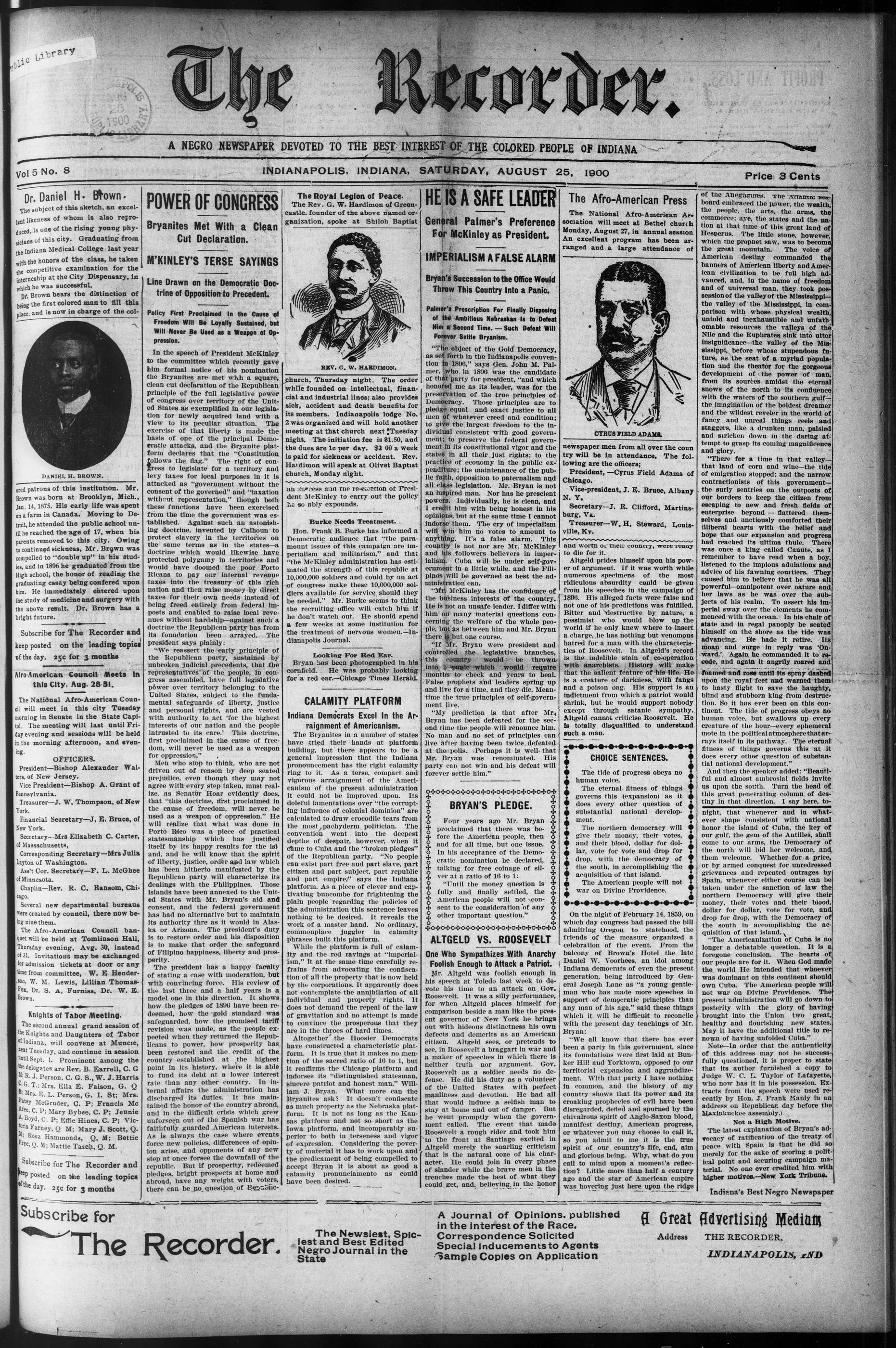
Dr. Daniel H. Brown.
The subject of this sketch, an excellent likeness of whom is also reproduced, is one of the rising young physicians of this city. Graduating from the Indiana Medical College last year with the honors of the class, he taken the competitive examination for the internship at the City Dispensary, in which he was successful, Dr. Brown bears the distinction of being the first colored man to fill this place, and is now in charge of the col-
[Name]
ored patrons of this institution. Mr. Brown was born at Brooklyn, Mich., Jan. 14, 1875. His early life was spent on a farm in Canada. Moving to Detroit, he attended the public school until he reached the age of 17, when his parents removed to this city. Owing to continued sickness, Mr. Brown was compelled to "double up" in his studies, and in 1896 he graduated from the High school, the honor of reading the graduating essay being conferred upon him. He immediately entered upon the study of medicine and surgery with the above result. Dr. Brown has a bright future.
Subscribe for The Recorder and keep posted on the leading topics of the day. 25c for 3 months
Miro-American Council Meets In this City, Aug. 28-31.
The National Afro-American Council will meet in this city Tuesday morning in Senate in the State Capitol. The meeting will last until Friday evening and sessions will be held in the morning afternoon, and evening.
OFFICERS.
President—Bishop Alexander Walters, of New Jersey.
Vice President—Bishop A. Grant of Pennsylvania.
Treasurer—J. W. Thompson, of New York.
Financial Secretary—J. E. Bruce, of New York.
Secretary—Mrs Elizabeth C. Carter, of Massachusetts,
Corresponding Secretary—Mrs Julia Layton of Washington.
Ass't Cor. Secretary—F. L. McGhee of Minnesota.
Chaplin—Rev. R. C. Ransom, Chicago.
Several new departmental bureaus were created by council, there now being nine them.
The Afro-American Council banquet will be held at Tomlinson Hall, Thursday evening, Avg. 30, instead of 31. Invitations may be exchanged for admission tickets at door or any time from committee, W. E. Henderson, W. M. Lewis, Lillian Thomas-Fox, Dr. S. A. Furniss, Dr. W. E. Brown.
Knights of Tabor Meeting.
The second annual grand session of the Knights and Daughters of Tabor of Indiana, will convene at Munce, next Tuesday, and continue in session until Sept. 1. Prominent among the the delegates are Rev. B. Earrell, C. G M; R. J. Person, C. G. S., W. J. Harris, C.G.T.; Mrs. Ella E. Faison, G. Q M; Mrs. E. L. Person, G. I. St; Mrs. Patsy McGruder, C. P; Francis McAfee, C. P; Mary Byebee, C. P; Jeunie A. Boyd, C. P; Effie Hines, C. P; Victoria Farney, Q M; Mary J. Scott, Q M; Rosa Hammonds, Q, M; Bettie Frye, Q. M; Mattie Tason, Q. M.
Subscribe for The Recorder and keep posted on the leading topics of the day. 25c for 3 months
The Recorder.
A NEGRO NEWSPAPER DEVOTED TO THE BEST INTEREST OF THE COLORED PEOPLE OF INDIANA
POWER OF CONGRESS
POWER OF CONGRESS
Bryanites Met With a Clean Cut Declaration.
M'KINLEY'S TERSE SAYINGS
Line Drawn on the Democratic Doctrine of Opposition to Precedent.
Policy First Proclaimed In the Cause of Freedom Will Be Loyally Sustained, but Will Never Be Used as a Weapon of Oppression.
In the speech of President McKinley to the committee which recently gave him formal notice of his nomination the Bryanites are met with a square, clean cut declaration of the Republican principle of the full legislative power of congress over territory of the United States as exemplified in our legislation for newly acquired land with a view to its peculiar situation. The exercise of that liberty is made the basis of one of the principal Democratic attacks, and the Bryanite platform declares that the "Constitution follows the flag." The right of congress to legislate for a territory and levy taxes for local purposes in it is attacked as "government without the consent of the governed" and "taxation without representation," though both these functions have been exercised from the time the government was established. Against such an astonishing doctrine, invented by Calhoun to protect slavery in the territories on the same terms as in the states—a doctrine which would likewise have protected polygamy in territories and would have doomed the poor Porto Ricans to pay our internal revenue taxes into the treasury of this rich nation and then raise money by direct taxes for their own needs instead of being freed entirely from federal imposts and enabled to raise local revenues without hardship—against such a doctrine the Republican party has from its foundation been arrayed. The president says plainly:
"We reassert the early principle of the Republican party, sustained by unbroken judicial precedents, that the representatives of the people, in congress assembled, have full legislative power over territory belonging to the United States, subject to the fundamental safeguards of liberty, justice and personal rights, and are vested with authority to act for the highest interests of our nation and the people intrusted to its care'. This doctrine, first proclaimed in the cause of freedom, will never be used as a weapon for oppression."
Men who stop to think, who are not driven out of reason by deep seated prejudice, even though they may not agree with every step taken, must realize, as Senator Hoar evidently does, that "this doctrine, first proclaimed in the cause of freedom, will never be used as a weapon of oppression." He will realize that what was done in Porto Bico was a piece of practical statesmanship which has justified itself by its happy results for the island, and he will know that the spirit of liberty, justice, order and law which has been hitherto manifested by the Republican party will characterize its dealings with the Philippines. Those islands have been annexed to the United States with Mr. Bryan's aid and consent, and the federal government has had no alternative but to maintain its authority thre as it would in Alaska or Arizona. The president's duty is to restore order and his disposition is to make that order the safeguard of Filipino happiness, liberty and prosperity.
The president has a happy faculty of stating a case with moderation, but with convincing force. His review of the last three and a half years is a model one in this direction. It shows how the pledges of 1896 have been redeemed, how the gold standard was safeguarded, how the promised tariff revision was made, as the people expected when they returned the Republicans to power, how prosperity has been restored and the credit of the country established at the highest point in its history, where it is able to fund its debt at a lower interest rate than any other country. In internal affairs the administration has discharged its duties. It has maintained the honor of the country abroad, and in the difficult crisis which grew unforeseen out of the Spanish war has faithfully guarded American interests. As is always the case where events force new policies, differences of opinion arise, and opponents of any new step at once forsee the downfall of the republic. But if prosperity, redeemed pledges, bright prospects at home and abroad, have any weight with voters, there can be no question of Republic-
INDIANAPOLIS, INDIANA, SATURDAY, AUGUST 25, 1900
ESS
The Royal Legion of Peace.
The Rev. G. W. Hardimon of Green-
castle, founder of the above named or-
ganization, spoke at Shiloh Baptist
HE IS A SAFE LEADER
General Palmer's Preference
The Afro
The Nation
sociation will
REV. G. W. HARDIMON
REV. G. W. HARDIMON.
church, Thursday night. The order while founded on intellectual, financial and industrial lines; also provides sick, accident and death benefits for its members. Indianapolis lodge No. 2 was organized and will hold another meeting at that church next Tuesday night. The initiation fee is $1.50, and the dues are 10 per day. $2 00 a week is paid for sickness or accident. Rev. Hardimon will speak at Olivet Baptist church, Monday night.
an success and the re-election of President McKinley to carry out the policy he so ably expounds.
Burke Needs Treatment.
Hon. Frank B. Burke has informed a Democratic audience that "the paramount issues of this campaign are imperialism and militarism," and that "the McKinley administration has estimated the strength of this republic at 10,000,000 soldiers and could by an act of congress make these 10,000,000 soldiers available for service should they be needed." Mr. Burke seems to think the recruiting office will catch him if he don't watch out. He should spend a few weeks at some institution for the treatment of nervous women.—Indianapolis Journal.
Looking For Red Ear.
Bryan has been photographed in his cornfield. He was probably looking for a red ear.—Chicago Times Herald.
CALAMITY PLATFORM
Indiana Democrats Excel In the Arra-
rainment of Americanism
The Bryantites in a number of states have tried their hands at platform building, but there appears to be a general impression that the Indiana pronouncement has the right calamity ring to it. As a terse, compact and vigorous arraignment of the Americanism of the present administration it could not be improved upon. Its doleful lamentations over "the corrupting influence of colonial dominion" are calculated to draw crocodile tears from the most pachyderm politician. The convention went into the deepest depths of despair, however, when it came to Cuba and the "broken pledges" of the Republican party. "No people can exist part free and part slave, part citizen and part subject, part republic and part empire" says the Indiana platform. As a piece of clever and captivating bumcote for frightening the plain people regarding the policies of the administration this sentence leaves nothing to be desired. It reveals the work of a master hand. No ordinary, commonplace juggler in calamity phrases built this platform.
While the platform is full of calamity and the red ravings at "imperialism," it at the same time carefully refrains from advocating the confiscation of all the property that is now held by the corporations. It apparently does not contemplate the annihilation of all individual and property rights. It does not demand the repeal of the law of gravitation and no attempt is made to convince the prosperous that they are in the throes of hard times.
Altogether' the Hoosier Democrats have constructed a characteristic platform. It is true that it makes no mention of the sacred ratio of 16 to 1, but it reaffirms the Chicago platform and indorses its "distinguished statesman, sincere patriot and honest man," William J. Bryan. What more can the Bryanites ask? It doesn't confiscate as much property as the Nebraska platform. It is not as long as the Kansas platform and not so short as the Iowa platform, and incomparably superior to both in terseness and vigor of expression. Considering the poverty of material it has to work upon and the predicament of being compelled to accept Bryan it is about as good a calamity pronunciamento as could have been desired.
The Newsiest, Spiciest and Best Edited Negro Journal in the State
A Journal of Opinions. published in the interest of the Race. Correspondence Solicited Special Inducements to Agents Sample Copies on Application
HE IS A SAFE LEADER
IMPERIALISM A FALSE ALARM
Bryan's Succession to the Office Would Throw This Country Into a Panic.
Palmer's Prescription For Finally Disposing of the Ambitious Nebraskan Is to Defeat Him a Second Time. — Such Defeat Will Forever Settle Bryanism.
"The object of the Gold Democracy, as set forth in the Indianapolis convention in 1896," says Gen. John M. Palmer, who in 1896 was the candidate of that party for president, "and which honored me as its leader, was for the preservation of the true principles of Democracy. Those principles are to pledge equal and exact justice to all men of whatever creed and condition; to give the largest freedom to the individual consistent with good government; to preserve the federal government in its constitutional vigor and the states in all their just rights; to the practice of economy in the public expenditure; the maintenance of the public faith, opposition to paternalism and all class legislation. Mr. Bryan is not an inspired man. Nor has he president powers. Individually, he is clean, and I credit him with being honest in his opinions, but at the same time I cannot indorse them. The cry of imperialism will win him no votes to amount to anything. It's a false alarm. This country is not nor are Mr. McKinley and his followers believers in imperialism. Cuba will be under self-government in a little while, and the Filipinos will be governed as best the administration can.
"Mr. McKinley has the confidence of the business interests of the country. He is not an unsafe leader. I differ with him on many material questions concerning the welfare of the whole people, but as between him and Mr. Bryan there is but one course.
"If Mr. Bryan were president and controlled the legislative branches, this country would be thrown into a paule which would require months to check and years to heal. False prophets and leaders spring up and live for a time, and they die. Meantime the true principles of self-government live.
"My prediction is that after Mr. Bryan has been defeated for the second time the people will renounce him. No man and no set of principles can live after having been twice defeated at the polls. Perhaps it is well that Mr. Bryan was renominated. His party can not win and his defeat will forever settle him."
BRYAN'S PLEDGE.
Four years ago Mr. Bryan proclaimed that there was before the American people, then and for all time, but one issue. In his acceptance of the Democratic nomination he declared, talking for free coinage of silver at a ratio of 16 to 1: "Until the money question is fully and finally settled, the American people will not consent to the consideration of any other important question."
One Who Sympathizes With Anarchy
Foolish Enough to Attack a Patriot.
Mr. Altgeld was foolish enough in his speech at Toledo last week to devote his time to an attack on Gov. Roosevelt. It was a silly performance, for when Altgeld places himself for comparison beside a man like the present governor of New York he brings out with hideous distinctness his own defects and demerits as an American citizen. Altgeld sees, or pretends to see, in Roosevelt a braggart in war and a maker of speeches in which there is neither truth nor argument. Gov. Roosevelt as a soldier needs no defense. He did his duty as a volunteer of the United States with perfect manliness and devotion. He had all that would induce a selfish man to stay at home and out of danger. But he went promptly when the government called. The event that made Roosevelt a rough rider and took him to the front at Santiago excited in Altgeld merely the snarling criticism that is the natural ooze of his character. He could join in every phase of slander while the brave men in the trenches made the best of what they could get, and, believing in the honor
The Afro-American Press
The National Afro-American Association will meet at Bethel church Monday, August 27, in annual session An excellent program has been arranged and a large attendance of
M.
CYRUS FIELD ADAMS.
newspaper men from all over the country will be in attendance. The following are the officers;
President, —Cyrus Field Adams of Chicago.
Vice-president, J. E. Bruce, Albany N. Y.
Secretary—J. R. Clifford, Martinsburg, Va.
Treasurer—W. H. Steward, Louisville, Ky.
and worth of their country, were invoy to die for it.
Altgeld prides himself upon his power of argument. If it was worth while numerous specimens of the most ridiculous absurdity could be given from his speeches in the campaign of 1896. His alleged facts were false and not one of his predictions was fulfilled. Bitter and destructive by nature, a pessimist who would blow up the world if he only knew where to insert a charge, he has nothing but venomous hatred for a man with the characteristics of Roosevelt. In Altgeld's record is the indelible stain of co-operation with anarchists. History will make that the salient feature of his life. He is a creature of darkness, with fangs and a poison pag. His support is an indictment from which a patriot would shrink, but he would support nobody except through satanic sympathy. Altgeld cannot criticise Roosevelt. He is totally disqualified to understand such a man.
CHOICE SENTENCES.
The tide of progress obeys no human voice.
The eternal fitness of things governs this (expansion) as it does every other question of substantial national development.
The northern democracy will give their money, their votes, and their blood, dollar for dollar, vote for vote and drop for drop, with the democracy of the south, in accomplishing the acquisition of that island.
The American people will not war on Divine Providence.
---
On the night of February 14, 1859, on which day congress had passed the bill admitting Oregon to statehood, the friends of the measure organized a celebration of the event. From the balcony of Brown's Hotel the late Daniel W. Voorhees, an idol among Indiana democrats of even the present generation, being introduced by General Joseph Lane as "a young gentleman who has made more speeches in support of democratic principles than any man of his age," said these things which it will be difficult to reconcile with the present day teachings of Mr. Bryan:
"We all know that there has ever been a party in this government, since its foundations were first laid at Bunker Hill and Yorktown, opposed to our territorial expansion and aggrandizement. With that party I have nothing in common, and the history of my country shows that its power and its croaking prophecies of evil have been disregarded, defied and spurned by the chivalrous spirit of Anglo-Saxon blood, manifest destiny, American progress, or whatever you may choose to call it, so you admit to me it is the true spirit of our country's life, end, alm and glorious being. Why, what do you call to mind upon a moment's reflection? Little more than half a century ago and the star of American empire was hovering just here upon the ridge
Price 3 Cents
of the Anegnames. The armenian seaboard embraced the power, the wealth, the people, the arts, the arms, the commerce; aye, the states and the nation at that time of this great land of Hesperus. The little stone, however, which the prophet saw, was to become the great mountain. The voice of American destiny commanded the banners of American liberty and American civilization to be full high advanced, and, in the name of freedom and of universal man, they took possession of the valley of the Mississippi—the valley of the Mississippi, in comparison with whose physical wealth, untold and inexhaustible and unfathomable resources the valleys of the Nile and the Euphrates sink into utter insignificance—the valley of the Mississippi, before whose stupendous future, as the seat of a mylad population and the theater for the gorgeous development of the power of man, from its sources amidst the eternal snows of the north to its confluence with the waters of the southern gulf—the imagination of the boldest dreamer and the wildest reveler in the world of fancy and unreal things reels and staggers, like a drunken man, palsied and sricken down in the daring attempt to grasp its coming magnificence and glory.
"There for a time in that valley—that land of corn and wine—the tide of emigration stopped; and the narrow contractionists of this government—the surly sentries on the outposts of our borders to keep the citizen from escaping to new and fresh fields of enterprise beyond — flattered themselves and unctiously comforted their illiberal hearts with the belief and hope that our expansion and progress had reached its ultima thule. There was once a king called Canute, as I remember to have read when a boy, listened to the imploqs adulations and advice of his fawning courtiers. They caused him to believe that he was all powerful—onnipotent over nature and her laws as he was over the subjects of his realm. To assert his imperial sway over the elements he commenced with the ocean. In his chair of state and in regal panoply he seated himself on the shore as the tide was advancing. He bade it retire. Its moan and surge in reply was 'Onward,' Again he commanded it to recede, and again it angrily roared and
foamed and rose until its spray dashed upon the royal feet and warned them to hasty flight to save the haughty, blind and stubborn king from destruction. So it has ever been on this continent. The tide of progress obeys no human voice, but swallows up every creature of the hour—every ephemeral mote in the political atmosphere that arrays itself in its pathway. The eternal fitness of things governs this at it does every other question of substantial national development."
And then the speaker added: "Beautiful and almost ambrosial fields invite us upon the south. Turn the head of this great penetrating column of destiny in that direction. I say here, tonight, that whenever and in whatever shape consistent with national honor the island of Cuba, the key of our gulf, the gem of the Antilles, shall come to our arms, the Democracy of the north will bid her welcome, and them welcome. Whether for a price, or by armed conquest for unrressed grievances and repeated outrages by Spain, whenever either course can be taken under the sanction of law the northern Democracy will give their money, their votes and their blood, dollar for dollar, vote for vote, and drop for drop, with the Democracy of the south in accomplishing the acquisition of that island.
"The Americanization of Cuba is no longer a debatable question. It is a foregone conclusion. The hearts of our people are for it. When God made the world He intended that whoever was dominant on this continent should own Cuba. The American people will not war on Divine Providence. The present administration will go down to posterity with the glory of having brought into the Union two great, healthy and flourishing new states. May it have the additional title to renown of having unfolded Cuba." Note—In order that the authenticity of this address may not be successfully questioned, it is proper to state that its author furnished a copy to Judge W. C. L. Taylor of Lafayette, who now has it in his possession. Extracts from the speech were used recently by Hon. J. Frank Zanly in an address on Republican day before the Maximuckee assembly.
The latest explanation of Bryan's advocacy of ratification of the treaty of peace with Spain is that he did so merely for the sake of scoring a political point and securing campaign material. No one ever credited him with higher motives.—New York Tribune.
Indiana's Best Negro Newspaper
PROFIT AND LOSS.
SPIRITUAL VALUES COMPARED WITH EARTHLY RICHES.
Worldly Wealth a Transitory Dream.
While the Glories of Heaven are Ever-lasting-The Soul Priceless, the Body Valueless-Dr. Talmage's Sermon.
From Berlin, where he preached in the American Church to a congregation comprising many of his countrymen who are traveling through Europe. Dr. Talmage sends this discourse, in which, by original methods, he calculates spiritual values and urges higher appreciation of things religious. The text is Mark vifl, 35. "What shall it profit a man if he shall gain the whole world and lose his own soul?" First, I have to say that the world is a very grand property. Its flowers are God's thoughts in bloom. Its rocks are God's thoughts in stone. Its dew-drops are God's thoughts in pearl. This world is God's child—a wayward child, indeed; it has wandered off through the heavens. But about 1,900 years ago, one Christmas night, God sent out a sister world to call that wanderer back, and it hung over Bethlehem only long enough to get the promise of the wanderer's return, and now that lost world, with soft feet of light, comes treading back through the heavens. The hills, how beautiful they billow up, the edge of the wave white with the foam of crouces! How beautiful the rainbow, the arched bridge on which heaven and earth come and talk to each other in tears after the storm is over! How nimble the feet of the lampshiver that in a few minutes set all the dome of the night ablaze with brackets of fire! How bright the oar of the saffron cloud that rows across the deep sea of heaven! How beautiful the spring, with bridal blossoms in her hair! I wonder who it is that beats time on a June morning for the bird orchestra. How gently the harebell tolls its fragrance on the air! There may be grander worlds, swarthier worlds, larger worlds than this, but I think that this is a most exquisite world—a mignonette on the bosom of immensity! "Oh," you say, "take my soul; give me that world! I am willing to take it in exchange. I am ready now for the bargain. It is so beautiful a world, so sweet a world, so grand a world!"
But let us look more minutely into the value of this world. You will not buy property unless you can get a good title to it. After you have looked at the property and found out that it suits you you send an attorney to the public office and he examines the book of deeds and the book of mortgages and the book of judgments and the book of liens, and he decides whether the title is good before you will have anything to do with it. There might be a splendid property and in every way exactly suited to your want, but if you can not get a good title you will not take it. Now, I am here to say that it is impossible to get a good title to this world.
Having examined the title of a property, your next question is about insurance. You would not be silly enough to buy a large warehouse that could not possibly be insured. You would not have anything to do with such a property. Now, I ask you what assurance can you give me that this world is not going to be burned up? Absolutely none. Geologists tell us that it is already on fire; that the heart of the world is one great living coal; that it is just like a ship on fire at sea, the flames not bursting out because the hatches are kept down.
Astronomers have swept their telescopes through the sky and have found out that there have been 15 worlds, in the last two centuries, that have disappeared. At first they looked just like other worlds. Then they got deeply red—they were on fire. Then they got ashen, showing they were burned down. Then they disappeared, showing that even the ashes were sintered. And, if the geologist be right in his prophecy, then our world is to go in the same way. And yet you want me to exchange my soul for it. Ah, no; it is a world that is burning now.
Here is a man who has had a large estate for 40 or 50 years. He lies down to die. You say: "That man is worth millions and millions of dollars." Is he? You call up a surveyor, with his compass and chains, and you say: "There is a property extending three miles in one direction and three miles in another direction." Is that the way to measure that man's property? No! You do not want any surveyor, with compass and chains. That is not the way to measure that man's property now. It is an undertaker you need, who will come and put his finger in his vest pocket and take out a tapeline and he will measure five feet nine inches one way and two feet and a half the other way. That is the man's property. Oh no. I forgot. Not so much as that, for he does not own even the place in which he lies in the cemetery. The deed to that belongs to the executors and heirs. Oh, what a property you propose to give me for my soul!
Now, let us look at the other property—the soul. We can not make a bargain without seeing the comparative value. The soul! How shall I estimate the value of it? Well, by its exquisite organization. It is the most wonderful ul piece of mechanism ever put together. Machinery is of value in proportion as it is mighty and silent at the same time. You look at the engine and the machinery in the Philadelphia mint, and as you see it performing its wonderful work you will be surprised to find how silently it goes. Machinery that rears and tears soon destroys its self and silent machinery is often most effective. Now, so it is with the soul of man, with all its tremendous faculties; it moves in silence. Judgment, without any racket, lifting its scale; memory, without any noise, bringing down all its treasures; conscience, taking its judgment seat without any excitement; the understanding and the will, doing their work. Velocity, majesty, might, but silence—silence. You listen at the door of your heart. You can hear no sound. The soul is all quiet. It is so delicate an instrument that no human hand can touch it. You break a bone, and with splinters and bandages the surgeon sets it; the eye becomes inflamed, and the apotheca-
ry's wash cools it, but a soul off the track, unbalanced—no human power can readjust it.
I calculate the value of the soul also by its capacity for happiness. How much joy it can get in this world out of friendship, out of books, out of clouds, out of the sea, out of flowers, out of ten thousand things, and yet all the joy it has here does not test its capacity. You are in a concert before the curtain hoists and you hear the instruments preparing—the sharp snap of the broken string, the scraping of the bow across the viol. "There is no music in that," you say. It is only getting ready for the music. And all the enjoyment of the soul in this world, the enjoyment we think is real enjoyment, is only preparative; it is only anticipative; it is only the first stages of the thing; it is only the entrance, the beginning of that which shall be the orchestral harmonies and splendors of the redeemed.
You can not test the full power of the soul for happiness in this world. How much power the soul has here to find enjoyment in friendships; but, oh, the grander friendships for the soul in the skies! How sweet the flowers here, but how much sweeter they will be there! I do not think that when flowers die on earth they die forever. In the sunny valleys of heaven shall not the marigold creep? On the hills of heaven will not the amaranth bloom? On the amethystine walls of heaven will not the jasmine climb? "My beloved is come down into his garden to gather illies." No flowers in heaven? Where, then, do they get their garlands for the brows of the righteous?
I calculate further the value of the soul by the price that has been paid for it. In St. Petersburg there is a diamond that the government paid $200,000 for. "Well," you say. "it must have been very valuable or the government would not have paid $200,000 for it." I want to see what my soul is worth and what your soul is worth by seeing what has been paid for it. For that immortal soul the richest blood that was ever shed, the deepest groan that was ever uttered, all the griefs of earth compressed into one tear, all the sufferings of earth gathered into one rapiper of pain and stuck through his holy heart. Does it not imply tremendous value?
I argue, also, the value of the soul from the home that has been fitted up for it in the future. One would have thought that a street of adamant would have done. No, it is a street of gold. One would have thought that a wall of granite would have done. No, it is the flame of sardonyx mingling with the green of emerald. One would have thought that an occasional doxology would have done. No, it is a perpetual song. If the ages of heaven marched in a straight line, some day the last regiment, perhaps, might pass out of sight. But no, the ages of heaven do not march in a straight line, but in a circle around about the throne of God, forever, forever, tramp, tramp. A soul so bought, so equipped, so provided for must be a priceless soul, a maesthetic soul, a tremendous soul.
Now, you have seen the two properties—the world, the soul. One perishable, the other immortal. One unsatisfying, the other capable of ever increasing felicity. Will you trade? Will you trade even? Remember, it is the only investment you can make. If a man sell a bill of goods worth $5,000, and he is cheated out of it, he may get $5,000 somewhere else; but a man who invests his soul invests all. Saving that, he saves all. In the light of my text, it seems to me as if you were offering your soul to the highest bidder, and I hear you say, "What is bid for it, my deathless spirit? What is bid for it?" Satan says, "I will bid the world." You say, "Begone, that is no equivalent! Sell my soul for the world? No! Begone!" But there is some one else in the audience not so wise as that. He says, "What is bid for my immortal soul?" Satan says, "I will bid the world." "The world? Going at that, going at that, going! Gone!" Gone forever!
Well, there are a great many people who say, "I will not sell my soul for the world. I find the world is an unsatisfying portion." What, then, will you do with your soul? Some one whispers here, "I will give my soul to Christ." Will you? That is the wisest resolution you ever made. Will you give it to Christ? When? To morrow? No, now. I congratulate you if you have come to such a decision.
I was reading lately of a sailor who had just got ashore and was telling about his last experience at sea. He said "The last time I crossed the ocean we had a terrific time. After we had been out three or four days the machinery got disarranged and the steam began to escape, and the captain, gathering the people and the crew on deck, said, 'Unless some one will go down and shut off that steam and arrange that machinery at the peril of his life we must all be destroyed!' He was not willing to go down himself. No one seemed willing to go. The passengers gathered at one end of the steamer waiting for their fate. The captain said: 'I give you a last warning. If there is no one here willing to imperil his life and go down and fix that machinery, we must all be lost.' A plain sailor said, 'Tl go, sir,' and he wrapped himself in a coarse piece of canvas and went down and was gone but a few moments when the escaping steam stopped, and the machinery was adjusted. The captain cried out to the passengers: 'All saved! Let us go down below and see that has become of the poor fellow.' They went down. There he lay dead." Vicarious suffering! Died for all! Oh, do you suppose that those people on the ship ever forgot, ever can forget, that poor fellow? "No!" they said. "It was through his sacrifice that I got ashore." The time came when our whole race must die unless some one should endure torture and sorrow and shame. Who shall come to the rescue? Shall it be one of the seraphim? Not one. Shall it be one of the cherubim? Not one. Shall it be an inhabitant of some pure and unfallen world? Not one. Then Christ said, "Lo, I come to do thy will, O God!" and he went down the dark stairs of our sin and wretchedness and misery and woe, and he stopped the peril, and he died that you and I might be free. Oh, the love; oh, the endurance; oh, the horrors of the sacrifice! Shall our souls go out toward him, saying, "Lord Jesus Christ, take my
THE RECORDER, INDIANAPOLIS, INDIANA
soul. Thou art worthy to have it. Thou hast died to save it." God help you rightly to cipher out this sum in gospel arithmetic: "What shall it profit a man if he shall gain the whole world and lose his own soul?"
Original State Capitals.
Very few American States have now their original State capitals, a circumstance which is being recalled by the observances in various parts of the country of anniversaries. The original capital of Indiana was Corydon; of Illinois, Vandalia; and that of Ohio, Chillicothe. Corydon and Vandalia are small towns, but Chillicothe has grown to be a city of some importance.
All the original States had fixed boundaries when admitted, but most of the Western and Southern States were sub-divisions of former territories, and the capital which was appropriate at one time would not serve after different boundaries were chosen. The territory of Michigan, for instance, included the city of Toledo. Ohio was admitted into the Union in 1802, and the northwestern counties were not annexed to it until 1836. This change in the State boundaries justified the selection of a more northerly town for the capital, and Columbus was chosen.
The original capital of New York was New York city, and for a short time New York had two capitals—New York city and Jamaica, L. I. Afterward, the course of the capital moved northerly, first to Poughkeepsie, then to Kingston, and finally to Albany, where it has been situated for more than a century.
The original capital of Alabama, according to the New York Sun, was Tuscaloosa; and of Georgia, Milledgeville, until superseded by Atlanta after the close of the civil war. Iowa City was the original capital of Iowa, now Des Moines; and in some of the new Northwestern States, notably North Dakota, it has been necessary to put the matter of capital selection to the determination of the voters on several occasions, and not without considerable contention and friction in the settlement of the dispute. New Orleans, for a time after the civil war the capital of Louisiana, has been superseded by Baton Rouge, Detroit, the largest city in Michigan, was originally the capital, a position now occupied by Lansing. Lecompton was the first capital of Kansas; Topeka is the capital now.
Omaha was the capital of Nebraska as a territory and remained such for a short time after its admission, until Lincoln succeeded it. Wheeling was the first capital of West Virginia before the selection of Charleston, and Virginia City was the capital of Nevada before the selection of Carson City, or Carson, as it is called locally, Denver has always been the capital of Colorado, State or territory. Yankton, S. D., was the capital of Dakota territory before its admission into the Union as two separate States, but the present capital of South Dakota is the town of Pierre, and it was not established as such until after some controversy.
By what may best, perhaps, he described as a paradox, Rhode Island, the smallest of the States in the country, has had the largest number of capitals. It now has two—Providence and Newport—and originally had five simultaneous capitals, so to speak—Providence, Newport, South Kingstown, East Greenwich and Bristol. Connecticut had two, Hartford and New Haven, and it is sometimes found difficult, at present, to understand why a small State with a sparse population, and having little official business to transact, should have found it necessary to maintain more than one capital. It is explained by the fact, however, that in early times and for some years after the revolutionary period, local jealousies existed between the several towns of a State, and it was to appease these jealousies that the concession was made of two capitals, Rhode Island, though not the pioneer, is now the last survivor of this custom, and its citizens are to vote in November on the proposition to do away with Newport as a capital and to establish Providence as the only one.
The United States has changed its capital, originally in New York and afterward in Philadelphia, like most of the separate States.
She could not see his face as he knelt and asked her to be his. She was glad of that, for she did not wish to know how much suffering her refusal caused him. She told him as gently as she could that their lives could not be linked together; that although she admired him and esteemed him she felt that it would be risking his future as well as her own to consent to h union when she was sure no affinity existed. It was a touching speech, and she threw so much heart into it that she did not observe that he was taking notes in shorthand. When she had concluded, he rose and put his notebook in his pocket. Extending his hand, he remarked genially: "I'm ever and ever so much obliged to you." "S-i-r-r-r-r!" "You did it ever so nicely, and I'm under a thousand obligations. I'm writing a novel, and I have a scene in which a girl refuses to marry a man. I was anxious to avoid the stereotyped style of depicting such incidents and make it realistic. You are the seventh girl I have proposed to, and every one of the others accepted me. If you had said 'Yes,' I think I should have been completely discouraged."
A certain Archbishop of Dublin was, toward the end of his life, afflicted by an absent-mindedness that often led to startling developments. In the midst of a dinner given by the Lord Leutenant of Ireland, the company was startled by seeing the Archbishop rise from his seat, looking pale and agitated, and crying: "It has come! It has come! "What has come, your Grace?" eagerly cried half a dozen voices from different parts of the table. "What I have been expecting for some years—a stroke of paralysis," solemnly answered the Archbishop. "I have been pinching myself for the last few minutes, and find my leg entirely without sensation." "Pardon me, my dear Archbishop," said the hostess, looking up to him with a quizzical smile; "pardon me for contradicting you, but it is I you have been pinching."
INDIRECTION.
Fair are the flowers and the children,
but their subtle suggestion is fairer;
Rare is the rose-burst of dawn, but
the secret that clasps it is rarer;
Sweet the exultance of song, but the
strain that precedes it is sweeter,
And never was poem yet writ, but the
meaning outmastered the metre.
Never a daisy that grows, but a mystery guildeth the growing;
Never a river that flows, but a majesty scapers the flowing;
Never a Shakespeare that soared, but a Stronger than he did enfold him. Nor ever a prophet fortells, but a mightier seer hath foretold him.
Back of the canvas that throbs the painter is hinted and hidden;
The statue that breathes the soul
Into the statue that breathes the soul
of the sculptor is bidden;
Under the joy that is felt lie the infinite issues of feeling;
Crowning the glory revealed is the glory that crowns the revealing.
Great are the symbols of being, but that which is symboled is greater;
Vast the create and beheld, but vaster the inward creator;
Back of the sound broods the silence,
back of the gift stands the giving;
Back of the hand that receives thrill
the sensitive nerves of receiving.
Space is as nothing to spirit, the dead
is outdone by the doing;
The heart of the wooer is warm, but
warmer the heart of the wooing;
And up from the pit where these shiver,
and up from the heights where
those shine.
Twin voices and shadows swim star-
ward, and the essence of life is divine.
—Richard Realf's Poems.
Princes and lords may flourish or may fade—
UNITED STATES
Supplies Nearly All the World With Wooden Ware Nowadays.
This country is the source of supply of wooden ware in general of the entire civilized world. American brooms are exported to many countries, and broom handles are sent by us to Australia. Wherever churns are used there you will find those of American make. American wash tubs go chiefly to the Argentine Republic, South America, and the Latin-American countries. Meeting in competition, however, a galvanized sheet iron article that up to date the American article has not been able to supplant us to washboards, the whole world is ours. The American output of ice cream freezers is on top throughout the world wherever ice, either natural or artificial, is known. Ten chances to one the bulk of the ice cream eaten in Melbourne, Calcutta, or any other city or country, not excepting Europe, is made in American freezers. Take many other of the simple and homely articles of daily or common use, for example clothes pins. No matter where you go you will find that the pins used in hanging clothes are made for the most part in the United States. Wooden pails, chopping trays and bowls, folding chairs, many different kinds of refrigerators, some of which can be taken apart for transportation pastry boards, ironing boards, all owe their origin to Yankee invention and thoughtfulness. School slides made in the country, all of which have made in bread, find a ready sale abroad, meet with opposition from Germany and England. The American product, however, sells up to the standard of either. It may surprise some people to learn that thousands of American slates and their way to distant Burmah. The wooden ware of American manufacture having successfully entered into competition with that of England and Germany on their own soil is now branching out and invading Russia. This is a new but a profitable and fast growing market. This ware goes also to New Zealand, South America and the West Indies, in fact to any and all lands that have any sort of modern civilization. In fact there is hardly a freight vessel leaving the ports of this part of the world that is not laden with this kind of tonnage for distant lands. The secret of all this is the United States has a greater abundance of the right kind of wood than is found elsewhere. This fact, added to the development of all sorts of labor-saving machinery by which the articles are fashioned, has given us a lead in this sort of commerce and the country has not been slow to take advantage of her favorable conditions. On the other hand, while Canada, our near neighbor, has the wood in plenty, she lacks the skilled labor, the machinery, and the trade facilities necessary to render her a competitor in this line of industry.
Spring at Lost Creek
This wee sonnet to spring appears in "The Lost Creek Lyre," over the signature of the poetess-laureate of the camp, Miss Popsie Duzenberry:
"The merry days of spring have came,
King Lear hatch onward went,
And sunshine in the a silvery flame
Heats up the firm-a-ment.
The birds, in plumage glad and bright,
For crumbs at doors begs.
And happy hens are getting quite
Prolific with their eggs.
And bees, new rated, softly croom
Upon their annual honeymoon."
—From the Denver Post.
In every Siberian city the most conspicuous and finest buildings are the churches and the government buildings.
I have landed Ripanus tabales in our office. I have been troubled for about three years with what I called bilious attacks coming on regularly once a week. Was told by different physicians that it was caused by bad teeth, of which I had 10. I was told that I had bilious attacks continued. I had seen advertisements of Ripanus Tabales in all the papers but had no faith in them, but about six weeks since a friend in India sent me a letter saying that small 5-cm boxes of the Tabales and have had no recurrence of the attacks. Have never given a testimonial for anything before, but the great news is that my friend by Ripanus Tabales induces me to add mine to the many testimonials you doubtless have in your possession now. A. T. DEWITR.
R.I.P.A.N.S
The modern standard Family Medicine: Cures the common every-day ill of humanity.
TRADE
R.I.P.A.N.S
AGRILS
MARK
---
Tablets regularly. Shekeops a few cartons Ripans Tablets in the house and says she will not be without them. The heartburn and sleeplessness have disappeared with the indigestion which was formerly so grease a burdon for her. Our whole family take the Tabules regularly, especially after a hearty meal. My mother is fifty years of age and is enjoying the best of health and spirits; also eats hearty meals, an impossibility before she took Ripans Tabules.
ASTON H. BLAKEN.
A new style packet containing TEN RIZANS TARUBLES packed in a paper carton (without any one for sale at some drug store—FOR FIVE TEN). This low-priced sort is intended for the poor and the economical. One of the five cartons (180 tablets) can be had by mail by sending for the next costs to the RIZAN CHEMICAL COMPANY, No. 16 Spruce Street, New York—or a single carton (TEN TARUBLES) will be sent for five cents. RIZAN TARUBLES may also be had of some grocers, general storekeepers, news agents and some liquor stores and heater shows. They banish pain, induce siees and prolong life. One of the
American Mutual Aid Association
We need not refer you to people in Europe, Asia, etc., for recommendation, but can furnish testimonials from reliable persons in your own city.
We pay Sick accident and Death Benefits Also furnish Free Medical attention in case of Sickness or Accident Be on the safe side and Insure with us.
E. B. HAMPTON, Organizer.
Room 43 BALDWIN BLOCK, Indianapolis, Ind.,
50 YEARS' EXPERIENCE
PATENTS
TRADE MARKS DESIGNS
COPYRIGHT & C.
Anyone sending a sketch and description may quickly ascertain our opinion free whether an invention is probably practicable. Communications strictly confidential. Handbook on Patents sent free. Oldest agency for securing patents. Please take through Hunn & Co. receive special notice, without charge.
THE NEW YORK CLIPPER
Contains a Reliable Record of all the Events in the THEATRICAL WORLD AND THE WORLD OF SPORTS.
PUBLISHED WEEKLY.
$4.00 A YEAR. SINCLE COPY, 10cts.
For Sale by all Newsdealers.
A handsomely illustrated weekly. Largest circu-
lation of the four months. $1. Sold by all new dealers.
MUNN & Co. 361Broadway, New York
Branch Office, F. St. Washington, D.C.
A RUN ON A BANK.
The Easy Trick by Which the President Stopped It.
"A run on a bank is a funny thing," said the old banker, who was in a reminiscent mood. "It will start without the slightest cause, and you never know when to expect it. It may be only a rumor, it may be in the air, and the deed is done. Many a good bank has gone to the wall simply because there was no way to know that a run was in prospect, and there are times when the soundest bank in the world could not stand an unexpect" run.
"A number of years ago, when I was a young man, I was cashier of a bank in the interior of the state. The bank was in good condition and perfectly sound, and we did not dream that our credit would be questioned. But one day a run was started without warning, and inside of two hours there was a howling mob around the bank, and we realized that we had a serious situation to face.
"It was simply impossible for us to meet all the demands, but I paid out the funds that we had on hand, knowing full well that it was a question of only a few minutes when we would be obliged to close.
"Finally the president of the bank came to me and said in a low voice:
"How much longer can we hold out?
"Not over ten minutes," I replied, wiping the beads of perspiration from my brow.
"Calmly and deliberately he reached over to the money case, picked up a $10 bill, rolled it lengthwise, stepped to the stove and lit it; then, without a quiver of an eyelid, he produced a cigar, bit off the end and proceeded to light it from the burning bill.
"That move saved the bank. The man to whom at that moment I was handing his balance gasped and then, shoving the money back, said he would leave it. It was the turn of the tide, and the run ceased. We didn't even lose the $10 bill, as the president was careful enough to see that there was enough left to be redeemed."—Detroit Free Press.
Ants' Sense of Smell.
Ants recognize one another easily. When an ant enters a colony which is not its own, it is put to death almost immediately. A German naturalist has discovered that it is by the sense of smell that this subtle recognition takes place. If an ant touches water, it invariably is attacked by its sisters on its return to the colony, the water having removed from the ant the special property on which depended the recognition. Experiment proved the statement. Some ants were crushed, and with the mess an ant was smeared and placed in a colony. If the ant had the odor of this substance, it was received; if not, it was attacked at once. An ant washed with alcohol at 30 degrees was returned to its nest and was attacked as a stranger. On the contrary, put at one side 24 hours before being returned to the colony, it was welcomed, that length of time being enough for the restoration of its family odor.
I want to inform you, in words of highest praise, of the benefit I had to give to Ripanes Tabules. I am a professional nurse and in this profession a clear head is always needed. I have been a patient after one of my cases I found myself completely run down. Acting on the advice of Mr. Geo. Bowen, a Jersey City, I took Ripanes Tabules with grand results.
MISS BEGIRNE WINDMAN
Mother was troubled with heartburn and sleepiness, caused by indication, for a good reason. She saw a testimonial in the paper indorsing Ripana Tables. She determined to give them a meal, relieved by their use and now takes the
for over five years. Nothing gave me any relief. My feet and legs and abdomen had collapsed. I could not wear shoes on my feet and one on my dresses. I saw Ripans tabulés advertised book them as directed. Have taken them about three times and there is such a change! I am not conspicted to Ripans Tabulés. I am thirty-seven years old and in occupation, only my household duties and nursing are handled. He has had the dropy and I am trying to take some time. He feels some better but it will take some time. He may use my letter and as your name. Mrs. MARY GORMAN CLARER.
I have been suffering from headaches ever since I was a little girl. I could
Reading some of the testimonials in favor of Ripans Tabules, I tried them. Ripans Tabules not only relieved but actually cured my youngster, the headaches have disappeared, bowels are good condition and he never complains of his stomach. He is now a red, chubby-faced boy. This wonderful change I attribute to Ripans Tabules. I am satisfied that they will benefit any one from the cradle to old age if taken according to directions. E. W. Paice
THE NEW YORK
CLIPPER
Contains a Reliable Record
of all the Events in the
THEATRICAL WORLD
AND THE
WORLD OF SPORTS,
PUBLISHED WEEKLY.
$4.00 A YEAR. SINCLE COPY, 10cts.
For Sale by all Newsdealers.
SAMPLE COPY FREE.
Address NEW YORK CLIPPER,
NEW YORK.
TAKEN FROM LIFE.
This wonderful hair pomade is the only safe preparation in the world that makes kink-free hair grow. It prevents the hair from falling out and makes it grow. Sold over 40 years and used by thousands of customers. It was the first preparation we ever requested. Get the Original Ozonized Ox Marrow, as the genuine hair product. It is the only gentlemen. Elegantly perfumed. Elegantly perfumed. Elegantly perfumed. You use it can straighten your own hair at home. Owing to superior quality, it is the most suitable preparation to produce a preparation equal to it. It is not possible for anybody to design or send us $1.40 Postal or Money Order for 3 dollars express pay. Write your name and press plain text.
OZONIZED OX MARROW CO.,
76 Wabash Ave., Chicago, Ill.
For sale by Lewis C. Hayes, Druggist, 502 Indiana ave: Indiana polls.
A GREAT NEWSPAPER
It has always been claimed for The Chicago Tribune that it would in all probability, pass away in active examination among the newspapers of the United States for excellence in all departments of journalism.
* Under date of May 2, 1899, the *World-Herald* editorially annotated a letter from inquiring about the latest newspapers in this country, points out that a newspaperman wrote another. The World-Herald gives lists under five general headings. The Chicago Tribune presents a news brief. The Chicago Tribune appears. Classification of news by departments.
* The Chicago Tribune is the only newspaper in the United States to consider worthy of mention under four different heads.* -From the October Flair Press.
Practically all high-class intelligent newspaper readers, comprising the best and mid-ranked Chicago and visiting newspapers. The Chicago Tribune. A great majority of them read no other morning newspaper. The Chicago Tribune prints more advertising year in year out than any newspaper in the West. A Great Advertising Medium.
I could snatch a shoe.
I could carve or go into a car without place without getting headache and sick at my headache and be about Ripans from an aunt of mine when taking them for cataracts to stomach. She had found a soldier from their use she took to them, and I have been doing so now, and will say they have cured my headache. I am twenty-nine years old. You are welcome to use this testimonial.
MRS. J. R. BENTH.
My seven years old boy has his head, constipation and complained of his stomach. He could not of his age and who did eat did not agree with him. He was this
CHINESE TAKE REFUGE IN FOR-BIDDEN CITY.
Conflicting Dispatches Convey Information of Doubtful Value—Minister Wu's Advices.
London cable: Rear Admiral Bruce leaves the Admiralty from Che-Foo, Aug. 18, as follows:
"Am informed on the authority of the Japanese that street fighting still continues in Pekin, part of which is on fire. Tung Lu prevented the Empress from leaving, and a last stand is now being made in the inner city which is surrounded by the allies and is being bombarded."
Come cable: A dispatch from Taku, via Che-Foo, Aug. 18, says: "Fighting continues in the streets of Pekin, and the allies have bombarded the point that is still resisting. Prince Yung prevented the departure of the Empress dowager."
Washington special: The Navy Department Sunday received the following calgrem from Admiral Remey, dated Tak. Aug. 18, via Che-Foo. Aug. 19.
Admiral Remey's dispatch contains much interesting information in few words. The starling feature of his advises is that fighting within the city of Pekin was continued. The inner, or as it is popularly known, the Forbidden city, evidently had not been taken. It is surrounded by a massive wall of solid masonry more than twenty feet high, and it is not regarded as surprising that the Chinese should make their final stand within its shadows. Prior to the receipt of the dispatch it was accepted generally as a fact that the dowager Empress, in company with the Emperor and a large sate, had left Pekin. While nothing is in Admiral Remey's advises as to the whereabouts of the Emperor, it is deemed scarcely probable that he left the city without the Empress dowager. Some doubt of the accuracy of the information received by Admiral Remey is expressed, particularly as the Chinese minister, Mr. Wu, is very positive that the Emperor, Empress dowager and the entire Chinese court left Pekin before the arrival at the sites of the allies.
Minister Wu said to the Associated Press that he had official advices to the effect that the Emperor and Empress dowager had gone from Pekin to the province of Shen-Si, a considerable distance west of the capital city. He had not been advised as to what city they had gone, but it seemed probable than their destination was the capital of Shen-Si province. The minister 'believed they were entirely out of danger. The statement that the dowager Empress was detained by Prince Yungedo therefore gave him little concern, although he expressed some interest in it. He said there was no Chinese Prince Yungedo. It is not a Chinese name. It might be, the minister thought, a Japanese name, but personally he knew of no such person.
POWERS HELD GUILTY
The Jury Returns a Unanimous Verdict
Giving Him a Life Sentence.
Georgetown, Ky., special: "We, the jury, find the defendant guilty and fix his punishment at confinement in the penitentiary for the rest of his natural life." This was the wording of the verdict in the case of ex-Secretary of State Caleb Powers, charged with being an accessory before the fact to the murder of William Goebel. The jury retired at 1:32 p. m. Saturday and returned its verdict at 2:25 o'clock, having been out only fifty-three minutes. Juror Craig stated afterward that the verdict could have been returned even sooner, but considerable time was taken up in reading the instructions. The vote in favor of a life sentence was unanimous. When the jury retired the belief was general that the jury would fall to agree, and in this opinion the defendant himself was firmly convinced. When the twelve men filed into the room and took their seats, as Clerk Penn called the roll of jurors, the prisoner did not appear to be more excited than the vast strong of spectators who craned their necks to catch the first intimation of the verdict.
"We have," the jurors assented and at the same time Mr. Stone, the foreman, passed the verdict up to the clerk, who read it aloud. Powers, always pale, grew ghastly as the verdict was read and his face betokened great mental anstill. This was only for a few seconds, however, and then, somewhat regalining his composure, he turned to the Misses Dangerfield, who had been in conversation with him, and said: "I was not expecting that. The verdict is unjust." There was no sort of demonstration following the verdict and the vast crowd filed out of the courthouse almost in silence. Powers remained in the courtroom for some time after the verdict was rendered, in conference with his attorneys, who will at once move for a new trial, and falling in that, will take an ap-
FIGHT OVER A GIRL
Rivals Arrange a Regular Fistic Hout to Settle Their Claims to the Lady's Affections.
New York special: George Kelly is dying in Seney Hospital in Brooklyn from the result of a knockout blow delivered by Michael Myers in a "try-out" bout at the Greenwood Athletic Club. The boys were deadly enemies on account of a young girl and sought the aid of the club so that the grudge could be settled regularly and they could escape the police interruption which was feared.
Killed By Dynamite
Louisville, Ky., special: by the preamble, explosion of dynamite at a quarry at Peeve valley, near Louisville. Thursday, Sam Scoess and his son, Logan Scoess, were killed and George Shiscar was badly injured. Young Scoess' hands were torn off and both of Shiscar's eyes were blown out.
The Kelly Axe Works, Covering Twenty Acres, Totally Destroyed.
Alexandria, Ind., special: The Kelly Axe Works, covering twenty acres of ground, were destroyed by fire late Sunday afternoon, causing a loss of $700,000 and throwing 600 men out of employment. There was $150,000 worth of stock ready for shipment which was destroyed. The company had just installed a New Corsair engine of 200 horse power, costing $50,000, and this, too, was destroyed. The factory had plenty of orders to keep it running night and day for many weeks. Six hundred men have been employed, working double shift. The loss on the factory, machinery and stock, exclusive of the $150,000 of stock ready for shipment and the new engine, is estimated to be $500,000. The amount of insurance is not known, but it is said to be large enough to cover the loss and justify Kelly Bros. in rebuilding.
SAFE AT LAST.
LEGATIONERS IN PEKIN RESCUED BY THE ALLIES.
The Empress Dowager, Prince Tuan and the Bulk of the Chinese Army Flee to Sheu-81.
Washington special: The Navy Department Friday night received the following cablegram from Admiral Remey:
"Taku, Aug. 17, 1 a. m.—Just received telegram from Tien-Tsin, dated on Aug. 16th, 10 p. m. 'Pekin was captured on Aug. 15. Foreign legations are safe. Details follow shortly.'" REMEY.
Washington special: The acting Secretary of State makes public the following plain telegram received this (Friday) evening from the United States consul at Che-Foo:
"Che-Foo, Aug. 17, 1900 (received Aug. 17, 7:55 p. m.)—Japanese admiral reports allies attacked Pekin, east, 15. Obstinate resistance. Evening Japanese entered capital with other forces. Immediately surrounded legations. Inmates safe, Japanese loss over 100. Chinese, 300.
"FOWLER."
Berlin cable: It is announced that the foreign legations at Pekin have been relieved. The German consul at Shanghai cabled as follows:
"The allies have entered Pekin without fighting, the legations are relieved and the foreigners are liberated."
This dispatch was given out by the Foreign Office at 1 o'clock Friday afternoon.
Shanghai cable: La Hung Chang has received a telegraphic dispatch announcing that the allied forces entered Pekin Wednesday, August 15, without opposition.
London cable: A special dispatch from Shanghai says: "The allies entered Pekin Aug. 15. It is believed that Yuan Shi Kaf's troops have gone thence to Shen-Si to protect the Empress, who, according to reports received by local officials here, with Tuan, the imperial household and the bulk of the army and Boxers, left Pekin Aug. 7 for Hsian-Fu."
A JEALOUS WOMAN'S CRIME.
Shoots Her Successful Rival Fatally, and then Kicks Her Prostrate Form*
Pittsburgh, Pa., special: Jealous of the wife whom she charged with stealing the affections of her lice, Viola Stockdale shot and probably fatally wounded Mrs. George Collins. Mrs. Collins was shot in the back four times and will die. The woman who did the shooting was carrying out a threat made nine months ago to George Collins, husband of the victim. Collins and the Stockdale woman had been friends for years. Recently he said he was going to Philadelphia to get married, left Pittsburgh and returned with his wife, a Philadelphia woman. Miss Stockdale sent Collins word she would kill his wife. No attention was paid to her. Saturday afternoon she went to Collins's flat. The two women had some words and Miss Stockdale shot Mrs. Collins. As the latter fell Miss Stockdale kicked the prostrate victim and exclaimed: "I hope you will die!" When taken to the police station Miss Stockdale was in a dazed condition and did not seem to realize what she had done.
His Proclamation Announces Stern Policy of British.
Pretoria cable: Lord Roberts's proclamation, after reciting the fact that many have broken the oath to maintain neutrality and that the lenency extended to the burghers is not appreciated, warns all who break their oaths in the future that they will be punished by death, imprisonment or fine. He declares that all burghers in districts occupied by British, except those who take the oath, will be regarded as prisoners of war and transported, and that buildings on farms where the enemy or his snoots are harbored will be liable to be razed.
HEAD SEVERED FROM BODY.
Blanche Skelle Killed and Two Others Injured in Street-Car Collision.
St. Louis special: A Sixth street car ran into a barrouce at Broadway and Itaaska street at 9 o'clock Sunday night, killing Blanche Skelle, eleven years old, and injuring more or less seriously Herman Wilsbach and George Skelle. Blanche Skelle fell under the car. the wheels passing over her neck, severing her head from her body. Wilsbach was also struck by the wheel of the car and the top of his skull was crushed. His recovery is doubtful. Skelle's injuries are not serious.
THREE BODIES FOUND.
Men Buled in Primrose Colliery Fire Unearthied by Rescuing Party.
Mahanoy City, Pa., special: After many hours of desperate battling with deadly fire damp one of the successive rescuing parties succeeded in locating the bodies of George and William Thompkiss and Charles Iritls, who were entombed in the burning Primrose colliery. The bodies were found near the middle of the tunnel. They were lying in a heap.
THE RECORDER, INDIANAPOLIS, INDIANA
BRYAN AT WAHOO
ASSAILS McKINLEY'S CHANGE OF POLICY.
Charges That Republican Party Practiced Deception on the Money Question in 1896 - International Blimetal-
Lincoln, Neb., special: Mr. Bryan addressed a large audience of Saunders county people at Wahoo, the county seat, Tuesday afternoon. Among other things he said:
"The Republican party is trying today the same deception that they practiced in 1896 on the money question. When I say that the Republican party practiced deception on the money question in 1896 I do not want any Republican here to think that I mean he was dishonest in his advocacy of the,Republican position in 1896. The Republican party held out the false hope of international bimetallism. I want to assert today that the Republican leaders never intended that we should have international bimetallism in 1896. The Republican leaders wanted the gold standard then just as they want it now, but they held out before the people the delusion of international bimetallism. The President sent a committee of three distinguished gentlemen, and they were to labor with the European nations and try to get those nations to help us. Did they succeed? Of course they did not. We told you in 1896 that they would not succeed. You could not expect England to join with us in restoring bimetallism. Now how can you tell whether the Republicans were in earnest or not when they held out that promise? If a man sets his heart on a thing and does not get it he feels sore, and sad, and unhappy, and sorrowful. You can not find a Republican today that felt sorrowful because they did not get international bimetallism that they promised to get in 1896." (Applause.)
At this point some one in the rear of the crowd shouted: "Hurrah for McKinley" to which Mr. Bryan promptly responded: "Now, I don't know whether that man is hurrahing for the McKinley that denounced Grover Cleveland or the one following in Cleveland's footsteps. I want to assure you that I do not object to anyone cheering for McKinley, but I think that you owe it to the audience to describe which McKinley you are cheering for when you are cheering." (Applause and cheers.)
"There are Republicans who were denouncing the trusts until the Republican party got in and then there were more trusts organized under the Republican administration during the last three and one-half years than were organized in the previous history of the country, and they are now trying to make themselves think it is good. They have had to change their opinion as fast as the Republican party changed its position. Let me give you a recent instance. When Mr. McKinley sent his message to Congress saying it was our plain duty to give free trade to Porto Rico those Republicans walked on the streets and echoed 'plain duty.' Then something happened. Some power behind the throne began to work. We have never been able to locate it exactly, but we know of this power, just as we know of a tornado, by its effects. This power overrode the recommendation of the governor-general of Porto Rico; this power overrode the petition of the people of Porto Rico; this power overrode the chairman of the committee on ways and means and compelled him to bring in a bill directly the opposite of the bill he first introduced. This power overrode the President and made him sign the bill when he said it was our plain duty to do the opposite, and Republicans have to turn somersaults and say, 'It is our plain duty to deny what was our plain duty before.' It was last December when the President said 'plain duty,' and it was after that you men were shouting 'plain duty,' but a power greater than your administration controlled, and that secret power was great enough to tear the flag from the Constitution and to assert the doctrine that the President and Congress are not restrained by the Constitution when dealing with people of the United States. (Great applause.)
"It is only a little more than two years ago that the President sent a message to Congress in which he said that forcible annexation is contrary to our code of morality, and criminal aggression, and yet, today, Republicans are asked to approve of a thing that was denounced as criminal aggression and against our code of morality less than two years ago. Has the code of morality changed? They have changed their code of morality, and now assert that that is right which they even declared to be criminal less than two years ago."
ALLIES MENACED
Telegraph Line Between Tien-Tsin and Pekin Has Been Cut.
Shanghai cable: The foreign officials here learn that the telegraph from Tien-Tsin has been cut. The position of the allies is uncertain, and a large body of Chinese troops has taken the field. Yuan Shi Kack, the governor of Shan-Tung, is dead.
Tien-Tsin cable: About 5,000 Chinese troops, which are reported to have been at Sung-Liu-Ching, left for Peki-Tsang, and 2,000 more Chinese troops have gone towards Tung-Chow.
Washington special: The population of the city of Chicago, according to the official count of the return of the twelfth census, is as follows:
1909. 1830.
Chicago City ..... 1,698,575 1,099,550
These figures show for the city, as a whole, an increase in population of 588-725, or 54.44 per cent. from 1890 to 1900. The population in 1880 was 503,155, showing an increase of 596,665, or 118.58 per cent. from 1890 to 1900.
**Planning Mill Trust.**
Chicago special: Thirty planing mills, including practically all the sash, door and blind concerns in Chicago, will pass into a combination with a capital of $4,000,000. The new concern will be known as the American Sash and Door Company. William McLaren, the banker, will be president. The purpose of the amalgamation is to effect economies by consolidation and reduction of expenses made necessary by separate plants.
DENQUINCES "FOREIGN DEVILS."
Gen. Yung Lu's Dispatch to the Commander of the Kan-Su Troops.
Hong Kong cable: A prominent reformer has obtained from the yamen runners a dispatch from Yung Lu, commander-in-chief of the northern army, to General Tung Fu Slan, commanding the Kan-Su troops, saying: "It is not convenient to accomplish my secret orders," and proceeding: "The foreign devils, counting their superior strength in warships and guns, have dared to exert all their power to rob and insult us, but their populations are small and entirely dependent on the Chinese productions. China now possesses cannon and rifles and plenty of well-trained troops. I don't fear the foreigners. In the case of San-Mun I refused Italy with the result that nothing was taken. It is evident that the foreign devils are cowards. I and Prince Tuan recently obtained the help of millions of Boxers possessing magic boldness. I swear to murder all the foreigners, with the assistance of the Boxers, who are supplied with arms." General Tung Fu Slan, in his reply, which was also obtained, says he is in the same position and places the Kan-Su troops at General Yung Lu's disposal.
HANNA'S KEY NOTE
HANNA'S KEY NOTE
CHAIRMAN OPENS REPUBLICAN
CAMPAIGN IN NEW JERSEY.
"Bryanism a Dangerous Menace That Must
Not be Permitted to Throttle Prosperity"--Republicans Warned.
New York special: Senator Hanna, chairman of the Republican national committee, opened the campaign of the Republicans of New Jersey at Asbury Park, N. J., Tuesday night. Senator Hanna, after thanking the audience for the hearty reception accorded him, said: "We are on the eve of a political campaign second to none in importance, one of the issues on which depends the prosperity of the country. But I leave the discussion of that matter to abler hands, to those who will soon address you. I want to sound a note of warning tonight which the importance of the campaign justifies. I want to call your attention to the duty before you, not only to individuals, but to the whole country. This is a duty that is not transferrable. It can not be placed on your neighbors. It is your individual duty.
"The time is at hand when every man is called on to contribute what he can to perpetuate this administration. It has been demonstrated beyond any doubt that the policy of the Republican party and President McKinley (applause) stands for everything which means the welfare and wellbeing of the country at large. You can not shirk in this country, because every man who has any property must feel that it is his fight as much as anyone's and that he must fight for his own interests.
"A note of warning has come from the national Republican headquarters. I am responsible for that. (Cheers.) I know the nature of the contest which is before us, and I tell you that you can not afford to take anything for granted or to miss a trick. (Laughter and cheers.) We are confronted with a dangerous foe, and Bryanism is in the balance, and if that is killed now it is killed forever."
"Now do you want another change and go back to the conditions that prevailed in 1857? Cries of 'No, no.' Then you must do your duty. I want New Jersey to set an example to the whole country—one that shall be seen and recognized all over the land. (Applause.)"
"Over confidence is the worst feature of this campaign. No one can be blamed for confidence in what the outcome will be after three years of President McKinley, but remember that we have an enemy which may be called the 'Cuckoo' party, which is composed of men of every shade of political opinion, every crank and every Nihilist. They are all against us. We must be active, and it is to impress this upon you that I am here tonight, and to tell you your plain duty. In conclusion let me say, you must not neglect it."
FARMERS' CONGRESS
Twentieth Annual Session at Colorado Springs is Largely Attended.
Colorado Springs, Col., special: The twentieth annual session of the National Farmers' Congress assembled here Tuesday for a three days session. The attendance promises to be the largest since the congress was organized. Although many of the delegates did not arrive in time to attend the opening session, the High School Auditorium, in which the congress met, was crowded with delegates and spectators when acting President R. G. F. Candage, of Brookline, Mass., called the gathering to order. President Slocum, of Colorado College, delivered the invocation, and welcoming addresses were made by Mr. Gilbert McClurg, secretary of the Colorado Springs Chamber of Commerce, Mayor J. R. Robinson and Governor Charles Thomas, to which responses were made by members of the congress. Responses were made by Secretary B. F. Stahl, of the congress, Col. B. F. Clayton, of Iowa, in place of Major G. M. Ryals, of Savannah, Ga., who was absent, and by President Worth, of the North Dakota Agricultural College. President R. G F. Candage delivered his annual address. Much of it was devoted to showing how the farmer had prospered in the last few years.
PROMINENT LADY SHOT.
The Wife of Ex-Attorney General Monnett of Ohio Seriously Wounded by a Stray Bullet.
Columbus, O., special: Mrs. F. S. Monnett, wife of the former Attorney General of Ohio, while standing in the doorway of the Cumberland, a fashionable apartment building on the east side, Monday, was struck in the breast by a bullet from a Flobert rifle, in the hands of boys who were shooting sparrows on the opposite side of the street. The bullet penetrated the lungs and the attending physicians stated that Mrs. Monnett was in a very critical condition. The shooting was wholly accidental and no arrests have been made.
LI TURNED DOWN
HIS REQUEST FOR ARMISTICE
IS REFUSED.
Chinse Imperial Troops Must Cease Their
Attacks on Foreigners Before Terms
of Peace Will be Considered.
Washington special: Li Hung Chang's appeal for a cessation of hostilities, pending negotiations for peace, has been rejected by the United States on the ground that the demand of the administration (made on Aug. 12), that the Chinese imperial troops cease their attacks on foreigners, has not been compiled with; also for the additional reason that the Chinese government is now apparently without a head. The reply of the United States has not yet been cabled to China. It may be withheld until the other powers are heard from. The viceroys of Nan-King and Hu-Nan have been informed that no indignities will be offered to the Emperor and Empress dowager. Minister Conger has cabled that the legationers were relieved after a desperate effort had been made to exterminate them. He does not know the whereabouts of the imperial family. Details of the entrance of the allied army into Pekin are beginning to arrive. They show that the Americans took a casualty part in the engagement. During the siege of the legationer the Chinese threw 4,000 shells into the compound. The casualties in the compound were 65 killed and 190 wounded.
WAR IN THE BALKANS
Roumania and Bulgaria Mobilizing Their
Armes.-Situation Seems Critical.
London cable: Referring to the tension between Roumania and Bulgaria, caused by the demand of Roumanian government for the arrest of Sarafow, president of the revolutionary committee of Sofia, the Bulgarian capital, together with the suppression of that organization, the Vienna correspondent of the Daily Express says;
"The Bulgarian reply to the note of Roumania has been received at Bucharest. It is couched in aggressive terms Bulgarian troops are being constantly moved to the frontier. The Macedonian revolutionary committee has collected 1,000 volunteers, under the command of Bulgarian regular officers, and will raid Roumanian territory. Three Roumanian army corps are mobilizing. King Charles, speaking to his officers, Sunday, said: 'Gentlemen, be ready for war. It can happen at any moment. You will proves yourselves worthy successors of heroes of 1877.' Addressing Minister of Foreign Affairs M. Lahovary, he said: "Thus do the ungrateful Bulgarians repay all the blood we shed for them in 1877." The Roumanian minister at Sofia will be immediately recalled."
IN THE SACRED CITY
IN THE SACRED CITY
ALLIES ENTER ANCIENT STRONG.
HOLD OF PEKIN.
Large Bodies of Chinese Troops Still on
the War Path to Harrass the
"Foreign Devils."
London cable: Admiral Brush reported Tuesday, under date of Taku, August 19, that the Forbidden City in Pekin, the stronghold of the Chinese troops, had been captured by the allies on August 17. Dispatches from Shanghai and elsewhere say the Chinese troops have cut the communications of the allies between Peking and Tien-Tsin. Large bodies of Chinese are marching northward to harass the "foreign devils." The position of the allies may become critical if they be not promptly reinforced. The rumor that the Emperor, Empress dowager and most of the Chinese court are in Shen-Si province, beyond reach of the allies, has not been confirmed, but probably is true. It is reported from Shanghai that the foreign envoyes have left Pekin for Tien-Tsin.
London cable; In the news that reached London direct from China there is nothing to confirm the report that the Empress dowager has been run to earth. The foreign envoys, according to the Shanghai correspondent of the Daily Express, are proceeding to Tien-Tsin. The same correspondent avers that the sacred city was entered August 15, two days earlier than Rear Admiral Bruce reported. "The flags of the allies," says the Shanghai correspondent of the Daily Mall, "are now floating over the imperial palace. Street fighting, however, continues. Considerable assistance in the capture of Pekin was rendered by four thousand armed native Christians. The legations were enabled to hold out by purchasing ammunition from the Chinese."
SHOWMEN ENGAGE IN RIOT.
Col. Cody's Wild Westeners Cause Trouble in Wisconsin Town.
Milwaukee, Wis., special. A Sentinel special from Prairie du Chien, Wis., Monday, says: "Thomas Vavra, a special policeman, shot Charles Triangle, an artilleryman of the Wild West show, in the leg during an argument. The affair caused a smallised lotr. Vavra escaped to a saloon under the protection of Marshal Lindner and Policeman Merrill, who were seriously injured. The mob of the Wild West show broke into the saloon just as Vavra left it and completely demolished the interior of the building. Vavra's house was also wrecked. An appeal was made to Colonel Cody, who soon quieted the mob, and everything was quiet at midnight and no further trouble expected."
Tornado at Sheboygan.
Sheboygan. Wls. special: A terrife windstorm struck the city Monday afternoon. The storm came very suddenly from the north. Eight large buildings were completely wrecked and 200 small houses were blown down. The loss will be upward of $300,000. It was considered remarkable that no one was killed though many were severely injured by the flying debris.
debris.
Issues an Address in Which He Denounces His Trial as a Judicial Faree.
Georgetown, Ky., special: Caleb Powers issued a statement Sunday evening as follows:
"To the Public—I am asked my opinion concerning my trial and the verdict of the jury. Could I have but one opinion? Can any fair-minded man or woman of this State have but one? That one of the greatest judicial fares known to history has been enacted here in my trial, under the forms of law, no well informed man can doubt. Innocence is no shield with one hundred thousand dollars and the methods of Campbellism against you. The rectitude of one's past life counts for naught. They say Taylor was guilty because he was at his office, and that I am guilty because I was away from mine.
"From the beginning of the campaign until now I have stood with what little of merit I have had for the rights and liberties of the people. That is my crime. That is the only offense I have committed. That is the only thing proven against me. I swore to that myself in my testimony. I have never had, and I now have no apology to make for being true to the trust imposed upon me by a majority of the voters of this State. History will draw its dark lines around those who have outraged me and disgraced the judiciary and blackened the history of the State. I am,
"Very respectfully;
(Signed)
"CALEB POWERS."
Ninth United States Cavalry and Hospital Stewards on the Warren.
San Francisco special: The transport Warren sailed at noon Thursday with the Ninth (colored) Cavailor for Taka, by way of Nagasaki. Several army officers besides those of the regiment sailed on the transport to join their regiments in Manila or China. Three hospital stewards and 100 men of the hospital corps, who will be assigned, some to China and some to the Phillippines, also took passage. The Slam, with more than 5,000 tons of freight for Honolulu, Guam and Manila, and the Aztec, with horses for China, also sailed Thursday. The general hospital at the Presidio is to be enlarged to accommodate the extraordinary detachments of sick and wounded on the way here from the Phillippines. Fifty wall tents will be erected inside the enclosure at the rear of the hospital, and a large tent to serve as a ward.
THIS IS "TOO FUNNY."
Mr. Smith's Fly Trap Starts "A Rough House" and Lands Him in Court.
Wilkesbarre special: Because Armand Smith put a molasses-smeared palm-leaf fan on his pillow to catch the flies which were worrying his bald head his wife had him arrested and charged him with trying to smother her. They were camping at Lake Winola when the incident occurred. The husband had during the night, when unable to sleep, invented the fan-and-molasses method of ensnaring the flies, and his wife, turning over afterward, rolled her face on the fan. She screamed murder, sprang from her bed and rushed into the night. The molasses got into her mouth and nose and nearly smothered her. The husband was arraigned before Alderman Donogue, who has taken a week to consider the case.
BAPTIZED IN A COFFIN
A Dying Woman Immersed in an Original Way at Her Own Request.
Springfield, O., special: Mrs. Virginia Shannon, aged seventy-two, of this city, was taken from her death bed and baptized in a coffin. She has been sick for months and can not recover, and recently made the novel request that she be baptized in a coffin. Her pastor, D. B. Green, of the Shiloh Baptist Church, procured a black metallic coffin, and it was filled with water in her home. According to the Baptist custom she was dipped beneath the water and, after it was over, carried back to her bed shouting praises. The ceremony was performed in presence of a small number of members of the church, and was attended with the usual baptismal rites.
Claims to be Particularly Successful With Women Afflicted with this Peculiar Malady.
Selin's Grove, Pa., special: There is no more unique character in this State than David L. Neltz, of Port Trevorton. He is known for a radius of fifty miles round about as the mysterious powwow doctor. Dr. Neltz said: "I am particularly successful in casting devils out of women. I cured two women recently who had been possessed for many years and today they are in a normal condition. The local doctors treated them in the regular way, but failed to cure." He volunteered the remark that if all the women who are possessed of devils would seek relief from him, he would have no time for anything else.
New Assistant Postmaster General.
Washington special: William M. Johnson, of Hackensack, N. J., the president of the New Jersey State Senate, has been tendered and has accepted the office of First Assistant Postmaster General, made vacant by the resignation of Perry S. Heath. He will take charge in a few days.
THE MARKETS.
INDIANAPOLIS.
WHEAT, No. 2 red..... $.74%
CORN, No. 1 white ..... .41%
OATS, No. 2 white ..... .24%
HAY ..... 13.00 @ 13.50
POULTRY-Hens ..... .07
Cocks ..... .04
Hen turkeys ..... .07
Young chickens ..... .15
Butter ..... .08 @ 12
FGGS, fresh ..... .10
Wool ..... .15 @ .30
Hides ..... .07 @ .08
CATTLE-Prime steers ..... 5.50 @ 5.85
HOGS-Heavies ..... 5.25 @ 5.30
Roughs ..... 4.75 @ 5.10
SHEEP-Good to choice ..... 3.50 @ 4.00
Good to choice lambs ..... 5.25 @ 5.50
CHICAGO
WHEAT, No. 2 red ..... .79
CORN, No. 2 ..... .39%
OATS, No. 2 white ..... .23%
PUBLISHED EVERY SATURDAY AT
INDIANAPOLIS, INDIANA.
SUBSCRIPTION RATES;
One Year. $1.00
Six Months. 50
Three Months. 25
Subscriptions may be sent by postoffice
money order, or registered letter.
All communications for publication should
be accompanied with the name of the writer—
not necessarily for publication but as a guarantee
of good faith. $\textcircled{1}$
We solicit news, contributions, opinions and
in fact all matter affecting the Race. We will
not pay for any matter, however, unless it is
ordered by us. All matter intended for publica
tion must reach this office not later than
Wednesday of each week to insure insertion
in the current issue.
ADVERTISING RATES
Will be furnished on Application
Entered at the Postoffice as second-class matter.
All letters, Communications and Business matters should be addressed to THE RECORDER.
Geo. P. STEWART, Publisher
SATURDAY, AUGUST 25 1900
EDITORIAL
William McKinley,
For Vice-President,
Theodore Roosevelt
THE STATE TICKET.
For Governor,
WINFIELD T. DURBIN,
Madison County.
For Lieutenant Governor,
NEWTON W. GILBERT,
Steuben County.
For Secretary of State,
UNION B. HUNT,
Randolph County.
For Auditor of State,
WILLIAM H. HART,
Clinton County.
For Treasurer of State,
LEOPOLD LEVY,
Huntington County.
For Attorney General,
WILLIAM L. TAYLOR,
Marion County.
For Superintendent Public Instruction,
FRANK L. JONES,
Tipton County.
For State Statistician,
E. F. JOHNSON,
Benton County.
For Reporter Supreme Court,
CHARLES F. REMY,
Jackson County.
For Judge of the Supreme Court,
First District,
JAMES H. JORDAN,
Morgan County.
Fourth District,
LEANDER J. MONKS
Randolph County.
Delegates-at-Large,
CHARLES W. FAIRBANKS,
ALBERT J. BEVERIDGE,
JAMES A. MOUNT,
CHARLES S. HERNLY,
Alternates.
NATHAN POWELL,
WILLIAM ANSDEN,
THOMAS ADAMS,
GURLEY BREWER,
NUGH H. HANNA,
C. W. MILLER.
For Prosecutor--John C. Ruckles-
haus.
For Treasurer--Armin C. Koehne
For Sheriff--Eugene Saulcy.
For Commissioner, First District--
John McGaughey.
For Commissioner, Third District--
Thomas Spafford.
For County Assessor--Marlon Eaton
For Coroner--Dr. Alembert W. Bray-
ton.
For Surveyor--James Nelson.
The speech of Mr. Bryan accepting the democratic nomination, with the exception of an avowal for a "scutile" policy in the Philippines, is a waste of political trulsms and a violation of fact Mr. Bryan's text is his favorite mystery, that this campaign is a contest between the man and the dollar. Leaving this mystery without explanation, he apologizes for approving the Paris treaty by saying he thought it "safer to trust to the American people than to diplomacy with an unfriendly nation." In other words, he favored undertaking sacred obligations to other nations in Paris, merely to repudiate those obligations later. This is his idea of responsible statesmanship.
Mr. Bryan admits that Spain's title to the Philippines was extinguished and that we made no promise of independence to the Filipinos. Yet he questions our title, falsely asserts that "we accepted the services of the Filipinos with full knowledge that they were fighting for independence," and says that "history furnishes no example of turpitude baser than ours." This is a slanderous distortion of fact. The Filipinos never fought for independence until a minority of them fought us. When Dewey went to Manila they were not fighting at all. We have kept every promise that we ever made to the Filipinos.
Mr. Bryan speaks of "forcible annexation," and says we are not "innocent purchasers" of the Philippines, because certain Tagals disputed our title. Certain Indians once disputed our title to this continent. Napoleon held up Spain on the international highway and robbed her of Louisiana. According to Mr. Bryan's theory, George Washington, who sent Wayne to conquer Ohio, and Thomas Jefferson, who bought Louisiana, were respectively a thief and a receiver of stolen goods. If it is a theft to keep the Philippines—and that is what Mr. Bryan says—then it was a theft to keep Texas and California. The Mexicans disputed our title to both.
"A republic can have no subjects," solemnly asserts Mr. Bryan. Then this has never been a republic, for it has always had what Mr. Bryan chooses to call "subjects"—people whom it governed without their consent. We have ruled red men without their consent for more than a century. Jefferson, Mr. Bryan's model, ruled white subjects in Louisiana. Mr. Bryan's friends in North Carolina have just added 75,000 black men to the number of our subjects.
Mr. Bryan dodges the practical question of the present fitness of the Filipinos for self-government by solemnly reiterating Clay's dictum that "it is the doctrine of thrones that man is too ignorant to govern himself." It has always been the doctrine of this republic that some men cannot be permitted to govern themselves. For example, we require every alien, no matter how well educated, to live here a certain time before he can vote.
Mr. Bryan's omissions are also as significant as his statements are absurd.
WORK OF PROGRESS.
"Talk not to me of crises through which we can not pass or obstacles too great to overcome. I know none such. A patriotic people are ready to meet every emergency as it rises, and as each generation follows each I believe it will be better fitted to perform the work of progress than ever before." This is not an extract from a Republican speech of the present day, much as it sounds like it, but is from an address made by William Jennings Bryan on the 15th of July, 1896, on the occasion of a reception to him in Salem, Ills.
Frooks For Girls.
Costumes for small girls all show a tendency toward princess forms, with such fluffy or ruffled trimming as is necessary arranged about the shoulders or across the front. Blouse effects with wide revers and box plaited skirts that join over a loosely worn belt are seen in plaque and coarse linen as well as in the light cloth gowns worn. These have little or no garniture beyond the rows of stitching that mark the hem, belt, cuffs, etc., and the wide lace, batiste or sheer lawn collar. Half length stockings are worn by small girls between the ages of 2 and 10 years. These are generally of a snowy white cotton, but light tans and also blue with white embroidery or inter woven dots are seen.-Harper's Bazar
Too Attenunted.
"I am always glad to have you spend your summers here," said the proprietor, "but I wish you wouldn't bring that greyhound."
"Why not?" asked the astonished guest
THE RECORDER, INDIANAPOLIS, INDIANA
THE RECORDER
has removed to its new quarters,
414 INDIANA AVENUE
Where we are equipped to do all kinds of Printing on short notice.
Address all matters for publication to The Recorder office, or call
New Telephone, * 1563.
THE CHURCH
BETHE A. M. E. CHURCH
(Corvett Vermont and Tolso Sts)
Rev. C. W. Newton, pastor
hours; 8 to 9 a. m: 5 to 6 p. m. Sunday
services: early morning Prayer meet-
ing, 6 o'clock' Chas. Grant, leader.
10;30 a: m., Preaching. 12;30 M. Class
es. 2-30, p. m., Sunday-school, John
Carter, superintendent.
Preaching at 8 p. m.
WEEKLY MEETINGS.
Monday, Y. P. A; second and fourth
weeks; Amanda Mayne, president and
Mamie Chavis, secretary.
Tuesday; Trustee meeting, first
Tuesday night of each month.
Christian Endeavor society, 8 p.
m., Alphonso Beard, president.
Official Board, second and fourth
Tuesday nights.
Wednesday; Class meetings.
Thursday; Prayer meeting, leaders
appointed weekly.
Dollar Money Roll;
Wm. E. Viney, Caroline Elbert, C. B. Rape, Alfred McGruder, M. Rogers Col. Ky. Lawson, Martha Hall, D. W Davis, Jno. H. Allen, Rhoda Tutt, Julia A. Ouinn, Susan Porter.
Mary C, Allen, J. M. Porter, Josie W. P. Q. Bell, W. G. Parks, Jos. P. Haughey, Ben F. Wade, John Carter, D. M. Black and wife, 50c each; Dorah Carter, John Hubbard, E. J. Smoot, Ed Harris, Tolbert Granger, Chas F. Nunn, M. Gentry, Eliza Thomson, Sam'l Givens and wife, Nellie Allen, $1.25; Dr. S. A. Elbert, 50c; Emma Shepherd, Rebecca Pounds, Mrs. Nathan Hill, Ida Sweeney, Mary Hart Addie Rudd, Angie Blackwell, 50c; John Brown, John Dewson, 50c; Nancay Bartell, 30c; Lizzie Abstom, Mrs. J. Young; 25; Mamie Chavis, Thomas York, Nathan Pierce, (Black class); Nora Hitehans, class, No. 1; Mrs. Glover, Mrs. Hedgepath, Mrs. Alice Mason, Mrs. E. B. Covington, Mrs. Paine, 50c; Mrs. Lizzie Sterrett, Mrs. Sarah Hart, B. H. Ferguson, 25c; Sarah Bryaut, 25c; Will Beck, Mrs Will Beck, sanders. Willie See, Georgie Caldwell, Cord Powell,
Miss Maude Skinner is at the helm again this week.
The pastor has recovered from his late sickness, and is again at himself-thanks to the many kind-hearted well wishers and friends, who bestowed up
on him, the care due a prince. *His recovery was in time to receive Bishop Grant and Dr. P. A. Hubbard, financial secretary, who came to be our honored guest last Saturday. The bishop preached a grand sermon Sunday morning, from the words of the psalmist, "My heart is fixed and I will sing and give praise unto Thee, O God
Dr. P. A. Hubbard preached the communion sermon at 2;30 p. m. his text beig, "He became poor that we through His grace, might be made rich The sermon was filled with the fire of the Holy Ghost, and both saint and sinner were benefited. Bishop Grant con secrated the elements for the Lord's supper. At night the bishop again preached from the following words; "The kingdom is like leaven which the woman took and hid in the measure of meal." A more masterly presentation is rarely given. In this sermon the bishop towered to his loftiest height of eloquence and pathos.
At night, Dr. Hubbard preached at Allen Chapel for Dr. Hurley. His seren men was grand and the audience thoroughly appreciated the spiritual feast. Dr. Hubbard left Monday for his home at Maniton Springs, Colo., going by the way of St Louis. Since his election to the high office of financial secretary of the of the connection, he has been busy locating himself at his head quarters at Washington, D. C. Dr. Hubbard has for yearf been a worker in the church, both as pastor and presiding elder. He will enjoy a much needed vacation in the Rocky mountains before his return to Washington.
Bishop Grant's Grief.
While bishop Grant was busily engaged with his correspondence; the intelligence came that his wife was critically ill. Rev. Bell; Mrs. Prof Shorter, Mrs. Ella Walden and the pastor, immediately prepared the bishop for the 7;10 train for Philadelphia, from where he goes to Atlantic City, to the bedside of his sick wife. At 8;30 p. m. the pastor received another telegram saying, "If you want to see her alive, come." The pastor was engaged in the lovefee, at the close of which he read both telegrams, and prayer was offered for her life to be spared until his arrival. At 4 p. m. Tuesday the sad intelligence came that Mrs. Grant had died. All the many acquaintance of the bishop sympathize with him in his bereavement. Rev. Newton attended the burial.
The dollar money collection amount ed to $65,00.
JONES TABERNACLE A, M. E. ZION
CHURCH
(COR BLACKFORD & NORTH STREETS)
Sunday morning at 11; preaching by P. E.; Sabbath-school at 2 p. m.; 2:30 p. m. our last quarterly meeting will be held. All pastors and their congregations are invited to be with us. We hope that the "Big Four" union that has existed for six years, will not die out.
We shall expect all the friends that have been with us in all our quarterly meetfit, to be with us on Sunday and have a glorious time, as this will be our last meeting together. Rev. E. L. Gilliam, pastor Simpson Chapel, M. E., will preach the sacramental sermon. General class Friday night; love feast, Monday to which all the friends and well wishers are invited.
It is expected that all the departments of the church will be ready to report at the quarterly conference Saturday night.
Don't forget the great connectional conference which meets Sept. 3rd. A grand reception will be tendered the bishops and general officers. Tuesday sept. 4, to which all are invited. See next week's issue for program.
The lawn fete given by the Young Ladies' Occasia club, at Mrs, Maud Sheltons on Tuesday night, was success.
The Ladies social club was entertained Thursday afternoon at the residence of Mrs. Bettie Ward, 580 N-Missouri street.
The Ladies social club will meet at the home of Mrs. Anna Stevenson, 1010 St. Peter street, Thursday afternoon. A full attendance is desired.
Mrs. A. Gibbs of St. Louis, will be the guest of Rev. and Mrs. Wakefield.
FREE BAPTIST CHURCH
Rev. Craven preached his farewell sermon Sunday evening to a large audience. It is with regret that we lose him. An informal reception was held at the church, Monday night. We wish him success in his new field. Sunday services as usual. Members and friends are urged to attend. The Sunday-school will give a musical Sept. 1.
9th Presbyterian Church Michigan st., bet. Capitol avenue and Illinois st.
Sunday-school at 9:10 a. m.
Rev. Brister will preach tomorrow at 11 a. m. and 8 p. m. Prayer meeting, Wednesday at 8 p. m.
John Carter, Thomas Bransford and F. Lindsay were elected Elders last Wednesday evening.
CORNISHIAN BAPTIST CHURCH
Corner North and Spring Streets.
Rev. John J. Blackshear, Pastor.
Sunday-school meets at 9:30 a, m
Visitors are always welcome.
The pastor is attending the General
Association of Baptists, in session at
Crawfordsville, Ind., this week.
Services last Sunday were well att
tended, one person baptized.
Miss Sidney Dupee a valued member
of our choir has left for Kentucky.
Mrs. Fanny Jones and Miss Emma
McCracken have been added to the
The Grand Rally has been postponed
until the fourth Sunday in September
at which time a final report will be made.
Miss Genevieve Bagby's club will give a moonlight social at the church, Sept. 3. You are invited. An increased interest is noticed in our prayer meetings.
Read The Recorder.
Capital City Tabernacle met July 20,
for the purpose of electing officers for
the ensuing year. The election were
as follows: Mary Bybee, H. P. Salile
Alexander, V. P. Amanda Laster, C.
R.; Lue Jamson, C. T, and Lucy Head
1. S. All daughters are hereby notified
that in the future all meetings will
bd held at Odd Fellows hall in Indiana
ave. Mary Bybee, H. P.; Amanda Laster,
C. R.
New Officers
Deborah Chapter No. 25, O. E. S.,
met at their hall in regular monthly
meeting, and elected the following
officers for the ensuing year:
Sarah Brown, R. M.
George Whitlock, R. P.
Lizzie Terry, A. M.
Rosella Beachem, Secretary
Emma Baxter, Treasurer,
Sophia Lesly, C.
Annie Jorman, A. C.
WHAT IS THE Royal Legion of Peace? The Chicago Tribune
is a newspaper for bright and intelligent people. It is made up to attract people who think is not neutral or colorless, constantly trimming in an endeavor to please both sides, but it is prominent in the best sense of the word. It has prominent opinions and is fearless in expressing them, but it is always fair to its opponents. Matters of national or public interest get-more space in THE TRIBUNE than in any other paper in the West. For these reasons it is the newspaper you should during the forthcoming political campaign. THE TRIBUNE'S financial columns never mislead the public.
Its facilities for gathering news, both local and foreign, are far superior to those of any other newspaper in the West. It presents the news in as fair a way as possible, and lets its readers form their opinions. While it publishes the most comprehensive articles on all news features, if you are busy the "Summary of THE DAILY TRIBUNE" published daily on the first page gives you briefly all the news of the day within one column.
Its sporting news is always the best, and its Sunday Pink Sporting Section is better than any other. It is the "clearest" daily printed in the West.
It is the "cleanest" daily printed in the West.
Subscribe for The Recorder and keep posted on the leading topics of the day. 25c for 3 months
OUR CORRESPONDENTS.
News, Incidents, Social * and * Personal Activities
Crawfordsville Notes.
Mrs. Ida Smith has returned after a pleasant visit at Champaign, Ills.
Nate Davis is slowly recovering from a heat prostration.
Walker Patterson spent Sunday at Danville, Ill.
The Baptist association is being held at the Second Baptist church this week.
Mrs Wilson of Anderson, who has been the guest of her neice, Mrs, M. V. Saunders, left for a visit at Danville, Ill.
Geo. L. Oliver is still on the sick list.
Many people are expecting to attend the Knights Templars conclave next week at Lafayette.
Seymour Sights.
Mrs. Madden is on the sick list. Mr. Hargraves of North Vernon is in the city this week visiting friends. Prof. D. W. Cain of the. F. A. M. went to Grand lodge Saturday.
Rev, S. J. Tumper filled the pulpit here Sunday. The Second Baptist church will soon be completed.
Dublin Notes.
Mrs. Burrey Robbins wife of Attorney S. Robbins, of Omaha, Neb., died at her sister's, Mrs. H. Jones, at Muncie last Monday week and was buried last week at Dublin. She leaves a husband, three children and a host of relatives and friends to mourn her loss. Rev. Collins officiated. Miss Stella Carmon assisted by the choir, conducted the singing which was very impressive. Those who attended from out of town: Dr. W. A. Burney, New Albany; Mr. and Mrs. J. R. Cotrain, Muncie: S. Robbins Omaha, Neb.; Ggo. Artist and J. Burney, Richmond; J·T. Hoosier and daughters, Misses Ida and Mattie Kizer, New Castle and quite a number from Cambridge City and Milton were present.
Rev. Collins preached his fare well sermon Sunday.
Fountain City Note.
Miss Prudence Chavis and Miss Gusfina Parker spent a pleasant evening with Bertha Coleman Sunday,
Prof. J. M. Benson of Mt. Vernon, was the guest of Miss Bertha Coleman last week.
Miss Ella Tann of Chicago, is the guest of relatives here.
Mrs. Walker Dennis of Terre Haute, is the guest of her sister-in-law, Mrs. Fred Evans.
Do you take the Recorder? If not; why not? It is the best Negro journal published in the State, 25c for three months.
Vincennes Doings.
Surgeon Marshall of Washington, has located permanently in this city.
Prof. Langford and Miss Eugene Rollins returned from Terre Haute this week.
E. G. McFarland is now operating the barber shop formerly run by James Moore.
Robert Head, of Washington, spent Sunday in the city, the guest of Winnie Morris.
Hiram Stewart has sold his interest in the James Clinton shop to Doc. Gains of Lawrenceville.
Miss Lettie Clinton will remain
```markdown
```
in Chicago until after the opening of the G. A. R. encampment.
of the G. A. R. encampment.
Rev. Thomas, pastor of the Second Baptist church at Princeton, passed through the city this week.
William Brown, who has been confined to his bed for many months, is out shaking hands with many friends again.
Miss Esther Smith will graduate from Providence Hospital, in Chicago, as trained nurse the middle of September.
Miss Beckum of Evansville, and Miss Lucretia Black, of Nashville, Tenn., passed through the city en route home- They spent a delightful two weeks with Miss Louetta Freeman at Paris, Ill.
Attorney Ross has issued a call to the colored citizens for a mass meeting to be held at the A. M. E. church. The object of the meeting was to organize an Afro-American Protective Association. There will be delegates sent to the national convention at Indianapolis on the 28 inst.
Last Monday week William Posey was barried from the A. M. E. church of which he was a member. A large number of friends and relatives came over Lawrenceville, and Mr. and Mrs, Ed Brewer of Indianapolis.
Mrs. Ella Goins and daughters, Misses Esther Beard and Leona Goines and Miss Minnie Nelson returned home from Chicago Wednesday.
Quite a number attended campmeeting at Lawrenceville Sunday Mrs. S. B. Jones and Mrs. Esther and Cora Smith starts for Chicago to see the encampment.
Any one wishing to subscribe for the Recorder call at 1226 Seminary st, Mrs. L. E. Goines, agent.
Charlestown Notes.
Mrs. Aiice Brooks, died last Saturday at her home in the country. interment at the Charlestown cemetary.
Rev. Kelly preached two interesting sermons Sunday morning and evening.
Mr. and Mrs. Guy Smith and little daughter Effie of New Albany, have returned home after spending several days with relatives and friends in this city.
Mr. and Mrs. George Harrison left last Saturday for Indianapolis, Marion and Anderson.
Miss Spratt Brown of Louisville is the guest of Mrs. Francis and Musett Smith.
Born to Mr. and Mrs. Richard Dyson a son.
Mrs. Anna McNary and little daughter of Chicago, are visiting relatives and friends here.
Miss Maggie Green and Master Garland Paynther are on the sick list.
South Bend Notes
Mrs. Anna Johnsan returned from Diamond Lake Wednesday.
Mrs. Myrtle Bradley and son went to Calvin, Mich., Tuesday.
Miss Mabel Woodfall is at Fort Wayne visiting her sister, Lula Boyd.
Mrs. Will Miller of the Ccountry club. was in the city Wednesday on business.
Mrs. James Coker and Mrs. Zach Pompey were called to Calvin last week on account of the illness or their mother.
Mrs. Oscar Higgins and neice, Flossie attended the Masonic conclave in Cass county Mich.
Ollie Lee accompanied Miss Gertrude Howard af Chicago, and Mrs Rasburn Curtis of this city, last Sunday to Benton Harbor where
THE RECORDER, INDIANAPOLIS, INDIANA
they visited Mr. and Mrs. Edward McClelland.
Miss Edith Anderson is spending a few weeks with ber aunt, Mrs. Gus Haithcox at Maconestburg, O.
Miss Clara Stewart is spending a few days in Cass County.
Mrs. S. T. Noland and son are attending "the street fair at Niles this week.
Mrs. Ardella Howard lett Friday for Benton Harbor as delegate to the Association.
Miss Alice Brown is visiting her grandmother near Brownsville Mitch.
Omer Powell has gone to Calvin to visit his father.
Mrs. James Anderson and daughter, Winnie, are with friends and relatives at Niles this week.
Mrs. James Mitchem is attending the street fair at Niles this week.
Indiana's Best Negro Newspaper
Knightstown News.
Will Neil of Greenfield was in the city Wednesday.
Messrs- Jackson and Mason of Indianapolis were the guests of A. E. Gramby Sunday.
A. Y. King of Marion, was the guest of Miss Maggie Crenshaw.
R. A. Roberts of Shelbyville, was the guest of Mr. and Mrs Keemer Sunday.
Mrs. Hattie Meridith of Greenfield, was in the city Monday.
Mrs. Hattie Franklin of Shirley, is residining in this city now.
Mrs. Lena Scott and Miss Louise Means attended the fair at Greenfield last week.
Misses Nellie Lindsey and Edith Bray spent Monday at Carthage.
Harry Taylor and Louis Fox spent Sunday at Dayton.
Leon Lester was the guest of Shelbyville friends Sunday and Monday.
Miss Cappie Burton who has been in the city for the last three months, returned to her home at Shirley this week.
Miss Rosa Thomas spent Wednesday day at Marion.
Charlie Brown who has been working at Rushville for past 3 montns, has returud to his home in this city.
A number of our young people picniced in the woods Sunday.
Mrs. Minnie Fox spent Wednesday at Marion.
Read The Recorder.
Fowler Notes.
Mrs. Benjamin Chambers of Lafayette, returned home this morning after a short visit with Mrs. James Wilson.
Henry Howell of Chicago was in the city Saturday.
Miss Minnie Wilson is on the sick list this week.
Marlon Flashes
Miss Jennie Milles of Indianapolis, is visiting Misses Minnie and Daisy Young.
Miss Mary Young of Richmond is visiting relatives here.
Mrs. Belle Watson returned home Sunday after an extended visit with relatives.
Mrs. H. A. Young and son returned from Benton Harbor; last Wednesday.
Mrs. Permelia Parker returned from Chicago Wednesday.
Squire Watson of Grand Junction, Mich., is visiting his sister Mrs. Josephine Brookings.
Mrs. Retta Curry of field. has returned home after a three weeks' visit with Mr. and Mrs. Knox. Grandmaster D. W. Cain of the
Masons grand lodge, called the meeting to order last Tuesday. There were about forty delegates in attendance. Reception and program was on the following Wednesday.
Mrs. Sadie Fleming Jerry and Geary Nichols will go to Chicago to attend the G. A, R, encampment where they will spend ten days.
Mr. and Mrs. Harper, Mr. and Mrs Naijhan Moore spent Sunday at Indianapolis.
Prof. Foster is in the city attending the Grand lodge.
Greensburg Notes.
Quarterly meeting was held Sunday. Rev. Irvin delivered sacramental sermon. The choir rendered choice music throughout the day.
Mr. Curtis of Muncie spent a few days with relatives and friends here this week.
Joe Tracy and Miss Gewby of Rushville, spent Sunday in the city among friends.
Millie and Catherine Wright are on the sick list.
Miss Josie Easton returned from a ten days vacation Wednesday and has taken her vocal students.
Mrs. Bertha Irvin and little grand daughter, Estella have returned from a two week's visit at Indianapolis. They were accompanied home by Mrs. Norvice Holt and children who will visit here.
Wm. Davis spent Sunday at Cincinnati.
Raymond Lester was in the city Monday evening with friends.
Mrs. Samuel Hardrick entertained Mmes. Easton and Terry at 6 o'clock dinner Friday.
Rev. Irvin spent Monday in Seymour.
Mesdames Jones and Gurton of Indianapolis, are the guests of Mrs. William Graves.
A Washington Notes
R. A. Roberts of Shelbyville, D. G. M. of D. No. 22, G. U. O. C. F. was in the city last week in the interest of the lodge. He did good work for The Recorder.
The Odd Fellows picnic last Thursday was a grand success. Charles Howard lodge made it pleasant for visiting brethren and friends. Wabash lodge of Vincenness turned out in a body and brought a large delegation from that city. R. A. Roberts made the principle speech in the afternoon and at night Hon. Gurley Brewer entertained a large crowd, Hon. John H. Spencer. ex-mayor, made a splendid 15 minute talk, in which he complimented highly the colored people of Daviess county for the progress they are making.
P. E., Morris Lewis will conduct services tomorrow, he will also close the business of Beulah A. M. E. church for the conference year. Mrs. Fannie Washington, wife of Geo. Washington, was buried last Monday. P. E., Lewis officiating. He was assisted by Rev. Patterson of Second Baptist church and Rev. Rogers of Bloomington. Miss Lorena Stewart is home from St. Elizabeth Academy, St. Louis, to spend her vacation w it her parents.
Kalamazoo Notes.
The 19th annual conclave of Michigan and Ontario was held all the week at Day. The Knights Templars of this city participated Thursday being the most attractive day. Among those present were: Sir Knights W. J. Pettiford, F. E. and H. L. Wilson, H. H. Tillman, the D. G. D. M. of Mich., W. Burton, F. Hill, I. S. Chandler, J. T. Russell of Almena. Order Eastern Star: Mesdames H. H. Tillman, F. M. Hill, Morgan. Harris, W. Burton, R. Richards, W. Cousins, J. T. Russell of Almena. There was a great number of people from all the surrounding points attended.
Chas. Sanders and wife and Mrs Wm Grady are camping at Crocket
Lake where they will remain for two weeks longer.
Rev. B. Roberts will preach his last sermon at the A. M. E. church Sunday evening; everybody is invited to be present to hear him. Mrs. G. W. Stafford has returned from Kansas where she visited relatives and friends.
Mrs. Gibson of Washington, D. C., is visiting her daughter, Rose, in the city this week.
Give your news to the agent not later than Wednesday. Advertisements in The Recorder always bring good results.
WOMAN AND FASHION.
A Pretty Gown With Smart Bolero—A Cloth Gown For Summer—Another Summery Frock
The pretty gown shown in the illustration is of white plique, with a black spot. The skirt has a wide box plait at the back and is trimmed in front with stitched bands simulating a broad box
THE WORLD'S FASHION
PRETTY AND SMART. plait in the center and two wide knife plaits at either side in graduated lengths. The smart little bolero is adorned all round with the graduated bands of plaque, while a long tapering revers collar is faced with ancient silk. The vest and collar band are of gathered white muslin, the wide, draped belt of the ancient silk and the cravat black mousse-line de sole, which is taken loosely round the neck and knotted twice over the vest, the ends disappearing under the belt. The sleeves are long, comfortably fitted and finished without garniture—Philadelphia Ledger.
Cloth Gown For Summer.
Cloth down for summer.
After wearing the thin muslins and summer silks, a light cloth gown looks very smart and trim on a cool day and much more finished and appropriate than any sort of cotton gown. So all complete summer outfits include two or more costumes of this description.
A handsome gown intended for cool days at Newport and later on at Lenox is of soft beige cloth, made up without skirt lining, to be worn over a petticoat of silk the shade of the dress. The skirt is one of the plaited styles, showing five side plaits stitched down on either side of the front and a double box plait in the center of the back with stitched plaits down each side.
The bolero is of tucked cloth, cut away on the shoulders and falling short of the belt by some inches, thus revealing a very pretty gulure trimmed blouse of beige pink and green satin vesting.
BROKEN BRIC-A BRCHS
Mr. Major, the famous cement man, of New York, explains some very interesting facts about Major's Cement.
The multitudes who use this standard article know that it is many hundred per cent, better than other cements for which similar claims are made, but a great many do not know the reason why. The simple reason is that Mr Major uses the best materials ever, discovered and other manufacturers do not use them, because they are too expensive and do not allow large profits. Mr Major tells us that one of the elements of his cement costs $3.75 a pound and another costs $2.65 a gallon, while a large share of the so-called cements and liquid glue upon the market are nothing more than sixteen-cent glue, dissolved in water or citric acid, and in some cases altered slightly in color and odor by the addition of cheap and useless materials.
Major's cement retails at fifteen cents and twenty-five cents a bottle, and when a dealer tries to sell a substitute you can depend upon it that his only object is to make larger profit
The profit on Major's cement is as much as any dealer ought to make on any cement. And this is doubly true in View of, the fact that each dealer gets his share of the benefit of Mr Major's advertising, which now amounts to over $500 a month, throughout the country.
Established in 1876.
Insist on having Major's. Don't accept any offhand advice from a druggist.
If you are at all handy (and you will be likely to find that you are a good deal more than you imagine) you can repair your rubber boots and family shoes, and any other rubber and leather articles, with Major's Rubber Cement and Major's Leather Cement.
And you will be suprised at how many dollars a yeanou will save.
If your druggist can't supply you, it will be forwarded by mall; either kind. Free of post
PATENTS
GUARANTEED
DESIGN, TRACE, MARK,
COPIES, COPYRIGHT & O.
Our fee returned if we fail. Any one sending sketch and description of any invention will promptly receive our opinion free concerning the patentability of same. "How to Obtain a Patent" sent upon request. Patents secured through us advertised for sale at our expense.
Patents taken out through us receive special notice, without charge, in THE PATENT RECORD, an illustrated and widely circulated journal, consulted by Manufacturers and Investors.
Send for sample copy FREE. Address,
VICTOR J. EVANS & CO.,
(Patent Attorneys),
Evans Building, WASHINGTON, D. C.
C. M. C. WILLIS
Funeral Director
Old and New 'Phones 1173
536 Indiana Ave
Indianapolis, Ind
Where to Locate?
Where to Locate?
Why, in the Territory Traversed
by the
LOUISVILLE
& NASHVILLE
RAILROAD,
The Great Central Southern Trunk
Line in
Kentucky, Tennessee, Alabama
Mississippi, Florida,
Where
FARMERS, FRUIT GROWERS.
STOCK RAISERS, MANUFAC-
TURERS, INVESTORS, SPECU-
ULATORS AND MONEY LENDERS will find the greatest chances in the United States to make "big money" by reason of the abundance and cheapness of LAND and FARMS,
TIMBER and STONE,
IRON and COAL,
LABOR-EVERYTHING!
Free sites, financial assistance, and Freedom from taxation for the manufacturer.
Land and farms at $1.00 per acre and up wards, and 500,000 acres in West Florida that can be taken gratis under the U. S. Homestead laws.
Stock raising in the Gulf Coast District will make enormous profits.
Half Fare Excursions the First and Third
TUESDAYS of each month.
Let us know what you want, and we will tell you where and how to get it--but don't delay, as the country is filling up rapidly. Printed matter, maps and information free. Address.
S. J. WEMYSS.
General Immigration and Industrial Agent, Louisville, Ky.
The Frederick....Douglass Watch.
A Premium Watch which Breaks The Record. Read carefully our Offer Below.
FREE FOR ONE DAY'S WORK.
AGENTLEMAN'S watch with the bust of HON. Frederick Douglass on the case. We have secured for our friends the most serviceable watches ever made; they are stem winders and a clock commonly called a watch, but a highly jeweled, nickel movement, made by one of the celebrated watch manufacturers in America, on our order. These watches are made of nickel and have found exactly as represented this guarantee is assumed by us. Watches like these a generation ago would have cost $2 if they could have been nickel and then unknown. Each watch has been properly adjusted and will be sent in ring order. Its character: They have a jewel balancone wheel. The cases are nickel silver. Are stem winding and stem setting. They have a duplex movement. Free to any one sending $4 for two yearly subscriptions, or $2 for one yearly and $1-$3 in all. This watch and The Colored American, one year for $3. The watch as a special inducement, postpaid, to any one sending $2.25.
It will be seen therefore from the above that no one need be without a watch equal for timekeeping to any in the neighborhood, a single day longer. Indeed it will not take a day for any one to get a small club of subscribers for The Colored American, the national newspaper of the race and the newsiest and best journal published. Try it once and use for yourself how easy it is to get this watch and to get only two subscribers for The Colored American. Don't lose time but attend to the news and money can be sent by Post Office Money Order, Express Order, Bank Check, or Registered Letter. Address—
...THE COLORED AMERICAN
459 C St., N. W. Washington, D. C.
PARTS OF PEKIN NO FOREIGNER EVER SEES
CHINESE CAPITAL IS REALLY FOUR CITIES IN ONE DI VIDED BY ENORMOUS AND WARNING WALLS.
Fekin lends itself to nickname and alliteration. An English minister described it as the place of "dirt, dust and disdain." Others have found it, like Lord Amherst, a city of despair. Henry Norman says that the two moments when one appreciates it are the first sight of its frowning gates and the last. Whatever it is or is not to the "men of long views" it must always be one of the nerve centers of human interest and international relations.
During the dynasty of those Mings whose name was the war cry of the Taipings, and is to-day in the mouths of many of the secret societies that form the great difficulty of Chinese rule and management, it was a city of but second rate importance. Their attention was given to the embellishment of the now half-wasted city of Nanking, often called "the national capital," but Pekin has been the imperial capital since the Ta Tsings seized the throne, and those who are qualified to speak are of the opinion that any notion of degrading it from its pride of place to suit the convenience of European diplomacy is foredoomed to failure. It is not only the capital of the Manchus, it is the capital of the mandarins.
In the four cities which make up the capital, and particularly in the imperial city, live most of the leading and opulent class, and therefore the houses are of a more important and solid appearance than is the rule elsewhere. High brick walls, with a single stone entrance, surround a multitude of courts, flanked by the tile-roofed dwelling rooms. It is a curious and universal custom among the Chinese to put up immediately fading the outer door a stone or brick screen, bearing tablets or painted scrolls, inscribed with the names of ancestors or classical texts. The object, according to the time-honored superstition, is to ward off evil spirits, for the demon, on entering, knocks his head against the obstacle, and, being devoid of all sense but an elementary hatred of mankind, is repulsed and goes away sorrowful. Why the aforesaid demon should have the cleverness to turn in at the gate, yet not sufficient to wheel around the screen, is difficult for the uninitiated to understand. There is no attempt at ostentation, or even of decent comfort, about these dwelling places.
The four cities of Pekin are the Chinese, the Tartar, the Imperial and the Forbidden. Each is quadrilateral and marked off by a wall, from outside to center, in the order given, save that the Chinese city is an excrescence and joins, but does not encircle, the remainder. Originally the Chinese had to be kept at a safe distance in subjection to the Manchu conqueror, but such a precaution is now superfluous, although there survives a perceptible variety of type, in spite of the mixture of blood, and the Manchu women dress their hair in a different fashion, secured at the back by a long bar which is turned down after marriage. Within the Chinese city is a vast open space, the two great enclosures of which are green with trees and dedicated, respectively, on the north and south, to the Temple of Agriculture and the Temple of Heaven. In the middle kingdom there are three great systems of religion, of worship, and of philosophy working together in harmony with a government which patronizes and conforms to each without friction and without confusion.
The consequence is that they are broken up by deep ruts and cavities, which tessify to the enormous length and weight of traffic that has passed and to the inanimate stupidity and corruption of the authorities in letting the mischief go so far. Apart from the flags, the roads and lanes are formed and maintained with a composition that is enough to bring MacAdam from his grave. On the Chinese principle of "waste not, want not," the roads are made up and repaired with the contents of the drains and cesspools, and in the dry climate of Chihli the dust is ankle deep—it might almost be said knee deep—of so delightful a mixture. This does not exhaust the ingenuity of the local authority. In order to keep the dust within the bounds of respiration the roads are plentifully watered with the liquid contents of the sewers, ladied out at every hour of the day in enormous wooden spoons. The sort of smell emanating from this road material would require the pen of M Zola adequately to describe.
Of a grand Chinese house of the old style the English Legation, formerly a princely palace, is not a bad example, and its tiled pavilions are kept in a condition of repair and spick-and-span order which mark the extra-territoriality better even than a foreign flag. In the compound live not only the Minister and the subordinate officials, but also some twenty student interpreters, who spend two years in learning the elements of the Chinese language before they can enter the consular service. To obtain any real knowledge of the language is said to take an intelligent European at least ten years, but it is possible to pick up some three thousand of the characters in a shorter time.
The other odd ten thousand must be left to chance and circumstances. Of the tones, some are never mastered, and as every intonation conveys a different meaning, it is not wonderful that in the conversation of half-baked Chinese scholars halling from Europe there occur mistakes of pronunciation at which the Chinese are hugely amused. Every vowel has four tones, and to the unutorted ear three are very much the same. There is a theory abroad that too much Chinese learning makes men a little mad, and among sur consuls it is a standing joke to echo the talk of their fellow countrymen and say: "Of course, we are all lunatics; you see, we talk Chinese." One wonders how far the isolation of the Chinese has contributed to the extraordinary difficulty of their lan-
guage, and how far their isolation is due it—clearly a case of action and reaction.
In the Forbidden City, which contains the imperial palace, no foreigner ever sat foot, except when the staffs of the legations carry their congratulations to the Emperor on the New Year Day—the 6th of February of the Chinese calendar—and in the rare cases of special audience, one of which took place when Prince Henry of Prussia was personally received by the Emperor at the very door. This question of audience has for the last hundred years been of the highest importance. First came the demand for the performance of the katow; then the right of audience, completely conceded in 1873, lastly, the place of audience toward the satisfactory solution of which much was done when Sir Nicholas O'Connor was received, not, as formerly, in the Hall of Tributary Nations, but at a palace within the Forbidden City. Chinese prejudice never disappears before the light, but it is dally being broken down by its own weight under external pressure. In years to come even the horrors of the Pekin cart may be discarded by foreign residents in favor of the foreign rickshaw, but this depends more on the mending of the Chinese roads than on the mending of Chinese manners.
Of all three the founders lived about the sixth century B. C., but Taolism has had the popular advantage of being able to identify itself with every object of the wonder or veneration of men. If the official classes, by reason of their training, are mainly Confusianist—that is, to say, agnostic, in their intellectual sympathies—that does not absolve them nor their imperial master from the regular and elaborate observance of the great state services of the year. The mighty spirits of earth and heaven are invoked by the Emperor without the intervention of ecclesiastic, and by deputy, through civil officers throughout every province. To the powers of earth and heaven he professes himself subject. He styles himself "Son of heaven by imperial succession," and he asks for the "efficient aid" of the "imperial spirits of earth and heaven" by sacrifice and oblation.
Foreigners are rigidly excluded from the Temple of Heaven, where once a year, at dead of night, the Emperor goes in solemn procession. The gates are kept strictly closed to all but the duly qualified. It was not always so, and there are old Pekin residents who have in days gone by entered the precints in Chinese dress, one, in particular, being Li Hung Chang's popular secretary, Mr. Pethick, an American, who has lived in China for many years. An exception was made in the case of Prince Henry of Prussia, but, unhappily, the result has been, according to Chinese logic, to insure continuance of last year's drouth and to hold up the rain clouds to the utter impoverishment of the land. The connection between cause and effect does not seem very close, but not less so than the popular belief reported recently from Persia that a like failure was due to the setting up of a stone by a foreign surveyor
A great difference exists between the imperial capital and the provincial cities, in that the main streets of Pekin are of adequate width, although stalls and booths have been set up between the frontage and the roadway on either side. The buildings are rarely two stories high; most of them have a flat roof, protected by a carved wooden parapet. Another difference between the north and the midlands is that the cold of the Mongolian desert and the high altitudes make the people close in the fronts with boards and paper windows, while a wadded porchire keeps out the wind. Signboards, scrolls, banners and trade emblems are in front of every shop or place of business. Scarlet, brown, yellow and black, with characters of brightest gold, they make a striking show of color that is a relief from the uniform monotony of Chinese costume, and the gold is particularly effective as a means of distinction. Amid trade signs, some, notably those of the barber and the pawnbroker, are not unlike the old signs of the west; the bootmakers have the same as can be seen in Nuremberg to-day; others, with many colored paper scraps and strips, are less intelligible.
A certain amount of fantastic carving in wood is used for external decoration, inclosing the wildest caricatures of man aid beast, and on the howes are painted the figures of Chinese gods and heroes, designed to strike terror into the unwelcome intruder. The infamy of the paving and roadmaking of Pekin has passed into a proverb. Originally the stone flagged passways that lead from the Chinese to the Tartar Wall, and to and from the several gates, must have been grand achievements, made up as they are of substantial blocks of limestone, clamped with iron bolts, but nobody has ever troubled to keep them in the slightest semblance of repair, although a large sum of money is annually paid over to the officials for the purpose—St. Louis Post-Dispatch.
The Social Line in the Slums.
"Are you acquainted with the prisoner at the bar?"
"Who? Me? Well, I should say not. He done belong to the same social strata. Judge. Guess you kind o' forget dat a safe cracker's neighborhood ain't got no use for a sneak-thief colony."Cleveland Plain Dealer.
Modern Education.
Here is a gem from the Oxford Magazine: A few days ago the rector of Oxford University received from a gentleman the following: "How much would I have to pay for the education of my son in your university? Let me know if I shall have to pay in case my son, besides rowing, should wish to learn to read and write"—Argonaut.
THE RECORDER, INDIANAPOLIS, INDIANA
I have risen, Mr. Chairman, 'cause I've got a speech to make,
An' I want the boys to listen, if but for politeness' sake;
I have got a short preamble an' some resolutions, too,
An' I want to jes' submit and to kinder push 'em through.
Whereas, we've been neglectful an' forgetful of our work.
Whereas, we've been too careless an' too often prone to shirk.
Whereas, we've been unmindful 'bout the little acts o' love.
An' little deeds o' kindness, why, I'm goin' to make this move:
Resolved, we'll be more faithful an' more watchful all the day.
Resolved, we'll let no brother who may
need our friendly grasp
Plod on another single step without our warmest clasp.
An' now 'It somebody second o' the resolutions, then
Let every feller vote an "I," an' add a strong "Amen!"
An' then go out an' act 'em right in all his daily walk.
An' make his livin' tally with his resolution talk.
In a Pound of Coal.
A pound of coal is a wonderful thing in its energy. Cassler's Magazine says: "Let us take a pound of what we will call average coal, containing, say, 10,000 heat units. This would be somewhat smaller in size than a man's fist. A pound of this coal, if expended in mechanical work, would give us two hundred and thirty-six horsepower. Imagine at the time of the Pharaohs two long lines of men, extending over half a mile, all pulling steadily at the command of the taskmaster, at a great rope to raise some huge obelisk, and as you see them sweating, tugging and straining, think again of this small lump of coal in which nature has placed an equal amount of powder. In some countries men who have been specially trained as porters to carry heavy loads on their backs, will, as a full day's work, carry a total of from three hundred and fifty to six hundred pounds a distance of one mile. And yet each has expended but one-third of the power stored up in this pound of coal.
"An exceptionally strong man has been known to do one-half horsepower of work as his mightiest effort; but in two and a half minutes work at this rate exhausts his muscular force. Let us suppose one hundred such men putting forth such extreme effort at rope or crank or crowbar; as they fall back, red-faced and puffing, to catch their breath, we might imagine this little black lump saying to them: "I can do as much as your whole company, and then can stand it for fully two minutes longer before I am exhausted."
"Let us now turn to another portion of the human race. From the earliest times spinning has been a much-prized accomplishment of the fair sex. We need not look back only to our own grandmothers. We can picture them, from their own stories, told us when we were children, as rosy-checked damselflies sitting around the open fireplace and spinning from early candlelight till bedtime, let us say possibly two hours. Let us then consider for a moment the thousands of spindles rattling and whirling in a modern cotton factory, impelled by the power locked up in coal. One pound of this egal carries the potential energy to do the work of three thousand such spinners.
"In sawing wood a man may work at the rate of about sixty strokes a minute and consider himself a 'top sawyer,' and his saw blade may have progressed five feet a second; but a circular saw, driven by machinery, may be put through seventy times that distance and saw seventy times as much wood. And yet this one little pound of coal contains power enough for one hundred and eighty such saws."
A Musical Collision.
It was at a dance up in Greene. The old man had been doing handsome work with the middle. "He's great on time," says every one in Greene. Teher's a good deal of sameness to his playing, but for time he beats the Lewiston Brigade aBnd. His favorite tune is "The Girl I Left Behind Me," and unless he is argued with he will play that from 8 o'clock till 12, for every dance except the Virginia reel. Some of the old dancers were on the floor the other night, and between dances one of them went up to the old man, who sat rubbing the resin on his bow. "Uncle," says the dancer, "all the folks down on the floor want you to play old 'Speed the Pough' for the next dance. Give it to us." The old man rolled his chew around to a more comfortable position in his cheek. He tucked his resm into his vest pocket.
"I sh'd like to 'commodate re fust rate,' he said, "but the's suthin' singlar 'bout that tune of 'Speed the Plough.' Jest as soon as I speed the plough along a little ways I run right into 'The Girl I Left Behind Me.'"—From the Lewiston Journal.
Improved methods of cultivating cane and perfection of the machinery used in extracting the sugar promise to increase largely the output of sugar from the Hawaiian Islands.
It is estimated that during the past fourteen months upward of 10,000 wolves have been killed in Wyoming, in addition to mountain lions, wildcats, lynx, bear and coyotes.
According to a police court decision in Louisville, Ky., women have the same right to smoke cigarettes on the streets as men have. There is no stat-
Rats exterminated a colony of fort eight prairie dogs in Lincoln Park Chicago.
I had gone around to Polly's studio to ask her to go with me to Horton's freak museum, where by some mistake of the management there was on display a really fine collection of Chinese curios that had attracted much attention among the few connoisseurs who had dared to enter the place. But the door had hardly closed behind me before we were quarreling about something—I've forgotten what. Five minutes later Polly was dabbling viciously at a canvas and I was glaring into the pages of a magazine six months old.
A knock sounded at the door—a decided tap followed by two or three lighter and hesitating ones. Polly's face wrinkled. "That sounds just like Mr. Peters' knock," she said crossly. "I wonder what that man can want, anyhow?"
She laid her palette and brush down and walked to the door, wiping her hands on the checked apron that enveloped her from chin to toes. For an instant I was happy in thinking of the frosty reception Mr. Peters was about to receive—just the kind he deserved. Then the door opened.
"Why, Mr. Peters!" cried Polly, graciously—decidedly too graciously, it seemed to me—holding out a hand to him. "It's you, is it? Come right in."
"Thank you—thank you, Miss Matson," he said, bowing repeatedly as he entered. "I'm very pleased to see you. I've been—"
Just then he stopped, for he had caught sight of me. The look on his face told me that his pleasure in seeing Polly did not also include me.
"You have met Mr. Minton, have you?" asked Polly, who noticed his pause.
Peters mumbled out a few words and I remarked that I thought I had met him some place—I had met him at least a dozen times. I couldn't forgive him for trying to hold Polly's hand, not even after the joy I had experienced at cheating him out of his dance with her at the fancy dress ball.
"I'm awfully glad to see you," said Polly, and then glanced slyly at me to see how I was taking it. "Why, I haven't seen you since the night of the ball. I was very sorry I didn't get to dance with you that night. As it was I had to dance that number out with Mr. Minton."
Again Peters smiled—and he had reason to smile. I began considering the propriety of throwing him out. He had no right to smile and be smiled at in such a fashion—of that there was no doubt. I glanced at one of the windows and wondered how a ten-story fall would affect his constitution. A little later I found myself leaning forward talking to him as though there was not another of his kind of earth. I understood perfectly that the object of her disregard for raising the window—preparatory for the extreme measure I felt compelled to take, for Polly hadn't looked at me since Peters came in, and was now me and her sudden regard for Peters was to make me jealous. But in spite of my understanding she was thoroughly successful.
"I dropped in to ask you if you wouldn't go with me to-morrow night to see the Chinese curios at Horton's," I heard Peters say.
Polly noticed that I was giving attention, and her manner grew even more effusive than ever. "I shall be delighted to go. I've been wanting to go ever so much, but I have had no opportunity. I suppose it's perfectly proper for a lady to go there?" "Perfectly proper-perfectly." Peters reassured her, with an eloquent wave of his right hand. I saw a chance for playing against Polly the same little game she was playing against me, and I did not pass my opportunity. "It's all right, Polly." I said carelessly. "You'll enjoy it."
Polly looked up quickly, showing a sudden loss of interest in Peters. "Why, how do you know?" "I was with a young lady there. Nothing in the least reprehensible about it. We had a jolly time. You and Mr. Peters will like it, too." There was a short silence; then Polly spoke in a voice that tried to be indifferent: "With whom did you go?"
"A young lady friend of mine," I answered, unconcernedly. "I glanced at her coverly and saw that she was not happy. I felt happier.
Since Polly had lost her volubility Peters began to grow uncomfortable. I saw him twist about in his chair and fumble with the band on his hat. Finally he rose.
"I suppose I can call for you to-morrow evening, then?" he asked.
Polly fingered her chin and looked at the floor as though in deep study.
"I spoke hastily when I said I'd go, I'm not so certain now that I think of it. There are some things I really ought to do to-morrow night." She paused, then shook her head slowly.
"No, after all, Mr. Peters, I really can't go."
She rose from her chair and started Peters toward the door by starting toward it herself—Polly is finished in the art of dismissing. She waited until the sound of his footsteps had died away, then marched across the room and took her stand determinedly, in front of me.
"Now, who is she?" she demanded.
"Who's who?" I asked, putting on an air of surprise.
"You know well enough. The girl you were out with the other night."
"Tuesday night?" I hazarded, finding myself in a close place, and hoping Polly would not remember.
Polly nodded her head. A most formidable little body she looked just then.
"Oh, she's a very fond friend of mine—a very good friend. Pretty, too, and sweet." I picked up a magazine, dropped into a chair and began to read.
"You-you like her?" Polly's voice was mandatory, yet hesitating, as though fearful of the answer.
"Who is she? Aren't you going to
tell me?" The voice was yet more imperative.
I shook my head.
"Well, you needn't then. I don't care to know anyhow."
Stiffly erect she walked to the window and looked down. She began to whistle, then she thrummed against the window pane with her fingers, then she was silent. Then she moved out of range of vision and for several minutes I heard her stirring about behind me. Suddenly I felt a hand come down softly on either shoulder and a head nestle close to mine.
"Who is she, Tom? There's a good boy. Now tell me," Polly coaxed. "She is ugly, isn't she, and her hair's red? Of course it is."
There was no resisting this new method of attack. The best I could do was to yield in my own way.
"I'm afraid she isn't ugly and her hair isn't red."
"And she isn't even freckled?" Polly's disappointment showed in her voice. "Not even freckled. In fact, she's very much like you."
"Why, she isn't so bad, after all," Polly admitted.
I nodded my head. "No, not very. It's because she's like you that I admire her."
"Now, how is she like me?"
"/She's like you because she is—" I turned my head and looked into the little eager face above my shoulder—"because she is you."
Polly straightened up and quickly moved around in front of me. "What's that. What do you mean?" she cried in amazement. "She's like me—she is me. Then I am the girl?" "You are the girl," I smiled up into her face.
"But I wasn't out with you?" "Tuesday night?" I suggested.
She studied for an instant. "Why, that's the evening we went to the theater after uncle left."
She stared at me in silence and a look of disgust came upon her face. Then she turned about squarely and left me gazing at her back. "Oh, shawl!" she said.
I bled my time, knowing she would turn around, and this she did, and I saw on her face the beginning of a smile.
"Well, I'm glad it wasn't some other girl," she said.
"So am I," I agreed—and at this smile increased.
"But the girl you were with at Horton's?" she spoke up suddenly. "You said you were there with one."
"I was in there for just a few minutes and happened to see Miss Stanton. I was with her for about a half a minute."
Again Polly stared at me. "You're a fraud," she commented.
"I know it," I admitted, cheerfully.
"And what's worse, you caused me to refuse Mr. Peters. See here, you've got to be punished." She was shaking a forefinger at me. "I'll make you take me up to see the curios. I really want to go."
"Certainly," said I. "I came around for the sole purpose of asking you."
"And you'd like to take me?" Her eyebrows went up.
"Of course."
"ell, we won't go, then," said Polly, decidedly. "You've got to be punished somehow."—Chicago Journal.
Toombs' Extemepor Effort.
Toombs Extemer Effort.
Robert Toombs, who was a leading member of the Confederate Congress in 1861, tried to impress people with the belief that his genius made him equal to any emergency. Even when he studied hard or availed himself of the labors of others, he encouraged the idea that his most splendid efforts were the result of the inspiration of the moment, entirely off hand, without any special preparation for the occasion. Once, when a very important debate was going on in the Federal Congress, Toombs made a magnificent speech, which attracted everybody's attention. It was not only an eloquent speech, but it was remarkable for its masterly array of facts and figures and its convincing arguments. "You must have devoted considerable time to its preparation," said one of the statesman's admirers. "Well, I gave about two hours to it." Toombs replied, with a careless, indifferent air. Some one repeated this to Alexander Hamilton Stevens, who was at that time Vice President of the Confederacy, in the presence of several Congressmen, and he exclaimed somewhat irritably: "Two hours? Prepare that speech in two hours, did he? Why, I spent two hours on it myself." Stephens had patently and laboriously collected the statistics, and Toombs had merely added the flourishes.—The Argonaut.
Patti's First Appearance.
Mert's first appearance.
Max Maretzek, under whom Madame Patti sang for the first time in public, has lately described the event. It occurred in 1853, when Patti was eight years old. Mr. Maretzek was conducting Italian opera in New York, and the child had been brought to him as the possessor of a remarkable voice. Her singing pleased him, and he asked her whether she would like to sing in a concert.
"Yes, sir. What will you give me?" responded the little girl, with that rare business instinct which has never deserted the prima donna. A box of candy was promised her, accepted, and then forgotten by Mr. Maretzek. But when the time arrived for the child to sing, she refused to go upon the stage until her salary was paid. No candy could be obtained at that hour, and the singer, was finally pacified with some little frosted cakes, and consented to sing. That was Patti's first public appearance.
Twelve samples of Japanese coal have been received at the War Department for test, with a view of ascertaining its suitability for the purpose of the Quartermaster's Department in China and the Philippines. So far as the tests have gone, they have demonstrated that the coal compares favorably with the product of American coal mines and will meet the needs of the department.—Washington Star.
A Fluent Listener
Tess—She was boasting that she was a very good listener.
Jess—Yes, she's what you might call a fluent listener. She loves to heat herself talk. Philadelphia Press.
Do You Know
THAT
THAT
THE RECORDER
Is Prepared to do all kinds of Job Printing on short notice? We can make anything from a Bill Head, Letter Head, Minutes, Dodgers, Tickets, Business Cards, Visiting Cards, Book or Newspaper,
In fact, everything in Job Printing We make a specialty of first-class Job Printing
If you want anything done and are too busy to call, drop us a postal or call telephone 561.
If You Want any kind of Printing done let us know.
If you have anything to advertise send it to The Recorder.
If you have a house to rent,
If you have a room to let,
If you want a situation,
If you want to sell anything,
If you want anything,
Advertise in THE RECORDER
We Want your subscription,
your advertisement,
We want you to buy the paper.
We want a large number of
Newsboys to sell the paper,
We don't want much but we
want to give you the best for your
money.
Send Us your news.
Send us what your lodge in doing,
Send us what your club is doing,
Send us word what you are doing, and we will be glad to publish it.
belongs to no party,
T1.2 Recorder
The Recorder belongs to no faction,
The Recorder belongs to no sect.
The Recorder belongs to no denomination.
The Recorder belongs to the people and it represents them.
We Want your trade, your patronage
We want your encouragement;
We want your co-operation;
We want you to assist us in mak-
ing The Recorder what it really is,
the greatest, the most newsy, and
the best Negro journal in the State
If You Want to know any more,
call or address
The Recorder,
INDIANAPOLIS, IND.
```markdown
```
Fight Your Liver
if you want to. But look out, or it will get the start of you. If it does, you will have dyspepsia, indigestion, biliousness, sick headache, poor blood, constipation. Perhaps you have these already. Then take one of Ayer's Pills at bedtime. These pills gently and surely master the liver; they are an easy and safe laxative for the whole family; they give prompt relief and make a permanent cure. Always keep a box of them in the house.
"I have raised a family of eleven children, all living at the present time, and I would not think I could keep house without Aver's Pills. I have used them for twenty years, and there is no family laxative their equal."—S. C. DARDEN, Myrtle, Miss, May 22, 1900.
Pale and Weak Women
Beauty and strength in women vanish early in life because of monthly pain or some menstrual irregularity. Many suffer silently and see their best gifts fade away.
Lydia E. Pinkham's Vegetable Compound helps women preserve roundness of form and freshness of face because it makes their entire female organism healthy. It carries women safely through the various natural crises and is the safeguard of woman's health.
The truth about this great medicine is told in the letters from women being published in this paper constantly.
BLOOD DRINKERS.
Queen Sight to be Witnessed Every Morning in New Orleans.
"The fire eaters are dying out," said a New Orleans pulmonary specialist, "but the blood drinkers are on the increase. Go down to the slaughter pens near the barracks any morning and you'll see a crowd of them waiting for their daily draught, fresh from the animals' veins. Most of the drinkers are people who show plainly the ravages of tuberculosis, but others are merely run-down and debilitated and take the blood as a tonic. There are always women and children in the gathering, and while all classes of society are represented, it is one place, at least, where there are no caste distinctions. Their afflictions and the curious treatment they are taking give them a common meeting ground, and it is singular to see how they fraternize. You will find wealthy business men cheating confidentially with hobos, and society ladies swapping symptoms with women in ragged calico. It's a queer sight.
"At first blush," the doctor went on, "one naturally shrinks from the idea of drinking blood, but there is really nothing repulsive about it to sob second thought. A French physician, who was one of the first to introduce the treatment, didn't tell his patients the real character of the fluid, but called it 'red milk', which was a very good name, for it tastes almost exactly like fresh milk. Some people are never able to drink it, however, without first closing their eyes, and for the benefit of the squamish a lot of red glasses are kept on hand at the slaughter house. The tint of the glass disguises the color of the fluid, and they tell me it makes it much easier to take. Some of the patients have red glasses of their own, which they bring along with them, and when you see a thin, cadaverous individual trudging barrackward with a ruby goblet in his hand you may know the character of his errand. Most of the blood drinkers take about half a pint at a time and come, if possible, every morning. Several New Orleans butchers make a special point of catering to their trade and have fixed up little rooms for their accommodation, where they can get the blood fresh without seeing the killing. As to the actual benefits of the practice I am not prepared to say. Whether the patient derives any real nutrition from the blood is a debatable question among doctors, but most of the drinkers themselves insist that they do. Up in the piny woods belt, which is a great resort for people with pulmonary affections, the country butchers have all the blood-drinkers customers they can attend to. The improvement in many cases is marked and undeniable, but how much is attributable to ozone, and how much to blood, is another matter."—New Orleans Times-Democrat.
imperance of the law excuses no one
except the policeman with a "pull."
Settled Out of Court.
A barrister riding his bicycle on a path was caught by a policeman. The gentleman at once came off the path, and tried to reason with the policeman.
"You aren't really going to come."
"You aren't really going to run me in for this?" he asked.
"Yes, sir; I can't help it."
"Well, come in here (a public house close by), and we will talk about it."
The policeman followed the gentleman, who ordered two glasses of beer, one for himself, the other for the policeman, both of which were finished before he again remarked:
"Surely you are not really going to make a fuss about this?"
"I must, sir; it's my business."
"Ah; then at the same time it will be my business to report you for drinking beer while on duty."
The policeman's expression suddenly changed.
"You're a lawyer, I suppose, sir?"
"Yes."
"And a sharp one, too," he said, as he went out and left the gentleman to continue his ride—London Tit-Bits.
Eye Pictures
Much has recently been written about "eye pictures," and lovers of novelty have been making collections of photographs each showing a single eye of some friend. But nothing is new under the sun, not even the latest of late fads. Long ago the Duke of Sussex developed a fancy for eye pictures. The camera wasn't so ubiquitous then as now, and even if it had been the ducal eyebrows would have been elevated in scorn at the idea of anything so common as a collection of photographs. The Duke employed the most noted miniature painter of his day to paint the eyes of his collection. Each one was painted on ivory and set in a circle of pearls. A number of the miniatures now belong to Queen Victoria, and the rest are in private collections throughout England.
Passing of the Horse.
So soon as nature sees an improvement there is a change. The candle gave way to electricity and the horse to the automobile. The fact that Hostetter's Stomach Bitters has been sold for over a half century proves its value. There is nothing to equal it for stomach or liver trouble. Be sure to give it a trial.
Far From It.
"What did Scummins say when you told him of our scheme to make him alderman?" asked the political leader. "It took him clean off his legs," said the faithful henchman. "He wanted time to think about it." "In a quandary, was he?" "No; he was in a saloon."—Chicago Tribune.
Try Grain-O! Try Grain-O!
Ask your grocer to-day to show you a package of GRAIN-O, the new food drink that takes the place of coffee. The children may drink it without injury as well as the adult. All who try it like it. GRAIN-O has that rich seal brown of Mocha or Java, but it is made from pure graffins, and the most delicate stomach receives it without distress. One-fourth the price of coffee. 15 and 25 cents per package. Sold by all grocers.
The man who takes no interest in anything or anybody has probably squandered his zest by taking too much interest in himself.
BEST FOR THE BOWELS.
No matter what ails you, headache to a cancer, you will never get well until your bowels are put right. CASCARETS help nature, cure you without a gripe or pain, produce easy natural movements, cost you humble ones to get getting your health back. CASCARETS canny Ge-thartic, the genuine, put up in metal boxes, every tablet has C. C. C. stamped on it. Beware of imitations.
One of man's vacation joys is his uncertainty as to whether the other men are doing his work or piling it up to greet him when he gets back.
Red Cross Ball Blue is better than bottle or box blue and also much cheaper. Large 2 oz. package only costs 5 cents.
What statisticians ought really to get at is how much valuable time we waste locking and unlocking doors, windows, closets and drawers which no one has ever attempted to break into.
Lane's Family Medicine
Moves the bowels each day. In order to be healthy this is necessary. Acts gently on the liver and kidneys. Cures sick headache. Price 25 and 50c.
People who are always looking up trouble are fortunate in one respect at least—they seldom meet with disappointment.
A very little woman is often at the bottom of a very big fuss.
An old bachelor says that many women marry because of curiosity.
THE RECORDER, INDIANAPOLIS, INDIANA
ABSOLUTE
SECURITY.
Genuine
Carter's
Little Liver Pills.
Must Bear Signature of
Grant Wood
See Fac-Simile Wrapper Below.
Very small and as easy
to take as sugar.
CARTER'S
LITTLE
LIVER
PILLS.
FOR HEADACHE.
FOR DIZZINESS.
FOR BILIOUSNESS.
FOR TORPID LIVER.
FOR CONSTIPATION.
FOR SALLOW SKIN.
FOR THE COMPLEXION
Price
25 Cents
GENUINE
MUST HAVE SIGNATURE.
CURE SICK HEADACHE.
New Lands in Indian Territory
New Lands in Indian Territory.
The Klowa and Comanche Indian reservation is to be opened to whites settlement. The bill making these two million acres of valuable farming land available to homesteaders was signed by President McInley last week, and the reservation will be opened within the next few months. The Klowa and Comanche country is one of the fines pieces of land ever given away by the government. True, in five years, one has to pay a filing fee of $1.50 per acre but the soil is fertile, the climate pleasant, the surface diversified, and game plentiful. There are many natural parks in the great Wichita mountains, where deer and turkey run wild. In the valleys are fine fishing streams, and even down the mountain sides may be found deep pools where bass and perch make their home. In a day's hunt in the Wichita mountains a skilled hunter might kill a half dozer deer if he cared to, or one hundred turkeys. One may find all kinds of climate there, just as in Colorado. Over ten thousand farms of 160 acres each will be put within the reach of the homesteaders. The land is adapted to the raising of corn, cotton, wheat and other crops common to the Southwest. The country has been noted for many years for its excellent grazing, and hundreds of thousands of head of cattle, owned mostly by Texas ranchmen have been fattened annually on its luxurant grasses and sent to the Northern markets.—New York Tribune.
Little Willie—Say, pa, what does cleave mean?
Pa—It means to unite or stick to together.
Little Willie—Then if the butcher cleaves a bone does he stick it together pa?
Pa—Why—cr—I guess it does mean separate, my son.
Little Willie—And when a man separates from his wife does he cleave to her, pa?
Pa—Young man, it's time you were in bed.—Chicago News.
Compensatory
Regular Annual Visitor (at Northern summer resort)—Your lake here seems to be dwindling.
Proprietor—Yes, a little. But there are two more breweries in the neighborhood than there was last year.—Chicago Tribune.
What Do the Children Drink?
Don't give them tea or coffee. Have you tried the new food drink called GRAIN-O? It is delicious and nourishing, and takes the place of coffee. The more Grain-O you give the children the more health you distribute through their systems. Grain-O is made of pure grains, and when properly prepared tastes like the choice grades of coffee, but costs about one-fourth as much. All grocers sell it. 15 and 25 cents.
Concerning conduct, the rudest thing you can do while visiting your friends is to get sick.
Deafness Cannot be Cured
by local applications, as they cannot reach the diseased portion of the car. There is only one way to cure deafness, and that is by constitutional condition of the mucous lining of an inflamed condition of the mucous lining of a Bustachian Tube. When this tube gets inflamed you have a rumbling sound or imperfect hearing, and when it is entirely closed deafness is the result and unless the inflammation is caused by Bustachian restored to its normal condition, hearing will be destroyed forever; nine cases out of ten are caused by cataract, which is nothing but an inflamed condition of the Dustachian tissue. We will give One Hundred Dollars for any case of Deduced fear caused by cataract that cannot be cured by Hall's Catrin Cure. Send for circulars for BENEY & CO., Toledo, G. Sold by Duggs at 55c. Hall's Family Pills are the best.
People who never fan in warm weather generally wear such a superior air that they make other people hot.
Piso's Cure can not be too highly spoken of as a cough cure—I. W. O'Brien, 32 Third avenue North, Minneapolis, Mmn. Jan. 6, 1900.
The veracity of the woman who tells her correct age is above par.
Mr. Winslow's Soothing syrup for children teething, softens the gums, reduces inflammation always pain, cures wind colic like per bottle.
People may sympathize with the man who acts the fool occasionally, but not with the one who insists on giving a continuous performance.
Some men don't have to travel very far when they go to the bad.
An optimist always feel rich when one of his friends has a piece of good luck.
THE SUNDAY SCHOOL
The Senior Bureau Lesson for Sunday, August 26, 1900.
JESUS THE GOOD SHEPHERD.—
John 10. 1-16.
1. Verily, verily, I say unto you, He that entereth not by the door the sheep-fold, but climbeth up some other way, the same is a thief and a robber.
2. But he that entereth not
2. But he that entereth in by the door is the shepherd of the sheep.
3. To him the porter openeth; and the sheep hear his voice; and he calleth his own sheep by name, and leadeth them out.
4. And when he putteth forth his own sheep, he goeth before them, and the sheep follow; for they know his voice.
5. And a stranger will they not follow, but will flee from him; for they know not the voice of strangers.
6. This parable spake Jesus unto them; but they understood not what things they were which he spake unto them.
7. Then said Jesus unto them again, Verily, verily, I say unto yau, I am the door of the sheep.
8. All that ever came before me are thieves and robbers; but the sheep did not hear them.
9. I am the door; by me if any man enter in, he shall be saved, and shall go in and out, and find pasture.
10. The thief cometh not, but for to steal, and to kill, and to destroy; I am come that they might have life, and that they might have it more abundantly.
11. I am the good shepherd: the good shepherd giveth his life for the sheep.
12. But he that is a hireling, and not the shepherd, whose own the sheep are not, seeth the wolf coming, and leaveth the sheep, and fieeth; and the wolf catcheth them, and scattereth the sheep.
13. The hireling fleeeth, because he is a hireling, and careth not for the sheep.
14. I am the good shepherd, and know my sheep, and am known of mine.
Golden Text.—The good shepherd giveth his life for the sheep.—John 10. 11.
OTHER HELPIS TO STUDY.
1. The Sheepfold, verses 1-6. 1. The sheepfold—Usually a stone-walled enclosure, with a well-roofed pen at one end. A thief—What we would call a "sneak thief." A robber—A brigand. 2. Entereth in by the door—The shepherds, and sometimes each sheep his flock. "There is not one salvation for the teacher and another for the taught." The seventh verse tells us that Jesus is "the door." 3. Caillet his own sheep by name—Aslatic sheep readily distinguish the voice of their shepherd, and sometimes each sheep has a name of his own, and knows it. 4. They know his voice—The true discipline lives in fellowship with the Master and bears his voice speaking in the silence of the soul. 5. A stranger—One of the "thieves and robbers." Will flee from him—Travelers in the East have often noticed that when they attempt to call the flock, using the words of the shepherd, the sheep will run from them. 6. They (the Pharisees) understood not—Their notions of the dignity of the priests and rabbis and the insignificance of the common people were radically different from the Christian conception of "pastor" and "flock."
11. The Door of the Sheep, verses 7-9. 7. I am the door—"Whooseover cometh to preach any other gospel comes to rob the sheep of their Saviour and salvation." 8. Before me—Claiming precedence in rank or authority over me. Robbers/The Pharisees, who held Jesus in contempt because he belonged not to their schools, were brigands, ready to ravish the flock of Christ. The sheep did not hear them—True Christians are not diverted from the Gospel by false teaching. 9. I am the door—There is no other door. Pasture—Food for the spiritual nature.
III. The Good Shepherd, verses 10-16. The thief is the enemy of souls, whether as the false teacher or the persecutor. 11. The good shepherd—Our beautiful and humble Care-taker and Provider. Giveth his life—Jesus sacrificed his life by living as really as he did by dying. 12. He that is a hiringel—This does not mean "he that is hired." The Bible tells us that "the laborer is worthy of his hire," and it is right and dutiful to pay wages to the men of God who "minister to us in holy things." "A hiringel" is he that serves for hire merely, and uses the church to forward his secular interests. Whose own the sheep are not—Who does not feel a personal responsibility for the sheep. The wolf—Any sudden emergency or danger. Fleeth—Deserts his sacred trust. 14. Know my sheep—Know their every trial, weakness, hope and fear, all the vickisitudes of their experience. Known of mine—Trusted in fully. 15. As the Father knoweth me—This and what follows should run on without break from the preceding sentence: "I know mine, and mine know me, as the Father knows me, and I know the Father." 16. Other sheep I have—His sincere but unsheltered followers in heathen lands. One fold—This should read "one flock." All alike must be brought into Christian fellowship.
STUDY AT HOME
—Questions.—
II. The Sheepfold, verses 1-6. What work of healing had Jesus performed shortly before he told this parable? What sort of spiritual leaders had Jesus declared the Pharisees to be? What can you tell concerning an Oriental sheepfold? What peculiar instinct have Oriental sheep? What sort of person does Jesus declare those to be who climb into the sheepfold? Who is he who enters by the door? What does this teach us concerning teachers and preachers who reject Jesus? What does Paul say about the only way to salvation? How do the sheep regard the shepherd? How do they regard a stranger? What lessons may we learn from this concerning our relations to our spiritual instructors? Why could not the Pharisees understand "the things he spake unto them?"
FOR MALARIA, CHILLS AND FEVER.
The Best Prescription Is Grove's Tasteless Chill Tonic.
The Formula Is Plainly Printed on Every Bottle, So That the People May Know Just What They Are Taking.
Imitators do not advertise their formula knowing that you would not buy their medicine if you knew what it contained. Grove's contains Iron and Quinine put up in correct proportions and is in a Tasteless form. The Iron acts as a tonic while the Quinine drives the malaria out of the system. Any reliable druggist will tell you that Grove's is the Original and that all other so-called "Tasteless" chill tonics are imitations. An analysis of other chill tonics shows that Grove's is superior to all others in every respect. You are not experimenting when you take Grove's—its superiority and excellence having long been established. Grove's is the only Chill Cure sold throughout the entire malarial sections of the United States. No Cure, No Pay. Price, 500
and smoke them to-day you will get the greatest amount of comfort and satisfaction that 5 cents will buy in a smoke, and get it three times over! You haven't any idea how good they are and cannot have until you try them. Try three to-day instead of a 5c.cigar. Three hundred million Old Virginia Cheroots smoked this year. Ask your own dealer. Price, 3 for 5 cents.
Early risers, as a rule, are frightfully stupid in the evening.
Do Your Feet Ache and Burn?
Shake into your shoes Allen's Foot-Ease, a powder for the feet. It makes tight or new shoes feel easy. Cures Corns, Bunions, Swollen, Hot and Sweating Feet. At all druggists and shoe stores, 25c. Sample sent FREE. Address Allen S. Olmsted, LeRoy, N. Y.
The only real way to enjoy a hammock is not to try to look graceless in it.
Through Sleeper to Michigan Resorts
The Through Sleeping Car Line for Grand Rapids, Traverse City, Petoskey, Bay View, Harbor Springs, Mackinaw City, via Pennsylvania Short Lines and G. R. & I. R. R., will be opened about June 17th. The only Tourist tickets on sale over this through car line from Indianapolis, through car line after June 1st to principal places of summer sojourn in the lake region. For particulars as to time of trains, rates, sleeping car space, etc., call on Pennsylvania Line agent, or address W. W. Richardson, D. P. A.
DETROIT SLEEPING CAR
and Wabash R. R., will again be placed in daily service the latter part of May. This will be the only through sleeping car line between Indianapolis and Detroit. Tourist tickets will be sold on and after June 1st through Detroit to St. Clair River points, Niagara Falls and summer resorts in Canada. Full particulars may be obtained from any Pennsylvania Lines ticket agent or by addressing W. W. Richardson, D. P. A., Indianapolis, Ind.
$24.75 Mackinac Island and Return Via Monon Route.
Giving via Chicago, Marquette and Munising, returning via any direct rail line. Tickets on sale daily to Sept. 30th; final return limit, Oct. 31st.
For further particulars call on any Monon agent, or address.
R. P. ALGEO, D. P. A.,
Indanapolis, Ind.
DROPSY NEW DISCOVERY; gives quick relief f. cures worst cases. Book of testimonial and 10 DAY VF treatment FREE. Dr. H. H. Green's Sona. Box R. Atlanta, Ga.
If you will
We take the finest dried beef and slice it as none can do by hand. Then we seal the wafer slices in key - opening cans. They come to you with all their tempting freshness marked
LIBBY'S
PEERLESS WAFER SLICED
DRIED BEEF
That's but one of Libby's thirty varieties of canned luncheons that your grocer should have for you. He will get them if you ask. There are no others like them.
Libby, McNeill & Libby, Chicago.
Write for our free booklet, "How to Make Good Things to Eat."
TOWER'S
FISH BRAND
SLICKER
WILL KEEP YOU DRY.
Don't be fooled with a mackintosh or rubber coat. If you want a coat that will keep you dry in the hardest storm buy the Fish Brand slider. It is for sale in your town, write for catalogue to A. J. TOWER, Boston, Mass.
DENSION
JOHN W. MORRIS
Washington, D.C.
Successfully Prosecutes Claims.
Late Principal Examiner U.S. Pension Bureau
Sys in civil war, 18 adjudicating claims, atty since
PISO'S CURE FOR
CURES WHERE ALL ELSE FAILS.
Best Cure Good Food Use
In time. Sold by drugstores.
CONSUMPTION
I. N. U. INDIANAPOLIS, NO. 34, 1900
PERSONAL MENTION
Patronize our Advertisers.
We print visiting cards 24 for 25c.
It pays to advertise in The Recorder
Furnished rooms to let, inquire 501
North West street.
Tell your friends to read next week's
issue of The Recorder.
The best of service at the Macedonia
For Rent—House, 4 or 6 rooms; 426
North California street.
Have you heard of the Royal Legion
of Peace?
Ice Cream, confections and fruits at
the Macedonia.
Mrs. Emma Garrett attended the
Fair at Louisville, Ky., last week.
Miss Soral Beasley returned to her
home last Sunday at Cincinnati.
Mrs. Anna Martin of Orange street left Saturday for Chicago.
Miss Bertha Reed spent Sunday with relatives at Muncie.
The Misses Mable and Lottie Ballard are in Louisville, Ky.
Mr. Lee Twine who has been suffering from a sprained leg is improving.
Mr and Mrs. John Fox, of Ellsworth street are the parents of a baby girl.
Mrs. Mattle Cobb of Chicago, is visiting her sister, Mrs. Sadie Grant.
Miss Susie Thompson left Thursday for Louisville, Ky., to visit relatives.
Mrs. Morris Brown, 309 West North street, is indisposed this week.
Dress Suits to let; by H. L. Sanders, 206 Indiana ave. R. R. Wright, president of the Georgia Industrial College is in the city. Delicious Sodas at the Macedonia. Call and see us in our new quarters-414 Indiana avenue. New. phone 1563
414 Indiana avenue. New phone 1563
Don't fail to attend the outing of the
barbers at Greenwood park Monday
Ang. 27.
Try our fresh bread cakes and pies
-The Macedonia, 415 Indiana avenue.
George J. Sneed and James Dickson
left for Nashville, Tenn., this week to
visit their parents.
Mrs. Walker Brown is seriously ill
with Malaria fever at her home in
Redmond street
Miss Mary Wilson of Chicago, Ill.,
is the guest of Mrs. Hanover Williams,
of 532 Douglass street.
John Boone, the sign painter, leaves
Saturday for Chicago where he will
reside permanently.
Born to Mr. and Mrs. Edward Perkins of East Twentieth street; a fine baby girl.
Misses Dora Lee Kittrell and Etta Evans spent Sunday in Danville, Ill.
Mr., R. H. Huddleston has returned from a ten weeks stay at Vawter Park, Ind.
Miss Mary Johnson of West Fourteenth street is visiting in Detroit, Mich.
Mr. and Mrs. Milton Gentry of West Eleventh street will leave Saturday for Chicago, Ill.
Mrs. Sarah Wilson of 705 West 11 th street has gone to Xenia O., to visit her mother and other relatives.
Miss Edna Douglass of Muncie is visiting Mrs. Hattie Porter of 433 Hiawatha street.
· Mr. Wheeler Brown and Miss Lizzie Williams attended the colored Fair at Louisville, Ky., last week.
Mrs. Robert White accompanied by Miss Cornelia Head lett Sunday for Gallative, Tenn., and other points.
William M. Quinn the well known barber returned Monday from an extended trip in the South.
Mrs. Rachel Craig of Louisville is the guest of her sister Mrs. Eliza Morris in East Twenth street.
Wanted—Agents to canvass-ladies or gentlemen liberal commission paid call at 639 Indiana avenue.
Get your money's worth by attending the oning given at Greenwood park by the barbers Monday Aug. 27.
Mrs. Fanny Bransford of North Missouri street after a pleasant visit in Logansport, has returned home.
Mr. Willie Darling is able to take his position at the Lombard block after a three months serious illness.
The Womans club will meet Monday at the home of Mrs. Davis 606 Bird street.
Mrs. William Stockard and Miss Mamie Miles of Muncie, Ind., are the guest of Miss Fanny Collins in the city.
As we go to press, the death of Wm Brown the barber, is announced. He was undergoing treatment at the Cify Hospital and he died at 11 a. m. Friday. The deceased was a member of Marion lodge K. of P., and the funeral will be held from Betnel church Sunday afternoon.
```markdown
```
Miss Flora Harper of Frankfort, Ky. is the guest of Miss Mable Brown 1304 North Missionri street.
The committee will spair neither time nor money to entertain you at Greenwood park Monday August 27.
Mr. and Mrs. Samuel Linton will return to the city after a pleasant two weeks visit in Anderson
Read The Recorder for the news-the paper of the people.
Mrs. Felix Davis the well known cateress has assumed charge of the Macedonia.
Mr. and Mrs. Charles Sneed, have returned from a pleasant visit with friends in Kentucky.
Mrs. Mattie Jackson and Mrs. Estella Wells are visiting friends in Louisville and other parts of Kentucky.
A. W. Strickland and John Morris attended the Windburn Reunion at Noblesville last Sunday.
Miss Sidney A. Dupee of N. Senate, avenue left last Sunday for Midway, Ky., where she will teach school.
Marion lodge No. 5 K. of P. has opened a special dispensation for the reinstatement of delinquent members.
Fine box stationery at 8 cents a box call and see our line.
Mrs. Frazier, 766 Center street, gave a nine o'clock breakfast. Saturday for her guests Mesdames Johnson and Wilks of Paris, Ky.
Mr. Fred. Patridge desires us to say that he is not the author of the title "Handsome Fred," and the use of the same is objectionable to him.
Miss Eva Johnson in Agnes street entertained a small party at six o'clock dinner Monday evening in honor of Rev. William Craven.
Miss Ethel M. Baker of Cynthiana, Ky., who has been the guest of Mrs. E Dent and family for three weeks, returned home last Sunday.
Mr. and Mrs. Harry Cooper left Friday for a two weeks visit, the former going to Detroit, and Mrs. Cooper will be the guest of her mother in Chicago.
Messers Oscar Reynolds and Edward Toliver spent Sunday in Louisville, the guest of Miss Tillie Nonsuch in Lueve street.
Mr. and Mrs. John Cash accompanied by Mrs. Allie McClure Will leave today for Chicago.
S. L. Taylor and Co, 17 Virginia ave. cleans, presses and repairs cloths. Read their adv. Mrs. Loss Seaton accompanied by Mrs Effie Banks and Mamie Taylor, is visiting friends in Lebanon,
Mrs. William Green 516 Leon street entertained in honor of her aunt, Mrs. Cobb of Chicago, last Tuesday evening.
The Recorder is now located at 414 Indiana avenue. New telephone 1563
Furnished Rooms and board by the week, day or meal. J. B. Stradford 355 S. Meridian street.
Miss Cora Warren and Paralce Adams retuned home last Saturday after a delightful trip to Niagara Falls, N. Y., and other points of interest through Canda.
Mrs. W. Quinn entertained Monday at 8 oclock breakfast in honor of Bishop Grant, P. H. Hubbard and Elder C. W. Newton; at her home in N. West street.
Mrs. H. A. Webb leaves Monday for Louisville to attend the meeting of the Independent Sons and Daughters of Honor which convens in that city next week.
Mrsr Stella Fisher-Wright of Niagara Falls and Mrs Quinn of Elizabethtown Ky., are the guest of Mrs. Berns Fisher in West Tenth street. They will reer about two weeks.
Richard Jackson and Oscar Mason enjoyed a centuay ride Sunday to Knightstown and New Castle; A. E. Gramby prepared a grndd dinner for the boys in Raysville.
Mrs. Anna Griffin state president of the B. Y. P. U., was elected a delegate to the national convention of the society which meets in Rionmomd, Va., Sept. 12.
Mrs. Mary Allen left last Sunday to visit Mrs. Lizzie Nickerson of Richmond, Ind., from there she will go to incinnati, where she joins her husband.
One continued round of pleasure at the outing given by the barbers at Greenwood park Aug. 27.
The Womans club will entertain Thursday from 3 to 9 p. m. at Odd Fellows hall in honor of the visiting guests and delegates attending the Afro-American council.
Mrs. Anna Bell and Mrs. Hattye Taylor of Connersville who have been the guest of Mrs. Clay Adams of North Missouri street were called home suddenly on account of the death of a friend.
Misses Nannie and Mary Richardson who have been spending the summer the guest of friends and relatives returned to their home in Louisville last Sunday.
THE RECORDER, INDIANAPOLIS, INDIANA
Mrs. Myrtle Wallace Brown, formerly of the Indianapolis Recorder, but now of Detroit, Mich., will reside at Mobile, Ala., in the future where her husband has taken charge of the Battle Hotel.
Wanted—A first class Women pastry cook-call at 306 Bird street. Felix Davis.
Mrs. B. J. Coleman and daughter Miss Cathrine of Wabash, spent Sunday in the city the guest of Mrs. Thomas Rogister in North Missouri street.
Soldier's Relief
A Sure Cure For
Cramps In the Stom
--DIARRHOEA--
SUMMER Complaint
Indigestion.
Call for it over the B
Manufactured by A. A. Nichol
Mr. Steward Williams and Miss Emma Taylor were married last Thursday at the home of the bride in Superior street. Many valuable and useful pres ents were received. The couple areat home to friends 532 Douglass street.
Come and be happy. Forget the care of business for one day, and join the barbers outing at Greenwood park Monday August 27 1900.
Miss Nellie McClendon and brother John of Chattanooga, Tenn., who were visiting their cousin, Agnes Booth, in Roanoke street were called home suddenly by a telegram announcing the death of their brother James.
Come and go to the outing given by the barbors at Greenfild park, Monday Aug. 27.
Mrs. Amanda Smiley, 1010 East Twentieth street, will give a sociable at her home this evening for the benefit of Antioch Baptist church. Everbody is invited.
The officers of the Sacred Heart Tabernacle are: Ella Faison, H, P; Lulu Wills, U. P.; Sallie Kincald, C. R.; Mary Phillips V. R.; Helen Sherzinger, C. T.; Florence G. Goins. I. S.; Nancy Taylor, C. P.; Lulu Sears, O. S.
The E. Hines' Golden Rule Tabernacle No. 1 was organized by Sis R.J. Person C. G. S. following officers present D. T. Mary J. Scott, U. G. P.; D T. Anna Hugh, P. P. P.; D. T., Mary Brybee, H. P. of Capital city. No. 35 and all other visiting members were present This Tabernacle will meet, the first and third Tuesdays in each month at the G. A.R. hall on Indiana ave. You are cordially invited out to help us. Effie Hines H. P.
Effle Hines, H. P Eliza Miller, C. R.
The Grocery store located at 539 Bright street, formerly operated by the Progressive Joint Stock company, is now owned jointly by W. M. Porter, L. W. Green and George W. Beasley. A first-class stock of staple and fancy groceries is now being carried We ask the public to give us a call.
I AM NOW RECEIVING
THE LATEST
FALL STYLES
I extend a cordial invitation to the public and friends, to call.
CLEANING, DYEING, REPAIRING
D. L Mesbitt,
Merchant Tailor. 405 Indiana av
Easy Shave, First-class Hair Cut or Refreshing Bath
216 INDIANA AVENUE Where you will find three well known and efficient tonsorial artists;
L. Dunn, Artistic Shoe Polisher.
CHAS. RAPE. Prop.
Give Us A Call
We are carrying a fine line of
Sraple and Fancy Groceries,
Meats and Vegetables.
Fresh Stock Low Prices.
The Peoples Grocery Store.
587 BRIGHT STREET.
8 to 10 a. m.
Office hours 1 to 3 p m.
6 to 8 p. m.
Dr. J. H. WARD,
Physician & Surgeon.
435 Indiana Avenue.
Old phone, 1 ring-6490; new 1974.
LEWIS C. HAYES
DRUGGIST
502 and 504 Indiana Avenue
The BEST Ice Cream Soda in "Buck-
town. Sole Agent in the city for
Ozonized Ox Marrow
Dr. GRANT H. CLAY,
DENTIST.
108 N. Illinois Street.
Soldier's Relief
POLICE
A Sure Cure For
Cramps In the Stomach
--DIARRHOEA--
SUMMER Complaint and
Indigestion.
Call for it over the Bar.
Manufactured by A. A. Nichols,
407 W. North St., Indianapolis.
For Sale by Druggists.
226 Indiana Ave
Meals, 15c; Lunches 10c. Good Service
Everything First-class and Meals at
all hours.
Cleaning, Dyeing and
Repairing
Merchant Tailors
CALL AND SEE OUR
+ Fall Styles +
No trouble to show them.
413 Indiana ave
All work promptly attended to.
THE MACEDONIA
415 Indiana Ave.
Ice Cream and Confectionery Parlor
Take home a box of our best candy to
your wife or sweetheart
Our Fine Ice Cream is unsurpassed,
Delicious Soda Water-try our
Fruit Flavors.
Fine Home-made Bread. Rolls and
Cakes a Specialty.
GIVE US A CALL.
Misses Julia Young, of Maysville, Ky.
and Henrietta Davis, in charge.
Mrs. Felix Davis, Mn'g.r.
Elizabeth Baker's Cafe
419 Indiana Avenue.
Will open to-day, Aug. 11,
Meals at all-hours, Home Cooking.
Good Service.
Fragrant Lasting
THE ONLY...
GENUINE
WOODBINE
Perfume
R. P. Blodau's Drug Store
All First Class
Barber Shops
USE
CUNNINGHAM'S
TAR SHAMPOO SOAP
Large Cake IOc
R. A. PEARCE & Sons, Agents
225 Indiana Ave. Indianapolis, Ind
S. L. TAYLOR.
Popular-priced Tailor (formerly of Taylor & Schneider) now at 17 Virginia Ave
now at 17 Virginia Ave.
Pants to order $3.00; Suits, $15.
up, Pants pressed 15c; Suits, 50c.
NEW YORK STORE Established in 1853 Sole Agents Butterick Patterns.
HANDKERCHIEFS
Most useful article in demand at all times—more especially now—good time to buy them, too—prices are about half usual
Some new designs in Lace and Embroidered Handkerchiefs—ought to be flarked 25e, but today for 15c
Children's extra fine quality Handkerchiefs, with colored borkers, at 4c
Ladies' plain and colored bordered Handkerchiefs, in a good quality; trimmed, embroidered and lace cornered ones, worth 10c special 5e
Men's large size Japanette Handkerchiefs, worth 12c, today for 8c
PETTIS DRY GOODS CO.
The RECORDER for the news.
CONRAD'S Payment House...
We are receiving every day New Dress Skirts, " Rainy Day Skirts, " Tailored Suits and
Golf Capes
All this Seasons late
For the MEN and BOY
line of ready to wear SU
that you will find in any st
prices range $7.50, $8
Trunk
For a good trunk at a med
—$2.50 to 7.50, buys
and heavy iron bumpers.
TERMS:
this Seasons latest fabrics and sty
the MEN and BOYS, we have the most c
ready to wear SUITS and OVERCO
u will find in any store.
range $7.50, $8, $9. $10 up to $
All this Seasons latest fabrics and styles
For the MEN and BOYS, we have the most complete line of ready to wear SUITS and OVERCOATS, that you will find in any store.
prices range $7.50, $8, $9. $10 up to $18.00
Trunks
good trunk at a medium price, we lead the O to 7.50, buys a good one with iron vy iron bumpers.
For a good trunk at a medium price, we lead the world
—$2.50 to 7.50, buys a good one with iron bottom
and heavy iron bumpers.
TERMS:
one fourth down
and 50c and $1.00 per week
you have the goods while
making payments.
CONRAD'S
332-334 Mass. ave.
2 squares North of Postoffice
A RACE ENTERPRISE
H. L. SANDERS.
Wishes to extend an invitation
visiting the city, to call at his
spect his electric plant for man
Gents furnishings
Rubber and Celluloid Collars,
Keep cool, buy silk-front and n
Newest and latest styles in nee
Hose, hats, capes, suspenders,
We will treat
MADAM M
ANDERS. 206 INDIAN
to extend an invitation to all friends and s
the city, to call at his new ARCADE store,
electric plant for manufacturing coatf and sh
nishings
and Celluloid Collars, always ready to use at
buy silk-front and mabras cloth shirts at 5
and latest styles in neckwear, 15, 25 and 50c.
s, capes, suspenders, handkerchiefs. umbrel
We will treat you right.
MADAM McNAIRDER
H. L. SANDERS. 206 INDIANA AVE.
Wishes to extend an invitation to all friends and strangers visiting the city, to call at his new ARCADE store, and inspect his electric plant for manufacturing coaf and shirts.
Gents Furnishings
Rubber and Celluloid Collars, always ready to use at 10c, 15c 25c
Keep cool, buy silk-front and mabras cloth shirts at 50c 7 1.00
Newest and latest styles in neckwear, 15, 25 and 50c.
Hose, hats, capes, suspenders, handkerchiefs, umbrellas, etc.
MADAM McNAIRDEE
The gifted Clairvoyant, the great female wonder, born with the double (caul) veil, she is one of the old ancient southern Clairvoyants of New Orleans She's a living Phrenologist and Physiognomist. She tells you plainly what you are best adapted for in life by reading your brains and mind. With a grasp of her hand she gives you a coil of influence to enable you to overcome all bad luck. She has made thousands of homes happy.
Read the fifth chapter, ninth verse of St. Matt: "Blessed are the peace-makers for they shall be called the children of God." She re-unites the separated, makes peace where there is confusion. Your husband or wife will never become angry or your sweet heart forsake you. But will love you better and marry you sooner if you will only heed this lady's consultation. Read what several ladies of your city say: "Yes, we believe her a God-send to our city; my husband and I had been separated over a year and just think, since I called on this lady, he returned; today we are together and happy." This young lady says: "The one I loved refused to call or write t
Address Mada
4171/2 India
Subscribe for The Recorder, one
year $1
Madam McNall
17½ Indiana-Avenue
for The Recorder, one Subscribe for The R
year $1
Address Madam McNairdee 4171/2 Indiana-Avenue.
Subscribe for The Recorder, one Subscribe for The Recorder, one year $1 year $1
best fabrics and styles
S, we have the most complete
ITS and OVERCOATS,
more.
8, $9. $10 up to $18.00
oks
medium price, we lead the world
a good one with iron bottom
CONRAD'S
332-334 Mass. ave.
2 squares North of Postoffice
206 INDIANA AVE.
on to all friends and strangers
new ARCADE store, and in-
facturing coatf and shirts.
always ready to use at 10c, 15c 25c
nabras cloth shirts at 50c 7 1.00
kwear, 15, 25 and 50c.
handkerchiefs, umbrellas, etc.
you right.
McNAIRDEE
me; I called on this lady and we are now engaged."
You can't afford to miss consulting this gifted lady; she is gifted to read characters. She challenges the world to excell her advice on love, losses, business, family and financial troubles Re-unites the separated, causes speedy marriage with the one of your choice.
No cards allowed in her place of business; no one's ill wishes filled; strictly a Christian lady and depends entirely on her heavenly gift.
If you are painful or ailing, think you have been witchcrafted go to see her. She spent eight years in the Jungles of Africa and has traveled through thirty-four States doing good wherever she went.
Read St. John, ninth chapter, thirty-third verse: "If this man is not of God he could do nothing."
Three Parlors so arranged that you meet no friend or stranger; every thing strictly confidential, owing to such crowds you may call night or day. Permanently located.
N, B. Send lock of hair accompanied by one $1.00 and receive full life reading. Clip this ad.
am McNairdee
na-Avenue.
Subscribe for The Recorder, one
year $1