The Recorder
Saturday, September 15, 1900
Indianapolis, Indiana
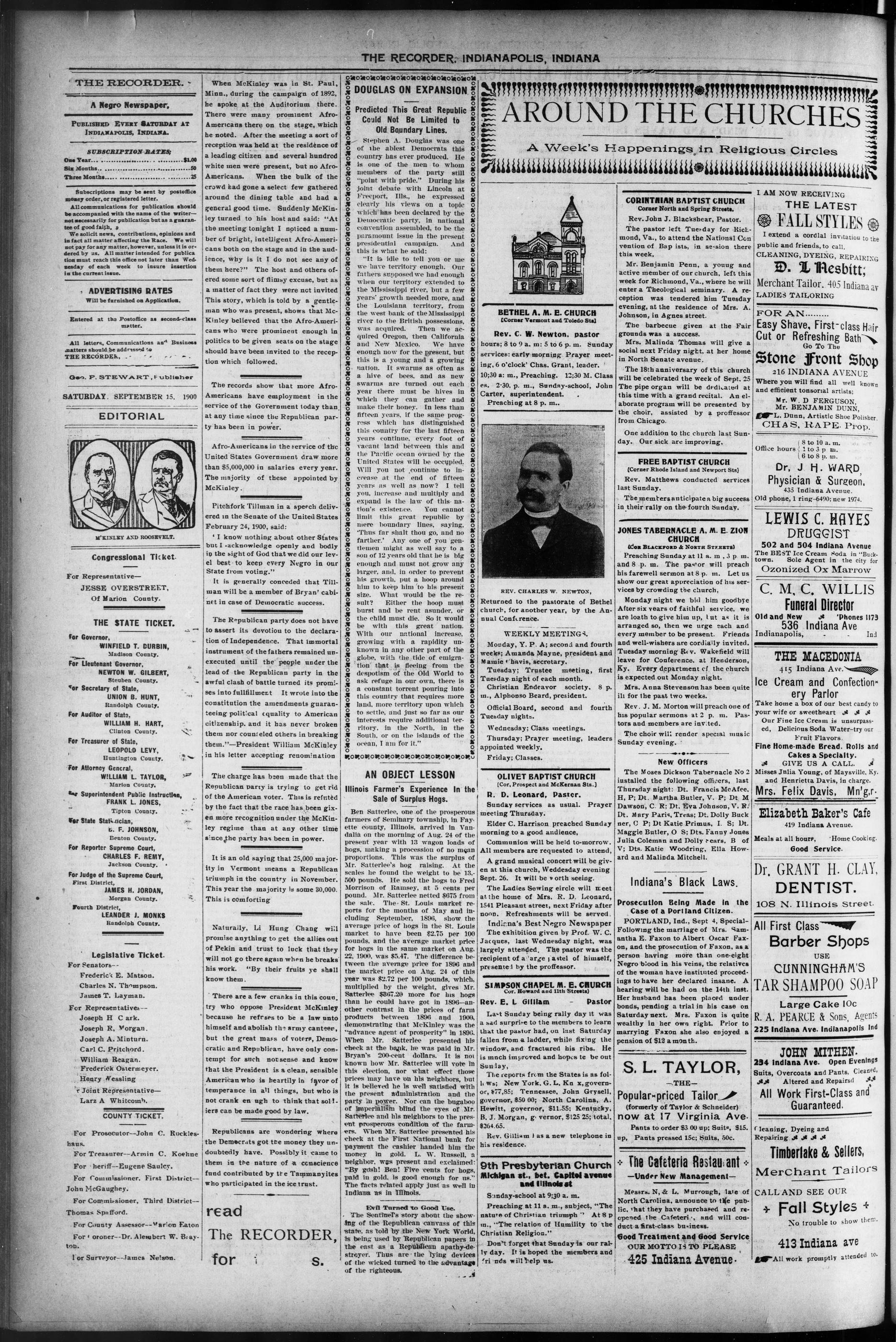
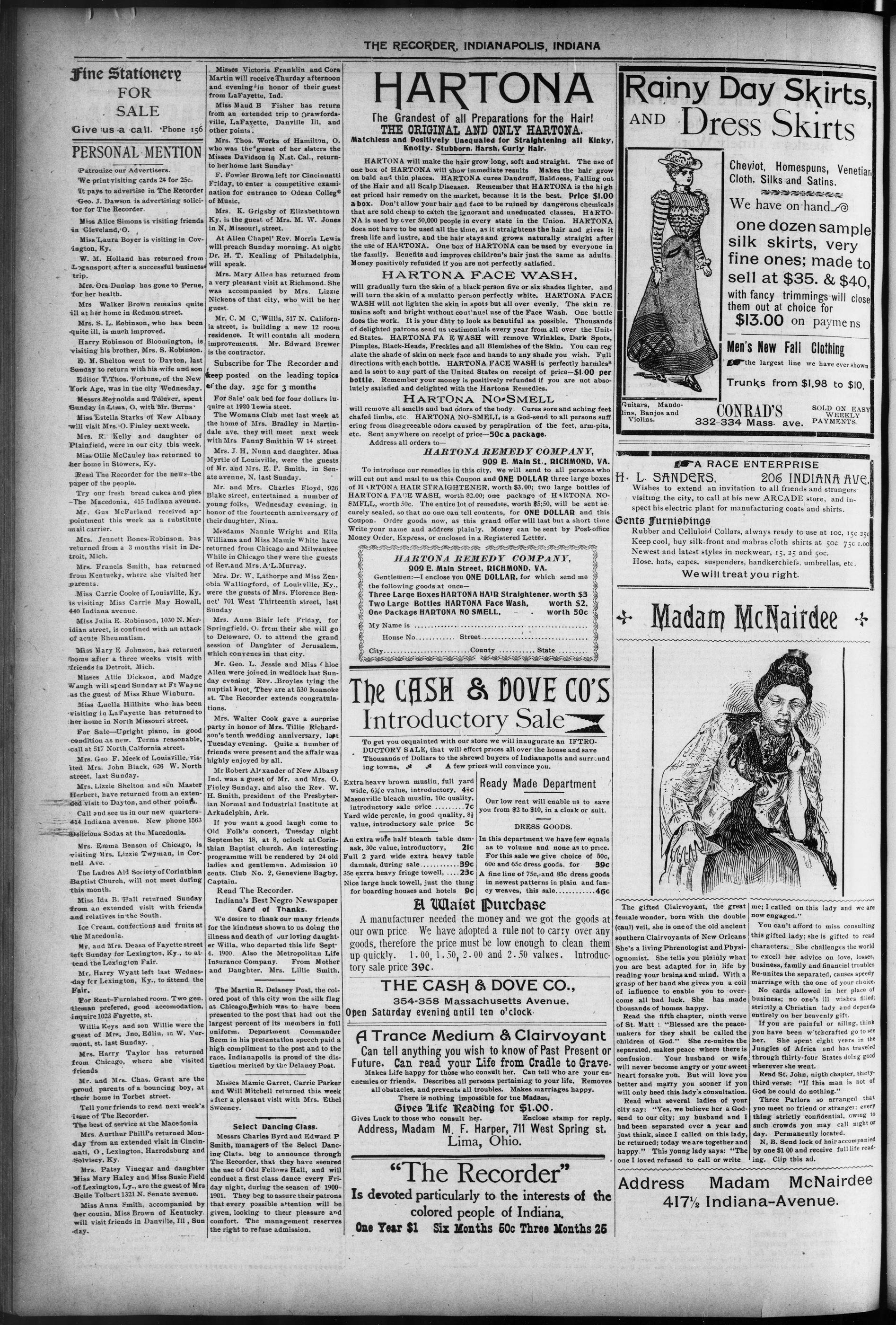
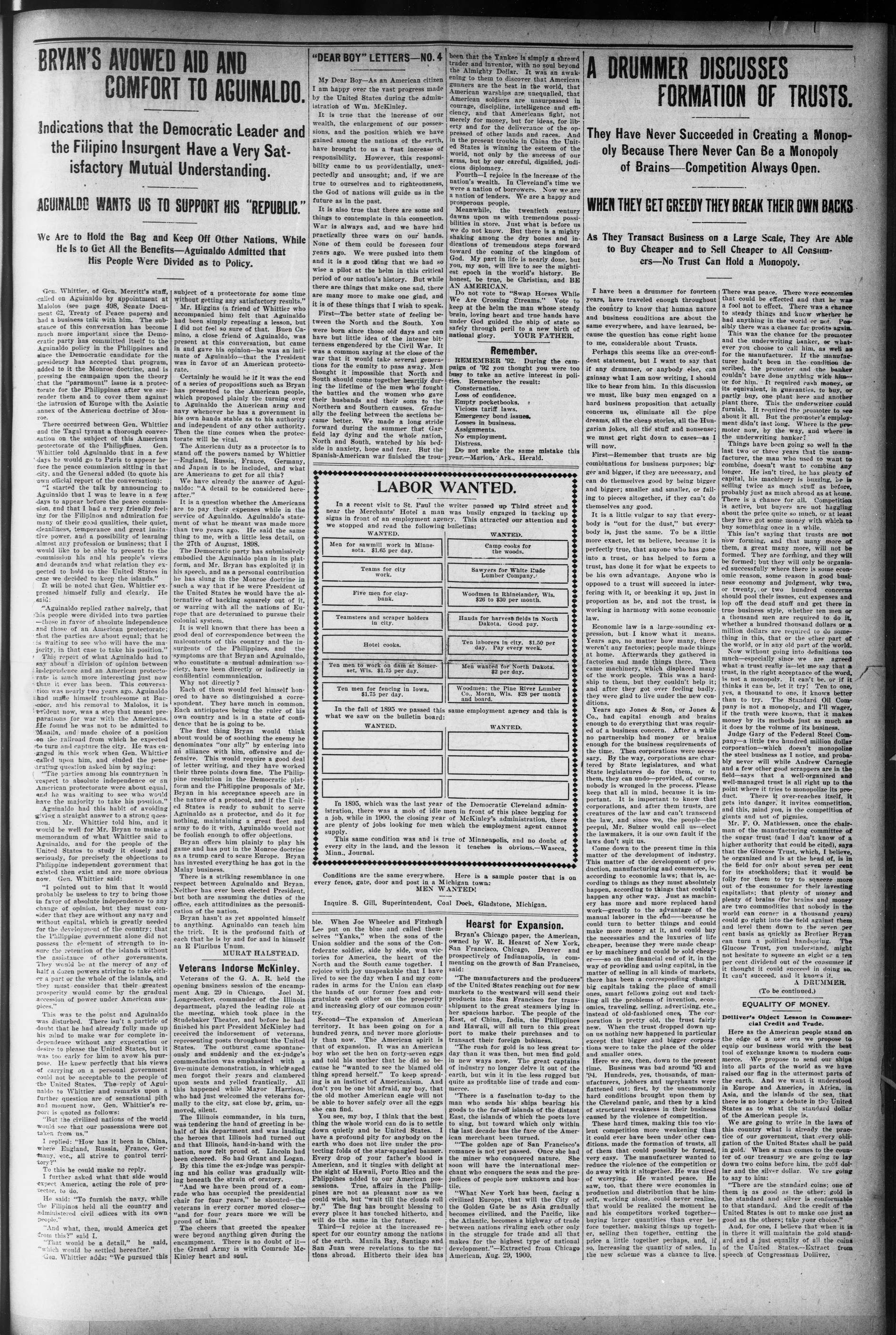
Page text (machine-generated)
The Recorder.
vol 5 No. 11
NEW YORK STORE
Established in 1853 Sole Agents Butterick Patterns.
Buy Blankets....
NOW, while assortment is BEST and the prices low. Our blankets are the kind that satisfy--as we buy and sell only the best, at prices within the reach of all.
Plain white cotton blankets, a pair, 10x4 white or tan ..... 53c
Cotton blankets, with fancy borders, a pair, 10x4 white or tan cotton ..... 59c
White or tan cotton blankets, the soft and fleecy kind, at ..... 75c
Other from $1.00 up to $8 and $10.00.
BASEMENT.
PETTIS DRY GOODS CO.
$2.00-Chicago and Return
Via the Lake Erie and Western and Lake Shore Roads.
Saturday Night, Sept. 22
Special train of sleepers, chair cars
and first-class coaches leaves Union
Station at 10:30 p. m. Secure berths
and chairs at once at city office, 28 S
Illinois street.
A Grand
Smoker
—Given by the---
Young Colored Mens Durbin Republican Club
Tuesday eve, Sept. 18 th.
At Odd Fellows Hall
Indiana Avenue.
GOOD SPEAKING AND MUSIC.
EVERYBODY INVITED.
Admission Free.
Thomas Sellers, president: John W.
Lewis, sec'y and treas.; Robert Wigg-
ings, sergeant-at-arms
Business Brevites.
Nicoll, the Tailor, has removed to 25 North Pennsylvania street. Their establishment is now one of the finest in the city.
George J. Marott, proprietor of the second largest shoe store in the World has on divers ocassions proven his friendship for the colored people, Mr Oscar Hightower, is the genial and efficient clerk in this great store.
P. Gramling & Son, 35 E., Washington st., are displaying their Fall line Fine suitings. They are enjoying a brisk trade.
Mr. Phil, Joseph has assumed charge of the Granger Store, in West Washington street. For real bargains, his ads., beat everything.
The Cash & Dove Co., 354 Massachusetts avenue, made their initial opening last Saturday. They report entire satisfaction, at the cordial treatment they received from the public. Their line is complete.
Timberlake & Sellers, the two little tailors, are adding some improvements to their establishment.
Miss Amelia Hines, has purchased the full interest in the Mendenhall-Hines Cafe.
H. L. Sanders, haberdasher is doing an exceptionally good business. His Fall display is a beauty.
Barbers will find in R. A. Pierce & Sons, soaps, a first-class article.
Colored saloon-keepers in this city have the reputation of conducting the finest bars in the country. Business is reported as flourishing.
As we have to "eat to live" the colored restaurant keepers, continue to smile.
Have you ever noticed that business firms who desire your patronage, as a rule, advertise in colored newspapers just as they do in the German or Jewish journals. Watch The Recorder.
H. P. Wasson's Busy Store, has added the annex to the West of their present store, in order to meet their growing trade. Improvements under contemplation, will give them the largest floor space in the State.
Mr. Don Smythe, the general "tad"
Subscribe for The
The Recorder.
A NEGRO NEWSPAPER DEVOTED TO THE BEST INTEREST OF THE COLORED PEOPLE OF INDIANA
man at the New York store, is so busy these days, attending to the wants of a large and growing constituent, that he scarcely has time to rest. He is sat isified that 'ads' in The Recorder, pull This store has a large number of colored employees. George J. Dawson, is looking after the advertising public for The Recorder. The Webb/jameson Co., have quite a large volume of business. Their latest contract is with the Indianapolis Gas Co., in which they will move a pumping station from Strawtown.
"Isn't a peculiar fact," says Dr. G. H. Clay, Dentist. "that colored merchants and professional men cannot depend on their own race for patronage The clannishness that predominates in some races, is entirely foreign to my people. Talk about drawing the color line" continued the Doctor "why my greatest opposition is from my own people." And the Recorder man could but admit the truthfullness of the statements. Dr. Clay reports a good business.
The F. H. Read Shoe Co., 42 West Washington street, are showing a fine line of goods. Give them a call.
Rescue, Riders Club' Formed.
A colored organization of first voters to be known as the Rescue Riders' Club was formed Wednesday night at a meeting hell on Ind. Ave, Speeches were made by Jas, Shelton, Jas. H. Lott'and Gurley Brewer. The club starts off with a membership of sixty two. Meetings will be held every Thursday evening. The following officers elected: President, Clarence Stewart; vice president, Joe. Timberlake: financial secretary, Fowler Brown: correspondent, Stewart Williams; treasurer Ed. Finley: sergeant-arms, Allie Mor, ton.
Obituary.
HARRIS
Mrs. Aurora Hurley Harris, daughter of Rev. Dr. R. F. Hurley pastor of Allen Chapel A. M. E. Church, died at 2 o'clock P. M. Wednesday at its family residence, corner Pratt and College the funeral services were conducted by Rev. C. W. Newton at Allen Chapel Friday at 2 o'clock P. M. Mrs. Harris has been quite ill in Detroit, Mich. the former station of Dr. Hurley since last June, on being stationed here she felt that a change to Indianapolis would improve her health. When she arrived she was hovering between life and death, she survived ten days or so and sauk consciously and peacefully to death. She leaves a darling little infant about six months old. Her Husband is manager of a large news paper route in Detroit, Mich. The family have the sympathy of the entire community.
DAVIS.
Mr. Felix Davis, a well known and respected citizen, died last Thursday afternoon at the Propagaudist club of which he was the genial and hospitable manager, Mr. Davis has had pulmonary complications for some time, and although the victim of a lingering illness, his death came as an unwelcome surprise He was born in Montgomery, Ala. March 15 1852, being 48 yrs. old at the time of his death. He was married in 1891 to his present wife Mrs. Belle Davis the well known Cateress. Mr. Davis has always been an energetic advocate of race enterprises and was a powerful exponent of what the American egro may achieve by honesty, industry and perseverance. For 25 yrs. he was a prominent contractor and only relinquished his business when his health began to fail him. He leaves a widow, one daughter, a step-son, a mother, two sisters, a brother and an innumerable host of friends to mourn his departure. The funeral obsequies will be held at the ninth, Presbyterian church Sunday afternoon at 2 o'clock. His body will lie in state, Sunday mornig, from 10 o'clock to 1 o'clock at the Propagaudist club.
Pertinent.
The eloquence of Democratic spellbinders on the subject of "imperialism" is likely to be much marred by coarse shouts of "How about North Carolina?"—Kansas City Journal.
Subscribe for The Recorder, one year $1
M. H.
CHARLE S N. ELIICTT.
Secretary of the Republican County Committee.
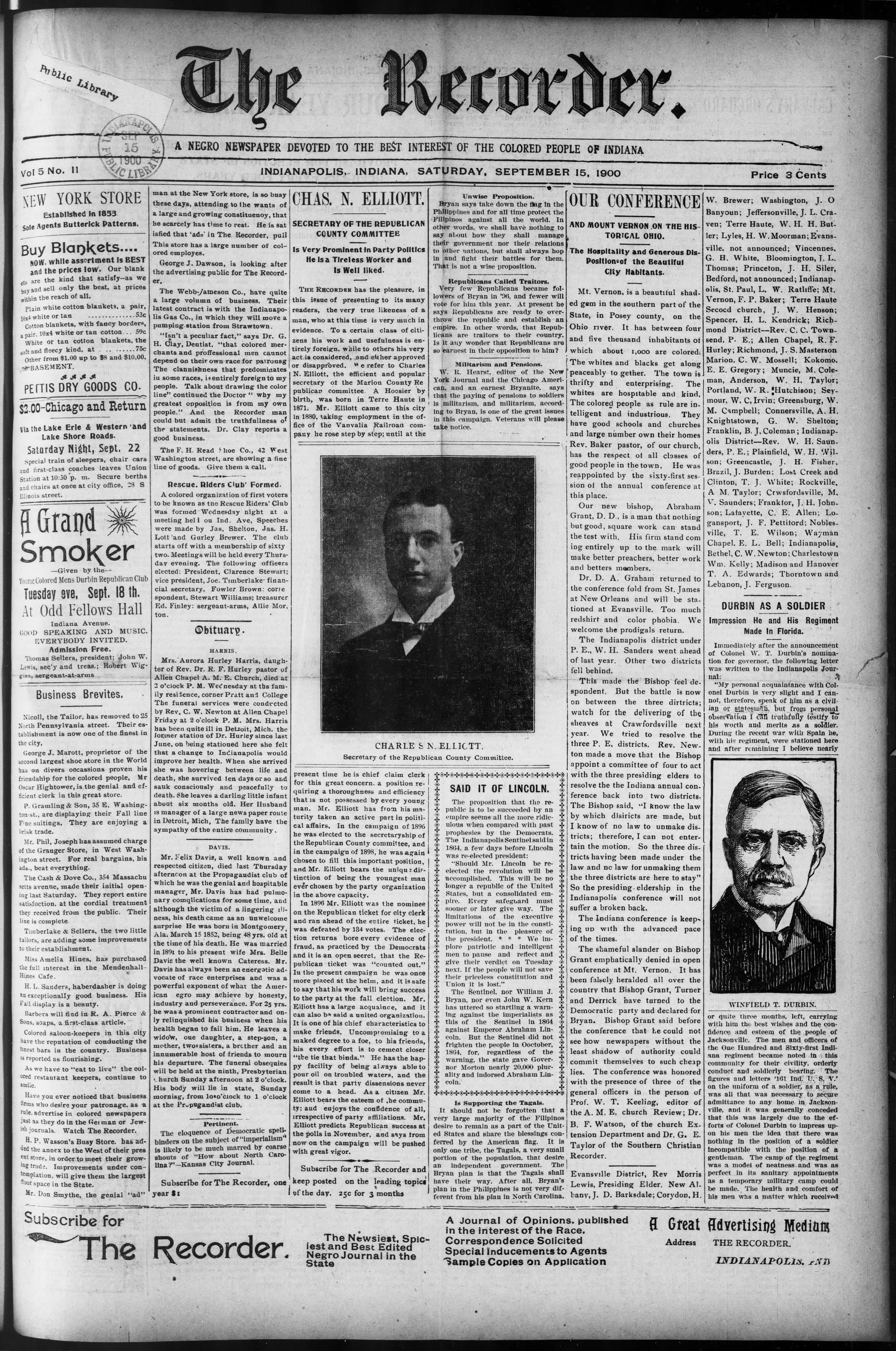
CHAS. N. ELLIOTT.
SECRETARY OF THE REPUBLICAN COUNTY COMMITTEE
Is Very Prominent in Party Politics
He Is a Tireless Worker and
Is Well liked.
THE RECORDER has the pleasure, in this issue of presenting to its many readers, the very true likeness of a man, who at this time is very much in evidence. To a certain class of citizens his work and usefulness is entirely foreign, while to others his very act is considered, and either approved or disapproved. We refer to Charles N. Elliott, the efficient and popular secretary of the Marion County Re publican committee. A Hoosier by birth, was born in Terre Haute in 1871. Mr. Elliott came to this city in 1880, taking employment in the office of the Vanvalia Railroan company he rose step by step; until at the
CHARLE S M
Secretary of the Republic
present time he is chief claim clerk for this great concern. a position requiring a thoroughness and efficiency that is not possessed by every young man, Mr. Elliott has from his maturity taken an active part in political affairs. In the campaign of 1896 he was elected to the secretaryship of the Republican County committee, and in the campaign of 1898, he was again chosen to fill this important position, and Mr. Elliott bears the unique distinction of being the youngest man ever chosen by the party organization in the above capacity.
In 1896 Mr. Elliott was the nominee on the Republican ticket for city clerk and ran ahead of the entire ticket, he was defeated by 134 votes. The election returns bore every evidence of fraud, as practiced by the Democrats and it is an open secret, that the Republican ticket was "counted out." In the present campaign he was once more placed at the helm, and it is safe to say that his work will bring success to the party at the fall election. Mr. Elliott has a large acquaince, and it can also be said a united organization. It is one of his chief characteristics to make friends. Uncompromising to a maked degree to a foe, to his friends, his every effort is to cement closer "the tie that binds." He has the happy facility of being always able to pour oil on troubled waters, and the result is that party dissensions never come to a head. As a citizen Mr. Elliott bears the esteem of, he commuity; and enjoys the confidence of all, irrespective of party affiliations. Mr. Elliott predicts Republican success at the polls in November, and says from now on the campaign will be pushed with great vigor.
Subscribe for The Recorder and keep posted on the leading topics of the day. 25c for 3 months
The Newsiest, Spiciest and Best Edited Negro Journal in the State
A Journal of Opinions. published in the interest of the Race. Correspondence Solicited Special Inducements to Agents Sample Copies on Application
Unwise Proposition.
Bryan says take down the flag in the Philippines and for all time protect the Filipinos against all the world. In other words, we shall have nothing to say about how they shall manage their government nor their relations to other nations, but shall always hop in and fight their battles for them. That is not a wise proposition.
Republicans Called Traitors.
Very few Republicans became followers of Bryan in '36, and fewer will vote for him this year. At present he says Republicans are ready to overthrow the republic and establish an empire. In other words, that Republicans are traitors to their country. Is it any wonder that Republicans are so earnest in their opposition to him?
Militarism and Pensions.
W. R. Hearst, editor of the New York Journal and the Chicago American, and an earnest Bryanite, says that the paying of pensions to soldiers is militarism, and militarism, according to Bryan, is one of the great issues in this campaign. Veterans will please take notice.
N. ELLICTT.
American County Committee.
SAID IT OF LINCOLN.
The proposition that the republic is to be succeeded by an empire seems all the more ridiculous when compared with past prophesies by the Democrats. The Indianapolis Sentinel said in 1864, a few days before Lincoln was re-elected president:
"Should Mr. Lincoln be re-elected the revolution will be accomplished. This will be no longer a republic of the United States, but a consolidated empire. Every safeguard must sooner or later give way. The limitations of the executive power will not be in the constitution, but in the pleasure of the president. * * * We implore patriotic and intelligent men to pause and reflect and give their verdict on Tuesday next. If the people will not save their priceless constitution and Union it is lost."
The Sentinel, nor William J. Bryan, nor even John W. Kern has uttered so startling a warning against the imperialists as this of the Sentinel in 1864 against Emperor Abraham Lincoln. But the Sentinel did not frighten the people in October, 1864, for, regardless of the warning, the state gave Governor Morton nearly 20,000 plurality and indorsed Abraham Lincoln.
Is Supporting the Tagals.
It should not be forgotten that a very large majority of the Filipinos desire to remain as a part of the United States and share the blessings conferred by the American flag. It is only one tribe, the Tagals, a very small portion of the population, that desire an independent government. The Bryan plan is that the Tagals shall have their way. After all, Bryan's plan in the Philippines is not very different from his plan in North Carolina.
A Journal of Opinion in the interest of the Rail Correspondence Solicits Special inducements to Sample Copies on App
OUR CONFERENCE
AND MOUNT VERNON ON THE HISTORICAL OHIO.
The Hospitality and Generous Dis-
Position of the Beautiful
City Habitants.
Mt. Vernon, is a beautiful shaded gem in the southern part of the State, in Posey county, on the Ohio river. It has between four and five theusand inhabitants of which about 1,000 are colored: The whites and blacks get along peaceably to gether. The town is thrifty and enterprising. The whites are hospitable and kind, The colored people as rule are intelligent and industrious. They have good schools and churches and large number own their homes Rev. Baker pastor, of our church, has the respect of all classes of good people in the town. He was reappointed by the sixty-first session of the annual conference at this place.
Our new bishop, Abraham Grant, D. D., is a man that nothing but good, square work can stand the test with. His firm stand coming entirely up to the mark will make better preachers, better work and betters members. Dr. D. A. Graham returned to the conference fold from St. James at New Orleans and will be stationed at Evansville. Too much redshirt and color phobia. We welcome the prodigals return. The Indianapolis district under P. E., W. H. Sanders went ahead of last year. Other two districts fell behind.
This made the Bishop feel despondent. But the battle is now on between the three dirctricts; watch for the delivering of the sheaves at Crawfordsville next year. We tried to resolve the three P. E. districts. Rev. Newton made a move that the Bishop appoint a committee of four to act with the three presiding elders to resolve the the Indiana annual conference back into two districts. The Bishop said, "I know the law by which dlsiricts are made, but I know of no law to unmake districts; therefore, I can not entertain the motion. So the three districts having been made under the law and no law for unmaking them the three districts are here to stay" So the presiding eldership in the Indianapolis conference will not suffer a broken back.
The Indiana conference is keeping up with the advanced pace of the times.
The shameful slander on Bishop Grant emphatically denied in open conference at Mt. Vernon. It has been falsely heralded all over the country that Bishop Grant, Turner and Derrick have turned to the Democratic party and declared for Bryan. Bishop Grant said before the conference that he could not see how newspapers without the least shadow of authority could commit themselves to such cheap lies. The conference was honored with the presence of three of the general officers in the person of Prof. W. T. Keeling, editor of the A. M. E. church Review; Dr. B. F. Watson, of the church Extension Department and Dr. G. E. Taylor of the Southern Christian Recorder.
Evansville District, Rev Morris Lewis, Presiding Elder. New Albany, J. D. Barksdale; Corydon, H.
Price 3 Cents
W. Brewer; Washington, J. O Banyoun; Jeffersonville, J. L. Craven; Terre Haute, W. H. H. Butler; Lyles, H. W. Moorman; Evansville, not announced; Vinceennes, G. H. White, Bloomington, J. L. Thomas; Princeton, J. H. Siler, Bedford, not announced; Indianapolis, St. Paul, L. W. Rattliffe; M. Vernon, F. P. Baker; Terre Haute Seccod church, J. W. Henson; Spencer, H. L. Kendrick; Richmond District—Rev. C. C. Townsend, P. E.; Allen Chapel, R. F. Hurley; Richmond, J. S. Masterson Marion. C. W. Mossell; Kokomo, E. E. Gregory; Muncie, M. Coleman, Anderson, W. W. Taylor; Portland, W. R. Hutchison; Seymour, W. C, Irvin; Greensburg, W. M. Campbell; Connersville, A. H. Knightstown, G. W. Shelton; Franklin, B. J. Coleman; Indianapolis District—Rev. W. H. Saunders, P. E.; Plainfield, W. H. Wilson; Greencastle, J. H. Fisher, Brazil, J. Burden; Lost Creek and Clinton, T. J. White; Rockville, A. M. Taylor; Crusfsordville, M. V. Saunders; Franktor, J. H. Johnson; Lafayette, C. E. Allen; Logansport, J. F. Pettitord; Noblesville, T. E. Wilson; Wayman Chapel, E. L. Bell; Indianapolis, Bethel, C. W. Newton; Charlestown Wm. Kelly; Madison and Hanover T. A. Edwards; Thorntown and Lebanon, J. Ferguson.
DURBIN AS A SOLDIER
Impression He and His Regiment
Immediately after the announcement of Colonel W. T. Durbin's nomination for governor, the following letter was written to the Indianapolis Journal:
"My personal acquaintance with Colonel Durbin is very slight and I cannot, therefore, speak of him as a civilian or stateman, but from personal observation I can truthfully testify to his worth and merits as a soldier. During the recent war with Spain he, with his regiment, were stationed here and after remaining I believe nearly
W. H.
WINFIELD T. DURBIN.
or quite three months, left, carrying with him the best wishes and the confidence and esteem of the people of Jacksonville. The men and officers of the One Hundred and Sixty-first Indiana regiment became noted in this community for their civility, orderly conduct and soldierly bearing. The figures and letters '161 Ind. U. S. V. on the uniform of a soldier, as a rule, was all that was necessary to secure admittance to any home in Jacksonville, and it was generally conceded that this was largely due to the efforts of Colonel Durbin to impress upon his men the idea that there was nothing in the position of a soldier incompatible with the position of a gentleman. The camp of the regiment was a model of neatness, and was as perfect in its sanitary appointments as a temporary military camp could be made. The health and comfort of his men was a matter which received
INDIANAPOLIS, ND
Work of Preparing It for the War with Spain.
Credit Should Be Given to Those Who Administer Its Affairs—Difficulty of Buying and Equipping Auxiliary Vessels — Doubling the Force of Sallora.
Under the present administration the navy has shown itself worthy of its best traditions. The great victories at Manila Bay and Santiago were in no sense accidents. They were the results of years of careful training of officers and men and the thorough preparation of the fleets for the crucial test of war. For this preparation, this readiness to meet the supreme moment for which a navy is constructed and maintained, those who administer the affairs of the navy should have credit. The glory goes to our heroes who are in command afloat, and to those officers and men who seize the opportunities of war to render conspicuous service; but in remembering them one should not forget those who labor without ceasing to secure the fleet in a condition of high efficiency, and to place at the disposal of the commanding officers an abundance of supplies, without which the fleet is powerless.
As early as Jan. 11, 1898, more than a month before the Maine was destroyed in the harbor of Havana, the Secretary of the Navy began to mobilize the ships of the navy and to take such measures as would place at the disposal of the officers in command the full measure of our naval force.
Immediately upon the passage of the bill appropriating $50,000,000 for the national defense, a board was organized for the purchase of auxiliary ships, and after careful examination 102 ships of various types were secured at a total cost of $17,936,850. Of these vessels but two, the New Orleans and the Albany, were stricly vessels of war. The others were merchant ships, pleasure yachts, tugs, etc., which were rapidly overhaulened at the different navy yards provided with such light armor protection as was practical, and suitably armed.
Between March 16 and June 30 all these vessels were purchased and as rapidly as overhauled were placed in commission and put into active service. They were used not only as auxiliary war vessels, but to supply the fleets with coal and ammunition and with fresh water and fresh provisions. For the care of the sick and wounded the Solace was fitted out as a complete hospital, and to make repairs to vessels at sea the Vulcan was fitted out as a modern machine shop. In order to meet the increased demands on the navy yards, it was necessary to practically double the force between Feb. 15 and the middle of April.
In addition to the ships which were added to the navy by purchase, fifteen revenue cutters and four lighthouse tenders were transferred from the Treasury Department to the navy, and four of the great steamers of the International Navigation Company and one of the Pacific Mail Steamship Company were chartered. There were in all 128 ships added to the regular naval establishment, and it became at once necessary to provide officers and men to man them. For this purpose 225 officers on the retired list were ordered to active duty, 856 officers were appointed for temporary service, and the enlisted force was increased from 12,500 to over 42,000 men.
It was an enormous undertaking to make all these additional ships ready for war service, to secure the necessary guns for them, and to keep the fleets supplied with coal, ammunition and provisions. But this was only a part of the work which the Navy Department had in hand. For the protection of the coasts of the United States an auxiliary naval force was created, which was offered and manned by the naval militia of the United States. A coast signal service was established, which kept practically our entire coast line from Maine to Texas under observation, to give warning of the approach of an enemy's vessel or of suspicious craft of any kind.
The operations of the fleets of the Asiatic and North Atlantic squadrons are so well known that it is hardly necessary to speak of them in any detail. Their work was so well done that the power of Spain was swept from the sea, and Cuba, Porto Rico and the Philippines, which she had misgoverned for centuries, were taken from under her dominion.
How We Have Grown.
HOW WE HAVE GROWN.
OUR FOREIGN TRADE.
Fiscal year. Amount.
1900 $2,220,190,828
1896 1,062,331,612
Increase under McKin-
ley administration $557,859,216
WAGE-EARNERS EMPLOYED.
Fiscal year. Number.
1900 7,500,000
1896 5,300,000
Increase under McKinley
administration 2,200,000
WAGES PAID.
Fiscal year. Amount.
1900 $3,125,750,000
1896 2,005,750,183
ley administration . . . $ 119,989,817
Five years ago when $7,200,000 in gold left New York in one day for Europe it nearly started a panic, and extraordinary efforts had to be made to offset it. Now, New York bankers offer England $25,000,000 as a gold loan, and are prepared to lend money to Russia and Sweden, and the announcement causes only a smile of complacency.
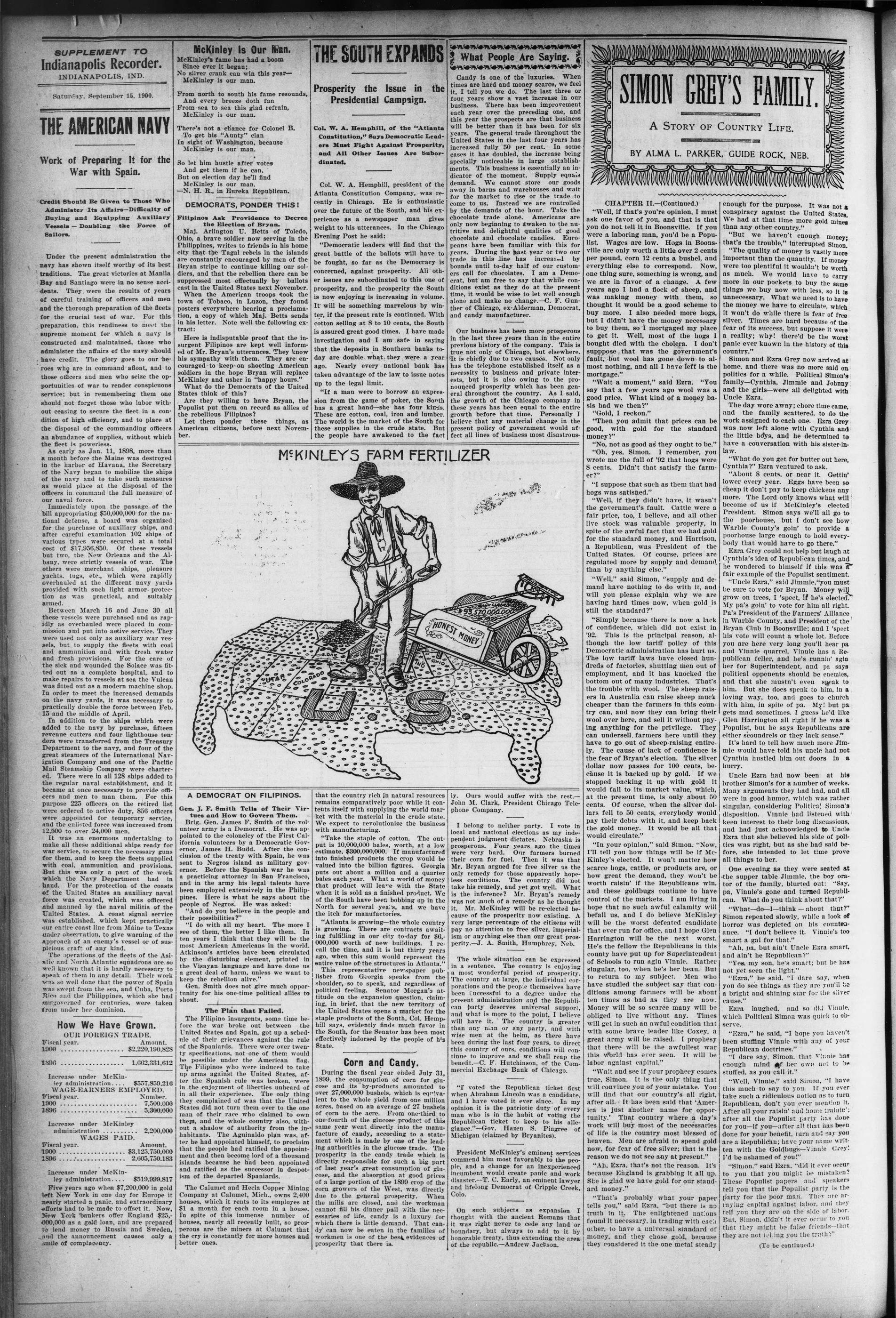
M'KINLEYS FARM FERTILIZER
HONEST MONEY
UTAH
COLORADO
U.S.
McKinley Is Our Man.
McKinley's fame has had a boom
Since ever it began;
No silver crank can win this year—
McKinley is our man.
From north to south his fame resounds,
And every breeze doth fan
From sea to sea this glad refrain,
McKinley is our man.
There's not a chance for Colonel B.
To get his "Aunty" clan
In sight of Washington, because McKinley is our man.
So let him hustle after votes And get them if he can.
But on election day he'll find McKinley is our man.
-N. H. R., in Eureka Republican.
DEMOCRATS, PONDER THIS!
Filipinos Ask Providence to Decree the Election of Bryan.
the election of Bryan.
Maj. Arlington U. Betts of Toledo, Ohio, a brave soldier now serving in the Philippines, writes to friends in his home city that the Tagal rebels in the islands are constantly encouraged by men of the Bryan stripe to continue killing our soldiers, and that the rebellion there can be suppressed most effectually by ballots cast in the United States next November.
When the American troops took the town of Tobaco, in Luzon, they found posters everywhere bearing a proclamation, a copy of which Maj. Betts sends in his letter. Note well the following extract:
Here is indisputable proof that the insurgent Filipinos are kept well informed of Mr. Bryan's utterances. They know his sympathy with them. They are encouraged to keep on shooting American soldiers in the hope Bryan will replace McKinley and usher in "happy hours."
What do the Democrats of the United
What do the Democrats of the United States think of this?
Are they willing to have Bryan, the Populist put them on record as allies of the rebellious Filipinos? Let them ponder these things, as American citizens, before next November.
MCKINNEY
SUTAN
COLLO
A DEMOCRAT ON FILIPINOS.
Gen. J. F. Smith Tella of Their Virtues and How to Govern Them.
Brig. Gen. James F. Smith of the volunteer army is a Democrat. He was appointed to the colonycy of the First California volunteers by a Democratic Governor, James H. Budd. After the conclusion of the treaty with Spain, he was sent to Negros island as military governor. Before the Spanish war he was a practicing attorney in San Francisco, and in the army his legal talents have been employed extensively in the Philippines. Here is what he says about the people of Negros. He was asked:
"And do you believe in the people and their possibilities?"
"I do with all my heart. The more I see of them, the better I like them. In ten years I think that they will be the most American Americans in the world. Attkinson's articles have been circulated by the disturbing element, printed in the Visayan language and have done us a great deal of harm, unless we want to keep the rebellion alive."
Gen. Smith does not give much opportunity for his one-time political allies to shout.
The Plan that Failed.
The Filipino insurgents, some time before the war broke out between the United States and Spain, got up a schedule of their grievances against the rule of the Spaniards. There were over twenty specifications, not one of them would be possible under the American flag. The Filipinos who were induced to take up arms against the United States, after the Spanish rule was broken, were in the enjoyment of liberties unheard of in all their experience. The only thing they complained of was that the United States did not turn them over to the one man of their race who claimed to own them, and the whole country also, without a shadow of authority from the inhabitants. The Aguinaldo plan was, after he had appointed himself, to proclaim that the people had ratified the appointment and then become lord of a thousand islands because he had been appointed and ratified as the successor in despotism of the departed Spaniards.
The Calumet and Hecla Copper Mining Company at Calumet, Mich., owns 2,400 houses, which it rents to its employees at $1 a month for each room in a house. In spite of this immense number of houses, nearly all recently built, so prosperous are the miners at Calumet that the cry is constantly for more houses and better ones.
Prosperity the Issue in the Presidential Campaign.
Col. W. A. Hemphill, of the "Atlanta Constitution," Says Democratic Leaders Must Fight Against Prosperity, and All Other Issues Are Subordinated.
Col. W. A. Hemphill, president of the Atlanta Constitution Company, was recently in Chicago. He is enthusiastic over the future of the South, and his experience as a newspaper man gives weight to his utterances. In the Chicago Evening Post he said:
"Democratic leaders will find that the great battle of the ballots will have to be fought, so far as the Democracy is concerned, against prosperity. All other issues are subordinated to this one of prosperity, and the prosperity the South is now enjoying is increasing in volume. It will be something marvelous by winter, if the present rate is continued. With cotton selling at 8 to 10 cents, the South is assured great good times. I have made investigation and I am safe in saying that the deposits in Southern banks today are double, what they were a year ago. Nearly every national bank has taken advantage of the law to issue notes up to the legal limit.
"If a man were to borrow an expression from the game of poker, the South has a great hand—she has four kills. These are cotton, coal, iron and lumber. The world is the market of the South for these supplies in the crude state. But the people have awakened to the fact
NLEYS FARM FERTI
that the country rich in natural resources remains comparatively poor while it contents itself with supplying the world market with the material in the crude state. We expect to revolutionize the business with manufacturing.
"Take the staple of cotton. The output is 10,000,000 bales, worth, at a low estimate, $200,000,000. If manufactured into finished products the crop would be valued into the billion figures. Georgia puts out about a million and a quarter bales each year. What a world of money that product will leave with the State when it is sold as a finished product. We of the South have been bobbing up in the North for several years, and we have the itch for manufactories.
"Atlanta is growing—the whole country is growing. There are contracts awaiting fulfilling in our city to-day for $6,000,000 worth of new buildings. I recall the time, and it is but thirty years ago, when this sum would represent the entire value of the structures in Atlanta."
This representative newspaper publisher from Georgia speaks from the shoulder, so to speak, and regardless of political feeling. Senator Morgan's attitude on the expansion question, claiming, in brief, that the new territory of the United States opens a market for the staple products of the South, Col. Hemphill says, evidently finds much favor in the South, for the Senator has been most effectively indorsed by the people of his State.
Corn and Candy.
During the fiscal year ended July 31, 1890, the consumption of corn for glucose and its by-products amounted to over 27,000,000 bushels, which is equivalent to the whole yield from one million acres, based on an average of 27 bushels of corn to the acre. From one-third to one-fourth of the glucose product of this same year went directly into the manufacture of candy, according to a statement which is made by one of the leading authorities in the glucose trade. The prosperity in the candy trade which is directly responsible for such a big part of last year's great consumption of glucose, and the absorption at good prices of a large portion of the 1890 crop of the corn growers of the West, was directly due to the general prosperity. When the mills are closed, and the workman cannot fill his dinner pail with the necessaries of life, candy is a luxury for which there is little demand. That candy can now be eaten in the families of workmen is one of the best evidences of prosperity that there is.
---
What People Are Saying.
Candy is one of the luxuries. When times are hard and money scarce, we feel it, I tell you we do. The last three or four years show a vast increase in our business. There has been improvement each year over the preceding one, and this year the prospects are that business will be better than it has been for six years. The general trade throughout the United States in the last four years has increased fully 50 per cent. In some cases it has doubled, the increase being specially noticeable in large establishments. This business is essentially an indicator of the moment. Supply equals demand. We cannot store our goods away in barns and warehouses and wait for the market to rise or the trade to come to us. Instead we are controlled by the demands of the hour. Take the chocolate trade alone. Americans are only now beginning to awaken to the nutritive and delightful qualities of good chocolate and chocolate candies. Europeans have been familiar with this for years. During the last year or two our trade in this line has increased by bounds until to-day half of our customers call for chocolates. I am a Democrat, but am free to say that while conditions exist as they do at the present time, it would be wise to let well enough alone and make no change. C. F. Gunther of Chicago, ex-Alderman, Democrat, and candy manufacturer.
Our business has been more prosperous in the last three years than in the entire previous history of the company. This is true not only of Chicago, but elsewhere. It is chiefly due to two causes. Not only has the telephone established itself as a necessity to business and private interests, but it is also owing to the pronounced prosperity which has been general throughout the country. As I said, the growth of the Chicago company in these years has been equal to the entire growth before that time. Personally I believe that any material change in the present policy of government would affect all lines of business most disastrous-
LIZER
93 520 000 000
BEST MONEY
ly. Ours would suffer with the rest.—John M. Clark, President Chicago Telephone Company.
I belong to neither party. I vote in local and national elections as my independent judgment dictates. Nebraska is prosperous. Four years ago the times were very hard. Our farmers burned their corn for fuel. Then it was that Mr. Bryan argued for free silver as the only remedy for those apparently hopeless conditions. The country did not take his remedy, and yet got well. What is the inference? Mr. Bryan's remedy was not much of a remedy as he thought it. Mr. McKinley will be re-elected because of the prosperity now existing. A very large percentage of the citizens will pay no attention to free silver, imperialism or anything else than our great prosperity.—J. A. Smith, Humphrey, Neb.
The whole situation can be expressed in a sentence. The country is enjoying a most wonderful period of prosperity. The country at large, the individual corporations and the people themselves have been successful to a degree under the present administration and the Republican party deserves universal support, and what is more to the point, I believe will have it. The country is greater than any man or any party, and with wise men at the helm, as there have been during the last four years, to direct this country of ours, conditions will continue to improve and we shall reap the benefit.—C. F. Hutchinson, of the Commercial Exchange Bank of Chicago.
"I voted the Republican ticket first when Abraham Lincoln was a candidate, and I have voted it ever since. In my opinion it is the patriotic duty of every man who is in the habit of voting the Republican ticket to keep to his allegiance."—Gov. Hazen S. Pingree of Michigan (claimed by Bryanites).
---
President McKinley's eminent services commend him most favorably to the people, and a change for an inexperienced incumbent would create panic and work disaster.—T. C. Early, an eminent lawyer and lifelong Democrat of Cripple Creek, Colo.
On such subjects as expansion I thought with the ancient Romans that it was right never to cede any land or boundary, but always to add to it by honorable treaty, thus extending the area of the republic.—Andrew Jackson.
SIMON GREY'S FAMILY.
---
"Well, if that's you're opinion, I must ask one favor of you, and that is that you do not tell it in Boonsville. If you were a laboring man, you'd be a Populist. Wages are low. Hogs in Boonsville are only worth a little over 2 cents per pound, corn 12 cents a bushel, and everything else to correspond. Now, one thing seems, something is wrong, and we are in favor of a change. A few years ago I had a flock of sheep, and was making money with them, so thought it would be a good scheme to buy more. I also needed more hogs, but I didn't have the money necessary to buy them, so I mortgaged my place to get it. Well, most of the hogs I bought died with the cholera. I don't suppose that was the government's fault, but wool has gone down to almost nothing, and all I have left is the mortgage."
"Wait a moment," said Ezra. "You say that a few years ago wool was a good price. What kind of a money basis had we then?" "Gold, I reckon." "Then you admit that prices can be good, with gold for the standard money?" "No, not as good as they ought to be." "Oh, yes, Simon. I remember, you wrote me the fall of '92 that hogs were 8 cents. Didn't that satisfy the farmer?" "I suppose that such as them that had hogs was satisfied."
"Well, if they didn't have, it wasn't the government's fault. Cattle were a fair price, too, I believe, and all other live stock was valuable property, in spite of the awful fact that we had gold for the standard money, and Harrison, a Republican, was President of the United States. Of course, prices are regulated more by supply and demand than by anything else."
"Well," said Simon, "supply and demand have nothing to do with it, and will you please explain why we are having hard times now, when gold is still the standard?"
"Simply because there is now a lack of confidence, which did not exist in '92. This is the principal reason, although the low tariff policy of this Democratic administration has hurt us. The low tariff laws have closed hundreds of factories, shutting men out of employment, and it has knocked the bottom out of many industries. That's the trouble with wool. The sheep raisers in Australia can raise sheep muck cheaper than the farmers in this country can, and now they can bring their wool over here, and sell it without paying anything for the privilege. They can undersell farmers here until they have to go out of sheep-raising entirely. The cause of lack of confidence is the fear of Bryan's election. The silver dollar now passes for 100 cents, because it is backed up by gold. If we stopped backing it up with gold it would fall to its market value, which, at the present time, is only about 50 cents. Of course, when the silver dollars fell to 50 cents, everybody would pay their debts with it, and keep back the gold money. It would be all that would circulate."
"In your opinion," said Simon. "Now, I'll tell you how things will be if McKinley's elected. It won't matter how scarce hogs, cattle, or products are, or how great the demand, they won't be worth raisin' if the Republicans win, and these goldbugs continue to have control of the markets. I am living in hope that no such awful calamity will befall us, and I do believe McKinley will be the worst defeated candidate that ever run for office, and I hope Glen Harrington will be the next worst. He's the fellow the Republicans in this county have put up for Superintendent of Schools to run again Vinnie. Rather singular, too, when he's her bean. But to return to my subject. Men who have studied the subject say that conditions among farmers will be about ten times as bad as they are now. Money will be so scarce many will be obliged to live without any. Times will get in such an awful condition that with some brave leader like Coxey, a great army will be raised. I prophesy that there will be the awful war this world has ever seen. It will be labor against capital."
"Wait and see if your prophecy comes true, Simon. It is the only thing that will convince you of your mistake. You will find that our country's all right, after all. It has been said that 'America is just another name for opportunity.' That country where a day's work will buy most of the necessaries of life is the country most blessed of heaven. Men are afraid to spend gold now, for fear of free silver; that is the reason we do not see any at present."
"Ah, Ezra, that's not the reason. It's because England is grabbing it all up. She is glad we have gold for our standard money."
"That's probably what your paper tells you," said Ezra, "but there is no truth in it. The enlightened nations found it necessary, in trading with each other, to have a universal standard of money, and they chose gold, because they considered it the one metal steady
enough for the purpose. It was not a conspiracy against the United States. We had at that time more gold mines than any other country." "But we haven't enough money; that's the trouble," interrupted Singer.
that's the trouble, interrupted Simon.
"The quality of money is vastly more important than the quantity. If money were too plentiful it wouldn't be worth as much. We would have to carry more in our pockets to buy the same things we buy now with less, so it is unnecessary. What we need is to have the money we have to circulate, which it won't do while there is fear of free silver. Times are hard because of the fear of its success, but suppose it were a reality; why! there'd be the worst panic ever known in the history of this country."
Simon and Ezra Grey now arrived at home, and there was no more said on politics for a while. Political Simon's family—Cynthia, Jimmie and Johnny and the girls—were all delighted with Uncle Ezra.
The day wore away; chore time came, and the family scattered, to do the work assigned to each one. Ezra Grey was now left alone with Cynthia and the little boys, and he determined to have a conversation with his sister-in-law.
"What do you get for butter out here, Cynthia?" Ezra ventured to ask.
"About 8 cents, or near it. Gettin' lower every year. Eggs have been so cheap it don't pay to keep chickens any more. The Lord only knows what will become of us if McKinley's elected President. Simon says we'll all go to the poorhouse, but I don't see how Warble County's gain" to provide a poorhouse large enough to hold everybody that would have to go there."
Ezra Grey could not help but laugh at Cyndha's idea of Republican times, and he wondered to himself if this was a fair example of the Populist sentiment. "Uncle Ezra," said Jimmie, "you must be sure to vote for Bryan. Money will grow on trees, I 'spect, if he's elected. My pa's goin' to vote for him all right. Pa's President of the Farmers' Alliance in Warble County, and President of the Bryan Club in Boonsville; and I 'spect his vote will count a whole lot. Before you are here very long you'll hear pa and Vinnie quarrel, Vinnie has a Republican feller, and he's runnin' again her for Superintendent, and pa says political opponents should be enemies, and that she mustn't even speak to him. But she does speak to him, in a loving way, too, and goes to church with him, in spite of pa. My! but pa gets mud sometimes. I guess he'd like Glen Harrington all right if he was a Populist, but he says Republicans are either scoundrels or they lack sense."
It's hard to tell how much more Jimmie would have told his uncle had not Cynthia hustled him out doors in a hurry.
Uncle Ezra had now been at his brother Simon's for a number of weeks. Many arguments they had had, and all were in good humor, which was rather singular, considering Political! Simon's disposition. Vinnie had listened with keen interest to their long discussions, and had just acknowledged to Uncle Ezra that she believed his side of politics was right, but as she had said before, she intended to let time prove all things to her.
One evening as they were seated at the supper table Jimmie, the boy orator of the family, blurted out: "Say, pa, Vinnie's gone and turned Republican. What do you think about that?"
"What--do I--think --about that?"
Simon repeated slowly, while a look of horror was deplored on his counterance. "I don't believe it. Vinnie's too smart a gal for that."
"Ah, pa, but ain't Uncle Ezra smart, and ain't he Republican?"
"Yes, my son, he's smart; but he has not yet seen the light."
"Ezra," he said. "I dare say, when you do see things as they are you'll be a bright and shining star for the silver cause."
Ezra laughed, and so did Vinnie, which Political Simon was quick to observe.
"Ezra," he said, "I hope you haven't been stuffing Vinnie with any of your Republican doctrines."
"I dare say, Simon, that Vinnie has enough mind of her own not to be stuffed, as you call it."
"Well, Vinnie," said Simon, "I have this much to say to you. If you ever take such a ridiculous notion as to turn Republican, don't you ever mention it. After all your raisin' and home graftu'? after all the Populist party has done for you—if you—after all that has been done for your benefit, turn and say you are a Republican; have your name written with the Goldbugs—Vinnie Grey! I'd be ashamed of you."
"Simon," said Ezra, "did it ever occur to you that you might be mistaken? These Populist papers and speakers tell you that the Populist party is the party for the poor man. They are arraying capital against labor, and they tell you they are on the side of labor. But, Simon, didn't it ever occur to you that they might be false friends—that they are not telling you the truth?"
(To be continued.)
CALVARY'S ORCHARD
THE THREE CROSSES ON THAT
FAMOUS MOUNT.
Ennity of the Natural Heart to Christ Typified by the Unrepentant Male-factor—Dr. Talmage's
The famous paintings in the picture galleries of Munich seem to have suggested the topic of this discourse, which Dr. Talmage sends from the quint Bavarian town. The text is Luke xxiii, 33. "There they crucified him and the malefactors, one on the right hand and the other on the left." Three crosses in a row—an upright piece and two transverse pieces, one on the top, on which the hands are nalled, and one at the middle, on which the victim sat. Three trees just planted, yet bearing fruit—the one at the right bearing poison and the one at the left bitter aloes, the one in the middle apples of love. Norway pine and tropical orange and Lebanon cedar would not make so strange a grove as this orchard of Calvary. Stand and give a look at the three crosses.
Just look at the cross on the right. Its victim dies scoffing. More awful than his physical anguish is his scorn and hatred of him on the middle cross. This wretched man turns half around on the spikes to hiss at the One in the middle. If the scoffer could get one hand loose and he were within reach, he would smite the middle sufferer in the face. He hates him with a perfect hatred. I think he wishes he were down on the ground that he might spear him. He envies the mechanics who with their nails have nailed him fast. Amid the settling darkness and louder than the crash of the rocks hear him jeer out these words: "Ah, you poor wretch! I knew you were an impostor! You pretended to be a God, and yet you let these legions master won!" It was in some such hate that Voltaire in his death hour, because he thought he saw Christ in his bedroom, got up on his elbow and cried out, "Crush that wretch!" What had the middle cross done to arouse up this right hand cross? Nothing, Oh, the enmity of the natural heart against Christ! The world likes a sentimental Christ or a philanthropic Christ, but a Christ who comes to snatch men away from their sins—away with him! On his right hand cross to-day I see typified the unbelief of the world. Men say: "Back with him from the heart! I will not let him take my sins. If he will die, let him die for himself, not for me." There has always been a war between this right hand cross and the middle cross, and wherever there is an unbelieving heart there the fight goes on. Oh, if that dying malefactor perished the faithlessness of man had perished, then that tree which yields poison would have budded and blossomed with life for all the world!
Away, then, from this right hand cross. The red berries of the forest are apt to be poisonous and around this tree of carnage grow the red, poisonous berries of which many have tasted and died. I can see no use for this right hand cross, except it be used as a lever with which to upturn the unbelief of the world.
Here from the right hand cross I go to the left hand cross. Pass clear to the other side. That victim also twists himself upon the nails to look at the center cross, yet not to scoff. It is to worship. He, too, would like to get his hand loose, not to smite, but to deliver the sufferer of the middle cross. He cries to the railler cursing on the other side: "Silence! Between us is innocence in agony. We suffer for our crimes. Silence!" Gather round this left hand cross. O ye people! Be not afraid. Bitter herbs are sometimes a tonic for the body, and the bitter aloes that grow on this tree shall give strength and life to thy soul. This left hand cross is a repenting cross. As men who have been nearly drowned tell us that in one moment, while they were under the water, their whole life passed before them, so I suppose in one moment the dying malefactor thought over all his past life—of that night when he went into an unguarded door and took all the silver, the gold, the jewels, and as the sleeper stirred he put a knife through his heart; of that day when, in the lonely pass, he met the wayfarer, and, regardless of the cries and prayers and tears and struggles of his victim, he flung the mangled corpse into the dust of the highway or heaped upon it the stones.
He says: "I am a guilty wretch. I deserve this. There is no need of my ensuing. That will not stop the pain. There is no need of blaspheming Christ, for he has done me no wrong. And yet I can not die so. The tortures of my body are undone by the tortures of my soul. The past is a scene of misdoing, the present a crucifixion, the future an everlasting undoing. Come back, thou hidden midday sun! Kiss my cheek with one bright ray of comfort. What, no help from above—no help from beneath? Then I must turn to my companion in sorrow, the One on the middle cross. I have heard that he knows how to help a man when he is in trouble. I have heard that he can cure the wounded. I have heard that he can pardon the sinner. Surely in all his wanderings up and down the earth he never saw one more in need of his forgiveness. Blessed One. I turn to thee. Wilt thou turn for the moment away from thine own pangs to pity me? Lord. It is not, to have my hands relieved or my feet taken from the torture—I can stand all this—but, my sins, my sins! They piece me through and through. They tell me I must die forever. They will push me out into the darkness unless thou will help me. I confess it all. Hear the cry of the dying thief. 'Lord, remember me when thou comest to thy kingdom.' I ask no great things. I seek for no throne in heaven, no charlot to take me to the skies, but just think of me when this day's horrors have passed. Think of me a little—of me, the one now hanging at thy side, when the shout of heavenly welcome takes thee back into thy glory. Thou wilt not forget me, wilt thou? Lord, remember me when thou comest
into thy kingdom.' Only just remember me."
You say, "I don't feel myself to be a slimmer." That may be. Walk along by the cliffs, and you see sunlight and flowers at the mouth of the cave, but take a torch and go in, and before you have gone far you see the flashing eye of a wild beast or hear the hiss of a serpent. So the heart seems in the sunlight of worldiness. But as I wave the torch of God's truth and go down into the deep cavern of the heart, alas, for the bristling horrors and the rattling fangs! Have you ever noticed the climax of this passage of Scripture: "The heart is deceitful." That seems enough. But the passage goes on and says, "The heart is deceitful above all things." Will you not say that is enough? But the passage goes on further and says, "The heart is deceitful above all things and desperately wicked." If we could see the true condition of the unpardoned before God, what wringing of hands there would be! What a thousand voiced shriek of supplication and despair! But you are a sinner, a sinner. I speak not to the person who sits next you, but to you. You are a sinner. All the transgressions of a lifetime have been gathered up into an avalanche. At any moment it may slip from the cliffs and crush you forever. May the Lord Almighty, by his grace, help us to repent of our sins while repentance is possible.
This left hand cross was a believing cross. There was no guesswork in that prayer, no "if" in that supplication! The left hand cross fung itself at the foot of the middle cross, expecting mercy. Faith is only just opening the hand to take what Christ offers us. The work is all done; the bridge is built strong enough for us all to walk over. Tap not at the door of God's mercy with the tip of your fingers, but as a warrior with gauntleted fists bests at the castle gate. So with all the aroused energies of our soils let us pound at the gate of heaven. That gate is locked. You go to it with a bunch of keys. You try philosophy. That will not open it. A large door generally has a ponderous key. I take the cross and place the foot of it in the lock, and by the two arms of the cross I turn the lock, and the door opens.
I have shown you the right hand cross and the left hand cross; now come to the middle cross. We stood at the one and found it yielded poison; we stood at the other and found it yielded bitter aloes. Come now to the middle cross and shake down apples of love. Uncover your head. You never saw so tender a scene as this. You may have seen father or mother or companion or child die, but never so affecting a scene as this. The railing thief looked from one way and saw only the right side of Christ's face; the penitent thief looked from the other way and saw the left side of Christ's face. But to-day, in the full blaze of gospel light, you see Christ's full face. It was a suffering cross. If the weapons of torture had gone only through the fatty portions of the body, the torture would not have been so great, but they went through the hands and feet and temples, the most sensitive portions. It was not only the spear that went into his side, but the sins of all the race—a thousand spears—plunge after a deep, deeper and deeper, until the characterized him gave way to a groan, through which rumbled the sorrows of time and the woes of eternity. Human hate had done its worst, and hell had buried its sharpest javelin, and devils had vented their hottest rage when, with every nerve of his body in torture, and every nerve of his heart in excruciation, he cried out, "My God, my God, why hast thou forsaken me?" It was a vicarious cross. The right hand cross suffered for itself, the left hand cross for itself, but the middle cross for you. When a king was dying, a young man cried, "Pour my blood into his veins, that he die not." The veins of the young man were tapped and the blood transferred, so that the king lived, but the young man died. Christ saw the race perishing. He cried, "Pour my blood into their veins, that they die not." My hand is free now because Christ's was crushed; my brow is painless now because Christ's was torn; my soul escapes because Christ's was bound; I gain heaven because Christ for me endured the horrors of hell.
When the Swiss were many years ago contending against their enemies, they saw their enemies arrayed in solid phalanx and knew not how to break their ranks, but one of their heroes, Arnold von Winkelried, rushed out in front of his regiment and shouted, "Make way for liberty!" The weapons of the enemy were plunged into his heart, but while they were slaying him of course their ranks were broken, and through that gap in the ranks the Swiss dashed to victory. Christ saw all the powers of darkness assailing men. He cried out, "Make way for the redemption of the world!" All the weapons of infernal wrath struck him, but as they struck him our race marched out free.
To this middle cross look, that your souls may live. I showed you the right hand cross in order that you might see what an awful thing it is to be unbelieving. I showed you the left hand cross that you might see what it is to repent. Now I show you the middle cross that you may see what Christ has done to save your soul. Poets have sung its praise, sculptors have attempted to commemorate it in marble, martyrs have clung to it in the fire, and Christians dying quietly in their beds have leaned their heads against it. This hour may all our souls embrace it with an ecstasy of affection. Lay hold of that cross! Everything else will fail you. Without a strong grip on that you perish. Put your hand on that and you are safe, though a world swing from beneath your feet.
But, no; we will not wait for such a dream. In this our mourn aroused mood we throw down at the foot of that middle cross sin, sorrow, life, death—everything. We are slaves; Christ gives deliverance to the captive. We are thirsty; Christ is the river of salvation to shake our thirst. We are hungry; Jesus says, "I am the bread of life." We are condemned to die; Christ says, "Save that man from going down to the pit; I am the ransom." We are fossed on the sea of trouble; Jesus comes over it, saving, "It is I; be not
THE RECORDER, INDIANAPOLIS, INDIANA
afraid." We are in darkness; Jesus says, "I am the bright and morning star." We are sick." Jesus is the "balm of Gilead." We are dead; hear the shrouds rend and the grave hillocks heave as he cries, "I am the resurrection and the life; he that believeth in me, though he were dead, yet shall he live." We want justification; "Being justified by faith, we have peace with God through our Lord Jesus Christ." We want to exercise faith; "Believe in the Lord Jesus Christ, and thou shalt be saved." I want to get from under condemnation; "There is now, therefore, no condemnation to them who are in Christ Jesus." The cross; he carried it. The flames of hell; he suffered them. The shame; he endured it. The crown; he won it. Heights of heaven sing it, and worlds of light to worlds of light all round the heavens cry. "Glory! Glory!" Let us go forth and gather the trophies for Jesus. From Golemān mules we gather the diamonds, from Ceylon shores we gather the pearls, from all lands and kingdoms we gather precious stones, and we bring the glittering burdens and put them down at the feet of Jesus and say: "All these are thine. Thou art worthy." We go again for more trophies, and into one sheaf we gather all the scepters of the Ciesars, and the Alexanders, and the zars, and the sultans, and of all royalties and dominions, and then we bring the sheaf of scepters and put it down at the feet of Jesus, and say, "Thou art king of kings. All these thou hast conquered." And then we go forth again to gather more trophies, and we bid the redeemed of ages, the sons and daughters of the Lord Almighty, to come. And the hosts of heaven bring crown and palm and scepter and here by these bleeding feet and this riven side and by this wounded heart cry, "Blessing and honor and glory and power unto the Lamb for ever and ever."
CHINESE POOR FOLKS.
The Proportion is a Thousand to One in the Flowery Kingdom, Where Men Work for 7 Cents a Day.
A rich Chinaman wears silk, a poor one cotton. Since the proportion of rich to poor is about one in a thousand it follows that the growth and manufacture of cotton are vital necessities. It is thought cotton culture was begun in the thirteenth century, the plant coming in from India, where it has been known for two thousand years. In spite of her unequaled agriculture, China does not raise cotton for export—nor, in fact, enough for her own needs. In the growth and manufacture of it, as in everything else, the aim is not, as in these United States, to save hand labor, but to use as much of it as possible. There are no payworms for taking out the seed. Instead, the Chinese use the little hand-gins very like those still to be found in the homespun regions of the Appalachian chain. The gin is nothing more than a couple of small wooden rollers made fast in uprights affixed to a bench. They are turned by a wooden crank, revolve one against the other, and free the cotton of seed by drawing the lint through the narrow space between. The lint is fed to them by hand, and it takes a long and steady day's work to gin five pounds of lint—which means twenty pounds of cotton in the seed.
The cotton is carded simultaneously with the glinning. A second man stands at the end of the bench beating the clean cotton with the tee-kung, or earth bow, into big flaky "bats." These bats the women spin in various ways. Sometimes they use the old-fashioned spinning wheel. Much oftener it is something approximating the ancient distaff. The spinner twirls it steadily, walking around and around, as she twirls, thus winding the lengthening thread into very long hanks. If it is spun and run into broaches or quills, they are often reeled with a hand-reel. Chinese industry indeed is as inveterate as Chinese economy. Women usually work at such reeling while they stand and gossip in the alley ways between their houses. If there is no reel handy they will be stifching upon a shoe sole, always a salable article. Dare feet are unknown in China. Even a beggar wears shoes, though he may have no other clothing than the head-bowl, which serves both as a hat and to hold out when there is a chance for alms.
Nothing is wasted in China. Even grass and wheat roots are pulled up, washed, dried and used for fuel. Scraps of paper and cloth are pasted together to make the insoles of shoes. Bits of wood are glued to build up either a board or a post. Women spinners and straw-plaiters earn 2 cents a day. The spinning, though, is most commonly like the weaving at the hand looms, only a part of unpaid household labor. Machine-made cloth and thread have of late come to bear heavily upon the cotton-workers, but that fact is in a degree offset by the growing import of raw cotton. Still some of the light yellow hand-made fabric, known the world over as nucken, from the city of export, Nankin, is shipped abroad. It is made from a peculiar yellow-staple cotton, hence not dyed. The same yellow-staple cotton is grown and manufactured by Arecadians in Louisiana, but the fabric is so course it does not compete with the Chinese one.
Five dollars a year will clothe a Chinese husband and wife something more than decently. Underwear is unknown—so is fitting a garment. The only measures taken are from the hip to the ground, and from the middle of the breast to the finger tips. Fashions do not change. Winter garments and bedding are wadded with cotton. Once a year they must be ripped apart and washed, padding and all.
How needful is economy may be judged from a few figures. Unskilled laborers are paid union an average of 7 cents a day. Masons, carpenters and stone cutters, here as elsewhere the aristocracy of labor, get from 25 to 30 cents a day. Work begins at sunrise and keeps up until dark. Not withstanding all which strikes are virtually unknown, and the Chinese laborer is the happiest and most contented in the world.—St. Louis Globe Democrat.
FOUR YEAR TERMS.
AN AMENDMENT TO CONSTITUTION PROPOSED PROVIDING FOR ELECTION OF STATE OFFICERS EVERY FOUR YEARS.
A Free-For-All in Jail—Shelby Surprised—Muncie's Population—France Wants Indiana Coal—Prisoners Must
Four Year Terms.
It is altogether probable that within the next four years an amendment to the constitution of the State will be adopted providing for the election of all the State officials every four years instead of the present system. As it is now the State officials with the exception of Governor, Lieutenant Governor, Clerk of the Supreme Court and Reporter of the Supreme Court are elected every two years. Attorney-General Taylor will introduce this amendment at the next session of the Legislature. According to the provisions of the constitution regulating the manner in which these amendments can be adopted, it will be the following session before the amendment can be acted upon by the Legislature. After it passes both houses of the Legislature it is submitted to a vote of the people of the State and they must ratify it. There seems to be a demand on the part of the people for this amendment. As it is now, elections are held every two years for State officials, and in the larger cities of the State, elections, either city, State or National, are held every year.
A Free-Kor-All in Jail
North Vernon special: Frank Pupa, Italian railroad laborer, was arrested for drunkenness Monday, William Koontz and Harry Pool, Butterville, were placed in the aime cell, and a fierce fight ensued. Koontz was cut about the head but not seriously. Pool was stabbed in the neck and through the liver, and it is thought he will die. The Italian is believed to have sustained internal injuries that may prove fatal. Koontz says Pupa did the cutting, but no weapon was found on the Italian, while Koontz surrendered a knife late Monday night. A fourth man in jail at the time says he was so intoxicated that he can give but meager details, but thinks that the Italian did the cutting, but only after he had been attacked by Koontz and Pool. Pupa was removed to the county jail, as excitement is running so high that violence is feared in case of Pool's death.
Shelby Surprised.
Shelbyville special: Experts Boltz and Wallace, who have been examining the books of treasurer and auditor of Shelby county since last March. Monday finished their report. The examination covers four years, and the result is a great surprise, as it shows no actual shortage on the part of either treasurer or auditor, except probably $148.20 against Auditor Carson. The political enemies of ex-Treasurer Wilson and Auditor Carson have circulated reports from time to time during the examination that large sums would be discovered appropriated by the two officers. Ex-Treasurer Wilson is charged with $174,167.99 collected, with credits of $128,442.56, leaving a discrepancy of $4,725.43. Off this amount a credit of $14,001.57 is shown, which leaves a total discrepancy of $31,723.58. This entire amount is offset by his claim against the county for a similar amount now in the courts. Ex-Auditor Carson failed to account for fees collected during the four years of $148.20. It is also charged that Carson overdrew his salary $205 for the four years, making a total of $533.20.
"Little Egypt" Starts a Row
E. A. Herington, manager of a "Little Egypt" show, was fired on by an Oakland City mob, but escaped. Several men had tried to enter the show without paying, and Harrington knocked one of them down, nearly killing him, it is said.
Belglans to be Imported.
Muncie members of L. A. 300 voted to appropriate $9,000 to import Belgium flatteners to work in glass factories in place of the American flatteners, who refuse to work until the wage question is settled.
Stabbed Nine Times
Raymond Collins, was stabbed nine times in a fight with two men named Newsome and Axe, at Switz City. It is said that Collins accompanied Miss Lotto Fate to her home, after she had jilted a friend of Newsome and Axe.
Muncle's Population.
Muncie special: The population of Muncie will be announced soon by the census bureau. From a reliable source the News of this city received information that the figures are 23,887 for the city proper, while the suburbs, all composed of people employed in the city, or its industries, show an additional 5,240, giving the city 29,127, if it had what justly belongs to it. The population of the city proper in 1890 was 11,345. When natural gas was developed twelve years ago the Citizens' Enterprise Company was organized and $200,000 was donated to be used in bringing factories and mills to the city. When gas was struck the population was 7,000, and Muncie has since kept in the lead of the remarkable growth made by gas belt towns, the combined efforts of which have brought millions of dollars in manufacturing interests to this part of the State, making the Eighth Congressional district one of the greatest manufacturing districts in the world, with glass, iron and steel the principal products. The suburbs of Muncie not included in the count this year are Normal City, or West Side, Forest Park, Congerville, Whiteley, Boyceon, Riverside, Walnut Grove and part of Industry, all separated from the city only by the river or a street.
France Wants Indiana Coal.
Brazil special: Saturday morning a letter was received from a large company at Marselles, France, by the Brazil Block Coal Company, asking for figures on 100,000 tons of block coal to be shipped
to France. The letter stated that they had seen samples of Brazil block coal at the Paris exposition and were much pleased with it.
Awarded a Gold Medal
W. H. Tolman, New York, member of the international jury of awards for the Paris exposition, has informed Secretary Butler, of the State Board of Charities, that the department has been awarded a gold medal and that the Secretary of the exposition has requested a statement of the origin, growth and work of the department, to publish in the record of the exposition.
New Indiana Mail Route
Rural free delivery will be established September 15 at Judson, Parke county-length of route, 23% miles; area covered, 52 square miles; population served, 72% carrier, Clayton B. Ensey, Star route. No. 33.445 will be discontinued and mail go to Judson. Parkville will be served by rural carrier.
Indiana Leads in Glass Factories
Indiana Lease in Glass factories.
Marton special: At the opening of the 1900-1901 fire, Indiana has more glass factories than any other one State in the union. In the three different lines—bottle and jar houses, window houses and pressed ware houses—this State has a grand total of 117 factories. Pennsylvania is a close second with 112 factories.
Prisoners Must Learn Trades.
Jeffersonville special: The contracts of a brush company and of a saddle-tree company for convict labor at the Indiana Reformatory, this city, have expired. The brush company is shipping its machinery to the reformatory at Mansfield, O. These companies employed about 300 men, and the prisoners who are not assigned to other contractors at the reformatory will be required to learn trades. The original idea was to teach prisoners some occupation, and this plan will shortly be inaugurated. In 1896 every contract for convict hire in the reformatory will have expired, and then the Indiana Reformatory will be solely a training school.
Hammond's Elephant.
Hammond has an elephant on her hands. The animal belonged to the New England carnival company, which entertained the Elks' carnival. Tents, fixtures and wild animals, one of which is an elephant, will soon be in a receiver's hands, if the creditors have their way. The show is stranded and the employees, who say they haven't been paid for eight weeks, are on the town.
Sad If True
The wife of David Linton, a wealthy farmer living near Noblesville, has sued for divorce, alleging failure to provide and cruel treatment. She sued her son, Fremont, 21, also, alleging that he choked, kicked and otherwise mistreated her so often that she is internally injured and can never recover.
A Juror's Escape
A jury in a justice court at Goshen could not agree, but the justice told them they would have to stay until they did. At 10 p. m. the justice, who had stood guard outside, stepped out to get a glass of soda water, when David Hodges, one of the jurors, climbed through a transom and escaped.
一
Dragged on a Barbed Wire Fence
Dragged on a Barbed Wire Fence.
Rushville special: Mrs. Samuel H. Young, wife of a well-known live stock dealer, received dangerous injuries Monday by being thrown from a buggy on a barbed wire fence and dragged about six feet on top of the wire. Mr. and Mrs. Young were driving to Mays to visit their daughter, Mrs. Frank McBride. Two miles north of the city their horse shied at a large fair poster on a fence and toppled the buggy over a small embankment. Mr. and Mrs. Young fell on the barbed fence. Mr. Young escaped with but slight injury. Mrs. Young's left arm was broken, the third finger of her right hand cut off, and her arms hacked as if cut with a knife. Physicians say her condition is critical.
Soaued the Tracks.
Richmond special: Some one soaped the tracks of the street railway company Sunday night, and a serious accident resulted. Two cars collided, the motormen being unable to control them. Mrs. Catherine Williams, Mrs. Joseph Burgoyne and Motorman Ezra Thompson were injured. An investigation is being made by the police.
Anderson Acc'den's
Anderson special: A 6-years-old son of J. D. Babcock had its underbit bitten off. Tuesday, by a vicious horse. The mother went to the rescue and met with a similar fate.
Collapse of a Condemned Bridge
Collapse of a Condemned Bridge
Hartford City special: The big iron bridge which spans the Mississinewa river, on the Walnut street plike, has collapsed and fallen into the river. The structure is eight miles north of this city, and was erected twenty-five years ago. E. E. Meredith, a tile manufacturer of this city, had just crossed the bridge with a horse and buggy when it wendown, and he is of opinion that the vibration of the bridge caused it to give way. The bridge was condemned several years ago. The damage is estimated at several thousand dollars, and it will be rebuilt at once.
"When Mr. William Barclay Parsons, chief engineer of the Rapid Transit Commission, was in China last year at the head of a surveying party that was laying out a route for the railroad projected by the Brice syndicate, he had some experience with the parties of Oriental brigands of which the "Boxers" are the most conspicuous illustration.
"I understand that the Society of the Sword operates only in the Shan Tung province, in northern China," he said the other day. "Our party did not enter that province, but the districts through which we passed were infested with bands of the same nature. We had a little adventure with them one morning. Our escort of Chinese soldiers saw in the distance what they told us were brigands. The soldiers fired a volley and the distant figures took to their heels without ruining."
"On several occasions, while we would not come into actual contact with these parties, we were aware of their presence in the neighborhood. Indeed, we avoided certain localities which we had intended visiting because we heard they were preparing to welcome us.
"Societies like the Boxers are common in China. They spring up in different districts and adopt a neighborhood, and sometimes a fanciful name. The clannish element is strong in the Chinese. In many respects they resemble the Sicilian brigands or the hold-up gangs that occasionally waylay a train in our own Southwest."
"Are they hostile only to foreigners?" was asked.
"Not at all," was the reply. "If they confined their depredations to the stranger they would starve. They rob with impartiality."—New York Mall and Express.
Russia's New Calendar
It is said that Russia is about to adopt a new calendar. Each year contains 12 months of twenty-eight days each. The main feature is its apparent stability, and in this it resembles the severeen remedy, Hostetter's Stomach Bitters. Try it for dyspepsia, constipation, nervousness or insomnia. Be sure you get the genuine.
Difference Between Them.
"After all," remarked the sarcastic man, "wherein are the professional boxers in this country any better than those in China?"
"In this country," replied the thoughtful citizen, "they fight only among themselves."—Chicago Post.
Happy is the man who is sure there is one woman who has unlimited faith in what he can accomplish.
Try Grain:O' Try Grain:O'
Ask your grocer to-day to show you a package of GRAIN O, the new food drink that takes the place of coffee. The children may drink it without injury as well as the adult. Ah who try it like it. GRAIN O has that rich seal brown of Mocha or Java, but it is made from pure grains, and the most delicate stomach receives it without distress. One-fourth the price of coffee. 15 and 25 cents per package. Sold by all grocers.
Don't fret about the weather. There will be snow enough to shovel next winter.
Prepares For Salaried Position.
Best education at lowest price ever offered, Indianapolis Business University, When Bldg. Special offer now.
The National Library of Paris has 1-100,000 bound books and 900,000 pamphlets.
TOWER'S
FISH BRAND
TRADING
POMMEL
The Best
Saddle Coat.
SLICKER
Keeps both rider and saddle per-
fectly dry in the hardest climas.
Saddle coats will display Ask for
story Fish Brand Pommel Slicker-
it is entirely new. If not for sale in
your town, write for catalog to
A. J. TOWER, Boston, Mass.
WILD HAVOC OF THE WINDS AND WAVES IN A SINGLE FATAL DAY.
MORE APPALLING
LATEST ESTIMATE PLACES THE NUMBER OF LIVES LOST AT GALVESTON AT 5,000.
Mayor Jones Appeals For Aid—City Under Martial Law Property Loss Estimated at $20,000,000----Decomposing Corpses May Cause Pestilence.
New York special: The World Monday prints the following:
"Austin, Tex., special: Information has just reached me that about 3,000 lives have been lost at Galveston, with enormous destruction of property.
"No information from other points." Joseph D. Sayers, Governor.
Dallas, Tex., special: The following telegram was just received from Houston by the News:
"Relief train just returned. It could not get closer than six miles of Virginia Point, where the prairie was covered with lumber, debris, pianos, trunks and dead bodies. Two hundred corpses were counted from the train. A large steamer is stranded two miles this side of Virginia Point as though thrown up by a tidal wave. Nothing can be seen of Galveston. Two men were picked up, who floated across to the mainland, who say they estimate the loss of life up to the time they left at 2,000."
The above message is addressed to Superintendent Felton, Dallas, and comes from Mr. Vaughan, manager of the West Union office at Houston.
Houston, Tex., special: The West Indian storm which reached the gulf coast Saturday morning, has wrought awful navice in Texas. Reports are conflicting, but it is known that an appalling disaster has befallen the city of Galveston, where it is reported a thousand or more lives have been blotted out and a tremendous property damage incurred. Meager reports from Sabine Pass and Port Arthur also indicate a heavy loss of life but these reports can not be confirmed at this hour.
The first news to reach this city from the stricken city of Galveston was received Sunday night, James C. Timmins, who resides in Houston, and who is the general superintendent of the National Compress Company, arrived in the city at 8 o'clock from Galveston. He was one of the first to reach here with tidings of the great disaster which has befallen that city, and the magnitude of that disaster remains to be told because of his endeavors to reach home.
After remaining through the hurricane on Saturday, he left Galveston on a schooner and came across the bay to Morgan's Point, where he caught a train for Houston. The hurricane, Mr. Timmins said, was the worst ever known. The estimate made by citizens of Galveston was that four thousand houses, most of them residences, have been destroyed.
MORE AP
LATEST ESTIMATE PL
LIVES LOST AT GA
Mayor Jones Appeals For A
—Property Loss Estimated
posing Corpses Ma
Houston, Tex., special: The Post correspondent at Galveston was instructed to forward the following address to the people of the United States:
"Galveston, Tex., Sept. 11.—It is my opinion, based on personal information, that 5,000 people have lost their lives here. Approximately one-third of the residence portion of the city has been swept away. There are several thousand people who are homeless and destitute. How many there is no way of finding out. Arrangements are now being made to have the women and children sent to Houston and other places, but the means of transportation are limited. Thousands are still to be cared for here. We appeal to you for immediate aid. WALTER C. JONES."
Mr. Jones is the Mayor of Galveston.
Dallas, Tex., special: A bulletin from Austin states that Governor Sayers has placed Galveston city and island under martial law.
Houston, Tex., special: The appalling nature of the great tragedy at Galveston grows steadily as communication is slowly restored and refugees reach a haven of safety here, bringing with them stories of a calamity unparalleled in American history. When early reports of the disaster reached the outside world, giving an estimate of 1,500 souls swept suddenly into survival, the news was received with universal incredulity. Mayor Jones issues the astounding statement that a conservative estimate of the dead is not less than 4,000 souls. The news from the stricken city is as sensational as it is shocking. So dangerous a menace to the safety of the survivors has the existence of the rapidly decomposing corpses become that every abled-bodied man who can lend a hand is engaged in the work of cremating those bodies that remain in the debris, and of consigning to the sea or common trenches those that are picked up on the street, or along the storm-swept beach. Already 2,300 have thus been disposed of in the interest of human life and the preservation of public sanitation.
```markdown
```
and that at least 1,000 people have been drowned, killed or are missing. Some business houses also were destroyed, but most of them stood, though badly damaged.
The city, Mr. Timmins avers, is a complete wreck so far as he could see, from the water front and from the Tremont Hotel.
Water was blown over the island by the hurricane, the wind blowing at the rate of eighty miles an hour, straight from the gulf and forcing the sea before it in big waves. The gale was a steady one, the heart of it striking the city about 5 o'clock Saturday evening and continuing without intermission until midnight, when it abated somewhat, although it continued to owl all night.
Houston, Tex., special: Meager reports are arriving here from the country between Houston and Galveston along the line of the Santa Fe road. The tornado was the most destructive in the history of the State. The town of Alvin is reported to be practically demolished. Hitchcock has suffered severely from the storm, while the little village of Alta Loma is reported without a house standing. The town of Pearl has lost one-half of its buildings.
I. E. Carlton, the president of the Business League of Alvin, and a prominent merchant there, reports that not a building is left standing in the town, either residence or business; stocks, of goods and house furniture are ruined and crops are a total loss. Alvin is a town of about 1,200 inhabitants. Seven persons were killed in and near the town.
Galveston is the most populous and greatest commercial city in Texas. It is situated in the Gulf of Mexico, and on an island at the mouth of a bay of its own name, at about 550 miles west by south of New Orleans. It is 214 miles east by southeast of Austin, the capital of the State. The island of Galveston, which separates the bay from the Gulf of Mexico is about thirty miles in length and three miles in breadth. The surface is level and has a mean elevation of only seven or eight feet above the water. The bay extends northward from the city to the mouth of Trinity river, a distance of thirty-five miles, and varies in breadth from twelve to eighteen miles. The harbor of Galveston, which is the best in the State, has twelve or fourteen feet of water over the bar at low tide. It is the terminus of several railways, and had a population of 37,789 last July.
PALLING
ACES THE NUMBER OF
ALVESTON AT 5,000.
Aid—City Under Martial Law
at $20,000,000---Decom-
y Cause Pestilence.
Though hardly credible, the news seem amply confirmed, that fiends in human form have flocked to Galveston to rob the dead. Intense indignation has been aroused here over these terrible disclosures and the report of the killing of more than a score of the ghouls by soldiers and citizens finds the strongest commendation in public sentiment. Now, however, that Mayor Jones has taken a firm stand on the situation, and has both the support of the State and regular troops, it is assured that the city will be more thoroughly policed and further deseration of the dead promptly stopped.
Memphis, Tenn., special: Authentic information from the storm-swept city of Galveston reached the Memphis office of the Associated Press shortly after a o'clock Tuesday night. The telegram bears date of Sept. 11 and states that a conservative estimate of the loss of life in Galveston is that it is not over 3,000. Five thousand families are reported destitute and the destruction to property is great. Following is the telegram in full:
"A conservative estimate of the loss of life is that it will reach 3,000; at least 5,000 families are shelterless and wholly destitute. The entire remainder of the population is suffering in greater or less degree. Not a single church, school or charitable institution, of which Galveston had so many, is left intact. Not a building escaped damage, and half the whole number were entirely obliterated. There is immediate need for food, clothing and household goods of all kinds. If near by cities would open asylums for women and children the situation will be greatly relieved. Coast cities should send us water as well as provisions, including kerosene oil, gasoline and candles." The foregoing statement was signed by Messrs. W. C. Jones, Mayor; M. Lasker, President Island City Savings Bank; J. D. Skinner, President Cotton Exchange; C. H. McMaster, for Chamber of Commerce; R. G. Love, manager Galveston News; Clarence Owsley, manager Galveston Tribune.
```markdown
```
THE RECORDER, INDIANAPOLIS, INDIANA
ENGLAND AND GERMANY AGREE
NOT TO LEAVE PEKIN.
Will Demand Full Satisfaction For Recent
Outrages-Imperial Elict Conferring
Absolute Authority
on Li Hung Chang.
London cable: A special dispatch from
Berlin says that Great Britain and Germany have agreed not to evacuate Pekin until full satisfaction for the recent outrages has been obtained.
Washington special: The Chinese minister, Mr. Wu, Tuesday delivered to the state department an imperial edict conferring on Li Hung Chang absolute and unconditional authority to negotiate with the powers for peace and for the settlement of questions growing out of the war. The edict is dated on the last day of the seventh moon, Chinese calendar, which is about Aug. 24. It is issued by the emperor, and not the empress dowager, indicating that the former is now exercising the imperial functions, which some of the powers, notably Great Britain, insisted belonged to him, rather than to the empress dowager. The document does not show the place at which it was issued, but it was transmitted through Pai Ting Fu, and probably emanated there, as the imperial household has been at that point for some time.
An extended conference was held between Mr. Hill and Minister Wu concerning the extensive authority with which Li Hung Chang is now invested. The edict makes him the sole negotiator on the part of China, giving him the discretion to act finally, and in a manner to bind China, without interference from the emperor.
ROOSEVELT IN SOUTH DAKOTA
A Great Demonstration and An Ovation to the Governor at Yankton.
Yankton, S. D., special: The demonstration here Tuesday evening in honor of Governor Roosevelt's arrival was almost unequaled in the history of the small city. The place was crowded with an immense throng. A torchlight procession and a parade were the features of the evening. In the mounted escort were a number of Indians, clad in their native costumes, with blankets and feathers and painted faces. Addresses were made by Governor Roosevelt and Curtis Guild, of Boston.
The Governor made a brief speech at Madison, in which some of the arguments used in preceding addresses were reiterated. He said that in the days of the civil war the people were asked to vote as they shot, South Dakota has been represented in the Philippines by men who not only reflected honor on South Dakota but upon all the nation. "I ask," he said, "that in this campaign South Dakota vote the way her men shot in the Philippines and not in the way that one of her Senators has talked. You can not get prosperity by any cheap patent device. Many things go to make it up. It is hard enough to make a farm pay. It is the easiest thing in the world to make it not pay. It is so with the government. Folly in legislation can ruin the best efforts of the best of men. Unsettle our currency, and make it so that no man knows what he is paying or what he is receiving and you can not hope to succeed.
"I ask the support by:you people of South Dakota for the re-election of Mr. McKinley because I feel that the interests of the country are vitally concerned. I ask your support for the sake of our material well being; I ask it for the sake of upholding our standard of civic honesty; and I ask that you stand with us exactly as you stood behind Lincoln in 1880 and 1864, because we are doing the work of a great nation and upholding the honor of the flag in the face of all the nations of mankind."
RED CROSS APPEAL.
Miss Clara Barton Asks For Quick Contributions For Galveston Sufferers.
Washington special: Miss Clara Barton, President of the Red Cross, has issued the following appeal to the country: "Nineteen years of experience on nearly as many fields renders the obligations of the Red Cross all the greater. The people have long learned its work, and it must again open its accustomed avenues for their charities. It does not beseach them to give, for their sympathies are as deep and their humanity as great as its own, but it pledges to them faithful, oldtime Red Cross relief work among the stricken victims of these terrible fields of suffering and death. He gives twice who gives quickly. Contributions may t2 wired or sent by mail to our treasurer, William J. Flather, assistant cashier Riggs National Bank, Washington, D.C.; also to the local Red Cross committees of the Red Cross Indian famine fund at 156 Fifth avenue, New York city, and the Louisiana Red Cross Society of New Orleans, both of whom will report all donations for immediate acknowledgement by us."
BULLER TAKES MAUCHBERG.
The Boers Are Talking of Trekking Into German Territory.
Cape Town cable: Sir Redvers Bullen continues his advance. He crossed the Mauchberg, etn miles east of Lydenburg, and came into action with the Boers. The occupation of Lydenburg, which took place last Thursday, is regarded as marking one of the last stages of the war. The Boers now talk of trekking into German territory. Lord Methuen is marching on Lichtenburg, from Mafeking. It is said that papers seized at Pretoria show that the Netherlands Railway Company, in many ways actively assisted the Boers. It converted its work shops into arsenals and provided the Transvaal forces with horseshoes.
Anarchists Condemn Pope to Death.
Rome cable: It is stated that the police have secured information from America that the anarchists have condemned the Pope to an awful death. The Vatican authorities are taking great precautions for the Pope's protection during the receptions of foreign pilgrims.
DESPERATE MUTINEERS.
A Savage of Uprising of Native Prisoners in Bibidb Prison.
Washington special: Manila newspapers just received at the War Department give details of a desperate mutiny among the native prisoners in Bilibid prison, which resulted in the death of four and the wounding of fifteen of them. The report states that the outbreak came without the slightest warning. The commandant and other officials of the prison were going about their duties on a hot summer afternoon, the 16th of July last, when a little wizened Filipino, serving a life term, assumed a crouching attitude and began to creep up behind the native foreman, giving utterance like a wild beast. The effect was electrical on the other convicts. In an instant the muttering had grown into a wild roar, and every prisoner was making for the keepers with murder in his eye. The senior captain of the native guard, when he commanded the little mob to disperse, was slashed across the back of the head with a bolo. Then the infuriated men started with the gateway of the prison to overpower the guard and escape. They were met by Major Rogers, the commandant, and a small portion of the guard, who fired a volley into the ranks of the fugitives. Three men fell, and this seemed to check the prisoners for an instant, but their leader, a Filipino of the most desperate type, urged them on. Though already wounded by the first fire, his spirit was unbroken, and four times the rifles spoke before he fell. Then, like rats in a trap, the prisoners tried first one gateway and then another, and very likely would have overpowered the small guard and made their escape had not American prisoners themselves come to the rescue and helped to capture the fugitives. A few more volleys from the reinforced pursuers, and the prisoners scurried to their quarters in abject terror.
Chinese Minister at Washington Stands Well With the Government.
Washington special: The statements of the Pekin correspondent of the London Times, charging Minister Wu with attempting deliberately to deceive the American government and people as to the situation of Minister Conger and the other legationers during the period of their beleaguerment by the Chinese boxers and troops, are not credited here, either in official or private circles. It is possible that Wu himself was deceived by dispatches from his government, but no one here believes that he either mislead or tried to mislead the state department or the American people. It was through his earnest efforts that the first message from Minister Conger after the siege of the legationers had begun was received. Whatever sins of omission or commission may lie at the door of the Chinese government Minister Wu is held blameless of wrong doing. In a position of great delicacy and difficulty he performed his duty manfully and well, being at once loyal and faithful to his own government and people and honest and frank with the American government and people.
Claims Aggregating $2,300,000 Filed Against the United States.
Washington special: Claims aggregating $2,300,000 or more have arisen in connection with the efforts made, principally in Hawaii, to prevent the bubonic plague from securing a foothold in this country and its outlying possessions by burning a considerable portion of the Japanese and Chinese quarter, where it was thought the disease might find lodgment. Two thousand Japanese residents are said to have lost their homes, furniture, and practically all their belongings. Their loss is estimated at $300,000. The Chinese loss was estimated at about $2,000,000. The Japanese consul general to Hawaii first brought the matter to the attention of the Hawaiian authorities, asking that the losses incurred by Japanese be reimbursed to them. President McKinley gave the necessary authority to Governor Dole to appoint a commission of five members to pass upon all claims of this nature, but on objection of the claimants this fell through. The authorities feel that it is a matter which Hawaii should adjust and moreover there is no fund available under which the United States government could pay for such losses.
One Solitary Democrat Elected to the State Senate.
Lewiston, Me., special; careful tabulation shows that 320 towns and plantations out of 512 in the State, give Hill, Republican, 63.056, and Lord, Democrat, 34.615. Same places four years ago gave Powers, Republican, 70.297, and Frank, Democrat, 28.360. This shows a Republican loss of 10 per cent, and a Democratic gain of 22 per cent.
Belated returns from Knox county show the election of a Democratic Senator, the only one probably in the upper branch of the Legislature. The number of Democratic Representatives will be slightly over 1898. Tuesday's figures only increase the majorities by which the four Republican Congressional candidates are returned.
The election of Samuel B. Pearson, a Baptist minister, as sheriff of Cumberland county, was a severe blow to the liquor interests.
DOWAGER TAKEN.
Reported That the Old Empress Has Been Captured.
London cable: A dispatch to'a news agency from Nagasaki, Japan, says it is reported there that the dowager empress of China has been captured by the Russians at Johol.
Olney For Bryan
Hon. Richard Oney, of Bozten, who was Secretary of State in Cleveland's Cabinet, has declared for Bryan and Stevenson. Mr. Oney has been known as a "sound money" Democrat and voted for McKinley in 1890.
FAIRBANKS SPEAKS
SENIOR SENATOR OF INDIANA OPENS THE CAMPAIGN.
Pending Issues Discussed at Length—Bryan Himself the Paramount Question—Imperialism a Spectre.
The formal opening of the campaign by the Republican party took place at Indianapolis Wednesday evening. The principal meeting was held at English Opera House and was addressed by Senator Fairbanks. There was a large overflow meeting at the Soldiers' Monument, which was addressed by Hon. A. C. Harris, Minister to Austria. The opera house was filled to overflowing and standing room was at a premium. Hon. John L. Griffiths presided, Mr. Griffiths, before introducing the speaker of the evening, announced that there was present one who all his life had affiliated with the Democratic party, but who at the present time desired to make a statement to the effect that he would support the Republican ticket this year. He introduced George G. Tanner, of the firm of Tanner & Sullivan, as the one who desired to make the statement. Like other converts to the Republican party this year, Mr. Tanner was a gold Democrat in 1896 and voted for McKinley. He made a statement denouncing Bryan.
After Mr. Tanner made his statement, Mr. Griffiths introduced Senator Fairbanks, who said, in part: "Mr. Chairman and Fellow Citizens: I shall discuss in a plain way and as briefly as may be some of the questions engaging the attention of the American people. We should approach them as patriots rather than as partisans, inspired only by the purpose to advance the best interests of our common country. Prejudice and passion have no rightful place in the august tribunal where the destiny of the American republic is determined." "We come before the people with no apology upon our lips, but with a luminous record of righteous deeds done, with promise wrought into fulfillment. We are not ashamed of our old issues, nor afraid to frankly espouse our new ones. Our record is before the people, and it is a part of the enduring history of the republic. We could not change it if we would, and we would not if we could
"The declarations of the Kansas City convention and its candidates are a menace to the credit of the country and to our industrial progress. The free coinage of silver and gold as proposed would drive from circulation every dollar of gold and reduce to a silver basis the silver and paper currency remaining, thus producing a radical contraction of our circulating medium.
"It has been said by some whom have certainly not given careful and serious thought to this vital subject, that if Mr. Bryan should be elected and carry the House of Representatives the gold standard would be secure because of the Republican Senate. Is it wise to take chances? Is it a part of conservative policy to hazard our prosperity for years to come upon such an assumption? Unfortunately his election would be accompanied by enough seats in the Senate before the expiration of his term to place it absolutely in his power to accomplish the great purpose of the campaign of 1896, and the real and everlasting purpose of the pending campaign—free silver coinage, or silver monetalism. "Those who toil should not be defrauded of the fruit of their labor. There is no device which so surely cheats labor as a depreciated currency, and it is the part of good government to provide for a circulating medium which shall be as good in the hands of labor as in the hands of capital."
Referring to the Philippines, the Senator said:
"The future rests within the supreme control of the American people. It rests within the sound discretion of Congress. But until Congress shall otherwise decree, the President of the United States must go forward in the work of pacification, in the work of establishing a civil government.
"The Republican platform makes solemn pledge to the Filipinos that 'the largest measure of self-government consistent with their welfare and our duties shall be secured to them by law.'"
"This pledge is not imperialism. It is the very foundation principle upon which we have held every territory from the Louisiana purchase to this hour.
"If the possession of the Philippines is imperialistic Mr. Bryan's insistence upon the ratification of the treaty was anwise and indefensible. If Mr. Bryan is right now his potential support of the ratification of the treaty was a stupendous blunder.
"We must discharge our obligations without regret, in a manful way, in an American way, conscious of the fact that we have the power, the manhood, the patriotism and the Christian spirit necessary to do it.
"Congress may be relied upon in the future, as it has been in the past, to provide for the new possession such legislation only as local conditions require and such as is in harmony with the spirit of our institutions."
On the subject of trusts the Senator said:
"The Republican party recognizes the honest co-operation of capital to meet new business conditions and o promote the extension of our foreign trade. It is inexorably opposed, however, to all combinations or trusts intended to stifle fair competition, to create monopolies or to control prices.
"The Republican party is credited with the only national legislation which has been effective in the regulation or restriction of combinations in any degree. It enacted the interstate commerce law and Sherman's anti-trust law, two measures which have been wholesome in their effect, though not as comprehensive in their effect as desired."
At the conclusion of Senator Fairbanks' speech the meeting adjourned.
Bynum For McKinley
Ex-Representative Bynum, of the Indianapolis district, in an interview at Washington Thursday, announced his intention of supporting McKinley and Roosevelt. Mr. Bynum was formerly a Democrat, and was chairman of the National Democratic committee in 1896, which supported Palmer and Buckner. Mr. Bynum denied that he voted for McKinley in 1896.
Eleven Now in the Field, Three of Which
Are Heeded by Bryan and Stevenson.
Eleven tickets for President and Vice President will be voted at the election in November. Three of these are headed by Bryan and Stevenson, leaving nine different sets of candidate in the field. The list, completed last week in New York, wheln the National party named a ticket, is as follows:
Republican—William McKinley and Theodore Roosevelt.
Democratic—William J. Bryan and A. E. Stevenson.
Populist—William J. Bryan and A. E. Stevenson.
Silver Republican—William J. Bryan and A. E. Stevenson.
Prohibition—John G. Woolley, of Illinois, and H. B. Metcalf, of Rhode Island.
Populist (Middle-of-the-Road)—Wharton Barker, of Pennsylvania, and Ignatius Donelly, of Minnesota.
United Christian—The Rev. F. E. Clark, of Massachusetts, and the Rev. Charles M. Sheldon, of Kansas.
Social Democrat—E. V. Debs, of Indiana, and Job Harriman, of California.
Social Labor—J. F. Maloney, of Massachusetts, and Valentine Remmell, of Pennsylvania.
National Party—Donelson Caffery, of Louisiana, and Archibald Murray Howe, of Cambridge, Mass.
National Reform Party—Seth H. Ellis, of Ohio, and Samuel T. Nicholson., of Pennsylvania.
Large Forces of Boxers Still Roaming Near Pekin—Missionaries Beheaded —A Lady Missionary Thrown Into the Flames.
Tien-Tsin cable, via Nagasaki: A Christian refugee from Pao Ting Fu, where the Pekin officials were enlisting troops when he left, asserts he saw a large force of boxers between Pekin and Pao Ting Fu. He also brings authoritative news of the massacre (already reported) by provincial soldiers of the American missionaries at Fen Chow Fu on Aug. 15. Mr. Atwater and his wife, with their two children, Mr. Legren and his wife and Miss English were beheaded. He also confirms the recent killing of twenty-five members of the English mission at Tai Yuan Fu; At Tai Ku, where Miss Coomba was thrown into the flames of the burning mission buildings and where ten French priests were killed, all members of the American mission were exterminated, the men making a gallant defense until their ammunition was exhausted. He says there is no doubt that Miss Whitechurch and Miss E. E. Searall were murdered at Hsl E. O. and he confirms the reported massacre of Miss French and Miss Yalmer, as well as hundreds of native Christians in the Chi Shien district of the province of Shan Shi
WAS A "FAKE" FIGHT.
It is Alleged That "Kid" McCoy "Laid Down" For $100.000 in His Bout With Corbett.
New York special: That the sporting public was the victim of a most gigantic swindle in the fight between James J. Corbett and Norman Selby—"Kid" McCoy—at Madison Square Garden, was established by the sworn statement of a woman, whose trust and confidence have been betrayed by one of the parties of the game. Mrs. Norman Selby, or Mrs. McCoy, has sued for divorce, alleging unfaithfulness. She swears that she was deserted by her husband and tells her version of the arrangement for the steal at the garden. She says McCoy received $100,000 for laying down to Corbett. "Laying down" in sporting parlance means that McCoy gave away the fight.
A LITTLE FAMILY AFFAIR.
Brothers-in-Law Get Drunk, Quarrel and One Cuts the Other to Pieces.
Chattanooga, Tenn., special: Richard Dunn and Hugh O'Nell, brothers-in-law, engaged in a desperate encounter at a wild place in the mountains five miles from Trenton Tuesday evening. Dunn is dead, literally hacked to pieces with a knife. The ground where they fought for a space of fifty feet looks as if there had been a bull fight. Grass and bushes are broken and covered with blood. No one witnessed the conflict. The two men had been in Trenton, drank heavily and quarreled. They met on the way home. O'Nell claims Dunn shot at him four times. There is no other evidence.
Gen. Wheeler Retires
Chicago special: At noon Monday General Joseph Wheeler, considered one of the most picturesque figures in the United States army, retired to private life, having reached the age limit of sixty-four years. General Wade will be temporarily in charge of the Department of the Lakes until General Otis, appointed to the place, arrives. General Wheeler will go to his home in Alabama, and following this he and his daughters will take a trip abroad.
Confessed His Crime
Poughkeepsie, N. Y., special; Peter Austin, the farmer, of Stormville, who has been in jail since Friday, on suspicion of having killed Charles Brower, his farmhand, fourteen years ago, confessed that he killed Brower, but says that he did it in self-defense.
THE MARKETS
WHEAT, No. 2 red ..... $7.3
CORN, No. 1 white ..... .42%
OATS, No. 2 white ..... .24
POLLURT-Hens ..... .07
Cocks ..... .04
Hen turkeys ..... .07
Young chickens ..... .15
Butter ..... .08 @ ..... .12
EGGS, fresh ..... .101%
Wool ..... .15 @ ..... .30
Hides ..... .07 @ ..... .08
CASTLE-Prime steers ..... 5.50 @ ..... 5.90
HOGS-Heavles ..... 5.25 @ ..... 5.42%
Roughs ..... 4.40 @ ..... 5.00
SHEEP-Good to choice ..... 3.50 @ ..... 4.00
Good to choice lambs ..... 4.00 @ ..... 5.25
# CHICAGO
WHEAT, No. 2 red ..... .76
CORN, No. 2 ..... .40
OATS, No. 2 white ..... .24
---
When McKinley was in St. Paul, Minn., during the campaign of 1892, he spoke at the Auditorium there. There were many prominent Afro-Americans there on the stage, which he noted. After the meeting a sort of reception was held at the residence of a leading citizen and several hundred white men were present, but no Afro-Americans. When the bulk of the crowd had gone a select few gathered around the dining table and had a general good time. Suddenly McKinley turned to his host and said: "At the meeting tonight I noticed a number of bright, intelligent Afro-Americans both on the stage and in the audience, why is it I do not see any of them here?" The host and others offered some sort of flimsy excuse, but as a matter of fact they were not invited This story, which is told by a gentleman who was present, shows that McKinley believed that the Afro-Americans who were prominent enough in politics to be given seats on the stage should have been invited to the reception which followed.
The records show that more Afro-Americans have employment in the service of the Government today than at any time since the Republican party has been in power.
Afro-Americans in the service of the United States Government draw more than $5,000,000 in salaries every year. The majority of these appointed by McKinley.
Pitchfork Tillman in a speech delivered in the Senate of the United States February 24, 1900, said:
"I know nothing about other States but I acknowledge openly and bodily in the sight of God that we did our level best to keep every Negro in our State from voting." It is generally conceded that Tillman will be a member of Bryan' cabinet in case of Democratic success.
The Republican party does not have to assert its devotion to the declaration of Independence. That immortal instrument of the fathers remained unexecuted until the people under the lead of the Republican party in the awful clash of battle turned its promises into fullfillment. It wrote into the constitution the amendments guaranteeing political equality to American citizenship, and it has never broken them nor counted others in breaking them."—President William McKinley in his letter accepting renomination
The charge has been made that the Republican party is trying to get rid of the American voter. This is refuted by the fact that the race has been gixen more recognition under the McKinley regime than at any other time since the party has been in power.
It is an old saying that 25,000 majority in Vermont means a Republican triumph in the country in November. This year the majority is some 80,000. This is comforting
Naturally, Li Hung Chang will promise anything to get the allies out of Pekin and trust to luck that they will not go there again when he breaks his work. "By their fruits ye shall know them.
There are a few cranks in this country who oppose President McKinley because he refuses to be a law unto himself and abolish the army canteen, but the great mass of voters, Democratic and Republican, have only contempt for such nonsense and know that the President is a clean, sensible American who is heartily in favor of temperance in all things, but who is not crank en ugh to think that soldiers can be made good by law.
Republicans are wondering where the Democrats got the money they undoubtedly have. Possibly it came to them in the nature of a conscience fund contributed by the Tammanyites who participated in the ice trust.
read
---
A Negro Newspaper.
PUBLISHED EVERY SATURDAY AT
INDIANAPOLIS, INDIANA.
SUBSCRIPTION RATES;
One Year..... $1.00
Six Months..... 50
Three Months..... 25
Subscriptions may be sent by postoffice
money order, or registered letter.
All communications for publication should
be accompanied with the name of the writer—
not necessarily for publication but as a guar-
antee of good faith, p
We solicit news, contributions, opinions and
in fact all matter affecting the Race. We will
not pay for any matter, however, unless it is
ordered by us. All matter intended for publica-
tion must reach this office not later than Wed-
nesday of each week to insure insertion
in the current issue.
ADVERTISING RATES
Will be furnished on Application.
Entered at the Postoffice as second-class matter.
All letters, Communications and Business matters should be addressed to THE RECORDER.
Geo. P. STEWART, Publisher
SATURDAY. SEPTEMBER 15. 1900
EDITORIAL
M'KINLEY AND ROOSEVELT.
Congressional Ticket
For Representative—
JESSE OVERSTREET,
Of Marion County.
For Governor,
WINFIELD T. DURBIN,
Madison County.
For Lieutenant Governor,
NEWTON W. GILBERT,
Steuben County.
For Secretary of State,
UNION B. HUNT,
Randolph County.
For Auditor of State,
WILLIAM H. HART,
Clinton County.
For Treasurer of State,
LEOPOLD LEVY,
Huntington County.
For Attorney General,
WILLIAM L. TAYLOR,
Marion County.
For Superintendent Public Instruction,
FRANK L. JONES,
Tipton County.
For State Statistician,
L. F. JOHNSON,
Benton County.
For Reporter Supreme Court,
CHARLES F. REMY,
Jackson County.
For Judge of the Supreme Court,
First District,
JAMES H. JORDAN,
Morgan County.
Fourth District,
LEANDER J. MONKS
Randolph County.
Legislative Ticket.
For Senators--
Frederick E. Matson.
Charles N. Thompson.
James T. Layman.
For Representatives--
Joseph H Cark.
Joseph R. Morgan.
Joseph A. Minturn.
Carl C. Pritchord.
William Reagan.
Frederick Ostermeyer.
Henry Nessling
r Joint Representative--
Larz A Whitcomb.
COUNTY TICKET.
For Prosecutor--John C. Ruckles-
haus.
For Treasurer--Armin C. Koehne
For heriff--Eugene Saulcy.
For Commissioner. First District--
John McGaughey.
For Commissioner, Third District--
Thomas Spafford.
For County Assessor--Marion Eaton
For toroner--Dr. Alembert W. Bray-
ton.
For Surveyor--James Nelson.
The RECORDER for s.
THE RECORDER, INDIANAPOLIS, INDIANA
DOUGLAS ON EXPANSION
Predicted This Great Republic Could Not Be Limited to
Stephen A. Douglas was one of the ablest Democrats this country has ever produced. He is one of the men to whom members of the party still "point with pride." During his joint debate with Lincoln at Freeport, Ills., he expressed clearly his views on a topic which has been declared by the Democratic party, in national convention assembled, to be the paramount issue in the present presidential campaign. And this is what he said:
"It is idle to tell you or me we have territory enough. Our fathers supposed we had enough when our territory extended to the Mississippi river, but a few years' growth needed more, and the Louisiana territory, from the west bank of the Mississippi river to the British possessions, was acquired. Then we acquired Oregon, then California and New Mexico. We have enough now for the present, but this is a young and a growing nation. It swarms as often as a hive of bees, and as new swarms are turned out each year there must be hives in which they can gather and make their honey. In less than fifteen years, if the same progress which has distinguished this country for the last fifteen years continue, every foot of vacant land between this and the Pacific ocean owned by the United States will be occupied. Will you not continue to increase at the end of fifteen years as well as now? I tell you, increase and multiply and expand is the law of this nation's existence. You cannot limit this great line, saying, "Thus far shalt thou go, and no farther.' Any one of you gentlemen might as well say to a son of 12 years old that he is big enough and must not grow any larger, and, in order to prevent his growth, put a hoop around him to keep him to his present size. What would be the result? Either the hoop must burst and be rent asunder, or the child must die. So it would be with this great nation. With our national increase, growing with a rapidity unknown in any other part of the globe, with the tide of emigration that is fleeing from the despotism of the Old World to ask refuge in our own, there is a constant torrent pouring into this country that requires more land, more territory upon which to settle, and just so far as our interests require additional territory, in the North, in the South, or on the islands of the ocean, I am for it."
```markdown
```
AN OBJECT LESSON
Illinois Farmer's Experience In the Sale of Surplus Hoos.
Ben Satterlee, one of the prosperous farmers of Seminary township, in Fayette county, Illinois, arrived in Vandalia on the morning of Aug. 24 of the present year with 13 wagon loads of hogs, making a procession of no mean proportions. This was the surplus of Mr. Satterlee's hog raising. At the scales he found the weight to be 13,500 pounds. He sold the hogs to Fred Morrison of Ramsey, at 5 cents per pound. Mr. Satterlee netted $675 from the sale. The St. Louis market reports for the months of May and including September, 1896, show the average price of hogs in the St. Louis market to have been $2.75 per 100 pounds, and the average market price for hogs in the same market on Aug. 22, 1900, was $5.47. The difference between the average price for 1896 and the market price on Aug. 24 of this year was $2.72 per 100 pounds, which, multiplied by the weight, gives Mr. Satterlee $867.20 more for his hogs than he could have got in 1896—another contrast in the prices of farm products between 1896 and 1900, demonstrating that McKinley was the "advance agent of prosperity" in 1896. When Mr. Satterlee presented his check at the bank, he was paid in Mr. Bryan's 200-cent dollars. It is not known how Mr. Satterlee will vote in this election, nor what effect those prices may have on his neighbors, but it is believed he is well satisfied with the present administration and the party in power. Nor can the bugaboo of imperialism blind the eyes of Mr. Satterlee and his neighbors to the present prosperous condition of the farmers. When Mr. Satterlee presented his check at the First National bank for payment the cashier handed him the money in gold. L. W. Russell, a neighbor, was present and exclaimed: "By gosh! Ben! Five cents for hogs, paid in gold, is good enough for us." The facts related apply just as well in Indiana as in Illinois.
Evil Turned to Good Use.
The Sentinel's story about the showing of the Republican canvass of this state, as told by the New York World, is being used by Republican papers in the east as a Republican apathy-destroyer. Thus are the lying devices of the wicked turned to the advantage of the righteous.
AROUND THE CHURCHES
THE HISTORIC MUSEUM OF THE CITY OF BOSTON
BETHEL A. M. E. CHURCH [Corner Vermont and Toledo Stal
Rev. C. W. Newton, pastor
hours; 8 to 9 a. m: 5 to 6 p. m. Sunday
services: early morning Prayer meet-
ing, 6 o'clock' Chas. Grant, leader.
10;30 a: m., Preaching. 12;30 M. Class
es. 2:30. p. m., Sunday-school, John
Carter, superintendent.
Preaching at 8 p. m.
M. B.
Returned to the pastorate of Bethel church, for another year, by the Annual Conference.
WEEKLY MEETINGS.
Monday, Y. P. A; second and fourth
weeks; Amanda Mayne, president and
Mamie Havis, secretary.
Tuesday; Trustee meeting, first
Tuesday night of each month.
Christian Endeavor society. 8 p.
m., Alphonso Beard, president.
Official Board, second and fourth
Tuesday nights.
Wednesday; Class meetings.
Thursday; Prayer meeting, leaders
appointed weekly.
Friday Class
OLIVET BAPTIST CHURCH
(Cor, Prospect and McKernan Sts.
Sunday services as usual. Prayer meeting Thursday.
Elder C. Harrison preached Sunday morning to a good audience.
Communion will be held to-morrow.
All members are requested to attend.
A grand musical concert will be given at this church, Wednesday evening Sept. 26. It will be worth seeing.
The Ladies Sewing circle will meet at the home of Mrs. R. D. Leonard, 1541 Pleasant street, next Friday after noon. Refreshments will be served.
Indiana's Best Negro Newspaper
The exhibition given by Prof. W. C. Jacques, last Wednesday night, was largely attended. The pastor was the recipient of a large jacket of himself, presented by the professor.
SIMPSON CHAPEL M. E. CHURCH
G. HOWARD AND ULIK HILL
Rev. E. L. Gilliam Pastor
Last Sunday being rally day it was a sad surprise to the members to learn that the pastor had, on last Saturday fallen from a ladder, while fixing the window, and fractured his ribs. He is much improved and hopes to be out Sunday.
The reports from the States is as follows; New York. G. L. Kn x, governor, $77,85; Tennessee, John Grysell, governor, $50 00; North Carolina, A. Hewitt, governor, $11.55; Kentucky, B. J. Morgan, governor, $125 25; total, $264.65.
Rev. Gilliam I as a new telephone in his residence.
9th Presbyterian Church Michigan st., bet. Capitol avenue and Illinois st.
Sunday-school at 9:30 a. m.
Preaching at 11 a. m., subject, "The nature of Christian triumph." At 8 p.m., "The relation of Humility to the Christian Religion."
Don't forget that Sunday is our rally day. It is hoped the members and friends will help us.
CORNSTRIAN BAPTIST CHURCH
Corner North and Spring Streets.
The pastor left Tuesday for Rickmond, Va., to attend the National Convention of Bap ists, in session there this week.
Mr. Benjamin Penn, a young and active member of our church, left this week for Richmond, Va., where he will enter a Theological seminary. A reception was tendered him Tuesday evening, at the residence of Mrs. A. Johnson, in Agnes street.
The barbecue given at the Fair grounds was a success.
Mrs. Malinda Thomas will give a social next Friday night, at her home in North Senate avenue.
The 18th anniversary of this church will be celebrated the week of Sept. 25. The pipe organ will be dedicated at this time with a grand recital. An elaborate program will be presented by the choir, assisted by a professor from Chicago.
One addition to the church last Sunday. Our sick are improving.
FREE BAPTIST CHURCH
(Corner Rhode Island and Newport Sts)
Rev. Matthews conducted services last Sunday.
The members anticipate a big success in their rally on the fourth Sunday.
JONES TABERNACLE A, M. E. ZION
CHURCH
(COR BLACKFORD & NORTH STREETS)
Preaching Sunday at 11 a. m. 3 p. m.
and 8 p. m. The pastor will preach
his farewell sermon at 8 p. m. Let us
show our great appreciation of his
services by crowding the church.
Monday night we bid him goodbye
After six years of faithful service, we
are loath to give him up, but as it is
arranged so, then we urge each and
every member to be present. Friends
and well-wishers are cordially invited.
Tuesday morning Rev. Wakefield will
leave for Conference, at Henderson,
Ky. Every department of the church
is expected out Monday night.
Mrs. Anna Stevenson has been quite
ill for the past two weeks.
Rev. J. M. Morton will preach one of
his popular sermons at 2 p. m. Pastors
and members are invited.
The choir will render special music Sunday evening.
New Officers
The Moses Dickson Tabernacle No 2 installed the following officers, last Thursday night: Dt. Francis McAfee, H; P; Dt. Martha Butler, V. P; Dt M Dawson, C; R; Dt. Eva Johnson, V. R. Dt. Mary Paris, Treas; Dt. Dolly Buckner, C; P; Dt Katie Primus, I. S; Dt. Maggie Butler, O; S; Dts. Fanny Jones Julia Coleman and Dolly years, B of V; Dts. Katie Woodring, Ella Howard and Malinda Mitchell.
Indiana's Black Laws.
Prosecution Being Made in the Case of a Portland Citizen.
PORTLAND, Ind., Sept. 4, Special-Following the marriage of Mrs. Samantha E. Faxon to Albert Oscar Faxon, and the prosecution of Faxon, as a person having more than one-eight Negro blood in his veins, the relatives of the woman have instituted proceedings to have her declared insane. A hearing will be had on the 14th inst. Her husband has been placed under bonds, pending a trial in his case on Saturday next. Mrs. Faxon is quite wealthy in her own right. Prior to marrying Faxon she also enjoyed a pension of $12 a month.
S. L. TAYLOR, THE-
Popular-priced Tailor
(formerly of Taylor & Schneider)
now at 17 Virginia Ave.
Pants to order $3 00 up; Suits, $15.
up, Pants pressed 15c; Suits, 50c.
The Cafeteria Restaurant
—Under New Management—
Messrs. N, & L. Murrough, late of North Carolina, announce to the public, that they have purchased and reopened the Cafeteria, and will conduct a first-class business. Good Treatment and Good Service OUR MOTTO IS TO PLEASE 425 Indiana Avenue.
I extend a cordial invitation to the public and friends, to call.
CLEANING, DYEING, BERAINING
Merchant Tailor. 405 Indiana av
LADIES TAILORING
FOR AN.....
Easy Shave, First-class Hair
Cut or Refreshing Bath
Go To The
Stone Front Shop
216 INDIANA AVENUE
Where you will find all well known
and efficient tonsorial artists;
Mr. W. D FERGUSON,
Mr. BENJAMIN DUNN,
L. Dunn, Artistic Shoe Polisher.
CHAS, RAPE Prop.
Office hours
8 to 10 a.m.
1 to 3 p.m.
6 to 8 p.m.
Dr. J H. WARD,
Physician & Surgeon.
435 Indiana Avenue.
Old phone, 1 ring-6490; new 1974.
LEWIS C. HAYES
502 and 504 Indiana Avenue
The BEST Ice Cream Soda in 'Buck-
town. Sole Agent in the city for
Ozonized Ox Marrow
C. M. C. WILLIS
Funeral Director
Old and New Phones 1173
536 Indiana Ave
Indianapolis, Ind
THE MACEDONIA
415 Indiana Ave. Ice Cream and Confection
Ice Cream and Confectionery Parlor
Take home a box of our best candy to
your wife or sweetheart
Our Fine Ice Cream is unsurpassed,
Delicious Soda Water-try our
Fruit Flavors.
Fine Home-made Bread. Rolls and
Cakes a Specialty.
GIVE US A CALL.
Misses Julia Young, of Maysville, Ky.
and Henrietta Davis, in charge.
Mrs. Felix Davis, Mn'g.r.
Elizabeth Baker's Cafe
419 Indiana Avenue.
Meals at all hour. Home Cooking.
Good Service.
Dr. GRANT H. CLAY,
108 N. Illinois Street.
All First Class
Barber Shops
USE
CUNNINGHAM'S
TAR SHAMPOO SOAP
Large Cake 10c
R. A. PEARCE & Sons, Agents
225 Indiana Ave. Indianapolis Ind
JOHN MITHEN.
234 Indiana Ave. Open Evenings
Suits, Overcoats and Pants, Cleaned,
Altered and Repairsd
All Work First-Class and
Guaranteed.
Cleaning, Dyeing and
Repairing
Timberlake & Sellers,
Merchant Tailors
CALL AND SEE OUR
Fall Styles
No trouble to show them.
413 Indiana ave All work promptly attended to.
*OUR CORRESPONDENTS,*
The Recorder
A Representative Paper Read by 20.000 Afro-Americans each week Subscription price
One Year $1.00
One Year $1.00
Will be sent to any address in the United States on receipt of subscription price
Agents Wanted.
Marion Flashes.
The Second Baptist church will soon close a deal with the Christian church for the McClure street. property,
There has been organized in South Marion au M. E. church and the pastor is here.
Mrs. Anna P. Julius is building on First street.
Mr. Oliver Burden is better this week.
Noah Burden the mail carrier is still unable for duty on account of a broken arm.
Mrs. Frank Thomas and Miss Mitchell of Frankfort, are going to open a dress making establishment at 514 1-2 S. Washington st. Call on them.
Miss Mary Beard has returned home after three weeks' visit with Mrs. Frank Thomas.
Rev. C. W. Mossell has returned from conference. He will stay here another year.
James Davis is visiting his mother at Crawfordsville for a few days.
Mrs. Dr. Thomas is convalescent
The Sorosis club is considering plans for a colored orphan home.
Rev. C. W. Carr is able to be out again.
Mrs. Marinda Matthew is very ill this week.
One of the grandest entertainments in the way of a public installation was that given by Queen City and Jennie Boyds, Tent before a large audience at their hall Tuesday evening.
Kalamazoo Notes
Read The Recorder.
William Stafford and son, Geo. W., of this city have gone to Rhode Island to enter the U. S. Navy as apprentices.
Mrs. Edith Boyd of Day. Mich., is visiting her parents, Mr. and Mrs. F. M. Hill.
Mrs. Virginia Roberts of Lafayette, Ind., is visiting her daughter, Mrs. C. H. Stafford in McCourtre street.
Miss Bessie Thompson is reported better.
Mrs. W. F. Cousins is able to be out again.
Asa Newsome of Cassopolis, has returned to Kalamazoo to resume his old position.
Miss Bessie Hill entered her third year high school Monday. Miss Julia Johnson has entered upon her first year high school work.
Mrs. Weares of Battle Creek, is the guest of Mrs. Richardson in Ransom street.
Mr and C. B. Burns and Mrs Lillie Harris of Battle Creek, were
the guests of Mr. and Mrs. Chas. Smith Labor day.
Elder Hayard will take charge of the A. M. E. church Sunday.
A band of twenty-five pieces has been organized, Henderson Bailey being president. Other officers were elected.
O. Stafford of Niles, is employed at Felix Bros' big store in this city
Rev. Belle preached Sunday evening at the Second Baptist church.
Subscribe for The Recorder, one year $1
Connersville Talk.
The A. M. E. church campmeeting last week was a success.
Miss Minnie Gordon of Indianapolis, is visiting her mother, Mrs. Alice Marshall,
Miss Clara Bradford of Rushville, is the guest of friends here this week.
Mr. and Mrs. F. Hood, Mrs. and Mrs. H. Hood went to Cincinnati, Sunday.
Mrs. Jakie Collins and Mrs. John Summers were delegates to the association at Crawsfordsville.
Irvington Dots
Will Martin visited his parents in Edinburg Sunday.
Mrs. Smith of Richmond is the guest of her sister, Mrs. Emma Slaughter.
Mrs. Jennie S, Boyd was in Denville this week in the interest of the I. O. of 12.
Miss Corine Lewis will leave Sunday for to visit relatives at Louisville, Ky.,
Miss Julia Martin of Shelbyville who has been visiting in Chicago and Milwaukee, returned here and is the guest of 'Mr. and Mrs W. R. Boyd in Burgess ave.
The public installation of Queen of Ind. Tabernacle 515, Brightwood, was held Tuesday evening by Mrs. Jennie S. Boyd of Irvington, G. H. P. of the G. T. and T. of Kts. and Dts. of Tabor. Subscribe for The Recorder and keep posted on the leading topics of the day. 25c for 3 months
Mr. Wm. Grissom of Stillwater Ckla., who has been visiting his daughter, Mrs. Green return home in a tew days,
Misses Alice Brown and Lizzie Marshall were the guests af friends here last Sunday.
John Curtis and daughter, Laura were the guest of Mrs. Nannie Green last Sunday.
Lafayette Gleanings.
Miss Bertha Brown has gone to Richmond for a two weeks visit.
W. H. Lillard has accepted the stewardship at the Velinchia Flats, in Indianapolis.
Miss Pearl Powell is home from Attica for a two weeks visit.
Miss Emma J. Smith has returned from a visit to Lebanon Tenn.
Miss Mattie Stokes and Miss Laura Biddle have returned from a visit to Nashville, Tenn.
Miss Millie Eckles is able to be out again.
The ladies of the O. E. S. will give an entertainment, Sept. 19th, at their hall.
Our public school began last Monday.
Mrs. Amanda Smith has gone to Sacramento, Cal., to spend the winter.
The Recorder should be read by more of our people in this city.
THE RECORDER, INDIANAPOLIS, INDIANA
Seymour News.
Homer Goens returned from visiting his sister, Mrs. Gertrude Carter, at Shelbyville, Saturday.
James West, an emyloye in the B. & O., railroad shops, was here last Saturday.
In the absence of the pastor, Rev Jesse Hill preached at the Methodist church last Sunday.
Rev. C. E. Allen, has been assigned to the pastorate of the A.M. E. church at LaFayette. We will miss him greatly, but wish him success in his new field.
The public schools opened last Monday. Prof. D. W. Cain is in charge of the Colored schools.
Miss Nellie Lamb has returned from Snelbyyille, where she visited Mrs. Carter.
Lee Reynolds of New Albany, was in the city Sunday.
Mrs. Jane Smith of Indianapolis, was in the city Sunday.
The Baptist' hope to get into their new edifice to-morrow.
Dublin Notes
Rev. C. Evans of Mooreland preached at the A. M. E. church Sunday morning.
J. W. Reed spent Sunday in Muncie.
Mr. Evans of Connersville, spent Sunday in the city.
Subscribe for The Recorder, one year $1
Miss Grace Reed is recovering from an attack of typhoid fever.
J. T. Hoosier of New Castle was in the city this week.
Edinburg Notes
The social given at the Misees Hill for the benefit of the First Baptist church was a success.
Mrs. John R. Miller and daughters, Miss Mamie and Cordelia and Mrs. Hensley, spent Sunday at Columbus.
Miss Louisa Small and Wm. Bell of Franklin spent Sunday in the city.
Miss Sallie Sims is much improved in health this week.
Richard Campbell of New Albany, spent Sunday in the city the guest of Miss Fannie Hill.
Will Martin of Irvington spent Sunday here among friends.
Miss Myrtle Bird who has been visiting at Norristown, returned home Sunday.
On the sick list: Mesdames Susie Dixon, Susie Hill, Miller and Hanley.
Richard Hodge, Henry Edwards and Nat Barnes spent Sunday at Indianapolis.
Rushville Noes.
The Second M. E. church gave a lawn fete Saturday night.
Mrs. E. Canway visited friends here Sunday.
Alum Roberts of New Castle spent Sunday at Indianapolis.
Greensburg Notes
There are five colored students in high school this year.
John and William Davis passed through the city Sunday en route to Cincinnati for an extended visit.
Mrs. John Goines entertained last Saturday evening in honor of Mrs. Green.
Messrs. Rhim, Davis and Meadows attended the fair at Shelbyville last week.
Mrs. Susan Green of North Vernon is the guest of Mrs. John Goines.
```markdown
```
Miss Lula Saunders has returned from her visit as the guest of Miss Sarah Rhim.
Mrs. Norvice Holt and children have returned to their home at Indianapolis.
Rev. Cammell will be pastor here this year.
Rev. Irvin returned from conference Sunday.
Shelbyville Notes.
Homer Goins and Miss Nellie Lamb who have been the guest of Mr. and Mrs. Tellis Carter returned to their homes at Seymour Friday.
Mrs Edward Fipley of Indianapolis, was the guest of friends in the city Sunday.
Miss Bertha Barker returned to her home in Greensburg Tuesday.
Miss Ida Johnson and Mrs. Bertha Reed spent the day in Cincinnati Sunday.
Mrs. Ida Winslow of Carthage is the guest of relatives in this city.
the guest of relatives in this city.
Miss Ella Smith who has been visiting in Indianapolis returned to her home Friday.
Mrs. J. R. Smith and Mattie and Ophelia Penicks returned from a two months' visit at Greensburg, Ky.
Miss Mattie Hodge of Danville, Ill., is the guest of parents in this city.
Rev. O. Jones of Springfield, O., was the guest of Miss Rose Dent Saturday and Sunday.
Mrs. Susie Loving entertained Mr. and Mrs. Henry McCullough of Carthage this week.
John Curtis of Muncie, was the guest of friends and relatives in this city Sunday.
Miss Clara Dudley who has been visiting in Indianapolis returned home Sunday.
Thomas Dorsey who has been seriously ill, is better.
Mrs. Len Grisom and Leona Harper left Sunday for an extended visited in Cincinnati.
South Bend Notes
Earnest Haithcox is sick with diptheria at his home in Lincoln st.
Calvin Stewart of Boston, Mass., is here visiting friends and relatives
The trustees of Mt. Zion Baptist church will give a grand entertainment on 2 of October.
Leonard Johnson and Charles Marshall spent several days in Chicago last week.
Lewis and Claud Bennett are down with the diphtheria.
Natt Hinton left for parts unknown Tuesday evening.
Rev. W. M. Simpson of Fort Wayne, will take charge of the A. M. E. church this year. He will preach his first sermon tomorrow evening.
Rev. F. P. Green of Benton Harbor, has been called by the members of Mt. Zion Baptist church.
Joe Haithcox and Mrs. Sadie Smith spent Sunday at Diamond Lake.
The A. M. E. church folks gave a social Friday evening to raise money to send for Rev. Simpson's family.
Rasburn Curtis is at Indianapolis this week.
Clide Matthew has returned to the city again.
Rev. Alexander has been appointed presiding elder for this district.
Charles Owen and Miss Ida Wright were married Wednesday the 5 inst.
The Baptist Association and the A. M. E. conference both will be held here next year.
Asa Dungey and Miss Bell Mannell were married on the 2 inst.
John Lett of Kansas City is visiting his sister here.
Crawfordsville Notes.
W. H. Lillard of Lafayette spent Sunday in the city the guest of Miss Blanche Patterson. Mr. and Mrs. Nate Davis entertained a few friends last Wednesday evening in honor of Miss Mary Reese of Vincennes.
Miss Minnie Hale is employed in the match factory. There are many strangers in the city attending the fair this week. Miss Maude Fisher has returned to her home at Indianapolis after a visit with her cousin, Miss Blanche Patterson.
PATENTS
GUARANTEED
DESIGNS TRANSMISSION
CREATES COPYRIGHTS B. O.
Our fee returned if we fail. Any one sending sketch and description of any invention will promptly receive our opinion free concerning the patentability of same. "How to Obtain a Patent" sent upon request. Patents secured through us advertised for sale at our expense.
Patents taken out through us receive special notice, without charge, in THE PATENT RECORD, an illustrated and widely circulated journal, consulted by Manufacturers and Investors.
Send for sample conv FREE. Address.
VICTOR.J. EVANS & CO., (Patent Attorneys), Evans Building, WASHINGTON, D. C.
BROKEN BRIC-A BRCHS
Mr. Major, the famous cement man, of New York, explains some very interesting facts about Major's Cement.
The multitudes who use this standard article know that it is many hundred per cent. better than other cements for which similar claims are made, but a great many do not know the reason why. The simple reason is that Mr. Major uses the best materials ever discovered and other manufacturers do not use them, because they are too expensive and do not allow large profits. Mr. Major tells us that one of the elements of his cement costs $3.75 a pound and another costs $2.65 a gallon, while a large share of the so-called cements and liquid glue upon the market are nothing more than sixteen-cent glue, dissolved in water or citric acid, and, in some cases altered slightly in color and odor by the addition of cheap and useless materials.
Major's cement retails at fifteen cents and twenty-five cents a bottle, and when a dealer tries to sell a substitute you can depend upon it that his only object is to make larger profit.
The profit Major's cement is as much as any dealer ought to make on any cement. And this is doubly true in View of the fact that each dealer gets his share of the benefit of Mr Major's advertising, which now amounts to over $8000 a month, throughout the country.
Established in 1876.
Insist on having Major's. Don't accept any offhand advice from a druggist.
If you are at all handy (and you will be likely to find that you are a good deal more so than you imagine) you can repair your rubber boots and family shoes, and any other rubber and leather articles, with Major's Rubber Cement and Major's Leather Cement.
And you will be suprised at how many dollars a year you will save.
If your druggist can't supply you, it will be forwarded by mail; either kind. Free of post.
Where to Locate?
by the LOUISVILLE & NASHVILLE RAILROAD,
The Great Central Southern Trunk
——Line in——
Where—
FARMERS, FRUIT GROWERS,
STOCK RAISERS, MANUFAC-
TURERS, INVESTORS, SPECU-
ULATORS AND MONEY LENDERS
will find the greatest chances in the United
States to make, "big money" by reason of the
abundance and cheapness of
LAND and FARMS,
TIMBER and STONE,
IRON and COAL,
LABOR-EVERYTHING!
Free sites, financial assistance, and Freedom
from taxation for the manufacturer.
Land and farms at $1.00 per acre and up
wards, and 500,000 acres in West Florida that
can be taken gratis under the U. S. Homestead
laws.
Stock raising in the Gulf Coast District will
make enormous profits.
Half Fare Excursions the First and Third
TUESDAYS of each month.
Let us know what you want, and we will tell
you where and how to get it—but don't delay,
as the country is filling up rapidly.
Printed matter, maps and information free Address.
S. J. WEMYSS
General Immigration and Industrial Agent, Louisville, Ky.
Soldier's Relief
T
Cramps In the Stomach
--DJARRHOEA--
SUMMER Complaint and
Indigestion.
Manufactured by A. A. Nichols,
407 W. North St., Indianapolis.
For Sale by Druggists.
BRYAN TO POPULISTS
Was Hailed as Their Most Sympathetic Friend.
INDORSE THE PARTY'S WORK
Recommits Himself to 16 to 1 Free Silver Coinage.
Some of the Doctrines to Which He Gives Emphatic Recognition and Indorsement—He and the Populists Are Believers in the Same Great Fundamental Principles—Deaf of Fusionists in '96 Does Not Mean End of Currency Discussion.
On Thursday afternoon last, in Topeka, Kan., Mr. William Jennings Bryan was formally notified of his nomination for president by the Populists. T. M. Patterson of Denver, delivered the notification address, saying in his introductory remarks that while it was understood Mr. Bryan was not a member of the Populist party, he was chosen because of the membership's "great love and confidence" that his convictions and principles coincided with that party's declarations. A little later in his address Mr. Patterson significantly said:
"BUT ABOVE AND BEFORE ALL, THE CONVENTION OF THE PEOPLE'S PARTY DETERMINED TO REST ITS FAITH UPON YOU. IN YOU THEY RECOGNIZE THE BROADEST, BRAVEST, PUREST AND MOST SYMPATHETIC OF OUR PUBLIC MEN."
It is well to observe that in his reply Mr. Bryan's first utterance was an acceptance. His second sentence was:
"I DESIRE TO GIVE EMPHATIO RECOGNITION TO THE EDUCATIONAL WORK DONE BY YOUR PARTY."
The educational work in which the Populist party has been engaged is defined by its 1900 platform, as a denunciation of the currency law which establishes gold as the standard of value; denunciation for the making of all obligations, domestic and foreign, payable in gold coin or its equivalent; denunciation for the refunding of bonds, whereby millions in interest will be saved; denunciation of the law for the establishing of banks in small towns and safeguarding their depositors; pledging the Populist party never to cease the agitation until the financial conspiracy had been blotted from the statute books. So much for the negative side of Populist educational work, emphatically indorsed by Mr. Bryan. On the affirmative he indorses emphatically the demand for free and unlimited coinage of silver at 16 to 1, the immediate increase in the volume of silver coins, and the certificates thus created to be substituted, dollar for dollar, for bank notes. All other sections of the Populist platform are indorsed by Mr. Bryan's emphatic declarations.
His Say on Silver.
Mr. Bryan expressed grateful thanks for the manifestations of good will. "The ties which bind together those who BELIEVE IN THE SAME GREAT FUNDAMENTAL PRINCIPLES," he said. "are stronger than ties of affection." Then he declared his future purpose by saying: "IN 1896 THE MONEY QUESTION WAS OF PARAMOUNT IMPORTANCE AND THE ALLIES IN THAT CAMPAIGN UNITED IN THE DEMAND FOR THE IMMEDIATE RESTORATION OF SILVER BY THE INDEPENDENT ACTION OF THIS COUNTRY AT 16 TO 1, THE RATIO WHICH HAD EXISTED SINCE 1834. THEY WERE DEFEATED, BUT THAT DID NOT END THE DISCUSSION."
Mr. Bryan's purpose, even if not by the uncreasing agitation of four years ago, is made plain in his declaration that the discussion is not ended. He would renew it with old time vigor were he successful in this campaign. To show his intent the more clearly, to make it plain that he has not given up the fight, he further said, as illustrating how the question is to be revived:
"The Democrats were defeated in 1838, but that did not put an end to tariff reform. The Republicans were defeated in 1892, but that did not permanently overthrow the protective tariff.
Defeat Does Not Decide.
"Defate at the polls does not necessarily decide a great problem. Experience, and experience alone, settles questions. If an increase in the volume of the currency since 1896, although unpromised by the Republicans and unexpected, has brought improvement in industrial conditions, this improvement, instead of answering the arguments put forth in favor of bimetallism, only confirms the contention of those who insisted that more money would make better times." These are but small parts of a speech abounding in indorsements of Populistic doctrines, but they are accurate quotations and sufficient to show that Mr. Bryan has not departed from his old way of thinking on the currency question.
If Silver Should Triumph.
Mr. Bryan feels called upon to say that the Democratic party "has no desire to discourage industry, economy and thrift." If by any chance free silver should triumph in the coming election, with its inevitable concomitants of savings cut in two, reduced purchasing power of wages and chaos in business, the American people would find too late that men deceive.
Evidence of the Bullet
"A rascal more or less of these scamps won't count. Try some of these pheasants, your honor. They were sent me by a friend, a trusted old friend. Yes, as I was saying, a rascal more or less." And the speaker, a broad-shouldered, blond-beared man in uniform, launched forth into a tirade against the Arabs, that from any other man would have brought down swift vengeance from these hardy sons of Algeria. But Vandier's cheery smile and kindly sympathy for the very men he was engaged in executing was proverbial beneath the white tents that dotted the sandy plains around us.
We—the Judge of El Azereg, and I, the military doctor—were seated at Vandier's table. In spite of the disparity of our positions—Vandier had risen from the ranks to a sergeantcy—we loved him for his geniality, devotion to his duty, and, above all, to his family, for whom he lived, breathed, and thought.
No, decidedly our good friend was exempt from the risk other men had incurred. But what did worry me was his perpetual and incurable fondness for winging anything feathered that came within gunshot, despite the stringent laws that forbade such sport, and the danger he, as guardian of these same laws, ran when he infringed upon them.
I wondered silently whether the judge was deceived by this excuse of an old friend, and as I glanced at the sweet-faced little wife and her two bonny children I resolved to repeat my warnings to Vandier at the first opportunity, Alas! Fate willed it otherwise.
The day after our pleasant little visit I was returning from a long and somewhat cheerless journey into the desert, whither I had been summoned to relieve a suffering Arab, when I was stopped by a crowd of people, headed by my friend, Garien, the judge.
"Quick, doctor," he cried. "I am off to El Azereg. Vandier has been assassinated."
"Dead?" I repeated, chilled to the heart.
"No, but a pistol shot in the groin. He is in great danger."
Mechanically I wheeled my horse's head in the opposite direction and galloped rapidly along beside Garien, who informed me that the police were already on the spot.
The minutes grew into hours in my distorted fancy; I hoped my colleague had been summoned in my absence; for I felt myself too excited to handle my patient with the calm deliberation so necessary to a physician. But, then, would he be still living when we arrived?
"Oh," cried the village smith, as we dashed into El Azereg, "he is alive and the murderer has been caught. Justice, justice, your honor."
Our horses flashed past him, up the narrow street, halting of their own accord before Vandier's little white vines that had cost him so many hours of patient care.
"Justice, justice; death to the Arab!" The cry came from a distance, closer and closer, as the villagers drew nearer the wounded man's dwelling.
We entered hurriedly. As I had hoped, my colleague had preceded me. Vandier, his face tensely drawn with the agony of his wound, lay among the white sheets that were spotted by a few drops of blood. Mme. Vandier knelt sobbing beside him. The doctor straightened as he saw us. "He still lives. You will have time to take his deposition." Vandier opened his eyes with a groan. "Oh!" he whispered. "it's all over with me. Watch over Marie and my little ones. The government must provide for them now. Don't abandon them." I could not answer; my grief tugged at my throat, and I nodded sorrowfully. Again the doctor spoke: "To save his strength I will repeat the story of his mishap. Listen carefully, Vandier, so that you can sign the declaration when it is finished." Vandier nodded, and his face set in more dolorous lines than before.
"Vandier was shot at very short range; just how I can not say, as it is impossible to search the wound. Some Arab contrivance, loaded with stones, perhaps. The murderer is a well-known rascal, Chened Omar Abdelkader, living yonder at Mahoudi. He has just been arrested. Vandier was returning from the farm of Pavanni in his runabout. He was alone, armed as usual with his gun and cartridge belt, both carelessly thrown under the scat. Everything seemed as usual until he approached El Azereg, when this blackguard sprang upon him from some bushes at the roadside, and, without a word, shot at him. Vandier, though gravely wounded, reached for his gun, the trigger caught and the gun went off, the bullet passing through the flooring of the carriage. This accident gave the assassin time to escape in the brush, but not before the viktim had recognized him as a scamp who had just been imprisoned for six months for theft. Then, by a supreme effort of his will, he managed to drive into the village."
Poor Vandier. He had then fallen a victim to his hasty words. During the narrative his pallor had increased, and as the judge glanced up, expectantly awaiting his affirmation of the details, he opened his eyes with an expression of anguish I have never before or since, thank God, seen on any face.
"Well, Vandier, as you hope for immortal salvation, is this the truth?" "Just an instant," interrupted my colleague.
"Did the Arab shoot from the right or left side?" "Left."
"Strange," murmured his interlocutor. "We must investigate this. The wagon is very high."
We filed out to inspect the wagon, and when we returned, convinced that a very tall man could have accom-
plished the deed, the invalid took the oath, and we turned from the painful farewell scene between husband and wife.
Outside the crowd surged and shouted for justice, for Vandler was a universal favorite. Had it not been for the presence of the guards the culprit would undoubtedly have been torn limb from limb. He sat there impossible, his sinister face the embodiment of evil, awaiting the moment of identification.
At last my colleague summoned us. "Fetch the Arab, or it will be too late." Vandler opened his eyes as we entered with our prisoner, then closed them with a shudder.
"Vandler, is this the man?"
The sergeant's features were convulsed by some mental struggle, and his threatening words against the Arab rang in my ears; why I could not tell.
Then, with an expression of pity, almost penitent remorse, he murmured: "It is."
Noble soul, true-hearted Vandier, grieved that his murderer should suffer the penalty of his crime.
But Omar cast himself beside the dying man and cried, with a refinement of hypocritical sincerity:
"In Allah's name, I have never injured this man."
And before we could prevent him, he had kissed Vandier's hand with passionate devotion.
The excitement overwhelmed the invalid, his breath came in gasps, his eyes closed, and then followed an ominous silence.
The following days we devoted to careful investigation of the facts. Needless investigation to my mind, convinced as I was of Vandier's absolute loyalty. As impartial judge, however, I pretended the absolute necessity of investigating the prisoner's unswerving asseverations of innocence, and my colleague, for some reason, unknown to me, but based, he told us, upon pathological reasons, supported him.
Our researches, however, confirmed all the details of Vandier's story. That Omar's friends and relatives swore he had not been absent from his tent at the hour specified we did not heed, for the Arabs would naturally seek to protect their kinsman.
One thing, however, impressed us as strange. The terrible hemorrhage that must have followed had not stained the bottom of the runabout, and yee the ground where the attack was made had been flooded a deep crimson.
"It dropped through the cracks," I asserted, when Garien mentioned the improbability of the wounded man having climbed from the wagon in pursuit of the villain.
"But in that case we would find traces of it all along the road."
I left the judge in anger at his implied doubt of Vandier's veracity. Our Arab maintaining an attitude of dignified resignation. Allah would not desert his child until his innocence had been proven!
Early in the morning of the day appointed for the man's conviction Garien came to me with something clasped tightly in his left hand.
"What do you make of that?" he asked, extending a bullet of the caliber used by Vandier instead of the Arab lead, and in the place of the rags they use, a bit of wood. "Why. wood; rather superfluous in a wound it seems to me."
"Where did you get them?" I asked, vaguely disconcerted by the occurrence.
"Your colleague brought them to me after the autopsy," replied Garien, between his teeth. "Come, let us examine the wagonette again."
We went out together. I still seeking an explanation to this undefined accusation against my departed friend.
Garien quietly fitted the splinters into the small hole in the bottom of the rumabout. Not a morsel was missing. Vandier himself had explained this hole by the accidental discharge of his gun.
"There!" said he at last. I could not believe my eyes.
"Impossible!" I cried. "they are not the same color as the wagon."
The judge gravely scraped away the blood on the splinters. The bright yellow that Vandier had used to stain his wagonette gleamed beneath the somber bloodstain.
"I—I don't understand." I stammered. The judge looked at me; then he said:
"You know Vandier hunted, or rather, poached?" he said coolly. I nodded.
"Well, he shot himself, and Omar is innocent. It is all quite clear. Returning that morning he discovered one of the pheasants his trusted friend was so fond of sending him. Dismounting he started to pull out his gum, but the trigger caught, discharging the bullet, which lodged in his groin." Garien illustrated just how this had happened. "By a marvelous effort of love and devotion Vandier, realizing what the consequences for his family would be if the true cause were known, forced his way back into the runabout and drove home with his carefully planned tale. For one of Vandier's frank, honest nature the stupendous deceet with which he dared face his Maker, from sheer love for his wife, amounted to a real heroism. It is superb and abominable. And to think that a man's life should depend upon such a chance."
I was overwhelmed by this terrible evidence. Much as we had liked to do so, we dared not conceal the true version of the story, although I believe we both mentally registered a vow to shield the widow from its consequences.
We entered the little court room where our prisoner was already seated. "You are free," said Garien. "to return to your home."
The Arab answered simply:
The Aloo answered simply:
"Allah be praised. May I watch
over you for long days to come."
Then with the easy grace of a man
who feels his innocence prove in the
face of doubt, he hides:
THE RECORDER, INDIANAPOLIS, INDIANA
"The tongue of the witness is a sentent who drinks of lies, but innocence is reflected in the eyes of a just man."
I thought of Vandier in his grave with that lie in his eyes; and, strong man that I was, I wept.—From the French of Paul Dumas.
THE BOER'S FLY TRAP.
A Remarkable Plant Which the South African Dutch Use to Catch Flies.
"Here is the American form of that remarkable plant which the South African Dutch use for catching flies." Prof. J. M. Macfarlane, of the University of Pennsylvania, who made the remark quoted, was making a tour of inspection of the greenhouses just back of the botanical laboratory. As he spoke he reached out and touched an odd looking potted plant which sprouted tendrils in place of ordinary leaves. Each tendril emitted a colorless viscous fluid, which hung on the points like beads of sweat on a man's brow. When Prof. Macfarlane touched one of the beads it clung to his finger tip like thin musculage; the tendrils, too, immediately bent inward toward a common center with a strange clutching motion. Then finding nothing to clutch, they resumed their former position.
"This is a sensitive plant," continued Prof. Macfarlane. "This particular species grows in New Jersey. It is small, as you see, but in the Transvaal the plants grow quite large, and the Boers hang it up in their houses to catch the many insect pests that inhabit that region. It becomes rull of insects after awhile. The owner then takes it out to a trough or pail and rinses it off. The imprisoned files, most of them dead, of course, are released by a good shaking in the water, and the fly-catcher is ready for use again. There is now a little midge just caught in one of the fronds."
It was true. A little green fly floated down through the air, attracted undoubtedly by the shining beads of liquor. It hovered above them a moment and then settled on one. Instantly it was struggling and trying to jerk away its legs, held teniously by the treacherous juice. Perhaps it might have succeeded, but the tendrils reached up and closed in on it from all sides much as one would imagine the death-dealing spikes of the "Iron Malden" closed in on the helpless criminal of the middle ages. In a moment the midge was dead.
"These plants will go on catching flies like that until there is almost no room for more insects," remarked Prof. Macfarlane. "A curious result of this is that the plant suffers with indigestion, and has to be treated accordingly if it is to be brought back to its usual standard."
He walked over to another plant and plucked it on the tip of the topmost leaf. This plant was shaped like a miniature palm, each stem carrying a leaf composed of rows of grass-like blades. Almost as soon as he touched them the first pair of blades snapped together, then the next pair followed suit, then the next pair, and so on down the length of the frond. When they had all come together the whole frond suddenly bent at right angles near the main trunk of the plant and dropped downward. As soon as it dropped the nerve, force which had been animating it was communicated to the frond nearest to it, and that one repeated the general performance of the first. And so it went until nearly the whole plant had closed up in a manner like an umbrella. Fifteen minutes afterward, when the irritating effects of the pinch had thoroughly disappeared, the plant went through a series of movements the reverse of those just mentioned; in other words, it slowly opened. Prof. Macfarlane then picked up a long tubular glass jar and held it up to the light. It was filled with tendrils and roots.
"Last October," he said, "I filled this jar with water, and then, having snipped off a single leaf of one of our sensitive plants, I placed it on the surface of the water. The plant was one that grows on land; that is, it was not aquatic species. There is the result. Is it not remarkable?"
He lifted the leaf from the jar and the tendrill-like roots trailed after it. When he held the leaf at arm's length the roots nearly touched the floor. They were four feet in length.
"Those roots," said Prof. Maeferlane, "grew down to that length in five months; that is, over three-quarters of a foot a month. Something of a prodigy, is it not?"—University News.
Standing Up for It.
"Yes, that's a nice piece of jewelry," said Johnny, looking at the new scart pin and handing it back. "But it's gold filled."
"Well, so's my tooth!" fiercely exclaimed Archie. "Anything wrong about that." -Chicago Tribune.
Burglar's Good Manner
Among other things a burglar at a Sydenham house took a bath. Then he took breakfast and afterward his departure, leaving the word "Thanks" spelled out in cherry stones on the window sill—London Express.
"I believe you boarded with your wife's mother before the happy event. Did you have any trouble in convincing her that you were the right man for a son-in-law?" "Not after I paid her a week's board in advance."—Cleveland Plain Dealer.
After the Concert.
"You sang that last song with great reeling, my dear."
"No wonder. There was a pin sticking in and I had to slug as if I felt it."—Philadelphia Bulletin.
Not Wise in Small Matters
"How do you like being in that lawyer's office, Belle?" "Oh, I like it well enough; but he isn't so smart; I have to tell him when it's time to quit and go home."—Indianapolis Journal.
I have used Ripans Tablesus with so many interactions that I can cheerfully recommend them. What I called billion attacks coming on regularly once a week. Was told by different physicians that it was caused by bad teeth, of which I had a few. I was told that I had sacks continued. I had seen advertisements of Ripans Tablesus in all the papers but had no faith in them, but about six weeks since a friend I had sent a letter to me had small s-event boxes of the Tablesus and have had no recurrence of the attacks. Have never given a testimonial for anything before, but the great amount of feedback by my friends that Ripans Tablesus induces me to add more to the many testimonials you doubtless have in your possession now. A. T. DoWrtt.
ONE GIVES RELIEF.
R·P·A·N·S
The modern stand-
ard Family Medi-
cine: Cures the
common every-day
ill of humanity.
TRADE
RIPPANS MARKS
---
American Mutual Aid Association
We need not refer you to people in Europe, Asia, etc., for recommendation, but can furnish testimonials from reliable persons in your own city. We pay Sick accident and Death Benefits Also furnish Free Medical attention in case of Sickness or Accident Be on the safe side and Insure with us. E. B. HAMPTON, Organizer ROOM 43 BALDWIN BLOCK. Indianapolis, Ind..
HUMOR OF THE HOUR.
Some years ago a reporter for a New York financial newspaper was sent to interview Colonel Thomas J. Lowery, who was then a prominent railroad promoter, relative to a rumor to the effect that the colonel was about to make an assignment. The reporter secured an audience with the railway developer, who was in conference at his hotel with numerous financiers and officials.
"There is a rumor in Wall street, Colonel Lowery," began the reporter, "that you are financially embarrassed."
"Is that so?" interrupted the colonel. "What is the name of your paper and how long have you been working on it?"
"I have been on The Coupon seven years."
"Well, my dear boy, go back to the office and tell the editor that you're not on to your job. Why, I have been financially embarrassed more years than you have been on that paper." And with that the reporter was led gently from the room—New York Commercial Advertiser.
Best Kind of a Recommendation,
"I understand that Smithkins married a telephone girl."
"He did," replied the clubman, suddenly becoming enthusiastic, "and while I don't know the girl personally I want to say that he probably has a gem."
"How so?"
"The manager of the exchange says she was there four years without ever saying a cross word over the wire."—Chicago Post.
The Small Girl's Forethought.
Ethel—Mamma, don't you think women should know how to cook, so that they may be able to look after their husbands' digestion when they marry?
Mamma—Certainly, dear.
Ethel—Mayn't I go to the kitchen, then, and practice making butter seetch?—Brooklyn Life.
The Interfering Idiot.
You know the interfering idiot, don't you? The other day he thought he would teach the housemaid how to carry things. "You're always smashing the crockery, Mary," says he. "You should take hold of things with both hands, like this!"
But, unfortunately, the plate was very hot, so the interfering idiot broke the plate—and also the record for the high jump. Perhaps that'll teach him to mind his own business another time, though we doubt it.
I want to inform you, in words of highest importance, that I have derived from Ripana Tables. I aim at this profession a clear head is always needed. Ripana Tables does it well. I found myself completely run down. Acting on the advice of Mr. Gow-Bow, Ave, Jersey City, I took Ripana Tables with grand results. MISS BREES WINDMAR.
Mother was troubled with sleeplessness, caused by indigestion, for a good many years. One day in the paper indorizing Ripana Tables. She determined to give them a rest, relieved by their use and now takes the
"How so?"
I have been a great friend from competitor for over 60 years. Nothing gave me any relief. My feet and legs and abdomen were blasted so my skin and muscles on my feet and only a loose skin saw a tear. I saw a tear daily paper, bounce me and took them as directed. Have taken them about three weeks and there is such a change I am not constipated any more and I owe it all to Ripans Tables. Am thirty-seven years old, have no occupation, only my household bills. I am not constipated. He was had the dropy and I am trying Ripans Tables for him. He feels some but it will take some time, he has been a bit slow. You may use my letter and name as you like.
MRS. MARY GORMAN CLARKER
I have been suffering from headaches ever since I was a little girl. I could never ride a
Reading some of the testimonials in favor of Ripana Tables, I tried them. Ripana Tables not only relieved but actually cured my younger brother, who had a diseased head and had good condition and he never complains of his stomach. He is now a rea, chubby-faced boy. This wonderful change I attribute to Ripana Tables' testimonials. I did not die from the cradle to old age if taken according to directions.
E. W. Price
And He Succeeded.
"I couldn't sleep last night. I just had to get up and walk around."
"Insomnia, eh?"
"Yes. The baby had it."—Philadelphia Press.
Midsummer Selence.
"Pa, what is action and reaction?"
"Well, George, my white duck suits make me cool and my laundry bills make me hot."—Chicago Record.
His Purpose.
No man, proposes to remain single. When he proposes, he expects to get married—Philadelphia Record.
WONDERFUL DISCOVERY Curly Hair Made Straight By
Curly Hair Made Straight By
TAKEN FROM LIFE.
BEFORE AND AFTER TREATMENT.
OZONIZED OX MARROW
THE ORIGINAL—COPYRIGHTED.
This "wonderful hair pomade is the only safe preparation in the world that makes kinky hair straight as shown above. It nourishes the scalp, prevents the hair from falling out and makes it grow. Sold over 40 years and used by thousands. Warranty is the best to keep the hair free on request. It was the first preparation ever sold for straightening kinky hair. Beware of imitations. Get the Original Ozonized Ox Marrow, as the genuine never fails to keep the hair pl급 and beautiful, a lot is necessary for ladies and gentlemen. Elegantly performed. The great advantage of this wonderful pomade is that by its use you can straighten your own hair at home. Owing to its superior and lasting quality it is the most economical. It is not possible for anybody to produce by preparation equal to it. Full directions with every bottle. Only 50 cents. Sold by dealers or send us $1.40 Postal or Express Money Order for 3 bottles, express paid. Write your name and address plainly to
OZONIZED OX MARROW CO.,
76 Wabash Ave., Chicago, Ill.
For sale by Lewis. Hayes. Drug
gist, 502 Indiana Ave; Indianapolis.
A GREAT NEWSPAPER.
It has always been claimed for The Chicago Tribune that it would, in all probability, pass with the highest average in any compere of paper examination of the United States for excellence in all departments of journalism.
"Under date of May 2, 1899, the Omanha World-Herald, editorially an independent and inquiring newspaper, asking the names of the five best newspapers in this country, points out one way and be inferior in another. The World-Herald gives lists under "American newspapers distinguished," "American newspapers distinguished," especially for excellence, mentioning "in all some twenty."
THE FOLLOWING ARE THE HEADINGS:
(1) Most and best news, foreign and domestic, presented attractively.
(2) Best possible presentation of personal experience.
(3) Typographical appearance.
(4) Classification of news by departments.
(5) The Chicago Tribune is the most popular newspaper, which the World-Herald considers worthy of mention under four different heads."—From the October Plain Timer.
Practically all high-class intelligent newspaper readers, comprising the best widely-liked classes in Chicago and宜昌, read The Chicago Trauma. A great majority of them read no other morning newspaper. The Chicago Trauma prints more advertising in in and year out than any newspaper in the West.
A Great Advertising Medium.
i. I could never ride in a car or into a crowd without getting a headache or stomach. I heard about Ripa's Tables from an aunt of mime who was taking the stomach. She had found such relief from their use sheavaged me too, and I have been doing this last October, and will say they have completely cured my headache old. You are welcome to use this testimonial **Mir J. Br. ENTERE**
my seven-year-old boy suffered with pains in his head, constipation and complained of his headache like children of his age do and what he did eat did not agree with of a saffron color
His Purpose.
Do You Know
THAT THE RECORDER
THAT
Is Prepared to do all kinds of Job Printing on short notice? We can make anything from a Bill Head, Letter Head, Minutes, Dodgers, Tickets, Business Cards, Visiting Cards, Book or Newspaper,
In fact, everything in Job Printing We make a specialty of first-class Job Printing
If you want anything done and are too busy to call, drop us a postal or call telephone 661.
If You Want any kind of Printing done let us know.
If you have anything to advertise send it to The Recorder.
If you have a house to rent,
If you have a room to let,
If you want a situation,
If you want to sell anything,
If you want anything,
Advertise in THE RECORDER
We Want your subscription, your advertisement,
We want you to buy the paper,
We want a large number of Newsboys to sell the paper,
We don't want much but we want to give you the best for your money.
Send ITs your news,
Send us word what your church is doing.
Send us what your lodge in doing,
Send us what your club is doing,
Send us word what you are doing, and we will be glad to publish it.
Tl. Recorder belongs to me party.
The Recorder belongs to no faction,
The Recorder belongs to no sect.
The Recorder belongs to no denomination.
The Recorder belongs to the people and it represents them.
We Want your trade,
your patronage
We want your encouragement;
We want your co-operation;
We want you to assist us in making The Recorder what it really is, the greatest, the most newsy, and the best Negro journal in the State
If You Want to know any more, call or address
The Recorder,
INDIANAPOLIS, IND.
```markdown
```
WHITE HOUSE, WASHINGTON, D. C.
"One of the most aristocratic faces seceded of President Tyler. She has paused successfully youthful complexion. Person stepping out of the European courts," so sailed Social Sidelights at the Capitol, the following in a letter this inter-Washington, D. C., to The Peruana Medicine great catarrh tonic, Peruana. Mrs. Sempi The Peruana Medicine Company, Columbus, Gentlemen—"Your Peruana is a friends have used it with the most mend it to all who need a strengthen medicine." Sincerely, Peruana is a specific to counteract the d book entitled "Summer Catarrh," sent by T
"One of the most aristocratic faces seen in Washington is that of Mrs. Semple, daughter of President aristocrat Tyler. She has passed her 60th year and yet retains an executive position. Personally she is charming, and impresses one as out of the European courts," so says The National Magazine, under the head "Social Silidels at the capital."
The following is a letter from this interesting lady, written from the Lonise Home, Washington, N.Y., to Peruina Peruina Co., of Columbus, Ohio, concerning their great catarrhonic tonic, Peruina, Mrs. Sample writes: The Peruina Medicine Company, Columbus, Ohio:
Gentlemen----"Your Peruina is a most valuable remedy. Many of my friends have used it with the most flattering results and I can commend it to all who need a strengthening tonic. It is indeed a remarkable medicine." Sincerely, Letitia Tyler Sample.
Peruina is a specific to counteract the depressing effects of hot weather. A free book entitled "Summer Catarrh," sent by The Peruina Medicine Co., Columbus, O.
Bound to Reach I:
Three Irishmen were crossing a certain bridge, and one of them, happening to look over the parapet, felt a strong desire to touch the water. But they could not see how it was to be done. At last it was suggested that, by hanging on to the feet of each other, they might accomplish what they desired. They made the attempt, but found that their combined length was not sufficient to reach the water. Then the one at the top cried to the undermost:
"Arrah now, Paddy, on till I come down to you, and then, my honey, we shall reach it!"—London Tt Bits.
BEST FOR THE BOWELS
No matter what ails you, headache to a cancer, you will never get well until your bowels are put right. CASCARETS help nature, cure you without a gripe or pain, produce easy natural movements, cost you just 10 cents to start getting your health back. CASCARETS Candy Cathartic, the genuine, put up in metal boxes, every tablet has C. C. C. stamped on it. Beware of imitations.
A city ordinance in Paris prevents women from setting type at night.
How's This?
We offer One Hundred Dollars reward for any use of cataracts that can not be cured by Hall's cureHur.
F. J. CHENYK & CO., Props, Toledo, O.
for the last 15 years, and believe him perfectly
knowable in, all business transactions and
business to carry out any obligations made
by their firm.
WEST & TRADU, Wholesale Drugs, Toledo, O. WALDING, KINNAN & MAVIN, Wholesale Drugs, Toledo. O. WALDING Cure is taken internally, acting directly upon the blood and mucous surfaces of the system. O. WALDING Bottle. Sold by all institutions. Testimonial free. Hall's Family Fills are the best.
births over deaths in Russia and Siberia is the natural outlet of this overflow.
PUTNAM FADELESS DYES do not stain the hands or spot the kettle.
He first went West in 1850.
There is annually an excess of 1,500,000
WHATYM low, debilitated or exasured cure by Dr. Kline's invigorating Tonic. FREE 31. Trial bottle containing 2 weeks' treatment. Dr. Kline's institute, 31 Arch Street, Philadelphia. Founded 1671.
HENRY G. Blaisdel, the first Governor of Nevada, has just died at Oakland, Cal.
Brs. Winston's Soothing syrup for children, teething, softens the gums, reduces inflammation pain, pain cures wind colic. 50 per bottle.
Carolus-Duran is to paint a portrait of
ex-Senator W. A. Clark of Montana.
Women Think
About This
In addressing Mrs. Pinkham you are communicating with
A Woman
A woman whose experience in treating female ills is greater than that of any living person, male or female.
She has fifty thousand such testimonial letters as we are constantly publishing showing that Lydia E. Pinkham's Vegetable Compound is daily relieving hundreds of suffering women.
Every woman knows some woman Mrs. Pinkham has restored to health.
Mrs. Pinkham makes no statements she cannot prove. Her advice is free.
Lydia E. Pinkham
Med. Co., Lynn, Mass.
How's This?
In Washington is that of Mrs. Sample, and lived for 50 years and yet admits only she is charming, and impresses one as a lady. The National Magazine, under the head-ressing lady, written from the Louise Home, Co., of Columbus, Ohio, concerning their writes: Ohio: most valuable remedy. Many of my a flattering results and I can come tonic. It is indeed a remarkable Letitia Tyler Sample. repressing effects of hot weather. A free the Peruna Medicine Co., Columbus, O.
FACTS ABOUT COWBELLS
They're Just the Same To-Day as They Were a Century Ago.
"One of the comparatively few things that the hand of improvement has not touched, is the cowbell, which is made now just as it was a hundred or more years ago, and has now just the same peculiar clanking sound as ever. Cowbells are made some of copper and some of a composition of metal; but most of them are made of iron and finished with a coating of bronze. The cowbell is not cast; it is cut from a sheet of metal, which is folded into shape and riveted. The metal cap at the top, through which the strap is passed, is riveted into the bell. Cowbells are made of ten 'sizes, whose sounds range through an octave. Sometimes musical entertainers who play upon bells of one sort and another come to us and by selection among bells of various sizes find eight bells that are accurate in scale," said a bell manufacturer to a Washington Star reporter.
"There are," the manufacturer continued, "only four factories in the United States in which cowbells are made, and in each case the cowbell is only an item of production among other productions. Cowbells are sold all over the country, just the same as ever, but much the greater number is sold in the South, the Southwest and the West, where farms are larger, less likely to be under fence and cattle are more apt to stray. American cowbells are exported quite largely to the various countries of South America and also to Australia."
Sealing Jars.
When ready to seal overflow one jar with the juice and seal that with the metal top before passing to the next.
When fruits were allowed "pound for pound." in the old way, they were so sweet they could not spill and were kept in an open jar or crock; but there was little flavor of the fruit remaining. In bottling fill each can to overflowing, then screw on the metal top as tightly as possible, standing the jar on its metal end to disclose any leakage, which would indicate that the top is defective or the rubber at fault.
Corn Bread Recipe:
One cupful of corn meal, one cupful of wheat flour, two tablespoons of sugar, one-half teaspoonful of salt, two teaspoonfuls of baking powder, one beaten egg, one cupful of milk, one tablespoonful of melted butter. Mix in the order given and bake for 20 or 30 minutes in a biscuit tin or in a hot, buttered gem iron, if individual muffins are preferred.
What Do the Children Drink?
Don't give them tea or coffee. Have you tried the new food drink called GRAIN-O? It is delicious and nourishing, and takes the place of coffee. The more Grain-O you give the children the more health you distribute through their systems. Grain-O is made of pure grains, and when properly prepared tastes like the choice grades of coffee, but costs about one fourth as much. All grocers sell it 15 and 25 cents.
Gets Some Relief
"Doesn't your husband's insomnia get any better?"
"No; the only sleep he ever gets is when I think I hear a burglar downstairs."—Chicago Record.
Country roads in China are entirely undefined.
Moves the bowels each day. In order to be healthy this is necessary. Acts gently on the liver and kidneys. Cures sick headache. Price 25 and 50c.
It seems impossible for some men to be civil while wearing a corporation uniform.
Dr. M. Smallf, 647 Prospect street, Indianapolis: "G. A. R. Oil best limiment I have ever sold. Send two dozen at once." C. B. Jones, Baker's Corner, Ind. Small's Pills, coated.
When in doubt it is a good plan to tell the truth.
Ladies who take pride in clear, white clothes should use Red Cross Ball Blue
---
THE RECORDER, INDIANAPOLIS, INDIANA
Some Side Lights on the Questions Now Agitating the Civilized World.
A cycle of Cathay has just elapsed since the doors of China were violently forced open by a "Christian" nation to admit the traffic in opium, the importation of which, up to that time, had by Chinese law, been a capital offense. For the opium war, which was forced upon her, a heavy indemnity was exacted from China and the cession of Hong Kong to Great Britain. The feeling of resentment aroused by these aggressions was shown in several minor insurrections, but culminated in the great Taiping Rebellion begun in 1850, which all but shook the dynasty from its throne, and only failed because its forces, corrupted by riotous living, gave up their high purpose of founding a new dynasty and degenerated into a horde of robbers.
The affair of the Arrow in 1856, in which a Chinese officer arrested some pirates from a boat that had formerly had a license to fly the British flag, but whose license had expired, was made the excuse for the French and English War of 1859-66. This war, marked by the desecration of temples and graves and the wanton destruction by the allies of ancient and sacred places, was closed by the wrangling of another heavy indemnity from China and the cession of more territory to both the allies, while Russia seized the opportunity to possess herself of the humane Ameer provinces. This war was also followed by widespread insurrections, particularly those in Kanshu and Yunnan. These were followed by the French seizure of Tonquin in 1867, the Japanese invasion of Formosa in 1868. English advances from Burmah and the Russian occupation of Ill and Eastern Turkestan, which last was so unjust and brazen a piece of aggression that Russia herself acknowledged it and withdrew, relinquishing all claims to the territory by the treaty of 1881.
The harshness and arrogance of the foreigners in their dealings with the Chinese in local affairs precipitated frequent trouble. The great massacre at Tien Tsin in 1870 was brought on by the arbitrary and unnecessary refusal of the French consul to allow the Chinese magistrate to inspect the Catholic Orphan Asylum, with a view to discovering the cause of an epidemic that was raging therein. This was followed by the murder of Mr. Margary, the guide of the English expedition through Yunnan, and the exaction by England of an indemnity of $250,000 for this single life. Then the French advance into Cochin China resulted in the disastrous war of the Black Flags and the treacherous bombardment and destruction of the Chinese fleet by the French Admiral Courbet in the River Min. Having requested and been allowed to pass the forts and occupy the Chinese naval anchorage on the plea that it was unsafe for his fleet outside, he drew up alongside the Chinese fleet and absolutely without warning, opened fire upon it and literally blew it out of the water.
The Japanese War had even less reason to justify it. China had scrupulously complied with the terms of her treaty. But Japan, with a serious rebellion on her hands, seeded something to divert the attention of her people from the troubles at home and an opportunity to try her new army. The results are known to all. China lost her ancient dependency of Korea. Japan received Formosa and an indemnity that repaid her four times over her outlay on account of the war. Russia, with a diplomacy comparable only to that of a highwayman, secured Manchuria, Port Arthur and the Liai-tung peninsula, while England accepted the "lease" of Wei-hai-wei "Spheres of influence" were then claimed by Great Britain, France, Russia and Japan, and finally Germany seized Kino-Chau and claimed for her sphere the province of Shantung.
Heretofore the claims and aggressions of the powers had been confined to outlying territories, but this last seizure, a piece of piracy that stands absolutely unequaled, was upon the sacred soil of one of the original eighteen provinces of the empire. The effect upon the Chinese people of the seizure of this part of Shantung, the home of Chinese civilization, the birthplace of their greatest sages and warriors, can be compared only to the effect that a seizure of Bunker Hill and Boston harbor would have upon us. In the seized territory the Chinese villagers were driven out, some from homes that had been in their families for over 2,000 years, and received no compensation in return. In laying out the proposed railroad through Shantung the engineers became offended at protesting villagers and, bringing up an armed force, completely exterminated two villages as a "warning" to others.
The present outbreak of the Boxers, which began with the murder of Dr. Brooks on January 2, was precipitated by a German engineer who brutally killed a boy by knocking him over the head with the handle of his riding whip. Nor is it strange that Chinese feeding should have been directed against the missionary in whose home this engineer stayed that night without even mentioning the reason he sought shelter. Priests who came to teach religion have stayed to usurp the functions of local magistrates. But it is useless to multiply incidents, for it is an unbroken tale of coercion and bad faith, of ports forced open at the cannon's mouth, of exorbitant indemnities for the most insignificant claims, of rich concessions wrang from an unwilling government by duress, of the total disregard of Chinese sentiment and the brutal outrage of Chinese feeling, of the utter ignoring of private rights and international comity.
In addition to this the sensational papers of Tien-Tsin and Shanghai have for the past two years discussed little else but the coming "partition" and the probable "division" of the empire, until the natives have become thoroughly alarmed. No wonder the people have come to look with suspicion or hatred upon all foreigners and are filled with resentment against a dynasty that has so failed to preserve the
honor and integrity of their empire. Dynasties have lasted in China only as long as they have protected the people in their rights, and the present uprising is intent on either relieving the throne from foreign coercion or on establishing a new dynasty in its stead. Foreigners, as usual, have shown a disregard for established customs and laws that they would not dare display in any other capital of the world. Guards sent to protect the legations have roamed about Pekin, trespassing where Chinamen themselves are not allowed to go, creating disturbances and alarming the superstitions by the reckless discharge of firearms from the city wall, while their reported attempt to enter the Forbidden City—those sacred precincts reserved exclusively for the Son of Heaven—could not fail to incense the people and gain recruits for the rebels.
The bombardment of the Taku forts was worse than a mistake; it was a criminal blunder. They could have been taken as easily as they were whenever the necessity arose. The Chinese army would probably have prided itself on its protection of the foreigners had the foreign forces shown their intention to rely on that protection, but the action at Taku threw the entire Chinese army into the arms of the Boxers and left the foreign colony in Pekin at the mercy of the mobs. They who have sowed the wind are reaping the whirlwind and the crimes and outrages of a cycle of dishonor have been wiped out in one of those blind outbreaks of human rage—the final protest of races against cumulating encroachments on their rights.—Guy Morrison Walker in Leslie's Weekly.
WELL-WORSHIP
Curious Superstition Prevalent in Various Parts of Europe.
At least a dozen wells in various parts of Scotland are worshiped by the peasants. The cure of children is a special virtue of many of these wells. Anxious mothers make long journeys to some well of fame, bathe the little invalid in its waters, drop an offering into them, and attach a bit of the child's dress to a bush or a tree growing by the side of the well.
Pins and nails and bits of rag may constantly be seen in all parts of the Highlands at these hallowed springs. In England, too, this custom is not unknown.
There is a rag well near Newcastle, so-called from the number of shreds of clothing that adorn the bushes at its side.
On Holy Thursday the maidens of Cornwall visit St. Roche's well and throw crooked pins or pebbles into the water and by the bubbles that rise to the surface, seek to ascertain whether their sweethearts will be true or false. At "wishing wells," if you follow the prescribed course, any wish you make will be fulfilled during the twelve-month, if the efficacy of the rite be not frustrated by the incredulity of the suppliant. In order to attain the desired_end, the votary must kneel on a bare stone beside the water, plunge to the wrist each hand in water, thinking earnestly all the while of the wish. Upon withdrawing the hands as much water as can be held in the hands must be swallowed.
Well dress corresponds with the ancient Roman Fontinalia, or annual flower festival of the spirits of the streams and fountains, Derbyshire, with the adjacent counties, is the home of well dressing, and June 24 the date of the festivity.
Elaborate preparations are made for its approach. Flowers are arranged in patterns to form mottoes and texts of Scripture, and also devices, such as crosses, crowns and anchors, while green boughs are added to complete the picture.
A recent visitor at one of these functions says that the name "well" hardly gives the proper idea; it is rather a fountain or cascade which is chosen, the water descending from above, and not rising, as in a well. Their height varies from ten to twelve feet and the stone frontage is, on this day, hidden by a wooden erection in the form of an arch. Over this a layer of plaster of paris is spread, and while it is wet flowers without leaves are stuck in it, forming a beautiful mosaic pattern. Showy yellow flowers are perhaps arranged to form a verse of Scripture or a hymn; or a white door is sculptured in the plaster and set in a groundwork of violets. With red and white flowers, a diaper-work is formed. Coral berries of the mountain ash are used effectively and arranged in garlands, wreaths and devices of every hue. The sparkling water completes the enchantment, and makes this feast of the well flowering one of the most beautiful of all customs. Songs and hymns are sung. In some places clergy and choir walk slowly around the spot singing "Rock of Ages" or "Living Stream to Crystal Clear."
Charlemagne.
"He could straighten four horseshoes joined together," we are told, "and lift with his right hand a fully equipped fighting man to the level of his head. His forehead was majestic, his nose like an eagle's beak. He had the eyes of a lion; when he was angry they gleaned so that no man could look him in the face. He dressed like a Frank of the ancient days, scoffed at foreign fashions, loved the speech and songs of his own Austrasia. Add to these external traits a tireless energy, an iron will, a keen love of order and justice, deep-seated religious instincts, and under all an exuberant animal nature, such was the man as he appeared to his contemporaries."—"Charlemagne," by H. W. Cartrees Davis.
A Patent Failure
"It's funny our minister never married," remarked the young husband, who had just refused his wife an Easter bonnet, in his endeavor to change the subject, "I think he'd make a good husband."
"Well," replied the wife, warmly, "he didn't seem to make a very good one when he married us."—Yonkers Stateman.
900 DROPS
CASTORIA
A Vegetable Preparation for Assimilating the Food and Regulating the Stomachs and Bowels of
INFANTS & CHILDREN
Promotes Digestion, Cheerfulness and Rest. Contains neither Opium, Morphine nor Mineral. NOT NARCOTIC.
Recipe of Old Dr. SAMUEL PITCHER
Pumpkin Seed
Aix Senae
Rockellia Salta
Indian Seed
Lipopinnut
Di Carbontate Salta
Worm Seed
Cinnamon Seed
Whiskey Seed
Aperfect Remedy for Constipation, Sour Stomach, Diarrhoea Worms, Convulsions, Feverishness and LOSS OF SLEEP.
Fac Simile Signature of
Charles H. Hitchin
NEW YORK
At 6 months old
35 DOSES - 35 CENTS
EXACT COPY OF WRAPPER.
CASTORIA
For Infants and Children.
The Kind You Have Always Bought
Bears the Signature of
Charles H. Hitchin.
In Use
For Over Thirty Years
CASTORIA
THE CENTAUR COMPANY, NEW YORK CITY.
```markdown
```
is unusual with "Five-Cent cigar smokers," but it has been the everyday experience of hundreds of thousands of men who have smoked
during the last thirty years, because they are just as good now-in fact better than when they were first made. Three hundred million Old Virginia Cheroots smoked this year. Ask your own dealer. Price, 3 for 5 cents.
```markdown
```
INDIANA STATE FAIR Indianapolis, Indiana. SEPTEMBER 17 to 22, 1900.
The death of the Duke of Argyll creates a vacancy among the elected trustees of the British Museum.
TO CURE A COLD IN ONE DAY
Take Laxative Bromo Quinine Tablets. All drugists refund the money if it fails to cure. E. W. Grove's signature is on each box. 25c.
Child labor in North Carolina mills has decreased 50 per cent. in the past three years.
The Manufacturers of Carter's Ink have had forty years' experience in making; it and they certainly know how. Send for "inklings," free.
American women are said to be the most handsomely dressed at the Paris exposition.
Piso's Cure for Consumption is an invaluable medicine for coughs and colds. N. W. Samuel, Ocean Grove, N. J., Feb. 17, 1900.
A very bad man who lately visited Chicago claims that prices there are very rheumatic—that is stuff in the joints.
To be always happy, use Red Cross Ball Blue, Refuse imitations.
A woman's quest is usually a conquest.
DROPSY NEW DISCOVERY; gives
cures. Book of testimonial and 10 DAYS' treatment
FREE. Dr. H. M. Greene's Sense Poor & Admite. Co.
THE
INDIANA S
Indian
Indian
SEPTEMBER
$25,000.00 In Premiums.
Open to the World.
Entries Free.
All Premiums Guaranteed.
Entries Close September 10th.
The Greatest Live Stock Show Ever
Held in Indiana.
FOR FURTHER PARK
CHARLES
AARON JONES,
President.
Tender chicken—just exactly right—cooked and pressed; then put up in key-opening cans. You get it at your grocer's—just as it leaves us—dainty, delicious and ready to serve.
LIBBY'S
BONELESS
CHICKEN
That's but one of the 70 foods that we prepare.
And nobody knows how to prepare food any better. You will never keep house without Libby's foods when you try them.
LIBBY, McNEIL & LIBBY
Chicago
Ask for our booklet, "How to. Make. Good Things to Eat."
PISO'S CURE FOR
GURES WHERE ALL ELSE FAILS.
Best Cough Syrup. Tastes Good. Use
in time. Sold by druggists.
CONSUMPTION
L. N. U. INDIANPOLIS, NO. 37, 1900.
THE
STATE FAIR
apolis,
a.
17 to 22, 1900.
The Largest Corn Show Ever Held in the West.
Lectures Every Day by Mrs. Rorer.
Other Special Attractions Announced Later.
Admission 50c. Carriages Free.
Excursions on All Railroads.
ICULARS, ADDRESS
DOWNING, Secretary,
Room 14, State House,
INDIANAPOLIS, IND.
Give us a call. Phone 156
PERSONAL MENTION
It pays to advertise in The Recorder
Geo. J. Dawson is advertising solicitor for The Recorder.
Miss Alice Simons is visiting friends in Cleveland, O.
Miss Laura Boyer is visiting in Covington, Ky.
W. M. Holland has returned from Logansport after a successful business trip.
Mrs. Ora Dunlap has gone to Perue, for her health.
Mrs. Walker Brown remains quite ill at her home in Redmon street.
Mrs. S. L. Robinson, who has been quite ill, is much improved.
Harry Robinson of Bloomington, is visiting his brother, Mrs. S. Robinson.
E. M. Shelton went to Dayton, last Sunday to return with his wife and son
Editor T.Thos. Fortune, of the New York Age, was in the city Wednesday.
Miss Estella Starks of New Albany will visit Mrs. O. Finley next week.
Mrs. R. Kelly and daughter of Plainfield, were in our city this week.
Miss Ollie McCaulley has returned to her home in Stowers, Ky.
Read The Recorder for the news-the paper of the people.
Try our fresh bread cakes and pies -The Macedonia, 415 Indiana avenue.
Mr. Gus McFarland received appointment this week as a substitute mail carrier.
Mrs. Jennett Bones-Robinson, has returned from a 3 months visit in Detroit, Mich.
Mrs. Francis Smith, has returned from Kentucky, where she visited her parents.
Miss Carrie Cooke of Louisville, Ky. is visiting Miss Carrie May Howell, 440 Indiana avenue.
Miss Julia E. Robinsok, 1030 N. Meridian street, is confined with an attack of acute Rheumatism.
Miss Mary E. Johnson, has returned home after a three weeks visit with friends in Detroit, Mich.
Misses Allie Dickson, and Madge Waugh will stend Sunday at Ft Wayne as the guest of Miss Rhue Wiaburn.
Miss Luella Hillhite who has been visiting in LaFayette has returned to her home in North Missouri street.
For Sale—Upright piano, in good condition as new. Terms reasonable, call at 517 North California street.
Mrs. Geo F. Meek of Louisville, visited Mrs. John Black, 628 W. North street, last Sunday.
Mrs. Lizzie Shelton and son Master Herbert, have returned from an extended visit to Dayton and other points.
Delicious Sodas at the Macedonia.
Mrs. Emma Benson of Chicago, is visiting Mrs. Lizzie Twyman, in Cornell Ave.
The Ladies Aid Society of Corinthian Baptist Church, will not meet during this month.
Miss Ida B. Hall returned Sunday from an extended visit with friends and relatives in the South.
Ice Cream, confections and fruits at the Macedonia.
Mr. and Mrs. Deasa of Fayette street left Sunday for Lexington, Ky., to attend the Lexington Fair.
Mr. Harry Wyatt left last Wednesday for Lexington, Ky., to attend the Fair.
For Rent-Furnished room. Two gen. teleman preferred, good accommodation, innquire 1023 Fayette, st.
Willis Keys and son Willie were the guest of Mrs. Jno, Edlin, in W. Vermont, st. last Sunday.
Mrs. Harry Taylor has returned from Chicago, where she visited friends
Mr. and Mrs. Chas. Grant are the proud parents of a bouncing boy, at their home in Torbet street.
Tell your friends to read next week's issue of The Recorder.
The best of service at the Macedonia
The best of service at the Macedonia Mrs. Aurthur PhilPs returned Monday from an extended visit in Cincinnati, O., Lexington, Harrodsburg and Solvisey, Ky.
Mrs. Patsy Vinegar and daughter Miss Mary Haley and Miss Susic Field of Lexington, Ly., are the guest of Mrs Belle Tolbert 1321 N. Senate avenue.
Miss Anna Smith, accompanied by her cousin, Miss Brown of Kentucky. will visit friends in Danville, Ill., Sun day.
Misses Victoria Franklin and Cora Martin will receive Thursday afternoon and evening in honor of their guest from LaFayette, Ind.
Miss Maud B Fisher has return from an extended trip to drawfordsville, LaFayette, Danville Ill, and other points.
Mrs. Thos. Works of Hamilton, O. who was the guest of her sisters the Misses Davidson in N.st. Cal., return to her home last Sunday.
F. Fowler Brown left for Cincinnati Friday, to enter a competitive examination for entrance to Odean College of Music,
Mrs. K. Grigsby of Elizabethtown Ky, is the guest of Mrs. M. W. Jones in N, Missouri, street.
At Allen Chapel' Rev. Morris Lewis will preach Sunday morning. At night Dr. H. T. Kealing of Philadelphia, will speak.
Mrs. Mary Allen has returned from a very pleasant visit at Richmond. She was accompanied by Mrs. Lizzie Nickens of that city, who will be her guest.
Mr. C. M. Willis, 517 N. California street, is building a new 12 room residence. It will contain all modern improvements. Mr. Edward Brewer is the contractor.
Subscribe for The Recorder and keep posted on the leading topics of the day. 25c for 3 months
For Sale' oak bed for four dollars inquire at 1920 Lewis street.
The Womans Club met last week at the home of Mrs. Bradley in Martindale ave, they will meet next week with Mrs Fanny Smithin W 14 street. Mrs. J. H. Nunn and daughter, Miss Myrtle of Louisville, were the guests of Mr. and Mrs. E. P. Smith, in Senate avenue, N, last Sunday. Mr. and Mrs. Charles Floyd, 926 Blake street, entertained a number of young folks, Wednesday evening, in honor of the fourteenth anniversary of their daughter, Nina. Mesdams Nannie Wright and Ella Williams and Miss Mamie White have returned from Chicago and Milwaukee While in Chicago they were the guests of Rev. and Mrs. A.L. Murray.
Mrs. Dr. W. Lathorpe and Miss Zenobia Wallingford, of Louisville, Ky., were the guests of Mrs. Florence Bennet' 701 West Thirteenth street, last Sunday
Mrs. Anna Blair left Friday, for Springfield. O. from their she will go to Delaware. O. to attend the grand session of Daughter of Jerusalem, which convenes in that city.
Mr. Geo. L. Jessie and Miss Chloe Allen were joined in wedlock last Sunday evening. Rev. Broyles tying the nuptial knot. They are at 530 Koanoke st. The Recorder extends congratulations.
Mrs. Walter Cook gave a surprise party in honor of Mrs. Tillie Richardson's tenth wedding anniversary, last Tuesday evening. Quite a number of friends were present and the affair was highly enjoyed by all.
Mr Robert Alexander of New Albany Ind. was a guest of Mr. and Mrs. O. Finley Sunday, and also the Rev. W. H. Smith, president of the Presbyterian Normal and Industrial Institute at Arkadelphia, Ark.
If you want a good laugh come to Old Folk's concert, Tuesday night September 18, at 8, oclock at Corinthian Baptist church. An interesting programme will be rendered by 24 old ladies and gentleman. Admission 10 cents. Club No. 2, Genevieve Bagby, Captain.
Read The Recorder.
Indiana's Best Negro Newspaper Card of Thanks.
We desire to thank our many friends for the kindness shown to us doing the illness and death of our loving daughter Willa, who departed this life Sept. 4, 1900. Also the Metropolitan Life Insurance Company. From Mother and Daughter, Mrs. Lillie Smith.
The Martin R. Delaney Post, the colored post of this city won the silk flag at Chicago, which was to have been presented to the post that had out the largest percent of its members in full uniform. Department Commander Beem in his presentation speech paid a high compliment to the post and to the race. Indianapolis is proud of the distinction merited by the Delaney Post.
Misses Mamie Garret, Carrie Parker and Will Mitchell returned this week after a pleasant visit with Mrs. Ethel Sweeney.
Select Dancing Class.
Messrs Charles Byrd and Edward P Smith, managers of the Select Dancing Class, beg to announce through The Recorder, that they have secured the use of Odd Fellows Hall, and will conduct a first class dance every Friday night, during the season of 1900-1901. They beg to assure their patrons that every possible attention will be given, looking to their pleasure and comfort. The management reserves the right to refuse admission.
THE RECORDER, INDIANAPOLIS, INDIANA
HARTONA
The Grandest of all Preparations for the Hair!
THE ORIGINAL AND ONLY HARTONA.
Matchless and Positively Unequaled for Straightening all Kinky, Knotty. Stubborn. Harsh, Curly Hair.
HARTONA will make the hair grow long, soft and straight. The use of one box of HARTONA will show immediate results Makes the hair grow on bald and thin places. HARTONA cures Dandruff, Baldness, Falling out of the Hair and all Scalp Diseases. Remember that HARTONA is the high est priced hair remedy on the market, because it is the best. Price $1.00 a box. Don't allow your hair and face to be ruined by dangerous chemicals that are sold cheap to catch the ignorant and uneducated classes. HARTONA is used by over 50,000 people in every state in the Union. HARTONA does not have to be used all the time, as it straightens the hair and gives it fresh life and lustre, and the hair stays and grows naturally straight after the use of HARTONA. One box of HARTONA can be used by everyone in the family. Benefits and improves children's hair just the same as adults. Money positively refuted if you are not perfectly satisfied.
HARTONA FACE WASH.
will gradually turn the skin of a black person five or six shades lighter, and will turn the skin of a mulatto person perfectly white. HARTONA FACE WASH will not lighten the skin in spots but all over evenly. The skin re-mains soft and bright without continual use of the Face Wash. One bottle does the work. It is your dhty to look as beautiful as possible. Thousands of delighted patrons send us testimonials every year from all over the United States. HARTONA FA E WASH will remove Wrinkles, Dark Spots, Pimples, Black-Heads, Freckles and all Blemishes of the Skin. You can regulate the shade of skin on neck face and hands to any shade you wish. Full directions with each bottle. HARTONA FACE WASH is perfectly harmless$ and is sent to any part of the United States on receipt of price—$1.00 per bottle. Remember your money is positively refunded if you are not absolutely satisfied and delighted with the Hartona Remedies.
HARTONA NO-SMELL will remove all smells and bad odors of the body. Cures sore and aching feet chafed limbs, etc. HARTONA NO-SMELL is a God-send to all persons suffering from disagreeable odors caused by perspiration of the feet, arm-pits, etc. Sent anywhere on receipt of price—50c a package.
Address all orders to—
smells and bad odors of the body. Cures sore and aching feet. HARTONA NO-SMELL is a God-send to all persons suffecible odors caused by perspiration of the feet, arm-pits, where on receipt of price—50c a package. All orders to—
will remove all smells and bad odors of the body. Cures sore and aching feet chafed limbs, etc. HARTONA NO-SMELL is a God-send to all persons suffering from disagreeable odors caused by perspiration of the feet, arm-pits, etc. Sent anywhere on receipt of price—50c a package.
HARTONA REMEDY COMPANY,
To introduce our remedies in this
will cut out and mail to us this Coupon
of HARTONA HAIR STRAIGHTEN
HARTONA FACE WASH, worth $2.
SMFLL, worth 50c. The entire lot of
curely sealed, so that no one can tell
Coupon. Order goods now, as this
Write your name and address plain
Money Order, Express, or enclosed in
HARTONA REM
909 E. Main Street
Gentlemen: I enclose you ON
the following goods at once—
Three Large Boxes HARTONA
Two Large Bottles HARTONA
One Package HARTONA NO S
My Name is
House No. Street
City.
The CASH &
Introducto
To get you ooquainted with our s
DUCTORY SALE, that will effec
Thousands of Dollars to the shre
ing towns. A few pr
Since our remedies in this city, we will send to all persons who send mail to us this Coupon and ONE DOLLAR three large boxes HARTONA STRAIGHTENER, worth $3.00; two large bottles of FACE WASH, worth $2.00; one package of HARTONA NO. 50c. The entire lot of remedies, worth $5.50, will be sent so that no one can tell contents, for ONE DOLLAR and this goods now, as this grand offer will last but a short time and address plainly. Money can be sent by Post-office Express, or enclosed in a Registered Letter.
HARTONA REMEDY COMPANY,
909 E. Main Street, RICHMOND, VA.
men:—I enclose you ONE DOLLAR, for which send me bring goods at once—
Large Boxes HARTONA HAIR Straightener, worth $3
Large Bottles HARTONA Face Wash, worth $2.
Package HARTONA NO SMELL, worth 50c
is
No. Street
County State
CASH & DOVE CO'S
Productory Sale
Noequainted with our store we will inaugurate an IFTRO-SALE, that will effect prices all over the house and save of Dollars to the shrewd buyers of Indianapolis and surround
A few prices will convince you.
To introduce our remedies in this city, we will send to all persons who will cut out and mail to us this Coupon and ONE DOLLAR three large boxes of HARTONA HAIR STRAIGHTENER, worth $3.00; two large bottles of HARTONA FACE WASH, worth $2.00; one package of HARTONA NO-SMFLL, worth 50c. The entire lot of remedies, worth $5;50, will be sent securely sealed, so that no one can tell contents, for ONE DOLLAR and this Coupon. Order goods now, as this grand offer will last but a short time. Write your name and address plainly. Money can be sent by Post-office Money Order, Express, or enclosed in a Registered Letter.
Gentlemen: I enclose you ONE DOLLAR, for which send me
the following goods at once:
Three Large Boxes HARTONA HAIR Straightener. worth $3
Two Large Bottles HARTONA Face Wash. worth $2.
One Package HARTONA NO SMELL. . . worth 50c
The CASH & DOVE CO'S Introductory Sale
To get you oequainted with our store we will inaugurate an IFTRO-
DUCTORY SALE, that will effect prices all over the house and save
Thousands of Dollars to the shrewd buyers of Indianapolis and surround
ing towns. A few prices will convince you.
Extra heavy brown muslin, full yard
wide, 6 3/4 c value, introductory, 4 1/4
Masonville bleach muslin, 10 c quality,
introductory sale price .... 7 c
Yard wide percale, in good quality, 8 1/4
value, introductory sale price 5 c
Ready Made Department
Our low rent will enable us to save
you from $2 to $10, in a cloak or suit.
damask, during sale ..... 59c
35c exra heavy fringe towell ..... 23c
Nice large huck towell, just the thing
for boarding houses and hotels 9c
A Waist Purchase
A manufacturer needed the our own price. We have adopt goods, therefore the price must up quickly. 1.00, 1.50, 2.00 tory sale price 39c.
cturer needed the money and we got the goods at price. We have adopted a rule not to carry over any before the price must be low enough to clean them 1.00,1.50,2.00 and 2.50 values. Introduce 39c.
A manufacturer needed the money and we got the goods at our own price. We have adopted a rule not to carry over any goods, therefore the price must be low enough to clean them up quickly. 1.00, 1.50, 2.00 and 2.50 values. Introductory sale price 39c.
THE CASH & DOVE CO.,
354-358 Massachusetts Avenue. Open Saturday evening until ten o'clock
A Trance Medium & Clairvoyant
Can tell anything you wish to know of Past Present or Future. Can read your Life from Cradle to Grave.
Gives Luck to those who consult her. Enclose stamp for reply Address, Madam M. F. Harper, 711 West Spring st. Lima. Ohio.
"The Recorder"
"The Recorder"
Is devoted particularly to the interests of the colored people of Indiana. One Year $1 Six Months 50c Three Months 25
Ready Made Department
Our low rent will enable us to save you from $2 to $10, in a cloak or suit.
In this department we have few equals as to volume and none as to price. For this sale we give choice of 50c, 60c and 65c dress goods, for 39c A fine line of 75c, and 85c dress goods in newest patterns in plain and fancy weaves, this sale..... 46c
Rainy Day Skirts AND Dress Skirts
THE FASHION OF THE TWENTIETH CENTURY
A RACE ENTERPRISE
H. L. SANDERS.
Wishes to extend an invitation visiting the city, to call at his respect his electric plant for manu
Gents furnishings
Rubber and Celluloid Collars, a
Keep cool, buy silk-front and m
Newest and latest styles in nec
Hose, hats, capes, suspenders,
We will treat
Madam M
H. L. SANDERS. 206 INDIANA AVE. Wishes to extend an invitation to all friends and strangers visiting the city, to call at his new ARCADE store, and inspect his electric plant for manufacturing coats and shirts.
Gents furnishings
Rubber and Celluloid Collars, always ready to use at 10c, 15c 25c
Keep cool, buy silk-front and mabras cloth shirts at 50c 75c 1.00
Newest and latest styles in neckwear, 15, 25 and 50c.
Hose, hats, capes, suspenders, handkerchiefs, umbrellas, etc.
We will treat you right.
Madam McNairdee
A
The gifted Clairvoyant, the great female wonder, born with the double (caul) veil, she is one of the old ancient southern Clairvoyants of New Orleans She's a living Phrenologist and Physiognomist. She tells you plainly what you are best adapted for in life by reading your brains and mind. With a grasp of her hand she gives you a coil of influence to enable you to overcome all bad luck. She has made thousands of homes happy.
Read the fifth chapter, ninth verse of St. Matt : "Blessed are the peace-makers for they shall be called the children of God." She re-unites the separated, makes peace where there is confusion. Your husband or wife will never become angry or your sweet heart forsake you. But will love you better and marry you sooner if you will only heed this lady's consultation. Read what several ladies of your city say: "Yes, we believe her a God-send to our city; my husband and I had been separated over a year and just think, since I called on this lady, he returned; today we are together and happy." This young lady says: "The one I loved refused to call or write
Address Madal
41712 India
Guitars, Mando-
lins, Banjos and
Violins.
Cheviot, Homespuns, Venetian Cloth, Silks and Satins.
We have on hand one dozen sample silk skirts, very fine ones; made to sell at $35. & $40, with fancy trimmings-will close them out at choice for $13.00 on payments
Men's New Fall Clothing the largest line we have ever shown Trunks from $1.98 to $10.
invitation to all friends and strangers
at his new ARCADE store, and in-
er manufacturing coats and shirts.
dillars, always ready to use at 10c, 15c 25c
and mabras cloth shirts at 50c 75c 1.00
in neckwear, 15, 25 and 50c.
inders, handkerchiefs, umbrellas, etc.
treat you right.
McNairdee
me; I called on this lady and we are now engaged."
You can't afford to miss consulting this gifted lady; she is gifted to read characters. She challenges the world to excel her advice on love, losses, business, family and financial troubles Re-unites the separated, causes speedy marriage with the one of your choice. No cards allowed in her place of business; no one's ill wishes filled strictly a Christian lady and depends entirely on her heavenly gift.
If you are painful or ailing, think you have been witchcrafted go to see her. She spent eight years in the Jungles of Africa and has traveled through thirty-four States doing good wherever she went.
Read St. John, nighth chapter, thirty-third verse: "If this man is not of God he could do nothing."
Three Partors so arranged that you meet no friend or stranger; every thing strictly confidential, owing to such crowds you may call night or day. Permanently located.
N, B. Send lock of hair accompanied by one $1.00 and receive full life reading. Clip this ad.
adam McNairdee
diana-Avenue.
SOLD ON EASY
WEEKLY
PAYMENTS.
BRYAN'S AVOWED AID AND COMFORT TO AGUINALDO.
Indications that the Democratic Leader and the Filipino Insurgent Have a Very Satisfactory Mutual Understanding.
AGUINALDO WANTS US TO SUPPORT HIS "REPUBLIC."
We Are to Hold the Bag and Keep Off Other Nations. While He Is to Get All the Benefits—Aguinaldo Admitted that His People Were Divided as to Policy.
Gen. Whittier, of Gen. Merritt's staff, called on Aguinaldo by appointment at Malolos (see page 498, Senate Document 62, Treaty of Peace papers) and had a business talk with him. The substance of this conversation has become much more important since the Democratic party has committed itself to the Aguinaldo policy in the Philippines and since the Democratic candidate for the presidency has accepted that program, added to it the Monroe doctrine, and is pressing the campaign upon the theory that the "paramount" issue is a protector for the Philippines after we surrender them and to cover them against the intrusion of Europe with the Asiatic annex of the American doctrine of Monroe.
There occurred between Gen. Whittier and the Tagal tyrant a thorough conversation on the subject of this American protectorate of the Philippines. Gen. Whittier told Aguinaldo that in a few days he would go to Paris to appear before the peace commission sitting in that city, and the General added (to quote his own official report of the conversation):
"I started the talk by announcing to Aguinaldo that I was to leave in a few days to appear before the peace commission, and that I had a very friendly feeling for the Filipinos and admiration for many of their good qualities, their quiet, cleanliness, temperance and great intuitive power, and a possibility of learning almost any profession or business; that I would like to be able to present to the commission his and his people's views and demands and what relation they expected to hold to the United States in case we decided to keep the islands."
It will be noted that Gen. Whittier expressed himself fully and clearly. He said:
"Aguinaldo replied rather naively, that his people were divided into two parties—those in favor of absolute independence and those of an American protectorate; that the parties are about equal; that he is waiting to see who will have the majority, in that case to take his position." This report of what Aguinaldo had to say about a division of opinion between independence and an American protectorate is much more interesting just now than it ever has been. This conversation was nearly two years ago. Aguinaldo had made himself troublesome at Bacoor, and his removal to Malolos, it is evident now, was a step that meant preparations for war with the Americans. He found he was not to be admitted to Manila, and made choice of a position on the railroad from which he expected to turn and capture the city. He was engaged in this work when Gen. Whittier called upon him, and eluded the penetrating question asked him by saving:
"The parties among his countrymen in respect to absolute independence or an American protectorate were about equal, and he was waiting to see who would have the majority to take his position." Aguinaldo had this habit of avoiding giving a straight answer to a strong question. Mr. Whittier told him, and it would be well for Mr. Bryan to make a memorandum of what Whittier said to Aguinaldo, and for the people of the United States to study it closely and seriously, for precisely the objections to Philippine independent government that existed then exist and are more obvious now. Gen. Whittier said:
"I pointed out to him that it would probably be useless to try to bring those in favor of absolute independence to any change of opinion, but they must consider that they are without any navy and without capital, which is greatly needed for the development of the country; that the Philippine government alone did not possess the element of strength to insure the retention of the islands without the assistance of other governments. They would be at the mercy of any of half a dozen powers striving to take either a part or the whole of the islands, and they must consider that their greatest prosperity would come by the gradual accession of power under American auspices."
This was to the point and Aguinaldo was disturbed. There isn't a particle of doubt that he had already fully made up his mind to make war for complete independence without any expectation or desire to please the United States, but it was too early for him to avow his purpose. He knew perfectly that his views of carrying on a personal government could not be acceptable to the people of the United States. The reply of Aguinaldo to Whittier and remarks upon a further question are of sensational pith and moment now. Gen. Whittier's report is quoted as follows: "But the civilized nations of the world would see that our possessions were not taken from us." I replied: "How has it been in China, where England, Russia, France, Germany, etc., all strive to control territory?" To this he could make no reply.
To this he could make no reply.
I further asked what that side would expect America, acting the role of protector, to do.
He said: "To furnish the navy, while the Filipinos hold all the country and administered civil offices with its own people."
"And what, then, would America get from this?" said I.
"That would be a detail," he said, "which would be settled hereafter."
Gen. Whittier adds: "We pursued this
subject of a protectorate for some time without getting any satisfactory results."
without getting any satisfactory results." Mr. Higgins (a friend of Whittier who accompanied him) felt that Aguinaldo had been simply repeating a lesson, but I did not feel so sure of that. Buen Camino, a close friend of Aguinaldo, was present at this conversation, but came in and gave his opinion—he was an intimate of Aguinaldo—that the President was in favor of an American protectorate. Certainly he would be if it was the end of a series of propositions such as Bryan has presented to the American people, which proposed plainly the turning over to Aguinaldo the American army and navy whenever he has a government in his own hands stable as to his authority and independent of any other authority. Then the time comes when the protectorate will be vital. The American duty as a protector is to stand off the powers named by Whittier—England, Russia, France, Germany, and Japan is to be included, and what are Americans to get for all this?
We have already the answer of Aguinaldo: "A detail to be considered here-after."
It is a question whether the Americans are to pay their expenses while in the service of Aguinaldo. Aguinaldo's statement of what he meant was made more than two years ago. He said the same thing to me, with a little less detail, on the 27th of August, 1898.
The Democratic party has submissively embodied the Aguinaldo plan in its platform, and Mr. Bryan has exploited it in his speech, and as a personal contribution he has slung in the Monroe doctrine in such a way that if he were President of the United States he would have the alternative of backing squarely out of it, or warring with all the nations of Europe that are determined to pursue their colonial system.
It is well known that there has been a good deal of correspondence between the malcontents of this country and the insurgents of the Philippines, and the symptoms are that Bryan and Aguinaldo, who constitute a mutual admiration society, have been directly or indirectly in confidential communication.
Why not directly?
Each of them would feel himself honored to have so distinguished a correspondent. They have much in common. Each anticipates being the ruler of his own country and in a state of confidence that he is going to be.
The first thing Bryan would think about would be of soothing the enemy he denominates "our ally" by entering into an alliance with him, offensive and defensive. This would require a good deal of letter writing, and they have worked their three points down fine. The Philippine resolution in the Democratic platform and the Philippine proposals of Mr. Bryan in his acceptance speech are in the nature of a protocol, and if the United States is ready to submit to serve Aguinaldo as a protector, and do it for nothing, maintaining a great fleet and army to do it with, Aguinaldo would not be foolish enough to offer objections. Bryan offers him plainly to play his game and has put in the Monroe doctrine as a trump card to scare Europe. Bryan has invested everything he has got in the Malay business.
There is a striking resemblance in one respect between Aguinaldo and Bryan. Neither has ever been elected President, but both are assuming the duties of the office, each attitudinizes as the personification of the nation.
Bryan hasn't as yet appointed himself to anything. Aguinaldo can teach him the trick. It is the profound faith of each that he is by and for in himself an E Pluribus Unum. MURAT HALSTEAD
Veterans Indorse McKinley.
Veterans of the G. A. R. held the opening business session of the encampment Aug. 29 in Chicago, Joel M. Longenecker, commander of the Illinois department, played the leading role at the meeting, which took place in the Studebaker Theater, and before he had finished his part President McKinley had received the endorsement of veterans, representing posts throughout the United States. The outburst came spontaneously and suddenly and the ex-judge's commendation was emphasized with a five-minute demonstration, in which aged men forgot their years and clambered upon seats and yelled frantically. All this happened while Mayor Harrison, who had just welcomed the veterans formally to the city, sat close by, grim, unmoved, silent.
The Illinois commander, in his turn, was tendering the hand of greeting in behalf of his department and was lauding the heroes that Illinois had turned out and that Illinois, hand-in-hand with the nation, now felt proud of. Lincoln had been cheered. So had Grant and Logan. By this time the ex-judge was perspiring and his collar was gradually wilting beneath the strain of oratory.
"And we have been proud of a comrade who has occupied the presidential chair for four years," he shouted—the veterans in every corner moved closer—"and for four years more we will be proud of him."
The cheers that greeted the speaker were beyond anything given during the encampment. There is no doubt of it—the Grand Army is with Comrade McKinley heart and soul.
LABOR WANTED.
In a recent visit to St. Paul the writer passed up Third street and near the Merchants' Hotel a man was busily engaged in tacking up signs in front of an employment agency. This attracted our attention and we stopped and read the following bullets:
WANTED.
Men for sawmill work in Minne-sota. $1.65 per day.
Teams for city work.
Five men for clay-bank.
Teamsters and scraper holders in city.
Hotel cooks.
Ten men to work on dam at Somerset, Wis. $1.75 per day.
Ten men for fencing in Iowa. $1.75 per day.
Camp cooks for the woods.
Sawyers for White Rude Lumber Company.
Woodmen in Rhinelander, Wis. $26 to $30 per month.
Hands for harvest fields in North Dakota. Good pay.
Ten laborers in city. $1.50 per day. Pay every week.
Men wanted for North Dakota. $2 per day.
Woodmen; the Pine River Lumber Co., Moran, Wis. $28 per month and board.
WANTED.
WANTED.
In 1895, which was the last year of the Democratic Cleveland administration, there was a mob of idle men in front of this place begging for a job, while in 1900, the closing year of McKinley's administration, there are plenty of jobs looking for men which the employment agent cannot supply.
This same condition was and is true of Minneapolis, and no doubt of every city in the land, and the lesson it teaches is obvious.—Waseca, Minn., Journal.
Conditions are the same everywhere. Here is a sample poster that is on every fence, gate, door and post in a Michigan town:
MEN WANTED!
Inquire S. Gill, Superintendent, Coal Dock, Gladstone, Michigan.
"DEAR BOY" LETTERS—NO.4
My Dear Boy—As an American citizen I am happy over the vast progress made by the United States during the administration of Wm. McKinley.
It is true that the increase of our wealth, the enlargement of our possessions, and the position which we have gained among the nations of the earth, have brought to us a 'fast increase of responsibility. However, this responsibility came to us providentially, unexpectedly and unsought; and, if we are true to ourselves and to righteousness, the God of nations will guide us in the future as in the past.
It is also true that there are some sad things to contemplate in this connection. War is always sad, and we have had practically three wars on our hands. None of them could be foreseen four years ago. We were pushed into them and it is a good thing that we had so wise a pilot at the helm in this critical period of our nation's history. But while there are things that make one sad, there are many more to make one glad, and it is of these things that I wish to speak.
First—The better state of feeling between the North and the South. You were born since those old days and can have little idea of the intense bitterness engendered by the Civil War. It was a common saying at the close of the war that it would take several generations for the enmity to pass away. Men thought it impossible that North and South should come together heartily during the lifetime of the men who fought the battles and the women who gave their husbands and their sons to the Northern and Southern causes. Gradually the feeling between the sections became better. We made a long stride forward during the summer that Garfield lay dying and the whole nation, North and South, watched by his bedside in anxiety, hope and fear. But the Spanish-American war finished the tru-
LABOR W
In a recent visit to St. Paul the near the Merchants' Hotel a man signs in front of an employment agency we stopped and read the following WANTED.
Men for sawmill work in Minne-sota. $1.65 per day.
Teams for city work.
Five men for clay-bank.
Teamsters and scraper holders in city.
Hotel cooks.
Ten men to work on dam at Somer-set, Wis. $1.75 per day.
Ten men for fencing in Iowa. $1.75 per day.
In the fall of 1895 we passed this what we saw on the bulletin board:
WANTED.
In 1895, which was the last year inistration, there was a mob of idle a job, while in 1900, the closing year are plenty of jobs looking for men supply.
This same condition was and is every city in the land, and the lesso Minn., Journal.
Conditions are the same everywhere, every fence, gate, door and post in a MEN W
Inquire S. Gill, Superintendent, Co
ble. When Joe Wheeler and Fitzhugh Lee put on the blue and called themselves "Kanks," when the sons of the Union soldier and the sons of the Confederate soldier, side by side, won victories for America, the heart of the North and the South came together. I rejoice with joy unspeakable that I have lived to see the day when I and my comrades in arms for the Union can clasp the hands of our former foes and congratulate each other on the prosperity and increasing glory of our common country.
Second-The expansion of American territory. It has been going on for a hundred years, and never more gloriously than now. The American spirit is that of expansion. It was an American boy who set the hen on forty-seven eggs and told his mother that he did so because he "wanted to see the blamed old thing spread herself." To keep spreading is an instinct of Americanism. And don't you be one bit afraid, my boy, that the old mother American eagle will not be able to hover safely over all the eggs she can find.
You see, my boy, I think that the best thing the whole world can do is to settle down quietly and be United States. I have a profound pity for anybody on the earth who does not live under the protecting folds of the star-spangled banner. Every drop of your father's blood is American, and it tingles with delight at the sight of Hawaii, Porto Rico and the Philippines added to our American possessions. True, affairs in the Philippines are not as pleasant now as we could wish, but "wait till the clouds roll by." The flag has brought blessing to every place it has touched hitherto, and will do the same in the future.
Third—I rejoice at the increased respect for our country among the nations of the earth. Manila Bay, Santiago and San Juan were revelations to the nations abroad. Hitherto their idea has
---
been that the Yankee is simply a shrewd trader and inventor, with no soul beyond the Almighty Dollar. It was an awakening to them to discover that American gunners are the best in the world, that American warships are unequalled, that American soldiers are unsurpassed in courage, discipline, intelligence and efficiency, and that Americans fight, not merely for money, but for ideas, for liberty and for the deliverance of the oppressed of other lands and races. And in the present trouble in China the United States is winning the esteem of the world, not only by the success of our arms, but by our careful, dignified, judicious diplomacy.
Fourth-I rejoice in the increase of the nation's wealth. In Cleveland's time we were a nation of borrowers. Now we are a nation of lenders. We are a happy and prosperous people.
Meenwhile, the twentieth century dawns upon us with tremendous possibilities in store. Just what is before us we do not know. But there is a mighty shaking among the dry bones and indications of tremendous steps forward toward the coming of the kingdom of God. My part in life is nearly done, but you, my son, will live to see the mightiest epoch in the world's history. Be honest, be true, be Christian, and BE AMERICAN.
Do not vote to "Swap Horses While We Are Crossing Streams." Vote to keep at the helm the man whose steady brain, loving heart and true hands have under God guided the ship of state so safely through peril to a new birth of national glory. YOUR FATHER.
Remember.
REMEMBER '92. During the campaign of '92 you thought you were too busy to take an active interest in politics. Remember the result:
Consternation.
Loss of confidence.
Empty pocketbooks.
Vicious tariff laws.
Emergency bond issues.
Losses in business.
Assignments.
No employment.
Distress.
Do not make the same mistake this year.—Marion, Ark., Herald.
WANTED.
writer passed up Third street and was busily engaged in tacking up coy. This attracted our attention and bulletins:
WANTED.
Camp cooks for the woods.
Sawyers for White Rude Lumber Company.
Woodmen in Rhinelander, Wis. $26 to $30 per month.
Hands for harvest fields in North Dakota. Good pay.
Ten laborers in city. $1.50 per day. Pay every week.
Men wanted for North Dakota. $2 per day.
Woodmen: the Pine River Lumber Co., Moran, Wis. $28 per month and board.
same employment agency and this is
WANTED.
of the Democratic Cleveland admin- men in front of this place begging for of McKinley's administration, there which the employment agent cannot
true of Minneapolis, and no doubt of it teaches is obvious.—Waseca.
Here is a sample poster that is on michigan town:
WANTED!
Al Dock, Gladstone, Michigan.
Hearst for Expansion.
Bryan's Chicago paper, the American, owned by W. R. Hearst of New York, San Francisco, Chicago, Denver and prospectively of Indianapolis, in commenting on the growth of San Francisco, said:
"The manufacturers and the producers of the United States reaching out for new markets to the westward will send their products into San Francisco for transhipment to the great steamers lying in her spacious harbor. The people of the East, of China, India, the Philippines and Hawaii, will all turn to this great port to make their purchases and to transact their foreign business.
"The rush for gold is no less great today than it was then, but men find gold in new ways now. The great captains of industry no longer deliver it out of the earth, but win it in the less rugged but quite as profitable line of trade and commerce.
"There is a fascination to-day to the man who sends his ships bearing his goods to the far-off islands of the distant East, the islands of which the poets love to sing, but toward which only within the last decade has the face of the American merchant been turned.
"The golden age of San Francisco's romance is not yet passed. Once she had the miner who conquered nature. She soon will have the international merchant who conquers the seas and the prejudices of people now unknown and hostile.
"What New York has been, facing a civilized Europe, that will the City of the Golden Gate be as Asia gradually becomes civilized, and the Pacific, like the Atlantic, becomes a highway of trade between nations rivaling each other only in the struggle for trade and all that makes for the highest type of national development."—Extracted from Chicago American, Aug. 29, 1900.
---
A DRUMMER DISCUSSES FORMATION OF TRUSTS.
They Have Never Succeeded in Creating a Monopoly Because There Never Can Be a Monopoly of Brains—Competition Always Open.
WHEN THEY GET GREEDY THEY BREAK THEIR OWN BACKS
As They Transact Business on a Large Scale, They Are Able to Buy Cheaper and to Sell Cheaper to All Consumers—No Trust Can Hold a Monopoly.
I have been a drummer for fourteen years, have traveled enough throughout the country to know that human nature and business conditions are about the same everywhere, and have learned, because the question has come right home to me, considerable about Trusts.
Perhaps this seems like an over-couident statement, but I want to say that if any drummer, or anybody else, can gainays what I am now writing, I should like to hear from him. In this discussion we must, like busy men engaged on a hard business proposition that actually concerns us, eliminate all the pipe dreams, all the cheap stories, all the Hungarian jokes, all the stuff and nonsense; we must get right down to cases—as I will now.
First—Remember that trusts are big combinations for business purposes; bigger and bigger, if they are necessary, and can do themselves good by being bigger and bigger; smaller and smaller, or falling to pieces altogether, if they can't do themselves any good.
It is a little vulgar to say that everybody is "out for the dust," but everybody is, just the same. To be a little more exact, let us believe, because it is perfectly true, that anyone who has gone into a trust, or has helped to form a trust, has done it for what he expects to be his own advantage. Anyone who is opposed to a trust will succeed in interfering with it, or breaking it up, just in proportion as he, and not the trust, is working in harmony with some economic law.
Economic law is a large-sounding expression, but I know what it means. Years ago, no matter how many, there weren't any factories; people made things at home. Afterwards they gathered in factories and made things there. Then came machinery, which displaced many of the work people. This was a hardship to them, but they couldn't help it; and after they got over feeling badly, they were glad to live under the new conditions.
Years ago Jones & Son, or Jones & Co., had capital enough and brains enough to do everything that was required of a business concern. After a while no partnership had money or brains enough for the business requirements of the time. Then corporations were necessary. By the way, corporations are chartered by State legislatures, and what State legislatures do for them, or to them, they can undo—provided, of course, nobody is wronged in the process. Please keep that it in mind, because it is important. It is important to know that corporations, and after them trusts, are creatures of the law and can't transcend the law, and since we, the people—the peepul, Mr. Sulzer would call us—elect the lawmakers, it is our own fault if the laws don't suit us.
Come down to the present time in this matter of the development of industry. This matter of the development of production, manufacturing and commerce, is according to economic laws; that is, according to things as they must absolutely happen, according to things that couldn't happen any other way. Just as machinery has more and more replaced hand work—greatly to the advantage of the manual laborer in the ehd—because he could turn to better things and could make more money at it, and could buy the necessaries and the luxuries of life cheaper, because they were made cheaper by machinery and could be sold cheaper—so on the financial end of it, in the way of providing and using capital, in the matter of selling in all kinds of markets, there has been a corresponding change: big capitals taking the place of small ones, smart fellows going out and tackling all the problems of invention, economics, traveling, selling, advertising, etc., instead of old-fashioned ones. The corporation is pretty old, the trust fairly new. When the trust dropped down upon us nothing new happened in particular except that bigger and bigger corporations were to take the place of the older and smaller ones.
Here we are, then, down to the present time. Business was bad around '93 and '94. Hundreds, yes, thousands, of manufacturers, jobbers and merchants were flattened out; first, by the uncommonly hard conditions brought upon them by the Cleveland panic, and then by a kind of structural weakness in their business caused by the violence of competition.
These hard times, making this too violent competition more weakening than it could ever have been under other conditions, made the formation of trusts, all of them that could possibly be formed, very easy. The manufacturer wanted to reduce the violence of the competition or do away with it altogether. He was tired of worrying. He wanted peace. He saw, too, that there were economies in production and distribution that he himself, working alone, could never realize, that would be realized the moment he and his competitors worked together—buying larger quantities than ever before together, making things up together, selling then together, cutting the price a little together perhaps, and, if so, increasing the quantity of sales. In the new scheme was a chance to live.
There was peace. There were economies that could be effected and that he was a fool not to effect. There was a chance to steady things and know whether he had anything in the world or not. Possibly there was a chance for profits again. This was the chance for the promoter and the underwriting banker, or whatever you choose to call him, as well as for the manufacturer. If the manufacturer hadn't been in the condition described, the promoter and the banker couldn't have done anything with him—or for him. It required cash money, or its equivalent, in guarantees, to buy, or partly buy, one plant here and another plant there. This the underwriter could furnish. It required the promoter to see about it all. But the promoter's employment didn't last long. Where is the promoter now, by the way, and where is the underwriting banker?
Things have been going so well in the last two or three years that the manufacturer, the man who used to want to combine, doesn't want to combine any longer. He isn't tired, he has plenty of capital, his machinery is buzzing, he is selling twice as much stuff as before, probably just as much abroad as at home. There is a chance for all. Competition is active, but buyers are not haggling about the price quite so much, or at least they have got some money with which to buy something once in a while.
This isn't saying that trusts are not now forming, and that many more of them, a great many more, will not be formed. They are forging, and they will be formed; but they will only be organized successfully where there is some economic reason, some reason in good business economy and judgment, why two, or twenty, or two hundred concerns should pool their issues, cut expenses and lop off the dead stuff and get there in true business style, whether ten men or a thousand men are required to do it, whether a hundred thousand dollars or a million dollars are required to do something in this, that or the other part of the world, or in any old part of the world.
Now without going into definitions too much—especially since we are agreed what a trust really is—let me say that a trust, in the right acceptance of the word, is not a monopoly. It can't be, or if it thinks it can be, let it try! Ten to one, yes, a thousand to one, it knows better than to try. The Standard Oil Company is not a monopoly, and I'll wager, if the truth were known, that it makes money by its methods just as much as it does by the volume of its business.
Judge Gary of the Federal Steel Company—a little two hundred million dollar corporation—which doesn't monopolize the steel business as I notice, and probably never will while Andrew Carnegie and a few other good scrappers are in the field—says that a well-organized and well-managed trust is all right up to the point where it tries to monopolize its product. There it over-reaches itself, it gets into danger, it invites competition, and this, mind you, is the competition of giants and not of pignies.
Mr. F. O. Mathiessen, once the chairman of the manufacturing committee of the sugar trust (and I don't know of a higher authority that could be cited), says that the Glucose Trust, which I believe, he organized and is at the head of, is in the field for only about seven per cent for its stockholders; that it would be fully for them to try to squeeze more out of the consumer for their investing capitalists; that plenty of money and plenty of brains (for brains and money are two commodities that nobody in the world can corner in a thousand years) could go right into the field against them and level them down to the seven per cent basis as quickly as Brother Bryan can turn a political handspring. The Glucose Trust, you understand, might not hesitate to squeeze an eight or a ten per cent dividend out of the consumer if it thought it could succeed in doing so. It can't succeed, and it knows it.
EQUALITY OF MONEY
Dotliver's Object Lesson in Commercial Credit and Trade.
Here as the American people stand on the edge of a new era we propose to equip our business world with the best tool of exchange known to modern commerce. We propose to send our ships into all parts of the world as we have raised our flag in the uttermost parts of the earth. And we want it understood in Europe and America, in Africa, in Asia, and the islands of the sea, that there is no longer a debate in the United States as to what the standard dollar of the American people is.
We are going to write in the laws of this country what is already the practice of our government, that every obligation of the United States shall be paid in gold. When a man comes to the counter of our treasury we are going to lay down two coins before him, the gold dollar and the silver dollar. We are going to say to him:
"There are the standard coins; one of them is as good as the other; gold is the standard and silver is conformable to that standard. And the credit of the United States is out to make one just as good as the others; take your choice." And, for one, I believe that when it is in there it will maintain the gold standard and a just equality of all the coins of the United States.—Extract from speech of Congressman Dolliver.