The Recorder
Saturday, September 29, 1900
Indianapolis, Indiana
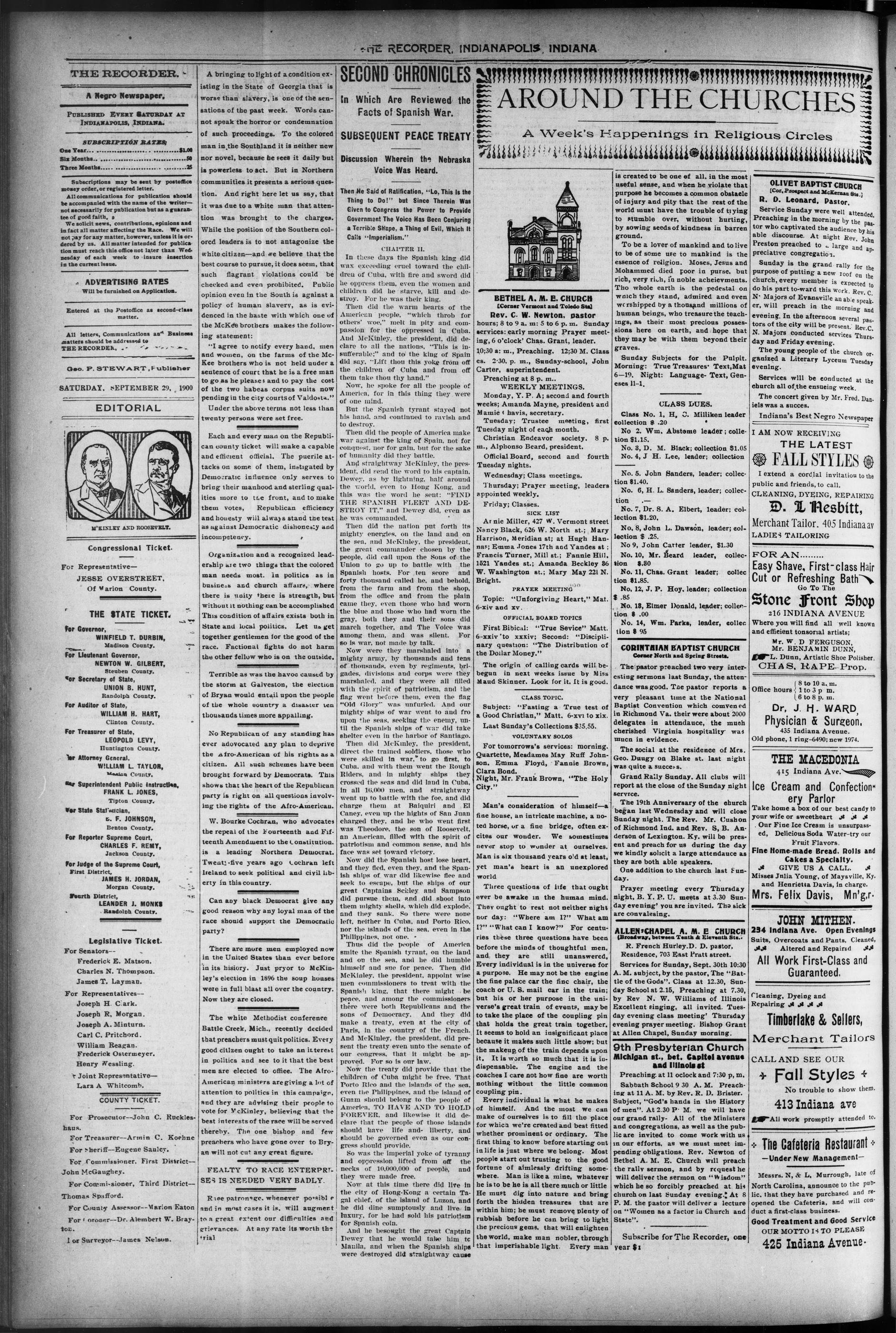
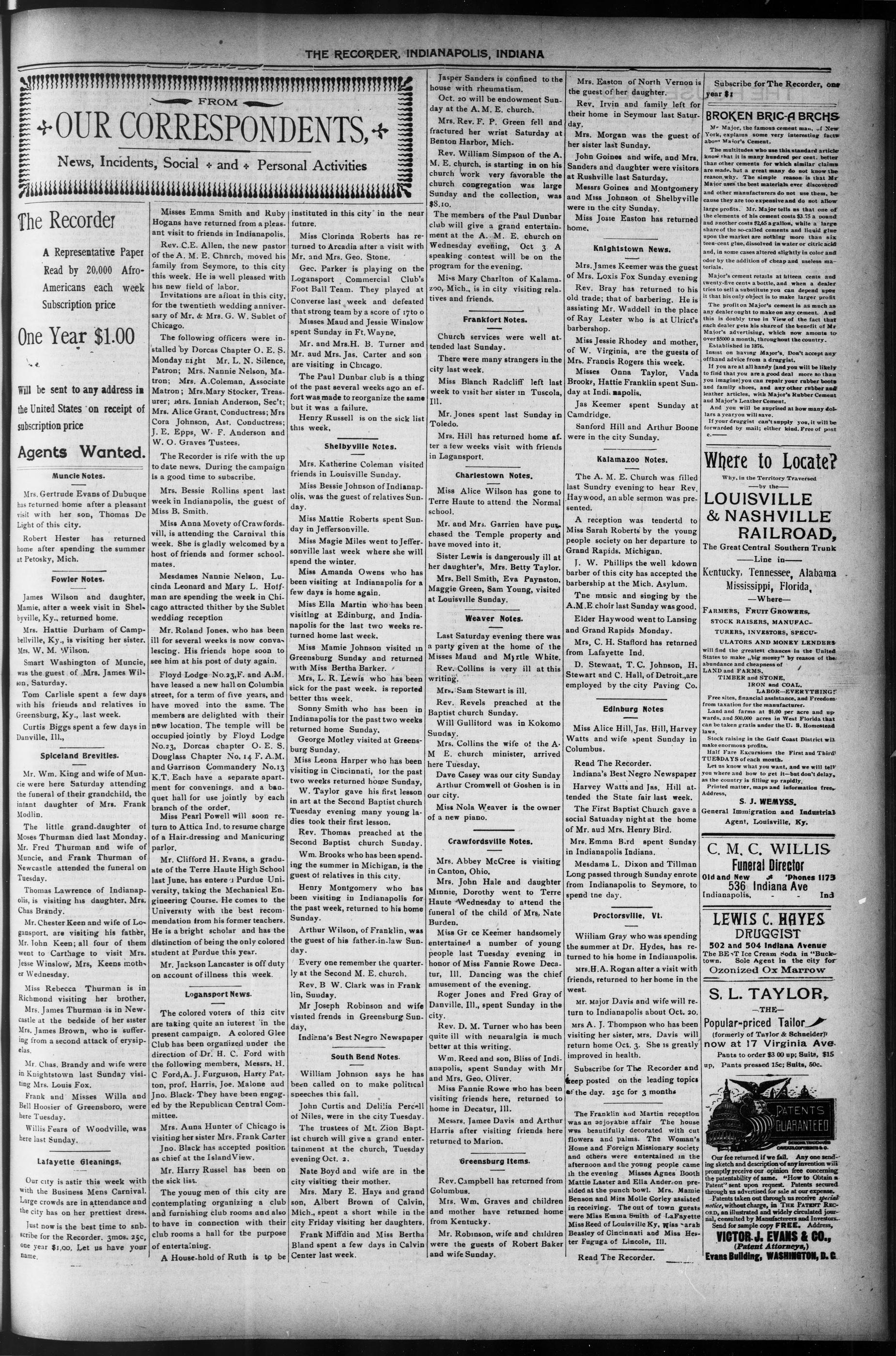
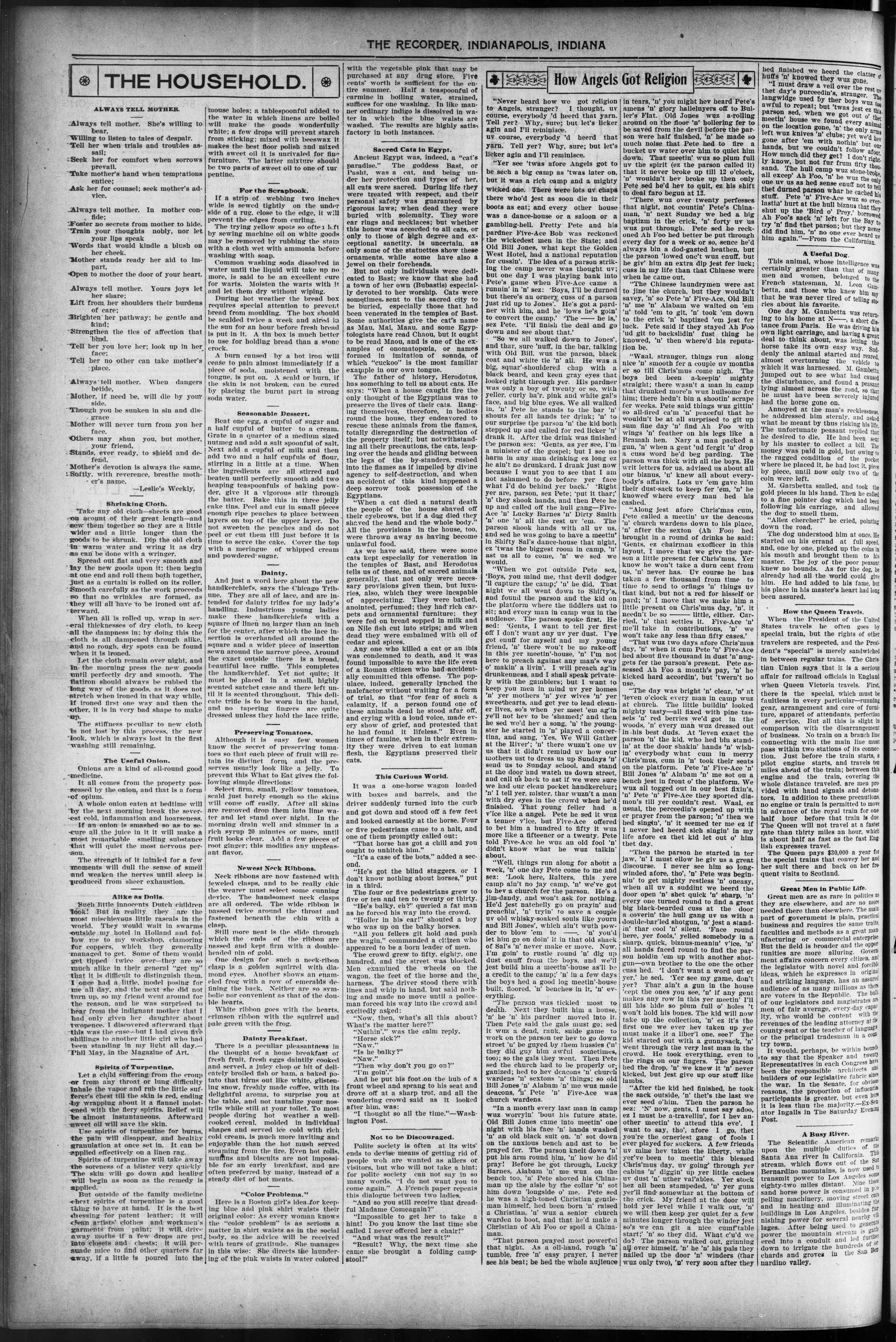
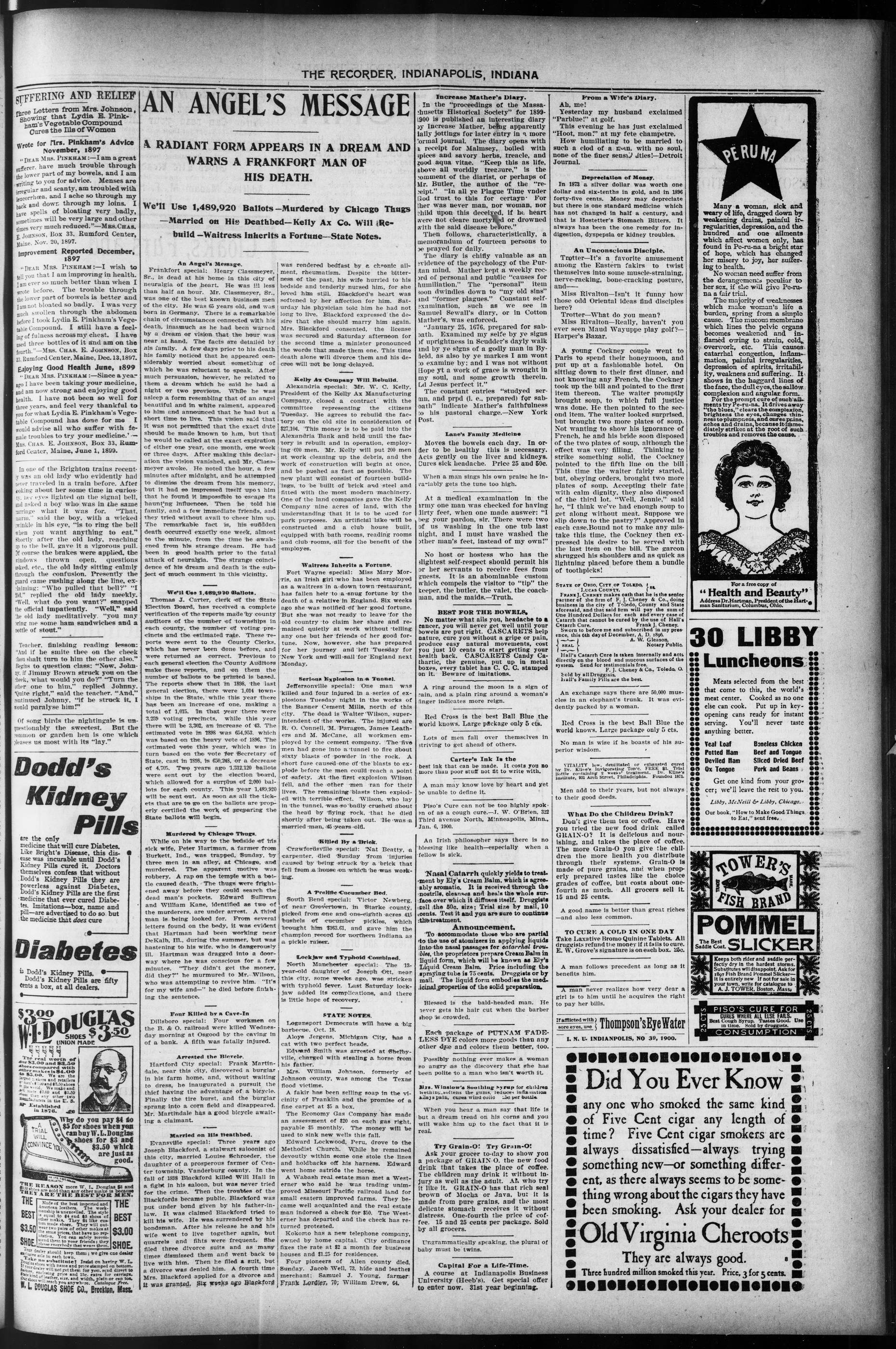
Page text (machine-generated)
NEW YORK STORE
Established in 1853
Sole Agents Butterick Patterns.
The.....
Silk Sale
$1.00 Corded Taffetas at 59c
Corded Taffetta Novelties, in
rose, reseda, lilac, porcelaine, silver,
cerese, white, gray, with
clusters of welt-like cords. These
beautiful Siles are just from the
looms of one of the world's most
successful manufacturers. A colla
qf fresh' exquisite and
dainty Silks that must be seen to
realize their beauty. At Silk
Counter, for per yard.....59c
PEETIS DRY GOODS CO.
THE.....
NEW
MILLINERY
STORE
448 Mass ave.
Is now ready for business with a
new stock of goods that is up-to
date. Prices range from $1.98 to
$4.98. Come and bring your friends
We want your trade.
Residence, 313.W North St.
PHONES NW 143, SOLD 3 on 23220. 401-402 Lemcke INDIANPOLIS.
All First Class
Barber Shops
USE
CUNNINGHAM'S
TAR SHAMPOO SOAP
Large Cake 10c
R. A. PEARCE & Sons, Agents
225 Indiana Ave. Indianapolis, Ind
Soldier's Relief
A Sure Cure For
Cramps In the Stomach
--DIARRHOEA--
SUMMER Complaint and
Indigestion.
Call for it over the Bar.
A Sure Cure For
Cramps In the Stomach
--DIARRHOEA--
SUMMER Complaint and
Indigestion.
Call for it over the Bar
Manufactured by A. A. Nichols,
407 W. North St., Indianapolis.
For Sale by Druggists.
Read The Recorder.
J, P. KEETER,
420 West Washington Street.
PHOTOGRAPHER
Enlargening Pictures a Specialty.
HS I deal exclusively in COFFEE
and TEA, my constant study
is to give only the very best
for the money—and I succeed.
Coffee oasted Fresh Daily
A. B. COFFY.
New Phone, 2321. 430 Mass. Ave.
Notice, Removal.
A. A. BUCKNER, will remove
to 427 Indiana avenue, October 1st
with a full line of Cigars, Tobacco
Pool Tables, Shining and News-
stand.
Subscribe for The
The Recorder.
INDIANAPOLIS, INDIANA, SATURDAY, SEPTEMBER 29, 1900
B. M. C. Meeting.
The 10th B. M. C. of the G. U. O. O.
F. will convene in Louisville, Ky.
Tuesday, Oct. 2 and continue five days
the local delegates to the meeting are
Dr. Robert Harper, Jas. Johnson-
Chas., Miller and A. C. Richardson.
Quite a number of persons will attend
the meeting. The Order is represented
by over 3000 lodges with a total mem-
bership exceeding 116,000 persons. Major
Gardner of this city is a candidate
for the office of Grand Director.
Emancipatlou Day.
Martin R. Delaney Post, No. 70, G.A R. held a picnic and jubilee Thursday at Greenwood Park in celebrating the anniversary of the emancipation proclamation. In the afternoon speeches were made by ex-Governor Taylor, Chas. A. Bookwalter and Rev. Dr. Lucas. In the evening, when the weather had cleared off somewhat, the crowd was augmented greatly, and by 8 o'clock, when the first speaker was called, there were several hundred people in the stand. Gurley Brewer, Geo. L. Knox, Jas. Shelton and Rev. Chas. Newton occupied the evening by short talks. The whole day was spent in having a jollification, and the way the people went about it they seemed to take great pleasure in celebrating the day of their freedom from slavery. Everywhere could be heard comments on the admirable way in which Chas. W. Brown, post commander, had arranged the affair.
Political
The Third Ward republican club opened head-quarters at 1320 N. Senate ave. last Thursday night.
Jas. Shelton spoke at Haughville to the colored voters of that section Monday night, Mr. Shelton is engaged for every night next week.
Attorney W. E. Henderson addressed a large gathering of colored voters at Jeffersonville, Wednesday night. His speech was well received
Oliver S. Clay lectured at Wayman Chapel last night, his subject being, "Shall we make Negro Citizenship an Issue?"
A meeting of the business and professional men of the city, will be held next Friday night at 536 Ind. ave for the purpose of affecting a political organization. A full attendance is desired Gurley Brewer, the leading political orator' of the State, spoke at Cincinnati O. Wednesday night and at New Albany, Friday night, to night he is billed for Charleston Ind. Attorney J. H. Lott, addressed a big political meeting at Alexandria, last Saturday night. Mr. Lott reports an enthusiastic reception. An organization was perfected.
New instructions to voters have been ordered printed by the State Board of Election Commissioners. The new instructions will be more comprehensive than the old ones and will contain a few minor changes. They will be ready for distribution by the first of next week.
The cloud of disaffection which has threatened the republican party in the ranks of the colored voters, has failed to materialize. While it is true that all grievances presented could not at this time be remedied. The rank and file of the party workers have assurances of their immediate considerations. A colored clerk will be employed at the county committee rooms and also one at state head-quarters.
A feature of the Republican parade Saturday night before the Senator Dolliver meeting at Tomlinson hall will be the appearance of the Rescue Riders, a first voters colored club. The club is handsomely uniformed and carry shooting canes. It bids fair to become the largest colored organization in the city. The officers are: Clarence Stewart, president; Joseph Timberlake, vice-president and F. Fowler Brown, secretary.
The colored voters of the Sixth ward held a large meeting Tuesday night at Bethel church. Dr S A. Furniss presided, making a speech in which he urge a united front to the enemy. The speakers of the evening were, F. E, Matson, Rev R, F. Hurley, D. B. Shideler and Gurley Brewer. Remarks were also made by James Shelton and John Ruckelhaus. The meeting was arranged by Henry Jackson.
HELD AS SLAYES
COLORED MEN AND WOMEN K-D
NAPED AND PUT TO WORK.
An Awful Condition Existing in the State of Georgia. Whipped and Chained as in Slave Days.
ATLANTA, Ga., Sept. 26.—Charges have been filed with the prison commission of Georgia by Solicitor J. W Edmonson, of Brooks county, against the McRae convict camp managers in Lowndes county, this State. In the form of affidavits from prominent citizens, to the effect that the McRee brothers have kidnapped innocent men and women and made them work under armed guards for an indefinite period. It is charged that one practice of the McRee camp has been to employ armed "trappers" to arrest innocent men and women passing through the county and without the form of trial to imprison them and put them to work. The charges filed by Solicitor Edmonson contain the following:
"Fanny Jackson, eight or ten years ago went to the camp to visit her husband, who was kept there as a convict When she went to leave the camp she was arrested and forced to work, chained with the men, watched by the guards and frequently whipped. She had a young child with her, and finally Will McRee whipped her terribly to make her bind the child to the camp in order that it might grow up a convict. Her statement in part fellows:
"I finally had to give up my child to prevent what seemed to me further an endurable beating. The skin was beat from my body and the flesh made raw. I was beaten first on Sunday and then made to sit in salty water, I suppose to cure the wounds. On Monday following I was beaten again and made to sit in salty water again. I was then put to work and Mr. George McRee went into the field and made them let me go to the house. I was sick from the beat ing nearly four months--too sick to work, and a great deal of the time could not rest at all except on my stem ach. Mr. Will has my child yet. He took it from me by force. I have never been paid any wages."
Molie Williams, a Negro woman, swore in an affidavit that several years ago she went to the camp to carry a dress to her sister. She alleges she was arrested and held until a few months ago as a convict. Other affiants charge that they were arrested and detained similarly without a criminal charge proved against them.
Several white citizens of the vicinity allege that as the affidavits of the Negroes are accurate as to statements made in them. Since habeas corpus writs have been sworn out in behalf of the Negroes it is alleged that W. S. McRee for the McRee brothers has made the following statement under date of Sept. 6; "I agree to notify every hand men and women, on the farms of the McRee brothers who is not held under a sentence of court that he is a free man to go as he pleases and to pay the cost of the two habeas corpus suits now pending in the city courts of Val-dosta." It is said that under this notification as many as twenty persons held in the camp have been released.
Bethel C. E. Meeting.
The president of the Christian Endeavor desires all members to be present at the call meeting tomorrow after noon at four o'clock, to decide as to disbanding or reviving the endeavor interest. All young people are invited to attend. The president will read a paper, which will be biscuss d by those who know what the Christain Endeavor can do for young men and women. We trust you will be present and giveus your support.
The Woman's Home and Foreign Missionary Society meet with Mrs Millie Scott, 707 Fayette street. A paper read by Miss Ella Washington a solo oy Mrs. Carrie Thompson were very highly appreciated. One visitor was present. The next meeting will be held with Mrs Fryson in Toledo street.
Subscribe for The Recorder and keep posted on the leading topics of the day. 25c for 3 months
The Newsiest, Spiciest and Best Edited Negro Journal in the State
A Journal of Opinions, published in the interest of the Race. Correspondence Soilcited Special Inducements to Agents Sample Copies on Application
POLITIGAL REVIEW OF THE WEEK
When a well known newspaper man in Columbus, O., gave out a statement some years ago to the effect that Hon. H. C. Smith of the Cleveland Gazette had in a public speech referred to the flag of his country as a "dirty rag," that gentleman stood on his head and tried to spit backward, and in his lucid intervals hurled several kinds of adjectives at his enemies and made noise enough with his pen and mouth for 16 men of his size.
Ordinarily a little thing like that would have been passed by in silence, but it so happened that Mr. Smith was a candidate for office, and if he did not succeed in giving the lie to his accusers and in proving that he is an ardent lover of Old Glory it was not his fault. Nobody with an ounce of brains paid any attention to the charge; nobody cared a rap whether he had abused the flag or praised it, for they well knew that nothing that Mr. Smith or anybody else could say could detract one iota from it. But Mr. Smith seemed to be of opinion that the statement—evidently made in a spirit of raillery—was an attack on his patriotism, and he seems to have thrown a fit three times a day until the day of his election to the legislature of Ohio. Since then he has been vindicating himself in his paper, and roasting every other fellow who has said anything against the administration.
What boots it if Mr. Fortune did criticise President McKinley? Is he not now a good administration Republican? Isn't he doing as much or more than Mr. Smith is doing to secure the re-election of the president? Is Mr. Fortune a paramount issue in this campaign? He is not a candidate for any office, big or little, but just a plain, aggressive Republican, with views which he is not afraid to express, and he'd be a big fool if he didn't change his opinions of men and things occasionally. If Mr. Smith is going to set himself up as a censor of the political morals of his fellows and draw the deadly parallel on all Republicans, he'll hind lots of them who have said things equally as bad as he has said about the president and the flag in the heat of passion and their excess of zeal, which they are now willing to forget in the interest of party harmony. Personal attacks on individual Republicians do not show good judgment, wisdom or common sense. Who cares what any man said or did ten months or ten years ago? "Wise men change often, fools never." The paramount question is, What does he say or believe now? The eternal now is worth a thousand yesterday. Let Mr. Smith pull himself together and take aim at the common enemy—the Democratic party. There is nothing to be gained in fighting Republicans.
The Hon. John B. Stanchfield, the Democratic nominee for governor of New York, is SUB-STANCHILLY licked. His votes in the legislature against the labor interests and his speeches in favor of expansion, a section of one of which is quoted in the New York Sun of Sept. 13, shows him to be one of those elastic and accommodating statesmen who are not averse to being on both sides of any question. His speech of Feb. 17, 1890, wherein he indorses the policy of this administration in the Philippines, Porto Rico and Cuba, is "a good enough Morgan" to elect the entire Republican state ticket this year and give it a few votes to spare.
Manifestly Mr. Stanchfield is not the kind of a Democrat who is likely to rally around him the dyed in the wool brethren of his political faith, for his views are decidedly out of harmony with theirs on the question of expansion.
Mr. Stanchfield's services may be needed after Nov. 6 to stanch the wounds which these brethren will inflict upon each other in the mix up scheduled to eventuate at any time during the campaign. "How pleasant it is for brethren to dwell together" in Tammany!
The platform adopted at Saratoga by the Democratic convention among other things declares in favor of government of the people, by the people, and for the people. It reads very smoothly in spots and is plausible enough in its way. But we cannot overlook the fact that it is a huge joke perpetrated with malign intent.
If a chain is no stronger than its
weakest part, the Democratic party of New York and of the nation is no stronger than the weak and corrupt branches of that party which now disgrace it as a party in every southern state by its obstinate and arbitrary refusal to recognize the right of sovereign citizens to participate in the administration of local and state governments at the south.
The Democratic party cannot blow hot in the north and cold in the south on this vital question. It cannot be one thing in the north, another thing in the south and the whole thing when it triumphs by fraud, misrepresentation and force.
As long as the south tramples underfoot the rights of any class of citizens and denies them the opportunity to share the burdens and the benefits of citizenship Democratic assertion about the "consent of the governed" and government of the people, etc., must take its place among the CONVENTIONAL LIES of the period. The Democratic party cannot get away from this proposition. If it be false in one thing, it is fair to assume that it is false in all things. This is an important point for colored voters to consider.
And be these juggling fends no more believed That palter with us in a double sensa.
In the discussion in the state senate of New York last winter on the bill introduced by Senator Elsberg to abolish separate schools in that state, a senator remarked in the course of a speech to the Democratic leader, Senator Grady, "But you have negroes in Tammany Hall, senator." "Oh, yes," replied the eloquent DEVOTEE of Bacchus, sneeringly, "but we keep them in their places." There is no doubt about that. Not only does Tammany keep its negro followers in their places, but the entire Democratic aggregation throughout the country does so, and will continue to do so whenever it can get the upper hand. Another one of these Tammany senators (Munzinger), with the smell of the emigrant still permeating his garments, was heard by the writer to say while this bill was under consideration, "I don't want my children to go to the same school with coons." These are the high caste Brahmans of the Democratic faith in the Empire State, in whose sincerity and honesty certain susceptible negroes have unlimited and unalterable faith, broad gauged statesmen who "mucilate" English and swim in rum. They are the descendants of the Irish and Dutch emigrant paupers who were offered at public sale in New York and Philadelphia, in the early history of the country, to the highest bldders, the INDENTED SERVANTS of the wealthy and aristocratic white men, for whose descendants these vermin in the Democratic party are now playing at lawmaking and statesmanship. Is it any wonder that they hate negroes, that they have a low and brutal estimate of negro character and manhood and a withering contempt for the virtue of negro women? They do not forget their origin, the depths from whence they came, and when once they are possessed of the strength of a giant they use it like a giant.
The Tammany contingent in the New York legislature is composed of men whose intellectual re-enforcement is not their most distinguishing characteristic. They are, with few honorable exceptions, keepers of low dives, patrons of the prize ring, owners of gambling hells and proprietors of vaudeville theaters, and incidentally, statesmen (God save the mark). All of them, regardless of their moral and intellectual delinquencies, regard themselves as superior to the most cultivated "coon." The colored man who can consistently follow in the wake of these leaders or vote to keep them "en evidence" is more than one kind of a fool and will deserve all the contempt they can heap on him.
Everybody knows former Governor P. B. T. Pinchback of Louisiana, and they know that he was one of the bravest negro Republicans in Louisiana, when it took a great deal of courage for a man to stand up and defend his principles in that state. He is the first and only negro ever elected governor of a southern state, and he was elected a senator from Louisiana in the seventies and counted out by the connivance of weak kneeed Republican and cowardly Democrats in the United States senate, who did not then, as they do not now, believe in electing negroes to high offices. The governor has, despite the duplicity and treachery of his party friends, been a consistent Republican and has always given his best service toward the advancement of his party's interest, both
on the stump and in the press. he is an able lawyer, though he does not practice his profession, and is an eloquent and convincing campaign orator, who may be heard in the present campaign in advocacy of the re-election of President McKinley, of whose administration he has a very high and intelligent opinion. He has pronounced views on the question of the re-election of President McKinley, and in speaking on that subject the other day in New York, he said: "I am in favor of the re-election of President McKinley and the retention of the Republican party in power in the nation because the action of the Democratic party on the franchise and its infamous class legislation in the southern states show it to be the implacable and unrelenting enemy of the colored race.
"No man is better than his party. If Mr. Bryan is elected president, he will be controlled by the southern wing of his party, and this will be highly detrimental to the political future of the negro. Therefore thoughtful, sensible, self respecting negroes everywhere desire the supremacy of the Republican party and its continuance in the control of the general government." This is clean cut and to the point.
Although Bishop W. B. Derrick has specifically and unequivocally denied through the press, by letter and orally, that he is not in sympathy with the cause which Mr. Bryan represents and that he would not vote for that political vimary for president, somebody who is probably in the pay of the Democratic literary bureau persists in retiring the statement that the bishop will support Bryann. The bishop again desires to state in the strongest possible terms that he has no sympathy whatever with the Bryanized Democracy and that any statement to the contrary is a shameless and cowardly falsehood. He will devote all of his energies and influence and time to help secure the election of William McKinley. JOHN E. BRUCE.
Estimate Placed on the Candidate by Abram S. Hewitt.
Abram S. Hewitt, a substantial Democrat until his party was seized by Bryan, and an ex-major of New York, recently made this statement:
"As between Bryan and McKinley we face a serious situation. McKinley, at least, we know is honest, intelligent and experienced. Mr. Bryan wants to turn the country over to sheer anarchy. Mr. Bryan denounced as 'government by injunction' the performance by the judiciary of the duty imposed upon it by the constitutional law of the land. A man who makes this statement, who denounces the supreme court, the bulwark of liberty and order, who sought to overthrow the judiciary of the country, is a man too limited in understanding and too violent in purpose to be intrusted with the great office of president. The American conception of government has been liberty regulated by law; the Bryan idea seems to be a despotism regulated by anarchy. Mr. Bryan and his followers denounce government by injunction because the courts refuse to allow them to be lawless and interfere with others. Thieves don't like government by police, and they denounce policemen, police courts and judges who sentence to imprisonment, and if they were in a majority they would have it their way."
Mr. Bryan, in Kansas City on July 17, 1896, declared with all possible emphasis of the silver question: "All others must stand back until this great question is solved." Mr. Bryan insisted upon the insertion of a specific 16 to 1 free coinage paragraph in the Kansas City platform, evidencing then his belief that it was still the great question. He caused all others to stand back then. Is it to be inferred that the man with such a record as that, for whom it is claimed that he is honest, would not exert every energy to foist that heresy upon the people of this government were he in power?
Don't Take It For Granted.
An enthusiastic Bryanite who declared in Indianapolis on Bryan day that Indiana could not go Republican this year was rebuked by his chief with the words: "Do not take too much for granted." Here for once is a Bryan saying that Republicans may profitably take to heart.
INDIANAPOLIS, ND
SUPPLEMENT TO Indianapolis Recorder. INDIANAPOLIS, IND.
Saturday, September 29, 1900.
ISSUES DISCUSSED BY MEN OF ALL PARTIES.
McClellan's Tribute to the Soldiers of Our Small Army.
Progress of the Campaign Commented On by Persons of All Shades of Political Thought — Imperialism No Issue.
A missionary was sent to convert Dewey to Democracy at Manila. He represented the most potential politicians in the Democratic party—those who could have given him the nomination if he would have consented to a few-line sentiments and glittering generalities. If Dewey had consented at Manila to be a Democratic candidate he would unquestionably have been the candidate. He would have been an imperialist something like; an imperialist wouldn't have hurt the Democrats a bit. The Democratic party wouldn't have cared a rap about imperialism nor about silver at 16 to 1 or at 33 to 1. They would have gone in on the heroics. They would have celebrated a conqueror as their candidate, and been glad and proud and stuck up and happy to support a man who had shed blood, conquered territory and surrounded the world with his glories. That is what the Democracy wanted—Murat Halstead.
Whoever attempts under whatever popular cry to shake the stability of the public currency and bring on distress in money matters, stabs your interest and your happiness to the heart—Daniel Webster, in the Senate Jan. 31, 1834.
"Militarism," "Imperialism," are terms used by newspapers, politicians and platforms to scare the people and catch votes. They are weapons—utterly groundless ones of the most demagogic import—used to stir the people which no well-balanced statesman or newspaper will use. There is no more danger of either condition in this great intelligent seventy million freemen and great aggregation of States fortified by those States' rights recognized by our constitution and sustained by our courts, than there is of England becoming an absolute despotism.—Canton (Miss.) Times, Dem.
All the incidents of the past prove that the army will never have the disposition to jeopardize the free institutions of the country. Our nation would be safe indeed, for all time, did the mass of its citizens place upon its institutions the same intelligent appreciation as that in which they are held by the army, and were honor, integrity and respect for the laws as much the rule among the people as they are in the army, which has given too many proofs of heroism, of integrity, of devotion to the country, to be regarded as a source of danger. On the contrary, he who understands its history must regard it with pride and satisfaction as one of the chief ornaments of the nation, as a school wherein are taught and practiced the virtues of valor, self-denial, obedience and patriotism, and as an institution which has never called the blush of shame to the face of an American.—George B. McCillian, Democrat, and nominee for the presidency in 1844.
---
There are 6,000 people connected with the glass business in Indiana alone and their votes will make the State go for McKinley. We are only protecting our interests. Our wages have been raised 15 per cent in the past two years, 8 per cent last year and 7 per cent this year, just restoring the cut that was made under the Democratic administration in 1803.—William Peck, Glass Workers' Union.
Bryan's name is a household word in every Philippine hut. They are thoroughly familiar with his anti-expansion views, and in him think they see their "deliverer." His nomination and candidacy alone mean the loss of much property and many lives, for it will infuse new life into the insurgent cause and cause them to break out anew.—R. M. Shearer, Inspector of Customs, Mauban, P. I.
Imperialism is a false cry. Never have I seen a Republican who wants to be a king. I am a military man, but I have never been able to find out what they mean by "militarism." If by "militarism" they mean they are opposed to our young men learning the things that will enable them to uphold the flag, then they are opposed to patriotism. One of my sons. Col. Guy Howard, was killed in the Philippines while fighting for the flag, and another one is fighting over there now. Don't talk to me about taking down our flag and giving the Philippines away. It is an insult.—Gen. Oliver O. Howard.
The Republican party in Wyoming is in excellent shape. The State is quite prosperous. This is particularly true of the wool industry, which has been stimulated by the tariff and the general business revival throughout the country. The wool growers all realize that their future depends largely on the continuation of the prosperity which now prevails and I believe that they, to a man, will support McKinley. Our people are paying little attention to the so-called imperialism, but are content to think seriously of the financial and tariff questions. Wyoming will give a handsome majority for McKinley and Roosevelt.—E. A. Slack, Cheyenne, Wyo.
We all know that there has ever been a party in this government, since its foundations were first laid at Bunker Hill and Yorktown, opposed to our territorial expansion and aggrandizement. With
My Dear Boy:
So your employer, Mr. Skinner, says that "The Filipinos ought to have their liberty and United States soldiers ought to be in better business than making war on an innocent people and strangling the life out of a new republic."
Since Mr. Skinner has put in a nutshell the substance of Mr. Bryan's speech. I shall dispose of Mr. Bryan and the whole anti-imperialist crew in answering Mr. Skinner. I know that you have but little time to read and shall use the fewest words possible, as I shall endeavor to give you a clear, intelligent view of the situation over in our new possessions.
1. Our soldiers are not strangling the life out of a new republic, for the very good reason that there never was any republic in the Philippines. A republic is a government by the people through their chosen representatives. The people of the Philippines never were consulted about the so-called Filipino Republic. Its head was a tricky young Tagalog named Aguinaldo, who proclaimed himself dictator and endeavored to make himself so by force of arms. Republics are not governed by a dictator. The form of government which took the place of a constitution in the so-called republic was a lengthy personal decree of Aguinaldo himself. It was not a republic but a despotism which he sought to establish. The people of the Philippine Islands are made up of many different tribes, Negritos, Tagalogos, Moros, Visayans, and more than fifty others. These tribes are separate in blood, sympathies, and to a large extent in language. In addition to them there are thousands of Spaniards, Germans, Americans, and people of other nations who are resident there, and whose persons and property are to be protected. In addition to all these are large numbers of Mestizos, people whose mothers were native Filipinos, but whose fathers were Japanese, Chinese or Spaniards.
There is no probability that one-half or one-third of all these vast numbers of people would consent to be governed by Aguinaldo and the Tagalog tribe which he represents. Many of them would certainly fight against it. The abandonment of the islands by the United States army would mean, not liberty to the people, but war among themselves, resulting in either despotism or anarchy.
2. The United States has never made war upon the Filipinos. We have not even been engaged in war, offensive or
IMPERIALISM
IMPERIALISM
DOWN WITH
UNLIKE
Mina
or Benjamin Doy
FARMER BR
IMPERIALISM
CHICAGO
CRAZY
QUITT
UNLIMITED COINAGE.
PLATFORM
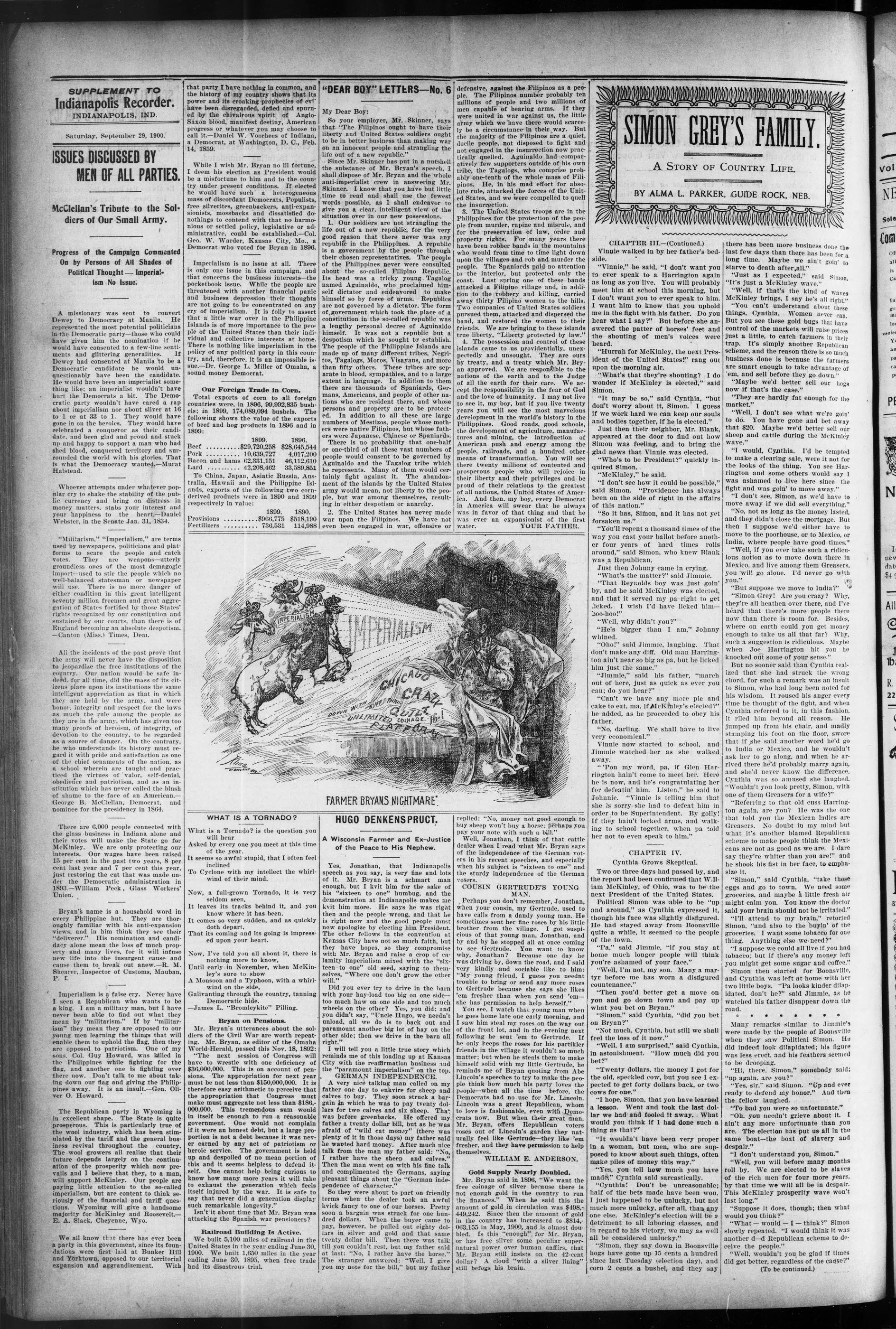
FARMER BRYANS NIGHTMARE.
HUGO DENKENSPRUCT.
IMPERIALISM
IMPERIALISM
IMPERIALISM
CHICAGO
CRAZY
QUIZZ
UNLIMITED COUNAGE.
PLATFORM
Xina
FARMER BRYANS NIGHTMARE'
A Wisconsin Farmer and Ex-Justice of the Peace to His Nephew.
Yes, Jonathan, that Indianapolis speech as you say, is very fine and lots of it. Mr. Bryan is a schmart man enough, but I kvit him for the sake of his "sixteen to one" humbug, and the demonstration at Indianapolis makes me kvit him more. He says he was right then and the people wrong, and that he is right now and the good people must now apologize by electing him President. The other fellows in the convention at Kansas City have not so much faith, but they have hopes, so they compromise with Mr. Bryan and raise a crop of camlamy imperialism mixed with the "sixteen to one" old seed, saying to themselves, "Where one don't grow the other will."
Did you ever try to drive in the barn with your hay-load too big on one side—too much haw on one side and too much wheels on the other? Yes, you did; and you didn't say, "Uncle Hugo, we needn't unload, all we do is to back out and paramount another big lot of hay on the other side; then we drive in the barn all right."
I will tell you a little true story which reminds me of this loading up at Kansas City with the reaffirmation business and the "paramount imperialism" on the top. GERMAN INDEPENDENT
MARKS INDEPENDENCE
A very nice talking man called on my father one day to invite for sheep and calves to buy. They soon strew a bargain in which he was to pay twenty dollars for two calves and six sheep. That was before greenbacks. He offered my father a twenty dollar bill, but as he was afraid of "wild cat money" (there was plenty of it in those days) my father said he wanted hard money. After much nice talk from the man my father said: "No, I rather have the sheep and calves." Then the man went on with his fine talk and complimented the Germans, saying pleasant things about the "German independence of character."
So they were about to part on friendly terms when the dealer took an awful kvick fancy to one of our horses. Pretty soon a bargain was struck for one hundred dollars. When the buyer came to pay, however, he pulled out eighty dollars in silver and gold and that same twenty dollar bill. Then there was talk till you couldn't rest, but my father said at last: "No, I rather have the horse." The stranger answered: "Well, I give you my note for the bill," but my father
---
---
that party I have nothing in common, and the history of my country shows that its power and its croaking prophecies of evi' have been disregarded, defied and spurned by the chivalrous spirit of Anglo-Saxon blood, manifest destiny, American progress or whatever you may choose to call it—Daniel W. Voorhees of Indiana, a Democrat, at Washington, D.C., Feb. 14, 1859.
While I wish Mr. Bryan no ill fortune, I deem his election as President would be a misfortune to him and to the country under present conditions. If elected he would have such a heterogeneous mass of discordant Democrats, Populists, free silverites, greenbackers, anti-expansionists, mossbacks and dissatisfied do-nothings to contend with that no harmonious or settled policy, legislative or administrative, could be established—Col. Geo. W. Warder, Kansas City, Mo., a Democrat who voted for Bryan in 1896.
Imperialism is no issue at all. There is only one issue in this campaign, and that concerns the business interests—the pocketbook issue. While the people are threatened with another financial panic and business depression their thoughts are not going to be concentrated on any cry of imperialism. It is folly to assert that a little war over in the Philippine Islands is of more importance to the people of the United States than their individual and collective interests at home. There is nothing like imperialism in the policy of any political party in this country, and, therefore, it is an impossible issue.—Dr. George L. Miller of Omaha, a sound money Democrat.
Our Foreign Trade in Corn.
Total exports of corn to all foreign countries were, in 1896, 99,992,835 bushels; in 1899, 174,089,094 bushels. The following shows the value of the exports of beef and hog products in 1896 and in 1899:
| | 1899 | 1896 |
| :--- | :--- | :--- |
| Beef | $29,720,258 | $28,645,544 |
| Pork | 10,639,727 | 4,017,200 |
| Bacon and hams | 62,331,151 | 46,112,610 |
| Lard | 42,208,462 | 33,589,851 |
| To China, Japan, Asiatic Russia, Australia, Hawaii and the Philippine Islands, exports of the following two cor-derived products were in 1890 and 1890 respectively in value:
| | 1899 | 1890 |
| :--- | :--- | :--- |
| Provisions | $96,775 | $518,190 |
| Fertilizers | 736,531 | 114,988 |
WHAT IS A TORNADO?
What is a Tornado? is the question you will hear
Asked by every one you meet at this time of the year.
It seems so awful stupid, that I often feel inclined
To Cyclone with my intellect the whirlwind of their mind.
Now, a full-grown Tornado, it is very seldom seen.
It leaves its tracks behind it, and you know where it has been.
It comes so very sudden, and as quickly doth depart.
That its coming and its going is impressed upon your heart.
Now, I've told you all about it, there is nothing more to know.
Until early in November, when McKinley's sure to show
A Monsoon and a Typhoon, with a whirlwind on the side.
Galivanting through the country, tanning Democratic hide.
-James L. "Bromleykite" Pilling.
Bryan on Pensions.
Mr. Bryan's utterances about the soldiers of the Civil War are worth repeating. Mr. Bryan, as editor of the Omaha World-Herald, passed this Nov. 18, 1892: "The next session of Congress will have to wrestle with one deficiency of $36,000,000. This is on account of pensions. The appropriation for next year must be not less than $150,000,000. It is therefore easy arithmetic to perceive that the appropriation that Congress must make must aggregate not less than $186,000,000. This tremendous sum would in itself be enough to run a reasonable government. One would not complain if it were an honest debt, but a large proportion is not a debt because it was never earned by any act of patriotism or heroic service. The government is held up and despoiled of no mean portion of this and it seems helpless to defend itself. One cannot help being curious to know how many more years it will take to exhaust the generation which feels itself injured by the war. It is safe to say that never did a generation display such remarkable longevity."
Isn't it about time that Mr. Bryan was attacking the Spanish war pensioners?
Railroad Building Is Active
We built 5,100 miles of railroad in the United States in the year ending June 30, 1900. We built 1,650 miles in the year ending June 30, 1895, when free trade had its disastrous trial.
defensive, against the Filipinos as a people. The Filipinos number probably ten millions of people and two millions of men capable of bearing arms. If they were united in war against us, the little army which we have there would scarcely be a circumstance in their way. But the majority of the Filipinos are a quiet, docile people, not disposed to fight and not engaged in the insurrection now practically quelled. Aguinaldo had comparatively few supporters outside of his own tribe, the Tagalogs, who comprise probably one-tenth of the whole mass of Filipinos. He, in his mad effort for absolute rule, attacked the forces of the United States, and we were compelled to quell the insurrection.
3. The United States troops are in the Philippines for the protection of the people from murder, rapine and misrule, and for the preservation of law, order and property rights. For many years there have been robber bands in the mountains who would from time to time light down upon the villages and rob and murder the people. The Spaniards paid no attention to the interior, but protected only the coast. Last spring one of these bands attacked a Filipino village and, in addition to the robbery and killing, carried away thirty Filipino women to the hills. Two companies of United States soldiers pursued them, attacked and dispersed the band, and restored the women to their friends. We are bringing to these islands true liberty. "Liberty protected by law."
4. The possession and control of these islands came to us providentially, unexpectedly and unsought. They are ours by treaty, and a treaty which Mr. Bryan approved. We are responsible to the nations of the earth and to the Judge of all the earth for their care. We accept the responsibility in the fear of God and the love of humanity. I may not live to see it, my boy, but if you live twenty years you will see the most marvelous development in the world's history in the Philippines. Good roads, good schools, the development of agriculture, manufactures and mining, the introduction of American push and energy among the people, railroads, and a hundred other means of transformation. You will see there twenty millions of contented and prosperous people who will rejoice in their liberty and their privileges and be proud of their relations to the greatest of all nations, the United States of America. And then, my boy, every Democrat in America will swear that he always was in favor of that thing and that he was ever an expansionist of the first water. YOUR FATHER.
16
replied: "No, money not good enough to buy sheep won't buy a horse; perhaps you pay your note with such a bill." Well, Jonathan, I think of that cattle dealer when I read what Mr. Bryan says of the independence of the German voters in his recent speeches, and especially when his subject is "sixteen to one" and the sturdy independence of the German voters.
COUSIN GERTRUDE'S YOUNG MAN
Perhaps you don't remember, Jonathan, when your cousin, my Gertrude, used to have calls from a dandy young man. He sometimes sent her fine roses by his little brother from the village. I got suspicious of that young man, Jonathan, and by and by he stopped all at once coming to see Gertrude. You want to know why, Jonathan? Because one day he was driving by, down the road, and I said very kindly and sociable like to him: "My young friend, I guess you neednt trouble to bring or send any more roses to Gertrude because she says she likes 'em fresher than when you send 'em—she has permission to help herself."
You see, I watch that young man when he goes home late one early morning, and I saw him steal my roses on the way out of the front lot, and in the evening next following he sent 'em to Gertrude. If he only keeps the roses for his partkiller friends in the village it wouldn't so much matter; but when he steals them to make himself solid with my little Gertrude, he reminds me of Bryan quoting from Abe Lincoln's speeches to try to make the people think how much his party loves the people—when all the time before, the Democrats had no use for Mr. Lincoln. Lincoln was a great Republican, whom to love is fashionable, even with Democrats now. But when their great man, Mr. Bryan, represents Republican voters roses out of Lincoln's garden they naturally feel like Gertrude—the like 'em fresher, and they have permission to help themselves.
WILLIAM E. ANDERSON
Cold Supply Nearly Doubled
Gold Supply Nearly Doubled.
Mr. Bryan said in 1806, "We want the free coinage of silver because there is not enough gold in the country to run the finances." When he said this the amount of gold in circulation was $498,-449,242. Since then the amount of gold in the country has increased to $814,-003,155 in May, 1900, and is almost doubled. Is this "enough," for Mr. Bryan, or has free silver some peculiar super-natural power over human aftiffs, that Mr. Bryan still insists on the 42-cent dollar? A cloud "with a silver lining" still befogs his brain.
SIMON GREY'S FAMILY.
---
CHAPTER III.—(Continued.)
Vinnie walked in by her father's bedside.
"Vinnie," he said, "I don't want you to ever speak to a Harrington again as long as you live. You will probably meet him at school this morning, but I don't want you to ever speak to him. I want him to know that you uphold me in the fight with his father. Do you hear what I say?" But before she answered the pattern of horses' feet and the shouting of men's voices were heard.
"Hurrah for McKinley, the next President of the United States!" rang out upon the morning air.
"What's that they're shouting? I do wonder if McKinley is elected," said Simon.
"It may be so," said Cynthia, "but don't worry about it, Simon. I guess if we work hard we can keep our souls and bodies together, if he is elected."
Just then their neighbor, Mr. Blank, appeared at the door to find out how Simon was feeling, and to bring the glad news that Vinnie was elected.
"Who's to be President?" quickly inquired Simon.
"McKinley," he said.
"I don't see how it could be possible," said Simon. "Providence has always been on the side of right in the affairs of this nation."
"So it has, Simon, and it has not yet forsaken us."
"You'll repent a thousand times of the way you cast your ballot before another four years of hard times rolls around," said Simon, who knew Blank was a Republican.
Just then Johnny came in crying.
"What's the matter? said Jimmie.
"That Reynolds boy was just goin' by, and he said McKinley was elected, and that it served my pa right to get licked. I wish I'd have licked him—hoo-hoo!"
"Well, why didn't you?"
"He's bigger than I am," Johnny whined.
"Oho!" said Jimmie, laughing. That don't make any diff. Old man Harrington ain't near so big as pa, but he licked him just the same."
"Jimmie," said his father, "march out of here, just as quick as ever you can; do you hear?"
"Can't we have any more pie and cake to eat, ma, if McKinley's elected?" he added, as he proceeded to obey his father.
"No, darling. We shall have to live very economical."
Vinnie now started to school, and Jimmie watched her as she walked away.
“Pon my word, pa, if Glen Harrington hain’t come to meet her. Here he is now, and he’s congratulating her for defeatin’ him. Listen,” he said to Johnnie. “Vinnie is telling him that she is sorry she had to defeat him in order to be Superintendent. By golly! If they hain’t locked arms, and walking to school together, when pa told her not to even speak to him.”
Two or three days had passed by, and the report had been confirmed that William McKinley, of Ohio, was to be the next President of the United States. Political Simon was able to be "up and around," as Cynthia expressed it, though his face was slightly disfigured. He had stayed away from Boonsville quite a while, it seemed to the people of the town.
"Pa," said Jimmie, "if you stay at home much longer people will think you're ashamed of your face."
"Well, I'm not, my son. Many a martyr before me has worn a disfigured countenance."
"Then you'd better get a move on you and go down town and pay up what you bet on Bryan."
"Simon," said Cynthia, "did you bet on Bryan?
"Not much, Cynthia, but still we shall feel the loss of it now."
"Well, I am surprised," said Cynthia, in astonishment. "How much did you bet?"
"Twenty dollars, the money I got for the old, speckled cow, but you see I expected to get forty dollars back, or two cows for one."
"I hope, Simon, that you have learned a lesson. Went and took the last dollar we had and fooled it away. What would you think if I had done such a thing as that?"
"It wouldn't have been very proper in a woman, but men, who are supposed to know about such things, often make piles of money this way."
"Yes, you tell how much you have made." Cynthia said sarcastically.
"Cynthia! Don't be unreasonable; half of the bets made have been won. I just happened to be unlucky, but not much more unlucky, after all, than any one else. McKinley's election will be a detriment to all laboring classes, and in regard to his victory, we may as well all be considered unlucky."
"Simon, they say down in Boonsville hogs have gone up 15 cents a hundred since last Tuesday (election day), and corn 2 cents a bushel, and they say
"McKinley." he said.
"Well, why didn't you?"
CHAPTER IV.
there has been more business done the last few days than there has been for a long time. Maybe we ain't gain' to starve to death after_all."
"Just as I expected," said Simon. "It's just a McKinley wave."
"Well, if that's the kind of waves McKinley brings. I say he's all ridiculous."
McKinley brings, I say he's all right."
"You can't understand about these things, Cynthia. Women never can. But you see these gold bugs that have control of the markets will raise prices just a little, to catch farmers in their trap. It's simply another Republican scheme, and the reason there is so much business done is because the farmers are smart enough to take advantage of 'em, and sell before they go down."
"Maybe we'd better sell our hogs now if that's the case."
"They are hardly fat enough for the market."
"Well, I don't see what we're goin' to do. You have gone and bet away that $20. Maybe we'd better sell our sheep and cattle during the McKinley wave."
"I would, Cynthia. I'd be tempted to make a clearing sale, were it not for the looks of the thing. You see Harrington and some others would say I was ashamed to live here since the fight and was goin' to move away."
"I don't see, Simon, as we'd have to move away if we did sell everything." "No, not as long as the money lasted, and they did not close the mortgage. But then I suppose we'd either have to move to the poorhouse, or to Mexico, or India, where people have good times."
"Well, if you ever take such a ridiculous notion as to move down there in Mexico, and live among them Greasers, you will go alone. I'd never go with you."
"But suppose we move to India?" "Simon Grey! Are you crazy? Why, they're all heathen over there, and I've heard that there's more people there now than there is room for. Besides, where on earth could you get money enough to take us all that far? Why, such a suggestion is ridiculous. Maybe when Joe Harrington hit you he knocked out some of your sense."
But no sooner said than Cynthia realized that she had struck the wrong chord, for such a remark was an insult to Simon, who had long been noted for his wisdom. It roused his anger every time he thought of the fight, and when Cynthia referred to it, in this fashion, it riled him beyond all reason. He jumped up from his chair, and madly stamping his foot on the floor, sword that if she said another word he'd go to India or Mexico, and he wouldn't ask her to go along, and when he arrived there he'd probably marry again, and she'd never know the difference. Cynthia was so amused she laughed. "Wouldn't you look pretty, Simon, with one of them Greasers for a wife?"
"Referring to that old cuss Harrington again, are you? He was the one that told you the Mexican ladies are Greasers. No doubt in my mind but what it's another blamed Republican scheme to make people think the Mexicans are not as good as we are. I dare say they're whiter than you are!" and he shook his fist in her face, to emphasize it.
"Simon," said Cynthia, "take those eggs and go to town. We need some groceries, and maybe a little fresh air might calm you. You know the doctor said your brain should not be irritated."
"I'll attend to my brain," retorted Simon, "and also to the buyin' of the groceries. I want some tobacco for one thing. Anything else we need?"
"I suppose we could all live if you had tobacco; but if there's any money left you might get some sugar and coffee."
Simon then started for Boonsville, and Cynthia was left at home with her two little boys. "Pa looks kinder dilapidated, don't he?" said Jimmie, as he watched his father disappear down the road.
* * * * * * * * *
Many remarks similar to Jimmie's were made by the people of Boonsville when they saw Political Simon. He did indeed look dilapidated; his figure was less erect, and his feathers seemed to be drooping.
"Hi, there. Simon," somebody said; "up again, are you?"
"Yes, sir." said Simon. "Up and ever ready to defend my honor." And then the fellow laughed.
"To bad you were so unfortunate."
"Oh, you needn't grieve about it. I ain't any more unfortunate than you are. The election has put us all in the same boat—the boat of slavery and despair."
"I don't understand you, Simon."
"Well, you will before many months roll by. We are elected to be slaves of the rich men for four more years, by that time we will all be in despair. This McKinley prosperity wave won't last long."
"Suppose it does, though; then what would you think?"
"What—would—I—think?" Simon slowly repeated. "I would think it was another d—d Republican scheme to deceive the people."
"Well, wouldn't you be glad if times did get better, regardless of the cage?" (To be continued)
A NOBLE EXAMPLE
CHRIST'S CHARACTER A PATTERN FOR ALL MEN.
His Earthly Life Replete With Self-Sacrifice, Humility, Prayer and Hard Work
—Dr. Talmage's Sermon.
In this sermon, which Dr. Talmage sends from Paris, he analyzes the character of the Savior and urges all Christians to exercise the qualities which were conspicuous in Christ's earthly life. The text is Romans viii, 9, "Now, if any man has not the spirit of Christ he is none of his."
In the first place the spirit of Christ was a spirit of gentleness. Sometimes he made wrathful utterances against Pharisees and hypocrites, but the most of his words were kind and gentle and loving and inoffensive and attractive. When we consider the fact that he was omnipotent and could have torn to pieces his assailants, the wonder is greater. We often bear the persecution and abuse of the world because we cannot help it. Christ endured it when he could have helped it. Little children who always shy off at a rough man rushed into his presence and clambered on him until the people begged the mothers to take them away. Invalids so sore with wounds that they could not bear to have any one come near them begged Christ just to put his hand upon the wound and soothe it. The mother with the sickest child was willing to put the little one in Christ's arms. Self righteous people rushed into his presence with a woman of debased character and said. "Now, annihilate her, blast her, kill her." Jesus looked at her and saw she was sorry and repentant, and he looked at them and saw they were proud and arrogant and malignant, and he said. "Let him that is without sin cast the first stone at her." A blind man sat by the wayside making a great ado about his lack of vision. They told him to hush up and not bother the Master. Christ stooped to him and said. "What wilt thou that I do unto thee?" Gentleness of voice, gentleness of manner, gentleness of life.
We all admire it whether we have any of it or not. Just as the rough mountain bluff and the scarred crag love to look down into the calm lake at their feet and as the stormiest winter loves to merge into the sunshiny spring, so the most precipitate and impulsive and irascible nature loves to think of the gentleness of Christ. How little we have of it? How little patience in the treating with! We have so little of the gentleness of Christ we are not fit for Christian work half the time. We do not know how to comfort the bereft or to encourage the disheartened or to take care of the poor. Even our voice of sympathy is on the wrong pitch.
Did you ever know any difficulty to be healed by acerbity or hypercriticism? About forty-five years ago the Presbyterian church was split into the new school and the old school. The chasm got wider and wider. The most outrageous personalities were indulged in. Good men on one side anathemized good men on the other side. Wider and wider the chasm got until after awhile some good people tried another track, and they began to explain away the difficulties and soon all the differences were healed, and at Pittsburgh they shook hands and are one now to be forever.
Did you ever know a drunkard reclaimed by mimicry of his staggering steps, his thick tongue or his hic cough? No. You only madden his brain. But you go to him and let him know you appreciate what an awful struggle he has with the evil habit and you let him know that you have been acquainted with people who were down in the same depths who, by the grace of God, have been rescued. He hears your voice, he responds to that sympathy, and he is saved. You cannot scold the world into anything better. You may attract it into something better. The stormiest wind comes out from its hiding place and says, "I will arouse this sea," and it blows upon the sea. Half of the sea is aroused or a fourth of the sea is aroused, yet not the entire Atlantic. But after awhile the moon comes out, calm and placid. It shines upon the sea, and the ocean begins to lift. It embraces all the highlands, the beach is all covered. The heart throb of one world beating against the heart throb of another world. The storm could not arouse the whole Atlantic: the moon lifted it. "And L," said Christ, "if I be lifted up will draw all men unto me."
Christ's disposition was also one of self sacrifice. No young man ever started out with so bright a prospect as Christ started out with if he had been willing to follow a worldly ambition. In the time that he gave to the sick he might have gathered the vastest fortune of his time. With his power to popularize himself and magnetize the people he could have gained any official position. No orator ever won such plaudits as he might have won from sandhedrim and synagogue and vast audiences by the seaside; no physician ever got such a rationation for healing power as he might have obtained if he had performed his wonderful cures before the Roman aristocracy. I say these things to let you know what Paul meant when he said, "He pleased not himself," and to show something of the wonders of his self sacrifice. All human power together could not have thrown Christ into the manger if he had not chosen to go there: all satanic strength could not have lifted Christ upon the cross if he had not elected himself to the torture. To save our race from sin and death and hell he faced all the sorrows of this world and the sorrows of eternity. How much of that self sacrifice have we?
The disposition of Jesus was also a disposition of humility. The Lord of earth and heaven in the garb of a rustic. He who poured all the waters of the earth out of his right hand—the Amazon, and the Euphrates, and the Oregon, and the Ohio, and the Mississippi—bending over a well to ask a Sa-
Christian character, and there is no discouragement in this text for you to try to love and serve the Lord. Alm high. Sheathe not your sword until you have gained the last victory. Climb higher and higher until you reach the celestial hills. Crowns bright and radiant for all the victors, but death to every deserter.
During a high wind one day this summer a young orole was thrown from its nest to the ground. It was picked up by kind hands and kept in the house till the storm was over, and then placed on the roof of the plaza. A watch was kept behind the closed blinds of a window near by to note proceedings on the part of the parent birds. They, in the meantime, had seen the little one borne away, and had followed it to the house, and, as it was kept near the open window, its cries had apprised them of its whereabouts. They soon came to it on the roof and consulting together. Finally, they alighted near the little one, and the female slipped her wing under it and seemed to urge some course of acting from the male, who fidgeted about, coming to the little one, spreading his wings over it, then flying to a tree, when the female followed him and brought him back, and again slipped a wing under the little one. Finally he seemed to understand or to get his nerves under control, and slipping his own wing under, together they made a sort of cradle for the birdling. And, each flapping its free wing they flew to the tree, bearing it to a place of safety among the branches, where it was lost sight of.—Boston Christian Register.
"Now, children," said the Sunday school teacher, "which of you can tell me why Babylon fell?" There was a long silence. The little ones bent over and looked at one another and drew long breaths, but none of them said anything.
"Come, Come," the teacher exclaimed at length. "I'm surprised! Isn't there any little boy or girl in this class who can tell why Babylon fell? Isn't there anyone of you who can think any reason why Babylon should have fallen?"
Then a boy with large brown freckles on the bridge of his nose and a thumb with a blackened nail put up his hand.
"Ah," the sweet-faced teacher said, "I thought some of you must know, if you only stopped to think. What was it, Percy?"
"Mebby he stepped on a banana peel," Percy suggested. — Chicago Times-Herald.
A miser, having lost £100, promised £10 reward to any one who should bring it to him. A poor man found and restored it to the miser, and demanded the reward; but the old man, in order to baffle him, alleged there were £110 in the bag when he lost it. The poor man, however, was advised to sue for the money; and when the cause came on to be tried, it appeared that the seal had not been broken, nor the bag ripped, and the Judge said to the defendant's counsel: "The bag you lost had £210 in it, you say?" "Yes, sir." "Then," said the Judge, "according to the evidence given in court, this can not be your money, for here are only £100; therefore the plaintiff must keep it until the true owner appears."
Verdict accordingly, with all the ex-
penses, to the opposite party.
London Tit-Bits.
The district manager of one of the Welsh railway connections received an application the other day from a man requesting a return pass for himself to Cardiff.
There was nothing about the letter to indicate that the writer had any claim for the privilege he be requested, but the railway official thought perhaps the applicant was the representative of a big customer, or had some connection with the line, possibly as a local goods agent. So he wrote back: "Please state explicitly on what account you request pass."
By return post came this reply: "I've got to go to Cardiff some way, and I don't want to walk."—london Tit-Bits.
The newly elected mayor of a country town was about to make his first journey in that capacity through the place. The townpeople had arranged that from an arch of flowers under which he was to pass a floral crown should hang, surmounted by the words, "He well deserves it." But the wind blew away the crown, and when the pompous mayor passed under the arch, to the great joy of those who had voted against him, only a rope with a noose at the end of it dangled there, with "He well deserves it" standing out in bold relief above it.—London Tit-Bits.
"The trouble with this world," said the emphatic man, "is that there are too many egotists in it."
"You dislike egotism?"
"I should say so. If there is anything in the world that annoys me it is to think of all these hundreds of thousands of people going to an election and voting their own way, when I could tell them exactly what they ought to do."—Washington Star.
At the burning of a provision shop the crowd helped themselves freely. One man grasped a huge ham as his share of the plunder. Rising up with it, he found himself face to face with a policeman, and with admirable presence of mind put the plunder into the officer's arms, saying: "You had better take care of that policeman, or some one will be walking off with it."—London Tit-Bits.
maritan woman for a drink. He who spread the canopy of the heavens and set the earth for a footstool admittting that he had not where to lay his head. He whose charlot the clouds are walking with sore feet; hushing the tempest on Gennesaret and wiping the spray of the storm from his beard, then sitting down in the cabin beside his disciples as though he had done no more than wipe the sweat from his brow in Joseph's carpenter shop; taking the foot of death off the heart of Lazarus and breaking the chain of the grave against the marble of the tomb and then walking out with Mary and Martha without any more pretension than a plain citizen going out in the suburban village to spend the evening: jostled as though he were a nobody; pursued as though he, were an outhaw; nicknamed; seated with publicans and with sinners—Kling of heaven and earth trailing his robes in the dust!
How much of that humility have we? If we get a few more dollars than other people or gain a little higher position, oh, how we strut! We go around wanting everybody to know their place and say, "Is not this great Babylon that I have built for the honor of my kingdom ard by the might of my strength?" Who has anything of the humility of Christ?
The disposition of Christ was also the spirit of prayer. Prayer on the mountains, prayer on the sea, prayer among the sick—prayer everywhere. Prayer for little children. "Father, I thank thee that thou hast hidden these things from the wise and prudent and revealed them unto babes." Prayer for his friends. "Father, I will that they be with me where I am." Prayer for his enemies. "Father, forgive them; they know not what they do." Prayer for all nations. "Thy kingdom come." How little of that spirit you and I have! How soon our knees get tired! Where is the vial full of odors which are the prayers of all the saints? Which of us can keep our mind ten minutes on a prayer without wandering? Not you; not I. Oh, that we might have the spirit of prayer which was the spirit of Christ! We want more prayer in the family, more prayer in the church, more prayer in the legislative hall, more prayer among the sick, more prayer among the young. The great advancement of the church is to be in that direction yet.
While the council of Nuremberg was signing the edict that gave the church its freedom Martin Luther was away off in a room by himself praying for that accomplishment. Though there was no line of communication between the place where the council was assembled and the room where Martin Luther was praying. Martin Luther suddenly rose from his knees and said: "It is accomplished! The church is free! Victory, victory!" Oh, for this direct line of communication with the throne of God, so that it may be said of us, as it was said of Luther, "He got what he asked for." We want, like Daniel, to pray with our face toward the Holy City; we want like Stephen, to pray gazing into heaven; we want, like the publican, to pray smitting on the heart of conviction; we want, like Christ, to pray—the Christ who emptied his heart of all its lifeblood and then filled it with the sorrows, the woes, the agonies of all nations.
Cold mountains and the midnight air Witnessed the power of his wrath.
Witnessed the fever of his prayer.
The spirit of Christ, I remark lastly, was the spirit of hard work. Not one lazy moment in all his life. Whether he was talking to the fisherman on the beach, or preaching to the sailors on the dock, or administering to the rustics amid the mountains, or spending an evening in Bethany, always busy for others. With hands, heart, head, busy for others—hewing in the Nazarene carpenter shop, teaching the lame how to walk without crutches, curing the child's fits, providing rations for the hungry host. Busy, busy, busy! The hardy man who pulled the net out of the sea filled with floundering treasures, the shepherds who hunted up grass spots for their flocks to nibble, the shipwrights pounding away in the dockyards, the winemakers of Engedi dipping the juices from the vat and pouring them into the goatskins, were not more busy than Christ. Busy, busy for others! From the moment dewent out of the caravansary of Bethlehem to the moment when the cross plunged into the socket on the bloody mount busy for others. Does that remind you of yourself? It does not remind me of myself. If we lift a burden, it must be light; if we do work, it must be popular; if we sit in the new, it must be soft; if we move in a sphere of usefulness, it must be brilliant; if we have to take hold of a load, give us the light end of the log. In this way to heaven fan us, rock us, sing us to sleep. Lift us up toward heaven on the tips of your fingers under a silken sunshade. Stand out of the way, all you martyrs who breasted the fire stand out of the way and let this colony of tender footed modern Christians come up and get their crowns!
What has your Lord done to you, O Christian, that you should betray him? Who gave you so much riches that you can afford to despise the awards of the faithful? At this moment, when all the armies of heaven and earth and hell are plunging into the conflict, how can you desert the standard? Oh, backslidden Christian, is it not time for you to start anew for God and anew for heaven?
Now, I have shown you that the disposition of Christ was a spirit of gentleness, a spirit of self sacrifice, a spirit of humility, a spirit of prayer, a spirit of hard work—five points. Will you remember them? Are you ready now for the tremendous announcement of the text, "If any man has not the spirit of Christ, he is none of his?" Are you ready for that statement? Can we stand up and say, "Yes; we have the spirit of Christ?" Not one of us can make that answer to the full question, yet I am to declare to you there is no discouragement in this subject for Christian people. You have the seeds of this character planted in your soul, "It doth not yet appear what we shall be."
You might as well blame an acorn for not being an oak of a thousand years as to blame yourself because you are not equal to Christ. You have the implantation within you which will enlarge and develop into the grandest
THE RECORDER. INDIANAPOLIS. INDIANA
Bird Intelligence
The Fall of Babylon.
Overreached Himself
Welsh Frankness.
The Prankish Wind.
A Dislike For Egotism
Ready Wit.
I have used Ripans Tables with so much satisfaction that I can cheerfully recommend them, but I have never had a billious attacks coming on regularly once a week. Was told by different physicians that it was caused by bad teeth, of which I had never had the teeth extracted, but the attack was caused by Ripans Tables in all the papers but had no faith in them, but about six weeks since a friend induced me to try them. Have taken but two of the tablets, and have never had any recurrence of the attacks. Have never given a testimonial for anything before, but the great amount of good which I believe has been done me with many testimonials you doubtless have in your possession now. A. T. D. WDWIT.
R·I·P·A·N·S
The modern stand-
ard Family Medi-
cine: Cures the
common every-day
ill of humanity.
TRADE
R·I·P·A·N·S
MARK
---
American Mutual Aid Association
We need not refer you to people in Europe, Asia, etc. for recommendation, but can furnish testimonials from reliable persons in your own city. We pay Sick accident and Death Benefits Also furnish Free Medical attention in case of Sickness or Accident Be on the safe side and Insure with us.
A Curious Wood Carving
Salem. Mass., is the home of the East India Marine hall, which contains collections of the Essex institute and of the East India Marine society. The scientific cabinets of the Essex institute are extensive and well arranged, and the collections of the Marine society include many curiosities from oriental countries and other distant nations. Among the numerous curiosities is a piece of wood carving in the form of two hemispheres $1\frac{1}{2}$ inches in diameter, in the concavities of which are carved representations on the one hemisphere of heaven and on the other of hell. There are 110 full length figures in the carving, and the whole is very skilfully executed. It is said to be the work of an Indian monk of the fourteenth century.
A man being About to die summoned his four Sons to his side and said: "My sons, I will leave to John one-third of my estate, to Alex one-fifth, to James one-half and to Thomas one-fourth, and thus you will all Share Equally." John and James and Thomas took Paper and Pencll and began figuring, but Alex took his Hat and started out. "Where are you going?" the other Three asked. "Do you not Intend figuring out the Problem?" "Not much," said Alex. "I am Going for a Lawyer to break the Will." Moral—Sometimes the Lawyer can Relieve the Heirs of Much of the Figuring.—Baltimore American.
Idle, but Witty.
He was an idle Irish boy, but he had the Celtic wit. He had shipped on board of a man-of-war, where he annoved the boatswain by his laziness.
Seeing him on the maintop one morning gazing idly out to sea, the boat-swain called out to him:
"Come down out of that, ye rashcall Come down out of that, and O'l'll give ye a dozen whacks wild me rope!" "Faith, sohr," replied the boy, "Ol wouldn't come if ye offered me two dozen."-Harper's Young People.
Deep Water Conference
"You are not a real fish; you are only an imitation," said the flying fish. "You can stay under water only an hour or two, and then you have to come to the surface to breathe."
"That's all right," retorted the whale. "You are only an imitation bird. I can live under the water longer than you can live out of it."
This, dear children, teaches us that those who dwell in water should not try to put on airs.-Chicago Tribune.
Abrentminded
"Absent mindedness is a bad thing in business," said the fat man.
"Ain't it, though?" responded the lean man.
"Just look at me, for instance. I went and lost one of my best customers last week by addressing a letter to him as 'John Henry Lloyd.'"—Indianapolis Press.
Not 'Restricted.
"That gentleman who is being introduced to Miss Binks is a freethinker."
"Which is he, a bachelor or a widower?"—Brooklyn Life.
About one half of the questions of life we solve; the other half solve na—Milwaukee Journal.
I want to inform you, in words of highest praise, of the benefit she derived from Ripan Taba's professional nurse and in this profession a clear head is always needed. Ripan Taba does it correctly. I found myself completely run down. Acting on the advice of Mr. Geo. Bowen, Newark Avenue, Jersey City I ripan Tabaes to grand results.
MISS BESJIE WIEDMAR.
Mother was troubled with heartburn and sleeplessness, caused by indigestion, for a good reason. She saw a testimonial in the paper indoring Ripana Tables. She determined to give them a meal relieved by their use and now takes the
Smart Alex.
Idle, but Witty.
Not Restricted.
I have been a great sunner from consummate
girl. I gave giving gave me any relief
My feet and legs and I could not wear shoes on my feet and only a loose
dress. I saw Ripans Tables advertised in our
new book, bought some and took them as direct
dress. Have you ever seen such a change? I am not constipated any more
and I owe it all to Ripans Tables. I am thirty-
five and I have a household duties and nursing my sick husband.
He has had the dropy and I am trying Ripans
Tables for him. He feels some better but it will
be a little more challenging. You may use my name and name as you like.
MRS. MARY GORMAN CLARK
I have been suffering from headaches ever
since I was a little girl. I could never驾
Reading some of the testimonials in favor of Ripans Tables, I tried them. Ripans Tables not only relieved but actually cured my younger, more frail sister. He had good condition and he never complains of his stomach. He is now a re, chubby-faced boy. This wonderful change I attribute to Ripans Tables. I am satisfied that they will benefit any one (from the elderly to old age) if taken care of testimonials. E. W. Parker.
Running from Phillipsburg to Newark, N.J., there is a remarkable canal. It is 60 miles long and was operated before any railroads were built in the state. At times it runs side by side with the Lackawanna railroad. Locks are not used, the boats being drawn up and down elevations on great cars on a track 18 feet wide.
A Shrowd Observer
"Dat kid goes ter Sunday school an likes it," remarked the first boy sneeringly.
"How d'yer knew?" asked the other.
"Cos he calls it Sabbath school."—Philadelphia Press.
WONDERFUL DISCOVERY
Curly Hair Made Straight By
TAKEN FROM LIFE.
TAKEN FROM LIFE:
BEFORE AND AFTER TREATMENT.
OZONIZED OX MARROW
This wonderful hair pomade is the only safe preparation in the world that makes kinky hair grow. It prevents the hair from falling out and makes it grow. Sold over 40 years and used by thousands, it is the best hair pomade you can get. It was the first preparation ever sold for hair care. It is the original Ozonized Ox Murreau as the genuine never fails to keep the hair pliable and shiny. It is gentle and gentle. Elegantly perfumed. The great advantage of Ozonized Ox Murreau is you can straighten your own hair at home. Owing to its superior and lasting qualities, you can produce a preparation to it. Full direct contact with the hair is required for anybody to desiers or send us $1.40 Postal or Express Money. All prices are paid. Write your name and address plainly to OZONIZED OX MARROW CO., 76 Wabash Ave., Chicago, Ill.
For sale by Lewis C Hayes, Druggist, 502 Indiana ave; Indianaapolis.
A GREAT NEWSPAPER.
It has always been claimed for The Chicago Tribune that it would. in all probability, pass with the highest authority among the newspapers of the United States for excellence in all departments of journalism.
"Under date of May 2, 1899, the Omaha World-Herald editorial author, William H. Hearn, asked the names of the five best newspapers in the United States as a newspaper may excel in one way and be inferior in another. The five general headings of leading American newspapers distinguished themselves in evidence, mentioning in all some twenty.
THE FOLLOWING ARE THE HEADINGS:
(1) Most and best news, foreign and domestic, presented attractively.
(2) The best presentation of news briefly.
(3) Typographical appearance.
(4) Indication of news by department.
(5) Editorials.
The Chicago Tribune is the only newspaper in the United States that presents the best worthy of mention under four different heads."—From the October Flain Talk.
Practically all high-class intelligent and middle classes in Chicago and vicinity, read The Chicago Tribune. A great majority of them read no other morning newspaper. The Chicago Tribune prints more advertising year in and year out than any newspaper in the West.
A Great Advertising Medium.
I could never ride in a car or into a crowded place without getting a seatbelt and sit at my desk. Ripa Tables from an aunt of mine who was taking them for caratins found such relief from their use she invaded me to take them too, and I have been doing so since last month he has come to say they have completely cured my headaches. I am twenty-nine years old and I have to use this testimonial to use this testimonial.
My seven-year-old boy suffered with pains in his head, constipation and complained of his headache like children of his age do and what he did did not agree with and a salflower thin and of a salflower thin.
Organizer.
THAT
THE RECORDER
Is Prepared to do all kinds of Job Printing on short notice? We can make anything from a Bill Head, Letter Head, Minutes, Dodgers, Tickets, Business Cards, Visiting Cards, Book or Newspaper, In fact, everything in Job Printing We make a specialty of first-class Job Printing If you want anything done and are too busy to call, drop us a postal or call telephone 561.
If-You Want any kind of Printing done let us know.
If you have anything to advertise send it to The Recorder.
If you have a house to rent,
If you have a room to let,
If you want a situation,
If you want to sell anything,
If you want anything,
Advertise in
THE RECORDER
We Want your subscription, your advertisement,
We want you to buy the paper.
We want a large number of Newsboys to sell the paper,
We don't want much but we want to give you the best for your money.
Send Us your news,
word what your
church is doing.
Send us what your lodge in doing,
Send us what your club is doing,
Send us word what you are doing, and we will be glad to publish it.
Tl.2 Recorder belongs to no party.
The Recorder belongs to no faction,
The Recorder belongs to no sect.
The Recorder belongs to no denomination.
The Recorder belongs to the people and it represents them.
We Want your trade your patronage
We want your encouragement;
We want your co-operation;
We want you to assist us in making The Recorder what it really is,
the greatest, the most newsy, and
the best Negro journal in the State
If You Want to know any more,
call or address
The Recorder,
INDIANAPOLIS, IND.
---
BEVERIDGE TALKS
FOR EXTENSION OF OUR DOMAIN AND COMMERCE.
Indiana's Junior Senator Given a Great Ovation at Chicago—His Address
Favors Expansion and Cu-
Chicago, special: The Republican campaign was formally opened at the Auditorium Tuesday night under the auspices of the Marquette Club. Senator Albert J. Beveridge, of Indiana, was the principal speaker. Chicago gave him a genuine speaker. Mr. Beveridge said in part:
"Ladies and Gentlemen-"Westward the star of empire takes it way. Not the star of kingly power, for kingdoms are everywhere dissolving, in the increasing rigors of men; not the star of autocratic oppression, for civilization is brightening and the liberties of the people are broadening under every flag that floats. But the star of empire, as Washington used the word, when he called the Republic an 'empire', as Jefferson understood it, when he declared our form of government ideal for extending "our empire", as Marshail understood it, when he closed a noble period of an immortal constitutional opinion by naming the domain of the American people 'our empire'. This is the 'empire' of which the prophetic voice declared "Westward the star of empire takes its way." the star of the empire of liberty and law, of commerce and communication, of social order and the gospel of our Lord—the star of the empire of the civilization of the world. Westward that star of empire takes its course. And to-day it illuminates our path of duty across the 'laide' into the islands and lands where Providence has called us. In that path the American government is marching forward, opposed at every step by those who deny the right of the Republic to plant the institutions of the flag where events have planted that flag itself. For this is our purpose, to perform which the opposition to the government declares that the Republic has no warrant in the Constitution, in morals or in the rights of man.
If it be said that tropical countries can not be peopled by the Caucasian race, I answer that, even if true (which is not yet proved), it is no reason why they should not be governed by the Caucasian race. India is a tropical country. India is ruled by Great Britain to the advantage of India and England alike. Dare Mr. Bryan say that he would have India back to its condition before England took it? If he dare not, he is answered. Dare he say that he would withdraw English rule now? If he dare not, he is answered.
"If the opposition declare that we ought to set up a separate government over the Philippines because we are setting up a separate government over Cuba, I answer that such an error in Cuba does not justify the same error in the Philippines. I am speaking for myself alone, but speaking thus, I say that for the good of Cuba more than for the good of the United States, a separate government over Cuba, uncontrolled by the American Republic, never should have been promised. Cuba is a mere extension of our Atlantic coastline. It commands the ocean currents to the Mississippi and the isthm canal. Jefferson's dearest dream was that Cuba should belong to the United States. To possess this extension of American soil has been the wish of every far-seeking statesman from Jefferson to Blaine. Annexation to the greatest nation the world has ever seen would have been a prouder Cuban destiny than separate nationality.
"Consider, now, the opposition's proposed method of procedure in the Philippines: It is to establish a stable government there, turn that government over to the Filipinos, and protect them and their government from molestation by any other nation. It is thus admitted that we must 'establish a stable government.' If we 'establish a stable government,' we must see that that stable government is maintained. For if we are not going to take care that this stable government, which the opposition says we must establish, is kept stable, why should we establish it?" Mr. Beveridge then proceeded to show that the plan to establish a native government was impractical and advocated the retention of the Philippines for commercial reasons as well as public policy, and proceeded:
The mercantile argument is mighty with Americans in merely mercantile times, and it should be so; but the argument of destiny is the master argument in the hour of destiny, and it should be so. The American people never yet entered on a great movement for merely mercantile reasons. Sentiment and duty have started and controlled every noble current of American history. And at this historic hour, destiny is the controlling consideration in the prophetic statesmanship which conditions require of the American people.
"It is destiny that the world shall be rescued from its natural wilderness and from savage men. Civilization is no less an evolution than the changing forms of animal and vegetable life. Surely and steadily the reign of law, which is the very spirit of liberty, takes the place of arbitrary caprice. Surely and steadily the methods of social order are bringing the whole earth under their subjection. And to deny that this is right, is to deny that civilization should increase. In this great work the American people must have their part. They are fitted for their work as no people have ever been fitted; and their work lies before them."
The speaker then discussed the subject of militarism at length and showed that real "militarism" is prevented and not caused by colonization or expansion. He argued that American institutions always preceded the constitution and that "institutions follow the flag"; that the United States may govern territory as the situation demands. Mr. Beveridge paid a glowing tribute to McKinley, and concluded his address as follows:
"Fellow-Americans, this is no partisan conflict. It is no unprecedented struggle. It is the ever-old and yet the ever-new, because the ever-elemental contest between the forces of growing nationality and those who resist it; between the forces of extending dominion and those who oppose it; between the forces that are making us the master people of the
world and those who think that our activities should be confined to this continent forever. It is the eternal duel between the forces of progress and reaction of construction and disintegration, of growth and of decay. Both sides are and always have been sincerer.
"Lincoln was sincere when he proclaimed that the Union was older than the Constitution, that nationality was the indestructible destiny of the American people, and that he would maintain that nationality by arms; and those mistaken ones were sincere who sought to divide the American people and on the field of battle poured out their blood fighting for their faith. But their sincerity did not make them right. Their earnestness, ability, courage could not give them history. They were struggling against the Fates. They were resisting the onward forces which were making of the American people the master nation of the world—the forces that established us first as a separate political body, then welded us into a national unit, indivisible; then extended our dominion from ocean to ocean over the unexplored wilderness; and now in the ripeness of time fling our authority and unfurl our flag almost all around the globe. It is the 'divine event' of American sovereignty among the governments of men for which these forces have been working since the pilgrims landed on the red man's soil.
"When nations shall war no more without the consent of the American Republic; what American heart thrills not with pride at that prospect? And yet our interests are weaving themselves so rapidly around the world that time is almost here. When government s stay the slaughter of human beings, because the American Republic demands it; what American heart thrills not with pride at that prospect? And yet to-night there sits at Constantinople a sovereign who knows that time is nearly here. When the commerce of the world on which the world's peace hangs, traveling every ocean highway of earth, shall pass beneath the guns of the great Republic; what American heart thrills not at that here. When governments stay the prospect? Yet that time will be here before the close of the second administration of the last American President of the nineteenth century and the first President of the twentieth century, William McKinley. When any changing of the map requires a conference of the powers, and when, at any congress of the nations, the American Republic will preside as the most powerful of powers and most righteous of judges; what American heart thrills not at that prospect? And yet, that prospect is at hand, even as I speak. It is the high and holy destiny of the American people, and from that destiny the American bugles will never sound retreat. Westward the star of empire takes its way."
A Neighborly Quarrel at Louisville Ends in Murder—Fatal Shooting Affray at Middlesboro.
Louisville, Ky., special: Dr. Hugh M. McCullough, coroner of Jefferson county, Tuesday night shot and killed George Owen, twenty-one years old, at the latter's home, 1621 Mellwood avenue. Coroner McCullough was arrested and denied ball. The trouble that led to the shooting started about two weeks ago between the McCullough and the Owen families, which are neighbors and were formerly friendly, and seemed to come to a head this afternoon over a pea-fowl which escaped from the yard of Mrs. Owen's house. The fowl had been given by Mrs. McCullough to Mrs. Owen, mother of the man who was killed. Mrs. Owen says Mrs. McCullough fired seven times at her with a revolver. None of the bullets hit her, but several of them hit the Owen house. Dr. McCullough came home at 7:30 p. m., and going into the Owen yard, according to Mrs. Owen, began to abuse her. George Owen came in at this time and addressed Dr. McCullough, who, Mrs. Owen says, immediately shot the young man and then shot a newfoundland dog which belonged to the Owens. Mrs. McCullough is reported to be prostrated by the affair, and has not been arrested on the charge of shooting at Mrs. Owen. Dr. McCullough refuses to make a statement.
Middlesboro, Ky., special: At the Half-Way House, a saloon near the State line, Dock Hoskins shot and fatally wounded Will Mosley, the latter also wounding Hoskins. The men fell out over a woman who, a few weeks ago, stabed to death another woman on account of jealousy.
DEATH OF GEN. PALMER
The Distinguished Soldier and Statesman
Suddenly Succumbs to Heart Disease
Springfield, Ill., special: Gen. John M. Palmer, formerly Governor of Illinois and United States Senator, Gold Democrat candidate for President in 1896, and one of the great generals in the Union Army in the Civil War, died very suddenly at his home here at 7 o'clock Tuesday morning. Gen. Palmer had long been in bad health, but his condition had not been considered even serious up to within a few hours of his death. John McAulay Palmer was born in Scott county, Kentucky, September 13, 1817, and removed with his parents to Madison county, Illinois, in 1831. He attended the common schools in Kentucky and Illinois, and entered Alton (now Shurftle) College in 1833. He remained in the college one year, paying his expenses, which were very small, by labor. In 1838 he taught it school in the daytime and studied law at night, and in the summer of the next year was admitted to the bar.
In 1843 Gen. Palmer entered public life and held many official positions. He served with distinction throughout the Civil War as a colonel, rising from that to the rank of major-general of volunteers. His political career since the war has been no less remarkable.
A Lover's Revenge
Zanesville, O., special: Henry Weller Sunday night shot and fatally wounded Homer Goodheart and then surrendered to the police, claiming he had acted in self-defense. The shooting was the result of an altercation caused by an accusation that Weller was trying to break a marriage engagement between Goodheart and a young woman of Zanesville. Both the young men are prominent.
THE RECORDER, INDIANAPOLIS, INDIANA
OUR CHINESE POLICY
OUR CHINESE POLICY
GERMANY'S PROPOSITION IS
DECLINED.
America Prepares to Make a Great Naval Demonstration in the Far East—War Ships Ordered to Fit Out.
Washington special: Having paved the way for the retirement of its army from Chinese soil, America has ordered a strong increase of its naval forces in Chinese waters. From guarding against the natives it has turned to guarding against the foreigners. This action, made plain in a statement issued by the Secretary of the Navy, assumes added clearness from the publication later of the American correspondence with foreign governments concerning the Chinese crisis. The correspondence embraces messages from and answers to Russia, Germany and Prince Ching. Germany's proposition to demand the delivery of the Chinese ringleaders in the recent riotous demonstrations is diplomatically declined.
Russia's inquiries as to the course which this government will pursue relative to the withdrawal of troops and the opening of negotiations are answered in a way which indicates that, while America is determined to proceed along lines which are entirely independent, those lines will, in a measure, be in accord with what Russia proposed in its recent circular note to the powers.
Prince Ching is told that he and Ld Hung Chang are recognized as mediators in the preliminary peace negotiations.
Companion to these notes, in significance, is the formal announcement from Mr. Long, the Secretary of the Navy, that our naval forces in both Chinese and Philippine waters will be immediately strengthened. Coincident with this announcement the Secretary of the Navy gave access to orders, which he has formulated, for ships now in American ports to prepare for early assignment to the Asiatic station.
The importance of the naval demonstration which has been decided on by the United States can not be overestimated. It is apparent that this demonstration is not directed toward China, but, as one government official stated, "toward the maritime powers now having interests in the Orient."
Washington special: The Navy Department Saturday afternoon issued the following statement:
"In view of the possibility that later, when circumstances so warrant, the land force in China will be materially reduced, the naval force in Asiatic waters will be from time to time increased, with reference to American interests in China and also in the Philippines. The following orders have therefore been issued:
"The Dorothea, at League Island, and the Annapolis, at Norfolk, have been ordered to fit out for the Asiatic station. The Wilmington has been ordered to the Asiatic station via the Mediterranean, and will be replaced on the South Atlantic station by the Atlanta. The Albany, at Piraeus, has been ordered to Manila. The Kentucky has been ordered to New York to fit out for the Asiatic station, and the Vicksburg to Boston for the same purpose."
SEPTEMBER ZEPHYRS
Eight Persons Crushed to Death by a Min
nesota Cyclone.
Faribault, Minn., special: Meager details have reached here of a terrible catastrophe which visited the village of Morristown, ten miles west of Faribault, shortly before 6 o'clock Monday evening. The village was struck by a cyclone and a barn was raised in the air and dropped directly on top of Paul Gatzke's saloon, where sixteen people took refuge from the storm. The saloon collapsed and all the occupants were buried in the drubbs. At present it is said that eight dead bodies and three injured persons have been taken from the ruins. The storm carve without warning upon the citizens of Morristown from a southwesterly direction, passing over to the northeast. The length of its path in the village was less than half a mile, but owing to its peculiar action, the distress and damage resulting were not as great as they might have been. The storm made jumps of one block, but whenever it came down everything was crumbed by the power of the wind. The barn belonging to Dr. Dargabel, which is on the outskirts of the village, was the first structure destroyed, and this was one of the freak features of the storm. The barn was picked up and carried a block, leaving the floor uninjured with the two horses standing on it. The building was crushed. From here the storm jumped a block to the saloon of Paul Gatzke. Before reaching the Gatzke saloon there is a two-story building which was left untouched. All the people killed and injured in Morristown were in the saloon, having hurriedly taken refuge there when the storm was seen on the outskirts of the village. There were sixteen people in the structure at the time the storm struck. The building was razed from its foundation and crushed like an egg shell.
ALARMING NEWS FROM CHINA
Waldersee Says He Finds the Situation in China Dangerous.
Berlin, cable: Alarming news from China has reached the German government, but it will not be published now, as Germany intends to use it during the conferences in Pekin. Field Marshal Count von Waldersee has cabled to Emperor William direct that he has found the situation much more dangerous than he had expected, as it has grown worse during the last fortnight, and the consuls in Central and Southern China are expecting a general uprising.
FIXES A NEW CAPITAL FOR CHINA.
Imperial Decree Tells Where Rulers Are and Orders Funds Raised.
Pekin cable (via Shanghai): An imperial decree announces the arrival at Tal Yuan Fu of the Emperor and Empress dowager. It also commands the governor of the province of Shensi to raise money to be delivered to build a palace at Hsian Fu, which city it is now the intention to make the capital.
BOER WAR VIRTUALLY ENDED.
The British Troops Have Driven the Burghers Across the Border.
London, cable: Lord Roberts has cabled full confirmation of the reports of the occupation of Koomatiport by the British army, and the disappearance of the remnants of the Boer commandes in Portuguese territory after a few rifle shots had been fired. The Guards' Brigade, which has held the post of honor throughout the campaign, led the way into Koomatiport, the final objective point of Lord Roberts' strategy. The war has ended with the destruction of guns and ammunition on the edge of the frontier, and with the disarming of the refugees by the Portuguese officials. Every mile of railway in the two Dutch States is 100 under British control, and every important town is garrisoned. The Delagou Bay railway, which has played an important part in the Boer plan of campaign, will now become an instrument of peace. It is nominally owned by a Holland company, but has virtually been the property of the Transvaal government. The Holland directors in order to prevent the confiscation of this railway by the British military authorities, will be anxious to clear the line and put it in working order to Pretoria for supplying the army of occupation, and for the resumption of mining operations on the Rand.
BLOOD IS SHED.
A CLASH BETWEEN STRIKERS AND DEPUTIES.
One Hungarian and a Little Girl Killed and Seven Persons Wounded—Mob Fires on Sheriff.
Shenandoah, Pa., special: A sheriff's posse fire on a crowd of roitous miners near here Friday afternoon, killing two persons and wounding seven others.
Sheriff Toole and Deputies O'Donnell and Brenneman were called to Shenandoah to suppress the mobs that threatened mine workers and colliery property. At quitting time the sheriff and a small posse went to the Indian Ridge Colliery of the Reading Company to escort the workingmen to their homes. The colliery is located a short distance east of Shenandoah. The workmen left for home shortly after 4 o'clock. They walked up the middle of East Center street and reached the Lehigh Valley railroad station. Here had gathered a large crowd of Poles, Slavs, and Hungarians, men and women and children, who lined both side of the street. A shot rang out from a saloon. This was followed by a shower of stones. Many of the crowd had picked up sticks and stones and were acting in a threatening manner. Seeing this, the sheriff, who had previously cautioned the men to keep cool and not to use their firearms, commanded them to fire. The order was obeyed with terrible results. The crowd pursued the sheriff and his posse to the Ferguson House, where they took refuge. Sheriff Toole shortly afterward telephoned to Harrisburg and asked that a detachment of troops be sent here.
TO BUY AMERICAN LUMBER.
The Russian Government Wants to Purchase 30,000,000 Kilo of Deliv-ly stock
Seattle, Wash., special: A well founded rumor has been going the rounds of the large lumber firms operating on the sound lately that a representative of the Russian government was investigating the cost and probabilities of quick delivery of 30,000,000 feet of lumber at Vladivostock. The first, inquiry was received by a firm in Tacoma a few weeks ago, and early in the month came a telegraphic notification from San Francisco to another large sound mill that the Russians had come to this section to investigate the facilities of the mills for turning out the product. It is said that all inquiries have been based on the requirement of speedy delivery, which will probably be taken as having a most important bearing on the war operations in the Orient. It is even reported by one informant that the grade of lumber asked for implies that it is to be used for the military encampments, as though extensive military operations were in contemplation.
SMUGGLED GOODS SEIZED.
The Government Makes a Rich Haul of Oriental Fabrics and Curtos.
San Francisco special: The revenue officers brought down from the Mare Island navy yard on a government tug 154 cases of rare Oriental goods which had been smuggled into this country on the hospital ship Solace. The articles seized would net a small fortune. The duty is nearly 80 per cent. of the value of the goods, and, on this account, most of the stuff, which includes loot from Tien Tein, will probably be abandoned to the government. The cases of silks and curios are addressed to persons all over the country.
AN AWFUL DEED.
Insane Man Shoots His Wife and Daughter and Bursts the Latter's Body.
Sumter, Gre., special: Fred Kane, who resided with his wife and stepdaughter, a child about seven years of age, six miles northwest of this place, in a fit of temporary insanity, shot his wife and daughter and burned the body of the latter by setting fire to the cabin. He then attempted suicide by shooting himself. Persons passing on the road found Kane and his wife a short distance from their home and brought them to Sumter. Both are thought to be mortally wounded.
Is Negotiating for the Return of the Emperor.
Paris, cable: The Temps publishes a dispatch from Shanghai which says the missionaries in Chi Li are threatened. European troops having been sent against the Boxers, Prince Chang, it is asserted, has protested that the yamen alone is qualified to carry out their extermination ordered by it. Li Hung Chang, the cabelogram concludes, has arrived at Pekin, and is negotiating for the return there of the Emperor.
In Gotham Campaign
New York, special: Richard Croker has introduced kites into the campaign. A string of three hung over Madison Square Saturday night. From them trailed a weighted streamer, on which was painted a motto that Mr. Croker himself wrote. It read: "Trusts and Imperialism Menace Liberty." The words were brought out by a search-light trained on the banner from the roof of the Barthold Hotel. The banner hung about 300 feet in the air, and every letter in Mr. Croker's epigram could be distinctly seen. Mr. Croker will make a speciality of banners attached to kites.
AMERICAN CAPITAL ABROAD.
Marvelous Change in United States Economic Conditions.
London cable: Mr. Charles T. Yerkes' London railroad deal—the purchase of the franchise of the Charing Cross, Euston and Hamstead underground railroad—creates considerable interest. He is said to be paying £100,000 for the rights, which have yielded the promoters a handsome profit. The present plans of the syndicate involve the expenditure of nearly £4,000,000.
The fact that all the capital is coming from America and that the English are not asked to subscribe causes astonishment, which the Daily Telegraph well voices, saying:
"Further developments in connection with electric traction are talked of by Mr. Yerkes, but by far the most startling development is the change which such events as the building of an underground road in London with American capital prove to have taken place in the economic conditions of the United States. Until the last few years the United Kingdom had to supply a large part of the capital needed for the development of American industries.
"In 1895 it was foreign capital that saved the United States from disaster. Now her capitalists are not only subscribing to English war loans and exchequer bonds and German treasury bills, but an American syndicate declares its intention of spending several millions in order to build a railway in London, on which, at the best, the profit can be but moderate." The London Times agrees with the Daily Telegraph in saying Americans are a long way ahead of England in electric traction, emphasizing the opinion by its editorial page extracts from recent reports from United States Consul Halstead at Birmingham.
Negro Instantly Killed by Soldiers and Body Burned.
Galveston, Tex., special: Thursday night a guard attached to the Dallas Rough Riders saw a negro attempting to break into a warehouse containing commissary stores. The command to halt was given, but no attention was paid to it. Then the soldier killed the offender instantly. No attempt was made at identification and the body has been burned. Several attempts at robbery have been reported, and the guards have been instructed to keep a close watch for this class of criminals. The city is quiet and the shooting of the negro attracted little attention.
Captain Page, of the Dallas Rough Riders, who has made a careful survey of the town, estimated that there are 1,000 bodies yet to be taken out of the ruins.
ROOSEVELT'S LONG TRIP.
He Will Travel 10,000 Miles and Make 225 Speeches.
Railwins, Wyo., special: After a week of great exertion in speaking and traveling, Governor Roosevelt spent a quiet Sunday of rest. Four speeches have been arranged for Monday at Railwins, Medicine Bow, Laramie and Cheyenne. The first three meetings will be held during the day and the night meeting will take place at Cheyenne. From Cheyenne the Governor will proceed to Colorado, Kansas and Nebraska. Deadwood, S. D., will be reached about Oct. 3 and Waterloo, Ia., about Oct. 5, from which point he will go to Chicago, where he is scheduled to speak October 6. During this campaign he will have traveled over 10,000 miles and have delivered more than 225 speeches.
Speclal Commissioner Rockhill | Advise
That American Troops Leave Pekin.
Pekin cable: Mr. William Woodville Rockhill, special commissor of the United States, has already conferred with Mr. Conger, the United States minister, but he has not yet met Prince Ching. It is understood that he will advise Washington to withdraw the American troops as speedily as would be safe. The plan to withdraw the German legation from Pekin has been temporarily abandoned, pending the receipt of further instructions from Berlin. The Russians report a Boxer demonstration against the railway recently, and the Germans are discussing an expedition to Pao-Ting-Fu, after the arrival of their main force. General Chaffee will go to Tien-Tsin soon.
AWFUL STORY OF MASSACRE.
Shanghai Report Says 45,000 Native Catholics Have Been Killed.
New York special; Dispatches received in this city announce that among the missionaries killed by Chinese in the massacre in the Yun Nan province were Bishop Fantosalli and Father Quirine, on the Roman Catholic Church. It was said that the Bishop died after the most awful torture. No direct word in confirmation of this particular report has yet come to Catholic missionaries in this city.
A telegram from the convent of the Holy Soul, in Shanghai, has been received, however, to the effect that 45,000 native Catholics had been massacred in different parts of the empire.
HONG-KONG JUNTA
ALLEGED TO BE BACKING UP INSURGENTS.
American Losses in Killod. Wounded and Missing During Ten Days Approach One Hundred.
Manila special: The insurgent demonstrations last week prove to have been more extended than was at first reported. From Cagayan and Isabella provinces and the northwestern district of Luzon come accounts of insurgent operations and American precautionary measures. Merchants in the province of Albay are getting their hemp to Manila as rapidly as possible, fearing that otherwise it will be burned by the insurgents. At Hilo there was considerable anxiety lest an uprising should occur, but the insurgents there are ceasing their activity and returning in white clothing to the garrisoned towns of the district. As a resumption of insurgent operations is considered quite probable, the Americans there are taking the necessary stops. The American casualties in killed, wounded or missing, during the last ten days approach one hundred, including those at Sialoan, at the east end of Laguna de Bay, where the insurgents, after the engagement, delivered ten beds of our dead. Documents captured in Manila show that the insurgents' activity in this vicinity were ordered by rebels here, following instructions from the Hong Kong junta.
Senor Buencamino has received from Aguinaldo an answer regarding his peace proposals. Aguinaldo declines to consider them, and declare that he is unwilling to agree to a compromise. Archbishop Nozalegda, with Bishop Hevia and ten friars, will leave for Spain Tuesday. He goes to render his decennial religious report. He says he expects to return here. During his absence the affairs of the archdiocese will be administered by Monsigneur Chapelle. The amnesty expired Sept. 21, and the conditions that existed previously have been resumed.
An insurgent proclamation, signed last month by Aguinaldo, directing that American prisoners be set at liberty; that good treatment be accorded to captives, and that $40 be paid to each American surrendering, has reached Manila. Few prisoners were released under the proclamation. Two, who have just arrived from the Calles district, report that the insurgents in that locality are in "better spirits" than they had displayed at any time since April. The insurgents recently murdered ruthlessly three persons in the Lukban district.
ROSE 25 FEET IN AN HOUR.
Cloudburst Turus Black River Into a Raging Torrent.
Carlsbad, N. M., special; Saturday night, during a tremendous downpour, the Black river, fifteen miles below here, went out of its banks, rising twenty-five feet in less than an hour. A house standing near the bank, occupied by four men and a boy, was carried away. The men escaped, but the boy, Willie Stamp, aged fourteen, was caught in the wreck and drowned. Two houses, wagons and other material were also carried off. The great rise in the Black river was due to a cloudburst in the foothills of the Sacramento mountains, where the river has its source.
SLAIN BY ROBBERS.
Farmer Who Lived Alone on Buffalo Creek Killed in His Yard.
Ironton, O., special: George W. Noble, a prominent farmer living alone on Buffalo creek, this county, was murdered on Sunday night for money. His body was found lying in the yard of his residence on Sunday evening by young ladies who stopped for a drink. Hogs had partially devoured the remains. Bloodstained clubs, and walls spattered with blood, gave evidence of a life and death struggle with his murderers. The house had been ransacked by the murderers, who overlooked a large sum of money. No clew to the guilty parties.
NEW SUBMARINE VOLCANO
Capt. Liddle's Remarkable Discovery in the Gulf of Mexico.
New York special: Captain Liddle, of the British steamship King Bleedyn, which arrived here Sunday, brought in a tale of the discovery of a submarine volcano on the northeast edge of the Campeche bank at the mouth of the gulf of Mexico. Every man on the freighter corroborated the captain. The location by observation made by the captain was 122 miles north of Cape Taicoue, the nearest point of land. Capt. Liddle took an observation and marks the spot as being latitude 23 degrees. 14 minutes and longitude 8 degrees. 07 minutes.
Heavy Snow In Colorado
Denver, Colo., special; Dispatches from various points in the Rocky mountains show that there has been a heavy snowfall. At Red mountain, near Ouray, snow is reported three feet deep. At Leadville there are about two inches of snow on the level.
An Epidemic of Suicide
An epidemic of suicide struck New York Sunday. Five weary and despondent persons successfully "shuffled of this mortal coil," and a large number of unsuccessful attempts were reported.
THE MARKETS
INDIANAPOLIS.
WHEAT, No. 2 red ... $8.75
CORN, No. 1 white ... $1.25
OATS, No. 2 white ... $2.4
POULTRY-Hens ... $0.7
Cocks ... $0.9
Hen turkeys ... $0.7
Young chickens ... $1.5
Butter ... $0.8 @ $1.2
Eggs, fresh ... $1.3
Wool ... $1.5 @ $0.9
Hides ... $0.7 @ $0.8
CATTLE-Prime steers ... $5.50 @ $5.80
HOGS-Heavles ... $5.50 @ $5.55
Roughs ... $4.75 @ $5.25
SHEEP-Good to choice ... $3.35 @ $3.65
Good to choice lambs ... $4.75 @ $5.25
CHICAGO.
WHEAT, No. 2 red.....
CORN, No. 2
BATS, No. 2 white
PUBLISHED EVERY SATURDAY AT
INDIANA POLIS, INDIAA.
SUBSCRIPTION RATES;
One Year... $1.00
Six Months... 50
Three Months... 25
Subscriptions may be sent by postoffice
money order, or registered letter.
All communications for publication should
be accompanied with the name of the writer-
not necessarily for publication but as a guarantee
of good faith, p
We solicit news, contributions, opinions and
in fact all matter affecting the Race. We will
not pay for any matter, however, unless it is
ordered by us. All matter intended for publication
must reach this office not later than Wednesday
of each week to insure insertion
in the current issue.
ADVERTISING RATES Will be furnished on Application.
Entered at the Postoffice as second-class matter.
All letters, Communications and Business matters should be addressed to THE RECORDER.
Geo. P. STEWART, Publieher
EDITORIAL
M'KINLEY AND ROOSEVELT.
Congressional Ticket.
For Representative—
JESSE OVERSTREET,
Of Marion County.
THE STATE TICKET.
For Governor,
WINFIELD T. DURBIN,
Madison County.
For Lieutenant Governor,
NEWTON W. GILBERT,
Steuben County.
For Secretary of State,
UNION B. HUNT,
Randolph County.
For Auditor of State,
WILLIAM H. HART,
Clinton County.
For Treasurer of State,
LEOPOLD LEVY,
Huntington County.
For Attorney General,
WILLIAM L. TAYLOR,
Mason County.
For Superintendent Public Instructi
FRANK L. JONES,
Tipton County.
For State Statutician,
E. F. JOHNSON,
Benton County.
For Reporter Supreme Court,
CHARLES F. REMY,
Jackson County.
For Judge of the Supreme Court,
First District,
JAMES H. JORDAN,
Morgan County.
Fourth District,
LEANDER J. MONKS
Randolph County.
Legislative Ticket
For Senators--
Frederick E. Matson.
Charles N. Thompson.
James T. Layman.
For Representatives--
Joseph H. Clark.
Joseph R. Morgan.
Joseph A. Minturn.
Carl C. Pritchord.
William Reagan.
Frederick Ostermeyer.
Henry Wessling.
Joint Representative—
Larz A Whitcomb.
COUNTY TICKET.
For Prosecutor--John C. Ruckles
haus.
For Treasurer--Armin C. Koehne
For Sheriff--Eugene Saulcy.
For Commissioner, First District--
John McGaughey.
For Commissioner, Third District--
Thomas Spafford.
For County Assessor--Marion Eaton
For Coroner--Dr. Alembert W. Bray
ton.
Ior Surveyor--James Nelson.
---
A bringing to light of a condition existing in the State of Georgia that is worse than slavery, is one of the sensations of the past week. Words cannot speak the horror or condemnation of such proceedings. To the colored man in the Southland it is neither new nor novel, because he sees it daily but is powerless to act. But in Northern communities it presents a serious question. And right here let us say, that it was due to a white man that attention was brought to the charges. While the position of the Southern colored leaders is to not antagonize the white citizen—and we believe that the best course to pursue, it does seem, that such flagrant violations could be checked and even prohibited. Public opinion even in the South is against a policy of human slavery, as is evidenced in the haste with which one of the McKee brothers makes the following statement:
"I agree to notify every hand, men and women, on the farms of the McKee brothers who is not held under a sentence of court that he is a free man to go as he please and to pay the cost of the two habeas corpus suits now pending in the city courts of Valdosta." Under the above terms not less than twenty persons were set free.
Each and every man on the Republican county ticket will make a capable and efficient official. The puerile attacks on some of them, instigated by Democratic influence only serves to bring their manhood and sterling qualities more to the front, and to make them votes, Republican efficiency and honesty will always stand the test as against Democratic dishonesty and incompetency.
Organization and a recognized leadership are two things that the colored man needs most. In politics as in business and church affairs, where there is unity there is strength, but without it nothing can be accomplished This condition of affairs exists both in State and local politics. Let us get together gentlemen for the good of the race. Factional fights do not harm the other fellow who is on the outside.
Terrible as was the havoc caused by the storm at Galveston, the election of Bryan would entail upon the people of the whole country a disaster ten thousands times more appalling.
No Republican of any standing has ever adovocated any plan to deprive the Afro-American of his rights as a citizen. All such schemes have been brought forward by Democrats. This shows that the heart of the Republican party is right on all questions involving the rights of the Afro-American.
W. Bourke Cochran, who advocates the repeal of the Fourteenth and Fifteenth Amendment to the Constitution, is a leading Northern Democrat. Twenty-five years ago Cochran left Ireland to seek political and civil liberty in this country.
Can any black Democrat give any good reason why any loyal man of the race should support the Democratic party?
There are more men employed now in the United States than ever before in its history. Just pryor to McKinley's election in 1896 the soup houses were in full blast all over the country. Now they are closed.
The white Methodist conference Battle Creek, Mich., recently decided that preachers must quit politics. Every good citizen ought to take an interest in politics and see to it that the best men are elected to office. The Afro-American ministers are giving a lot of attention to politics in this campaign, and they are advising their people to vote for McKinley, believing that the best interests of the race will be served thereby. The one bishop and few preachers who have gone over to Bryan will not cut any great figure.
FEALTY TO RACE ENTERPRISES IS NEEDED VERY BADLY.
Rise patronage, whenever possible and in most cases it is, will augment to a great extent our difficulties and grievances. At any rate its worth the trial
RECORDER, INDIANAPOLIS INDIANA
SECOND CHRONICLES
SECOND CHRONICLES
In Which Are Reviewed the Facts of Spanish War.
SUBSEQUENT PEACE TREATY
Discussion Wherein the Nebraska Voice Was Heard.
Then He Said of Ratification, "Lo, This Is the Thing to Do!" but Since Therein Was Given to Congress the Power to Provide Government The Voice Has Been Conjuring a Terrible Shape, a Thing of Evil, Which It Calls "Imperialism."
CHAPTER II.
In these days the Spanish king did wax exceeding cruel toward the children of Cuba, with fire and sword did he oppress them, even the women and children did he starve, kill and destroy. For he was their king.
Then did the warm hearts of the American people, "which throb for others' woe," melt in pity and compassion for the oppressed in Cuba. And McKinley, the president, did declare to all the nations, "This is insufferable;" and to the king of Spain did say, "Lift thou this yoke from off the children of Cuba and from off them take thou thy hand."
Now, he spoke for all the people of America, for in this thing they were of one mind.
But the Spanish tyrant stayed not his hand, and continued to ravish and to destroy.
Then did the people of America make war against the king of Spain, not for conquest, nor for gain, but for the sake of humanity did they battle.
And straightway McKinley, the president, did send the word to his captain, Dewey, as by lightning, half around the world, even to Hong Kong, and this was the word he sent: "FIND THE SPANISH FLEET AND DESTROY IT," and Dewey did, even as he was commanded.
Then did the nation put forth its mighty energies, on the land and on the sea, and McKinley, the president, the great commander chosen by the people, did call upon the Sons of the Union to go up to battle with the Spanish hosts. For ten score and forty thousand called he, and behold, from the farm and from the shop, from the office and from the plain came they, even those who had worn the blue and those who had worn the gray, both they and their sons did march together, and The Voice was among them, and was silent. For so is war, not made by talk.
Now were they marshaled into a mighty army, by thousands and tens of thousands, even by regiments, brigades, divisions and corps were they marshaled, and they were all filled with the spirit of patriotism, and the flag went before them, even the flag "Old Glory" was unfurled. And our mighty ships of war went to and fro upon the seas, seeking the enemy, until the Spanish ships of war did take shelter even in the harbor of Santiago.
Then did McKinley, the president, direct the trained soldiers, those who were skilled in war," to go first, to Cuba, and with them went the Rough Riders, and in mighty ships they crossed the seas and did land in Cuba, in all 16,000 men, and straightway went up to battle with the foe, and did charge them at Baqluri and El Caney, even up the hights of San Juan charged they, and he who went first was Theodore, the son of Roosevelt, an American, filled with the spirit of patriotism and common sense, and his face was set toward victory.
Now did the Spanish host lose heart, and they fled, even they, and the Spanish ships of war did likewise flee and seek to escape, but the ships of our great Captains Sciley and Sampon did pursue them, and did shoot into them mighty shells, which did explode, and they sank. So there were none left, neither in Cuba, and Porto Rico, nor the islands of the sea, even in the Philippines, not one.
Thus did the people of America smite the Spanish tyrant, on the land and on the sea, and he did humble himself and sue for peace. Then did McKinley, the president, appoint wise men commissioners to treat with the Spanish king, that there might be peace, and among the commissioners there were both Republicans and the sons of Democracy. And they did make a treaty, even at the city of Paris, in the country of the French. And McKinley, the president, did present the treaty even unto the senate of our congress, that it might be approved. For so is our law.
Now the treaty did provide that the children of Cuba might be free. That Porto Rico and the islands of the sea, even the Philippines, and the island of Guam should belong to the people of America, TO HAVE AND TO HOLD FOREVER, and likewise it did declare that the people of those islands should have life and- liberty, and should be governed even as our congress should provide.
So was the imperial yoke of tyranny and oppression lifted from off the necks of 10,000,000 of people, and they were made free.
Now at this time there did live in the city of Hong-Kong a certain Tagal chief, of the island of Luzon, and he did dine sumptously and live in luxury, for he had sold his patriotism for Spanish coin.
And he besought the great Captain Dewey that he would take him to Manila, and when the Spanish ships were destroyed did straightway cause
AROUND THE CHURCHES
A Week's Happenings in Religious Circles
THE MUSEUM
BETHEL A. M. E. CHURCH
[CORNER YERRIT and TALDEA ST]
Rev. C. W. Newton, pastor
hours; 8 to 9 a. m: 5 to 6 p. m. Sunday
services: early morning Prayer meet-
ing, 6 o'clock' Chas. Grant, leader.
10;30 a: m., Preaching. 12;30 M. Class
es. 2:30. p. m., Sunday-school, John
Carter, superintendent.
Preaching at 8 p. m.
WEEKLY MEETINGS.
Monday, Y. P. A; second and fourth weeks; Amanda Mayne, president and Mamie t havis, secretary.
Tuesday; Trustee meeting, first Tuesday night of each month.
Christian Endeavor society. 8 p.m., Alphonso Beard, president.
Official Board, second and fourth Tuesday nights.
Wednesday; Class meetings.
Thursday; Prayer meeting, leaders appointed weekly.
SICK LIST
Arnie Miller, 427 W. Vermont street
Nancy Black, 626 W. North st.; Mary
Harrison, Meridian st.; at Hugh Hannas;
Ema Jones 17th and Yandes st.;
Francis Turner, Mill st.; Fannie Hill,
1521 Yandes st.; Amanda Beckley 86
W. Washington st.; Mary May 221 N.
Bright.
PRAYER MEETING
Topic: "Unforgiving Heart," Mat.
6-xiv and xv.
OFFICIAL BOARD TOPICS
First Biblical: "True Sevice" Matt.
6-xxiv 'to xxxiv; Second: "Disciplinary question: "The Distribution of the Dollar Money."
The origin of calling cards will be begun in next weeks issue by Miss Maud Skinner. Look for it. It is good.
CLASS TOPIC.
Subject: "Fasting a True test of a Good Christian," Matt. 6-xvi to xix.
Last Sunday's Collections $35.55.
VOLUNTARY SOLOS
For tomorrows's services: morning, Quartette, Meadames May Ruff Johnson. Emma Floyd, Fannie Brown, Clara Bond.
Night, Mr. Frank Brown, "The Holy City."
Man's consideration of himself—a fine house, an intricate machine, a noted horse, or a fine bridge, often excites our wonder. We sometimes never stop to wonder at ourselves.
Man is six thousand years old at least, yet man's heart is an unexplored world
Three questions of life that ought ever be awake in the human mind. They ought to rest not neither night nor day: "Where am I?" What am I?" "What can I know?" For centuries these three questions have been before the minds of thoughtful men, and they are still unanswered. Every individual is in the universe for a purpose. He may not be the engine the fine palace car the fine chair, the coach or U. S. mail car in the train; but his or her purpose in the universe's great train of events, may be to take the place of the coupling pin that holds the great train together. It seems to hold an insignificant place because it makes such little show; but the makeup of the train depends upon it. It is worth so much that it is indispensable. The engine and the coaches I care not how fine are worth nothing without the little common coupling pin.
Every individual is what he makes of himself. And the most we can make of ourselves is to fill the place for which we're created and best fitted whether prominent or ordinary. The first thing to know before starting out in life is just where we belong. Most people start out trusting to the good fortune of almlessly drifting somewhere. Man is like a mine, whatever he is to be he is all there much or little. He must dig into nature and bring forth the hidden treasures that are within him; he must remove plenty of rubbish before he can bring to light the precious gems, that will enlighten the world, make man nobler, through that imperishable light. Every man
is created to be one of all, in the most useful sense, and when he violate that purpose he becomes a common obstacle of injury and pity that the rest of the world must have the trouble of trying to stumble over, without hurting, by sowing seeds of kindness in barren ground.
To be a lover of mankind and to live to be of some use to mankind is the essence of religion. Moses, Jesus and Mohammed died poor in purse, but rich, very rich, in noble acheievments. Tho whole earth is the pedestal on which they stand, admired and even worshipped by a thousand millions of human beings, who treasure the teachings, as their most precious possessions here on earth, and hope that they may be with them beyond their graves.
Sunday Subjects for the Pulpit
Morning: True Treasures' Text,Mat
6-19. Night: Language- Text, Geneses 11-1
CLASS LUES.
Class No. 1, H, C. Milliken leader collection $ .20
No. 14. Wm. Parks, leader, collection $ 95
CORINTHIAN EAPTIST CHURCH
Corner North and Spring Streets.
The pastor preached two very interesting sermons last Sunday, the attendance was good. The pastor reports a very pleasant time at the National Baptist Convention which convened in Richmond Va. their were about 2000 delegates in attendance, the much cherished Virginia hospitality was much in evidence.
The social at the residence of Mrs. Geo. Dungy on Blake st. last night was quite a success.
Grand Rally Sunday. All clubs will report at the close of the Sunday night service.
The 19th Anniversary of the church began last Wednesday and will close Sunday night. The Rev. Mr. Cushion of Richmond Ind, and Rev. S. B. Anderson of Lexington. Ky. will be present and preach for us during the day we kindly solicit a large attendance as they are both able speakers.
One addition to the church last Sunday.
Prayer meeting every Thursday night, B. Y. P. U. meets at 3.30 Sunday evening' you are invited. The sick are convalescing.
ALLEN*CHAPEL A. M. E. CHURCH
(Broadway, between Tenth & Eleventh St.)
Services for Sunday, Sept. 30th 10:30 A. M. subject, by the pastor, The "Battle of the Gods". Class at 12.30, Sunday School at 2.15, Preaching at 7.30, by Rev N. W. Williams of Illinois Excellent singing, all invited. Tuesday evening class meeting' Thursday evening prayer meeting. Bishop Grant at Allen Chapel, Sunday morning.
9th Presbyterian Church Michigan st., bet. Capitol avenue and Illinois st.
Preaching at 11 oclock and 7:30 p.m.
Sabbath School 9 30 A. M. Preaching at 11 A. M. by Rev. R. D. Brister. Subject, "God's hands in the History of men". At 2.30 P. M. we will have our grand rally. All of the Ministers and congregations, as well as the public are invited to come work with us in our efforts, as we must meet impending obligations. Rev. Newton of Bethel A. M. E. Church will preach the rally sermon, and by request he will deliver the sermon on "Wisdom" which he so forcibly preached at his church on last Sunday evening. At 8 P. M. the pastor will deliver a lecture on "Women as a factor in Church and State".
Subscribe for The Recorder, one year $1
OLIVET BAPTIST CHURCH
Service Sunday were well attended, Preaching in the morning by the pastor who captivated the audience by his able discourse. At night Rev. John Preston preached to a large and appreciative congregation.
Sunday is the grand rally for the purpose of putting a new roof on the church, every member is expected to do his part to-ward this work. Rev. C. N. Majors of Evansville an able speaker, will preach in the morning and evening. In the afternoon several pastors of the city will be present. Rev. C. N. Majors conducted services Thursday and Friday evening.
The young people of the church organized a Literary Lyceum Tuesday evening.
Services will be conducted at the church all of the ensuing week.
The concert given by Mr. Fred. Daniels was a success.
Indiana's Best Negro Newspaper
I AM NOW RECEIVING
FALL STYLES
I extend a cordial invitation to the public and friends, to call.
CLEANING, DYEING, REPAIRING
Merchant Tailor. 405 Indiana av
LADIES TAILORING
FOR AN.....
Easy Shave, First-class Hair
Cut or Refreshing Bath
Go To The
Stone Front Shop
216 INDIANA AVENUE
Where you will find all well known
and efficient tonsoral artists;
Mr. W. D FERGUSON,
Mr. BENJAMIN DUNN,
L. Dunn, Artistic Shoe Polisher.
CHAS. RAPE-Prop.
Office hours {8 to 10 a. m.
1 to 3 p. m.
6 to 8 p. m.
Dr. J. H. WARD,
Physician & Surgeon.
435 Indiana Avenue.
Old phone, 1 ring-6490; new 1974.
THE MACEDONIA
Ice Cream and Confectionery Parlor
Take home a box of our best candy to your wife or sweetheart
Our Fine Ice Cream is unsurpassed, Delicious Soda Water-try our Fruit Flavors.
Fine Home-made Bread. Rolls and Cakes a Specialty.
GIVE US A CALL.
Misses Julia Young, of Maysville, Ky.
and Henrietta Davis, in charge.
Mrs. Felix Davis, Mn'g.r.
JOHN MITHEN.
JOHN MITHEN.
234 Indiana Ave. Open Evenings
Suits, Overcoats and Pants, Cleaned,
Altered and Repairsd
All Work First-Class and
Guaranteed.
Cleaning, Dyeing and
Repairing
Timberlake & Sellers.
Merchant Tailors
CALL AND SEE OUR
Fall Styles
No trouble to show them.
413 Indiana ave
All work promptly attended to.
The Cafeteria Restaurant
—Under New Management—
Messrs. N, & L, Murrough, late of North Carolina, announce to the public, that they have purchased and reopened the Cafeteria, and will conduct a first-class business.
Good Treatment and Good Service
OUR MOTTO IS TO PLEASE
425 Indiana Avenue.
SIT SSSTVETTETTTSSTSTSOSSSSOSSNFTV EO ON OooSSNSTSN DONT OTE TTT Ne
= OUR CORRESPONDENTS, + 2
E News, Incidents; Social sands’ Personal Activities =
AETTTTRT TATE TE TT ETATT TET TTT TTT TTT TTT TTTTT TENET TET TTTTTTTTTTTTTTTTT TTT md
{The Recorder
A Representative Paper
Read by 20,000 Afro-
Americans each week
Subscription price
One Year $1.00
Ne
Will be sent to any address in
the United States “on receipt of
subscription price
Agents Wanted.
Muahace a
Mrs, Gertrude Evans of Dubuque
hus returned home after a pleasant
visit with her son, Thomas De
Light of this city.
Robert Hester has returned
home after spending the summer
at Petosky, Mich.
Fowler Notes.
James Wilson and daughter,
Mamie, after a week visit in Shel-
byville, Ky., returned home,
Mrs. Hattie Durham of Camp-
bellville, Ky., is visiting her sister,
Mrs, W, M, ‘Wilson, :
Smart Washington of Muncie,
was the guest of Mrs, James Wil-
fon, Saturday.
Tom Carlisle spent a few days
with his frieuds and relatives in
Greensburg, Ky., last week.
Curtis Biggs spent a few days in
Danville, IIL,
Spiceland Brevitles.
Mr, Wm, King and wife of Mun-
cie were here Saturday attending
the funeral of their grandchild, the
infant daughter of Mrs. Frank
Modlin,
‘The little grand-daughter of
Moses Thurman died last Monday.
Mr. Fred Thurman end wife of
Muncie, and Frank Thurman of
Newcastle attended the funeral on
Tuesday.
Thomas Lawrence of Indianap-
olis, is visiting hs daughter, Mrs.
Chas Brandy.
Mr. Chester Keen and wife of Lo~
gansport, are visiting his father,
Mr. Tohn Keen; all four of them
went to Carthage to visit Mrs.
Jesse Winslow, Mrs, Keens moths
et Wednesday,
Miss Rebecca Thurman is in
Richmond visiting her brother,
Mrs, James Thurman is in New-
castle at the bedside of her sister
Mrs, James Brown, who is suffer-
ing from a second attack of erysip-
elas,
Mr. Chas, Brandy and wife were
in Knightstown last Sunday visi-
tng Mrs, Louis Fox.
Frank and’ Misses Willa and
Bell Hoosier of Greensboro, were
here Tuesday.
Willis Feara of Woodville, was
here last Sunday,
Lafayette Gleanings,
Our city is astir this week with
with the Business Mens Carnival.
Large crowds are in attendance and
the city has on her prettiest dress.
Just nowis the best time to snb-
‘cribe for the Recorder. 3mos. 25¢,
one year $3,00, Let us have your
Dame,
Misses Emma Smith and Ruby
Hogans have returned from a pleas-
ant visit to friends in Indianapolis,
Rev. .C.E. Allen, the new pastor
of the A. M. E. Charch, moved his
family from Seymore, to this city
this week. He is well pleased with
his new field of labor.
Invitations are afloat in this city,
for the twentieth wedding anniver-
sary of Mr, & Mrs. G. W. Sublet of
Chicago.
The following officers were in-
‘stalled by Dorcas Chapter O. E. S.
paondey night Mr, L.N. Silence,
Patron; Mrs. Nannie Nelson, Ma-
tron; Mrs, A.Coleman, Associate
Matron; Mrs.Mary Stocker, Treas-
urer; wirs. Inniah Anderson, Sec’t;
Mrs. Alice Grant, Conductress; Mrs
Cora Johnson, Ast, Conductress;
J.E. Epps, W- F. Anderson and
W. O. Graves Tustees,
The Recorder is rife with the up
todate news, During the campaign
is a good time to subscribe.
Mrs. Bessie Rollins spent last
week in Indianapolis, the guest of
Miss B, Smith,
Miss Anna Movety of Crawfords-
vill, is attending the Carnival this
week, She is gladly welcomed by a
host of friends and former school-
mates.
Mesdames Nannie Nelson, Lu-
cinda Leonard and Mary L. Holf-
man are spending the week in Chi-
cago attracted thither by the Sublet
wedding reception
Mr. Roland Jones, who has been
ill for several weeks is now convas
lescing. His friends hope soon to
see him at his post of duty again.
Floyd Lodge No.23,F. and A.M.
have leased a new hall on Columbia
street, for a term of five years, and
have moved into the same. The
members are delighted with their
new location. The temple will be
occupied jointly by Floyd Lodge
No.23, Dorcas chapter O.E. S.
Douglass Chapter No, 14 F. A.M.
and Garrison Commandery No.13
K.T. Each have a separate apart-
ment for convenings. and a bao-
quet hall for use jointly by each
branch of the order.
Miss Pearl Powell will soon re-
turn to Attica Ind, to resume charge
of a Hair-dressing and Manicuring
parlor,
Mr. Clifford H. Evans, a gradu-
‘ute of the Terre Haute High School
last June, has entere 4 Purdue Uni-
versity, taking the Mechanical En-
gineering Course. He comes to the
‘University with the best recom:
mendation trom his former teachers,
He is abright scholar and has the
distinction of being the only colored
student at Purdue this yeur.
Mr, Jackson Lancaster is off duty
on account ofillness this week.
Logansport News.
The colored voters of thi2 citv
are taking quite an iuterest ‘in the
present campaign. A colored Glee
Club has been organized under the
direction of Dr. H. C. Ford with
the following members, Messrs, H.
C Ford,A. J. Furguson, Harry Pat-
ton, prof. Harris, Joe. Malone aud
Jno. Black: They have been engag-
ed by the Republican Central Com-
mittee.
Mrs. Auna Hunter of Chicago is
visiting her sister Mrs, Frank Carter
Jno. Black has accepted position
as chief at the IslandView,
Mr. Harry Russel has been on
the sick list.
The youug men of this city are
contemplating organizing a club
and furnishing club rooms and also
tohave in connection with their
club rooms a hall for the purpose
of entertaining.
A House-hold of Ruth is tp be
THE RECORDER, ‘INDIANAPOLIS, INDIANA
‘instituted in this city’ in the near
‘futnre,
Miss Clorinda Roberts has re-
turned to Arcadia after a visit with
Mr, and Mrs. Geo. Stone,
Gee. Parker is playing on the
Logansport | Commercial Club's
Foot Ball Team. They played at
Converse last week and defeated
that strong team by a score of r7to o
Musses Maud and Jessie Winslow
spent Sunday in Ft, Wayne,
Mr. and Mrs.H. B. Turner and
Mr. aud Mrs. Jas, Carter and son
are visiting in Chicago,
‘The Paul Dunbar club is a thing
of the past several weeks ago an ef.
fort was made to reorganize the same
but it was a failure.
Henry Russell is on the sick list
this week,
Shelbyville Notes.
Mrs, Katherine Coleman visited
friends in Louisville Sunday.
Miss Bessie Johnson of Indianap-
olis, was the guest of relatives Sun-
day.
Miss Mattie Roberts spent Sun.
day in Jeffersonville.
Miss Magie Miles went to Jeffer-
sonville last week where she will
spend the winter,
Miss Amanda Owens who has
been visiting at Indianapolis for a
few days is home again.
Miss Ella Martin who-has been
visitIng at Edinburg, and India-
napolis for the last two weeks re-
turned home last week.
Miss Mamie Johnson visited in
Greensburg Sunday and returned
with Miss Bertha Barker. /
/ Mrs, L.R. Lewis who has been
sick for the past week. is reported
better this week,
Sonny Smith who has been in
Indianapolis tor the past two weeke
returned home Sunday.
George Motley visited at Greens-
burg Sunday,
Miss Leona Harper who has been
visiting in Cincinnati, for the past
two weeks returned home Sunday,
W. Taylor gave his first lesson
in art at the Second Baptist church
Tuesday evening many young la-
dies took their first lesson.
Rev. Thomas preached at the
Second Buptist church Sunday.
Wm. Brooks who has been spend-
ing the summer in Michigan, is the
guest of relatives in this city.
Henry Montgomery who has
been visiting in Indianapolis for
the past week, returned to his home
Sunday.
Arthur Wilson, of Franklin, was
the guest of his father-in-law Sun-
day.
Every one remember the quarter-
ly at the Second M. E. church,
Rev. B W. Clark was in Frank
lin, Sunday,
Mr Joseph Robinson and wife
visited frends in Greensburg Sun-
day,
Indiena’s Best Negro Newspaper
South Bend Notes.
William Jobnson says he has
been called on to make political
speeches this fall,
John Curtis and Delitia Percell
ot Niles, were in the city Tuesday.
The trustees of Mt. Zion Bapt-
ist church will givea grand enter.
tainment at the church, Tuesday
evening Oct. 2.
Nate Boyd and wife are in the
city visitiog their mother.
Mrs. Mary E, Hays and gran¢
son, Albert Brown of Calvin,
Mich., spent a short while in the
city Friday visiting her daughters,
Frank Miffdin and Miss Bertha
Bland spent a few days in Calvir
enter: last week.
Jasper Sanders is confined to the
house with rheumatism,
Oct. 20 will be endowment Sun-
day at the A.M, E, church,
Mrs, Rey. F. P, Green fell and
fractured her wrist Saturday at
Benton Harbor, Mich-
Rev. William Simpson of the A.
M. E. church, is starting in on his
church Work very favorable the
cburch congregation was large
Sunday and the collection, was
$8.10,
The members of the Paul Dunbar
club will give a grand entertain.
ment at the A..M. E, eburch on
Wednesday eveting, Oct 3 A
speaking contest will be on the
program for the evening.
Miss Mary Charlton of Kalama
200, Mich,, is in city visiting rela-
tives and friends.
Frankfort Notes.
Church services were well at.
tended last Sunday.
There were many strangers in the
city last week,
Miss Blanch Radcliff left last
week to visit her sister in Tuscola,
Il.
Mr, Jones spent last Sunday in
‘Toledo.
Mrs, Hill has returned home af-
ter afew weeks visit with friends
‘in Lagansport,
Charlestown Notes,
Miss Alice Wilson has gone to
Terre Haute to attend the Normal
school,
‘Mr. and Mrs. Garrien have pute
chased the Temple property and
have moved into it.
Sister Lewis is dangerously ill at
her daughter's, Mrs, Betty Taylor.
Mrs, Bell Smith, Eva Paynston,
Maggie Green, Sam Young, visited
at Louisville Sunday,
Weaver Notes.
Last Saturday evening there was
& party given at the home of the
Misses Maud and Myrtle White.
RevsCollins is very ill at this
writing,
Mrs,'Sam Stewart is ill.
Rev. Revels preached at the
Baptist church Sunday.
Will Gullitord was in Kokomo
Sunday,
Mrs. Collins the wife of the A-
M E., church minister, arrived
here Tuesday,
Dave Casey was our city Sunday
Arxthur Cromwell ot Goshen is in
our city.
Miss Nola Weaver is the owner
of a new piano.
Crawfordsville Notes.
Mrs, Abbey McCree is visiting
in Canton, Ohio,
Mrs. John Hale and daughter
Minnie, Dorothy went to Terre
Haute “Wednesday to attend the
funeral of the child of Mrs, Nate
Burden,
Miss Gr ce Keemer handsomely
entertained a number of young
people last Tuesday evening in
honor of Miss Fannie Rowe Deca-
tur, Ill, Dancing was the chief
amusement of the evening.
Roger Jones and Fred Gray of
Danville, Ill. spent Sunday in the
city.
Rev. D. M. Turner who has been
quite ill with neuaralgia is much
better at this writing.
Wm. Reed and son, Bliss of Indi-
anapolis, spent Sunday with Mr
and Mrs. Geo, Oliver.
Miss Fannie Rowe who has been
visiting friends here, returned to
home in Decatur, Ill.
Messrs, Jamee Davis and Arthur
Harris after visiting friends here
returned to Marion,
‘Greensburg Items.
Rev. Campbell has returned from
Golumbus,
Mrs. Wm, Graves and children
and mother have ‘returned home
from Kentucky.
Mr. Robinson, wife and children
were the guests of Robert Baker
and wifeSandev.
" Mrs, Easton of North Vernon i
the guest of her daughter.
Rey, Irvin and family left for
their home in Seymour last Satur.
day,
Mrs, Morgan was the guest of
her sister last Sunday,
John Goines and wife, and Mrs,
Sanders and daughter were visitors
at Rushville last Saturday.
Messrs Goines and Montgomery
and Miss Johnson of Shelbyville
were in the city Sunday,
Miss Josie Easton has returned
home,
Knightstown News.
Mrs, James Keemer was the guest
of Mrs, Loxis Fox Sunday evening
Rev. Bray has returned to his
old trade; that of barbering, He is
assisting Mr, Waddell in the place
of Ray Lester who is at Ulrict’s
barbershop.
Miss Jessie Rhodey and mother,
of W. Virginia, are the guests of
Mrs. Francis Rogers this week.
Misses Onna Taylor, Vads
Brooke, Hattie Franklin spent Sun.
day at Indi. mapolis,
Jas Keemer spent Sunday at
Camdridge.
Sanford Hill and Arthur Boone
were in the city Sunday.
Kalamazoo Notes.
_ The A. M. E. Church was filled
last Sundry evening to hear Rev.
Haywood, an able sermon was pre-
sented,
A reception was tendertd to
Miss Sarah Roberts by the young
people society on her departure to
Grand Rapids. Michigan,
J. W. Phillips the well kdown
barber of this city has accepted the
barbership at the Mich, Asylum,
Tne mnsic and singing by the
A.M.E choir last Sunday was good,
Elder Haywood went to Lansing
and Grand Rapids Monday.
Mrs, C, H. Staflord has retarned
from Lafayette Ind,
D, Stewaat, T.C. Johnson, H.
Stewart and C, Hall, of Detroit,,are
employed by the city Paving Co.
Edinburg Notes
Miss Alice Hill, Jas, Hill, Harvey
Watts and wife spent Sunday in
Columbus.
Read The Recorder.
Indiana’s Best Negro Newspaper
Harvey Watts and Jas, Hill at.
tended the State fair last week.
The First Baptist Chusch gave a
social Satuaday nightat the home
of Mr. aud Mrs, Henry Bird.
Mre.Emma Bird spent Sunday
‘in Indianapolis Indiana,
3 Mesdams L. Dixon and Tillman
Long passed through Sunday enrote
from Indianapolis to Seymore, te
spend tne day.
Proctorsville, Vt.
Wiiliam Gray who was spending
the summer at Dr. Hydes, has re-
turned to his home in Indianapolis.
airs... Rogan atter a visit with
friends, returned to her home in the
west.
ar. Major Davis and wife will re.
turn to Indianapolis about Oct. 20,
urs A. J. Thompson who has beer
visiting her sister, urs. Davis will
return home Oct. 3, She 1s greatly
improved in health.
Subscribe for The Recorder and
keep posted on the leading topic
@fthe day. 2s¢ for 3 months
‘The Franklin and Martin reception
was an oojoyable affair The house
wes beautifully decorated with cut
flowers and palms. The Woman’s
Home and Foreign Missionary society
and others were entertained im the
afternoon and the young people came
ih theevening Misses Agnes Booth
Mattie Laster and Ella Ander-on pre.
sided at the punch bowl. Mrs. Mamie
Benson and Mies Molle Corley assisted
ia receiving. The out of town guest:
were Miss Emma Smith of LaFayette
Miss Reed of Louisville Ky, Wiss ~arat
Beasley of Cincinnati and Miss Her.
ter Fuguga of Lincoln, IN,
Read The Recorder. __
Subscribe for The Recorder, one
year $1
BROKEN BRIC-€ BRCHS
Mr Major, the famous cement man, .f New
‘York, explams some very interesting factw
abont Major's Cement.
‘The multitudes who use this standard article
know that it is many hundred per ceat. better
than other cements for which similar claims
are made, but a great many do not know the
reason.why. The simple reason is that Mr
‘Major uses the best materials ever discovered!
and other manufacturers do not use them, be
cause they are too expensiveand do not allow
large profits. Mr. Major tells ms that one of
the elements of his cement costs $3.75 a pound
‘aud another costs $2,65a gallon, while a large
‘shareof the so-called cements and liquid gine
upon the market are nothing more than six
teen-cent glue, dissolved in water or citricack®
and, in some cases altered slightly in color an@
odor by the addition of cheap and useless ma~
terials,
Major's cement retails at filteen cents and
twenty-five cents a bottle, and when a dealer
tries to sell a substitute you can depend upow
it that his only object is to make larger profit
‘The profiton Major's cement is as much as
any dealer ought to makeon any cement. And
this is doubly true in View of the fact that
each dealer gets his shareof the benefit of Mr
“Major's advertising, which now amonte to
‘over $5000 a month, throughout the country.
Established in 1876.
Insist on having Mayor's, Don’t accept any”
offhand advice from a draggist,
Af you areat all handy (and you will be likely,
to find that you area good deal more $0 tham
sou imagine) you can repair your rubber boots:
aud family shoes, and auy other rubber and!
leather articles, with Major's Kubber Cement
aud Major's Leather Cement.
And you will be suprised at how many dob
Jars a yearyou will save.
If your druggist can’tsupply you, it will be
forwarded by mail; either kind. Free of post
Why, in the Territory ‘Traversed
by the—
RAILROAD,
The Great Central Southern Trunk
—Line in—
Kentucky, Tennessee, Alabama
Mississippi, Florida,
—Where—
Fanuers, Frurr Growers,
STOCK RAISERS, MANUFAC-
TURERS, INVESTORS, SPECU-
ULATORS AND MONEY LENDERS
will find the greatest chances iu the United
States to make big momey” by reason of the:
abundance and cheapness of ‘ SS
LAND and PARMS,
‘TIMBER and STONE,
TRON and COAL, =
LABOR—EVERY THING?
Free sites, financial assistance, and Freedom:
from taxation for the manufacturer.
Land and farms at $1.00 per acre and up
wards, and Si000 acres in West Plorida that
can be taken gratis under the U. 8. Homestead
tame,
Stock raising in the Gulf Coast District wit
make enormous profits,
Malt Fare Excursions the Fiest aud Tira!
TUESDAYS ofeach month.
Let us know what you want, and we will tel?
ou where and bow to get it—but don't delay,
as the country is Siting up rapidty,
Printed matter, maps and taformation freee
Address,
S. J. WEMYSS,
General Immigration and Industria}
Agent, Louisville, Ky.
C. M,C, WILLIS
Funeral Director
Oldand New wt = "Phones 1173
_ 536: Indiana Ave
Indianapolis, - - Ind
LEWIS C. HAYES
DRUGGIST
502 and 504 Indiana Avenue
‘The BET Ice Cream Soda in “Buck-
town. Sole Agent in the city for
Ozonized Ox Marrow
S. L. TAYLOR,
—THE—
Ean Tailor_
(formerly of Taylor & Schneider)’
now at !7 Virginia Ave.
Pants to order $3 00 up; Suits, $15
up, Pants pressed 15; Suits, 50c.
by FA b-
oe ae b=
he ag Tk amen
: EX PATENTS |
GUARANTEED J
Se ee
Our fee returned if we fail. Any one send—
ing sketch and description of any invention will
promptly receive our opinion free concerning
the patentability of same. “How to Obtain a.
Patent” sent upon request. Patents secured.
through us advertised for saie at our expense.
Patents taken out through us receive special’
notice, without charge, in Tux Patent Rusc-
‘ORD, an illustrated and widely circulated jour-
nal, consulted by Manufacturers and Investors
Send for sample copy FREE. Address,
VICTOR. J. EVANS & CO.,
(Patent Attorneys,)
Evans Bullding, WASHINGTON, D.C.
THE HOUSEHOLD.
Always tell mother. She's willing to bear,
Willing to listen to tales of despair.
Tell her when trials and troubles assail;
Seek her for comfort when sorrows prevail.
Take mother's hand when temptations entice;
Ask her for counsel; seek mother's advice.
Always tell mother. In mother confide;
Foster no secrets from mother to hide.
Train your thoughts nobly, nor let your lips speak
Words that would kindle a blush on her cheek.
Mother stands ready her aid to impart.
Open to mother the door of your heart.
Always tell mother. Yours joys let her share;
Lift from her shoulders their burdens of care;
Brighten her pathway; be gentle and kind;
Strengthen the ties of affection that bind.
Tell her you love her; look up in her face;
Tell her no other can take mother's place.
Always tell mother. When dangers betide;
Mother, if need be, will die by your side.
Though you be sunken in sin and disgrace
Mother will never turn from you her face.
Others may shun you, but mother, your friend.
Stands, ever ready, to shield and defend.
Mother's devotion is always the same.
Softly, with reverence, breathe mother's name.
Shrinking Cloth.
Take any old cloth—sheets are good on account of their great length—and sow them together so they are a little wider and a little longer than the goods to be shrunk. Dip the old cloth in warm water and wring it as dry as can be done with a wringer. Spread out flat and very smooth and lay the new goods upon it; then begin at one end and roll them both together, just as a curtain is rolled on its roller. Smooth carefully as the work proceeds so that no wrinkles are formed, as they will all have to be ironed out afterward. When all is rolled up, wrap in several thicknesses of dry cloth, to keep all the dampness in; by doing this the cloth is all dampened through alike, and no rough, dry spots can be found when it is ironed.
Let the cloth remain over night, and in the morning press the new goods until perfectly dry and smooth. The flatlion should always be rubbed the long way of the goods, as it does not stretch when ironed in that way while, if ironed first one way and then the other, it is in very bad shape to make up. The stiffness peculiar to new cloth is not lost by this process, the new look, which is always lost in the first washing still remaining.
The Useful Onion.
Onions are a kind of all-round good medicine.
It all comes from the property possessed by the onion, and that is a form of opium.
A whole onion eaten at bedtime will by the next morning break the severest cold, inflammation and hoarseness.
If an onion is smashed so as to secure all the juice in it it will make a most remarkable smelling substance that will quiet the most nervous person.
The strength of it inmlled for a few moments will dull the sense of smell and weaken the nerves until sleep is produced from sheer exhaustion.
Alike as Dolls
Such little innocents Dutch children took. But in reality they are the most mischievous little rascals in the world. They would wait in swarms outside my hotel in Holland and follow me to my workshop, clamoring for coppers, which they generally managed to get. Some of them would get tipped twice over—they are so much alike in their general "get up" that it is difficult to distinguish them. I once had a little, model posing for me all day, and the next she did not turn up, so my friend went around for the reason, and he was surprised to hear from the indignant mother that I had only given her daughter about twopence. I discovered afterward that this was the case—but I had given five shillings to another little girl who had been standing in my light all day.—Phil May, in the Magazine of Art.
Spirits of Turpentine.
Let a child suffering from the croup or from any throat or lung difficulty inhale the vapor and rub the little sufferer's chest till the skin is red, ending by wrapping about it a flannel moistened with the flery spirits. Relief will be almost instantaneous. Afterward sweet oil will save the skin.
Use spirits of turpentine for burns, the pain will disappear, and healthy granulation at once set in. It can be applied effectively on a linen rag.
Spirits of turpentine will take away the soreness of a blister very quickly. The skin will go down and healing will begin as soon as the remedy is applied.
But outside of the family medicine chest spirits of turpentine is a good thing to have at hand. It is the best dressing for patent leather; it will clean artists' clothes and workmen's garments from paint; it will drive away moths if a few drops are put into closets and chests; it will persuade mice to find other quarters far away, if a little is poured into the
mouse holes; a tablespoonful added to the water in which linens are boiled will make the goods wonderfully white; a few drops will prevent starch from sticking; mixed with beeswax it makes the best floor polish and mixed with sweet oil it is unrivaled for fine furniture. The latter mixture should be two parts of sweet oil to one of turpentine.
For the Scrapbook.
If a strip of webbing two inches wide is sewed tightly on the underside of a rug, close to the edge, it will prevent the edges from curling.
The trying yellow spots so often left by sewing machine oil on white goods may be removed by rubbing the stain with a cloth wet with ammonia before washing with soap.
Common washing soda dissolved in water until the liquid will take up no more, is said to be an excellent cure for warts. Moisten the warts with it and let them dry without wiping.
During hot weather the bread box requires special attention to prevent bread from moulding. The box should be scaled twice a week and aired in the sun for an hour before fresh bread is put in it. A tin box is much better to use for holding bread than a stone crock.
A burn caused by a hot iron will cease to pain almost immediately if a piece of soda, moistened with the tongue, is put on. A scald or burn, if the skin is not broken, can be cured by placing the burnt part in strong soda water.
Seasonable Dessert.
Beat one egg, a cupful of sugar and a half cupful of butter to a cream. Grate in a quarter of a medium sized nutmeg and add a salt spoonful of salt. Next add a cupful of milk and then add two and a half cupfuls of flour, stirring in a little at a time. When the ingredients are all stirred and beaten until perfectly smooth add two heaping teaspoonfuls of baking powder, give it a vigorous stir through the batter. Bake this in three jelly cake this. Peel and cut in small pieces enough ripe peaches to place between layers on top of the upper layer. Do not sweeten the peaches and do not peel or cut them till just before it is time to serve the cake. Cover the top with a meringue of whipped cream and powdered sugar.
Dainty.
And just a word here about the new handkerchiefs, says the Chicago Tribune. They are all of lace, and are intended for dainty trifles for my lady's handling. Industrial young ladies make these handkerchiefs with a square of linen no larger than an inch for the center, after which the lace insertion is overhanded all around the square and a wider piece of insertion sewn around the narrow piece. Around the exact outside there is a broad, beautiful lace ruffle. This completes the handkerchief. Yet not quite; it must be placed in a small, highly scented satchet case and there left until it is scented throughout. This delicate trifle is to be worn in the hand, and no tapering fingers are quite dressed unless they hold the lace trifle.
Preserving Tomatoes.
Although it is easy few women know the secret of preserving tomatoes so that each piece of fruit will retain its distinct form and the preserves usually look like a jelly. To prevent this What to Eat gives the following simple directions:
Select firm, small, yellow tomatoes, scald just barely enough so the skins will come off easily. After all skins are removed drop them into lime water and let stand over night. In the morning drain well and simmer in a rich syrup 20 minutes or more, until fruit looks clear. Add a few pieces of root ginger; this modifies any unpleasant flavor.
Newest Neck Ribbons.
Neck ribbons are now fastened with jeweled clips, and to be really chic the weaver must select some cunning device. The handsomest neck clips are all ordered. The wide ribbon is passed twice around the throat and fastened beneath the chin with a clasp.
Still more neat is the slide through which the ends of the ribbon are passed and kept firm with a double-headed pin of gold.
One design for such a neck-ribon clasp is a golden squirrel with diamond eyes. Another shows an enameled frog with a row of emeralds defining the back. Neither are so symbolic nor convenient as that of the double hearts.
White ribbon goes with the hearts, crimson ribbon with the squirrel and pale green with the frog.
Dainty Breakfast.
There is a peculiar pleasantness in the thought of a home breakfast of fresh fruit, fresh eggs daintily cooked and served, a juicy chop or bit of delicately broiled fish or ham, a baked potato that turns up like white, glistening snow, freshly made coffee, with its delightful aroma, to surprise you at the table, and not tantalize your nostrils while still at your toilet. To most people during hot weather a well-cooked cereal, molded in individual shapes and served ice cold with rich cold cream, is much more inviting and enjoyable than the hot mush served steaming from the fire. Even hot rolls, muffins and biscuits are not impossible for an early breakfast, and are often preferred by many, instead of a steady diet of hot meats.
"Color Problems."
Here is a Boston girl's idea for keeping blue and pink shirt waists their original color: As every woman knows the "color problem" is as serious a matter in shirt waists as in the social body, so the advice will be received with tears of gratitude. She manages in this wise: She directs the laundering of the pink waists in water colored
THE RECORDER, INDIANAPOLIS INDIANA
with the vegetable pink that may be purchased at any drug store. Five cents' worth is sufficient for the entire summer. Half a teaspoonful of carmine in boiling water, strained, suffices for one washing. In like manner ordinary indigo is dissolved in water in which the blue waists are washed. The results are highly satisfactory in both instances.
Ancient Egypt was, indeed, a "cat's paradise." The goddess Bast, or Pashta, was a cat, and being under her protection and types of her, all cats were sacred. During life they were treated with respect, and their personal safety was guaranteed by rigorous laws; when dead they were buried with solemnity. They wore ear rings and necklaces; but whether this honor was accorded to all cats, or only to those of high degree and exceptional sanctity, is uncertain, as only some of the statuettes show these ornaments, while some have also a jewel on their foreheads.
But not only individuals were dedicated to Bast; we know that she had a town of her own (Bubastis) especially devoted to her worship. Cats were sometimes, sent to the sacred city to be buried, especially those that had been venerated in the temples of Bast. Some authorities give the cat's name as Mau, Mal, Maau, and some Egyptologists have read Chauo, but it ought to be read Maou, and is one of the examples of onomatopoeia, or names formed in imitation of sounds, of which "cuckoo" is the most familiar example in our own tongue.
The father of history, Herodotus, has something to tell us about cats. He says: "When a house caught fire the only thought of the Egyptians was to preserve the lives of their cats. Ranging themselves, therefore, in bodies around the house, they endeavored to rescue these animals from the flames, totally disregarding the destruction of the property itself; but notwithstanding all their precautions, the cats, leaping over the heads and gliding between the legs of the by-standers, rushed into the flames as if impelled by divine agency to self-destruction, and when an accident of this kind happened a deep sorrow took possession of the Egyptians.
"When a cat died a natural death the people of the house shaved off their eyebrows, but if a dog died they shaved the head and the whole body." All the provisions in the house, too, were thrown away as having become unlawful food.
As we have said, there were some cats kept especially for veneration in the temples of Bast, and Herodotus tells us of these, and of sacred animals generally, that not only were necessary provisions given them, but luxuries, also, which they were incapable of appreciating. They were bathed, anointed, perfumed; they had rich carpets and ornamental furniture; they were fed on bread sopped in milk and on Nile fish cut into strips; and when dead they were embalmed with oil of cedar and spices.
Any one who killed a cat or an ibis was condemned to death, and it was found impossible to save the life even of a Roman citizen who had accidentally committed this offense. The populace, indeed, generally lynched the malefactor without waiting for a form of trial, so that "for fear of such a calamity, if a person found one of these animals dead he stood afar off, and crying with a loud voice, made every show of grief, and protested that he had found it lifeless." Even in times of famine, when in their extremity they were driven to eat human flesh, the Egyptians preserved their cats.
This Curious World:
It was a one-horse wagon loaded with boxes and barrels, and the driver suddenly turned into the curb and got down and stood off a few feet and looked earnestly at the horse. Four or five pedestrians came to a halt, and one of them promptly called out: "That horse has got a chill and you ought to unhitch him." "It's a case of the bots," added a second. "He's got the blind staggers, or I don't know nothing about horses," put in a third. The four or five pedestrians grew to five or ten and ten to twenty or thirty. "He's balky, ch?" queried a fat man as he forced his way into the crowd. "Holler in his ear!" shouted a boy who was up on the balky horses.
"All you fellers git hold and push the wagin," commanded a citizen who appeared to be a born leader of men. The crowd grew to fifty, eighty, one hundred, and the street was blocked. Men examined the wheels on the wagon, the feet of the horse and the harness. The driver stood there with lines and whip in hand, but said nothing and made no move until a policeman forced his way into the crowd and excitedly asked: "Now, then, what's all this about? What's the matter here?"
"Nuthin'," was the calm reply.
"Horse sick?"
"Naw."
"Is he balky?"
"Naw."
"Then why don't you go on?"
"I'm goin'."
And he put his foot on the hub of a front wheel and sprang to his seat and drove off at a sharp trot, and all the wondering crowd said as it looked after him, was:
"I thought so all the time."—Washington Post.
Not to be Discouraged.
Polite society is often at its wits' ends to devise means of getting rid of people woh are wanted as allers or visitors, but who will not take a hint; for polite society can not say in so many words, "I do not want you to come again." A French paper repeats this dialogue between two ladies. "And so you still receive that dreadful Madame Comeagain?" "Impossible to get her to take a hint! Do you know the last time she called I never offered her a chair!" "And what was the result?" "Result? Why, the next time she came brought a folding campstool!"
"Never heard how we got religion to Angels, stranger? I thought, uv course, everybody'd heerd that yarn. Tell yer? Why, sure; but let's licker agin and I'll reminisce. uv course, everybody'd heerd that yarn. Tell yer? Why, sure; but let's licker agin and I'll reminisce.
"Yer see 'twas afore Angels got to be sech a big camp as 'twas later on, but it was a rich camp and a mighty wicked one. There were lots uv chaps there who'd jest as soon die in their boots as eat; and every other house was a dance-house or a saloon or a gambling-hell. Pretty Pete and his patner Five-Ace Bob was reckoned the wickedest men in the State; and Old Bill Jones, what kept the Golden West Hotel, had a national reputation for cussin'. The idea of a parson striking the camp never was thought uv; but one day I was playing bank into Pete's game when Five-Ace came a runnin' in 'n sez: 'Boys, I'll be durned but there's an ornery cuss of a parson just rid up to Jones'. He's got a pardner with him, and he 'lows he's goin' to convert the camp.' The —— he is, sez Pete. 'I'll finish the deal and go down and see about that.'
"So we all walked down to Jones," and thar, sure 'nuff, in the bar, talking with Old Bill, wuz the parson, black coat and white tie 'n all. He was a big, squar-shouldered chap with a black beard, and keen gray eyes that looked right through yer. His pardner was only a boy of twenty or so, with yeller, curly ha'r, pink and white gals' face, and big blue eyes. We all walked in, 'n Pete he stands to the bar 'n shouts for all hands ter drink; 'n to our surprise the parson 'n the kid both stepped and called for red licker 'n drank it. After the drink was finished the parson sez: 'Gents, as yer see, I'm a minister of the gospel; but I see no harm in any man drinking ez long he ain't no drunkard. I drank just now because I want you to see that I am not ashamed to do before yer face what I'd do behind yer back.' 'Right yer are, parson, sez Pete; 'put it thar; 'n they shook hands, and then Pete he up and called off the hull gang-Five-Ace 'n Lucky Barnes 'n Dirty Smith 'n one 'n all the rest uv 'em. The parson shook hands with all uv us, and sed he was going to have a meetin' in Shifty Sal's dance-house that night, ez 'twas the biggest room in camp, 'n ast us all to come, 'n we sed we would.
"When we got outside Pete sez, 'Boys, you mind me, that devil dodger I capture the camp': 'n he did. That night we all went down to Shifty's, and found the parson and the kid on the platform where the diddlers ust to sit; and every man in camp wuz in the audience. The parson spoke first. He sed: 'Gents, I want to tell yer first off I don't want any uv yer dust. Iye got enuff for myself and my young friend, 'n there won't be no rake-off in this yer meetin'-house, 'n I'm not here to preach against any man's way o'makin' a livin'. I will preach ag'in drunkenness, and I shall speak privately with the gamblers; but I want to keep you men in mind uv yer homes 'n yer mothers 'n yer wives 'n yer sweethearts, and get yer to lead cleaner lives, so's when yer meet 'em ag'in ye'll not hev to be 'shamed'; and then he sed we'd hev a song, 'n the youngster he started in 'n played a concertina, and sang. Yes, We Will Gather at the River'; 'n' there wuzn't one uv us that it didn't remind uv how our mothers ust to dress u up Sundays 'n send us to Sunday school, and stand at the door and watch us down street, and call us back to ast if we were sure we had our clean handkerchur; 'n I tell yer, mister, that wuzn't a man with dry eyes in the crowd when he'd finished. That young feller had a v'ice like a angel. Pete he sed it wuz a tenner v'ice, but Five-Ace offered to bet him a hundred to fifty it wuz more like a fifteener or a twenty. Pete told Five-Ace he wuz an old fool 'n didn't know what he wuz talkin' about.
"Well, things run along for about a week, 'n one day Pete come to me and sez: 'Look here, Ralters, this mere camp ain't no jay camp, 'n we've got to hev a church fer the parson. He's a jim-dandy, and won't ask for nothing. He'd jest nutchely on prayin' and preachin', 'n' tryin' to save a couple uv old whisky-soaked souls like youn and Bill Jones', which ain't with powder to blow em to — —, 'n you'd let him go on doin' it in that old shack of Sal's n never make er move. Now, I'm goin' to rustle round 'n dig up dust enuf from the boys, and well' jest build him a meetin'-house as'll be a credit to the camp': 'n in a few days the boys hed a good log meetin'-house built, floored, 'n benches in it, 'n everything.
"The parson was tickled most to death. Next they built him a house, 'n he 'n' his pardner moved into it. Then Pete said the gals must go; sed it wuz a dead, rank, snide game to work on the parson ter hev to go down street 'n' be guyed by them hussies ('n' they did guy him awful sometimes, too); so the gals they went. Then Pete sed the church had to be properly organized; hed to hev deacons 'n' church wardens 'n' sextons 'n' things; so old Bill Jones 'n' Alabam 'n' me wuz made deacons, 'n' Pete 'n' Five-Ace was church wardens.
"In a month every last man in camp wuz worryin' 'bout his future state. Old Bill Jones came into meetin' one night with his face 'n' hands washed 'n' an old black suit on. 'n' sit down on the anxious bench and ast to be prayed fer. The parson knelt down 'n' put his arm round him, 'n' how he did pray! Before he got through, Lucky Barnes, Alabama 'n' me wuz on the bench too, 'n' Pete shoved his Chinaman up the alce by the collar 'n' sit him down 'longside o' me. Pete sed he was a high-toned Christian gentleman himself, hed been born 'n' raised a Christian, 'n' wuz a senior church warden to boot, and that he'd make a Christian of Ah Foo or spoil a Chinaman.
"That parson prayed most powerful that night. As a oil-hand, rough 'n' tumble, free 'n' easy prayer, I never see his beat; he hed the whole uilence
in tears, 'n you might hev heard Pete's amens 'n glory hallerneys off to Buller's Flat. Old Jones wuz a-rolling around on the floor 'n hollering fer to be saved from the devil before the parson were half finished, 'n he made so much noise that Pete hed to fire a bucket uv water over him to quiet him down. That meetin' wuz so plum full uv the spirit (ez the parson called it) that it never broke up till 12 o'clock, 'n wouldn't hev broke up then only Pete sed he'd hev to quit, ez his shift to deal faro begun at 12.
"There wuz over twenty perfeses that night, not countin' Pete's Chinaman, 'n next Sunday we hed a big baptizm in the crick, 'n forty uv us wuz put through. Pete sed he reckoned Ah Foo had better be put through every day for a week or so, sence he'd always bin a dod-gasted heathen, but the parson 'lowed once' uw enuff, but he giv' him an extra djest jesf fur luck; cuss in my life than that Chinese were when he came out.
"The Chinese laundrymen were ast to jine the church, but they wouldn't save, 'n so Pete n' Five-Ace, Old Bill 'n me n' Alabam we waited on 'em 'n told 'em to git, 'n took 'em down to the crick 'n baptized 'em jester luck. Pete said if they stayed Ah Foo 'u git to backslidin' fust thing he knowed, 'n then where'd his reputation be.
"Waal, stranger, things run along nice 'n smooth fer a couple uv months or so till Chris'mus come nigh. The boys bed been a-keepin' mighty straight; there wasn't a man in camp that drunked more'n wuz hullsome for him; there hedn't bin a shootin' scrapefer weeks. Pete said things wuz gittin' so all-ired ca'm' n' n peaceful that he wouldn't be at all surprised to git up sum fine day n' find Ah Foo with wings 'n' feather on his legs like a Bramah hen. Nary a man packed a gun, n' when a gent 'ud fergit n' drop a cuss word he'd bg parding. The parson was thick with all the boys. He writ letters for us, advised us about all our biznus, n' knew all about everybody's affairs. Lots uv 'em gave him their dust-sack to keep fer 'em, n' he knowed where every man hed his cashed.
"Along jest afore Chris'mas cum, Pete called a meetin' uv the deacons n' church wardens down to his place, n' after the sexton (Ah Foo) hed brought in a round of drinks he said: 'Gents, ez chairman exoffixer in this layout, I move that we give the parson a little present for Chris'mus. Yer know he won't take a durn cent from us, n' never has. Uv course he has taken a few thousand from time to time to send to orfings n' things uv that kind, but not a red for hisself or pard; n' I move that we make him a little present on Chris'mus day, n' it needn't be so —— little, either. Carried, n' that settles it. Five-Ace n' me'll take in contributions, n' we won't take any less than fifty cases. "That wuz two days afore Chris'mus day, n' when it cum Pete n' Five-Ace hed about five thousand in dust n' nuggets for the parson's present. Pete assessed Ah Foo a month's pay, n' he kicked hard accordin', but 'twern't no use.
"The day was bright 'n clear, 'n at leven o'clock every man in camp wuz at church. The little buildin' looked mighty tasty—all fixed with pine tassels 'n red berries we'd got in the woods, 'n every man wuz dressed out in his best duds. At leven exact the parson 'n the kid, who hed blun stand'in at the door shakin' hands 'n wishin' everybody what cum in merry Chris'mus, cum in 'n took their seats on the platform. Pete n 'Five-Ace n Bill Jones n 'Alabam n 'me set on a bench jest in front o' the platform. We wuz all togged out in our best fixin', 'n Pete n 'Five-Ace they sported diamon's till yer could not rest. Waal, es usual, the perceedin' opened up with er prayer from the parson; 'n then we hed singin', 'n it seemed ter me ez if I never hed heerd singin' in my life afore ez the kid let out o' him the day.
"Then the parson he started in ter jaw, 'n' I must allow he giv us a great discourse. I never see him so long-winded afore, tho', 'n' Pete was beginin' to get mighty restless 'n' oneasy, when all uv a suddint we heerd the door open 'n' shet quick 'n' sharp, 'n' every one turned round to find a great big black-bearded cuss at the door a coverin' the hull gang uv us with a double-bar-led shotgun, 'n' jest a standin' thar cool 'n' silent. 'Face round here, yer fools, yelled somebody in a sharp, quick, biznus-meanin' v'ice, 'n all hands faced round to find the parson holdin' em up with another shotgun—own brother to the one the other cuss hed. I don't want a word out er yer, he sed. 'Yer see my game, don't yer? Thar ain't a gun in the house 'cept the ones you see, 'n' if any gent makes any row in this yer meetin' I'll ill his hide so plum o' holes 'n' won't hold his bones. The kid will now take up the collection, 'n' ez it's the first one we ever hev taken up yer must make it a liber'l one, see?' The kid started out with a gunnysack, 'n' went through the very last man in the crowd. He took everything, even to the rings on our fingers. The parson hed the drop, 'n' we knew it 'n' never kicked, but jest give up our stuff like lambs.
"After the kid hed finished, he took the sack outside, 'n' that's the last we ever seed o'him. Then the parson he sez: 'N' now, gents. I must say adoo, ez I must be a-travellin', for I hev another meetin' to attend this eve. I want to say, tho', afore I go, that you're the orneriest gang of fools I ever played for suckers. A few friends uv mine he taken the liberty, while yer've been to meetin' this blessed Chris'mus day, uv going' through yer cabins 'n' diggin' up yer little caches uv dust 'n' uther val'ables. Yer stock hez all been stamped. 'n' yer guns yer'll find somewhar at the bottom of the crick. My friend at the door will hold yer level while I walk out, 'n we will then keep yer quiet fer a few minutes longer through the winder jest so we can git a nice cumf'table start!' 'n so they did. What'd we do? The parson walked out, grimming all over himself. 'n he 'n his pals they nailed up the door 'n' winders (thar wuz only two), 'n' very soon after they
hed finished we heared the clatter $q$
huffs $n'$ knew they wuz gone.
"I must draw a vell over the rest wu the day's pavelinic's, stranger. The langwidge used by ther boys wuz too awful to repeat; but 'twas jest ez this parson sed, when we got out o' the meetn!' house we found every animal on the location gone, 'n' the only arms left wuz knives 'n' clubs; yet wud he gave after 'em with nothin' on our hands, but we couldn't follow afoot. How much did they get? I don't rightly know, but not fur frum fifty thousand. The hull camp wuz stone-broke, all except! Ah Foo, 'n' he wuz the only one uus us as hed sense enuf not to tell the durned parson wha he cached his stuff. Pete 'n' Five-Ace wuz so everlastia' hurt at the hull bizun that they shut up the 'Bird o' Prey' borrowed Ah Foo's sack 'n' left for the Bay to try 'n' find that parson; but they never did find him, 'n' no one ever heard u him again."—From the California
A Useful Dog
This animal, whose intelligence was certainly greater than that of many men and women, belonged to the French statesman, M. Leon Gambetta, and those who knew him say that he was never tired of telling stories about his favorite.
One day M. Gambetta was returning to his home at N——, a short distance from Paris. He was driving his own light carriage, and having a great deal to think about, was letting the horse take its own easy way. Suddenly the animal started and reared, almost overturning the vehicle to which it was harnessed. M. Gambetta jumped out to see what had caused the disturbance, and found a pleasure lying almost across the road, so that he must have been severely injured had the horse gone on.
Annoyed at the man's recklessness, he addressed him sternly, and asked what he meant by thus risking his life. The unfortunate peasant replied that he desired to die. He had been sent by his master to collect a bill. The money was paid in gold, but owing to the ragged condition of the pocket where he placed it, he had lost it piece, until now only two of the coin were left. M. Garnetta smiled, and took the gold pieces in his hand. Then he called to a fine pointer dog which had been following his carriage, and allowed the dog to smell them. "Allez chercher!" he cried, pointing down the road.
The dog understood him at once. He started on his errand at full speed, and, one by one, picked up the coins in his mouth and brought them to his master. The joy of the poor peasant knew no bounds. As for the dog, he already had all the world could give him. He had added to his fame, but his place in his master's heart had long been assured.
How the Queen Travels
When the President of the United States travels he often goes by special train, but the rights of other travelers are respected, and the President's "special" is merely sandwiched in between regular trains. The Christian tion Union says that it is a serious affair for railroad officials in England when Queen Victoria travels. First, there is the special, which must be faultless in every particular—running gear, arrangement and care of furniture, apparel of attendants, perfection of service. But all this is slight in comparison with the disarrangement of business. No train on a branch line connecting with the main line must pass within two stations of its connection. Just before the train starts, a pilot engine starts, and travels ten miles ahead of the train; between this engine and the train, covering the whole distance traveled. are men provided with hand signals and detonators. In addition to these precautions, no engine or train is permitted to move in advance of the royal train for one half hour before that train is due. The Queen will not travel at a faster rate than thirty miles an hour, which is about half as fast as the fast English expresses travel.
The Queen pays $30,000 a year for the special trains that convey her and her suit there and back on her freequent visits to Scotland.
Great Men in Public Life
Great men are as rare in politics as they are elsewhere, and are no more needed there than elsewhere. The main part of government is plain, practical business and requires the same traits, faculties and methods as a great man manufacturing or commercial enterprise. But the field is broader and the opportunities are more alluring. Government affairs concern every citizen, and the legislator with novel and forcible ideas, which he expresses in original and striking language, has an assured audience of as many millions as there are voters in the Republic. The bills of our legislators and magistrates are men of fair average, every-day capacity, who would be content with the revenues of the leading attorney at the county-seat or the teacher of language or the principal tradesman in a country town.
It would, perhaps, be within bounds to say that the Speaker and twenty Representatives in each Congress have been the responsible architects and builders of our legislative fabric since the war. In the Senate, for obvious reasons, the proportion of influential participants is greater, but even then it is less than the majority—Ex-Senator Ingalls in The Saturday Evening Post.
A Busy River.
The Scientific American remarks upon the multiple duties of the Santa Ana river in California. This stream, which flows out of the San Bernardino mountains, is now used to transmit power to Los Angeles some eighty-two miles distant. Nine thou sand horse power is consumed in p o pelling machinery, moving street car and in heating and illuminating the buildings in Los Angeles, besides fur nishing power for several nearby vil lages. After being used to generate power the mountain stream is gath ered into a conduit and led further down to irrigate the hundreds of or chards and groves in the San Ben bardino valley.
Three Letters from Mrs. Johnson
Showing that Lydia E. Pinkham's Vegetable Compound
surges the Ils of Women
Wrote for Mrs. Pinkham's Advice
November, 1897
"DEAR MRS. PINKHAM:--I am a great sufferer, have much trouble through the lower part of my bowels, and I am writing to you for advice. Menses are irregular and scanty, am troubled with leucorrhea, and I ache so through my back and downr through my loins. I have spells of bloating very badly, sometimes will be very large and other times very much reduced."—MRS. CHAS. E. JOHNSON, Box 33, Rumford Center, Maine, Nov. 20, 1897.
Improvement Reported December, 1897
"Dear Mrs. Pinkham:—I wish to tell you that I am improving in health. I am ever so much better than when I wrote before. The trouble through the lower part of bowels is better and I am not bloated so badly. I was very much swollen through the abdomen before I took Lydia E. Pinkham's Vegetable Compound. I still have a feeling offulness across my chest. I have used three bottles of it and am on the fourth." Mrs. Chas. E. Johnson, Box 35. Rumford Center, Maine, Dec. 13, 1897.
Eajoying Good Health June, 1899
Enjoy
*DEAR MRS. PINKHAM*: Since a year ago I have been taking your medicine, and am now strong and enjoying good health. I have not been so well for three years, and feel very thankful to you for what Lydaia E. Pinkham's Vegetable Compound has done for me. I would advise all who suffer with female troubles to try your medicine.' - Mrs. CHAS. E. JOHNSON, Box 33, Rumford Center, Maine, June 1, 1899.
In one of the Brighton trains recently was an old lady who evidently had never traveled in a train before. After asking about her some time in curiosity, the eyes lighted on the signal bell, and asked a boy who was in the same rattle what it was for. "That, warn," said the boy, with a wicked wink in his eye, "is to ring the bell when you want anything to eat." Shortly after the old lady, reaching up to the bell, gave it a vigorous pull. Mcourse the brakes were applied, the windows thrown open, questions asked, etc., the old lady sitting calmly through the confusion. Presently the guard came rushing along the line, exclaiming: "Who pulled that bell?" "I did" replied the old lady neekly. "Well, what do you want?" snapped the official impatient. "Well," said the old lady meditatively. "you may bring me some ham sandwiches and a bottle of stout."
Teacher, finishing reading lesson: "And if he suite the on the check shunt shift turn to him the other also." Begins to question class: "Now, Johnny. If Jimmy Brown struck you on the check, what would you do?" "Turn the other one to him," replied Johnny. "Quite right," said the teacher. "And." continued Johnny, "if he struck it, I would paralyse him!"
Of song birds the nightingale is unquestionably the sweetest. But the common or garden hen is one which pleases us most with its "lay."
Dodd's Kidney Pills are the only medicine that will cure Diabetes. Like Bright's Disease, this disease was incurable until Dodd's Kidney Pills cured it. Doctors themselves confess that without Dodd's Kidney Pills they are powerless against Diabetes. Dodd's Kidney Pills are the first medicine that ever cured Diabetes. Imitations—box, name and pill—are advertised to do so. but the medicine that does cure
Diabetes is Dodd's Kidney Pills. Dodd's Kidney Pills are fifty cents a box, at all dealers.
$3.00
W.L.DOUGLAS
SHOES $3.50
UNION MADE
A. B.
The real worth of our $3.00 and $3.50 shoes compared with other muckers with 60 to $4.49. We are the largest makers and retailers of the world. We make and sell shoes for $3.00 and $3.50 every day in two manufacturers in the L. S. Established in 1870.
Why do you pay $4 so $5 for shoes when you can buy W.L. Douglas shoes for $3 and $3.50 which are just as good.
THE
Made of the best imported and
American leather. The work-
ing is equal to $4 and $5 shoes of
$3.50 L. The $4 like custom
made shoes. The two pairs of other makes at
station. You can safely wear them.
Shoe can be brought them to your friends they
wear them. Your dealer should
have them; we give one deal
durable sale in each town.
The substitutes insist on having W. L.
Your dealer will not get them for your
dealer will not get them for your
sale price and the extra for carriage.
Save up money. The price is the same
price will reach you anywhere. Catalogue Free.
W. L. DOUGLAS SHoe CO. Brockton, Mass.
AN ANGEL'S MESSAGE
We'll Use 1,489,920 Ballots-Murdered by Chicago Thugs Married on His Deathbed-Kelly Ax Co. Will Rebuild-Waitress Inherits a Fortune-State Notes.
An Angel's Message.
Frankfort special: Henry Classmeyer, Sr. is dead at his home in this city of neuralgia of the heart. He was ill less than half an hour. Mr. Classmeyer, Sr., was one of the best known business men of the city. He was 65 years old, and was born in Germany. There is a remarkable chain of circumstances connected with his death, inasmuch as he had been warned by a dream or vision that the hour was near at hand. The facts are detailed by als family. A few days prior to his death his family noticed that he appeared considerably worried about something of which he was reluctant to speak. After much persuasion, however, he related to them a dream which he said he had a night or two previous. While he was asleep a form resembling that of an angel beautiful and in white raiment, appeared to him and announced that he had but a short time to live. This vision said that it was not permitted that the exact dude should be made known to him, but that he would be called at the exact expiration of either one year, one month, one week or three days. After making this declaration the vision vanished, and Mr. Classmeyer awoke. He noted the hour, a few minutes after midnight, and he attempted to dismiss the dream from his memory, but it had so impressed itself upon him that he found it impossible to escape its haunting influences. Then he told his family, and a few immediate friends, and they tried without avail to cheer him up. The remarkable fact is, his sudden death occurred exactly one week, almost to the minute, from the time he awakened from his strange dream. He had been in good health prior to the fatal attack of neuralgia. The strange coincidence of his dream and death is the subject of much comment in this vicinity.
We'll Cus 1 489:920 Ballots.
We'll Go 1,489,920 Ballots.
Thomas J. Carter, clerk of the State Election Board, has received a complete verification of the reports made by county auditors of the number of townships in each county, the number of voting precincts and the estimated rate. These reports were sent to the County Clerks, which has never been done before, and were returned as correct. Previous to each general election the County Auditors make these reports, and on them the number of ballots to be printed is based. The reports show that in 1898, the last general election, there were 1,014 townships in the State, while this year there has been an increase of one, making a total of 1,015. In that year there were 3,259 voting precincts, while this year there will be 3,302, an increase of 43. The estimated vote in 1898 was 654,953, which was based on the heavy vote of 1896. The estimated vote this year, which was in turn based on the vote for Secretary of State, cast in 1898, is 650,248, or a decrease of 4.75. Two years ago 1,512,120 ballots were sent out by the election board, which allowed for a surplus of 2,000 ballots for each county. This year 1,489,992 will be sent out. As soon as all the tickets that are to go on the ballots are properly certified the work of preparing the State ballots will begin.
Murdered by Chicago Thurs
While on his way to the bedside of his sick wife, Peter Hartman, a farmer from Burkett, Ind., was trapped, Sunday, by three men in an alley, at Chicago, and murdered. The apparent motive was robbery. A rap on the temple with a bottle caused death. The thugs were frightened away before they could search the dead man's pockets. Edward Sullivan and William Kane, identified as two of the murderers, are under arrest. A third man is being looked for. From several letters found on the body, it was evident that Hartman had been working near DeKalb, Ill., during the summer, but was hastening to his wife, who is dangerously ill. Hartman was dragged into a doorway where he was conscious for a few minutes. "They didn't get the money, did they?" he murmured to Mr. Wilson, who was attempting to revive him. "It's for my wife and—" he died before finishing the sentence.
Four Killed by a Cave-In
Dillsboro special: Four workmen on the B. & O. railroad were killed Wednesday morning at Osgood by the caving in of a bank. A fifth was fatally injured.
Arrested the Bicycle.
Hartford City special: Frank Martindale, near this city, discovered a burglar in his farm home, and, without waiting to dress, he inaugurated a pursuit the thief having the advantage of a bicycle. Finally the tire burst, and the burglar sprang into a corn field and disappeared. Mr. Martindale has a good bicycle awaiting a claimant.
Married on His Deathbed.
Evanville special: Three years ago Joseph Blackford, a stalwart saloonist of this city, married Louise Schroeder, the daughter of a prosperous farmer of Center township, Vanderburg county. In the fall of 1888 Blackford killed Will Hall in a fight in his saloon, but was never tried for the crime. Then the troubles of the Blackfords became public. Blackford was put under bond given by his father-in-law. It was claimed Blackford tried to kill his wife. He was surrendered by his bondman. After his release he and his wife went to live together again, but quarrels and flirts were frequent. She filed three divorce suits and as many times dismissed them and went back to live with him. Then he filed a suit, but a divorce was denied him. A fourth time Mrs. Blackford applied for a divorce and it was granted. Six weeks ago Blackford
THE RECORDER, INDIANAPOLIS, INDIANA
was rendered bedfast by a chronic allment, rheumatism. Despite the bitterness of the past, his wife hurried to his bedside and tenderly nursed him, for she loved him still. Blackford's heart was softened by her affection for him. Saturday his physician told him he had not long to live. Blackford expressed the desire that she should marry him again. Mrs. Blackford consented, the license was secured and Saturday afternoon for the second time a minister pronounced the words that made them one. This time death alone will divorce them and his decree will not be long delayed.
Kelly Ax Company Will Rebuild
Alexandria special: Mr. W. C. Kelly, President of the Kelly Ax Manufacturing Company, closed a contract with the committee representing the citizens Tuesday. He agrees to rebuild the factory on the old site in consideration of $27,104. This money is to be paid into the Alexandria Bank and held until the factory is rebuilt and in operation, employing 600 men. Mr. Kelly will put 200 men at work cleaning up the debris, and the work of construction will begin at once, and be pushed as fast as possible. The new plant will consist of fourteen buildings, to be built of brick and steel and fitted with the most modern machinery. One of the land companies gave the Kelly Company nine acres of land, with the understanding that it is to be used for park purposes. An artificial lake will be constructed and a club house built, equipped with bath rooms, reading rooms and club rooms, all for the benefit of the employees.
Waltress Inherits a Fortune
Fort Wayne special: Miss Mary Morris, an Irish girl who has been employed as a waitress in a down town restaurant, has fallen heir to a snug fortune by the death of a relative in England. Six weeks ago she was notified of her good fortune. But she was not ready to leave for the old country to claim her share and remained quietly at work without telling any one but her friends of her good fortune. Now, however, she has prepared for her journey and left Tuesday for New York and will sail for England next Monday.
Serious Explosion in a Tunnel.
Jeffersonville special: One man was killed and four injured in a series of explosions Tuesday night in the works of the Banner Cement Mills, north of this city. The dead is Walter Wilson, superintendent of the works. The injured are R. O. Connell, M. Paragon, James Leathers and M. McCane, all workmen employed by the cement company. The five men had gone into a tunnel to fire about sixty blasts of powder in the rock. A short fuse caused one of the blasts to explode before the men could reach a point of safety. At the first explosion Wilson fell, and the other men ran for their lives. The remaining blasts then exploded with terrible effect. Wilson, who lay in the tunnel, was so badly crushed about the head by flying rock, that he died shortly after being taken out. He was a married man, 45 years old.
Killed By a Brick
Crawfordsville special: Nat Beatty, a carpenter, died Sunday from 'injuries caused by being struck by a brick that fell from a house on which he was working.
A Traffic Guumber Bed
South Bend special: Victor Newberg, of near Govertown, in Starke county, picked from one and one-eighth acres 45 bushels of cucumber pickles, which brought him $163.61, and gave him the champion record for northern Indiana as a pickle raiser.
Locklaw and Typhoid Combined
North Manchester special: The 13-year-old daughter of Joseph Ott, near this city, some weeks ago, was stricken with typhoid fever. Last Saturday lock-jaw added its complications, and there is little hope of recovery.
STATE NOTES
Logansport Democrats will have a big barbecue. Oct. 18.
Alloys Jergens, Michigan City, has a cat with two perfect heads.
Edward Smith was arrested at Shelbyville, charged with stealing a horse from his father.
Mrs. William Johnson, formerly of Johnson county, was among the Texas flood victims.
A fakir has been selling soap in the vicinity of Franklin and the promise of a fine carpet at $5 a box.
The Economy Gas Company has made an assessment of $20 on each gas right, payable $5 monthly. The money will be used to sink new wells this fall.
Edward Lockwood, Peru, drove to the Methodist Church. While he remained devoutly within some one stole the lines and holdbacks his harness. Edward went home astride the horse.
A Wabash real estate man met a Westerner who said he was trading unimproved Missouri Pacific railroad land for small eastern improved farms. They became well acquainted and the real estate man indorsed a check for $50. The Westerner has departed and the check has returned protested.
Kokomo has a new telephone company, owned by home capital. City ordinance fixes the rate at $2 a month for business houses and $1.25 for residences. Four pioneers of Allen county died, Sunday. Jacob Well, 73, hide and leather merchant; Samuel J. Young, farmer; Frank Lordier, 70; William Drew, 64.
Increase Mather's Diary.
In the "proceedings of the Massachusetts Historical Society" for 1899-1900 is published an interesting diary by Increase Mather, being apparently lally jottings for later entry in a more formal journal. The diary opens with a receipt for Malmsey, boiled with spices and savory herbs, treacle, and good aqua vitae. "Keep this as life, above all worldly treasure," is the comment of the diarist, or perhaps of Mr. Butler, the author of the "receipt." "In all ye Plique Time under God trust to this for certayn. For her was never man, nor woman, nor child upon this deceived, if he heart were not cleare morty or drowned with the said disease before." Then follows, characteristically, a memorandum of fourteen persons to be prayed for daily.
The diary is chifty valuable as an evidence of the psychology of the Puritan mind. Mather kept a weekly record of personal and public "causes for humiliation." The "personal" item soon dwindles down to "my old sins" and "former plagues." Constant self-examination, such as we see in Samuel Sewall's diary, or in Cotton Mather's, was enforced.
"January 25, 1676, prepared for sabath. Examined my selfie by ye signs of uprightness in Scudder's dayly walk and by ye signs of a godly man in Byfield, as also by ye markes I am wont to examine by; and I was not without Hope yt a work of grace is wrought in my soul, and some growth therein. Ld Jesus perfect it."
The constant entries "studyed sermn, and prpd (i. e., prepared) for sabath" indicate Mather's faithfulness to his pastoral charge.—New York Post
Lane's Family Medicine
Moves the bowels each day. In order to be healthy this is necessary. Acts gently on the liver and kidneys. Cures sick headache. Price 25 and 50c.
When a man sings his own praise he ina-
lably gets the tune too high.
At a medical examination in the army one man was checked for having dirty feet, when one made answer: "I beg your pardon, sir. There were two of us washing in the one tub last night, and I must have washed the other man's feet, instead of my own" No host or hostess who has the slightest self-respect should permit his or her servants to receive fees from guests. It is an abominable custom which compels the visitor to "tip" the keeper, the butler, the valet, the coachman, and the maids.-Truth.
BEST FOR THE BOWELS.
No matter what ails you, headache to a cancer, you will never get well until your bowels are put right. CASCARETS help nature, cure you without a gripe or pain, produce easy natural movements, cost you just 10 cents to start getting your health back. CASCARETS Candy Cathartic, the genuine, put up in metal boxes, every tablet has C. C. C. stamped on it. Beware of imitations.
A ring around the moon is a sign of rain, and a plain ring around a woman's finger indicates more reign.
Red Cross is the best Ball Blue the world knows. Large package only 5 cts.
Lots of men fall over themselves in striving to get ahead of others.
Carter's Ink Is the best ink that can be made. It costs you no more than poor stuff not fit to write with.
A man may know love by heart and yet be unable to define it.
Piso's Cure can not be too highly spoken of as a cough cure. J. W. O'Brien, 322 Third avenue North, Minneapolis, Minn., Jan. 6, 1900.
An Irish philosopher says there is no blessing like health—especially when a fellow is sick.
Nasal Catarrh quickly yields to treatment by Ely's Cream Balm, which is agreeably aromatic. It is received through the nostrils, cleanses and heals the whole surface over which it diffuses itself. Druggists sell the 50a. size; Trial size by mail, 10 cents. Test it and you are sure to continue this treatment.
Announcement
To accommodate those who are partial to the use of atomizers in applying liquids into the nasal passages for earlarm troubles, the proprietors prepare Cream Balm in liquid form, which will be known as Ely's Liquid Cream Balm. Price including the spraying tube is 75 cents. Druggists or by mail. The liquid form embodies the medicinal properties of the solid preparation.
Blessed is the bald-headed man. He never gets his hair cut when the barber shop is crowded.
Each package of PUTNAM FADE-LESS DYE colors more goods than any other dye and colors them better, too.
Possibly nothing ever makes a woman so angry as the discovery that she has been polite to a man who isn't worth it.
Biza. Winston's Soothing Syrup for children teething, softening the gums, reduces inflammation all its pain, cures wind colds. See per bottle.
When you hear a man say that life is but a dream tread on his corns and you will wake him up to the fact that it is real.
Try Grain-O! Try Grain-O!
Ask your grocer to day to show you a package of GRAIN-O. the new food drink that takes the place of coffee. The children may drink it without injury as well as the adult. All who try it like it. GRAIN-O has that rich seal brown of Mocha or Java, but it is made from pure grains, and the most delicate stomach receives it without distress. One-fourth the price of coffee. 15 and 25 cents per package. Sold by all grocers.
Ungrammatically speaking, the plural of baby must be twins.
Capital For a Life-Time:
A course at Indianapolis Business University (Heeb's). Get special offer to enter now. 31st year beginning.
Did You Ever Know
any one who smoked the same kind of Five Cent cigar any length of time? Five Cent cigar smokers are always dissatisfied—always trying something new—or something different, as there always seems to be something wrong about the cigars they have been smoking. Ask your dealer for Old Virginia Cheroots They are always good. Three hundred million smoked this year. Price, 3 for 5 cents.
From a Wife's Diary.
Ah, me!
Yesterday my husband exclaimed "Parblue" at golf.
This evening he has just exclaimed "Hoot, mon" at my fete champetre.
"Hoot, mon" at my fete champetre.
How humiliating to be married to a clod of a man, with no soul, no nose, the finer senses! dites! -Detroit Journal
Depreciation of Money
In 1873 a silver dollar was worth one dollar and six-tenths in gold, and in 1896 forty-five cents. Money may depreciate but there is one standard medicine which has not changed in half a century, and that is Hostetter's Stomach Bitters. It always has been the one remedy for indigestion, dyspepsia or kidney troubles.
An Unconscious Disciple.
Trotter—It's a favorite amusement among the Eastern fakirs to twist themselves into some muscle-straining, nerve-racking, bone-cracking posture, and—
Miss Rivalton—Isn't it funny how those odd Oriental ideas find disciples here?
Trotter—What do you mean?
What do you mean?
Miss Rivalton—Really, haven't you ever seen Maud Wayupie play golf?—Harper's Bazar.
A young Cockney couple went to Paris to spend their honeymoon, and put up at a fashionable hotel. On sitting down to their first dinner, and not knowing any French, the Cockney took up the bill and pointed to the first item there. The waiter promptly brought soup, to which full justice was done. He then pointed to the second item. The waiter looked surprised, but brought two more plates of soup. Not wanting to show his ignorance of French, he and his bride soon disposed of the two plates of soup, although the effect was very filling. Thinking to strike something solid, the Cockney pointed to the fifth line on the bill. This time the waiter fairly started, but, obeying orders, brought two more plates of soup. Accepting their fate with calm dignity, they also disposed of the third lot. "Well, Jennie," said he, "I think we've had enough soup to get along without meat. Suppose we slip down to the pastry?" Approved in each case.Bound not to make any mistake this time, the Cockney then expressed his desire to be served with the last item on the bill. The garcon shrugged his shoulders and as quick as lightning placed before them a bundle of toothpicks!
STATE OF OHIO, CITY OF TOLEDO,
FRANJ K. CHENY makes oath that he is the senior partner of the firm of F. J. Cheney & Co., doing business in New York, storedess, and that said firm will pay the sum of One Hundred Dollars for each and every case of the wrongdoing, cannot be cured in Courtnure Cure. Swn to before me and subscribed in my pres-
Sworn to before me and subscribed in my presence this 6th day of December, A. D. 1856,
{ REAL
Hall's Catarch Cure is taken internally and acts directly on the blood and mucous surfaces of the system. Send for testimonials free.
F. J. Cheney & Co., Toledo, O.
Sold by all Druggers.
Hall's Family Pills are the best.
Red Cross is the best Ball Blue the world knows. Large package only 5 cts.
No man is wise if he boasts of his superior wisdom.
VITALITY low, demilitated or exhausted cured by Dr. Kline's invigorating Topic. FREE $1 Triple bottle containing Vitamin C. Founded 1871 institute, 84 Arch Street, Philadelphia. Founded 1871
Men add to their years, but not always to their good deeds.
What Do the Children Drink?
Don't give them tea or coffee. Have you tried the new food drink called GRAIN-O? It is delicious and nourishing, and takes the place of coffee. The more Grain-O you give the children the more health you distribute through their systems. Grain-O is made of pure grains, and when properly prepared tastes like the choice grades of coffee, but costs about one-fourth as much. All grocers sell it. 15 and 25 cents.
A good name is better than great riches—and also less common.
TO CURE A COLD IN ONE DAY
Take Laxative Bromo Quinine Tablets. All drugeists refund the money if it fails to cure. E. W. Grove's signature is on each box. 25c.
A man follows precedent as long as it benefits him.
A man never realizes how very dear a girl is to him until he acquires the right to pay her bills.
I. N. U. INDIANPOLIS, NO 39, 1900.
Did You B
any one who smok
of Five Cent cig
time? Five Cent
always dissatisfied
something new—or
ent, as there always
PERUNA
Many a woman, sick and weary of life, dragged down by weakening drains, painful irregularities, depression, and the hundred and one ailments which affect women only, has found in Pe-ru-na a bright star of hope, which has changed her misery to joy, her suffering to health.
No woman need suffer from the derangements peculiar to her sex, if she will give Pe-runa a fair trial.
The majority of weaknesses which make woman's life a burden, spring from a simple cause. The mucous membrane which lines the pelvic organs becomes weakened and inflamed owing to strain, cold, overwork, etc. This causes malignant peritoneal inflammation painful irregularities, depression of spirits, irritability, weakness and suffering. It shows in the haggard lines of the face, the dull eyes, the sailow complexion and angular form.
For the prompt cure of such impairments try Pe-runa. It drives away brightens the eyes, changes thinness to plumpness, and cures prina, cura, distally strikes at the root of such troubles and removes the cause.
For a free copy of
"Health and Beauty"
Address Dr.Hartman, President of the Hart-
man Sanitarium, Columbus, Ohio.
Meats selected from the best that come to this, the world's meat center. Cooked as no one else can cook. Put up in key-opening cans ready for instant serving. You'll never taste anything better.
Yeal Loaf Boneless Chicken
Potted Ham Beef and Tongue
Deviled Ham Sliced Dried Beef
Ox Tongue Pork and Beans
Get one kind from your grower; we'll leave the rest to you.
Libby, McNeill & Libby, Chicago.
Our book, "How to Make Good Things to Eat." sent free.
TOWER'S
TIME
FISH BRAND
POMMEL
SLICKER
The Best
Saddle Coat.
Keeps both rider and saddle per-
fectly dry in the hardest storms.
Substitutes will disappoint. Ask for
1891 Fish Brand Pommel Slicker.
It is entirely new. It not for sale in
your town, write for catalogue to
A. J. TOWER, Boston, Mass.
PISO'S CURE FOR
CURES WHERE ALL ELSE FAILS.
Best Lough Sigh. Fresher Coast. Use
in time. Sold by druggists.
25 CTS
25 CTS
SUMPTION
Give us a call. 'Phone 1563
PERSONAL MENTION
Robert Moody was ill this week. Geo. J. Dawson is advertising solicitor for The Recorder.
Read The Recorder for the news-the paper of the people.
Mrs Sallie Brown spent Tuesday in Cincinnati on business.
Fred D. Thomas has gone to Nashville Teun.
Miss Sarah Watkins of Richmond Ind. is visiting in the city.
Mrs. John A. Puryear has been indisposed for the past two weeks.
Quite a number of people spent Sunday in Chicago.
T. Thomas Fortune, editor of the New York Age, is in the city.
Mrs. Wells of 1115 North Missouri street is sick.
Corwin Earnest has recovered from a recent sickness.
Miss Etta Johnson has returned from Wequatonsing, Mich,
Mrs. Belle Davis, 306 Bird street is quite ill.
Mrs. Nannie Woodfork is quite ill.
Ed. N. Shelton visited his sister Mrs Lucy Gibbs in Chicago, this week.
Mrs. Edward McClelland has returned to the city for residence.
G. L. Jones visited his family this week.
For Rent; restaurant at 515 Indiana avenue. Inquire at once.
Mrs. Sadie Coleman is quite ill at the home of Mrs. Roberson in Hudson street.
Wanted Agents; 15 or 20 male or female. Steady employment, inquire 536 Indiana avenue, Monday morning.
Mr. and Mrs. Orange Sneed visited friends in Louisville last Sunday.
Mrs. Ruth Cummings of Franklin is the guest of her mother, Mrs. Heston in Cornell avenue.
E. B. Hampton is quite ill at his home. Mrs. Hampton was recalled to the city from her visit.
Miss Annie Muer of Covington, Ky., was the guest of Miss Chism last Sunday.
Mrs. M. E. Johnson and daughter, of Chicago, are visiting Mrs. W. M. Tucker at 638 superior street.
Miss Anna Brady of Dayton, O. was the guest of her sisters, Mrs. Hubbard and Mrs. J. H Stine, Sunday.
Mrs. John Starling entertained Mr. and Mrs Walter Wright of Niagra Falls, N. Y. last Sunday.
Mr. and Mrs. R. L. Booth and Miss Emma Strickland spent Sunday in Chicago.
Mrs. Carter of Cleveland spent Sunday the guest of Mrs. Waites in Harlan street.
Mrs. Millie Scott and Miss Ella Anderson spent Sunday with friends and relatives, in Chicago.
Mrs. Mary Coleman left last Sunday for Henderson, Ky. on a three weeks visit.
Mr. and Mrs. Charles Bass have returned from Northern Michigan, where they spent the Sun mer.
Misses Daneva Donnell and Effie Stewart' have taken positions as composers at The Recorder Office.
For Sale—Upright piano, in good condition as new. Terms reasonable call at 517 North California street.
F Fowler Brown very creditably passed the entrance examination to Odeon College of Music at Cincinnati.
Mrs John A Jackson and son and Miss Susie Jackson have returned bone after a two weeks' visit in Lexington Ky'
Mrs. Ruben Shelton of Denver Col., is the guest of Henery Shelton 611 West North street.
Mrs Lewis Brown, 311 W. North-st will entertain the Progressive club next Thursday afternoon.
Mrs. Henderson of Noblesville will assume charge of the home of Bishop Grant in North Pennsylvania street.
Rev, Wakefield Hart, of Louisville Ky., who has been the guest of Mrs Jones in Paca street, returned home last week.
Mrs. Jennie Raglin returned to her home Sunday after spending a week with Mrs. Katie Cox in West Twelfth street.
Miss Lorinda Forrester and Frank Hall, of Richmond, were guests of Misses Pearl Patterson and Maude grass Sunday.
Mr. L. B. Willis, a well known under taker of Frankfort, Ky. is in the city, the guest of C. M. C. Willis in Indiana avenue.
Mrs. Susie Rounds is sole agent for Solar Rayon Sketches and teacher of first and second courses in crayon and pattel, 861 Hadley street.
Mrs. James Washington and Mrs. Frank Bryant, of Covington Ky., were guests of Mrs. James Stafford in Blake street Sunday.
Mr. Lightfoot of Cincinnati. joined hls wife in this city, Sunday, who has been the guest of Mrs. A. H. Henderson for the last week.
Mrs. Maggie Mitchell and daughter, Louise, returned to their home at Paris Ky., after two weeks' visit with Mrs. W. H. Corbin.
Mrs. Myrtle Lewis returned to her home at Bloomington Sunday, accompanied by Miss Hattie Taylor, who goes for an indefinite stay. A trolley party arranged by Will Russell and chaperoned by Dr. and Mrs. Morgan, was enjoyed by a number of guests. Tuesday night. Miss Florence Anthony returned to her home in Cincinnati, after a two weeks, visit with Mrs. Geo. Worthington and other friends, in the city. Mrs. Elmira Jackson and grandaughter, Elmira Moxley are spending a week with friends at Louisville Ky. The Indiana General Assembly of the American Mutual Aid Association of St. Louis met Tuesday night in monthly session.
Save Money! by buying your brass and iron beds, mattresses and feather pillows from W. D. Snafter 929 Mass. Ave.
Wanted Agents; We have the fastest selling article on the market. Everybody wants it, you can make money. For further particulars call at 417 Indiana avenue.
Mrs. Luu Colbert has returned after an extended visit in Nashville, Tenn. She was accompanied by her sister Miss Cornelia Head and Mrs. Robert White.
The members and friends of Saint Paul Temple A. M. E. church, tendered the Rev, L. W. Ratliffe and family a handome surprise last Tuesday eve. A very enjoyable evening was spent.
John William' son of William Willman, president of the Seymour Furniture Company, underwent an operation for appendicitis, and died from the results.
A reception, in honor of the pastor Rev. R F. Hurley, and family will be given at Allen Chapel, next Wednesday day evening. A fine programme will be rendered 'Everybody is invited.
The Lyceum of Olivet Baptist church will give a big concert Friday evening, Oct 26, for the benefit of the church. Mr. Julius K, Cox is managing the affair. Tickets, 10 cts.
Rev C. w. Majors of Evansville, a very able minister, will preach at Olivet Baptist Church Sunday morning and evening. He will also probably preach there during the week.
Miss Lizzie Nelson, one of Cincinnati's most popular young ladies, returned home last Sunday after a very pleasant visit of two weeks, the guest of Mrs. Alfred Banks.
A grand ball will be given at Odd Fellows Hall next Tuesday evening, for the benefit of Carter Smith's orchestra. Good Music will be furnished.
Mrs. Nora Hitchens has returned from Chicago, where she went to meet her son Emmett V. Hitchens, who has been make ng a tour through the west.
Mr. Hitchens visited Denver Col., Santa Fe N. M., Seattle Wash., San Francisco cal. and other western cities
Mrs. Eli Bass of Connerville and daughter, Mrs. Birdie Bass Fairfax and Mies Clara Bradford of Rushville Ind. are visiting Mrs. Ella Curry in St. Clair street. Mrs. Fairfax leaves for San Luis, Potosi, Mex. to make her future home.
Anna, the five-year-old daughter of Rev. E. L. Gilliam, was run down by a byeclist while playing on the sidewalk in front of her home, in West Eleventh street, Saturday night. She was cut about the face and head and otherwise bruised.
Amos Hawkins of Washington, Ind. who was visiting in the city last week, went to Chicago, last Sunday. He returned home Monday morning. The Members of Olivet Baptist church met last Tuesday evening and organized a lyceum. The society will meet every Tuesday evening. Everybody is welcome.
Original Select Dancing Class.
Messrs. E. S. Stone and Harry Taylor will reopen their Select Dancing School at Odd Fellow's Hall next Thursday evening. A number of hand some invitations have been sent out. Prof. Geo. J. Dawson will direct the class and will introduce a number of new dances. The latest music will be furnished by Taylor and Gaten. Mr. Emsidell Stone will again be found at the door. Objectionable persons will not be admitted. Instruction given from 8 to 9:30 p. m.
THE RECORDER, INDIANAPOLIS, INDIANA
HARTONA
HARTONA will make the hair grow long, soft and straight. The use of one box of HARTONA will show immediate results. Makes the hair grow on bald and thin places. HARTONA cures Dandruff, Baldness, Falling out of the Hair and all Scalp Diseases. Remember that HARTONA is the high est priced hair remedy on the market, because it is the best. Price $1.00 a box. Don't allow your hair and face to be ruined by dangerous chemicals that are sold cheap to catch the ignorant and uneducated classes. HARTONA is used by over 50,000 people in every state in the Union. HARTONA does not have to be used all the time, as it straightens the hair and gives it fresh life and lustre, and the hair stays and grows naturally straight after the use of HARTONA. One box of HARTONA can be used by everyone in the family. Benefits and improves children's hair just the same as adults. Money positively refunded if you are not perfectly satisfied.
HARTONA FACE WASH.
will gradually turn the skin of a black person five or six shades lighter, and will turn the skin of a mulatto person perfectly white. HARTONA FACE WASH will not lighten the skin in spots but all over evenly. The skin re. maintains soft and bright without continuel use of the Face Wash. One bottle does the work. It is your dhty to look as beautiful as possible. Thousands of delighted patrons send us testimonials every year from all over the United States. HARTONA FA E WASH will remove Wrinkles, Dark Spots, Pimples, Black-Heads, Freckles and all Blemishes of the Skin. You can regulate the shade of skin on neck face and hands to any shade you wish. Full directions with each bottle. HARTONA FACE WASH is perfectly harmless and is sent to any part of the United States on receipt of price-$1.00 per bottle. Remember your money is positively refunded if you are not absolutely satisfied and delighted with the Hartona Remedies.
HARTONA NO-SMELL
will remove all smells and bad
hafed limbs, etc HARTONA
spring from disagreeable odors
etc. Sent anywhere on receipt
Address all orders to—
HARTON
To introduce our remedies we
will cut out and mail to us of HARTONA HAIR STRAIGHT
HARTONA FACE WASH, worth
MFLLL, worth 50c. The entire
urely sealed, so that no one can
Coupon. Order goods now, or
Write your name and address
Money Order, Express, or encl
HARTONA
909 E. Main
Gentlemen:—I enclose
the following goods at our
Three Large Boxes HAIR
Two Large Bottles HAIR
One Package HARTONA
My Name is ...
House No.
City.
The CASH
354-35
smells and bad odors of the body Cures sore
tic HARTONA NO-SMELI, is a God-send to
gregable odors caused by perspiration of the
where on receipt of price----50c a package.
all orders to—
HARTONA REMEDY COM
will remove all smells and bad odors of the body Cures sore and aching feet chafed limbs, etc HARTONA NO-SMELL, is a God-send to all persons suffering from disagreeable odors caused by perspiration of the feet, arm-pits, etc. Sent anywhere on receipt of price----50c a package.
To introduce our remedies in this city, we will send to all persons who will cut out and mail to us this Coupon and ONE DOLLAR three large boxes of HARTONA HAIR STRAIGHTENER. worth $3.00; two large bottles of HARTONA FADE WASH. worth $2.00; one package of HARTONA NOSMFLL, worth 50c. The entire lot of remedies, worth $5;50, will be sent securely sealed, so that no one can tell contents, for ONE DOLLAR and this Coupon. Order goods now, as this grand offer will last but a short time. Write your name and address plainly. Money can be sent by Post-office Money Order, Express, or enclosed in a Registered Letter.
Since our remedies in this city, we will send to
and mail to us this Coupon and ONE DOLLAR the
HAIR STRAIGHTENER, worth $3.00; two
HOSE WASH, worth $2.00; one package of H
50c. The entire lot of remedies, worth $5;50,
so that no one can tell contents, for ONE DOLLAR
goods now, as this grant offer will last the
time and address plainly. Money can be sent
Express, or enclosed in a Registered Letter.
HARTONA REMEDY COMPANY
909 E. Main Street, RICHMOND, VA.
men—I enclose you ONE DOLLAR, for which
saving goods at once—
Large Boxes HARTONA Hair Straightener,
Large Bottles HARTONA Face Wash, w
kage HARTONA NO SMELL, . . .
me is
se No. Street.
County State.
CASH & DOVE
354-358 Mass. ave
HARTONA REMEDY COMPANY,
909 E. Main Street, RICHMOND, VA.
Gentlemen: I enclose you ONE DOLLAR, for which send me
the following goods at once—
Three Large Boxes HARTONA HAIR Straightener. worth $3
Two Large Bottles HARTONA Face Wash, worth $2.
One Package HARTONA NO SMELL, worth 50c
My Name is
House No.... Street.....
City..... County..... State....
The CASH & DOVE CO'S
354-358 Mass. ave
COAT
Very low prices in
THE CAFE
354-358 N
Open Saturday evening
new prices in Suits, Cloaks and Dress THE CASH & DOVE C 354-358 Massachusetts Averi day evening until ten o'clock
Very low prices in Suits, Cloaks and Dress Goods.
THE CASH & DOVE CO.,
354-358 Massachusetts Avenue.
Open Saturday evening until ten o'clock.
Enterprise Hotel Block.
A Big Republican Rally
and Laboring Mens Meeting at
Tomlinson Hall, Friday night, Oct. 5th GOV. JAMES A, MCUNT, will deliver the principal address. The parade will be the largest ever witnessed. All the political organizations of the city will be in line. Don't Miss This Meeting,
dors of the body Cures sore and aching feet
NO-SMELL, is a God-send to all persons suff
used by perspiration of the feet, arm-pits,
of price--50c a package.
DONA REMEDY COMPANY,
909 E. Main St., RICHMOND, VA.
At this city, we will send to all persons who
Coupon and ONE DOLLAR three large boxes
STENER. worth $3.00; two large bottles of
with $2.00; one package of HARTONA NO-
lot of remedies, worth $5;50, will be sent se-
tell contents, for ONE DOLLAR and this
this grant offer will last but a short time
plainly. Money can be sent by Post-office
used in a Registered Letter.
REMEDY COMPANY,
Street, RICHMOND, VA.
You ONE DOLLAR, for which send me
price—
HARTONA HAIR Straightener. worth $3
HARTONA Face Wash, worth $2.
NO SMELL, worth 50c
Street.....
County....State.....
& DOVE CO'S
8 Mass. ave
WOOL WAIST SALE
An opportunity of a lifetime
to buy a fine waist at one-third price. These prices will move
hundreds of Waists quickly.....
$1.00 and $1.50 all wool waists, for our
Big intreductory sale, only.....79
$2.25 to $2.75 extra fine wool waists
full trimmed, for the big sale.. ..1.39
$4.00 and 5.00 Silk Mercerized petticoat.....2.98
uits, Cloaks and Dress Goods. SH & DOVE CO., Massachusetts Avenue.
Address, Madam M. F. Harper, 711 West Spring st. Lima, Ohio.
Cloaks, Furs and Suits
Cloaks, Furs and Suits
PAYMENTS OF 50C AND $1.00 PER WEEK. We are ready for cold weather now any time come. Our Stock is complete with Everything New in skirts, suits, jackets, capes and fur
ready for cold weather now any time Our Stock is complete with everything Ne suits, jackets, capes and fur
in skirts, suits, jackets, capes and furs.
MEN & BOYS
Suits and Overco
all this Falls style-
stock, sizes from a 3
olo boy to the larges
SOLD
ON.... Easy Pay
SEE OUR LINE OF TRUNKS
ando-
and
CONRAD'S
SOLD
W
PAY
332-334 Mass. ave.
Madam McNairde
Madam M
Madam McNairdee
A
Has shocked this city with her prophetic power. She is still in our midst doing good for her many patrons, all that are heartbroken by family troubles, or love affairs should call on her. She challenges the world to excel her advice on love, losses, business, family and financial troubles. She unites those separated, causes speedy marriage, with the one of your choice.
Lost affections positively restored, If you think that you've been hoodood or if in bad luck, give her a call. She will tell you past, present and future.
No cards allowed in her place of business; no one's ill wishes filled; strictly a Christian lady and depends entirely on her heavenly gift.
Address Mada 41712 India
Address Madam McN
417½ Indiana-Avenue
Mrs. Alfred Banks entertained in royal style. last Thursday evening, in honor of Miss Lizzie Nelson A most enjoyable evening was spent by all. Among the out of town guest present were Misses Lizzie Nelson and Florence Anthony and Mr Will! Fielding of Cincinnati, Miss Louise Miller of Paris, Ky., and Mrs' Myrtle Lewis of Bloomington Ind.
D. Shala
—Dealer
New and Sec
clothing, boots
Highest Cash price p
of Clothing. Send F
435 Mass
Dr. GRANT
Miss Emma Smith returned to her home at LaFayette, after a pleasant visit with Missee Cora Martin and Victoria Franklin.
---
Guitars, Mandolins, Banjos and Violins.
eather now any time it may delete with ing New s, capes and furs.
MEN & BOYS Suits and Overcoats all this Falls style--no old stock, sizes from a 3 year old boy to the largest man. SOLD ON... Easy Payments
McNairdee
If you are painful or ailing, think you have been witchcrafted go to see her. She spent eight years in this Jungles of Africa and has traveled through thirty-four States doing good wherever she went.
Do you wish to know who will be the next President? Call on Madam and get the tip.
Three Parlors so arranged that yuo meet no friend or stranger; every thing strictly confidential, owing to such crowds you may call night or day. Permanently located.
N, B. Send lock of hair accompanied by one $1 00 and receive full life reading. Clip this ad.
Ham McNairdee
ana-Avenue.
D. Shalansky,
--Dealer In--
New and Second-Hand
clothing, boots, and shoes
Highest Cash price paid for all kinds
of Clothing. Send Postal Card.
435 Mass. Ave.
Dr. GRANT H. CLAY
DENTIST.
108 N. Illinois Street.
SOLD ON EASY
WEEKLY
PAYMENTS.
RURAL MAIL SERVICE
STARTED BY M’KINLEY.
History di the Daily Delivery
in the Country.
Democrats Said that the Plan Was Im-
practicable, but the Republicans
Haye Thoroughly Demonstrated
Its Value to Farmers.
of the Postoffice Department. Its de-
velopment from an insignificant begin-
hice of forty-four routes and au appro-
prostion for the fiseal year which closed
in 197 to its present magnificent pro-
poruons with the raral routes numbered
by the thousands and an appropriation
of $1,130,000 voted for its further exten-
sion duriug the present fiscal year, has
fi! been brought about by the MeKinley
admiuistration,
‘A movement to broaden the free deliv-
ory of the mails was started by Post-
master General Wanamaker under the
Kepublican administration of Gen, Har-
cison, Tt took the form of village free
delivers, and was more an extension of
city delivery to smaller communities than
free delivery to farmers, but limited as
was its scope and successful though it
was in ineveasing postal receipts aad
postal facilities, it encountered Demo-
cratic opposition. When Mr. Cleveland
came in, his Postmaster General fearing
irs effect in popularizing Republican prin-
ciples. and disseminating Republican lit-
erature, ordered it dropped.
It was a Republiean administration
that conceived and executed the idea of
brightening the home of the farmer, edu-
eating his children, increasing the value
of his land, compelling the improvement
of the roads, and bringing the news of
the markets and the.weather so as to se-
cure him a better priee for his crops by
delivering daily his mail to him on his
farm. Every Democratic House of Rep-
reseatatives sittee the idea was first
Iroweked of carrying the mails into the
roral_distriefs, bas declared against it.
‘The Vorty-third Congress, with a Demo-
erat fom North Carolina as chairman of
the committee on postoffices and post
rads, proclaimed the plan impossible,
aud tuned it down. Postmaster Gen-
eral Bissell, Postmaster General Wilson
and First Assistant Postmaster General
Jones in the Cleveland administration,
all took up the ery of extravagance and
impossibility of execution, Conseqnently
little or nothing was done to give the
farmers access to the mails until Cleve-
Jand went out of office.
When Tirst Assistant Postmaster
General Perry S$. Heath took up the
rural service under the direetion of the
President and the Postmaster General in
March, 1897. it was languishing to the
point of extinguishment, and in a few
months more would have been starved to
death, like Mr. Wanamaker's village de-
livery, ‘The oticial reports-of the Post-
ofice Department record that it was with
surprise that President MeKinley and
those to whom he entrusted the adminis:
tration of postal affairs, learned that
there was such a thing as an experi-
mental rural free delivery mail service
in_proxress,
‘They at once grasped its possibilities
and advoeated its immediate development
and a Republican Congress generously
seconded their efforts, Under this vivi-
fying touch, it has grown until there is
not now State in the Union that has
‘not feit the civilizing and edueational in-
finence of rural free mail delivery, and
not one that does not desire a further
expansion of the service. On the Ist of
June, 1900, there were 1,200 rural ser-
Vices’ in actual operation and 2,000 ap-
plications for an extensiou of the aystem
in process of establishment by special
agents appointed for the purpose,
‘The appropriations for the rural tree
aelivery service have been increased from
$50,000 in the fiseal year ISVT-8 to $150,
000) in T8989), and then to $450,000 in
1899-1900, and lastly to $1.750,000 for
the present fiscal year 1900-01,
Tinee years’ expnrience has shown that
In well-selected rural districts the maits
ean be distrimted to the domiciles of the
addvexseos or in boxes placed within rea-
couable distanee of the farmers’ homes
at some cross roads or other convenient
spot at a cost per piece not exceeding
thgt of the free delivery in many of the
cites of the United States. fu the vast
majority of communities where it has
been tested, the rural free delivers ser-
vice has obtained so strong a hold that,
pablie sentiment won wat permit its is:
continuance, It has bern a revolution,
and revolutions do nut move backward. |
Tt costs very little more than the old
colnuial style of postal service whieh it)
upersedes, and Hf ineariably brings 3
Iacge and compensating increase in the
amoutt of postal receipts turned into, ee)
treasury. But even if it does cost more
than the obsolete ald plan, are not the |
farmers entitled to some of the heuefits
of the government which they: help <o tib-
erally to support by their taxes? ‘The
country ean well afford to continne and |
extend a system which makes better citi
zens and happier homes and contributes
Jargely te the mental, moral and-material
advancement af all the people.
Itural tree delivery of mail has come
to stuy, and the Republican administea
tion which brought it into being will stay
with it,
Trade Expansion in South America.
Acounting to the Manufacturer. the
present disturbances in Chinw have en
bbasized the necessity of Amertean man-
ufacturers developing an outlet for their
goods in Central and South America
above what they now control. Produe-
ion has reached a point of development
that manufacturers are seeking every
outlet for the production of their mills
and works, Quite a number of the lead-
ing exporters are inoking south for new
fields of enterprise. ‘This ix ae it should
be, for the more goods that are manufac
tured and exported the greater the pros
peity and ehanee for wage workers at
heme,
Growth of Foreign Commerce.
Gu: foreign commerce under a Repubit:
cau, administration in 1960 was worth
$2.48 1 oe cee et
He PVULITIVAL OIEUA IH
_ ets 7]
ps f Whe <A a DEMOCRATIC eee
(an es BE Ses
We UA es a ay
i, ae: Aga GP
NOR ae
Kun 4 BSS f pe Wg
pee ae
eee
mm Pr a
MANUFACTURERS HAVE
~ AVERY BUSY YEAR.
Exports Under the Dingley Law
Show Vast Growth.
The Demand for Raw Material Is So
Great that Imports of Manufactur-
ers’ Material Have Also
Greatly Increased.
‘The manufacturers of the United
States are making their greatest record
in this closing year of the century. Busy
workshops, smoking chimneys, factories
running on double time and, in some
cases, the full twenty-four hours with
three shifts of hands, are an evidence of
this; but exact proof is found in the re-
port of the chief of the bureau of statis:
ties, just issued, which shows an enor-
mous inerease in the importation of the
raw materials which they use in manu-
facturing and au equally enormous in-
crease in the exportation of finished man-
ufactures. Importations of manufactur-
ers’ materials in the fiscal year 1900
were more than double those in the fixeal
year 1804 and, during the three fiscal
years in which the Dingley law has been
in operation, have exceeded, by more
than $10,000,000, the imports of raw
materials in the three years in which
the Wilson law was in operation, while
the exportations of finished mamufac-
tures, id the three years under the Ding-
ley Jaw. have exceeded, by more than
$300,000,000, the exportations of maun-
factures in the three years under the
Wilson law.
Evidence from Official Sources.
Here are the official figures showing
the importation of manufacturers’ ma-
terials and exportations of manufactures
in the fiscal years 1895, 1806 and 1897,
ail of which were under the Wilson low
tariff, contrasted with those during the
fiseal years 1898, 1899 and 1900. which
were under the Dingley tariff. ‘The Wil-
son tariff, it will be remembered, went
into operation Ang. 28, 1804, and the
Dingley tariff on July 26, 1897, so that
the fiscal years ending June 30, 1805,
1894 and 1897, were practically all_with-
in the operations of the low tariff and
those of 1898, 1899 and 1900 were prac-
tleally all within the operations of the
Dingley tariff.
Imports of manufacturers’ materials
and exports of mannfactures under the
Wilson and Dingley laws, respectively:
Imports of materiais Exports of
for manufacturing. manufactures.
Peret. Per ot.
Wilson law=- of total. of total,
Ts. $19,110,810 2011 $183,505,748 “2-14
sod. aumigestiT 2085 “aos SriiTe 2048
1s9T.: SLo1e,05 2810 AT BRAN Beat
Ween ai ann Tae as cae has:
Total $6135.405,192 $659,452,912,
Diuztey taiw—
1SUS.. 204,548,017 33.20 200,007,854 24.02
ISH0.. S2zvIK2R FLAS — BBSeTH ON BIS
19005) BORZERIOG 35.57 — 4922841300 31,57
Total .$729.821,852 $1,061.657,278
‘otal $728,821.52 $1,061,657,278
‘The ubove table is worthy of caretul
study, We have been hearing, for years,
from Democratic orators first. that free
yaw materials would help the manufae-
turers, and, second, that a protective
tariff destrors our ‘chances in foreign
markets, yet it will be seen by this table
that the importations of “Articles ina
erie condition for use in domestic in-
(ustries” amounted, in the three years
tuder the Wilson free trade law, to $615,-
105.152. while in the three years under
the Dingley protective tariff they amount
to ST2S.S21.952. Look also at the narrow
column, whieh indicates the percentages
“€ the total imports which these raw ma-
terials form, and you will see that they
form a much greater proportion of the to-
tal imports under the Republiean system
of protection than under the Democratic
system of free trade. Why? The an-
swer is simple enough. Under the Dem-
oeratie low tariff, absolute free trade in
some particulars, many manufacturers
were compelled either to close their
works or reduce their output owing to
the heavy importation of manufactures
from abroad under the low tariff rates.
Hence the small consumption of raw
rvaterial in manufacturing. ‘This differ-
ence of more than $100,000,000. in the
quantity of raw materials imported in the
three years means a difference of several
hundred millions of dollars in the amount
of goods manufactured and hundreds of
tniltions in the amount of money paid to
wage earners in the various mannfactur-
ngettues.
facile SoS ee
he total liabilities of firms that faile |
the year ending June 30, 1900, was
Behe cuit, ee aged ese
sens owed $258 006804 Te will thus
bout one-third what it was in 1895. It}
‘ils the story of prosperity, |
- . a9¢, “1900 a
: en at oF, e ER
axe gh a We Bah) A
aD 7 pe
\ oaks t An BRY > Nitto I
“FAN p is if i
RAMEY oh t/ HW
i ‘i 1 ¥ i} t
eee RS & |
JONES AND HIS COTTON BALE. =
How Did He Get His Trust Stock and What Did He Pay for It?
‘The composite chairman of the Popu-
list Democracy, Senator Jones of Arkan-
sas, is still resenting with considerable
heat thé charge that since he is such an
important officer of the Ameriean Cotton
Company, (capital $7,000,000; John B.
Searles, fately treasurer of the sugar
trust, grand mogul), it must be that he
is a high priest in the trust temple, or,
at least, that he is a reckless, abandoned
plutocrat. ‘To do Mr. Jones entire jus-
tice, we suppose that the American Cot-
ton Company is not a vicious trust which
deserves to be destroyed, any more than
a number of other corporations of $7.
000,000 capital in the hands of former
officers of more monopolistic trusts. Pret
sumably the American Cotton Company
will make all the money it can, will make
dividends, indeed, upon its $7,000,000 of
stock. Mr, John E, Searles ean be trust-
ed to look after a little thing like that,
even if Mr. Jones devotes all of his at-
tention for the next three months, or for
the next three years, for that matter, to
Populist Democratic’ polities exclusively.
‘The phase of Mr. Jones’ connection
with the American’ Cotton Company
which we would like him to explain is
this, rather: How much of the $7,000,:
000'ot the stock of the company has he
gat. he Mk hs ost Uh and acim te
WHO IS MARK HANNA?
Who is this Marcus Hanna, pa,
‘That people call him great?
Is he the man who holds the helm
Which guides the ship of state?
Ts he like old Goliath tall—
Like some steeple in the sky,
Or, is he that awful wicked man
Who winks the other eye?
‘Tut, tut, my son, he’s just a man
Like good old Renben Blue,
Who has his way of doing things,
And “knows a thing or two!”
But why does Bryan hate him so,
And Popocrats berate?
Is it because he’s old and slow,
And isn't up to date?
Oh, 20, my son, you bet your life
He's not so very slow,
For when his shoulder’s to the whee.
‘The cart is bound to go.
‘The reason why the Popoerats
Now tremble at his name,
Is ‘cause he did it to ’em once
An's goin’ to do the same
Again this fall, and bury deep
Bill Bryan and his host
In some dark place where Tagal clan:
Forever more will roast,
Where boiling oil, bolos and spears
And Aguinaldos dwell—
A place, my son, so hot and bad,
Its name I must not tell,
8.1. G.
Plenty of Money Circulating.
President MeKinley’s letter of accept-
ance called attention briefly but effective-
ly to the per capita circulation of money
in the United States. This per capita
circulation marks the high water of
American prosperity. It is now $26.85.
for every man, woman and child in the
country. To show its growth, in spite
of the predictions of the calamity free
silver cries, this table is appended:
Circulation
Year. per capita,
GERD! 5002054 <eensseus coesee SAT WO:
ABES oss -- convene sys censuece ae 16)
BOO: 2. <2242-2.-0ees ite sessen AD AL
GORD! co 12+. seco, ce teen ana
SOO (0. as ein cou un tee seeds ceases A
BOON cies encensdesesissaon1 eee
FOO: 05520: cansveateasapaen Ge8 00)
give for it? Is his name, undoubtedly
an eminent one in some quarters, used in
the board of directors as a bait to catel
investors? Did Mr, Jones himself pay
par in “cash money” for the stock that
he holds? Is his possession of it, or any
part of it, due to the fact that he is in-
fluential in the finance committee of the
United States Senate, and by virtue of
his position there could do his company,
or Mr. Searles’, or almost any company
of the kind in which he or Mr. Searles
might have an interest, a very important
serviee at a very critical time?
‘We have never known a gentleman of
Mr. Jones’ financial prospects to grow
rich suddenly except by some means of
this kind. In other words, and to be
plain, it is fair to infer, until Mr. Jones
denies it, that he is “it,” neither on ac-
count of his cash, nor his property, nor
some invention of demonstrated value,
but rather on account of his “pull” or his
swing. We say that it is fair to infer
this until Mr. Jones denies it, because
Mr. Jones, by reason of his unjust at-
tacks upon leading Republicans puts
himself very much in the public eye and
invites attack from any quarter. Mr.
Tones has no business to live in a glass
honse with perfect safety if he is going
to keep theewing such lavge stones.
M’KINLEY ON THE WAR.
The Government Will Carry Liberty
cate Rik dee Toccoa,
At the exercises in connection with the
presentation by the Navy Department to
the city of Canton, Ohio, of a cannon
captured at Santiago, the President, af-
ter repeated calls, responded as follows
on July 4, 1900:
“My Fellow Citizens—I will not con-
sent to prolong these exercises beyond
making acknowledgment for your gen:
erous call and expressing as well the
pleasure which I have had in participat-
ing with my neighbors and fellow citizens
in the observation of this anniversary—
one of the most significant, if not the
‘most significant, in American annals, The
sacred principles proclaimed in 1776 in
the city of Philadelphia, advanced tri-
umphantly at Yorktown, made effective
in the formation of the Federal Union in
1787, sustained by a united people in
every war with a foreign power, upheld
by the supreme sacrifices of the volun-
teers of 1861, sealed in solemn covenant
at Appomattox Court House, sanctified
within the last two years with the best
Dlood of the men of the North and the
men of the South at Manila and San-
tiago and in Porto Rico—still animate
the American heart, and still have their
force and virtue. (Load and enthusias-
tic applause.) And adhering to them as
we have always adhered to them at any
cost, or at any sacrifice, we find ourselves
after one hundred and twenty-four years
formed into a more perfect union, stron-
ger and freer than ever before, strength-
ened in every one of its great funda-
mental safeguards, and mightier in its
power to execnte its holy mission of lib-
erty, equality and justice, Summoning
the precepts of the fathers, we will main-
tain inviolate the blessings of free gov-
ernment at héme and carry its benefits
and benediction to our distant possessions
which lie under the shelter of our glorious
fing.” (Enthpsiastic and long-continued
‘quninnee.).
Exports Increase $600,000,000.
We exported $1,394,479,214 worth of
merchandise in the year ending June 30,
1900, That was under a Republican
administration. Tn the year ending June
30, 1895, under a Democratic adminis. |
tration, we exported goods worth $793,-
392,509. The inerease favoring the Re-
publican policy is almost exactly six hun-
red million dollars in the year. :
PROTECTIVE TARIFF
APPROVED BY BRITISH.
eon Glassware Manu-
facturing Stimulated.
The British Consu) at Chicago Makes a
Report to His Government indors-
ing the Republican’ Protzc-
tive Policy.
Advantages of the protective tariff sys-
tem accruing to the workingmen of this
country is shown in a report of the Brit-
ish vice consul at Chicago to his govern-
ment, in which he deals with the china,
earthenware and glass trade of Chicago.
He points out that the high tariff on
goods of this character has enabled
Americans to start factories for the man-
ufacture of these goods, and more will
soon be built. In his report the vice
jeonsul says:
“or sears the British potter has been
the supplier of the American market,
and he still continues to lead, but with
the general increase of the production in
the United States, and the rapidly grow-
ing competition from Japan, this lead
can only be maintained by a strict watch
being kept on the market and the nature
of the xoods demanded, as well as the
prompt filling of orders.’ Chicago buyers
g0 over once or twice a year to Europe
to buy for the local market and the large
Aistriet supplied from that city as a dis-
tributing center, and it should be the aim
of producers to get in touch with them,
Imports increased 13.05 per cent in 1899,
as compared with 1808, and the valve
21,518,598 trom £1,337.452.
“There are no potteries in the consu-
lar district of Chicago, the chief ones
heing in New Jersey and East Liverpool,
Ohio, and the output last year was £2
000,000. ‘The saie of American crockery
has increased immensely, and is only
checked by the works having all they
can do. The improvements: in the last
few years in American pottery, especial-
ly at Bast Liverpool, have bem great,
and there are now sixty: factories, but of
these only ten are turning ont first-class
work, and none can equal the best for-
eign produets, but it must be remembered
that the demand for te more expensive
article is limited.
“The high tariff, 60 per cent, which
assures the American product of a mar-
ket, has had the effect of increasing the
number and size of the American tac-
tories, and with a rise in the price of the
British article they will still further in-
crease,
“The American earthenware takes a
place near that of the English and is su-
perior to the coarse German earthen-
ware, and the product of most potteries.
is heavier than the former and is more
durable than the latter. ‘The colors are
not so well put on as in the British, and
the whole article -is, as a rule, coarser,
and yet underglazed patterns and float
Blue have not heen made successfully,
and, with the process the same; purchas-
ers will not take the American article.
Every manufacturer in the United States
procures specimens of each new British
design, and copies are made if it is
thought likely to take in the market. ‘The
mannfacture of china in the United
States is not yet competing with the
United Kingdom, but is improving rap-
idly.
“Cut glass; for the manufacture of
which there are one or two sinall fuc-
tories in Chieago, has a large sale, and
the American article is said to be vastly
superior in design, cutting, shape, polish
and luster to any other, and it is claimed
that the polishing by acids has a great
superiority over the hand polishing. Bo-
hemian glass still has a good market, nt
it is found that the British glass is made
too fine, and the thin stemmed soblets
are not good for the rough treatment they.
receive in the United States. American
or Belgian cut glass is preferred. The
demand for glass which formerly came
from Leith and Edinburg, has now turn-
ed to the United States, sshich also ex-
ports cut gliss to’ Great Britain and Ger.
many.” ri
Demand for Hog and Cattle Products.
‘Through the Republican policy of open-
ing the mills and of restoring confidence
to general business, practically every
workman in the United States has be-
come able, since 1896, to have all the
fresh meat he wants. ‘The fact that the
city workman can afford to eat more
roast beef, chops. hams, veal cutlets,
bacon, pork, sausages. ete,, than he could
in 1896 means of course that there must
be more money in the farmer's business
of raising corn to feed to cattle and hogs.
‘Take the many other products derived
from cattle and hogs, which had been
raised on corn, like lard, glue, gelatine,
isinglass, curléd hair for mattresses, ete.,
brush bristles, felts, soap. glycerine, am:
monia, fertilizers, hoofs for bution mate-
rial, cut bones for knife handies, ete.
poultry foods from dried ment scraps. ai
bumen for fixing colors and finishing
leather, neatsfoot oll, ete.,—all these have
naturally more extended uses whea times
are prosperous than when they are not.
For instance, lard—nearly every eracker
made is about one-eighth of it lard. In
prosperous times the families of work-
men go on picnies, travel, eat oyster
stews, and do other things which great-
ly increase the conswnption of crackers.
‘As a resnlt of such increased demands
for the products from slaughtered hogs
and cattle, which in turn mens better
demand for corn, there has been an en-
hancement in the value of live hogs and
cattle as follows:
Jan. 1. 1897. Jan. 1. 1900.
Cattle .......$507.929,421 $68,486,260
Hogs ...++++. 166,272,770 245,725,000
Total .....$674,202,191 $935,211,260
American Railway Supplies Abroad.
A’ 4,000-ton steel rail contract has just
been booked in Pennsylvania for the
Cape Colony government railways. This
follows another order of 3,000 tons of
rails delivered before the war began. An-
other recent shipment is 3,000 tons,
which have been sent to Borneo. ‘This
is good commercial expansion.
Once @ Deficit, Now a Balance.
‘There is a surplus of $81,220,771 in the
United States treasury. Wive yeare ago.
under the Democratic free trade policy,
there was a deficit of $42,805,223.
SCUTTLE AND PANIC
ARE BRYAN’S POLICY.
Why sean tee Supports.
the Nebraskan.
He Always Has Been a Belicver in Haule
ing Down the Flag and Shirking
Responsibilities Falling to
the Coun:ry,
Mr. Richard Olney has done a public:
service to the entire country by: forcing
every voter to face the fact that Mr
Bryan's election means scuttle.
Mr. Olney was one of an administra:
tion which withdrew from the Hawaiiam
Islands, He would repeat the act. We
are in the Philippines. Mr. Olney would
leave. President MeKiuley’s adminis:
tration has protected American citizen
from massacre and American women
from outrage in China, Mr. Olney de
nountes its acts as the acts of the
“weakest and silliest of administra-
tions.” ‘The administration has demand=
ed the open door in China, and whew
Manchn: reaction and massnere threat
ened to: close and bolt the door Presi-
dent MeKinley has thoust in the wedge
of 5,000 victorious: American troops 10:
Keep the: door open from: Chinese intol-
erance or European aggression, But this:
ig a part of that policy on which Mr.
Olney urges Mr. Bryan's election, be-
cause “so far as the injurious conse
quences of past courses can be averted:
or mitigated something may be hoped:
from those not primarily responsible for
them.”
“From their official authors and: justi=
fiers nothing but persistence in these:
courses can reasonably be expected,”
says Mr. Oey. Te is right, It re
sistance to American authority comes
on American territory President Me-
Kinley will suppress it, Where the: lag
has been hauled down, as in Hawaii,
he will replace it, and the American peo-
ple will yote to keep it there. Where
citizens are in peril President MeKinley,
will protect them, in all lands, Where
their claims to just indemnity, as in
‘Turkey, have been systematically neg
lected by a. previous administration, of
which Mr. Olney was Seeretiry of State,.
President MeKinley will insist om pay=
ment.
Mr. Olney objects to this policy. ‘The:
American “people approves. Vermont
demonstrates it, ‘That New England:
State stands for the flag and all it pro:
tects, Mz. Olney demands a poligg-of
scuttle, To him this “outweighs? all.
jelse, Te admits that panfe will come
fwith Bryan; but berter, he says, im
substance, “Seuttle and Panie” than
| “Sovereignty and Security.”
| We accept the issue. We trust Mr,
Olney can be induced to accompany
Mr. Bryan on his piatform eampalgy to
urge scuttle with a vigor and plainness:
[of speceh his chief, his leader: and: his
guide dodges. Mr. Bryan talks of a
“stable government” in the Philippines,
Mr. Olney objects because we “foreibly
expelled Spain from her Philippine pos
sessions.” Mr, Olney returned the Hae
walian Islands to one tyrant. He is
ready to return the Philippines to ane
other.
‘The Amerfeau people is not, Mr,
Oty is a lawyer, He knows that the
legal choice lay between Spanish sov-
eveiguty aitd ours. He prefers Spanishy
American voters do uot. Mr Olney
talks of much else, but his heart is im
a policy of scuttle, He denounces the
Dingley tariit. Perhaps he thinks vorers
prefer the tariff his ehief sighed and
which brought depression, desolation
and deficits, He complains of “the
most intimate relations between the
United States treasmry and the money
market.” As he looks at our eredit on
a4 2 per eent basis and British bonds
‘seeking a market in New York he: pers
hays hopes to perstade the country that
those were better and more prosperous
days when Mr. Olney approved seeret
contracts with money changers dictating.
their terms at the White House, when
Four bonds had to be seld in London at
usurions rates to buy gold and prop the
sinking eredit of the treasury, which
cowered before bankers who to-day. hava
uo word in its policy. ;
Mr. Olney has done well for the Re-
publican party. He has recaied to the
public those dire days of a Democratic
‘adininistration of whick he was a part
when our railroads were in the Sands of
receivers, our factories closed, our teense
ury empty, our credit gone and our flag.
disgraced. He demands again days: of
pauic, of a free trade tariff, of erash and
failure, of breaking banks aud bankrapt
firms. ‘These “calamitous poxsibilities,®
which were calamitous certuinties under
the Cleveland-Olney administration, are
outweighed,’ says Mr. Olney. hy the *
certainty of a policy of “scuttle from:
Mr. Bryan. Under him citizens will no
longer, in peril, see the Jag coining with
salvation in its folds, bronght 10 Pekin
by “the weakest and silliest of adminis:
trations:” the flag will come down in the
Philippines, and it will be withdrawn, as
Mr. Olney withdrew it in Hawaii, though
in Cuba Mr. Oluey is willing to break
national faith and protests against this
islond being “alien territory.” ‘Trust a
prostavery Democrat to grab Guba and
to insist, as he does, that it must be:
come an “integral part of the United
States," which the Kepublican party did
not accep as to annexed territory when
urged for slavery aud will not when arg:
od for scuttle.
Mr. Olney is a Democrat. He needs
A pacts. He has no other, It woald he.
strange if he did not support a Demo-
cratic candidate unless he were a pablie
peril. A public peril’ he admits Mr,
Bryan is, but since Mr. Olney must xup-
port him, in spite of this, it is of grave
public service that he has made plain to
all men that Mr. Bryan not oniy mevug
disaster at home but disgrace abront, a
poliey of scuttle, surrender and’ retreat,
—Philadeiphia Press,
France Disapproves of McKintey.
It appears that President McKinley's
letter of aceeptance has mét eitaaaeen
Te appears that President McKinley's
letter of acceptance has met with 9 7ery
frosty reception in France. President
McKinley's ground with respect to the
Philippines does not meet the approval
of the French press. All the better. tea
son for sustaining the Prewideut.
France’s attitude during the Spanish war
has not yet faded from memory.