Iowa State Bystander
Friday, January 3, 1902
Des Moines, Iowa
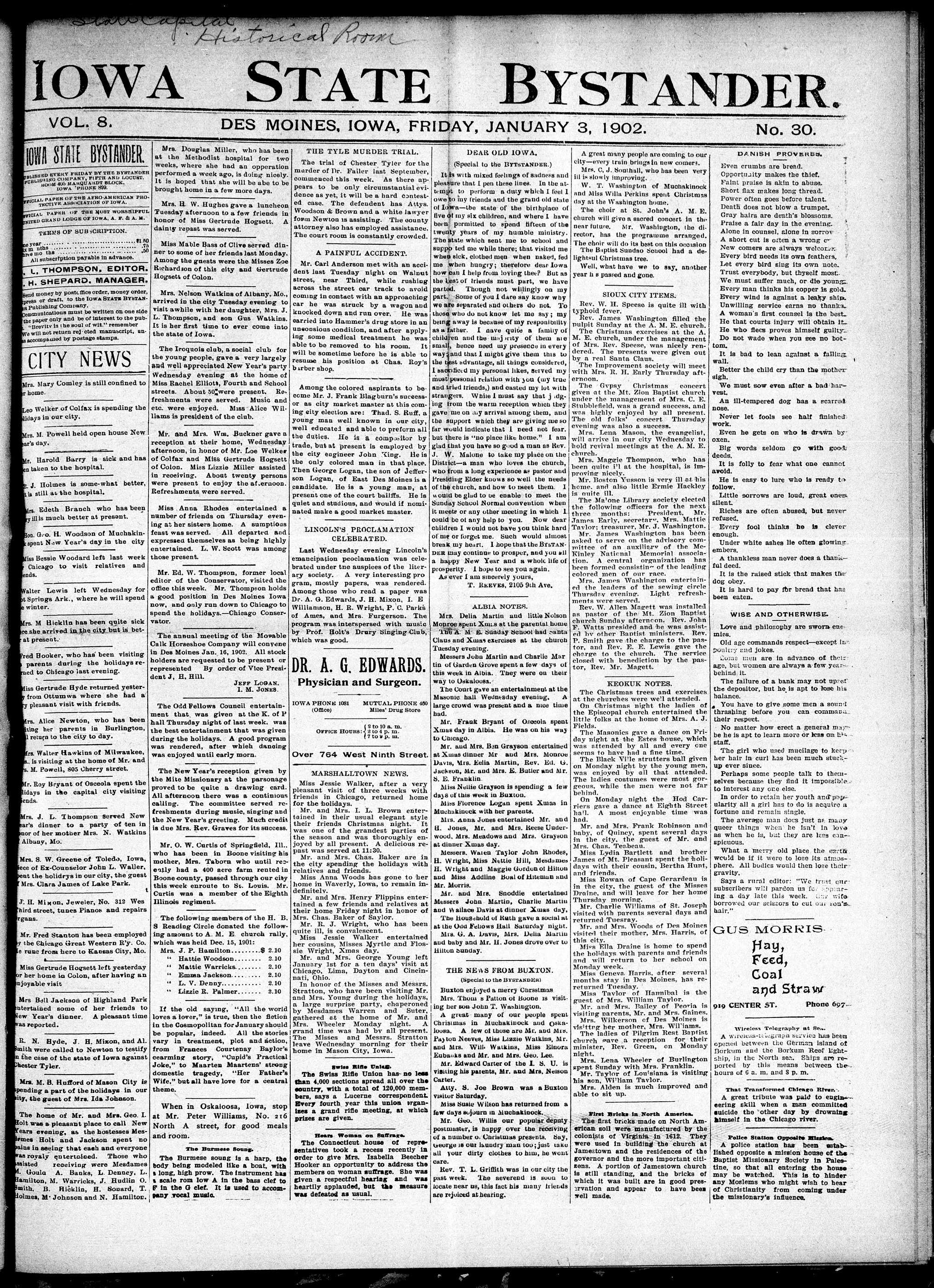
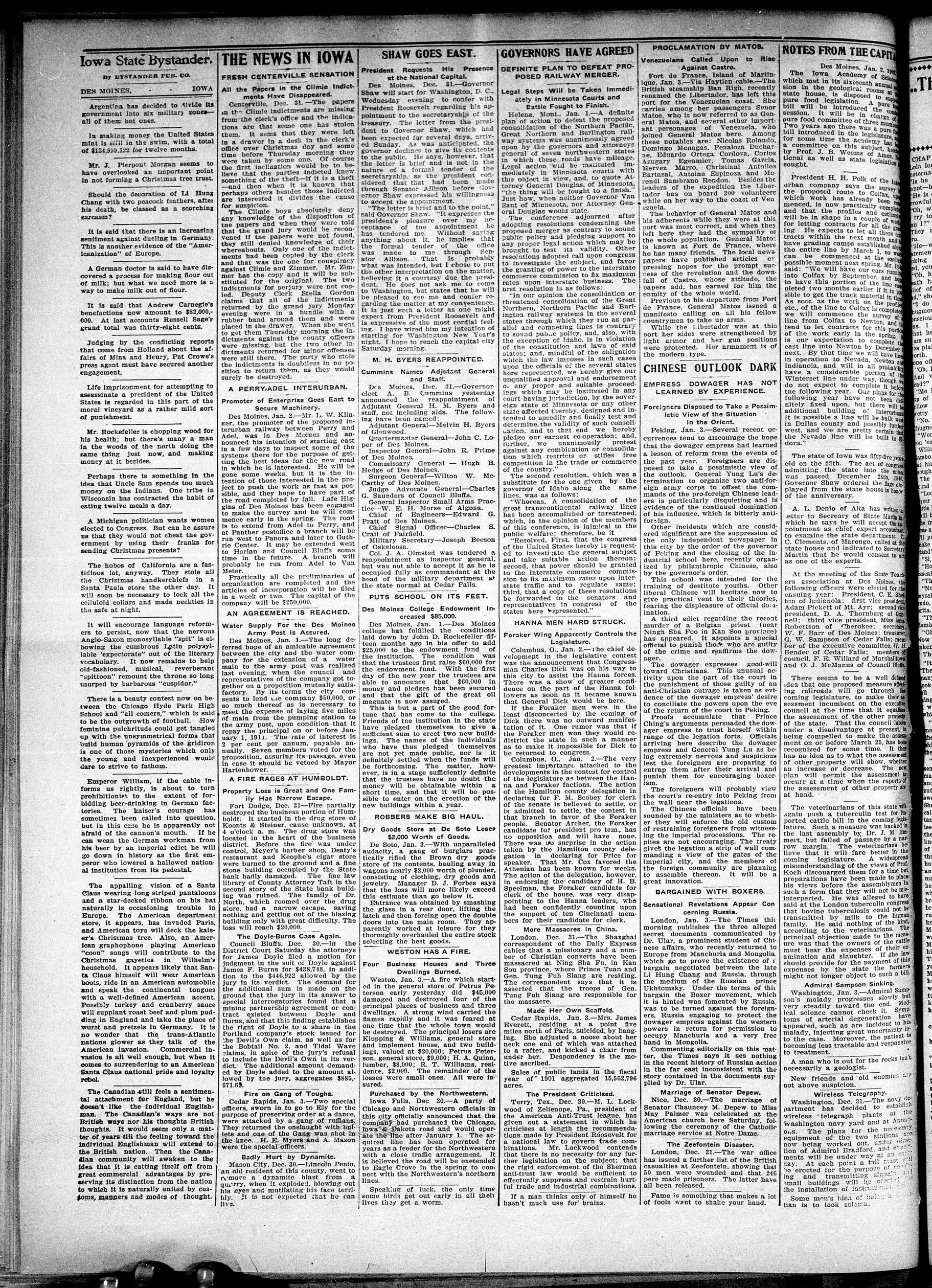
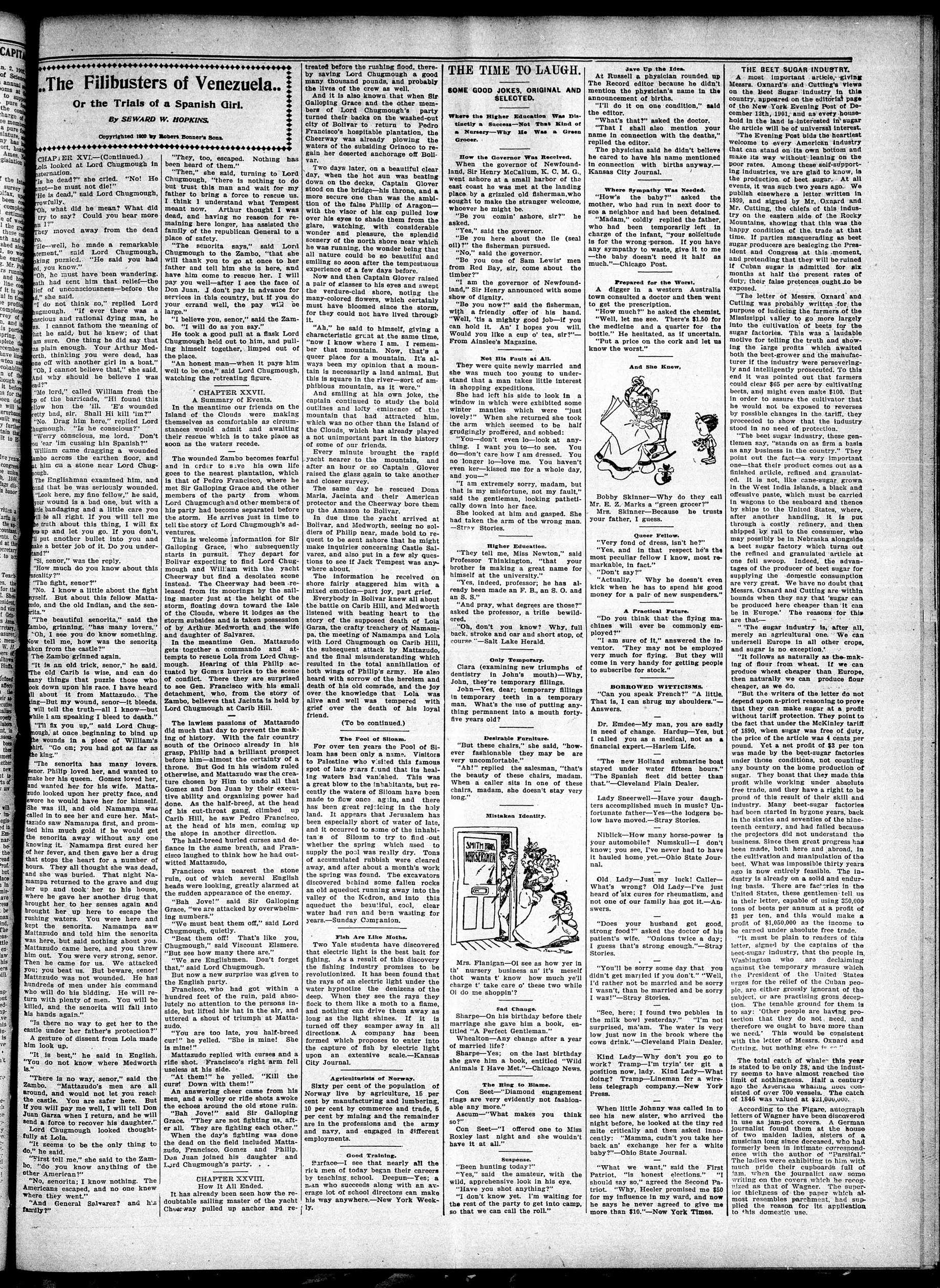
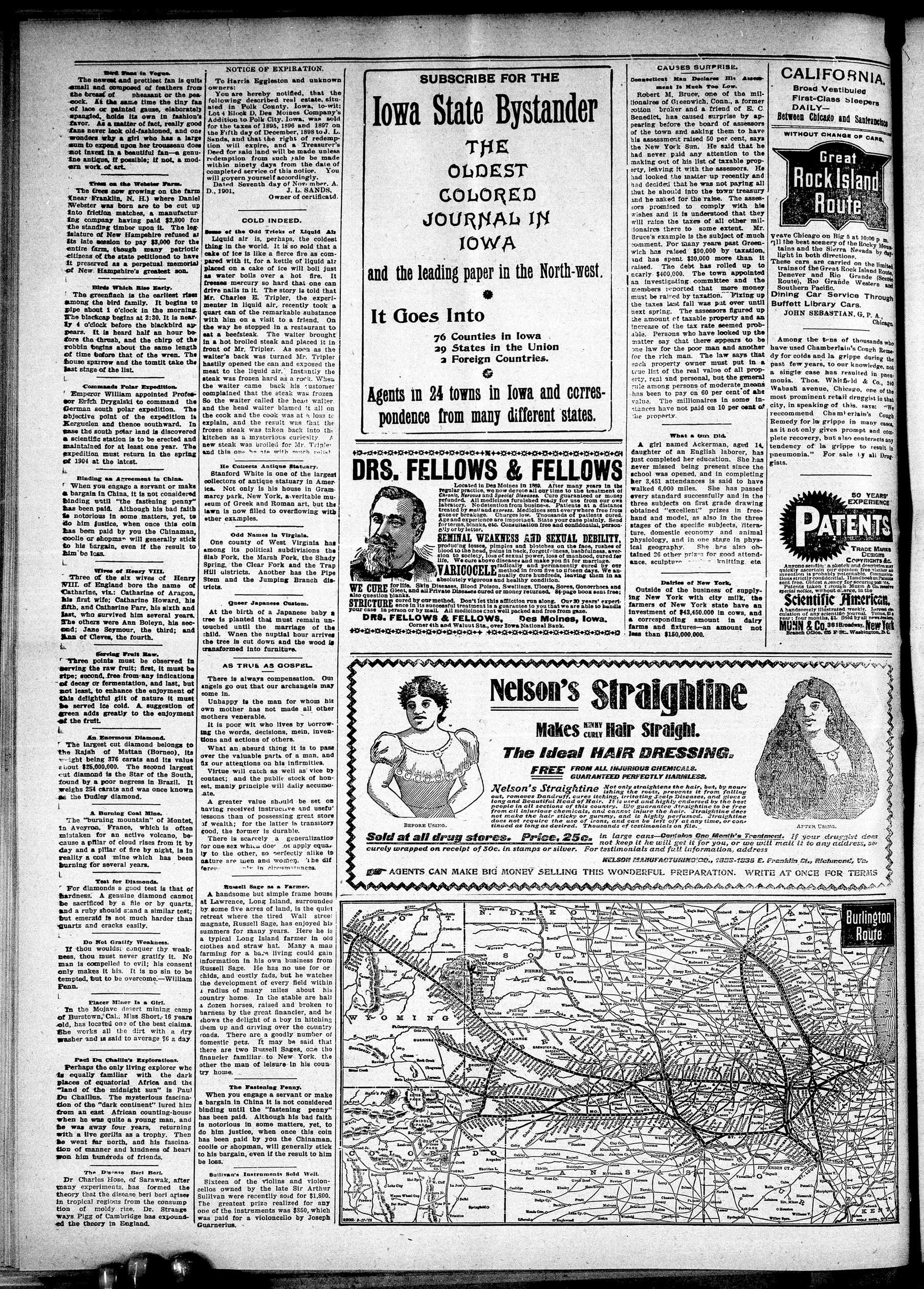
Page text (machine-generated)
IOWA STATE BYSTANDER.
VOL. 8.
IOWA STATE BYSTANDER.
PUBLISHED EVERY FRIDAY BY THE BYSTANDER PUBLISHING COMPANY, FIFTH AND LOCUT.
800M 405 MANGUARD BLOCK,
IOWA PHONE 899.
OFFICIAL PAPER OF THE ABO-AMERICAN PRO-
TECTIVE ASSOCIATION OF IOWA.
OFFICIAL PAPER OF THE MOST WORSHIPFUL
UNITED GRAND LODGE OF IOWA, A. F. & A. M.
TERMS OF SUB-SCRIPTION.
One year ..... $1.50
6 m nths ..... $7.00
Three mo this ..... $5.00
All subscription payables in advance.
L. THOMPSON, EDITOR.
H. SHEPARD, MANAGER.
Send money by post office order, money order,
press or draft. to the IOWA STATE BYSTANDER
Publishing Company.
Communications must be written on one side
of the paper only and be of interest to the pub-
"Brevity is the soul of wit." remember
We will not return re-cited manuscript, unless
accompanied by postage stamps.
CITY NEWS
Mrs. Mary Comley is still confined to our home.
Leo Welker of Colfax is spending the holidays in our city.
Mr. Harold Barry is sick and has been taken to the hospital.
E. J. Holmes is some-what better, it is still at the hospital.
Mrs. Edeth Branch who has been very ill is much better at present.
Hon. Gro. H. Woodson of Muchakin-spent New Year's day in the city
Miss Bessie Woodard left last week Chicago to visit relatives and sends.
Walter Lewis left Wednesday for Springs Ark., where he will spend the winter.
Mrs. M Hicklin has been quite sick
since she arrived in the city but is bet-
at present.
Fred Hooker, who has been visiting
a parents during the holidays re-
ferred to Chicago last evening.
Miss Gertrude Hyde returned yester-
ly from Ottumwa where she had a
very pleasant visit with friends.
Mrs. Alice Newton, who has been
visiting her parents in Burlington,
will return to the city to day.
Mrs. Walter Hawkins of Milwaukee,
is visiting at the home of Mr. and
rs. M. Powell, 805 Cherry street.
Mr. Roy Bryant of Osceola spent the holidays in the capital city visiting friends.
Mrs. J. L. Thompson served New Year's dinner to a party of ten in honor of her mother Mrs. N. Watkins Albany, Mo.
Mrs. S. W. Greene of Toledo, Iowa, piece of Ex-Counselor John L. Waller, sent the holidayrs in our city, the guest Mrs. Clara James of Lake Park.
J. H. Mimon, Jeweler, No. 312 Wes third street, tunes Pianos and repairs organs.
Mr. Fred Stanton has been employed by the Chicago Great Western R'y. Co. he runs from here to Kansas City, Mo.
Miss Gertrude Hogsett left yesterday or her home in Colon, after having an enjoyable visit
Mrs. Bell Jackson of Highland Park entertained some of her friends to New Year's dinner. A pleasant time was reported.
R. N. Hyde, J. H. Mixon, and Al. Smith were called to Newton to testify in the case of the state of Iowa against Chester Tyler.
Mrs. M. B. Hufford of Mason City is spending a part of the holidays in our city, the guest of Mrs. Ida Johnson.
The home of Mr. and Mrs. Geo. I. Holt was a pleasant place to call New Years evening, as the hostesses Meslames Holt and Jackson spent no pain in seeing that each and everyone was royally entertained. Those who assisted receiving were Mesdames M. Gould A. Bauks, L. Denney, L. Hamilton, M. Warricks, J. Hudlin O. Smith, B. Hicklin, H. Sonard, T. Holmes, M. Johnson and N. Hamilton.
Mrs. Douglas Miller, who has been at the Methodist hospital for two weeks, where she had an opposition performed a week ago, is doing nicely. It is hoped that she will be able to be brought home in a few more days.
Mrs. H. W. Hughes gave a luncheon Tuesday afternoon to a few friends in honor of Miss Gertrude Hogsett. A dainty repast was served.
Miss Mable Bass of Clive served dinner to some of her friends last Monday. Among the guests were the Misses Zoe Richardson of this city and Gertrude Hogsett of Colon.
THE TYLE MURDER TRIAL.
The trial of Chester Tyler for the murder of Dr. Failer last September, commenced this week. As there appears to be only circumstantial evidence as yet, it will be a hard contested case. The defendant has Attys. Woodson & Brown and a white lawyer from Newton is assisting. The county attorney also has employed assistance. The court room is constantly crowded.
A PAINFUL ACCIDENT.
Mr. Carl Anderson met with an accident last Tuesday night on Walnut street. Third while rohing
DEAR OLD IOWA.
(Special to the BYTSTANDER.)
It is with mixed feelings of sadness and pleasure that I pen these lines. In the attempt to perform a duty which I feel I owe to my friends and the grand old state of Iowa—the state of the birthplace of five of my six children, and where I have been permitted to spend fifteen of the twenty years of my humble ministry. The state which sent me to school and suppoted me while there; that visited me when sick, clothed men when naked, fed me when hungry; therefore dear Iowa how can I help from loving thee? But as the least of the friends there.
A great many people city—every train brings Mrs. C. J. Southall, ill is slowly improving. W. T. Washington and Miss Willa Perkins day at the Washington The choir at St. church will give a sacr near future. Mr. W. rector, has the prog The choir will do its bac The Baptist Sundae lightsl Christmas tree Well, what have we year he is passed and go
Mrs. Nelson Watkins of Albany, Mo. arrived in the city Tuesday evening to visit awhile with her daughter, Mrs. J. L. Thompson, and son Gus Watkins. It is her first time to ever come into the state of Iowa.
The Iroquois club, a social club for the young people, gave a very largely and well appreciated New Year's party Wednesday evening at the home of Miss Rachel Elliott, Fourth and School streets. About 50 were present. Refreshments were served. Music and etc. were enjoyed. Miss Alice Williams is president of the club.
Mr. and Mrs. Wm. Buckner gave a reception at their home, Wednesday afternoon, in honor of Mr. Loe Welker of Colfax and Miss Gertrude Hogsett of Colon. Miss Lizzie Miller assisted in receiving. About twenty persons were present to enjoy the afternoon. Refreshments were served.
Miss Anna Rhodes entertained a number of friends on Thursday evening at her sisters home. A sumptious feast was served. All departed and expressed themselves as being highly entertained. L. W. Scott was among those present.
Mr. Ed. W. Thompson, former local editor of the Conservator, visited the office this week. Mr. Thompson holds a good position in Des Moines Iowa now, and only run down to Chicago to spend the holidays.—Chicago Conservator.
The annual meeting of the Movable Calk Horseshoe Company will convene in Des Moines Jan. 16, 1902. All stock holders are requested to be present or represented By order of Vice President J, H. Hill.
JEFF LOGAN.
I. M. JONES.
The Odd Fellows Council entertainment that, was given at the K. of P hall Thursday night of last week. was the best entertainment that was given during the holidays. A good program was rendered, after which dancing was enjoyed until early morn.
The New Year's reception given by the Mite Missionary at the parsonage proved to be quite a drawing card. All afternoon there was a continuous calling. The committee served refreshments during music, singing and the New Year's greeting. Much credit is due Mrs. Rev. Graves for its success.
Mr. O. W. Curtis of Springfield, Ill.. who has been in Boone visiting his mother, Mrs. Taborn who until recently had a 400 acre farm rented in Boone county, passed through our city this week enroute to St. Louis. Mr. Curtis was a member of the Eighth Illinois regiment.
The following members of the H. B. S Reading Circle donated the following amount to A. M. E. church rally, which was held Dec. 15, 1901:
Mrs. J. P. Hamilton.....$ 2.10
If the old saying, "All the world loves a lover," is true, then the fiction in the Cosmopolitan for January should be popular, indeed. All the stories vary in treatment, plot and action, from Frances Courtenay Baylor's cearming story, "Cupid's Practical Joke," to Maarten Maartens' strong domestic tragedy, "Her Father's Wife," but all have love for a central theme.
When in Oskaloosa, Iowa, stop at Mr. Peter Williams, No. 216 North A street, for good meals and room.
The Burmese Sound
The Burmese sound is a harp, the body being modeled like a boat, with a long, high prow. The instrument has a scale rom low A in the bass clef to F in the G clef. It is used to accompany vocal music.
THE TYLE MURDER TRIAL.
The trial of Chester Tyler for the murder of Dr. Failer last September commenced this week. As there appears to be only circumstantial evidence as yet, it will be a hard contested case. The defendant has Attys Woodson and Brown and a white lawyer from Newton is assisting. The county attorney also has employed assistance. The court room is constantly crowded.
A PAINFUL ACCIDENT.
Mr. Carl Anderson met with an accident last Tuesday night on Walnut street, near Third, while rushing across the street car track to avoid coming in contact with an approaching car he was struck by a wagon and knocked down and run over. He was carried into Hammer's drug store in an unconscious condition, and after applying some medical treatment he was able to be removed to his room. It will be sometime before he is able to resume his position at Chas. Roy's barber shop.
Among the colored aspirants to become Mr. J. Frank Blagburn's successor as city market master at this coming city election are: Thad. S. Ruff, a young man well known in our city, well educated and able to preform all the duties. He is a composer by trade, but at present is employed by the city engineer John King. He is the only colored man in that place. Then George Logan, the son of Jefferson Logan, of East Des Moines is a candidate. He is a young man, at present one of the court bailiffs. He is quiet and studious, and would if nominated make a good market master.
LINCOLN'S PROCLAMATION
CELERATED.
Last Wednesday evening Lincoln's emancipation peoclamation was celebrated under the auspices of the literary society. A very interesting program, mostly papers, was rendered. Among those who read a paper was Dr. A. G. Edwards, J. H. Mixon, I. E Willamson, H. R. Wright, P. C. Parks of Ames, and Mrs. Furgerson. The program was interspersed with music by Prof. Holt's Drury Singing Club, which was good.
DR. A. G. EDWARDS
Physician and Surgeon.
IOWA PHONE 1081
(Office) MUTUAL PHONE 460
Miles' Drug Store
OFFICE HOURS: {8 to 10 a. m.
2 to 4 p. m.
7 to 9 p. m.
Over 764 West Ninth Street.
MARSHALLTOWN NEWS.
Miss Jessie Walker, after a very pleasant visit of three weeks with friends in Chicago, returned home for the holidays.
Mr. and Mrs. I. L. Brown entertained in their usual elegant style their friends Christmas night. It was one of the grandest parties of the season and was thoroughly enjoyed by all present. A delicious repast was served at 11:30.
Mr. and Mrs. Chas. Baker are in the city spending the holidays with relatives and friends.
Miss Anna Woods has gone to her home in Waverly, Iowa, to remain indefinitely.
Mr. and Mrs. Henry Flippins entertained a few friends and relatives at their home Friday night in honor of Mrs. Chas. Baker of Saylor.
Mr. R. J. Wright, who has been quite ill, is convalescent.
Miss Jessie Walker entertained her cousins, Misses Myrtle and Flossie Wright, Xmas day. Mr. and Mrs. George Young left January 1st for a ten days' visit at Chicago, Lima, Dayton and Cincinnati, Ohio. In honor of the Misses and Messrs. Stratton, who have been visiting Mr. and Mrs. Young during the holidays, a large surprise party, chaperoned by Mesdames Warren and Suter, gathered at the home of Mr. and Mrs. Wheeler Monday night. A grand time was had by all present. The Misses and Messrs. Stratton leave Wednesday morning for their home in Mason City, Iowa.
Swiss Rifle Union.
The Swiss Rifle Union has no less than 4,000 sections spread all over the country, with a total of 120,000 members, says a Lucerne correspondent. Every fourth year this union organises a grand rifle meeting, at which prizes are given.
Hears Woman on Suffrage.
The Connecticut house of representatives took a recess recently in order to give Mrs. Isabella Beecher Hooker an opportunity to address the members on woman suffrage. She was given a respectful hearing and was heartily applauded, but the measure was defeated as usual.
---
DEAR OLD IOWA.
(Special to the BYTSTANDER.)
It is with mixed feelings of sadness and pleasure that I pen these lines. In the attempt to perform a duty which I feel I owe to my friends and the grand old state of Iowa—the state of the birthplace of five of my six children, and where I have been permitted to spend fifteen of the twenty years of my humble ministry. The state which sent me to school and suppo ted me while there; that visited me when sick, clothed men when naked, fed me when hungry; therefore dear Iowa how can I help from loving thee? But as the best of friends must part, we have parted. Though not willingly on my part. Some of you I dare say know why we are separated and others do not. To those who do not know let me say; my being away is because of my responsibility as a father. I have quite a family of children and the majority of them are small, hence need my presence in every way; and that I might give them this to the best advantage, all things considered, I sacrificed my personal likes, served my most personal relation with you (my true and tried friends), and casted my lot with strangers. While I must say that judging from the warm reception when they gave me on my arrival among them, and the support which they are giving me so far would indicate that I need not fear, but there is "no place like home." I am glad that you have so good a man as Rev. J. W. Malone to take my place on the District—a man who loves the church, who from a long experience as pastor and Presiding Elder knows so well the needs of the church, and how to meet them. I would be glad to be enable to meet the Sunday School Normal convention when it meets or any other meeting in which it could be of any help to you. Now dear children I would not have you think hard of me or forget me. Such would almost break my heart. I hope that the BYSTANDER may continue to prosper, and you all a happy New Year and a whole life of prosperity. I hope to see you again.
A letter I am sorry to you again.
T. RKEVES. 2105 9th Ave.
ALBIA NOTES.
Mrs. Delia Martin and little Nelson Monroe spent Xmas at the parental home
The A. M. E. Sunday School had Santa Claus and Xmas exercises at the church Tuesday evening.
Messers John Martin and Charlie Martin of Garden Grove spent a few days of this week in Albia. They were on their way to Oskaloosa.
The Court gave an entertainment at the Masonic hall Wednesday evening. A large crowd was present and a nice time had.
Mr. Frank Bryant of Osoeola spent Xmas day in Albia. He was on his way to Chicago.
Mr. and Mrs. Ben Grayson entertained at Xmas dinner Mr. and Mrs. Monroe Davis, Mrs. Kelia Martin, Rev. Ed. G. Jackson, Mr. and Mrs. E. Butler and Mr. S. E. Franklin.
Miss Nellie Grayson is spending a few days of this week in Buxton.
Miss Florence Logan spent Xmas in Muchakinock with her parents.
Mrs. Anna Jones entertained Mr. and H. Jones, Mr. and Mrs. Reese Underwood, Mrs. Meadows and Mrs. Grayson at dinner Xmas day.
Messers, Waten Taylor John Rhodes, H. Wright, Miss Nettie Hill, Mesdames H. Wright and Maggie Gordon of Hilton and Miss Addline Boal of Hiteman and Mr. Morris.
Mr. and Mrs. Snoddie entertained Messers John Martin, Charlie Martin and Wallace Davis at dinner Xmas day,
The Household of Ruth gave a social at the Oud Fellows Hall Saturday night.
Mrs. G. A. Davis, Mrs. Delia Martin and baby and Mr. H. Jones drove over to Hilton Sunday.
THE NEWS FROM BUXTON.
(Special to the BYSTANDER)
Buxton enjoyed a merry Christmas
Mrs. Thom's Patton of Boone is visiting her son John T. Washington.
A great many of our people spent Christmas in Muchakinock and Oskaloosa. A few of those are Mr. and Mrs. Payton Neeves, Miss Lizzie Watkins, Mr. and Mrs. Will Watkins, Miss Elmora Eubanks and Mr. and Mrs. Geo. Lee.
Mr. Edward Carter of the I. S. U. is visiting his parents, Mr. and Mrs. Neison Carter.
Atty. S. Joe Brown was a Buxton visitor Saturday.
Miss Susie Wilson has returned from a few days sojourn in Muchakinock.
Mr. Geo. Willis our popular deputy postmaster, is happy over the receiving of a number o. Christmas presents. Say, George is our laundry man too; just take all your dirty clothes to him, he won't care.
Rev. T. L. Griffith was in our city the past week. The averend is soon to locate near us, this fact his many friends are rejoiced at hearing.
A great many people are coming to our city—every train brings in new comers. Mrs. C, J. Southall, who has been very ill is slowly improving. W. T. Washington of Muchakinock and Miss Willa Perkins spent Christmas day at the Washington home. The choir at St. John's A. M. E. church will give a sacred concert in the near future. Mr. Washington, the director, has the programme arranged. The choir will do its best on this occasion The Baptist Sundao School had a delightful Christmas tree. Well, what have we to say, another year he has passed and gone.
SIOUX CITY ITEMS
Rev. W. H. Speese is quite ill with typhoid fever.
Rev. James Washington filled the pulpit Sunday at the A. M. E. church.
The Christmas exercises at the A. M. E. church, under the management of Mrs. Rev. Speese, was nicely rendered. The presents were given out by a real Santa Claus.
The Improvement society will meet with Mrs. R. H. Early Thursday afternoon.
The Gvpsy Christmas concert given at the Mt. Zion Baptist church under the management of Mrs. C. E. Stubblefield, was a grand success, and was highly enjoyed by all present. The old folks' concert Thursday evening was also a success.
Mrs. Lena Mason, the evangelist, will arrive in our city Wednesday to hold revival meetings at the A. M. E. church.
Mrs. Maggie Thompson, who has been quite ill at the hospital, is improving nicely.
Mr. Boston Yusson is very ill at his home, and also little Ernie Hackley is quite ill.
The Ma'one Library society elected the following officers for the next three months: President, Mr. James Early, secretary. Mrs. Mattie Taylor, treasurer, Mr. J. Washington. Mr. James Washington has been asked to serve on the advisory committee of an auxiliary of the McKinley National Memorial association. A central organization has been formed consistin' of the leading colored men of our race.
Mrs. James Washington entertained the leaders of the sewing circle Thursday evening. Light refreshments were served.
Rev. W. Allen Magett was installed as pastor of the Mt. Zion Baptist church Sunday afternoon. Rev. John F. Watts presided and he was assisted by other Baptist ministers. Rev. P. Smith gave the charge to the pastor, and Rev. E. E. Lewis gave the charge to the church. The service closed with benediction by the pastor. Rev. Mr. Magett.
KEOKUK NOTES
The Christmas trees and exercises at the churches were well attended. On Christmas night the ladies of the Episcopal church entertained the little folks at the home of Mrs. A. J. Fields. The Masonics gave a dance on Friday night at the Estes house, which was attended by all and every one seems to have had a fine time. The Black Ville strutters ball given on Monday night by the young men, was enjoyed by all that attended. The ladies costumes were most gorgeous, while the men were not far behind. On Monday night the Hod Carriers gave a dance at Eighth Street hall. A most enjoyable time was had. Mr. and Mrs. Frank Robinson and baby, of Quincy, spent several days in the city, the guest of Mr. and Mrs. Chas. Teabeau.
Miss Lydia Bartlett and brother James of Mt. Pleasant spent the holidays with their cousin, Bertha Hunt, and friends.
Miss Rowan of Cape Gerardeau is in the city, the guest of the Misses Draine, and will leave for her home Thursday morning.
Mr. Charlie Williams of St. Joseph visited with parents several days and returned Tuesday.
Mr. and Mrs. Woods of Des Moines visited their mother, Mrs. Harris, of this city.
Miss Ella Draine is home to spend the holidays with parents and friends and will return to her school on Monday week.
Miss Geneva Harris, after several months stay in Des Moines, has re-returned Tuesday.
Miss Tavlor of Harmibal is the guest of Mrs. William Taylor.
Mr. and Mrs. Bailey of Peoria is visiting parents, Mr. and Mrs. Gaines.
Mrs. Wilkerson of Des Moines is visiting her mother, Mrs. Williams.
The ladies of Pilgrim Rest Baptist church gave a reception for their minister, Rev. Green, on Monday night.
Mrs. Alden is much improved and able to sit up.
First Bricks in North America.
The first bricks made on North American soil were manufactured by the colonists of Virginia in 1612. They were used in building the church at Jamestown and the residences of the governor and the more important citizens. A portion of Jamestown church is still standing, and the bricks of which it was built are in good preservation and appear to have been well made.
```markdown
```
No. 30.
Even crumbs are bread.
Opportunity makes the thief.
Paint praise is akin to abuse.
Short flax makes long thread.
Power often goes before talent.
Death does not blow a trumpet.
Gray hairs are death's blossoms.
Praise a fair day in the evening.
Alone in counsel, alone in sorrow
A short cut is often a wrong or
New comers are always welcome.
Every bird needs its own feathers.
Let every bird sing its own note.
Trust everybody, but thyself most.
We must suffer much, or die young.
Every man thinks his copper is gold.
Every wind is against a leaky ship
Unwilling service earns no thanks.
A woman's first counsel is the best.
He that courts injury will obtain it.
He who flees proves himself guilty.
Do not wade when you see no bottom.
It is bad to lean against a falling wall.
Better the child cry than the mother sigh.
We must sow even after a bad harvest.
An ill-tempered dog has a scarred nose.
Never let fools see half finished work.
Even he gets on who is drawn by oxen.
It is folly to fear what one cannot avoid.
He is easy to lure who is ready to follow.
Little sorrows are loud, great ones silent.
Every fool thinks he is clever enough.
Under white ashes lie often glowing embers.
A thankless man never does a thankful deed.
It is the raised stick that makes the dog obey.
It is hard to pay for bread that has been eaten.
WISE AND OTHERWISE.
Love and philosophy are sworn enemies.
Old age commands respect—except for poultry and jokes.
Some men are in advance of their age, but women are always a few years behind it.
The failure of a bank may not upset the depositor, but he is apt to lose his balance.
You have to give some men a sound thrashing before you can command their respect.
No matter how erect a general may be he is apt to learn more or less on his staff.
The girl who used mucilage to keep her hair in curl has been much stuck-up ever since.
Perhaps some people talk to themselves because they find it impossible to interest any one else.
In order to retain her youth and popularity all a girl has to do is acquire a fortune and remain single.
The average man does just as many queer things when he isn't in love as when he is, but they are less conspicuous.
What a merry old place the earth would be if it were to lose its atmosphere. All bodies would then lose their gravity.
Says a rural editor: "We trust our subscribers will pardon us for appearing a day late this week. Our wife borrowed our scissors to cut our son's hair."
GUS MORRIS
Hay,
Feed,
Coal
and Straw
919 CENTER ST. Phone 697-
Wireless Telegraphy at Sea. A wireless telegraph service has been opened between the German island of Borkum and the Borkum Reef lightship, in the North sea. Ships are reported by this means between the hours of 6 a. m. and 8 p. m.
A great tribute was paid to engineering skill when a man committed suicide the other day by drowning himself in the Chicago river.
Police Station Opposite Mission.
A police station has been established opposite a mission house of the Baptist Missionary Society in Palestine, so that all entering the house may be watched. This is to hinder any Moslems who might wish to hear of Christianity from coming under the missionary's influence.
```markdown
```
Iowa State Bystander.
Argentina has decided to divide its government into six military zones—all of them hot ones.
In making money the United States mint is still in the swim, with a total of $134,999,122 for twelve months.
Mr. J. Pierpont Morgan seems to have overlooked an important point in not forming a Christmas tree trust.
Should the decoration of Li Hung Chang with two peacock feathers, after his death, be classed as a scorching sarcasm?
It is said that there is an increasing sentiment against duelling in Germany. This is another evidence of the "Americanization" of Europe.
A German doctor is said to have discovered a process for making flour out of milk; but what we need more is a way to make milk out of flour.
It is said that Andrew Carnegie's benefactions now amount to $82,000,000. At last accounts Russell Sage's grand total was thirty-eight cents.
Judging by the conflicting reports that come from Holland about the affairs of Mina and Henry, Pat Crowe's press agent must have secured another engagement.
Life imprisonment for attempting to assassinate a president of the United States is regarded in this part of the moral vineyard as a rather mild sort of punishment.
Mr. Rockefeller is chopping wood for his health; but there's many a man in the woods of the north doing the same thing just now, and making money at it besides.
Perhaps there is something in the idea that Uncle Sam spends too much money on the Indians. One tribe in Wisconsin has contracted the habit of eating twelve meals a day.
A Michigan politician wants women elected to Congress. But can he assure us that they would not cheat the government by using their franks for sending Christmas presents?
The hobbs of California are a fastidious lot, anyway. They stole all the Christmas handkerchiefs in a Santa Paula store the other day. It will soon be necessary to lock all the celluloid collars and made neckties in the safe at night.
It will encourage language reformers to persist, now that the nervous Anglo-Saxon monosyllable "spit" is elbowing the cumbrous Latin polysyllable "expectorate" out of the literary vocabulary. It now remains to help old-fashioned, musical, reverberant "spittoon" remount the throne so long usurped by barbarous "cuspidor."
There is a beauty contest now on between the Chicago Hyde Park High School and "all comers," which is said to be the outgrowth of football. How feminine pulchritude can get tangled up with the unsymmetrical forms that build human pyramids of the gridiron is one of those mysteries which only the young and inexperienced would dare to strive to fathom.
Emperor William, if the cable informs us rightly, is about to turn prohibitionist to the extent of forbidding beer-drinking in German factories. The kaiser's courage has sometimes been called into question, but in this case he is apparently not afraid of the cannon's mouth. If he can wean the German workman from his beer by an imperial edict he will go down in history as the first emperor who lowered a hallowed national institution from its pedestal.
The appalling vision of a Santa Claus wearing long striped pantaloons and a star-decked ribbon on his hat naturally is occasioning trouble in Europe. The American department store, it appears, has invaded Paris, and American toys will deck the kaiser's Christmas tree. Also, an American graphophone playing American "coon" songs will contribute to the Christmas gayeties in Wilhelm's household. It appears likely that Santa Claus himself will wear American boots, ride in an American automobile and speak the continental tongues with a well-defined American accent. Possibly turkey and cranberry sauce will supplant roast beef and plum pudding in England and take the place of wurst and pretzels in Germany. It is no wonder that the trans-Atlantic nations glower as they talk of the American invasion. Commercial invasion is all well enough, but when it comes to surrendering to an American Santa Claus national pride and loyalty rebel.
The Canadian still feels a sentimental attachment for England, but he doesn't like the individual Englishman. The Canadian's ways are not British ways nor his thoughts British thoughts. It would seem only a matter of years till the feeling toward the individual Englishman will extend to the British nation. Then the Canadian community will awaken to the idea that it is cutting itself off from great commercial advantages by preserving its distinction from the nation to which it is naturally united by customs, manners and modes of thought.
THE NEWS IN IOWA
FRESH CENTERVILLE SENSATION
All the Papers in the Climie Indict-
ment Have Disappeared.
Centerville, Dec. 31.—The papers in the Climie indictments are missing from the clerk's office and the indications are that some one has stolen them. It seems that they were left in a drawer in a desk in the clerk's office over Christmas day and some time before Thursday morning they were taken by some one. The first inclination would be to believe that the parties indicted knew something of the theft—if it is a theft and then when it is known that perhaps others besides those indicted are interested it divides the cause for suspicion.
The Climie boys absolutely deny any knowledge of the disposition of the papers and when they were told that the grand jury would be reconvened if the papers were not found, they still denied knowledge of their whereabouts, been copied by the clerk and that was the one for conspiracy against Climie and Zimmer. Mr. Zimmer has the copy and it will be substituted for the original. The two indictments for perjury were not copied. Deputy Clerk Jesse McClain claims that all the indictments against the grand jury Monday evening were in a bundle with a rubber band around them and were placed in the drawer. When she went to get them Thursday morning the indictments against the county officers were missing, but the two indictments turned out minor offenses. The party who stole the indictments is doubtless in no position to return them, as they would surely be destroyed.
A PERRY:ADEL INTERURBAN.
Promoter of Enterprise Goes East to Secure Machinery
Des Moines, Jan. 2.—Mr. L. W. Klinger, the promoter of the L.posed interurban railway between Perry and Adel, was in Des Moines and announced his intention of starting east in a few days to inspect some of the systems there for the purpose of getting the best ideas for the new road in which he is interested. He will be gone some weeks, but it is the intention of those interested in the project to push the work at least possible, and they have part of the construction by fall. Late Higins of Des Moines has been engaged to make the survey and he will commence early in the spring. The road is to extend from Adel to Perry, and at Panther postoffice a branch will be run west to Panora and later to Guthrie Center. It may be extended west to Harlan and Council Bluffs some time in the future. A branch will probably be run from Adel to Van Meter. Practically all the preliminaries of operation are completed and the articles of incorporation will be filed in a week or two. The capital of the company will be $250,000.
AN AGREEMENT IS REACHED.
Water Supply For the Des Moines
Army. Post is Assured.
Des Molines, Jan. 1.—The long deferred hope of an amicable agreement between the city and the water company for the extension of a water main to the army post was realized last evening, when the council and representatives of the company got together on a proposition mutually satisfactory. By its terms the city consents to lend the company $50,000, or so much thereof as is necessary to meet the expense of laying five miles of main from the pumping station to the army post, upon condition it repay the principal on or before January 1, 1911. The rate of interest is not cent per annum, payable annually. Seven members voted for the proposition, assuring its passage, even in case it should be vetoed by Mayor Hartenhower.
A FIRE RAGES AT HUMBOLDT.
Property Loss is Great and One Fam
ily Has Narrow Escape.
Fort Dodge, Dec. 31—Fire partially destroyed the business portion of Humboldt. It started in the drug store of Koonts & Steiner, cause unknown, at 4 o'clock a. m. The drug store was located in the heart of the business district. Before the fire was under control, Meyer's store chose to burn Koonts & Steiner's cigar store were burned to the ground and a fine stone building occupied by the State bank badly damaged. The fine law library of County Attorney Taft in the second story of the State bank building was ruined. The family of Dr. North, which room for the fire, saving nothing and getting out of the blazing building only with great difficulty. The loss will reach $20,000.
The Doyle-Burns Case Again.
Council Bluffs, Dec. 30.—In the District Court Saturday the attorneys for James Doyle filed a motion for judgment in the suit of Doyle against James F. Burns for $438,748, in addition to the $446,922 allowed by the court, the additional sum is made on the ground that the jury in its answer to special interrogatories found that a mining partnership agreement or contract existed between Doyle and Burns, and that this finding establishes the case against the Portland company's stock issued for the Devil's Own claim, as well as for the Bobtail No. 2, and Tidal Wave claims, in spite of the jury's refusal to include the Devil's Own in its verdict. The additional amount demanded by Doyle added to the amount allowed by the jury, aggregates $885,671.63.
Fire on Gang of Toughs.
Cedar Rapids, Jan. 3.—Two special officers, sworn in to go to Ely for the purpose of preserving order at a dance, were attacked by a gang of ruffians. They returned the onslaught with bullets and one of the Gang was shot in the knee. H. E. Myers and A. Mason were the special officers.
Badly Hurt by Dynamite.
Mason City, Dec. 30.—Lincoln Peno, an old resident of this county, went to remove a dynamite blast from a quarry, when it exploded, blowing his eyes and mutilating his face terribly. It is not expected that he can
SHAW GOES EAST.
President Requests His Presence
present the National Capital
Des Moines, Dec. 31.—Governor Shaw will start for Washington, D.C. Wednesday evening to confer with President Roosevelt regarding his appointment to the secretaryship of the treasury. The letter from the president to Governor Shaw, which had been expected for several days, arrived Sunday. As was anticipated, the governor declines to give its contents to the public. He says, however, that the letter is brief and is not in the nature of a formal tenor. The secretaryship is the president's job that had been made through Senator Allison before Governor Shaw expressed his willingness to accept the appointment.
"The letter is brief and to the point," said Governor Shaw. "It expresses the president's pleasure over my acceptance of the appointment he has tendered me. Without it, without this tenderment it, he professes that the formal tender of the office was made to me through Senator Allison. That is probably what was intended, but I chose to put the other interpretation on the matter, believing it a courtesy due the president to Washington but states that he will be pleased to see me and confer regarding the matter at my convenience. It is just such a letter as one might expect from President Roosevelt and is expressive of the most cordial feeling. I have wired him my letter with the New Year's night. I hope to reach the capital city Saturday morning.
M. H. BYERS REAPPOINTED.
Cummins Names Adjutant General and Staff
Des Moines, Dec. 31.—Governor elect A. B. Cummins yesterday announced the reappointment of Adjutant General H. M. Byers and staff, not including aids. The following have been named: Adjutant General—Melvin H. Byers of Glenwood.
Quartermaster General—John C. Loper of Des Moines.
Inspector General—John R. Prime of Dag Moine.
Commissary General — Hugh B.
Hedge, of Des Moines.
Surgeon General—Wilton W. McCarthy of Des Moines.
Judge Advocate General—Charles G. Saynders of Council Bluffs.
Chief Signal Officer—Charles S. Crall of Fairfield.
Military Secretary—Joseph Beeson of Columbia.
Col. J. A. Olmsted was tended a reappointment as inspector general, but was not able to accept it as he is occupied fully as commander at the state normal at Cedar Falls at the state normal at Cedar Fells.
PUTS SCHOOL ON ITS FEET.
Des Moines College Endowment Increased $55,000.
Des Moines, Jan. 1.—Des Moines college has fulfilled the conditions laid down by John D. Rockefeller fifteen months ago in his offer to add $25,000 to the endowment fund of the institution. The condition was that the trustees first raise $60,000 for the endowment fund. With the first day of the new year the fund announced that $60,000 in money and pledges has been secured and that the gift of the great oil margate is now assured.
This is but a part of the good fortune that has come to the college. Friends of the institution in the state have pledged themselves to give a sufficient sum to erect two menhouses for the individuals who have thus pledged themselves are not yet made public, nor is it definitely settled when the funds will be forthcoming. The matter, however, is in a stage sufficiently definite that the trustees have no doubt the menhouses will be short time, and that it will be possible to enter on the erection of the new buildings within a year.
ROBBERS MAKE BIG HAUL.
Dry Goods Store at De Soto Loser
$2,000 Worth of Goods
De Soto, Jan. 3.—With unparalleled audacity, a gang of burglaries practically riffed the Brown dry goods store of its contents, hauling away in wagons nearly $2,000 worth of plunder, consisting of clothing, dry goods and tools, and a large number that the loss will more likely exceed this estimate than go below it. Entrance was obtained by smashing the glass in a rear door, lifting the latch and then forcing open the double doors into the main room. They appalled the store thoroughly overhauled the entire stock selecting the best goods.
WESTON HAS A FIRE.
Four Business Houses and Three Dwellings Burned.
Weston, Jan. 3.—A fire which started in the general store of Petrus Peterson early yesterday did $45,000 damaged and destroyed four of the principal places of business and three dwellings. A strong wind carried the flames rapidly and it was feared at one time that the whole town would be destroyed. The principal losers are Klopping, Williams, general store and implement house, and two buildings, valued at $20,000; Petrus Peterson, general store, $9,000; H. A. Quinn, lumber, $8,000; R. T. Williams, residence, $2,000. The remainder of the losses were small ones. All were insured.
Purchased by the Northwestern.
Purchased by the Northwestern.
Iowa Falls, Dec 30—A party of Chicago and Northwestern officials in this city officially announced that the company had purchased the Chicago, Iowa and Dakota road and would operate the line after January 1. The acquired line has been operated for years as a feeder for the Northwestern. It is believed the road will be extended to Eagle Grove in the spring to connect with the Northwestern's northern lines.
Speaking of luck, the only time some birds get out early in all their lives they get a worm.
GOVERNORS HAVE AGREED
DEFINITE PLAN TO DEFEAT PROPOSED RAILWAY MERGER.
Helena, Mont. Jan. 1.—A definite plan of action to defeat the proposed consolidation of the Northern Pacific, Great Northern and Burlington railway systems was unanimously agreed upon by the governors and general of these two northern states which these roads have mileage. Legal action will be instituted immediately in Minnesota courts with this object in view, and, to quote Attorney General Douglas, of Minnesota, the thing will be fought by the governor Van Sant of Minnesota, nor attorney General Douglas would state.
The conference adjourned after adopting resolutions condemning the proposed merger as contrary to sound public policy and pledging to work with the company which may be brought to test its validity. Other resolutions adopted call upon congress to investigate the subject, and favor the granting of power to the interstate commerce commission to impose a corporate business. The first resolution is as follows:
"In our opinion the consolidation or threatened consolidation of the Great Northern, Northern Pacific and Burlington railway systems in the several states through which they run as parallel and competing lines is contrary to sound public policy, and, also, with the exception of Idaho, is in violation of the constitution and law of states; and mindful of the obligation which law imposes in such cases the officials of the several states here represented, we hereby give our unqualified approval and endorsement o. any proper and suitable proceedings which may be instituted in any court having jurisdiction, by the sovereign state of Minnesota or any other state affected thereby, designed and intended to speedily and finally test and determine, the validity of such consolidation, and to that end we pledge our earnest cooperation; and, further, we jointly unanimously protest any combination or consolidation which restricts or stifles free competition in the trade or commerce of the country."
The second resolution, which was a substitute for the one given by the governor of Idaho along the same lines, was as follows:
"Whereas, A consolidation of the great transcontinental railway lines has been accomplished or threatened which, in the opinion of the members of the public, is inimical to the public welfare; therefore, be it
"Resolved, First, that the congress of the United States hereby is requested to investigate the general subject and take suitable action thereon; second, that power should be granted to the interstate commerce commission to fix maximum rates upon interstate traffic and to modify the policy of these resolutions be forwarded to the senators and representatives in congress of the states here represented."
HANNA MEN HARD STRUCK.
Foraker Wing Apparently Controls the Legislature.
Columbus, O., Jan. 2.—the chief development in the legislative contest was the announcement that Congressman Charles Dick was on his way to this city to assist the Hanna forces. There was a show of greater confidence on the part of the Hanna followers as soon as it became known that General Dick would be here. If the Foraker men were in the less disconcerted coming of Dick, they would outward manifestation of it. One rumor was that if the Foraker men won they would redistrict the state in such a manner as to make it impossible for Dick to be returned to congress.
Columbus, O., Jan. 2.—The very greatest importance attached to the developments in the contest for control of the legislature as between the Hanna and Foraker factions. The action of the Hamilton county delegation in declaring for F. M. Scobey for clerk or the senator is set to be limited to settle, the contest in that branch in favor of the Foraker people. Senator Archer, the Foraker candidate for president pro tem, has no opposition and will have none. There was no surprise in the action taken by the Hamilton county delegation in declaring for Price for speaker. That Mr. Cox favored the Athenian has been known for weeks. The action of the senator was the candidacy of H. B. Speelman, the Foraker candidate for clerk of the house, was very disappointing to the Hanna leaders, who had been confidently counting upon the support of ten Cincinnati members for their candidate for clerk.
More Massacres in China.
London, Dec. 31.—The Shanghai correspondent of the Daily Express cables that a missionary and a number of Christian converts have been massacred at Ning Fu Fu, in Kan Son province where Prince Tuan and Gen. Tung Fuh Siang are residing, the correspondent says that it asserted that the troops of Gen. Tung Fuh Siang are responsible for the massacre.
Made Her Own Scaffold.
Cedar Rapids, Jan. 3.—Mrs. James Everett, residing at a point five miles north of Paris, sulcided, by hanging. She adjusted a noose about her neck one end of which was attached to a hook held in a chair from under her. Despondency is the motive ascribed. Sales of public lands in the fiscal year of 1901 aggregated 15,502,796 acres.
The President Criticised.
Terry, Tex., Dec. 30.—M. L. Lockwood of Zelienna, Pa., president of the American Anti-Trust league, has given out a statement in which he criticises at length the recommendations made by President Roosevelt for a national law to govern trade combinations. Mr. Lockwood contends that there is no necessity for any further legislation on the subject; that the rigid enforcement of the Sherman anti-trust law would be sufficient to effectually suppress and restrain hurtful trade and industrial combinations. If a man thinks only of himself he hasn't much use for' brains.
Fort de France, Island of Martílique, Jan. 2—Via Hayden cable.—The British steamship Ban Righ, recently renamed the Libertador, has left this port for the Venezuelan coast. She carries among her passengers Senior Matos, who is now referred to as General Matos, and several other important personages of Venezuela, who joined General Matos here. Among these notables are: Nicolas Rolando, Domingo Monagas, Penalozha Ducharne, Eduardo Ortega Cordova, Carlos Azugary Egeamier, Tomas Mervez, Marro, Christian Antolles Bartazal, Amirte Espinoza and Monsanto Sambrano Rendon. Besides the leaders of the expedition the Libertador has on board 200 volunteers while on her way to the coast of Venezuela.
The behavior of General Matos and his adherents while they were at this port was most correct, and when they left here they had the sympathy of the whole population. General Matos is known at Fort de France, where he has many friends. The local newspapers have published articles pressing hopes for the prompt success of revolution and the downfall of Castro, whose attitude, the papers add, has earned for him the empathy of the whole world.
Previous to his departure from Fort de France, General Matos issued a manifesto calling on all his fellow countrymen to take up arms. While the Libertador was at this point he was sentenced by light armor and her gun positions were protected. Her armament is of the modern type.
CHINESE OUTLOOK DARK
EMPRESS DOWAGER HAS NOT
LEARNED BY EXPERIENCE.
Peking, Jan. 3.—Several recent occurrences tended to discourage the hope that the dowager empress had learned a lesson of reform from the events of the past year. Foreigners are disposed to take a pessimistic view of the outlook. General Yung Lu's determination to organize two antiforeign corps to offset the commands of the pro-foreign Chinese leaders is particularly disquieting and is evidence of the continued domination of his influence, which is bitterly antiforeign.
Other incidents which are considered significant are the suppression of the only independent newspaper in this city by the order of the governor of Peking and the closing of the industrial school here, recently organized by Wilhelmrophe Chinese, also by the governor's order.
This school was intended for the training of destitute youths. Other liberal Chinese will hesitate now to give practical vent to their theories, fearing the displeasure of official destination.
A third edict regarding the recent murder of Belgian priest (near Shi Shi Foo in Anshan) has appeared. It appoints a special official to punish those who are guilty of the crime and reaffirms the dowager.
The dowager expresses good-will toward Christians. This unusual activity upon the part of the court in the punishment of those guilty of an anti-Christian act, the dowager empress' desire to conciliate the powers upon the eve of the return of the court to Peking.
Proofs accumulate that Prince Ching's arguments persuaded the dowager empress to trust herself within range of the legation forts. Officials arriving here describe the dowager empress and General Yung Lu as being extremely nervous and suspicious lest the foreigners are preparing to traumatize them for a violent invasion, punish them for encouraging boxerism. The foreigners will probably view the court's re-entry into Peking from the wall near the legations. The Chinese officials have been sounded by the ministers as to whether they will enforce the old custom of restraining foreigners from witnessing the imperial processions. The replies are not encouraging. The treaty gives the legation a stairway to the gates of the imperial city, and the members of the foreign community are planning to assemble thereon. It will be a great innovation.
BARGAINED WITH BOXERS.
Sensational Revelations Appear Concerning Russia.
London, Jan. 3.—The Times this morning publishes the three alleged secret documents communicated by Dr. Ular, a prominent student of Chinese affairs, who recently returned to Europe from Manchuria and Mongolia, which go to prove the existence of $t$ bargain negotiated between the late Li Hung Chang and Russia, through the medium of the Russian prince Ukhtomsky. Under the terms of this bargain the Boxer movement, which it is hinted to fomented by Russia, was to be turned against the foreigners. Russia engaging to protect the powers in return for permission to occupy Manchuria and a very free hand in Mongolia.
Commenting editorially on this matter, the Times says it ses nothing in the recent history of Russian action in the far east inconsistent with the story contained in the documents supplied by Dr. Ular.
Nice, Dec 20—The marriage of Senator Chaucey M. Deppe to Miss May Palmer was celebrated at the American church here Saturday, following the ceremony of the Catholic marriage service at Notre Dame.
The Zeefontein Disaster.
London, Dec. 31.—The war office has issued a further list of the British casualties at Zeefontein, showing that 50 men were wounded and that 246 pere made prisoners. The latter have all been released.
Fame is something that makes a lot of fools want to shake your hand.
Des Moines, Jan. 2, 1922
The Iowa Academy of Science which met in its sixteenth annual session in the geological rooms at the house is disposed to pure food laboratory. A pure food bill will be introduced the commission session. It will be in charge of pure food committee of three. Two years ago there was a pure food introduced in the legislature for the time the academy has been a committee its subject, held by Prof. J. B. Weems of Ames National as well as state legislation sought.
President H. H. Polk of the International urban company says the survey of the proposed route to Colfax, upon which work has already been commenced, is now practically complete and that the profiles and estimates will be in shape in a couple of weeks for letting contracts for all the grazing projects to let all these contractors within the month and have grading camps established along the entire line by March so we can be commenced at the possible moment next spring. Mr. Polk said: "We will have our cars running into Colfax by September, and how to have this portion of the line completed earlier if it is possible to get the material in time. As soor, as the work is going, the profiles etc., of the line to Colfax is completed, we will commence the line from Colfax to Newton, and it tend to let contracts for this portion of the work early in the spring. It is our expectation to complete the east line into Newton by December. By then, we will have lines in operation to Nevada Newton and Indianola, and will in all countries have a considerable portion of the Winterset line under way, though we do not expect to complete it before the following year. Our plans for the following year have not been definitely fixed upon, but there will be interurban it is possible a line will be built in Dallas county and possibly in the west, and we are pretty certain the Nevada line will be built to Edora."
The state of Iowa was fifty-five years old on the 28th. The act of congress admitting the state into the union was passed December 28th, 1894. Governor Shaw ordered the glass displayed from the state house in honor of the anniversary.
A. L. Denio of Alka has written a letter to Secretary of State Martin in which says he expects the department chief expert to examine the state department.
C. Clemente, of Marengo, called at the state house and indicated to Secretary Martin that he would consent to act as one of the experts.
At the meeting of the State Teachers association at Des Moines, the following officers were elected for the ensuing year: President, C. E. Shelton of Indianola; first vice president, Adam Picktall of Mt. Ayr; second vice president, D. A. Thornburg of Gettysburg; third vice president, Robertson of Cherokee; secretary, W. F. Barr of Des Moines; treasurer, G. W. Sampson of Cedar Falls; member of the executive committee, W. H. Bender of Cedar Falls; members of council, F. E. Willard of Marshalltown and O. J. McManus of Council Bluffs.
There seems to be a well defined idea that one proposed measure affecting railroads will go through the coming legislature, to make their assessment incumbent on the executive council at the time that it equalizes the assessment of the other property of the state. That the council labor under a disadvantage at present, being compelled to make the ment on or before May 25, has been no idea as to what the assessment of other property will show, whether an increase or decrease. The new plan will permit the assessment to occur at a time when the reports of the assessment of other property are at hand.
The veterinarians of this state will again push a tuberculin test for imported cattle bill in the coming legislature. Such a measure was backed in the last assembly by Dr. J. M. Emert, but failed of passage by a new margin. The veterinary commission should be better in the coming legislature. A widespread misunderstanding of the views of Prof. Koch discouraged them for a time but preparations have been made to place his views before the assemblymen in such a form that they will not be interrupted. He was told to have the congressional congress that bovine tuberculosis could not be transmitted by milk to the human family. He said nothing of the kind, according to the veterinarians. The principal objection made to the贸贸 was that the owners of their cattle must bear the expenses of their expire must be paid for. If the law should provide for the payment of this expenses by the state the farmers might not longer object to such a bill.
Admiral Sampson Sinking.
Washington, Jan. 3.—Admiral Simpson's malady progresses slowly but very steadily toward the end. The medical science cannot check it. Symptoms of arterial degeneration have appeared, such as are incident to malady, injecting great uncertainty into the case. Moreover, the patient is becoming less tractable and responsive to treatment.
A man who is out for the rocks isn't necessarily a geologist.
New friends and old enemies are not above suspicion.
Wireless Telegraphy
Washington, Dec. 31.—The navy department has decided to establish wireless telegraph plants at the Washington navy yard and at Annapolis. The plans for the necessary equipment of the telegraphy stations are now worked out, under direction of Admiral Bradford, and experiments will be under way at an early day. At each point a tail must be erected for the purpose of waving and transmitting signals; all small buildings will be constructed for the installation of instruments.
Some men's idea of being a
tian is to look solemn.
..The Filibusters of Venezuela.. Or the Trials of a Spanish Girl. By SEWARD W. HOPKINS.
CHAPTER XVI.—(Continued.)
Lola looked at Lord Chugmough in instaternation.
"Is he dead?" she cried. "No! He not—he must not die!"
"He is dead," said Lord Chugmough, rrowfully.
"Oh, what did he mean? What did try to say? Could you hear more an!?"
They moved away from the dead ro.
"He—well, he made a remarkable statement," said Lord Chugmough, asking puzzled. "He said you had ed, you know."
"Oh, he must have been wandering. sath had sent him that relief—theliof of unconsciousness—before thed she said."
"They, too, esse been heard of the Then," she s Chugmough, "the but trust this father to bring I think I under meant now. A dead, and having maining here long family of the rep place of safety.
"The senitoria Chugmough to t will thank you t father and tell t have him come pay you well—af Don Juan. I don services in this c
"I do not think so," replied Lord Chugmouth. "If ever there was a conscious and rational dying man, he as. I cannot fathom the meaning of that he said, he knew; of that am sure. One thing he did say that as plain enough. Your Arthur Medforth, thinking you were dead, has one off with another girl in a boat. "Oh, I cannot believe that," she said. And why should he believe I was敢? "Me lord," called William from the op of the barricade. "Hi found this show hon the 'ill. 'E's wounded retty bad, sir. Shall Hi kill 'im? "No. Drag him here," replied Lord Chugmouth. "Is he conscious? "Werry conscious, me lord. Don't ear 'car' im cussing him Spanish? "William came dragging a woundedambo across the earthen floor, and at him on a stone near Lord Chugmouth.
"The Englishman examined him, and sound that he was seriously wounded. "Look here, my fine fellow," he said, your wound is a bad one, but with a little bandaging and a little care you will be all right. If you will tell me the truth about this thing, I will fix you up and let you go. If you don't, I will another bullet into you and make a better job of it. Do you understand? "Sl, senor," was the reply. "How much do you know about this rascality? "The fight, senor? "No. I know a little about the fight myself. But about this fellow Matta-ando, and the old Indian, and the senorita." "The beautiful senorita," said the Zambo, grinning, "has many lovers." "Oh, I see you do know something. Now tell me, how was the senorita taken from the castle?"
"It is an old trick, senor," he said.
The old Carib is wise, and can do many things that puzzle those who look down upon his race. I have heard all about it from Mattazudo. The king—But my wound, senor—it bleeds. I will tell the truth—all I know—but while I am speaking I bleed to death.
"I'll fix you up," said Lord Chugmough, at once beginning to bind up the wounds in a piece of William's shirt. "Go on; you had got as far as the king."
"The senitora has many lovers. senor. Philip loved her, and wanted to make her his queen. Gomez loved her, and wanted her for his wife. Mattazudo looked upon her pretty face, and swore he would have her for himself. She was ill, and old Namampa was called in to see her and cure her. Mattazudo saw Namampa first, and promised him much gold if he would get the senitora away without any one knowing it. Namampa first cured her of her fever, and then gave her a drug that stops the heart for a number of hours. They all thought she was dead, and she was buried. That night Namampa returned to the grave and dug her up and took her to his house, where he gave her another drug that brought her to her senses again and brought her up here to escape the rushing waters. You were here and kept the senitora. Namampa saw Mattazudo and told him the senitora was here, but said nothing about you. Mattazudo came here, and they threw him out. You were very strong, senor. Then he came for us. We attacked you; you beat us. But beware, senor! Mattazudo was not wounded. He has hundreds of men under his command who will do his blinding. He will return with plenty of men. You will be killed, and the senitora will fall into his hands again."
"Is there no way to get her to the castle under her father's protection?" A gesture of dissent from Lola made him look up.
"It is best," he said in English. "You do not know where Medworth is."
"There is no way, senor," said the Zambo. "Mattazudo's men are all around, and would not let you reach the castle. You are safer here. But if you will pay me well, I will tell Don Juan Garza when I return, and he will send a force to recover his daughter." Lord Chugmough looked thoughtfully at Lola.
"It seems to be the only thing to do," he said.
"First tell me," she said to the Zambo. "do you know anything of the other American?" "No, senorita; I know nothing. The Americans escaped, and no one knew where they went."
"And General Salvarez? and his family?"
"The fight, senor?"
"They, too, escaped. Nothing has been heard of them."
"Then," she said, turning to Lord Chugmough, "there is nothing to do but trust this man and wait for my father to bring a force to rescue us. I think I understand what Tempest meant now. Arthur thought I was dead, and having no reason for remaining here longer, has assisted the family of the republican General to a place of safety.
"The senorita says," said Lord Chugmough to the Zambo, "that she will thank you to go at once to her father and tell him she is here, and have him come to rescue her. I will pay you well—after I see the face of Don Juan. I don't pay in advance for services in this country, but if you do your errand well, the pay will be large."
"I believe you, senor," said the Zambo. "I will do as you say."
He took a good pull at a flask Lord Chugmough held out to him, and pulling himself together, limped out of the place.
"An honest man—when it pays him well to be one," said Lord Chugmough, watching the retreating figure.
CHAPTER XXVII
A Summary of Events
In the meantime our friends on the Island of the Clouds were making themselves as comfortable as circumstances would admit and awaiting their rescue which is to take place as soon as the waters recede.
The wounded Zambo becomes fearful and in order to save his own life goes to the nearest plantation, which is that of Pedro Francisco, where he met Sir Galloping Grace and the other members of the party from whom Lord Chugmough and other members of his party had become separated before the storm. He arrives just in time to tell the story of Lord Chugmough's adventures.
This is welcome information for Sir Galloping Grace, who subsequently starts in pursuit. They depart for Bolivar expecting to find Lord Chugmough and William with the yacht Cheerway but find a desolated scene instead. The Cheerway had been released from its moorings by the sailing master just at the height of the storm, floating down toward the Isle of the Clouds, where it lodges as the storm subsides and is taken possession of by Arthur Medworth and the wife and daughter of Salyarez.
In the meantime Gen. Mattazudo gets together a commando and attempts to rescue Lola from Lord Chugmough. Hearing of this Philip actuated by Gomez hurries to the scene of conflict. There they are surprised to see Gen. Francisco with his small detachment, who, from the story of Zambo, believes that Jacinta is held by Lord Chugmough at Carib Hill.
The lawless passions of Mattazuo did much that day to prevent the making of history. With the fair country south of the Orinoco already in his grasp, Philip had a brilliant prospect before him—almost the certainty of a throne. But God in his wisdom ruled otherwise, and Mattazuo was the creature chosen by Him to undo all that Gomez and Don Juan by their executive ability and organizing power had done. As the half-breed, at the head of his cut-throat gang, climbed up Carib Hill, he saw Pedro Francisco, at the head of his men, coming up the slope in another direction.
The half-breed hurled curses and defiance in the same breath, and Francisco laughed to think how he had outwitted Mattazuo.
Francisco was nearest the stone ruin, out of which several English heads were looking, greatly alarmed at the sudden appearance of the enemy.
"Bah Jove!" said Sir Galloping Grace, "we are attacked by overwhelming numbers."
"We must beat them off," said Lord Chugmough, quietly.
"Beat them off! That's like you, Chugmough," said Viscount Elsmere. "But see how many there are."
"We are Englishmen. We don't forget that," said Lord Chugmough.
But now a new surprise was given to the English party.
Francisco, who had got within a hundred feet of the ruin, paid absolutely no attention to the persons inside, but lifted his hat in the air, and uttered a shout of triumph at Mattazudo.
"You are too late, you half-breed curl!" he yelled. "She is mine! She is mine!"
Mattazudo replied with curses and a rifle shot. Francisco's right arm fell useless at his side.
"At them!" he yelled. "Kill the curs! Down with them!"
An answering cheer came from his men, and a volley or rifle shots awoke the echoes around the old stone ruin. "Bah Jove!" said Sir Galloping Grace. "They are not fighting us, after all. They are fighting each other." When the day's fighting was done the dead on the field included Mattazudo, Francisco, Gomez and Philip. Don Juan joined his daughter and Lord Churghum's party. . .
CHAPTER XXVIII.
How It All Ended
It has already been seen how the red-doubtable sailing master of the yacht Cheer-way pulled up anchor and re-
treated before the rushing flood, thereby saving Lord Chugmough a good many thousand pounds, and probably the lives of the crew as well. And it is also known that when Sir Galloping Grace and the other members of Lord Chugmough's party turned their backs on the washed-out city of Bolivar to return to Pedro Francisco's hospitable plantation, the Cheerwain was already plowing the waters of the subsiding Orinoco to regain her deserted anchorage off Bolivar.
Two days later, on a beautiful clear day, when the hot sun was beating down on the decks, Captain Glover stood on the bridge—his throne, and a more secure one than was the ambition of the false Philip of Aragon—with the visor of his cap pulled low over his eyes to shade them from the glare, watching, with considerable wonder and pleasure, the splendid scenery of the north shore near which he was running, the wonder being that all nature could be so beautiful and smiling so soon after the tempestuous experience of a few days before. Now and then Captain Glover raised a pair of glasses to his eyes and swept the verdure-clad shore, noting the many-colored flowers, which certainly must have bloomed since the storm, for they could not have lived through it.
"Ah," he said to himself, giving a characteristic grat at the same time, "now I know where I am. I remember that mountain. Now, that's a queer place for a mountain. It's always been my opinion that a mountain is necessarily a land animal. But this is square in the river—sort of amphibious mountain, as it were."
And smiling at his own joke, the captain continued to study the bold outlines and lofty eminence of the mountain that had attracted him, which was no other than the Island of the Clouds, which has already played a not unimportant part in the history of some of our friends.
Every minute brought the rapid yacht nearer to the mountain, and after an hour or so Captain Glover raised the glass again to take another and closer survey.
The same day he rescued Dona Maria, Jacinta and their American protector and the Cheerway bore them up the Amazon to Bolivar.
In due time the yacht arrived at Bolivar, and Medworth, seeing no soldiers of Philip near, made bold to request to be sent ashore that he might make inquiries concerning Castle Salvarez, and also put in a few sly questions to see if Jack Tempest was anywhere about.
The information he received on shore fairly staggered him with a mixed emotion—part joy, part grief. Everybody in Bolivar knew all about the battle on Carib Hill, and Medworth listened with beating heart to the story of the supposed death of Lola Garza, the crafty treachery of Namampa, the meeting of Namampa and Lola with Lord Chugmough on Carib Hill, the subsequent attack by Mattazu, and the final misunderstanding which resulted in the total annihilation of both wings of Philip's army. He also heard with sorrow of the heroism and death of his old comrade, and the joy over the knowledge that Lola was alive and well was tempered with grief over the death of his loyal friend.
(To be continued.)
The Pool of Slowam.
For over ten years the Pool of Siloam has been only a name. Visitors to Palestine who visited this famous spot of late years found that its healing waters had vanished. This was a great blow to the inhabitants, but recently the waters of Siloam have been made to flow once again, and there has been great refining in the holy land. It appears that Jerusalem has been especially short of water of late, and it occurred to some of the inhabitant's of Siloam to try to find out whether the spring which used to supply the pool was really dry. Tons of accumulated rubbish were cleared away, and after about a month's work the spring was found. The excavators discovered behind some fallen rocks an old aqueduct running away into the valley of the Kedron, and into this aqueduct the beautiful, cool, clear water had run and been wasting for years.-Sunday Companion.
Flsh Are Like Moths.
Two Yale students have discovered that electric light is the best bait for fishing. As a result of this discovery the fishing industry promises to be revolutionized. It has been found that the rays of an electric light under the water hypnotize the denizens of the deep. When they see the rays they flock to them like a moth to a flame, and nothing can drive them away as long as the light shines. If it is turned off they scamper away in all directions. A company has been formed which proposes to enter into the capture of fish by electric light upon an extensive scale.—Kansas City Journal.
Agriculturists of Norway
Sixty per cent of the population of Norway live by agriculture, 15 per cent by manufacturing and lumbering, 10 per cent by commerce and trade, 5 per cent by mining and the remainder are in the professions and the army and navy, and engaged in different employments.
Good Training.
Surface—I see that nearly all the rich men of today began their careers by teaching school. Deepun—Yes; a man who succeeds along with an average lot of school directors can make his way anywhere.—New York Weekly.
BOME GOOD JOKES, ORIGINAL AND
SELECTED.
Where the Higher Education Was Distinctly a Success—Not That Kind of a Nursery—Why He Was a Green Grocer.
How the Governor Was Received.
When the governor of Newfoundland, Sir Henry McCallum, K. C. M. G, went ashore at a small harbor of the east coast he was met at the landing place by a grizzled old fisherman, who sought to make the stranger welcome, whoever he might be.
"Be you comin' ashore, sir?" he asked.
"Yes," said the governor.
"Be you here about the lie (seal oil)?" the fisherman pursued.
"No," said the governor.
"Be you one of Sam Lewis' men from Red Bay, sir, come about the timber?"
"I am the governor of Newfoundland," Sir Henry announced with some show of dignity.
"Be you now?" said the fisherman, with a friendly offer of his hand.
"Well, 'tis a mighty good job—if you can hold it. An' I hopes you will. Would you like a cup o' tea, sir?"—From Ainslee's Magazine.
Not His Fault at All.
They were quite newly married and she was much too young to understand that a man takes little interest in shopping expeditions.
She had left his side to look in a window in which were exhibited some winter mantles which were "just lovely!" When she returned she took the arm which seemed to be half grudgingly proffered, and sobbed: "You—don't even lo—look at anything. I want you to—to see. You do—don't care how I dressed. You no longer lo—love me. You haven't even ker—kissed me for a whole day, and you—"
"I am extremely sorry, madam, but that is my misfortune, not my fault," said the gentleman, looking pathetically down into her face.
She looked at him and gasped. She had taken the arm of the wrong man.—Stray Stories.
Higher Education
"They tell me, Miss Newton," said Professor Thinkington, "that your brother is making a great name for himself at the university."
"Yes, indeed, professor; he has already been made an F. B., an S. O. and an S. S."
"And pray, what degrees are those?" asked the professor, a trifle bewildered.
"Oh, don't you know? Why, full back, stroke and car and short stop, of course."—Salt Lake Herald.
Only Temporary
Clara (examining new triumphs of dentistry in John's mouth)—Why, John, they're temporary fillings. John—Yes, dear; temporary fillings in temporary teeth in a temporary man. What's the use of putting anything permanent into a mouth forty-five years old?
Desirable Furniture
"But these chairs," she said, "however fashionable they may be are very uncomfortable."
"Ah!" replied the salesman, "that's the beauty of these chairs, madam. When a caller sits in one of these chairs, madam, she doesn't stay very long."
Mistaken Identity.
SMITH BROAD
MISSECKEN
Mrs. Flanigan—Oi see as how yer in th' nursery business an' it's meself that wants t' know how much ye'll charge t' take care o' these two while Oi do me shopin'?
Sad Change.
Sharpe—On his birthday before their marriage she gave him a book, entitled "A Perfect Gentleman."
Wheaton—Any change after a year of married life?
Sharpe—Yes; on the last birthday she gave him a book, entitled "Wild Animals I Have Met."—Chicago News.
The Ring to Blame.
Con Seet—"Diamond engagement rings are very evidently not fashionable any more."
Ascum—"What makes you think so?"
Con Seet—"I offered one to Miss Roxley night and she wouldn't have it at all."
Suspense.
"Been hunting today?"
"Yes," said the amateur, with the wild, apprehensive look in his eye.
"Have you shot anything?"
"I don't know yet. I'm waiting for the rest of the party to get into camp, so that we can call the roll."
Save Up the Idea.
At Russell a physician rounded up
The Record editor because he didn't
mention the physician's name in the
announcement of births.
"I'll do it on one condition," said
the editor.
"What's that?" asked the doctor.
"That I shall also mention your
name in connection with the deaths,
replied the editor.
The physician said he didn't believe
he cared to have his name mentioned
in connection with births anyway.—
Kansas City Journal.
Where Sympathy Was Needed.
"How's the baby?" asked the mother, who had run in next door to see a neighbor and had been detained. "Madam," coldly replied the father, who had been temporarily left in charge of the infant, "your solicitude is for the wrong person. If you have any sympathy to waste, give it to me—the baby doesn't need it half as much."—Chicago Post.
Prepared for the Worst.
A digger in a western Australia town consulted a doctor and then went to get the prescription.
"How much?" he asked the chemist.
"Well, let me see. There's $1.50 for the medicine and a quarter for the bottle." He hesitated, as if uncertain.
"Put a price on the cork and let us know the worst."
And She Knew,
Bobby Skinner—Why do they call Mr. E. Z. Marks a "green grocer?" Mrs. Skinner—Because he trusts your father. I guess.
Queer Fellow.
"Very fond of dress, isn't he?"
"Yes, and in that respect he's the most peculiar fellow I know, most remarkable, in fact."
"Don't say?"
"Actually. Why he doesn't even kick when he has to spend his good money for a pair of new suspenders."
A Practical Future.
"Do you think that the flying machines will ever be commonly employed?"
"I am sure of it," answered the inventor. "They may not be employed very much for flying. But they will come in very handy for getting people to subscribe for stock."
BORROWED WITTICISMS.
"Can you speak French?" "A little. That is, I can shrug my shoulders."—Answers.
Dr. Emdee—My man, you are sadly in need of change. Hardup—Yes, but I called you as a medical, not as a financial expert—Harlem Life.
"The new Holland submarine boat stayed under water fifteen hours." "The Spanish fleet did better than that."—Cleveland Plain Dealer.
Lady Sneerwell—Have your daughters accomplished much in music? Unfortunate father—Yes—the lodgers below have moved.—Stray Stories.
Niblick—How many horse-power is your automobile? Numskull—I don't know; you see, I've never had to have it hauled home, yet.—Ohio State Journal.
Old. Lady—Just my luck! Caller—What's wrong? Old Lady—I've just heard of six cures for hematism, and not one of our family has got it.—Answers.
"Does your husband get good, strong food?" asked the doctor of his patient's wife. "Ontons twice a day; I guess that's strong enough."—Stray Stories.
"You'll be sorry some day that you didn't get married if you don't." "Well, I'd rather not be married and be sorry I wasn't, than be married and be sorry I was!"—Stray Stories.
"See, here; I found two pebbles in the milk bowl yesterday." "I'm not surprised, ma'am. The water is very low just now in the brook where the cows drink."—Cleveland Plain Dealer.
Kind Lady—Why don't you go to work? Tramp—I'm tryin' terg git a position now, lady. Kind Lady—What doing? Tramp—Lineman fer a wireless telegraph company.—New York Press.
When little Johnny was called in to see his new sister, who arrived the night before, he looked at the tiny red mite critically and then asked innocently: "Mamma, cuidn't you take her back an' exchange her fer a white baby?"—Ohio State Journal.
"What we want," said the First Patriot, "is honest elections." "I should say so," agreed the Second Patriot. "Why, Heeler promised me $50 for my influence in my ward, and now he says he never agreed to give me more than $10."—New York Times.
---
THE BEET SUGAR INDUSTRY.
THE BEET SUGAR INDUSTRY.
A most important article, giving Messrs. Oxnard's and Cutting's views on the Beet Sugar industry in this country. In the book of the New York Business Post of December 12th, 1901, and as every household in the land is interested in sugar the article will be of universal interest.
"The Evening Post bids the heartiest welcome to every American industry that can stand on its own bottom and make its way without leaning on the poor rates. Among these self-supporting industries, we are glad to know, is the production of beet sugar. At all events, it was such two years ago. We publish elsewhere a letter written in 1899, and signed by Mr. Oxnard and Mr. Cutting, the chiefs of this industry on the eastern side of the Rocky Mountains, showing that this was the happy condition of the trade at that time. If parties masquerading as beet sugar producers are beating the President and Congress at this moment, and pretending that they will be ruined if Cuban sugar is admitted for six months at half the present rates of duty, their false pretences ought to be exposed.
"The letter of Messrs. Oxnard and Cutting was probably written for, the purpose of inducing the farmers of the Mississippi valley to go more largely into the cultivation of beets for the sugar factories. This was a laudable motive for telling the truth and showing the large profits which awaited both the beet-grower and the manufacturer if the industry were perseveringly and intelligently prosecuted. To this end it was pointed out that farmers could clear $65 per acre by cultivating beets, and might even make $100. But in order to assure the cultivator that he would not be exposed to reverses by possible changes in the tariff, they proceeded to show that the industry stood in no need of protection.
"The beet sugar industry, these gentlemen say, 'stands on as firm a basis as any business in the country.' They point out the fact—a very important one—that their product comes out as a finished article, refined and granulated. It is not, like cane-sugar grown in the West India Islands, a black and offensive paste, which must be carried in wagons to the seaboard and thence by ships to the United States, where, after another handling, it is put through a costly refinery, and then shipped by rail to the consumer, who may possibly be in Nebraska alongside a beet sugar factory which turns out the refined and granulated article at one fell swoop. Indeed, the advantages of the producer of beet sugar for supplying the domestic consumption are very great. We have no doubt that Messrs. Oxnard and Cutting are within bounds when they say that 'sugar can be produced here cheaper than it can be in Europe.' The reasons for this are that—
"The sugar industry is, after all, merely an agricultural one. We can undersell Europe in all other crops, and sugar is no exception."
"It follows as naturally as the making of flour from wheat. If we can produce wheat cheaper than Europe, then naturally we can produce flour cheaper, as we do.
"But the writers of the letter do not depend upon a priori reasoning to prove that they can make sugar at a profit without tariff protection. They point to the fact that under the McKinley tariff of 1890, when sugar was free of duty, the price of the article was 4 cents per pound. Yet a net profit of $3 per ton was made by the beet-sugar factories under those conditions, not counting any bounty on the home production of sugar. They boast that they made this profit while working under absolute free trade, and they have a right to be proud of this result of their skill and industry. Many beet-sugar factories had been started in bygone years, back in the sixties and seventies of the nineteenth century, and had failed because the projectors did not understand the business. Since then great progress has been made, both here and abroad, in the cultivation and manipulation of the beet. What was impossible thirty years ago is now entirely feasible. The industry is already on a solid and enduring basis. There are factories in the United States, these gentlemen tell us in their letter, capable of 350,000 tons of beets per annum at a profit of $3 per ton, and this would make a profit of $1,050,000 as the income to be earned under absolute free trade.
"It must be plain to readers of this letter, signed by the captains of the beet-sugar industry, that the people in Washington who are declaiming against the temporary measure which the President of the United States urges for the relief of the Cuban people, are either grossly ignorant of the subject, or are practising gross deception. The tenable ground for them is to say: 'Other people are having protection that they do not need, and therefore we ought to have more than we need.' This would be consistent with the letter of Messrs. Oxnard and Cutting, but nothing else is so."
The total catch of whales this year is stated to be only 28, and the industry seems to have almost reached the limit of nothingness. Half a century ago the American whaling meet consisted of over 700 vessels. The catch of 1846 was valued at $21,000,000.
According to the Figaro, autograph letters of Wagner have been discovered in use as jam-pot covers. A German journalist found them at the house of two malden ladies, sisters of a musician long since deceased, who had formerly been in intimate correspondence with the author of "Parsifal." The ladies were exhibiting to him with much pride their cupboards full of jam when the journalist saw some recognizing as that of Wagner. The older thickness of the paper which almost resembles parchment, had supplied the reason for its application to this domestic use.
W
Bird. Fans in Vogue.
The newest and prettiest fan is quite small and composed of feathers from the breast of pheasant or the peacock. At the same time the tiny fan of lace or painted gown, elaborately spangled, holds its own in fashion's favor. As a matter of fact, really good fans never look old-fashioned, and one wonder why a girl who has a large sum to expend upon her trousseau does not invest in a beautiful fan—a genuine antique, if possible; if not, a modern work of art.
Trom on the Webster Farm.
The trees now growing on the farm (Near Franklin, N. H.) where Daniel Webster was born are to be cut up into friction matches, a manufacturing company having paid $2,800 for the standing timber upon it. The legislature of New Hampshire refused at its late session to pay $3,000 for the entire farm, though many patriotic citizens of the state petitioned to have it preserved as a perpetual memorial of New Hampshire's greatest son.
Birds Which Bise Early:
The greenfinch is the earliest rises among the bird family. It begins to pipe about 1 o'clock in the morning. The blackcap begins at 2:30. It is nearly 4 o'clock before the blackbird appears. It is heard half an hour before the thrush, and the chirp of the robbin begins about the same length of time before that of the wren. The house sparrow and the tomtit take the last stage of the list.
Commands Polar Expedition
Emperor William appointed Professor Erich Drygsalk to command the German south polar expedition. The objective point of the expedition is Kerguelen and thence southward. In case the south polar land is discovered a scientific station is to be erected and maintained for at least one year. The expedition must return in the spring of 1904 at the latest.
Binding an Agreement in China
Binding an Agreement in China
'When you engage a servant or make a bargain in China, it is not considered binding until "the fastening penny" has been paid. Although his bad faith is notorious in some matters, yet, to do him justice, when once this coin has been paid by you the Chinaman, coolie or shopman will generally stick to his bargain, even if the result to him be loss.
Wives of Henry VIII.
Three of the six wives of Henry VIII. of England bore the name of Catharine, viz.: Catharine of Aragon, his first wife; Catharine Howard, his fifth, and Catharine Farr, his sixth and last, who survived him several years. The others were Ann Boleyn, his second; Jane Seymour, the third; and Ann of Cleves, the fourth.
Ferrying Fruit Bowl.
Three points must be observed in serving the raw fruit; first, it must be ripe; second, free from any indications of decay or fermentation, and last, but not least, to enhance the enjoyment of this delightful gift of nature it must be served ice cold. A suggestion of green adds greatly to the enjoyment of the fruit.
An Enormous Diamond.
The largest cut diamond belongs to the Rajah of Mattan (Borneo), its weight being 376 carats and its value about $25,000,000. The second largest cut diamond is the Star of the South, found by a poor negress in Brazil. It weighs 254 carats and was once known as the Dudley diamond.
A Burning Coal Mine.
The "burning mountain" of Montet, in Aveyron, France, which is often mistaken for an active volcano, because a pillar of cloud rises from it by day and a pillar of fire by night, is in reality a coal mine which has been burning for several years.
Test for Diamonds.
For diamonds a good test is that of hardness. A genuine diamond cannot be sacrificed by a file or by quartz, and a ruby should stand a similar test; but emerald is not much harder than quartz and cracks easily.
Do Not Gritify Weakness
If thou wouldst conquer thy weakness, thou must never gratify it. No man is compelled to evil; his consent only makes it his. It is no sin to be tempted, but to be overcome.—William Penn.
Placer Miner Is a Girl.
In the Molaje dessert mining camp of Burstun, Cali. Miss Short, 16 year old, has located one of the best claims. She works all the dirt with a dry washer and is said to average $6 a day.
Paul Du Chailin's Explorations.
Paul De Challus' Explorations.
Perhaps the only living explorer who is equally familiar with the dark places of equatorial Africa and the "land of the midnight sun" is Paul Du Challus. The mysterious fascination of the "dark continent" lured him from an east African counting-house when he was quite a young man, and he was away four years, returning with a live gorilla as a trophy. Then he went far north, and his fascination of manner and kindness of heart won him hundreds of friends.
The Disease Berl Berl
Dr Charles Hose, of Sarawak, after many experiments, has formed the theory that the disease beri bari arises in tropical regions from the consumption of molly rice. Dr. Strange ways Pigg of Cambridge has expounded the theory in England.
NOTICE OF EXPIRATION.
To Harris Eggleston and unknown owners:
You are hereby notified, that the following described real estate, situated in Polk County, Iowa, to-wit: Lot 4 Block D, Des Moines Company's Addition to the property of 1895, 1898 and 1897 on the Fifth day of December, 1898 to J. L. Sands, and that the right of redemption will expire, and a Treasurer's Deed for said land will be made unless redemption from such sale be made on the Fifth day of December, and a completed service of this notice. You will govern yourself accordingly.
Dated Seventh day of November, A.
D., 1901, L. SANDS
Owensville, N.J.
COLD INDEED.
Some of the Odd Trials of Liquid Air
Liquid air is, perhaps, the coldest thing in the world. It is so sold that a cake of ice is like a fierce fire as compared with it, for a kettle of liquid air placed on a cake of ice will boil just as water bolls over a hot fire. It frees mercury so hard that one can drive nails in it. The story is told that Mr. Charles E. Tripler, the experimenter in liquid air, recently took a quart of the remarkable substance with him on a visit to a friend. On the way he stopped in a restaurant to eat a beefsteak. The waiter brought in a hot broiled steak and placed it in front of Mr. Tripler. As soon as the waiter's back was turned Mr. Tripler hastily opened the can and exposed the meat to the liquid air. Instantly the steak was frozen hard as a rock. When the waiter came back his customer complained that the steak was frozen. So the waiter called the head waiter and the head waiter blamed it all on the cook and the cook was at a loss to explain, and the result was that the frozen steak was taken back into the kitchen as a mysterious curiosity. A new steak was broiled for Mr. Tripler and this one he ate with much relief.
He Collects Antique Statuary.
Stanford White is one of the largest collectors of antique statuary in America. Not only is his house in Grammar park, New York, a veritable museum of Greek and Roman art, but the lawn is now filled to overflowing with other examples.
Odd Names in Virginia
One county of West Virginia has among its political subdivisions the Slab Fork, the Marsh Fork, the Shady Spring, the Clear Fork and the Trap Hill districts. Another has the Pipe Stem and the Jumping Branch districts.
Queer Japanese Custom
At the birth of a Japanese baby a tree is planted that must remain untouched until the marriage of the child. When the naptime hour arrives the tree is cut down and the wood is transformed into furniture.
AS TRUE AS GOSPEL
There is always compensation. Our angels go out that our archangels may come in.
Unhappy is the man for whom his own mother has not made all other mothers venerable.
It is poor wit who lives by borrowing the words, decisions, mein, inventions and actions of others.
What an absurd thing it is to pass over the valuable part of a man, and fix our attentions on his infirmities.
Virtue will catch as well as vice by contact; and the public stock of honest, manly principle will daily accumulate.
A greater value should be set on having received instructive and useful lessons than of possessing great store of wealth; for the latter is transitory good, the former is durable.
There is scarcely a generalization for one sex which does not apply equally to the other, so perfectly alike in nature are men and women. The different in circumstances.
Russell Sage as a Farmer.
A handsome but simple frame house at Lawrence, Long Island, surrounded by some five acres of land, is the quiet retreat where the tired Wall street magnate, Russell Sage, has enjoyed his summers for many years. Here he is a typical Long Island farmer in old clothes and straw hat. Many a man farming for a base living could gain information in his own business from Russell Sage. He has no use for orchids, and costly fads, but he watches the development of every field within a radius of many miles about his country home. In the stable are half a dozen horses, raised and broken to harness by the great financier, and he shows the delight of a boy in hitching them up and driving over the country roads. There are a goodly number of domestic pets. It may be said that there are two Russell Sages, one the financier familiar to New York, the other the man of leisure in his country home.
The Fastening Penny.
When you engage a servant or make a bargain in China it is not considered binding until the "fastening penny" has been paid. Although his bad faith is notorious in some matters, yet, to do him justice, when once this coin has been paid by you the Chinaman, coolie or shopman, will generally stick to his bargain, even if the result to him be loss.
Sullivan's Instruments Sold Well.
Sixteen of the violins and violoncellos owned by the late Sir Arthur Sullivan were recently sold for $1,800. The greatest prize realized for any one of the instruments was $550, which was paid for a violoncell by Joseph Guarperus.
Iowa State Bystander
and the leading paper in the North-west.
Agents in 24 towns in Iowa and correspondence from many different states.
WE CURE for life. Skin Diseases, Blood Poison, Swellings, Ulcers, Sores, Gonorrhoea and
Gleast, and all Private Diseases cured or money returned. 64-page book sent free; also question blank.
Answered by our method. Don't let this affliction run along. Our 20 years' expert-
disease ence in its successful treatment is a guarantee to you that you are able to handle
your case in person or by mail. All medicines can well packed and free from gaze.
DRS. FELLOWS & FELLOWS. Des Moines, Iowa.
Corner 4th and Walnut St., over Iowa National Bank.
M. B.
Nelson's Straightine
76 Counties in Iowa
29 States in the Union
2 Foreign Countries.
Located in Des Moines in 1899. After many years in the regular practice, we now denote all our time to the treatment of various and Special Diseases. Cuore guaranteed or money refunded. In the office, we have a laboratory. Nodentation from business. Patients at a distance treated by mail and express. Medicines sent everywhere free from gaze or breakage. Charges low. Thousands of patients cured. Special treatment. Stats your case plainly. Send for letters, blanks, etc. Consultation free and confidential, personally or by letter.
SEMINAL WEAKNESS AND SEXUAL DEBILITY,
protecting losses, pimples and blotches on the face, rushes of
blood to the head, pains in back, forgetfulness, basilfulness, aver
life. We cure above diseases and make it for your marriage.
VARIGOCELLE
radically, and permanently cured by our
specialized cure hundreds, leaving them in a
CAUSES SURPRISE.
Connecticut Man Declares His Ass-
sessment In Math Too Low.
Robert M. Bruce, one of the millionaires of Greenwich, Conn., a former cotton broker and a friend of E. C. Benedict, has caused surprise by appearing before the board of assessors of the town and asking them to have his assessment raised 50 per cent, says the New York Sun. He said that he had never paid any attention to the making out of his list of taxable property, leaving it with the assessors. He had looked the matter up recently and had decided that he was not paying all that he should into the town treasury and he asked for the raise. The assessors promised to comply with his wishes and it is understood that they will raise the taxes of all other millionaires there to some extent. Mr. Bruce's example is the subject of much comment. For many years past Greenwich has raised $80,000 by taxation, and has spent $30,000 more than it raised. The debt has rolled up to nearly $400,000. The town appointed an investigating committee and the members reported that more money must be raised by taxation. Fixing up the taxes last fall was put over until next spring. The assessors figured up the amount of taxable property and an increase of the tax rate seemed probable. Persons who have looked up the matter say that there appears to be one law for the poor man and another for the rich man. The law says that each property owner must put in a true list of the real value of all property, real and personal, but the general rule among persons of moderate means has been to pay on 60 per cent of the value. The millionaires in some instances have not paid on 10 per cent of the property.
What a gun Did
A girl named Ackerman, aged 14 daughter of an English laborer, has just completed her education. She has never missed being present since the school was opened, and in completing her 3,451 attendances is said to have walked 6,000 miles. She has passed every standard successfully and in the three subjects on first grade drawing obtained "excellent" prizes in freehand and model, as also in the three stages of the specific subjects, literature, domestic economy and animal physiology, and in one stage in physical geography. She has also obtained 26 other prizes for good attendance, sculpture, knitting etc.
Dairies of New York.
Outside of the business of supplying New York with city milk, the farmers of New York state have an investment of $43,450,000 in cows, and a corresponding amount in dairy farms and fixtures—an amount not less than $150,000,000.
Great Rock Island Route
Veave Chicago on Big 5 at 10:00 p.m.
fill the best scenery of the Rocky Mountains and the Sierra Nevada by daylight in both directions.
These cars are carried on the limited trains of the Great Rock Island Route.
Denever and Rio Grande (Secchi Route),
Rio Grande Western and Southern Pacific.
Dining Car Service Through Buffett Library Cars
Among the tens of thousands who have used Chamberlain's Cough Remedy for colds and la gripe during the past few years, to our knowledge, not a single case has resulted in pneumonia. Thos. Whitfield & Co., 240 Wabash avenue, Chicago, one of the most prominent retail druggists in that city, in speaking of this, says: "We recommend Chamberlain's Cough Remedy for la gripe in many cases, as it not only gives prompt and complete recovery, but also contracts any tendency of la gripe to result in pneumonia." For sale by all Druggists.
50 YEARS' EXPERIENCE
PATENTS
TRADE MARKS DESIGNS
Corporation, Inc.
Anyone sending a sketch and description may quickly ascertain our opinion free of charge and information strictly confidential. Handbook on Patents and free information from Corp. Patents taken a touch Mumu & Co. receive special notice, without charge, in the Scientific American.
A handsomely illustrated weekly, latest calculation of any scientific invention. Sold by MUHN & Co. 3618 Broadway, New York, N.Y. 10001.
```markdown
```
THE BEST PLASTER
A piece of funnel dampened with Chamberlain's Pain Balm and bound to the effected parts is superior to any plaster. When troubled with lama back or paina in the side or chest, give it a trial and you are certain to be more than pleased with the prompt relief which it affords. Pain Balm also covers rheumatism. One application gives relief. For sale by all Druggists.
No Fashion; Many Styles.
As if to prove conclusively the infinite number of ways in which a comparatively simple thing may be done, note the various fashions in which men hold their cigars in their mouths. Every man seems to work out his own way of smoking a cigar, evolving it slowly from the first time, when he placed it carefully in the middle of his mouth and blew the smoke out as if he were whistling. There is no accepted conventional standard; no fashion, but many styles.—New York Post.
Where Sedan Chairs Survive
Will it be believed that the Sedan chair still exists in a bustling town not far from Paris—in Orleans? In this pretty city, says a Paris newspaper, especially on Sundays at the hour of mass, the classic Sedan chair, as it was known to the gallants of the Eighteenth century, is borne through the streets by robust carriers, its occupants being aged people and invalids, to whom the jolting of a carriage is intensely disagreeable.
Coconuts at Their Bests
Before the shell of the cocoanut becomes thick and hard and while the meat is soft and about the consistency of clabber, many of the nuts are gathered and sold upon the street corners of South American cities and in the drink shops. The nuts are cut open with a machete. The milk proves a most refreshing drink, while the meat is eaten with a spoon, or more often with a silver cut from the shell.
The Imitation "Reuben."
The imitation "Reuben," clad in a linen duster and carrying a carpetbag, no longer fools the people in New York streets. Time was when such a man, if he had a guilleless expression, and concealed his advertising dodge long enough, could collect a crowd anywhere; nowadays, people who are much in the streets have become too "wise."—New York Press.
Coffee a Barometer.
Drop a lump of sugar in a cup of hot coffee, watch the bubbles rise without disturbing the coffee. If they collect in the middle the weather will be fair. If they adhere to the cup, forming a ring, rain will fall. If they separate, floating in unfixed position, it is a sure sign of changeable weather. Picnickers, watch your cup of coffee in the morning.
Kind to the Negroes.
R. B. Weddington, a Union county, North Carolina, farmer who died recently, lived in the kindliest relations with the negroes, and in his will he gave three tracts of land to three of his faithful colored servants, leaving money to others. The remainder of his estate, amounting to 1,660 acres he bequeathed to the Methodist church
Gain of Some Cities.
In the ten years between 1890 and 1900, Passaic, N. J., gained 113 per cent in population; Butte, Mont., 184; Superior, Wis., 160; Newcastle, Pa., 185; Seattle, Wash., 88; Waterbury, Conn., 60; St. Joseph, Mo., 96; East St. Louis, Ill.; 95; Jacksonville, Fla., 65, and South Omaha, Neb., 222 per cent.
Self-Supporting Students.
It is worth noting in these days that in the graduating class at the University of Vermont this year was a young woman who supported herself doing housework through the entire four years' course, and a young man who supported himself by working at his trade of stone-cutter.
Britain's Population and Opsr.
Britain's Population and Ours.
Forty-one and one-half millions of people are now crowded into the United Kingdom. A similar density of population in the United States would mean a total population in this country, excluding the dependencies, of about one billion thirty-six millions.
Obtained to Being in Novel
Dan Godfrey, the famous British band-leader, has recently obtained damages for libel from a publisher and woman author for putting him into a novel, also an injunction against the further publication of the book.
British Coal Fields.
South Wales raises more coal than any other part of Great Britain, nearly 29,000,000 tons a year. Twenty-seven millions come from Midland collieries and 26,000,000 from York and Lincolnshire.
Odd Advertising in Chicago.
The following advertisement appears in a Chicago paper: "Young men having a large circle of friends exerting their influence can obtain their fall clothes free of charge. Address, etc."
Demand for Meerschaum Pipes.
Among retail dealers, it is said that the demand for meerschaum pipes and holders has greatly decreased in the last few years. French briar has supplanted it in popularity.
Save coal—Buy ash sifter at Dawson's Hardware, Fifth street
BILLINGS' PHILOSOPHY.
It costs less to agree with a phooc than to differ with him.
All men owe mutch more to chance than they are willing to admit.
Men who luv the least to make munny, luv the most to spend it.
Old age is a perch whare all the akes, sorrows and ills ov life cum tc roost.
Obstinacy mite be excusable in a wize man, but wize men are never obstinate.
The best friend and the worst enemy than enny man has got iz his confluence.
Luv, which is simply the result ov fear, will turn to hate the fust good chance it gits.
There is nothing that God luvs more, and nothing that makes us all feel better, than thankful.ness.
The man who won't proffit bl the experiences ov others, ain't a going to proffit mutch bl his own.
Take all the folly and foolishness out ov this world, and there would be but little excitement, and no fun at all in living in it.
When the bottom does fall out of a simply comik fool, he a.l goes to pieces in such a way that he never kan be mended agin.
All human natur luvs to tak the chances. Thare is grate fun in seeing how near yu can go to a mule's heels without gitting highsted.
I have no doubt thare iz a perfecktly honest man in the world sumwhare, but I will travel 250 miles to see him, and giv 10 dollars for the sight after I git thare.
To lie well a man must have a greasy tongue, a level face, and abuv all a smart memory, so that he can tell the same lie at least twice allike out ov 3 times.
A true kritick iz like a bee; he hunts for funny, and nothing else, wherever he lights.—Josh Billings in New York Weekly.
HOUSEWIFE SUGGESTIONS.
A few drops of turpentine in hot starch add luster to ironed linen.
Arrowwroot tied in a thick cotton rag and boiled with linens and cottonts imparts an odor to them that is pleasing.
English pottery with Dutch mottoes seems an anomaly and rather incongruous, but the effect is qualit and attractive. Candlesticks with strange birds and beasts appeal to the eye.
Silk and linen are woven together to make the handsomest table damask.
Sometimes the goods is brought out in mauve, gold and white and an especially pretty pattern was all in soft rosy pink.
A shelf supported by brackets and from which falls a curtain is a good scheme to conceal a radiator. Then the shelf may be embellished by a large brass or copper pot or a few pieces of brie-a-brac.
To avoid wrinkling bodices and jackets they should be hung on frames such as men use for their coats, winding the frames first with cloth or silk, upon which, if desired, orris or other sachet powder may be sprinkled.
Little used matting, as in spare chambers or upper summer rooms, should be swept very clean, then wiped with a cloth wrung out of sweet milk. Do this once a year—it keeps the straw live and to a degree pliant. If the milk wash is used in a living room or on a plaza, follow it by wiping with very hot clear water to keep the floor from drawing flies.—Chicago News.
PEOPLE'S QUEER WAYS.
In the extreme north and extreme south of England some remains can be traced of the old style of harvest home, which was usually celebrated during September. The emblem of it was the kern-baby, or, as it is called in the north, the krin-dolly, a tiny sheaf made of the last stalks of grain cut, tied with bright ribbon and carried home by the harvest queue, to be afterward hung on the wall of the great straw barn, while the harvesters feasted on boiled mutton and potatoes and home-brewed beer and then danced till morning.
A party of Bedouin Arabs, with camels, horses and donkeys, camped for some weeks at the zoological gardens in Vienna, took with them, when they left for Trieste, seven Viennese brides, to whom they will be married with Arabian rites upon reaching their destination. All the women had property. Thirty others who wanted to take up a desert life were rejected because of their poverty.
A traveler in Abyssinia writes: "We here found quite a now currency—thin bands of iron, 2 feet long, 1 inch wide, sixteen of which go to the Abyssinian dollar. They are called 'dorma.'"—Chicaro News.
ITEMS OF INTEREST.
South Dakota has more Indians (11,000) than any other state. Of the territories Indian Territory has 56,000 and Arizona 25,000.
The common measure of road distance in Greece is the plike, threequarters of an English yard, 1,000 pikes being about 750 yards.
The orange tree is very fruitful; a single tree will produce 20,000 oranges fit for use. A good lemon tree will produce 8,000 lemons.
By the advice of eminent oculists, the authorities of Munich have decided no longer to use gas or petroleum for lighting school rooms.
A curious custom prevails in Korea. If a man meets his wife in the street he ignores her presence and passes her as if she were a stranger.
FORECAST OF FASHIONS.
A fchu effect of Hamburg is pretty on a wash frock.
Lawn collars with colored borders are the latest fad.
Very long waisted effects are now the fashion for small children.
Black greadnads, both plain and figured, are offered in great varieties.
Black greennails, both plain and figured, are offered in great varieties. A popular style of trimming for the street and everyday hat is the draped silk scarf. Gainsborough and Duchess of Devon hats appear among the high-priced millinery. Rich, dull black is exceedingly becoming to golden-haired, fair-complexioned women. Embroidered pongees appear beautiful in the excellence of their fiber and needleworked design. Costly netted fringes add greatly to the grace of the sweeping, clinging gowns of soft fabrics. Long, unlined sleeves are again the mode of evening gowns. They are made long over the hands. Entire gowns of crape for either the street or the house are exceedingly handsome, and always becoming. Plaited and flounced skirts will be worn the entire summer season for morning, afternoon and evening.
French challis and sheer nun's velling are two very favorite materials in the preparing of the summer outfit.
Black and white is perhaps the most favored combination of the season, and some lovely effects are to be seen in simple materials.
All waists have a becoming fullness at the front and skirts are extra full at the bottom. Puff effects are also noticeable on the sleeves.
Striking-looking parasols are those made of silk of broad pronounced stripes, running around the upper part of the parasol, while the lower part is of chiffon and silk.
Mercerized sateens, which very closely resemble satin foulard, end soft silk and linen mixtures in dainty colorings, striped, dotted, and plain of surface, are among the favored materials for shirt waists for morning wear this spring.
HAPPY TIT-BITS.
"Poor Matie, her marriage was a disappointment." "Was it?" "Oh, yes; she didn't get half the nice presents she counted on." "You are not addicted to any kind of athletics, are you?" "Athletics?" Gracious man, I earn a good living for a family of seven. "The doctor says I must go away for a change of climate," said Mrs. Dukane. "If that's all you need," replied Dukane, "stay right here, and the change of climate will come to you." "Walt a minute," she said to the young man. Now, the young man, being a wise party, immediately went to the telephone and told his friends he would possibly be with them in two hours.
Mistress—Bridget I am tired of your carelessness. Only look at all that dust lying about on the furniture; it is six months old at the very least. Mald (very dignified)—Then it is no fault of mine. You knows, very well, mum, that I have been with you only three months.
WHAT THE LAW DECIDES.
A loan made to a married woman on her credit, although she gave notes therefor payable to her husband, which are void, is held in National bank vs. Tyndale (Mass.); 51 L. R. A. 447, to sustain an action at law against her estate upon the common counts for money lent or money had and received. Bona-fide residence of the plaintiff in a suit for divorce is held, in Bell vs. Deil, U. S. Adv. Sheets 551, to be necessary to give jurisdiction of a suit for a divorce against a resident of another state, and a recital of facts necessary to give jurisdiction is held not to be conclusive on the courts of another state.
Actual notice of proceedings for divorce in a court of the state which has always been the domicile is held, in Atherton vs. Atherton, U. S. Adv. Sheets 544, not to be necessary to bind a non-resident defendant if reasonable efforts to give her actual notice are required by the state statutes and are actually made.
ODDS AND ENDS.
There are now fifty-eight factories, with 250,000 horse-power in the French Alps.
The number of Japanese at present living in the United States is estimated at 35,000.
The population of the German empire includes 3,000,000 who use the Polish language.
The Neodesha (Kas.) Register has a report of a shale bed that shows the prints of horses' feet, shod.
In New Hampshire the state government pays a bounty on dead grass-hoppers at the rate of $1 a bushel.
"Tartar" morocco is the leather of which the new card cases and purses are made. The colors are delicate and artistic.
Although the letter carriefle have been ordered to wear shirt waists, they are not forbidden to deliver mail in wrappers.
Tenphoid Killing British Soldiers. During the first three months of this year there were, among the British troops in South Africa, 6,258 cases of tenphoid fever, 1,060 of which proved fatal.
STEAM LAUNDRY
Iowa Phone 839.
BETHEL A. M. E. CHURCH
KEOKUK, IOWA.
Corner of Fourteen and Blondau Streets
Pastor F. J. Peterson D. D. Residence
1318 Fulton Street.
Services: Preschool 10:30 m and 7:30 p m,
Class 12:40 m Sunday School 2:30 p m Christian Endeavor 0:30 p m Wednesday 7:30 p m
day in the m in Class Meeting 7:30 p m.
All are welcome to these service.
eve Filling Device
A device for use in constructing graves, the invention of Henry D. Cameron, of Burlington, Iowa, is designed to fill the grave with earth after the coffin has been lowered, and to conceal as far as possible the actual throwing of the dirt upon the coffin, the most trying termination of the grave ceremony to the bereaved mourners. It consists of a receptacle, with detachable sides and bottom, and a gate in the latter so arranged as to be capable of being opened to allow the contents to fall. The front is a flexible curtain, extending from the top to the gate, and designed to prevent the earth within from being seen. This receptacle is filled with earth previous to the ceremony and carried to a convenient point. When all is over and the grave is to be filled, the receptacle is placed over it, and the gates opened, thus gently closing the last sad scene in a much more fitting manner than the seemingly cold-hearted return of the earth with a shade.
BLACK SKIN REMOVER
REGISTERED
IN
PATENT OFFICE
U.S.
BEFORE
AFTER
AND HAIR STRAIGHTENER
both in a box for $1, or three boxes for $2. Ginormous
boxes are also available. One box is all that is required if used
directly.
A WONDERFUL FACE BLEACH
A PEACH-LIKE complexion obtained if used as directed. Will turn the skin of a black or brown person to a light brown person, person perfectly white. In forty-eighthour shade or two will be noticeable. It does not turn the skin of a brown person to a light brown, maintaining beautiful without continual use. Will turn the skin of a brown person to a light brown, bumps or black heads, making the skin skin so smooth. Small pox pits, tan, liver spots or red spots will be removed. The color you wish, stop using the preparation.
THE HAIR STRAIGHTENER
that goes in every one dollar box is enough to keep it from failing to grow long and straight, and keeps it from failing to grow long and straight, makes the hair soft and easy to comb. Many of the other dollar boxes worth ten dollars, we sell it for one dollar a box. THE NO-SMELL thrown in free. The letter or Post Office money order, express money order or registered letter, we will send it through the mail or post office. The letter, sent to C. O. L., it will come by express, $2 extra.
In any case where it fails to do what we claim,
we will furnish the money or send a box free or
charge. Fucked that no one will know conten-
tents except receiver.
CRANE AND CO.
122 west Broad Street.
RICHMOND, VA.
TRICK OF VOICE.
now Oae Lawyer Keops the Judge from
Siciling
There is said to be a lawyer in Philadelphia who possesses a trick of the voice to which a certain measure of his success in United States Supreme court practice is due. The trick consists in waking a judge. Whether it is a common practice for the high dignitaries of the federal supreme bench to indulge in a nap in the course of a long and tedious argument, such happenings are not unknown, and it is well for an able logician of the bar to be prepared for it. The trick of waking a sleepy judge would seem to be something in the nature of slamming a law book under his nose or connecting his personality with the current of an electric battery. But the trick is explained as purely a matter of sound involved in the skillful control of the voice. It is said that a barrister practiced in the art and rhetoric of addressing the bench can gather all the waves of sound from his throat into a focus and deposit it in the orifice of the judge's ear with the general effect of a bomb. The trick, however it is accomplished, is said to have been worked repeatedly with success on the late Judge McKennan, whose habit of to sleep on the bench was once a notorious subject of comment in the litigation over the Berlin telephone patients. This queer trick of the voice while it is said to be the peculiar property of one celebrated lawyer, is probably attempted often with varying success by others. Philadelphia Record
New Jersey's Constitution.
The present constitution of the state of New Jersey, adopted in 1844, has remained unchanged for fifty years and remains practically the same as when first adopted. The term of the governor of New Jersey, which expires in December, is three years, and New Jersey is now the only state in the country which adheres to the three years' term.
531-533 Sixth Ave.
MT. PLEASANT NEWS.
Mrs Stewart and children, Eveet and Avera, of Burlington, visited in the city during thh holidays.
Miss Irene McNeal spent the holidays with her mother and sister Mrs. McNeal and Mrs. Wilber.
Mr. William Burnaugh attended the wedding of Otto Clark of Ft. Madison Dec 25.
Mr. William Clay of Des Moines is home visiting his mother after a long absence of about thirteen years.
Miss Lydia Bartlett has returned from Kookuk and reports a pleasant time.
Mrs. Robert Hackley is spending a few weeks in Kansas City with her sister Mrs Godthet and friends.
Mr. Featon Burnaugh of Creston was n the city last week.
Mrs-Sallie Smith and brother While of Kekoha, Mo., are the guests of Mrs. Robert Anderson.
Mr. Hily Carter is in the city visiting home folks and friends.
Mr. James Bartlett is visiting relatives in Kesokuk.
The Odi Fellows gave an entertainment Thursday Dec. 26, which was a success. They chared a very neat sum.
Miss Myra Carter is reported quite ill.
Miss Perry Greenup of Fairfield spent the holidays with her father and friends in this city.
Mrs. Lou Nunley has improved very little, and is still very ill.
Mrs. Oloo Kied is some better but confined to her bed yet.
Mrs. Eunma Jones is not improving as fast as might be exected.
Mrs. Charlie Fitzgerald is able to be about again.
We are glad Mr. Elias Berry is improving, and intends taking up some of his work at the coert house soon, if he continues to improve.
The ladies of the A. M. E. church will receive on New Year's day at the church from 4 to 10 p. m.
Rev. and Mrs. Ferribee and Mr. Monro Nunley were the guests of Miss Hattie Ketcham to dinner Xmas day.
Mrs. Geo Logan entertained at dinner Sunday Rev. and Mrs. Ferribee.
The Xmas entertainment at the A. M. E. church was most delightful under the aunpices of the young ladies of the Sunday School. The program was the most enjoyable feature of the evening, for which Miss Cora Taylor deserves great credit for the training of the children. Santa Claus spared no pains in remembering the little ones and many of their parents Refreshments were served by the young ladies and a neat sum was realized.
The pastor and wife were kindly remembered by members and friends, both in this city and distant cities. The solo,
"Tell her I'm a soldier boy and not afraid to die," was beautifully rendered by little Clifford Logan. If little Clifford receives proper vocal culture he will in the future be one of the leading singers of our race.
Mrs. Robert Tompron entertained at dinner Sunday Mr. Charlie Watson, Miss Sallie Smith and Mr. Willie Smith. Mrs. McNeal entertained the choir of the A. M. E. church at dinner Xmas day. Mr. and Mrs. wilber gave a dinner in honor of Mrs. Wilber's sister Miss Irene McNeal, formerly of this city but now of Peoria.
MUSCATINE NEWS
Miss Margeruite Bradley of Moline is in the city visiting Miss Alice Phoenix.
Rev. Taylor left last Monday to spend the holidays at Clinton with his family. Rev. Malone, P. E., preached in his place.
Mrs. R. C. Ousley entertained at a three course dinner Saturday Mr. and Mrs. Edward Gronnes and Mrs. F. White.
Miss Nora Taylor and Messers. Henry and Writer Seay at ended a birthday reception in Rock Island last Monday in honor of Mr. G. Pearson.
The emancipation proclamation celebration will be held Jan. 1, at Steins' Music hall.
Mr. Martin Lee and family have moved to Buxton. They have many friends here who will regret to see them leave.
Mrs. Watson entertained at dinner Sunday dames Ousley and White, Misses Ousley, Taylor, White and Mr. Henry Seay.
Mr. S. Barnes who has been sick is improving.
Miss Helen Johnson is visiting relatives in "Muchy."
Mr. Wm. Brooks is suffering with a severe cold.
Disposes of a Half-Million.
The will of George N. Kennedy, exjustice of the supreme court of Maryland, disposes of property valued at more than $500,000. Syracuse university receives about $40,000 and several local charities get $5,000 each.
1123
Work of Livingstone's Daughters
The two surviving daughters of Dr.
Livingstone recently opened the
extension of Livingstone College at
Layton, England, founded eight years ago
for training in medicine and surgery
those missionaries about to depart for
far away stations where they would be
called up to play the part of doctors as
often as that of priest. It was because
Livingstone: himself was such a splendid
d example of the medically trained
missionary that the fine college as
Layton was erected to his memory.
Boy Story-Writer's Banner
A monument to the late Rev. Elijah Kellogg, the preacher and writer of books for boys, is projected in Maine, and three towns are laying claim to its location—Portland, the city of his birth; Brunswick, where he was educated, and Harpswell, the little seascape town where he preached for so many years and where he died. Some of his friends suggest that the monument be erected in Portland and memorial tablets be placed in Brunswick and Harpswell.
Transvaal Gets New Stamps First. The first stamps to be issued by the British government bearing the imprint of King Edward VII, will be a complete set for use in the Transvaal, says a London newspaper. The government designers are now at work on the pattern, which is understood to be a profile of his majesty on a background of deep carmine. At the same time the imprint of the King when Prince of Wales has been used by one or two of the colonies.
One Woman in Business
A Chicago broker recently found a postal card in his morning mail reading as follows: "Dear Sir—Please buy me five thousand shares of People's Gas at 95 cents and sell the same at $1.15. After deducting your commission you may remit the balance in a registered letter. Yours respectfully, Mrs. Bland. P. S.-My future patronage depends upon the promptness with which you act in executing the above order."
Married Each Other Often.
John and Mary Burkett, of Kokomu, Ind., began marrying each other about forty years ago, and have kept it up at intervals ever since. They have had three divorces and four weddings, neither having wedded another in the meantime. Kokomo also reports another couple, Henry and Myrtle Mohn, who have been married to each other three times, and are now living happily.
Waves Checked by Nets:
Baron Benvenuto d'Alessandro, an Italian, has invented a means of checking the force of waves by means of nets made of waterproof hemp. One recently tried with success at Havre was 360 feet long and fifty feet wide, with meshes eleven inches apart. The sets will break the waves at sea, and will also be a bulwark for hydraulic works against heavy surf.
Policeman's Christian Association
Canon Hobson, the founder of the Policeman's Christian association, has arrived at New York. This association was founded eighteen years ago in a cellar in Liverpool. It had three members at the start, but today has over 100,000 throughout Great Britain and her colonies. He comes over to visit his sister in Fulton, Oswego country, New York.
Real Coral the Cheaper.
A store in New York which makes a specialty of fancy articles for woman's wear recently displayed in a window two chains of coral beads. One was of round, smoothly polished beads and bore the legend, "imitation coral, 65 cents." The other, of ragged, uncut coral, was marked, "Real coral, 25 cents."
Wheat Belt Around Wichita
The Kansas wheat belt centers around Wichita. Within a hundred-mile radius of the town fully 60 per cent of the wheat of Kansas was raised, while in seventeen counties of southern and central Kansas 50 per cent of the yield was reaped. In northern Kansas but little wheat is raised.
Damage-Salt Lawyer's Wealth.
A lawyer named Patterson died a few days ago in Brooklyn, learning about $1,000,000, nearly all made by conducting damage suits in cases of accidents and personal injuries, the defendants being chiefly street railroad and similar corporations.
Poems by Klae James L.
An interesting literary discovery is reported from Oxford, where a number of hitherto unknown poems by King James I. have been found in the Bodleian library. They are stated to be undoubtedly genuine and bear the royal autograph.
Travelling with 0x Teams
A novel vacation trip is being taken by Banker Jenkins and a party of eleven friends, from Carrolton, Kas. They are traveling across the state of Colorado in an old-style prairie wagon behind relays of oxen spans.
University Extension for St. Helena.
St. Helena is to have a university extension. The Cape University is going to send examiners to the island for the young Boer prisoners who are studying to enter the university.
Debts of Four Great Cities.
New York City's debt is now $233,-$42,000. The debt of Chicago is $26,000,000. of Philadelphia $43,000,000. and of Boston $54,000,000. The oldest cities have the largest debts.
Temperance Notes
GOLD AND GRAY.
I told you once, sweet wife, long years ago.
When all our blood thrilled with a youthful glow,
That in the whole wide world naught could compare
could compare
To the wild glory of your golden hair.
Now a far other vision seems to rise.
Nay! start not, dearest, with such
wondering eyes.
A deeper beauty I have learned to see;
That silver-gray far dearer is to me.
—A. M. Open in Chamber's Journal.
LIQUORLESS HOOPESTON.
LIQUORLESS HOOPESTON.
The people of Hoopeston, ill., are rounding out a quarter of a century during which they have made a remarkable record as a temperance town. Hoopeston is thirty years old, but for the past twenty-five years there has been no saloon or liquor of any kind sold within its corporate limits. A quarter of a century ago there had been one saloon, which ran for six months, and during that same period another was established, which lasted three months, but they were forced out of business. More recently, it is claimed, a druggist undertook to sell liquor, but the people downed the attempt; the proprietor closed the store and began the study of law, and is now said to be one of the best lawyers in the country. During this period the town has built twenty miles of brick and concrete sidewalks and six miles of substantial street pavements. There are but one or two wooden business buildings on the main street; all the others are brick and stone. The wooden buildings which still remain will soon be torn down to conform to the more substantial surroundings. There are four large brick churches, which compare favorably with those of towns of a population of 25,000. The town has two of the largest canning concerns in the state, has more than the usual number of business enterprises, and is surrounded by fine farming country, into which it operates two rural free delivery routes.
The population of Hoopeston is now about 3,200, but the very near territory swells this figure to about 4,000, and the town is constantly growing. It is claimed that the personnel of the Hoopeston citizen is responsible for the absence of liquor. The average citizen is determined to have no liquor traffic within its corporate limits. He willingly pays his assessments for public improvements and keeps up his own private property to conform to the high standard maintained in the town. As illustrating the interest taken by the citizens in the moral upgrowth and commercial importance of the town it is stated that the mayor serves the city for an annual compensation of fifty cents, and each alderman is paid half that much. The very best citizens serve the town in these capacities. The fire department is an old volunteer arrangement, each citizen who attends the fire being paid $1. Those who attend a fire with a team are paid $2. The city maintains a fine water works system and fire apparatus.
BEER AND LIGHT WINES.
ONE solution to the liquor evil that is sometimes offered, proposes that spirituous beverages be prohibited, but the sale of beer and light wines be allowed to continue. The advocates of this plan are apt to cite the examples of France and Germany, where these lighter beverages are used almost universally, and yet, as it is claimed, with very moderate, if any, evil consequences. This apprehension is a popular one we admit, but what basis it has in fact we are at a loss to discover, for if news from France and Germany are reliable, the governments of those nations are beside themselves with worry the disastrous effects of the drink evil. France has already passed restrictive, if not prohibitory, regulations concerning the use of wine and beer in a portion of her army, while Germany shows signs of awakening to a similar need to combat a similar peril. A writer in the Kreutz Zeitung, in advocating the instant disuse of intoxicants in army and navy, shows that in one hundred and twenty German army prisons 46 per cent of all the murders committed their crime while under the 'influence of drink, while 63 per cent of cases of manhunt, 74 per cent of serious assault, and 7 per cent of criminal immorality come under the same head. In the navy, of 1,671 cases of punishable offenses during the last six years, three-fourths of the serious cases are due to drunkenness. It would seem, in view of these figures, that the belief that Germany is immune from such disasters is a misapprehension of the deepest kind—Ram's Horn.
ANARCHY AND LIQUOR.
A huge audience was addressed on a recent Sunday by the Rev. D. Silas C. Swallow in the auditorium of the Harrisburg, Pa., board of trade. In the course of his address, which was a powerful arraignment of the liquor traffic, D. Swallow said: "The greatest anarchist of the centuries is the legalized liquor traffic, and our government has formed a 'covenant' with it, an 'agreement' with it. God's law says: 'Look not upon the wine when it is red, when it giveth its color to
the cup, when it moveth itself aright,
that is fermented, for at last it brittle
like a serpent and stingeth like an
adder. God says: 'Wine is a mocker,
strong drink is raging, and whosoever
is deceived thereby is not wise.' God
classes drunkard with thieves, and
says they 'shall not inherit the king-
dom of God.' God says: 'Woe unto
him that giveth his neighbor drink,
that putteth thy bottle to him and
makest him drunk also.' Yes, woe
unto you, distiller, brewer, hop and
barley grower bar and saloon owner
or tender; woe unto you bondsmans
license signer, judge who grants the
license, lawyer who advocates it, legislator who authorizes it, governor
who endorses it and, last but not
least, you, voter, who standing behind
them all cast a ballot on election day
that renders their agents in the
work of drunkard making."
"TEMPERANCE" SCHEME:
It seems rather paradoxical to find a brewers' organization coming forward with a "temperance" scheme, but that is what the brewers of Birmingham, England, have just done, and, moreover the scheme itself is one of the most interesting propositions ever made for the reform of the liquor trade. For a long time it has been generally admitted that Birmingham, like London, has a good many more public houses or saloons than is good for its people, and not long ago the licensing justices, of which body Arthur Chamberlain, the brother of the colonial secretary, is chairman, decided to wipe out about 100 by quashing their licenses. Then the brewers came forward with their proposal. The new scheme is that a committee, to be composed partly of magistrates and partly of the brewers, should decide just which public houses it would be best to close, and that the committee should fix a fair price for each of these houses, which the owners would be obliged to accept. The brewers argue that the closing of these houses would substantially increase the business of those that remained, and on this theory it is proposed that their owners should put up the money necessary to pay off those whose places were closed.
A PROHIBITION AUDITORIUM
A magnificent new auditorium seating 1,500 persons, the gift to Staunton, Va., and to moral reform of James W. Bodley the widely known philanthropist of that city was dedicated recently by immense Prohibition rallies. Mr. Bodley is a most generous supporter of the Prohibition cause. In declaring his purpose in the erection of the auditorium, Mr. Bodley said: "I was once a party man, steadily adhering to one of the old parties, but the time came when I could no longer conscientiously support it, and for eight years I did not vote, and for nine years did not hear a political speech. I then determined to join the Prohibition party as that of truth and right, and for twenty-five years I have had no occasion to regret it. I had been called a crank, but I learned in early boyhood that one of the most necessary appliances for the proper running of an engine was a crank. Years ago I intended to build an auditorium in this city, but residence in another state and other causes have prevented up to this time. I have now erected a building in which a non-sectarian Sunday school can be conducted, and which will be used for the cause of religion, temperance and morality."
Tragic Object Lesson.
A tragic incident due to the liquor business was brought to the world's attention through the "Million Pledge Crusade" in England. While Dr. Henry, the American temperance leader, was speaking, news was received that at a drink shop opposite the chapel, while the meeting was in progress, a man had murdered his wife by shooting her with a rifle. Dr. Henry, commenting upon the terrible occurrence, used it to show that in such a crime it is impossible to acquit of some measure of moral responsibility, either those who help to maintain the deadly traffic, those who, directly or indirectly, participate in its profits, or those who fail in their duty to labor for its entire suppression.
J. Pierpont Morgan Criticised.
Several delegates who attended the press conference. Episcopal congregation in San Francisco have publicly criticised the lavish manner in which J. Pierpont Morgan entertained his brother delegates there. Rgv. Dr. J. S. B. Hodges of Baltimore says, "it is a sad thing that the dinners of one deputy received more attention than the proceedings of the convention." Wines costing as high as $23 a bottle were served at the feasts.—Chicago Chronicle.
TEMPERANCE NOTES.
The new Presbyterian church at Christiana, Pa., is said to have a "Temperance" window, the money being raised by local temperance workers.
The Rev. D. S. Webster, rector of the Episcopal church in Mexico, Mo., has decided to withdraw from the church, because of its universal use of fermented wine.—Ram's Horn.
At its last session the New York legislature passed an amendment to the Sunday closing law forbidding the sale of all uncooked meats on Sunday. The law becomes operative on September 1.
The St. Luke's Society, of, Chicago, proposes to establish an Inebriates Home on the farm where Abraham Lincoln was born, fifty miles south of Louisville, Ky. The farm has been donated to the society.
Funds for the Actors' Home Being Solicited—Sketches of the Careers of Miss May Irwin and Mr. James O'Neil —General Items of Interest.
Appeal for Actors' Home.
The officers of the Actors' Fund are making earnest efforts to secure subscriptions to carry to completion the plans for the Actors' Fund Home on Staten Island, which is nearing completion and which will be dedicated in May.
They are endeavoring to secure a sufficient amount of money to insure the running expenses of the Home after it is opened. While a sufficient sum was subscribed to pay for the property, there is no fund to defray the running expenses, and these will have to be met by voluntary subscriptions.
The plan of the Fund trustees is to solicit gifts from the profession generally. There is now being circulated an appeal for such gifts. Those who subserbe $100 will be classed as Donors, while those who subserbe $25 will be known as Patrons.
"Nadjexda" in Australia.
Tyrone Power and his wife, Edith Crane, have recently produced in their Australian theater Barrymore's "Nad-
MISS MA
Mary E.
MISS MAX IRWIN
jezda." In this connection the criticisms all go to say the play is clever, but entirely too suggestive of "La Tosca." It will be recalled that poor, unfortunate Maurice Barrymore maintained that the plot of "La Tosca" was taken from his work.
Edwin Knowles Seriously Ill.
It is reported that Edwin Knowles, who has been ill for several months, was recently placed in a private asylum. He suffered a stroke of paralysis early this year, and his mind, it is said, has also given way. Since the first attack Mr. Knowles has been at his home in Brooklyn, where he has been cared for assiduously by his devoted wife.
FETERAN OF ROMANTIC DRAMA.
TETANEH OF ROMANIC GRANZA
James O'Keeffe the 'Monte Cristo' of that green isle which may proudly boast of so many of her gifted children in every line. He came to America in his boyhood, and Cincinnati was the city of his theatrical debut, in 1868.
Few stars of prominence of that day
し
can be named that escaped his study, the almost forgotten kings of the stage, Ford and John E. Ellisler, being his first companions. In Chicago's early days he was leading man with the stock companies of McVicker and Hooley, but it is as "Monte Cristo" that he will live in the memories of the present generation of theater-goers. For fifteen years he delighted patrons of the stage with his exquisite art in this powerful drama, and he may rest his claim to fame securely on this part alone. The great Fechter
Appeal for Aster's Home
"Nadlezda" in Australia.
JAMES O'NEIL
is the only one that can be said to be his rival.
Mrs. Campbell's Tour.
It is now settled that Mrs. Patrick Campbell will begin her American tour in Chicago on Dec. 30. She is bringing with her to the States three of the best actors on the London stage to-day. They are Herbert Waring, Mr. George S. Titheradge, and young Charles Bryant. Mr. Bryant comes to America to play the roles heretofore acted in Mrs. Campbell's company by Gerald du Maurier, who does not wish to leave England, it seems, even for the delights of an American tour in mid-winter.
New Rock Island Theater
New Rock Blvd Theater
The fad of naming theaters after the states in which they are located has been extended to the new house in Rock Island, which will be known as the Illinois Theater. The house cost seventy-five thousand dollars to build, and is owned and will be managed by Chamberlin and Kindt. It will have a seating capacity of twelve hundred with a stage of 70x40, and proscenium opening to be 30x36. It was built by George H. Johnston of St. Louis and is said to be a model structure.
May Irwin—"jolly May Irwin"—immutable in her chosen line of comedy, is here portrayed in one of her best pictures, fat, fair and—twenty-five,
AY IRWIN.
Not another day will we yield to time, for age and custom are powerless to wither her infinite charm.
Born across the northern border line at Whitby, Ont., she made her stage debut in Buffalo in 1876. Figures are cruel things sometimes. In Tony Pastor's company, with her sister, Flora, she first gained fame, and with such masters of the art theatrical as Augustin Daly and Charles Frohman she put the finishing touches on her education.
For some seasons Miss Irwin has been a star, and her success in all her productions has been complete. In her own special work of genuine comedy she has the center of the stage, to the exclusion of all rivals.
Alleges Broach of Promise.
Alice Roland of San Francisco has brought suit against Edward A. Bihn, assistant treasure of the Garden Theater, New York, for $30,000 damages for breach of promise. Miss Roland alleges that Bihn jilted her and has since been married to another woman
Blanche Rates Has Recovered.
Miss Blanche Bates, the actress, who has been a patient at Grace Hospital, Detroit, since Sept. 30, was discharged from that institution and will leave soon with her mother for New York. She will stay in the remainder of the season.
It appears that the climax of Terry McGovern's new drama, "The Path to Ruin," is laid in Hartford, Conn.
C. Harry Robertson, late of "A Modern Crusoe," is seriously ill with pneumonia at the New York Hospital.
Lillian Seymour has regained her health and resumed her position as leading woman of "From Scotland Yard."
Olga Nethersole, when she returns next season, may be seen in a dramatization of Thomas Hardy's "The Mayor of Casterbridge."
Edwin Arden, former leading man for Sadie Martinot, has been signed as leading man of the Empire Theater Stock Company in Toledo.
John S. Barrymore, younger son of Maurice Barrymore, won last week the 1902 scholarship offered by the Press Artists' League of New York.
D'Annunzio is reported to have finished his tragedy built on the story of Paolo and Francesca and that it will be produced late this month in Italy, where it is expected to create a furore.
A QUEEN OF COMEDY.
THEATRICAL NOTES.
Cropping March Lance
From Farmers' Review: The marsh lands referred to by F. K. in a recent number of the Review must contain a large proportion of vegetable matter. We may, therefore, assume with a reasonable degree of fairness that the labor of draining might be largely accomplished during the early fall and winter while other farm work is slack. My experience with such land is quite limited, but from what I know it is a work not to be accomplished in a day. Patience and endurance, with perseverance will bring about astonishing results. My plan would be to drain as above indicated, but if not practical on account of freezing I would do the work during the summer season and plow the land during the fall, if dry enough. Otherwise it should remain undisturbed until the water is sufficiently drained out of the soil to permit plowing without discomfort to either team or plowman. If the proper condition for plowing is not obtainable the first spring or fall after draining let it stand until it is. After plowing do not hasten to get a crop upon it at once, but let it have a winter's freezing and thawing, or exposure to a summer's sun and rain. Both will be beneficial especially if it is stirred enough during the summer season to keep down the weeds, allowing none to go to seed.
One of the first crops and one most likely to succeed is rape, which may be sown broadcast, and if not sown until the middle of June on clean ground free from weeds will be able to take care of itself until time to feed off either with hogs or sheep; preferably the latter. Pasture off two or three rape crops in successive seasons, after which it may be sown to millet, followed by barley, then to timothy. These marsh lands are likely too rich in vegetable matter to seed to blue grass and expect good returns. The more profitable methods of farming for the first few years will be cropping either cereal or forage crops.
Just such lands, if not too heavy, make the finest kind of land for the growing of onions and celery. Some of these same soils where properly managed in growing the above crops are to-day giving larger profits per acre than any other lands of which I have a personal knowledge. A few years of cultivation will do much toward bringing these lands into condition to grow such garden crops as onions and celery, and if the land is not too light may after a few years grow blue grass with no small degree of success.—J. Fremont Hickman, Ohio Experiment Station.
Concealed or Darkened Nests.
We illustrate here a concealed or darkened nest of such simple construction that it may be easily made by any person that can use tools. Such nests are especially valuable in case of hens that have formed the egg-eating habit.
Pro. 11—Concealed or darkened nest.
This nest permits enough light to enter to make it attractive to the hen, to whom a darkened nest is naturally preferable.
Points on the Feverroller
From the Farmers' Review: The two strong points of the Faverolles are egg production combined with size. We claim they will lay as many eggs as our strictly egg-producing kind, Leghorns and Minorcas, and at the same time have the size of a Plymouth Rock. They are very hardy, quick growers, and will not fly over 3-foot wire. As they have long keel and broad breast, you get the meat where it is most desired. They will be very popular here, because they are just what we claim for them. In color the males are the same as a Dorking male, only showing more brilliant colors; females are a wheaten brown. These are the French and English colors and they could not be improved on.-J. F. Crangle, Hart
Probably there is no better preservative of whole eggs than water glass. The Farmers' Review some time ago called the attention of its readers to some experiments with it that had been made in Europe. Since that time preserving eggs in liquid glass has been quite extensively tried both in this country and in Europe. Some of the most interesting of these tests are the ones carried on for nearly a year by the Rhode Island Experiment station. Twenty-five separate tests were made, the eggs being kept for from 7 to 11 months. In 19 of these tests all the eggs were found to be good at the ends of the periods. One test gave 90 per cent good, 10 per cent bad; one test 80 per cent good and 20 per cent bad; one test 85 per cent good and 15 per cent bad; one test 95 per cent good, 5 per cent bad; one test none good, all bad; one test 10 per cent good, 90 per cent bad. This makes an average of about 90 per cent good to 10 per cent bad. Certainly this is a remarkable showing.
Henrik Isben, the Norwegian dramatist, was reported seriously ill recently with no hope of recovery.
Thomas W. Lawson lost $12,000,000 by the recent drop in copper.
When a man asks a favor he always puts his worst foot forward.
New York, Jan. 3.—The plans of the international Banking corporation which has been named by the preside- sion as a reposter for the receiving of the United States, have been explained by General Thomas H. Hussard, the president of the board of directors of the new corporation. He says that after the Philippine agency is estab- lished other branches will be instituted to deal with the insular possessions. The feature is that the entire Orient and south central America shall be comprehended by the operations of the bank.
"All of this is but the natural out- growth of the commercial and ter- toral expansion of the United States." Heretofore there has been a similar need in the United States of a banking institution doing an international- ness, but since the Spanish war and the tremendous trade of recent years with South America and the promise of a constantly increasing trade with other countries, the necessity for just such an institution as this has been developed.
"Hercetofore all the exchange with foreign countries has been handled by the banks of Berlin and London. There are a number of international cities, which will be the purpose of the international banking corporation to secure as much possible of the exchange business as the foreign banks with which this country is concerned." So far comparatively little has been done by the new bank, its charter by special enactment of the Connecticut Bank, obtained last June. General Hubbard, that a branch would be established in New York city, although the bank would not be for the purposes of deposit, exchange alone being handled. The New York bank it to be sort of a clearing house for the various branches controlled by the main institution, the charter was obtained in Connecticut, leading to General Hubbard, is found in the fact that the laws of that state are usually liberal to banking institutions.
DEATH MYSTERY SOLVED.
Startling Statement Made by Professor Loeb.
Chicago, Dec. 31. — Experiments which it is claimed are a beginning of the unraveling of the mysteries of death were made public by Professor Loeb, a professor at the annual meeting of the American Physicalological society of the University of Chicago last night.
During the last summer the noted scientist has been continuing his series of experiments with the eggs of the lower marine animals, especially the shrimp, in a paper entitled "On the Progression of Life of Unfertilized Eggs of the Sea Urchin by Potassium Cyanide," he told a group of the foremost physiologists in America that by means of observation of the effects of certain chemicals upon these minute bits of life, he could make a tentative definition of the heretofore unknown nature of death.
Death, Professor Loeb affirmed, was not a negative process, a simple breaking down of tissues, as has been regarded up to this time, but an active agent born with the birth of the eggs (the oocyte) of a chick can gain the upper of the life instinct and bring about the extinction. But, greater even than the apparent discovery of this death agent in all life substance, is Professor Loeb's announcement that he has been able to check it in the eggs of the sea urchin at least by means of chemical agents. This is less than that of a minute scale the secret of eternal life is in the power of mankind.
The experiments, Professor Loeb says, were simple. Unfertilized eggs of the sea urchin were placed in a weak solution of potassium cyanide and abandoned for several days. In ordinary conditions an unfertilized egg was destroyed by the death agents born with it. At the end of several days the eggs were again examined and were found to be still capable of fertilization and of producing healthy animals. In explaining the results Professor Loeb said that the 'natural process' were due to the actions of certain ferments of an unknown nature, whose destructive tendency was counteracted my the potassium salts
ELECTION WAS ONE SIDED.
Havana, Jan. 2.—The indications are that the entire Palma ticket will be elected and that Tomas Estrada Palma, the nationalist candidate for the presidency of Cuba, will receive the unanimous vote of the electoral college.
The adherents of Gen. Bartolomeo Maso, the democratic candidate who recently withdrew from the campaign, not only withdrew their candidates, but refused to go to the polls.
A remarkably light vote was polled throughout the island.
The Diario describes this indifference to the certainty on the part of the Palmaists of being victorious, and that consequently the majority of them remained at home and did not vote.
La Lucha says that this light vote can be taken as a protest from the people protesting the imposition of official candidates.
The Diario de la Marina says that the result is an indication that the Cuban democracy may look upon American policy as inevitable.
The man with an orchard needs to watch as well as spray.
Turkey Yields to United States.
Constantinople, Dec. 30.—The incident arising from the publication of a notification by the authorities of Beyrout, Syria, to the effect that naturalized American citizens must realize the naturalization within fifteen days under penalty of being expelled from Turkey, appears to have been satisfactorily closed, the Turkish foreign minister, Tewfik Pasha, having assured the United States legislation that the action of the local authorities would have no effect.
A good many women wear high-heeled shoes who do not have a high-heeled appearance.
PROSTRATE WITH RHEUMATIC FEVER SIX TIMES WITHIN TWENTY YEARS
This year the case of Mr. El Wiltshire of Landsdown Terrace, Calme, Wis. during this time suffered the intense agony. He writes:
"I heartily indorse the testimonials which you publish of St. Jacob's Oil as a pain killer, for I have been a sufferer from rheumatism and kindred complaints at different times during the last twenty years. I have been laid prostrate with rheumatic fever six times during that period, therefore I consider I know something about rheumatism. During all of these twenty years I have tried various advertised rheumatic remedies, oils, ointments and embrocations. None of them gave me much relief, but when I tried St. Jacob's Oil I found quite different results. It cased the pain almost immediately and has done for me what all other remedies put together never began to do.
"I could give you several cases that have been cured, which have come under my notice, and through my recommendation; also one of toothache, one of faceache, and one of sore throat.
"I have recommended St. Jacob's Oil and shall continue to do so by every means in my power, as I consider you deserving of every support."
No man's destiny can be judged till destiny has ended him.
THE HANDSOMEST CALENDAR
THE HANDSOMEST CALENDAR of the season (in ten colors) six beautiful heads (on six sheets, 10x12 inches), reproductions of paintings by Moran, issued by General Passenger Department, Chicago, Milwaukee & St. Paul Railway, will be seat on receipt of twenty-five cents. Address F. A. Miller, General Passenger Agent, Chicago.
A handsome hostess is bad for the purse.
LARGER SCHOOL BUILDINGS REQUIRED
Owing to the recent large influx of population into Western Canada it has become absolutely necessary in many parts of Manitoba, Assinibio, Saskatchewan and Alberta to increase the school accommodation. In may places buildings have been erected that are only half-occupied. This is perhaps as good evidence as will be found not only of their satisfaction with their present school system and their confidence that it will remain as it is, but also of their firm belief in the future expansion of the country, in increased immigration, and it further indicates that they have little fear that the well established rate of births in civilized communities will not be maintained there.
The free homestead laws and the cheap railway landls offer great inducements, which are opening up the new settlements. Agents of the Government of Canada are actively at work in different portions of the States for the purpose of giving information to possible settlers, and advertisements are now appearing in a large number of papers, giving the names and locations of these agents.
The difference between a job and a position seems to depend on the salary.
I do not believe Piso's Cure for Consumption has an equal for coughs and colds.—John P. Boyer, Trinity Springs, Ind., Veb. 15, 1000.
In driving storms the clouds hold the rains.
If You Suffer From Rheumatism try a bottle of MATT J. JOHNSON'S Guarantee goes with it.
It's not only the poor people that can't keep servants.
FOR SALE - Summer County, Kansas, wheat, corn and silage farms; best in the world. Write for list. Wellington Land Co, Wellington, Kansas.
The man who never smiles is the center of gravity.
ALWAYS USE RUSS BLEACHING BLUE, acknowledged the leading bluing. Made by the Russ Company, South Bend, Ind.
France has ten regiments of soldiers in Africa.
Time proves all things. It has seen Wizard Oil cure pain for over forty years. Many people know this.
Policemen clubs are trumps in the game of strife.
STATE OF OHIO, CITY OF TOLEDO, lss
Lucas County.
Frank Cheese, 75th North, is the senior partner of the firm of P. J. Chesey & Co., doing business in the City of Toledo, County and state foresales and that said firm will pay a sum of one HUNDRED DOLLARS for each and every case of Catarrth that cannot be cured by the use of Hall's Catarrth Cure.
FRAWN BURGERY, Sவ.
Sworn to before me and unscribed in my Gocess, is the first to December A. D. 1934.
A. W. GLEASON, Notary Public.
Hall's Catarrth Cure is taken internally, and acts directly on the blood and mucous surfaces of the system.
Send for testimonials, free.
F. G. CHENBY & CO., Toledo, O.
Sold by Druggists, 750
The itinerant spiritualist is a circulating medium.
Sweat or fruit acids will not discolor goods/dyed with PUTNAM FADELESS DYES. Sold by drugists, 10c package.
The hardest thing on earth is to act pleased when you are disappointed.
Ask your grocer for DEPIANCE STAICH, the only 16 oz. package for 10 cents. All other 10-cent starch contains only 12 oz. Satisfaction guaranteed or money refunded.
Envy shoots at others but only in
injures itself.
Mother Gray POWDER for Children
Successfully used by Mother Gray, nurse
in the Children's Home in New York. Cure
Feverishness, Bad Stomach, Teething Disorders, move and regulate the Bowels and
Gray Women. Over 30,000 Sedimentations
At all drugstores, 25c. Sample FREE.
Address Allen B. Olmsted, LeRoy, N. Y.
Man is the only animal that eats
pie and employs a physician.
FISO'S CURE FOR
BEST WEARS WHERE ALL ELSE FAILS.
Best Cough Syrup. Tweezed Good. Use
in time. Sold by drugstores.
CONSUMPTION
ENGINE JUMPS TRACK; TWO DEAD
Baltimore and Ohio Passenger Train Wrecked Near Cumberland, Md.
Seventeen Persons Injured and Some of Them May Not Survive — Accident Happens in Hilly Region — Cause Is Not Yet Known.
Pittsburg, Jan. 3.—The Baltimore & Ohio day express. No. 6, east-bound, was drailed one mile from Glencoe at 2:30 p. m. yesterday, wrecking the train, killing the engineer and fireman, and wounding seventeen others. The train caught fire and all the cars burned, but all the passengers, several of whom were from Chicago and the west, and trahmens were got out before the fire reached them. The train was an hour late, and Engineer Collins was trying to make up lost time. Going down grade, on a sharp curve, it is said the air-brakes failed to work, and the engine on leaving the track buried itself in a clay bank. The postal car, baggage car, and smoker veered the other way and overturned.
Coaches Jammed Into Bank.
The day coach and Pullman car were jammed into the hillside and were not overturned. The storage gas under the mail car used for lighting caught fire with a sudden blaze, and the seventy-five or more passengers who were not injured began working heroically to get the injured out. Water was scooped from a small creek at hand, and it is being carried to cool the track to permit the west-bound trains to pass. The bodies of the engineer and fireman were recovered, the engineer's corpse being charred. The heat became so intense the rescuers could scarcely work.
The Dead and Injured.
The deaths are: John Collins, Connellsville, Pa., engineer; McCune, Connellsville, freeman. The Injured are: William Avery, engineer, seriously; J. A. Barton, Chicago, slightly; Frank W. Brenner, head cut; H. A. Hall, Galensville, W. Va., slightly; I. N. Hay, Meyersdale, Pa., slightly; Charles Henry, Philadelphia, slightly; S. J. Jones, Summit, D. c., slightly; F. J. Lazy, Chicago, badly bruised; E. J. Lebman, Washington, D. c., slightly; J. S. Matthews, Cheyenne, Wyo., slightly; M. R. McKinley, Rock Island, Ill., slightly; D. J. Partella, mail clerk, Washington, D. c., seriously; G. W. Ryan, Baltimore, seriously; C. B. Smith, Allegheny, Pa., slightly; R. R. Souser, Napier, Pa., seriously; J. R. Waters, Futtonsville, W. Va., slightly; C. A. Young, mall clerk, Hagerstown, Md., seriously. Four of the coaches had passed on ahead of the engine and the wind swept the flames towards the latter. Rescue crews from all points on the railroad were sent out with physicians.
Accident on Mountain Side.
Where the engine left the track the road runs almost straight along the side of a steep mountain. On the left is a small stream of water. The rescuers were enabled to continue at work by bathing their faces and hands in the nearby creek, else they would have failed to dig out those pinned under the debris. Engineer Collins, to all appearances, stuck to his post with his hand on the throttle in an effort to save the passengers. His body was found near the boiler. A relief train from Cumberland reached the scene at 4:30, and an hour later had all the injured on board and landed them all in Cumberland, those seriously injured being now in the Cumberland hospital
Mail All Destroyed.
The eastern mail was all destroyed. A few pieces of baggage were saved. There were only a few women on the trains, and these all escaped. "Katy" Collins, as the engineer was known along the line by the children for the last twenty-five years, is not blamed by the local railroad authorities, as his reputation was among the best for careful running. The east-bound tracks cannot be opened until late in the afternoon on account of the fire.
Six Day Cyclists Grind Along.
Boston, Jan. 3.—Despite the intense cold, the bikers covered 202 miles and 7 laps in ten hours for the day. McConnell and Carni dropped out in the afternoon, the latter having sprained his wrist from a fall. Keegan and Krebs sprug a surprise this evening when the Dutchman gained a lap with Keegan's help. The score: McLean and Butler, Lander and Rutz, Presman and Munro, Gougoitz and Simar, King and Samuelson, McFarland and Maya, 607.2; Fisher and Maya, 607; Keegan and Krebs, 606.9; Muller and Jaak, 606.5; McConnell and Carni, 445.4.
Fire Endangers Store Employees.
FIR EMBASSY
Dublin, Jan. 3.—The drapery store of the Todd Burns company was burned out last night. One hundred and twenty employees of the company, who sleep in the building, barely escaped in their night clothes. The damage amounted to several thousand pounds.
Accidentally Kills Herself.
Nevada, Mo., Jan. 3.—Miss Alma, the accomplished daughter of ex-County Collector Thorp, while handling a target rifle accidentally killed herself.
Liberals preparing to attack Panama.
COL. MONSTERY IS DEAD.
soldier of Many Wars Expires in Hospital at Chicago.
Chicago. Jan. 2.—Colonel Thomas Hoyer-Monstery, soldier of fortune, expert swordsman, and hero of hundreds of skirmishes and battlefields, has fought his last fight with death at the Presbyterian Hospital and lost. He had suffered for nearly three weeks from an embolism of a throat artery, and while his friends were aware of the sorriousness of his trouble none expected a fatal result. The passing of Colonel Monstery takes away one of Chicago's most picturesque figures and a man with a remarkable history. Eighty years old, he had the erect carriage of a man half his age, and his tall, sparse figure, elastic step and military air attracted attention wherever he went. Fate had played many pranks with Colonel Monstery. Born in Baltimore in 1821, his adventurous career began at the age of 12, when his parents took him to Copenhagen and placed him in the Royal Academy. There he won a reputation as a athlete. After graduation began a series of duels, until he had to fee from Denmark. In 1842 he was an instructor in the Czar's household at St. Petersburg, but a duel with a noble forced him to leave Russia in 1843. He returned to the United States in 1846 and went to San Francisco in 1849. After that came fighting with the Walker expedition in Nicaragua and the Cuban insurrection of 1851. In 1854 he joined the Spanish army as instructor general of fencing. Next he joined a filibustering expedition to Honduras, where he was captured, but escaped. Then came service in the Mexican army under Juárez. In 1871 Colonel Monstery opened a fencing school in New York. A few years later he came to Chicago and opened a school here. Six months ago Colonel Monstery went to Mexico to press a claim against the Mexican government for $150,000, which was stolen from him in 1860. For years Colonel Monstery had tried to interest President Diaz in his behalf. At length a favorable reply was received, and the veteran athlete hurried to Mexico. He came back without the money, a broken-hearted and discouraged man.
Explosion Sinks a Boat.
Cincinnati, Jan. 3.-A great pump boat blown to splinters, the pilot house of an adjoining steamboat reduced to kindling wood and an immense steel barge sunk are some of the results of a boiler explosion in the morning. The boiler on pump boat No. 4 exploded with a roar that shook the river and neighborhood for blocks around. The pump boat vanished. Presently there descended a storm of huge splinters. The boiler was hurled at towboat William C. Horner, lying in the harbor. It struck the pilot house and smashed it to fragments. A great slice was also torn out of the cabin. No one was hurt seriously.
Big Fire at Muskegon.
Muskegon, Mich., Jan. 3.—Fire which started at 10 o'clock in the morning in the clothing store of A. P. Conner & Co., damaged the stock, building, and adjoining mercantile establishments to the extent of $25,000. The crockery firm of J. O. Jeannet & Co. the Leahy company's dry goods store, and the W. D. Hardy company's department store suffered heavily from the smoke damage. The loss is fully covered by insurance.
Senator Beveridge's Sister Ill:
Indianapolis, Ind., Jan. 3.—Senator Beveridge received a telegram from Peoria calling him to the bedside of his sister. He started at once for that city. She is reported as very low with pneumonia. Her condition is such that the return of Senator Beveridge to Washington will in all probability be delayed.
Packing Plant for Mexico.
City of Mexico, Jan. 3.—A great American packing-house, to be established in the State of Michoacan, near the Town of Uruapam, will soon be under active construction, a capital of $1,600,000 gold having been subscribed in Chicago. Uruapam, besides being a great coffee growing place, is in the heart of the cattle country.
Shoots Wife: Kills Himself.
Chicago, Jan. 3.—Henry Albert shot his wife early in the morning and then killed himself. The Alberts lived at 1061 California avenue, and for some time they had not been on friendly terms. The police believe that jealousy was the cause of the crime. Mrs. Albert may recover.
New Joint Note for Sultan:
Constantinople, Jan. 3.-On the initiative of the British representative, the foreign embassies here are preparing a collective note protesting against the exaction of Salonika quay dues without the previous approval of the powers.
Aged Couple Cremated.
Litchfield, Minn., Jan. 3—Milton
Gorton, seventy-eight, and Harriet
Gorton, aged seventy, his wife, were
cremated last night. Mrs. Gorton escaped from the burning residence, but went back after her husband.
Ship Capsizes at Wharf.
Portland, Ore., Jan. 3.—The French
ship Acle capsized at the Davedge
wharf after its ballast had been
removed. There were no casualties.
Plague at Port Elizabeth:
Cape Town, Jan. 3.—The bubonic plague has broken out at Port Elizabeth on the southern coast of Cape Colony.
Snow Blockades in Norway.
Christiania, Jan. 3.—Several of the railways in Norway have been blocked with snow for over a week.
URIBE INVADES COLOMBIA.
Revolutionary Leader Crosses the Der
with 3,969 New
New York, Jan. 3.—According to cabegrams just received by Dr. Restrepo, head of the Colombian revolutionary junta here, General Uribe-Uirbe, the revolutionary leader, with 3,000 men, has invaded Colombia from Venezuela. The invasion was made in the Colombian province of Santander. The clash came from General Vargas Santes, a Liberal chief living in Curacua. Uribe-Uirbe is confronted by General Gonzalez Valencia, according to the advises. In the rear of the government forces is said to be a Liberal army which recently took possession of the town of Buecuramanga. Four battalions of government troops in that town, it is said, joined the Liberals in a body.
Three Men Rout 29 Filipinos.
Three Men Rout 20 Flipkins.
Manila, Jan. 3.—Lieutenant Charles D. Rhodes of the Sixth Cavalry, accompanied by two orderlies, within six miles of Manila to-day, came across twenty armed insurgents in a quartel, or barracks. The insurgents shouted "Americanos!" and Lieutenant Rhodes feigned a retreat. But in reality he took the quartel in flank and drove out the insurgents, capturing two rifles, three revolvers and some ammunition. Rhodes then burned the barracks down and proceeded to Manila. Four of the insurgents were killed.
Drawt Cornerb on Policeman:
Draws Cornebord on Policeman.
Parkersburg, W. Va., Jan. 3-While escorting several city prisoners over the streets of Clarksville to-day Policeman Springs was relieved of his wards in a remarkable manner. When he was not looking Terry Robinson, one of the men, ran up and thrust a corn cob in the face of the policeman, commanding him to throw up his hands. Springs thought the man had a gun, and complied. While his hands were pointing heavierward seven prisoners escaped.
Takes the Helm in Virginia
Richmond, Va., Jan. 3.—The new state administration was sworn in here in the presence of the members of the constitutional convention and a large crowd. Governor Montague delivered a brief inaugural address, touching in a general way on state matters, which he said he would deal with more fully in his message to the legislature, which then adjourned until Monday evening after a number of bills had been introduced.
Oner Mix-Up of Casualties
Kallispeil, Mont., Jan. 3.—A strange combination of murder and mishap led to two deaths and the injury of four persons here. Section Foreman Sullivan of the Great Northern, in a drunken rage, killed his daughter and seriously injured his wife at Jennings. A special train sent from here with doctors to attend the victims of this attack was wrecked and the engineer was killed, while the fireman, a brakeman and a doctor were injured.
Eleven Hurt at Grade Crossing.
Chicago, Jan. 3—Eleven persons, several of them children, were injured at 9:35 o'clock p. m., when an engine of the Chicago Junction railway backed a train of thirty-five empty refrigerator cars upon a Wallace and Center avenue trolley car. The accident happened in Forty-seventh street, half a block west of Morgan street, where a Y runs into the Stock Yards. There are no gates at the crossing.
Shot His Father for a Burglar
Galesburg, Ill., Jan. 3. August Lanoim of East Galesburg was shot and probably fatally wounded in the evening by his son, Anson. The two went into the ward by different doors in search of a supposed burglar. They met on opposite sides of the house, and Anson, taking his father for the burglar, fired, the bullet taking effect near the heart. A doctor has gone from here.
Negro Shot Down by Miners
Terre Haute, Ind., Jan. 3.—A negro named Hensley was shot to death by a crowd of miners at Island City, when he returned to the scene of a fight he had with a few of them earlier. It is not known how many miners shot at him, but he was struck by a half dozen bullets. Sherif Hutton found no one who would give him any names and everyone approved of the shooting. Hensley was 20 years old and had been in trouble frequently for fighting and stealing.
Man and Race Horses Killed
Keithsville, La, Jan. 3.—A collision of freight trains on the Texas & Pacific road resulted in the death of Fireman W. J. Daniels, injury to two trainmen and the destruction of a carload of race horses being shipped from New Orleans. One racer killed was George Arnold, winner of the Christmas handicap.
Bankrupt for Over Million
Philadelphia, Pa., Jan. 3.—George Watkinson and Irving Watkinson, trading as George Watkinson & Co., of this city were to-day adjudged voluntary bankrupts in the United States District Court. The liabilities of the firm are estimated at $1,447,685 and the assets at $1,048,512.
Seth Low in Office
New York, Jan. 3.—Croaker and his friends are out of power in Gotham. Seth Low, W. T. Jerome and reform are the rulers of Greater New York. This change was made quietly New Year's day.
New $20 Counterfelt.
New York, Jan. 3.—Local bankers have been informed of the existence of a new $20 counterfeit, numbered 02952835. It is finished by the unintended photographic process.
Are You Using Allen's Foot-Ease?
It is the only cure for Swollen,
Smarting, Burning, Sweating Feet,
Corns and Bunions. Ask for Allen's
Foot-Ease, a powder to be shaken into
the shoes. At all druggists and
shoe stores. 230. Sample sent FREE.
Address Allen S. Olusted, Leik,
N. Y.
Every man ought to have a good-natured wife to grumble at occasionally.
A telephone meter has been invented by Thomas Baret, of Sydney, N. S. W.
It begins to record time the moment the telephone is used, and ceases when the receiver is hung up. The object is to make each patron pay for the exact time he has used, and not for the number of messages.
A Boston school teacher had been reading to her pupils about the rain. Asking one of them to write a little story, he told her he would declare his inability to do so, upon the teacher's insistence, produced the following: "What does the rain say to the dust? 'I am on to you, and your name is mud.'"
A remarkable story, which is really true, is toole of an affectionate son in Buda Pesth. His age was eighty-eight and, in a fit of despondence, he leaped from abridge and committed suicide because of his inability to longer support his father and mother, aged, respectively, 115 and 110 years. There are three nut-cracking plants in St. Louis. The machines are driven by electricity, each nut being fed individually into the crusher. After the nuts have been winnowed by an air blast and the meat is picked from the cracked shells by hand, women and girls being employed for this part of the work.
A Wonderful Care
Wright City, Mo., Dec. 30.—Medical men are still wondering over the Symes case, which has aroused such a widespread interest in this neighborhood.
Mr. Joseph G. Symes had suffered very severely from inflammatory Rheumatism, enduring pains which were something terrible and which made it altogether impossible for him to work by day or rest or sleep at night. In spite of all treatments he grew worse and his case seemed to defy all the usual remedies.
He began a treatment of Dodd's Kidney Pills and very soon noticed a marked improvement, which increased as he kept on till six boxes were used. when he found himself without a trace of pain or ache. He is now able to work all day and sleep all night, and his rapid and complete recovery is regarded by the doctors as little short of a miracle.
The price of liberty is eternal vigilance
and it is always payable in advance.
HAIR NATURALLY ABUNDANT.
When It is Free of Daudruff, It Grows Luxurantly.
Hair preparations and dandruff cures, as a rule, are sticky or irritating affairs that do no earthly good. Hair, when not properly treated, can irritate, and Dandruff is the cause of nine-tenths of all hair trouble, and dandruff is caused by a germ. The only way to cure dandruff will be the germ under it, only hair preparation that will positively destroy the germ is Newbro's Hericide—absolutely harmless, free from grease, sediment, dye matter or dangerous drugs. Hair preparation that will positively hair glossy and soft as silk, "Destroy the cause, you remove the effect"—dandruff.
The only use some women have for a man, is to watch him
St. Louis is the conceded apple shipping center of the country.
Mrs. Winston's Soothing Syrup.
For children teething, softens the gums, reduces inflammation, always pain, cures wind cold. So be a bottle.
It is reported that Emperor William has taken up the palmistry fad.
Dropsy treated free by Dr. H. H. Green's Sons, of Atlanta, Ga. The greatest dropsy specialists in the world. Read their advertisement in another column of this paper.
A woman's weakness lies in her love for a man who is strong enough to work.
WHEN YOU GO TO BUY BLUING.
Ask for Russ Bleaching Blue, Made by The Russ Company, South Head, Ind.
Kings Edward's life has been insured for a large sum.
To Cure a Cold in One day.
Take Laxative Bromo Quinine Tablets. All druggists refund money if it fails to cure. $2c.
Charity gives itself rich and covetous Lords itself poor.
Ask your grocer for DEFIANCE STARCH, the only 16 oz. package for 10 cents. All other 10-cent starch contains only 12 oz. Satisfaction guaranteed or money refunded.
A bachelor always wonders what is the matter with a baby when it isn't crying.
HAS NO EQUAL.
DEFLANCE
TRADE
MARKS
DETANCE IN QUALITY & QUANTITY
STARGH
16 OZ.
REQUIRES NO COOKING
PREPARED FOR
LAUNDRY PURPOSES ONLY
MANUFACTURED BY
MAGNETIC STARGH MFG CO
OMAHA, NEB.
Editors Affaid.
The Western Canadian Press association is to make a transcontinental trip early in 1902.
According to itinerary just arranged, they will leave Denver for Los Angeles, Cal., on Jan. 9, via the Santa Pa.
The sections of New Mexico and Arizona truss the Santa Pa. He contain material for a great many interesting sketches, both from a traveler and novelist's view-point, and doubtless Canada readers will hear further from this expedition.
Many noted Canadian writers will be in the party which will make the side trip from Williams to view the Grand Canyon of Arizona.
Keep off an honest man's toes and he will be a true friend.
It isn't always the clock with the loudest tick that keeps the best time.
SOZODONT
PERFECT LIQUID DENTIFRICE FOR THE
TEETH AND BREATH
25¢ EACH
SOZODONT
TOOTH POWDER
SAVE FUEL
HEAT ADDITIONAL ROOMS
by attaching BURTONS FUEL CONSUMER
Saves one chairhole $45.00.
Your desk will happy you if it not
direct from us.
#
W. J. BURTON & CO.
302 CASE STREET, STREET, DETROIT, MICH.
1201 S. 12th St. & 13th St.
Lafarge, with
oilfice, with
oilfice, used
Thompson's Eye Water
OKLAHOMA 500 HOMESTEAD CLAIMS
For Sale,
DICK T. MORGAN, El Remo, G. Y.
DROPSY NEW DISCOVERY, drops
cases. Book of testimonials and BY PAFF trustworthy.
FREE. DR. H. H. GREEN'S SONS, Box E, Atlanta, Ga.
PATENTS No charge for examination and opinion
BUILDER, any year. To burgar, garages,
or "original scheme." Unqualified for book,
etc., free. R. N. & A. H. LACEY.
Patent Attorneys, Washington, D. C.
"ALL WRIGHT-FOR MORE THAN HALF A CENTURY"
ROMAN
ELEBALSAM
FOR WEAK,
EYES AND EYELIDS
INFLAMED
Price 25 Cent. All Druggists.
WRIGHT'S INDIAN VEGETABLE PILL CO., New York
CAPSIGUM VASELINE
(PUT UP IN COLLAPSIBLE TUBES)
A man who never has a fallain crop, gets splendid returns for his laborers, and his best vantages together with splendid alimant and splendid calimant on the lands of Western Canada. We give to the settlers on the lands of Western Canada the prices the greatest grain
Manitoba, Assumbla, Alberta and Suskatechways
Deceptional advantages and Power lines
Given to those desirous of inspecting the Fall grant lands. The handsome forty-page AIPs of Weston Canada sent free to all appointments. Apply to P.O. Box 10000, Canada, or to N. Partholomew, Canúndiu Government Agent, 865 Fifth St., DesMohes, Iowa.
Salzer's shape
grazier, which,
greenland,
foods
FARM
SEEDS
BAZZER'S SEEDS NEVER FALL!
1,000,000 Customers
Proudest record of a 2000 seedman on earth
and the first of the 1900s to receive
desire, by July 1st, 2000 more and hence
this unprecedented offer.
SIO WORTH FOR 10c
We will mail upon receipt of the 10 in stamps
our great catalog, worth $100,000 to $100,000
to each other with many farm need samples
potentially several times more than
start with, upon receipt of but
100 in stamps. $3 pks
at each other with some
seeds $1.00
Please send this
adv. with
10c to Salzer.
CATALOG
alone, $c
Send all.
W. N. U., Des Moines, No. 1.—1902.
You can't help being satisfied with Defiance Starch. It has all the qualities you want, these is more of it than you ever got before, and it will do more with less labor. It needs no cooking, simply mix with cold water. 16 ounce package for 10c.
Don't forget it—a better qual ity and one-third more of it.
A. Curlons Deed.
A curious deed is on file in Northumberland county, Pennsylvania, according to the Sunbury Republican. It bears date of October 9, 1793. In a series of wherecases it traces the ownership of the land conveyed from the Creator of the earth, who "by parole and livery of selzin did enfeoff the parents of mankind, to-wit, Adam and Eve, of all that certain tract of land called and known in the planetary system as the earth," down through the ages to the maker of the deed.
Great Britain's Population.
Great Britain and Ireland, according to the compiled census returns, has a population of about 42,000,000. The exact figures are: England, 30,805,466; Wales, 1,720,609; Scotland, 4,471,957; Ireland, 4,456,546; the Isle of Man, 54,758; and the Channel Islands, 95,841, making a total of 41,605,177. To this is added an estimate of 400,000 for the men in the army, navy and merchant service abroad and for the troops serving in South Africa.
Old Style Comes Back.
Glazed chintz in exact reproduction of the patterns in use forty years ago is again coming into favor for wall and furniture 'overing and is exceedingly quaint and cool looking with trails of old-fashioned flowers on a chalk white background. This material is exceedingly durable and after a couple of years' service for furniture covering, it may be reglazed and is as good as new.
Ornamental Designing:
The trades in which the ornamental designer is chiefly employed are the various branches of the textile industry, as the manufacture of cotton prints, carpets, curtain materials, dress goods, etc., and also wall paper and oil-cloth. The salary of a designer of course varies according to his capabilities, but one with artistic taste and originality is always well paid.
Chair of Historical Research
The Italian government has created at the Royal University in Rome a chair for the advancement of historical research in connection with medieval and modern art. The new chair was created through the efforts of Prof. Venturl, who for the last eleven years has been in charge of the medieval and modern art classes at the university.
Two Calamitous Flires.
The two most calamitious fires ever known anywhere in the world occurred in the United States within thirteen months of each other. In the first of these, in Chicago, on October 8, 1871, the property loss was $200,000,000, and in the second, in Boston, November 9, 1872, $80,000,000 of property was consumed.
United States Cities:
The census taken on June 1, 1900,
gives the population of the ten largest
cities in the United States as follows:
New York, 3,437,202; Chicago, 1,698,
675; Philadelphia, 1,293,697; St. Louis,
675,238; Boston, 560,892; Baltimore,
508,957; Cleveland, 381,768; Buffalo,
352,387; San Francisco, 342,782; Cincinnati,
325,902.
An Inylable Ink
Among the Romans an invisible ink was made with the milky juices of certain plants. Its manufacture was a state secret, death being denounced to any who should disclose it, and all important dispatches from the capital to the provinces, or vice versa, were written in this ink.
Date of Shakespeare's Birth
Considerable uncertainty prevails regarding the date of Shakespeare's birth. Tradition points to April 23, old style, corresponding to our May 5th, as the date. This is in accord with the statement made by the late Sir Walter Besant in his magazine article.
Big Rose Tree.
There is a rose tree with a trunk two feet and nine inches in circumference, in a Ventura garden, in California. It is a Lamarque, has been growing a quarter of a century, and yielded over 21,000 blooms in 1895.
Flanting Rubber Trees.
The rubber tree is to be introduced into India by the British government The Mexican rubber tree has been selected as the best, and a large shipment of seeds has just been made to Madras.
British Lieutenant Tyler
According to Arnold White, an English critic, the inhabitants of the British Isles are degenerating physically.
He bases his conclusions on the results of recruiting for the Boer war.
In the Manchester district alone 8,000 out of 11,000 men who offered themselves for military service were certified unit to endure a soldier's life.
Salton Destroy Himself.
The Sultan of Turkey is devoted to the study of chemistry and has given a good deal of time to the study of medicine, a study which he first took up because of fears that his life was in danger from poison. He new doctors his own alliances so long as they act of a serious nature.
STORYETTES
It is said that the Indians gave to the first eastern immigrants who reached California the name of "Wo-hah," formed from "who-haw," the sound they heard the drivers produce when they shouted to their oxen. When Oliver Goldsmith was one day asked regarding James Boswell, "What is this Scotch cat at Johnson's heels?" the author of "The Good-Natured Man" characteristically responded: "You are too severe. He is not a cur, he is only a bur. Tom Davis flung him at Johnson in sport and he has the faculty to sticking."
One day in a London tobacconist's shop, Sandow, the strong man, was handed some change, and in the middle of it he saw something that looked like a bad shilling. He pushed it back across the counter. "I think that one is bad," he said. "Nonsense," said the shop keeper, with an incredulous air. He took up the shilling and tried it in the little brass coin-tester that was screwed to the side of the counter. Then he tendered it again. "It's quite good," he said. "I can't bend it." Sandow smiled and took it between his finger and thumb. "You can't bend it! May I try?" he asked. "Certainly," said the man, with a grin. The strong man pressed the tip of his forefinger toward the tip of his thumb, and the spurious coin bent like tissue paper. "Well," said the tobacconist, dum-founded, "it looks like a wrong 'un after all. Perhaps you will accept another?" And Sandow did.
President Porfrio Díaz of Mexico gained national prominence and won his spurs at the battle of Puebla where the liberal forces made a gallant but ineffectual stand against the French who had invaded Mexico for the purpose of erecting a throne for Maximilian. Notwithstanding that the Mexican forces were defeated, their defense against superior numbers was so gallant that the anniversary of the battle of the 5th of May became a national holiday in Mexico. A brusque American once asked the President: "Why do you Mexicans ceebrate a defeat, when you know that the French finally took Puebla?" President Díaz with a twinkle in his eye, replied: "Perhaps we imitated the Americans even to the extent of ceebrating our defcats, for I have been told that the British defeated the colonists at Bunker Hill, and yet you built a monument to commemorate the event."
SERMONETTES ON M'KINLEY.
The President's home was ideal, and his loyalty as a disciple of Jesus Christ was notable.Rev. D. McLead, Presbyterian, Washington, D.C.
The heroic spectacle of that Christian deathbed is an example for all time of how a Christian man may meet the issues of life and death.-Rev. C. J. Young, Puritan, New York City.
Above all, McKinley was a Christian, exemplifying in his daily life the sublime power and excellency of the principles of Christianity.-Rev. Dr. Chapman, Methodist, Washington, D.C.
The simple truth is this, anarchy is atheism. It is the denial of any overruling Providence and the refusal to recognize any God whose will is law.-Rev. Dr. Huntington, Episcopalian, New York City.
President M.Kinley is dead, but he lives in the lives and in the hearts of all decent people as a man who was true to his God, his country and his manhood.—Rev. C. L. Twing, Episcopalian, Brooklyn, N. Y.
The doctrine that humanity could exist, that order and civilization could be maintained without law and order, as the disciples of anarchy assert, is one of the wildest notions.—Dr. Drachman, Rabbit, New York City.
There is a national grief, and there must needs be a national lesson. What is this horde which finds a harbor among us, and who, to further their own principles and ideas, strike at the innocent and lay them low? They are a class with disdained minds, on evil bent.—Rev. R. M. Kemp, Episcopalian, New York City.
BILLPOSTING IN FRANCE
The landlord, usufructuary or tenant in chief, has always the right to oppose any posting on his house and he can take down all posters placarded without his permission.
All placarding, done knowingly, of posters which do not contain the names, profession and address of the author and printer is punished by imprisonment of from six days to six months. This punishment is reduced to a fine if the printer's name be disclosed.
If the contents of a poster incite to crime or misdemeanors, if they be contrary to morality, the distributors, printers or authors will be punished with a fine of from 16 to 500 francs, imprisonment from one to twelve months and the confiscation of the posters.
No private individual may placard posters on public monuments or on places destined to receive official posters—penalty 100 francs. Posting is not allowed on walls of buildings bearing the legend "Stick no bills."—Chicago Chronicle.
IN A NUTSHELL
The demand for electrical ventilators in India is ahead of the supply. Electrical apparatus used in mining in this country is estimated to be worth about $100,000,000. Paving experiments are to be made in Havana with vitrified bricks, granite squares and sandstone blocks.
Chicago to Denver, Colorado Springs
and Pueblo
$25 00 Aug. 1 to 10 $31 50 July 10 to 31
Sedt. 1 to 10 Aug. 11 to 31
Similar reduced Rates on same dates to
other Colorado and Utah Tourist
Points.
Rates from other points on Rock Island
Route proportionally lower on
same dates of sale.
Return: July 11 October 31, 1991
Leaves Chicago daily at 1:00 p.m. arriving
Denver 4:45 p.m. Colorado Springs (Manitou)
4:30 p.m next day.
ONLY ONE NIGHT OUT
See your Agent for details and Colorado literature
or address
JOHN SEBASTIAN, G. P. A, CHICAGO.
All Druggists guarantees every bottle of Chamberlain's Cough Remedy and will refund the money to anyone who is not satisfied after using two-thirds of the contents. This is the best remedy in the world for la gripe, coughs, coles, croup and whoopin cough and is pleasant and safe to take. It prevents any tendency of a cold to result in pneumonia.
EVERYBODY
KNOWS THAT MUNGER'S LAUN
DEY is the best in the city. Try then
and be decided.
Maine Office 211-215 NINTH St
Banc Office 504 MULBERRY ST.
PHONE 579.
SHANK BROS. Funeral Directors 517 Mulberry St.
TELEPHONES 880, 688 and 889.
DES MOINES, - IOWA.
NOTICE OF EXPIRATION.
To Hiram Wells and Bankers Iowa
State Bank:
You are hereby notified, that the following described real estate, situated in Polk County, Iowa, to-wait: Lot 7
Block 12, Whites' Riverview addition, to City of Des Moines, Iowa, was sold for the taxes of 1896 to the Eighth day of
December, 1897 to B. F. Loose of Des Moines, Iowa, that the certificate of
sale thereof is now owned by B. F. Loose and that the right of reemption will
expire, and a Tressurer's Deed for said
land will be made upon reemption from such sale be made within
ninety days from the date of completed
service of this notice. You will
govern yourself accordingly.
Dated 3rd day of December, A. D.
1901. B.F. LOOSE.
By E. F. Gibson, attorney.
An Old Lady Mistake
Cardinal Gibbons was formerly a frequent visitor to Cape May and usually took long walks morning and afternoon by the seashore. He always wore his cardinal's skull cap of scarlet silk, of which an inch or so showed below the rim of his silk hat. One afternoon while he was on the board walk an old lady stopped him and said; "Excuse me, sir, but the lining of your hat has slipped down in the back." The cardinal thanked her gravelly, but as soon as she left laughed heartily as her mistake.
Caleb Powers and Number "13."
Powers, the Kentuckian convicted of complicity in the murder of Goebel, may be excused if he put some faith in the idea that thirteen is an unlucky number. He was nominated for office June 13, 1899; arraigned July 13, 1900; as one of thirteen conspirators named; was defended by thirteen lawyers; his sweetheart was the thirteenth witness; the evidence showed that 1,300 soldiers were ready to defend him; he gave Culton $1,300 to pay the expenses of the mountaineers; he took $1,300 with him when he fled; the evidence closed Aug. 13.
Dog Parted the Fencers.
A friend, accompanied by his colle, recently called on M. Prevost at the artist's studio in Paris. After an hour's chat the men decided to fence a while. Scarcely had the bout begun when the dog, thinking his master attacked, flew at is host, knocking him down and out in short order. The fencing-mast was all that saved the artist from an even worse injury, for the indignant collie was pulled from his victim with the greatest difficulty.
The Cornishian Baptist Church — started on 11th St. between Crocker and School St. Preaching at 11 A.M.; Sunday School at 13 o'clock. Preaching at 7 P.M.
Rev. S. Bates, Pastor.
St. Paul A. M. E.—Corner of Second and Center Streets. Preaching at 10:30 a. m.; Sunday School at 3 o'clock. Epworth League at 7 p.m.; preaching at 8 p.m. L. J. Phillips, pastor.
First African Baptist Church—Corner School and Fourth streets. Rev. F. Lomack pastor. Preaching 10:30 a. m.; Sunday school at 3:30 p.m. Mr. M. E. Houston. Superintendent Young People's meeting 7 p.m. in, preaching 8:00 p.m.
Barn's M. E.—East Second and Des Moines street. Sunday services, preaching at 11:00 a.m. and 4 p.m. Sunday School at 12:30. Preaching and Class meeting, Wednesday 8 p.m. All are welcome. Rev. C. W. Holmes, pastor.
Mount Nebo Baptist Church—E. Second Street between Lncust and Grand avenue—Sunday service preaching at 11 a. m.; Sunday School at 12:30 p.m. Superintendent Rose Johnson. Preaching at 8 p.m. Rev. J. H. Bell pastor.
Tabernac-Baptist Church—Mission—Situated over the East West street. Preaching 11 a. m. Sunday School at 9:00 a. m.; preaching at 8 p.m. Rev. J. R. Winthush pastor.
SECRET ORDERS.
North Star Lodge, No. 2. A. F. A. M.-Meets First Thursday in each month at Masonic Hall, Frid Jackson, J. H. Shepard, W. M. T. S. Ruf, secretary.
King Solomon Commandery, No. 6.-Meets Second and Fourth Thursday in each month at Masonic Hall, Frid Jackson, M. C.; G. H. Cleggett, Rec.
Nacourt Court, No. 3-meets Second Monday in each month at Masonic Hall, Mrs. J. H. Shepard; matron; Mrs. Fred Jackson, securer.
M. Olive Court, No. 4-meets First Thursday of each month at Masonic Hall, Mrs. Susan White, matron; Mrs. Frode Majors, securer.
Olity Lodge, No. 129, G. U. of O. F.-Meets First, Second and Third Tuesday each month at Odd Fellows hall on West Side, Walnut streets. D. Burns, N. G. F.-Lows, H. H. of R., No. 39 of G. U. of O. F.-Convenes the first and third Thursday in each month, promptly. Mrs. G. L. Williams, W. K. knights and Luddes of honor of the World No. 178 Victoria Lodge-meets every Monday evening at Webster Hall, court of Tenth Ward, Mrs. G. L. Williams, Wood. Proctor, Mrs Rose Johnson Secretary.
HOW TO CURE CROUP.
Mr. R. Gray who lives near Amenia, Duchess county, N. Y., says: "Chamberlain's Cough remedy is the best medicine I have ever used. It is a fine children's remedy for croup and never sails to cure." When given as soon as the child becomes hourse, or even after the croupy cough has developed, it will prevent the attack. This should be borne in mind and a bottle of the Cough Remedy kept at hand, ready for instant use as these symptoms appear. For sale by all Druggists.
DES MOINES PASSENGER TRAINS
C. R. I & P., GOING EAST.
ARRIVE
4 89 pm Chicago Limited. DEPART
4 89 pm Day Express & Mail. 4 45 pm
11 16 pm Night Limited. 12 01 am
11 31 pm Day Express. 12 46 pm
10 10 pm Hawkeye Limited. 10 40 am
C. R. I & P., GOING WEST
8 30 am Denver Limited. 8 35 am
9 55 pm Night Limited Express. 4 30 am
3 55 pm Rocky Mountain Limited. 4 00 am
11 40 am Fast Mall. 11 49 am
11:30 am ..... Eldon ..... 6:55 pm
3:00 pm ..... Keokuk ..... 7:10 am
DES MOINES & MAIL & EXPRESS. 8:10 p.m.
4:30 p.m. Ruthven Mail & Express. 10:10 p.m.
8:15 p.m. Minn. & St. Louis. 9:00 p.m.
4:00 am. St. Paul and Minn. Flyer. 8:20 p.m.
WINTERSET BRANCH.
11 20 am ..... Mail ..... 4 40 pm
8 50 am ..... Express ..... 7 20 am
6 40 am ..... Freight ..... 8 45 am
CHICAGO GREAT WESTERN-NOYORK
8 15 pm ..... Paul Lim. ..... 8 30 am
8 25 am ..... Chicago and St. Paul Ex. ..... 8 30 am
8 23 am ..... Twin Cities Special. ..... 8 30 am
CHICAGO GREAT WEST RN-SOUTH
6 50 am ..... Kansas City Limited. ..* 7 45 am
11 30 am ..... Day Express ..... * 11 44 am
7 50 pm ..... Night Express ..... 8 45 am
CHICAGO BURLINGTON & QUINCY
13 15 pm. Albia and Burlington Pass.. $3 15 pm
5 40 pm. Albia Passenger.....8 00 am
7 00 pm. Albia Accommodation.....5 45 am
KEOKUK & WESTEIN
PASSENGER TRAIN LEAVE Q STATION.
10 35 am. Mall and Express.....12 40 pm
5 50 pm. Mall and Express.....8 25 am
CHICAGO & NORTH WESTERN
6 15 pm. Sioux City, N. & W.....9 10 am
1 15 pm. Colorado Special.....40 pm
5 40 am. Chicago Limited.....$9 30 pm
11 50 am. Dakota Limited.....$13 30 pm
12 50 pm. C.R.C. Express.....$10 am
13 70 pm. Chicago Special.....11 05 am
14 20 pm. Omaha Express.....9 10 am
7 29 am. Chicago Express.....$4 00 pm
15 20 am. Omaha & Pa Exprese.....$6 00 pm
WABASHA P.L.M.AY
8 15 am. St. Louis Passenger.....$6 45 pm
9 15 pm. St. Louis Eastern Expre.....$10 am
C.M. and St. P.-Fonda Line.....
7 29 pm. Storm Lake Express.....4 05 pm
10 6 pm. Fonda & Sioux City Line.....
C.M. & ST.P-BOONE LIME.....
12 5 pm. Boone Mall and Express.....3 40 pm
7 10 pm. Mall and Express.....7 40 am
4 50 am. Chicago Limited.....19 40 pm
11 60 pm. Chicago Express.....12 00 am
13 45 pm. Sioux City & Omaha.....20 am
14 00 pm. $10 pm
15 00 pm. $11 pm
16 00 pm. $12 pm
17 00 pm. $13 pm
18 00 pm. $14 pm
19 00 pm. $15 pm
20 00 pm. $16 pm
21 00 pm. $17 pm
22 00 pm. $18 pm
23 00 pm. $19 pm
24 00 pm. $20 pm
25 00 pm. $21 pm
26 00 pm. $22 pm
27 00 pm. $23 pm
28 00 pm. $24 pm
29 00 pm. $25 pm
30 00 pm. $26 pm
31 00 pm. $27 pm
32 00 pm. $28 pm
33 00 pm. $29 pm
34 00 pm. $30 pm
35 00 pm. $31 pm
36 00 pm. $32 pm
37 00 pm. $33 pm
38 00 pm. $34 pm
39 00 pm. $35 pm
40 00 pm. $36 pm
41 00 pm. $37 pm
42 00 pm. $38 pm
43 00 pm. $39 pm
44 00 pm. $40 pm
45 00 pm. $41 pm
46 00 pm. $42 pm
47 00 pm. $43 pm
48 00 pm. $44 pm
49 00 pm. $45 pm
50 00 pm. $46 pm
51 00 pm. $47 pm
52 00 pm. $48 pm
53 00 pm. $49 pm
54 00 pm. $50 pm
55 00 pm. $51 pm
56 00 pm. $52 pm
57 00 pm. $53 pm
58 00 pm. $
An "Accident" Indeed.
Among the "accidents" reported in Austria recently was the case of a workingman who walked along the road smoking a pipe, with a fifty-pound bag of gunpowder on his back.
Ingenuity.
The following ingentious mode of crossing a river was once displayed by a kafir, who had for some time stood watching the vain attempts of a party of soldiers to cross the stream at a time when to ford it was attended by considerable danger. After smiling at their efforts with that sardonic expression remarkable among those savages, he quietly raised a heavy stone, placed it on his head and then walked, with perfect ease, through the torrent to the opposite side.
Sober Second Thought
Tom—"Was it hard to tell Miss Autumnal you loved her?"
Jack—"Not half so hard as it was to explain matters after I got sober."—Chicago News.
If we could only look at our own troubles as philosophically as we do at those of others happiness would so
THE AMERICAN MONTHLY REVIEW OF REVIEWS is commended by Statesmen. Professional men and thousands of others prominent in the world's activities, for its fine discrimination in offering the actual news from conflicting report and the presentation of current events in their just proportion. They comment on its freedom from daily-paper sensationalism. All men and women who want to know what the world is coming find it an intellectual necessity, to judge from the letters received from hundreds. Its editors are comprehensive, and labor saving to the busy man or woman. Its timely contributions on important topics are by the best-informed writers. Its reviews of other magazines give the best of their best work. It is profusely illustrated. These letters will enable all thoughtful men and women to judge of its value to them;
Send for particulars as to how it can be had with an invaluable set of books for so cents a month.
The Review of Reviews Company
13 ASTOR PLACE, NEW YORK
This is what Captain Beall says to day: Dr. C. M. McLain My Dear Doctor — "After cataract surgery, I have had a cataract through the stoma which was filling me, and when all the other doctors had made a failure of my case you took hold of it and cured me. I have not had a pain or ache or a sign of cataract for some time. Very respectfully yours, GEORGE BEALL We refer the afflicted to people we have cured, among them: H. C. Harris, of Harris, Emery, Dry Goods Co.; Rev. Dr. Wirt, Wirt. Past St. John's Lutheran Church, Des Moines, Iowa. The treatment at BS.00 per month includes all medicines for the cure of Cataract, Dearness, may fever, Brancock's disease, also Stomach, Lice, and Bladder troubles. Consultation free by mail or at office.
Consultation, Blank and Symptom Sheets with Dr. McLean's Monograph on Deafness and Autism. Sent FREE to any Address, and is of Great Value to the Affiliated. The book also contains hundreds of testimonial letters from cured patients.
"I know that through its columns views have been presented to me that I could not otherwise have had access to; because all earnest and thoughtful men, no matter how widely their ideas diverge, are given free utterance in its columns."—Theodore Fowcett
EX-PRESIDENT
"I consider it a very valuable addition to my library."
—Grover Cleveland.
"It is a publication of very great value. I have sometimes found there very important matter indeed which I should not otherwise have discovered."—George F. Hoar, U. S. Senator, Massachusetts.
Send for particulars as to how of books for 50 cents a month.
The Review
CAPT. O
Chief of Capita
$5 PER MO
to-day he weighs 190 p
is doing.
My Dear Doctor—"After catarrh had bighpo
good, and after it had produced a chronic catarrh
all the other doctors had made a failure of my
had a pain or ache or a sign of catarrh for毒
We refer the afflicted to people we have cured,
Dry Goods Co.; Rev. Dr. Wirt, Pastor St. John
The treatment at $200 O per month includes
Hay Fess, Brochillis, Asthm, and all afflictions
Souwl, Kidney, and Bladder troubles. Consultation
Consultation Blank and Symptom Sheets
and Catarrh Sent WHRC for any After
The book also contains hundreds of testimonia
THE COPELAND M
Dr. C. M. M
FRILLS OF FASHION.
Varlations in children's gowns blossom out from time to time, even though they are very slight, and small girls rival their mothers in their ambition to keep up to date.
Soft wool materials make up very prettily in this way. In figured French flannel the collar may be made of the same and trimmed with rows of narrow braid or velvet ribbon. Skirts of the small gowns are usually plain, but the older girls have some sort of trimming, either tucks, stitched bands, ruffles or velvet foils, stitched on.
The long-waisted mode, in which the waist line rounds down low in front, is conspicuously evident among the gowns for girls over 10 years of age, and the small gowns for dainty little girls of 6 imitate this fashion as much as possible by having the long waist all around. Guilme dresses, which never seem to go out of style, are suitable for all ages, from 6 to the more mature years of middle age.
Bolero jackets are very popular in the kingdom of small costumes, and the attempt to produce the effect of stols ends is seen in one little gown, where narrow lace revers are carried down the entire length of the front, as shown in the illustration. Another pretty effect is made by two box plaits in front, one at either side from the yoke to the hem, and two in the back, giving a long effect to the waist, which is defined with a narrow velvet belt ending in small velvet rosettes at either side of the front on the plaits. The skirt gathers on to the waist between the plaits, which apparently are a continuation of those in the waist. A sailor collar of lace covers the shoulders in the back and opens in front over a yoke of tucked white silk or batiste. Thin gowns of point d'essent for party wear are variously trimmed with ruches, ruffles, lace insertion and rows of colored satin ribbon. A pretty feature of the small girl's costume is the coat and hat to match—New York Sun.
Human Nature Exemplified.
An Atchison father who has a lazy worthless son sent him adrift on Saturday at noon, saying he never wanted to se him again. The young man's mother carried on in a pitiful way, but the father was inexorable, the young man must get out and shift for himself. The young man went away saying he would return a rich man some day and make his father ashewed of himself? His mother said he was a noble boy, and swooled. That night at 6 o'clock the kitchen door opened softly, and the young man came in carrying a small armful of wood. When supper was ready he took his usual place at the table, and ate with his accustomed appetite. The father said nothing, but the mother waited on her son with unusual care, as though he had returned with the fortunes he had talked about at noon.—Atchison Globe
---
"I am a constant reader of the Review of Reviews, and appreciate it very highly indeed. I think it a very important part of my library, and practically a necessity for one in public life" — J. B. Foraker, U. S. Senator Goss.
"It is one of the best and most satisfactory publications of the day" — Charles W. Fawbank, U. S. Senator, Indiana.
"I do not have a great deal of time to read magazine but I take the Review of Reviews" is among the number which finds a place on my table each month" — James K. Jones, U. S. Senator, Arkansas.
it can be had with an Invaluable set
of Reviews Company
13 ASTOR PLACE, NEW YORK
GEORGE BEALL,
Pol Police, Das Moines, Iowa
In 1894 Capt. Beall's days seemed to be numbered. His friends had given him up to die, and the man who carried England was quietly dying. He said who later became a Chief of Police was rapidly passing to the "great beyond." Dr. McLean's has been treated by Dr. McLean's New Treatment. The family doctors and his friends were amazed at the bravery and living monument of what Dr. McLean
bain Beall says to day: Dr. C. M. McLanean my boyhood days and cursed my meach of the stomach which was killing me, and when my age reached that and curcuma me, I have not years, and I want the work meach of my respectfully yours. GEORGE BEALL among them: H. C. Harris, of Harris, Emery's Lutheran Church, De Moines, Iowa. S's Lutheran Church, De Moines, Iowa. of the Nose, throat, and Lungs; also Stomach, Liver, in free by mail or at office. with Dr. McLanean's Monograph on Deafness. with Dr. McLanean's Monograph on Deafness. with letters from cured patients. EDUCAL INSTITUTE. CLEAN, Chief Consulting Physician. 606 Walnut St. De Moines, Iowa.
LITERARY NOTES.
E. Nesbit's new story, which will be published in the autumn, will have the queer title, "The Wouldbegoods."
S. R. Crockett's new book, "Love Idyls," will be published soon. It will be uniform in size with "An Englishwoman's Love Letters."
Maurice Thompson's "Alice of Old Vincennes" is to be published in Great Britain, as is also "The Story of Eva," the Chicago novel by Will Payle.
Few persons are aware, even in England, that a privately printed collection of unpublished writings from the pen of Robert Louis Stevenson is about to be issued.
In Dr. Minot J. Svage's new book, "The Passing and the Permanent in Religion," the author tries to make clear the great positive elements of religion which cannot pass away.
Henry James was recently told that Sarah Grand, the novelist, says she was 14 years old before she ever learned to read or write. "She hasn't learned to write even yet," he remarked.
Edmund Gosse is about to become a publisher. His first venture will be a collection of the poems of his friend Austin Dobson which have been written since July, 1899, when the last edition of his collected poems was published. The new book will contain about thirty pieces, among them being poems on the war and on the late queen. Mr. Gosse intends to charge $3.20 for each copy.
A new book on "Modern Strategy," which is said to be a work of importance, will be published soon. It is the work of Capt. Walter H. James of the British army. It is a treatise on the strategy of today and deals with the effect which railroads and telegraphs and the increase of newspapers have had on war. The campaigns chosen to illustrate it are chiefly taken from the Napoleonic wars and those of recent times. At the end of the book a chapter has been added on the effect of modern weapons upon tactics.
IN A NUTSHELL.
an size, not counting colonies, the European powers stand in this order: Russia, Austria, Germany, France, United Kingdom, Italy.
White List for Managers:
New York, like London, is to have a "white list" of theatrical managers. An organization calling itself the Women's anti-vice committee has come into existence, and its avowed purpose is to protect the chorus girl. The manager who is on the list will be there because the committee will have decided that he treats chorus girls of his company properly. Public placarding with the aim of public boycott will be the fate of the manager who does not get a certificate of high moral rating.—Chicago Tribune.