Iowa State Bystander
Friday, July 11, 1913
Des Moines, Iowa
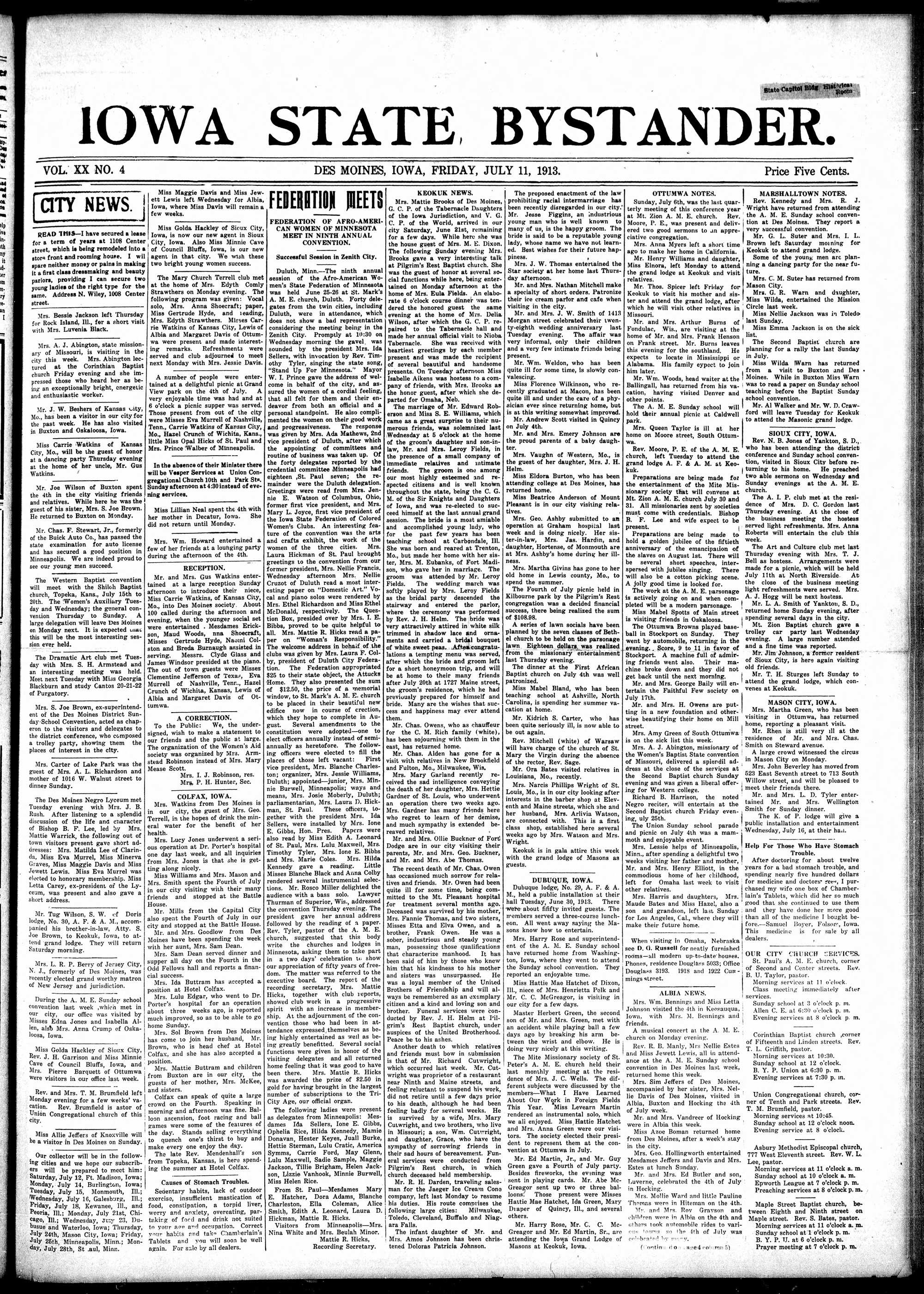
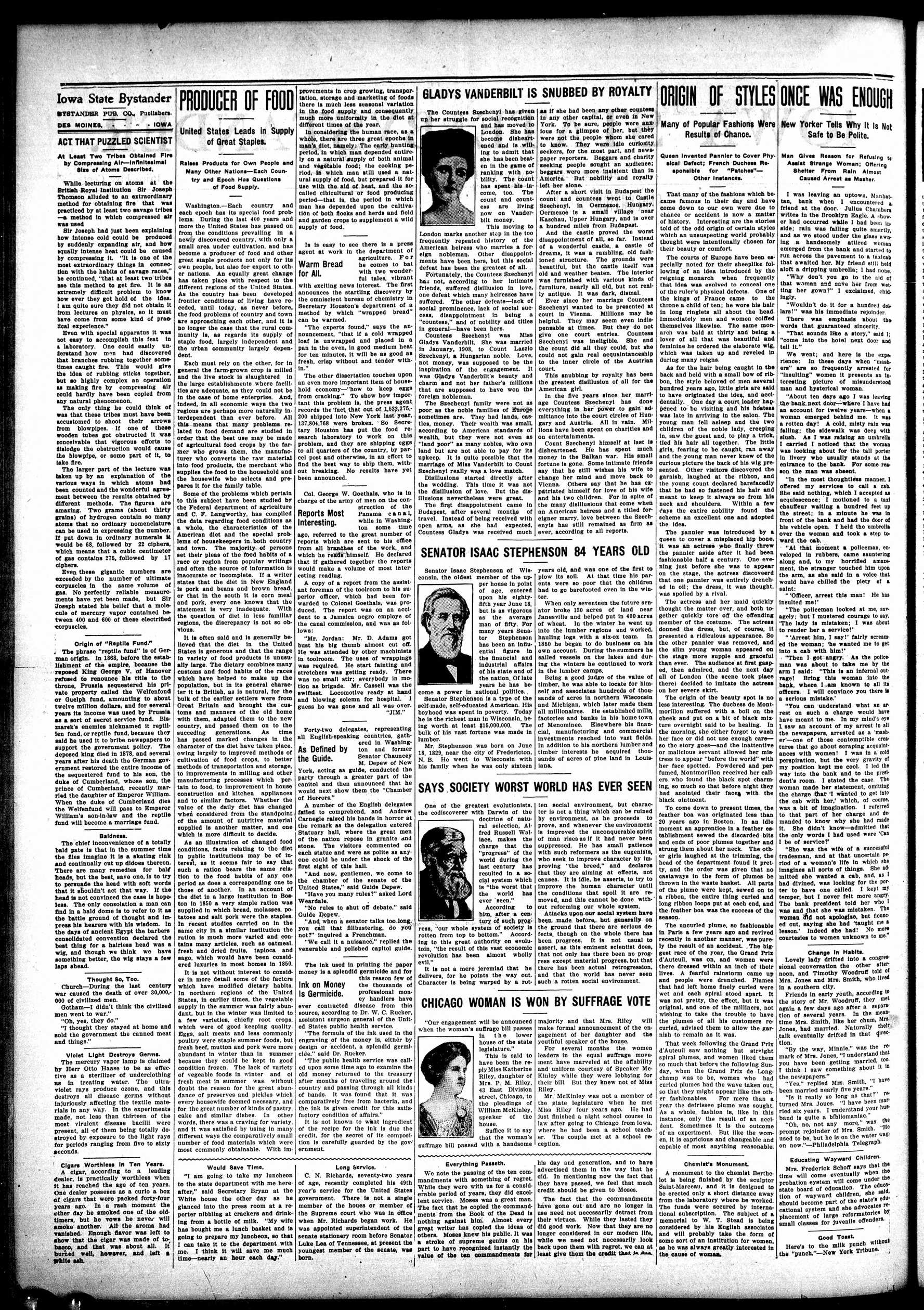
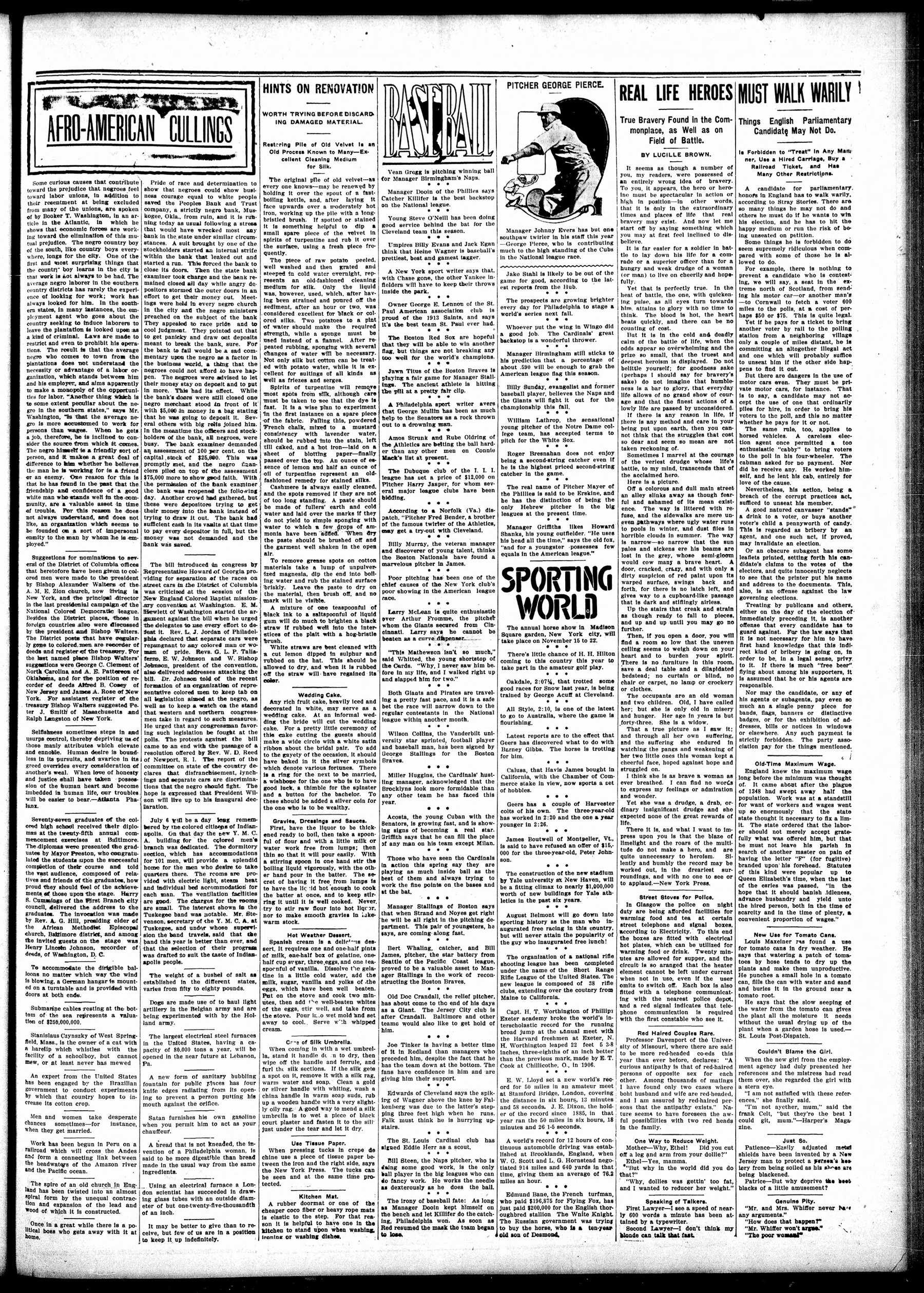
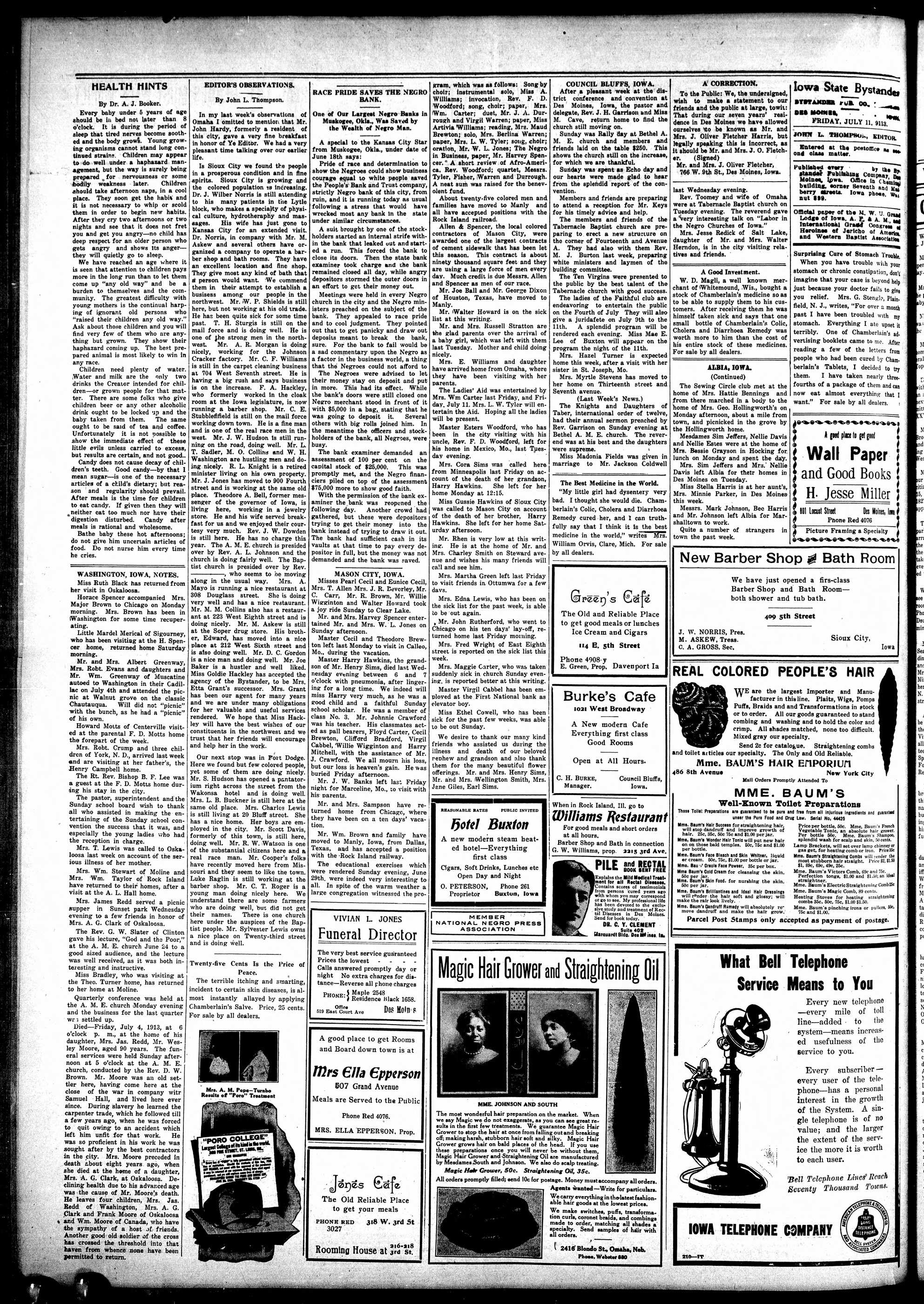
Page text (machine-generated)
IOWA STATE BYSTANDER.
VOL. XX NO. 4
CITY NEWS
READ THIS—I have secured a lease for a term of years at 1108 Center street, which is being remodeled into a store front and rooming house. I will spare neither money or pain in making it a first class dressmaking and beauty parlor, providing I can secure two young ladies of the right type for the same. Address N. Wiley, 1008 Center street.
Mrs. Bessie Jackson left Thursday for Rock Island, Ill., for a short visit with Mrs. Luvenia Black.
Mrs. A. J. Abington, state missionary of Missouri, is visiting in the city this week. Mrs. Abington lectured at the Corinthian Baptist church Friday evening and she impressed those who heard her as being an exceptionally bright, energetic and enthusiastic worker.
Mr. J. W. Beshers of Kansas City, Mo., has been a visitor in our city for the past week. He has also visited in Buxton and Oskaloosa, Iowa.
Miss Carrie Watkins of Kansas City, Mo., will be the guest of honor at a dancing party Thursday evening at the home of her uncle, Mr. Gus Watkins.
Mr. Joe Wilson of Buxton spent the 4th in the city visiting friends and relatives. While here he was the guest of his sister, Mrs. S. Joe Brown. He returned to Buxton on Monday.
Mr. Chas. F. Stewart, Jr., formerly of the Buick Auto Co., has passed the state examination for auto license and has secured a good position in Minneapolis. We are indeed proud to see our young men succeed.
The Western Baptist convention will meet with the Shilch Baptist church, Topeka, Kans., July 15th to 20th. The Women's Auxiliary Tuesday and Wednesday; the general convention Thursday to Sunday. A large delegation will leave Des Moines on Monday next. It is expected that this will be the most interesting session ever held.
The Dramatic Art club met Tuesday with Mrs. S. H. Armstead and an interesting meeting was held. Meet next Tuesday with Miss Georgia Blackburn and study Cantos 20-21-22 of Purgatory.
Mrs. S. Joe Brown, ex-superintendent of the Des Moines District Sunday-School Convention, acted as chaperon to the visitors and delegates to the district conference, who composed a trolley party, showing them the places of interest in the city.
Mrs. Carter of Lake Park was the guest of Mrs. A. L. Richardson and mother of 1016 A. W. Walnut street to dinner Sunday.
The Des Moines Negro Lyceum met Tuesday evening with Mrs. J. B. Rush. After listening to a splendid discussion of the life and character of Bishop B. F. Lee, led by Mrs. Mattie Warrick, the following out of town visitors present gave short addresses: Mrs. Matilda Lee of Clarina, Miss Eva Murrel, Miss Minerva Graves, Miss Maggie Davis and Miss Jewett Lewis. Miss Eva Murrel was elected to honorary membership. Miss Letta Carey, ex-president of the Lyceum, was present and also gave a short address.
Mr. Tug Wilson, S. W. of Doris lodge, No. 30, A. F. & A. M., accompanied his brother-in-law, Atty. S. Joe Brown, to Keokuk, Iowa, to attend grand lodge. They will return Saturday morning.
Mrs. L. R. P. Berry of Jersey City, N. J., formerly of Des Moines, was recently elected grand worthy matron of New Jersey and jurisdiction.
During the A. M. E. Sunday school convention last week, which met in our city, our office was visited by Misses Edna Jones and Isabella Allen, alls Mrs. Anna Crump of Oksaloosa, Iowa.
Miss Golda Hackley of Sioux City, Rev. J. H. Garrison and Miss Minnie Cave of Council Bluffs, Iowa, and Mrs. Pierre Barquett of Ottumwa were visitors in our office last week.
Rev. and Mrs. T. M. Brumfield left Monday evening for a few weeks' vacation. Rev. Brumfield is astor of Union Congregational church of this city.
Miss Allie Jeffers of Knoxville will be a visitor in Des Moines on Sunday.
Our collector will be in the following cities and we hope our subscribers will be prepared to meet us: Saturday, July 12, Ft. Madison, Iowa; Monday, July 14, Monmouth, Iowa; Tuesday, July 15, Monmouth, Ill.; Wednesday, July 16, Galesburg, Ill.; Friday, July 18, Kewanee, Ill., and Peoria, Ill.; Monday, July 21st, Chicago, Ill.; Wednesday, July 23, Dubusie and Waterloo, Iowa; Thursday, July 24th, Mason City, Iowa; Friday, July 25th, Minneapolis, Minn.; Monday, July 28th, St. aul, Minn.
Miss Maggie Davis and Miss Jewell Lewis left Wednesday for Albia, Iowa, where Miss Davis will remain a few weeks.
Miss Golda Hackley of Sioux City, Iowa, is now our new agent in Sioux City, Iowa. Also Miss Minnie Cave of Council Bluffs, Iowa, is our new agent in that city. We wish these two bright young women success.
The Mary Church Terrell club met at the home of Mrs. Edyth Comly Strawhaters on Monday evening. The following program was given: Vocal solo, Mrs. Anna Shoecraft; paper, Miss Gertrude Hyde, and leading, Mrs. Edyth Strawhaters. Misses Carrie Watkins of Kansas City, Lewis of Albia and Margaret Davis of Ottumwa were present and made interesting remarks. Refreshments were served and club adjourned to meet next Monday with Mrs. Jessie Davis.
A number of people were entertained at a delightful picnic at Grand View park on the 4th of July. A very enjoyable time was had and at 6 o'clock a picnic supper was served. Those present from out of the city were Misses Eva Murrell of Nashville, Tenn., Carrie Watkins of Kansas City, Mo., Hazel Crunch of Wichita, Kans., little Miss Opa Hicks of St. Paul and Mrs. Prince Walber of Minneapolis.
In the absence of their Minister there will be Vesper Services at Union Congregational Church 10th and Park Sts. Sunday afternoon at 4:30 instead of evening services.
Miss Lillian Neal spent the 4th with her mother in Decatur, Iowa. She did not return until Monday.
Mrs. Wm. Howard entertained a few of her friends at a lounging party during the afternoon of the 4th.
RECEPTION.
Mr. and Mrs. Gus Watkins entertained at a large reception Sunday afternoon to introduce their niece, Miss Carrie Watkins, of Kansas City, Mo., into Des Moines society. About 100 called during the afternoon and evening, when the younger social set were entertained. Mesdames Erickson, Maud Woods, nna Shoecraft, Misses Gertrud Hyde, Naoni Colston and Breda Burnaugh assisted in serving. Messrs. Clyde Glass and James Windsor presided at the piano. The out of town guests were Misses Clementine Jefferson of Texas, Eva Murrell of Nashville, Tenn., Hazel Crunch of Wichita, Kansas, Lewis of Albia and Margaret Davis of Otumwa.
A CORRECTION
To the Public: We, the undersigned, wish to make a statement to our friends and the public at large. The organization of the Women's Aid society was organized by Mrs. Armstead Robinson instead of Mrs. Mary Mease Scott.
Mrs. I. J. Robinson, res.
Mrs. P. H. Hunter, Sec.
COLFAX, IOWA.
Mrs. Watkins from Des Moines is in our city, the guest of MGeo. Terrell, in the hopes of drink the mineral water for the benefit of her health.
Mrs. Lucy Jones underwent a serious operation at Dr. Porter's hospital one day last week, and all inquiries from Mrs. Jones is that she is getting along nicely.
Miss Williams and Mrs. Mason and Mrs. Smith spent the Fourth of July in our city visiting with their many friends and stopped at the Battle House.
Mr. Mills from the Capital City also spent the Fourth of July in our city and stopped at the Battle House.
Mr. and Mrs. Goodlow from Des Moines have been spending the week with her aunt, Mrs. Sam Dean.
Mrs. Sam Dean served dinner and supper all day on the Fourth in the Odd Fellows hall and reports a financial success.
Mrs. Ida Buttram has accepted a position at Hotel Colfax.
Mrs. Lulu Edgar, who went to Dr. Porter's hospital for an operation about three weeks ago, is reported much improved, so as to be able to go home Sunday.
Mrs. Sol Brown from Des Moines has come to join her husband, Mr. Brown, who is head chef at Hotel Colfax, and she has also accepted a position.
Mrs. Mattie Buttram and children from Buxton are in our city, the guests of her mother, Mrs. McKee, and sisters.
Colfax can speak of quite a large crowd on the Fourth. Speaking in morning and afternoon was fine. Balloon ascension, foot racing and ball games were some of the features of the day. Stands selling everything to quench one's thirst to buy and make every one enjoy the day.
The late Rev. Mendenhall's son from Topeka, Kansas, is here spending the summer at Hotel Colfax.
Causes of Stomach Troubles.
Senior性 habits, lack of outdoor exercise, insufficient mastication of food, constipation, a torpid liver, worry and anxiety, overeating, partaking of food and drink not suited to your age and occupation. Correct your habits and take Chamberlain's Tablets and you will soo be well again. For sale by all dealers.
DES MOINES, IOWA, FRIDAY, JULY 11, 1913.
FEDERATION MEETS
FEDERATION OF AFRO-AMERI CAN WOMEN OF MINNESOTA MEET IN NINTH ANNUAL CONVENTION.
Successful Session in Zenith City.
Duluth, Minn.—The ninth annual session of the Afro-American Women's State Federation of Minnesota was held June 25-26 at St. Mark's A. M. E. church, Duluth. Forty delegates from the twin cities, including Duluth, were in attendance, which does not show a bad representation considering the meeting being in the Zenith City. Promptly at 10:30 on Wednesday morning the gavel was sounded by the president Mrs. Ida Sellers, with invocation by Rev. Timothy Tyler, singing the state song "Stand Up For Minnesota." Mayor W. I. Prince gave the address of welcome in behalf of the city, and assured the women of a cordial feeling, that all felt for them and their endeavor from both an official and a personal standpoint. He also complimented the women on their good work and progressiveness. The response was given by Mrs. Ada Mathews, 2nd vice president of Duluth, after which the appointing of committees and routine of business was taken up. Of the forty delegates reported by the ecditional committee Minneapolis had eighteen St. Paul seven; the remainder were the Duluth delegation. Greetings were read from Mrs. Jenner E. Watson of Columbus, Ohio, former first vice president, and Mrs. Mary L. Joyce, first vice president of the Iowa State Federation of Colored Women's Clubs. An interesting feature of the convention was the arts and crafts exhibit, the work of the women of the three cities. Mrs. Laura Hickman of St. Paul brought greetings to the convention from our former president, Mrs. Nellie Francis. Wednesday afternoon Mrs. Nellie Cruzot of Duluth read a most interesting paper on "Domestic Art." Vocal and piano solos were rendered by Mrs. Ethel Richardson and Miss Ethel McDonald, respectively. The Question Box, presided over by Mrs. I. E. Bibbs, proved to be quite helpful to all. Mrs. MATTie R. Hicks read a paper on "Woman's Responsibility." The welcome address in behalf of the clubs was given by Mrs. Laura F. Colby, president of Duluth City Federation. The Federation appropriated $25 to their state object, the Attucks Home. They also presented the sum of $12.50, the price of a memorial window, to St. Mark's A. M. E. church to be placed in their beautiful new edifice now in course of creation, which they hope to complete in August. Several amendments to the constitution were adopted—one to elect officers annually instead of semiannually as heretofore. The following officers were elected to fill the places of those left vacant: First vice president, Mrs. Blanche Charleston; organizer, Mrs. Jessie Williams, Duluth; appointed—junior, Mrs. Minnie Burwell, Minneapolis; ways and means, Mrs. Josie Moberly, Duluth; parliamentarian, Mrs. Laura D. Hickman, St. Paul. These officers, with the president Mrs. Ida Sellers, were installed by Mrs. Ione E. Gibbs, Hon. Pres. Papers were also read by Edith A. Leonard of St. Paul, Mrs. Milla Maxwell, Mrs. Timothy Tyler, Mrs. Ione E. Bibbs and Mrs. Marie Coles. Mrs. Hilda Kennedy gave a reading. Little Misses Blanche Black and Anna Colby rendered several instrumental selections. Mr. Rosco Miller delighted the audience with a bass solo. Lawyer Thurman of Superior, Wis., addressed the convention Thursday evening. The president gave her annual address followed by the reading of a paper. Rev. Tyler, pastor of the A. M. E. church, suggested that this body write the churches and lodges in Minnesota, asking them to take part in a two days' celebration to show our appreciation of fifty years of freedom. The matter was referred to the executive board. The report of the recording secretary, Mrs. Mattie Hicks, together with club reports, showed club work in a progressive spirit, with an increase in membership. At the adjournment of the convention those who had been in attendance expressed themselves as being highly entertained as well as being greatly benefited. Several social functions were given in honor of the visiting delegates and all returned home feeling that it was good to have been there. Mrs. Mattie R. Hicks was awarded the prize of $2.50 in gold for having brought in the largest number of subscriptions to the Tricity Age, our official organ.
The following ladies were present as delegates from Minneapolis: Mesdames Ida Sellers, Ione E. Gibbs, Ophelia Rice, Hilda Kennedy, Mamie Donavan, Hester Keyes, Juall Burke, Hettie Sterman, Lulu Critic, America Symms, Carrie Ford, May Glenn, Lulu Maxwell, Sadie Sample, Maggie Jackson, Tillie Brigham, Helen Jackson, Lizzie Vanhook, Minnie Burwell, Miss Helen Rice.
From St. Paul—Mesdames Mary E. Hatcher, Dora Adams, Blanche Charleston, Ella Coleman, Alice Smith, Edith A. Leonard, Laura D. Hickman, Mattie R. Hicks.
Visitors from Minneapolis—Mrs. Nina White and Mrs. Beulah Minor. Mattie R. Hicks, Recording Secretary.
KEOKUK NEWS.
Mrs. Mattie Brooks of Des Moines, G. C. P. of the Tabernacle Daughters of the Iowa Jurisdiction, and V. G. C. P. of the World, arrived in our city Saturday, June 21st, remaining for a few days. While here she was the house guest of Mrs. M. E. Dixon. The following Sunday evening Mrs. Brooks gave a very interesting talk at Pilgrim's Rest Baptist church. She was the guest of honor at several social functions while here, being entertained on Monday afternoon at the home of Mrs. Eula Fields. An elaborate 6 o'clock course dinner was tendered the honored guest the same evening at the home of Mrs. Delia Wilson, after which the G. C. P. repaired to the Tabernacle hall and made her annual official visit to Nioba Tabernacle. She was received with heartiest greetings by each member present and was made the recipient of several beautiful and handsome presents. On Tuesday afternoon Miss Isabelle Aikens was hostess to a company of friends, with Mrs. Brooks as the honor guest, after which she departed for Omaha, Neb.
The marriage of Mr. Edward Roberson and Miss S. E. Williams, which came as a great surprise to their numerous friends, was solemnized last Wednesday at 5 o'clock at the home of the groom's daughter and son-in-law, Mr. and Mrs. Leroy Fields, in the presence of a small company of immediate relatives and intimate friends. The groom is one among our most highly esteemed and respected citizens and is well known throughout the state, being the C. G. M. of the Sir Knights and Daughters of Iowa, and was re-elected to succeed himself at the last annual grand session. The bride is a most amirable and accomplished young lady, who for the past few years has been teaching school at Carbondale, Ill. She was born and reared at Trenton, Mo., but made her home with her sister, Mrs. M. Eubanks, of Fort Madison, who gave her in marriage. The groom was attended by Mr. Leroy Fields. The wedding march was softly played by Mrs. Leroy Fields as the bridal party descended the stairway and entered the parlor, where the ceremony was performed by Rev. J. H. Helm. The bride was very attractively attired in white silk trimmed in shadow lace and ornaments and carried a bridal bouquet of white sweet peas. After congratulations a tempting menu was served, after which the bride and groom left for a short honeymoon trip, and will be at home to their many friends after July 20th at 1727 Maine street, the groom's residence, which he had previously prepared for himself and bride. Many are the wishes that success and happiness may ever attend them.
Mr. Chas. Owens, who as chauffeur for the C. M. Rich family (white), has been sojourning with them in the east, has returned home.
Mr. Chas. Alden has gone for a visit with relatives in New Brookfield and Fulton, Mo., Milwaukee, Wis.
Mrs. Mary Garland recently received the sad intelligence conveying the death of her daughter, Mrs. Hettie Gardner of St. Louis, who underwent an operation there two weeks ago.
Mrs. Gardner has many friends here who regret to learn of her demise, and much sympathy is extended beaved relatives.
Mr. and Mrs. Ollie Buckner of Fort Dodge are in our city visiting their parents, Mr. and Mrs. Geo. Buckner, and Mr. and Mrs. Abe Thomas.
The recent death of Mr. Chas. Owen has occasioned much sorrow for relatives and friends. Mr. Owen had been quite ill for some time, being committed to the Mt. Pleasant hospital for treatment several months ago. Deceased was survived by his mother, Mrs. Fannie Thomas, and two sisters, Misses Etta and Elva Owen, and a brother, Frank Owen. He was a sober, industrious and steady young man, possessing those qualifications that characterize manhood. It has been said of him by those who knew him that his kindness to his mother and sisters was unsurpassed. He was a loyal member of the United Brothers of Friendship and will always be remembered as an exemplary citizen and a kind and loving son and brother. Funeral services were conducted by Rev. J. H. Helm at Pilgrim's Rest Baptist church, under auspices of the United Brotherhood. Peace be to his ashes.
Another death to which relatives and friends must bow in submission is that of Mr. Richard Cutwright, which occurred last week. Mr. Cutwright was proprietor of a restaurant near Ninth and Maine streets, and feeling reluctant to suspend his work, did not retire until a few days prior to his death, although he had been feeling badly for several weeks. He is survived by a wife, Mrs. Mary Cutwright, and two brothers, who live in Missouri; a son, Wm. Cutwright, and daughter, Grace, who have the sympathy of sorrowing friends in their sad hours of bereavement. Funeral services were conducted from Pilgrim's Rest church, in which church deceased held membership. Mr. R. H. Darden, traveling salesman for the Jaeger Ice Cream Cone company, left last Monday to resume his duties. His route comprises the following large cities: Milwaukee, Toledo, Cleveland, Buffalo and Niagara Falls. The infant daughter of Mr. and Mrs. Amos Johnson has been christened Dolores Patricia Johnson.
The proposed enactment of the law prohibiting racial intermarriage has been recently disregarded in our city: Mr. Jesse Figgins, an industrious young man who is well known to many of us, is the happy groom. The bride is said to be a reputable young lady, whose name we have not learned. Best wishes for their future happiness.
Mrs. J. W. Thomas entertained the Star society at her home last Thursday afternoon.
Mr. and Mrs. Nathan Mitchell make a specialty of short orders. Patronize their ice cream parlor and cafe when visiting in the city.
Mr. and Mrs. J. W. Smith of 1413 Morgan street celebrated their twenty-eighth wedding anniversary last Tuesday evening. The affair was very informal, only their children and a very few intimate friends being present.
Mr. Wm. Weldon, who has been quite ill for some time, is slowly convalescing.
Miss Florence Wilkinson, who recently graduated at Macon, has been quite ill and under the care of a physician ever since returning home, but is at this writing somewhat improved.
Mr. Andrew Scott visited in Quincy on July 4th.
Mr. and Mrs. Emery Johnson are the proud parents of a baby daughter.
Mrs. Vaughn of Western, Mo., is the guest of her daughter, Mrs. J. H. Helm.
Miss Eldora Burton, who has been attending college at Des Moines, has returned home.
Miss Beatrice Anderson of Mount Pleasant is in our city visiting relatives.
Mrs. Geo. Ashby submitted to an operation at Graham hospital last week and is doing nicely. Her sister-in-law, Mrs. Jas. Hardin, and daughter, Hortense, of Monmouth are at Mrs. Ashby's home during her illness.
Mrs. Martha Givins has gone to her old home in Lewis county, Mo., to spend the summer.
The Fourth of July picnic held in Kilbourne park by the Pilgrim's Rest congregation was a decided financial success, there being realized the sum of $108.98.
A series of lawn socials have been planned by the seven classes of Bethel church to be held on the parsonage lawn Eighteen dollars was realized from the missionary entertainment last Thursday evening.
The dinner at the First African Baptist church on July 4th was well patronized.
Miss Mabel Bland, who has been teaching school at Ashville, North Carolina, is spending her summer vacation at home.
Mr. Kidrich S. Carter, who has been quite seriously ill, is now able to be out again.
Rev. Mitchell (white) of Warsaw will have charge of the church of St. Mary the Virgin from the absence of the rector, Rev. Sage.
Mrs. Ora Bates visited relatives in Louisiana, Mo., recently.
Mrs. Narcis Phillips Wright of St. Louis, Mo., is in our city looking after interests in the barber shop at Eleventh and Maine streets, which she and her husband, Mrs. Arlivia Watson, are connected with. This is a first class shop, established here several weeks ago by Mrs. Watson and Mrs. Wright.
Keokuk is in gala attire this week with the grand lodge of Masons as guests.
DUBUQUE IOWA
Dubuque lodge, No. 29, A. F. & A. M., held a public installation at their hall Tuesday, June 30, 1913. There were about fifty invited guests. The members served a three-course lunch-eon. All went away saying the Masons know how to entertain.
Mrs. Harry Rose and superintendent of the A. M. E. Sunday school have returned home from Washington, Iowa, where they went to attend the Sunday school convention. They reported an enjoyable time.
Miss Hattie Mae Hatchet of Dixon, Ill., niece of Mrs. Henrietta Pelk and Mr. C. C. McGreagor, is visiting in our city for a few days.
Master Herbert Green, the second son of Mr. and Mrs. Green, met with an accident while playing ball a few days ago by breaking his arm between the wrist and elbow. He is doing very nicely at this writing.
The Mite Missionary society of St. Peter's A. M. E. church held their last monthly meeting at the residence of Mrs. J. C. Wells. The different subjects were discussed by the members—What I Have Learned About Our Work in Foreign Fields This Year. Miss Levearn Martin rendered an instrumental solo, which we all enjoyed. Miss Hattie Hatchet and Mrs. Anna Green were our visitors. The society elected their president to represent them at the convention at Ottumwa in July.
Mr. Ed Martin, Jr., and Mr. Guy Green gave a Fourth of July party. Besides fireworks, the evening was sent in playing cards. Mr. Abe McGreagor sent up two or three balloons! Those present were Misses Hattie Mae Hatchet, Ida Green, Mary Diaper of Quincy, Ill., and several others.
Mr. Harry Rose, Mr. C. C. McGreagor and Mr. Ed Martin, Sr., are attending the Iowa Grand Lodge of Masons at Keokuk, Iowa.
OTTUMWA NOTES
Sunday, July 6th, was the last quarterly meeting of this conference year at Mt. Zion A. M. E. church. Rev. Moore, P. E., was present and delivered two good sermons to an appreciative congregation.
Mrs. Anna Myers left a short time ago to make her home in California.
Mr. Henry Williams and daughter, Miss Elnora, left Monday to attend the grand lodge at Keokuk and visit relatives.
Mr. Thos. Spicer left Friday for Keokuk to visit his mother and sister and attend the grand lodge, after which he will visit other relatives in Missouri.
Mr. and Mrs. Arthur Burns of Fondulac, Wis., are visiting at the home of Mr. and Mrs. Frank Henson on Frank street. Mr. Burns leaves this evening for the southland. He expects to locate in Mississippi or Alabama. His family expect to join him later.
Mr. Wm. Woods, head waiter at the Ballingall, has returned from his vacation, having visited Denver and other points.
The A. M. E. Sunday school will hold their annual picnic at Caldwell park.
Mrs. Queen Taylor is ill at her home on Moore street, South Ottumwa.
Rev. Moore, P. E. of the A. M. E. church, left Tuesday to attend the grand lodge A. F. & A. M. at Keokuk.
Preparations are being made for the entertainment of the Mite Missionary society that will convene at Mt. Zion A. M. E. church July 30 and 31. All missionaries sent by societies must come with credentials. Bishop B. F. Lee and wife expect to be present.
Preparations are being made to hold a golden jubilee of the fifteenth anniversary of the emancipation of the slaves on August 1st. There will be several short speeches, interspersed with jubilee singing. There will also be a cotton picking scene. A jolly good time is looked for.
The work at the A. M. E. parsonage is actively going on and when completed will be a modern parsonage.
Miss Mabel Spotts of Main street is visiting friends in Oskaloosa.
The Ottumwa Browns played baseball in Stockport on Sunday. They went by automobile, returning in the evening. Score, 9 to 11 in favor of Stockport. A machine full of admiring friends went also. Their machine broke down and they did not get back until the next morning.
Mr. and Mrs. George Baily will entertain the Faithful Few society on July 17th.
Mr. and Mrs. H. Owens are putting in a new foundation and otherwise beautifying their home on Mill street.
Mrs. Amy Green of South Ottumwa is on the sick list this week.
Mrs. A. J. Abington, missionary of the Women's Baptist State convention of Missouri, delivered a splendid address at the close of the services at the Second Baptist church Sunday evening and was given a liberal offering for Western college.
Richard B. Harrison, the noted Negro reciter, will entertain at the Second Baptist church Friday evening, uly 25th.
The Union Sunday school parade and picnic on July 4th was a mamoth and enjoyable event.
Mrs. Lessie helps of Minneapolis, Minn., after spending a delightful two weeks visiting her father and mother, Mr. and Mrs. Henry Elliott, in the commodious home of her childhood, left for Omaha last week to visit other relatives.
Mrs. Harris and daughters, Mrs. Maude Bates and Miss Hazel, also a son and grandson, left last Sunday for Los Angeles, Cal., where they will make their future home.
When visiting in Omaha, Nebraska see D. G. Russell for neatly furnished rooms—all modern up-to-date houses, Phones, residence Doughlass 5033; Office Doughlass 3193; 1918 and 1922 Curtmings street.
ALBIA NEWS
Mrs. Wm. Bennings and Miss Letta Johnson visited the 4th in Keesaquau, Iowa, with Mrs. M. Bennings and friends.
A musical concert at the A. M. E. church on Monday evening.
Rev. R. B. Manly, Mrs Nellie Estes and Miss Jewett Lewis, all in attendance at the A. M. E. Sunday school convention in Des Moines last week, returned home this week.
Mrs. Sim Jeffers of Des Moines, accompanied by her sister, Mrs. Nellie Davis of Des Moines, visited in Albia, Buxton and Hocking the 4th of July week.
Mr. and Mrs. Vandreer of Hocking were in Albia this week.
Miss Azeo Boman returned home from Des Moines, after a week's stay in the city.
Mrs. Geo Hollingworth entertained Messames Jeffers and Davis and Mrs. Estes at lunch Sunday.
Mr. and Mrs. Ed Butler and son, Laverne, celebrated the 4th of July in Hocking.
Mrs. Mollie Ward and little Pauline Thomas were in Hiteman on the 4th.
Mr. and Mrs. Roy Gravyson and children were in Albia on the 4th and others took automobile rides to various towns so the 4th of July was celebrated by many.
(Continuing on page 4 column 5)
State Capitol Bldg Historic
Room
Price Five Cents.
MARSHAALLTOWN NOTES.
Rev. Kennedy and Mrs. R. J. Wright have returned from attending the A. M. E. Sunday school convention at Des Moines. They report a very successful convention.
Mr. G. L. Suter and Mrs. I. L. Brown left Saturday moining for Keokuk to attend grand lodge.
Some of the young men are planning a dancing party for the near future.
Mrs. C. M. Suter has returned from Mason City.
Mrs. G. R. Warn and daughter, Miss Wilda, entertained the Mission Circle last week.
Miss Nellie Jackson was in Toledo last Sunday.
Miss Emma Jackson is on the sick list.
The Second Baptist church are planning for a rally the last Sunday in July.
Miss Wilda Warn has returned from a visit to Buxton and Des Moines. While in Buxton Miss Warn was to read a paper on Sunday school teaching before the Baptist Sunday school convention.
Mr. Al Walker and Mr. W. D. Crawford will leave Tuesday for Keokuk to attend the Masonic grand lodge.
SIOUX CITY IOWA
Rev. N. B. Jones of Yankton, S. D., who has been attending the district conference and Sunday school convention, visited in Sioux City before returning to his home. He preached two able sermons on Wednesday and Sunday evenings at the A. M. E. church.
The A. I. P. club met at the residence of Mrs. D. C. Gordon last Thursday evening. At the close of the business meeting the hostess served light refreshments. Mrs. Anna Roberts will entertain the club this week.
The Art and Culture club met last Thursday evening with Mrs. T. J. Bell as hostess. Arrangements were made for a picnic, which will be held July 11th at North Riverside. At the close of the business meeting light refreshments were served. Mrs. A. J. Hogg will be next hostess.
Mr. L. A. Smith of Yankton, S. D., returned home Sunday evening, after spending several days in the city.
M. Zion Baptist church gave a trolley car party last Wednesday evening. A large number attended and a fine time was reported.
Mr. Jim Johnson, a former resident of Sioux City, is here again visiting old friends.
Mr. T. H. Sturges left Sunday to attend the grand lodge, which convenes at Keokuk.
MASON CITY IOWA
Mrs. Martha Green, who has been visiting in Ottumwa, has returned home, reporting a pleasant visit. Mr. Rhen is still very ill at the residence of Mr. and Mrs. Chas. Smith on Steward avenue. A large crowd witnessed the circus in Mason City on Monday. Mrs. John Beverley has moved from 523 East Seventh street to 713 South Willow street, and will be pleased to meet their friends there. Mr. and Mrs. L. D. Tyler entertained Mr. and Mrs. Wellington Smith for Sunday dinner. The K. of P. lodge will give a public installation and entertainment Wednesday, July 16, at their hall.
Help For Those Who Have Stomach Trouble
After doctoring for about twelve years for a bad stomach trouble, and spending nearly five hundred dollars for medicine and doctors' ree, I purchased my wife one box of Chamberlain's Tablets, which did her so much good that she continued to use them and they have done her more good than all of the medicine I bought before.—Samuel Boyer, Folsor, Iowa. This medicine is for sale by all dealers.
OUR CITY CHURCH SERVICES.
St. Paul's A. M. E. church, corner of Second and Center streets. Rev. B. U. Taylor, pastor.
Morning services at 11 o'clock.
Class meeting immediately after services.
Sunday school at 3 o'clock p. m.
Allen C. E. at 6:30 o'clock p. m.
Evening services at 8 o'clock p. m.
Corinthian Baptist church, corner of Fifteenth and Linden streets. Rev. T. L. Griffith, pastor.
Morning services at 10:30.
Sunday school at 12 o'clock.
B. Y. P. Union at 6:30 p. m.
Evening services at 7:30 p. m.
Union Congregational church, corner of Tenth and Park streets. Rev. T. M. Brumfield, pastor.
Morning services at 10:45.
Sunday school at 12 o'clock noon.
Evening service at 8 o'clock.
Asbury Methodist Episcopal church,
777 West Eleventh street. Rev. W. L.
Lee, pastor.
Morning services at 11 o'clock a. m.
Sunday school at 10 o'clock a. m.
Epworth League at 7 o'clock p. m.
Preaching services at 8 o'clock p. m.
Maple Street Baptist church, between Eighth and Ninth street on Maple street. Rev. S. Bates, pastor.
Morning services at 11 o'clock a. m.
ACT THAT PUZZLED SCIENTIST
At Least Two Tribes Obtained Fire by Compressing Air—Infiniteal Size of Atoms Described.
While lecturing on atoms at the British Royal Institution Sir Joseph Thomson alluded to an extraordinary method for obtaining fire that was practiced by at least two savage tribes—a method in which compressed air was used.
Sir Joseph had just explained how intense cold could be produced by suddenly expanding air, and how equally intense heat could be caused by compressing it. "It is one of the most extraordinary things in connection with the habits of savage races," he continued, "that at least two tribes use this method to get fire. It is an extremely difficult problem to know how ever they got hold of the fire and not obtain it from lectures on physics, so it must have come from some kind of practical experience."
Even with special apparatus it was not easy to accomplish this feat in a laboratory. One could easily understand how man had discovered that branches rubbing together sometimes caught fire. This would give the idea of rubbing sticks together, but so highly complex an operation could hardly be done by any natural phenomenon.
The only thing he could think of was that these tribes must have been accustomed to shoot their arrows from blowpipes. If one of these wooden tubes got obstructed it was conceivable that vigorous efforts to dislodge the obstruction would cause the blowpipe, or some part of it, to take fire.
The larger part of the lecture was taken up by an explanation of the various ways in which atoms had been counted and the wonderful agreement between the results obtained by different methods. The figures are amazing. Two grams (about thirty grains) of hydrogen contain so many atoms that no ordinary nomenclature can be used in expressing the number. If put down in ordinary numerals it would be 68, followed by 22 cipher which means that a cubic centimeter contains 275, followed by 17 cipher. Even these gigantic numbers are exceeded by the number of ultimate corpuscles in the same volume of gas. No perfectly reliable measurements have yet been made, but Sir Joseph stated his belief that a molecule of mercury vapor contained between 400 and 600 of these electrified corpuscles.
Origin of "Bentile Fund:"
The phrase "reptile fund" is of German origin. In 1868, before the establishment of the empire, because the reposed King George V. of Hanover refused to renounce his title to the throne, Prussia sequestered his private property called the Welfenford or Guelph fund, amounting to about twelve million dollars, and for several years its income was used by Prussia as a sort of secret bank. It nicknamed it reptile fund or reptile fund, because they said he used it to bribe newspapers to support the government policy. The deposed king died in 1878, and several years after his death the German government restored the entire income of the sequestered fund to his son, the duke of Cumberland, whose son, the prince of Cumberland, recently married the daughter of the duke of Cumberland and the Welfenford will pass to Emperor William's son-in-law and the reptile fund will become a marriage fund.
Baldness.
The chief inconvenience of a totally bald pate is that in the summer time the flies imagine it is a skating rink and continually cut up dyes thereon. There are many remedies for bald heads, but the best, save one, is to try to persuade the head with soft words that it shouldn't act that way. If the head is not convinced the case is hopeless. The only consolation a man can find in a bald dome is to refract the bare ground of thoughts and in imitation with his wisdom. In the days of ancient Egypt the barbers consolidated convention declared the best thing for a hairless head was a wig, and though we think we have something better, the wig stays a few laps ahead.
Thought &c. Too.
Church—During the last century war caused the death of over 30,000,000 of civilized men. I think the civilized men went to war."
"Oh, yes, they do."
"I thought they stayed at home and sold the government the canned meat and things."
Violet Light Destroys Germs
Violet Light Bottle lamp
The mercury vapor lamp is claimed by Herr Otto Haase to be as effective as a sterilizer of underclothing in treating water. The ultra violet rays produce ozone, and this destroys all disease germs without injuriously affecting the textile materials in any way. In the experiments made, not less than thirteen of the most virulent disease bacilli were present, all of them being totally destroyed by exposure to the light rays for periods ranging from five to sixty seconds.
Gigars Worthless in Ten Years.
A cigar according to a leading dealer is practically worthless when it has reached the age of ten years. One dealer possesses as a curio a box of cigars that were packed forty-four years ago. In a rush moment the other day he smoked one of the old-timers, and he vows he never will smoke another. All the aroma had vanished. Enough flavor was left to show that the cigar was made of tobacco, and that was about all. It burned well, however, and left a
---
PRODUCER OF FOOD United States Leads in Supply of Great Staples.
Raise Products for Own People and Many Other Nations—Each Country and Epoch Has Questions of Food Supply.
Washington—Each country and each epoch has its special food problems. During the last 400 years and more the United States has passed on from the conditions prevailing in a newly discovered country, with only a small area under cultivation, and has become a producer of food and other great staple products not only for its own people, but also for export to other nations. An equally great change has taken place with respect to the different regions of the United States. The food problems of country and town are approaching each other, and it is no longer the case that the rural community is, as regards its supply of staple food, largely independent and the urban community largely dependent. Each must rely on the other, for in general the farm-grown crop is milled and the live stock is slaughtered in the large establishments where facilities are adequate, as they could not be in the case of home enterprise. And, indeed, in all economic ways the two regions are perhaps more naturally interdependent than ever before. All this means that many problems related to the food demand are studied in order that the best use may be made of agricultural food crops by the farmer, who grows them, the manufacturer who converts the raw material into food products, the merchant who supplies the food to the household and the housewife who selects and prepares it for the family table.
Some of the problems which pertain to this subject have been studied by the Federal department of agriculture and C. F. Langworthy, has compiled the data regarding food conditions as a whole, the characteristics of the American diet and the special problems of housekeepers in both country and town. The majority of persons set their pleas of the food habits of a race or region from popular writings and often the source of information is inaccurate or incomplete. If a writer states that the diet in New England and Maine and brown bread or pork, that the south it is corn meal and pork, that one knows that the statement is very inadequate. With the question of diet in less familiar regions, the discrepancy is not so obvious.
It is often said and is generally believed that the diet in the United States is generous and that the range in variety of food products is unusually large. The dietary combines many customs and food habits of the races which have helped to make up the population, but in its general character it is British, as is natural, for the bulk of the earlier settlers were from Great Britain and brought them to the new country, and adapted them to the new country, and passed them on to the succeeding generations. As time has passed marked changes in the character of the diet have taken place, owing largely to improved methods of cultivation of food crops, to better methods of transportation and storage, to improvements in milling and other manufacturing processes which pertain to food, to improvement in house construction and kitchen appliances and to similar factors. Whether the diet is changed when considered from the standpoint of the amount of nutritive material supplied is another matter, and one which is more difficult to decide.
As an illustration of changed food conditions, facts relating to the diet in public institutions may be of interest, as it seems fair to say that such a ration bears the same relation to the food habits of any one period as does a corresponding one to those of another. In an account of the diet in a large institution in Boston in 1850 a very simple ration was supplied in which bread, molasses, potatoes and salt pork were the staple food; the rice was the secondary food; the sameity in a similar institution the ration is much more varied and contains many articles, such as oatmeal, fresh and dried fruits, tapioca and sage, which would have been considered luxuries in most homes in 1850.
It is not without interest to consider in more detail some of the factors which have modified dietary habits. In northern regions of the United States, in earlier times, the vegetable supply in the summer was fairly abundant, but in the winter was limited to a few varieties, chiefly root crops, which were of good keeping quality. Eggs, salt meals and less commonly poultry were staple summer foods, but fresh beef, mutton and pork were more abundant in winter than in summer because they could be kept in good condition frozen. The lack of variety of vegetable foods dinner and of oil and vinegar during summer has often doubt the reason for the great abundance of preserves and pickles which every housewife deemed necessary, and for the great number of kinds of pastry, cake and similar dishes. In other words, there was a craving for variety, and it was satisfied by using in many different ways the comparatively small number of food materials which were most commonly obtainable. With im-
Would Save Time.
"I am going to take my luncheon to the state department with me hereafter," said Secretary Bryan at the White house the other day as he glanced into the press room at a reporter nibbling at crackers and drinking from a bottle of milk. "My wife has bought me a lunch basket and is going to prepare my luncheon, so that I can take it to the department with me. I think it will save me much time—nearly an hour each day."
provements in crop growing, transportation, storage and marketing of foods there is much less seasonal variation in the food supply and consequently much more uniformity in the diet at different times of the year.
In considering the human race, as a whole, there are three great spores in the man's diet namely. The early hunting period, in which man depended entirely on a natural supply of both animal and vegetable food; the cooking period, in which man still used a natural supply of food, but prepared it for use with the aid of heat, and the so-called cibicultural or food producing period—that is, the period in which man has depended upon the cultivation of both flocks and herds and field and garden crops to supplement a wild supply of food.
Is it easy to see there is a press agent at work in the department of agriculture. For bread to be baked to bat with two wonderful tales, vibrant with exciting news interest. The first announces the starting discovery by the omniscible bureau of chemistry in Secretary Houston's department of a method by which "wrapped bread" can be warmed.
"The experts found," says the announcement, "that if a cold wrapped loaf is unwrapped and placed in a pan in the oven, in good medium for ten minutes, it will be as good as fresh, crisp without and tender with-
The other dissertation touches upon an even more important item of household economy—"how to keep eggs from cracking." To show how important this problem is, the press agent records the fact that out of 1,532,275,200 shipped into New York last year, 137,804,768 were broken. So Secretary Houston has put the food research laboratory to work on this problem, and they are shipping eggs to all quarters of the country, by parceling and sending an effort to find the best way to ship them, without breaking. No results have yet been announced.
Col. George W. Goethals, who is in charge of the army of men on the construction of the Reports Most Interesting. while in Washington some time ago, referred to the great number of reports which are sent to his office from all branches of the work, and which he reads himself. He declared that if gathered together the reports would make a volume of most interesting reading.
A copy of a report from the assistant foreman of the toolroom to his superior officer, which had been forwarded to Colonel Goethals, was produced. The report was on accord to Jamaica negro employee of the canal Commission, and was as follows:
"Mr. Jordan: Mr. D. Adams got bust his big thumb almost cut off. He was attended by other machinists in toolroom. The uses of wrappings was required. He start fainting and stretchers was getting ready. There was no small strir; everybody in room as brigaded the machine. The commotive ready at hand and blowing solemn for hospital. I guess he was gone and all was over. "JIM."
Forty-two delegates, representing all English-speaking countries, gathered in Washington and former Senator Chauney M. Depew of New York, acting as guide, conducted the party through a greater part of the capitol and then announced that he would next show them the "Chamber of Amenities." A number of the English delegates failed to comprehend, and Andrew Carnegie raised his hands in horror at the remark as the delegation entered Statuary hall, where the great men of the nation repose in granite and stone. The visitors commented on each statue and were as polite as anyone could be under the shock of the first sight of this hall. And now, gentlemen, we come to the room of senate of the United States," said Guide Depew. "Have you many rules?" asked Lord Weardale.
"No rules to shut off debate," said Guide Depew.
"And when a senator talks too long, you call that filbustering, do you not?" inquired a Frenchman.
"We call it a nuisance," replied the venerable and polished capitol guide.
Ink on Money Is Germicide.
ever contracted disease from this source, according to Dr. W. C. Rucker, assistant surgeon general of the United States public health service.
"The formula of the ink used in the engraving of the money is, either by design or accident, a splendid germicide."
"The public health service was called upon some time ago to examine the old money returned to the treasury after months of traveling around the country and passing through all kinds of hands. It was found that it was comparatively free from bacteria, and the ink is given credit for this satisfactory condition of affairs."
It is not known to what ingredient of the recipe for the ink is due the reason for the secret of its composition is carefully guarded by the government.
C. N. Richards, seventy-two years of age, recently completed his 49th year's service for the United States government. There is not a single member of the houses or member of the Supreme court who was in office when Mr. Richards began work. He was appointed superintendent of the senate stationary room before Senator Luke Lee of Tennessee, at present the youngest member of the senate, was born
GLADYS VANDERBILT IS SNUBBED BY ROYALTY
SENATOR ISAAC STEPHENSON 84 YEARS OLD
SAYS SOCIETY WORST WORLD HAS EVER SEEN
CHICAGO WOMAN IS WON BY SUFFRAGE VOTE
The Countess Szekelyn has given up her struggle for social recognition
social recognition and has moved to London. She has become disheartened and is willing to admit that she has been beaten in the game of ranking with nobility. The count has spent his income, too. The count and countess are living now on Vanderbilt money.
London. She has become disheath and is willing to admit that she has been beaten in the game of ranking with no bility. The count has spent his income, too. The count and countess are living now on Vanderbilt money. This moving to London marks another step in the too frequently repeated history of the American heirloom who married for elegance nobleman. Others disappointments have been hers, but this social defeat has been the greatest of all. Fortunately, the Countess Szecchenyl has not, according to her intimate friends, suffered disillusion in love, one defeat which many heirresses have suffered. The other defeats—lack of social prominence, lack of social success, disappointment in being a "countess," and of nobility and titles in general—have been hers. Countess Szecchenyl was Miss Gladys Vanderbilt. She was married in January, 1908, to Count Laszio Szecchenyl, a Hungarian noble. Love, not money, was supposed to be the inspiration of the engagement. She was Gladys Vanderbilt and charm and not her father's millions that are supposed to have won the foreign nobleman.
The Szechenyi family were not as poor as the noble families of Europe sometimes are. They had lands, castles, money. Their wealth was small, according to American standards of wealth, but they were not even as hard poor as many noble, who owed it. They were so upkeep. It is quite possible that the marriage of Miss Vanderbilt to Count Szechenyi really was a love match. Disillusions started directly after the wedding. This time it was not the disillusion of love. But the disillusions nevertheless were great. The first disappointment came in Count Gladys's travel. Instead of being received with open arms, as she had expected, Countess Gladys was received much
---
Senator Isaac Stephenson of Wisconsin, the oldest member of the up
member of the upper house in point of age, entered upon his eighty-fifth year June 18, but is as vigorous as the average man of fifty. For many to be Stephenion has been an influential figure in the financial and industrial affairs of his state and of the nation. Of late years he has be
of age, entered upon his eighty-fifth year June 18, but is as vigorous as the average man of fifty. For many years Senator Stephenson has been an influential figure in the financial and industrial affairs of his state and of the nation, of late years he has become a power in national politics. Senator Stephenson is a type of the self-made, self-educated American. His boyhood was spent in poverty. Today he is the richest man made wealth at least $15,000,000. The bulk of his vast fortune was made in lumber. Mr. Stephenson was born on June 18, 1829, near the city of Frederickton, N. B. He went to Wisconsin with his family when he was only sixteen
One of the greatest evolutionists, the codiscoverer with Darwin of the
doctrine of natural selection, Alfred Russell Wallace, makes the charge that the "progress" of the world during the last century has been the civil system which is "the worst that the world has ever seen."
DARWIN
According to him, after a century of such prog
ress, "our whole system of society is rotten from top to bottom." According to this great authority on evolution, "the result of this vast economic revolution has been almost wholly evil." In not a mere meridian that he delivers, for he points the way out. Character is being warped by a rot-
"Our engagement will be announced when the woman's nuffrage bill passes in the lower house of the state legislature."
This is said to have been the reply Miss Katherine Riley, daughter of Mrs. P. M. Riley, 43 East Division street, Chicago, to the pleadings of William McKinley, speaker of the house.
Suffice it to say that the woman's
This is said to have been the reply Miss Katherine Riley, daughter of Mrs. M. Riley, East Street, Chicago, to the pleadings of William McKinley, speaker of the house. Suffice it to say that the woman's
Everything Passeth.
We note the passing of the ten commandments with something of regret. While they were with us for a considerable period of years, they did excellent service. Moses was a great man. The fact that he copied the commandments from the Book of the Dead is nothing against him. Almost every great writer has copied them, and other people have copied this public. It was a reward of supreme genius on his part to have recognized instantly the value of the ten commandments for
as if she had been any other counten in any other capital, or even in New York. To be sure, people were anxious for a glimpse of her, but they were not the people whom she cared to know. They were idle curiosity seekers, for the most part, and newspaper reporters. Beggars and charity seeking people sought an audience; beggars were more insistent than in America. But nobility and royalty left her alone.
After a short visit in Budapest the count and countess went to Castle Szczenyl, Osmosgey, Hungary,ormezme is a small village near Kelkul Upper Hungary, and is over a hundred miles from Budapest.
And the castle proved the worst disappointment of all, so far. Instead of a wonderful castle, a castle of dreams, it was a rambling, old fashioned structure. The grounds were beautiful, but the castle itself was old and weather beaten. The interior was furnished with various kinds of furniture, nearly all old, but not really antique. It was dark, dismal.
Ever since her marriage Countess Szczenyl wanted to be presented at court in Vienna. Millions may be helpful. They may seem even indispensable at times. But they do not give one court entries. Countess Szczenyl was ineligible. She and the count did all they could, but she could not gain real acquaintance to the inner circle of the Austrian court.
This snubbing by royalty has been the greatest distillation of all for the American girl.
In the five years since her marriage Countess Szechenyl has done everything in her power to gain admittance into the court circles of Hungary and Austria. All in vain. Millions have been spent on charities and on entertainments.
Count Szechenyl himself at last is disheartened. He has spent much money in the Balkan war. His small fortune is gone. Some intimate friends say that he still wishes to change her mind and move back to Vienna. Others say that he has expatriated for love of his wife and the two children. For in spite of the many disillusions that come when an American helress and a titled foreigner marry, love between the Szechenyls has still remained as firm as ever, according to all reports.
years old, and was one of the first to plow its soil. At that time his parents were so poor that the children had to go barefooted even in the winter.
When only seventeen the future senator broke 130 acres of land near Janesville and helped put in 400 acres of wheat. In the winter he went up into the nine regions and worked hollow logs with a six-ox team. In 1850 he began to do business on his own account. During the summers he sailed vessels on the lakes and during the winters he continued to work in the lumber camps.
Being a good judge of the value of timber, he was able to locate for himself and associates hundreds of thousands of acres in northern Wisconsin and Michigan, which later made them all millionaires. He established mills, factories and barns home to his financial investments then into vast fields. In addition to his northern lumber and timber interests he acquired thousands of acres of pine land in Louisiana.
ten social environment, but character is not a thing which can be ruined by environment, as he proceeds to prove, and whenever the environment is improved the unconquerable spirit of man rises as if it had never been suppressed. He has small patience with such reformers as the eugenists, who seek to improve character by improving "the breed," and declares that they are aiming at effects, not causes. It is idle, he asserts, to try to improve the human character until the conditions that spoil it are removed, and when they do without, we obtain our whole system. Attacks upon our social system have been made before, but generally on the ground that there are serious defects, though on the whole there has been progress. It is not usual to assert, as this eminent scientist does, that not only has there been no progress except material progress, but that there has been actual retrogression, and that the world has never seen such a rotten social environment.
majority and that Mrs. Riley will make formal announcement of the engagement of her daughter and the youthful speaker of the house. For several months the women leaders in the equal suffrage movement have marveled at the ability and uniform courtesy of Speaker McKinley while they were lobbying for their bill. But they knew not of Miss Riley. Mr. McKinley was not a member of the state legislature when he met Miss Riley four years ago. He had just finished a night school course in law after going to Chicago from Iowa, where he had been a school teacher. The couple met at a school reception.
his day and, to have and to advertise them in the way that he did. In mentioning now the fact that they have passed, we feel that much credit should be given to Moses.
The fact that the commandments have gone out and are no longer in use need not necessarily detract from their virtues. While they lasted they go good. Now that they are no longer considered in our modern life, while we need not necessarily look back upon them with regret, we can at least give them the credit that is
ORIGIN OF STYLES ONCE WAS ENOUGH
Queen Invented Pannier to Cover Physical Defect; French Duchess Responsible for “Patches”—Other Instances.
That many of the fashions which became famous in their day and have come down to our own were due to chance or accident is now a matter of history. Interesting are the stories told of the odd origin of certain styles which an unsuspecting world probably thought were intentionally chosen for them. The courts of Europe have been especially noted for their sheepskin following of an idea introduced by the reigning monarch when frequently that idea was evolved to conceal one of the ruler's physical defects. One of the kings of France came to the throne a child of ten; he wore his hair in long ringlets all about the head. Immediately men and women coiffed themselves likewise. The same monarch衣着 and parity and being a member of all that was beautiful and feminine he ordered the elaborate wig, which was taken up and revealed in during many reigns.
As for the hair being caught in the back and held with a small bow of ribbon, the style beloved of men several hundred years ago, little girls are said to have originated the idea, and accidentally. One day a court leader happened to be visiting and his hostess was late in arriving in the salon. The young man fell asleep and the two children of the noble lady, creeping over the carpet and laying his hair all together. The little girls, fearing to be caught, ran away and the young man never knew of the curious picture the back of his wig presented. Other visitors discovered the garnish, laughed at the ribbon, and the young count declared barefaced that he had so fastened his hair and meant to keep it always so from his neck and shoulders. Within a few days the entire nobility found the scheme an excellent one and adopted the idea. The pannier was introduced by a queen to cover a misplaced hip bone, it was an actress who finally threw the pannier aside after it had been removed from the court. One witness just before she was to appear on the stage, the actress discovered that one pannier was entirely drenched in oil; the dress, it was thought, was spoiled by a rival.
The actress and her maid quickly thought the matter over, and both together quickly tore off the offending member of the costume. The actress donned the dress, but, of course, it presented a ridiculous appearance. So the other pannier was removed, and the slim young woman appeared on the stage more supple and graceful than ever. The audience at the grappe had all been there, and the next day all of London (the scene took place there) decided to imitate the actress on her severe skirt.
The origin of the beauty spot is no less interesting. The duchess de Montmorillon suffered with a boll on the cheek and put on a bit of black mixture overnight said to be healing. In the morning, she either forgot to wash her face or did not use enough care—so the story goes—and the inattentive or malicious servant allowed her mistress to appear "before the world" with her face or did not use enough blood. Montmorillon received her callers who found the black spot charming, so much so that before night they had anointed their face with the black ointment.
To come down to present times, the feather box was originated less than 20 years ago in Boston. In an idle moment an apprentice in a feather establishment sewed the discarded bits and ends of poor plumes together and strung them about her neck. The other girls laughed at the trimming, the head of the department found it pretty and the order was given that no wounds in the form of plumes be thrown in the waste basket. All parts of the plume were kept, sewed on to a ribbon, the entire thing curled and long ribbon loops put at each end, and the feather boa was the success of the season.
The uncurled plume, so fashionable in Paris a few years ago and revived recently in another manner, was purely the result of an accident. The biggest race of the year, the Grand Prix D'autelou, was on, and women were there dressed within an inch of their lives. A fearful rainstorm came up and people were drenched. Plumes that had let home finely curled them and their stalk stood apart. It was not pretty, the stalk was original, and one of the milliners, not wishing to take the trouble to have the plumes of all his customers recruited, advised them to allow the garnish to remain as it was.
That week following the Grand Prix d'Auteuil saw nothing but straight spiral plumes, and women liked them so much that before the following Sunday, when the Grand Prix de Longchamp was to be, women who had curled plumes had the wave taken out, so that they might appear like the other fashionables. For more than a year the deffreese plume was sought. As a whole, fashion is, like in this instance, only the result of an accident. Sometimes it is the outcome of an experiment. But like the women, it is capricious and changeable and capable of most anything reasonable.
Chemist's Monument
A monument to the chemist Berthelot is being finished by the sculptor Saint-Marcau, and it is designed to be erected only a short distance away from the laboratory where he worked. The funds were secured by international subscriptions. The subject of a book by T. J. Treadwell, being considered by his English academy, and will probably take the form of some sort of an institution for women, as he was always greatly interested in the cause of women.
New Yorker Tells Why It Is Not Safe to Be Polite.
Man Gives Reason for Refusing to Assist Strange Woman; Offering Shelter From Rain Almost Caused Arrest as Masher.
I was leaving an uptown, Manhattan, bank when I encountered a friend at the door. Julius Chambers writes in the Brooklyn Eagle. A shower had occurred while I had been inside; and I was stood quite smartly, and as we stood under the glass awning a handsomely attired woman emerged from the bank and started run across the pavement to a tavern that awaited her. My friend still held aloft a dripping umbrella; I had none.
"Why don't you go to the aid of that woman and save her from wetting her gown?" I exclaimed, chiding.
"Wouldn't do it for a hundred dollars!" was his immediate rejoinder.
There was emphasis about the
There was emphasis about the words that guaranteed sincerity.
"That sounds like a story," said I; "come into the hotel next door and tell it."
We went; and here is the experience: in these days when "mashers" are so frequently arrested for "insulting" women it presents an interesting picture of misunderstood man and hysterical woman.
"About ten days ago I was leaving the bank next door—where I have had an account for twelve years—when a woman emerged behind me. It was a rotten day! A cold, misty rain was falling on the floor with slush. As I was raising an umbrella I carried I noticed that the woman was looking about for the tall porter in livery who usually stands at the entrance to the bank. For some reason the man was absent.
"In the most thoughtless manner, I offered my services to call a cab. She said nothing, which I accepted as acquisence; I motioned to a taxi chauffeur waiting a hundred feet up the street; in a minute he was in front of the bank and had the door of his vehicle open. I held the umbrella over the woman and took a step toward the cab.
"At that moment a policeman, enveloped in rubbers, came sauntering along, and to my horrified amusement, the stranger touched him upon the arm, as she said in a voice that have chilled the plea of a saint:
"Officer, arrest this man! He has insulted me!"
"The policeman looked at me, savagely; but I mustered courage to say, 'The lady is mistaken; I was about to render her a service!'"
"Arrest him, I say!' fairly screamed the woman; 'he wanted me to get into a cab with him!'"
"Then got away. As the policeman was about to take by the arm I said: 'This is an informal outrage! Bring this woman into the bank, where I am known to all its officers. I will convince you there is a serious mistake.'"
"You can understand what an arrest on such a charge would have have meant to me. In my mind's eye I saw an account of my arrest in all the newspapers, arrested as a masher—one of those contemptible things that you pay accounting to women! I was in a cold perseveration, but the very gravity of my position kept me cool. I led the way into the bank and to the president's room. I stated the case. The woman made her statement, omitting the charge that I wanted to get into the cab with her', which, of course, was a bit of imagination. I referred to that part of her charge and manded to know why she made him pay the tax. I admitted that the only words I had used were 'Can I be of service!'
"She was the wife of a successful tradesman, and at that uncertain period of a woman's life in which she imagines all sorts of things. She admitted she wanted a cab, and, as had divined, was looking for the porter to have one called. I kept my temper, but I never felt more angry. The bank president told her who I was and that she was mistaken. The woman did not apologize, but founded out, saying she had 'taught me a lesson.' Indeed she had! No more courtesies to women unknown to me."
Change In Habits.
Lovely lady drifted into a congressional conversation the other afternoon, and Timothy Woodruff told of Mrs. Jones and Mrs. Smith, who lived in a southern city.
Friends in early youth, according to the story of Mr. Woodruff, they met and married ago after a separation of several years. In the meantime Mrs. Smith, like her chum Mrs. Jones, had married. Naturally their talk eventually drifted in that direction.
"By the way, Minute" was the remark of Mrs. Jones. "I understand that you had spent getting married, too. I saw something about it in the newspapers."
"Yes," replied Mrs. Smith, "I have been married nearly five years." "Is it really so long as that?" returned Mrs. Jones. "I have been married six years. I understand your husband is quite a bidiomaniac."
"Oh, no, not any more," was the prompt reprimidor of Mrs. Smith. "He used to be, but he is on the water wag on now."-Philadelphia Telegraph.
Educating Wayward Children
Mrs. Frederick Schoft says that the time will come eventually when the probation system will come under the state board of education. The education of wayward children, she said, should become part of the state's educational system and she advocates replacement of large reformatories by small classes for juvenile offenders.
Good Toast.
Here's to the milk punch without the "punch"-New York Tribune.
AFRO-AMERICAN CULLINGS
Some curious causes that contribute toward the prejudice that negroes feel toward labor unions, in addition to their resentment at being excluded from many of the unions, are spoken of by Booker T. Washington, in an article in the Atlantic, in which he shows that economic forces are working toward the elimination of this mutual prejudice. The negro boy of the south, like country boys everywhere, longs for the city. One of the first and most surprising things that the work is not always to be had. The average negro laborer in the southern country districts has rarely the experience of looking for work; work has always looked for him. In the southern states, in many instances, the employment agent who goes about the country seeking to induce laborers to leave the plantation is looked upon as a kind of criminal. Laws are made to restrict and even to prohibit his occupation. The result is that the average negro who comes to town from the plantations does not understand the necessity or advantage of a labor organization or between him and his employer, and also things that make a monopoly of the employment for labor. "Another thing which is to labor. Is that the average negro is more accustomed to work for persons than wages. When he gets a job, therefore, he is inclined to consider the source from which it comes. The negro himself is a friendly sort of person, and it makes a great deal of difference to him whether he believes the man he is working for is a friend or an enemy. One reason for this is that he has found in the past that the friendship and confidence of a good community, are a valuable asset in times of trouble. For this reason he does not always understand, and does not like, an organization which seems to be founded on a sort of impersonal emity to the man by whom he is employed."
Suggestions for nominations to several of the District of Columbia offices that heretofore have been given to colored men were made to the president by Bishop Alexander Walters of the A. M. E. Zion church, now living in New York, and the principal director in the last presidential campaign of the National Colored Democratic league. Besides the District places, those in foreign countries also were discussed by the president and Bishop Walters. The District posts that have regularly gone to colored, men are recorder of deeds and register of the treasury. For the last named place Bishop Walters suggestions were George E. Patterson of Oklahoma, and E. Patterson of Oklahoma, and for the position of recorder of deeds Alfred B. Cosey of New Jersey and James A. Rose of New York. For assistant register of the treasury Bishop Walters suggested Peter J. Smith of Massachusetts and Ralph Langston of New York.
Selflessness sometimes steps in and usurps control, thereby depriving us of those manly attributes which elevate and ennoble. Human desire is boundless in its pursuits, and avarice in its greed overrides every consideration of another's weal. When love of honesty and justice shall have taken possession of the human heart and become imbedded in human life, our troubles will be easier to bear—Atlanta Phalanx.
---
Seventy-seven graduates of the colored high school received their diplomas at the twenty-fifth annual commencement exercises at Baltimore. The diplomas were presented the graduates by Mayor Preston, who congratulated the students upon the successful completion of their course and told the vast audience, composed of relatives and friends of the graduates, how proud they should feel of the achievements of those upon the stage. Harry S. Cummings of the First Branch city council, delivered the address to the graduates. The invocation was made by Rev. A. G. Hill, presiding elder of the African Methodist Episcopal Baltimore district, and among the invited guests on the stage was Henry Lincoln Johnson, recorder of deeds, of Washington, D. C.
To accommodate the dirigible balloons no matter which way the wind is blowing, a German hangar is mounted on a turntable and is provided with doors at both ends.
Submarine cables resting at the bottom of the sea represents a valuation of $256,000,000.
Stanislaus Czynszky of West Springfield, Mass., is the owner of a cat with a harepet which whistles with the facility of a schoolboy, but cannot mew, or at least never has mewed
An expert from the United States has been engaged by the Brazilian government to conduct experiments by which that country hopes to increase its cotton crop.
Men and women take desperate chances sometimes—for instance, when they get married.
Work has been begun in Peru on a railroad which will cross the Andes and form a connecting link between the headwaters of the Amazon river and the Pacific ocean.
The spire of an old church in Eng-
land has been twisted into an almost
spiral form by the unequal contraction
and expansion of the lead and
wood of which it is constructed.
Once in a great while there is a pol-
tical boss who gets away with it at
home.
Pride of race and determination to show that negroes could show business courage equal to white people saved the Peoples Bank and Trust company, a strictly negro bank, Muskegow, Okla., from ruin, and it is running today as usual wrecked most any bank in the state under similar circumstances. A suit brought by one of the stockholders started an internal strife within the bank that leaked out and started a run. This forced the bank to examine the bank. Then the state bank examiner took control of the bank remained closed all day while the repositors stormed the door entrances in an effort to get their money out. Meetings were held in every negro church in the city and the negro ministers preached on the subject of the bank. They appealed to race pride and to cool judgment. They pointed out that to get panicky and draw out deposits meant to break the bank, sure. For the bank to fail would be a sad commentary on the negro as a factor in the business world, a thing that the negroes could not afford to have happen. The negroes were advised to let money stay on deposit and to put it in the bank. This led to hiring the bank's doors were still closed one negro merchant stood in front of it with $5,000 in money in a bag stating that he was going to deposit it. Several others with big reels joined him. In the meantime the officers and stockholders of the bank, all negroes, were busy. The bank examiner demanded an assessment of 100 per cent. on the capital stock of $25,000. This was promptly met, and the negro financiers $75,000 more to show good faith. With the permission of the bank examiner the bank was reopened the following. Another crowd had gathered, but their money was not available to try their money into the bank instead of trying to draw it out. The bank had sufficient cash in its vanity at that time to pay every depositor in full, but the money was not demanded and the bank was saved.
---
The bill introduced in congress by Representative Howard of Georgia providing for separation of the races on street cars in the District of Columbia was criticized at the session of the New England Colored Baptist mission convention at Washington. E. M. Hewlett of Washington started the argument against the bill when he urged the state to allow a woman to officiate. It, Rev. L. J. Jordan of Philadelphia declared that separate cars were repugnant to any colored man or woman of pride. Revs. G. L. P. Tailfero, E. W. Johnson and W. Bishop Johnson, president of the convention, also delivered addresses attacking the bill. Dr. Johnson told of the recent formation of an organization of representative colored men to keep tab on the police. He said it was well as to keep a watch on the stand that western and northern congressmen take in regard to such measures. He urged that any congressman favoring such legislation be fought at the polls. The protests against the bill came to an end with the passage of a resolution offered by Rev. W. D. Reed of Newport, R. I. The report of the committee on state of the country defense and separate cars are discriminations that the negro should fight. The hope is expressed that President Wilson will live up to his inaugural declaration.
July 6 will be a day long remembered by the colored citizens of Indianapolis. On that day the new Y. M. C. A. building for the colored men's branch was dedicated. The dormitory section, which has accommodations for 101 men, will provide a splendid home for the men who desire to take quarters there. The rooms are promenade, cottage light, steam heater and individual bed accommodation for each man. The ventilation facilities are good. The charges for the rooms are small. The interest shown in the Tuskegee band was notable. Mr. Stevenson, secretary of the Y. M. C. A. at Tuskegee, and under whose supervision the band travels, said that the band this year is better than ever, and that the selection of their program was drafted to suit the taste of Indianapolis people.
The weight of a bushel of salt was established in the different states, varies from fifty to eighty pounds.
Dogs are made use of to haul light artillery in the Belgian army and are being experimented with by the Holland army.
The largest electrical steel furnaces in the United States, having a capacity of 80,000 tons a year, will be opened in the near future at Lebanon, Pa.
A new form of sanitary bubbling fountain for public places has four knife edges radiating from its opening to prevent a person putting his mouth against the orifice.
Satan furnishes his own gasoline when you permit him to act as your chauffeur.
A bread that is not kneaded, the invention of a Philadelphia woman, is said to be more digestible than bread made in the usual way from the same ingredients.
Using an electrical furnace a London scientist has succeeded in drawing glass tubes with an outside diameter of but one twenty-five-thousandth of an inch.
It may be better to give than to receive, but few of us are in a position to keep it up indefinitely.
HINTS ON RENOVATION
WORTH TRYING BEFORE DISCARDING DAMAGED MATERIAL.
Restring Pile of Old Velvet is an Old Process Known to Many—Excellent Cleaning Medium for Silk.
The original pile of old velvet—as every one knows—may be renewed by holding it over the spot of a fast-bolling kettle, and, after laying it face upwards over a moderately hot iron, working up the pile with a long-bristled brush. If spotted or stained it is something helpful to dip a small space piece of the velvet in spirits of turpentine and rub it over the surface, using a fresh piece frequently.
The piece of raw potato peeled, well washed and then grated and steeped in cold water overnight, represents an old-fashioned cleaning medium for silk. Only the liquid was, however, used, which, after having been strained and poured off the sediment, after an hour or two, was considered excellent for black or colored silks. Two potatoes to a plint of water should make the required strength, while a sponge must be used instead of a flannel. After repeated rubbing, sponging with salt and water is necessary. Not only silk but cotton can be treated with potato water, while it is excellent for suitings of all kinds as well as frides and serues.
Spirits of turpentine will remove most spots from silk, although care must be taken to see that the dye is fast. It is a wise plan to experiment in the first instance on a spare piece of the fabric. Falling this, powdered French chalk, mixed to a mustard consistency with lavender water, should be rubbed into the stain, left undeveloped and dried, and then applied to a sheet of blotting paper—finally passed over the top. An ounce of essence of lemon and half an ounce of oil of turpentine represent an old-fashioned remedy for stained silks. Cashmere is always easily cleaned, and the spots removed if they are not of too long standing. A paste should be made of fullers' earth and cold water and laid over the marks if they do not yield to simple sponging with water to remove the marks. Marmalate have been added. When dry the paste should be brushed off and the garment well shaken in the open air.
To remove grease spots on cotton materials take a lump of unpulverized magnesia, dip the end into boiling water and rub the stained surface briskly. Leave the paste to dry on the material, then brush off, and no mark will be visible.
A mixture of one teaspoonful of black ink to a saltpuffed of liquid gum will do much to brighten a black straw if rubbed well into the interstices of the plait with a hog-bristle brush.
White straws are best cleaned with a cut lemon dipped in sulphur and rubbed on the hat. This should be allowed to dry, and when it is rubbed off the straw will have regained its color.
Wedding Cake.
Any rich fruit cake, heavily leed and decorated in white, may serve as a wedding cake. At an informal wedding the bride will cut the wedding cake. For a pretty little ceremony of this cake cutting the guests should make a wide circle with a white satin ribbon about the bridal pair. To add to the gayety of the occasion, it should have baked in it the silver symbols which denote various fortunes. There are many of these symbols, a wishbone for the one who is to have good luck, a thimble for the splinter and a button for the bachelor. To these should be added a silver coin for the one who is to be wealthy.
Gravies, Dressings and Sauces.
First, have the liquor to be thick ened ready to boll, then take a spoonful of flour and with a little milk or water work free from lumps; then thin so that it will pour easily. With a stirring spoon in one hand stir the boiling liquid vigorously, with the other hand pour in the batter. The secret of having it free from lumps is to have the liquid hot enough to cook the batter it in, then keep it warm until it is well cooked. Never try to stir raw flour into hot liquor nor to make smooth gravis in lakewarm stock.
Hot Weather Dessert
Spanish cream is a delicious dessert. It requires one and one-half pints of milk, one-half box of gelatine, one half cup sugar, three eggs, and one tea spoonful of vanilla. Dissolve the gelatine in a little cold water, add the milk, sugar, vanilla and yolks of the eggs, which have been well beaten. Put on the stove and cook two minutes, then add the well-beaten whites of the eggs, stir well, and take from the stove. Pour in 1/4 wet mold and set away to cool. Serve with whipped cream.
Case of Silk Umbrella
When coming in with a wet umbrella, stand it handle down to dry, then wipe off the handle and ferrule, and furl the silk sections. If the silk gelt a spot on it, remove it with a silk rag, warm water and soap. Clean a gold or silver handle with whiting, wash a china handle in warm soap suds, rub it with water and then wipe it off oly rag. A good way to mend a silk umbrella is to wet a piece of black court plaster and fasten it to the silk just under the tear and let it dry.
Use Tissue Paper.
When pressing tucks in crepe dchine use a piece of tissue paper between the iron and the right side, says the New York Press. The tucks can be seen and at the same time protected.
Kitchen Mat.
A rubber doormat or one of the cheaper coco fiber or heavy rope mats is elastic to the step. For that reason it is helpful to have one in the kitchen to stand upon when washing, ironing or washing dishes.
BASEBALL
Yean Grogg is pitching winning ball for Manager Birmingham's Naps.
Manager Doolin of the Phillies says Catcher Killifor is the best backstop on the National league.
Young Steve O'Neill has been doing good service behind the bat for the Cleveland team this season.
Umpires Billy Evans and Jack Egan think that Heine Wagner is baseball's prettiest, best and gamest tagger.
A New York sport writer says that, with Chase gone, the other Yankee infiltrators will have to keep their throws inside the park.
Owner George E. Lennon of the St. Paul American association club is proud of the 1913 Saints, and says it's the best team St. Paul ever had.
The Boston Red Sox are hopeful that they will be able to win another flag, but things are not breaking any too well for the world's champions.
Jawn Titus of the Boston Braves is playing a fair game for Manager Stallings. The ancient athlete is hitting the pill at a pretty fair clip.
A Philadelphia sport writer avers that George Mullin has been as much help to the Senators as a rock thrown out to a drowning man.
Amos Strunk and Rock Olding of the Athletics are belting the ball harder than any other men on Connie Mack's list at present.
The Dubuque club of the I. I. I. league has set a price of $12,000 on Pitcher Harry Jasper, for whom seven major league clubs have been billed.
. . .
According to a Norfolk (Va.) dispatch, "Pitcher Fred Bender, a brother of the famous twirler of the Athletics, may get a try-out with Cleveland.
Billy Murray, the veteran manager and discoverer of young talent, thinks the Boston Nationals have found a marvelous pitcher in James.
Poor pitching has been one of the chief causes of the New York club's poor showing in the American league race.
. . .
Larry McLean is quite enthusiastic ever Arthur Fromme, the pitcher whom the Giants secured from Chicago. Larry says he cannot be beaten as a curve dispenser.
"This Mathewson isn't so much," said Wilthed, the young shortstop of the Cards. "Why, I never saw him before in my life, and I walked right up and slapped him for two."
Both Giants and Pirates are traveling a pretty fast pace, and it is a safe bet the race will narrow down to the regular contestants in the National league within another month.
Wilson Collins, the Vanderbilt university star apprised, football player and baseball man, has been signed by George Stallings for the Boston Braves
---
Miller Huggins, the Cardinals' hustle manager, acknowledged that the Brocklyn's look more formidable than any other team he has faced this
---
Acosta, the young Cuban with the Senators, is growing fast, and is showing signs of becoming a real star. Griffith says that he can fill the place of any man on his team except Milan.
Those who have seen the Cardinals in action this spring say they are playing as much inside ball as the best of them and always trying to work the fine points on the bases and at the bat.
Manager Stallings of Boston says that Strand and Neyes get right he will be all right in the pitching department. This pair of youngsters, he says, are coming along fast.
Bert Whaling, catcher, and Bill James, pitcher, the star battery from Seattle of the Pacific Coast league proved to be a valuable asset to Manager Stallings in the work of reconstructing the Boston Braves.
Old Doc Crandall, the relief pitcher, has about come to the end of his day as a Giant. The Jersey City club is after Crandall. Baltimore and other teams would also like to get hold of him.
---
Joe Tinker is having a better time of it in Redland than managers who preceded him, despite the fact that he has the team down at the bottom. The fans have confidence in him and are giving him their support.
Edwards of Cleveland says the spiking of Wagner above the knee by Falkner was due to the latter's stepping three feet high when he runs Falk must think he is hurrying up stairs.
---
The St. Louis Cardinal club has signed Eddie Herr as a scout.
Bill Steen, the Naps pitcher, who is doing some good work, is the only ball player in the big leagues who can do fancy work. He works the needle as dexterously as he does the ball.
The irony of baseball fate: As long as Manager Dooin kept himself on the bench and let Killifer do the catching, Philadelphia won. As soon as Red resumed the mask the team began to lose.
Manager Johnny Evers has but one southpaw twirler in his staff this year—George Pierce, who is contributing much to the high standing of the Cubs in the National league race.
Jake Stahl is likely to be out of the game for good, according to the late-eat reports from the Hub.
The prospects are growing brighter every day for Philadelphia to stage a world’s series next fall.
Whoever put the wing in Wingo did a good job. The Cardinals’ great backstop is a wonderful thrower.
Manager Birmingham still sticks to his prediction that a percentage of about .590 will be enough to grab the American league flag this season.
Billy Sunday, evangelist and former baseball player, believes the Naps and the Giants will fight it out for the championship this fall.
William Lathrop, the sensational young pitcher of the Notre Dame college team, has accepted terms to pitch for the White Sox.
Roger Bresnahan does not enjoy
being a second-string catcher even if
he is the highest priced second-string
catcher in the game.
The real name of Pitcher Mayer of
the Phillies is said to be Erskine,
and he has the distinction of being
the only Hebrew pitcher in the big
leagues at the present time.
Manager Griffiths likes Howard
Shanks, his young outfielder. "He uses
his head all the time," says the old fox,
"and for a youngster possesses few
equals in the American league."
SPORTING WORLD
The annual horse show in Madison
Square garden, New York city, will
take place on November 15 to 22.
There's little chance of H. H. Hilton
coming to this country this year to
take part in the amateur golf play.
Gakdale, 2.074; that trotted some
good races for Snow last year, is being
trained by George Acuff at Cleveland.
All Style, 2:10, is one of the latest
to go to Australia, where the game is
flourishing.
Latest reports are to the effect that
Geers has discovered what to do with
Barney Gibba. The horse is trotting for
hip.
---
Calusa, that Havis James bought in
California, with the Chamber of Com-
merce stake in view, now sports a cet
of hobbles.
Geers has a couple of Harvester
colts of his own. The three-year-old
has worked in 2:20 and the one a year
younger in 2:26.
---
James Boutwell of Montpellier, Vt. is said to have refused an offer of $15,000 for the three-year-old, Peter Johnson.
---
The construction of the new stadium by Yale university at New Haven, will be a fitting climax to nearly $1,000,000 of the funds. The Yale athletics in the past six years.
---
August Belmont will go down into sporting history as the man who inaugurated free racing in this country, but will never attain the popularity of the guy who inaugurated free lunch!
The organization of a national rifle shooting league has been completed under the name of the United States. The new league is composed of 38 rifle clubs, extending over the country from Maine to California.
. . .
Capt, H. T. Worthington of Philipsa Exeter academy broke the world's interscholastic record for the running broad jump at the annual meet with the Harvard freshmen at Exeter, N. H. Worthington at North Carolina, and N. H. Worthington at heights of an inch better than the previous mark made by E. T. Cook at Chilcothe, O. in 1906.
---
E. W. Lloyd set a new world's record for 50 miles in an amateur meet at Stamford Bridge, London, covering the distance in six hours, 13 minutes and 58 seconds. J. E. Dixon, the holder of the record since 1885, in that year ran the 100-mile race in 18 hours, 18 minutes and 26 1-5 seconds.
A world's record for 12 hours of continuous automobile driving was established at Brooklands, England, when W. G. Scott and L. G. Hornstead negotiated 914 miles and 640 yards in that time, giving them an average of 76.2 miles per hour.
---
Edmund Bane, the French turkman,
who paid $196,875 for Flying Fox,
has just paid $200,000 for the English
thoroughbred stallion The White Knight
The Russian government was trying
to find a man who is a ten-year
old son of Demond.
REAL LIFE HEROES MUST WALK WARILY
True Bravery Found in the Commonplace, as Well as on Field of Battle.
BY LUCILLE BROWN.
It seems as though a number of you, my readers, were possessed of an entirely wrong idea of bravery. To you, it appears, the hero or heroine must be spectacular in action or high in position—in other words, that it is only in the extraordinary times and places of life that real bravery may exist. And now let me start off by saying something which you may at first feel inclined to disbelieve.
It is far easier for a soldier in battle to lay down his life for a comrade or a superior officer than for a hungry and weak drudge of a woman (or man) to live on cheerily and hopefully. Yet that is perfectly true. In the heat of battle, the one, with quickening pulse, as all eyes turn towards him, attains to glory with no time to think. The blood is hot, the heart heats quickly, and there can be no counting of cost.
But it is in the cold and deadly calm of the battle of life, when the odd appaer so overwhelming and the prize so small, that the truest and deepest heroism is displayed. Do not belittle yourself; for goodness sake perhaps, you should not do not smile that humbleness is a har to glory, that everyday life allows of no grand show of courage and that the finest actions of a lowly life are passed by unconsidered. If there is any reason in life, if there is any method and care in your being put upon earth, then you cannot think that the struggles that cost so deed so mean are not taken reckoning of. Sometimes I marvel at the courage of the valent drudge whose life's battle, to my mind, transcends that of the acclaimed hero.
Here is a picture
Off a colorous and dull main street an alley slinks away as though fearful and ashamed of its mean existence. The way is littered with refuse, and the sidewalks are mere uneven pathways where ugly water runs to pools in winter, and dust files in horrible clouds in summer. The way is narrow—so narrow that the sun is shining through, and the lost in the grey, whose semi-gloom would cow many a brave heart. A door, cracked, crazy, and with only a dirty suspicion of red paint upon its warped surface, swings back and forth, for there is no latch left, and gives way to a cupboard-like passage that is dark and stiffly airless. Up the stairs that creak and strain as soon as ready to fall to pieces, and up and up until you may go no further.
Then, if you open a door, you will find a room so low that the uneven ceiling seems to weigh down on your heart and to burden your spirit. There is no furniture in this room, save a deal table and a dislapsed cabinet, not a curtain or blind no chair or carpet, no lamp or crockery or clothes.
The occupants are an old woman and two children. Old, I have called her; but she is only old in misery and hunger. Her age in years is but forty-three. She is a widow.
That a true picture as I saw it; and through all her own suffering, and through all her suffering, watching the pans and weakening of her two little ones this woman kept a cheerful face, hoped against and struggled on.
I think she is as brave a woman as ever breathed. I can find no words to express my feelings or admiration and wonder.
Yet she was a drudge, a drab, ordinary insignificant drudge and she observed none of the great rewards of life.
There it is, and what I want to impress upon you is that the blaze of lightlime and the roars of the multitude do not make a hero, and are quite unnecessary to heromel. SI is not a hero, and the man who worked out, In the drearest surroundings, and with no one to see or to applaud.—New York Press.
Street Stoves for Police
In Glasgow the police on night duty are being afforded facilities for warming food and tea at certain street telephone and signal boxes, according to Electricity. To this end the boxes are fitted with electrical hot plates, which can be utilized for warming food or drink. Twenty minutes are allowed for supper, and the circuit is so arranged that the heater element cannot be left under current when not in use, even if the user omits to switch off. Each box is also fitted with a telephone communicating with the nearest police depot, and a red signal indicates that telephone communication is required with the first constable who see it.
Red Haired Couples Bare
Professor Davenport of the University of Missouri, where there are said to be more red-headed co-eds this year than ever before, declares: "A curious antipathy is that of red-haired persons of opposite sex for each other. Among thousands of matings I have found only two cases where boht husband and wife are red-headed, and I am assured by red-haired persons that the antipathy exists." Nature seems to have foreseen the awful possibilities with two red heads in the family.
One Way to Reduce Weight.
Mother—Why, Ethel! Did you cut of a leg and arm from your dollie?
Ethel—Yes, mamma.
"But why in the world did you do that?"
"Why, dolles was gettin' too fat, and I wanted to reducer her weight."
Speaking of Talkers
Second Lawyer-I don't think my blonde can talk that fast.
```markdown
```
Things English Parliamentary
Candidate May Not Do.
is Forbidden to "Treat" in Any Man-
ner, Use a Hired Carriage, Buy a
Railroad Ticket, and Has
Many Other Restrictions.
A candidate for parliamentary
honor in England has to walk warily,
according to Stray Stories. There are
so many things he may not do and
others he must do if he wants to win
his election, and he has to hit the
happy medium or run the risk of
being unseated on petition.
Some things he is forbidden to do
seem supremely ridiculous when com-
pared with some of those he is allowed to do.
For example, there is nothing to
prevent a candidate who is contesting
his seat in the extreme north of Scotland, from sending his motor car—or another man—to Cornwall to fetch a voter 600 miles to the polls, at a cost of per-hap-
$50 or $75. This is quite legal.
Yet if he pays for a ticket to bring another voter by rail to the polling station from a neighboring village only a couple of miles distant, he is committing an altogether illegal act and one which will probably suffice to unseat him if the other side happeared. But there are欺诈ers in the use of motor cars even. They must be private motor cars, for instance. That is to say, a candidate may not accept the use of one that ordinarily piles for hire, in order to bring his voters to the poll, and this no matter whether he pays for it or not.
The same rule, too, applies to horsed vehicles. A careless election agent once permitted a too enthusiastic "cabby" to bring voters to the poll in his four-wheeler. The cabman asked for no payment. Nor did he receive any. He worked him up to having his cab, entirely for love of the cause.
Nevertheless, his action, being a breach of the corrupt practices act, sufficed to unseat his member.
A good natured canvasser "stands" a drink to a voter, or buys another voter's child a pennyworth of candy. This is regarded as bribery by an agent, and one such act, if proved, may invalidate an election.
Or an obscure subagent has some leaflets printed, setting forth his candidate's claims to the votes of the electors, and quite innocently neglects to see that the printer put his name and address to the documents. This, also, is an offense against the law governing elections.
Treating by publicans and others, either on the day of the election of immediately preceding it, is another offense that every candidate has to guard against. For the law says that it is not necessary for him to have knowledge of this indirect kind of bribery is going on, in order to be, in a legal sense, privy to it. If there is much "free beer" flying about among his supporters, it is assumed that he or his agents are responsible.
Nor may the candidate, or any of his agents or subagents, pay even so much an a single penny piece for bands, flags, banners or distinctive badges, or for the exhibition of additional items, or for elsewhere. Any such payment is strictly forbidden. The party association pay for the things mentioned.
Old-Time Maximum Wage
England knew the maximum wage long before the minimum was thought of. It came about after the plague of 1348 had swept away half the population. Work was at a standstill for want of workers and wages went up so enormously that the state state thought it necessary to fix a limit. The state ordered that the laborer should not merely accept gratefully what was offered him, but that he must not leave his parish in search of another master on pain of having the letter "F" (for fugitive) branded him his master. Statutes of king Henry popular. Queen Elizabeth's time, when the last of the estates was passed, "In the hope that it should banish idleness, advance husbandry and yield unto the hired person, both in the time of scarcity and in the time of plenty, a convenient proportion of wages."
New Use for Tomato Cana
Louis Maxineer was found a use for tomato cans in dry weather. He says that watering a patch of tomatoes by hose tends to dry up the plants and make them unproductive. He punches a small hole in a tomato can, fills the can with water and sand and buries it in the ground near a tomato root. He says that the slow seeping of the water from the tomato can gives the plant all the moisture it needs without the usual drying up of the plant when a garden hose is used. St. Louis Post-Dispatch.
Couldn't Blame the Girl.
When the new girl from the employment agency had duly presented her references and the mistress had read them over, she regarded the girl with a stern eye.
"I am not satisfied with these references," she finally said, "but not any other, mum." said the frank Cox, "but they're the best I could git, mum-"Harper's Magazine.
Just So.
Patience—Easily adjusted meted
shields have been invented by a New
Jersey man to protect a person's hea-
tery from being soiled as his shoes are
being blackened.
Patrice—But why deprive the beow
blacks of a little amusement?
Genuine Pity.
"Mr. and Mrs. Whifter never have
any arguments."
"How does that happen?"
"Mr. Whifter won't argue."
"The poor woman!"
HEALTH HINTS
By Dr. A. J. Booker.
Every baby under 5 years of age should be in bed not later than 8 o'clock. It is during the period of sleep that tired nerves become soothed and the body grows. Young growing organisms cannot stand long continued strains. Children may appear to do well under a haphazard management, but the way is surely being prepared for nervousness or some bodily weakness later. Children should take afternoon naps, in a cool place. They soon get the habit and it is not necessary to whip or scold them in order to begin new habits. After they cry two afternoons or two nights and see that it does not fret you and get you angry—no child has deep respect for an older person who gets angry and shows its anger—they will quietly go to sleep.
We have reached an age where it is seen that attention to children pays more in the long run than to let them come up "any old way" and be a burden to themselves and the community. The greatest difficulty with young mothers is the continual harping of ignorant old persons who "raised their children any old way." Ask about those children and you will find very few of them who are anything but grown. They show their haphazard coming up. The best prepared animal is most likely to win in any race.
Children need plenty of water. Water and milk are the only two drinks the Creator intended for children—or grown people for that matter. There are some folks who give children beer or any other alcoholic drink ought to be locked up and the baby taken from them. The same ought to be said of tea and coffee. Unfortunately it is not possible to show the immediate effect of these little evils unless carried to excess, but results are certain, and not good. Candy does not cause decay of children's teeth. Good candy—by that I mean sugar—is one of the necessary articles of a child's dietary; but reason and regularity should prevail. After meals is the time for children to eat candy. If given then they will neither eat too much nor have their digestion disturbed. Candy after meals is rational and wholesome.
Bathe baby these hot afternoons; do not give him uncertain articles of food. Do not nurse him every time he cries.
Miss Ruth Black has returned from her visit in Oskaloosa. Horace Spencer accompanied Mrs. Major Brown to Chicago on Monday morning. Mrs. Brown has been in Washington for some time recuperating. Little Mardel Merical of Sigourney, who has been visiting at the H. Spencer home, returned home Saturday morning. Mr. and Mrs. Albert Greenway, Mrs. Robt. Evans and daughters and Mr. Wm. Greenway of Muscatine autoed to Washington in their Cadillac on July 4th and attended the picnic at Walnut grove on the classic Chauautaur. Will did not "picnic" with the bunch, as he had a "picnic" of his own. Howard Motts of Centerville visited at the parental F. D. Motts home the forepart of the week.
Mrs. Robt. Crump and three children of York, N. D., arrived last week and are visiting at her father's, the Henry Campbell home.
The Rt. Rev. Bishop B. F. Lee was a guest at the F. D. Motts home during his stay in the city.
The pastor, superintendent and the Sunday school board wish to thank all who assisted in making the entertaining of the Sunday school convention the success that it was, and especially the young ladies who had the reception in charge.
Mrs. T. Lewis was called to Oskaloosa last week on account of the serious illness of her mother.
Mrs. Wm. Stewart of Moline and Mrs. Wm. Taylor of Rock Island have returned to their homes, after a visit at the A. L. Hall home.
Mrs. James Redd served a picnic supper in Sunset park Wednesday evening to a few friends in honor of Mrs. A. G. Clark of Oskaloosa.
The Rev. G. W. Slater of Clinton gave his lecture, "God and the Poor," at the A. M. E. church June 24 to a good sized audience, and the lecture was well received, as it was both interesting and instructive.
Miss Bradley, who was visiting at the Theo. Turner home, has returned to her home at Moline.
Quarterly conference was held at the A. M. E. church Monday evening and the business for the last quarter we settled up.
Died—Friday, July 4, 1913, at 6 o'clock p. m., at the home of his daughter, Mrs. Jas. Redd, Mr. Wesley Moore, aged 90 years. The funeral services were held Sunday afternoon at 5 o'clock at the A. M. E. church, conducted by the Rev. D. W. Brown. Mr. Moore was an old settler here, having come here at the close of the war in company with Samuel Hall, and lived here ever since. During slavery he learned the carpenter trade, which he followed till a few years ago, when he was forced to quit owing to an accident which left him unfit for that work. He was so proficient in his work he was sought after by the best contractors in the city. Mrs. Moore preceded in death about eight years ago, when she died at the home of a daughter, Mrs. A. G. Clark, at Oskaloosa. Declining health due to his advanced age was the cause of Mr. Moore's death. He leaves four children, Mrs. Jas. Redd of Washington, Mrs. A. G. Clark and Frank Moore of Oskaloosa and Wm. Moore of Canada, who have the sympathy of a host of friends. Another good old soldier of the cross has crossed the threshold into that haven from whence none have been permitted to return.
EDITOR'S OBSERVATIONS.
In my last week's observations of Omaha I omitted to mention that Mr. John Hardy, formerly a resident of this city, gave a very fine breakfast in honor of Ye Editor. We had a very pleasant time talking over our earlier life.
Is Sioux City we found the people in a prosperous condition and in fine spirits. Sioux City is growing and the colored population is increasing. Dr. J. Wilber Norris is still attending to his many patients in the Lyle block, who makes a specialty of physical culture, hydrotherapy and massages. His wife has just gone to Kanaas City for an extended visit. Dr. Norris, in company with Mr. M. Askew and several others have organized a company to operate a barber shop and bath rooms. They have an excellent location and fine shop. They give most any kind of bath that a person would want. We commend them in their attempt to establish a business among our people in the northwest. Mr. W. P. Shields is still here, but not working at his old trade. He has been quite sick for some time past. T. H. Sturgis is still on the mail force and is doing well. He is one of the strong men in the northwest. Mr. A. R. Morgan is doing nicely, working for the Johnson Cracker factory. Mr. C. F. Williams is still in the carpet cleaning business at 704 West Seventh street. He is having a big rush and says business is on the increase. F. A. Hackley, who formerly worked in the cloak room at the Iowa legislature, is now running a barber shop. Mr. C. E. Stubblefield is still on the mail force working down town. He is a fine man and is one of the real race men in the west. Mr. J. W. Hudson is still running on the road, doing well. Mr. L. T. Sadler, M. O. Collin and W. H. Washington are hustling men and doing nicely. R. L. Knight is a retired minister living on his own property. Mr. J. Jones has moved to 900 Fourth street and is working at the same old place. Theodore A. Bell, former messenger of the governor of Iowa, is living here, working in a jewelry store. He and his wife served breakfast for us and we enjoyed their courtesy very much. Rev. J. W. Dowden is still here. He has no charge this year. The A. M. E. church is presided over by Rev. A. L. Johnson and the church is doing fairly well. The Baptist church is presided over by Rev.
who seems to be moving along in the usual way. M. A. Mayo is running a nice restaurant at 308 Douglass street. She is doing very well and has a nice restaurant. Mr. M. M. Collins also has a restaurant at 223 West Eighth street and is doing nicely. Mr. M. Askew is still at the Soper drug store. His brother, Edward, has moved into a nice place at 212 West Sixth street and is also doing well. Mr. D. C. Gordon is a nice man and doing well. Mr. Joe Baker is a hustler and well liked. Miss Goldie Hackley has accepted the agency of the Bystander, to be Mrs. Etta Grant's successor. Mrs. Grant has been our agent for many years and we are under many obligations for her valuable and useful services rendered. We hope that Miss Hackley will have the best wishes of our constituents in the northwest and we trust that her friends will encourage and help her in the work.
Our next stop was in Fort Dodge. Here we found but few colored people, yet some of them are doing nicely. Mr. S. Hudson has opened a pantatorton right across the street from the Wakonsa hotel and is doing well. Mrs. L. B. Buckner is still here at the same old place. Mrs. Charles Lewis is still living at 20 Bluff Street. She has a nice home. Her boys are employed in the city. Mr. Scott Davis, formerly of this town, is still here, doing well. Mr. R. W. Watson is one of the substantial citizens here and a real race man. Mr. Cooper's folks have recently moved here from Missouri and they seem to like the town. Luke Raglin is still working at the barber shop. Mr. C. T. Roger is a young man doing nicely here. We understand there are some farmers who are doing well, but did not get their names. There is one church here under the auspices of the Baptist people. Mr. Sylvester Lewis owns a nice place on Twenty-third street and is doing well.
Twenty-five Cents Is the Price of Peace.
The terrible itching and smarting, incident to certain skin diseases, is almost instantly allayed by applying Chamberlain's Salve. Price, 25 cents. For sale by all dealers.
Mrs. A. M. Pope—Turnbo
Results of "Poro" Treatment
"PORO COLLEGE"
Largest College of the land in the world.
2000 PINE STREET, ST. LOUIS, MO.
FOR QUARTERS
A house of worship is the permanent residence of the Poro College. It is a beautiful building with a spacious interior. The college offers a variety of courses and programs, including foreign languages, art, music, and sports. The college is located in a quiet neighborhood with a beautiful campus and a peaceful atmosphere.
RACE PRIDE SAVES THE NEGRO BANK.
One of Our Largest Negro Banks in Muskogee, Okla., Was Saved by the Wealth of Negro Man.
A special to the Kansas City Star from Muskogee, Okla., under date of June 18th says:
Pride of race and determination to show the Negroes could show business courage equal to white people saved the People's Bank and Trust company, strictly Negro bank of this city, from ruin, and it is running today as usual following a stress that would have wrecked most any bank in the state under similar circumstances.
A suit brought by one of the stockholders started an internal strife within the bank that leaked out and started a run. This forced the bank to close its doors. Then the state bank examiner took charge and the bank remained closed all day, while angry depositors stormed the outer doors in an effort to get their money out.
Meetings were held in every Negro church in the city and the Negro ministers preached on the subject of the bank. They appealed to race pride and to cool judgment. They pointed out that to get panicky and draw out deposits meant to break the bank, sure. For the bank to fail would be a sad commentary upon the Negro as a factor in the business world, a thing that the Negroes could not afford to. The Negroes were advised to let their money stay on deposit and put in more. This had its effect. While the bank's doors were still closed one Negro merchant stood in front of it with $5,000 in a bag, stating that he was going to deposit it. Several others with big rolls joined him. In the meantime the officers and stockholders of the bank, all Negroes, were busy.
The bank examiner demanded an assessment of 100 per cent on the capital stock of $25,000. This was promptly met, and the Negro financiers piled on top of the assessment $75,000 more to show good faith. With the permission of the bank examiner the bank was reopened the following day. Another crowd had gathered, but these were depositors trying to get their money into the bank instead of trying to draw it out. The bank had sufficient cash in its vaults at that time to pay every depositor in full, but the money was not demanded and the bank was saved.
MASON CITY IOWA
Misses Pearl Cecil and Eunice Cecil,
Mrs. T. Allen Mrs. J. R. Davleyer, Mr.
C. Carr, Mr. R. Brown, Mr. Willie
Wigginston and Walter Howard took
a joy ride Sunday to Clear Lake.
Mr. and Mrs. Harvey Spencer entertained
Mr. and Mrs. W. L. Jones on
Sunday afternoon.
Master Cecil and Theodore Brewton left last Monday to visit in Callee,
Mo., during the vacation.
Master Harry Hawkins, the grandson of Mr. Henry Sims, died last Wednesday evening between 6 and 7 o'clock with pneumonia, after lingering for a long time. We indeed will miss Harry very much, as he was a good child and a faithful Sunday school scholar. He was a member of class No. 3. Mr. Johnnie Crawford was his teacher. His classmates acted as pall bearers, Floyd Cearl, Cecil Brewton, Clifford Bradford, Virgil Cabbell, Willie Wigginton and Harry Mitchell, with the assistance of Mr. J. Crawford. We all mourn his loss, but our loss is heaven's gain. He was buried Friday afternoon.
Mr. J. W. Banks left last Friday night for Marceline, Mo., to visit with his parents.
Mr. and Mrs. Sampson have returned home from Chicago, where they have been on a ten days' vacation.
Mr. Wm. Brown and family have moved to Manly, Iowa, from Dallas, Texas, and has accepted a position with the Rock Island railway.
The educational exercises which were rendered Sunday evening, June 29th, were indeed very interesting to all. In spite of the warm weather a large congregation witnessed the pro-
VIVIAN L. JONES
The very best service guaranteed
Prices the lowest
Calls answered promptly day or
night No extra charges for distance-Reverse all phone charges
PHONE: Maple 2548
Residence black 1658.
Office
519 East Court Ave
Des Moines
A good place to get Rooms and Board down town is at Mrs Ella Epperson 507 Grand Avenue Meals are Served to the Public Phone Red 4076. MRS. ELLA EPPERSON, Prop.
Jönnes Cafe
The Old Reliable Place
to get your meals
PHONE RED 318 W. 3rd St
3027
Rooming House at 216-218
3rd St.
Magic Hair Grower and Straightening Oil
MME. JOHNSON AND SOUTH
The most wonderful hair preparation on the market. When we say Magic we do not exaggerate, as you can see great results in the first few treatments. We guarantee Magic Hair Grower to stop the hair at once from falling out and breaking off, making hair stubborn hair soft and thick. Magic Hair Grower grows hair on bald places of the head. If you use these preparations once you will never be without them, Magic Hair Grower and Straightening Oil are manufactured by Meadames South and Johnson. We also do scalp treating.
gram, which was as follows: Song by choir; instrumental solo, Miss A. Williams; invocation, Rev. F. D. Woodford; song, choir; paper, Mrs. Wm. Carter; duet, Mr. J. A. Durrough and Virgil Warren; paper, Miss Artivia Williams; reading, Mrs. Maud Brewton, solo, Mrs. Berlina Warren; paper, Mrs. L. W. Tyler; song, choir; oration, Mr. W. L. Jones; The Negro in business, paper, Harvey Spencer. A short review of Afro-America. Rev. Woodford; quartet, Messrs. Tyler, Fisher, Warren and Durrough. A neat sum was raised for the benevolent fund. About twenty-five colored men and families have moved to Manly and all have accepted positions with the Rock Island railroad.
Allen & Spencer, the local colored contractors of Mason City, were awarded one of the largest contracts of cement sidewalk that has been let this season. This contract is about ninety thousand square feet and they are using a large force of men every day. Much credit is due Messrs. Allen and Spencer as men of our race.
Mr. Joe Ball and Mr. George Dixon of Houston, Texas, have moved to Manly.
Mr. Walter Howard is on the sick list at this writing.
Mr. and Mrs. Russell Stratton are the glad parents over the arrival of a baby girl, which was left with them last Tuesday. Mother and child doing nicely.
Mrs. E. Williams and daughter have arrived home from Omaha, where they have been visiting with her parents.
The Ladies' Aid was entertained by Mrs. Wm Carter last Friday, and Friday, July 11. Mrs. L. W. Tyler will entertain the Aid. Hoping all the ladies will be present.
Master Esters Woodford, who has been in the city visiting with his uncle, Rev. F. D. Woodford, left for his home in Mexico, Mo., last Tuesday evening.
Mrs. Cora Sims was called here from Minneapolis last Friday on account of the death of her grandson, Harry Hawkins. She left for her home Monday at 12:15.
Miss Gussie Hawkins of Sioux City was called to Mason City on account of the death of her brother, Harry Hawkins. She left for her home Saturday aftersoon.
Mr. Rhen is very low at this writing. He is at the home of Mr. and Mrs. Charley Smith on Steward avenue and wishes his many friends will call and see him.
Mrs. Martha Green left last Friday to visit friends in Ottumwa for a few daws.
Mrs. Edna Lewis, who has been on the sick list for the past week, is able to be out again.
Mr. John Rutherford, who went to Chicago on his ten days' lay-off, returned home last Friday morning.
Mrs. Fred Wright of East Eighth street is reported on the sick list this week.
Mrs. Maggie Carter, who was taken suddenly sick in church Sunday evening, is reported better at this writing.
Master Virgil Cabbel has been employed at the First National bank as elevator boy.
Miss Ethel Cowell, who has been sick for the past few weeks, was able to be out Sunday.
We desire to thank our many kind friends who assisted us during the illness and death of our beloved nephew and grandson and also thank them for the many beautiful flower offerings. Mr. and Mrs. Henry Sims, Mr. and Mrs. Wellington Smith, Mrs. Jane Giles, Earl Sims.
Hotel Buxton
A new modern steam heated hotel—Everything first class
Cigars, Soft Drinks, Lunches etc Open Day and Night
O. PETERSON, Phone 261 Proprietor Buxton, Iowa
MEMBER
NATIONAL NEGRO PRESS
ASSOCIATION
Magic Hair Grower and
MME. JOHNSON AND SOUTH
The most wonderful hair preparation on the we say Magic we do not exaggerate, as you can suits in the first few treatments. We guarantee Grower to stop the hair at once from falling out off; making harsh, stubborn hair soft and silky. Grower grows hair on bald places of the hair these preparations once you will need be Magic Hair Grower and Straightening Oil are by Mendames South and Johnson. We also do Magic Hair Grower, 50c. Straighteningin All orders promptly filled; send 10c for postage
Agents
We able
We tion ma spe all
COUNCIL BLUFFS, IOWA.
After a pleasant week at the district conference and convention at Des Moines, Iowa, the pastor and delegate, Rev. J. H. Garrison and Miss M. Cave, return home to find the church still moving on.
Sunday was Rally day at Bethel A. M. E. church and members and friends laid on the table $250. This shows the church still on the increase, for which we are thankful.
Sunday was spent as Echo day and our hearts were made glad to hear from the splendid report of the convention.
Members and friends are preparing to attend a reception for Mr. Keys for his timely advice and help.
The members and friends of the Tabernacle Baptist church are preparing to erect a new structure on the corner of Fourteenth and Avenue A. They had also with them Rev. M. J. Burton last week, preparing white ministers and laymen of the building committee.
The Ten Virgins were presented to the public by the best talent of the Tabernacle church with good success. The ladies of the Faithful club are endeavoring to entertain the public on the Fourth of July They will also give a juridafete on July 9th to the 11th. A splendid program will be rendered each evening. Miss Mae E. Lee of Buxton will appear on the program the night of the 11th.
Mrs. Hazel Turner is expected home this week, after a visit with her sister in St. Joseph, Mo.
Mrs. Myrtle Stevens has moved to her home on Thirteenth street and Seventh avenue.
(Last Week's News.)
The Knights and Daughters of Taber, international order of twelve, had their sermon premed by Rev. Garrison on Sunday evening at Bethel A. M. E. church. The reverend was at his best and the daughters were supreme. Miss Madonia Fields was given in marriage to Mr. Jackson Coldwell
The Best Medicine in the World.
"My little girl had dysentery very bad. I thought she would die. Chamberlain's Colic, Cholera and Diarrhoea Remedy cured her, and I can truthfully say that I think it is the best medicine in the world," writes Mrs. William Orvis, Clare, Mich. For sale by all dealers.
The Old and Reliable Place to get good meals or lunches Ice Cream and Cigars 114 E. 5th Street Phone 4908-y E. Green, Prop. Davenport Ia
1021 West Broadway
A New modern Cafe
Everything first class
Good Rooms
Open at All Hours.
L. BURKE, Council Bluffs,
Manager. Iowa.
C. H. BURKE Manager.
Williams Restaurant
For good meals and short orders
at all hours.
Barber Shop and Bath in connection
G. W. Williams, prop. 2215 3rd Ave.
PILE and RECTAL
BOOK GENT FREE
Explains the Mild Medical Treatment
for all Rectal Diseases.
Contains scores of testimonials
from patients with whom you may correspond
or go to see. My professional He
has been booked to the exclusive
study and treatment of Rectal Diseases in Des Moines.
Send for book today.
DR. C. Y. CLEMENT
Suite 402
Marquette Blvd., Des Moines, IA.
Explains the Mild Medical Treatment for all Coral Diseases. Explains the treatment from persons cured years ago with whom you may correspond or go to see. My professional life is devoted to the study and treatment of Coral Diseases in Des Moines. Send for book today.
DR. C. Y. CLEMENT
Marquette Bldg. Des Moines In.
```markdown
```
stage. Money must accompany all orders.
Agents wanted - Write for particular.
We carry everything in the latest fashionable hair goods at the lowest prices.
We make switches, puffs, transformation curls, cornet braids, and combings made to order, matching all shades a speciality. Send samples of hair with all orders.
A CORRECTION.
To the Public: We, the undersigned, wish to make a statement to our friends and the public at large, towit: That during our seven years' residence in Des Moines we have allowed ourselves to be known as Mr. and Mrs. J. Oliver Fletcher Harris, but legally speaking this is incorrect, as it should be Mr. and Mrs. J. O. Fletcher. (Signed)
Entered at the postoffice as se
ond class matter.
Mr. and Mrs. J. Oliver Fletcher,
766 W. 9th St. Des Moines, Iowa
last Wednesday evening.
Rev. Toomey and wife of Omaha were at Tabernacle Baptist church on Tuesday evening. The reverend gave a very interesting talk on "Labor in the Negro Churches of Iowa."
Official paper of the N. W. U. Grand
Lodge of Iowa, A. E. & A. M.,
International Grand Congress of
Heroines of Jericho of America
and Western Baptist Association
Mrs. Jesse Redick of Salt Lake, daughter of Mr. and Mrs. Walter Herndon, is in the city visiting relatives and friends.
Surprising Cure of Stomach Trouble.
When you have trouble with your stomach or chronic constipation, don't imagine that your case is beyond help just because your doctor fails to give you relief. Mrs. G. Stengle, Plainfield, N. J., writes, "For over a month past I have been troubled with my stomach. Everything I ate upset it terribly. One of Chamberlain's advertising booklets came to me. After reading a few of the letters from people who had been cured by Chamberlain's Tablets, I decided to try them. I have taken nearly three-fourths of a package of them and can now eat almost everything that I want." For sale by all dealers.
A Good Investment:
W. D. Magli, a well known merchant of Whitemound, Wis., bought a stock of Chamberlain's medicine so as to be able to supply them to his customers. After receiving them he was himself taken sick and says that one small bottle of Chamberlain's Colic, Cholera and Diarrhoea Remedy was worth more to him than the cost of his entire stock of these medicines. For sale by all dealers.
The Sewing Circle club met at the home of Mrs. Hattie Bennings and from there marched in a body to the home of Mrs. Geo. Hollingworth's on Monday afternoon, about a mile from town, and picnicked in the grove by the Hollingworth home.
A good place to get good
Wall Paper
and Good Books
H. Jesse Miller
801 Locust Street Des Moines, Iowa
Phone Red 4076
Picture Framing a Specialty
Mesdames Sim Jeffers, Nellie Davis and Nellie Estes were at the home of Mrs. Bessie Grayson in Hocking for lunch on Monday and spent the day. Mrs. Sim Jeffers and Mrs.' Nellie Davis left Albia for their homes in Des Moines on Tuesday. Miss Stella Harris is at her aunt's. Mrs. Minnie Parker, in Des Moines this week. Messrs. Mark Johnson, Bec Harris and Mr. Johnson left Albia for Marshalltown to work. Quite a number of strangers in town the past week.
New Barber Shop Bath Room
We have just opened a firs-class Barber Shop and Bath Room—both shower and tub bath.
409 5th Street
J. W. NORRIS, Pres
M. ASKEW, Treas.
C. A. GROSS, Sec.
Sioux City,
Iowa
REAL COLORED PEOPLE'S HAIR
```markdown
```
WE are the largest Importer and Manufacturer in this line, Plaits, Wigs, Pomps Puffs, Braids and and Transformations in stock or to order. All our goods guaranteed to stand combing and washing and to hold the color and crimp. All shades matched, none too difficult. Mixed gray our specialty.
MME. BAUM'S
Well-Known Toilet Preparations
Those Toilet: Preparations are guaranteed to be pure and free from all inlurious ingredients and guaranteed the pure Uine Food and Drug Law. Serial No. 44428
Mme. Baum's Hair Success for straightening hair, price per bottle, 50c. Mme. Baum's French will stop dandruff and improve growth of hair, 25c, 35c, 50c 75c and $1.00 per jar. Vegetable Tonic, an absolute hair grower, per bottle, 50c. Mme. Baum's Shampoo, Mme. Baum's Wonder Hair Tonic will put new hair on on those bald temples, 50c, 75c and $1.00 per jar. Lamp Brackets, will set over lamp chaperon or gas, for heating comb or iron. Price $8c. Mme. Baum's Face Biasch and Skin Whitener, liquid Mme. Baum's Face Biasch and Skin Whitener, most stubborn tightening Combs will tighten most stubborn tightening. Price $2.10 Mme. Baum's Face Foam Power, 35c per box.
will stop dandruff and improve growth of
hair, 65c, 60c 70c and $1.00 per jar.
Mme. Bae's Face Mask Tint will put new hair
on on those bald heads. 65c 70c
per bottle.
Mme. Bae's Face Mask Skin Whitener, liquid
Mme. Bae's Face Mask Powder. 35c per box.
Mme. Bae's Gold Dream for cleaning the skin,
60c per jar.
Mme. Bae's Face Powder. 35c per box.
Mine. Baum's Victors Comb, 85c and 17c.
The tightest, $1.00 and $1.00 an aldrighten.
Mme. Baum's Skin Food. for nurching the skin. 50c per jar.
Mina, Baum's Brilliantines and ideal Nair Dressings
that make the rain book lively; and will glue;
$1,000.00 $1,000.00
Mme. Baum's pinching irons or pinks, 85c
75c and 100c.
Mme. Baum's Dandref Ramsay will absolutely re- Mme. Baum's pinching irons or pullets. Mme. Baum's Dandref Ramsay only accepted as payment of postage. Parcel Post Stamps only accepted as payment of postage.
What Bell Telephone Service Means to You
```markdown
```
Every new telephone every mile of toll line—added to the system—means increased usefulness of the service to you.
Every subscriber every user of the telephone—has a personal interest in the growth of the System. A single telephone is of no value; and the larger the extent of the service the more it is worth to each user.
Bell Telephone Lines Reach
Seventy Thousand Towns.
COMPANY
AMERICAN TELEPHONE & TELEPHONO
GLOBAL LONG
Distance TELEPHONE
BELL SYSTEM
AND ASSOCIATED COMPANIES
IOWA TELEPHONE COMPANY