Iowa State Bystander
Friday, October 30, 1914
Des Moines, Iowa
Page text (machine-generated)
IOWA STATE BYSTANDER.
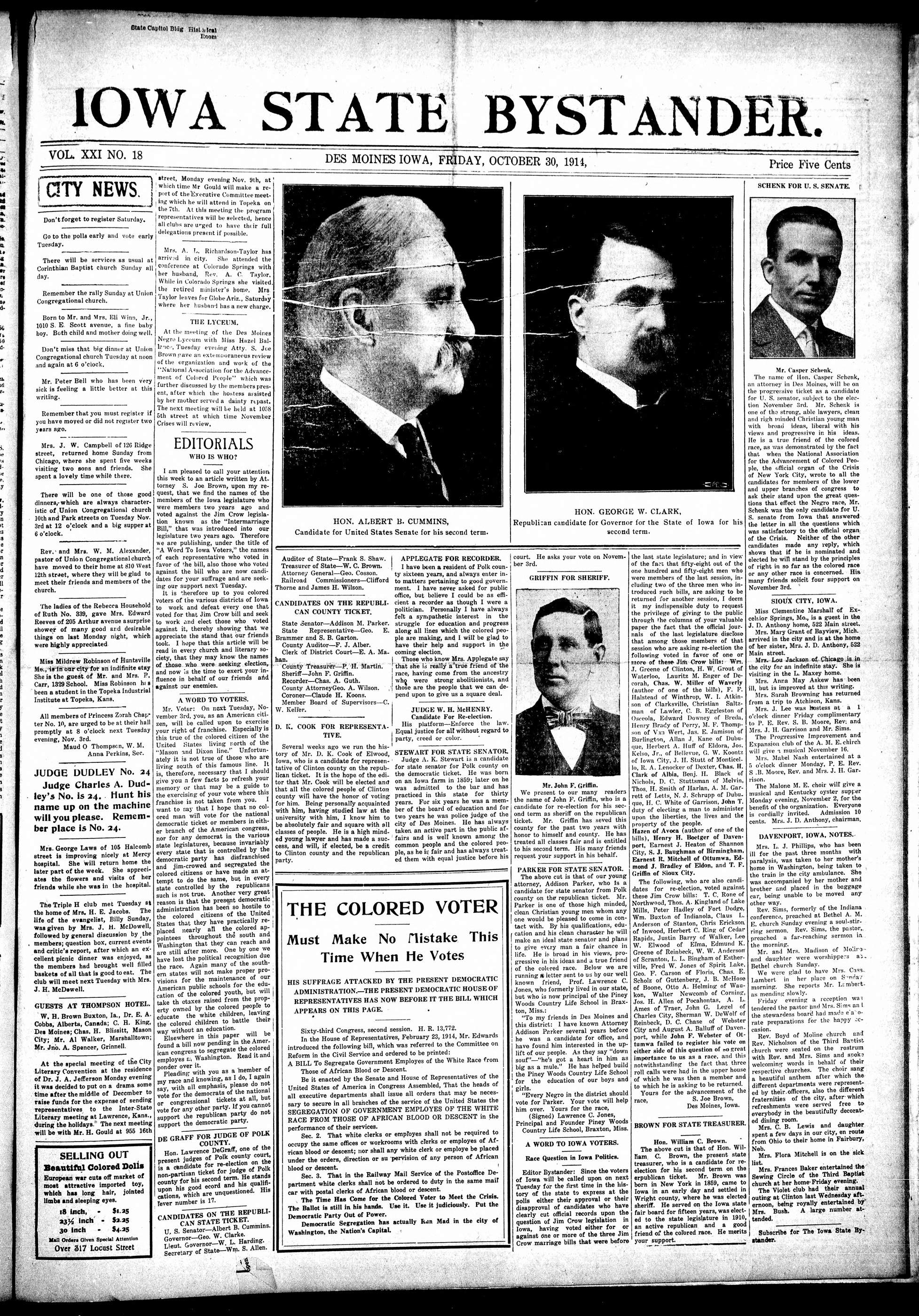
Go to the polls early and vote early Tuesday.
There will be services as usual at Corinthian Baptist church Sunday all day.
Remember the rally Sunday at Union Congregational church.
Born to Mr. and Mrs. Eli Winn, Jr., 1010 S. E. Scott avenue, a fine baby boy. Both child and mother doing well.
Don't miss that big dinner at Union Congregational church Tuesday at noon and again at 6 o'clock.
Mr. Peter Bell who has been very sick is feeling a little better at this writing.
Remember that you must register if you have moved or did not register two years ago.
Mrs. J. W. Campbell of 126 Ridge street, returned home Sunday from Chicago, where she spent five weeks visiting two sons and friends. She spent a lovely time while there.
There will be one of those good dinners, which are always characteristic of Union Congregational church 10th and Park streets on Tuesday Nov. 3rd at 12 o'clock and a big supper at 6 o'clock.
Rev. and Mrs. W. M. Alexander, pastor of Union Congregational church have moved to their home at 810 West 12th street, where they will be glad to meet their friends and members of the church.
The ladies of the Rebecca Household of Ruth No. 339, gave Mrs. Edward Reeves of 205 Arthur avenue asurprise shower of many good and desirable things on last Monday night, which were highly appreciated
Miss Mildrew Robinson of Huntsville Mo., is in our city for an indefinite stay She is the guest of Mr. and Mrs. P. Carr, 1329 School. Miss Robinson has been a student in the Topeka Industrial Institute at Topeka, Kans.
All members of Princess Zorah Chapter No. 10, are urged to be at their hall promptly at 8 o'clock next Tuesday evening, Nov. 3rd.
JUDGE DUDLEY No.24
Judge Charles A. Dudley's No. is 24. Hunt his name up on the machine will you please. Remember place is No. 24.
Mrs. George Laws of 105 Halcomb street is improving nicely at Mercy hospital. She will return home the later part of the week. She appreciates the flowers and visits of her friends while she was in the hospital.
The Triple H club met Tuesday at the home of Mrs. H. E. Jacobs. The life of the evangelist, Billy Sunday, was given by Mrs. J. H. McDowell, followed by general discussion by the members; question box, current events and critic's report, after which an excellent picnic dinner was enjoyed, as the members had brought well filled baskets of all that is good to eat. The club will meet next Tuesday with Mrs. J. H. McDowell.
GUESTS AT THOMPSON HOTEL.
W. H. Brown Buxton, Ia., Dr. E. A. Cobbs, Alberta, Canada; C. H. King, Des Moines; Chas. H. Blissett, Mason City; Mr. Al Walker, Marshalltown; Mr. Jno. A. Spencer, Grinnell.
At the special meeting of the City Literary Convention at the residence of Dr. J. A. Jefferson Monday evening it was decided to put on a drama some time after the middle of December to raise funds for the expense of sending representatives to the Inter-State Literary meeting at Lawrence, Kans., during the holidays. The next meeting will be with Mr. H. Gould at 955 16th
Beautiful Colored Dolls European war cuts off market of most attractive imported toy, which has long hair, jointed limbs and sleeping eyes.
---
VOL. XXI NO. 18
CITY NEWS.
Don't forget to register Saturday.
Maud O Thompson, W. M.
Anna Perkins, Sec.
SELLING OUT
18 inch, - $1.25
23½ inch - $2.25
30 inch - $4.25
Mail Orders Given Special Attention
Over 317 Locust Street
State Capitol Bldg Hist ocal Room
OWA
18
street, Monday evening Nov. 9th, at which time Mr Gould will make a report of the Executive Committee meeting which he will attend in Topeka on the 7th. At this meeting the program representatives will be selected, hence all clubs are urged to have their full delegations present if possible.
Mrs. A. L. Richardson-Taylor has arrived in city. She attended the conference at Colorado Springs with her husband, Rev. A. C. Taylor, While in Colorado Springs she visited the retired minister's home. Mrs Taylor leaves for Globe Ariz., Saturday where her husband has a new charge.
THE LYCEUM.
ing well.
At the meeting of the Des Moines Negro Lyceum with Miss Hazel Ballance, Tuesday evening Atty. S. Joe Brown gave an extemporaneous review of the organization and work of the "National Association for the Advancement of Colored People" which was further discussed by the members present, after which the hostess assisted by her mother served a dainty repast. The next meeting will be held at 1058 5th street at which time November Crises will review.
at Union at noon
en very at this
register if register two
6 Ridge day from weeks
EDITORIALS
WHO IS WHO?
EDITORIALS WHO IS WHO?
I am pleased to call your attention this week to an article written by Attorney S. Joe Brown, upon my request, that we find the names of the members of the Iowa legislature who were members two years ago and voted against the Jim Crow legislation known as the "Intermarriage Bill," that was introduced into our legislature two years ago. Therefore we are publishing, under the title of "A Word To Iowa Voters," the names of each representative who voted in favor of the bill, also those who voted against the bill who are now candidates for your suffrage and are seeking our support next Tuesday.
It is therefore up to you colored voters of the various districts of Iowa to work and defeat every one that voted for that Jim Crow bill and seek to work and elect those who voted against it, thereby showing that we appreciate the stand that our friends took. I hope that this article will be read in every church and literary society, that they may know the names of those who were seeking election, and now is the time to exert your influence in behalf of our friends and against our enemies.
A WORD TO VOTERS
Mr. Voter: On next Tuesday, November 3rd, you, as an American citizen, will be called upon to exercise your right of franchise. Especially is this true of the colored citizen of the United States living north of the "Mason and Dixon line." Unfortunately it is not true of those who are living south of this famous line. It is, therefore, necessary that I should give you a few facts to refresh your memory or that may be a guide to the exercising of your vote where this franchise is not taken from you. I want to say that I hope that no colored man will vote for the national democratic ticket or members in either branch of the American congress, nor for any democrat in the various state legislatures, because invariably every state that is controlled by the democratic party has disfranchised and jim-crowed and segregated the colored citizens or have made an attempt to do the same, but in every state controlled by the republicans such is not true. Another very great reason is that the present democratic administration has been so hostile to the colored citizens of the United States that they have practically replaced nearly all the colored appointees throughout the south and Washington that they can reach and are still after more. One by one we have lost the political recognition due the race. Again many of the southern states will not make proper provisions for the maintenance of our American public schools for the education of the colored youth, but will take the etaxes raised from the property owned by the colored people to educate the white children, leaving the colored children to battle their without an education.
way without an email. Elsewhere in this paper will be found a bill now pending in the American congress to segregate the colored employees e. Washington. Read it and sender over it.
ponder over it. Pleading with you as a member of my race and knowing, as I do, I again say, with all emphasis, please do not vote for the democrats of the national or congressional tickets at all, but vote for any other party. If you cannot support the republican party do not support the democratic party.
DE GRAFF FOR JUDGE OF POLK COUNTY.
Hon. Lawrence DeGraff, one of the present judges of Polk county court, is a candidate for re-election on the non-partisan ticket for judge of Polk county for his second term. He stands upon his good record and his qualifications, which are unquestioned. His lever number is 17.
CANDIDATES ON THE REPUBLI-CAN STATE TICKET.
U. S. Senator—Albert B. Cummins.
Governor—Geo. W. Clarke.
Lieut. Governor—W. L. Harding.
Secretary of State—Wm. S. Allen.
Open
M.
HON. ALBERT B. CUMMINS,
Candidate for United States Senate for his second term.
THE COLORED VOTER Must Make No Mistake This Time When He Votes
HIS SUFFRAGE ATTACKED BY THE PRESENT DEMOCRATIC ADMINISTRATION.—THE PRESENT DEMOCRATIC HOUSE OF REPRESENTATIVES HAS NOW BEFORE IT THE BILL WHICH APPEARS ON THIS PAGE.
Sixty-third Congress, second session
In the House of Representatives, February 23, 1914, Mr. Edwards introduced the following bill, which was referred to the Committee on Reform in the Civil Service and ordered to be printed:
A BILL To Segregate Government Employees of the White Race from Those of African Blood or Descent.
Be it enacted by the Senate and House of Representatives of the United States of America in Congress Assembled, That the heads of all executive departments shall issue all orders that may be necessary to secure in all branches of the service of the United States the SEGREGATION OF GOVERNMENT EMPLOYES OF THE WHITE RACE FROM THOSE OF AFRICAN BLOOD OR DESCENT in the performance of their services.
Sec. 2. That white clerks or employees shall not be required to occupy the same offices or workrooms with clerks or employees of African blood or descent; nor shall any white clerk or employee be placed under the orders, direction or su pervision of any person of African blood or descent.
Sec. 3. That in the Railway Mail Service of the Postoffice Department white clerks shall not be ordered to duty in the same mail car with postal clerks of African blood or descent.
The Time Has Come for the Colored Voter to Meet the Crisis. The Ballot is still in his hands. Use it. Use it judiciously. Put the Democratic Party Out of Power.
Democratic Segregation has actually Kun Mad in the city of Washington, the Nation's Capital.
Auditor of State—Frank S. Shaw.
Treasurer of State—W. C. Brown.
Attorney General—Geo. Cosson.
Railroad Commissioners—Clifford
Thorne and James H. Wilson.
CANDIDATES ON THE REPUBLI
CAN COUNTY TICKET.
State Senator—Addison M. Parker.
State Representative—Geo. E. Brammer and S. B. Garton.
County Auditor—F. J. Alber.
Clerk of District Court—E. A. Mahan.
County Treasurer—P. H. Martin.
Sheriff—John F. Griffin.
Recorder—Chas. A. Guth.
County AttorneyGe. A. Wilson.
Coroner—Claude H. Koons.
Member Board of Supervisors—C. W. Keller.
D. K. COOK FOR REPRESENTATIVE.
Several weeks ago we run the history of Mr. D. K. Cook of Elwood, Iowa, who is a candidate for representative of Clinton county on the republican ticket. It is the hope of the editor that Mr. Cook will be elected and that all the colored people of Clinton county will have the honor of voting for him. Being personally acquainted with him, having studied law at the university with him, I know him to be absolutely fair and square with all classes of people. He is a high minded young lawyer and has made a success, and will, if elected, be a credit to Clinton county and the republican party.
APPLEGATE FOR RECORDER.
I have been a resident of Polk county sixteen years, and always enter into matters pertaining to good government. I have never asked for public office, but believe I could be as efficient a recorder as though I were a politician. Personally I have always felt a sympathetic interest in the struggle for education and progress along all lines which the colored people are making, and I will be glad to have their help and support in the coming election.
Those who know Mrs. Applegate say that she is really a true friend of the race, having come from the ancestry who were strong abolitionists, and those are the people that we can depend upon to give us a square deal.
Candidate For Re-election.
His platform—Enforce the law. Equal justice for all without regard to party, creed or color.
STEWART FOR STATE SENATOR.
Judge A. K. Stewart is a candidate for state senator for Polk county on the democratic ticket. He was born on an Iowa farm in 1859; later on he was admitted to the bar and has practiced in this state for thirty years. For six years he was a member of the board of education and for two years he was police judge of the city of Des Moines. He has always taken an active part in the public affairs and is well known among the common people and the colored people, as he is fair and has always treated them with equal justice before his
E. P.
HON. GEORGE W. CLARK,
Republican candidate for Governor for the State of Iowa for his second term.
court. He asks your vote on Novem-
ber 3rd.
GRIFFIN FOR SHERIFF.
Mr. John F. Griffin.
We present to our many readers the name of John F. Griffin, who is a candidate for re-election for his second term as sheriff on the republican ticket. Mr. Griffin has seved this county for the past two years with honor to himself and county. He has treated all classes fair and is entitled to his second term. His many friends request your support in his behalf.
PARKER FOR STATE SENATOR.
The above cut is that of our young attorney, Addison Parker, who Is a candidate for state senator from Polk county on the republican ticket. Mr. Parker is one of those high minded, clean Christian young men whom any one would be pleased to come in contact with. By his qualifications, education and his clean character he will make an ideal state senator and plans to give every man a fair chance in life. He is broad in his views, progressive in his ideas and a true friend of the colored race. Below we are running a letter sent to us by our well known friend, Prof. Lawrence C. Jones, who formerly lived in our state, but who is now principal of the Piney Woods Country Life School in Braxton, Miss.:
"To my friends in Des Moines and this district: I have known Attorney Addison Parker several years before he was a candidate for office, and have found him interested in the uplift of our people. As they say "down souf"—"he's got a heart in him as big as a mule." He has helped build the Piney Woods Country Life School for the education of our boys and girls.
"Every Negro in the district should vote for Parker. Your vote will help him over. Yours for the race, (Signed) Lawrence C. Jones, Principal and Founder Piney Woods Country Life School, Braxton, Miss."
A WORD TO IOWA VOTERS.
Race Question in Iowa Politics.
Editor Bystander: Since the voters of Iowa will be called upon on next Tuesday for the first time in the history of the state to express at the polls either their approval or their disapproval of candidates who have clearly cut official records upon the question of Jim Crow legislation in Iowa, having voted either for or against one or more of the three Jim Crow marriage bills that were before
the last state legislature; and in view of the fact that fifty-eight out of the one hundred and fifty-eight men who were members of the last session, including two of the three men who introduced such bills, are asking to be returned for another session, I deem it my indispensable duty to request the privilege of giving to the public through the columns of your valuable paper the fact that the official journals of the last legislature disclose that among those members of that session who are asking re-election the following voted in favor of one or more of these Jim Crow bills: Wn. J. Greene of Clinton, H. W. Grout of Waterloo, Lauritz M. Enger of Decorah, Chas. W. Miller of Waverly (author of one of the bills), F. F. Halstead of Winthrop, W. I. Atkinson of Clarksville, Christian Saltzman of Lawler, C. B. Eggleston of Osceola, Edward Downton of Breda, Henry Brady of Perry, M. F. Thompson of Van Wert, Jas. E. Jamison of Burlington, Allan J. Kane of Dubue, Herbert A. Huff of Eldora, Jos. Kelso, Jr., of Bellevue, G. W. Koontz of Iowa City, J. H. Stutt of Monticello, R. A. Lenocock of Dexter, Chas. H. Clark of Albia, Benj. H. Black of Nichols, J. H. C. Stutts of Melvin, Thos. H. Smith of Harlan, A. M. Garrett of Lettns, J. H. Schrupp of Dubue, H. C. White of Garrison, John T. duty of electing a man to administer upon the liberties, the lives and the property of the people.
Hazen of Avoca (author of one of the bills), Henry H. Boetger of Davenport, Earnest J. Heaton of Shannon City, S. J. Baughman of Birmingham, Earnest R. Mitchell of Ottumwa, Edmond J. Bradley of Eldon, and T. F. Griffin of Sioux City.
The following, who are also candidates for re-election, voted against these Jim Crow bills: T. C. Rone of Northwood, Thos. A. Kingland of Lake Mills, Peter Hadley of Fort Dodge, Wm. Buxton of Indianola, Claus L. Anderson of Stanton, Chris Erickson of Inwood, Herbert C. Ring of Cedar Rapids, Justin Barry of Walker, Lee W. Elwood of Elma, Edmund K. Greene of Reinbeck, W. W. Anderson of Scranton, L. L. Bingham of Estherville, Fred W. Jones of Spirit Lake, Geo F. Carson of Floris, Chas E. Scholz of Gutenberg, J. B. McHose of Boone, Otto A. Helming of Waukon, Walter Newcomb of Corning, Jos H. Allen of Pocahontas, A. L. Ames of Traer, John G. Legel of Charles City, Sherman W. DeWolf of Reinbeck, D. C. Chase of Webster City and August A. Balluff of Davenport, while John F. Webster of Otumwa failed to register his vote on either side of this question of so great importance to us as a race, and this notwithstanding the fact that three roll calls were had in the upper house of which he was then a member and to which he is asking to be returned.
Yours for the advancement of the
BROWN FOR STATE TREASURER
Hon. William C. Brown. The above cut is that of Hon. William C. Brown, the present state treasurer, who is a candidate for reelection for his second term on the republican ticket. Mr. Brown was born in New York in 1859, came to Iowa in an early day and settled in Wright county, where he was elected sheriff. He served on the Iowa state fair board for fifteen years, was elected to the state legislature in 1910, an active republican and a good friend of the colored race. He merits your support.
SCHENK FOR U. S. SENATE.
The name of Hon. Casper Schenk, an attorney in Des Moines, will be on the progressive ticket as a candidate for U. S. senator, subject to the election November 3rd. Mr. Schenk is one of the strong, able lawyers, clean and righd minded Christian young man with broad ideas, liberal with his views and progressive in his ideas. He is a true friend of the colored race, as was demonstrated by the fact that when the National Association for the Advancement of Colored People, the official organ of the Crisis of New York City, wrote to all the candidates for members of the lower and upper branches of congress to ask their stand upon the great questions that effect the Negro race, Mr. Schenk was the only candidate for U. S. senate from Iowa that answered the letter in all the questions which was satisfactory to the official organ of the Crisis. Neither of the other candidates made any reply, which shows that if he is nominated and elected he will stand by the principles of right in so far as the colored race or any other race is concerned. His many friends solicit four support on November 3rd.
SIQUX CITY, IOWA
Miss Clementine Marshall of Excelsior Springs, Mo., is a guest in the J. D. Anthony home, 522 Main street. Mrs. Mary Grant of Bayview, Mich. arrived in the city and is at the home of her sister, Mrs. J. D. Anthony, 522 Main street. Mrs. Lou Jackson of Chicago is in the city for an indefinite stay. She is visiting in the L. Maxey home. Mrs. Anna May Askew has been ill, but is improved at this writing. Mrs. Sarah Browning has returned from a trip to Atchison, Kans. Mrs. J. Lee was hostess at a 1 o'clock dinner Friday complimentary to P. E. Rev. S. B. Moore, Rev. and Mrs. J. H. Garrison and Mr. Sims. The Progressive Improvement and Expansion club of the A. M. E. chirch will give a musical November 16. Mrs. Mabel Nash entertained at a 5 o'clock dinner Monday, P. E. Rev. S. B. Moore, Rev. and Mrs. J. H. Garrison. The Malone M. E. choir will give a musical and Kentucky oyster supper Monday evening, November 2, for the benefit of the organization. Everyone is cordially invited. Admission 10 cents. Mrs. J. D. Anthony, chairman.
DAVENPORT, IOWA, NOTES.
Mrs. L. J. Phillips, who has been ill for the past three months with paralysis, was taken to her mother's home in Washington, being taken to the train in the city ambulance. She was accompanied by her mother and brother and placed in the baggage car, being unable to be moved any other way.
Rev. Sims, formerly of the Indiana conference, preached at Bethel A. M. E. church Sunday evening a soul-stirring sermon. Rev. Sims, the pastor, preached a far-reaching sermon in the morning.
Mr. and Mrs. Madison of Molina and daughter were worshippers at Bethel church Sunday.
We were glad to have Mrs. Cass Lambert in her place on Sunday morning. She reports Mr. Lambert as mending slowly.
Friday evening a reception was tendered the pastor and Mrs. Sims and the stewardess board had made a rate preparations for the happy occasion.
Rev. Boyd of Moline church and Rev. Nicholson of the Third Baptist church were seated on the rostrum with Rev. and Mrs. Sims and sook welcoming words in behalf of their respective churches. The choir sang a beautiful anthem after which the different departments were represented by their officers, also the different fraternities of the city, after which refreshments were served free to everybody in the beautifully decorated dining room.
Mrs. C. B. Lewis and daughter spent a few days in our city, en route from Ohio to their home in Fairbury, Neb.
Mrs. Flora Mitchell is on the sick list.
Mrs. Frances Baker entertained the Sewing Circle of the Third Baptist church at her home-Friday evening. The Violet club had their annual outing at Clinton last Wednesday afternoon, being royally entertained by Mrs. Bush. A large number attended.
Subscribe for The Iowa State Bystander.
AFRO-AMERICAN CULLINGS
The majority of Negroes of Texas are engaged in the occupation of farming. Most of them are farming because their fathers farmed before them, they were raised on the farm and know little else, and re-lily little of that. Their woolly ignorance of the science underlying agriculture, of recent discoveries, of the use of modern machinery and the marketing of their crops is appalling. They do not have home and the opportunity to learn anything about the subject. So these people go on from year to year doing the work of the farm in very much the same way it was done a generation ago. No particular effort has been made to reach these farmers with modern agriculture and home economics. The beauty, independence and importance of the farmer's life have never come to them. They only know the drudgery and wretchedness of it all. Is it surprising that managers in our cities and farming services in our cities? To those acquainted with conditions surrounding the average Negro farmer and farmhand it is not surprising.
There are some conspicuous examples of successful Negro farmers in Texas, but theirs are individual cases, and most of these successes are due to fortunate circumstances and not to any particular effort to promote the general efficiency of the Negro farmers as a class. Articles appearing in the paper from June 1969, Negro farming, and cliting these conspicuous individual successes as examples of what the masses are doing are misleading and really do the Negro farmers, less fortunately situated, great harm, for those in position to help him help himself conclude that the Negro farmer is doing well enough. We are all glad that a few individual Negro farmers are succeeding, but many concerned about that very large body of tollers of the soil for whom the sun of prosperity has never risen.
Honest men everywhere will agree that the only way to eradicate evils, and to make living conditions better, is to tell the truth about them, awaken sentiment, find a remedy and then apply it. The purpose of this letter is to inform the majority of the important to the making farm life more attractive to the Negro farmer and thus hold him on the farm, and to attract others back to this life from congested conditions of living in Negro sections in our large cities, making all of them useful citizens in their communities and producers of not only enough to supply their own needs but producers in other areas to increase our food supply and materially reduce the high cost of living.
Now somebody please rise and say: "It can't be done—we've tried it." The fact that it has never been tried in Texas in earnest on a sufficiently large scale and well organized effort to result in much good. A few good men of our state are doing the best they can, for example: R. L. Smith of Colorado county and now of Waco, TX. He is a successful individual for the uplift and improvement of Negro farmers through the medium of his farmers' organization, the Farmers' improvement society, and an agricultural college at Ladonia, Tex., supported by this organization. This society is self-supporting and deserves additional aid for its splendid work. E. L. Blackshear of Prairie
Among the surprises that the department of fine arts will give the world when the Panama-Pacific International expoition opens in 1915 will be the presentation of paintings by Samuel Morse, inventor of the telegraph; Robert Fulton, inventor of the steamboat; General R. S. Baden-Powell, writer and Mrs. Woodrow Wilson, engravers by Paul Revere, the famous patrol, will be displayed.
If a young man has money to burn any number of anxious mothers try to hand him a match.
In New Haven there is exhibited the earliest known skate, roughly fashioned out of the bone of a horse. It is about twelve inches in length and was found in an excavation made in the city of London.
Be frugal of your common sense; it will some day be above par.
The fiber of a plant growing extensively in Argentina has been found to possess qualities similar to the kapok of the Philippines.
All Danish passenger steamers and ferry boats on the route between Sweden and Germany will probably soon be equipped with the wireless telephone stations will be erected on the coast.
As a rule, the money a man doesn't save by remaining a bachelor would be more than enough to support a wife and ten children.
He who marries a widow need not hope to be called the best man that ever lived.
More than 99 per cent of Alaska is owned by the United States, and this vast area was bought by the government for less than two cents an acre. For developing the country about ten thousand miles of railroad will be required.
Some women are born shapely and some others employ expert dressmakers.
View college has rendered service that is valuable to the Negro farmers' congress, of which he is founder and president. The agricultural department of the same college, with C. H. Waller at the head, has turned out a number of young colored mea who are doing excellent work. But almost all the work done so far has been voluntary, and has not reached the masses through organized effort emanating from some central authority. The state of Texas has never put forth any new effort to reach and increase their efficiency, and yet a large proportion of the productive wealth of Texas is committed to this unskilled labor through the rich lands they control and cultivate.—Wade C. Rollins in the Houston Post.
The sum of $55,000, appropriated by congress for expenses of the exposition to celebrate the fiftieth anniversary of the emancipation of the negro and to show the advancement and achievements of the negro race in education and in the industrial work of the nation, to be held next year, near Richmond, Va. will be turned over by the government to a deputy commissioner designated by the governor of Virginia. This fund may then be withdrawn by order of the treasurer of the Negro Historical & Industrial association of Richmond, Va. approved by the governor of the state. The treasurer of the organization will be required to give bond to the Negro Historical & Industrial association, as the governor may direct or approve. No bond will be required to give bond to the department of the fund will not be done under federal supervision, and no accounting to the federal government will be exacted.
This outlines the procedure set down by W. W. Warwick, acting controller of the treasury, in response to the inquiry of the secretary of the treasury as to the manner of withdrawal of the fund from the treasury, and as to what bond, if any, the disbursement agent should be required to execute to the treasury the money should be accounted for. It is stated in the reference that Giles B. Jackson, president of the negro organization, has given notice of the appointment of a disbursement agent. Acting Controller Warwick points out that the appropriation act provides only for supervision and direction of disbursement of the fund by the government of Virginia. He also closes the appropriation act with the promise of any responsibility to give bond or to account to the United States for proper disbursement of the appropriation.
Shantung can boast of 40 centuries of agricultural activity. It is still an agricultural province with an area of 55,000 square miles—about equivalent to that of the state of Wisconsin—with an estimated population of 30,000,000, and has been forced to a degree of intensive cultivation unknown to the farmers of the United States.
All the relatives from the country round were gathered at the home of Frank Taylor, Tomah, Wis., for a family party, when the conversation drifted to Albert Taylor, who was a fifteen van away in 1854 to join a circus and had not been heard of since. While they were talking the door opened and Albert walked in.
If a woman still laughs at her husband's jokes five years after the wedding bells have jingled the divorce lawyers get discouraged.
M. A. Johnson of Rockland, Me., has a pair of rubber boots which he bought in 1883. The boots were worn on a farm at intervals for six years, and have since been worn on many hunting and fishing trips. They are still sound and dry.
Of the emigrants leaving Ireland during the year 7 per cent were destined for the United States and 21½ per cent for Canada. From the province of Ulster there were 12,392 immigrants, or 40 per cent of the total.
There was launched at Port Arthur recently the largest steamer on the Great Lakes, having a capacity of 585,000 bushels or 12,000 tons of oats.
Tinplate imports into the United States fell from 135,000,000 pounds in 1902 to 4,500,000 pounds in 1912, while the quantity exported increased from 3,500,000 pounds in 1902 to 183,000,000 pounds in 1912.
Attending the same school for 13 years without being absent or tardy is the remarkable record of John Pugn, nineteen years old, who has just graduated from the Deepwater (Mo.) High school as the only boy in the class.
Success may not depend so much upon what you do yourself as upon what you can jolly others into doing for you.
Many a woman acts rather stiffly after her first tango lesson.
A rural mail carrier in Missouri has driven the same horse 67,600 miles in the last eight years. This is equal to more than two complete trips around the world.
Philippine sugar harvest, especially in Ilolio, is said to be the largest since 1908.
His Satanic majesty never gets his due from some people while they live.
Italian state railways are now using more than 60 electric locomotives.
HINTS FOR PRESERVE CLOSET
Pickled Peaches Should by All Means
Be Among the Condiments Stored
—Branded Cherries.
Pickled peaches are a dinner condiment of unparalleled excellence. Many people prefer pickled fruit to the sweeter fylles and preserves and the good housekeeper always puts up pickled dainties as well as preserves, jellies and jams for her well-atckored winter fruit closet. Here is a tried and true recipe for pickled peaches. To seven pounds of selected peaches allow half as many pounds of granulated sugar, one quart of vinegar, two ounces of stick cinnamon and cloves. Dissolve the sugar in the hot vinegar, add the spices and boll for six minutes; add the peaches and boll slowly until the peaches have become soft enough to be pierced easily by a fork. Out the fruit and boll the boll down the peaches and boll the peacher again and let the whole just come it a boll. Pour into a deep crock and cover when cold.
A Virginian housekeeper recommends this recipe for branded cherries: Cover large, oxheart cherries which have been stoned with some excellent brandy and let stand for 48 hours. Add to the mixture sugar in a proportion of pound for pound. Do not cook, but seal in glass jars and set away in a cool place. These are delicious for garnishing whipped cream and frozen desserts. They may also be served in home-mixed cocktails.
AN OYSTER STEW RECIPE
Expert Recommends This as an un-
likely Appointment of Serv-
ice to the Bylaws.
Fanile Merritt Farmer, cookery editor of the Woman's Home Companion, presents a number of "Recipes for October" in that publication. Among them is her recipe for Boston oyster stew, which follows:
"Put one quart of oysters in a coander and pour over three-fourths cupful of cold water. Carefully pick over oysters, remove tough muscles from half of them, and slightly chop remaining half with removed tough muscles. Add chopped oysters to water drained through coander, heat to the boiling point, and let simmer three minutes. Strain through a double thickness of cheesecloth, add reserved part of oyster, and cook until oysters are plump. Put in oysters with a coander and put in one fourth cupful of butter, one half tablespoonful of salt, and one-eighth teaspoonful of pepper. Add oyster liquor, strained a second time, and one quart of scalded milk. Always remember to scald milk in a double boiler, which overcomes the danger of scorching. Serve with oyster crackers."
Jellied Salmon, Cucumber Sauce.
One can salmon, one-half tablespoonful salt, one-half tablespoonful sugar one-half tablespoonful flour, one teaspoonful mustard, few grain cayenne yolks of two eggs, one and a half teaspoonful melted butter, three fourths cupful milk, one-fourth cupful vinegar, three-fourths tablespoonful cold water. Remove salmon from in a rinse thoroughly with hot water and separate in flakes. Mix dry ingredients, add egg yolks, milk and vinegar. Cook over boiling water, stirring constantly until mixture thickens. Add gelatin soaked in cold water, strain and add to salmon. Stand until set. Serve in individual molds with following sauce: Beat one-half cupful heavy cream until stiff, add two tablespoonful vinegar, then add one cucumber, peeled and chopped.
Old-Fashioned Baked Ham
Have a slice of ham cut an inch (or even a little more) thick—one with quite a little fat on is preferable—trim off the extreme edge of the fat and wash the slice thoroughly, lay fat in dripping pan and cover to the depth of about one-quarter of an inch with brown sugar. Stick into the sugar about ten or twelve whole cloves, put one-half cupful of water in the pan and bake slowly, about three-tquarters of time, but add a little more water from time to time if it seems too dry; spinach garnished with hard-boiled eggs cut in slices is nice to serve with this, and the ham is good cold as well as hot.
Sponge Cake, Orange Filling
Mix well together three egg yolks, three fourths of a cupful of sugar, the grated rind of one lemon, one cupful of sifted flour and one teaspoonful of baking powder. When well beaten together add a little salt and the whites of the three eggs beaten stiff. Bake for 15 minutes in Washington pie tins. For the filling beat together the juice of one orange, with a little lemon juice and two egg yolks of sugar and two tablespoonfuls warmed butter, and cook in a double boiler until it thickens. Spread between the layers of cake.
Beanpot Roast.
One and one-half pounds of clear stew meat, cut into two-inch bits. Put in beanpot and cover. Set in oven two hours and bake slowly. Do not add anything but one-half teaspoonful salt. It will be rich, with lots of nice gravy, if cooked slowly. Nice served with potatoes, sometimes when nearly done take a slice of the oven and put into a good-sized shallow dish, put a thick layer of mashed potatoes on evenly all over. Set back in oven to brown slowly.
Boston Brown Haah.
Chop any remains of steaks, roasts or stews very fine. Grease a deep pie dish. Put a layer of mashed potatoes (old ones, left over, will answer) in the bottom of the dish, then a layer of meat, then a layer of stale bread crumbs, applesauce with salt and milk, or few bits of butter, modelling with a half cupful of beef gravy, then another layer of potatoes. Dip a knife into milk and smooth the top. Bake in a moderate oven until brown. Serve hot.
IOWA STATE BYSTANDER
Fundamental Principles of Health
By ALBERT S. GRAY. M.D.
(Copyright, 1914, by A. S. Gray)
FOOD AND DELINQUENTS.
Under a recent date an Associated Press dispatch credits Charles C. D. Hilles, formerly private secretary to President Taft, now president of the New York Juvenile asylum in Dobbs Ferry, with the discovery that bad teeth make bad boys.
What is the cause of bad teeth in children under fifteen years of age? It is universally admitted that the fundamental cause of the early decay of children's teeth is anemia, a lack of sufficient-building material during the growing period. Obviously a lack of brick and mortar will result in an inadequate building, and the same lack of material must result in an imperfect body.
Mr. Hilles is not the discoverer of this truth, but none the less he is entitled to great credit for recognizing and taking practical steps to combat a dangerous condition that many foreign governments are making strenuous efforts to overcome.
In the parliamentary debate on free meals, March 27, 1905, Sir William Anson, then British parliamentary secretary to the board of education, replying to Messrs. Kier and William Crookes, admitted that in the day industrial schools, where the children had three meals a day, he found them to be overfed, and being developed physically and mentally in a satisfactory way." Although the children lived at home the regular and wholesome supply of food was so potent a factor that "their condition was thoroughly satisfactory." Wilson Bruce, following other witnesses before the Scottish commission in pointing out the startling superiority of industrial school children, added that if we fed and clothed the elementary school children as suitably we should "make a new race of them." The commissioners noted this contrast between the ill-nourished elementary school children and well-developed industrial school children of those who have "altofogether failed in their duty."
The countess of Warwick, writing in "A Nation's Youth," says: "What a fine moral have we here. Be a bad parent, or confess yourself unable to control your own children, and they will be attached to an industrial society. They will be attached at the expense of the ratepayers, and they will become bright and intelligent boys, developed physically and mentally in a satisfactory way." This touches upon and brings sharply to the front the whole subject of sophisticated foods around which a commercial battle royal is at present raging in this country. In no field of knowledge is there so general a lack of information founded on experience as in the fundamental one of food.
Eating has become an art which has to be learned by man, and unfortunately the subject is considered so unimportant that quite generally our foods are selected on the statement of persons whose only interest is in the profit to be derived from the manufacture and sale of the commodity, and that is why the problem in this slipshed manner it is too frequently turned over to some incompetent kitchen drudge to be prepared for eating.
In order that an intelligent choice of proper diet may be made it is absolutely necessary that we should possess a certain emattering of scientific knowledge. This does not consist in the memorizing of a few terms sufficient to enable us to babble about carbohydrates, proteins and fats, of calories and of balanced ratios, but to have a thorough understanding of the real meaning of the closing paragraph of the fourth article of this series, which we here again repeat for emphasis: "The now prevailing standard of food values which measures the health of the human body and completely ignores all other elements and factors is not only woefully inadequate in the light of modern science, but constitutes a grave menace to the health, to the morals, to the sanity and to the life of any people." The chief reason for the improvement in inmates of well-governed asylums and industrial schools over the rate of development shown by children under home conditions undoubtedly lies in the fact that food matter is bought in bulk and largely
Net fsc Hlm:
J. B. Regan, the noted New York hotel man, was said, apropos of a champagne dispute, champagne stories.
"Mean men should never drink champagne," said Mr. Regan. "They can't enjoy it, you know. They think, with every swallow, 'there goes 35 cents.'
"Once on the Mauretania a man asked me for a seasickness cure."
"Drink," I said to him, a half bottle of champagne just before you feel the seasickness starting."
"Oh," he said with a worried look, "wouldn't ginger ale do just as well? Champagne seems such expensive stuff to—er—risk."
Rhodes Scholarship.
A feeling that the present system leads every so often to a loss of interest in the Rhodes scholarship plan is undoubtedly the dominant force behind the determination of the Rhodes scholarship in the method of choosing the scholars from this country. Hereafter there will be elections from two-thirds of the states
on the horse-food basis, that is to say, the whole grains are bought, cooked and served, rather than the more expensive refined processed matter. Of course we are assured by "experia" that the food is "improved" and made "more digestible" by the elaborate process through which it is passed, but any successful raiseer of cattle, hogs, chickens, pigeons, dogs or cats can tell of disastrous results following the feeding of any of these animals for any material period of time on "refined" food matter. And humanity still waits the coming of some Moses to free it from the bondage of the observance of universal law to which all living things are subject.
WHITE FLOUR FOOD.
"A little learning is a dangerous thing: Drink deep, or taste not the Pierian. There shallow drains intoxicate the brain, And drinking largely sobers us again."
A recent magazine article written by an "expert" on food matters misquotes the first line of the above and then gives particular point to the truth of the quotation by grossly misinterpreting a clean cut, scientific demonstration of a disease resulting from the use of sophisticated food matter.
The article in question reads as follows: "We are told about biochemical properties of wheat offals and as proof we are referred to the ravages of berleri from eating hulled rice. This is 'guglery,' something on the order of the magician Kellar. To be specific, berleri is a disease that has no connection with the whole wheat and white flour question. It is as remote as it can be. Bert-beri is a nervous disease that has affected the natives of Asia, who live mainly on the fruits of late years the introduction of hulled rice has increased the disease. It has been found that when rice polish was used as food along with the rice the disease was lessened in intensity.
"From this it has been argued that the rice hulls contained nourishing substances which had been removed from the rice in polishing. This looked very plausible. From these facts it has argued that wheat bran must also contain nourishing substances and they should not be removed from the wheat in the manufacture of flour. Fortunately, however, the subject of berberi has been worked out scientifically, and Funk, of the Lister institute, has shown that the disease is caused by some toxic action of rice protein.
"This should show the danger of being influenced by the exaggerated accounts of white bread and hulled rice starvation, statements which are no foundation in prose. White bread is safe food. Polished rice is safe food, a scientific investigation has proved."
The discerning reader will note that the matter in the body of the article controverss the finding stated in the closing paragraph quoted. The whole truth is as follows:
Casimir Funk of the biochemical department, Lister Institute of Preventive Medicine, discovered that a substance could be recovered from the matter ground from the surface of rice in polishing it which would in a few hours cure a disease known as polyneuritis, or bert-berl.
Underlying every happening in this universe is a law or principle, and the same principle will be found producing many widely separated results. The statement that berl-beri has no connection with whole wheat and white flour is not strictly true, because the same principle applies. Berl-beri is caused by a mineral starvation, and we know many diseases are caused by the mineral starvation resulting from the too free use of demineralized foods, including flour. The writer personally knows that the mineral starvation killed by feeding them on demineralized grain, and of dogs killed by feeding them on demineralized meat and white bread. Every physiologist of note states that the vitality of the individual cell depends on a free supply of mineral matter consisting of at least three elements. It would be reasonable then to expect some definite deleterious result from a diet composed largely of mineral-free matter, and the fact that all white bread eating peoples are greatly troubled with constipation may be considered evidence of the mineral-free matter that white bread is not healthful is given by Sherman, who states that washed bran fed to cows was found to be constipating, indicating that the laxative property of ordinary bran and whole wheat products is dependent not simply upon mechanical irritation.
It would be as logical to state that while you might break your neck falling off a thirty foot brick house, falling off a thirty foot frame house over in the next block is safe because it has no connection with the brick house. "It is as remote as it can be." That may be, but nevertheless, the chances are small, because the principles are identical. The too free use of white four, or of any other demineralized foodstuff, no matter whether it be demineralized by being processed or by stupid cooking methods, is detrimental to health.
every year and the old idea of elections from all the states two years out of three will be abandoned. The new plan will insure to Oxford an uninterrupted flow of American students and should put an end to the lethargy that prevails here whenever a so-called lean year is upon us. At best the trustees seem to be having their trusties maintaining a continuous interest in Cecil Rhodes' vast enterprise and they are ever on the alert to popularize it. It was only last year, it will be remembered, that the Ox on the campus of the extent of excusing American dates for scholarships from entrance examinations in Greek—Boston Transcript.
St. Pierre Still Dead.
St. Pierre, Martinique, which was destroyed by the eruption of Mount Pelee in 1902, has never been rebuilt, but it is said that even yet the ruins are being searched for valuables. The place is under police control, and two or three streets have been excavated, but it is still a "city of desolation."
LauraJeanLibbey's Talks on Heart Topics
[Courtesy 1914, by the McClure Newspaper Syndicate]
DOUBLE LIVES OF MANY NEW
YORK GIRLS.
Life is a waste of wearisome hours
Which seldom the rose of enjoyment
adorns.
And the heart that is soonest awake to
the flowers.
Is always the first to be touched by the
thorns.
How truly it has been said that
one half of the world knows not how
the other half lives. Those who have pitted the poor little milliner, the typewriter, and shop girl, troubling over how data and old lives were, might open their eyes wide with surprise to find how many of the wrest pleasure from even so dreary an existence as is theirs. They read few papers, yet they are abreast with
1930
the current events of the day. They are far removed socially from people of wealth and luxury. They can unfold, however, an intimate knowledge of them that is marvelous. Before hand, they are able to whisper when a love match is about to blossom into an engagement. They see the beginning and growth of affairs that end in scandals.
Watching these women and their ideal lives, as it seems, is the one joy of these girls. The manner in which they touch elbows with these rich women is somewhat unique. During the day, these young women work at their allotted tasks, as though life contained nothing else for them. When the closing hour comes, they sit on the windowsill, their lonely hall bedrooms, blithe as the birds that twitter outside their windows. Usually two young women share their room together. They are in cramped quarters; must take turns in cooking their frugal suppers over the oil stove. If there are pleasures ahead they don't mind the hardships. Girls are clever with their fingers, and help one another to fashion simply gowns. The gowns give the warm vie with a millionaire's sumptuous robe, and not look out of place by comparison.
Donning their evening gowns, throwing scarfs round their shoulders, the girls scurry eagerly forth. To the cheap picture shows for an evening's amusement? Oh, no. A dark skirt and plain shirt waistwalt would answer for going there; their attire would not be closely observed. On past the moving picture places they go; their destination is the dining room. The drawing room and lobbies are to all guests who look to the manner born. They loiter in the beautiful lobby for a while; sitting on the rich divans they are so near the favorite of fortune they could reach forth their hands and touch their robes. They drink in their floating bits of conversations; feast their eyes on their dazzling gems, inhale the exotic perfume from the rare flowers they wear. Like the fabled Cinderella, their eyes are transported into a different world. The dreary hall bedroom fades away from their memories. In its place are marble halls, strains of sweetest orchestra music.
The rich and the great ebb to and fro past them. They secure seats in the magnificent dining room. To be sure it is an obscure corner; still they are part of that rich throng. The girls order rolls and milk. Evening is spent amidst surroundings of bright lights, flowers, geyery, happy laughter, and all that makes life one grand sweet song. When it is over we go home and their steps homeward, eager chatty over all they have seen and heard. They make the rounds of the great hotels and restaurants. Managers know them; they are unobstruc, quiet girls. Usually they are sorry to refuse them a table, but tell them their tables are all engaged for the entire evening. Their expenses are high. They reserve tables for those who spend money generously. They are in the rounds; while it lasts they pretty, innocent girls have their fling in leading a double life, as it were. They are surrounded by hardships in day time and luxury by night.
IF A CHILD BINDS THEM.
Remember the honeys where the light has fed,
where the rose has faded away
And love that glows in youthful hearts,
Oh, cherish it while you may!
I'll be there.
Make your home a bower of flowers,
Let joy bloom there through childhood
hours,
God pity the child of divided hearts.
The chain of love is no stronger than its weakest link. The couple who step to the altar to be made man and wife should understand they are leaving the old life behind them and entering a new world, as it were. After marriage neither the husband nor the wife can do absolutely as he or she wills—there is another to consult, advise with and please.
The trouble is, many a married couple wake up to the fact too late. The husband who has always had his wife does not take kindly to being dictated by him. He always gave his wife his own way; he expects his wife to do likewise. The spirited young wife who has been petted, spoiled and coddled by her family is quite as determined that she must be the ruling spirit of the household. Slight disagreements end all too soon in quarrels.
This is bad enough if there are no little ones, but if there is a child looking on with frightened eyes and bated breath, parents should never utter the bitter words that rise to their lips. Unconsciously, even in its earliest years, the child will take sides with one or the other. The scene will be engraved upon its memory while life lasts.
In frequent quarrels of parents, lead to estrangements and contemplation of divorce. Ere parents should take that extreme measure, they should give a thought to the innocent child whose future they would deliberately wreck by such a course. When the dovecote has once been desecrated, the fledglings have no heart to return there again. Where there is a child to bind them, a husband and wife should make every sacrifice in keeping back their resentment and difficulties for the sake of the little life that would not have looked out distrustfully into the world. It has been for them. Parents owe it to their children to make a home for them and to cause happiness to reign within its walls.
The wife who speaks slightly of her husband before her children makes a fatal mistake. The husband who speaks sneeringly to his wife with the children looking on paves the way to be slighted himself by them when he is old. Father may endeavor to influence them that mother's in the wrong. But in the calm judgment of after years their hearts will turn to her, as the sunflower turns to the sun. Children should bind husband and wife in love and peace till death do them part.
IF HIS LIFE WERE AN OPEN BOOK.
Nay, grieve not for the dead alone,
whose song has told their heart's sad
Weep for the voiceless, who have known
the cross without the crown of glory!
A few can touch the magic string,
which can be used to win them.
Alas, for those that never sing.
But die with all their music in them!
The man who shows no disposition
to indulge in the society of the fair
sex should not be singled out for
persistent attention by women.
There is generally a good reason
he has when a man fights sex or
marriety. It may be his nature to
polite to the opposite sex, but it
shouldn't be taken for granted that
courtney means liking which may lead
to a tenderer sentiment.
He may appear to be very lonely and much in need of woman's sympathy. But appearances in such cases may be deceptive. Instead of being a bachelor, as every one supposes, he may be a widower, with a large family of children, whom his mother, in a far-off city, is aiding him to care for. His one thought may be to make name and fortune for himself, to form in his avowed attention never to entertain the thought of taking a wife until his children are educated, grown up, married and in homes of their own.
Then, again, a bachelor may have had a heart entanglement in his early youth which causes him to forswear marriage for all time to come. Or he may have habits, such as an ungovernable temper, which he knows that no woman would put up with for long, or love of drink. If every man's life was an open book that all might read, men who seem so desirable might be shunned, while others, who seem to possess all the faults in the calendar, might be considered worthy of reforming; aye, jewels in the rough. Even a man to whom a woman is wedded may not be just what she imagines him. He may be supporting dependent relatives whom he has never mentioned to his wife and of whom the world knows not.
If a man wishes to close the book of his past from all prying eyes it is wisest and best to let him have his own way. If a man is interested in a woman he will not have to be coaxed to seek him from earth as strong as love to bring two together who are intended for each other.
Have Chickens Some Sense?
In Farm and Fireside, in the poultry-raising department, a contributor tells the following story about an experience with his chickens: "An amusing incident happened last summer. I had a fine flock of chickens in an old garden adjoining the yard. I cared for them, and as it happened no one else went about them for weeks. I was in the habit of taking the fresh air and sunlight remedy not wearing a hat. One day I went toward the barn, and a tiny flock took to flight. Relieving myself of the scarecrow I again went into the yard, and the excitement immediately ceased.
"Chickens are quick and alert to every noise, object and movement. They observe before they venture. "Chickens love and trust their master. They watch and wait for coming, making and knowing the movement makes, and know the general contents of the different vessels he carries."
Five Risks In Early Days
In early days in this country people had a wholesome respect for fire hazards. Way back in 1761 an ordinance was adopted in New York city demanding "more effectual prevention of fires." To that end it was required that every building in the city "south of Fresh Water shall be made of stone or brick and roofed with tile or slate." It would be hard to find any legislation in any of the large cities of this country at the present time which contains such rigid provisions for preventing the spread of fire in congested districts. Truly, progress in fire prevention is slow.
Had Worn Out Upper Garments.
"Twas holiday time, and the gude-
man had had an enjoyable round of
bibulous pleasure, which his bide
half strongly disapproved of Look
here," she began, "on every stomach
there are three coats, and excessive
indulgence in alcoholic liquors wears
these as a way." "Well, Susan," she
faced, "if that's so my poor old stom-
ach has been going about in its shirt-
sleeves a long time now."—London Tile
Bits
For all Lodge and Church Soçities
The Love Regalia Co.
GEO, W. K. LOVE, Pres.
2418 Flora Ave. Kansas City, Mo
Magic Hair Grower and Straightening Oil
Magic Hair Grower and Straightening Oil
MME, JOHNSON AND SOUTH
The most wonderful hair preparation on the market. When we say Magic we do not exaggerate, as you can see great suits in the first few treatments. We guarantee Magic Hair Grower to stop the hair at once from falling out and breaking off; making harsh, stubborn hair soft and silky. Magic Hair Grower grows hair on bald places of the head. If you use these preparations once you will never be without them, Magic Hair Grower and Straightening Oil are manufactured by Meesames South and Johnson. We also do scalp treating.
Magic Hair Grower, $5.00. Strawberry
All orders promptly filled; send 10c for postage. Money must accompany all orders.
All orders must be written for particulars.
OTTUMWA, IOWA.
Miss Lizzie Beverly and Lorenza Vincent were united in the holy bona of matrimony Monday, October 26th, at the home of the bride. They departed for Chicago and other eastern points where they will spend their honeymoon.
Mr. George Wagoner's condition remains about the same.
Mr. George Robinson is some better.
Rev. Toomly of First Baptist church is assisting Rbv. T. J. Carr in a series of meetings at Second Baptist church.
Faithful Few met with Mrs. E. Hall and had an excellent meeting. Next meeting with Mrs. H. Ham on Center avenue. The kostess served an elaborate luncheon of three courses, which was enjoyed by all.
B. F. Lee M. M. S. meet every Thursday aftercoon at A. M. E. church
Rev Searay preached two powerful sermons Sunday and had good attendance.
Mr. and Mrs. F. Lewis are the proud parents of a fine boy.
Tom Helen and Sweetland Lewis of La Grange, Mo., and Howard Lewis of Davenport are in the city and expect to make this their future home.
Mr. Tom Spicer is still quite ill at his home.
Mrs. Mattie Gooch after a long severe spell of sickness is able to be out again.
ALRIA NEWS.
Mrs. Roper, the mother of Mr. Oscar Roper, has been at the home of her son in Albia for a week or so.
Lawyer James Spears of Buxton has been in Albia the past week on business.
Mrs. Sarah Jones of Des Moines has been visiting at the Burt Allen home the past week.
The Sewing Circle club met at the home of Mrs. Oscar Roper on Monday afternoon. Light refreshments were served by Madam Oscar Roper and Willia Lewis.
Mr. Elbert Walls, Miss Tessie and Gwindlin Walls of Moulton, Iowa visited this week at the home of Miss Azoe Bowman.
Mrs. Willia Lewis with her sister Oscar Roper went over to Oskaloosa Thursday morning.
Mrs. Bert Allen and children and Mrs. Sarah Jones went to Ottumwa Sunday to visit with Mrs. Harry Jackson.
Rev. J W. Jackson of Mt. Pleasant spent Sunday in Albia.
Mrs. Elizabeth Grayson-Jeffers of Des Moines was in Albia a few days of this on business.
Messrs. Bert Jones and Charlie Davis went to Buxton on Saturday afternoon. Some strangers in town the past week.
For Chapped Skin.
Chapped skin, whether on the hands or face, may be cured in one night by applying Chamberlain's Salve. It is also unequalled for sore nipples, burns and scalds. For sale by all ocalers.
Badges Emblem
Regalia
Books
For all Lodge and C
A Negro F
The Love Re
GEO, W. K. LOV
2418 Flora Ave.
Magic Hair Grower and
Books
MME JOHNSON AND SOUTH
The most wonderful hair preparation on the m
we say Magic we do not exaggerate, as you can
suit in the first few treatments. We guarantee
Grower to stop the hair at once from falling out
off; making harsh, stubborn hair soft and silky.
Grower grows hair on bald places of the head
these preparations once you will never be a
Magic Hair Grower and Straightening Oil are
by Meadames South and Johnson. We also do
Magic Hair Grower, 50c. Straightening
All orders promptly filled; send 10c for postage
Age
We
able
We
tion
mac
spec
all d
FT. MADISON NOTES.
Mr. Allen of Hannibal, Mo. was in our city last week in the interest of a colored newspaper.
Mrs. B. Brown left Saturday afternoon for Duluth, Minn., where she will join her husband.
Mrs. L. H. Owens, who has been ill for quite a while, last left week for Chicago, where she will be given special medical attention.
There will be a Hallowe'en social at the A. M. E. church Friday night.
Messrs. Chester and Floyd White of Hamilton, Ill., were visiting at the home of Mr. and Mrs. Geo. Harper Sunday.
Mr. E. Prentice left last Saturday morning for a two weeks' visit in Chicago.
Mr. Harry Black left Monday morning for Milan, Mo. where he expects to spend the winter with his mother.
Quite a number of young gentlemen from Keokuk motored to Ft. Madison Monday.
QUINCY, ILL. NEWS
Mr. Edward Holder, who was in the city on business and pleasure combined last week, left for his home in Kansas City, Kans., on Friday last. Mrs. Evans, the wife of Rev. J. J. Evans, arrived in the city Friday evening and they are now comfortably situated at the parsonage of Bethel church. Mr. W. A. Lilly is now able to be out.
"Here is Your Answer," in WEBSTER'S NEW INTERNATIONAL THE MEMORIAL WEEKEND
Even as you read this publication you like question the meaning of some new words of fondness. "Wides mortar harden?" You seek the location of Lock Katrine or the pronunciation of jigalat and jigalat edu? This NEW CREATION answers all kinds of questions in Language, History, Biography, Education and AWARDs, Arts and Sciences, with final authority.
400,000 Words and Phrases Defined. 6000 Illustrations. Cost: $500.00. 2700 Pages.
The only dictionary with the new divided page,—cleverly worded and AWARDed Stroke of Genius.
Write for specimen pages, in the museum, etc.
Mention this publication receive FREE sets of pocket maps.
G. & C. MERRIAM
Springfield, Mass.
VIVIAN L. JONES
Funeral Director
The very best service guaranteed
Prices the lowest . . . . . . .
Calls answered promptly day or
night No extra charges for distance—Reverse all phone charges
PHONE:} Maple 2548 Residence Wal. 6624.
Office 519 East Court Ave Des Moines
Banners
Items
Furniture
Books
d Church Soçities
To Firm
Regalia Co.
LOVE, Pres.
Kansas City, Mo
and Straightening Oil
```markdown
```
We carry everything in the latest fashionable hair goods at the lowest prices.
We make switches, puffs, transformation curule, coronet braids, and combings made to order, matching all shades a specialty. Send samples of hair with all orders.
2416 Blondo St, Omaha, Neb.
Phone, Webster 880
The Quincy branch of the N. A. A. C. P. rendered an excellent program Sunday afternoon last at the Eighth and Elm Street Baptist church. The interest was greatly manifested by the appreciative audience.
YOUNKER
In the B
Basel
—all on one floor, we are show
things one needs to wear or us
son, in thoroughly dependable
For instance—
Underwear and Hosiery
Suits, Coats and Dresses
Footwear for women and
Flannelette Night Gear
children;
Winter weights in all kite
Dress Accessories of all
wear, ribbons, jewelry,
sundries, handkerchiefs and
Blankets and bedding.
ECONOMY
WAR!
HAS the whole world gone st
question? Are swords rattle
glistening just because Russia wa
brother—Servi
THE ECONOMY
BASEMENT
are showing complete lines of all the
wear or use, for the coming Winter Sea-
pendable qualities, but at lesser prices.
Hosiers for men, women, and children;
Dresses for women and children;
Women and children;
Right Garments for men, women and
in all kinds of piece goods;
ties of all kinds, such as gloves, neck-
jewelry, leather goods, notions, drug
chiefs and so forth.
edding.
MY BASEMENT
R! What Is It
All About?
had gone stark mad over a very foolish and trivial
words rattling, cannon rumbling, mailed armour
Russia wanted to show her love for the little
other—Servia?
all on one floor, we are showing complete lines of all the things one needs to wear or use, for the coming Winter Season, in thoroughly dependable qualities, but at lesser prices. For instance Underwear and Hosiery for men, women, and children;
Flannelette Night Garments for men, women and children;
Winter weights in all kinds of piece goods;
Dress Accessories of all kinds, such as gloves, neckwear, ribbons, jewelry, leather goods, notions, drug sundries, handkerchiefs and so forth.
Blankets and bedding.
ECONOMY BASEMENT
WAR! What Is It All About?
HAS the whole world gone stalk mad over a very foolish and trivial question? Are swords rattling, cannon rumbling, mailed armour glistening just because Russia wanted to show her love for the little brother—Servia?
Tear aside the curtain of Europe's politics and see the grim and sinister game of chess that is being played. See upon what a slim, yet desperate, excuse the sacred lives of millions may be sacrificed. Read the history of the past one hundred years, as seen by one of the greatest authorities in the world ever known and just asked the truthful truth. Just to get you started as a Review of Reviews subscriber, we make you this extraordinary offer. We will give to you
Today is the climax of a hundred years of preparation. And in this timely, authoritative, complete, AND THELY CONDENSED classic world history of which over 200,000 copies have been sold in France alone—just what has place in the inner council of Europe during the past one hundred years. Read in trying to escape from her darkness—a year-round open port, with its economic freedom. And how Germany and Austria, fearful of the monster's strength, have been trying to checkmate her and how pinned all in this last, supreme stake.
Today is the climax of a hundred years of preparation. Read in this timely, authoritative, complete, AND THE ONLY CONDENSED classic world history—of which over 2,000,000 copies have been sold in France alone—just what has taken place in the inner councils of Europe during the past one hundred years. Read in these entrancing pages how Russia has for years craftily been trying to escape from her darkness—to get a year-round open port, with its economic freedom.
Read how Germany and Austria, fearful of the monster's latent strength, have been trying to checkmate her and how they have pinned all in this last, supreme stake.
The Lesson of the Past
This master of the pen shows you the glory that was Greece's grand master that was Rome's. He guides you through the Middle Ages, the pictureque old days of fendalism and the crusades; rough the Renaissance and monopolistic power of the Middle Ages. In the story of the Past the secrets of today. And you will understand them better when you get the Review of Reviews for the eavesdropping of the eavesdropping that are taking with such rapidity. It is not enough to read the daily news. Your ability to comprehend conditions in the meaning and the meaning of why events. In your mind you must bring order to chaos and the Review of Reviews will do it for you.
Get the VIEW of REVIEWS for a Year
1. Send the coupon only. It brings the magazine absolutely free. All we ask is it after you get the books.
2. Pay for books for your time to be paid, and $1.00 a month for three months.
3. The Review of Reviews. If the books pay for books for your time to be paid, and $1.00 a month for three months, will make these 5,000 sets available once, send your coupon
Review of Reviews
28 New York:
Get me on my knees. Your ability to comprehend conditions in the meaning and the meaning of why events. In your mind you must bring order to chaos and the Review of Reviews will do it for you.
Also enter my name for the Review of Reviews for a Year.
I will write in 10 days.
25 cents for shipping and 81 cents for delivery. The magazine and retain the History of the World without charge.
I will write in 10 days, return the books at your expense.
Name:
Address:
For cash with order only $3.00 and we will pay shipping with cash and set costs only a new cents more. For a set of this hurdling binding, change 30 living Pl., N.Y.
aren't worth more than you pay for books and make
gifts, send them back at our expense. But be promp-
world-wide fame of Danny will make these 5,000 re-
appear from our stock room at once. Send your cou-
today—and be in Danny.
Review of Reviews Co., 30 Irving Pl., N.Y.
Rev. T. L. Smith returned Friday night with Mrs. Smith. She is some better.
ST. JOSEPH MO
Miss Sallie Carter left Monday for a two weeks' visit with her parents and other relatives and friends at her former home near Leavenworth, Kan.
Mr. and Mrs. Ben Hill, 1340 Buchanan street, announce the arrival of a son on the 11th inst.
Mrs. Johanna P. Moore, a representative of the American Bible Missionary society, spent a few days of last week in our city and delivered an address at the Francis Street Baptist church. She is nearly 83 years of age and has been lecturing among our race in different states and cities for more than fifty years, and it is a pleasure to hear her speak.
The North Missouri conference of the A. M. E. church will convene in this city next year.
Dr. F. N. Goodson, who has only been here about three years, has secured a good practice. His residence and office has been at 218 W. Missouri avenue in South St. Joseph, but having so many patients in other parts of the city, he has decided to open an office at 405 Felix street on November 1st for the convenience of the people uptown, but will retain his residence and office at 218 W. Missouri avenue as previously stated in our notes. Dr. Goodson has an automobile and can answer calls very promptly day or night. The building at 405 Felix street has been thoroughly remodeled and he and Dr. Goins,
HISTORY OF THE WORLD
DURING
HISTORY OF THE WORLD
HISTORY OF THE WORLD
HISTORY OF THE
THIS
Middle A
through the
Copenhagen
place with no
report. Your
rationally dep
reason why
out of chaos
REVIEW
Send
No
Money
ask
for shipping and
to pay for the Rerie
IOWA STATE BYSTANDER
the dentist, will have an elegant suite of rooms. Both read The Bystander every week, and any one needing the services of a doctor or dentist will find them prepared to render efficient service.
Mrs. Georgia Beshears, who has been at the hospital for several weeks, was taken home last week and is yet convalescent.
Rev. J. G. McCullough is in Topeka this week attending the annual conference. It is expected, or the desire of his members and friends that he will be returned for another year.
It is said that the joyous wedding bells will ring again ere long, as the groom-to-be is building an addition to his home and making other alterations. If you don't know who it is just wait for the invitations.
The Boxley chapter of the O. E. S. had charge of the bazaar and fair at the Masonic temple, beginning Monday night and concluding tonight. Mrs. Nellie Walker is the royal matron of that chapter. Mrs. Hattie Madison was on the sick Est a few days last week. The fourth annual fair and bazaar at the Masonic Temple M. E. church, nineteenth and Angelique street, will begin next Tuesday night and continue until Friday night. A different program will be rendered each evening and the prizes will be awarded to the successful contestants at the conclusion of the program Friday night. Mr. W. E. Coffy has returned from Wewoka, Okla., where he spent his vacation with his parents and other relatives.
CLINTON, IOWA.
The many friends of Mr. S. C. Smith of Waterloo, a former citizen of Clinton, are pleased to hear of him having passed through a successful
FREE!
Four splendid cloth volumes, full of
portraits, sketches, maps, diagrams
The Lesson of the Past
operation at the Mayo Bros.' sanitarium in Rochester, Minn., the past week, and hope for his speedy recovery.
A supper and program will be given Saturday evening, under the auspices of Bethel A. M. E. Sunday school.
Sunday was Stewardess Day at the A. M. E. church, with music in the evening by a special choir.
We wish to call attention to the subscribers who are in arrears that the Bystand Co. would consider it a favor if a settlement could be made. They have been patient and must hee their money.
The Violet Reading club of Davenport, Iowa, was the guests of Mrs. A. A. Bush at a complimentary afternoon last week Wednesday at her home on Eighth avenue. This organization plans to hold its autumn meeting in this city at the home of one of the members. Mrs. Bush, while not a member, planned for their entertainment as a courtesy. A business session was held and an enjoyable program rendered. At 6:30 o'clock a four-course dinner was served. The table decorations were in pink and yellow. Flowers were in evidence in the living rooms. The Davenport ladies in attendance were Mrs. L. Applewhite, Mrs. F. R. Nicholson, Mrs. H. Baker, Mrs. J. Young, Mrs. M. Bush, Mrs. H. P. Proctor, Mrs. A. Chesterfield, Mrs. F. Hale, Mrs. F. Burns, Mrs. S. Washington, Mrs. C. Hart, Mrs. J. Harper, Mrs. C. Davis, Mrs. Plumer, Mrs. H. Allen, Mrs. G. Hart, Mrs. E. Allen, Mrs. C. Adams, Mrs. Frances Baker, Mrs. Margie Perkins, Mrs. Chas. Caines, Mrs. Wm. Henderson and Mrs. Holland Williams, Clinton members, were also present. Other guests were Mrs. J. T. Culberson, Mrs. Geo. J. Robinson and Miss Gilla Robinson. The hostess was assisted by Mrs. Mattie Thompson and Mrs. E. S. Heron.
Mrs. Geo, Robinson, who suffered another attack of paralysis last week, which assumed a serious aspect, is reported as improving.
What Would You Do?
There are many times when one man questions another's actions and motives. Men act differently under different circumstances. The question is, what would you do right now if you had a severe cold? Could you do better than to take Chamberlain's Cough Remedy It is highly recommended by people who have used it for years and know its value. Mrs. O E. Sargent, Peru, Ind., says, "Chamberlain's Cough Remedy is worth its weight in gold and I take pleasure in recommending it." For sale by all dealers.
ROCK ISLAND. ILL
(Special Offer)
Mr. Cass Lambert is improving nicely, after his serious operation. Dr. Davis deserves much credit, as Mr. Lambert was in a serious condition.
Mrs. Agnes Burris still remains very poorly. Her many friends are alarmed about her illness.
The missionary society of the Second Baptist church gave an entertainment the 17th of the month in the basement of the church.
Mr. H. E. Burris returned last week from the grand lodge of Masons, which convened in Decatur, Ill.
The Twin City Embroidery club will give a Halloween entertainment Saturday evening at the residence of Mrs. S. Dangerfield.
Mrs. Mary Windsor was calling among friends in Moline last week.
Mr. Sol Butler is a world beater at playing football, so says the R. I. H. school boys and girls.
The R. L. I. Art club was entertained last Wednesday at the beautiful residence of Mrs. Belle Jones (white) at a six-course dinner. The guests were served in the dining room, which was beautifully decorated for the occasion in ferns and dahlias. Quite a number of prominent white ladies were invited to meet the ladies of the Art club. The following program was rendered by the club Opening address, Mrs. J. McClain; essay, "Go Forward," Mrs. L. Golden; select reading, Mrs. A. Harding; recitation, Mrs. M. Windsor; recitation, Mrs. M. Golden. Closing address was made by the president, Mrs. H. Houston. Where do you find the white people opening their doors to the Negro woman and helping to uplift the race any better than in Rock Island?
MONMOUTH ILL:
Dr. E. L. Scruggs spent a part of last week in Jacksonville, Ill. The Agnes Moody club will give a mask Hallowe'en social at the G. A. B. Hall Saturday evening.
E. Hahn
Mrs. Richardson of Aurora, Ill.
who has been visiting Mrs. Moses Brown, returned home Saturday.
Rev. P. H. Lewis, the new minister of the A. M. E. church, preached two able sermons Sabbath day.
Mr. G. Allen of St. Louis, a representative of the Home Protective Record of Hannibal, Mo., was in the city this week in the interest of the paper.
While in the city he was the guest of Mr. and Mrs. E. F. Birdett.
Hon. Edward Green of Chicago, a former colored representative in the Illinois conference, will give a political address at the county court house Wednesday evening.
The Presiding Elder's Aid society will meet at the home of Mrs. Nancy Cooper on Tuesday evening. They will plan a social for next week.
The first quarterly meeting of the
PHONE RED 318 W. 3rd St
3027
Rooming House at 216-218
3rd St.
A. M. E. church will be held November 11th.
Mr. Robert Catlin attended a meeting of Chapter No. 13, R. S. M., at Galesburg on Tuesday afternoon.
Mr. James Groff, who has been ill for some time with Bright's disease, is gradually failing.
Mr. and Mrs. Logan Krigg and daughter, Eliza, of Glasgow, Ky., are in the city for an indefinite visit with Mrs. Krigg's sister, Mrs. Eliza Smith.
Earl Vaughn of Des Moines, Iowa, is here to attend school this term.
Calvin Reed is very low at the hospital with typhoid fever.
WASHINGTON, IOWA, NOTES
Mr. and Mrs. Harry Sims have moved from W. Jefferson street to South Seventh avenue, where they are at home to their many friends.
Little Lucile Rhodes is recovering from an operation on her neck, which was performed last Sunday afternoon. The many friends of the family hope for the best.
T. L. Burnett has purchased the property in which he has been living from Mr. Horace Spencer. We are glad the Burnett family have decided to make this city their home, as it is a worthy acquisition to Washington.
Mrs. Daniel Haines expects to go to Iowa City soon to enter the hospital and have a cataract removed from one of her eyes.
Mr. and Mrs. Tom Lewis are the proud parents of a baby girl, eleven and one-half pounds, born October 20. Mother and daughter doing nicely.
On Tuesday evening, October 20th, the Intellectual Improvement club gave a reception and banquet in the lecture room of the A. M. E. church in honor if the new pastor and family. Saturday Mrs. T. L. Burnett received word that a nephew, a son of John Walls, who visited here this past summer, had died at his home in Omaha, Neb. Mrs. Burnett has the sympathy of many friends here.
Mrs. F. L. Wallace was in Burlington on Saturday evening, October 17, whither she had accompanied Mrs. Ruth Black Kipper to her home.
Mrs. Yatterson, sister of Cordelia Whaley, has returned to her home in Missouri.
Mrs. Merical and children of Sigourney passed through Washington last Tuesday week on their way to Jacksonville, Ill., where they were going to attend the funeral of David Spencer, father of Mrs. Merical, and Mrs. Julia Curry and the Spencer brothers, Horace and Harvey, formerly residents here.
Margaret Campbell is making an extended visit with friends in Otumwa.
Rev. W. Williams of Fremont, Iowa, a Baptist, minister who was here attending the State Baptist convention, preached Sunday morning at the A. M. E. church to a large and appreciative audience. Rev. Williams is a fine speaker.
Rev. T. L. Griffith of Des Moines was the guest of Mr. and Mrs. H. Rhodes during his attendance at the State Baptist convention.
Samuel Hall, who has been spending the summer at Mason City, has returned home for the winter.
Beebe Gwinn is the new assistant at the depot, vice H. Rhodes, resigned.
Mr. and Mrs. Wm. Greenway, Jr., and son and Mrs. Robt. Evans and three children of Muscatine autoeed here Sunday and were the guests of friends.
Mrs. Rev. Boyd has organized a children's choir for the morning service at the A. M. E. church.
Mr. and Mrs. Walter Williams entertained Rev. Boyd and family at a 6 o'clock dinner Monday evening.
HENRY BANK. JR..
Of Keokuk, Lee County, Iowa,
Candidate for Judge of District Court
Candidate for Judge of District Court
Whose record as a jurist is well
known and needs no comment, will
appreciate the assistance and vote of
the voters of Lee county at the
election to be held November 3, 1914.
Don't fail to vote for Judge bank on
the non-partisan judicial ticket, in
addition to your regular party ticket.
See column 7 on printel ballot, headed
"Non-Partisan Judicial Ticket."
Names of candidates for judge will
only be found in column 7, headed
"Non-Partisan Judicial Ticket."
You are hereby notified that on the 11th day of December, 1911, the following described real estate, situated in Pol kounty, Iowa, towit: Lot eight (8) in block seven (7), in Morningstar's addition, being in and a part of the city of Des Moines, Iowa, was sold for the then delinquent and unpaid tax for the year 1910 to me; that I am still the owner and holder of the certificate of purchase issued in pursuance of the above mentioned sale, and that the right of redemption will expire and a deed for said lot will be made unless redemption is made within ninety days from the completed service hereof.
Dated this first day of October, 1914.
Geo. Harnagel.
CENTERVILLE, IOWA, NEWS.
Rev. V. S. Copper organized a Mission Circle of the Second Baptist church and the ladies say they expect to make their Mission Circle second to none in the state. Mrs. M. J. Tompkins, president. Sister Alice Copper, vice president; Mrs. A. L. Crittenden, secretary; Mrs. Emma Martin, treasurer; Sister Emma Hick, corresponding secretary; Sister Shelby Noah, chaplain; Sister Edna M. Hicks, reporter.
The Ladies' Mission Circle gave a social Thursday evening at the church, which was a grand success.
The Mission Circle will observe the fourth Sunday of every month as mission day. The mission sermon will be preached by Rev. V. S. Copper, pastor.
MASON CITY, IOWA.
Mrs. Edna Lewis, who was called to
Helena, Montana, several weeks ago on account of the death of her mother, returned home last week. The change of climate caused illness of the children, but they have much improved since their return home. Mr. Thomas Allen left last week for a few days' stay in Fort Dodge on business. Miss Ethel Pugh, who has been visiting the last week in Mason City, returned to her home in Des Meines on Sunday.
On last Friday, October 24th, a very timely birthday party was given Miss Gladys Palmer by Mr. Willie Wigginton, it being her 18th birthday. A two-course luncheon was served. The house was beautifully decorated with ferns and pennants and on a table stood a big white birthday cake, lighted up with eighteen different assorted candles. Miss Palmer received many beautiful and handsome presents. Twenty-four guests were present. The out of town guest was Miss Martha Alexander of Charles City. The evening was spent in games and amusements of many kinds. Mrs. Alta Dent entertained a few of the younger people for dinner Sunday in honor of Miss Martha Alexander, who is in the city visiting Miss Gladys Palmer for a few days. Mr. Willie Wigginton and Mr. Bush entertained Miss Palmer and Miss Alexander at a theater party Monday afternoon.
Mrs. J. O. Reeler and Mrs. R. O. Stratton returned home Saturday, after a two weeks' visit in St. Paul. They report a pleasant trip.
Mrs. E. Williams and daughter, Ruby, returned home Sunday from Omaha, where she was called on account of sickness.
Mrs. Paul Scott also returned home this week from Chicago, where she has been visiting for the past week.
Mrs. M. M. Brewton entertained a few of the younger people Monday afternoon to a two-course luncheon in honor of Miss Martha Alexander, who left Monday at 7:45 for her home in Charles City, Iowa.
Mrs. J. C. Crawford and little son, Vern, left Saturday to spend a few days in Sioux City with her sister-in-law, Mrs. Victor Wright.
IOWA COURT RANKS HIGH.
Iowa has just cause to be proud of her supreme court according to statistics compiled by the West Publishing Company's Docket, a law magazine. Of all the forty-eight supreme courts in the nation, there are only six of which the opinions are cited oftener than the Iowa court. This record speaks high praise for the personnel of the Iowa Supreme court, three members of which are candidates for reelection in November. These three are Scott M. Ladd, Silas M. Weaver and W. S. Withrow.
The Docket examined the last five volumes of decisions by the supreme courts of eighteen states and found that the opinions of the Iowa supreme court had been cited with approval 1,248 times or 60 times in each state and a little less than 14 times in each volume. Of the forty-eight supreme courts in the nation the Iowa court was among the nine most cited and only six cited offender. It appears also that in the last fifteen years Iowa Supreme court opinions have been quoted from more often than those of any western state—Sheffield Press.
ALL ABLE MEN.
Voters, are many of us at sea about voting for supreme court judges? How many of us know anything whatever about the fitness of the candidates? In case of doubt there's one thing the voter can do, vote to continue in office the men already there who are candidates for reelection. The three men now in whose names are before us to vote on Nov. 3d are Scott M. Ladd, Silias M. Weaver and W. S. Withrow. All are able men, and the wavering voter who doesn't know what else to do is perfectly safe in continuing the present court. Withrow, who is the newest member on the supreme bench of the state, should surely be continued, for he is an able jurist and an able man in every sense of the word. Someone has examined the reports of forty-eight supreme courts in the nation, to find which state's decisions were most oftented. Iowa ranked among the first nine, showing that the Iowa decisions are sound and we should continue in office the men who have made them, the idea in having the court on a nonpartisan ticket being to get the best men. -Clarinda Herald.
WEAVER, WITHROW AND LADD
It looks to the Centerville Iowagian if the nonpartisan judiciary law were doing "just what it was calmed it would not do, plunging the candidates into politics." It declares that the present contest for supreme judgeships is "the most unseemly tremble ever seen in Iowa" and addresses the reelection of Judges Ladd, Leaver and Withrow.
60 YEARS EXPERIENCE
PATENTS
TRADE MARKS DESIGNS
COPYRIGHTS & C.
Anyone sending a sketch and describing any property they wish to whether an invention is probably patentable. Communities should contact the agency for securing patents. Patents taken through the U.S. receive without charge in the U.S.
It Always Does the Work
"I like Chamberlain's Cough Remedy better than any other," writes R. E. Roberts, Homer City, Pa. "I have taken it off and on for years and it has never failed to give the desired results." For sale by all dealers.
BANKS FOR JUDGE OF THE DISTRICT COURT.
I take pleasure in presenting the name of Hon. H. Banks, Jr., who is a candidate on the non-partisan ticket for re-election as judge of that district. Judge Banks is a true and tried friend of the colored race and has always been willing to deal fair with all classes of people. He is one of the best judges on the bench in Iowa and his many friends are soliciting the united vote of all the citizens in that district.
AYRES FOR JUDGE.
Hon. Wm. S. Ayres.
The above cut is that of Judge Wm. S. Ayres, who is one of the present judges of the Polk county district court, who is a candidate on the non-partisan ticket for election. Judge Ayres is one of the able young attorneys of Polk county and is highly respected for his honesty, efficiency and square dealings with all classes of people. He is a broad minded Christian man and his decisions have always been sound and good. A vote for Judge Ayres means a vote for good citizenship and honest decisions by the court. Remember his name on election day. Lever number 18.
DUDLEY FOR JUDGE OF THE DISTRICT COURT.
Hon. Charles A. Dudley.
It is indeed a pleasure for the editor of The Bystander to present the picture of Judge Chas. A. Dudley, who is one of the judges of the district court, by virtue of appointment by Governor Clarke, who is now a candidate for election on the non-partisan ticket. Judge Dudley's number on the voting machine is 24. As I have known Judge Dudley for nearly twenty years, having studied law in his office, I can say that he is one of the finest, cleanest and highest minded men that I have ever come in contact with. He is absolutely unbiased to as race, color or conditions and will treat all classes for and with equal justice. It is my earnest hope that every colored voter in Polk county will see that they vote for him. Remember his number on the voting machine is 24.
J. C. H.
HUBERT UTTERBACK
NON-PARTISAN CANDIDATE FOR
DISTRICT JUDGE
POLK COUNTY
HUBERT UTTERBACK
NON-PARTISAN CANDIDATE FOR
DISTRICT JUDGE
POLK COUNTY
ELECTION, NOVEMBER 3, 1914
UTTERBACK FOR JUDGE.
Mr. Utterback is now serving as judge of the police court and is one of the able young lawyers of this county and his record shows that he has always given every class a fair and square deal and we feel that if he is elected he will carry out the same policy on the district bench, and his many colored friends solicit your support in his behalf.
Why Not Publish It?
When you want a fact to become generally known, the right way is to publish it. Mrs. Joseph Kallans, Peru, Ind., was troubled with belching, sour stomach and frequent headaches. She writes, "I feel it my duty to tell others what Chamberlain's Tablets have done for me. They have helped my digestion and regulated my bowels. Since using them I have been entirely well." For sale by all dealers.
Hon. J. E. Mershon.
We present to our readers the cut of Attorney J. E. Mershon, who is one of the candidates for judge of the district court of Polk county on a non-partisan ticket next Tuesday. Below we publish a clipping: J. E. Mershon, an attorney of this city of long practice, is a candidate for judge and ought to be on the bench. He is so well equipped for the place, is of a judicial turn of mind, is so square that he would make an ideal judge, looks now like he would win. The people are thinking about whom they will elect as their judges, and if they give the matter the attention they should it will mean the election of J. E. Mershon without a doubt. He is mentally so well informed, so broad in his thinking, so upright in his life that he ought to win.—Craddock's Letter to Stuart Herald.
J. E. Mershon stands all four on the questions of right living. He would make a mighty good judge. What "Craddock" says about him is all true.
EVERYBODY LIKES "JACK"
CHAMBERLAIN.
M.
Republicans, democrats, bull mossers and all the rest are endorsing A. P. (Jack) Chamberlain as a non-partisan candidate for judge of the district court of Polk county, and nobody knows anything of him. "He was nominaed at the June primaries without going through the county and asking for the job; he had no employed solicitors on primary day at the polling places; he furnished no refreshments, wet or dry, to get votes. The people nominated him because they like him and want to make him judge. No one questions his ability as a lawyer or his integrity as a business man.
Don't let the foreign war news distract you; you are charged with the it is a duty you owe yourselves, your families and your neighbors to get busy until the polls close on November 3rd. Don't forget that you will be blamable if you fail to do your duty—Sheldahl Thrift, Friday, Oct. 9, 1914.
Mr. Chamberlain stands for a square deal at the election to be held November 3rd; he believes that the names of the candidates for judges of the district court should be rotated on the ticket in accordance with the directions of the secretary of state and in conformity with the intent and spirit of the non-partisan judiciary law. He made a hard fight to have this done, but the county auditor has refused to rotate the names of the candidates in the several precincts of the county, and it will therefore be necessary for Mr. Chamberlain's friends to look near the bottom of the ticket and pull the lever over his name, number 23.
It may also be said that Mr. Chamberlain led the fight that resulted in the fight that resulted in the county obtaining twenty-five more voting machines for use at the coming election. Without these additional machines many voters would be unable to vote in the larger precincts of the city and county.
EDWIN J. FRISK FOR JUSTICE OF PEACE.
Edwin J. Frisk.
We present the name and cut of Edwin J. Frisk of East Des Moines Lee township, who is a candidate for justice of the peace on the republican ticket, subject to the election November 3rd. I have known Judge Frisk for many years and know that he is a true and tried friend of the colored race. He has always given every class a square deal and equal justice in his court and his many friends in Lee township and elsewhere are ask-
ing the colored people to give their support to him on next Tuesday.
A.
SCOTT M. LADD of Sheldon.
Judge Scott M. Ladd of the state supreme court, who is a candidate for reelection at the general election on November 3d, is of German and English ancestry; was raised on a farm; took a college course; taught school; studied law at the State University of Iowa, and began the practice of law at Sheldon, Iowa, in 1881. He so approved himself to the people as a man and lawyer that he was elected district judge in the fall of 1886.
In that office he was just, impartial and fearless. He was, withal, possessed of an unusual knowledge of the law and rare common sense which soon marked him as one of Iowa's leading jurists. The lawyers agree that no fairer man ever sat upon the bench. They are unanimous that no judge ever dispatched the business of the court with greater expedition, with greater satisfaction to all concerned, and with greater economy to the people.
The most important litigation before him while district judge was that concerning 56,000 acres of disputed lands in O'Brien and Plymouth counties. His decisions in this litigation were approved by the state and national supreme courts.
Judge Ladd's record as a supreme court judge in Iowa is found in sixty volumes of the Iowa reports. His decisions evidence his deep learning, his untiring industry, and his rare skill in applying the law to the facts. He has done his full share in elevating the Iowa tribunal to the front rank of American courts of last resort. Tested, tried, and found not wanting, no one yet has suggested a reason that he should not continue his term of honorable service for the state.
GUTHRIE FOR JUSTICE.
D. R. Guthrie, one of the highly
and well-known citizens of Lee
township, is a candidate for Justice
on the Progressive ticket. He is a
good friend of the colored people.
He solicits your support.
JUDGE DUDLEY No. 24
Judge Charles A. Dudley's No. is 24. Hunt his name up on the machine will you please. Remember place is No. 24.
JOHN T. MULVANEY FOR CONGRESS.
The name of our good friend, John T. Mulvaney, who is a candidate for congress from the Seventh district, is subject to the election of next Tuesday. Mr. Mulvaney is one of our well known and highly respected lawyers of this city and he has always been a true friend to the colored race, as was exemplified by his attitude upon all questions effecting the race.
In fact he is in close sympathy with the common masses of people and if elected will no doubt make a good congressman, and his many friends will appreciate any support that he may receive from you.
JUDGE HUGH BRENNAN.
The record made by Judge Hugh Brennan on the district bench is one that should entitle him to another term.
During his service on the bench Judge Brennan has won an enviable reputation for his fearlessness, fairness and accuracy in handling judicial matters.
He has given, universal satisfaction and is recognized by members of the Des Moines bar as one of the ablest jurists that ever sat on the Polk county bench. He is also noted for his untiring industry.
Judge Brennan has been a resident of Des Moines forty-six years. He began the practice of law in 1878 and continued in the profession until elected to the bench.
His record is unique. Starting as a coal miner when a youth, he has steadily climbed toward the top through his remarkable energy and painstaking efforts.
Briefly, Judge Brennan is a man noted for his honesty and integrity, possessing a rare judicial mind and in every way qualified to fill the position he again seeks. A vote cast for Judge Brennan is well cast.
IOWA STATE SYSTANDEE
M. B.
SILAS M. WEAVER of Iowa Falls.
Judge Silas M. Weaver who is a candidate for reelection to the supreme bench of the state, is a native of Chautauqua county, New York. While still a boy he left the home farm and started out for himself and after a period in school read law. Having been admitted to the bar, he came at once to Iowa, where he has ever since resided. Except for a brief experience in newspaper work he has at all times given his undivided attention to the law. In 1858 he was elected to the legislature and had a leading part in all the important work coming before that body. In 1858 he was elected to the district bench of the Eleventh judicial district and reelected without substantial opposition in 1890, 1894 and 1898, resigning in 1902, to take a place on the supreme bench, to which he had been chosen. In that position his work has come under the scrutiny of lawyers and all others of our people who take an interest in the judiciary of the state, and the best test of the service he has rendered is found in the practical unanimity with which the bar is united in his support. In no other public station are experience and proved fitness so important as in our courts of last resort and that such appears to be the sentiment of the people is indicated by the vote cast at the June primary. The office has been made by law what it ought to be in fact—nonpartisan—and neither Judge Weaver nor his friends are asking his retention on any other basis.
His wide experience, ripe learning and keen sense of justice peculiarly qualify him for his work as judge of the supreme court. The state could ill-afford to lose the benefit of his services on the bench.
M.
WINFIELD S. WITHROW of Mt. Pleasant.
Judge Winfield S. Withrow, of Mt. Pleasant, is a new member of the supreme court, having been appointed to that position by Gov. Clarke in April, 1913. In the previous autumn he had been elected as judge of the Twentieth District for the fifth term, Judge Withrow is a native of Iowa. His career as a practicing lawyer was successful, continuing until his appointment to the district bench by Governor Drake in 1896. Of his long service as judge of the district court, where for four terms he was elected without opposition, and of the appreciation in which he was and is held by the people-whom he served, the Burlington Hawkeye says:
"Southeastern Iowa has not been represented on the state supreme bench since the days of Judge J. M. Beck of Fort Madison, a quarter of a century ago, until the appointment of Judge Withrow last year.
"Judge Withrow having resigned his seat on the district bench to enter upon the duties of the higher court, is entitled to election for a full term."
"If the voters throughout the state knew Judge Witrow as well as his district constituents have known him for many years, they would make his election as unanimous as was done in this judicial district for four successive terms when democrats and republicans voted for him and he had no opposition. That is a record of which to be proud. And this judicial 'district is proud of it because it shows how far above partisan politics the voters of this district have risen on matters purely judicial, and how acceptably Judge Witrow met the expectations of his solid constituency."
More Than Enough is Too Much.
To maintain health, a mature man or woman needs just enough food to repair the waste and supply energy and body heat. The habitual consumption of more food than is necessary for these purposes is the prime cause of stomach troubles, rheumatism and disorders of the kidneys. If troubled with indigestion, revise your diet, let reason and not appetite control and take a few doses of Chamberlain's Tablets and you will soon be all right again. For sale by all dealers.
M. B.
W. H. McHENRY FOR JUDGE.
Judge W. H. McHenry is a candidate for re-election on the non-partisan ticket. He is well known in Polk county by his long public life and past record, honesty and high qualifications. He is a tried and true
Again we are permitted to present the cut of County Attorney Thomas L. Guthrie, who is a candidate for judge of the district court of Polk county on the non-partisan ticket, subject to the election next Tuesday. Atty. Guthrie is one of the young men who by his own endeavors, honesty and square dealings has made himself popular in Polk county. He is a self-made young man and has given all classes, all colors and all races a square deal, and no doubt, if elected, will continue that policy. He is a good friend of the colored race and his friends solicit your support.
MEMBER
NATIONAL NEGRO PRESS
ASSOCIATION
IOWA FREIGHT PREPA
Open
an
Account
DAVID
IOWA'S LARGEST F
412-414-416-418
This Solid Oak
EHT PREPAID ON $5 PURCHASEL
VIDSON'S
5 LARGEST FURNITURE STORE
144-416-418 -WALNUT-ST.
Your
Credit
Is Good
Oak Dresser
now Priced 6.90
mounted with an 18x24 incl
mirror. Regularly priced $11
Special now at.....
mounted with an 18x24 inch French bevel plate shaped mirror. Regularly priced $11.75. Special now at. $9.25
18x24 inch French bevel plate shaped
priced $11.75.
$9.25
AVE YOU BEAUTIFUL HAIR?
WE are the only Importers and Manufacturers of Real Colored People's Hair.
Also Wavy Hair.
We absolutely guarantee our hair to stand combing and washing and to retain its color and crimp.
Wigs, Plates, Braids, Transformations and Puffs in stock or to order; all shades, none too difficult.
Straightening Combs and Toilet Articles.
For Price List. Mall Orders receive prompt attention. TABLE Mme. Baum's Hair Emporium 18 Between 51th and 38th St. NEW YORK CITY
Bend two-cent stamp for Price List.
The Old Reilable Mme.
436 8th Avenue 11-10-3-16 Between
Send two-cent stamp for Price List. Mall Orders receive prompt attention.
The Old Rellable Mme. Baum's Hair Emporium
436 8th Avenue 11-18-3-16 Between 51st and 53rd St. NEW YORK CITY
GUTHRIE FOR JUDGE.
Attorney Thomas L. Guthrie.
Open
an
Account
$6.90
H4
friend of colored people and has always been and can be depended upon. His platform is as follows: "Enforce the law, equal justice for all without regard to party, creed or color." We hope that the colored voters will remember him on election day.
J. B. H.
HARPEL FOR COUNTY TREASURER.
The name of Jacob Harpel, whose cut appears above, is one of the strong candidates for county treasurer. His many years of citizenship and his honesty and fair dealings, with his age and experience, undoubtedly qualifies him to make a good treasurer. His many friends are soliciting your vote in his behalf.
Toned Up Whole System.
"Chamberlain's Tablets have done more for me than I ever dared hope fcr," writes Mrs. Esther Mae Baker, Spencerport, N. Y. "I used several bottles of these tablets a few months ago. They rot only cured me of bilious attacks, sick headaches and that tired out feeling, but toned up my whole system." For sale by all dealers.
Your
Credit
Is Good
Here's the greatest value in a solid oak dresser that can possibly be made. It's well designed and very durably built. Has three large drawers, a serpentine shaped top and above is a good size French bevel plate mirror. All drawers are wood knob trimmed and lock fitted. It is finished golden and mounted on casters. Specially priced now at only..... $6.90
We feature another dresser of solid oak in the golden fiaish, having a serpentine front, three large drawers, paneled sides, and
Published every Friday by the bystander Publishing Company, Des Moines Iowa. Office in Chesapeake building, corner Seventh and Maberry streets Iowa phone, Wainut 699.
THOMAS J. SELLERS FOR JUDGE
We take pleasure in presenting to our many readers the cut of Mr. Thomas J. Sellers, who is a candidate for judge of the district court on the non-partisan ticket. Mr. Sellers is one of our well known lawyers, having practiced in this city for more than a quarter of a century. He has never held any political office and his many friends feel that by his service and experience and the many years practice in this state he is entitled to the office, and if elected he will treat the common masses equal and fair.
LOOK FOR OUR
BARGINS IN
GROCERIES
NEIMAN
The pure food
GROCER
The Laboring
Man's Friend
Phona
Wal. 4975
12th & Center St.
The quality is right, the price
is right and you save on every
item you buy.
18 lbs. Granulated Sugar. $1.00
(With $5.00 order other goods)
7 lbs. Irish Potatoes. $1.00
15 lbs. Irish Potatoes. $2.00
Good Cooking Apples, peck. $2.00
Good Bacon, lb. $2.00
Good Bacon, 10 lbs. $2.00
Pure Country Lard, 10 lbs. $1.40
Good Scoop Broom. $2.00
Golden Crowns flour. $1.65
sealed in flour in city, rack.
I Guarantee Every Sack.
Golden Crowns flour Free with every sack of flour.
Salt, Yeast, Matches, 3 for...10
Good Goods — Good Weight
GOOD SERVICE
GOOD SERVICE
If you have a need or come to our new store at 12th and Cen-
tal.
Business Man Praises Dr. Miles' Heart Remedy
Business Man Praises Dr. Miles' Heart Remedy
Successful Merchant After Investigation
Found a Remedy That Restored His Health.
"This is Thanksgiving day in the
state of Pennsylvania, and I want to
devote a part of it in writing a letter to you. On the 28th day of March, I was struck with heart trouble. My family physician Pectoris Pectoris I had from one to five attacks in 24 hours, in the latter part of the year I wrote to the
JOHN H. BURKE
Miles Medical Co. for information concerning my case, and in reply I received a very kind and instructive letter, asking for my name and address, and he told me to use your Remedies in connection with the medicine he gave me, so I did. I used five bottles of Dr. Miles Heart Remedy and seven bottles of Dr. Miles Heart Remedy, and confined to the house for about four months. The action of my heart is now, and has been normal for the last six months. I can truly recommend Dr. Miles Heart Remedy to do what they are intended for, if used according to directions. I thank you kindly for your advice in answer to my monthly reports. I am now in charge of the mercantile business for thirty-five years and lived retired for the last thirteen years A. B. HOLLINGER, Lincoln, Penna.
Dr. Miles' Heart Remedy is sold and guaranteed by all druggists.
MILES MEDICAL CO., Elkhart, Ind.
Green's Cafe
The Old and Reliable Place
to get good meals or lunches
Ice Cream and Cigars
114 E. 5th Street
Phone 4908-y
E. Green, Prop. Davenport Ia
FREE
F
R
R
E
E
E
We are the largest importers and manufacturers of colored peoples hair and the most reliable firm in this line. We make wigs, switches, braids, transformations and all styles of hair that can comb and wash the same as your own. We also sell straightening combs, hair nets and cut hair by the pound. We guarantee all goods, and if not satisfied money will be refunded. Our prices are lower than those quoted elsewhere. Send 2c stamp for illustrated book.
Humania Hair Company
Dent 81
23 Duane St. New York