Iowa State Bystander
Friday, April 16, 1915
Des Moines, Iowa
Page text (machine-generated)
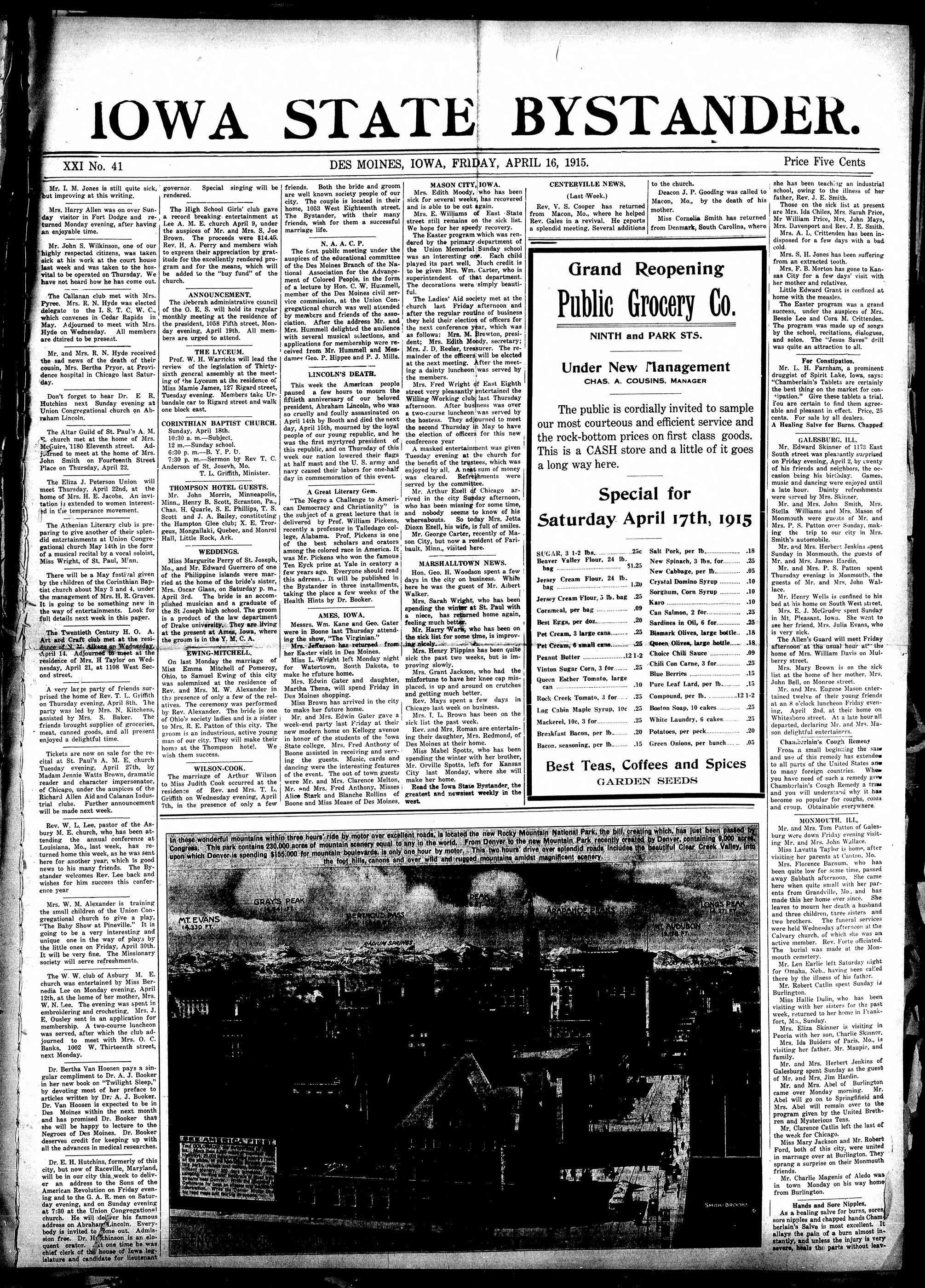
IOWA STATE BYSTANDER.
Mr. I. M. Jones is still quite sick, but improving at this writing.
Mrs. Harry Allen was on over Sunday visitor in Fort Dodge and returned Monday evening, after having an enjoyable time.
Mr. John S. Wilkinson, one of our highly respected citizens, was taken sick at his work at the court house last week and was taken to the hospital to be operated on Thursday. We have not heard how he has come out.
The Callanan club met with Mrs. Pyreye. Mrs. R. N. Hyde was elected delegate to the I. S. T. C. W. C., which convenes in Cedar Rapids in May. Adjourned to meet with Mrs. Hyde on Wednesday. All members are dtsired to be present.
Mr. and Mrs. R. N. Hyde received the sad news of the death of their cousin, Mrs. Bertha Pryor, at Providence hospital in Chicago last Saturday.
Don't forget to hear Dr. E. R. Hutchins next Sunday evening at Union Congregational church on Abraham Lincoln.
The Altar Guild of St. Paul's A. M. E. church met at the home of Mrs. McGuire, 1180 Eleventh street. Adjourned to meet at the home of Mrs. John Smith on Fourteenth Street Place on Thursday, April 22.
The Eliza J. Peterson Union will meet Thursday, April 22nd, at the home of Mrs. H. E. Jacobs. An invitation is extended to women interested in the temperance movement.
The Athenian Literary club is preparing to give another of their splendid entertainments at Union Congregational church May 14th in the form of a musical recital by a vocal soloist, Miss Wright, of St. Paul, Minn.
There will be a May festival given by the children of the Corinthian Baptist church about May 3 and 4, under the management of Mrs. H. R. Graves. It is going to be something new in the way of entertainments. Look for full details next week in this paper.
The Twentieth Century H. O. A. Art and Craft club met at the residence of N. M. Alkens on Wednesday, April 14. Adjourned to meet at the residence of Mrs. H. Taylor on Wednesday, April 21, at 1108 West Second street.
A very large party of friends surprised the home of Rev. T. L. Griffith on Thursday evening, April 8th. The party was led by Mrs. N. Kitchens, assisted by Mrs. S. Baker. The friends brought supplies of groceries, meat, canned goods, and all present enjoyed a delightful time.
Tickets are now on sale for the recital at St. Paul's A. M. E. church Tuesday evening, April 27th, by Madam Jennie Watts Brown, dramatic reader and character impersonator, of Chicago, under the auspices of the Richard Allen Aid and Calanan Industrial clubs. Further announcement will be made next week.
Rev. W. L. Lee, pastor of the Asbury M. E. church, who has been attending the annual conference at Louisiana, Mo., last week, has returned home this week, as he was sent here for another year, which is good news to his many friends. The Bystander welcomes Rev. Lee back and wishes for him success this conference year
Mrs. W. M. Alexander is training the small children of the Union Congregational church to give a play, "The Baby Show at Pineville." It is going to be a very interesting and unique one in the way of plays by the little ones on Friday, April 30th. It will be very fine. The Missionary society will serve refreshments.
The W. W. club of Asbury M. E. church was entertained by Miss Bernedia Lee on Monday evening, April 12th, at the home of her mother, Mrs. W. N. Lee. The evening was spent in embroidering and crocheting. Mrs. J. E. Ousley sent in an application for membership. A two-course luncheon was served, after which the club adjourned to meet with Mrs. O. C. Banks, 1002 W. Thirteenth street, next Monday.
Dr. Bertha Van Hoosen pays a singular compliment to Dr. A. J. Booker in her new book on "Twilight Sleep," by devoting most of her preface to articles written by Dr. A. J. Booker. Dr. Van Hoosen is expected to be in Des Moines within the next month and has promised Dr. Booker that she will be happy to lecture to the Negroes of Des Moines. Dr. Booker deserves credit for keeping up with all the advances in medical researches.
Dr. E. H. Hutchins, formerly of this city, but now of Raceville, Maryland, will be in our city this week to deliver an address to the Sons of the American Revolution on Friday evening and to the G. A. R. men on Saturday evening, and on Sunday evening at 7:30 at the Union Congregational church. He will deliver his famous address on Abraham Lincoln. Everybody is invited to come out. Admission free. Dr. Hutchinson is an eloquent orator. At one time he was chief clerk of the house of Iowa legislature and candidate for lieutenant
In these wonderful mountains within three hours' ride by motor over excellent roads, is located the new Rocky Mountain National Park, the bill, creating which, has just been passed by Congress. This park contains 230,000 acres of mountain scenery equal to any in the world. From Denver to the new Mountain Park recently created by Denver, containing 9,000 acres, upon which Denver is spending $155,000 for mountain boulevards, is only one hour by motor. This two hours' drive over splendid roads includes the beautiful Clear Creek Valley, into the foot hills, canons and over wild and rugged mountains amidst magnificent scenery.
SEE AMERICA FIELD
Your Colorado view encompasses the majestic Rocky Mountains, 20,000 high-altitude acres of the park, which offers over 100 miles of hiking, skiing and rock climbing trails. The park is located near Denver, where the Colorado River flows through the valley. The park is a popular destination for outdoor enthusiasts.
The High School Girls' club gave a record breaking entertainment at Lee A. M. E. church April 9, under the auspices of Mr. and Mrs. S. Joe Brown. The proceeds were $14.45. Rev. H. A. Perry and members wish to express their appreciation by gratitude for the excellently rendered program and for the means, which will be added to the "buy fund" of the church.
ANNOUNCEMENT.
The Debcrah administrative council of the O. E. S. will hold its regular monthly meeting at the residence of the president, 1058 Fifth street, Monday evening, April 19th. All members are urged to attend.
THE LYCEUM
Prof. W. H. Warricks will lead the review of the legislation of Thirty-sixth general assembly at the meeting of the Lyceum at the residence of Miss Mamie James, 127 Rigard street, Tuesday evening. Members take Urbandale car to Rigard street and walk one block east.
CORINTHIAN BAPTIST CHURCH.
Sunday, April 18th.
10:30 a. m.—Subject.
12 m.—Sunday school.
6:30 p. m.—B. Y. P. U.
7:30 p. m.—Sermon by Rev T. C. Anderson of St. Joseph, Mo.
T. L. Griffith, Minister.
THOMPSON HOTEL GUESTS
THOMPSON HOTEL VISITOR
Mr. John Morris, Minneapolis,
Minn, Henry B. Scott, Scranton, Pa.,
Chas. H. Quarle, S. E. Phillips, T. S. Scott and J. A. Bailey, constituting the Hampton Glee club; X. E. T.orgeus, Mongallaki, Quebec, and Monrol
Hall, Little Rock, Ark.
WEDDINGS.
Miss Margurite Perry of St Joseph, Mo., and Mr. Edward Guerrero of one of the Philippine islands were married at the home of the bride's sister, Mrs. Oscar Glass, on Saturday p. m., April 3rd. The bride is an accomplished musician and a graduate of the St Joseph high school. The groom is a product of the law department of Drake university. They are living at the present at Ames, Iowa, where the groom is in the Y. M. C. A.
EWING-MITCHELL.
On last Monday the marriage of Miss Emma Mitchell of Pomeroy, Ohio, to Samuel Ewing of this city was solemnized at the residence of Rev. and Mrs. M. W. Alexander in the presence of only a few of the relatives. The ceremony was performed by Rev. Alexander. The bride is one of Ohio's society ladies and is a sister to Mrs. R. E. Patton of this city. The groom is an industrious, active young man of our city. They will make their home at the Thompson hotel. We wish them success.
WILSON-COOK.
The marriage of Arthur Wilson to Miss Judith Cook occurred at the residence of Rev. and Mrs. T. L. Griffith on Wednesday evening, April 7th, in the presence of only a few
friends. Both the bride and groom are well known society people of our city. The couple is located in their home, 1053 West Eighteenth street. The Bystander, with their many friends, wish for them a successful marriage life.
MASON CITY, IOWA.
Mrs. Edith Moody, who has been sick for several weeks, has recovered and is able to be out again.
Mrs. E. Williams of East State street still remains on the sick list. We hope for her speedy recovery.
CENTERVII
(Last M)
Rev. V. S. Coop from Macon, Mo.
Rev. Gales in a re splendid meeting
N. A. A. C. P.
The first public meeting under the auspices of the educational committee of the Des Moines Branch of the National Association for the Advancement of Colored People, in the form of a lecture by Hon. C. W. Hummell, member of the Des Moines civil service commission, at the Union Congregational church was well attended by members and friends of the association. After the address Mr. and Mrs. Hummell delighted the audience with several musical selections, and applications for membership were received from Mr. Hummell and Mesdame Geo. P. Hippee and P. J. Mills.
LINCOLN'S DEATH.
This week the American people paused a few hours to mourn the fiftieth anniversary of our beloved president, Abraham Lincoln, who was so cruelly and foully assassinated on April 14th by Booth and died the next day, April 15th, mourned by the loyal people of our young republic, and he was the first myrtyred president of this republic, and on Thursday of this week our nation lowered their flags at half mast and the U. S. army and navy ceased their labors for one-half day in commemoration of this event.
A Great Literary Gem
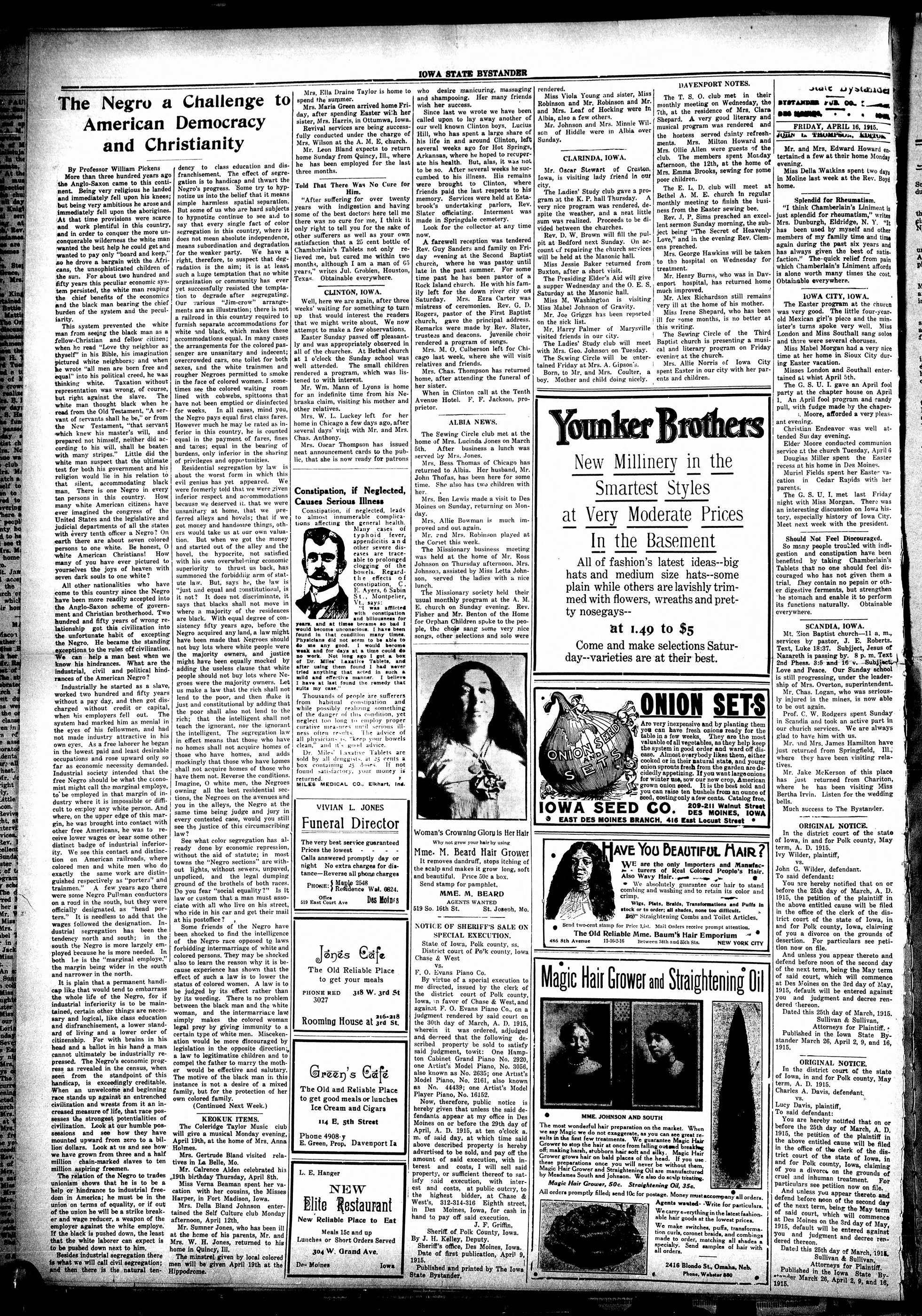
"The Negro a Challenge to American Democracy and Christianity" is the subject of a great lecture that is delivered by Prof. William Pickens, recently a professor in Talledago college, Alabama. Prof. Pickens is one of the best scholars and orators among the colored race in America. It was Mr. Pickens who won the famous Ten Eyck prize at Yale in oratory a few years ago. Everyone should read this address. It will be published in the Bystander in three installments, taking the place a few weeks of the Health Hints by Dr. Booker.
AMES, IOWA
Messrs. Wm. Kane and Geo. Gater were in Boone last Thursday attending the show, "The Virginian."
Mrs. Jefferson has returned from her Easter visit in Des Moines.
Miss L. Wright left Monday night for Watertown, South Dakota, to make her fulture home.
Mrs. Edwin Gater and daughter, Martha Thena, will spend Friday in Des Moines shopping.
Miss Brown has arrived in the city to make her future home.
Mr. and Mrs. Edwin Gater gave a week-end party last Friday at their new modern home on Kellogg avenue in honor of the students of the Iowa State college. Mrs. Fred Anthony of Boone assisted in receiving and serving the guests. Music, cards and dancing were the interesting features of the event. The out of town guests were Mr. and Mrs. Clarence Melton, Mr. and Mrs. Fred Anthony, Misses Alice Stark and Blanche Rollins of Boone and Miss Mease of Des Moines.
Mrs. Edith Moody, who has been sick for several weeks, has recovered and is able to be out again.
Mrs. E. Williams of East State street still remains on the sick list. We hope for her speedy recovery.
The Easter program which was rendered by the primary department of the Union Memorial Sunday school was an interesting one. Each child played its part well. Much credit is to be given Mrs. Wm. Carter, who is superintendent of that department. The decorations were simply beautiful.
The Ladies' Aid society met at the church last Friday afternoon and after the regular routine of business they held their election of officers for the next conference year, which was as follows: Mrs. M. Brewton, president; Mrs. Edith Moody, secretary; Mrs. J. D. Reeler, treasurer. The remainder of the officers will be elected at the next meeting. After the meeting a dainty luncheon was served by the members.
Mrs. Fred Wright of East Eighth street very pleasantly entertained the Willing Working club last Thursday afternoon. After business was over a two-course luncheon was served by the hostess. They adjourned to meet the second Thursday in May to have the election of officers for this new conference year
A masked entertainment was given Tuesday evening at the church for the benefit of the trustees, which was enjoyed by all. A neat sum of money was cleared. Refreshments were served by the committee.
Mr. Arthur Ezell of Chicago arrived in the city Sunday afternoon, who has been missing for some time, and nobody seems to know of his whereabouts. So today Mrs. Jetta Dioxn Ezell, his wife, is full of smiles. Mr. George Carter, recently of Mason City, but now a resident of Faribault, Minn., visited here.
MARSHALLTOWN NEWS.
Hon. Geo. H. Woodson spent a few days in the city on business. While here he was the guest of Mr. Albert Walker.
Mrs. Sarah Wright, who has been spending the winter at St. Paul with a niece, has returned home again, feeling much better.
Mr. Harry Warn, who has been on the sick list for some time, is improving nicely.
Mrs. Henry Flippins has been quite sick the past two weeks, but is improving slowly.
Mrs. Grant Jackson, who had the misfortune to have her knee cap misplaced, is up and around on crutches and getting much better.
Rev. Mays spent a few days in Chicago last week on business.
Mrs. I. L. Brown has been on the sick list the past week.
Rev. and Mrs. Roman are entertaining their daughter, Mrs. Redmond, of Des Moines at their home.
Miss Mabel Spotts, who has been spending the winter with her brother, Mr. Orville Spotts, left for Kansas City last Monday, where she will make her home.
Read the Iowa State Bystander, the greatest and newsiest weekly in the west.
Ient roads, is located the new Rocky Many in the world. From Denver to the one hour by motor. This two hours' over wild and rugged mountains am
CENTERVILLE NEWS.
Rev, V. S. Cooper has returned from Macon, Mo., where he helped Rev. Gales in a revival. He reports a splendid meeting. Several additions
Grand R
Public Gr
and Reopening Public Grocery
Grand Reopening Public Grocery Co.
NINTH and PARK STS.
Under New Management CHAS. A. COUSINS, MANAGER
The public is cordially invited to sample our most courteous and efficient service and the rock-bottom prices on first class goods. This is a CASH store and a little of it goes a long way here.
SUGAR, 3 1-2 lbs.....25c Salt Pork, per lb.....18
Beaver Valley Flour, 24 lb.....18
bag 51.25 New Spinach, 3 lbs. for.....25
Jersey Cream Flour, 24 lb.....1.20 New Cabbage, per lb.....0.05
bag 1.20 Crystal Domino Syrup.....10
Jersey Cream Flour, 5 lb. bag.....25 Sorghum, Corn Syrup.....10
Cornmeal, per bag.....0.09 Karo.....10
Best Eggs, per doz.....20 Can Salmon, 2 for.....25
Pet Cream, 3 large cans.....25 Sardines in Oil, 6 for.....25
Pet Cream; 6 small cans.....25 Queen Olives, large bottle.....18
Peanut Butter.....12 1-2 Choice Chili Sauce.....0.09
Vinton Sugar Corn, 3 for.....25 Chili Con Carne, 3 for.....25
Queen Esther Tomato, large can.....10 Blue Berries.....15
Rock Creek Tomato, 3 for.....25 Pure Leaf Lard, per lb.....15
Log Cabin Maple Syrup, 10c.....25 Boston Soap, 10 cakes.....25
Mackerel, 10c, 3 for.....25 White Laundry, 6 cakes.....25
Breakfast Bacon, per lb.....20 Potatoes, per peck.....20
Bacon, seasoning, per lb.....15 Green Onions, per bunch.....0.05
(Last Week.)
to the church.
Deacon J. P. Gooding was called to Macon, Mo., by the death of his mother.
Miss Cornelia Smith has returned from Denmark, South Carolina, where
eopening
ocery Co.
Price Five Cents
she has been teaching an industrial school, owing to the illness of her father, Rev. J. E. Smith.
Those on the sick list at present are Mrs. Ida Chiles, Mrs. Sarah Price, Mr William Price, Mrs. John Mays, Mrs. Davenport and Rev. J. E. Smith.
Mrs. A. L. Crittenden has been indisposed for a few days with a bad cold.
Mrs. S. H. Jones has been suffering from an extracted tooth.
Mrs. F. B. Morton has gone to Kansas City for a few days' visit with her mother and relatives.
Little Edward Grant is confined at home with the measles.
The Easter program was a grand success, under the auspices of Mrs. Bessie Lee and Cora M. Crittenden. The program was made up of songs by the school, recitations, dialogues, and solos. The "Jesus Saves" drill was quite an attraction to all.
For Constipation.
Mr. L. H. Farnham, a prominent druggist of Spirit Lake, Iowa, says: "Chamberlain's Tablets are certainly the best thing on the market for conjunction." Give these tablets a trial. You are certain to find them agreeable and pleasant in effect. Price, 25 cents. For sale by all dealers. A Healing Salve for Burns. Changed
GALESBURG ILL
Mr. Edward Skinner of 1173 East South street was pleasantly surprised on Friday evening, April 2, by twenty of his friends and neighbors, the occasion being his birthday. Games, music and dancing were enjoyed until a late hour. Dainty refreshments were served by Mrs. Skinner.
Mr. and Mrs. John Smith, Mrs. Stella Williams and Mrs. Mason of Monmouth were guests of Mr. and Mrs. P. S. Patton over Sunday, making the trip to our city in Mrs. Smith's automobile.
Mr. and Mrs. Herbert Jenkins spent Sunday in Monmouth, the guests of Mr. and Mrs. James Hardin.
Mr. and Mrs. P. S. Patton spent Thursday evening in Monmouth, the guests of Mr. and Mrs. John Wallace.
Mr. Henry Wells is confined to his bed at his home on South West street. Mrs. E. J. McGruder spent Sunday in Mt. Pleasant, Iowa. She went to see her friend, Mrs. Julia Evans, who is very sick.
The Allen's Guard will meet Friday afternoon at the William hour at the home of Mrs. William Davis on Mulberry street.
Mrs. Mary Brown is on the sick list at the home of her mother, Mrs. John Bell, on Monroe street.
Mr. and Mrs. Eugene Mason entertained twelve of their young friends at an 8 o'clock luncheon Friday evening, April 2nd, at their home on Whitesboro street. At a late hour all departed, declaring Mr. and Mrs. Mason delightful entertainers.
Chaucerlain's Cough Remeoy
From a small beginning the sale and use of this remedy has extended to all parts of the United States and to many foreign countries. When you have need of such a remedy give Chamberlain's Cough Remedy a truss and you will understand why it has become so popular for coughs, colds and croup. Obtainable everywhere.
MONMOUTH. ILL.
Mr. and Mrs. Tom Patton of Galesburg were down Friday evening visiting Mr. and Mrs. John Wallace.
Miss Lavatta Taylor is home, after visiting her parents at Canton, Mo.
Mrs. Florence Barnum, who has been quite low for some time, passed away Sabbath afternoon. She came here when quite small with her parents from Grandville, Mo., and has made this her home ever since. She leaves to mourn her death a husband and three children, three sisters and two brothers. The funeral services were held Wednesday afternoon at the Calvary church, of which she was an active member. Rev. Forte officiated. The burial was made at the Monmouth cemetery.
Mr. Len Earlie left Saturday night for Omaha, Neb., having been called there by the illness of his father.
Mr. Robert Catlin spent Sunday in Burlington.
Miss Hallie Dulin, who has been visiting with her sisters for the past week, returned to her home in Frankfort, Mo., Sunday.
Mrs. Eliza Skinner is visiting in Peoria with her son, Charlie Skinner.
Mrs. Ida Builders of Paris, Mo., is visiting her father, Mr. Maupin, and family.
Mr. and Mrs. Herbert Jenkins of Galesburg spent Sunday as the guess of Mr. and Mrs. Jim Hardin.
Mr. and Mrs. Abel of Burlington came over Monday morning. Mr. Abel will go on to Springfield and Mrs. Abel will remain over to the program given by the United Brethren and Mysterious Tens.
Mr. Clarence Catlin left the last of the week for Chicago.
Miss Mary Jackson and Mr. Robert Ford, both of this city, were united in marriage over at Burlington. They sprang a surprise on their Monmouth friends.
Mr. Charlie Magenis of Aledo was in town Monday on his way home from Burlington.
Hands and Sore Nipples.
As a healing salve for burns, sores sore nipples and chapped hands Cham berlain's Salve is most excellent. It allays the pain of a burn almost instantly, and unless the injury is very severe, heals the parts without leav-
AFRO-AMERICAN CULLINGS
There died in Montgomery a short time ago a Scotchman who did a noble work in the education of the Negro race in Alabama, and his passing has made a vacancy that will not be easy to fill. His name was W. B. Paterson; his fame was purely local; for he did not make the big noise, and because he was a white man conductor he was not a good notoriety that has been such a factor in the upbuilding of the noted Negro educators of the South.
Professor Paterson drifted in Alabama about 1870, looking for work. He was homeless and friendless, afflicted with an incurable deafness that made social intercourse an impossibility with him. He had tramped from New York to Omaha and then back east looking for work, but could find none. By trade he was a gardener. His forebears before him had been gardeners on the estate of a Scotch farmer, the man of the farm and he had learned their trade. He got a job at Marion, on a plantation, digging ditches and doing ordinary farm work along with the Negroes, and this proximity taught him the exact condition of the Negro's intelligence and educational advancement. Out of it came a Negro school that grew until it became a state normal with a large patronage. The plantation owner for whom he worked took a fancy to him and helped him on his farm, and he courageed him he built up an establishment that was too large for_Marion. The Scotch gardener had his eye on the state capital, and he made his plans to move his school there.
When it became known in Montgomery that a white man was going to move a Negro school to that city, a mass meeting of the citizens was held and speeches were made, as Professor Paterson often afterward said, "they almost tarred and feathered him." This latter was in a figurative sense only. Nothing daunted, the teacher, and speeches were made. Montgomery, and went quietly about his business. He conducted an orderly institution; he taught the Negroes domestic science, manual training, trades, the dignity of labor, the value of keeping in the place the white people of the South said the Negro must keep. There was no social equality of the races there, and never in the more than forty years of the life of the school under Professor Paterson was there so much as an institution practiced. The Negroe had great and grave reverence for him, that was almost patrarchal in its simplicity.
Montgomery quieted down after the school was settled, and in a few years began to look upon it as an asset and on Professor Paterson as a public benefactor. Year by year he increased the membership of his school, and in order to make it self-sustaining and to make it possible for the students to pay their way through, he placed them in the school and in the school halls, fixing the school hours so that they could do their domestic work and carry on their studies too. His training made itself felt for the servants in Montgomery, and they were in demand. Montgomery is now full of them, and they all command high wages because they can earn them. That in itself is tribute enough for the school and for the memory of this good man. Of the thousands that went through this school, some were found to pos-
Christ church, Providence, was the first effort of the late Rev. Dr. Crummell, following his ordination in St Paul's church, Boston, in 1842. He soon relinquished it. Rev. Mr. Stokes, ordained by Bishop Whittington, in St James' church, Baltimore, in 1843, organized St. Luke's church, New Haven, the following June. In a year or so, having been priested by the bishop of Connecticut, Mr. Stokes yielded to his old friend, whom he had known in Baltimore, Bishop Heshaw, and moved Providence. In 1850 he went to Africa as a missionary. The Providence church was left without a pastor, and it seems to have gradually gone out of existence. What became of the money from the sale of the church we do not know.
During all our experience, we have never known any two white priests more devoted to the welfare of the colored people, than the late Calibrath B. Perry and Robert H. Paine. If I mistake not, both of them were natives of Rhode Island. Here is a splendid opportunity for the friends of Messrs. Perry, Paine and Crummell
Honduras, in Central America, reports a quiet and prosperous period for the year 1912-13. Actual receipts exceeded expenditures by $103,000. There were no political disturbances of any character. It is about as large as the state of Pennsylvania.
In a London museum is a clock which indicates on the main dial the Greenwich time, and on eight smaller ones the time in as many large cities in the world. The clock also tells the date and has a barometer attached.
The markings on a graduated measuring glass invented in Germany are made along a zigzag line instead of a vertical one and, having wider spaces between, are said to be read more accurately.
There is a plant growing on mountains in Central Europe that develops enough heat to push its flower stalks through snow and produce blossoms.
Considering the way they have been ground down, the people of this country get used to it.
sess intelligence and scholarship enough for higher training, and they were given it, and today they fill places of responsibility as teachers and principals and superintendents of Negro public schools in the large cities of Alabama and neighboring states.—Mobile Register.
About two years ago St. Augustine's mission among the colored people of Providence, R.I., was initiated, writes correspondent of The Living Church. From a recent account in a church paper, I note the following: "The church building used for the services is rented property, and is likely to be sold at any moment."
The purpose of this article is to point out that as early as 1843 there was a parish of colored people in Providence, "Christ church;" that the parish having gone out of existence, the money for freeing the church building from debt having been raised in England by a colored priest, and turned over to the diocesan authorities in trust, it seems to me that in this emergency the diocesan authorities should welcome the opportunity for making restitution. Here is an extract from the Episcopal address of Bishop Henshaw, in 1849, which throws light on the matter:
"At the time of the meeting of the last annual convention, Rev. Eli W. Stokes, rector of Christ church in this city, was absent, in Europe, for the purpose of soliciting funds to liquidate the debt by which that parish has been embarrassed ever since their house of worship was erected. In consequence of a certificate, required by the laws of England, furnished by me, he was received with great kindness by the archbishops, bishops and clergy of our mother church; and I am happy to inform you that his mission was crowned with entire success, and the liberal contributions which he received in that distant land have enabled the gentlemen holding the property in trust to make a satisfactory settlement with the mortgages. The congregation is now free from debt, the gentlemen have wisely made over their corporate property to the 'board of commissioners for church building' with a view of security against embarrassment and incumbrance for the time to come. The Christian generosity with which our English brethren answered the appeal made to them in behalf of that feeble parish has been duly acknowledged in a letter addressed by me to his grace the archbishop of Canterbury, and through him to the church over which he worthy presides."
District Commissioner Louis Brown low and Charles E. Nesbit, superintendent of insurance of the district, were speakers at a meeting in the Metropolitan A. M. E. Zion church, under the auspices of the trustees and Men's club of the church, relates the Washington Star. The commissioner spoke of the value of vocational training, and declared that improvement in living conditions is responsible for a reduction in the mortality rate of the colored population of Washington. Mr. Nesbit urged the men's clubs of colored churches to take an interest in insurance matters, with the object of protecting members of their race against the practices of unscrutious companies.
to honor them in making this church at Providence, for colored people, all that it ought to be, and a fitting memorial to these pioneer laborers among the colored people.
Alexander Crummlen was the first black man to be ordained to the ministry of the church on the soil of New England. Christ church, Providence, was the first parish of colored persons ever organized in the territory of New England. And it was the very first colored church, anywhere in the United States, to be received into union with a diocesan convention. Three colored men sat as deputies from that parish at the diocesan convention which met in St. Stephen's church, Providence, in June, 1813. George F. Bragg, Jr., in the Living Church.
One of the poorest imitations is that given by the woman who is trying to simulate indifference to the fact that she wasn't invited to the party.
There is no particular reason for it, but the effeminate man is always called "Lizzie."
To prevent shoe laces from becoming untied a New York inventor has patented small metal clasps to be fastened to the tops of shoes to hold their ends.
The Italian city of Milan has changed a gas street lighting to electricity, generating its current by Alpine waterfalls, nearly one hundred miles away.
If you wish to write an expression of contempt from a man, refer casually to the woman who jilted him.
Jamala produces a great variety of hardwood trees. Lists of its timbers, classified according to the suitability of the timbers (113 in all), have been printed in a bulletin issued by the department of agriculture.
Two bridges in a city of India are supported on large metal tanks, which float on the water and accommodate themselves to the rise and fall.
When a man is unusually courteous to a woman, that is an indication she is not his wife.
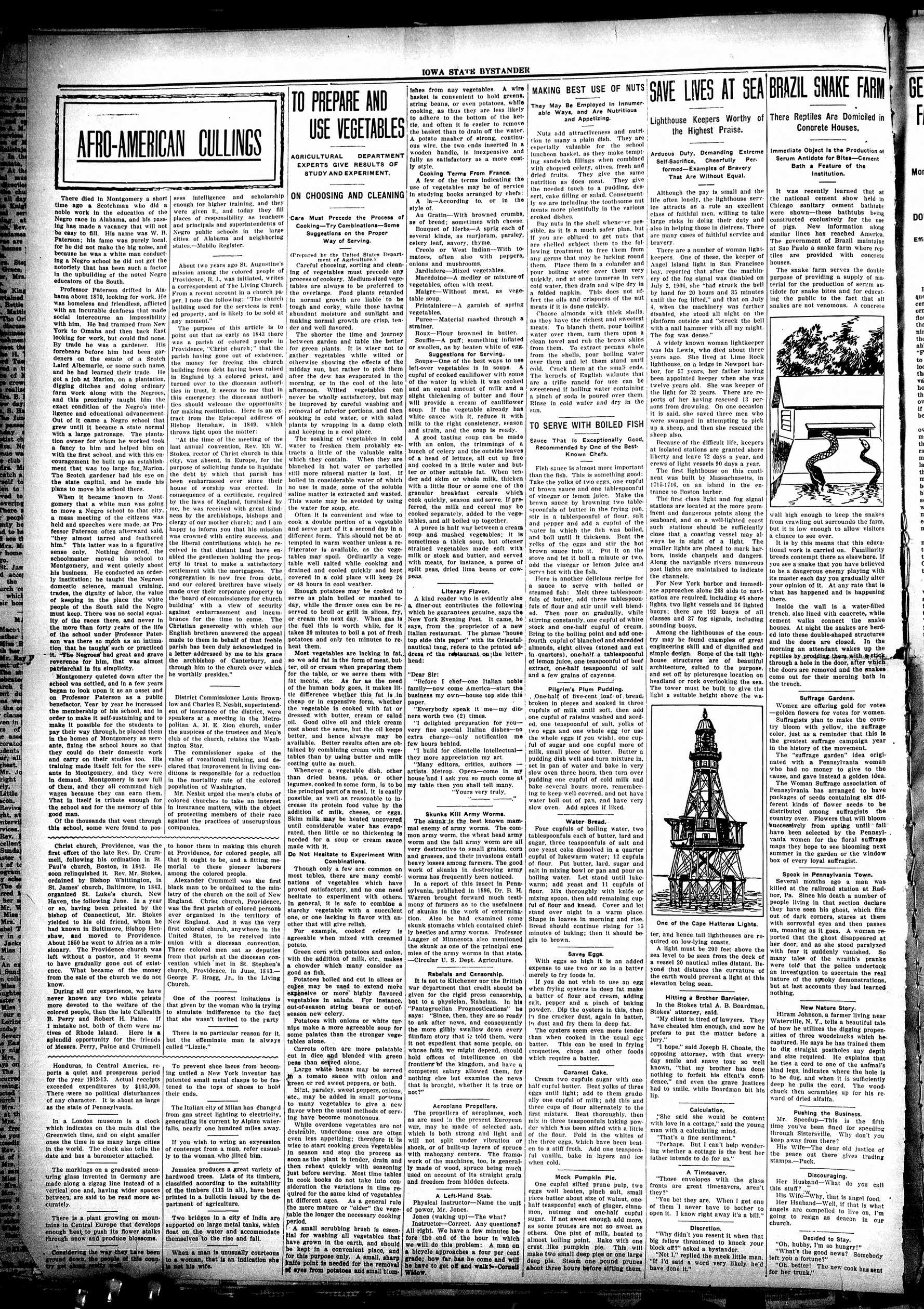
TO PREPARE AND USE VEGETABLES
AGRICULTURAL DEPARTMENT EXPERTS GIVE RESULTS OF STUDY AND EXPERIMENT.
ON CHOOSING AND CLEANING
*Care Must Precede the Process of Cooking—Try Combinations—Some Suggestions on the Proper Way of Serving.*
(Prepared by the United States Department of Agriculture.)
Careful choosing, sorting and cleaning of vegetables must precede any process of cookery. Medium-sized vegetables are always to be preferred to the overlarge. Food plants retarded in normal growth are liable to be tough and corky, while those having abundant moisture and sunlight and making normal growth are crisp, tender and well flavored.
The shorter the time and journey between garden and table the better for green plants. It is wiser not to gather vegetables while wilted or otherwise showing the effects of the midday sun, but rather to pick them after the dew has evaporated in the late afternoon. Wilted vegetables can never be wholly satisfactory, but may be improved by careful washing and removal of inferior portions, and then soaking in cold water, or with salad plants by wrapping in a damp cloth and keeping in a cool place.
The soaking of vegetables in cold water to freshen them probably extracts a little of the valuable salts which they contain. When they are blanched in hot water or parboiled still more mineral matter is lost. If boiled in considerable water of which no use is made, some of the water is used for washing. This waste may be avoided by using the water for soup, etc.
Often it is convenient and wise to cook a double portion of a vegetable and serve part of it a second day in a different form. This should not be attempted in warm weather unless a refrigerator is available, as the vegetables may spoil. Ordinarily a vegetable is drained and drained and cooled quickly and kept covered in a cold place will keep 24 or 48 hours in cool weather.
Enough potatoes may be cooked to serve as plain boiled or mashed today, while the firmer ones can be to broil or grill in slices, fry, or cream the next day. When gas is the fuel this is worth while, for it takes 30 minutes to boil a pot of fresh potatoes and only ten minutes to煮 potato. Most vegetables are lacking in fat, so we add fat in the form of meat, butter, oil or cream when preparing them for the table, or we serve them with fat meats, etc. As far as the need of the human body goes, it makes little difference whether this fat is in cheap or in expensive form, whether the vegetable is cooked with fat or dressed with butter, cream or salad oil. Good olive oil and thick cream cost about the same, but the oil keeps the vegetables always warm and may be available. Better results often require beaten by combining cream with vegetables than by using butter and milk costing quite as much.
Whenever a vegetable dish, often than dried beans, peas, or other legumes, cooked in some form, is to be the principal part of a meal, it is easily possible, as well as reasonable to increase its protein food value by the addition of milk, cheese, or eggs. Skim milk may be heated uncovered until considerable water has evaporated, then little or no thickening is needed for a soup or cream sauce made with it.
Do Not Hesitate to Experiment With Combinations.
Though only a few are common on most tables, there are many combinations of vegetables which have proved satisfactory, and no one need hesitate to experiment with others. In general, it is safe to combine a starchy vegetable with a succulent one, or one lacking in flavor with another that will give relish. For example, cooked celery is agreeable when mixed with creamed potato. Green corn with potatoes and onion, with the addition of milk, etc., makes a chowder which many consider as good as fish. Potatoes boiled and cut in slices or cubes be used to extend more expensive or more highly flavored vegetables in salads. For instance, out-of-season string beans or out-of-season new celery. Potatoes with onions or turnips make a more agreeable soup for some palates than the stronger vegetables alone. Carrots often are more palatable in cut dice and blended with green peas than served alone.
Large white beans may be served in a tomato sauce with onion and green or red sweet peppers, or both. Parsley, sweet peppers, onions, etc., may be added in small portions to many vegetables to give a new flavor when the usual methods of serving have become monotonous.
While overdone vegetables are not desirable, underdone ones are often even less appetizing; therefore it is wise to start cooking green vegetables in season and stop the process as soon as the plant is tender, drain and rinse in liquid with seasoning just before serving. Most time tables in cook books do not take into consideration the variations in the required for the same kind of vegetables at different ages. As a general rule the more mature or "older" the vegetable the longer the necessary cooking period.
A small scrubbing brush is essential for washing all vegetables that have grown in the earth, and should be kept in a convenient place, and for this purpose only. A small, sharp knife point is needed for the removal of eye spots from potatoes and small biom-
IOWA STATE BYSTANDER
lakes from any vegetables. A wire basket is convenient to hold greens, string beans, or even potatoes, while cooking, as thus they are less likely to adhere to the body of the kettle and often it is easier to remove the basket than to drain off the water. A potato masher of strong, continuous wire, the two ends inserted in a wooden handle, is inexpensive and fully as satisfactory as a more costly style.
Cooking Terms From France.
A few of the terms indicate the use of vegetables may be of service in studying books arranged by chefs: A la—According to, or in the style of.
Au Gratin—With browned crumbs, as of bread; sometimes with cheese.
Bouquet of Herbs—A sprig each of several kinds, as marjoram, parsley, celery leaf, savory, thyme.
Croole or West Indian—With tomatillos, with peppers, onions and mushrooms.
Jardiniere—Mixed vegetables.
Macedoine—A medley or mixture of vegetables, often with meat.
Malgre—Without meat, as vegetable table gou.
Printinfere—A garnish of spring vegetables.
Puree—Material mashed through a strainer.
Roux—Flour browned in butter.
Souffle—a puff, something inflated or swollen, as by beaten white of egg, butter, or saffron.
Suggestions for serving.
Soups—One of the best ways to use left-over vegetables is in soups. A cupful of cauliflower cauliflower with the water in it which it will cook and an equal amount of milk and a light thickening of butter and flour in the cream of cauliflower soup. If the vegetable already has white sauce with it, reduce it with milk to the right consistency, season and strain, and the soup is ready.
A good tasting soup can be made with an onion, the trimmings of a bunch of colery and the outside leaves of a head of lettuce, all cut up fine and cooked in a little water and butter or other suitable fat. When tender add skim or whole milk, thicken with a little flour or some one of the granular breakfast cereals which cook quickly, season and serve. If preferred, the milk and cereal may be cooked separately, added to the vegetables, and all boiled up together.
A puree is half way between a cream soup and mashed vegetables; it is sometimes a thick soup, but often strained vegetables made soft with milk or stock and butter, and served with meats, for instance, a puree of split peas, dried lima beans or cowpeas.
Literary Flavor.
A kind reader who is evidently also a diner-out contributes the following which he guarantees genuine, says the New York Evening Post. It came, he says, from the proprietor of a new Italian restaurant. The phrase "house top side this paper" with its Orientalian tautal tang, refers to the printed address of the restaurant on the letterhead:
"Dear Sir:
"Before I chef—one Italian noble family—now come America—start the business my own—house top side this paper.
"Everybody speak it me—my dinners worth two (2) times.
"I delighted preparation for you—very fine special Italian dishes—no extra charge—only notification me for the dinner.
"I build for clientele intellectual—the more appreciation my art.
"Many editors, critics, authors—artists Metrop. Opera—come in my house and I ask you so much come at my table then you shall tell many.
Skunka Kill Army Worms.
The skunk is the best known mammal enemy of army worms. The common army worm, the wheat head army worm and the fall army worm are all very destructive to small grains, corn and grasses, and their invasions entail heavy losses among farmers. The good work of skunks in destroying army worms has frequently been noticed. In a report of this insect in Pennsylvania, published in 1896, Dr. B. H. Warren brought forward much testimony of farmers as to the usefulness of skunks in the work of extermination. Also he had examined some of the army worms of beetles and army worms. Professor Lugger of Minnesota also mentioned the skunk as one of the principal enemies of the army worms in that state. -Circular U. S. Dept. Agriculture.
Rabelals and Censorship.
It is not to Kitchener nor the British war department that credit should be given for the rigid press censorship, but to a physician, Rabelais. In his "Pantagruelian Prognostications" he says: "Since, then, they are so ready to ask after news, and consequently the more glibly swallow down every filmfam story that is told them, we it not expedient that some people, on faith, might depend, should hold offices of intelligence on the frontiers of the kingdom, and have a competent salary allowed them, for nothing else but examine the news that is brought, whether it is true or not?"
Acroplane Propellers
The propellers of aeroplanes, such as are used in the present European war, may be made of selected ash, which is both strong and light and will not split under vibration or shock, or of built-up layers of spruce with mahogany centers. The framework of the body too is made of wood, spruce being much used on account of its straight grain and freedom from hidden defects.
A Left-Hand Stab.
Physical Instructor—Name the unit of power, Mr. Jones.
Jones (waking up)—The what?
Instructor—Correct. Any questions?
As we have done in minutes before the hour, in which we will do this problem: A man on a bicycle approaches a four per cent grade; how far has he come and will he have to get off and walk?—Corral Wmow.
MAKING BEST USE OF NUTS
They May Be Employed in Innumerable Ways, and Are Nutritious and Appetizing.
Nutra add attractiveness and nutrition to many a plain dish. They are especially valuable for the school luncheon basket, as they make sandwich fillings when combined with chopped celery, give fresh and dried fruits. They give the same nutrition as does cheese. They give lunch to a pudding, dessert, cake filling or salad. Consequently we are including the toothsome nut meats more plentifully in the various cooked dishes. Buy nuts in the shell when ever possible, as it is a much safer plan, but if you are obliged to get nuts that are shelled subject them to the following treatment to free them from any germs that may be barking round them. Place them in a colander and pool water over them very quickly, and at once germinate in very dry air and wipe dry in a folded napkin. This does not affect the oils and crispness of the nut meats if it is done quickly.
Choose almonds with thick shells as they have the richest and sweetest meats. To blanch them, pour boiling water over them, turn them upon a clean towel and rub the brown skins from them. To extract pecans whole from the shells, pour boiling water over them and let them stand uncold. Crack them at the small ends. The knecels of almonds walnuts that are used for use can be sweetened if boiling water containing a pinch of soda is poured over them. Rinse in cold water and dry in the sun.
TO SERVE WITH BOILED FISH
Sauce That Is Exceptionally Good
Recommendation for the Best-
Dish Kwetsch
Fish sauce is almost more important than the fish. This is something good: Take the yolks of two eggs, one cupful of brown sauce and one tablespoonful of vinegar or lemon juice. Make the brown sauce by browning two tablespoonful of butter in the frying pan, stir in a tablespoonful of flour, salt and pepper and add a cupful of the water in which the fish was boiled, and boil until it thickens. Beat the yolks of the eggs and stir the hot brown sauce into it. Put it on the sauce and let it boil a minute or two, add the vinegar or lemon juice and serve hot with the fish.
Here is another delicious recipe for a sauce to serve with boiled or steamed fish: Melt three tablespoonfuls of butter, add three tablespoonfuls of flour and stir until well blended. Then pour on gradually, while stirring constantly, one cupful of white stock and one-half cupful of cream. Bring to the boiling point and add one-fourth cupful of blanched and cut into quarters, and cut into quarters, one-half a tablespoonful of lemon juice, one teaspoonful of beef extract, one-half teaspoonful of salt and a few grains of cayenne.
Pilgrim's Plum Pudding
One-half of five-cent loaf of bread, broken in pieces and soaked in three cupfuls of milk until soft, then add one cupful of raisins washed and seeded, one teaspoonful of salt, yolks of two eggs and one whole egg (or use the whole eggs if you wish), one cupful of sugar and one cupful more of milk, small piece of butter. Butter a pudding dish well and turn mixture in, set in pan of water and bake in very hot water until bubbling, and pudding one cupful of cold milk and bake several hours more, remembering to keep well covered, and not have water boil out of pan, and have very slow oven. Add spices if liked.
Water Bread.
Four cupfuls of boiling water, two tablespoonfuls each of butter, and sugar, three teaspoonfuls of salt and one yeast cake dissolved in a quarter cupful of lukewarm water; 12 cupfuls of flour. Put butter, sugar and salt in mixing bowl or pan and on boiling water. Let stand until lukewarm; add yeast and 11 cupfuls of flour. Mix thoroughly with knife or spoon and then add remaining cupful of flour and knead. Cover and let stand over night in a warm place. Shape in loaves in morning and rise. Bread should continue rising for 15 minutes of baking; then it should begin to brown.
Saves Eggs.
With eggs so high it is an added expense to use two or so in a batter merely to fry foods in. If you do not wish to use an egg when frying oysters in deep fat make a batter of flour and cream, adding salt, pepper and a pinch of baking powder. Dip the oysters in this, then fine cracker dust, again in batter, dust and fry them in deep fat. The batter may be more tender than when cooked in the usual egg batter. This can be used in frying croquettes, chops and other foods which require a batter.
Caramel Cake.
Cream two cupfuls sugar with one half cupful butter. Beat yolks of three eggs until light; add to them gradually one cupful of milk; add this and three cups of flour alternately to the first mixture. Beat thoroughly, then mix in three teaspoonfuls baking powder which was sifted with a little baking powder. Add three tablespoons of the three eggs, which have been been to a stiff froth. Add one teaspoonful vanilla, baking in layers and ice when cold.
Mock Pumpkin Pie
One cupful sifted pulp, two eggs well beaten, pinch salt, small piece butter about size of walnut, one half teaspoonful of e.g. cinnamon, nutmeg and one half cupful sugar. If not sweet enough add more, as some prunes are not so sweet as others. One pint of milk, heated to almost boiling point. Bake with one crust. like pumpkin pie. This will make two small deep pies or one large deep pie. Steam one pound prunes about three hours before sifting them.
SAVE LIVES AT SEA|BRAZIL SNAKE FARM
Lighthouse Keepers Worthy of the Highest Praise.
Ardous Duty, Demanding Extreme Self-Sacrifice, Cheerfully Performed—Examples of Bravery That Are Without Equal.
Although the pay is small and the life often lonely, the lighthouse service attracts as a rule an excellent class of faithful men, wanting to take large risks in doing their duty and also in helping those in distress. There are many cases of faithful service and bravery.
There are a number of woman light-keepers. One of these, the keeper of Angel Island light in San Francisco, reported that after the machinery of the fog signal was disabled on July 2, 1906, she "had struck the bell by hand for 20 hours and 35 minutes until the fog lifted," and that on July 4, when the machinery was further disabled, she stood all night on the platform outside and "struck the bell with a nail hammer with all my might. The fog was dense."
A widely known woman lightkeeper was Ida Lewis, who died about three years ago. She lived at Lime Rock lighthouse, on a ledge in Newport harbor, for 57 years, her father having been appointed keeper when she was twelve years old. She was keeper of the light for 32 years. There are reports of her having rescued 13 persons from drowning. On one occasion it is said, she saved three men who were swamped in attempting to pick up a sheep, and then she rescued the sheep also.
Because of the difficult life, keepers at isolated stations are granted shore liberty and leave 72 days a year, and crews of light vessels 90 days a year.
The first lighthouse on this continent was built by Massachusetts, in 1715-1716, on an island in the entrance to Boston harbor.
The first class light and fog signal stations are located at the more prominent and dangerous points along the seaboard, and on a well-lighted coast such stations should be sufficiently close that a coasting vessel may always be in sight of a light. The smaller lights are placed to mark harbors, inside channels and dangers. Along the navigable rivers numerous post lights are maintained to indicate the channels.
For New York harbor and immediate approaches alone 268 aids to navigation are required, including 46 shore lights, two light vessels and 36 lighted buoys; there are 192 buoys of all classes and 37 fog signs, including sounding buoys.
Among the lighthouses of the country may be found examples of great creature and of dignified and simple design. Sounding lighthouse structures are of the beautiful architecture, suited to the location, and set off by pictureresque location on headland or rock overlooking the sea. The tower must be built to give the light a suitable height above the wa
Lighthouse
One of the Cape Hatteras Lights.
ter, and hence tall lighthouses are required on low-lying coasts.
A light must be 200 feet above the sea level to be seen from the deck of a vessel 20 nautical miles distant. Beyond that distance the curvature of the earth would prevent a light at this elevation being seen.
Hitting a Brother Barricter
In the Stokes trial A. B. Boardman, Stokes' attorney, said, "My client is tired of lawyers. They have cheated him enough, and now he prefers to put the matter before a jury." "I hope," said Joseph H. Chate, the opposing attorney, with that every day smile and suave tone so well known, "that my brother has done nothing to forfeit his client's confidence," and even the grave justices had to smile, while Boardman bit his lip.
Calculation.
"She said she would be content with love in a cottage," said the young man with a calculating mind. "She's a fine sentiment." "What's a cottage to wonder, whether a cottage is the best her father intends to do for us?"
A Timesaver.
"Those envelopes with the glass fronts are great timesavers, aren't they?"
"You bet they are. When I get one of them I never have to bother to open it. I know right away it's a bill."
Discretion
"Why didn't you resent it when that big fellow threatened to knock your block off?" asked a bystander. "Not I," replied the meek little man. "It I'd said a word very likely, he'd have done it."
There Reptiles Are Domiciled in Concrete Houses.
Immediate Object Is the Production of Serum Antidote for Bites—Cement Bath a Feature of the Institution.
It was recently learned that at the national cement show held in Chicago sanitary cement bathbats were shown—the bathbats being constructed exclusively for the use of pigs. New information along similar lines has reached America. the government of Brazil maintains at Sao Paulo a snake farm where reptiles are provided with concrete houses.
The snake farm serves the double purpose of providing a supply of material for the production of serum antidote for snake bites and for educating the public to the fact that all snakes are not venomous. A concrete
Snake in the garage
wall high enough to keep the snakes from crawling out surrounds the farm, but it is low enough to allow visitors a chance to see over. It is by this means that this educational work is carried on. Familiarity breeds contempt there as elsewhere. If you see a snake that you have believed to be a dangerous enemy playing with its master each day you gradually alter your opinion of it. At any rate that is what has happened and is happening there.
Inside the wall is a water-filled trench, also lined with concrete, while cement walks connect the snake houses. At night the snakes are herded into these double-shaped structures and the doors are closed. In the morning an attendant wakes up the reptiles by prodding them with a stick through a hole in the door, after which the doors are removed and the snakes come out for their morning bath in the trench.
Suffrage Gardens
Women are offering gold for votes—golden flowers for votes for women. Suffragists plan to make the country bloom with yellow, the suffrage color, just as a reminder that this is the greatest suffrage campaign year in the history of the movement. The "suffrage garden" idea originated with a Pennsylvania woman who had no money to give to the cause, and gave instead a golden idea. The Woman Suffrage association of Pennsylvania has arranged to have packages of seeds containing six ferments of red flowers to be distributed among suffragists the country over. Flowers that will bloom successfully from spring until fall have been selected by the Pennsylvania women for the floral suffrage maps they hope to see blooming next summer in the garden or the window box of every loyal suffragist.
Spook in Pennsylvania Town.
VAYAHNA TOWN.
Several months ago, a man was killed at the railroad station at Radnor, Pa. Since his death a number of people living in that section declare they have seen his ghost, which flits out of dark corners, stares at them with sorrowful eyes and then passes on, monning as it goes. A woman reported that the ghost disappeared at her door, and as she stood paralyzed with fear it suddenly vanished. So many tales of the wraith's pranks of the police to警官 undertook an investigation to address a real nature of the spooky demonstrations, but at last accounts they had learned nothing.
New Nature Story
Hiram Johnson, a farmer living near Waterville, N. Y., tells a beautiful tale of how he utilizes the digging propensities of three woodchucks which he captured. He says he has trained them to dig straight postholes any depth else required. He explains that he tapes the holes to one of the animal's hind legs indicate where the hole is to be dug, and when it is sufficiently deep he pulls the cord. The woodchuck then scrambles up for his reward of dried alfalfa.
Pushing the Business
Mr. Speedup—This is the fifth time you've been finned for speeding through Sistersville. Why don't you learn from there? From this. His Wife's dear old justice of the peace out there gives trading stamps—Puck.
Discouraging.
Her Husband—What do you call this stuff?
Her Wife? "Why, that is angel food.
Her Husband—Well, if that is what angels are compelled to live on, I'm going to resign as deacon in cur church.
Decided to Stay
"What's the good news? Somebody left you a fortune?" "Oh. better! The new cook has sent for her trunk."
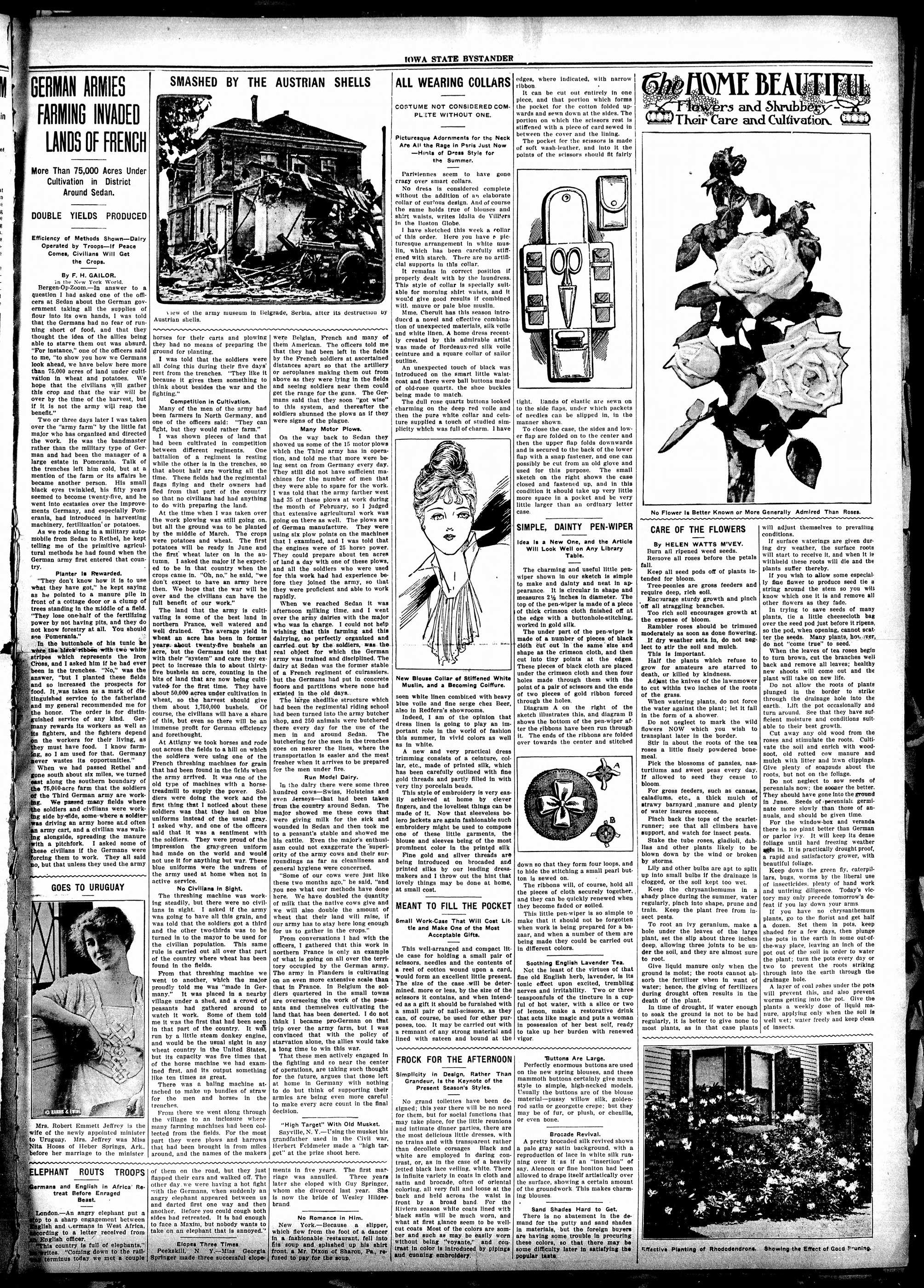
GERMAN ARMIES FARMING INVADED LANDS OF FRENCH
More Than 75,000 Acres Under Cultivation in District Around Sedan.
DOUBLE YIELDS PRODUCED
Efficiency of Methods Shown—Dairy Operated by Troops—If Peace Comes, Civilians Will Get the Crops.
By F. H. GAILOR.
in the New York World.
Bergen-Op-Zoom.—In answer to a question I had asked one of the officers at Sedan about the German government taking all the supplies of flour into its own hands, I was told that the Germans had no fear of running short of food, and that they thought the idea of the allies being able to starve them out was absurd.
"For instance," one of the officers said to me, "to show you how we Germans look ahead, we have below here more than 75,000 acres of land under cultivation in wheat and potatoes. We hope that the civilians will gather this crop and that the war will be over by the time of the harvest, but if it is not the army will reap the benefit."
Two or three days later I was taken over the "army farm" by the little fat major who has organized and directed the work. He was the bandmaster rather than the military type of German and had been the manager of a large estate in Pomerania. Talk of the trenches left him cold, but at a mention of the farm or its affairs he became another person. His small black eyes twinkled, his fifty years seemed to become twenty-five, and he went into easisties over the improvements Germany, and especially Pomerania, had introduced in harvesting machinery, fertilization or potatoes. As we rode along in a military automobile from Sedan to Rhetel, he kept telling me of the primitive agricultural methods he had found when the German army first entered that country.
Planter Is Rewarded.
"They don't know how it is to use what they have got," he kept saying as he pointed to a manure pile in front of a cottage door or a clump of trees standing in the middle of a field. "They lose one-half of the fertilizing power by not having pits, and they do not know forestry at all. You should see Pomerania."
In the buttonhole of his tunic he wore the black ribbon with two white stripes which represents the Iron Cross, and I asked him if he had ever been in the trenches. "No," was the answer, "but I planted these fields and so increased the prospects for food. It was taken as a mark of distinguished service to the fatherland and my general recommended me for the honor. The order is for distinguished service of any kind. Germany rewards its workers as well as its fighters, and the fighters depend on the workers for their living, as they must have food. I know farming, so I am used for that. Germany never wastes its opportunities."
When we had passed Rethel and gone south about six miles, we turned east along the southern boundary of the 75,000-acre farm that the soldiers of the Third German army are working. We passed many fields where the soldiers and civilians were working side by side, some where a soldier was driving an army horse and often an army cart, and a civilian was walking alongside, spreading the manure with a pitchfork. I asked some of these civilians if the Germans were forcing them to work. They all said no, but that unless they used the army
GOES TO URUGUAY
BARR & EWES
Mrs. Robert Emmett Jeffrey is the wife of the newly appointed minister to Uruguay. Mrs. Jeffrey was Miss Nita Hooss of Heber Springs, Ark., before her marriage to the minister
Germans and English in Africa' Retreat Before Enraged Beast.
London.—An angry elephant put a stop to a sharp engagement between English and Germans in West Africa, according to a letter received from the English country is full of elephants," writes. "Coming down to the rail-terminus today we met a couple
SMASHED BY THE AUSTRIAN SHELLS
horses for their carts and plowing they had no means of preparing the ground for planting. I was told that the soldiers were all doing this during their five days' rest from the trenches. "They like it because it gives them something to think about besides the war and the fighting." were Belgian, French and many of them American. The officers told me that they had been left in the fields by the French soldiers at ascertained distances apart so that the artillery or aeroplanes making them out from above as they were lying in the fields and seeing soldiers near them could get the range for the guns. The Ger
Competition in Cultivation.
Competition in Cultivation.
Many of the men of the army had been farmers in North Germany, and one of the officers said: "They can fight, but they would rather farm."
I was shown pieces of land that had been cultivated in competition between different regiments. One battalion of a regiment is resting while the other is in the trenches, so that about half are working all the time. These fields had the regimental flags flying and their owners had fled from that part of the country so that no civilians had had anything to do with preparing the land.
At the time when I was taken over the work plowing was still going on, but all the ground was to be planted by the middle of March. The crops were potatoes and wheat. The first potatoes will be ready in June and the first wheat later on in the autumn. I asked the major if he expected to be in that country when the crops came in. "Oh, no," he said, "we don't expect to have an army here then. We hope that the war will be over and the civilians can have the full benefit of our work."
The land that the army is cultivating is some of the best land in northern France, well watered and well drained. The average yield in wheat an acre has been in former years, about twenty-five bushels an acre, but the Germans told me that with their "system" and care they expect to increase this to about thirty-five bushels an acre, counting in the bits of land that are now being cultivated for the first time. They have about 50,000 acres under cultivation in wheat, so the harvest should give them about 1,750,000 bushels. Of course, the civilians will have a share of this, but even so there will be an immense profit for German efficiency and forethought.
At Attigny we took horses and rode out across the fields to a hill on which the soldiers were using one of the French threshing machines for grain that had been found in the fields when the army arrived. It was one of the old type of machines with a horse-treadmill to supply the power. Soldiers were doing the work and the first thing that I noticed about these soldiers was that they had on blue uniforms instead of the usual gray. I asked why, and one of the officers said that it was a sentiment with the soldiers. They were proud of the impression the gray-green uniform had made on the world and would not use it for anything but war. These blue uniforms were the undress of the army used at home when not in active service.
No Civilians In Sight.
The threshing machine was working steadily, but there were no civilians in sight. I asked if the army was going to have all this grain, and was told that the soldiers got a third and the other two-thirds was to be turned in to the mayor to be used for the civilian population. This same rule is carried out all over that part of the country where wheat has been found in the fields.
From that threshing machine we went to another, which the major proudly told me was "made in Germany." It was placed in a nearby village under a shed, and a crowd of peasants had gathered around to watch it work. Some of them told me it was the first that had been seen in that part of the country. It was run by a little steam donkey engine, and would be the usual sight in any wheat country in the United States, but its capacity was five times that of the horse machine we had examined first, and its output something like ten times as great. There was a baling machine attached to make up bundles of straw for the men and horses in the trenches.
From there we went along through the village to an enclosure where many farming machines had been collected from the fields. For the most part they were plows and harrows that had been brought in from miles around, and the names of the makers of them on the road, but they just flapped their ears and walked off. The other day we were having a hot fight with the Germans, when suddenly an angry elephant appeared between us and darted first one way and then another. Before you could cough both sides had retreated. It is had enough to face a Maxim, but nobody wants to take on an elephant that is annoyed."
Elopes Three Times
Peekskill, N. Y.—Miss Georgia
Springer made three successful elope-
were Belgian, French and many of them American. The officers told me that they had been left in the fields by the French soldiers at ascertained distances apart so that the artillery or aerplanes making them out from above as they were lying in the fields and seeing soldiers near them could get the range for the guns. The Germans said that they soon "got wise" to this system, and thereafter the soldiers shunned the plows as if they were signs of the plague.
Many Motor Plows.
On the way back to Sedan they showed us some of the 15 motor plows which the Third army has in operation, and told me that more were being sent on from Germany every day. They still did not have sufficient machines for the number of men that they were able to spare for the work. I was told that the army farther west had 35 of these plows at work during the month of February, so I judged that extensive agricultural work was going on there as well. The plows are of German manufacture. They were using six plow points on the machines that I examined, and I was told that the engines were of 25 horse power. They could prepare about ten acres of land a day with one of these plows, and all the soldiers who were used for this work had had experience before they joined the army, so that they were proficient and able to work rapidly.
When we reached Sedan it was afternoon milking time, and I went over the army dairies with the major who was in charge. I could not help wishing that this farming and this dairying, so perfectly organized and carried out by the soldiers, was the real object for which the German army was trained and disciplined. The dairy at Sedan was the former stable of a French regiment of culrassiers, but the Germans had put in concrete floors and partitions where none had existed in the old days.
The large shedlike structure which had been the regimental riding school had been turned into the army butcher shop, and 250 animals were butchered there every day for the use of the men in and around Sedan. The butchering for the men in the trenches goes on nearer the lines, where the transportation is easier and the meat fresher when it arrives to be prepared for the men under fire.
Run Model Dairy.
In the dairy there were some three hundred cows—Swiss, Holsteins and even Jerseyes—that had been taken from the country around Sedan. The major showed me these cows that were giving milk for the sick and wounded in Sedan and then took me to a peasant's stable and showed me his cattle. Even the major's enthusiasm could not exaggerate the superiority of the army cows and their surroundings as far as cleanliness and general hygiene were concerned.
"Some of our cows were just like these two months ago," he said, "and you see what our methods have done here. We have doubled the quantity of milk that the native cows give and we will also double the amount of wheat that their land will raise, if our army has to stay here long enough for us to gather in the crops."
From conversations I had with the officers, I gathered that this work in northern France is only an example of what is going on all over the territory occupied by the German army. The army in Flanders is cultivating on an even more extensive scale than that in France. In Belgium the soldiers quartered in the small towns are overseeing the work of the peasants and themselves cultivating the land that has been deserted. I do not think I became pro-German on that trip over the army farm, but I was convinced that with the policy of starvation alone, the allies would take a long time to win this war.
That these men actively engaged in the fighting and so near the center of operations, are taking such thought for the future, argues that those left at home in Germany with nothing to do but think of supporting their armies are being even more careful to make every acre count in the final decision.
Sayville, N. Y. - Using the musket his grandfather used in the Civil war, Herbert Feldmeter made a "high target" at the prize shoot here.
ments in five years. The first marriage was annulled. Three years later she eloped with Guy Springer, whom she divorced last year. She is now the bride of Wesley Hilderbrand.
No Romance in Him.
New York.—Because a slipper, which flew from the foot of a dancer in a fashionable restaurant, fell into his soup and splashed up his shirt front, a Mr. Dixon of Sharon, Pa., refused to pay for the soup.
---
IOWA STATE BYSTANDER
ALL WEARING COLLARS
ALL WEARING COLLARS
COSTUME NOT CONSIDERED COMPLETE WITHOUT ONE.
Picturesque Adornments for the Neck Are All the Rage in Paris Just Now —Hints of Dress Style for the Summer.
Parisiennes seem to have gone crazy over smart collars.
No dress is considered complete without the addition of an elaborate collar of curious design. And of course the same holds true of blouses and shirt waists, writes Idalia de Villers in the Boston Globe.
I have sketched this week a roller of this order. Here you have a picturesque arrangement in white muslin, which has been carefully stiffened with starch. There are no artificial supports in this collar.
It remains in correct position if properly dealt with by the laundress. This style of collar is specially suitable for morning shirt waists, and it would give good results if combined with mauve or pale blue muslin.
Mme. Cheruit has this season introduced a novel and effective combination of unexpected materials, silk veil and white linen. A home dress recently created by this admirable artist was made of Bordeaux-red silk veil ceinture and a square collar of sailor outline.
An unexpected touch of black was introduced on the smart little waist-coat and there were ball buttons made of old-rose quartz, the shoe buckles being made to match.
The dull rose quartz buttons looked charming on the deep red voile and then the pure white collar and ceinture supplied a touch of studied simplicity which was full of charm. I have
THE WORLD'S FINEST FASHION
New Bloe Collar of Stiffened White Muslin, and a Becoming Coifure.
seen white linen combined with heavy blue velo and fine serge chez Beer, also in Redfern's showrooms.
Indeed, I am of the opinion that dress linen is going to play an important role in the world of fashion this summer, in vivid colors as well as in white.
A new and very practical dress trimming consists of a culture, collar, etc., made of printed silk, which has been carefully outlined with fine gold threads and partly filled in with very tiny porcelain beads.
This style of embroidery is very easily achieved at home by clever fingers, and the loveliest things can be made of it. Now that sleeveless boiler jackets are again fashionable such embroidery might be used to compose one of these little garments, the blouse and sleeves being of the most prominent color in the printed silk
Fine gold and silver threads are being introduced on brocaded and printed silks by our leading dressmakers and I throw out the hint that lovely things may be done at home, at small cost.
MEANT TO FILL THE POCKET
Small Work-Case That Will Cost Little and Make One of the Most Acceptable Gifts.
This well-arranged and compact little case for holding a small pair of scissors, needles and the contents of a reel of cotton wound upon a card, would form an excellent little present. The size of the case will be determined, more or less, by the size of the scissors it contains, and when intended as a gift it should be furnished with a small pair of nail-scissors, as they can, of course, be used for other purposes, too. It may be carried out with a remnant of any strong material and lined with sateen and bound at the
FROCK FOR THE AFTERNOON
Simplicity in Design, Rather Than Grandeur, Is the Keynote of the Present Season's Styles.
No grand toilette has been designed; this year there will be no need for them, but for social functions that may take place, for the little reunions and intimate dinner parties, there are the most delicious little dresses, with no trains and with transparent rather than decollate corsages Black and white are employed in daring contrast, or, as in the case of a heavily jetted black lace velling, white. There is infinite variety in coats in cloth and satin and brocade, often of oriental coloring, all very full and loose at the back and held across the waist in front by a broad band. For the Riviera season white coats lined with black satin will be much worn, and what at first glance seem to be well-cut coats Most of the colors are somber and such as may be easily worn without being "voyante," and contrast in color is introduced by pipings and cunning embroidery.
edges, where indicated, with narrow ribbon
It can be cut out entirely in one piece, and that portion which forms the pocket for the cotton folded upwards and sewn down at the sides. The portion on which the scissors rest is stiffened with a piece of card sewed in between the cover and the lining.
The pocket for the scissors is made of soft wash-leather, and into it the points of the scissors should fit fairly
2
tight. Lands of elastic are sewn on to the side flaps, under which packets of needles can be slipped in, in the manner shown.
To close the case, the sides and lower flap are folded on to the center and then the upper flap folds downwards and is secured to the back of the lower flap with a snap fastener, and one can possibly be cut from an old glove and used for this purpose. The small sketch on the right shows the case closed and fastened up, and in this condition it should take up very little more space in a pocket and be very little larger than an ordinary letter case.
SIMPLE. DAINTY PEN-WIPER
Idea is a New One, and the Article Will Look Well on Any Library Table.
The charming and useful little pen-wiper shown in our sketch is simple to make and dainty and neat in appearance. It is circular in shape and measures $2\frac{1}{2}$ inches in diameter. The top of the pen-wiper is made of a piece of thick crimson cloth finished off at the edge with a buttonhole-stitching, worked in gold silk.
The under part of the pen-wiper is made of a number of pieces of black cloth cut out in the same size and shape as the crimson cloth, and then cut into tiny points at the edges. These pieces of black cloth are placed under the crimson cloth and then four holes made through them with the point of a pair of scissors and the ends of two pieces of gold ribbon forced through the holes.
Diagram A on the right of the sketch illustrates this, and diagram B shows the bottom of the pen-wiper after the ribbons have been run through it. The ends of the ribbons are folded over towards the center and stitched
down so that they form four loops, and to hide the stitching a small pearl button is sewed on.
The ribbons will, of course, hold all the pieces of cloth securely together, and they can be quickly renewed when they become faded or soiled.
This little pen-wiper is so simple to make that it should not be forgotten when work is being prepared for a bazaar, and when a number of them are being made they could be carried out in different colors.
Soothing English Lavender Tea.
Not the least of the virtues of that fine old English herb, lavender, is its tonic effect upon excited, trembling nerves and irritability. Two or three teaspoonfuls of the tincture in a cupful of water, with a slice or two of lemon, make a restorative drink that acts like magic and puts a woman in possession of her best self, ready to take up her burden with renewed vigor.
Perfectly enormous buttons are used on the new spring blouses, and these mammoth buttons certainly give much style to simple, high-necked models. Usually the buttons are of the blouse material—pussy willow silk, goldenrod satin or georgette crepe; but they may be of fur, or plush, or chenille, or even bone.
Brosade Revival.
A pretty brocaded silk revived shows a pale gray satin background, with a reproduction of lace in white silk running over it as if an "insertion" of say, Alencon or fine honlon had been allowed to drape itself artistically over the surface, showing a certain amount of the groundwork. This makes charming blouses.
Sand Shades Hard to Get
There is no abatement in the demand for the putty and sand shades in materials, but the foreign buyers are having some trouble in procuring these colors, so that there may be some difficulty later in satisfying the popular taste.
The HOME BEAUTIFUL Flowers and Shrubbery Their Care and Cultivation
Rose
No Flower Is Better Known or More Generally Admired Than Roses.
```markdown
```
Effective Planting of Rhododendrons. Showing the Effect of Good Pruning.
CARE OF THE FLOWERS
By HELEN WATTS M'VEY.
Burn all ripened weed seeds.
Remove all roses before the petals
fall.
Keep all seed pods off of plants intended for bloom.
Tree-peonies are gross feeders and require deep, rich soil.
require deep, rich soil.
Encourage heighty growth and pinch off all straggling branches.
Too rich soil encourages growth at the expense of bloom.
Rambler roses should be trimmed moderately as soon as done flowering.
If dry weather sets in, do not neglect to stir the soil and mulch.
This is important.
Half the plants which refuse to grow for amateurs are starved to death, or killed by kindness.
Adjust the knives of the lawnmower to cut within two inches of the roots of the grass.
When watering plants, do not force the water against the plant; let it fall in the form of a shower.
Do not neglect to mark the wild flowers NOW which you wish to transplant later in the border.
Stir in about the roots of the tea roses a little finely powdered bone-meal.
Pick the blossoms of pansies, nasturtiums and sweet peas every day. If allowed to seed they cease to bloom.
For gross feeders, such as cannas, caladiums, etc., a thick mulch of strawy barnyard manure and plenty of water inures success.
Pinch back the tops of the scarlet-runner; see that all climbers have support, and watch for insect pests.
Stake the tube roses, gladiolus, dahlias and other plants likely to be blown down by the wind or broken by storms.
Lily and other bulbs are apt to split up into small bulbs if the drainage is clogged, or the soil kept too wet.
Keep the chrysanthemums in a shady place during the summer, water regularly, pinch into shape, prune and train. Keep the plant free from insect pests.
To root an ivy geranium, make a hole under the leaves of the large plant, set the slip about three inches deep, allowing three joints to be under the soil, and they are almost sure to root.
Give liquid manure only when the ground is moist; the roots cannot absorb the fertilizer when in want of water; hence, the giving of fertilizers during drought often results in the death of the plant.
In time of drought, if water enough to soak the ground is not to be had regularly, it is better to give none to most plants, as in that case plants
will adjust themselves to prevailing conditions.
If surface waterings are given during dry weather, the surface roots will start to receive it, and when it is withheld these roots will die and the plants suffer thereby.
If you wish to allow some especially fine flower to produce seed tie a string around the stem so you will know which one it is and remove all other flowers as they fade.
In trying to save seeds of many plants, tie a little cheesecloth bag over the seed pod just before it ripens, so the pod, when opening, cannot scatter the seeds. Many plants, however, do not "come true" to seed.
The leaves of tea roses begin to turn brown, cut the branches well back and remove all leaves; healthy new shoots will come out and the plant will take on new life.
Do not allow the roots of plants plunged in the border to strike through the drainage hole into the earth. Lift the pot occasionally and turn around. See that they have sufficient moisture and conditions suitable to their best growth.
Cut away any old wood from the roses and stimulate the roots. Cultivate the soil and enrich with woodsoot, old rotted cow manure and mulch with litter and lawn clippings. Give plenty of soapsuds about the roots, but not on the foliage.
Do not neglect to sow seeds of perennials now; the sooner the better. They should have gone into the ground in June. Seeds of perennials germinate more slowly than those of annuals, and should be given time.
For the window-box and veranda there is no plant better than German or parlor ivy. It will keep its dense foliage until hard freezing weather gets in. It is practically drought proof, a rapid and satisfactory grower, with beautiful foliage.
Keep down the green fly, caterpillars, bugs, worms by the liberal use of insecticides, plenty of hand work and unitiring diligence. Today's victory may only precede tomorrow's defeat if you lay down your arms.
If you have no chrysanthemum plants, go to the florist and get half a dozen. Set them in pots, keep shaded for a few days, then plunge the pots in the earth in some out-of-the-way place, leaving an inch of the pot out of the soil in order to water the plant; turn the pots every day or two to prevent the roots striking through into the earth through the drainage hole.
A layer of coal ashes under the pots will prevent this, and also prevent worms getting into the pot. Give the plants a weekly dose of liquid manure, applying only when the soil is well wet; water freely and keep clean of insects.
The Negro a Challenge American Democracy and Christianity
By Professor William Pickens
More than three hundred years ago the Anglo-Saxon came to this continent. Being very religious he landed and immediately fell upon his knees, but being very ambitious he arose and immediately fell upon the aborigines. At that time provisions were scarce and work plentiful in this country, and in order to conquer the more unconquerable wilderness the white man wanted the best help he could get and wanted to pay only "board and keep," so he drove a bargain with the Africans, the unsophisticated children of the sun. For about two hundred and fifty years this peculiar economic system persisted, the white man reaping the chief benefits of the economics and the black man bearing the chief burden of the system and the peculiarity.
This system prevented the white man from seeing the black man as a fellow-Christian and fellow citizen; when he read "Love thy neighbor as thyself" in his Bible, his imagination pictured white neighbors; and when he wrote "all men are born free and equal" into his political creed, he was thinking white. Taxation without representation was wrong, of course, but right against the slave. The white man thought black when he read from the Old Testament, "A servant of servants shall he be," or from the New Testament, "that servant which knew his master's will, and prepared not himself, neither did according to his will, shall be beaten with many stripes." Little did the white man suspect that the ultimate test for both his government and his religion would lie in his relation to that silent, accommodating black man. There is one Negro in every ten persons in this country. How many white American citizens have ever imagined the congress of the United States and the legislative and judicial departments of all the states with every tent officer a Negro? On earth there are about seven colored persons to one white. Be honest, O white American Christians! How many of you have ever pictured to yourselves the joys of heaven with seven dark souls to one white?
All other nationalities who have come to this country since the Negro have been more readily accepted into the Anglo-Saxon scheme of government and Christian brotherhood. Two hundred and fifty years of wrong relationship got this civilization into the unfortunate habit of excepting the Negro. He became the standing exceptions to the rules off civilization. We can help a man best when we know his hindrances. What are the industrial, civil and political hindrances of the American Negro?
Industrially he started as a slave worked two hundred and fifty years without a pay day, and then got discharged without credit or capital when his employers fell out. The system had marked him as menial in the eyes of his fellowmen, and had not made industry attractive in his own eyes. As a free laborer he began in the lowest paid and least desirable occupations and rose upward only so far as economic necessity demanded. Industrial society intended that the free Negro should be what the economist might call the marginal employee, to be employed in that margin of industry where it is impossible or difficult to employ any white person. And where, on the upper edge of this margin, he was brought into contact with other free Americans, he was to receive lower wages or bear some other distinct badge of industrial inferiority. We see this contact and distinction on American railroads, where colored men and white men who do exactly the same work are distinguished respectively as "porters" and trainmen." A few years ago there were some Negro Pullman conductors on a road in the south, but they were officially designated as "head porters." It is needless to add that the wages followed the designation. Industrial segregation has been the tendency north and south; in the south the Negro is more largely employed because he is more needed. In both he is the "marginal employee," the margin being wider in the south and narrower in the north.
It is plain that a permanent handicap like that would tend to embarrass the whole life of the Negro, for if industrial inferiority is to be maintained, certain other things are necessary and logical, like class education and disfranchisement, a lower standard of living and a lower order of citizenship. For with brains in his head and a ballot in his hand a man cannot ultimately be industrially repressed. The Negro's economic progress as revealed in the census, when seen from the standpoint of this handicap, is exceedingly creditable. When an unwelcome and beginning race stands up against an entrenched civilization and wrests from it an increased measure of life, that race possesses the strongest potentialities of civilization. Look at our humble possessions and see how they have mounted upward from zero to a billion dollars. Look at us and see how we have grown from three and a half million chain-marked slaves to ten million aspiring freemen.
The relation of the Negro to trades unionism shows that he is to be a help or hindrance to industrial freedom in America; he must be in the union on terms of equality, or if out of the union he will be a strike breaker and wage reducer, a weapon of the employer against the white employee. If the black is pushed down, the least that the white laborer can expect is to be pushed down next to him. Besides industrial segregation there is what we will call civil segregation; and then there is the natural ten-
deny to class education and disfranchisement. The effect of segregation is to handicap and thwart the Negro's progress. Some try to hypnotize us into the belief that it means simple harmless spatial separation. But some of us who are hard subjects to hypnotize continue to see and to say that every single fact of color segregation in this country, where it does not mean absolute independence, means subordination and degradation for the weaker party. We have a right, therefore, to suspect that degradation is the aim; it is at least such a huge temptation that no white organization or community has ever yet successfully resisted the temptation to degrade after segregating. Our various "Jim-crow" arrangements are an illustration; there is not a railroad in this country required to furnish separate accommodations for white and black, which makes these accommodations equal. In many cases the arrangements for the colored passenger are unsanitary and indecent; overcrowded cars, one toilet for both sexes, and the white trainmen and rougher Negroes permitted to smoke in the face of colored women. I sometimes see the colored waiting room lined with cobwebs, spittoons that have not been emptied or disinfected for weeks. In all cases, mind you, the Negro pays equal first class fares. However much he may be rated as inferior in this country, he is counted equal in the payment of fares, fines and taxes; equal in the bearing of burdens, only inferior in the sharing of privileges and opportunities.
Residential segregation by law is about the worst form in which this evil genius has yet appeared. We were formerly told that we were given inferior respect and accommodations because we deserved it, that we were unsanitary at home, that we preferred alleys and hovels; that if we got money and handsome things, others would take us at our own valuation. But when we got the money and started out of the alley and the hovel, the hypocrite, not satisfied with his own overwhelming economic superiority to thrust us back, has summoned the forbiddid arm of statute law. But, says he, the law is "just and equal and constitutional, is it not? It does not discriminate, it says that blacks shall not move in where a majority of the residences are black. With equal degree of consistency fifty years ago, before the Negro acquired any land, a law might have been made that Negroes should not buy lots where white people were the majority owners, and justice might have been equally mocked by adding the useless clause that white people should not buy lots where Negroes were the majority owners. Let us make a law that the rich shall not lend to the poor, and then make it just and constitutional by adding that the poor shall also not lend to the rich; that the intelligent shall not teach the ignorant, nor the ignorant the intelligent. The segregation law in effect means that those who have no homes shall not acquire homes of those who have homes, and adds mockingly that those who have homes shall not acquire homes of those who have them not. Reverse the conditions. Imagine, O white men, the Negroes owning all the best residential sections, the Negroes on the avenues and you in the alleys, the Negro at the same time being judge and jury in every contested case, would you still see the justice of this circumscribing law?
See what color segregation has already done by economic repression, without the aid of statute; in most towns the "Negro sections" are without lights, without sewers, unpaved, unpoliced, and the legal dumping ground of the brothels of both races. Do you fear "social equality"? Is it law or custom that a man must associate with all who live on his street, who ride in his car and get their mail at his postoffice?
Some friends of the Negro have been shocked to find the intelligence of the Negro race opposed to laws forbidding intermarriage of white and colored persons. They may be shocked also to learn the reason why it is because experience has shown that the effect of such a law is to lower the status of colored women. A law is to be judged by its effect rather than by its wording. There is no problem between the black man and the white woman, and the intermarriage law simply makes the colored woman legal prey by giving immunity to a certain type of white men. Misekenation would be more discouraged by legislation in the opposite direction, a law to legitimatize children and to compel the father to marry the mother would be effective and salutary. The motive of the black man in this instance is not a desire of a mixed family, but for the protection of her own colored family.
(Continued Next Week.)
KEOKUK ITEMS.
The Coleridge Taylor Music club will give a musical Monday evening, April 19th, at the home of Mrs. Anna Holmes. Mrs. Gertrude Bland visited relatives in La Belle, Mo. Mr. Calence Alden celebrated his 19th birthday Thursday, April 8th.
Miss Verna Beaman spent her vacation with her cousins, the Misses Harper, in Fort Madison, Iowa. Mrs. Della Bland Johnson entertained the Self Culture club Monday afternoon, April 12th. Mr. Summer Jones, who has been ill at the home of his parents, Mr. and Mrs. W. H. Jones, returned to his home in Quincy, Ill. The minstrel given by local colored men will be given April 19th at the Hippodrome.
Mrs. Ella Draine Taylor is home to spend the summer.
Mrs. Maria Green arrived home Friday, after spending Easter with her sister, Mrs. Harris, in Ottumwa, Iowa. Revival services are being successfully conducted under the charge of Mrs. Wilson at the A. M. E. church.
Mr. Leon Bland expects to return home Sunday from Quincy, Ill., where he has been employed for the last three months.
Told That There Was No Cure for Him.
"After suffering for over twenty years with indigestion and having some of the best doctors here tell me there was no cure for me, I think it only right to tell you for the sake of other sufferers as well as your own satisfaction that a 25 cent bottle of Chamberlain's Tablets not only relieved me, but cured me within two months, although I am a man of 65 years," writes Jul. Grobien, Houston, Texas. Obtainable everywhere.
CLINTON, IOWA.
Well, here we are again, after three weeks' waiting for something to turn up that would interest the readers that we might write about. We now attempt to make a few observations. Easter Sunday passed off pleasantly and was appropriately observed in all of the churches. At Bethel church at 1 o'clock the Sunday school was well attended. The small children rendered a program, which was listened to with interest. Mr. Wm. Mann of Lyons is home for an indefinite time from his Nebraska claim, visiting his mother and other relatives. Mrs. W. L. Luckey left for her home in Chicago a few days ago, after several days' visit with Mr. and Mrs. Chas. Anthony. Mrs. Oscar Thompson has issued neat announcement cards to the public, that she is now ready for patrons
Constipation, if Neglected,
Causes Serious Illness
Constipation, if Neglected,
Causes Serious Illness
Constipation, if neglected, leads
treatments, affecting the general health.
Many cases of typhoid fever, appendicitis and other severe diseases are traceable to prolonged clogging of the relapse Rochelet the effects of constipation, C. E. Ayers, 6 Sabin St., Montpelier, Vt. says:
PETER H.
"I was afflicted with constipation and hilarity."
and billiardiness for years, and I would become unconscious. I had been found in that condition many times. Physicians did not seem to be able to do me any good. I would become weak and for days at a time could do no work. Not long ago I got a box after using it. Tablet after using them found I had never tried anything that acted in such a mild and effective manner. I believe I have at last found the remedy that suits my case.
Thousands of people are sufferers from habitual constipation and while possibly realizing something of the danger of this condition, yet neglect too long to employ proper curative measures until serious illness often results. The advice of all physicians is, "keep your bowels clean," and it's good advice.
Dr. Miles' Laxative Tablets are sold by all drummers, at 25 cents a box containing 25 doses. If not found satisfactory, your money is returned.
MILES MEDICAL CO., Elkhart, Ind.
VIVIAN L. JONES
Funeral Director
The very best service guaranteed
Prices the lowest
Calls answered promptly day or
night No extra charges for distance-Reverse all phone charges
PHONE: Maple 2548
Residence Wat. 6824.
Office
519 East Court Ave
Des Moines
PHONE RED 318 W. 3rd St
3027
Rooming House at 216-218
3rd St.
The Old and Reliable Place
to get good meals or lunches
Ice Cream and Cigars
114 E. 5th Street
Phone 4908-y
E. Green, Prop. Davenport Ia
NEW Elite Restaurant
New Reliable Place to Eat
IOWA STATE BYSTANDER
who desire manicuring, massaging and shampooing. Her many friends wish her success.
Since last we wrote we have been called upon to lay away another of our well known Clinton boys. Lucius Hill, who has spent a large share of his life in and around Clinton, left several weeks ago for Hot Springs, Arkansas, where he hoped to recuperate his health. But, alas, it was not to be so. After several weeks he succumbed to his illness. His remains were brought to Clinton, where friends paid the last respects to his memory. Services were held at Estabrook's undertaking parlor, Rev. Slater officiating. Interment was made in Springdale cemetery.
Look for the collector at any time now.
A farewell reception was tendered Rev. Guy Sanders and family on Friday evening at the Second Baptist church, where he was pastor until late in the past summer. For some time past he has been pastor of a Rock Island church. He with his family left for the down river city on Saturday. Mrs. Ezra Carter was mistress of ceremonies. Rev. G. D. Rogers, pastor of the First Baptist church, gave the principal address. Remarks were made by Rev. Slater, trustees and deacons, juvenile choir rendered a program of songs.
Mrs. M. O. Cubberson left for Chicago last week, where she will visit relatives and friends.
Mrs. Chas. Thompson has returned home, after attending the funeral of her sister.
When in Clinton call at the Tenth Avenue Hotel. F. F. Jackson, proprietor.
ALBIA NEWS.
The Sewing Circle club met at the home of Mrs. Lucinda Jones on March 5th. After business a lunch was served by Mrs. Jones.
Mrs. Bess Thomas of Chicago has returned to Albia. Her husband, Mr. John Thofas, has been here for some time. She also has two children with her.
Mrs. Ben Lewis made a visit to Des Moines on Sunday, returning on Monday.
Mrs. Allie Bowman is much improved and out again.
Mr. and Mrs. Robinson played at the Cornet this week.
The Missionary business meeting was held at the home of Mr. Ross Johnson on Thursday afternoon. Mrs. Johnson, assisted by Miss Letta Johnson, served the ladies with a nice lunch.
The Missionary society held their usual monthly program at the A. M. E. church on Sunday evening. Rev. Fisher and Mr. Benton of the Home for Orphan Children spoke to the people, the choir sang some very nice songs, other selections and solo were
MARIA MAYORA
Mme. M. Beard Hair Grower
It removes dandruff, stops itching of
the scalp and makes it grow long, soft
and beautiful. Price 50c a box.
Send stamp for pamphlet
NOTICE OF SHERIFF'S SALE ON SPECIAL EXECUTION.
State of Iowa, Polk county, ss.
District court of Polk county, Iowa
Chase & West
vs.
F. O. Evans Piano Co.
By virtue of a special execution to
me directed, issued by the clerk of
the district court of Polk county,
Iowa, in favor of Chase & West,
and against F. O. Evans Piano Co., on a
judgment rendered by said court on
the 30th day of March, A. D. 1915,
wherein it was ordered, adjudged
and decreed that the following described
property be sold to satisfy
said judgment, towit: One Hampton
Cabinet Grand Piano No. 2920,
one Artist's Model Piano, No. 3056,
also known as No. 2635; one Artist's
Model Piano, No. 2161, also known
as No. 44439; one Artist's Model
Player Piano, No. 16152.
Now, therefore, public notice is hereby given that unless the said defendants appear at my office in Des Moines on or before the 29th day of April, A. D. 1915, at ten o'clock a.m. of said day, at which time said above described property is hereby advertised to be sold, and pay off the amount of said execution, with interest and costs, I will sell said property, or sufficient thereof to satisfy said execution, with interest and costs, at public outcry, to the highest bidder, at Chase & West's, 312-314-316 Eighth street, in Des Moines, Iowa, for cash in hand to pay off said execution.
J. F. Griffin,
Sheriff of Polk County, Iowa.
By J. H. Kelley, Deputy.
Sheriff's office, Des Moines, Iowa.
Date of first publication, April 9, 1915.
Published and printed by The Iowa State Bystander.
Miss Viola Young and sister, Miss Robinson and Mr. Robinson and Mr. and Mrs. Leaf of Hocking were in Albia, also a few others. Mr. Johnson and Mrs. Minnie Wilson of Hiddle were in Albia over Sunday.
Mr. Oscar Stewart of Creston, Iowa, is visiting lady friend in our city. The Ladies' Study club gave a program at the K. P. hall Thursday. A very nice program was rendered, despite the weather, and a neat little sum was realized. Proceeds to be divided between the churches. Rev. D. W. Brown will fill the pulpit at Bedford next Sunday. On account of repairing the church services will be held at the Masonic hall.
The Presiding Elder's Aid will give a supper Wednesday and the O. E. S. Saturday at the Masonic hall. Miss M. Washington is visiting Miss Mabel Johnson of Gravity.
Mr. Joe Griggs has been reported on the sick list.
Mr. Harry Palmer of Marysville visited friends in our city. The Ladies' Study club will meet with Mrs. Geo. Johnson on Tuesday. The Sewing Circle will be entertained Friday at Mrs. A. Gipson's. Born, to Mr., and Mrs. Coulter, a boy, Mother and child doing nicely.
Miller Brothers
Millinery in the
artest Styles
Moderate Prices
the Basement
fashion's latest ideas--big
medium size hats--some
others are lavishly trim-
lowers, wreaths and pret-
sers--
at 1.49 to $5
and make selections Satur-
ies are at their best.
Younker J
New Milline
Smartest
at Very Mode
In the Ba
All of fashion's la
hats and medium s
plain while others a
med with flowers, w
ty nosegays--
at 1.49
Come and make s
day--varieties are at
Younker Brothers
All of fashion's latest ideas--big hats and medium size hats--some plain while others are lavishly trimmed with flowers, wreaths and pretty nosegays--
at 1.49 to $5
Come and make selections Saturday--varieties are at their best.
ED CO. 209-211 Walnut Street DES MOINES, IOWA DES BRANCH, 416 East Locust Street
HAVE YOU BEAUTIFUL HAIR?
HAVE YOU BEAUTIFUL HAIR?
WE are the only Importers and Manufacturers of Real Colored People's Hair. Also Wavy Hair.
We absolutely guarantee our hair to stand combing and washing and to retain its color and crimp.
Wigs, Plats, Braids, Transformations and Puffs in stock or to order; all shades, none too difficult.
Brown Straightening Combs and Toilet Articles.
or Price List. Mail Orders receive prompt attention.
Table Mme. Baum's Hair Emporium
16 Between 34th and 85th Sts. NEW YORK CITY
Power and Straightening Oil
Send two-cent stamp for Price List. Ma
The Old Reliable Mme. Ba
486 8th Avenue 11-16-2-16 Between 34
Magic Hair Grower and
Send two-cent stamp for Price List. Mail Orders receive prompt attention.
The Old Reliable Mme. Baum's Hair Emporium
486 8th Avenue 11-16-2-16 Between 34th and 38th Sts. NEW YORK CITY
Magic Hair Grower and Straightening Oil
MME. JOHNSON AND SOUTH
The most wonderful hair preparation on the day we say Magic we do not exaggerate, as you ca仕 in the first few statements. We guard Grower to stop the hair at once after selling off; making harah, stubborn hair soft and Grower grows hair on bald places of the head these preparations once you will never be Magic Hair Grower and Straightening Oil are by Meadames South and Johnson. We also do *Magic Hair Grower, 50c. Straightenin* All orders promptly filled; send 10c for postage
The most wonderful hair preparation on the market. When we say Magic we do not exaggerate, as you can see great results in the first few treatments. We guarantee Magic Hair to stop the hair at once from falling out and breaking off immediately with hair soft and silky. Magic Hair Grower grows hair on bald heads. You use these preparations once you will never be without Magic Hair Grower and Straightening Oil are manufactured by Meadlands South and Johnson. We also do scalp treating.
rendered.
CLARINDA, IOWA.
ONION SEED
SETS
IOWA SEED
EAST DES MOINES BR
H
```markdown
```
DAVENPORT NOTES.
The T. S. O. club met in their monthly meeting on Wednesday, the 7th, at the residence of Mrs. Clara Shepard. A very good literary and musical program was rendered and the hostess served dainty refreshments. Mrs. Milton Howard and Mrs. Ollie Allen were guests of the club. The members spent Monday afternoon, the 12th, at the home of Mrs. Emma Brooks, sewing for some poor children.
The E. L. D. club will meet at Bethel A. M. E. church in regular monthly meeting to finish the business from the Easter sewing bee.
Rev. J. P. Sims preached an excellent sermon Sunday morning, the subject being "The Secret of Heavenly Love," and in the evening Rev. Clemens preached.
Mrs. George Hawkins will be taken to the hospital on Wednesday for treatment.
Mr. Henry Burns, who was in Davenport hospital, has returned home much improved.
Mr. Alex Richardson still remains very ill at the home of his mother.
Miss Irene Shepard, who has been ill for some months, is no better at this writing.
The Sewing Circle of the Third Baptist church is presenting a musical and literary program on Friday evening at the church.
Mrs. Allie Norris of Iowa City spent Easter in our city with her parents and children.
ONION SETS
Are very inexpensive and by planting them you can have fresh onions ready for the table in a few weeks. They are the most valuable of all vegetables, as they help keep the system in good order and ward off disease. Almost everybody likes them, either cooked or in their natural state, and young onion sprouts fresh from the garden are decidedly appetizing. If you want large onions American grown onion seed. It is the best onion you can raise ten bushels from an ounce of seed, costing only a few cents. Catalog free
```markdown
```
sage. Money must accompany all orders.
Agents waited - Write for particulars.
We carry everything in the latest fashion-
able hair goods at the lowest prices.
We make switches, puffs, transformation
curls, cornet braids, and combions
made to order, matching all shades a
specialty. Send samples of hair with
all orders.
2416 Blondo St., Omaha, Neb.
Phone, Webster 850
FRIDAY, APRIL 16, 1915.
JOHN L. THOMPSON, EDITOR
Mr. and Mrs. Edward Howard entertained a few at their home Monday evening.
Miss Della Watkins spent two days in Moline last week at the Rev. Boyd home.
Splendid for Rheumatism
"I think Chamberlain's Liniment is just splendid for rheumatism." writes Mrs. Dunburgh, Eldridge, N. Y. "It has been used by myself and other members of my family time and time again during the past six years and has always given the best of satisfaction." The quick relief from pain which Chamberlain's Liniment affords is alone worth many times the cost. Obtainable everywhere.
IOWA CITY, IOWA.
The Easter program at the churca was very good. The little four-year-old Mexican girl's piece and the minister's turns spoke very well. Miss London and Miss Southall sang solos and there were several choruses.
Miss Mabel Morgan had a very nice time at her home in Sioux City during Easter vacation.
Misses London and Southall entertained at whist April 5th.
The G. S. U. I. gave an April fool party at the chapter house on April 1. An April fool program and candy pull, with fudge made by the chaper- Moore, afforded a very pleasant evening.
Christian Endeavor was well attended Sunday evening.
Elder Moore conducted communion service at the church Tuesday, April 6 Douglas Miller spent the Easter process at his home in Des Moines.
Muriel Fields spent her Easter vacation in Cedar Rapids with her parents.
The G. S. U. I. met last Friday night with Miss Morgan. There was an interesting discussion on Iowa history, especially history of Iowa City. Meet next week with the president.
Should Not Feel Discouraged.
So many people troubled with indigestion and constipation have been benefited by taking Chamberlain's Tablets that no one should feel discouraged who has not given them a trial. They contain no pepsin or other digestive ferments, but strengthen he stomach and enable it to perform its functions naturally. Obtainable everywhere.
SCANDIA IOWA.
Mt. Zion Baptist church—11 a. m., services by pastor, J. E. Roberts. Text, Luke 18:37. Subject, Jesus of Nazareth is passing by. 8 p. m. Text 2nd Phess. 3.5 and 16 v. Subject, Love and Peace. Our Sunday school is still progressing, under the leadership of Mrs. Overton, superintendent. Mr. Chas, Logan, who was seriously injured in the mines, is now able to be out again.
Prof. C. W. Rodgers spent Sunday in Scandia and took an active part in our church services. We are always glad to have him with us.
Mr. and Mrs. James Hamilton have just returned from Springfield, Ill.; where they have been visiting relatives.
Mr. Jake McKerson of this place has just returned from Chariton, where he has been visiting Miss Bertha Irvin. Listen for the wedding bells.
Much success to The Bystander.
ORIGINAL NOTICE
In the district court of the state of Iowa, in and for Polk county, May term, A. D. 1915.
Ivy Wilder, plaintiff,
vs.
John G. Wilder, defendant.
To said defendant:
You are hereby notified that on or before the 25th day of March, A. D. 1915, the petition of the plaintiff in the above entitled cause will be filed in the office of the clerk of the district court of the state of Iowa, in and for Polk county, Iowa, claiming of you a divorce on the grounds of desertion. For particulars see petition now on file.
And unless you appear thereto and defend before noon of the second day of the next term, being the May term of said court, which will commence at Des Moines on the 3rd day of May, 1915, default will be entered against you and judgment and decree rendered thereon.
Dated this 25th day of March, 1915.
Sullivan and Sullivan.
Attorneys for Plaintiff.
Published in the Iowa State Bystander March 26, April 2, 9, and 16,
1915.
In the district court of the state of Iowa, in and for Polk county, May term, A. D. 1915.
Charles A. Davis, defendant,
vs.
Lucy Davis, plaintiff,
To said defendant:
You are hereby notified that on or
before the 25th day of March, A. D.
1915, the petition of the plaintiff in
the above entitled claim will be filed
in the office of the clerk of the disti
court of the state of Iowa, in
and for Polk county, Iowa, claiming
of you a divorce on the grounds of
cruel and inhuman treatment. For
particulars see petition now on file.
And unless you appear thereto and
defend before noon of the second day
of the next term, being the May term
of said court, which will commence
at Des Moines on the 3rd day of May,
1915, default will be entered against
you and judgment and decree ren-
dered thereon.
Dated this 25th day of March, 1915,
Sullivan or Sullivan.
y of March, 1911.
Sullivan & Sullivan.
Attorneys for Plaintiff.
Published in the Iowa State By-
stender March 26, April 2, 9, and 16,
1915.