Kansas City Sun
Saturday, August 21, 1915
Kansas City, Missouri
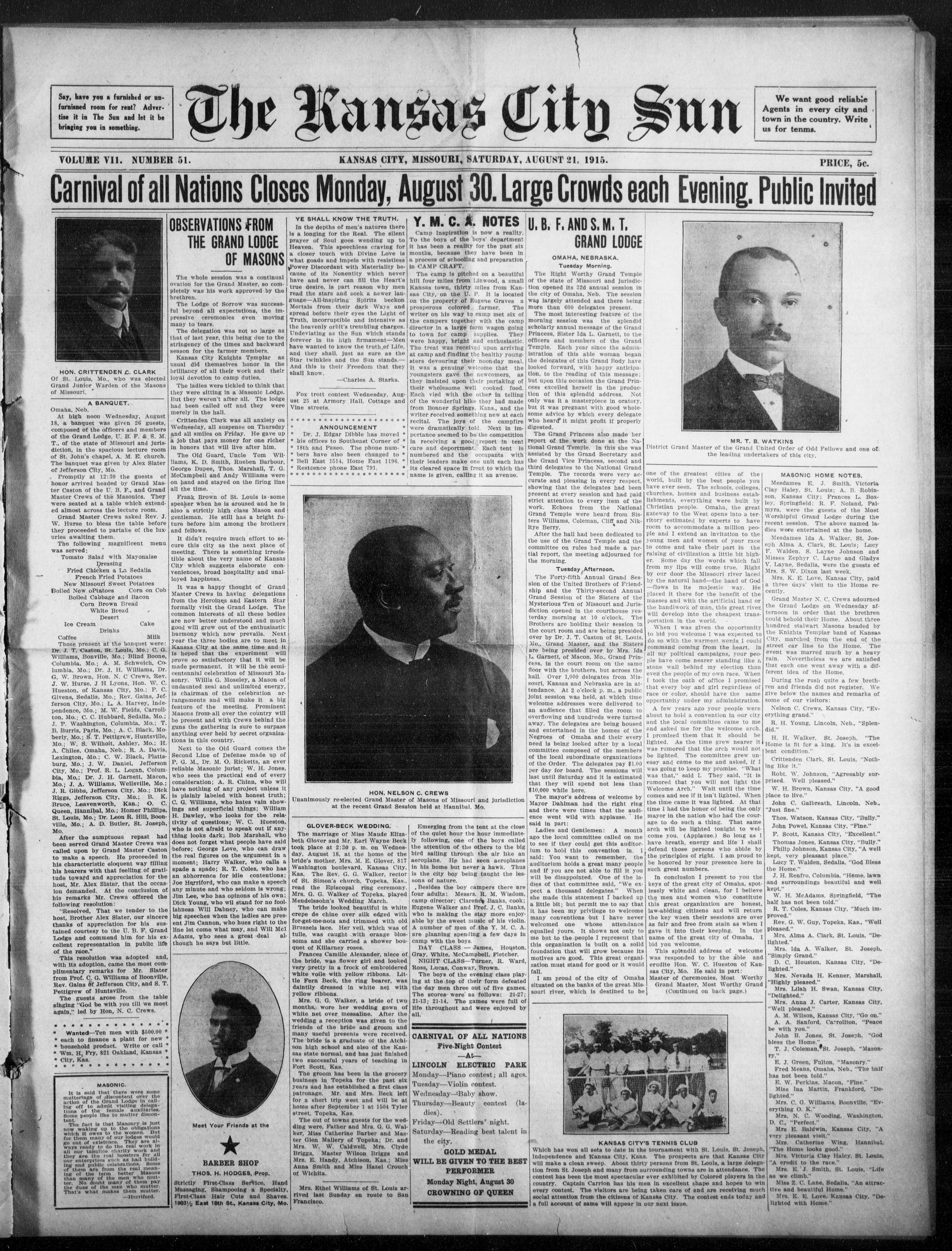
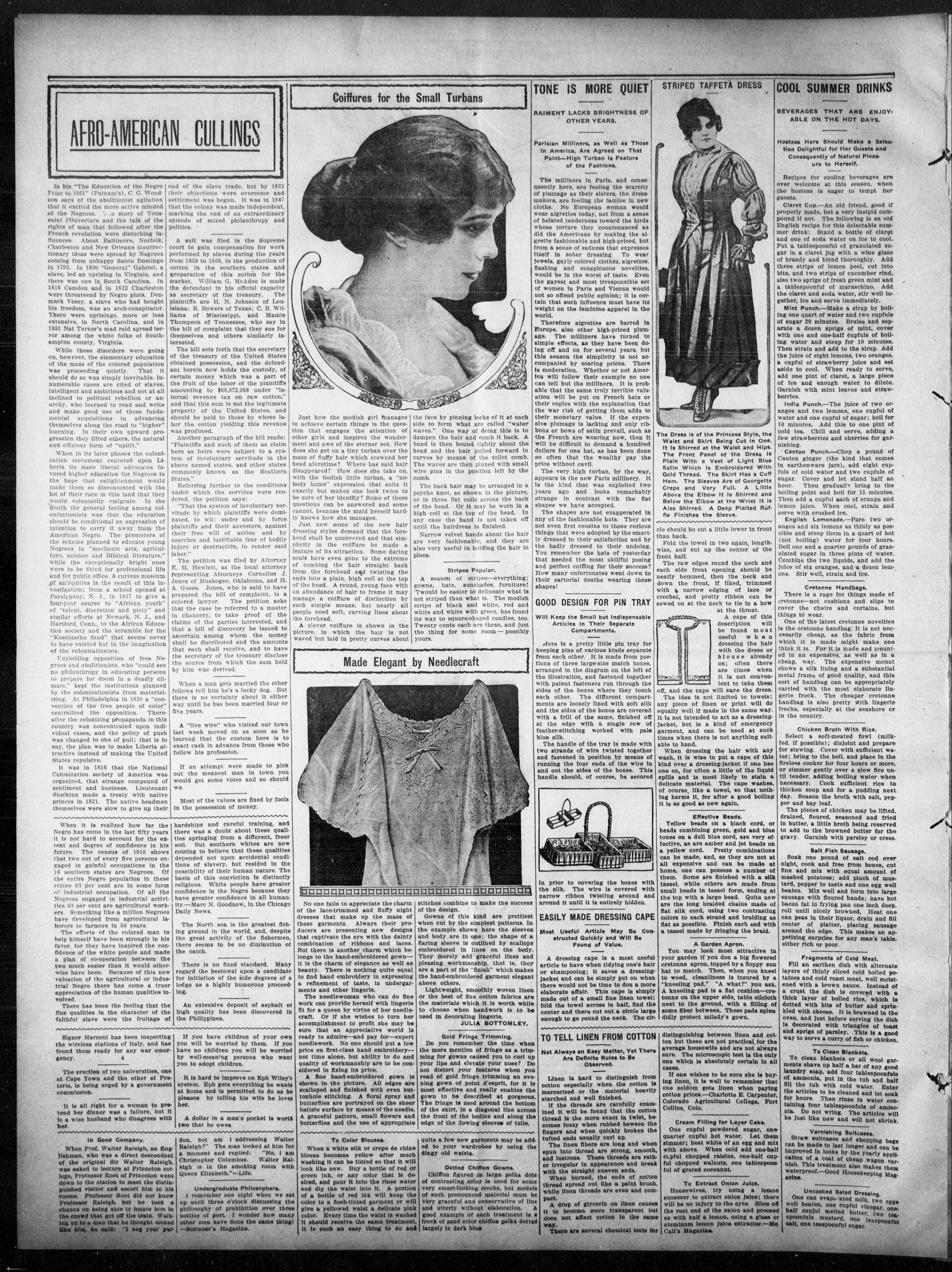
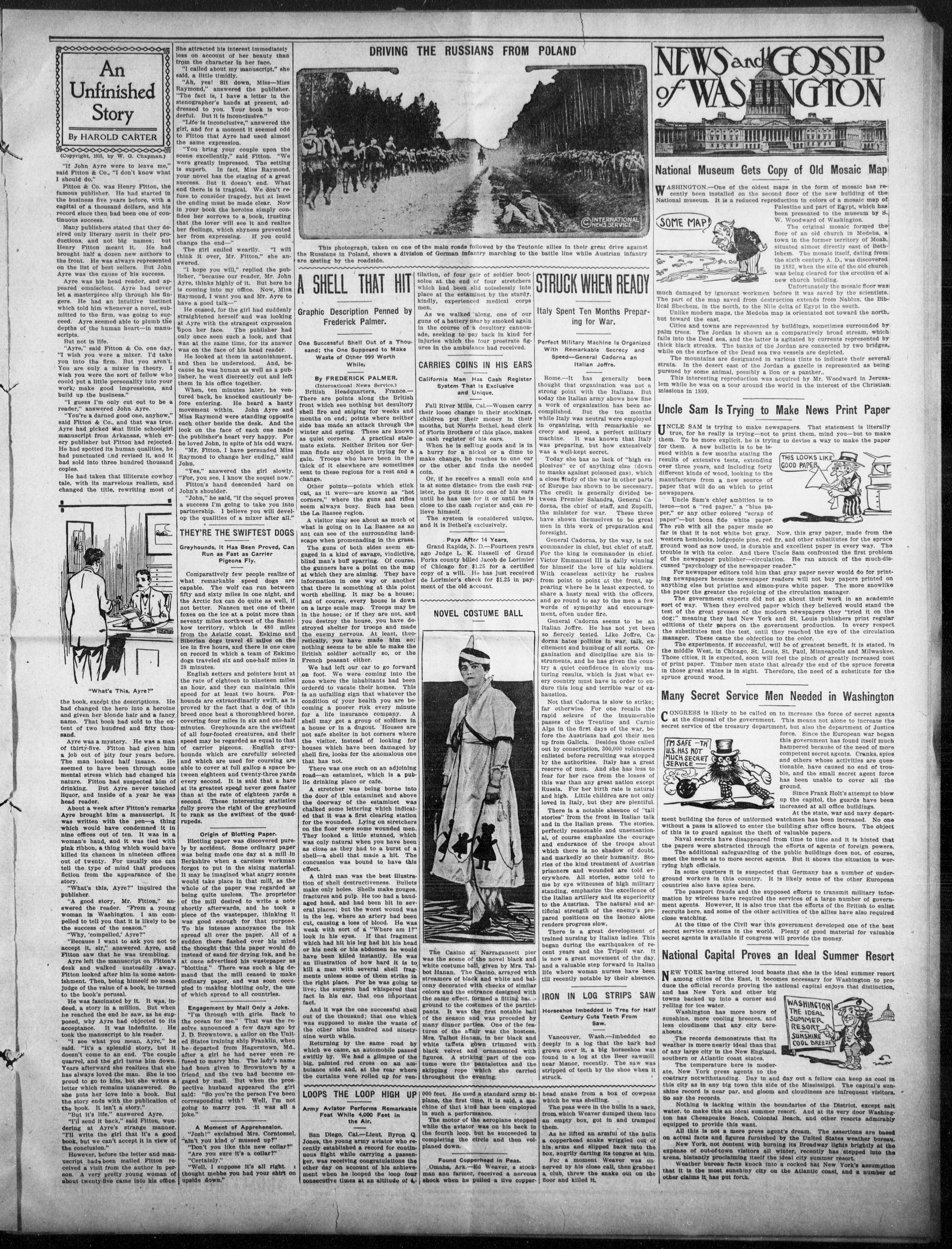
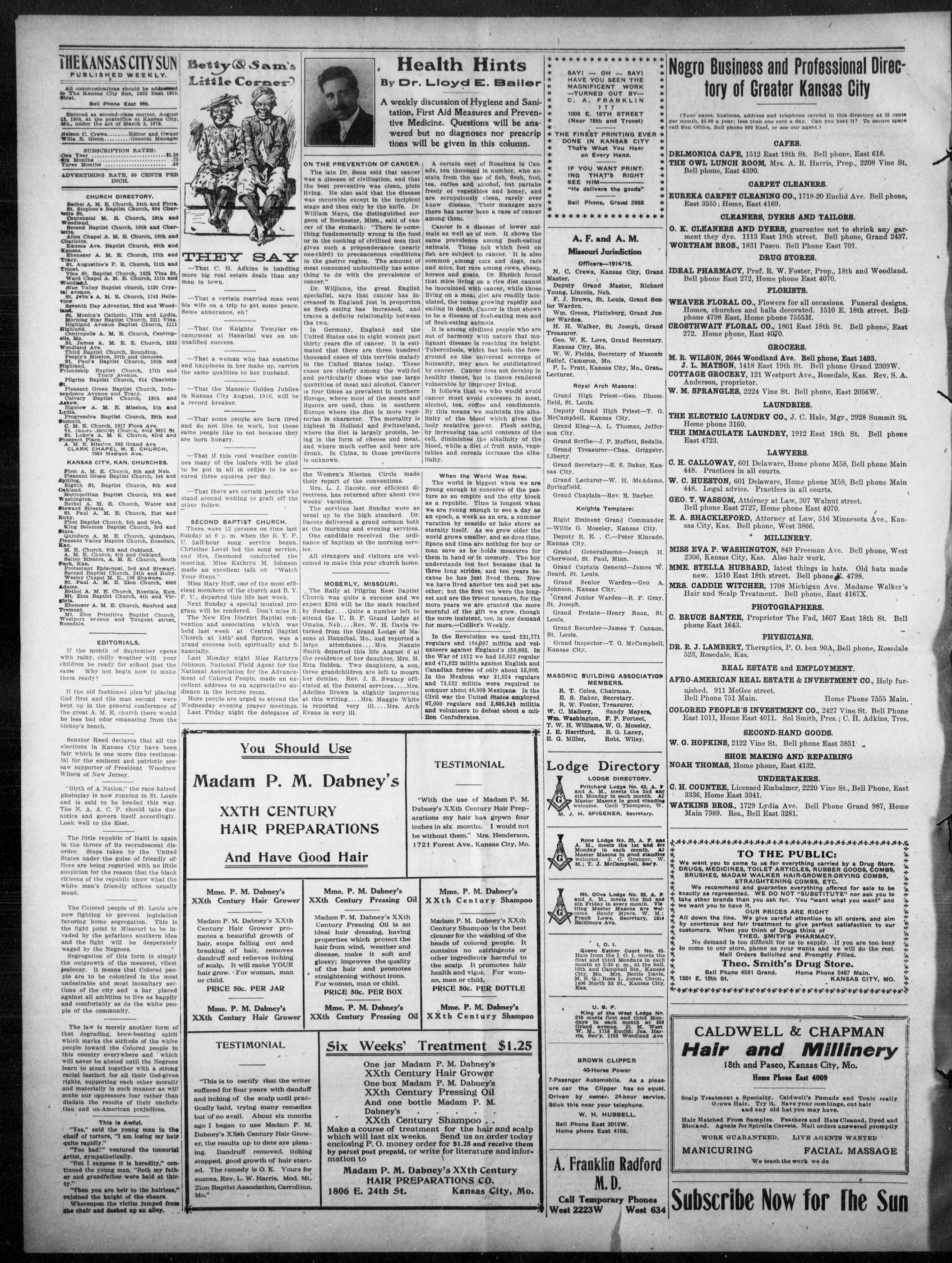
Page text (machine-generated)
Carnival of all Nations Closes Monday, August 30. Large Crowds each Evening. Public Invited
Say, have you a furnished or unfurnished room for rent? Advertise it in the Sun and let it be bringing you in something.
VOLUME VI1. NUMBER 51.
Carnival of all Na
HON. CRITTENDEN C. CLARK
Of St. Louis, Mo., who was elected
Grand Junior Warden of the Masons
of Missouri.
OBSERVATION
The ovation
pletely brethre
The ful beey
pressive
many t
The that of
stringe
season
Kans
usual
brilliant
loyal d
The
they w
At high noon Wednesday, August 18, a banquet was given 26 guests, composed of the officers and members of the Grand Lodge, U. B. F. & S. M. T., of the state of Missouri and juridiction, in the spacious lecture room of St. John's chapel, A. M. E. church. The banquet was given by Alex Slater of Jefferson City, Mo. Promptly at 12:30 the guests of honor arrived headed by Grand Master Caston of the U. B. F., and Grand Master Crews of the Masonics. They were seated at a table which extend ed almost across the lecture room. Grand Master Crews asked Rev. J. W. Hurse to be the table before they proceeded to partake of the lux uries awaiting them. The following magnificent menu was served:
French Fried Potatoes
New Missouri Sweet Potatoes
Boiled New optatoes Corn on Cob
Boiled Cabbage and Bacon
Corn Brown Bread
White Bread
Desert
Ice Cream Cake
Drinks
Coffee Milk
Those present at the banquet were:
Dr. J. T. Caston, St. Louis, Mo.; C. G. Williams, Bonville, Mo.; Blind Boone, Columbia, Mo.; A. M. Schweich, Columbia, Mo.; Dr. J. H. Williams, Dr. G. W. Brown, Hon. N. C Crews, Rev. J. W. Hurse, J H Lyons, Hon. W. C. Hueston, of Kansas City, Mo.; P. C. Givens, Sedalia, Mo.; Rev. Gains, Jefferson City, Mo.; L. A. Harvey, Independence, Mo.; M. W. Fields, Carrollton, Mo.; C. C. Hubbard, Sedalia, Mo.; J. P. Washington, Columbia, Mo.; T. B. Burris, Paris, Mo.; A. C. Black, Mobery, Mo.; S. T. Pettigrew, Huntsville, Mo.; W. S. Wilhot, Ashley, Mo.; H. A. Chiles, Omaha, Neb.; R. A. Davis, Lexington, Mo.; C. W. Black, Plattsburg, Mo.; J. W. Daniel, Jefferson City, Mo.; Prof. R. L. Logan, Columbia, Mo.; Dr. J. H. Garnett, Macon, Mo.; J. A. Williams, Wellsville, Mo.; J. A. Ribbs, Jefferson City, Mo.; B. K. Bruce, Leavenworth, Kan.; O. C. Queen, Hannibal, Mo.; Homer Phillips, St. Louis, Mo.; Dr. Leon R. Hill, Boonville, Mo.; A. D. Butler, St. Joseph, Mo.
It was Master from the formal commons are not good w harmor year t Kansas he prove a centenary sony, undra, is chan rager Mason, be pregnant anythings it is Next Second P. G. Kansas who reliable s have need it is plan C. G. Kansas who is play
After the sumptuous repast had been served Grand Master Crews was called upon by Grand Master Caston to make a speech. He proceeded in his characteristic eloquent way filling his hearers with that feelling of gratitude toward and appreciation for the host, Mr. Alex Slater, that the occasion demanded. At the conclusion of his remarks Mr. Crews offered the following resolution:
"Resolved, That we tender to the host, Brother Alex Slater, our sincere thanks of appreciation for his sustained courtesy to the U. B. F. Grand Lodge and command him for his excellent representation in public life of the race."
This resolution was adopted and, with its adoption, came the most complimentary remarks for Mr. Slater from Prof. C. G. Williams of Boonville, Rev. Gains of Jefferson City, and S. T. Pettigrew of Huntsville.
The guests arose from the table singing "God be with you till we meet again," led by Hon. N. C. Crews.
* Wanted—Ten men with $500.00 *
* each to finance a plant for new *
* household product. Write or call *
* Wm. H, Fry, $21 Oakland, Kansas *
* City, Kas.
```markdown
```
MASONIC.
It is said that there were some misunderstandings of discontent over the action of the Grand Lodge in calling off to admit visiting delegations of the female auxiliaries. Some people like to mutter discontent. The fact is that Masonry is just now waking up to the obligations which we are owed to the women, but for them many of our lodges would go out of existence. They are always ready to do what in all our tangible charity work and they are the real boosters for all our enterprises such as hall building and public celebrations. Some of them are from the real meaning of the term better. Masons than many of the men who mutter. No doubt many of them pay the dues of the men who mutter. That's what makes them mutter. —Herriford.
The Kansas City Sun
OBSERVATIONS FROM THE GRAND LODGE OF MASONS
OBSERVATIONS FROM THE GRAND LODGE OF MASONS
The whole session was a continual ovation for the Grand Master, so completely was his work approved by the brethren.
The Lodge of Sorrow was successful beyond all expectations, the impressive ceremonies even moving many to tears.
The delegation was not so large as that of last year, this being due to the stringency of the times and backward season for the farmer members.
Kansas City Knights Templar as usual did themselves honor in the brilliance of all their work and their loyal devotion to camp duties.
The ladies were tickled to think that they were sitting in a Masonic Lodge. But they weren't after all. The lodge had been called off and they were merely in the hall.
Crittenden Clark was all anxiety on Wednesday, all suspense on Thursday and all smiles on Friday. He gave up a job that pays money for one richer in honors that will live after him.
The Old Guard, Uncle Tom Williams, K. D. Smith, Rueben Barbour, George Dupee, Thos. Marshall, T. G. McCampbell and Andy Williams were on hand and stayed on the firing line all the time.
Frank Brown of St. Louis is some speaker when he is aroused and he is also a strictly high class Mason and gentleman. He still has a bright future before him among the brothers and fellows.
It didn't require much effort to secure this city as the next place of meeting. There is something irresistible about the very name of Kansas City which suggests elaborate conveniences, broad hospitality and unalloyed happiness. It was a happy thought of Grand Master Crews in having delegations from the Heriones and Eastern Star formally visit the Grand Lodge. The common interests of all these bodies are now better understood and much good will grow out of the enthusiastic harmony which now prevails. Next year the three bodies are to meet in Kansas City at the same time and it is hoped that the experiment will prove so satisfactory that it will be made permanent. It will be the semi-centennial celebration of Missouri Masonry. Willis G. Moseley, a Mason of undaunted zeal and unlimited energy, is chairman of the celebration arrangements and will make it a big feature of the meeting. Prominent Masons from all over the country will be present and with Crews behind the guns the gathering is sure to surpass anything ever held by secret organizations in this country.
Next to the Old Guard comes the Second Line of Defense made up of P. G. M., Dr. M. O. Rickett, an ever reliable Masonic jurist, W. H. Jones, who sees the practical end of every consideration; A. R. Chinn, who will have nothing of any project unless it is plainly labeled with honest truth; C. G. Williams, who hates vain showings and superficial things; William H. Dawley, who looks for the relativity of questions; W. C. Hueston, who is not afraid to speak out if anything looks dark; Bob Marshall, who does not forget what people have said before; George Love, who can draw the real figures on the argument in a moment; Harry Walker, who calls a spade a spade; R. T. Coles, who has an abhorrence for idle contentions; Joe Herriford, who can make a speech any minute and who seldom is wrong; Jim Lee, who has opinions of his own; Dick Young, who will stand for no foolishness Will Dabney, who can make big speeches when the ladies are present Jim Cannon, who hues right to the line let come what may, and Will McI Adams, who sees a great deal although he says but little.
Meet Your Friends at the
Strictly First-Class Service, Hand Massaging, Shampooing a Specialty, First-Class Hair Cuts and Shaves. 1903$^2$ East 18th St., Kansas City, Mo.
KANSAS CITY, MISSOURI, SATURDAY, AUGUST 21, 1915.
P.
FROM NELSON CROWS
Unanimously re-elected Grand Master of Missouri and jurisdiction
at the recent Grand Session held at Hannibal, Mo.
YE SHALL KNOW THE TRUTH.
In the depths of men's natures there is a longing for the Real. The silent prayer of Soul goes wending up to Heaven. This speechless craving for a closer touch with Divine Love is what goods and impels with resistless Power Discordant with Materiality because of its Nonentity which never have and never can fill the Heart's true desire, is part reason why men read the stars and seek a newer language—All-inspiring Spirits beckon Mortals from their dark Ways and spread before their eyes the Light of Truth, incorruptible and intensive as the heavenly orbit's trembling charges. Undeviating as the Sun which stands forever in its high firmament—Men have wanted to know the truth of Life, and they shall, just as sure as the Star twinkles and the Sun stands. And this is their Freedom that they shall know.
—Charles A. Starks.
Fox trott contest Wednesday, August 25 at Armory Hall, Cottage and Vine streets.
ANNOUNCEMENT
* Dr. J. Edgar Dibble has moved
* his offices to Southeast Corner of
* 18th and Paseo. The phone num-
* bers have also been changed to
* Bell East 1514, Home East 1196,
* Residence phone East 791.
---
HON, NELSON
Unanimously re-elected Grand Master
at the recent Grand Sess
GLOVER-BECK WEDDING.
The marriage of Miss Maude Elizabeth Glover and Mr. Earl Wayne Beck took place at 2:30 p. m. on Wednesday, August 18, at the home of the bride's mother, Mrs. M. E. Glover, 817 Washington boulevard, Kansas City, Kas. The Rev. G. G. Walker, rector of St. Simon's church, Topeka, Kas, read the Episcopal ring ceremony, Mrs. G. G. Walker of Topeka, played Mendelssohn's Wedding March.
The bride looked beautiful in white crepe de chine over silk edged with for-get-me-nots and trimmed with old Brussels lace. Her veil, which was of tulle, was caught with orange blossoms and she carried a shower bouquet of Killarney roses.
Frances Camille Alexander, niece of the bride, was flower girl and looked very pretty in a frock of embroidered white volle with yellow ribbons. Little Fern Beck, the ring bearer, was daintily dressed in white net with yellow ribbons.
Mrs. G. G. Walker, a bride of two months, wore her wedding gown of white net over messaline. After the wedding a reception was given to the friends of the bride and groom and many useful presents were received.
The bride is a graduate of the Atchison high school and also of the Kansas state normal, and has just finished two successful years of teaching in Fort Scott, Kas.
The groom has been in the grocery business in Topeka for the past six years and has established a first class patronage. Mr. and Mrs. Beck left for a short trip west and will be at home after September 1 at 1504 Tyler street, Topeka, Kas.
The out of towns guests for the wedding were, Father and Mrs. G. G. Walker, Miss Catherine Barber and Master Glen Mallery of Topeka; Dr. and Mrs. W. W. Caldwell, Mrs. Clyde Briggs, Master Wilson Briggs and Mrs. E. Handy, Atchison, Kas.; Miss Anna Smith and Miss Hazel Crouch of Wichita.
Mrs. Ethel Williams of St. Louis arrived last Sunday en route to San Francisco.
Camp Inspiration is now a reality. To the boys of the boys' department it has been a reality for the past six months, because they have been in a process of schooling and preparation in CAMP CRAFT.
The camp is pitched on a beautiful hill four miles from Linwood, a small Kansas town, thirty miles from Kansas City, on the U. P. It is located on the property of Eugene Graves a prosperous colored farmer. The writer on his way to camp met six of the campers together with the camp director in a large farm wagon going to town for camp supplies. They were happy, bright and enthusiastic. The treat was received upon arriving at camp and finding the healthy youngsters devouring their noon-day meal. It was a genuine welcome that the youngsters gave the newcomers, as they insisted upon their partaking of their wholesome well cooked food. Each vied with the other in telling of the wonderful like they had made from Bonner Springs, Kans., and the writer received something new at each recital. The joys of the campfire were dramatically told. Next in importance seemed to be the competition in receiving a good report in tent care and deportment. Each tent is numbered and the occupants with their leaders make one unit each has its cleared space in front to which the name is given, calling it an avenue.
ON C. CREWS
of Masons of Missouri and jurisdiction
ion held at Hannibal, Mo.
Emerging from the tent at the close of the quiet hour the hour immediately following, one of the boys called the attention of the others to the big bird sailing through the air like an aeroplane. He had seen aeroplanes in his home but never a hawk. Thus is the city boy being taught the lessons of nature.
Besides the boy campers there are four adults: Messrs. R. M. Wisdom, camp director; Clarence Banks, cook; Eugene Walker and Prof. J. C. Banks, who is making the stay more enjoyable by the sweet music of his violin. A number of men of the Y. M. C. A. are planning spending a few days in camp with the boys.
DAY CLASS — James, Houston, Gray, White McCampbell, Fletcher, NIGHT CLASS—Turner, R. Ward, Ross, Lucas, Conway, Brown.
The boys of the evening class playing at the top of their form defeated the day men three out of five games. The scores were as follows: 21-27; 21-13; 21-14. The games were full of life throughout and were enjoyed by all.
CARNIVAL OF ALL NATIONS Five-Night Contest
LINGOLN ELECTRIC PARK
Monday—Piano contest; all ages.
Tuesday—Violin contest.
Wednesday—Baby show.
Thursday—Beauty contest (ladies).
Friday—Old Settlers' night.
Saturday—Reading best talent in the city.
GOLD MEDAL
WILL BE GIVEN TO THE BEST
PERFORMER
U. B. F. AND S. M. T.
GRAND LODGE
U. B. F. AND S. M. T.
GRAND LODGE
OMAHA, NEBRASKA.
Tuesday Morning.
The Right Worthy Grand Temple of the state of Missouri and jurisdiction opened its 32d annual session in the city of Omaha, Neb. The session was largely attended and there being more than 600 delegates present.
The most interesting feature of the morning session was the splendid scholarly annual message of the Grand Princess, Sister Ida L. Garnett, to the officers and members of the Grand Temple. Each year since the administration of this able woman began the delegates of this Grand Body have looked forward, with happy anticipation, to the reading of this message; but upon this occasion the Grand Princess excelled herself in the production of this splendid address. Not only was it a masterpiece in oratory, but it was pregnant with good wholesome advice by which every delegate who heard it might profit if properly digested.
The Grand Princess also made her report of the work done at the National Grand Temple. In this she was assisted by the Grand Secretary and the Grand Vice Princess, second and third delegates to the National Grand Temple. The records were very accurate and pleasing in every respect, showing that the delegates had been present at every session and had paid strict attention to every item of the work. Echoes from the National Grand Temple were heard from Sisters Williams, Coleman, Cliff and Nikitye Berry. After the hall had been dedicated to the use of the Grand Temple and the committee on rules had made a partial report, the meeting adjourned for the morning.
The Forty-fifth Annual Grand Session of the United Brothers of Friendship and the Thirty-second Annual Grand Session of the Sisters of the Mysterious Ten of Missouri and Jurisdiction opened in the courthouse yesterday morning at 10 o'clock. The Brothers are holding their session in the court room and are being presided over by Dr. J. T. Caston of St. Louis Mo., Grand Master, and the Sisters are being presided over by Mrs. Ida L. Garnett, of Macon, Mo., Grand Princess, in the court room on the same floor with the brothers, but across the hall. Over 1,000 delegates from Missouri, Kansas and Nebraska are in attendance. At 2 o'clock p. m., a public joint session was held, at which time welcome addresses were delivered to an audience that filled the room to overflowing and hundreds were turned away. The delegates are being housed and entertained in the homes of the Negroes of Omaha and their need is being looked after by a local committee composed of the members of the local subordinate organizations of the Order. The delegates pay $1,000 per day for board. The sessions will last until Saturday and it is estimated that they will spend not less than $10,000 while here. The mayor's address of welcome by Mayor Dahlman had the right ring and there were times that the audience went wild with applause. He said in part:
Ladies and Gentlemen: A month ago the local committee called on me to see if they could get this auditorium to hold this convention in. I said: You want to remember, the auditorium holds a great many people and if you are not able to fill it you will be disappointed. One of the ladies of that committee said, "We expect a thousand delegates." She made this statement I backed up a little bit; but permit me to say that it has been my privilege to welcome many conventions but I have never welcomed one whose attendance equalled yours. It shows not only to me but to the people I represent that this organization is built on a solid foundation that will grow because its motives are good. This great organization must stand for good or it would fall.
I am proud of the city of Omaha situated on the banks of the great Missouri river, which is destined to be
KANSAS CITY'S TENNIS CLUB
Which has won all sets to date in the tournament with St. Louis, St. Joseph, Independence and Kansas City, Kans. The prospects are that Kansas City will make a clean sweep. About thirty persons from St. Louis, a large delegation from St. Joseph and many from surrounding towns are in attendance. The contest has been the most spectacular ever exhibited by Colored players in the country. Captain Carrion has his men in excellent shape and hopes to win every contest. The visitors are being taken care of and are receiving much social attention from the citizens of Kansas City. The contest ends today and a full account of same will appear in our next issue.
Tuesday Afternoon.
one of the greatest cities of the world, built by the best people you have ever seen. The schools, colleges, churches, homes and business establishments, everything were built by Christian people. Omaha, the great gateway to the West opens into a territory estimated by experts to have room to accommodate a million people and I extend an invitation to the young men and women of your race to come and take their part in the raising of civilization a little bit higher. Some day the words which fall from my lips will come true. Right by our door the Missouri river laced by the natural hand—the hand of God—flows in its majestic way. He placed it there for the benefit of the masses and with the artificial hand or the handwork of man, this great river will develop into the cheapest transportation in the world.
When I was given the opportunity to bid you welcome I was expected to do so with the warmest words I could command coming from the heart. In all my political campaigns, your people have come nearer standing like a stone wall behind my election than even the people of my own race. When I took the oath of office I promised that every boy and girl regardless of race or color, should have the same opportunity under my administration.
MASONIC HOME NOTES.
Mesdames E. J. Smith, Victoria Clay Haley, St. Louis; A. B. Robinson, Kansas City; Frances L. Boxley, Springfield; R. F. Noland, Palmyra, were the guests of the Most Worshipful Grand Lodge during the recent session. The above named ladies were entertained at the home.
Mesdames Ida A. Walker, St. Joseph Alma A. Clark, St. Louis; Lucy F. Walden, S. Layne Johnson and Misses Zephyr C. Layne and Gladys V. Layne, Sedalia, were the guests of Mrs. S. W. Dixon last week.
Mrs. K. E. Love, Kansas City, paid a three days' visit to the Home recently.
Grand Master N. C. Crews adourned the Grand Lodge on Wednesday afternoon in order that the brethren could behold their Home. About three hundred stalwart Masons headed by the Knights Templar band of Kansas City, marched from the end of the street car line to the Home. The event was marred much by a heavy rain. Nevertheless we are satisfied that each one went away with a different idea of the Home.
During the rush quite a few brethren and friends did not register. We give below the names and remarks of some of our visitors:
A few years ago you people were about to hold a convention in our city and the local committee came to me and asked me for the welcome arch. I promised them that it should be lighted. As the time grew nearer it was rumored that the arch would not be lighted. The committee grew uneasy and came to me and asked, if I was going to keep my promise, "What was that," said I. They said, "it is rumored that you will not light the Welcome Arch." Wait until the time comes and see if it isn't lighted. When the time came it was lighted. At that time I had the honor of being the only mayor in the nation who had the courage to do such a thing. That same arch will be lighted tonight to welcome you. (Applause.) So long as I have breath, energy and life I shall defend those persons who abide by the principles of right. I am proud to be honored by your presence here in such great numbers.
In conclusion I present to you the keys of the great city of Omaha, spotlessly white and clean, for I believe the men and women who constitute this great organization are honest, law-abiding citizens and will return the key when their sessions are over as fair and free from stain as when I gave it into their keeping. In the name of the great city of Omaha, I bid you welcome.
This splendid address of welcome was responded to by the able and erudite Hon. W. C. Hueston of Kansas City, Mo. He said in part: Master of Ceremonies, Most Worthy
Master of Ceremonies, Most Worthy
Grand Master, Most Worthy Grand
(Continued on back page.)
the tournament with St. Louis, St. Josephs. The prospects are that Kansas City city persons from St. Louis, a large delegation surrounding towns are in attendance. They ever exhibited by Colored players in the men in excellent shape and hopes to win taken care of and are receiving much Kansas City. The contest ends today and our next issue.
M. B.
We want good reliable Agents in every city and town in the country. Write us for tenms.
PRICE, 5c.
Public Invited
A. WATKINS
United Order of Odd Fellows and one of
artakers of this city.
MASONIC HOME NOTES.
Mesdames E. J. Smith, Victoria Clay Haley, St. Louis; A. B. Robinson, Kansas City; Frances L. Loxley, Springfield; R. F. Noland, Palmyra, were the guests of the Most Worshipful Grand Lodge during the recent session. The above named ladies were entertained at the home.
Mesdames Ida A. Walker, St. Joseph Alma A. Clark, St. Louis; Lucy F. Walden, S. Layne Johnson and Misses Zephyr C. Layne and Gladys V. Layne, Sedalia, were the guests of Mrs. S. W. Dixon last week.
Mrs. K. E. Love, Kansas City, paid a three days' visit to the Home recently.
Grand Master N. C. Crews adourned the Grand Lodge on Wednesday afternoon in order that the brethren could behold their Home. About three hundred stalwart Masons headed by the Knights Templar band of Kansas City, marched from the end of the street car line to the Home. The event was marred much by a heavy rain. Nevertheless we are satisfied that each one went away with a different idea of the Home.
During the rush quite a few brethren and friends did not register. We give below the names and remarks of some of our visitors:
Nelson C. Crews, Kansas City, "Everything grand."
R. H. Young, Lincoln, Neb., "Splendid."
H. H. Walker, St. Joseph, "The Home is fit for a king. It's in excellent condition."
Crittenden Clark, St. Louis, "Nothing like it."
Robt. W. Johnson, "Agreeably surprised. Well pleased."
W. H. Brown, Kansas City, "A good place to live."
John C. Galbreath, Lincoln, Neb., "Just fine."
Thos. Watson, Kansas City, "Bully," John Powel, Kansas City, "Fine."
F. Scott, Kansas City, "Excellent."
Thomas Jones, Kansas City, "Bully."
Philip Johnson, Kansas City, "A well kept, very pleasant place."
Lucy T. Walden, Sedalia, "God Bless the home."
J. H. Renfro, Columbia, "Home, lawn and surroundings beautiful and well kept."
W. H. McAdams, Springfield, "The half has not been told."
R. T. Coles, Kansas City, "Much improved."
Mrs. Alma A. Clark, St. Louis, "Delighted." Mrs. Ida A. Walker, St. Joseph, "Simply Grand."
D. C. Houston, Kansas City, "Delighted." Mrs. Nevada H. Kenner, Marshall, "Highly pleased."
Mrs. Lilah H. Swan, Kansas City,
"D delighted."
Mrs. Anna J. Carter, Kansas City,
"Well pleased."
A. M. Wilson, Kansas City, "Go on."
A. A. Sanford, Carrollton, "Peace
be with you."
John B. Jones, St. Joseph, "God
bless the home."
T. J. Coleman, St. Joseph, "Masonry."
E. J. Green, Fulton, "Masonry."
Fred Means, Omaha, Neb., "The half
has not been told."
E. W. Perkins, Macon, "Fine."
Miss Ina Martin, Frankford, "Delighted."
Mrs. C. G. Williams, Boonville, "Everything O. K."
Mrs. N. C. Wooding, Washington,
D. C., "Perfect."
Mrs E. Baldwin, Kansas City, "A
very pleasant visit."
Mrs. Catherine Wing, Hannibal,
"The Home looks good."
Mrs. Victoria Clay Haley, St. Louis,
"A credit to the race."
Mrs. E. J. Smith, St. Louis, "Life as we climb." Miss Z. C. Lane, Sedalia, "An attractive and beautiful Home."
Mrs. K. E. Love, Kansas City, "Delighted with Home."
AFRO-AMERICAN CULLINGS
In his "The Education of the Negro Prior to 1861" (Putnam's), C. G. Woodson says of the abolitionist agitation that it excited the more active minded of the Negroes. The story of Toussaint I'ouverture and the talk of the rights of man that followed after the French revolution were disturbing influences. About Baltimore, Norfolk, Charleston and New Orleans insurrectionary ideas were spread by Negroes coming from unhappy Santo Domingo in 1793. In 1800 "General" Gabriel, a slave, led an uprising in Virginia, and there was one in South Carolina. In 1816 Camden and in 1822 Charleston were threaten by Negro plots. Denmark Vesey, a slave who had bought his freedom, was an arch-conspirator. There were uprisings, more or less extensive, in North Carolina, and in 1831 Nat Turner's mad raid spread terror among the white folks of South ampton county, Virginia.
While these disorders were going on, however, the elementary education of the mass of the colored population was proceeding quietly. That it should do so was simply inevitable. In numerable cases are cited of slaves, intelligent and ambitious and not at all inclined to political rebellion or anarchy, who learned to read and write and make good use of those fundamental acquisitions in advancing themselves along the road to "higher" learning. In their own upward progression they lifted others, the natural and efficient form of "uplift."
When in its later phases the colonization movement centered upon Liberia its more liberal advocates favored higher education for Negroes in the hope that enlightenment would make them so discontented with the lot of their race in this land that they would voluntarily emigrate. In the South the general feeling among colonizationists was that the education should be conditional on expression of intention to carry it away from the American Negro. The promoters of the scheme planned to educate young Negroes in "mechanic arts, agriculture, science and Biblical literature," while the exceptionally bright ones were to be fitted to professional life and for public office. A curious museum of antiquities is the result of this investigation; from a school opened at Parishypany, N. J., in 1817 to give a four-year course to "African youth" of "talent, discretion and piety" and similar efforts at Newark, N. J., and Hartford, Conn., to the African Education society and the scramble for the "Kosciuszko fund" that seems never to have existed but in the imagination of the colonizationists.
Unyielding opposition of free Negroes and abolitionists, who "could see no philanthropy in educating persons to prepare for doom in a deadly climate," kept the institutions planned by the colonizationists from materializing. At Philadelphia in 1830 a "convention of the free people of color" centralized the opposition. Thereafter the colonizing propaganda in this country was concentrated upon individual cases, and the policy of push was changed to one of pull; that is to say, the plan was to make Liberia attractive instead of making the United States repulsive.
It was in 1816 that the National Colonization society of America was organized, that strange compound of sentiment and business. Lieutenant Stockton made a treaty with native princes in 1821. The native headmen themselves were slow to give up their
When it is realized how far the Negro has come in the last fifty years it is not hard to account for the extent and degree of confidence in his future. The census of 1910 shows that two out of every five persons engaged in gainful occupations in the 16 southern states are Negroes. Of the entire Negro population in these states 63 per cent are in some form of industrial occupation. Of all the Negroes engaged in industrial activities 60 per cent are agricultural workers. Something like a million Negroes have developed from agricultural laborers to farmers in 50 years. The efforts of the colored man to help himself have been strongly in his favor, for they have inspired the confidence of the white people and made a plan of co-operation between the two much easier than it would otherwise have been. Because of this new valuation of the agricultural or industrial Negro there has come a truer appreciation of the human qualities involved.
There has been the feeling that the fine qualities in the character of the faithful slave were the fruitage of
Signor Marconi has been inspecting the wireless stations of Italy, and has found them ready for any war emergency.
The erection of two universities, one at Cape Town and the other at Pretoria, is being urged by a government commission.
It is all right for a woman to pretend her dinner was a failure, but it is a wise husband who disagrees with her.
In Good Company.
When Prof. Walter Raleigh, an Englishman, who was a direct descendant of the original Sir Walter Raleigh, was asked to lecture at Princeton college, Professor Root of Princeton went down to the station to meet the distinguished visitor and escort him to his rooms. Professor Root did not know Professor Raleigh, but he took a chance on being able to locate him in the crowd that got off the train. Walking up to a man that he thought looked like him, he said: "I beg your par-
end of the slave trade, but by 1822 their objections were overcome and settlement was begun. It was in 1847 that the colony was made independent, marking the end of an extraordinary episode of mixed philanthropy and politics.
A suit was filed in the Supreme court to gain compensation for work performed by slaves during the years from 1859 to 1868, in the production of cotton in the southern states and preparation of cotton for the market. William G. McAdoo is made the defendant in his official capacity as secretary of the treasury. The plaintiffs are H. N. Johnson of Louisiana; R. Bowers of Texas; C. B. Williams of Mississippi; and Mamie Thompson of Tennessee, who say in the bill of complaint that they sue for themselves and others similarly interested.
The bill sets forth that the secretary of the treasury of the United States obtained possession, and the defendant herein now holds the custody, of certain money which was a part of the fruit of the labor of the plaintiffs amounting to $68,072.388 under "internal revenue tax on raw cotton," and that this sum is not the legitimate property of the United States, and should be paid to those by whose labor the cotton yielding this revenue was produced.
Another paragraph of the bill reads: "Plaintiffs and such of them as claim here as heirs were subject to a system of involuntary servitude in the above named states, and other states commonly known as the Southern States."
Referring further to the conditions under which the services were rendered, the petition says:
"That the system of involuntary servitude by which plaintiffs were dominated, to wit; under and by force plaintiffs and their ancestors, against their free will of action and by coercion and fustifiable fear of bodily injury or destruction, to render said labor."
The petition was filed by Attorney E. M. Hewlett, as the local attorney representing Attorneys Cornelius J. Jones of Muskogee, Oklahoma, and H. A. Guess. Jones, who is said to have prepared the bill of complaint, is a colored lawyer. The petition asks that the case be referred to a master in chancery, to take proof of the claims of the parties interested, and that a bill of discovery be issued to ascertain among whom the money shall be distributed and the amounts that each shall receive, and to have the secretary of the treasury disclose the source from which the sum held by him was derived.
When a man gets married the other fellows tell him he's a lucky dog. But there is no certainty about it either way until he has been married four or five years.
A "live wire" who visited our town last week moved on as soon as he learned that the custom here is to exact cash in advance from those who follow his profession.
If an attempt were made to pick out the meanest man in town you would get some votes and so should we.
Most of the values are fixed by fools in the possession of money.
hardships and careful training, and there was a doubt about these qualities springing from a different, freer soil. But southern whites are now coming to believe that these qualities depended not upon accidental conditions of slavery, but resided in the possibility of their human nature. The basis of this conviction is distinctly religious. White people have greater confidence in the Negro because they have greater confidence in all humanity.—Marc N. Goodnow, in the Chicago Daily News.
The North sea is the greatest fishing ground in the world, and, despite the great activity of the fishermen, there seems to be no diminution of the catch.
There is no fixed standard. Many regard the bestowal upon a candidate for initiation of the side degrees of a lodge as a highly humorous proceeding.
An extensive deposit of asphalt of high quality has been discovered in the Philippines.
If you have children of your own you will be worried by them. If you have no children you will be worried by well-meaning persons who want you to adopt children.
It is hard to improve on Eph Wiley's system. Eph gets everything he wants at home and is permitted to do as he pleases by telling his wife he loves her.
A dollar in a man's pocket is worth two that he owes.
don, but am I addressing Walter Raleigh? The man looked at him for a moment and replied: "No, I am Christopher Columbus. Walter Raleigh is in the smoking room with Queen Elizabeth."—Life.
Undergraduate Philosophers
I remember one night when we sat up until three o'clock discussing the philosophy of prohibition over three bottles of port. I wonder how many other men have done the same thing! —Scribner's Magazine.
A
Made Elegant by Needlecraft
```markdown
```
Just how the modish girl manages to achieve certain things is the question that engages the attention of other girls and inspires the wonderment and awe of the sterner sex. How does she get on a tiny turban over the mass of fluffy hair which crowned her head aforetime? Where has said hair disappeared? How does she take on, with the foolish little turban, a "nobody home" expression that suits it exactly but makes one look twice to be sure of her identity? Some of these questions can be answered and some cannot, because the maid herself hardly knows how she manages.
Just now some of the new hair dressing styles demand that the forehead shall be uncovered and that simplicity in the coiffure be made a feature of its attraction. Some daring souls have even gone to the extreme of combing the hair straight back from the forehead and twisting the ends into a plain, high coll at the top of the head. A round, young face with an abundance of hair to frame it may manage a coiffure of distinction by such simple means, but nearly all people need soft, curving lines about the forehead.
A clever coiffure is shown in the picture, in which the hair is not waved but laid in pretty curves about
Made Elegant b
No one fails to appreciate the charm of the lace-trimmed and fluffy night dresses that make up the mass of these garments. Always their producers are presenting new designs that captivate the eye with the dainty combination of ribbons and laces. But there is another charm which belongs to the hand-embroidered gown—it is the charm of elegance as well as beauty. There is nothing quite equal to find hand embroidery in expressing a refinement of taste, in undergarments and other lingerie.
The needlewoman who can do fine work can provide herself with lingerie fit for a queen by virtue of her needlecraft. Or if she wishes to turn her accomplishment to profit she may be sure that an appreciative world is ready to admire and pay for—expert needlework. One should put a low price on first-class hand embroidery—not time alone, but ability to do and quality of workmanship are to be considered in fixing its price.
A fine hand-embroidered gown is shown in the picture. All edges are scalloped and finished with even buttonhole stitching. A floral spray and butterflies are portrayed on the sheer batiste surface by means of the needle. A graceful pattern, small flowers and butterflies and the use of appropriate
When a white silk or crepe de chine blouse becomes yellow after much washing it can be tinted so that it will look like new. Buy a bottle of red or green ink, or any color that is desired, and pour it into the rinse water and dip the waist into it. A portion of a bottle of red ink will keep the color in a flesh-tinted garment or will give a yellow waist a delicate pink color. Every time the waist is washed it should receive the same treatment. It is such an easy thing to do and
the face by pinning locks of it at each side to form what are called "water waves." One way of doing this is to dampen the hair and comb it back. A band is then bound tightly about the head and the hair pulled forward in curves by means of the toilet comb. The waves are then pinned with small wire pins in the position left by the comb.
The back hair may be arranged in a psychic knot, as shown in the picture, or in three flat flats across the back of the head. Or it may be worn in a high coll at the top of the head. In any case the band is not taken off until the hairdress is finished.
Narrow velvet bands about the hair are very fashionable, and they are also very useful in holding the hair in place.
Stripes Popular.
A season of stripes—everything; gowns, hats, sunshades, furniture! Twould be easier to delineate what is not striped than what is. The modish stripe of black and white, red and white and white with green, has found its way to square-shaped candies, too. Twenty cents each are these, and just the thing for some room—possibly yours.
by Needlecraft
stitches combine to make the success of the design.
Gowns of this kind are prettiest when cut by the simplest patterns. In the example shown here the sleeves and body are in one; the shape of a flaring sleeve is outlined by scallops embroidered in lines on the body. They merely add graceful lines and pleasing workmanship, that is, they are a part of the "finish" which makes the hand-embroidered garment elegant above others.
Lightweight, smoothly woven linen or the best of fine cotton fabrics are the materials which it is worth while to choose when handwork is to be used in decorating lingerie.
Gold Fringe Trimming
Gold Fringe Trimming.
Do you remember the time when the mere mention of fringe as a trimming for gowns caused you to curl up your lips and elevate your nose? Do not distort your features when you read of gold fringe trimming an evening gown of point d'esprit, for it is most effective and really enables the gown to be described at gorgeous. The fringe is used around the bottom of the skirt, in a diagonal line across the front of the bodice and along the edge of the flowing sleeves of tulle.
quite a few new garments may be added to your wardrobes by using the dingy old waists.
Dotted Chiffon Gowns
Chiffon figured in large polka dots of contrasting color is used for some very smart-looking frocks, but models of such pronounced material must be very graceful and conservative of line and utterly without elaboration. A good example of such treatment is a frock of sand color chiffon polka dotted largely in dark blue
---
TONE IS MORE QUIET
RAIMENT LACKS BRIGHTNESS OF
OTHER YEARS.
Parisian Milliners, as Well as Those in America, are Agreed on That Point—High Turban Is Feature of the Fashions.
The milliners in Paris, and consequently here, are feeling the scarcity of plumage as their sisters, the dressmakers, are feeling the famine in new cloths. No European woman would wear aglettes today, not from a sense of belated tenderness toward the birds whose torture they countenanced as did the Americans by making the algrette fashionable and high-priced, but from a sense of sadness that expresses itself in sober dressing. To wear jewels, gaily colored clothes, algrettes, flashing and conspicuous novelties, would be in the worst of taste. Even the gayest and most irresponsible set of women in Paris and Vienna would not so offend public opinion; it is certain that such influence must have its weight on the feminine apparel in the world.
Therefore aligrettes are barred in Europe, also other high-priced plumage. The milliners have turned to simple effects, as they have been doing off and on for several years, but this season the simplicity is not accompanied by soaring prices. There is moderation. Whether or not America will follow their example no one can tell but the milliners. It is probable that the same truly terrible valuation will be put on French hats or their copies with the explanation that the war risk of getting them adds to their monetary value. If the expensive plumage is lacking and only ribbons or bows of satin prevail, such as the French are wearing now, then it will be difficult to demand a hundred dollars for one hat, as has been done so often that the wealthy pay the price without cavil.
The very high turban, by the way, appears in the new Paris millinery. It is the kind that was exploited two years ago and looks remarkably strange in contrast with the flat shapes we have accepted. The shapes are not exaggerated in any of the fashionable hats. They are not even first cousins to those curious things that were adopted by the smartly dressed to their satisfaction and by the badly dressed to their undoing. You remember the hats of yesterday that needed the most skillful posing and perfect coiffing for their success? How many unfortunates went down to their sartorial deaths wearing those shapes!
GOOD DESIGN FOR PIN TRAY
Will Keep the Small but Indispensable Articles in Their Separate Compartments.
Here is a pretty little pin tray for keeping pins of various kinds separate from each other. It is made from portions of three large-size match boxes, arranged in the diagram on the left of the illustration, and fastened together with patent fasteners run through the sides of the boxes where they touch each other. The different compartments are loosely lined with soft silk and the sides of the boxes are covered with a frill of the same, finished off at the edge with a single row of feather-stitching worked with pale blue silk.
The handle of the tray is made with two strands of wire twisted together and fastened in position by means of running the four ends of the wire in and out the sides of the boxes. This handle should, of course, be secured
in prior to covering the boxes with the silk. The wire is covered with narrow ribbon twisting around and around it until it is entirely hidden.
EASILY MADE DRESSING CAPE
Most Useful Article May Be Constructed Quickly and Will Be Found of Value.
A dressing cape is a most useful article to have when tidying one's hair or shampooing; it saves a dressing-jacket and can be simply put on when there would not be time to do a more elaborate affair. This cape is simply made out of a small fine linen towel; fold the towel across in half, find the center and there cut out a circle large enough to go round the neck. The cir-
Not Always an Easy Matter, Yet There Are Definite Rules to Be Observed.
Linen is hard to distinguish from cotton especially when the cotton is mercerized or the material heavily starched and well finished.
If the threads are carefully examined it will be found that the cotton thread is the more exact in twist, becomes fuzzy when rubbed between the fingers and when quickly broken the tufted ends usually curl up.
The linen fibers are long and when spun into thread are strong, smooth, and lustrous. These threads are rather irregular in appearance and break with the straight uneven ends.
When burned, the ends of cotton thread spread out like a paint brush, while linen threads are even and compact.
A drop of glycerin on linen causes it to become more transparent but does not affect cotton in the same way.
There are several chemical tests for
A
The Dress is of the Princess Style, the Waist and Skirt Being Cut in One. It is Shirred at the Waist and Hips. The Front Panel of the Dress is Plain With a Vest of Light Blue Satin Which is Embroidered With Gold Thread. The Skirt Has a Cuff Hem. The Sleeves Are of Georgette Crepe and Very Full. A Little Above the Elbow it is Shirred and Below the Elbow at the Wrist it is Also Shirred. A Deep Plaited Ruffle Finishes the Sleeve.
cle should be cut a little lower in front than back. Fold the towel in two again, lengthwise, and cut up the center of the front half.
The raw edges round the neck and each side front opening should be neatly hemmed, then the neck and down the front, if liked, trimmed with a narrow edging of lace or crochet, and pretty ribbon can be sewn on at the neck to the in a bow
A ape of this description will be found most useful when dressing the hair with the dress or blower already on; often there are times when it is not convenient to take them
A cape of this description will be found most useful when dressing the hair with the dress or blouse already on; often there are times when it is not convenient to take them off, and the cape will save the dress. The idea is not limited to towels; any piece of linen or print will do equally well if made in the same way. It is not intended to act as a dressing-jacket, but is a kind of emergency garment, and can be used at such times when there is not anything suitable to hand.
When dressing the hair with any wash, it is wise to put a cape of this kind over a dressing.jacket if one has one on, for often a little of the liquid spills and is most likely to stain a delicate material. The cape washes, of course, like a towel, so that nothing harms it, for after a good boiling it is as good as new again.
Effective Beads.
Yellow beads on a black cord, or heads combining green, gold and blue tones on a dull blue cord, are very effective, as are amber and jet beads on a yellow cord. Pretty combinations can be made, and, as they are not at all expensive and can be made at home, one can possess a number of them. Some are finished with a silk tassel, while others are made from small beads in tassel form, ending at the top with a large bead. Quite new are the long braided chains made of flat silk cord, using two contrasting colors to each strand and braiding as flat as possible. Finish each end with a tassel made by fringing the braid.
A. Garden Apron.
You may look most attractive in your garden if you don a big flowered cretone apron, topped by a floppy sun hat to match. Then, when you kneel to weed, cleanliness is insured by a "kneeling pad." "A what?" you ask. A kneeling pad is a flat cushion—cretonne on the upper side, table oilcolth next to the ground, with a filling of some fiber between. These pads splendidly protect milady's gown.
distinguishing between linen and cotton but these are not practical for the average housewife and are not always sure. The microscopic test is the only one which is absolutely certain in all cases.
If one wishes to be sure she is buying linen, it is well to remember that one seldom gets linen when paying cotton prices—Charlotte E. Carpenter, Colorado Agricultural College, Fort Collins, Colo.
Cream Filling for Layer Cake
One cupful powdered sugar, one quarter cupful hot water. Let them simmer; beat white of an egg and mix with above. When cold add one-half cupful chopped raisins, one-half cupful chopped walnuts, one tablespoonful of grated cocoanut.
To Extract Onion Juice.
Housewives, try using a lemon squeeze to extract onion juice; there will be no injury to the eyes. Slice off the root end of the onion and proceed as with half a lemon, using a glass or aluminum lemon juice extractor.—McCall's Magazine.
COOL SUMMER DRINKS
BEVERAGES THAT ARE ENJOYABLE ON THE HOT DAYS.
Hostess Here Should Make a Selection Delightful for Her Guests and Consequently of Natural Pleasure to Herself.
Recipes for cooling beverages are ever welcome at this season, when the hostess is eager to tempt her guests.
Claret Cup.—An old friend, good if properly made, but a very insipid compound if not. The following is an old English recipe for this delectable summer drink: Stand a bottle of claret and one of soda water on ice to cool. Put a tablespoonful of granulated sugar in a claret jug with a wine glass of brandy and blend thoroughly. Add three strips of lemon peel, cut into bits, and two strips of cucumber rind, also two sprigs of fresh green mint and a tablespoonful of maraschino. Add the claret and soda water, stir well together, ice and serve immediately.
Mint Punch—Make a sirup by boiling one quart of water and two cupfuls of sugar 20 minutes. Bruise and separate a dozen sprigs of mint, cover with one and one-half cupfuls of boiling water and steep for 10 minutes. Then strain and add to the sirup. Add the juice of eight lemons, two oranges, a cupful of strawberry juice and set aside to cool. When ready to serve, add one pint of claret, a large piece of ice and enough water to dilute. Garnish with mint leaves and strawberries.
India Punch—The juice of two oranges and two lemons, one cupful of water and one cupful of sugar; boll for 10 minutes. Add this to one pint of cold tea. Chill and serve, adding a few strawberries and cherries for garnishing.
Canton Punch—Chop a pound of Canton ginger (the kind that comes in earthenware jars), add eight cupfuls of cold water and two cupfuls of sugar. Cover and let stand half an hour. Then gradually bring to the boiling point and boil for 15 minutes. Then add a cupful each of orange and lemon juice. When cool, strain and serve with crushed ice.
English Lemonade—Pare two oranges and six lemons as thin as possible and steep them in a quart of hot (not boiling) water for four hours. Boil one and a quarter pounds of granulated sugar in three pints of water. Combine the two liquids, and add the juice of six oranges, and a dozen lemons. Stir well, strain and ice.
Cretonne Handbags
There is a rage for things made of cretonne—not cushions and slips to cover the chairs and curtains, but things to wear.
One of the latest cretonne novelties is the cretonne handbag. It is not necessarily cheap, as the fabric from which it is made might make one think it is. For it is made and mounted in an expensive, as well as in a cheap, way. The expensive mount shows a silk lining and a substantial metal frame of good quality, and this sort of handbag can be appropriately carried with the most elaborate lingerie frock. The cheaper cretonne handbag is also pretty with lingerie frocks, especially at the seashore or in the country.
Chicken Broth With Rice
Select a soft-meated fowl (milked, if possible); disjoint and prepare for stewing. Cover with sufficient water; bring to the boll, and place in the fireless cooker for four hours or more, or simmer gently over a slow fire until tender, adding boiling water when necessary. Cook sufficient rice to thicken soup and for a pudding next day. Season the broth with salt, pepper and bay leaf.
The pieces of chicken may be lifted, drained, floured, seasoned and fried in butter, a little broth being reserved to add to the browned butter for the gravy. Garnish with parsley or cress
Salt Fish Sausage.
Soak one pound of salt cod over night, cook and free from bones, cut fine and mix with equal amount of mashed potatoes; add pinch of mustard, pepper to taste and one egg well beaten. Mix well and form into large sausage with floured hands; have hot bacon fat in frying pan one inch deep, roll until nicely browned. Heat one can peas in their liquor, drain and fill center of platter, placing sausage around the edge. This makes an appetizing surprise for any man's table, either rich or poor.
Fragments of Cold Meat
Fill an earthen dish with alternate layers of thinly sliced cold boiled potatoes and cold roast meat, well moltened with a brown sauce. Instead of a crust the dish is covered with a thick layer of boiled rice, which is dotted with bits of butter and sprinkled with cheese. It is browned in the oven, and just before serving the dish is decorated with triangles of toast and sprigs of parsley. This is a good way to serve a curry of fish or chicken.
To Clean Blankets
To clean blankets or all wool garments shave up half a bar of any good laundry soap, add four tablespoonfuls of ammonia, put in the tub and half fill the tub with cold water. Enter the articles to be cleaned and let soak for hours. Then rinse in water containing four tablespoonfuls of ammonia. Do not wring. The articles will be just like new and will not shrink
Varnishing Suitcases.
Straw suitcases and shopping bags can be made to last longer and can be improved in looks by the yearly application of a coat of cheap wagon varnish. This treatment also makes them waterproof.-Good Housekeeping Magazine.
One can evaporated milk, two eggs well beaten, one cupful vinegar, one half cupful melted butter, two teaspoonful mustard, one teaspoonful salt, one teaspoonful sugar.
An Unfinished Story
By HAROLD CARTER
(Copyright, 1915, by W. G. Chapman.)
"If John Ayre were to leave me," said Fitton & Co., "I don't know what I should do."
Fitton & Co. was Henry Fitton, the famous publisher. He had started in the business five years before, with a capital of a thousand dollars, and his record since then had been one of continuous success.
Many publishers stated that they desired only literary merit in their productions, and not big names; but Henry Fitton meant it. He had brought half a dozen new authors to the front. He was always represented on the list of best sellers. But John Ayre was the cause of his success.
Ayre was his head reader, and appeared omniscient. Ayre had never let a masterpiece slip through his fingers. He had an intuitive instinct which told him whenever a novel, submitted to the firm, was going to succeed. Ayre seemed able to plumb the depths of the human heart—in manuscripts.
But not in life.
"Ayre," said Fitton & Co. one day, "I wish you were a mixer. I'd take you into the firm. But you aren't. You are only a mixer in theory. I wish you were the sort of fellow who could put a little personality into your work; make good impressions, and build up the business."
"I guess I'm only cut out to be a reader," answered John Ayre.
"You're a darned good one, anyhow," said Flatten & Co., and that was true. Ayre had picked that little schoolgirl manuscript from Arkansas, which every publisher but Flatten had rejected. He had spotted its human qualities, he had punctuated and revised it, and it had sold into three hundred thousand copies.
He had taken that illiterate cowboy tale, with its marvelous realism, and changed the title, rewriting most of
A
"What's This, Ayre?"
the book, except the descriptions. He had changed the hero into a heroine and given her blonde hair and a fancy name. That book had sold to the extent of two hundred and fifty thousand.
Ayre was a mystery. He was a man of thirty-five. Fitton had given him a job out of pity four years before. The man looked half insane. He seemed to have been through some mental stress which had changed his nature. Fitton had suspected him of drinking. But Ayre never touched liquor, and inside of a year he was head reader.
About a week after Fitton's remarks Ayre brought him a manuscript. It was written with the pen—a thing which would have condemned it in nine offices out of ten. It was in a woman's hand, and it was tied with pink ribbon, a thing which would have killed its chances in nineteen offices out of twenty. For usually one can tell the type of mind that produces fiction from the appearance of the story.
"What's this, Ayre?" inquired the publisher.
"A good story, Mr. Fitton," answered the reader. "From a young woman in Washington. I am compelled to tell you that it is likely to be the success of the season."
"Why, compelled, Ayre?"
"Because I want to ask you not to accept it, sir," answered Ayre, and Fitton saw that he was trembling.
Ayre left the manuscript on Fitton's desk and walked unsteadily -away. Fitton looked after him in some astonishment. Then, being himself no mean judge of the value of a book, he turned to the book's perusal.
He was fascinated by it. It was, indeed, a story in a million. But when he reached the end he saw, as he supposed, why Ayre had objected to its acceptance. It was indefinite. He took the manuscript to his reader.
"I see what you mean, Ayre," he said. "It's a splendid story, but it doesn't come to an end. The couple quarrel, and the girl turns him down. Years afterward she realizes that she has always loved the man. She is too proud to go to him, but she writes a letter which remains unanswered. So she puts her love into a book. But the story ends with the publication of the book. It isn't a story."
"But it's life," answered Ayre. "Til send it back," said Fitton, wondering at Ayre's strange manner. "Til write the girl that it's a good book, but we can't accept it in view of the conclusion." However, before the letter and manuscript had been mailed Fitton received a visit from the author in person. A very pretty young woman of about twenty-five came into his office.
She attracted his interest immediately less on account of her beauty than from the character in her face. "I called about my manuscript," she said, a little timidly. "Ah, yes! Sit down, Miss—Miss Raymond," answered the publisher. "The fact is, I have a letter in the stenographer's hands at present, addressed to you. Your book is wonderful. But it is inconclusive." "Life is inconclusive," answered the girl, and for a moment it seemed odd to Fitton that Ayre had used almost the same expression.
"You bring your couple upon the scene excellently," said Fitton. "We were greatly impressed. The setting is superb. In fact, Miss Raymond, your novel has the staging of a great success. But it doesn't end. What end there is is tragical. We don't refuse to consider tragedy, but at least the ending must be made clear. Now in your book the heroine simply confides her sorrows to a book, trusting that the lover will see it and realize her feelings, which shyness prevented her from expressing. If you could change the end—"
The girl smiled wearily. "I will think it over, Mr. Fitton," she answered.
"I hope you will," replied the publisher, "because our reader, Mr. John Ayre, thinks highly of it. But here he is coming into my office. Now, Miss Raymond, I want you and Mr. Ayre to have a good talk—"
He ceased, for the girl had suddenly straightened herself and was looking at Ayre with the strangest expression upon her face. The publisher had only once seen such a look, and that was at the same time, for its answer was on the face of his head reader. He looked at them in astonishment, and then he understood. And, because he was human as well as a publisher, he went discreetly out and left them in his office together. When, ten minutes later, he ventured back, he knocked cautiously before entering. He heard a hasty movement within. John Ayre and Miss Raymond were standing opposite each other beside the desk. And the look on the face of each one made the publisher's heart very happy. For he loved John, in spite of his old ways. "Mr. Fitton, I have persuaded Miss Raymond to change her ending," said John.
"Yes," answered the girl slowly.
"For, you see, I know the sequel now."
Fitton's hand descended hard on John's shoulder.
"John," he said, "if the sequel proves a success I'm going to take you into partnership. I believe you will develop the qualities of a mixer after all."
THEY'RE THE SWIFTEST DOGS
Comparatively few people realize of what remarkable speed dogs are capable. The wolf can run between fifty and sixty miles in one night, and the Arctic fox can do quite as well, if not better. Nansen met one of these foxes on the ice at a point more than seventy miles northwest of the Sanki-kow territory, which is 480 miles from the Asialic coast. Eskimo and Siberian dogs travel 45 miles on the ice in five hours, and there is one case on record in which a team of Eskimo dogs traveled six and one-half miles in 28 minutes.
English setters and pointers hunt at the rate of eighteen to nineteen miles an hour, and they can maintain this speed for at least two hours. Fox-hounds are extraordinarily swift, as is proved by the fact that a dog of this breed once beat a thoroughbred horse, covering four miles in six and one-half minutes. Greyhounds are the swiftest of all four-footed creatures, and their speed may be regarded as equal to that of carrier pigeons. English greyhounds which are carefully selected and which are used for coursing are able to cover at full gallop a space between eighteen and twenty-three yards every second. It is said that a hare at its greatest speed never goes faster than at the rate of eighteen yards a second. These interesting statistics fully prove the right of the greyhound to rank as the swiftest of the quadrupeds.
Origin of Blotting Paper
Origin of Blotting Paper.
Blotting paper was discovered purely by accident. Some ordinary paper was being made one day at a mill in Berkshire when a careless workman forgot to put in the sizing material. It may be imagined what angry scenes would take place in that mill, as the whole of the paper was regarded as being quite useless. The proprietor of the mill desired to write a note shortly afterwards, and he took a piece of the wastepaper, thinking it was good enough for that purpose. To his intense annoyance the ink spread all over the paper. All of a sudden there flashed over his mind the thought that this paper would do instead of sand for drying ink, and he at once advertised his wastepaper as "blotting." There was such a big demand that the mill ceased to make ordinary paper, and was soon occupied in making blotting only, the use of which spread to all countries.
"I'm through with girls. Back to the ocean for me." That was the resolve announced a few days ago by J. D. Browntown, a sailor on the United States training ship Franklin, when he departed from Hagerstown, Md., after a girl he had never seen refused to marry him. The lady's name had been given to Browntown by a friend, and the two had become engaged by mail. But when the prospective husband appeared the girl said: "So you're the person I've been corresponding with? Well, I'm not going to marry you. It was all a joke."
A Moment of Apprehension.
"Josh!" exclaimed Mrs. Corntossel, "am't you kind o' mussed up?"
"Don't you like this new collar?"
"Are you sure it's a collar?"
"Certainly."
"Well, I suppose it's all right. I thought mebbe you had your shirt on upside down."
DRIVING THE RUSSIANS FROM POLAND
INTERNATIONAL
NEWS SERVICE
This photograph, taken on one of the main roads followed by the Teutonic allies in their great drive against the Russians in Poland, shows a division of German infantry marching to the battle line while Austrian infantry are resting by the roadside.
This photograph, taken on one of the main roads followed by the Teutonic allies in their great drive against the Russians in Poland, shows a division of German infantry marching to the battle line while Austrian infantry are resting by the roadside.
Graphic Description Penned by Frederick Palmer.
One Successful Shell Out of a Thousand; the One Supposed to Make Waste of Other 999 Worth
By FREDERICK PALMER.
(International News Service.)
British Headquarters, France.—There are points along the British front which see nothing but desultory shell fire and sniping for weeks and months on end; points where neither side has made an attack through the winter and spring. These are known as quiet corners. A practical stale-mate exists. Neither Norton nor German finds any object in trying for a gain. Troops who have been in the thick of it elsewhere are sometimes sent to these regions for a rest and a change.
Other points—points which stick out, as it were—are known as "hot corners," where the guns and rifles seem always busy. Such has been the La Bassee region.
A visitor may see about as much of what is going on in La Bassee as an ant can see of the surrounding landscape when promenading in the grass.
The guns of both sides seem engaged in a kind of savage, vindictive, blind man's buff sparring. Of course, the gunners have a point on the map at which they are aiming. They have information in one way or another that there is something at this point worth shelling. It may be a house; and of course, every house is down on a large scale map. Troops may be in the house; or if they are not, and you destroy the house, you have destroyed shelter for troops and made the enemy nervous. At least, theoretically, you have made him so; nothing seems to be able to make the British soldier actually so, or the French peasant either.
We had left our car to go forward on foot. We were coming into the zone where the inhabitants had been ordered to vacate their homes. This is an unfalling sign that whatever the condition of your health you are becoming a poorer risk every minute for a life insurance company. A shell may get a group of soldiers in a house or in a dugout. Houses are not safe shelter in hot corners where the visitor, instead of looking for houses which have been damaged by shell fire, looks for the anomalous one that has not.
There was one such on an adjoining road—an estimine, which is a public drinking place or cafe.
A stretcher was being borne into the door of this estaminet and above the doorway of the estaminet was chalked some lettering which indicated that it was a first clearing station for the wounded. Lying on stretches on the floor were some wounded men. They looked a little stunned, which was only natural when you have been as close as they had to a burst of a shell—a shell that made a hit. The concussion was bound to have this effect.
A third man was the best illustration of shell destructiveness. Bullets make only holes. Shells make gouges, fractures and pulp. He too had a bandaged head, and had been hit in several places; but the worst wound was in the leg, where an artery had been cut, causing a loss of blood. He was weak with sort of a "Where am I?" look in his eyes. If that fragment which had hit his leg had hit his head or his neck or his abdomen he would have been killed instantly. He was an illustration of how hard it is to kill a man with several shell fragments unless some of them strike in the right place. For he was going to live; the surgeon had whispered that fact in his ear, that one important fact.
And it was the one successful shell out of the thousand; that one which was supposed to make the waste of the other nine hundred and ninety-nine worth while.
Returning by the same road by which we came, an automobile passed swiftly by. We had a glimpse of the big, painted red cross on an ambulance side and, at the rear where the curtains were rolled up for ven-
Army Aviator Performs Remarkable
Tested With 1,000 Foots
San Diego, Cal.-Lieut. Byron J. Jones, the young army aviator who recently established a record for continuous flight while carrying a passenger, was receiving congratulations the other day on account of his achievement when he looped the four loop consecutive times at an altitude of 4.
titation, of four pair of soldier boot-soles at the end of four stretchers which had been slid noiselessly into place at the estaminer by the sturdy, kindly, experienced medical corps men.
As we walked along, one of our guns of a battery near by smoked again in the course of a desultory cannonade, seeking to pay back in kind for injuries which the four prostrate figures in the ambulance had received.
CARRIES COINS IN HIS EARS
California Man Has Cash Register
System That Is Exclusive
and Unique.
Fall River Mills, Cal.—Women carry
their loose change in their stockings,
children put their money in their
mouths, but Norris Bethel, head clerk
of Florin Brothers of this place, makes
a cash register of his ears.
When he is selling goods and is in
a hurry for a nickel or a dime to
make change, he reaches to one ear
or the other and finds the needed
coin.
Or, if he receives a small coin and
is at some distance from the cash
register, he puts it into one of his ears
until he has use for it or until he is
close to the cash register and can relieve himself.
The system is considered unique,
and it is Bethel's exclusively.
Pays After 14 Years
Grand Rapids, N. D.-Fourteen years ago Judge L. K. Hassell of Grand Forks county billed Jacob de Loriier of Chicago for $1.25 for a certified copy of a will. He has just received de Loriier's check for $1.25 in payment of the old account.
—
The Casino at Narragansett tiff was the scene of the novel black and white costume ball, given by Mrs. Talbot Hanan. The Casino, arrayed with streamers of black and white and balcony decorated with checks of similar colors and the entrance designed with the same effect, formed a fitting bac-ground to the costumes of the participants. It was the first notable ball of the season and was preceded by many dinner parties. One of the features of the affair was the hostess, Mrs. Talbot Hanan, in her black and white taffeta gown trimmed with black velvet and ornamented with figures. A striking part of the costume were the pantalettes and the skipping rope which she carried throughout the evening.
000 feet. He used a standard army blane, the first time, it is said, a machine of that kind has been employed in such a performance.
The motor of the aeroplane stopped while the aviator was on his back in the fourth loop, but he succeeded in completing the circle and then volplaned down.
Found Copperhead in Peas.
Omaha, Ark—Ed Weaver, a stockman and farmer, received a nervous shock when he pulled a live copper-
STRUCK WHEN READY
Italy Spent Ten Months Preparing for War.
Perfect Military Machine Is Organized With Remarkable Secrecy and Speed—General Cadorna an Italian Joffre.
Rome.—It has generally been thought that organization was not a strong point with the Italians. But today the Italian army shows how fine a work of organization has been accomplished. But the ten months while Italy was neutral were employed in organizing, with remarkable secrecy and speed, a perfect military machine. It was known that Italy was preparing, but how extensively was a well-kent secret.
Today she has no lack of "high explosives" or of anything else (down to masks against poisoned gas), which a close study of the war in other parts of Europe has shown to be necessary. The credit is generally divided between Premier Salandra, General Cadora, the chief of staff, and Zupellu, the minister for war. These three have shown themselves to be great men in this work of preparation and foresight.
General Cadora, by the way, is not commander in chief, but chief of staff. For the king is commander in chief, Victor Emmanuel III is daily winning for himself the love of his soldiers. With ceaseless activity he rushes from point to point at the front, apearing where he is least expected, to share a hasty meal with the officers and go round to say to the men a few words of sympathy and encourage ment, often under fire.
General Cadora seems to be an Italian Joffre. He has not yet been so fiercely tested. Like Joffre, Cadora hates politics in war, talk, excitement and humbug of all sorts. Organization and discipline are his instruments, and he has given the country a quiet confidence in slowly maturing results, which is just what every country must have in order to endure this long and terrible war of exhaustion.
Not that Cadrona is slow to strike; far otherwise. For one recalls the rapid seizure of the innumerable passes of the Trentine and Carnic Alps in the first days of the war, before the Austrians had got their men up from Galicia. Besides those called out by conscription, 300,000 volunteers enlisted before recruiting was stopped by the authorities. Italy has a great reserve of men. And she has less to fear for her race from the losses of this war than any great nation except Russia. For her birth rate is natural and high. Little children are not only loved in Italy, but they are plentiful.
There is a notable absence of "tail stories" from the front in Italian talk and in the Italian press. The stories, perfectly reasonable and unsensational, of course emphasize the courage and endurance of the troops about which there is no shadow of doubt, and markedly so their humanity. Stories of the kind treatment of Austrian prisoners and wounded are told everywhere. All stories, some told to me by eye witnesses of high military standing, emphasize the excellence of the Italian artillery and its superiority to the Austrian. The natural and artificial strength of the enemy's prepared positions on the isonzo alone renders progress slow.
There is a great development of trained nursing by Italian ladies. This began during the earthquakes of recent years and the Tripoli war. It is now a great movement of the day, and a valuable step forward in Italian life where woman nurses have been till recently notable by their absence.
IRON IN LOG STRIPS SAW
Horseshoe imbedded in Tree for Half Century Cuts Teeth From Saw.
Vancouver, Wash—Imbedded so deeply in a log that the bark had grown over it, a big horseshoe was found in a log at the Beer sawmill near Manor, recently. The saw was stripped of teeth by the shoe when it struck.
head snake from a box of cowpeas which he was shelling.
The peas were in the hulls in a sack, from which Weaver dunged them into an empty box, got in and tramped them.
As he lifted an armful of the hulls a copperhead snake wriggled out of his arms and slipped back into the box, sngly darting its tongue at him.
For a moment Weaver was unnerved by his close call, then grabbed a club, threw the snake out on the floor and killed it.
NEWS and GOSSIP
of WASHINGTON
National Museum Gets Copy of Old Mosaic Map
WASHINGTON.—One of the oldest maps in the form of mosaic has recently been installed on the second floor of the new building of the National museum. It is a reduced reproduction in colors of a mosaic map of
Unfortunately the mosaic floor was much damaged by ignorant workmen before it was saved by the scientists. The part of the map saved from destruction extends from Nablus, the Biblical Shechem, in the north, to the Nile delta of Egypt in the south.
Unlike modern maps, the Medeba map is orientated not toward the north, but toward the east.
Cities and towns are represented by buildings, sometimes surrounded by palm trees. The Jordan is shown as a comparatively broad stream, which falls into the Dead sea, and the latter is agitated by currents represented by thick black streaks. The banks of the Jordan are connected by two bridges, while on the surface of the Dead sea two vessels are depicted.
The mountains are designated in various tints to indicate their several strata. In the desert east of the Jordan a gazelle is represented as being pursued by some animal, possibly a lion or a panther.
This interesting reproduction was acquired by Mr. Woodward in Jerusalem while he was on a tour around the world in the interest of the Christian missions in 1899.
Uncle Sam Is Trying to Make News Print Paper
Uncle Sam Is Trying to Make News Print Paper
UNCLE SAM is trying to make newspapers. That statement is literally true, for he really is trying—not to print them, mind you—but to make them. To be more explicit, he is trying to devise a way to make the paper
far is that it is not white but gray. Now, this gray paper, made from the western hemlocks, lodgepole pine, red fir, and other substitutes for the spruce ground wood as now used, is durable and excellent paper in every way. The trouble is with its color. And there Uncle Sam confronted the first problem of the newspaper publisher—circulation. He ran amuck of the much-discussed "psychology of the newspaper reader."
For newspaper editors told him that gray paper never would do for printing newspapers because newspaper readers will not buy papers printed on anything else but pristine and simon-pure white paper. The more snowlike the paper the greater the rejoicing of the circulation manager.
The government experts did not go about their work in an academic sort of way. When they evolved paper which they believed would stand the test of the great presses of the modern newspapers they "tried it on the dog;" meaning they had New York and St. Louis publishers print regular editions of their papers on the government production. In every respect the substitutes met the test, until they reached the eye of the circulation manager. These came the objection to the color.
The experiments, if successful, will be of greatest benefit, it is stated, in the middle West, in Chicago, St. Louis, St. Paul, Minneapolis and Milwaukee. Those cities, it is expected, soon will feel the pinch of greatly increased cost of print paper. Timber men state that already the end of the spruce forests in those great states is in sight. Therefore, the need of a substitute for the spruce ground wood.
Many Secret Service Men Needed in Washington
Many Secret Service Men Needed in Washington
CONGRESS is likely to be called on to increase the force of secret agents at the disposal of the government. This means not alone to increase the secret service of the treasury department, but also the department of Justice
ment building the force of uniformed watchmen has been increased. No one without a pass is allowed to enter the building after office hours. The object of this is to guard against the theft of valuable papers.
Naval secrets have disappeared from time to time and it is hinted that the papers were abstracted through the efforts of agents of foreign powers.
The additional safeguarding of the public buildings does not, of course, meet the needs as to more secret agents. But it shows the situation is worrying high officials.
In some quarters it is suspected that Germany has a number of underground workers in this country. It is likely some of the other European countries also have spies here.
The passport frauds and the supposed efforts to transmit military information by wireless have required the services of a large number of government agents. However, it is also true that the efforts of the British to enlist recruits here, and some of the other activities of the allies have also required close watching.
At the time of the Civil war this government developed one of the best secret service systems in the world. Plenty of good material for valuable secret agents is available if congress will provide the money.
National Capital Proves an Ideal Summer Resort
NEW YORK having uttered loud boasts that she is the ideal summer resort among cities of the East, it becomes necessary for Washington to produce the official records proving the national capital enjoys that distinction, and has New York and other big
contrary notwithstanding. Day in and day out a fellow can keep as cool in this city as in any big town this side of the Mississippi. The capital's sunshine record is near par, and gloom and cloudiness are infrequent visitors. So say the records.
Nothing is lacking within the boundaries of the District, except salt water, to make this an ideal summer resort. And at its very door Washington has Chesapeake Beach, Colonial Beach, and other resorts admirably equipped to provide this want.
All this is not a mere press agent's dream. The assertions are based on actual facts and figures furnished by the United States weather bureau.
New York, not content with burning its Broadway lights brightly at the expense of out-of-town visitors all winter, recently has stepped into the arena, blatantly proclaiming itself the ideal city summer resort.
Weather bureau facts knock into a cocked hat New York's assumption that it is the most sunshine city on the Atlantic coast, and a number of other claims it has put forth.
SOME MAP!
much damaged by ignorant workmen by
The part of the map saved from destruc-
tional Shechem, in the north, to the Nile.
Unlike modern maps, the Medeba ma-
but toward the east.
Cities and towns are represented by
palm trees. The Jordan is shown as a
falls into the Dead Sea, and the latter is
thick black streaks. The banks of the
while on the surface of the Dead Sea two
The mountains are designated in wi-
strata. In the desert east of the Jorda
pursued by some animal, possibly a lion.
This interesting reproduction was a
lem while he was on a tour around the
missions in 1899.
Uncle Sam Is Trying to I
UNCLE SAM is trying to make new
true, for he really is trying—not to
them. To be more explicit, he is tryin
for them. A new bulletin is to be issued within a few months stating the results of extensive tests, extending over three years, and including forty different kinds of wood, looking to the manufacture from a new source of paper that will do on which to print newspapers.
Uncle Sam's chief ambition is to issue—not a "red paper," a "blue paper," or any other colored "scrap of paper"—but bona fide white paper. The rub with all the paper made so
far is that it is not white but gray. western hemlocks, lodgepole pine, red fire ground wood as now used, is durable a trouble is with its color. And there U of the newspaper publisher—circulated "psychology of the newspaper re For newspaper editors told him the ing newspapers because newspaper re anything else but pristine and simon- the paper the greater the rejoicing of the The government experts did not sort of way. When they evolved paper test of the great presses of the mod dog;" meaning they had New York editions of their papers on the gove the substitutes met the test, until the manager. These came the objection The experiments, if successful, with the middle West, in Chicago, St. Louis Those cities, it is expected, soon will of print paper. Timber men state that in those great states is in sight. Their spruce ground wood.
Many Secret Service Me CONGRESS is likely to be called on at the disposal of the government. secret service of the treasury department
I'M SAFE —TH
U.S. HAS NOT
MUCH SECRET
SERVICE
ment building the force of uniformed without a pass is allowed to enter the of this is to guard against the theft of Naval secrets have disappeared from the papers were abstracted through the The additional safeguarded of the meet the needs as to more secret agency trying high officials. In some quarters it is suspected ground workers in this country. It countries also have spies here. The passport frauds and the suppmation by wireless have required the ment agents. However, it is also true recruits here, and some of the other ac close watching. At the time of the Civil war this secret service systems in the world. secret agents is available if congress w
National Capital Proves
NEW YORK having uttered loud boar among cities of the East, it becoe the official records proving the
and has New York and other big towns backed up into a corner and yelling for ice water.
Washington has more hours of sunshine, more cooling breezes, and less cloudiness that any city hereabouts.
The records demonstrate that its weather is more nearly ideal than that of any large city in the New England, southern or Atlantic coast states.
The temperature here is moderate. New York press agents to the
contrary notwithstanding. Day in and
this city as in any big town this side
shine record is near par, and gloom.
So say the records.
Nothing is lacking within the h
water, to make this an ideal summer.
ton has Chesapeake Beach, Colonial
equipped to provide this want.
All this is not a mere press age
on actual facts and figures furnished.
New York, not content with burn
expense of out-of-town visitors all
arena, biantantly proclaiming itself the
Weather bureau facts knock into
that it is the most sunshiny city on
other claims it has put forth.
Palestine and part of Egypt, which has been presented to the museum by S. W. Woodward of Washington. The original mosaic formed the floor of an old church in Medeba, a town in the former territory of Moab, situated almost directly east of Bethlehem. The mosaic itself, dating from the sixth century A. D., was discovered in 1882, when the site of the old church was being cleared for the erection of a new church building.
Unfortunately the mosaic floor was before it was saved by the scientists. Construction extends from Nablus, the Bible delta of Egypt in the south. The map is orientated not toward the north, by buildings, sometimes surrounded by a comparatively broad stream, which is agitated by currents represented by a Jordan are connected by two bridges, two vessels are depicted. Various tints to indicate their several Jordan a gazelle is represented as being ion or a panther. Acquired by Mr. Woodward in Jerusa- world in the interest of the Christian
Make News Print Paper
newspapers. That statement is literally to print them, mind you—but to make ing to devise a way to make the paper
THIS LOOKS LIKE GOOD PAPER
Now, this gray paper, made from the fir, and other substitutes for the spruce and excellent paper in every way. The Uncle Sam confronted the first problem. He ran amuck of the much-disreader."
that gray paper never would do for print-readers will not buy papers printed on pure white paper. The more snowlike of the circulation manager. It go about their work in an academic paper which they believed would stand the modern newspapers they "tried it on the and St. Louis publishers print regular government production. In every respect they reached the eye of the circulation in to the color.
will be of greatest benefit, it is stated, in this, St. Paul, Minneapolis and Milwaukee. I feel the pinch of greatly increased cost that already the end of the spruce forests therefore, the need of a substitute for the
Men Needed in Washington
on to increase the force of secret agents. This means not alone to increase the moment, but also the department of Justice
force. Since the European war began this government has found itself much hampered because of the need of more competent secret agents. Cranks, spies and others whose activities are questionable, have caused no end of trouble, and the small secret agent force has been unable to cover all the ground.
Since Frank Holt's attempt to blow up the capitol, the guards have been increased at all office buildings.
At the state, war and navy depart-
mil watchmen has been increased. No one
is building after office hours. The object
of valuable papers.
from time to time and it is hinted that
the efforts of agents of foreign powers,
the public buildings does not, of course,
ents. But it shows the situation is wor-
d that Germany has a number of under-
t is likely some of the other European
opposed efforts to transmit military infor-
me services of a large number of govern-
that the efforts of the British to enlist
activities of the allies have also required
is government developed one of the best.
Plenty of good material for valuable
will provide the money.
an Ideal Summer Resort
oasts that she is the ideal summer resort
comes necessary for Washington to pro-
national capital enjoys that distinction,
WASHINGTON
THE IDEAL
SUMMER
RESORT
SUNSHINE
COOL BREEZE
and day out a fellow can keep as cool inside of the Mississippi. The capital's sun and cloudiness are infrequent visitors, the boundaries of the District, except salt or resort. And at its very door Washingtional Beach, and other resorts admirably agent's dream. The assertions are based by the United States weather bureau, turning its Broadway lights brightly at the winter, recently has stepped into the ideal city summer resort. Into a cocked hat New York's assumption on the Atlantic coast, and a number of
THEKANSASCITYSUN
PUBLISHED WEEKLY.
All communications should be addressed to the Kansas City Sun, 1803 East 18th St.
Bell Phone East 999.
Entered as second-class matter, August
12, 1908, at the postoffice at Kansas City,
Mo., under the act of March 3, 1879.
Nelson C. Crews.....Editor and Owner
Willa B. Glenn.....General Manager
SUBSCRIPTION RATES:
One Year ..... $1.50
Six Months ..... .75
Taree Months ..... .50
ADVERTISING RATE, 50 CENTS PER INCH.
CHURCH DIRECTORY.
Bethal A. M. E. Church, 344 and Flora.
Bethal A. M. E. Baptist Church, 644
Charlotte St.
Ebenzeer A. M. E. Church, 17th and Tracy.
St. Augustine's P. E. Church, 11th and Troost.
Vine St. Baptist Church, 1825 Vine St.
Wind Chapel A. M. E. Church, 11th and Woodland.
Shue Valley Baptist church, 1120 Crystal avenue.
St. John's A. M. E. Church, 1743 Heleneville.
Seventh Day Adventist, 23rd and Woodland.
St. Monica's Catholic, 17th and Lydia.
Mounting Star Baptist Church, 2311 Vine Highland Avenue Baptist Church, 1111 Highland
Centropolis A. M. E. Church, Centropolis, Mo. M. James A. M. E. Z. Church, 1823 Woodland Ave. Third Baptist Church, Roundtop, Columbus and Albany. St. Paul's Baptist Church, 19th and Highland. St. Paul's Baptist Church, 17th and
Friendship Baptist Church, 17th and Tracy Avenue.
Pilgrim Baptist Church, 614 Charlotte
Pleasant Green Baptist Church, Independence Avenue and Tracy. Bary Baptist Church, 19th and Ackow
Bigelow A. M. E. Mission, 5th and Lyda.
Progressive Baptist Church, 29th and Summit.
C. M. E. Church, 1817 Flora Ave.
C. M. E. Baptist Church, 4083 Mill St.
L. Stuke L. M. E. Church, 453rd and Prospect Place.
A. M. E. Mission, 556 Grand Ave.
CLARK CHAPEL E. E. CHURCH,
164d Madison Ave.
KANSAS CITY, KAN. CHURCHES.
First A. M. E. Church, 5th and Neb.
First Green Baptist Church, 1st and Episcopal.
Eighth St. Baptist Church, 8th and Oakland.
Metropolitan Baptist Church, 9th and Washington. M. E. Church, Water and Steward Streets. Paul A. M. E. Church, 21st and Ruby.
First Baptist Baptist, 5th and Neb.
King Solomon Baptist Church, 3rd and
4th.
Quindarado A. M. E. Church, Quindarado
Pleasant Valley Baptist Church, Rosdale,
Kan
M. E. Church, 9th and Oakland,
M. E. Church, 4th and Oakland.
Salter Mission, A. M. E. Church, South
Park, Kan
Second Episcopal, 3rd and Stewart,
Second Baptist Church, 3rd and Ruby
Wesley Chapel M. E. 106 Shawnee.
St. Paul A. M. E. Zion Church, 4000
Adams.
Bethel A. M. E. Church, Rosdale, Kan
M. Zion Baptist Church, 4th and Virginia.
Ebenezer A. M. E. Church, Sanford and
Tremont
Mt. Zion Primitive Baptist Church
wet avenue and avenue Tangent street
Rosedale
EDITORIALS
If the month of September opens with rainy, chilly weather will your children be ready for school just the same. Why not begin now to make them ready?
If the old fashioned plan of placing God first and the man second were kept up in the general conference of the great A. M. E. church there would be less bad odor emanating from the bishop's bench.
Senator Reed declares that all the elections in Kansas City have been fair which is one more fine testimonial for the eminent and patriotic see-saw supporter of President Woodrow Wilson of New Jersey.
"Birth of A Nation," the race hatred photoplay is now running in St. Louis and is said to be headed this way. The N. A. A. C. P. should take due notice and govern itself accordingly. Look well to the East.
The little republic of Hali't is again in the throes of its recrudescent disorder. Steps taken by the United States under the guise of friendly offices are being regarded with no little suspicion for the reason that the black citizens of the republic know what the white man's friendly offices usually mean.
The Colored people of St. Louis are now fighting to prevent legislation favoring home segregation. This is the fight point in Missouri to be invaded by the nefarious southern idea and the fight will be desperately waged by the Negroes.
Segregation of this form is simply the outgrowth of the meanest, vilest jealousy. It means that Colored people are to be colonized in the most undesirable and most insinatory sections of the city and a bar placed against all ambition to live as happily and comfortably as do the white people of the community.
The law is merely another form of that degrading, brow-beating spirit which marks the attitude of the white people toward the Colored people in this country everywhere and which will never be abated until the Negroes learn to stand together with a strong racial instinct for all their God-given rights, supporting each other morally and materially in such manner as will make our oppressors fear rather than disdain the results of their unchristian and un-American prejudices.
This is Awful.
"Yes," said the young man in the chair of torture, "I am losing my hair quite rapidly."
"Too bad!" ventured the tonsorial artist, sympathetically.
"But I suppose it is heredity," continued the young man. "Both my father and grandfather were bald at thirty."
"Then you are heir to the hairless," rejoined the knight of the shears.
Whereupon the victim jumped from the chair and dashed up an alley.
Madam P. M. Dabney's
XXTH CENTURY
HAIR PREPARATIONS
And Have Good Hair
EAST COURT
—That C. H. Adkins is handling more big real estate deals than any man in town.
—That a certain married man sent his wife on a trip to get some peace. Some annoyance, eh?
—That the Knights Templar encampment at. Hannibal was an unqualified success.
—That a woman who has sunshine and happiness in her make up, carries the same qualities to her husband.
—That the Masonic Golden Jubilee in Kansas City August, 1916, will be a record breaker.
—That some people are born tired and do not like to work, but these same people like to eat because they are born hungry.
—That if this cool weather continues many of the loafers be glad to put in all in order to be assured three squares per day.
—That there are certain people who stand around waiting to graft off the other fellow.
SECOND BAPTIST CHURCH.
There were 13 persons on time last Sunday at 6 p. m. when the B. Y. P. U. halfhour song service began. Christine Lovel led the song service, and Mrs. Desmond conducted the meeting. Miss Kathryn M. Johnson made an excellent talk on "Watch Your Steps."
Miss Mary Huff, one of the most efficient members of the church and B. Y. P. U. departed this life last week.
Next Sunday a special musical program will be rendered. Don't miss it. The New Era District Baptist convention and association which was held last week at Central Baptist Church at 14th' and Spruce, was a grand success both spiritually and financially.
Last Monday night Miss Kathryn Johnson, National Field Agent for the National Association for the Advancement of Colored People, made an excellent address to an appreciative audience in the lecture room.
More people are urged to attend the Wednesday evening prayer meetings.
Last Friday night the delegates of
You Should
Madam P. M.
XXTH CENTU
HAIR PREPA
And Have Go
Mme. P. M. Dabney's XXth Century Hair Grower
Madam P. M. Dabney's XXth Century Hair Grower promotes a beautiful growth of hair, stops falling out and breaking of hair, removes dandruff and relieves itching of scalp. It will make YOUR hair grow. - For woman, man or child.
PRICE 50c. PER JAR
Mme. P. M. Dabney's XXth Century Hair Grower
TESTIMONIAL
"This is to certify that the writer suffered for four years with danduff and itching of the scalp until practically bald, trying many remedies but of no avail. About six months ago I began to use Madam P. M. Dabney's XXth Century Hair Grower, the results up to date are pleasing. Dandruff removed, itching stopped, good growth of hair started. The remedy is O. K. Yours for succes, Rev. L. W. Harris, Mod. Mt. Zion Baptist Association, Carrollton, Mo."
By Dr. Lloyd E. Bailer A weekly discussion of Hygiene and Sanitation, First Aid Measures and Preventive Medicine. Questions will be answered but no diagnoses nor prescriptions will be given in this column.
ON THE PREVENTION OF CANCER
ON THE PREVENTION OF CANCER
The late Dr. Senn said that cancer was a disease of civilization, and that the best preventive was clean, plain living. He also said that the disease was incurable except in the incipient stage and then only by the knife. Dr. William Mayo, the distinguished surgeon of Rochester, Mim, said of cancer of the stomach: "There is something fundamentally wrong in the food or in the cooking of civilized men that gives such a preponderance (nearly one-third) to precancerous conditions in the gastric region. The amount of meat consumed undoubtedly has something to do with the prevalence of concer."
Dr. Williams, the great English specialist, says that cancer has increased in England just in proportion as flesh eating has increased, and traces a definite relationship between the two.
In Germany, England and the United States one in eight women past thirty years die of cancer. It is estimated that there are three hundred thousand cases of this terrible malady in the United States today. These cases are chiefly among the well-fed and particularly those who use large quantities of meat and alcohol. Cancer is four times as prevalent in northern Europe, where most of the meats and liquors are used, than in southern Europe where the diet is more vegetarian in character. The mortality is highest in Holland and Switzerland, where the diet is largely protein, being in the form of cheese and meat, and where much coffee and beer are drunk. In China, in those provinces is unknown.
the Women's Mission Circle made their report of the conventions.
Mrs. L. J. Bacote, our efficient directress, has returned after about two weeks' vacation.
The services last Sunday were as usual up to the high standard. Dr. Bacote delivered a grand sermon both at the morning and evening services. One candidate received the ordinance of baptism at the morning service. All strangers and visitors are welcomed to make this your church home.
MOBERLY, MISSOURI
MOBEKLY, MISSOUR.
The Rally at Pilgrim Rest Baptist Church was quite a success and we expect $300 will be the mark reached by Sunday. ...Quite a number left to attend the U. B. F. Grand Lodge at Omaha, Neb. ...Rev. W. H. Davis returned from the Grand Lodge of Masons at Hannibal, Mo., and reported a large attendance. ...Mrs. Nannie Smith departed this life August 6 at the residence of her daughter, Mrs. M. Etta Bolden. Two daughters, a son, three grandchildren are left to mourn her demise. Rev. J. S. Swancy officiated at the funeral services. ...Mrs. Adeline Brown is slightly improving at this writing. ...Mrs. Maggie White is reported very ill. ...Mrs. Arch Evans is very ill.
Should Use
M. Dabney's
TURY
PARATIONS
Good Hair
Mme. P. M. Dabney's
XXth Century Pressing Oil
Madam P. M. Dabney's XXth Century Pressing Oil is an ideal hair dressing, having properties which protect the hair from wind, weather and disease, make it soft and glossy; improves the quality of the hair and promotes straightening without irons. For woman, man or child.
PRICE 50c. PER BOX
Mme. P. M. Dabney's XXth Century Pressing Oil
Six Weeks'
Six Weeks' Treatment $1.25
One jar Madam P. M. Dabney's XXth Century Hair Grower One box Madam P. M. Dabney's XXth Century Pressing Oil And one bottle Madam P. M. Dabney's
Make a course of treaty which will last six weeks enclosing P. O. money owed by parcel post prepaid, or mation to
Madam P. M. Da
HAIR PREP
1806 E. 24th St.
Make a course of treatment for the hair and scalp which will last six weeks. Send us an order today enclosing P. O. money order for $1.25 and receive them by parcel post prepaid, or write for literature and information to
Madam P. M. Dabney's XXth Century
HAIR PREPARATIONS CO.
1806 E. 24th St. Kansas City, Mo.
A. B.
A certain sect of Russians in Canada, ten thousand in number, who abstain from the use of fish, flesh, foul, tea, coffee and alcohol, but partake freely of vegetables and honey, and are scrupulously clean, rarely ever know disease. Their manager says there has never been a case of cancer among then.
Cancer is a disease of lower animals as well as of men. It shows the same prevalence among flesh-eating animals. Those fish which feed on fish are subject to cancer. It is also common among cats and dogs, rats and mice, but rare among cows, sheep, horses and goats. Dr. Ehrlich found that mice living on a rice diet cannot be inoculated with cancer, while those living on a meat diet are readily inoculated, the tumor growing rapidly and ending in death. Cancer is thus shown to be a disease of flesh-eating men and of flesh-eating animals.
It is among civilized people who are out of harmony with nature that malignant disease is reaching its height. Tuberculosis, which has held the foreground as the universal scourge of humanity, may soon be outdistanced by cancer. Cancer does not develop in healthy tissue, but in tissue rendered vulnerable by improper living. It follows that we who would avoid cancer must avoid excesses in meat, alcohol, tea, coffee and condiments. By this means we maintain the alkalinity of the blood which gives the body resistive power. Flesh eating, by increasing the acid contents of the cell, diminishes the alkalinity of the blood, while a diet of fruit nuts, vegetables and cereals increase the alkalinity.
When the World Was New.
When the World Was New.
The world is biggest when we are young enough to conceive of the pasture as an empire and the city block as a republic. Time is longest when we are young enough to see a day as an epoch, a week as an era, a summer vacation by seaside or lake shore as eternity itself. As we grow older the world grows smaller, and so does time, Space and time are nothing for boy or man save as he holds measures for them in hand or in memory. The boy understands ten feet because that is three long strides, and ten years because he has just lived them. Now we have lived another ten and yet another; but the first ten were the longest and are the truest measure, for the more years we are granted the more scourful of the gift we grow, though the more insistent, too, in our demand for more—Collier's Weekly.
In the Revolution we used 231,771 regulars and 164,007 militia and volunteers against England's 150,605. In the War of 1812 we had 56,052 regular and 471,622 militia against English and Canadian forces of only about 55,000. In the Mexican war 31,024 regulars and 73,532 militia were required to conquer about 46,000 Mexicans. In the Civil war the United States employed 67,000 regulars and 2,605,341 militia and volunteers to defeat about a million Confederates.
TESTIMONIAL
"With the use of Madam P. M. Dabney's XXth Century Hair Preparations my hair has grown four inches in six months. I would not be without them." Mrs. Henderson, 1721 Forest Ave., Kansas City, Mo. Mme. P. M. Dabney's XXth Century Shampoo
Madam P. M. Dabney's XXt Century Shampoo is the best cleaner for the washing of the heads of colored people. It contains no astringents or other ingredients harmful to the scalp. It promotes hair health and vigor. For woman, man or child.
PRICE 50c. PER BOTTLE
Mme. P. M. Dabney's
XXth Century Shampoo
Treatment $1.25
treatment for the hair and scalp
weeks. Send us an order today
order for $1.25 and receive them
or write for literature and infor-
Dabney's XXth Century
EPARATIONS CO.
Kansas City, Mo.
SAY! — OH — SAY!
HAVE YOU SEEN THE
MAGNIFICENT WORK
—TURNED OUT BY—
C. A. FRANKLIN
???
1008 E. 18TH STREET
(Near 18th and Troost)
THE FINEST PRINTING EVER
DONE IN KANSAS CITY
That's What You Hear
on Every Hand.
IF YOU WANT PRINT-
ING THAT'S RIGHT
SEE HIM
"He delivers the goods"
Bell Phone, Grand 2988
A. F. and A. M.
Missouri Jurisdiction
Officere—1914'15
N. C, Crews, Kansas City, Grand Master.
Deputy Grand Master, Richard Young, Lincoln, Neb.
F. J. Brown, St. Louis, Grand Seni
lor Warden.
Wm. Green, Plattsburg, Grand Jun-
lor Warden.
H. H. Walker, St. Joseph, Grand Treasurer.
Geo. W. K. Love, Grand Secretary,
Kansas City, Mo.
W. W. Fields, Secretary of Masonic Relief, Cameron, Mo.
P. L. Pratt, Kansas City, Mo., Grand Lecturer.
Royal Arch Masons:
Grand High Priest—Geo. Bloom field, St. Louis.
Deputy Grand High Priest—T. G McCampbell, Kansas City.
Grand King—A. L. Thomas, Jefferson City.
Grand Scribe—J. P. Moffett, Sedalla
Grand Treasurer—Chas. Griggsby Liberty.
Grand Secretary—E. S. Baker, Kansas City.
Grand Lecturer—W. H. McAdams Springfield.
Knights Templars:
Right Eminent Grand Commander—Willis G. Moseley, Kansas City.
Deputy R. E. . C. Peter Kincade Kansas City.
Grand Generalissmo—Joseph H Cherwood, St. Paul, Minn.
Grand Captain General—James W Beard, St. Louis.
Grand Senior Warden—Geo A Johnson, Kansas City.
Grand Junior Warden—B. F. Gray St. Joseph.
Grand Prelate—Henry Roan, St Louis.
Grand Recorder—James T. Cannon St. Louis.
Grand Inspector—T. G. McCampbell Kansas City.
MASONIC BUILDING ASSOCIATION MEMBERS.
R. T. Coles, Chairman.
E. S. Baker, Secretary.
R. W. Foster, Treasurer.
W. C. Mallory, Sandy Meyers,
Wm. Washington, F. P. Porteet,
T. W. H. Williams, W. G. Moseley,
J. E. Herriford, E. G. Lacey,
E. G. Miller, Robt. Willey.
Lodge Directory
G
M. J.
LODGE DIRECTORY.
Pritchard Lodge No. 42, A. B
and A. M., meets the 2nd and
Master's each month.
Master's standing,
welcome. Cecil Thompson, W.
H. SPIGENER, Secretary.
G
WESTMINSTER MASONRY
Rone Lodge No. 25, A. F. A.
Annual Monday in good standi
Monday in each month. All
Master Masons in good standi
Must M. J. McCadden, Seey.
M. J. 2, J. McCadden, Seey.
G
M. Olive Lodge No. 53, A. F.
and A. M. meets the 2nd and
4th Friday in every month. Visiting Master Masons are welcome. Sandy Myers. W. M.
Secretary, Secretary, Baltimore Ave.
1. 0. 1.
Queen Esther Court No. 43.
Hale from the I. O. I. meets the first and third Mondays in the month at 2:30 p. m., at the hall, 10th and Campbell St., Kansas City. Mo. Mrs. Bettie Davis, Q. R. Qia, R. L. Jones, Chron., 1408 North 3d St., Kansas City, Kas.
U. B. F.
King of the Wast Edge N 218 meets first and third Mon. to meet Grand avenue. D. M. W. West W. M., W. 1718. Eucalypt. Jas. Har
BROWN CLIPPER
7-Pasenger Automobile. As a pleasure car the Clipper has no equal. Driven by owner. 24-hour service. Stick this near your telephone. W. H. HUBBELL. Bell Phone East 2013W. Home phone East 4159.
A. Franklin Radford
Phones West 634
Call Temporary Phones West 2223W West 634
Negro Business and Professional Directory of Greater Kansas City
(Your name, business, address and telephone carried in this directory at 25 cents per month, $3.00 a year; less than one cent a day. Can you beat it?) To secure space call 1-800-555-1234.
CAFES.
DELMONICA CAFE, 1512 East 18th St. Bell phone, East 618.
THE OWL LUNCH ROOM, Mrs. A. R. Harris, Prop., 2208 Vine St.
Bell phone, East 4390.
CARPET CLEANERS
EUREKA CARFET CLEANING CO., 1718-20 Euclid Ave. Bell phone,
East 3555; Home, East 4169.
CLEANERS, DYERS AND TAILORS.
O. K. CLEANERS AND DYERS, guarantee not to shrink any garment they dye. 1113 East 18th street. Bell phone, Grand 2437. WORTHAM BROS.. 1831 Paseo. Bell Phone East 701.
DRUG STORES
BORMACY, Prof. R. W, Foster, Prop., 18th
Floor East 272, Home phone East 4070.
FLORISTS.
FLORAL CO., Flowers for all occasions. F.
churches and halls decorated. 1510 E. 18
98 East, Home phone 7555M.
FT FLORAL CO., 1801 East 18th St. B.
phone, East 4070.
GROCERS.
GN, 2644 Woodland Ave. Bell phone, East
FISSON, 1418 East 19th St. Bell phone G
GROCERY, 121 Westport Ave., Rosedale, B
, proprietor.
NGLES, 2224 Vine St. Bell phone, East 2
IDEAL PHARMACY, Prof. R. W. Foster, Prop., 18th and Woodland. Bell phone East 272. Home phone East 4070.
FLORISTS
WEAVER FLORAL CO., Flowers for all occasions. Funeral designs. Homes, churches and halls decorated. 1510 E. 18th street. Bell phone 4798 East, Home phone 7555M.
CROSTHWAIT FLORAL CO., 1801 East 18th St. Bell phone, East 272. Home phone, East 4070.
GROCERS
J. L. MATSON, 1418 East 19th St. Bell phone Grand 2309 W. COTTAGE GROCERY, 121 Westport Ave., Rosedale, Kas. Rev. S. A Anderson, proprietor. W. M. SPRANGLES, 2224 Vine St. Bell phone. East 2056 W.
LAUNDRIES.
ERIC LAUNDRY CO., J. C. Hale, Mgr., 21
phone 3160.
PULATE LAUNDRY, 1912 East 18th S.
LAWYERS.
WAY, 601 Delaware, Home phone M58, B
actices in all courts.
CON, 601 Delaware, Home phone M58, B
al advice. Practices in all courts.
USOM, Attorney at Law, 307 Walnut street
the East 2727, Home phone East 4070.
KLEFORD, Attorney at Law, 516 Minnes
Kas. Bell phone, West 3866.
THE ELECTRIC LAUNDRY CO., J. C. Hale, Mgr., 2928 Summit St. Home phone 3160.
THE IMMACULATE LAUNDRY, 1912 East 18th St. Bell phone East 4723.
LAWYERS.
C. H. CALLOWAY, 601 Delaware, Home phone M58, Bell phone Main 448. Practices in all courts.
W. C. HUESTON, 601 Delaware, Home phone M58, Bell phone Main 448. Legal advice. Practices in all courts.
GEO. T. WASSOM, Attorney at Law, 307 Walnut street. Bell phone East 2727, Home phone East 4070.
E. A. SHACKLEFORD, Attorney at Law, 516 Minnesota Ave., Kansas City, Kas. Bell phone, West 3866.
MILLINERY
T. WASHINGTON, 849 Freeman Ave. Bussas City, Kas. Also hair work.
LA HUBBARD, latest things in hats.
1510 E 18th street. Bell phone E. 478
ME WITCHER, 1708 Michigan Ave. Ma
Scalp Treatment. Bell phone, East 416
MISS EVA P. WASHINGTON, 849 Freeman Ave. Bell phone, West 2306, Kansas City, Kas. Also hair work.
MME. STELLA HUBBARD, latest things in hats. Old hats made new. 1510 East 18th street. Bell phone E. 4798.
MRS. CADDIE WITCHER, 1708 Michigan Ave. Madame Walker's Hair and Scalp Treatment. Bell phone, East 4167X.
PHOTOGRAPHERS
C. BRUCE SANTEE, Proprietor The Fad, 1607 East 18th St. Bell phone E643.
PHYSICIANS
DR. R. J. LAMBERT, Theraptics, P. O. box 90A, Bell phone, Rosedale 523, Rosedale, Kas.
REAL ESTATE and EMPLOYMENT.
MICAN REAL ESTATE & INVESTMENT
911 McGee street.
The 751 Main. Home Ph
PEOPLE'S INVESTMENT CO., 2427 Vine
, Home East 4011. Sol Smith, Pres.; C. L.
SECOND-HAND GOODS.
INS, 2122 Vine St. Bell phone East 3851
SHOE MAKING AND REPAIRING
MAS, Home phone, East 4132.
AFRO-AMERICAN REAL ESTATE & INVESTMENT CO., Help furnished. 911 McGee street. Bell Phone 751 Main. Home Phone 7555 Main. COLORED PEOPLE'S INVESTMENT CO., 2427 Vine St. Bell Phone East 1011, Home East 4011. Sol Smith, Pres.; C. H. Adkins, Tres.
UNDERTAKERS.
EE, Licensed Embalmer, 2220 Vine St., Borne East 3341.
EROS., 1729 Lydia Ave. Bell Phone Gr
9. Res., Bell East 3281.
C. H. COUNTEE, Licensed Embalmer, 2220 Vine St., Bell Phone, East 3336, Home East 3341.
WATKINS BROS., 1729 Lydia Ave. Bell Phone Grand 987, Home Main 7989. Res., Bell East 3281.
---
TO THE PUBLIC:
you to come to us for everything carried by a ADICINES, TOILET ARTICLES, RUBBER GOODS, MADAM WALKER HAIR-GROWER-DRYING, STRAIGHTENING COMBES, ETC. commend and guarantee everything offered for represented. WE DO NOT "SUBSTITUTE" none brands than you ask for. You "want what you want to have it."
We want you to come to us for everything carried by a Drug Store. DRUGS, MEDICINES, TOILET ARTICLES, RUBBER GOODS, COMB8, BRUSHES, MADAM WALKER HAIR-GROWER-DRYING COMB8, STRAIGHTENING COMB5, ETC.
We recommend and guarantee everything offered for sale to be exactly as represented. WE DO NOT "SUBSTITUTE" nor ask you to take other brands than you ask for. You "want what you want" and we want you to have it.
OUR PRICES ARE RIGHT
All down the line. We give careful attention to all orders, and alm by courteous and fair treatment to give perfect satisfaction to our customers. When you think of Drugs think of
We give careful attention to all orders and fair treatment to give perfect satisfaction. When you think of Drugs think of THEO. SMITH'S PHARMACY. and is too difficult for us to supply. If you your store, phone us your wants and we will Mall Orders Solicited and Promptly Filled.
Theo. Smith's Drug Store.
Phone 4591 Grand. Home Phone 5467 St. KANSA
No demand is too difficult for us to supply. If you are too busy to come to our store, phone us your wants and we will do the rest. Mall Orders Sollicited and Promptly Filled.
Theo. Smith's Drug Store.
Bell Phone 4591 Grand. Home Phone 5467 Main.
1301 E. 18th St. KANSAS CITY, MO.
Scalp Treatment a Specialty. Caldwell's Pomade and Tonic really Grows Hair. Try it. Save your combings, cut hair and any old hat you may have.
Hair Matched From Samples. Feathers and Hats Cleaned, Dyed and Blocked. Agents for Spirella Corsets. Mail orders answered promptly
Miss Joyce Dorsey is visiting her father in Chicago.
Mrs. M. Porter, 3614 McGee, left for San Francisco, Cal., last Wednesday.
FOR RENT—Large front room furnished for one or two gentlemen. 1020 Vine street.
Mrs. Anthony Dickens entertained with a six-course dinner last Saturday in honor of Mrs. Wesley Emery.
Mr. Wm. Smith, walking to Galveston, writes that he is in McKinney, Texas.
Mrs. Stella Gant of this city, and Mrs. Effe Richards of Claremore, are in Chicago.
Mrs. Harry J. Brown, 1639 Cottage avenue, is attending the Grand Lodge S. M. T. at Omaha this week.
Mr. Henry Carvin, a nephew of Dr. J. E. Dibble, was a victim of the recent severe storm at Houston, Tex.
Mrs. F. B. Jones of Independence, Mo., entertained a party of ten Sunday in honor of Mrs. Wesley Emery.
..WANTED—An unfurnished room in a nice quiet family. Address 1410 Highland avenue. Mrs. Cornelius Hill.
Mrs. Wesley Emery of Glasgow, Mo., who has been the guest of Mrs. Mark V. Wilson for the past two weeks, returned home yesterday.
Mr. Chas. Green will accompany Mrs. E. Dixon and in their private car to the Panama Exposition and other towns on the coast, returning September 20.
Mr. and Mrs. G. H. Burnside, 3107 E. 16th street, announces the birth of their daughter whom they have named Hassilitine Lois. Mrs. Burnside was formerly Miss Ruby Green.
Mrs. Lettie Miller, 2108 Bales avenue left Wednesday evening, August 18, for Chicago, Ill., for two weeks' visit with her brother, accompanied by Mrs. W. H. Picket, 2820 Genesee street.
Mrs. Ethel Shores, 1706 Howard avenue, and sister-in-law, Mrs. A. B. Townsend, will leave for St. Louis tonight to visit relatives and friends, and on their return to Kansas City will stop at Wellsville, Mo.
Mrs. A. Harvey gave a four-course luncheon. Covers were laid for eight in honor of Mrs. Wesley Emery of Glasgow, Mo. Each lady declared Mrs. Harvey a charming hostess.
Mrs. Spencer Burke left Thursday morning for Denver, Colo., and Canyon City, Colo., to visit friends and relatives. She will also visit Ellis and Junction City, Kas., before returning.
Mr. and Mrs. I. E. Page and Master, Vernon spent last Sunday in Bethel, Kans., with their mother, Mrs. Lucy Page, who after spending three weeks with Mr. and Mrs. Dennis S. Thompson, is much improved.
Mrs. John Gardner, 1525 East 11th street, entertained at whist in honor of Mr. Edw. Dennis, Friday evening, August 13. All present reported a good time and found Mrs. Gardner to be an ideal hostess.
BELL HALL—The neatest, cleanest and cheapest place in the city, 21st and Flora avenue, for entertainments and parties. Anna Bell Spaiding, Manager. Bell phone Grand 1857-M; Home South 4897.
The luncheon given at the Y. M. C. A. for Mrs. Nelson Bowman of Nowata, Okla., was an enjoyable affair. Covers were laid for ten. Mrs Bowman left for her home this morning.
Mr. and Mrs. Floyd and little daughter, Hellen, are in Omaha attending the Grand Lodge of U. B. F. and S. M. T. From there they will go to Denver for two weeks.
Mrs. A. L. Rummons, 1306 Highland avenue, spent last week in Atchison Kas., the guest of her cousin, Miss Virginia Elliott, who entertained with a morning whist party; also Miss Hattie Ingram, who entertained for her with an evening whist party.
A. BARGAIN
FOR SALE—Five-room bungalow; strictly modern and up-to-date. Hardwood floors, electric lights and full basement. Near 28th and Woodland. Terms to suit. See C. H. Adkins. Bell phone East 1011 and Home phone East 4011.
Prof. R. G. Jackson left last week for Oakland, Cal., where he had charge of 100 voices in chorus. They sang at Oakland and San Francisco to Colored and white audiences. Miss Buelah Douglass has charge of the work during his absence.
Mrs. Rosa G. Price of Bloomington, Ill., and Miss Pearl Green of Moberly, Mo., daughters of Mr. H. T. Green. 1307 Highland avenue, Kansas City, Mo., are in the city, called by the illness of their father.
Miss Etheline Wilson, 1804 E. 10th street, will leave Saturday evening for Chicago to spend her vacation. En route she will visit her uncle, Dr. A. W. Cradock of St. Louis, Mo. Miss Wilson is the librarian at the Garrison Field House.
CITY NEWS.
Mr. and Mrs. Chas. Green entertained with a dinner party at the Y. M. C. A. last Sunday afternoon for Mrs. L. Burney. Covers were laid for six. A basket of high geraniums formed the centerpiece. The party was also given an auto ride over the boule vards of the city in the Brown Clipper.
We wish to extend our thanks and appreciation to friends and neighbors for their kindness to us during the illness and death of our beloved mother Fanny Paire, and also for the beautiful floral offerings.-Mrs. Lizzie Gooch and Sisters,' 2636 Woodland avenue.
The W. H. N. S. met at the residence of Miss Cherry McGill, Thursday afternoon, August 12. They were highly favored with a short lecture by Rev. Brown, rector of the Episcopal church, and also one of his original poems. An elaborate luncheon was served.
MRS. ANNA B. LONG, President.
MRS. ELLEN WHEELER, Sec'y.
Miss Zeola Johnson and mother, Mrs. Murray Johnson, entertained four guests at a buffet luncheon on Thursday, August 12, at the residence, 1232 Michigan avenue. The guests were Mrs. Celeste Jackman Jones of Sedalia, Mo.; Miss Mary Jackman of Sedalia, Mo., and Mr. and Mrs. Calvin Mack of this city.
LADY
FOR CLASS, STYLE, CO
there are no shoes in to
SHOES WE ARE SELLING F
Shoes of this class sell even
per pair. This stock will n
COME NOW!
LADIES!
there are no shoes in town that can surpass the SHOES WE ARE SELLING FOR $1.25 TO $1.95 PER PAIR
Mrs. Richard Gaines of Riverside Ill, entertained at a very pretty lunch on Thursday afternoon. Madame Anita Patti Brown, Misses Mabel and Pauline Vaughan of Kansas City, Kas. and Miss Henrietta Johnson of Toron to, Canada, who is the house guest of Madame Brown. The other guests were Miss Malida Campbell, Mrs. Mattle Kiser, Blanch Evans, Martha Mitchell, Mattie Stenhouse. In the evening the ladies were joined by their husbands. The guests departed at a late hour declaring they had had a delightful time.
The fourth and last Quarterly meeting
of the Conference year will be
held at Ward Chapel, 1120 Woodland
avenue, Sunday, August 22. Love
feast Monday. Thursday, August 26,
there will be a camp in the wilderness
at the church. All are invited.
REV. H. H. JONES, Pastor.
NOTICE.
* You are invited to attend the *
* opening Thursday evening dance *
* at Lyric Hall, September 2. Prof.
* M. D. Clark, Manager. Music fur-
nished by the Southwestern Or-
chestra. Admission 25 cents.
The intelligence has just reached this office that the Original Imperial Jubilee Concert Co., which is composed entirely of Christian men and women of this city, after rendering one of their excellent entertainments in one of the prominent white churches here in the city on Tuesday evening last, was entertained by that body with lucheon.
Hurrah for the Imperial.
This organization, which is fast growing into prominence, has appeared at a number of white and Colored churches, and is said by people who know, to be the best of its kind in the state.
This company is being pushed to success by its efficient business manager, B. J. Knox, 1513 Woodland. Bell phone E. 3995. Engagements solicited.
Mr. and Mrs. C. B. Chase are now happy in their new country home. Mrs. Chess is quite ill... Mesdames Josie Walls, Viola Walls, Maria Ford, and Alice Craig were caller at the home of Mrs. C. B. Chess Saturday. The ladies returned reporting Mrs. Chess improving... The services at the Second Baptist Church were largely attended Sunday and also at the M. E. Church, ., Slater public schools will open September 6. Prof. A. C. Lewis, principal and Miss Maud Blackman his worthy assistant, are looking forward to a greater success this year than ever. Prof. Lewis is a scholar in every respect... Mrs. Anna Lewis of Kansas City is visiting her mother and relatives in Glasgow and will visit Mrs. A. C. Lewis Sunday on her way home... Mrs. Lelia Morton of Higbeg is visiting her mother, Mrs. T. H. Lockwood, .Mr. and Mrs. Bailey of Higbeg are visiting their daughter, Mrs. Gudlie Holt, .Mrs. Alice Ford is improving, also Mrs. I. M. Graves, .Mrs. I. M. Graves visited her sister in Brunswick, Mo., last week, and returned bringing her sister, Mrs. Lue Page with her for a short visit in Slater, .Little Miss Theo Walls visited her uncle Lewis Walls in Glasgow last week, .Little Miss Edesie Walls visited in Glasgow Saturday.
---
1730 TROOST AVENUE
WARD CHAPEL.
Hurrah for the Imperial.
SLATER, MISSOURI.
Misses Pauline and Mable Vaughan of Kansas City, Kas., write that they are having a glorious time.
Tango Club cards are out. Write for one. Armory Hall, September 3.
Mrs. Janie White instructs dancing class every Saturday night.
Mr. Robart of St. Louis and Prof. J. C. Hobbs were the guests of Mr. and Mrs. Roscoe White last Wednesday night at their weekly dance.
STRAIGHTENING COMBS
J. E. Lalng, Manufacturer of Human Hair Dye, Wigs, Toilet Preparations for Homes, Hair Dresser's Supplies; wipes to inform the public that his Patent Straightening Purchasers can get them from the Main Store, 1715 East 18th street, Kansas City, Mo.; Branch Store, 1814 North 18th street, Kansas City, Mo.; Store, 1814 North 18th street, Kansas City, Mo.; Store, 18th and Paseo; Smith's Drug Store, 18th and Tracy; Vandeman's Hair Store, 18th and Tracy; These combs have wonders because they have left orders for combs like them so much. Please call. All combs guaran-
Mrs. Bettie Carson
914 New Jersey Avenue
Kansas City, Kans.
DIES!
COMFORT AND ELEGANCE
own that can surpass the
FOR $1.25 TO $1.95 PER PAIR
everywhere for $3.50 to $5.00
not last long at these prices
BETTER HURRY!
VINE STREET BAPTIST CHURCH.
Morning and evening services were well attended. Four additions to the Church....Mrs. Percy Parris has been very sick but is somewhat better at this writing....The annual sermon of the Mission Circle was preached Tuesday evening by Rev. Jenkins, pastor of Antioch Baptist Church. The attendance was fair and the occasion very enjoyable....The Kansas-Missouri Association will convene with the Baptist Church at Round Top, August 26. All are invited.
Mrs. T. T. Adams, 3829 Adams street, entertained a number of friends Monday evening in honor of her daughter, Mrs. F. E. Jones' birthday anniversary. The affair was quite a pleasant surprise to Mrs. Jones... The second quarterly conference will be held at Wesley Chapel Sunday. Rev. G. T. Wooten, pastor of the M. E. Church in Bonner Springs, Kas. will preach. Every one invited.. The Friendly Six of a club of young men will entertain the Friendly Twelve Club Friday evening at the church... Rev. Robinson, a splendid preacher, will preach Sunday morning... Rev. J. E. Williams, pastor of the church, has returned from the District Conference held in Manhattan, Kas. with splendid reports...Mesdames Lizzle Strictland and Elizabeth Gilbert have returned from the District Conference in Manhattan, Kas., after a very pleasant stay...There will be a social given by the parsonage committee Thursday night at Wesley Chapel.. Mrs. J. E. Williams, the pastor's wife, attended the Grand Session of the Eastern Star in Topeka, Kas....Mrs. JnoRalls gave a luncheon at her residence, 618 Booth avenue, last week, complimentary to Mrs. A. Bond of St. Paul, Minn..Mis Sophia Bates is ill at her home in Leavenworth, but has improved somewhat..Sunday will be Communion Day at the Pleasant Valley Baptist Church. The services will be conducted by Rev. G. Glover assisted other prominent ministers. We hope all the members will come. Visitors are welcome at all services.
Mr. and Mrs. Charley Walls have returned from St. Louis, where they visited the former's mother, Mrs. Anna Walls, 4447 Lucky street, St. Louis, Mo....Mrs. Marseilla Barnett of Joplin, is visiting her mother in Hutchinson, Kas....The Joplin Night Owl balls team played Springfield Midgets Sunday, Monday and Tuesday....Rev. L. S. Wilson, the successful traveling real estate man for the Red Bird Investment Co. left for Springfield Tuesday....Mr. Joe Washington signed a twelve months' contract as representative of the Red Bird Investment Co. in this vicinity with a liberal salary. We hope for him success....Go to Church Sunday at Rev. DeBoe's church was largely attended....Quite a number of the Galena people came over last Thursday for Ringling Bros. Circus....Mr. Claud Bagsby and mother of Sapulpa were in the city Saturday and Sunday visiting Miss Ethel Sears. Mrs. Sears returned home Sunday evening....Mr. A. L. Ford will move to his new home about the 20th at 105 E. 2d street....Rev. T. Wesson of Muskogee is still carrying on revival at Unity Baptist Church....The entertainment on the lawn at Handy Chapel was a success....Mr. and Mrs. A. P. Franklin have returned from Springfield. The former is suffering from blood poison in the left hand, which he received while cutting meat.
---
OPEN NIGHTS
ROSEDALE, KANSAS.
JOPLIN. MISSORUI
Mr. H. T. Green, 1307 Highland avenue, is recovering from her recent illness.
Mr. and Mrs. D. W. Anderson of Springfield, Mo., are now living at 846 Oakland avenue.
Mr. Richard B. Harrison, dramatic reader, gave two recitals here this week.
Miss Sarah Williams, 821 Oakland avenue, is in California and will spend several months before returning.
Mr. and Mrs. J. M. Irvine and family of Independence, Mo. are now living at 835 Freeman avenue.
Miss Lillian McCoy and Edna Roch of Topeka, Kas., were the guests of Mr. and Mrs. S. A. Fitzhugh, 1514 N 9th street last week.
Mr. J. M. Davis, 915 Freeman returned home from the K. of P. Grand Lodge at Leavenworth, Kas., and reports a fine session.
Mr. and Mrs. J. D. Hurt of 2120 N. Walnut boulevard, have as their guest Mrs. Dicle Anderson of Memphis, Tenn., a sister of the former. Mrs. Anderson is a teacher in the public schools and will go to Denver and Colorado Springs from here.
Mr. and Mrs. Jas. Rhodes, 942 Washington boulevard, entertained in honor of Miss Westfield of Parsons, Kas. Covers were laid for eight guests. Six courses were served.
Mr. W. J. White of Lynchburg, Va., was run over over by a train and killed last week. He was the brother of Mr. Harry White, 318 Greeley avenue and the nephew of Mr. D. W. White of this city.
Miss Edna H. Cook, secretary of the Y. W. C. A., left for Chicago to visit her parents for two weeks. The Vesper services will be held as usual and Dr. G. E. Horsey will be the speaker August 22.
Mrs. Harry L. Watkins, 332 Greeley avenue, is improving nicely at her home after having undergone a serious operation Saturday, August 14 Her mother, Mrs. Susie Morris of Muncie, Ind., is with her.
At their meeting the Grant Mite Missionary Society of the First A. M. E. Church was highly entertained by Mrs. Dennis Henry of 632 New Jersey. There were about twenty present. The Society had the honor of listening to very excellent addresses by the wife of the Rev. Jacobs and of Miss Cook, secretary of the W. Y. C. A. Dainty luncheon was served. Clifton and Henry White attended the guests, who left saying they had a lovely time.
Rooms to Rent
FOR RENT - Nicely furnished room,
strictly modern, light and airy, furnace heat, electric lights. Inquire at
1012 Highland avenue, 3d floor.
FOR RENT—A nicely furnished front room either for one or two gentlemen. All modern conveniences. Bell phone free, East 648 J. Mrs. M. L. Washington, 2720 Highland ave
FOR RENT—5 room cottage, 2803 Norton ave. Key at 1113 E. 18th St Water paid. 8.50 per month.
For Rent—One room with bath, $13
Charlotte. First class rooms for light
housekeeping, 708 E. 6th, between
Holmes and Charlotte. Mr. and Mrs.
Geo. W. Little. Bell 2967 Main.
For Rent- Furnished house or rooms. Mrs. H. Bean. 1009 Euclid.
LISTEN!
WE SELL FOR CASH ONLY
PARLOR GROCERY
WE SELL FOR CASH ONLY.
PARLOR GROCERY.
We have Notions, Meats, Pickles,
Oils, etc.
Come and give us a call. It will be
appreciated.
Prices are right. No Fresh Meats
O. H. Raines
1208 N. 9th St. Kansas City, Kas.
Don't forget the place.
Give this a thought.
For Sale—Must sacrifice my beautiful 88-note mahogany player with 20 rolls of music. Sell on time to responsible people.
How often, O how often you've had
friends come to town and go away
without knowing where your place of
business is. A Crescent ad would pre-
vent that. Only one penny a day.
* CRESCENT ADVERTISING
* AGENCY.
* "The Business Way"
* BOB BOSLEY, Manager.
Bell phone East 1521.
* 1521 E. 18th street.
MOON BROS.
Commission Co.
1386 E 18th St. Boll Phone Brand 1746 W
---
FOR RENT
1712 Agnes, water and gas, 8·8 • $16.00
1713 Belmont, 1st fl, 4·8 • $10.00
1828 East 19th, 5·8 • $15.00
1829 East 17th, 5·8 • 14.00
1829 Fort, 5·8 • $10.00
619 Locust, 4·8 • 10.00
2406 Mers, mod, 4·8 • 20.00
2290 Highland, 4·8 • 9.00
2290 K, C, K, 3·8 • $10.00
E 24th, 4·8 • 10.00
1614 Pacific, 4·8 • $6.00
54 Rousedale, 5·8 • $10.00
2d floor, 3·8 • $6.00
1929 East 19th, 3·8 mod • $22.50
1929 East 19th, 3·8 mod, water • $20.00
1929 Tracy, 5r strictly modern. • $20.00
1929 Brooklyn, 5r water and gas • $18.00
1830 Norton, 4·8 • $8.00
1830 Norton, 4·8 • $10.00
1830 Norton, 5·8 • $11.50
1853 Cottage, 5·8 • $12.00
1853 Wandotte, 10·8 mod • $15.00
1951 Grand, 25r, mod, newly papered • 60.00
1951 Grand, 25r, mod, newly papered • 60.00
1959 Grand, storeroom • $12.00
2406 Highland, 3r gas and water. • $12.00
2636 Mich, 4·8 • 14.00
2636 Mich, 4·8 • $15.00
1863 Haskell, C, K, mod • 14.00
220 W, 10th, 8r mod • 35.00
220 W, 10th, 8r mod, steam heat. • 11.00
1184 Vine, rear 4·8 • $10.00
1184 Flora, 4·8, 2nd fl. • $10.00
1911 Tracy, 5r strictly modern. • $10.00
1911 Tracy, 5r strictly modern. • $10.00
1613 E, 22d—4 rms • $11.00
2921 Myrtle, 4·8 • $15.00
2921 Myrtle, 4·8 • store rooms • 25.00
423 E, 6th, 8·8 • $10.00
1428 East 18th St, 6r, modern • 20.00
1609 East 17th St, 5·8 • 10.00
1609 Olive—6r, water and gas • $20.00
2108 Highland—6 rooms • 15.00
FOR SALE.
1909 E. 17th St.—5-room, partly modern
cottage, $1,500; $100 down, $12 per month.
1515 E. 17th St.—5-room cottage, newly
decorated and painted. Price, $1,300;
$100 down and $12 per month.
Near end of 31st St. car line—6-room
cottage, half-acre of ground. Price,
$150 down and $10 per month.
Vacant lot—2459 Belfontaine, 30x130 ft.
Price, $400; $150 down, balance easy.
24th and Euclid—8-room duplex; now
rents for $29.00 per month, $2,400, Easy
terms.
2430 Garfield—4-room cottage; water
and toilet and electric lights in house;
corner lot. Price $1,350; $150 down; $12
month.
Persons renting or buying from us will
be given preference on all employment in
our employment department.
AFRO-AMERICAN
INVESTMENT & EMPLOYMENT Co.
911 McGee St.
Phones:—Home, 7555 M; Bell, 751 M.
THE LIGHTNING SHOE PASTES
HOWARD'S
LIGHTNING
SHOE POLISHES
BOX CALF
Sold by Dorsey B. Brown.
[Name]
DORSEY B. BROWN
The presenter of public utilities offers to you the products of the Fulton Polish Company of New York, a colored company, makers of paste, liquid cleaners and dyers for the cleaning, preservation and shining of all shoe leather. The products of this company are prize winners at the Paris exposition, 1903; Jameson, 1907; San Antionton, 1909. They also furnish the polish for the United States army. We will be in your neighborhood soon to show you our goods. Wholesale price to stores and bootblock parors. Address all mail orders to Dorsey B. BrBown. Town orders will be filled at Taylor Holmes.
KIMO
Shoe Polish
Outfit
Clean - Compact
Always Ready
For Use.
No may be broken in the
for KIMO to ensure it
is in COLLAPSIBLE
HUBS, which prevents it
drying up. Some hubs
do not outfit the shoe.
Each KIMO OUTFIT consists of a
COLLAPSIBLE TUBE of black
and white material, all the
hardest scraps, all security packed in
hand-made Hard Case.
Quilt, your choice of Polish, Black, Tan or White, 424 P. Park.
Out-of-town stores and bootblack
parlors state quantities wanted
and write for prices.
Ask for it in the stores.
Address all mail orders to
DRESSMAKING
taught in shortest possible time
Terme Reasonable
Open July 21, 1915
MRS. MATTIE MAE BODINE
1121 Woodland Avenue
KANSAS CITY, MISSOURI
THE ONE THING
To Complete Your
te Your Toilet
To Complete Your Toilet
PORO The Ideal of Sanitation and
anitation and Beauty
The Ideal of Sanitation and Beauty
MADE ONLY BY
3100 PINE STR
ST. LOUIS, M
NE STREET
OUIS, MO.
3100 PINE STREET ST.LOUIS,MO.
Expert Dental Specialists
OF KANSAS CITY
Our work has stood the test. We have been doing high
tal Work for the past 29 years. We have thousands of
REMEMBER, IN BUSINESS 29 YEAR
All work kept in repair free of charge
SAVE MONEY EXAMINATION FREE GE
All work guaranteed 20 years.
The doctor who extracts your teeth here has undoubtedly
in this line than any other dentist in the city, so you get
ice. Painless Extracting, 25 cents.
BRIDGE
we have been doing high class guaranteed De-
We have thousands of satisfied patients.
IN BUSINESS 29 YEARS
in repair free of charge.
EXIMATION FREE
guaranteed 20 years.
GET THE BEST
with here has undoubtedly had more experience
in the city, so you get the most expert serv-
BRIDGE WORK
Our work has stood the test. We have been doing high class guaranteed Dental Work for the past 29 years. We have thousands of satisfied patients.
REMEMBER, IN BUSINESS 29 YEARS
All work kept in repair free of charge.
SAVE MONEY EXAMINATION FREE All work guaranteed 20 years.
GET THE BEST
The doctor who extracts your teeth here has undoubtedly had more experience in this line than any other dentist in the city, so you get the most expert service. Painless Extracting, 25 cents.
BRIDGE WORK
Spaces where from one to ten teeth have been lost we replace with bridge work. It looks the same as natural teeth, lasts a lifetime and requires no plate. Broken down teeth we restore to beauty and usefulness with crowns of porcelain and gold.
GOLD CROWNS, $3, $4 AND $5
SILVER FILLINGS, 75c AND $1.00
WHITE CROWNS, $3, $4 AND $5
PLATINA FILLINGS, 200
SET OF TEETH, UPPER AND LOWER, $5.00 AND UP
NEW YORK DENTAL CO.
75c AND $1.00
CROWNS, $3, $3, $4 AND $5
PLATINA FILLINGS, 20C
UPPER AND LOWER, $5.00 AND UP
K DENTAL CO.
PLATINA FILLINGS, 20G
SET OF TEETH, UPPER AND LOWER, $5.00 AND UP
NEW YORK DENTAL CO.
1017-19 WALNUT STREET
Over Jaccard's Jewelry Store, 1 door north Emery, Bird, Thayer Co.
The Handy
Colored Store
2409 Vine St.
Ladies' and Gents' Furnishing
Goods and Notions
BOWLING CO. BOWLING CO.
SPECIAL VALUE
In Gray Enamel Ware and
Hardware
BARGAINS
Special Bargains in our No-
tion Department and
Hair Goods
Help Make Our Store Your Store, Our
Customers Your Friends
Special Values in Furnishings for
Men Women and Children
GIVE US A CALL
Taylor Holmes & Co.
Mrs. Annie Holmes, Manager
2409 Vine St. K. C. Me.
Mrs. C. A. Smith
has opened a branch office of
MRS. S. BEDFORD'S
Wonderful Hair Grower &
Scalp Treatment
This treatment has proved to be a
wonderful success. Mrs. Smith will
receive patients for treatment from
From 8:30 a.m. to 6:00 p.m. m. as
her residence. 11th and Highland
Every ingredient used on the hair
is perfectly safe and
716 East 12th St. Kansas City, Mo
y, me
```markdown
```
MME. A. MOORE
(Formerly Mme. C. McGinnis)
TEACHER OF PIANO
1705 Forest Ave.,
Kansas City, Mo.
Bell Phone, Grand 3319W.
List Your Vacant or Improved Property with Wm. Hopkins Modern Homes for Sale on Easy Trems Bell Phone East 3851
WANTED; SEVERAL WIDE AWAKE Colored Agents. Liberal commission. A postal .brings information. The Patrick-Lee Realty Co., 2743 Welton St., Dencer, Co. Dept. K.
Sumner Cleaners
OLD HATS MADE NEW
GLOVES AND TIES CLEANED FREE
Goods Called For and Delivered
WM. ROUTTLEDGE and
S. R. WILSON, Props
1319 N. 9th St., Kansas City, Kas
HENRY H. SCOTT
INTERIOR DECORATING, PAINT
ING and PAPER HANGING
2103 Bellefountain
Office Hours
8 to 12 m. & 1 to 5 p. m.
Sunday by Appointment
Bell Grand 2553W
DR. E. C. BUNCH
Gold Crown, Bridges and Plates A Specialty Painless Extraction
Guaranteed to Give Satisfaction Bell Phone, East 4975.
SEEING LIFE with
JOHN HENRY
by George V. Hobart
John Henry on Human Nature
cakey-
"The Moment I Put My Weight on It my Stepping-Stone Gave Way."
SAY! Did you ever sit around in the Pullman Car and study a few paragraphs from the world's most famous text book—human nature?
Go after it the first chance you get—you'll learn at lot.
For instance, during a trip recently on one of Mr. Pullman's sleep-wagons I soon learned that the brisk and breezy crew in the seats around me were commercial travelers, and they were fanning each other with fair tales about the goods they sold.
I learned that the one who looked like a human apple was affectionately known as Slim because he's so fat that every time he turns around he meets himself coming back.
And it wasn't hard to learn that the tall one with the sandy hair was Nick Dalrymple, who goes after the orders for a hardware house in Columbus and knows everybody in the world—bar one family living in Yonkers.
Then there was Tod Glipin, who cuts ice for a match factory in Newark, and he's the life of a small party. Tod's main hold is to creep into the "reading room" of a Rube hotel after the chores are done of an evening and throw salve at the come-ones. Tod tells them that their town is the brightest spot on the map, and they warm up to him and want to buy him sarsaparilla and root beer. Then when he gets them stuck on themselves he sells them matches.
Presently I learned that the party with the mauve forehead and the magenta mustache was Mutt Dawson—the most reckless spendthrift with his words and the meanest man to the English language I ever listened to.
The Dream Builders' Association was in full session when Wedge Murray caromed over and weighed-in with the party.
Wedge is a saucy little party, five foot four, with three foot shoulders. He thinks he strikes twelve on all occasions, but his timepiece is an hour slow.
I learned that Wedge sells canned shirt waists for the Shine Brothers, and if he's ever let into the firm it will be as a brother.
Wedge is one of those goose-headed ginks who scratch gravel and start in to make a killing every time they see a pretty girl.
Across the aisle sat two pet ca-
"The Moment I Put My Weight on
naries from Plainfield, New Jersey.
They were members of the Soubrette Stinging Society, and they were en route to the West to join the "Bunch of Birds Burlesque Company."
Their names were Millie and Tillie, and they wore Feather Duster hats, and did a sister act that contained more bad grammar than an East Side pinchole game.
Millie was fully aware that she could back Duse off the map, and Tillie was ready to bet a week's salary that she could make Bernhardt feel like she was out in the storm we had day before yesterday.
Tod called them the Roast-Beef Sisters, Rare and Well-done.
In a minute the castors on Wedge's neck began to turn.
Nick put the others wise with a wink, so they lit the fire and began to cook it up.
Wedge's heart was warming for the birds in the gilded cage.
"Nothing into it!" said Slim. "It's a plain case of Appomattox. The war is over and they are yours, Wedge!" Wedge turned a few more volts into his twinkling lamps.
"Lower your mainsail, Wedge, and drop alongside; you've made the landing," suggested Nick.
Wedge began to feel his necktie and play patty-cake with the little bald spot on the top of his head.
"Stop the hansom and get out; you're at your corner," said Tod.
The Sweet Dreams across the way were giving Wedge the glorious eyeroll, and he felt that dinner was ready.
"Hang up your hat, Wedge, and gather the myrtle with Mary!" Slim chipped in.
Then Wedge bounced over and began to show Mille and Tillie what a handsome brute he was at close quarters.
He sat on the arm of the seat and steamed up.
In less than a minute he crowded the information on them that he was a millionaire who had escaped from Los Angeles, California, and he was just going to put them both in grand opera, when Slim toddled over to him and said: "Next stop Erie! You told me to remind you to send that
telegram to,your wife in Logansport." Curtain.
Of course the fact that Wedge didn't have a wife in Logansport or elsewhere made no difference. He couldn't prove an alibi, so he faded out into the day coach and became as one who isn't.
The Roast-Beef Sisters seemed to be all carved up about something or other.
While these more or less grin-producing incidents were occurring there was ever present in my noodle the grim reality that bedtime was approaching and I had drawn an upper berth.
Say! I'll be one of a party of six to go before Congress and tell all I know about an upper berth.
The upper berth in a sleeping car is the same relation to comfort that a carpet tack is to a bare foot.
As a place to tie up a small bundle of sleep a boiler factory has it beat to a whimper.
Strong men weep every time the ticket agent says, "Nothing left but an upper," and lovely women have hysterics and begin to make faces at the general public when the colored porter points up in the air and says, "Madam, your eagle's nest is ready far up the mountainside."
While the porter was cooking up my attack of insomnia I went out in the smoking room to drown my sorrow, but I found such a bunch of sorrow killers out there ahead of me that I had to hold the comb and brush in my lap and sit up on the towel rack while I took a little smoke.
Did you ever notice on your travels that peculiar hog on the train who pays two dollars for a berth and always displaces eight dollars' worth of space in the smoking car?
If he would bite the end of a piece of rope and light up occasionally he wouldn't be so bad, but nix on the smoke for him.
He simply sits there with a face like a fish and keeps George Nicotine and all the real rag burners from enjoying a smoke. If ever a statue is needed of the patriot Buttinski I would suggest a model in the person of the smokeless smoker who always travels in the smoking car. Two busy gazabes were discussing politics when I squeezed into the smoker on this particular occasion.
n It my Stepping-Stone Gave Way."
and I judge they both had lower berths; otherwise their minds would have been busy with dark and personal fears of the future.
"Well," exclaimed the gaby one from Kansas City, "what is politics? Well, what is it?"
"Politics," replied Wise Willie from Providence, "politics is where we get it—sometimes in the bank, sometimes in the neck!"
Everybody present peeled the cover off a loud laugh and the smokeless hog at the window stole four inches extra space so that he could shake more when he giggled.
"Well," resumed the inquisitive person from Kansas City, "what is a politician? Do you know? Eh, well, what is a politician?"
"A politician," replied the fat man from Providence, "a politician is the reason we have so much politics."
Much applause left the hands of those present, and the smokeless hog turned sideways so that he could make the others more uncomfortable.
"Perhaps," insinuated gabby Jim from Kansas City, "perhaps you know what a statesman is, eh?" "A statesman is a politician in good luck," was the comeback from our fat friend from Providence, and in the enthusiasm which followed the smokeless hog found out there was no buffet car on the train, so he offered to buy the drinks. "Don't you believe that all men are born equal?" inquired the Kansas Cityite. "Yes, but some of them have pull enough to get over it," responded the Providence philosopher; whereupon the smokeless hog by the window took out a flask and began to dampen his conscience. Just then the towel rack fell with a crash, and after I picked up the comb and brush and myself I decided to retire to my bracket on the wall and try to sleep.
When I left the smoker the smokeless hog was occupying two and a half seats and was now busy breathing in some second-hand cigarette smoke which nobody seemed to care for.
"How do I reach my Alpine bungalow?" I said to the porter, whereupon
he laughed teethfully and hit me on the shins with a stepladder.
The spectacular gent who occupied the star chamber beneath my garret was sleeping as noisily as possible, and when I started up the stepladder he began to render Mendelssohn's obbligato for the trombone in the key of G.
Above the roar of the train from away off in lower No. 2 faintly I could hear an answering bugle call.
I climbed up prepared for the worst and in the twinkling of an eye the porter removed the stepladder and there I was, sitting on the perilous edge of my pantry shelf with nothing to comfort me save the exhaust of a professional snorer.
After about five minutes devoted to a parade of all my sins, I began to try to extract my personality from my coat, but when I pushed my arm up in the air to get the sleeve loose my knuckle struck the hardwood finish and I fell backward on the cast-iron pillows, breathing hoarsely like a busy jackrabbit.
I waited about ten minutes while my brain was bobbing back and forth with the excitement of running fifty miles an hour over a careless part of the country, and then I cautiously tried to approach my shoe laces.
Say! If you're a man and you weigh in the neighborhood of 200 pounds, most of which is in the re-
"Their Names Were Millie and Tillie:"
region of the equator, you will appreciate what it means to lie on your back in an upper berth and try to get your shoes off.
And this goes double for the man who weighs more than 200 pounds. Every time I reached for my feet to get my shoes off I bumped my head off; so I decided that in order to keep my head on I had better keep my shoes on also. Then I tried to divorce my suspenders from my shoulders but just as I got the suspenders half way over my head I struck my crazy bone on the rafters, and there I was, suspendered between heaven and earth, but praying with all my heart for a bottle of arnica. Finally I decided to sleep as nature made me, with all my clothes on, including my rubbers. So I stretched out, but just then the train struck a curve and I went up in the air till the ceiling hit me, and then I bounced over to the edge of the precipice and hung there, trembling on the verge.
Below me all was dark and gloomy, and only by the hoarse groans of the snorers could I tell that the Pullman company was still making money. Luck was with me, however, for just then the train struck an in-shoot curve which pushed me to the wall, and I bumped my head so completely that I fell asleep. When I woke up a small package of daylight was peeping into the car, so I decided to descend from my cupboard shelf at once. I peeped out through the aluminum curtains, but there was no sign of the colored porter and the stepladder was invisible to the naked eye. The car was peaceful now, with the exception of a gent in lower No. 4, who had a strangle hold on a Beethoven sonata and was beating the cadenze out of it. I made a short prayer and concluded to fall out, but just one of my feet rested on something solid; so I put both feet on it and began to step down.
Alas, however, the moment I put my weight on it my stepping stone gave way and I fell overboard with a splash.
"How dare you put your feet on my head?" yelled the man on the ground noor of my bedroom.
"Excuse me. It felt like something wooden." I whispered, while I dashed madly for the smoker.
From that day to this I have never been able to look a Pullman car in the face, and whenever anybody mentions an upper berth to me I lose my presence of mind and get peevish.
If you have ever been there yourself I know you don't blame me!
Do you?
Dynamiting Moles
It has recently been discovered that dynamite can be used as an effective and convenient means of getting rid of moles, ground mice and other small destructive animals which burrow into the ground and destroy the roots of plants.
An inch or two of a 40 per cent dynamite stick can be wrapped in paper or cloth and provided with a fuse but no detonator. A charge of this kind should be stuck down into each burrow and some loose dirt packed around the fuse after it is lighted. No explosion will result from the dynamite when used in this way. It will burn slowly, filling the hole with poisonous gases which will kill the animals. This method has recently been put into effect upon a large California ranch. The moles, which frequently ruin the appearance of a city terrace, can also be conquered by this method at the trifling cost of two cents for each hole.
Caddy Is Doomed.
The doom of the caddy is read in the invention of D. and K. Roberts of Grantham, England. They have patented an adjustable golf stick, with interchangeable heads, so that it will be necessary for the player to carry only the stick and as many heads as he wishes to use. Even the number of heads is cut down by having two striking faces on each, either of which may be used.
The HOME BEAUTIFUL
Flowers and Shrubbery
Their Care and Cultivation
A
Specimen Polypodium Mandalanum.
THE WINDOW GARDEN
Bx EBEN F REXFORD
By EBEN E. REXFORD.
It may not seem reasonable to the reader to treat of winter window gardens in midsummer, but a careful consideration of the subject from my point of view will convince the flower-loving person. I feel quite sure, that this article is "timely."
Look over the window gardens of your neighbors, in winter, when they ought to be at their best to give the fullest degree of satisfaction, and I think you will find the majority of them far from satisfactory.
The plants will be small, much too small to be ornamental; and if you keep an eye on them throughout the season you will find that few of them reach the flowering stage before March, which is to say that most specimens in the ordinary house collection of plants give few or no flowers at the period when a window garden should afford us the greatest amount of pleasure.
What we aim at is flowers in winter—not in the spring, when the blossoms of the outdoor garden are at hand.
Said a woman to me, not long since: "I don't see why it is that I can't have flowers in the winter. Some of my friends have, and they don't take half as good care of their plants as I do. Why, some of them don't repot their plants at all, still I notice they have flowers from them; and I go over all my plants just before winter sets in, and repot them and cut them back or start new ones and take pains to give them the best soil and am so careful about watering, and fertilizing, and airing, but most of them will not blossom for me. They look healthy and they grow well, but one doesn't care for just leaves.
Now, this woman's failure to obtain flowers from her plants was explained by three words she made use of—"just before winter." The attention she gave the plants at that period came several months too late.
The fact is, as anyone will readily see when they come to think the matter over, a plant cannot be satisfactorily developed in two or three months. Not much can be expected from a plant that is not made ready for winter until that season is about upon us.
In order to secure a good collection of good-sized plants for the winter, one must begin to get ready during the summer. By the term "good-sized," I do not mean large plants in the usual sense of the word, but rather plants of sufficient development to justify one in expecting flowers from them for the holidays.
Age is often a more important factor in plant culture than mere size. Young plants seldom bloom while development is taking place most rapidly. They must "get their growth" so to speak, before we can expect them to bend their energies to the production of flowers.
Therefore, I advise the owner of a collection of house plants from which she wishes to secure flowers all through the winter season to get the plants under way now. If some of them are large, cut them back and allow them to renew themselves wholly, as to branches, during the months between now and winter.
Report now, if necessary, and shift such as seem to need larger pots. If young plants are to be used, procure them at once and keep them going ahead steadily.
Do not be so anxious to secure rapid development that you fall into the error of overfeeding. Simply aim to bring about a strong, healthy growth, and as long as a plant seems to be
A
making such growth do not make use of the fertilizers.
It is one of the hardest things I know of to make an enthusiastic amateur plant grower satisfied to "let well enough alone." She is constantly wanting to urge her pets on a little faster, and in her efforts to do this she gives them more food than they can digest, and the consequence is a breakdown from overstimulation nine times out of ten.
A plant that does not get as much food as it can make good use of, will give vast greater satisfaction in the long run, than the plant that gets so much food that it doesn't know what to do with it.
Some persons are under the impression that all plants for winter use must be young ones. Such is not the case, however. Year-old plants, as a general thing, are much preferable to the young ones.
There are exceptions as in the case of Chinese primroses, Primula obconica and others of a habit similar, in some respects to our annuals; but for the majority of plants adapted to house culture like geraniums, heliotropes, begonias, abutions, asparagus in variety and carnations, older plants should always be chosen.
This summer I start the geraniums which I intend to depend upon for winter flowers a year from the coming winter. These will bloom some this winter if I let them, but I shall hold them in check to a great extent for future service.
The person who preaches "young plants for winter flowering" to you does not take into consideration the fact that a plant started this season from a cutting will have but few branches by winter, and a plant that has but few branches cannot give many flowers because ample flowering surface means many branches.
Therefore, instead of letting the geraniums you start this summer blossom in the winter, keep pinching them back to produce a sufficient number of branches to give the desired amount of flowering surface.
The more branches there are the more flowers you may expect.
Cut your ferns apart now and use each division of the roots that has a piece of crown attached as the basis of a new plant. Use leaf mold or turf loam for this class of plants, if obtainable.
Hanging baskets should receive attention at once.
SOME HELPFUL HINTS
Roses of all kinds should be thoroughly manured with well-rotted cow manure and mulched with lawn cuttings and leaves.
Liquid manure should be applied only when the ground is moist enough to absorb it.
It is fatal to some plants to fertilize them with rich manure when the ground is very dry.
Never allow roses to remain on the bush until the petals begin to fall.
All plants that are intended for winter bloomers should have the buds pinched off now.
Pick the pansies and nasturtiums every day if you want to have plenty of bloom.
MULCH YOUR PLANTS
If the season is warm, and the soil seems likely to dry out rapidly, water your plants well, and mulch about them with road dust. This will prevent the rapid evaporation of moisture from about the roots of the plants. Larger plants can be mulched with grass clippings from the lawn.
DRIED FRUITS IN DESSERTS
Properly Used, It May Be Made to Serve to as Good Purpose as the Fresh.
Dried fruit is quite as nice as fresh, but it has been overworked in the alleged interest of economy. It will make a dessert second to none, if properly used.
The covered enameled ware caserole is the proper cooking utensil for dried fruit. Let it soak over night, and cook very slowly, and it will regain its shape and also its finest flavor. In addition it should have some sort of accompanying flavor. Prunes soaked in just enough wine to cover them and then cooked in this way taste like something costly. Apricots cooked with raisins are good. So are dried apples cooked in the good, old-fashioned way, in cider. A mixture of two or three kinds of dried fruit, all cooked together, is good. Dried peaches—add a little vanilla to the sirup when they are done. Dried cherries are not used here to any extent, but in England, where the cherry is an old and famous fruit, they are used with currants in pum cake, and very nice they are. It is perfectly practicable to use any sort of dried fruit, cooked slowly in this way, to add flavor to bread puddings or steamed puddings. The fruit can be either mixed with the bread pudding or put in the dish with the bread on top, or in layers; but when it is used the bread should not be soaked in milk; the fruit juice will make enough moisture, and the bread should merely be soaked enough in water to make it soft, and cooked with the fruit, covered.
FOR THE MORNING REPAST
Some Dishes That Are More Than Usually Acceptable in the Hot Weather.
In the summer this meal should be simple and of wholesome, easily digested food. Of course things must be tasty, and quite as much thought and pains should be expended on a light breakfast as on a heavy one. Foods should be selected in reference to their suitability to one another and the season. The Sunday morning breakfast should be different. Banish from the Sunday morning breakfast table anything that is served on week day mornings except coffee.
Here are a few simple menus which may serve as a guide:
Peaches or stewed pears, hominy, poached eggs on toast, cocoa or coffee.
Raspberries or blackberries, fried egg plant, toast, coffee.
Blackberries, cream of wheat, molded eggs, toast, coffee.
Fruit, cereal, small broiled lamb chops, with cold asparagus; rolls, coffee.
Fruit, cereal, an omelet with peas, asparagus or tomatoes, biscuits, coffee.
Fruit, cereal, a well-soaked salt mackerel, boiled or broiled, with a cream parsley sauce; rolls, cocoa or coffee.
Fruit, cereal, creamed dried beef, muffins, coffee. Chop fine a cupul of dried beef. Put over the fire with one gill of cream or milk. Season with pepper and stir in four beaten eggs. When thick turn over squares of hot buttered toast.
Orange juice, cereal, broiled mackerel, baked potatoes, toast, coffee.
Carafe Frappe.
Frappe, as most persons know, is to freeze, and carafe is the glass decanter smart folk use at their functions for holding drinking water. Fill the bottles with distilled water to within an inch of the top and then sink them to two-thirds depth in a tub of ice, as for making ice cream; use less salt than for cream, and do not have the ice cover the decanters any higher than stated, as the glass may break. Stopper them with bits of absorbent cotton during the freezing. The ice forms at the bottom of the bottles and the displaced water rises, and as long as the ice remains the decanters can be refilled and used after a few minutes.
Bake Vegetables.
Do not boll vegetables in the old fashioned way and throw away most of the substance in the water.
Cook them in the oven and preserve the flavor and prevent odors in the house.
This last is especially true of sauerkraut, cabbage and onions. If you have no casserole cook them in a granite pan, placed in a pan of water in the oven. If to be served with a cream sauce, pour a thin sauce over the raw vegetables and cook till tender, or cook with butter or meat fryings or bacon.
Eureka Fudge.
Two cupfuls sugar, three-quarters of a cupful milk, pinch salt, piece butter. Boil without stirring six minutes over gentle fire. Add square of chocolate or three tablespoonfuls cocoa, half cupful shredded cocoanut, and ten marshmallows. Cook, stirring now three more minutes. Add vanilla flavor and beat until cool, standing pan in cold water. Omit marshmallows, if you wish.
Salad Louisiana.
To one pint of shredded celery, finely minced, five oranges and two lemons, dried, add one pint of large strawberries cut in halves which have been put on the ice to chill. Beat two egg yolks very light, add a tea-spoonful of very fine salt, the juice of two lemons and lastly, one cupful of strawberry juice poured over the salad just when served.
Fruit Trifle.
For a quick dessert try beating one-half cupful of cream until thick, then fold in one pint of canned peaches, which have been drained. Sweeten to taste. Serve very cold. Other fruit may be used.
Paint Towel Racks
If towel racks in kitchen and bathrooms are not nickeled carefully paint them with at least two coats of white enamel paint, to avoid the possibility of iron rust spots as well as for general cleanliness.
Home Town Helps
BUILT AROUND A DEAD TREE
Summer Rest Seat That Is Not Expensive, and an Ornament to Any Grounds.
The fact that summer rest seats do not have to be expensive to be attractive is demonstrated in the seat seen in the accompanying illustration. The seat has been termed the "Tree Summer Seat," from the fact that it is really built around a tree which was at one time growing at the point where
A
Attractive Summer Seat and Shade Built About the Trunk of a Dead Tree
it now stands. Upon finding that the tree had lost all signs of life, the gardener in this park devised the novel idea of turning the dead trunk into this artistic seat rather than dig it out bodily.
Suiting the action to the decision he cut the main limbs off about six feet from the ground and to the top of these he fastened a pretty roof, which is made of palm branches. This done, the seat, which runs all around the trunk at a distance of about a foot and a half from the ground, was made out of sections of palm branches. In addition to being inexpensive, this seat is one of the most attractive in this very elaborate park
This suggestion might well be followed by others. It is not an uncommon sight to see unsightly dead trees in public parks, which might be converted into useful and ornamental objects instead. World's Advance.
SCREEN OF GOOD APPEARANCE
Haa Durability and is Distinguished Looking, is Claim Made for New Idea on Market.
The attitude of the average person toward screens is expressed by the epigram, "Screens is Screens." When the fly fouler is in need of repairs, the man who is doing the work gets a few yards of screen with no regard to its nonrusting and wearing abilities. A western concern has invented a rust-proof which, according to the manufacturers, is finished with ten coats composed of three different materials. The copper coats are put on first; then the zinc coats are applied, and lastly a finishing material of lacquer is put on, which protects the zinc and also adds to the rust-resisting qualities of the screen.
All these coats are applied to the wire cloth after weaving by an electro-galvanizing process.
The color after finishing is a dull aluminum, making a handsome, distinguished looking screen.
Billboards a Public Nuisance.
Billboards are a public nuisance. They are dangers to human beings who have to live near them. They present real petals from the standpoint of public health, fire protection, police protection and reasonable safeguard against accident.
This is the new and practical principle upon which the city council is now asked to amend Sections 706 and 707 of the present building code.
It is a weapon against the billboard nuisance forged out of the perfectly definite practical rights of the citizen instead of from that newer metal known as his aesthetic rights. We may not have reached the stage when we have established the fact that a citizen has the right to be protected against eye-sores, but we certainly long ago reached the point when we recognized that his sanitary well being, the protection of his life and property were charges of the state—Chicago Post.
Barters Soul for Lump of Soil. The vice of earth eating is spreading through tropical parts of the Americas, the natives being from infancy addicted to the fatal habit, known scientifically as geophagy. It is always fatal, producing dysentery in adults and dropsy in the very young. Native mothers inculcate the vice into their children by giving them chunks of soft clay to eat. Once fastened on a person, the vice of geophagy becomes insatiable, and the victim will barter his immortal soul for a lump of soft, white clay.
Between Friends.
"Harry took me to the theater last night," said the first dear girl. "We had a box all to ourselves."
"Yes," rejoined dear girl No. 2. "I saw you eating candy in the gallery, but I wasn't quite sure whether you had a box or a paper bag."
Literary Note.
the lady with the ingrowing face. "And I," responded the man with the fringed collar and the lack of hair cut, "to his of-course-ness."
The
INTERNED
GERMAN
SAILORS
OFFICERS OF THE EITEL FRIEDRICH
PRINCE EITEL FRIEDRICH AT NEWPORT, NELS
AUGHT in Hampton Roads, forced to submit to internment at Norfolk, required to live aboard their ships, the officers and men of the German converted cruisers Prinz E'tel Friedrich and Kronprinz Wilhelm have transformed their vessels into comfortable homes. On the ships more than 600 men are living contentedly. Their contentment is a tribute to the
efficiency of German methods and to the generosity with which they are treated by the United States navy department and naval officers. As few restrictions as possible have been placed upon the intermed crews, and reasonable requests have been promptly granted.
efficiency of German methods and to the generosity with which they are treated by the United States navy department and naval officers. As few restrictions as possible have been placed upon the interned crews, and reasonable requests have been promptly granted.
From the moment the visitor steps upon the gangway of the Prinz Eitzel Friedrich, which also leads to the Kronprinz Wilhelm, he sees evidences of preparations for a long stay and comfortable living. The cruisers, formerly transatlantic liners, with commodious cabins and expansive decks, have been cleared of all evidence which usually marks the warship. Awnings have been stretched to protect from the rain or sun. Everything not needed by a ship out of commission is out of sight.
About two hundred men are daily granted shore leave. In the case of the enlisted men and noncommissioned officers the leaves of absence can be granted by the commanding officer of either cruiser. These leaves never exceed 12 hours. The majority are for six. In the case of the officers all leaves of absence must receive the sanction of the yard commandant or officer of the day—United States naval officials, in other words.
All leaves specify that the men thus quitting the ships must not leave the jurisdiction of the Norfolk yard. This includes the ports of Norfolk, Portsmouth, Newport, News and Hampton, as well as Old Point Comfort and the seaside resorts. Where leaves are desired to go beyond this yard jurisdiction, special permission, with the approval of the yard commandant, must be secured from the navy department. These must specify the places to be visited, the object of the visit, and the duration of absence. As yet they have been granted only to officers.
It is no uncommon sight to see German sailors on the streets of Norfolk. They are also often at the seaside resorts. They have received the nickname of "Sissy," because of the peculiar caps they wear, with ribbon streamers falling almost to their shoulders. The peculiar baggy manner in which the blouse is worn, with the protruding large white collar, a relic of pinafore days, and the numerous rows of brass buttons adorning the uniform, make them easily recognizable. They are usually found in groups of from three to six—seldom in larger numbers. They are remarkably orderly, and although frequent patrons at the bars and the beer and music gardens, are never seen intoxicated. It is the local belief that this is due to practice the making perfect—that they are well trained for "carrying a load."
On shore when leave the principal amusements of the German sailor are sight-seeing, social drinking, and, as a negro would say, "orating" with German-Americans, of whom there are a considerable number in Norfolk. In the beautiful residential sections of the city they are repeatedly observed on sight-seeing trips. They invariably walk, and show lively interest in the buildings and water front.
In the evening the German sailors are to be found at the rathskeller of the various hotels or the beer saloons. Some of them are always there, enjoying themselves in a quiet manner. Usually they are accompanied by Germans in civilian clothes who know the town.
The well-known German neatness characterizes these sailors, whether aboard ship or on shore leave. They pride themselves on personal cleanliness, neatness of appearance, and military bearing. They are seemingly always on dress parade—and yet it is not ostentatiousness. The majority are clean shaven, and appear to have just jumped from the barber's chair. A number wear the kaiser mustache; some have a patch of hair, a "bunny's tail," on their chins.
Some of the men ashore make their headquarters at places of business kept by local Germans. One—the most popular because convenient in coming and going to the interned cruisers—is a jeweler's shop. Americans are welcomed by the sailors and treated cordially. They talk freely of their life on shipboard, and of their hopes of German victory. However, under instructions
DAY'S DURATION NOT FIXED without in the longes
From the moment the visitor steps upon the gangway of the Prinz Eitel Friedrich, which also leads to the Kronprinz Wilhelm, he sees evidences of preparations for a long stay and comfortable living. The cruisers, formerly transatlantic liners, with commodious cabins and expansive decks, have been cleared of all evidence which usually marks the warship. Awnings have been stretched to protect from the rain or sun. Everything not needed by a ship out of commission is out of sight.
About two hundred men are daily granted shore leave. In the case of the enlisted men and noncommissioned officers the leaves of absence can be granted by the commanding officer of either cruiser. These leaves never exceed 12 hours. The majority are for six. In the case of the officers all leaves of absence must receive the sanction of the yard commandant or officer of the day—United States naval officials, in other words.
All leaves specify that the men thus quitting the ships must not leave the jurisdiction of the Norfolk yard. This includes the ports of Norfolk, Portsmouth, Newport_News and Hampton, as well as Old Point Comfort and the seaside resorts. Where leaves are desired to go beyond this yard jurisdiction, special permission, with the approval of the yard commandant, must be secured from the navy department. These must specify the places to be visited, the object of the visit, and the duration of absence. As yet they have been granted only to officers.
It is no uncommon sight to see German sailors on the streets of Norfolk. They are also often at the seaside resorts. They have received the nickname of "Sissy," because of the peculiar caps they wear, with ribbon streamers falling almost to their shoulders. The peculiar baggy manner in which the blouse is worn, with the protrading large white collar, a relic of pinafore days, and the numerous rows of brass buttons adorning the uniform, make them easily recognizable. They are usually found in groups of from three to six—seldom in larger numbers. They are remarkably orderly, and although frequent patrons at the bars and the beer and music gardens, are never seen intoxicated. It is the local belief that this is due to practice making perfect—that they are well trained for "carrying a load."
When on shore leave the principal amusements of the German sailor are sight-seeing, social drinking, and, as a negro would say, "orating" with German-Americans, of whom there are a considerable number in Norfolk. In the beautiful residential sections of the city they are repeatedly observed on sight-seeing trips. They invariably walk, and show lively interest in the buildings and water front.
In the evening the German sailors are to be found at the rathskellers of the various hotels or the beer saloons. Some of them are always there, enjoying themselves in a quiet manner. Usually they are accompanied by Germans in civilian clothes who know the town.
The well-known German neatness characterizes these sailors, whether aboard ship or on shore leave. They pride themselves on personal cleanliness, neatness of appearance, and military bearing. They are seemingly always on dress parade—and yet it is not ostentatiousness. The majority are clean shaven, and appear to have just jumped from the barber's chair. A number wear the kaiser mustache; some have a patch of hair, a "bunny's tall," on their chins.
Some of the men ashore make their headquarters at places of business kept by local Germans. One—the most popular because convenient in coming and going to the interned cruisers—is a jeweler's shop. Americans are welcomed by the sailors and treated cordially. They talk freely of their life on shipboard, and of their hopes of German victory. However, under instructions
without interruption. In Spitzerbergen the longest day is three and a half months, and the shortest two and a half hours of actual light. At Petroglad the longest day is nineteen hours and the shortest five. At Hamburg the longest is seventeen and the shortest seven, and in London the longest is sixteen and a half and the shortest eight hours.
The ancient Jews fixed the beginning of the day at sunrise; with the Umbrians it began at noon, and the Egyptians and Romans fixed the time
6.1
Accepted idea of Twenty-Four Hours is by No Means Uniform Recognition.
Not everywhere and always does the natural day include 24 hours, if measured from sunrise to sunrise.
A day is not a fixed number of hours, but the length of time during which the light of the sun illumines any part of the earth. In some parts of Norway the day lasts from May 21 to July 22
from their commanding officers, they immediately become silent in the presence of newspaper men. They have been well drilled in this respect.
Two kinds of currency are used by the German sailors. On shipboard German coins are used exclusively. Men granted shore leave use American money. On each ship there is an officer whose duty it is to exchange American for German and German for American coin, as desired. The sailors have been instructed not to attempt to spend the German coin on shore. Visitors to the ships, desiring to purchase anything, must pay for it in German coin. The American money is promptly exchanged for the German by the exchange officer. Thousands of people in the Norfolk region now have German coin luck pieces for the pocket. Many persons visit the ships for the purpose of securing a German coin for this use.
mander of the navy yard received a the commander of the Prinz Eitzel the men be allowed to cultivate a land near the interned ships. It is tract acquired several years ago by partment for the enlargement of the and on which a new mammoth dry built. The request was granted.
A couple of acres or more were the Germans. Among the crew are understand intensified farming. The tract is of the richest variety. Us stead of plows and industriously these men quickly worked a transfer bage, spinach, tomatoes, potato turnips were planted. In another is declared that the crop of vegetable sufficient to provide for all of the Germans for the rest of the summer next fall.
Each of the intermed ships is equipped with a commissary department. Practically everything wanted by a sailor is for sale. The Germans are urged to buy on the ships, as they secure what is wanted at only a fraction above cost. Outsiders with German money can purchase anything desired, except uniforms and equipment. Portions of the ships have been set aside for beer drinking and smoking. The quarters are commodious. Here German sailors and their friends can be found, smoking, sipping their beer, eating light lunches, and gossiping volubly in German and broken English.
At first these ship beer gardens were open to all. But a local clergyman and an ex-chapplain of the navy, with several friends, one Sunday went aboard one of the ships, enjoyed the hospitality of the Germans, and drank beer. Then the clergyman fired a bombshell at his congregation. It was the story of how the law was being violated each Sunday on the German cruisers by the sale of intoxicants. It was the sensation of a day, but local police officials found themselves helpless, inasmuch as the alleged violations were committed on a federal reservation and on a foreign warship. The navy department ruled that it had no jurisdiction, further than a request to the German commanders not to permit the indiscriminate sale of intoxicants on Sunday. Such a request was made, and as a result the sale of beer and other drinks to Americans was discontinued.
But this does not mean that a visitor on the ship cannot get something to drink and pay for it himself. The way to obtain a stein of beer when on one of the German cruisers is to treat a German sailor by getting him to "treat" you. They are always ready to accommodate you, although treating is not a German politeness, as it is in America. All one has to do is to furnish American money. The sailor will exchange it for German coin. He also orders the drinks. Sailors act as waiters. But there is no effort to entice you to buy. The cost of a stein of beer is about two and one-half cents. The light lunches served are also reasonable in price. One gives his order and it is filled with remarkable quickness.
On shipboard, while the rules have been relaxed sufficiently to relieve monony, there is no lack of discipline. The men are divided into watches, and during their service hours are employed at the occupations necessary to make life comfortable aboard ship.
Card playing is allowed, reading rooms are provided, and on deck games, such as quit throwing, take place. Like American sailors the Germans have their ship mascots—monkeys, parrots, dogs, cats.
Except when on duty the officers of the cruisers are rarely seen. They have their quarters separate from the men, keep to them, and seldom take part in the pastime. Yet there is a marked want of aloofness from the men, when they are thrown together. Those informed declare that the officers are close students and spend much time reading. Nearly all speak English fluently and read it readily. In conversation they are reticent and noncommittal.
Rumors have been repeatedly circulated in Norfolk that the German officers have been spying and gathering information for the German military machine. It is even whispered that they have detailed information as to navy yards, forts, warships and harbors. Navy officers of the yard who have kept these men constantly under watch laugh at such charges.
Besides their activities on shipboard some of the Germans give time to farming. The com-
at midnight, a custom adopted by the United States and by most of the European countries.
It is a matter of common knowledge that the longest day of the year is June 21 and the shortest December 21 (sometimes the 22d). This latter is the time when the sun is farthest south on its annual slant over the Tropic of Capricorn, making the maximum declination to the axis of the earth.
All over the world this date marks a turning point in duration of the day.
mander of the navy yard received a request from the commander of the Prinz Eltel Friedrich that the men be allowed to cultivate a small strip of land near the interned ships. It is a part of a tract acquired several years ago by the navy department for the enlargement of the navy yard, and on which a new mammoth drydock is to be built. The request was granted.
A couple of acres or more were turned over to the Germans. Among the crew are farmers, who understand intensified farming. The soil of the tract is of the richest variety. Using spades instead of plows and industriously welding hoes, these men quickly worked a transformation. Cabbage, spinach, tomatoes, potatoes, beets and turnips were planted. In another thirty days it is declared that the crop of vegetables will be sufficient to provide for all of the wants of the Germans for the rest of the summer and far into next fall.
When the Kronprinz Wilhelm interned there was an epidemic of berl berl to check. More than seventy men had the disease. Today the epidemic is practically over.
Early after the internment, according to reports received from the navy yard, and upon the request of the commandant of the yard, the sailors of both cruisers were lined up by their officers and given instructions that in conversation off the ship strict neutrality must be observed. They were urged not to talk of German aspirations, of German successes, and above all warned to avoid bragging. They were warned that such conduct would probably lead to difficulties with those who favor the allies, and would mean punishment and withdrawal of shore liberty. These instructions have been rigidly adhered to by the German sailors.
Mrs. Lloyd-George Is Aiding in Care of English
Unfortunately.
A scheme for the training in remunerative work of unmarried mothers was inaugurated recently at a meeting of Evangelical church women in the Welsh chapel, Charing Cross road.
A house has been taken in a small country town, at the foot of the Wiltshire downs, where 14 young women will shortly be received. It is intended that each girl shall learn domestic crafts, gardening, or poultry rearing. The instruction will be given in the course of the ordinary work of the house, commencing before and continuing after the child is born.
Doctor Saleeby said that it was a sign of progress that in a Calvinistic chapel people should consider the claims of the unmarried mother, and he characterized the work that was about to be undertaken not only as religious, but as hygienic in the highest sense of the word.
"In so far as you save a single young mother from the life of the streets," he said, "you are protecting the future generation from indescrible evils."
Mrs. Lloyd-George, who is deeply interested in the experiment of caring for unmarried mothers on constructive lines, was unable to attend the meeting, having been called into the country to see her little girl, who is ill. With many others interested in social welfare, she feels that more could be done to reclaim young mothers if a course of training could be given to them on broader and more interesting lines than those of the past.
The home, which is picturesquely called "The Retreat," will have these ideals before it in all its various activities.—London Chronicle.
POCKETED.
"Isn't this the third time I've seen you on this particular stretch of highway?"
"Yes," replied Plodding Pete. "I ain't got no place to travel. There's a gang of men fixing the road a mile ahead and another a mile back. Either one of 'em is sure to offer me work if I come near enough."
A scheme for the training in remunerative work of unmarried mothers was inaugurated recently at a meeting of Evangelical church women in the Welsh chapel, Charing Cross road.
A house has been taken in a small country town, at the foot of the Wiltshire downs, where 14 young women will shortly be received. It is intended that each girl shall learn domestic crafts, gardening, or poultry rearing. The instruction will be given in the course of the ordinary work of the house, commencing before and continuing after the child is born.
Doctor Saieeby said that it was a sign of progress that in a Calvinistic chapel people should consider the claims of the unmarried mother, and he characterized the work that was about to be undertaken not only as religious, but as hygienic in the highest sense of the word.
"In so far as you save a single young mother from the life of the streets," he said, "you are protecting the future generation from indescribible evils."
Mrs. Lloyd-George, who is deeply interested in the experiment of caring for unmarried mothers on constructive lines, was unable to attend the meeting, having been called into the country to see her little girl, who is ill. With many others interested in social welfare, she feels that more could be done to reclaim young mothers if a course of training could be given to them on broader and more interesting lines than those of the past.
The home, which is picturesquely called "The Retreat," will have these ideals before it in all its various activities—London Chronicle.
"Isn't this the third time I've seen you on this particular stretch of highway?"
"Yes," replied Plodding Pete. "I ain't got no place to travel. There's a gang of men fixing the road a mile ahead and another a mile back. Either one of 'em is sure to offer me work if I come near enough."
For some reason best known to the female of the species, the engagement was off.
"Leave my presence!" she exclaimed in a tone redolent with indignation.
"W-why," stammered the young man in the parlor scene, "you n-never gave me any p-presents."
For some reason best known to the female of the species, the engagement was off.
"Leave my presence!" she exclaimed in a tone redolent with indignation.
"W-why," stammered the young man in the parlor scene, "you n-never gave me any p-presents."
HELP WAR BABIES' MOTHERS
POCKETED.
NONE TO LEAVE
although in every case it is not the shortest day. In places south of the Equator they are enjoying the longest day. At the South pole on this date it is high noon of the six months' day, and at the North pole it is midnight of the "great night."
Foreigner—Is this what you call a popular government?
American (proudly)—Yes, str.
Foreigner—Then why is it that your high officials are always so unpopular?
INTERNATIONAL
SUNDAY SCHOOL
LESSON
(By O. E. SELLERS, Acting Director of
School Course of the Moody
Bible Institute.)
LESSON FOR AUGUST 22
ASA'S GOOD REIGN.
LESSON TEXT-II Chron. 15:1-16.
GOLDEN TEXT—Draw nigh to God and
he will draw nigh to you. James 4:3.
Skeptics who formerly laughed at
the record of II Chron. 14:9 or at the
reputed size of Xerxes' army are pain-
fully silent in the face of the present
European struggle where armies are
reckoned by the millions. Abijah, Rohoam's successor, easily defeated
Jeroboam (ch. 13:13-20) because he
"relied upon the Lord," and "Ass his
son reigned in his stead."
1. Righteousness Exhorted, vv. 1.7. Returning from his wonderful victory over Zorah the Ethiopian, Asa is met by the spirit-anointed prophet, Azariah (v. 1). This man was taken possession of by the spirit of God (II Pet. 1:21; Num. 24:12; Judges 2:10; II Tim. 3:16). Thus it was that he commands even the king, "Hear ye me" (v. 2). His first words were encouraging ones, "Jehovah is with you," and the proof of his word was the victory Asa had just won, (ch. 32:8; Rom. 8:31; Deut. 20:1). That victory was a demonstration, it involved an obligation and had a lesson for the king as well, viz., that if he and his people would seek Jehovah they would find him, but if they forsook him "he will forsake you." The words recorded in verse three were a fearful indictment ("without the true God," Eph. 2:12) and they are a suggestive picture of this age that is so sadly in need of a "teaching priest" and is so constantly acting as though "without law" or else is a law unto itself. But God was merciful (Ps. 103:8; 117:2), and in that time of testing was working his good will. Thus it came that "in their great trouble" (v. 4) they sought Jehovah and "he was found of them." Neglecting him there was "no peace," and "great vexations" also (Isa. 48:22). Our Lord has prophesied even greater calamities in the last days of Israel's apostasy (Matt. 24:6, 7) and the press ent, upheaval in Europe can be large ly traced to apostasy and to the treatment of God's people Israel.
II. Righteousness Executed, vv. 8-15.
(1) The King's Part, vv. 8, 9. Asa had shown himself worthy of this special revelation from God: (a) his conduct (14:2, 3, 5); (b) his words of command and exhortation (14:4); (c) his care for and service in behalf of others (14:60); (d) his reliance upon and zeal of God (14:11). Verse eight is suggestive of the way he received this revelation; (a) he "took courage"—a word of commendation will revive any weary heart. (b) He "put away the abominations," most thoroughly, which his great-great-father Solomon had brought into Israel, and in accordance with the word of God (Deut. 7:5). There are many strange altars in our land today, forms of religion that stand not the test of God's word and which not alone deceive the very elect but are sweeping into their vortex the sons and daughters of the saints of God. Anything, no matter how esthetic or morally elevating or professedly religious, that measures not according to this word, should be torn down. (c) But Asa was constructive as well as destructive for he built again "the altar of Jehovah."
2. The People's Part, vv. 10-15. (a) They obeyed and gathered together at Jerusalem, at the proper time and the place. (b) They "offered sacrifice unto the Lord." Heretofore their offerings had been to their selfishness or to strange gods. Their gift was a costly one and the Lord's treasury is always a standard whereby to measure the work of grace in the hearts of his people. (c) They made another covenant "to seek the Lord." (Ps. 105:3, 4; Amos 5:4, 6). Those who seek him find him (Ps. 14:2). To seek him is pleasing to him, but it must be as theirs, "with all their soul." We find God in Christ (John 14:6; I John 5:20). Whosoever sought him not were punished, even so will those be who now turn from him (John 16:8; 9; Matt. 25). (d) They gave public testimony of their determination (v. 14). Loud protestations are not always permanent.
Conclusion. Though Asa had a parental handicap (I Kings 16:13) and lived in a corrupt court still he yielded to the teaching of God's word and therefore wrought a great reformation.
Recognizing the source of power in his own life Asa taught the people the word of God, to seek God and to keep his commandments.
Asa's reformation was in reality a religious revival and such is the only kind that has any permanency.
In the time of testing Asa (1) went to God for help; (2) pleaded the cause of God and the honor of his name; (3) went out to fight, trusting in God.
Revival heights and experiences bless us evermore, a new light shines in our daily life, the level of life is higher and the ideals of men and of communities are more noble and exalted.
No one can work his best without enthusiasm, and revivals provide both inspiration and enthusiasm. Ana was freed from invasions for twenty years after this experience.
Plaster of Paris Casts Renovated.
Casts of plaster paris, which have become solled, can be easily cleaned by melting some whiting in water.
Dissolve a little isinglass in warm water to prevent it from rubbing off.
Stir the liquid well, and apply to the plaster with a soft camel's hair brush.
Watch Designed for the Blind.
For the blind there has been invented a watch with the hours so marked by raised dots and dashes that it can be read by the sense of touch.
RAVENNA A DYING CITY
PALACE OF THE VATICAN
ARCADE AND ALTAR, ST APPOLLINARE IN CLASSE
OVERS of the most beautiful things have had one great piece of good fortune in that Ravenna does not lie on the route of the
mass of ordinary tourists through Italy. Honeymooning couples avoid it; so do the personally conducted flocks. It is, moreover, externally a dull town, and its streets and near surroundings are flat and uninteresting, writes Sir Martin Conway in Country Life.
A few miles away, indeed, there is the beautiful pine forest sung by Dante, a wild stretch of broken ground along the Adriatic coast, with charming glades and hollows, bushy below and overarched by rugged and pathetically dignified trees, where those who do not suffer from fear of snakes can wander in romantic surroundings. The neighborhood of Ravenna is, moreover, fever-striken. I shall never forget a visit paid to the church of Santa Maria in Porto Fuori. It stands in a hamlet of decaying houses, itself also far gone in decay—the pavement broken, plaster falling from the walls, and all the usual signs of dilapidation. A woman who brought the keys of the church told us how the few peasants about were all broken down with fever, how the priest was away as much as possible, how the folk were mostly atheistic and anarchistic, and how only the very minimum of work was done by anyone
ARCADE AND ALTAR,
about. There were reeking quagmires and damp places and stagnant pools on all sides, and the old church itself seemed to be sinking into the swamp.
Thus, in fact, Ravenna actually is sinking. It is not merely that the level of the ground of the town is rising, as ground levels in towns normally rise; but the buildings sink into the soft alluvial soil by little and little, and have thus sunk from the day they were built. The process is a very slow one, but likewise very sure, and it cannot be stayed. Already in the wet season of the year the naves of the old churches stand a foot or two deep in water, and that although the floor level has been raised as much as three or four feet, so that the bases of the columns are buried. The older the church the deeper it lies in the ground. Some have been dug out and surrounded by a kind of walled moat; but all this only postpones the inevitable ultimate end. Ravenna is, in fact, a dying city, and has been dying slowly ever since the Lombards came and drove out the exarchs of the emperor of Byzantium a century or so before Charlemagne liberated the pope from Lombard oppression.
Once Actually on the Coast.
At an earlier time Ravenna was actually on the coast. The Roman port was only a mile or two away, a relatively shallow port in the midst of lagoons, which were continually being silted up. That port, however, was the best then available for ships of war, and its site, now miles inland, still bears its ancient name, Classe. Descriptions of Classe tell us of its great basins and quays, its noble streets and houses, its many churches and monasteries. We likewise learn from them of the noble avenue of stately buildings which led thence to Ravenna itself, where was the splen-
COLLECTING BILLS IS AN ART
"A good collector is a combination of nearly all the requirements which make a live business man," said George W. Hurn, office manager of the Haverhill Electric company, Haverhill, Mass. in a recent address on modern methods of collecting outstanding accounts.
"He must be resourceful in methods, diplomatic, courteous and withal capable of drastic, kind, severe, generous or relentless moods; in fact, of every temperament that fits the particular requirements of the task in hand when he undertakes to separate the debtors from their money. A method that works well with one debtor may fall flat with another. A method that builds business through courtesy and kindness with one man may with another result in loss of money.
"Collecting is the art of educating customers to make prompt payments—not the collecting of accounts after
did palace of the prince and such numbers of churches and public buildings as almost to seem incredible. Today, of Classe and the great avenue of buildings, not one stone remains upon another except in the case of the single church which is famous under the name of St. Appollinaire in Classe.
The earliest building of interest still existing in Ravenna is the small but most attractive little mausoleum of Galla Piaceia. It attempted no rivalry with the mausoleus of the great Roman Imperial days, such as that of Trajan or even the Constantinian Santa Costanza. It is only a little cruciform structure of brick, surmounted over the crossing by a tiny dome; but the three sarcophagi that fill its arms are stately, and the lining of gold ground mosaic that covers its lunettes and vaults glows with all the splendor which ancient artists knew so well how to attain; while the marble revetment below them, admirably restored, and the marble pavement and thin alabaster window slabs (likewise restorations), complete an interior decoration which, for perfect taste, subdued magnificence, and simple dignity could scarcely be surpassed.
St. Appollinaire in Classe I suppose is sometimes used for worship, but it wears a look of tidy abandonment. There are no houses near to supply worshippers, and only the wandering visitor breaks the solitude; but it is a
ST APPOLLINARE IN CLASSE
peoped solitude all the same, a solitude vocal with memories of great men and great doings long ago. The spacious marble floor is divided by the two great ranges of columns, noble antique monoliths of veined marble standing upon sculptured bases which are not buried. The simple ape, enriched with mosaic, is all the more splendid in effect because so much else of the walls is bare. An ancient altar of small dimensions is in the midst of the nave. Another, surmounted by a remarkable clorium of sculptured marble on spirally fluted columns, fills the east corner of the north aisle.
Tomb of the Great Ostrogoth.
One other monument of great importance cannot be passed over without a brief mention. This is the mausoleum of Theodoric himself. It is not large, a little larger than Galla Placidia, but it is imposing by the strength of its massive stone construction. Polygonal in plan, two storied, with external staircases leading to a gallery round the empty upper chamber—that is all. For roof it is covered by one huge hollow block of stone, like an inverted saucer in form, with an external protuberance in the center, on which a bronze ornament once stood. The bronze doorn, the bronze parapet of the gallery, and perhaps other ornaments, were carried away by Charlemagne and built into his palatine chapel at Aix-la-Chapelle, where some of them can still be seen.
Nothing of Theodoric himself remains in his grave. His body was thrown out when orthodoxy supplanted Arrianism. The mausoleum is now a mere empty shell, well protected by a salaried guardian, who in the hot season, when I was last there, accompanied me with a broom to sweep away the harmless snakes which are now the sole occupants of the pile.
they are due. If, therefore, we train our customers to pay their bills promptly, the results will be advantageous to both the customer and the concern, because if a customer can be educated to pay his bill within the discount period, he receives his service at a smaller cost and will be more satisfied than he would be if he had been hounded by notices and collectors."—Electrical World.
Eel's Deadly Blood
If injected into man, the blood of an eel causes death almost immediately. This should deter no one from eating the fish, however, for the heat of cooking destroys the toxic properties of its blood and, besides, that blood is practically harmless when taken into the stomach.
To Remove Wet Ink Stains
Rub with a piece of ripe tomato and then rinse well in cold water. Wash and boil, or put a little red ink on the mark and wash. The acid dissolves the iron in the ink and sets free the tanning or coloring matter, which will boil out.
PROGRESSIVE MILLINER
-In-
KANSAS CITY, KAS.
Has Large Assortment of HATS
Sells Shirt Waists and Skirts at Extremely Low Prices.
A.
The hustling proprietor of a Millinery Store.
Would you think it? Right on Fifth street, too. Just where all patrons are bound to pass. Yes, the Quindaro or the Chelsea cars will put you off right in front of the door, 1421 North 5th street, you couldn't miss it if you tried. Mr. James Tucker is responsible for the place, and a hustling, bustling gentleman he is. It may be said truly, that he knows the business in its various phases.
The most striking thing about the store, aside from its cleanliness and fine appointment, is the exceptionally large stock carried. Positively hundreds of designs in hats (all up to date patterns), skirts, shirt waists and gowns. Missouri people will do well to take advantage of the following sale which starts this morning. Remember, you can save, not only your car fare, but 50 per cent on the dollar. Think of it!
100 all wool skirts @ 89c; worth
$4.00 to $6.00.
White wash suits all go at 69c;
worth $2.50.
Another line goes at $1.25; worth
$5.00.
White wash waists at 19c and 29c.
Silk waists at 59c.
Petticoats, 59c; worth $1.50.
Any trimmed hat in the house
only 69c.
Also a fine selection of new fall
sailors at $1.49 and up.
You wonder how we can do it, don't
you? Come and see. Remember we
are located in Kansas City, Kas., and
are easy to reach by either the popu
lar Quindaro or Chelsea lines.
JAMES TUCKER, Prop.
1421 N. 5th St.
The Moses Dickson Re
1217 WOODLAND
Kansas
Regalias, Rituals a
HEROINES OF JERICHO
ORDER EASTER
M
Badges and Emblems for U. B. F.
LODGE ROOM FURNITURE
Souvenir Badges
HAVE YOU
McCampbell
New Dru
The Finest
Everything F
Druggists' Sundries, Cigars
Perfumes,
Phones—Bell 765 E
N. W. Cor. Howa
SEE US FOR GAR
Now lo
1518 EAST EIGHTEENTH ST
O.K. CLEANE
The Moses Dickson Regalia and Supplies Co
1217 WOODLAND AVENUE
Kansas City, Mo.
Regallias, Rituals and Ceremonials for
HEROINES OF JERICHO
ORDER EASTERN STAR
MASONIC BODIES
ORDER OF TWELVE
Badges and Emblems for U. B. F. & S. M. T.
Special Catalogues for Each
LODGE ROOM FURNITURE MADE TO ORDER
Souvenir Badges for All Conventions
HAVE YOU SEEN IT?
McCampbell @ Houston's
New Drug Store
The Finest in the City
Everything Fresh and New
Druggists' Sundries, Cigars and Tobacco
Perfumes, Soda Water
Prescriptions a Specialty
Phones—Bell 765 East; Home 5806 Main
N. W. Cor. Howard and Vine Sts.
SEE US FOR GARMENT CLEANING
Now located at
1518 EAST EIGHTEENTH ST. BELL PHONE, EAST 2431
O.K. CLEANERS & DYERS
Our Work Compels Your O. K. Approval.
NON-SHRINKING DYEING F. S. PHILLIPS
Bell Phone E. 4394Y
THE Modern
A. E. ESTE
General C
Repairing
SATISFACTION
SATISFACTION GUARANTEED
(Continued from first page.) Princess and Mr. Mayor, Ladies and Gentlemen:
For the past four weeks I have had the pleasure of responding to the welcome addresses of mayors of different cities. I come to say to you at this time that this is one of the proudest moments of my life. I thank you for permitting me to come to the Midwest to hear this young white man with all his eloquence hold out this light of hope to an oppressed people. He says for the past ten years he has been the mayor of this city. When I picked up the papers and saw where James C. Hahman had again been elected mayor of the city of Omaha, Neb., I asked myself the question, Why? But when I come here to this temple of justice and hear this son of the Anglo-Saxon race present this magnificent welcome to my people, that query is answered. The time has come when race-prejudice does not reign supreme, but God-fearing men are being elevated and kept there. Christian ideas are sweeping the country.
Your excellency suggested that you had had the support of my people in your political campaigns. In every step along the lines of advancement the Anglo-Saxons are backed up by just such representatives of my people as are found in this grand old organization here today. It matters not whether at San Juan Hill or in the peaceful quiet of our own country, my people are found side by side with the brave and true of your race.
You have said that your welcome to my people who constitute this organization came from your heart and I believe it ha scared the heart again, so much so that long after they have returned to their various homes your warm words of welcome will be found burning on the main altar of their hearts. I am a stand-pat Republican, but I want to say, Mr. Mayor, that when I grow creeping home to gather inspiration from the most beautiful woman God ever made and to receive the loving embrace of Marguerite and Billy, Jr., I shal feel that I don't care what party you belong to so long as you give Marguerite and Billy, Jr., a fair chance along the upper walks of life.
Mr. Mayor, you have left a lasting impression on the hearts and minds of my people; one that will never be forgotten and long after you are sleeping beneath the sod, the children of the representatives here assembled will be taught to say, "Blessed, blessed Dahman." Other addresses were made by Rev. Botts, Father Rhodes, Osborne and Charles Dickenson of this city. The responses to the addresses were made by Hon. C. H. Calloway of Kansas City, Mrs. A. J. Abington of Clarksville, Rev. Botts, Grand Chapain, and the Hon. N. C. Crews, of Kansas City, Mo.
Wednesday Morning Session.
Though the weather was inclement the delegates were prompt in their attendance at the morning session. When the session was opened the
Regalia and Supplies Co.
BAND AVENUE
City, Mo.
and Ceremonials for
N STAR
ASONIC BODIES
ORDER OF TWELVE
& S. M. T.
Special Catalogues for Each
URE MADE TO ORDER
For All Conventions
HOW SEEN IT?
Houston's
Drug Store
in the City
Fresh and New
Drugs and Tobacco
Soda Water
Prescriptions a Specialty
East; Home 5806 Main
Hard and Vine Sts.
MENT CLEANING
Located at
BELL PHONE, EAST 2431
ERS & DYERS
Office 2460 Waldrond Ave.
Builders Co.
S, President
Contracting
a Specialty
GUARANTEED
F. S. PHILLIPS
Grand Princess appointed her committees. The new Princesses in the jurisdiction were brought forward and introduced and given Grand Honors They were 36 in number. Captain C. H. Tandy of St. Louis, Mo., Past Grand Master Noble King, was admitted and given Grand honors. The Grand Princess styled him the Chesterfield of the Order and his courtly manner proved the term had not been misapplied. He asked the Grand Temple for a donation for Brother Steven Bell of St. Louis one of the oldest members of the Order and who is now in strained circumstances on account of his old age and inability to earn a livelihood. When Captain Tandy had left the room a motion prevailed to not only remember the brother from St. Louis but all the infirm, decrepit and needy of the fraternity. At about ten minutes till 12' the Grand Princess called forth a couple of sisters who lifted a collection for the purpose above mentioned.
Hon. W. C. Hueston and Dr. M. H. Lambright of Kansas City sought admission and were admitted and introduced and given Grand honors. The Grand Princess told the gentlemen that the price of their admission was a speech. The request of the Grand Princess in this was granted. Thus ended the marriage as soon.
Wednesday Afternoon Session.
This joint session opened at 2:30 p. m. The session was opened with an anthem, "Praise ye the Father," sung by the U. B. F. & S. M. t. choir of Kansas City. The Grand Master, with fitting words, turned the gavel over to Past Grand Master Captain C. H. Tandy of St. Louis, Mo., who presided as master of ceremonies. Prayer was offered by Rev. O. T. Redd. The choir then sang, "O Lord, I'm hungry and I want to be fed." The Grand Master was introduced and made his fourth and last annual report as Grand Master of the United Brothers of Friendship and Sisters of the Mysterious Ten. Words are inadequate to express the forcefulness, eloquence and precision of this most excellent address. No phase of the great work of this splendid organization was overlooked by our Grand Master; showing that he was ever vigilant ever active. He had no hesitation in giving credit to whom credit is due, displaying to the fraternity his broadness of soul, fairness of purpose and goodness of heart. In his statesmanlike address the Grand Master portrayed every feature of the work of the fraternity and sought to enlighten his hearers, concerning every phase of the work of this grand old organization.
The State Grand Princess, Mrs. Ida L. Garnett, was next introduced and in her own pleasing way made her annual report. Although the state Grand Princess does not make annual visits officially, she has found a plan by which she has been able to find out the status of the various local temples. She had ascertained the numerical growth of each temple and also the amount of finance in their treasuries. Upon her careful investigation she found that Mayflower Temple of St. Louis had made the greatest general advancement and Marshall Juvenile Temple of Marshall, Mo., had done the same, and by way of encouragement, she presented each with a beautiful banner. The report was a splendid report of the year's work showing the activity of the Chief Executive of the Women's Department of the fraternity and giving us an idea of the great good that would have been done had she been allowed to make annual official visits to the local temples.
The Grand Secretary of the Grand Lodge, Prof. S. T. Pettigrew made his annual report. It was short but pointed. He reported that the total receipts for the year from the Grand Lodge and Grand Temple jointly were $57,267.57.
Mrs. M. Etta Bolden, Grand Secretary of the Grand Temple, made a very pleasing report, showing the careful and painstaking way in which she has handled this part of our fraternal work. It showed that there had been no negligence, no shirking of duty on her part, but that she has been ever active in the discharge of her duty. Her collections for the year from the Grand Temple and juveniles alone were $2,135.32.
A most excellent report was given by the organization's financier and State Grand Treasurer of the Grand Lodge, Prof. B. K. Bruce, of Leavenworth, Kan. By his report were able to see our weakest points financially. He made it clear to us, the things that must be done in order that we might continue on our upward march financially. From his report it was shown that the total receipts for the year were $72,274.46, and the total amount paid out was $56,865.14; balance on hand, $15,409.32.
The Grand Temple Treasurer, Mrs. Anna S. Toley, gave to her hearers a clear, interesting and accurate account of the Grand Temple's financial report, showing every penny that the Grand Secretary had received was turned over to and accounted for by the Grand Treasurer.
Other reports were made by Dr. J. H. Williams, Grand Medical Registrar, Dr. O. C. Queen, chairman of the Home.
Thus ended the joint session.
ST. JOSEPH, MISSOURI.
The annual tennis meet was held in Kansas City this week. The members of the St. Jos Club were present. St. Louis, Lawrence, Wichita and Atchison were represented. Chicago and Washington were also invited. The officers are Dr. McQueen Carrion, captain and president; W. H. Evans, secretary, and Jas, Gordon, treasurer. The members from here went to Kansas City Monday morning
...Mr. Chas. Mason, an old resident, is very ill... Mrs. Hayden is still on her crutches. She was injured in Kansas City about two months ago... The A. M. E. Conference will meet in St. Joseph October 1... Mrs. Bell Crews is up and out again from her recent illness... Mrs. Bell McGee has returned from St. Louis, where she attended Grand Lodge of K. P.
Causes of Street Car Delays in Kansas City
For the Week of Saturday, Aug. 7, to Saturday, Aug. 14
Central Avenue
Fairmount Park
Independence, Mo.
8:49 a. m. --Delayed 15 minutes
at Missouri Pacific
freight train blocking track.
2:00 p. m. --Delayed 10 minutes
at Kansas City South-
land freight train blocking track.
Central Avenue
Fairmount Park
Independence, Mo.
5th Street line
9:18 p. m. - Delayed 17 minutes at Rochester and Montreal by freight train on crossing.
11:30 p. m. - Delayed 10 minutes at Missouri Pacific freight in Fairmount Park lines freight train stuck on crossing caused by drawhead hitting out of one of the freight lines
Sunset Hill
15th Street
Station
Northeast
Country Club
Independence, Mo.
10:15 a.m. p. — Delayed 10 minutes in Grand Ave between 3d and 15th streets by parade of Third Regiment.
Independence Ave.
Hillsborough
Vine Street
Prospect Avenue
8:00 p. m. — Delayed 10 minutes, northbound at 9th and 11th streets on account of Sasas City, County & St. Joseph Railway Co. car being disabled.
Trost Avenue
Rockhill
Swope Park.
Mariborough
8:00 p. m. — Delayed 10 minutes, eastbound at 47th and Virginia, on account of Rockhill canal being caralled at the point of switch.
Holmes Street Jackson Avenue lines 10:00 a. m.—Delayed 10 minutes, westbound at 18th and Charlotte, by wagon break-ing down on truck.
5th Street line 1:00 p. m.—Broken trolley wire on 5th street between Tracy and Forest caused 15 minutes' delay to this line.
Patrons desiring any informationropolitan Street Railway Company
METROPOLY
Western College I
any information about the str
y Company, Grand Avenue and
POLITAN ST
R. J. Dunham, Ford
College Bulletin
1915-1916
forors for the reception of Students
SEMBER 27, 1915
ON, MO.
TAGES
College a pleasant and comfortable
competent teachers, good discipline
Patrons desiring any information about the street railway service are requested to address the Metropolitan Street Railway Company, Grand Avenue and Fifteenth Street.
Western College Bulletin
FOR 1915-1916
Western College will open its doors for the u
MONDAY, SEPTEMBER 27
AT MACON, MO.
Western College will open its doors for the reception of Students
MONDAY, SEPTEMBER 27, 1915
AT MACON, MO.
ADVANTAGES
Students will find at Western College a pleasant and comfortable home, thorough instruction by competent teachers, good discipline and Christian Culture. COURSE OF STUDY
Elementary English Preparatory Academic College Theological Industrial Musical Agricultural Business
Elementary English Preparatory
Theological Industrial Musical
Business
For further particulars, address the President
J. H.
Western C
tory Academic College Musical Agriculturalness
ss the President,
For further particulars, address the President,
J. H. GARNETT,
Western College, Macon, Mo.
Besides Rev. Ross and wife, our pastor, Rev. E. S. Redd, and wife, also Mrs. Lee Gray were present. Six courses were served and everything was enjoyed by those present....The young men of Columbia gave a delightful entertainment Tuesday evening at the Schweich hall in honor of Miss Lillian Boykins of Chicago, and Mrs. Viola Gordon of St. Louis, who are visiting here. It was an evening of real pleasure....Mrs. A. M. Schweich entertained the members of the Art club Wednesday afternoon, at her home on North Third street. All members were present an dafter the regular routine of business a three-course luncheon was served....Mrs. Luceil Merritt and Miss Bertha Sailes entertained Wednesday evening at the K. P. hall, quite a number of guests in honor of Mrs. Viola Gordon who is here. It is needless to say but all present were most cordially entertained....Mr. Clyde Buckner gave an automobile party Sunday afternoon for Mrs. Viola Gordon and visited all places of interest in the city.
Mr. Arb King spent Sunday in Kansas City.....Mrs. Beulah Perkins and her sister, Miss Maudle Ewing, spent Saturday and Sunday with friends in Chilhowee.....Mr. Henry Murry is off on a ten days' vacation.....Mr. and Mrs. Henry Rogers spent Saturday night with his father-in-law, Mr. Sawyers, near Centerview.....Mr. Charles Pratt spent Saturday night in Sedalia, Mo.....Mr. W. O. Harden left Saturday evening for Lathrop, Mo., where he has a job.....Miss Beatrice King left last Sunday for a week's visit at Lexington Junction.....Miss Charlene Morgan was down v'siting her folks from Kingsville, Sunday.....Mrs. Chas. Pennington of Kingsville spent Sunday with her mother-in-law, Mrs. J. J. Taylor, this city.....Prof. B. B. Tulley went to Lathrop, Mo., Saturday. He says they have built a new school house to begin with next session.....Miss Garnettle Haulley returned from Sedalia, Mo., and reports a very pleasant visit.
Mrs. Mamie Hill is a first class hair dresser.
Saturday, Angust 7, 1915
Sunday, August 8, 1915
Monday, August 9, 1915
Holmes Street
Jackson Avenue lines
Vine Street
5th Street line
COLUMBIA, MO.
By E. R. Douglass
Quite a number of Fayette persons were visitors at the fair here last week, among those being Misses Myra Pullam, Mabel Barnes and Annie Leonard.....Miss Nettie Moore arrived here last Thursday from Denver, Colo., and has resumed her duties as clerk in Caldwell's pharmacy.....Miss Lily Hill of Fayette visited her brother, Mr. Humphrey Hill, here last week.....Miss Mattie Crosswhite, formerly of this city, is here from Chicago to spend a few days visiting relatives.....Miss Lily Logan of St. Louis, Mo., is here visiting her mother.....Miss Laura Taylor, of Chicago, arrived last week for a short stay with relatives and friends
. . . Miss Lillian Boykins of Chicago, Ill., is the guest of Mr. and Mrs. A. M. Schweich this city.....Mrs. Viola Gordon of St. Louis is visiting at the home of Mrs. Alice Williams.....Mrs. William Burton left Sunday night for Omaha, Neb., to attend the annual grand session of the United Brothers of Friendship, that convenes in that city this week. Mr. Burton is also a candidate for first grand trustee. With the assistance of his many friends he hopes to be the victor in the race.... Prof. J. H. Renroft returned Saturday evening from Hanibal, Mo., where he attended the Masonic Grand Lodge. Prof. Renroft represented St. Paul Lodge, No. 12, and reports his mission a success which without doubt could have been nothing else with such an able person as the professor to look after the lodge's interest.....Mrs. David Samuels left Sunday night to attend the grand session of S. M. T. at Omaha.....Little Albert Hemsley, Jr. received quite a painful accident last Thursday afternoon while playing by sliding onto a nail, which inflicted a serious and painful injury, but owing to the little fellow's courage and will power in not giving up he seems to be improving nicely at this writing. The experience will no doubt, cause him to keep his eyes open, especially when sledding down posts hereafter.....M. and Mrs. Jas. Bryant entertained at a 6 O'clock dinner party in honor of Rev. Ross and wife of Fulton, last Friday evening.
Monday, August 9, 1915 (Continued)
2:58 p. m. -Delayed 20
[until southbound at]
Prospect Avenue line
Prospect, by wargon br
Swope Park line
12th Street line
Tuesday, August 10, 1915
7:30 a. m. --Delayed 10 minutes
westbound at Poplar
Station, by car with broken
trolley pole
6:37 p. m. --Delayed 15 minutes
at Sheffield on account
of Central Avenue car being
Fairmount Park
Troost Avenue line
Wednesday, August 11, 1915
Holmes Street 9:05 a. m. - Delayed 10 min-
utes at 18th and Charlotte
Jackson Avenue lines by wagon breaking down on
track.
nation about the street railway service
7, Grand Avenue and Fifteenth Street.
ITAN STREET RAIL
R. J. Dunham, Ford F. Harvey, Receiv
Bulletin
Reception of Students
1915
Can you wear 4 to 7 s
a pair, high or low c
sell the world over fr
R. J. Dunham, Ford F. Harvey, Receivers
usant and comfortable
others, good discipline
academic College
Agricultural
ent,
Ho
THE SEMI-
HOLDEN, MO.
[5:30 p. m. -Delayed 10 minutes
15th and Bolt Line
to bread train blocking
crossing.
[5:40 p. m. -Delayed 20 minutes
by street grading ma-
surement
track at 33th and Beltline.
Can you wear 4 to 7 size in shoes? If so, we can sell you shoes $1.50 a pair, high or low cut, patent or dull leather, standard makes that sell the world over from $3.50 to $5.00.
THE SEMI-CENTENNIAL CELEBRATION
Will be held in Chicago, August 23d to Sept. 21st. For This Important Occasion
The Chicago & Alton Railroad
has arranged to provide special accommodations in high class equipment and to sell round trip tickets at reduced rates going either direct or via. St. Louis in each direction, available for return until October 31st TAKE ADVANTAGE OF THIS OPPORTUNITY to visit the great city of Chicago, with its many interesting summer diversions.
Phones : Bell Main 6500; Home Main 542
KELLEY'S
BEST
HIGH PATENT
FLOUR
Kelley's Best
Beat all the Rest.
Kelley Milling Co.
K.C., U.S.A.
[2:53 p. m. --Delayed 20 minutes,
southbound at 39th and
Protect, by wagon breaking
down on track.
[6:00 p. m. --Delayed 15 minutes
at 53d and Swope Park-
way by auto truck breaking
down on track.
[6:00 p. m. --Delayed 10 minutes
eastbound at 12th and
Troost, by disabled 12th
street car. Car pushed by
following car to siding at
12th and Jackson.
[6:37 p. m. -Delayed 15 minutes at Sheffield on account of Christine Avenue car being locked]
[7:35 p. m. -Delayed 10 minutes, southbound at 19th and Troost, by disabled car. Car pushed by following car to the barn at 48th and Harrison.
[11:30 a. m. -Delayed 50 minutes on account of a street down on the track at 41st and Bell. During this period cars were rerouted around between State Line and Bell.
OPEN NIGHTS
Thursday, August 12. 1915
Central Avenue Fairmount Park lines Independence, Mo.
7:30 a. m. —Delayed 10 minutes at the Missouri City Southern crossing in Sheffield by freight train blocking track.
12th Street line
7:55 a. m. —Delayed 15 minutes at 12th and Jackson by disabled 12th car.
Roanoke 31st Street lines
12:15 p. m. —Delayed 10 minutes by an auto breaking down on track at 44th and State Line.
4:45 p. m. —Delayed 20 minutes on account of Vine Street car being derailed at 3d and Locust.
5:55 p. m. —Delayed 10 minutes, westbound, on account of an auto turning over on the track.
11:00 p. m. —Delayed 15 minutes, westbound on the 12th Street bridge, on account of disabled Argentine car.
Argentine lines Argentine-Minnesota
11:45 p. m. —Delayed 10 minutes at the Missouri Pacific crossroad by Sheffield by freight train blocking track.
Central Avenue Fairmount Park lines Independence, Mo.
Friday, August 13, 1915
Independence, Mo.
Central Avenue Line
Fairmount Park
8:31 a. m. --Delayed 20 minutes
from the Mississippi crossing in Sheffield
by freight train blocking track
9:05 a. m. --Delayed 10 minutes
northbound at 27th and
Main by wagon breaking
down on train
Woodland Avenue
Rockhill
Sunset Hill
Country Club
101 St Line
8:30 p. m. --Delayed 10 minutes
at 31st and Main south-
bound by street grading machine
breaking down on train
of a street breaking
kick at het
this period
ad around
een State
Woodland Avenue
Rockhill
Sunset Hill
Country Club
31st Street
7:30 p. m.—Delayed 10 minutes at 31st and Main southbound by street grading machine breaking down on track.
10 min-
Belt Line
blocking
Quindaro Blvd.
Chelsea-Uni.
8:55 p. m.—Delayed 10 minutes northbound at 5th and State Line by broken trolley wire.
20 min-
ading ma-
down on
Belleview.
Chelsea-University
Woodland Ave.
11:30 p. m.—Delayed 20 minutes on account of derailment of car. Wrecking equipment brought from 5th and Virginia car barn to replace car.
service are requested to address the Met-Street.
RAILWAY CO.
Receivers
AILWAY CO.
SAY. MAN!
or 4 to 7 size in shoes? If so, we can sell you or low cut, patent or dull leather, standard d over from $3.50 to $5.00.
or 4 to 7 size in shoes? If so, we can sell you shoes $1.50
or low cut, patent or dull leather, standard makes that
and over from $3.50 to $5.00.
1730 TROOST AVENUE
MITS TRANSFER POINT
Ho! For Chicago
SEMI-CENTENNIAL CELEBRATION
OF
NEGRO FREEDOM
we held in Chicago, August 23d to Sep-
For This Important
Occasion
Chicago & Alton Rail
changed to provide special accommoda-
tion equipment and to sell round trip t
rates going either direct or via. St.
section, available for return until Octo
ADVANTAGE OF THIS OPPORT
the great city of Chicago, with its ma-
mer diversions.
further information, inquire
ENTENNIAL CELEBRATION
OF
NEGRO FREEDOM
Chicago, August 23d to Sept. 21st.
This Important
Occasion
Mago & Alton Railroad
provide special accommodations in
ment and to sell round trip tickets at
ing either direct or via. St. Louis in
available for return until October 31st
TAGE OF THIS OPPORTUNITY
city of Chicago, with its many inter-
versions.
information, inquire
ALTON TICKET OFFICE,
915 WALNUT STREET
Phones: Bell Main 6500; Home Main 54
LEY'S FLO
EST
Kelley's
Beat all th
ell Main 6500; Home Main 542 FLOUR Kelley's Best Beat all the Rest.
TRANSFER POINT