Kansas City Sun
Saturday, January 29, 1916
Kansas City, Missouri
Page text (machine-generated)
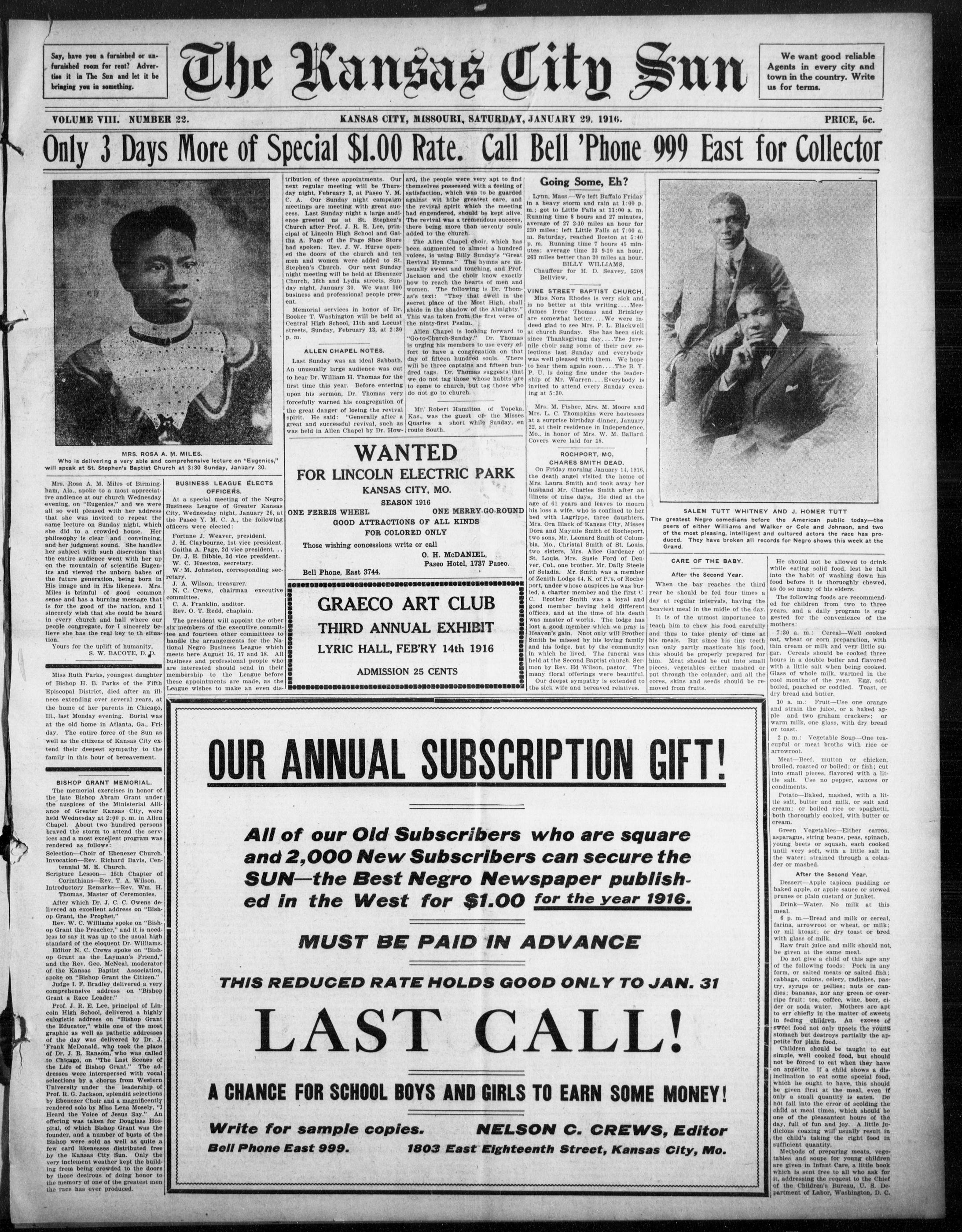
Only 3 Days More of Special $1.00 Rate. Call Bell 'Phone 999 East for Collector
Say, have you a furnished or unfurnished room for rent? Advertise it in The Sun and let it be bringing you in something.
VOLUME VIII. NUMBER 22.
Only 3 Days M
Days Mo
Mary C.
MRS. ROSA A. M. MILES.
Who is delivering a very able and comprehensive lecture on "Eugenics," will speak at St. Stephen's Baptist Church at 3:30 Sunday, January 30.
Mrs. Rosa A. M. Miles of Birmingham, Ala., spoke to a most appreciative audience at our church Wednesday evening, on "Eugenics," and we were all so well pleased with her address that she was invited to repeat the same lecture on Sunday night, which she did to a crowded house. Her philosophy is clear and convincing, and her judgment sound. She handles her subject with such discretion that the entire audience went with her up on the mountain of scientific Eugenics and viewed the unborn babes of the future generation, being born in His image and in His likeness. Mrs. Miles is brimful of good common sense and has a burning message that is for the good of the nation, and I sincerely wish that she could be heard in every church and hall where our people congregate, for I sincerely believe she has the real key to the situation.
Yours for the uplift of humanity,
S. W. BACOT, D. D.
BUSINESS LEAGUE ELECTS OFFICERS.
At a special meeting of the Negr Business League of Greater Kansas City, Wednesday night, January 26, at the Paseo Y. M. C. A., the followin officers were elected:
Fortune J. Weaver, president.
J. H. Claybourne, 1st vice president.
Gaitha A. Page, 2d vice president.
Dr. J. E. Dibble, 3d vice president.
W. C. Hueston, secretary.
W. M. Johnston, corresponding secretary.
J. A. Wilson, treasurer.
N. C. Crews, chairman executive committee.
C. A. Franklin, auditor.
Rev. O. T. Redd, chaplain.
The president will appoint the other six members of the executive committee and fourteen other committees to handle the arrangements for the National Negro Business League which meets here August 16, 17 and 18.
Miss Ruth Parks, youngest daughter of Bishop H. B. Parks of the Fifth Episcopal District, died after an illnes extending over several years, at the home of her parents in Chicago, Ill., last Monday evening. Burial was at the old home in Atlanta, Ga., Friday. The entire force of the Sun as well as the citizens of Kansas City extend their deepest sympathy to the family in this hour of bereavement.
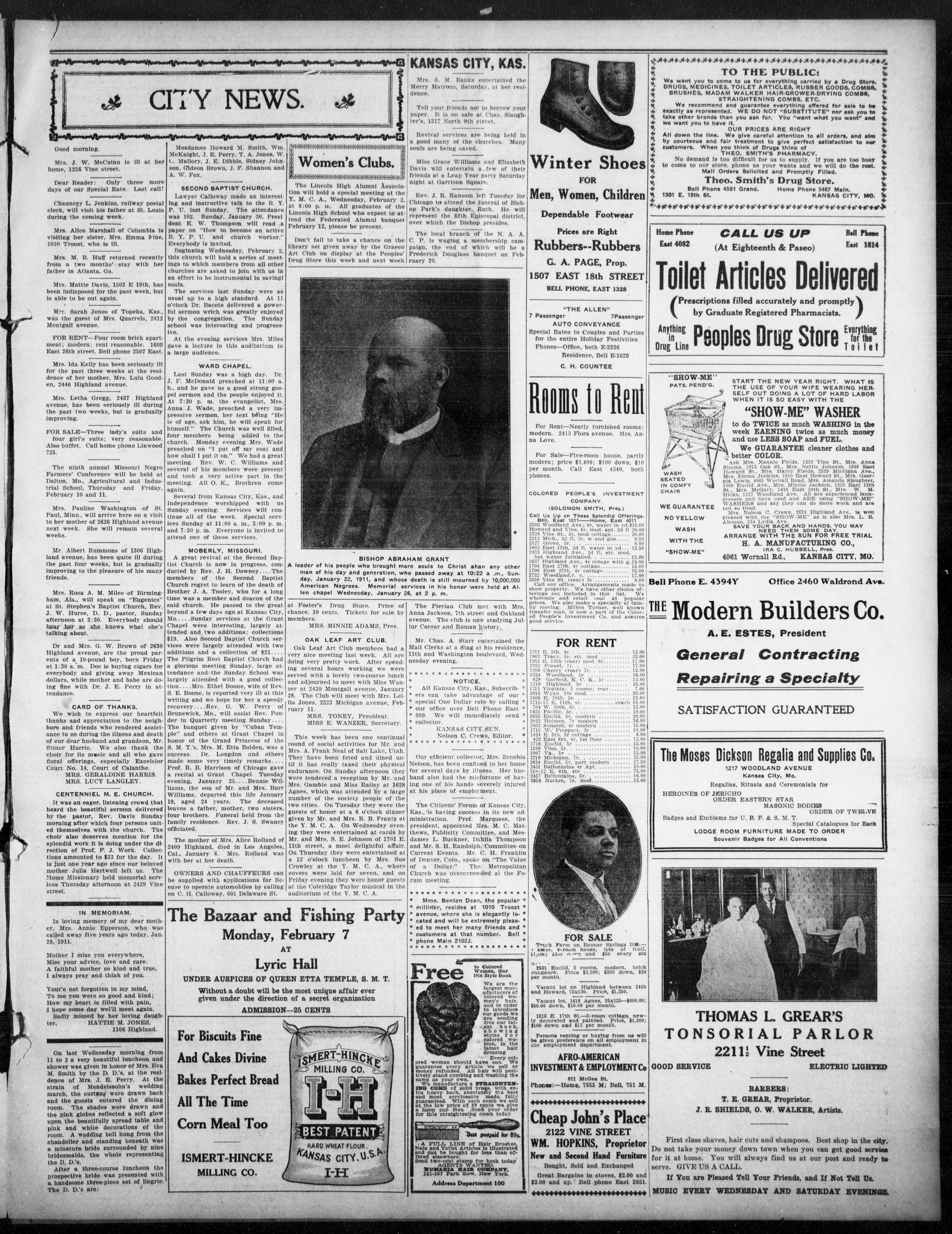
BISHOP GRANT MEMORIAL.
The memorial exercises in honor of the late Bishop Abram Grant under the auspices of the Ministerial Alliance of Greater Kansas City, were held Wednesday at 2:00 p. m. in Allen Chapel. About two hundred persons braved the storm to attend the services and a most excellent program was rendered as follows:
Selection—Choir of Ebenezer Church.
Invocation—Rev. Richard Davis, Centennial M. E. Church.
Scripture Lesson—15th Chapter of Corinthians—Rev. T. A. Wilson.
Introductory Remarks—Rev. Wm. H. Thomas, Master of Ceremonies.
After which Dr. J. C. C. Owens delivered an excellent address on "Bishop Grant, the Prophet."
Rev. W. C. Williams spoke on "Bishop Grant the Preacher," and it is needless to say it was up to the usual high standard of the eloquent Dr. Williams.
Editor N. C. Crews spoke on "Bishop Grant as the Layman's Friend," and the Rev. Geo. McNeal, moderator of the Kansas Baptist Association, spoke on "Bishop Grant the Citizen."
Judge I. F. Bradley delivered a very comprehensive address on "Bishop Grant a Race Leader."
Prof. J. R. E. Lee, principal of Lincoln High School, delivered a highly eulogistic address on "Bishop Grant the Educator," while one of the most graphic as well as pathetic addresses of the day was delivered by Dr. J. Frank McDonald, who took the place of Dr. J. R. Ransom, who was called to Chicago, on "The Last Scenes of the Life of Bishop Grant." The addresses were interspersed with vocal selections by a chorus from Western University under the leadership of Prof. R. G. Jackson, splendid selections by Ebenezer Choir and a magnificently rendered solo by Miss Lena Mosely, "I Heard the Voice of Jesus Say." An offering was taken for Douglass Hospital, of which Bishop Grant was the founder, and a number of busts of the Bishop were sold as well as quite a few card likenesses distributed free by the Kansas City Sun. Only the very inclement weather kept the building from being crowded to the doors by those desirous of doing honor to the memory of one of the greatest men the race has ever produced.
The Kansas City Sun
comprehensive lecture on "Eugenics," arch at 3:30 Sunday, January 30.
BUSINESS LEAGUE ELECTS OFFICERS.
At a special meeting of the Negro Business League of Greater Kansas City, Wednesday night, January 26, at the Paseo Y. M. C. A., the following officers were elected:
Fortune J. Weaver, president.
J. H. Claybourne, 1st vice president.
Gaitha A. Page, 2d vice president. ...
Dr. J. E. Dibble, 3d vice president.
W. C. Hueston, secretary.
W. M. Johnston, corresponding secretary.
J. A. Wilson, treasurer.
N. C. Crews, chairman executive committee.
C. A. Franklin, auditor.
Rev. O. T. Redd, chaplain.
The president will appoint the other six members of the executive committee and fourteen other committees to handle the arrangements for the National Negro Business League which meets here August 16, 17 and 18. All business and professional people who are interested should send in their membership to the League before these appointments are made, as the League wishes to make an even dis-
OUR ANNUAL SUBSCRIPTION GIFT!
All of our Old Subscribers who are square and 2,000 New Subscribers can secure the SUN—the Best Negro Newspaper published in the West for $1.00 for the year 1916.
THIS REDUCED RATE HOLDS GOOD ONLY TO JAN. 31
Write for sample copies. NELSON C. CREWS, Editor Bell Phone East 999. 1803 East Eighteenth Street, Kansas City, Mo.
KANSAS CITY, MISSOURI, SATURDAY, JANUARY 29, 1916.
tribution of these appointments. Our next regular meeting will be Thursday night, February 3, at Paseo Y. M. C. A. Our Sunday night campaign meetings are meeting with great success. Last Sunday night a large audience greeted us at St. Stephen's Church after Prof. J. R. E. Lee, principal of Lincoln High School and Gaitha A. Page of the Page Shoe Store had spoken. Rev. J. W. Hurse opened the doors of the church and ten men and women were added to St. Stephen's Church. Our next Sunday night meeting will be held at Ebenezer Church, 16th and Lydia streets, Sunday night, January 30. We want 100 business and professional people present.
ard, the people were very apt to find themselves possessed with a feeling of satisfaction, which was to be guarded against wit hite greatest care, and the revival spirit which the meeting had engendered, should be kept alive. The revival was a tremendous success, there being more than seventy souls added to the church.
The Allen Chapel choir, which has been augmented to almost a hundred voices, is using Billy Sunday's "Great Revival Hymns." The hymns are unusually sweet and touching, and Prof. Jackson and the choir know exactly how to reach the hearts of men and women. The following is Dr. Thomas's text: "They that dwell in the secret place of the Most High, shall abide in the shadow of the Almighty." This was taken from the first verse of the ninety-first Psalm.
Memorial services in honor of Dr Booker T. Washington will be held at Central High School, 11th and Locust streets, Sunday, February 13, at 2:30 p. m.
Allen Chapel is looking forward to "Go-to-Church-Sunday." Dr. Thomas is urging his members to use every effort to have a congregation on that day of fifteen hundred souls. There will be three captains and fifteen hundred tags. Dr. Thomas suggests that we do not tag those whose habits are to come to church, but tag those who do not go to church.
ALLEN CHAPEL NOTES.
Last Sunday was an ideal Sabbath. An unusually large audience was out to hear Dr. William H. Thomas for the first time this year. Before entering upon his sermon, Dr. Thomas very forcefully warned his congregation of the great danger of losing the revival spirit. He said: "Generally after a great and successful revival, such as was held in Allen Chapel by Dr. How-
Mr. Robert Hamilton of Topeka
Kas., was the guest of the Misses
Quarles a short while Sunday, en
route South.
NTED
ELECTRIC PARK
CITY, MO.
ON 1916
ONE MERRY GO ROUND
ONS OF ALL KINDS
ORED ONLY
site or call
WANTED
FOR LINCOLN ELECT
KANSAS CITY, M
SEASON 1916
ONE FERRIS WHEEL
GOOD ATTRACTIONS OF A
FOR COLORED ONLY
Those wishing concessions write or call
Bell Phone. East 3744.
ART CLUB
UAL EXHIBIT
EB'RY 14th 1916
GRAECO ART
THIRD ANNUAL
LYRIC HALL, FEB'RY
LYRIC HALL, FEB'RY 14th 1916
ADMISSION 25 CENTS
OUDOO
O. H. McDANIEL,
Paseo Hotel, 1737 Paseo.
Going Some, Eh?
Lynn, Mass.—We left Buffalo Friday in a heavy storm and rain at 1:00 p. m.; got to Little Falls at 11:00 a. m. Running time 8 hours and 27 minutes, average of 27 2-10 miles an hour for 230 miles; left Little Falls at 7:00 a. m. Saturday, reached Boston at 5:40 p. m. Running time 7 hours 45 minutes; average time 33 9-10 an hour, 263 miles better than 30 miles an hour. BILLY WILLIAMS. Chauffeur for H. D. Seavey, 5208 Bellview.
VINE STREET BAPTIST CHURCH. Miss Nora Rhodes is very sick and is no better at this writing....Mesdames Irene Thomas and Brinkley are somewhat better....We were indeed glad to see Mrs. P. L. Blackwell at church Sunday. She has been sick since Thanksgiving day....The juvenile choir sang some of their new selections last Sunday and everybody was well pleased with them. We hope to hear them again soon....The B. Y. P. U. is doing fine under the leadership of Mr. Warren....Everybody is invited to attend every Sunday evening at 5:30.
Mrs. M. Fisher, Mrs. M. Moore and Mrs. L. C. Thompkins were hostesses at a surprise birthday dinner, January 22, at their residence in Independence, Mo., in honor of Mrs. W. M. Ballard. Covers were laid for 18.
ROCHPORT, MO.
On Friday morning January 14, 1916, the death angel visited the home of Mrs. Laura Smith and took away her husband Mr. Charles Smith after an illness of nine days. He died at the age of 61 years and leaves to mourn his loss a wife, who is confined to her bed with Lagripe, three daughters, Mrs. Ora Black of Kansas City, Misses Dora and Maymie Smith of Rocheport, two sons, Mr. Leonard Smith of Columbia, Mo., Christal Smith of St. Louis, two sisters, Mrs. Alice Gardener of St. Louis, Mrs. Susie Ford of Denver. Col., one brother, Mr. Dally Steele of Seladia, Mr. Smith was a member of Zenith Lodge 64. K. of P.'s, of Rocheport, under whose auspices he was buried, a charter member and the first C. C. Brother Smith was a loyal and good member heving held different offices, and at the time of his death was master of works. The lodge has lost a good member which we pray is Heaven's gain. Nnot only will Brother Smith be missed by his loving family and his lodge, but by the community in which he lived. The funeral was held at the Second Baptist church. Sermon by Rev. Ed Wilson, pastor. The many floral offerings were beautiful. Our deepest sympathy is extended to the sick wife and bereaved relatives.
THE FOLLOWING PHOTOGRAPH IS A PHOTO OF THE FOLLOWING PHOTOGRAPH. THE FOLLOWING PHOTOGRAPH IS A PHOTO OF THE FOLLOWING PHOTOGRAPH.
SALEM TUTT WHITNEY AND J. HOMER TUTT The greatest Negro comedians before the American public today—the peers of either Williams and Walker or Cole and Johnson, and two of the most pleasing, intelligent and cultured actors the race has produced. They have broken all records for Negro shows this week at the Grand.
CARE OF THE BABY.
After the Second Year.
When the bay reaches the third year he should be fed four times a day at regular intervals, having the heaviest meal in the middle of the day.
It is of the utmost importance to teach him to chew his food carefully and thus to take plenty of time at his meals. But since his tiny teeth can only partly masticate his food, this should be properly prepared for him. Meat should be cut into small pieces, vegetables either mashed on put through the colander, and all the cores, skins and seeds should be removed from fruits.
We want good reliable Agents in every city and town in the country. Write us for terms.
PRICE, 5c.
or Collector
Y AND J. HOMER TUTT
are the American public today—the
Walker or Cole and Johnson, and two
and cultured actors the race has pro-
cords for Negro shows this week at the
He should not be allowed to drink while eating solid food, lest he fall into the habit of washing down his food before it is thorughly chewed, as do so many of his elders.
The following foods are recommended for children from two to three years, and a daily program is suggested for the convenience of the mothers:
7:30 a. m.: Cereal—Well cooked out, wheat or corn preparation, with thin cream or milk and very little sugar. Cereals should be cooked three hours in a double boiler and flavored with a little salt when being cooked. Glass of whole milk, warmed in the cool months of the year. Egg, soft boiled, poached or coddled. Toast, or dry bread and butter.
10 a. m.: Fruit—Use one orange and strain the juice, or a baked apple and two graham crackers; or warm milk, one glass, with dry bread or toast.
2 p. m.: Vegetable Soup—One teacupful or meat broth with rice or arrowroot.
Meat—Beef, mutton or chicken, broiled, roasted or boiled; or fish; cut into small pieces, flavored with a little salt. Use no pepper, sauces or condiments.
Potato—Baked, mashed, with a little salt, butter and milk, or salt and cream; or boiled rice or spaghetti, both thoroughly cooked, with butter or cream.
Green Vegetables—Either carros, asparagus, string beans, peas, spinach, young beets or squash, each cooked until very soft, with a little salt in the water; strained through a colander or mashed.
After the Second Year.
Dessert—Apple tapioca pudding or baked apple, or apple sauce or stewed prunes or plain custard or junket.
Drink—Water. No milk at this meal.
6 p. m.—Bread and milk or cereal, farina, arrowroot or wheat, or milk; or mil ktoast; or dry toast or bred with glass of milk.
Raw fruit juice and milk should not be given at the same meal.
Do not give a child of this age any of the following foods: Pork in any form, or salted meats or salted fish; cabbage, onions, celery, radishes, pastry, syrups or pellies; nuts or candies; bananas, nor any green or overripe fruit; tea, coffee, wine, beer, cider or soda water. Mothers are apt to err chiefly in the matter of sweets in feding children. An excess of sweet food not only upsets the young stomach but destroys partially the appetite for plain food.
Children should be taught to eat simple, well cooked food, but should not be forced to eat when they have on appétite. If a child shows a disinclination to eat some special food, which he ought to have, this should be given first at the meal, even if only a small quantity is eaten. Do not fall into the error of scolding the child at meal times, which should be one of the pleasantest hours of the day, full of fun and joy. A little judicious coaxing will usually result in the child's taking the right food in sufficient quantity.
Methods of preparing meats, vegetables and soups for young children are given in Infant Care, a little book which is sent free to all who ask for it, addressing the request to the Chief of the Children's Bureau, U. S. Department of Labor, Washington, D. C.
INTERNATIONAL
SUNDAY SCHOOL
LESSON
(By E. O. SELLERS, Acting Director of the Sunday School Course of the Moody Bible Institute of Chicago.)
(Copyright, 1915, Western Newspaper Union.)
LESSON FOR JANUARY 30
THE LAME MAN LEAPING.
LESSON TEXT-Acts 2
LESSON TEXT—Acts 3.
GOLDEN—Acts 3. "Silver and gold have I mote, but what I have that give I thee. In the name of Jesus Christ of Nazareth, walk."—Acts 3 R. V.
The coming of power (chapter 2) is soon tested outside of the circle of believers. It is put to a public test, is tried as to its efficacy physically, i. e., has the Holy Spirit power physically as well as over the spirits of men?
i. The Appeal to Peter and John, vv. 1-10. Following Pentecost the disciples seem to have continued their accustomed mode of life. (1) The apostles and worship (v. 1). As yet, and indeed for many years to come, there was no particular separation of Jews and Christians.
Praying men like these two leaders, Peter and John, continued to fulfill their temple duties. The ninth hour was the prayer hour, the hour of sacrifice (Ex. 29:33, J Kings 18:36.
All true approach to God must be on the grounds of sacrifice (John 14:6, Heb. 9:22) and we must remember that this hour was the one at which Jesus died for us, our sacrifice (Heb. 10:19, 29).
Emphasize the need and importance of worship and prayer.
(2) The afflicted one (v. 2). This man had been there often and made his usual appeal; his expectation was limited to material aid (v. 5); he may or he may not have been familiar with Christ and his teachings, but something unusual was about to happen because the two to whom he appealed really knew God and on them now rested this new power in the world.
(3) The apostle's response (vv. 4:7). Peter took a good look at the man (v. 4). Peter was changed by a look (Matt. 16:7). What he saw was the man's fundamental spiritual need. (a) Demanding the man's undivided attention, Peter gave the man what he had not—not what the man wanted or expected. Peter's words. "Look on us." and Paul's "be ye followers of me" (I Cor. 4:16) are in no wise egotistical, but in each case the fearless appeal of a man wholly God's, men conscious of the endowment of power, trying to seize the wavering wiles of men that they might point them to Christ. (b) Peter aroused the man's expectancy. It is usually men lacking in silver and gold who give to the world its greatest blessings and highest good (I Cor. 4:11).
The appeal to curiosity is a perfectly legitimate one. (c) Peter gave a personal testimony. What he was about to do for the man was not in or of himself.
Every effective Christian worker must base his appeal upon the facts of a personal experience (I. Pet. 4:10. 11). (d) Peter bade the man to do the very thing he (humanly) could not do, but the thing which, "in the name of Jesus Christ" he would be able to do.
The power of that mighty name came into the lame feet the moment he believed (v. 7; cf. v. 16).
Notice how full the account given by Luke, who was a physician. (e) Peter followed the word of testimony and of command by a personal touch (v. 7; see also Mark 1:31).
The personal testimony plus the personal touch, and both "in the name of Jesus," are sure to produce results.
(4) The result. (1) Upon the man. There is no doubt as to the completeness of the cure (v. 8). He had "strength;" was "lifted up" from his former position of weakness; he "leaped" (literally, ecstatic joy); he "walked," continuous activity; and he "worshiped," thanksgiving and renewing of strength. (2) Upon the people. (a) "All the people saw." They may not have heard or comprehended the words of Peter, but they did witness the transformation. (b) "They took knowledge" (v. 10), they began to observe, even as the world always does, the one who professes his faith in Christ? (c) They were filled with "wonder and amazement" (v. 10), they could not understand. No more can the world of today (see I Cor. 1:18. 23) really comprehend the Christian. There was no guesswork, however, about this miracle, and, of the people who witnessed it and were so filled with wonder and amazement, many were converted (ch. 4:4).
The miracle served to get for the gospel a good hearing and it accomplished its purpose (Rom. 1:16).
II. Peter's Appeal to the People, vv. 11-26. Notice it was the man who attracted the crowd, not Peter or John for he eagerly held the disciples while the crowd gathered (John 5:10, 11). This may suggest the weakness of the man's faith in that he depended upon Peter and John rather than upon Jesus. (1) Peter seized this opportunity (v. 12) and began his salutation by taking advantage of their curiosity. Peter eagerly turned their thoughts from himself unto Jesus. He wished to divert attention from himself and used the miracle for the double purpose of glorifying Jesus Christ and to convict these men of their sin.
Verses 18, 14, 15 contain the charges, whereof Peter and John were "wit nesses." They were not to look upon "us" as though they had done anything, nor was it some new God of whom they witnessed (v. 13). The act of the crucifixion, he grants, may have been consummated in ignorance (v 17), but since God had raised Jesus from the dead, and this doctrine of the resurrection was new, therefore they ought to repent even though their acts were in accord with prophecy. Peter appeals to Jewish pride. Is such an appeal legitimate?
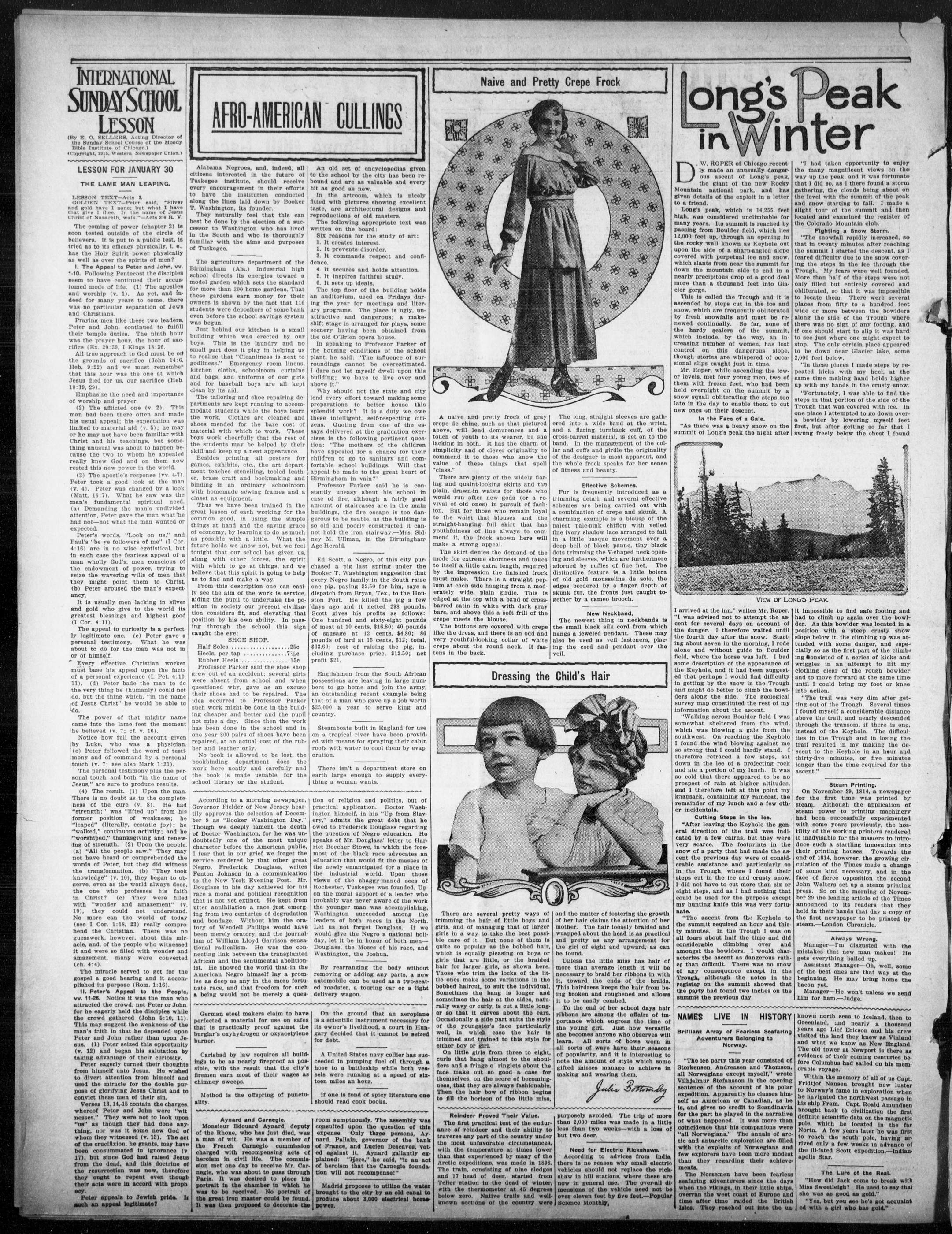
AFRO-AMERICAN CULLINGS
---
---
---
Alabama Negroes, and, indeed, all citizens interested in the future of Tuskegee institute, should receive every encouragement in their efforts to have the institution conducted along the lines laid down by Booker T. Washington, its founder.
They naturally feel that this can best be done by the election of a successor to Washington who has lived in the South and who is thoroughly familiar with the aims and purposes of Tuskegee.
The agriculture department of the Birmingham (Ala.) Industrial high school directs its energies toward a model garden which sets the standard for more than 300 home gardens. That these gardens earn money for their owners is shown by the fact that 116 students were depositors of some bank even before the school savings system was begun.
Just behind our kitchen is a small building which was erected by our boys. This is the laundry and no small part does it play in helping us to realize that "Cleanliness is next to godliness." Emergency room linens, school clothes, schoolroom curtains and bags, and uniforms of our girls and for baseball boys are all kept clean by its aid.
The tailoring and shoe repairing departments are kept running to accommodate students while the boys learn the work. Clothes are cleaned and shoes mended for the bare cost of material with which to work. These boys work cheerfully that the rest of the students may be helped by their skill and keep up a neat appearance.
Besides printing all posters for games, exhibits, etc., the art department teaches stenciling, tooled leather, brass craft and bookmaking and binding in an ordinary schoolroom with homemade sewing frames and a closet as equipment.
Thus we have been trained in the great lesson of each working for the common good, in using the simple things at hand and the saving grace of economy, by learning to do as much as possible with a little. What the future holds we know not, but we feel tonight that our school has given us, along with other forces, the spirit with which to go at things, and we believe that this spirit is going to help us to find and make a way.
From this description one can easily see the aim of the work is service, aiding the pupil to undertake the position in society our present civilization considers fit, and elevating that position by his own ability. In passing through the school this sign caught the eye:
SHOE SHOP
Half Soles ..... 25c
Heels, per tap ..... 7½c
Rubber Heels ..... 15c
Professor Parker said the shoe shop grew out of an accident; several girls were absent from school and when questioned why, gave as an excuse their shoes had to be repaired. The idea occurred to Professor Parker such work might be done in the building cheaper and better and the pupil not miss a day. Since then the work has been done in the school and in one year 800 pairs of shoes have been repaired, at an actual cost of the rubber and leather only.
No book is allowed to be lost, the bookbinding department does the work here neatly and carefully and the book is made usable for the school library or the student.
According to a morning newspaper, Governor Fielder of New Jersey heartily approves the selection of December 9 as "Booker Washington Day." Though we deeply lament the death of Doctor Washington, for he was undoubtedly one of the most unique character before the American public, I fear that in our grief we forget the service rendered by that other great Negro, Frederick Douglass, writes Fenton Johnson in a communication to the New York Evening Post. Mr. Douglass in his day achieved for his race a moral and political recognition that is not yet extinct. He kept from utter annihilation a race just emerging from two centuries of degradation and bondage. Without him the oratory of Wendell Phillips would have been merely oratory, and the journalism of William Lloyd Garrison sensational radicalism. He was the connecting link between the transplanted African and the sentimental abolitionist. He showed the world that in the American Negro himself lay a promise as deep as any in the more fortunate race, and that freedom for such a being would not be merely a ques-
German steel makers claim to have perfected a material for use on safes that is practically proof against the burglar's oxyhydrogen or oxyacetylene burner.
Carlsbad by law requires all buildings to be as nearly fireproof as possible, with the result that the city's firemen earn most of their wages as chimney sweeps.
Method is the offspring of punctuality.
Monsieur Eduard Aynard, deputy of the Rhone, who has just died, was a man of wit. He was a member of the French Carnegie commission charged with recompensing acts of herolism in civil life. The commission met one day to receive Mr. Carnegie, who was about to pass through Paris. It was desired to place his portrait in the chamber in which he was to be received. No portrait of the great iron master could be found. It was then proposed to decorate the
An old set of encyclopedias given to the school by the city has been rebound and are as valuable and every bit as good as new.
In the artroom, which is nicely fitted with pictures showing excellent taste, are architectural designs and reproductions of old masters.
The following appropriate text was written on the board:
Six reasons for the study of art:
1. It creates interest.
2. It is useful.
2. It prevents disorder.
3. It commands respect and confidence.
4. It secures and holds attention.
5. It inspires faithful study.
6. It sets up ideals.
The top floor of the building holds an auditorium, used on Fridays during the year for meetings and literary programs. The place is ugly, unattractive and dangerous; a makeshift stage is arranged for plays, some scenery having been obtained from the old O'Brien opera house.
In speaking to Professor Parker of the housing conditions of the school plant, he said: "The influence of surroundings cannot be overestimated. I dare not let myself dwell upon this building; we have to live over and above it."
Why should not the state and city lend every effort toward making some preparations to better house this splendid work? It is a duty we owe these intelligent, self-respecting citizens. Quoting from one of the essays delivered at the graduation exercises is the following pertinent question: "The mothers of the children have appealed for a chance for their children to go to sanitary and comfortable school buildings. Will that appeal be made to the great heart of Birmingham in vain?" Professor Parker said he is constantly uneasy about his school in case of fire, although a fairly good amount of staircases are in the main buildings, the fire escape is too dangerous to be usable, as the building is so old and poorly constructed it cannot hold the iron stairway—Mrs. Sidney M. Ullman, in the Birmingham Age-Herald.
Ed Scott, a Negro, of this city purchased a pig last spring under the Booker T. Washington suggestion that every Negro family in the South raise one pig, paying $2.50 for him, says a dispatch from Bryan, Tex., to the Houston Post. He killed the pig a few days ago and it netted 298 pounds. Scott gives his profits as follows: One hundred and sixty-eight pounds of meat at 10 cents, $16.80; 40 pounds of sausage at 12 cents, $4.80; 80 pounds of lard at 15 cents, $12; total, $33.60; cost of raising the pig, including purchase price, $12.50; net profit $21.
Englishmen from the South African possessions are leaving in large numbers to go home and join the army, an outstanding recent example being that of a man who gave up a job worth $25,000 a year to serve king and country.
Steamboats built in England for use on a tropical river have been provided with means for spraying their cabin roofs with water to cool them by evaporation.
There isn't a department store on earth large enough to supply everything a woman wants.
tion of religion and politics, but of practical application. Doctor Washington himself, in his "Up from Slavery," admits the great debt that he owed to Frederick Douglass regarding the question of Negro education. He speaks of Mr. Douglass' letter to Harriet Beecher Stowe, in which the foremost of the black race advocates an education that would fit the masses of the newly emancipated for a place in the industrial world. Upon those views of the shaggy-maned sees of Rochester, Tuskegee was founded. Upon the moral support of a leader who probably was never aware of the work the younger man was accomplishing, Washington succeeded among the leaders of both races in the North. Let us not forget Douglass. If we would give the Negro a national holiday, let it be in honor of both men—Douglass, the Moses of his race, and Washington, the Joshua.
By rearranging the body without removing or adding any parts, a new automobile can be used as a two-seated roadster, a touring car or a light delivery wagon.
On the ground that an aeroplane is a scientific instrument necessary for its owner's livelihood, a court in Hungary decided that it cannot be seized for debt.
A United States navy collier has succeeded in pumping fuel oil through a hose to a battleship while both vessels were running at a speed of sixteen miles an hour.
If one is fond of spicy literature one should read cook books.
room sumptuously. The assembly was consulted upon the question of this expense. Only three persons, Aynard, Pallain, governor of the bank of France, and Lucien Descaves, voted against it. Aynard gallantly explained: "Here," he said, "is an act of heroism that the Carnegie foundation will not recompense!"
Madrid proposes to utilize the water brought to the city by an old canal to produce about 3,000 electrical horsepower.
O
Dressing the Child's Hair
A naive and pretty frock of gray crepe de chine, such as that pictured above, will lend demureness and a touch of youth to its wearer, be she lacking in both. It has the charm of simplicity and of clever originality to commend it to those who know the value of these things that spell "class."
There are plenty of the widely flaring and quaint-looking skirts and the plain, drawn-in waists for those who would run after new gods (or a revival of old ones) in pursuit of fashion. But for those who remain loyal to the waist that blouses and the straight-hanging full skirt that has youthfulness of line always to commend it, the frock shown here will make a strong appeal.
The skirt denies the demand of the mode for extreme shortness and takes to itself a little extra length, required by the impression the finished frock must make. There is a straight peplum at each side hanging from a moderately wide, plain girdle. This is edged at the top with a band of crossbarred satin in white with dark gray bars, and above this a soft frill of the crepe meets the blouse.
The buttons are covered with crepe like the dress, and there is an odd and very youthful-looking collar of white crepe about the round neck. It fastens in the back.
Dressing the
There are several pretty ways of trimming the hair of little boys and girls, and of managing that of larger girls in a way to take the best possible care of it. But none of them is quite so popular as the bobbed hair, which is equally pleasing on boys or girls that are little, or the braided hair for larger girls, as shown here. Those who trim the locks of the little ones make some variations in the bobbed haircut, to suit the individual. Sometimes the bang is longer and sometimes the hair at the sides, naturally wavy or curly, is cut a little longer so that it curves about the ears. Occasionally a side part suits the style of the youngster's face particularly well, in which case the hair is trimmed and trained to this style for either boy or girl.
On little girls from three to eight, curls that hang almost to the shoulders and a fringe o' ringlets about the face make out so good a case for themselves, on the score of becomingness, that they are always fashionable. Then the hair bow of ribbon begins to fill the horizon of the little miss,
The first practical test of the endurance of reindeer and their ability to traverse any part of the country under the most unfavorable circumstances, with the temperature at times lower than that experienced by many of the Arctic expeditions, was made in 1898. The train, consisting of nine sledges and 17 head of deer, started from Teller station in the dead of winter, with the thermometer at 45 degrees below zero. Native trails and well-known sections of the country were
The long, straight sleeves are gathered into a wide band at the wrist, and a flaring turnback cuff, of the cross-barred material, is set on to the band. In the management of the collar and cuffs and girdle the originality of the designer is most apparent, and the whole frock speaks for her sense of fitness and beauty.
Effective Schemes
Fur is frequently introduced as a trimming detail, and several effective schemes are being carried out with a combination of crepe and skunk. A charming example is a blouse of the paleest pale-pink chiffon with veiled fine ivory shadow lace arranged to fall in a little basque movement over a deep bell of black panne, tiny black dots trimming the V-shaped neck opening and sleeves, which are furthermore adorned by ruffles of fine net. The distinctive feature is a little bolera of old gold mousseline de sole, the edges bordered by a finger depth of skunk fur, the fronts just caught together by a cameo brooch.
New Neckband.
The newest thing in neckbands is the small black silk cord from which hangs a jeweled pendant. These may also be used as veil fasteners, placing the cord and pendant over the veil.
Child's Hair
and the matter of fostering the growth of her hair claims the attention of her mother. The hair loosely braided and wrapped about the head is as practical and pretty as any arrangement for the girl of eight and upward, as can be found.
Unless the little miss has hair of more than average length it will be necessary to braid her ribbons in with it, toward the ends of the braids. This hairdress keeps the hair from being broken and roughened and allows it to be easily combed.
To the end of her school days hair ribbons are among the affairs of importance which engross the time of the young girl. Just how versatile she becomes anyone who observes will learn. All sorts of bows worn in all sorts of ways have their seasons of popularity, and it is interesting to note the amount of style which some gifted misses manage to achieve in making and wearing them.
Julia Bottomly
purposely avoided. The trip of more than 2,000 miles was made in a little less than two weeks—with a loss of but two deer.
Need for Electric Rickshaws. According to advice from India, there is no reason why small electric vehicles should not replace the rickshaw in hill stations, where these are now in general use. The over-all dimensions of the vehicle need not be over eleven feet by five feet.—Popular Science Monthly.
Long's Peak in Winter
D. W. ROPER of Chicago recently made an unusually dangerous ascent of Long's peak, the giant of the new Rocky Mountain national park, and has given details of the exploit in a letter to a friend.
Long's peak, which is 14,255 feet high, was considered unclimbed for many years. Its summit is reached by passing from Boulder field, which lies 12,000 feet up, through an opening in the rocky wall known as Keyhole out upon the side of a sharp-angled slope covered with perpetual ice and snow, which slants from near the summit far down the mountain side to end in a nearly precipitous drop of a good deal more than a thousand feet into Glacier gorge.
This is called the Trough and it is ascended by steps cut in the ice and snow, which are frequently obliterated by fresh snowfalls and must be renewed continually. So far, none of the hardy scalers of the summit, which include, by the way, an increasing number of women, has lost control on this dangerous slope, though stories are whispered of occasional slips caught just in time.
Mr. Roper, while ascending the lower levels, met four young men, two of them with frozen feet, who had been held overnight on the summit by a snow squall obliterating the steps too late in the day to enable them to cut new ones on their descent.
In the Face of a Gale.
"As there was a heavy snow on the summit of Long's peak the night after
J
VIEW OF LONGS PEAK
I arrived at the inn," writes Mr. Roper, "I was advised not to attempt the ascent for several days on account of the danger. I therefore waited until the fourth day after the snow. Starting about seven in the morning, I rode alone and without guide to Boulder field, where the horse was left. I had some description of the appearance of the Keyhole, and it had been suggested that perhaps I would find difficulty in getting by the snow in the Trough and might do better to climb the boulders along the side. The geological survey map constituted the rest of my information about the ascent.
"Walking across Boulder field I was somewhat sheltered from the wind, which was blowing a gale from the southwest. On reaching the Keyhole I found the wind blowing against me so strong that I could hardly stand. I therefore retraced a few steps, sat down in the lee of a projecting rock and ate a portion of my lunch. It was so cold that there appeared to be no prospect of rain at higher altitudes, and I therefore left at this point my knapsack, containing my raincoat, the remainder of my lunch and a few other incidentals.
Cutting Steps in the Ice.
"After leaving the Keyhole the general direction of the trail was indicated by a few cairns, but they were very scarce. The footprints in the snow of a party that had made the ascent the previous day were of considerable assistance and particularly so in the Trough, where I found their steps cut in the ice and crusty snow. I did not have to cut more than six or eight steps, and as I had nothing that could be used for the purpose except my hunting knife this was very fortunate.
"The ascent from the Keyhole to the summit required an hour and thirty minutes. In the Trough I was on all fours about half the time and did considerable climbing over and amongst the bowlers. I would characterize the ascent as dangerous rather than difficult. There was no snow of any consequence except in the Trough, although the notes in the register on the summit showed that the party had found two inches on the summit the previous day.
NAMES LIVE IN HISTORY
Brilliant Array of Fearless Seafaring Adventurers Belonging to Norway.
"The ice party this year consisted of Storkensen, Andreasen and Thomson, all Norwegians except myself," wrote Vilhjalmur Stefansson in the opening sentence of the account of his polar expedition. Apparently he classes himself as American or Canadian, as he is, and gives no credit to Scandinavia for the part he played in the narrative of what happened. It was more than coincidence that his companions were "all Norwegians." The annals of arctic and antarctic exploration are filled with the exploits of Norwegians and few explorers have been more modest than they regarding their achievements.
The Norsemen have been fearless seafaring adventurers since the days when the vikings, in their little ships, overran the west coast of Europe and time after time raided the British Isles. They reached out into the un-
"I had taken opportunity to enjoy the many magnificent views on the way up the peak, and it was fortunate that I did so, as I there found a storm gathering, the clouds being about on the level with the summit of the peak and snow starting to fall. I made a slight tour of the summit and then located and examined the register of the Colorado Mountain club.
Fighting a Snow Storm.
Fighting a Snow Storm.
"The snowfall rapidly increased, so that in twenty minutes after reaching the summit I started the descent, as I feared difficulty due to the snow covering the steps in the ice through the Trough. My fears were well founded. More than half of the steps were not only filled but entirely covered and obliterated, so that it was impossible to locate them. There were several places from fifty to a hundred feet wide or more between the bowlers along the side of the Trough where there was no sign of any footing, and if one should start to slip it was hard to see just where one might expect to stop. The only certain place appeared to be down near Glacier lake, some 2,000 feet below.
"In these places I made steps by repeated kicks with my heel, at the same time making hand holds higher up with my hands in the crusty snow.
"Fortunately, I was able to find the steps in that portion of the side of the Trough that was covered with ice. In one place I attempted to go down over a bowler by lowering myself feet first, but after getting so far that I swung freely below the chest I found
NGS PEAK
it impossible to find safe footing and had to climb up again over the bowler. As this bowler was located in a position with a steep crusty snow slope below it, the climbing up was attended with some danger, and especially so as the first part of the climbing consisted of a series of kicks and wriggles in an attempt to lift my clothing clear of the rough bowler and to move forward at the same time until I could bring my foot or knee into action.
"The trail was very dim after getting out of the Trough. Several times I found myself a considerable distance above the trail, and nearly descended through the transom, if there is one, instead of the Keyhole. The difficulties in the Trough and in losing the trail resulted in my making the descent to the Keyhole in an hour and thirty-five minutes, or five minutes longer than the time required for the ascent."
On November 29, 1814, a newspaper for the first time was printed by steam. Although the application of steam power to printing machinery had been successfully experimented with some years previously, the hostility of the working printers rendered it inadvisable for the masters to introduce such a startling innovation into their printing houses. Towards the end of 1814, however, the growing circulation of the Times made a change of some kind necessary, and in the face of fierce opposition the second John Walters set up a steam printing press. So on the morning of November 29 the leading article of the Times announced to its readers that they held in their hands that day a copy of the first newspaper to be printed by steam—London Chronicle.
Manager—I'm disgusted with the mistakes that new man makes! He gets everything balled up.
Assistant Manager—Oh, well, some of the best ones are that way at the beginning. He may bring home the bacon yst.
Manager—He won't unless we send him for ham.—Judge.
known north seas to Iceland, then to Greenland, and nearly a thousand years ago Lief Ericson and his crew visited the land they knew as Vinland and what we know as New England. The old tower at Newport is there as evidence of their coming centuries before Columbus had sailed on his memorable voyage.
Within the memory of all of us Capt. Fridtjof Nansen brought new luster to Norway's fame in exploration when he navigated the northwest passage in his ship Fram. Capt. Roald Amundsen brought back to civilization the first definite scientific data on the magnetic pole, which he located in the far Nortn. A few years later he was first to reach the south pole, having arrived only a few weeks in advance of the ill-fated Scott expedition.—Indianapolis Star.
The Lure of the Real.
"How did Jack come to break with Miss Sweetleigh? He used to say that she was as good as gold."
"Yes, but you see he's got acquaint ed with a girl who has gold."
Steam Printing.
Always Wrong.
LITTLE GARMENT AN IMPROVEMENT ON SWEATER.
French Idea That Will Be Eagerly Taken Up May Be Called a Compromisie—its Many Advan-
France has invented an admirable substitute for the sweater, to be worn in the house on cold days and under a coat in the street. It has saved a distressing situation. It covers the shirtwalt, completes the suit without a coat and keeps one warm in the cold.
A woman who dresses exceedingly well, and she says that she dresses on a small income, was the apostle of this garment to a large number of disciples. Hers was of black velvet, looking like a shapely smoking jacket worn by men; it went in at the waistline with a belt and was slightly touched with gold-colored embroidery. It fell to about three inches below the waistline, had long sleeves and no collar. It could be fastened up the front with silk loops over large buttons of silk braid. The garment is called a French gilet and is made in any color.
She wore her black velvet one with a short skirt of black and gray-checked cloth. Underneath the gilet was a white, plaited silk shirt, the rolling collar of which was pulled out. Any woman is quick to see the advantages of this garment. How often has one put on a slightly crushed blouse and then been compelled to take off the coat in a public place; even in one's own home in the morning a sweater is worn for warmth, and yet one cannot wear it in the street under a coat. This little velvet frock is the compromise between an informal frock and a white waist and skirt.
A few of the women who are taking up the idea are having several made on the same pattern in different colors. Young girls are wearing them in brick-dust red and Egyptian blue for skating in the afternoon, under rough homespun trimmed with wide bands in Roman colors.
In the house these colored-gilets are also attractive and can be worn with
1
Muff and Cape Made of Ermine and Sable; a Poiret Model.
any kind of skirt. They need not be embroidered; they can have a slight ornamentation of fine braid. Madame Cheruit invented them, and they rose out of the economical situation of the French women in regard to clothes. Her original garment had chiffon sleeves instead of velvet ones, but the American substitution is better, for two reasons; it makes the garment warmer and does not show the sleeve of the shirtwalst beneath. In its present form I think it is one of the best accessories to the wardrobe that have been invented for several seasons. Every woman should have one at least.
(Copyright, 1916, by the McClure Newspaper Syndicate.)
The Well-Dressed Girl.
The sensible girl will prefer the simplest, neatest, most youthful styles while she is under eighteen. So many girls lose a chance to be real beauties in boyish shirts and neckties and achieve only a bad imitation of a lady of fashion. The girls in fashionable families have beautiful clothes, but the beauty is always of color, texture and finish—never anything startling or conspicuous. Vells are very bad form for girls under eighteen, except for stormy weather; and jeweled combs or hair ornaments should never be worn in the daytime.
To Launder Tatting
To launder tatting successfully, baste it firmly to a Turkish bath towel and proceed to wash it as if it were a part of the towel. When nearly dry press the tatting, still on the towel, then carefully remove the basting threads and you will find your tatting almost like new.
May Be Made Delightfully Cozy and Neat Looking If Proper Taste Is Displayed.
When a bedroom or small dressing room is papered with anything but a plain or neutral paper, bright-colored or flowered chintz should never be used, but often a little color is needed to add toge to the room. In a case of this kind one of the new bedspreads which are so pretty and easily made is just the thing to give the necessary color. Select a plain white spread of good quality and rather heavy.
Cut from chintz a bunch of roses or a spray of gay-colored flowers and baste one in each corner, with a larger one for the center. Sew to the spread and finish the raw edges with a fine feather stitch or with a long and short buttonhole stitch.
This idea can be carried out for scarfs to cover the dressing table and bureau. Make the scarf of linen cut to it the top of each and finish the edges with a scallop or a hem and tint this with the stitch that was used
Hanging Pocket That Costs Little to Make One of the Most Charming of Gifts.
A hanging pocket for the bed is a most useful article to have; handkerchiefs can be found when put there, and lozenges that may have to be taken during the night to relieve a cough. These pockets are particularly handy—invalids lose their handkerchiefs so and do not like to trouble to ring for such trifles. If little necessaries, such as a few clean handkerchiefs, a small bottle of eau-de-cologne, lozenges, and other odds and ends are placed in the pocket, and it is hung where the patient can reach for it without any exertion, many little irritations are saved.
Cut out of cardboard two pieces, one to be 8 inches by 5 inches, the other 7 inches by 8 inches. Now shape
```markdown
```
the piece intended for the pocket, by cutting it like a half circle. Take some print or chintz and cover the pieces of cardboard; put the cardboard between two pieces of chintz and sew the sides together; the edges can be oversewn all round with strong thread.
Each piece of cardboard requires two pieces of chintz, as they are covered back and front.
Sew the pocket to the back piece; if liked, a piece of chintz can be sewn down the center of the pocket to divide it into two.
Now take about half a yard of dainty ribbon to tone with the chintz; sew two ends to the back of the pocket, and tie in a pretty bow at the top, the pocket is then hung up by the ribbon and can be slipped over the bed rail.
The pocket is a charming gift for an invalid, for they appreciate little attentions and thought for their comfort.
NEW COLLARS OF ORGANDIE
Possible to Make Choice of Many Designs, Some of Them Remarkably Pretty.
An organdle collar has revers scalloped and embroidered, and a high, upright accordion plaited frill across the back only. Organdle revers are thickly dotted with hand embroidered dots or bars, with high medi collar dotted and scalloped, wired and worn slightly turned back. Rather stiff organdle with fine hand work is used for collar and cuff sets and vestees. A vestee of organdle in fine tucks is attached to a high collar, with a narrow embroidered turnover just showing on both parts, and a crush ribbon over the collar passes through slits in front, leaving the edges of a fichu about an inch and a half apart.
An elaborate style of organdie collar has a frill of oriental lace on the lower edge to the shoulder only. A partly closed round turnover of embroidered organdie is worn with a short tied cravat of black velvet ribbon.
Handbags Are Dainty
Every woman seems to be trying to outdo every other woman these days in daintiness of handbag equipment. Reticules for theater use and for shopping and utility service are alike luxurious of fabric and expensive as to frame and fittings. Leather grows higher in price as the war progresses, and a leather handbag of satisfactory quality is rather costly now; so, if one must pay substantially anyway, why not pay for a really charming bag of brocade or velvet—something that will add eclat to the costume? This is what women seem to think. Lovely, indeed, for matinee use, is a bag of pansy-colored velvet, shirred to a silver frame. The lining is of pansy-yellow pussy-willow silk. Another bag, of rich mahogany-toned brocade, has a frame of carved imitation ivory in creamy tints. A new gate-top silver bag is attached to a bracelet, very convenient for carrying.
Buckles Much Used.
Buckles of all sorts are used as trimming. On some of the severe shapes in beaver hats a wide buckle of jet, celluloid or bone is used, with a band of corded ribbon as the sole trimming.
on the spread. Cut out the flowers and applique to the edges of the scarf. Bunches of the same flowers can be added to the corners of the white curtains with good effect.
MILLINERS Use Much Braid
Braid is used in connection with millinery, not only on velour and felt shapes, but also velvet and panne. A very narrow band of braid was carried round the edge of a small tete de negro panne hat, the shape slightly reminiscent of a jockey's with its quaint little upward peak in front, the crown completely concealed beneath a handsome gray ostrich feather, the stem held by a gold and silver rose.
Coat Gowns.
At the smart tearrooms, Rumpelmeyer's, Columbin's and the Ritz, it is interesting to note how many gowns resemble coats and how many coats resemble gowns. The one-piece costume is a universal favorite, and when blouses are worn they are of the same color as the suit, never white or of a contrasting color—Harper's Dazaar.
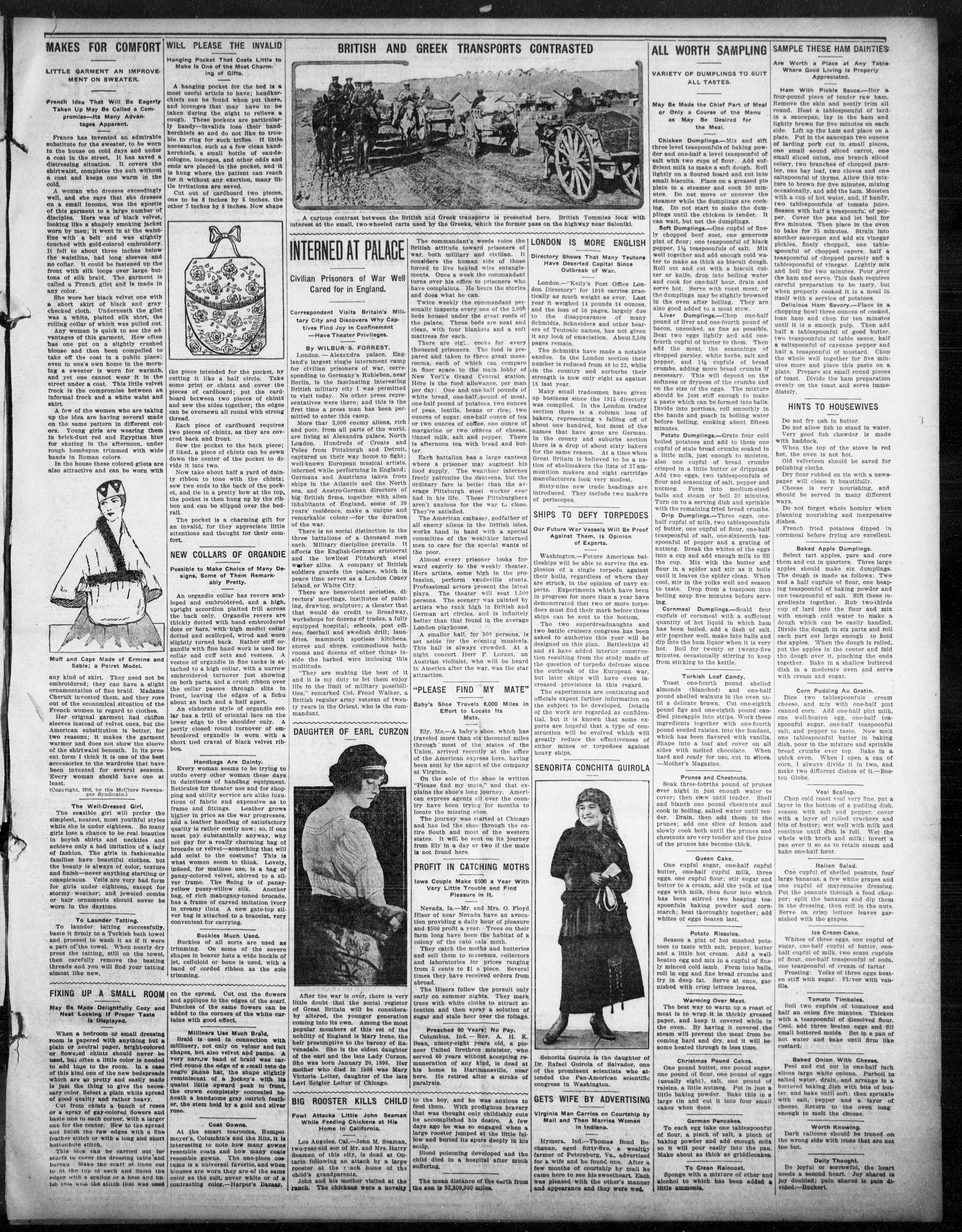
BRITISH AND GREEK TRANSPORTS CONTRASTED
A curious contrast between the British and Greek transports is presented here. British Tommies look with interest at the small, two-wheeled carts used by the Greeks, which the former pass on the highway near Saloniki.
INTERNED AT PALACE
Correspondent Visits Britain's Military City and Discovers Why Captives Find Joy in Confinement —Have Theater Privileges.
By WILBUR S. FORREST.
London. —Alexandra palace, England's largest single interment camp for civilian prisoners of war, corresponding to Germany's Ruhleben, near Berlin, is the fascinating interesting British military city I was permitted to visit today. No other press representatives were there; and this is the first time a press man has been permitted to enter this camp.
More than 3,000 enemy aliens, rich and poor, from all parts of the world, are living at Alexandra palace, North London. Hundreds of Croats and Poles from Pittsburgh and Detroit, captured on their way home to fight; well-known European musical artists. intermed while performing in England; Germans and Austrians taken from ships in the Atlantic and the North sea, and Austro-German directors of big British firms, together with alien inhabitants of England, some of 30 years' residence, make a unique and remarkable colony—for the duration of the war.
There is no social distinction in the three battalions of a thousand men each. Military discipline prevails. It affects the English-German aristocrat and the lowliest Pittsburgh steel worker alike. A company of British soldiers guards the palace, which in peace time serves as a London Coney Island or White City.
There are benevolent societies, directors' meetings, institutes of painting, drawing, sculpture; a theater that would do credit to Broadway, workshops for dozens of trades, a fully equipped hospital; schools, post offices, football and swedish drill; laundries, mammoth spotless kitchens, stores and shops, commodious bathrooms and dozens of other things inside the barbed wire enclosing this multitude.
"They are making the best of it and it is my duty to let them enjoy life to the limit of military possibilities," remarked Col. Frood Walker, a British regular army veteran of twenty years in the Orient, who is the commandant.
DAUGHTER OF EARL CURZON
THE FASHION WEEKLY
After the war is over, there is very little doubt that the social register of Great Britain will be considerably altered, the younger generation coming into its own. Among the most popular members of this set of the nobility of England is Mary Irene, the heir presumptive to the barony of Ravensdale. She is the eldest daughter of the earl and the late Lady Curzon. She was born January 20, 1896. Her mother who died in 1906 was Mary Victoria Leiter, daughter of the late Levi Zeigler Leiter of Chicago.
BIG ROOSTER KILLS CHILD
Fowl Attacks Little John Seaman
While Feeding Chickens at His
Home in California.
Los Angeles, Cal.—John M. Seaman,
two-year-old son of Mr. and Mrs. Harry
Seaman of this city, is dead at Ontario following an attack by a large rooster at the ranch home of the child's grandparents,
John and his mother visited at the ranch. The chickens were a novelty
The commandant's words voice the British attitude toward prisoners of war, both military and civilian. It considers the human side of those forced to live behind wire entanglements. Once a week the commandant turns over his office to prisoners who have complaints. He hears the stories and does what he can.
Twice weekly the commandant personally inspects every one of the 2,000 beds housed under the great roofs of the palace. These beds are neat and clean, with four blankets and a soft mattress for each.
There are eight. cooks for every thousand prisoners. The food is prepared and taken to three great messrooms, each of which can compare in floor space to the main lobby of New York's Grand Central station. Here is the food allowance, per man per day: One and one-half pounds of white bread, one-half pound of meat, one-half pound of potatoes, two ounces of peas, lentils, beans or rice; two ounces of sugar, one-half ounce of tea or two ounces of coffee, one ounce of margarine or two ounces of cheese, tinned milk, salt and pepper. There is afternoon tea with bread and butter.
Each battalion has a large canteen where a prisoner may augment his food supply. The wealthier internes freely patronize the canteens, but the ordinary fare is better than the average Pittsburgh steel worker ever had in his life. These Pittsburghers aren't anxious for the war to close. They're satisfied.
The American embassy, godfather of all enemy aliens in the British isles, works hand in hand with a special committee of the wealthier interned men to care for the special wants of the poor.
Almost every prisoner looks forward eagerly to the weekly theater. Here artists, some high in the profession, perform vaudeville stunts. Professional actors present the latest plays. The theater will seat 1,500 persons. The scenery was painted by artists who rank high in British and German art circles, and is infinitely better than that found in the average London playhouse.
A smaller hall, for 500 persons, is set aside for the evening musicals. This hall is always crowded. At a night concert Herr F. Lorant, an Austrian violinist, who will be heard in America after the war, was the star attraction.
"PLEASE FIND MY MATE"
Baby's Shoe Travels 6,000 Miles in Effort to Locate Its Mate.
Ely. Mo.—A baby's shoe, which has traveled more than six thousand miles through more than the states of the Union, arrived recently at the office of the American express here, having been sent by the agent of the company at Virginia.
On the sole of the shoe is written "Please find my mate," and that explains the shoe's long journey. American express agents all over the country have been trying for months to locate the missing shoe.
The journey was started at Chicago and has led the shoe through the entire South and most of the western states. It will be sent on its journey from Ely in a day or two if the mate is not found here.
PROFIT IN CATCHING MOTHS
Iowa Couple Make $500 a Year With Very Little Trouble and Find Pleasure in It.
Nevada, Ia.—Mr. and Mrs. O. Floyd Hiser of near Nevada have an avocation providing a daily hour of pleasure and $500 profit a year. Trees on their farm long have been the habitat of a colony of the cato cala moth.
They catch the moths and butteries and sell them to museums, collectors and laboratories for prices ranging from 5 cents to $1 a piece. Several times they have received orders from abroad.
The Hisers follow the pursuit only early on summer nights. They mark trees with white cloths to attract attention and then spray a solution of sugar and stale beer over the foliage.
Presched 60 Years: No
Columbus, Ind. — Rev. A. H. K. Bean, ninety-eight years old, a pioneer United Brethren minister, who served 60 years without accepting remuneration of any kind, is dead at his home in Hartmansville, near here. He retired after a stroke of paralysis.
to the boy, and he was anxious to feed them. With prodigious bravery that was thought only childishly cute he accomplished his desire. A few days ago he was engaged when a large rooster jumped at the little fellow and buried its spurs deeply in his scalp.
Blood poisoning developed and the child died in a hospital after much suffering.
The mean distance of the earth from the sun is 92,800,000 miles.
Directory Shows That Many Teutons Have Deserted Capital Since Outbreak of War.
London.—"Kelly's Post Office London Directory" for 1916 carries practically as much weight as ever. Last year it weighed 14 pounds 14 ounces, and the loss of 50 pages, largely due to the disappearance of many Schmidt, Schneider and other bearers of Teutonic names, has not given it any look of emaciation. About 3,500 pages remain.
The Schmidt have made a notable exodus. In the London section their number is reduced from 48 to 22, while in the country and surburbs their strength is now only eight as against 18 last year.
Many small tradesmen have given up business since the 1915 directory was compiled. In the London trades section there is a column less of bakers, representing a falling off of about one hundred, but most of the names that have gone are German. In the county and suburbs section there is a drop of about sixty bakers for the same reason. At a time when Great Britain is believed to be a nation of shellmakers the lists of 27 ammunition makers and eight cartridge manufacturers look very modest. Sixty-nine new trade headings are introduced. They include two makers of periscopes.
SHIPS TO DEFY TORPEDOES
Our Future War Vessels Will Be Proof Against Them, Is Opinion of Experts.
Washington.—Future American battleships will be able to survive the explosion of a single torpedo against their hulls, regardless of where they are struck, in the opinion of navy experts. Experiments which have been in progress for more than a year have demonstrated that two or more torpedoes must find their mark before these ships can be sent to the bottom. The two superdreadnaughts and two battle cruisers congress has been asked to authorize this year will be designed on this plan. Battleships 43 and 44 have added interior construction resulting from the study made of the question of torpedo defense since the outbreak of the European war, but later ships will have even increased provisions in this regard.
The experiments are continuing and officials expect further information on the subject to be developed. Details of the work are regarded as confidential, but it is known that some experts are hopeful that a type of construction will be evolved which will greatly reduce the effectiveness of either mines or torpedoes against heavy ships.
SENORITA CONCHITA GUIROLA
A
Senorita Guirola is the daughter of Dr. Rafael Guirola of Salvador, one of the prominent scientists who attended the Pan-American scientific congress in Washington.
GETS WIFE BY ADVERTISING
Virginia Man Carries on Courtship by Mail and Then Marries Woman in Indiana.
Hymera, Ind.—Thomas Bond Buchanan, aged forty-five, a wealthy farmer of Petersburg, Va., advertised for a wife and he found one. After a few months of courtship by mail he came here to see his sweetheart. Each was pleased with the other's manner and appearance and they were wed.
ALL WORTH SAMPLING
VARIETY OF DUMPLINGS TO SUIT ALL TASTES.
May Be Made the Chief Part of Meal or Only a Course of the Menu as May Be Desired for the Meal.
Chicken Dumplings—Mix and sift three level teaspoonfuls of baking powder and one-half a level teaspoonful of salt with two cups of flour. Add sufficient milk to make a soft dough. Roll lightly on a floured board and cut into small biscuits. Place on a greased pie plate in a steamer and cook 20 minutes. Do not move or uncover the steamer while the dumplings are cooking. Do not start to make the dumplings until the chicken is tender. It can wait, but not the dumplings.
Soft Dumplings—One cupful of finely chopped beef suet, one generous pint of flour; one teaspoonful of black pepper, $1\frac{1}{2}$ teaspoonfuls of salt. Mix well together and add enough cold water to make as thick as biscuit dough. Roll out and cut with a biscuit cutter or knife, drop into boiling water and cook for one-half hour, drain and serve hot. Serve with roast meat, or the dumplings may be slightly browned in the oven after boiling. They are also good added to a meat stew.
Liver Dumplings.—Chop one-half pound of liver and one-fourth pound of bacon, uncooked, as fine as possible. Beat two eggs lightly and add one-fourth cupful of butter to them. Then add the meat, the seasonings of chopped parsley, white herbs, salt and pepper, and $1 \frac{1}{2}$ cupfuls of bread crumbs, adding more bread crumbs if necessary. This will depend on the softness or dryness of the crumbs and on the size of the eggs. The mixture should be just stiff enough to make a paste which can be formed into balls. Divide into portions, roll smoothly in the hands and poach in boiling water before boiling, cooking about fifteen minutes.
Potato Dumplings.—Grate four cold boiled potatoes and add to them one cupful of stale bread crumbs soaked in a little milk, just enough to moisten. also one cupful of bread crumbs crisped in a little butter or drippings. Add two eggs, two tablespoonfuls of flour and seasoning of salt, pepper and nutmeg. Form into medium-sized balls and steam or boil 20 minutes. Turn on to a serving dish and sprinkle with the remaining fried bread crumbs.
Drip Dumplings.—Three eggs, one-half cupful of milk, two tablespoonfuls of butter, one cupful of flour, one-half teaspoonful of salt, one-sixteenth teaspoonful of pepper and a grating of nutmeg. Break the whites of the eggs into a cup and add enough milk to fill the cup. Mix with the butter and flour in a spider and stir as it boils until it leaves the spider clean. When cool, stir in the yolks well and season to taste. Drop from a teaspoon into boiling soup five minutes before serving.
Cornmeal Dumplings.-Scald four cupfuls of cornmeal with a sufficient quantity of hot liquid in which ham has been boiled, add a dash of salt, stir together well, make into balls and dip into the ham liquor when it is very hot. Boil for twenty or twenty-five minutes, occasionally stirring to keep from sticking to the kettle.
Turkish Loaf Candy.
Toast one-fourth pound shelled almonds (blanched) and one-half pound shelled walnuts in the oven until a delicate brown. Cut one-eighth pound figs and one-eighth pound candied pineapple into strips. Work these ingredients together with one-fourth pound seeded raisins, into the fondant, which has been flavored with vanilla. Shape into a loaf and cover on all sides with melted chocolate. When hard and ready for use, cut in slices. —Mother's Magazine.
Prunes and Chestnuts
Soak three-fourths pound of prunes over night in just enough water to cover; then stew until tender. Shell and blanch one pound chestnuts and cook in boiling, salted water until tender. Drain, then add them to the prunes; add one slice of lemon and slowly cook both until the prunes and chestnuts are very tender and the juice of the prunes has become thick.
Queen Cake.
One cupful sugar, one-half cupful butter, one-half cupful milk, three eggs, one cupful flour; stir sugar and butter to a cream, add the yolk of the eggs with milk, then flour into which has been stirred two heaping teaspoonfuls baking powder and cornstarch; beat thoroughly together; add whites of eggs beaten last.
Potato Rissoles.
Season a pint of hot mashed potatoes to taste with salt, pepper, butter and a little hot cream. Add a well-beaten egg and mix in a cupful of finely minced cold lamb. Form into balls, roll in egg and fine bread crumbs and fry in deep fat. Serve at once, garnished with crisp lettuce leaves.
Warming Over Meat
The best way to warm up a roast of meat is to wrap it in thickly greased paper, and keep it covered while in the oven. By having it covered the steam will prevent the meat from becoming hard and dry, and it will beome heated through in less time.
Christmas Pound Cakes
One pound butter, one pound sugar, one pound of four, one pound of eggs (usually eight), salt, one pound of raisins, a little nutmeg. Put in just a little baking powder. Bake this in a large tin and cut it into four small cakes when done.
German Pancakes
To each egg take one tablespoonful of flour, a pinch of salt, a pinch of baking powder and add enough milk so it will pour easily into the pan. Make about as thick as griddlecakes.
To Clean Raincoat.
Sponge with a mixture of ether and alcohol to which has been added a little ammonia.
Are Worth a Place at Any Table Where Good Living Is Properly Appreciated.
Ham With Pickle Sauce.—Buy a four-pound piece of tender raw ham. Remove the skin and neatly trim all round. Heat a tablespoonful of lard in a saucepan, lay in the ham and lightly brown for five minutes on each side. Lift up the ham and place on a plate. Put in the saucepan two ounces of larding pork cut in small pieces, one small sound sliced carrot, one small sliced onion, one branch sliced celery, two branches of chopped parsley, one bay leaf, two cloves and one saltspoonful of thyme. Allow this mixture to brown for five minutes, mixing occasionally, and add the ham. Moisten with a cup of hot water, and, if handy, two tablespoonfuls of tomato juice. Season with half a teaspoonful of pepper. Cover the pan and let boil for five minutes. Then place in the oven to bake for 35 minutes. Strain into another saucepan and add six vinegar pickles, finely chopped, one tablespoonful of chopped capers, half a teaspoonful of chopped parsley and a tablespoonful of vinegar. Lightly mix and boll for two minutes. Pour over the ham and serve. This dash requires careful preparation to be tasty, but when properly cooked it is a meal in itself with a service of potatoes.
Delicious Ham Savory—Place in a chopping bowl three ounces of cooked, lean ham and chop for ten minutes until it is a smooth pulp. Then add half a tablespoonful of good butter, two teaspoonfuls of table sauce, half a saltspoonful of cayenne pepper and half a teaspoonful of mustard. Chop the whole well together for five minutes more and place this paste on a plate. Prepare six small round pieces of toast. Divide the ham preparation evenly on the toast and serve immediately.
HINTS TO HOUSEWIVES
Do not fry ush in butter.
Do not allow fish to stand in water.
Very good fish chowder is made with haddock.
When the top of the stove is red hot, the oven is not hot.
Old velveten should be saved for polishing cloths.
Dry flour rubbed on tin with a newspaper will clean it beautifully.
Cheese is very nourishing, and should be served in many different ways.
Do not forget whole hominy when planning nourishing and inexpensive dishes.
French fried potatoes dipped in cornmeal before frying are excellent.
Baked Apple Dumplings.
Select tart apples, pare and core them and cut in quarters. Three large apples should make six dumplings. The dough is made as follows: Two and a half cupfuls of flour, one heaping teaspoonful of baking powder and one teaspoonful of salt. Sift these ingredients together. Rub two-thirds cup of lard into the flour and mix with enough cold water to make a dough which can be easily handled. Divide the dough in six parts and roll each part out large enough to hold the apples. When the dough is rolled, put the apples in the center and fold the dough over it, pinching the ends together. Bake in a shallow buttered dish in a moderate oven and serve with cream and sugar.
Corn Pudding Au Gratin
Dice two tablespoonfuls cream cheese, and mix with one-half pint canned corn. Add one-half pint milk, one well-beaten egg, one-half teaspoonful sugar, one-half teaspoonful salt, and pepper to taste. Now melt one tablespoonful butter in baking dish, pour in the mixture and sprinkle bread crumbs over top. Bake in a quick oven. When I open a can of corn, I always divide it in two, and make two different dishes of it.—Boston Globe.
Veal Scallop.
Chop cold roast veal very fine, put a layer in the bottom of a pudding dish, season with salt and pepper, cover with a layer of rolled crackers and bits of butter; wet well with milk and continue until dish is full. Wet the whole with broth and milk; invert a pan over it so as to retain steam and bake one-half hour.
Italian Salad.
One cupful of shelled peanuts, four large bananas, a few white grapes and one cupful of mayonnaise dressing. Put the peanuts through a food chopper; split the bananas and dip them in the dressing, then roll in the nuts. Serve on crisp lettuce leaves garnished with the grapes.
Ice Cream Cake.
Whites of three eggs, one cupful of sugar, one-half cupful of butter, one-half cupful of milk, two scant cupfuls of flour, one-half teaspoonful of soda, one teaspoonful of cream of tartar.
Frosting: Yolks of three eggs beaten stiff with sugar. Flavor with vanilla.
Tomato Timbales.
Boil two cupfuls of tomatoes and half an onion five minutes. Thicken with a teaspoonful of dissolved flour. Cool, add three beaten eggs and fill small buttered molds. Set in a pan of hot water and bake until firm like custard.
Baked Onion With Cheese
Peel and cut out in one-half inch slices large white onions. Parboil in salted water, drain, and arrange in a buttered baking dish with bits of butter, and bake until soft; then sprinkle with salt, pepper and a layer of cheese. Return to the oven long enough to melt the cheese.
Worth Knowing.
Dark calicoes should be ironed on the wrong side with irons that are not too hot.
Daily Thought.
Be joyful or sorrowful, the heart needs a second heart. Joy shared is joy doubled; pain shared is pain divided—Buckert.
All communications should be addressed
to The Kansas City Sun, 1803 East 18th
Stret.
Bell Phone East 999.
Entered as second-class matter, August
12, 1988, at the postoffice at Kansas City,
Mo., under the act of March 3, 1879.
Nelson C. Crews.....Editor and Owner
Willa B. Glenn.....General Manager
SUBSCRIPTION RATES:
One Year.....$1.50
Six Months.....75
Three Months.....50
ADVERTISING RATE, 50 CENTS PER
INCH.
CHURCH DIRECTORY.
Bethel A. M. E. Church, 24th and Flora.
St. Stephen's Baptist Church, 604 Charlotte St.
Annual M. E. Church, 19th and Woodland.
Second Baptist Church, 10th and Charlotte.
Van Chapel A. M. E. Church, 10th and Charlotte.
Kansas Ave. Baptist Church, 46th and Kansas.
Ebenzer A. M. E. Church, 17th and Troost.
St. Augustine's P. E. Church, 11th and Troost.
St. Augustine's P. E. Church, 11th and Ward Chapel A. M. E. Church, 11th and Woodland.
St. Monica's Catholic, 17th and Lydia.
Morning Star Baptist Church, 2311 Vine.
Highland Avenue Baptist Church, 1111
Highland.
Centropolis A. M. E. Church, Centropolis
St. James A. M. E. Z. Church, 1823
Woodland Ave.
Third Baptist Church, Roundtop.
Friendship Baptist Church, 17th and Tracy Avenue.
Pilgrim Baptist Church, 614 Charlotte
St.
Bigelow A. M. E. Mission, 5th and Lyda.
Progressive Baptist Church, 29th and
Summit.
C. M. E. Church, 1817 Flora Ave.
8t. James Baptist Church, 4033 Mill St.
St. Mary's Church, M. E. Church, 43rd and
Prospect Place.
A. M. E. Mission, 556 Grand Ave.
CLARK CHAPEL M. E. CHURCH,
1664 Madison Ave.
First A. M. E. Church, 8th and Neb.
Pleasant Green Baptist Church, 1st and
spiritlog.
Eighth St. Baptist Church, 8th and
Oakland.
Milpacolton Baptist Church, 9th and
Washington.
Bethel A. M. E. Church, Water and
steward Streets.
St. Paul A. M. E. Church, 21st and
River.
First Baptist Church, 5th and Neb.
King Solomon Baptist Church, 3rd and
state.
Quindaro A. M. E. Church, Quindaro,
Pleasant Valley Baptist Church, Rosedale,
KAN
M. E. Church, 9th and Oakland.
A. M. E. Church, 4th and Oakland.
Salter Mission, A. M. E. Church, South
Park, Kan.
Protestant Episcopal, 3rd and Stewart.
Second Baptist Church, 3rd and Ruby.
Women's College, 10% Shore.
St. Paul A. M. E. Zion Church, 4000
Adams.
Bethel A. M. E. Church, Roselea, Kan.
M. M. Zion Baptist Church, 4th and Virginia.
Ebenezer A. M. E. Church, Sanford and Tremont
Primitive Baptist Church, Westport avenue and Tangent street, Rosedale.
EDITORIALS
If the President should happen to run out of "Note" paper in this crisis, wouldn't it be awful?
Georgia is determined to outdo her last year's record for mob violence. Five negroes, four belonging to one family, were lynched last week just as a beginner.
If the white Republicans of St. Louis fall to defeat the iniquitous segregation ordinance soon to be voted on, the Negro Republicans may in turn fall to defeat the Democrats later on.
Now the English have put Chief Sam into jail. He is accused of manslaughter in not properly guarding the health of the colonists whom he promised to establish on the Gold Coast in Africa. Sam didn't know that a man could be put into jail for that.
According to press reports, Jack Johnson would rather come home and go to jail than remain free in England or France. One would scarcely think these European countries so very undesirable to live in. Can they be as bad as Georgia and Texas?
On account of the fervent love which President Wilson bears for the Negro and the constant sympathy which he manifests toward our civic and industrial welfare, we should all make it a point to hear his speech at Convention hall, February 4, and by our presence swell the volume of approval of his preparedness theme. Some of the local Negro Democrats will doubtless be on the reception committee and will see that we all get seats.
Santa Barbara, Cal.
Find enclosed money order to renew my subscription and I trust I will not miss a copy of the paper as it always brings sunshine. Wishing you a happy new year, I am
Yours truly,
RICHARD GAINES.
PRESIDENT URGES INDEMNITY.
Asks Congress to Apropriate $41,030 as "Act of Grace" for Mob Vigilance
Washington, D. C.—President Wilson continues to grieve the colored citizenship of the United States by his very queer attitude affecting them. He recently served notice on Bishop Walters of the African Methodist Episcopal Zion church that no Colored man would be appointed recorder of deeds in the District of Columbia, a place which had been held by Colored men from time immemorial. A vacancy has existed for eighteen months or more and the belated announcement is just made that the position is not to be given to a Colored man. During this same week he congratulates Major R. R. Morton upon succeeding to
the principalship of Tuskegee Institute, while ignoring altogether the death of the man whom Major Morton is to succeed.
He now follows this up by a special message to Congress advocating an appropriation of $41,030 indemnity to Greece, Austria-Hungary and Turkey on account of injuries done to subjects of these countries, respectively, by mob violence in riots on February 21, 1909, at South Omaha, Neb., when Edward Lowrey, a policeman, was shot by John Massourides, a Greek subject whom the officer had arrested. The request is made of Congress "as an act of grace and without reference to the liability of the United Sates."
This special message is sent to oncress by the president during the same week that announcement is made of the lynching of 69 men and women in the South during the year 1915. Not a word of protest issues from the White House in condemnation of this terrible lawlessness. A special message from the president would center attention upon this deplorable practice and if the president could see his way clear that "indemnities" were paid the victims of lynch law in this country, the practice would cease.
TECOPA, CAL
It has ben some time since Booker T. Washington passed away, but as you doubtless know that news travels very slowly in this part of the country and mail much slower. But we would have it known that when the educational world was shocked to its very center by his demise that the shock was felt even here on the sands of Death Valley. We mourn him because we feel that he made America what it is today for the Negro. He shaped stupendous events, turned human thoughts into new channels and left an impression upon the known civilized world that even that relentless hand of time will not be able to erase. His work is reflected in every enterprise put forth for the betterment of the race of which he was identified. He was as wise as Solomon, purposeful as Caesar, gentle as a lamb, bold as a lion. He was one of those superbrilliant meteors that traverse the earth but once in centuries. He rose from a slave to world fame; he enjoyed a universal respect never before equaled by man. His philosophy was the greatest, simplest, of times and he was the builder of the American spirit of liberty.
J. E. WALTON.
Betty & Sam's
Little Corner
—That everybody present at Lyric hall Monday night, February 7, will receive a souvenir.
—That the doctors say you must not kiss, you may spread the grip. Oh, your cruel doctors.
—That there are some Negroes here who are such runts it would be a travesty to call them Hogs!
—That the political grafters, white and black, are beginning to get busy. Well, they are hungry, ain't they?
—That if this weather keep up there will be nobody doing anything except the doctor and the undertaker.
—That the plan by which 10 per cent is saved on meals at the Y. M. C. A. Cafeteria is becoming very popular.
—That President Wilson evidently forgot to "write a note" to those Georgians that lynched five Negroes the other day. Well, they were not foreigners, were they?
—That Kansas City has the greatest poet in America. If you don't believe it, read the following effusion from his pen:
"What paper do you read," said he, She answered: "Did you speak to me?" "For all the news, I need but one, That is THE KANSAS CITY SUN."
—That little Willie was eating dinner at another lady's house the other day when the following conversation took place: "Does your mother allow you to have two pieces of pie when you are at home, Willie?" asked his hostess.
"No, ma'am."
"Well do you think she would like you to have two pieces here?"
"Oh, she wouldn't care," said Willie confidently; "this isn't her pie."
—That a certain Negro was haled before the Court for failing to pay his wife alimony, and the judge questioned him as follows; "Mose, you are charged with failing to carry out the instructions of the Court and pay your wife $2 a week alimony. What's your excuse?" And Mose scratched his head for a moment and said: "Well I tell ye jedge dis second wife I married since you all gie me mat divorce ain't wuking like I that she wud and I jes ain't bin able to pay it, but Ise dun got her another job fuh next week and if she don't stick to it Ise gwine to cum back here and git you to git me another divorce." The judge fainted then and there.
dominate this Negro Business League which has achieved so much in a practical way for Negro advancement, and is helping us to win in our several communities, the respect, the encouragement and the friendship of our white neighbors. May we so firmly believe in and be so determined to carry out the practical lessons he has taught, that we shall come more and more to believe in ourselves, that we shall be willing, like him, to devote our lives to the advancement of our race and, if necessary, die in the cause of the uplift of our fellows. My friends, that race which does not believe in itself, that race which does not respect itself, that race which is not willing to patiently pursue the path of toll, of self-sacrifice, of unceasing industry, until it can master the arts and crafts of civilization, is neither going to be useful to itself, nor able to command the confidence, the esteem or the friendship of other races.
Y. M. C. A. NOTES
Ten boys have already joined the "Thrift or Savings Club."
Judge J. Coody Johnson, who made such marked improvement in his health during last summer through the gymnasium work, is in the city again for a two weeks' stay.
A campaign of friendship which has as its motto "clean living, clean speech and clean sport" will be conducted among the boys of the five high schools the week of February 6.
The serviceable book stand donated by Mrs. Minnie L. Crosthwait, Miss Ethel N. White, Miss Addie P. Groves and Mr. L. C. Smith, added a much appreciated piece of furniture to the reading room.
A full collection of "Stoddard's Lectures on Travel" of fourteen volumes were donated to the Y. M. C. A. by Mr. A. Frank Neal last week. This is probably the most valuable set of books now owned by the Association
Let us determine with all our hearts, not only to do our utmost toward building up a strong economic foundation for our race's future, but following the footsteps of the Great Master of us all, may we "learn to love one another," have faith in and co-operate with each other, believe in our race and go forth determined to do our level beat toward making every man, woman and child of the Negro race, by efficiency in unselfish service, as deserving of respect as the members of any other race, whether they be white, yellow, red or brown! Southern Workman.
The men are expecting an unusual message from Mr. L. A. Halbert, superintendent of the Welfare Board, on next Sunday when he speaks on the subject, "Deserving to Win or Winning on Merit." This meeting begins at 3:20 p. m. sharp.
A "Waiting List" for rooms will be necessary if as many regular roomers come into the Y. M. C. A. building this week as on last. In that event young men desiring to receive the privilege of rooming at the Y. M. C. A. will place their name on file and will be notified when there is a vacant room.
(From an address to the Negro Business League in August, 1915.
HELENA, MONTANA.
After the extreme cold weather for two weeks with the thermometer ranging from 6 below to 40 below zero, we are now enjoying a Montana "Chi-Harrison are convalescing...cmfwy nook"...Mrs. Alexandre and Mrs. Jeff Harrison are convalescing...Mrs. Elnora Johnson is yet quite ill...Mrs. G. Knuff entertained a few friends on Monday evening in honor of Mrs. Jones of Seattle...Mrs. C. V. Ford left Monday to spend the winter on the Coast. She will visit in Spokane before going to the Coast...The ladies of the A. M. E. Church had to postpone their entertainment on account of the severe cold weather...Mr. Ransom of St. Paul and Mr. Adkins of Seattle were house guests of Mr. and Mrs. A. E. McGinnis...Mrs. L. Walker and Mrs. Lowe entertained the Busy Bee Thursday night, Mrs. I. Ingram, acting president...Mr. A. T. Luchman and Mrs. E. Riley Owens were united in marriage Friday...Neomia Lodge No. 842 has a dispensation on...Mr. J.川 Anderson was maid in the Household last Tuesday. A grand feast was spread. All enjoyed a good time...Mrs. Robt. Houston and Mrs. Chas. Oliver are expected home from Kansas and Missouri soon...Mr. J. H. Hilliard, Deputy Superintendent G. C. of Montana, is on the sick list...Mr. Titus, the Pullman porter, was severely injured on the road in a wreck. It is reported that blood poison has set in and he is in a critical condition. He is in the hospital at Missoula...Miss Olionie Lucas of Seattle is expected in Helena for a visit soon.
Fifteen men made decisions to live the Christian life during Evangelist Howard's three Sunday afternoon addresses. On last Sunday, of the eight men who professed Christ Jesus, three are to join Allen Chapel, two the Pleasant Green, one the Second Baptist, one the First A. M. E. church of Kansas City, Kas., and one man was undecided as to what church he would join.
A WORTHY NEGRO CORPORATION
Editor Kansas City Sun:
Through the columns of your valuable paper I want to thank Mr. Fortune J. Weaver, president and general manager of the Afro-American Investment Co., for his kindness and thorough business ability in saving the home of my parents, Mr. and Mrs. Dan Lucas from foreclosure. Through sickness and bad management the property was badly tied up with mortgages, taxes and mechanic liens and it seemed that they were doomed to lose their home at the time when they needed a home most. I was advised by some of my close friends to go to white men; they thought it possible for me to get money from them to save the home, but I went to the Afro-American Investment Co. and Mr. Weaver promised to do the best he could for me, so I left the matter in his hands and in less than two weeks he had arranged to renew the mortgages and pay off the mechanic liens and taxes. Now the mortgages are arranged so it can be paid off in easy payments and there is no danger of my mother and father being put out of doors, for I shall see to it myself that the payments are made when due. I feel that this Negro company of real estate dealers should receive the highest praise for the work they are doing in getting good homes for our people and helping them out when they are in danger of losing them.
MRS. HARRIET T. RICHARDSON,
2026 Woodland Ave.
MOTON ON WASHINGTON.
We know that no man ever worked
with a loftier motive for the uplift
of our people, with more earnestness,
with more patience, with more unsel-
fishness, or with more efficiency, than
is true of him whom we all delight to
honor—Dr. Booker T. Washington.
His spirit, his purpose and his ideals
EXPERT
Recognized
fancy of
Bring you
your own
expert in
For fr
or address
CUT THIS BLANK OUT, FILL IT IN AND MAIL
$1.00 Special Rate
CUT THIS BLANK OUT, FILL IT IN AND MAIL OR SEND TO OUR OFFICE.
$1.00 Special Rate Offer $1.00
1803 East 18th Street, Kansas City, Mo.
Sir: Please enter my name as a su-
City Sun for 1916 per your Special Ra-
paper on December 31, 1916, unless other
I herewith enclose One Dollar to pay
one year. Respectfully
Name.....
Town.....
Date.....
DR. L. L. SHEY
Sir: Please enter my name as a subscriber to The Kansas City Sun for 1916 per your Special Rate Offer and stop my paper on December 31, 1916, unless otherwise notified.
I herewith enclose One Dollar to pay the Special Rate for one year. Respectfully,
Name.....
HONONONONONONONONONONONONONONONONONONONONON
DENTIST
Announces the opening of a dental office and Vine streets, over McCampbell & How would be pleased to make an examinator mate on your work.
Office hours, 9:00 A. M to 6 P. M.
A FEW WARM, STEAM ROOMS FOR
PASEO Y. M. C. A. I
$1.50 PER WEEK A
Announces the opening of a dental office at corner of Howard and Vine streets, over McCampbell & Houston's Drug Store. He would be pleased to make an examination and submit an estimate on your work.
Office hours, 9:00 A. M to 6 P. M. Sundays by Appointment.
A FEW WARM, STEAM HEATED ROOMS FOR MEN PASEO Y. M. C. A. BUILDING $1.50 PER WEEK AND UP
MOTON ON WASHINGTON
The Kansas City, Sun.
National Colored Dressmaking College
The reliable place to learn the art of
Expert Teachers in Attendance. Recognized authority in advanced styles. Coats, suits and fancy dresses made to order. Bring your material and make your own suits and dresses under expert instructors. For further information call on or-address MRS. ALICE STEELE. President
HELENA MONTANA.
Kansas City, Mo.
AROS., 1831 Paseo. Bell Phone East 701.
DRUG STORES.
SMITH, 1301 East 18th St. Bell phone Grand 4591,
in 5467.
DRUG STORE, 18th and Paseo. Bell phone East 1814,
at 4082.
ER'S PHARMACY—18th and Woodland.
East 272, Home phone 4070.
DRY GOODS AND NOTIONS.
MES & CO., 2409 Vine Street.
BSON, 1816 Highland, Bell phone, East 2377J.
BNS, F. W. DAVIS. Moving, packing and storing house-
s. Home phone, East 2158. Residence, 1229 Woodland.
FLORISTS.
AT FLORAL CO., 1801 East 18th St. Bell phone, East
phone, East 4070.
GROCERS.
N, 2644 Woodland Ave. Bell phone, East 1493.
INSURANCE.
LIFE INSURANCE CO., 1507 East 18th St., Bell phone
66J. T. A. Ross,
JEWELERS.
N, 1616 West 9th St., Bell phone, Main 6248R.
LAWYERS.
WAY, 601 Delaware, Home phone M58, Bell phone Main
tices in all courts.
ON, 601 Delaware, Home phone M58, Bell phone Main
al advice. Practices in all courts.
LEFORD, Attorney at Law, 516 Minnesota Ave., Kan-
kas. Bell phone, West 3866.
MILLINERY.
MOLLAND, Fashionable Dressmaking and Tailoring. Bell
tast 4600. 1706 East 19th.
CHAPMAN, 18th and Paseo. Home phone East 4009.
ANTEE, Proprietor The Fad, 1607 East 18th St. Bell
t 1643.
PHYSICIANS.
LIBERT, Theraptics, P. O. box 90A, Bell phone, Rosedale
dale, Kas.
PRINTERS.
LIN, 1008 East 18th St. Bell phone Grand 2988.
REAL ESTATE and EMPLOYMENT.
MICAN REAL ESTATE & INVESTMENT CO., Help fur-
11 McGee street.
e 751 Main. Home Phone 7555 Main.
YMENT AND INVESTMENT CO., 500 Minnesota Ave.
Kansas City, Kans. Bell phone, West 1743; Home
est 1036. C. W. Neloms, Mgr.
OPLE'S INVESTMENT CO., 2427 Vine St. Bell Phone
Home East 4011. Sol Smith, Pres
NS, 2122 Vine St. Bell phone East 3851
UNDERTAKERS.
ROS. & GREEN, 19th and Vine Sts. Both phones E. 4349.
EE, Licensed Embalmer, 2220 Vine St., Bell Phone, East
East 3341.
ROS., 1729 Lydia Ave. Bell Phone Grand 987, Home
D. Res., Bell East 3281.
OLDWELL & CHAPMAN
ir and Millinery
18th and Paseo, Kansas City, Mo.
ment a Specialty. Caldwell's Pomade and Tonic really
crows Hair. Try it. Save your combings, cut hair
and any old hat you may have.
Red From Samples. Feathers and Hats Cleaned, Dyed and
Agents for Spirella Corsets. Mail orders answered promptly
GUARANTEED. LIVE AGENTS WANTED
URING FACIAL MASSAGE
TELL ME WHERE IS THE BEST PLACE TO BUY
ags, Toilet Articles and have
Prescriptions Filled?
Sure
—AT—
FOSTER'S PHARMACY
18TH AND WOODLAND AVE.
by, they fill and deliver prescriptions to any part of the
call call for them, too.
PHONES: Bell East 272. Home East 4070.
Negro Business and Professional Directory of Greater Kansas City
BEAUTY PARLORS AND HAIR DRESSERS
MESDAMES JACKSON & JOHNSON, 18th and Highland Ave. Bell phone E. 4788.
MRS. CADDIE WITCHER, 1708 Michigan Ave. Madame Walker's Hair and Scalp Treatment. Bell phone. East 4167X.
CAFES.
DELMONICA CAFE, 1512 East 18th St. Bell phone, East 618.
COAL AND FEED.
W. W. PAYNE, 1902 1-2 Vine St. Bell phone, East 559; Home phone East 4132.
CLEANERS, DYERS AND TAILORS.
WORTHAM BROS., 1831 Paseo. Bell Phone East 701.
DRUG STORES.
THEODORE SMITH, 1301 East 18th St. Bell phone Grand 4591, Home Main 5467.
PEOPLE'S DRUG STORE, 18th and Paseo. Bell phone East 1814, Home East 4082.
R. W. FOSTER'S PHARMACY—18th and Woodland. Bell phone East 272. Home phone East 4070.
EXPRESS AND BAGGAGE
THOS.JACKSON,1816 Highland,Bell phone,East 2377J. MOVING VANS,F.W.DAVIS. Moving,packing and storing house hold goods. Home phone,East 2158. Residence,1229 Woodland
FLORISTS.
CROSTHWAIT FLORAL CO., 1801 East 18th St. Bell phone, East 272. Home phone, East 4070.
GROCERS.
M. R. WILSON. 2644 Woodland Ave. Bell phone. East 1493.
INSURANCE
STANDARD LIFE INSURANCE CO., 1507 East 18th St., Bell phone Grand 2666J, T. A. Ross.
JEWELERS.
J. A. WILSON, 1616 West 9th St., Bell phone, Main 6248R.
LAWYERS.
C. H. CALLOWAY, 601 Delaware, Home phone M58, Bell phone Main 448. Practices in all courts.
W. C. HUESTON, 601 Delaware, Home phone M58, Bell phone Main 448. Legal advice. Practices in all courts.
E. A. SHACKLEFORD, Attorney at Law, 516 Minnesota Ave., Kansas City, Kas. Bell phone, West 3866.
MILLINERY.
MRS. T. A. HOLLAND, Fashionable Dressmaking and Tailoring. Bell phone, East 4600. 1706 East 19th.
PHOTOGRAPHERS.
C. BRUCE SANTEE, Proprietor The Fad, 1607 East 18th St. Bell phone East 1643.
PHYSICIANS.
DR. R. J. LAMBERT, Therapeutics, P. O. box 90A, Bell phone, Rosedale 523, Rosedale, Kas.
PRINTERS.
C. A. FRANKLIN. 1008 East 18th St. Bell phone Grand 2988.
REAL ESTATE and EMPLOYMENT.
AFRO-AMERICAN REAL ESTATE & INVESTMENT CO., Help furnished. 911 McGee street.
Bell Phone 751 Main. Home Phone 7555 Main.
A B C EMPLOYMENT AND INVESTMENT CO., 500 Minnesota Ave.
(upstairs) Kansas City, Kans. Bell phone, West 1743; Home phone, West 1036. C. W. Neloms, Mgr.
COLORED PEOPLE'S INVESTMENT CO., 2427 Vine St. Bell Phone East 1011, Home East 4011. Sol Smith, Pres
SECOND.HAND GOODS
W. G. HOPKINS, 2122 Vine St. Bell phone East 3851
UNDERTAKERS.
ADKINS BROS. & GREEN, 19th and Vine Sts. Both phones E. 4349.
C. H. COUNTEE, Licensed Embalmer, 2220 Vine St., Bell Phone, East
3336, Home East 3341.
WATKINS BROS., 1729 Lydia Ave. Bell Phone Grand 987, Home
Main 7989. Res. Bell Phone 3281.
CALDWELL & CHAPMAN Hair and Millinery
Home Phone East 4009
Scalp Treatment a Specialty. Caldwell's Pomade and Tonic really Grows Hair. Try it. Save your combits, cut hair and any old hat you may have.
Hair Matched From Samples. Feathers and Hats Cleaned, Dyed and Blocked. Agents for Spirella Correts. Mail orders answered promptly
We teach the work we do
Say Friend!
CAN YOU TELL ME WHERE IS THE BEST PLACE TO BUY Drugs, Toilet Articles and have Prescriptions Filled? Sure AT-
FOSTER'S PHARMACY 18TH AND WOODLAND AVE.
By the way, they fill and deliver prescriptions to any part of the city; they will call for them, too.
BOTH PHONES: Bell East 272. Home East 4070.
When not Convenient to Come, Call Us Up.
Remember the Place EIGHTEENTH and WOODLAND
Mr. Charles Smith died at his home, January 14, of Pneumonia. His wife was ill with Lagripe and unable to attend the funeral....Mrs. J. T. Black who attended the funeral of her father Mr. Chas. Smith and the bedside of her mother left for her home in Kansas City Monday....Mr. Dalley Steele of Sedalia was here to attend the funeral of his brother, Chas. Smith....Mrs. Georgia Jackson is ill with Lagripe....Mrs. Lulu Johnson who has been with her sick mother. Mrs. John Griffen left for her home in St. Louis Wednesday....Mr. Christal Smith of St. Louis and Mr. Leonard Smith and family of Columbia attended the funeral of their father....Miss Maria Payton is on the sick list....Miss Belle Onloe of Jefferson City was here to attend the funeral of Mr. Smith....Wedding bells are ringing....Mrs. Laura Gray has been very sick for the past week....Mr. Johnnie Steele and Mrs. Laura Smith are convalescing....Mrs. Cresia Jackson arrived home last Sunday evening from Kansas City where she has been visiting her daughter. Mrs. Anna Gains who accompanied her....Mrs. Jane Miller was in Columbia Monday on business.
ROSEDALE. KANSAS.
The condition of Mr. Louis Mosely, 4030 Adams street, who was injured in a railroad wreck last week, is somewhat improved....The funeral of Mr. Dudley Powell, who died Tuesday, was held from the Pleasant Valley Baptist Church, Thursday. Mr. Powell has been a resident of this city for many years. He is survived by two daughters and three sons....Mrs. May Stafford, 4007 Adams, has almost recovered from her illness....Mr. Stiner Harris died at his residence, 3905 Adams street, Sunday, after a short illness. Besides his wife, Mrs. Geraldine Harris, he is survived by six brothers, an aunt and grandmother. The funeral services were held from Wesley Chapel, M. E. Church. Rev. J. E. Williams officiated. She floral offerings were beautiful. Interment was in Woodlawn cemetery, Kansas City, Kas.
PRINTING?
SEE FRANKLIN.
Bell phone Grand 2988.
Everything it takes to make
Printing pleasing and attractive—
why he's got it.
“He Delivers the Goods.”
1008 East 18th Street.
(Near 18th and Troost).
Lodge Directory
G
M. J.
LODGE DIRECTORY.
Pritchard Lodge No. 42, A. F. and A. M. meet the 2nd and 4th Monday in each month. All Master Masons are welcome. Cecil Thompson, W. H. SPIGENER, Secretary.
Rone Lodge No. 25, A. F. and A. M. meet the 1st and 2nd Monday in each month. All Master Masons in good standing welcome. J. C. Oranger, W. M.; T. J. McCampbell, Scey.
Mt. Olive Lodge No. 53, A. F. and A. M. meet the 2nd and 4th Mating Master Masons are welcome. Sandy Myers. W. M.; Frank Love, W. 1615 Baltimore Ave.
Liberty Lodge No. 37, A. F. & A. M. Liberty, Mo., meets the second and fourth Saturday nights in each month. V. T. S. S. S. S. Master; Nelson Wall, Seey.
I. O. I.
Queen Esther Court No. 43. Hale from the I. O. I. meets the first and third Mondays in each month at 2:30 p.m. the fifth and April Ballst. Kansas City. Mo. Mrs. Bettie Davis, M. B. Q.; Rosa L. Jones, Chron., 1406 North 3d St., Kansas City, Kas.
U. B. F.
King of the West Lodge No. 218 meets and arti- tic work in each month at 58' Grand avenue. C. F. Wilson, W. M.; D. M. West, 1718 Euclid Ave., Secret.
SAY BROTHER! Have you seen the beautiful tri-colored cards, letter heads, bill heads and beautiful arti- tic work A. W. Harris, the commercial printer, 1515 East 18th st., has been putting on the market recently? It's the finest ever. His phone is Bell East 2782. Call him and he'll tell you all about the cost of them.
A
REV. SISTER PEARL, D. D., the forceful and tireless missionary worker spent a delightful Christmas and New Year with her sister, Mrs. Grace L. Clark, 1931 McGee street, and with her many other friends in this city. Sister Pearl received many nice presents from friends both in and out of the city. She left here January 5 in answer to a call in Battle Creek, Mich., where she will conduct a series of meetings. Reservation and traveling expenses were forwarded her and her lady traveling companion. Sister Pearl is an extensive traveler and her noble work and achievements for good have merited fame and admiration from some of the foremost men and women and not unfrequently whites to whom she has preached. The following are some forceful and helpful Scripture lessons which Sister Pearl would be pleased to have her many friends read while thinking of her: Luke 9: 49, 50; Matthew 23: entire chapter.
Good morning.
Mrs. J. W. McCuinn is ill at her home, 1226 Vine street.
Dear Reader: Only three more days of our Special Rate. Last call!
Chauncey L. Jenkins, railway postal clerk, will visit his father at St. Louis during the coming week.
Mrs. Alice Marshall of Columbia is visiting her sister, Mrs. Emma Fine, 1010 Troost, who is ill.
Mrs. M. B. Huff returned recently from a two months' stay with her father in Atlanta, Ga.
Mrs. Mattie Davis, 1502 E 19th, has been indisposed for the past week, but is able to be out again.
Mrs. Sarah Jones of Topeka, Kas., was the guest of Mrs. Quarrels, 2412 Montgall avenue.
FOR RENT—Four room brick apartment; modern; rent reasonable. 1605 East 26th street. Bell phone 2507 East.
Mrs. Ida Kelly has been seriously ill for the past three weeks at the residence of her mother, Mrs. Lulu Gooden, 2446 Highland avenue.
Mrs. Letha Gregg, 2437 Highland avenue, has been seriously ill during the past two weeks, but is gradually improving.
FOR SALE—Three lady's suits and four girl's suits; very reasonable. Also buffet. Call home phone Linwood 725.
The ninth annual Missouri Negro Farmers' Conference will be held at Dalton, Mo., Agricultural and Industrial School, Thursday and Friday. February 10 and 11.
Mrs. Pauline Washington of St. Paul, minn., will arrive here on a visit to her mother of 2626 Highland avenue next week. She will remain several weeks.
Mr. Albert Rummons of 1306 Highland avenue, has been quite ill during the past four weeks, but is gradually improving to the pleasure of his many friends.
Mrs. Rosa A. M. Miles of Birmingham ham. Ala., will speak on "Eugenies" at St. Stephen's Baptist Church, Rev J. W. Hurse, D. D., pastor, Sunday afternoon at 3:30. Everybody should hear her as she knows what she's talking about.
Dr and Mrs. G. W. Brown of 2630 Highland avenue, are the proud parents of a 10-pound boy, born Friday at 1:30 a. m. Doc is buying cigars for everybody and giving away Mexican dollars, while mother and babe are doing fine with Dr. J. E. Perry in attendance.
CARD OF THANKS
We wish to express our heartfelt thanks and appreciation to the neighbors and friends who rendered assistance to us during the illness and death of our dear husband and grandson, Mr Stinner Harris. We also thank the choir for its music and all who gave floral offerings, especially Excelsior Court No. 14, Court of Calanthe. MRS. GERALDINE HARRIS. MRS. LUCY LANGLEY.
CENTENNIEL M. E. CHURCH.
It was an eager, listening crowd that heard the beautiful sermon delivered by the pastor, Rev. Davis Sunday morning after which four persons united themselves with the church. The choir also deserves mention for the splendid work it is doing under the direction of Prof. F. J. Work. Collections amounted to $33 for the day. It is just one year ago since our beloved mother Julia Hartwell left us. The Home Missionary held memorial services Thursday afternoon at 2429 Vine street.
IN MEMORIAM
In loving memory of my dear mother, Mrs. Annie Epperson, who was called away five years ago today, Jan. 29, 1911.
Mother I miss you everywhere,
Miss your advice, love and care.
A faithful mother so kind and true,
I always pray and think of you.
You're not forgotten in my mind,
To me you were so good and kind;
How my heart is filled with pain,
I hope some day we'll meet again.
Sadly missed by her loving daughter,
HATTIE M. JONES,
100 Highland
On last Wednesday morning from 11 to 2 a very beautiful luncheon and shower was given in honor of Mrs. Eva M. Smith by the D. D.'s, at the residence of Mrs. J. E. Perry. At the strain of Mendelssohn's wedding march, the curtains were drawn back and the guests entered the dining room. The shades were drawn and the pink globes reflected a soft glow upon the beautifully spread table and pink and white decorations of the room. A wedding bell hung from the chandelier and standing beneath was a miniature bride surrounded by nine bridesmaids, the whole representing the D. D.'s.
After a three-course luncheon the prospective bride was presented with a handsome three-piece set of lingrie. The D. D.'s are:
The Bazaar and Fishing Party Monday, February 7
UNDER AUSPICES OF QUEEN ETTA TEMPLE, S. M. T. Without a doubt will be the most unique affair ever given under the direction of a secret organization ADMISSION—25 CENTS
CITY NEWS.
Mesdames Howard M. Smith, Wm. McKnight, J. E. Perry, T. A. Jones, W. C. Mallory, J. E. Dibble, Sidney Johnson, Gideon Brown, J. F. Shannon and A. W. Fox.
SECOND BAPTIST CHURCH
Lawyer Calloway made an interesting and instructive talk to the B. Y. P. U. last Sunday. The attendance was 102. Sunday, January 30, President E. W. Thompson will read a paper on "How to become an active B. Y. P. U. and church worker." Everybody is invited.
Beginning Wednesday, February 2, this church will hold a series of meetings to which members from all other churches are asked to join with us in an effort to be instrumental in saving souls.
The services last Sunday were as usual up to a high standard. At 11 o'clock Dr. Bacote delivered a powerful sermon wich was greatly enjoyed by the congregation. The Sunday school was interesting and progressive.
At the evening services Mrs. Miles gave a lecture in this auditorium to a large audience.
WARD CHAPEL
Last Sunday was a high day. Dr. J. F. McDonald preached at 11:00 a. h., and he gave us a good strong gospel sermon and the people enjoyed it. At 7:30 p. m. the evangelist, Mrs. Anna J. Wade, preached a very impressive sermon, her text being "He is age, ask him, he will speak for himself." The Church was well filled, four members being added to the church. Monday evening Mrs. Wade preached on "I put off my coat and how shall I put it on." We had a great meeting. Rev. W. C. Williams and several of his members were present and took a very active part in the meeting. All O. K., Brethren come again.
Several from Kansas City, Kas., and Independence worshipped with us Sunday evening. Services will continue all of the week. Special services Sunday at 11:00 a. m. 3:00 p. m. and 7:30 p. m. Everyone is invited to attend one of these services.
MOBERLY MISSOURI
A great revival at the Second Baptist Church is now in progress, conducted by Rev. J. H. Downey....The members of the Second Baptist Church regret to learn of the death of Brother J. A. Tooley, who for a long time was a member and deacon of the said church. He passed to the great beyond a few days ago at Kansas City, Mo....Sunday services at the Grant Chapel were interesting, largely attended and two additions; collections $19. Also Second Baptist Church services were largely attended with two additions and a collection of $21....The Pilgrim Rest Baptist Church had a glorious meeting Sunday, large attendance and the Sunday School was largely attended with a good collection....Mrs. Ethel Boone, wife of Rev. S. E. Boone, is reported very ill at this writing and we hope for her a speedy recovery....Rev. G. W. Perry of Brunswick, Mo., will assist Rev. Ponder in Quarterly meeting Sunday....The banquet given by "Cuban Temple" and others at Grant Chapel in honor of the Grand Princess of the S. M. T.'s, Mrs. M. Etta Bolden, was a success. Dr. Longdon and others made some very timely remarks....Prof. R. B. Harrison of Chicago gave a recital at Grant Chapel Tuesday evening, January 25....Bennie Williams, the son of Mr. and Mrs. Burr Williams, departed this life January 19, aged 24 years. The deceased leaves a father, mother, two sisters, four brothers. Funeral held from the family residence. Rev. J. S. Swancy officiated.
The mother of Mrs. Alice Rolland of 2409 Highland, died in Los Angeles, Cal., January 8. Mrs. Rolland was with her at her death.
OWNERS AND CHAUFFEURS can be supplied with applications for license to operate automobiles by calling on C. H. Calloway, 601 Delaware St.
Women's Clubs.
The Lincoln High Alumni Association will hold a special meeting at the Y. M. C. A., Wednesday, February 2, at 8:00 p. m. All graduates of the Lincoln High School who expect to attend the Federated Alumni banquet February 12, please be present.
Don't fail to take a chance on the library set given away by the Graeco Art Club on display at the Peoples' Drug Store this week and next week
欽定四庫全書
[Name not visible]
BISHOP ABRAHAM GRANT
A leader of his people who brought more souls to
man of his day and generation, who passed away
day, January 22, 1911, and whose death is still
American Negroes. Memorial services in his
len chapel Wednesday, January 26, at 2 p. m.
A leader of his people who brought more souls to Christ ahan any other man of his day and generation, who passed away at 10:22 a.m., Sunday, January 22, 1911, and whose death is still mourned by 10,000,000 American Negroes. Memorial services in his honor were held at Allen chapel Wednesday, January 26, at 2 p. m.
at Foster's Drug Store. Price of chance, 10 cents. Tickets for sale by members.
MRS. MINNIE ADAMS, Pres.
The Pierian Club met with Mr Anna Jackson, 7th street and Oaklawn avenue. The club is now studying Ju jur Caesar and Roman history.
Oak Leaf Art Club members had a very nice meeting last week. All are doing very pretty work. After spending several hours working we were served with a lovely two-course lunch and adjourned to meet with Miss Wanzer at 2420 Montgall avenue, January 28. The Club will meet with Mrs. Lelia Jones, 2323 Michigan avenue, February 11.
MRS. TONEY, President.
MISS E. WANZER, Secretary.
This week has been one continual round of social activities for Mr. and Mrs. A. Frank Neal of Salt Lake, Utah. They have been feted and dined until it has really taxed their physical endurance. On Sunday afternoon they were tendered a reception by Mr. and Mrs. Gamble and Miss Railey at 1628 Agnes, which was attended by a large number of the society people of the two cities. On Tuesday they were the guests of honor at a 6 o'clock dinner given by Mr. and Mrs. R. B Frantz at the Y. M. C. A. On Wednesday evening they were entertained at cards by Mr. and Mrs. S. E. Johnson of 1701 E 11th street, a most delightful affair. On Thursday they were entertained at a 12 o'clock luncheon by Mrs. Sue Crowley at the Y. M. C. A., where covers were laid for seven, and on Friday evening they were honor guests at the Coleridge Taylor musical in the auditorium of the Y. M. C. A.
Fishing Party
February 7
AT
C. Hall
EEN ETTA TEMPLE, S. M. T.
the most unique affair ever
of a secret organization
N—25 CENTS
ISMERT-HINCKE
MILLING CO.
I-H
BEST PATENT
HARD WHEAT FLOUR.
KANSAS CITY. U.S.A.
I-H
---
KANSAS CITY, KAS.
Mrs. S. M. Banks entertained the Merry Matrons, Saturday, at her residence.
Tell your friends not to borrow your paper. It is on sale at Chas, Slaughter's, 1317 North 9th street.
Revival services are being held in a good many of the churches. Many souls are being saved.
Miss Grace Williams and Elizabeth Davis will entertain a few of their friends at a Leap Year party Saturday night at Garrison Square.
Rev. J. R. Ransom left Tuesday for Chicago to attend the funeral of Bishop Park's daughter, Ruth. He will represent the fifth Episcopal district, over which the Bishop presides.
The local branch of the N. A. A. C. P. is waging a membership campaign, the end of which will be a Frederick Douglass banquet on February 20.
.
re souls to Christ ahan any other
to passed away at 10:22 a.m., Sun-
death is still mourned by 10,000,000
services in his honor were held at Al-
6, at 2 p.m.
The Pierian Club met with Mrs. Anna Jackson, 7th street and Oakland
avenue. The club is now studying Jul-
fur Caesar and Roman history.
Mr. Chas. A. Starr entertained the Mail Clerks at a Stag at his residence, 11th and Washington Boulevard, Wednesday evening.
NOTICE.
All Kansas City, Kas., Subscribers can take advantage of our special One Dollar rate by calling our office over Bell Phone East 999. We will immediately send collector.
Nelson C. Crews, Editor.
Our efficient collector, Mrs. Zenobia Nelson, has been confined to her home for several days by illness. Her husband also had the misfortune of having one of his hands severely injured at his place of employment.
The Citizens' Forum of Kansas City, Kas., is having success in its new administration. Prof. Marquess, the president, appointed Mrs. M. C. Matthews, Publicity Committee, and Mesdames L. Buckner, Dahlia Thompson and Mr. S. H. Randolph, Committee on Current Events. Mr. C. H. Franklin of Denver, Colo., spoke on "The Value of a Dollar." The Metropolitan Church was overcrowded at the Forum meeting.
* Mme. Benton Dean, the popular
* millirier, resides at 1010 Troost
* avenue, where she is elegantly loc-
* cated and will be extremely pleased
* to meet her many friends and
* customers at that number. Bell
* phone Main 2102J.
Free
to Colored
Women, Our
1916 Style Book
We are the largest manufacturer of colored women's hair, and we own to introduce our goods we are sending five new latest book, if you wear styles for colored women, in the latest hair dressing.
Every colored woman should have one. Our guarantee every article we sell or money refunded. All hair will positively stand combing and washing the same as your own.
We manufacture a STREAIGHTENING COMB of solid bras, with extra padding, best modest and most serviceable made, fully guaranteed. With each comb we sell five different sizes of bras, with a lamp cup free. Send your order for this straightening comb today.
Sent postpaid for 89c.
A FULL LINE of Hair Brushes.
Note and World Articles is illustrated
and can be bought for less than oi-
fered elsewhere.
Send two-cent stamp for book today
AGENT'S WANTED.
HUMANIA HAIR COMPANY,
181-187 Park Row, New York.
Address Department 100
We are the
fabricators of
colored wool
and in order
to introduce
our gowning
and sending
free our latt-
book, a
stylish styles f or
makes it in the
latest hair
dressing
Winter Shoes
FOR
Men, Women, Children
Dependable Footwear
Prices are Right
Rubbers--Rubbers
G. A. PAGE, Prop.
1507 EAST 18th STREET
BELL PHONE, EAST 1328
"THE, ALLEN"
7 Passenger 7Passenger
AUTO CONVEYANCE
Special Rates to Couples and Parties
for the entire Holiday Festivities
Phones—Office, both E-3336
Residence, Bell E-1029
C. H. COUNTEE
Rooms to Rent
For Rent—Neatly furnished rooms; modern. 2413 Flora avenue. Mrs. Anna Love.
For Sale—Five-room house, partly modern; price $1,400; $100 down, $10 per month. Call East 4349, both phones.
Call Us Up On These Splendid Offerings
Beil, East 1011—Home, East 4011
6100 Palm Ave. Ave. 6, water in vd. $15.00
Howard Vine, Vine 2, 2d fl. $15.00
Vine St. Vine 5, 5r. mod cottage. $19.00
2213 Mich. 2d fl. 3r, w and gas. $9.50
2213 Grove, 3r. $9.00
1602 East 13th, 2d fl, water in yd...
2433 Highland Ave., 2d fl, str. mod hot water furnished.
Call our office. Arrangements made to shoppers have other choice of warehouses not included. We wholesale and retail coal at popular locations and are well positioned moving. Milton Turner, well known transfer man, is now a part of the Colorado investment Co. and assures good service.
FOR RENT
1311 E. 5th, 4r ..... 12.0
1622 Tracy, 5r, str. mod ..... 23.0
1623 Tracy, (repr) mod, 5r ..... 17.0
1292 Forest, 7r ..... 17.0
1392 Cherry (repr) 7r ..... 17.0
1324 Woodland, 5r ..... 12.0
1324 Coyle, field, K, 5r ..... 16.0
1319 Harland, 8r ..... 25.0
1711 Virginia, 2 rooms, rear ..... 7.0
3015 Wyan, 10r mod ..... 30.0
1509 Wyan, 10th, 5r ..... 16.0
117-17 E. 11th, 5r ..... each 18.0
704 W. 30th, 8r ..... 12.0
1421 Pacific, 5r ..... 10.0
1422 Pacific, 5r, modern ..... 10.0
2023 Holmes, 7r, modern ..... 16.0
2023 Summit, 4r, modern ..... 15.0
1715 W. Prospect, 3r ..... 10.0
1423 Eccl, 8th, 3r, mottage ..... 15.0
423 East 8th, 4r, 1st floor ..... 12.0
1180 Euclid, 5r ..... 15.0
1108 Vine, 5r ..... 10.0
1109 Mac, 5r ..... 15.0
2218 Michigan, 7r ..... 15.0
2634 Euclid, 5r, part modern ..... 17.0
2451 Belfontaine, 4 Apt ..... 10.0
2451 Belfontaine, 5r ..... 15.0
2457 Belfontaine, 5r ..... 16.0
2958 Norton, 7r, mod ..... 15.0
FOR SALE
Truck Farm on Bonner Springs line—
1 acre, 4-room house, lots of fruit,
$1,000; $300 down and $50 every six
per month.
2631 Euclid, 5 rooms, modern, brick
bungalow. Price $2,200; $200 down, $20
per month.
Vacant lot on Highland between 24th
and Howard, 75x130. Price $1,250.
Vacant lot, 1618 Agras, 25x125=$600.00;
$50.00 down, $10.00 per month.
1515 E. 17th St.—5-room cottage, newly
decorated and painted. Price, $1,300;
$100 down and $12 per month.
Persons renting or buying from us will
be given preference on all employment in
our employment department.
AFRO-AMERICAN
INVESTMENT & EMPLOYMENT Co
911 McGee St.
Phones:—Home, 7555 M; Bell, 751 M.
Cheap John's Place
2122 VINE STREET
WM. HOPKINS, Proprietor
New and Second Hand Furniture
Bought, Sold and Exchanged
Great Bargains in stoves, $2.00 and
$3.00 and up. Bell phone East 3851.
TO THE PUBLIC:
you to come to us for everything carried by a Drug Store. MEDICINES, TOILET ARTICLES, RUBBER GOODS, COMB8, MES, MADAM WALKER HAIR-GROWER-DRYING COMB8, STRAIGHTENING COMBS, ETC. recommend and guarantee everything offered for sale to be represented. WE DO NOT "SUBSTITUTE" nor ask you to brands than you ask for. You "want what you want" and you to have it.
OUR PRICES ARE RIGHT
the line. We give careful attention to all orders, and aimous and fair treatment to give perfect satisfaction to our.
When you think of Drugs think of THEO. SMITH'S PHARMACY.
mand is too difficult for us to supply. If you are too busy to our store, phone us your wants and we will do the rest.
Mail Orders Solicited and Promptly Filled.
Theo. Smith's Drug Store.
Bell Phone 4591 Grand. Home Phone 5467 Main.
St. KANSAS CITY, MO.
CALL US UP
(At Eighteenth & Paseo)
Get Articles Delivered
descriptions filled accurately and promptly
by Graduate Registered Pharmacists.
Peoples Drug Store
Everything for the Toilet
We want you to come to us for everything carried by a Drug Store. DRUGS, MEDICINES, TOILET ARTICLES, RUBBER GOODS, COMB8, BRUSHES, MADAM WALKER HAIR-GROWER-DRYING COMB8, STRAIGHTENING COMB8, ETC.
We recommend and guarantee everything offered for sale to be exactly as represented. WE DO NOT "SUBSTITUTE" nor ask you to take other brands than you ask for. You "want what you want" and we want you to have it.
OUR PRICES ARE RIGHT
All down the line. We give careful attention to all orders, and aim by courteous and fair treatment to give perfect satisfaction to our customers. When you think of Drugs think of THEO. SMITH'S PHARMACY.
No demand is too difficult for us to supply. If you are too busy to come to our store, phone us your wants and we will do the rest.
Mail Orders Solicited and Promptly Filled.
Theo. Smith's Drug Store.
Bell Phone 4591 Grand. Home Phone 5467 Main.
1301 E. 18th St. KANSAS CITY, MO.
Home Phone
East 4082
CALL US UP
(At Eighteenth & Paseo)
Bell Phone
East 1814
Toilet Articles Delivered
(Prescriptions filled accurately and promptly
by Graduate Registered Pharmacists.
Anything
in
Drug Line
Peoples Drug Store
Everything
for the
Toilet
Ask Mrs. Nannie Fields, 1333 Vine St. Mrs. Anna Simms, 1915 Oak St. Mrs. Nettie Johnson, 1806 East Howard St. Mrs. Harry Fields, 2539 Michigan Ave. Mrs. Howard St. Mrs. Earl Howell Georgia Lewis, 4916 Wornall Road, Mrs. Amanda Shaughter, 1009 Euclid Ave. Mrs. Minnie Jackson, 1820 East 12th St. Mrs. McGary, 1416 East 24th St. Mrs. W. M. Hillard, 1416 East 24th St. Mrs. Anne dresses and have used and ARE using "SHOW-ME" WASHERS and say they can do more work and are not so tired. Mrs. Nannie C. Crews, 2624 Highland Ave. is well pleased with the "SHOW-ME" as is also Mrs. L. B. Aleman, 353 Lydia Ave.
SAVE YOUR BACK AND HANDS, YOU MAY
Bell Phone E. 4394Y
THE Modern
A. E. B
Genera
Repairi
SATISFACT
The Moses Dickson
1217
Regallias,
HEROINES OF JERICHI
ORDER
Badges and Emblems for
LODGE ROOM
Souvenir
THOM
TONSOH
221
GOOD SERVICE
Modern Builders Co.
A. E. ESTES, President
General Contracting
Repairing a Specialty
TISFACTION GUARANTEED
Houses Dickson Regalia and Supplies Co.
1217 WOODLAND AVENUE
Kansas City, Mo.
Regalias, Rituals and Ceremonials for
S OF JERICHO
ORDER EASTERN STAR
MASONIC BODIES
ORDER OF TWELVE
and Emblems for U. B. F. & S. M. T.
Special Catalogues for Each
LODGE ROOM FURNITURE MADE TO ORDER
Souvenir Badges for All Conventions
THOMAS L. GREAR'S
NSORIAL PARLOR
2211½ Vine Street
SATISFACTION GUARANTEED
THE BARBER'S CHAIR
BARBERS:
T. E. GREAR, Proprietor.
J. R. SHIELDS, O. W. WALKER, Artists.
First class shaves, hair
Do not take your money
for it at home. You will
serve. GIVE US A CALL
If You are Pleased To
MUSIC EVERY WEDN
ass shaves, hair cuts and shampoos. Best shop in the city. Your money down town when you can get good service time. You will always find us at our post and ready to US A CALL. Share Pleased Tell Your Friends, and If Not Tell Us. EVERY WEDNESDAY AND SATURDAY EVENINGS
First class shaves, hair cuts and shampoos. Best shop in the city. Do not take your money down town when you can get good service for it at home. You will always find us at our post and ready to serve. GIVE US A CALL.
If You are Pleased Tell Your Friends, and If Not Tell Us. MUSIC EVERY WEDNESDAY AND SATURDAY EVENINGS
WASH
SEATED
IN COMFY
CHAIR
WE GUARANTEE
NO YELLOW
WASH
WITH THE
"SHOW-ME"
START THE NEW YEAR RIGHT. WHAT IS
THE USE OF YOUR WIFE WEARING HER-
SELF OUT DOING A LOT OF HARD LABOR
WHEN IT IS SO EASY WITH THE
"SHOW-ME" WASHER
to do TWICE as much WASHING in the week EARNING twice as much money and use LESS SOAP and FUEL.
We GUARANTEE cleaner clothes and better COLOR.
Ask Mrs. Nannie Fields, 1333 Vine St., Mrs. Anna Simms, 1915 Oak St., Mrs. Nettie Johnson, 1806 East St., Mrs. Emma Jenkins, 1819 East Howard St., Mrs. Georgia Lewis, 4961 Wornall Road, Mrs. Amanda Slaughter, 1009 Euclid Ave., Mrs. Minnie Jackson, 1820 East 12th St., Mrs. M. Hicks, 1117 Woodland Ave. All are experienced laundresses and have used and ARE using 'SHOW-ME' WASHERS and say they can do more work and are not so hard. Mrs. Nelson C. Crews, 2624 Highland Ave., is well pleased with the 'SHOW-ME' as is also Mrs. L. B. Alleman. SAVE YOUR BACK AND HANDS, YOU MAY NEED THEM SOME DAY.
ARRANGE WITH THE SUN FOR FREE TRIAL H. A. MANUFACTURING CO., IRA C. HUBBELL, Pres.
4961 Wornall Rd., KANSAS CITY, MO.
Office 2460 Waldrond Ave.
ELECTRIC LIGHTED
Just as Milly started to run across the finish line.
HER RICH PRINCE
By KENNETH BURGOYNE.
A mellow, mirthful laugh rangs through the old-fashioned kitchen of the Gordon farmhouse, and Aunt Selma adjusted her spectacles and surveyed the author of the merriment inquisitively.
"What now, Milly?" she asked in her gentle, pleasant way.
"Pretty near the bottom of the flour barrel, auntie!" replied Milly gayly.
"And you think that is something to jollify over?" chided Mrs. Gordon in a reproachful tone.
"Well, not exactly, auntie," replied Milly in pretty penitence, "only I got thinking in my fanciful dreaming way. I had just been reading a story of a family like us that got poorer and poorer, until the flour barrel was really empty and they were nearly starving. Then along came a rich prince. He recognized the aged sire of the family as an old loyal soldier and knighted him, and made his brother a lord chamberlain, and it was all so real to me I actually saw poor dear, clumsy old Uncle Zeb at court, bowing to the queen in his rich rermine trimmed robe, and he stumbled over it, and said, 'Howdy,' and I had to laugh.
"Dear child! it is well that you see brightness in everything," murmured Aunt Selma, and turned her face aside to hide the rising tears.
For they were poor, indeed. She and her husband had arrived past the meridian of life with no income to depend upon. Mr. Gordon was unable to work and they had to hire a man
A woman in a dress and hat stands in a garden, looking at a dog that is running. The dog is brown and black with a white face. The woman is wearing a dress with a skirt and a hat. The garden has a fence and trees with leaves. The sky is blue with clouds.
The Animal Started in Front of Her.
to attend to what there was of the poor little farm. There were times when they just scraped along, as the saying went. In addition to their own deplorable condition, they had to think and partly provide for Mrs. Gordon's widowed sister, who lived a mile over beyond the range. This was Mrs. Ward. She had a daughter, Victoria, but the latter had gone to the city to become a great singer, and what Victoria earned as a stenographer barely paid for her board and expensive music.
Milly was a distant relative of the Gordons, an orphan who had been practically adopted by them when she was a child. Old Uncle Zeb declared her as "smart as a whip," and Aunt Selma added that she was a girl with a heart of gold. Certainly Milly appeared clever and brilliant in conversation, considering the little education she had received. As to kind heartedness, she was everybody's friend.
When Victoria had gone to the city to try her fortune, she had urged Milly to go with her. For a moment Milly was dazzled. Then she thought of the old folks. They had done so much for her! They were old and feeble. She had become a systematic, economical young housekeeper and held things well together. It seemed base desertion to leave them. Milly cried one whole night. Then she took up her burden, laughing her sweet way along the path of duty, sometimes dark, ever hopeful.
Milly proceeded with her baking. She felt guilty at the extravagance, but she loved sweet and pretty things, even edibles, and had to add a pan of cookies to the heap of biscuits. Of both she made up a small package, put it under her arm, and donned her sunshade. "I'm going to run over to Aunt Ward's," she announced. "It's a pretty hard climb over the range for a hot day like this," suggested Mrs. Gordon. "Oh, I don't mind that," chirped Milly, "and I've had rare luck with the baking."
Preserving Leaves.
In order to make preserved leaves look their best, the leaves should be gathered at the season of their greatest beauty and variety of tints. Sumac, and the leaves of similar plants and trees, are usually gathered early in October. Maple, alder, oak, linden, etc., are then at their best. To preserve the leaves, they should be thoroughly dried as soon as possible. A simple method is as follows: Spread the leaves, and press in a suitable pan with alternate layers of fine sifted sand heated as hot as the hand can bear, and set aside to cool. When the sand has cooled the leaves may be removed, smoothed under a hot iron, dipped for a moment in clear French spirit varnish, and allowed to dry in the air. Melted paraffin and wax are sometimes preferred to the varnish.
Card Playing Once Under Ban.
In Germany card playing had made great headway by 1490. Burgher's books of the fifteenth century contain municipal prohibition of card playing. It is recounted in that 1452 a Franciscan friar preached in Nuremberg
the yard she paused in startled wonder. Coming through the open gateway, limping, blood stained, swaying from side to side, was a dog. The animal seemed to have fallen or had been battered by a rock landslide up in the range. He ran to the pump and licked the empty water pail, looking imploringly into the face of Milly.
"You poor sufferer!" cried the sympathetic girl, and she filled the pail and placed it before the animal who drank thirstily. Then she tossed him a cookie from her bundle which he snapped greedily.
"You just rest here until I get back," said Milly, "and I'll see if there is any cold meat for you."
But the animal, revived, ran about her in a circle. It would lift its head and utter a loud echoing, baying sound. Then, regarding her beseenchingly the animal started in front of her, frequently looking back to observe if Milly was following.
To the intelligent Milly all this meant something. She decided from the appearance of the dog that he had fallen somewhere, perhaps into a pit. In trying to escape he had grazed sharp-pointed rocks or they had fallen upon him. Was it possible that the animal had a human companion, who, too, had sustained injury, and the faithful dog had started out to bring assistance and rescue?
At least so Milly reasoned, and when, half way across the range, the animal paused at a spot with which Milly was entirely familiar, she guessed out the situation in a flash. "Someone has fallen into the cavern pit!" she exclaimed.
Milly quickly descended a slant twenty feet away. Further progress brought her up against a vine-clad wall of solid rock. She brushed aside a great clump of verdure to disclose a gap in the rock surface. Through this Milly crept, followed by the dog.
She experienced a vivid shock as she noticed lying on the ground a young man. He was motionless and his eyes were closed. His clothing indicated taste and wealth, his features were open and handsome. A walking staff by his side indicated a stranger tourist, inadvertently fallen into the pit.
Milly did everything by impulse. She threw down her bundle of goodies and hurried from the spot. The dog did not accompany her, but, as she retraced her way from the pit, came up and licked her hand, as if encouraging her in her good work. She did not consume much time in getting back home.
Mr. Gordon was on a neighboring farm. Milly located him and recited the tragedy of the hour. There was no resisting her appeal and marked-out plan. Mr. Gordon soon had a horse hitched to a light wagon, summoned a helper, and all hands hurried away to the vicinity of the old pit.
"Dear me!" gasped Milly, starting back in embarrassment and wonder as she once more found entrance to the cavern.
For the handsome young man had revived, it seemed. He looked woefully haggard and in evident pain, but there he was—eating a cookie. And he smiled as Milly confronted him, and made a courtly bow with the words: "I knew that some angel had come to my succor in my distress! I needed strength, for I have been here nine mortal hours, and whoever made these famous edibles is a jewel."
"It was poor me made them," said Milly flutteringly—and, please, are you dreadfully hurt, sir?
"Only a sprain," declared the young man, but he carried his arm in a sling for a week, meantime a guest of the Gordons, for the village surgeon forbade his removal for the present.
Then the arm got better so he could use it almost naturally. One afternoon it felt so well, that, amid the leafy greenwood, it stole of Milly's waist, while his lips framed a sweet welcome confession of undying love. Earl Ransom did not tell the loyal girl who accepted him on faith how rich he was until after the wedding. Then he took her to his princely home in the city—and Uncle Zeb and Aunt Selma along with her. (Copyright, 1916, by W. G. Chapman.)
Useless "Lost and Found Ado."
An old man, well past sixty, entered the publication offices of the Book and Life, and asked to be directed to the Lost and Found counter. At the proper department, he requested the insertion of the following "liner ad":
LOST—for forty years ago—an opportunity. It is probably worthless now, but I will reward the honest finder who brings it to me, as I am curious to know what it might have done for me had I not been careful.
The clerk read the advertisement and then looked pityingly at the old man.
"We'll insert your ad." he said, "but it is my duty to inform you that there is hardly any use in putting it in. We have no records of any lost opportunities ever having been found."
The old man thought for a few minutes. Then he said:
"Well, insert it anyhow. People will read it and start to thinking."
Then he went away—Cleveland Plain Dealer.
against gaming, with the result that a penitent populace burned in the market place great quantities of playing cards, along with other devices of devils.
Mrs. Hep's Sayings.
"Mabbe ambishism is a bad thing," observed Mrs. Jonathan Hep as she bought a few gifts, "but I don't believe any more peepal dies from dyspepsy brought on by bitin' off more'n they kin chew, then perishes frum lack' of nutrishum brought on by bein' afraid to bite at all."—Pittsburgh Dispatch.
Moses Not to Blame.
Green—"What do you mean by cheating me like this? You said this chain I bought here would last a lifetime, and here's all the plating worn off in a month!" Moses—"Mine friend, I said dot shain would last you a lifetime because ven you pay it you look so ill I didn't tink you would live week out."
Optimistic Thought.
Fear not indigence, since no man liveth so poor as he was born.
NATIONAL CAPITAL AFFAIRS
Home Part of White House Barred to the Curious
WASHINGTON. While the main floor of the White House is open to visitors at certain hours every weekday, the second, or residential story, is carefully guarded against intrusion by the public, which, all the more for
The White House now has ten bedrooms, the removal of the presidential business offices from the mansion to an annex having made space available for five additional guest chambers. These five guest chambers occupy the east wing of the mansion on the second floor, four of them being directly over the historic east room. The fifth—adjoining the library—is immediately above the green parlor. All of the ten bedrooms, as well as the library, open upon a wide corridor which runs through the middle of the building from end to end.
If, walking along Pennsylvania avenue, one pauses for a view of the front of the White House, he may know that the suite of rooms occupied by the president and his wife is represented by the last five windows of the second story toward the right. In other words, the apartment in question is in the northwest corner of the building. It comprises two large rooms and one small one, the latter being used at a boudoir.
The presidential suite is decorated in blue and gold, and the walls of the boudoir are covered with pale blue brocaded satin, in lieu of paper.
The government furnishes everything required for housekeeping purposes, and it is not desired that presidential property shall get mixed up with that of Uncle Sam. Even soap and towels are supplied, and, oh, the linen—such quantities of it, hemstitched and embroidered! The linen press of the White House is really quite a big room, its shelves weighted down under a wealth of whiteness.
The mistress of the executive mansion has no "wash list." Uncle Sam attends to that, as well as to the housecleaning. The kitchen department runs itself, as if by clockwork.
Wonderful Machine That Computes Tide Tables
Wonderful Machine That Computes Tide Tables
A GOVERNMENT book, "written" in as peculiar a way, perhaps, as any other modern publication, is the constant object of reference of hundreds of navigators, engineers, hydrographers and other scientists, not only in the
ports that are bathed by the seven seas. The creation of these wonderfully accurate tables is not in the hands of a corps of seasoned computers, for the good reason that even the best of them would have to devote six months or more to the labor of computing tide tables for a year for a single port. Instead, the work is done by a great 2,500-pound machine of iron and brass which stands, like the vitals of a giant clock, in one of the rooms of the coast and geodetic survey in Washington. The mechanical tide computer is 11 feet long, but only 2 feet wide, and stands as high as a man. It is a seeming jumble of shafts, cams, sliding plates, pulleys and chains, but each of the elements stands carefully in place as a very tangible representative of a faraway force of the sun or moon, and registers figures that indicate the pull which, months in the future, will result in the raise of millions of tons of water perhaps thousands of miles away.
When the tide tables for any locality are desired the numerous cranks on the side of the machine are set in accordance with "harmonic constants" for the place, already known from observation, and the figures for the tables are then secured by turning the principal crank of the apparatus. Whenever the indicator reaches a maximum or a minimum the machine is automatically stopped by an electro-magnet, and the operator merely jots down the hour indicated by one dial and the feet and inches by another. At the same time a moving fountain pen draws on a turning roll of paper a curve of the tide. In these ways the machine turns out in from ten to fifteen hours the work that would keep a mere human calculator busy for six months.
Ontonagon Bowlder Now in the National Museum
Ontonagon Bowlder Now in the National Museum
EMPLOYEES of the Smithsonian institution have finished a heavy job in moving the Ontonagon bowler from the institution to the new National museum. This large mass of copper has been in the possession of the Smith-
this remarkable specimen. During the next 75 years many explorers and scientists followed Henry's footsteps until the bowler came to be well known as a mineralogical curiosity. It was undoubtedly worth several thousand dollars, but its weight prevented anyone from taking it away.
In 1841 Julius Eldred, a hardware merchant of Detroit, bought this copper rock from the Chippewa Indians, on whose lands it was located, and two years later, after many difficulties, succeeded in transporting it down the Ontonagon river through Lake Superior to Sault Ste. Marie, and thence to Detroit, where it was placed on exhibition for a short time. Soon after its arrival the government claimed it, and in 1843 it was shipped to Washington and deposited in the yard of the quartermaster's bureau of the war department, where it remained till 1860, when it was transferred to the Smithsonian institution. Some years later the government repaid Mr. Eldred for his time and work in securing this bowler, congress having appropriated $5,646.90 for this purpose.
Uncle Sam Has the Biggest of Printing Plants
Uncle Sam Has the Biggest of Printing Plants
"O F all the governments in the world, the government of the United States tries the hardest to keep its people informed of what is doing. That is why this government printing office here in Washington is the biggest print-
later," he went on, "and the number of those activities is almost past counting. Every one of them has a direct bearing on the lives and the interests of some considerable portion of the public. That is why Uncle Sam puts the record in print, so all may read.
"The pity is that not all know how readily all this vast store of information may be obtained, nor how useful it may be to them. But the public is learning. The demand for government publications is growing fast. That is as it should be, for the people never can know too much about their own government.
"Of course, there is some waste. Sometimes an expensive publication will be put out for which there is only slight call, and thousands of copies will remain in storage for years, ultimately to be destroyed, but these instances are becoming rarer and rarer. More discrimination in ordering printing is being manifested by the legislative and executive departments, and the vigorous steps we are taking, through the office of the superintendent of documents, to inform the public of what we have on hand are resulting in a reduction of 'dead' stock."
A man in a hat looks at the White House.
bedrooms, the removal of the president to an annex having made space available. These five guest chambers occupy a second floor, four of them being direct fifth—adjoining the library—is immediate the ten bedrooms, as well as the libra runs through the middle of the building. If, walking along Pennsylvania av front of the White House, he may know the president and his wife is represent second story toward the right. In oth is in the northwest corner of the bull and one small one, the latter being use The presidential suite is decorated the boudoir are covered with pale blue The government furnishes everyth poses, and it is not desired that presider that of Uncle Sam. Even soap and tow such quantities of it, hestitched and a White House is really quite a big room wealth of whiteness. The mistress of the executive man attends to that, as well as to the hour runs itself, as if by clockwork.
Wonderful Machine That
A GOVERNMENT book, "written" in other modern publication, is the cor of navigators, engineers, hydrographers
United States, but in all parts of the world. It is the annual volume of tide tables issued by the coast and geodetic survey, that is literally ground out of a machine. The book consists of tables of closely printed figures, more or less unintelligible to the layman, but showing, to those who understand them, for the entire calendar year, the exact hour and minute of each day when the tide will rise to its crest and sink to its lowest depth in all the important
ports that are bathed by the seven seas accurate tables is not in the hands of a good reason that even the best of them more to the labor of computing tide tread, the work is done by a great 2, which stands, like the vitals of a glacier coast and geodetic survey in Washington 11 feet long, but only 2 feet wide, and sizing jumble of shafts, cams, sliding plate elements stands carefully in place as a away force of the sun or moon, and r which, months in the future, will resu water perhaps thousands of miles away. When the tide tables for any local on the side of the machine are set in a for the place, already known from obse are then secured by turning the principle the indicator reaches a maximum or a n stopped by an electro-magnet, and the indicated by one dial and the feet and a moving fountain pen draws on a turn. In these ways the machine turns out that would keep a mere human calcula Ontonagon Bowlder Now MPLOYEES of the Smithsonian inst moving the Ontonagon bowlder from museum. This large mass of copper ha
HOW
MUCH?
?
this remarkable specimen. During the scientists followed Henry's footsteps known as a mineralogical curiosity. It sand dollars, but its weight prevented In 1841 Julius Eldred, a hardware per rock from the Chippewa Indians, two years later, after many difficulties. Ontonagon river through Lake Superior Detroit, where it was placed on exhibit arrival the government claimed it, and deposited in the yard of the quarment, where it remained till 1860, whosonian institution. Some years later his time and work in securing this b $5,646.90 for this purpose.
Uncle Sam Has the B
"O'F all the governments in the world tries the hardest to keep its people why this government printing office he
why this goes on.
office in existence. The fact that the office uses more than 32,000,000 pounds of paper and more than 65,000 pounds of ink in a year in printing matter for distribution among the people is merely an index to the quantity of work turned out."
Cornelius Ford, public printer, head of the army of 4,000 employees in the great plant, was discussing his job and what it means.
"Every activity of this government gets into the printing office sooner or
later," he went on, "and the number of ing. Every one of them has a direct of some considerable portion of the put record in print, so all may read.
"The pity is that not all know howition may be obtained, nor how useful learning. The demand for government as it should be, for the people never government.
"Of course, there is some waste, will be put out for which there is on will remain in storage for years, u instances are becoming rarer and reprinting is being manifested by the and the vigorous steps we are taking, of documents, to inform the public on a reduction of 'dead' stock."
this reason, is intensely curious to know what goes on upstairs—how the rooms are arranged, what the furniture is like, and how the presidential folks spend their time when at home. Fifteen years or more ago the White House was half office building. Today, however, the White House—thanks to its reconstruction by Mr. Roosevelt, at a cost of $500,000—is the most admirably equipped and most comfortable palace in the world. The White House now has ten
tential business offices from the mansion table for five additional guest chambers. The east wing of the mansion on the left over the historic east room. The dately above the green parlor. All of Mary, open upon a wide corridor which going from end to end. Revenue, one pauses for a view of the view that the suite of rooms occupied byented by the last five windows of the other words, the apartment in question hiding. It comprises two large rooms sed at a boudoir. d in blue and gold, and the walls of the brocaded satin, in lieu of paper. thing required for housekeeping purential property shall get mixed up with sweels are supplied, and, oh, the linen—embroidered! The linen press of the m, its shelves weighted down under a mansion has no "wash list." Uncle Sam housecleaning. The kitchen department
At Computes Tide Tables
as peculiar a way, perhaps, as any constant object of reference of hundreds and other scientists, not only in the
THE TAPE BOX
as. The creation of these wonderfully a corps of seasoned computers, for the man would have to devote six months or tables for a year for a single port. In 2,500-pound machine of iron and brass ant clock, in one of the rooms of the ton. The mechanical tide computer is stands as high as a man. It is a seames, pulleys and chains, but each of the a very tangible representative of a farregisters figures that indicate the pull in the raise of millions of tons of way. reality are desired the numerous cranks accordance with 'harmonic constants'ervation, and the figures for the tables pal crank of the apparatus. Whenever minimum the machine is automatically the operator merely jots down the hour inches by another. At the same time rolling roll of paper a curve of the tide. in from ten to fifteen hours the workator busy for six months...
in the National Museum
institution have finished a heavy job in from the institution to the new National as been in the possession of the Smith-
sonian institution since 1860. The bowler is $3\frac{1}{2}$ feet long, 3 feet wide and $1\frac{1}{2}$ feet in its thickest part, and, owing to the great density of copper, weighs nearly three tons.
For ages this mass of copper lay on the bank of Ontonagon river in the upper peninsula of Michigan, where it was known for many years by the Chippewa Indians of that region. It was not until 1776 that the first white man, Alexander Henry, an English adventurer and trader, visited
the next 75 years many explorers and
was until the bowler came to be well
it was undoubtedly worth several thou-
anyone from taking it away.
the merchant of Detroit, bought this cop-
, on whose lands it was located, and,
succeeded in transporting it down the
tior to Sault Ste. Marie, and thence to
tion for a short time. Soon after its
id in 1843 it was shipped to Washington
termaster's bureau of the war depart-
when it was transferred to the Smith-
the government repaid Mr. Eldred for
bowler, congress having appropriated
Biggest of Printing Plants
old, the government of the United States
apple informed of what is doing. That is
here in Washington is the biggest print-
YES, IKEEP
PRETTY
BUSY
of those activities is almost past count, but bearing on the lives and the interests of public. That is why Uncle Sam put the news readily all this vast store of information it may be to them. But the public is instant publications is growing fast. That is why can know too much about their own use. Sometimes an expensive publication only slight call, and thousands of copies ultimately to be destroyed, but these scarer. More discrimination in ordering legislative and executive departments through the office of the superintendent of what we have on hand are resulting
RUSSIANS FOND OF ANIMALS
All Classes of the People Teach Children to Be Kind to All Species of Beasts.
No one can be in Russia for any length of time without noticing the kindness that the people show to animals, writes Curtis Guild in the Youth's Companion.
The beautiful Russian folktales, which are just beginning to be translated into English, teach children to be kind to all animals. The very name of the most terrible animal in Europe, the bear, shows the sympathetic, affectionate attitude of the Russian toward animals. In every other European language with which I am familiar the title of the bear, with the "r" rolled as it is universally except in English, suggests a fierce, growling wild beast. In Italian it is orso; in French, ours; in German, baer; in Scandinavian, bjorn. But the Russians think of the bear in a friendly, rather jocular way, and call him miedvied—"the fellow who likes honey." As a matter of fact, however, the peasants seldom use that word. They call the bear mishka, which means Little Michael, or Micky.
Because the Russian is kind to animals and to his fellow man you must not think that he is a coward. The Russian is, I think, the only hunter who kills the biggest bears single handed with a spear; and so we find a naturally gentle race displaying in war the most dauntless bravery, not only in the excitement of a bayonet charge, but in the stubborn endurance of defense.
The Russian is very fond of pets. I have seen that embodiment of unbending and wooden faced dignity, the conventional butter, forgetting his thin silk stockings and pumps, dash out into the snow when the mercury was far below zero, to rescue a starving kitten, which he thenceforth kept in his own room. I have never seen a Russian boy throw a stone at a dog or a cat. Russian boys do not catapult pigeons. One of the maids in the American embassy rescued a wounded pigeon, set its broken leg and tended it carefully in secret. When her act of kindness was discovered, she burst into sobs, because she was afraid that she would not be permitted to keep the bird.
But He Was No Yankee
Mr. Israel Zangwill, the famous author, has aroused a good deal of criticism lately owing to his attitude towards the war.
The author of "The Children of the Ghetto" is one of the wittiest of our literary men, and as an after-dinner speaker he has few rivals.
Shortly after he was married Mr. Zangwill went with his wife to America where they were entertained by some prominent citizens at a well-known New York club.
After the dinner an admiral who was present, proposed Mr. Zangwill's health, and remarked that it was a pity they could not claim him as a citizen of the United States.
"Oh," said Mr. Zangwill, with a smile, "but I do belong to one of the United States, through my wife, by marriage."
Everyone was much puzzled, for Mrs. Zangwil was certainly English; but it was she herself who explained the mystery.
"It was a joke." she said sadly; "he does belong to the united state—the married state, do you see?" — Exchange.
Red Silk From Caterpillars
It has just been discovered that by putting silkworms on special foods, they can be made to spin different colored silk threads.
Up to the present, of course, the silk threads produced commercially have always been white or yellow. Most people who have kept the silk worms for a hobby have experimented with feeding them on dyed leaves, and so getting different colored silks, but this method is not practical when silk is being produced for the market. By the new method the silkworms are partly fed on mulberry leaves and partly on osage leaves, and it is the careful allowances of the two foods which make the caterpillar spin red and blue silk, the two colors which have at present been successfully produced.
It takes 3,000 caterpillars to produce a pound of silk, and when they begin they spin at the rate of six inches a minute. Each caterpillar will produce from 500 to 1,000 yards of continuous thread.
The New Farm Movement
A new branch of the United States department of agriculture is known as the states relation service, and dates from July 1, 1915. Its function is to represent the secretary of agriculture in his relations with the state agricultural colleges and experiment stations, and to carry on the work of the department in connection with farmers' cooperative demonstration work, investigations relating to agricultural schools, farmers' institutes, the relative utility and economy of agricultural products used for food, clothing and other purposes in the home, and the maintenance of agricultural experiment stations in Alaska, Hawaii, Porto Rico and Guam.
The present office of experiment stations becomes a branch of the new service.
Found That Rumor Was False
Found That Rumor Was False.
The story is going the rounds of the London stock exchange that one of their number had the surprise of his life while on duty a few nights ago. What happened is as follows: Two special constables were patrolling the sides of a big building, and the arrangement agreed upon that they were to meet at one of the corners at the end of their respective "beats." One arrived in a very damaged condition.
"Hello! have you met a burglar?" anxiously inquired one.
"No," ruefully replied the other. "You know that pretty girl we were flirting with, who told us that her husband had gone to the Dardanelles? Well, he hasn't."
HANDICRAFT FOR BOYS AND GIRLS
A HOME-MADE BOBSLED.
To make a strong, substantial sled it is best to use heavy material. Two-by-fours for the runners and for blocks for connecting the sleds to the seat, two-by-tens for the sled tops and seat, and one-by-two material for cross-
pieces, is the right sort of stuff. For hardware you will need some two-inch and three-inch nails, a five-eighths inch carriage bolt eight inches long, and three iron washers for the bolt, a pair of four-by-four-inch wrought steel hinges, four two-inch stove bolts and eight screws one inch and three-quarters long, and a piece of iron jack-chain three feet long.
The four runners of the two sleds should be prepared first. Figure 3 shows a pattern. Draw this out upon a piece of two-by-four, sloping the bow from a distance of about ten inches back of the end, and rounding and
$\textcircled{3}$
$\textcircled{4}$
$\textcircled{5}$
slanting the stern in the manner shown. Notches A are for crosspieces A, which should be one inch thick and two inches wide. Locate the first notch eight inches from the bow, the third notch near the stern, and the second notch halfway between the first and third. After marking out the runner, cut it out carefully; then use it for a pattern for marking out the other three.
Make crosspieces A fourteen inches long, and nail them fast in the notches cut for them (Fig. 4); then cut the sleds twenty inches long out of 2x10-inch stuff and fasten them to cross pieces A, nailing through the underside of the cross pieces into them (Fig. 5). Cross piece B (Fig. 5) is the footbar on the bow sled; on the stern sled a similar cross piece, fourteen inches long, forms a brace.
Figures 6 and 7 are cross-sections showing how the bow and stern sleds are connected to the plank seat. Cut
$\textcircled{8}$ BOLT
F WASHER
D
A NUT WASHER
$\textcircled{9}$
$\textcircled{6}$
BOLTS
F
B
A
CHAIN
$\textcircled{7}$
blocks C and D (Figs. 6 and 8) two inches square, and nail C to the under side of the plank seat, and D to the top of the bow sled; then bore a five-eighths-inch hole through the center of C and the plank seat, and through D and the sled top. In connecting, place a washer between the bolt head and the seat plank, another between blocks C and D, and a third between the sled top and the bolt nut.
Cut block E (Fig. 9) out of a piece of two-by-four, bevel its top edge as shown in Fig. 7, and fasten the pair of hinges to the wider edge. Bore holes through the block for bolting the hinges through their center hole. Drive screws through the other holes. Then fasten the other half of the hinges to the plank seat, using bolts for the center holes, and screws for the outer holes, and spike the block to the sled top. The hinge arrangement is necessary so the stern sled will rise and fall as it runs over uneven ground, independent of the bow sled. Connect the bow of the stern sled with the seat plank by 18-inch pieces of chain attached to screweyes (Figs. 2 and 7). Cross pieces F (Figs. 6 and 7) support the handle-bars. Fasten them to the under side of the seat plank. Use broom-handle: for handle-bars.
Should Get a Move On
Penley—I can't afford it. my dear.
Remember, I am merely a hack writer.
His Wife—Yes, and why are you
merely a hack writer?—because you're
such a slow coach.—Boston Evening
Transcript.
Nine Points of the Law.
"Blessed are the meek, for they shall inherit the earth," quoted the good deacon.
"They may inherit it, all right." said the backsider, "but they never seem to take possession."—Judge.
FOR YOUR SCHOOL DESK.
Every girl should have a holder for pencils and pen-holder, to keep them from scattering about in her school desk.
Cretonne of a dark color, with a small pattern, is the best material to use. For the holder shown in Fig. 1, first cut a piece of cloth 7 inches wide and $8\%$ inches long (Fig. 3). Then turn down 2 inches of its length (A, Figs. 3 and 4) and stitch the turned-over edge as indicated by the
$ \textcircled{3} $ $ \textcircled{4} $
$\textcircled{1}$ $ \textcircled{2} $
row of small dots in Fig. 4. The heavy dotted line in Fig. 4 indicates where to make the second fold, to bring side B over to the opposite side. The pockets are partitioned off with up-and-down rows of fine stitching. Sew a short piece of tape to the center of one side of the holder, to provide for tying the holder in a roll (Fig. 1 and 2). Some of you girls will prefer the holder shown in Fig. 5, because of its pocket for erasers, pencil-sharpener, pen-knife, pens, pencil clubs, etc. Figure 6 shows the pattern by which to cut the cloth; also, how the edges should be turned over slightly, or else be bound with a narrow braid, to
A B C
10½
$\textcircled{6}$
A B C
$\textcircled{5}$
conceal the raw edge. The dotted lines indicate the folding. The outer third A folds over on to the center third B, to form the pocket, and it is stitched to B along the top and bottom edges; and the outer third C is provided with small pockets for pencils.
The pen-wiper shown in Fig. 7 is composed of four layers of lightweight flannel. $4\%$, $3\%$, $3$ and $2\%$ inches in diameter, sewed together through their centers, with a fancy button sewed to the top.
Figure 8 shows the four circular pieces placed one on top of the other. This diagram also shows by dotted lines how to prepare the pieces by first folding over a square of cloth
$\textcircled{8}$
$\textcircled{9}$
$\textcircled{10}$
$\textcircled{7}$
$\textcircled{11}$
$\textcircled{12}$
from top to bottom, then from side to
side, and then from corner to corner,
into the form of Fig. 9. Cut off the
upper corner on an arc of a circle, as
indicated by dotted line in Fig. 9,
and notch the folded edges (Fig. 10).
Use two colors of flannel, alternating
them, and you will have a most
attractive pen-wiper.
Never carry, a pointed instrument
in your pocket, or lay it away in your
desk, without protecting the points.
A cork pushed far enough on to the
points to hold fast makes a good pro-
tection (Figs. 11 and 12).
Good Advice.
"Come into my parlor," said the spi-
der to the fly.
"Don't get conceited by what is said
to you," said the fly's mother. "You're
no parlor ornament, you know."
"This world is but a vale of tears." said the sentimental landiaid. "Even the beautiful rose has its thorn." "Oh, I don't mind a little thing like that," rejoined the prosaic bourder, "but when it comes to finding a hairpin in the hash, I draw the line."
Who Shot
Col. Garrett?
By
H. M. EGBERT
Copyright, 1816, by W. G. Chapman.)
“Mr. Heard, you must save John
‘Thornton's life. He 1s innocent!”
I looked at the young woman who
‘stood before me in my office, her
hands clasped, the tears streaming
down her cheeks. My first. thought
was that it 1s just such scamps: as
‘Thornton who find such women as
Janet Clifford to believe in them.
My second was a desire to help her
in any way that was possible. But
the murder of ld Colonel Garrett had
stirred the blood of everyone, and
threats of lynching had been openly
made.
‘The verdict had been rendered
within fifteen minutes of the jury's re
tirement, and the case seemed to
have been proved to the hilt. Thomas
Garrett had been the wealthiest man
for miles around, He had been a
slave-owner before the war, and he
had saved enough out of the wreck
to enable him to amass a huge fortune
when electric traction came and cre
ated riches for the far-sighted.
John Thornton, Garrett's nephew
had beon a scapegrace, His uncle
after repeated admonitions, had final
ly ordered the young man out of his
house; he had cut him out of hi
will, ledving all his property to Ellit
‘Tomlinson, another nephew. ‘Thai
had been two years before.
I had known that Thornton anc
Janet Clifford cared for each other
but I had not guessed at the devo
thy ii ie
iil ly j
|) se |
an
4 ri Hy
? Warn -
Wi) ie
“| Ny) eee
qi) ae ~~
tion shown me by the girl's manner.
1 promised to try, and that was all
I could promise, The chance of
saving the young man from the chair
seemed infinitesimally small.
It was proved at the trial that
‘Thornton had suddenly come home to
plead for forgiveness. There had
been an angry interview between him
and his uncle. The negro butler,
Washington, was emphatic on this
point, and added that he had heard
the nephew threaten the old man.
An hour later a shot had been heard.
Washington, who occupied a rebuilt
cabin seven hundred yards from the
house, had run out, and had encoun-
tered Ellis in the library, and thay
found Garrett dying from a bullet
wound in the throat. The colonel
lived just long enough to say that he
‘was sure Thornton was his murderer.
However, under examination the
negro admitted that the colonel had
not geen the man who shot him,
‘Thornton was arrested the same
night in the lodging house where he
was staying. Now came a series of
damning facts which clinched the situ-
ation in the opinion of all reasoning
minds.
The cabin occupied by the negro
‘was seven hundred yards from the
house. Behind it was a clump of
dense trees, a little to one side of the
compact little building. A bee line
from the library window, grazing the
cabin wall, led to a large oak tree,
eight hundred yards from where Gar-
rett had sat at his table, Fixed firmly
by clamps against the side of the oak
tree was a rifle, trained upon the col-
onel’s house. It was immovable, and
was 80 well concealed in the under-
brush that it had been discovered
only by the merest accident. Ellis
‘Tomlinson had found it,
Ellis gave testimony at the trial to
the fact that when they were boys he
and his cousin had played in the
grove and had made investigations
into the ballistic properties of small
arms. ‘The judge and jury adjourned
to the spot, a bullet was inserted In
the rifle, and, when discharged, it
hardly varied by two inches in its
course from the flight presumably
made by the ball that killed Garrett.
‘What further evidence was needed!
‘The fury found Thornton guilty—and
here stood Janet Clifford, telling me
that her lover was a wronged man,
‘and that the guilty man was Ellis,
I started upon my investigation
with a heavy heart, but I knew that
women do possess @ certain: instinct
in such matters, and, while I could
find no decisive clue, I did come upon
gertain suspicious circumstances. |
had known Ellis Tomlinson was a
man of unworthy character. I had al.
‘ways distrusted him’and the influence
which he had over his uncle. My in
vestigations proved the following
facts to be true:
First, there had been a quarrel be
tween Bilis and the Colonel on the
afternoon after ‘Thornton's return
‘This ‘was eworn fo by-s litle colared
oy, in Garrett's employ, who had
overheard the high words, and the
Colonel's threat to disinherit Bilis
‘The boy also said that, far from hav
‘2 second Cine, tho colonel bad aie
\ Slonatety: tayited him to take. ey. bi
©
ewHEper, ze
UST NeWSpA By
Q E ]
Wa SCARS Vm ees
' “ZHERE'S, A= SS rr og
WICKLIFFE. WOOLLEY, \DIREC. \> Gx
] /, TOR OF THE MINT, BY EDWARD) (ij fi) oem
(/ B. CLARK. HIS OLD! JOURNALISTIC @@@imm 4 WF 8
_WASJIINGTON CORRESPONDENTS. ieee J le Me
en ee +H ~ Min FE + <a ‘ : pa
; BR id ce eget AR LG A 8 a Pa see
ee ee es
AS eee erent Rr ere ce eee ys
amount of it, although the salaries paid are In a
general way more than fairly comfortable.
Robert Wickliffe Woolley is one of the latest
of America’s well-known newspuper men to be
appointed to a position in the treasury depart:
ment, As someone else has put it, Woolley makes
more money than any other man in the United
States, but the personal difficulty 1s tha: he is
not allowed to keep the proceeds of his manu-
facture. He is the director of the mint, and every-
body knows that the province of the mint {s—to
turn out money for the multitudinous uses of the
people of these United States.
‘There are not many aewspaper men in the
country who are better known than this present
official of Uncle Sam's government. Woolley
looks about thirty years old, but he can add quite
‘a number of years on to that and giv. no lie to
the date of his birth, He has been a reporter, a
sporting editor, a managing editor, an editor, and
a writer of magazine articles, and today he can
pick up any one of his old jobs and do it justice,
and if the whirligig of politics in time shall thrust
him forth from the portals of the treasury de-
partment, he probably and very naturally will
turn to tread in the old accustomed ways.
‘The writer of this has known Woolley for a
good many years, and worked with him side by
side for a considerable length of time on a great
Chicago daily. Woolley was then a sporting edi-
tor. He is an outdoor man, who loves the things
which all full-blooded Americans love, and, more-
over, he knows how to write about them, whether
it be as a close finish on a Kentucky track or a
14 innings “so far” 0 to 0 at the National league
grounds in New York city. Woolley loves sport
for sport's sake, but tt must not be supposed for
a minute that sport ever occupied the major part
of his time.
From boyhood until this day the present direc-
tor of the mint has been a student of sociological
conditions, of economics and of the ways and
means of legislation to get for the people what
seems to the progressive-minded the things which
they ought to bave. Convictions that certain
3ines of procedure were the right ones to follow,
and a determination to follow them, have given
Robert W. Woolley many strenuous and exciting
hours during his long newspaper career.
It is not necessary to explain to the people of
the United States what a political ring is, nor is
{t necessary to explain what an invisible govern:
ment is. Certain brave spirits in newspaperdom
have been fighting rings and invisible government
for years, and it has made no difference to the
courageous ones whether the ring was composed
of men of their own party, or whether the in-
visible government likewise was tinged with a
partisan color of a hue ordinarily deemed ‘ad-
mirable by the crusaders, The director of the
mint is a Democrat, but he has fought Democrats
when they were trying to exploit the people for
selfish ends,
Not long after he entered newspaper work the
director of the mint had # “time of it,” which
tested his courage and the sincerity of his convic-
tions. I am tot going to mention the name of
the place where a certain thing happened, but
unquestionably the scene of it will be recognized
by many and the details will be remembered by
men who have not yet arrived on the borders of
middle age.
Down in tho South, and not very far in the
South, either, Robert W. Woolley was once
managing editor of a newspaper of prominence
in @ city of considerable size, ‘The chief editor
of his paper and the mayor of the town were
engaged in a row, for the mayor, it was believed,
was connected with a municipal political combi-
nation which, as the editor viewed it, was far
from being an Institution intended to benefit the
people of the community. Finally the lie was
passed, and the lie fs, or was, anyway, a sure
fighting word in certain communities.
‘One morning Mr. Woolley went down to tho
newspaper office and found the mayor of the town
and his son, each with a gun in hand, holding the
Great wealth has come to Birmingham, Bngland, through war contracts,
and everybody {s spending it like water, according to newspaper correspond:
ents. An instance of the way in which quickly made money Js being \ightly
spent is afforded by the fur trade. A furrier relates that within a couple of
days of his getting n a big stock of valuable furs he was sold out, and further
evidence is supplied by the fashionable cut and extravagant trimmings of the
coats which middle-class women are wearing, Birmingham was an area ot
innumerable little factories before the war, ‘The small manufacturers are
now among the very rich, and their wives are helping to spend the war gains.
An enormous bustness is being done in cheap jewelry, but part is due to the
Gemand for patriotic badges, army badges vet as brooches, and so on. Pawn
brokers report a marked decrease in pawning and # corresponding increase in
at the trial, ‘This established a strong:
motive for the murder having been
committed by Ellis,
Secondiy, the bullet fired from the
fixed rifle by the foreman of the Jury
was of plain load, tipped with nlckel.
The bullet that had killed Colonel
Garrett, while of the same caliber,
had a slightly thinner coating, ‘This
fact, while not necessarily suspicious,
induced mo to call in a friend, an ex-
vert in mechanics.
“What would be the effect on the
fiight of a thinner bullet?” I asked.
“It would not carry quite 0 far, on
account of the smaller {nitial momen-
tum," he answered.
“Then,” 1 said, after explaining the
situation, “if the bullet fired by the
foreman fell at @ certain fixed point,
| slightly Nghter bullet—"
“Would have to be fired a little
nearer to fall at the same point,” he
replied.
“But that proves nothing,” I said in
despair.
He smiled. “Everything is capable
of proof," he answered. “Have you
the experts’ opinions given at the
trials?”
Well, we sent for the records. 1
shall never forget how, with only a
week of lite for Thornton, with the
girl's pleading face ever before me,
and her confidenco that almost un-
nerved me, we debated the pros and
cons of ballistics.
In all that mass of detail it was
hard to set a finger upon the salfent
point. It was not until the third day
that the expert hit on a fact which
was to chango the entire situation.
‘The oourt experts, men hired by the
Jstate, had traced the course of the
,| bullet with exactitude, from the mo-
'} ment tt left the rifle until it hit Gar
rett. ‘The rifle had been, as 1: sald,
‘| fixed; consequently it had been {m-
| possible to sight it. It was fired at
point-blank range, but the rifle was
| fixed at an upward slant of nine de-
grees, which was the equivalent of
§00 yards’ sighting. ‘The bullet had,
then, traveled at an upward slant of
nine degrees until ft reached the exact
center of the distance; then it had
described a fall of nine degrees as it
|| went on its course, until it plerced
|| Garrett through the throat,
|| Replying to a question, the leading
expert had compared the flight of the
bullet to the rebound of a billiard bal
from the cushion,
“The angle of incidence 1s equal to
|| the angle of rebound,” he had ex
plained. “The angle at which a bul
| let fired, or a stone thrown, rises, 1
that at which it falls.”
“He's wrong!” shouted my frien¢
~Jexcitedly, “We have him, Heard!
‘That law has been shown to be in
¢ | correct.”
S| How?"
=| “Because the billiard ball runs on ¢
level surface with an equal gravits
|attraction everywhere. The falling
bullet, with a lessening momentum,
_ | more strongly attracted by the eartl
than the rising bullet. Wait!"
-| "He covered a whole sheet with fig
_| ures, “A bullet rising at an ungle 0
nine degrees,” he announced, “wil
fall at an angle of thirteen.”
| “More steeply?”
| “Perceptibly.”
{| “Then it was fired from a close
r | range!”
He covered the back of the shee
t | with further figuring. “At seven hur
o| dred and twenty-seven yards,” he an
a | swerea.
n| We traced the yards out from the 1
r. | rary window. I remember the cur
8|ous group of onlookers, and Elli
d|among them, coldly skeptical. Th
a. | bee line took us past the edge of th
1. | wall of the butler’s cabin and w
it | halted in an open space between th
© | house and the trees.
| “The bullet was fired from here,
y | announced the expert.
t| And the trail had led us nowher«
sl | Nothing had been proved, nothing ai
e| proved. We stared at each other |
r. | bitter humiliation,
e| Suddenly a light came to me, “Yo
d|naven't allowed for the different bu
let!"" 1 shouted. .
e| “Whose make? How many grains?
| He pulled a paper book from his pock
of | et and in a moment we were both ca
u- | culating.
ig | _“'Seven hundred and two yards, les
five inches,” he said.
| How we measured back those fo
| paces! I recollect the change in E
of | is’ looks, the snegrs. . . . We halted ¢
e | the extreme angle of the rebuilt cabi
1e | My friend measured the inches up.th
e | wall, We saw a round hole in the mf
e,{dle of a brick outside the butler
r- | spare room.
y| | saw Ellis Tomlinson hurry int
ik | the house, and, hardly yet understan
1 | ing what had occurred, I rushed aft
4 |him. He slammed the door and trie
r| to bolt it, but I forced it open. I ws
sd | just too late. I heard a shot and
is| fall: I saw the huddled body of th
murderer half in, half out of the oa
10 | closet, and, behind it, the rifle on
1e | tripod, with the muzzle pointin
1@ | through the hole in the brick.
8 | Ellis had planned too well. Tr
| scheme, to which the negro confesse
9d |had been almost perfect, but it ba
in | not reckoned with a woman's faith,
“gf pint fly te a2} Dpaaiecarneds
.
Those Noisy Musicians,
During the concert a man who really
appreciated music for its own sake
was greatly annoyed by a young fop
in front of him who kept talking to the
girl at his side. “What a nuisance!”
finally exclaimed the appreciative man,
“Do you refer to me, sir?” threatening.
ly demanded the fop. “Oh, no. |
meant the musicians. They keep up
such a noise with thelr instruments
that I can’t hear half your brilliant con-
versation.”
Made Him Think He Did.
“Do you feel that you are called on
to do something for your fellow-
men?” asked the indefatigable philsn-
thropist. "I don’t know whether I am
or not,” answered the practical man,
“but the unanimity with which my
fellowmen seem to expect it some.
times makes mo think that I am."—
Birmingham Age-Herald,
Usually on the Go,
Man at Door—I'd like to see the
nee Senate it's pretty
‘busy, but I suppose you can see it for a
Prosperous English City
By EDWARD B. CLARK. ©
NE of Washington's humorists de-
clared once upon a time thas ene rea-
son so many newspaper men are ap-
pointed to positions in th. United
States treasury is that the scribes’
heart desire is for once in their lives
to get next toa lot money. One gets
next to much money in the building
containing Uncle Sam's strong box,
‘sales, The cheaper and more showy kinds of furniture and ornaments are
being sold as fast as they can be turned out, and the Kidderminster carpet
factories cannot meet the home demand.
‘The Eskimos have an original superstition, They say that one day Anign,
the moon, chased his sister, the hun, in wrath, Just as he was about to catch
her, however, she turned round and threw a great handful of soot in hic face,
and thus escaped him; and of that soot he bears the traces to this day.
A good grade of paper can now be commercially made from the hop
‘refuse of breweries, which has heretofore been thrown away, :
Uncle Sum made $2,500,000 last year from the sale of wood from the
‘government forests. Tix:
He a ee
BRC ssa | eee
PUPS ccd » ae |
ie eh ae ccrongy — A
as 7 ea ag ee hie tS
Beaty dy Sale a
ee a
Pek a
ee: - ee
a ae
ee ee
iad = Ee aa
[es ee
ben ee a fe eg
i ee
The Building 1s Uncle Sam's New Money Fac-
tory, and Below Are Employees Counting His
Miitiona,
entire business office force of the newspaper
prisoners behind their counters. The intruders
were threatening to shoot anybody who attempted
to leave. Woolley had no gun. He entered the
office and proceeded to address some remarks
made up of words ordinarily considered of the
fighting kind to the armed intruders.
Woolley reached for a telephone, took it off the
receiver and was laughed at by the gunmen, who
told him that they had cut the wire, Woolley
stood there with the receiver in his hand for a
minute while red-hot verbiage was exchanged.
Then Woolley walked straight by the two armed
men and went out of the door, and neither one
eared or dared to interfere with him.
Later it developed that while the recelver was
off, although the wire had been cut, the chief
editor of the paper at his home had taken off
his own receiver to call up the office, and found
he could not get it. But as only one wire was
severed he heard a large part of the conversa-
tion in the office by means of the uncut wire
connected with the office telephone, What he
heard afterwards was used in evidence, for
court proceedings were brought.
Now, it is just here that an ordinary newspaper
man would have become disgusted with the pro-
fession which he was trying to’ follow and would
haye thought that the whole world was out of
Joint. The mayor of the town and his son were
editors of a rival newspaper. This rival stood,
of course, for the municipal ring, and {t was
things which appeared in its columns which had
caused the other editor, Mr. Woolley’s chief, to
put the lie in print. While things seemingly were
still at white heat between the two camps the
mayor and his rival editor, whom he was ready
to shoot, or be thot by, made up their differences,
combined the two papers, and thus Woolley. who
had dared everything for his chief, was forced
out, and in che parlance of the street, was “left
to hold the bag.” In other words, Bob Woolley
stood for right and principle and’ then lost his
Job.
‘There was a celebrated law case in Kentucky
that attracted world-wide attention, After the
municipal ring episode and Mr. Woolley had lost
his place as managing editor, he became a re-
porter and he handled this case. ‘There came
down from Chicago at this time two newspaper
men who since have become widely known—Eu-
gene Bertrand, now of the New York Herald, and
William E. Lewis, the editor of the New York
‘Telegraph, They had been sent down from Chi:
cago to work on the matter Woolley had in hand,
and they became acquainted with him. They
found out a lot of things about him which ap-
pealed to their newspaper sense. They also dis:
covered that he was fond of American sports
‘They went back to Chicago and a short time
thereafter Woolley, who knew nothing about their
interest in him, received an offer from the Chi:
cago Tribune to become a reporter in the sport
ing department of that paper. He went to Chi
cago,and it was not long before he became the
sporting editor of the newspaper whose staff he
Joined,”
From Chicago the present director of the min!
went to New York, and for long time was em
ployed on the New York World. A little later, as
somebody else has put it, “he yielded to the temp
tation of a beautiful fruit plantation in Texas.”
‘The fruit was not altogether golden, as far as the
proceeds from the sale of the crops were con
cernedjand Mr, Woolley went back into the news
‘paper profession.
For six months, which he has described a8
“atx eventful months,” he was the editor of a
newspaper in a southern town, whose locality
I shall not give here, because of certain circum:
stances connected with the case. There it was
another crusade against a municipal ring and
another case of being compelled to edit with a
revolver in the hand and also to walk with a gun
exceedingly handy. The ring eventually was
broken into bits, but meanwhile Mr. Woolley had
lost his newspaper.
For a short time thereafter Mr. Woolley was
the editor of the San Antonio Light in Texas.
'Then he went back to New York and entered
upon a really notable career as a magazine writer.
He was sent on many assignments throughout
the country for some of the best magazines in
the United States, and then he became one of
the Washington correspondents of the New York
World, a position which he held for about two
years, Then again Mr, Woolley turned to maga-
zine work, and in the year 1911 he became the
chief investigator of the congressional commit:
tee appointed to look into the affairs of the Unit-
ed States Steel corporation, This committee was
known as the Stanley committee.
Because of its wide-reaching effects, it 1s prob-
able that a magazine article entitled, “The Plun-
derers of Washington,” was the most notable
contribution to the “news and information of the
day,” which Mr. Woolley ever wrote, This article
was preceded by an intimation that anyone men-
tioned and who chose so to do might know that
he had recourse in the courts. In other words,
the information upon which the article was based
was tested in advance. This article was called
by the press of the time “fearless.” It dealt with
some of Washington's big bankers and real es:
tate men and with a good many officials,
Woolley was writing just as he wrote when he
was attacking municipal rings in smaller towns
of the country. It is not too much to say, per
haps, that the article largely was responsible
for a complete change i the manner of men 1p-
pointed to positions of high trust in the muni-
cipal government of the city of Washington, for
Washington {n a way bas municipal government,
being under the rule, of course, of congress, but
having a board of District commissioners as
responsible heads.
In the year 1912 Mr. Woolley was the editor and
compiler of the “Democratic Text Book,” and was
chief of the campaign of publicity bureau of the
Democratic national committee. He also com:
piled the text book of 1914. His political affilia
tions at this time, however, newspaper men be
Meve, did not have anything to do with his ap
pointment to office, His efforts along liberal and
progressive lines had attracted the attention of
Woodrow Wilson, Mr, Woolley was appointed
first as auditor for the {nterior department, ar
office which, despite its name, is under the contro
of the treasury department. Then he was giver
his present position as director of the mint. Hi
is filling tt.
1am writing this article with feelings of per
sonal admiration and liking, perhaps even of af
fection, for I have known Woolley for years. Hi
fs a tried man. He Is one of the newspaper fra
ternity, and after nearly a quarter of a century 0
close acquaintance I know that I can say that h
is an honor to {t. Robert Wickliffe Woolley live
just outside of Washington in Fairfax, Va. It 4
this little town which has possession of the will
of George and Martha Washington, and som
parts of the bill of rights of George Mason, |
fs a good place for a Democrat of strongly pro
gressive tendencles to live.
Mr. Woolley married Marguerite Treholm o
Winchester, Virginia. They have four childrey
all girls, ‘The family life is of the kind a¢
counted ideal. In the books Mr. Woolley {s pu
down as Robert Wickliffe Woolley, but newspape
men from coast to coast and from the Canada lin
to the Gulf know him much better as “Bob.”
SAFETY FIRST IN ALL THINGS.
“Why do you always carry your umbrella, even
when it is not raining?”
“So someone else won't carry ft when it ts
raining.”—Pennsylvanfa Punch Bowl,
A MARINE JOY RIDE.
Motor Boater (to passenger)—Did you see me
cut down that fisherman in the skiff?
Passenger—Sure! Say, this is almost as much
fur ag automobiling.
Me rs
GOOD APARTMENTS, LOW RENT
Pecat Greene Oe
A practical demonstration to provo
that individual apartments with mod-
ern plumbing. sanitary conventencos,
and absolute privacy for each family,
can be built to rent for from $8 to
$12.50 per month and yot yield @ rea-
sonable profit to the builder, was mace
fa short time ago at Des Moines, 1a.
‘Tho Octavia Hill association, which
has already won renown in solving
housing problems, has worked out the
plan to tho smallest detail and is
building the model houses. Forty-five
families were provided for in the first
block now under construction.
‘The houses, which are of red brick,
are simply finished with suifictent
trimming to keep them from being #e-
verely plain. One important featuro
of the property is the provision for
the children. About §,000 square feet
of ground in the centor of the block
will be used for a playground. The
rent collectors are trained society
workers and will volunteer to start
the playground activities.
‘The investment will reach nearly
$60,000, which is represented by cap-
{tal stock and a mortgage which pays
44 per cont a year. The investment
will yield a gross income of 10.9 per
cont per year, after deducting taxes,
insurance, water rents, cost of collec-
tion of rents, social work, deprecia
tion, etc., of 5.7 per cent,
‘The Des Moines venture is a test
case to prove that the unsanitary and
bad housing conditions which prevail
for the low-salaried workingmen are
criminally unnecessary. It is. vole:
ing an unanswerable protest against
the crowded tenement, the dilapidated
‘and unsanitary house which is virtu
ally the only kind offered to the man
who must pay less than $15 @ month
rental.
‘The association now owns or man
ages 253 dwellings, housing 2,500 peo
ple, and has never failed to pay four
per cent a year to its stockholders,
HAS MANY POINTS OF VALUE.
‘Tower in California City That Might
Well Be Copied in Other
Communities.
se
In the center of the principal street
of Bakersfield, Cal., is stone tower
80 fect high and
20 feet square,
says a writer im
ast Popular Mechan-
@ fet. The tower
| oe has varied uses.
AP In the top is the
(a city clock; in the
nn middie is a large
is alarm bell, and
ae around the base
we is a corridor with
i Eee entrances on alt
EsMeraaeL, c| four sides. Stone
| litte SAS] benches are prov
| o— vided for tired pé-
|| 58) eatrians. An ad-
| ditinasl: fastens
20 feet square,
says a writer im
m Popular Mechan-
QL | ics. The tower
lees has varied uses.
en In the top is the
(a city clock; in the
ane middie is a large
is alarm bell, and
ey around the base
ae is a corridor with
lf Ta entrances on alt
Peerage. | four sides. Stone
acter Sek) benches are prov
PS | vided for tired pe
“= 3)) destrians. An ad-
- ditional feature
of the interior {s a rest room, The
tower is just one block from the city
hall, the library, and the county court-
house, Because of this, the structuro
is a convenient meeting place for ac-
quaintances from all parts of the city
and county.
| SELECT TREES WITH CARE
Matter Worth Great Consideration by
the One Who Is Planning a
Real Home.
Now that the process of tree mov-
ing is so successful, it is a simple
matter to annex and preserve as one's
‘own specimens of the numerous beau-
tiful trees which the countryside
dweller is apt to run across in his
woodland rambles.
‘Do not make the mistake, however,
of thinking that any kind of a treo
can be planted in any place; selec-
tions need to be made with intelli-
gence and due regard to drainage and
soll,
The cver-changing beauty of the
mountain maple makes it an unusu-
ally satisfactory tree for ornamental
planting, The branches in winter ara
beautiful in coloring, as in spring are
the buds and blossoms, followed fm
summer by the developing fruits.
‘The wild plum tree, too, has possi-
bilities which too many people fail to
recognize, The blossoms of this tree
‘are the nearest we get to the cherry
blossom display of the Japanese, and
although their beauty endures for only
a brief season, the trees are especially
desirable when planted along rooker-
ies or along walls.
For the Flower Grower.
Sow mignonette in pots for early
spring flowering,
To keep geraniums in bloom give @
temperature of 60 degrees during the
day and 50 degrees at night. Keep
them in the dryest situation possible,
avoiding too much water at the roots
and too much artificial manure,
A florists’ paper says that on low
‘land pussy willows can be grown to
advantage. If you want to grow them
and have no low land set them out op
high ground, where they will do quite.
as well,
One of the Mysteries,
“Bliggins says he never reads the
newspapers because they always make
him angry.”
“But if he docsn’t read ‘em how
does he know what to get angry
about?”
* When the Slip Gomes.
“The wicked stand in slippery
places.” F sit
“Thats ene.” semiies. Seastes
ghum, “and yet jt,looks to me. ¢
ome mighty good people got.
You Should Use
Madam P. M. Dab
XXTH CENTURY
HAIR PREPARATION
dam P. M. Dabne
XXTH CENTURY
HAIR PREPARATION
Madam P. M. Dabney's XXTH CENTURY HAIR PREPARATIONS
And Have Good Hair
Mme. P. M. Dabney's XXth Century Hair Grower
Madam P. M. Dabney's XXth Century Hair Grower promotes a beautiful growth of hair, stops falling out and breaking of hair, removes dandruff and relieves itching of scalp. It will make YOUR hair grow. For woman, man or child.
PRICE 50c. PER JAR
Mme. P. M. Dabney's XXth Century Hair Grower
TESTIMONIAL
"This is to certify that the writer suffered for four years with danduff and itching of the scalp until practically bald, trying many remedies but of no avail. About six months ago I began to use Madam P. M. Dabney's XXth Century Hair Grower, the results up to date are pleasing. Dandruff removed, itching stopped, good growth of hair started. The remedy is O. K. Yours for success, Rev. L. W. Harris, Mod. Mt. Zion Baptist Association, Carrollton, Mo."
DIRECT ROAD
TO
MAJORS
OXFORD C
OF
HAIR
Hair Grower 50c per box
4246 W. Belle Pl., St. Louis, Mo.
DIRECT ROAD
TO
MAJORS'
OXFORD COLLEGE
OF
HAIR CULTURE
r Grower 50c per box
S W. Belle Pl., St. Louis, Mo.
e of Fashion and Beauty
DIRECT ROAD
TO
MAJORS'
OXFORD COLLEGE
OF
HAIR CULTURE
THE BEST
FOR
SPEED & QUALITY
MENTHOL MINI BLEACH CREAM
25¢
WRITE FOR HISTORY OF COLLEGE
COMPLETE COURSE 325
ACTS. EVERY WHERE
Hair Grower 50c per box
4246 W. Belle Pl., St. Louis, Mo.
MRS. BIRDIE JACKSON
DESIGNER AND DRESSMAKER
Latest Styles
We Alter and Repair Clothing
Northwest corner 18th St. and Highland Ave. BELL PHONE-EAST 4788
Expert Dental
OF KANSAS
Our work has stood the test. We have be-
tal Work for the past 29 years. We ha-
d been remembered in BUSINESS.
All work kept in repair.
SAVE MONEY EXAMINATION
All work guaranteed.
The doctor who extracts your teeth here
in this line than any other dentist in the
ice.
Cert Dental Special
OF KANSAS CITY
has stood the test. We have been doing high cla
for the past 29 years. We have thousands of sa
REMEMBER, IN BUSINESS 29 YEARS
All work kept in repair free of charge.
MONEY EXAMINATION FREE All work guaranteed 20 years. GET
who extracts your teeth here has undoubtedly ha
than any other dentist in the city, so you get the
BRIDGE W
```markdown
```
Expert Dental Specialists
Our work has stood the test. We have been doing high class guaranteed Dental Work for the past 29 years. We have thousands of satisfied patients.
REMEMBER, IN BUSINESS 29 YEARS
All work kept in repair free of charge.
SAVE MONEY EXAMINATION FREE
All work guaranteed 20 years.
GET THE BEST
The doctor who extracts your teeth here has undoubtedly had more experience in this line than any other dentist in the city, so you get the most expert service.
BRIDGE WORK
Spaces where from one to ten teeth have been lost we replace with bridge work. It looks the same as natural teeth, lasts a life time and requires no plate. Broken down teeth we restore to beauty and usefulness with crowns of porcelain and gold.
GOLD CROWNS, $3, $4 AND $5
WHITE CROWNS
SET OF TEETH, UPPER
NEW YORK L
1017-19 Walt
Over Jaccard's Jewelry Store, 1 doo
WNWS, $3, $4 AND $5
WHITE CROWNS, $3, $4 AND $5
SET OF TEETH, UPPER AND LOWER, $5.0
NEW YORK DENTAL
1017-19 Walnut St
Haccard's Jewelry Store, 1 door north Emery, Bl
WHITE CROWNS, $3, $4 AND $5
SET OF TEETH, UPPER AND LOWER, $5.00 AND UP
Over Jaccard's Jewelry Store, 1 door north Emery, Bird, Thayer Co.
M. Dabney's
ANTURY
SEPARATIONS
Mme. P. M. Dabney's XXth Century Pressing
Madam P. M. Dabney's XXth Century Pressing Oil is an ideal hair dressing, having properties which protect the hair from wind, weather and disease, make it soft and glossy; improves the quality of the hair and promotes straightening without irons. For woman, man or child.
PRICE 50c. PER BOX
Mme. P. M. Dabney's
XXth Century Pressing Oil
Six Weeks' T
Six Weeks' Treatment $1.25
Make a course of treatment which will last six weeks enclosing P. O. money order by parcel post prepaid, or mation to Madam P. M. Dab HAIR PREPA 1806 E. 24th St. ROAD O'ORS' RD COLLEGE OF HAIR CULTURE. THE BEST FOR SPEED & QUALITY box is, Mo. n and Beauty Parlor
Make a course of treatment for the hair and scalp which will last six weeks. Send us an order today enclosing P. O. money order for $1.25 and receive them by parcel post prepaid, or write for literature and information to Madam P. M. Dabney's XXth Century HAIR PREPARATIONS CO.
MME LILLIE JOHNSON
HAIR DRESSER AND BEAUTY
SPECIALIST
Scalp Treatment a Specialty
Latest and Most Approved Methods
—in—
Manicuring and Massaging
Total Specialists
KANSAS CITY
We have been doing high class guaranteed Den-
We have thousands of satisfied patients.
IN BUSINESS 29 YEARS
in repair free of charge.
NATION FREE
guaranteed 20 years.
GET THE BEST
In here has undoubtedly had more experience
in the city, so you get the most expert serv-
BRIDGE WORK
Spaces where from one to ten teeth have been lost we replace with bridge work. It looks the same as natural teeth., lasts a lifetime and requires no plate. Broken down teeth we restore to beauty and usefulness with crowns of porcelain and gold.
CROWNS, $3, $4 AND $5
UPPER AND LOWER, $5.00 AND UP
K DENTAL CO.
Walnut Street
e, 1 door north Emery, Bird, Thayer Co.
r
Weeks' Treatment
One jar Madam P. M. Dabney's
XXth Century Hair Grower
One box Madam P. M. Dabney's
XXth Century Pressing Oil
And one bottle Madam P. M.
Dabney's
XXth Century Shampoo .
Lam P. M. Dabney's XXth Cent.
HAIR PREPARATIONS CO.
24th St. Kansas C
THE BEST
FOR
ED & QUALITY
MENTHOL MINT BLEACH C
25¢
WRITE FOR HISTORY OF COL
COMPLETE COURSE 323
AGTS. EVERYWHERE
All Kinds of
Cut Flower
Potter
For all Occasions, From
the Gr
We Please th
1510 E. 18th St.
TESTIMONIAL
"With the use of Madam P. M. Dabney's XXth Century Hair Preparations my hair has grown four inches in six months. I would not be without them." Mrs. Henderson, 1721 Forest Ave., Kansas City, Mo.
Mme. P. M. Dabney's XXth Century Shampoo
Madam P. M. Dabney's XXth Century Shampoo is the best cleaner for the washing of the heads of colored people. It contains no astringents or other ingredients harmful to the scalp. It promotes hair health and vigor. For woman, man or child. PRICE 50c. PER BOTTLE
Mme. P. M. Dabney's XXth Century Shampoo
Treatment $1.25
treatment for the hair and scalp
weeks. Send us an order today
y order for $1.25 and receive them
or write for literature and infor-
Dabney's XXth Century
EPARATIONS CO.
Kansas City, Mo.
MENTHOL MINT BLEACH CREAM
25¢.
WRITE FOR HISTORY OF COLLEGE
COMPLETE COURSE 3225
AGTS. EVERY WHERE
Will make some loans on pianos and furniture to reliable people. Confidential; private party. Call or write the Sun. 1803 East 18th st.
Madame C. A. Smith announces to the public that her marvelous hair grower and scalp treatment has been tested out thoroughly and proven to be the
MOST WONDERFUL TREATMENT FOR THE HAIR
She has ever used or seen used.
Every ingredient safe and harmless.
Patients received from 8:30 a. m. to 6 p. m.
Bell phone East 4975.
1100 Highland Ave.
ANCHOR
H. P. 7555 Main. B. P. 4798 East
WEAVER
FLORAL CO.
All Kinds of Fruit.
Cut Flowers and
Potted Plants
For all Occasions, From the Cradle to
the Grave.
We Please the People.
1510 E. 18th St. Kansas City, Mo
Grand 914; East 4059—Both Phones. 7-Passenger Limousine Theatre Parties, Receptions and Boulevard Trips a Specialty. RATES REASONABLE. FOR FIRST CLASS AUTO SERVICE CALL FLOYD W. STONE
KELLEY'S
BEST
HIGH PATENT
FLOUR
Kelley's Best
Beat all the Rest.
Kelley Milling Co.
K.C., U.S.A.
By JOE E. HERRIFORD, P. M.
Chapter 17.
The Round Table boys must have had considerable amusement perusing the proceedings of our twenty-fourth annual Grand Communication. There were quite a number of unusual features scattered throughout the doings. In the first place the meeting was begun by a call from the Junior Grand Warden, although the last communication had been closed in ample form, and although Grand Master Pelham was present in the East and Past Grand Master Moses Dickson was present in the ante-room.
Boonville, one of the most thriving little cities of the state and in the heart of a most fertile agricultural section, had put on her gala attire and was ready to welcome the breth-
P. B.
ren with unsubdued hospitality. The attendance was large and the Grand Master in a most eloquent address reported the jurisdiction to be in a most prosperous and harmonious state. The proxy system was now at its height and quite a number of the members found themselves representing lodges that they had probably never heard of before. Five lodges had been added during the year and a total of 355 members had been enrolled in subordinate bodies. The Grand Master reported that he had gone to Jefferson City for the purpose of establishing the Temple but had found that the sites offered were at such exorbitant prices that he was forced to leave the work unfinished.
Brother W. W. Yates, then one of the most active and useful members of the Grand Lodge and hailing from Kansas City, again made a generous proposal from the city on the Kaw and the Grand Lodge turned its hopes westward. New locating committees were appointed and new instructions were given out. Jefferson City had missed its opportunity.
It was voted to celebrate the quarto-centennial at the next communication which was later appointed for Omaha.
Notwithstanding the supreme popularity which Grand Master Pelham enjoyed as the leader of the craft, and notwithstanding the skill with which he held intact the devoted list of his followers upon whom he appointed honors and emoluments, there was a constantly increasing opposition to his leadership and this reached a high point at the Boonville meeting when Brother A. R. Chinn, who stood against him in the election, only lacked 51 votes of defeating him. Upon this occasion the Grand Master had good reasons to be grateful for the large number of proxy votes which he had the chance to distribute among his friends. These saved the day for the regime and Chinn went back to the secretaryship, carrying with him the none too good wishes of the Grand Master.
Brother Lucian D. Carter of Kansas City, a very worthy and consistent man and Mason, defeated a whole bunch of opponents for the high office of Deputy Grand Master.
Brother K. D. Smith, a stalwart Civil war veteran and one of the most worthy Masons who ever graced the roster of our membership, easily became Senior Grand Warden.
C. G. Williams, afterwards Grand Master, was at this time seeing his first sights in the Grand Lodge. He was a young man of fine appearance, well educated and a good mixer. Added to these qualities was a very laud-
able desire to at once fall into the working harness of the body and do something worth while. Subsequent history shows that he did it.
Then there was Elijah Cooper who had several years experience in the councils of the Grand Lodge to his credit and who at this meeting was one of the mainstays in legislation. He possessed a rare degree of congeniality, industry and loyalty to his ideals—one of which was the Grand Master.
Brother M. O. Rickettis was at this session appointed to the chairmanship of the committee on foreign correspondence and so well did he grace the office during many years thereafter until he became a recognized authority on Masonic law and procedure. His opinions were accepted in every affiliated grand lodge in the world and the brilliancy as well as the rhetorical force of his reviews have never been equaled except perhaps by Willis N. Brent of Missouri and W. T. Boyd of Ohio. At this time the writer of these notes was secretary of Golden Rule lodge No. 77, at Chillicothe, and his lodge was represented in the Grand lodge by a brother proxy whom none of the members had ever seen or perhaps heard of.
We made the hill in time for the Omaha meeting and have had the good fortune to attend each of the twenty-five succeeding sessions. So, hereafter we may tell what we have seen as well as what we have heard.
CAN WE HAVE A Y. W. C. A.?
Come and let us talk the matter over at the Y. M. C. A. Tuesday night, February 1, at 8 o'clock. We want every well thinking woman in Kansas City to sympathize and support this movement. We invite all members of all churches and all clubs to come and feel that they are a part of this beginning. We have secured the hearty indorsement of both Baptist and Methodist Ministers' Alliance and their promise to give us every assistance possible. A statement will be published right away of all moneys raised by our captains and donated by the clubs for our last rally on the league home. WOMAN'S LEAGUE.
The Handy
Colored Store
2409 Vine St.
Ladies' and Gent's Furnishing
Goods and Notions
HARDWARE DEPARTMENT
Enamelware, Pocket Knives,
Fire Shovels, Iron Handles,
Padlocks, Coal Hods, Stove
Pipe, Elbows, Nails, Curtain
Rods.
Hinges and Hasps, Bolts,
Screws, etc., Window Shades,
Fixtures, Moulding, Hooks,
Brass Cup Hooks, Mouse and
Rat Traps.
BARGAINS
SPECIAL BARGAINS IN OUR
NOTION DEPARTMENT
AND HAIR GOODS.
Help Make Our Store, Your Store, Our
Customers Your Friends
Special Values in Furnishings for
Men, Women and Children.
GIVE US A CALL.
Taylor Holmes & Co.
Mrs. Annie Holmes, Mngr.
2409 VINE ST., Kansas City, Mo.
PORO
HAIR GROWER
The Password
FORMULATED 1900
PORO
HAIR GROWER
MADE ONLY BY
Mrs Am Pochurulo
Malony
ST. LOUIS
MISSOURI
FOR DANDRUFF, FALLING HAIR, ITCHING
SCALP; GIVING LIFE, BEAUTY, COLOR
AND ABUNDANT GROWTH
THIS STYLE OF BOX ADOPTED JUNE 12,1915
PRICE 50 CENTS
Of all
Good Hair Dressers
3100 Pine St., Dept. G. St. Louis, Mo.
Laing's New Patent Incline Straightening Comb Just Out.
Laing's New Patent Incline Straightening Comb Just Out.
CROSS SECTION OF COMB
THE KING
34-inch w
or money
Ret
These Combs are Sold in
The hair is immediately
tween these wide teeth of the
The comb can be used both
changing handle; a hole at ear
the shortest hair around the
versible comb made on the m
HAIR DRESS
J. E.
Hair Dressing Taught in All H
sage, also Hair Dressers' S
We guarantee to Cure
Giving Different
Manufacturer of instants
and blonde.
Manufacturer of all kind
bleach, and dye, any shade.
Manufacturer of wigs, to
ing on nets made to order.
Manufacturer of Shampoo
United States Patent Office,
Manufacturer of face and
Colored People's Goods a S
MAIN OFFICE, 171
KANSAS
THE KING OF ALL STRAIGHTENERS
3/4-inch wide, 9½-inches long, guaranteed
or money refunded.
These Combs are Sold in Wholesale and Job Lots.
A hair is immediately straightened while it passes because wide teeth of the comb from the roots to the ends. The comb can be used both ways, right or left hand, by easy handle; a hole at each end. The comb will straighten best hair around the neck and edges. The only recomb made on the market.
HAIR DRESSING PARLOR
J. E. LAING
Pressing Taught in All Branches, Manicuring, Facial Mass. Also Hair Dressers' Supplies, Combings Made Over. Guarantee to Cure Different Scalp Diseases by Giving Different Scientific Treatments.
Ufracturer of instantaneous hair dye in black, brown shade.
Ufracturer of all kinds of human hair goods, refined and dye, any shade.
Ufracturer of wigs, toupes, doll wigs, French ventilators made to order.
Ufracturer of Shampoo Drier and straightening combs states Patent Office, Washington, D. C., Serial 798947.
Ufracturer of face and hair toilet articles.
People's Goods a Specialty—Mail Orders Promptly Filled.
MAIN OFFICE, 1715 EAST 18TH STREET
KANSAS CITY, MO.
These Combs are Sold in Wholesale and Job Lots.
The hair is immediately straightened while it passes between these wide teeth of the comb from the roots to the ends. The comb can be used both ways, right or left hand, by exchanging handle; a hole at each end. The comb will straighten the shortest hair around the neck and edges. The only reversible comb made on the market.
Hair Dressing Taught in All Branches, Manicuring, Facial Massage, also Hair Dressers' Supplies, Combings Made Over. We guarantee to Cure Different Scalp Diseases by Giving Different Scientific Treatments.
Manufacturer of instantaneous hair dye in black, brown, and blonde.
Manufacturer of all kinds of human hair goods, refined, bleach, and dye, any shade.
Manufacturer of wigs, toupes, doll wigs, French ventilating on nets made to order.
Manufacturer of Shampoo Drier and straightening combs. United States Patent Office, Washington, D. C., Serial 798947.
Manufacturer of face and hair toilet articles.
Colored People's Goods a Specialty—Mail Orders Promptly Filled.
MAIN OFFICE, 1715 EAST 18TH STREET
KANSAS CITY, MO.
AGENTS WANTED EVERYWHERE.
R. Adkins R. V. Adkins R. F. Green
Bkins Bros. & Green
FUNERAL DIRECTORS AND EMBALMERS
minute all doubt at a time when confidence in a square is most requisite. Lady assistant. Free chapel.
Calls answered day or night.
Adkins Bro
FUNERAL. DIRECTO
We eliminate all doubt at a t
deal is most requisite. I
Calls answer
FUNERAI. DIRECTORS AND EMBALMERS
We eliminate all doubt at a time when confidence in a square deal is most requisite. Lady assistant. Free chapel.
Calls answered day or night.
BOTH PHONES—EAST 4349
19TH and VINE STREETS KANSAS CITY, MO.
Muehlebach's Pilsener Beer
"A HOME PRODUCT"
"A DELICIOUS DRINK"
"A BEER OF PURITY"
Surpassed by none in the market
Geo. Muehlebach's Brewing Comp
Bell Phone 777 Grand Kansas City, Me. Home Phone 327
Subscribe for The S
o. Muehlebach's Brewing Company
Phone 777 Grané Kansas City, Me. Home Phone 3277 Main
Geo. Muehlebach's Brewing Company Bell Phone 777 Grand Kansas City, Mo. Home Phone 3277 Main
Subscribe for The Sun
Chas. H. Adkins
Retail.....$1.00 EACH
R. V. Adkins
KANSAS CITY, MO.