Kansas City Sun
Saturday, September 2, 1916
Kansas City, Missouri
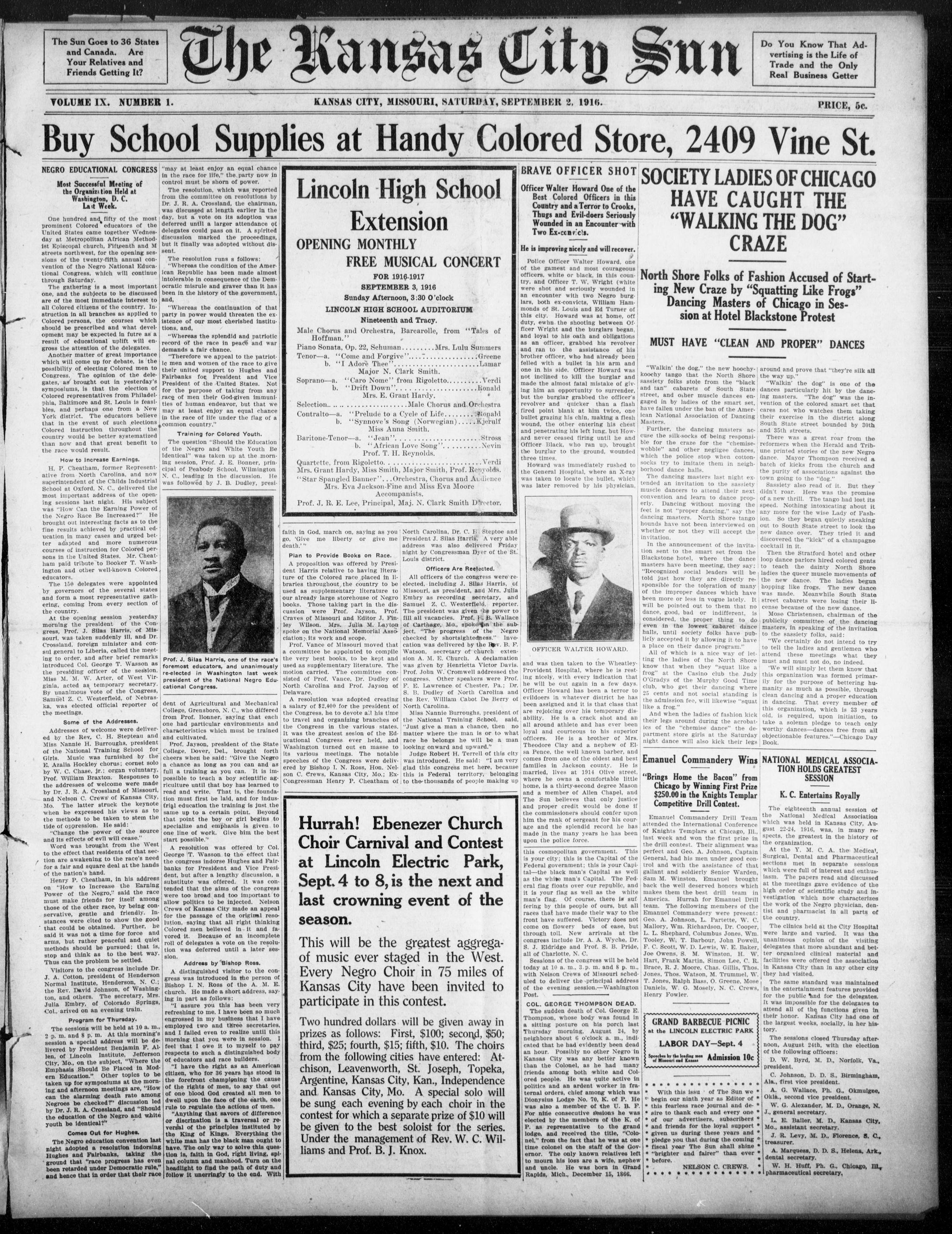
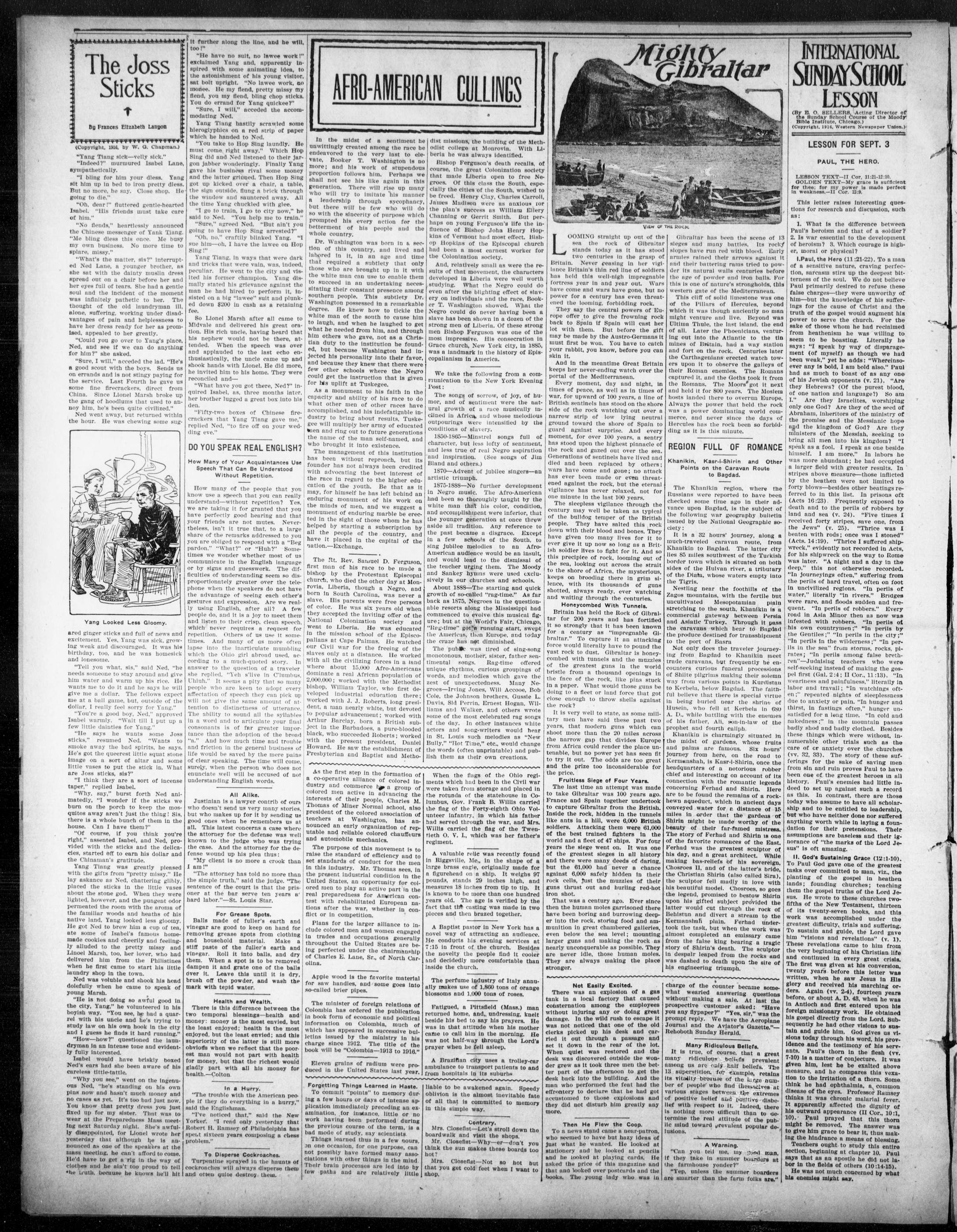
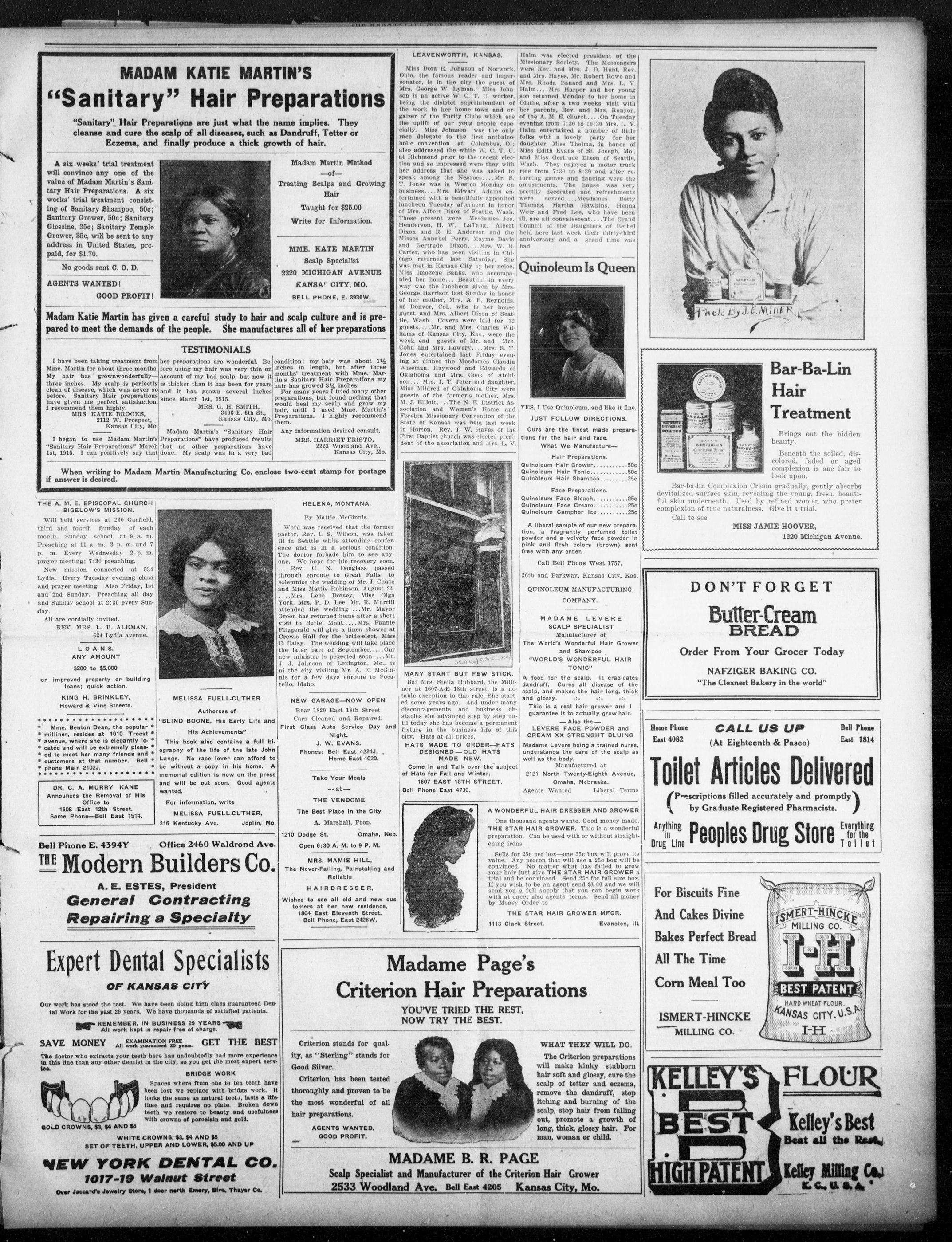
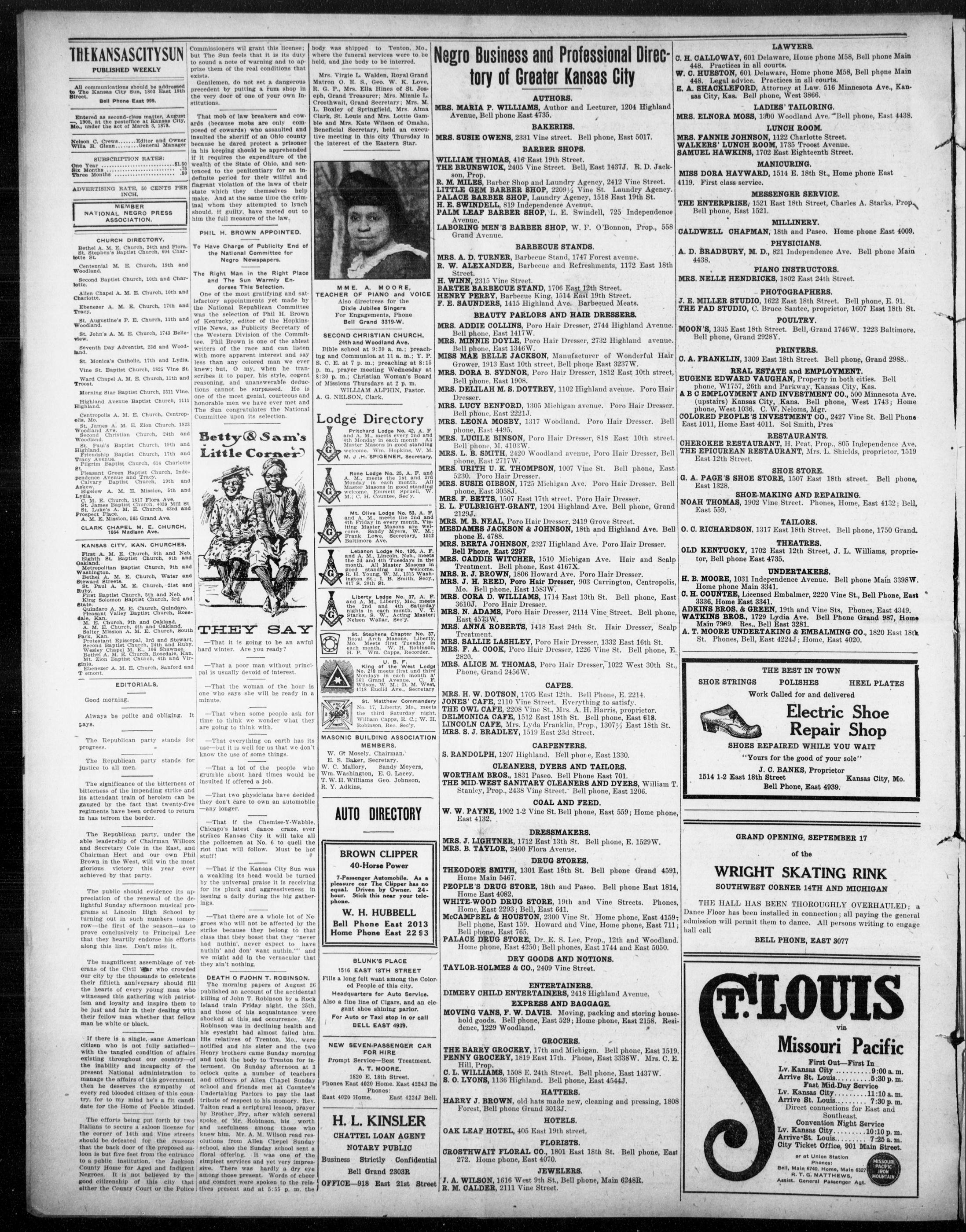
Page text (machine-generated)
Buy School Supplies at Handy Colored Store, 2409 Vine St.
The Sun Goes to 36 States and Canada. Are Your Relatives and Friends Getting It?
VOLUME IX. NUMBER 1.
NEGRO EDUCATIONAL CONGRESS
Most Successful Meeting of the Organization Held at Washington, D. C. Last Week.
One hundred and fifty of the most prominent Colored educators of the United States came together Wednesday at Metropolitan African Methodist Episcopal church, Fifteenth and M streets northwest, for the opening sessions of the twenty-fifth annual convention of the Negro National Educational Congress, which will continue through Saturday.
The gathering is a most important one, and the subjects to be discussed are of the most immediate interest to all Colored citizens of the country. Instruction in all branches as applied to Colored persons, the courses which should be prescribed and what development may be expected in future as a result of educational uplift will engross the attention of the delegates.
Another matter of great importance which will come up for debate, is the possibility of electing Colored men to Congress. The opinion of the delegates, as brought out in yesterday's symposiums, is that the election of Colored representatives from Philadelphia, Baltimore and St. Louis is feasible, and perhaps one from a New York district. The educators believe that in the event of such elections Colored instruction throughout the country would be better systematized than now and that great benefit to the race would result.
How to Increase Earnings.
H. P. Cheatham, former Representative from North Carolina, and now superintendent of the Childs Industrial School at Oxford, N. C., delivered the most important address of the opening sessions last night. His subject was "How Can the Earning Power of the Negro Race Be Increased?" He brought out interesting facts as to the fine results achieved by practical education in many cases and urged better adapted and more numerous courses of instruction for Colored persons in the United States. Mr. Cheatham paid tribute to Booker T. Washington and other well-known Colored educators.
The 150 delegates were appointed by governors of the several states and form a most representative gathering, coming from every section of the country.
At the opening session yesterday morning the president of the Congress, Prof. J. Silas Harris, of Missouri, was taken suddenly ill, and Dr. Crossland, foreign minister and consul general to Liberia, called the meeting to order, and after brief remarks introduced Col. George T. Wasson as the presiding officer of the session. Miss M. M. W. Arter, of West Virginia, acted as temporary secretary. By unanimous vote of the Congress, Samuel Z. C. Westerfield, of Nebraska, was elected official reporter of the meetings.
Some of the Addresses.
Addresses of welcome were delivered by the Rev. C. H. Stepeau and Miss Nannie H. Burroughs, president of the National Training School for Girls. Music was furnished by the E. Azalia Hockley chorus; cornet solo by W. C. Chase, Jr.; organ voluntary. Prof. William Braxton. Responses to the addresses of welcome were made by Dr. J. R. A. Crossland of Missouri, and Nelson C. Crews of Kansas City. Mo. The latter struck the keynote when he expressed his views as to the methods to be taken to stem the tide of oppression. He said:
"Change the power of the source and its effects of evil will cease."
Word was brought from the West to the effect that residents of that section are awakening to the race's need for a fair and square deal at the hands of the nation's hand.
Henry P. Cheatham, in his address on "How to Increase the Earning Power of the Negro," said the race must make friends for itself among those of the other race, by being conservative, gentle and friendly. Instances were cited to show the good that could be obtained. Further, he said it was not a time for force and arms, but rather peaceful and quiet methods should be pursued; that is, stop and think as to the best way. Thus can the problem be settled.
Visitors to the congress include Dr. J. A. Cotton, president of Henderson Normal Institute, Henderson, N. C.; the Rev. David Johnson, of Washington, and others. The secretary, Mrs Julia Embry, of Colorado Springs, Col. arrived on an evening train.
Program for Thursday.
The sessions will be held at 10 a. m., 2 p. m. and 8 p. m. At this morning's session a special address will be delivered by President Benjamin F. Allen, of Lincoln Institute, Jefferson City, Mo., on the subject, "Where the Emphasis Should Be Placed in Modern Education." Other topics to be taken up for symposiums at the morning and afternoon meetings are, "How can the alarming death rate among Negroes be checked?" discussion led by Dr. J. R. A. Crossland, and "Should the education of the Negro and white youth be identical?"
Comes Out for Hughes.
The Negro education convention last night adopted a resolution indorsing Hughes and Fairbanks, taking the ground that "race progress has even been retarded under Democratic rule," and hence that in order that their race
The Kansas City Sun
"may at least enjoy an equal chance in the race for life," the party now in control must be shorn of power.
The resolution, which was reported from the committee on resolutions by Dr. J. R. A. Crossland, the chairman, was discussed at length earlier in the day, but a vote on its adoption was deferred until a larger attendance of delegates could pass on it. A spirited discussion marked the proceedings, but it finally was adopted without dissent.
The resolution runs s follows:
"Whereas the condition of the American Republic has been made almost intolerable in consequence of the Democratic misrule and graver than it has been in the history of the government, and,
"Whereas the continuation of that party in power would threaten the existence of our most cherished institutions, and,
"Whereas the splendid and patriotic record of the race in peace and war demands a fair chance.
"Therefore we appeal to the patriotic men and women of the race to give their united support to Hughes and Fairbanks for President and Vice President of the United States. Not for the purpose of taking from any race of men their God-given immunities of human endeavor, but that we may at least enjoy an equal chance in the race of life under the flag of a common country."
Training for Colored Youth.
The question "Should the Education of the Negro and White Youth Be Identical" was taken up at the morning session, Prof. J. E. Bonner, principal of Peabody School, Wilmington N. C., leading in the discussion. He was followed by J. B. Dudley, presi
Prof. J. Silas Harris, one of the race's foremost educators, and unanimously re-elected in Washington last week president of the National Negro Educational Congress.
dent of Agricultural and Mechanical College, Greensboro, N. C., who differed from Prof. Bonner, saying that each one had particular environments and characteristics which must be trained and cultivated.
Prof. Jayson, president of the State College, Dover, Del., brought forth cheers when he said: "Give the Negro a chance as long as you can and as a training as you can. It is impossible to teach a boy scientific agriculture until that boy has learned to read and write. That is, the foundation must first be laid, and for industrial education the training is just the same up to a certain point. Beyond that point the boy or girl begins to specialize and emphasis is given, to one line of work. Give him the best start possible."
A resolution was offered by Col. George T. Wasson to the effect that the congress indorse Hughes and Fairbanks for President and Vice President, but after a lengthy discussion, a substitute was offered. It was contended that the aims of the congress were too broad and too important to allow politics to be injected. Nelson Crews of Kansas City made an appeal for the passage of the original resolution, saying that all right thinking Colored men believed in it and favored it. Because of an incomplete roll of delegates a vote on the resolution was deferred until a later session.
Address by Bishop Ross.
A distinguished visitor to the congress was introduced in the person of Bishop I. N. Ross of the A. M. E. church. He made a short address, saying in part as follows:
"I assure you this has been very refreshing to me. I have been so much engrossed in my business that I have employed two and three secretaries, and I failed even to realize until this morning that you were in session. I feel that I owe it to myself to pay respects to such a distinguished body of educators and race builders.
"I have the right as an American citizen, who for 36 years has stood in the forefront championing the cause of the rights of men, to say that out of one blood God created all men to dwell upon the face of the earth, one rule to regulate the actions of men.
"Anything that savors of difference or discrimination is a traversal or reversal of the principles instituted by the King of Kings. Everything the white man has the black man ought to have. The only way to solve this question is, faith in God, right living, spinal column and manhood. Turn on the headlight to find the path of duty and follow it unerringly to the end. With
KANSAS CITY, MISSOURI, SATURDAY, SEPTEMBER 2. 1916.
Lincoln High School Extension OPENING MONTHLY FREE MUSICAL CONCERT
FOR 1916-1917
SEPTEMBER 3, 1916
Sunday Afternoon, 3:30 O'clock
LINCOLN HIGH SCHOOL AUDITORIUM
Nineteenth and Tracy.
Male Chorus and Orchestra, Barcarolle, from "T. Hoffman."
Piano Sonata, Op. 22, Schuman... Mrs. Lulu S.
Tenor—a. "Come and Forgive"... b. "I Adore Thee"... Major N. Clark Smith.
Soprano—a. "Caro Nome" from Rigoletto... b. "Drift Down"... Mrs. E. Grant Hardy.
Selection... Male Chorus and O.
Contralto—a. "Prelude to a Cycle of Life... b. "Synnove's Song (Norwegian)... Miss Anna Smith.
Baritone-Tenor—a. "Jean"... b. "African Love Song"... Prof. T. H. Reynolds.
Quartette, from Rigoletto... Mrs. Grant Hardy, Miss Smith, Major Smith, Prof. R.
"Star Spangled Banner"... Orchestra, Chorus and A.
Mrs. Eva Jackson-Fine and Miss Eva Moore
Accompanists.
Prof. J. R. E. Lee, Principal, Maj. N. Clark Smith I
Male Chorus and Orchestra, Barcarolle, from "Tales of Hoffman."
Soprano—a. “Caro Nome” from Rigoletto.....Verdi
b. “Drift Down”.....Ronald
Mrs. E. Grant Hardy.
Selection... Male Chorus and Orchestra
Contralto—a. “Prelude to a Cycle of Life”.....Ronald
b. “Synnove's Song (Norwegian)”.....Kjerulf
Miss Anna Smith.
Baritone-Tenor—a. “Jean”.....Stross
b. “African Love Song”.....Nevin
Prof. T. H. Reynolds.
Prof. J. R. E. Lee, Principal, Maj. N. Clark Smith Director.
faith in God, march on, saying as you go. 'Give me liberty or give me death.'"
Plan to Provide Books on Race.
A proposition was offered by President Harris relative to having literature of the Colored race placed in libraries throughout the country to be used as supplementary literature to our already large storehouse of Negro books. Those taking part in the discussion were Prof. Jayson, Prof. Craves of Missouri and Editor J. Finley Wilson. Mrs. Julia M. Layton spoke on the National Memorial Association, its work and scope.
Prof. Vance of Missouri moved that a committee be appointed to compile the very best books, to be kept and used as supplementary literature. The motion carried. The committee consisted of Prof. Vance, Dr. Dudley of North Carolina and Prof. Jayson of Delaware.
A resolution was adopted creating a salary of $2,400 for the president of the Congress, he to devote all his time to travel and organizing branches of the Congress in the various states. It was the greatest session of the Educational Congress ever held, and Washington turned out en masse to its various meetings. The notable speeches of the Congress were delivered by Bishop I. N. Ross, Hon. Nelson C. Crews, Kansas City, Mo.; Ex-Congressman Henry P. Cheatham of
Hurrah! Ebe Choir Carniva
Hurrah! Ebenezer Church Choir Carnival and Contest at Lincoln Electric Park, Sept. 4 to 8, is the next and last crowning event of the
This will be the greatest aggregaof music ever staged in the West. Every Negro Choir in 75 miles of Kansas City have been invited to participate in this contest. Two hundred dollars will be given away in prizes as follows: First, $100; second, $50; third, $25; fourth, $15; fifth, $10. The choirs from the following cities have entered: Atchison, Leavenworth, St. Joseph, Topeka, Argentine, Kansas City, Kan., Independence and Kansas City, Mo. A special solo will be sung each evening by each choir in the contest for which a separate prize of $10 will be given to the best soloist for the series. Under the management of Rev. W. C. Williams and Prof. B. J. Knox.
Barcarolle, from "Tales of
Mrs. Lulu Summers
Greene
Lamar
Lark Smith.
From Rigoletto. Verdi
Konald
Ant Hardy.
Male Chorus and Orchestra
Cycle of Life. Ronald
Song (Norwegian). Kjerulf
A Smith.
Stross
Love Song''. Nevin
Reynolds.
Verdi
Major Smith, Prof. Renyolds.
Orchestra, Chorus and Audience
e and Miss Eva Moore
opanists.
Maj. N. Clark Smith Director.
North Carolina, Dr. C. H. Steptoe and
President J. Slas Harris. A very able
address was also delivered Friday
night by Congressman Dyer of the St.
Louis district.
Officers Are Reelected.
All officers of the congress were reelected, including J. Silas Harris, of Missouri, as president, and Mrs. Julia Embry as recording secretary, and Samuel Z. C. Westerfield, reporter. The president was given the power to fill all vacancies. Prof. H. B. Wallace of Carthage, Mo., spoken in the subject, "The progress of the Negro checked by shortsightness." Invocation was delivered by the Rev. B. F. Watson, secretary of church extension A. M. E. Church. A declamation was given by Henrietta Victor Davis. Prof. John W. Cromwell addressed the congress. Other speakers were Prof. F. E. Lawrence of Chester, Pa.; Dr. S. B. Dudley of North Carolina and the Rev. William Cabot De Berry of North Carolina.
Miss Nannie Burroughs, president of the National Training School, said, "Just give a man a chance, then no matter where the man is or to what race he belongs he will be a man looking onward and upward."
Judge Robert H. Terrell of this city was introduced. He said: "I am very glad this congress met here, because this is Federal territory, belonging to the thousands of people making up
nezer Church al and Contest
BRAVE OFFICER SHOT
Officer Walter Howard One of the Best Colored Officers in this Country and a Terror to Crooks, Thugs and Evil-doers Seriously Wounded in an Encounter with Two Ex-convicts.
He is improving nicely and will recover.
Police Officer Walter Howard, one of the gamest and most courageous officers, white or black, in this country, and Officer T. W. Wright (white were shot and seriously wounded in an encounter with two Negro burglars, both ex-convicts, William Hammonds of St. Louis and Ed Turner of this city. Howard was at home, off duty, ewn the shooting between Officer Wright and the burglars began, and loyal to his oath and obligations as an officer, grabbed his revolver and ran to the assistance of his brother officer, who had already been felled with a bullet in his arm and one in his side. Officer Howard was not inclined to kill the burglar and made the almost fatal mistake of giving him an opportunity to surrender, but the burglar grabbed the officer's revolver and quicker than a flash fired point blank at him twice, one bullet grazing his chin, making a flesh wound, the other entering his chest and penetrating his left lung, but Howard never ceased firing until he and Officer Black, who ran up, brought the burglar to the ground, wounded three times. Howard was immediately rushed to the General Hospital, where an X-ray was taken to locate the bullet, which was later removed by his physician.
OFFICER WALTER HOWARD
and was then taken to the Wheatley-Provident Hospital, where he is resting nicely, with every indication that he will be out again in a few days. Officer Howard has been a terror to evildoers in whatever district he has been assigned and it is that class that are rejoicing over his temporary disability. He is a crack shot and an all around athlete and has ever been loyal and courteous to his superior officers. He is a brother of Mrs Theodore Clay and a nephew of Elsa Pence, the well known barber, and comes from one of the oldest and best families in Jackson county. He is married, lives at 1914 Olive street, where he owns a comfortable little home, is a thirty-second degree Mason and a member of Allen Chapel, and The Sun believes that only justice and proper credit would be done if the commissioners should confer upon him the rank of sergeant for his courage and the splendid record he has made in the many years he has been upon the police force.
this cosmopolitan government. This is your city; this is the Capital of the Federal government; this is your Capital—the black man's Capital as well as the white man's Capital. The Federal flag floats over our republic, and it is your flag as well as the white man's flag. Of course, there is suffering by this people of ours, but all races that have made their way to the front have suffered. Victory does not come on flowery beds of ease, but through toll. New arrivals at the congress include Dr. A. A. Wyche, Dr. S. J. Eldridge and Prof. S. B. Pride, all of Charlotte, N. C. Sessions of the congress will be held today at 10 a. m., 3. p. m. and 8 p. m., with Nelson Crews of Missouri scheduled to deliver the -principal address of the evening session.-Washington Post.
COL. GEORGE THOMPSON DEAD.
The sudden death of Col. George E. Thompson, whose body was found in a sitting posture on his porch last Thursday morning, August 24, by neighbors about 6 o'clock a. m., indicated that he had evidently been dead an hour. Possibly no other Negro in Kansas City was any better known than the Colonel, as he had many friends among both white and Colored people. He was quite active in politics and an ardent worker in fraternal orders, chief among which was Dionysius Lodge No. 70, K. of P. He was also a member of the U. B. F. For nine consecutive sessions he was elected by the members of the K. of P. as representative to the grand lodge, and received the title, "Colonel," from the fact that he was at one time colonel on the staff of the Governor. The only known relatives left to mourn his loss are a wife, nephew and uncle. He was born in Grand Rapids, Mich., December 15, 1866.
SOCIETY LADIES OF CHICAGO HAVE CAUGHT THE "WALKING THE DOG" CRAZE
North Shore Folks of Fashion Accused of Starting New Craze by "Squatting Like Frogs" Dancing Masters of Chicago in Session at Hotel Blackstone Protest
MUST HAVE "CLEAN AND PROPER" DANCES
"Walkin' the dog," the new hoochy-koochy tango that the North Shore sassiety folks stole from the "black and tan" cabarets of South State street, and other muscle dances engaged in by ladies of the smart set, have fallen under the ban of the American National Association of Dancing Masters.
Further, the dancing masters accuse the silk-socks of being responsible for the craze for the "chemise-wobble" and other negligee dances, which the police stop when cotton-socks try to imitate them in neighborhood dance halls.
The dancing masters last night extended an invitation to the sassiety muscle dancers to attend their next convention and learn to dance properly. Dancing without moving the feet is not "proper dancing," say the dancing masters. North Shore tango hounds have not been interviewed on whether or not they will accept the invitation.
In the announcement of the invitation sent to the smart set from the Blackstone hotel, where the dance masters have been meeting, they say: "Recognized social leaders will be told just how they are directly responsible for the toleration of many of the improper dances which have been more or less in vogue lately. It will be pointed out to them that no dance, good, bad or indifferent, is considered, the proper thing to do even in the lowest cabaret dance halls, until society folks have publicly accepted it by allowing it to have a place on their dance program."
All of which is a nice way of letting the ladies of the North Shore know that when they "squat like a frog" at the Casino club the Judy O'Gradys of the Murphy Good Time club, who get their dancing where 25 cents and not social standing is the admission fee, will likewise "squat like a frog."
And when the ladies of fashion kick their legs around during the acrobatics of the "chemise dance" the department store girls at the Saturday night dance will also kick their legs
“Brings Home the Bacon” from Chicago by Winning First Prize $250.00 in the Knights Templar Competitive Drill Contest.
Emanuel Commandery Drill Team attended the International Conference of Knights Templars at Chicago, Ill., last week and won the first prize in the drill contest. Their alignment was perfect and Geo. A. Johnson, Captain General, had his men under good control and with the assistance of that gallant and soldierly Senior Warden, Sam M. Winston, Emanuel brought back the well deserved honors which makes them the best drill team in America. Hurrah for Emanuel Drill team. The following members of the Emanuel Commandery were present: Geo. A. Johnson, L. Partette, W. C. Mallory, Wm. Richardson, Dr. Cooper L. L. Shephard, Columbus Jones, Wm Tooley, W. T. Barbour, John Powell F. C. Scott, W. D. Lewis, W. E. Baker Joe Owens, S. M. Winston, H. H Wart, Frank Martin, Simon Lee, C. R Brace, R. J. Moore, Chas, Gillis, Thos Jones, Thos, Watson, M. Trumuel, W. T. Jones, Ralph Bass, O. Greene,麦丹iels, W. G. Mosely, N. C. Crews Henry Fowler.
GRAND BARBECUE PICNIC
at the LINCOLN ELECTRIC PARK
LABOR DAY—Sept. 4
Speeches by the leading men
of Missouri and Kansas
Admission 10c
* With this issu. of The Sun we
* begin our ninth year as Editor of
* this fearless race journal and desi-
* desire to thank each and every one
* of our advertisers, subscribers
* and friends for the loyal support
* given us during these years and
* pledge you that during the coming
* fiscal year The Sun shall shine
* "brighter and fairer" than ever
* before.
NELSON C. CREWS.
Do You Know That Advertising is the Life of Trade and the Only Real Business Getter
PRICE. 5c.
Vine St.
ES OF CHICAGO
UGHT THE
THE DOG"
AZE
Fashion Accused of Start-
quatting Like Frogs"
of Chicago in Ses-
backstone Protest
AND PROPER" DANCES
around and prove that "they're silk all the way up."
"Walkin' the dog" is one of the dances particularly hit by the dancing masters. "The dog" was the invention of the colored smart set that cares not who watches them taking their exercise in the district along South State street bounded by 30th and 35th streets.
There was a great roar from the reformers when the Herald and Tribune printed stories of the new Negro dance. Mayor Thompson received a batch of kicks from the church and the purity of associations against the town going to the "dog."
Sassettie also read of it. But they didn't roar. Here was the promise of a new thrill. The tango had lost its speed. Nothing intoxicating about it any more for the wise Lady of Fashion. So they began quietly sneaking out to South State street to look the new dance over. They tried it and discovered the "kick" of a champagne cocktail in it.
Then the Stratford hotel and other loop dance parlors hired colored gents to teach the dainty North Shore ladies the queer muscle movements of the new dance. The ladies began hopping like frogs. The new dance was made. Meanwhile South State street cabbages were losing their license because of the new dance.
Mose Christensen, chairman of the publicity committee of the dancing masters, in speaking of the invitation to the sassiety folks, said:
"We certainly do not intend to try to tell the ladies and gentlemen who attend these meetings what they must and must not do, no indeed.
"We will simply let them know that this organization was formed primarily for the purpose of bettering humanity as much as possible, through clean dancing and a proper education in dancing. That every member of this organization, which is 33 years old, is required, upon initiation, to take a solemn pledge to teach only worthy dances—dances free from all objectionable features."—Chicago Day Book.
NATIONAL MEDICAL ASSOCIATION HOLDS GREATEST SESSION
K. C. Entertains Royally
The eighteenth annual session of the National Medical Association which was held in Kansas City, August 22-24, 1916, was, in many respects, the greatest in the history of the organization.
At the Y. M. C. A. the Medical, Surgical, Dental and Pharmaceutical sections met in separate sessions which were full of interest and enthusiasm. The papers read and discussed at the meetings gave evidence of the high order of scientific study and investigation which now characterizes the work of the Negro physician, dentist and pharmacist in all parts of the country.
The clinics held at the City Hospital were large and varied. It was the unanimous opinion of the visiting delegates that more abundant and better organized clinical material and facilities were offered the association in Kansas City than in any other city they had visited.
The same standard was maintained in the entertainment features provided for the public and for the delegates. It was impossible for the delegates to attend all of the functions given in their honor. Kansas City had one of the largest weeks, socially, in her history.
The sessions closed Thursday afternoon, August 24th, with the election of the following officers:
D. W. Byrd, M. D., Norfolk, Va. president.
C. Johnson, D. D. S., Birmingham, Ala., first vice president.
A. G. Wallace, Ph. G., Okmulgee, Okla., second vice president.
W. G. Alexander, M. D., Orange, N.
J., general secretary.
L. E. Baller, M. D., Kansas City,
Mo., assistant secretary.
J. R. Levy, M. D., Florence, S. C.,
treasurer.
A. Marquess, D. D. S., Helena, Ark.,
dental secretary.
W. H. Huff, Ph. G., Chicago, Ill.,
pharmaceutical secretary.
The Joss Sticks
By Frances Elizabeth Lanpon
(Copyright, 1916, by W. G. Chapman.)
"Yang Tiang slick—velly slick."
"Indeed?" murmured Isabel Lane, sympathetically.
"I bling for him your dless. Yang sit him up in bed to iron pretty dless. But no more, he say. Close shop. He going to die."
"Oh, dear!" fluttered gentle-hearted Isabel. "His friends must take care of him."
"No flends," heartlessly announced the Chinese messenger of Yank Tiang. "Me bless dless this once. Me busy my own business. No more time to splare, missy."
"What's the matter, sls?" interrupted Ned Lane, a younger brother, as she sat with the dainty muslin dress spread out on a chair before her and her eyes full of tears. She had a gentle soul and the incident of the moment was infinitely pathetic to her. The thought of the old laundryman ill, alone, suffering, working under disadvantages of pain and helplessness to have her dress ready for her as promised, appealed to her greatly.
"Could you go over to Yang's place, Ned, and see if we can do anything for him?" she asked.
"Sure, I will," acceded the lad. "He's a good scout with the boys. Sends us on errands and is not stingy paying for the service. Last Fourth he gave us some fine firecrackers, direct from China. Since Lionel Marsh broke up the gang of hoodlums that used to annoy him, he's been quite civilized."
Ned went away, but returned within the hour. He was chewing some sug-
A boy is offering a cup of tea to an elderly man.
Yang Looked Less Gloomy.
ared ginger sticks and full of news and excitement. Yes, Yang was sick, growing weak and discouraged. It was his birthday, too, and he was homesick and lonesome.
"Tell you what, sis," said Ned. "he needs someone to stay around and give him water and warm up his rice. He wants me to do it and he says he will give me a dollar. The fellows expect me at a ball game, but, outside of the dollar, I really feel sorry for Yang."
"You're a good boy, Ned," approved Isabel warmly. "Walt till I put up a few little dainties for Yang."
"He says he wants some Joss sticks," resumed Ned. "Wants to smoke away the bad spirits, he says. He's got the queerest little squint stone image on a sort of altar and some little vases to put the stick in. What are Joss sticks, sis?"
"I think they are a sort of incense taper," replied Isabel.
"Why, say," burst forth Ned animatedly, "I wonder if the sticks we burn on the porch to keep the mosquitos away aren't just the thing! Sis, there is a whole bunch of them in the house. Can I have them?" "Of course, if you think you're right," assented Isabel, and Ned, provided with the sticks and the delicacies, started off to earn his dollar and the Chinaman's gratitude.
Yang Tiang was greatly pleased with the gifts from "pretty miss." He lay askance as Ned, chattering gibby, placed the sticks in the little vases about the stone god. When they were lighted, however, and the pungent odor permeated the room with the aroma of the familiar woods and heaths of his native land. Yang looked less gloomy. He got Ned to brew him a cup of tea, ate some Isabel's famous homemade cookies and cheerily and feelingly alluded to the pretty missy and Linnei Marsh, too, her lover, who had delivered him from the Philistines when he first came to start his little laundry shop in the town.
Ned was voluble and shook his head dolefully when he came to speak of young Marsh.
"He is not doing so awful good in the city, Marsh." he volunteered in his boyish way. "You see, he had a quarrel with his uncle and he's trying to study law on his own hook in the city and I guess he finds it hard running."
"How—how?" questioned the laundryman in an intense tone and evidently fully interested. Isabel would have briskly boxed Ned's ears had she been aware of his careless title-tattle.
"Why you see?" went on the ingenuous Ned, "he's standing on his own pins now and hasn't much money and no cases as yet. It's too bad just now. You know that pretty dress you just fixed up for my sister. That was to wear at the Preparedness Mass meeting next Saturday night. She's awfully disappointed, for Lionel wrote her yesterday that although he is announced as one of the speakers at the mass meeting, he can't afford to come. He'd have to get a rig in the way of clothes and he ain't too proud to tell "he truth, because he knows he'll hit
It further along the line, and he will, too!"
"He have no suit, no lawe work!" exclaimed Yang and, apparently inspired with some animating idea, to the astonishment of his young visitor, sat bolt upright. "No lawe work, no monee. He my flend, pretty missy my flend, you my flend, bling chop sticks. You do errand for Yang quickee?"
"Sure, I will," acceded the accommodating Ned.
Yang Tiang hastily scrawled some hieroglyphics on a red strip of paper which he handed to Ned.
"You take to Hop Sing laundly. He must come right away." Which Hop Sing did and Ned listened to their jargon jabber wonderingly. Finally Yang gave his business rival some money and the latter grinned. Then Hop Sing got up kicked over a chair, a table, the sign outside, flung a brick through the window and sauntered away. All the time Yang chuckled with glee.
"I go to train, I go to city now," he said to Ned. "You help me to train." "Sure," agreed Ned. "But ain't you going to have Hop Sing arrested?" "Oh, no." craftily blinked Yang. "I sue him—oh, I have the lawe on Hop Sing!"
Yang Tiang, in ways that were dark and tricks that were vain, was, indeed, peculiar. He went to the city and visited his former champion. Yang dismally stated his grievance against the man he had hired to perform it, insisted on a big "lawee" suit and plunked down $200 in cash as a retaining fee.
So Lionel Marsh after all came to Midvale and delivered his great oration. His rich uncle, having heard that his nephew would not be there, attended. When the speech was over and applauded to the last echo enthusiastically, the uncle came up and shook hands with Lionel. He did more, he invited him to his home. They were reconciled and—
"What have you got there, Ned?" Inquired Isabel, as, three months later, her brother lugged a great box into his den.
"Fifty-two boxes of Chinese fire crackers that Yang Tiang gave me," replied Ned, "to fire off on your wedding eve."
DO YOU SPEAK REAL ENGLISH?
How Many of Your Acquaintances Use Speech That Can Be Understood Without Repetition.
How many of the people that you know use a speech that you can really understand—without repetition? Yes, we are taking it for granted that you have perfectly good hearing and that your friends are not mutes. Nevertheless, isn't it true that, to a large share of the remarks addressed to you you are obliged to respond with a "Beg pardon." "What?" or "Huh?" Sometimes we wonder whether most of us communicate in the English language or by signs and guesswork. The difficulties of understanding seem so disproportionately greater over the telephone when the speakers do not have the advantage of seeing each other's gestures and expression. Are we really using English, after all? A few people do, and it is a joy to meet them and listen to their crisp, clean speech which never requires a request for repetition. Others of us use it sometimes. And many of us as more often lapse into the inarticulate mumbling which the Ohio girl abroad used, according to a much-quoted story. In answer to the question of a traveler she replied, "Teh s'live in C'clumbus, it." It seems a pity that so many people who are keen to adopt every affection of speech they can pick up will not give the same amount of attention to distinctness of utterance. The ability to sound all the syllables in a word and to articulate your final consonants is of far greater importance than the adoption of the broad "a." And how much time and trouble and friction in the general business of life would be saved by the mere pains of clear speaking. The time will come, surely, when the person who does not enunciate well will be accused of not understanding English words.
All Alike
Justinian is a lawyer contrib of ours who doesn't send us very many stories, but who makes up for it by sending us good ones when he remembers us at all. This latest concerns a case where the attorney for the defense was well known to the judge who was trying the case. And the attorney for the defense wound up his plea thus: "My client is no more a crook than I am!" "The attorney has told no more than the simple truth," said the judge. "The sentence of the court is that the prisoner at the bar serve ten years a hard labor."—St. Louis Star.
For Grease Spots
Balls made of fuller' earth and vinegar are good to keep on hand for removing grease spots from clothing and household material. Make a stiff paste of the fuller' earth and vinegar. Roll it into balls, and dry them. When a spot is to be removed dampen it and grate one of the balls over it. Leave this until it is dry, brush off the powder, and wash the mark with tepid water.
Health and Wealth.
There is this difference between the two temporal blessings—health and money; money is the most enlisted, but the least enjoyed; health is the most enjoyed, but the least enlisted; and this superiority of the latter is still more oblivious when we reflect that the poorest man would not part with health for money, but that the richest would gladly part with all his money for health—Colton.
In a Hurry.
"The trouble with the American people if they do everything in a hurry," said the Englishman.
"I've noticed that," said the New Yorker, "I read only yesterday that Robert H. Ramsey of Philadelphia has spent sixteen years composing a chess problem."
To Disperse Cockroaches
Turbentine sprayed in the haunts of cockroaches will always disperse them and often quite destroy them.
AFRO-AMERICAN CULLINGS
In the midst of a sentiment he unwittingly created among the race he endeavored to the very last to elevate, Booker T. Washington is no more; and his work of stupendous proportion follows him. Perhaps we shall not see his like again in this generation. There will rise up many who will try to imitate his manner a leadership through sycophancy, but there will be few who will do so with the sincerity of purpose which prompted his every action for the betterment of his people and the whole country.
Dr. Washington was born in a section of this country, and lived and labored in it, in an age and time that required a subtlety that only those who are brought up in it with the white man can use to enable them to succeed in an undertaking necessitating their constant presence among southern people. This subtlety Dr. Washington possessed in a remarkable degree. He knew how to tickle the white man of the south to cause him to laugh, and when he laughed to get what he needed from him, and through him others who gave, not as a Christian duty to the institution he founded, but because Washington had injected his personality into their favor, and because they knew that there were few other schools where the Negro could get the instruction that is given for his uplift at Tuskegee.
As a monument to his faith in the capacity and ability of his race to do what other men of other races have accomplished, and his indefatigable industry to bring about results, Tuskegee will multiply her army of educated men and ring out to future generations the name of the man self-named, and who brought it into existence.
The management of this institution has been without reponch, but its founder has not always been credited with advocating the best interest of the race in regard to the higher education of the youth. Be that as it may, for himself he has left behind an enduring monument of his work on the minds of men, and we suggest a monument of enduring marble be erected in the sight of those whom he has helped by starting a subscription by all the people of the country, and have it placed in the capital of the nation—Exchange.
The Rt. Rev. Samuel D. Ferguson, first man of his race to be made a bishop by the Protestant Episcopal church, who died the other day at Monrovia, Liberia, died a Negro, and born in South Carolina, was never a slave. His parents were free persons of color. He was six years old when they accepted the inviting offer of the National Colonization society and went to Liberia. He was educated in the mission school of the Episcopalians at Cape Palmats. He watched our Civil war for the freeing of the slaves only at a distance. He worked with all the civilizing forces in a land where about 15,000 Afro-Americans dominate a real African population of 2,000,000; worked with the Methodist bishop, William Taylor, who first developed industrial education there; worked with J. J. Roberts, long president, a man nearly white, but devoted to popular advancement; worked with Arthur Barclay, born a British subject in the Barbados, a pure-blooded black, who succeeded Roberts; worked with the present president, Daniel Howard. He saw the establishment of Presbyterian and Baptist and Metho-
As the first step in the formation of a co-operative alliance of colored industry and commerce by a group of colored men active in advancing the interests of their people, Charles M. Thomas of Miner Normal school, also president of the colored association of teachers at Washington, has announced an early organization of reputable and reliable colored chauffeurs and automobile mechanics.
The purpose of this movement is to raise the standard of efficiency and to set standards of conduct for the men in this industry. Mr. Thomas sees, in the present industrial condition in the United States, an opportunity for colored men to play an active part in the real preparedness for American contest with rehabilitated European nations after the war, whether in conflict or in competition.
Plans for the larger alliance to include colored men and women engaged in trades and occupations generally throughout the United States are being perfected under the chairmanship of Charles E. Lane, Sr., of North Carolina.
Apple wood is the favorite material for saw handles, and some goes into so-called brier pipes.
The minister of foreign relations of Colombia has ordered the publication in book form of economic and political information on Colombia, much of which has appeared in successive bulletins issued by the ministry in his charge since 1912. The title of the book will be "Colombia—1913 to 1916."
Eleven grains of radium were produced in the United States last year.
Forgetting Things Learned in Haste.
To commit "points" to memory during a few hours or days of intense application immediately preceding an examination, for instance, little or no work having been performed during the previous course of the term, is a bad mode of study, say scientists.
Things learned thus in a few hours, on one occasion, for one purpose, can not possibly have formed many associations with other things in the mind. Their brain processes are led into by few paths and are relatively little
dist missions, the building of the Methodist college at Monrovia. With Liberia he was always identified.
Bishop Ferguson's death recalls, of course, the great Colonization society that made Liberia open to free Negroes. Of this class the South, especially the cities of the South, wished to be freed. Henry Clay, Charles Carroll, James Madison were as anxious for the plan's success as William Ellery Channing or Gerrit Smith. But perhaps on young Ferguson's life the influence of Bishop John Henry Hopkins of Vermont had most effect. Bishop Hopkins of the Episcopal church had been a most earnest worker for the Colonization society.
And, relatively small as were the results of that movement, the characters developed in Liberia were well worth studying. What the Negro could do even after the blighting effect of slavery on individuals and the race, Booker T. Washington showed. What the Negro could do never having been a slave has been shown in a dozen of the strong men of Liberia. Of these strong men Bishop Ferguson was one of the most impressive. His consecration in Grace church, New York city, in 1885, was a landmark in the history of Episcopalianism in America.
We take the following from a communication to the New York Evening Post:
The songs of sorrow, of joy, of humor, and of sentiment were the natural growth of a race musically inclined in Africa and whose melodious outpourings were intensified by the conditions of slavery.
1850-1865—Minstrel songs full of character, but less lofty of sentiment, and less true of real Negro aspiration and inspiration. (See songs of Jim Bland and others.)
1870—Advent of jubilee singers—an artistic triumph.
1875-1888—No further development in Negro music. The Afro-American had been so thoroughly taught by the white man that his color, condition, and accomplishment were inferior, that the younger generation at once threw aside all tradition. Any reference to the past became a disgrace. Except in a few schools of the South, to sing jubilee melodies to an Afro-American audience would be an insult, and would lead to the dismissal of the teacher urging them. The Moody and Sankey hymns were used exclusively in our churches and schools.
About 1888—The starting and quick growth of so-called "rag-time." As far back as 1875, Negroes in the questionable resorts along the Mississippi had commenced to evolve this musical figure; but at the World's Fair, Chicago, "reg-time" got a running start, swept the Americas, then Europe, and today the craze has not diminished.
The public was tired of sing-song monotonous, mother, sister, father sentimental songs. Rag-time offered unique rhythms, curious groupings of words, and melodies which gave the zest of unexpectedness. Many Negroes—Irving Jones, Will Accooe, Bob Cole, the Johnson brothers, Gussie L. Davis, Sid Perrin, Ernest Hogan, Williams and Walker, and others wrote some of the most celebrated rag songs of the day. In other instances white actors and song-writers would hear in St. Louis such melodies as "New Bully," "Hot Time," etc., would change the words (often unprintable) and publish them as their own creations.
When the flags of the Ohio regiments which had been in the Civil war were taken from storage and placed in the rotunda of the statehouse in Columbus, Gov. Frank B. Willis carried the flag of the Forty-eighth Ohio Volunteer infantry, in which his father had served through the war, and Mrs. Willis carried the flag of the Twentieth O. V. L, which was her father's regiment.
A valuable relic was recently found in Riggsville, Me., in the shape of a large brass eagle, originally made for a figurehead on a ship. It weighs 97 pounds, stands 29 inches high, and measures 18 inches from tip to tip. It is known to be more than one hundred years old. The age is verified by the fact that the casting was made in two pieces and then brazed together.
A Baptist pastor in New York has a novel way of attracting an audience. He conducts his evening services at 7:15 in front of the church. Besides the novelty the people find it cooler and decidedly more comfortable than inside the church.
The perfume industry of Italy annually makes use of 1,860 tons of orange blossoms and 1,000 tons of roses.
Fatigued, a Pittsfield (Mass.) man returned home, and, undressed, knelt beside his bed to say his prayers. He was in that attitude when his mother came to call him in the morning. He was not half-way through the Lord's prayer when he fell asleep.
A Brazilian city uses a trolley-car ambulance to transport patients to and from hospitals in its suburbs
liable to be awakened again. Speedy oblivion is the almost inevitable fate of all that is committed to memory in this simple way.
Contrary
Mrs. Closefist—Let's stroll down the boardwalk and visit the shops.
Mr. Closefist—Why-er—don't you think the sun makes these boards too hot?
Mrs. Closefist—Not so hot but that you get cold feet when I want to shop.
Mighty
Gibraltar
OOMING straight up out of the sea the rock of Gibrait stands today as it has stood
two centuries in the grasp of Britain. Never ceasing in her vigilance Britain's thin red line of soldiers has held this well-nigh impregnable fortress year in and year out. Wars have come and wars have gone, but no power for a century has even threatened the looming, forbidding rock. They say the central powers of Europe offer to give the frowning rock back to Spain if Spain will cast her lot with them. Before the gift may be made by the Austro-Germans it must first be won. You have to catch your rabbit, you know, before you can skin it. And in the meantime Great Britain keeps her never-ending watch over the portal of the Mediterranean.
Every moment, day and night, in times of peace, as well as in times of war, for upward of 100 years, a line of British sentinels has stood on the shore side of the rock watching out over a narrow strip of low lying neutral ground toward the shore of Spain to guard against surprise. And every moment, for over 100 years, a sentry has stood upon the highest pinnacle of the rock and gazed out over the sea. Generations of sentinels have lived and died and been replaced by others; wars have come and gone; no attack has ever been made or even threatened against the rock, but the eternal vigilance has never relaxed, not for one minute in the last 100 years.
The sleepless vigilance through the century may well be taken as triplicate of the bulldog temper of the British people. They have salted this rock down with their blood and bones. They have given too many lives for it to ever give it up now so long as a British soldier lives to fight for it. And so this precipice of rock, looming out of the sea, looking out across the strait to the shore of Africa, the mysterious, keeps on brooding there in grim silence, with its thousands of guns shotted, always ready, ever watching and waiting through the centuries.
Honeycombed With Tunnels.
Britain has held the Rock of Gibraltar for 200 years and has fortified it so strongly that it has been known for a century as "impregnable Gibraltar." To capture it an attacking force would literally have to pound the vast rock to dust. Gibraltar is honeycombed with tunnels and the muzzles of the greatest guns in the world bristle from a thousand openings in the face of the rock, like pins stuck in a paper. What would those guns be doing to a fleet or land force that got close enough to throw shells against the rock?
It is very well to state, as some military men have said these past two years, that modern guns which can shoot more than the 20 miles across the narrow gap that divides Europe from Africa could render the place untenable, but no power yet has seen fit to try it out. The odds are too great and the prize too inconsiderable for the price.
Fruitless Siege of Four Years.
The last time an attempt was made to take Gibraltar was 100 years ago. France and Spain together undertook to capture Gibraltar from the British. Inside the rock, hidden in the tunnels like ants in a hill, were 6,000 British soldiers. Attacking them were 61,000 of the best trained fighters in the world and a fleet of 47 ships. For four years the siege went on. It was one of the greatest sieges in all history and there were many deeds of daring, but the 61,000 had never a chance against 6,000 safely hidden in their rock cells, just the muzzles of their guns thrust out and hurling red-hot iron shot.
That was a century ago. Ever since then the human moles garrisoned there have been boring and burrowing deeper into the rock, storing food and ammunition in great chambered galleries, even below the sea level; mounting larger guns and making the rock as nearly unconquerable as possible. They are never idle, those human moles. They are always making the place stronger.
There was an explosion of a gas tank in a local factory that caused consternation among the employees without injuring any or doing great damage. In the wild rush to escape it was not noticed that one of the old clerks picked up his desk and carried it out through a passage and set it down in the rear of the lot. When quiet was restored and the desk was discovered outside the wonder grew as it took three men the better part of the afternoon to get the desk back into the building. And the man who performed the feat had the enfertory to declare that he had got accustomed to those explosions and they did not disturb him greatly any more.
To a new stand came a near-patron, who seemed to have but bazy ideas of just what he wanted. He looked at stationery and he looked at pencils and he looked at playing cards. He asked the price of this magazine and that and looked over postcards and the books. The young lady who was in
Not Easily Excited.
Then He Flew the Coop.
VIEW OF THE ROCK
Gibraltar has been the scene of 13 steges and many battles. Its rocky slopes have run red with blood. Early armies rained their arrows against it and their battering rams tried to powder its natural walls centuries before the age of powder and iron balls. For this is one of nature's strongholds, this western gate of the Mediterranean.
This cliff of solid limestone was one of the Pillars of Hercules, beyond which it was though anciently no man might venture and live. Beyond was Ultima Thule, the last island, the end of all. Later the Phoenicians, venturing out into the Atlantic to the timines of Britain, had a way station and fort on the rock. Centuries later the Carthageans erected watch towers upon it to observe the galleys of their Roman enemies. The Romans captured it, and the Goths took it from the Romans. The Moors got it next and held it for 800 years. The Moslem hosts landed it to overrun Europe, Always the power that held the rock was a power dominating world commerce, and never since the days of Hercules has the rock been so forbidding as it is this minute.
REGION FULL OF ROMANCE
Khanikin, Kasr-i-Shirin and Other Points on the Caravan Route to Bagdad.
The Khanikin region, where the Russians were reported to have been checked some time ago in their advance upon Bagdad, is the subject of the following war geography bulletin issued by the National Geographic society:
It is a 32 hours' journey, along a much-traveled caravan route, from Khanikin to Bagdad. The latter city lies 85 miles southwest of the Turkish border town which is situated on both sides of the Hulvan river, a tributary of the Diuka, whose waters empty into the Tigris.
Nestling near the foothills of the Zagos mountains, with the fertile but uncultivated Mesopotamian plain stretching to the south, Khanikin is a commercial gateway between Persia and Asiatic Turkey. Through it pass the caravans which bear to Bagdad the produce destined for transshipment to the port of Basrn
Not only does the traveler journeying from Bagdad to Khanikin meet trade caravans, but frequently he encounters curious funeral processions of Shilite pilgrims making their solemn way from various points in Kurdistan to Kerbela, below Bagdad. The faithful believe that there is special virtue in being buried near the shrine of Husein, who fell at Kerbela in 680 A.D., while battling with the enemies of his father, Ali, son-in-law of the prophet and fourth caliph.
Khanikin is charmingly situated in the midst of gardens, whose fruits and palms are famous. Six hours' journey from here, on the road to Kermanshah, is Kasr-i-Shirin, once the headquarters of a notorious robber chief and interesting on account of its connection with the romantic legends concerning Ferhad and Shirin. Here are to be found the remains of a rock-hewn aqueduct, which in ancient days conveyed water for a distance of 15 miles in order that the gardens of Shirin might be made worthy of the beauty of their far-famed mistress. The story of Ferhad and Shirin is one of the favorite romances of the East. Ferhad was the greatest sculptor of his day, and a great architect. While making bas-reliefs of his sovereign, Chosroes II, and of the latter's bride, the Christian Shirin (also called Sira), the sculptor fell madly in love with his beautiful model. Chosroes, so goes the legend, promised to bestow Shirin upon his gifted subject provided the latter would cut through the rock of Behlstun and divert a stream to the Kermanshni plain. Ferhad undertook the task, but when the work was almost completed an emissary came from the false king bearing a tragic story of Shirin's death. The sculptor in despair leaped from the rocks and was dashed to death upon the site of his engineering triumph.
charge of the counter became some what wearied answering questions without making a sale. At last the prospective customer asked: "Have you any fipaper?" "Yes, sir," was the prompt reply. We have the Aeroplanet Journal and the Aviator's Gazette."—Rehoboth Sunday Herald.
Many Ridiculous Beliefs.
It is true, of course, that a great many ridiculous beliefs prevalent among us are only half beliefs. The 13 superstition, for example, retains its vitality because of the large number of people who find themselves at various stages between the extremes of positive belief and positive disbelief with respect to it. Indeed, there is nothing more difficult than to determine the real attitude of the public mind toward prevalent popular delusions.
"Can you tell me, my good man,
if they take in summer boarders at
the farmhouse yonder?"
"Yep, unless the summer boarders
are smarter than the farm folks are."
Many Ridiculous Bellefs
A Warning.
INTERNATIONAL
SUNDAY SCHOOL
LESSON
(By E. O. SELLERS, Acting Director of the Sunday School Course of the Moody Bible Institute, Chicago.)
(Copyright, 1916, Western newspaper Union.)
LESSON FOR SEPT. 3
PAUL, THE HERO.
LESSON TEXT—II Cor. 11:21-12:10.
GOLDEN TEXT—My grace is sufficient for thee; for my power is made perfect in weakness—II Cor. 12:3.
This letter raises interesting questions for research and discussion, such as:
1. What is the difference between Paul's heroism and that of a soldier?
2. Is war essential to the development of heroism?
3. Which courage is higher, moral or physical?
I.Paul, the Hero (11:21:22). To a man of a sensitive nature, craving perfection, sarcasm stirs up the deepest bitterness of the soul. We do not believe Paul primarily desired to refuse these false charges—they were unworthy of him—but the knowledge of his sufferings for the cause of Christ and the truth of the gospel would augment his power to serve the church. For the sake of those whom he had reclamed from heathenism he was willing to seem to be boasting. Literally he says: "I speak by way of disparagement (of myself) as though we had been weak," yet he adds: "Whereinsoever any is bold, I am bold also." Paul had as much to boast of as any one of his Jewish opponents (v. 21). "Are they Hebrews? (Of the purest blood, of one nation and language?) So am I." Are they Israelites, worshiping only one God? Are they of the seed of Abraham, inheritors of the ministry of the promise and the Messianic hope and the kingdom of God? Are they ministers of the Messiah, seeking to bring all men into his kingdom? "I speak as a fool. I speak as a beside himself. I am more." In labors he was more abundant; he had occupied a larger field with greater results. In stripes above measure—those inflicted by the heathen were not limited to forty blows—besides other beatings referred to in this list. In prisones off (Acts 16:23). Frequently exposed to death and to the perils of robbers by land and sea (v. 24). "Five times I received forty strips, save one, from the Jews" (v. 25). "Thrice was I beaten with rods; once was I stoned" (Acts. 14:19). "Thrice I suffered shipwreck," evidently not recorded in Acts, for his shipwreck on the way to Rome was later. "A night and a day in the deep," this not otherwise recorded. "In journeyings often," suffering from the perils of hard travel, on often foot in uncivilized regions. "In perils of water," literally "In rivers." Brudges were rare, and floods sudden and frequent. "In perils of robbers." Every road in Asia Minor then as now was infested with robbers. "In perils of his own countrymen;" "In perils by the Gentiles;" "In perils in the city;" "In perils in the wilderness;" "In perils in the sea" from storms, rocks, pirates; "In perils among false brethren." Judaisling teachers who were self-seeking instead of making the gospel first (Gal. 2:4; II Cor. 11:13). "In weariness and floods," literally in labor and travail; "In watchings often;" repeated nights of sleeplessness due to anxiety or pain. "In hunger and thirst, in fastings often," hunger unsatisfied for a long time. "In cold and nakedness;" in the mountain passes badly shod and badly clothed. Besides these things which were without, innumerable other trials such as the care of cr anxiety over the churches (vv. 32, 33). The story of these sufferings for the sake of saving men from sin and ruin proves Paul to have been one of the greatest heroes in all history. Paul's enemies had little indeed to set up against such a record as this. In contrast, there are those today who assume to have all scholarship and to be entitled to leadership, but who have neither done nor suffered anything worth while in laying a foundation for their pretensions. Their assumptions are baseless and their ignorance of "the marks of the Lord Jesus" is oft amazing.
11. God's Sustaining Grace (12:1:10). To Paul God gave one of the greatest tasks over committed to man, viz., the planting of the gospel in heathen lands; founding churches; teaching them the gospel truths of the Lord Jesus. He wrote to these churches two-fifths of the New Testament, thirteen of its twenty-seven books, and this work was accomplished under the greatest difficulty, trials and suffering. To sustain and guide, the Lord gave him "vistons and revelations" (v. 1). These revelations came to him from the very beginning of his Christian life and continued in every great crisis. The first was given at his conversion, twenty years before this letter was written, when he saw Jesus in His glory and received his marching orders. Again (vv. 2-4), fourteen years before, or about A. D. 43, when he was in Antioch and first entered upon his missionary work. He obtained his gospel directly from the Lord. Subsequently he had other visions to sustain and guide him. God gives us visions today through his word, his providence and the testimony of his servants. Paul's thorn in the flesh (vv. 7-10) is a matter of conjecture. It was given him, lest he be exalted above measure, and he compares this vexation to the irritation of a thorn. Some think he had ophthalmia, a common disease of the eyes. Professor Ramsey thinks it was chronic malarial fever. It apparently affected the dignity of his outward appearance (II Cor. 10:1, 10). Paul prayed that this thorn might be removed. The answer was to give him grace to bear it, thus making the hindrance a means of blessing.
Teachers ought to study this entire section, beginning at chapter 10. Paul says that as an apostle he did not labor in the fields of others (10:14-15). He was not much concerned by what his enemies might say.
MADAM KATIE MARTIN'S "Sanitary" Hair Preparations
"Sanitary" Hair Preparations are just what the name implies. They cleanse and cure the scalp of all diseases, such as Dandruff, Tetter or Eczema, and finally produce a thick growth of hair.
A six weeks' trial treatment will convince any one of the value of Madam Martin's Sanitary Hair Preparations. A six weeks' trial treatment consisting of Sanitary Shampoo, 50c; Sanitary Grower, 50c; Sanitary Glossine, 35c; Sanitary Temple Grower, 35c, will be sent to any address in United States, prepaid, for $1.70.
No goods sent C. O. D.
Madam Martin Met-
of—
Treating Scalps and G
Hair
Taught for $25.00
Write for Informa
MME. KATE MAR-
Scalp Specialist
AGENTS WANTED!
GOOD PROFIT!
Madam Katie Martin has given pared to meet the demands
Madam Katie Martin has given a careful study to hair and scalp culture and is prepared to meet the demands of the people. She manufactures all of her preparations
I have been taking treatment from Mme. Martin for about three months. My hair has grownwonderfully—three inches. My scalp is perfectly clean of disease, which was never so before. Sanitary Hair preparations have given me perfect satisfaction I recommend them highly.
MRS. KATIE BROOKS,
2112 W. Prospect,
Kansas City, Mo
Madam Martin's "Sanitary Hair I began to use Madam Martin's Preparations" have produced results "Sanitary Hair Preparations" March that no other preparations have lest, 1915. I can positively say that done. My scalp was in a very bad
I began to use Madam Martin's "Sanitary Hair Preparations" March 1st, 1915. I can positively say that
When writing to Madam I if answer is desired.
When writing to Madam Martin Manufacturing Co. enclose two-cent stamp for postage if answer is desired.
THE A. M. E. EPISCOPAL CHURCH
-BIGELOW'S MISSION.
Will hold services at 230 Garfield,
third and fourth Sunday of each
month. Sunday school at 9 a. m.
Preaching at 11 a. m., 3 p. m. and 7
p. m. Every Wednesday 2 p. m.
prayer meeting; 7:30 preaching.
New mission connected at 534
Lydia. Every Tuesday evening class
and prayer meeting. Also Friday, 1st
and 2nd Sunday. Preaching all day
and Sunday school at 2:30 every Sunday.
All are cordially invited.
REV. MRS. L. B. ALEMAN,
534 Lydia avenue.
LOANS,
ANY AMOUNT
$200 to $5,000
on improved property or building loans; quick action.
KING H. BRINKLEY,
Howard & Vine Streets.
* Mme. Benton Dean, the popular * milliner, resides at 1010 Troost * avenue, where she is elegantly located and will be extremely pleased * to meet her many friends and customers at that number. Bell * phone Main 2102J.
DR. C. A. MURRY KANE
Announces the Removal of His Office to
1608 East 12th Street.
Same Phone—Bell East 1514.
Bell Phone E. 4394Y
THE Modern E
A. E. ESTES
General C
Repairing
Expert Dental
A. E. ESTES, President General Contracting Repairing a Specialty
Expert Dental Specialists
OF KANSAS CITY
Our work has stood the test. We have
tal Work for the past 29 years. We
REMEMBER, IN B
All work kept in re
SAVE MONEY EXAMINATION
All work guaran
The doctor who extracts your teeth her
in this line than any other dentist in the
ice.
Our work has stood the test. We have been doing high class guaranteed Dental Work for the past 29 years. We have thousands of satisfied patients.
REMEMBER, IN BUSINESS 29 YEARS
All work kept in repair free of charge.
SAVE MONEY
EXAMINATION FREE
All work guaranteed 20 years.
GET THE BEST
The doctor who extracts your teeth here has undoubtedly had more experience in this line than any other dentist in the city, so you get the most expert service.
BRIDGE WORK
Spaces where from one to ten teeth have been lost we replace with bridge work. It looks the same as natural teeth... lasts a life time and requires no plate. Broken down teeth we restore to beauty and usefulness with crowns of porcelain and gold.
GOLD CROWNS, $3, $4 AND $5
WHITE CROWN
SET OF TEETH, UPPE
NEW YORK
1017-19 WA
Over Jaccard's Jewelry Store, 1 d
WHITE CROWNS, $3, $3, AND $5
SET OF TEETH, UPPER AND LOWER, $5.00 AND UP
Over Jaccard's Jewelry Store, 1 door north Emery, Bire, Thayer Co.
All are cordially invited.
[Image of a woman with dark hair and a light-colored dress].
is given a careful study to hair and heads of the people. She manufactu
TESTIMONIALS
her preparations are wonderful. Before using my hair was very thin on account of my bad scalp, but now it is thicker than it has been for years and it has grown several inches since March 1st, 1915.
MRS. G. H. SMITH,
3406 E. 6th St.,
Kansas City, Mo.
Madam Martin's "Sanitary Hair Preparations" have produced results that no other preparations have done. My scalp was in a very bad
Am Martin Manufacturing Co. enclose
A. E.
MELISSA FUELL-CUTHER
Autohress of
"BLIND BOONE, His Early Life and His Achievements"
This book also contains a full biography of the life of the late John Lange. No race lover can afford to be without a copy in his home. A memorial edition is now on the press and will be out soon. Good agents wanted.
For information, write
MELISSA FUELL-CUTHER,
316 Kentucky Ave. Joplin, Mo.
Office 2460 Waldrond Ave.
Builders Co.
TES, President
Contracting
g a Specialty
Total Specialists
have been doing high class guaranteed Den-
We have thousands of satisfied patients.
IN BUSINESS 29 YEARS
in repair free of charge.
INATION FREE
guaranteed 20 years.
GET THE BEST
here has undoubtedly had more experience
in the city, so you get the most expert serv-
BRIDGE WORK
Spaces where from one to ten teeth have
been lost we replace with bridge work. It
looks the same as natural teeth. lasts a lifetime and requires no plate. Broken down
teeth we restore to beauty and usefulness
with crowns of porcelain and gold.
CROWNS, $3, $4 AND $5
UPPER AND LOWER, $5.00 AND UP
K DENTAL CO.
Walnut Street
, 1 door north Emery, Bire, Thayer Co.
Madame Page's Criterion Hair Preparations YOU'VE TRIED THE REST, NOW TRY THE BEST.
MADAME B. R. PAGE Scalp Specialist and Manufacturer of the Criterion Hair Grower 2533 Woodland Ave. Bell East 4205 Kansas City, Mo.
Treating Scalps and Growing
Hair
Taught for $25.00
Write for Information.
MME. KATE MARTIN
Scalp Specialist
2220 MICHIGAN AVENUE
KANSA' CITY, MO.
BELL PHONE, E. 3936 W.
and scalp culture and is pre-
tures all of her preparations
condition; my hair was about 1½
inches in length, but after three
months' treatment with Mme. Martin's Sanitary Hair Preparations my
hair has grown 3¼ inches.
For many years I tried many other preparations, but found nothing that would heal my scalp and grow my hair, until I used Mme. Martin's Preparations. I highly recommend them.
Any information desired consult,
MRS. HARRIET FRISTO,
2223 Woodland Ave.,
Kansas City, Mo.
HELENA, MONTANA.
By Mattie McGinnis.
Word was received that the former pastor, Rev. I. S. Wilson, was taken ill in Seattle while attending conference and is in a serious condition. The doctor forbade him to see anyone. We hope for his recovery soon. ...Rev. C. N. Douglass passed through enroute to Great Falls to solemnize the wedding of Mr. J. Chase and Miss Mattie Robinson, August 24. ...Mrs. Lena Dorsey, Miss Olga York, Mrs. P. D. Lee, Mr. R. Murrill attended the wedding. ...Mr. Mayor Green has returned home after a short visit to Butte, Mont. ...Mrs. Fannie Fitzgerald will give a linen shower at Crew's Hall for the bride-elect, Miss C. Daisy. The wedding will take place the later part of September. ...Our new minister is peexected soon. ...Mr. J. J. Johnson of Lexington, Mo., is ni the city visiting Mr. A. E. McGinnis for a few days enroute to Pocatello, Idaho.
NEW GARAGE—NOW OPEN
Rear 1820 East 18th Street
Cars Cleaned and Repaired.
First Class Auto Service Day and
Night.
J. W. EVANS.
Phones: Bell East 4224J.
Home East 4020.
THE VENDOME
The Best Place in the City
A. Marshall, Prop.
1210 Dodge St. Omaha, Neb.
Open 6:30 A. M. to 9 P. M.
MRS. MAMIE HILL,
The Never-Failing, Painstaking and
Reliable
Wishes to see all old and new customers at her new residence, 1804 East Eleventh Street. Bell Phone, East 2426W.
Criterion stands for quality, as "Sterling" stands for Good Silver.
Criterion has been tested thoroughly and proven to be the most wonderful of all hair preparations.
AGENTS WANTED.
GOOD PROFIT.
M
Scalp Specialist
2533 Woodla
One thousand agents wante. Good money made.
THE STAR HAIR GROWER. This is a wonderful preparation. Can be used with or without straightening irons.
Sells for 25c per box—one 25c box will prove its value. Any person that will use a 25c box will be convinced. No matter what has failed to grow your hair just give THE STAR HAIR GROWER a trial and be convinced. Send 25c for full size box. If you wish to be an agent pay $1.00 and we will send you a full supply that you can begin work with at once; also agents' terms. Send all money by Money Order to
LEAVENWORTH, KANSAS.
Miss Dora E. Johnson of Norwork, Ohio, the famous reader and impersonator, is in the city the guest of Mrs. George W. Lyman. Miss Johnson is an active W. C. T. U. worker, being the district superintendent of the work in her home town and organizer of the Purity Clubs which are the uplift of our young people especially. Miss Johnson was the only race delegate to the first anti-alcohol convention at Columbus, O. also addressed the white W. C. T. U. at Richmond prior to the recent election and so impressed were they with her address that she was asked to speak among the Negroes.....Mr. S. T. Jones was in West Monday on business.....Mrs. Edward Adams entertained with a beautifully appointed luncheon Tuesday afternoon in honor of Mrs. Albert Dixon of Seattle, Wash. Those present were Mesdames Jos. Henderson, H. W. LaTang, Albert Dixon and R. E. Anderson and the Misses Annabel Perry, Mayme Davis and Gertrude Dixon.....Wrs. B. Carter, who has been visiting in Chicago, returned last Saturday. She was met in Kansas City by her niece, Miss Imogene Ganks, who accompanied her home....Beautiful in every way was the luncheon given by Mrs. George Harrison last Sunday in honor of her mother, Mrs. A. E. Reynolds, of Denver, Col., who is her house guest, and Mrs. Albert Dixon of Seattle, Wash. Covers were laid for 12 guests.....Mr. and Mrs. Charles Williams of Kansas City, Kas., were the week end guests of Mr. and Mrs. Cohn and Mrs. Lowery.....Mrs. S. T. Jones entertained last Friday evening at dinner the Mesdames Claudia Wiseman, Haywood and Edwards of Oklahoma and Mrs. Cook of Atchison.....Mrs. J. T. Jeter and daughter, Miss Mildred of Oklahoma City were guests of the former's mother, Mrs. M. J. Elliott.....The N. E. District Association and Women's Home and Foreign Missionary Convention of the State of Kansas was held last week in Horton. Rev. J. W. Hayes of the First Baptist church was elected president of the association and Mrs. L. V
F. H. B. J. B. M. H.
MANY START BUT FEW STICK.
But Mrs. Stella Hubbard, the Milliner at 1607-A-E 18th street, is a notable exception to this rule. She started some years ago. And under many discouragements and business obstacles she advanced step by step until today she has become a permanent fixture in the business life of this city. Hats at all prices.
HATS MADE TO ORDER—HATS DESIGNED—OLD HATS MADE NEW.
Come in and Talk over the subject of Hats for Fall and Winter.
1607 EAST 18TH STREET.
Bell Phone East 4730.
®
Halm was elected president of the Missionary Society. The Messengers were Rev. and Mrs. J. D. Hunt, Rev. and Mrs. Hayes, Mr. Robert Rowe and Mrs. Rhoda Banard and Mrs. L. V. Halm...Mrs Harper and her young son returned Monday to her home in Olathe, after a two weeks' visit with her parents, Rev. and Mrs. Runyon, of the A. M. E. church...On Tuesday evening from 7:30 to 10:30 party of Mrs. L. V. Halm entertained a number of little folks with a lovely party for her daughter. Miss Thelma, in honor of Miss Edith Evans of St. Joseph, Mo. and Miss Gertrude Dixon of Seattle, Wash. They enjoyed a motor truck ride from 7:30 to 8:30 and after returning games and dancing were the amusements. The house was very pretty decorated and refreshments were served...Mesdames Betty Thomas, Martha Hawkins, Henna Weir and Fred Lee, who have been ill, are all convalescent...The Grand Council of the Daughters of Bethel held here last week their thirty-third anniversary and a grand time was had.
Quinoleum Is Queen
YES, I Use Quinoleum, and like it fine.
JUST FOLLOW DIRECTIONS.
Ours are the finest made preparations for the hair and face.
What We Manufacture—
Quinoleum Hair Grower.....50c
Quinoleum Hair Tonic.....50c
Quinoleum Hair Shampoo.....25c
Face Preparations.
Quinoleum Face Bleach.....25c
Quinoleum Face Cream.....25c
Quinoleum Camphor Ice.....25c
A liberal sample of our new preparation, a fragrantly perfumed toilet powder and a velvety face powder in pink and flesh colors (brown) sent free with any order.
Call Bell Phone West 1757.
26th and Parkway, Kansas City, Kas.
COMPANY.
MADAME LEVERE
SCALP SPECIALIST
Manufacturer of
The World's Wonderful Hair Grower
and Shampoo
"WORLD'S WONDERFUL HAIR
TONIC"
A food for the scalp. It eradicates
dandruff. Cures all disease of the
scalp, and makes the hair long, thick
and glossy. :- :- :-
This is a real hair grower and I
guarantee it to actually grow hair.
—Also the
LEVERE FACE POWDER and
CREAM XX STRENGHT BLUING
Madame Levere being a trained nurse
understands the care of the scalp as
well as the body.
2121 North Twenty-Eighth Avenue, Omaha, Nebraska.
Agents Wanted Liberal Terms
WENDERFUL HAIR DRESSER AND GROWER
be thousand agents wante. Good money made.
STAR HAIR GROWER. This is a wonderful
ration. Can be used with or without straight-
irons.
Is for 25c per box—one 25c box will prove its
Any person that will use a 25c box will be
acced. No matter what has failed to grow
hair just give THE STAR HAIR GROWER a
and be convinced. Send 25c for full size box
wish to be an agent send $1.00 and we will
you a full supply that you can begin work
at the time; also agents' terms. Send all money
money Order to
THE STAR HAIR GROWER MFGR.
Clark Street. Evanston, Ill.
ge's
parations
EST,
WHAT THEY WILL DO.
The Criterion preparations will make kinky stubborn hair soft and glossy, cure the scalp of tetter and eczema, remove the dandruff, stop itching and burning of the scalp, stop hair from falling out, promote a growth of long, thick, glossy hair. For man, woman or child.
PAGE
Criterion Hair Grower
Kansas City, Mo.
BAM BA-LIN
BAM BA-LIN
Photo By J.E. MILLER
BAR-BA-LIN COMPLEXION CRE
devitalized surface skin, reveal
ful skin underneath. Used by
complexion of true naturalness.
lin Complexion Cream gradually, gentle surface skin, revealing the young, freer underneath. Used by refined women v of true naturalness. Give it a trial. see
axion Cream gradually, gently absorbs in, revealing the young, fresh, beauti- Used by refined women who prefer turalness. Give it a trial.
Bar-ba-lin Complexion Cream gradually, gently absorbs devitalized surface skin, revealing the young, fresh, beautiful skin underneath. Used by refined women who prefer complexion of true naturalness. Give it a trial.
DON'T F
Butter-
BRI
Order From You
MISS JAMIE HOOVER,
1320 Michigan Avenue.
DON'T FORGET
Butter-Cream
BREAD
Order From Your Grocer Today
'T FORGET
Butter-Cream
BREAD
From Your Grocer Today
Order From Your Grocer Today
NAFZIGER BAKING CO.
"The Cleanest Bakery in the world"
CALL US UP
(At Eighteenth & Paseo)
At Articles Deliv
riptions filled accurately and pro
by Graduate Registered Pharmacies
Peoples Drug Store
ALL US UP Bell Phone
(Eighteenth & Paseo) East 1814
Articles Delivered
Filled accurately and promptly
ate Registered Pharmacists.
es Drug Store Everything
for the Toilet
Toilet Article Prescriptions filled acc by Graduate Regist
Prescriptions filled accurately and promptly by Graduate Registered Pharmacists.
For Biscuits Fine And Cakes Divine Bakes Perfect Bread All The Time Corn Meal Too
ISMERT-HINCKE
MILLING CO.
KELLEY'S
BEST
LEY'S FLO
EST Kelley Beat all
FLOUR Kelley's Best Beat all the Rest
KELLEY'S
BEST
HIGH PATENT
FLOUR
Kelley's Best
Beat all the Rest
Kelley Milling Co.
K.C., U.S.A.
Call to see
Home Phone
East 4082
Anything in Drug Line
Bar-Ba-Lin Hair Treatment
Brings out the hidden beauty.
Beneath the soiled, discolored, faded or aged complexion is one fair to look upon.
SMERT-HINCKE
MILLING CO.
I-H
BEST PATENT
HARD WHEAT FLOUR.
KANSAS CITY, U.S.A.
I-H
Bell Phone East 1814
Everything for the Toilet
THEKANSASCITYSUN
PUBLISHED WEEKLY
All communications should be addressed to the Kansas City Sun, 1803 East 18th Street.
Bell Phone East 999.
Entered as second-class matter, August 1988, at the postoffice at Kansas City, Mo., under the act of March 3, 1879.
Nelson C. Crews.....Editor and Owner Willa B. Glenn.....General Manager
SUBSCRIPTION RATES:
One Year ..... $1.50
Six Months ..... .75
Three Months ..... .60
ADVERTISING RATE, 50 CENTS PER
INCH.
MEMBER
NATIONAL NEGRO PRESS
ASSOCIATION.
CHURCH DIRECTORY.
Bethel A. M. E. Church, 24th and Flora.
St. Stephen's Baptist Church, 604 Charlotte St.
Centennial M. E. Church, 18th and Woodland.
Second Baptist Church, 10th and Charlotte.
Allen Chapel A. M. E. Church, 10th and Charlotte.
Ebeneser A. M. E. Church, 17th and Tracy.
St. Augustine's P. E. Church, 11th and Woodland.
St. John's A. M. E. Church, 1743 Belleview
Seventh Day Adventist, 23d and Woodland.
St. Monica's Catholic, 17th and Lydia.
Vine St. Baptist Church, 1825 Vine St.
Ward Chapel A. M. E. Church, 11th and Troost.
Morning Star Baptist Church, 2311 Vine.
Highland Avenue Baptist Church, 1111
Highland.
Centropolis A. M. E. Church, Centropolis, Mo.
St. James A. M. E. Zion Church, 1823 W. Woodland Ave.
Second Christian Church, 24th and Woodland.
St. Paul's Baptist Church, 19th and Hildale.
Friendship Baptist Church, 17th and Tracy Avenue.
Pilgrim Baptist Church, 614 Charlotte St.
Pleasant Green Baptist Church, Inde-
pendent Calvary Baptist Church, 19th and
20th
Bigelow A. M. E. Mission, 5th and Lyda.
C. M. E. Church, 1817 Flora Ave.
St. James Baptist Church, 4039 Mill St.
St. Lake's A. M. E. Church, 43rd and Prospect Place.
A. M. E. Mission, 565 Grand Ave.
CLARK CHAPEL M. E. CHURCH,
1664 Madison Ave.
KANSAS CITY, KAN. CHURCHES.
First A. M. E. Church, 8th and Neb.
Eighth St. Baptist Church, 8th and Oval.
Metropolitan Baptist Church, 9th and Washington.
Bethel A. M. E. Church, Water and Steward Streets.
Paul A. M. E. Church, 21st and Ruby.
First Baptist Church, 5th and Neb.
King Solomon Baptist Church, 3rd and
4th.
Quindardo A. M. E. Church, Quindardo.
Pleasant Valley Baptist Church, Rose-
dale, Kan.
M. E. Church, 9th and Oakland.
A. M. E. Church, 4th and Oakland.
M. E. Mission, 4. M. E. Church, South
Park, Kan.
* Protestant Episcopal, 3rd and Stewart, Second Baptist Church, 24th and Ruby, Wesley Baptist Church, 25th, Babel A. M. E. Church, Rosedale, Kan, Mt. Zion Baptist Church, 4th and Virginius, Ebenezer A. M. E. Church, Sanford and T emont.
EDITORIALS.
Good morning.
Always be polite and obliging. It
lays.
The Republican party stands for
progress.
The Republican party stands for
justice to all men.
The significance of the bitterness of
bitterness of the impending strike and
its attendant train of heroism can be
gauged by the fact that twenty-five
regiments have been ordered to return
in has tether the border.
The Republican party, under the able leadership of Chairman Willcox and Secretary Cole in the East, and Chairman Hert and our own Phil Brown in the West, will win the most glorious victory this year ever achieved by that party.
The public should evidence its appreciation of the renewal of the delightful Sunday afternoon musical programs at Lincoln High School by turning out in such numbers tomorrow—the first of the season—as to prove conclusively to Principal Lee that they heartily endorse his efforts along this line. Don't miss it.
The magnificent assemblage of veterans of the Civil War who crowded our city by the thousands to celebrate their fiftieth anniversary should fill the hearts of every young man who witnessed this gathering with patriotism and loyalty and inspire them to be just and fair in their dealing with their fellow man whether that fellow man be white or black.
If there is a single, sane American citizen who is not fully satisfied—with the tangled condition of affairs existing throughout our country—of the inability and incapacity of the present National administration to manage the affairs of this government, then he deserves the sympathy of every red blooded citizen of this country, for to my mind he's a fit candidate for the Home of Feeble Minded.
The efforts being put forth by two Italians to secure a saloon license for the corner of 14th and Vine streets should be defeated for the reasons that the back door of the proposed saloon is but five feet from the entrance to a public institution, the Jackson County Home for Aged and Indigent Negroes. It is not believed by the good citizenship of this city that either the County Court or the Police
Commissioners wil grant this license; but The Sun feels that it is its duty to sound a note of warning and to apprize them of the real conditions that exists. Gentlemen, do not set a dangerous precedent by putting a rum shop in the very door of one of your own Institutions.
That mob of law breakers and cowards (because mobs are only composed of cowards) who assaulted and insulted the sheriff of an Ohio county because he dared protect a prisoner in his keeping should be apprehended if it requires the expenditure of the wealth of the State of Ohio, and sentenced to the penitentiary for an indefinite period for their willful and flagrant violation of the laws of their state which they themselves help make. And at the same time the criminal whom they attempted to lynch should, if guilty, have meted out to him the full measure of the law.
PHIL H. BROWN APPOINTED.
To Have Charge of Publicity End of the National Committee for Negro Newspapers.
The Right Man in the Right Place and The Sun Warmly Endorses This Selection.
One of the most gratifying and satisfactory appointments yet made by the National Republican Committee was the selection of Phil H. Brown of Kentucky, editor of the Hopkinsville News, as Publicity Secretary of the Western Division of the Committee. Phil Brown is one of the ablest writers of the race and can listen with more apparent interest and say less than any colored man we ever knew; but, O my, when he transcribes it to paper, his style, cogent reasoning, and unanswerable deductions cannot be surpassed. He is one of the most genial, courteous and honorable men we have ever met and The Sun congratulates the National Committee upon its selection.
Betty & Sam's
Little Corner
THEY SAY
—That it is going to be an awful hard winter. Are you ready?
—That a poor man without principal is usually devoid of interest.
—That the woman of the hour is one who says she will be ready in a minute.
—That when some people ask for time to think we wonder what they are going to think with.
—That everything on earth has its use—but it is well for us that we don't know the use of some things.
—That a lot of the people who grumble about hard times would be insulted if offered a job.
—That two physicians have decided they don't care to own an automobile—any longer.
—That if the Chemise-Y-Wabble, Chicago's latest dance craze, ever strikes Kansas City it will take all the policemen at No. 6 to quell the riot that will follow. Must be hot stuff!
—That if the Kansas City Sun was a weakling its head would be turned by the universal praise it is receiving for its pluck and aggressiveness in issuing a daily during the big gatherings.
—That there are a whole lot of Negroes who will not be affected by the strike because they belong to that class that they boast that they "never had nuthin', never expect to have nuthin', and don' want nuthin'," and we might add in the vernacular that they ain't nothing.
DEATH O FJOHN T. ROBINSON.
The morning papers of August 26 published an account of the accidental killing of John T. Robinson by a Rock Island train Friday night, the 25th, and those of his acquaintance were shocked at this sad occurrence. Mr. Robinson was in declining health and his eyesight had almost failed him. His relatives of Trenton, Mo., were notified and his sister and the two Henry brothers came Sunday morning and took the body to Trenton for interment. On Sunday afternoon at 3 oclock quite a number of teachers and officers of Allen Chapel Sunday school and friends met at Countee's Undertaking Parlors to pay the last tribute of respect to his memory. Rev. Talton read a scriptural lesson, prayer by Brother Fry, after which several spoke of Mr. Robinson, his worth and usefulness among those who knew him. Mr. A. M. Wilson read resolutions from Allen Chapel Sunday school, also the Sunday school sent a floral offering. It was one of the simplest services and yet very impressive. There was hardly a dry eye among those present. Words of cheer and comfort were spoken to the relatives present and at 5:55 p. m. the
body was shipped to Teenton, Mo., where the funeral services were to be held, and the body to be interred.
Mrs. Virgie L. Walden, Royal Grand Matron O. E. S., Geo. W. K. Love, R. G. P., Mrs. Ella Hines of St. Joseph, Grand Treasurer; Mrs. Minnie L. Crosthwait, Grand Secretary; Mrs. M. L. Boxley of Springfield, Mrs. Alma Clark, St. Louis and Mrs. Lottie Gamble and Mrs. Kate Wilson of Omaha, Beneficial Secretary, held an executive meeting in this city Thursday in the interest of the Eastern Star.
MME. A. MOORE,
TEACHER OF PIANO and VOICE
Also directress for the
Dixie Jubilee Singers
For Engagements, Phone
Bell Grand 3319-W.
SECOND CHRISTIAN CHURCH,
24th and Woodland Ave.
Bible school at 9:30 a. m.; preaching
and Communion at 11 a. m.; Y. P.
S. C. E. at 7 p. m.; preaching at 8:15
p. m., prayer meeting Wednesday at
8:30 p. m.; Christian Woman's Board
of Missions Thursdays at 2 p. m.
WILLIAM ALPHIN, Pastor.
A. G. NELSON, Clark.
Lodge Directory
G
Pritchard椅 No. 42, A. F and A. M. meets every 2nd and 4th Monday in each month. All Master Masons in good standing welcome. Wm. Hopkins, W. M. J. H. SPIGENER, Secretary.
G
MASONRY
Rone Lodge No. 25, A. F. and A. M., meets the 1st and 3rd Master Masons in good standing welcome. Emmett Spruell, W. M.; C. H. Counte, Secy.
Mt. Olive Lodge No. 53, A. F. and A. M., meets the 2nd and 3rd Master Mason's month, fitting Master Masons and welcome. Sandy Myers, W. M.; Frank Lowe, Secretary, 1512 Baltimore Ave.
Lebanon Lodge No. 126, A. F. and A. M., Lincoln, Neb., meets the 2nd and 3rd Master Mason's month. All Master Masons in good standing are welcome. R. H. Young, W. M., 1315 Washington St., J. B. Smith, Secy., S. 20th St.
G
G
Liberty Lodge No. 37, A. 17,
and A. M. Liberty, M. mo, meets
the day, W. M. meets the
night in each week, W. Y.
Starks, S. W. Acting Master,
Nelson Wallar, Secy.
St. Stephens Chapter No. 37,
Royal Arch Masons, Liberty,
H. P. W. Acting Master,
each month, W. H. Robinson,
H. P. Wm. Capps, Recorder,
R
M
e
H
King of the West Lodge No. 218 meets first and third days in each month 55 F. Wilson, M.; W. D.; M. West, 1718 Euclid Ave., Secretary
St. Matthew Commandery No. 17, Liberty, Mt., meets the third Saturday night, William Capps, E. C.; W. H. Robinson, Rec. Sec'y.
St. Matthew Commandery
No. 17, Liberty, Mo., meets
the third Saturday night,
William Capps, E. C.; W. H.
Robinson, Rec. Sec'y.
MASONIC BUILDING ASSOCIATION
MEMBERS.
W. G. Mosely, Chairman.
E. S. Baker, Secretary.
W. C. Mallory, Sandy Meyers,
Wm. Washington, E. G. Lacey,
T.W. H. Williams Geo. Johnson,
R. Y. Adkins.
AUTO DIRECTORY
AUTO DIRECTORY
---
BROWN CLIPPER
40-Horse Power
7-Passenger Automobile. As a pleasure car The Clipper has no equal. Driven by Owner. 24-hour. Stick this near your telephone.
W. H. HUBBELL
Bell Phone East 2013
Home Phone East 2293
BLUNK'S PLACE
1516 EAST 18TH STREET
Fills a long felt want among the Color-
ed People of this city.
Headquarters for Auto Service.
Also a fine line of Cigars, and an ele-
gant shoe shining parlor.
For Auto or Taxi stop in or call
BELL EAST 4939.
NEW SEVEN-PASSENGER CAR
FOR HIRE
Prompt Service-Best Treatment.
A. T. MOORE.
1820 E. 18th Street.
Phones East 4020 Home. East 4224J Be
Phones:
East 4020 Home. East 4224J Bell.
H. L. KINSLER
CHATTEL LOAN AGENT
NOTARY PUBLIC
Business Strictly Confidential
Bell Grand 2303R
OFFICE—918 East 21st Street
Negro Business and Professional Directory of Greater Kansas City
AUTHORS.
MRS. MARIA P. WILLIAMS, Author and Lecturer, 1204 Highland Avenue, Bell phone East 4735.
BAKERIES
MRS. SUSIE OWENS, 2331 Vine street. Bell phone, East 5017.
BARBER SHOPS.
WILLIAM THOMAS, 416 East 19th Street.
THE BRUNSWICK, 2405 Vine Street. Bell,
son, Prop.
R. M. MILES, Barber Shop and Laundry Ag
LITTLE GEM BARBER SHOP, 2209½ Vin
PALACE BARBER SHOP, Laundry Agent
H. E. SWINDELL, 819 Independence Avenue
PALM LEAF BARBER SHOP, L. E. Swin
Avenue.
LABORING MEN'S BARBER SHOP, W. I
Grand Avenue.
OMAS, 416 East 19th Street.
ICK, 2405 Vine Street. Bell, East 1437J
Barber Shop and Laundry Agency, 2412 W
BARBER SHOP, 2209 $ \frac{1}{2} $ Vine St. Laun
BER SHOP, Laundry Agency, 1518 East
LL, 819 Independence Avenue.
BARBER SHOP, L. E. Swindell, 725
EN'S BARBER SHOP, W. F. O'Bonnor
nue.
WILLIAM THOMAS, 416 East 19th Street.
THE BRUNSWICK, 2405 Vine Street. Bell, East 1437J. R. D. Jackson, Prop.
R. M. MILES, Barber Shop and Laundry Agency, 2412 Vine Agency
LITTLE GEM BARBER SHOP, 2209 $ \frac{1}{2} $ Vine St. Laundry Agency
PALACE BARBER SHOP, Laundry Agency, 1518 East 19th St.
H. E. SWINDELL, 819 Independence Avenue.
PALM LEAF BARBER SHOP, L. E. Swindell, 725 Independence Avenue.
LABORING MEN'S BARBER SHOP, W. F. O'Bonnon, Prop., 558 Grand Avenue.
BARBECUE STANDS.
MRS. A. D. TURNER, Barbecue Stand, 1141 Forest avenue.
R. W. ALEXANDER, Barbecue and Refreshments, 1172 East 18th Street.
H. WINN, 2315 Vine Street.
H. WINN, 2315 Vine Street.
BARTEE BARBECUE STAND, 1706 East 12th Street.
HENRY PERRY, Barbecue King, 1514 East 19th Street.
F. E. SAUNDERS, 1415 Highland Ave. Barbecued Meats
BARTEE BARBECUE STAND, 1706 East 12th
HENRY PERRY, Barbecue King, 1514 East
F. E. SAUNDERS, 1415 Highland Ave. Bar
BEAUTY PARLORS AND HAIR
MRS. ADDIE COLLINS, Poro Hair Dresser,
Bell phone, East 1417W.
MRS. MINNIE DOYLE, Poro Hair Dresser,
Bell phone, East 1346W.
MISS MAE BELLE JACKSON, Manufacturer,
Grower, 1913 East 10th street, Bell phone
MRS. DORA B. SYDNOR, Poro Hair Dresser,
Bell phone, East 1908.
MRS. DELILAH M. S. DOTTREY, 1102 High
Dresser.
MRS. LUCY BENFORD, 1305 Michigan ave.
Bell phone, East 2221J.
MRS. LEONA MOSBY, 1317 Woodland.
phone, East 4495.
MRS. LUCILE BINSON, Poro Hair Dresser,
Bell phone, M. 4103W.
MRS. L. B. SMITH, 2420 Woodland avenue
phone, East 2717W.
MRS. URITH U. K. THOMPSON, 1007 Vin.
5230. Poro Hair Dresser.
MRS. SUSIE GIBSON, 1725 Michigan Ave.
phone, East 3058J.
MRS. F. BETTS, 1507 East 17th street. Por
E. L. FULBRIGHT-GRANT, 1204 Highland
2129J.
MRS. M. B. NEAL, Poro Hair Dresser, 2419.
MESDAMES JACKSON & JOHNSON, 18th
phone E. 4788.
MRS. BERTA JOHNSON, 2327 Highland A
Bell Phone, East 2297
MRS. CADDIE WITCHER, 1510 Michigan
Treatment. Bell phone, East 4167X.
MRS. R. J. BROWN, 1806 Howard Ave. Por
MRS. J. H. REED, Poro Hair Dresser, 900
Mo. Bell phone, East 1583W.
MRS. CORA D. WILLIAMS, 1714 East 13
3610J. Poro Hair Dresser.
MRS. N. ADAMS, Poro Hair Dresser, 2114
East 4573W.
MRS. ANNA ROBERTS, 1418 East 24th
Treatment.
MRS. SALLIE LASHLEY, Poro Hair Dresser.
MRS. F. A. COOK, Poro Hair Dresser, 1222
2820.
MRS. ALICE M. THOMAS, Poro Hair Dress
Phone, Grand 2456W.
CAFES.
MRS. H. W. DOTSON, 1705 East 12th. Be
JONES' CAFE, 2110 Vine Street. Everythi
THE OWL CAFE, 2208 Vine St., Mrs. A. H.
DELMONICA CAFE, 1512 East 18th St. J.
LINCOLN CAFE, Mrs. Lyda Franklin, Por
MRS. S. J. BRADLEY, 1519 East 23d Street
BEGUE STAND, 1706 East 12th Street.
Y, Barbeene King, 1514 East 19th Street
RS, 1415 Highland Ave. Barbeene Me
UTY PARLORS AND HAIR DRESSE
COLLINS, Poro Hair Dresser, 2744 High East 1417W.
DOYLE, Poro Hair Dresser, 2732 High East 1346W.
ELLE JACKSON, Manufacturer of Wo
13 East 10th Street, Bell phone East 3237
SYDNOR, Poro Hair Dresser, 1812 East 1908.
H.M.S. DOTTREY, 1102 Highland aven
ENFORD, 1305 Michigan avenue. Poro East 2221J.
MOSBY, 1317 Woodland. Poro Hair St 4495.
BINSON, Poro Hair Dresser, 818 East M. 4103W.
ITH, 2420 Woodland avenue, Poro Hair St 2717W.
U.K. THOMPSON, 1007 Vine St. Bell to Hair Dresser.
HIBSON, 1725 Michigan Ave. Poro Hair St 3058J.
S, 1507 East 17th Street. Poro Hair Dresser GHT-GRANT, 1204 Highland Ave. Bell
EAL, Poro Hair Dresser, 2419 Grove Street & JOHNSON, 18th and High 1788.
JOHNSON, 2327 Highland Ave. Poro H East 2297
WITCHER, 1510 Michigan Ave. Bell Phone, East 4167X.
OWN, 1806 Howard Ave. Poro Hair Dresser, 903 Carrington Phone, East 1583W.
WILLIAMS, 1714 East 13th St. Bell Poro Hair Dresser.
MS, Poro Hair Dresser, 2114 Vine Street
ROBERTS, 1418 East 24th St. Hair
LASHLEY, Poro Hair Dresser, 1332 E
DOK, Poro Hair Dresser, 1226 Vine St.
M. THOMAS, Poro Hair Dresser, 1022 and 2456W.
CAFES.
OTSON, 1705 East 12th. Bell Phone, E.E., 2110 Vine Street. Everything to satisfy AFE, 2208 Vine St., Mrs. A. H. Harris, p. CAF, 1512 East 18th St. Bell phone, FFE, Mrs. Lyda Franklin, Prop., 1307/2.
ADLEY, 1519 East 23rd Street.
BEAUTY PARLORS AND HAIR DRESSERS.
MRS. ADDIE COLLINS, Poro Hair Dresser, 2744 Highland Avenue, Bell phone, East 1417W.
MRS. MINNIE DOYLE, Poro Hair Dresser, 2732 Highland avenue, Bell phone, East 1346W.
MISS MAE BELLE JACKSON, Manufacturer of Wonderful Hair Grower, 1913 East 10th street, Bell phone East 3237W.
MRS. M. B. NEAL. Poro Hair Dresser. 2419 Grove Street.
MESDAMES JACKSON & JOHNSON, 18th and Highland Ave. Bell phone E. 4788.
MRS. BERTA JOHNSON, 2327 Highland Ave. Poro Hair Dresser.
Bell Phone, East 2297
MRS. CADDIE WITCHER, 1510 Michigan Ave. Hair and Scalp
Treatment. Bell phone, East 4167X.
MRS. R. J. BROWN, 1806 Howard Ave. Poro Hair Dresser.
MRS. J. H. REED, Poro Hair Dresser, 903 Carrington, Centropolis,
Mo. Bell phone, East 1583W.
MRS. CORA D. WILLIAMS, 1714 East 13th St. Bell phone, East
3610J. Poro Hair Dresser.
MRS. N. ADAMS, Poro Hair Dresser, 2114 Vine Street. Bell phone,
East 4573W.
MRS. ANNA ROBERTS, 1418 East 24th St. Hair Dresser, Scalp Treatment.
MRS. SALLIE LASHLEY, Poro Hair Dresser, 1332 East 16th St.
MRS. F. A. COOK, Poro Hair Dresser, 1226 Vine St. Bell phone, E. 2820.
MRS. ALICE M. THOMAS, Poro Hair Dresser, 1022 West 30th St. Phone. Grand 2456W.
THE OWL CAFE, 2208 Vine St., Mrs. A. H. Harris, proprietor.
DELMONICA CAFE, 1512 Eight 18th St. Bell phone, E618.
LINCOLN CAFE, Mrs. Lyda Franklin, Prop. 1307½ East 18th St.
MRS. S. J. BRADLEY, 1519 Eight 23d Street.
CARPENTERS.
S. RANDOLPH, 1207 Highland. Bell phone, East 1330.
CLEANERS, DYERS AND TAILORS.
WORTHAM BROS., 1831 Paseo. Bell Phone East 701.
THE MID.WEST SANITARY CLEANERS AND DYERS, William T
Stanley, Prop., 2438 Vine Street. Bell phone, East 1206.
COAL AND FEED.
W. W. PAYNE, 1902 1-2 Vine St. Bell phone, East 559; Home phone East 4132.
DRESSMAKERS
MRS. J. LIGHTNER, 1712 East 13th St. Bell phone, E. 1529 W
MRS. B. TAYLOR, 2400 Flora Avenue.
DRUG STORES.
THEODORE SMITH, 1301 East 18th St.
Home Main 5467.
PEOPLE'S DRUG STORE, 18th and Pass
Home East 4082.
WHITE-WOOD DRUG STORE, 19th and
Home, East 2293; Bell, East 641.
McCAMPBEL & HOUSTON, 2300 Vine St.
Bell phone, East 159. Howard and Vi
Bell phone, East 765.
PALACE DRUG STORE, Dr. E. S. Lee, I
Home phone, East 4250; Bell phones, I
DRY GOODS AND NO
TAYLOR-HOLMES & CO., 2409 Vine Street
SMITH, 1301 East 18th St. Bell phone in 5467.
DRUG STORE, 18th and Paseo. Bell phone 4082.
D DRUG STORE, 19th and Vine St. East 2293; Bell, East 641.
A & HOUSTON, 2300 Vine St. Home phone, East 159. Howard and Vine, Home phone, East 765.
DRUG STORE, Dr. E. S. Lee, Prop., 12th phone, East 4250; Bell phones, East 1744 and DRY GOODS AND NOTIONS.
LMES & CO., 2409 Vine Street.
THEODORE SMITH, 1301 East 18th St. Bell phone Grand 4591, Home Main 5467.
PEOPLE'S DRUG STORE, 18th and Paseo. Bell phone East 1814, Home East 4082.
WHITE-WOOD DRUG STORE, 19th and Vine Streets. Phones, Home, East 2293; Bell, East 641.
McCAMPBEL & HOUSTON, 2300 Vine St. Home phone, East 4159; Bell phone, East 159. Howard and Vine, Home phone, East 711; Bell phone, East 765.
PALACE DRUG STORE, Dr. E. S. Lee, Prop., 12th and Woodland Home phone, East 4250; Bell phones, East 1744 and East 5050.
DRY GOODS AND NOTIONS.
TAYLOR-HOLMES & CO. 2409 Vine Street.
ENTERTAINERS
DIMERY CHILD ENTERTAINERS, 2418
EXPRESS AND BAG
MOVING VANS, F. W. DAVIS. Moving,
hold goods. Bell phone, East 529; Hor-
dence, 1229 Woodland.
GROCERS.
THE BARRY GROCERY, 17th and Michigan
PENNY GROCERY, 1819 East 17th. Phon-
Hill, Prop.
C. L. WILLIAMS, 1508 E. 24th Street. Be-
S. O. LYONS, 1136 Highland. Bell phone,
HATTERS.
HARRY J. BROWN, old hats made new, o
Forest, Bell phone Grand 3013J.
HOTELS.
ILD ENTERTAINERS, 2418 Highland A
EXPRESS AND BAGGAGE.
INS, F. W. DAVIS. Moving, packing and
als. Bell phone, East 529; Home phone, E
29 Woodland.
GROCERS.
GROCERY, 17th and Michigan. Bell ph
GCCERY, 1819 East 17th. Phone, East 3338
.
AMS, 1508 E. 24th Street. Bell phone, Ea
1136 Highland. Bell phone, East 4544J.
HATTERS.
BROWN, old hats made new, cleaning and
bell phone Grand 3013J.
HOTELS.
MOVING VANS, F. W. DAVIS. Moving, packing and storing house hold goods. Bell phone, East 529; Home phone, East 2158. Residence, 1229 Woodland.
GROCERS
THE BARRY GROCERY, 17th and Michigan. Bell phone, East 1519. PENNY GROCERY, 1819 East 17th. Phone, East 3338W. Mrs. C. E. Hill Prog
Hill, Prop.
C. L. WILLIAMS, 1508 E. 24th Street. Bell phone, East 1437W.
S. O. LYONS, 1136 Highland. Bell phone, East 4544J.
HATTERS.
HARRY J. BROWN, old hats made new, cleaning and pressing, 1808 Forest, Bell phone Grand 3013J.
HOTELS
OAK LEAF HOTEL, 405 East 19th street.
FLORISTS.
CROSTHWAIT FLORAL CO., 1801 East
272. Home phone, East 4070.
JEWELERS.
J. A. WILSON, 1616 West 9th St., Bell pho
R. M. CALDER, 2111 Vine Street.
FLORISTS.
BET FLORAL CO., 1801 East 18th St. B
line phone, East 4070.
JEWELERS.
N, 1616 West 9th St., Bell phone, Main 63
R, 2111 Vine Street.
CROSTHWAIT FLORAL CO., 1801 East 18th St. Bell phone, East 272. Home phone, East 4070.
JEWELERS.
J. A. WILSON, 1616 West 9th St., Bell phone, Main 6248R.
R. M. CALDER. 2111 Vine Street.
CAFES.
Y, 601 Delaware, Home phone M58, Belles in all courts.
, 601 Delaware, Home phone M58, Belle advice. Practices in all courts.
FORD, Attorney at Law. 516 Minnesota.
Bell phone, West 3866.
C. H. CALLOWAY, 601 Delaware, Home phone M58, Bell phone Main 448. Practices in all courts.
W. C. HUESTON, 601 Delaware, Home phone M58, Bell phone Main 448. Legal advice. Practices in all courts.
E. A. SHACKLEFORD, Attorney at Law. 516 Minnesota Ave., Kansas City, Kas. Bell phone, West 3866.
LADIES' TAILORING.
MRS. ELNORA MOSS, 1300 Woodland Ave. Bell phone, East 4438.
LUNCH ROOM.
MRS. FANNIE JOHNSON, 1122 Charlotte Street.
WALKERS' LUNCH ROOM, 1735 Troost Avenue.
SAMUEL HAWKINS, 1702 East Eighteenth Street.
MANICURING.
MISS DORA HAYWARD, 1514 E. 18th St., Home phone East 4119. First class service.
MESSENGER SERVICE
THE ENTERPRISE, 1521 East 18th Street, Charles A. Starks, Prop Bell phone, East 1521.
MILLINERY.
CALDWELL CHAPMAN, 18th and Paseo. Home phone East 4009.
PHYSICIANS.
A. D. BRADBURY, M. D., 821 Independence Ave. Bell phone Main 4438.
PIANO INSTRUCTORS.
MRS. NELLE HENDRICKS, 1802 East 24th Street.
CALDWELL CHAPMAN, 18th and Paseo. Home phone East 4009.
PHYSICIANS.
A. D. BRADBURY, M. D., 821 Independence Ave. Bell phone Main
4438.
PIANO INSTRUCTORS.
MRS. NELLE HENDRICKS, 1802 East 24th Street.
PHOTOGRAPHERS.
J. E. MILLER STUDIO, 1622 East 18th Street. Bell phone, E. 91.
THE FAD STUDIO, C. Bruce Santee, proprietor, 1607 East 18th St.
POULTRY.
MOON'S, 1335 East 18th Street. Bell, Grand 1746 W. 1223 Baltimore.
Bell phone, Grand 2928Y.
N, 1309 East 18th Street. Bell phone, DEAL ESTATE and EMPLOYMENT. HARD VAUGHAN, Property in both city, 157, 26th and Parkway, Kansas City, KMENT AND INVESTMENT CO., 500 M Kansas City, Kanss. Bell phone, West 1036. C. W. Neloms, Mgr. PLE'S INVESTMENT CO., 2427 Vine St. East 4011. Sol Smith, Pres
C. A. FRANKLIN, 1309 East 18th Street. Bell phone, Grand 2988...
REAL ESTATE and EMPLOYMENT.
EUGENE EDWARD VAUGHAN, Property in both cities. Bell phone, W1757, 26th and Parkway, Kansas City, Kas.
A B C EMPLOYMENT AND INVESTMENT CO., 500 Minnesota Ave. (upstairs) Kansas City, Kans. Bell phone, West 1743; Home phone, West 1036. C. W. Neloms, Mgr.
COLORED PEOPLE'S INVESTMENT CO., 2427 Vine St. Bell Phone East 1011, Home East 4011. Sol Smith, Pres
RESTAURANTS.
CHEROKEE RESTAURANT, H. Peat, Prop., 805 Independence Ave.
THE EPIGUREAN RESTAURANT, Mrs. L. Shields, proprietor, 1519 East 12th Street.
SHOE STORE.
G. A. PAGE'S SHOE STORE, 1507 East 18th street. Bell phone, East 1328.
SHOE-MAKING AND REPAIRING.
NOAH THOMAS, 1902 Vine Street. Phones, Home, East 4132; Bell, East 559.
TAILORS.
O. C. RICHARDSON. 1317 East 18th Street. Bell phone, 1750 Grand.
G. A. PAGE'S SHOE STORE, 1507 East 18th street. Bell phone, East 1328.
SHOE-MAKING AND REPAIRING.
NOAH THOMAS, 1902 Vine Street. Phones, Home, East 4132; Bell, East 559.
TAILORS.
O. C. RICHARDSON. 1317 East 18th Street. Bell phone, 1750 Grand.
THEATRES.
OLD KENTUCKY, 1702 East 12th Street, J. L. Williams, proprietor, Bell phone East 4735.
1031 Independence Avenue. Bell phone
the Main 3341.
E, Licensed Embalmer, 2220 Vine St., B
East 3341.
J. & GREEN, 19th and Vine Sts, Phone
OS., 1729 Lydia Ave. Bell Phone Gra
Res., Bell East 3281.
UNDERTAKING & EMBALMING CO.,
s, Bell, East 4224J; Home, East 4020.
THE BEST IN TOWN
RINGS POLISHES HEEK
Work Called for and delivered
Electric Sh
Repair Sh
HOES REPAIRED WHILE YOU WAIT
"Yours for the good of your sole"
J. C. BANKS, Proprietor
East 18th Street
Kansas
Bell Phone, East 4939.
H. B. MOORE, 1031 Independence Avenue. Bell phone Main 3398W Home phone Main 3341.
C. H. COUNTEE, Licensed Embalmer, 2220 Vine St., Bell Phone, East 3336. Home East 3341.
A. T. MOORE UNDERTAKING & EMBALMING CO., 1820 East 18th St. Phones, Bell, East 4224J, Home, East 4020,
SHOES R
"You
J
1514 1-2 East 18th
GRAND OPENING, SEPTEMBER 17
of the
RIGHT SKATING RI
NTHWEST CORNER 14TH AND MICHEL
ALL HAS BEEN THOROUGHLY OVER
has been installed in connection; all pay
permit them to dance. All persons wri
WRIGHT SKATING RINK
SOUTHWEST CORNER 14TH AND MICHIGAN THE HALL HAS BEEN THOROUGHLY OVERHAULED; a Dance Floor has been installed in connection; all paying the general admission will permit them to dance. All persons writing to engage hall call
F.LOUIS via Missouri Pa First Out—First Lv. Kansas City ..... Arrive St. Louis
T.LOUIS
via
Missouri Pacific
First Out—First In
Lv. Kansas City.....9:00 a.m.
Arrive St. Louis.....5:30 p.m.
Fast Mid-Day Service
Lv. Kansas City.....11:10 a.m.
Arrive St. Louis.....7:30 p.m.
Direct connections for East and
Southeast.
Convention Night Service
Lv. Kansas City.....10:10 p.m.
Arrive*St. Louis.....7:25 a.m.
City Ticket Office, 901 Main Street.
er at Union Station
Phones:
Bell, Main 6740. Home, Main 63271.
R. T. G. MATTHEWS,
Assist. General Passenger Agt.
LAWYERS.
LADIES' TAILORING.
LUNCH ROOM
MANICURING.
MILLINERY.
PHOTOGRAPHERS
POULTRY.
PRINTERS.
RESTAURANTS
SHOE STORE
TAILORS
THEATRES.
UNDERTAKERS
of the
BELL PHONE. EAST 3077
CITY NEWS
Miss Daisy Powell of Joplin, Mo.
was a guest in the city week.
Shoes for growing boys and girls at
$2.00. Page's, 1507 East 18th St.
Mrs. S. K. Brownlow of Omaha,
Neb., visited friends last week.
Rev. and Mrs. H. E. Walden of Evan-
ston, Ill., visited here last week.
Mrs. C. J. North of Omaha, Neb.,
was a visitor this week.
Mrs. Ida Brown of 1017 Tracy is
on a three weeks' visit to Chicago.
Mr. Steven Martin of Marysville att-
tended the G. A. R. encampment.
The editor returned from New York
and Chicago Tuesday.
Prof. W. H. Dawley, Jr., is spending his vacation at Chicago, Ill., and Benton Harbor, Mich.
Miss Magnolia Lewis and Mrs. Sarah Hammett are spending a month visiting in Chicago.
Mrs. Ruby Braxton is visiting in Chicago and Gary, Ind. Her daughter resides at Gary.
Mrs. Ruby Spencer Schutte has just returned from a visit in Guthrie, Langston and Oklahoma City, Ok.
Mrs. Hattie Ross, Probation Officer of New York City, is visiting her sister in Kansas City, Kans.
Mrs. Ronetta Webb, a teacher at Lincoln Institute, visited in the city this week.
Mr. H. L. Kinsler, 918 E. 21st street, attended the Colored Fair at Higginsville last Thursday.
Mrs. Mary Walker and daughter, Miss Jennie, have returned from a delightful visit at Fulton, Mo.
Miss Ollie Belle Oden of St. Louis, Mo., is the guest of Mrs. J. W. Oden, 1808 E. 24th street.
Mr. William A. Easter of Coffeyville, Kansas, was a visitor in the city last Sunday.
Miss Alby Simms of St. Louis, Mo., was a guest of Miss Alberta Wells, 2425 Grove street.
Grand Master W. W. Fields and wife are spending their vacation in Minneapolis, Minn.
Dr. R. S. Grant of Colorado Springs, Col., attended the National Medical Association last week.
Dr. John A. Kenney of Tuskegee, Ala., attended the National Medical Association last week.
Hon. L. A. Knox, who recently went to New York, is visiting relatives in Richmond and Petersburg, Va.
Mrs. G. A. Slaughter and Miss Margaret V. Foster of Topeka, Kas, were the guests of Mrs. Mayme Smith, 2318 Vine street.
Mrs. Katie Haley and Mrs. Fenton Kinchblow of Sheibina, Mo., were the guests of Mrs. E. Kinchlow, Kansas City, Kansas.
Mrs. H. A. Calhoun and family were in the city visiting her mother and father, Mr. and Mrs. I. L. Garner, 1105 Harrison street.
Misses Nina Z. Bell, Grace White and Effie Penniston, teachers in our schools, have returned from an extended visit East.
Mrs. Jennie Whitworth, 1111 E 8th street, and Mrs. Sallie Abbey of Independence, Mo., are spending ten days at Chicago and Benton Harbor.
Mrs. Ella Robinson, 1810 E. 12th street, entertained Miss Ola Giles of Dennison, Texas, Thursday with a whist party.
Mrs. Annie E. Floyd and daughter, Helen, are in Toledo, O., visiting an aunt of the former whom she has not seen for 15 years.
Dr. R. L. Douglass of Chicago was the guest of Mr. James A. Lee, 2404 Paseo, and attended the National Medical Association.
Mrs. Thelma Johnson, wife of the oil promoter and attorney, was the guest of Mrs. P. Hoffman, 2720 Highland avenue.
Miss Florence Scott of 1908 Woodland avenue, was the guest of Miss Pearl Perry while in Meadville and of Augustus Anderson in Chillicothe.
Dr. and Mrs. J. T. Jeter and daughter of Oklahoma City, Okla., are visiting in the city the guest of Mrs. Peter's sister, Mrs. Sergt. Crawford, 2307 Woodland avenue.
Mrs. A. H. Tucker, 2434 Woodland avenue, visited her brother and won in Chicago, Ill., but was called home suddenly on account of the illness of her husband.
CITY FEDERATION.
The City Federation will reassemble with their regular meeting, Friday, September 8.
MRS. MINNIE L. CROSTHWAIT,
President.
MRS. PEARL STEWART,
Secretary.
THE CHURCH OF THE WESTERN UNION
Allen Chapel will hold her fourth quarterly meeting Sunday, Dr. A. A. Gilbert presiding.. Dr. J. R. Ransom will preach the Sacramental sermon at 3 p. m. COME.
ANNOUNCEMENT
DR. A. R. EAGLESON—DENTIST
who practiced at Guthrie, Okla., for eight years
announces the opening of
Dental Parlors at the Northwest Corner of
Twelfth and Vine Streets
Kansas City, Mo.
In office with Dr. L. E. Bailer.
Mrs. Joseph Collins, 3921 Lloyd avenue, Rosedale, Kas., underwent an operation at the Wheatyte Provident Hospital last Wednesday. She is getting along nicely at this time.
Hon. F. C. Antoine, Assistant Adjutant General and Quartermaster General of Louisiana and Mississippi of New Orleans, La., a brother of former Lieut. C. C. Antoine of Louisiana and Post Commander Jacob Jackson of Edwards, Miss., were pleasant callers at The Sun office during the Grand Army Encampment.
Allen Chapel will hold her fourth Gilbert presiding.. Dr. J. R. Ransom mon at 3 p. m. COME.
ANNOUNCE
DR. A. R. EAGLE
who practiced at Guthrie
announces the
Dental Parlors at the
Twelfth and
Kansas C
In office with I
Miss Ann E. Crosthwait left for St. Louis, Mo., to resume her duties at Summer High School. She spent a very enjoyable vacation with her parents in this city.
Mrs. F. M. Bryant, 1328 East 19th street, left Wednesday evening for Chicago, Ill., to visit her brother, Mr. Levi Lilley, and Mrs. Lilley, 3216 Forest avenue.
Quarterly meeting will be held at the A. M. E. Church, Bigelow's Mission, at 3:00 p. m. the second Sunday in September. Presiding Elder A. A. Gilbert will be present.
Miss Pearl M. Adams, a teacher of St. Louis, Mo., who has been visiting a few weeks with Mrs. A. J. Lewis, 2212 Michigan avenue, will return to morrow to resume her duties.
lotte street. Bell phone, Grand 2303R. Mrs. Miley Hawkins and grandson, Charley Langford, of Washington, Ind., were the house guests of Mrs. Frances Wilson.
For four weeks since returning from her vacation trip, Miss Inez Page has been confined to her home with a severe case of granulated eyelids and inflamed eyes. She is gradually improving at this writing.
Mr. and Mrs. Mathew Anderson of Los Angeles are visiting their son and daughter, Mr. and Mrs. S. E. Bean of 1932 Grand avenue. They also are entertaining Mrs. Amanda Bean of Gainsville, Tex., Mr. Bean's mother.
Sunday school at 530 Garfield avenue last Sunday was excellent. Nine-teen pupils and three teachers were present. Richard Williams, superintendent, and Miss May Clark, assistant superintendent. Three sermons were preached. The public invited.
Lawyer Charles. H. Galloway returned from New York last Tuesday. While away he visited relatives in Baltimore, Washington and Pittsburg. HeH will speak for the National committee this fall in various cities on the Pacific Coast.
SECOND BAPTIST CHURCH.
The services last Sunday were fine and well attended. The pastor, Dr. S. W. Bacote, preached to a large audience in the morning and in the evening Dr. Barton of Alabama preached a soul stirring sermon to an appreciative audience. There were six additions. The Sunday school and Young People's Unions are also being well attended.
FOR RENT—Two apartments for rent. One of three rooms furnished and one unfurnished. $10. 1710 East 27th. Bell phone East 4139Y.
HEAR
MRS. S. J. S. WHITE
At the Centennial M. E. Church,
19th and Woodland
Tuesday Evening, September 5th, in
Dramatic Recital,
Rendition of Dunbar's and
Shakespeare's Selections.
* Dr. E. A. Walker announces
* change of Bell Phone to East 4550.
* Same location, 18th and Paseo.
quarterly meeting Sunday, Dr. A. A.
him will preach the Sacramental ser-
INCLEMENT
DESON—DENTIST
Je, Okla., for eight years
the opening of
Northwest Corner of
Vine Streets
City, Mo.
Dr. L. E. Bailer.
Miss May Vire, who has resided in San Francisco, Cal., the past year, writes that she is so well pleased with that city that she will remain and other year. Her many friends have missed her very much during her absence and had hoped for her early return.
Mr. and Mrs. T, E. Grear, 2126 Woodland avenue, entertained at dinner last Thursday at 1 o'clock in honor of Mr. and Mrs. Cannon of Jersey City, N. J.; Miss Gladys Cannon and Master George Cannon. Others present were: Rev. and Mrs. William H. Thomas, Miss Lossett of Boston, Mass.; Dr. and Mrs. M. G. Brookins, Mrs. B. O. Crane and Mrs. Dixon of Western Kansas.
We regret to learn of the recent death of Mr. Neal Range, Sr., the father of Col. Neal Range. His death occurred Monday at 5:15 a. m. and the funeral will be held Sunday, September 3rd, at the Pleasant Green Baptist Church, Independence and Tracy avenues, at 2:00 p. m. under the auspices of Peaceful Path Lodge No. 140, U. B. F., and the Uniform Rank, K. of F. Rev. J. M. Booker will officiate.
One of the greatest and grandedst entertainments of the season was that given by the world's famous Williams Jubilee Singers under the auspices of the Ebenezer A. M. E. Church at Lincoln Electric Park, Tuesday, August 22. Their selections were well rendered before an audience of more than 2,000.
The eagle eye of the pastor, Rev W. C. Williams, saw this far ahead and secured their services for $150 The gate receipts were $610.85.
Mrs. Chester A. Franklin, one of Kansas City's charming matrons, Miss Armeda Jarrett and Mrs. Clyde Manly were house guests of Mrs. George Chase, 194 Clinton street, Buffalo, N. Y., Mis Melony Minor, Miss Gannell Johnson and Miss Effie Penston also were visitors of Buffalo and were the recipients of much social attention. A dance party was given Friday night in their honor; Monday a sightseeing party with Mrs. McAdams and Wednesday Miss Helen Thompson entertained with a dance party. Mrs. Charles entertained with an eight-course breakfast for ten while on Tuesday night Mr. Smith entertained with a card party. Thursday evening a dinner party for 20 young people was given by Mrs. B. Wilson, and Mrs. Hayes entertained with cards Monday.
This round of pleasure closed with an all-day reception on Saturday and dancing party at night by Mrs. Chase. These Kansas Cityans are well pleased with Buffalo.
SCHOOLS OPEN NEXT TUESDAY.
Negro Parents:—The public schools will open next Tuesday, September 5. Have your children ready the first day in order that they may begin work with their classes and maintain their grade. Send them to school in the district where they live and avoid confusion after they have begun their work. There are children enough to fill all the schools. Education is our only hope of salvation in the race of life. Only ruin awaits those who grow up in idleness and ignorance. This is to be a great school year. Many new and better prepared teachers have been added and supervision of educational work is to be more exact.
The test of efficiency is to be applied in every detail and we shall expect our children to rank with the best. Parents can do much toward this end by cheerfully co-operating with the spirit of the school. The carelessness and indifference which some mothers and fathers are showing in this respect is being strongly condemned by the school authorities and unless much improvement is made it will inevitably follow that a separate schedule will be made for the colored teachers and pupils. This must not be. Send your children to school the first day and keep them in their classes regularly.
It is pointed out that the percentage of tardiness is greatest among the Negro children. There is no excuse for this, either. Tardiness is usually mere laziness. Get your children out of this habit and thus establish in them the most important of all ideals, punctuality.
THE GRAECO'S ENTERTAIN.
The Graeco Art Club entertained
with a Garden Musical, August 23,
from 3:00 to 5:00 at the residence of
Mrs. B. B. Officer, 2321 Lydia avenue,
and the following program was rendered:
Solo ..Mrs. Tulle
Solo ..Miss A. Gray
Instrumental Selection.....
.....Miss Mabel Vaughan
Reading, "Ben Hur".....
.....Mrs. Ida M. Becks
Solo ..Miss G. Stanlz
New Orleans, La.
Violin Selection..Mr. Maceo Williams
Solo ..Mrs. D. A. Holmes
Kansas City, Kans.
The Club will have its opening
meeting September 7.
Rooms to Rent
For Rent—Furnished rooms. Men only. Modern. Bell phone East 2690. Mrs. Janie White, 2319 Highland Ave.
FOR RENT—2010 Bales Avenue, 3 newly papered rooms. Gas and city water. No children. Open at all times. Mrs. J. L. Jones. Phone after Sunday. Bell, Hiland 282, and Home South 209.
For Rent—Six rooms, modern; 2440 Montgall. John M. Day, 1419 E. 18th St. Bell phone 1413.
One neatly furnished room downstairs. See Mrs. Bean, 915 Euclid Ave.
For Rent—Nicely furnished rooms; also unfurnished room. 2538 Euclid avenue.
For Rent—A 4 or 5-room apartment, strictly modern, steam heat and electricity. See Kinsler, 2100 Char-
MRS. N. ADAMS.
Owner and Proprietor of a First Class
Hair-Dressing Shop.
Mrs. Adams deserves much credit for the excellent business methods used and the interest she is taking in life. When a business goes down daily, it is fully demonstrated that you are losing daily and in the end will fail; but Mrs. Adams has shown Kansas Citians that the attention given her work means success.
She has two assistants to whom she pays a good salary. She is the owner of a big 7-passenger Speedwell car which lead the parade during the National Negro Business League.
Mrs. Adams is a very young widow and is to be commended for the excellent start which she has made in life. She is pleasing, kind and always courteous to her patrons and friends. She has the best equipped place in the City for comfort and is ever ready to give service. She has many out-of-town customers as well as a host of patrons who live in this city. All leave her shop highly pleased with the treatment accorded them by Mrs. Adams.
For service visit Mrs. N. Adams
PORO HAIR DRESSING SHOP
2114 Vine Street
Bell Phone East 4573W
KANSAS CITY, KAS.
KANSAS CITY, KAS.
Miss Ida Godfrey, 327 Troup avenue is visiting at Wellington, Kas.
Mr. Everett E. Green of Portland, Ore., is visiting in the city.
Mr. P. K. Bown of South Park, Kan., is visiting Mrs. O. E. Black in Chillicothe, Mo.
Mrs. C. H. Brown and little son of 1231 Armstrong avenue visited her parents at Reno, Kansas.
Rev. Watson of Gtuhrie, Okla., preached at the Metropolitan church Sunday.
Mrs. S. C. Rogers, 1611 Forest, was the guest of Mrs. J. C. Branch, 835 Nehraska avenue, this summer.
Miss Viola Jackson of Pittsburg, Kas., is the guest of her sister, Mrs. John Hodge, 339 Greely avenue.
Little Cordeola Ray of 525 Troup avenue is visiting Mrs. Virginia Clark at 2727 Walnut street, St. Louis, Mo.
Miss Byrd of Lawrence, Kansas, is the guest of her cousin, Mrs. Sarah Parks, 712 Everett.
W. H. Summers and P. L. Lyle of Chandler are the guests of Mrs. Hollingsworth, 1221 State avenue.
A large number attended the A. M. E. church Sunday morning and a number of distinguished visitors were present.
Dr. R. J. Lambert and wife returned from Chillicothe to Rosedale, Kans., after a visit of several days with Mr. and Mrs. Oscar E. Black.
Miss Nellie Cantebury of St. Joseph has returned home after spending a week with her sister, Mrs. M. E. Adams, 3322 Greely avenue.
Miss Mabel B. Vaughan returned to Vinita, Okla., to resume her duties as teacher after spending her vacation with parents at Quindaro, Kans.
Mr. H. W. Ragsdale of Tulsa, Okla., was the guest of his uncle at 228 Virginia. Mr. Ragsdale is the leading undertaker of that city.
Mrs. White, 1237 Armstrong avenue, will leave for Denver, Col., to spend a week with her daughter, Mrs. Dora Leary.
Mr. and Mrs. L. D. Taylor of 814 Oakland avenue attended the fair at Higginsville, Mo., last Thursday, and a very interesting program was rendered.
Mrs. J. M. Phillips, 334 Greely, entertained seventy-five guests Thursday in honor of Mrs. Ruth Ray of Keytesville, Mo., and Mrs. Ishman of New Orleans.
Mrs. Mabel Henderson, Stella Wilson and Robert Wilson of Slater, Mo. are visiting their cousin, Mrs. J. C. Ray, at 325 Troupe avenue.
Mr. Wilbey Hines and daughter of Oakland, Cal., and Mrs. Rachel Elhot of Des Moines, Ia., were the guests of their cousin, Mrs. Josie White, 824 Nebraska avenue.
The play and Scotch reception written by Mrs. M. C. Matthews was rendered so successfully at the crowded Exposition at 4th and Virginia that it is asked for again. Miss Gussie Nelson was Mary, Queen of Scots.
MT. PLEASANT BAPTIST CHURCH
Kansas City, Kansas.
A fine session was had spiritually and financially. The Vine Street Mission Circle carried away the banner having raised the largest amount of money during the year....Mrs. Gertrude Tibbs, President of the Juvenile Choir, has returned from a three weeks' visit in Higginsville and Malta Bend where she visited relatives and friends and a good time is reported.
IN MEMORIAM
Sacred to the memory of my dear daughter, Mrs. Lulu Bank-Warner who departed this life one year ago August 31, 1915.
Summers may change to winters Flowers fade and die, Others may forget you, But never will I.
Sadly missed by MRS. E. J. BANKS, Mother.
A 14K GOLD WATCH.
14K
BWCCO
Small size worth $25, you can buy for ..... $15.00
Also a pair of diamond ear screws for ..... 30.00
Also a lady's ring with three diamonds and one ruby..... 10.00
Also a diamond stud for..... 10.00
Also a beautiful gold Masonic ring for ..... 5.00
As well as numerous bargains in $5 up to ..... 50.00
Ase well as numerous bargains in a large stock of Jewelry suitable for PRESENTS or for your own use at
J. A. WILSON'S,
Your Own Jeweler.
1616 West Ninth St.
Bell phone Main 6248R.
Our various departments which carry Juvenile Apparel are prepared with Correct Styles in dependable goods for School Girls and Boys of all ages.
BOOKS ACCESSORIES
CLOTHING FOOTWEAR
HEADWEAR HOSIERY
If You Have Something Worth While, Advertise It!
USE PRINTER'S INK
If You Have Sold Something, Get Your Money!
Call in THE PRINTER to help you
C. A. FRANKLIN, PRINTER
Bell, rand 2988 1309 E. 18TH STREET
NEW HABERDASHERY
R. L. Hopkins.
WHITE-WOOD
WHITE-WOOD DRUG STORE
THE QUALITY STORE.
Nineteenth and Vine Sts. (Transfer Point).
Fresh drugs and pure chemicals. Prescriptions are
specialty. Our prescription department is one of the
complete in the city and is in charge of graduate, exp
care-taking and registered pharmacists. Other sund
iodas sell at the same price, but don't have that m
fruity taste.
Come where your nickles and dimes have the m
PHONES—HOME EAST 2293, BELL E. 64
Fresh drugs and pure chemicals. Prescriptions and sodas a specialty. Our prescription department is one of the most complete in the city and is in charge of graduate, experienced, care-taking and registered pharmacists. Other sundaes and sodas sell at the same price, but don't have that refreshing fruity taste.
Come where your nickles and dimes have the most cents.
PHONES—HOME EAST 2293, BELL E. 641.
FURNISHED APARTMENTS
Mrs. V. L. North Hueston, who has returned from San Francisco recently, has opened up a first-class apartment—strictly modern—single or in two-room suites for rent.
Prices Reasonable.
Rooms, 1206 Highland Avenue.
Bell phone, East 3537M.
Bell Phone, Grand 2626
---
Mr. R. L. Hopkins wishes to announce that he has aadded to his cleaning, pressing and tailoring business a first-class line of gents' furnishings such as Arrow Brand Shirts and Collars, Ties, Suspenders, Hosiery, etc.
YOUR INSPECTION INVITED
2326 Vine Street
Bell Phone East 1207J
DRUG STORE
chemicals. Prescriptions and sodas a
department is one of the most
a charge of graduate, experienced,
pharmacists. Other sundaes and
but don't have that refreshing
es and dimes have the most cents.
EAST 2293, BELL E. 641.
---
Home Phone, Main 3522
Wholesale dealers in
UP-TO-DATE
HOUSE-LIGHTING FIXTURES
and SUPPLIES
at Reasonable Prices.
Estimates given on Fixtures for
new houses. Better buy now before
prices go higher. See our
display room at
1303 GRAND AVENUE
Just bought 110 beautiful electric lamps of traveling man's samples. On sale at one-half price, ranging from $5 upwards.
A Loyal Love
(Copyright, 1916, by W. G. Chapman.)
Reuben Waite was just about to thrust his pitchfork into a winnow of hay when he espied a human foot.
"Hey, wake up here!" he shouted in his custom stentorian tones.
As he spoke, he tapped an extending boot sole with the tines of the fork. The foot drew in, the hay rose up in a cascade and a lithe well-featured young man was revealed. He brushed dust and seed from hair and clothing and rather shamefacedly confronted the farmer.
"Tramp, eh?" gruffly suggested old Reuben.
"I look it, don't I?" propounded the stranger, with a little bitter laugh.
"You do, for a fact. I say—where did you get those togs?"
"I found them over on a rubbish heap back of the barn."
They were, in fact, an utterly discarded suit Reuben had thrown away as unfit the day previous.
"H'm! your own must have been pretty bad to change for these," observed the farmer.
"They were, for a fact," answered the stranger and his face grew stern and cold. "I'm Tom Lee. I'm a tramp. I'm hungry, give me work."
"Well, I need help," spoke Reuben, after a critical inspection of the applicant. "You look likely, and, if you're honest as well, we may hitch for harvest."
"I'll try to suit," said Tom Lee.
"Those togs won't do, though," declared Reuben, and they were indeed.
D
tatters. "Come into the barn and I'll provide something better."
Within a few minutes Tom Lee took somewhat more respectable in a homespun suit, worn but whole and a yellow prototype of the great straw hat the farmer wore. He was given a good meal in the kitchen, furnished with a pitchfork by the farmer and put in the day so diligently that Reuben commended him approvingly.
"I'll show you your quarters in the attic," said the farmer after supper.
"There's a cool sheltered nook in that old summer house in the garden," dissented Tom Lee. "If you'll let me have a hay cover and don't mind, I'll bunk in the open air."
"Just as you like," said Reuben. "Ah, there's Nellie, my daughter. Been visiting since yesterday. Put up the rig, will you?"
Tom Lee braced himself and stood like a statue at the hitching block as a young lady drove into the yard, and, waving her hand gayly to her father, rounded the house and came to the barn. She alighted graceful as some nymph, then stood rooted, sturing with strangely questioning eyes at Tom Lee.
"You?" she gasped, and her face became bloodless.
Tom simply bowed. He had folded his arms and stood like a man awaiting anger, disdain, censure.
"Why did you come here?" she futtered.
"For a purpose. You need not recognize me, you must not betray me. You will know in a few days."
Old Reuben was coming towards her now and the brief colloquy was sustained.
Tom Lee did not seek to meet Nellie Waite again. He went about his work steadily. If old Reuben Waite had been watchful, however, he would have noticed that the eyes of the new farmhand followed him everywhere and that he sought to be near him whenever he could.
It was three days afterwards when Farmer Waite came upon Tom Lee mewing a hay rake. His face was stern and foreboding.
"You will have to go at the end of the week. Lee," he said.
"Why, sir?" questioned Tom Lee.
"Because I found the clothes you changed for my old suit. You threw them behind some brush. A striped suit."
Tom Lee's chin sank.
"A convict's suit."
"That condemns me, doesn't it?" inquired Tom Lee in a crushed tone.
"Do you blame me? If the woman-folks or the neighbors know what you have been, you can imagine their fears. Oh. I'm not going to tell on you, Tom Lee. Of course you are an escaped convict, but I sha'n't tell anybody. I burned your old suit safely that night. Go your way when Saturday night comes and good luck to you, for you are a faithful worker."
"Thank you, sir," said Tom Lee humbly.
Saturday morning early, Reuben came around the barn to halt stock
still and stare, and then, pitchfork in hand, start on a rapid run.
There, carrying a great armful of barley straw to the pig pens was Tom Lee. And sneaking toward him. Just emerged from behind a stack, was a lurking evil-faced fellow carrying a big, short but heavy hickory cudgel. He raised it and swung out a fearful blow. Tom Lee went down like a shot. His assailant drew back to repeat the blow, when the big straw hat, the prototype of that worn by Reuben, fell off.
"The wrong man!" shouted the ruffian.
"Am I the right one?" announced Reuben, "Stir an inch and I will split you with the fork. Ha, Jim Devilin, I see, I see! March to the house, hands up, or I'll nail you good." "Stay quiet, ind, you're in good hands." In truly genial, almost affectionate tones spoke Farmer Waite to Tom Lee an hour afterward.
The latter stared hard. He was lying in a bed in the best spare room in the house. His head was bandaged. The farmer sat beside him.
"What has happened?" questioned Tom Lee faintly.
"You saved my life, that's what," came the sturdy reply. "You looked like me in my old suit and hat. A man named Jim Devlin did it. A fellow I sent over the road five years ago for stealing horses. He swore then that he would have my life when he got out. He must have escaped, for he got a twenty-year term."
"Yes, he escaped, and I with him," was the surprising statement of Tom Lee. "I had only a week to serve, but the opportunity came and because I knew he was aimed for you, I joined him, slipped him and came here to guard you against his revenge."
"Why?" uttered the bewildered Reuben.
"Because I loved your daughter, Stay, do not get angry. I was sent to the penitentiary an innocent man. The world will yet know it. I had met your daughter when she was visiting a friend—"
"Yes, father," broke in an Impressive voice, and Nellie Waite appeared at the doorway. "He is an innocent man. He saved you—help him. You have wondered why I have refused to marry. It is because of Elston Deane, whom you know as Tom Lee, the only man I shall ever love."
Elston Deane went back to prison to serve out the few remaining days of his sentence, but the law remitted it. Jim Devlin had ten years added to his former sentence. Farmer Waite took up the cudgel in behalf of the man who had saved his life and whom his daughter so lovingly loved.
It was no easy task digging up the buried past, but persistence and money unearthed the real criminals, for whose misdoings Elston Deane had so unjustly suffered.
"Truth will prevail," sapiently observed old Reuben, the day that the complete vindication of "Tom Lee" was publicly announced.
"And love will inspire the darkest life with hope and courage!" added Elston Deane fervently, as he wound his arm affectionately about his wife that was to be.
Rare Breed.
Teddy is the joy of a North Hill neighborhood, not on account of his ancestry, because Teddy is a dog of varied antecedents, but because he is one of the best-natured and most highly accomplished "purps" imaginable.
To be plain and frank, Teddy is a mongrel, and this fact was conveyed to one little boy who urged his father to get him a dog just like him.
The little boy knew Teddy was a mongrel, but his idea of what "mongrel" meant was surprising when revealed to his father.
"What kind of a dog would you like?" the father questioned when he finally consented to make the purchase.
"Just like Teddy."
"But Teddy is a mongrel."
"Yes; that's what I want, too," said the youngster, "a full-blooded mongrel."-Youngstown Telegram.
Shark Bitters
"Pop?"
"What is it. Rutherford?"
"Is it true that a shark has to turn over before it can bite?"
"Yes."
"And do you think it has to turn over to drink, too?"
"I don't think so. Why do you ask?"
"I was just thinking of Uncle Henry."
"What about Uncle Henry?"
"I have often heard you say he drinks like a fish, and I was just wondering if it is because he throws back his head until he nearly lies on his back." — Pittsburgh Chronicle-Telephraph.
Not Dulled by Age.
They still repeat in Chicago and the West a witticism of George Ade's, enunciated at a Christmas dance in the early nineties.
A very pretty young lady said to Mr. Ade at this dance:
"What do you think of our scheme of decoration—holly leaves over laurel?"
"Well, to be frank," the brilliant bachelor replied, "I'd much prefer mistletoe over yew."—Exchange.
Muzzled
Speaking of garters—have you heard of the Harvard students who spied a pair with silver clasps in a Harvard square shopwindow, and thinking to raise a smile, at least, from the charmer at the counter, asked the price of a dog collar, pointing at the same time to the silver-clasped garter? She turned, looked sweetly at the young men, and said: "We do not separate them for puppies, sr.?"—Boston Herald.
Mesmerism and Hypnotism
You may say that "mesmerism is a form of hypnotism," or you may, with equal propriety, say that "hypnotism is a form of mesmerism." It is as broad as it is long. Mesmerism is so-called from the fact that it first sprang into prominence through one F. A. Mesmer, a German physician of Merseburg, about 1760. The name mesmerism has in these days been eclipsed by the more familiar hypnotism.
In Woman's Realm
Sports Clothes, Which Have Achieved Such a Wonderful Popularity, Bound to Become a Permanent Institution — Have Given Impetus to the Separate Skirt Idea—Pretty Party Dress, in Batiste or Organdie, for the Little Miss.
A
LATE MODEL IN SEPARATE SKIRTS.
When sports clothes made their appearance up-to-date women came and saw and were conquered by them. They are not classed among the fads of a season now but acknowledged as a new departure that promises to become a permanent institution. They have added a lot of color and vivacity to the apparel of women, and have influenced styles in other lines. Already specialists in designing them have demonstrated that their character and style lie in lines and in materials as much as in color.
removal of her coat in these thin mats hand embroidered, mamed embroidered, and off either case, with if stitches. In the sunn bonnet is much like a winter time it is a p
The little frock pic machine-embroidered quality. Among the things there are man seen made especial dresses. The flower
A separate skirt in a handsome plaid, shown in the picture, is not classed among sports skirts, although it might be. But it reflects the style of the sports skirt. It is made ankle length with bias edges of the goods Joined in a seam down the back and the front. Piplings and parallel rows of most workmanlike machine stitching places it in the class that is distinguished by fine tailoring—and there is nothing better.
The saddle-bag pockets, introduced early in the season, proved an inspiration for several pocket effects which
C
A
are reappearing in the new fall models. In the skirt shown, a shaped band about the hips serves a double purpose, as it decorates and also provides a place for two pockets.
Skirts of this kind are worn with plain waists of crepe de chine or of cotton materials. The combination of plaid skirt and plain colored coat, to match the dominant color of the skirt, is among the best of the new showings for fall. The well-tailored separate skirt is a joy to its possessor and gives months of good service. For the coldest weather long heavy coats will replace the coats to match, which are designed for immediate wear.
When she goes visiting the little girl going on four or five or six is more than likely to wear a dress of batiste or organdle. Summer or winter the
rosette of pink ribbon
Short sox and black persicate the view the little miss, in much like an animated nothing unusual or diff pretty outfit. Every have one like it. Ever ries the materials need and all hearts warm clad little ones in the bons.
To Make Fowls
If a turkey or chick side and out with lem the meat white, juicy g
To Clean Wicker
When a wicker chair requires cleaning dust it well and wash in tepid soapsuds. Mix together equal parts of turpentine and sweet oil and a few drops of methylated spirits. When the chair is quite dry, rub with a cloth moistened with the polish.
Hand Whitener
A splendid formula to use on the bands after washing is: Fifteen grains of powdered borax, fifteen grains of common table salt, one-half
removal of her coat discloses her finery in these thin materials, sometimes hand embroidered, more often machine embroidered, and often finished off. In either case, with fancy needlework stitches, in the summertime her frilled bonnet is much like her dress, and in winter time it is apt to match her coat. The little frock pictured above is of machine-embroidered batiste in a fine quality. Among the embroidered flouncings there are many patterns that seem made especially for children's dresses. The flower designs are dainty and the work fine. Such a pattern is needed for the little dress shown here. Frills are set in the short sleeves and they are made of the same flouncing as that used in the skirt. The skirt is set to a short baby waist, and what little needlework there is, is done by hand.
The finest of organdle edgings and floundings are used for making those dressy bonnets, with double frills about the face, that have a permanent place in style for little children. The bonnet shown has a puffed crown and is trimmed with a soft
I
rosette of pink ribbon at the left side.
Short sox and black strapped slippers complete the visiting toilet of the little miss, in which she looks much like an animated doll. There is nothing unusual or different about this pretty outfit. Every little girl may have one like it. Every merchant carries the materials needed for making it and all hearts warm to the daintily clad little ones in their frills and ribbons.
Julia Bottomly
To Make Fowls Tender.
If a turkey or chicken is rubbed inside and out with lemon it will make the meat white, juicy and tender.
dram of spirits of ammonia, one dram oil! of orange, two ounces of glycerin, six ounces of alcohol.
Rage for Velvet.
A sheer frock and a velvet hat is the favored costume for fall. And let the hat be-royal purple if it becomes you, or navy blue for second choice.
Switzerland, in proportion to its population, spends more on poor relief than does any other country.
MAY HELP OUT HOUSEWIFE
List of Menus That Give Variety With the Use of Only, the Standard Foods.
The following menus were worked out by a class in cookery at the Connecticut Agricultural college, the problem being to plan 12 dinners, using only four common foods, beef, potatoes, cabbage, and apples, without repeating a dish, and to select appropriate food combinations and attractive ways of serving these.
These menus could be used in winter or summer, and it is hoped that they may suggest an answer to the housekeeper's oft-repeated question, "What shall I give my family for dinner today?"
L Roast beef, potatoes, roasted with the beef, grated cabbage, apple pie.
3. Corned beef, boiled potatoes, boiled cabbage, apple Brown Betty.
4. Beefsteak pie, baked potatoes, cold slaw, apple fritters.
5. Minced beef with gravy, browned mashed potatoes, scalloped cabbage with cheese, Dutch apple cake.
6. Beef croquettes, creamed potatoes, cabbage and celery salad with French dressing, apple taploca.
7. Pot roast, scalloped potatoes, sauerkraut, apple dumplings.
8. Potato soup, browned hash, cabbage and olive salad with boiled dressing, apple charlotte.
9. Cold beef loaf, German cabbage with sour sauce, potato salad, apple snow.
10. Baked beef liver, stuffed baked potatoes, fried cabbage, apple sauce and apple sauce cake.
11. Creamed dried beef, hashed —browned potatoes, cabbage and green pepper salad with sour cream dressing, apple slump.
12. Rolled stuffed steak, riced potatoes, steamed cabbage with drawn butter sauce, apple and date salad. -Maud E. Hayes, Department of Home Economics, Connecticut Agricultural College.
When Making Jam.
When making jam or marmalade try the following, a much easier way than the old-fashioned one, which requires a great amount of stirring; $ \mathbb{X} $ pure the fruit as usual when making jelly, and after boiling it just long enough to release the juice pour it into a colander and let it stand five or ten minutes. Remove the juice which has run through, and after working the pulp through put three cupfuls of the juice and the same amount of sugar into a large shallow pan. Allow this to boil violently until it will jell when tested. Then add one and one-half cupfuls of the pulp and one-half cupful of sugar. Stir while this bolls about five or eight minutes and it is done. The result is the same as that obtained by the old method, and the work is not one-third as great and there is much less danger of scorching
Sweet Gherkins
Fill a tub with salt water enough to bear up an egg. Pup gherkins about two inches long in this and allow to stand nine days. Remove them from the brine and put in fresh, cold water, allowing them to stand several hours until hardened. Spread out on a folded cloth to free them of moisture. Pack in glass quart jars, fill with cold vinegar, and set aside for three weeks in cool place. Then open the jars, drain off the vinegar and add to that of each jar one cupful of sugar, one half teaspoonful of extract of mace, one half teaspoonful of cloves and cinnamon, and cayenne pepper to taste. Stir until sugar is dissolved, pour the liquid over the pickles, close the jars and set away in a cool place.
Baked Onions.
Peel as many good, firm medium-sized onions as the size of your family will require. Put them into a saucepan and parboil until tender, not done. Remove and drain water carefully off. Then place in a deep baking dish, close enough together so that they will just swell. Season with salt, pepper and a few tiny pieces of butter. Cover with a layer of finely rolled bread crumbs, drop two or three pieces of butter on these, pour over all one cupful of cream or rich milk and bake until the crumbs are a rich golden brown. Bake in a moderate oven. Remove and serve in individual dishes, either plain or with a white sauce.
Fricatelli.
Pass through a meat chopper enough pork tenderloin to make two cupfuls and season with pepper and salt, one teaspoonful of grated onion and a quarter teaspoonful of powdered sage. Moisten one cupful of bread crumbs with boiling water, squeeze dry and add to the meat with one beaten egg. Shape into small cakes, dredge with flour and brown on both sides in hot bacon fat, cooking slowly in order that the meat may be thoroughly cooked without burning.
Fig Sandwiches.
Cut thin slices of buttered bread in fancy shapes with fig filling between each two. Prepare as follows: One-half a pound finely chopped figs; one-half cupful of sugar, one-half cupful boiling water and two tablespoonfuls of lemon juice. Mix these ingredients and cook in a double boiler until thick enough to spread.
Maple Ico
A cupful of milk, three-quarters of a cupful of maple sirup, two eggs and one cupful of cream. First scald the milk in a double boiler, then add the sirup and pour over the well-beaten eggs. Return all to the boiler, cook until thick, strain, cool, add the cream and freeze.
Use Potato Water.
Potato water is excellent for cleaning spoons and knives and forks. Apply it with a soft cloth. All stains will disappear immediately. Polish with a chamois leather after this treatment.
Salt for Egg Stains
Egg stains on silver spoons can be removed by rubbing them with damp salt.
IS ALWAYS USEFUL
IS ALWAYS USEFUL
PERPETUAL CALENDAR MAKES A
DAINTY PRESENT.
Serviceable and Decorative Little Article May Easily Be Made in Odd Moments—Complete Directions for Its Construction.
A perpetual calendar always forms a useful possession. We give a sketch of a dainty and decorative little article of this description that can be easily made in odd moments. A circular piece of stiff card five inches in diameter is cut out, and in the upper part a circular hole is cut away and in the lower part a long slit. This is shown in diagram A on the right of the illustration. The card is covered in front with pale pink and at the back with
A
B
4
AUGUST
linen. It is edged with silk cord, and the floral design which appears upon the silk consists of three white blossoms and leaves worked in various shades of green.
For suspending the calendar from a nail in the wall, a loop of ribbon with a rosette bow at the top is attached to the upper part, and at the points where the ends of the ribbon are sewn on there are two more rosettes.
Diagram B shows the way the back of the calendar is arranged. Behind each opening a pocket is sewn on, and into these pockets cards can be slipped bearing numbers and the names of the months. Both sides of the cards can be used and it is an easy matter to turn round the calendar and alter the date each day.
Dress Hints
Collars have grown a bit shorter over the shoulders and a bit longer down the back; in fact, they are something like eagle collars, but just enough different to be new.
The girl who can braid cleverly and neatly will have ample work to do, for the garments of milady of fashion are to be braided or embroidered over many an inch at the juncture of different materials and for bands and ornamentation in general.
That skirts are to be longer will be a great relief to many and a sad blow to the woman with trim ankles. Yes, they are to be but a paltry five inches from the ground, and after the ten we have grown accustomed to they will make us all appear most unusually modest.
Non-Slipping Shoes for Babies
One of the first difficulties which attend baby's first lessons in walking is the slippery nature of most little shoe soles. To safeguard the little fellow, there are made shoes which have non-slip, disk-protected soles. The little rubber insets insure non-slipping contact with the floor. The shoes have the further merit of being shaped to fit the foot without cramping or distorting the toes. They are made in several kinds of leather or of a combination of materials, such as black patent leather bottoms and white calf uppers.—Mothers' Magazine.
Glazed Kid.
Glazed Kid
Woman would wear anything in the way of footwear that would make her foot, instep and ankle look as alluring as the glazed kid boot, with its high-buttoned or laced top, its dashing lines and its graceful Louis heel. These boots come in various shades of tan, fawn, gray, gummetal, dull blue, green and coffee brown. Other shades may be ordered to match special costumes. Sometimes two shades are combined, and many charming boots have vamps of dark-colored glazed kid with tops of washable white kid.
Summer Sachets
Don't forget to save your rose leaves. You can do much with their fragrance after they have been dried and treated to a potpourri mixture. They may be piled into little heart-shaped boxes, without a lid, and tied into a colored silk handkerchief. The perfume will sift out through the soft silk, and the whole may be laid in a bureau drawer, hope chest or linen closet.
Citron a Modish Shade
Citron is the shade of shades in Paris just now. It is a grayish-green tan with which a certain pinkish-yellow harmonizes smartly and one sees much of this salmon pink also on young women—to the middle-aged it is sadly trying. Citron topcats of gabardine are accompanied by little hats of salmon pink silk, and black straw saliors are banded with citron crepe, a tiny salmon pink flower resting against the brim in front.
Paquin Wrap of Rose Taffeta
A Paquin wrap is of the "Thann" red taffetta, a new shade of rose. The brown velvet collar is like those brought out by Premet during the last season, trimmed with embroidery in front and back. The wrap is smocked in the back directly below the collar and has a reticella and fringe of beads at the sides. The hem is of small gold beads.
Red or Blue Coloring.
Cochineal is harmless for red coloring matter. Crushed blueberry juice makes the blue shade. This serves for ting and creams.
Soft and Beautiful, Although They Are Something of a Strain, on the Purse.
The newest ostrich ruff is one of uncurled fronds. This sort is a bit expensive, but very soft and beautiful.
Two shades or colors of ostrich are often combined. White is used with any color—blue or brown or green or black. Tan, too, is combined with colors. Sometimes just the tips of some of the fronds are white, or tan.
Some of the new ruffs are made of tuffea silk, made into points, many of them, and arranged in a full collar about the throat. These are stiff, but very becoming to some persons. They, too, are more durable than tulle.
Tulle, however, is made into so many charming ruffs that it is difficult to resist them even on the score of fragility. Some of them are made of double puffs of the tulle. Sometimes the tulle has big chenille 'dots—white on a colored ground.
Soft satin ribbon is shirred into very becoming and graceful ruffs. Like all ruffs of the season, these are not very long.
FOR LAST DAYS OF SUMMER
Popular Costumes Before the Fall Attire Has Been Decided On and Definitely Donned.
Most popular among the young girls, for the summer's ending, are either skirts of white, pale blue or pale pink and mauve flannel, both with and without round, white pearl buttons and patch pockets, made very short length, showing stockings to match. With these are worn finely frilled blouses of matching color, felt hats, also the same color, and worn or carried with these costumes are closely knitted silk scarfs in purple and white, gray or black.
The slimness of most of the younger set allows them to wear and set off to advantage slip-on sweaters of loosely knitted wool, in colors of gray, old rose and lavender, white, blue and pink. Some of these are sleeveless and many are held in at the waistline by a single piece of wool tied in a bow in the center front; this must be renewed each time the sweater is worn. Many short red flannel jackets are being worn with white cotton skirts and black sailor hats.
PRETTY "POPE" BONNET
UNDERWOOD
& UNDERWOOD
Pope bonnet of panne velvet with a crown of black velvet trimmed with a smart bow of white grosgrain ribbon. The hat is extreme in its simplicity and is worn with a bewitching tilt.
Chemise Hint.
If you aren lover of the empire effect in chemises, you will appreciate this way of obtaining it. Make your chemise as usual, either the straight kind or the envelope variety. Crochet a neat little beading around the top and then make about twelve or fourteen inches of beading insertion to match the edge. Sew this across the front of your chemise at the high waistline and run ribbon through it, tying in a bow at the front and sewing the ends where the insertion ends, just to the front of the side seams. You will have the high-waisted effect and a decorative one as well.
Yoke Collar.
Collars are the decidedly new characteristic of the dresses. They might be termed "yoke collars." They are, as a rule, of white satin, and stand about two and one-half inches.
The neckband is elongated, so that the collars are almost as large around as those wide standing collaretles of the furs. Some of the collars round down almost as far as the end of the "V" in the average waist. They are kept soft. The top is not even pressed carefully to make a straight edge.
Detachable Ruffles
It is almost impossible to insist too often upon the snowy dust ruffle of lace or mull. In some of the Paris frocks this ruffle is fastened to a detachable band inside the skirt by snaps. But the best models have a drop skirt of organdie or thinest silk fastened to the skirt at the belt and upon this drop is the plaited frill often of finest lace, but also of picot-edged mull or organdie.
Ornamental Towel
Qualit and pretty was a bath towel noted recently. It had yellow sunflowers worked in satin stitch across the bottom, which was scalloped in big square scallops of white. These scallops were outlined on the inside with blue. Blue tassels were hung between the scallops and the effect achieved was exceedingly quant.
Sults for Early Autumn
Wool velour, cashmere velour, sergea gaberdine, velour checks, silvestite cloth, velour de laine and duvettin will be used for early fall suits. Later in the season velvet is to be used for both dresses and suits.
By EUNICE MARIAN WALLER
(Copyright, 1916, by W. G. Chapman.)
Ten years in the service of Arting-stall & Cholmondely, architects, five of the same spent in a little room containing only a drafting table and a high stool—that had become the familiar environment of John Bruce.
"Not that it's so bad—only monotonous," Bruce was wont to explain to his few friends. "There's one blessed environment: the court beyond my window, open, full of free air, and the birds have built a nest just across under the eaves, and my box of pansies on the window sill do some wonderful blooming, so, you see I have a touch of the wildwood right at home."
The wildwood—the real wildwood—John Bruce had only dreamed of that, for there had been no vacation for a full decade. He had not grumbled much, however. His position was quite lucrative. It had enabled him to provide for two sisters until they were happily married, to put aside later quite a respectable surplus.
At twenty-eight Bruce was the uniform, pleasant, lovable fellow he had been at eighteen, never realizing that to an exacting servitude he had sacrificed the best years of his life, having little of the lighter enjoyments of youth and nothing at all of love.
It was a red-letter day in the life of John Bruce when the senior partner, Artingstall, sent for him.
"We have a commission for you, Mr. Bruce," he said. "It will take you away for a month."
"Away—from the office—the city—for a month!" repeated Bruce, as astonished as would be a schoolboy tendered a lifetime vacation.
"Yes, we are solicited to take up plans for the restoration and decorate the building."
A man is sitting at a desk, holding a document, and speaking to another man standing in front of him.
"We Have a Commission for You, Mr. Bruce."
that we did some work for the Warren estate some years since."
Bruce remembered. General Warren, a wealthy man with half a dozen country seats, took the whim to occupy the old family mansse semioccasionally. Bruce had sketched some garden pagoda work, on verbal order, some seven years previously. He recalled the time with a pleasant sensation. The general, world-weary and blase, had come to the office with his daughter, Heloise, a tail, dark beauty, stately in her manner, but gracious in her bearing. While her father was indifferent as to architectural details, Miss Warren had a love of art, and for nearly two hours Bruce and she had passed a very harmonious time, selecting the lines of style and detail to be followed out in the construction of the pagodas.
"Queer thing here, Mr. Bruce," said Artingall. "Miss Warren has written 'atte'-ton of Mr. Bruce, please," so she seems to want you and no one else."
Bruce blusued with both embarrassment and pleasure. It was gratifying to consider that, after all these years, a lady should recall his past services and even remember his name.
"It seems," proceeded his employer, "that the general is dead. Of course, his daughter is his heiress. She is a little past girlhood, as you know, a young lady more given to study and a quiet life than social follies. Very commendable, that. The estate. I learn, has shrunk considerably these latter years. She has sold off most of it, favors Warrenton and designs making it more habitable and her permanent house."
"I see," nodded Bruce.
Never Satisfied.
The captain of the ship Hardtack was on one occasion greatly exasperated by the complaints of the men in the forecaste of the quality of the meat supplied to them. "Shure, an I won't deny that it shouts," he said, as one of the uncontented brought a particularly offensive morsel for his inspection. "But you boys are always grumbling and, behead, if you got baked angel for dinner you'd growl about the stuffin."
All the Same.
One—Of course, they are nice to have, but they're a lot of trouble just the same.
Two (with a sigh);—Yes, they are.
One—Cost a bunch of money, too.
Two—You're right, they do.
One—Tisn't the first expense one minds—but the upkeep is fierce.
Two—Don't I know it?
One—Always something wrong with the blamed things, and then there is nobody but a specialist who can tell what it is.
Two—That is true.
One—Still, after you've had one or
"She wants the work done on the spot. Inclines to the old Moorish technique, I fandy, from her former selections. Take a couple of portfolios 'n that line, and you can send for re-enforcement as needed."
John-Bruce felt like a person going forth alone into the world as he prepared for a month's sojourn in an unfamiliar country. Somehow now he was fluttered at the thought of dealing with a young lady. He engaged quarters at the town hotel and sent word to Warrenton that he was ready to place himself at the service of its mistress. A servant appeared with the statement that apartments had been prepared for him at the hall, and thither his traps were removed and himself installed.
It was the next morning when he met Miss Warren. She was more beautiful than ever. She was in mourning, and this lent a subdued tone to the always intelligent eyes. She greeted Bruce as she would have done an old, respected friend. She recalled the work they had mutually done in the city, and anticipated great interest and pleasure in the projected improvements upon the manse.
The library had been cleared and arranged for the work designed. Bruce was surprised and charmed at the elaborate thought and work his client had already put upon the plans. He regarded her with the overt admiration his genuine nature could not conceal as she outlined her ideas.
"I see that my services will be purely superficial and subsidiary, Miss Warren," he observed. She bowed at the compliment, but added: "My ideas are merely a prelude, Mr. Bruce. You must discern something lacking. It is good, expert skill I need for the deeper detail."
That phrase covered the situation in a bewildering way from then forward. It prevailed all through cherished halcyon days. It was discussion, suggestion, direction, rather than any great volume of active work, and diversified by automobile trips to mansions at a distance, some facade or ornament of which had attracted Heloise.
How much this ever-agreeable and intelligent quest had become necessary to her life, Heloise Warren did not realize until the four weeks had passed by. "The deeper detail" had been worked out to her satisfaction. It had comprised a free modernization of old Castilian dome features and Arabian fretwork. Heloise was almost jubilant as Bruce handed her the finished plans.
"We have another week to go over everything and be sure there are no necessary modifications," she said. She glanced inquiringly and rather disappointed at the face of her guest as she spoke. For a week past he had somehow changed. He was graver, deeply thoughtful. "The work has tired you, I fear," she added regretfully.
"Oh, never!" he burst forth, borne out of himself by sheer emotion. "I could stay in this paradise forever!" and then he drew back, abashed.
"Then—" she began. Her voice faltered. A delicate flush crossed her velvet cheek.
"There is a deeper detail you would not understand," he scarcely voiced audibly, and his wistful glance drooped. She was trembling all over. Too fully she valued and cherished the sterling nature, the delicate promptings of this modest yet grave master mind.
"How do you know that?" she challenged, and her breath came quicker. "The deeper detail—"
"That draws me away before—before I offend you," she stumbled.
"How could you offend me?" she just murmured, the echo of a sob in her liquid tones. "Tell me of this 'deeper detail' that seems to be troubling you!" she rallied. "Perhaps in that, as in our other pleasant mutual work, we may be harmonious."
"I dare not believe it."—despair.
"You may at least explain it"—ep couragement.
"Then"—wavering hope.
"Speak, I bid you."
"The deeper detail is—love."
She drew nearer to him with a little famished cry. He stared at her unbelievingly.
"Yes," she said simply, but never lifting her eyes, "the deepest, sweetest detail, indeed!"
Her hands went out and rested within his own—bliss!
His Share.
Billy glowed with rapture. He had won the girl of his heart, and in the sanctity of his bed-sitting room he was discussing his rosy prospects with a friend.
"Yes," he said, while his shirt front expanded many inches; "I think Molly and I are starting married life under the rostest auspices. Her father is giving us a little creeper-clad cottage; her mother will furnish it for us; her grandfather is giving us a motor car, and, in addition to this, Molly has a snug little income of her own."
"Excellent!" said his friend, inspired by the young man's enthusiasm. "And you—what are you bringing to the happy union?"
"Me? Oh—er—I'm giving my name!" —Philadelphia Inquirer.
two of them, you couldn't get along without them.
Two (brightening)—That's what I think. People envy you, too.
One—Yes; still, it's an endless worry keeping them looking trim and shining, and gasoline and tires are going up—
Two—Gasoline and tires! Good heavens, mnn! I thought you were talking about babies!—Philadelphia Ledger.
The Test
Let me ask you a question: Did you ever, on a freezing winter day, stand precariously in one slippery washbasin while you sponged your shivering self with about a quart of water from another china bowl? If you think you would have persisted in this, morning after morning, in an unheated bedroom, through zero weather, I salute you! You belong to the elect. —The Atlantic.
Our Sawed-Off Sermon
It is some satisfaction to know that people can't draw a sight draft on us for a debt of gratitude.
WAR'S DARK TRAIL in the CALKANS
PICTURESQUE BALKAN TOWN
PICTURESQUE BALKAN TOWN
David Starr Jordan, noted educator and pacifist, tells what frightfulness has been brought by conflict in the little countries of Eastern Europe :: A grave problem still unsolved
(Courtesy American Museum Journal)
I
suffering is very folk have grown in marks by which war in a land of village, with its ened by fire. There there in the plow together at the suspended just dogs or goats. S in the Balkan woman driving on while another be men are in the air. The memory I live is a picture taken of this land of state of the limestone age to the Turks. It will be remen were for years un and that none of century. The Turk was asleep. Where ideas of "Union an formality. A nation one religion, one of bringing about of scource. And as the her, ruling over an anns, Jews, Armenians, Moors, andiance to keep the progress. These people have the investment and mass other, some of each these, often two of while, following the Dismell, Europe be from financiers in has borrowed蒙acedonia lies Balkan peninsula, chains of rounded and swift streams like the south of miles of territory, Maine, with a peo of the city of Net liberation it had a majority of these we were allowed to schools. As to the cam Macedonia in the the a word. The his given with accurate report of the Balk endowment, a doot study of the conkan war' which to the First Balkan any war can be, distressed people, laxities of Turks everywhere unscre continuously kept the land in The Balkan allii It was planned by Belgrade in the evented in the treat termedling of the trigue, agreed one leaving the states, donia war, was concern Balkan war, in wail the mistakes
suffering is very real even if, as in the Balkans, folk have grown used to it. There are two pain marks by which you may recognize the path of war in a land of farmers. The one is the charred village, with its whitewashed stone walls blackened by fire. The other is the presence here and there in the plowed fields of three poles fastened together at the top, and from the crotch a baby suspended just high enough to baffle inquisitive dogs or goats. Somewhere in the field, anywhere in the Balkan valleys in May, you will see one woman driving or leading a bullock or a buffalo, while another behind her holds the plow. The men are in the army—or else they were there.
suffering is very real even if, as in the Balkans, folk have grown used to it. There are two pain marks by which you may recognize the path of war in a land of farmers. The one is the charred village, with its whitewashed stone walls blackened by fire. The other is the presence here and there in the plowed fields of three poles fastened together at the top, and from the crotch a baby suspended just high enough to baffle inquisitive dogs or goats. Somewhere in the field, anywhere in the Balkan valleys in May, you will see one woman driving or leading a bullock or a buffalo, while another behind her holds the plow. The men are in the army—or else they were there.
The memory I shall longest hold of Montenegro is a picture taken by my guide, Antonio Reinwel, of this land of stony graves, of the resolute people of the limestone crags who have never done homage to the Turks nor to any other outside power. It will be remembered that all these Balkan folk were for years under the dominion of the Turk, and that none of them have been free for half a century. The Turk was most acceptable when he was asleep. When he was awake, he had his own ideas of "Union and Progress." Union meant uniformity. A nation should have one ruler, one flag, one religion, one language. Progress was his way of bringing about this condition. This was by massacre. And as the actual Turks were few in number, ruling over an empire of Slavs, Greeks, Infiltrants, Jews, Armenians, Albanians, Kurds, Egyptians, Moors and Arabs, it demanded eternal vigilance to keep them all in a state of union and progress.
These people have had constantly before them the choice of revolt, conversion, assimilation, banishment and massacre. And at one time or another, some of each race have chosen each one of these, often two or three at once. Meanwhile, following the wicked lead of Bismarck and Dismarck, Europe has kept the Turk alive, because from financiers in each nation, the Ottoman sultan has borrowed considerable sums of money.
Macedonia lies along the southern slopes of the Balkan peninsula. It is a fertile region crossed by chalins of rounded mountains, with green valleys and swift streams, in physical conditions not unlike the south of France. It has 45,000 square miles of territory, is about as large as the state of Maine, with a population nearly two-thirds that of the city of New York, and before the war of liberation it had about 2,250,000 people. The majority of these were Bulgarian in blood and they were allowed to have their own churches and schools.
As to the campaigns which have desolated Macedonia in the last few years we need say only a word. The history of the two Balkan wars is given with accuracy and justice in the monumental report of the Balkan commission of the Carnegie endowment, a document of especial value in any study of the conditions preceding the "third Balkan war" which today has set the world in flames.
The first Balkan war was altruistic as far as any war can be. Its purpose was the relief of a distressed people, suffering for centuries from the laxtiles of Turkish rule, always incompetent and everywhere unscrubulous, and on the other hand continuously overrun by the outlaw patriots which kept the land in incessant turnoff.
The Balkan alliance was a Russian inspiration. It was planned by Hartwig, Russian minister at Belgrade, "the evil genius of the Balkans." It ended in the treaty of London, where the blind intermeddling of the powers, baffled by Austrian intrigue, agreed only on the kingdom of Albania, leaving the states to fight it out so far as Macedonia was concerned. This brought on the second Balkan war, in which Bulgarian diplomacy made all the mistakes it had a chance to make.
The memory I shall longest hold of Montenegro is a picture taken by my guide, Antonio Reinwein, of this land of stony graves, of the resolute people of the limestone crags who have never done homage to the Turks nor to any other outside power. It will be remembered that all these Balkan folk were for years under the dominion of the Turk, and that none of them have been free for half a century. The Turk was most acceptable when he was asleep. When he was awake, he had his own idents of "Union and Progress." Union meant uniformity. A nation should have one ruler, one flag, one religion, one language. Progress was his way of bringing about this condition. This was by massacre. And as the actual Turks were few in number, ruling over an empire of Slavs, Greeks, Italians, Jews, Armenians, Albanians, Kurds, Egyptians, Moors and Arabs, it demanded eternal vigilance to keep them all in a state of union and progress.
These people have had constantly before them the choice of revolt, conversion, assimilation, banishment and massacre. And at one time or another, some of each race have chosen each one of these, often two or three of them at once. Meanwhile, following the wicked lead of Bismarck and Disraeli, Europe has kept the Turk alive, because from financiers in each nation, the Ottoman sultan has borrowed considerable sums of money. Macedonia lies along the southern slopes of the Balkan peninsula. It is a fertile region crossed by chains of rounded mountains, with green valleys and swift streams, in physical conditions not unlike the south of France. It has 45,000 square miles of territory, is about as large as the state of Maine, with a population nearly two-thirds that of the city of New York, and before the war of liberation it had about 2,250,000 people. The majority of these were Bulgarian in blood and they were allowed to have their own churches and schools.
As to the campaigns which have desolated Macedonia in the last few years we need say only a word. The history of the two Balkan wars is given with accuracy and justice in the monumental report of the Balkan commission of the Carnegie endowment, a document of especial value in any study of the conditions preceding the "third Balkan war" which today has set the world in flames. The first Balkan war was altruistic as far as any war can be. Its purpose was the relief of a distressed people, suffering for centuries from the laxities of Turkish rule, always incompetent and everywhere unscrubulous, and on the other hand continuously overrun by the outlaw patrols which kept the land in incessant turnoll.
The Balkan alliance was a Russian Inspiration. It was planned by Hartwig, Russian minister at Belgrade, "the evil genius of the Balkans." It ended in the treaty of London, where the blind intermeddling of the powers, baffled by Austrian intrigue, agreed only on the kingdom of Albania, leaving the states to fight it out so far as Macedonia was concerned. This brought on the second Balkan war, in which Bulgarian diplomacy made all the mistakes it had a chance to make.
The treaty of Bucharest left Macedonia crossed
Rubbish
Mrs. Flatbush—
red.
Mr. Flatbush—E
"Yes, really. I h
eating corn on the
sun."
Her
"I suppose the
classed among the
"She may be to
Rubbing Ears.
Mrs. Flatbush—Your ears are quite red.
Mr. Flatbush—Really?
"Yes, really. I hope you haven't been eating corn on the cob already this season."
Her Status.
"I suppose the Bremen can be classed among the busy B's."
"She may be to the extent that the
Big grah havoc wrought by wolves, and injured mals. The animals and
"What"
"Some"
"His he"
I WAS my fortune, not long ago, with three good friends and two soldiers, to follow in a king's automobile along the trait of war. This was in Macedonia. The line of an army's march is not pleasant to look upon even though the people along it had not much to lose. The pinch of
by artificial boundaries. The effect of intolerance, worst in Greece, bad enough everywhere, was to drive out of each nation all who belonged to the wrong language or religion. I do not say race, for they are all of the same general stock, even the bulk of the "Turks" and Greeks. This has filled the region with refugees, men and women whose fault is that they lived on the wrong side of the boundaries made for them in the treaty of Bucharest.
Passing down the long highway which leads over 200 miles from Sofia to Samokov and Dublinita in old Bulgaria, then across the border of Macedonia, down the Struma river past Dzumna to Petritch, we found everywhere the Bulgarian refugees from the Salonikl district in Greek Macedonia. These have been roughly estimated at 50,000 in number. Some of these have been given farms or houses abandoned in Macedonia by Turks who followed the Turkish army away. Others received farms left by Greeks when the Greek army went back after the treaty of Bucharest. The government grants each person some fourpence a day. Some find work, but after the war there are few employers. The cost of living has doubled, the means of living has fallen. At Petritch, near the present boundary of Greece, there were hundreds of these waiting about on the stone sidewalks day by day. They were waiting for the powers to revise the treaty of Bucharest and give them back their homes in the region above Salonikl. Some local journal had said that this revision was coming soon. It was my duty to assure them that it would never come. The phrase in Sofia, "Europe exists no more," is the truth so far as Balkan affairs are concerned.
The reason for that is clearer now. Europe was paralyzed by the great terror which has since come on it in an unthinkable catastrophe. There were some in the "concert of powers" who were striving to bring on this catastrophe. The "war of steel and gold" was about to give place to real war, which would end, they hoped, in speedy victory and world power. It has not ended in that way. It has not yet ended at all. But those who most looked forward to war were the ones who had least conception of its certain consequences. In the whole length of the Struma valley in western Macedonia, towns have been burned in whole or part by the Greek army which pursued the Bulgarians as far as the old border of Bulgaria. In Greek Macedonia, at the hands of some one or all of the three successive armies—Turkish, Bulgarian and Greek—most of the towns between Salonikli and Drama have suffered the same fate. Each of these towns has now its share of Greek refugees from Turkish Thrace. These have been estimated by Greek authorities as numbering 300,000. They have come by railway from Adrianople in box cars belonging to the Greek government.
Big game is very plentiful in Korean, judging from reports of a year's havcow wrought by tigers, leopards, bears and wolves. Most of the damage was by wolves, which are very ferocious. In addition to having killed 113 persons and injured 50, they have destroyed 517 cattle and 1,519 other domestic animals. The Korean authorities are exerting every effort to exterminate the animals and rewards are offered for each wolf that is killed.
CRASS CRITICISM.
"What are you playing tonight, daughter?"
"Something from Boroffsky, father."
"His health must have been poor."
"No, indeed. His health was excellent, and he lived to be ninety years old."
"Then there was no excuse for his writing that kind of music."
WOMEN SUFFER MOST
These cars are left at the various stations, a dozen or more at each. In these the people keep their bedding and their scanty effects. The government of Greece allows them two or three sons a day, with rice which they cook on fires of thistles and other weeds. In a Turkish journal, vigorous complaint was made against the Abbanian refugees in Thrace as more "proficient with the Mauser than with the plow, and skillful as any cattle thieves." A plea was made for bringing back the Bulgarian farmers as far more desirable neighbors. "The Bulgarians are now our friends."
In the larger towns, as Saloniki and Kilkush, the refugees are ranged in tent cities, ten thousand or more in one encampment. There were perhaps 60,000 Greek refugees a little more than a year ago along the drama from Drama to Saloniki.
When I was at Salonki the Turks were leaving in great numbers: 212,000 took steerage passage for Stamboul in one month. Salonki (Thessalonike), beautifully situated, in full face of Mount Olympus and with a noble harbor, should be one of the great cities of the world. In the aftermath of the second Balkan war it lost half its population. It is no better off today than in the times when St. Paul called out for help in Macedonia. Harsh and often terribly brutal operations in Serbia and Greece result from the unchecked operations of the military element. The soldier, as such, considers neither economic conditions nor the soul of man. It was claimed that the two wise ministers Pashitch in Beilgrade and Venizelos in Athens were both opposed to the policy of repression. Both would, if they could, have proclaimed religious linguistic tolerance in those parts of Macedonia turned over to them by the treaty of Bucharest. But the fact of victory, and especially victory over their sister state, Bulgaria, intoxicates the military, and fills the mob with the "east wind." In such times the civil authority cannot hold its own against the military.
Bulgaria recognized better the value of tolerance. A Greek church and school stand undisturbed in Sofia. In the Bulgarian national assembly there are about a dozen Turkish deputies, representing Thrace. These Turks, supporters all of the king, hold the balance of power against the combined democrats and socialists, the group opposed to all war. The spirit of hate is still very strong among the people of Bulgaria. They hate Roumania, as the robber-state who has done them the most harm. They hate Greece.
There can never be settled quiet in the East until the "Balkans belong to the Balkans," until civil authority everywhere dominates the military and until customs unions and other unions cause these people to realize that one fate befalls them all and that the welfare of each state is bound up in that of its neighbor.
His Favorite.
Bill—I see the works of Charles Dickens contain 1,425 characters.
Jill—Suppose they did; he wasn't in it with the other Charles.
"What other Charles?"
"Chaplin."
Ought to Hear It.
Bacon—I see a machine has been invented by a Frenchman to tell when a thunderstorm is approaching.
Egbert—What's the matter with the Frenchman? Is he deaf?
HOME TOWN HELPS
"SLUMS" OUTSIDE OF CITIES
Country Districts May Have Their Share if Proper Regulations Are Not Observed.
When we read or hear of slums we almost invariably think of the back, crowded, dirty and perhaps wicked districts in the large cities. It seems that there are rural slums. When the American Civic association held its convention it outlined a campaign of attack on the rural slum as it exists both in the village and in the open country. The campaign is a part of a wholly new movement for country planning which is intended to supplement and strengthen the work of city planning which the association has been carrying on with success for some years.
The civic association's information department speaks of the rural slum as if it it were something newly discovered. It is true enough, as we already have suggested, that most people do not think of slums of having existence in the country, but that they are no strangers there has been known to some students of sociological conditions for a long time.
There are rural slums to be found in plenty in country districts where "good government" is supposed to rule the day. Slums spring up about the pens of the "blind pigs." These places are, perhaps, more of a menace to the country youth than the slums of a city are to the city youth. Because in some places there is a lack of more wholesome attractions, the country boy is led to seek what he thinks are recreation and entertainment in the plague places nearest at hand.—Chicago Post.
CITY LOOKING INTO FUTURE
Billboards and Such Disfigurements
Sternly Prohibited in Prosperous
California Town.
We have one city with sufficient
civic pride and backbone to say that
no billboards shall be erected within
her limits, and that one is Inglewood,
a small city with great hopes and
ambitions. It already has a civic center,
starting with a five-block park system
flanked on one side by a grammar
school and a modern up-to-date high
school second to none, and on the
other side by city lands reserved for
a city hall, fire house, etc., that in time
will give Inglewood a centralized city
government of a rare combination of
beauty, usefulness and economy in so
far as a municipal plan is concerned.
More expenditure is needed on the park system and a great improvement could be made in the appearance of both building and grounds of the grammar school. With this granted, this little city is well toward the head of the list in municipal improvements, and when that new city hall is built will outrank any place of like population known to the writer. And she is deserving of the greatest praise for keeping out the offensive billboard, which desecrates every landscape incumbered with one. Here's to a city council with the right sort of nerve.—Los Angeles Times.
Municipalities Need Power
Thomas Adams, English city-planning expert, on a recent visit to this country, emphasized the necessity of proper legislative steps to give municipalities power to carry out town-planning schemes. He pointed out that, to have a successful application of restrictive regulations, there must be co-operation between the owner and the municipality. "If you leave the control of your building development until the buildings are up, the owner is not going to submit to restrictions which will take away his property. If you go to him 12 years before, he will join you in the proper health regulation which will help him to properly control and restrict the property so long as you restrict everybody else in the district accordingly."
In closing, Mr. Adams said: "Somebody said yesterday that you, in America, have no war. Have you not? You have got war with potential degradation and slum life just as we have in Europe, and you have to fight it. You have war with all these difficulties that breed preventable diseases; with those difficulties that always confront us. I want to appeal to the American Civic association to be up and doing. Not only let it be said that this hemisphere is a place where there is liberty and freedom, politically speaking, but it is also a hemisphere of home."
Prizes Worth Winning.
The national Americanization committee is offering prizes aggregating $1,800 for plans, sketches, grouping and arrangements for small workmen's houses. The prizes are divided into two groups. The first covers plans for the housing of workmen in industrial communities not exceeding a population of 35,000. The prizes in this group are $1,000 for the first, $500 for the second and $100 each for the third, fourth and fifth. The prizes in the second group—covering substitutes for old cars now used by railway construction gangs—are $300, $200 and $100 for the first, second and third, respectively.
Landscape Backgrounds.
Every garden in which a house stands should have a background. This is generally accomplished by planting trees along the rear jine and along the sides up to a point opposite the rear end of the house. In small yards slender trees are advisable, and if the space is much restricted use but two trees, one in each corner and connect and bank with tall shrubs. With a good background it is much easier to build a good picture in the remainder of the premises.
NATIONAL BAPTIST CONVENTION
Send your name and address in at once to the Committee on Homes, care of Rev. J. W. Hurse, D. D., 800 Independence Avenue, Kansas City, Mo. Every church or religious organization is entitled to representation in this meeting. Come out to Kansas City and help the constructive forces build for present as well as future generations. Come where pure orthodox Baptist doctrine reigns supreme. Join in with us that have been stigmatized as "little unknown Baptists." There will be thousands in attendance. Every accommodation that can be afforded a visiting organization will be arranged by the people of Kansas City. A mighty host of "little unknown Baptists" will be in attendance:
THE BUSINESS SIDE OF MARRIED LIFE.
Business Tangles.
Hearing of so many cases where the husband, and perhaps father, passes out of this life leaving his business affairs in a tangle, we thought perhaps a word of warning might have good effect.
side for fear she will ask for assistance. Her acquaintances are afraid to call on her, for they would not care to be burdened with her tale of woe. I think upon investigation you will find that the majority will corroborate the statements given. Upon this very argument is based the true religion as taught by the Holy Bible. We read in Jas. 1:27: "Pure religion
The Handy Colored Store 2409 Vine St.
Y. M. C. A. Notes
After eleven years of successful service in Indianapolis, Ind., Thomas E. Taylor has been called to the secretaryship of the New York City Y. M. C. A. The Indianapolis work under Mr. Taylor has grown from a weak organization with seventeen members.
City, Mo.
The office of Secr will be turned over to C. Crews, newly electary, after the first Relief Board in Nov. Relief Reports will be Brother W. W. Fields Official notice of the forwarded to all su
Quite often it is found that a man has lost his business, has left a mortgage on his home, he has left no money in the bank, and perhaps a large number of scattered bills; he has left his family without means; there is no alternative for the widow except to go into some kitchen or do laundry, prehabs, and this is so slow, uphill work. Many times the wife must struggle to pay t he doctor bills, the medicine bill and the funeral expenses unless the husband has life insurance, or belongs to some secret order, and usually after all expenses are paid there is little if anything left. If he should belong to some order and become unfinancial during a long illness he would lose the benefits which would be a great help to his family. A great many of our men leave their wives entirely out of their business affairs, and in case the hus band passes away firstt the wife usually ignorant of his business standing and generally finds things in bad shape. She may not even know where he keeps his important papers and when found, she doesn't know whether they are right or wrong.
A man should see that his home is on the safe side—deeded in both his and his wife's name; he should keep his papers and receipts in shape all the time—keep his advised of any changes. The man who has faith in his wife and makes her his business confidant is the man who generally builds up in the world, leaving the narrow, selfish man who ignores his wife to come up in the rear. If a man has anything at all he should not neglect to draw up a will.
A poor widow has a hard enough time, and every husband should safeguard his wife against business losses if possible and other embarrassments for the world is cold, so cold, merciless and exacting, and being a widow in poor circumstances cuts no ice in the business world. A few may be found who are lenient, but they never stop until they get the last farthing due them, thus entailing privations, hardships, heartaches and discouragement.
The Remedy.
The husband should provide a home the first thing he does, and then avoid gambling with his home by giving liens unless unavoidably driven into it, and he should not rest day nor night, figuratively speaking, until he has redeemed his property, and then aim to keep clear of debt. In Tim. 5:8 we read: "But if any man provide not for his own, and especially for those of his own house, he hath denied the faith, and is worse than an infidel." A man of family should lay aside a part of his earnings, however meager, a sum for the rainy days, which come to all human beings at some time in life in one form or another. If he is not prejudiced against secret orders let every man join at least one of the old reliable orders, and keep up; this will insure him care in sickness and decent burial after death. Every man should have its life insured in some of the old and well established companies; these are pretty good banking concerns and the wife is sure of a neat sum if her husband should be taken from her. It ought not to be necessary for widows to organize themselves into societies for protection, as has been done in Omaha, Neb., among the white women, but take it from one who knows, ministers, church people, lodge brethren and sisters of the various orders pay little if any attention to widows and orphans—even those of their own connection. A woman in distress usually finds that the priest, the loveli and moving world pass by on the streets on the other side. Her kinsmen being generally poor, shut up or clams when she is in trouble—they are afraid to write for fear she will ask for financial aid. If she writes and asks for help they forget to write, her friends(?) meeting her on the street cross over on the other
To Be Held In KANSAS CITY, MO.
Reduced Round Trip Rates Will Be Granted On All Railroads, East As Well As West Of The Mississippi.
E. P. JONES, D. D., Pres., Vicksburg, Miss.
For further information concerning Railroad Rates, write or call on your nearest Ticket Agent.
side for fear she will ask for assistance. Her acquaintances are afraid to call on her, for they would not care to be burdened with her tale of woe. I think upon investigation you will find that the majority will corroborate the statements given. Upon this very argument is based the true religion as taught by the Holy Bible. We read in Jas. 1:27: "Pure religion and undefiled before God and the Father is this: to visit the fatherless and widows in their affliction."
Investment
So many of our men depend upon some onesource of a livelihood. In so doing they cannot lay up as they should; think of investing a part of their earnings as the majority of other races are doing. They have never learned the principle that to make money rapidly they must get others working for them. The fields, the mines and inventions are making hosts of white men—money kings—masters of finance. If our men of means would combine their holdings and organize stock companies and other business enterprises more generally and give small wage earners a chance to invest their small savings in shares it would mean so much to the race. Our men need to have thrift, economy, saving and wise investment continually preached to them. Putting a few dollars in the bank for emergencies is well enough but it doesn't mean anything only to the bankers, they get the plum because they take the money off the poor and by judicious investment and wise speculation they make money on a large scale for themselves.
Our men should also study "how to make money, make money," and how to use it wisely; they should stop leaving their wives improvident, helpless, thrust upon a cold, heartless world of selfish people, and leaving perhaps dependent children to be thrown out upon the world so careless and indifferent to the cries of the needy, without proper education, without a trade or profession, to dig on and die perhaps without having made any headway in the earth. Husbands, fathers, men! Have pride, be loyal to the home—man's earthly haven of rest. Be a strong staff, upon which the wife and children can safely lean so that when you have been called from labor to reward those who have depended upon you, can cherish your memory and can point to you as a bright and shining example to others.
A WIDOW.
EBENEZER CHOIR CARNIVAL
Lincoln Electric Park, September 4-9, 1916.
Ebenezer Baptist-Atchison, W. H.
Hill, Minister.
Bethel A. M. E.—Leavenworth, Mrs.
W. B. Carter, Director.
St. Luke A. M. E.—Westport, Mrs.
Maud White, Director.
Tuesday, Sept. 5.
St. Paul A. M. E.—Argentine, Mrs.
Ophelia Jackson, Director.
St. James A. M. E.—Independence, E.
R. Vaughn, Minister.
Wednesday, Sept. 6.
Shiloh Baptist—Topeka, F. M. Ware,
Director.
First A. M. E.—Kansas City, Kans.
Major N. Clark Smith, Director.
Thursday, Sept. 7.
Allen Chapel A. M. E.—Quindaro, T.
B. Jones, Director.
2nd Christian—Kansas City, Mo., Mrs.
J. Brown, Director.
Friday, Sept. 8.
Ebeneser A. M. E.—St. Joseph, Mrs.
N. C. Buren, Director.
Ebeneser A. M. E.—Kansas City, Mo.
B. J. Knox, Director.
AWARDING OF PRIZES.
Saturday Night, Sept. 9.
Ebenezer Choir in Plantation Melodies
Each night the contesting choirs
will present soloists for the $10 prize,
Reception Committee—Mrs. Elizabeth Knox, Molly Christopher, Mildred Mott.
W. C. WILLIAMS, Minister.
B. J. KNOX, General Manager.
Full line of School Shoes at Page's,
1507 E. 18th St.
T. J. KING, D. D., Sec., Richmond, Va.
OF THE
BAPTIST
IN INCORPORATE
Land In KANSAS C
November 6th to Monday
Up Rates Will Be Granted O
Well As West Of The Missis
Place to the Committee on Home
Every church or religious or
and help the constructive
box Baptist doctrine reigns
There will be thousands in
will be arranged by the people
:., Vicksburg, Miss.
T. J. KING, D
ing Railroad Rates, write or
(UNINCORPORATED)
The Handy Colored Store 2409 Vine St. Ladies' and Gent's Furnishing Goods and Notions
VISIT OUR DRY GOODS AND
HARDWARE DEPT.
BARGAINS
SPECIAL BARGAINS IN OUR
NOTION DEPARTMENT
AND HAIR GOODS.
Help Make Our Store, Your Store, Our
Customers Your Friends
Special Values in Furnishings for
Men, Women and Children.
GIVE US A CALL.
Full Line
of School
Supplies
Taylor Holmes & Co.
Mrs. Annie Holmes, Mngr.
2409 VINE ST., Kansas City, Mo.
Bell Phone East 1298-J.
ORIGINAL
$16
TAILORS
Clothes Made
As You Want Them
MASON & MASON
3 Stores
220-22 East 12th Street,
914 Main St.
204 W. 12th St.
DUNSON & COMPANY
Decorators—Painters—Plumbers
1011 VINE STREET
Bell Phone East 2124J.
Let us figure with you. Our prices are right.
Wm. Dunson, who makes a speciality of fancy paper hanging and imitations of oak, mahogany, walnut, and pine woods. His practical experience has made him master of his profession.
Call before 10:00 a. m., and after
6:00 p. m.
$1.75 and $2.00 will start any child
to school with good shoes on. See
Page at 1507 E. 18th St.
City, Mo.
Y. M. C. A. Notes
After eleven years of successful service in Indianapolis, Ind., Thomas E Taylor has been called to the secretorship of the New York City Y. M. C. A. The Indianapolis work under Mr. Taylor has grown from a weak organization, with seventeen members, to be one of the strongest and best regulated associations in the United States. Faburn E. DeFrantz, for three years physical director under Mr Taylor, becomes the secretary-in-charge of the Indianapolis association.
The association work for Colored men moves continuously on. Atlanta Georgia, has sent out invitations for the ground breaking exercises of their new $100,000 plant. The most noted men of that section, including Bishop J. S. Flipper, will take part in the program. At lanta has made a long heroic fight to reach the goal, although one of the first to attempt to receive Mr. Julius Rosenwald's offer, it was only last month that enough money had been collected to claim the prize.
During the past three weeks, visitors from every section of the country have stopped in our association building. Among these have been those of National reputation. Practically every large Y. M. C. A. was represented by these delegates to the various conventions. One of these, a delegate to the G. A. R. encampment, Rev. G. W. Ward, who is a member of the Louisville Y. M. C. A., shows by his virile ideas that he is still a young man in spirit. Letters are being received from many delegates to the Business League expressing their appreciation for the courteous treatment received while in Kansas City.
NEGRO STUDENTS SAVE ONION
CROP.
Amherst, Mass.—A force of 300 Negro students from the HaHmpton Institute, Va., and 500 other Negroes from the South farmed and harvested the onion crop in a portion of Connecticut this year, when the regular farm hands left the fields for higher wages in the munion factories of the state, according to a statement of J. W. Alsop of Avon, Conn., before the Onion Growers of Hampshire and Franklin counties yesterday.
Mr. Alsop said: "When our laborers went to the factories we raised $8,000 and sent to employment agents in the cities. The men provided were worse than useless. Then we sent to the South and got 300 students from Hampton Institute and other schools and 500 other Negroes.
"These students went to church, sang well and by their gentlemanly conduct won the good will of the community and the praise of their employers."
MASONS. ATTENTION.
Official Notice.
Official Notice.
To the W. M., Wardens and Brothers,
Greeting:
The following officers were elected
and installed at the 50th Annual Com-
munication of the M. W. Grand Lodge
of Missouri and Jurisdiction, A. F.
and A. M., held in Kansas City, Mo.
August 9th, 10th and 11th:
Brother W. W. Fields, Cameron,
Grand Master.
Brother William Green, Plattsburg,
Deputy Grand Master.
Brother Crittenden Clark, St. Louis,
Senior Grand Warden.
Brother Ernest Boone, Louisiana,
Junior Grand Warden.
Brother Harry H. Walker, St. Joseph,
Grand Treasurer.
Brother Nelson C. Crews, Kansas City, Relief Secretary.
Brother P. L. Pratt, Cameron, Grand Lecturer.
Brother E. J. Cooper, Mexico, Grand Lecturer.
Brother R. A. James, St. Louis, Member of Relief Board.
Brother William H. Jones, St. Joseph, Member of Relief Board.
Brother William F. Botts, Omaha
Neb., Grand Chaplain.
Place of meeting. 1917. Jefferson
The office of Secretary of Relief will be turned over to Brother Nelson C. Crews, newly elected Relief Secretary, after the first meeting of the Relief Board in November, and all Relief Reports will be forwarded to Brother W. W. Fields until that time. Official notice of the change will be forwarded to all subordinate lodges in ample time.
Fraternally,
W. W. FIELDS,
Attest:
Grand Master,
GEORGE W. K. LOVE,
Grand Secretary.
THE CHOIR CARNIVAL.
By Charles A. Starks.
A stroke of genius! One could appropriately exclaim in commenting upon the big event that is to take place at the new poular Lincoln Electric Park, September 4 to 9. As usual the premier promoter of high ordered musicals is at the helm, only this time it is a combination—Rev. W. C. Williams and Prof. B. J. Knox, which means big success. Was not the Williams Singers a huge affair? Still this choir carnival has every right to eclipse the season's events. There will be choirs and combinations of choirs. Then there is the possibility of a grand chorus tremendous in proportion, glorious and enthusiastic in execution. Our choirs do a constructive work in the study of music, building up the units in all parts of the country. They furnish high class music to millions of communicants on Sundays. Every hamlet boasts of its choir. But our city churches furnish the trained singers and often discover high genius and talent. It will be hard to say who will win that 100 dollar prize the management offers for the best singing choir. With Topeka and Quindaro, Atchison, Leavenworth, St. Joseph, Argentine, Independence and our locals there should be something doing every night. There will be SOME contest. There will be SOME SINGING! The aggregate prizes amount to $200.00. N. Clark Smith's Concert Band every night. Thetheatrical circles would style Smith a box attraction. No advance in admission, 10 cents each night, or 35 cents for the entire week.
Meantime, who will win that big prize? Go every night and see.
G. A. R
By Charles A. Starks
Yours is the grandest of them all, for through the spanning years of the immortal past and the glorious present you have known the meaning of struggle. Alas, your fight did not end with the Emancipation proclamation. The green God PREJUDICE, who stalked in the marshy places, came out to do battle with you and has sought to accomplish what shot and shell could not—not annihilate, but humilitate, to drag your honor in the filth and mire of hate. Grand old men that you are! You shouldered your muskets for liberty, for yourself and for humanity, and now the circling years is solemnly closing in with their somber hues. Here and there the leaves of life are turning red, here and there they fall. Summer has gone—gone back into receding years. The soft autumn is blending with the blasts of winter, ye shall never behold again the spring of youth. But the eternal is yours. You must look yonder. Look and Hope.
PRAISE FROM ROSCOE.
Col. Roscoe Conkling Simmons, noted orator and journalist, who spent the week in Kansas City following the Business League, is loud in praise of the editions of the Sun, and the efforts of Editor Crews. Speaking of the Sun, Col. Simmons said: "Nothing in connection with the meeting of the Business League gave me more satisfaction than the daily issue of the Kansas City Sun and the determination of Mr. Crews to show what a newspaper conducted by a Colored man can do for a community if only half apported. And my feeling is shared by the officers and delegates to the League. I heard more about the daily appearance of the Sun than I did about any other single
Scalp Treatment a Specialty. Caldwell's Pomade and Tonic really Grows Hair. Try it. Save your combings, cut hair and any old hat you may have.
Hair Matched From Samples. Feathers and Hats Cleaned, Dyed and Blocked. Agents for Spirella Correts. Mail orders answered promptly
Palace of Fashion and Beauty Parlor
---
thing, possibly excepting the general agreement to keep the flag of the League from trailing in the dust.
"I know what it means to operate a newspaper, I know what it means to think up a newspaper, raise the money for it, write it, and then make it up. I am schooled in that. Mr. Crews deserves the approbation of his city and also the support of his city and his state."
Col. Simmons left for New York by way of Chicago. Already arrangements are being completed for his return to this city early in the fall.
CENTENNIAL M. E. CHURCH
Sunday was rally day at this church. The church was divided into two clubs, viz. Stand Pat and Anaconda, the former winning. Both clubs raised $1,300. God be praised for such wonderful leaders as Rall Walls and Horace Conway. The services spiritually were excellent, three additions to the membership. Rev. Davis preached in the morning and Rev. Boatner in the evening. We are looking forward to a splendid meeting Sunday, September 3. All are cordially invited to attend.
REV RICHARD DAVIS.
Pastor
CHRISTIAN CHURCH
The services at the Christian Church, 24th and Woodland avenue, were in harmony with the Mission of the Church in the world. The cool weather added to the attendance, and interest and an attentive audience heard the pastor discuss sanctification as taught in the Bible. Elder Bowen of Fulton, Mo., preached both an eloquent and instructive sermon at night. The contribution was good. Two men made the good confession. The subject next Sunday morning will be "Christin's Jerusalem; How Built and How Fortified" and Sunday night the subject will be "Sincerely Telling and Believing a Lie."
CHILLICOTHE, MISSOURI.
By B. L. Longdon.
Dr. and Mrs. Lambert and son of Kansas City, Kansas, were the guests of Mr. and Mrs. Oscar Black last week...Mrs. Mattie Green of Otumwa, Ia. is visiting relatives and friends...Mrs. Dicy Wood and daughter were called to Fayette, Mo. last week...Mrs. William Nance and son of Kansas City, Mo. are the guests of Mr. and Mrs. Hannibal Nance. The illness of Mr. Nance, a man of advanced age but not of faltering faith and hope, is unchanged...Mrs. Carrie Robinson of Olathe, Kansas, is spending a few days as the guest of Mrs. Ann Clayton...Mr. and Mrs. Edward Brown arrived last Saturday from Atchison, Kansas, where they were the guests of Mr. and Mrs. Geo. Kerford...Mrs. Emma Longdon and Mrs. Almyra Jones returned from an extended visit to Denver, Col. last
Poro College Co., 3100 Pim
Please mention name
CALDWELL
Hair and
18th and Paseo,
Home Phon
Scalp Treatment a Specialty. C
Grows Hair. Try it. S
and any old h
Hair Matched From Samples. F
Blocked. Agents for Spirella Corr
WORK GUARANTEED,
MANICURING
We teach th
Palace of Fashion
MRS. BIRDIE JACKSON
DESIGNER AND DRESSMAKER
Latest Styles
We Alter and Repair Clothing
Northwest corner 18th
BELL PHON
Friday....Mrs. Ann Saunders is on the sick list....Mr. Herbert Beach is able to be out after several months' illness....The subject of missions was observed at Methodist and Baptist churches last Sunday, and judging from the appropriate program and the liberal collections these churches are endeavoring to do their part toward discipling the world....Prof. Clem Brown has completed and occupied his new modern home. We congratulate Prof. Brown, who, with the assistance of an accomplished wife, is looking beyond the comforts and necessities of today.
ARGENTINE, KANSAS
By Mrs. Ophelia Jackson.
Mr. O. L. Lawson, Ph. G., of Denver, Col., is visiting his aunt, Mrs. R. F. Balthorp, 1651 South 20th street.
Mr. Lawson attended the National Medical Association which met in Kansas City last week....The St. Paul A. M. E. church choir will enter the contest at Lincoln Park September 4-10....Mrs. Stella Owens, who has been visiting in Oklahoma and Kansas for six weeks, has returned, and reports a fine trip. She took little Mary Harris with her, who also enjoyed the visit....The Baptist Choir Concert was not given last Friday night on account of rain, but they hope to render their program Thursday evening, September 7....Mrs. Eva Anderson, who has been sick, is improving....Mrs. Daisy Holway is indisposed....Miss Pansy Frazer of Topeka, Kas, is making her home with her cousin, Mrs. Eva Anderson....The various clubs of St. Paul A. M. E. church are working hard for the rally, the third Sunday in September.
A prize will be given to the capitina raising the largest amount of money....Mrs. Ida Joe Porter, who has been visiting her aunt, Mrs. Jane Kelly, left for her home in Nashville, Tenn., last Saturday evening.
EXCELSIOR SPRINGS, MO.
Albany Hotel, H. B. White, Prop.
The following were the guests at the Albany Hotel spending the week end: Dr. and Mrs. Levy, Florence, S. C.; Miss Levy, Florence, S. C.; Mrs. Stamps, Cincinnati, O.; Mrs. Bailey, Miss Wilson, Miss Newson, Mr. and Mrs. Leon Jordan, Mr. J. R. E. Lee, Mr. James, Miss Lena Hunt, Mr. N. G. Walker, Mr. and Mrs. Wm. Smith of Kansas City, Mr. and Mrs. Ray Johnson, Miss Blanche Morrison and Mrs. A. D. Harts, all of St. Joseph, Mo.; Miss Lulu Montgomery, Joplin, Mo.; Mr. Alex Jones, Harris, Mo.; Mr. Logan, Tuskegee, Ala.; Mrs. A. Ford, Mrs. J. P. Simms, Monneapolis, Minn.; Mrs. T. P. Mahammitt and Mrs. J. C. Donley, Omaha, Nebr. ..... H. M. B. White, Mrs. Wm. McKnight and Miss Maude Moorehead left Saturday in Mr. White's car for Omaha and returned Tuesday, August 29, reporting a fine trip.
have a Box of
ORO
Sent by
ARCEL
POST
e St., Dept. G. St. Louis, Mo.
of this paper when writing.
& CHAPMAN
Millinery
Kansas City, Mo.
New East 4009
Holdwell's Pomade and Tonic really
have your combings, cut hair
at you may have.
Feathers and Hats Cleaned, Dyed and
Pets. Mail orders answered promptly
LIVE AGENTS WANTED
FACIAL MASSAGE
we work we do
and Beauty Parlor
MME LILLIE JOHNSON
HAIR DRESSER AND BEAUTY
SPECIALIST
Scalp Treatment a Specialty
Latest and Most Approved Methods
—in—
Manicuring and Massaging
St. and Highland Ave.
E—EAST 4788