Kansas City Sun
Saturday, October 21, 1916
Kansas City, Missouri
Page text (machine-generated)
Don't Miss the Clippers Charity Ball Nov.6 at Lyric Hall
Solid Negro Vote For G.O.P. Ticket Only Hope of Race
The Sun Goes to 36 States and Canada. Are Your Relatives and Friends Getting It?
VOLUME IX. NUMBER 8.
Don't M
Solid Negro V
For G.O.P
Only Ho
If the Negroes of this country have learned anything from their experience during the last four years, it is that for many years to come, the thing to be feared most in politics, is the election of a man to the presidency of Southern birth, supported by a Democratic Congress. Four years ago there were thousands of Negroes who had come to believe that it would be wise to divide their votes, and with the hope of winning the friendship of their Democratic neighbors, cast their ballots for Woodrow Wilson for president.
They reckoned without a knowledge of the depth and intensity of the racial prejudice of the Southern people. Their faith in Mr. Wilson was not warranted by the facts. They overlooked the fact that the one consistent policy of the Democratic party has been its reprisals against the constitutional rights of the Negro.
Placing a ban upon the progress of the Negro race is the only policy to which President Wilson's administration has consistently adhered and the only one that has been successful. The president has succeeded in undoing in four years, what the Republican party has been fifty years accomplishing for the advancement and recognition of the rights of Negro citizens.
Woodrow Wilson, after promising the Negro fair play, celebrated his entrance into the White House by closing the door of opportunity to the Negro. By word and deed he has encouraged the enemies of the Negro race and has fostered and intensified race prejudice throughout the country. Disfranchisement and segregation are purely Democratic institutions, but it was left to Woodrow Wilson to be the first president of the United States to stamp them with official approval.
WILLIAM INSPIRED SEGREGATION
MOVEMENT.
While Woodrow Wilson was a candidate for the presidency he made promises to the Negroes that were fairer than any ever given by a candidate for that high office. In his letters to Bishop Walters, he promised them civil rights and privileges such as they are guaranteed under the constitution, but as soon as he was elected he repudiated every pledge he made them and submitted himself absolutely to the counsel of the most vicious Southern Negro-baiters such as Tillman, Vardaman, Helfin and Hardwick, who have shaped his policy in dealing with the Negro race.
Inspired by the example of President Wilson, in segregating the Negroes in the government departments, Negro-baiters throughout the country were encouraged to undertake the segregation of the Negroes by restricting their property rights in the large cities. Baltimore, Louisville and St. Louis, in the order named, fell into line with President Wilson, in this most infamous of all forms of reprisal against the progress of the Negro race, by adopting segregation ordinances. Baltimore and Louisville, the segregation ordinances were enacted by Democratic boards of aldermen. In St. Louis, a Republican board of aldermen refused to enact the ordinance, which was carried later at a special
HOLDEN, MO.
By Chas. Pratt.
Mrs. Pennington of Kingsville and
Mr. Charles Pennington of Kansas
City were the guests of Mrs. James
Taylor in West Holden last Saturday
and Sunday...Mrs. Josie Lee, who
has been quite ill for several weeks,
is improving. We hope she will be
out soon...Mr. and Mrs. Taylor
Washington of Warrensburg were
called home on account of sickness
of her father, Harrison Jacobs, who
is slightly improving...Mrs. Emma
Owens of Blackwater was the guest
of her sister, Mrs. Anna Hammonds,
at Kansas City last Saturday...Mrs.
Permecia Little of Kansas City came
down to visit her mother-in-law, Mrs.
Hannah Jacobs of North Holden...
The Dunbar Literary Club had a hot
discussion last Friday night against
HALLOWE'E
THE WITCHES WILL DINE
HARMONY LITERARY ART
MONDAY, OCTOBER 23—
ADMISSION
Prizes will be awarded to t
most comically
The Kansas City Sun
election, only to be enjoined by a Republican federal judge.
DEMOCRATS WOULD DISFRAN-
CHISE NEGROES.
Among the first bills introduced in the 63rd Congress by a Democrat was one to repeal the Fourteenth and Fifteenth Amendments of the Constitution of the United States, which confer citizenship upon the Negro. This was followed by other bills, introduced by Democratic congressmen and senators, to provide Jim Crow cars for Negroes in the District of Columbia; to segregate the races in the races in the departments at Washington; to repeal the criminal statute which punishes as a crime, conspiracy to injure, oppress, threaten or intimidate any citizen of the United States; to forbid the appointment of any Negro soldier as a commissioned officer of the army or navy, and to prevent the enlistment of Negroes in the military service of the United States.
WILSON DISHONORED DEAD
HEROES.
When the white marines were killed at Vera Cruz, the president went to Brooklyn to attend the funeral and spoke with utmost feeling of the flag of the country for which they had given their lives. But when the colored troopers of the famous Tenth cavalry, fighting against overwhelming odds, displaying heroism seldom equaled, died for the same flag and the same country at Carrizal, and their-remains were brought to Washington for interment at Arlington, the president was conspicuous by his absence. He was asleep in the White House and did not desire to be disturbed.
In spite of all this, the Democratic party is asking Negroes to vote for Mr. Wilson. In spite of the discriminations and humiliations that have been heaped upon their race by them, Democrats hope to secure some help from the Negro voters to gain re-election.
It cannot be that any Negro voter could be so destitute of self-respect as to cast his vote for a Democrat at this election, in the face of the treatment his race has received at the hands of that party from the presidents down to the petty officers of the government.
There is no such thing in existence as a Negro Democrat. Negroes are Republicans from the force of circumstances. The Republican party alone upholds the principles upon which their citizenship depends. Every right the Negro has, either constitutional or statutory, came from the Republican party, and the Democratic party has labored for 50 years to deprive the Negro of the rights given to him by the Republican party.
HUGHES A STRONG FRIEND OF THE NEGRO,
The only salvation of the Negro in this election is to cast his solid vote for Charles Evans Hughes and the entire Republican ticket. Four years more of Wilson will mean political damnation to the Negro voters of this country. Hughes has always stood up boldly for justice for the Negro and will, if elected, right the wrongs Wilson has done to the race.
the Lincoln School Literary Club, the latter given the points....The Business men of our city organized a club of prominent men to enlighten our voters this fall. Meeting each Thursday. Some prominent speakers will be here....Mr. Emmett Davenport, who has been near Wellington, says that the corn crops on the Missouri river bottoms are good....Mr. and Mrs. Sherman Brown were in last Saturday and are planning to go on a trip to Wellington to visit her cousin, Mrs. Hattie Hanna, who spent a week with them....One addition to the M. E. Church last Sunday. They are doing well....Mrs. Eva Taylor was in from the farm and spent Friday day with her mother's sister, Mrs Katie Butler, and Mrs. Chas. Pratt....Mr. Willie Dodd is expecting to be in his new home soon.
KANSAS CITY, MISSOURI, SATURDAY, OCTOBER 21, 1916.
ALL NATIONS WIN OVER CHICAGO
GIANTS.
Rube Fosters' Team Plays Good Game But Mendez Makes Sensational Play Resulting in Their Defeat.
Somewhat to the disappointment of the many fans who attended the series of all-professional baseball players last week between the Chicago Giants and the All-Nations at Association Park, there were no big spectacular plays in the game.
It is true, however, that Mendez, All-Nations shortstop, did some excellent work both in the field and at the bat, and Donaldson, pitcher for the All-Nation's team, made a most splendid play on Monday, with Wickware holding the ball.
On the whole, and despite these extraordinary plays by Glasgow boy's team, the Giants played a better and smoother game than the opposing team. Yet Rube's team lost in the final tally.
There will be an ankle excursion trip by the Senior B. Y. P. U. of the Second Baptist church, Monday evening, October 30. Everybody is welcome. Secure your tickets now. Tickets on sale at all stations.
Owing to high water and washouts the schedule has been changed a little from that of the tickets—
Route as follows: Leaving Kansas City at 8:48, 1714 East 13th street, to Chicago, 2110 Woodland;
Washington, D. C., 22d and Flora.
There will be refreshments served
at each station and new passengers
taken on. Come one, come all, and
enjoy the greatest excursion trip of
your life.
H. W. BECKS, Conductor.
EDW. ROSS, Engineer.
F. S. SMITH, Pass'r Agt.
SECOND BAPTIST CHURCH.
The pastor, Dr. Bacote, preached a grand sermon to a large congregation at the morning services last Sunday. The Sunday school was interesting and well attended. Dr. Jordan, who represents the foreign mission work, addressed the Sunday school and received a fine offering for support of the great work he and others are giving natives in foreign lands. The two B. Y. P. U.'s are getting fine and having good programs every Sunday. At the evening services Dr. Jordan and others made fine talks on Foreign Missions. There were eight additions to the church.
Y. M. C. A. Notes
Sixty men and boys were present at the opening of the Bible School on Wednesday evening, October 18th. Pastors representing five denominations, namely, the A. M. E., A. M. E. Z., Baptist, Christian and Episcopal churches, strengthened the men in their determination to learn of the Bible by appropriate remarks on the "Value of Bible Study." Two of the teachers who have proffered their services, Professors J. R. E. Lee and H. L. Cox also made talks on this subject. Regular class work begins on next Wednesday evening at 7 o'clock sharp. The class period is 7 to 7:50 p.m. All men desiring a practical working knowledge of the Bible are urged to be present with their Bibles at this time that they may be assigned to their particular class.
Physical examinations, will begin next Tuesday, and every member of the physical department will have a thorough examination and be advised as to his general condition. For special examination the phys'cal director has enlisted the services of Drs. W. H. Bruce, T. A. Fletcher and Dr. L. E. Bailer.
The Noon Day class for men has in its membership five ministers who are among the most enthusiastic members, namely, Reverends W. B. Woyd, J. M. Booker, J. C. Roberts, J. Frank McDonald and J. C. Van Loo.
Mr. Thomas Bass of Mexico, Mo., probably the greatest horse trainer in the country, was a visitor this week in the building and renewed his annual member's fee.
Mr. J. J. Seals, one of our most popular men, has changed his location to Chicago. The many friends of Mr. Seals wish him seuccess in his new field.
Mr. G. W. Moore, International Boys' Work Secretary, will conduct a publicity campaign next week. Mr. Wisdom has been very busy arranging for this program, and it will be very helpful to all interested in boys. The campaign will include all phases of work being fostered by the association with boys throughout the land. There are more than 8,000 boys in our city between the ages of eleven and twenty-three years that needs the contact of men that will have the proper influence in their development.
Southwest Missouri Conference Holds Its Sixth Annual Session
All Kansas City Ministers Returned
The sixth annual session of the Southwest Missouri Conference convened at Springfield, Mo. Wednesday morning, October 11, the Rt. Rev. Bishop H. B. Parks presiding. Rev. A. A. Gilbert, presiding elder, conducted the devotional exercises, assisted by Rev. W. H. Thomas. The annual sermon was preached by Rev. F. D. Wells which was a spiritual treat, followed by communion the Bishop Parks celebrant.
The organization of the conference was as follows: Rev. George F. Martin, secretary; Rev. W. B. Brooks, statistician; Rev. A. A. Gilbert, treasurer.
The reports of all the Kansas City churches were the first called for and were a credit to the pastors and churches as were the reports generally throughout the district the exceptions being Independence and Joplin. The missionary sermon was preached by Rev. William H. Thomas and the
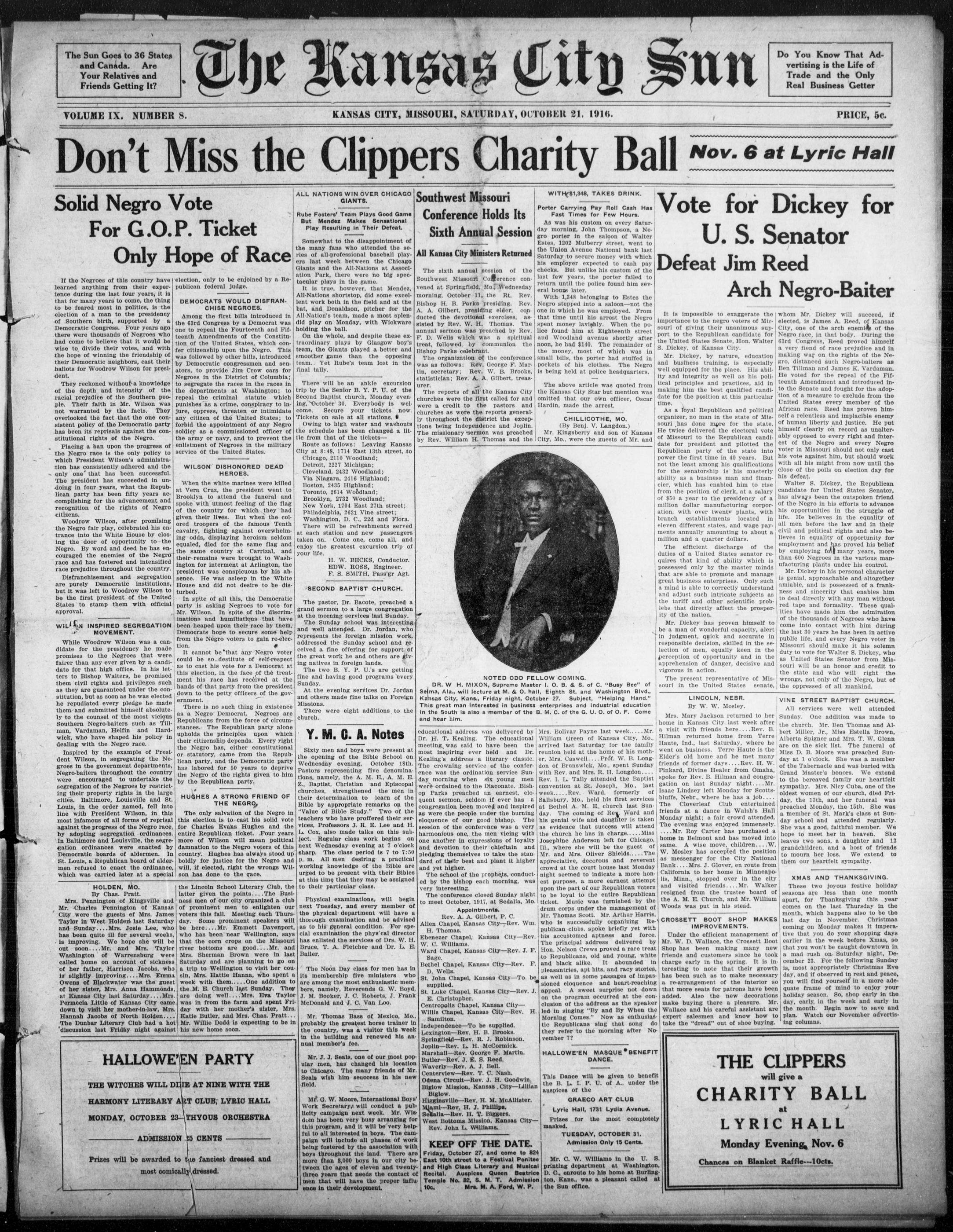
[Image of a man in formal attire, wearing a suit and tie, with a serious expression.]
[Name]
NOTED ODD FELLOW COMING.
DR. W. H. MIXON, Supreme Master I. O. B. & S. of C. "Busy Bee" of Selma, Ala., will lecture at M. & O. hail, Eighth St. and Washington Blvd., Kahsaas City, Kans., Friday night, October 27. Subject, "Helping Hand." This great man interested in business enterprises and industrial education in the South is also a member of the B. M. C. of the G. U. O. of O. F. Come and hear him.
DR. W. H. MIXON, Supreme Maste Selma, Ala., will lecture at M. & O. hail Kansas City, Kans., Friday night, Octo This great man interested in business in the South is also a member of the B and hear him.
educational address was delivered by Dr. H. T. Kealing. The educational meeting, was said to have been the most inspiring ever held and Dr. Kealing's address a literary classic. The crowning service of the conference was the ordination service Sunday morning when six young men were ordained to the Diaconate. Bishop Parks preached an earnest, eloquent sermon, seldom if ever has a congregation been moved and inspired as were the people under the burning eloquence of our good bishop. The session of the conference was a very harmonious one, the men vieing with one another in expressions of loyalty and devotion to their chieftain and pledging themselves to take the standard of their best and plant it higher and yet higher.
The school of the prophets, conducted by the bishop each morning, was very interesting.
The conference closed Sunday night to meet October, 1917, at Sedalia, Mo.
KEEP OFF THE DATE.
Friday, October 27, and come to 824 East 10th street to a Festival Ponitee and High Class Literary and Musical Recital. Auspices Queen Beatrice Temple No. 82, S. M. T. Admission 10c. Mrs. M. A. Ford, W. P.
WITH $1,348, TAKES DRINK.
Porter Carrying Pay Roll Cash Has
Fast-Times for Few Hours.
As was his custom on every Saturday morning, John Thompson, a Negro porter in the saloon of Walter Estes, 1202 Mulberry street, went to the Union Avenue National bank last Saturday to secure money with which his employer expected to cash pay checks. But unlike his custom of the last few years, the porter failed to return until the police found him several hours later.
With 1,348 belonging to Estes the Negro stepped into a saloon—not the one in which he was employed. From that time until his arrest the Negro spent money lavishly. When the police found him at Eighteenth street and Woodland avenue shortly after noon, he had $140. The remainder of the money, most of which was in small bills, the porter had stuffed in pockets of his clothes. The Negro is being held at police headquarters.
The above article was quoted from the Kansas City Star but mention was omitted that our own officer, Oscar Hardin, made the arrest.
CHILLICOTHE, MO.
(By BenJ. V. Langdon.)
Mr. Kingsberry and son of Kansas City, Mo., were the guests of Mr. and
dontugaeutlh
er I. O. B. & S. of C. "Busy Bee" of
Bill, Eighth St. and Washington Blvd.
October 27. Subject, "Helping Hand."
es enterprises and industrial education
B. M. C. of the G. U. O. of O. F. Come
Mrs. Bolivar Payne last week.....Mr. William Green of Kansas City, Mo., arrived last Saturday for the family reunion held at the home of his mother, Mrs. Caswell.....Proft, W. B. Longdon of Brunswick, Mo., spent Sunday with Rev. and Mrs. R. H. Longdon.....Rev. I. L. Tally attended the Baptist convention at St. Joseph, Mo., last week.....Rev. Ward, formerly of Sallsbury, Mo., held his first services at Bethel A. M. E. church last Sunday. The coming of Rev. Ward and his genial wife and daughter is taken as evidence that success will attend the church he has in charge.....Miss Josephine Anderson left for Chicago, Ill., where she will be the guest of Mr. and Mrs. Oliver Shields.....The appreciative, decorous and reverent crowd at the court house last Monday night seemed to indicate a more honest purpose, a more earnest attempt upon the part of our Republican voters to be loyal to the entire Republican ticket. Music was furnished by the drum corps under the management of Mr. Thomas Scott. Mr. Arthur Harris, who is successfully organizing Republican clubs, spoke briefly yet with his accustomed aptness and force. The principal address delivered by Hon. Nelson Crews proved a rare treat to Republicans, old and young, white and black alike. It abounded in pleasantries, apt hits, and racy stories as well as in some passages of impassioned eloquence and heart-reaching appeal. A sweet surprise not down on the program occurred at the conclusion of the address as the speaker led in singing "By and By When the Morning Comes." Now as enthusiastic tic Republicans sing that song do they refer to the morning after Noember 7?
This Dance will be given to benefit
the B. L. I. P. U. of A., under the
auspices of the
GRAECO ART CLUB
Lyric Hall, 1731 Lydia Avenue.
Prizes for the most completely
masked.
TUESDAY, OCTOBER 31.
Admission Only 15 Cents.
Mr. C. W. Williams in the U. S.
printing department at Washington,
D. C., enroute to his home at Burlington,
Kans., was a pleasant called at
the Sun office.
Vote for Dickey for U. S. Senator Defeat Jim Reed Arch Negro-Baiter
THE CLIPPERS
will give a
CHARITY BALL
at
LYRIC HALL
Monday Evening Nov. 6
Chances on Blanket Raffle---10cts.
It is impossible to exaggerate the importance to the negro voters of Missouri of giving their unanimous support to the Republican candidate for the United States Senate, Hon. Walter S. Dickey, of Kansas City.
Mr. Dickey, by nature, education and business training, is especially well equipped for the place. His ability and integrity as well as his political principles and practices, aid in making him the best qualified candidate for the position at this particular time.
As a loyal Republican and political organizer, no man in the state of Missouri has done more for the state. He twice delivered the electoral vote of Missouri to the Republican candidate for president and piloted the Republican party of the state into power the first time in 40 years. But not the least among his qualifications for the senatorship is his masterly ability as a business man and financier, which has enabled him to rise from the position of clerk, at a salary of $50 a year to the presidency of a million dollar manufacturing corporation, with over twenty plants, with branch establishments located in eleven different states, and wage payments annually amounting to about a million and a quarter dollars.
The efficient discharge of the duties of a United States senator requires that kind of ability which is possessed only by the master minds that are able to promote and manage great business enterprises. Only such a mind is able to correctly understand and adjust such intricate subjects as the tariff and other scientific problems that directly affect the prosperity of the nation.
Mr. Dickey has proven himself to be a man of wonderful capacity, alert in judgment, quick and accurate in responsible decision, skilled in the selection of men, equally keen in the perception of opportunity and in the apprehension of danger, decisive and vigorous in action.
The present representative of Missouri in the United States senate
LINCOLN, NEBR.
By W. W. Mosley.
Mrs. Mary Jackson returned to her home in Kansas City last week after a visit with friends here....Rev. B. Hillman returned home from Terre Haute, Ind., last Saturday, where he went on business. Terre Haute is the Elder's old home and he met many friends of former days....Rev. H. W. Pinkard, Divine Healer from Omaha, spoke for Rev. B. Hillman and congregation on last Sunday night....Mr. Isaac Lindsey left Monday for Scottsbluffs, Nebr., where he has a job....The Cloverleaf Club entertained friends at a dance in Walsh's Hall Monday night; a fair crowd attended. The evening was enjoyed immensely....Mr. Roy Carter has purchased a home in Belmont and has moved into same. A wise move, children....W. W. Mosley has accepted the position as messenger for the City National Bank....Mrs. J. Glover, en route from California to her home in Minneapolis, Minn., stopped over in the city and visited friends....Mr. Walker resigned from the trustee board of the A. M. E. Church, and Mr. William Woods was put in his stead.
CROSSETT BOOT SHOP MAKES
IMPROVEMENTS.
Under the efficient management of Mr. W. D. Wallace, the Crossett Boot Shop has been making many new friends and customers since he took charge early in the spring. It is interesting to note that their growth has been such as to make necessary a re-arrangement of the interior so that more seats for patrons have been added. Also the new decorations make buying there a pleasure. Mr. Wallace and his careful assistant are expert salesmen and know how to take the "dread" out of shoe buying.
Do You Know That Advertising is the Life of Trade and the Only Real Business Getter
PRICE, 5c.
t Lyric Hall
Dickey for
Senator
Reed
Negro-Baiter
whom Mr. Dickey will succeed, if elected, is James A. Reed, of Kansas City, one of the arch enemies of the Negro race, in that body. During the 63rd Congress, Reed proved himself a very fiend of race prejudice and in making war on the rights of the Negro, distanced such Negro-baiters as Ben Tillman and James K. Vardaman. He voted for the repeal of the Fifteenth Amendment and introduced into the Senate and fought for the adoption of a measure to exclude from the United States every member of the African race. Reed has proven himself a relentless and implacable enemy of human liberty and justice. He put himself clearly on record as unalterably opposed to every right and interest of the Negro and every Negro voter in Missouri should not only cast his vote against him, but should work with all his might from now until the close of the polls on election day for his defeat.
Walter S. Dickey, the Republican candidate for United States Senator, has always been the outspoken friend of the Negro in his efforts to advance his opportunities in the struggle of life. He believes in the equality of all men before the law and in their civil and political rights and also believes in equality of opportunity for employment and has proved his belief by employing for many years, more than 600 Negroes in the various manufacturing plants under his control.
Mr. Dickey in his personal character is genial, approachable and altogether amiable, and is possessed of a frankness and sincerity that enables him to deal directly with any man without red tape and formality. These qualities have made him the admiration of the thousands of Negroes who have come into contact with him during the last 20 years he has been in active public life, and every Negro voter in Missouri should make it his solemn duty to vote for Walter S. Dickey, who as United States Senator from Missouri will be an honor and credit to the state and who will right the wrongs, not only of the Negro, but of the oppressed of all mankind.
VINE STREET BAPTIST CHURCH
VINE STREET BAPTIST CHURCH
All services were well attended Sunday. One addition was made to the church. Mr. Ben Thomas and Albert Miller, Jr., Miss Estella Brown, Alberta Spigner and Mrs. T. W. Glen are on the sick list. The funeral of Miss D. B. Moore was preached Sunday at 1 o'clock. She was a member of the Tabernacle and was buried with Grand Master's honors. We extend to the bereaved family our heartfelt sympathy. Mrs. Nicy Cuba, one of the oldest women of our church, died Friday, the 13th, and her funeral was preached Monday, the 15th. She was a member of St. Mark's class at Sunday school and attended regularly. She was a good, faithful member. We hope to meet her in heaven. She leaves two sons, a daughter and 12 grandchildren, and a host of friends to mourn her loss. We extend to them our heartfelt sympathy.
XMAS AND THANKSGIVING.
These two joyous festive holiday seasons are less than one month apart, for Thanksgiving this year comes on the last Thursday in the month, which happens also to be the last day in November. Christmas coming on Monday makes it imperative that you do your shopping days earlier in the week before Xmas, so that you won't be caught downtown in a mad rush on Saturday night, December 23. For the following Sunday, is most appropriately Christmas Eve day, and if observed in rest and peace, you will find yourself in a more adequate frame of mind to enjoy your holiday season. So, shop early in the day, early, in the week and early in the month. Begin now to save and plan. Watch our November advertising columns.
CLIPPERS
I give a
TY BALL
at
C HALL
evening Nov. 6
at Raffle---10cts.
Expert Dental Specialists OF KANSAS CITY
Our work has stood the test. We have been doing high class guaranteed Dental Work for the past 29 years. We have thousands of satisfied patients.
REMEMBER, IN BUSINESS 29 YEARS
All work kept in repair free of charge.
The doctor who extracts your teeth here has undoubtedly had more experience in this line than any other dentist in the city, so you get the most expert service.
BRIDGE WORK
Spaces where from one to ten teeth have been lost we replace with bridge work. It looks the same as natural teeth, lasts a life time and requires no plate. Broken down teeth we restore to beauty and usefulness with crowns of porcelain and gold.
GOLD CROWNS, $3, $4 AND $5
$3, $4 AND $5
WHITE CROWNS, $3, $4 AND $5
T OF TEETH, UPPER AND LOWER, $5.00 AND UP
YORK DENTAL CO.
2017-19 Walnut Street
D's Jewelry Store, 1 door north Emery, Bira, Thayer Co.
WHITE C
SET OF TEETH, U
NEW YORK
1017-19 W
Over Jaccard's Jewelry Store
CALDWEL
Hair and
WHITE CROWNS, $3, $4 AND $5
SET OF TEETH, UPPER AND LOWER, $5.00 AND UP
Over Jaccard's Jewelry Store, 1 door north Emery, Bira, Thayer Co.
18th and Paseo, Kansas City, Mo.
Home I
Scalp Treatment a Specialty.
Grows Hair. Try it.
and any oi
Hair Matched From Samples.
Blocked. Agents for Spirella
WORK GUARANTEED
Home Phone East 4009
Present a Specialty. Caldwell's Pomade and Tonic really
news Hair. Try it. Save your combings, cut hair
and any old hat you may have.
From Samples. Feathers and Hats Cleaned, Dyed and
agents for Spirella Corsets. Mail orders answered promptly
GUARANTEED. LIVE AGENTS WANTED
URING FACIAL MASSAGE
Scalp Treatment a Specialty. Caldwell's Pomade and Tonic really Grows Hair. Try it. Save your combits, cut hair and any old hat you may have.
Hair Matched From Samples. Feathers and Hats Cleaned, Dyed and Blocked. Agents for Spirella Correts. Mail orders answered promptly
Palace of Fashion
MRS. BIRDIE JACKSON
DESIGNER AND DRESSMAKER
Latest Styles
We teach the work we do of Fashion and Beauty Parlor
Palace of Fashion and Beauty Parlor
We Alter and Repair Clothing
Northwest corner 18
BELL PH
Bell Phone E. 4394Y
THE Modern
A. E. EST
General
Repairing
Poro College Co., 3100
corner 18th St. and Highland Ave.
BELL PHONE—EAST 4788
E. 4394Y Office 2460 Waldrond Ave
Modern Builders Co.
A. E. ESTES, President
General Contracting
Repairing a Specialty
Northwest corner 18th St. and Highland Ave. BELL PHONE-EAST 4788
Have a Box of
ORO
Sent by
ARCEL
OST
Poro College Co., 3100 Pine St., Dept. G. St. Louis, Mo.
Please mention name of this paper when writing.
DON'T
Butt
E
Order From
NAFZIG
DON'T FORGET Butter-Cream BREAD Order From Your Grocer Today NAFZIGER BAKING CO.
DON'T FORGET
Butter-Cream
BREAD
Order From Your Grocer Today
NAFZIGER BAKING CO.
"The Cleanest Bakery in the world"
MANICURING
Spaces where from one to ten teeth have been lost we replace with bridge work. It looks the same as natural teet, lasts a lifetime and requires no plate. Broken down teeth we restore to beauty and usefulness with crowns of porcelain and gold.
MME LILLIE JOHNSON
HAIR DRESSER AND BEAUTY
SPECIALIST
Manicuring and Massaging
PORO
HAIR GROWER
20VL
PORO
MARK
Have a Box of
ORO
Sent by
ARCEL
OST
THE KANSAS CITY SUN, SATURDAY, OCTOBER 21, 1916
ANNOUNCEMENT
Chicago.—Aside from Quixotic attempts put forward by a few alleged colored men, the Democratic party has made no attempt to refute the charges that the administration at Washington has consistently segregated the Negro in government service and has placed many reprisals upon his citizenship.
President Wilson entered into the campaign with his speech at Hodgensville, Kentucky, where he had gone to receive the Lincoln farm in behalf of the United States Government. It has been generally remarked that it was inconsistent for a man who has done so much against the Negro race to extoll the virtues of the man who emancipated it. Nevertheless, in view of the fact that he, as president of the United States, was delegated for this patriotic service, it is passing strange that he failed to mention in any manner whatever, the crowning glory of Lincoln's life, the emancipation of the slave.
It is said that Wilson spoke at Hodgensville for two hours, without making a single reference to the Emancipation Proclamation.
GOMPERS AND BURLESON.
A singular anomaly is presented in the enterprise for campaign purposes of Samuel Gompers, president of the American Federation of Labor, and Postmaster-General Burleson. Gompers has always thought as a Democrat. His activities in behalf of labor have always been tinctured with the interests of the Democratic party. He has contended, perhaps with some sincerity, for the uplift of labor, yet he has entered upon the hustlings in this campaign with Mr. Burleson, the Postmaster General of the United States, a former member of Congress in the State of Texas, and an owner of plantations in the Lone Star State upon which convict labor alone is employed.
Out of the flotsam and jetsam of the present campaign, the fact has developed that Burleson is not only the owner of plantations employing convict labor exclusively, but that one of his overseers actually killed a negro convict with a blacksnake whip upon one of them, and that he later rewarded the man by appointing him as postmaster at Longview, Texas, against the protests of members of Congress in his state, who knew the man was incapable from every point of view.
It is pointed out as a trifle incongruous that the exponent of organized labor in the United States should be touring the country, advising people to vote for Wilson in the campaign with a notorious employer of colored convict labor. Aside from this it is strange that the Democratic party should ask the support of any colored man in view of the fact that this employer of convict labor, who elevated his overseer, a man who had murdered one of the negroes on his plantation, should be elevated to office in the cabinet of the president of the United States. From all accounts Mr. Burleson is the first slave driver to occupy any office in the presidential cabinet since the promulgation of the Emancipation Proclamation.
WILLCOX UNANSWERED.
As early as the middle of September William R. Willcox, chairman of the Republican National Committee, issued an interview condemning the Wilson administration in no uncertain terms for its treatment of the negro
Mr. Willcox said in his interview which was widely published in the white press of this country: "Not even the splendid patriotism of the black heroes in the Tenth Cavalry, who went to their death at Carrizal as the result of the president's policy of timidity and blundering in Mexico, sufficed to move him from his course of negro baiting. The colored man, under Woodrow Wilson, may die for his country, but he may not serve it in civilian life save under the sign of the "Jim Crow."
More than this, the chairman of the Republican National Committee went on record in condemning the Wilson administration for its position toward Hayti. He brought out that Mexico was permitted to invade the United States and to destroy American property and lives without any action on the part of the administration, while marines were landed in Hayti and forcible possession taken of the customs house, simply because the negroes there had seen fit to fight among themselves.
Colored men of prominence who visit the national Republican headquarters, are very outspoken in their condemnation of the Wilson administration and the wonder is, that any self-respecting negro can lend his support to the candidate in face of the unprecedented reprisals that he has visited upon the race.
It is being said that Wilson ignored the brave boys who were killed at Carrizal. It is claimed that by order from the war department at Washington, the boys were buried at seven o'clock in the morning, so that there would be no demonstration over their remains. It is being further charged that the president of the United States by whose mistakes these boys lost their lives, did not deign to rise from his bed to recognize the fact that the heroes of the colored race were being buried.
This is being contracted with the action of Wilson when the victims of Vera Cruz were brought to this country for interment. Their arrival was the occasion for a great demonstration in which the president and at least two members of his cabinet went
to New York to pay homage to the dead.
It is said that he wept over the martys of Vera Cruz and slept over the black heroes of Carrizal, yet each of them were the victims of his mistakes.
COLORED PEOPLE UNITED.
There appears to be no question about the sentiment of the colored people in this campaign. They are of one mind in reference to President Wilson and any change that may come can only be for the better. They see in Mr. Hughes, the Republican nominee, an opportunity for a return to their own, a chance to defend their country in positions of trust and responsibility.
If there is a colored man who expects to vote for Wilson in the West, he has kept it a close secret.
DUNNE AND TAGGART
There can be occasionally heard in gatherings of colored people some favorable comment upon the candidacy for re-election of Governor Dunne of Illinois, and Senator Taggart of Indiana, and it is generally admitted that these two men are accepted by the colored people as being much better than their party.
This may be very true, but it has never been demonstrated they are able to control their party. Senator Ham Lewis, for instance, has been a member of the United States Senate for a number of years. The senator is duly accredited with being a friend to the race, yet he has never done anything to stem the avalance of opposition that has inured against the negro. As is true in the case of Taggart, his friendship is of the distinctly neutral variety. Taggart in the senate has done nothing personally against the negro and nothing for him. It is the old story of good old dog Tray who was a very excellent canine himself but he kept very bad company and consequently got a bad name. It is neither Taggart nor Dunne who comes under the bann of the colored voters, but their party. Any man who pretends to be a friend to the negro, and then sits down with Vardaman and Tillman can hardly be ascribed as a good friend.
The question naturally arises as to whether or not such men as Taggart and Dunne have any influence with their party. If they have, why have they not used it in behalf of their colored friends?
The deduction is natural: The Democratic party is an enemy to the colored voter. It has always been and has grown more and more pernicious in its enmities. Dunne knows this; Taggart knows it, but they are trying to prove an alibi to their colored friends. A man might accompany a band of thieves upon an expedition and not actually steal anything himself, but he is nevertheless just as guilty. Taggart and Dunne have not personally robbed the negroes of their rights, but they are identified with the political highbinders who have set upon the race from a thousand angles, and what is really worse, in this campaign, are trying to cover up the real culprits of their party with the mantle of their apparent respectability.
It means the political life of the negro to vote against every man who acknowledges that he is a Democrat. There might be good men, but there are no good Democrats. As a class they range from the indifferent of the Taggart type to the very worst enemies we have exemplified in the Southern negro haters who now control Congress and the White House.
(Signed) PHIL H. BROWN, Assistant Manager Publicity Republican National Committee.
The wrong use of a thing does not condemn the thing—it condemns the use of it. Glutteny is not the fault of meat, it is the fault of the meat eater, yet we do not prohibit the use of meat. Drunkenness is not the fault of drink, it is the fault of the drinker.
It is not a matter of Prohibition or Anti-prohibition, it is a matter of sane, reasonable men and women on both sides getting together and eliminating the abuses.
Drinking liquor never killed any one, the abuse has, same as other abuses.
The Prohibition "Theorists" claim "temperance" which means moderation—Prohibition means nothing at all. One oppose the other.
If we should adopt the professional Prohibition philosophy and prohibit everything that is or may be abused, there would not be anything left, for everything is abused somewhere by somebody. The professional Prohibitionist is the most dogmatic of all so-called reformers; he asserts that the drinking of any kind of beverages containing any amount of alcohol is evil and only evil and therefore should be prohibited by law. He does not reason or argue—he asserts and demands; he appeals to prejudice to passion and to the unthinking mind. He knows that it is easier to arouse feeling than to awaken thought.
Mme. Benton Dean, the popular milliner, resides at 1010 Troost avenue, where she is elegantly located and will be extremely pleased to meet her many friends and customers at that number. Bell phone Main 2102J.
ON TEMPERANCE
Does Prohibition Prohibit?
"The 1915 statistics show a total consumption of liquor practically equal to that of any previous year." —Prohibition Year Book, 1916 (Page 13.)
The Testimony of Seattle
Prohibition advocates arbitrarily maintained that general total abstinence from stimulating beverages would follow the adoption of a law which would prohibit the manufacture and sale of beer and other liquors within the State of Washington.
The Actual Facts—
Figures Show Increases in Monthly Consumption of Liquor.
Seattle, Washington, July 13.
Six months ago King county, with the state of Washington, went dry, as regards the sale an dmanufacture of intoxicating beverages. The county of King county, at the altitude of King county, ground out a half year of ard conditions, have accepted the provisions of the state dry law as follows:
Permits to ship intoxicating liquor into King county were granted to 38,464.
These permits provided for the purchase of 227,712 quarts of beer 35,900 quarts of whisky, 1,051 quarts of wine, 891 quarts of alcohol, 626 quarts of brandy, 340 quarts of gin, 77 quarts of vermouth and 78 quarts of rum.
Nearly 6,000 druggist permits have been issued.
Beginning January 3, when the first liquor permit was issued, the number of permits have nearly doubled every succeeding month over permits issued the previous month. That applies to this is April, which for some unexplained reason fell 25 permits short of enquiring the number issued in March.
No law is any stronger than the sentiment that supports it.
There is no stronger public sentiment in favor of Prohibition.
There is a demand for clean, decent places of public resort in which people can be supplied with pure, wholesome beverages. None other than such places should be licensed.
The Breweries ana Brewery Agencies of Kansas City, Missouri
NOTE—We respectfully suggest that you read carefully the articles that have already appeared, as well as those which will appear in the future. Write for our pamphlet "Does Prohibition Prohibit?'"—containing the articles in this series—it will give you possession of indisputable facts and unimpeachable proof as to the folly of prohibition. Write
The Promise—
Prohibition advocates abstinence from stimulants a law which would place other liquors within the
The Actual Fact
From The CLB
SEA
Figures SIX
Six months lington, went on intoxicating before the office show the a half year of the state drank Permits to were granted the These perish quarts of beer 891 quarts of a 77 quarts of veal Nearly 6,000 Beginning issued, the number succeeding more The only except plained reason issued in March
No law is any stronger There is no stronger There is a demand for people can be supplied than such places show
The Breweries of
NOTE—We re-read articles that have appeared in the future Prohibit?'"—contains possession of indisposition the folly of prohibition
Quinoleum Is Queen
YES, I Use Quinoleum, and like it fine.
JUST FOLLOW DIRECTIONS.
Ours are the finest made preparations for the hair and face.
What We Manufacture—
Hair Preparations.
Quinoleum Hair Grower.....50c
Quinoleum Hair Tonic.....50c
Quinoleum Hair Shampoo.....25c
Quinoleum Face Bleach.....25c
Quinoleum Face Cream.....25c
Quinoleum Camphor Ice.....25c
A liberal sample of our new preparation, a fragrantly perfumed toilet powder and a velvety face powder in pink and flesh colors (brown) sent free with any order.
QUINOLEUM MANUFACTURING COMPANY.
SUNDAY SCHOOL TEACHERS' MEETING.
At Y. M. C. A.
Wednesday weekly at 8:00 P. M.
Jas. H. Crews, president; Mrs. A.
C. Coleman secretary; Prof. T. B.
Steward, conductor; Mrs. Rogers,
treasurer. The teachers of all the
schools of the city are invited to be
present every Wednesday night the
guests of Ward Chapel Bethel, St.
Lukes, St. John, Ebenezer, Allen
Chapel and others.
MRS. ROBERTS,
Dist. Supt.
MRS. IDA BIRCH,
Supt. of Cradle Roll.
---
A. P. SCHERUMAN,
522 American Bank Bldg.
KELLEY'S BEST HIGH PATENT
T.LOUIS
via
Missouri Pacific
First Out—First In
Lv. Kansas City.....9:00 a.m.
Arrive St. Louis.....5:30 p.m.
Fast Mid-Day Service
Lv. Kansas City.....11:10 a.m.
Arrive St. Louis.....7:30 p.m.
Direct connections for East and
Southeast.
Convention Night Service
Lv. Kansas City.....10:10 p.m.
Arrive St. Louis.....7:25 a.m.
City Ticket Office, 901 Main Street.
or at Union Station
Phones:
Bell, Main 6740. Home, Main 6327
R. T. G. MATTHEWS,
Assist. General Passenger Agt.
MISSOURI
PACIFIC
IRON
MOUNTAIN
By ALBERTA S. COLLINS, AGENT
1419 EAST EIGHTEENTH ST., KANSAS CITY, MO.
Life size busts with a true likeness and durability in bronze.
Every race-booster should have one. Partial payments if so desired.
Call and see it—demonstrated free. Send money order, express order or registered letter. Price, $3.00.
A
—That she didn't want him, but she married him because he had a good job.
—That two women were walking down 19th street the other day and her foot hurt her so, so exclaimed, "Ge whiz! I'm gonna git me some of that Gitzit and put on my toe." I wonder if she still has that toe?
—That it's a big business asset never to be in a hurry when the man you want to see is busy. And never try to force something on a customer that isn't sure he wants.
—That The Sun represents the betterclass of forty or more thousand Negroes. Is their business worth ad vertising for? Well, they spend about $200,000 per month. Do you get a part of this? If you don't, it's because you don't use The Sun columns.
Centropolis A. M. E. Church, Centropolis, Mo.
St. James A. M. E. Zion Church, 1823 Woodland Ave.
Second Christian Church, 24th and Woodland.
St. Paul's Baptist Church, 19th and Highland.
Friendship Baptist Church, 17th and Tracy Avenue.
Pilgrim Baptist Church, 614 Charlotte St.
Pleasant Green Baptist Church, Independence Avenue and Tracy.
Calvary Baptist Church, 19th and Askew.
Negroes. vertising for $200,000 per of this? If don't use 7
—That the part you w thing real never did of course you have misses
—That the best part of a day is the part you work hardest doing something really worth while. If you never did anything worse while why of course you can't realize what you have missed.
—That if every man's toes do not toast before a good hot fire this winter, it's his own fault. There's been plenty of work, and a long time of it.
—That a certain well known woman who received a flogging about a man the other day remarked, "Well, when a man is as sweet as he is, I don't mind a little thing like that.
—That some gossipers were hailed before the court the other day to state what they knew concerning a woman about whom their tongues had been wagging. The judge placed a heavy fine on each of them and since then quietness has observed.
—That if a woman who frequented the same buffet flat as did her husband had not talked so loudly a divorce suit would not now be pending.
—That every man believes he is about as good a man as can possibly be. Ask some of their wives.
—That when any of us get an automobile, we go blind, at least if you are walking, it seems so.
MASONIC BUILDING ASSOCIATION
T. G. McCampbell, S. H. P. Edwards,
E. G. Lacy, J. E. Rhodes,
T. W. H. Williams, E. S. Baker,
Wm. Washington, R. V. Adkins,
Geo. Johnson, W. G. Mosely,
S. Myers, Richard Harris
Edw. Thompson, R. Fulbright.
Meets fourth Tuesday in each
month.
Lodge Directory
Cloak and Suit
Values
in Kansas City
Suits at Coats at
$15.00 $10.00
$17.50 $15.00
and and
$22.50 $17.50
SEE THEM
```markdown
```
THEKANSASCITYSUN PUBLISHED WEEKLY
All communications should be addressed to The Kansas City Sun, 1803 East 18th Street.
Bell Phone East 999.
Entered as second-class matter, August
—, 1908, at the postoffice at Kansas City,
Mo., under the act of March 3, 1879.
Nelson C. Crews.....Editor and Owner
Willa B. Glenn.....General Manager
SUBSCRIPTION RATES
One Year ..... $1.50
Six Months ..... .75
Three Months ..... .60
ADVERTISING RATE, 50 CENTS PER
INCH.
MEMBER
NATIONAL NEGRO PRESS
ASSOCIATION.
CHURCH DIRECTORY.
Bethel A. M. E. Church, 24th and Flora.
St. Stephen's Baptist Church, 604 Charlotte St.
Centennial M. E. Church, 19th and Woodland.
Second Baptist Church, 10th and Charlotte.
Allen Chapel A. M. E. Church, 10th and Charlotte.
Ebenezer A. M. E. Church, 17th and Tracy.
St. Augustine's P. E. Church, 11th and Woodland.
St. John's A. M. E. Church, 1743 Belleview.
Seventh Day Adventist, 23d and Woodland.
St. Monica's Catholic, 17th and Lydia.
Morning Star Baptist Church, 2311 Vine
Morning Avenue Baptist Church, 111
Highland
Bigelow A. M. E. Mission, 5th and Lyda.
C. M. E. Church, 1817 Flora Ave.
St. James Baptist Church, 4039 Mill St.
St. Luke's A. M. E. Church, 43rd and Pinehurst Flora.
A. M. E. Mission, 565 Grand Ave.
CLARK CHAPEL M. E. CHURCH,
1664 Madison Ave.
First A. M. E. Church, 8th and 12th St. Baptist Church, 8th and 14th St.
Metropolitan Baptist Church, 9th and
Metropolitan Baptist Church, 9th and
Bethel A. M. E. Church, Water and
Steward Streets.
Paul A. M. E. Church, 21st and
Ruby.
First Baptist Church, 5th and Neb.
King Solomon Baptist Church, 3rd and 6th
Quindaro A. M. E. Church, Quindaro.
Pleasant Valley Baptist Church, Rose-dale, Kan.
M. E. Church, 9th and Oakland.
M. E. Church, 4th and Oakland.
Salter Mission A. M. E. Church, South Park, Kan.
Second Episcopal, 3rd and Stewart
Second Baptist Church, 2nd and Ruby Wesley Chapel M. 1, 106 Shawnee.
Bethel A. M. E. Church, Rosedale, Kan.
Mt. Zion Baptist Church, 4th and Virgil
Ebenezer A. M. E. Church, Sanford and T emont.
EDITORIALS
It's along the same line, to patronize the alley entrance to a downtown vaudeville house or to vote for Wilson who draws the color line even in the public toilet rooms.
Will someone explain how a man can belong to the N. A. A. C. P. and at the same time be an avowed Democrat? Is it not one of the maxims of Democracy that the C. P. have already advanced too far, at least socially and politically?
Someone has remarked that Wilson solves problems by putting them off. But he did not solve his Negro political problem that way. He settled it quickly by simply kicking the black man out. Some of them are still rubbing themselves and trying to grin. Others will vote for Hughes and American manhood.
The return of Rev. Wm. H. Thomas to the pastorate of Allen Chapel for another year is a distinct blessing to the entire community. The influence of such a liberal, intelligent and generous man as Dr. Thomas is not confined to any one denomination. It is the kind that reaches every interest and every impulse of good everywhere. Dr. Thomas is distinctly a big man and no place needs him more than Kansas City.
BYRON BROS. 1116 Main Street
We offer for the coming week the greatest
IMMENSE SELECTION OF BEAUTIFUL FALL GARMENTS
一
---
W. G. Moseley, President.
T. G. McCampbell, Vice President.
Wm. Washington, Treasurer.
E. S. Baker, Secretary.
Board of Directors:
---
G
Pritchard Lodge No. 42, A. F. and A. M., meets every 2nd and 3rd Master Masons in good standing welcome. Wm. Hopkins, W. M. M. J. H. SPIGENER, Secretary.
Rone Lodge No. 25, A. F. and A. M., meets the 1st and 3rd Month Master Masons in good standing welcome. Emmett Spruell, W. M.; C. H. Countee, Secy.
Mt. Olive Lodge No. 53, A. F. and A. M., meets the 2nd and 4th Friday in every month. Visitation Masons are welcome. Sandy Lowe, Secretary, Frank Lowe, Secretary, 1512 Baltimore Ave.
Lebanon Lodge No. 128, A. F. and A. M., meets the 2nd and 4th Tuesdays in the month. All Master Masons in good standing are welcome. H. Young, W. M. 1515 Washington, J. B. Smith, Secy. 617 S. 20th St.
and A. M., Liberty, M., meets
the 2nd and 4th Saturday
nights in each month. William
Parker, W. M.; Nelson Wallar,
Sec'y.
St. Stephens Chapter No. 27,
Royal Arch Masons, Liberty,
Meets first Tuesday in
east mall in H. H. Robinson,
H. P. Wm. Capps, Recorder.
U. B. F.
King of the West Lodge
No. 248 Mondays in each month at
633 Grand Avenue. C. F.
Wilson, W. M.; D. M. West
1718 Euclid Ave. Secretary
St. Matthew Commandery
No. 17, Liberty, M., meets
the third Saturday night.
William Capps, E. C.; W. H.
Robinson, Sec'y.
Primrose*Tabernacle meets 1st and 2d Wednesday nights in Vine Street. All Daughters and Sir Knights in good standing are welcome. Sue Dotson, H. C. R. 18:15. Eustia Pitt, C. R. 18:15. Eustia Pitt, C. R. 18:15.
THE KANSAS CITY SUN, SATURDAY, OCTOBER 21, 1916
Madame Page's Criterion Hair Preparations YOU'VE TRIED THE REST, NOW TRY THE BEST.
Scalp Specialist and Manufacturer of the Criterion Hair Grower 2533 Woodland Ave. Bell East 1358w Kansas City, Mo.
WHEN LOVE WAS YOUTHFUL
The Little Girl With a Pigtail and Skinny Legs Is Sweet Memory to Dayton Journal Man.
Did you marry your first little sweetheart, she of the pinafore frock, and, perhaps, the barber-pole stockings? It is certain that at times she wore a cute little braided queue, though sometimes—when she was dressed up—her hair hung in curls down her slender back. How the sun glinted in those curls, making them to shine with a splendor akin to that which lights the wing of drifting angels in the dreams of night!
Do you remember where you stood when you first kissed her? Of course, you do, says a writer in the Dayton (O.) Journal. That is an incident which is graven in our memory forever and ever. You felt thrilly and chilly and warm and were half scared to death. You saw God in her eyes and felt him in your soul. Wouldn't you give all you have, or ever expect to have, in exchange for the innocence of your heart as it beat that day against the little throbbing heart in her tender breast?
But did you marry her? Some syndicate writer is asking the question, and promises soon to tell us all about it, provided a lot of people will first write letters telling her all about it.
Perhaps you married this little woman of dreams, and perhaps you did not. The chances are that you did not. But you will remember the sweet ache that troubled your soul in the days when you were wooing her with a chivalry unknown to all who have passed beyond the heavenland of childhood.
When you think of her now your soul years backward to that never-ever land, and maybe the moisture of sweet sad tears fills your eye.
Did you marry her? Did you?
If you did, then, sometimes, when you take her hand, in the quiet of a summer evening, together you may read the palmiest of memory, joying as it is given to but few mortals to rejoice.
DANGER LIES IN BOILED EGG
Scientists Discover Deadly Germs in Poultry Product—Buy Only Fresh Eggs.
The fact that hens having certain diseases well known to chicken fanciers lay eggs from which come chicks that soon develop the parental disease led Dr. Leo F. Rettger, Thomas G. Hull and William S. Sturges of the Sheffield laboratory, Yale university, and the Storrs agricultural experiment station, to investigate the possibility of such eggs being injurious to man.
Doctor Rettger is the discoverer of the so-called bacterium pullorum, which makes the hen sick, is in her egg when it is laid and then makes the chicken that is hatched sick. He and his associates report to the Journal of Experimental Medicine that adult fowls and young rabbits, to which they fed infected eggs, soon died, that kittens and guinea pigs showed signs of poisoning, but that rats were unaffected.
They did not feed infected eggs to human beings, but they cooked them in several ways and then examined them for the bacteria. Boiling for five minutes did not destroy these. Poaching made the eggs sterile. Frying on one side had no effect, but frying on both sides destroyed the disease germs. Coddling was effective only when continued for at least five minutes. Cases of poisoning, sometimes on a wide scale, after eating eggs are quite common. So is the infection of fowls. "Hence," say these experimenters in their report, "a large proportion of the marketed eggs is infected with bacterium pullorum." They warn consumers against any eggs but those that are quite fresh, as the bacteria in them develop very rapidly, especially in summer.
Things That Save.
"Saved by his spectacle case," was the report which went out following the attack upon Colonel Roosevelt in Milwaukee three and a half years ago. "Saved by a silver dollar" is the report from Seattle regarding a man who would have been shot through the breast but for a protecting coin in his pocket. "Saved by a highball" is the report of a near-tragedy of thirst in the dry belt. "Saved by grace" runs the old revival hymn. And "Saved by her—" but propriety bids us pause. Anyhow, she was a woman, and she was attacked with a deadly weapon. But she wore an invisible coat of armor reputed not to be unusual among those of her sex. A salvage of good form was reported—St. Paul Dispatch.
Criterion stands for qual- ity, as "Sterling" stands for Good Silver.
Criterion has been tested thoroughly and proven to be the most wonderful of all hair preparations.
AGENTS WANTED.
GOOD PROFIT.
Scalp Specialist
2533 Woodland
METAL COLORS RARELY SEEN
Some Light Waves Absorbed, Others Reflected—Copper Is Really Salmon-Pink Shade.
One of the beautiful things we seldom see is the color of pure metals. When exposed to the air most metals tarnish so rapidly that our only means to get even a passing gimpse of their true color is by quickly scraping off the corroded surface. The color of metals depends upon the selective absorption of light waves of different lengths. For instance, if a metal absorbs every light wave except that of the length which produces the optical sensation yellow, then its color is yellow, for what it cannot absorb it reflects. Gold is such a metal. On the other hand, when gold is beaten to such thinness that it becomes translucent, it transmits not yellow light rays, but those which it formerly absorbed, namely, a greenish blue mixture.
Silver is the best example of a large class of metals that reflect practically all the light they receive, and are therefore approximately of the same color as the light to which they are exposed. From their color in the sunlight they are quite properly called "white" metals. Some of these are aluminum, magnesium, nickel, sodium, tin, iron and antimony.
Others, like lead, cadmium and zinc, have something of this silver luster, but with a slight bluish tinge. The gray metals, such as manganese and cobalt, probably owe their lack of color to their tendency to absorb all colors in about equal amounts. Bismuth is of a peculiar light red and potassium has a pinkish tinge. Copper, strange to say, is not "copper colored," but is usually described as salmon-pink.
Clothiers' Troubles
The manufacturing clothiers are having more than their usual trouble in the operations that have started for next fall. Owing to the piece goods shortage and the scarcity of dyes, styles have to be switched about in a bewildering manner. Salesmen have got to the point where they are almost afraid to take a fairly large order, owing to the possibility of no goods being on hand to fill it. Though there were fewer style numbers put out than customary when the season started, even the restricted lines have had to be cut down still further. A ray of light is seen in the situation that exists in the woman's-wear trade. The man's-wear trade expects that with operations tied up in that branch, the mills will be able to supply the clothiers with a greater quantity and assortment of piece goods.—New York Times.
Dinner Ended a Conspiracy
News has been received here from Urumtsi, in the province of Sin Kiang, that a number of officers in the province of Yunnan hatched a plot to behead the governor general at Urumtsi and proclaim the independence of the province of Sin Kiang.
The governor discovered the plot and invited ten of the conspirators to an official dinner, at which he beheaded them one after another. Petrograd Correspondent to the London Globe.
To Do Away With Old System.
The government of India has decided to abolish the system of indentured emigration to British colonies, but it will be allowed for a further period of five years in order to permit the various colonies to adjust themselves to the labor conditions necessarily entailed by the abolition of the indenture system. For practically half a century the colony of Trinidad had been dependent upon indentured laborers from India, commonly known as coolies, for the working of the large sugar cocoa estates. Their labor was the cheapest to be had, averaging about twenty-four cents per day during the indentured period. East Indians now number approximately 120,000 and constitute one-third of the colony's population.
Adding to French Wealth
Adding to French Wealth.
Sixty families of the Maisons Alfort suburb of Paris have received assignments of uncultivated land for planting potatoes and other vegetables, the action being under a decree by the French minister of agriculture. This is the first practical application of the measures adopted for the utilization of all previously uncultivated lands.
Looking It Over.
A visitor to Indianapolis, who is six feet four inches in height, was asked by an acquaintance if he had seen the federal building. "No," said the visitor. "I was in the neighborhood, but I did not see it." "You probably overlooked it," was the comment of the acquaintance.—Indianapolis News.
THE WOMEN
HAPPENINGS of the week IN MISSOURI
Mrs. Margaret Harger, a widow, while walking on the back porch of her home at Hume, fell into the cistern and drowned in five feet of water. Her husband, James S. Harger, died a few months ago.
Kenneth Rigg, 17-year-old son of Charles Rigg of Higginasville, was killed by a Chicago & Alton train while watching a battalion of the Seventh Massachusetts infantry entrain.
The one hundredth birthday anniversary of Mrs. William Brewer was celebrated by herself and her family in Springfield, recently. Mrs. Brewer has good health and is alert mentally. She walks without difficulty about her home.
---
Clarence Krebs, editor of the Bellflower News, is dead at the age of 39. Knowing that he was fatally ill, Krebs recently sold his paper to J. C. Peroffitt, who has taken control.
Melvin N. Bricker, 41 years old, owner of much land near Monroe City, is dead at Bushnell, Ill. Two children and a widow survive.
Glen Ballentyne of Ludlow, 17-year-old son of Mrs. Minnie Ballentyne, who conducts a hotel there, was killed by John Gentry, who is mentally unbalanced, at that place the other night. The boy's throat was slashed with a knife.
---
Butler is threatened with a water famine. For the present the sprinkling of the streets has been discontinued. The Miami river, from which the city draws its water, is lower at the present time than ever before since the construction of the water system.
---
The special grand jury has returned an indictment against Oscar D. McDaniel, prosecuting attorney of Buchanan county, charging murder in the first degree, following its 13-day investigation of the slaying the night of July 14, of Mrs. Harriet Moss McDaniel, the prosecutor's wife.
HOW TO RELIEVE DYSPEPSIA
Don't Overeat, Keep Away From the Food That Disagrees With You and Heed Your Doctor.
Simple dyspepsia is that form of indigestion that is not caused by any lesion or malformation of the stomach or other digestive organs. People differ widely in the strength of their digestive apparatus, but most adults know something of the symptoms of simple dyspepsia. In fact, most people expect, and bear with resignation, an occasional attack of indigestion. It is when the attacks come too often and stay too long—when the sufferer becomes a dyspeptic—that he seeks relief.
In a case where the usual home remedies for impaired digestion are no longer efficacious and the continual attacks begin to affect the general health, it is necessary to go to a good doctor and ask him to find the underlying cause of the trouble. There are many reasons for the failure of the digestive powers that lie quite beyond the scope of amateur diagnosis, with its dangerous accompaniment—amateur dosing; although there are, of course, many other reasons that any intelligent person can search out for himself.
Too many people become chronic dyspeptics because they will not learn to masticate properly, to refrain from hearty meals when they are tired, or to deny themselves articles of food that experience has shown to be indigestible. That form of dyspepsia is not in itself hard to cure, but those who suffer from it are often very difficult to handle. They are likely to have their pet remedy—a soda tablet, or what not—which often does good service for years, but is bound to fail in the end. Then nothing can be done for them unless they learn self-control.
Sometimes—indeed often—the trouble is with the teeth, which have been neglected until they cannot properly chew the food. People who are worried and overdriven are almost sure to have weak digestions. That form of dyspepsia yields quickly to a good rest and tonic treatment. If that cannot be had, try a brief rest just after eating. That is a wise economy for even the busiest people. Abdominal massage is good for toning up the muscles of the stomach. As for diet and medicine, the doctor in charge is the best judge, for no two cases are exactly alike.
e's
arations
WHAT THEY WILL DO.
The Criterion preparations will make kinky stubborn hair soft and glossy, cure the scalp of tetter and eczema, remove the dandruff, stop itching and burning of the scalp, stop hair from falling out, promote a growth of long, thick, glossy hair. For man, woman or child.
GE
Criterion Hair Grower
Kansas City, Mo.
Negro Business and Professional Directory of Greater Kansas City
BAKERIES.
WENS, 2331 Vine street. Bell phone, East
BARBER SHOPS.
ICK, 2405 Vine Street. Bell, East 1437J
EN'S BARBER SHOP, W. F. O'Bonnor
nue.
MRS. SUSIE OWENS, 2331 Vine street. Bell phone, East 5017.
BARBER SHOPS.
THE BRUNSWICK, 2405 Vine Street. Bell, East 1437J. R. D. Jackson, Prop.
LABORING MEN'S BARBER SHOP, W. F. O'Bonnon, Prop., 558 Grand Avenue
BARBECUE STANDS.
MRS. A. D. TURNER, Barbecue Stand, 1747 Forest avenue.
H. WINN. 2315 Vine Street.
BEAUTY PARLORS AND HAIR DRESSERS.
MRS. L. B. SMITH, 2420 Woodland avenue, Poro Hair Dresser, Bell phone, East 2717W.
MRS. URITH U. K. THOMPSON, 1007 Vine St. Bell phone, East 5230. Poro Hair Dresser.
MRS. SUSIE GIBSON, 1725 Michigan Ave. Poro Hair Dresser. Bell phone, East 3058J.
MRS. CADDIE WITCHER, 1510 Michigan Ave. Hair and Scalp Treatment. Bell phone, East 4167X.
MRS. CORA D. WILLIAMS, 1714 East 13th St. Bell phone, East 3610J. Poro Hair Dresser.
MRS. SALLIE LASHLEY, Poro Hair Dresser, 1332 East 16th St.
MRS. F. A. COOK, Poro Hair Dresser, 1226 Vine St. Bell phone, E. 2820.
MRS. ALICE M. THOMAS, Poro Hair Dresser, 1022 West 30th St. Phone. Grand 2456W.
CAFES
MRS. H. W. DOTSON, 1705 East 12th. Bell Phone, E. 2214.
JONES' CAFE, 2110 Vine Street. Everything to satisfy.
WOODLAND CAFE, Charles E. Gilliam, Prop., 1804 East 12th St.
DELMONICA CAFE, 1512 East 18th St. Bell phone, East 618.
MRS. S. J. BRADLEY, 1519 East 23d Street.
CLEANERS, DYERS AND TAILORS.
THE MID-WEST SANTIARY CLEANERS AND DYERS, William T. Stanley, Prop., 2438 Vine Street. Bell phone. E1206.
COAL AND FEED:
W. W. PAYNE, 1902 1-2 Vine St. Bell phone, East 559; Home phone, East 4132.
DRUG STORES
PEOPLE'S DRUG STORE, 18th and Paseo. Bell phone East 1814, Home East 4082.
FLORISTS
CROSTHWAIT FLORAL CO. 1801 East 18th St. Bell phone, East 272. Home phone, East 4070.
LAWYERS
WAY, 601 Delaware, Home phone M58, B
Practices in all courts.
ON, 601 Delaware, Home phone M58, B
Practice advice. Practices in all courts.
LEFORD, Attorney at Law, 516 Minne
Kas. Bell phone, West 3866.
C. H. CALLOWAY, 601 Delaware, Home phone M58, Bell phone Main 448. Practices in all courts.
W. C. HUESTON, 601 Delaware, Home phone M58, Bell phone Main 448. Legal advice. Practices in all courts.
E. A. SHACKLEFORD, Attorney at Law, 516 Minnesota Ave., Kansas City, Kas. Bell phone, West 3866.
LADIES' TAILORING
MRS. ELNORA MOSS, 1300 Woodland Ave. Bell phone, East 4438.
JEWELERS
N, 1616 W. 9th street, Kansas City, Mo
BR.
' FURNISHINGS, DRY GOODS and N
N, 1313 East 1t8h street.
MANICURING.
HAYWARD, 1514 E. 18th St., Home ph
class service.
J. A. WILSON, 1616 W. 9th street, Kansas City, Mo. Bell phone, Main 6248R.
GENTS' FURNISHINGS, DRY GOODS and NOTIONS.
W. L. MARTIN, 1313 East 1t8h street.
MANICURING.
MISS DORA HAYWARD, 1514 E. 18th St., Home phone East 4119. First class service.
MESSENGER SERVICE
THE ENTERPRISE, 1521 East 18th Street, Charles A. Starks, Prop.
Bell phone, East 1521.
PHYSICIANS.
A. D. BRADBURY, M. D., 821 Independence Ave. Bell phone Main 4438.
PHOTOGRAPHERS.
R STUDIO, 1622 East 18th Street. Bell
PRINTERS.
LIN, 1309 East 18th Street. Bell phone.
REAL ESTATE and EMPLOYMENT
DEMOPMENT AND INVESTMENT CO., 500
) Kansas City, Kans. Bell phone, West
est 1036. C. W. Neloms, Mgr.
GOPLE'S INVESTMENT CO., 2427 Vine
tone East 4011. Sol Smith, Pres
J. E. MILLER STUDIO, 1622 East 18th Street. Bell phone, E. 91.
PRINTERS.
C. A. FRANKLIN, 1309 East 18th Street. Bell phone, Grand 2988.
REAL ESTATE and EMPLOYMENT.
A B C EMPLOYMENT AND INVESTMENT CO., 500 Minnesota Ave.
(upstairs) Kansas City, Kans. Bell phone, West 1743; Home
phone, West 1036. C. W. Neloms, Mgr.
COLORED PEOPLE'S INVESTMENT CO., 2427 Vine St: Bell Phone
East 1011, Home East 4011. Sol Smith, Pres
RESTAURANTS
MRS. FANNIE ISAM. 805 Independence Avenue
SHOE STORE
G. A. PAGE'S SHOE STORE, 1507 East 18th street. Bell phone East 1328.
UNDERTAKERS.
E, 1031 Independence Avenue. Bell phone
one Main 3341.
REE, Licensed Embalmer, 2220 Vine St., Lydia East 3341.
OS. & GREEN, 19th and Vine Sts. Phon
EROS., 1729 Lydia Ave. Bell Phone G
9. Res., Bell East 3281.
SHOE REPAIRING.
SHOE & REPAIR SHOP, J. C. Banks, Pro-
pet. Bell phone, East 4939.
GARAGES.
GARAGE, S. A. Robinson, Prop., 1400 Lydia
ne, Grand 2191.
H. B. MOORE, 1031 Independence Avenue. Bell phone Main 3398W Home phone Main 3341.
C. H. COUNTEE, Licensed Embalmer, 2220 Vine St., Bell Phone, East 3336, Home East 3341.
ADKINS BROS. & GREEN, 19th and Vine Sts. Phones, East 4349.
WATKINS BROS., 1729 Lydia Ave. Bell Phone Grand 987, Home Main 7989. Res. Bell East 3281.
ELECTRIC SHOE & REPAIR SHOP, J .C. Banks, Prop., 1514 $ \frac{1}{2} $ East 18th street. Bell phone, East 4939.
GARAGES.
ECONOMY GARAGE, S. A. Robinson, Prop., 1400 East 19th street. Bell phone, Grand 2191.
WAS, IE, AIS, I, IE, IE, HI, GE, IIE, AIS, IE YI, YI GI, IIIS, YI YE
CITY NEWS
ahs 8 fe 38 fe fa Sie ae She Miho Sih eke Sie ihe Ss Hilo Fike Fike Sh Fike Fhe Sh
Ebenezer Trustees will give a reception Monday night,
October 23, In honor of Rev. W. C. Williams, our pastor. Wel-
come addresses and special music will be rendered under the
direction of Prof. B. J. Knox.
‘Shoes for growing boys and girls at
$2.00, Page's, 1507 East 18th St.
Alderman Oscar DePriest of Chis
ago and J. Madison Vance of New
Orleans, La., were pleasant callers at
the Sun office last week.
Rey. J. B. Weaver of Bolia, Mo., was
visitor in the city the guest of his
cousin, Mrs, Callie Diggs, 1710 Oak
street.
NOTICE,
‘The Teachers’ Athletic Association
has organized and meet every Satur-
day evening at 6:30 at the Garrison
Field house. All persons desiring to
Join will call Miss Vicy Newson, Bell
phone, East’ 2409Y, |
Ebenezer Trustees will giv:
October 23, in honor of Rev. W.
come addresses and special mu:
direction of Prof, B. J. Knox.
Buy a chance on the blanket to be
raffled at the Charity ball Monday
evening, November 6, at Lyric hall.
‘The blanket will be on display at the
various drug stores.
‘The Charity ball by the Clippers
will eclipse anything given this sea-
son. Don't forget the date—Monday
evening, November 6, at Lyric hall.
GRAND THEATRE. |
Always the theatre for the whole
people—
‘Announces the Season's
Opening for Saturday Night,
October 21
A BIG MUSICAL COMEDY HIT
Special reservations for Colored
People.
GOOD SEATS, 10¢
Mrs, Hellen Carter of Chicago, I,
who has been visiting friends and
relatives in the two Kansas Cites,
returned home.
CARD OF THANKS.
We wish to thank the many friends
and neighbors for their kindly. assist:
ance in our bereavement in the loss
of our wife and mother, Mrs. Cora
Brooks, also far their beautiful floral
offerings. May God bless you.
M. B. BROOKS, buisband,
Children and relatives.
BUCKNER & McELROY
TRANSFER CO.
Furniture anid Piano Movers, Express
and Baggage.
Goods stored, packed and shipped by
experienced men.
‘The right priee with truck and wagon
service. :
1404.6 Holmes Street.
Bell phone Grand 1566-W.
‘Houle phone Main 9173, -~
WINTER 1S COMING.
‘When you notice an advertisement
concerning new fall and winter styles,
comfortable clothing and the like, you
should know cold weather is coming.
‘The merchant {s properly advised al-
ways as to weather conditions and his
announcements are to be taken seri-
ously. For real genuitte bargains pat-
ronize our advertisers. Always good
values in their stores, priced at un-
beatable prices.
THE MOLA WASHING MACHINE.
Have you been to see that machine
that washes youm clothes for five
cents? Did you see how stout the
thfhg was and smoothly it ran?
Cleans five sheets at one time! And
how long have you tugged and pulled
those five sheets of yours through a
tub full of other clothes because they
were so bunglesome.
‘Take a step in at the Kansas City
Light and Power Company, 16th and
Grand Avenue, and ask to see a dem
onstration of the Mola Washing Ma
chine, There is no charge, and it is
interesting! Go- today or your firs
convenience.
IN MEMORIAM,
In sad and loving memory of our,
dear wife and mother, Lucy Nance, |
who passed away one year ago Octo-
ber 28, 1915,
She is gone but not forgotten,
Never shall her memory fade;
Sweetest thoughts shall ever linger
‘Around the grave where she Is laid,
One year is passed and still we itd
her;
Friends may think the sorrow healed,
Little'do they know the sorrow
‘That les within our hearts concealed.
Sadly missed by
‘W. H. NANCE, husband,
ROBT. L. CARTER, son.
EMMA McFADDEN, sister.
Prof, W. 8. Scarborough, President
of Wilberforce University, has return:
ed home after an extended trip to
Kansas City and other Western cities,
He was very much impressed with
Kansas City and its hospitable peo-
plé) While here he addressed the con-
gregation at Allen Chapel and was
also the recipient of much social at-
tention. ¢
LULA C, SUMMERS:
Pianist and Teacher _
‘Will open her studios
OCTOBER 2, 1916 :
“2021 North Sixth Street,
iS Bell Phone West 1753
KANSAS CITY, KANSAS.
¢| Mr. Cal Cowans and Mrs. Cora
ohn are culty suieriad ‘Tune
da) evening at the residence of Mrs.
Mayme’ Clark, 3110 East 16th street,
; the Rev. Richard Davis officiating.
'| ‘The Charity ball Monday evening,
November 6, at Lyric hall, by the Clip-
pers, will be largely attended from
'|the number of tickets being sold.
|| Don’t fail to be there, too.
The Administrative Matron’s Coun”
eil_enjoyed an excellently prepared
program at the last meeting and all
present were greatly benefitted. One
pleasing number was the solo render-
ed by little Marie Lillard. The next
meeting will be held Friday, October
27, Every Past Matron is urged to be
| present.
ve a reception Monday night, |
. C. Williams, our pastor. Wel- |
usic will be rendered under the |
ON
Full line of School Shoes at Page's, |
1507 E. 18th St. |
| IN MEMORIAM.
In sad and loving memory of my
dear husband, Edward Randolph, who
died one year ago today, October 20,
1915:
“If you only knew how our hearts
moan for you;
Just one year ago God called you,
Why he did we cannot tell,
But we have the consolation
God doeth all things well.”
Sadly missed by his wife,
EMMA RANDOLPH,
and relatives,
Mrs, Fannie Williams and her
daughter, Mrs. Carrie Welch, return-
ed to the city after spending four
‘months on Lake Buelah, Wis. En:
route they stopped at Chicago two
‘veeks and were the guests of Mr.
and Mrs. Hackley.
/ SECOND CHRISTIAN CHURCH.
. 24th and Woodland Ave,
Bible school at 9:30 a. m.; preach:
‘ig and Communfon at 11 a, m.; Y. P.
‘S.C, E, at 7p. m.; preaching at 8:15
jm. prayer meeting Wednesday at
8:50 p. m.; Christian Woman's Board
of Missions Thursday at 2 p. m.
WILLIAM ALPHIN, Pastor.
A. G. NELSON, Clerk.
Mrs. 8. EB, Bean, 1932 Grand avenue,
entertained with an elegant dinner
party in Honor of Mr. Rube Foster of
the Chipago Giants last Thursday af-
pera Plates were laid for eight.
PRINTING.
When you want it
Where you want it
As you want it
at
Franklin's, 1309 E. Eighteenth.
| Bell Grand 2938.
| —— >
| _ MONEY—MONEY—MONEY.
| Furniture foans made to honest peo-
|ple. Pay back in weekly payments.
| Business strictly confidential.
Bell Phone, Grand 2303-R.
| J KING COLE 1917
| Automobile
Since ‘the ordinary car does the ordi-
nary things, to take a ride in
——— KING COLE ———
fone comes out of the past
Into the present—————
PHONES:
Bell, East 2013 Home, East 2293
W. H. HUBBELL,
Mrs, B. F. Parks of 1903 Paseo, left
Tuesday evening for Chicago for a
ten days’ visit with friends,
Mr, Desdierro Hernandez and Mr.
Jose’ Men'dez with “All Nations”
baseball club, the guests of Mrs, Al-
berta Adams, left Monday night for
| their homes in Havana, Cuba.
‘The services last week at the Sec-
ond Christian church, 24th and Wood-
land, were well attended. The re-
ports of the clubs in the rally placed
the congregatiop on higher financial
grrounds.
Mrs, Alberta Adams and Miss Elea-
nor Watson entertained “with a 7
o'clock dinner Sunday, at the home
of Mrs. Adams, 921 Michigan avenue,
for Mrs. James Donajson,’ Mr, Jobn
Donaldson ot Glasgow, Mr. Rube
Foster of Chicago, Mr. Jose’ Men'dez,
Mr. Desdierro Hernandez, Mr. Chris:
tobal Torriente of Havana, Cuba,
Don't Fail to Attend the Athenaeum
Hallowe'en Black and Yellow
Costume Dance
‘Monday, October 20, at Lyric Hall,
‘Admission 25 cents,
BUY YOUR COAL NOW,
Richmond Lump $4.00; Lexington
Lump, $4.00; Cherokee Lump, $4.50;
Cherokee Nut, $4.00; Diamond Block,
$4.50; Semi-Anthracite Lump, $6.50.
All of our coal is deep shaft, If
aot as represented, send it back.
PAYNES’ COAL & FEED CO,
1930 Highland Avenue.
Home Phone East 4132—Bell phone
Bast 559,
Office: 1902% Vine st.
|. $1.75 and $2.00 will start any child
$| to school with good shoes on. See
pe at 1507 E, 18th St.
/
THE KANSAS CITY SUN, SATURDAY, OCTOBER 21, 1916.
KANSAS CITY, KAS
Mr, and Mrs. J. R. Rhodes of 942
Washington boulevard, gave a lunch.
eon in honor of Mr. and Mrs. A. An:
derson of Los Angeles, Calif, last
Wednesday. Seven guests were pres:
ent.
Rev. Mackey of New York preach:
8 an inspiring sermon Sunday morn:
ing at the Metropolitan church. Rev.
Coleman of Memphis, Tenn., preach:
ed at night.
Mrs. Green of 987 Washington boule.
vard, is ill at this writing.
Mr. C. Allsbrook of 845 Freeman,
made a business trip to Oklahoma.
The dinner party by Mrs. G. W.
Woods, 1138 Armstrong, was indeed
an enjoyable affair Thursday, October
12, in honor of Mrs. Mary Davis of
Chicago. All the ladies present were
handsomely gowned. The guests
were; Mesdames Cordelia Taylor,
Georgia A. Baldock, M. E. Walker,
Florence Flood, Alice .Elam, Mary
Jones. Mrs. Wood was ably assisted
by Mrs. Sophia Scales and Miss
Gladys Miles.
| Hair-cutting, 52¢,
Shaving, 15¢.
Manacuring, 50c,
| Magazines and Papers.
Negro Literature
Phone Main 5298.
TUTT'S NEW BARBER SHOP
Toilet Supplies, Brushes, Combs,
‘Tooth Brushes, Toilet water,
Soap, ete.
300 Main Street,
Seattle, Wash.
FURNISHED APARTMENTS in sin-
gle or in two room suites, Strictly
modern, 1206 Highland avenue, Bell
phone’ East 3537M, Mrs, V, L. Heus-
ton.
FOR RENT—Furnished rooms, 2217
Michigan, 2nd fl. Modern large front
room with use of kitchen to reliable
‘man and wife—$2.50 a week. Other
rooms for $1.75 and $2.00. Mrs. Henry
B, Green,
For Sale on easy payments, a 5-r.
Cottage at 914 Highland. See owner,
112 E. Missouri Ave. Home, Main 642.
Bell, Main 4108, -
For Sale—One five room and one
four room house near 2 acres ground,
Brenmore edition, Hocker Grave car
line. Get off at Twenty-first street, go
2 blocks north, J.T. Haskell, Phone
Dr. Lambert, Rosedale 523, and call
for Mrs. Haskell before noon.
FOR RENT—Furnished, strictly
modern, steam heat. Fred Manuel,
820 Jefferson Ave, Bell phone, Main
2257,° ”
FOR RENT—Strictly modern 6-room
apartment; rent reasonable. Bell
phone, 2507 East,
For Rent—Nice apartments $12,
$14, $18. Bell phone Grand 2666w.
FOR RENT—Neatly furnished
rooms, strictly modern, bath, gas,
electricity. Bell phone, East 1827.
1212 Michigan avenue, Mrs¥A. Cleve-
land. *
FOR RENT—Strietly modern rooms.
$2.50 per week. 1214 B. 22nd street.
Mrs. C. Gibson. .
GLIMPSES OF THE GRAND LODGE
OF MISSOURI AND ITS JU-
RISDICTION—ITS PAST
AND PRESENT.
By James H. Crews.
In the year 1883 at St, Joseph, Mo.,
I made my first visit to the Grand
Lodge of Missouri as Master of Gra-
ham Lodge No. 85. Since then I have
attended a number of its sessions,
but this one just closed was the best
ever held. There are two reasons
that convince me that it was the best’
the first is that the revenue reported
to the Grand Lodge was the largest
and most gratifying that has ever
been reported to the Grand Lodge,
which shows that no mistake was
made in selecting Nelson C. Crews as
thelr Grand Master, At the time of
his electfon there was a debt hanging
over the Grand Lodge of $4,090, which
he declared he would wipe out the
first year, and when the Grand Lodge
met a year henee in Moberly, Mo., the
debt was canceled, witha surplus to
the credit of the Grand Lodge. ‘The
Missouri Grand Lodge is composed of
some of the brainiest men in the
country, and for sound judgment and
plaform talkers and in my opinion
they cannot be excelled. Past Gran¢
Master Crews makes a most excellent
presider; ;;he is impartial in his rul
ing, and yet firm in his dealings with
all and will not swerve from his ac
‘tions when he thinks his position &
PEL a ones
a EE ee NL
Mn * re peks ecrmmin “T ae
i i ia At a
"i vf bes Sa Bai S
eee er oe
Hee ot tke ‘ Par Ips. >
(a Or 2a a 4a ¥
ee ea A ae
ae ro wi a toe
og . —— , qd
4 “i Ae "S x
ey Bee
hus Sea ag ME og ae
: ae ahh .
eee: a
cs
MR. AND MRS. CHARLES F. LEWIS,
A well known Kansas City couple, who: were united in mariage at St. Au:
Gustine’s Episcopal Church, Wednesday morning, October 11,
The mariage ceremony of Miss June Arva Tillman and Mr. Charles
Franklin Lewis was solemnized by the Rev. Father J. C. Vanloo, This
young couple is well Known in Kansas City’s best society circles and they
have a host of friends. Mr. Lewis has been a resident of Kansas City for
many years and is a young man of sterling cNaracter and has the highest
respect of all who know him, He isa member of Pritchard Lodge No. 42,
A. F. & A, M. algo a member of the Bachelor Boys’ Social Club. Mrs.
Lewis is a Kansas City girl, a graduate of Lincoln Institute, Jefferson
City, Mo., and is quite accomplished, She.is charming, lovable and en.
dears herself to all with whom she comes in contact. Mr. and Mrs. Lewis
Will bead Ronie) Gabinerartivcat 1614 Lodia avenue,
WANTED—n boys to ach
ling boys to sel
the SUN~-~-Saturday and Sunday
CALL AT THE SUN OFFICE
COME TO ME
‘With my Modern Up-to-date Methods and Special Office Equip-
rent, T’ean and will CURE YOU, even when all others have
failed. I have been making a Specialty of curing Acute and
Chronic, NERVOUS, SPECIAL and PRIVATE DISEASES OF
BOTH MEN AND WOMEN for over 29 years. My experience
Combined with my Elaborate Office Equipment will produce re-
sults in your case, that are truly marvelous. Come today. Don't
‘ delay. Consultation and Examination Free. Charges moderate.
Payments can be arranged to suit your conyenience.
319-321 DR. WILLIAM FRYE, Specialist 1021-1023
MISSOURI (over Physicians Supply Co.) GRAND
BUILDING Office Hours 9 a.m. to 8 p.m. - Sundays, 9 to 12 noon AVENUE
SS, ‘ SSS5S ¥
Nie FORD'S S22 FORD'S fies
Lies HAR PONADE [ea oval ware | Art|
ies) moe Nponge| sccitt | Bo
K ror nnazoser ft a toon wHireR (| -cce))
\ Herne eons. Wiesel
d iten crue ; Meertctae USES
price 254ano sor nner NY eetSunceses
Maat asi ase
{Two ieee suanraD
Fa a TRAGER,
WEMTERES THE KA ee AND HAIR STRAIGHTENING
gicsiemencce® = UDIIMIYTR Sates acess
ean arent NUIT) sane uae
: exten er eee BS
PATENT SECTIONAL TOOTH COMB Sineie eee oe moana seu
jj iil i ii i WIND) never atcont toe tne ean
THVUUMIUUN csPezoneSeeRethcurnomey sooner’ ern
UM PENTA gt HOLD THEM MAM. PRE SLES
FORD SPIRAL HANDLE aia FORD'S LARGE BRASS.
Persea ton Ee aD
‘aven-tnuct aa vey SRN) SANNA TA xanron ang wae storms
eae ee erase a COMB NB.O25 WOODEN HANDLE
TSE ce 8.80 PS ee ee eek
feeianines ta Mies ee gene
gags enum seo _ FBG Bae
ene
axe)
Wer Naeem eons 1a FOROS HAIR PRESSER
Sito ret Soe Fone Re
ooo Dea rae craneat
| ALL OUR GOODS WAPRANED AS DESCRIBED OR MONEY REFUNDED, PRICE SO
fis ons tees aN ee cor
Te eat Sa ne egrets ON HE
OZONIZED OX MARROW CO. 46 W.KINZIE ST.CHICAGO,ILL,
/ Fall Dress Up Week
sat
; We CROSSETT’S
a : 1005 Main Street
4 HN iS The neatest line of shoes for gentle-
gia men and the one place in Kansas City
EF you will find it a pleasure to trade.
i et j Ask for—
| : _ WD, WALLACE, Manager
right. It was inspiring to visit the
Grand Lodge and see the splendid
manner in which the business of the
Grand Lodge 1s conducted, Fifty
years ago the Grand Lodge of Mis-
sour was organized, and among the
number of those who were in the or-
ganization of the Grand Lodge five
were present at the Piftieth Convoca-
tion, through the kindness and gen-
erosity of the Past Master's Council
of St. Louis, Mo, It was a real happi-
ness to the Past Master's Cotincil of
St. Louis to be able,to do this kind-
ness and the entire jurisdiction pray
God’s benediction upon them, My
second reason for saying it was the
best Grand Lodge was because of its
religious features. In opening the
Grand Lodge the religious features
are carried out the same as if it were
a church. Prayer by our Grand
Chapel and all heartily joining in the
singing led by Grand Master Crews,
who seems to have had another gift
added to him—that of a singer, lead-
inng with such Grand old songs _as
“In Thy Cleft, O Rock of Ages hife
thou me”; “Long as I fell the spirit
moving in my heart I will pray,” and
“We are often destitute of the things
that life demands, want of shelter
and of food, foreign hills and barren
We are
ready
to supply
you
with
warm
winter clothes
Grnny, Bind, DRoyerGo-
lands, We are trusting in the Lord
and according to his word, we will
understand it better by and by.” Un-
der the guidance of such a Grand
Master the Grand Lodge had to grow
financially as well as religiously.
It was the first time that I ever
witnessed real happiness, tears of joy
shed and amens in our Grand Lodge.
We feel that Grand Master Crews has
a calling in a religious way as an
eveangelist because he has been in-
strumental in the past year of bring-
ing many into the church by his per-
suasive power. It is my belief that
the prayer of our sainted mother who
departed this life years ago are just
being answered and the promises he
made her that he would lead and live
better life and meet bor inn heaven
have fully dawned upon him and now
he fs to do a great work in helping
to win the world for Christ. Our
Grand Lodge will continue to grow
and prosper if we continue such
Grand Masters as this. It should be
an incentive for our future Grand
Masters to take God as the man of
their council and live Godly lives,
thereby inspiring the craft to do the
same. For the reasons above men-
tioned, in my opinion, this 50th Ses-
sion was the best ever held.
About Home Buying and
In olden times the first thing the cave man did, after capturing
his bride, was to Aunt out a cave and there, upon finding a suitable
one, establish her in full glory. It is none the less a first-rate thing
for the young man of this day and time to do. Of course, it takes
money to do what probably in many cases mere physical prowess ac-
If you already own a home, see me about investments that I have
investigated. If you have a problem in real estate matters which you
Real Estate and Insurance Brokerage,
26th and Parkway, Kansas City, Kans.
Bell West 1757
| LOOK! ATTEND!! LISTEN!!!
GRAND VIOLIN RECITAL
assisted by rare local talent at
PLEASANT GREEN BAPTIST CHURCH
Cor, Tracy and Independence Aves:
| WEDNESDAY EVENING — NOVEMBER 8, 1916
| at 8715 p. m.
| Under auspices of IDEAL LODGE No. 70, A. F. & A. M.
F. J. Douglass, W. M.; Clay E. Brassfield, S. W.; L. W. Roy,
J. W.; Olen Schoolen, Sec’y; Wm. H. Dawley, Jr., Treas. 4
H. Walden, Geo. W. K, Love, Eugene Edward Vanghan,
Chairmen,
ADMISSION 25 CENTS. No Reserved Seats
,
WHITE-WOOD DRUG STORE |
.
THE QUALITY STORE. .
‘
Nineteenth and Vine Sts. (Transfer Point).
Fresh drugs and pure chemicals. Presoriptions and sodas a |
specialty. Our prescription department is one of the most |
_ complete in the city and is in charge of graduate, experienced, |
| care-taking and registered pharmacists. Other sundaes ‘and |
sodas sell at the same price, but don’t have that refreshing |
fruity taste.
|
Come where your nickles and dimes have the most cents, |
|
PHONES—HOME EAST 2293, BELL E. 641,
ll i a al ed ae
Bell Phone, Grand 2626 Home Phone, Main 9622
' EDWARD LIGHT 00.
Wholesale dealers in
; UP-TO-DATE
PS HOUSE-LIGHTING FIXTURES
Poy ‘and SUPPLIES
i at Reasonable Prices,
f cantngevremm Astimates given on Fixtures for
EB new houses, Better buy now be-
(ia As fore prices go higher. See our
a display room at ;
aS eee 1808 GRAND AVENUE
de) BE BBA >. Electric Reading Lampato cheer _
L i “up your home, from $3 up,
The Tell-Tale Letter
(Copyright, 1915, by W. G. Chapman.)
"Tell her right out like a man that you love her, Hoyt."
"I can't do it."
"Why not?"
"She might think me daring. She might laugh at me. I never have a chance to be alone with her. No, I'll write."
Dale Bright placed an affectionate hand on the shoulder of his friend, Marvin Hoyt, but smiled quizzically.
"Hoyt," he said, "you're a good fellow, pure gold all of the time and all the way through. The matter is though that you underestimate yourself. Miss Eva Walters is a most charming young lady, but if she turns you down it will be because she isn't worthy of you, for a more deserving fellow I don't know. Write, if you think best, only get through with this dilly-dallying, for you're getting sallow and peaked worrying over it."
Hoyt was one of those young men having so profound a reverence for womanhood that he shrank at the thought of intruding his views upon the especial one of the sex who had won his heart. He really believed that if his suit was denied he would die forthwith of heartbreak. His shyness and, as Bright had said, his low valuation of his own merits, had kept him in the background with pretty Eva Walters for over a year. Now the indecision was becoming unbearable, and he determined to break the ice in some way.
So Hoyt went to his lonely room and wrote the letter that was to solve his fate. He placed it in an envelope.
WILLIAM CURTIS
Stole In and Out Among the Shrubbery, sealed it and at dusk started for the home of his beloved.
Hoyt entered the front yard, but hesitated. Then he summoned up his courage and advanced up the steps and onto the porch. The front door was open. Looking through the screen he had a view of the dining room. He recoiled as there echoed a burst of merry laughter, as he noticed three or four girl friends of Eva seated at the evening meal. That was enough for Hoyt. He was loath to face so many. He nervously drew the letter from his pocket. He pulled up the slot cover of the mail box and dropped the missive within it. Then he stole down the steps, feeling the coward, but also realizing that a long contemplated deed was over and done with.
"She'll get it in the morning at the latest," he solloquized, as he left the place. "She'll answer tomorrow. My! It's a strain—the suspense. Wonder if I've done the right thing?"
Hoyt went home. Over and over in his mind can all the pros and cons of the incident. He went to bed finally to go over them again with alternate fear, hope, faith, doubt, gloom, brightness. He could not sleep. His worked up mind had lost its balance. Now its rational processes weakened. He saw in the writing of the letter an amazing piece of effrontery. He was in a wild perspiration through anxiety. He marveled how he had ever had the audacity to leave that letter.
"I'll get it back. It's the wrong way. I've made a dreadful mistake!" he fumed and fussed, and he got up and dressed himself.
The disordered light in which Hoyt now viewed the circumstances made him eagerly anxious to recover the letter. He hurried along the silent streets, almost utterly deserted. As he neared a vacant lot next to the home of Ewa he dodged from bush to bush
As he stole in and out among the shrubbery on the side lawn of the house he stumbled over a bundle lying on the ground with a force that sent it hurtling in among some thick shrubs out of sight.
"A bundle of washing," he decided, and paid no more attention to it except to recognize that the bundle had something hard wrapped up inside of it. "Clothespins, I suppose," he soilloquized. "Now for the letter box and the letter itself. I shall feel relieved when I get it back in my possession once more. Eva would just have laughed at me. I'll stop making a nuity of myself. She'd never have me."
Hoyt ascended the steps and reached the letter box. He strove to lift its cover. It was in vain.
"Locked!" he muttered. "Letter still in? Yes. That's lucky," for, shifting the outside plate, he could see a white object beyond. "Well, I've just got to get back that letter! My combination tool knife—'it's all right," and he drew the article from his pocket and opened its screwdriver blade. "There's no other way," decided Hoyt, and he proceeded to unscrew too
and bottom fastenings of the letter box. He would have to carry it away with him to break it open, but in his present desperate mood he heeded no destruction.
The box rattled as he stole down the steps. Hoyt uttered a low chuckle of exultation. Then suddenly two figures dashed from the shadows.
"He's a daring fellow, coming back a second time," spoke a gruff voice; "but we've got him!"
"Here, unhand me!" ordered Hoyt, struggling in the firm grip of two pairs of stout hands.
"You keep quiet, or I'll give you a stunner!" growled the other of his captors. "Jim, ring the bell and tell Mr. Walters we've found one of the burglars."
"Burglar? I'm no burglar!" shouted Hoyt. "What does all this mean?"
"What does that mean?" demanded his captor, kicking aside the mail box which Hoyt had dropped.
His comrade had rung the bell. In a few minutes Mr. Walters came to the door, his wife behind him, Eva a shrinking third, all in attire hurriedly dunned.
"Mr. Walters," the man said, "we haven't got a clew to the men who broke in here nor the stuff they took, but we just got this fellow on the porch there, stealing your letter box; see!" "Why!" exclaimed Eva, as the porch light was turned on, "it's Mr. Hoyt!" "I declare!" exclaimed the astounded Mrs. Walters.
Just then Hoyt began to gather his wits, recognizing the two men as village officers. There had been a burglary earlier in the evening, it seemed, and he had come around at a moment when the officers were prowling in the vicinity.
"Why, here's a mystery," observed Mr. Walters, picking up the mail box. "I don't understand why Mr. Hoyt should steal a mail box. Ah, there's a letter in it."
"Yes, sir. It's mine. I—left it by mistake, sir. Please restore it to me."
"Left a letter?" echoed pretty Eva, coming forward.
"By mistake. It was one I wrote in an ill-advised moment. Regret. Kindly restore it. About the burglargs—I just kicked some kind of a bundle in among the shrubbery yonder. Maybe the burglar dropped it."
"Why, look here!" cried one of the officers, securing the bundle and opening it. "A fur cape, some jewelry, some silver."
"Oh, I'm so glad!" exclaimed Mrs. Walters. "These are the things we most cared for."
"But the letter?" insisted the pertinacious Eva.
"I wrote it," admitted Hoyt, with reluctance.
"To whom?" challenged persistent Eva.
"To you, Miss Walters. Thank you, sir," as Mr. Walters, unlocking the box, extended the letter.
"No," demurred Eva, "it's mine. See: 'Miss Eva Walters.'"
"You'll—you'll dislike me if you read it!" groaned Hoyt.
"How do you know that, sir?" demanded Eva.
Just then the embarrassed Hoyt ended the comedy of the night by retiring from the scene. He felt cheap, beaten, ridiculous, but the next day he received a dainty note from Eva which read:
"Mother wishes you to come to the house so she may thank you for your share in the recovery of her stolen treasures."
And when he went, Hoyt received an answer to his letter from the sweet lips of Eva that set his heart beating with delirious joy.
WAITER HAD HIM "SPOTTED"
Knew His Distinguished-Appearing Patron Was "Up Amongst De Face Cyards Somewhere."
There used to be a little restaurant in Washington famed for its southern breakfasts, where the chief waiter was an aged darky of beautiful manners and unshakable dignity.
One morning a rather severe appearing, elderly gentleman, with a snowy mustache and a keen eye, entered the establishment. He was a stranger, but the venerable waiter, after a quick survey of the new patron, felt no doubt. He approached with a napkin over his arm and bowed low and politely.
"Good mornin', gin'ral," he said, tentatively, in greeting.
"I am not a general," snapped back the customer.
"Scuse me, admiral," cried the old negro.
"What kin I bring you, suh?"
"I am not an admiral, either."
"Well, suh, I knew you wuz up amongst de face cyards somewhere. Kin I have the pleasure of orderin' you some ham and waffles—bishop?"—Saturday Evening Post.
Muddled Thinking
It would be foolish to say that a dynamo and an electric light are the same thing; that green apples is a term synonymous with indigestion; that an architect's plans are the same thing as a completed building; or that sex attraction is but another name for the social institution called the family. In the same way it is an evidence of muddled thinking to maintain that being good is the same thing as being religious.—Bernard L Bell in Atlantic.
Mean Man.
"I hear that Laura's engagement to the young minister is off." "Why, yes, she told me. He was horribly jealous and so unfair." "In what way was he unfair?" "Every time she would make an engagement to go motoring with some other man he would pray for rain."
Nothing Doin'.
"Give me a cigar, boy," said the man with the Hughes brand of whiskers, as he approached the case. "Give me one that smokes free."
"Can't do it, mister," replied the boy.
"We haven't a cigar in the place that smokes for less than 5 cents. See?"
A Good Time?
People are always being misunderstood; especially the man whose idea of showing a friend a good time is to take him out in a racing car and hand him the scare of his life.
THE KANSAS CITY SUN, SATURDAY, OCTOBER 21, 1916
Life in Modern Athens
International Film Service
ROYAL PALACE AND CONSTITUTION SQUARE GAINST a background of crumbling but magnificent marble temples, of massive aque-"Socially, too, the vides itself with the end of the rainy seas
ducts, of extensive amphitheaters, it is easy to project the ties of sentiment which bind the life of the Greek of today to that of the classic worthies from whom he claims direct descent, according to a communication addressed to the National Geographic society by George Higgins Moses, formerly United States ambassador to Greece. Mr. Moses in his graphic picture of the Athens of today and of the modern citizens of the city which reached the pinnacle of its greatness in the days of Pericles, says:
"It was with only a slight shock that I learned that the man who brought me my morning coffee at the legation bore the tremendous name of Themistocles. And yet it is difficult to visualize the modern Athenian with those who once walked his streets.
"Thinking of Homer, of Praxietes and of Philidas, one looks for Helen, for Hermes and for Athene; but the only Helen I ever saw in Athens was an American girl, married to a member of the cabinet, and whose golden hair, blue eyes and classic features made her at once the reigning hostess in the city. And it is only in the islands or deep in the country where the Albanian flood once swept across the Attic facial has never reached, that one finds the facial lineaments and the bodily grace which the ancient sculptor has taught the modern world as being common to all Greeks of classic time.
"The Attic year is sharply divided climatically into two seasons, the rainy and the dry, the latter beginning late in May and extending to early October, and during which there is no rainfall except a single thunder shower, which comes with great regularity during the second week in August. Outside of Attica climatic conditions are somewhat better. In the islands along the Gulf of Corinth, and in the Morene there is constant greenery—grass, vines and many trees. But for one who spent, as I did, four summers on and in Athens, it is not easy to learn that hills may have a beauty aside from forests, and that colors, contour and form can lend enchantment to the naked rock. It was long before my New England eyes appreciated the wonderful tints which the Athenian sunset throws upon Lycaetittus and Hymettu and that I learned that Athens now, as ever, should be hailed as the 'violet-crowned city.'
"Personally, I found the Athenian climate agreeable, and I cannot now recall a single day of my stay there when, even in the rainy season, the sun did not shine at least part of the time. Cold winds there were, to be sure, in winter, blowing down from the snow-capped hills above the town or blowing up from the sea at Phaleron; but there were no frosts; the roses bloomed during every month of the year in the legation gardens; oranges ripened in the open air, and we picked our breakfast fruit from the trees outside of the window, while the palm flourishes there as I have seen it nowhere else, not even in the Rivieren. The summer heat is easily endurable, despite a well-nigh constant temperature of nearly 100
Blucher in the Hospital.
At the time of the seven years war there was very little knowledge of surgery, and the surgeons were often no more than barbers, inexperienced and uneducated. They were commonly known as the "Company of Pain," a name that fitted them admirably. Lieutenant Blucher, afterward the famous field marshal, was wounded in the foot by a musket ball. At the hospital to which he was carried several surgeons began to probe the wound and cut promiscuously in its vicinity. Finally Blucher inquired, in spite of the pain. "What sort of tailoring are you trying to do? The wound is large enough already, I should think!" "We're looking for the bullet," answered one of the offended surgeons. "Oh! Oh!" eried Blucher angrily. "Why didn't you tell me that before? I have it in my pocket." And with that he drew from his pocket the bullet, which he had extracted from the wound himself.
While not making the hours less, occupation makes them appear shorter.
"Socially, too, the Athenian year divides itself with the climate. At the end of the rainy season the court, the diplomatic body and the rich flee away, the latter going, as they say, 'to Europe'; and to take their places there flock to Athens and to the seaside hotels at Phaleron and to villas and resorts at Kephisia-in-the-hills numbers of rich Greeks from Asia Minor and from Egypt; and the whole city reverses the order of its winter life, turning night into day and spending most of the hours between sunset and sunrise out-of-doors.
"Athenian houses are built to resist heat. The exterior and interior walls are all of thick stone, and, with tightly closed windows, one stays indoors until the afternoon tea, when the level rays of the setting sun permit adventure. Then one strolls or drives, dines wherever the dinner hour may find him, and invariably out of doors, journeys by tram to Phaleron for the bathing and the music, or seeks the cool garden of the Zappelon to see the "movies," or goes to Alyssaia for dinner and the vaudeville, and never loses caste by returning home as late as two o'clock in the morning.
Athens Dines in the Open.
"Everywhere about the town, on the roofs of clubs or hotels, in the gardens or on the terraces of restaurants, beneath the pepper trees of the parks, and even in the streets tables are spread, and I venture to say that more than 100,000 people dine in the open air each night of an Athenian summer. Greek cooking is more oriental than indigenous. Lamb or kid, with chicken—which has always seemed to me to be the national bird of all Europe—are the principal meats, though from the shores of Eleusis come delicious wild duck, and other game birds are found near by, while plan a, a Turkish dish of rice with chicken or lamb, and giaourt, the Bulgarian ferment of milk, are standards in every Hellenic bill of fare.
"With the renewal of the rains the brown fields and hillsides quickly clothe themselves in green. The royal family returns from its "cure," the diplomats come back from leave, the great houses of the city open, and the winter season begins.
"Entertaining in Athens travels a somewhat narrow circle. State dinners at the palaces, reciprocal entertainments at the legations, few receptions, and still fewer dinners at Greek houses form the backbone of the winter's enjoyment. Greeks rarely invite a stranger to their board, although among themselves exists a society which the foreign colony knows of chiefly by rumor.
"There is much conversation in Athenian salons, and always of a high order. In no capital of Europe, I believe, can be found a more cultured society, and in no drawing room that I have known does conversation flow so smoothly and at such a high level. Art, politics and the drama are all well known in Athens, and the Greeks are such accomplished linguists that any foreigner may use his own speech without hesitation. French, of course, is the prevailing foreign tongue, with English pressing it hard for first place."
"Strangers in the city need have but little trouble in getting about on the street cars" we declared. "They run frequently and—"
"Eh-yah." returned old Festus Pester, "but perhaps some of the strangers do not come to town for the sole purpose of running frequently."—Kansas City Star.
She Knew the Game
Mrs. Willis (at the ball game, as the pfizer and catcher hold a conference)
—What are they talking about?
Mr. Willis—About what to throw to the next batter.
Mrs. Willis—But they aren't allowed to throw anything to him except the ball, are they?—Puck.
Amusement for Soldiers.
Soldiers at the front in France enjoyed performances of a traveling theater company, financed by a group of philanthropic French people. The entire paraphernalla necessary for these performances was packed in three big wagons which traveled from point to point along the lines in France.
FURS TO THE FORE
Long and very distinctive coats trimmed with fur are an assured vogue for the coming months. This is an economical fashion which permits of much variety. With those who ought to know, the belief stands firm that for the early months of autumn the coat gown will remain in favor, as well it may. But with the coming of the colder days, resource will fall back on this second line of defense, the cloth coat of particular cachet, with always a touch of fur in its composition. And as many are already in process of thinking out the future of their warm wraps and the renovating of fur possessions, it is wise to talk of this subject at this moment.
From a reliable source there hails a report that will be readily credited, of a feeling for "capep" effects at the back. One very stunning coat seen a short while ago illustrated the fact that these tiny capes swung from the shoulders can be very charming. It was developed in brown gabriclord and ornamented effectively with rows of coarse machine stitching and bands of skunk. The cape effect was very obvious and took form in a separate loose swing affair, weighted by a deep band of the fur. A collar of the skunk gave a touch of richness to the coat.
Just a word about furs. Reduced in size, as are both neck fitments and muffs, almost more skill than ever will be required to maneuver these new fashions. There was abundant evidence last year of the futility of amateur fingers trying to compose one of those upright collars, the upper edge of which stood right away from the head at the back. For the construction of these the most delicate shaping is exacted, while only a past master in the peltry art is capable of producing the more elaborate of collars, some of which are so ingeniously contrived that they can be rolled down right over the shoulders or rolled upward to close cosily about the throat and incidentally almost envelop the head.
Again, though simpler in general effect, there is probably quite as much, if not more, making in the small melon muff than was exacted by the straight, loose saddle bag flung over a separate bolster foundation. Obviously the degree aimed at is the complete suppression of the mammoth muff. At the same time it is clear even at this early date that the melon shape will have many formidable rivals. Few women are very enamored of the melon in its most extravagantly small and pronounced aspect.
PRETTY VOILE DRESS
THE LADY'S DRESS
Raspberry pink volle is used for the dress shown here. The full skirt is tucked above the hem and is gauged in front at waist. Bodice and sleeves are trimmed with tucks. Hat of pink moire, lined black and trimming is of velvet.
Material required; 5½ yards 40-
inch volle.
SUITS AND COATS FOR FALL
General Tendency Is to Show Outline of Figure Without Making Garment Tight-Fitting.
A few suit coats are cut knee length, and many trimmed with fur bands are even longer. Jackets all show a fitted tendency above the waistline and nearly all are full and flaring over the hips. The general tendency is to show the Embroidered Corset Bag. If you desire a convenient place to keep your corset while traveling or visiting you can make one of the very useful corset bags. These are very simple to make and require very little material. To make one, cut two straight pieces of the material and outline a small design in the center of both pieces. Fill this in with solid embroidery or French knots—the latter is much the simpler way—and then sew the pieces together and hem at the top. Draw together with a cord of the same color. A very effective way would be to embroider the design in a contrasting color.
Choice of Fabrics.
The separate blouse this season offers a wide choice in materials. Georgette crepe heads the list; then there comes crepe de chine, together with lace, net, plain and chenille striped cotton' voile, batiste, linen and Japanese silk. Then there are the decorations, hand-wrought open-work stitch, smockings, delicate entre-deux of lace, set in by hand to suggest various scrolls, loops and bow devices. On
outline of the figure without making of coat tight-fitting.
The collars of new suit coats are very high, especially at the sides and back. They are made so that they can be worn open or closed at the throat. Suit skirts are cut on simple lines. A few plaits are used, and many models have a yoke around the hips. Skirts are a little longer.
Separate coats are longer than last year. Sport coats are about knee length. Some are close-fitting above the waistline, others are semi-fitted, while many hang loosely from the shoulders. Frequently a yoke is cut at the shoulders with the lower part of the coat hanging loose and flaring from the yoke.
All coats are very full and flaring around the bottom. Cape collars and sailor collars, either long, square or cut in points, are highly favored for separate coats. Other collar ideas are those that softly roll, and military types that stand straight up.
DAINTY SHADES FOR LIGHTS
These Are Easily Made and Are a Great Improvement to Any Room.
Dainty shades for the lights, whether they are electric or gas, make a great improvement to any room.
The shade in the sketch is an excellent one for many reasons; it does not obscure the light, yet it slightly
Dainty Light Shades.
softens it; it will fit on almost any shape of shade and it is simple and inexpensive to make.
Dried sprays of maldenhair fern can be bought ready in packets; they are quite cheap and can be had at any fancy store; they are quite green and look like the fresh fern.
The material that the shade is made of should be transparent, such as net, tulle, or thin nylon, and pieces sufficient will no doubt be found in the piece-bag.
Take a piece of net say 15 inches square, and lay it flat on a table; in each corner put a pretty spray of fern, secure the fern to the net with a few stitches.
Now over this put another square of net and gently sew the edges together.
Round the edges put a little edging of gold or silver gimp, or beads; cut out a circle in the center of the square, the size will depend upon the size of the shade over which it has to fit. Hem neatly well round the edges of the circle, and work some French knots in green silk.
The net of ninon should be very pale cream, white, or a very pale yellow or green are the best colors to use. Nothing could look dainter than these pretty shades, and when the material is at hand the cost is very trivial.
TRIMMING, THE AUTUMN MODE
Trimming, always of paramount importance, is very interesting this autumn and is as varied as the winds. Here are some of its striking phases:
Worth uses ostrich for trimming evening gowns and, of course, many American dressmakers have followed suit.
Brocade is much used for trimming afternoon and evening frocks.
Embroidery in Chinese and Japanese style is much employed, especially for blouses and evening wraps.
Real lace is used again for trimming and will probably grow in favor. We may see a return of Irish lace to the place it held half a dozen years ago.
Wool embroidery is much used on frocks of serge, and silk and bead embroidery are also used.
A good deal of fur is used for trimming. It takes the form of hems and wide bands on the skirt and of buttons and cuffs on the bodice.
Chenille embroidery is almost as much favored as wool embroidery.
Spangled nets and spangle embroidery are used for trimming for evening wear.
Pencock feathers are cleverly used.
Their gorgeousness of color and prettiness of design make them particularly suitable for trimming.
such stuffs as Georgette, crepe chiffon and ninon there is a marked fancy for embroideries, carried out in a darning stitch with silk, plicked out with colored sampler beads. Plot edging buttonhole stitch, small and mammoth plipings, are all in evidence.
Covering for Dress.
Five yards of paper camcad, cut in two strips two and one half yards long, will make a suit cover; join by selvages; lap over the other two selvages and button down the front. Cut a tap at the top and button over crosswise, envelope shape. Make a small opening at the top, through which the coat-hanger or skirt tapes can pass to hang. It keeps your suit or light dress from the dust and is too light to crush them.
New Silk Braids.
Many new and narrow mohair and silk braids are to be found in the shops, and among them are the new strips of leatherette that have the gloss of half-shy rubber. This comes in several widths, and is used for trimming both suits and hats.
INTERNATIONAL
SUNDAY SCHOOL
LESSON
(By E. O. SELLERS, Acting Director of Sunday School Course, Moody Bible Institute, Chicago). (Copyright, 1916, Western Newspaper Union.)
LESSON FOR OCTOBER 22
PAUL'S DEFENSE BEFORE
AGRIppa.
LESSON TEXT-Acts 26 (vv. 1, 24-23).
GOLDEN TEXT-1 was not disobedient
unto the heavenly vision.-Acts 26:19.
It is possible to use the Bible either as a music box or a telephone. We should let it speak the words of the Lord Jesus to us and our pupils. This lesson occurred probably A. D. 50, perhaps in August, the day after last Sunday's lesson. This was the same hall where Agrippa had heard the people calling him a god (Acts 12). Paul, the center of all interest, is chained to his Roman guardians. The prisoner has been vehemently accused as one worthy of death and had appealed to Caesar, but Festus, not being well acquainted with Jewish laws and customs, could not make any definite charge against him before the Roman court. Hence he turns him over to Agrippa, who was well acquainted with matters of Jewish law.
I. Paul, the Preacher (vv. 1-23).
This was one of the great occasions in the life of this great man. Paul was preaching to a king and a woman of great influence (a sermon which little changed their lives evidently), and also to the coming ages. This king and queen were wedded to their infamy. God had in mind on that day an audience in comparison with which that which Paul saw faded into oblivion. Notice his argument. (1) He begins with his own experience. In these verses there are over forty personal pronouns. He, himself, was a living fact of the wondrous change which Jesus wrought in the life of a man. Such testimony is the most effective teaching.
Men do not need so much light as they do need heat, and Paul was speaking out of the hot throbs of his personal experience. Paul stood before them a living miracle, an incarnate argument. We might tremble at the doctrine of the resurrection. He knew it was a marvelous thing that God should raise the dead, but that change had been wrought in him which was equivalent to the miracle of raising one from the grave.
Paul's plea was for the Roman as well as the Jew. Considering his personal testimony, he declares that he is a true Jew of the strictest sect (vv. 4-8), and as such he lived in the "hope of the promise" as predicted by Isaiah and Daniel. That promise has been fulfilled in Jesus, the crucified, who rose again from the dead, and Paul adds, "I have seen him, for which hope's sake, King Agrippa, I am accused of the Jews." (2) (vv. 9-15) Paul tells the audience that he, himself, was once a zealous persecutor of the Christians, more so than those who are now persecuting him, "being exceedingly mad against them." He then relates his Damascus journey and the conversation held on the road with the risen Lord. The metaphor of, kicking against the pricks seems to be that the more you resist the power that is urging you on, the more painful it will be. It is of no use to resist. (3) Paul shows the aim and purpose of the religion of Jesus, He, the servant, is to be a minister. First of all he had received forgiveness. That forgiveness carried with its responsibility of a twofold nature, (a) to be a minister, literally an assistant, and (b) a witness (martyr), the human side, a witness of the present as well as the things which should happen in the future, as God gave him revelation during his experience. (See II Cor. 4:6; Eph. 1:18.) Second, it turned them from darkness to light, the darkness of ignorance and sin unto him who is the "Light of the World" (John 9:5), and from the power of Satan, the inveterate adversary of God in all that is good (see Eph. 1:21; 6:12; Col. 2:1-15; II Thes. 2:9) unto God.
The gospel Paul preached was to lead men into the kingdom of God that they might receive forgiveness of sins and an inheritance among those who were fitted for that inheritance, who were the sanctified. For this cause the Jews went about to kill him.
II. Agrippa, the Doubter (vv. 24-32). Five ways are suggested as to the reception of Paul's message. The high priest's way was to hate him and oppose. Felix's way was "go thy way this time. When I have a more convenient season I will call." Festus' way (vv. 24-26) was to charge Paul with madness. Much learning (literally, many writings) was turning him mad, making him a lunatic, a dreamer, one who lived in the atmosphere of wild imaginations. Paul's reply was not harsh, "Most noble Festus" (Am. R.) "I am not mad, but speak words of soberness," words of eternal life and spiritual life (of sound sense) that were true and earnest. Paul thereupon appeals to King Agrippa to confirm his statements (v. 2-6). The crazy man is he who lives for this world rather than for eternity. The devil has cheated many a man out of eternal life by the method which Festus followed. He has also cheated many a Christian out of the larger life in the same way. Paul's appeal to Agrippa (vv. 27-29) is very suggestive.
Some people believe that the contents of the prophecies are of no present day value, and some are trying to break their force. Some declare they cannot be true, yet prophecies are the ones that declare that "Jesus is the Christ, the Son of God." The literal translation of Agrippa's answer is, "In a little thou persuadest me to be a Christian." It is said that Agrippa said this in sarcasm, but, like many another attempted jest, it revealed the real state of the heart.
Waiting!
By
Mrs. Alvah Gordon Garth
(Copyright, 1916, by W. G. Chapman.)
"Going home, Livingston?"
"With fear and trembling."
"Recuse—?"
For answer Royce Livingston took out his memorandum book. He pointed to a page. It was a record of auto hire, suppers, theater parties and haberdashery. It footed up two hundred and seventy-eight dollars. Ned Grisso puckered his lips to a low amazed whistle.
"Pretty steep, eh?" questioned Royce, his brief laugh full of assumed indifference. "I don't know what my Aunt Marcia will say to it, but I've got to tell her. My creditors will wait just one week into the vacation. Then—action."
"As how, now?"
"Notify my aunt, and then a row, I can tell you! for I have overdrawn my allowance every month of the present term."
"She must like you, Livingston."
"I'm all she has in the way of relations, and a poor specimen, I'm free to say. Dear woman! She's cared for me ever since her sister, my mother, died. Never a scolding word—sweet, patient, self-sacrificing—oh, I'm a cad, I am!" and Royce strode away, hating himself.
He had reason to say "Dear woman," for Aunt Marcia had been a veritable mother to him. The worst of it was, it struck him, she was positively proud of him. His juvenile pitticoids she had never chided. As he grew older and some of his wild capers came to her notice, she passed them by as the evanescent and unavoidable ebulation of growing manhood. Royce felt thoroughly ashamed of himself.
"I'll cut it all out. I'll amount to something and be a credit to the fam
SEEING
AMON
They Were His College Bills. lly name," he resolved. "When I get home I'll tell the whole miserable story of my folly and extravagance to Aunt Marcia, and turn over a new leaf, strictly."
Royce was not destined to see his aunt when he arrived at Ferndale the next morning. The old family servant met him at the door and greeted him with genuine pleasure in her face. She was Mary Barker, true as steel to her mistress and loyal to all of her kin.
The house was in sterling order, a royal breakfast lay spread, specially prepared for one, and he obviously the honored guest. When she showed him later to his room he found it newly furnished, a box of cigars on a stand, everything accessible for comfort and luxury, a check on his dressing table for one hundred dollars and beside it a little stack of paper slips inclosed by a rubber band.
They were his college bills and all marked "Paid." A little note said: "Enjoy yourself after your hard term. I shall not see you today, as I am confined to my room." Royce was overcome. Not a word of reproach, the way cleared for perfect freedom from care or annoyance. He swallowed a big limp in his throat and registered a renewed solemn vow to mend his reckless ways.
But youth is youth and loneliness a bore, and towards afternoon Royce got tired of reading and strolling in the garden and lounging about.
"I hope my aunt isn't sick, Mary," he remarked to the old servant.
"Oh, bless you, now!" was promptly responded. "You see, this is the twenty-eighth."
"Of what?" demanded Royce be wilderedly.
"Of June. Why, don't you know? Oh, I've put my foot in it! I thought—" and Mary darted away, flushed and discomposed.
"A mystery here!" soliloquized Royce, and then forgot all about it when he reached the village billiard room, met some old village chums, went to a traveling show that happened to be in town, and started for home at nearly midnight. A night key had been trustfully left on his dresser by his confiding aunt, and Royce counted on getting to his room quietly. When he came to search for it, however, he found that he had lost it somewhere from his pocket. He recalled old boyish days and a certain low window at the rear of the house. Royce started around the wing. Then he halted in sheer amazement. He had never known its upper room to be occupied. It had been kept always locked up. It was occupied now. A shade at an open window was fluttering in the strong night breeze and he could see plainly into the lighted room beyond.
A remarkable picture met his perplexed vision. His aunt sat in the center of the room. She was arrayed in the garb of a bride. Vell, wreath,
dress, flimy, almost eerie-like, she was garbed as if for a wedding ceremony. Except that the delicate filaments of apparel were old, yellow, in places frayed out and torn, she might be a bride awaiting the call to the altar.
She sat rigid, though graceful, her set sad eyes, her whole pose one of expectancy, as though each moment she anticipated the arrival of her bridesmaids. Then the curtain flapped close and the strange startling picture was shut from view. Royce rubbed, his eyes, he marveled. He reached his room by the old sureptures route. Then he may awake, groping vainly in his mind for a key to this uncanny mystery.
His aunt greeted him at the table next morning, her old gracious, kindly self. She was still a beautiful woman, under forty, and not a trace of her face that she had been keeping a weary vivil that surely commemorated some vivid event in the long gone past.
And for the first time that afternoon Royce learned of the romance in the life of his aunt. Ten years ago she had been engaged to a man named Rolfe Gregory. The marriage day was set, the evening arrived. She was all ready for the ceremony when a note came from Gregory. He bade her farewell forever—he could not marry her. He would love her to the end of life, but a great barrier had been raised against all future happiness.
And Aunt Marcia still loved her recreant lover, thus Royce reasoned, else why this annual vigil, remindful of the expectedly most happy moment of her life? Royce began an investigation. He located Rolfe Gregory in a city five hundred miles away. He devoted the money Aunt Marcia had given him to ferreting out this man.
Royce found Rolfe Gregory leading a lonely bachelor life, a sad, cheerless man of forty. He formed his acquaintance, he learned his secrets.
On the eve of his wedding his father was confronted with a prosecution for fraud in his business. In no way could it be averted save through money. In no way could the money be secured except through Gregory's marriage to an heleness who loved him. He made the sacrifice, his wife lived two years. Since then he had lived a hermit life existence, ashamed to seek again the only woman he had ever loved.
"There is someone to see you in the parlor, Aunt Marcia." Royce said one day, "a broken, penitent man with a sad, sad story to tell. You will listen to it?"
"Is it Rolfe Gregory?" she spoke. and sweetly, patiently.
"Yes, Aunt Marcia."
"I knew he would come back to me in time," she said simply.
He had come back—to remain. Their tears mingled and then their kisses. Time had not soured them. It had mellowed them, had made them patient and forgiving, and a future hovered. It was a future hallowed by another issue: the regeneration of Royce Livingston. He had done a grand act in bringing those two starving souls together, and, somehow, a new ambition and manlier impulses came into his young life.
CHINESE DISLIKE SOLDIERS
Unlike the Japanese They Have a Con tempt for the Professional Fighting Man.
The well-known olden dislike of, even contempt for, soldiers common to the industrious masses of China, in town as in country, is based on their experience that the soldier is a loafer most of the time and a terror to the country when war is in the air. They have not glorified valor or quite grasped the beauty, not to say the duty, of dying for one's country, although when they do fight they face death with a great indifference.
Discussing this phase of the Chinese character, Yone Noguchi, the Japanese writer, says in the course of a recent article, according to East and West: "This Chinese hatred of soldiery business or the encouragement of effeminate indolence is well explained in a famous ballad written by Po Chu-called 'The Arm Broken Old Man.' This old man was not informed till he received in his youth an order to become a soldier and intentionally broke his arm in order to be excused from such a duty. Although his arm pained badly on a cold or rainy day, he was glad to be thankful for it, for while his friends had been killed in the battlefield, he alone could enjoy a long life. What a different sentiment from that of us Japanese, whose loyalty to the flag and the imperial house is taught to begin with the slighting of our own lives."
Didn't Want to Wish.
"Infernal hot day, and makes me infernally thirsty," growled the colonel, sinking into the club's biggest armchair one afternoon. "Tell them to fetch you some water, colonel," suggested a cold-hearted scoundrel who knew the old gentleman's habits, but the ancient warrior was equal to the occasion. "Sir," he said, fixing the suggestor with a fiery glare, "I said thirsty—not dirty."
Had Been Practicing
"I shall never scold my husband again for spending so much time at the club!" "Tell me about it!" "Well, last night a burglar got into the house and my husband knocked him senseless with the poker. I've heard several men speak of him as a poker expert. He has evidently been practicing at the club for just such an emergency!"—Judge.
* Mere Formality.
"Shall we tell papa?" asked the girl.
"Huh?"
"That you are his son-in-law-elect?"
"Don't you suppose the old man knows that something is up after I have been hanging around here for two years? What's the use of bothering him with a notification committee?" -Louisville Courrier-Journal.
The Difference
A timid person is frightened before a danger, a coward during the time and a courageous person afterward. —Richter.
THE KANSAS CITY SUN, SATURDAY, OCTOBER 21, 1916
UNIVERSAL MILITARY SERVICE
Here is told how the systems of Switzerland and Australia are conducted, and how the people of France look upon it. What is proposed for the United States.
army. That
is liable to
physically
ants for the
a popula-
the largest
portionately.
and Germany
of the Swiss
official Swiss
the American
cycle goes on,
These are
to the
twenty to
chr, the sol-
of age, and
one to forty-
to their mil-
a foreign
military tax.
frances per
temporar-
expenses
to this mod-
rate 1.50
June and, in
of half an
parents or
tax in
The maxi-
is 6,000
SAN FRANCISCO HIG
PHOTOS
@ INTERNATIONAL
FILM SERVICE
HE Swiss army is a citizen army. That means every Swiss citizen is liable to do military service if he is physically and mentally fit. This accounts for the fact that Switzerland, with a population of 3,800,000, maintains the largest armed force in Europe proportionately. France comes second, and Germany and Sweden third."
Thus runs an exposition of the Swiss military system, as prepared by the official Swiss bureau in the United States for the American Defense society.
"The Swiss military forces," the article goes on, "consist of three different divisions. These are the auszug, landwehr and landsturm. To the auszug belong the young men from twenty to thirty-two years of age; to the landwehr, the soldiers from thirty-three to forty years of age, and to the landsturm the men from forty-one to forty-eight years of age.
"Swiss citizens who are unable to do their military service because of residence in a foreign country, have to pay a regular military tax. Previous to the war this tax was six francs per man per year, but it has been doubled, temporarily, on account of the nation's great expenses brought on by the war. In addition to this modest tax there is also a taxation at the rate 1.50 francs per 1,000 francs of private fortune and, in certain cases, on every 1,000 francs of half an inheritance coming to a man from his parents or grandparents. The maximum military tax in normal times is 3,000 francs yearly. The maximum under temporary war taxation is 6,000
Thus runs an exposition of the Swiss military system, as prepared by the official Swiss bureau in the United States for the American Defense society.
"The Swiss military forces," the article goes on, "consist of three different divisions. These are auszug, landwehr and landsturm. To the auszug belong the young men from twenty to thirty-two years of age; to the landwehr, the soldiers from thirty-three to forty years of age, and to the landsturm the men from forty-one to forty-eight years of age.
"Swiss citizens who are unable to do their military service because of residence in a foreign country, have to pay a regular military tax. Previous to the war this tax was six francs per man per year, but it has been doubled, temporarily, on account of the nation's great expenses brought on by the war. In addition to this modest tax there is also a taxation at the rate 1.50 francs per 1,000 francs of private fortune and, in certain cases, on every 1,000 francs of half an inheritance coming to a man from his parents or grandparents. The maximum military tax in normal times is 3,000 francs yearly. The maximum under temporary war taxation is 6,000
O
HARVARD INFANTRY GETTING UNIFORMS
range and bring men bevy years in use of the these prelimly by young the regular expense of instruction ished in dif- while there is at liberty along to the wars generally to serve cavalrymen mountain arrows; transport days. Thezug have to bring 11 days. excises every natural warers who are wars. The required to attain the special prac- instructors. Theusthism of responsible for the world as the which has and federal intervals. For the sech championship, contest in remembered at Camp but they have allowed to and when the army canatest notice, and equip- exception, active against never, there in any way to him by his uniform and give to a staff and a salary. The superior they the common soldier, when on duty, has ally and besides that he receives a tion of 16 cents. Recruits re- pensation of 10 cents."
In the early days of the Eur- have been of tremendous ad- France or Germany to violate Switzerland by sending troop- tory in flanking movements at But little Switzerland was rea- punish any such internation- glum wasn't.
In Australia all males bet- sixty years are liable to milit- of war, according to an a- Stevens in Collier's weekly, physically unit passes into the and undergoes physical training drill for two years; at fourteenth cadet and serves four years, each year; at eighteenth enters, and is liable for 16 days' trai- seven years one and three. At the end of 1914, three yew pulsory-training law went in had more than 87,000 senior of junior cadets in training, to citizen soldiers. That country of a little more than 5,000,000 persons as live in New York. By 1913 Australia will be a every healthy citizen has been place in the firing line, and were his country invaded.
The principal difficulty about the compulsory system arose fives. The Australian is has Briton and the American, but a allistic than the Briton. He and hates to call a man "sir." boys resented discipline, their did not help the authorities and prosecutions for evasion of duce seen that the government waver, the boys and their plan and now seem to like it.
Authorities say there is alr- provement in the physical ar- of the youth, and generally a sense of responsibility.
Americans who have seen the system of universal service in it is not only an effective me- fense against foreign enemies, port, is a very practical or prevention of class prejudices, man's son from Brittany likely for his bunk mate during their son of a Paris banker. "The aristocrat and commoner stanly together during bar-
in regular military fashion, including range and field work. Preparatory work for young men between the ages of sixteen and twenty years includes athletics, marching, care and use of the service rifle, and target practice. These preliminary training courses are taken usually by young men who hope to win commissions in the regular army.
in regular military fashion, including range and field work. Preparatory work for young men between the ages of sixteen and twenty years includes athletics, marching, care and use of the service rifle, and target practice. These preliminary training courses are taken usually by young men who hope to win commissions in the regular army.
"Military instruction is given at the expense of the Swiss Confederation by a special instruction corps. Recruiting schools are established in different cities throughout the land, and while there is no choice in the service, each man is at liberty to decide whether he would like to belong to the infantry or cavalry. Cavalry soldiers generally have to provide their own horses.
"Men intended for the infantry have to serve for 65 days in a school for recruits; cavalrymen have to serve for 90 days; field and mountain artillerymen 75 days, engineers 75 days; transport men, 42 days, and ambulance men, 60 days. The cavalry and all the forces of the auszug have to take a yearly repetition course lasting 11 days. Landwehr forces now have their exercises every four years. Special courses and training naturally are required in the cases of soldiers who are destroys of advancing to higher grades.
"Regular rifle practice each year is required of every soldier, and if a man does not attain the required mark he is ordered to do special practice work under the supervision of instructors. These rigid rules, and the natural enthusiasm of the Swiss for rifle shooting, are responsible for the unvruled position they hold in the world as crack shots. There is hardly a village which has not its rifle club, and local, cantonal and federal shooting matches are held at regular intervals.
"Switzerland was able to retain for the seventeenth time out of 18 the world championship, on the occasion of the rifle-shooting contest in Viborg, Holland, in 1914. It may be remembered that in 1913 the Swiss were victors at Camp Perry, Ohio. The one world's contest they have lost was held in Turin, Italy, in 1898.
"In the Swiss army every man is allowed to keep his rifle and uniform at home, and when the mobilization order is given, the entire army can be ready for action within the shortest notice. The yearly inspection of armament and equipment at which every soldier, without exception, has to appear, is an effective preventive against any possible neglect in that line. However, there is no fear that a Swiss soldier would in any way neglect that which has been intrusted to him by his country; his rifle is his hobby and his uniform receives the constant care one would give to a precious pet.
"Only the instructors, the general staff and a few other officials receive a regular salary. The officers are paid only for the short period they are called upon for training, and the common
"Military instruction is given at the expense of the Swiss Confederation by a special instruction corps. Recruiting schools are established in different cities throughout the land, and while there is no choice in the service, each man is at liberty to decide whether he would like to belong to the infantry or cavalry. Cavalry soldiers generally have to provide their own horses.
"Men intended for the infantry have to serve for 65 days in a school for recruits; cavalrymen have to serve for 90 days; field and mountain artillerymen 75 days, engineers, 75 days; transport men, 42 days, and ambulance men, 60 days. The cavalry and all the forces of the auszug have to take a yearly repetition course lasting 11 days. Landwehr forces now have their exercises every four years. Special courses and training naturally are required in the cases of soldiers who are desirous of advancing to higher grades.
"Regular rifle practice each year is required of every soldier, and if a man does not attain the required mark he is ordered to do special practice work under the supervision of instructors. These rigid rules, and the natural enthusiasm of the Swiss for rifle shooting, are responsible for the unrivaled position they hold in the world as crack shots. There is hardly a village which has not its rifle club, and local, cantonal and federal shooting matches are held at regular intervals. "Switzerland was able to retain for the seventeenth time out of 18 the world championship, on the occasion of the rifle-shooting contest in Viborg, Holland, in 1914. It may be remembered that in 1913 the Swiss were victors at Camp Perry, Ohio. The one world's contest they have lost was held in Turin, Italy, in 1898.
"In the Swiss army every man is allowed to keep his rifle and uniform at home, and when the mobilization order is given, the entire army can be ready for action within the shortest notice. The yearly inspection of armament and equipment at which every soldier, without exception, has to appear; is an effective preventive against any possible neglect in that line. However, there is no fear that a Swiss soldier would in any way neglect that which has been intrusted to him by his country; his rifle is his hobby and his uniform receives the constant care one would give to a precious pet.
"Only the instructors, the general staff and a few other officials receive a regular salary. The officers are paid only for the short period they are called upon for training, and the common
Portable houses that can be carried in an automobile and set up in a short time in any convenient place, are a French invention.
Pieces of rubber sponge cover a new metal case in which soap can be carried, water finding its way to the soap forming a lather that exudes through the sponge.
German scientists have invented a glass for X-ray photography that absorbs only from 10 to 15 per cent of the rays, permitting much sharper pictures to be made than heretofore.
---
---
frances. At the age of eight years the Swiss schoolboy begins his course of physical training, which is gradually developed until he is sixteen years old. Then come the cadet corps, in which the boys undergo all the preliminary exercises and where they receive thorough and systematic instruction in rifle shooting. The rifle used in the cadet corps is, of course, a smaller and lighter model than the regulation army rifle. Rifle practice for the youngsters is accorded
GATHERED INFORMATION
Hans Berge, who settled in Willow Grove, Pa., in 1717, now has nearly 10,000 known descendants. Java is estimated to have exported 85,000,000 pounds of tea in 1915, as compared with 65,000,000 pounds the year before. Estimates made by the department of agriculture put the 1916 beet sugar acreage at 768,500 acres. This is 104,500 more than in 1915 and 864,000 than in 1914.
AL Y
NEW YORK STATE HIGH SCHOOL BOYS IN SUMMER CAMP
SAN FRANCISCO HIGH SCHOOL BOYS TRAINING
PHOTOS
© BY
INTERNATIONAL
FILM SERVICE
YALE UNIVERSITY BATTERY
A
order, when on duty, has all his expenses besides that he receives a daily compense of 16 cents. Recruits receive a daily compensation of 10 cents."
On the early days of the European war it was been of tremendous advantage to enlist or Germany to violate the neutrality, Switzerland by sending troops across her territory in flanking movements against the end of Switzerland was ready and waiting, ash any such international outlawry, you wasn't.
Australia all males between eighteen and twenty are liable to military service in an army, according to an article by Berdens in Collier's Weekly. Every boy is officially unfit passes into the junior cadet force undergoes physical training and elemental training for two years; at fourteen becomes a sergeant and serves four years, completing 40 years; at eighteen enters the citizen soldier's liable for 16 days' training every ten years and one parade in the eighth year; at the end of 1914, three years after the military-training law went into effect, a military-training law went into effect. A little more than 87,000 senior cadets, about 45,000 soldiers. That country has a population little more than 5,000,000—about as many as live in New York city proper.
In 1933 Australia will be a democracy in very healthy citizen has been trained to take in the firing line, and would have to do his country invaded.
The principal difficulty about the inception of compulsory system arose from the boys that the Australian is halfway between the American, but he is more indifferent than the Briton. He objects to restraints to call a man "shr." At first many of the presented discipline, their easy-going parity not help the authorities and there were no instructions for evasion of drills. When it is that the government was in earnest, the boys and their parents accepted the law and now seem to like it.
Authorities say there is already a marked element in the physical and moral charm of the youth, and generally a tendency toward responsibility. Americans who have seen the French republic form of universal service in operation say it is not only an effective means of national defense against foreign enemies, but, quite as important, is a very practical organization for theention of class prejudice. The poor father of son from Brittany likely as not will his bunk mate during their period of training of a Paris banker. The rich and paristocrat and commoner, are thrown together during barrack days.
soldier, when on duty, has all his expenses paid and besides that he receives a daily compensation of 16 cents. Recruits receive a daily compensation of 10 cents."
In the early days of the European war it would have been of tremendous advantage to either France or Germany to violate the neutrality of Switzerland by sending troops across her territory in flanking movements against the enemy. But little Switzerland was ready and waiting to punish any such international outlawry. Belgium wasn't.
In Australia all males between eighteen and sixty years are liable to military service in time of war, according to an article by Bertram Stevens in Collier's Weekly. Every boy not physically unfit passes into the junior cadet force and undergoes physical training and elementary drill for two years; at fourteen becomes a senior cadet and serves four years, completing 40 drills each year; at eighteen enters the citizen soldiery and is liable for 16 days' training every year for seven years and one parade in the eighth year.
At the end of 1914, three years after the compulsory-training law went into effect, Australia had more than 87,000 senior cadets, about 48,000 junior cadets in training, together with 51,000 citizen soldiers. That country has a population of a little more than 5,000,000—about as many persons as live in New York city proper. By 1933 Australia will be a democracy in which every healthy citizen has been trained to take his place in the firing line, and would have to do so were his country invaded.
The principal difficulty about the inception of the compulsory system arose from the boys themselves. The Australian is halfway between the Briton and the American, but he is more individualistic than the Briton. He objects to restraint and hates to call a man "sir." At first many of the boys resented discipline, their easy-going parents did not help the authorities and there were many prosecutions for evasion of drills. When it was seen that the government was in earnest, however, the boys and their parents accepted the plan and now seem to like it.
Authorities say there is already a marked improvement in the physical and moral character of the youth, and generally a tendency toward a sense of responsibility.
Americans who have seen the French republic's system of universal service in operation say that it is not only an effective means of national defense against foreign enemies, but, quite as important, is a very practical organization for the prevention of class prejudice. The poor fisherman' son from Brittany likely as not will have for his bunk mate during their period of training the son of a Paris banker. The rich and poor, the aristocrat and commoner, are thrown constantly together during barrack days.
---
has all his expenses paid
selves a daily compensa-
tions receive a daily com-
mute European war it would
was advantage to either
violate the neutrality of
troops across her terri-
ents against the enemy.
was ready and waiting to
national outlawry. Bel-
ows between eighteen and
military service in time
an article by Bertram
weekly. Every boy not
to the junior cadet force
training and elementary
courteen becomes a senior
enlistment, completing 40 drills
interts the citizen soldiery
training every year for
trade in the eighth year.
Three years after the con-
ment into effect, Australia
senior cadets, about 48,000
gather together with 51,000
country has a population
of 600,000—about as many
York city proper.
Be a democracy in which
been trained to take his
and would have to do so.
Ivy about the inception of
rose from the boys them-
sis halfway between the
but he is more individu-
He objects to restraint
"sir." At first many of the
their easy-going parents
dies and there were many
of drills. When it was
want in earnest, how-
ir parents accepted the
like it.
Is already a marked ima-
cal and moral character
a tendency toward a
been the French republic's
say that we mean of national
demies, but, quite as ima-
cal organization for the
judice. The poor fisher-
likely as not will have
their period of training
taker. The rich and poor,
money, are thrown con-
barrack days.
To secure
absolutely,
Don't leave
might accept it to your
breed or if you
keep, pay price for a
mand. Cl and dry w
small and layer with
much bett will reach
absolutely will not lo-
ing customers abo-
FIND
It has had
practical quarter of
Clinton bounced
alligator's
Workmen's
ings of the week set
a neon pond taken
a much alive
under the d
(1) The keep.
(2) The little care.
We have a average of
(3) The nest when.
(4) The plump, and market in.
(5) The sonable d bugs and d
A collage that is exe-
shippers.
According stenograph
the United
Total in tures and be more t.
Towers with pearl
that they are.
A fuel economy exceeding 12 per cent is claimed for a French device that heats water, before it reaches locomotive boilers, with exhaust steam. When a torpedo is discharged, water of the same weight automatically flows into the submarine's tanks, so that the poise of the vessel is preserved.
The government of British India has sent an expert to the United States to study American methods of cotton production and other agricultural questions.
United States Senator Chamberlain has prepared a bill for the establishment of universal military service in this nation. It is not unlikely that our country will have universal service within a few years, considering lessons learned from the European war, from our own experience in various wars, and from the widespread feeling that the United States should have systematic preparedness. If universal service comes, the plan of work probably will be evolved from the Swiss, Australian and French systems.
United States Senator Chamberlain has prepared a bill for the establishment of universal military service in this nation. It is not unlikely that our country will have universal service within a few years, considering lessons learned from the European war, from our own experience in various wars, and from the widespread feeling that the United States should have systematic preparedness. If universal service comes, the plan of work probably will be evolved from the Swiss, Australian and French systems.
To secure a fancy price for eggs, you must be absolutely certain that every egg sold is fresh. Don't leave an egg in nest for nest egg. You might accidentally get one in gathering and send it to your customer—then good-by customer. When the breeding season is over sell all the roosters, or if you have a few good ones you wish to keep, pen them up. Then you can get a fancy price for infertile eggs, which are in great demand. Clean all soiled eggs with a damp cloth and dry well, so they will not shine. Keep all small and imperfect eggs at home. Fill each layer with eggs of the same size, they look so much better that way. Pack carefully, so they will reach the customer in good condition, and absolutely guarantee every egg to be fresh. You will not have any trouble in getting and holding customers for all you can produce, at several cents above the market price.
To secure a fancy price for eggs, you must be absolutely certain that every egg sold is fresh. Don't leave an egg in nest for nest egg. You might accidentally get one in gathering and send it to your customer—then good-by customer. When the breeding season is over sell all the roosters, or if you have a few good ones you wish to keep, pen them up. Then you can get a fancy price for infertile eggs, which are in great demand. Clean all soiled eggs with a damp cloth and dry well, so they will not shine. Keep all small and imperfect eggs at home. Fill each layer with eggs of the same size, they look so much better that way. Pack carefully, so they will reach the customer in good condition, and absolutely guarantee every egg to be fresh. You will not have any trouble in getting and holding customers for all you can produce, at several cents above the market price.
It has long been known that East Tennessee had practically everything to be found in any quarter of the earth, but a recent discovery in Clinton brings to light the fact that it also has alligators which live in subterranean streams. Workmen who were excavating for the new buildings of the Magnet knitting mills in this city last week set off a blast which uncovered a subterranean pond or stream, and from the water was taken an alligator 20 inches in length, and very much alive. How the reptile came in the water under the town is something which no one knows.
It has long been known that East Tennessee had practically everything to be found in any quarter of the earth, but a recent discovery in Clinton brings to light the fact that it also has alligators which live in subterranean streams. Workmen who were excavating for the new buildings of the Magnet knitting mills in this city last week set off a blast which uncovered a subterranean pond or stream, and from the water was taken an alligator 20 inches in length, and very much alive. How the reptile came in the water under the town is something which no one knows.
(1) They are a large breed and very easy to keep.
(2) They lay well all the year round, with very little care and food during the winter months. We have a flock of about 50 layers and get on an average of 30 eggs a day the entire year.
(3) They are good sitters, sedum leaving the nest when set properly.
(4) The young chickens are of a good size and plump, and also healthy, being ready to eat or market in about 10 or 12 weeks after hatching.
(5) They are splendid foragers, going a reasonable distance out in the fields in search of bugs and other insects for the young chicks.
(4) The young chickens are of a good size and plump, and also healthy, being ready to eat or market in about 10 or 12 weeks after hatching.
(5) They are splendid foragers, going a reasonable distance out in the fields in search of bugs and other insects for the young chicks.
A collapsible poultry crate is a new invention that is expected to prove a great convenience to shippers. According to the census reports, 263,315 girl stenographers and typewriters are employed in the United States. Total investment in film concerns, moving pictures and accessories in this country is said to be more than $2,000,000,000. Towers of the Panama cathedral are roofed with pearl shells, which reflect the sunlight so that they can be seen far out at sea.
A collapsible poultry crate is a new invention that is expected to prove a great convenience to shippers.
According to the census reports, 263,315 girl stenographers and typewriters are employed in the United States.
Total investment in film concerns, moving pictures and accessories in this country is said to be more than $2,000,000,000.
Towers of the Panama cathedral are roofed with pearl shells, which reflect the sunlight so that they can be seen far out at sea.
---
They come to understand one another's feelings, to know the qualities of one another's manhood, and to have a common patriotism among them. This has meant much to the French republic. In no other great army in the world is there such a spirit of comradeship as between officers and men of the French establishment. One might expect that record to be held by the United States. But it isn't: our regular army is patterned after the British system, which is an aristocratic system.
TO GET FANCY PRICES.
FIND BABY ALLIGATOR IN POND.
RHODE ISLAND REDS.
FACTS OF INTEREST
81108
FROM ALL THE WORLD
Chief Justice Winslow of Wisconsin supreme court has completed 25 years on the bench.
Some 250 miles northwest of Winnipeg a paper mill is being built to turn out 100 tons a day.
Naturalists have estimated that a single crow can destroy about 700,000 insects in one year.
Pressing a lever projects a slide down the tines of a new cold meat fork to remove its contents neatly.
HOMETOWN HELPS
Baltimore Has Demonstrated That Division Fences May Profitably Be Done Away With.
It has already been convincingly demonstrated, here in Baltimore, that the scheme of tearing down division fences between city home backyards and developing the unobstructed stretch of space thus provided as a continuous flower garden or a grassed lawn, is no chimerical or impractical dream. It has been demonstrated because it has been done on several back stretches and partially accomplished in hundreds of instances. By partially accomplished we mean those instances where two or three or four adjoining householders have thrown their backyards into a common and developed the enlarged spaces into flower gardens. This backyard park idea, developed to the limit of potentiality, would mean the tearing down of all fences on both sides the midway alley and beautifying all the yards upon some harmonious scheme of ornamental gardening.
There are comparatively few block centers in which this complete scheme of ornamentation can be realized, for the reason that many owners wish to build a garage, a stable or some other kind of outbuilding in the backyard and fronting along the alley. While the placing of rear buildings in one or more of the backyards of a block interferes with the complete realization of the backyard parking scheme, it need not prevent the partial carrying out of the plan. And as to back buildings, their ugliness and inharmony can be greatly modified by planting climbing roses or other climbing vines along their sides and rear ends. There is nothing so utilitarian—not even a stable—that every thought of beautification should be abandoned in connection with it.—Baltimore American.
FIRE PREVENTION PAYS WELL
Safe Construction Lowers Insurance and Reduces Depreciation— Repairs Cost Little.
If the walls and roof of the house are of fire-resistant material fully 60 per cent of the fire hazard is overcome, says the writer of an article on "Common Sense Home Building," which is published in the June issue of Construction. In the interior it is not necessary to eliminate wood from the finishing. There is no objection to trim on doors and even the floors above the first may be of wood. The basement should, by all means, be cut off from the rest of the house by a masonry floor, protected stairway and fireproof doors connecting with the first floor. Partitions should be of fire-resistant material in order to check the rapid spread of flames. In other words, think of fire as it really is and use common sense in the construction of the house.
In most localities a house of this type is credited with a noticeable reduction in insurance cost. Naturally, too, the cost of maintenance is reduced, painting and repairs are not necessary. Another saving factor is the matter of depreciation. A frame house with wood shingles, built as they are today, will depreciate just three times as quickly as a masonry house with a common-sense roof.
Chicago's City Planning
Chicago, the premier American city in city-planning work, is about to invade the world of the "movies." It is going to show other municipalities how to make themselves more attractive, healthful and prosperous, and as an object lesson will display views of present-day and future Chicago to millions of people throughout the United States, Canada and Europe. To satisfy demands made by more than a hundred American cities which are watching Chicago's planning efforts, the Chicago plan commission has arranged to have the entire Chicago plan put in film form.
The national, state, county and city officials in Chicago, members of the Commercial club, members of the plan commission and the officers and directors of the leading civic, social and commercial organizations, industrial clubs, real estate board and women's clubs are to be visualized.
The Household Incinerator
An aid in sanitation especially useful in the country is a small garbage incinerator which can be attached to the ordinary kitchen range. The surplus heat from the range will dry the garbage in a short time. After all the moisture has been taken up, a damper is opened, which allows a draft from the firebox to pass over the dried garbage and consume it to ashes in a few minutes. The ashes can be removed from the incinerator without being mixed with those of the range. The garbage ashes constitute a valuable fertilizer.
Good Accompaniment
"How can I impress the class with the fact those stirring lines must be delivered in trumpet tones?"
Certainly Not.
Bill—You know you borrowed five dollars from me.
Jill—Why, no, I don't.
"Well you did, about two years ago."
"Oh, well, you can't expect a fellow to remember a thing like that forever."
Good Night!
Little Eva—Father says he has often seen you act.
Great Actress—What did he say he saw me in, dear?
Little Eva—In the '70s!
Where Your Trade is Appreciated
Lw Flour, 24 pounds.....$1.00
Morning Glory Coffee, per pound.....22c
25-cent Grade Coffee, ground.....15c
25-cent Sack Corn Meal.....20c
14 pounds Sugar, with $4.00 order.....$1.00
Bread, six loaves.....25c
Water Queen or D. C. Soap, 8 bars.....25c
Good Cooking Apples, per bushel.....75c
Potatoes, per peck.....30c
Split Herring, 5c kind, for.....5c
WE NOW HANDLE FOR YOUR CONVENIENCE A LINE
OF STOVE ACCESSORIES—ALSO DRY GOODS.
2415-17 VINE STREET
227. Home I
CALL US UP
(At Eighteenth & Paseo)
Articles Deliver
options filled accurately and pr
Graduate Registered Pharmac
eoples Drug Store
YOU A LAUNDRY
Toilet Article
Prescriptions filled a
by Graduate Reg
Anything
in
Drug Line Peoples
ARE YOU A
Prescriptions filled accurately and promptly by Graduate Registered Pharmacists.
ARE YOU A LAUNDRESS?
THERE ARE JUST TWO KINDS
The tired, cross and snapping
clothes by rubbing them
and—the happy, p
laundress w
MOLA WASH
It saves her energy, makes t
Tell the lady of
Washin
$5 DOWN
Kansas City Light
Bell, Grand 60.
ross and snappish laundress, who by rubbing them all day on a wad—the happy, pleasant and agreea laundress whose "folks"
The tired, cross and snappish laundress, who tears up the clothes by rubbing them all day on a washboard, and—the happy, pleasant and agreeable laundress whose "folks"
-USE A -| -
A WASHING MACH
energy, makes the family's clothes
tell the lady of the house you want
Washing Machine.
DOWN ONE YEAR TO
City Light & Power Co
60. H
MOLA WASHING MACHINE
It saves her energy, makes the family's clothes wear longer.
Tell the lady of the house you want a
Washing Machine.
$5 DOWN ONE YEAR TO PAY
Kansas City Light & Power Company,
Bell, Grand 60. Home, Main 60
For Biscuits Fine And Cakes Divine Bakes Perfect Bread All The Time Corn Meal Too
ISMERT-HINCKE
MILLING CO.
A WONDERFUL HAIR DRESS
One thousand agents want
THE STAR HAIR GROWER.
preparation. Can be used with
ening irons.
Sells for 25c per box—one 2
value. Any person that will
convinced. No matter what
your hair just give THE STAR
trial and be convinced. Send
A WONDERFUL HAIR DRESSER AND GROWER
One thousand agents wante. Good money made.
THE STAR HAIR GROWER. This is a wonderful preparation. Can be used with or without straightening irons.
Sells for 25c per box—one 25c box will prove its value. Any person that will use a 25c box will be convinced. No matter what has failed to grow your hair just give THE STAR HAIR GROWER a trial and be convinced. Send 25c for full size box. If you wish to be an agent send $1.00 and we will send you a full supply that you can begin work with at once; also agents' terms. Send all money by Money Order to
Patronize Our Advertisers
Patronize Our Advertisers
AUTO DIRECTORY
8-Cylinder Cole Automobile
Driven by Owner
W. H. HUBBELL
Bell Phone East 2013
Home Phone East 2293
Bell Phone E. 227.
Home Phone
East 4082
(1)
Home Phone E. 617
US UP Bell Phone
(ath & Paseo) East 1814
es Delivered
accurately and promptly
registered Pharmacists.
Drug Store Everything
for the Toilet
LAUNDRESS?
sh laundress, who tears up the all day on a washboard, pleasant and agreeable whose "folks"
ING MACHINE
the family's clothes wear longer.
the house you want a
g Machine.
ONE YEAR TO PAY
& Power Company,
Home, Main 60
ISMERT-HINGKE
MILLING CO.
I-H
BEST PATENT
HARD WHEAT FLOUR.
KANSAS CITY. U.S.A.
I-H
FERFUL HAIR DRESSER AND GROWER
tousand agents wante. Good money made.
HAIR HAIR GROWER. This is a wonderf-
lon. Can be used with or without straight
ons.
or 25c per box—one 25c box will prove it
any person that will use a 25c box will be
d. No matter what has failed to grow
just give THE STAR HAIR GROWER
be convinced. Send 25c for full size bo
THE KANSAS CITY SUN, SATURDAY, OCTOBER 21, 1916
MRS. MAMIE HILL,
The Never-Falling, Painstaking and
Reliable
HAIRDRESSER,
Wishes to see all old and new cus-
tomers at her new residence,
1804 East Eleventh Street.
Bell Phone East 2472.
A. E.
M M E. A. MOORE,
TEACHER OF PIANO and VOICE
Also directress for the
Dixie Jubilee Singers
For Engagements, Phone
Bell Grand 3319-W.
THE A. M. E. EPISCOPAL CHURCH
—BIGELOW'S MISSION.
Will hold services at 230 Garfield,
third and fourth Sunday of each
month. Sunday school at 9 a. m.
Preaching at 11 a. m., 3 p. m. and 7
p. m. Every Wednesday 2 p. m.
prayer meeting; 7:30 preaching.
New mission connected at 534
Lydia. Every Tuesday evening class
and prayer meeting. Also Friday, 1st
and 2nd Sunday. Preaching all day
and Sunday school at 2:30 every Sunday.
Take the Fifth Street car going east and get off at Garfield. Walk one block north. You will see the sign. All are cordially inited.
REV. MRS. L. B. ALEMAN,
534 Lydia avenue.
The Handy Colored Store 2409 Vine St. Ladies' and Gent's Furnishing Goods and Notions
FURNISHING GOODS & WOODS
VISIT OUR DRY GOODS AND
HARDWARE DEPT.
BARGAINS
SPECIAL BARGAINS IN OUR
NOTION DEPARTMENT
AND HAIR GOODS.
Help Make Our Store, Your Store, Our
Customers Your Friends
Special Values in Furnishings for
Men, Women and Children.
GIVE US A CALL.
Full Line
of School
Supplies
Taylor Holmes & Co.
Mrs. Annie Holmes, Mngr.
2409 VINE-ST., Kansas City, Mo.
Bell Phone East 1298-J.
ORIGINAL
$16
TAILORS
Clothes Made
As You Want Them
MASON & MASON
3 Stores
220-22 East 12th Street.,
914 Main St. 204 W. 12th St.
A memorial to Mrs. Carry Nation, former Kansas prohibitionist crusader and saloon smasher, will be erected on Capitol Square in Topeka. At the annual convention of the Kansas Woman's Christian Teperance Union at Hutchinson the delegates voted to erect the memorial. It will consist of a large drinking fountain, including a trough from which horses can drink. Part of the money to pay for the memorial will be raised by the sale of Mrs. Nation's autobiography.
The annual art exhibition of the McPherson city schools, marked by the showing of paintings by many well known American artists, opened there recently. The exhibitions held at McPherson every year are beginning to attract attention all over Kansas.
There are only fourteen private water plants in Kansas and more than one-half of all the electric light plants in the state are owned by the cities, according to a report, given before the convention of the League of Kansas Municipalities at Independence recently by W. B. Hess, city attorney of Pratt, chairman of the committee on Municipal ownership.
Wild bees in western Kansas have stored thousands of pounds of honey this fall and bee hunters are making good returns collecting it. Near Minneapolis one hunter has collected more than 800 pounds of honey from hollow trees.
Shooting jack rabbits by automobile lights is the latest sport in western Kansas. Hunters drive their cars along country roads at night. When a rabbit is caught in the light he will run straight ahead in the path of the car and is easily shot.
* * *
War on the boarding houses has been declared by students at the Kansas Normal at Emporia. Due to a recent increase in prices, a large number of students led by Raymond Cremer, a sophomore from Kansas City, has withdrawn from the boarding clubs of the town and organized co-operative clubs. By joining in groups of twenty, renting a house and a cook board can be reduced to $2 or $2.50 a week, says Cremer. That is $2 less than the most recent boarding house prices.
The public school building at Clyde, was destroyed by fire the other day. A fire had been started in the furnace the first time this fall and it is supposed the blaze started from a defective flue. The whole building was ablaze about ten minutes after the fire was discovered, but all the children were saved, although their wraps and books were lost.
Hyland Clark, 18 years old, was accidentally shot by his younger brother at Atchison and probably fatally wounded. They were returning from a hunting trip when the accident occurred.
The state convention of the Women's Christian Temperance Union at Hutchinson reelected Mrs. Lillian Mitchner for the seventh year as president. An effort was made to unseat her.
John Gredeo, of Whitewater, was killed recently when the motor car in which he was riding with a party of friends overturned into a ditch east of Newton.
Michael Killillay, a bricklayer, was found dead in a creek in the southwest part of Leavenworth recently. The indications were that he fell over an embankment into the water.
Edward Sheppard, a pioneer of Southeastern Kansas, is at the point of death at his home in Pittsburg, as the result of a timothy seed lodging in his eye five weeks ago. The optic nerve was directly affected and in turn his entire nervous system was wrecked.
State health authorities are in charge of an investigation to determine the mysterious source of typhoid fever cases which have developed at a Kansas university student boarding house. In addition to three cases in the hospital, it has been announced that four students have gone to their homes threatened with the disease and two more are under the observation of physicians.
A formal verdict that Bert Dudley came to his death at the hands of a mob, "persons to this jury unknown," was returned by the coroner's jury at Olathe recently.
Ninety thousand dollars' worth of bonds for a new high school building were voted at a special election held at Ablene recently.
Because, it is said, she was jealous of another woman, Mrs. Grover Plummer dashed a bottle of carbolic acid in the face of Rogers Evans, a motorman of Atchison. Evans sustained painful burns about the face and neck. None of the acid got into his eyes.
Morton Meredith, son of J. D. Meredith of Winfield, was accidentally shot in the back in a shooting gallery at Winfield. Surgeons have been unable to locate the bullet, and it is feared that the boy will be paralyzed from the waist down.
While William Hesse, a farmer, was cutting corn near his barn near Warensburg., he was attracted by the screams of his 3-year-old son, Evan. He rushed to the barn and found his son standing in the midst of a pile of blazing hay. The father was unable to rescue him. He burned to death.
Harold Stanley. 15 years old, was instantly killed at Carthage when he attempted to "hop" a moving motor truck and missed his hold, falling under the machine.
Chicago, Oct. 21.—Colored men look askance upon a very small coterie of the members of the race who are attempting to apologize for Wilson's miserable treatment of our people, and it is being remarked that the absence of erstwhile prominent colored Democrats in the activities of the poor apologists is positively painful. Of course, there is always a man for every job; men have been found that are willing to scuttle a ship or eat a throat, but in this campaign it is hard to find colored men who are willing to do for Woodrow Wilson what he has not had the effrontery to do for himself.
It has been the boast of the present occupant of the White House that he thinks as a Southerner and acts as a Southerner, and he has lived up to this principle too faithfully for the colored voter.
When he was elected four years ago, it was hoped that he would take his cue from Grover Cleveland, who gave the Negroes a square deal, but the President had disappointed the colored people just as he has disappointed everybody else. Consequently it can be predicted that every self respecting colored man in the United States will vote against him.
Of the vast horde of time servers who are stumping the country asking that the President be given four years more of experiment in the intricate problems of diplomacy and statecraft, not one will ask a colored man to contribute his vote to the enterprise. Not one of them has had the nerve to make such a request in the face of Wilson's declaration that "Segregation of the Negroes is not a political question."
That segregation and peonage had had a glorious inning under the Wilson administration no man, white or black, will deny. The President has done everything in his power to humiliate the colored citizen of the country, and has succeeded far beyond the most ghoulish dreams of Vardaman and Tillman.
Discussions of his attitude have brought out his backhanded treatment of the Negro in diplomacy. At the outset much was expected from him on account of his supposed temperament and environment. He was expected to be at least-fair, but in no case had he measured up true to form. He stalked the Negro as the hunter would an animal and sought every opportunity to destroy his rights. This is true not only of the colored citizens of the country he vowed to serve, but he visited his vnom upon those of other countries.
All of the traditions and purposes of the civil service have been thrown over the scrap heap in his zeal to make places for "deserving Democrats," as Secretary Bryan frankly stated it. White Democrat* were found to fill every position of honor and trust that had for forty years been given to the Negroes. White men were sent to represent the government even in the Negro republics, and when Haiti and Santo Domingo were seized by Wilson's marines, the first solicitude was to place a multitude of "deserving Democrats" on the jobs in the custom houses of those countries to loot the natives of their pitiful revenues.
Haiti Being Robbed.
During the week a former consul from Haiti to an American port, Mr. Fellip, has been visiting in Chicago, and he submits a grave indictment of the administration of the fiscal affairs of his country by the Wilson appointee. The scandal that accompanied the recall of the Democratic minister to the Santo Dominican Republic pales into insignificance by the story that Mr. Fellip unfolds.
It will remembered that Wilson, smarting under the ludicrous failure of his watchful waiting policy for Mexico, tried to create a reputation for aggressiveness by rushing an armed force to Haiti and seizing its custom houses. In Mexico the public debt, even if there should be sufficient peace to compute it, would appear to be a fabulous amount. Wars have been prolonged in that country upon various pretexts, to which Woodrow Wilson has contributed no mean degree by his vacillating policy. In Haiti the public debt is less than $30,000,000, but the President deemed it necessary to take over the revenues of that country with a view to liquidation.
The truth of the matter is that Wilson feared Mexico, and like all other bullies who are at heart cowards, he fell upon the weak Negro republic to make some display at policing the continent.
With the advent in Haiti came his inherent desire to provide "places for deserving Democrats," and the director-of the customs service, appointed by Wilson gets the handsome stipend of $12,000 a year out of the miserable funds of that poor little country. Aside from this, there is a small army of carpet-baggers who receive such large salaries that it will take a thousand years for Haiti to pay her debts. Wilson employees are paid out of the coffers of Haiti before anyone else is paid. No native receives as much as $300 a year.
What a striking example of Wilson's "New Freedom," when he unloads a horde of personal partisans upon the little Negro republic, which grafters are sent there for the avowed purpose of looting the treasury.
Further than this it is charged that the white people sent in there by the Wilson administration have demoralized the natives. They have established dives for the custom house employees and marines and have lowered the morals of every community in which they are stationed.
Filthy Cohabitation.
When the marines were first landed at Port-au-Prince they wore gloves to withhold them from contact with the natives when shaking their hands.
However, as time wore on they "pitied, then endured and then embraced" the natives, and the embracement went on with the lowest women of the island. It is being said that men who would join a mob to lynch a Negro in the United States lived in open adultery with the black women of scarlet character in Haiti.
Our information is that the Wilson representatives in Haiti are held up to scorn by the English and German residents on account of their gross immorality with the black people there.
We do not pretend to say that the President has knowledge of the way his "deserving Democrats" are representing him in Haiti. He has the unhappy faculty of not knowing anything he does not want to know, but the conduct of his people there is a lasting disgrace to his administration.
It might be noted in passing that the usual Wilson consistency prevails. He will segregate the colored employees in the departments at Washington, but it appears that his representatives in Haiti are not so particular about living up to the rule that was laid down by their distinguished chief in the White House.
THE WOMAN WHO WAS THE LADY OF THE WORLD
HATS MADE TO ORDER—HATS
DESIGNED—OLD HATS
MADE NEW.
HATS MADE TO ORDER—HATS
DESIGNED—OLD HATS
MADE NEW.
Come in and talk over the subject
of Hats for Fall and Winter.
MME. STELLA HUBBARD.
1607 East 18th Street.
Bell Phone East 4730.
The Kansas City Sun can be found
on sale in Chicago at A. D. Hayes,
3640 State Street.
THE HOPKIN
The story of my growth in of those romantic stories such and oil fields and the enrichi have been serving the public spot. The story begins when location of a successful busin place where most of the ho people live. Vine street nat thoroughfare of that class of In 1910 when I entered bus
THE HOPKINS STORE
The story of my growth in retail-merchandising is not one of those romantic stories such as the finding of rich mineral and oil fields and the enriching of poor men over night, for I have been serving the public long years right in this one spot. The story begins when I first realized that the proper location of a successful business among my people is that place where most of the home-owning, steady and reliable people live. Vine street naturally appealed to me as the main thoroughfare of that class of customers whom I seek to serve. In 1910 when I entered business my sole line consisted of
CLEANING, PRESSING and REPAIRING
After a while my customer new spring, fall and winter great that I next added
TAIL
At that time I took order myself. I soon afterwards and have since learned to do in my own show, in exactly firms downtown. The addit brought me many new custom made regularly twice a year made, tailor-to-fit garment looks "just a little bit diff clothes. Wasn't it only natu soon be calling for ties, collar wear, hose supporters, belts chiefs and jewelry and other boys? To accommodate my to add still another line—
After a while my customers began to call for patterns for new spring, fall and winter suits. This demand became so great that I next added
At that time I took orders for suits, doing the measuring myself. I soon afterwards took up the study of tailoring and have since learned to do certain parts of work on suits in my own show, in exactly the same manner as the larger firms downtown. The addition of tailoring to my business brought me many new customers, some of whom have suits made regularly twice a year, observing that a neat, well-made, tailor-to-fit garment feels better, wears longer and looks "just a little bit different" to the other fellow's clothes. Wasn't it it only natural that these customers should soon be calling for ties, collars, shirts (Arrow Brand), underwear, hose supporters, belts, suspenders, socks, handkerchiefs and jewelry and other wearing apparel for men and boys? To accommodate my customers, therefore, I just had to add still another line—
GENTS' FURNISHING GOODS.
Now you have my story, very few minutes. The next line come to see me. Visitor stock, and it is growing bigg Two assistants and a deliver
Now you have my story, six long years, read in only a very few minutes. The next time you need anything in my line come to see me. Visitors always welcome. I have a big stock, and it is growing bigger. Let me supply your needs. Two assistants and a delivery boy.
2326 VINE STREET
BELL, E
YOU CAN BE
BEAUTIFUL
BELL, EAST 1207J
YOU CAN BE BEAUTIFUL
LET US HELP YOU
WE SPECIALIZE IN HAIR GOODS AND SELL ALL THE LATEST STYLES IN WIGS, PUFFINS, SWITCHES, ETC.
WE GUARANTEE ALL OUR GOODS MONEY BACK IF NOT SATISFIED.
WE SELL THE FINEST HAIR STRAIGHT-ENING COMB IN THE WORLD MORE EITHER MADE, FRESH- A CATALOGUE TO EVERYONE, MENTIONING THE NAME OF J. THIS NEWSPAPER
Halo Hair Company
647 STEINWAY AVENUE
L.I.C. NEW YORK
AGENTS WANTED
Subscribe for
THE SUN
Mrs. Charles B. Farris of Jefferson City was elected president of the United Daughters of the Confederacy in their thirteenth annual session at Hannibal. The other officers follow: Mrs. Elliott Spalding, St. Joseph, first vice-president; Mrs. M. Dolan, Hannibal, second vice-president; Mrs. Lester Parker, Jefferson City, corresponding secretary; Miss Ada Potts, Fayette, recording secretary; Mrs. W. W. Pollock, Mexico, registrar; Miss Nellie Burris, Warensburg, treasurer; Mrs. Blake Woodson, Kansas City, historian; Mrs. C. A. Chenault, Richmond, recorder of crosses.
At the request of the city commissioners the Springfield Traction Company suspended car service at 7 o'clock the other evening on all the lines it has been operating since the car men's strike. The commissioners could give no promise of adequate police protection, saying the police would be needed to control crowds at a political rally and those attracted to the business district on account of it being payday for Frisco employees.
Mrs. J. F. Weaver, wife of the editor of the LaPlata Republican and vice-president of the Farmers and Merchants Bank, is dead in LaPlata.
Fulton is in the throes of a typhoid fever epidemic, all the cases so far being of a mild character. Physicians' reports brought the total to eleven. Among those ill are Prosecuting Attorney Nick Cave.
Judge Thomas F. R. Ryan, of the criminal court at St. Joseph, announced that Oscar D. McDaniel, indicted on a charge of murdering his wife, would not be suspended as prosecuting attorney pending his trial.
Mrs. Elizabeth Branstetter, mother of Mayor C. K. Shepps of Montgomery, is dead at her home there. She was 73 years old. She had been a resident of Montgomery County for about thirty-five years.
The Rev. Irl R. Hicks, nationally known weather prophet, is dead at his home in Wellston, a suburb of St. Louis, of pneumonia. He was 71 years old.
These officers were elected at St. Joseph at the close of the two days' session of the encampment of Missouri Odd Fellows: Grand patriarch, A. T. Hudelson, Louisiana; grand high priest, H. G. Fischer, Liberty; grand senior warden, E. W. Ousley, St. James; grand scribe, Ben Weldle, St. Louis; grand treasurer, H. A. Hamilton, St. Louis.
NS STORE
in retail-merchandising is not one
than as the finding of rich mineral
ing of poor men over night, for I
be long years right in this one
I first realized that the proper
ness among my people is that
time-owning, steady and reliable
rally appealed to me as the main
customers whom I seek to serve.
business my sole line consisted of
ers began to call for patterns for suits. This demand became so LORING.
us for suits, doing the measuring it took up the study of tailoring to certain parts of work on suits the same manner as the larger business of tailoring to my business owners, some of whom have suits ear, observing that a neat, well-feels better, wears longer and different" to the other fellow's rural that these customers shouldirts, shirts (Arrow Brand), under-urs, suspenders, socks, handker-er wearing apparel for men and customers, therefore, I just had
TAILORING
six long years, read in only a time you need anything in my always welcome. I have a bigger. Let me supply your needs. my boy.
WE SPECIALIZE IN HAIR GOODS AND SELL
ALL THE LATEST STYLES IN WIGS, PUPPS,
SWITCHES, ETC.
WE GUARANTEE ALL OUR GOODS
MONEY BACK IF NOT SATISFIED.
WE SELL THE FIREST HAIR STRAIGHT-
ENING COMB IN THE WORLD
MORE EITHER MAGE.
FREE: A CATALOGUE TO EVERYONE,
MENTIONING THE NAME OF,
THIS NEWSPAPER
Halo Hair Company
647 STEINWAY AVENUE
. . .