Kansas City Sun
Saturday, August 11, 1917
Kansas City, Missouri
Page text (machine-generated)
Open Air School for Negro Children The Kansas City Sun
U. B. F. & S. M. T. Meet in Lexington, Missouri, August 20
VOLUME IX. NUMBER 50 U. B. F. &
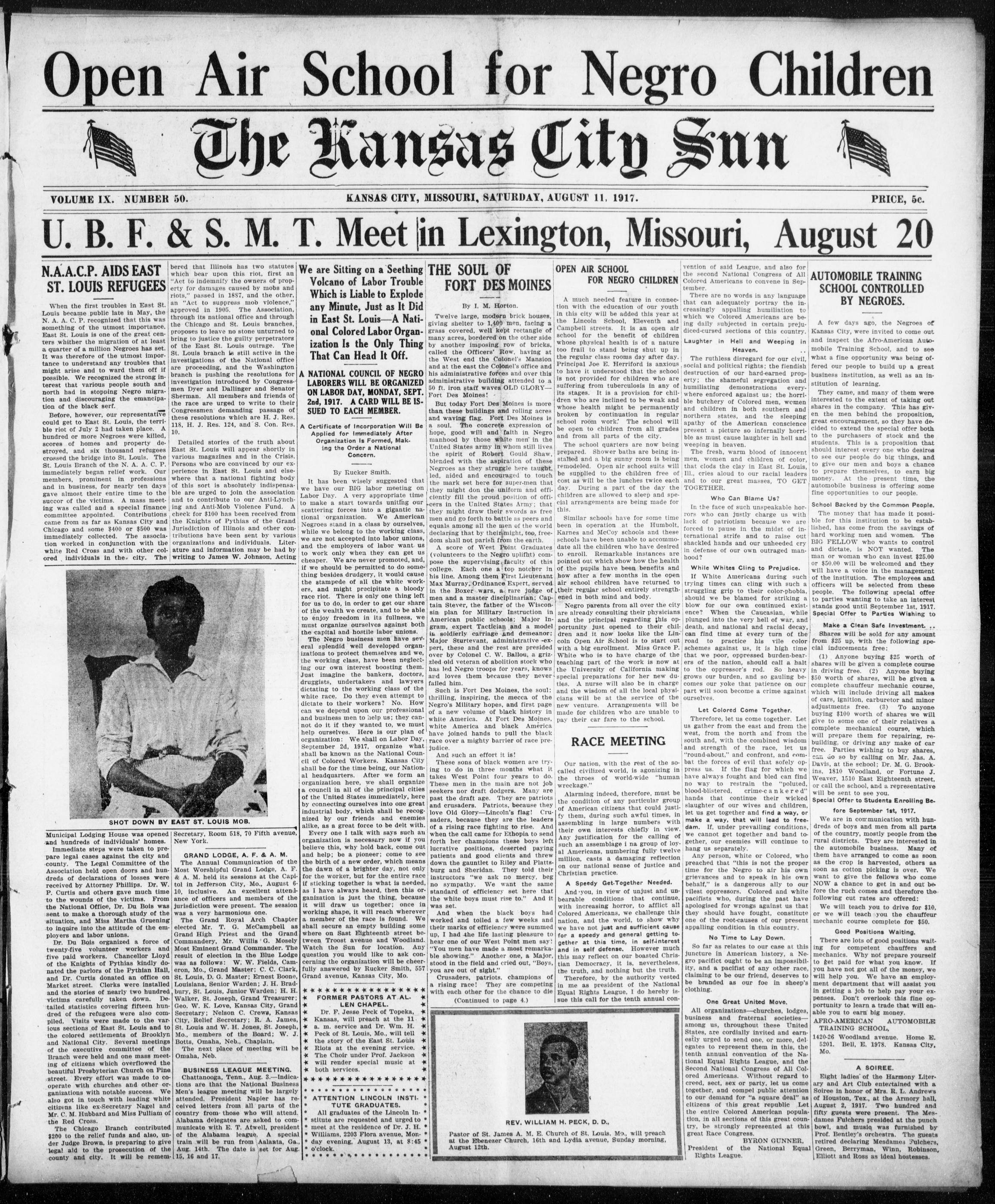
N.A.A.C.P. AIDS EAST ST. LOUIS REFUGEES
When the first troubles in East St. Louis became public late in May, the N. A. A. C. P. recognized that this was something of the utmost importance. East St. Louis is one of the great centers whither the migration of at least a quarter of a million Negroes has set. It was therefore of the utmost importance to understand any troubles that might arise and to ward them off if possible. We recognized the strong interest that various people south and north had in stopping Negro migration and discouraging the emancipation of the black serf.
Before, however, our representative could get to East St. Louis, the terrible riot of July 2 had taken place. A hundred or more Negroes were killed, scores of homes and property destroyed, and six thousand refugees crossed the bridge into St. Louis. The St. Louis Branch of the N. A. A. C. P. immediately began relief work. Our members, prominent in professions and in business, for nearly ten days gave almost their entire time to the succor of the victims. A mass meeting was called and a special finance committee appointed. Contributions came from as far as Kansas City and Chicago and some $400 or $500 was immediately collected. The association worked in conjunction with the white Red Cross and with other colored individuals in the city. The
SRI LANKA
M.
SHOT DOWN BY EAST ST. LOUIS MOB.
Municipal Lodging House was opened and hundreds of individuals' homes. Immediate steps were taken to prepare legal cases against the city and county. The Legal Committee of the Association held open doors and hundreds of declarations of losses were received by Attorney Phillips. Dr. W. P. Curtis and others gave much time to the wounds of the victims. From the National Office, Dr. Du Bois was sent to make a thorough study of the situation, and Miss Martha Gruening to inquire into the attitude of the employers and labor unions.
Dr. Du Bois organized a force of twenty-five volunteer workers and five paid workers. Chancellor Lloyd of the Knights of Pythias kindly donated the parlors of the Pythian Hall, and Dr. Curtis donated an office on Market street. Clerks were installed and the stories of nearly two hundred victims carefully taken down. Detailed statistics covering fifteen hundred of the refugees were also compiled. Visits were made to the various sections of East St. Louis and to the colored settlements of Brooklyn and National City. Several meetings of the executive committee of the Branch were held and one mass meeting of citizens which overflowed the beautiful Presbyterian Church on Pine street. Every effort was made to cooperate with churches and other organizations with notable success. We also got in touch with leading white citizens like ex-Secretary Nagel and Mr. C. M. Hubbard and Miss Pulliam of the Red Cross.
The Chicago Branch contributed $200 to the relief funds and also, under Judge Brown, is preparing to give legal aid to the prosecution of the county and city. It will be remem-
bered that Illinois has two statutes which bear upon this riot, first an "Act to indemnify the owners of property for damages caused by mobs and riots," passed in 1887, and the other, an "Act to suppress mob violence," approved in 1905. The Association, through its national office and through the Chicago and St. Louis branches, proposes to leave no stone unturned to bring to justice the guilty perpetrators of the East St. Louis outrage. The St. Louis branch is still active in the investigations of the National office are proceeding, and the Washington branch is pushing the resolutions for investigation introduced by Congressmen Dyer and Dallinger and Senator Sherman. All members and friends of the race are urged to write to their Congressmen demanding passage of these resolutions which are H. J. Res. 118, H. J. Res. 124, and S. Con. Res. 10.
Detailed stories of the truth about East St. Louis will appear shortly in various magazines and in the Crisis. Persons who are convinced by our experience in East St. Louis and elsewhere that a national fighting body of this sort is absolutely indispensable are urged to join the association and to contribute to our Anti-Lynching and Anti-Mob Violence Fund. A check for $100 has been received from the Knights of Pythias of the Grand Jurisdiction of Illinois and other contributions have been sent by various organizations and individuals. Literature and information may be had by writing to James W. Johnson. Acting
THE BEST OF THE WEEK
Secretary, Room 518, 70 Fifth avenue, New York.
GRAND LODGE, A. F. & A. M.
The Annual Communication of the Most Worshipful Grand Lodge, A. F. & A. M. held its sessions at the Capitol in Jefferson City, Mo., August 6-10, inclusive. An excellent attendance of officers and members of the jurisdiction were present. The session was a very harmonious one.
The Grand Royal Arch Chapter elected Mr. T. G. McCampbell as Grand High Priest and the Grand Commandery, Mr. Willis G. Mosely Most Eminent Grand Commander. The result of election in the Blue Lodge was as follows: W. W. Fields, Cameron, Mo., Grand Master; C. C. Clark, St. Louis, D. G. Master; Ernest Boone, Louisiana, Senior Warden; J. H. Bradbury, St. Louis, Junior Warden; H. H. Walker, St. Joseph, Grand Treasurer; Geo. W. K. Love, Kansas City, Grand Secretary; Nelson C. Crews, Kansas City, Relief Secretary; R. A. James, St. Louis and W. H. Jones, St. Joseph, Mo., members of the Board; W. J. Botts, Omaha, Neb., Chapain.
The next place of meeting will be Omaha, Neb.
BUSINESS LEAGUE MEETING.
Chattanooga, Tenn., Aug. 3.—Indications are that the National Business Men's league meeting will be largely attended. President Napier has received letters from all parts of the country from those who will attend. Alabama delegates are asked to communicate with E. T. Atwell, president of the Alabama league. A special train will be run from Aalanta, Ga.
Aug. 14th. The date is set for Aug. 15, 16 and 17.
KANSAS CITY, MISSOURI, SATURDAY, AUGUST 11, 1917.
We are Sitting on a Seething Volcano of Labor Trouble Which is Liable to Explode any Minute, Just as It Did in East St. Louis—A National Colored Labor Organization Is the Only Thing That Can Head It Off.
A NATIONAL COUNCIL OF NEGRO LABORERS WILL BE ORGANIZED ON LABOR DAY, MONDAY, SEPT. 2nd, 1917. A CARD WILL BE ISSUED TO EACH MEMBER.
A Certificate of Incorporation Will Be Applied for Immediately After Organization Is Formed, Making the Order a National Concern.
By Rucker Smith
It has been wisely suggested that we have our BIG labor meeting on Labor Day. A very appropriate time to make a start towards unifying our scattering forces into a gigantic national organization. We American Negroes stand in a class by ourselves, while we belong to the working class, we are not accepted into labor unions, and the employers of labor want us to work only when they can get us cheaper. We are never promoted, and, if we should be permitted to do something besides drudgery, it would cause the stampede of all the white workers, and might precipitate a bloody race riot. There is only one thing left for us to do, in order to get our share of the wealth we create, and to be able to enjoy freedom in its fullness, we must organize ourselves against both the capital and hostile labor unions.
The Negro business men have several splendid well developed organizations to protect themselves and we, the working class, have been neglecting our own interest boosting them. Just imagine the bankers, doctors, druggists, undertakers and lawyers dictating to the working class of the white race. Do they even attempt to dictate to their workers? No. How can we depend upon our professional and business men to help us; they cannot do it if they wanted to, we must help ourselves. Here is our plan of organization: We shall on Labor Day, September 2d, 1917, organize what shall be known as the National Council of Colored Workers. Kansas City shall be for the time being, our National headquarters. After we form an organization here, we shall organize a council in all of the principal cities of the United States immediately, here by connecting ourselves into one great industrial body, which shall be recognized by our friends and enemies alike, as a great force to be delt with. Every one I talk with says such an organization is necessary now if you believe this, why hold back, come out and help; be a pioneer; come to see the birth of a new order, which means the dawn of a brighter day, not only for the worker, but for the entire race if sticking together is what is needed as I have always heard, then this organization is just the thing, because it will draw us together; once in working shape, it will reach wherever a member of the race is found. We shall secure an empty building some where on Sast Eighteenth street between Troost avenue and Woodland. Watch the Sun for location. Any question you would like to ask concerning the organization will be cheerfully answered by Rucker Smith, 557 Grand avenue, Kansas City, Mo.
* FORMER PASTORS AT AL-
* LEN CHAPEL.
Dr. F. Jesse Peck of Topeka, Kansas, will preach at the 11 a. m. service and Dr. Wm. H. Peck of St. Louis, Mo., will tell the story of the East St. Louis Riots at the evening service. The Choir under Prof. Jackson will render special music at both services.
★★★★★★★★★★★★★★
* ATTENTION LINCOLN INSTITUTE GRADUATES.
* All graduates of the Lincoln Institute are requested and urged to meet at the residence of Dr. J. H. Williams, 2203 Flora avenue, Monday evening, August 13, at 8:45 o'clock.
THE SOUL OF
FORT DES MOINES
Twelve large, modern brick houses, giving shelter to 1,400 men, facing a grass covered, well kept rectangle of many acres, bordered on the other side by another imposing row of bricks, called the Officers' Row, having at the West end the Colonel's Mansion and at the east the Colonel's office and his administrative forces and over this administrative building attended to a 50 ft. iron staff waves OLD GLORY—Fort Des Moines!
But today Fort Des Moines is more than these buildings and rolling acres and waving flag. Fort Des Moines is a soul. The concrete expression of hope, good will and faith in Negro manhood by those white men in the United States army in whom still lives the spirit of Robert Gould Shaw, blended with the aspiration of these Negroes as they struggle here taught, led, aided and encouraged to touch the mark set here for super-men that they might don the uniform and efficiently fill the proud position of officers in the United States Army; that they might draw their swords as free men and go forth to battle as peers and equals among all the men of the world declaring that by their might, too, freedom shall not parish from the earth.
A score of West Point Graduates (volunteers to the Negro uplift) compose the supervising faculty of this college. Each one a top notcher in his line. Among them First Lieutenant Max Murray, Ordinance Expert, served in the Boxer wars, a rare judge of men and a master disciplinarian; Captain Stever, the father of the Wisconsin sin plan for Military Instruction in American public schools; Major Ingram, expert Tactician and a model in soldierly carriage and demeanor; Major Sturtevant, administrative expert, these and the rest are presided over by Colonel C. W. Ballou, a grizzled old veteran of abolition stock who has led Negro troops for years, knows and loves them because they never failed him.
Such is Fort Des Moines, the soul; thrilling, inspiring, the mecca of the Negro's Military hopes, and first page of a new volume of black history in white America. At Fort Des Moines, white America and black America have joined hands to pull the black race over a mighty barrier of race prejudice.
These sons of black women are trying to do in three months what it takes West Point four years to do. These men in the main are not job seekers nor draft dodgers. Many are past the draft age. They are patriots and crusaders. Patriots, because they love Old Glory—Lincoln's flag! Crusaders, because they are the leaders of a rising race fighting to rise. And when the call came for Ethiopia to send forth her champions these boys left lucrative positions, deserted paying patients and good clients and threw down the gauntlet to Riley and Plattsburg and Sheridan. They told their instructors "we ask no mercy, beg no sympathy. We want the same standard of efficiency set here that the white boys must rise to." And it was set.
And when the black boys had worked and toiled a few weeks and their marks of efficiency were summed up, I had the life lasting pleasure to hear one of our West Point men say: "You men have made a most remarkable showing." Another one, a Major, stood in the field and cried out, "Boys, you are out of sight."
Crusaders, patriots, champions of a rising race! They are competing with each other for the chance to die (Continued to page 4.)
[Name]
REV. WILLIAM H. PECK, D. D.
Pastor of St. James A. M. E. Ch
at the Ebenezer Church, 16th a
August 12th.
Pastor of St. James A. M. E. Church of St. Louis, Mo., will preach at the Ebenezer Church, 16th and Lydia avenue, Sunday morning, August 12th.
By I. M. Horton
And such an effort it is!
OPEN AIR SCHOOL
FOR NEGRO CHILDREN
A much needed feature in connection with the education of our youth in this city will be added this year at the Lincoln School, Eleventh and Campbell streets. It is an open air school for the benefit of children whose physical health is of a nature too frail to stand being shut up in the regular class rooms day after day. Principal Joe E. Herriford is anxious to have it understood that the school is not provided for children who are suffering from tuberculosis in any of its stages. It is a provision for children who are inclined to be weak and whose health might be permanently broken by continuation in regular school room work'. The school will be open to children from all grades and from all parts of the city.
The school quarters are now being prepared. Shower baths are being installed and a big sunny room is being remodeled. Open air school suits will be supplied to the children free of cost as will be the lunches twice each day. During a part of the day the children are allowed to sleep and special arrangements are being made for this.
Similar schools have for some time been in operation at the Humbolt, Karnes and McCoy schools and these schools have been unable to accommodate all the children who have desired to enroll. Remarkable instances are pointed out which show how the health of the pupils have been benefits and how after a few months in the open air school children have returned to their regular school entirely strengthened in both mind and body.
Negro parents from all over the city are already consulting their physicians and the principal regarding this op portunity just opened to their children and it now looks like the Lincoln Open Air School is to start out with a big enrollment. Miss Grace P. White who is to have charge of the teaching part of the work is now at the University of California making special preparations for her new duties. A nurse will also be in charge and the wisdom of all the local physicians will be at the service of the new venture. Arrangements will be made for children who are unable to pay their car fare to the school.
RACE MEETING
Our nation, with the rest of the so-called civilized world, is agonizing in the throes of world-wide "human wreckage."
Alarming indeed, therefore, must be the condition of any particular group of American citizens that could justify them, during such awful times, in assembling in large numbers with their own interests chiefly in view. Any justification for the calling of such an assemblage i na group of loyal Americans, numbering fully twelve million, casts a damaging reflection on our national sense of justice and Christian practice.
A. Speedy Get-Together Needed.
And you, in view of unjust and unbearable conditions that continue, with increasing horror, to afflict all Colored Americans, we challenge this nation, and the world, to show why we have not just and sufficient cause for a speedy and general getting together at this time, in self-interest and in self defense. However much this may reflect on our boasted Christian Democracy, it is, nevertheless, the truth, and nothing but the truth. Therefore, by the authority vested in me as president of the National Equal Rights League, I do hereby issue this call for the tenth annual con-
Church of St. Louis, Mo., will preach and Lydia avenue, Sunday morning,
---
vention of said League, and also for the second National Congress of All Colored Americans to convene in September. There are no words in any language that can adequately portray the increasingly appalling humiliation to which we Colored Americans are being daily subjected in certain prejudiced-cursed sections of this country.
Laughter in Hell and Weeping in Heaven. ..
The ruthless disregard for our civil, social and political rights; the fiendish destruction of our hard-earned property; the shameful segregation and humiliating demonstrations everywhere enforced against us; the horrible butchery of Colored men, women and children in both southern and northern states, and the sleeping apathy of the American conscience present a picture so infernally horrible as must cause laughter in hell and weeping in heaven. The fresh, warm blood of innocent men, women and children of color that clods the clay in East St. Louis Ill., cries aloud to our racial leaders and to our great masses, TO GET TOGETHER.
Who Can Blame Us?
In the face of such unspeakable horrors who can justly charge us with lack of patriotism because we are forced to pause in the midst of international strife and to raise out shackled hands and our unheeded cry in defense of our own outraged manhood?
While Whites Cling to Prejudice.
If White Americans during such trying times can cling with such a struggling grip to their color-phobia, should we be blamed for striking a blow for our own continued existence? When the Caucasian, while plunged into the very hell of war, and death, and national and racial decay, can find time at every turn of the road to practice his vile color schemes against us, it is high time that we poor, oppressed burden-bearers of the nation, should call a halt to the oppressor's rod. So heavy grows our burden, and so gaulling becomes our yoke that patience on our part will soon become a crime against ourselves.
Let Colored Come Together
Therefore, let us come together. Let us gather from the east and from the west, from the north and from the south and, with the combined wisdom and strength of the race, let us "round-about," and confront, and combat the forces of evil that sofely oppress us. If the flag for which we have always fought and bled can find no way to restrain the "poluted, blood-blistered, crime-cankered" hands that continue their wicked slaughter of our wives and children, let us get together and find a way, or make a way, that will lead to freedom. If, under prevailing conditions, we cannot get together and band together, our enemies will continue to hang us separately.
Any person, white or Colored, who preached that "this is not the proper time for the Negro to air his own grievances and to speak in his own behalf," is a dangerous ally to our vilest oppressors. Colored and white pacifists who, during the past have apologised for wrongs against us that they should have fought, constitute one of the root-causes of our present appalling condition in this country.
No Time to Lay Down.
So far as relates to our case at this juncture in American history, a Negro pacific ought to be an impossibleity, and a pacifist of any other race, claiming to be our friend, deserves to be branded as our foe in sheep's clothing.
One Great United Move.
All organizations—churches, lodges, business and fraternal societies—among us, throughout these United States, are cordially invited and earnestly urged to send one, or more, delegates to represent them in this, the tenth annual convention of the National Equal Rights League, and the Second National Congress of All Colored Americans. Without regard to creed, sect, sex or party, let us come together, and compel public attention to our demand for "a square deal" as citizens of this great republic Let the entire Colored American population, in all sections of this great country, be strongly represented at this great Race Congress.
BYRON GUNNER,
President of the National Equal Rights League.
PRICE, 5c. august 20
AUTOMOBILE TRAINING SCHOOL CONTROLLED BY NEGROES.
A few days ago, the Negroes of Kansas City, were invited to come out and inspect the Afro-American Automobile Training School, and to see what a fine opportunity was being offered our people to build up a great business institution, as well as an institution of learning.
They came, and many of them were interested to the extent of taking out shares in the company. This has given the men behind the proposition, great encouragement, so they have decided to extend the special offer both to the purchasers of stock and the students. This is a proposition that should interest every one who desires to see our people do big things, and to give our men and boys a chance to prepare themselves, to earn big money. At the present time, the automobile business is offering some fine opportunities to our people.
School Backed by the Common People.
The money that has made it possible for this institution to be established, has come from the savings of hard working men and women. The BIG FELLOW who wants to control and dictate, is NOT wanted. The man or woman who can invest $25.00 or $50.00 will be welcomed and they will have a voice in the management of the institution. The employees and officers will be selected from these people. The following special offer to parties wanting to take an interest stands good until September 1st, 1917. Special Offer to Parties Wishing to
Make a Clean Safe Investment ...
Shares will be sold for any amount from $25 up, with the following special inducements free:
(1) Anyone buying $25 worth of shares will be given a complete course in driving free. (2) Anyone buying $50 worth of shares, will be given a complete chauffeur mechanic course, which will include driving all makes of cars, ignition, carburetor and minor adjustments free. (3) To anyone buying $100 worth of shares we will give to one of their relatives a complete mechanical course, which will prepare them for repairing, rebuilding, or driving any make of car free. Parties wishing to buy shares, can do so by calling on Mr. Jas. A. Davis, at the school; Dr. M. G. Brookins, 1810 Woodland, or Fortune J. Weaver, 1510 East Eighteenth street, or call the school, and a representative will be sent to see you.
fore September 1st, 1917.
We are in communication with hundreds of boys and men from all parts of the country, mostly people from the rural districts. They are interested in the automobile business. Many of them have arranged to come as soon as the crop is harvested, others as soon as cotton picking is over. We want to give the fellows who come NOW a chance to get in and out before the ruch comes and therefore the following cut rates are offered:
We will teach you to drive for $10, or we will teach you the chauffeur mechanic course complete for $50.
Good Positions Waiting.
There are lots of good positions waiting for competent chauffers and mechanics. Why not prepare yourself to get paid for what you know. If you have not got all of the money, we will help you. We have an employment department that will assist you in getting a job to help pay your expenses. Don't overlook this fine opportunity to learn a trade that will enable you to earn big money.
AFRO-AMERICAN AUTOMOBILE TRAINING SCHOOL,
1420-26 Woodland avenue. Home E.
5201. Bell, E. 1978. Kansas City,
Mo.
A SOIREE
Eight ladies' of the Harmony Literary and Art Club entertained with a Soiree in honor of Mrs. R. L. Andrews of Houston, Tex., at the Armory hall, August 2, 1917. Two hundred and fifty guests were present. The Mesdames Fulchers presided at the punch bowl, and music was furnished by Prof. Bentley's orchestra. The guests retired declaring Mesdames Fulchers Green, Berryman, Winn, Robinson Elliott and Ross as ideal hostesses.
From Our Foreign Correspondents
A. F. and A. M. Mo. Jurisdiction
Officers—1917.
W. W. Fields, Cameron, Mo., Grand Master.
Wm. Green, Plattsburg, Mo., Dep.
Grand Master.
C. C. Clark, St. Louis, Mo., Senior
Grand Warden.
Ernest Boone, Louisiana, Mo., Junior
Grand Warden.
H. H. Walker, St. Joseph, Mo., Grand
Treasurer.
Geo. W. K. Love, Kansas City
Grand Secretary.
Nelson C. Crews, Kansas City, Rei
lief Secretary.
P. L. Pratt, Cameron, Mo., G. L.
1st District.
E. J. Cooper, Mexico, Mo., G. L.
2nd District.
Lodge Directory
G
WEST CHESTER
Rone Lodge No. 25, A. F, and
A. M, meets the 1st and 3rd
Monday in each month. All
Master Masons in good standing
welcome. Emmett Spruell, W.
M.; C. H. Countee, Sec'y.
G
Liberty Lodge No. 37, A. F.
and A. M., Liberty, Mo., meets the 2nd and 4th Saturday nights in each month. William Parker, W. M.; Nelson Wallar, Secy.
Mt. Olive Lodge No. 53, A. F. and A. M., meets the 2nd and 4th Fridays in every month. Visiting Master Masons are welcome. H. Brown, W. M.; Wibert Wilson, Secretary, 1820 Highland.
G
St. Stephens Chapter No. 37,
Royal Arch Masons, Liberty,
Boston, Mass. In each month, W. H. Robinson,
H. P. Wrn, Capps, Recorder.
```markdown
```
St. Matthew Commandery
No. 17, Liberty, Mo., meets
the third Saturday night
William Capps, E. C.; W. H.
Robinson, Rec. Sec'y.
HOC
ONCE
VICTORY
U. B. F.
```markdown
```
King of the West Lodge No. 218 meets first and third Wednesday in each month at 10th and Campbell. C. F Wilson, W M.; H. Conway, 58 Tracy Avey, Sec.
D. OF T.
Prelimrose Tabernacle meets 1st and 3d Wednesday nights at 1413 Vine Street. All Daughters and Sir Knights in good standing are welcome. Browse Dotson, H. C., R. 1351, 2th; Estella Pitts, C. R. 1351, 12th. E.
MASONIC BUILDING ASSOCIATION
T. G. McCampbell, President.
E. B. Thompson, Vice President.
W. H. Washington, Treasurer.
S. H. P. Edwards, Secretary.
Board of Directors:
N. W. Jordan. S. Myers,
W. H. Brown. E. S. Baker,
W. R. Patterson. R. V. Adkins,
B. R. Francis. Richard Harris
Geo. Johnson. R. Fulbright.
Meets second and fourth Tuesday
in each month.
CHURCH DIRECTORY.
Bethel A. M. E. Church, 24th and Flora.
St. Stephen's Baptist Church, 604 Charlton
Centennial M. E. Church, 19th and Woodland.
St. Augustine's P. E. Church, 11th and Troost Avenue.
St. John's A. M. E. Church, 1743 Belleville.
Seventh Day Adventist, 23d and Woodland.
St. Monica's Catholic, 17th and Lydia St. Baptist Church, 1825 Vine St. Wake Chapel A. M. E. Church, 11th and Troost.
Morning Star Baptist Church, 2311 Vine,
Highland Avenue Baptist Church, 1111
Hill Street
Centropolis A. M. E. Church, Centropolis Mo.
St. James A. M. E. Zlon Church, 1823
Woodland Ave.
Filgrim Baptist Church, 614 Charlotte
8t
B
Pleasant Green Baptist Church, Independence Avenue and Tracy.
Calvary Baptist Church, 19th and Ascend.
M. E. Church, 1817 Flora Ave.
St. James Baptist Church, 4039 Mill St.
St. Luke's E. M. Church, 43rd and Place.
CLARK CHAPEL M. E. CHURCH,
1664 Madison Ave.
KANSAS CITY, KAN. CHURCHES.
Church of Ascension, 3rd and Steward.
First A. M. E. Church, 8th and Neb.
Eighth St. Baptist Church, 8th and
Oakland.
Metropolitan Baptist Church, 9th and Washington.
Bethel A. M. E. Church, Water and Steward Streets.
St. Paul A. M. E. Church, 21st and Ruby.
First Baptist Church, 5th and Neb.
King Solomon Baptist Church, 3rd and State.
Quindaro A. M. E. Church, Quindaro
Pleasant Valley Baptist Church, Rosas-
da
M. E. Church, 9th and Oakland.
A. M. E. Church, 4th and Oakland.
Salter Mission A. M. E. Church, South Park, Kan.
Second Baptist Church, 24th and Ruby.
Weasley Chapel M. E., 166 Shawnee.
Bethel A. M. E. Church, Rosedale, Kan.
Mt. Zion Baptist Church, 4th and Vir-
Ebenezer A. M. E. Church, Sanford and
Bible school at 9:30 a. m.; preaching and Communion at 11 a. m.; Y. P. S. C. E. at 7 p. m.; preaching at 8:15 p. m.; prayer meeting Wednesday at 8:30 p. m.; Christian Woman's Board of Missions Thursday at 2 p. m.
WILLIAM ALPHIN, Pastor.
HELENA. MONT.
By J. H. Hilliard.
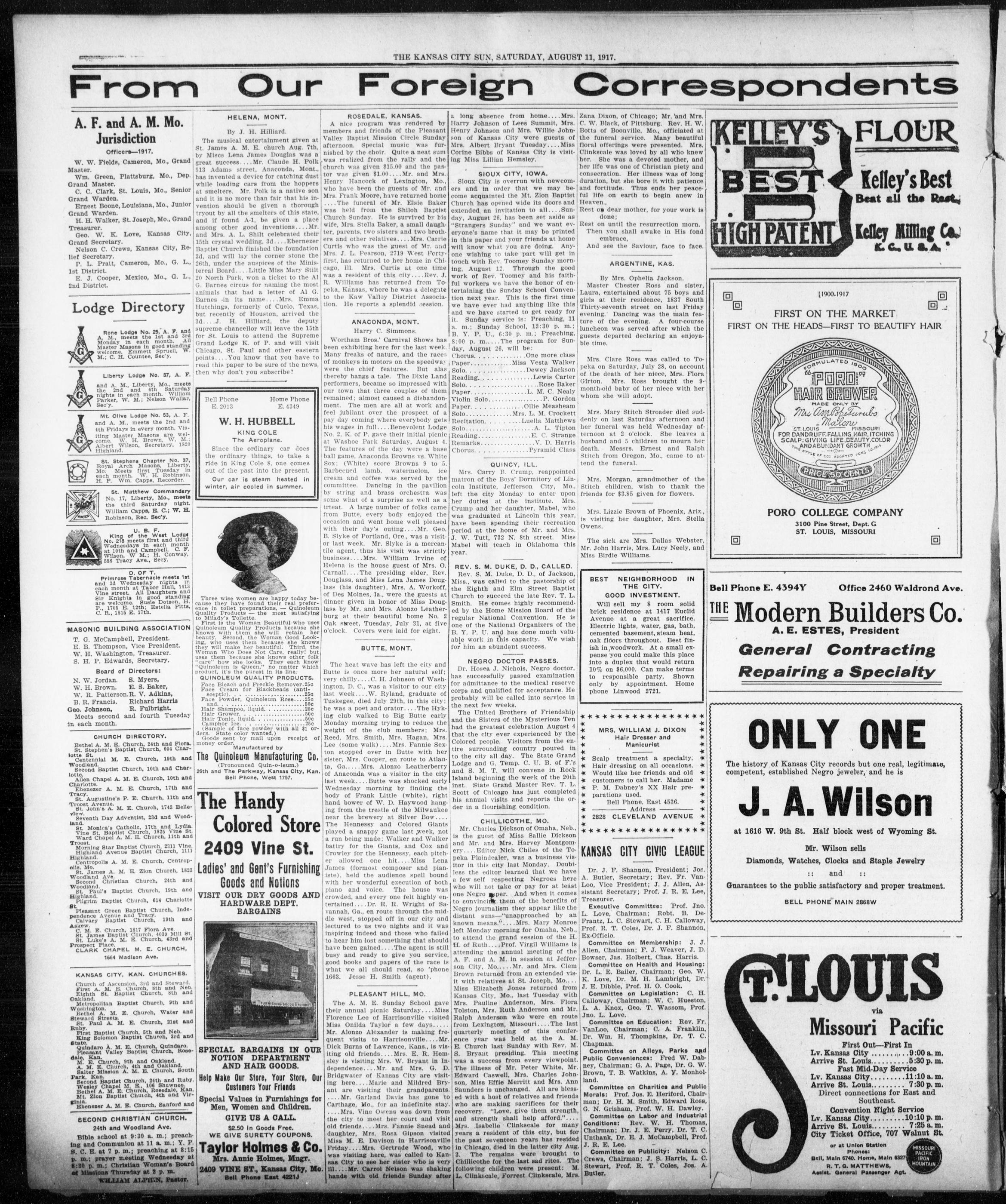
The musical entertainment given at St. James A. M. E. church Aug. 7th, by Mises Lena James Douglas was a great success...Mr. Claude H. Polk 513 Adams street, Anaconda, Mont. has invented a device for catching dust while loading cars from the hoppers at smelters. Mr. Polk is a native son and it is no more than fair that his invention should be given a thorough tryout by all the smelters of this state and if found A-1, be given a place among other good inventions...Mr. and Mrs. A. L. Shilt celebrated their 15th crystal wedding, 3d...Ebernezer Baptist Church finished the foundation 3d, and will lay the corner stone the 26th, under the auspices of the Ministeral Board...Little Miss Mary Stilt 20 North Park, won a ticket to the AL G. Barnes circus for naming the most animals that had a letter of Al G. Barnes -in its name...Mrs. Emma Hutchings, formerly of Cuelo, Texas, but recently of Houston, arrived the 3d....J. H. Hilliard, the deputy supreme chancellor will leave the 15th for St. Louis to attend the Supreme Grand Lodge K. of P. and will visit Chicago, St. Paul and other eastern points...You know that you have to read this paper to be sure of the news, then why don't you subscribe?
W. H. HUBBELL
The Aeroplane.
Since the ordinary car does the ordinary things, to take a ride in King Cole 8, one comes out of the past into the present.
Our car is steam heated in winter, air cooled in summer.
Three wise women are happy today because they have found their real preference in toilet preparations. Quinoleum Quality Products — the most satisfying to Milady's Tollette.
First is the Woman Beautiful who uses Quinoleum Quality Products because she knows with them she will retain her beauty, Second the Woman Good Looking, who uses them because she knows they will make her beautiful. Third, the Woman Who Does Not Care, really! but uses them because she knows other folk "care" how she looks. They each know "Quinoleum is Queen," no matter which product, it's the purest in its line.
QUINOLEUM QUALITY PRODUCTS.
Face Bleach and Freckle Remover .25c
Face Cream for Blackheads (anti-
sceptic). .25c
Face Powder, Quinoleum Rose .25c
Face Powder, Quinoleum Rose .25c
Hair Shampoo, liquid .25c
Hair Grower .25c
Hair Tonic, liquid .50c
Camphor Ice. .50c
(Sand) Face ice powder with all $1
order. State color wanted.)
Goods sent by mail upon receipt o
money order.
(Profounded) Quin-6-leam)
28th and
Bell Phone, Whee, 1277
The Handy Colored Store
2409 Vine St.
Ladies' and Gent's Furnishing
Goods and Notions
VISIT OUR DRY GOODS AND
HARDWARE DEPT.
BARGAINS
PUBLISHING GROCERY & NUTRITION
THE KANSAS CITY SUN, SATURDAY, AUGUST 11, 1917.
ROSEDALE, KANSAS.
A nice program was rendered by members and friends of the Pleasant Valley Baptist Mission Circle Sunday afternoon. Special music was furnished by the choir. Quite a neat sum was realized from the rally and the church was given $15.00 and the pastor was given $1.00...Mr. and Mrs. Henry Hancock of Lexington, Mo., who have been the guests of Mr. and Mrs. Frank Moore, have returned home
...The funeral of Mr. Elsie Baker was held from the Shiloh Baptist Church Sunday. He is survived by his wife, Mrs. Stella Baker, a small daughter, parents, two sisters and two brothers and other relatives...Mrs. Carrie Curtis who was the guest of Mr. and Mrs. J. L. Pearson, 2719 West Ferttyfirst, has returned to her home in Chicago, Ill. Mrs. Curtis at one time was a resident of this city...Rev. J. R. Williams has returned from Topeka, Kansas, where he was a delegate to the Kaw Valley District Association. He reports a splendid session.
ANACONDA, MONT.
Harry C. Simmons
Wortham Bros.' Carnival Shows has been exhibiting here for the last week. Many freaks of nature, and the races of monkeys in motors on the speedway were the chief features. But alas thereby hangs a tale. The Dixie Land performers, became so impressed with our town that three couples of them remained; almost caused a disbandment. The men are all at work and feel jubilant over the prospect of a pay day coming where everybody gets his wages in full... Benevolent Lodge No. 2, K. of P, gave their initial picnic at Washoe Park Saturday, August 4. The features of the day were a base ball game, Anaconda Brown's vs. White Sox; (White) score Brown's 9 to 5. Barbecued lamb, watermelon, ice cream and coffee was served by the committee. Dancing in the pavilion by string and brass orchestra was some what of a surprise as well as a trtreat. A large number of folks came from Butte, every body enjoyed the occasion and went home well pleased with their day's outing...Mr. Geo. B. Slyke of Portland, Ore., was a visitor last week. Mr. Slyke is a mercantile agent, thus his visit was strictly business...Mrs. William Irvine of Helena is the house guest of Mrs. O. Carnall...The presiding elder, Rev. Douglass, and Miss Lena James Douglass (his daughter), Mrs. A. Workoff, of Des Molines, la., were the guests at dinner given in honor of Miss Douglass by Mr. and Mrs. Alonzo Leathburg at their beautiful home No. 2 Oak sweet, Tuesday, July 31, at five o'clock. Covers were laid for eight.
BUTTE, MONT
The heat wave has left the city and Butte is once more her natural self; very chilly.....C. H. Johnson of Washington, D. C., was a visitor to our city last week....W. Ryland, graduate of Tuskegee, died July 29th, in this city; he was a poet and orator....The Hyking club walked to Big Eagle early Monday morning trying to reduce the weight of the club members; Mrs. Reed, Mrs. Smith, Mrs. Hagan, Mrs. Lee (some walk).....Mrs. Fannie Sexton stopped over in Butte with her sister, Mrs. Cooper, en route to Atlanta, Ga.....Mrs. Alonzo Leatherberry of Anaconda was a visitor in the city last week....Butte was shocked early Wednesday morning by finding the body of Frank Little (white), right hand bower of W. D. Haywood hanging from the trestle of the Milwaukee near the brewery at Silver Row...
The Hennessy and Colored Giants played a snappy game last week, not a run being made; Walker and Walker battery for the Giants, and Cox and Crowley for the Hennessy, each pitcher allowed one hit...Miss Lena James (formost composer and pianiste), held the audience spell bound with her wonderful execution of both piano and voice. The house was crowded, and every one felt highly entertained...Dr. R. R. Wright of Savannah, Ga., en route through the middle west, stopped off in our city and lectured to us two nights and it was inspiring indeed and those who failed to hear him lost something that should have been gained...The agent is still busy and ready to give you service good books and papers of the race is what we all should read, so 'phone 1663. Jesse H. Smith (agent).
PLEASANT HILL, MO.
The A. M. E. Sunday School gave their annual picnic Saturday.....Miss Florence Lee of Harrisonville visited Miss Onida Taylor a few days....Mr. Alonzo Alexander is making frequent visits to Harrisonville.....Mr. Dick Burns of Lawrence, Kans., is visiting old friends.....Mrs. E. R. Hemsley is visiting Mrs. W. Bryant in Independence.....Mr. and Mrs. G. D. Bridgwater of Kansas City are visiting here.....Marie and Mildred Bryant are visiting their grandparents
Mr. Garland Davis has gone to Carthage, Mo., for an indefinite stay. Mrs. Vine Owens was down from the city to meet her court and visit old friends...Mrs. Fannie Snead and daughter, Mrs. Rosa Gipson visited Miss M. E. Davison in Harrisonville Friday...Mrs. Gertrude Wood, who was visiting here, was called to Kansas City to see her sister who is very ill...Mr. Carrol Nelson was shaking hands with old friends Sunday after
a long absence from home....Mrs.
Harry Johnson of Lees Summit, Mrs.
Henry Johnson and Mrs. Willie Johnson of Kansas City were guests of Mrs. Albert Bryant Tuesday....Miss Corline Bibbs of Kansas City is visiting Miss Lillian Hensley.
SIOUX CITY, IOWA.
Sioux City is overrun with newcomers and in order that we may become acquainted the Mt. Zion Baptist Church has opened wide its doors and extended an invitation to all.....Sunday, August 26, has been set aside as "Strangers Sunday" and we want everyone's name that it may be printed in this paper and your friends at home will know what you are doing. Anyone wishing to take part will get in touch with Rev. Toomey Sunday morning, August 12. Through the good work of Rev. Toomey and his faithful workers we have the honor of entertaining the Sunday School Convention next year. This is the first time we have ever had anything like this and we have started to get ready for it. Sunday service is: Preaching, 11 a. m.; Sunday School, 12:30 p. m.; B. Y. P. U., 6:30 p. m.; Preaching, 8:00 p. m....The program for Sunday, August 26, will be:
Chorus.....One more class
Paper.....Miss Vesta Walker
Solo.....Dewey Jackson
Reading.....Lewis Carter
Solo.....Rose Baker
Paper.....L. M. C. Nealy
Violin Solo.....P. Gordon
Paper.....Ollie Measham
Solo.....Mrs. L. M. Crockett
Recitation.....Luella Matthews
Solo.....A. L. Tipton
Reading.....E. C. Strange
Remarks.....V. D. Harris
Chorus.....Pyramid Class
QUINGY ILL
Mrs. Carry B. Crump, reappointed matron of the Boys' Dormitory of Lincoln Institute, Jefferson City, Mo. left the city Monday to enter upon her duties at the institute. Mrs Crump and her daughter, Mabel, who was graduated at Lincoln this year have been spending their recreation period at the home of Mr. and Mrs. J. W. Tutt, 732 N. 8th street. Miss Mabel will teach in Oklahoma this year.
REV. S. M. DUKE, D. D., CALLED.
Rev. S. M. Duke, D. D., of Jackson Miss., was called to the pastorship of the Eighth and Elm Street Baptist Church to succeed the late Rev. T. L. Smith. He comes highly recommended by the Home Mission Board of the regular National Convention. He is one of the National Organizers of the B. Y. P. U. and has done much valuable work in this capacity. We wish for him an abundant success.
NEGRO DOCTOR PASSES
Dr. Hosea J. Nichols, Negro doctor, has successfully passed examination for admittance to the medical reserve corps and qualified for acceptance. He probably will be called into service in the next few weeks.
The United Brothers of Friendship and the Sisters of the Mysterious Ten had the greatest celebration August 4 that the city ever experienced by the Colored people. Visitors from the entire surrounding country poured in to the city all day. The State Grand Lodge and G. Temp. C. U. B. of F's and S. M. T. will convene in Rock Island beginning the week of the 20th inst. State Grand Master Rev. T. L. Scott of Chicago has just completed his annual visits and reports the order in a flourishing condition.
CHILLICOTHE, MO.
Mr. Charles Dickson of Omaha, Neb., is the guest of Miss Sallie Dickson and Mr. and Mrs. Harvey Montgomery....Editor Nick Chiles of the Topeka Plaindealer, was a business visitor in this city last Monday. Doubtless the editor learned that we have a few self respecting Negroes here who will not take or pay for at least one Negro paper. And when it comes to convincing them of the benefits of Negro journalism they appear like the distant suns—"unapproached by an known means."...Mrs. Mary Monroe left Monday morning for Omaha, Neb., to attend the grand session of the H. H. of Ruth....Prof. Virgil Williams is attending the annual meeting of the A. F. and A. M. in session at Jefferson City, Mo....Mr. and Mrs. Clem Brown returned from an extended visit with relatives at St. Joseph, Mo....Miss Elizabeth Jones returned from Kansas City, Mo., last Tuesday with Mrs. Pauline Anderson, Mrs. Flora Tolston, Mrs. Ruth Anderson and Mr. Ralph Anderson who were en route from Lexington, Missouri....The last quarterly meeting of this conference year was held at the A. M. E. Church last Sunday with Rev. M. S. Bryant presiding. This meeting was a success from every viewpoint. The illness of Mr. Peter White, Mr. Edward Caswell, Mrs. Charles Johnson, Miss Eiffie Merritt and Mrs. Ann Saunders is unchanged. All are blessed with a host of relatives and friends who are making sacrifices for their recovery. "Love, give them strength and strength shall help afford."...Mrs. Isabelle Clinkscale for many years a resident of this city, but for the past seventeen years has resided in Chicago, died in the latter city Aug 3. The remains were brought to Chillicothe for the last rites. The following children were present: M. L. Clinkscale, Forrest Clinkscale, Mrs
Zana Dixon, of Chicago; Mr.' and Mrs.
C. W. Black, of Pittsburg. Rev. H. W.
Botts of Boonville, Mo., officiated at
the funeral service. Many beautiful
floral offerings were presented. Mrs.
clinkscale was loved by all who knew
her. She was a devoted mother, and
her life was one of Christian piety and
consecration. Her illness was of long
duration, but she bore it with patience
and fortitude. Thus ends her peaceful
life on earth to begin anew in
Heaven.
Rest on dear mother, for your work is
done;
Rest on until the resurrection morn.
Then you shall awake in His fond
embrace,
And see the Saviour, face to face.
ARGENTINE, KAS.
By Mrs. Ophelia Jackson.
Master Chester Ross and sister,
Laura, entertained about 75 boys and
girls at their residence, 1837 South
Thirty-seventh street on last Friday
evening.' Dancing was the main
feature of the evening. A four-course
luncheon was served after which the
guests departed declaring an enjoyable time.
Mrs. Clare Ross was called to Topeka on Saturday, July 28, on account of the death of her niece, Mrs. Flora
Girton. Mrs. Ross brought the 9-
month-old baby of her niece with her
whom she will adopt.
Mrs. Mary Stitch Stronder died suddenly on last Saturday afternoon and her funeral was held Wednesday afternoon at 2 o'clock. She leaves a husband and 5 children to mourn her death. Messrs. Ernest and Ralph Stitch from Oregon, Mo., came to attend the funeral.
Mrs. Morgan, grandmother of the Stitch children, wish to thank the friends for $3.85 given for flowers.
Mrs. Lizzie Brown of Phoenix, Ariz., is visiting her daughter, Mrs. Stella Owens.
The sick are Mrs. Dallas Webster, Mr. John Harris, Mrs. Lucy Neely, and Miss Birdie Williams.
BEST NEIGHBOOROOD IN
THE CITY.
GOOD INVESTMENT.
Will sell my 8 room solid brick residence at 1417 Euclid Avenue at a great sacrifice. Electric lights, water, gas, bath, cemented basement, steam heat, oak floors throughout. Best finish in, woodwork. At a small expense you could make this place into a duplex that would return 10% on $6,000. Can make terms to responsible party. Shown only by appointment. Home phone Linwood 2721.
MRS. WILLIAM J. DIXON
Hair Dresser and
Manicurist
Scalp treatment a specialty. Hair dressing on all occasions. Would like her friends and old customers to call her. Madame P. M. Dabney's XX Hair preparations used.
★★★★★★★★★★★★★+
KANSAS CITY CIVIC LEAGUE
Dr. J. F. Shannon, President; Jos. A. Butler, Secretary; Rev. F. Van-Loo, Vice President; J. J. Allen, Assistant Secretary; Prof. J. R. E. Lee, Treasurer.
Executive Committee: Prof. Jno. L. Love, Chairman; Robt. B. DeFrantz, L. C. Stewart, C. H. Calloway, Prof. R. T. Coles, Dr. J. F. Shannon, Ex-Officio.
Committee on Membership: J. J. Allen, Chairman; F. J. Weaver, J. D. Bowser, Jas. Holbert, Chas. Harris.
Committee on Health and Housing: Dr. L. E. Bailer, Chairman; Geo. W. K. Love, Dr. M. H. Lambright, Dr. J. E. Dibble, Prof. H. O. Cook.
Committee on Legislation: C. H. Calloway, Chairman; W. C. Hueston, L. A. Knox, Geo. T. Wassom, Prof. Jno. L. Love.
Committee on Education: Rev. Fr. VanLoo, Chairman; C. A. Franklin, Dr. Wm. H. Thompkins, Dr. T. C. Chapman.
Committee on Alleys, Parks and Public Conveniences: Fred W. Dabney, Chairman; G. A. Hill, Dr. G. W. Brown, T. B. Watkins, A. Y. Monholland.
Committee on Charities and Public Morals: Prof. Jos. E. Heriford, Chairman; Dr. H. M. Smith, Edward Ross, G. N. Grisham, Prof. W. H. Dawley.
Committee on Labor and Industrial Conditions: Rev. W. H. Thomas, Chairman; Dr. J. E. Perry, Dr. T. C. Unthank, Dr. E. J. McCampbell, Prof. J. R. E. Lee.
Committee on Publicity: Nelson C. Crews, Chairman; J. S. Harris, L. C. Stewart, Prof. R. T. Coles, Jos. A. Butler.
KELLEY'S
BEST
HIGH PATENT
FLOUR
Kelley's Best
Beat all the Rest.
Kelley Milling Co.
K.C. U.S.A.
FIRST ON THE MARKET FIRST ON THE HEADS-FIRST TO BEAUTIFY HAIR
FORMULATED 1800
PORO
HAIR GROWER
MADE ONLY BY
Mrs Amber Perrigo
-Mallory
ST. LOUIS
MISSOURI
FOR DANDRUFF, FALLING HAIR, ITCHING
SCALP; GIVING LIFE, DEAUTY, COLOR
AND ABURDANT GROWTH
THE STYLE OF LOCAL ADOPTED JUNE 12,1915
PRICE: 50 CENTS
PORO COLLEGE COMPANY
3100 Pine Street, Dept. G
ST. LOUIS, MISSOURI
---
---
Bell Phone E. 4394Y
Modern Builder
A. E. ESTES, President
General Contractor
Repairing a Special
ONLY ONE
City of Kansas City records but one real,
established Negro jeweler, and he is
A. A. Wilson
W. 9th St. Half block west of Wyoc
Mr. Wilson sells
Bonds, Watches, Clocks and Staple Je
:: and ::
s to the public satisfactory and proper
THE Modern Builders Co. A.E. ESTES, President General Contracting Repairing a Specialty
ONLY ONE
The history of Kansas City records but one real, legitimate, competent, established Negro jeweler, and he is J. A. Wilson at 1616 W. 9th St. Half block west of Wyoming St.
BELL PHONE MAIN 2868W
T.LOUIS via Missouri Pacific
Office 2460 Waldrond Ave.
Builders Co.
S, President
Contracting
a Specialty
ONE
records but one real, legitimate,
jeweler, and he is
Wilson
block west of Wyoming St.
sells
locks and Staple Jewelry
and ::
factory and proper treatment.
---
[1900.1917
MISSOURI
PACIFIC
IRON
MOUNTAIN
NEWS and GOSSIP of WASHINGTON
Intense Heat Makes Life Miserable at Capital
Intense Heat Makes Life Miserable at Capital
WASHINGTON.—Washington sweats. That is the abiding impression one carries away. Under the enormous and stupefying pressure of war the nation's nerve center is speeding up. Moist and hot, the close, heavy sky
and heavily, forging history. So fast are events moving, and with such urgency, that never in Washington's history was so much work being done at such high pressure.
Great capitalists and manufacturers run around from office to office in their shirt sleeves, enthusiastic as boys. Thwarted, puzzled-looking congressmen go angrily along, muttering to themselves, with their constituents following. What kind of government institution is this—without congressional patronage?
The Willard, the Shoreham, the Raleigh look like the Hotel Astoria in Petrograd during the war. The same military men in American, Russian, Belgian, French, English uniforms—the same gentlemen with something to sell to the government.
Statesman Resents Insult to Nation's Uniform
Statesman Resents Insult to Nation's Uniform
W AR clouds hung low and threateningly over the dining room at the Washington Union station at the dinner hour. The firm diplomacy of Representative J. B. Aswell of Louisiana, however, which met quick and favorable
The waiter approached him quickly, and said: "The lunch counter is in the room beyond." The boy rose, picked up his suitcase, and walked into the next room. He was embarrassed.
Mr. Aswell called the head waiter. Then he called all the waiters in the room. He demanded apologies from the waiter and from the head waiter, and the latter he sent scurrying after the sailor with an invitation to return and be served.
"And serve him in proper style," shouted Mr. Aswell. "Give him everything he wants, and then give me the bill."
The boy was a recruit. He was on his way to join his ship "somewhere on the Atlantic." He had only a few minutes to catch his train, he said, and had merely dropped in for a cup of coffee. He politely declined the invitation of Mr. Aswell to be his guest at dinner.
"Lookee here," said the Louisiana member, to the waiter, "don't you ever do that again. You caused me to lose my temper for the first time in four years."
The waiter promised he never again would permit himself to be caught doing anything that could be construed as a reflection upon the uniform of the navy or the army.
Arts Club Stirring Things Up at Washington
Arts Club Stirring Things Up at Washington
THE Biblical Injunction to "go to the ant, thou sluggard, consider his ways and be wise," has been improved on by Ellise DuFour, interpretive dancer, who, in a brief talk to the Arts club, advised her auditors also to consider the
learn from his easy lope the proper articulation of the hip joints. From the birds we may learn the flying rhythm, and one sings as one flies. There are many animal rhythms that we might study with much profit."
Miss DuFour was one of three speakers at the Arts club lawn party, the others being Ossip Peralma, Russian portrait painter, and Edwin Callow, singer.
The talk of Mr. Peralma contained as much patriotism as art, and he made frequent reference to the bonds of fellowship uniting this country and the new Russia.
"This Arts club is a wonderful cradle of progress," said the Russian, "for it is a pioneer movement in Washington, which has become the capital of capitals. Washington is the great ideal which stands for liberation of oppressed peoples. America has gone into the war to help humanity, to see that these great ideals do not perish."
Patent Fire Extinguisher Played No Favorites
THE experiences of Charlie Chaplin in the movies didn't have anything on an incident on Fourteenth street between G street and New York avenue. A cigarette butt, carelessly thrown from an upper window, had become in-
The crowd that had gathered got a generous sprinkling, but the first full force of the discharge took a colored porter in the eye. A grandmotherly woman who wanted to see all the fun and yet not suffer herself had the quick wit to open her umbrella and use it Indian fashion as a shield.
In attempting to direct the hose at the burning awning the young man turned it directly at a group gazing down from a window.
Then he let it flop back and it knocked a cigar out of the mouth of a customer just coming from the cigar store. When he had finally extinguished the incipient blaze he was nonplussed as to how to shut off the flow and in juggling the extinguisher gave himself an inverted shower bath, which he took with a sangroid that pleased the crowd, and he got a "hand."
But there was one person in the crowd that couldn't see anything funny in the incident. That was a summer girl, whose gorgeous purple silk hoslery were well sprinkled. She threatened to tell the police.
SUNSHINE
and heavily, forging history. So fast a
gency, that never in Washington's histo
such high pressure.
Great capitalists and manufacturer
their shirt sleeves, enthusiastic as be
gressman go angrily along, muttering
a following. What kind of government
sional patronage?
The Willard, the Shoreham, the R
Petrograd during the war. The same
Belgian, French, English uniforms—the
sell to the government.
Statesman Resents Insu
AR clouds hung low and threatening
ington Union station at the dinner
sentative J. B. Aswell of Louisiana, ho
response from the management, saved the situation. Mr. Aswell, with a party of friends in the restaurant, saw a waiter order from the dining room a boy not more than eighteen years old, who was wearing the uniform of a United States seaman.
The boy had entered the dining room by the main entrance. He deposited his suitcase by the side of a table and sat down.
The waiter approached him quickly, and said: "The lunch counter is in the room beyond." The boy rose, picke next room. He was embarrassed. Mr. Aswell called the head waiter. room. He demanded apologies from it and the latter he sent scurrying after and be served.
"And serve him in proper style," a thing he wants, and then give me the boy. He was a recruit. He was on the Atlantic." He had only a few had merely dropped in for a cup of cation of Mr. Aswell to be his guest at di "Lookee here," said the Louisiana do that again. You caused me to lose years."
The waiter promised he never age doing anything that could be construed the navy or the army.
Arts Club Stirring This
THE Biblical Injunction to "go to the and be wise," has been improved on who, in a brief talk to the Arts club, ad
A teacher
learn from his easy lope the proper and birds we may learn the flying rhythm, many animal rhythms that we might s. Miss DuFour was one of three spe others being Ossip Peralma, Russian singer. The talk of Mr. Peralma contains made frequent reference to the bonds the new Russia. "This Arts club is a wonderful craft it is a pioneer movement in Washing capitals. Washington is the great id pressed peoples. America has gone i that these great ideals do not perish." Patent Fire Extinguishers THE experiences of Charlie Chaplin an incident on Fourteenth street be A cigarette butt, carelessly thrown fr trenched in the awning in front of a cigar store and was throwing up quite a little smoke.
Dashing out of the door of the cigar store came one of the clerks, carrying one of these patent fire extinguisherms that go to work as soon as its top is turned where the bottom usually is. In his haste, gripping the top and bottom, the young man happened to turn the extinguisher over and the fun began. The crowd that had gathered got
a generous sprinkling, but the first fu porter in the eye. A grandmotherly and yet not suffer herself had the quil Indian fashion as a shield.
In attempting to direct the hose turned it directly at a group gazing do. Then he let it flop back and it k customer just coming from the cigar s the incipient blaze he was nonplussed juggling the extinguisher gave himse took with a sangfroid that pleased the. But there was one person in the in the incident. That was a summer were well sprinkled. She threatened
That is the abiding impression one us and stupefying pressure of war the Moist and hot, the close, heavy sky bends down over Washington, and the great sun burns vaguely through light mist. The city steams, its heavy air full of the sickly sweet odor of locusts; you are drenched with perspiration—even clothes hanging in your room get damp.
Occasionally great clouds ride up over the horizon, black as ink, breasting the wind; night swoops over the town, and storm and solid sheets of rain. Then sun again, breathless air, wet heat. Still, fate fammers swift
are events moving, and with such urtory was so much work being done at
ers run around from office to office in
boys. Thwarted, puzzled-looking con-
to themselves, with their constituents
at institution is this—without congres-
Raleigh look like the Hotel Astoria in
the military men in American, Russian,
the same gentlemen with something to
ault to Nation's Uniform
ingly over the dining room at the Wash-
er hour. The firm diplomacy of Repre-
over, which met quick and favorable
A man in a suit is bending down to greet a man in a suit holding a briefcase.
kicked up his suitcase, and walked into the
Then he called all the waiters in the
the waiter and from the head waiter,
the sailor with an invitation to return
shouted Mr. Aswell. "Give him every-bill."
on his way to join his ship "somewhere
minutes to catch his train, he said, and
coffee. He politely declined the invita-
inner.
member, to the waiter, "don't you ever
be my temper for the first time in four
gain would permit himself to be caught
ed as a reflection upon the uniform of
ings Up at Washington
he ant, thou sluggard, consider his ways
on by Elise DuFour, interpretive dancer,
advised her auditors also to consider the
ways of the cat, the caterpillar, the
frog, the bear, and the birds.
"All the world is rhythmic except man," said Miss DuFour. "He alone is out of harmony, and the rhythmic dance is the way to put him in tune. We should go to the cat to learn to loosen the bones of the spine; to the caterpillar to learn to curl up and uncurl from the center; to the frog to learn the proper articulation of the leg.
"We should go to the bear to articulation of the hip joints. From the h, and one sings as one flies. There are study with much profit."
Speakers at the Arts club lawn party, the in portrait painter, and Edwin Callow, used as much patriotism as art, and he is of fellowship uniting this country and handle of progress," said the Russian, "forington, which has become the capital of ideal which stands for liberation of opinto the war to help humanity, to see."
Other Played No Favorites
In the movies didn't have anything on between G street and New York avenue, from an upper window, had become in-
Jazz band playing under awning.
all force of the discharge took a colored woman who wanted to see all the funlick wit to open her umbrella and use it.
at the burning awning the young man down from a window.
knocked a cigar out of the mouth of a store. When he had finally extinguished as to how to shut off the flow and in self an inverted shower bath, which he crowd, and he got a "hand."
crowd that couldn't see anything funny girl, whose gorgeous purple silk hostery to tell the police.
THE KANSAS CITY SUN, SATURDAY, AUGUST 11, 1917.
LINESARESIMPLE
The most remarkable event of the present session was the great "Foire de St. Sulpice," organized by the Franco-American Committee of the "Secours de Guerre." This wonderful fete was held in the courtyard of the old Seminaire St. Sulpice and it attracted immense crowds, says Idalia De Villiers, a Paris correspondent.
Some of the dresses worn at this notable fete were lovely. None of them were really elaborate or intricate in design, for it is not considered correct nowadays to wear elaborate gowns, but the outline of the moment is essentially picturesque and becoming. Fragile materials and long, straight lines made all the beautiful women look like goddesses.
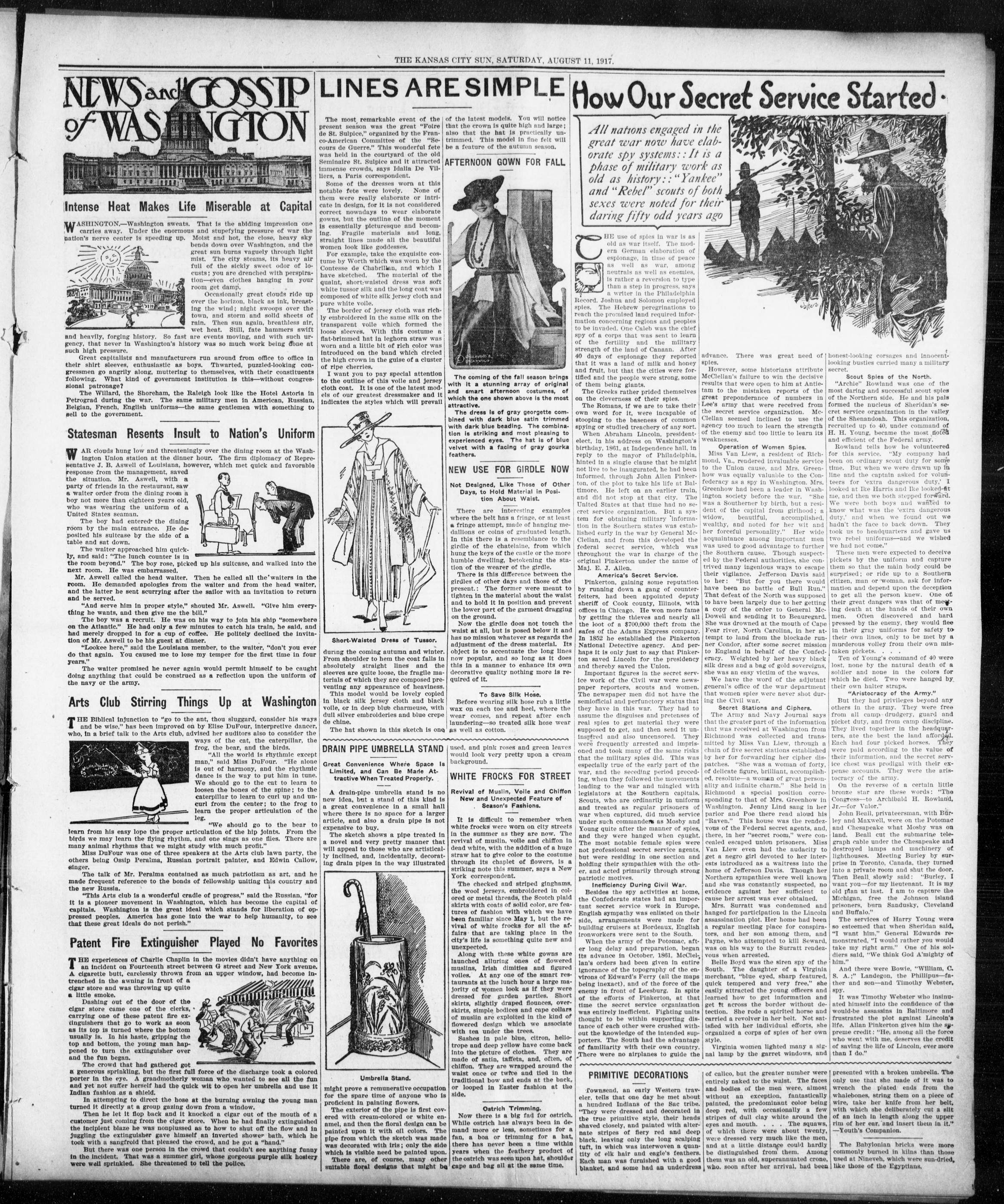
For example, take the exquisite costume by Worth which was worn by the Contesse de Chabrillon, and which I have sketched. The material of the quaint, short-waisted dress was soft white tussor silk and the long coat was composed of white silk jersey cloth and pure white voile. The border of jersey cloth was richly embroidered in the same silk on the transparent voile which formed the loose sleeves. With this costume a flat-brimmed hat in leghorn straw was worn and a little bit of rich color was introduced on the band which circled the high crown in the guise of a cluster of ripe cherries.
I want you to pay special attention to the outline of this voile and jersey cloth coat. It is one of the latest models of our greatest dressmaker and it indicates the styles which will prevail
THE FASHION OF THE TWENTIETH CENTURY
Short-Waisted Dress of Tussor. during the coming autumn and winter. From shoulder to hem the coat falls in absolutely straight lines and the sleeves are quite loose, the fragile materials of which they are composed preventing any appearance of heaviness. This model would be lovely copied in black silk jersey cloth and black volle, or in deep blue charmeuse, with dull silver embroideries and blue crepe de chine. The hat shown in this sketch is one
DRAIN PIPE UMBRELLA STAND
Great Convenience Where Space Is Limited, and Can Be Made Attractive When Treated Properly.
A drain-pipe umbrella stand is no new idea, but a stand of this kind is a great convenience in a small hall where there is no space for a larger article, and also a drain pipe is not expensive to buy.
The sketch shows a pipe treated in a novel and very pretty manner that will appeal to those who are artistically inclined, and, incidentally, decorating drain pipes in the way illustrated
I
Umbrella Stand.
might prove a remunerative occupation for the spare time of anyone who is proficient in painting flowers. The exterior of the pipe is first covered with cream-colored or white enamel, and then the floral design can be painted upon it with oil colors. The pipe from which the sketch was made was decorated with iris; only the side which is visible need be painted upon. There are, of course, many other suitable floral designs that might be
How Our Secret Service Started.
of the latest models. You will notice that the crown is quite high and large; also that the hat is practically untrimmed. This model in fine felt will be a feature of the autumn season.
AFTERNOON GOWN FOR FALL
C. W. H. WILSON
The coming of the fall season brings with it a stunning array of original and smart afternoon costumes, of which the one shown above is the most attractive. The dress is of gray georgette combined with dark blue satin trimmed with dark blue beading. The combination is striking and most pleasing to experienced eyes. The hat is of blue velvet with a facing of gray gourka feathers.
NEW USE FOR GIRDLE NOW
Not Designed, Like Those of Other Days, to Hold Material in Position About Waist.
There are interesting examples where the belt has a fringe, or at least a fringe attempt, made of hanging medallions or coins of graduated length. In this there is a resemblance to the girdle of the chatelaine, from which hung the keys of the castle or the more humble dwelling, betokening the station of the wearer of the girdle.
There is this difference between the girdles of other days and those of the present.: The former were meant to tighten in the material about the waist and to hold it in position and prevent the lower part of the garment dragging on the ground.
Now the girdle does not touch the waist at all, but is posed below it and has no mission whatever as regards the adjustment of the dress material. Its object is to accentuate the long lines now popular, and so long as it does this in a manner to enhance its own decorative quality nothing more is required of it.
To Save Silk Hose.
Before wearing silk hose rub a little wax on each toe and heel, where the wear comes, and repeat after each laundering—so treated silk hose wear as well as cotton.
used, and pink roses and green leaves would look very pretty upon a cream background.
WHITE FROCKS FOR STREET
Revival of Muslin, Volle and Chiffon New and Unexpected Feature of Season's Fashions.
It is difficult to remember when white frocks were worn on city streets in the summer as they are now. The revival of muslin, volle and chiffon in dead white, with the addition of a huge straw hat to give color to the costume through its chaplet of flowers, is a striking note this summer, says a New York correspondent.
The checked and striped ginghams, the wool jerseys, embroidered in colored or metal threads, the Scotch plaid skirts with coats of solid color, are features of fashion with which we have been familiar since May 1, but the revival of white frocks for all the affairs that are taking place in the city's life is something quite new and unexpected.
Along with these white gowns are launched alluring ones of flowered muslins, Irish dimities and figured volles. At any one of the smart restaurants at the lunch hour a large majority of women look as if they were dressed for garden parties. Short skirts, slightly draped flounces, over skirts, simple bodices and cape collars of muslin are exploited in the kind of flowered design which we associate with tea under the trees.
Sashes in pale blue, citron, hellotrope and deep yellow have come back into the picture of clothes. They are made of satin, taffeta, and, often, of chiffon. They are wrapped around the waist once or twice and tied in the traditional bow and ends at the back, or looped in Easter fashion at the side.
Ostrich Trimming.
Now there is a big fad for ostrich. While ostrich has always been in demand more or less, sometimes for a fan, a boa or trimming for a hat, there has never been a time within years when the feathery product of the ostrich was seen upon hat, shoulder cape and bag all at the same time.
All nations engaged in the great war now have elaborate spy systems::It is a phase of military work as old as history::"Yankee" and "Rebel" scouts of both sexes were noted for their daring fifty odd years ago
HE use of spies in war is as old as war itself. The modern German elaboration of esplonage, in time of peace as well as war, among neutrals as well as enemies, is rather a reversion to type than a step in progress, says a writer in the Philadelphia
HE use of spies in war is as old as war itself. The modern German elaboration of espionage, in time of peace as well as war, among neutrals as well as enemies, is rather a reversion to type than a step in progress, says a writer in the Philadelphia Record. Joshua and Solomon employed spies. The Hebrew peregrinations to reach the promised land required information concerning regions and peoples to be invaded. One Caleb was the chief spy of a corps that was sent to learn of the fertility and the military strength of the land of Canaan. After 40 days of espionage they reported that it was a land of milk and honey and fruit, but that the cities were fortified and the people were strong, some of them being giants. The Greeks rather prided themselves on the cleverness of their spies.
The Romans, if we are to take their own word for it, were incapable of stooping to the baseness of common spying or studied treachery of any sort. When Abraham Lincoln, president-elect, in his address on Washington's birthday, 1861, at Independence hall, in reply to the mayor of Philadelphia, hinted in a single clause that he might not live to be inaugurated, he had been informed, through John Allen Pinkerton, of the plot to take his life at Baltimore. He left on an earlier train, and did not stop at that city. The United States at that time had no secret service organization. But a system for obtaining military information in the Southern states was established early in the war by General McClellan, and from this developed the federal secret service, which was throughout the war in charge of the original Pinkerton under the name of MaJ. E. J. Allen.
America's Secret Service.
Pinkerton, gaining some reputation by running down a gang of counterfeiters, had been appointed deputy sheriff of Cook county, Illinois, with offices in Chicago. He won more fame by getting the thieves and nearly all the loot of a $700,000 theft from the safes of the Adams Express company. In 1852 he established the Pinkerton National Detective agency. And perhaps it is only just to say that Pinkerton saved Lincoln for the presidency and thereby saved the Union.
Important figures in the secret service work of the Civil war were newspaper reporters, scouts and women. The newspaper men did not have the semifoolish and perfunctory status that they have in this war. They had to assume the disguises and pretenses of real spies to get material they were supposed to get, and then send it uninspired and also uncensored. They were frequently arrested and imprisoned and took many of the same risks that the military spies did. This was especially true of the early part of the war, and the seceding period preceding, when they followed the movements leading to the war and mingled with legislators at the Southern capitals. Scouts, who are ordinarily in uniform and treated as regular prisoners of war when captured, did much service under such commanders as Mosby and Young quite after the manner of spies and they were hanged when caught. The most notable female spies were not professional secret service agents but were residing in one section and holding their sympathies with the other, and acted primarily through strong patriotic motives.
Inefficiency During Civil War. Besides the spy activities at home, the Confederate states had an important secret service work in Europe. English sympathy was enlisted on their side, arrangements were made for building cruisers at Bordeaux, English tronworkers were sent to the South.
When the army of the Potomac, after long delay and preparation, began its advance in October, 1861, McClelan's orders had been given in entire ignorance of the topography of the environs of Edward's Ferry (all the maps being inexact), and of the force of the enemy in front of Leesburg. In spite of the efforts of Pinkerton, at that time the secret service organization was entirely inefficient. Fighting units thought to be within supporting distance of each other were crushed without the knowledge of the intended supporters. The South had the advantage of familiarity with their own country. There were no airplanes to guide the
PRIMITIVE DECORATIONS
Townsend, an early Western traveler, tells that one day he met about a hundred Indians of the Sac tribe. "They were dressed and decorated in the true primitive style, their heads shaved closely, and painted with alternate stripes of fiery red and deep black, leaving only the long scalping tuft, in which was interwoven a quantity of elk hair and eagle's feathers. Each man was furnished with a good blanket, and some had an underdress
the lab-
is a
k as
kee"
both
their
ago
advance. There was great need of spies. However, some historians attribute McClellan's failure to win the decisive results that were open to him at Antietam to the mistaken reports of the great preponderance of numbers in Lee's army that were received from the secret service organization. McClellan seemed inclined to use the agency too much to learn the strength of the enemy and too little to learn its weaknesses.
honest-looking corsages and innocent-looking busties carried many a military secret.
Scout Spies of the North.
"Archie" Rowland was one of the most daring and successful scout spies of the Northern side. He and his pals formed the nucleus of Sheridan's secret service organization in the valley of the Shenandoah. This organization, recruited up to 40, under command of H. H. Young, became the most noted and efficient of the Federal army.
Operation of Women Spies.
Miss Van Liew, a resident of Richmond, Va., rendered invaluable service to the Union cause, and Mrs. Greenhow was equally valuable to the Confederacy as a spy in Washington, Mrs. Greenhow had been a leader in Washington society before the war. "She was a Southerner by birth, but a resident of the capital from girlhood; a widow, beautiful, accomplished, wealthy, and noted for her wit and her forceful personality." Her wide acquaintance among important men was used to good advantage to further the Southern cause. Though suspected by the Federal authorities, she contrived many ingenious ways to escape their vigilance. Jefferson Davis said to her: "But for you there would have been no battle of Bull Run." That defeat of the North was supposed to have been largely due to her getting a copy of the order to General McDowell and sending it to Beauregard. She was drowned at the mouth of Cape Fear river, North Carolina, in her attempt to land from the blockade runner Condor, after some secret mission to England in behalf of the Confederacy. Weighted by her heavy black silk dress and a bag of gold sovereigns, she was an easy victim of the waves.
We have the word of the adjutant general's office of the war department that women spies were never shot during the Civil war.
Secret Stations and Ciphers. The Army and Navy Journal says that the greater part of the information that was received at Washington from Richmond was collected and transmitted by Miss Van Liew, through a chain of five secret stations established by her for forwarding her cipher dispatches. "She was a woman of forty, of delicate figure, brilliant, accomplished, resolute—a woman of great personality and infinite charm." She held in Richmond a special position corresponding to that of Mrs. Greenhow in Washington. Jenny Lind sang in her parlor and Poe there read aloud his "Raven." This house was the rendezvous of the Federal secret agents, and, there, in her "secret room," were concealed escaped union prisoners. Miss Van Liew even had the audacity to get a negro girl devoted to her interests introduced as a waitress into the home of Jefferson Davis. Though her Northern sympathies were well known and she was constantly suspected, no evidence against her sufficient to cause her arrest was ever obtained.
Mrs. Surratt was condemned and hanged for participation in the Lincoln assassination plot. Her home had been a regular meeting place for conspirators, and her son among them, and Payne, who attempted to kill Seward, was on his way to the Surratt rendezvous when arrested.
Belle Boyd was the siren spy of the South. The daughter of a Virginia merchant, "blue eyed, sharp featured, quick tempered and very free," she easily attracted the young officers and learned how to get information and get it across the border without detection. She rode a spirited horse and carried a revolver in her belt. Not satisfied with her individual efforts, she organized a corps of spies of her own style.
Virginia women lighted many a signal lamp by the garret windows, and
of calico, but the greater number were entirely naked to the waist. The faces and bodies of the men were, almost without an exception, fantastically painted, the predominant color being deep red, with occasionally a few stripes of dull clay white around the eyes and mouth. . . . The squawas, of which there were about twenty, were dressed very much like the men, and at a little distance could hardly be distinguished from them. Among them was an old, superannuated crone, who, soon after her arrival, had been
Scout Spies of the North.
"Archie" Rowland was one of the most daring and successful scout spies of the Northern side. He and his pals formed the nucleus of Sheridan's secret service organization in the valley of the Shenandoah. This organization, recruited up to 40, under command of H. H. Young, became the most noted and efficient of the Federal army.
Rowland tells how he volunteered for this service. "My company had been on ordinary scout duty for some time. But when we were drawn up in line and the captain asked for volunteers for 'extra dangerous duty,' I looked at Ike Harris and Ike looked at me, and then we both stepped forward. We were both boys and wanted to know what was the 'extra dangerous duty,' and when we found out we hadn't the face to back down. They took us to headquarters and gave us two rebel uniforms—and we wished we had not come."
These men were expected to deceive pickets by the uniform and capture them so that the main body could be surprised; or ride up to a Southern citizen, man or woman, ask for information and depend upon the deception to get all the person knew. One of their great dangers was that of meang death at the hands of their own men. Often discovered and hard pressed by the enemy, they would flee in their gray uniforms for safety to their own lines, only to be met by a murderous volley from their own mistaken pickets. . . .
Ten of Young's command of 40 were lost, none by the natural death of a soldier and none in the colors for which he died. Two were hanged by their own halter straps.
But they had privileges beyond any others in the army. They were free from all camp drudgery, guard and picket duty, and from camp discipline. They lived together in the headquarters, ate the best the land afforded. Each had four picked horses. They were paid according to the value of their information, and the secret service chest was prodigal with their expense accounts. They were the aristocracy of the army.
On the reverse of a certain little bronze star are these words: "The Congress—to Archibald H. Rowland, Jr—for Vulor."
John Beall, privateersman, with Burley and Maxwell, were on the Potomac and Chesapeake what Mosby was on land. Beall cut the submarine telegraph cable under the Chesapeake and destroyed lamps and machinery of lighthouses. Meeting Burley by surprise in Toronto, Canada, they turned into a private room and shut the door. Then Beall, slowly said: "Burley, I want you—for my lieutenant. It is my old plan at last. I am to capture the Michigan, free the Johnson island prisoners, burn Sandusky, Cleveland and Buffalo." The services of Harry Young were so esteemed that when Sheridan said, "I want him." General Edwards reconstrated, "I would rather you would take my right arm." One of his soldiers said, "We think God A'mighty of him."
And there were Bowie, "William, C. S. A.;" Landegon, the Phillipus—father and son—and Timothy Webster, spy.
It was Timothy Webster who insinuated himself into the confidence of the would-be assassins in Baltimore and frustrated the plot against Lincoln's life. Allan Pinkerton gives him the supreme credit: "He, among all the force who went with me, deserves the credit of saving the life of Lincoln, ever more than I do."
presented with a broken umbrella. The only use that she made of it was to wrench the plated ends from the whalebones, string them on a piece of wire, take her knife from her belt, with which she deliberately cut a slit of an inch in length along the upper rim of her ear, and insert them in it."
—Youth's Companion.
The Babylonian bricks were more commonly burned in kilns than those used at Nineveh, which were sun-dried, like those of the Egyptians.
THEKANSASCITYSUN
All communications should be addressed to The Kansas City Sun, 1803 East 18th Street.
Bell Phone East 999.
Entered as second-class matter, August
— 1908, at the postoffice at Kansas City,
Mo., under the act of March 3, 1879.
Nelson C. Crews.....Editor and Owner
Willa M. Glenn.....General Manager
SUBSCRIPTION RATES:
One Year.....$1.50
Six Months.....75
Three Months.....50
ADVERTISING RATES, $2.00 PER INCH
PER MONTH.
MEMBER
NATIONAL NEGRO PRESS
ASSOCIATION.
EDITORIALS.
Be men.
Fear nobody but God.
If this world war really succeeds in establishing world democracy, it will be comforting to the colored soldiers who return weary, worn and broken to feel that they may reach their homes without fear of being lynched ever for the crime of saucing a poor white man.
Of course those ignorant greasers down at Waco didn't do anything to the members of the black twenty-fourth infantry who are accused of race rioting down in that southern Eden. The colored people are always to blame just for being colored and just for exercising manly dignity.
In a letter from Mr. Leon H. Herrford to his father in this city it is learned that the twenty-fifth infantry is not in France as was reported in some of the papers. The regiment is still at Schofield Barracks near Honolulu, Hawaii, although preparing and expecting to be moved at any time.
To Dr. Wm. H. Thomas we may always look for the newest ideas in church utility. The special service at Allen last Sunday to which were invited all strangers and newcomers in the city was largely responded to and a great many strangers not only came but many also united with the church. This effort should not stop with one Sunday but should continue indefinitely.
THE LEEDS' HOSPIPTAL.
The agitation on the Leeds Hospital keeps up in the City Hall and in political circles. It is not our purpose to condemn but merely to suggest. We believe that those in charge at Leeds are doing the best they know. We are not going to impune their purposes. What Leeds needs is a Tuberculosis expert. Kansas City has a man who has given the better part of his life to studying Tuberculosis in the person of Dr. Wm. H. Crowder. People have come from far and near to be treated by him. It is said that he has made some remarkable cures of Tuberculosis. It is said by those who know that he has discovered a specific for the cure of Tuberculosis. We do not know Dr. Crowder personally, but we are told by those who do know him that he would not accept Leeds Hospital on a golden platter. His private practice keeps him too busy. But why not constitute a visiting committee and put Dr. Crowder in charge of it? These unfortunate victims are entitled to the benefit of his life's work along Tuberculosis lines. The black man has Tuberculosis as well as the white man and as a matter of public interest we are all interested in common with what can be done for these unfortunate victims.
NEGRO JOURNALISM AND ITS BENEFIT TO THE RACE.
We have not time or space to tell of the benefits of Negro journalism to the race. We can memely sketch them. No race or group can rise which does not have its own organs of publicity so as to keep its people informed about themselves, and to discuss the affairs of the community and the world as they refer particularly to that group, and to defend themselves against misrepresentation. Every locality must have its local paper. So every group must have its organs.
We do not get justice from white papers. We must look to our own. We do not get much inspiration from white papers. We must turn to our own.
Negro papers try to dignity the Negro race. No matter how poor the paper is, it is standing up for the Negro, and is doing good.
Negro papers tell of the achievements of the Negro people. You can learn more of the good that Negroes are doing from one issue of the average Negro paper, which costs two cents, three cents, or five cents, than you can get from a year's subscription of the average white paper that some of us pay $5.00 per year for White papers emphasize the Negro's weakness; Negro papers tell of our strong points.
The Negro paper tries to dignity Negro society, Negro womanhood and the Negro home.
The Negro paper makes public opinion among Negroes of an inspiring sort.
T the Negro paper is about the only place where the Negro can get his case before the world.
Classified Wants and Rooms to Rent
FOR RENT—Nicely furnished rooms near car line. 2018 East Ninth.
FOR RENT—Neatly furnished rooms to porters only. Call Bell 'phone East 1147J. Mrs. E. Rose, 1514 East Tenth street.
FOR RENT—room for light house-keeping if desired and furnished rooms. 806 Brooklyn avenue.
FOR RENT—Furnished room or house completely furnished or un furnished. Call Bell 'Phone East 2865 or 2456 Euclid avenue.
WANTED—Children to care for by the day or week. 1514 East Tenth street. Bell 'Phone East 1147J.
FOR RENT.—A nice front room unfurnished or a three room house furnished to responsible persons near car lines. Call after 2:00 p. m. Bell phone East 960W. Mrs. H. Shaw 2445 Waldron.
FOR RENT—Neatly furnished rooms. Inquire at 806 Brooklyn.
FOR SALE.
14 Nicely furnished rooms; good location on 18th street. For information call at 1002 E. 18th street. Mrs. Kate Brookins.
FOR RENT—A neatly furnished room near car line, strictly modern. Bell phone East 771W.
FOR RENT—A three and four room apartments strictly modern, $13.00 and $18.00 per month. See Kinsler, Bell Grand 4204.
FOR RENT—Nicely furnished room near car lines. Modern. Call Grand 3532-W.
Betty & Sam's Little Corner?
A
THEY SAY
—That all is not gold that glitters and noise is not money.
—That a good deed is oftimes interpreted differently by individuals.
—That many business men do not understand why they can't get business. They do not advertise.
—That a certain society lady has been "dieting" for a week to save enough money to entertain her club in September.
—That a certain popular young woman can't make her friends believe she fell down the steps and received a black eye.
—That many women have started to "reduce" since the street car strike. Well, some of them can keep on walking.
—That the Negro business man who has the "get rich quick" idea in his head will be found to resort to sharp practices and soon be "cut off."
—That a recently married couple was very much disappointed to find that neither had a bank account when their social sponsors had declared each to be wealthy.
The Mesdames Wm. Snell, S. T. Thomas, E. T. Williams and E. Dora Thomas, were hostesses of a sandwich spread for Mrs. R. L. Andrews of Houston, Texas, Friday, August 3d. The guest of honor sang "It Was the End of a Perfect Day."
RIDE IN A VELIE!
COMPETENT DRIVER!
RATES REASONABLE!
Special attention given to
PRIVATE PARTIES,
PICNICS and JOY RIDES.
W. 2842-W. E. 2324-W.
OHIO MOTOR CO.
* Miss Goldie Price has opened
* a Studio of Music at her home,
* 1736 Brooklyn Ave. Special attention given to beginners.
* Lesson, 25 cents.
THE KANSAS CITY SUN, SATURDAY, AUGUST 11, 1917
Negro Business and Professional Directory of Greater Kansas City
BAKERIES.
MRS. SUSIE OWENS, 2331 Vine street.
Bell phone, East 5017.
BARBER SHOPS.
LABORING MEN'S BARBER SHOP,
W. F. O'Bonnon, Prop., 558 Grand
avenue.
BEAUTY PARLORS AND HAIR
DRESSERS.
MRS. CORA D. WILLIAMS, Poro Hair
Dresser, 1319 Euclid Ave. Bell
phone, East 1215J.
MRS. SUSIE P. GIPSON, 1725 Michigan
avenue, Poro hair dresser. Bell
Phone, East 3058J.
MRS. MINNIE DOYLE, Poro Hair
Dresser, 2627 Vine St. Bell Phone,
East 3176.
MRS. ETHEL E. WILSON, 1008 Woodland.
XX Century Hair Dresser.
Bell phone, E. 5469W.
MRS. DELILAM M. S. DOTTREY, 1931
East 14th St. Poro Hair Dressers.
Bell Phone East 1834J.
MRS. F. A. COOK, Poro Hair Dresser
1226 Vine street. Bell phone, E
2820.
CAFES.
MRS. H. W. DOTSON, 1705 East 12th.
Bell Phone, E. 2214.
DELMONICA CAFE, 1512 East 18th
street. Bell phone, East 618.
W. W. PAYNE, 19th and Vine streets. Bell Phone, East 559. Home Phone, East 4132.
FLORISTS.
CROSTHAWIT FLORAL CO., 1501 E.
Ninth. Bell phone, East 272.
LAWYERS.
C. H. CALLOWAY, 601 Delaware, Home phone M. 58, Bell phone Main 448. Practices in all courts.
W. C. HUESTON, 601 Delaware, Home phone, M58, Bell phone Main 448. Legal advice. Practices in all courts.
E. A. SHACKLEFORD, Attorney at Law, 511 Minnesota avenue, Kansas City, Kas. Bell phone, West 3866.
JEWELERS
J. A. WILSON, 1616 W. Ninth street Kansas City, Mo. Bell phone, Main 6248R.
PHOTOGRAPHERS
J. E. MILLER STUDIO, 1622 East Eighteenth street. Bell phone, E. 91.
REAL ESTATE and EMPLOYMENT.
COLORED PEOPLES INVESTMENT CO., Solomon Smith, Pres., 2122 Vine St. Bell Phone, East 1011. Home Phone, East 4011.
A B C EMPLOYMENT AND INVESTMENT CO., 500 Minnesota avenue. (Upstairs) Kansas City, Kas. Bell phone, West 1743; Home phone, West 221. C. W. Neloms, Mgr.
H. L. KINSLER, 918 East Twenty-first street. Bell phone, Grand 4204?
SHOE STORE.
G. A. PAGE'S SHOE STORE, 1507 E. Eighteenth street. Bell phone, East 1328.
SHOE REPAIRING
ELECTRIC SHOE & REPAIR SHOP
J. C. Banks, Prop., 1514 $ _{1/2} $ East Eigh
teenth street. Bell phone 4939
833-222-2222
UNDERTAKERS
ADKINS BROS. & GREEN, Nineteenth and Vine streets. Both Phones, East 4349.
I. G. OLIVER, 415 Minnesota avenue, Kansas City, Kansas. Bell Phone, West 4183.
H. B. MOORE, 1031 Independence avenue. Bell phone Main 3398W. Home phone Main 3341.
WATKINS BROS., 1729 Lydia avenue. Bell phone Grand 987, Home Main 7989. Res., Bell East 3281.
MONEY TO LOAN.
Short time money to loan to roominghouse keepers—must have reference. Property owners can obtain a loan thru our agency and pay it back by weekly installments. If your house get a loan and put in its necessary re-needs papering, painting or repairing, pairs.
Our business is strictly confidential.
Bell phone, Grand 4204...
THE NEGRGO AND THE WORLD WAR.
The world war has made prominent the problems relating to the Negro. There is in the United States his migration to the North. On the firing line in France, thousands of black soldiers from Africa are doing their part. Africa, the continent richest in natural resources, is one of the stakes for which the war is being fought. All of these things have increased the demand for accurate, comprehensive and concise information concerning the Negro. Such information is supplied by the almost five hundred pages of the 1916-17 Negro Year Book, Tuskegee Institute, Ala.
The Cash Grocery & Meat Market
623 East 17th Street
Under new management. B.F. Carpen
The Spotless Kitch
(All that its name implies)
23 WEST 13th STREET
The best place in Kansas City for a Clean
some, Satisfying Meal
The Spotless Kitchen
(All that its name implies)
23 WEST 13th STREET
best place in Kansas City for a Clean
some, Satisfying Meal
The best place in Kansas City for a Clean, Wholesome, Satisfying Meal
Special Dinner and Lunch at Noon for those employed down town
MRS. PEARL RILEY, Manager MARTIN YOUNG Proprietor
Women, Girls, Earn Money
My Free Book Tells How.
LEARN TO GROW HAIR
Women, Girls, Earn Money My Free Book Tells How. LEARN TO GROW HAIR
Women, Girls, Earn Money My Free Book Tells How. LEARN TO GROW HAIR
[Picture of a woman with dark hair styled in a bun, wearing a white dress with a decorative collar. She is looking to the right with a thoughtful expression.]
President of Eloso College Co., 21
1917 Season A
The Moses Dickson R
1217 Woodland Ave
Everything For Every
Season Announcement
Moses Dickson Regalia and Supply
1217 Woodland Avenue, Kansas City, Mo.
everything For Every Lodge. Ask
A Wonderful Hair Dresser
One thousand agents wanted. Go
THE STAR HAIR GROWER. This
preparation. Can be used with or w
ening irons.
Sells for 25c per box—one 25c be
value. Any person that will use a
convinced. No matter what has
your hair just give THE STAR HA
trial and be convinced. Send 25c f
If you wish to be an agent send $
send you a full supply that you
with at once; also agents' terms.
by Money Order to
President of Eloso College Co., 21 S. Compton Avenue, St. Louis, Mo
Everything For Every Lodge. Ask Us.
A Wonderful Hair Dresser and Grower
One thousand agents wanted. Good money made. THE STAR HAIR GROWER. This is a wonderful preparation. Can be used with or without straightening irons.
Sells for 25c per box—one 25c box will prove its value. Any person that will use a 25c box will be convinced. No matter what has failed to grow your hair just give THE STAR HAIR GROWER a trial and be convinced. Send 25c for full size box. If you wish to be an agent send $1.00 and we will send you a full supply that you can begin work with at once; also agents' terms. Send all money by Money Order to
1113 Clark Street. Sandwiches Club and Din . HATTIE LUCAS RICHARD
Lunch and Sandwiches
MRS. HATTIE LU
TEA
MRS. HATTIE LUCAS RICHARDSON
TEA ROOM
The East 4818 183
EAST INDIA HAIR G
Bell Phone East 4818 THE EAST INDI
THE EAST INDIA HAIR GROWER
Leaves the life of a thousand Heavy and Gray Hair to Iron for Str
Leaves the hair soft and silky. Perfumed with a balm of a thousand flowers. The best known remedy for Heavy and Beautiful Black Eye-Brows, also restores Gray Hair to its Natural Color. Can be used with Hot Iron for Straightening.
Price, Sent by Mail, 50c; 10 cExtra for Postage.
AGENTS' OUTFIT.
1 Hair Grower, 1 Temple
Oil, 1 Shampoo, 1 Pressing
Oil, 1 Face Cream and
Direction for Selling, $2.
25c Extra for Postage.
```markdown
```
B. F. Carpenter, Prop.
notless Kitchen
(that its name implies)
T 13th STREET
Kansas City for a Clean, Whole-
e, Satisfying Meal
MARTIN YOUNG
Proprietor
Girls, Earn Money
See Book Tells How.
TO GROW HAIR
Don't struggle along in un-
congenial employment with
long hours and short pay. Edu-
cate yourself to do work that
has little competition; isn't it
better to spend a half-hour daily
and qualify yourself to do work
that everyone else cannot do.
The fields are large.
ELOSO HAIR GROWER
50 Cents Per Box
Are seldom equaled and never
excelled
Instructions by mail or in person.
Diplomas to graduates.
Agents wanted everywhere;
don't delay, write today.
A penny will do it.
MME. J. NELSON
ELOSO HAIR GROWER
Manufactured Only By
Co., 21 S. Compton Avenue, St. Louis, Mo.
Union Announcement 1917
Union Regalia and Supplies Co.
And Avenue, Kansas City, Mo.
Every Lodge. Ask Us.
Wonderful Hair Dresser and Grower
One thousand agents wanted. Good money made.
THE STAR HAIR GROWER. This is a wonderful
separation. Can be used with or without straight-
ing irons.
Bells for 25c per box—one 25c box will prove its
true. Any person that will use a 25c box will be
advanced. No matter what has failed to grow
our hair just give THE STAR HAIR GROWER a
al and be convinced. Send 25c for full size box.
You wish to be an agent send $1.00 and we will
and you a full supply that you can begin work
with at once; also agents' terms. Send all money
Money Order to
THE STAR HAIR GROWER MERS.
LUCAS RICHARDSON
INDIA HAIR GROWER Will Promote a Full Growth of Hair; Will also Restore the Strength, Vitality and the Beauty of the Hair. If your Hair is Dry and Wiry Try
EAST INDIA HAIR GROWER
If you are bothered with Falling Hair, Dandruff, Itching Scalp, or any Hair Trouble, we want you to try a jar of EAST INDIA HAIR GROWER. The remedy contains medical proprieties that go to the roots of the Hair stimulates the skin, helping nature do its work. hair soft and silky. Perfumed with a balm and flowers. The best known remedy for Beautiful Black Eye-Brows, also restores to its Natural Color. Can be used with Hot lightening.
Sent by Mail, 50c; 10 cExtra for Postage.
S. D. LYONS, Gen. Agt., 314 East 2d St.
Oklahoma City, Okla.
1917
Evanston, III
1831 PASEO
WHY ARE YOU SATISFIED TO RECEIVE FROM $40 TO $60 WHEN YOU EARN FROM $60 TO $100? WE ARE IN TOUCH WITH THE BEST JOBS IN THE CITY. LIST YOUR NAME WITH US AND Better Your Condition BUREAU OF DOMESTIG REQUIREME
AU OF DOMESTIC REQUIREMENTS
TONES
4059
East 5398
SECOND FLOOR
1509 E. 18TH STREET
Kansas City, Mo.
BETTER JOBS FOR BETTER PEOPLE"
SODA SEASON IS HERE!
Service and Quality are Paramount at the
TE-WOOD DRUG STORE
Your Prescriptions to us and be assured
Absolute Accuracy and Fair Treatment.
STOCK IS COMPLETE IN ALL LINES
Corner 19th and Vine Streets. (Transfer Point)
PHONES—HOME EAST 2293, BELL E. 641.
LYDIA GARDNER'S MAGICAL LIP REDUCER
TRADE MARK
ORE
AFTER
"BETTER JOBS FOR
THE SODA SEAS
Service and Quality are
WHITE-WOOD
Bring Your Prescriptions
of Absolute Accuracy and
OUR STOCK IS COMPLETE
N. W. Corner 19th and Vine
PHONES—HOME EAST
MADAM LYDIA GARDNER'S
TRADE MARK
BEFORE
Service and Quality are Paramount at the
Bring Your Prescriptions to us and be assured of Absolute Accuracy and Fair Treatment.
OUR STOCK IS COMPLETE IN ALL LINES
N. W. Corner 19th and Vine Streets. (Transfer Point)
PHONES—HOME EAST 2293, BELL E. 641.
MADAM LYDIA GARDNER'S MAGICAL LIP REDUCER
TRADE MARK
BEFORE
AFTER
AGENTS WANTED!
316 KENTUCKY AVENUE
"If you have good hair, or
If you have a diseased sc
If you have little or no ha
and a good reason for
Madame M. B. Jackson's Wonda
discovery, but has been used for yet
temple grow
"If you have good hair, care for it. If you have a diseased scalp, treat it. If you have little or no hair—it's your own fault and a good reason for quick action." me M. B. Jackson's Wonderful Hair Grower is not a new but has been used for years with the best results. Both temple grower and grower sell for twenty-
Madame M. B. Jackson's Wonderful Hair Grower is not a new discovery, but has been used for years with the best results. Both temple grower and grower sell for twenty-five and fifty cents per box. Also a pressing oil at twenty-five cents per box. Madame M. B. Jackson's Hair Grower can be used with or without straightening the hair. A complete course taught by mail or personal instruction. Work guaranteed. Years of experience. Hair matched by sample. We sell all kinds of hair goods. A six weeks' treatment of Madame M. B. Jackson's Wonderful Preparations will be mailed to any one for one dollar and a half. Mail orders promptly filled. Send two-cent stamp for return mail and literature. Agents wanted. Liberal discount.
P
MRS. ORA WILLIAMS. Assistant
Send all money orders to Madame M. B.
Jackson. For further information call
BELL PHONE, E.
MME. M. B. JACKSON, 1913 East
HOURS: 8 A. M.
BOTH TIME AND M
BELL PHONE, E. 3237W or write
B. JACKSON, 1913 East Tenth St., KANSAS CITY, MO.
HOURS: 8 A. M. to 5:3C P. M.
TIME AND MONEY SAVED AT
MME. M. B. JACKSON, 1913 East Tenth St., KANSAS CITY, MO.
HOURS: 8 A. M. to 5:36 P. M.
BOTH TIME AND MONEY SAVED AT
LADIES AND GENTS
FURNISHING STORE
CLOTHING FOR CHILDREN ALSO
W. L. MARTINS
1318 East 18th Street
COME IN AND INSPECT OUR STOCK
MADAME E. NEFF, Electric Hair Grower
COME IN AND INSPECT OUR STOCK
AME E. NEFF, Electric Hair Grower
COME IN AND INSPECT OUR STOCK
MADAME E. NEFF. Electric Hair Grower
A. E. H.
PHONES
Bell East 4059
Home East 5398
Mme. M. B. Jackson
JOPLIN, MO.
W. L. MARTINS
1318 East 18th Street
(In business 8 years.)
I cure all scalp diseases and stop falling hair. Write the following for reference:
Mrs. J. A. Hensley, 2443 Tremont Ph. Denver, Colo.; Mrs. Della Burns, 913 Everett Ave. Kansas City, Kans.; Mrs. Laura Fields, 1007 East 17th, Kansas City, Mo.; Mrs. Elliza Bradford, 1704$^{\textcircled{1}}$ E. 18th St., Kansas City, Mo.
Agents Wanted. Write for terms.
MADAME NEFF'S
HAIR DRESSING PARLORS
at
1714 EAST 18TH ST.
Bell Phone, East 412W.
CITY NEWS
---
Mrs. Sophia Jackson of 617 E. Sixteenth street, who has been ill for two months is improving.
Mrs. Jas. Montgomery of 1010 Troost is visiting her foster daughter, Mrs. Mattie B. Dean in Chicago.
Mr. and Mrs. W. E. Maxwell and Miss Cora Potts are visiting their parents at Columbia, Mo.
Miss Carrie Robinson and Miss Emma Williams are spending four weeks in St. Louis with relatives and friends.
Miss M. W. Barnes, head nurse of the C. S. Hospital at Pittsburgh, Pa., is visiting her mother, Mrs. Pryor Williams.
Miss Hazel Hickum visited in St. Joseph, Mo., last week and Jefferson City, Mo., this week with relatives and friends.
Mrs. Thomas Herndon and son, Thos. Jr., 2445 Highland avenue, left Tuesday for a two weeks' visit at Des Moines, Ia.
Mrs. E. R. Vaughn is in Denver, Col., representing her Chapter at the Grand Chapter O. E. S. which holds its session in that city.
Mrs. Mary Walker is taking her vacation and is expecting company from Fulton, Mo., for a few weeks. They will visit Lexington, Mo.
Mr. Jas. H. Crews accompanied by his wife, is spending his vacation in Chicago, Ill., with his sons, Messrs. Osborne and Blanton Crews.
Mr. T. D. Henderson, the well known barber of this city, is visiting his parents at Phoenix, Ariz. Mr. Henderson will remain away about a month.
Prof. Roscoe White bought shares of stock in the A. A. A. Training School at 1420 Woodland avenue and thinks he made a good investment.
Miss Jennie Walker and aunt, Miss Harriett Wilkerson, paid Lexington, Mo., a visit and attended the Grand Lodge Knights and Daughters of Tabor.
Mr. Winston Holmes, 2221 Michigan avenue, is in Chicago on a business trip at the Brown's Hotel. Mr. Winston is foreman for the Star Piano Company.
Among the pleasant callers at the Sun's office this week were Messrs. P. H. Jenkins and Walter L. Seals of Omaha, Nebr.; A. A. Sanford and Wm. Alexander of Carrolton, Mo.
Mrs. J. S. Cannon and daughter, Erma, leave Wednesday for Park Ridge, Ill., to spend- the remainder of the summer with Miss Blanche Nichols, one of the city's teachers.
Among those seen at the Dancing Academy at Cottage and Vine streets last Wednesday night were Mrs. Eva Ellis of Blackfoot, Idaho, Edith Sayers of Omaha, Neb., and Emma Coar of Topeka, Kan.
Mrs. Ida Sharber formerly of this city died at Seattle, Wash., Tuesday, August 7th, and the body was brought here for burial. Mrs. Sharber was the aunt of Mr. Cecil Thompson, 2630 Woodland avenue.
Mrs. John H. Williams, 2110 Tracy avenue, left on the 2d for Chicago, Ill., to visit her daughter, Mrs. Leslie Brown; en route she stopped at Higbee spending the 3d and 4th, visiting relatives and friends.
Mrs. Harry Watts of Chicago, Ill., Mrs. Jake Cason and daughter, Alease, of Wheeling, W. Va., were guests of Mrs. J. S. Cannon last Sunday afternoon for an auto ride. They were delighted with a view of our city.
Miss Jose E. Green, the sister of Misses Mary and Susie Greene of 1018 Highland avenue, has returned from a four months' visit to Bloomington and Chicago, Ill. They have as their guest their sister, Mrs. Rosa G. Price of Bloomington, Ill.
The Kansas City District of the M. E. Church Conference convened in St. Joseph, Mo., August 8, and will close Sunday the 12th. Rev. W. H. Wheeler, District Superintendent. A large representation was in attendance. Rev. Wheeler was accompanied by his wife, Mrs. L. A. Wheeler.
The prize of $5.00 given by the Douglass Hospital club for the best essay on "Home" was won by Miss Kathrene Washington of Allen Chapel. The second prize was won by Mr. Nelson Jackson, of the St. Paul Sunday School at Argentine, Kansas, and honorable mention was made of Miss Myrte Teal of the Pleasant Green Baptist Church, this city.
Mrs. R. L. Andrews, guest of Mrs. Nelle E. Young, 3412 E. Twenty-first street, was called to her home on account of her mother's illness. Before her return she praised the people of Kansas City, saying she will always have a warm place in her heart for the courtesies shown her while here.
Mrs. Albert Lee Rummons has just returned from Chicago and Evanston, Ill., after spending several weeks the guest of Mrs. S. L. Greenlee and Mrs. Katie Holman. She reports a delightful trip having been the guest of honor at several affairs and especially those given by friends formerly of Kansas City.
IN MEMORIAM.
In fond remembrance of my dear mother, Elizabeth Richardson, who departed this life August 6, 1914.
Sad it was when Jesus called her
We little thought that, on that day
My dear mother would be called away
In our sorrow we hope to meet her at the pearly gates.
Sadly-missed by
Mrs. Annie E. Floyd and Family
DR. J. H. V.
Grand Master of U. B. F. and S. M. T. o.
at Lexington, M.
DR. J. H. WILLIAMS,
V. U. B. F. and S. M. T. of Missouri, whose se
at Lexington, Mo., August 20-25.
I
Grand Master of U. B. F. and S. M. T. of Missouri, whose sessions will be held at Lexington, Mo., August 20-25.
BETTER LEFT UNSAID
Now, there is no use in telling ev
Just because somebody asks you
Lots of times you get in trouble-
Volunteering information, doubt
And you're not prevaricating, not
From repeating things that's hard
Some particular thing in detail t
There are many things, remember
is no use in telling every blessed thing you
me somebody asks you, and you are sure
as you get in trouble—get some other foe
ing information, doubtless, that was told
not prevaricating, not a bit, when you re-
ting things that's harmful, or refusing
ular thing in detail that might bow some
many things, remember, that are better.
Now, there is no use in telling every blessed thing you know,
Just because somebody asks you, and you are sure that it is so:
Lots of times you get in trouble—get some other folks in, too,
Volunteering information, doubtless, that was told to you.
And you're not prevaricating, not a bit, when you refrain
From repeating things that's harmful, or refusing to explain
Some particular thing in detail that might bow somebody's head.
There are many things, remember, that are better left unsaid.
Japanese Superstition
There are no 4's nor 44's in Japanese telephone directories, because the name of the figure four, "Shl," is the term for death.
No Doubt of IE.
When a bachelor declares that he is wedded to his profession it's doughnuts to fudge the right woman can make him commit bigamy.
In the fjords on the Norway coast the clearness of the water is wonderful. Objects may be seen at a depth of twenty-five to thirty fathoms.
"He is a wise man who does not grieve for the thing he has not, but rejoices for those which he has."—Epictetus.
A Time for Everything.
Edith—"Is it true that you have quarreled with Jack?" Ethel—"I should say not! My birthday is next week."
Ought to Be Enough. According to a lately issued edition of a dictionary there are now 450,000 words in the English language.
Yes, InJeed.
A friend in need is the one we're pretty apt to take the other side of the street in passing.
ROOMS WANTED
The Sun has many inquiries each week for rooms, furnished and unfurnished, and persons having rooms for rent would do well to advertise them in this paper if you want quick returns.
CARD OF THANKS
We desire to express our heartfelt thanks to our friends who so ably asisted us during the illness and death of our beloved father, Andrew Holmes for their cheering words and sympathy and the beautiful floral offerings We are extremely grateful.
LUCY BENFORD,
JESSE FIZER,
ALMEDA SCRUGGS,
LENA HOLMES,
JAMES HOLMES,
ALEX HOLMES,
ALLEN HOLMES.
Children.
* Justice, equal and exact, to all *
* men, of whatever state of per-*
* suasion, religious or political.—
* Thomas Jefferson.
WILLIAMS,
of Missouri, whose sessions will be held
lo., August 20-25.
very blessed thing you know,
and you are sure that it is so:
—get some other folks in, too,
less, that was told to you.
at a bit, when you refrain
firmful, or refusing to explain
that might bow somebody's head.
per, that are better left unsaid.
—Defender.
NOTICE.
Beginning Monday August 6 and continuing until the opening of School September 4 the Principal's office at the Lincoln High School will be open each day from 9:00 A. M. to 4:00 P. M. for the purpose of consulting parents, pupils or others on any matters with reference to work of the School for the coming year.
J. R. E. Lee, Principal
TENANTS DIDN'T MIND HIM
Old Gentleman Merely Was a Harmless Optimist With a Seemingly Peculiar Delusion.
A district visitor was paying calls on the folk in a row of cottages, and was shocked by the conduct of a shabby-dressed old gentleman, who passed from door to door in a great rage, and threatened the occupants with all manner of dire penalties.
"Dear me, what a peculiar old man!" she exclaimed to one of the tenants. "Why do you permit him to abuse you in that fashion?"
"Oh, we don't mind in the least, ma'am," answered the tenant, with a twinkle in her eyes. "We're quite used to his little ways by now. He's been a harmless lunatic for ten or eleven years."
"You don't say so! Poor old fellow! What particular form does his madness take?"
"Optimism, ma'am. He comes for the rent every Monday, and actually allows himself to fancy that he'll get it!"—London Tit-Bits.
THE KANSAS CITY SUN, SATURDAY, AUGUST 11, 1917.
NOTICE.
By Mrs. Zenobia Nelson.
Mr. Carl Grant was a visitor of the D. V. B. S. Tuesday morning and left words of encouragement.
Mr. C. W. Neloms left for Plattsburg, Mo., Wednesday morning to attend the Convention of the Christian Church.
Mr. and Mrs. Roy Boone are the proud parents of a boy born at Wichita, Kan. Both mother and son are doing nicely.
Miss Laura Harlan and Miss May Jones, 1060 Washington boulevard, returned from a month's visit at Leavenworth, Kans.
Mr. T. S. Hulsey left Monday night for Omaha to attend the Encampment of the 14th Regiment of Patriarche G. U. O. of O. F.
Mrs. J. M. Davis, 915 Freeman avenue, is visiting her brother in Chicago, Ill.
Mrs. Wm. Carey, 720 N. 3rd street, returned home from a visit throughout Western Kansas.
Dr. John Wilson addresses the children at the D. V. B. S. Tuesday morning and many interesting points were discussed.
The funeral of Mrs. Sadie Malinda Duncan of 1016 Oakland avenue, will be held at the A. M. E. Church, 8th and Nebraska avenue, at 2 p. m. Monday, August 13.
The D. V. B. schools closed with a successful session. We feel that the children have been helped morally and spiritually. The aim of the school is to familiarize the children with the Bible that they may be helped daily.
Rev. D. A. Holmes is preaching a series of sermons from Revelations. Much inspiration is derived from these sermons. A large crowd was present last Sunday and the Holy Spirit prevailed throughout the day. The rally closed with grand results.
CARD OF THANKS.
We desire to thank the friends and lodge members for their kindness during the illness and bereavement of our dear loving mother.
Mr. and Mrs. Rube Williams.
Mr. and Mrs. Perry Brown.
Mr. and Mrs. Hedgewood.
Andrew Williams.
Mrs. Sarah Williams, 72 years of age, departed this life Tuesday, July 31, at 8:00 o'clock at the home of her daughter, 9th and Freeman. She was an old resident of Kansas City, Kan. and her death caused from the extreme hot weather was a shock to all her friends. She lived a consistent Christian and her funeral services were held from the A. M. E. Church of which she was a faithful member. She leaves to mourn her loss three daughters and two sons and a host of friends. Many floral offerings were in evidence.
Mrs. Maud Yates of St. Louis, Mo. who was visiting her cousin, Mrs. W. T. Barbour, 2400 N. 6th street, left yesterday morning for Clarksville Mo. Later she will return home. She was entertained while here by the following: Mr. and Mrs. Nathan Grey, 2122 Vine street; Mrs. Birdie Paine and Miss Nellie Walker, 2210 Campbell; Mrs. Myrtle Willis, 824 E 24th street; Dr. and Mrs. N. S. Jenkins of Argentine, Kans., and Mrs Lillie Brown, 2514 N. 6th street.
A camp for sick babies is now open in Spring Valley Park. The best of care for sick babies free under the auspices of the B. Y. P. U. of the Second Baptist Church. Visitors welcome.
A Camp for sick babies is now
THE SOUL OF FORT DES MOINES.
(Continued from page 1.)
that their death might prove the worth of the Negro race and justify our claim to partnership with the white race in the possession of this American continent.
From 5:30 in the morning until 9:00 o'clock at night they drilled and marched over the hills with gun and loaded haversack. We fought sham battles, charged with fixed bayonets, stabbing straw men. We went thru physical exercises in the broiling sun bareheaded. All this simulate warfare that the men might prove their mental and physical efficiency, their fitness to lead men against that most
After more than two years' wo mology, University of Rosedale and Bel
After more than two years' work in the Department of Ophthalmology, University of Kansas Medical School at Rosedale and Bell Memorial Hospital
DR. L. E. BAILER
announces
DISEASES
Measurements and spec
HOURS: 2 to
12TH and VINE STREETS.
The Biggest Event of the Summer Season
The Annual
Buy
Furniture
No
The Annual August Sale of
Buy
Furniture
Now
FURNITURE FOR THE BEDROOM
FURNITURE FOR THE GUESTROOM
FURNITURE FOR THE LIVING ROOM
FURNITURE FOR RECEPTION ROOM
FURNITURE FOR THE DEN
FURNITURE FOR THE HALL
AND BOX SPRING
Each piece of Furniture will bear two price, and a colored tag showing both the
THE YELLOW TAGS denote 50 PER CENT
THE GREEN TAGS denote 25 PER CENT
THE BLUE TAGS denote 25 PER CENT
In View of the Industry
additional interest surrounds this 1917 Aug. and labor is a great deal more—but through offer Furniture at
10 Per Cent to
Emers, J.
Each piece of Furniture will bear two price tags—the regular ticket which will show the regular price, and a colored tag showing both the regular price and the special August Sale price, as follows: THE YELLOW TAGS denote 50 PER CENT OFF THE PINK TAGS denote 33 1-3 PER CENT OFF THE GREEN TAGS denote 25 PER CENT OFF THE RED TAGS denote 20 PER CENT OFF
In View of the Increasing Cost of Furniture
additional interest surrounds this 1917 August sale—every kind of wood has advanced, glass is away up, and labor is a great deal more—but through our methods and merchandising we aer still in a position to offer Furniture at
efficient German fighting machine. The boys are fed on the best, are paid $100.00 per month for their time and are disciplined until discipline is no more. The Army requires scrupulous cleanliness of body and belongings—and they get it. The Government furnished books free, and such an array of books, books on drill, on firearms, on military law, on may drawing, on science of warfare and so on. All this work was supervised by West Pointers. But the men who are actually whipping the Negro army into shape are the Negro nom-coms from the Ninth, Tenth, Twenty-fourth and Twenty-fifth.
These heroes of San Juan, the Pacific Isles and Carrizal are all picked by the Government as the finest in the Army. Their shoulders, physical set up, general carriage and grasp of military science mark them as the fittest soldiers in the world. They have carried the roll of honor for their race since '61, have worked up in the Army through drudgery from the bottom to the top and they are now handling down the record untarnished to the younger generation of college breed Negroes and may these college men in turn keep the scutcheon as untarnished as their predecessors have through the wery years in which they have so gallantly upheld us. And when these Sargeants turn out our Negro Army as finished the Kaiser, after we have met his troops in a cold steel clash, will have some bad news to tell his country.
Aside from these lessons, the Training Camps teach this country that a million men can form a mob over night but not an army of soldiers. The citizens who take this training will readily see the pathos in that miserable fallacy of a million men springing to arms over night. The men who graduate with their commissions have a long way to go before their soldierly ability will measure up to the grade of their commissions whatever rank they get in both the white and black camps. IT TAKES MORE THAN NINETY DAYS TO MAKE A SOLDIER.
a specialty in
OF THE EYE
special tests for correct glasses.
4 and 7 to 9 p. m.
KANSAS CITY, MO.
THE BLUE TAGS denote 10 PER CENT OFF
the Increasing Cost of
this 1917 August sale—every kind of wood has a
but through our methods and merchandising
nt to 50 Per Cent
ing, Bird, Thayer
Myers Tailoring
GREAT REDUCTION S
DURING THE MONTH
$35.00 SUITS FO
$30.00 SUITS FO
Myers Tailoring Co.
Beat the Laun
By Having Your Laun
LEE YEUN, Chicago Expert Ch
First Class Work. Re
No Chemicals
Lee Yeun, Prop.,
Peoples' Dr
Northeast corner of Eighteent
Bell East 1814
```markdown
```
The sale that has a great reason behind it—the ambition to have E. B. T. Furniture in every home in this Middle Western community. It offers unrestricted choice of our entire stock—as well as other furniture especially selected for this event—
At 10% to 50% Off
This is a sale without a parallel as it has made more history than any other event in home furnishing circles—and it includes:
FURNITURE FOR THE SUN ROOM
FURNITURE FOR THE NURSERY
FURNITURE FOR THE BATHROOM
FURNITURE FOR THE SLEEPING PORCH
FURNITURE FOR THE SERVANT'S QUARTERS
FURNITURE FOR THE KITCHEN
increasing Cost of Furniture august sale-every kind of wood has advanced, glass is a tough our methods and merchandising we aer still in a pos to 50 Per Cent Savi Bird, Thayer Co. Kansas City, Mo.
ers Tailoring Company
GREAT REDUCTION SALE ON SUITS
URING THE MONTH OF AUGUST
$35.00 SUITS FOR $25.00;
$30.00 SUITS FOR $22.50
ers Tailoring Co. 1518E.12
at the Laundry Tru
y Having Your Laundry Done by
UN, Chicago Expert Chinese Hand Laun
First Class Work. Reasonable Prices
No Chemicals Used.
Lee Yeun, Prop., 1217 E. 18th
Peoples' Drug Sto
neast corner of Eighteenth Street and the
Myers Tailoring Company
GREAT REDUCTION SALE ON SUITS
DURING THE MONTH OF AUGUST
$35.00 SUITS FOR $25.00;
$30.00 SUITS FOR $22.50
Myers Tailoring Co.1518E.12thSt.
Beat the Laundry Trust
By Having Your Laundry Done by LEE YEUN, Chicago Expert Chinese Hand Laundryman First Class Work. Reasonable Prices. No Chemicals Used. Lee Yeun, Prop., 1217 E. 18th Street
Peoples' Drug Store
Northeast corner of Eighteenth Street and the Paseo
For twelve years we have served you. We have never substituted nor given you an inferior article. We carry everything in the Drug line, all the latest and best toilet articles. We deliver anything to any part of the city -- promptly -- call us up.
PHONES
East 1814 Home East 4
Bell East 1814 Home East 4082
She Didn't Know
By Mary Parrish
(Copyright, by W. G. Chapman.)
"I can't understand, Hilton, where you got your low ideas."
"Low, mother!" repeated the young man. "Did you say 'low?'"
"Yes, I did," answered Mrs. Flavia Bayes, with emphasis. "What else can you call it?"
"I can call it a good many other things," said her son, with some indignation. "The trouble is you refuse to see them."
"I should hope I did. My breeding and education have taught that humanity is not all on the same plane, either socially, mentally or spiritually. The day laborer, or common clerk, the butcher or the baker are not fitted to associate with my circle of friends, and you know it.
"That's true in the main. I don't think Simmons, the butcher, would be exactly comfortable in the company of Professor Askew, nor the grocer with Doctor Wakeman. Yet I'm not exactly sure," reflected young Bayes. "Either of those men—I mean the butcher or the grocer—may be pursuing lines of study it would be an advantage to your friends to know."
"Hilton! How can you talk such nonsense? You were born an aristocrat. You have been educated an aristocrat. You know these different classes of people can no more mix together than oil and water."
"How do you know that? What do you know about these people?" he demanded.
"Where do you get such ideas as you've just been expressing, and a lot more quite as crazy, if not from those people?"
"I tell you, you don't know them! You don't want to know them!" "You're quite right. I don't," she answered. "Then don't judge till you do know," he retorted. "I suppose when you go down there and talk to those clubs and societies you think you are elevating them?" "No," he answered, quietly. "If I started out with any such idea Ive
WALTERS
"I'm Not Going to Be Done Out of My Meeting."
had to change my views. It's the other way around. They are elevating me."
Mrs. Flavia Bayes stared in speechless amazement at her son. Things had come to a worse pass than she had even suspected.
"Hilton Bayes! Are you losing your senses?" she gasped.
"I hope not," he answered quietly.
"Hadn't I better go now and look over those repairs you asked me to see about?"
He did not wait for further discussion, but went out of the room.
Mrs. Bayes was plainly troubled about her son, and the situation was aggravated when Helen Berkeley called and inquired if Hilton was still doing "those queer stunts down in the Bowery." She laughingly wondered what he thought he was going to achieve by his dip into socialism. The very word "socialism" had a startling, omnious sound to Mrs. Bayes. Good heavens! was her son being branded as a "socialist?" This certainly was the last straw. She then opened her heart to Miss Berkeley and told her how troubled she was over the turn Hilton had taken and how powerless she seemed to be to influence him since he had got in with "that dreadful set." Miss Berkeley sympathized with her and confided the fact that others of their friends deeply deplored Hilton's "eccentric" departure from the straight and narrow path of "good society," thereby making matters much worse for the unsuspecting son in the eyes of his mother.
Miss Berkeley was implored to use her influence to turn the young man from the error of his ways, and prom-
ised, though with some misgiving. Mrs. Bayes was sure she detected a more than ordinary interest in the girl for her son, and was delighted at the discovery. She could not imagine a more suitable alliance for Hilton. Helen belonged to one of the best families in point of social position and wealth. She had always liked her, and the girl's ready sympathy for her in this matter endeared her more than ever. She determined if possible to bring them together. No doubt Helen would succeed where she had failed, for she reasoned that a man in love can be bent like a green sapling. So she proceeded to put her plan into execution. She invited Helen to the house, and saw to it that her son and the lady were thrown much together. At first when she set these times at hours when he was due at meetings he flatly refused to remain at home, so she had to conform to his dates, but when she thought she saw he was becoming more interested in Helen, she began to be more careless of the time, in the hope that he would forget his Bowyery engagements. Hilton allowed this interference for two or three times, then he put his foot down firmly. He would not stand any more upsetting of his plans. Mrs. Bayes feared Helen was not succeeding as well as she had hoped, but she by no means gave up the battle. Then one day she experienced a shock. Hilton was leaving the house in the morning, and he turned to speak to her.
"Did you say Helen Berkely was dining here tonight?" he asked.
His mother answered that she was,
"Then I won't be home. You see—"
he hesitated, "if I leave directly after dinner, she feels that it isn't exactly courteous to her—"
"Well, it isn't." said Mrs. Bayes.
"I'm not going to be done out of my meeting. So I'd better not come home. Besides I'm getting tired of Helen's attempts to 'convert' me. She doesn't know any more about the people she raves against than a sheep does of geometry. As to the great human question, the principle underlying the vast social structure, she is about as shallow as it's possible to be. It's out of the question to argue with her, and I refuse to be bored any more."
Mrs. Bayes was simply speechless with disappointment and rage, and allowed her son to depart with a look more expressive than words. Helen that night had also to acknowledge her defect.
But the crowning shock to the unhappy mother came months later when Hilton announced to his mother he had become engaged to a girl of the "people," a Miss Bertha Stall, who worked as a stenographer, and wrote occasionally for a radical paper. She had also several times addressed their meetings. Hilton described her as a bright, brainy hardworking little girl. "She's thoroughly in earnest about life," he added. "And she's unselfish and sensible. She'd make any man a good wife, and I think I'm a pretty lucky fellow."
"Oh, indeed!" responded his mother. "I should have supposed it was the other one who was 'lucky.'"
"Oh, you won't say that when you see her!" was the enthusiastic reply. "I don't intend to see her."
Hilton stared at the coldly determined face in astonishment. But entreaties proved of no avail. At the close of a very stormy scene mother and son parted. She had told him he need never try to see her again till he had changed his views and given up the woman he thought of marrying.
So Hilton went his way. He married Bertha Stall, and they went on happily working together. Young Bayes had a fortune in his own right, so they set up a pleasant country home, and lived there when they were not working among the people. Years went by, and Mrs. Bayes never saw her son nor daughter-in-law nor spoke of them. One day at a meeting of several charitable societies which had combined to work together for a large benefit she was introduced to a pretty, well dressed young woman serving on one of the committees, and they fell into conversation, which became more and more interesting as they talked. "Oh!" exclaimed the elder woman, "I must know you better! Won't you come and see me? I didn't catch your name." "Nor I yours," laughed the other, "We'd better exchange cards."
The women looked at the bits of pastebound in their hands, and experienced equal shocks. One read: "Mrs. Flavia Norton Bayes," the other, "Mrs. Hilton Bayes." Both were silent. The elder woman was the first to speak.
"Won't you come?" she said appealingly. "I do want to know you better!"
"Yes," answered the other, "if you will promise to stay and hear Hilton speak."
Mrs. Bayes promised. She listened to her son in a kind of dazed wonderment. He told these fashionable women how they could best help their less fortunate brothers and sisters. He deplored the worse than useless practice of wholesale "charities," and told them how they could really help by informing themselves of the real condition of the poor, and remembering first of all who was their neighbor whom the Christ had said they must love as themselves. This neighbor was not necessarily the one next door in the elegant mansion, but all humanity. Many other things which he put in a forcible, convincing way struck the soul of the mother like a great light illuminating undreamed of heights.
After it was over, she went to her son and said: "Come home, both of you. Let us know each other."
Then Hilton drew her hand within his ermine, and knew she understood. The three went on together.
THE KANSAS CITY SUN. SATURDAY. AUGUST 11. 1917
MARRYING AGAINST WISHES OF FAMILY
By LAURA JEAN LIBBEY
An old farmhouse with meadows wide,
Sweet with clover on either side:
A bright-eyed youth, who looks from out
The door with woodbine wreathed with
out.
Wishing this one thought all the day:
"Oh, if I could but fly away
From this dull spot the world to see,
How happy I would be."
What youth of one and twenty and mud of sweet sixteen if they happened to become enamored of one another would not tell you that there is just one person in the world for them, and each has met that one? It is all in vain for relatives or friends to attempt to dissuade them from their feeling. The young man declares he will leave home and all belonging to him and go out into the world to earn fame and fortune for the girl he has chosen. The mild declares that if she cannot wed the hero of her heart she will never, never marry. Though her lips may not complain her sad eyes will be a reaproach to those who have separated her from her love for all time to come.
How the parents are to deal with such a determined young couple is a problem. The youth's parents know that it is his nature to fall quickly in love, and as quickly climb out of it. The girl's parents realize that the kind of man who fills her fancy at sixteen she would possibly be heartily tired of at two and twenty.
They met at a ball. The girl in her tulle party dress, white gloves, white
PLAYERS "WITH A PAST"
ARE POPULAR THIS YEAR
Return to Big Leagues of Bobby Wallace, Veteran of Veterans, Shows Trend of the Times.
Major league magnates and managers are showing a strong preference this year for ball players "with a past."
In ordinary times the big league pilots pay little attention to pill tossers who have seesaw back and forth from the minors to the big show. They usually break their necks bidding for the "phenoms" who spring up in the tall and uncut sticks, and they have paid some fabulous prices for this class of players.
But 1917 is no ordinary year. The majors have been slow to sign youngsters and seemingly eager to jump at the chance of getting players who have had big league experience, but who, because of age or some minor defects, have failed to stick on big time. The recent signing of Bobby Wallace by the Cardinals is a most vivid example of this tendency. Bobby Wallace, the veteran of veterans; a player whose name appeared in the box
G
scores before Lajole broke into the limelight, is back again in the role of utility infielder with the Cards.
His comeback marks fails to a 15-year absence from the National league, for he jumped from the Cardinals back in 1902 to cast his fortunes with the Browns, who were making their first start in St. Louis. His long years of service with the Browns and his ultimate release is remembered by all fans today. It seemed only natural that Wallace should step down and out, and when he was made a member of the Wichita (Western league) club the majors bid him good-by for all time.
But Wallace is back, and the owners of the Cardinals figure that he is a valuable asset, in which they are more than likely to be upheld by his work whenever the occasion arises to use him in the lineup.
The return of the veteran Wallace recalls the fact that 1917 has seen a number of players in the veteran class return to the big tent while hundreds of youngsters are piling their young lives away in the bush leagues for a chance. Ping Bodle, purchased last winter from the San Franciisco club by Connie Mack, has made good with a vim since his return. Harry Walter and Charley Deal, brought back from the minor leagues by the Cubs, and Jim Thorpe, recalled by the Giants, and later sold to the Reds, are other examples.
Bobby Wallace.
slippers and pink roses, looked very alluring. He has taken her home from dances, perhaps a half-dozen times and at the end of that time proposed marriage. Neither had peeped beyond the first chapter of the book of life. Their entire conversation had been about other girls and boys—what a Jolly good time they had had at the skating rink or barn dance. Yet these two kiddlings considered themselves in love and had the notion that they ought to wed.
The boy's father does his best to have a serious talk with his son, endeavoring to make him understand that married life is something more than continuous love-making; that it entails obligations, such as winning the support of two, to start with; that a pretty sweetheart transferred to the kitchenette is not always the amiable companion a youth fondly believes she would be.
The girl's parents do their best to make her understand that a young man should have at least a start in life before he essays matrimony; that all love-making, no work, would put out the kitchen fire. If, despite earnest parental advice on both sides, the young people take their own heads and marry, they have only themselves to blame for much of the tribulations that may follow. Parents on both sides should be eager for the match, then it will turn out happily.
Mother's Cook Book The woman of moderate means, who markets in person, with a basket on her arm, often gets better goods for less money than her wealthy sister, who trusts to servants or the telephone and takes what the market merchant chooses to send her, in blissful ignorance of food values or food quality.
Some Cornmeal Dishes
The rainy consistency of cornmeal is an advantage when used in griddle cakes or waffles, for it renders them very tender.
Take two cupfuls of flour sifted with a teaspoonful and a half of baking powder, with the same amount of salt. Add a cupful and a half of boiling water to a half-cupful of cornmeal, cook five minutes, turn into a bowl and add one and a fourth cupfuls of milk, one beaten egg, a third of a cupful of sugar and the flour mixture. Stir well, then add two tablespoonfuls of melted shortening. Cook on a greased griddle. Mush that has been molded makes a delicious breakfast dish, by frying the slices in a little hot fat.
Cornmeal and Wheat Waffles
Cook a half cupful of cornmeal, added very gradually to a cupful and a half of boiling water, for 20 minutes, then add a cupful and a half of milk, three cupfuls of flour, three tablespoonfuls of sugar, $1\frac{1}{4}$ tablespoonfuls of baking powder, $1\frac{1}{2}$ teaspoonfuls of salt, the yolks and whites of two eggs beaten separately. When all is well mixed, add two tablespoonfuls of melt-
Less Unemployment Likely In America in Near Future As Result of the Great War
At present, and in all probability in the near future, according to a report of a medical committee on social insurances reported in the American Medical Journal, this country will have less and less unemployment, and there is no question that with the war and with the destruction of life and peoples in Europe, in the very countries from which, in recent years, this country has drawn its vigorous unskilled labor, the immigration which has come to these shores so abundantly will enormously diminish, and there will be a dearth of labor and a rise in wages.
At present, however, there is no question that even in good times the wage earners of this country are unemployed for from one-fifth to one-fourth—20 to 25 per cent—of the working days of the year. Those who are dependent on their daily wages have thus to consider a further diminution of what is apparently their actual wage. All investigations on the amount of wages have shown that about four-fifths of the men and nineteen-twentieths of the women earn less than $600 a year to support their families, and this amount of wage is not able, even in this country, to support those families on a fair standard of living. This is one cause of the enormous mass of woman and child labor.
Serenity in Thick of Broil.
The environment, of the commander in-chief, Sir Douglas Haig, is strongly suggestive of his conduct of the war. Before war became a thing of precise science the headquarters of an army head seethed with all the picturesque details so common to pictures of martial life. Courlers mounted on foam-flecked horses dashed to and fro; the air was vibrant with action; the fate of battle showed on the face of the humblest orderly. But today things are totally different. Although army
Cornmeal Pancakes.
ed shortening, just before adding the stiffly beaten whites.
Indian Pudding.
Cook five cupfuls of milk and a third of a cupful of cornmeal in a double boiler, a half cupful of molasses, a teaspoonful of each salt and ginger. Mix all together and pour into a buttered baking dish and bake two hours in a slow oven; serve with cream.
Cornmeal Doughnuts.
Put three-fourths of a cupful of milk and 1½ cupfuls of cornmeal into a double boiler and heat together ten minutes. Add three-fourths of a cupful of sugar and a fourth of a cupful of shortening. Sift together 1¼ cupfuls of wheat flour with a teaspoonful of cinnamon and two teaspoonfuls of baking powder, add these and two well-beaten eggs to the meal. Roll out on a well-floured board, cut and fry in hot deep fat.
I'd like to be as FORTUNATE as lots of MEN I know who rouse an agitation in all hearts where'er they go. Now take YOUR old friends Tyrus Cobb; he leads the COUNTRY, fans, in clever execution of the tricks Hugh Jennings plans. And then, in little, old New York, LIVES "Muggsy," John McGraw, and many other notables who follow "fame" quite raw BECAUSE it's served to them so fast there is no time to cook the adulation that they get each blessed way they look. You've got to hand it to these chaps; they've earned all they have won, and it's worth while to rouse the shout: "Gee! Attaboy! Well done!" But, humbly may I ask of YOU to ponder Garfield's thought: Behold our land, in twenty years, and see the men who fought in this, we pray, the final war for everlasting peace, and hear all nations' cry of thanks which nevermore shall cease! And then imagine, if you can, that reverence multiplied ten thousand times ten thousand, for the Fighting Men—who DIED!
"Fortunate men your country
lives, because you died."
(Copyright 1917, bx lst1 Press Bureau.)
Brother Needed Attention.
Governor and Mrs. Stanley of Kentucky have an interesting young family. They are also regular Sunday school attendants. The youngest member of the house of Stanley has been very much indulged, but lately the wise mother has taught him that he must not ask God for such things as he coveted. The small heir ceased praying after that for a speckled pony and cart, which a little friend of his owned.
One night not long since the governor and his lady were entertaining guests in the executive mansion when the elder boy called his mother to the foot of the stairs. The visitors were amused to hear the lad saying, in a stage whisper:
"Mother, I wish you'd come up here to brother—he's worrying the Lord again about that speckled pony and dog-cart."—Harper's Magazine.
units have risen from thousands to millions of men, and fields of operations stretch from sea to sea, and more ammunition is expended in a single engagement than was employed in entire wars of other days, absolute serenity prevails. It is only when your imagination conjures up the picture of flame and fury that lies beyond the horizonline that you get a thrill.—Isaac F. Marcosson in Everybody's.
Flashlights.
About all that jealousy asks to make trouble is a chance.
Fair as women are, even they are no excuse for the so-called ladies' man.
No matter how much a man may neglect his wife it always makes him mad to discover that some other man is slightly interested in her.
This world may owe you a living, but if you don't care enough for it to hustle round and collect it, the world isn't going to do any worrying.
Luck doesn't play nearly so big a part in the other fellow's success as you imagine.
Grenades of Many Types.
The grenade has become one of the leading weapons of the European war. Each belligerent uses several, types, Austria as many as six. Grenades are thrown by hand by means of a special "racket," by catapults, shot from guns and from trench mortars. Hand grenades have a range of some twenty-five or thirty yards. The grenades fired from mortars may range up to five hundred yards. The most powerful grenade is a Danish invention. It is shot from a mortar, weighs about three pounds, and in addition scattering the fragments of its case on explosion, it carries some 250 bullets.
NOT ALL HEROES AT FRONT
Manus Duggan, Twenty-Year-Old Irish Lad, Saves 25 Miners, but Loses His Own Life.
Not all the deeds of bravery are in the war zone. When a fire in the Speculator mine, near Butte, Mont., entombed several hundred men and brought death to 145 others, a twenty-year-old Irish lad named Manus Duggan, known as a "nipper boy," or tool boy, saved 25 miners by his coolness and self-sacrifice. But he paid for devotion to duty with his life. His body was taken from the mine five days later.
When the first flash of flames, smoke and deadly gas cut off all retreat from the mine, Duggan was caught with a number of companions in a distant tunnel. Reared in the mines at Butte, he knew every nook and turn in the underground workings. He guided a party of miners through the tunnels to a spot comparatively free from gas and fire. There he constructed a temporary bulwark. He had few timbers at hand, and principally put off the fire's approach by building a wall of dirt, rocks and clothing taken from his companions and the bodies of those who already had fallen victims to the fire. As fast as one temporary wall was thus constructed, he fell back with his charges and built another. He finally directed the party to a point where their rescue was effected by miners from above. Whether the boy turned back to seek others or was overcome while building his last defense against the rapidly approaching flames and gas, no one seems to know. But he died at his post and his body was buried among the victims of the grim tragedy.
But what he did will never perish from the memory of 25 men who owe their lives to the "nipper boy," Manus Duggan.
A Vermont Genius
New England, if we may accept the testimony of the Harwick (Vermont) Gazette, will not let itself be outdone by ancient Greece. Zeuxis, who painted grapes so naturally that the birds came to peck at them, has his worthy rival in Timothy Tripe, a Bellows Falls sign painter.
Tripe completed a mail-order course in sign painting a few days ago, and to show his skill, and incidentally to get a little free advertising, he painted a board fence on the side of a barn that faced on the main street. It was a success artistically, but it got Tripe into trouble.
It looked so natural that several farmers skinned their knuckles trying to hitch their teams to it, and numberless English sparrows wore themselves out trying to alight on it. They would slip down the side of the barn, hit the ground, assume a worried expression, and fly away.
The climax came recently. Tripe has a vicious buldog, named Francis X. Bushman. The dog chased a book agent down the street. The stranger, in trying to get away, attempted to jump the fence, and drove his head into the barn. He recovered sufficiently to consult a lawyer, and a lawsuit may result.-Youth's Companion.
How Trenches Are Dug.
Each man in an officers' training camp is given an intrenching shovel, about the size of a big tablespoon, and a small pick. He is expected to dig his trench with those small tools. Each man must start lying flat on his stomach and dig himself into the ground. In about two hours an entire system of trenches, beginning with the skirmishers' trench, and ending with the reserve trench, is finished, together with the parapets in front to protect the men from the front to protect the men from the enemy's fire, and the paradoes behind to keep out pieces of bursting shell. After the men have dug their trenches down so they are out of range they sometimes get a shovel a little larger than their intrenching tool. That helps considerably, for the intrenching tool takes out about a quart of earth with each movement. Each man carries his intrenching tools on his back.
Love Schedule.
Girls in love ain't no use during the whole blessed week. Sunday's they're looking down the road, expectin' he'll come. Sunday afternoon they can't think of anything else 'cause he's here! Monday mornings they're kind of sleepy and dreamy, and slimpsy and good for nothing on Tuesday and Wednesday. Thursday they get absent-minded and begin to look off toward Sunday again, an' mope around and let the dishwater get cold right under their noses. Friday they break dishes and go off in the best room and snivel an' look out of the winder. Saturday they have queer spurs of workin' like all possessed, an' spurts of frizin' their hair. An' Sunday they begin it all over ag'in.—Coopersville Sun.
Joy Riding in Army.
Joy riding seems to be a regular sport of French army officers. According to charges of reckless extravagance made against the touring-car section of the French army, the officers think that the cars they use are their own private property. Indeed, competition is rampant, each officer wanting the best machine and the most expensive assortment of accessories, says the report. The cost of 28 cars for the general headquarters staff cost $170,000. Three thousand dollars is the annual upkeep per car. The only remedy, as France now sees it, is to refuse to allow any officer, no matter what his rank, to have a personal car.—Popular Science Monthly.
HOME TOWN HELPS
Should Be Selected by Home Builder Only After Many Things Are Taken Into Consideration.
Selection of the proper site, the one most adapted to the style of structure contemplated, is a question of great importance to the prospective home builder. Many features should be considered in choosing the location. All of the reasons why much care should be exercised in picking the right situation have an important bearing on the enjoyment of the home by the occupants.
Proximity to the business of the head of the house and to transit facilities, schools and church should be ascertained before a site is decided upon. Other features to be considered are advantages from a public-facilities viewpoint—good streets, drainage, gas and water supplies and sanitation. Healthiness and beauty of location, street lighting, privacy and general character of the neighborhood are other features to be investigated. Relation of the site's value and surroundings to the proposed cost of the contemplated home should be considered. Size of the lot should also greatly influence the style of building. The type of the home should be determined by definite conditions, in which the character of the site and surroundings are of predominating importance.
While a prospective builder may have in his imagination an adaptation or reproduction of a period design, it is very frequently unwise to permit such an imagination to be the deciding factor as to what design a home should represent. Errors in construction are often made through placing a reproduced design in an inappropriate setting, where a uniquely constructed dwelling is entirely out of place with its surroundings.
CITY PLANTS SHADE TREES
Women of Oakland, Cal., Aid Superintendent of Parks in Beautification of Residence Streets.
All of the big residential streets in Oakland are to be planted with shade trees, according to Lee S. Kerfoot, superintendent of parks. He will be assisted in the matter by local society women.
The plan had its inception at afternoon teas and other social gatherings where society women met. The subject of lining the residence streets with trees of uniform growth and species was often discussed, and a committee appointed to take the matter up.
According to the park superintendent, the plan is to use trees grown by the city in its conservatories in Lakeside park. Poplars, willows and eucalyptus will probably be used, and no two varieties will be planted on any one street.
Ain't It So?
If you want to live in the kind of a town
Like the kind of a town you like.
You needn't slip your clothes in a grip
And start on a long, long hike.
You'll only find what you left behind,
For there's nothing really new.
It's a knock to yourself when you knock your town,
It isn't your town—it's you.
Real towns are not made by men afraid
Lest somebody else gets ahead;
When everyone works and nobody shirks
You can raise a town from the dead.
And if you can make your personal stake,
Your neighbor can make one, too.
Your town will be what you want to see;
It isn't your town—it's you.
Dotted Line.
Getting Privacy About Home. Within the last few years Americans have begun to discover that the land about their house should be treated as a part of the home and that it should have the charm of intimacy and privacy. They have reverted to the ways of the early Colonial days, when the fence was not only a protection but an ornamental part of the grounds. Some of the fences around the old houses in Salem, Mass.; in Charleston, S. C., and elsewhere bear witness to the state and dignity of the persons who lived behind them, and through the gates one still gets glimpses of charms that would lose by half if they were not secluded and kept for the persons who live in the houses of which they form the setting.
We are even borrowing the foreign idea, hesitatingly, of turning our houses about, with their backs to the street and their fronts to a garden of lawn and flowers which may be as fully and freely enjoyed as the most comfortable living room in the house
CORN EARLY IN JULY
Farmers of our vast central section not only are giving their sons but are raising bumper crops to help win the war against autocracy
E
VENTS of a revolutionary character have taken place on the middle Western farms since America's entry into the war. When President Wilson issued his call to the American farmer to do his duty in war times by feeding the world, or that portion of it engaged in the war for democracy, he launched the biggest drive for increased food production in the history of the world. In fact, no
step toward preparedness in connection with the participation of the United States in the war has proceeded more rapidly than the mobilization of the farm resources of the middle West, which just now is preparing itself for the task of feeding not only the United States, but a large part of the world.
Despite the fact that the call to the fields came too late to affect the winter wheat crop, the middle Western farmer has made tremendous advances in increasing the acreage of his other food crops, such as corn, oats, rye and other farm products. Present indications are that the wheat crop will not be large enough to much more than meet the needs of America, let alone the exportation of large quantities of this product which must be made to the allies, but famine is still a distant specter. For the first time in its history the world is going to learn a valuable lesson in domestic economy, and that is the adaptation of other farm products for food purposes. One of the first results will be a world-wide campaign to dethrone King Wheat and enthrone King Corn, whose monarchy heretofore has scarcely extended beyond the boundaries of the United States.
The bumper corn crop which the middle West will raise this summer, barring such unforeseen calamities as drought and floods, will stave off hunger for a large portion of the world. Present indications are that the corn acreage in the 12 great corn states of the country will be increased from 20 to 30 per cent, or even more in some localities, due to the fact that thousands of acres of winter wheat lands were made useless for that purpose by the severe cold weather, which killed the wheat. An increase of 20 per cent in the acreage planted in corn will add approximately 500,000,000 bushels of corn to the nation's crop. A large portion of this increased yield will go to European allies of the United States and to neutral nations. It is probable that Uncle Sam will have to send some of his experts in domestic science abroad to instruct the European in the value and methods of preparing corn as a food product.
The nation's corn crop has averaged 3,000,000-000 bushels in the last few years, a no inconsiderable mark in itself, but reports collected by agricultural experts from the middle West indicate that the 1917 crop will approximate 3,500,000,000 bushels. The banner corn states of the Union are prepared to do their share in the drive for increased food production. Conservative estimates of what some of the leading states in the cornbelt region will do this year are: Illinois, 400,000,000 bushels; Iowa, 325,000,000 to 350,000,000 bushels; Nebraska, 250,000,000 bushels; Missouri, 225,000,000 bushels; Indiana, 200,000,000 bushels, and Texas, 200,000,000 bushels. Such middle Western states as Minnesota, South Dakota, North Dakota, Wisconsin and Michigan will have greatly increased acreages of corn this season, due to several reasons. In the Western group of states which lie in the heart of the wheat belt thousands of acres of winter wheat were killed during the winter. Despite the fact that the spring wheat acreage planted this year is unusually larger, there still remained many thousands of acres of land which could be used for no other purpose than for corn or oats, two of the leaders in the great trio of farm crops.
The harvest this summer is likely to see a record-breaking crop of oats, approximating 2,000,000 bushels. Tremendous increases will also be made in the rye, kafir corn sorghum and forage crops, all of which are important factors in supplying the tables of the world with important food products. It is this latter activity in planting greatly increased acreages of the minor crops that is expected to bring on a small revolution in farming circles. Instead of depending upon one, two or three of the big trio of crops, the farmer is devoting his energy to the growing of other crops which supplement the food products gained from wheat, corn and oats. Thus, in the case of a failure of any of the important crops, America will have plenty of substitutes to fall back upon.
Already food chemists and experts in almost all of the middle Western states are busily engaged in finding new flour substitutes. Discoveries made in a number of laboratories indicate that America's bread will be baked with the aid of more varieties of flour than ever before. Kaifr corn and feterita have been found to make acceptable flours, and the use of cottonseed meal in the preparation of breadstuffs will soon gain widespread popularity. Chemists are engaged on other still hunts for new food substitutes, and by the end of the year America will be eating scores of new foods and combinations of foodstuffs which have been wasted heretofore or fed to live stock.
Emergency food commissions established in all of the states are conducting an aggressive cam-
PRIZE EARS FROM JOWA
palign to enlist the support of all farmers in the work of growing greatly increased crops. "Keep every acre working this summer," is a campaign slogan which is heard in all of the great farming states. The result will be that in the fall the farmers will harvest peanut, bean, buckwheat, potato and other "catch crops," a departure in the history of agriculture. According to present indications, the potato crop will be nearly 200,000,000 bushels larger than ever before, while prodigious quantities of peanuts and beans will be available for food products in the fall and during 1918.
The mobilization of the farms for war service has been conducted along many lines of service. Close co-ordination between all branches of the industry has given tremendous impetus to the campaign to increase the nation's food supply.
Travelers who pass through the middle West this year will see scenes along railroad property comparable to those in Europe, where the farmers have been cultivating such idle ground for years. In some states, notably Iowa and Kansas, well-defined steps have been taken to encourage the planting of certain useful crops along the roadsides. Iowa has more than 200,000 acres of unused land along its public highways which could be drafted for this purpose, while Kansas has more than 150,000 acres, according to a recent survey.
It is safe to say that virtually every acre of or $30 for his services was considered a go.
The patriotic service the farmers are this year and which they will be called to do next year on a much larger scale with millions, if not billions, of dollars to the of the country. Mobilization of the resources has been one of the most stupendertakings ever attempted by the gover but it has succeeded admirably well despite the late start. By 1918 every a resource of the middle West will be thro the production of vastly increased yields farm crops.
The Eskimo Tells the World Why He Asks to be Left Alone
"Why are you trying to educate the Eskimos? Why don't you let them alone? They were happy and were able to exist before you began to change their mode of life."
These are the questions that are asked and answered in The Eskimo, a monthly magazine published at Nome, Alaska, in the interests of Eskimos of the northwest district of Alaska. Walter C. Shields, superintendent of the work of the bureau of education, department of the interior, in northwestern Alaska, who writes the leading article in this new magazine of the North, says:
"The people who ask these questions, if they are really sincere enough to warrant any consideration, can be divided into two classes. First, those who display their scientific knowledge by quoting the law of 'the survival of the fittest,' with the assumption that the Eskimo is not fit to survive. The second class claim a peculiar insight into the frame of mind of the ancient Eskimo, who; they assert, was an especially contented individual, and furthermore they insist that the Eskimo of today is not contented.
"This set of critics insists on taking the position, indefensible in this day and generation, that education is a bad thing for a people. The claim of our service is that the Eskimo by reason of his inherent qualities and because of his geographical position is fit and able to survive, and we claim that by our system of education for him we are making him not only more fit to survive, but that he will be a vital factor in the development of northern Alaska.
"The Eskimo is not dependent. On the contrary, he is, even in the present condition, a real and vital factor in the wealth of the country. He has never received a ration from the government; he can support himself, not always according to our standards, it is true, but it is better for him to eat strictly native food than for him to learn to expect the government to support him. The wall so often heard from ignorant but presumably charitable people, 'Why don't you give the poor people some food?' if heeded would make paupers of a self-supporting and noble race. We are proud of the fact that we have not fed the Eskimo. We are proud of him as a man because he feeds himself.
"One reason why primitive races have so often been pushed to the wall by the white race has been that the white race has coveted and needed the land. As far as we can see, for years to come the white man will not make any attempt to push the Eskimo off his part of the map. While there will undoubtedly be developments in mining, yet for a long time to come the Eskimo will have plenty of room in northern Alaska. Therefore, even if this northern part of Alaska, through some unexpected development, should become desirable for a large population, we believe that, with what development the Eskimo has already received and the additional development that even five years more of undisturbed possession of his northern fastnesses will give him, he will be well fitted to meet advanced economic conditions.
"The keynote of our school system for the Eskimo is its direct relation to the village life. Thus the school republic becomes the village council, the school garden soon becomes the village garden, the cooking class becomes the bread-baking class for the village, the clean-up of the school grounds becomes the village clean-up, the bench work for the boys' class becomes the boat and sled building center for the village. And, most striking of all, the schoolboy who is sent to the reindeer herd as an apprentice in four years becomes the trained
Eskimo Fit and Able.
THE KANSAS CITY SUN, SATURDAY, AUGUST 11, 1917.
land which can be handled conveniently during the summer months has been placed under cultivation in Iowa and the surrounding states. The labor shortage is so serious that thousands of farmers have been greatly handicapped in putting out increased acreage because of the fear that they would be unable to harvest the crops unaid. It is estimated that the middle West will require an army of 500,000 farm laborers this summer if the food crop is to be saved in its entirety. Farm laborers can command almost any price for their services, but despite alluring offers they are hard to get. Canada is paying as high as $75 a month for laborers, and in some cases is promising them free homesteads. In the Northern states farm hands can command wages ranging from $45 to $60 a month and board. A few years ago the farm hand who could get $25 or $30 for his services was considered a genius.
The patriotic service the farmers are doing this year and which they will be called upon to do next year on a much larger scale will add millions, if not billions, of dollars to the wealth of the country. Mobilization of the farm resources has been one of the most stupendous undertakings ever attempted by the government; but it has succeeded admirably well for 1917, despite the late start. By 1918 every available resource of the middle West will be thrown into the production of vastly increased yields of all farm crops.
herder, the supporter of his family and a future leader of his people.
"We Want No Praise."
"We of the Alaska service are helping to bear the white man's burden; we do not claim to be ministering to a dying race; we want no praise as helpers of the weak or as ministers to the downtrodden who are dying in filth and degradation. We do not allow anyone to class us in these categories. That class of work is entirely humanitarian and is properly the duty of the missionary organizations. But as representatives of the government we claim the right of our service to exist because we are developing the resources of northern Alaska just as much as any man with a pick and pan. We are adding to the wealth of the nation just as much and as surely as any prospector or trailmaker. We are making a country productive just as much as any reclamation project that was ever managed by the government."
The teachers and others who have established The Eskimo have been formerly congratulated by United States commissioner of education for their enterprise in inaugurating the magazine. Doctor Claxton believes that it will be of direct help to the service of the bureau of education in Alaska.
REMINISCENCE OF POE.
The painter, William Sartain, contributed some recollection of Edgar Allan Poe to the Art World: "His biographer, Griswold, has slandered him as intemperate. My father said this was not true, and he was most temperate in drinking. It is a considerable confirmation of this that Poe was a model of punctuality in his reviewing and other work for the magazines during all the ensuing 15 years of his life, which comprises his literary career. In 1837 he moved to New York and after a year to Philadelphia, where he wrote some of his finest stories. For much of his literary career he was half starving. His labor over his writings is shown, no doubt with some exaggeration, however, in his article 'The Philosophy of Composition,' written shortly after the publication of 'The Raven.' In this essay he enumerates some of his articles of faith, such as: Beauty is the legitimate province of the poem; it is a pure and intense elevation of the soul, not of the intellect nor the heart.
"But except for these intermittent indulences, his addiction to stimulants must have been grossly exaggerated by his biographer Griswold, whom my father has said he had personally seen on quite bad terms with Poe. My father's acquaintance with him was the more close in the latter years of his life and, as his statements were most positive, these derogatory stories must be taken with a grain of salt. The account I have given of Poe's death after having been robbed of his clothes seems to me to be so reasonable—and, moreover, based on my father's contemporary information—that I cannot accept the story of his having been lured into the hands of an electioneering gang and drugged, so as to be utilized for depositing ballots in numerous polling places."
MISUNDERSTANDING.
"What did the kaiser mean by his promise to his brother-in-law when he knew he couldn't keep it?"
"He wrote and sent him a letter, didn't he?"
"Yes."
"Well, that is what he meant by his malled fist."
INTERNATIONAL
SUNDAY SCHOOL
LESSON
(By REV. P. B. FITZWATER, D. D.
Teacher of English Bible in the Moody
Bible Institute of Chicago).
(Copyright, 1917, Western Newspaper Union.
LESSON FOR AUGUST 12
JOSIAH'S GOOD REIGN.
LESSON TEXT-II Chronicles 34:1-13.
GOLDEN TEXT-Remember now thy Creator in the days of thy youth.-Eccles. 12:1.
The reign of Josiah is in striking and pleasing contrast with that of many of his predecessors, especially that of his father, Amon, and grand-father, Manasseh.
1. Time of Beginning (v. 1). He ascended the throne when only eight years of age. At this tender age he evidently had a sense of the import of the service of God's house. This sense must have been strong to enable him to withstand the corrupt influences of his surroundings. The prevailing idolatry influenced this boy, but influenced him in the opposite way in which boys are usually influenced. It aroused his hatred for it. This serves to demonstrate the fact that circumstances do not necessarily determine the direction a life may go. Each individual has the ability to determine the course of his life; and moreover, his responsibility so to do. It is a most perilous thing to be thrust into such a prominent position while so young. However, sometimes such responsibility has a sobering effect, calling forth one's latent powers. That his aspiration for God and the right was genuine is proven by the fact that he persisted therein for thirty-one years.
II. The Character of His Reign (v. 2). "He did that which was right in the sight of the Lord, and walked in the ways of David his father, and declined neither to the right hand nor to the left." He not only maintained outward order and decorum as to the worship of God, but doubtless at heart desired to please God.
III. Josiah's Reformation in the Kingdom (vv. 3-7). He first set out to root out idolatry from the land. This was a prodigious task, requiring great courage and skill. He did this with a strong hand. Without pity he swept out from the land these abominations. In the execution of this task he—
1. Broke down the altars of Baalim (v. 4). This form of idolatry was first brought into the land by Jezebel when she married Ahab. The images seem to have been such as would appeal to the sensual nature of men; therefore it was but natural that the grossest licentious practices should be associated with this worship.
2. He broke in pieces the groves, carved images, and molten images (v. 4). He even made dust of them and strewed it upon the graves of those who had been offering unto them.
3. He burned the bones of the priests on their altars (v. 5). He not only showed no nity for them, but he manifested a decided fierceness in the execution of his task.
4. He extended this destruction to certain districts in the northern kingdom. It was not until all this was done that he returned to Jerusalem (vv. 6, 7). His reformation thus began at home, but was extended to the widest extent of his kingdom.
IV. Josiah Repaired the Temple (vv. 8-13). Having rid the land of its idolatry, he set himself to the repairing of the temple which had been so long neglected. This neglect, coupled with gross abuses at times, made it to be sadly in need of attention.
1. His deputies (v. 8). This work he intrusted to a committee of three—Shaphan, the royal secretary (II Kings 22:3); Masselah, mayor of Jerusalem; and Joah, the recorder, the historian of the nation. In the matter of ridding the city and country of idolatry Josiah took the lead in person, but now the work had gone far enough forward that he could work by deputy. He chose his deputies from among "laymen" instead of the priests.
2. Method of procedure (vv. 9-13).
(a) Collection of money (v. 9).
It would seem that for some time collection of money for temple repairs had been going on. Perhaps it was begun in connection with the destruction of idolatry some six years before. The agents in this work were the Levites. They collected it from all over the kingdom, even giving the remnant of Israel an opportunity for fellowship in this matter. This shows us that religious interests of the people should be sustained by all the people adhering thereto.
(b) Money placed into the treasury (v. 9).
Hilkiah, the high priest, was the treasurer. From this treasury the overseers drew the money and paid it to the workmen who repaired the temple.
(c) The overseers (v. 12). Among the overseers were certain skilled musicians. The duty of these overseers was to exercise supervision over the carpenters, builders, and other artisans, and the helpers of all classes. The musicians, by skillful music, incited the workman to diligence and activity, thus lightening the burdens of their toll. Music in the soul while working bears a very vital relationship to the work itself.
3. The character of the work (v. 12). They did the work faithfully. This is a fine thing to be said of a set of workmen.
What Well Dressed Women Will Wear
Aspen
Morgan & Co.
Designers of apparel for stout women are confronted with two problems; one, to make accepted styles becoming to full figures and the other to create styles exclusively for them. The first problem takes most of their time and thought, for all women like to dress in the mode, and the perverse modes continue to be designed for the slimness of youth. But specialists are doing more than their bit toward making life happy for women whose figures have rounded out to the fullness of matronhood.
Just how successfully they can design becoming clothes is set forth in the costume of wool and satin shown in the picture. The underskirt and upper part of the sleeves are of satin, the overdrapery of serge, and it might be of any of the more substantial woolen fabrics. Every line in this model shows careful thought its creator. The strap skirt adds nothing to hips. A little care ness in the overskirt line from bust to hip are placed where the figure. By dress into points at most straight lines neck to hem. The cuffs makes the skin the narrow collar seam lessen the wrists.
Rows of small but and on the front center the eyes on tache braid makes and with the pooled designer's allegiance modes.
INTER-NATIONAL FILM SERVICE
What
Can We
Do?
The American Red Cross is organizing 30 base hospitals and preparing the equipment, supplies and personnel for them. The magnitude of this undertaking can be glimpsed when we consider that each unit has 23 surgeons, two dentists, 50 graduate nurses with assistants and attendants making up 250 persons; for the 30 units, 7,500 persons, trained to care for the wounded.
Besides the permanent equipment of these hospitals with the most modern appliances for the care of the sick and for surgical cases, it is necessary to provide great numbers of articles that are quickly consumed by a hospital in service, such as bandages, splints, pads, drains, garments worn by the wounded and all sorts of surgical dressings. These are called consumable hospital supplies and these are the things that women are making and will continue to make while war lasts. Every woman can help in this work in some way. Not to do something is a confession of indifference or of cold-hearted lack of sympathy or of selfishness—a betrayal of cheap character that dishonors womanhood.
But indifference often springs from lack of knowledge and not from coldness of heart. Red Cross headquarters have been deluged with letters from women all over the country, offering to help in any way they can. For their benefit one of the important chapters of the Red Cross has issued a circular of information concerning the work of base hospitals and in it a vivid picture is painted of the experiences of the wounded soldier from the time he falls until he reaches a base hospital. Here he must be given
shows careful thought on the part of its creator. The straight hanging satin skirt adds nothing to the size of the hips. A little carefully disposed fullness in the overskirt straightens the line from bust to hips and the pockets are placed where they will not widen the figure. By extending the overdress into points at the sides an almost straight line is achieved from neck to hem. The point on the deep cuffs makes the sleeves shapely and the narrow collar and short shoulder seam lessen the width of the shoulders.
Rows of small buttons on the sleeves and on the front of the overdrapery center the eyes on straight lines. Sontache braid makes a dignified finish and with the pockets proclaims the designer's allegiance to prevailing modes.
What Can We Do?
every available assistance to recovery. Briefly, this circular tells us 'that, when a wounded soldier is too badly injured to drag himself to shelter, he lies on the field or in the trenches, until army litter bearers can reach him. They carry him back to a first-aid station, located in any available shelter—in a wood—behind a hill or in a trench, or dugout or tent. Here surgeons stanch the blood, put splints on shattered bones and dress wounds, so that the soldier may be moved to a place back of the danger zone.
He is carried by the ambulance column to one of the small field hospitals set up to the rear of the fighting line. The field hospitals are usually housed in tents, with capacity for temporary care of 125 wounded, who lie on blankets or tarpaulins on the ground. Further back of the line there are evacuation hospitals each designed to receive the wounded from three field hospitals. But none of these are permanent resting places or equipped with appliances of a real hospital. The wounded man must be sent still further away from the danger zone, to some place where he will not have to be moved even if the army is forced to retreat. He is finally taken to a base hospital, with all the equipment of a regular military hospital. Here he has the best of care and may remain until the base hospital is filled, when he is again transferred to a permanent interior hospital to complete his recovery. It is the base hospital that gives him his chance for life.
Julia Bottomly
Teamsters' Picnic, August 14th, at Lincoln Park
NEW ARRIVALS
The Crossett Shoe Store
```markdown
```
The "ST. LOUIS"
In a Rich Shade of Tan Vici—Exceedingly
Dressy for Hot Weather
Economy
still in p
3.95 4.45
The
CROSS
"MAKES LIFE'S
TRADE
Economy Sale
still in progress
3.95 4.45 4.95 5.95
The
CROSSETT
Shoe
"MAKES LIFE'S WALK EASY"
TRADE-MARK
CROSSETT Shoe
1005 MAIN STREET
IF YOUR HAIR'S ALABAMA BOUND
Use Docia
"Removes the K
Renders harsh, stubborn hair s
duces a heal
Prepared by Johnson-Jo
K. C., U
Something Doing
Every Night
ATLTHE
Use Docia Pomade
"Removes the Kink in a Wink"
is harsh, stubborn hair soft and easy to arrange
duces a healthy growth.
Prepared by Johnson-Johnson, 1614 Lydia Ave
K. C., U. S. A.
Use Docia Pomade
"Removes the Kink in a Wink"
Renders harsh, stubborn hair soft and easy to arrange. Produces a healthy growth.
Prepared by Johnson-Johnson, 1614 Lydia Ave.
K. C., U. S. A.
Lincoln Electric Park 20th and Woodland
TEAMSTERS' PICNIC AND
OUTING
AUGUST 14TH
Plenty of Attractions.
LINCOLN PARK
UNREDEEMED
Box Back Tail
Always on the
BONDED LO
1428 MAID
LYRIC HALL FOR RENT
For All Entertainments
— See —
C. H. HARRIS, Mgr.
1731 Lydia Ave.
Back Tailor Made S
Always on Sale at the
NDED LOAN OFF
1428 MAIN STREET
BONDED LOAN OFFICE
1428 MAIN STREET
Hours: to 9 a. m., 12 to 1 p. m. Hall phones, Home Main 2783, Bell Grand 3352. Residence, 2624 Euclid Ave. Res. Phone, Bell East 3429 W. RATES REASONABLE.
---
---
nomy Sale
in progress
4.45 4.95 5.95
SSETT
Shoe
E'S WALK EASY"
TRADE - MARK
W. D. WALLACE, Mgr.
Cacia Pomade
the Kink in a Wink"
hair soft and easy to arrange. Pro-
duces healthy growth.
Bon-Johnson, 1614 Lydia Ave.
C., U. S. A.
LINCOLN PARK EMBLEM.
Nailor Made Suits
on Sale at the
LOAN OFFICE
MAIN STREET
MATTHEW HALL PRODUCTION
THE KANSAS CITY SUN, SATURDAY, AUGUST 11, 1917
AMONG THE CHURCHES
SECOND BAPTIST CHURCH.
Last Sunday morning the pastor, Dr. S. W. Bocote, preached a fine sermon to a large congregation. The evening services were devoted to covenant meeting and the Lord's Supper. During the day seven joined the Church. On last Friday the Mission Circle held an interesting session at the home of Mrs. Tucker, 2434 Woodland avenue. The B. Y, P. U. is considering a camp for sick babies at Twenty-sixth and Vine streets. An unusually large number attended prayer meeting last Wednesday evening. Come to church.
VINE STREET BAPTIST CHURCH.
All services were well attended
Sunday.....Mrs. John Ralls is improving, also Mrs. Ella Lawson. We hope they will continue to improve.....Mr James Hicks, son of Mrs. Catherine Gibson, died Saturday, August 7th, and we extend our heartfelt sympathy....Mrs. Mary Gordon and Mrs. Lulu Smith will spend the week in Omaha attending the Grand Lodge of Oddfellows.
We were glad to note the many visitors in our midst Sunday morning who came in answer to the call made to all newcomers in the city to the special services held for them. Dr. Thomas delivered a very touching sermon from the 137th Psalm, 4th verse: "How shall we sing the Lord's song in a strange land"—the cry of a homeisck soul. A special welcome was extended to all, and they were asked to connect themselves with some church home. At the morning service eight responded. The music was excellent. In the evening Mr. J. G. Groves, Kansas' greatest Negro farmer, spoke on "The Relation of the Negro to the Farm." Special music. The Federation of church clubs was in Allen Chapel last Monday afternoon. The leaders are trusting there will be a larger number come cut to prayer meeting and class, likewise the Christian Endeavors. Sunday, Aug. 12th, Dr. F. J. Peck of Topeka, Kas., will preach at the 11 o'clock service. Dr. Wm. H. Peck of St. Louis will preach on the East St. Louis Riot. Do not fall to hear him. Saturday, Aug. 18th, the Lincoln Park management has
Service and S
Are what you
when you pat
Bell phone Grand 2988
E PLURIBUS UNUM.
I wonder if Abe Lincoln can look
And see the things that happen in
I wonder if his heart aches; if the
If Heaven is not quite perfect for
He must recall the message he g
When he said, "God made men eq
But are they equal? Are they free
When some men's souls are scarce
So I wonder if Abe Lincoln would
To earth, and count as nothing the
Just to show an erring people who
I wonder if Abe Lincoln can look down from where he is,
And see the things that happen in this land that once was his?
I wonder if his heart aches; if the tears bedim his eyes;
If Heaven is not quite perfect for him, beyond the skies?
He must recall the message he gave us, long ago.
When he said, "God made men equal," then helped to prove them so.
But are they equal? Are they free? And what is freedom, pray.
When some men's souls are scarce their own in this free land today?
So I wonder if Abe Lincoln wouldn't like to just step down
To earth, and count as nothing the loss of golden crown.
Just to show an erring people what he meant when once he said,
"Equality for each one," be he black or white or red.
Yes, his heart must ache, and grieving must fill his soul to see
How they've abused his message since the days of '63.
But patience, men, truth, crushed to earth will surely rise again,
And never anything worth while was won, except through pain.
There's Someone who is watching; there's Someone taking toll; And every unjust deed will reap, some day, a white man's soul. Abe Lincoln yet will see his words respected and fulfilled Will find the cruel slander against the dark race stilled. Then, perhaps, we'll boast a country that is brave and truly free. That upholds its own dear honor and its vaunted liberty; Then our E Pluribus Unum will be more than empty phrase, And our treatment of the dark race won't besmirch the flag we raise. —Edna Perry Booth, Brooklyn, N. Y.
THE MUSIC BAND
ALLEN CHAPPEL
kindly set aside that day for the benefit of Douglass Hospital. It is hoped all friends and well wishers will respond.
A. L. Corneal left Sunday for Jefferson City, Mo., to attend the Grand Lodge, A. F. & A. M., of Missouri and Jurisdiction...Ed. Griffin went to Monton last Saturday where several men from Lincoln are working extra.... Mt. Zion Baptist and A. M. E. Sunday Schools will hold their annual union picnic in Antelope Park Thursday, August 16.... Rev. B. Hilman went to Kansas City, Mo., Monday on business.... Mrs. O. J. Burckhardt returned home last week from a visit with her mother in Burlington, Ia., and visiting friends in Chicago, Ill.... Paul L. Moore left Monday for Grand Lodge at Jefferson City, Mo.... Mrs. Bert Patrick arrived into the city last week and is visiting relatives.... A blind man (writer failed to get the name) stopped over night in the city because of being stranded. He visited the churches Sunday and was aided financially, and thanking the people heartily, he left for his home in Sedalia, Mo., Sunday night.... Mrs. I. C. Kelley and sister, Miss Artsha Field of Keokuk, Ia., are visiting daughter and niece in the city, Mr. and Mrs. Geo. L. Mastin.... Subscribe for The Sun.... The Union Meeting, which has been going on for the past two weeks under the leadership of Rev. H. F. Bray, evangelist of Denver, Colo., closed last Sunday, on which day an all-day service and a basket meeting was held between the two churches. Sunrise prayer meeting, led by Rev. O. J. Burckhardt; preaching at 11:00 a. m. by Dr. B. Hilman at the A. M. E. Basket; basket dinner at 1:00 p. m.; preaching at 3:00 p. m. by Evangelist Bray at A. M. E. Church; Farewell services at Mt. Zion Baptist Church at 8 p. m. by Evangelist Bray. Rev Bray is quite a forceful speaker and we feel that he did great good in our midst. Rev Bray says his stay with us was most pleasant, and complimented Lincoln for making it such. He left Monday for his home. Total amount of finance raised during meeting was $100.67.... Knights of Pythias gave their annual picnic as arranged Monday in Electric Park, but jollification was cut short because of a heavy
atisfaction
you get
bronize
C. A. Franklin,
the printer
1315 E. 18th
down from where he is,
this land that once was his?
tears bedim his eyes;
him, beyond the skies?
ave us, long ago,
saal," then helped to prove them so.
he? And what is freedom, pray,
their own in this free land today?
n't like to just step down
the loss of golden crown.
but he meant when once he said.
LINCOLN, NEB.
By W. W. Mosley.
rain in the early evening. Mr. Hampton went to Fremont, Neb., Wednesday...Mrs. Ben Corneal is convalescent from recent illness.
American Woodmen Taking on New Life in Kansas City
Not since its organization in Kansas City has the American Woodmen been so wonderfully aroused and revived as it is today. The recent visit of the Supreme Commander, Hon. C. M. White, and special readjustment of matters by this wide-awake, farvisioned Supreme Commander, has given new light, new life and new inspiration to the American Woodmen of Missouri generally and Kansas City Camp No. 5 in particular.
Commander Baker, competent and thoughtful, Banker Franklin, the logician, neighbor Nelson, the enthusiastic Clerk, Deputy Hines, the dynamo, and Nelson C. Crews, the invincible, plus the great group of loyal neighbors and friends all deserve great credit for this splendid meeting.
With the National Lecturer, Dr. H. L. Billups, Supervising Deputy L. D. Hines and Deputy Abernathy, who has recently been appointed Worthy Guardian of the Juvenile Department, and as such is creating a splendid showing, the work will be in fine shape for the oncoming big Quadrennial American Woodmen Convention in Denver, Colo., August 13 to 16. Watchword everywhere is "On the Denver." Our
A bad complexion is the most fatal foe to an attractive face. Regularity of feature and a graceful form count little when a dull blotchy complexion is the accompaniment. Every woman has a distinctive desire to be attractive; no one can deny the attractions that lie in a glowing skin. To protect your complexion from exposure to weather and keep the skin naturally soft and velvety, use PILPHINO SNOW CREAM,
Prepared by Johnson-Johnson,
1614 Lydia Ave.,
K. C., U. S. A.
MME A. MOORE
Teacher of
Piano and Voice
1905 E. 19th Street
Bell Phone E 5407
Vaughan's Values
MISSOURI
4-room; water and gas; \(\frac{1}{2}\) block
12th street. ..... $1,800
5-room; brick; water and gas,
1\(\frac{1}{2}\) block 15th street. ..... $2,800
4-room; stucco, strictly modern. $2,000
20-acre farm, only ..... $2,700
KANSAS.
2-room; part acre of ground, on Bonner Springs line ..... $650
\(\frac{1}{2}\)-acre, in Quindaro ..... $750
4-room, and 125 feet ..... $600
6-room; water and gas; near
4-room and 2 acres. to trade for Kansas City property.....$1,500
WEST 1757, BELL PHONE.
26th and Parkway, Kansas City, Kas.
newly and neatly arranged American Woodmen office, 1315 E. 18th street, always invites and welcomes neighbors and friends.
L. D. HINES,
Supervising Deputy.
Special Deputies: C. C. Trimble, W.
NO END TO THE FUN AND FROLIC AT THE
TEAMSTERS' PICNIC AND OUTING
TUESDAY, AUGUST 14, AT LING
TWENTIETH AND WOOD
Wheel Barrow, Swimming, Fat M
Races; Graceful Skating, Moving Pie
among the amusements.
HAVE YOU HE
Grand Opening of the PEN
at Madame Floyd's Super
beginning Wednes
SATISDAY, AUGUST 14, AT LINCOLN ELECTRIC P
TWENTIETH AND WOODLAND AVENUE
Del Barrow, Swimming, Fat Man, Barrel, Sack a
Graceful Skating, Moving Pictures, and Vaude
e amusements.
HAVE YOU HEARD IT?
and Opening of the PERFECTO SYST
Madame Floyd's Superior Beauty Sh
beginning Wednesday, Sept. 5
Demonstrate
TUESDAY, AUGUST 14, AT LINCOLN ELECTRIC PARK
TWENTIETH AND WOODLAND AVENUE
Wheel Barrow, Swimming, Fat Man, Barrel, Sack and Blind Races; Graceful Skating, Moving Pictures, and Vaudeville are among the amusements.
HAVE YOU HEARD IT? Grand Opening of the PERFECTO SYSTEM at Madame Floyd's Superior Beauty Shop, beginning Wednesday, Sept. 5
T.A.E.D.
MUNIE
LOCATED PERMANENTLY AT
BELL PHONE, EASY
WANTED
CATED PERMANENTLY AT 1616 EAST 18TH
BELL PHONE, EAST 1345 J.
LOCATED PERMANENTLY AT 1616 EAST 18TH ST.
BELL PHONE, EAST 1345 J.
LINCOLN INSTITUTE
College, Normal Industrial and Ag Courses for farmers and tradesmen Moral Tone, Violin, Piano, Voice, Heat, Shower Baths. President Allen has been with and that fact assures stability and Term opens September 1.
Normal Industrial and Agricultural Courses for farmers and tradesmen. Superior Faculty One, Violin, Piano, Voice. Electric Lights,lower Baths. President Allen has been with the school twenty fact assures stability and character for theiens September 1.
College, Normal Industrial and Agricultural Courses. Short Courses for farmers and tradesmen. Superior Faculty, High Moral Tone, Violin, Piano, Voice. Electric Lights, Steam Heat, Shower Baths.
President Allen has been with the school twenty years and that fact assures stability and character for the work. Term opens September 1.
For catalogue, write to President B. F. Allen, Jefferson City, Mo.
CALL THEO. SMITH
Home Phone Main 5467
Bell Phone Grand 4591
Drugs, Prescriptions,
Hair Growers, Face Bleaches
Service--Quality--Price
MAIL ORDERS PROMPTLY FILLED
News and Periodicals
1301 E. 18th Street, Kansas City, Mo.
Good Bread
G. Banks, L. B. Alberson, Mrs. H.
Abernathy, L. A. Marshall, F. C.
Bruce.
Office Phones: Bell Grand 317.
Home, Main 3963.
Residence Phone, Bell, East 3502-W.
DISPENSATION NOW ON.
LINCOLN ELECTRIC PARK
WOODLAND AVENUE
Fat Man, Barrel, Sack and Blind
Pictures, and Vaudeville are
HEARD IT?
PERFECTO SYSTEM
Superior Beauty Shop,
tuesday, Sept. 5
Demonstrated by
MISS WILLIE MANIECE
One of St. Louis,
Mo.'s best known
Hair Dressers and
Scalp Specialists
—guaranteed to
grow hair or money re-
funded, assisted by Mad-
ame Floyd, formerly of
Seattle, Wash.
For thirty days we are giving each customer their first treatment for one dollar and a box of
Superior method of Beauty Culture and Hair Manufacturing taught. Diplomas given.
ONE THOUSAND AGENTS WANTED
Y AT 1616 EAST 18TH ST.
EAST 1345 J.
INSTITUTE
and Agricultural Courses. Short men. Superior Faculty, High Voice. Electric Lights, Steam
with the school twenty years and character for the work.