Metropolis Weekly Gazette
Friday, April 7, 1916
Metropolis, Illinois
Page text (machine-generated)
METROPOLIS WEEKLY GAZETTE
If you believe that every Republican should be given avoice in the selection of the Illinois member of the Republican National Committee do not fail, when you go to the polis April 11, to place a cross in the square opposite the name of William Hale Thompson for Republican National Committeeman.
---
To the citizens of Metropolis, we have purchased the Entire Clothing Stock of W. C. Miller Estate and will close out same in the next 30 days, regardless of cost--prices slaughtered. Everything must go. Space will not permit us telling all the good news just now, but watch this paper for further news. "Watch us grow" we are here to stay.
98c At this price you can take your pick of any hat on the front show case. Regular values $1.50, $2.00 and $4.50 All sizes, all colors and nearly any shape wanted.
44c One hat only to a customer. This lot includes men and boys hats of all sizes and shapes--you can fit up the whole family here for less than half of wholesale cost.
Men's Work Shirts 39c Men's Best Blue Overalls 98c Men's Dress-Shirts 44c and 78c.
Remember that these suits are all Wool and worth double the price at wholesale
All suits marked in plain figures and in separate piles on tables. It don't require a salesman to sell things. They sell tbemselves. Come and pick out your size while the assortment is still complete. We started this sale April 1st and will continue same for 30 days. We expect to remain here and put in a complete new stock of up-to-date Men's Clothing, Hats and Furnishings. Remember the place. Get one of our big sales bills, read it over carefully-come where the crowd is, bring your friends and join the throng of satisfied customers.
M. B.
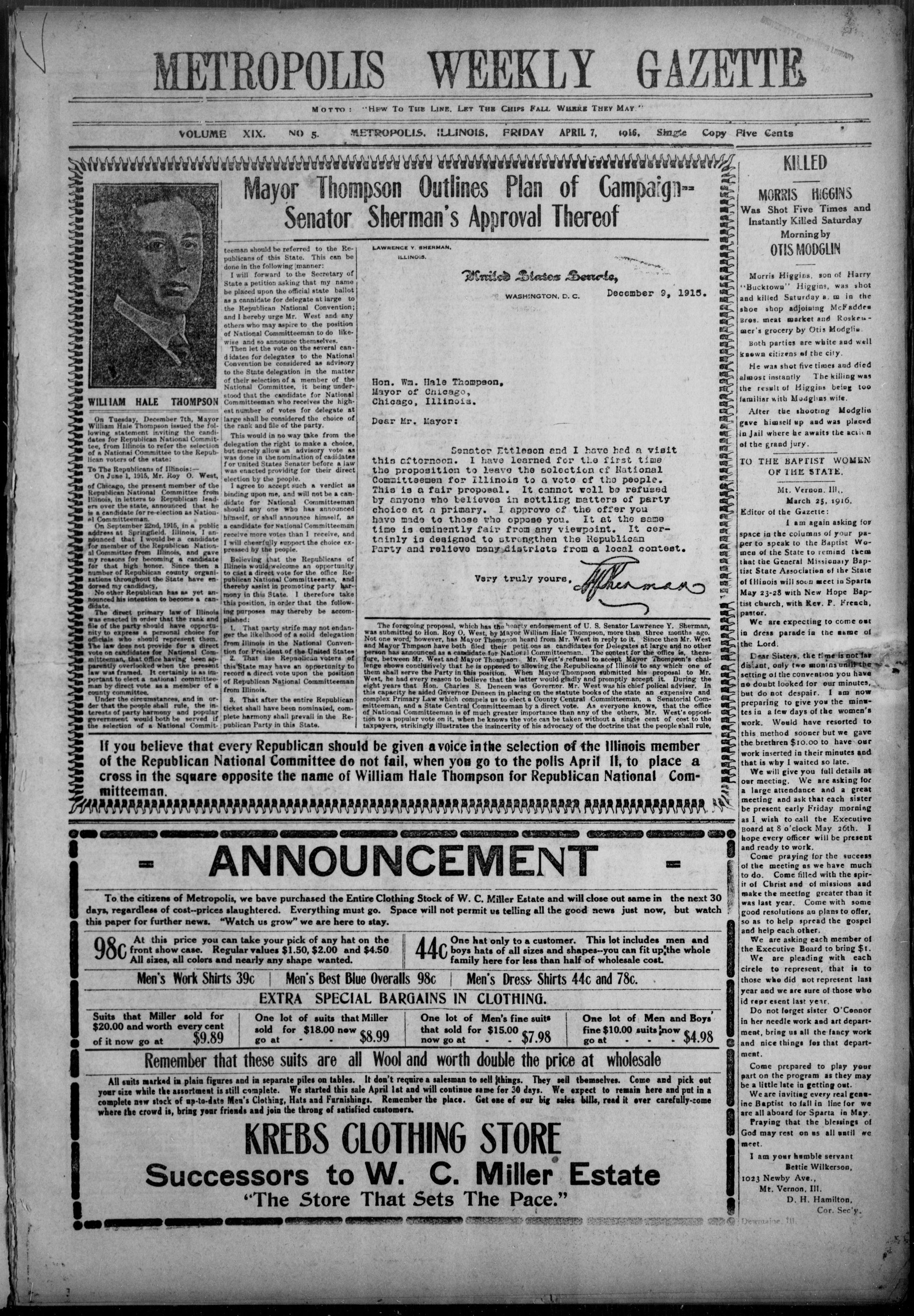
On Tuesday, December 7th, Mayor William Hale Thompson issued the following statement inviting the candidates for Republican National Committee, from Illinois to refer the selection of a National Committee to the Republican voters of the state:
To The Republicans of Illinois:—
On June 1, 1915, Mr. Roy, O. West.
On June 1, 1915, Mr. Roy O. West, of Chicago, the present member of the Republican National Committee from Illinois, in letters to Republican leaders over the state, announced that he is a candidate for re-election as National Committeeman.
On September 22nd, 1915, in a public address at Springfield, Illinois, I announced that I would be a candidate for member of the Republican National Committee from Illinois, and gave my reasons for becoming a candidate for that high honor. Since then a number of Republican county organizations throughout the State have endorsed my candidacy.
No other Republican has an yet announced his intention to become a candidate.
The direct primary law of Illinois was enacted in order that the rank and file of the party should have opportunity to express a personal choice for officials who should represent them. The law does not provide for a direct vote on candidates for National Committee, that office having been apparently overlooked when the present law was framed. It certainly is as important to elect a national committee by direct vote as a member of a county committee. Under the circumstances, and in order that the people shall rule, the interests of party harmony and popular government would both be served if the selection of a National Commiti-
If you believe that ex
of the Republican Na
cross in the square e
mitteeman.
To the citizens of Metropo
days, regardless of cost--prices
this paper for further news. "
98c At this price you c
front show case. Req
All sizes, all colors an
Men's Work Shirt
Suits that Miller sold for $20.00 and worth every cent of it now go at $9.89
Remember the
All suits marked in plain figure your size while the assortment is a complete new stock of up-to-date where the crowd is, bring your fr
Mayor Thompson Outlines Plan of Campaign Senator Sherman's Approval Thereof
ANNOUNCEMENT
EXTRA SPECIAL BARGAINS IN CLOTHING.
teeman should be referred to the Republicans of this State. This can be done in the following manner: I will forward to the Secretary of State a petition asking that my name be placed upon the official state ballot as a candidate for delegate at large to the Republican National Convention; and I hereby urge Mr. West and any others who may aspire to the position of National Committeeman to do likewise and so announce themselves. Then let the vote on the several candidates for delegates to the National Convention be considered as advisory to the State delegation in the matter of their selection of a member of the National Committee, it being understood that the candidate for National Committeeman who receives the highest number of votes for delegate at large shall be considered the choice of the rank and file of the party. This would in no way take from the delegation the right to make a choice, but merely allow an advisory vote as was done in the nomination of candidates for United States Senator before a law was enacted providing for their direct election by the people.
I agree to accept such a verdict as binding upon me, and will not be a candidate for National Committeeman should any one who has announced himself, or shall announce himself, as a candidate for National Committeeman receive more votes than I receive, and I will cheerfully support the choice expressed by the people.
Believing that the Republicans of Illinois would welcome an opportunity to cast a direct vote for the office Republican National Committeeman, and thereby assist in promoting party harmony in this State. I therefore take this position, in order that the following purposes may thereby be accomplished:
1. That party strife may not endanger the likelihood of a solid delegation from Illinois in the National Convention for President of the United States
2. That the Republican voters of this State may have an opportunity to record a direct vote upon the position of Republican National Committeeman from Illinois.
3. That after the entire Republican ticket shall have been nominated, complete harmony shall prevail in the Republican Party in this State.
Senator Ettleson and I have had a visit this afternoon. I have learned for the first time the proposition to leave the selection of National Committeemen for Illinois to a vote of the people. This is a fair proposal. It cannot well be refused by anyone who believes in sottling matters of party choice at a primary. I approve of the offer you have made to those who oppose you. It at the same time is eminently fair from any viewpoint. It certainly is designed to strengthen the Republican Party and relieve many districts from a local contest.
Very truly yours.
The foregoing proposal, which has the hearty endorsement of U. S. Senator Lawrence Y. Sherman, was submitted to Hon. Roy O. West, by Mayor William Hale Thompson, more than three months ago. Not one word, however, has Mayor Thompson heard from Mr. West in reply to it. Since then Mr. West and Mayor Thompson have both filed their petitions as candidates for Delegates at large and no other person has announced as a candidate for National Committeeman. The contest for the office is, therefore, between Mr. West and Mayor Thompson. Mr. West's refusal to accept Mayor Thompson's challenge shows conclusively that he is opposed to allowing the Republicans of Illinois to say which one of them shall serve the Party in this position. When Mayor Thompson submitted his proposal to Mr. West, he had every reason to believe that the latter would gladly and promptly accept it. During the eight years that Hon. Charles S. Deneen was Governor, Mr. West was his chief political adviser. In this capacity he aided Governor Deneen in placing on the statute books of the state an expensive and complex Primary Law which compels us to elect a County Central Committeeman, a Senatorial Committeeman, and a State Central Committeeman by a direct vote. As everyone knows, that the office of National Committeeman is of much greater importance than any of the others. Mr. West's opposition to a popular vote on it, when he knows the vote can be taken without a single cent of cost to the taxpayers, strikingly illustrates the insincerity of his advocacy of the doctrine that the people shall rule,
Hon. Wm. Hale Thompeon,
Mayor of Chicago,
Chicago, Illinois.
Dear Mr. Mayor:
December 9, 1915.
have had a visit
the first time
of National
of the people.
will be refused
matters of party
the offer you
at it at the same
point. It cer-
e Republican
from a local contest.
U. S. Senator Lawrence Y. Sherman,
Hompson, more than three months ago,
rest in reply to it. Since then Mr. West
states for Delegates at large and no other.
The contest for the office is, there-
susal to accept Mayor Thompson's chal-
ibicans of Illinois to say which one of
Hompson submitted his proposal to Mr.
and promptly accept it. During the
West was his chief political adviser. In
books of the state an expensive and
real Committeeman, a Sematorial Com-
As everyone knows, that the office
any of the others, Mr. West's opposi-
without a single cent of cost to the
of the doctrine that the people shall rule,
the Illinois member
April 11, to place a
American National Com-
will close out same in the next 3
and news just now, but watch
This lot includes men and
hopes--you can fit up the whole
of wholesale cost.
4c and 78c.
One lot of Men and Boys fine $10.00 suits now go at $4.98 at wholesale bemselves. Come and pick out pect to remain here and put in a bills, read it over carefully-zone
KILLED
MORRIS HIGGINS
Was Shot Five Times and
Instantly Killed Saturday
Morning by
OTIS MODGLIN
Morris Higgins, son of Harry
"Bucktown" Higgins, was shot
and killed Saturday a.m. in the
shoe shop adjoining McFadden
Bros. meat market and Roske-
mer's grocery by Otis Modglin.
Both parties are white and well
known citizens of the city.
He was shot five times and died
almost instantly. The killing was
the result of Higgins being too
familiar with Modgins wife.
After the shooting Modglin
gave himself up and was placed
in jail where he awaits the action
of the grand jury.
TO THE BAPTIST WOMEN OF THE STATE.
Editor of the Gazette:
I am again asking for space in the columns of your paper to speak to the Baptist Women of the State to remind them that the General Missionary Baptist State Association of the State of Illinois will soon meet in Sparta May 23-28 with New Hope Baptist church, with Rev. P. French, pastor.
We are expecting to come out in dress parade in the name of the Lord.
Dear Sisters, the time is not far distant, only two months until the setting of the convention you have no doubt looked for our minutes, but do not despair. I am now preparing to give you the minutes in a few days of the women's work. Would have resorted to this method sooner but we gave the brethren $10.00 to have our work inserted in their minutes and that is why I waited so late.
We will give you full details at our meeting. We are asking for a large attendance and a great meeting and ask that each sister be present early Friday morning as I wish to call the Executive Board at 8 o'clock May 26th. I hope every officer will be present and ready to work.
Come praying for the success of the meeting as we have much to do. Come filled with the spirit of Christ and of missions and make the meeting greater than it was last year. Come with some good resolutions an plans to offer, so as to help spread the gospel and help each other.
We are asking each member of the Executive Board to bring $1.
We are pleading with each circle to represent, that is to those who did not represent last year and we are sure of those who id represent last year.
Do not forget sister O'Connor in her needle work and art department, bring us all the fancy work and nice things fos that department.
Come prepared to play your part on the program as they may be a little late in getting out.
We are inviting every real genuine Baptist to fall in line for we are all aboard for Sparta in May.
Praying that the blessings of God may rest on us all until we meet.
I am your humble servant
Bettie Wilkerson,
1023 Newby Ave.,
Mt. Vernon, Ill.
D. H. Hamilton,
Cor. Sec'y.
HiGH PRICES
B00 CROPS
It ts no new experience for settlers
Jocated in a fertile country such as
‘Western Canada, where lands may be
ought at very reasonable prices, to
harvest a crop that in one season pays
the entire cost of their farm, Undoubt-
edly this was the experience of many
farmers during 1915, but one instance
may be quoted. A settler who camo
to Canada from the United States
some years ago decided to add to his
holdings by buying an adjoining quar-
ter section near his home at Warner,
‘At $20.00 an acre, with terms spread
over a period of years. He got the
land into a good state of cultivation
and last spring put the whole quarter
section in wheat. When the crop was
threshed he found that it only took
half the wheat on the farm to pay the
‘whole purchase price of it; in short
‘a single year’s crop paid the cost of
the land, paid all the expenses of op-
eration and left him handsome sur-
plus as profit. This settler had some
adjoining land, and his whole wheat
jerop for the season amounted to
over 18,000 bushels. He is now plan-
ning to obtain some sheep and invest
his profits in live stock which will as-
sure hini a good living irrespective of
what the season may happen to be.
Canada’s financial position is ex-
cellent. All speculation has been elim.
inated, and trading is done on a cash
basis, with restricted credit,
Detailed figures of Canada’s trade
for twelve months ending October 31
show how the war Is forcing Canadian
trade into new channels, One of the
‘most extraordinary changes is in com-
merce with the United States. A
couple of years ago Canada imported
from the United States two or three
hundred million dollars’ worth of
goods more than she exported. Tho
balance of trade was all with the
United States. ‘The balance is rapid-
1y disappearing, ard the present out-
look is that by the end of this year
Canada will have exported to the
‘United States more than she has im-
norted,
‘The figures for the past four years
are illuminating. They are as fol
lows:
Exports. Imports.
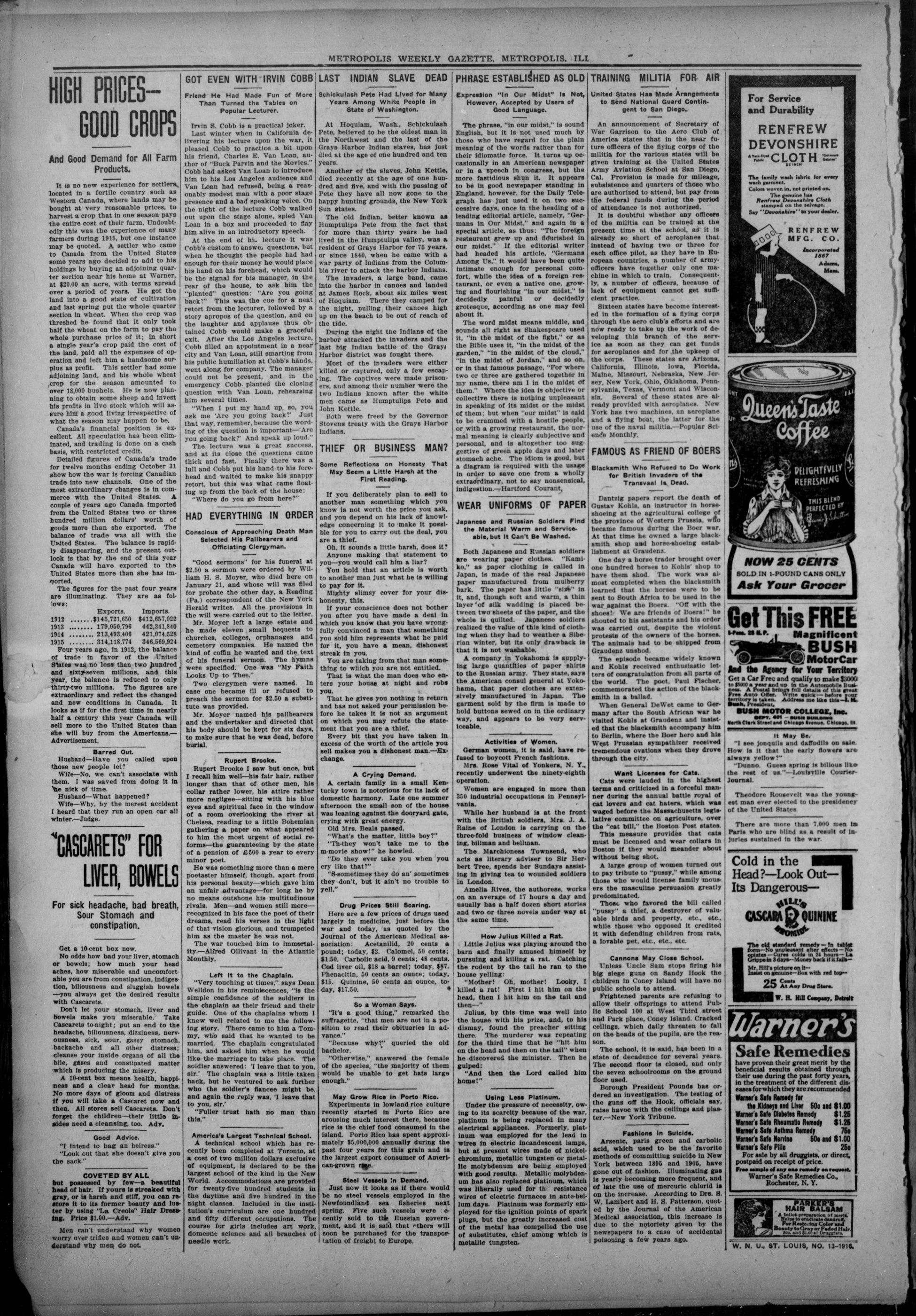
4912 ...,...$145,721,650 $412,657,022
1913 ..++0++ 179,050,796 442,341,840
1914 ...0000. 213,498,406 421,074,528
1915 ........ 314,118,774 346,569,924
Four years ago, in 1912, the balance
of trade in favor of the United
‘States’ wad-no les# than two pundred
and sixtyseven millions, and this
year, the balance is reduced to only
thirty-two millions. The figures are
extraordinary and reflect the changed
and new conditions in Canada. It
looks as if for the first time in nearly
half a century this year Canada will
sell more to the United States than
she will buy from the Americans —
Advertisement,
Barred Out.
Husband—Have you called upon
those new people let?
Wife—No, we can't associate with
them. I was saved from doing it in
‘he nick of time.
Husband—What happened?
‘Wite—Why, by the merest accident
I heard that they run an open car all
‘Winter —~Judes.
“CASCARETS” FOR
For sick headache, bad breath,
Sour Stomach and
constipation,
Get a 10-cent box now.
No odds how bad your liver, stomach
or bowels; how much your head
aches, how miserable and uncomfort-
able you are from constipation, indiges-
tion, biliousness and sluggish bowels
—you always get the desired results
with Cascarets.
Don't let your stomach, liver and
bowels make you miserable. Take
Cascarets to-night; put an end to the
headache, biliousness, dizziness, nery-
ousness, sick, sour, gassy stomach,
backache and all other distress;
¢leanse your inside organs of all the
bile, gases and constipated matter
which is producing the misery.
A 10cent box means health, happi-
mess and a clear head for months.
No more days of gloom and distress
4f you will take a Cascaret now and
then. All stores sell Cascarets. Don’t
forget the children—their little in-
sides need a cleansing, too. Ady.
Good Advice.
“I intend to bag an heiress.”
“Look out that she doesn't give you
the sack.”
‘ie covers oy ALL
possessed by few—a beautiful
‘head of hair. If yours is streaked with
gray, or is harsh and stiff, you can re-
store it to its former beauty and lus-
ter by using “La Creole” Hair Dress
fmg. Price $1.00.—Adv.
‘Men can't understand why women
‘worry over trifles and women can’t un-
derstand why men do not.
GOT EVEN WITH“IRVIN COBB
Friend’ He Had Made Fun of More
Than Turned the Tables on
Popular Lecturer. |
Irvin 8. Cobb is a practical joker.
Last winter when in California de-
livering his lecture upon the war, it
pleased Cobb to practice a bit upon
his friend, Charles E. Van Loan, au-
thor of “Buck Parvin and the Movies.”
Cobb had asked Van Loan to introduce
him to his Los Angeles audience and
Van Loan had refused, being @ reas-
onably modest man with a poor stage
presence and a bad speaking voice. On
the night of the lecture Cobb walked
out upon the stage alone, spied Van
Loan in a box and proceeded to flay
‘him alive in an introduetory speech.
At the end of hi. lecture it was
Cobb's custom to answes questions, but
when he thought the people had had
enough for their money he would place
his hand on his forehead, which would
be the signal for his manager, in the
rear of the house, to ask him the
“planted” question: “Are you going
back?” This was, the cue for a neat
retort from the lecturer, followed by a
story apropos of the question, and on
the laughter and applause thus ob.
tained Cobb would make a graceful
exit, After the Los Angeles lecture,
Cobb filled an appointment in a near
city and Van Loan, still smarting from
his public humiliation at Cobb's hands,
went along for company. The manager
could not be present, and in the
emergency Cobb. planted the closing
question with Van Loan, rehearsing
him several times.
“When I put my hand up, so, you
ask me ‘Are you going back” Just
that way, remember, because the word:
ing of the question is important—'Are
you going back?” And speak up loud.”
‘The lecture was @ great success,
and at its close the questions came
thick and fast. Finally there was a
lull and Cobb put his hand-to his fore
head and waited to make his snappy
retort, but this was what came float
ing up from the back of the house:
“Where do you go from here?”
HAD EVERYTHING IN ORDER
Conscious of Approaching Death Man
Selected His Pallbearers and
Officiating Clergyman.
“Good sermons” for his funeral at
$2.50 a sermon were ordered by Wil-
lam H. S. Moyer, who died here on
January 21, and whose will was fled
for probate the other day, a Reading
(Pa,) correspondent of the New York
Herald writes. All the provisions in
the will were carried out to the letter.
Mr, Moyer left a large estate and
he made eleven small bequests to
churches, colleges, orphanages and
cemetery companies. He named the
kind of coffin he wanted and the. text
of his funeral sermon. The hymns
were specified. One was “My Faith
Looks Up to Thee.”
‘Two clergymen were named. In
case one became ill or refused to
preach the sermon for $2.50 a substi-
tute was provided.
‘Mr, Moyer named his pallbearers
and the undertaker and directed that
his body should be kept for six days,
to make sure that he was dead, before
burial.
4 © feet ‘ieotn.
Rupert Brooke I saw but once, but
I recall him well—his fair hair, rather
longer than that of other men, his
collar rather lower, his attire rather
more negligee—sitting with his blue
eyes and spiritual face in the window
of a room overlooking the river at
Chelsea, reading to a little Bohemian
gathering @ paper on what appeared
to him the most urgent of social re-
forms—the guaranteeing by the state
of a pension of £500 a year to every
minor poet.
He was something more than a mere
poetaster himself, though, apart from
his personal beauty—which gave him
an unfair advantage—for long he by
no means outshone his multitudinous
rivals. Men—and women still more—
recognized in his face the poet of their
dreams, read his verses in the light
of that vision glorious, and trumpeted
him as the master he was not.
The war touched him to immortal:
ity.—Alired Ollivant in the Atlantic
Monthly.
ate i te the Ghaciete.
“Very touching at times,” says Dean
Welldon in his reminiscences, “is the
simple confidence of the soldiers in
the chaplain as their friend and their
guide. One of the chaplains whom I
knew well related to me the follow-
ing story. There came to him a Tom-
my, who said that he wanted to be
married. ‘The chaplain congratulated
him, and asked him when he would
like the marriage to take place. The
soldier answered: ‘I leave that to you,
sir.’ The chaplain was a little taken
back, but he ventured to ask further
who the soldier's fiancee might be,
and again the reply was, ‘I leave that
to you, sir.”
“Puller trust hath no man than
this.”
America’s Largest Technical School.
A technical school which has re-
cently been completed at Toronto, at
@ cost of two million dollars exclusive
‘of equipment, is declared to be the
Jargest school of the kind in the New
‘World. Accommodations are provided
for twenty-five hundred students in
the daytime and five hundred in the
night classes. Included in the inst-
tution’s curriculum are one nines
and fifty different occupations.
course for girls includes art work,
domescie science and all brancher of
peedie werk.
METROPOLIS WEEKLY GAZETTE, METROPOLIS, ILL
LAST INDIAN SLAVE DEAD | PHRASE ESTABLISHED AS OLD|1
Schickulash Pete Had Lived for Many | Expression “In Our Midst” Is Not, | U
Years Among White People in However, Accepted by Users of
‘State of Washington. Good Language.
At Hoquiam, Wash. Schickulash
Pete, believed to be the oldest man in
the Northwest and the last of the
Grays Harbor Indian slaves, has just
died at the age of one hundred and ten
years.
Another of the slaves, John Kettle,
died recently at the age of one hun-
dred and five, and with the passing of
Pete they have all now gone to the
happy hunting grounds, the New York
Sun states.
The old Indian, better known as
Humptulips Pete from the fact that
for more than thirty years he had
lived in the Humptulips valley, was a
resident of Grays Harbor for 75 years.
or since 1840, when he came with a
war party of Indians from the Colum-
bia river to attack the harbor Indians.
‘The invaders, a large band, came
into the harbor in canoes and landed
at James Rock, about six miles west
of Hoquiam. There they camped for
the night, pulling their canoes high
up on the beach to be out of reach of
the tide.
During the night the Indians of the
harbo? attacked the invaders and the
‘last big Indian battle of the Grays
‘Harbor district was fought there.
Most of the invaders were either
‘killed or captured, only a few escap-
ing. The captives were made prison-
ers, and among their number were the
two Indians known after the white
men came as Humptulips Pete and
John Kettle.
Both were freed by the Governor
Stovens treaty with the Grays Harbor
Indians.
THIEF OR BUSINESS MAN?
Some Reflections on Honesty That
May Seem a Little Harsh at the
First Reading.
If you deliberately plan to sell to
another man something which you
know is not worth the price you ask,
and you depend on his lack of know!-
edge concerning it to ‘make it possi-
ble for you to carry out the deal, you
are a thief.
Oh, it sounds a little harsh, does it?
Anyone making that statement to
you—you would call him a liar?
You hold that an article is worth
to another man just what he is willing
to pay for it.
Mighty slimsy cover for your dis-
honesty, this.
If your conscience does not bother
you after you have made a deal in
which you know that you have wrong-
fully convinced # man that something
you sold him represents what he paid
for it, you have a mean, dishonest
streak in you.
You are taking from that man some-
thing to which you are not entitled.
‘That is what the man does who en-
ters your house at night and robs
you. *
“That he gives you nothing in return
‘and has not asked your permission be-
fore he takes it is not an argument
on which you may refute the state-
ment that you are a thief.
Every bit that you have taken in
excess of the worth of the article you
sell makes you a dishonest man.—Ex-
change.
A Crying Demand.
A certain family in a small Ken-
tucky town is notorious for its lack of
domestic harmony. Late one summer
afternoon the small son of the house
was leaning against the dooryard gate,
crying with great energy.
Old Mrs. Beals passed.
“What's the matter, little boy?”
“Ththey won't take me to the
m-movie show!” he howled.
“Do they ever take you when you
ery like that?"
“S-sometimes they do an’ sometimes
they don’t, but it ain't no trouble to
yell.”
Drug Prices Still Soaring.
Here are a few prices of drugs used
largely in medicine, just before the
war and today, as quoted by the
Journal of the American Medical as-
sociation: Acetanilid, 20 cents a
pound; today, $2. Calomel, 50 cents;
$1.50. Carholic acid, 9 cents; 48 cents.
Cod liver oll, $18 @ barrel; today, $87.
Phenacitin, 50 cents an ounce; today,
$15. Quinine, 50 cents an ounce, to-
day, $17.50, ‘
So a Woman Says.
“It's a good thing,” remarked the
suffragette, “that men are not in a po-
sition to read their obituaries in ad-
vance.”
“Because why?’ queried the old
bachelor,
“Otherwise,” answered the female
of the species, “the majority of them
would be unable to get hats largo
enough.”
May Grow Rice in Porto Rico.
Experiments in lowland rice culture
‘Tecently started in Porto Rico are
arousing much interest there, because
rice is the chief food consumed in the
island. Porto Rico has spent approxi-
mately $5,000,000 annually during the
past four years for this grain and is
the largest export consumer of Amert-
cangrown rige.
Steel Vessels in Demand,
Just now it looks as if there would
be no steel vessels employed in the
Newfoundland sea fisheries next
spring. Five such vessels were :¢
cently sold to thie Russian govern-
ment, and it is said that rthers will
toon be purchased for the transpor
tation of freight to Europe.
PHRASE ESTABLISHED AS OLD
Expression “In Our Midst” Is Not,
‘However, Accepted by Users of
Good Language.
‘The phrase, “in our midst,” is sound
English, but it is not used much by
those who have regard for the plain
meaning of the words rattler than for
their idiomatic force. It turns up oc-
casionally in an American newspaper
or in @ Speech in congress, but the
more fastidious shun it, It appears
to bé in good newspaper standing in
England, however, for the Daily Tele-
graph has just used it on two suc-
cessive days, once in the heading of a
leading editorial article, namely, “Ger-
mans in Our Midst,” and again in a
special article, as thus: “The foreign
restaurant grew up and fidurished in
our midst.” If the editorial writer
had headed his article, “Germans
Among Us,” it would have been quite
intimate enough for personal com-
fort, while the idea of a foreign res-
taurant, or even a native one, grow-
ing and flourishing “in our midst,” {9
decidedly painful or decidedly
grotesque, according as one may feel
about It.
‘The word midst means middle, and
sounds all right as Shakespeare used
it, “in the midst of the fight,” or as
the Bible uses it, “in the midst of the
garden,” “in the midst of the cloud,”
“in the midst of Jordan,” and ¢0 on,
or in that famous passage, “For where
two or three are gathered together in
my name, there am I in the midst of
them.” Where the idea is objective or
collective there is notbing unpleasant
in speaking of its midst or the midst
of them; but when “our midst” is said
to be crammed with a hostile people,
or with a growing restaurant, the nor-
mal meaning is clearly subjective and
personal, and is altogether too sug-
gestive of green apple days and later
stomach ache. The idiom is good, but
a diagram is required with the usage
in order to save one from a wholly
extradrdinary, not to say nonsensical,
indigestion.—-Hartford Courant,
WEAR UNIFORMS OF PAPER
Japanese and Russian Soldiers Find
the Material Warm and Service-
able, but It Can't Be Washed.
Both Japanese and Russian soldiers
fare wearing paper clothes. “Kami-
ko,” as paper clothing is called in
Japan, is made of the real Japanese
paper manufactured from mulberry
bark. The paper has little “sis” in
it, and, though soft and warm, a thin
layer ‘of silk wadding is placed be-
tween tworsheets of the paper, and the
whole is quilted. Japanese soldiers
realized the value of this kind of cloth-
ing when they had to weather a Sibe-
rian winter, but its only drawback is
that ft fs not washable.
A company in Yokahoma {s sypply-
ing large quantities of paper shirts
to the Russian army. They state, says
the American consul general at Yoko-
hama, that paper clothes are exten-
sively manufactured in Japan. The
garment sold by the firm is made to
hold buttons sewed on in the ordinary
way, and appears to be very serv-
tceable,
‘atbiien of Wien
German women, it is said, have re-
fused to boycott French fashions,
Mrs. Rose Vital of Yonkers, N. Y.,
recently underwent the ninety-eighth
operation.
Women are engaged in more than
350 industrial occupations in Pennsyl-
vania, .
‘While her husband is at the front
with the British soldiers, Mra. J. A.
Raine of London is carrying on the
three-fold business of window clean:
ing, billman and bellman.
‘The Marchioness Townsend, who
acts as literary adviser to Sir Her-
bert Tree, spends her Sundays assist
ing in giving tea to wounded soldiers
in London.
Amelia Rives, the authoress, works
on an average of 17 hours a day and
usually has a half dozen short stories
and two or three novels under way at
the same time.
How Julius Killed a Rat.
Little Julius was playing around the
barn and finally amused himself by
pursuing and killing @ rat. Catching
the rodent by the tail he ran to the
house yelling:
“Mother! Oh, mother! Looky, |
killed @ rat! First 1 hit him on the
head, then I hit him on the tail and
then—"
Julius, by this time was well into
the house with his prize, and, to his
dismay, found the preacher sitting
there. ‘The murderer was repeating
for the third time that he “hit him
on the head and then on the tail” wher
he discovered the minister. ‘Then be
gulped:
“and then the Lord called him
home!”
Usina Less Platinum.
Under the pressure of necessity, ow-
ing to its scarcity because of the war,
platinum 1s being replaced in many
Glectrical appliances. Formerly, plat-
inum was employed for the lead in
wires in electric incandescent lamps,
but at present wires made of nickel
chromium, metallic tungsten or metal-
He molybdenum are being employed
‘with good results. Metallic molybden-
um has also replaced platinum, which
was Iberally used for th resistance
wires of electric furnaces in ante-bel
lum days. Platinum was formerly em
ployed for the ignition points of spark
plugs, but the greatly increased cost
of the metal has compelled the use
of substitutes, chief among which is
metallic tungsten.
TRAINING MILITIA FOR AIR
United States Has Made Arangements
to Send National Guard Contin.
; gent to San Diego.
An announcement of Secretary of
War Garrison to the Aero Club of
America states that in the near fu-
ture officers of the flying corps of the
militia for the various states will be
given training at the United States
Army Aviation School at San Diego,
Cal. Provision is mado for mileage,
subsistence and quarters of those who
are authorized to attend, but pay from
the federal funds during the period
of attendance is not authorized.
It is doubtful whether any officers
of the militia can be trained at the
‘present time at the schdol, ai it is
‘already so short of aeroplanes that
instead of having two or three for
each office pilot, as they have in Bu-
ropean countries, a number of army-
officers have together only one ma-
chine in which to train. Consequent-
ly, a number of officers, because of
lack of equipment cannot get suff:
cient practice.
Sixteen states have become interest-
jed in the formation of a flying corps
‘through the aero club's efforts and are
now ready to take up the work of de-
veloping this branch of the serv-
ice as soon as they can get funds
for aeroplanes and for the upkeep of
the corps. These states are Arizona,
California, TMlinois, lowa, Florida,
‘Maine, Missouri, Nebraska, New Jer-
sey, New York, Ohio, Oklahoma, Penn-
sylvania, Texas, Vermont and Wiscon-
‘sin, Several of these states are al-
‘ready provided with aeroplanes. New
York has two machines, an seroplane
and a flying boat, the latter for the
use of the naval militia.—Popular Scl-
ends Mesthly,
FAMOUS AS FRIEND OF BOERS
Blacksmith Who Refused to Do Work
for British Invaders of the
Traneveal ia. Deed.
Dantzig papers report the death of
Gustay Kohls, an instructor in horse
shocing at the agricultural college 6
the province of Western Prussia, w
became famous during the Boer war
At that time he owned a large black
smith shop and horseshoeing estab
lishment at Graudent.
‘One day a horse trader brought over
one hundred horses to Kohis’ shop to
have them shod. The work was al
most completed when the blacksmith
learned that the horses were to be
sent to South Africa to be used in the
‘war against the Boers. “Off with the
shoes! We are friends of Boers!” he
shouted to bis assistants and his order
was carried out, despite the violent
protests of the owners of the horses
‘The animais bad to be shipped from
Graudenz unshod.
‘The episode became widely known
and Kobis received enthusiastic let
ters of congratulation from all parts of
the world. The poet, Paul Fischer,
commemorated the action of the black
smith in a ballad.
‘When General DeWet came to Ger
many after the South African war he
visited Kohis at Graudenz and insist
ed that the blacksmith accompany him
to Berlin, where the Boer hero and his
West Prussian sympathizer received
tremendous ovations when they drove
‘through the city.
Want Licenses for Cats.
Cats were lauded in the highest
terms and criticized in @ forceful man-
ner during the annual battle royal of
cat lovers and cat haters, which was
‘waged before the Massachusetts logis-
lative committee on agriculture, over
the “cat bill,” the Boston Post states.
‘This measure provides that cats
must be licensed and wear collars in
Boston if they would meander about
without belng shot.
A large group of women turned out
to pay tribute to “pussy,” while among
those who would license family mous
ers the masculine persuasion greatly
predominated.
‘Those who favored the bill called
“pussy” a thief, a destroyer of valu
able birds and property, etc., ete.
while those who opposed it credited
it with defending children from rats
a lovable pet, etc., ete., ete.
anmtinel tiny Otacs Qalianl.
Uniess Uncle Sam stops firing his
big siege guns on Sandy Hook the
children in Coney Istand will have no
public schools to attend.
Frightened parents are refusing to
allow thelr offsprings to attend Pub-
Hic School 100 at West Third street
and Park place, Coney Island. Cracked
ceilings, which daily threaten to fall
on the heads of the pupils, are the rea
son.
‘The school, it is said, has been in 2
state of decadence for several years
‘The second floor is closed, and onl)
the seven schoolrooms on the ground
floor used.
Borough President Pounds has or
dered an investigation. The testing o
the guns off the Hook, officials say
raise havoc with the ceilings and plas
ter—New York Tribune.
Fashions in Suicide.
Arsenic, paris green and carbolic
acid, which used to be the favorite
methods of committing suicide in New
York between 1895 and 1906, have
gone out of fashion. "Illuminating gas
is yearly becoming more frequent, and
of late the use of mercuric chlorid is
on the increase. Aceording to Drs.
W. Lambert and H. S. Patterson, quot
ed by the Journal of the American
‘Medical association, this increase is
due to the notoriety given by the
newspapers to a case of accidenta
poisoning a few years ago.
For Service
and Durability
RENFREW
DEVONSHIRE
“CLOTH =
‘The family wash fabric for every
alors woven ia ot ited on:
Restos, ewer Cloth
sar “"Dsohshire' vs your delat,
OU et
ie | Incorporated
is67
‘Adams,
| >
SS ———
bald oh
Ge.
fi
Bey ti
\ i /
\ ee
ia} eA
oh Chai ts ys an
Dae rane
PY” hy» \i ee al
eA) pe
NOW 25 CENTS \
SOLD IN 1-POUND CAN ONLY
Ask Your Grocer
Get This FREE
te wee Magnificent
. BUSH
“Sygike, BUSH
And the Agency for Your Tervitory
Get a Car Frec and qualify to make $3000
fone (A Boned brings fail eins et this great
Bros Anto Omer: Write guick—- before Ta
Saree ‘Address me like this —).
BUSH MOTOR COLLEGE, Inc.
err. 407 suan son ome
arth Clark Strestana Obicags Areave, Congo, 1
Posiehaichesttnendeneenelenemscionmaalol
ts Stew fay
| “I see jonquils and daffodils on sale.
How is it that the early flowers are
always yellow?”
| “Dunno. Guess spring in bilious like
‘the rest of us.”"—Loulsyille Courter-
Journal.
| Theodore Roosevelt was the young-
et man ever elected to the presidency
| of the United States
Crete
| ‘There are more than 7,000 men tm
| Paris who are blind as a result of in.
| furles sustained in the war
ccaiesiecaiheliasnaliaiaiaiscellsi
Cold in the
| Head?—Look Out—
Its Dangerous—
Ape
| standard —In
gales ecs
Sleein 5 daye-<Khomay beck ft tale
eB wn vad tom
25 icx.
At Any Drug Store.
| W. H. Hill Company, Detroit
Warner:
Safe Remedies
ha their great merit by the
benedcial results ‘obtained through
their use during the past forty years
in the treatment of the different dis:
eases for which they are recommended
Warner's Safe Remedy for
the Kidneys and Liver 600 and $1.00
‘Warner's Safe Diabetes Remedy $1.26
Warner's Safe Rhoumatio Remedy = $1.25
Warner's Safe Asthma Remedy To
Warner's Safe Norvine = 508 and $1.00
Set aes
cette ara ne
‘Free sample of any one remedy on request.
Warner's Sate Remedies Co,
Rochester, N. Y.
ar
pera char et
*W. N. U. ST. LOUIS, NO, 13-1916,
SYMPATHY FOR A BACHELOR
Never Since History of Man Began
Has He Been the Marked Man
He Is Today in Europe.
If single men continue to be
singled out as victims for tax collee-
tors and recruiting sergeants, the
great trinity of human rights will
be changed to read, “life, liberty and
matrimony.” For where can. the
bachelor find happiness in a world
that marks his income as the first
to be seized by a rapacious stite and
his precious person as the first to be
‘exposed to the enemy’s bullets?
Never since the history of man be-
gan has the bachelor been the marked
man he is today, a writer in the
Brooklyn Eagle asserts. In England
Premier Asquith’s famous promise
was given to the married men, the
conscription bill excepts the married
men, the state supports the wives and
children of énlisted married men. In
France the state supports not only
the <legally~ established wives but
those whom soldiers acknowledge as
their “wives,” the assumption being
that the legal ceremony will follow
when the war comes to an end. Thus
even the man who promises to be-
come married is favored by the state.
And as for taxes, the bachelor has
Jong been the victim of his own dis-
cretion. Even Uncle Sam, who is
ordinarily the least given to making
invidious distinctions among his citi-
zenry, grants the married man a
‘$4,000 exemption on the income tax.
In Burope the discrimination
against the bachelor is much more
marked—so marked, in fact, that
bachelorhood is more of a luxury
than a limousine.
HIS JEWELRY SCATTERED
a
Ki > i f
ey
hes \
a 4 \
A
\ th
fi ty 3
i F
“His girl is wearing his ring.”
“And his uncle bas his watch.”
NOT QUITE CLEAR.
“Did I understand you to say that
a change of climate had been recom-
mended for you?” asked the bank
president.
“Yes, sir,” replied the cashier.
“That is why I desire an earlier va-
cation than usual,”
“Um-yes,” ynused the b. p. “By
the way, who recommended the
change, your physician or your at-
torney?” ‘
A HUMBLE START.
“The Gadspurs seem to be very
rich, and I notice that they put on s
great deal of style.”
“Just 60.”
“Miss Gadspur said her father laid
the foundation of his fortune in rub-
ber.”
“I know about that.”
“Did he own a rubber plantation
somewhere ?”
“No, He sold toy balloons.”
WHAT DID HE MEAN?
Wife—And will you miss me while
I am away, dear?
Husband—You bet I will.
Wife—Well, that’s some consola-
tion to me.
Husband—And to me also, dear,
Wife—But why to you?
Husband—It will be a consolation
to have the pleasure of missing you.
CRUEL NECESSITY.
“Love is all in all, says this poet,”
“In a fine frenzy, no doubt.”
“You can’t always tell. He may
have written this sonnet to pay the
+butcher.”
THE USUAL WAY.
Biggs—I hear you are financially
embarrassed ; is it true?
Diggs—No; my’ creditors seem to
be a little embarrassed, but I’m not.
ITS IDEA, :
“I see where they are making pa-
‘per out of brewery hop refuse.”
: “That shows how modern inven-
\tion keeps on the jump.”
{/GIRLS, CULTIVATE A SMILE
,| Pleasant Expression Will Bring Yong
Women From Ranks of Plainnéss:
to Heights of Beauty,
Cultivate your smiles unceasingly,
girls. this does not-mean that you
must sit in street cars wearing an
insipid grin, Not at all! It does
not even mean that you must actu-
ally smile in the literal sense of the
word. But your expression ean be
smiling without your lips being part-
ed at all. If you are thinking about
pleasant occurrences your mouth will
turn up at the corners and your eyes
will sparkle, quite naturally and
without any effort.
‘This will keep your face attractive
and youthful, even when you have
passed the borders of youth itself. If
you wish to retain your beauty as
long as possible, don’t form the habit
of letting your lips droop and all
your face muscles sag downward
when your face is in repose.
Just stand before the mirror and
pull your lines down to get the ef-
fect. Draw your mouth down and
scowl a bit and you will see just how
ugly those drooping lines can make
you look. Then smile, not artificially
but naturally, just a little around the
lips, but a great deal in the eyes, and
you will see how pretty you can ap-
pear. -
If every woman realized how much
harm she is doing to herself when she
sits with her face muscles all relaxed
and drooping she would try the smile
cure for ugly lines. The smile can
bring about magical resulta in lift-
ing a girl from the ranks of plain-
ness to the heights of actual beauty.
HAPPIEST MAN MOST HONEST
He Has No Bad Habits and So He Is
Always Prosperous—He Works
for Good Living.
We have noticed the happiest man
many a time. He works for his liv-
ing and he gets a good one. One
thing we notice is he is a man of
fine habits; doesn’t squander a cent
on liquor, tobacco or betting. He
saves his money and is getting ready
to buy some property. He loves his
home, plays with the children, reads
good books and keeps company with
his wife. Because of his good habits
he saves a little, which will give him
4 chance to make an investment.
And then there is another thing—
he is a reliable man. He does good
work. He will not smooth over bad
work. He is honest in whatever he
does. Every dollar he gets represents
just that much of honest labor. It is
this, largely, that makes him -pros-
perous and happy.
| Water keeps its own level, and so
does conduct and character and pros-
perity, If a man is mean and low,
so will the consequences be. He can-
not be one thing and his experience
another. A low-lited man may grow
rich and happy, but it will not be
for long. Anybody can tell what's
the matter with a man if he is with
him a day; he will soon see if the
other is a spleen, a stomach, an up-
lift or a hope.—Ohio State Journal.
TOO GOOD.
“Was the paper Mrs, Gadders read
before the Literary club—er—illu-
minating, informative and all that
sort of thing?”
“I suppose 80.”
“Yes?”
“At least, all the other elub mem-
bers thought so well of the paper
that none of them believed Mrs, Gad-
ders wrote it.”
MATTER OF SENTIMENT.
“What makes you go in through
the kitchen?”
“I don’t know our servants very
well,” replied Mr. Cumrox. “Some
way, the front hall seems kind of in-
formal and distant. Around at the
kitchen steps they’ve got an old door-
mat with ‘Welcome’ on it.”
SAVED HIM THE TROUBLE.
Tom—How did you manage to
break the ice with Miss Chillington?
Jack-—I didn’t break it. I acci-
dentally found her in a melting
mood,
THEIR HOLD. —
“{ wonder why songs of the sea
are generally popular.”
“ suppose it is on account of the
whistling buoys.”
UNPROFICIENT.
“[ suppose you play golf?”
“No,” replied Mr. Cumrox, “T
can’t say that 1 play it. But I am
‘still working at it.”
METROPOLIS WEEKLY GAZETTE, METROPOLIS, ILL.
en
| NO JOB FOR AMATEUR DEITY) MYSTERY OF THE BLACK COW
|| Could Perform Many Miracles, but | ingenious Example of Means Used by
Couldn't Drop Lead Pencil With: German Scouts in France for Com-
out Breuking Point. es sdedaubinall telatings tn
“What,” asked the Maharajah of
Nepal, “means all this turmaoil I hear
in the streets?”
“Most high son of the sun,” re-
plied the grand vizier, “it is the pop-
ulace following one who calleth him-
self Buddha, and who goeth about
performing miracles.”
“Let him be brought in!”
* ‘The palace guards brought in an
old man, dressed in rags.
“Let the hippodrome proceed,”
said the maharajah,
‘The old man swallowed three can-
non balls, climbed an invisible pole,
rubbed the rheumatism out of a scul-
lery maid’s shoulders, removed a
royal wart from the grand vizier’s
nose, took a six-year-old boy out of
his pocket handkerchief, cut him into
ten parts with a razor-edged scimi-
tar, tossed the parts into the air,
whence they vanished, and then pro-
duced the identical urchin, un-
harmed, from a fern pot in the bay
window,
“Art Buddha?” asked the mahara-
jah, without batting an eye.
“Thou beholdest,” said the old
man.
“Then,” said the mabarajah, “take
thee this lead pencil and drop the
same upon the floor, If the end
break not then verily thou art Bud-
dha.” -
The fakit shricked his dismay,
burst through the guards and did not
stop this side of the deepest. recess
of the Himalayas.
The court crowded about the
throne, praising their ruler’s wisdom
as that of Solomon.
The maharajah smiled. “Thus,”
he said, “have I unmasked already
nineteen Buddhas,” — Kansas City
Star.
MYSTERY SOLVED
ay
Res ie ‘
=,
y
Ne /
{
—y oe
7
I! t
° —
ty Il IN
(% {I
s |
“Tsn’t it too bad our dréams don’t
materialize ?”
“Some do. I know a man who had
an awful nightmare, wrote it out the
next morning, and sold it for a mu-
sical comedy.”
SETTING HERSELF RIGHT.
“My dear,” said Mr. Twobble, in
the course of a domestic argument,
“I have never seen your equal for
magnifying things. Why, you—”
“Perhaps you are right,” inter-
rupted Mrs. Twobble, acidly. “But
please remember that when I mag-
nify your virtues before company
it is done strictly for the sake of
appearances.”
CHANCE ELIMINATED.
“Do you play cards?”
“No,” replied Broncho Bob. “I
used to, but I quit.”
“[s there no gambling in Crimson
Gulch?”
“No, A lot of sure-thing sharps
took possession of the games, and
there ain’t such a thing as what
you'd call a real gamble any more.”
WOMEN, LOVELY WOMEN.
‘Mrs. Dash—Tom and I were mar-
ried in haste, you know.
Mrs. Nash—Well, you ought to be
thankful that such was the case.
Mrs. Dash—Why, pray?
Mrs, Nash—If Tom had taken
time to think it over you would prob-
ably be single yet.
NATURAL BARRIER.
_ “What’s the trouble with your
antikissing crusade?”
“The public just won't set their
faces against it.”
ITS SORT.
got’ a rum deal in: that: store
just now.”
“What was it?” e
- “Jqmaica spirits.” . _,
MYSTERY OF THE BLACK COW
Ingenious Exernbie of Means Used by
German Scouts in France for Com-
municating Information.
| _A particularly ingenious example
‘of the methods employed by German
boots ta France for communicating
‘information to their troops has been
‘reported from France. It appears
‘that the German intelligence depart-
‘ment took an idea or two from the
gypsies, who have a code of signs
‘that they write on walls and fences
‘as they ys along, for the informa-
‘tion of other members of their clan.
A favorite sign with the Germans
‘has been a black cow. ‘That animal,
‘roughly sketched in black crayon on
walls, gates and fences, was fre-
quently noticed by the French as
they passed, and was so crudely
drawn that at first it aroused no sus-
picion, Sometimes it was small,
sometimes large, now rampant, now
‘couchant, and often the horns were
ridiculously long in comparison with
‘the rest of the animal. But it was
not a case of bad drawing. The only
things that mattered were the size
and the direction in which it faced.
‘The French officers discovered the
‘secret of this system of signals.
A little cow signified that the road
was only weakly defended ; a moder-
‘ate-sized cow meant that the allied
‘troops were in the neighborhood; a
large cow was a warning that there
were earthworks or trenches near by.
The direction in which the cow’s
head pointed indicated where the
danger lay. If it pointed into the
air, that meant that the Germans
had better reconnoiter the ground by
aeroplane before advancing.
‘SEVERE TEST FOR WATCHES
During Competition at Royal Observa-
tory, Greenwich, Chronometers
Given Turn in Oven.
Only the best-made chronometer
would ever survive the tests made at
the Royal, observatory, Greenwich.
Usually there are about two hundred
watches under examination for use
in the royal navy. On certain occa-
sions there is a complete trial of
chronometers open to all makers
who have sufficient confidence in
their watches being able to withstand
the severity of the tests.
During the competition the watehe:
are exposed to every possible varia.
tion of temperature. They are baked
in furnaces sufficiently hot to cook 2
joint.
In fact, so great is the heat that a
badly made watch has been known
to tumble to pieces during the bak-
ing test. The moment a watch is
taken out of the oven it is plunged
into mixtures registering 40 degrees
of frost.
To such perfection has the manu:
facture of some chronometers at
tained that even the most stringent
tests fail to cause the slightest varia.
tion.
MORE DIFFICULT.
“Most of us take things very seri-
ously.”
“Yes,” replied Miss Cayenne. “And
it is largely due to indolence, In or-
der to seem serious it is necessary
only to manage your facial expres-
sion, But it takes a great deal of
time, money and ingenuity to be
truly frivolous.”
SLOW PROGRESS.
“How are you getting along with
Mise Gadder?”
“Not so well, I fear.” ‘
“You are too easily discouraged.”
“No, V'm not. Why, I haven't
even made friends with her poodle
yet.”
‘THE PINCH.
First Golfer (to clubmate who has
just been trimmed woefully)—Well,
what’s your handicap?
Second Golfer—Honesty, mostly!
—TIudge.
MORE MODERN.
She—What did you do with that
automobile story you wrote?
He—I have taken it apart and am
reassembling it’as a submarine novel.
AT IT AGAIN.
Aimee—Don’t you think my new
hat is a perfect dream?
Hazel—It’s more than a dream,
dear; it’s a regular ‘nightmare,
AN EXCEPTION.
A man should always show a dis-
position to go to the bottom of
things.”
“But what if he is a sea captain ?”
FACTS ABOUT THE SLOVAKS
People Belonging to West Branch of
Slav Family—Mostly Agricul-
turists and Woodcutters.
‘The Slovaks are Slavs, The Mag-
yara are not, ‘The Slovaks are a
people belonging to the west branch
of the Slav family. ‘They are chiefly
located in northwest Hungary and
Moravia, but they are also to be
found in Lower Austria, Slavonia
and Bukowina, About three-fourths
of them are Roman Catholics. Their
language was a dialectal form of
Czech, and Czech was used in all
their writing until the end of the
eighteenth century, when the Slovak
dialect began to be used in writing.
‘The Slovaks are principally agricul-
turists and woodcutters. ‘They num-
ber about 2,500,000. So far as is
known, the Slovaks occupied their
present: territory about the fifth or
sixth century, together with land
stretching far to the south, When
the Magyars conquered the kingdom
of Great Moravia in 907, the Slovaks
were a part of that country; the
Magyars displaced or assimilated the
southern Slovaks and have, with
brief interruptions, ruled the rest
ever since. In 1848-49, when the
Magyars rose against Austria, the
Slovaks in turn rose against the
Magyars, but on the treaty of peace
were handed back to them. , The
Magyars are a Finno-Ugrian or
Finno-Turki people, descendants of
the race who, about 550, moved from
the Ural region to the Volga, and
after a long sojourn on the Russian
steppe were driven westward to ob-
tain a permanent footing, before the
close of the ninth century, in the ba-
ain of the. middle Danube.
OVERHEARD ON THE LAKE
(BO
Od wre ahs
<i IWS 7
enw et
y ry
ke. RS
wally
SO) ag
IVER...
i Wider .,
“How can you know they're mar-
ried ?”
“Can't you see? He's making her
strap her own skates.”
EXPLAINING AN APPELLATION.
“Why do you call your mule ‘Phil-
ippines? ”
“A gemman come along an’ told
me dat ’ud be a good name,” replied
Mr. Erastus Pinkley. “I were ’scus-
sin’ de animal wif “im an’ I told *im
I wasn’ made up in my mind whether
Vd hold on to ’im or try to trade im
off or lose ’im.”
‘THE BOLD OFFENDER.
“Procrastination, you know, is the
thief of time.”
“Yes,” replied Senator Sorghum;
“put ordinary procrastination is only
a petty offender. Filibustering look
to me like a highway robber.”
NO WONDER.
“So this is your studio?”
“As you see.”
“But it is very cold here.”
“Yes,” said the artist, “just now I
am painting a frieze.”
A DIFFERENT SPELLING.
Miss Gusher—The roses you sent
me were lovely. ‘They speil “love”
to me.
Mr. Shortcash (absently)—They
spell “free lunch” to me.
ALMOST GOT IT.
Mr, Smalltalk—What is that sort
om swinging sound I hear?
Miss Bigword—I dessay it’s our
new French clock’s pendulum oscu-
lating.
HEARD IN AN OFFICE.
“So poor Blank is dead. Influenza,
wasn’t it?”
“Yes, he snuffled off this mortal
coil, poor chap.”
WILLIE’S PHILOSOPHY.
“Willie, when did you wash your
face last ?”
“Mother, don’t let’s bring up the
paat?—Jndge,
;
YOUR GRAY, FADED OR GRAY-STREAKED
HAIR EVENLY DARKENED
WITHOUT DYES
Do this: Apply like a shampoo Q-Ban
Hair Color Restorer to your hair and
scalp, and dry hair in sunlight. A few
applications like this turn all your
gray, faded, dry or gray-streaked hair
to an even, beautiful dark shade.
QBan also makes scalp and entire
head of hair healthy, so all your hair
(whether gray or not) is left soft,
flufty, lustrous, wavy, thick, evenly
dark, charming and fascinating, with-
‘out even a trace of gray hair showing,
Insist on having Q-Ban, as it is harm-
less—no dye—but guaranteed to dark-
en gray hair or money returned. Big
bottle 50c at druggists’ or sent pre-
paid. Address Q-Ban, Front St. Mem-
phis, Tenn.—Advertisement.
- The Soldier's Estimate,
A member of the first Canadian con-
tingent, writing home, says: “I guess
the first seven years of this war are
going to be the worst.”—Canadian
American.
FIERY RED PIMPLES
Soothed and Healed by Cuticura Soap
and Ointment. Trial Free.
Smear the affected skin with Cuticura
Ointment on end of finger. Let it re-
main five to ten minutes. Then wash
off with plenty of Cuticura Soap and
hot water. Dry without irritation.
Nothing like Cuticura for all skin
troubles from infancy to age.
Free sample each by mail with Book.
Address postcard, Cuticura, Dept. L,
Boston. Sold everywhere.—Adv.
How to Talk to the Wounded.
“What the boches can't stand, you
know, ma'am, is cold steel.”
“Yes, | suppose it gets very cold
this time of the year.”—London Punch.
Whenever You Need a General Tonic
Take Grove's
‘The Old Standard Grove's Tasteless
chill Tonic is equally valuable as a Gen-
eral Tonic because it contains the well
known tonic properties of QUININE and
IRON. It acts on the Liver, Drives out
Malaria, Eariches the Blood and Builds
up the Whole System. 50 cents.
Considerable of a Snub.
Mr. Asquith recently administered
a grim snub tora certain M. P. Some
time ago, on the death of a noted pub-
lie man, there was a great deal of gos-
sip as to who should succeed him. The
M. P. in question had a friend whom
he wished to get the appointment, and,
determined to be first in the field, he
went to Mr, Asquith on the day after
the late holder of the post had died.
“May my friend So-and-So have Mr.
Blank’s place?” he asked, eagerly
“He may,” answered Mr. Asquith,
gravely, “if he thinks the coffin will
fit him comfortably!”"—London Mail.
Aiderteans Great Mate sere.
“Every man, woman and child in
this céuntry uses an average of ten
matches each day,” remarked J. A
Hunter of New York, representative of
a large match company.’ “It is es-
timated that the match manufacturers
of the United States turn out every
day more than 1,700,000,000 matches.
Of this output 1,000,000,000 are con-
sumed in thts country. Our people
have come to be very extravagant in
the use of matches. A decade ago a
pipe smoker might keep his pipe go-
ing by way of the kitchen fire and a
pipe lighter; today he wouldn't think
of it. The greater use of cigarettes
‘also has increased the consumption
of matches, as have gas and gasoline
stoves, which are continually turned
off and relighted,
“There has been an increased manu-
facture of patent lighters and a new
style of gas stove with patent lighter
attached, and these have helped to dut
the sales of matches, but only to \g
small extent.”
A woman doesn’t realize her strength
until she discovers a man’s weakness,
MORE THAN EVER
‘Increased Capacity for Work Since
Leaving Off Coffee.
|. Many former coffee drinkers who
have mental work to perform day af-
ter day, have found a better capacity
and greater endurance by using Pos-
tum Instead of coffee. An Illinois
woman writes:
“I had drank coffee for about twenty
years, and finally had what the doctor
called ‘coffee heart.’ I was nervous and
extremely despondent; had little men-
tal or physical strength left; had kid-
ney trouble and constipation.
“The first noticeable benefit which
followed the change from coffee to
Postum was the {mproved action of
the kidneys and bowels. In two weeks
my heart action was greatly improved
and my nerves steadier.
“Then I became less despondent,
and the desire to be active again
showed proof of renewed physical and
mental strength.
“I formerly did mental work and had
to give it up on account of coffee, but
since using Postum I am doing bard
mental labor with less fatigue.” Name
given by Postum Co., Battle Creek,
Mich.
Postum comes in two forms:
Postum Cereal—the original form—
must be well boiled, 15¢ and 25¢ pack-
ages.
Instant Postum—a soluble powder—
dissolves quickly in a cup of hot wa
ter, and, with cream and sugar, makes
‘4 delicious beverage Instantly. 30¢ and
50c tins,
Both forms are equally delicious and
cost about the same per cup.
“There's a Reason” for Postum.
; _ sold by Grocers.
CAP and BELLS
SCHEME FOR MAKING MONEY
Irving Bachelier, Head of Newspaper Syndicate, Would Buy Up All Great Auk Eggs in Existence.
When Irving Bachelier was running a newspaper syndicate and publishing a juvenile magazine in New York he always sat in a large porch rocking chair before a fat desk so heaped with letters that every few minutes a little epistolary avalanche would shoot down from it to the floor. One day Orson Lowell, the artist, who was a partner in the magazine, found him in a more than usually meditating mood, and said to him.
"What's the matter, Irving; got an idea?"
"Y-e-s," answered Bacheller, very slowly, "a big one. One that will make us all rich. You know the great auk is extinct, and that there are only four of its eggs in existence. They are worth thousands of dollars apiece, and a great auk itself would be priceless. My notion is to get these eggs and hatch 'em."
"But how will you hatch them?" asked Lowell.
"Oh." answered Bacheller, visibly annoyed. "I haven't given that point any thought yet. But it's a mere detail—a mere detail. The plan is bound to succeed. And it will make us all rich."—Woman's Home Companion.
The Practice.
"I have no sympathy with these emancipated women who want to omit the word 'obey' from the marriage service, and put themselves on an equality with men."
"Yes, I believe with you, Mrs. Snap, that a man should be the master in his own house. By the way, my husband was disappointed that yours did not join his poker club. Why didn't he?"
"Oh, he wanted to badly, but I wouldn't let him."
Poor Listener
"What was the lecturer's subject?"
"From the Cradle to the Grave."
answered Mr. Dubwaite, who escorted Mrs. Dubwaite to the hall under compulsion."
"Was the address worth hearing?"
"I can't say. I fell asleep during the 'cradle' part, and when I woke up the lecturer had just spoken the final words in the cemetery."
Woman's Way.
"I must say it's hard to give you up," said the disappointed suitor.
"Well, if it will make the parting any easier for you, I'll introduce you to a friend of mine who will help you to forget me."
"You are very kind."
"But, on second thought, I won't. If she did that I would never forgive her."
KEEPING HIS WORD.
J. H.
She—My husband promised me that
I should never hear a harsh word from
him in all of our married life, and I
never have.
He—H'm! How long have you been
married?
She—Let me see. Just two days
and four hours.
"When I took Mrs. Gaddy out for an automobile ride she was nervous all the time for fear we should strike somebody."
"That was all put on. She's used to running people down."
The Vehicle.
"So the fight was suspended for awhile, you say. Did the defendant go home in the interlm?"
"No, sir; he went to the hospital in an ambulance."
JOKE ON A PRACTICAL JOKER
Inoffensive Citizen Turned on Him,
Hit Him Between the Eyes and
Then Jumped on Him.
The practical joker was sauntered
along in the dusk. The inoffensive
citizen was sauntering along in
the same dusk, unmindful of the presence
of the practical joker. The practical
joker, recognizing a friend in the in-
offensive citizen, chuckled to himself
and quickened his steps to overtake
him.
The inoffensive citizen looked at the practical joker, who now had one eye closed, and laughed. The practical joker angrily asserted that it was no laughing matter.
"But you said it was a joke," returned the inoffensive citizen, "and I think you are right."
And he laughed again. But the practical joker hasn't been able to see the point of it to this day. Still, it was unquestionably a good joke.
Deeply Moved.
"Your lawyer made an eloquent plea in your defense. He evidently believed you innocent."
"No, he didn't," answered the defendant.
"But you must have said something to him that strongly influenced him in your favor?"
"So I did. I showed him my bank roll and said: 'Fifty-fifty if you get me out of this.'"
A Happy Thought:
"I heard you holding gay converse with the janitor this morning."
"Yes."
"Tis seldom the great man unbends."
"Quite true, but this morning I had occasion to borrow a corkscrew from him and I invited him up to my apartment to see that highly useful device in operation."
HIS REVENGE.
"Yes; she quarreled with Tom and returned all his presents!"
"Every one of them. Why, he even went so far as to send her half a dozen boxes of face powder with a note explaining that since he first met her he must have taken that much home on his coat."
Keeping Up Appearances.
Keeping Up Appearances.
"How about some hair tonic?" suggested the barber.
"What for?" inquired Mr. Growcher.
"So as to preserve your hair, of course."
"Let it fall out. I'm too old to be handsome, and my only hope of looking intellectual is to become bald-headed."
Not to Be Trusted.
Grandmother—Did you get a letter from your husband this morning?
Young Wife—No; I expected one, but the carrier tells me the mails have been very irregular this week.
Grandmother—This week fiddle-sticks! They always have been that way; you can't trust one of 'em out of your sight.
The meeting of the suffragette club was on in deadly earnest.
"How can we keep man at a distance?" howled the woman in sawed-off skirt.
"By eating onions," replied the female in the plaid waist.
"Is there anything more pathetic than the low-browed husband of a high-browed wife?"
"Oh, yes," answered the advocate of culture.
"I can't imagine what it is."
"I can't imagine what it is."
"A husband and wife who are both low browed."
You Never Can Tell.
"What business do you think your son will adopt?"
"Can't say, but judging by the hours Josiah keeps, I shall say he was naturally content to be a milkman."
METROPOLIS WEEKLY GAZETTE. METROPOLIS. ILL
BIT OF REAL POLAND
VILLAGE IN ASIA MINOR HAS AN INTERESTING HISTORY.
Purity and Independence,
Hundreds of miles from Poland, in Turkish territory, not far from the Black sea and the Bosporus, there is a Polish village. It has been there for 60 years. But the news of its existence will come as a surprise both to the world at large and to the Polish Poles of Poland.
The village was "discovered" recently by a German journalist, the correspondent of a Berlin newspaper, who was watching the fighting at the Dardanelles. He sandwiched in between his dispatches describing death and destruction on the Gallipoli peninsula an interesting description of this peaceful and forgotten bit of old Poland under the title of "A Polish Island."
The village was tounded back in the fifties of the last century during the Crimean war. Among the Russian soldiers fighting in the Crimea against the British and French and Turks were some from Russian Poland. Of these a number were captured by the Turks and taken to Scutari, opposite Constantinople, in Asia Minor. There some Polish noblemen, bitter enemies of Russia, found these men, and hit upon the idea of emancipating this handful of their fellow-countrymen from the control of Russia. Foremost among these noblemen was Prince Adam Czartorisky, a very wealthy man, who, from his own pocket and out of funds collected by him from other Poles who hated Russia, purchased lands in Asia Minor from Turkish owners and there established the Polish prisoners in a village of their own.
On that spot the prisoners and their descendants have continued to live to this day. When the German journalist visited the village he found a few of the original colonists still living. The villagers, he writes, are genuine Poles, still speaking their native tongue. The noblemen who founded the village fetched the wives of many of the prisoners from Poland when the village was first started, and their offspring have intermarried among themselves, thus preserving the purity of their race. Not one of them, says the German writer, has married a Turk or even learned the Turkish language that is spoken on every side of this little "Polish Island."
Much Timber Wasted.
Fifteen per cent of the timber cut in the United States is wasted every year and government experts are engaged in a number of experiments to determine to what extent a huge money loss to the country may be prevented by utilizing the waste. One of the interesting experiments under way is the utilization of sawdust in the manufacture of alcohol. These tests have hardly more than passed an experimental stage, but technical men are optimistic as to the ultimate success of the process. Another interesting possibility is the utilization of hydrolyzed sawdust as a carbo-hydrate cattle food.
The use of wood for producer gas, according to officials, deserves more extended introduction in industrial plants. Dr. E. E. Pratt, chief of the bureau of domestic and foreign commerce, in a report to Secretary Redfield said that the manufacture of plastics from wood, as well as the manufacture of wood flour, has not been developed in the United States, and that European nations are far in advance of this country in the utilization of such by-products.
"Hoboism is a Disease."
"Hoboism is not a habit, but a disease."
"There are 3,000 to 4,000 homeless men in Cleveland today—hoboes, tramps and bums."
"On the Trail of the Hobo," was the subject of Rev. John A. Gray, instructor in sociology in the extension division of the University of Minnesota, and formerly pastor in New York, who spoke under auspices of the Cleveland Lyceum bureau at East Cleveland Congregational church, Euclid and Page avenues, East Cleveland.
Rev. Mr. Gray based his assertions on a two weeks' investigation of Cleveland's homeless problem, during which he lived among hobos, tramps and bums in the city's cheap lodging houses.—Cleveland Plain Dealer.
Bullets Which Trail Fire.
After many months experimenting, J. A. Sambrook of Ellesmere Port, England, has invented a bullet which travels at a tremendous velocity and emits a trail of sparks, which, he asserts, will pass through a Zeppelin like a comet through space and instantly blow it up.
The invention consists of an ordinary-sized bullet charged with a special preparation which ignites with its passage through the air.
The bullet can be fired from an ordinary rifle, and is easily adaptable to aircraft and machine guns.
Sign of the Times
It is said that a Chinese statesman has just married his stenographer. China may at last be considered to have caught up with occidental civilization.
NEED FOR DAYS OF STORM
Sage Reflections on the Impossibility of Life Being Always a Bed of Roses.
Every woman, young and old, knows what it is to have cross days; days when, from sunrise till sunset, every mortal thing seems to go wrong, no matter how hard one tries to have them go right. For that matter, one always does try harder on such days than one the happy-go-lucky ones when life flows on smoothly and harmoniously, like "a grand, sweet song." Goodness knows, there is enough conscientious effort wasted on a single cross day to balance half a year of ordinary days.
Why is this? Is crossness a disordered state of the mind, or an overwrought condition of the nerves, or simply the reflection of an inexplicable but unanimous "crossedness" on the part of things in general? And if it be any or all of these, is there any way or overcoming it?
Crossness, like most other conditions of life, is the inevitable effect of a perfectly natural cause. Good humor, like fine weather, cannot possibly last forever. If it could, it would inevitably become an intolerable bore. Being eternally pleasant and agreeable is all right theoretically, but it is a terrific strain on the nerves.
It is dreadfully wearing, too, on other people. Did you ever have to live in the same house with somebody who was always placid, always eventempered, no matter who else was worried and distraught? And were you not sometimes seized with an unholy yearning to do something perfectly awful and flendish, that you might for once startle that hateful being out of his or her maddening imperturbability?
Music by Wireless
A young California inventor has designed an apparatus whereby selections played on a phonograph have been transmitted to several neighboring homes equipped with special receiving instruments, Popular Mechanics Magazine states. In some instances the instruments have been installed in the dining room and by this arrangement the neighbors have been entertained at mealtime. A wireless telephone apparatus upon which the inventor has been working several years is used at his central station. A phonograph, in which the horn is an integral part of the body of the instrument, is used in producing the selections. The slats are removed from the mouth of the horn and within it are placed two ordinary telephone transmitters, from which the sounds are carried by wires to the wireless telephone outfit which, after serving as an amplifier, sends the waves through a cable in the aerial on the roof, whence they are discharged into the air.
The waves are caught by the varkous receiving stations and conveyed by wires to receivers each of which is fitted with a small megaphone. In several instances head appliances with a pair of receivers were used. In others a single megaphone was sufficient for a group of persons.
Zinc In War Time.
Zinc is so essential in war time that it has risen enormously in price. Costing originally only two-fifths as much as copper, it now costs decidedly more than copper, in spite of the fact that copper itself has sharply increased in value. Zinc is a constituent of cartridge brass and shell fuses, and is used also as a covering for iron barbed-wire fencing. In 1913 the United States, Germany and Belgium were the leading producers of zinc.
Of the three, only the United States smelted domestic ores. Belgium and Germany relied mainly on zinc concentrates that they imported from the Broken Hill mines in New South Wales, where, for one reason and another, it does not pay to do the smelting. France, Spain and Great Britain also produce substantial quantities, but not enough to supply their own needs. Austria and Germany have considerable deposits of ore in Siliesia, Hungary, Carinthia and the Tyrol. As the zinc-smelting furnaces of Great Britain are not well adapted for dealing with the Broken Hill concentrate it buys the bulk of its supplies from the United States.
Jury Acquits Forger Hero
Acquittal by the jury at the Gers (France) assizes of the charge of forgery, for which he was sentenced by default to 20 years' penal servitude, will be prized by Second Lieutenant Pechin as a greater reward for his gallantry in this war than his stripe, the medalia militaire and even the Legion of Honor, which he has won by honorable wounds in battle.
Business misfortune drove Pechin to forgery and he fled to the Ivory coast, where he toiled until he had paid back every penny he owed. Then when the war came he never hesitated, but enlisted under an alias as a private, and now that honors were to be showered on him he was discovered and all seemed lost, but the Gers jury knew its duty.
Guardian
"Why do you keep that hideous Chinese idol in your room?" "I find it very useful," replied the gay bachelor. "I should like to know in what way." "Well, my landlady is a simple soul in some respects. She's so afraid of the idol that she doesn't go snooping about in my room looking for such incriminating evidence as poker chips, playing cards and empty flasks."
AFRO-AMERICAN CULLINGS
A half century of as noble and effacing sacrifice as was ever given in the name of Christ by any set of missionaries, and for any race, has brought its reward. The Negro is being educated and trained into industrial, intellectual, moral and spiritual manhood and womanhood. Thirty-five thousand Christian ministers speak to him the word of life each Lord's day, from as many pulpits, in as many churches of his own. Intelligent and trained men and women in the same churches, to the number of over a hundred thousand as Sunday school teachers, open up this same Bible to more than 2,000,000 children and adults. Schools have multiplied until 75 out of every 100 over ten years of age can read and write. Five hundred colleges and normal schools are turning out common school teachers for the 35,000 or 40,000 schools that house nearly 2,000,000 of his children. Nearly fourteen millions are expended annually on his education, of which he himself, who half a century ago owned nothing, not even himself, contributes one million and a half.
More than that, he is giving a good account of himself, and is becoming a useful and prosperous citizen. He owns farms, village homes, banks, and all manner of business enterprises to the value of seven hundred millions. He has physicians, lawyers, and great leaders of his own race, of which any race might be proud. In the South he is an economic necessity, and his education has immensely increased his value to the community. All of which is surely working out a vast change in southern Anglo-Saxon sentiment with reference to his training and education. As usual Christian educators and philanthropists first caught the vision. While politicians were using the Negro as a scarecrow to keep modern progress out of the southern states, and to retain their places at the public crib, far-seeing ministers and public educators were organizing for "a square deal" in the South for the black man.
The Southern Sociological congress, composed of leading philanthropists and educators in the South, organized for the purpose of studying the economic, social, educational and religious conditions of the whole southern people, in its annual meeting at Atlanta, Ga., last year gave the largest share of its attention to the question of the educational, social and religious condition and uplift of the Negroes. That section of the congress devoted to this subject proved to be the most popular and wideawake of the entire gathering. It was particularly notable for the fact that all of these men recognized the necessity for a larger recognition on the part of the southern people of the education and moral welfare of the Negro.—Northern Christian Advocate.
There are some seven hundred colored soldiers in Chicago. They have their numerical place in the state defensibles as the larger portion of the Eighth regiment of Illinois infantry and have a good armory. There are four other colored companies elsewhere in the state, making up the remainder of the Eighth regiment. The claim for colored population in the city is about 70,000. If, therefore, one man out of every hundred people of his race is a soldier it seems a fair ratio in times of peace. Can any other race show up proportionately here or elsewhere, no matter what tint
Paradoxical as it may seem, kerosene is the best extinguisher known for fire in baled cotton. Owing to the fact that the cotton is highly compressed, water will penetrate to a depth of only an inch or so. Fire in the baled cotton does not blaze, but smolders, eating its way into the bale. Kerosene quickly penetrates to the center of the mass. Owing to the low temperature at which the cotton burns, however, and to the absence of flames the oil does not take fire, but instead chokes and smothers the fire already started. When the fire has been extinguished the bale is opened. The oil then evaporates quickly, leaving the cotton practically as good as ever.
Treves, which the French airmen have been visiting, is probably the oldest city in Germany, and contains more Roman antiquities than any other city in northern Europe, but its most famous possession is the "holy coat" preserved in the cathedral. According to tradition, this is the identical "seamless robe" worn by Jesus Christ and gambled for by the Roman soldiers at the foot of the cross.
The town of Nottingham, England, disposes of its sewage on a farm of about 2,000 acres lying a short distance away. Rags and coarser materials are screened out and the sewage is applied to the soil as a fertilizer. Most of it is given to the soil in a liquid state by means of ditches. This requires a thorough system of underdrainage. This farm not only solves the problem of disposing of the town's sewage but it also nets a good profit; the income from the sale of its products during the last fiscal year was $100,000.
of skin? A like ratio as to the national population would give the United States nearly a million soldiers right off the bat! Other northern states have colored militia, though none in such creditable proportion as Illinois. There are four companies in Ohio, constituting two battalions, with headquarters in Columbus, and one company in the District of Columbia. It seems odd that Pennsylvania, from the beginning the most encouraging northern home of the freedman, has not yet made a militiaman of him; neither has New York.
There is naturally a first-class colored militia company in Massachusetts—company L of the Sixth regiment. All the remaining eleven companies are white. If memory has not gone awry this is the historic organization that was stoned in Baltimore en route for Washington early in 1861, "the first blood of the war." Now the lovely city at the head of Chesapeake bay, whence sprang the soul-thrilling but larynx straining "Star-Spangled Banner" and in 1861 disloyal but beautiful "Maryland, My Maryland," has an excellent company of colored state infantry!
At the recent civilian training, of brief but invaluable experience, at Fort Sheridan, Col. John R. Marshall, head of the colored Eighth regiment Illinois infantry, was one of the regular students at this useful and interesting adult military kindergarten. If the outlined immediate increase of the regular army to 125,000 materializes Colonel Marshall has no doubt that enlistment of colored men will be in full and effective proportion.
Twenty-five Negro societies, representing about 3,000 members, reported through their chairman, J. Rosamond Johnson, to the Shakespeare celebration, that they would join in the celebration of the Shakespearean tercentary at New York. There will be a group festival at the Manhattan Casino, the last week in April. This will be under the auspices of eight prominent Negro societies: Ye Friends of Shakespeare, the Beaux Arts Dramatic club, St. Mark's Lyceum, St. Philip's Men's Guild, the Round Table of the Colored Branch of the Y. M. C. A., the Ebenezer Literary and Dramatic association, the Douglas Social Center, and the Music School-Settlement for Colored People. There will be scenes from "Othello," the Merchant of Venice," and "Love's Labor's Lost." A chorus of 200 mixed voices recruited from the Music School Settlement, will sing, and an orchestra of Negro musicians drawn from the New Amsterdam Musical association, the Cefl club, and the Temple club, will play the incidental music for "Othello" written for Beerbohm Tree's London production of the play by Coleridge-Taylor, the colored composer.
American manufacturers of musical instruments, with an annual output valued at about $100,000,000, export only $300,000 worth annually to foreign countries. American pianos are chiefly exported to Canada, where they constitute about 90 per cent of the total imports of that class, to Great Britain, for reshipment to other parts of the world, and to Central and South America. Our player pianos are sent in about equal numbers to Australia, England, Italy and Argentina, and in much larger quantities to Canada.
Designed to meet the requirements of bookkeepers and clerical workers, a comparatively inexpensive rapid calculating device has been introduced, which is capable of adding, subtracting and multiplying quickly and accurately. The instrument is about ten and one-half inches long, two and a quarter inches wide and a half inch thick. It is provided with a series of seven dials, which are revolved by a stylus when making calculations. A single turn of one of the wheels adds a figure to a previous register and simultaneously shows a total. The device may be used on a ledger page and moved downward as the work proceeds.
The congress Ecuador has granted a concession for a steamship line between Guayaquil, Ecuador, and Philadelphia. The vessels of the company are to navigate under the Ecuadorian flag, and at least one-half of the employees are to be natives of Ecuador. It is stipulated that the steamships must begin running within one and one-half years after the signing of the contract.
Records of a justice of the peace in Butler county, Ohio, from more than a century ago show that the magistrate's fee was then 12½ cents in all cases and that civil actions often were brought over sums of less than $1. The possessor of these records also has a wall clock known to have been in use for 130 years, with the weight ropes.
If Alaska's erratic coast line was stretched out in a straight line it would be longer than the entire coast line of the remainder of the United States.
MAKE CARVING EASY
Inventor, It Would Seem, Has Introduced Something That Should Prove to Be a Boon to Suffering Humanity.
The jocular remarks of Mark Twain and other humorists about the difficulties and embarrassments of the man with the carving implements presiding over the roast of meat or fowl will no longer apply when the dining tables are all supplied with the meat holder which has recently been patented by a Denver man.
Mark Twain said in one of his stories that he always refused to carve except in dining rooms where the wall paper matched the color of the gravy, so that any unfortunate mishaps might not do any serious damage to the mural decoration. To one who has carved, it does seem that the usual plate on which the roast is placed for the cutting operation is inadequate and invites disaster, for a little slip of the meat will be the means of projecting a stream of the gravy over some unfortunate person seated around the board.
Two metal members with prongs on their inside are made to surround and secure the meat by bringing their two
Every Amateur Carver Skates All Over the Platter With a Roast of Fowl--This New Scheme Will Hold It Steady for Him.
free ends together, at which point they are clamped. The other ends are secured in a ball and socket joint by means of which it is possible to turn the roast over.
Baby Monoplane.
What is undoubtedly the smallest successful monoplane in the world has recently been constructed by a California. In addition to this distinction the machine is almost as unusual in design as it is in size, for it is driven tall first by an ordinary seven horsepower, twin-cylinder motorcycle engine. It weighs, complete with its gasoline tank filled, only 238 pounds, has a wing spread of 18 feet, an overall length of 16 feet, and a supporting area of about 90 square feet. The motor drives a 4½-feet propeller at about 1,400 revolutions a minute, giving the craft a speed of nearly 60 miles an hour. The power plant is placed at the extreme rear of the machine, so that its weight is balanced by that of the pilot who rides several feet ahead of it. The machine has been driven a number of times, and during these flights has remained in the air from 15 minutes to half an hour.—Popular Mechanics Magazine.
Wrong Stocking Stolen.
On one of the coldest nights this winter Mrs. Annie Dietz of 115 Mechanics street prudently wore woolen sleeping hose when she went to bed. Testifying in court against Michael Arenewich, who was held in $500 bail on the charge of burglary and attempted theft from person, Mrs. Dietz said: "As I was placing a roll of $400 in my stocking I heard a slight noise, and looking out thought I saw this man stepping back from my bedroom window. The next I knew I was awakened by feeling one of my stockings being pulled off. Before I could turn on a light the intruder jumped through the window and disappeared with my left stocking."
The chief reason why Arenewich was charged merely with attempted theft was that Mrs. Dietz put the money in her right stocking.—Hartford (Conn.) Dispatch to New York World.
The Man With No Initials.
Playgoers everywhere will regret to near that fine actor, Mr. Charles Hawtrey, has had heavy financial losses owing to the war.
Mr. Hawtrey can be as humorous off the stage as he is on it. On one occasion he was talking to a friend about peculiar names and initials.
"By the way," he said, "I have a friend who is in a most unfortunate position. He actually has no initials." "No initials?" exclaimed his friend in amazement. "Why, how can that be? Hasn't he got any name?"
"Oh, yes," answered Mr. Hawtry, with a twinkle in his eye. "But you see, each of his names begins with an aspirate and, being cockney, he always drops his h's."—Redman's.
May Be Valuable Find.
Workmen digging in the bay of Guanabara, at Rio de Janeiro, recently brought up a quantity of pure phosphorus. Acting on the belief that a deposit of value had been tapped, the government was advised of the discovery and it has ordered an investigation to determine the probable size and value of the body of mineral
With This Electrical Contrivance You Do Not Have to Get Up on a Cold Morning.
The electric fire starter illustrated here makes it unnecessary to get up on a cold morning to light the grate.
All that is required is a spark coil of any size, enough batteries to operate the coll, an alarm clock, a battery switch, a box eight by three inches, a tin pan, two cork stoppers and two needles. The stoppers are fastened to the bottom of the pan and the needles stuck through the corks, making a
spark gap. The gap is connected to the coll and set under the grate. Some rags are bundled up tight and soaked in gasoline or turpentine and put just under the gap. Over the rags are placed some splinters, and then wood and coal.
The alarm clock is wound and set and a loop put in a string over the alarm thumbscrew on the back of the clock. The other end is attached to a small switch coming from the batteries. The other wire from the batteries goes to the spark coil, and the opposite end of the switch connects to the coil. When the clock goes off the thumbscrew will revolve, close the switch and start the coil. The spark will light the rags under the grate and start the fire.—Electrical Experimenter.
Bibles Have Right of Way.
It is a somewhat curious fact that the governments of all belligerents have allowed the Bible society to ship its Bible to and fro.
"Since the war began the Bible society has supplied somewhere about 3,000,000 Scriptures to fight men, prisoners, wounded, interned civilians, and refugees, and during that time the ordinary work has proceeded—the latest ventures of the committee being the opening of a depot in Abysinia and the fitting up of a floating Bible house to serve the 50,000 miles of the great Amazon water system of South America," says a secretary of the British and Foreign Bible society.
"This interest in the Word of God is one of the really bright spots in the present gloomy world situation, and the news of it should gladden and enhearten all whose faces are turned wistfully toward the East, waiting for the glimmer of a dawn that shall usher in a new and brighter day."
Since the outbreak of hostilities, we are informed, "the society's agents have been distributing copies of the Word of God as though no war existed, and, all the depots in the capitals of the warring nations are still open—even the Turk has not closed the doors of the depot in Constantinople."
New Form of Tetanus
A latent form of tetanus, hitherto practically unknown, was recently described to the Academy of Science, Paris, according to observations made by Doctor Bazy, who has been studying it.
It appears from thirty to fifty days after the patient has been wounded, irrespective of the fact whether a precautionary injection of serum has been given or not and without apparent cause, although it is more frequent after an operation or a fresh outbreak of inflammation in the wound.
The mortality is unusually high, averaging from one-third to a half of the cases observed. Doctor Bazy concludes that the first injection when the wound has been dressed is insufficient and that the injections should be repeated every week.
Wood Pigeons a Nuisance.
Wood pigeons have recently caused a great deal of damage to crops in Wigtonshire, England, and the stewartry and farmers have organized a campaign against them. So large has been the increase of these birds that the depredations on the crops has become serious. It has been arranged by the stewartry committee on food production to observe five Saturdays as pigeon-shooting days. The arrangements are in the hands of parish committees; and to all proprietors of the county, the request is made to instruct their game keepers to co-operate with the parish committee, and to allow their woods and lands to be entered, so that the best positions for shooting may be occupied—London Mall.
Salta Birds' Tails: Killed.
A four-year-old boy, Bernard Weinert, was killed in his childish effort to prove the truth of the old adage that one can easily capture birds by putting salt on their tails. The boy and his mother stood on the curb at American and Poplar streets waiting for some vehicles to pass. The child saw the sparrows in the street. Quickly leaving his mother's side, little Bernard ran toward the birds, clutching a salt shaker, and before his mother could reach him he was run over by a wagon loaded with scrap iron. — Philadelphia Dispatch Cincinnati Enquirer.
METROPOLIS WEEKLY GAZETTE. METROPOLIS. ILL
DEER WAS A FIGHTER
NOTHING "MILD-EYED" OR "TIM-ID" ABOUT THIS BUCK.
One Hunter Decidedly of the Opinion That When Out for Venison Cau
When anyone grows eloquent over the "mild-eyed, timid deer," Jim Barlow smiles a knowing smile and shurgs his shoulders. He knows better, for he has lived for thirty years in the bush and knows all about the fighting powers and propensities of the bucks. When his father, who, with his elder brothers, was getting out logs, brought him to the bush, he was a good-sized lad. He had seen a few deer shot, bled and hung up, but he had been in the bush some months before he had his own adventure. It was in the early winter.
One day Jim heard his dog barking furiously in the nearby swamp. He seized his gun and went down. The dog had a big buck at bay, and the buck seemed to be enjoying the sport quite as much as the dog. The dog tried again and again to get a grip on the deer, but its horns were always in the way. Again and again the deer rushed at the dog, but he always dodged skillfully and snapped at the deer's legs. It looked to Jim like a case of endurance; but the end came with starling swiftness. Whether the dog weakened or was caught off his guard Jim never knew, but, like a streak of lightning the buck landed on the dog with both sharp front feet. There was a wild scream, and the dog lay perfectly still. The deer continued to leap up and down and cut the dog's body to pieces with his knifelike hoofs.
Jim put his gun to his shoulder and fired. The buck lifted its head and charged. Jim threw another cartridge into the old-fashioned rifle and fired a second shot. That brought the buck down with a crash.
Jim drew his hunting knife and ran to cut the deer's throat. He put his knife on the deer's shoulder and had barely touched the throat with the knife when the animal sprang up. Jim went flying into the snow over the buck's head, and he lost his knife. The deer whirled round, and as Jim tried to get to his feet it hit him in the back and knocked him down. He tried to rise again, and was knocked over again. The deer's sharp feet cut through his coat and gashed his back. Jim could see his rifle, but it was on the other side of the deer. He felt round in the snow, but could not find his knife. He thought that he must get his gun or it would be all over with him. He tried to edge away toward the rifle, but the deer was on him like a flash of lightning. The sharp hoofs struck him in the side and knocked him unconscious. Whether or not the deer hit him again he never knew.
Late in the afternoon Jim's brother came in with a load of lumbering supplies. He had his own dog with him. He drove near where Jim lay, and in running through the bush the dog found the boy. Jim was unconscious and badly frozen, and not far away the big buck lay dead. The brother picked Jim up, carried him to his sleigh and hurried him to the shanty. Jim was roused to consciousness and told his story, but it was some time before he was able to get out again. The deer was brought in and dressed. It weighed over two hundred pounds. Jim got his rifle, but it was not until the snow melted the next spring that he again saw his hunting knife—Youth's Companion.
Diet of Troops.
It is remarked in the European armies that by reason of faulty and defective alimentation the fighting men show an unusual amount of diseases of functional impairment and that night blindness is particularly prevalent among the trench fighters. Much of this functional impairment is said to be due to the unbalanced diet of the troops; that is, lack of variety, and in winter to a special lack of vegetables. The best-fed soldier in Europe is doubtless the Briton, who has a ration in which there is not only a sufficiency of meat, but fruits and vegetables are not forgotten. The Munich Medical Weekly records the fact that in the German army night blindness is more marked in winter than in summer. The paper recommends the use of fresh fruit juices to make good this deficiency in the winter months. Citric acid lemonade is not favored, however, as it is an artificial product which contains no "vitamines," that is, has none of the properties that contribute strength and energy to human life.
Millions In Flax.
At the present time about 2,200,000 acres are devoted to the raising of flax, chiefly in North Dakota, Minnesota, South Dakota and Montana. The flax is grown primarily for the seed from which linseed oil is manufactured. The annual crop amounts to about 20,000,000 bushels of seed and is valued at approximately $33,000,000. The crop also yields approximately 1,600,000 tons of straw, but of this only about 200,000 tons are put to any profitable use.
Slide Reveals Fortune.
It's an ill slide that slips nobody a piece of luck. news reports stating that a western mountain avalanche has uncovered tungsten deposits assaying $5 per cent, a mere matter of $8,000 a ton at present prices for that commodity.
Message That "Baby Has a New Tooth" Set Him to thoughts of the Future.
"Baby has a new tooth," came faintly over the wire. The mother laughed. She added something, but the girl clerk did not understand. The phone did not work well.
"Baby has a new tooth." The news went round the office. All the clerks stopped to listen. They, too, laughed.
"Baby has a new tooth," announced the girl clerk in the doorway of the private office. She withdrew.
The chief laid down a paper. It was covered with figures. Most of them were in terms of dollars and cents. The table was littered with papers. On another table were other papers; these, too, were covered with figures and most of them were in terms of dollars and cents.
He wasn't growing old, in fact he was in the prime of life—just old enough to mix sober judgment with youthful energy and do things to count in a hustling, bustling world of rapid changes and big achievements—he felt that his opportunity had come and that he was going to be a success. But a streak of gray showed in his hair—his wife had commented on it only that morning—and there was so much to do, far more, he knew now, than his youth had reckoned. He looked out a window. The wind was blowing; he noticed that a weather-vane pointed northwest.
"Baby has a new tooth." With a shock it came back to him. It was his first born. He thought of the child and he thought of its mother. Soon the baby would have two rows of teeth in his head; then he would grow up and, his mother's work finished, he, and in turn his son, and his son, and all the generations after, like he, the parent of them all, would lay their little coral lives on his, and in time the island of his dreams would rise above the ocean of ignorance and fear and constitute in the sunlight of truth a new and more beautiful world than what he knew. His head lifted and his heart lightened. After all, he reasoned, there is use in work, and he turned to his desk.—San Antonio Express.
Many Are Four-Flushing.
There's many a Broadwayite posing as ready money who only has two changes of raiment—on and off. Yet the tailors here decree that a man must spend $5,000 per annum for sartorial effects if he must pose as a gentleman. First he must have a cereal suit of brocaded silk or velvet to wear in the morning when he eats his roasted sawdust. And then he should have a suit for every occasion after that. Here's the dope for the swell dresser—twelve sack suits, cutaways, full evening clothes, dinner coats, six or seven overcoats, attire for riding, polo, yachting, golf, tennis, a dozen or so fancy vests, in fact, a suit or two or six or eight for each and every occasion must be included in the wardrobe, and it can all be done for the trifling sum of $5,000 a year, or $100 a week. It's very simple when one knows the system, the molders of fashion say. Some of the fellows who have a suit for every day in the week, and that is the one they are wearing, are thinking of establishing credit with their tailors and go to it. The tailors then may alter the aforementioned decree.—New York Times.
Astronomical Observatories.
Plans are on foot to erect an astronomical observatory on Volkollen, one of the highest mountain summits in Scandinavia. A citizen of Duluth, Minn., Mr. J. H. Darling, has undertaken to erect an observatory on one of the public playgrounds in that city, and to equip it with a nine-inch equatorial refractor. Plans have been drawn for an observatory in Toronto to serve as headquarters of the Royal Astronomical Society of Canada. The building is to be erected in a public park, and maintained by the University of Toronto. The proposed equipment includes a 20-inch telescope. This project is at present in abeyance, on account of the war.—Scientific American.
Literary Centenaries.
The year 1916 will be a remarkable one for anniversaries. First and foremost is the Shakespeare centenary; July 7th will mark the centenary of the death of another of our greatest dramatists, Richard Brinsley Sheridan, who died in the greatest poverty, but was accorded a magnificent funeral in Westminster abbey. Other literary anniversaries are those of Charlotte Bronte, who was born in 1816, and Thomas Gray, the poet, who first saw the light a century earlier. This year also witnesses the hundredth anniversary of the birth of Philip James Riley, a poet who has always met with far greater veneration in the United States than in his native country—London Tit-Bits,
Dog Caused Baby's Death.
The death of a ten-months-old child at Birmingham, England, caused by a chained dog, was investigated by the coroner a few days ago. The two companions were left alone for a time, the baby secured in a chair and the dog chained to the door close by. When the baby's mother returned she found the little one lying on the floor strangled. The dog had apparently reaped on the chair, probably in play, and in his antics the chain had been passed round the baby's neck, gripping him tighter and 'terr' as the dog struggled for liberty. A verdict of "accidental death" was recorded.
By HOPE AINSLIE.
One of those woolen fascinators that women used to wear over their hair when they went out in the evening; a set of bone dishes of the same date of usefulness, an umber of dilapidated umbrellas, band-boxes full of old hats and pieces of hats, saucers without any cups and cups without any saucers, and a motley collection of out-of-date men's and woman's clothing—such was the array of articles that Molly Bergen found in the living room one cool morning in November when she returned from her usual trip to the village.
"Whatever on earth"—she began, pulling off her gloves and slipping out of her sport coat.
Her mother anticipated her question. "Those are for the rummage sale for the benefit of the old people's home." Mrs. Bergen was sitting at her desk laboriously rubbing the names off from Christmas and Easter and other seasonal cards. "I'm getting these cards ready, too. I've saved them ever since before you were born. There are many hundreds of them and most of them I can use. We can sell them for five for a cent. Some one will want to buy them."
Molly drew her chair to the open fireplace and stretched out her hands to the blaze. "Have you heard the news, mother?" she asked by way of announcing that there was news to tell. "The Stanleys' house is opened again. Yes, it is Tom Stanley, I think, though I know you don't agree with me when I say that he is quite the best looking man that I ever saw. I know what you are going to say. You're going to say that it isn't becoming for a young, eligible girl to make complimentary remarks like that about men—you weren't going to say it just that way, but that would have been the gist of it. But really you mustn't mind. All girls are quite frank about those things nowadays."
"I wasn't going to say that at all," assured the mother. "I'm sure Mr. Stanley is very handsome, but don't imagine for a minute that the heir to that large fortune is going to be one little bit interested in a little country mouse like you."
"I'm not a country mouse at all. Haven't I been away to boarding school? Anyway, I've met that Stanley man and he's fine. His cousin was at boarding school—not that he cared at all for her. She was engaged at the time. He dropped around to see her once or twice. I met him. But what were you going to say?"
"Simply that your remark gave me an idea that I might telephone there for a bundle of rummage. I am sure they have plenty of old things that they don't want that would sell very easily."
"No one is there but old Tom and the man who drives his car. Old man hates the country. Son adores it. He's making the old house a headquarters for a hunting trip. Just gets in the village on the eleven-seven and starts out hunting again this afternoon. That's what the village gossips say."
Before Molly had finished, Mrs. Bergen had picked up her desk phone to get into communication with the Stanley house. Her voice was sweetness personified when she spoke.
"Mr. Stanley, excuse me for phoning the minute you arrived, but we are giving a rummage sale, beginning this afternoon, for the benefit—" and so she went on with her honeyed words of explanation.
As a matter of fact, the telephone bell had been ringing when Stanley arrived at the house. Tom had dropped the armful of paraphernalia that he had with him on the front porch to hurry in to answer the call. There was a chance that it was important business news from New York. Meantime his one-time chauffeur, who was active as chief cook and bottlewasher and boon companion on the proposed hunting trip, had stopped at the village for provisions and Tom had dismissed the station taxi.
"I'm sure I can dig up something. Old books we have lots of," Tom said over the phone. "And I have a trunk full of old clothes somewhere. I'll get my man to hunt it." Nothing very.wonderful, of course, for we to wear our clothes till they are worn out, but perhaps they will be salable for a few cents. I really wouldn't dare to give you anything from around the house, though I am quite sure there are loads of useless things, but when my sister comes out next time she might discover that I had given away all the family heirlooms. I'll send my man over with the bundle."
"Please don't bother," Mrs. Stanley replied. "I shall be delighted to stop. You may be away on your trip. In that case, leave the bundle on the front veranda. My daughter will run down in the car. My daughter says she has met you. No, indeed, I should really rather have her stop for them."
Tom Stanley experienced a decidedly agreeable turn of memory at the name of Mrs. Stanley's daughter. Yes, she was the decidedly pretty, vivacious brunette he had met at his cousin's boarding school. She had told him that her home was near one of his many homes. He had promised himself the pleasure of hunting her up some time. In fact, he had made two trips to the country with a half idea of finding an excuse to meet her again. But Tom was anything but a ladies' man, and he had merely leafed around the rambling old house for a day or so reading 'beside the open fire that
his man kept burning cheerfully for him.
Today he had intended to start out after luncheon. He decided to wait till the girl had called. While his man prepared the simple luncheon he mumaged around the attic for the promised books and clothes. He got them ready in a large basket that he thought could be easily put into the car.
It was three when Molly called. Tom had not gone out. "Even if Mr. Stanley should still be in," her mother had warned her, "just pick up the bundle from the veranda and come away. You know how people would talk if they saw you going into his house."
An hour later, Stanley, having missed the sound of Molly's light footsteps on the veranda and giving up hope of seeing her, started off for his trip to the hunting club. On the veranda, he looked for the bundle he had left there hurriedly when he entered the house in the morning. It contained a new fur motor coat, mink lined; two sleeping rugs, hunting boots, oilskins, half a dozen new books fresh from the printers, and two new steamer rugs—in short, his entire outfit outside of provisions and arms. He thought perhaps he had left them in the station taxi, but a trip of his man to the station and his own recollection of having lifted the bundle from the taxi convinced him this was not the case. Perhaps his man had taken the things indoors for safekeeping; but on inquiry and patient searching he found this was not so.
After passing a half hour in doubt, he suddenly recalled that something had been said about Molly Bergen taking a package left on the veranda. That cleared the matter. He would telephone to the Bergens at once. Of course they would have seen the mistake. It would be easy to explain. But no one was home but the cook. "Sure 'nuff Miss Bergen and Miss Molly done gone to the scrubbage sale. Yassar, been gone all afternoon. No, sir, there's no telephone there. It's at the old hay barn on the Smith place and the Smith place done burned down, so there's no telephone there, neither."
It was nearly five and Tom was just getting ready to start out in person to the "hay barn" of the Smith farm, wherever that might be, when the phone rang at his side. It was Mrs. Bergen's sweetest voice.
"I just took a chance at finding you home. I thought maybe it would be cold for you to start out this afternoon. I must thank you. Such beautiful things I never saw. Why, it was only about ten minutes before they were all sold. And such high prices, too! We actually got twenty dollars for that coat—" Tom had paid eighty for it a week before—"and the books my daughter was glad to buy. One would hardly know they had been read—"As a matter of fact the leaves had not even been cut. "And the rugs and the blankets and everything were simply splendid. I can never thank you enough for being so interested in our old people's home. They really made my little offerings look quite shabby. I had managed to get together some interesting antiques myself that sold pretty well, but not so well as your things. And, Mr. Stanley, if you would care to we should be delighted to have you come to call. You are all alone. Perhaps you would share our simple family dinner with us.
"I'll send down the car for you at once. No. I promise I won't have a thing done for you except to have an extra place laid. And I'll tell you that our waitress has gone and we have only a cook, so you know how simply we shall dine." She didn't add that there had never been a waitress in the Bergen household and probably never would be.
No sooner had she put down the telephone receiver than she rushed to the kitchen, her excited daughter who had been listening to the conversation following her. "Olive, for pity sake," she said, addressing the cook, "open a large can of bouillon and some olives. And if you have time make the butter into balls and get out that bottle of port that the grocer sent by accident with the last order. And, Molly, hurry and get out the best china, and lay an extra place at the table, and get down the candlesticks and—and when your father comes in whisper to him that he is to make no comments. Tell him not to put his foot in it the way he did the last time we used the candles by asking if the electricity had been turned off. And, Olive, be sure to wear that cap I bought you the time the minister dined with us. Molly, you'll have to take the car around for Mr. Stanley. You might make some remark about the chauffeur being ill or his day off or something if you think it would look better. Slip into your little blue mull before you go. I'll wear my black moiré. Really, those Stanley must have a great deal of money to be able to discard such perfectly splendid things. And he seemed so delighted when I told him that they had sold well. I am sure he has a very kind heart. Molly, he is really interested in you already, for he seemed fairly to jump at the invitation to dinner. I wonder why he didn't go hunting. It wasn't really so very cold."
(Copyright, 1816, by McClure Newsper per Syndicate.)
15.
"The new minister called upon the factory superintendent today."
"How'd he come out?"
"Boiling. The busy superintendent thought he was a man looking for a job and told him that he would give him a job in spite of his looks, if he could furnish first-class references and give a bond."
MOTHER! LOOK AT CHILD'S TONGUE
If cross, feverish, constipated, give "California Syrup of Figs."
A laxative today saves a sick child tomorrow. Children simply will not take the time from play to empty their bowels, which become clogged up with waste, liver gets sluggish; stomach sour.
Look at the tongue, mother! If coated, or your child is listless, cross, feverish, breath bad, restless, doesn't eat heartily, full of cold or has sore throat or any other children's aliment, give a teaspoonful of "California Syrup of Figs," then don't worry, because it is perfectly harmless, and in a few hours all this constipation poison, sour bile and fermenting waste will gently move out of the bowels, and you have a well, playful child again. A thorough "inside cleansing" is oftimes all that is necessary. It should be the first treatment given in any sickness. Beware of counterfeit fig syrups. Ask at the store for a 50-cent bottle of "California Syrup of Figs," which has full directions for babies, children of all ages and for grown-ups plainly printed on the bottle. Adv.
SAVING MONEY FOR THE FIRM
Peculiar Reason Given by Commercial Traveler for His Extravagant Style of Living.
A Berlin toy manufacturing concern has an agent in Christiania, a man named Sorensen, a native of Norway, who travels the Scandinavian kingdoms for his German employers, and naturally, like other commercial travelers, has his expenses paid.
By chance, not long ago, one of the directors of the firm had business in the North. At the Savoy hotel, in Copenhagen, he came upon Sorensen in the restaurant, surrounded by intrenchments of oysters, caviare, champagne, and the like pomp and circumstance of high living and with company to match.
"Great heavens, man," exclaimed the director, "so this is the way you live—at our expense."
"To be sure," replied the Norwegian calmly. "And you should be thankful for it. Don't you realize that the bigger my expense account is the less the firm in Berlin will have to pay in the way of war-profits taxes?"—New York Evening Mall.
KIDNEYS CLOG UP FROM
EATING TOO MUCH MEAT
Take Tablespoonful of Salts If Back Hurts or Bladder Bothers—Meat Forms Uric Acid.
We are a nation of meat eaters and our blood is filled with uric acid, says a well-known authority, who warns us to be constantly on guard against kidney trouble.
The kidneys do their utmost to free the blood of this irritating acid, but become weak from the overwork; they get sluggish; the eliminative tissues clog and thus the waste is retained in the blood to poison the entire system.
When your kidneys ache and feel like lumps of lead, and you have stinging pains in the back or the urine is cloudy, full of sediment, or the bladder is irritable, obliging you to seek relief during the night; when you have severe headaches, nervous and dizzy spells, sleeplessness, acid stomach or rheumatism in bad weather, get from your pharmacist about four ounces of Jad Salts; take a tablespoonful in a glass of water before breakfast each morning and in a few days your kidneys will act fine. This famous salts is made from the acid of grapes and lemon juice, combined with lithia, and has been used for generations to flush and stimulate clogged kidneys, to neutralize the acids in urine so it is no longer a source of irritation, thus ending urinary and bladder disorders.
Jad Salts is inexpensive and cannot injure; makes a delightful effervescent lithia-water drink, and nobody can make a mistake by taking a little occasionally to keep the kidneys clean and active.—Adv.
Not Practiced.
The Rev. Charles F. Aked of San Francisco, before sailing on the Ford peace mission, was talking about Christianity, when a journalist said to him: "Doesn't this war prove the failure of Christianity?" "The failure of Christianity," said Doctor Aked, in an amazed voice, "the failure of Christianity? Let me answer your question, sir, by asking you another. Who among the belligerents ever practiced Christianity?"
Her Idea.
"Do you think Cholly Primrose ever
thinks?"
"He does, he takes pains to hide
it."
"So Kitty said I had a thick head of hair."
"Oh, she didn't mention the hair."
The Reason.
"Why do they call a baseball the sphere?"
"Because it is whirled."
Probably He Knew.
"I have a mind to get married."
"No; that shows lack of mind."—Exchange.
JUST A FEW WORDS FOR DAD
One Writer Who Believes the "Old Man" Has Not Been Given All He Is Entitled To.
Dad is rarely the object of rhapsody. The poets pass him over as of all things least poetical. The song writers indite no sob melodies to immortalize him, but reserve him rollicking ditties in which he figures as a failure or a freak. Even in the best-regulated families, where there is no thought either of discountery or unappreciation, what father wants or does or says is alluded to half apologetically, as if to suggest that not much could be expected from such a source. If one were so minded it would be possible to extend this survey of dad indefinitely along these lines, but there is another picture of him equally true to life and more inspiring to contemplate. It is one too seldom limned, if not too lightly appraised.
The common or garden variety of dad, no matter what his circumstances, represents much that is admirable. As a rule he is self-sacrifice sublimated. The father who is worth while, which is the kind we are talking of here, lives not for himself. Possibly he has his weaknesses and his pleasures, and to an extent ministers in the unessentials to his own comforts and habits. But, after all, for whom and for what does he live, struggle and contrive, deny and save? To the end that his children shall be better, abler, happier and more richly endowed of gifts and goods than he and his wife. There is no discounting or undervaluing the mother's part and lot. But is there not a tendency to award scant meed of praise to dad?—Pittsburgh Gazette-Times.
MADE THE FIRST PERISCOPE
Preacher Is Credited With Invention Which Has Given the Submarine Its Dreaded Power.
The origin of the periscope is now under discussion, and the following extract from the writings of the well-known inventor of "Pepper's Ghost" gives the credit to the clerical profession.
Pepper wrote soon after the Crimean war: "During the siege of Sebastopol numbers of our best artillerymen were continually picked off by the enemy's rifles as well as by cannon shot, and in order to put a stop to the foolhardiness and incautiousness of the men a very ingenious contrivance was invented by Rev. Willian Taylor, the coadjutor of Mr. Denison in constructing the first 'Big Ben' bell.
"It was called the reflecting spyglass, and by its simple construction rendered the exposure of the sailors and soldiers, who would look over the parapets or other parts of the works to observe the effect of their shot, perfectly unnecessary; while another form was constructed for the purpose of allowing the gunner to 'lay' or aim his gun in safety.
"The instruments were shown to Lord Pannure, who was so convinced of the importance of the invention that he immediately commissioned Rev. William Taylor to have a number of these telescopes constructed."
Photographing Machinery.
One of the tasks which occasionally fall to the lot of the amateur photographer is to take some piece of machinery as it stands in the works, often with a back ground of other machines, belting, etc., with which it is easily confused. As it is usual to block out machines on the negative, so that they print out on a plain white background, this does not matter very much; but the blocking out is made much easier if the machine is given some kind of a background against which it can be seen, so that there is no doubt which is the machine in question and which is not. A few newspapers pinned together will be found quite sufficient for this purpose, and a few more spread on the floor will be very helpful by reflecting light up on to the undersurfaces of the different parts, which otherwise would be likely to come out much too dark.
Well Put
A man who kept a roadhouse in Rhode Island was called upon to testify in a suit as to the number of cubic yards handled in some rock removing and filling in of lots in the vicinity. Naturally enough he showed very little knowledge of the matter, his idea of a cubic yard being so indefinite that it was suspected he hardly comprehended the term. In order to facilitate his understanding the judge said: "Listen, witness! Assume this inkstand to be three feet across the top this way and three feet that way and three feet in height, what should you call it?" "Well, your honor," said the witness, without hesitation, "I should say it was SOME inkstand."
His Philanthropy.
"Look here," said the benevolent looking man, "you have asked me for work every time I passed this corner for the last three weeks."
"Have it!" was the surprised inquiry.
"Yes, you have, and I have given you money once or twice. Now, what would you do if I offered you work?"
"What would I do? I'd take your name an' address, guv'nor, an' then, if I found anybody that wanted work, I'd sen' im roun' ter yer. I'm a philanthropist, an' run a free employment agency. I don't get a penny fur me time—only jest what comes in accidental like from folks like you."
METROPOLIS WEEKLY GAZETTE. METROPOLIS, ILL.
HER LAST HOUR OF SERVICE
This Newark Domestic Made a Cleanly Exit, Aided by the Services of Her Employer.
Marlar was going. For a week the housework had stood still, "because" as Mrs. Woodside said, "you can't ask a maid to do anything when she's leaving."
For a week the kitchen range had been cold, likewise the water tank beside it; and, there being no gas heater in the Woodside home, the grownups had contented themselves with cold baths and the children with such purification as could be accomplished with occasional bedtime teakettles of hot water. "I ought to have Marlar start the fire," said the mistress, "but it means bringing up coal from the cellar, and I'm afraid to ask her."
The hour of Mariar's departure had arrived. She lazied through the breakfast dishwashing, then disappeared upstairs to pack. Mrs. Woodside went into the deserted kitchen and said, "Now I'll have a fire and boilerful of hot water at last." She brought kindling and coal from the lower regions, she built the fire and stoked it for an hour, until the water tank gave out a grateful heat. Then she went to look for Mariar.
The outgoing maid was not in her room. Mrs. Woodside came down from the third floor perplexed. Could Mariar have gone without saying goodby?
Then from behind the closed door of the bathroom came the joyous sound of one luxuriating in a porcelain tub filled with glorious hot water. Mariar was taking a bath.—Newark News.
TOUCHED PORTER'S HEART
George Could Not Take Money From
Man Who Was Less Fortunate
Than Himself.
A correspondent sends us an excerpt from a yet unpublished work to be entitled "A Sentimental Journey to the Pacific Coast."
"It was about seven o'clock in the evening," relates Mr. Thornton, "when the following conversation took place between myself and the porter, who, strangely enough, was called George: 'Well,' said I, 'it has been a nice day. No noise, no dust, smooth riding and an empty car?'
"Beggin' yo' pardon, suh,' demurred George, 'Ah bges to diffah with you, suh. It's been an exceedingly po' day today, suh."
"Why do you speak thus, George?"
"In de fust place, dey's been no dust, as you say. Dat means less brushin', an' less brushin' means slim tips. Dey's been nobody on de cyah, as you remark. Dat means slim pickin'. Yessuh, dat's how she go. Ah depends on de travelin' public fo' subsistence. Ah'm de oldes' potah on de line. Mah haid grow gray in de service, an' mah life is a failure, suh."
"I felt sorry, so I handed him a dime. I said: 'I'm sorry I can't make it more, George, but this is all I have. I'm in the law business.'"
"Well, of co'ce dey's always dose dat's wusser off dan us,' said George, brightening up. 'Ah'm sorry fo' you, suh."
"And he handed me back my dime."
—Cleveland Plain Dealer.
Nearly Transparent.
Just as the football match was getting interesting it began to rain. A well-dressed man in the front row of the stand immediately raised his umbrella, which was rather the worse for wear.
As soon as it appeared, however, the people behind him began to grumble that they couldn't see the game. The well-dressed individual at once turned to them and said in a supercilious voice:
"I—er—beg your pardon! But can't you see over my umbrella?"
"No," replied a voice from the rear, "we can't see over, but we can nearly see through it!"
New Road to Riches.
Some time since a little girl who lived in a rural community appeared at the back door of a neighbor's house with a small basket in her hand. "Mrs. Smith," said she, as the neighbor answered her timid knock, "mother wants to know if you won't please lend her a dozen eggs. Ske wants to put them under a hen." "Put them under a hen?" was the wondering rejoinder of the neighbor. "I didn't know that you had a hen." "We haven't," was the frank reply of the little girl. "We are going to borrow the hen from Mrs. Brown."
Workings of Conscience.
A seedy-looking individual in a Chicago saloon turned from the free-lunch counter, where he had been helping himself most generously, and said to the barkeeper:
"Friend, can you trust me for a glass of beer till tomorrow?"
"No," said the barkeep.
"I am sorry to hear that," said the seedy one. "It seems kinder mean to eat the amount of free lunch I have and not buy nothin'."
Wise Move.
Mrs. Rankin—When it comes to resourcefulness, you can't beat Mrs. Amley.
Mrs. Phyle—What do you mean?
Mrs. Rankin—When she wants to scrub her front steps she fastens a couple of brushes on the feet of her boy Willie and lets him pretend he is roller skating in the scansuda.
NEW LIFE FOR EGYPT
COUNTRY BECOMING A GRANARY FOR THE NATIONS.
Skillful Work of Irrigating Engineers Has Done Wonders for Land That Has Long Been Looked Upon as a Desert Waste.
From a forbidding, sun-glazed, powery-sordid wasteland, farmed where naturally fertile barely for a frugal daily fare, into a land of numerous farms and plantations, of ever-extending irrigation nets and increasing profusions of green and gold and russet vegetation, is the story of Egypt's progress under European leadership during the past generation. Where the fame of Egypt of old was for thugery and revolution, the modern land was earning renown as a wonderful winter playgrounds for tourists and as England's kitchen garden, says a statement given out by the National Geographic society at Washington, which discusses the Nile-land as the granary, vegetable garden, orchard and poultry yard to the great congested centers to the Northwest.
The long, fruitful farm that follows the Nile banks through hundreds of miles of desert, and spreads out over the wide delta today, with the people of the most productive countries in the world in trenches and in training camps, has come into first rank importance as a source of foodstuffs. For the past 30 years the progress of Nile control and of great irrigation projects has been preparing the country for strong competition in all of the larger produce markets of Europe. The number of farm holdings has grown to about 1,000,000 in a land with a population of 11,000,000. These holdings include 5,500,000 acres of land.
And there is labor a-plenty in the country for the development of every square rod of area reclaimed; for Egypt is one of the most densely settled lands in the world. Its habitable area is given as 12,026 square miles, and its density of population at 939 persons per square mile. Belgium, before the war the most thickly settled country in Europe, had a density of 539 per square mile. The enormous growth in agricultural resources has stimulated in Egypt an increase of population equaled by few other lands in Old World areas besides Germany. Cities, villages, roads, railways and canals have sprung up out of the profits of the Nile bonanza farm.
At the time the war broke out irrigation projects were in prospect that would have reclaimed nearly 2,000,000 acres more of land. The cost of all of these works had been estimated at something more than $100,000,000. Cotton was first of the plantation crops, with an apparently glowing future before it. Rice was the principal grain export, being sold abroad to a value of about $1,250,000. Fresh eggs on the London breakfast tables were largely Egyptians, the value of this product taken each year by Great Britain averaging around $600,000. There were also important quantities of fancy Egyptian vegetables sold in London markets, and a thriving cane-sugar industry was in the course of upbuilding.
Moreover, agricultural Egypt just began to gather headway during the past ten years. It was just beginning to realize a fraction of the production that a proper development of its lands could be expected to bring about. Its out-of-season vegetables, grown at a time when the fields of Europe's great vegetable gardens still lie frost-bound, had enjoyed scarce half a decade of demand in northern markets, though they compared in quality with the fancy vegetables, the first aristocracy of vegetable foods, grown on the little garden plots in Northern France and in Belgium, the coaxed and coddled cultivations of zealous small gardeners. Egypt gave promise of becoming England's fairest farm.
Bathtub Under Sink
"By utilizing the space ordinarily wasted beneath a kitchen sink as a place of concealment for a bathtub, a curious plan has been evolved for providing bathing facilities in cramped houses without toilet rooms," says Popular Mechanics Magazine. "The sink and its accompanying drainboard occupy the top of a movable cabinet of neat appearance. The backboard of this is permanently fixed to a wall, and water faucets are attached to it immediately over the sink. The bathtub is permanently installed beneath the cabinet and at the front end supports a small basin, connected with the waste pipe, into which the water from the sink is drained. Normally the bathtub is entirely out of sight. When it is to be used, however, the cabinet, holding the sink, is moved away from the wall to give free access to it. Water is then supplied through faucets attached to the board above."
Thief Quotes the Bible.
A religious grape thief defended his thefts when he tacked to the fence of C. A. Parker, a vineyardist, a quotation from the Bible as follows: "When thou comest into thy neighbor's vineyard, then thou mayest eat grapes thy fill at thine own pleasure; but thou shalt not put any in thy vessel." Numerous complaints have been made to the sheriff's office about people stripping the vines of grapes. Parker was one of the last to complain, and now the thief has justified his act."—Fresno (Cal.) Dispatch.
Women Once Invalids
Now in Good Health Through Use of Lydia E. Pinkham's Vegetable Compound. Say it is Household Necessity. Doctor Called it a Miracle.
All women ought to know the wonderful effects of taking Lydia E. Pinkham's Vegetable Compound even on those who seem hopelessly ill. Here are three actual cases:
Harrisburg, Penn.—“When I was single I suffered a great deal from female weakness because my work compelled me to stand all day. I took Lydia E. Pinkham's Vegetable Compound for that and was made stronger by its use. After I was married I took the Compound again for a female trouble and after three months I passed what the doctor called a growth. He said it was a miracle that it came away as one generally goes under the knife to have them removed. I never want to be without your Compound in the house.”—Mrs. FRANK KNOBL, 1642 Fulton St., Harrisburg, Penn.
Hardly Able to Move.
Albert Lea, Minn.—"For about my back and hips and was hardly My head would ache and I was a taking Lydia E. Pinkham's Vegeta am feeling stronger than for years old and am doing my work all alor remedies in the house as there a Yosr, 611 Water St., Albert Lea, M
Three Doctors Gave
Pittsburg, Penn.—"Your mede我 wonderfully. When I was a g was always sickly and delicate an irregularities. Three doctors gave I would go into consumption. I Pinkham's Vegetable Compound a bottle began to feel better. I soon and I got strong and shortly after Now I have two nice stout healthy able to work hard every day."—M DUERRING, 34 Gardner St, Troy Hill
All women are invited to write cine Co., Lynn, Mass., for special
Albert Lea, Minn.—"For about a year I had sharp pains across my back and hips and was hardly able to move around the house. My head would ache and I was dizzy and had no appetite. After taking Lydia E. Pinkham's Vegetable Compound and Liver Pills, I am feeling stronger than for years. I have a little boy eight months old and am doing my work all alone. I would not be without your remedies in the house as there are none like them"—Mrs. F. E. Yosr, 611 Water St., Albert Lea, Minn.
Three Doctors Gave Her Up.
Pittsburg, Penn.—"Your medicine has helped me wonderfully. When I was a girl 18 years old I was always sickly and delicate and suffered from irregularities. Three doctors gave me up and said I would go into consumption. I took Lydia E. Pinkham's Vegetable Compound and with the third bottle began to feel better. I soon became regular and I got strong and shortly after I was married. Now I have two nice stout healthy children and am able to work hard every day."—Mrs. Clementina Duerering, 34 Gardner St, Troy Hill, Pittsburg, Penn.
All women are invited to write to the Lydia E. Pinkham Medicine Co., Lynn, Mass., for special advice,—it will be confidential.
Exceptions.
"Women have no idea of applied science in ordinary life."
"How about chemical blondes?"
To keep clean and healthy take Dr. Pierce's Pleasant Pellets. They regulate liver, bowels and stomach—Adv.
Make the Liver Do its Duty
Nine times in ten when the liver right the stomach and bowels are rig CARTER'S LITTLE LIVER PILLS
Knicker—Who will be the presidential candidates?
Bocker—"Very" and "I."
IMITATION IS SINCEREST FLATTERY but like counterfeit money the imitation has not the worth of the original. Insist on "La Creole" Hair Dressing—it's the original. Darkens your hair in the natural way, but contains no dye. Price $1.00.—Adv.
"You seem to be in a melancholy mood this morning."
"Yes, I've been thinking about the thousands of poor fellows being killed in Europe."
"Still, that isn't your fault."
"I know it, but you see, I don't own any war stocks and there is nothing to prevent my yielding to acute depression."
RELIABLE REMEDY
RESTORES KIDNEYS
For many years druggists have watched with much interest the remarkable record maintained by Dr. Kilmer's Swamp-Root, the great kidney, liver and bladder remedy.
It is a physician's prescription.
Swamp-Root is a strengthening medicine. Dr. Kilmer used it for years in his private practice. It helps the kidneys, liver and bladder do the work nature intended they should do.
Swamp-Root has stood the test of years. It is sold by all druggists on its merit and it will help you. No other remedy can successfully take its place.
Be sure to get Swamp-Root and start treatment at once.
However, if you wish first to test this great preparation send ten cents to Dr. Kilmer & Co., Binghamton, N. Y., for a sample bottle. When writing be sure and mention this paper.-Adv.
Accounted For.
Why was it your client failed to put a good face on the matter?
"He changed countenance."
LADIES: Get a c
Oneida
verware free by saving th
Paul F. Skinner on each pa
SKINNER
Nine kinds of Skinner's prod
that fakes the place of high pri
LADIES: Get a complete set of the famous Oneida Community Par Plate Silverware free by saving the trade mark signature of Paul F. Skinner on each package of
SKINNER'S MACARONI PRODUCTS
Nine kinds of Skinner's products delicious, healthful food that lakes the place of high priced meat dishes can be cooked 58 different ways. Drop us a postal today asking for full information and a beautiful 36-page recipe book free.
SKINNER MANUFACTURING COMPANY
The Largest Macaroni Factory in America, Omaha, Nebraska
M.
Easy Victim.
at a year I had sharp pains across
able to move around the house.
lizzy and had no appetite. After
able Compound and Liver Pills, I
I have a little boy eight months
e. I would not be without your
are none like them."—Mrs. F. E.
inn.
to the Lydia E. Pinkham Medi-
advice,—it will be confidential.
Make the Liver
Do its Duty
Nine times in ten when the liver is
right the stomach and bowels are right.
CARTER'S LITTLE
LIVER PILLS
gently but firmly com-
pel a lazy liver to
do its duty.
Cures Constipation, In-
digestion, Sick
Headache,
and Distress After Eating.
SMALL PILL, SMALL DOSE, SMALL PRICE.
Genuine must bear Signature
Grant Wood
BLACK LOSSSES SURELY PREVENTED by Cutter's Blackie Plops. Low-price fresh, reliable produce. Westerns, wines, cheeses, they pay. Westerns, wines, cheeses, they pay. Westerns, wines, cheeses, they pay. Writer for vassal fall. Writer for vassal fall. 10-99c pigs. Blanket Pigs $1.000 10-99c pigs. Blanket Pigs $1.000 The supermarket Use and inbutter, but Cutter's host. 18 years of specializing in vassal and vassal only. In Cutter's. If unavailable, order direct. The Company
"We are maintaining a strict neutrality."
"Hardly! We are praying that the right side may win and are quite convinced as to which is the right side."
Use Murse after Exposure in Gold, Cutting Winds and Dust. It Restores, Refreshes and Promotes Eye Health. Good for all eyes that Need Care. Murine Eye Remedy Co. Chicago, Sands Eye Book on request.
When there is a famine in the matrimonial field at home a girl goes to some other town to study music or teach school.
SOAP IS STRONGLY ALKALINE and constant use will burn out the scalp. Cleanse the scalp by shampooing with "La Creole" Hair Dressing, and darken, in the natural way, those ugly, grizzly hairs. Price. $1.00—Adv.
How are the chickens today
"I ain't heard a one of 'em complaining, sir."
Man is a mister; woman is a mystery.
complete set of the famous
Community Par Plate Sil-
trade mark signature of
package of
'S MACARONI
PRODUCTS
P
Neutrality.
DRINK HOT WATER AND RID JOINTS OF RHEUMATIC RUST
Why rheumatism and lumbago sufferers should drink phosphated hot water each morning before breakfast
RUST OF IRON
RUST OF RHEUMATISM
St. Louis Mothers Agree With Those Of Kansas City And St. Jo.
Just as coal, when it burns, leaves behind a certain amount of incombustible material in the form of ashes, so the food and drink taken day after day leaves in the alimentary canal a certain amount of indigestible material, which if not completely eliminated each day, becomes food for the millions of bacteria which infest the bowels. From this mass of left-over waste material, toxins and ptomaine-like polsona, called uric acid, is formed and then sucked into the blood where it continues to circulate, collecting grain by grain in the joints of the body much like rust collects on the hinge as shown above.
Men and women who suffer from lumbago, rheumatism or sore, stiff, aching joints should begin drinking phosphated hot water, not as a means to magic relief from pain, but to prevent more uric acid forming in the system. Before eating breakfast each morning, drink a glass of real hot water with a teaspoonful of limestone phosphate in it. This will first neutralize and then wash out of the storm.
Privilege Denied Them.
"Here's a picture of a woman golf champion."
"I see. And she looks almost graceful."
"Why shouldn't she look graceful?"
"I guess it's because golf champions cannot consistently adopt the pose made famous by Annette Kellerman."
WOMAN'S CROWNING GLORY is her hair. If yours is streaked with ugly, grizzly, gray hairs, use "La Creola" Hair Dressing and change it in the natural way. Price $1.00.—Adv.
Even the man who is tired of this world is soldom in a hurry to move on to the next.
Women never criticize the grammar of men who pay them compliments.
To Build Up
After Grippe, Colds
Bad Blood
Take a blood cleanser and alterative that starts the liver and stomach into vigorous action, called Dr. Pierces' Golden Medical Discovery because of one of its principal ingredients—the Golden Seal plant. It assists the body to manufacture rich red blood which feeds the heart—nerves—brain and organs of the body. The organs work smoothly like machinery running in oil. You feel clean, strong and strenuous. Buy "Medical Discovery" today and in a few days you will know that the bad blood is passing out, and new, rich, pure blood is filling your veins and arteries.
Improved Process of Freezing Fish. It is announced that a Danish company, with headquarters at Copenhagen, is utilizing a new process for freezing fish, which is declared to be a decided improvement over previous methods. Recent demonstrations resulted in the freezing of herring in a half hour which, under the system previously employed, took several hours.
Girls will be girls—if they can't be married women.
St. Louis Mothers
Those Of Kansas
Children's Colds, They Say, Should Be Treated Externally -- Internal Medicines Are Harmful.
In our previous advertisements we have published letters from mothers in Kansas City, St. Jo, Joplin, Springfield and other Missouri cities. These ladies agree that internal medicines injure the delicate stomachs of the little folks, and they recommend the use of the external treatment—Vap-O-Rub. From a large number of letters from St. Louis women we will give just a few extracts.
Mrs. K. Petranich, 2900 Park Ave., writes—"Last winter when I had a bad cold I applied Vap-O-Rub over my chest and throat covering with a warm flannel cloth. I had almost instant relief, and believe it better than internal medicines for cold troubles."
Mrs. S. J. Wolf, 2341 Dodler St, says-"I used Vick's Vap-O-Rub on my baby who had bronchitis. I applied it over his chest, following directions, and the next morning he breathed easier."
Mrs. M. Hickman, 4020a Laclede Ave, says-"I have given Vick's Vap-
ach, liver, kidneys and bowels the previous day's accumulation of toxins and poisons; thus, cleansing, sweetening, and freshening the entire alimentary canal, each morning, before putting more food into the stomach.
A quarter pound of limestone phosphate costs very little at the drug store but is sufficient to make any rheumatic or lumbago sufferer an enthusiast on the morning inside bath.
Millions of people keep their joints free from these rheumatic acids by practicing this daily internal sanitation. A glass of hot water with a teaspoonful of limestone phosphate, drank before breakfast, is wonderfully invigorating; besides, it is an excellent health measure because it cleanses the alimentary organs of all the waste, gases and sour fermentations, making one look and feel clean, sweet and fresh all day.
Those who try this for one week may find themselves free from sick headaches, constipation, billious attacks, sallowness, nasty breath and stomach acidity.
Ninety-Year-Old Tree Bears.
Apples plucked from the oldest apple tree on the Pacific coast, in Vancouver barracks, have been sent to the department of agriculture by A. A. Quarnberg, ex-horticulture inspector of that district. This famous tree is almost ninety years old and produced a fair crop of apples last year.
Throw Off Coldie and Prevent Grip.
When you feel a cold coming on, LAXA. IVE QUININE. It compares quite of Golds and Grip. Only One "BROMO QUININE" W GROVE'S signature box. No.
Don't blame a girl for assuming a striking attitude when she's trying to make a hit.
"Has she any sense of humor?"
"I don't think so. She can look at her hat without laughing."
BACKACHE. LUMBAGO
Uric acid causes backache, pains here and there, rheumatism, gout, gravel, neuralgia and sciatica. It was Dr. Pierce who discovered a new agent, called "Anuric," which will throw out and completely eradicate this uric acid from the system. "Anuric" is 37 times more potent than lithia, and consequently, you need no longer fear muscular or articular rheumatism or gout, or many other diseases which are dependent on uric acid within the body.
If you feel that tired, worn-out feeling, backache, neuralgia, or if your sleep is disturbed by too frequent urination, go to your best drug store and ask for Doctor Pierce's Anuric Tablets, full treatment 50c, or send 10 cents for a trial package of "Anuric" Tablets to Dr. Pierce, Invalids' Hotel, Buffalo, N. Y.
Father, in the hall, has been standing for an hour while Millicent and Harold bid each other good night in the doorway.
"Parting," quoth Harold, "is such sweet sorrow that I could say good-night till—"
At this speech father gets a Shakespearean inspiration of his own and tramps down the stairs.
"Seems to me," he asserted, "there is too much adieu about nothing here."—Philadelphia Ledger.
Agree With us City And St. Jo.
O-Rub a thorough trial for headache, cold in the head and chest, cuts and burns and find it without an equal."
Mrs. W. J. Himmelberg, 630 Lynch St, writes: "I recommend Vap-O-Rub to all mothers with small children. I tried it on my children for colds, sore throat, tonsillitis, and burns, and it certainly gave us great results." Mrs. J. T. Shepard, 4221a No. 9th Street, writes: "My husband had a very sore throat, as he has had several times before, and always hitherto he has had to have it lanced; but this time he used Vap-O-Rub and was cured without any trouble." Vick's comes in salve form and when applied over the throat and chest the body heat releases the ingredients in the form of vapors. All night long these vapors are inhaled with every breath through the air passages to the lungs, loosening the phlegm and taking out the tightness and soreness. You will find it quicker than internal medicines, and it can be used freely with perfect safety on the smallest child. Three sizes, 25c, 50c or $1.00. At all drugstores.
The Genuine has
VAPORUB
METROPOLIS WEEKLY GAZETTE. METROPOLIS. ILL
JURORS MADE OWN CARDS INVENTOR OF CHEWING GUM
Men Manufactured a Deck With Which to Pass Away the Time.
Playing cards, dice and checkers, all of their own making, was the experience of a federal court jury in Seattle. The case was submitted to the jury at four o'clock in the afternoon by Judge E. E. Cashman. At six o'clock, unable to agree, the members of the jury were taken to dinner, and after their return they deliberated on the case until two o'clock in the morning.
Deadlocked by the action of one member, further consideration was refused and one of the jurors called upon Balliff Tobey for a deck of cards. The request was refused. Balliff Tobey notified the jurors that to comply with it would be to violate the law.
Thereupon it was decided to make their own cards, and ten of the jurors proceeded to build a deck of cards out of the luncheon boxes in which they had brought sandwiches to the jury-room, which they obtained following their dinner and in anticipation that they were in for a long session. While four then proceeded to play pitch, another member put his hand in one of the pockets of the card player, where enough lumps of sugar were found to make a set of dice, he having taken the sugar while at dinner and placed it in his colleague's pocket without any idea that he would find such use for it later.
Two more of the jurors were yet to be supplied, however, and these latter decided on turning a blotter they found in the room into a checker board, which was immediately done, a dance program which hung on the wall being cut up for use as checkers.
The nonassenting member of the jury and one other decided upon a sleep. There was no further deliberation on the case, the jurors continuing to play their games and sleep until the opening of court the next morning, when they reported to Judge Neterer that they were unable to agree, and they were discharged.
SUGGESTS BOWS FOR MEN
Loose Hats With a Chin Ribbon Have Been Recommended by a Chicago Doctor.
For some centuries man has not been addicted to the hat beautiful, leaving that esthetic creation to woman. He has required his headgear to be utilitarian and comfortable—nothing more. But now its utility and comfort are being assailed by forward-looking iconoclasts. Doctor Reynolds of Chicago avers that the constriction of the masculine lid causes baldness and boldly recommends that hats be abandoned altogether. Doctor Skrainka, another health authority, suggests as a compromise a loose-fitting hat, tied under the chin with ribbons.
If men act at all in the premises they will probably adopt Doctor Reynolds' suggestion. Hatless men may be surveyed with some degree of equanimity, but men dolled up in a Dolly Varden or Salvation Army hat, with a little bow of ribbons under the chin, is unthinkable. Better the stovepipe of our sainted sires than bands and bows tempting man to look upon himself as a thing of beauty and a joke forever.
Hammurabi's Law.
Hammurabi, who was a king of Chaldea about 2185 B. C., and whose code of laws is the oldest existing legal record of humanity, was not such a back number after all, even though the supreme court of Missouri has just set aside one of his precepts. According to this precept the son of an adopted son, the latter dying before his adoptive parents, does not become the legal heir to the parents' estate. The supreme bench of the "Show Me" state could not see the matter in this light. Yet the principle that a legacy which the legatee did not live to receive reverts to the estate of the testator is recognized in modern law. Unless the surviving heirs of the legatee are descendants, related in blood to the testator, they cannot inherit. Hammurabi's law may not be good law in Missouri, but it would be recognized as such almost everywhere else.—Philadelphia Record.
Popular Japanese Statesman.
Popular Japanese Statesman.
Dr. Julichi Soyeda, who has lately accepted the presidency of the Imperial Railway bureau, is one of the accomplished Japanese best known to foreign visitors to Japan for his unwearied courtesy, his keen intelligence and refined hospitality. Doctor Soyeda was once the vice minister of finance and for a long time has been governor of the Industrial bank of Japan. He is also connected with the French-Japanese bank. He is well known in America, where he was sent by the Japanese chamber of commerce as representative to visit the Japanese residents of the United States, in connection with the California land dispute some years ago.
In Kings' Houses.
The German emperor's palace at Corfu, recently a subject of newspaper dispatches, is described as a magnificent white marble edifice, one of the most luxurious royal residences ever built. It was formerly the property of the unfortunate Empress Elizabeth of Austria, who lavished vast sums on its embellishment. It contains over a hundred rooms and is surrounded by wonderful gardens.
John Colgan of Louisville, Recently Deceased, Was the Pioneer of the Business in America.
The death a short time ago at his home in Louisville, Ky., of John Colgan brings to mind the fact that he was the pioneer chewing gum manufacturer in the United States. His business career in many ways was a remarkable one, the Richmond Virginian observes. When but nineteen years of age he began business in a small drug store in his home city. In the use of balsam in the preparation of cough sirops he conceived the idea of sweetening and rolling the tolu into sticks, which he gave freely to his friends and customers. A few years later he was told by a traveling salesman of a large quantity or chicle, which had been imported by a druggist in New Orleans for experimental purposes, in the hope that it might be used as a substitute for rubber. When this was found impossible, the chicle was offered for sale, and Mr. Colgan purchased the entire lot, hoping it could be used for chewing gum.
As a result of his mixture of the balsam tolu with the chicle, the first chewing gum, as we now have it, was produced. The demand for this new gum was so great that the supply of chicle was soon exhausted and supplies in large quantities were ordered from Mexico. Other "chewing gum makers" soon began to use it also in their products, and today over 5,000,000 pounds of it are made in the United States each year.
Mr. Colgan, who was seventy-two years of age at the time of his death, spent his entire life in Louisville, and for many years was actively engaged in business in that city. He was a man of splendid personality, and his death was much regretted.
NOT A TOTAL WIPING OUT
"Annihilated Regiment" Means That the Organization of the Unit Is Broken.
In the dispatches concerning the war in Europe we sometimes run across the expressions "annihilated" and "destroyed," with reference to large military forces. These technical terms, says the Philadelphia Record, are likely to be misleading to the reader who is ignorant of things military. One learns with horror that "an entire division was destroyed while attempting to take Hill C," or that "a regiment of cavalry, while reconnoitering on the flank of the enemy, was annihilated. Naturally enough, the reader imagines a terrible scene of slaughter, in which all, or practically all, the soldiers are left dead on the field.
The truth, however, is quite different. By no means was every soldier killed—the division or regiment was destroyed or annihilated as an organization or effective fighting unit.
In time of war men fight, not as individuals, but as parts of a fighting unit. That unit may be a regiment, a division or an army corps. In order to be of any real use, those organizations must be maintained. When the organization is broken up, the individual soldiers who compose it, no matter how brave they may be personally, degenerate into a mob; and, as a mob or more disorganized collection of men, they are unable to make any defense against attack.
Animals We Never Met.
Dr. N. A. Cobb, an authority on zoology, declares that there must be hundreds of thousands of species of nematodes, or threadworms, more than nine-tenths of which are still unknown to science. Of the parasitic nematodes infesting vertebrate animals alone it is estimated that there are at least 80,000 species. Insects, mollusks, crustaceans and other animal groups are also much infested, and as a rule a given species of nematode is peculiar to a single species of host. Lastly the species of nematode living free in soil and water vastly outnumber the parasitic species. As these creatures are enormously prolific, the number of individuals must be quite beyond conception. Doctor Cobb estimates that in the upper foot of an arable soil the number of nematodes runs to thousands of millions an acre.
The Sore Head in History.
The sore head has not been fully appreciated by students of human affairs. It even exceeds the love of gain in goading men to action, and it has helped greatly in the elevation of Prussia. At the end of the Napoleonic struggle the governing group in Prussia sat down and reasoned with itself somewhat after this fashion: Some day we must defeat France, and thus clear our good name and settle old scores. To do this we must have an army of strong, efficient men, with plenty of supplies. To get these things we must educate every boy so that he can utilize his powers to the utmost; we must promote science to get industry, and then promote industry to get the supplies. There is the key to the last hundred years of Prussian history.—J. Russell Smith in Century.
Improving Rotterdam Harbor.
Rotterdam, Holland's great seaport, which since the war began has become more active than ever before, is to improve its facilities for shipping by deepening the channel to the North sea to 38 feet, and later on to 41 feet, at high tide. The work will require a dredging of over 10,000,000 cubic yards, and cost about $1,000,000. Other contemplated improvements will bring the total to be expended to over $2,000,000.
CASTORIA
For Infants and Children.
Mothers Know That
Genuine Castoria
Always
Bears the
Signature
of
Chas. H. Hitchens.
In Use
For Over
Thirty Years
CASTORIA
THE CENTAUR COMPANY, NEW YORK.
Net Contents 15 Fluid Drachms
900 DROPS
CASTORIA
ALCOHOL - 3 PER CENT
AVegetable Preparation for As-
simulating the Food and Regula-
ting the Stomachs and Bowels of
INFANTS CHILDREN
Promotes Digestion, Cheerful-
ness and Rest. Contains neither
Opium, Morphine nor Mineral.
NOT NARCOTIC.
Recipe of Old Dr. SAMUEL PITCHER
Pumpkin Seed -
Alc. Sugar -
Rochelle Salts -
Amino Acid
Peppermint
Bt. Carbonate Soda -
Witch Hazel Sugar
Wintergreen Flavor
A perfect Remedy for Conslipa-
tion, Sour Stomach, Diarrhoea,
Worms, Feverishness and
LOSS OF SLEEP.
Fac-Simile Signature of
Chas. H. Hitchens
THE CENTAUR COMPANY,
NEW YORK.
At 6 months old
35 DOSES - 35 CENTS
Exact Copy of Wrapper
Efficiency
COPYRIGHT 1912
GENERAL ROOFING BFSR. CO.
Efficiency built the Panama Canal, after inefficiency failed. The efficiency of the Panama Canal doubled the effectiveness of the U. S. Navy without adding a ship to it. It took over 8,000 miles out of the trip from New York to San Francisco and changed the highway between London and Australia from Suez to Panama.
Efficiency insures against lost motion—it produces the utmost service out of equipment and yields the finest product, at the least cost.
Every advantage that men, money and machinery can offer is used to increase the production, maintain the quality and lower the cost. Each of the General's enormous mills is advantageously located to serve the ends of efficient manufacture and quick distribution. Each is equipped with the most up-to-date machinery. Raw materials are purchased in enormous quantities and far ahead of the needs of manufacturing, thus guarding against increased cost due to idle machinery. This also insures favorable buying, and the pick of the market.
Expert chemists at each mill are employed to select and blend the asphalts, and every roll of CERTAIN-TEED is made under their watchful care.
CERTAIN-TEED resists the drying-out process so destructive to ordinary roofing, because the felt is thoroughly saturated with a blend of soft asphalts, prepared under the formula of the General's board of expert chemists. It is then coated with a blend of harder asphalts, which keeps the inner saturation soft. This makes a roofing more pliable, and more impervious to the elements than the harder, drier kind.
CERTAIN-TEED is made in rolls; also in slate-surfaced shingles.
World's Largest Manufacturers of Roofing and Building Papers
New York City Chicago Philadelphia St. Louis Boston Cleveland
Pittsburgh Detroit San Francisco Cincinnati New Orleans
Los Angeles Milwaukee City Seattle Jacksonville
Atlanta Richmond Houston London Sydney
We are wholesale distributors of Certain-teed Products. Dealers should write
us for samples, prices and full information.
WITTE HARDWARE CO., ST. LOUIS, MO.
Children for Farm Work.
The Kent (England) education committee has again decided to release children twelve years of age and upwards from school attendance for employment in agriculture during the summer months. Children of not less than twelve years of age are also to be released this year for employment in home duties if thereby their mothers can be employed in agriculture.
His Reasons.
"Why does a dog lick your hand?"
"I suppose to put on you the stamp of approval."
The reindeer has been known to pull 200 pounds at ten miles an hour for 12 hours.
Efficiency built the Panama Canal
The efficiency of the Panama Canal
ness of the U. S. Navy without
took over 8,000 miles out of the
San Francisco and changed the H
and Australia from Suez to Panama
Efficiency insures against lost mo-
most service out of equipment and y
the least cost.
Certain
Roofing
is an efficiency
Every advantage that men, money and
to increase the production, maintain the
Each of the General's enormous min-
to serve the ends of efficient manufact
Each is equipped with the most up-
materials are purchased in enormous
the needs of manufacturing, thus
cost due to idle machinery. This al-
and the pick of the market.
Expert chemists at each mill are empl-
asphalt, and every roll of CERTAIN
their watchful care.
CERTAIN-TEED resists the drying
to ordinary roofing, because the felt is
blend of soft asphalt, prepared under
board of expert chemists. It is then a
asphalt, which keeps the inner satur
roofing more pliable, and more imper-
the harder, drier kind.
CERTAIN-TEED is made in rolls; a
There is a type of CERTAIN-TEED for every kind of building, with flat or pitched roofs, from the largest sky-scraper to the smallest residence or out-building.
CERTAIN-TEED is guaranteed for 5, 10 or 15 years, according to ply (1, 2 or 3). Experience proves that it lasts longer.
General Roofing Manufa
World's Largest Manufacturers of Ro
New York City
Pittsburgh
Los Angeles
Atlanta
Chicago
Detroit
Minneapolis
Richmond
Philadelphia
San Francisco
Kansas City
Houston
We are wholesale distributors of Certain-teed us for samples, prices and
WITTE HARDWARE CO
"This is the 29th of February, isn't it?"
"It is."
"There's one thing I can't figure out."
"What is it?"
"Where was I this day a year ago, and what was I doing?"
THIS IS THE AGE OF YOUTH.
You will look ten years younger if you darken your ugly, grizzly, gray hairs by using "La Creole" Hair Dressing.—Adv.
Close B. Palmer has been leader of a church choir at Maple Grove, Tenn, for the past 58 years.
All things come with the waiter who serves an order of hash.
ciency
Canal, after inefficiency failed. A Canal doubled the effective-mout adding a ship to it. It the trip from New York to the highway between London and anama.
motion—it produces the ut- and yields the finest product, at
n-teed
fining
ency product
and machinery can offer is used in the quality and lower the cost. Its mills is advantageously located manufacture and quick distribution. It up-to-date machinery. Raw quantities and far ahead of thus guarding against increased this also insures favorable buying,
employed to select and blend the BTAIN-TEED is made under
drying-out process so destructive cell is thoroughly saturated with a under the formula of the General's men coated with a blend of harder saturation soft. This makes a supervious to the elements than
mills; also in slate-surfaced shingles.
Manufacturing Company
of Roofing and Building Papers
St. Louis Boston Cleveland
Missico Cincinnati New Orleans
Miss City Seattle Indianapolis
Boston London Sydney
steed Products. Dealers should write
and full information.
CO., ST. LOUIS, MO.
The names and addresses of contributors must be known to us in every instance, in order to secure publication. We want the news of your vicinity each week.
TERMS OF SUBSCRIPTION:
One Year .....£1 00
Ix Months .....£5
Three Months .....£40
Single Copy .....£05
$20 in Advance.
ADVERTISING RATES.
made known on application.
You must mail copy on Mondays to secure publication.
ANNOUNCEMENTS.
We are authorized to announce the name of Roy R. Hirn, as a candidate for State's Attorney on the Republican ticket, subject to the will of the voters at the September primary election.
We are authorized to announce the name of WALMEN BENSAIR, as a candidate for State's Attorney on the Republican ticket, subject to the will of the voters at the September primary election.
We are authorized to announce John S. Anderson, as a candidate for Alderman of the First Ward. Subject to the decision of the voters at the polls, Tuesday April 18th 1916.
John Anderson Annouces.
In this issue of the Gazette will be found the name of John S. Anderson as a candidate for Alder of the First Ward. The election is April 18th and the women will be entitled to a vote.
John was reared and educated in this city having graduated from Dunbar High School, and then attended the State University of Champaign, for a time. He is a barber by trade, is well liked and stands high among both races in his home city. He is sober and industrious, and a member of the A. M. E. church and Odd Fellows.
He is well qualified for the office of which he seeks, and if elected we believe he would fill the office with credit to himself and satisfaction to the voters.
Give his claims a fair consideration.
MARRIED.
Mr. Jno. Brooks, of Pickens, Miss., age 26, and Miss Laura Jackson, of Clarence La., age 25, were quietly married, Wednesday Eve. the 5th inst. at the residence of Mr. and Mrs. Hooper, on N. Pearl, before a large crowd of intimate friends Rev. J. M. Blake ex Pastor of the First Baptist Church, this city performed the ceremony.
They are now cozied at the beautiful home of Mr. Thos. Harmon, 815 N. Pearl, st. where they they will be glad to entertain their many friends. The Gazette wishes for them a long and prosperous life.
Colored People's Progress,
A new race history, soon to be placed on the market at $1.50. publishers, Austin-Jenkins Co., Washington, D. £., Warder Building, are now placing agents. Anyone wanting to secure the agency may obtain a fine prospectus FREE for 15 cents in postage.
Good Advice.
Since thou art not sure of a minute, do not throw away an hour—Franklin.
The Gazette has just received another lot of new type faces and other material which adds much to the output of the work of the office. We deserve your patronage. We have a full line of cards, Letter Heads, Envelopes and other material. Let us do some of your work. Let us do your minute work and any other church advertisements.
Reader if a blue or red mark appears on the head of your paper marked with an [X] it is to notify you that you owe for the paper and are notiged to pay up.
Rev. J. B. McCrary, was at his charge in Brookport, Sunday.
Mrs. Eisie Daugherty and daughters of Brookpor, visited in the city last week.
Mrs. Nora Davis, of Brookport visited her daughter, Miss Izora in the city Saturday.
Rev. Berry Thomas, was in Brookport, Sunday and attended services at the Unity Baptist church.
The infant boy of Mrs. George Ramsey is sick at their home on 7th St.
We have just received the Book, Booker T. Washington's Own Story of His Life and Work, published by Mullikin-Jenkins Co., Washington, D. C.
This book contains 518 pages with a complete account of his sickness and death.
It is worth its weight in gold and should be in the home of every negro family. Many white people are purchasing the book. Edgar S. B. McCrary, was in Brookport, Saturday. The Teachers of Massac county attended the Southern Illinois teachers meeting in Harrisburg last week. They report a splendid session.
Mr. Jonah Frizzell of Lovejoy, arrived in the city Saturday to visit Mr. and Mrs. Richard Winston, he in company with his wife returned to their home Wednesday.
Mrs. Hearletta Groves is slightly indisposed this week.
Mr. and Mrs. James Albrittlon, visited Mr. Mingo Long and family of Powers, Sunday.
Mrs. Emma Simmons, returned to her home in Chicago, Friday after visiting her mother, Mrs. Mollie Claybrooke, and other relatives.
Miss Allie Barnard, was a Paducah, visitor Thursday.
Mrs. Addie Frizzell, of Love Joy, Ill., visited her parents Mr. and Mrs. Richard Winston this week.
Persons who owe the Gazette would greatly lesson the financial burden of the publishers by remitting at once.
We are going to put on a big advertising proposition soon, we want live agents in every town and community. Write for terms.
Box 583
Mr. Geo. Dobson, visited his sister, Mrs. Ada Barnett, of Paducah, Ky., last week.
Revs. W. H. Cole, of Brookport, and J. H. Smith, of this city in company with Messrs. John Rentro, of this city and Jones, of Unionville, left Tuesday for Carrier Mills, where they will attend the District Conference.
A. N. Bryant, of Brookport was in the city Saturday on business.
Mrs. Beatrice Varbour, and son of Shady Grove, visited the Bogan family Sunday.
Mrs. James Townsley, who has been indisposed for more than two weeks is speedily recovering.
Mrs. Harmon Smith, was a Paducah, visitor Tuesday.
The readers of this paper will be pleased to learn that there is at least one drenched disease that science has been able to cure in all its stages, and that is catarrh. Hall's Catarrh cure is the only positive cure now known to the medical fraternity. Catarrh being a constitutional disease, requires a constitutional treatment. Hall's catarrh is taken internally, acting directly upon the blood and mucous surface of the system, thereby destroying the foundation of the disease, and giving the patient strength by building up the constitution and assisting nature in doing its work. The proprietors have so much faith in its curative powers that they offer. One Hundred Dollars for any case that it fails to cure. send for list of testimonials.
Address F. J. cHENEY & co., Toledo, O.
preached at the Free Will Bapti- t Church. Rev. J. N. Patterson, Pastor.
Miss Florence Calhoun, who has been visiting relatives in the city of Fvansville, Ind for several months and while there was taken quite sick, arrived in the city Friday for an indefinite stay. She is much improved.
Send us a trial order for the Great Nature Solve, see a Box. Why suffer when you can be re- deved for such a small amount. Read our guarantee on the front page of The Gazette.
Mr. and Mrs. A. F. Malone, Owners of the "Poro" College, St. Louis, Mo., were in the city Monday and gave a High Class Moving Picture the same eve, to a large crowd at the A. M. E. Church.
They were accompanied by Miss Maudelle C. McMurray, the private Sec'y, of Mrs. Malone, They were guest of Mr. and Mrs. H. G. Burken, ol 10th, st.
St. Paul, Minnesota.
The organizing of a "Twins City Negro Minister's Association" is now in history. This matter was thoroughly threshed out Tuesday March 14, at 2:30 when all the pastors of the churches for colored people met in the Directory of the St. Phillips Episcopal church, St. Paul. Denominationally represented there were four Baptist pastors; three Methodist; one Presbyterian one Episcopalian the priest of the Negro Catholic church was not present.
Having been most active in the efforts to bring about such an organization, Rev. B. N. Murrell, pastor of Pilgrim Baptist church, said, "Each of us derive some very valuable help from our various denominational minister's Alliances. Having these chances to hear other ministers as well as to have them bear me in my turn, has proven to be a timely mental and spiritual topic. But it is also noticed that each race as well, has its distinctive preacher's organization. The Germans, Swedish speaking people, Danish Norwegians, French, Bohemian, Russians and others of the twin cities are finding it very, very much to their advantage to have their religious leaders organized for mutual racial benefits." To my way of thinking, the Negroes are no exception to the rule so far as having distinctive interests are concerned.
Granting as I wish to do, here in this connection, that each minister present is a full fledged believer in the distinctive denominational doctrines with which he is affiliated, yet that very fact ought to let us rest entirely easy when we are brought in closer relation with one another. As I understand my purpose in advocating the bringing about of such an organization, it is not to bind either our churches or denominations by
Native Salve.
We have just received some more of Native Salve and it is going very fast, those in Carbon and Md. City can secure a box or more now by goc, per box Act quick if you want it. Sen all orders to Rev J B. McCrary any act of this group of preachers We are acting in this city capacity as so many other men who may be drawn together by mutual interest and duties.
It is, therefore, my foremost wish to have the colored ministers organize in that we may the better be of help both to ourselves and to our people in matters Educational, Social, Moral and Religious. All present unanimously concurred in the statement of the speaker. The organization was soon history. Officers were elected. The next meeting will be held at the St. Peter's A. M. B. church, Minneapolis.
The revival of the two weeks closed at St. James A. M. E. St. Paul, Sunday there were eleven additions to the church. Rev. S. P. Simms reports a splendid meeting.
Zion Presbyterian church will present Hon. John R. Lynch, former of the state of Mississippi, March 28. Many of the people are expecting to hear the distinguished Negro Statesman of the Reconstruction days.
The California Jubilee singers are finding Minnesota a fertile field in which to work.
They have been in the state a month. The twin cities are their headquarters. In fact they purpose, upon the close of the winter season, locating in St. Paul for the Summer, study and rest. Two of the men expressed their purpose of locating here permanently. This is another testimonial to the splendid Educational, Social and Religious atmosphere of the Saintly city.
The Northern Baptist convention will hold its session in Minneapolis beginning May 17, those elected to represent Pilgrim Baptist church are Rev. B. N. Murrell, pastor, G. W. James and Mrs. Birdie Migh.
Dr. William Bloom, a native colored physician of this city is building a very enviable patronage for his private Sanitarium.
Dr. Bloom is rated as one of the best practitioners of his profession.
It is a very pleasing surprise to note how many business enterprises are being opened up by St. Paul Negroes. Another Grocery store has been added to the list by Mr. Charles Tibbs. This addition is the more highly rated when it is known that Mr. Tibbs first built the structure, in which he is conducting the grocery business on his own lot. All is paid for.
W. H. GRBENB.
Rheumatism, Piles, Kidney troubles,
Bladder Troubles, Heart Troubles,
Female Troubles, Stiff Joints, Syphilis,
of All Discriptions, Indigestion,
Corns, Bunlens, Lost of Manhood,
All Kinds of Swelling and Fever,
Neuralgia, Worms, in Children, All Kinds of Skin Diseases, Mumps,
Diptheria, Weak Eyes, All Kinds of Pains, Pneumonia, etc.
When your doctor falls, buy you a box
Subscribe For The Gazette.
[Name]
On Sunday night at the First Baptist Church, the following program will be rendered The church will be beautifully decorated with plants, the National Flag and banners.
ROY R. HELM, Announces
Roy R. Helm, son of ex-Senator, D. W. Helm, of Metropolis, announces for States Attorney on the Republican ticket, and asks the support of every voter and assures them if elected the office will have his earnest and painstaking care and will take no undue advantage in his prosecutions.
Roy is a first rate young man and is well liked by all who knows him. He was born in Metrodolis, Illinois, Sept., 15th 1886. He attended public schools of the City of Metropolis, and graduated from the High School in 1902. He then entered the State University of Champaign, and attended four years, graduating with the degree of A. B. He did his first year of law work at the State University, Champaign, 1906-1907. Judge O, A. Harker, formerly circuit Judge in this District is Dean of the Law School and to say that Mr. Helm, is proficient in law, is putting it mildly, he is doubly so. He ranks with the older and best attorneys at the Bar today, in Southern Illinois, and during his seven years as a practitiener he has practiced in Pope, Johnson, White and Saline counties, showing his popularity and knowledge of law and that his services are much sought for not only by clients but other attorneys are glad to secure his wise counsel when they have hard and knotty law-suits to try. He goes into every suit knowing just what to do, fully prepared to his part.
He finished his law work by attend
[He] finished his law work by attending two years at University of Chicago.
at Chicago, in 1909, studied Criminal law under Judge Emlin McClain, author of text book on Criminal Law. He took Bar Examination and was admitted to the bar in Oct. 1909. He is a member of the law firm of Courtney, Helm and Helm, one of the oldest and best established law firms in the Southern part of the State.
Mr. Helm, was elected City Attorney of Metropolis, in the spring of 1913, and re-elected wittout opposition in 1915, thus giving him three years experience in the City Attorneys office which is good stepping stone to the office of States Attorney. Thus he would enter upon the duties of the office not as a novice as to criminality as his duties in the City Court requires more than half of his time in prosecuting offenders, which prepares him for the great duties he will be called upon to perform should he be elected to the most important office of the county.
Roy, was secretary of Republican County Central Committee in 1912 and 1914. He has spoken in nearly every precinct in the county and his services were much sought after by the various County Central Committees in 1912 and 1914 on account of his oratorical ability and willingness to speak in the Democratic strong counties. He campaigned in Johnson, and Wayne counties, substituted for Congressman Williams in Williamson and Wayne counties in 1914 when he was injured in an autoble accident. In the recent Judicial campaign he spoke in Johnson county. We would like to see Mr. Helm, have a fair chance and due consideration in the race for the office above mentioned.