Metropolis Weekly Gazette
Friday, February 23, 1917
Metropolis, Illinois
Page text (machine-generated)
METROPOLIS WEEKLY GAZETTE
1 OTICE.
To the Churches and Pastors composing the Missionary Baptist State Association of the State of Illinois. Dear Co-workers the time is fast approaching, that our state association shall convene in the beautiful city of Carbondale. Ill. the city of learning a place where all can be refreshed after a year's hard earnest spiritual labors. Dr. G. W. Dorsey and his good people of the Hopewell Baptist church is preparing to give us a great opportunity for the grandest session in the history of the organization, convening on Tuesday before the 4th Sunday in May 1917.
Brethren there is a great work to be done along Missionary lines.
Let every pastor, layman and deacon, get busy to the work of the Master. The opportunity is now open to every willing mission worker, and soul winner.
The hand of the state association is out to help him, or her.
Let us start now to make the association a great factor of Christian work in the state of Illinois.
Let us all come up, down, out through and over to Carbondale, in next, bringing with us spend the Lord's money that we ion, (go en spending, so that his an be carly, (go ye and make discip. view be carried out.
Proof the viewpoint of light, salt, sacrifice of time, money and it need be, the church is given great work of making disciples in all the world, and the teaching of them the importance of observing all the things commanded by our Lord Jesus Chil. Let the entire State of Illinois blend her christian forces at Carbondale in May next, and by work, will, courage, money, diligence and sacrifice, do some tangible work for the Kingdom of God, and the spread of the good message and the relief of suffering humanity.
We are looking for the Baptist of the State of Illinois in Carbondale, next May. The Lord help them to come.
Dr. W. P. Washington, Corresponding Secretary
The rally is progressing nicely any churches that are interested in our welfare would make us feel very happy by sending us a collection to help us out on the rally.
The Colored news association representatives were in Nashville, this week and paid us a visit.
Madam C. J Walker, now of New York City formerly of Indianapolis, Ind., has a representative here who has succeeded in installing a hair dressing parlor so the ladies of our school as well as their neighbors may have an advantage in hair and scalp culture. We predict for her much success.
Our monthly test is on this week and all are hopeful as to results.
J. N. Washington.
Judge Orders Man Cut From Jury List For Race Prejudice
The name of John A. Magee, a real estate agent and Yale graduate of No. 174 West Eighty sixth street, is to bestricken from all jury lists at the direction of Judge Rosalsky.
Magee's prejudice against the Negro race is responsible for this remarkable order, which was announced at the trial of a Negro in Part V. General Sessions.
Magee was one of the talesmen undergoing examination for the trial of Nathaniel Motley, accused of stabbing to death John Press, alsbo Negro, on August 4th. Magee, when asked if there was a reason why he should not serve as a juror, replied:
"The best reason I can give for not being el gible as a juror is my prejudice against the Negro race. As the defendant belongs to that race I know I could not view the case impartially."—N. Y. Herald.
NOTICE
As the Executive Board and Ministers and Deacons Union cannot meet with the 2nd Baptist church in March, who will take the Board. The meeting will hold two days. Thursday and Friday before the 2nd Sunday. Let me hear from you.
The above named church is at Centralia, Ill.
J. B. McCRAY.
DIED
Lee Port r, who has been confined to his bed for several months of lung trouble died last Saturday morning at the home of his father's on Johnson street.
His funeral was held Tuesday afternoon at the Antioch Baptist church, of which he was a member. Rev. C. W. Norment, of Carbondale, officiating.
He leaves a mother and father, a wife, sister, three brothers and a host of relatives and friends to mourn their loss.
Peace to his ashes.
OUR RALLY.
Our rally at the Unity Baptist church, Brookport, last Sunday was a howling success, not so much from a financial viewpoint as from a spiritual and mutual feeling that was manifested by the large audience composed of both white and colored. The white people turned out enmasse, especially the Baptist and they were there heart and hand to do whatever they found to do, and too they were much more in evidence than the colored, a liberal invitation was extended to all churches but our sister A. M. E. church, was so busily engaged in their own work until they failed to be present however we want to thank the few that were present.
Rev. John Adams, (white) pastor of Fair Play, brought with him a number of his members and his choir who took time about with the choir of the white Baptist of Brookport. To say they both furnished ex-
dent music is putting it mild y.
This occasion set pace for the christian unity among the Races in this part of the state and just as we should be because christian love could be no better exemplified than by co-operation for the betterment of the city and Christ' Kingdom.
A strong gospel sermon was delivered by Rev. Adams at two o'clock.—Theme—The Greatness or Power of Salvation.
Everyone speaks in the highest terms of him and desire to have him return in the near future. He gave the church a Bible at the conclusion of his sermon, which will be used by the pastor to constrain men to obey the teachings of Christ.
After some good music by the white choir, Bro. James Robinet (white) made an address and presented the pastor and church with a fine pulpit.
An address was delivered by Mrs. Laura A. Long, Belgrade.
Music by the Choirs.
A splendid address was given by Bro. H W. Holifield, postmaster which was reponded to by Edgar McCrary, of Metropolis, in a most masterly way.
Alter another splendid piece of music and collection thebenediction was announced by the pastor.
A vote of thanks was given to Rev. Adams, the choirs, churches Bros. Robinet, Holifield, McCrary, Sister Long and all who contributed in the least way to make the day a success.
All are invited to return again in April when we have our opening. We want to enter the auditorium then and desire to make that day a galla one.
Let every member work to that end.
SPARTA
Mr. Editor:
Our S. S. was opened at 9:30 a. m. by Bro. Wm. Macklin; each teacher present in the discharge of their deliberation and the lesson was briefly reviewed by Rev. French.
At 11:00 a. m. Rev French, ascended the pulpit and preached the word of God with power.
At 7:30 p. m. the church reassembled and our pastor took for a text St. Luke 17:20, and preached another strong sermon.
The Bible Institute will be entertained at the residence of Mrs. George Terry.
The Carnation Club will meet at the home of Mrs. Anna Nance, they made their report and turned over $3.00.
Mr. Ocie Johnson of Jackson, Miss., stopped here a few hours with T. C. Owess, enroute to Alton, Ill., where he expects to make his home with his mother, Mrs Ella Johnson.
Mr. Truman Curtis and wife, have gone to St. Louis, to live with their relatives in their old age.
Our S. S and church are still growing. G W. Greer is super-intendent.
E Ronalds visited Centralia, Sunday.
M Duncan went to Murphysboro.
Sam Sikes visited Carbondale.
Rev. J. D. Davis, attended his church in Marion Sunday.
Mr. Editor you will please find enclosed a P O money order for $1 50 for the Gazette so continue to send me the paper.
We are ready for the Board Meeting whenever it is. Our pastor tell us to start on time and we will be on time.
I hope all pastors will take the saying and help to make this year the "Banner Year" in our Church and S. S. work.
M. Duncan.
Following are the names of those who contributed 252, and over Sunday.
Names Amount
Frank Howard $1.25
Isaac Moore 1 00
J. B. McCryal 50
Bud Kendall 1.00
Aaron Green 85
Paul Baker 25
Ella Long .50
Ora Smith .50
Hester Moore .50
Phillip Sumner .50
Virgie Steel 1 00
Lizzie Childers 25
Hallie Titsworth .25
W. B. Titsworth .50
Alonzo Donlow 1 00
Odis Sumner .25
Bert Cupp .25
Joshia Moore .25
Mamie Maxwell .50
Jack Douglass (white) .25
Douglass (white) .25
Ruth Donlow .52
Wm Hollifield (white) .50
Naunie Blackwell .25
Leatha Moon .50
Ollie Robinet (white) 50
James Baker .75
Malissa Kendall .25
James Robinett (white) .25
K. OF P.'S BUY BIG HALL
Washington D. C.—The Knights of Pythias have purchased the T. R. Hall here at a cost of $75 000. It is a beautiful and imposing structure and will be used for lodge meetings, public meetings and living quarters This is one of the largest buildings owned by the order.
BURNS TO DEATH.
Springfield, Ill.—Mrs. Morgan of West Williams boulevard, wife of Lieutenant Morgan of the Eighth Regiment, was burned to death here last week when entrapped in her home which was burned to the ground. She lived only a few hours after her body was recovered from the ruins of the fire, blistered badly. The cause of the fire is unknown.
Dignamlem.
Dignam tells us: "There are many riche in business. The wise man abown his competitors to take them."
```markdown
```
Daily Globe-Democrat
Every Day Except Sunday
One Whole Year For Only
$2.50 In Clubs of 3 or More $
This offer is open to you and your friends only
and they receive the paper on a Rural or star
where there is no Daily Globe Democrat News.
It is not open to subscribers who live in towns
by Daily Newsdealers. The regular price of the
a-week Globe-Democrat is $5 per year. A special Route Rate of $3 per year is made. You
that special price to only $2.50 per year It You
Two or More of Other Subscriptions Plus You
At One Time. With Money Order For at Least
You Well Know the Sterling M
Of The "Old Reliable" Globe-Democrat
It is sold on its value as a newspaper to its s
ers. It is a fact newspaper. It is believed in
years it has been recognized throughout its gre
tory as the One Supreme Newspaper—honored
reliability, its fearlessness, its honesty, its strict
ence to its high principles.
10 In Clubs of 3 or More $
A offer is open to you and your friends only. They receive the paper on a Rural or state there is no Daily Globe Democrat News not open to subscribers who live in towns only News dealers. The regular price of the Globe-Democrat is $5 per year. A special Rate of $3 per year is made. Your special price to only $2 50 per year It You More of Other Subscriptions Plus Your Time. With Money Order For at Least 7
Well Know the Sterling M
Of The "Old Reliable" Globe-Democrat
sold on its value as a newspaper to its suit it is a fact newspaper. It is believed in. It has been recognized throughout its great the One Supreme Newspaper—honored charity, its fearlessness, its honesty, its strict its high principles.
$2.50 In Clubs of 3 or More $2.50
This offer is open to you and your friends only if you and they receive the paper on a Rural or star Route where there is no Daily Globe Democrat Newsdealers. It is not open to subscribers who live in towns served by Daily Newsdealers. The regular price of the 6-day-a-week Globe-Democrat is $5 per year. A special Rural Route Rate of $3 per year is made. You can cut that special price to only $2.50 per year If You Sord In Two or More of Other Subscriptions Plus Your Own, At O1: Tine. With Money Order For at Least $7.50
You Well Know the Sterling Merits Of The "Old Reliable" Globe-Democrat
It is sold on its value as a newspaper to its subscribers. It is a fact newspaper. It is believed in. For 64 years it has been recognized throughout its great territory as the One Supreme Newspaper—honored for its reliability, its fearlessness, its honesty, its strict adherence to its high principles.
Read and Remember This:
To secure the club rate, $2 Globe-Democrat except Sundr three names in one order, $7.50 In sending your own are entitled to the special rate (only) one year. If you a Globe-Democrat, remit $5 day one year, or at the net yearly subscription, in a com for the Daily, Including Sundr Send Your Order Today—cing price of news print paper which enter into Newspaper creased subscription rate at a
The Globe Printing
St. Louis
secure the club rate, $2.50 per year for the Democrat except Sunday, you must send games in one order, with remitance of $1. In sending your own subscription alone entitled to the special rate, remit $3 for the one year. If you also wish the Great Democrat, remit $5.50 for both Daily a year, or at the net club rate of $4.75 for subscription, in a complete club of three or Daily. Including Sunday.
And Your Order Today—The advanced and price of news print paper and of all other news center into Newspaper making may force a subscription rate at any time. So Do Not
The Globe Printing Co., Publisher
St. Louis, Mo.
To secure the club rate, $2.50 per year for the Daily- Globe-Democrat except Sunday, you must send at least three names in one order, with remi tance of at least $7.50 In sending your own subscription alone, if you are entitled to the special rate, remit $3 for the daily (only) one year. If you also wish the Great Sunday Globe-Democrat, remit $5.50 for both Daily and Sunday one year, or at the net club rate of $4.75 for each yearly subscription, in a complete club of three or more, for the Daily Including Sunday
Send Your Order Today—The advanced and advancing price of news print paper and of all other materials which enter into Newspaper making may force an increased subscription rate at any time So Do Not Delay!
TOOK REVENGE FOR THE DEATH OF HIS WIFE
Mob Hung Her to Tree, but He Killed Six and Made
His Getaway.
Athens, Ga., Feb. 2.—Two little boys (one white) got to fighting in a town a few miles from here and the result was that the mother of the Race boy slapped the white one. 12 men formed a mob and took her to the outskirts of the city and lynched her.
They hung her body to a tree and then went to where her husband was working and asked him to come and help them cut down a cow which was too heavy for them. He went and was dumfounded when he saw that it was his wife. He humbly begged of them to allow him to go home and get a sheet to wrap it around her.
They consented. While in the house he put his Winchester under the sheet and came back. They waited to watch him, bnt he had beat them to it. Approaching them, he opened fire, killing six.
Before they could get him he made his escape. The Associated Press never said anything about the matter.
—Chicago Defender.
Chicago Defender.
3 or More $2.50
send your friends only if you
are on a Rural or star Route
the Democrat Newsdealers.
ers who live in towns served
regular price of the 6-day
5 per year. A special Rur-
ear is made. You can cut
50 per year It You Serd In
scriptions Plus Your Own,
Order For at Least $7.50
The Sterling Merits
"Globe-Democrat
newspaper to its subscrib-
It is believed in. For 64
throughout its great terri-
newspaper—honored for its
its honesty, its strict adher-
250 per year for the Daily day, you must send at least with remi tance of at least subscription alone, if you rate, remit $3 for the daily also wish the Great Sunday 50 for both Daily and Sun club rate of $4.75 for each complete club of three or more, day.
The advanced and advan- and of all other materials making may force an in- any time So Do Not Delay!
Co., Publishers
O, Mo.
ADDITIONAL LOCALS.
H. G. Burke, went to St. Louis Mo. Sunday.
The funeral of Edward Nu was attended at the A. M. echhurch, last Friday by Rev. I. I. Stone, assisted by Rev J. McCrary. The Odd Fellows b charge of the body. Hi Sister Mrs Mollie and little Gene Buffalo, N. Y., any sister, M Nannie Lee, of Chicago, w present at the funeral. The ceased was born in Stewart Tenn., and was 40 years, and months old at the time of dee The Gaztte is in sympathy w the relatives.
Rev. Fred Bell, was in the this week.
Mrs. Minnie Cook return from Grand Rivers Ky., Fr where she has been visiting mother.
Alfonso Renfro is here St. Louis visiting relatives.
Mrs. Deborah Barnard Paducah visitor this week.
Common Sense a Bad Master
In creative thought common is a bad master. Its sole criterion judgment is that new ideas shall like old ones. In other words, it only act by suppressing original A. N. Whitehead in "An Introduction to Mathematics."
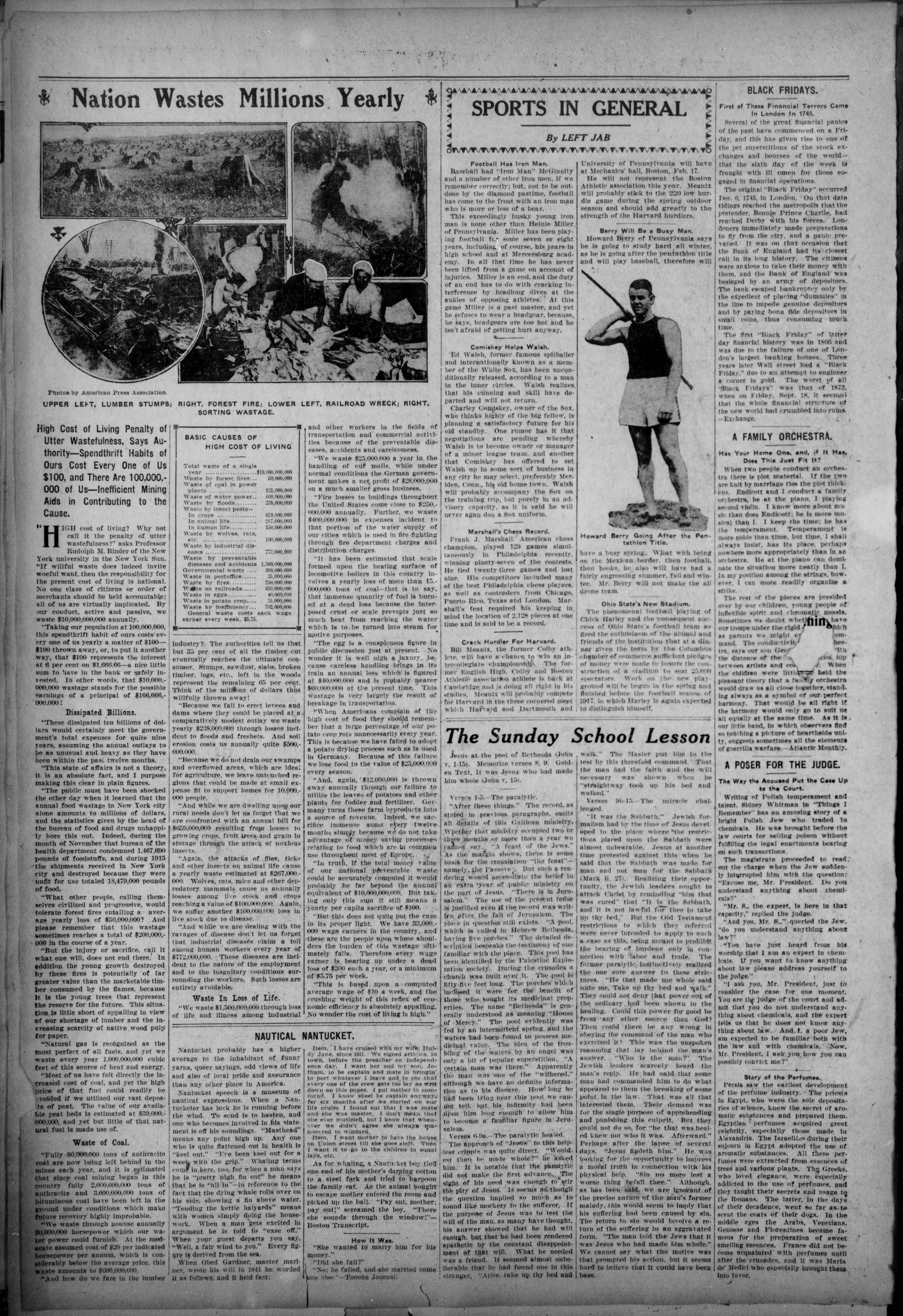
Nation Wastes Millions Yearly
♣
UPPER LEFT, LUMBER STUMPS; RIGHT, FOREST FIRE; LOWER LEFT, RAILROAD WRECK; RIGHT,
SORTING WASTAGE.
High Cost of Living Penalty of Utter Wastefulness, Says Authority—Spendthrift Habits of Ours Cost Every One of Us $100, and There Are 100,000,-000 of Us—Inefficient Mining Aids in Contributing to the Cause.
"HIGH cost of living? Why not call it the penalty of utter wastefulness?" asks Professor Rudolph M. Binder of the New York university in the New York Sun. "If willful waste does indeed invite woeful want, then the responsibility for the present cost of living is national. No one class of citizens or order of merchants should be held accountable; all of us are virtually implicated. By our conduct, active and passive, we waste $10,000,000,000 annually.
"Taking our population at 100,000,000, this spendthrift habit of ours costs every one of us yearly a matter of $100—$100 thrown away, or, to put it another way, that $100 represents the interest at 6 per cent on $1,666,66—a nice little sum to have in the bank or safely invested. In other words, that $10,000,000,000 wastage stands for the possible earnings of a principal of $166,666,000,000!
Dissipated Billions.
"These dissipated ten billions of dollars would certainly meet the government's total expenses for quite nine years, assuming the annual outlays to be as unusual and heavy as they have been within the past twelve months.
"This state of affairs is not a theory, it is an absolute fact, and I purpose making this clear in plain figures.
"The public must have been shocked the other day when it learned that the annual food wastage in New York city alone amounts to millions of dollars, and the statistics given by the head of the bureau of food and drugs unhappily bore this out. Indeed, during the month of November that bureau of the health department condemned 1,467,690 pounds of foodstuffs, and during 1915 the shipments received in New York city and destroyed because they were unfit for use totaled 18,479,000 pounds of food.
"What other people, calling themselves civilized and progressive, would tolerate forest fires entailing a average yearly loss of $50,000,000? And please remember that this wastage sometimes reaches a total of $200,000,000 in the course of a year.
"But the injury or sacrifice, call it what one will, does not end there. In addition the young growth destroyed by these fires is potentially of far greater value than the marketable timber consumed by the flames, because it is the young trees that represent the reserve for the future. This situation is little short of appalling in view of our shortage of lumber and the increasing scarcity of native wood pulp for paper.
"Natural gas is recognized as the most perfect of all fuels, and yet we waste every year 1,000,000,000 cubic feet of this source of heat and energy. "Most of us have felt directly the increased cost of coal, and yet the high price of that fuel could readily be avoided if we utilized our vast deposits of peat. The value of our available peat beds is estimated at $29,000,000,000, and yet little of that natural fuel is made use of.
Waste of Coal.
"Fully-80,000,000 tons of antiharce coal are now being left behind in the mines each year, and it is estimated that since coal mining began in this country fully 2,000,000,000 tons of anthracite and 3,000,000,000 tons of bituminous coal have been left in the ground under conditions which make future recovery highly improbable.
"We waste through nonuse annually $0,000,000 horsepower which our water power could furnish. At the moderate assumed cost of $20 per indicated horsepower per annum, which is considerably below the average price, this waste amounts to $200,000,000.
"And how do we fare in the lumber
Total waste of a single year ... $10,000,000,000
Waste by forest fires ... 50,000,000
Waste of coal in power plants ... 325,000,000
Waste of water power ... 600,000,000
Waste by floods ... 228,000,000
Waste by insect pests—
In crops ... 659,000,000
In animal life ... 267,000,000
In human life ... 150,000,000
Waste by wolves, rats, etc ... 100,000,000
Waste by industrial diseases ... 772,000,000
Waste by preventable diseases and accidents ... 1,500,000,000
Governmental waste ... 300,000,000
Waste in postoffice ... 55,000,000
Waste by fires ... 250,000,000
Waste on railroads ... 650,000,000
Waste in eggs ... 40,000,000
Waste in potato crop ... 15,000,000
Waste by inefficiency ... 700,000,000
General waste costs each wage earner every week, $5.75.
industry? The authorities tell us that but 35 per cent of all the timber cut eventually reaches the ultimate consumer. Stumps, sawdust, slabs, broken timber, logs, etc., left in the woods represent the remaining 65 per cent. Think of the millions of dollars this willfully thrown away!
"Because we fail to erect levees and dams where they could be placed at a comparatively modest outlay we waste yearly $238,000,000 through losses incident to floods and freshets. And soil erosion costs us annually quite $500,000,000.
"Because we do not drain our swamps and overflowed areas, which are ideal for agriculture, we leave untouched regions that could be made at small expense fit to support homes for 10,000,000 people.
"And while we are dwelling upon our rural needs don't let us forget that we are confronted with an annual bill for $653,000,000 resulting from losses to growing crops, fruit trees and grain in storage through the attack of noxious insects.
"Again, the attacks of files, ticks and other insects on animal life cause a yearly waste estimated at $267,000,000. Wolves, rats, mice and other depredatory mammals cause us annually losses among live stock and crops reaching a value of $100,000,000. Again, we suffer another $100,000,000 loss in live stock due to disease.
"And while we are dealing with the ravages of disease don't let us forget that industrial diseases claim a toll among human workers every year of $772,000,000. These diseases are incident to the nature of the employment and to the insanitary conditions surrounding the workers. Such losses are entirely avoidable.
Waste In Loss of Life.
"We waste $1,500,000,000 through loss of life and illness among industrial
NAUTICAL NANTUCKET.
Nantucket probably has a higher average to the inhabitant of funny yarns, queer sayings, odd views of life and also of local pride and assurance than any other place in America.
Nantucket speech is a museum of nautical expressions. When a Nantucket has luck he is running before the wind. To send is to hasten, and one who becomes involved in his statement is off his soundings. "Masthead" means any point high up. Any one who is quite flattened out in health is "keel out." "I've been keel out for a week with the grip." Whaling terms come in here, too, for when a man says he is "pretty nigh fin out" he means that he is "all in"—in reference to the fact that the dying whale rolls over on his side, showing a fin above water. "Tending the kettle halyards" means with women simply doing the housework. When a man gets excited in argument he is told to "ease off." When your guest departs you say, "Well, a fair wind to you." Every figure is derived from the sea.
When Obed Gardner, master marlin,
wrote his will in 1841 he worded
it as follows, and it held fast:
and other workers in the fields of transportation and commercial activities because of the preventable diseases, accidents and carelessness. "We waste $25,000,000 a year in the handling of our mails, while under normal conditions the German government makes a net profit of $28,000,000 on a much smaller gross business. "Fire losses to buildings throughout the United States come close to $250,000,000 annually. Further, we waste $400,000,000 in expenses incident to that portion of the water supply of our cities which is used in fire fighting through fire department charges and distribution charges.
"It has been estimated that scale formed upon the heating surface of locomotive boilers in this country involves a yearly loss of more than 15.000,000 tons of coal—that is to say, that immense quantity of fuel is burned at a dead loss because the interposed crust or scale prevents just so much heat from reaching the water which is to be turned into steam for motive purposes.
"The egg is a conspicuous figure in public discussion just at present. No wonder it is well nigh a luxury, because careless handling brings in its train an annual loss which is figured at $40,000,000 and is probably nearer $60,000,000 at the present time. This wastage is very largely the result of breakage in transportation.
"When Americans complain of the high cost of food they should remember that a large percentage of our potato crop rots unnecessarily every year. This is because we have failed to adopt a potato drying process such as is used in Germany. Because of this failure we lose food to the value of $25,000,000 every season.
"And, again, '$12,000,000 is thrown away annually through our failure to utilize the leaves of potatoes and other plants for fodder and fertilizer. Germany turns these farm byproducts into a source of revenue. Indeed, we sacrifice immense sums every twelve months simply because we do not take advantage of money saving processes relating to food which are in common use throughout most of Europe.
"In truth, if the total money value of our national preventable waste could be accurately computed it would probably be far beyond the annual equivalent of $10,000,000,000. But taking only this sum it still means a yearly per capita sacrifice of $100.
"But this does not quite put the case in its proper light. We have 33,000,000 wage earners in the country, and these are the people upon whose shoulders the burden of this wastage ultimately falls. Therefore every wage earner is bearing up under a dead loss of $300 each a year, or a minimum of $5.75 per week.
"This is based upon a computed average wage of $10 a week, and the crushing weight of this reflex of economic efficiency is absolutely appalling. No wonder the cost of living is high."
Item. I have cruised with my wife, Huldy Jane, since 1811. We signed articles, in town, before the preacher on Independence day. I want her and my son, Jotham, to be captain and mate in bringin' to port whatever I leave and to see that every one of the crew gets the lay as写 down on this paper. I put mother in command. I know she will be captain anyway, my life cruise we started on our life cruise I found out that I was mate and she was master. I don't mean that she ever mutinied, but I know that whenever we didn't agree she always manoovered to windward.
Item. I want mother to have the house on Union street till she goes hoff. Then I want it to go to the children in equal lays, etc.
As for whaling, a Nantucket boy tied one end of his mother's daring cotton to a steel fork and tried to harpoon the family cat. As the animal sought to escape mother entered the room and picked up the ball. "Pay out, mother; pay out!" screamed the boy. "There she sounds through the window!"—Boston Transcript.
"She wanted to marry him for his money."
"Did she fail?"
"No; he failed, and she married some one else." "Topeka Journal."
How It Was.
SPORTS IN GENERAL
By LEFT JAB
Football Has Iron Man.
Baseball had "Iron Man" McGinnity and a number of other iron men, if we remember correctly; but, not to be outdone by the diamond pastime, football has come to the front with an iron man who is more or less of a bear.
University of Pennsylvania will have at Mechanics' hall, Boston, Feb. 17.
He will not represent the Boston Athletic association this year. Meanix will probably stick to the 220 low hurdle game during the spring outdoor season and should add greatly to the
This exceedingly husky young iron man is none other than Heinie Miller of Pennsylvania. Miller has been playing football for some seven or eight years, including of course, his years in high school and at Mercersburg academy. In all that time he has never lifted from a game on account of injuries. Miller is an end, and the duty of an end has to do with cracking interference by headlong dives at the ankles of opposing athletes. At this game Miller is a past master, and yet he refuses to wear a headgear, because, he says, headgears are too hot and he isn't afraid of getting hurt anyway.
Ed Walsh, former famous spitballer and internationally known as a member of the White Sox, has been unconditionally released, according to a man in the inner circles. Walsh realizes that his cunning and skill have departed and will not return.
Charley Comiskey, owner of the Sox, who thinks highly of the big fellow, is planning a satisfactory future for his old standby. One rumor has it that negotiations are pending whereby Walsh is to become owner or manager of a minor league team, and another that Comiskey has offered to set Walsh up in some sort of business in any city he may select, preferably Meriden, Conn., his old home town. Walsh will probably accompany the Sox on the training trip, but purely in an advisory capacity, as it is said he will never again do a Sox uniform.
Frank J. Marshall. American chess champion, played 120 games simultaneously in Philadelphia recently, winning ninety-seven of the contests. He tied twenty-three games and lost nine. His competitors included many of the best Philadelphia chess players, as well as contenders from Chicago, Puerto Rico, Texas and London. Marshall's feat required his keeping in mind the location of 2.128 pieces at one time and is said to be a record.
Crack Hurdler For Harvard.
Bill Meanix, the former Colby athlete, will have a chance to win an intercollegiate championship. The former English High, Colby and Boston Athletic association athlete is back at Cambridge and is doing all right in his studies. Meanix will probably compete for Harvard in the three cornered meet which Harvard and Dartmouth and
The Sunday School Lesson
Jesus at the pool of Bethesda (John
v. 145). Memorize verses 8, 9. Golden
Text. It was Jesus who had made
him whole (John v. 15).
"After these things." The record, as stated in previous paragraphs, omits all details of this Galilean ministry. Whether that ministry occupied two or three months or more than a year we cannot say, "A feast of the Jews." As the margin shows, there is some basis for the translation "the feast"—namely, the Passover. But such a rendering would necessitate the belief in an extra year of public ministry on the part of Jesus, "There is in Jerusalem." The use of the present tense is justified even if the record was written after the fall of Jerusalem. The place in question still exists. "A pool which is called in Hebrew Bethesda, having five porches." The detailed description bespeaks the testimony of one familiar with the place. This pool has been identified by the Palestine Exploration society. During the crusades a church was built over it. The pool is fifty-five feet long. The porches which included it were for the benefit of those who sought its medicinal properties. The name "Bethesda" is generally understood as meaning "House of Mercy." The pool evidently was fed by an intermittent spring, and the waters had been found to possess medicinal value. The idea of the troubling of the waters by an angel was only a bit of popular superstition, "A certain man was there." Apparently the man was one of the "withered," although we have no definite information as to his disease. How long he had been lying near this pool we cannot tell, but his infirmity had been upon him long enough to allow him to become a familiar figure in Jerusalem.
Verses 6:03.—The paralytic healed.
The approach of "Jesus" to this helpless cripple was quite direct. "Would est thou be made whole?" he asked him. It is notable that the plumylistic did not make the first advance. The sight of his need was enough to stir the pity of Jesus. It seems as though the question implied so much as to sound like mockery to the sufferer. If the purpose of Jesus was to test the will of the man, as many have thought, his answer showed that he had will enough, but that he had been rendered apathetic by the constant disappointment of that will. What he needed was a friend. It seemed almost unbelievable that he had found one in this stranger, "Arise, take up thy bed and
Comiskey Helos Walsh
Marshall's Chess Record.
Verges 1.5 - The paralytic.
University of Pennsylvania will have
at Washington hall, Feb. 27.
at Mechanics' hall, Boston, Feb. 17.
He will not represent the Boston
Athletic association this year. Meanix
will probably stick to the 220 low hur-
dle game during the spring outdoor
season and should add greatly to the
strength of the Harvard hurdlers.
Berry Will Be a Busy Man.
Howard Berry of Pennsylvania says
he is going to study hard all winter,
as he is going after the pentathlon title
and will play baseball, therefore will
1
Howard Berry Going After the Pentathlon Title.
have a busy spring. What with being on the Mexican border, then football, then books, he also will have had a fairly engrossing summer, fall and winter. Mr. Berry will not make the all drone team.
Ohio State's New Stadium.
Ohio State's football stadium.
The phenomenal football playing of Chick Harley and the consequent success of Ohio State's football team so fired the enthusiasm of the alumni and friends of the institution that at a dinner given the team by the Columbus chamber of commerce sufficient pledges of money were made to insure the construction of a stadium to seat 23,000 spectators. Work on the new playground will be begin in the spring and finished before the football season of 1917, in which Harley is again expected to distinguish himself.
walk." The Master put him to the test by this threefold command. "That the man had the faith and the will necessary was shown when he "straightway took up his bed and walked." Verses 90-15. -The miracle challenged.
"It was the Sabbath." Jewish formalism had by the time of Jesus developed to the place where the restrictions placed upon the Sabbath were almost unbearable. Jesus at another time protested against this when he said that the Sabbath was made for man and not man for the Sabbath (Mark ii. 27). Realizing their opportunity, the Jewish leaders sought to attack Christ by reminding "him that was cured" that "It is the Sabbath, and it is not lawful for thee to take up thy bed." But the Old Testament restrictions to which they referred were never intended to apply to such a case as this, being meant to prohibit the bearing of burdens only in connection with labor and trade. The former paralytic instinctively realized the one sure answer to these strictures. "He that made me whole said unto me, Take up thy bed and walk." They could not deny that power out of the ordinary had been shown in the healing. Could this power for good be from any other source than God? Then could there be any wrong in obeying the command of the man who exercised it? This was the unspoken reasoning that lay behind the man's answer. "Who is the man?" The Jewish leaders scarcely heard the man's reply. He had said that some man had commanded him to do what appeared to them the breaking of some point in the law. That was all that interested them. Their demand was for the single purpose of apprehending and punishing this culprit. But they could not do so, for "he that was healed knew not who it was. Afterward." Perhaps after the lapse of several days, "Jesus fadeth him." He was looking for the opportunity to impress a moral truth in connection with his physical help. "Sin no more lest a worse thing befall thee." Although, as has been said, we are ignorant of the precise nature of the man's former malady, this would seem to imply that his suffering had been caused by sin. The return to sin would involve a return of the suffering in an aggravated form. "The man told the Jews that it was Jesus who had made him whole." We cannot say what the motive was that prompted his action, but it seems hard to believe that it could have been base.
BLACK FRIDAYS.
First of These Financial Terrors Came In London In 1745.
Several of the great financial panics of the past have commenced on a Friday, and this has given rise to one of the pet superstitions of the stock exchanges and bourses of the world—that the sixth day of the week is fraught with ill omen for those engaged in financial operations.
The original "Black Friday" occurred Dec. 16, 1745, in London. On that date tidings reached the metropolis that the pretender, Bonnie Prince Charlie, had reached Derby with his forces. Londoners immediately made preparations to fly from the city, and a panic prevailed. It was on that occasion that the Bank of England had its closest call in its long history. The citizens were anxious to take their money with them, and the Bank of England was besieged by an army of depositors. The bank escaped bankruptcy only by the expedient of placing "dummies" in the line to impede genuine depositors and by paying bona fide depositors in small coins, thus consuming much time.
The first "Black Friday" of latter day financial history was in 1866 and was due to the failure of one of London's largest banking houses. Three years later Wall street had a "Black Friday" due to an attempt to engineer a corner in gold. The worst of all "Black Fridays" was that of 1873, when on Friday, Sept. 18, it seemed that the whole financial structure of the new world had crumbled into ruins. —Exchange
A FAMILY ORCHESTRA.
Has Your Home One, and, if It Has,
Does This Just Fit It?
When two people conduct an orchestra there is plot material. If the two are knit by marriage ties the plot thickens. Endicott and I conduct a family orchestra, he at the piano, I playing second violin. I know more about music than does Endicott; he is more musical than I. I keep the time; he has the temperament. Temperament is more noble than time, but time, I shall always insist, has its place, perhaps nowhere more appropriately than in an orchestra. He at the piano can dominate the situation more neatly than I. In my position among the strings, however, I can more readily organize a strike.
The rest of the pieces are presided over by our children, young people of inflexible spirit and chromatic moods. Sometimes we doubt whether we have our troupe under the rigid which as parents we might enjoy command. The conductive orchestra, says our son Geoff, with the distance of the instrument hip between artists and conductor. When the children were little, we held the pleasant theory that a family orchestra would draw us all close together, standing always as a symbol of our perfect harmony. That would be all right if the harmony would only go to suit us all equally at the same time. As it is our little band, in which observers find so touching a picture of heartbreak unity, suggests sometimes all the elements of guerrilla warfare—Atlantic Monthly.
A POSER FOR THE JUDGE.
The Way the Accused Put the Case Up to the Court.
Writing of Polish temperament and talent. Sidney Whitman in "Things I Remember" has an amusing story of a bright Polish Jew who traded in chemicals. He was brought before the law courts for selling poison without fulfilling the legal enactments bearing on such transactions.
The magistrate proceeded to read out the charge when the Jew suddenly intergrupted him with the question: "Excuse me, Mr. President. Do you understand anything about chemicals?
"Mr. S., the expert, is here in that capacity," replied the judge.
"And you, Mr. S.," queried the Jew, "do you understand anything about law?"
"You have just heard from his worship that I am an expert in chemicals. If you want to know anything about law please address yourself to the judge."
"I ask you, Mr. President, just to consider the case for one moment. You are the judge of the court and admit that you do not understand anything about chemicals, and the expert tells us that he does not know anything about law. And, f. a poor Jew, am expected to be familiar both with the law and with chemicals. Now, Mr. President, I ask you how you can possibly convict me?"
Story of the Perfumes
Persia saw the earliest development of the perfume industry. The priests in Egypt, who were the sole depositories of science, knew the secret of aromatic substances and prepared them. Egyptian perfumes acquired great celebrity, especially those made in Alexandria. The Israelites during their sojourn in Egypt adopted the use of aromatic substances. All these perfumes were extracted from essences of trees and various plants. The Greeks, who loved elegance, were especially addicted to the use of perfumes, and they taught their secrets and usage to the Romans. The latter, in the days of their decadence, went so far as to scent the coats of their dogs. In the middle ages the Arabs, Venetians, Genoese and Florentines became famous for the preparation of sweet smelling essences. France did not become acquainted with perfumes until after the crusades, and it was Maria de Medici who especially brought them into favor.
WOMEN'S FASHIONS and THE HOME
THE FASHION OF THE TWENTIETH CENTURY
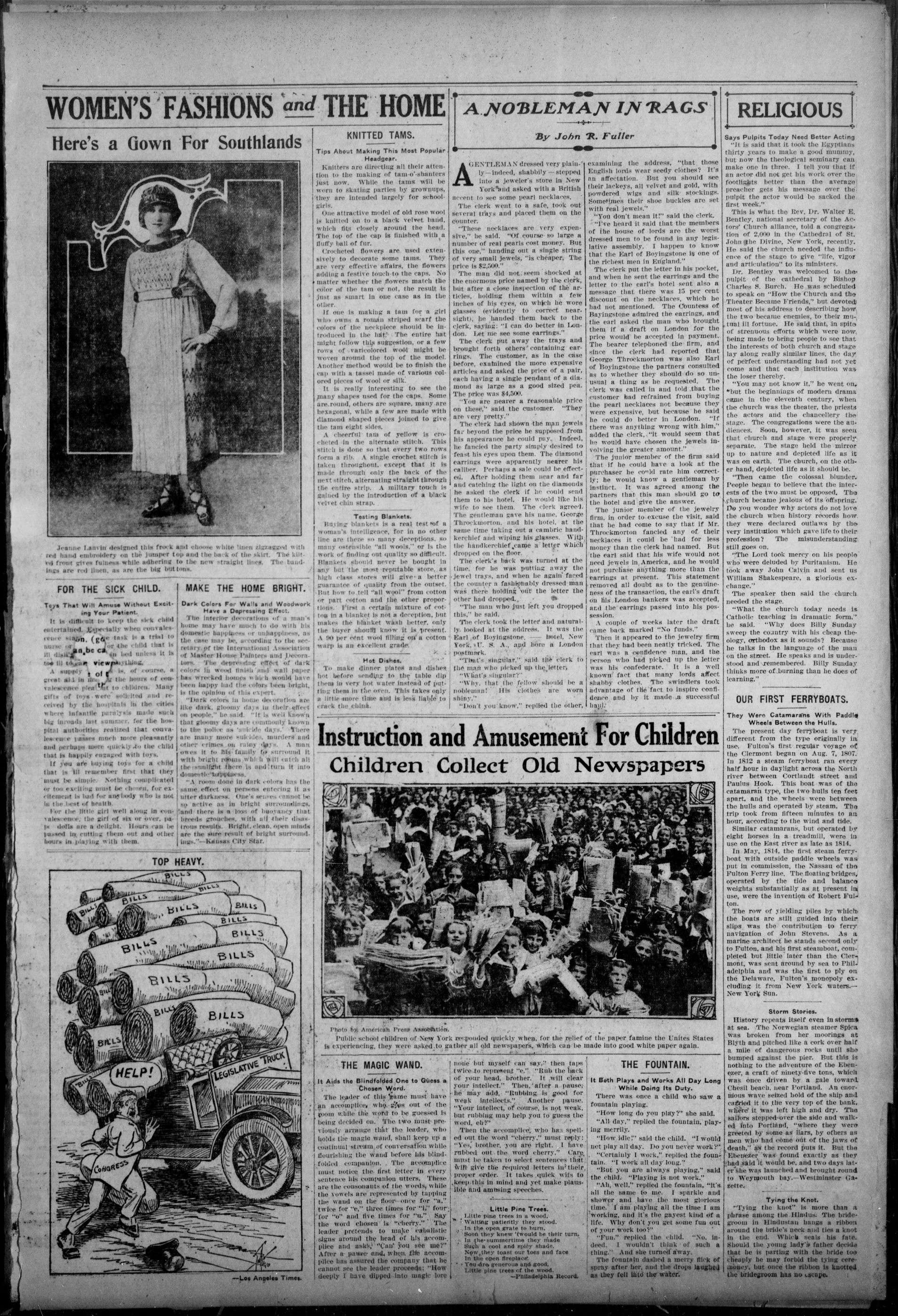
Jeanne Lauvin designed this frock and choose white linen zigzagged with red hand embroidery on the jumper top and the back of the skirt. The kilted front gives fulness while adhering to the new straight lines. The bandings are red linen, as are the big buttons.
TOP HEAVY.
BILLS
BILLS
BILLS
BILLS
BILLS
BILLS
BILLS
BILLS
HELP!
LEGISLATIVE TRUCK
CONGRESS
FOR THE SICK CHILD.
Toys That Will Amuse Without Exciting Your Patient.
It is difficult to keep the sick child entertained. Especially when convalescence stims. (goe task is a trial to nurse or an be ca or the child that is ill dislikes an bed unless it is too ill to care view anything.
A supply of toys is, of course, a great aid in me, for the hours of convalescence pleasent but to children. Many gifts of toys were solicited and received by the hospitals in the cities where infantile paralysis made such big inroads last summer, for the hospital authorities realized that convalescence passes much more pleasantly and perhaps more quickly to the child that is happily engaged with toys.
If you are buying toys for a child that is ill remember first that they must be simple. Nothing complicated or too exciting must be chosen, for excitement is bad for anybody who is not in the best of health. For the little girl well along in convalescence, the girl of six or over, papa dolls are a delight. Hours can be passed in cutting them out and other hours in playing with them.
MAKE THE HOME BRIGHT.
Dark Colors For Walls and Woodwork
Have a Depressing Effect.
The interior decorations of a man's home may have much to do with his domestic happiness or unhappiness, as the case may be, according to the secretary of the International Association of Master House Painters and Decorators. The depressing effect of dark colors in wood finish and wall paper has wrecked homes which would have been happy had the colors been bright, is the opinion of this expert.
"Dark colors in wood decoration are like dark, gloomy days in their effect on people," he said. "It is well known that gloomy days are commonly known to the police as 'suicide days.' There are many more suicides, murders and other crimes on rainy days. A man owes it to his family to surround it with bright rooms which will catch all the sunlight there is and turn it into domestic happiness.
"A room done in dark colors has the same effect on persons entering it as utter darkness. One's senses cannot be so active as in bright surroundings, and there is a loss of buoyancy that breeds grouches, with all their disastrous results. Bright, clean, open minds are the sure result of bright surroundings."-Kansas City Star.
HEAVY.
BILLS
LEGISLATIVE TRUCK
--Los Angeles Times.
Instruction and Amusement For Children Children Collect Old Newspapers
THE NEW YORK TIMES
Public school children of New York responded quickly when, for the relief of the paper famine the United States is experiencing, they were asked to gather all old newspapers, which can be made into good white paper again.
KNITTED TAMS.
Tips About Making This Most Popular Headgear.
Knitters are directing all their attention to the making of tam-o's shanters just now. While the tams will be worn to skating parties by grownups, they are intended largely for school-girls.
One attractive model of old rose wool is knitted on to a black velvet band, which fits closely around the head. The top of the cap is finished with a fluffy ball of fur.
Crocheted flowers are used extensively to decorate some tams. They are very effective affairs, the flowers adding a festive touch-to the caps. No matter whether the flowers match the color of the tam or not, the result is just as smart in one case as in the other.
If one is making a tam for a girl who owns a roman striped scarf the colors of the neckpiece should be introduced in the hat. The entire hat might follow this suggestion, or a few rows of varicolored wool might be woven around the top of the model. Another method would be to finish the cap with a tassel made of various colored pieces of wool or silk.
It is really interesting to see the many shapes used for the caps. Some are round, others are square, many are hexagonal, while a few are made with diamond shaped pieces joined to give the tam eight sides.
A cheerful tam of yellow is crocheted in the alternate stitch. This stitch is done so that every two rows form a rib. A single crochet stitch is taken throughout, except that it is made through only the back of the next stitch, alternating straight through the entire strip. A military touch is gained by the introduction of a black velvet chin strap.
Testing Blankets.
Buying blankets is a real test of a woman's intelligence, for in no other line are there so many deceptions, so many ostensible "all wools," or is the work of finding out quality so difficult. Blankets should never be bought in any but the most reputable store, as high class stores will give a better guarantee of quality from the outset. But how to tell "all wool" from cotton or part cotton and the other proportions. First a certain mixture of cotton in a blanket is not a deception, but makes the blanket wash better, only the buyer should know it is present. A 90 per cent wool filling on a cotton warp is an excellent grade.
Hot Dishes.
To make dinner plates and dishes hot before sending to the table dip them in very hot water instead of putting them in the oven. This takes only a little more time and is less liable to crack the china.
Instruction and
Children
Photo by American Press Association
Public school children of New York is experiencing, they were asked to
THE MAGIC WAND.
It Aids the Blindfolded One to Guess a
Chosen Word.
The leader of this game must have an accomplice, who goes out of the room while the word to be guessed is being decided on. The two must previously arrange that the leader, who holds the magic wand, shall keep up a continual stream of conversation while flourishing the wand before his blind-folded companion. The accomplice must notice the first letter in every sentence his companion utters. These are the consonants of the words, while the vowels are represented by tapping the wand on the floor-once for "a," twice for "e," three times for "i," four for "o" and five times for "u." Say the word chosen is "cherry." The leader pretends to make caballistic signs around the head of his accomplice and asks, "Can you see me?" After a pause and, when the accomplice has assured the company that he cannot see the leader proceeds; "How deeply I have dived into magic lore
A NOBLEMAN IN RAGS
GENTLEMAN dressed very plainly—indeed, shabbily—stepped into a jeweler's store in New York and asked with a British accent to see some pearl necklaces. The clerk went to a safe, took out several trays and placed them on the counter. "These necklaces are very expensive," he said. "Of course so large a number of real pearls cost money. But this one," handing out a single string of very small jewels, "is cheaper. The price is $2,500." The man did not seem shocked at the enormous price named by the clerk, but after a close inspection of the articles, holding them within a few inches of his eyes, on which he wore glasses (evidently to correct near-sight), he handed them back to the clerk, saying: "I can do better in London. Let me see some earrings."
The clerk put away the trays and brought forth others' containing carrings. The customer, as in the case before, examined the more expensive articles and asked the price of a pair, each having a single pendant of a diamond as large as a good sized pea. The price was $4,500. "You are nearer a reasonable price on these," said the customer. "They are very pretty."
The clerk had shown the man jewels far beyond the price he supposed from his appearance he could pay. Indeed, he fancied the party simply desired to feast his eyes upon them. The diamond earrings were apparently nearer his caliber. Perhaps a sale could be effected. After holding them near and far and catching the light on the diamonds he asked the clerk if he could send them to his hotel. He would like his wife to see them. The clerk agreed. The gentleman gave his name, George Throckmorton, and his hotel, at the same time taking out a cambric handkerchief and wiping his glasses. With the handkerchief came a letter which dropped on the floor.
The clerk's back was turned at the time, for he was putting away the jewel trays, and when he again faced the counter a fashionably dressed man was there holding out the letter the other had dropped.
"The man who just left you dropped this," he said.
"The clerk took the letter and naturally looked at the address. It was the Earl of Boyingtonstone. — hotel, New York, U. S. A., and bore a London postmark.
"That's singular," said the clerk to the man who picked up the letter, "What's singular?"
"Why, that the fellow should be a nobleman!" His clothes are worn shiny.
"Don't you know," replied the other.
and Amusement
collect Old N
none but myself can say," then taps twice to represent "e." "Rub the back of your head, brother. It will clear your intellect." Then, after a pause, he may add, "Rubbing is good for weak intellects." Another pause. "Your intellect, of course, is not weak, but rubbing may help you to guess the word, eh?" Then the accomplice, who has spelled out the word "cherry," must reply: "Yes, brother, you are right. I have rubbed out the word cherry." Care must be taken to select sentences that will give the required letters in their proper order. It takes quick wits to keep this in mind and yet make plausible and amusing speeches.
Little Pine Trees.
Little pine trees in a wood.
Waiting patiently they stood.
In the open grate to burn.
Soon they knew 'twould be their turn.
In the summertime they made
Such a cool and spicy shade.
New, they toast our toes and face
In the open fireplace.
You do generous and good.
Little pine trees of the wood.
Philadelphia Record.
examining the address, "that those English lords wear seedy clothes? It's an affection. But you should see their lackeys, all velvet and gold, with powdered wigs and silk stockings. Sometimes their shoe buckles are set with real jewels."
"You don't mean it!" said the clerk, "I've heard it said that the members of the house of lords are the worst dressed men to be found in any legislative assembly. I happen to know that the Earl of Boyingstone is one of the richest men in England."
The clerk put the letter in his pocket, and when he sent the earrings and the letter to the carl's hotel sent also a message that there was 15 per cent discount on the necklaces, which he had not mentioned. The Countess of Bayingstone admired the earrings, and the earl asked the man who brought them if a draft on London for the price would be accepted in payment. The bearer telephoned the firm, and since the clerk had reported that George Throckmorton was also Earl of Boyingstone the partners consulted as to whether they should do so unusual a thing as he requested. The clerk was called in and told that the customer had refrained from buying the pearl necklaces not because they were expensive, but because he said he could do better in London. "If there was anything wrong with him," added the clerk, "it would seem that he would have chosen the jewels involving the greater amount."
The junior member of the firm said that if he could have a look at the purchaser he could rate him correctly; he would know a gentleman by instinct. It was agreed among the partners that this man should go to the hotel and give the answer.
The junior member of the jewelry firm, in order to excuse the visit, said that he had come to say that if Mr. Throckmorton fancied any of their necklaces it could be had for less money than the clerk had named. But the earl said that his wife would not need jewels in America, and he would not purchase anything more than the earrings at present. This statement removed all doubt as to the genuineness of the transaction, the earl's draft on his London bankers was accepted, and the earrings passed into his possession.
A couple of weeks later the draft came back marked "No funds."
Then it appeared to the jewelry firm that they had been neatly tricked. The earl was a confidence man, and the person who had picked up the letter was his confederate. It is a well known fact that many lords affect shabby clothes. The swindlers took advantage of the fact to inspire confidence and by it made a successful haul.
For Children
Newspapers
of the paper famine the Unites States
made into good white paper again.
THE FOUNTAIN.
It Both Plays and Works All Day Long While Doing Its Duty.
There was once a child who saw a fountain playing.
"How long do you play?" she said.
"All day," replied the fountain, playing merrily.
"How idie!" said the child. "I would not play all day. Do you never work?"
"Certainly I work," replied the fountain. "I work all day long."
"But you are always playing," said the child. "Playing is not work."
"Ah, well." replied the fountain, "it's all the same to me. I sparkle and shower and have the most glorious time. I am playing all the time I am working, and it's the gayest kind of a life. Why don't you get some fun out of your work too?"
"Fun," replied the child. "No, indeed. I wouldn't think of such a thing." And she turned away.
The fountain dashed a merry flick of spray after her, and the drops laughed as they fell into the water.
Says Pulpits Today Need Better Acting
"It is said that it took the Egyptians thirty years to make a good mummy, but now the theological seminary can make one in three. I tell you that if an actor did not get his work over the footlights better than the average preacher gets his message over the pulpit the actor would be sacked the first week."
This is what the Rev, Dr. Walter E. Bentley, national secretary of the Actors' Church alliance, told a congregation of 2,000 in the Cathedral of St. John the Divine, New York, recently. He said the church needed the influence of the stage to give "life, vigor and articulation" to its ministers.
Dr. Bentley was welcomed to the pulpit of the cathedral by Bishop Charles S. Burch. He was scheduled to speak on "How the Church and the Theater Became Friends," but devoted most of his address to describing how the two became enemies, to their mutual ill fortune. He said that, in spite of strenuous efforts which were now, being made to bring people to see that the interests of both church and stage lay along really similar lines, the day of perfect understanding had not yet come and that each institution was the loser thereby.
"You may not know it," he went on, "but the beginnings of modern drama came in the eleventh century, when the church was the theater, the priests the actors and the chancellery the stage. The congregations were the audiences. Soon, however, it was seen that church and stage were properly separate. The stage held the mirror up to nature and depicted life as it was on earth. The church, on the other hand, depicted life as it should be.
"Then came the colossal blunder. People began to believe that the interests of the two must be opposed. The church became jealous of its offspring. Do you wonder why actors do not love the church when history records how they were declared outlaws by the very institution which gave life to their profession? The misunderstanding still goes on.
"The Lord took mercy on his people who were deluded by Puritanism. He took away John Calvin and sent us William Shakespeare, a glorious exchange."
The speaker then said the church needed the stage.
"What the church today needs is Catholic teaching in dramatic form," he said. "Why does Billy Sunday sweep the country with his cheap theology, orthodox as it sounds? Because he talks in the language of the man on the street. He speaks and is understood and remembered. Billy Sunday thinks more of burning than he does of learning."
OUR FIRST FERRYBOATS.
They Were Catamarans With Paddle Wheels Between the Hulls.
The present day ferryboat is very different from the type originally in use. Fulton's first regular voyage of the Clermont began on Aug. 7, 1807. In 1812 a steam ferryboat ran every half hour in daylight across the North river between Cortlandt street and Paulus Hook. This boat was of the catamaran type, the two hulls ten feet apart, and the wheels were between the hulls and operated by steam. The trip took from fifteen minutes to an hour, according to the wind and tide.
Similar catamarans, but operated by eight horses in a treadmill, were in use on the East river as late as 1814. In May, 1814, the first steam ferryboat with outside paddle wheels was put in commission, the Nassau of the Fulton Ferry line. The floating bridges, operated by the tide and balance weights substantially as at present in use, were the invention of Robert Fulton.
The row of yielding piles by which the boats are still guided into their slips was the contribution to ferry navigation of John Stevens. As a marine architect he stands second only to Fulton, and his first steamboat, completed but little later than the Clermont, was sent around by sea to Philadelphia and was the first to ply on the Delaware, Fulton's monopoly excluding it from New York waters.—New York Sun.
Storm Stories.
History repeats itself even in storms at sea. The Norwegian steamer Spica was broken from her moorings at Blyth and pitched like a cork over half a mile of dangerous rocks until she bumped against the pier. But this is nothing to the adventure of the Ebenezer, a craft of ninety-five tons, which was once driven by a gale toward Chesil beach, near Portland. An enormous wave seized hold of the ship and carried it to the very top of the bank, where it was left high and dry. The sailors stepped over the side and walked into Portland, "where they were greeted by some as liars, by others as men who had come out of the jaws of death," as the record puts it. But the Ebenezer was found exactly as they had said it would be, and two days later she was launched and brought round to Weymouth bay.—Westminster Gazette.
Tying the Knot.
"Tying the knot" is more than a phrase among the Hindus. The bridegroom in Hindustan hangs a ribbon around the bride's neck and ties a knot in the end. Which seals his fate. Should the young lady's father decide that he is parting with the bride too cheaply he may forbid the tying ceremony, but once the ribbon is knotted the bridegroom has no escape.
SPE they at rrr a
' 7 F i 3 5 2 call
Iitetropotts Gazette
PUBLISHED ON FR‘TAY BY
THE GAZETTE PRINTING CO.
qmtmeyolis, - -©- - + WL
Us. M. J. MOCRARY, MANAGER.
J.B. MoOnany, Eprrox
Be he na
FRIDAY FEB. 23, 1917.
——<—$<—— ——
@iice gth and Pearl Streets, Me-
ropolis, Illinois. ®
Snvorered as second-class mail mat-
7, % Mutropolis, Minole, Postofiice.
——$—$— $$
<-Addreme aii communications to J. B.Mo-
RAY, ox 107 Metropol, Titinole,
—<—<—<—$—$—
‘The names and addresses of contrib-
tors must be known to us in evey in-
Aanoe, in orser to secure publication.
We want the news of your vicinity
aon week,
TERMS OF SUBSCRIPTION:
Que Lene. cececceecee cere OO
Phree Months... 00. 6.6 eee A
Bingio Oopy.......eeeee ee vee veers e 8
wer In Advance.
ADVERTISING RATES.
made known on application.
SG You must mail copy on
Mondays to secure publication.
re
ANNOUNCEMETS
We are autho ixed to announce the
name of T. F. McCartney, asa candi
date for re-election to the office of
Mayor of the City of {Metropolis, at
the City election in April.
We are authorized to announce the
name of Judge W. F. Smith as a can-
diate for City3Judge, subject to the
decision of the voters at the April e.
lection.
We are cuthorized{to snnounce the
namejof Ro.la Finney, as a eandidate
for Clerk of the City of Ne:ropolis,
subject to the will of the voters at the
April elect 01,
Read-r if ablue or red mark
appears on the head of your pa-
pre marked with an [X] itis te
notily you that you owe for the
‘paper and are notiged Ito pay up,
“° Fred R. Young, Solicitor.
Master ia Chancery Sale.
State of Ilinois, Massac County, ss
in the Cireuit Court of said County,
Jenuary Te-m A. D. 1917.
Elizabeth Wymer Vs. C. H, Dunn,
and Ella Dunn. Bill to foreclose mort
gage No, 340,
Public notice is hereby given that i
pursuance of a decree entered at th
January Term of said court, to wit, or
the lithday of January A. D, 191
in the above entitled cause, I, 8. Bart
lett Kerr, Master in Chancery of sai
County, will at the hour of 10 o'clock
A.M. Saturday February 10th A. D.
1917 at the east door of the Court Hous
inthe City of Metropolis, County o
Massac, and State of Illinis, sell a
public vendue to the highest and bes!
bidder, the folloving cescribe! rea
etate to-wit!
Lots Three (3) and Four (4) in Block
Seven (7) in the Fostlewaite and Mor
ton Addition to the village of Broo!
jyn, now the City of Brookport, ir
Massac County, State of Iilinois,
Terms of sale, Cash in hand.
Dated this 11th day of January A
D. 1917.
S. Bartietr Kerr,
Master in Chancery.
Geo. H. Crippins
The Blacksmith
W. 7th Street, between Market
and Pearl S-reéts; Metropoiis,
Naif
Bee Bing
gare.
eye ‘
({ aaa |
5 ee ee na
Horse Shoeing and Rubber Tire-
ing a Specialty
General Repair Work
Give me atrial, All werk Guar-
pacegd.
eisiaiiunan sure of p minute,
oa
$100 Reward, $160.
The readers of this paper will be
pleased to learn that there is at lesst
one dreaded disease that safence has
beow able to cure in all ita stages, and
that is catarrh. “Hall's catarah cure
is the oely postive cure now now known
to the medical fraternity. catarrh he-
ing’a constitutional disease, requires
ronstitutional treatment. Hall's Oa-
tarrh is taken internally, acting direct-
ly upon the blood and mucous surfaces
of the system, thereby destsoying the
foundation of the disease, and giving
the patient strength by building up the
constitution and assisting nature in do-
ing ite work. ‘The proprietors have ve
much faith in its curative powers that
they offer One Hundred Dollars for
any case that it fails to cure. send for
‘ist of testimonials. 2
| «Address F. J. CHENEY & CO,, Tole-
do, 0.
Sold by all Druggiats, 75e.
Take Hall's Family Pille for consti.
pation,
Prof. A. P Smith, has been
confined to his room.
Mrs. Lurania Blakemore, is
still on the sick list
Mingo Long, has been confired
to his ved several days with the
“Gripe.”
Our subscribers who owe us
would certainly bestow a favor om
us by sending in your subscript-
jon atonce. Some have been re-
mitting. Let all do s@ please, we
need the money to continue the
paper,
Mrs Mary Robinson has been
copfined to her bed, but is much
improved.
{{Coal Oil ioc gallon at,Grand
‘Leader, oth and Pearl.
The Starks Printing Compaay
have begun the publication of a
daily paper, (The News) etffs
they are supplying’a ‘long fel
want by the merchants and read-
ing public. It “is an evening
paper and is quite newsy. From
the appearance it has the hand
of a master mechanic behind it.
We wish them much success ip
their enterprise.
Bennie Harmon and Miss Beat-
rice Stephens were married bere
Jast week. She “* of Paducah
and heof Memphis Tenn. ‘The
Garette wishes them success.
Rev, Paul Jones and Miss
Eddie Willingham were married
at the home of the groom of the
groom last Saturday night by
Kev J.B. McCrary. We wish
them success, | ‘
Rev. C. W. Norment, pastor
of Rock Hill Baptist church,
Carbondale, in company of Rev.
J. W. Davie of this city paid
this office a pleasant call_Tues-
day ’ i
The Silver Leaf ‘Civb of the
Yst Baptist church, will give an
entertainment at Grand Leader
Cafe, Cor, oth and Pear! Streets,
Saturday night. All are invited
to be present
The Silver Leaf Club, will give
a play at Unity Baptist church,
Brookport Saturday night, Feb.
28, Admission 15¢.
Mesdames Mattie Fossie, Jen-
nie Woods. Odie Buchanan, and
George and Edgar McCrary were
Brookport. visitors Supday’ aad
worshipped at Unity Baptist
church. - ag:
Edgar McCrary , came’ home
sick Tuesday «from © Brookport
where he is teaching aed wants
to be able to return soom, ~
Albert Hedgepeth of Union-
was down Sunday attending
Cowt @ é
Tne Free Baptist Quarterly
Meetiug and S. S. Conventign.is
in session bere this week at Free
Baptist Church, Rev. Wm. .Bar-
nett is pastor. .
‘M:sJames Mary Blackwell end
Maggie Restro are om the sick
lit.
Samuel Upshaw was a Padu-
cab visi ors last week.
Tax Purchaser's Not‘ce,
Metropolis; lil., Feb. 2ist 1917.
To Henay Neftzger, Virginia ‘Neftz-
8°", Heirs, and unknown owners, You
are hereby notified, that at a sale of
Renl ‘Estate made by the Sheriff of
Massac County, Ill., at the East door
of the Court House, in the City of Me-
tropotis, County bf Mossac, and State
of Illinois on the 14th day of June 1916
William Wright, purchased the follow.
tne described Real Estate, situated ir
the said County, for the Taxes, Inter.
‘est,’ Penalties and Costsdue and un:
paid thereon, for the year, A. D., 1914
Undivided one fourth of the N. E.
Fourth of Seetion Thirty Three (83),
Township 16, Range 6, East Srd P. M.
Maseac County, Illinois, Asseseéd in
the name of Henry Neftsger,
‘And that the time allowed by law for
thg redemtion of said Real Estate wil
expire on the 14th day of June A.D.
1917,
8. B.[Kerr,
Assignee of Purehaser,
« Tex Parchaser’s Notice
Metropolis Ill. Februgry 21, 1917
To Rebecce Landrum, her heire fur:
eae ‘owners or parties interested.
You are hereby notified, That ats
‘sale of Real Estate made by the Sher:
te of Masase - County, IU, et th
East door of the Court House, in. the
City of Metropolis, County ot Maseac,
‘and State of Illinois on the 14th day of
June A. D. 1916S. B, Kerr purchased
the following described Real Estate
situated in the said County, for tha
Taxes, Interest, Penalties jand Coste
due and unpaid thereon, for thé yeas
A. D. 1914 to-wit:
Lot 6, Block §8, of the City of Me
tropolis, Massac County, “Illinois, as
sessed in the name of Rebecca Land
rum. ‘
And that the time allowed by the law
for the redemption of said Real Estate
will expige on the 14thday of June
A.D. 1917. +
$8. B, Kean, °*+
Purchaser.
- Tax Purchaser's Netice.
‘To B. Friederman, Fred Nelsen, un-
Imown owners, and parties interested
if any. :
| ‘You Are Hereby Notified, That ata
sale of Rexl Estate made by the Sher-
iff Massae Co. Il, at the East door of
the Court House, in the City tf Me-
tropolis, County of Massac, and State
of Illinois‘on the 14th day of June A.
D. 1915 purchased the following de-
scribed Real Estate, situated in the
said County, for the Taxes, interest,
Penalties and eoste due’ and: unpaid
thereon, for the year, A. D.- 1914 to-
wit:
Lot 6 Block 56, of the City of Metrop-
olis, Massac Co.,' Ill, assessed to Fred.
Nelson. ’
dnd that,the time allowed by law
tor the redemption of said Real Es-
tate!will expire onthe 14th day of
June A.D. INT, 4. rom
8B. Kear, Agsignee, of pure haser
aa Ree 0
Tax Perchaser’s Notice.
Metropolis, Ill., Feb. 2iet 1911
To J. B. Bartee, unknowu owners,
heirs, and others in You are
hereby notified, ee of Res
Eatate madq-by. the Sheriff of Massac
County, Ill,, at the East. door of the
Court House, in the City of Metropolis,
County of Massac, and State of Illinois
on tho ldth dey of June A. D. 1916,
William Wright purchased the follow.
ing described Real Estate, situated in
the’ said County-for the Téxes, Inter-
ext, Penalties . and Costs due and un-
paid thereon, for the year A. D, 1914
to-wit: . i dcae
941200 » tet in Hatfleld’s Addition to
Pope’s Addition to Joppa, Il. in Block
15, asseased te J. B. Biftes.
‘And that the time allowed by law for
the redemption of said Real Estate wil
expire on the Adth day of June A. D,
1917, hee 3
+8. B. (Kuan,
‘Assignee of Purchaser.
The Gazette Office has bees
supplied: with’ & new. Klestric
Motor, aed we have a. twe borse
power gasolime engine for sale.
Any one in ‘need of s geod en-
gine it will pay youto call’ end
see the Gazette Manager. 901
Cor, oth & Pearl Stem |
» In this issue of the Gazette
willbe fowud the announcement
of Rolla Finsey asa cantidase
for re-election to the office o|
City Clerk for the city of Metre-
polis’ Mr. Finaey has seryed
in office four. years and has giv-
en verféct “satistaction, He it
sober and ing aad we
‘onc it more courteous thag he,
‘and he is oof likely to heve ‘any
opposition f The voters sill no
make any, ke by ra-electing
him tor J amother term oe
W. L. KRONE, Attorney:
Compleinant’s Solicitor. -
Netice of Publication, in Chancery
STATE OF ILLINOIS Massac County
as.
In thé Cireult Court, April’ Term, A.
D. 1917, "
Blanche Blakemore, vs Charles Blake:
ymore.
~ Bill Ld CHANCERY for Divorce.
Affidavit of now-residence of Charles
‘Blakemore the above defendant hav-
ing been fled in the Clerk's office of
the Cirewit Court of said County,
notice is therefore hereby given to the
‘above non-resident defendant that the
‘complainant filed her bill of complaint
in said Court, on the Chancery side
‘thereof, on the Sth day of February
1917 and that thereupon s Summons
‘issued out of said Court, wherein said
‘suit is uow'pending returnable on the
secon: M.nday in the month of April
A. D, 1917 as is by lawrequired, Now
unless you, the said non-resident de-
fendant above named Charlee Blake-
‘more, shall personally appear before
said Court, on the first day of the next
term thereof to be holden at Metropo-
‘lis in and for the said County, on the
Second Monday of April A, D. 1917
and plead, answer or demur to the
said complainant's bill of complaint,
the same and the matters and things
therein charged and stated will be
taken as confessed, and s decree en-
tered against you secording to the
prayerof said bill.
; Conpax Momais Clerk.
‘Metropolis Iitinois, Februsty 8th 1917.
W. L. KRONE, ‘Attorney
Complainant's Solicitor
NOTICE OF PUBLICATION
CHANCERY
STATE OF ILLINOIS Maseae County.
ss.
In The Cireuit Court, April Term,
A. D. 1917.
Daisy Brady vaC, P. Brady.
Bill IN CHANCERY for Divoree.
| AMidavit of -non-residence of C. P.
Brady, the above defendant baving
‘been Gilad in the Clerk's. office of the
Cireuit Court of said: County, notice is
therefore hereby giyen..to the snid
non-resident defendant that the com.
plainant filed her bill of complaint is
said Court, om the Chancery side there.
of, on the 8th day of February 1917
‘and that thereupon a Summons issued
‘out of said Court, wherein snid suit is
now pending returnable on the Second
Monday in the month ef April A. D.
1917. ns it is by law prequired. Now,
unless you, the said non-resident de-
fendant above namediC,,P, Brady shall
personally be und appear before said
Cireuit Court, on the firet dey of the
next term therecf,)to beholden at
‘Metropolis, in and for the said County,
on the Second Monday ef April A. D.
1917, and plead, answer or demur to
the said corsplainans,e bill’ of eom-
plaint, the samevand the matters and
things therein chargad‘and stated will
be taken s confessed, and a decree
entered against you wccording to the
prayer of eaid bill.
Courax Mosnis, Clerk.
Mitropelis, Dlincis, February Sth 1917.
NEWHOME
oY Tl,
. I
WO at
ty wi
ye
=
Bae
Yoyey
SS Merarnat a oun
Spumeress
eee Se
"wc ac ow oi wii ane a
Native Salve.
We have just recived come
more of Native Salve and itis
going very (ast, those: ia Carbon.
and Md. City con’ secures box
Gr more sow by Soc, per bom.
Act quiek if you want it. Send
afl orders to Rev, ), B. MeCracy,
The Grand leader
Cafe
Opened its doors to friends
and well wishers Saturday
Night, Dec. 30, 1916
No. 900 Gor. Ninth and Pearl Sts.
For a Nice Clean Cafe, where you will
meet your friends and receive careful and
courteous attention, come to the
Grand Leader Cafe
In connectioa, with our cafe, we will con-
duct a Sc and 10c variety bargain counter
Our Motto: The best is not too good for any of out
customers.
Hot and Cold Lunches Served
Hot cat fish, “Kentucky Oysters” Saturda;
night. You cata get soup, stew, pork chops
ham and eggs, tripe, pig feet, etc., in fac
we can serve you on short order. Give 1
a trial is all that we ask. Everything i
sanitary condition. writin
Watch this space each i. }
For, one and all, a successful Né:*: dear.
| Remember the Place.
; J.B. MoGRARY, Mgr,
Subscribe for The Gaz
ge, HAIR
rt meetin
==
# fy teas =
Meee Serco
y Sri
f pepttEs
7 SSG SE ee
perefoia
fa wise
Don’t tet sume fake Kink Remover foot
Galtingt ine ence
EXELENTO guns
ene feeds the Roots
Soe |
Rateencuecuearra fl
Belted if Kasiontatar' oes fi
Bitraniassenttvore cc fl
AGENTS WANTED EVERYWHERE,
Sm peresmee
MOLL ETE SO OE OO. Ratan, Oe '
The Churches. B, Y, P. U's
3. S$. and W. E. M. Societies are
requested to send Soc each to the
Executive Board which meets in
Centralia, Wl, Mar.14, 1917
by letter or messenger to assis
Rev. J. N. Washington in schoo!
at Nashville, Tena, Don’t for:
get to specify for what a,
This is aside from the amount
churches are required to send up
ter missionary, and expenses o
Board. Please do aot fa.
Rev. J. B. McCrary,
Moderator
Rev. J. H. Starke,
Corresponding Sec'y.
Administrator's Notice
Estate of Malissa Gaines, ees
The undersigned, having been
ed Administrator of the Estate
Gaines late of the County of
tie State of Illinois. decemsed.
gives notice that he will appear b
the County Court of Magsse €
at the Court House in Metropol!
the April Term on the first Mon
April next, A. D. 1917 at
all persone having claims agal
estate are notified and
tend for the purpose of ha
same adjusted. All persons
to said estate are required
immediate payment to the unde:
Dated this 20th day of Janua:
D. 1917.
N@LSONn Gaines, Administr
S, BantLerr Kern, aed
sli Of nealing
Sale of Personal Pro
| Notice is Hereby Given that
|urday at 1p. m. the 26th day |
ruary, A. D. 1917, next,
hours of ten o’elock in the
| and five o’cloek in the afternos
| anid day, at the late residence
lisse Gaines, on Lot 1, Block
| tropolis, IIL, personal property
|decedent, consisting of Hi
goods, and other articles, will
| at Public Sale, in nccordande
lorder of the County Court of
County. \
‘Terms of sale: All sales up |
‘cash, and $5.00 and over ond
time with acceptable
per cent interest from date,
February Ist, A. D. 1917
Nuison Gaines,
S. Bantetr Kear, Atty
Cunt Rost
‘The Proms of Gardenia
| tn this unjust world @ larg
the profits of a town garden
vy the hardware
Gide E