Metropolis Weekly Gazette
Friday, March 2, 1917
Metropolis, Illinois
Page text (machine-generated)
METROPOLIS WEEKLY GAZETTE
1 NOTICE.
To the Churches and Pastors composing the Missionary Baptist State Association of the State of Illinois. Dear Co-workers the time is fast approaching, that our state association shall convene in the beautiful city of Carbondale. Ill the city of learning a place where all can be refreshed after a year's hard earnest spiritual labors.
Dr. G. W. Dorsey and his good people of the Hopewell Baptist church is preparing to give us a great opportunity for the grandest session in the history of the organization, convening on Tuesday before the 4th Sunday in May 1917.
Brethren there is a great work to be done along Missionary lines.
Let every pastor, layman and deacon, get buy to the work of the Master. The opportunity is now open to every willing mission worker, and soul winner.
The hand of the state association is out to help him, or her.
Let us start now to make the association a great factor of christian work in the state of Illinois.
One tenth of all of our earnings b long to the Lord, and we have not given him what justly belongs to him. [Will a man rob God?]
Let us all come up, down, out through and over to Carbondale, in May next, bringing with us some of the Lord's money that we have been spending, so that his commission, (go ye and make disciples) can be carried out.
From the viewpoint of light, salt, sacrifice of time, money and life if need be, the church is given the great work of making disciples in all the world, and the teaching of them the importance of observing all the things commanded by our Lord Jesus Christ. Let the entire State of Illinois blend her christian forces at Carbondale in May next, and by work, will, courage, money, diligence and sacrifice, do some tangible work for the Kingdom of God, and the spread of the good message and the relief of suffering humanity.
We are looking for the Baptist of the State of Illinois in Carbondale, next May. The Lord help them to come.
Dr. J. F. Thomas,
Moderator.
Dr. W. P. Washington, Corresponding Secretary
NOTICE
As the Executive Board and Ministers and Deacons Union cannot meet with the 2nd Baptist church in March, who will take the Board. The meeting will hold two days, Thursday and Friday before the 2nd Sunday. Let me hear from you. The above named church is at Centralia, Ill.
Moderator
We received a letter from Centralia, for publication but there was no name signed to it, only says reporter. If the party will send their name, as a matter of good faith we will publish same.
Editor.
METROPOIIS BELT LINE IS INCORPORATED IN ILLINOIS
Incorporation paper were filed yesterday at Springfield, Ill, for the Metropolis Belt and Terminal Railway with a capital stock of $300 000, to build a belt line around the City of Metropolis and to afford direct connection with the new double-track railroad bridge across the Ohio River, which is nearing completion.
The incorporators are: Mayor T. F. McCartney, W. P Baynes, president of the Commercial Club; Leonard and S. F. Chase of Metropolis and R. N. Green'aw of St. Louis.
C H. Middleton of St. Louis, has been engaged as consulting engineer by the new company, and will supervise the location and construction of the line Greenlaw is also president of the Gulf Lines Connecting Railroad of Illinois, now building a road between Carmi and Metropolis. The belt line is planned to afford connection with all existing industries and to provide favorable factory locations in the vicinity. —Globe Democrat.
Unionville Ill. 2-27-'17
Mr. Editor of the Gazette:
At the Little Rock School the scholars wrote an essay, subject, "What I will do when school is out." The best to be printed in your worthy paper.
Enclosed please find essay written by Leora F. Crim, a member of the 6th Grade.
What I Will Do When School Is Out.
The first thing I will do when school is out will be to help my mother and sister clean house. The next thing I will do will be to help attend the garden. On Saturdays I will go fishing; I haven't any dolls therefore I cannot play with any. I will go to Sunday School and church on Sundays.
When school is out I will visit my friends if they have dolls, we will take them and go out walking. When school is out I will leap with a cry of joy for freedom. I will do every thing to make life a sunshine. I will be like the little dialogue thus: "When school is out I'll go to play, and I'll go fishing every day. We girls are going to have a show, I'll watch my little garden grow, I'll play with dolly all I please. I'll sweep the floor and shell the peas. I'll wash the dishes every one. Oh, won't we have some fun!" This is the way I will be, when school is out I will go to picnics, but I will not forget my books.
Good Advice.
Since thou art not sure of a minute,
do not throw away an hour — Franklin.
COLORED BOY WINS PRIZE.
Boston, Mass.—That the prize for the best original oration deliver by a Bowdoin College senior should this year have gone to David A. Lane, fr., a Negro, wil
MOTTO : HEW TO THE LINE. LET THE CHIPS FALL WHERE THEY MAY.
will not surprise those who have observed the recent achievements of this race
What is particularly noteworthy about the incident mentioned, and no doubt contributed to the winner's success, was the fact that he chose no irrelevant and high-sounding subject, but a practical topic appropriate to the times and to himself, namely, "The Task of the College-Trained Negro."
Were all orators as careful to choose common-sense subjects on which they are able to speak with some authority their audiences would oftener find it worth while to listen.—Ex.
SPARTA
Mr. Editor, I am thankful to Jehovah to speak through the organ of your worthy paper concerning our church and S. S. The Superintendent and teachers were present and in the discharge of their duty; the lesson was reviewed by Rev. M. E. , Parnel; who at 11:30 ascended the rostrum and preached an excellent sermon to a large audience. At 8 p. m. Rev. P. B. French preached from Acts 32. The day was set for our rally and we realized $14.25. Bro. Chester Taylor came forward and united with the chnchr. The Sewing Circle will meet at the home of Miss Amanda Haynes and the Carnation Club will meet at the home of Mrs. Malinda Foster.
A fine baby girl arrived at the home of Mrs. Vienna Black last Friday.
Brookport, Ill.
You will please find enclosed $100 to apply on my subscription to The Gazette.
Please record it on your books and oblidge.
Frank Howark.
Unity, Ill.,
Feb. 26, 1917.
Rev. J. B. McCrary;
Sir:
Please note that Rev. Blake is gradually improving. I think if he can keep up his treatment he will possibly get strengthened.
Rev. F. Bomur. of Caio visited him last week We are very grateful to Mt. Moriah Sunday School and church for $3.34 donation
We are glad to be remembered in this time of affliction. We certainly appreciate the Pastor's efforts and kindness.
Mrs J. M. Blake.
Chicago, Ill.,
2-27-1917.
Mrs. M. J. McCryar:
Dear Madam; Your bill is before me, would have remitted before no n, had I known how much to send.
However, I enclose $2.00 which the bill calls for. I also wish to say, that my paper has not been coming every week, as it should, the fault, I think must be some where in your office. Please find out just where and rectify it so I can get the paper each week, and oblidge.
3605 Prairie Ave.
Please find enclosed $2.00 for your paper. It is almost like reading a letter for I hear from so many of my friends.
CARD OF THANKS.
Golconda, Illinois.
Dear Sir and Bro:
Please permit us to say through the columns of your paper, that we take this method of thanking the many friends throughout the District, for their kind words of sympathy, or other tokens of friendship over the death of our son G R Phillips, who departed this life Feb 15, 1917.
Galati. Ill.
Rev. J. B McCrary,
Here is one dollar for
zette, and if there
me know when you receit me for
same and I will respond.
We are well at this writing.
Yours,
Mrs Susie McFarland.
Thanks
Rev McCrary, here is $1 00
for a renewal to The Gazette, I
want the paper.
Yours,
Peter Haynes.
Thanks for your timely assistance.
Editor.
NOTICE.
The management of the Gazette have placed into the hands of Bro. J. J. Taylor, of Sparta, some accounts for collections. Please honor them by paying him.
Rev. J. H Goosby, of Danville Ill, formerly of this associational district is thinking of returning to the district. He writes a complimentary letter of the Moderator and we extend an invitation for him to return as we are in need of some more good men to take the place of those who have fallen out of our ranks.
J. B. McCrary,
Moderator.
COLORED WOMAN ELEC TED POST MISTRESS
MRS. ELNORA GRESHAM MADE ASSISTANT HOUSE POSTMISTRESS.
An interesting contest before the representatives in the house caucuses of Friday and Saturday was that in which the assistant to the legislative postmistress was involved. Ten candidates were aspirants for the place, eight of them being from Des Moines. The applicants included two Colored women, Mrs. Elnora Gresham of Cedar Rapids and Mrs. Frances M. Hall, of Des Moines. The contest finally resolved itself into a three cornered affair between the colored women and their White opponent. A combination of the Gresham and Hall strength result-
```markdown
```
HERE'S A REAL BARGAIN! The St. Louis
This offer is open to you and your friends only if you and they receive the paper on a Rural or star Route where there is no Daily Globe Democrat Newsdealers. It is not open to subscribers who live in towns served by Daily Newsdealers. The regular price of the 6-day-a-week Globe-Democrat is $5 per year. A special Rural Route Rate of $3 per year is made. You can cut that special price to only $2.50 per year if You Serd in Two or More of Other Subscriptions Plus Your Own. At Day Time. With Money Order For at Least $7.50.
You Well Know the Sterling Merits Of The "Old Reliable" Globe-Democrat
It is sold on its value as a newspaper to its subscribers. It is a fact newspaper. It is believed in. For 64 years it has been recognized throughout its great territory as the One Supreme Newspaper—honored for its reliability, its fearlessness, its honesty, its strict adherence to its high principles.
Read and Remember This:
To secure the club rate, $1.50 Globe-Democrat except Surrey three names in one order $7.50 In sending your own are entitled to the special rate (only) one year. If you Globe-Democrat, remit $5 day one year, or at the net yearly subscription, in a confor the Daily Including Sunday. Send Your Order Today—citing price of news print paper which enter into Newspaper creased subscription rate at
The Globe Printing
St. Louis
To secure the club rate, $2.50 per year for the Daily- Globe-Democrat except Sunday, you must send at least three names in one order, with remittance of at least $7.50 In sending your own subscription alone, if you are entitled to the special rate, remit $3 for the daily (only) one year. If you also wish the Great Sunday Globe-Democrat, remit $5.50 for both Daily and Sunday one year, or at the net club rate of $4.75 for each yearly subscription, in a complete club of three or more, for the Daily Including Sunday.
Send Your Order Today—The advanced and advancing price of news print paper and of all other materials which enter into Newspaper making may force an increased subscription rate at any time. So Do Not Delay!
The Globe Printing Co., Publishers
St. Louis, Mo.
ed in putting the Cedar Rapid woman over a winner. This is the first instance in the history of the state of Iowa, a Colored woman has been elected to fill a position in the Iowa Legislature. Mrs Gresham has the indorsement of the commercial club of Cedar Rapids, the lieutenant-governor elect and the Iowa Federation of Colored women.—Broad Ax.
SILVER LEAF
The above named club of the First Baptist church, met at the residence of Mrs. Wm Fossie on W. 9th St., last week.
The meeting was extremely interesting both spiritually and financially, each member present rejoiced in the God of their salvation, and went away feeling that "it was good to have been there."
The next meeting will be held at the beautiful home of Mrs. Rachel Shannon on W. 8th St.
The hostesses last week were Mesdames Mattie Fossie and Bessie Cork.
We solicit the membership of all who will come and join us. Reporter
1.
250 per year for the Daily day, you must send at least with remittance of at least subscription alone, if you rate, remit $3 for the daily also wish the Great Sunday 50 for both Daily and Sun club rate of $4 75 for each complete club of three or more, day. The advanced and advanced and of all other materials making may force an in any time So Do Not Delay!
Co., Publishers
s, Mo.
AT THE GRAND LEADER.
The above named Cale, which is owned and operated by the editor of this paper, in the person of Rev. J. B. McCrary. was the scene of much pleasure Saturday night.
The editor and his most estimable wife granted Silver Leaf club permission to serve supper there.
The crowd was so dense that all could not gain admittance.
You will always receive a cordial welcome at the Grand Leader, and we take pleasure in recommending same to you.
Thanks, dear editor and wife, for your hospitality. Success to the Grand Leader, may she sa smoothly on through many years, and again may your wall echo with the sound of good cheer from the friends and members of Silver Leaf.
SILVER LEAF CLUB.
Per. Mrs. Bessie Cork,
Recorder.
IN SYMPATHY.
The Gazette Staff is in sympathy with Rev. Dr. C. C. Phillips, and wife, over the loss of their oldest son, Rowley, who passed into the great beyond, a few days ago after a lingering illness of a few months. May God console them in their bereavement.
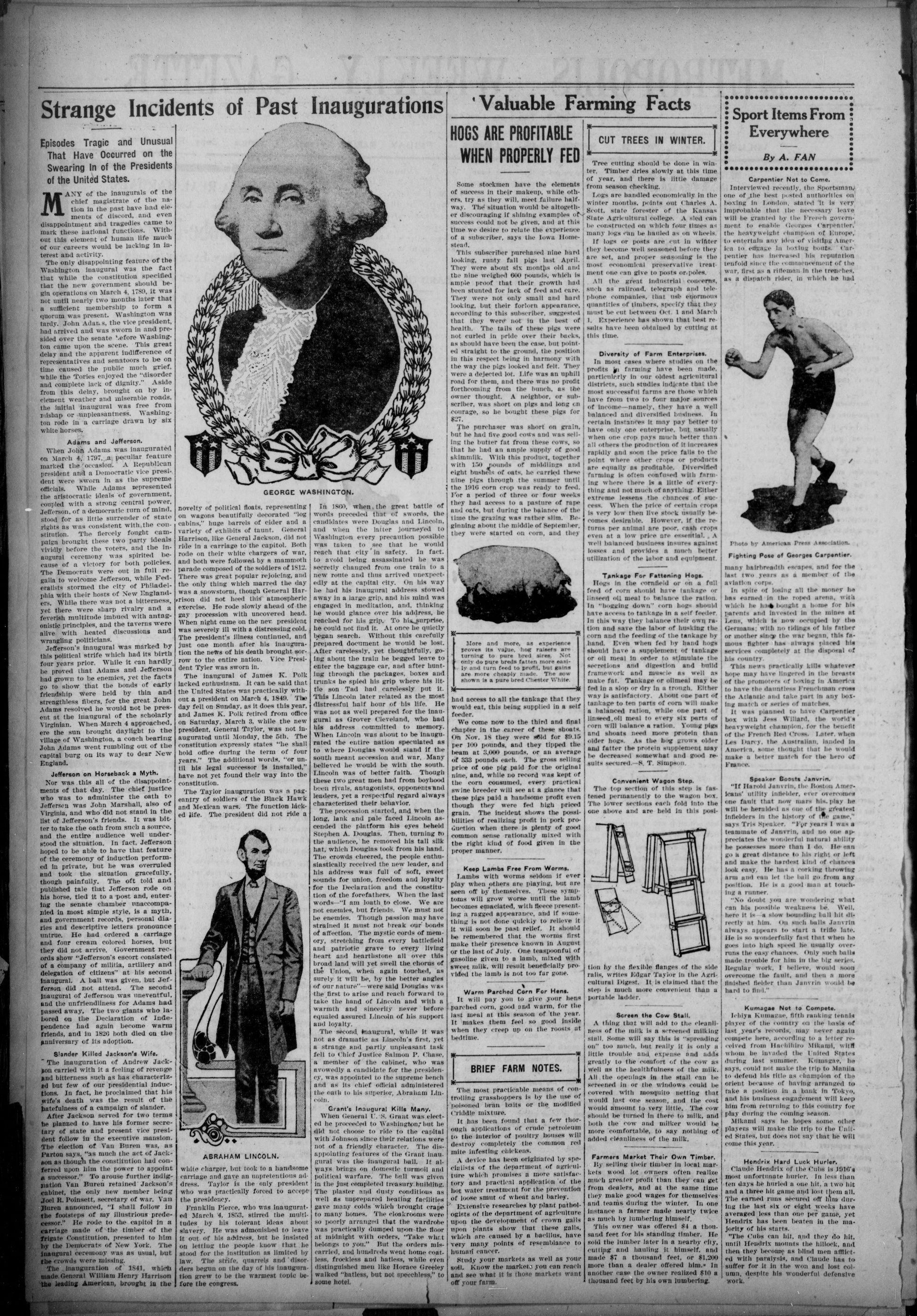
Strange Incidents of Past Inaugurations
Episodes Tragic and Unusual That Have Occurred on the Swearing In of the Presidents of the United States.
MANY of the inaugurals of the chief magistrate of the nation in the past have had elements of discord, and even disappointment and tragedies came to mark these national functions. Without this element of human life much of our careers would be lacking in interest and activity.
The only disappointing feature of the Washington inaugural was the fact that while the constitution specified that the new government should begin operations on March 4, 1780, it was not until nearly two months later that a sufficient membership to form a quorum was present. Washington was tardy. John Aden's, the vice president, had arrived and was sworn in and presided over the senate before Washington came upon the scene. This great delay and the apparent indifference of representatives and senatoors to be on time caused the public much grief, while the Tories enjoyed the "disorder and complete lack of dignity." Aside from this delay, brought on by inclement weather and miserable roads, the initial inaugural was free from mishap or unpleasantness. Washington rode in a carriage drawn by six white horses.
Adams and Jefferson.
When John Adams was inaugurated on March 4, 1797, a peculiar feature marked the occasion. A Republican president and a Democratic vice president were sworn in as the supreme officials. While Adams represented the aristocratic ideals of government, coupled with a strong central power, Jefferson, of a democratic turn of mind, stood for as little surrender of state rights as was consistent with the constitution. The fiercely fought campaign brought these two party ideals vividly before the voters, and the inaugural ceremony was spirited because of a victory for both policies. The Democrats were out in full regalia to welcome Jefferson, while Federalists stormed the city of Philadelphia with their hosts of New Englanders. While there was not a bitterness, yet there were sharp rivalry and a feverish multitude imbued with antagonistic principles, and the taverns were alive with heated discussions and wrangling politicians.
Jefferson's inaugural was marked by this political strife which had its birth four years prior. While it can hardly be proved that Adams and Jefferson had grown to be enemies, yet the facts go to show that the bonds of early friendship were held by thin and strengthless fibers, for the great John Adams resolved he would not be present at the inaugural of the scholarly Virginian. When March 4 approached, ere the sun brought daylight to the village of Washington, a coach bearing John Adams went rumbling out of the capital burg on its way to dear New England.
Jefferson on Horseback a Myth.
Jefferson on Horseback a Myth.
Nor was this all of the disappointments of that day. The chief justice who was to administer the oath to Jefferson was John Marshall, also of Virginia, and who did not stand in the list of Jefferson's friends. It was bitter to take the oath from such a source, and the entire audience well understood the situation. In fact, Jefferson hoped to be able to have that feature of the ceremony of induction performed in private, but he was overruled and took the situation gracefully, though painfully. The oft told and published tale that Jefferson rode on his horse, tled it to a post and, entering the senate chamber unaccompanied in most simple style, is a myth, and government records, personal diaries and descriptive letters pronounce untrue. He had ordered a carriage and four cream colored horses, but they did not arrive. Government records show "Jefferson's escort consisted of a company of militia, artillery and delegation of citizens" at his second inaugural. A ball was given, but Jefferson did not attend. The second inaugural of Jefferson was uneventful, and the unfriendliness of Adams had passed away. The two giants who labored on the Declaration of Independence had again become warm friends, and in 1826 both died on the anniversary of its adoption.
Slander Killed Jackson's Wife.
Slander Killed Jackson's Wife.
The inauguration of Andrew Jackson carried with it a feeling of revenge and bitterness such as has characterized but few of our presidential inductions. In fact, he proclaimed that his wife's death was the result of the hatefulness of a campaign of slander.
After Jackson served for two terms he planned to have his former secretary of state and present vice president follow in the executive mansion. The election of Van Buren was, as Parton says, "as much the act of Jackson as though the constitution had conferred upon him the power to appoint a successor." To arouse further indignation Van Buren retained Jackson's cabinet, the only new member being Joel R. Poinsett, secretary of war. Van Buren announced, "I shall follow in the footsteps of my illustrious predecessor." He rode to the capitol in a carriage made of the timber of the frigate Constitution, presented to him by the Democrats of New York. The inaugural ceremony was as usual, but the crowds were missing.
The inauguration of 1841, which made General William Henry Harrison the leading American, brought in the
GEORGE WASHINGTON.
novelty of political floats, representing on wagons beautifully decorated "log cabins," huge barrels of elder and a variety of exhibits of taunt. General Harrison, like General Jackson, did not ride in a carriage to the capitol. Both rode on their white chargers of war, and both were followed by a mammoth parade composed of the soldiers of 1812. There was great popular rejoicing, and the only thing which marred the day was a snowstorm, though General Harrison did not heed this atmospheric exercise. He rode slowly ahead of the gay procession with uncovered head. When night came on the new, president was severely ill with a distressing cold. The president's illness continued, and just one month after his inauguration the news of his death brought sorrow to the entire nation. Vice President Tyler was sworn in.
The inaugural of James K. Polls lacked enthusiasm. It can be said that the United States was practically without a president on March 4, 1849. The day fell on Sunday, as it does this year, and James K. Polk retired from office on Saturday, March 3, while the new president, General Taylor, was not inaugurated until Monday, the 5th. The constitution expressly states "he shall hold office during the term of four years." The additional words, "or until his legal successor is installed," have not yet found their way into the constitution.
The Taylor inauguration was a pageantry of soldiers of the Black Hawk and Mexican wars. The function licked life. The president did not ride a
L
ABRAHAM LINCOLN.
white charger, but took to a handsome carriage and gave an unpretentious address. Taylor is the only president who was practically forced to accept the presidency.
Franklin Pierce, who was inaugurated March 4, 1853, stirred the multitudes by his tolerant ideas about slavery. He was admonished to leave it out of his address, but he insisted on letting the people know that he stood for the institution as limited by law. The strife, quarrels and disorders began on the day of his inauguration grew to be the warmest topic before the congress.
In 1800, when the great battle of words preceded that of swords, the candidates were Douglas and Lincoln, and when the latter journeyed to Washington every precaution possible was taken to see that he would reach that city in safety. In fact, to avoid being assassinated he was secretly changed from one train to a new route and thus arrived unexpectedly at the capital city. On his way he had his inaugural address stowed away in a large grip, and his mind was engaged in meditation, and, thinking he would glance over his address, he reached for his grip. To his surprise, he could not find it. At once he quietly began search. Without this carefully prepared document he would be lost. After carelessly, yet thoughtfully, going about the train he begged leave to enter the baggage car, and after hunting through the packages, boxes and trunks he spied his grip where his little son Tad had carelessly put it. This Lincoln later related as the most distressful half hour of his life. He was not as well prepared for the inaugural as Grover Cleveland, who had his address committed to memory. When Lincoln was about to be inaugurated the entire nation speculated as to where Douglas would stand if the south meant secession and war. Many believed he would be with the south. Lincoln was of better faith. Though these two great men had from boyhood been rivals, antagonists, opponents and leaders, yet a respectful regard always characterized their behavior.
The procession started, and when the long, lank and pale faced Lincoln ascended the platform his eyes beheld Stephen A. Douglas. Then, turning to the audience, he removed his tall silk hat, which Douglas took from his hand. The crowds cheered, the people enthusiastically received the new leader, and his address was full of soft, sweet sounds for union, freedom and loyalty for the Declaration and the constitution of the forefathers. When the last words—"I am loath to close. We are not enemies, but friends. We must not be enemies. Though passion may have strained it must not break our bonds of affection. The mystic cords of memory, stretching from every battlefield and patriotic grave to every living heart and heartstone all over this broad land will yet swell the chorus of the Union, when again touched, as surely it will be, by the better angles of our nature"—were said Douglas was the first to arise and reach forward to take the hand of Lincoln and with a warmth and sincerity never before equaled assured Lincoln of his support and loyalty.
The second inaugural, while it was not as dramatic as Lincoln's first, yet a strange and partly unpleasant task fell to Chief Justice Salmon P. Chase, a member of the cabinet, who was avowedly a candidate for the presidency, was appointed to the supreme bench and as its chief official administered the cath to his superior, Abraham Lincoln.
Grant's Inaugural Kills Many
Grant's Inaugural Kills Many. When General U. S. Grant was elected he proceeded to Washington, but he did not choose to ride to the capital with Johnson since their relations were not of a friendly character. The disappointing features of the Grant inaugural was the inaugural ball. It always brings on domestic turmoil and political warfare. The ball was given in the just completed treasury building. The plaster and dusty conditions as well as unprepared heating facilities gave many colds which brought crape to many homes. The cloakrooms were so poorly arranged that the wardrobe was practically dumped upon the floor at midnight with orders. "Take whit belongs to you." But the orders miscarried, and hundreds went home coatless, frockless and hatless, while even distinguished men like Horace Greeley walked "hatless, but not speechless," to some hotel.
' Valuable Farming Facts
HOGS ARE PROFITABLE WHEN PROPERLY FED
HOGS ARE PROFITABLE WHEN PROPERLY FED
Some stockmen have the elements of success in their makeup, while others, try as they will, meet failure halfway. The situation would be altogether discouraging if shining examples of success could not be given, and at this time we desire to relate the experience of a subscriber, says the Iowa Home-stead.
This subscriber purchased nine hard looking, runty fall pigs last April. They were about six months old and the nine weighed 600 pounds, which is ample proof that their growth had been stunted for lack of feed and care. They were not only small and hard looking, but their forlorn appearance, according to this subscriber, suggested that they were not in the best of health. The tails of these pigs were not curled in pride over their backs, as should have been the case, but pointed straight to the ground, the position in this respect being in harmony with the way the pigs looked and felt. They were a dejected lot. Life was an uphill road for them, and there was no profit forthcoming from the bunch, as the owner thought. A neighbor, or subscriber, was short on pigs and long on courage, so he bought these pigs for $27.
The purchaser was short on grain, but he had five good cows and was selling the butter fat from these cows, so that he had an ample supply of good skimmilk. With this product, together with 150 pounds of middlings and eight bushels of oats, he carried these nine pigs through the summer until the 1916 corn crop was ready to feed. For a period of three or four weeks they had access to a pasture of rape and oats, but during the balance of the time the grazing was rather slim. Beginning about the middle of September, they were started on corn, and they
More and more, as experience proves its value, hog raisers are turning to more bred aires. Not only do pure breds fatten more easily and turn feed to profit, but gains are more cheaply made. The sow shown is a pure bred Chester White.
had access to all the tankage that they would eat, this being supplied in a self feeder.
We come now to the third and final chapter in the career of these shoats. On Nov. 18 they were sold for $9.15 per 100 pounds, and they tipped the beam at 3,000 pounds, or an average of 333 pounds each. The gross selling price of one pig paid for the original nine, and, while no record was kept of the corn consumed, every practical swine breeder will see at a glance that these pigs paid a handsome profit even though they were fed high priced grain. The incident shows the possibilities of realizing profit in pork production when there is plenty of good common sense rationally mixed with the right kind of food given in the proper manner.
Keep Lambs Free From Worms.
Keep Lamb's Free From Worms.
Lambs with worms seldom if ever play when others are playing, but are seen off by themselves. These symptoms will grow worse until the lamb becomes enunciated, with fleece presenting a ragged appearance, and if something is not done quickly to relieve it it will soon be past relief. It should be remembered that the worms first make their presence known in August or the last of July. One teaspoonful of gasoline given to a lamb, mixed with sweet milk, will result beneficially provided the lamb is not too far gone.
Warm Parched Corn For Hens
It will pay you to give your hens parched corn, good and warm, for the last meal at this season of the year. It makes them feel so good inside when they creep up on the roosts at bedtime.
BRIEF FARM NOTES.
The most practicable means of controlling grasshoppers is by the use of poisoned bran baits or the modified Criddle mixture.
It has been found that a few thorough applications of crude petroleum to the interior of poultry houses will destroy completely the common red mite infesting chickens.
A device has been originated by specialists of the department of agriculture which promises a more satisfactory and practical application of the hot water treatment for the prevention of loose smut of wheat and barley.
Excessive researches by plant pathologists of the department of agriculture upon the development of crown galls upon plants show that these galls, which are caused by a bacillus, have very many points of resemblance to human cancer.
Study your markets as well as your soil. Know the markets you can reach and see what it is those markets want off your farm.
CUT TREES IN WINTER.
Tree cutting should be done in winter. Timber dries slowly at this time of year, and there is little damage from season checking.
Logs are handled economically in the winter months, points out Charles A. Scott, state forester of the Kansas State Agricultural college. A sled can be constructed on which four times as many logs can be hauled on wheels.
If logs or posts are cut in winter they become well seasoned before they are set, and proper seasoning is the most economical preservative treatment one can give to posts or poles.
All the great industrial concerns, such as railroad, telegraph and telephone companies, that usb enormous quantities of timbers, specify that they must be cut between Oct. 1 and March 1. Experience has shown that best results have been obtained by cutting at this time.
Diversity of Farm Enterprises.
Diversity of Farm Enterprises. In most cases where studies on the profits in farming have been made, particularly in our oldest agricultural districts, such studies indicate that the most successful farms are those which have from two to four major sources of income—namely, they have a well balanced and diversified business. In certain instances it may pay better to have only one enterprise, but usually when one crop pays much better than all others the production of it increases rapidly and soon the price falls to the point where other crops or products are equally as profitable. Diversified farming is often confused with farming where there is a little of everything and not much of anything. Either extreme lessens the chances of success. When the price of certain crops is very low then live stock usually becomes desirable. However, if the returns per animal are poor, cash crops even at a low price are essential. A well balanced business insures against losses and provides a much better utilization of the labor and equipment.
Tankage For Fattening Hogs.
Tankage For Fattening Hogs. Hogs in the cornfield or on a full feed of corn should have tankage or linseed oil meal to balance the ration. In "hogging down" corn hogs should have access to tankage in a self feeder. In this way they balance their own ration and save the labor of husking the corn and the feeding of the tankage by hand. Even when fed by hand hogs should have a supplement of tankage or oil meal in order to stimulate the secretions and digestion and build framework and muscle as well as make fat. Tankage or oilmeal may be fed in a stop or dry in a trough. Either way is satisfactory. About one part of tankage to ten parts of corn will make a balanced ration, while one part of linseed, oil meal to every six parts of corn will balance a ration. Young pigs and shorths need more protein than older hogs. As the hog grows older and fatter the protein supplement may be decreased somewhat and good results secured. - S. T. Simpson.
Convenient Wagon Step.
The top section of this step is fastened permanently to the wagon box. The lower sections each fold into the one above and are held in this posi-
tion by the flexible flanges of the side rals, writes Edgar Taylor in the Agricultural Digest. It is claimed that the step is much more convenient than a portable ladder.
Screen the Cow Stall.
A thing that will add to the cleanliness of the milk is a screened milking stall. Some will say this is "spreading on" too much, but really it is only a little trouble and expense and adds greatly to the comfort of the cow as well as the healthfulness of the milk. All the openings in the stall can be screened in or the windows could be covered with mosquito netting that would last one season, and the cost would amount to very little. The cow should be turned in there to milk, and both the cow and milker would be more comfortable, to say nothing of added cleanliness of the milk.
Farmers Market Their Own Timber.
By selling their timber in local markets wood lot owners often realize much greater profit than they can get from dealers, and at the same time they make good wages for themselves and teams during the winter. In one instance a farmer made nearly twice as much by lumbering himself.
This owner was offered $4 a thousand feet for his standing timber. He sold the lumber later in a nearby city, cutting and hauling it himself, and made $7 a thousand feet, or $1,200 more than a dealer offered him. In another case the owner realized $10 a thousand feet by his own lumbering.
Carpentier Not to Come. Interviewed recently, the Sportsman one of the best posted authorities on boxing in London, stated it is very improbable that the necessary leave will be granted by the French government to enable Georges Carpentier, the heavyweight champion of Europe, to entertain any idea of visiting America to engage in boxing bouts. Carpentier has increased his reputation tenfold since the commencement of the war, first as a rideman in the trenches, as a dispatch rider, in which he had
1910
Photo by American Press Association.
Fighting Pose of Georges Carpentier.
many hairbreadth escapes, and for the last two years as a member of the aviation corps.
In spite of losing all the money he has earned in the roped arena, with which he has bought a home for his parents and invested in the mines at Lens, which is now occupied by the Germans; with no tidings of his father or mother since the war began, this famous fighter has always placed his services completely at the disposal of his country.
This news practically kills whatever hope may have lingered in the breasts of the promoters of boxing in America to have the dauntless Frenchman cross the Atlantic and take part in any boxing match or series of matches.
It was planned to have Carpentier box with Jess Willard, the world's heavyweight champion, for the benefit of the French Red Cross. Later, when Les Darcy, the Australian, landed in America, some thought that he would make a better match for the hero of France.
Speaker Boosts Janyrin.
Speaker Boosts Janvrin.
"If Harold Janvrin, the Boston Americans' utility infielder, ever overcomes one fault that now mars his play, he will be heralded as one of the greatest infielders in the history of the game," says Tris Speaker. "For years I was a teammate of Janvrin, and no one appreciates the wonderful natural ability he possesses more than I do. He can go a great distance to his right or left and make the hardest kind of chances look easy. He has a corking throwing arm and can let the ball go from any position. He is a good man at touching a runner.
"No doubt you are wondering what can his possible weakness be. Well, here it is—a slow bounding ball hit directly at him. On such balls Janyrin always appears to start a trifle late. He is so wonderfully fast that when he goes into high speed he usually overruns the easy chances. Only such balls made trouble for him in the big series. Regular work, I believe, would soon overcome the fault, and then a more finished fielder than Janyrin would be hard to find."
Kumagae Net to Compete
Kumagae Not to compete.
Ichiya Kumagae, fifth ranking tennis player of the country on the basis of last year's records, may never again compete here, according to a letter received from Hachibiro Mikami, who whom he invaded the United States during last summer. Kumagae, he says, could not make the trip to Manila to defend his title as champion of the orient because of having arranged to take a position in a bank in Tokyo, and his business engagement will keep him from returning to this country for play during the coming season.
Mikami says he hopes some other players will make the trip to the United States, but does not say that he will come this year.
Hendrix Hard Luck Hurler.
Hendrix Hard Luck Hurler.
Claude Hendrix of the Cubs is 1916's most unfortunate hurler. In less than ten days he hurled a one hit, a two hit and a three hit game and lost them all. The earned runs secured off him during the last six or eight weeks have averaged less than one per game, yet Hendrix has been beaten in the majority of his starts.
"The Cubs can hit, and they do hit, until Hendrix mounts the billock, and then they become as blind men afflicted with paralysis, and Claude has to suffer for it in the won and lost column, despite his wonderful defensive work.
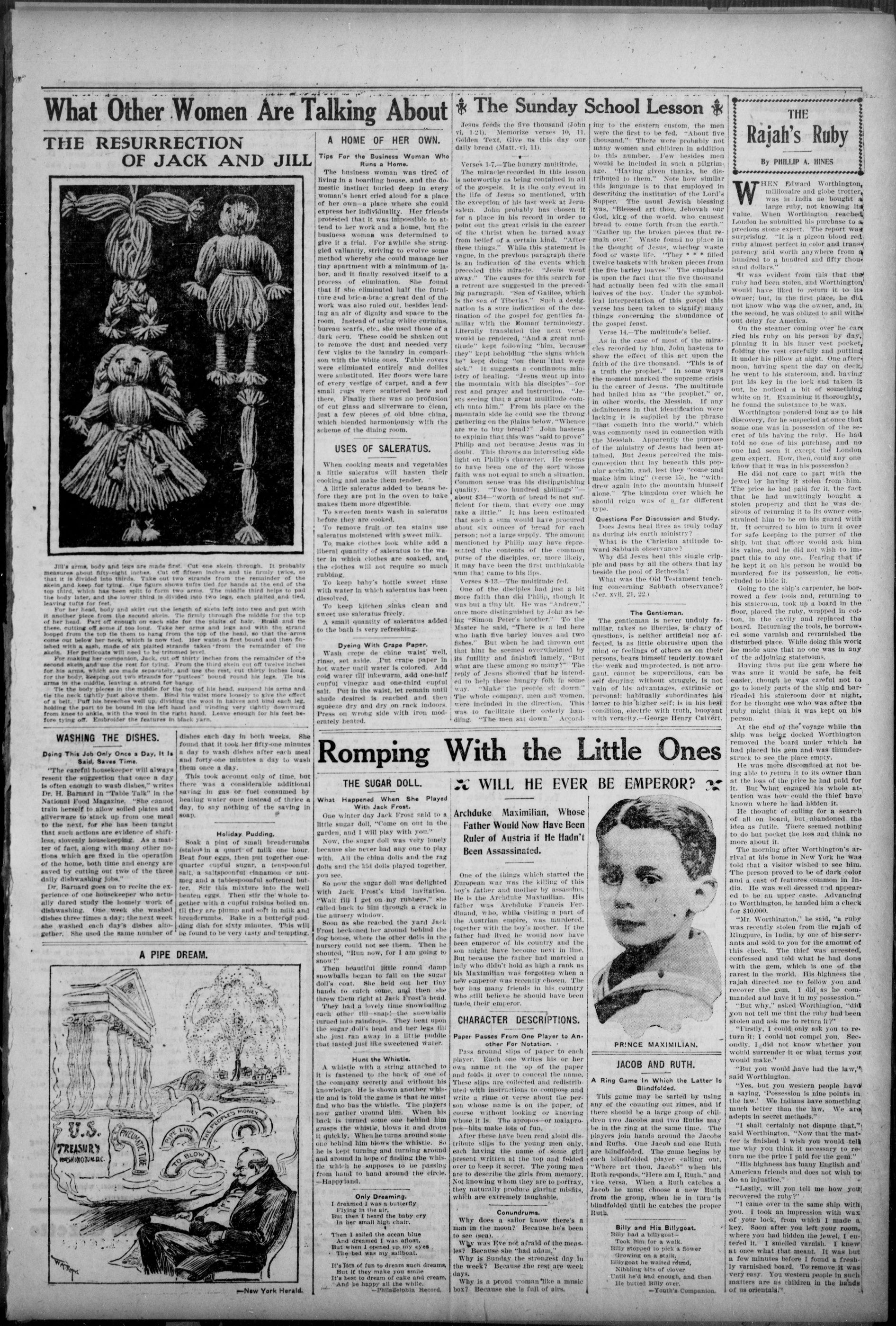
What Other Women Are Talking About
RABBIT RACING
Jill's arms, body and legs are made first. Cut one skeln through. It probably measures about fifty-eight inches. Cut off fifteen inches and the firmly twice, so that it is divided into thirds. Take out two strands from the remainder of the skeln and keep for tying. One figure shows tuffs tied for hands at the end of the top third, which has been split to form two arms. The middle third helps to pad the body later, and the lower third is divided into two legs, each plaited and tied, leaving tuffs for feet. For her head, body and skirt cut the length of skeln left into two and put with it another piece from the second skeln. The firmly through the middle for the top of her shoulder part off enough on each side for the plaits of hair. Braid and the these, cutting off some if too long. Take her arms and legs and with the strand looped from the top tie them to hang from the top of the head, so that the arms come out below her neck, which is now tied. Her waist is first bound and then finished with a sash, made of six plaited strands taken from the remainder of the skeln. Her petticoats will need to be trimmed level.
For making her companion, Jack, cut off thirty inches from the remainder of the second skeln, and use the rest for tying. From the third skeln cut off twelve inches for his arms, which are made separately, and use the rest, cut thirty inches long, for the body, keeping out two strands for 'puttees' bound round his legs. The his arms in the middle, leaving a strand for bangle. Cut off the middle of his head, suspend his arms and tie the neck tightly just above them. bind his waist more loosely to give the effect of a belt. Puff his breeches well up, dividing the wool in halves and bind each leg, holding the part to be bound in the left hand and winding very tightly downward from knee to ankle, with the wool in the right hand. Leave enough for his feet before tying off. Embroider the features in black yarn.
U.S.
TREASURY
WASHINGTON, D.C.
PNEUMATIC TUBE
PIPE LINE
THE PEOPLE'S MONEY
TO BLOW
WASHING THE DISHES.
Doing This Job Only Once a Day, It Is Said, Saves Time.
"The careful housekeeper will always resent the suggestion that once a day is often enough to wash dishes," writes Dr. H. Barnard in "Table Talk" in the National Food Magazine. "She cannot train herself to allow soiled plates and silveryware to stack up from one meal to the next, for she has been taught that such actions are evidence of shiftless, slovenly housekeeping. As a matter of fact, along with many other notions which are fixed in the operation of the home, both time and energy are saved by cutting out two of the three daily dishwashing jobs."
Dr. Barnard goes on to recite the experience of one housekeeper who actually dared study the homely work of dishwashing. One week she washed dishes three times a day; the next week she washed each day's dishes altogether. She used the same number of
dishes each day in both weeks. She found that it took her fifty-one minutes a day to wash dishes after each meal and forty-one minutes a day to wash them once a day. This took account only of time, but there was a considerable additional saving in gas or fuel consumed by heating water once instead of thrice a day, to say nothing of the saving in soap.
Holiday Pudding.
Soak a pint of small breadcrumbs (estate) in a quart of milk one hour. Beat four eggs, then put together one-quarter cupful sugar, a teaspoonful salt, a saltspoonful cinnamon or nutmeg and a tablespoonful softened butter. Stir this mixture into the well beaten eggs. Then stir the whole together with a cupful rinses boiled until they are plump and soft in milk and breadcrumbs. Bake in a buttered pudding dish for sixty minutes. This will be found to be very tasty and tempting.
DREAM.
THE PEOPLE'S MONEY
DO BLOW
New York Herald.
Romping With the Little Ones
Tips For the Business Woman Who Runs a Home.
The business woman was tired of living in a boarding house, and the domestic instinct buried deep in every woman's heart cried aloud for a place of her own—a place where she could express her individuality. Her friends protested that it was impossible to attend to her work and a home, but the business woman was determined to give it a trial. For awhile she struggled valiantly, striving to evolve some method whereby she could manage her tiny apartment with a minimum of labor, and it finally resolved itself to a process of elimination. She found that if she eliminated half the furniture and bric-a-brac a great deal of the work was also ruled out, besides lending an air of dignity and space to the room. Instead of using white curtains, bureau scarfs, etc., she used those of a dark cork. These could be shaken out to remove the dust and needed very few visits to the laundry in comparison with the white ones. Table covers were eliminated entirely and doilies were substituted. Her floors were bare of every vestige of carpet, and a few small rugs were scattered here and there. Finally there was no profusion of cut glass and silverware to clean, just a few pieces of old blue china, which blended harmoniously with the scheme of the dining room.
USES OF SALERATUS.
When cooking meats and vegetables a little saleratus will hasten their cooking and make them tender.
A little saleratus added to beans before they are put in the oven to bake makes them more digestible.
To sweeten meats wash in saleratus before they are cooked.
To remove fruit or tea stains use saleratus moltened with sweet milk.
To make clothes look white add a liberal quantity of saleratus to the water in which clothes are soaked, and the clothes will not require so much rubbing.
To keep baby's bottle sweet rinse with water in which saleratus has been dissolved.
To keep kitchen sinks clean and sweet use saleratus freely.
A small quantity of saleratus added to the bath is very refreshing.
Dyeing With Crape Paper.
Wash crope de chine waist' well, rinse, set aside. Put crape paper in hot water until water is colored. Add cold water till inkwarm, add one-half cupful vinegar and one-third cupful salt. Put in the waist, let remain until shade desired is reached and then squeeze dry and dry on rack indoors. Press on wrong side with iron moderately heated.
THE SUGAR DOLL.
What Happened When She Played With Jack Frost.
One winter day Jack Frost said to a little sugar doll, "Come on out in the garden, and I will play with you."
Now, the sugar doll was very lonely because she never had any one to play with. All the china dolls and the rag dolls and the kid dolls played together, you see.
So now the sugar doll was delighted with Jack Frost's kind invitation. "Wait Hill I get on my rubbers," she called back to him through a crack in the nursery window.
Soon as she reached the yard Jack Frost beckoned her around behind the dog house, where the other dolls in the nursery could not see them. Then he shouted, "Run now, for I am going to snow."
Then beautiful little round damp snowballs began to fall on the sugar doll's coat. She held out her tiny hands to catch some, and then she threw them right at Jack Frost's head. They had a lovely time snowballing each other till -snap! -the snowballs turned into raindrops. They beat upon the sugar doll's head and her legs till she just ran away in a little puddle that tasted just like sweetened water.
Hunt the Whistle.
A whistle with a string attached to it is fastened to the back of one of the company secretly and without his knowledge. He is shown another whistle and is told the game is that he must find who has the whistle. The players now gather around him. When his back is turned some one behind him grasps the whistle, blows it and drops it quickly. When he turns around some one behind him blows the whistle. So he is kept turning and turning around and around in hope of finding the whistle which he supposes to be passing from hand to hand around the circle. -Happy land.
The Sunday School Lesson
WILL HE EVER BE EMPEROR?
Jesus feeds the five thousand (John
vi, 1-21). Memorize verses 10, 11,
Golden Text, Give us this day our
daily bread (Matt. vi, 11).
Verses 1-7.—The hungry multitude.
The miracle recorded in this lesson is noteworthy as being contained in all of the gospels. It is the only event in the life of Jesus so mentioned, with the exception of his last week at Jerusalem. John probably has chosen it for a place in his record in order to point out the great crisis in the career of the Christ when he turned away from belief of a certain kind. "After these things." While this statement is vague, in the previous paragraph there is an indication of the events which preceded this miracle. "Jesus went away." The causes for this search for a retreat are suggested in the preceding paragraph. "Sea of Gallilee, which is the sea of Tiberias." Such a designation is a sure indication of the destination of the gospel for gentiles familiar with the Roman terminology. Literally translated the next verse would be rendered, "And a great multitude" kept following "him, because they" kept beholding "the signs which he" kept doing "on them that were sick." It suggests a continuous ministry of healing. "Jesus went up into the mountain with his disciples" for rest and prayer and instruction. "Jesus seeing that a great multitude cometh unto him." From his place on the mountain side he could see the throng gathering on the plains below. "Whence are we to buy bread?" John hastens to explain that this was "said to prove" Philip and not because Jesus was in doubt. This throws an interesting side light on Philip's character. He seems to have been one of the sort whose faith was not equal to such a situation. Common sense was his distinguishing quality. "Two hundred shillings"—about $34 "worth of bread is not sufficient for them, that every one may take a little." It has been estimated that such a sum would have procured about six ounces of bread for each person; not a large supply. The amount mentioned by Philip may have represented the contents of the common purse of the disciples, or, more likely, it may have been the first unthinkable sum that came to his lips.
Verses 8-13—The multitude fed.
One of the disciples had just a bit more faith than did Philip, though it was but a tiny bit. He was "Andrew," once more distinguished by John as being "Simon Peter's brother." To the Master he said, "There is a lad here who bath five barley leaves and two fishes." But when he had thrown out that hint he seemed overwhelmed by its futility and finished lamely, "But what are these among so many?" The reply of Jesus showed that he intended to help these hungry folk in some way. "Make the people sit down." The whole company, men and women, were included in the direction. This was to facilitate their orderly handling. "The men sat down." Account-
Archduke Maximilian, Whose Father Would Now Have Been Ruler of Austria if He Hadn't Been Assassinated.
One of the things which started the European war was the killing of this boy's father and mother by assassins. He is the Archduke Maximilian. His father was Archduke Francis Ferdinand, who, while visiting a part of the Austrian empire, was murdered, together with the boy's mother. If the father had lived he would now have been emperor of his country and the son might have become next in line. But because the father had married a lady who didn't hold as high a rank as his Maximilian was forgotten when a new emperor was recently chosen. The boy has many friends in his country who still believe he should have been made their emperor.
CHARACTER DESCRIPTIONS.
Paper Passes From One Player to Another For Notation.
Pass around slips of paper to each player. Each one writes his or her own name at the top of the paper and folds it over to conceal the name. These slips are collected and redistributed with instructions to compose and write a rime or verse about the person whose name is on the paper, of course without looking or knowing whose it is. The apropos—or malapropos—hits make lots of fun.
After these have been read aloud distribute slips to the young men only, each having the name of some girl present written at the top and folded over to keep it secret. The young men are to describe the girls from memory. Not knowing whom they are to portray, they naturally produce glaring misfits, which are extremely laughable.
Why does a sailor know there's a man in the moon? Because he's been to see (sea).
Why was Eve not afraid of the measles? Because she "had adam."
Why is Sunday the strongest day in the week? Because the rest are week days.
Why is a proud woman "like a music box"? Because she is full of airs.
ing to the eastern custom, the men were the first to be fed. "About five thousand." There were probably not many women and children in addition to this number. Few besides men would be included in such a pilgrimage. "Having given thanks, he distributed to them." Note how similar this language is to that employed in describing the institution of the Lord's Supper. The usual Jewish blessing was, "Blessed art thou, Jehovah our God, king of the world, who causest bread to come forth from the earth." "Gather up the broken pieces that remain over." Waste found no place in the thought of Jesus, whether waste food or waste life. "They * * * filled twelve baskets with broken pieces from the five barley loaves." The emphasis is upon the fact that the five thousand had actually been fed with the small loaves of the boy. Under the symbolical interpretation of this gospel this verse has been taken to signify many things concerning the abundance of the gospel feast.
Verse 14.—The multitude's belief
Verse 14.—The multitude's other.
As in the case of most of the miracles recorded by him, John hastens to show the effect of this act upon the faith of the five thousand. "This is of a truth the prophet." In some ways the moment marked the supreme crisis in the career of Jesus. The multitude had hailed him as "the prophet," or, in other words, the Messiah. If any definiensness in that identification were lacking it is supplied by the phrase "that cometh into the world," which was commonly used in connection with the Messiah. Apparently the purpose of the ministry of Jesus had been attained. But Jesus perceived the misconception that lay beneath this popular acclaim, and, lest they "come and make him king" (verse 15), he "withdrew again into the mountain himself alone." The kingdom over which he should reign was of a far different type.
Questions For Discussion and Study.
Does Jesus heal lives as truly today as during his earth ministry?
What is the Christian attitude toward Sabbath observance?
Why did Jesus heal this single cripple and pass by all the others that lay beside the pool of Bethesda?
What was the Old Testament teaching concerning Sabbath observance? (Cer xvii. 21, 22.)
The Gentleman.
The gentleman is never unduly familiar, takes no liberties, is chary of questions, is neither artificial nor affected, is as little oblivious upon the mind or feelings of others as on their persons, bears himself tenderly toward the weak and unprotected, is not arrogant, cannot be supercilious, can be self denying without struggle, is not vain of his advantages, extrinsic or personal; habitually subordinates his lower to his higher self; is in his best condition, electric with truth, buoyant with veracity—George Henry Calvert.
1930
JACOB AND RUTH.
A Ring Game In Which the Latter Is Blindfolded.
This game may be sarted by using any of the counting out rimes, and if there should be a large group of children two Jacobs and two Ruths may be in the ring at the same time. The players join hands around the Jacobs and Ruths. One Jacob and one Ruth are blindfolded. The game begins by each blindfolded player calling out, "Where art thou, Jacob?" when his Ruth responds, "Here am I, Ruth," and vice versa. When a Ruth catches a Jacob he must choose a new Ruth from the group, when he in turn is blindfolded until he catches the proper Ruth.
Billy and His Billygoat.
Billy had a billygoat—
Took him for a walk.
Billy stopped to pick a flower
Growing on a stalk.
Billygoat he waited round,
Nibbling bits of clover
Until he'd had enough, and then
He butted Billy over.
York's Companion
THE Rajah's Ruby
By PHILLIP A. HINES
WHEN Edward Worthington, millionaire and globe trotter, was in India he bought a large ruby, not knowing its value. When Worthington reached London he submitted his purchase to a precious stone expert. The report was surprising. "It is a pigeon blood red ruby almost perfect in color and transparency and worth anywhere from a hundred to a hundred and fifty thousand dollars."
It was evident from this that the ruby had been stolen, and Worthington would have liked to return it to its owner; but, in the first place, he did not know who was the owner, and, in the second, he was obliged to sail without delay for America.
On the steamer coming over he cared his ruby on his person by day, plining it in his inner vest pocket, folding the vest carefully and putting it under his pillow at night. One afternoon, having spent the day on deck, he went to his stateroom, and, having put his key in the lock and taken it out, he noticed a bit of something white on it. Examining it thoroughly, he found the substance to be wax.
Worthington pondered long as to his discovery, for he suspected at once that some one was in possession of the secret of his having the ruby. He had told no one of his purchase, and no one had seen it except the London gem expert. How, then, could any one know that it was in his possession?
He did not care to part with the jewel by having it stolen from him. The price he had paid for it, the fact that he had unwittingly bought a stolen property and that he was desirous of returning it to its owner constrained him to he on his guard with it. It occurred to him to turn it over for safe keeping to the purser of the ship, but that officer would ask him its value, and he did not wish to impart this to any one. Fearing that if he kept it on his person he would be murdered for its possession, he concluded to hide it.
Going to the ship's carpenter, he borrowed a few tools and, returning to his stateroom, took up a board in the floor, placed the ruby, wrapped in cotton, in the cavity and replaced the board. Returning the tools, he borrowed some varnish and revarnished the disturbed place. While doing this work he made sure that no one was in any of the adjoining staterooms.
Having thus put the gem where he was sure it would be safe, he felt easier, though he was careful not to go to lonely parts of the ship and barricaded his stateroom door at night, for he thought one who was after the ruby might think it was kept on his person.
At the end of the voyage while the ship was being docked Worthington removed the board under which he had placed his gem and was thunderstruck to see the place empty.
He was more discomfited at not being able to return it to its owner than at the loss of the price he had paid for it. But what engaged his whole attention was how could the thief have known where he had hidden it.
He thought of calling for a search of all on board, but abandoned the idea as futile. There seemed nothing to do but pocket the loss and think no more about it.
The morning after Worthington's arrival at his home in New York he was told that a visitor wished to see him. The person proved to be of dark color and a cast of features common in India. He was well dressed and appeared to be an upper caste. Advancing to Worthington, he handed him a check for $10,000.
"Mr. Worthington," he said, "a ruby was recently stolen from the rajah of Ringpheton, in India, by one of his servants and sold to you for the amount of this check. The thief was arrested, confessed and told what he had done with the gem, which is one of the rarest in the world. His highness the rajah directed me to follow you and recover the gem. I did as he commanded and have it in my possession." "But why," asked Worthington, "did you not tell me that the ruby had been stolen and ask me to return it?" "Firstly, I could only ask you to return it; I could not compel you. Secondly, I did not know whether you would surrender it or what terms you would make." "But you would have had the law," said Worthington.
"Yes, but you western people have a saying, 'Possession is nine points in the law.' We Indians have something much better than the law. We are adepts in secret methods."
"I shall certainly not dispute that," said Worthington. "Now that the matter is finished I wish you would tell me why you think it necessary to return me the price I paid for the gem."
"His highness has hany English and American friends and does not wish to do an injustice."
"Lastly, will you tell me how you recovered the ruby?"
"I came over in the same ship with you. I took an impression with wax of your lock, from which I made a key. Soon after you left your room, where you had hidden the jewel, I entered it. I smelled varnish. I knew at once what that meant. It was but a few minutes before I found a freshly varnished board. To remove it was very easy. You western people in such matters are as children in the hands of us orientals."
Metropolis Gazette
PUBLISHED ON PRTAY BY
THE GAZETTE PRINTING CO.
METROPOLIS, . . . . . ILL.
MRS. M. J. McCRARY, MANAGER
J. B. McCRARY, EDITOR
FRIDAY MAR. 2, 1917.
Office 9th and Pearl Streets, Metropolis, Illinois.
Enterered as second-class mail matter, at Metropolis, Illinois, Postoffice.
B. Address all communications to J. R. McRAEF. Box 107 Metropolis, Illinois.
The names and addresses of contributors must be known to us in every instance, in order to secure publication.
We want the news of your vicinity each week.
TERMS OF SUBSCRIPTION:
One Year.....$1 00
x Months.....75
three Months.....40
Single Copy.....05
In Advance.
You must mail copy on Mondays to secure publication.
ANNOUNCEMETS
We are authized to announce the name of T. F. McCartney, as a candidate for re-election to the office of Mayor of the City of Metropolis, at the City election in April.
We are authorized to announce the name of Judge W. F. Smith as a candidate for City Judge, subject to the decision of the voters at the April election.
We are authorized to announce the name of Rolla Finney, as a candidate for Clerk of the City of Metropolis, subject to the will of the voters at the April election.
We are authorized to announce the name of W. D. Almon, for City Treasurer, subject to the April election.
Read r if a blue or red mark appears on the head of your paper marked with an [X] it is to notify you that you owe for the paper and are notiged lto pay up.
Fred R. Young, Solicitor.
Master in Chancery Sale.
State of Illinois, Massac County, ss.
In the Circuit Court of said County,
January Term A. D. 1917.
Elizabeth Wymer Vs. C. H. Dunn,
and Ella Dunn. Bill to foreclose
mortgage No. 340.
Public notice is hereby given that in
pursuance of a decree entered at the
January Term of said court, to wit,
on the 11th day of January A. D. 1917
in the above entitled cause, I, S. Bartlett Kerr, Master in Chancery of said
County, will at the hour of 10 o'clock
A. M. Saturday February 10th A. D.
1917 at the east door of the Court House
in the City of Metropolis, County of
Massac, and State of Illinois, sell at
public vendue to the highest and best
bidder, the following described real
estate to-wit:
Lots Three (3) and Four (4) in Block Seven (7) in the Fostlewaite and Morton Addition to the village of Brooklyn, now the City of Brookport, in Massac County, State of Illinois. Terms of sale, Cash in hand. Dated this 11th day of January A. D. 1917. S. BARTLETT KERR. Master in Chancery.
CITY TREASURER
In this issue of the Gazevte will be found the announcement of W. D. Almon, for city Treasurer.
The editor is not acquainted with the young man. He holds the important position of cashier at the Burlington Station, which position will justify us in saying that he is fully qualified to fill the important position. He has been in the city about five years.
We ask that our readers give his claim a fair and impartial consideration before voting, as is it claimed that he is a young man of glean habits.
$100 Reward. $100.
The readers of this paper will be pleased to learn that there is at least one dreaded disease that science has been able to cure in all its stages, and that is catarrh. Hall's catarrh cure is the ocular positive cure now known to the medical fraternity. catarrh being a constitutional disease, requires a constitutional treatment. Hall's catarrh is taken internally, acting directly upon the blood and mucous surfaces of the system, thereby destroying the foundation of the disease, and giving the patient strength by building up the constitution and assisting nature in doing its work. The proprietors have so much faith in its curative powers that they offer One Hundred Dollars for any case that it fails to cure. send for list of testimonials.
Address F. J. cHENEY & cO., Toledo, O.
Sold by all Druggists, 75c.
Take Hall's Family Pills for constipation.
We thank Bro. and Sister Tittsworth for the $1.00 subscription.
We have several others of Brookport, we would like to see come across.
We are sending out more statements this week. We want to save you cost. If we can't collect by that method then we will place them in the hands of collectors, let us hear from you within the next ten days please.
Charles Landers, of Brookport, died of heart trouble Sunday night. Edgar McCrary, was able to return to his school Monday after a few days confinement.
The quarterly meeting of the Eddyville, Kv., Freewill Baptist church that was in session from Wednesday until Sunday last week was a decided success. Over $60 was raised during the meeting.
This speaks well for Rev W. H Barrett and his members.
Mesdames Mabel Burke, and daughter, Berniece and Odie Buchanan, were Paducah, visitors last week.
Mesdames Ruth Don'ow and Mamie Maxwell Brookport, spent Monday with their grand-parents Mr. and Mrs. Henry Tinsley
Coal Oil 100 gallon at Grand Leader, 9th and Pearl.
We would like for the 1st Baptist Church, (this city,) and pastor to entertain the Executive Board of the Mt. Olive Association in April if no other church cares to take it, as we would like to arrange for a Missionary.
Mrs. Louise A. Mitchell, spent a few days last week in Cairo, visiting relatives and friends.
Rev. C. W. Norment, pastor of Rock Hill Baptist church, Carbondale, is conducting a meeting at the 1st Baptist church, here.
There have been some conversions with bright prospects for a great revival.
Henry Tinsley, and old and respected citizen, was slightly paralyzed Sunday but is resting easy at this writing.
Mingo Long is still confined to his room
Mrs Jennie Cowper, has been on the ick list several days.
The wife of George Jamison of W. 9th St., presented to him a fine baby girl Tuesday night.
Mother and baby are doing nicely.
George A. Stratton, of Boaz paid our place of business a pleaant call Monday.
Rev. B. C. Long ol Choat, returned from Hickory Grove Ky., Monday. He will be able to hold services in their new church edifice in March. This speaks well of the pastor and members.
Mrs. Ed Neely left this week to join her husband in New Jersey.
Garrett Tranzor left for Central, ia, Ill., Sunday.
Mrs. Beatrice Franklin left for Cincinnatti, Ohio, to join her husband.
Tax Purchaser's Notice.
Metropolis, Ill., Feb. 21st 1917.
To Henay Neftzger, Virginia Neftzger, Heirs, and unknown owners. You are hereby notified, that at a sale of Real Estate made by the Sheriff of Massac County, Ill., at the East door of the Court House, in the City of Metropolis, County of Mossac, and State of Illinois on the 14th day of June 1915 William Wright, purchased the following described Real Estate, situated in the said County, for the Taxes, Interest, Penalties and Costs due and unpaid thereon, for the year, A. D., 1914 Undivided one fourth of the N. E. Fourth of Section Thirty Three (38), Township 16, Range 6, East 3rd P. N. Massac County, Illinois. Assessed in the name of Henry Neftzger.
And that the time allowed by law for the redemption of said Real Estate will expire on the 14th day of June A. D., 1917.
S. B. Kerr,
Assignee of Purehaser.
Tax Purchaser's Notice
Metropolis Ill. February 21, 1917
To Rebecca Landrum, her heirs unknown owners or parties interested.
You are hereby notified, That at a sale of Real Estate made by the Sheriff of Massac County, Ill., at the East door of the Court House, in the City of Metropolis, County of Massac, and State of Illinois on the 14th day of June A. D. 1915 S. B. Kerr purchased the following described Real Estate, situated in the said County, for the Taxes, Interest, Penalties and Costs due and unpaid thereon, for the year A. D. 1914 to-wit:
Lot 6, Block 58, of the City of Metropolis, Massac County, Illinois, assessed in the name of Rebecca Landrum.
And that the time allowed by the law for the redemption of said Real Estate will expire on the 14th day of June A. D. 1917
Tax Purchaser's Notice.
To B. Friederman, Fred Nelson, unknown owners, and parties interested if any.
You Are Hereby Notified, That at a sale of Real Estate made by the Sheriff Massac Co. Ill, at the East door of the Court House, in the City of Metropolis, County of Massac, and State of Illinois on the 14th day of June A. D. 1915 purchased the following described Real Estate, situated in the said County, for the Taxes, interest, Penalties and costs due and unpaid thereon, for the year, A. D. 1914 towit:
Lot 6 Block 56, of the City of Metropolis, Massac Co., Ill, assessed to Fred. Nelson.
And that the time allowed by law for the redemption of said Real Estate will expire on the 14th day of June A. D. 1917. S. B. KERR, Assignee, of purchaser
Tax Purchaser's Notice.
Metropolis, Ill., Feb. 21st 1917
To J. B. Bartee, unknowu owners,
heirs, and others interested. You are
hereby notified, that at a sale of Real
Estate made by the Sheriff of Massac
County, Ill., at the Eaat door of the
Court House, in the City of Metropolis,
County of Massac, and State of Illinois
on the 14th day of June A. D. 1915,
William Wright purchased the following
described Real Estate, situated in
the said County for the Taxes, Interest,
Penalties and Costs due and unpaid
thereon, for the year A. D. 1914
to-wit:
94x200 feet in Hatfield's Addition to
Pope's Addition to Joppa, Ill. in Block
15, assessed to J. B. Bartee.
And that the time allowed by law for
the redemption of said Real Estate will
expire on the 14th day of June A. D.
1917.
S. B. KERR.
The Gazette Office has been supplied with a new Electric Motor, and we have a two horse power gasoline engine for sale. Any one in need of a good engine it will pay you to call and see the Gazette Manager. 901 Cor. 9th & Pearl Sts.
In this issue of the Gazette will be found the announcement of Rolla Finney as a candidate for re-election to the office of City Clerk for the city of Metropolis Mr. Finney has served in office four years and has given perfect satisfaction. He is sober and painstaking and no one is more courteous than he, and he is not likely to have any opposition. The voters will not make any mistake by re-electing him for another term.
W. L. KRONE, Attorney Complainant's Solicitor.
STATE OF ILLINOIS Massac County SS.
In the Circuit Court, April Term, A.
D. 1917.
Blanche Blakemore, vs Charles Blake-
more.
Bill IN CHANCERY for Divorce. Affidavit of non-residence of Charles Blakemore the above defendant having been filed in the Clerk's office of the Circuit Court of said County, notice is therefore hereby given to the above non-resident defendant that the complainant filed her bill of complaint in said Court, on the Chancery side thereof, on the 8th day of February 1917 and that thereupon a Summons issued out of said Court, wherein said suit is now pending returnable on the second Munday in the month of April A. D. 1917 as is by law required. Now unless you, the said non-resident defendant above named Charles Blakemore, shall personally appear before said Court, on the first day of the next term thereof to be holden at Metropolis in and for the said County, on the Second Monday of April A. D. 1917 and plead, answer or demur to the said complainant's bill of complaint, the same and the matters and things therein charged and stated will be taken as confessed, and a decree entered against you according to the prayer of said bill.
COLFAX MORRIS Clerk.
Metropolis Illinois, February 8 1917
W. L. KRONE, Attorney.
Complainant's Solicitor
NOTICE OF PUBLICATION
CHANCERY
STATE OF ILLINOIS Massac County.
SS.
In The Circuit Court, April Term,
A. D. 1917.
Daisy Brady vs C. P. Brady.
Bill IN CHANCERY for Divorce.
Affidavit of non-residence of C. P. Brady, the above defendant having been filed in the Clerk's office of the Circuit Court of said County, notice is therefore hereby given to the said non-resident defendant that the complainant filed her bill of complaint in said Court, on the Chancery side thereof, on the 8th day of February 1917 and that thereupon a Summons issued out of said Court, wherein said suit is now pending returnable on the Second Monday in the month of April A. D. 1917 as it is by law required. Now, unless you, the said non-resident defendant above named C. P. Brady shall personally be and appear before said Circuit Court, on the first day of the next term thereof, to be holden at Metropolis, in and for the said County, on the Second Monday of April A. D. 1917, and plead, answer or demur to the said complainant's bill of complaint, the same and the matters and things therein charged and stated will be taken as confessed, and a decree entered against you according to the prayer of said bill.
COLFAX MORRIS, Clerk.
Metropolis, Illinois, February 8th 1917.
KINKY
HAIR
Atlanta, Ga.
Erie County, Med. Co.
Gentlemen.
I pray you always pon
what your fine
EXELENTO
TIMING
COMARE
Has done for my hair.
Before I read it, my hair
was dreaded and crumpled,
and now it is 24 inches
long, and so soft and
silly that I can do it
up any way I want to.
doe, removes Dandruff, feeds the Roots of the hair, and makes it grow long, soft and silky. After using a few times you can tell the difference, and after a little while it will be so pretty and long that you can fit it into your hair. If long, we claim, we will give your money back. 25c by mail on receipt of stamps or coin. AGENTS WANTED EVERYWHERE. Write For Particulars. EXELENTO MEDICINE CO., Atlanta, Ga.
Native Salve.
We have just recived some more of Native Salve and it is going very fast, those in Carbon- and Md. City can secure a box or more now by 50c, per box. Act quick if you want it. Send all orders to Rev. J. B. McCrary.
Neuraigia and Nhaumatte Faine yield quickly to the influence of Dr. Millet and Faine Pills. No bad of an offence.
THE EDITOR'S VIEWS.
Some of our subscribers are responding to our request to pay up their subscriptions, while others seem to ignore our appeal entirely. That is one of the great reasons why our people fail in business enterprises; because most of our patrons have no Race Pride. It seems that all the majority of them want is, 'To Get By.' especially our so-called race Leaders, who put up a great howl if you fail to patronize them and in this bunch, will be found a large number of would-be preachers, holding big churches and styling themselves 'big-uns.' But they are very little when it comes to contributing to the financial uplift to racial enterprises and to the real uplift of the race. We have almost constantly from 3 to 4 and sometimes more colored young men and women in our employ one way or the other, otherwise would be with out employment most of the time were it not for us and you can help us materially by not only subscribing and paying your subscription but by getting your neighbors and friends to subcrite and also by giving us your jb work.
Do you love your race, and would you like to see it succeed? Would you like to see your sons and daughters fill positions of honor and trust as they emerge from the High Schools, Seminaries and Colleges, and even while pursuing these institutions? Then patronize, and speak well of the men and women who are trying to operate business enterprises and contribute something in the way of helping your young people.
If this letter does not appeal to you just take a walk down the business streets of your city, the thouroughfares, avenues, railroads, stations, banks, drug stores etc. and see who are employed in those places and by whom and then return home and use a little gray if you are possessed with any and learn to do likewise. The Gazette, like most of Negro enterprises are largely made successful by the assistance of their white friends who know of the hardships that their owners must encounter. Reader, you can save us a deal of worry and financial embarrassment just now if you would do the part of a man and woman and pay all you owe and renew for another year. Do as others have done. We have only a few Negro journals and we cannot afford to lose any of them. We need them to speak for the Race in these trying times.
We have some pastors of Negro churches, calling themselves leaders who seldom read a race journal and never subscribe and pay for one and is always ready to criticise the paper, the editor and use his influence among the members of his church, and the delegation and ministers of the Association to take the support from a man who stands four square every day in the week and month in the year against the injustice and inequalities, discrimination, segregation, jim-crowism and whatnots, by ill designing men against the race, when these same little two-by-fours so-called D. D.'s are skulking around trying to handicap, the poor editor, who is sacrificing time nerve and all the finance he can get to operate
The Gazette launched March 4th 1899 19 years ago, without a dollar and with but only a few friends. We had two good friends (white) Ex-Senator, D. W. Helm and S. B. Kerr, who financed the enterprise for us until we could get before our people. We have conducted ourselves in such a way since that day to the present until we can continue to claim them as our friends and will as readily come to our rescue now as in 1898. We can number anong our real friends, such men as, U. E Smith, Fred Smith Fred Young, Roy R. Helm, Geo. Schneeman, Colfax Morris, Fred Risinger, Oscar Miller, George Sawyer, and many others to numerous to mention at this time. Most of the ministers of my Association who stood for me and against me are dead but I have one who still lives in the person of Dr. C. C. Phillips, who is a life long friend.
Let those who are friends to the race pay up and help us to reach the 20th mile post. We embarked in the newspaper field in 1895, as the editor of the Baptist Truth, now published in Cairo by Prof. C. C. Wilson and was its editor for three and one half years and then turned its back to the Mt. Olive Baptist Association who was then its owner. Thus I am the oldest publisher in Southern Ill., today perhaps the oldest in the oldest in the State being actively engaged in the work without a break 21 years last October 1916
Administrator's Notice
Estate of Malissa Gaines, Deceased
The undersigned, having been appointed
Administrator of the Estate Malissa
Gaines late of the County of Massac and
the State of Illinois. deceased. hereby
gives notice that he will appear before
the County Court of Massac County
at the Court House in Metropolis, at
the April Term on the first Monday in
April next. A. D. 1917 at which time
all persone having claims against said
estate are notified and requested to
attend for the purpose of having the
same adjusted. All persons indebted
to said estate are required to make
immediate payment to the undersigned
Dated this 30th day of January, A.
D. 1917.
NELSON GAINES, Administrator.
S. BARTLETT KERR, Attorney.
Sale of Personal Property
Notice is Hereby Given that on Saturday at 1 p. m. the 24th day 'of February, A. D. 1917, next, between the hours of ten o'clock in the forenoon and five o'clock in the afternoon of the said day, at the late residence of Malissa Gaines, on Lot 1, Block 56, Metropolis, Ill., personal property of said decedent, consisting of Household goods, and other articles, will be sold at Public Sale, in accordance with an order of the County Court of Massac County.
Terms of sale: All sales up to $4.00 cash, and $5.00 and over one months time with acceptable security, and 6 per cent interest from date.
February Ist, A. D. 1917
NELSON GAINES, Administrator.
S. BARTLETT KERR, Atty.
CURT ROBY, Crier
Mrs. Saphronia Martin and son Maurice have returned from a trip to Cincinatti where they attended to bnssiness.
Mrs. Jennie Woods left for St. Louis, Thursday, where she will remain indefinitely.
Mrs. Victorine wright returned from a trip to Evansville In., and Carmi Ill.
Mrs. Lillie Towles is visiting her parents and children in Belgrade this week.
Miss Izora Davis has returned from Brookport, where she visited her parents.