Metropolis Weekly Gazette
Friday, June 29, 1917
Metropolis, Illinois
Page text (machine-generated)
METROPOLIS WEEKLY GAZETTE
To the Baptist Churches of Mt. Olive Baptist Association.
It is to be hoped that all of our chor hes will respond to the urgent need and appeal of our missionary on the field just now. Brethren, it is a sin to place a man on the field to look after the neglected churches and fail to see after his support, while we are at home faring sumptuously every day with our families and congregations. It is wore than a crime to allow his family to suffer, while we are responsible to to send the gospel into destitute places. "How can they hear without a preacher, and how can they preach except they are sent?" Brethren, bestir yourselves as never before; the eyes of our old fathers who have let their months fall on us are expecting us to evargeize this field in they labored so earnestly contending for missions and the missionary. Remember the great commissioner, and let us take the State for Christ. The harvest is white, but the laborers are few. Lift up your eyes and look upon the field. The true missionary spirit is lax in most of our Baptist churches in Southern Illinois.
Let us put out mission caids, preach a mission sermon once a month or a quarter, lift a special collection for missions and start the mission box plan.
We have a good, missionary in the person of Elder J. H. Hilley, and he needs our support. Let every church send something to the Board which meets with the Sunday School conuion at Caito, June 13th.
CARD OF THANKS
We the undersigned wish to thank the people of Metropolis, for the kindness shown in helping to al eviate the strain that existed when our wife, mother, sister and aunt, Mrs. Addie Kimball, was so hurriedly called from this earth to join that heavenly hosts.
We will never forget those that left their homes that terrible stormy night, and with their clothes soaked with rain, wended their way thru the darkness to her little home, we pray God's blessings upon you, and when such pall to me to you, as they will in some form, call upon us and we will gladly admister to you, such words of sympathy that it will take to cherish the sadness that exists.
Lyn Kemball, onboard
Mrs. demes Emma Watkins, Molly
Brown, Mattie Howard, Rush
Wat, E. F. Jones, Sisters
Mrs. Mable Routen Neice.
In the Sunken Submarine.
"It's too annoying that we should be
stuck down here. I bought myself
the most splendid tomb only last
week."--Lustige Blaetter.
Applied Learning.
The Absent-Minded Professor—"My tailor has put one button too many on my vest!" I must cut it off. That's funny; now there's a buttonhole too many. What's the use of arithmetic?" —Sourire.
Officers of the General Batist State Convention of Illinois
Committee on Nomination beg to report as follows:
Moderator Eld. J. F. Thomas.
1st Vice Mod. " W. P. Washington.
2nd Vice Mod. Eld. C. w. Norment.
Recording Sec. Eld. P. B. French
Corresponding Sec. Ed. J. B. McCrary.
Treasurer Eld. H. C. Armstead.
Added Members
Eld. F. Bomar Cairo
Eld. J. E Haywood Chicago
Eld. Jas. Swanson Maywood
State Missionary H. E. Mewilliams.
State Mission Board
Chairman Dr. C. C. Phillips
Cor. Sec. Eld. J. D. Davis
Treasurer Eld. J. E Haywood
Other Members
Eld. S. H. Prittt
Deacon R. Lewis
Sister Sallie Thomas Chicago
Sister M. Hudgin Cuiro
Sister J. w. winston Olmstead
Sister Carrie Casiy Shawnetown
Urish Jenkins
Rev. J. A. Royal Chicsgo
" L. Drane Chicago
Rev. A. J. Bowers Dewmaine
Rev. D. Johnson Dewmaine
" B. H. Hunter Evanston
" K. V. Howard Grand Chain
" Robt. Grey Marphysboro
" J. L. Martin Oolps
Deacon J. Simpson Hallidayboro
" J. Baker Brookport
Eld. Thomas Morris Metropolis
Bro. Chas. Skates Mound City
Deacon J. L. Taborn
Educational Board
Chairman Dr. B J. Priace Chicago
Cor. Sec. Sis. Frankie Jenkie
Cairo.
Stater willie Greyer Colpa
Sister Emma Farrow Cairo
"J. M. Oweus Sparta
Eld. J B McRary Metropolis
Committee on Nomination
C. C. Phillips
J. E. Heywood
G. H. Mitchell
F. Bomar
Sister Stella Duprec
"willie Greer
"M. B Taylor
Elder H. C. Armstead
"H. E. Mewilliams
Members of various Committees
of National Baptist Convention
(Unincorporated.)
Foreign Mission Boa.d
H. E. Mewilliams, D. D.
Chicago, Ill.
Home Mission Board
J. B. McCray, S. T. B.
Metropolis, Ill.
Educationzi Board
Dr. B J. Prince,
Chicago, Ill.
Evangelical Board
Elder F. Bomar,
Cairo, Ill.
B. Y P. U. Board
Dr. W. P. washington,
Mt. Vernon, Ill.
Benefit Board
Elder James Swanson,
Maywood, Ill.
Publishing Board
Dr. J F. Thomas,
Chicago, Ill.
Resolutions
J. E Haywood,
Chicago, Ill.
State of the Country
Elder H. C. Armstead,
Pulsski, Ill.
Vice President
Dr. C. C. Phillips,
Golconda, Ill.
Unanswered.
"George," she naked. "If we were both young and single again would you want me to be your wife?" "Now, my dear," he absent-mindedly replied "what's the ans. of trying to start a quarrel just as we have settled down to enjoy a quiet evening?"—Chicago Record-Herald.
Household Philosopher.
"Strange what a difference there is," said the household philosopher, "between things we need and things we want. There are many things we need in the house, but never can find the money for, while somehow we can always find the money for things we want that we personally fancy."
MOTTO : HEW TO THE LINE, LET THE CHIPS FALL WHERE THEY MAY
The Mt. Olive S. S. Convention Holds Successful Meeting in Cairo.
The 37th annual S. S convention of the Mt. Olive district, held with Mt. Moriah Baptist church, Cairo, was a success in evrey particular. It was the largest by far than any convention since the division Peace and harmony prevailed throughout the entire session. We have never seen the spirit for work higher among the number of young people who were sent up from the schools and Unions, and they returned to their homes laden with precious truths and important facts and enthusiasm to put into execution the information and modern methods used calculated to build up frontline S. S., and B. Y. P. U.'s. Every messenger expressed a willingness on returning home to start out with renewed energy to make the next meeting which will be held with the 1st Baptist church, Metropolis, excel the meeting held in Cairo.
The president's annual addresses were master pieces, full of inspiration and encouragement
The Metropolis B. Y. P. U. received the Banner for the second year in succession; Mrs. L.
B. Duke, is president.
The Mt. Olive S. S. Colp, received the Convention Banner for the first year, having sent the most money. More than $180,00 was raised.
The Institute conductor made some good points on the black board.
Rev. H. A. Boyd, of Nashville, Tenn., Asst'. Sec. of the National Baptist Pub'g Board was present and made a record breaking address on the Front Line S S. Every one spoke of the address in the highest terms. He holds a warm place in the hearts of the messengers and visitors He has a standing invitation to visit us at any time. The White dress parade Sunday was a success notwithstanding the hot sultry weather. The slogan is "$300 00 in Metropolis 1918."
D1ED
Aaron Marshall Cobb, fotmerly of Paducah, Ky., but late of this city, died at the home of his daughter, Mrs. Ada Gordon, Friday: June 24. of old age.
ROOSEVELT WANTED
COLORED SOLDIERS
Would Have Organized Two Or More Regiments For The Battlefields Of France.
Had President Wilson allowed Col. Theodore Roosevelt to go to France, as the Col. had proposed, it is generally conceded he would have taken with him at least two regiments of col red men. This was recently closed by a letter to Emmet J. Scott, secretary of Tuskegee Industrial Institute, in which Col Roosevelt makes it known that two such regiments should be organized and one of them, at least, should be commanded by Lieutenant Col. Young, with the rank of Colonel -Ex.
the Almighty and with much prais to our church and S. S. The Supt. M. C. Wrice, was at his post of duty. Rev D. G. Hutson. At 11:00 the funeral of Mr. Passe Oliver was preached by Rev. P B French. The decease had his leg amputated as he had been shot last Friday at Chester. At 2:30 the International Order of Twelve and the U. K. T assembled in the New Hope Baptist church and a nice program was rendered and a splendid sermon was delivered by Rev. A collection of $20 was raised and $200 of this amount was donated to church.
At 8:20 p. m. Rev. D. G. Hutson ascended the stand and preached a good sermon
The sewing circle and the carnation club will both meet at the home of Mrs Malinda Foster and the Golden leaf club will meet at the home Mrs D. Browning. Rev French, is a St Louis visitor this week.
CARD OF THANKS
To the many friends of Metropolis, and Paducah, who so kindly assisted me in the last illness and death of my father, Aaron M. Cobb, who departed this life June 22nd. I take this method to thank you. I shall always remember you and if you meet with the same misfortune I will come to your rescue.
To Rev. J. H Patterson, and Mrs. Amanda Barnard, of Metropolis, and Mrs. Pearline Baker of Paducah, Ky., who accompanied us to Grand Rivers, your kindness shall never be forgotten.
CENTRALIA
Dear Editor:
Please allow space tor just a few words. On June 10th was a day of joy having with us our Supt. cf Missions, Dr. C. C. Phillips, also Rev. W. P. Washington, our pastor, The Dr., ascerded the rostrom at 11:30 a. m. Text, John 9:4 I must work the work of Him that sent me. All was made to rejoiceand to say did not our heart burn while he talked to us? At 7:30 p. m. he preached a soul stirring
sermon, afterwhich the pastor stated the doors of the churub were opened for the reception of members, one person was received.
CONSOLIDATION OF SMALL-CITY ELECTRIC PLANTS
AN IMPORTANT MOVEMENT NOW GOING ON, ESPECIALLY IN THE MIDDLE WEST.
This Article Was Written by George W. Weber and is from Weber's Weekly of October 7. It Explains How the Electric Plants of the Middle West Cities Are Being Combined.
In Illinois—outside of Chicago—as in other states—each town had, or has, an electric plant. Each of these was too small to justify the employment of such expert service, machinery and supplies as would bring about the best service or financial results. The requirement for electrical service came simultaneously everywhere, and each place proceeded to provide for its own requirements. Hence many small, unprofitable plants, too often mismanaged, were installed.
The aim now is, and for some time has been, to unite these isolated plants into operating units.
1. The connection of the individual plants in a group by transmission lines will, when the system is fully developed and properly patronized, insure the cities in the group against accidents that might occur to a single isolated plant. At times of extraordinary demand for light and power—as in the case of a county fair—sufficient can be supplied without danger of a breakdown or overload.
2. Instead of each plant requiring separate administration, or being left to the changing municipal governments, the consolidated plants have but one managerial service and that continuous and selected operations, and are under the State Public Utilities Commission.
3. By uniting a considerable number of small plants a large unit is produced, which has sufficient income and work to make it possible to employ experts and to keep in stock all necessary supplies and repairs.
4. Great economics are possible in financing a group of connected small plants as compared with the overhead charges on the same plants operating independently of each other.
5. All of the plants being connected by means of transmission lines, these lines can be, and are being, extensively used to supply energy to farm houses in the rural districts through which the lines pass.
Cities Should Have Surplus Power.
Consider this one fact: The single plant, servicing a small city, must have capacity equal to the greatest service requirement that may be put upon it. In other words its use at certain hours may be—let us say—equal to 1,000 horsepower, while its low point of service may be as little as fifty horsepower. Unless the plant is equipped separately at great expense—with generators for each different degree of service, the 1,000 horsepower machine will have to run all the time, even while carrying its smallest service load. Of course, the fuel consumed would be reduced, but that would be about all. Now, suppose that several plants be united by a transmission line. In that event one plant can do the entire service during the hours of minimum requirement. And, ordinarily, one plant can carry the minimum load of ten or twenty plants. The advantages from all of this are obvious. Some of the plants could lie out of service part of the time, which, besides reducing wear and tear, would permit repairs of idle machinery. Another thing, with such a system a twenty-four hour force of operatives would not be required. On top of all of this is the assurance that there would not be a break in the service because of the "home plant" breaking down. This ideal is aimed at but is prevented in some small cities and it should be kept in mind that the small city isolated plant can never do better than it is doing now. An electric plant should have a surplus product in excess of the town's present needs so that outside power-using needs so that concerns will locate in the town, for they will locate only where they can be sure of a power supply. The electric light plant, more than anything else, upbuilds the town, and it should be—economically speaking—in advance of the town—always pulling the town up toward its own higher level, as it were. No city can prosper with bad electric service. An overworked or improperly worked, electric light plant is like an overworked team of horses on a farm.
Serious Charge Against Three Members of the Militia in East St. Louis
Monday morning of this week three prominent colored men of East St. Louis came to Spring as a committee to pay before Ajt. General Dickerson, charges against three members of the Malitia on duty in that city. The committee consisted of Mrs. F. W Wallace, editor of The Star of Zion and a member of the Board of Supervisors of St. Clair, S. R. Wheat, a prominent Real Estate and Automobile Agent and Thes. Green Deputy Clerk of the East St. Louis Election Commissioners. After an hour's conference with friends and local colored men at the Legion office, the committee proceeded to the State House where they were cordially received by Adj. General Dickson and laid before him the following complain and charge:
"On Saturday night June 9th 1917. Three members of the malitia on duty in East St. Louis, namely: Fred Groomis, Ernest Bradshaw and Jerry Jordan, forcibly entered the business place of William Walker, 6th and Boismune Avenue, East St. Louis, drank a number of bottles of beer took bottles of whiskey, cigars, etc. and otherwise did considerable damage, holding the occupants up and taking from Walker the sum of Ten ($10 00) Dollars and from Wilson Young, 1300 Baker Ave, Twenty ($20 00). None of the articles taken were returned to the proper owners. The soldiers entered the place without any authority from any source. They were subsequently discharged from the custody of the police, although they bad disarmed one plain clothesn an who entered the place during the depredation and later when about to be arrested, ordered the police man acting to throw up his hands Witnesses to the above outrage are, Harry Lecther, Clarence Tendall, 1322 Russell Ave., Mutt Haynes, 605 Russell Ave. and Joe Wilson.
General Dickson received the committee cordially and assured them that a thorough investiga- would be made and the guilty parties dealt with according to the findings. Afterwards the committee returned to the Legion office where an earnest coference with commissioner R. w. Mitchell was held over important phases of the Race Problem now looming up before the country. After an hour's earnest discussion of matters in Mr Mitchell's private office, the committee was escorted to dinner and hastened to train, returning to St. Louis in the afternoon Ex-
Invention of Cut Glass.
Pressed glass was invented by an humble carpenter of Sandwich, Mass., but in the primitive state of affairs it profited him little. More than 200 years ago a Boehmian glassmaker conceived the idea of making cut glass. This idea was destined to revolutionize the entire glass industry of the world. The inventor began by making the walls of the article on which he was working thicker than he was wont so that he might cut the glass with a sharp knife into figures as he chose.
---
GEORGE WASHINGTON
JOHN ADAMS
THOMAS DEFFERSON
JAMES MADISON
JAMES MONROE
JOHN QUINCY ADAMS
ANDREW JACKSON
MARTIN VAN BUREN
WILLIAM H HARRISON
JOHN TYLER
JAMES KNOX POLK
ZACHARY TAYLOR
MILLARD FILLMORE
FRANKLIN PIERCE
A VALUABLE BIRD.
The Rough Legged Hawk is a Helpful Friend on the Farm.
An extremely helpful friend of ours, when bird friends are few, is the rough legged hawk, saws a writer in Farm and Fireside. Unfortunately this bird is little known or valued. It reaches the United States from its northern breeding range in September and October, remaining until April.
It may be identified afield by its broad wings, its large size and the broad dark band which crosses its breast and under side of its wings. It is comparatively tame. The name rough legged or hare footed is made appropriate by the bird's full feathered legs and feet.
The coloration of the American rough leg and its more western subspecies, the ferruginous rough leg, varies from the type here described to almost solid black. In this darker phase the rough leg is commonly called the black hawk. On such good authority as that of Dr. A. K. Fisher, under whose direction the United States biological survey
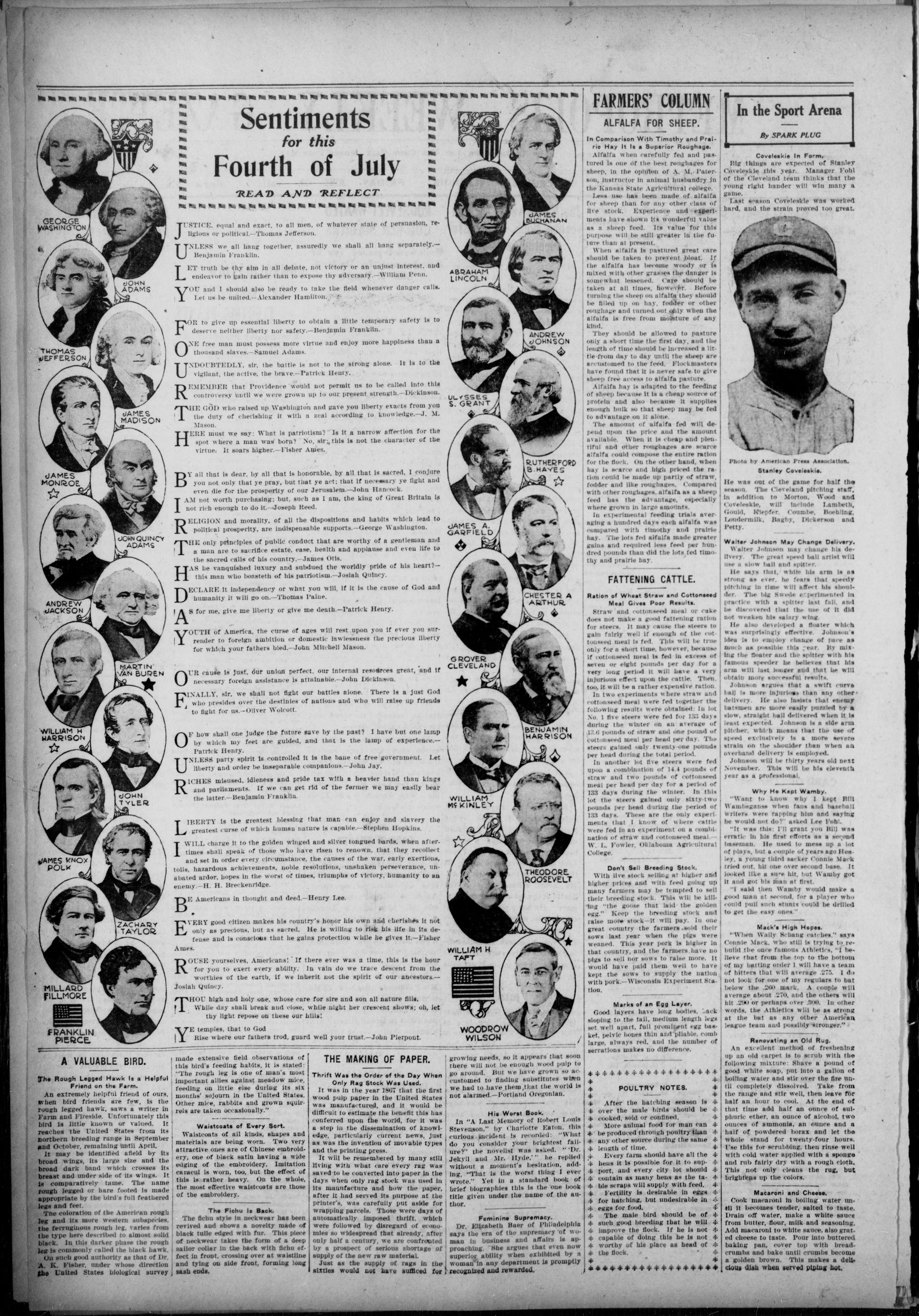
Sentiments for this Fourth of July
READ AND REFLECT
JUSTICE, equal and exact, to all men, of whatever
ligious or political.—Thomas Jefferson.
UNLESS we all hang together, assuredly we
Benjamin Franklin.
LET truth be thy aim in all debate, not victory
endeavor to gain rather than to expose thy ad-
YOU and I should also be ready to take the f
Let us be united.—Alexander Hamilton.
FOR to give up essential liberty to obtain a life
deserve neither liberty nor safety.—Benjamin
ONE free man must possess more virtue and en-
thousand slaves.—Sir, the battle is not to the
vigilant, the active, the brave.—Patrick Henry.
EMEMBER that Providence would not permit
controversy until we were grown up to our p
THE GOD who raised up Washington and gave
the duty of cherishing it with a zeal acco-
Mason.
HERE must we say: What is patriotism? Is it
spot where a man was born? No, sir, this
virtue. It soars higher.—Fisher Ames.
BY all that is dear, by all that is honorable, by
you not only that ye pray, but that ye act; the
even die for the prosperity of our Jerusalem.
AM not worth purchasing; but, such as I am, t
not rich enough to do it.—Joseph Reed.
RELIGION and morality, of all the disposition
political prosperity, are indispensable support.
THE only principles of public conduct that are
a man are to sacrifice estate, ease, health and
the sacred calls of his country.—James Otis.
AS he vanquished luxury and subdued the w
this man who bonsteth of his patriotism.—Joe
ECLARE it independency or what you will, if
humanity it will go on.—Thomas Paine.
AS for me, give me liberty or give me death.—I
YOUTH of America, the curse of ages will res-
render to foreign ambition or domestic law
for which your fathers bled.—John Mitchell M
OUR cause is just, our union perfect, our inter-
necessary foreign assistance is attainable.—J
INALLY, sir, we shall not fight our battles a
who presides over the destinies of nations and
to fight for us.—Oliver Wolcott.
OF how shall one judge the future save by the
by which my feet are guided, and that is
Patrick Henry.
UNLESS party spirit is controlled it is the ban
liberty and order be inseparable companions.
ICHES misused, idleness and pride tax with
and parliaments. If we can get rid of the
the latter.—Benjamin Franklin.
LIBERTY is the greatest blessing that man has
greatest curse of which human nature is capa-
WILL charge it to the golden winged and silver
times shall speak of those who have risen to
and set in order every circumstance, the causes
toils, hazardous achievements, noble resolutions,
abated arder, hopes in the worst of times, triumph
enemy.—H. H. Breckenridge.
and exact, to all men, of whatever state or
tactical.—Thomas Jefferson.
will hang together, assuredly we shall all have
Franklin.
why aim in all debate, not victory or an un-
gain rather than to expose thy adversary.—W
would also be ready to take the field whence
lited.—Alexander Hamilton.
up essential liberty to obtain a little temp-
erature liberty nor safety.—Benjamin Franklin.
must possess more virtue and enjoy more
leaves.—Samuel Adams.
LY, sir, the battle is not to the strong alo-
active, the brave.—Patrick Henty.
What Providence would not permit us to be
until we were grown up to our present stren-
rised up Washington and gave you liberty
cherishing it with a zeal according to k
he say: What is patriotism? Is it a narrow
a man was born? No, sir, this is not the
boars higher.—Fisher Ames.
clear, by all that is honorable, by all that is
ye pray, but that ye act; that if neces-
t the prosperity of our Jerusalem.—John Hay
purchasing; but, such as I am, the king of
tho do it.—Joseph Reed.
and morality, of all the dispositions and habi-
serity, are indispensable supports.—George
riciples of public conduct that are worthy of
so sacrifice estate, case, health and applause
falls of his country.—James Otis.
ished luxury and subdued the worldly pride
who boasteth of his patriotism.—Josiah Quince
independency or what you will, if it is the e
will go on.—Thomas Paine.
me liberty or give me death.—Patrick Heck
America, the curse of ages will rest upon you
foreign ambition or domestic lawlessness tha
our fathers bled.—John Mitchell Mason.
Just, our union perfect, our internal resou-
foreign assistance is attainable.—John Dickin
we shall not fight our battles alone. Tho
is over the destinies of nations and who will
is.—Oliver Wolcott.
one judge the future save by the past? I hath
my feet are guided, and that is the lamp-
ery.
spirit is controlled it is the bane of free
order be inseparable companions.—John Jay.
eed, idleness and pride tax with a heavier
ents. If we can get rid of the former we
denjamin Franklin.
the greatest blessing that man can enjoy
of which human nature is capable.—Steph-
it to the golden winged and silver tongued be-
break of those who have risen to renown, ther
every circumstance, the causes of the way
achievements, noble resolutions, unshaken b
ness in the worst of times, triumphs of victory
deckenridge.
of whatever state of persuasion, re-
nuredly we shall all hang separately.—
not victory or an unjust interest, and
pose thy adversary.—William Penn.
take the field whenever danger calls.
miton.
Obtain a little temporary safety is to
—Benjamin Franklin.
true and enjoy more happiness than a
not to the strong alone. It is to the
Patrick Henry.
I not permit us to be called into this
up to our present strength.—Dickinson.
and gave you liberty exacts from you
zeal according to knowledge.—J. M.
otism? Is it a narrow affection for the
so, sir, this is not the character of the
names.
Morable, by all that is sacred, I conjure
ye act; that if necessary ye fight and
Jerusalem.—John Hancock.
as I am, the king of Great Britain is
ed.
dispositions and habits which lead to
stable supports.—George Washington.
that are worthy of a gentleman and
health and applause and even life to
James Otis.
fuded the worldly pride of his heart?—
iotism.—Josiah Quincy.
you will, if it is the cause of God and
paine.
the death.—Patrick Henry.
Ges will rest upon you if ever you sur-
nestic lawlessness the precious liberty
Mitchell Mason.
at our internal resources great, and if
sustainable.—John Dickinson.
our battles alone. There is a just God
nations and who will raise up friends
have by the past? I have but one lamp
and that is the lamp of experience.—
is the bane of free government. Let
companions.—John Jay.
the tax with a heavier hand than kings
world of the former we may easily bear
that man can enjoy and slavery the
fure is capable.—Stephen Hopkins.
and silver tongued bards, when after-
e risen to renown, that they recollect
the causes of the war, early exertions,
solutions, unshaken perseverance, un-
s, triumphs of victory, humanity to an
Henry Lee.
Gry's honor his own and cherishes it not
life is willing to risk his life in its de-
s protection while he gives it.—Fisher
there ever was a time, this is the hour
in vain do we trace descent from the
herit not the spirit of our ancestors.—
for sire and son all nature fills,
while night her crescent shows; oh, let
fills!
well your trust.—John Pierpont.
JUSTICE, equal and exact, to all men, of whatever state of persuasion, religious or political.—Thomas Jefferson.
UNLESS we all hang together, assuredly we shall all hang separately.—Benjamin Franklin.
LET truth be thy aim in all debate, not victory or an unjust interest, and endeavor to gain rather than to expose thy adversary.—William Penn.
YOU and I should also be ready to take the field whenever danger calls. Let us be united.—Alexander Hamilton.
FOR to give up essential liberty to obtain a little temporary safety is to deserve neither liberty nor safety.—Benjamin Franklin.
ONE free man must possess more virtue and enjoy more happiness than a thousand slaves.—Samuel Adams.
UNDOUBTEDLY, sir, the battle is not to the strong alone. It is to the vigilant, the active, the brave.—Patrick Henry.
REMEMBER that Providence would not permit us to be called into this controversy until we were grown up to our present strength.—Dickinson.
THE GOD who raised up Washington and gave you liberty exacts from you the duty of cherishing it with a zeal according to knowledge.—J. M. Mason.
HERE must we say: What is patriotism? Is it a narrow affection for the spot where a man was born? No, sir; this is not the character of the virtue. It soars higher—Fisher Ames.
BY all that is dear, by all that is honorable, by all that is sacred, I conjure you not only that ye pray, but that ye act; that if necessary ye fight and even die for the prosperity of our Jerusalem.-John Hancock.
AM not worth purchasing; but, such as I am, the king of Great Britain is not rich enough to do it.-Joseph Reed.
RELIGION and morality, of all the dispositions and habits which lead to political prosperity, are indispensable supports.-George Washington.
THE only principles of public conduct that are worthy of a gentleman and a man are to sacrifice estate, ease, health and applause and even life to the sacred calls of his country.-James Otis.
AS he vanquished luxury and subdued the worldly pride of his heart?- this man who boasteth of his patriotism.-Josiah Quincy.
ECLARE it independency or what you will, if it is the cause of God and humanity it will go on.-Thomas Palne.
AS for me, give me liberty or give me death.-Patrick Henry.
YOUTH of America, the curse of ages will rest upon you if ever you surrender to foreign ambition or domestic lawlessness the precious liberty for which your fathers bled.-John Mitchell Mason.
OUR cause is just, our union perfect, our internal resources great, and if necessary foreign assistance is attainable.-John Dickinson.
FINALLY, sir, we shall not fight our battles alone. There is a just God who presides over the destinies of nations and who will raise up friends to fight for us.-Oliver Wolcott.
OF how shall one judge the future save by the past? I have but one lamp by which my feet are guided, and that is the lamp of experience. Patrick Henry.
UNLESS party spirit is controlled it is the bane of free government. Let liberty and order be inseparable companions. John Jay.
RICHES misused, idleness and pride tax with a heavier hand than kings and parliaments. If we can get rid of the former we may easily bear the latter. Benjamin Franklin.
LIBERTY is the greatest blessing that man can enjoy and slavery the greatest curse of which human nature is capable.—Stephen Hopkins.
WILL charge it to the golden winged and silver tongued bards, when after-times shall speak of those who have risen to renown, that they recollect and set in order every circumstance, the causes of the war, early exertions, toils, hazardous achievements, noble resolutions, unshaken perseverance, unabated ardor, hopes in the worst of times, triumphs of victory, humanity to an enemy.—H. H. Breckenridge.
BE Americans in thought and deed.—Henry Lee.
EVERY good citizen makes his country's honor he only as precious, but as sacred. He is willing fense and is conscious that he gains protection. Ames.
ROUSE yourselves, Americans! If there ever w for you to exert every ability. In vain do worthies of the earth, if we inherit not the Josiah Quincy.
TOU high and holy one, whose care for sire and While day shall break and close, while night thy light repose on these our hills!
YE temples, that to God Rise where our fathers trod, guard well your
citizen makes his country's honor his own and
ious, but as sacred. He is willing to risk
conscious that he gains protection while he
lives, Americans! If there ever was a time
exert every ability. In vain do we trace
the earth, if we inherit not the spirit of
and holy one, whose care for sire and son all
shall break and close, while night her cresce
repose on these our hills!
hat to God
our fathers trod, guard well your trust.—Joh
EVERY good citizen makes his country's honor his own and cherishes it not only as precious, but as sacred. He is willing to risk his life in its defense and is conscious that he gains protection while he gives it.—Fisher Ames.
ROUSE yourselves, Americans! If there ever was a time, this is the hour for you to exert every ability. In vain do we trace descent from the worthies of the earth, if we inherit not the spirit of our ancestors.—Josiah Quincy.
THOU high and holy one, whose care for sire and son all nature fills. While day shall break and close, while night her crescent shows; oh, let thy light repose on these our hills!
YE temples, that to God Rise where our fathers trod, guard well your trust.—John Pierpont.
made extensive field observations of this bird's feeding habits, it is stated: "The rough leg is one of man's most important allies against meadow mice, feeding on little else during its six months' sojourn in the United States. Other mice, rabbits and grown squirrels are taken occasionally."
Thrift Was The Order of the Day When
Only Bag Stock Was Used.
It was in the year 1867 that the first wood pulp paper in the United States was manufactured, and it would be difficult to estimate the benefit this has conferred upon the world, for it was a step in the dissemination of knowledge, particularly current news, just as was the invention of movable types and the printing press.
Waistcoats of Every Sort.
Waistcoats of all kinds, shapes and materials are being worn. Two very attractive ones are of Chinese embroidery, one of black satin having a wide edging of the embroidery. Imitation caracol is worn, too, but the effect of this is rather heavy. On the whole, the most effective waistcoats are those of the embroidery.
It will be remembered by many still living with what care every rag was saved to be converted into paper in the days when only rag stock was used in its manufacture and how the paper, after it had served its purpose at the printer's, was carefully put aside for wrapping parcels. Those were days of automatically imposed thrift, which were followed by disregard of economies so widespread that already, after only half a century, we are confronted by a prospect of serious shortage of supply of the new raw material.
The Fichu Is Back.
The fichu style in neckwear has been revived and shows a novelty made of black tulle edged with fur. This piece of neckwear takes the form of a deep sailor collar in the back with fichu effect in front, crossing over at waistline and tying on side front, forming long sash ends.
Just as the supply of rags in the sixties would not have suffaced for
THE MAKING OF PAPER.
JAMES BUCHANAN
ABRAHAM LINCOLN
ANDREW JOHNSON
ULYSSES S. GRANT
RUTHERFORD B. HAYES
JAMES A. GARFIELD
CHESTER A ARTHUR
GROVER CLEVELAND
BENJAMIN HARRISON
WILLIAM MCKINLEY
THEODORE ROOSEVELT
WILLIAM H TAFT
WOODROW WILSON
growing needs, so it appears that soon there will not be enough wood pulp to go around. But we have grown so accustomed to finding substitutes when we had to have them, that the world is not alarmed—Portland Oregonian.
His Worst Book.
In "A Last Memory of Robert Louis Stevenson," by Charlotte Eaton, this curious incident is recorded: "What do you consider your brightest failure?" the novelist was asked. "Dr. Jekyll and Mr. Hyde," he replied without a moment's hesitation, adding, "That is the worst thing I ever wrote." Yet in a standard book of brief biographies this is the one book title given under the name of the author.
Feminine Supremacy.
Dr. Elizabeth Baer of Philadelphia says the era of the supremacy of woman in business and affairs is approaching. "She argues that even now superior ability when exhibited by a woman in any department is promptly recognized and rewarded.
FARMERS' COLUMN
FARMERS' COLUMN
ALFALFA FOR SHEEP.
In Comparison With Timothy and Prain-
In How Make a Simulation Database
In Comparison With Timothy and Prairie Hay It Is a Superior Roughage. Alfalfa when carefully fed and pastured is one of the best roughages for sheep, in the opinion of A. M. Paterson, instructor in animal husbandry in the Kansas State Agricultural college. Less use has been made of alfalfa for sheep than for any other class of live stock. Experience and experiments have shown its wonderful value as a sheep feed. Its value for this purpose will be still greater in the future than at present.
When alfalfa is pastured great care should be taken to prevent bloat. If the alfalfa has become woody or is mixed with other grasses the danger is somewhat lessened. Care should be taken at all times, however. Before turning the sheep on alfalfa they should be filled up on hay, fodder or other roughage and turned out only when the alfalfa is free from moisture of any kind.
They should be allowed to pasture only a short time the first day, and the length of time should be increased a little from day to day until the sheep are accustomed to the feed. Flockmasters have found that it is never safe to give sheep free access to alfalfa pasture.
Alfalfa hay is adapted to the feeding of sheep because it is a cheap source of protein and also because it supplies enough bulk so that sheep may be fed to advantage on it alone.
The amount of alfalfa fed will depend upon the price and the amount available. When it is cheap and plentiful and other roughages are scarce alfalfa could compose the entire ration for the flock. On the other hand, when hay is scarce and high priced the ration could be made up partly of straw, fodder and like roughages. Compared with other roughages, alfalfa as a sheep feed has the advantage, especially where grown in large amounts. In experimental feeding trials averaging a hundred days each alfalfa was compared with timothy and prairie hay. The lots fed alfalfa made greater gains and required less feed per hundred pounds than did the lots fed timothy and prairie hay.
FATTENING CATTLE.
Ration of Wheat Straw and Cottonseed
Meal, Gives Poor Results.
Straw and cottonseed meal or cake does not make a good fattening ration for steers. It may cause the steers to gain fairly well if enough of the cottonseed meal is fed. This will be true only for a short time, however, because if cottonseed meal is fed in excess of seven or eight pounds per day for a very long period it will have a very injurious effect upon the cattle. Then, too, it will be a rather expensive ration. In two experiments where straw and cottonseed meal were fed together the following results were obtained: In lot No.1 five steers were fed for 133 days during the winter on an average of 13.6 pounds of straw and one pound of cottonseed meal per head per day. The steers gained only twenty-one pounds per head during the total period.
In another lot five steers were fed upon a combination of 14.4 pounds of straw and two pounds of cottonseed meal per head per day for a period of 133 days during the winter. In this lot the steers gained only sixty-two pounds per head during the period of 133 days. These are the only experiments that I know of where cattle were fed in an experiment on a combination of straw and cottonseed meal. W. L. Fowler, Oklahoma Agricultural College.
Don't Sell Breeding Stock.
With live stock selling at higher and higher prices and with feed going up many farmers may be tempted to sell their breeding stock. This will be killing "the goose that laid the golden egg" Keep the breeding stock and raise more stock—it will pay. In one great country the farmers sold their sows last year when the pigs were weaned. This year pork is higher in that country, and the farmers have no pigs to sell nor sows to raise more. It would have paid them well to have kept the sows to supply the nation with pork—Wisconsin Experiment Station.
Marks of an Egg Layer.
Good layers have long bodies, back sloping to the tail, medium length legs set well apart, full prominent egg basket, pelvic bones thin and pliable, comb large, always red, and the number of serrations makes no difference.
POULTRY NOTES.
After the hatching season is over the male birds should be cooked, sold or confined.
More animal food for man can be produced through poultry than any other source during the same length of time.
Every farm should have all the hens it is possible for it to support, and every city lot should contain as many hens as the table scraps will supply with feed.
Fertility is desirable in eggs for hatching, but undesirable in eggs for food.
The male bird should be of such good breeding that he will improve the flock. If he is not capable of doing this he is not worthy of his place as head of the flock.
In the Sport Arena
By SPARK PLUG
Coveleskie In Form.
Big things are expected of Stanley Coveleskie this year. Manager Fohl of the Cleveland team thinks that the young right hander will win many a game.
Last season Coveleskie was worked hard, and the strain proved too great.
C
Photo by American Press Association.
Stanley Coveleskie.
He was out of the game for half the season. The Cleveland pitching staff, in addition to Morton, Wood and Coveleskie, will include Lambeth, Gould, Kiepfer, Coumbe, Boehling, Loudermilk, Bagby, Dickerson and Petty.
Walter Johnson May Change Delivery.
Walter Johnson may change his delivery. The great speed ball artist will use a slow ball and spitter.
He says that, while his arm is as strong as ever, he fears that speedy pitching in time will affect his shoulder. The big Swede experimented in practice with a spitter last fall, and he discovered that the use of it did not weaken his salary wing.
He also developed a flatter which was surprisingly effective. Johnson's idea is to employ change of pace as much as possible this year. By mixing the flatter and the splitter with his famous speeder he believes that his arm will last longer and that he will obtain more successful results.
Johnson argues that a swift curve ball is more injurious than any other delivery. He also insists that enemy batsmen are more easily puzzled by a slow, straight ball delivered when it is least expected. Johnson is a side arm pitcher, which means that the use of speed exclusively is a more severe strain on the shoulder than when an overhand delivery is employed.
Johnson will be thirty years old next November. This will be his eleventh year as a professional.
Why He Kept Wamby.
"Want to know why I kept Bill Wambigansse when fans and baseball writers were rapping him and saying he would not do?" asked Lee Fohl.
"It was this; I'll grant you Bill was erratic in his first efforts as a second baseman. He used to mess up a lot of plays, but a couple of years ago Helen, a young third sacker Connie Mack tried out, hit one over second base. It looked like a sure hit, but Wamby got it and got his man at first.
"I said then Wamby would make a good man at second, for a player who could pull such stunts could be drilled to get the easy ones."
Mack's High Hopes.
"When Wally Schang catches," says Connie Mack, who still is trying to rebuild the once famous Athletics, "I believe that from the top to the bottom of my batting order I will have a team of hitters that will average .275. I do not look for one of my regulars to bat below the .200 mark. A couple will average about .270, and the others will hit .200 or perhaps over .300. In other words, the Athletics will be as strong at the bat as any other American league team and possibly stronger."
Renovating an Old Rug.
An excellent method of freshening up an old carpet is to scrub with the following mixture: Shave a pound of good white soap, put into a gallon of boiling water and stir over the fire until completely dissolved. Take from the range and stir well, then leave for half an hour to cool. At the end of that time add half an ounce of sulphuric ether, an ounce of alcohol, two ounces of ammonia, an ounce and a half of powdered borax and let the whole stand for twenty-four hours. Use this for scrubbing, then rinse well with cold water applied with a sponge and rub fairly dry with a rough cloth. This not only cleans the rug, but brightens up the colors.
Macaroni and Cheese.
Cook macaroni in boiling water until it becomes tender, salted to taste. Drain off water, make a white sauce from butter, flour, milk and seasoning. Add macaroni to white sauce, also grated cheese to taste. Pour into buttered baking pan, cover top with breadcrumbs and bake until crumbs become a golden brown. This makes a delicious dish when served piping hot.
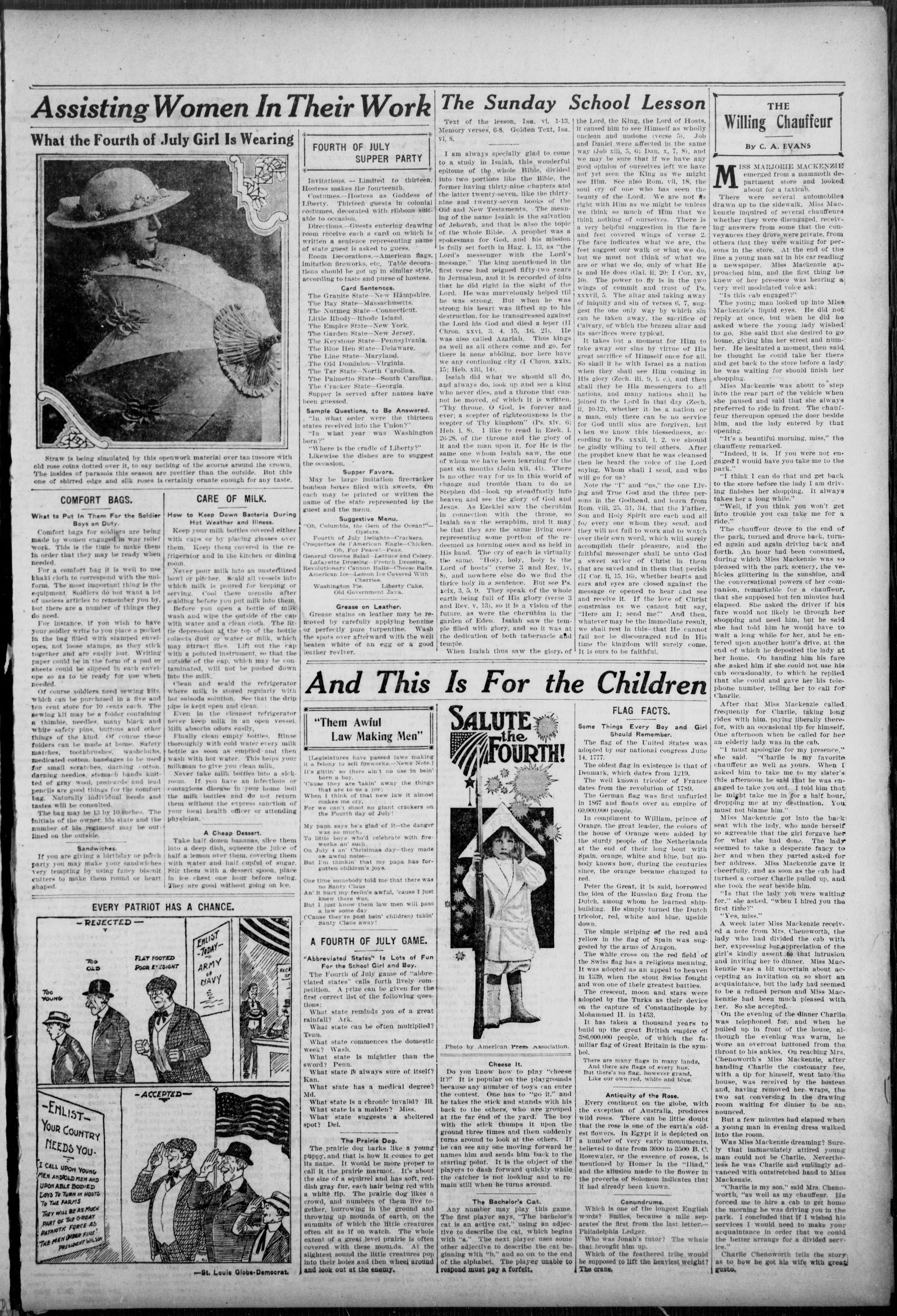
Assisting Women In Their Work
What the Fourth of July Girl Is Wearing
THE WORLD'S FINEST FASHION
Straw is being simulated by this openwork material over tan tussore with old rose coins dotted over it, to say nothing of the acorns around the crown. The insides of parasols this season are prettier than the outside. But this one of shirred edge and slik roses is certainly ornate enough for any taste.
COMFORT BAGS.
What to Put In Them For the Soldier Boys on Duty.
Comfort bags for soldiers are being made by women engaged in war relief work. This is the time to make them in order that they may be ready when needed.
For a comfort bag it is well to use khaki cloth to correspond with the uniform. The most important thing is the equipment. Soldiers do not want a lot of useless articles to remember you by, but there are a number of things they do need.
For instance, if you wish to have your soldier write to you place a pocket in the bag filled with stamped envelopes, not loose stamps, as they stick together and are easily lost. Writing paper could be in the form of a pad or sheets could be slipped in each envelope so as to be ready for use when needed.
Of course soldiers need sewing kits, which can be purchased in a five and ten cent store for 10 cents each. The sewing kit may be a folder containing a thimble, needles, many black and white safety pins, buttons and other things of the kind. Of course these folders can be made at home. Safety matches, toothbrushes, washcloths, medicated cotton, bandages to be used for small seratches, darning cotton, darning needles, stomach bands knitted of gray wool, postcards and lead pencils are good things for the comfort bag. Naturally individual needs and tastes will be consulted.
The bag may be 13 by 10 inches. The initials of the owner, his state and the number of his regiment may be outlined on the outside.
If you are giving a birthday or pach party you may make your sandwiches very tempting by using fancy biscuit cutters to make them round or heart shaped.
EVERY PATRIOT HAS A CHANCE.
- REJECTED
TOO OLD
FLAT FOOTED
POOR EYE SIGHT
TOO YOUNG
ENLIST
TODAY
ARMY
OR
NAVY
- ENLIST
YOUR COUNTRY
NEEDS YOU.
I CALL UPON YOUNG
MEN AND OLD MEN AND
UPON ABLE BODIED
LOYS TO TURN IN HOSTS
TO THE FARMS
THEY WILL BE AS MUCH
PART OF THE GREAT
PATRIOTIC FORCE AS
THE MEN UNDER FIRE
PRESIDENT WILSON
Sandwiches.
CARE OF MILK.
How to Keep Down Bacteria During Hot Weather and Illness.
Keep your milk bottles covered either with caps or by placing glasses over them. Keep them covered in the refrigerator and in the kitchen or dining room.
Never pour milk into an unsterilized bowl or pitcher. Scald all vessels into which milk is poured for keeping or serving. Cool these utensils after scalding before you put milk into them.
Before you open a bottle of milk wash and wipe the outside of the cap with water and a clean cloth. The little depression at the top of the bottle collects dust or water or milk, which may attract flies. Lift out the cap with a pointed instrument, so that the outside of the cap, which may be contaminated, will not be pushed down into the milk.
Clean and seal the refrigerator where milk is stored regularly with hot salsoda solution. See that the drip pipe is kept open and clean. Even in the cleanest refrigerator never keep milk in an open vessel. Milk absorbs odors easily. Finally clean empty bottles. Rinse thoroughly with cold water every milk bottle as soon as emptied and then wash with hot water. This helps your milkman to give you clean milk. Never take milk bottles into a slick room. If you have an infectious or contagious disease in your home boil the milk bottles and do not return them without the express sanction of your local health officer or attending physician.
A Cheap Dessert.
Take half dozen bananas, slice them into a deep dish, squeeze the juice of half a lemon over them, covering them with water and half cupful of sugar. Stir them with a dessert spoon, place in ice chest one hour before using. They are good without going on ice.
And This Is For the Children
FOURTH OF JULY
SUPPER PARTY
Invitations. — Limited to thirteen.
Hostess makes the fourteenth.
Costumes—Hostess as Goddess of
Liberty. Thirteen guests in colonial
costumes, decorated with ribbons suit-
able to occasion.
Directions. —Guests entering drawing
room receive each a card on which is
written a sentence representing name
of state guest is asked to guess.
Room Decorations. —American flags,
imitation fireworks, etc. Table decora-
tions should be got up in similar style,
according to taste and purse of hostess.
Card Sentences.
The Granite State—New Hampshire.
The Bay State—Massachusetts.
The Nutmeg State—Connecticut.
Little Rhody—Rhode Island.
The Empire State—New York.
The Garden State—New Jersey.
The Keystone State—Pennsylvania.
The Blue Hen State—Delaware.
The Line State—Maryland.
The Old Dominion-Virginia.
The Tar State—North Carolina.
The Palmetto State—South Carolina.
The Cracker State—Georgia.
Supper is served after names have been guessed.
Sample Questions, to Be Answered.
"In what order were the thirteen states received into the Union?"
"In what year was Washington born?"
"Where is the cradle of Liberty?"
Likewise the dishes are to suggest the occasion.
Supper Favors.
May be large imitation firecracker bonbon boxes filled with sweets. On each may be printed or written the name of the state represented by the guest and the menu.
Suggestive Menu
Suggestive Menu.
"Oh, Columbia, the Gem of the Ocean!"—Oysters.
Fourth of July Dresses—Crackers.
Croquettes de l'Américan Eagle—Chicken.
Oh, For Peace—Peas.
General Greene Salad—Lettuce and Celery.
Lafayette Dressing—French Dressing.
Revolutionary Cannon Balls—Cheese Balls.
American Ice—Lemon Ice Covered With Cherries.
Washington Pie. Liberty Cake.
Old Government Java.
Grease on Leather.
Grease stains on leather may be removed by carefully applying benzine or perfectly pure turpentine. Wash the spots over afterward with the well beaten white of an egg or a good leather reviver.
And This
"Them Awful Law Making Men"
[Legislatures have passed laws making it a felony to sell fireworks.—News Note.]
it's gittin' so there ain't no use in bein' born a boy;
'Cause they are 'takin' away the things that are to us a joy;
When I think of that new law it almost makes me cry.
For we can't shoot no giant crackers on the Fourth day of July!
My papa says he's glad of it—the danger was so much.
To little boys who'd celebrate with fire-works.
On July 4 an 'Christmas day—the made an awful noise—
But I'm thinkin' that my papa has forgotten children's joys.
One time somebody told me that there was no Santy Claus
An' it hurt my feelin' awful, 'cause I just knew there was.
But I just know them law men will pass a law some day
('Cause they're past hein' children) takin'
'Santy Claus away!'
A FOURTH OF JULY GAME.
"Abbreviated States" Is Lots of Fun For the School Girl and Boy.
The Fourth of July game of "abbreviated states" calls forth lively competition. A prize can be given for the first correct list of the following questions:
What state reminds you of a great rainfall? Ark.
What state can be often multiplied? Teen.
What state commences the domestic week? Wash.
What state is mightier than the sword? Penn.
What state is always sure of itself? Kan. What state has a medical degree? Md.
What state is a chronic invalid? Ill.
What state is a malden? Miss.
What state suggests a sheltered spot? Del.
The Prairie Dog.
The prairie dog barks like a young puppy, and that is how it comes to get its name. It would be more proper to call it the prairie marmot. It's about the size of a squirrel and has soft, redish gray fur, each hair being red with a white tip. The prairie dog likes a crowd, and numbers of them live together, burrowing in the ground and throwing up mounds of earth, on the summits of which the little creatures often sit as if on watch. The whole extent of a great level prairie is often covered with these mounds. At the slightest sound the little creatures pop into their holes and then wheel around and look out at the enemy.
The Sunday School Lesson
Text of the lesson, Isa, vi, 1-13
Memory verses, 6-8. Golden Text, Isa,
vi, 8.
I am always specially glad to come to a study in Isaiah, this wonderful epitome of the whole Bible, divided into two portions like the Bible, the former having thirty-nine chapters and the latter twenty-seven, like the thirty-nine and twenty-seven books of the Old and New Testaments. The meaning of the name Isaiah is the salvation of Jehovah, and that is also the topic of the whole Bible. A prophet was a spokesman for God, and his mission is fully set forth in Hag. 1, 13, as "the Lord's messenger with the Lord's message." The king mentioned in the first verse had reigned fifty-two years in Jerusalem, and it is recorded of him that he did right in the sight of the Lord. He was marvelously helped till he was strong. But when he was strong his heart was lifted up to his destruction, for he transgressed against the Lord his God and died a leper (11 Chron. xxvi. 3, 4, 15, 16, 21). He was also called Azariah. Thus kings as well as all others come and go, for there is none abiding, nor here have we any continuing city (I Chron. xxix. 15; Heb. xxii. 14).
Isaiah did what we should all do, and always do, look up and see a king who never dies, and a throne that cannot be moved, of which it is written, "Thy throne, O God, is forever and ever; a scepter of righteousness is the scepter of Thy kingdom" (Ps. xlv. 6; Heb. 1, 8). I like to read in Ezek. 1, 26-28, of the throne and the glory of it and the man upon it, for he is the same one whom Isaiah saw, the one of whom we have been learning for the past six months (John xii, 41). There is no other way for us in this world of change and trouble than to do as Stephen did—look up steadfastly into heaven and see the glory of God and Jesus. As Ezekiel saw the cherubim in connection with the throne, so Isaiah saw the seraphim, and it may be that they are the same living ones representing some portion of the redeemed as burning ones and as held in His hand. The cry of each is virtually the same, "Holy, holy, holy is the Lord of hosts" (verse 3 and Rev. iv, 8), and nowhere else do we find the thrice holy in a sentence. But see Ps. xlx, 3, 5, 9. They speak of the whole earth being full of His glory (verse 3 and Rev. v, 13), so it is a vision of the future, as were the cherubim in the garden of Eden. Isaiah saw the temple filled with glory, and so it was at the dedication of both tabernacle and temple.
When Isaiah thus saw the glory, of
SALUTE
the
FOURTH!
Photo by American Press Association.
Cheese It.
Do you know how to play "cheese it?" It is popular on the playgrounds because any number of boys can enter the contest. One has to "go it." and he takes the stick and stands with his back to the others, who are grouped at the far end of the yard. The boy with the stick thumps it upon the ground three times and then suddenly turns around to look at the others. If he can see any one moving forward he names him and sends him back to the starting point. It is the object of the players to dash forward quickly while the catcher is not looking and to remain still when he turns around.
The Bachelor's Cat.
Any number may play this game. The first player says, "The bachelor's cat is an active cat," using an adjective to describe the cat, which begins with "a." The next player uses some other adjective to describe the cat beginning with "b," and so on to the end of the alphabet. The player unable to respond must pay a forfeit.
the Lord, the King, the Lord of Hosts, it caused him to see Himself as wholly unclean and undone (verse 5). Job and Daniel were affected in the same way (Job xlii, 5, 6; Dan, x, 7, 8), and we may be sure that if we have any good opinion of ourselves left we have not yet seen the King as we might see Him. See also Rom. vii, 18, the soul cry of one who has seen the beauty of the Lord. We are not as right with Him as we might be unless we think so much of Him that we think nothing of ourselves. There is a very helpful suggestion in the face and feet covered wings of verse 2. The face indicates what we are, the feet suggest our walk or what we do, but we must not think of what we are or what we do, only of what He is and He does (Gal. ii, 20; I Cor. xv, 10). The power to fly is in the two wings of commit and trust of Ps. xxxvii, 5. The altar and taking away of iniquity and sin of verses 6, 7, suggest the one only way by which sin can be taken away, the sacrifice of Calvary, of which the brazen altar and its sacrifices were typical.
It takes but a moment for Him to take away our sins by virtue of His great sacrifice of Himself once for all. So shall it be with Israel as a nation when they shall see Him coming in His glory (Zech. iii, 9, 1. c), and then shall they be His messengers to all nations, and many nations shall be joined to the Lord in that day (Zech. ii, 10-12), whether it be a nation or a man, only there can be no service for God until sins are forgiven, but when we know this blessedness, according to Ps. xxxii, 1, 2, we should be gladly willing to tell others. After the prophet knew that he was cleansed then he heard the voice of the Lord saying, Whom shall I send, and who will go for us?
Note the "I" and "us," the one Living and True God and the three persons in the Godhead, and learn from Rom. vill, 25, 31, 34, that the Father, Son and Holy Spirit are each and all for every one whom they send, and they will not fail to work and to watch over their own word, which will surely accomplish their pleasure, and the faithful messenger shall be unto God a sweet savior of Christ in them that are saved and in them that perish (II Cor. ii, 15, 16), whether hearts and ears and eyes are closed against the message or opened to hear and see and receive it. If the love of Christ constrains us we cannot but say, "Here am I; send me!" And then, whatever may be the immediate result, we shall rest in this—that He cannot fall nor be discouraged and in His time the kingdom will surely come. It is ours to be faithful.
FLAG FACTS.
Some Things Every Boy and Girl Should Remember.
The flag of the United States was adopted by our national congress June 14, 1777.
The well known tricolor of France dates from the revolution of 1789. The German flag was first unfurled in 1867 and floats over an empire of 60,000,000 people.
In compliment to William, prince of Orange, the great leader, the colors of the house of Orange were added by the sturdy people of the Netherlands at the end of their long bout with Spain, orange, white and blue, but nobody knows how, during the centuries since, the orange became changed to red.
Peter the Great, it is said, borrowed the idea of the Russian flag from the Dutch, among whom he learned shipbuilding. He simply turned the Dutch tricolor, red, white and blue, upside down.
The simple striping of the red and yellow in the flag of Spain was suggested by the arms of Aragon.
The white cross on the red field of the Swiss flag has a religious meaning. It was adopted as an appeal to heaven in 1339, when the stout Swiss fought and won one of their greatest battles. The crescent, moon and stars were adopted by the Turks as their device on the capture of Constantinople by Mohammed II. in 1453. It has taken a thousand years to build up the great British empire of 380,000,000 people, of which the familiar flag of Great Britain is the symbol.
Antiquity of the Rose.
Every continent on the globe, with the exception of Australia, produces wild roses. There can be little doubt that the rose is one of the earth's oldest flowers. In Egypt it is depicted on a number of very early monuments, believed to date from 3000 to 3500 B. C. Rosewater, or the essence of roses, is mentioned by Homer in the "Ililud," and the allusion made to the flower in the proverbs of Solomon indicates that it had already been known.
Conundrums.
Which is one of the longest English words? Smiles, because a mile separates the first from the last letter.—Philadelphia Ledger.
Who was Jonah's tutor? The whale that brought him up.
Which of the feathered tribe would be supposed to lift the heaviest weight? The crane.
THE Willing Chauffeur
By C. A. EVANS
MISS MARJORIE MACKENZIE emerged from a mammoth department store and looked about for a taxicab.
There were several automobiles drawn up to the sidewalk. Miss Mackenzie inquired of several chauffeurs whether they were disengaged, receiving answers from some that the conveyances they drove were private, from others that they were waiting for persons in the store. At the end of the line a young man sat in his car reading a newspaper. Miss Mackenzie approached him, and the first thing he knew of her presence was hearing a very well modulated voice ask:
"Is this cab engaged?"
The young man looked up into Miss Mackenzie's liquid eyes. He did not reply at once, but when he did he asked where the young lady wished to go. She said that she desired to go home, giving him her street and number. He hesitated a moment, then said he thought he could take her there and get back to the store before a lady he was waiting for should finish her shopping.
Miss Mackenzie was about to step into the rear part of the vehicle when she paused and said that she always preferred to ride in front. The chauffeur thereupon opened the door beside him, and the lady entered by that opening.
"It's a beautiful morning, miss," the chauffeur remarked.
"Indeed, it is. If you were not engaged I would have you take me to the park."
"I think I can do that and get back to the store before the lady I am driving finishes her shopping. It always takes her a long while." "Well, if you think you won't get into trouble you can take me for a ride."
The chauffeur drove to the end of the park, turned and drove back, turned again and again driving back and forth. An hour had been consumed, during which Miss Mackenzie was so pleased with the park scenery, the vehicles glittering in the sunshine, and the conversational powers of her companion, remarkable for a chauffeur, that she supposed but ten minutes had elapsed. She asked the driver if his fare would not likely be through her shopping and need him, but he said she had told him he would have to wait a long while for her, and he entered upon another hour's drive, at the end of which he deposited the lady at her home. On handing him his fare she asked him if she could not use his cab occasionally, to which he replied that she could and gave her his telephone number, telling her to call for Charlie.
After that Miss Mackenzie called frequently for Charlie, taking long rides with him, paying liberally therefor, with an occasional tip for himself. One afternoon when he called for her an elderly lady was in the cab. "I must apologize for my presence." she said. "Charlie is my favorite chauffeur as well as yours. When I asked him to take me to my sister's this afternoon he said that he was engaged to take you out. I told him that he might take me in for a half hour, dropping me at my destination. You must not blame him."
Miss Mackenzie got into the back seat with the lady, who made herself so agreeable that the girl forgave her for what she had done. The lady seemed to take a desperate fancy to her and when they parted asked for her address. Miss Mackenzie gave it cheerfully, and as soon as the cab had turned a corner Charlie pulled up, and she took the seat beside him.
"Is that the lady you were waiting for," she asked, "when I hired you the first time?"
A week later Miss Mackenzie received a note from Mrs. Chenoworth, the lady who had divided the cab with her, expressing her appreciation of the girl's kindly assent to that intrusion and inviting her to dinner. Miss Mackenzie was a bit uncertain about accepting an invitation on so short an acquaintance, but the lady had seemed to be a refined person and Miss Mackenzie had been much pleased with her. So she accepted.
On the evening of the dinner Charlie was telephoned for, and when he pulled up in front of the house, although the evening was warm, he wore an overcoat buttoned from the throat to his ankles. On reaching Mrs. Chenoworth's Miss Mackenzie, after handing Charlie the customary fee, with a tip for himself, went into the house, was received by the hostess and, having removed her wraps, the two sat conversing in the drawing room waiting for dinner to be announced.
But a few minutes had elapsed when a young man in evening dress walked into the room.
Was Miss Mackenzie dreaming? Surely that immaculately attired young man could not be Charlie. Nevertheless he was Charlie and smiling advanced with outstretched hand to Miss Mackenzie.
"Charlie is my son," said Mrs. Chenoworth, "as well as my chauffeur. He forced me to hire a cab to get home the morning he was driving you in the park. I concluded that if I wished his services I would need to make your acquaintance in order that we could the better arrange for a divided service."
Charlie Chenoworth tells the story as to how he got his wife with great gusto.
Metropolis Gazette
PUBLISHED ON FRIDAY BY
THE GAZETTE PRINTING CO.
GETROPOLIS, . . . . ILL.
MRS. M. J. McCRARY, MANAGER.
J. B. McCRARY, EDITOR
FRIDAY JUNE 29, 1917.
Office 9th and Pearl Streets, Metropolis, Illinois.
Entered as second-class mail matter, at Metropolis, Illinois, Postoffice.
Address all communications to J. R. McRARY, Box 107 Metropolis, Illinois.
The names and addresses of contrib
rors must be known to us in every
instance, in order to secure publication.
We want the news of your vicinity
each week.
TERMS OF SUBSCRIPTION:
One Year ..... $1.50
ix Months ..... 75
Three Months ..... 40
single Copy ..... 05
in Advance.
ADVERTISING RATES.
made known on application.
You must mail copy on
Mondays to secure publication.
KINKY Hair
Grows Long, Soft, Silky
Gentlement:
I am sending you my picture to let you see what your EXELENTO QUININE Pomade has done for my hair. It has grown to take longer and is very thick, soft and silky and I can now fix my hair any way I want to. It is the best hair care in the world. Lovely BANKS.
Don't be fooled all your life by using some fake preparation, which claims to straighten kinky hair. You are just fooling yourself by using it. Kinky hair cannot be made straight. You must have hair direct. Now this agent of stamps or coin.
EXELENTO QUININE POMADE is a Hair Grower which feeds the scalp and roots of the hair and makes kinkyumpy hair grow long, soft and silky. It cleans dandruff and stops Falling hair from it. Now by mail on receipt of stamps or coin.
AGENTS WANTED EVERYWHERE
Write for Participants
EXELENTO MEDICINE CO. ATLANTA, GA.
NO. 141110
The Gazette has just received another lot of new type faces and other material which adds much to the output of the work of the office. We deserve your patronage. We have a full line of cards, Letter Heads, Envelopes and other material. Let us do some of your work. Let us do your minute work and any other church advertisements.
Paper and every other articles used in a newspaper have jumped sky-high, therefore it takes more money to operate a paper than ever before. If you appreciate our efforts to give you a good paper, you will not hesitate to pay up at once. The Gazette, office has just received a large consignment, Letter Heads Envelopes, Bill Heads, Cards & etc. Let us do some of your job work.
The brothers that promised to pay the editor of The Gazette for the paper if they lived. Poor fellows! they are dead for they have not paid for the paper. We are preparing to hand a number of names of our subscribers to our collecting agent as they seem to think we can run on cold air. We can't and need our money to pay bills. Fine Strawberries, Lettuce, Beets, Onions, Beans and New Potatoes Friday night for Saturday morning, at the Grand Leader Cafe.
Capt. A. Williams, Lieut H.
G. Burke and Private Edgar Or-
lington of Co. M. were in Caire.
Wednesday on business connected
with the company.
The Profits of Gardening.
In this unhust world a large part of
the profits of a town garden are made
by the hardware store.-Achison
Globe.
$100 Reward. $100.
The readers of this paper will be pleased to learn that there is at least one dreaded disease that science has been able to cure in all its stages, and that is catarrh. Hall's catarh cure is the ooly positive cure now known to the medical fraternity. catarh being a constitutional disease, requires a constitutional treatment. Hall's catarh is taken internally, acting directly upon the blood and mucous surfaces of the system, thereby destroying the foundation of the disease, and giving the patient strength by building up the constitution and assisting nature in doing its work. The proprietors have so much faith in its curative powers that they offer One Hundred Dollars for any case that it fails to cure. send for list of testimonials.
Address F. J. cHENEY & cO., Toledo, O.
Sold by all Druggists, 75c.
Take Hall's Family Pills for constipation.
Fried Fish every day at the Grand Leader Cafe.
The delegates and friends that attended the Mt. Olive B Y. P.
U. and S. S cs convention at Cairo,
returned home Monday.
N W Long. undertaker accompanied the body of Mr.
James Wright, to Obion, Tenn.,
for burial.
Mr. and Mrs. Major Sulzer were Paducah, visitors Saturday.
Rev. I. S. Stone, ana Misses Izora Rodgers, Maud Porter, and Francis English, left Monday for Colp, where they will attend the A. M. E. Sunday School convention.
George Whittaker, is in the city visiting relatives and friends.
Mr. and Mrs. Thos. Anderson last their last child Saturday and was buried Sunday afternoon by undertaker Long.
Mrs. Alberta Spicer, webb, of Chicago is visiting parents.
Atty. Horace A. Taylor, of St Louis, Mo., is in the city visiting his grand-mo her, Mrs. Ann Tinley. Silver Crown lodg Masors celebrated St. John's day Sunday and the lodges of Paducuh, were down and required the Strs, Rapids and City of Cairo, to carry the crowd and then there were some left on the bank The crowd though large was very orderly and reflected credit upon the fraternity as well as upon the race.
Capt. A. Williams, Lieut. H. G. Burke, and Edgar Oringtoon went Cairo, and other points this week enrolling men for Company M. of this city. We think it is wise to enlist in the 8th Ill', Regiment.
The East Mt. Olive Baptist S. S. convention, which held a successful meeting in Dewmaine, last week, raised $200.00 cash writes Dr Phillips. Good, and this the grand total of the two conventions to almost the $400 notch. What will the A. M E. S. S. convention raise this week at Colp?
Mrs. Mamie Harmon is at home from Cairo with her mother and relatives.
Mrs. Mamie Maxwell, of our sister city, Brookport, was down last Sunday.
There was a Red Cross meeting held at the Fisrt Baptist church Tuesday night and at the Antioch Baptist church, Wednesday night and much interest was manifested. Senator D. W. Helm, W. A. Spence, Capt Edd Cowling, Cooper, Revs. Rowlett, and Thos. Morris. J. B. McCrary, presided. A committee was appointed consisting 9 members to arrange for the canvass for membership.
Wm Adams, manager of the Metropolis Clirrt, was in Cairo, Thursday on business connected with baseball.
that investor is satisfied with small. The transmission lines connecting city with city extend through rural districts and may be used for supplying electrical energy for use on farms. Illinois is much more advanced in this respect than any other great American state. Nearly half of the geographical area of the state is connected up by transmission lines between the electrical plants of small cities—plants that heretofore were operated as single units but which have become united into one major unit for operation and otherwise. Three hundred and thirty-five separate municipalities with a population of a million are grouped—each group served as from a single central station.
A distinct advantage of the plant combination system is that it enables farmers to use electrical energy from transmission lines for farm work, increasing farm production and improving farm living conditions. This, in turn, greatly improves the business and social conditions of the cities that depend almost entirely upon the farmers.
Expensiveness of Animal Power.
Expensiveness of Animal Power.
The use of power on the farm has always been necessary—horses, windmills, waterpower. But, these have had their conspicuous objections. The water wheel could not be relied on continuously, and its power could not be distributed and used where it was needed on the farm. It was the same with the windmill—its use was intermittent and limited. The steam, or gasoline, engine was better, but, its power was not easily applied—as in lighting. Horses, while the most used, have been the most expensive sources of power. At the present time it takes as much land to grow food for the horses and mules of the United States as is required for the human beings. And, ninety per cent of the horses are used in agriculture. In addition the horse requires housing and care, and his work day is short and his years of usefulness few. Unlike the ox, he is not available as food when he becomes otherwise useless. The use of electricity on the farm is the greatest advance that farming is now making. It saves the land, time and capital, given up to the horse, and reduces the disagreeableness of farm work to the minimum. In European countries—especially in Germany and Switzerland—electrical energy has done much to improve farm conditions and out puts.
Cities Depend on the Farms.
America should do more to make farming attractive as a vocation—to reduce the labor of the farm. The elimination of draft animals alone from the farm can be made to increase the surplus exports of the farm enormously. In addition, work now not attempted will be carried on. For example, consider the matter of drainage. Great areas can be freed from surplus water, while in dry seasons water can be pumped for cattle and often for growing crops. Eventually by the development of the use of electrical energy on the farm fertilizers from the air will become a by-product of the great and greater electrical plants operating during the hours of minimum use. And, this matter of fertilization is becoming more and more important. We need nitrogen for our farms and we require it in our preparation for war. An ideal electrical development system would contemplate the use of waterpower supplemented with steam, distributed from central stations by means of transmission lines everywhere that it could be made use of to enhance farm productions and ameliorate farm living and working conditions. It should be situated advantageously to fuel supply and where water is always available. A great many diversified industries should be encouraged—industries that would, by using power at times of minimum load, make a steady requirement that would reduce the cost of light and power.
The small city that undertakes to hold itself aloof and operate its own small, perhaps out of date, electric light and power plant—happy-go-lucky—is behind the times. It might as well refuse to connect itself by railroad, telegraph and telephone, with other places that would make it accessible from the outer world. And, as I have indicated, not only should the small plants in the small cities be tied together to be operated in groups as units, but they should do what they can to make electrical current available for the farmers who support and make, practically, all that is of great value in the cities. We may build cities and they may stand—but they will not make farms nor foodstuffs. But, if we build up and improve the farms in attractiveness and output, at the same time we build cities, and railroads, and churches, and schools, and all that is worth while of social and physical character.
ELECTRIC HARVESTING
Nine farmers near Abilong, Kansas, inaugurated the first, threshing of wheat by electric power in the United States. Forming a company, they purchased a small motor and a separator. They rented a transformer from the central light company and also 1,000 feet of cable. The separator was placed in the field, connected with the motor and the cable reached to the nearest light along the highway. The turning of the switch set the machinery in motion and the threshing was done at a coat of half the ordinary expense. The old fashioned engine requires a water boy, engineer and perhaps a coal hunter and is expensive to operate. The motor is clean, quiet, free from fire danger and needs only occasional oiling. Over 1,600 barrels of wheat a day were threshed easily. New York independent
There are several vacant churches in Southern Illinois, and good pastors are very much in need, especially in the Mt. Olive District. We need broad men, men who are able to construct and reach the unreached and un-saved. We need and must have a good sound gospel minister in the Mt. Olive District for Missionary. Who will it be? It will require an able man, of exceptional qualifications one apt to teach, pray for the work and that God will send more laborers into this vineyard. Where are the license ministers? of our churches? Have the churches been making and encouraging young men to prepare for the ministry to take the places of those who have passed into their reward, and others who will shortly do so? We must have recruits to fill the places made vacant or soon the Baptist pulpits and churches will be lost for leaders. The churches and older ministers have made a sad mistake by not encouragising the younger men. They returned down their own for others and now you are in dire need of men, your own men who should follow in the footsteps of their fathers. The crisis is upon us, turn your eyes upon the harvest and see that the laborers are very few indeed. Will you correct this evil by appciating your young men. "Take what you have and make what you want," you can make strong preachers if you will.
To The Brethren Con posing the Mt. Olive Baptist Assoc at on Dear Brethren: I am very sorry that I could not be in the Gairo meeting. It was due to my having to pull through many struggles. as you know all pa tors are trown into at times.
I just returned home from the State Convention at Paris, Ill, and ruhed two delegates off to see after the district work, while I remained at home planning for the Western States Convention in July at DesMoines, Iowa.
I take this method of saying to
to the brethren that as long as I
am pastor of this church you all
are welcome to come to our church
and greach. Our choir, deacon
board and people are always ready
to assist in making your stay
pleasant one.
I close hoping to meet you in
your next meeting.
I am yours for the work.
Jos. W. Harris.
company's money spent in improvements has been spent to make 'Fore River a better place to work. There are still many departments needing new buildings, new washrooms, new locker rooms, and many other improvements to make this yard the kind of a yard you and we both want it to be.
"We expect to pay a fair tax, but will not pay an exorbitant one. This matter is of interest to you. Think it over.
A Texas legislator recently offered for enactment a bill designed to prevent head-on collisions between railroad trains in his State. The main part of the text said: "When two trains, coming from opposite directions, approach a crossing, both shall stop, and neither shall cross until the other has passed."
CONSERVATION TRUTHS.
The man at the bench is the coworker of the man in the office. Let them get together for the common good.
Stick to your job. The man who jumps from one job to another never learns enough about any particular class of work to become valuable in it.
All Weather Good
Sunshine is delicious, rain is refreshing, wind braces up, snow is exhilarating; there is really no such thing as bad weather, only different kinds of good weather—John Ruskin.
ACCEPTANCE OF FEDERAL AID MONEY FOR ROADS
By S. E. BRADT.
('Member of Illinois State Highway Commission.)
ARTICLE III.
I have discussed a state bond issue
for a system of state roads, and an
increase in automobile license fees
which would be sufficient to pay one-
nth of the cost of the bond issue. Con-
nected intimately with these questions
is the passing of the federal aid road
bill which will allot to this state.
$220,000 available July 1, 1916
440,000 " " 1,1917
660,000 " " 1,1918
880,000 " " 1,1919
1,100,000 " " 1,1920
a total of $3,300,000.
The requirement of the federal aid law is that the state shall appropriate an equal amount, or an additional $3,900,000. The department of agriculture asks that this state prepare a definite plan for the expenditure of this $6,000,000 and submit the same to it with the first project for road improvement. They probably will require that the plan shall involve the completion of a restricted system of roads; that is, that it shall either connect up stretches of durably constructed main highways or, if we have no such stretches of highways to connect up, that it shall involve a restricted system by itself. I assume that there will be no question as to the acceptance of this money by Illinois; therefore this sum of $6,000,000 added to the fund derived from $0,000,000 bond issue would give a total of $03,000,000 or approximately $16,500 per mile for a 4,000-mile system, which would be ample to construct a system in which the main roads where necessary would be 18 feet in width and none less than 15 feet in width. This would give us in Illinois a system of federal and state aid roads of 4,000 miles to be improved by the state with such additional help as came from the government; another system of 12,000 miles of county roads to be improved at the joint expense of the state and county under the state aid system or bond issue plan, and a further system of 78,000 miles of township roads to be improved at the expense of the township.
As I have said, I believe it impossible to get satisfactory results through the annual construction of a short section in each county on the state aid system, because the people are not time for rond improvement. If the willing to wait the required length of county bond issue plan is pursued without the state's first taking over a state system many of our main roads will be inadequately improved and many not improved at all. With a combination of state and federal system of roads, a county system of roads and a township system, all the money expended by the government, the state and the county will be conserved and satisfactory results brought about in the shortest period of time possible.
FARMERS INDORSE ROAD SYSTEM
Illinois Institute Also Goes on Record for Federal Aid and Increased Auto Fees.
At the recent meeting of the Illinois Farmers' institute the following resolution favoring a state-wide system of roads connecting the different communities was adopted:
"Resolved. That we favor the appropriation of sufficient money from the general fund of the state to meet the requirements of the federal aid statute for the building of durable roads in Illinois, such roads to be so planned and located as to be of the greatest good to the whole people; and be it further
"Resolved. That we favor a reasonable increase in the automobile license fee, the greater increase to fall upon the larger and heavier automobiles and trucks; and be it further
"Resolved. That we favor the building of a state-wide system of permanent roads to connect the different communities, markets and principal cities and towns of the state."
$60,000,000 BOND ISSUE BILL
The bill introduced in the legislature provides for the construction of 4,000 miles of highways to cost approximately $80,000,000. The system is to be constructed in five or six years, work to start in various parts of the state at the same time and to be carried on continuously in each section. The roads are to be built under the supervision of the state highway department, but not to be less than ten feet nor more than 18 feet wide. They are to be of a type that will outlast the bonds. Bonds are to run 20 years and bear interest of $1%, and not exceeding 4 per cent. The roads are to be maintained by the state after construction. Generally, they will connect large cities, towns and county seats along routes serving the greatest population, the main points to be considered to be selected by the legislature and voted upon by the people of the state at the same time they pass on the question of the bond issue, which, it is proposed, will be the election of November, 1918. The bill authorizes the reimbursement of any county for the construction of any state bond issue road, whether under the state-aid system or the county-bond issue system. It provides for levying a direct tax to pay principal and interest, except where appropriations are made from other sources to pay part of the indebtedness, for instance, from the state motor fee fund.
THREE IMPORTANT HIGHWAY QUESTIONS.
Three important questions touching the improvement of Illinois highways come up before the fifthtier Illinois legislature, now in session. They are:
1. A state bond issue.
2. An increase in the automobile license fees.
3. The acceptance by Illinois of the federal allotment for the improvement of main roads.
This newspaper will print a series of three articles touching on these subjects written by S. E. Bradt, member of the Illinois State Highway commission.
highways. A system of that size would reach practically every county of the state and connect nearly all the cities and villages having more than 2,000 population, as well as many other smaller places.
If the forthcoming general assembly should authorize a vote upon this question, it could not be submitted to the people until the next general election November, 1918. I believe it is desirable to vote upon this question at a "off year" election when there are national issues to be decided, no national offices, and very few state offices to be filled. If the question of anmitting this proposition to the people is not acted upon until the general assembly meets in January, 1919, then the election would be held in 1920 the time of a presidential election, well as at a time when our principal state officials are elected. It may then become an issue in the state capitol, or be overshadowed by official questions. If the fifthth general assembly shall authorize a vote taken 1918 it would be some months after the election before work could begin as it would be desirable to have the preme court pass upon the proceeding in order to give the bonds a stamarket. Therefore, if we go at matter as expeditiously as possible would be the summer of 1919 before work would be commenced; and it considered that it would probably to from five to seven years to constr this 4,000-mile system; I believe it high time that the movement should be started.
The next question that prises what would be the source from with the money should be derived to pay principal of a $00,000,000 bond is and the interest thereon? Assume that it would require five years make the improvement and that bonds would be issued serially up a 25-year limit, all bonds would mat within 30 years from the date of first issue, or practically at the age rate of $2,000,000 per year, suming the interest rate to be 6 cent, which I believe to be simple der any ordinary conditions, the mutual interest would approximate 000,000 which would mean an am payment of $3,000,000 including principal and interest.
(NEXT ARTICLE—"AN IN CREASE IN AUTOMOBIL LICENSE FEES.")
4,888,231 PEOPLE SERVED BY
4,000-MILE ROAD SYS
If Illinois constructs a state siz of 4,000 miles of permanent high as is proposed under the $00,000 bond issue, 80 per cent of the population of the state (which wi 638,591 under the last census) will either on the roads so construct within a radius of five miles.
Thus not only will the larger c towns and villages of the state be nected, but a great part of the population will have the use of ways that can be traveled all the round.
Experts of the state highway dement have figured that in addition the 2,185,283 population of Ch. 4,520,071 people living in smaller towns and villages will be disserved by the good roads. In ada 82,560 farmers and their families live along the roads. The addedlation within a radius of five mi 1,003,317, making a total populat 4,886,231 that will be served.
ALL FOR STATE ROAD BOND
ISSUE OF $60.00
The following organizations voted endorsements of the proposal a $60,000,000 state bond issue to struct a system of 4,000 miles of manent good roads in Illinois: Hotel Association of Chicago. Executive council of Illinois ers' association. Good roads committee—Har club, Chicago. Illinois Women's Legislative gross. Associated Roads organizati Chicago and Cook county. Illinois Hotel association. Hamilton club of Chicago. Advertising club of Chicago. Alton Chamber of Commerce. Automobile Trade associatic Chicago. State Dairymen's association. Rotary club of Chicago.
Do Some Topworking. Plan to do some topworkin spring. This is a good way to turtles from unproductive trees thrifty.
Most Profitable Trees. Low-headed peach trees are most profitable.