Metropolis Weekly Gazette
Friday, August 3, 1917
Metropolis, Illinois
Page text (machine-generated)
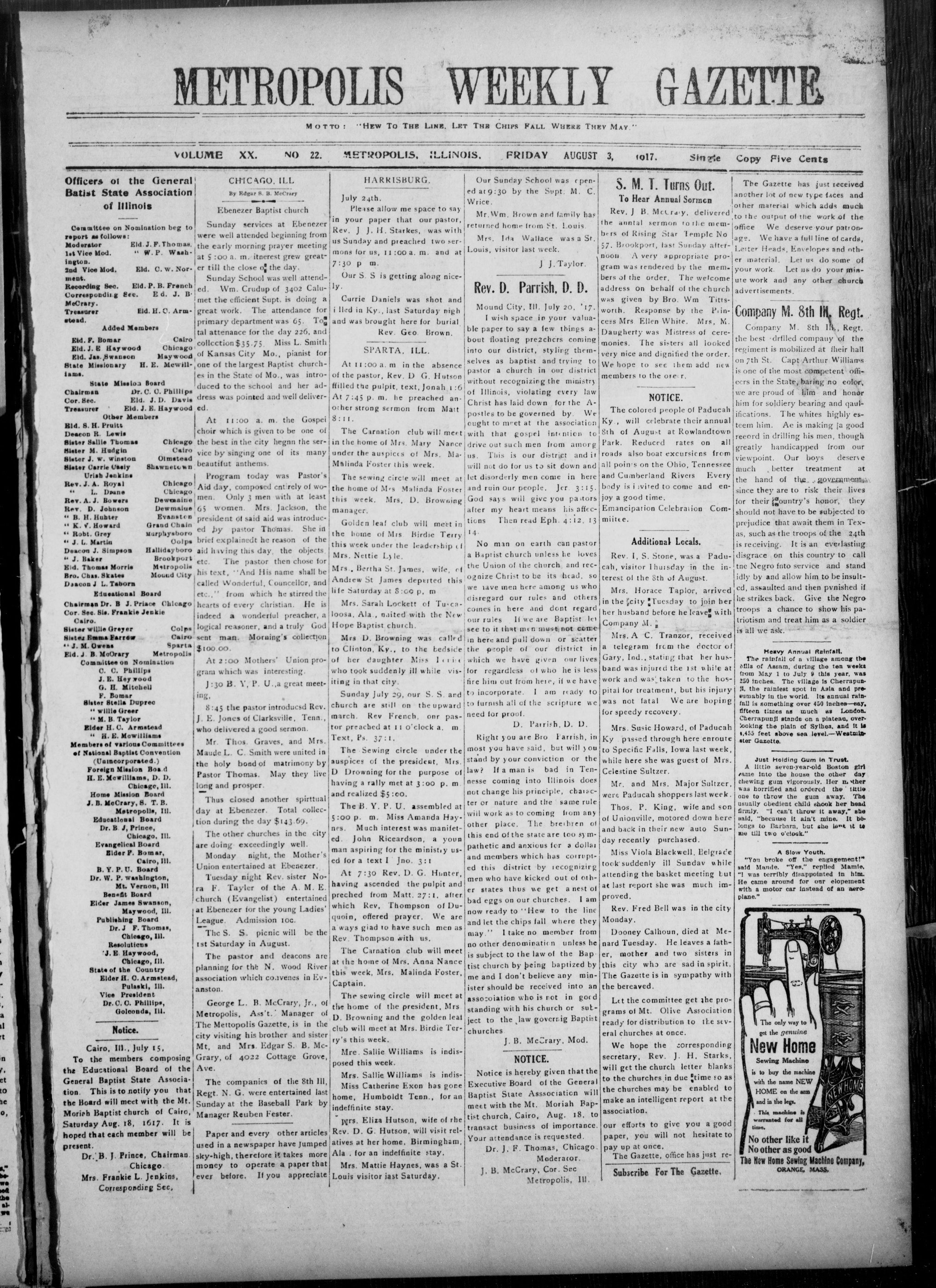
METROPOLIS WEEKLY GAZETTE
Officers of the General Batist State Association of Illinois
Committee on Nomination beg to report as follows:
Moderator Eld. J. F. Thomas,
1st Vice Mod. " W. P. Washington.
2nd Vice Mod. Eld. C. w. Norment.
Recording Sec. Eld. P. B. French
Corresponding Sec. Ed. J. B. McCrary.
Treasurer Eld. H. C. Armstead.
Added Members
Eld. F. Bomar Cairo
Eld. J. E. Haywood Chicago
Eld. J. Jas. Swanson Maywood
State Missionary H. E. Mewilliams.
State Mission Board
Chairman Dr. C. C. Phillips
Cor. Sec. Eld. J. D. Davis
Treasurer Eld. J. E. Haywood
Other Members
Eld. S. H. Prutt
Deacon R. Lewis
Sister Sallie Thomas Chicago
Sister M. Hudgin Cairo
Sister J. w. winston Olmstead
Sister Carrie Casly Shawnetown
Urish Jenkins
Rev. J. A. Royal Chicago
" L. Drane Chicago
Rev. A. J. Bowers Dewmaine
Rev. D. Johnson Dewmaine
" B. H. Hubter Evanstein
" K. V. Howard Grand Chain
" Robt. Grey Murphysboro
" J. L. Martin Colps
Deacon J. Simpson Hallidayboro
" J. Baker Brookport
Thomas Morris Metropolis
Bro. Chas. Skates Mound City
Deacon J. L. Taborn
Educational Board
Chairman Dr. B. J. Priace Chicago
Cor. Sec. Sis. Frankie Jenkie Cairo.
Sister willie Greyer Colps
Sister Emma Farrow Cairo
" J. M. Owens Sparta
Eld. J. B. McOrary Metropolis
Committee on Nomination
C. C. Phillips
J. E. Heywood
G. H. Mitchell
F. Bomar
Sister Stella Duprec
" willie Greer
" M. B. Taylor
Elder H. C. Armstead
" H. E. Mowilliams
Members of various Committees of National Baptist Convention (Unincorporated.)
Foreign Mission Board
H. E. Mowilliams, D. D. Chicago, Ill.
Home Mission Board
J. B. McCrary, S. T. B. Metropolis, Ill.
Educational Board
Dr. B. J, Prince, Chicago, Ill.
Evangelical Board
Elder F. Bomar, Cairo, Ill.
B. Y. P. U. Board
Dr. W. P. washington, Mt. Vernon, Ill.
Benefit Board
Elder James Swanson, Maywood, Ill.
Publishing Board
Dr. J. F. Thomas, Chicago, Ill.
Resolutions
" J. E. Haywood, Chicago, Ill.
State of the Country
Elder H. C. Armstead, Pulaski, Ill.
Vice President
Dr. C. C. Phillips, Golconda, Ill.
Notice.
Notice.
Cairo, Ill., July 15.
To the members composing the Educational Board of the General Baptist State Association. This is to notify you that the Board will meet with the Mt. Moriah Baptist church of Cairo, Saturday Aug. 18, 1617. It is hoped that each member will be present.
Dr. B. J. Prince, Chairman. Chicago.
Mrs. Frankie L. Jenkins, Corresponding Sec.
\(^{1}\)
```markdown
```
Sunday services at Ebenezer were well attended beginning from the early morning prayer meeting at 5:00 a.m. itinerest grew greater till the close o the day.
Sunday School was well attended. Wm. Crudup of 3402 Calumet the efficient Supt. is doing a great work. The attendance for primary department was 65. Total attenance for the day 226, and collection $35.75. Miss L. Smith of Kansas City Mo., pianist for one of the largest Baptist churches in the State of Mo., was introduced to the school and her address was pointed and well delivered.
At 11:00 a.m. the Gospei choir which is given to be one of the best in the city hegnn the service by singing one of its many beautiful anthems.
Program today was Pastor's Aid day, composed entirely of women. Only 3 men with at least 65 women. Mrs. Jackson, the president of said aid was introduced by pastor Thomas. She in brief explained he reason of the aid having this day, the objects, etc. The pastor then chose for his text, "And His name shall be called Wonderful, Counceller, and etc.," from which he stirred the hearts of every Christian. He is indeed a wonderful preacher, a logical reasoner, and a truly God sent man. Morning's collection $100.00.
Mr. Thos. Graves, and Mrs. Maude L. C. Smith were united in the holy bond of matrimony by Pastor Thomas. May they live long and prosper.
Thus closed another spiritual day at Ebenezer. Total collection during the day $143.69.
The other churches in the city are doing exceedingly well.
Monday night, the Mother's Union entertained at Ebenezer.
Tuesday night Rev. sister Nora F. Tayler of the A. M. E. church (Evangelist) entertained at Ebenezer for the young Ladies' League. Admission 10c.
The S. S. picnic will be the 1st Saturday in August.
The pastor and deacons are planning for the N. wood River association which convenes in Evanston.
George L. B. McCrary, Jr., of Metropolis, Ass't. Manager of The Mettopolis Gazette, is in the city visiting his brother and sister Mt, and Mrs. Edgar S. B. McGary, of 4022 Cottage Grove, Ave.
The companies of the 8th Ill. Regt. N. G. were entertained last Sunday at the Baseball Park by Manager Reuben Fester.
Paper and every other articles used in a newspaper have jumped sky-high, therefore it takes more money to operate a paper that ever before. If you appreciate
MOTTO : "HEW TO THE LINE, LET THE CHIPS FALL WHERE THEY MAY."
HARRISBURG.
Please allow me space to say in your paper that our pastor, Rev. J J. H. Starkes, was with us Sunday and preached two sermons for us, 11:00 a.m. and at 7:30 p.m.
Our S. S is getting along nicely.
Currie Daniels was shot and killed in Ky., last Saturday night and was brought here for burial.
SPARTA. ILL.
At 11:00 a.m. in the absence of the pastor, Rev. D G. Hutson filled the pulpit, text, Jonah 1:6 At 7:45 p.m. he preached another strong sermon from Matt 8:11.
The Carnation club will meet in the home of Mrs. Mary Nance under the auspices of Mrs. Ma-Malinda Foster this week.
The sewing circle will meet at the home of Mrs Malinda Foster this week. Mrs. D. Browning manager.
Golden leaf club will meet in the home of Mrs. Birdie Terry this week under the leadership of Mrs. Nettie Lyle.
Mrs., Bertha St. James, wife, of Andrew St James deported this life Saturday at 8:00 p.m.
Mrs. Sarah Lockett of Tuscaloosa, Ala., nailed with the New Hope Baptist church.
Mrs D. Browning was called to Clinton, Ky., to the bedside of her daughter Miss Iorie who took suddenly ill while visiting in that city.
Sunday July 29, our S. S. and church are still on the upward march. Rev French, our pastor preached at 11 o'clock a. m. Text, Ps. 37:1.
The Sewing circle under the auspices of the president, Mrs. D Drowning for the purpose of having a rally met at 3:00 p. m. and realized $5:00.
The B. Y. P. U. assembled at 5:00 p. m. Miss Amanda Haynes. Much interest was manifested. John Riceardson, a young man aspiring for the ministry used for a text I Jno. 3:1
At 7:30 Rev. D. G. Hunter, having ascended the pulpit and preched from Matt. 27:1, after which Rev. Thompson of Duquoin, offered prayer. We are a ways giad to have such men as Rev. Thompson with us.
The Carnation club will meet at the home of Mrs. Anna Nance this week, Mrs. Malinda Foster, Captain.
The sewing circle will meet at the home of the president, Mrs. D. Browning and the golden leaf club will meet at Mrs. Birdie Terry's this week.
Mre. Sallie Williams is indisposed this week.
Mrs. Sallie Williams is indis- Miss Catherine Exon has gone home, Humboldt Tenn., for an indefinite stay.
Mrs. Eliza Hutson, wife of the Rev. D. G. Hutson, will visit relatives at her home. Birmingham, Ala. for an indefinite stay.
Mrs. Mattie Haynes, was a St. Louis visitor last Saturday.
Our Sunday School was opened at 9:30 by the Supt. M. C. Wrice.
Mrs. Ida Wallace was a St. Louis, visitor last week.
Rev. D. Parrish. D. D.
Mound City, Ill. July 20, '17.
I wish space in your valuable paper to say a few things about floating preachers coming into our district, styling themselves as baptist and trying to pastor a church in our district without recognizing the ministry of Illinois, violating every law Christ has laid down for the Apostles to be governed by. We ought to meet at the association with that gospel intention to drive out such men from among us. This is our district and it will not do for us to sit down and let disorderly men come in here and ruin our people. Jer. 3:15. God says will give you pastors after my heart means his affections. Then read Eph. 4:12, 13 14.
No man on earth can pastor a Baptist church unless he loves the Union of the church, and recognize Christ to be its head, so we have men here among us who disregard our rules and others comes in here and dont regard our rules. If we are Baptist let see to it that men must not come in here and pull down or scatter the people of our district in which we have given our lives for regardless of who he is less fire him out from here, if we have to incorporate. I am ready to to furnish all of the scripture we need for proof.
D. Parrish, D. D.
Right you are Bro Farrish, in most you have said, but will you stand by your conviction or the law? If a man is bad in Tennessee coming into Illinois does not change his principle, character or nature and the same rule will work as to coming from any other place. The brethren of this end of the state are too sympathetic and anxious for a dollar and members which has corrupted this district by recognizing men who have kicked out of other states thus we get a nest of bad eggs on our churches. I am now ready to "Hew to the line and let the chips fall where they may." I take no member from no other denomination unless he is subject to the law of the Baptist church by being baptized by me and I don't believe any minister should be received into an association who is not in good standing with his church or subject to the law governig Baptist churches.
J. B. McCrary, Mod.
NOTICE.
Notice is hereby given that the Executive Board of the General Baptist State Association will meet with the Mt. Moriah Baptist church, Cairo, Aug. 18, to transact business of importance. Your attendance is requested.
S. M. T. Turns Out. To Hear Annual Sermon
Rev, J B. McCrazy, delivered the annal sermon to the members of Rising Star Temple No 57. Brookport, last Sunday afternoon. A very appropriate program was rendered by the members of the order. The welcome address on behalf of the church was given by Bro. Wm Tittsworth. Response by the Princess Mrs Ellen White. Mrs, M. Daugherty was Mistress of ceremonies. The sisters all looked very nice and dignified the order. We hope to see them add new members to the order.
NOTICE.
The colored people of Paducah Ky., will celebrate their annual 8th of August at Rowlandtown Park. Reduced rates on all roads also boat excursions from all points on the Ohio, Tennessee and Cumberland Rivers Every body is invited to come and enjoy a good time. Emancipation Celebration Committee.
Additional Locals.
Rev. I, S. Stone, was a Paducah, visitor Ihursday in the interest of the 8th of August.
Mrs. Horace Taplor, arrived in the city Tuesday to join her her husband before he leave with Company M.
Mrs. A C. Tranzor, received a telegram from the doctor of Gary, Ind., stating that her husband was injured the 1st while at work and was taken to the hospital for treatment, but his injury was not fatal We are hoping for speedy recovery.
Mrs. Susic Howard, of Paducah Ky. passed through here enroute to Specific Falls, Iowa last week, while here she was guest of Mrs. Celestine Sultzer.
Mr. and Mrs. Major Sultzer, were Paducah shoppers last week.
Thos, P. King, wife and son of Unionville, motored down here and back in their new auto Sunday recently purchased.
Miss Viola Blackwell, Belgrade took suddenly ill Sundav while attending the basket meeting but at last report she was much improved.
Rev. Fred Bell was in the city Monday.
Dooney Calhoun, died at Menard Tuesday. He leaves a father, mother and two sisters in this city who are sad in spirit. The Gazette is in sympathy with the bereaved.
Let the committee get the programs of Mt. Olive Association ready for distribution to the several churches at once.
We hope the corresponding secretary, Rev. J. H. Starks, will get the church letter blanks to the churches in due time so as the churches may be enabled to make an intelligent report at the association.
our efforts to give you a good paper, you will not hesitate to pay up at once.
The Gazette, office has just re
Subscribe For The Gazette.
The Gazette has just received another lot of new type faces and other material which adds much to the output of the work of the office. We deserve your patronage. We have a full line of cards, Letter Heads, Envelopes and other material. Let us do some of your work. Let us do your minute work and any other church advertisements.
Company M. 8th HL. Regt.
Company M. 8th Ile., Regt. the best drilled company of the regiment is mobilized at their hall on 7th St. Capt Arthur Williams is one of the most competent officers in the State, baring no color, we are proud of him and honor him for soldiery bearing and qualifications. The whites highly esteem him. Ae is making ja good record in drilling his men, though greatly handicapped from our viewpoint. Our boys deserve much better treatment at the hand of the government, since they are to risk their lives for their country's honor, they should not have to be subjected to prejudice that await them in Texas, such as the troops of the 24th is receiving. It is an everlasting disgrace on this country to call the Negro into service and stand idly by and allow him to be insulted, assaulted and then pwnished if he strikes back. Give the Negro troops a chance to show his patriotism and treat him as a soldier is all we ask.
Heavy Annual Rainfall.
The rainfall of a village among the bills of Assam, during the ten weeks from May 1 to July 9 this year, was 250 inches. The village is Cherrapunil, the rainstest spot in Asia and presumably in the world. Its annual rainfall is something over 450 inches—say, fifteen times as much as London. Cherrapunil stands on a plateau, overlooking the plain of Sylpha, and it is 1,455 feet above sea level.—Westminster Gazette.
---
Just Holding Gum in Trust.
A little seven-year-old Boston girl came into the house the other day chewing gum vigorously. Her mother was horrified and ordered the little one to throw the gum away. The usually cbedient child shook her head firmly.
"I can't throw it away," she said, "because it ain't mine. It belongs to Barbarn, but she lent it to me till two o'clock."
A Slow Youth.
"You broke off the engagement!" said Mande. "Yes," replied Mande. "I was terribly disappointed in him. He came around for our elopement with a motor car instead of an aeroplane."
The only way to
get the genuine
New Home
Sewing Machine
is to buy the machine
with the name NEW
HOME on the arm
and in the legs.
This machine is
warranted for all
time.
No other like it
No other as good
The New Home Sewing Machine Company,
ORANGE, MASS.
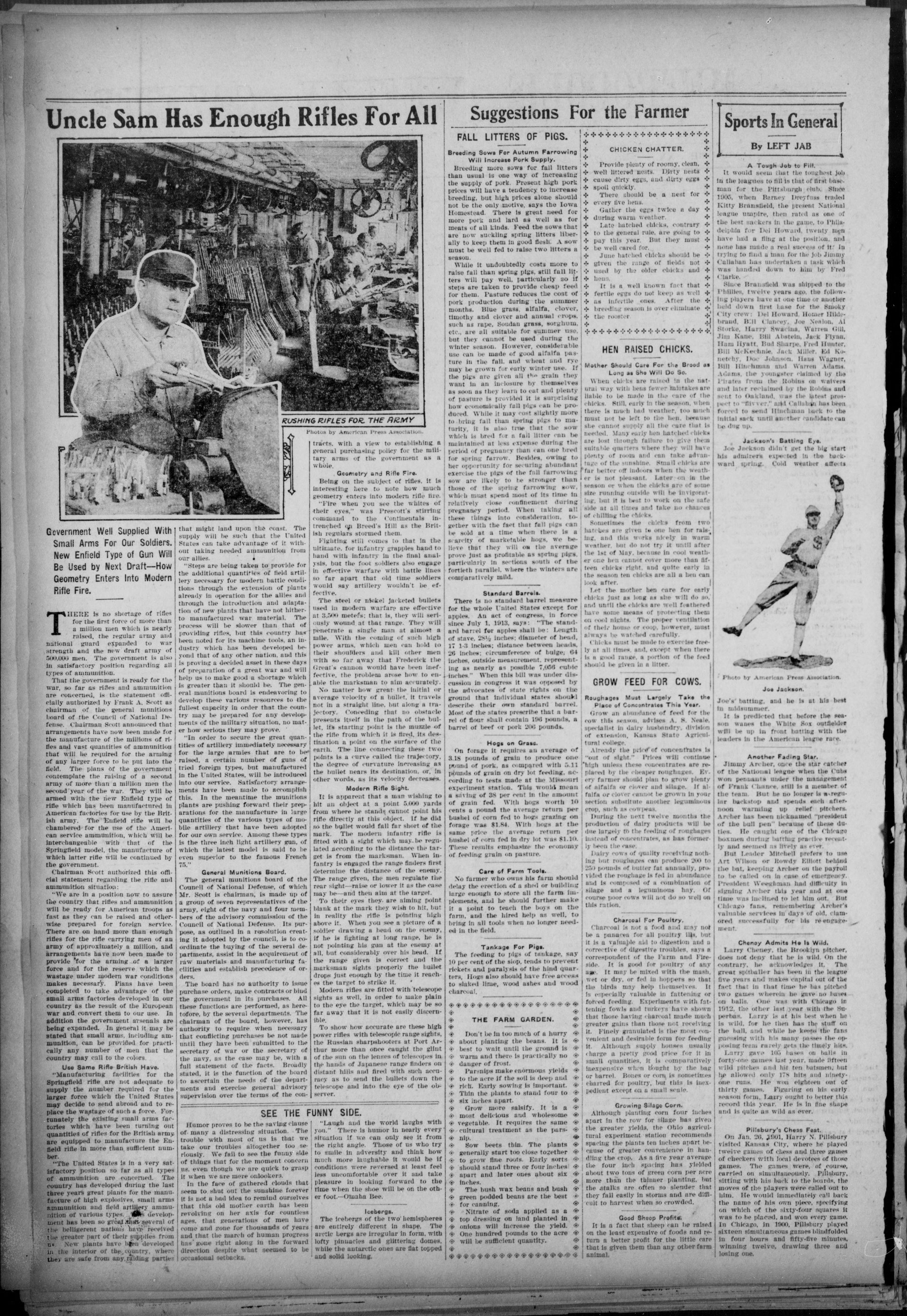
Uncle Sam Has Enough Rifles For All
Government Well Supplied With Small Arms For Our Soldiers. New Enfield Type of Gun Will Be Used by Next Draft—How Geometry Enters Into Modern Rifle Fire.
THERE is no shortage of rifles for the first force of more than a million men which is nearly raised, the regular army and national guard expanded to war strength and the new draft army of 500,000 men. The government is also in satisfactory position regarding all types of ammunition.
That the government is ready for the war, so far as rifles and ammunition are concerned, is the statement officially authorized by Frank A. Scott as chairman of the general munitions board of the Council of National Defense. Chairman Scott announced that arrangements have now been made for the manufacture of the millions of rifles and vast quantities of ammunition that will be required for the arming of any larger force to be put into the field. The plans of the government contemplate the raising of a second army of more than a million men the second year of the war. They will be armed with the new Enfield type of rifle which has been manufactured in American factories for use by the British army. The Enfield rifle will be chambered for the use of the American service ammunition, which will be interchangeable with that of the Springfield model, the manufacture of which latter rifle will be continued by the government.
Chairman Scott authorized this official statement regarding the rifle and ammunition situation:
"We are in a position now to assure the country that rifles and ammunition will be ready for American troops as fast as they can be raised and otherwise prepared for foreign service. There are on hand more than enough rifles for the rifle carrying men of an army of approximately a million, and arrangements have now been made to provide for the arming of a larger force and for the reserve which the wastage under modern war conditions makes necessary. Plans have been completed to take advantage of the small arms factories developed in our country as the result of the European war and convert them to our use. In addition the government arsenals are being expanded. In general it may be stated that small arms, including ammunition, can be provided for practically any number of men that the country may call to the colors.
Use Same Rifle British Have.
"Manufacturing facilities for the Springfield rifle are not adequate to supply the number required for the larger force which the United States may decide to send abroad and to replace the wastage of such a force. Fortunately the existing small arms factories which have been turning out quantities of rifles for the British army are equipped to manufacture the Enfield rifle in more than sufficient number
"The United States is in a very satisfactory position so far as all types of ammunition are concerned. The country has developed during the last three years great plants for the manufacture of high explosives, small arms ammunition and field artillery ammunition of various types. This development has been so great that several of the belligerent nations have received the greater part of their supplies from us. New plants have been developed in the interior of the country, where they are safe from any raiding parties
RUSHING RIFLES FOR THE ARMY
that might land upon the coast. The supply will be such that the United States can take advantage of it without taking needed ammunition from our allies.
"Steps are being taken to provide for the additional quantities of field artillery necessary for modern battle conditions through the extension of plants already in operation for the allies and through the introduction and adaptation of new plants that have not hitherto manufactured war material. The process will be slower than that of providing rifles, but this country has been noted for its machine tools, an industry which has been developed beyond that of any other nation, and this is proving a decided asset in these days of preparation of a great war and will help us to make good a shortage which is greater than it should be. The general munitions board is endeavoring to develop these various resources to the fullest capacity in order that the country may be prepared for any developments of the military situation, no matter how serious they may prove.
"In order to secure the great quantities of artillery immediately necessary for the large armies that are to be raised, a certain number of guns of tried foreign types, but manufactured in the United States, will be introduced into our service. Satisfactory arrangements have been made to accomplish this. In the meantime the munitions plants are pushing forward their preparations for the manufacture in large quantities of the various types of mobile artillery that have been adopted for our own service. Among these types is the three inch light artillery gun, of which the latest model is said to be even superior to the famous French 75."
The general munitions board of the Council of National Defense, of which Mr. Scott is chairman, is made up of a group of seven representatives of the army, eight of the navy and four members of the advisory commission of the Council of National Defense. Its purpose, as outlined in a resolution creating it adopted by the council, is to coordinate the buying of the several departments, assist in the acquisition of raw materials and manufacturing facilities and establish precedence of orders.
The board has no authority to issue purchase orders, make contracts or bind the government in its purchases. All these functions are performed, as heretofore, by the several departments. The chairman of the board, however, has authority to require when necessary that conflicting purchases be not made until they have been submitted to the secretary of war or the secretary of the navy, as the case may be, with a full statement of the facts. Broadly stated, it is the function of the board to ascertain the needs of the departments and exercise general advisory supervision over the terms of the con-
SEE THE FUNNY SIDE
Humor proves to be the saving clause of many a distressing situation. The trouble with most of us is that we take our troubles altogether too seriously. We fail to see the funny side of things that for the moment concern us, even though we are quick to grasp it when we are mere onlookers.
In the face of gathered clouds that seem to shut out the sunshine forever it is not a bad idea to remind ourselves that this old mother earth has been revolving on her axis for countless ages, that generations of men have come and gone for thousands of years and that the march of human progress has gone right along in the forward direction despite what seemed to be occasional setbacks.
General Munitions Board.
Photos by American Press Association.
Geometry and Rifle Fire
Being on the subject of rifles, it is interesting here to note how much geometry enters into modern rifle fire. "Fire when you see the whites of their eyes," was Prescott's stirring command to the Continentalists intrenched on Breed's Hill as the British regulars stormed them.
Fighting still comes to that in the ultimate, for infantry grapples hand to hand with infantry in the final analysis, but the foot soldiers also engage in effective warfare with battle lines so far apart that old time soldiers would say artillery wouldn't be effective.
The steel or niskel jacketed bullets used in modern warfare are effective at 3,500 metefs; that is, they will seriously wound at that range. They will penetrate a single man at almost a mile. With the coming of such high power arms, which men can hold to their shoulders and kill other men with so far away that Frederick the Great's cannon would have been ineffective, the problem arose how to enable the marksmans to alm accurately. No matter how great the initial or average velocity of a bullet, it travels not in a straight line, but along a trajectory. Conceding that no obstacle presents itself in the path of the bullet, its starting point is the muzzle of the rifle from which it is fired, its destination a point on the surface of the earth. The line connecting these two points is a curve called the trajectory, the degree of curvature increasing as the bullet nears its destination, or, in other words, as its velocity decreases.
Modern Rifle Sight.
It is apparent that a man wishing to hit an object at a point 5,000 yards from where he stands cannot point his rifle directly at this object. If he did so the bullet would fall far short of the mark. The modern infantry rifle is fitted with a sight which may be regulated according to the distance the target is from the marksman. When infantry is engaged the range finders first determine the distance of the enemy. The range given, the men regulate the rear sight—raise or lower it as the case may be—and then aim at the target.
To their eyes they are alming point blank at the mark they wish to hit, but in reality the rifle is pointing high above it. When you see a picture of a soldier drawing a bead on the enemy, if he is fighting at long range, he is not pointing his gun at the enemy at all, but considerably over his head. If the range given is correct and the marksman sights properly the bullet drops just enough by the time it reaches the target to strike it.
Modern rifles are fitted with telescope sights as well, in order to make plain to the eye the target, which may be so far away that it is not easily discernible.
To show how accurate are these high power rifles with telescopic range sights, the Russian sharpshooters at Port Arthur more than once caught the glint of the sun on the lenses of telescopes in the hands of Japanese range finders on distant hills and fired with such accuracy as to send the bullets down the telescope and into the eye of the observer.
"Laugh and the world laughs with you." There is humor in nearly every situation if we can only see it from the right angle. Those of us who try to smile in adversity and think how much more laughable it would be if conditions were reversed at least feel less uncomfortable over it and take pleasure in looking forward to the time when the shoe will be on the other foot. -Omaha Bee.
Icebergs.
The icebergs of the two hemispheres are entirely different in shape. The arctic bergs are irregular in form, with lofty pinnacles and glittering domes, while the antarctic ones are flat topped and solid looking.
Suggestions For the Farmer
FALL LITTERS OF PIGS.
Breeding Sows For Autumn Farrowing Will Increase Pork Supply.
Breeding more sows for fall litters than usual is one way of increasing the supply of pork. Present high pork prices will have a tendency to increase breeding, but high prices alone should not be the only motive, says the Iowa Homestead. There is great need for more pork and lard as well as for meats of all kinds. Feed the sows that are now suckling spring litters liberally to keep them in good flesh. A sow must be well fed to raise two litters a season.
While it undoubtedly costs more to raise fall than spring pigs, still fall litters will pay well, particularly so if steps are taken to provide cheap feed for them. Pasture reduces the cost of pork production during the summer months. Blue grass, alfalfa, clover, timothy and clover and annual crops, such as rape, Soudan grass, sorghum, etc., are all suitable for summer use, but they cannot be used during the winter season. However, considerable use can be made of good alfalfa pasture in the fall, and wheat and rye may be grown for early winter use. If the pigs are given all the grain they want in an enclosure by themselves as soon as they learn to eat and plenty of pasture is provided it is surprising how economically fall pigs can be produced. While it may cost slightly more to bring fall than spring pigs to maturity, it is also true that the sow which is bred for a fall litter can be maintained at less expense during the period of pregnancy than can one breed for spring farrow. Besides, owing to her opportunity for securing abundant exercise the pigs of the fall farrowing sow are likely to be stronger than those of the spring farrowing sow, which must spend most of its time in relatively close confinement during pregnancy period. When taking all these things into consideration, together with the fact that fall pigs can be sold at a time when there is a scarcity of marketable hogs, we believe that they will on the average prove just as profitable as spring pigs, particularly in sections south of the fordth parallel, where the winters are comparatively mild.
Standard Barrels.
There is no standard barrel measure for the whole United States except for apples. An act of congress, in force since July 1, 1913, says: "The standard barrel for apples shall be: Length of stave, $28\frac{1}{2}$ inches; diameter of head, 17 1-3 inches; distance between heads, 26 inches; circumference of bulge, 64 inches, outside measurement, representing as nearly as possible 7,056 cubic inches." When this bill was under discussion in congress it was opposed by the advocates of state rights on the ground that individual states should describe their own standard barrel. Most of the states prescribe that a barrel of flour shall contain 196 pounds, a barrel of beef or pork 206 pounds.
Hogs on Grass.
On forage it requires an average of 318 pounds of grain to produce one pound of pork, as compared with 5.11 pounds of grain on dry lot feeding, according to tests made at the Missouri experiment station. This would mean a saving of 38 per cent in the amount of grain fed. With hogs worth 10 cents a pound the average return per bushel of corn fed to hogs grazing on forage was $1.84. With hogs at the same price the average return per bushel of corn fed in dry lot was $1.10. These results emphasize the economy of feeding grain on pasture.
Care of Farm Tools.
No farmer who owns his farm should delay the erection of a shed or building large enough to store all the farm implements, and he should further make it a point to teach the boys on the farm, and the hired help as well, to bring in all tools when no longer needed in the field.
Tankage For Pigs.
The feeding to pigs of tankage, say 10 per cent of the slop, tends to prevent rickets and paralysis of the hind quarters. Hogs also should have free access to shaken lime, wood ashes and wood charcoal!
THE FARM GARDEN.
* Don't be in too much of a hurry about planting the beans. It is best to wait until the ground is warm and there is practically no danger of frost.
* Parsnips make enormous yields to the acre if the soil is deep and rich. Early sowing is important.
* Thin the plants to stand four to six inches apart.
* Grow more salisify. It is a most delicious and wholesome vegetable. It requires the same cultural treatment as the parsnip.
* Sow beets thin. The plants generally start too close together to grow fine roots. Early sorts should stand three or four inches apart and later ones about six inches.
* The bush wax beans and bush green podded beans are the best for canning.
Nitrate of soda applied as a
top dressing on land planted in
onions will increase the yield.
One hundred pounds to the acre
will be sufficient quantity.
```markdown
```
CHICKEN CHATTER.
Provide plenty of rooity, clean,
well littered nests. Dirty nests
cause dirty eggs, and dirty eggs
spoil quickly.
There should be a nest for
every five hens.
Gather the eggs twice a day
during warm weather.
Late hatched chicks, contrary
to the general rule, are going to
pay this year. But they must
be well cared for.
June hatched chicks should be
given the range of fields not
used by the older chicks and
hens.
It is a well known fact that
fertile eggs do not keep as well
as infertile ones. After the
breeding season is over eliminate
the rooster.
HEN RAISED CHICKS
Mother Should Care For the Brood as Long as She Will Do So.
When chicks are raised in the natural way with hens fewer mistakes are liable to be made in the care of the chicks. Still, early in the season, when there is much bad weather, too much must not be left to the hen, because she cannot supply all the care that is needed. Many early hen hatched chicks are lost through failure to give them suitable quarters where they will have plenty of room and can take advantage of the sunshine. Small chicks are far better off indoors when the weather is not pleasant. Later on in the season or when the chicks are of some size running outside will be invigorating, but it is best to work on the safe side at all times and take no chances of chilling the chicks.
Sometimes the chicks from two hatches are given to one hen for raising, and this works nicely in warm weather, but do not try it until after the 1st of May, because in cool weather one hen cannot cover more than fifteen chicks right, and quite early in the season ten chicks are all a hen can look after.
Let the mother hen care for early chicks just as long as she will do so, and until the chicks are well feathered have some means of protecting them on cool nights. The proper ventilation of their house or coop, however, must always be watched carefully.
Chicks must be made to exercise freely at all times, and, except when there is a good range, a portion of the feed should be given in a litter.
GROW FEED FOR COWS
Roughages Must Largely Take the Place of Concontrates This Year.
Grow an abundance of feed for the cow this season, advises A. S. Neale, specialist in dairy husbandry, division of extension, Kansas State Agricultural college.
Already the price of concentrates is "out of sight." Prices will continue high unless these concentrates are replaced by the cheaper roughages. Every farmer should plan to grow plenty of alfalfa or clover and silage. If alfalfa or clover cannot be grown in your section substitute another leguminous crop, such as cowpeas.
During the next twelve months the production of dairy products will be due largely to the feeding of roughages instead of concentrates, as has formerly been the case.
Dairy cows of quality receiving nothing but roughages can produce 200 to 250 pounds of butter fat annually, provided the roughage is fed in abundance and is composed of a combination of silage and a leguminous hay. Of course poor cows will not do so well on this ration.
Charcoal For Poultry
Charcoal is not a food and may not be a panacea for all poultry lills, but it is a valuable aid to digestion and a corrective of digestive troubles, says a correspondent of the Farm and Fireside. It is good for poultry of any age. It may be mixed with the mash, wet or dry, or fed in hoppers so that the birds may help themselves. It is especially valuable in fattening or forced feeding. Experiments with fattening fowls and turkeys have shown that those having charcoal made much greater gains than those not receiving it. Finely granulated is the most convenient and desirable form for feeding it. Although supply houses usually charge a pretty good price for it in small quantities, it is comparatively inexpensive when bought by the bag or barrel. Bones or corn is sometimes charred for poultry, but this is inexperient except on a small scale.
Growing Silage Corn.
Although planting corn four inches apart in the row for silage has given the greater yields, the Ohio agricultural experiment station recommends spacing the plants ten inches apart because of greater convenience in handling the crop. As a five year average the four inch spacing has yielded about two tons of green corn per acre more than the thinner plant, but the stalks are often so slender that they fall easily in storms and are difficult to harvest when so crowded.
Good Sheep Profite.
It is a fact that sheep can be raised on the least expensive of foods and return a better profit for the little care that is given them than any other farm animal.
Sports In General
By LEFT JAB
A Tough Job to Fill.
It would seem that the toughest job
in the leagues to fill is that of first base-
man for the Pittsburgh club. Since
1905, when Barney Dreyfuss traded
Kitty Bransfield, the present National
league umpire, then rated as one of
the best sackers in the game, to Phila-
delphia for Del Howard, twenty men
have had a fling at the position, and
none has made a real success of it! In
trying to find a man for the job Jimmy
Cullahan has undertaken a task which
was handed down to him by Fred
Clarke.
Since Branstield was shipped to the Phillies, twelve years ago, the following players have at one time or another held down first base for the Smoky City crew: Del Howard, Homer Hildebrand, Bill Clancey, Joe Nealon, Al Storke, Harry Swacina, Warren Gill, Jim Kane, Bill Abstein, Jack Flynn, Ham Hyatt, Bud Sharpe, Fred Hunter, Bill McKechnie, Jack Miller, Ed Konetchy, Doc Johnson, Hans Wagner, Bill Hinchman and Warren Adams. Adams, the youngster claimed by the Pirates from the Robins on wavers and later reclaimed by the Robins and sent to Onkland, was the latest prospect to "diver," and Callahan has been forced to send Hinchman back to the initial sack until another candidate can be dug up.
Jackson's Batting Eye.
Joe Jackson didn't get the big start his admirers expected in the backward spring. Cold weather affects
S
Photo by American Press Association.
Joe Jackson.
Joe's batting, and he is at his best in midsummer.
It is predicted that before the season wanes the White Sox outfielder will be up in front batting with the leaders in the American league race.
Another Fading Star.
Jimmy Archer, once the star catcher of the National league when the Cubs won pennants under the management of Frank Chance, still is a member of the team. But he no longer is a regular backstop and spends each afternoon warming up relief pitchers. Archer has been nicknamed "president of the bull pen" because of these duties. He caught one of the Chicago boxmen during batting practice recently and seemed as lively as ever. But Leader Mitchell prefers to use Art Wilson or Rowdy Ellott behind the bat, keeping Archer on the payroll to be called on in case of emergency. President Weeghman had difficulty in signing Archer this year and at one time was inclined to let him out. But Chicago fans, remembering Archer's valuable services in days of old, clamored successfully for his reengagement.
Chenay Admits He Is Wild.
Larry Cheney, the Brooklyn pitcher, does not deny that he is wild. On the contrary, he acknowledges it. The great spitballer has been in the league five years and makes capital out of the fact that in that time he has pitched two games wherein he gave no bases on balls. One was with Chicago in 1912, the other last year with the Superbus. Larry is at his best when he is wild, for he then has the stuff on the ball, and while he keeps the fans guessing with his many passes the opposing team rarely gets the timely hits. Larry gave 105 bases on balls in forty-one games last year, made fifteen wild pitches and hit ten batsmen; but he allowed only 178 hits and ninety-one runs. He won eleven out of thirty games. Figuring on his early season form, Larry ought to better this record this year. He is in fine shape and is quite as wild as ever.
Pillsbury's Chess Feat
Pillsbury's Chess Feat.
On Jan. 26, 1901, Harry N. Pillsbury visited Kansas City, where he played twelve games of chess and three games of checkers with local devotees of those games. The games were, of course, carried on simultaneously. Pillsbury, sitting with his back to the boards, the moves of the players were called out to him. He would immediately call back the name of his own piece, specifying on which of the sixty-four squares it was to be placed, and won every game. In Chicago, in 1900, Pillsbury played sixteen simultaneous games blindfolded in four hours and fifty-five minutes, winning twelve, drawing three and losing one.
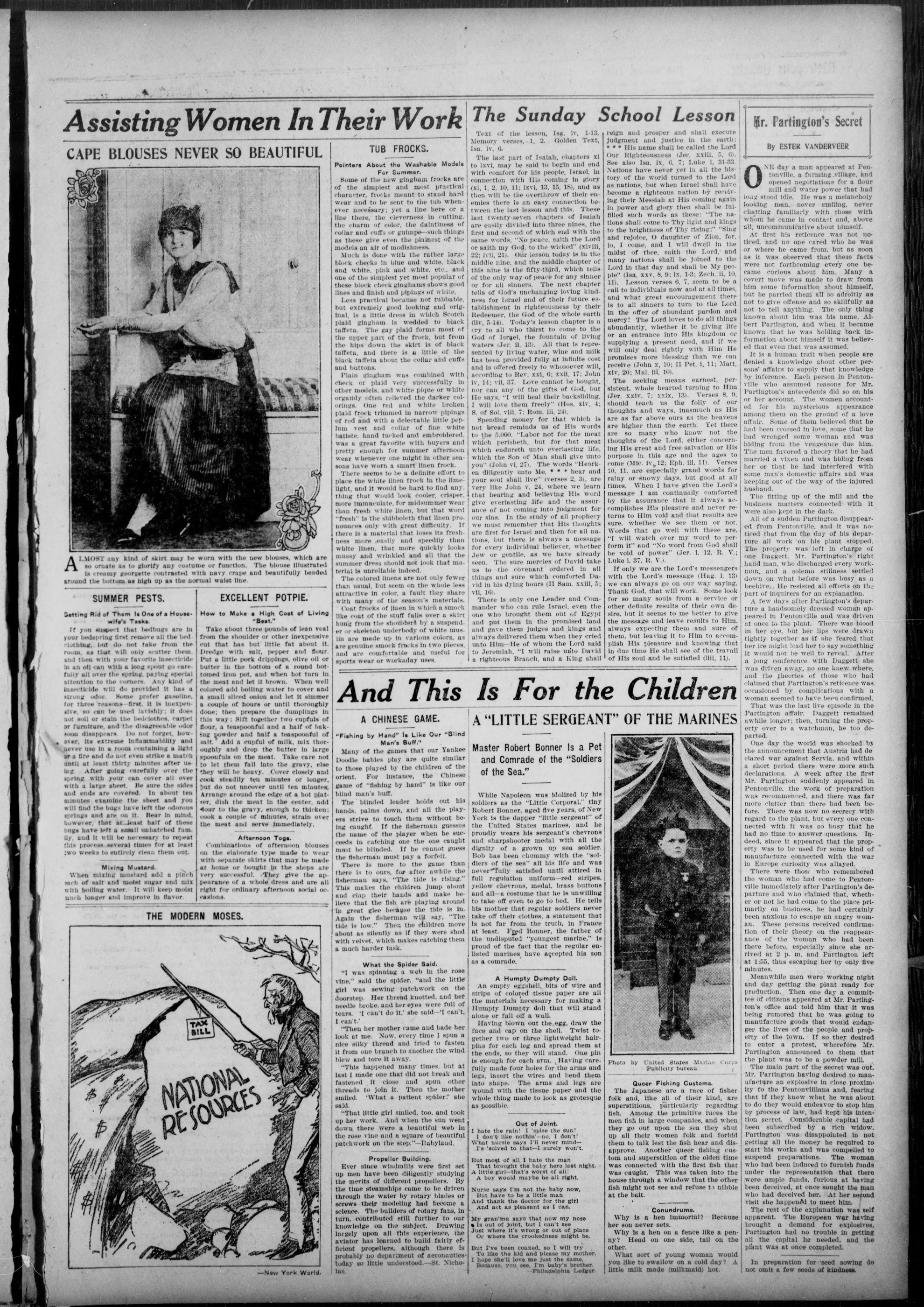
Assisting Women In Their Work
CAPE BLOUSES NEVER SO BEAUTIFUL
THE ROSE
ALMOST any kind of skirt may be worn with the new blouses, which are so ornate as to glorify any costume or function. The blouse illustrated is creamy georgette contrasted with navy crape and beautifully beaded around the bottom as high up as the normal waist-line.
Setting Rid of Them Is One of a House wife's Tasks.
If you suspect that bedbugs are in your bedspring first remove all the bedclothing, but do not take from the room, as that will only scatter them, and then with your favorite insecticide in an oil can with a long spout go carefully all over the spring, paying special attention to the corners. Any kind of insecticide will do provided it has a strong odor. Some prefer gasoline, for three reasons—first, it is inexpensive, so can be used lavishly; it does not soil or stain the bedclothes, carpet or furniture, and the disagreeable odor soon disappears. Do not forget, however, its extreme inflammability and never use in a room containing a light or a fire and do not even strike a match until at least thirty minutes after using. After going carefully over the spring with your can cover all over with a large sheet. Be sure the sides and ends are covered. In about ten minutes examine the sheet and you will find the bugs have left the odorous springs and are on it. Bear in mind, however, that at least half of these bugs have left a small unhatched family, and it will be necessary to repeat this process several times for at least two weeks to entirely clean them out.
When mixing mustard add a pinch
sach of salt and moist sugar and mix
with boiling water. It will keep moist
much longer and improve in flavor.
THE MODERN MOSES.
TAX BILL
NATIONAL
RESOURCES
SUMMER PESTS.
Mixing Mustard.
EXCELLENT POTPIE.
How to Make a High Cost of Living "Best."
Take about three pounds of lean veal from the shoulder or other inexpensive cut that has but little fat about it. Dredege with salt, pepper and flour. Put a little pork drippings, olive oil or butter in the bottom of a round bottomed iron pot, and when hot turn in the meat and let it brown. When well colored add boiling water to cover and a small sliced onion and let it simmer a couple of hours or until thoroughly done; then prepare the dumplings in this way: Sift together two cupfuls of flour, a teaspoonful and a half of baking powder and half a teaspoonful of salt. Add a cupful of milk, mix thoroughly and drop the batter in large spoonfuls on the meat. Take care not to let them fall into the gravy, else they will be heavy. Cover closely and cook steadily ten minutes or longer, but do not uncover until ten minutes. Arrange around the edge of a hot platter, dish the meat in the center, add dour to the gravy, enough to thicken; cook a couple of minutes, strain over the meat and serve immediately.
Combinations of afternoon blouses on the elaborate type made to wear with separate skirts that may be made at home or bought in the shops are very successful. They give the appearance of a whole dress and are all right for ordinary afternoon social occasions.
NATIONAL
OURCES
Afternoon Toes.
New York.World.
And This Is For the Children
TUB FROCKS.
Pointers About the Washable Models For Summer.
Some of the new gingham frocks are of the simplest and most practical character, frocks meant to stand hard wear and to be sent to the tub whenever necessary; yet a line here or a line there, the cleverness in cutting, the charm of color, the daintness of collar and cuffs or gimpme—such things as these give even the plainest of the models an air of modishness.
Much is done with the rather large block checks in blue and white, black and white, pink and white, etc., and one of the simplest yet most popular of these block check gingham shows good lines and finish and pliings of white.
Less practical because not tubbable, but extremely good looking and original, is a little dress in which Scotch plaid gingham is wedded to black taffeta. The gay plaid forms most of the upper part of the frock, but from the hips down the skirt is of black taffeta, and there is a little of the black taffeta about the collar and cuffs and buttons.
Plain gingham was combined with check or plaid very successfully in other models, and white plaque or white organdy often relieved the darker colorings. One red and white broken plaid frock trimmed in narrow pipings of red and with a delectable little peplum vest and collar of fine white bastise, hand tucked and embroidered, was a great favorite with buyers and pretty enough for summer afternoon wear whenever one might in other seasons have worn a smart linen frock.
There seems to be a definite effort to place the white linen frock in the lime-light, and it would be hard to find anything that would look cooler, crisper, more immaculate, for midsummer wear than fresh white linen, but that word "fresh" is the shibboleth that linen pronounces only with great difficulty. If there is a material that loses its freshness more easily and speedily than white linen, that more quickly looks mussy and wrinkled and all that the summer dress should not look that material is unreliable indeed.
The colored linens are not only fewer than usual, but seem on the whole less attractive in color, a fault they share with many of the season's materials.
Coat frocks of linen in which a smock like coat of the stuff falls over a skirt bung from the shoulders by a suspender or skeleton underbody of white muslin are made up in various colors, as are genuine smock frocks in two pieces, and are comfortable and useful for sports wear or workaday uses.
A CHINESE GAME.
"Fishing by Hand" Is Like Our "Blind Man's Buff."
Many of the games that our Yankee Doodle babies play are quite similar to those played by the children of the orient. For instance, the Chinese game of "fishing by hand" is like our blind man's buff.
The blinded leader out his hands, palms down, and all the players strive to touch them without being caught. If the fisherman guesses the name of the player when he succeeds in catching one the caught must be blinded. If he cannot guess the fisherman must pay a forfeit.
There is more to the game than there is to ours, for after awhile the fisherman says, "The tide is rising." This makes the children jump about and clap their hands and make believe that the fish are playing around in great glee because the tide is in. Again the fisherman will say, "The tide is low." Then the children move about as silently as if they were shod with velvet, which makes catching them a much harder task.
What the Spider Said.
"I was spinning a web in the rose vine," said the spider. "and the little girl was sewing patchwork on the doorstep. Her thread knotted, and her needle broke, and her eyes were full of tears. 'I can't do it,' she said—'I can't, I can't.'
"Then her mother came and bade her look at me. Now, every time I spun a nice silky thread and tried to fasten it from one branch to another the wind blew and tore it away.
"This happened many times, but at last I made one that did not break and fastened it close and spun other threads to join it. Then the mother smiled. 'What a patient spider.' she said.
"That little girl smiled, too, and took up her work. And when the sun went down there were a beautiful web in the rose vine and a square of beautiful patchwork on the step."—Babyland.
Propeller Building.
Ever since windmills were first set up men have been diligently studying the merits of different propellers. By the time steamships came to be driven through the water by rotary blades or screws their modeling had become a science. The builders of rotary fans, in turn, contributed still further to our knowledge on the subject. Drawing largely upon all this experience, the aviator has learned to build fairly efficient propellers, although there is probably no department of aeronautics today so little understood.—St. Nicholas.
The Sunday School Lesson
A "LITTLE SERGEANT" OF THE MARINES
Text of the lesson, Isa. lv, 1-13.
Memory verses, 1, 2. Golden Text,
Isa. lv, 6.
The last part of Isaiah, chapters xl to ixvi, may be said to begin and end with comfort for his people, Israel, in connection with His coming in glory (xl, 1, 2, 10, 11; ixvi, 13, 15, 18), and as will be the overthrow of their enemies there is an easy connection between the last lesson and this. These last twenty-seven chapters of Isaiah are easily divided into three nines, the first and second of which end with the same words, "No peace, saith the Lord or saith my God, to the wicked" (xviii, 22; ixvi, 21). Our lesson today is in the middle nine, and the middle chapter of this nine is the fifty-third, which tells of the only way of peace for any sinner or for all sinners. The next chapter tells of God's unchanging loving kindness for Israel and of their future establishment in righteousness by their Redeemer, the God of the whole earth (vif, 5-14). Today's lesson chapter is a cry to all who thirst to come to the God of Israel, the fountain of living waters (Jer. ix, 13). All that is represented by living water, wine and milk has been provided fully at infinite cost and is offered freely to whoever will, according to Rev. xxi, 6; xxii, 17. John iv, 14; vii, 37. Love cannot be bought, nor can any of the gifts of God, but He says, "I will heal their backsliding, I will love them freely" (Hos. xiv, 4; 5, of Sol. viii, 7; Rom. iii, 24).
Spending money for that which is not bread reminds us of His words to the 5,000, "Labor not for the meat which perisheth, but for that meat which endureth unto everlasting life, which the Son of Man shall give unto you" (John vi, 27). The words "Hearken diligently unto Me, * * * hear and your soul shall live" (verses 2, 3), are very like John v, 24, where we learn that hearing and believing His word give everlasting life and the assurance of not coming into judgment for our sins. In the study of all prophecy we must remember that His thoughts are first for Israel and then for all nations, but there is always a message for every individual believer, whether Jew or gentile, as we have already seen. The sure mercies of David take us to the covenant ordered in all things and sure which comforted David in his dying hours (II Sam. xxilf, 5; vii. 16).
There is only one Leader and Commander who can rule Israel, even the one who brought them out of Egypt and put them in the promised land and gave them judges and kings and always delivered them when they cried unto Him—He of whom the Lord said to Jeremiah, "I will raise unto David a righteous Branch, and a King shall
Master Robert Bonner Is a Pet and Comrade of the "Soldiers of the Sea."
While Napoleon was idolized by his soldiers as the "Little Corporal," tiny Robert Bonner, aged five years, of New York is the dapper "little sergeant" of the United States marines, and he proudly wears his sergeant's chevrons and sharpshooter medal with all the dignity of a grown up sea soldier. Bob has been chummy with the "soldiers of the sea" all his life and was never fully satisfied until attired in full regulation uniform—red stripes, yellow chevrons, medal, brass buttons and all—a costume that he is unwilling to take off even to go to bed. He tells his mother that regular soldiers never take off their clothes, a statement that is not far from the truth, in France at least. Fred Bonner, the father of the undisputed "youngest marine," is proud of the fact that the regular enlisted marines have accepted his son as a comrade.
A Humpty Dumpty Doll
An empty eggshell, bits of wire and strips of colored tissue paper are all the materials necessary for making a Humpty Dumpty doll that will stand alone or fall off a wall. Having blown out the egg, draw the face and cap on the shell. Twist together two or three lightweight hairpins for each leg and spread them at the ends, so they will stand. One pin is enough for each arm. Having carefully made four holes for the arms and legs, insert the wires and bend them into shape. The arms and legs are wound with the tissue paper and the whole thing made to look as grotesque as possible.
Out of Joint.
I hate the rain! I 'spise the sun!
I don't like nothin'-no, I don't!
What nurse says I'll never mind--
Is 'solved to that—I surely won't.
But most of all I hate the man
That brought the baby hero last night.
A little girl—that's worst of all!
A boy would maybe be all right.
Nurse says I'm not the baby now,
But have to be a little man
And thank the doctor for the girl
And act as pleasant as I can.
My gran'ma says that now my nose
Is out of joint, but I can't see
Just where it's wrong or out of place
Or where the crookedness might be.
But I've been coaxed, so I will try
To like the kid and please my mother.
I hope she'll love me just the same.
Because, you see, I'm baby's brother.
Philadelphia Ledger
reign and prosper and shall execute judgment and justice in the earth;
**** His name shall be called the Lord Our Righteousness Jer. xxii, 5, 6.
See also Isa. isa, 6, 7; Luke 4, 31-33.
Nations have never yet in all the history of the world turned to the Lord as nations, but when Israel shall have become a righteous nation by receiving their Messiah at His coming again in power and glory then shall be fulfilled such words as these: "The nations shall come to Thy light and knight to the brightness of Thy rising;" "Sing and rejoice, O daughter of Zion, for, lo, I come, and I will dwell in the midst of thee, saith the Lord, and many nations shall be joined to the Lord in that day and shall be My people" (isa. xxv, 8, 9; lx. 1-3; Zech. ii, 10, 11). Lesson verses 6, 7, seem to be a call to individuals now and at all times, and what great encouragement there is to all sinners to turn to the Lord in the offer of abundant pardon and mercy! The Lord loves to do all things abundantly, whether it be giving life or an entrance into His kingdom or supplying a present need, and if we will only deal rightly with Him He promises more blessing than we can receive (John x, 10; II Pet. 1, 11; Matt. xly 20; Mal. iii, 10).
The seeking means earnest, persistent, whole hearted turning to Him (Jer. xxiv. 7; xxix. 13). Verses 8, 9, should teach us the folly of our thoughts and ways, inasmuch as His are as far above ours as the heavens are higher than the earth. Yet there are so many who know not the thoughts of the Lord, either concerning His great and free salvation or His purpose in this age and the ages to come (Mic. iv. 12; Eph. iii. 11). Verses 10, 11, are especially grand words for rainy or snowy days, but good at all times. When I have given the Lord's message I am continually comforted by the assurance that it always accomplishes His pleasure and never returns to Him void and that results are sure, whether we see them or not. Words that go well with these are: "I will watch over my word to perform it" and "No word from God shall be void of power" (Jer. 1. 12, R. V., Luke 1. 37, R. V.).
If only we are the Lord's messengers with the Lord's message (Hag. l. 13) we can always go on our way saying, Thank God, that will work. Some look for so many souls from a service or other definite results of their own desire, but it seems to me better to give the message and leave results to Him, always expecting them and sure of them, but leaving it to Him to accomplish His pleasure and knowing that in due time He shall see of the travail of His soul and be satisfied (dii. 11).
T
Photo by United States Marine Corps Publicity bureau.
Queer Fishing Customs.
The Japanese are a race of fisher folk and, like all of their kind, are superstivers, particularly regarding fish. Among the primitive races the men fish in large companies, and when they go out upon the sea they shut up all their women folk and forbid them to talk lest the fish hear and disapprove. Another queer fishing custom and superstition of the olden time was connected with the first fish that was caught. This was taken into the house through a window that the other fish might not see and refuse to nibble at the bait.
Conundrums.
Why is a hen immortal? Because her son never sets.
Why is a hen on a fence like a penny? Head on one side, tail on the other.
What sort of young woman would you like to swallow on a cold day? A little milk made (milkmaid) hot.
Mr. Partington's Secret
By ESTER VANDERVEER
ONE day a man appeared at Pentonville, a farming village, and opened negotiations for a flour mill and water power that had long stood idle. He was a melancholy looking man, never smiling, never chatting familiarly with those with whom he came in contact and, above all, uncommunicative about himself.
At first his reticence was not noticed, and no one cared who he was or where he came from, but as soon as it was observed that these facts were not forthcoming every one became curious about him. Many a covert move was made to draw from him some information about himself, but he parried them all so adroitly as not to give offense and so skillfully as not to tell anything. The only thing known about him was his name. Albert Partington, and when it became known that he was holding back information about himself it was believed that even that was assumed.
It is a human trait when people are denied a knowledge about other persons' affairs to supply that knowledge by inference. Each person in Pentonville who assumed reasons for Mr. Partington's antecedents did so on his or her account. The women accounted for his mysterious appearance among them on the ground of a love affair. Some of them believed that he had been crossed in love, some that he had wronged some woman and was hiding from the vengeance due him. The men favored a theory that he had married a vixen and was hiding from her or that he had interfered with some man's domestic affairs and was keeping out of the way of the injured husband. The fitting up of the mill and the business matters connected with it were also kent in the dark.
All of a sudden Partington disappeared from Pentonville, and it was noticed that from the day of his departure all work on his plant stopped. The property was left in charge of one Daggett. Mr. Partington's right hand man, who discharged every workman, and a solemn stillness settled down on what before was busy as a beehive. He resisted all efforts on the part of inquirers for an explanation.
A few days after Partington's departure a handsomely dressed woman appeared in Pentonville and was driven at once to the plant. There was blood in her eye, but her lips were drawn tightly together as if she feared that her ire might lead her to say something it would not be well to reveal. After a long conference with Daggett she was driven away, no one knew where, and the theories of those who had claimed that Partington's reticence was occasioned by complications with a woman seemed to have been confirmed. That was the last live episode in the Partington affair. Daggett remained awhile longer; then, turning the property over to a watchman, he too departed.
One day the world was shocked by the announcement that Austria had declared war against Servia, and within a short period there were more such declarations. A week after the first Mr. Partington suddenly appeared in Pentonville, the work of preparation was recommenced, and there was far more clatter than there had been before. There was now no secrecy with regard to the plant, but every one connected with it was so busy that he had no time to answer questions. Indeed, since it appeared that the property was to be used for some kind of manufacture connected with the war in Europe curiosity was allayed.
There were those who remembered the woman who had come to Pentonville immediately after Partington's departure and who claimed that, whether or not he had come to the place primarily on business, he had certainly been anxious to escape an angry woman. These persons received confirmation of their theory on the reappearance of the woman who had been there before, especially since she arrived at 2 p. m. and Partington left at 1.55, thus escaping her by only five minutes.
Meanwhile men were working night and day getting the plant ready for production. Then one day a committee of citizens appeared at Mr. Partington's office and told him that it was being rumored that he was going to manufacture goods that would endanger the lives of the people and property of the town. If so they desired to enter a protest, wherefore Mr. Partington announced to them that the plant was to be a powder mill.
The main part of the secret was out, Mr. Partington having desired to manufacture an explosive in close proximity to the Pentonvillians and, fearing that if they knew what he was about to do they would endeavor to stop him by process of law, had kept his intention secret. Considerable capital had been subscribed by a rich widow. Partington was disappointed in not getting all the money he required to start his works and was compelled to suspend preparations. The woman who had been induced to furnish funds under the representation that there were ample funds, furious at having been deceived, at once sought the man who had deceived her. At her second visit she happened to meet him.
The rest of the explanation was self apparent. The European war having brought a demand for explosives. Partington had no trouble in getting all the capital he needed, and the plant was at once completed.
In preparation for seed sowing do not omit a few seeds of kindness.
Metropolis Gazette
PUBLISHED ON FRIDAY BY
THE GAZETTE PRINTING CO.
METROPOLIS, . . . . ILL.
MRS. M. J. McCRARY, MANAGER.
J. B. McORARY, EDITOR
FRIDAY AUG. 3, 1917.
Office 9th and Pearl Streets, Metropolis, Illinois.
Entered as second-class mail matter, at Metropolis, Illinois, Postoffice.
Address all communications to J. B. McORARY, Box 107 Metropolis, Illinois.
The names and addresses of contributors must be known to us in every instance, in order to secure publication. We want the news of your vicinity each week.
TERMS OF SUBSCRIPTION:
One Year ..... $1.50
1x Months ..... 75
Three Months ..... 40
Single Copy ..... 05
In Advance.
You must mail copy on Mondays to secure publication.
XELENTO
Quinine Pomade
Copyrighted
JANIE BAND and MARGARET BERRY wrote us
that they had hardly any hair, but after using
Xelento you can see the results on their pictures.
Kinky Hair cannot be made straight.
You have to have hair before it can be
straightened. Now this
EXELENTO QUININE
POMADE
is a Hair Grower which feeds the scalp
and creates the hair and makes Kinky,
nappy hair grow long, soft and silky. It
cleans dandruff and stops Falling Hair at
once. Price 2 See by mail on receipt of
stamps or coin.
AGENTS WANTED EVERYWHERE.
Write For Particulars at Once
EXELENTO MEDICINE CO., Atlanta, Ga.
NOTICE.
The Mt. Olive Baptist Association will convene with the Siloam Baptist church Unionville. Tuesday before the 4th Sunday in Sept. 1917. Let every pastor and church represent with a full representation and make this one of the best in the history of the organization.
Come singing and praying as never before with one aim in view that of doing more efficient work for the Master.
We ask that you bring money to represent every phase of our work.
More next week,
J. B. McCrya,
Moderator.
NOTICE.
NOTICE.
To our women auxilliaries connected with the East Mt. Olive Baptist Association.
Dear Sisters the time is near at hand for our great annual meeting which convenes at Murphysboro, Ill., with Shiloh Baptist church Tuesday before the second Sunday in August.
Dear sister, let us rally to the standard and push the cause of Christianity and humanity.
Working side by side for the betterment of our race and the betterment of our denomination. Sisters, let us work and pray and God will bless our efforts. Each one come prepared to take a part.
Ruth L. Rowly,
Corresponding Sec'y.
$100 Reward, $100.
The readers of this paper will be pleased to learn that there is at least one dreaded disease that science has been able to cure in all its stages, and that is catarrh. Hall's catarah cure is the oily positive cure now known to the medical fraternity. catarh being a constitutional disease, requires a constitutional treatment. Hall's catarh is taken internally, acting directly upon the blood and mucous surfaces of the system, thereby destroying the foundation of the disease, and giving the patient strength by building up the constitution and assisting nature in doing its work. The proprietors have so much faith in its curative powers that they offer One Hundred Dollars for any case that it fails to cure. send for list of testimonials.
Address F. J. CHENEY & CO., Toledo, O.
Sold by all Druggists. 75c.
Sold by all Druggists, toc.
Take Hall's Family Pills for consti-
pation.
Fried Fish every day at the
Grand Leader Cafe.
Rev. W. H Baruett, was at
Tulu, Ky, Sunday at his charge
He had a splendid meeting.
Rev Thos, Morris, worshipped
at Belgrade Sunday.
Nehemiah's Band, of the 1st
Baptist church had a rally Sun-
day, and had a success.
Mrs. Harriet Jefferson, of East St. Louis, arrived in the city Sunday with two grand children to spend a few days with parents Mr. and Mrs. Mingo Long and other relatives.
Wethank Mr. Wm. Tittsworth for bringing us to Fort Massac Sunday afternoon in his fishing gasoline launch.
Will Petty of Paducah, Ky., was down Tuesday.
Mr. William Wheeler. of Chicago, but for many years a prominent citizen of Metropolis, and Massac county, also an old teacher is in the city the guest of Mrs. Georgia Martin. He is taking his vacation.
Mrs. Icie Wimbly Johnson of Cincinati, Ohio, who was called to Brookport, recently on the account of the death of her sister Mrs. Ledora Davis, was in city on business Tuesday.
Mrs. Leah Reed, is back from St Lou is, Mo, where she went to visit her son James who has enlisted in the U. S. Medical corps.
Rev. I. S. Stone, pastor of the St. Paul Methodist church, delivered a special sermon to Company M. Sunday night.
Miss Agnes Neely, is at home from St. Louis, Mo., for a visit with parents.
Mrs. Desma Whitman, returned home to St. Louis, Mo., after visiting with her parents Mr. and Mrs. Thos. Roberts.
Geo. L. B. McCrary, Jr., left for Chicago, Tuesday where he has employment.
Mr. and James McGehee are the proud parents over a houncing baby boy.
The East Mt. Olive Baptist association will meet with the Shiloh Baptist church, Murphysboro, Tuesday August 7th The Rev. W. P. Washington, D. D. is moderator-*
Napoleon Brown has purchased a very nice home on W. 9th St.
Henry Neely, returned home Tuesday from Mollue, where he was employed. He is indisposed.
Rev. J. B. McCrary, will hold services for the Shiloh Baptist church, Future City, the second Saturday and Sunday and expect to be there on Saturday. We hope to see a full attendance of members.
We ask every member of Unity Baptist church, Brookport, to be present at the business meeting
Saturday night and Sunday without fail.
Please psy up your subscription. Can you afford to loose your race papers for want of support? It is up to you. What are you going to do about it Mr. non payer? Decide by paying up please.
If you have any Race pride and leve for truth, you will pay your subscription. We are toiling day and night to give you the news.
Mrs. Rosie Davie, was called to Belknap to preach at eleven o'clock Sundey at Belknap. She was accompanied by her husband son and friend Miss Viola Sims. She has an appointment for the 1st Sunday in August. Committee, Revs. J. H. Hilly, F. Bomar, Sister Emma Farrow, Dr. D. Parrish, Sist. Elizabeth Mahone.
Wm Rudledge and wife who were visiting his aunt, Mr. Rosa Davie and family, returned to their home in Newport, Ky., last week and was accompanied as far Paducah, Ky., by his cousin Mrs. Ella McCane, Miss Mary Davie also by his father of Clifton, Tenn., who he had not seen in five years. Mr Rudledge decided to visit his sister and stepfather and others in Clifton, Tennessee also he will visit in Nashville, Tenn.
NOTICE
Dear Co-workers of the East Mt. Olive Baptist Association of Southrn Illinois, the time is just a little ahead of us. it will not be long before we are to meet in our annual meeting at Murphysboro. Let us come up, go around the walls and make this the grandest meeting in she history of the organization. Come full of religious zeal, financial and spiritual enthnsiasm.
Come singing, praying and let us have a glorious meeting Gnd helping us. Look over the field and see the great need of us as Baptist women rallying together, as there is much for us to do along religious lines.
I ask all circle to be on exhibit that day. Chairman is expect-ecting every circle to represent.
Yours for the cause of Christ
M. J. O. Connor, Pres.
Ruth Rowlie Cor. Sec.
NOTICE.
All churches composing the East Mt. Olive Baptist Association, are hereby notified that the association will convene with the Shiloh Baptist church, Murphysboro, Ill., Tuesday before second Sunday in August, 7-12,'16. All pastors of the association who can't attend, please remember our $1. one dollar pledge and forward same to the association to help defray the expenses of the association.' All delegates are expected to be present Tuesday morning, 9:00 a.m.
W. P. Washington,
Moderator, Mt. Vernon, Ili.
A H. Bradley, Cor. Sec.
Dewmaine, Ill.
We dont propose to be a figure head for no one for the sake of office. If the majority of the messengers find someone else that they think that is more entitled to the office, and is better prepared to carry out the business of said office better than we, that will please us. But whether in or out of office we will be the same man, contending for the principles laid down by Jesus Christ, and will see to it that the land marks of our fathers will not be removed.
McCrary Moderator.
NOTICE. The Mt. Olive Executive Board Meeting
A short session of the executive board was held in Cairo, on Saturday June 23, with the Mod. Eider J. B. McCrary, pre-iding. The first thing under considera- was to find a place for the Association to hold its forthcoming session, as the Shiloh Baptist church, Future City could not care for it. After carefully considering the invitations, a motion prevailed to meet with Siloam Baptist church, Unionville, on Tuesday before the 4th Sunday in Sept. 1917.
A motion prevailed that the Educational space on the church letter blanks, be changed to read Livingston Normal Rebuilding and Educational Tax. A motion prevailed that the Woman's District auxiliary be requested to turn over to the treasurer of Trustee Board, all of the money they have on hand for education and same placed in the Bank by him on interest.
Eld. H. E. McWilliams, came in and was permitted to speak on the Co opperative Missionary work. A motion prevailed thus this subject be special attention in the association next fall.
Eld. J. D. Davis, paid the missionary money of $4.00 for the Mt Olive church, Colp. This closed a short and sweet session of the Board.
Elder J. B. McCrary,
Moderator,
Elder J. H. Starks.
Corresponding Sec.
Reporter.
To the Baptist Churches of Mt. Olive Baptist Association.
It is to be hoped that all of our churches will respond to the urgent need and appeal of our missionary on the field just now. Brethren, it is a sin to place a man on the field to look after the neglected churches and fail to see after his support, while we are at home faring sumptuously every day with our families and congregations. It is wore than a crime to allow his family to suffer, while we are responsible to to send the gospel into destitute places. "How can they hear without a preacher, and how can they preach except they are sent?" Brethren, bestir yourselves as never before; the eyes of our old fathers who have let their montles fall on us are expecting us to evangelize this field in they labored so earnestly, contending for missions and the missionary. Remember the great commission, and let us take the State for Christ. The harvest is white, but the laborers are few. Lift up your eyes and look upon the field. The true missionary spirit is lax in most of our Baptist churches in Southern Illinois.
Let us put out mission cards, preach a mission sermon once a month or a quarter. lift a special collection for missions and start the mission box plan.
We have a good missionary in the person of Elder J. H. Hilley, and he needs our support. Let every church send something to the Board which meets with the Sunday School conuion at Cairo, June 13th.
J. B. McCrary,
Moderator.
M. D. and M. Institute
8:30 a. m. Tuesday, Devotionals conducted by Marion bondale Messengers.
9:00 a. m. Meeting called to order by President, Bowers, of Dewmaine.. Appointment of commissareous matters.
11:00 Sermon by President A. J. Bowers. Alt. Eld.,
11:45 Collection and adjournment.
Afternoon
1:30 Song and prayer service,'led by Mt. Vernon and Messengers
2:00 Meeting called to order by the President. M matters, and introduction of visitors and co Messengers
2:30 The need of an old Minister's Home, opened by Armstead, Pulaski. Illinois. Discussed by the Fox. Duquoin, Ill. Subject, Unity among the
3:45 Paper, by Dr. H. E. McWilliams, Subj. The wist tist as set forth in the Scriptures.
4:30 Adjournment.
8:00 Song and prayer service, led by Murpysboro, a Messengers. Sermon by Eld. S. H. Pruitt, Duc Eld. J. L. Martin, Colp Wednesday 8:30 A. M.
8:30 a. m. Song and prayer service led by Metropo quoin Messengers.
9:00 Meeting called to order by President A. J. B cellaneous matters and introduction of Corres sengers, etc.
9:30 Paper by Elder Thos. Morris, Metropolis, Illinois Sanctification, and when does it begin? and what Discussed by the Body
10:30 Fifteen minutes intermission
10:45 Song, and are we yet alive
11:00 Sermon. Minister to be selected by committee service
11:45 Collection and adjournment
1:30 P. M. Song and prayer service led by Shaw Grayson messengers
2:00 Meeting called to order by President. Miscell ters and reports of committee
3:00 Sermon by Elder D. Johnson. Alternate Elder Murphysboro
4:00 Collection and installation of officers, etc.
8:00 Sermon, Elder D. T. Fox, Duquoin. Alt. Elder bard, Grand Chain
8:30 a. m. Tuesday, Devotionals conducted by Marion and Carbondale Messengers.
9.00 a. m. Meeting called to order by President, Eld. A. J. Bowers, of Dewmaine.. Appointment of committees and miscellaneous matters.
11:00 Sermon by President A. J. Bowers. Alt. Eld., J. D. Davis
11:45 Collection and adjournment.
Afternoon
1:30 Song and prayer service, led by Mt. Vernon and Dewmaine
Messengers
2:00 Meeting called to order by the President. Miscellaneous matters, and introduction of visitors and corresponding Messengers
2:30 The need of an old Minister's Home, opened by Elder H. Armstead, Pulaski. Illinois. Discussed by the Body
3:00 Sermon by Elder Jno. Winston, Levings. Alternate D. T. Fox. Duquoin, Ill. Subject, Unity among the Baptist
3:45 Paper, by Dr. H. E. McWilliams, Subj. The work of Baptist as set forth in the Scriptures.
4:30 Adjournment.
8:00 Song and prayer service, led by Murpysboro. and Golconda Messengers. Sermon by Eld. S. H. Pruitt, Duquoin,. Alt. Eld. J. L. Martin, Colp Wednesday 8:30 A. M.
8:30 a. m. Song and prayer service led by Metropolis and Duquoin Messengers.
9:00 Meeting called to order by President A. J. Bowers. Miscellaneous matters and introduction of Corresponding messengers, etc.
9:30 Paper by Elder Thos. Morris, Metropolis, Illinois. Subject
Sanctification, and when does it begin? and what is it?
11:00 Sermon. Minister to be selected by committee on Divine service
11:45 Collection and adjournment
1:30 P. M. Song and prayer service led by Shawneetown and Grayson messengers
2:00 Meeting called to order by President. Miscellaneous matters and reports of committee
3:00 Sermon by Elder D. Johnson. Alternate Elder J. J. Parrish Murphysboro
Murphysboro
4:00 Collection and installation of officers, etc.
8:00 Sermon, Elder D. T. Fox, Duquoin. Alt. Elder K. V. How-
ard, Grand Chain.
Thursday-W. E. and M. Convention
8:30 Song and [prayer service led by Grand Tower]
messengers
9:00 A: M. Convention called to order by Pa resident M.
Connor, Carbondale. Appointment of com-
miscellaneous matters
9:30 Partial report of Enrollment committee
9:45 Paper by Mrs. C. C. Phillips. Subject, Woman
work of Religion. Discussion optional with the
10:00 Reading of letters
11:00 Sermon by Elder J, B. McCrary, Metropolis, M.
the Mt. Olive Baptist Association.
11:45 Collection and adjournment
Afternoon
1:30 Song and prayer service led by Centralia and D
sengers
2:00 Convention called to order by President. M
matters and reading of letters
3:00 Reports of the various committees
4:00 Election and installation of officers. Adjournme
Evening
8:00 A partial programme rendered by the Shilob Ba-
B. Y. P. U. and literary program as arranged by
8:30 Song and prayer service led by Grand Tower and Galatia messengers
9:00 A: M. Conventien called to order by Paesident Mrs. M. J. O.
Connor, Carbondale. Appointment of committees and
miscellaneous matters
9:30 Partial report of Enrollment committee
9:45 Paper by Mrs. C. C. Phillips. Subject, Womans place in the
work of Religion. Discussion optional with the Body
10:00 Reading of letters
10:00 Sermon by Friday, L. R. McGraw, Matthews. Moderator of
11:00 Sermon by Elder J, B. McCrary, Metropolis, Moderator of the Mt. Olive Baptist Association.
1:30 Song and prayer service led by Centralia and Duquoin messengers
2:00 Convention called to order by President. Miscellaneous matters and reading of letters
8:00 A partial programme rendered by the Shiloh Baptist Church B. Y. P. U. and literary program as arranged by the women
Friday A. M.-Association Proper
8:30 Song and prayer service, led by Golgotha, Elkviverty, Cairo, messengers
9:00 Meeting called to order by Moderator W. P. Wai
Appointment of committees and miscellaneous
9:15 Partial report of enrollment Committee
9:30 Introduction of visitors, Corresponding messeng
ceiving their correspondence
10:00 Address by Dr. B. F. Rodman, Dnquoin, Illinois
Secretary of the Illinois Baptist State Assoc
ject, the work of the Baptist State Associa
Home Board (white) of Atlanta Ga., and its
the Negroes
11:00 Introductory sermon, by Dr. W. P. Throgmo
of Illinois (paper) Baptist, and Chairman
Mission Board
11:45 Collection and adjournment
Afternoon
1:30 Song and prayer service led by Pulaski and
messengers
2:00 Meeting called to order by Moderator- Miscell
ters and reading of letters
3:00 An old and young Folks Covenant meeting
4:00 Meeting re-assemble for business of the Assoc
4:30 Adjournmet
Evening
8:00 Missionary sermon, by State Missionary, H. E.
Chicago
8:30 Song and prayer service, led by Golgotha, Elkville, and Liberty, Cairo, messengers
9:00 Meeting called to order by Moderator W. P. Washington
Appointment of committees and miscellaneous matters
9:15 Partial report of enrollment Committee
9:30 Introduction of visitors, Corresponding messengers, and receiving their correspondence
10:00 Address by Dr. B. F. Rodman. Dnquoin, Illinois, Financial Secretary of the Illinois Baptist State Association. Subject, the work of the Baptist State Association and the Home Board (white) of Atlanta /Ga., and its work among the Negroes
11:00 Introductory sermon, by Dr. W. P. Throgmorton, Editor of Illinois (paper) Baptist, and Chairman of the State Mission Board
1:30 Song and prayer service led by Pulaski and Hallidayboro messengers
2:00 Meeting called to order by Moderator- Miscellaneous matters and reading of letters
8:00 Missionary sermon, by State Missionary, H. E. McWilliams Chicago
Saturday A. M.
8:20 Song and prayer service led by Cairo and Metropolis messengers
9:00 The work of the Association in general
11:00 Sermon by Dr. J. J. Olive, Cairo
11:45 Collection and adjournment
Afternoon
1:30 Song and prayer service led by Dewmaine and G
messengers
2:00 The house called to order by Moderator. M
matters
Reeport of committees. Election and installa
cers
Sermon at night as may be provided by the Commi
service. Sunday services to be directed by commi
service.
Address of welcome by Moderator as may be
to the Association. We urge that every pastor an
come to Murphysboro, bent and determined to add
tional Fund of the Shiloh Baptist church, sufficient to
clear of debt at this setting of our Association. M
lead this Baptist Army to success.
1:30 Song and prayer service led by Dewmaine and Grand Tower messengers
2:00 The house called to order by Moderator. Miscellaneous matters
Reeport of committees. Election and installation of officers
Sermon at night as may be provided by the Committee on Divine service. Sunday services to be directed by committee on Divine service
Address of welcome by Moderator as may be compatible to the Association. We urge that every pastor and Messenger come to Murphysboro, bent and determined to add to the Financial Fund of the Shiloh Baptist church, sufficient to dedicate it clear of debt at this setting of our Association. May the Lord lead this Baptist Army to success.
Committee:—C.C. PHILLIPS
A. J. BOWERS
W. P. WASHINGTON.