Metropolis Weekly Gazette
Friday, September 28, 1917
Metropolis, Illinois
Page text (machine-generated)
METROPOLIS WEEKLY GAZETTE
art
Officers of the General Batist State Association of Illinois
Committee on Nomination beg to report as follows:
Moderator Eld. J. F. Thomas.
1st Vice Mod. " W. P. Washington.
2nd Vice Mod. Eld. C. w. Nortment.
Recording Sec. Eld. P. B. Franch
Corresponding Sec. Ec. J. B. McCrary.
Treasurer Eld. H. C. Armstead.
Added Members
Eld. F. Bomar Cairo
Eld. J. E Haywood Chicago
Eld. Jas. Swanson Maywood
State Missionary H. E. Mewilliana.
State Mission Board
Chairman Dr. C. C. Phillips
Cor. See. Eld. J. D. Davis
Treasurer Eld. J. E. Haywood
Other Members
Eld. S. H. Pruitt
Deacon R. Lewis
Sister Sallie Thomas Chicago
Sister M. Hudgin Cairo
Sister J. w. winston Otmstead
Sister Carrie Casiy Shawnetown
Urish Jenkins
Rev. J. A. Royal Chicago
" L. Drane Chicago
Rev. A. J. Bowers Dewmaine
Rev. D. Johnson Dewmaine
" B. H. Hubter Evansten
" K. V. Howard Grand Chain
" Robt. Grey Murphysboro
" J. L. Martin Colps
Daacon J. Simpson Hallidayboro
" J. Baker Brookport
Eld. Thomas Morris Metropolis
Bro. Chas. Skates Mound City
Daacon J. L. Taborn
Chairman Dr. B J. Priace Chicago
Cor. Sec. Sis. Frankie Jenkie
Cairo.
Sister willie Greyer Colps
Sister Emma Farrow Cairo
"J. M. Owens Sparta
Eld. J B. McOry Metropolis
Committee on Nomination
C. C. Phillips
J. E. Hey wood
G. H. Mitchell
F. Bomar
Sister Stella Dupree
"willie Greer
"M. B Taylor
Elder H. C. Armstead
"H. E. Mcwilliams
Members of various Committees
of National Baptist Convention
(Unincorporated.)
Foreign Mission Boa.d
H. E. Mcwilliams, D. D.
Chicago, Ill.
Home Mission Board
J. B. McCrary, S. T. B.
Metropolis, Ill.
Educational Board
Dr. B J. Prince,
Chicago, Ill.
Evangelical Board
Elder P. Bomar,
Cairo, Ill.
B. Y. P. U. Board
Dr. W. P. washington,
Mt. Vernon, Ill.
Benefit Board
Elder James Swanson,
Maywood, Ill.
Publishing Board
Dr. J F. Thomas,
Chicago, Ill.
Resolutions
J. E Haywood,
Chicago, Ill.
State of the Country
Elder H. C. Armstead,
Pulaski, Ill.
Vice President
Dr. C. C. Phillips,
Goleonda, Ill.
Notice
The Teachers' Institute of the
St. Olive S. S. convention will
held with the 17. St Baptist
urch Friday before the 4th
day in Oct., Murphysboro.
p. President, please arrange
programs at once. We want a
age attendance. Send up a
presentative from your school
to one dollar to meet the ex-
sces. More later,
J. B McCrary,
subscribe For The Gazette.
Smith
Paper, Mrs. Adelaide McCrary
Recitation, Mrs. Ruth Donlow
Bass solo, ..... Raleigh Smith
Paper, Mrs. Hallie Tittsworth
Paper, ..... Miss Leatha Moon
Duett ..... Mrs. Ruth Donlow
..... Miss Florence Welch
Recitation, Mrs. Martha Ford
Solo, ..... Miss Mary Long
Committee:
Florence Welch
Ruth Donlow
Raleigh Smith
SPARTA. ILL
The New Hope Bapt. church and S. S. are getting along nicely. J J. Taylor, ex-Supt., acted in that position Sunday.
Miss Laura Foster, reviewed the school.
The pastor attended the association of the Mt. Olive district last week at Unionville, and reports one of the best meetings in the history of the organization. This speaks well for Moderator, J. B McCraig. There was more money raised on Sunday than at any of the past meetings. 45 70 was raised at the morning collection, right off of the reel, not in pledges but actual cash.
The church assembled at 7 o'clock and another prayer service was enjoyed by the members
The curnation club meets at the home of Mrs. Mary Nance, Monday Sept. 24, under the auspices of Mrs. Malinda Foster.
The Golden leaf club, will meet at the home of Mrs. D. Browning this week under the uspices of Mrs. Ida Cushingberry. J. J. Taylor.
The only way to
get the genuine
New Home
Sewing Machine
is to buy the machine
with the name NEW
HOME on the arm
and in the legs.
This machine is
warranted for all
time.
No other like it
No other as good
The New Home Sewing Machine Company,
ORANGE, MASS.
Good Advice.
Since thou art not sure of a minute,
do not throw away an hour —Franklin.
MOTTO : HEW TO THE LINE, LET THE CHIPS FALL WHERE THEY MAY
Names of those who gave $1.00 to the special $100. Rally Sunday
At the Mt Olive Baptist Association at Unionville, Ill.
A number of the messengers and ministers left before Sunday without giving their dollar. We expect them to send it to J. B. McCrary, so they can get credit for same through the Gazette. We should give so that we can make this association stand for more than "gab" or a mere set of "resolutions." Dr Phillips, forgot to leave his dollar but he signed it and will send it just the same.
Following are the names and amount paid on the $100.00 rally last Sunday per request of Modeator McCrary:
J. B. McCrary, Metropolis $1.00
J. A Sharp, Nashville T 1.00
W. D Sims, Newberg, Ind. 1.00
F. Bomar.....Cairo, 1.00
G. W. Norment, C'bondale, 1.00
J. H. Hiltley, Colp.....1.00
P. Moreland, New Liberty 1.00
W. P. Washington.....1.00
J. D. Davis, Colp.....1.00
J. H. Yarbrough Unionville 1.00
G. W. Rowlett, Metropolis 1.00
S. H. Pruitt, Duquoin.....1.00
P. Cross Paducah, Ky.....1.00
Mrs. M, J. Blake, Unity.....1.00
H T. King, Unionville, 1.00
Robt. Murray, '' 1.00
Nancy Murray, '' 1.00
W H Tompson, '' 1.00
Sam Smotherman, '' 1.00
Isacc Watson, '' 1.00
S L. A. Owens '' 1.00
Rev. M Simpson '' 1.00
A. Lovelace, M'Boro, 1.00
D Parrish, Md. City, 1.00
Wm. Young Joppa, 1.00
P. B. French, Sparta, 1.00
Nannie King, Unionville, 50
Mary Wimbly, Brookport, 25
Flora Bell, Unionville, 50
Emma Farrow, Cairo, 50
Tennie Watson, '' 25
Bennie Jakson, Metropolis, 25
Ella Ramsy, Colp, 25
Total amount recived at the morning collection was $45.20 The clerk failed to give us the total raised on Sunday and for the session which run above the $300.00 mark from all sources. Hope to be able to report next week.
Additional Locals
Eld. H. Tuberville, of Martin, Tenn., preached for the 1st Baptist church Sunday.
Pastor J B. McCrary, will be at his charge, Brookport, Sunday the 30th and wish to meet every member on special business connected with the financial conition of the church.
Rev. J. H. Hilley, was elected missionary and requested to visit all the churches without pastors and labor in the destitute part of the district and with pastors when needed and churches and pastors are urged to send up the first quarterly missionary money to the Board at Future City the 4th Sunday in Nov at 5c per member and as much more as you possibly can send, let us be all we really stand for. "Missionary Baptists."
```markdown
```
L. A. Baker, will attend the Prince Hall Masonic Grand lodge at Peoria, Oct. 8th
The next session of the Mt. Olive Baptist Association will be held with the St. Paul Baptist church, Duquoin, Sept. 1918.
The Executive Board of the Mt. Olive Association will meet with Shiloh Baptist church. Future City Friday before the 4th Sunday in Nov., by invitation of the pastor Rev. Wm. Young.
Miss Anna Roberts, has been employed as one of the teacher's at Dunbar High School.
Rev A. Jones, of Unionville, also Benj. Wimbly of Brookport, passed thru the city enroute to Alton, to attend the Annual conference of the A. M. E. denomination.
Elder A. Lovelace, of Murphysboro, was in the city Monday enroute home from the Mt. Olive Baptist association which convened in Unionville, while here he paid the Gazette office a pleasant call. You will find the latch string on the outside of the door.
Rev. J Reddick, pastor of the Bethel A. M E church, Brookport, is attending the Annual Conference at Alton, this week.
The Board of Education has added one grade to Dunbar High School, also another room and teacher. This is a much needed and deserved improvement: the grade should have been added have been added several years ago. We are pleased to see our home talent being employed as it keeps the money at home and encourages Massac county teachers to improve their talents.
Miss Gertie Hall, has been employed to teach the Joppa school
Loren Towles, the child of Mrs. Lillie Towles is quite sick.
A. C. Tranzor, has returned to his work at Gary, Ind.
Mrs. Harriett Jefferson, and grand-sons left for East St. Louis their home Tuesday after several weeks visit with relatives and friends.
Wallace Bell, left for East St. Louis, Tuesday.
Rev, I. S. Stone, is attending the A. M. E. Annual conference at Alton, this week also his wife.
Mrs. Frances Matchem of Paducah, Ky., was in the city Thursday visiting friends.
Mrs. Parthenia Dixon, of Padcah, was down on business Thursday.
Mr. Mack' Hooper, and Mrs. Ada Gordon, were married recently in Gary, Ind, and have returned home. It was a surprise to some but not the editor May their "bark" be able to ride the breakers on the matrimonial sea, is the wish of The Gazette.
Booket Cook, and Fowler Dukes, attended the colored county fair at Princeton, Kv., last week and they report a big time and a pleasant trip.
Frank Martin, of Brookort, a brother of Blaine Martin, was run over last Saturday night by an I. C. R. R., switch engine and was horribly mangled. We did not learn full particular but is said he had been drinking which makes it more regretable.
PRESIDENTS ANNUAL ADDRESS Of The Mt. Olive Baptist S. S. Teachers' Institute Read June 1917 At Mt. Morish Baptist Church, Cairo, Illinois.
I greet you in the Master's name because there is no name so glorious as His name—none so lasting. tute met with Bro. J. W. Corneal presiding. Twelve months have passed. Now, the great question is: Has any good been accomplished for the Master's cause? Have we done what we could, as a body of Christian workers in the district of Illinois, to make the world better? I fear we have thought too largely of self and not enough has been done for the Master's cause. In the work of perfecting the highest quality of the nation our country occupies the unique position of seeking the true solution of this great difficulty, the complete triumph of the spiritual through the straight and narrow way of religious freedom. The people themselves are to be the makers of their own destiny. The priests of righteousness seeking on the breast plate of a pure purpose to know what is the highest truth and what the best means of gaining it are.
Imagination has brought perplexities in its wake. It has brought to our shore men of all nationalities, creeds and ideals, thinking this is a land of absolute freedom. They all act too often as if liberty meant license, and as being free they were no bound by any claim of morality and right upon conscience or conduct, so the higher life of the nation instead of being promoted is hindered. What we do is usually a stepping stone—a foundation for future effort. There are people who spend all their time in getting ready to work and who never have time to begin. They give too much energy to the tool. But this class is small. The common disposition to-day is to shirk hardships and all responsibility that does not lead to immediate and showy results. Yet, most of the acts of our lines are in their outcome of great importance, either to ourselves, to the community or to posterity. By their fruit ye shall know them, you will remember, was taken from an old book—the Bible, and its truth has often been proved. All through life we have learned that there are poisonous influences about us, and it is necessary that we examine closely not only what we eat but the books we read and the company we keep so that the fruit by which we are judged may be something more than leaves. In our lives we are constantly bearing fruit. Perhaps we are not aware of it but every word and every act is a seed which will spring up and bear fruit, and whether it be good or bad depends upon ourselves. We may not be building a structure by means of which we expect to make our names famous but we are all building the invisible frame work of character. May the material of which it is composed be the best, and may it be held together by the nails of pure motive. Often, however, instead of our efforts being crowned with success we meet with failure but our failure, as well as our successes, should be steps by which we rise to greater usefulness. Now, we rise only as we place our difficulties under our feet. We cannot hope to grasp all there is in life in our few years. If a person were lost on some desolate and unknown shore or broad plain, how welcome would be the sight of a footprint which might suggest some trail to civilization. But if the footprint be discovered was that of some wild beast or of an Indian moccasin he might conclude that he was in an uncivilized country. So when we are travelling on the broad shores of life, discouraged, the sight of some footprint left on the sand gives us new courage and hope. We will endeavor to follow more nearly those whose work in life has been a good example to us. There are a few footprints, however, that alarm us as much as the print of an Indian moccasin—those people whose lives have been blotted with some great crime. We instinctively turn in another direction and sigh at the thought of following them. We are constantly advancing from the darkness into the light of truth and knowledge.
All great teachers have been inspired with a great belief and in this manner the path of knowledge widens as time advances. When a person abandons the footprints of others who are accepted as authority and independently start in a new direction, though he may be eagerly searching for truth, he is more likely to receive the ridicule of the public than its sympathy. Our lives will be just what we ourselves make them and even though we may not become great in the usual sense of the word, still, as Longfellow says, we may all make our lives and perhaps our work sublime, and deeds may make some one's life better and more cheerful:
"We think not those of old
Were better men than now
Of more ingenious brow,
We heed not those who pine for force
A ghost of time to raise
As if they thus could check the course
Of this progressive age."
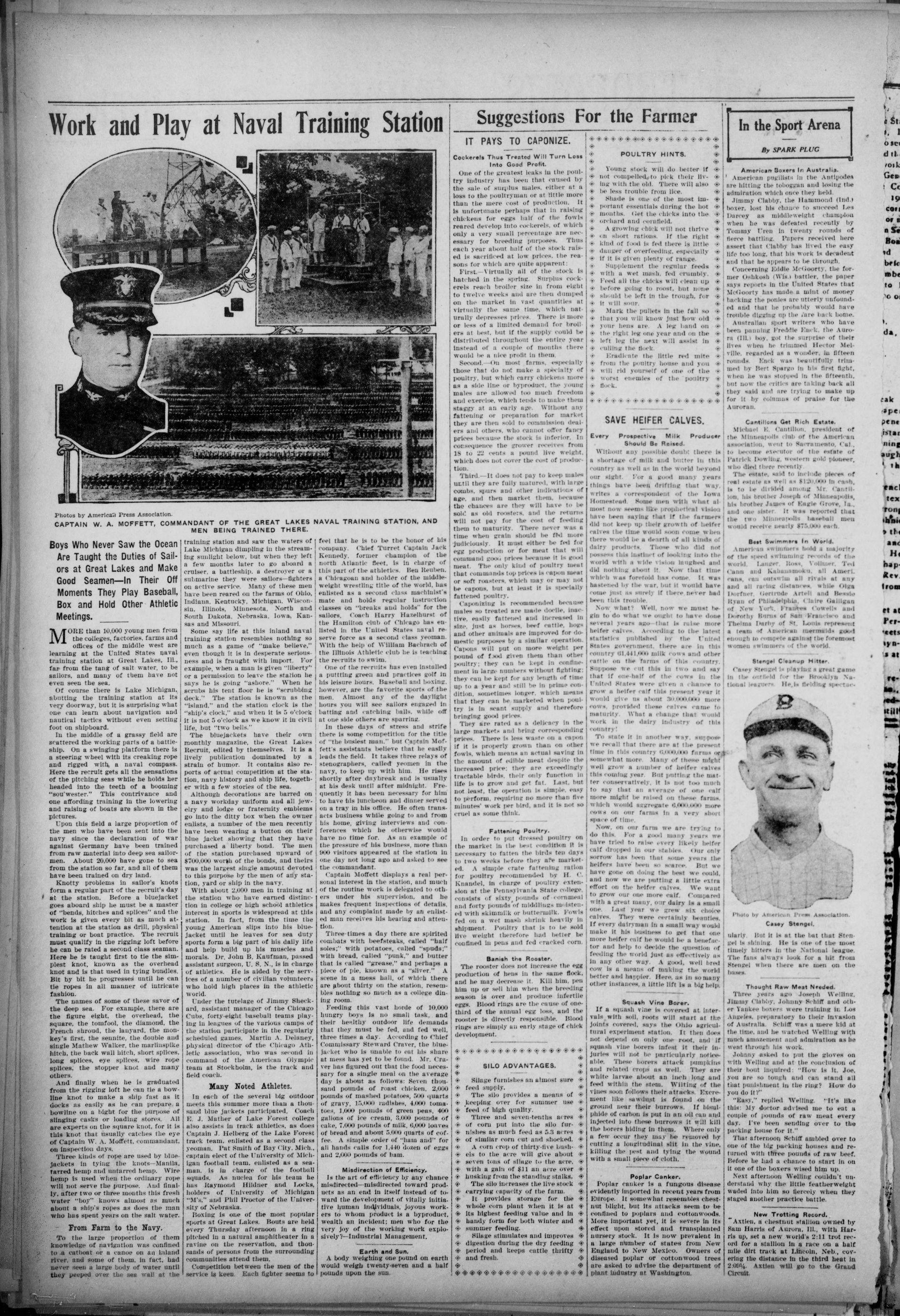
Work and Play at Naval Training Station
THE FIRST SAILING EXHIBITION AT THE NEW YORK CITY SAILING MUSEUM. THE EXHIBITION WAS HELD IN THE FIRST SAILING EXHIBITION AT THE NEW YORK CITY SAILING MUSEUM. THE EXHIBITION WAS HELD IN THE FIRST SAILING EXHIBITION AT THE NEW YORK CITY SAILING MUSEUM.
Boys Who Never Saw the Ocean Are Taught the Duties of Sailors at Great Lakes and Make Good Seamen—In Their Off Moments They Play Baseball, Box and Hold Other Athletic Meetings.
More than 10,000 young men from the colleges, factories, farms and offices of the middle west are learning at the United States naval training station at Great Lakes, Ill., far from the tang of salt water, to be sailors, and many of them have not even seen the sea.
training station and saw the waters of Lake Michigan dimpling in the streaming sunlight below, but when they left a few months later to go aboard a cruiser, a battleship, a destroyer or a submarine they were sailors—fighters on active service. Many of these men have been reared on the farms of Ohio, Indiana, Kentucky, Michigan, Wisconsin, Illinois, Minnesota, North and South Dakota, Nebraska, Iowa, Kansas and Missouri.
Some say life at this inland naval training station resembles nothing so much as a game of "make believe," even though it is in desperate seriousness and is fraught with import. For example, when a man is given "liberty" or a permission to leave the station he says he is going "ashore." When he feel that he is to be the honor of a company. Chief Turret Captain Ja Kennedy, former champion of the north Atlantic fleet, is in charge of this part of the athletics. Ben Reuben a Chicagoan and holder of the middle weight wrestling title of the world, he enlisted as a second class machinel mate and holds regular instructive classes on "breaks and holds" for sailors. Coach Harry Hazelhurst the Hamilton club of Chicago has listed in the United States naval serve force as a second class yeoman. With the help of William Bachrauch the Illinois Athletic club he is teaching the recruits to swim.
One of the recruits has even installed a putting green and practices golf his leisure hours. Baseball and boxing
Of course there is Lake Michigan, abutting the training station at its very doorway, but it is surprising what one can learn about navigation and nautical tactics without even setting foot on shipboard.
In the middle of a grassy field are scattered the working parts of a battleship. On a swinging platform there is a steering wheel with its creaking rope and rigged with a naval compass.
Here the recruit gets all the sensations of the pitching seas while he holds her headed into the teeth of a booming "sou'wester." This contrivance and one affording training in the lowering and raising of boats are shown in the pictures.
Upon this field a large proportion of the men who have been sent into the navy since the declaration of war against Germany have been trained from raw material into deep sea sailormen. About 20,000 have gone to sea from the station so far, and all of them have been trained on dry land. Knotty problems in sailor's knots form a regular part of the recruit's day at the station. Before a bluejacket goes aboard船 he must be a master of "bends, hitches and splices" and the work is given every bit as much attention at the station as drill, physical training or boat practice. The recruit must qualify in the rigging loft before he can be rated a second class seaman. Here he is taught first to tie the simplest knot, known as the overhead knot and is that used in tying bundles. Bit by bit he progresses until he can tie ropes in all manner of intricate fashion.
The names of some of these savor of the deep sea. For example, there are the figure eight, the overhead, the square, the tomfool, the diamond, the French shroud, the lanyard, the monkey's first, the sennite, the double and single Matthew Walker, the marlinusplike hitch, the back wall hitch, short splices, long splices, eye splices, wire rope splices, the stopper knot and many others.
And finally when he is graduated from the rigging loft he can tie a bowline knot to make a ship fast as it docks as easily as he can prepare a bowline on a bight for the purpose of slinging casks or loading stores. All are experts on the square knot, for it is this knot that usually catches the eye of Captain W. A. Moffett, commandant, on inspection days.
Three kinds of rope are used by blue-jackets in tying the knots-Manila, tarred hemp and untarred hemp. Wire hemp is used when the ordinary rope will not serve the purpose. And finally, after two or three months this fresh water "boy" knows almost as much about a ship's ropes as does the man who has spent years on the salt water.
From Farm to the Navy.
To the large proportion of them knowledge of navigation was confined to a catbott or a canoe on an island river, and some of them, in fact, had never seen a large body of water until they peeped over the sea wall at the
training station and saw the waters of Lake Michigan dimpling in the streaming sunlight below, but when they left a few months later to go aboard a cruiser, a battleship, a destroyer or a submarine they were sailors-fighters on active service. Many of these men have been reared on the farms of Ohio, Indiana, Kentucky, Michigan, Wisconsin, Illinois, Minnesota, North and South Dakota, Nebraska, Iowa, Kansas and Missouri.
Some say life at this inland naval training station resembles nothing so much as a game of "make believe," even though it is in desperate seriousness and is fraught with import. For example, when a man is given "liberty" or a permission to leave the station he says he is going "ashore." When he scrubs his tent floor he is "scrubbing deck." The station is known as the "island," and the station clock is the "ship's clock," and when it is 5 o'clock it is not 5 o'clock as we know it in civil life, but "two bells."
The bluejackets have their own monthly magazine, the Great Lakes Recruit, edited by themselves. It is a lively publication dominated by a strain of humor. It contains also reports of actual competition at the station, navy history and ship life, together with a few stories of the sea.
Although decorations are barred on a navy workday uniform and all jewelry and lodge or fraternity emblems go into the ditty box when the owner enlists, a number of the men recently have been wearing a button on their blue jacket showing that they have purchased a liberty bond. The men of the station purchased upward of $700,000 worth of the bonds, and theirs was the largest single amount devoted to this purpose by the men of any station, vard or ship in the navy.
With about 2,000 men in training at the station who have earned distinction in college or high school athletics interest in sports is widespread at this station. In fact, from the time the young American slips into his blue-jacket until he leaves for sea duty sports form a big part of his daily life and help build up his muscles and morals. Dr. John B. Kaufman, passed assistant surgeon, U. S. N., is in charge of athletics. He is aided by the services of a number of civilian volunteers who hold high places in the athletic world.
Under the tutelage of Jimmy Sheckard, assistant manager of the Chicago Cubs, forty-eight baseball teams playing in leagues of the various camps of the station participate in the regularly scheduled games. Martin A. Delaney, physical director of the Chicago Athletic association, who was second in command of the American Olympic team at Stockholm, is the track and field coach.
Many Noted Athletes.
In each of the several big outdoor meets this summer more than a thousand blue jackets participated. Coach E. J. Mather of Lake Forest college also assists in track athletics, as does Captain J. Helberg of the Lake Forest track team, enlisted as a second class yeoman. Pat Smith of Bay City, Mich., captain elect of the University of Michigan football team, enlisted as a seaman, is in charge of the football squads. As nuclea for his team he has Raymond Hildner and Locks, holders of University of Michigan "M.'s" and Phil Proctor of the University of Nebraska. Boxing is one of the most popular sports at Great Lakes. Bouts are held every Thursday afternoon in a ring pitched in a natural amphitheater in a ravine on the reservation, and thousands of persons from the surrounding communities attend them. Competition between the men of the service is keen. Each fighter seems to
feel that he is to be the honor of his company. Chief Turret Captain Jack Kennedy, former champion of the north Atlantic fleet, is in charge of this part of the athletics. Ben Reuben, a Chicagoan and holder of the middle-weight wrestling title of the world, has enlisted as a second class machinist's mate and holds regular instruction classes on "breaks and holds" for the sailors. Coach Harry Hazelhurst of the Hamilton club of Chicago has enlisted in the United States naval reserve force as a second class yeoman. With the help of William Bachrach of the Illinois Athletic club he is teaching the recruits to swim.
One of the recruits has even installed a putting green and practices golf in his leisure hours. Baseball and boxing, however, are the favorite sports of the men. Almost any of the daylight hours you will see sailors engaged in batting and catching balls, while off at one side others are sparring.
In these days of stress and strife there is some competition for the title of "the busiest man," but Captain Moffett's assistants believe that he easily leads the field. It takes three relays of stenographers, called yeomen in the navy, to keep up with him. He rises shortly after daybreak and is usually at his desk until after midnight. Frequently it has been necessary for him to have his juncheon and dinner served on a tray in his office. He often transacts business while going to and from his home, giving interviews and conferences which he otherwise would have no time for. As an example of the pressure of his business, more than 900 visitors appeared at the station in one day not long ago and asked to see the commandant.
Captain Moffett displays a real personal interest in the station, and much of the routine work is delegated to others under his supervision, and he makes frequent inspections of details, and any complaint made by an enlisted man receives his hearing and attention.
Three times a day there are spirited combats with beefsteaks, called "half soles;" with potatoes, called "spuds;" with bread, called "punk," and butter that is called "grease," and perhaps a piece of pie, known as a "silver." A scene in a mess hall, of which there are about thirty on the station, resembles nothing so much as a college dining room.
Feeding this vast horde of 10,000 hungry boys is no small task, and their healthy outdoor life demands that they must be fed, and fed well, three times a day. According to Chief Commissary Steward Craver the blue-jacket who is unable to eat his share at mess has yet to be found. Mr. Craver has figured out that the food necessary for a single meal on the average day is about as follows: Seven thousand pounds of roast chicken, 2,000 pounds of mashed potatoes, 500 quarts of gravy, 15,000 radishes, 4,000 tomatoes, 1,000 pounds of green pens, 400 gallons of ice cream, 3,000 quarts of cake, 7,000 pounds of milk, 6,000 leaves of bread and about 5,000 quarts of coffee. A simple order of "ham and" for all hands calls for 1,440 dozen of eggs and 2,000 pounds of ham.
Misdirection of Efficiency
Is the art of efficiency by any chance misdirected—misdirected toward products as an end in itself instead of toward the development of vitally initiative human individuals, joyous workers to whom product is a byproduct, wealth an incident; men who for the very joy of the working work explosively?—Industrial Management.
Earth and Sun.
A body weighing one pound on earth would weigh twenty-seven and a half pounds upon the sun.
Suggestions For the Farmer
IT PAYS TO CAPONIZE.
Cockerels Thus Treated Will Turn Loss Into Good Profit.
One of the greatest leaks in the poultry industry has been that caused by the sale of surplus males, either at a loss to the poultryman or at little more than the mere cost of production. It is unfortunate perhaps that in raising chickens for eggs half of the fowls reared develop into cockerels, of which only a very small percentage are necessary for breeding purposes. Thus each year about half of the stock raised is sacrificed at low prices, the reasons for which are quite apparent:
First—Virtually all of the stock is hatched in the spring. Surplus cock-erels reach broiler size in from eight to twelve weeks and are then dumped on the market in vast quantities at virtually the same time, which naturally depresses prices. There is more or less of a limited demand for broilers at best, but if the supply could be distributed throughout the entire year instead of a couple of months there would be a nice profit in them.
Second. On most farms, especially those that do not make a specialty of poultry, but which carry chickens more as a side line or byproduct, the young males are allowed too much freedom and exercise, which tends to make them staggy at an early age. Without any fattening or preparation for market they are then sold to commission dealers and others, who cannot offer fancy prices because the stock is inferior. In consequence the grower receives from 18 to 22 cents a pound live weight which does not cover the cost of production.
Third—It does not pay to keep makes urtill they are fully matured, with large combs, spurs and other indications of age, and then market them, because the chances are they will have to be sold as old roosters, and the returns will not pay for the cost of feeding them to maturity. There never was a time when grain should be fed more judiciously. It must either be fed for egg production or for meat that will command good prices because it is good meat. The only kind of poultry meat that commands top prices is capon meat or soft roosters, which may or may not be capons, but at least it is specially fattened poultry.
Caponizing is recommended because males so treated are made docile, inactive, easily fattened and increased in size, just as horses, beef cattle, hogs and other animals are improved for domestic purposes by a similar operation. Capons will put on more weight per pound of food given them than other poultry; they can be kept in confinement in large numbers without fighting; they can be kept for any length of time up to a year and still be in prime condition, sometimes longer, which means that they can be marketed when poultry is in scant supply and therefore bringing good prices.
They are rated as a delicacy in the large markets and bring corresponding prices. There is less waste on a capon if it is properly grown than on other fowls, which means an actual saving in the amount of edible meat despite the increased price; they are exceedingly tractable birds, their only function in life is to grow and get fat. Last, but not least, the operation is simple, easy to perform, requiring no more than five minutes' work per bird, and it is not so cruel as some think.
Fattening Poultry.
In order to put dressed poultry on the market in the best condition it is necessary to fatten the birds ten days to two weeks before they are marketed. A simple crate fattening ration for poultry recommended by H. C Knandel, in charge of poultry extension at the Pennsylvania State college, consists of sixty pounds of cornmeal and forty pounds of middlings moistened with skimmilk or buttermilk. Fowls fed on a wet mash shrink heavily in shipment. Poultry that is to be sold live weight therefore had better be confined in pens and fed cracked corn.
Banish the Rooster.
The rooster does not increase the egg production of hens in the same flock, and he may decrease it. Kill him, pet him up or sell him when the breeding season is over and produce infertile eggs. Blood rings are the cause of one-third of the annual egg loss, and the rooster is directly responsible. Blood rings are simply an early stage of chick development.
SILQ ADVANTAGES.
* Silage furnishes an almost sure feed supply.
* The silo provides a means of keeping over for summer use feed of high quality.
* Three and seven-tenths acres of corn put into the silo furnishes as much feed as 5.3 acres of similar corn cut and shocked.
* A corn crop of thirty-five bushels to the acre will give about seven tons of silage to the acre, with a gain of $11 an acre over husking from the standing stalks.
* The silo increases the live stock carrying capacity of the farm.
* It provides storage for the whole corn plant when it is at its highest feeding value and in handy form for both winter and summer feeding.
* Silage stimulates and improves digestion during the dry feeding period and keeps cattle thrifty and fresh.
```markdown
```
POULTRY HINTS.
Young stock will do better if not compelled to pick their living with the old. There will also be less trouble from lice.
Shade is one of the most important essentials during the hot months. Get the chicks into the orchard and cornfield.
A growing chick will not thrive on short rations. If the right kind of food is fed there is little danger of overfeeding, especially if it is given plenty of range.
Supplement the regular feeds with a wet mash, fed crumby.
Feed all the chicks will clean up before going to roost, but none should be left in the trough, for it will sour.
Mark the pullets in the fall so that you will know just how old your hens are. A leg band on the right leg one year and on the left leg the next will assist in culling the flock.
* Eradicate the little red mite
* from the poultry house and you
* will rid yourself of one of the
* worst enemies of the poultry
* flock.
*
SAVE HEIFER CALVES.
Every Prospective Milk Producer Should Be Raised.
Without any possible doubt there is a shortage of milk and butter in this country as well as in the world beyond our sight. For a good many years things have been drifting that way, writes a correspondent of the Iowa Homestead. Some men with what almost now seems like prophetical vision have been saying that if the farmers did not keep up their growth of heifer calves the time would soon come when there would be a dearth of all kinds of dairy products. Those who did not possess this instinct of looking into the world with a wide vision laughed and did nothing about it. Now that time which was forefold has come. It was hastened by the war, but it would have come just as surely if there never had been this trouble.
Now what? Well, now we must begin to do what we ought to have done several years ago- that is raise more heifer calves. According to the latest statistics published by the United States government, there are in this country 61,441,900 milk cows and other cattle on the farms of this country. Suppose we cut this in two and say that if one-half of the cows in the United States were given a chance to grow a heifer calf this present year it would give us about 30,000,000 more cows, provided these calves came to maturity. What a change that would work in the dairy industry of this country!
To state it in another way, suppose we recall that there are at the present time in this country 6,000,000 farms or somewhat more. Many of these might well grow a number of heifer calves this coming year. But putting the matter conservatively, it is not too much to say that an average of one calf more might be raised on these farms, which would aggregate 6,000,000 more cows on our farms in a very short space of time.
Now, on our farm we are trying to do this. For a good many years we have tried to raise every likely heifer calf dropped in our stables. Our only sorrow has been that some years the heifers have been so scarce. But we have gone on doing the best we could, and now we are putting a little extra effort on the heifer calves. We want to grow our one more calf. Compared with a great many, our dairy is a small one. Last year we grew six choice calves. They were certainly beauties. If every dairyman in a small way would make it his business to get that one more heifer calf he would be a benefactor and help to decide the question of feeding the world just as effectively as in any other way. A good, well bred cow is a means of making the world better and happier. Here, as in so many other instances, a little lift is a big help.
Squash Vine Borer.
If a squash vine is covered at intervals, with soil, roots will start at the joints covered, says the Ohio agricultural experiment station. It then does not depend on only one root, and if squash vine borers infest It their injuries will not be particularly noticeable. These borers attack pumpkins and related crops as well. They are white larvae about an inch long and feed within the stem. Wilting of the vines soon follows their attacks. Excrement like sawdust is found on the ground near their burrows. If bisulphide of carbon is put in an oil can and injected into these burrows it will kill the borers hiding in them. Where only a few occur they may be removed by cutting a longitudinal slit in the vine, killing the pest and tying the wound with a small piece of cloth.
Poplar Canker.
Poplar canker is a fungous disease evidently imported in recent years from Europe. It somewhat resembles chestnut blight, but its attacks seem to be confined to poplars and cottonwoods. More important yet, it is severe in its effect upon stored and transplanted nursery stock. It is now prevalent in a large number of states from New England to New Mexico. Owners of diseased poplar or cottonwood trees are asked to advise the department of plant industry at Washington.
In the Sport Arena
By SPARK PLUG
American Boxers In Australia.
American pugilists in the Antipodes are hitting the toboggan and losing the admiration which once they held.
Jimmy Clabby, the Hammond (Ind.) boxer, lost his chance to succeed Les Darcey as middleweight champion when he was defeated recently by Tommy Uren in twenty rounds of fierce battling. Papers received here assert that Clabby has lived the easy life too long, that his work is decadent and that he appears to be through.
Concerning Eddie McGoorty, the former Oshkosh (Wis.) battler, the paper says reports in the United States that McGoorty has made a mint of money backing the ponies are utterly unfounded and that he probably would have trouble digging up the rare back home.
Australian sport writers who have been panning Freddie Enck, the Aurora (IL.) boy, got the surprise of their lives when he trimmed Hector Melville, regarded as a wonder, in fifteen rounds. Enck was beautifully trimmed by Bert Spargo in his first fight, when he was stopped in the fifteenth, but now the critics are taking back all they said and are trying to make up for it by columns of praise for the Auroran.
Cantillons Get Rich Estate
Michael E. Cantillon, president of the Minneapolis club of the American association, went to Sacramento, Cal., to become executor of the estate of Patrick Dowling, western gold pioneer, who died there recently.
The estate, said to include pieces of real estate as well as $120,000 in cash, is to be divided among Mr. Cantillon, his brother Joseph of Minneapolis, his brother James of Engle Grove, In., and one sister. It was reported that the two Minneapolis baseball men would receive nearly $75,000 each.
Best Swimmers In World.
American swimmers hold a majority of the speed swimming records of the world. Langer, Ross, Vollmer, Ted Cann and Kabannmokun, all Ameri-cans, can outswim all rivals at any and all racing distances, while Olga Dorfner, Gertrude Artell and Bessb Ryan of Philadelphia, Claire Galligan of New York, Frances Cowells and Dorothy Burns of Saff Francisco and Thelma Darby of St. Louis represent a team of American mermids good enough to compete against the foremost women swimmers of the world.
Stengel Cleanup Hitter
Casey Stengel is playing a great game in the outfield for the Brooklyn National leaguers. He is fielding spectac-
B
Photo by American Press Association.
Casey Stengel.
ularly. But it is at the bat that Stengel is shining. He is one of the most timely hitters in the National league. The fans always look for a hit from Stengel when there are men on the bases.
Thought Raw Meat Needed.
Three years ago Joseph Welling, Jimmy Clabby, Johnny Schiff and other Yankee boxers were training in Los Angeles, preparatory to their invasion of Australia. Schiff was a mere kid at the time, and he watched Welling with much amusement and admiration as he went through his work.
Johnny asked to put the gloves on with Welling and at the conclusion of their bout inquired: "How is it. Joe, you are so tough and can stand all that punishment in the ring? How do you do it?"
"Easy," replied Welling. "It's like this: My doctor advised me to eat a couple of pounds of raw meat every day. I've been sending over to the packing house for it."
That afternoon Schiff ambled over to one of the big packing houses and returned with three pounds of raw beef. Before he had a chance to start in on it one of the boxers wised him up.
Next afternoon Welling couldn't understand why the little featherweight waded into him so fiercely when they staged another practice battle.
New Trotting Record.
Axtien, a chestnut stallion owned by Sam Harris of Aurum, Ill., with Harris up, set a new world's 2:11 trot record for a stallion in a race on a half mile dirt track at Lincoln, Neb., covering the distance in the third heat in 2.004'. Axtien will go to the Grand Circuit.
WOMEN'S FASHIONS and THE HOME
.
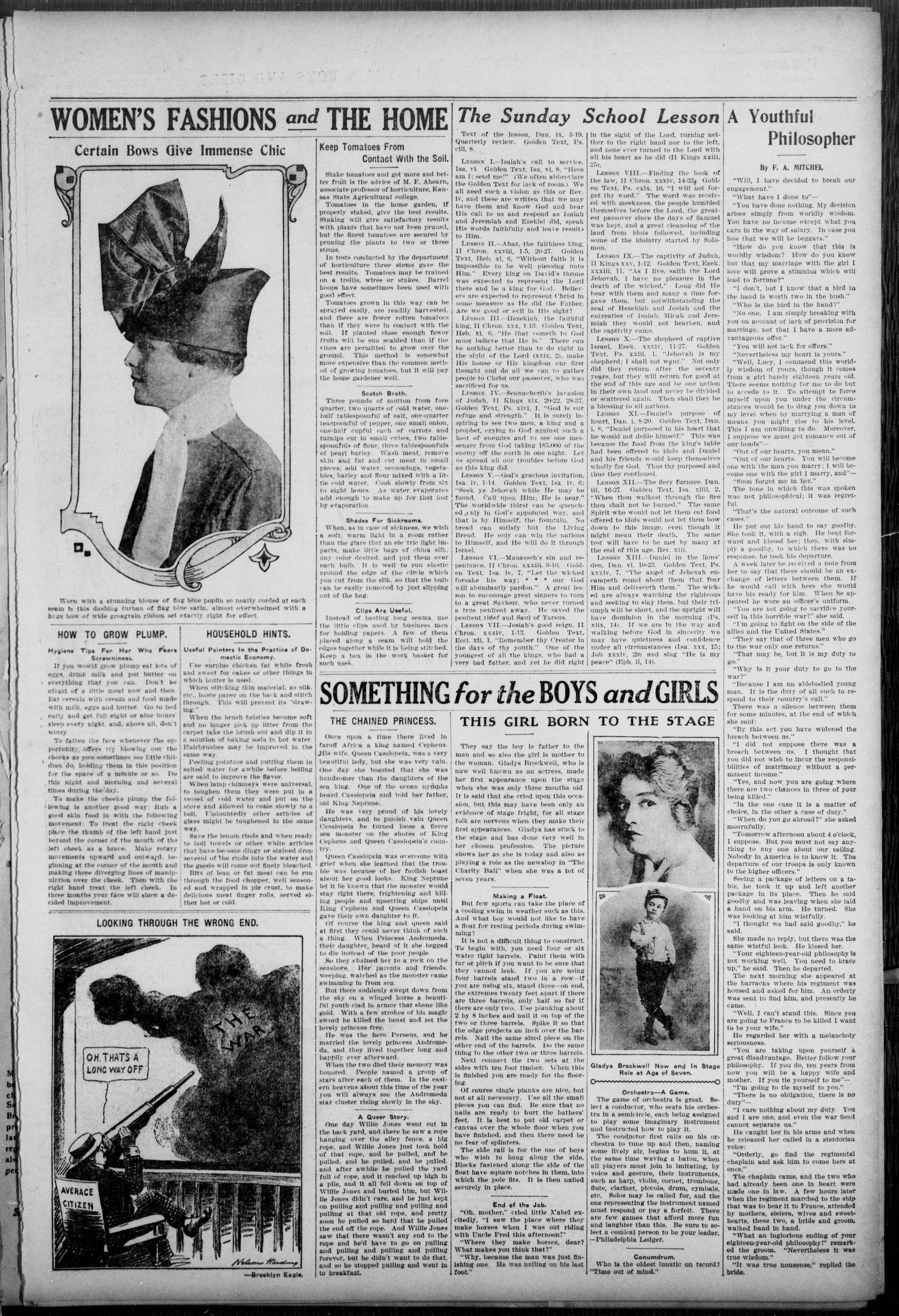
Worn with a stunning blouse of flag blue poplin so neatly corded at each seam is this dashing turban of flag blue satin, almost overwhelmed with a huge how of wide grosgrain ribbon set exactly right for effect.
Worn with a stunning blouse of flag blue poplin so neatly corded at each seam is this dashing turban of flag blue satin, almost overwhelmed with a huge how of wide grosgrain ribbon set exactly right for effect.
HOW TO GROW PLUMP.
Hygiene Tips For Her Who Fears Scrawniness.
If you would grow plump eat lots of eggs, drink milk and put butter on everything that you can. Don't be afraid of a little meat now and then. Eat cereals with cream and food made with milk, eggs and butter. Go to bed early and get full eight or nine hours' sleep every night, and, above all, don't worry.
To fatten the face whenever the opportunity, offers try blowing out the cheeks as you sometimes see little children do, holding them in this position for the space of a minute or so. Do this night and morning and several times during the day.
To make the cheeks plump the following is another good way: Rub a good skin food in with the following movement: To treat the right cheek place the thumb of the left hand just beyond the corner of the mouth of the left cheek as a brace. Make rotary movements upward and outward, beginning at the corner of the mouth and making three diverging lines of manipulation over the cheek. Then with the right hand treat the left cheek. In three months your face will show a decided improvement.
LOOKING THROUGH THE WRONG END.
OH. THAT'S A LONG WAY OFF
THE WAR
AVERAGE CITIZEN
Nelson Harding
HOUSEHOLD HINTS.
Useful Pointers In the Practice of Domestic Economy.
Use surplus chicken fat while fresh and sweet for cakes or other things in which butter is used.
When stitching thin material, as silk, etc., baste paper on the back and stitch through. This will prevent its "drawing."
When the brush bristles become soft and no longer pick up litter from the carpet take the brush out and dip it in a solution of baking soda in hot water. Hairbrushes may be improved in the same way.
Peeling potatoes and putting them in salted water for awhile before boiling are said to improve the flavor.
When lamp chimneys were universal, to toughen they were put in a vessel of cold water and put on the stove and allowed to come slowly to a boil. Undoubtedly other articles of glass might be toughened in the same way.
Save the lemon rinds and when ready to boil towels or other white articles that have become dingy or stained drop several of the rinds into the water and the goods will come out finely bleached. Bits of lean or fat meat can be run through the food chopper, well seasoned and wrapped in ple crust, to make delicious meat finger rolls, served either hot or cold.
SOMETHING for the BOYS and GIRLS
Keep Tomatoes From
Contact With the Soil.
Stake tomatoes and get more and better fruit is the advice of M. F. Ahearn, associate professor of horticulture, Kansas State Agricultural college. Tomatoes in the home garden, if properly staked, give the best results. Staking will give satisfactory results with plants that have not been pruned, but the finest tomatoes are secured by pruning the plants to two or three stems. In tests conducted by the department of horticulture three stems gave the best results. Tomatoes may be trained on a trellis, wires or stakes. Barrel hoops have sometimes been used with good effect.
Tomatoes grown in this way can be sprayed easily, are readily harvested, and there are fewer rotten tomatoes than if they were in contact with the soil. If planted close enough fewer fruits will be sun scalded than if the vines are permitted to grow over the ground. This method is somewhat more expensive than the common method of growing tomatoes, but it will pay the home gardener well.
Scotch Broth.
Three pounds of mutton from fore quarter, two quarts of cold water, one-half tablespoonful of salt, one-quarter teaspoonful of pepper, one small onion, one-half cupful each of carrots and turnips cut in small cubes, two tablespoonfuls of flour, three tablespoonfuls of pearl barley. Wash meat, remove skin and fat and cut meat in small pieces; add water, seasonings, vegetables, barley and flour mixed with a little cold water. Cook slowly from six to eight hours. As water evaporates add enough to make up for that lost by evaporation.
Shades For Sickrooms
When, as in case of sickness, we wish a soft, warm light in a room rather than the glare that an elec tric light imparts, make little bags of china silk, any color desired, and put them over each bulb. It is well to run elastic around the edge of the circle which you cut from the silk, so that the bulb can be easily removed by just slipping out of the bag.
Clips Are Useful.
Instead of basting long seams, use the little clips used by business men for holding papers. A few of them placed along a seam will hold the edges together while it is being stitched. Keep a box in the work basket for such uses.
THE CHAINED PRINCESS.
Once upon a time there lived in faroff Africa a king named Cepheus. His wife, Queen Cassiopela, was a very beautiful lady, but she was very vain. One day she boasted that she was handsomer than the daughters of the sea king. One of the ocean nymphs heard Cassiopela and told her father, old King Neptune.
He was very proud of his lovely daughters, and to punish vain Queen Cassiopela he turned loose a fierce sea monster on the shores of King Cepheus and Queen Cassiopela's country.
Queen Cassiopeia was overcome with grief when she learned that the trouble was because of her foolish boast about her good looks. King Neptune let it be known that the monster would stay right there, frightening and killing people and upsetting ships until King Cepheus and Queen Cassiopeia gave their own daughter to it.
Of course the king and queen said at first they could never think of such a thing. When Princess Andromeda, their daughter, heard of it she begged to die instead of the poor people.
So they chained her to a rock on the seashore. Her parents and friends, weeping, watched as the monster came swimming in from sea.
But there suddenly swept down from the sky on a winged horse a beautiful youth clad in armor that shone like gold. With a few strokes of his magic sword he killed the beast and set the lovely princess free.
He was the hero Perseus, and he married the lovely princess Andromeda, and they lived together long and happily ever afterward. When the two died their memory was honored. People named a group of stars after each of them. In the eastern heavens about this time of the year you will always see the Andromeda star cluster rising slowly in the sky.
A Queer Story.
One day Willie Jones went out in the back yard, and there he saw a rope hanging over the alley fence, a big rope, and Willie Jones just took hold of that rope, and he pulled, and he pulled, and he pulled, and he pulled, and after awhile he pulled the yard full of rope, and it reached up high in a plie, and it all fell down on top of Willie Jones and buried him, but Willie Jones didn't care, and he just kept on pulling and pulling and pulling and pulling at that old rope, and pretty soon he pulled so hard that he pulled the end off the rope. And Willie Jones saw that there wasn't any end to the rope and he'd have to go on pulling and pulling and pulling and pulling forever, but he didn't want to do that, and so he stopped pulling and went in to breakfast.
The Sunday School Lesson
THIS GIRL BORN TO THE STAGE
Text of the lesson, Dan, ix, 3-19. Quarterly review. Golden Text, Ps. cilf, 8.
LESSON I.—Isaiah's call to service. Isa, vl. Golden Text, Isa, vl, 8. "Here am I; send me!" (We often abbreviate the Golden Text for lack of room.) We all need such a vision as this or Rev. iv, and these are written that we may have them and know God and hear His call to us and respond as Isaiah and Jeremiah and Ezekiel did, speak His words faithfully and leave results to Him.
LESSON II.—Ahaz, the faithless king, II Chron. xxviii, 1-5, 20-27. Golden Text, Heb, xi, 6. "Without faith it is impossible to be well pleasing unto Him." Every king on David's throne was expected to represent the Lord there and be a king for God. Believers are expected to represent Christ in some measure as He did the Father. Are we good or evil in His sight?
LESSON III.—Hezekiah, the faithful king, I Chron. xxx, 1-13. Golden Text, Heb. xi, 6. "He that cometh to God must believe that He is." There can be nothing better than to do right in the sight of the Lord (xxix, 2), make His house or His kingdom our first thought and do all we can to gather people to Christ our passover, who was sacrificed for us.
LESSON IV.—Sennacherib's invasion of Judah, I Kings xix. 20-22. 28-37. Golden Text, Ps. xivi, 1. "God is our refuge and strength." It is surely inspiring to see two men, a king and a prophet, crying to God against such a host of enemies and to see one messenger from God taking 185,000 of the enemy off the earth in one night. Let us spread all our troubles before God as this king did.
LESSON V.—God's gracious invitation, Isa. lv. 1-14. Golden Text, Isa. lv. 6: "Seek ye Jehovah while He may be found. Call upon Him; He is near." The worldwide thirst can be quenched, only in God's appointed way, and that is by Himself, the fountain. No bread can satisfy but the Living Bread. He only can win the nations to Himself, and He will do it through Israel.
LESSON VI.—Manasseh's sin and repentance, H Chron. xxiii. 9-16. Golden Text, Isa. lv. 7, "Let the wicked forsake his way; * * * our God will abundantly pardon." A great lesson to encourage great sinners to turn to a great Saviour, who never turned a true penitent away. He saved the penitent tibef and Saul of Tarsus.
Lesson VII—Josiah's good reign, IH Chron. xxxiv, 1-13. Golden Text, Eccl. xl, 1. "Remember thy Creator in the days of thy youth." One of the youngest of all the kings, who had a very bad father, and yet he did right
They say the boy is father to the man and so also the girl is mother to the woman. Gladys Brockwell, who is now well known as an actress, made her first appearance upon the stage when she was only three months old. It is said that she cried upon this occasion, but this may have been only an evidence of stage fright, for all stage folk are nervous when they make their first appearances. Gladys has stuck to the stage and has done very well in her chosen profession. The picture shows her as she is today and also as playing a role as the newsboy in "The Charity Ball" when she was a tot of seven years.
Making a Float.
But few sports can take the place of a cooling swim in weather such as this. And what boy would not like to have a float for resting periods during swimming?
It is not a difficult thing to construct. To begin with, you need four or six water tight barrels. Paint them with tar or pitch if you want to be sure that they cannot leak. If you are using four barrels stand two in a row—if you are using six, stand three—on end, the extremes twenty feet apart if there are three barrels, only half so far if there are only two. Use planking about 2 by 8 inches and nail it on top of the two or three barrels. Spike it so that the edge projects an inch over the barrels. Nail the same sized piece on the other end of the barrels. Do the same thing to the other two or three barrels. Next connect the two sets at the sides with ten foot timber. When this is finished you are ready for the flooring.
Of course single planks are nice, but not at all necessary. Use all the small pieces you can find. Be sure that no nails are ready to hurt the bathers' feet. It is best to put old carpet or canvas over the whole floor when you have finished, and then there need be no fear of splinters.
The side rail is for the use of boys who wish to hang along the side. Blocks fastened along the side of the float have square notches in them, into which the pole fits. It is then nailed securely in place.
End of the Job.
"Oh, mother," cried little Mabel excitedly, "I saw the place where they make horses when I was out riding with Uncle Fred this afternoon!" "Where they make horses, dear? What makes you think that?" "Why, because the man was just finishing one. He was nailing on his last foot."
in the sight of the Lord, turning nelther to the right hand nor to the left, and none ever turned to the Lord with all his heart as he did (II Kings xxiii, 25).
LESSON VIII.—Finding the book of the law, II Chron. xxxiv, 14-33; Golden Text, Ps. exx, 16, "I will not forget thy word." The word was received with meekness, the people humbled themselves before the Lord, the greatest passover since the days of Samuel was kept, and a great cleansing of the land from idols followed, including some of the idolatry started by Solomon.
LESSON IX.—The captivity of Judah, 11 Kings xxy, 1-12. Golden Text, Ezek, xxxil, 11. "As I live, saith the Lord Jehovah, I have no pleasure in the death of the wicked." Long did He bear with them and many a time forgave them, but notwithstanding the zeal of Hezekiah and Josiah and the entreaties of Isaiah, Micah and Jeremiah they would not hearken, and the captivity came.
LESSON X.—The shepherd of captive Israel, Ezek, xxxiv, 11-27. Golden Text, Ps. xxxil, 1. "Jehovah is my shepherd; I shall not want." Not only did they return after the seventy years, but they will return for good at the end of this age and be one nation in their own land and never be divided or scattered again. Then shall they be a blessing to all nations.
LESSON XI.—Daniel's purpose of heart, Dan. i, 8-20. Golden Text, Dan. i, 8. "Daniel purposed in his heart that he would not defile himself." This was because the food from the king's table had been offered to idols and Daniel and his friends would keep themselves wholly for God. Thus thy purposed and thus they continued.
LESSON XII.—The fiery furnace, Dan. iii. 16-27. Golden Text, Isa. xiii. 2. "When thou walkest through the fire thou shalt not be burned." The same Spirit who would not let them eat food offered to idols would not let them bow down to this image, even though it might mean their death. The same test will have to be met by many at the end of this age. Rev. xiii.
LESSON XIII. - Daniel in the lions' den,丹, vl. 10-23. Golden Text, Ps. xxxiv, 7. "The angel of Jehovah encampeth round about them that fear Him and delivereth them." The wicked are always watching the righteous and seeking to slay them, but their trumpet will be short, and the upright will have domination in the morning (Ps. xlix, 14). If we are in the way and walking before God in sincerity we may have quietness and confidence under all circumstances (Isa. xxx, 15; Job xxxiv, 29) and sing "He is my peace" (Eph. i, 14).
THE FILM MAKER
Gladys Brockwell Now and In Stage Role at Age of Seven.
Orchestra-A Game.
The game of orchestra is great. Select a conductor, who seats his orchestra in a semicircle, each being assigned to play some imaginary instrument and instructed how to play it.
The conductor first calls on his orchestra to tune up and then, naming some lively air, begins to hum it, at the same time waving a baton, when all players must join in imitating, by voice and gesture, their instruments, such as harp, violin, cornet, trombone, flute, clarinet, picocho, drum, cymbals, etc. Solos may be called for, and the one representing the instrument named must respond or pay a forfeit. There are few games that afford more fun and laughter than this. Be sure to select a comical person to be your leader.
—Philadelphia Ledger.
Who is the oldest lunatic on record?
"Time out of mind."
A Youthful Philosopher
By F. A. MITCHEL
"Will, I have decided to break our engagement."
"What have I done to"—
"You have done nothing. My decision arises simply from worldly wisdom. You have no income except what you earn in the way of salary. In case you lose that we will be beggars."
"How do you know that this is worldly wisdom? How do you know but that my marriage with the girl I love will prove a stimulus which will lead to fortune?"
"I don't, but I know that a bird in the hand is worth two in the bush."
"Who is the bird in the hand?"
"No one. I am simply breaking with you on account of lack of provision for marriage, not that I have a more advantageous offer."
"You will not lack for offers."
"Nevertheless my heart is yours."
"Well, Lucy, I commend this worldly wisdom of yours, though it comes from a girl barely eighteen years old. There seems nothing for me to do but to accede to it. To attempt to force myself upon you under the circumstances would be to drag you down to my level when by marrying a man of means you might rise to his level. This I am unwilling to do. Moreover, I suppose we must get romance out of our heads"—
"Out of our hearts, you mean."
"Out of our hearts. You will become one with the man you marry; I will become one with the girl I marry, and"—
"Soon forget me in her."
The tone in which this was spoken was not philosophical; it was regretful.
"That's the natural outcome of such cases."
He put out his hand to say goodbye. She took it, with a sigh. He bent forward and kissed her; then, with simply a goodbye, to which there was no response, he took his departure. A week later he received a note from her to say that there should be an exchange of letters between them. If he would call with hers she would have his ready for him. When he appeared he wore an officer's uniform. "You are not going to sacrifice yourself in this horrible war?" she said. "I'm going to fight on the side of the allies and the United States." "They say that of three men who go to the war only one returns."
"That may be, but it is my duty to go."
"Why is it your duty to go to the war?"
"Because I am an ablebodied young man. It is the duty of all such to respond to their country's call."
There was a silence between them for some minutes, at the end of which she said:
"By this act you have widened the breach between us."
"I did not suppose there was a breach between us. I thought that you did not wish to incur the responsibilities of matrimony without a permanent income."
"Yes, and now you are going where there are two chances in three of your being killed."
"In the one case it is a matter of choice, in the other a case of duty."
"When do you go abroad?" she asked mournfully.
"Tomorrow afternoon about 4 o'clock, I suppose. But you must not say anything to any one about our sailing. Nobody in America is to know it. The departure of our troops is only known to the higher officers."
Seeing a package of letters on a table, he took it up and left another package in its place. Then he said goodby and was leaving when she laid a hand on his arm. He turned. She was looking at him wistfully.
"I thought we had said goodby," he said.
She made no reply, but there was the same wistful look. He kissed her.
"Your eighteen-year-old philosophy is not working well. You need to brace up," he said. Then he departed.
The next morning she appeared at the barracks where his regiment was housed and asked for him. An orderly was sent to find him, and presently he came.
"Well, I can't stand this. Since you are going to France to be killed I want to be your wife."
He regarded her with a melancholy seriousness.
"You are taking upon yourself a great disadvantage. Better follow your philosophy. If you do, ten years from now you will be a happy wife and mother. If you tie yourself to me"—"I'm going to tie myself to you." "There is no obligation, there is no duty"—"I care nothing about my duty. You and I are one, and even the war fiend cannot separate us." He caught her in his arms and when he released her called in a stentorian voice:
"Orderly, go find the regimental chaplain and ask him to come here at once."
The chaplain came, and the two who had already been one in heart were made one in law. A few hours later when the regiment marched to the ship that was to bear it to France, attended by mothers, sisters, wives and sweet-hearts, these two, a bride and groom, walked hand in hand.
"What an inglorious ending of your eighteen-year-old philosophy?" remarked the groom. "Nevertheless it was true wisdom."
"It was true nonsense," replied the bride.
Metropolis Gazette
PUBLISHED ON FRIDAY BY
THE GAZETTE PRINTING CO.
METROPOLIS, . . . . . ILL.
MRS. M. J. MOCRARY, MANAGER.
J. B. MOCRARY, EDITOR.
FRIDAY SEPT. 28, 1917.
Office 9th and Pearl Streets, Metropolis, Illinois.
Entered as second-class mail matter, at Metropolis, Illinois, Postoffice.
Address all communications to J. B. MOCRARY, Box 107 Metropolis, Illinois.
The names and addresses of contrib-
sors must be known to us in every in-
tance, in order to secure publication.
We want the news of your vicinity
each week.
One Year.....$1.50
in Months.....75
Three Months.....40
Single Copy.....05
in Advance.
ADVERTISING RATES.
made known on application.
You must mail copy on
Mondays to secure publication.
XELENTO
Quinine Pomade
Copyrighted
JANE HAND and MARGARET BIRRY writes us
their advice and how they may hair, but later using
the hair can also be the result on Eribe pictures.
Kinky Hair cannot be made straight.
You have to have hair before it can be
straightened. Now this.
XELENTO QUININE
POMADE
is a Hair Grower which feeds the scalp
and roots of the hair and makes kinky.
nappy hair grow long, soft and silky. It
cleans dandruff and stops Falling Hair at
once. Please make by mail on receipt of
stamps or coin.
AGENTS WANTED EVERYWHERE.
Writes For Particulars at Once
XELENTO NECIINE CO., Atlanta, Ga.
Please psy up your sub cription. Can you afford to loose your race papers for want of support? It is up to you. What are you going to do about it Mr. non payer? Decide by paying up please.
If you have any Race pride and leve for truth, you will pay your subscription. We are toiling day and night to give you the news.
We solicit your patronage at the Leader 900 Pearl St.
We are pleased with the many nice things said of the Gazette, but we appreciate the money you owe us the more.
NOTICE
Colp, Ill., Aug. 1917.
I am authorized by the State missionary Board chairman, Dr. C. C Phillips, Golconda, to serve notice of those that pledged themselves to contribute to the work of State Missions during the General Missionary Baptist State Convention, Carbondale, May 1917 to communicate with the corresponding secretary at once or not later than the 5th Sunday in September at which time the Board the Board will be called to meet at Colp, Saturday before the 5th Sunday. All members of the Board are expected to be present or contribute $100 one dollar.
C. C. Phillips, Chairman,
Goleonda,
J. D. Bavis, Cor Sec
Colps, Ill.
A Slew Youth.
"You broke off the engagement!" said Mande. "Yes." replied Mamle. "I was terribly disappointed in him. He came around for our elopement with a motor car instead of an aeroplane."
$100 Reward. $100.
The readers of this paper will be pleased to learn that there is at least one dreaded disease that science has been able to cure in all its stages, and that is catarrh. Hall's catarrh cure is the ooly positive cure now known to the medical fraternity. catarrh being a constitutional treatment. Hall's catarrh is taken internally, acting directly upon the blood and mucous surfaces of the system, thereby destroying the foundation of the disease, and giving the patient strength by building up the constitution and assisting nature in doing it work. The proprietors have so much faith in its curative powers that they offer One Hundred Dollars for any case that it fails to cure. send for list of testimonials.
Address F. J. CHENEY & cO., Toledo, O.
Sold by all Druggists, 75c.
Take Hall's Family Pills for constipation.
Fried Fish every day at the Grand Leader Cafe.
The Gazette has just received another lot of new type faces and other material which adds much to the output of the work of the office. We deserve your patronage. We have a full line of cards, Letter Heads, Envelopes and other material. Let us do some of your work. Let us do your minute work and any other church advertisements.
All the delegates have returned home from the Association.
Rev B. C. Long, of Choag, a prosperou farmer, has bought an automobile, "Rah!" for Bennie.
Mrs. Rosa Lee Sylvester has returned to Canton, Miss., her home
Elder J. B. McCrary; and wife, Edgar McCrary, wife and Joseph Edgar, Jr. and Mrs. M, J. Blake were guest for dinner last Sunday at the beautiful farm home of Mr. and Mrs. Thos. P. King, of Unionville. Mr. King, is building a large barn of the most modern type for his cattle, feed and machinery. The foundation is of concrete, even the floors to all of the stalls, when complete it will be one of the best in the county as all of the timbers are of the very best white oak. We are proud of Mr. King. To appreciate what he is really doing and to have idea of what he stands for, one must pay a visit to his home.
There are several prosperous colored farmers in the Black Bottoms, among them, are Wm. King' John Edmonds, Andy Morand, Fred Brisco, Philip Moreland, J. H. Yarbrough, John Morris, Henry Stewart, Wash Shelton and others we cannot mention. Mrs. S. L. A. Owens entertained several of the delegates during the association although a widow she is prosperous a good tarmcr and large hearted christian woman, and the Lord bless her. We found lodging in her home during the association.
Mrs. M. J. McCrary, Fronnie Martin, Georgia Martin, Edgar McCrary, and wife, Adetaide Master Joseph Edgar, Ontrue Cowper and wife Jennie, Quincy Martin, and wife, Terrel Lyons and wife, Chas. Scott and several others spent Sunday attending the closing of the Mt. Olive Baptist Association at Unicnville and report a pleasant time.
Mrs. Lena M Phillips, was at home Sunday from Centralia.
Mrs. Corrine Williams, left for Centralia, where she has been re-employed to teach again.
Company M. will give a public drill at Park Sunday afternoon, Admission tree. J. B McCrary, grand chaplain of Prince Hall Masonic Grand Lodge of Illinois and jurisdiction will attend its session at Peoria, Oct. 9, 9, and 10th.
SPECIALISTS TRAIN BOYS AND GIRLS
THE CAFE
PETER H.
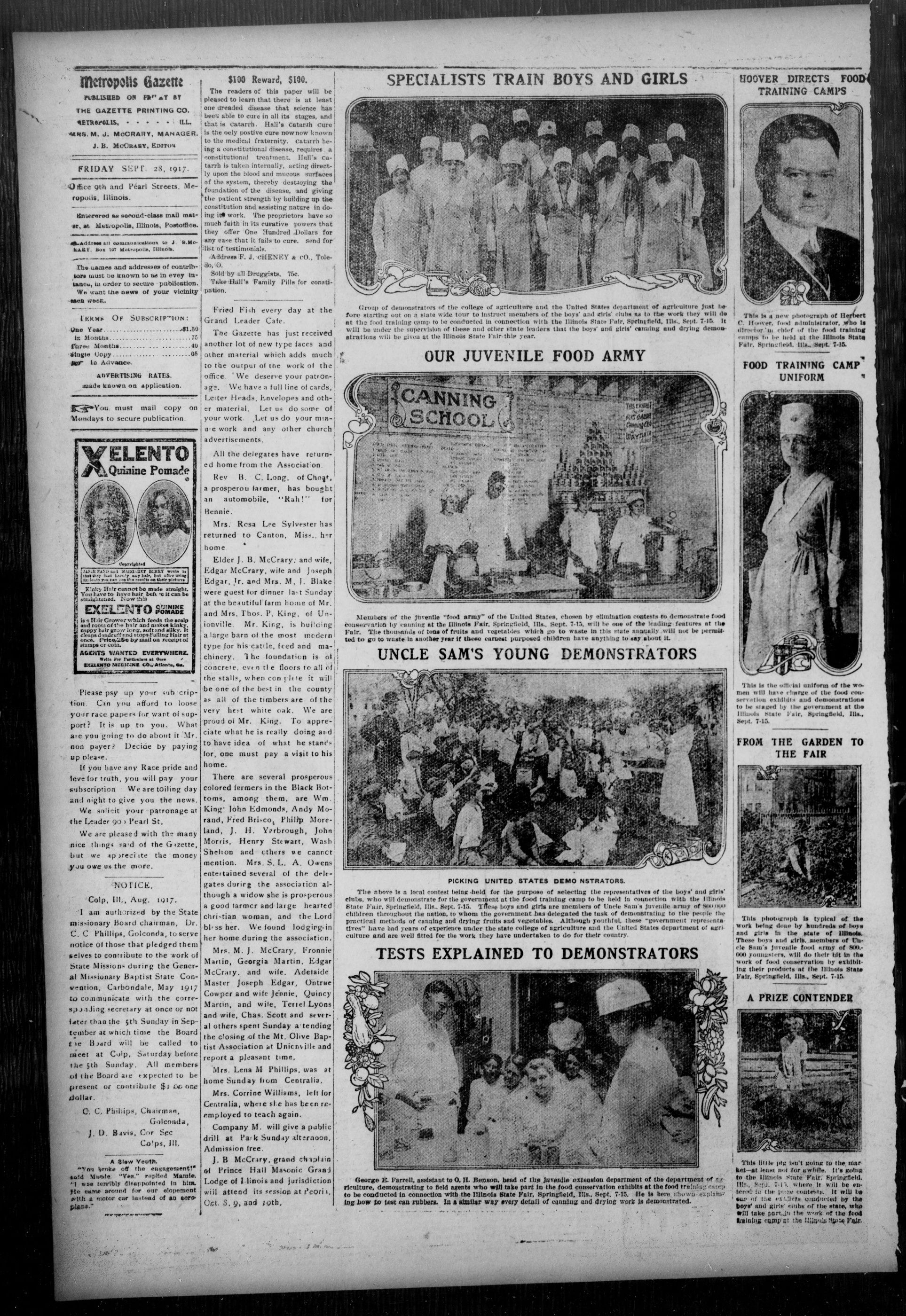
Group of demonstrators of the college of agriculture and the United States department of agriculture just before starting out on a state wide tour to instruct members of the boys' and girls' clubs as to the work they will do at the food training camp to be conducted in connection with the Illinois State Fair, Springfield, Ill., Sept. 7-15. It will be under the supervision of these and other state leaders that the boys' and girls' caning and drying demonstrations will be given at the Illinois State Fair this year.
This is a new photograph of Herbert C. Hower, food administrator, who is director in chief of the food training camps to be held at the Illinois State Fair, Springfield, Ill., Sept. 7-15.
This is a new photograph of Herbert C. Hoover, food administrator, who is director in chief of the food training camps to be held at the Illinois State Fair, Springfield, Ill., Sept. 7-15.
FOOD TRAINING CAMP
UNIFORM
CANNING SCHOOL
THIS EXHIBIT
GUTS GARDEN
CANNING CRAFT
DRYING
M.
Members of the juvenile "food army" of the United States, chosen by elimination contests to demonstrate food conservation by camming at the Illinois Fair, Springfield, Ills., Sept. 7-15, will be one of the leading features at the Fair. The thousands of tons of fruits and vegetables which go to waste in this state annually will not be permitted to go to waste in another year if these carnest purposed children have anything to say about it.
THE SCHOOL
This is the official uniform of the women will have charge of the food conservation exhibits and demonstrations to be staged by the government at the Illinois State Fair, Springfield, Ills. Sept. 7-15.
This is the official uniform of the women will have charge of the food conservation exhibits and demonstrations to be staged by the government at the Illinois State Fair, Springfield, Ills., Sept. 7-15.
FROM THE GARDEN TO THE FAIR
THE FIELD
PICKING UNITED STATES DEMO NSTRATORS.
The above is a local contest being held for the purpose of selecting the representatives of the boys' and girls' clubs, who will demonstrate for the government at the food training camp to be held in connection with the Illinois State Fair, Springfield, Ills., Sept. 7-15. These boys and girls are members of Uncle Sam's juvenile army of 800,000 children throughout the nation, to whom the government has delegated the task of demonstrating to the people the practical methods of canning and drying fruits and vegetables. Although youthful, these "government representatives" have had years of experience under the state college of agriculture and the United States department of agriculture and are well fitted for the work they have undertaken to do for their country.
This photograph is typical of the work being done by hundreds of boys and girls in the state of Illinois. Those boys and girls, members of Uncle Sam's juvenile food army of 800,000 youngsters, will do their bit in the work of food conservation by exhibiting their products at the Illinois State Fair, Springfield, Ill., Sept. 7-15.
TESTS EXPLAINED TO DEMONSTRATORS
THE FESTIVAL
A PRIZE CONTENDER
THE FIRST WORLD WAR
This little pig isn't going to the market—at least not for wattle. It's going to the Illinois State Fair. Springfield, Ill., Sep. 7-13, where it will be entered in the prize contests. It will be one of the exhibits conducted by the boys' and girls' clubs of the state, who will take part in the work of the food training camp at the Illinois State Fair.
This little pig isn't going to the market—at least not for wattle. It's going to the Illinois State Fair. Springfield, Ill., Sep. 7-13, where it will be entered in the prize contests. It will be one of the exhibits conducted by the boys' and girls' clubs of the state, who will take part in the work of the food training camp at the Illinois State Fair.
George E. Farrell, assistant to O. H. Benson, head of the juvenile extension department of the department of agriculture, demonstrating to field agents who will take part in the food conservation exhibits at the food training camp to be conducted in connection with the Illinois State Fair, Springfield, Ill., Sept. 7-15. He is here shown explaining how to test can rubbers. In a similar way every detail of canning and drying work is demonstrated.
George E. Farrell, assistant to O. H. Benson, head of the juvenile extension department of the department of agriculture, demonstrating to field agents who will take part in the food conservation exhibits at the food training camp to be conducted in connection with the Illinois State Fair, Springfield, Ill., Sept. 7-15. He is here shown explaining how to test can rubbers. In a similar way every detail of canning and drying work is demonstrated.