Metropolis Weekly Gazette
Friday, October 5, 1917
Metropolis, Illinois
Page text (machine-generated)
METROPOLIS WEEKLY GAZETTE
Officers of the General Batist State Association of Illinois
Committee on Nomination beg to report as follows:
Moderator Eld. J. F. Thomas.
1st Vice Mod. " W. P. Washington.
2nd Vice Mod. Eld. C. w. Norment.
Recording Sec. Eld. P. French
Corresponding Sec. Eld. J. B. McCrary.
Treasurer Eld. H. C. Armstead.
Added Members
Eld. F. Borar Cairo
Eld. J. E. Haywood Chicago
Eld. Jas. Swanson Maywood
State Missionary H. E. Mcwilliams.
State Mission Board
Chairmar Dr. C. C. Phillips
Cor. Sec. Eld. J. D. Davis
Treasurer Eld. J. E. Haywood
Other Members
Eld. S. H. Pruitt
Deacon R. Lewis
Sister Sallie Thomas Chicago
Sister M. Hudgin Cairo
Sister J. w. winston Olimstead
Sister Carrie Casly Shawnetown
Elish Jenkins
Rev. J. A. Royal Chicago
" L. Drane Chicago
Rev. A. J. Bowers Dewmaine
Rev. D. Johnson Dewmaine
" B. H. Hubter Evanson
" K. V. Howard Grand Chain
" Robt. Grey Marphysboro
" J. L. Martin Colpa
Deacon J. Simpson Hallidayboro
" J. Baker Brookport
Eld. Thomas Morris Metropolis
Bro. Chas. Skates Mound City
Dsacon J. L. Taborn
Educational Board
Chairman Dr. B. J. Priace Chicago
Cor. Sec. Sis. Frankie Jenkie Cairo.
Sister willie Greyer Colps
Sister Emma Farrow Cairo
" J. M. Owens Sparta
Eld. J. B. McCrary Metropolis
Committee on Nomination
C. C. Phillips
J. E. Heywood
G. H. Mitchell
F. Borar
Sister Stella Duprec
" willie Greer
" M. B. Taylor
Elder H. C. Armstead
" H. E. Mowwilliams
Members of various Committees of National Baptist Convention (Unincorporated.)
Foreign Mission Board
H. E. Mowwilliams, D. D. Chicago, Ill.
Home Mission Board
J. B. McCrary, S. T. B. Metropolis, Ill.
Educational Board
Dr. B. J. Prince, Chicago, Ill.
Evangelical Board
Elder F. Borar, Cairo, Ill.
B. Y. P. U. Board
Dr. W. P. washington, Mt. Vernon, Ill.
Benefit Board
Elder James Swanson, Maywood, Ill.
Publishing Board
Dr. J. F. Thomas, Chicago, Ill.
Resolutions
J. E. Haywood, Chicago, Ill.
State of the Country
Elder H. C. Armstead, Pulaski, Ill.
Vice President
Dr. C. C. Phillips, Golconda, Ill.
Notice
The Teachers' Institute of the Mt. Olive S. S. convention will be held with the 17, St. Baptist church Friday before the 4th Sunday in Oct., Murphysboro, Bro. President, please arrange programs at once. We want a large attendance. Send up a representative from your school also one dollar to meet the expenses. More later,
M be ch Su Brv pr lan trep per
Subscribe For The Gazette.
MOTTO : "HEW TO THE LINE. LET THE CHIPS FALL WHERE THEY MAY."
Program
The Literary program was rendered at the Unity Baptist church Sunday Sept. 30, at 7:30
Song
Prayer.....E. S. B McCrary
Song
Opening remarks
Rev. J B. McCrary
Song
Paper,.....Miss Mary White
Recitation.....Bright Long
Duette
Misses Myrtle Mason, Pearl
Smith
Paper, Mrs Adelaide McCrary
Recitation, Mrs. Ruth Donlow
Bass solo,.....Raleigh Smith
Paper, Mrs. Hallie Tittsworth
Paper,.....Miss Leatha Moon
Duett.....Mrs. Ruth Donlow
Miss Florence Welch
Solo,.....Miss Mary Long
SPARTA. ILL.
It affords me pleasure to say through your organ that our church and Sunday School are in a prosperous condition. Bro. Wm. Macklin was at the helm at 9:30 a. m. Attendance good and interest high. The lesson was timely reviewed by Bro. Eugene Wallace.
At 11:20 Rev. P. B. French ascended the pulpit and preached a good gospel sermon. Text "Repent ye therefore and be converted Acts 3:16 At 8 p. m. the pastor again ascended the rostrum and preached a splendid sermon from the 84, Psalm. Rev. French made some brief remarks to the S. S. and impressed upon the minds of the pupils the importance of a Teacher's Training Course and he said this would be the aim of all the S. S. in the district to bring them up to standard
Mrs Jennie Jones of Memphis Tenn. is visiting her sister. Mrs. Anna Owens, this week, Mrs. Lucy Greenwell and daughter Alice and son Thomas, of Waverly, Ky. are the guest of Mrs. Mattie Haynes
The Golden leaf Club will meet at the home of Mrs. Birdie Terry this week. Mrs. Ida Cushionberry presiding. The Sewing Circle will meet at the home of Mrs. Anna Owens. The Carnation club will meet at the home of Mr. J. T. Lavesque under the au pices of Mrs. Melinda Foster. J. I. Taylor.
NEGRO TROOPS TO BE
TRAINED BY THEMSELVFS
Will Mobilize in Same Camps with White Regiments.
Washington, D. C., Sept. 10. Illinois Negroes of the draft army will be trained at Camp Grant, Rockford, for service in the fighting line in France.
The colored men will not be called out, however, with the Sept. 19, contingent, but will go in a body on a later call.
Michigan colored men will go to Battle Creek cantonment, and Iowans to the Des Moines cantonment. What disposition will be made of the colored drafted men of Indiana, Wisconsin and Minnesota, in which states there are no
```markdown
```
```markdown
```
Names of those who gave $1.00 to the special $100. Rally Sunday
At the Mt Olive Baptist Association at Unionville, Ill.
A number of the messengers and ministers left before Sunday without giving their dollar. We expect them to send it to J. B. McCrary, so they can get credit for same through the Gazette. We should give so that we can make this association stand for more than "gab" or a mere set of "resolutions." Dr Phillips, forgot to leave his dollar but he signed it and will send it just the same.
Following are the names and amount paid on the $100.00 rally since Sunday per request of Modeator. McCrary:
cantonment, remains to be determined
Secretary of War Baker announced final decision as to the policy followed in dealing with the colored troops question today. The effect of his decision will be to dispose finally of the efforts of southern congressmen to prevent the assignment of any colored troops to southern camps.
Will Train Separately
All national army colored men of the southern states which have cantonments will train at those cantonments. All colored troops of the northern national guards will train at the camps to which the troops of their states have been assigned
But the training of the national guard and national army colored regiments will be conducted separately from that of the white troops. Whether they will be sent to France with the divisions of which they form a part, or whether they will go as a colored division, remains to be determined Southern Pleas Turned Down Secretary Baker made the following announcement:
"The call for colored men will be postponed until one of the later calls, so that they will be called at a separate time, giving an opportunity to the officers at the camps to assemble the organizations of which they are a part substantially all at one time. They will not be the last called, but they will be called separately."
Pressure has been brought to beas on Secretary Baker by Texas congressmen to amend the orders sending the Eighth Illinois Infantry to camp at Houston, Tex. Congressman Dent of Alabama endeavored to have Secretary Baker order the Ninth separate battalion of Ohio, a colored organization, from Montgomery, Ala, to some camp north. He feared race riots. Other southern members raised similar objections. Secretary Baker turned down these appeals.
Adversity and Prosperity.
We become wiser by adversity; prosperity destroys our appreciation at the right.-Seneca.
TlIE 24th INNANTRY
Deblorable as it is for a regiment of soldiers to mutiny, it seems that the black soldiers at Houston, Tex., threw discretion to the wind and decided to fight the devil with his own ammunition-fire. The negro soldiers live in peace in every part of the world, except the southern states of the U. S A They have been to Cuba, the Philippines, Mexico, some of them are in France, perhaps fighting at this moment. In all parts of the North they have been stationed and no complaint has been offered as to their conduct.
The 25th Infantry left Spokane a few years ago, and the chamber of commerce tendered to their chaplain, a colored man, a banquet. The daily papers expressed their sorrow at their going. The columns of the daily press fairly teemed with letters of regret at their departure. All of these letters were from members of the so-called superior race. When a state of anarchy prevailed at Spokane, Chief Sullivan was assassinated, supposed by an I. W. W. The sheriff was powerless; more than 700 I. W. W.'s were incarcerated. At last the government was called upon. The commanding officer at Fort Wright marched down Riverside avenue with 400 black soldiers. The I. W. W.'s were marched to Fort Wright, and anarchy, like the silent Arab, folded its teut and went away
At that time black soldiers looked mighty, good to Spokone. These fellows don't complain of the heat in Mexico. They don't care for the fire of the snipers. They welcome death on the battlefields of France. They captured Sitting Bull with General Miles, and gained the title of Buffalo soldiers. We say they can stand anything but the wanton brutality or the South. These men are trained to fight—and they will!
It seems as if the particular trouble was provoked when a blrick soldier was arrested by a police officer. When a soldier is arrested here he is promptly turned over to thirth military authorities. This rule does not appear to hold in the South, as applied by the damnable crackers, when a black soldier is involved. The South appears to be a law unto itself.
The whole difficulty lies in the fact that the South has never been reconstructed If the late Ben Butler could have been made military governor of the South for twenty years, it might have been different -Forum, Tacoma, Wash.
Just Holding Gum in Truet.
Just Holding Gum in Trust.
A little seven-year-old Boston girl
same into the house the other day
chewing gum vigorously. Her m-ther
was horrified and ordered the little
one to throw the gum away. The
usually obedient child shook her head
firmly. "I can't throw it away," she
said, "because it ain't mine. It belongs
to Barbara, but she lent it to
me till two o'clock."
One of Man's Oldest Works.
The necropolis at Bahrain, the center
of the gulf pearl fisheries, is one
of the oldest pieces of man's handi-
work in the world.
PRESIDENT'S ANNUAL ADDRESS
Of The Mt. Olive Baptist B. Y. P. U. Convention.
Read June 1917 At Mt. Moriah Baptist Church,
Cairo, Illinois.
Mrs. Vice President, Officers and Members of Mt. Olive
B. Y. P. U. Convention of Southern Illinois:
It affords me an abundance of pleasure to stand and address you with my Second Annual Address as your President.
Notwithstanding the heavy war cloud that is hanging over us as citizens of this, the American country, and the terrible disasters, such as earthquakes, storms and tornadoes, the mobbing and hanging of our dear brothers in the southern states, we as co-laborers in the Master's vineyard, have been spared to greet each other once again with a pleasant smile and hearty hand-shake, feeling that God, in His all-wise providence, will take care of us as He did the prophets in the days of old. The late Booker T. Washington, the great negro educator and Baptist leader, said in one of his great addresses, "Let your bucket down where you are," and I say unto you, as B. Y. P. U. workers, to let your buckets down where you are and you will see the ingathering of those precious souls that you think will never see the light as you now see.
Last year in the city of Carbondale, that great city of learning where one of the state universities is located, we met with the Rock Hill B. Y. P. U. and our meeting was not in vain but marked well an epoch in the Mt. Olive B. Y. P. U. Convention and to-day we have convened with the Mt. Moriah B. Y. P. U. in this most beautiful edifice, the largest and most commodious building of colored churches in this, the southern end of Illinois. We are glad to be in this striving little city where we can meet and be met, and discuss the important issues of the day, pertaining to the work of the Master.
I would that I had the words of a poet, the oratory of the world's greatest orator, I would stand without fear and trembling and pour out to you my heart's wishes, and oh, that my vocabulary was of such that my words would ring out, I would break unto you such as would be pleasing to your ear. But I must say at this juncture that you are in a grand and noble work.
Your ambitions should be: 1st. To help foster the Baptist cause. 2nd. To promulgate Baptist doctrine and history. 3rd. To do active missionary work and last but not least, to raise up the fallen and care for the dying.
As Jesus Christ commanded his disciples before leaving the world to "love one another," I say unto you, "love ye one another for God is love." As Afro-Americans let us look forward to a bright and more perfect day, thinking that the day is sure to come when "Ethiopia shall stretch forth her hands unto God."
The Baptist banner must not trail in the dust. We must not suffer loss. We should not be discouraged but we should go out on the battle field as B. Y. P. U. workers with a determined and resolute will and do all that we can for the Baptist, Christ and His cause.
Visits
My personal visits have been few. Owing to the high cost of living and the scarcity of money and the severe hard winter that we have just passed, I only visited the Brookport and Metropolis B. Y. P. U. Both were in prosperous conditions and they are represented with their local presidents. With the assistance of Rev. J. W. Davie and Mrs. L. B. Duke I succeeded in organizing in Metropolis a Junior and Senior B. Y. P. U. which I must say is meeting with much success, both spiritually and financially. They are doing a great work and need congratulations.
Recommendations
that the Recording Secretary of the convention be paid the sum of $1.500 minutes.
and that Article 5 in the Constitution that the following be the object of convention: 1st. To secure the city of the Baptist Young People. To give them greater stimulation. 3rd. To edify them in the knives. 4th. To edify them in Baptistry. 5th. To enlist them in action.
commend that the 4th Sunday in B. Y. P. U. Day" all over the district arrangements be made; a programstors urge every member to put aside the afternoon of the above mention recommend that we as B. Y. P. ourselves, put on new courage and science.
will toward all and envy toward me
I recommend that the Recording Secretary of this B. Y. P. U. Convention be paid the sum of $1.50 for compiling the minutes.
I recommend that Article 5 in the Constitutions be changed and that the following be the objects or purpose of this convention: 1st. To secure the increased spirituality of the Baptist Young People of America. 2nd. To give them greater stimulation in christian service. 3rd. To edify them in the knowledge of the scriptures. 4th. To edify them in Baptist doctrine and history. 5th. To enlist them in active missionary work.
I further recommend that the 4th Sunday in July be set aside as "B. Y. P. U. Day" all over the district and that special arrangements be made; a program prepared and the pastors urge every member to put aside their work in the afternoon of the above mentioned Sunday. I further recommend that we as B. Y. P. U. workers bestir ourselves, put on new courage and run the race with patience.
With a good will toward all and envy toward none, I thank you.
EDGAR S. B. McCRARY.
Aeroplanes One of Big Factors In World War
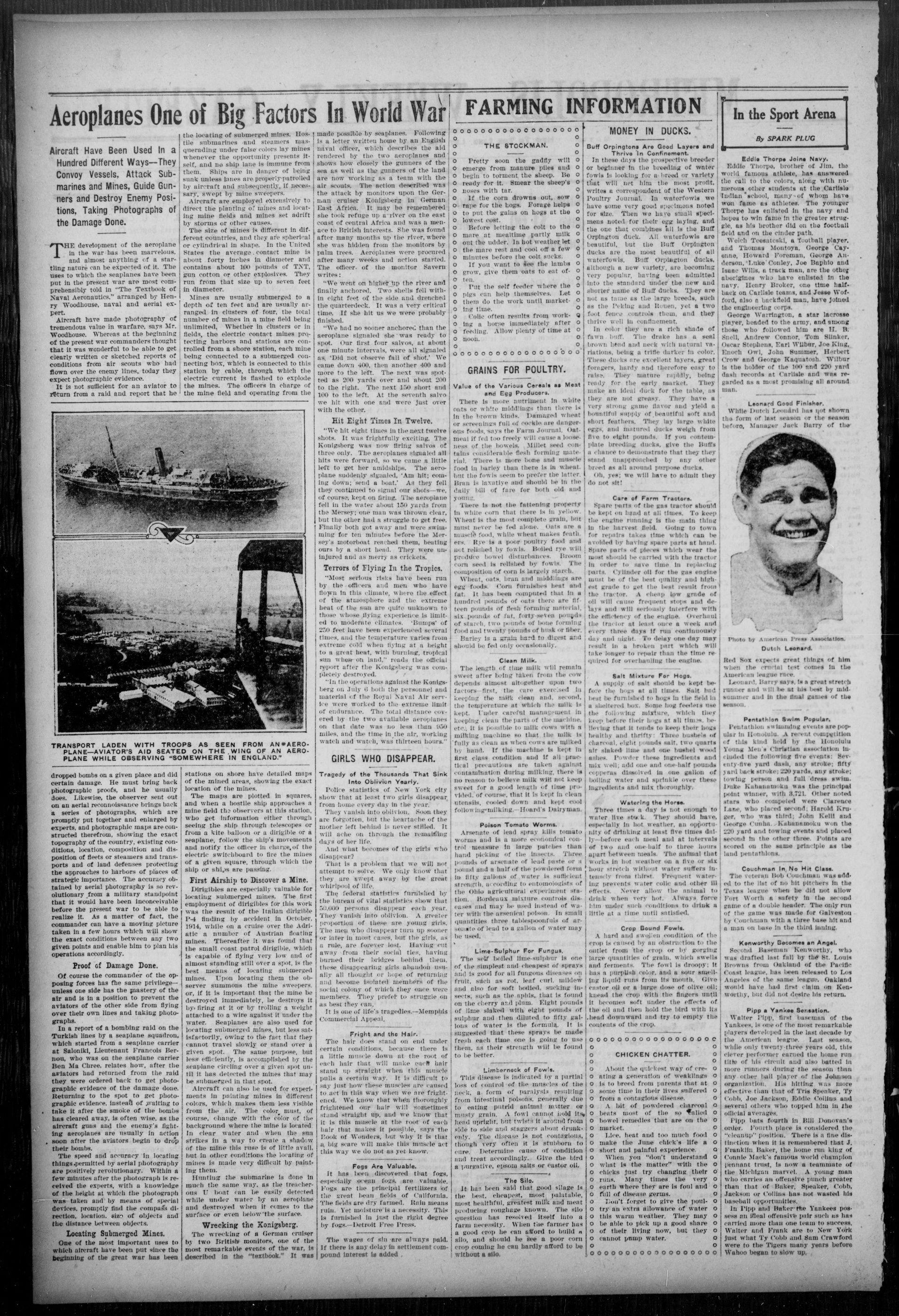
Aerial view of the port of Copenhagen. The ship is docked in the harbor, surrounded by buildings and trees. The city is visible in the background, with a river running through it.
TRANSPORT LADEN WITH TROOPS AS SEEN FROM AN*AEROPLANE-AVIATOR'S AID SEATED ON THE WING OF AN AEROPLANE WHILE OBSERVING "SOMEWHERE IN ENGLAND."
Aircraft Have Been Used In a Hundred Different Ways-They Convoy Vessels, Attack Submarines and Mines, Guide Gunners and Destroy Enemy Positions, Taking Photographs of the Damage Done.
THE development of the aeroplane in the war has been marvelous, and almost anything of a startling nature can be expected of it. The uses to which the seaplanes have been put in the present war are most comprehensibly told in "The Textbook of Naval Aeronautics," arranged by Henry Woodhouse, naval and aerial expert. Aircraft have made photography of tremendous value in warfare, says Mr. Woodhouse. Whereas at the beginning of the present war commanders thought that it was wonderful to be able to get clearly written or sketched reports of conditions from air scouts who had flown over the enemy lines, today they expect photographic evidence. It is not sufficient for an aviator to return from a raid and report that he
TRANSPORT LADEN WITH TROG
PLANE—AVIATOR'S AID SEATE
PLANE WHILE OBSERVING "SC
dropped bombs on a given place and did certain damage. He must bring back photographic proofs, and he usually does. Likewise, the observer sent out on an aerial reconnaissance brings back a series of photographs, which are promptly put together and enlarged by experts, and photographic maps are constructed therefrom, showing the exact topography of the country, existing conditions, location, composition and disposition of fleets or steamers and transports and of land defenses protecting the approaches to harbors of places of strategic importance. The accuracy obtained by aerial photography is so revolutionary from a military standpoint that it would have been inconceivable before the present war to be able to realize it. As a matter of fact, the commander can have a moving picture taken in a few hours which will show the exact conditions between any two given points and enable him to plan his operations accordingly.
Proof of Damage Done.
Of course the commander of the opposing forces has the same privilege—unless one side has the mastery of the air and is in a position to prevent the aviators of the other side from flying over their own lines and taking photographs.
In a report of a bombing raid on the Turkish lines by a seaplane squadron, which started from a seaplane carrier at Saloniki, Lieutenant Francois Bernou, who was on the seaplane carrier Ben Ma Chree, relates how, after the aviators had returned from the raid they were ordered back to get photographic evidence of the damage done. Returning to the spot to get photographic evidence, instead of waiting to take it after the smoke of the bombs has cleared away, is often wise, as the aircraft guns and the enemy's fighting aeroplanes are usually in action soon after the aviators begin to drop their bombs.
The speed and accuracy in locating things permitted by aerial photography are positively revolutionary. Within a few minutes after the photograph is received the experts, with a knowledge of the height at which the photograph was taken and by means of special devices, promptly find the compass direction, location, size of objects and the distance between objects.
Locating Submerged Mines.
One of the most important uses to which aircraft have been put since the beginning of the great war has been
the locating of submerged mines. Hostile submarines and steamers masquerading under false colors lay mines whenever the opportunity presents itself, and no ship lane is immune from them. Ships are in danger of being sunk unless mines are properly patrolled by aircraft and subsequently, if necessary, swept by mine sweepers. Aircraft are employed extensively to direct the planting of mines and locating mine fields and mines set adrift by storms or other causes.
The size of mines is different in different countries, and they are spherical or cylindrical in shape. In the United States the average contact mine is about forty inches in diameter and contains about 160 pounds of TNT, gun cotton or other explosives. They run from that size up to seven feet in diameter.
Mines are usually submerged to a depth of ten feet and are usually arranged. in clusters of four, the total number of mines in a mine field being unlimited. Whether in clusters or in fields, the electric contact mines protecting harbors and stations are controlled from a shore station, each mine being connected to a submerged connecting box, which is connected to this station by cable, through which the electric current is flashed to explode the mines. The officers in charge of the mine field and operating from the
OPS AS SEEN FROM AN AERO-D ON THE WING OF AN AERO-MEWHERE IN ENGLAND."
stations on shore have detailed maps of the mined areas, showing the exact location of the mines. The maps are plotted in squares, and when a hostile ship approaches a mine field the observers at this station, who get information either through seeing the ship through telescopes or from a kite balloon or a dirigible or a seaplane, follow the ship's movements and notify the officer in charge, of the electric switchboard to fire the mines of a given square, through which the ship or ships are passing.
First Airship to Discover a Mine.
First Airship to Discover a Mine.
Dirigibles are especially valuable for locating submerged mines. The first employment of dirigibles for this work was the result of the Italian dirigible P-4 finding by accident in October, 1914, while on a cruise over the Adriatic a number of Austrian floating mines. Thereafter it was found that the small coast patrol dirigible, which is capable of flying very low and of almost standing still over a spot, is the best means of locating submerged mines. Upon locating them the observer summons the mine sweepers, or, if it is important that the mine be destroyed immediately, he destroys it by firing at it or by trolling a weight attached to a wire against it under the water. Seaplanes are also used for locating submerged mines, but less satisfactorily, owing to the fact that they cannot travel slowly or stand over a given spot. The same purpose, but less efficiently, is accomplished by the seaplane circling over a given spot until it has detected the mines that may be submerged in that spot.
Aircraft can also be used for experiments in painting mines in different colors, which makes them less visible from the air. The color must, of course, change with the color of the background where the mine is located. In clear water and when the sun strikes in a way to create a shadow of the mine this ruse is of little avail, but in other conditions the locating of mines is made very difficult by painting them.
Hunting the submarine is done in much the same way, as the treacherous U boat can be easily detected while under water by an aeroplane and destroyed when it comes to the surface or even below the surface.
Wrecking the Konigsberg.
The wrecking of a German cruiser by two British monitors, one of the most remarkable events of the war, is described in the "textbook." It was
made possible by seaplanes. Following is a letter written home by an English naval officer, which describes the aid rendered by the two aeroplanes and shows how closely the gunners of the sea as well as the gunners of the land are now working as a team with the air scouts. The action described was the attack by monitors upon the German cruiser Königsberg in German East Africa. It may be remembered she took refuge up a river on the east coast of central Africa and was a menace to British interests. She was found after many months up the river, where she was hidden from the monitors by palm trees. Aeroplanes were procured after many weeks and action started. The officer, of the monitor Savern writes:
"We went on higher up the river and finally anchored. The two shells fell within eight feet of the side and drenched the quarterdeck. It was a very critical time. If she hit us we were probably finished.
"We had no sooner anchored than the aeroplane signaled she was ready to spot. Our first four salvos, at about one minute intervals, were all signaled as, 'Did not observe fall of shot.' We came down 400, then another 400 and more to the left. The next was spotted as 200 yards over and about 200 to the right. The next 150 short and 100 to the left. At the seventh salvo we hit with one and were just over with the other.
Hit Eight Times In Twelve.
"We hit eight times in the next twelve shots. It was frightfully exciting. The Kongsberg was now niring salvos of three only. The aeroplanes signalled all hits were forward, so we came a little left to get her amidships. The aeroplane suddenly signaled, 'Am hit; coming down; send a boat.' As they fell they continued to signal our shots—we, of course, kept on firing. The aeroplane fell in the water about 150 yards from the Mersey; one man was thrown clear, but the other had a struggle to get free. Finally both got away and were swimming for ten minutes before the Mersey's motorboat reached them, beating ours by a short head. They were uninjured and as merry as crickets.
Terrors of Flying In the Tropics.
"Most serious risks have been run by the officers and men who have flown in this climate, where the effect of the atmosphere and the extreme heat of the sun are quite unknown to those whose flying experience is limited to moderate climates. 'Bumps' of 250 feet have been experienced several times, and the temperature varies from extreme cold when flying at a height to a great heat, with burning, tropical sun when on land," reads the official report after the Konigsberg was completely destroyed.
"In the operations against the Konigsberg on July 6 both the personnel and material of the Royal Naval Air service were worked to the extreme limit of endurance. The total distance covered by the two available aeroplanes on that date was no less than 950 miles, and the time in the air, working watch and watch, was thirteen hours."
GIRLS WHO DISAPPEAR.
Tragedy of the Thousands That Sink Into Oblivion Yearly.
Police statistics of New York city show that at least two girls disappear from home every day in the year.
They vanish into oblivion. Soon they are forgotten, but the heartache of the mother left behind is never stilled. It will ache on through the remaining days of her life.
And what becomes of the girls who disappear?
That is a problem that we will not attempt to solve. We only know that they are swept away by the great whirlwind of life.
The federal statistics furnished by the bureau of vital statistics show that 50,000 persons disappear each year. They vanish into oblivion. A greater proportion of these are young girls. The men who disappear turn up sooner or later in most cases, but the girls, as a rule, are forever lost. Having cut away from their social ties, having burned their bridges behind them, these disappearing girls abandon usually all thought or hope of returning and become isolated members of the social colony of which they once were members. They prefer to struggle on as best they can. It is one of life's tragedies.—Memphis Commercial Appeal
Fright and the Hair.
The hair does stand on end under certain conditions, because there is a little muscle down at the root of each hair that will make each hair stand up straight when this muscle pulls a certain way. It is difficult to say just how these muscles are caused to act in this way when we are frightened. We know that when thoroughly frightened our hair will sometimes stand straight up, and we know that it is this muscle at the root of each hair that makes it possible, says the Book of Wonders, but why it is that a big scare will make this muscle act this way we do not as yet know.
Fogs Are Valuable
It has been discovered that fogs, especially ocean fogs, are valuable. Fogs are the principal fertilizers of the great bean fields of California. The fields are dry farmed. Rain means rain. Yet moisture is a necessity. This is furnished in just the right degree by fogs.—Detroit Free Press.
The wages of sin are always paid. If there is any delay in settlement compound interest is added.
FARMING INFORMATION
○○○○○○○○○○○○○○○○○
THE STOCKMAN.
- Pretty soon the gadfly will
emerge from manure piles and
begin to torment the sheep. Be
ready for it. Smear the sheep's
noses with tar.
- If the corn drowns out, sow
rape for the hogs. Forage helps
to put the galins on hogs at the
lowest cost.
- Before letting the colt to the
mare at mealtime partly milk
out the udder. In hot weather let
the mare rest and cool off a few
minutes before the colt sucks.
- If you want to see the lambs
grow, give them oats to eat of
ten.
- Put the self feeder where the
pigs can help themselves. Let
them do the work until marketing
time.
- Colic often results from working
a horse immediately after
feeding. Allow plenty of time at
noon.
GRAINS FOR POULTRY.
Value of the Various Cereals as Meat and Feta Producer.
There is more nutriment in white oats or white middlings than there is in the brown kinds. Damaged wheat or screenings full of cockle are dangerous foods, says the Farm Journal. Oatmeal if fed too freely will cause a looseness of the bowels. Millet seed contains considerable flesh forming material. There is more bone and muscle food in barley than there is in wheat, but the fowls seem to prefer the latter. Bran is inaxiye and should be in the daily bill of fare for both old and young.
There is not the fattening property in white corn that there is in yellow. Wheat is the most complete grain, but must never be fed alone. Oats are a muscle food, while wheat makes feathers. Rye is a poor poultry food and not relished by fowls. Boiled rye will produce bowel disturbances. Broom corn seed is relished by fowls. The composition of corn is largest starch.
Wheat, oats, bran and middlings are egg foods. Corn furnishes heat and fat. It has been computed that in a hundred pounds of oats there are fifteen pounds of flesh forming material, six pounds of fat, forty-seven pounds of starch, two pounds of bone forming food and twenty pounds of husk or fiber. Barley is a grain hard to digest and should be fed only occasionally.
Clean Milk.
The length of time milk will remain sweet after being taken from the cow depends almost altogether upon two factors—first, the care exercised in keeping the milk clean and, second, the temperature at which the milk is kept. Under careful management in keeping clean the parts of the machine, etc. it is possible to milk cows with a milking machine so that the milk is fully as clean as when cows are milked by hand. If the machine is kept in first class condition and if all practical precautions are taken against contamination during milking, there is no reason to believe milk will not keep sweet for a good length of time provided, of course, that it is kept in clean utensils, cooled down and kept cool following milking—Hoard's Dairyman.
Poison Tomato Worms.
Arsenate of lead spray kills tomato worms and is a more economical control measure in large patches than hand picking of the insects. Three pounds of arsenate of lead paste or a pound and a half of the powdered form in fifty gallons of water is sufficient strength, according to entomologists of the Ohio agricultural experiment station. Bordeaux mixture controls diseases and may be used instead of water with the arsenical poison. In small quantities three tablespoonfuls of arsenate of lead to a gallon of water may be used.
Lime: Sulphur For Fungus
The self boiled lime-sulphur is one of the simplest and cheapest of sprays and is good for all fungous diseases on fruit, such as rot, leaf curl, mildew and also for soft bodied, sucking insects, such as the aphids, that is found on the cherry and plum. Eight pounds of lime slaked with eight pounds of sulphur and then diluted to fifty gallons of water is the formula. It is suggested that these sprays be made fresh each time one is going to use them, as their strength will be found to be better.
Limberneck of Fowls.
This disease is indicated by a partial loss of control of the muscles of the neck, a form of paralysis resulting from intestinal poisons, generally due to eating putrid animal matter or musty grain. A fowl cannot hold its head upright, but twists it around from side to side and staggers about drunkly. The disease is not contagious, though very often it is stubborn to cure. Determine cause of condition and treat accordingly. Give the bird a purgative, epsom salts or cactor oil.
The Sile.
It has been said that good silage is the best, cheapest, most palatable, most healthful, greatest milk and meat producing roughage known. The silo question has resolved itself into a farm necessity. When the farmer has a good crop he can afford to build $n$ silo, and should he see a poor corn crop coming he can hardly afford to be without a silo.
Buff Orpington Are Good Layers and
Thieve In Confinement
In these days the prospective breeder or beginner in the breeding of waterfowls is looking for a breed or variety that will not him the most profit, writes a correspondent of the Western Poultry Journal. In waterfowls we have some very good specimens noted for size. Then we have small specimens noted for their egg laying, and the one that combines all is the Buff Orpington duck. All waterfowls are beautiful, but the Buff Orpington ducks are the most beautiful of all waterfowls. Buff Orpington ducks, although a new variety, are becoming very popular, having been admitted into the standard under the new and shorter name of Buff ducks. They are not as tame as the large breeds, such as the Peking and Rouen, yet a two foot fence controls them, and they thrive well in confinement.
In color they are a rich shade of fawn buff. The drake has a seal brown head and neck with natural variations, being a trifle darker in color. These ducks are excellent layers, great foragers, hardy and therefore easy to raise. They mature rapidly, being ready for the early market. They make an ideal duck for the table, as they are not greasy. They have a very strong game flavor and yield a bountiful supply of beautiful soft and short feathers. They lay large white eggs, and mature ducks weigh from five to eight pounds. If you contemplate breeding ducks, give the Buffs a chance to demonstrate that they they stand unapproached by any other breed as all around purpose ducks. Oh, yes; we will have to admit they do not sit!
Care of Farm Tractors
Care of Farm Tractors.
Spare parts of the gas tractor should be kept on hand at all times. To keep the engine running is the main thing in the harvest field. Going to town for repairs takes time which can be avoided by having spare parts at hand. Spare parts of pieces which wear the most should be carried with the tractor in order to save time in replacing parts. Cylinder oil for the gas engine must be of the best quality and highest grade to get the best result from the tractor. A cheap low grade of oil will cause frequent stops and delays and will seriously interfere with the efficiency of the engine. Overhaul the tractor at least once a week and every three days if run continuously day and night. To delay one day may result in a broken part which will take longer to repair than the time required for overhauling the engine.
Salt Mixture For Hogs.
A supply of salt should be kept before the hogs at all times. Salt had best be furnished to hogs in the field in a sheltered box. Some hog feeders use the following mixture, which they keep before their hogs at all times, believing that it tends to keep their hogs healthy and thrifty: Three bushels of charcoal, eight pounds salt, two quarts air slaked lime and one bushel wood ashes. Powder these ingredients and mix well; add one and one-half pounds copperas dissolved in one gallon of boiling water and sprinkle over these ingredients and mix thoroughly.
Watering the Horse
Three times a day is not enough to water live stock. They should have, especially in hot weather, an opportunity of drinking at least five times daily—before each meal and at intervals of two and one-half to three hours apart between meals. The animal that works in hot weather on a five or six hour stretch without water suffers intensely from thirst. Frequent watering prevents water colic and other ill effects. Never allow the animal to drink when very hot. Always force him under such conditions to drink a little at a time until satisfied.
Crop Bound Fowls.
A hard and swollen condition of the crop is caused by an obstruction to the outlet from the crop or by gorging large quantities of grain, which swells and ferments. The fowl is droopy; it has a purplish color, and a sour smelling liquid runs from its mouth. Give castor oil or a large dose of olive oil; knead the crop with the fingers until it becomes soft under the effects of the oil and then hold the bird with its head downward and try to empty the contents of the crop.
CHICKEN CHATTER.
- About the quickest way of creating a generation of weaklings
- is to breed from parents that at some time in their lives suffered from a contagious disease.
- A bit of powdered charcoal beats most of the so called bowel remedies that are on the market.
- Lice, heat and too much food make the June chick's life a short and painful experience.
- When you "don't understand what is the matter" with the chicks just try changing their runs. Many times the very earth where they are is foul and full of disease germs.
- Don't forget to give the poultry an extra allowance of water this warm weather. They may be able to pick up a good share of their living now, but they cannot pump water.
```markdown
```
Eddie Thorne Joine Navy.
Eddie Thorpe, brother of Jim, the world famous athlete, has answered the call to the colors, along with numerous, other students at the Carlisle Indian school, many of whom have won fame as athletes. The younger Thorpe has enlisted in the navy and hopes to win fame in the greater struggle, as his brother did on the football field and on the cinder path.
Welch Tocateski, a football player, and Thomas Montoya, George Cayenne, Howard Foreman, George Anderson, Luke Conley, Joe Bapho and Isaac Willis, a track man, are the other aborigines who have enlisted in the navy. Henry Broker, one time halfback on Carlisle teams, and Jesse Wofford, also a backfield man, have joined the engineering corps.
George Warrington, a star incrosse player, headed to the army, and among those who followed him are H. B. Snell, Andrew Connor, Tom Slinker, Oscar Stephens, Earl Wilbur, Joe King, Enoch Owl, John Summer, Herbert Crow and George Kqatosh. Wilbur is the holder of the 100 and 220 yard dash records at Carlisle and was regarded as a most promising all around man.
Leonard Good Finisher.
While Dutch Leonard has not shown the form of last season or the season before, Manager Jack Barry of the
1
Photo by American Press Association.
Dutch Leonard.
Red Sox expects great things of him when the crucial test comes in the American league race.
Leonard, Barry says, is a great stretch runner and will be at his best by mid-summer and in the final games of the season.
Pentathlon Swim Popular.
Pentathlon swimming events are popular in Honolulu. A recent competition of this kind held by the Honolulu Young Men's Christian association included the following five events: Seventy-five yard dash, any stroke; fifty yard back stroke; 220 yards, any stroke; towing person and full 'dress swim. Duke Kahanamoku was the principal point winner, with 3,721. Other noted stars who competed were Clarence Lane, who placed second; Harold Kruger, who was third; John Kelll and George Cunha. Kahanamoku won the 220 yard and towing events and placed second in the other three. Points are scored on the same principle as the land pentathlons.
Couchman In No Hit Class
The veteran Bob Couchman was added to the list of no hit pitchers in the Texas league when he did not allow Fort Worth a safety in the second game of a double header. The only run of the game was made for Galveston by Couchman with a three base hit and a man on base in the third inning.
Kenworthy Becomes an Angel
Second Baseman Kenworthy, who was drafted last fall by the St. Louis Browns from Oakland of the Pacific Const league, has been released to Los Angeles of the same league. Oakland would have had first claim on Kenworthy, but did not desire his return.
Pipp a Yankee Sensation.
Walter Pipp, first baseman of the Yankees, is one of the most remarkable players developed in the last decade by the American league. Last season, while only twenty-three years old, this clever performer earned the home run title of his circuit and also batted in more runners during the season than any other bail player of the Johnson organization. His hitting was more effective than that of Tris Speaker, Ty Cobb, Joe Jackson, Eddie Collins and several others who topped him in the official averages.
Pipp bats fourth in Bill Donovan's order. Fourth place is considered the "cleanup" position. There is a fine distinction when it is remembered that J. Franklin Baker, the home run king of Coucle Maack's famous world champion pennant trust, is now a teammate of the Michigan marvel. A young man who carries an offensive punch greater than that of Baker, Speaker, Cobb, Jackson or Collins has not wasted his baseball opportunities. In Pipp and Baker the Yankees possess an ideal offensive pair such as has carried more than one team to success, Walter and Frank are to New York just what Ty Cobb and Sam Crawford were to the Tigers many years before Wahoo began to slow up.
Assisting Women In Their Work
THE CHILDREN'S WEEKLY NEWS
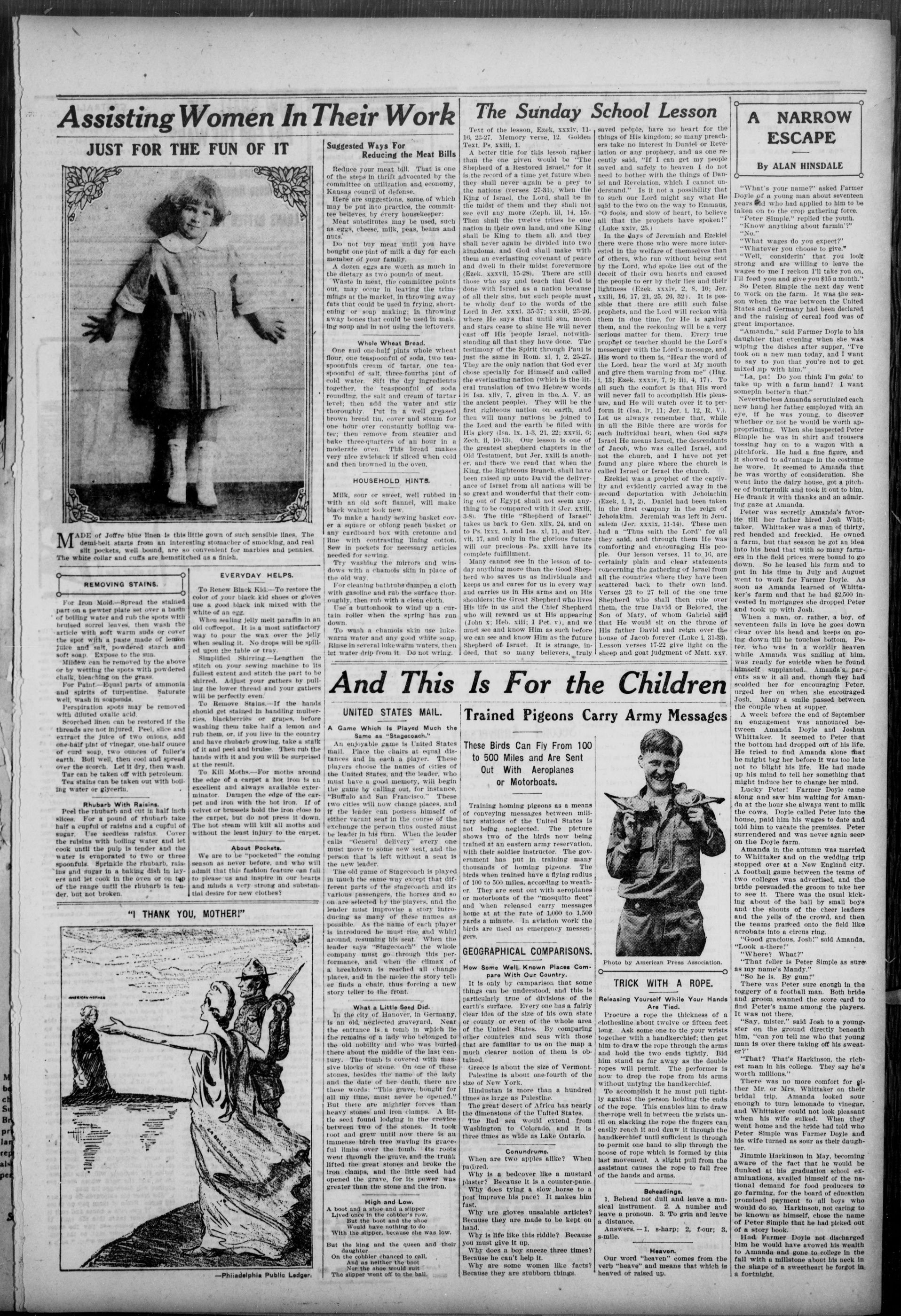
MADE of Joffre blue linen is this little gown of such sensible lines. The demi-belt starts from an interesting stomacher of smocking, and real slit pockets, well bound, are so convenient for marbles and pennies. The white collar and cuffs are hemstitched as a finish.
MADE of Joffre blue linen is this little gown of such sensible lines. The demi-belt starts from an interesting stomacher of smocking, and real slit pockets, well bound, are so convenient for marbles and pennies. The white collar and cuffs are hemstitched as a finish.
REMOVING STAINS
For Iron Mold—Spread the stained part on a pewter plate set over a basin of boiling water and rub the spots with bruised sorrel leaves, then wash the article with soft warm suds or cover the spot with a paste made of lemon juice and salt, powdered starch and soft soap. Expose to the sun.
Mildew can be removed by the above or by wetting the spots with powdered chalk, bleaching on the grass.
For Paint—Equal parts of ammonia and spirits of turpentine. Saturate well, wash in soapsuds.
Perspiration spots may be removed with diluted oxalic acid.
Scorched linen can be restored if the threads are not injured. Peel, slice and extract the juice of two onions, add one-half pint of vinegar, one-half ounce of curd soap, two ounces of fuller's earth. Boll well, then cool and spread over the scorch. Let it dry, then wash.
Tar can be taken off with petroleum. Tea stains can be taken out with boiling water or glycerin.
Rhubarb With Raisins
Rhubarb With Raisins.
Peel the rhubarb and cut in half inch slices. For a pound of rhubarb take half a cupul of raisins and a cupul of sugar. Use seedless raisins. Cover the raisins with boiling water and let cook until the pulp is tender and the water is evaporated to two or three spoonfuls. Sprinkle the rhubarb, raisins and sugar in a baking dish in layers and let cook in the oven or on top of the range until the rhubarb is tender, but not broken.
"I THANK YOU, MOTHER!"
AMERICAN MOTHER
LA BILLE FRANCE
EVERYDAY HELPS.
To Renew Black Kid.—To restore the color of your black kid shoes or gloves use a good black ink mixed with the white of an egg.
When sealing jelly melt paraffin in an old coffeeepot. It is a most satisfactory way to pour the wax over the jelly when sealing it. No drops will be spilled upon the table or tray.
Simplified Shirring—Lengthen the stitch on your sewing machine to its fullest extent and stitch the part to be shirred. Adjust your gathers by pulling the lower thread and your gathers will be perfectly even.
To Remove Stains.—If the hands should get stained in handling mulberries, blackberries or grapes, before washing them take half a lemon and rub them, or, if you live in the country and have rhubarb growing, take a stalk of it and peel and brushe. Then rub the hands with it and you will be surprised at the result.
To Kill Moths—For moths around the edge of a carpet a hot iron is an excellent and always available exterminator. Dampen the edge of the carpet and iron with the hot iron. If of velvet or brussels hold the iron close to the carpet, but do not press it down. The hot steam will kill all moths and without the least injury to the carpet.
We are to be "pocketed" the coming season as never before, and who will admit that this fashion feature can fail to please us and inspire in our hearts and minds a very strong and substantial desire for new clothes?
EA BRILE FRANCE
-Phiadelphia Public Ledger.
About Pockets.
And This Is For the Children
Reduce your meat bill. That is one of the steps in thrift advocated by the committee on utilization and economy, Kansas council of defense.
Here are suggestions, some of which may be put into practice, the committee believes, by every housekeeper:
Meat substitutes may be used, such as eggs, cheese, milk, peas, beans and nuts.
Do not buy meat until you have bought one pint of milk a day for each member of your family.
A dozen eggs are worth as much in the dietary as two pounds of meat.
Waste in meat, the committee points out, may occur in leaving the trimmings at the market, in throwing away fats that could be used in frying, shortening or soap making; in throwing away bones that could be used in making soup and in not using the leftovers.
Whole Wheat Bread.
One and one-half pints whole wheat flour, one teaspoonful of soda, two teaspoonfuls cream of tartar, one teaspoonful of salt, three-fourths pint of cold water. Sift the dry ingredients together, the teaspoonful of soda rounding, the salt and cream of tartar level; then add the water and stir thoroughly. Put in a well greased brown bread tin, cover and steam for one hour over constantly boiling water; then remove from steamer and bake three-quarters of an hour in a moderate oven. This bread makes very nice zwiebel if sliced when cold and then browned in the oven.
HOUSEHOLD HINTS.
Milk, sour or sweet, well rubbed in with an old soft flannel, will make black walnut look new.
To make a handy sewing basket cover a square or oblong peach basket or any cardboard box with cretonne and line with contrasting lining cotton.
Sew in pockets for necessary articles needed for sewing.
Try washing the mirrors and windows with a chamois skin in place of the old way.
For cleaning bathtubs dampen a cloth with gasoline and rub the surface thoroughly, then rub with a clean cloth.
Use a buttonhook to wind up a curtain roller when the spring has run down.
To wash a chamois skin use lukewarm water and any good white soap. Rinse in several lukewarm waters, then let water drip from it. Do not wring.
UNITED STATES MAIL.
A Game Which Is Played Much the Same as "Stagecoach."
An enjoyable game is United States mail. Place the chairs at equal distances and in each a player. These players choose the names of cities of the United States, and the leader, who must have a good memory, will begin the game by calling out, for instance, "Buffalo and San Francisco." These two cities will now change places, and if the leader can possess himself of either vacant seat in the course of the exchange the person thus ousted must be leader in his turn. When the leader calls "General delivery" every one must move to some new seat, and the person that is left without a seat is the new leader.
The old game of Stagecoach is played in much the same way except that different parts of the stagecoach and its various passengers, the horses and so on are selected by the players, and the leader must improvise a story introducing as many of these names as possible. As the name of each player is introduced he must rise and whirl around, resuming his seat. When the leader says "Stagecoach" the whole company must go through this performance, and when the climax of a breakdown is reached all change places, and in the melee the story teller finds a chair, thus forcing a new story teller to the front.
What a Little Seed Did.
What a Little Seed Did.
In the city of Hanover, in Germany, is an old, neglected graveyard. Near the entrance is a tomb in which lie the remains of a lady who belonged to the old nobility and who was buried there about the middle of the last century. The tomb is covered with massive blocks of stone. On one of these stones, besides the name of the lady and the date of her death, there are these words: "This grave, bought for all my time, must never be opened." But there are mightier forces than heavy stones and iron clamps. A little seed found lodging in the crevice between two of the stones. It took root and grew until now there is an immense birch tree waving its graceful limbs over the tomb. Its roots went through the grave, and the trunk lifted the great stones and broke the iron clamps, and the little seed had opened the grave, for its power was greater than the stone and the iron.
High and Low.
The Sunday School Lesson
Trained Pigeons Carry Army Messages
Text of the lesson, Ezek, xxxiv, 11-
16, 23-27. Memory verse, 12. Golden
Text Ps. xxiii. 1.
A better title for this lesson rather than the one given would be "The Shepherd of a Restored Israel," for it is the record of a time yet future when they shall never again be a prey to the nations (verses 27-31), when the King of Israel, the Lord, shall be in the midst of them and they shall not see evil any more (Zeph. iii, 14, 15). Then shall the twelve tribes be one nation in their own land, and one King shall be King to them all, and they shall never again be divided into two kingdoms, and God shall make with them an everlasting covenant of peace and dwell in their midst forevermore (Ezek. xxxvil, 15-28). There are still those who say and teach that God is done with Israel as a nation because of all their sins, but such people must be wholly deaf to the words of the Lord in Jer. xxxl. 35-37; xxxiii, 23-26, where He says that until sun, moon and stars cease to shine He will never cast off His people Israel, notwithstanding all that they have done. The testimony of the Spirit through Paul is just the same in Rom. xl, 1, 2, 15-27. They are the only nation that God ever chose specially for Himself and called the everlasting nation (which is the literal translation of two Hebrew words in Isa. xliv, 7, given in the A. V. as the ancient people). They will be the first righteous nation on earth, and then will many nations be joined to the Lord and the earth be filled with His glory (Isa. lx, 1-3, 21, 22; xxvii, 3; Zech. ii, 10-13). Our lesson is one of the greatest shepherd chapters in the Old Testament, but Jer. xxii is another, and there we read that when the King, the Righteous Branch, shall have been raised up unto David the deliverance of Israel from all nations will be so great and wonderful that their coming out of Egypt shall not seem anything to be compared with it (Jer. xxii, 3-8). The title "Shepherd of Israel" takes us back to Gen. xlix, 24, and on to Ps. xxxl, 1, and Isa. xl, 11, and Rev. vii, 17, and only in the glorious future will our precious Ps. xxiii have its complete fulfillment.
Many cannot see in the lesson of today anything more than the Good Shepherd who saves us as individuals and keeps us and cares for us in every way and carries us in His arms and on His shoulders; the Great Shepherd who lives His life in us and the Chief Shepherd who will reward us at His appearing (John x; Heb. xiii; I Pet. v), and we must see and know Him as such before we can see and know Him as the future Shepherd of Israel. It is strange, indeed, that so many believers, truly
These Birds Can Fly From 100 to 500 Miles and Are Sent Out With Aeroplanes or Motorboats.
Training homing pigeons as a means of conveying messages between military stations of the United States is not being neglected. The picture shows two of the birds now being trained at an eastern army reservation, with their soldier instructor. The government has put in training many thousands of homing pigeons. The birds when trained have a flying radius of 100 to 500 miles, according to weather. They are sent out with aerplanes or motorboats of the "mosquito fleet" and when released carry messages home at at the rate of 1,000 to 1,500 yards a minute. In aviation work the birds are used as emergency messengers.
GEOGRAPHICAL COMPARISONS.
How Some Well, Known Places Compare With Our Country.
It is only by comparison that some things can be understood, and this is particularly true of divisions of the earth's surface. Every one has a fairly clear idea of the size of his own state or county or even of the whole area of the United States. By comparing other countries and seas with those that are familiar to us on the map a much clearer notion of them is obtained.
Greece is about the size of Vermont. Palestine is about one-fourth of the size of New York.
Hindustan is more than a hundred times as large as Palestine.
The great desert of Africa has nearly the dimensions of the United States.
The Red sea would extend from Washington to Colorado, and it is three times as wide as Lake Ontario.
Conundrums.
When are two apples alike? When paired.
Why is a bedcover like a mustard plaster? Because it is a counter-pane.
Why does tying a slow horse to a post improve his pace? It makes him fast.
Why are gloves unsalable articles? Because they are made to be kept on hand.
Why is life like this riddle? Because you must give it up.
Why does a boy sneeze three times? Because he can't help it.
Why are some women like facts?
Because they are stubborn things.
saved people, have no heart for the things of His kingdom; so many preachers take no interest in Daniel or Revelation or any prophecy, and as one recently said, "If I can get my people saved and safely to heaven I do not need to bother with the things of Daniel and Revelation, which I cannot understand." Is it not a possibility that to such our Lord might say what He said to the two on the way to Emmaus, "O fools, and slow of heart, to believe all that the prophets have spoken!" (Luke xxiv, 25.)
In the days of Jeremiah and Ezekiel there were those who were more interested in the welfare of themselves than of others, who ran without being sent by the Lord, who spoke lies out of the deceit of their own hearts and caused the people to err by their lies and their lightness (Ezek. xxxiv, 2, 8, 10; Jer. xxiii, 16, 17, 21, 25, 26, 32). It is possible that there are still such false prophets, and the Lord will reckon with them in due time, for He is against them, and the reckoning will be a very serious matter for them. Every true prophet or teacher should be the Lord's messenger with the Lord's message, and His word to them is, "Hear the word of the Lord, hear the word at My mouth and give them warning from me" (Hfg. 1, 13; Ezek. xxxiv, 7, 9; III, 4, 17). To all such the comfort is that His word will never fail to accomplish His pleasure, and He will watch over it to perform it (Isa. lv, 11; Jer. 1, 12, R. V). Let us always remember that, while in all the Bible there are words for each individual heart, when God says Israel He means Israel, the descendants of Jacob, who was called Israel, and not the church, and I have not yet found any place where the church is called Israel or Israel the church.
Ezekiel was a prophet of the captivity and evidently carried away in the second deportation with Jeholachin (Ezek. 1, 1, 2). Daniel had been taken in the first company in the reign of Jeholachin. Jeremiah was left in Jerusalem (Jer. xxxix, 11-14). These men had a "Thus saith the Lord" for all they said, and through them He was comforting and encouraging His people. Our lesson verses, 11 to 16, are certainly plain and clear statements concerning the gathering of Israel from all the countries where they have been scattered back to their own land. Verses 23 to 27 tell of the one true Shepherd who shall then rule over them, the true David or Beloved, the Son of Mary, of whom Gabriel said that He would sit on the throne of his father David and reign over the house of Jacob forever (Luke 1, 31-33). Lesson verses 17-22 give light on the sheep and goat judgment of Matt. xxv.
A young boy holds two pigeons in his hands.
Photo by American Press Association.
TRICK WITH A ROPE.
Releasing Yourself While Your Hands Are Tied.
Procure a rope the thickness of a clothesline about twelve or fifteen feet long. Ask some one to the your wrists together with a handkerchief; then get him to draw the rope through the arms and hold the two ends tightly. Bid him stand as far away as the double ropes will permit. The performer is now to drop the rope from his arms without untying the handkerchief.
To accomplish it he must pull tightly against the person holding the ends of the rope. This enables him to draw the rope well in between the wrists until on slacking the rope the fingers can easily reach it and draw it through the handkerchief until sufficient is through to permit one hand to slip through the noose of rope which is formed by this last movement. A slight pull from the assistant causes the rope to fall free of the hands and arms.
Beheadings.
1. Behead not dull and leave a musical instrument. 2. A number and leave a pronoun. 3. To grin and leave a distance.
Answers. — 1. s-harp; 2. f-our; 3. s-mile.
Heaven.
Our word "heaven" comes from the verb "heave" and means that which is heaved or raised up.
By ALAN HINSDALE
"What's your name?" asked Farmer Doyle of a young man about seventeen years and who had applied to him to be taken on to the crop gathering force.
"Peter Simple," replied the youth.
"Know anything about farmin?" No.
"What wages do you expect?"
"Whatever you choose to give."
"Well, considerin' that you look strong and are willing to leave the wages to me I reckon I'll take you on. I'll feed you and give you $15 a month."
So Peter Simple the next day went to work on the farm. It was the season when the war between the United States and Germany had been declared and the raising of cereal food was of great importance.
"Amanda," said Farmer Doyle to his daughter that evening when she was wiping the dishes after supper, "I've took on a new man today, and I want to say to you that you're not to get mixed up with him."
"La, pa! Do you think I'm goin' to take up with a farm hand? I want somepin better'n that."
Nevertheless Amanda scrutinized each new hand her father employed with an eye, if he was young, to discover whether or not he would be worth appropriating. When she inspected Peter Simple he was in shirt and trousers tossing hay on to a wagon with a pitchfork. He had a fine figure, and it showed to advantage in the costume he wore. It seemed to Amanda that he was worthy of consideration. She went into the dairy house, got a pitcher of buttermilk and took it out to him. He drank it with thanks and an admiring gaze at Amanda.
Peter was secretly Amanda's favorite till her father hired Josh Whittaker. Whittaker was a man of thirty, red headed and freckled. He owned a farm, but that season he got an idea into his head that with so many farmers in the field prices were bound to go down. So he leased his farm and to put in his time in July and August went to work for Farmer Doyle. As soon as Amanda learned of Whittaker's farm and that he had $2,500 invested in mottgages she dropped Peter and took up with Josh.
When a man, or, rather, a boy, of seventeen falls in love he goes down clear over his head and keeps on going down till he touches bottom. Peter, who was in a worldly heaven while Amanda was smiling at him, was ready for suicide when he found himself supplanted. Amanda's parents saw it all, and though they had scolded her for encouraging Peter, urged her on when she encouraged Josh. Many a smile passed between the couple when at supper.
A week before the end of September an engagement was announced between Amanda Doyle and Joshun Whittaker. It seemed to Peter that the bottom had dropped out of his life. He tried to find Amanda alone that he might beg her before it was too late not to blight his life. He had made up his mind to tell her something that might induce her to change her mind.
Lucky Peter! Farmer Doyle came along and saw him waiting for Amanda at the hour she always went to milk the cows. Doyle called Peter into the house, paid him his wages to date and told him to vacate the premises. Peter surrendered and was never again seen on the Doyle farm.
Amanda in the autumn was married to Whittaker and on the wedding trip stopped over at a New England city. A football game between the teams of two colleges was advertised, and the bride persuaded the groom to take her to see it. There was the usual kicking about of the ball by small boys and the shouts of the cheer leaders and the yells of the crowd, and then the teams practiced onto the field like acrobats into a circus ring.
"Good gracious, Josh!" said Amanda, "Look a-there!"
"Where? What?" "That feller is Peter Simple as sure as my name's Mandy."
"So he is. By gum!" There was Peter sure enough in the togggery of a football man. Both bride and groom scanned the score card to find Peter's name among the players. It was not there. "Say, mister." said Josh to a youngster on the ground directly beneath him, "can you tell me who that young man is over there taking off his sweater?" "That? That's Harkinson, the richest man in his college. They say he's worth millions." There was no more comfort for either Mr. or Mrs. Whittaker on their bridal trip. Amanda looked sour enough to turn lemonade to vinegar, and Whittaker could not look pleasant when his wife sulked. When they went home and the bride had told who Peter Simple was Farmer Doyle and his wife turned as sour as their daughter.
Jimmie Harkinson in May, becoming aware of the fact that he would be flunked at his graduation school examinations, availed himself of the national demand for food producers to go farming, for the board of education promised payment to all boys who would do so. Harkinson, not caring to be known as himself, chose the name of Peter Simple that he had picked out of a story book.
Had Farmer Doyle not discharged him he would have avowed his wealth to Amanda and gone to college in the fall with a millstone about his neck in the shape of a sweetheart he forgot in a fortnight.
Metropolis Gazette
PUBLISHED ON FRIDAY BY
THE GAZETTE PRINTING CO.
METROPOLIS, . . . . ILL.
M.S. M. J. McCRARY, MANAGER.
J. B. McOBARY, EDITOR
FRIDAY OCT. 5, 1917.
Office 9th and Pearl Streets, Metropolis, Illinois.
Interested as second-class mail matter, at Metropolis, Illinois, Postoffice.
Address all communications to J. B. McOBARY. Box 107 Metropolis, Illinois.
The names and addresses of contributors must be known to us in every instance, in order to secure publication. We want the news of your vicinity each week.
TERMS OF SUBSCRIPTION:
One Year $1.50
in Months. 75
Three Months. 40
Single Copy. 05
In Advance.
ADVERTISING RATES.
made known on application.
You must mail copy on Mondays to secure publication.
KINKY
Hair
Made to Grow
Long, Soft
and Silky
MY STARKS says
hair can be
hard until she
and short until she
and Dextertoy, and
now can come to
as little as 24 inches long,
soft and silky.
Don't be fooled all your life by using
some false preparation which claims
to straighten kinky hair. You are just
fooling yourself by asking it. Kinky
hair cannot be made straight. You
must have hair first. Now this
EXELENTO QUININE
POMADE
is a Hair Grower which feeds the scalp
and dries it that hair and makes the
kinky
nappy hair grow long, soft and silky.
It cleans dandruff and stops Falling
Hair at once. Price 25c by mail on
same stamp or coin.
AGENTS WANTED EVERYWHERE
Writes for Particulars
EXELENTO MEDICINE CO. ATLANTA, GA.
Please pay up your subscription. Can you afford to loose your race papers for want of support? It is up to you. What are you going to do about it Mr. non payer? Decide by paying up please.
If you have any Race pride and leve for truth, you will pay your subscription. We are toiling day and night to give you the news.
We solicit your patronage at the Leader 900 Pearl St.
We are pleased with the many nice things said of the Gazette, but we appreciate the money you owe us the more.
NOTICE.
I am authorized by the State missionary Board chairman, Dr. C. C. Phillips, Golconda, to serve notice of those that pledged them selves to contribute to the work of State Missions during the General Missionary Baptist State Convention, Carbondale, May 1917 to communicate with the corresponding secretary at once or not later than the 5th Sunday in September at which time the Board the Board will be called to meet at Colp, Saturday before the 5th Sunday. All members of the Board are expected to be present or contribute $1,00 one dollar.
C. C. Phillips, Chairman,
Golconda,
J. D. Bavis, Cor Sec
Colps, Ill.
A. Slow Youth.
"You broke off the engagement!" said Maude. "Yes," replied Mamie. "I was terribly disappointed in him. He came around for our elopement with a motor car instead of an aeroplane."
$100 Reward, $100.
The readers of this paper will be pleased to learn that there is at least one dreaded disease that science has been able to cure in all its stages, and that is catarrh. Hall's catarrh cure is the oily positive cure now known to the medical fraternity. catarrh being a constitutional disease, requires a constitutional treatment. Hall's catarrh is taken internally, acting directly upon the blood and mucous surfaces of the system, thereby destroying the foundation of the disease, and giving the patient strength by building up the constitution and assisting nature in doing its work. The proprietors have so much faith in its curative powers that they offer One Hundred Dollars for any case that it fails to cure. send for list of testimonials.
Address F. J. CHENEY & CO., Toledo, O.
Sold by all Druggiats, 75c.
Take Hall's Family Pills for consti-
pation.
Fried Fish every day at the
Grand Leader Cafe.
The Gazette has just received
another lot of new type faces and
other material which adds much
to the output of the work of the
office. We deserve your patron-
age. We have a full line of cards,
Letter Heads, Envelopes and other
material. Let us do some of
your work. Let us do your minute
work and any other church
advertisements.
J. B McCrary, grand chaplain of Prince Hall Masonic Grand Lodge of Illinois and jurisdiction will attend its session at Peoria, Oct. 8, 9, and 10th. Pastor J. B. McCrary, will be at his charge, Brookport, Sunday the 7th and wish to meet every member on special business connected with the financial conition of the church.
Rev B N. Murrell arrived home from Camp Dodge, Iowa, Wednesday. He will remain here until about the 15th of October, when he will return to the camp to take the final examination for chaplain in the army.
St Paul Appeal.
Those who were to have papers printed in the Gazette from the Association, Woman's Convention and Sunday School Conventions, either from Mt Olive or East Mt. Olive send them in now, if you want them printed —Ed
Dr. C. C. Phillips, sends in his dollar pledged to Mt Olive Baptist Association. Who will be the next? Dr McWtliams forgot to leave his, also Dr Carter of Centralia. Let us hear from you.
Rev J H. Hileley, was elected missionary and requested to visit all the churches without pastors and labor in the destitute part of the district and with pastors when needed and churches and pastors are urged to send up the first quarterly missionary money to the Board at Future City the 4th Sunday in Nov at 5c per member and as much more as you possibly can send, let us be all we really stand for. "Missionary Baptists."
Rev B. C. Long, of Choath motored to the home of Mr. and Mrs. Mingo Long's Sunday of Powers District in his car that he recently purchased.
Miss Mjud Porter, left Sunday for Golconda, to begin her school work.
Mr. Gno. Collins, is still on the sick list, not doing so well.
Mrs. Corine Williams, and daughter Ethel, of Centralia, were in the city to see the soldier of Company M. at Sham Battle
Rev. Bruton, of Unionville, Tenn preached two strong, spiritual sermons at First Baptist church. They were semingly much enjoyed by all present. Mrs. Tommie Herron, is very teeble at this writing.
Miss Vita Hughes, left for E. St. Louis, where she is to be the guest of her sater Mrs. Myrtle Thomas.
Mr. John Renfro, Sr attended the A M E. Conference, which was in session at Alton.
Master James Harding, left Thursday for Jacksonville where he is to attend school.
Mr L A. Baker, Master of the Silver Crown Lodge, left Sunday for Peoria to attend the Grand Lodge of Masors which is in session there.
Mrs. G.rac Williams, who has been indisposed for sometimer, was able to be out to service at First Baptist church Sunday.
Rev. J B McCrary, leaves Monday for Peoria, to attend the Grand Lodge of Masons
Rev. W, M. Youg, on his way back home from the Association stopped at Belgrade and preacded several nights
Mrs. Edgar McCrary, and little son Joseph Edgar, of Brookport, are down spending the week.
There were several out of town visitors in the city last Sunday to witness the drill and sham battle of Co. M, 8th Ill. Init. The crowd was estimated at 5,000. Every one was well paid for the trip and many complimeuts were showered upon Capt. Arthur Williams and his men by both colored and white. The company is well drilled in the war tactics.
The Prince Hall Masonic Herald, will be the name of a monthly paper printed by the Gazette Pub. Co. in the interest of Illinois Masons. Edgar McCrary, is editor and J. B. McCrary Business manager. The first issue will be out this week. Subscription price $1.00 per year in advance. Single copy 10 cents. Send in your subscription.
Second Anniversary.
The Second Anniversary of the Corner Stone laying Sunday Oct 21, 1917, in commemoration of the laying of the Corner Stone of Unity Missionary Baptist church Brockport in 1915. A special program will be arranged for the occasion. Good music, singing, addresses and preaching. Rev W A. Spence will preach at 2:30 p.m. All friends to the cause are invited to be present.
Harvest Home Fair.
There will be a Harvest Home Fair at the Unity Baptist Church Brookport, Oct. 15th, and continue for one week. This will be the first of its kind ever held here. Don't fail to attend it as it will be managed by skilled young ladies and men. It will be interesting srom beginning to end. Come out and help us as we are struggling to meet our obligations and to place our new bullding in shape so as to winter. Watch for bills.
Real Hard Luck,
Nobody can be said to be really down on his luck to the down downdown set degree until he has had presented to him a very valuable watch which every time it is repaired costs from $10 to $25. There's no place where the percentage system works so agoniously as with the valuable watch owned by a poor man.
Daily Health Hints
Understand that if you are mentally unified with sickness, old age and death, no amount of desire or affection can make you well, young, or long lived. To be healthy, you must be mentally in unity with health; to remain young, you must be mentally one with youth, and to live long, you must be mentally unified with life, says Wallace D. Wattles in the Nautilus.
THREE IMPORTANT
HIGHWAY QUESTIONS.
Three important questions touching the improvement of Illinois highways come up before the fifthth Illinois legislature, now in session. They are:
1. A state bond issue.
2. An increase in the automobile license fees.
3. The acceptance by Illinois of the federal allotment for the improvement of main roads.
This newspaper will print a series of three articles touching on these subjects written by G. E. Bradt, member of the Illinois State Highway commission.
highways. A system of that size would reach practically every county of the state and connect nearly all the cities and villages having more than 2,000 population, as well as many other smaller places.
If the forthcoming general assembly should authorize a vote upon this question, it could not be submitted to the people until the next general election, November, 1918. I believe it is desirable to vote upon this question at an "off year" election when there are no national issues to be decided, no national offices, and very few state offices to be filled. If the question of submitting this proposition to the people is not acted upon until the general assembly meets in January, 1919, then the election would be held in 1920 at the time of a presidential election, as well as at a time when our principal state officials are elected. It might then become an issue in the state campaign, or be overshadowed by other questions. If the fifthtier general assembly shall authorize a vote taken in 1918 it would be some months after the election before work could begin; as it would be desirable to have the supreme court pass upon the proceedings in order to give the bonds a stable market. Therefore, if we go at the matter as expeditiously as possible it would be the summer of 1919 before work would be commenced; and it is considered that it would probably take from five to seven years to construct this 4,000-mile system; I believe it is high time that the movement should be started.
The next question that arises is, what would be the source from which the money should be derived to pay the principal of a $80,000,000 bond issue and the interest thereon? Assuming that it would require five years to make the improvement and that the bonds would be issued serially under a 25-year limit, all bonds would mature within 30 years from the date of the first issue, or practically at the average rate of $2,000,000 per year. Assuming the interest rate to be 4 per cent, which I believe to be simple under any ordinary conditions, the annual interest would approximate $1,000,000 which would mean an annual payment of $3,000,000 including both principal and interest.
(NEXT ARTICLE—"AN INCREASE IN AUTOMOBILE LICENSE FEEs.")
4,888,231 PEOPLE SERVED BY
4,000-MILE ROAD SYSTEM
If Illinois constructs a state system of 4,000 miles of permanent highways as is proposed under the $60,000,000 bond issue, 86 per cent of the total population of the state (which was 5,638,591 under the last census) will live either on the roads so constructed or within a radius of five miles.
Thus not only will the larger cities, towns and villages of the state be connected, but a great part of the rural population will have the use of highways that can be traveled all the year round.
Experts of the state highway department have figured that in addition to the 2,185,268 population of Chicago, 1,520,071 people living in smaller cities, towns and villages will be directly served by the good roads. In addition 82,500 farmers and their families will live along the roads. The added population within' a radius of five miles is 1,083,317, making a total population of 4,886,231 that will be served.
ALL FOR STATE ROAD BOND
ISSUE OF $60,000,000
The following organizations have voted indorsements of the proposal for a $200,000,000 state bond issue to construct a system of 4,000 miles of permanent good roads in Illinois:
Hotel Association of Chicago.
Executive council of Illinois Bankers' association.
Good roads committee—Hamilton club, Chicago.
Illinois Women's Legislative congress.
Associated Roads organizations of Chicago and Cook county.
Illinois Hotel association.
Hamilton club of Chicago.
Advertising club of Chicago.
Alten Chamber of Commerce.
Automobile Trade association of Chicago.
State Dalrymen's association.
Rotary club of Chicago.
Do Some Topworking.
Plan to do some topworking this spring. This is a good way to get returns from unproductive trees that are thrifty.
Most Profitable Trees.
Low-headed peach trees are the most profitable.
HOW SHALL WE PAY FOR THE WAR?
LOANS BETTER THAN TAXES
Five Reasons Why Excessive Taxes at the Outset of War Are Disadvantageous—Great Britain Example Worthy of Emulation—How the Taxes Should Be Apportioned.
By EDWIN R. A. SELIGMAN,
McVickar Professor of Political Economy, Columbia University.
On May 23, 1917, the House of Representatives passed an act "to provide revenue to defray war expenses and for other purposes." In the original bill as presented by the Committee of Ways and Means, the additional revenue to be derived was estimated at $1,810,420,000. The amendment to the income tax, which was tacked on to the bill during the discussion in the House, was expected to yield another $40,000,000 or $50,000,000.
In discussing the House bill, two problems arise:
1. How much should be raised by taxation?
11. In what manner should this sum be raised?
1. How Much Should Be Raised by Taxation?
How was the figure of $1,800,000,000 arrived at? The answer is simple. When the Secretary of the Treasury came to estimate the additional war expenses for the year 1917-18, he calculated that they would amount to some $6,000,000,000, of which $3,000,000,000 was to be allotted to the allies, and $3,000,000,000 was to be utilized for the domestic purposes. Thinking that it would be a fair proposition to divide this latter sum between loans and taxes, he concluded that the amount to be raised by taxes was $1,800,000,000.
There are two extreme theories, each of which may be dismissed with scant courtesy. The one is that all war expenditures should be defrayed by loans, and the other is that all war expenditures should be defrayed by taxes. Each theory is untenable.
It is indeed true that the burdens of the war should be borne by the present rather than the future generation; but this does not mean that they should be borne by this year's taxation.
Meeting all war expenses by taxation makes the taxpayers in one or two years bear the burden of benefits that ought to be distributed at least over a decade within the same generation.
In the second place, when expenditures approach the gigantic sums of present-day warfare, the tax-only policy would require more than the total surplus of social income. Were this absolutely necessary, the ensuing havoc in the economic life of the community would have to be endured. But where the disasters are so great and at the same time so unnecessary, the tax-only policy may be declared impracticable.
Secretary McAdoo had the right instinct and highly commendable courage in deciding that a substantial portion, at least, of the revenues should be derived from taxation. But when he hit upon the plan of 50-50 per cent, that is, of raising one-half of all domestic war expenditures by taxes, the question arises whether he did not go too far.
The relative proportion of loans to taxes is after all a purely business proposition. Not to rely to a large extent on loans at the outset of a war is a mistake.
Disadvantages of Excessive Taxes.
The disadvantages of excessive taxes at the outset of the war are as follows:
1. Excessive taxes on consumption will cause popular resentment.
2. Excessive taxes on industry will disarrange business, damp enthusiasm and restrict the spirit of enterprise at the very time when the opposite is needed.
3. Excessive taxes on incomes will deplete the surplus available for investments and interfere with the placing of the enormous loans which will be necessary in any event.
4. Excessive taxes on wealth will cause a serious diminution of the incomes which are at present largely drawn upon for the support of educational and philanthropic enterprises. Moreover, these sources of support would be dried up precisely at the time when the need would be greatest.
5. Excessive taxation at the outset of the war will reduce the elasticity available for the increasing demands that are soon to come.
Great Britain's Policy.
Take Great Britain as an example. During the first year of the war she increased taxes only slightly, in order to keep industries going at top notch. During the second year she raised by new taxes only 9 per cent. of her war expenditures. During the third year she levied by additional taxes (over and above the pre-war level) only slightly more than 17 per cent. of her war expenses.
If we should attempt to (A) as much in the first year of the war as Great Britain did in the third year it would suffice to raise by taxation $1,250,000,000. If, in order to be absolutely on the safe side, it seemed advisable to increase the sum to $1,500,000,000, this should, in our opinion, be the maxmum.
CENTRALIA
Please allow space in your valuable paper to say that we attended the National Baptist Convention un-incorporated at Athens, Ga. We had a great convention.
We hope to do constructive work for the Master's Kingdom. All seemed to go down with a new zeal. It was great to be there and hear for yourself.
Rev. W. P. Washington was with us on the 4th Sunday and preached two able sermons at 11:30 and 7:30. We were made to rejoice at both services.
Please find $1.50 for the Gazette
E M. Long.
The only way to
get the genuine
New Home
Sewing Machine
is to buy the machine
with the name NEW
HOME on the arm
and in the legs.
This machine is
warranted for all
time.
No other like it
No other as good
The New Home Sewing Machine Company,
ORANGE, MASS
OVERTAXING INDUSTRY
Taxes are not alone the burden of the rich. They inevitably descend along the scale and are generally shared in some proportion by all. When excessive burdens of taxation emphasize the competitive disadvantages of any community for any branch or class of business that community will invariably suffer a decrease in the industrial development and prosperity of all within its boundaries. In many sections of the country reports show that industry is often subjected to continuous and unreasonable burdens of taxes in one form or another. This condition is due in part at least to a mistaken public attitude toward industrial operations or a prejudiced, ignorant or indifferent opinion on the part of public officers and politicians. The history of industrial communities where such burdens are imposed, however, is the best evidence of whether such a policy pays anybody.
Two manufacturers in similar lines of business, one operating a plant in Massachusetts and the other located in Connecticut, were recently comparing notes. They discovered that for every $100 in taxes which the Connecticut plant pays per annum the Massachusetts plant was paying $1,000, or ten times as much. The answer to this situation is that Massachusetts has been failing behind in the percentage of growth as an industrial state compared with some of her neighboring communities where industry is not so often aimed at by burdensome, unnecessary and unreasonable laws.
The following open letter by J. W. Powell, president of the Fore River (Mass.) Shipbuilding Corporation, addressed to the employees of that company in a recent issue of their "family magazine." The Fore River Log, presents in a fair way the average business man's view on excessive taxation of industrial plants:
"What is good for Fore River is good for Quincy, and what is good for Quincy is good for Fore River.
"The officers and employees of this company and their families make up more than a quarter of the population of the city. Their interests are the same as the interest of Quincy and of the Fore River Shipbuilding Corporation.
"This company's business is building ships, which brings us into competition with companies building ships in other States. Anything that Fore River must do in this community that other shipbuilding companies do not have to do in their cities will, in the long run, hurt us.
"Today there are more ships to be built than there are. yards to build them. When the war is over there will be more shipyards than there are ships to build. Then the yard that builds the cheapest will take the contracts, and the yard whose costs are highest will discharge its men.
"The other big shipyards do not pay big taxes. Some of them pay no taxes at all. If you own a house and rent it you add your taxes into the rent. If you rent a house, you pay the taxes when you pay your rent, so the company must add its taxes when it sells a ship.