Metropolis Weekly Gazette
Friday, January 17, 1919
Metropolis, Illinois
Page text (machine-generated)
METROPOLIS WEEKLY GAZETTE
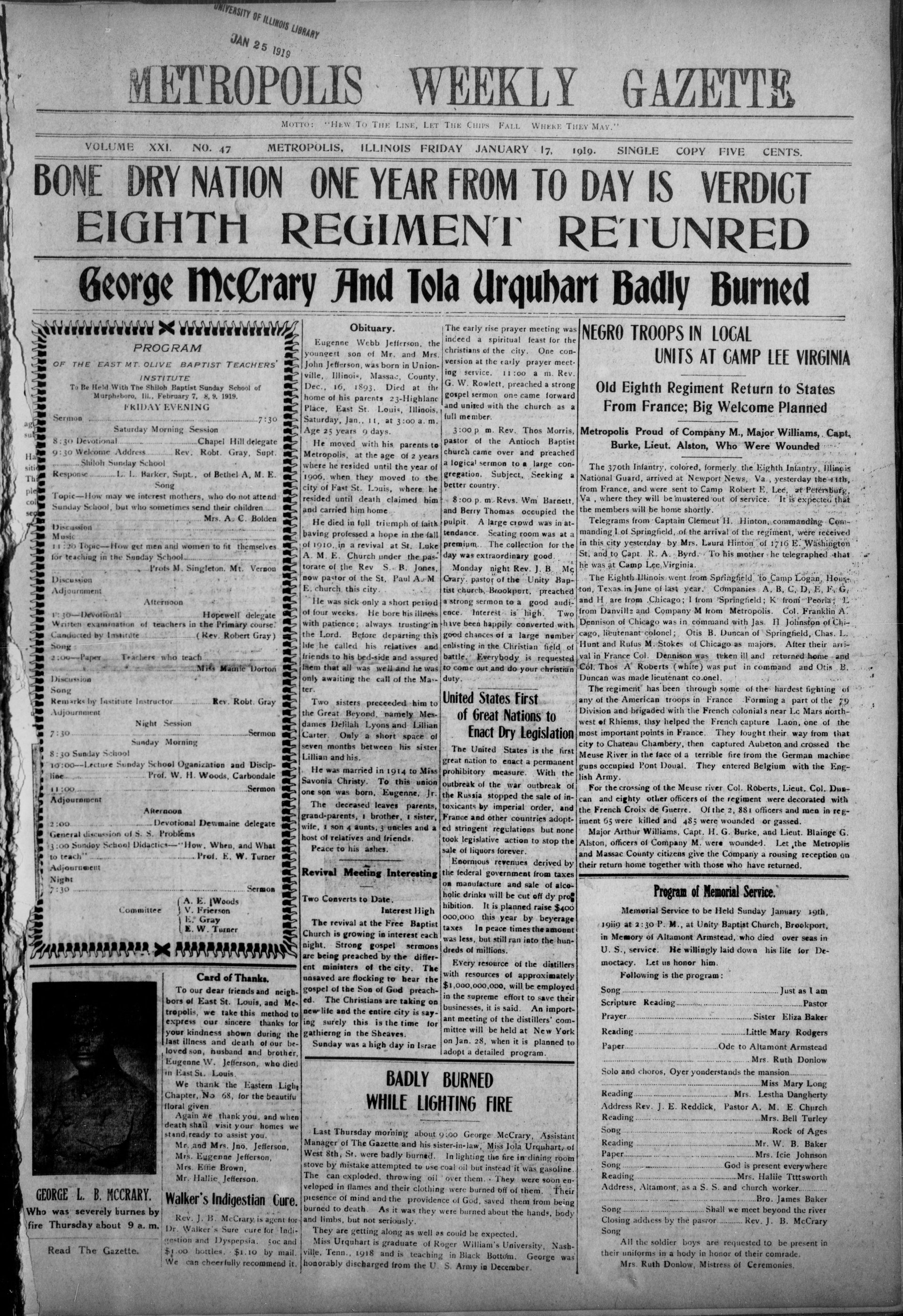
BONE DRY NATION ONE YEAR FROM TO DAY IS VERDICT EIGHTH REGIMENT RETUNRED
George McCrary And Tola Urquhart Badly Burned
OF THE EAST M.T. OLIVE BAPTIST TEACHERS
INSTITUTE
To Be Held With The Shiloh Baptist Sunday School of
Murpheboro, Ill., February 7, 8, 9, 1919.
FRIDAY EVENING
8:30 Devotional.....Chapel Hill delegate
9:30 Welcome Address.....Rev. Robt. Gray. Supt.
.....Shiloh Sunday School
Topic—How may we interest mothers, who do not attend
Sunday School, but who sometimes send their children
Mrs. A. C. Bolden
1:30—Devotional Hopewell delegate
Written examination of teachers in the Primary course:
Conducted by Institute (Rev. Robert Gray)
Song
8:30 Sunday School
10:00--Lecture Sunday School Organization and Discipline.....Prof. W. H. Woods, Carbondale
11:00.....Sermon
Adjournment
Afternoon
2:00.....Devotional Dewmaine delegate
General discussion of S. S. Problems
3:00 Sunday School Didactics—"How, When, and What to teach".....Prof. E. W. Turner
Adjournment
A. E. Woods
V. Frierson
E. Gray
E. W. Turner
---
A
Card of Thanks.
To our dear friends and neighbors of East St. Louis, and Metropolis, we take this method to express our sincere thanks for your kindness shown during the last illness and death of our beloved son, husband and brother, Eugenne W. Jefferson, who died in East St. Louis.
We thank the Eastern Light Chapter, No 68, for the beautiful floral given.
Again we thank you, and when death shail visit your homes we stand ready to assist you.
Mr. and Mrs. Jno. Jefferson,
Mrs. Eugenne Jefferson,
Mrs. Effie Brown,
Mr. Hallie Jefferson.
GEORGE L. B. MCCRARY.
Who was severely burnes by fire Thursday about 9 a. m.
Read The Gazette.
Walker's Indigestian Cure.
Rev. J. B. McCrary is agent for Dr. Walker's Sure cure for Indigestion and Dyspepsia. $0c and $1.00 bottles. $1.10 by mail. We can cheerfully recommend it.
MOTTO: "HEW TO THE LINE, LET THE CHIPS FALL WHEKE THEY MAY."
The early rise prayer meeting was indeed a spiritual feast for the christians of the city. One conversion at the early prayer meeting service. 11:00 a m. Rev. G. W. Rowlett, preached a strong gospel sermon one came forward and united with the church as a full member.
3:00 p. m. Rev. Thos Morris, pastor of the Antioch Baptist church came over and preached a logical sermon to a large congregation. Subject, Seeking a better country.
8:00 p. m. Revs. Wm Barnett, and Berry Thomas occupied the pulpit. A large crowd was in attendance. Seating room was at a premium. The collection for the day was extraordinary good.
Monday night Rev. J. B. McCrary, pastor of the Unity Baptist church, Brookport, preached a strong sermon to a good audience. Interest is high. Two have been happily converted with good chances of a large number enlisting in the Christian field of battle. Everybody is requested to come out and do your christian duty.
United States First of Great Nations to Enact Dry Legislation
The United States is the first great nation to enact a permanent prohibitory measure. With the outbreak of the war outbreak of the Russia stopped the sale of intoxicants by imperial order, and France and other countries adopted stringent regulations but none took legislative action to stop the sale of liquors forever.
Enormous revenues derived by the federal government from taxes on manufacture and sale of alcoholic drinks will be cut off dy prohibition. It is planned raise $400 000,000 this year by beverage taxes. In peace times the amount was less, but still ran into the hundreds of millions.
Every resource of the distillers with resources of approximately $1,000,000,000, will be employed in the supreme effort to save their businesses, it is said. An important meeting of the distillers' committee will be held at New York on Jan. 28, when it is planned to adopt a detailed program.
BADLY BURNED WHILE LIGHTING FIRE
Last Thursday morning about 9:00 George McCrary, Assistant Manager of The Gazette and his sister-in-law, Miss Jola Urquhart, of West 8th, Sr. were badly burned. In lighting the fire in dining room stove by mistake attempted to use coal oil but instead it was gasoline. The can exploded, throwing oil over them. They were soon enveloped in flames and their clothing were burned off of them. Their presence of mind and the providence of God, saved them from being burned to death. As it was they were burned about the hands, body and limbs, but not seriously.
They are getting along as well as could be expected.
Miss Urquhart is graduate of Roger William's University, Nashville, Tenn., 1918 and is teaching in Black Bottom. George was honorably discharged from the U. S. Army in December.
Eugenne Webb Jefferson, the youngest son of Mr. and Mrs. John Jefferson, was born in Unionville, Illinois, Massac, County, Dec., 16, 1893. Died at the home of his parents 23-Highland Place, East St. Louis, Illinois, Saturday, Jan., 11, at 3:00 a.m. Age 25 years 9 days.
He moved with his parents to Metropolis, at the age of 2 years where he resided until the year of 1906, when they moved to the city of Fast St. Louis, where he resided until death claimed him and carried him home.
He died in full triumph of faith having professed a hope in the fall of 1910, in a revival at St. Luke A. M. E. Church under the pastorate of the Rev S. B. Jones, now pastor of the St. Paul A. M. E. church, this city.
He was sick only a short period of four weeks. He bore his illness with patience; always trusting in the Lord. Before departing this life he called his relatives and friends to his bed-side and assured them that all was well and he was only awaiting the call of the Master.
Two sisters preceeded him to the Great Beyond, namely Mesdames Delliah Lyons and Lillian Carter. Only a short space of seven months between his sister Lillian and his.
He was married in 1914 to Miss Savonia Christy. To this union one son was born, Eugenne, Jr. The deceased leaves parents, grand-parents, 1 brother, 1 sister, wife, 1 son 4 aunts, 3 uncles and a host of relatives and friends. Peace to his asher.
Revival Meeting Interesting
The revival at the Free Baptist Church is growing in interest each night. Strong gospel sermons are being preached by the different ministers of the city. The unsaved are flocking to hear the gospel of the Son of God preached. The Christians are taking on new life and the entire city is saying surely this is the time for gathierg in the Sheaves. Sunday was a high day in Israel
NEGRO TROOPS IN LOGAL
UNITS AT CAMP LEE VIRGINIA
Old Eighth Regiment Return to States
From France; Big Welcome Planned
Metropolis Proud of Company M., Major Williams, Capt.
Burke, Lieut. Alston, Who Were Wounded
The 370th Infantry, colored, formerly the Eighth Infantry, Illinois
National Guard, arrived at Newport News, Va., yesterday the 11th,
from France, and were sent to Camp Robert E. Lee, at Petersburg,
Va., where they will be mustered out of service. It is expected that
the members will be home shortly.
Telegrams from Captain Clemest H. Hinton, commanding
Commanding I of Springfield, of the arrival of the regiment, were received
in this city yesterday by Mrs. Laura Hinton, of 1716 E. Washington
St., and to Capt. R. A. Byrd. To his mother he telegraphed that
he was at Camp Lee, Virginia.
The Eighth Illinois went from Springfield to Camp Logan, Houston, Texas in June of last year. Companies A, B, C, D, E, F, G, and H are from Chicago; I from Springfield; K from Peoria; L from Danville and Company M from Metropolis. Col. Franklin A. Dennison of Chicago was in command with Jas. H Johnston of Chicago, lieutenant colonel; Otis B. Duncan of Springfield, Chas. L. Hunt and Rufus M. Stokes of Chicago as majors. After their arrival in France Col. Dennison was token ill and returned home and Col. Thos A Roberts (white) was put in command and Otis B. Duncan was made lieutenant co.onel.
The regiment has been through some of the hardest fighting of any of the American troops in France. Forming a part of the 79 Division and brigaded with the French colonial's near Lc Mars northwest of Rhiems, this helped the French capture Laon, one of the most important points in France. They fought their way from that city to Chateau Chambery, then captured Aubeton and crossed the Meuse River in the face of a terrible fire from the German machine guns occupied Pont Doual. They entered Belgium with the English Army.
For the crossing of the Meuse river Col. Roberts, Lieut. Col. Duncan and eighty other officers of the regiment were decorated with the French Croix de Guerre. Of the 2, 881 officers and men in regiment 65 were killed and 485 were wounded or gassed.
Major Arthur Williams, Capt. H. G. Burke, and Lieut. Blainge G. Alston, officers of Company M. were wounded. Let the Metropolis and Massac County citizens give the Company a rousing reception on their return home together with those who have returned.
Program of Memorial Service.
Memorial Service to be Held Sunday January 19th, 19ii9 at 2:30 P. M., at Unity Baptist Church, Brookport, in Memory of Altamont Armstead, who died over seas in U. S., service. He willingly laid down his life for Democtacy. Let us honor him.
Song.....Just as I am
Scripture Reading.....Pastor
Prayer.....Sister Eliza Baker
Reading.....Little Mary Rodgers
Paper.....Ode to Altamont Armstead
.....Mrs. Ruth Donlow
Solo and choros, Oyer yonderstands the mansion
.....Miss Mary Long
Reading.....Mrs. Lestha Dangherty
Address Rev. J. E. Reddick, Pastor A. M. E. Church
Reading.....Mrs. Bell Turley
Song.....Rock of Ages
Reading.....Mr. W. B. Baker
Paper.....Mrs. Icie Johnson
Song.....God is present everywhere
Reading.....Mrs. Hallie Ttttsworth
Address, Altamont, as a S. S. and church worker
.....Bro. James Baker
Song.....Shall we meet beyond the river
Closing address by the pasror.....Rev. J. B. McCrary
Song
All the soldier boys are requested to be present in their uniforms in a body in honor of their comrade. Mrs. Ruth Donlow, Mistress of Ceremonies.
Page Two
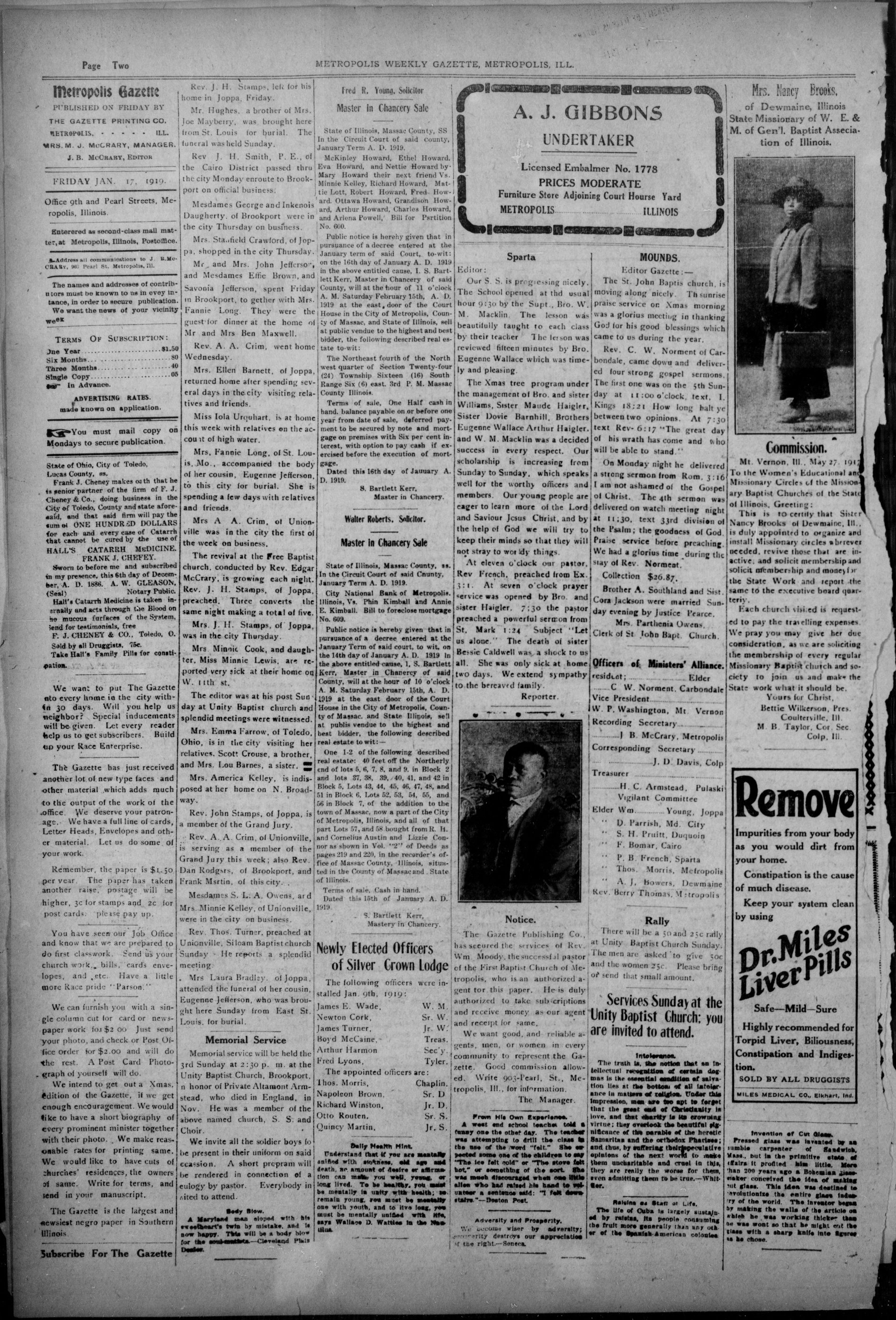
Iietropolis Gazette
PUBLISHED ON FRIDAY BY |
THE GAZETTE PRINTING CO,
METROPOLIS, - - - - + ILL.
WRS.M. J. McCRARY, MANAGER.
J.B. McOnany, Eprron
FRIDAY JAN. 17, (919.
eee
Office gth and Pearl Streets, Me-
ropolis, Ilinois.
Enterered as second-class mail mat-
tet,at Metropolis, Illinois, Postoiice.
——————
B-Addrews ai! communioxtions to J. B.Me-
CRABY, ME Pearl St. Metropatis, Tl
i
The names and addresses of contrib-
utors must be known to us in evey in-
tance, in order to secure publication.
Wo want the news of your vicinity
week
TeRMs OF SUBSCRIPTION:
Dne Year. ....-------6+* weeee + «$1.50
Giz Monte... 5... -ene ee o+2 180
Three Monthe........ --. -.--+---40
Single Copy......-.c.-5 05 vee --- +708
ear In Advance.
DVERTISING RATES.
made known on application.
BGEPVou must mail copy on
Mondays to secure publication.
——_—_—
State of Ohio, City of Toledo,
Lucas County, 8s.
Frank J. Cheney makes osth that he
és genior partner of the firm of F. J.
Cheney & Co., doing business in the
City of Toledo, County and state afore-
aid, and that said firm will pay the
um oi ONE HUNDRED DOLLARS
for each and every case of Caterrh
that cannot be cured by the use of
HALL'S CATARRH MeDICINE.
FRANK J, CHEFEY.
Sworn to before me and subscribed
én my presence, this 6th day of Decem-
ber, A. D. 1886. A.W. GLEASON,
(Seal) Notary Public.
Hal's Catarrh Medicine is taken in-
ernally and acts through tae Blood on
he mucous furfaces of the System,
Send for testimonials, free
F. J. CHENEY & CO., Toledo, 0.
Sold by all Druggists, 75e.
‘Take Halt’s Family Pills for consti-
pation. 4
We want to put The Gazette
ato every home ia the city with-
a 30 days. Will you help us
neighbor? Special inducements
willbe given. Let every reader
help us to get subscribers. Build
up your Race Enterprise.
The Gazette bas just received
another lot of new type faces and
other material which adds much
to the output of the work of the
woffice, We deserve your patron-
age. We havea full line of cards,
Letter Heads, Envelopes and ae
er material, Let us dosome of
your work,
Remember, the paper is $1.50.
per vear, The paper has taken
another faise,” postage will be
higher, 3c for stamps and_ 2c for
post cards: ‘pleasé pay up.
You have seem our Job Office
and know that we are prepared to
do first classwork, Send iS your
church work,, bills, ‘cards enve-
fopes, and ,etc. Have a little
more Race pride “Parson.”
We can furnish you with a sin-
gle column cut for card or news-
paper work for $200 Just send
‘your photo, and check or Post. OF
fice order for $2.00 and will do
the rest. A Post Card Photo-
_graph of yourself will do
We intend to get out a Xmas,
Adition of the Gazette, it we get
enough encouragement. We would
fike to have a short biography of
every prominent minister together
with their photo. | We make reas.
‘onable rates for printing same.
We would like to have cuts of
churches’ residences, the owners
of same. Write for terms, and
“send in your manuscript,
The Garette is the latgest and
sew st negro paper in Southern
oh
Subscribe For The Gazette
Mr. Hughes, a brother of Mrs |
Joe Mayberry, was. brought here’
from St, Louis for burial. The|
tuneral was held Sunday,
Rev J. H. Smith, P. E., off
the Cairo District passed thru!
the city Monday enroute to Brook-|
port on official business }
Mesdames George and Inkenois
Daugherty. of Brookport were in
the city Thursday on busfness
Mrs, Staufield Crawford, of Jop-
pa, shopped in the city Thursday.
Mec_and Mrs. John Jefferso"
and Mesdames Effie Brown, and
Savonia Jefferson, spent Friday
i Brookport, to gether with Mrs.
Fannie Long. They were the
guest'for dinner at the home of
Mr and Mrs Ben Maxwell.
Rev. A. A. Crim, went home
Wednesday.
Mrs. Ellen Barnett, of Joppa,
returned home after spending sev-
eral days inthe city visiting rela-
tives and friends.
Miss Iola Urquhart, is at home
this week with relatives on the ac-
court of high water,
Mrs, Fannie Long, of St. Lov-
is, Mo., accompanied the body
of her cousin, Eugenne Jefferson,
to this city for burial. She is
spending a few days with relatives
and friends.
Mrs A A. Crim, of Union-
ville was inthe city the first of
the week on business,
The revival at the Free Baptist
church, conducted by Rev. Edgar
McCrary, is growing each night.
Rev. J. H. Stamps, of Joppa,
preached, Three converts the
same night making a total of five.
Mrs. J. H. Stamps, of Joppa,
was in the city Thursday.
Mrs, Minaie Cook, and heat
ter, Miss Minnic Lewis, are re-
ported very sick at their home og
W. 11th: st, 1
The editor was at his post Sun-
day at Unity Baptist church and
splendid meetings were witnessed.
Mrs. Emma Farrow, of Toledo,
Ohio, isin the city visiting her
elatives. Scott Crouse, a brother,
nd Mrs, Lou Barnes, a sister, &
Mrs. America Kelley, is indis-
vosed ather home on N. Broad-
vay. i
Rev. John Stamps, of Joppa, is
| member of the Grand Jury.
Rev. A.A. Crim, of Unionville,
s serving as a member of the
irand Jury this week; also Rev.
Jan Rodgsrs, of Brookport, and
‘rank Msrtin, of this city. , |
Mesdames S. Li A. Owens, ard
rs. Minnie Kelley, of Unionville,
vere in the city on business. |
Rev. Thos. Turner, preached at
Jnionville, Siloam Baptist church |
sunday ~ He reports a splendid
necting {
Mrs Laura Bradley. of Joppa,|
tended the funeral of her cousin,
Zugenne Jefferson, who was brou-
int here Sunday from East oe
ouis, for burial,
Memorial Service
Memorial service will be held the
3rd Sunday at 2:30 p. m. at the
Unity Baptist Church, Brookport,
n honor of Private Altamont Arm-
stead, who died in England, in
Nov. He was a member of the
above named church, S. S: and
Choir. *
We invite all the soldier boys fo
be present in their uniform on said
ecassion. A short prepram will
be rendered in connection of a
eulogy by pastor. Everybody in
sited to attend.
i tee
A Marylend man sloped with his
evootheart’s twin by mistake, and te
now happy. Thia will be x body blow
for the eoubenntiets. Cleveland Ptxis
‘Dester.
2TROPOLIS WEEKLY GAZETTE, METROPOLIS, 11
Fred R, Young, Solicitor =f ee
Master in Chancery Sale > | Oe
State of Illinois, Massac Gounty, SS
In the Circuit Court of said County,
January Term A. D. 1919,
McKinley Howard, Ethel Howard.
Eva Howard, and Nettie Howard by
Mary Howard their next friend Vs
Minnie Kelley, Richard Howard, Mat.
tie Lott, Robert Howard, Fred. How
‘ard. Ottawa Howard, Grandison How:
ard, Arthur Howard, Charles Howard
and Arlena Powell,’ Bill for Psrtitior
No. 600.
| Public notice is herehy given that ir
pursuance of adecree entered at the
January term of said Court, to-wit
on the 16th day of January A. D. 191:
in the above entitled cause, I, S. Bart
lett Kerr, Master in Chancery of saic
| County, will at the hour of 11 o'clock
|A. M. Saturday February 15th, A. D
[1919 at the east, door of the Cour
| House in the City of Metropolis, Coun
| ty of Massac, and State of Illinois, sel
at public vendue to the highest and bes
bidder, the following described real es
tate to-wit:
‘The Northeast fourth of the North
west quarter of Section Twenty-fou
(24) Township Sixteen (16) South
Range Six (6) east. 3rd P. M. Massa
County Illinois.
Terms of sule, One Half cash it
hand, balance payable on or before on
year from date of sale, deferred pay
ment to be secured by note and mort
gage on premises with Six per cent in
terest, with option to pay cash if ex
ercised before the execution of mort
gage.
Dated this 16th day of Jauuary A
D, 1919.
8, Bartlett Kerr,
Master in Chancery.
Walter Roberts, Solicitor.
Master in Ghancery Sale
State of Illinois, Massac County, #8.
In the Cireuit Court of said Cnunty,
January Term A. D. 1919.
City National Bank of Metropolis.
Mlinois, Vs. Phin Kimball and Anni¢
E, Kimball. Bill to foreclose mortgage
No. 609.
Public notice is hereby given that ir
pursuance of a decree entered at th
January Term of said court, to wit, on
the 14th day of January A.D. 1919 In
the above entitled-cause, 1, S. Bartlett
Kerr, Master in Chanercy of said
County, will at the hour of 10 o'clock
A. M. Saturday February 15th, A. D.
1919 at the east door of the Court
‘House in the City of Metropolis, Coun-
ty of Massac. and State Illinois, se!l
at publis vendue to the highest and
best bidder, the following described
real estate to wit: — {
One 1-2 of the following ‘described
real estate: 40 feet off the Northerly
end of lots 5, 6, 7, 8, and 9, in Block 2
and lots 37, 38, 39, /40, 41, and 42 in
Block 5, Lots 43, 44, 45, 46, 47, 48, and
51 in Block 6, Lots 52, 58 54, 65, and
56 in Block 7, of the addition to the
town of Massac, now a part of the City
of Metropolis, Illinois, and all of that
part Lots 57, and 58 bought from R. H.
and Cornelius Austin and Lizzie Con-
nor as shown in Vol. **2" of Deeds as
pages 219 and 220, in the recorder’s of-
fice of Massac County, “Illinois, situx-
ted in the County of Massacand . State
of Mlinois.
Terms of sale, Cash in hand,
Dated this 16th of January A. D.
1919 zt
S. Bartlett Kerr,
, Mastery in Chancery.
Newly Elected Officers
of Silver Grown Lodge
The following officers were in-
‘stalled Jan. oth, ro19:
James E. Wade, W. M.
eno Cork, sr. W,
James Turner, Je. W:
‘Boyd McCaine, Treas.
Achar Harnion Sec'y
Fred Lyons, Tyler.
"The appointed officers are:
Hoe Morris, Chaplin.
Napoleon Brown, ~ Sr. D
Richard Winston, Jr D,
Otto Routen, Sr. S.
ary Martin, JeS;
H Dalle Meath, Mint.
‘Understand that «€ you are mentally
anifind with stoktions, ohd age aad
death, ne amount of Aesire or affirms
tion can male you well, young, oF
long lived. To be healthy. you maint
be mentally im unity with health; ‘te
remain young, you must be mentally
one with youth, and to itve loag, you
must be mentally unified with ife,
anys Wallace D. Wattles tm the New
lua
Be eae Sr ae
A. J. GIBBONS
UNDERTAKER
Licensed Embalmer No. 1778 :
PRICES MODERATE
Furniture Store Adjoining Court Hourse Yard
‘ METROPOLIS. ILLINOIS
Sparta ] MOUNDS.
Editor:
) Our S. S. is progressing nicely.
The School opened at thd usual
hour 9:30 by the Supt., Bro. W.
M. Macklin, The lesson was
beautituily taught to each class
‘by their teacher The lesson was
reviewed filteen minutes by Bro.
Eugenne Wallace which was time-
ly and pleasing
The Xmas tree program under
‘the management of Bro. and sister
Williams, Sister Maude Haigler,
Sister Dovie Barnhill, Brothers
Eugenne Wallace Arthur Haigler.
and W. M. Macklin was a decided
success in every respect. Our
scholarship is increasing from
Sunday to Sunday, which speaks
well for the worthy officers and
members. Our young people are
eager to learn more of the Lord
and Saviour Jesus Christ, and by
the help of God we will try to
keep their minds so that they will
not stray to wor dy things.
At eleven o'clock our pastor,
Rev French, preached from Ex.
3:t. At seven o'clock prayer
service was opened by Bro. and
sister Haigler. 7;30 the pastor
preached a powerful sermon from
St, Mark 1:24 Subject ‘‘Let
us alone.’ The death of sister
Bessie Caldwell was_a shock to us
all. She was only sick at home:
two days. Weextend sympathy
to.the bereaved family.
Reporter.
>. 5) cameras
Rea en '
Se Saas |
“Sapa Boy
is o |
Cae :
ae
d i
The Gazette Publishing Co.
has seeured the services. of Rev
Wm_ Moody, the successfs! pastor
of the First Baptist Church of Me-
tropolis, who isan authorized a-
gent tor this paper. Heis duly
authorized to take sub<criptions
and receive money as our agent
and receipt for same, $
We want good, and. reliable a
gents, men, or women in: every
community to represent.the Ga-
zette. Good commission allow-
ed, Write 903-Pearl, St., Me-
tropelis, Ill., for information.
The Manager.
From Hie Own Experience,
‘A west end school teaches told 6
funny one the othet day. The teacher
was attempting to drill the class &®
the use of the word “felt” She or
Deated some one of the children to ony
“The {ee felt cold” or “The stove felt
bot.” oF something of the sort.
wha mach @fscouraged when ome
allen Who had ratsed hie hand to
untesr a sentence said: “I felt Gown
statrs."—Doston Post.
Adversity and Prosperity,
We ovcome wiser by adversity;
pormrerity destroys our appreciation
wt the right.—Seneca
MOUNDS.
Editor Gasette :
The St. John Baptis church, is
moving along nicely. Th sunrise
Praise service on Xmas morning
was a glorius mecting in thanking
God for his good blessings which
came to us during the year.
Rev. C. W. Norment of Car.
bondale, came dowu and deliver:
ed four strong gospel sermons.
The first one was on the 5th Sun-
day at tt:000'clock, text, I.
Kings 18:21 How long halt yc
betweentwo opinions, At 7:30
text Rev- 6:17 “The great day
of his wrath has come and who
will be able to stand."’
On Monday night he delivered
a strong sermon from Rom, 3:16
Lam not ashamed of the Gospel
of Christ. The 4th sermon was
delivered on watch meeting night
at 11530, text 33rd divisien of
the Psalm; the goodacss of God
Praise service before preaching,
We had a glorius time during the
stay of Rev. Norment,
Collection $26.87,
Brother A. Southland and Sist.
Cora Jackson were married Sun-
day evening by Justice Pearce,
Mrs. Parthenia Owens,
Clerk of St Jobo Bapt. Church.
Officers of, Ministers’ Alliance.
— be oo inw Elder
ou € W. Norment, Carbondale
Vice President Ae
W. P. Washington, Mt. Vernon
Recording Secretary...
ua) B. McCrary, Metropolis
Corresponding Secretary ......
oe J. D! Davis, Colp
Treasurer tec
sul C, Armstead, Pulaski
Vigilant Committee
Elder Wa. Young, Joppa
‘* D. Parrish, Md. City
"SH. Pruitt, Duquoin
** KF. Bomar, Cairo
** P. Bo French, Sparta
** Thos. Mortis, Metropolis
“\ A. J, Bowers, Dewmaine
Rev. Berry Thomas, M:tropolis
Rally
Shere will be a 50 and 25¢ rally
at Unity Baptist Church Sunday.
The men are asked ‘to give soc
and the women25c, Please brifg
of send that smal! amount,
; ‘i
.
_* Services Sunday at the
‘Unity Baptist: Church; you
are invited to attend.
| Rae e.
The truth is, the notion that sn In
leltectual recognition af certain dog
mas Is the essential eundition ef salva
tion lies at the bottom sf all latoler
ance In matters of religion. Under this
‘Impression, men are too apt to forget
that the great end of Christianity is
love, and that ehartty ts ts erowving
virtue; they overtook the beautifal pig:
nificance of the parable of the hereti
Samaritan and the orthodox Pharisees,
and thus, by suffering peepensr
epintons of the next fo make
Shem uncharitable and crael in this,
they are renily the worse for them,
avon admitting them fo be irue.—Whit
er.
Rating es Stati ot Lite,
‘The Life of Quba ts largely sustajn.
o4 by retina, Its people consuming
the fruft more generally than uny oth.
or of the Spanish-American colontes
. Mrs. Haney Brooks,
_ of Dewmaine, Hlinois
State Missionary of W. E. &
M. of Gen’l, Baptist Assecia-
tion of Illinois.
are
Ds ¥
ae a) , haa
eae ee
ee afi
Seca (ie ve:
mee «Pee
“el + saa
‘
al ‘
:
eae
Commission.
| Mt. Vernon, Ill, May 27. 194
To the Women’s Educational am
Missionary Circles of the Miss
a“ Baptist Churches of the Stat
of Illinois, Greeting :
| This is tocertiy that Sister
Nancy Brooks of Dewmaine, Ill,
is duly appointed to organize and
install Missionary circles a bereves
needed, revive those that are in-
active, and solicit membership and
solicit afembership and money ior
the State Work and report the
same to the executive board qoar-
teriy.
Each church vised is request-
ed to pay the travelling expenses.
We pray you may give her due
consideration, as we are soliciting
the membership of every regular
Missionary Baptit ‘chutch and so-
ciety 10 join us and make the
State work what it should be,
Yours for Christ,
Bettie Wilkerson, Pres.
Coulterville, Ut
M. B. Taylor, Cor, Sec
Colp, Hi
Impurities from your body:
as you would dirt from
your home.
Constipation is the cause
of much disease.
Keep your system clean
by using
miles
°
pr" pills
e
piveF
Safe—Mild—Sure
Highly recommended for
Torpid Liver, Biliousness,
Constipation and Indiges-
ition,
SOLD BY ALL DRUGGISTS
MILES MEDICAL €O, Eiknart, ind,
Invention of Cur Qiaam,
Pressed giase was invented by a8
tumble carpenter of Sandwiob,
Mass, put Im the primitive state, of
(faire {t profited im. little, Mere
‘han 200 years ago ® Bohemian gisse-
aker conceived the iden of making
tut glans, ‘This {don was destined to
“svolutionize the entire gins indum
‘ry of the world. The inventor begns
oy mating the walls of the article om
sblgh he was working thicker thes
oe wae wont so that be might ent the
tase with « sharp Knife inte figures
<o he cheese.
Page Three
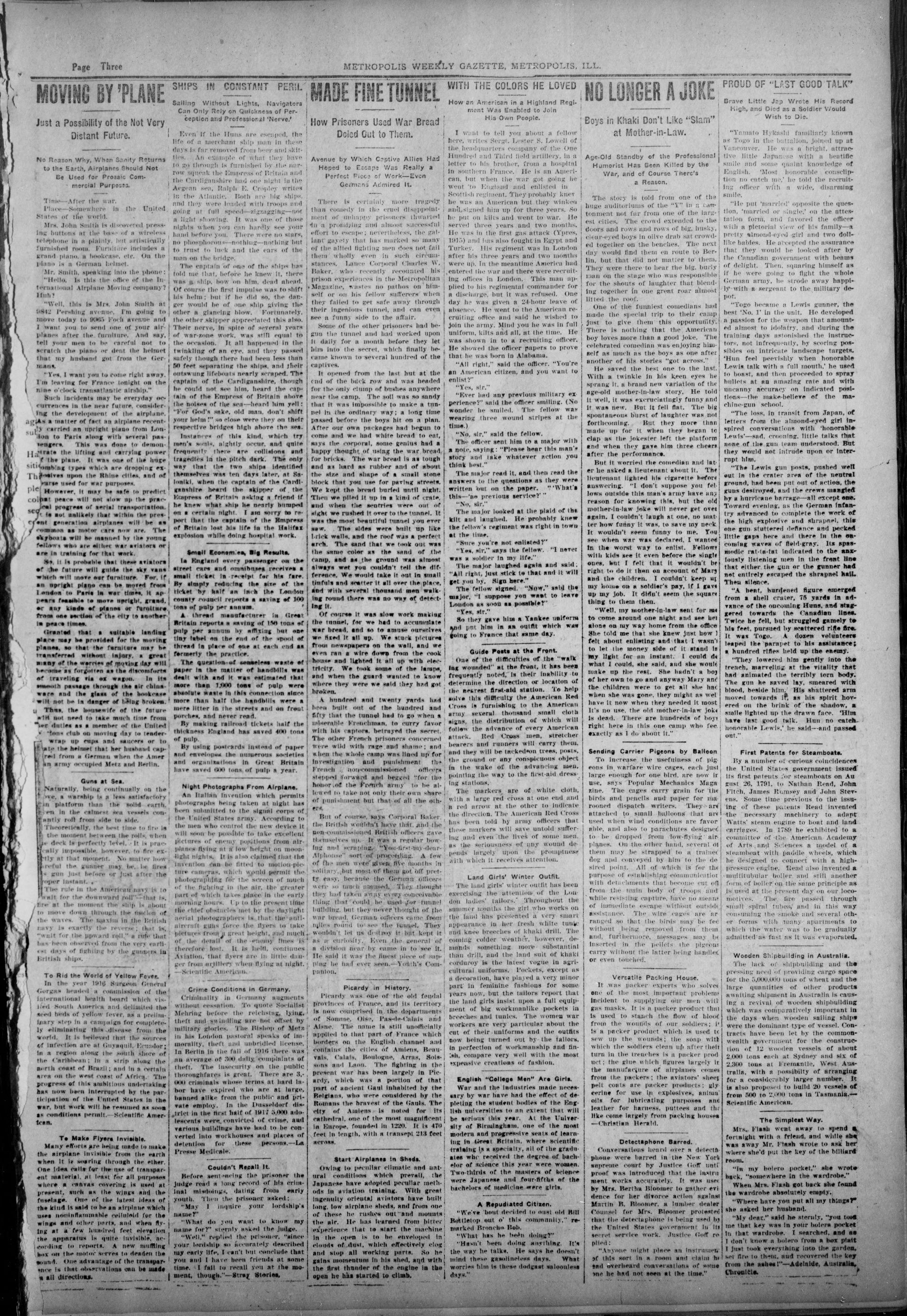
MOVING BY 'PLANE
Just a Possibility of the Not Very Distant Future.
No Reason Why, When Sanity Returns to the Earth, Airplanes Should Not Be Used for Prosaic Com-
Place—Somewhere in the United States of the world.
Mrs. John Smith is discovered pressing buttons at the base of a wireless telephone in a plainly, but artistically furnished room. Furniture includes a grand piano, a bookcase, etc. On the piano is a German helmet.
Mr. Smith, speaking into the phone:
"Hello. Is this the office of the International Airplane Moving company? Huh?
"Well, this is Mrs. John Smith at 9842 Pershing avenue. I'm going to move today to 9065 Foch avenue and I want you to send one of your airplanes after the furniture. And say, tell your men to be careful not to scratch the piano or dent the helmet that my husband got from the Germans.
"Yes, I want you to come right away. I'm leaving for France tonight on the nine o'clock transatlantic airship."
Such incidents may be everyday occurrences in the near future, considering the development of the airplane.
again as a matter of fact an airplane recently carried an upright piano from London to Paris along with several passengers. This was done to demonstrate the lifting and carrying power of the plane. It was one of the huge combing types which are dropping explosives upon the Rhine cities, and of course used for war purposes.
please. However, it may be safe to predict that peace will not slow up the practical progress of aerial transportation. It is not unlikely that within the present generation airplanes will be as common as motor cars now are. The airboats will be manned by the young fellows who are either war aviators or are in training for that work.
So, it is probable that these aviators of the future will guide the sky vanes which will move our furniture. For, if an upright piano can be moved from London to Paris in war times, it appears feasible to move upright, grand, or any kind of planes or furniture from one section of the city to another in peace times.
Granted that a suitable landing place may be provided for the moving planes, so that the furniture may be transferred without injury, a great many of the worries of moving day will become as forgotten as the discomforts of traveling via ox wagon. In its smooth passage through the air chinaware and the glass of the bookcase will not be in danger of bling broken. Thus, the housewife of the future will not need to take much time from her duties as a member of the United
town club on moving day to tender
wrap up cups and saucers or to
tate the helmet that her husband cap-
pelled from a German when the Amer-
ian army occupied Metz and Berlin.
Guns at Sea.
Naturally, being continually on the love, a warship is a less satisfactory an platform than the solid earth, even in the calmest sea vessels commonly roll from side to side. Theoretically, the best time to fire is the moment between the rolls, when the deck is perfectly level. It is practically impossible, however, to fire exactly at that moment. No matter how careful the gunner may be, he fires is gun just before or just after the roper instant.
The rule in the American navy is to await for the downward roll—that is, fire at the moment the ship is about to move down through the motion of the waves. The maxim in the British navy is exactly the reverse; that is, "wait for the ppward roll" a rule that has been observed from the very earliest days of fighting by the gunners in British ships.
To Rid the World of Yellow Fever.
In the year 1915 Surgeon General Gorgas headed a commission of the international health board which visited South America and delimited the seed beds of yellow fever, as a preliminary step in a campaign for completely eliminating this disease from the world. It is believed that the sources of infection are at Guyana, Ecuador; in a region along the south shore of the Caribbean; in a strip along the north coast of Brazil; and in a certain area on the west coast of Africa. The progress of this unbent undertaking has now been interrupted by the participation of the United States in the war, but work will be resumed as soon as conditions permit.—Scientific American.
To Make Flyera Invisible.
Many efforts are being made to make the airplane invisible from the earth when it is soaring through the ether. One idea calls for the use of transparent material, at least for all purposes where a canvas covering is used at present, such as the wings and the fuselage. One of the latest ideas of the kind is said to be an airplane which uses noninflammable celluloid for the wings and other parts, and when flying at a few hundred feet elevation the apparatus is quite invisible, according to reports. A new numming box on the motor serves to deaden the sound. One advantage of the transparency is that observations can be made in all directions.
SHIPS IN CONSTANT PERIL
Sailing Without Lights, Navigators
Can Only Rely on Quickness of Perception and Professional 'Nerve.'
Even if the Huns are escaped, the life of a merchant ship man in these days is far removed from beer and skillets. An example of what they have to go through is furnished by the narrow squeak the Empress of Britain and the Cardiganshire had one night in the Argean sea, Ralph E. Cropley writes in the Atlantic. Both are big ships, and they were leaded with troops and going at full speed—zigzagging—not a light showing. It was one of those nights when you can hardly see your hand before you. There were no stars, no phosphorous—nothing—nothing but to trust to luck and the cars of the man on the bridge.
The captain of one of the ships has told me that, before he knew it, there was a ship, bow on him, dead ahead. Of course the first impulse was to shift his helm; but if he did so, the danger would be of one ship giving the other a glancing blow. Fortunately, the other skipper appreciated this also. Their nerve, in spite of several years of war-zone work, was still equal to the occasion. It all happened in the twinkling of an eye, and they passed safely though there had been less than 50 feet separating the ships, and their outswung lifeboats nearly scrapped. The captain of the Cardiganshire, though he could not see him, heard the captain of the Empress of Britain above the noises of the sea—heard him yell: "For God's sake, old man, don't shift your helm," so close were they on their respective bridges high above the sea.
Instances of this kind, which try men's souls, nightly occur, and quite frequently there are collissions and tragedies in the pitch dark. The only way that the two ships identified themselves was ten days later, at Salonki, when the captain of the Cardiganshire heard the skipper of the Empress of Britain asking a friend if he knew what ship he nearly bumped on a certain night. I am sorry to report that the captain of the Empress of Britain lost his life in the Halifax explosion while doing hospital work.
Small Economica. Big Results.
In England every passenger on the street cars and omnibuses receives a small ticket in receipt for his fare. By simply reducing the size of the ticket by half an inch the London county council reports a saving of 100 tons of pulp per annum.
A thread manufacturer in Great Britain reports a saving of 150 tons of pulp per annum by affixing but one tiny label on the end of the spool of thread in place of one at each end as formerly the practice.
The question of senseless waste of paper in the matter of handbills was dealt with and it was estimated that more than 1,000 tons of pulp were absolute waste in this connection since more than half the handbills were a mere litter in the streets and on front porches, and never read.
By making railroad tickets half the thickness England has saved 400 tons of pulp.
By using postcards instead of paper and envelopes, the numerous societies and organizations in Great Britain have saved 600 tons, of pulp a year.
Night Photographs From Airplane.
An Italian invention which permits photographs being taken at night has been submitted to the signal corps of the United States army. According to the men who control the new device it will soon be possible to take excellent pictures of enemy positions from airplanes flying at a low height on moonlight nights. It is also claimed that the invention can be fitted to motion-picture cameras, which would permit the photographing for the screen of much of the fighting in the air, the greater part of which takes place in the early morning hours. Up to the present time the chief obstacles met by the daylight aerial photographers is, that the anti-aircraft guns force the flyers to take pictures from a great height, and much of the denial of the enemy lines is therefore lost. It is held, continues Aviation, that flyers are in little danger from artillery when flying at night. —Scientific American.
Crime Conditions in Germany.
Crime Confinement in Germany.
Criminality in Germany augments without cessation. To quote Socialist Mehring before the reichstug, lying, theft and swindling are not offset by military glories. The Bishop of Metz in his London pastoral speaks of immorality, theft and unbridled license. In Berlin in the fall of 1916 there was an average of 300 daily complaints of theft. The insecurity on the public thoroughfares is great. There are 3,000 criminals whose terms at hard labor have expired who are at large, banned alike from the public and private employ. In the Dusseldorf district in the first half of 1917 5,000 adolescents were convicted of crime, and various buildings have lead to be converted into workhouses and places of detention for these persons.—La Presse Medicale.
Couldn't Recall It.
Before sentencing the prisoner the judge read a long record of his criminal misdouches, dating from early youth. Then the prisoner asked:
"What do you want to know my name for?" sternly asked the judge. "Well," replied the prisoner. "since your lordship so accurately described my early life, I can't but conclude that you and I have been friends at some time. I fail to recall you at the moment, though."—Sturay Stories.
METROPOLIS WEEKLY GAZETTE. METROPOLIS. ILL.
How Prisoners Used War Bread Doled Out to Them.
Avenue by Which Captive Allies Had Hoped to Escape Was Really a Perfect Place of Work—Even Germans Admired It.
There is certainly more tragedy than comedy in the cruel disappointment of unhappy prisoners thwarted in a promising and almost successful effort to escape; nevertheless, the galtant gayety that has marked so many of the allied fighting men does not fail them wholly even in such circumstances. Lance Corporal Charles W. Baker, who recently recounted his prison experiences in the Metropolitan Magazine, wastes no pathos on himself or on his fellow sufferers when they failed to get safe away through their ingenious tunnel, and can even see a funny side to the affair.
Some of the other prisoners had begun the tunnel and had worked upon it daily for a month before they let him into the secret, which finally became known to several hundred of the captives.
It opened from the last hut at the end of the back row and was headed for the only clump of bushes anywhere near the camp. The soil was so sandy that it was impossible to make a tunnel in the ordinary way; a long time passed before the boys hit on a plan. After our own packages had begun to come and we had white bread to eat, says the corporal, some genius had a happy thought of using the war bread for bricks. The war bread is as tough and as hard as rubber and of about the size and shape of a small stone block that you use for paving streets. We kept the bread buried until night. Then we piled it up in a kind of crate, and when the sentries were out of sight we rushed it over to the tunnel. It was the most beautiful tunnel you ever saw. The sides were built up like brick walls, and the roof was a perfect arch. The sand that we took out was the same color as the sand of the camp, and as the ground was almost always wet you couldn't tell the difference. We would take it out in small tinfuls and scatter it all over the place, and with several thousand men walking round there was no way of detecting it.
Of course it was slow work making the tunnel, for we had to accumulate war bread, and so to amuse ourselves we fixed it all up. We stuck pictures from newspapers on the wall, and we even ran a wire down from the cook house and lighted it all up with electricity. We took some of the lamps, and when the guard wanted to know where they were we said they had got broken.
A hundred and twenty yards had been built out of the hundred and fifty that the tunnel had to go when a miserable Frenchman, to curry favor with his captors, betrayed the secret. The other French prisoners concerned were wild with rage and shame; and when the whole camp was lined up for investigation and punishment the French noncommissioned officers stepped forward and begged 'for the honor of the French army' to be allowed to take not only their own share of punishment but that of all the others.
But of course, says Corporal Baker, the British wouldn't have that, and the non-co commissioned British officers gave themselves up. It was a regular bowing and scraping, "You first my dear Alphone" sort of proceeding. A few of the men were given five months in solitary, but most of them got off pretty easy, because the German officers were so much amused. They thought they had taken away every conceivable thing that could be used for tunnel building, but they never thought of the war bread. German officers came from allies round to see the tunnel. They wouldn't let us destroy it but kept it as a curiosity. Even the general of a division near by came in to see it. He said it was the finest piece of sapping he had ever seen. Youth's Companion.
Picardy in History.
Picardy was one of the old fendal provinces of France, and its territory is now comprised in the departments of Somme, Oise, Pas-de-Calais and Alsace. The name is still unofficially applied to that part of France which borders on the English channel and contains the cities of Amiens, Beauval, Calafs, Boulogne, Arras, Soissons and Laon. The fighting in the present war has been largely in Picardy, which was a portion of that part of ancient Gaul inhabited by the Belgians, who were considered by the Romans the bravest of the Gauls. The city of Amiens is noted for its cathedral, one of the most magnificent in Europe, founded in 1220. It is 470 feet in length, with a transept 213 feet across.
Start Airplanes in Sheds.
Owing to peculiar climatic and natural conditions which prevail, the Japanese have adopted peculiar methods in aviation training. With great ingenuity oriental aviators have built long, low airplane sheds, and from one of these he rushes out and mounts the air. He has learned from bitter experience that to start the machine in the open is to be enveloped in clouds of dust, which effectively clog and stop all working parts. So he gains momentum in his shed, and with the first thunder of the engine in the open he has started to climb.
WITH THE COLORS HE LOVED
How an American in a Highland Regiment Was Enabled to Join His Own People.
I want to tell you about a fellow here, writes Sergt. Lester S. Lowell of the headquarters company of the One Hundred and Third field artillery, in a letter to his brother, from a hospital in southern France. He is an American, but when the war got going he went 'to England and enlisted in Scottish regiment. They probably knew he was an American but they winked and signed him up for three years. So he put on kilts and went to war. He served three years and two months. He was in the first gas attack (Ypres, 1915) and has also fought in Egypt and Turkey. His regiment was in London after his three years and two months were up. In the meantime America had entered the war and there were recruiting offices in London. This man applied to his regimental commander for a discharge, but it was refused. One day he was given a 24-hour leave of absence. He went to the American recruiting office and said he wished to join the army. Mind you he was in full uniform, kilts and all, at the time. He was shown in to a recruiting officer. He showed the officer papers to prove that he was born in Alabama.
"All right," said the officer. "You're an American citizen, and you want to enlist?" "Yes, sir." "Ever had any previous military experience?" said the officer smiling. (No wonder he smiled. The fellow was wearing three wound stripes at the time.) "No sir." said the fellow.
"No, sr., said the fellow.
The officer sent him to a major with a note, saying: "Please hear this man's story and take whatever action you think best."
The major read it, and then read the answers to the questions as they were written but on the paper. "What's this—no previous service?"
"No, sr."
The major looked at the plaid of the kilt and laughed. He probably knew the fellow's regiment was right in town at the time.
"Save you not enlisted?"
"Yes, sir," says the fellow. "I never was a soldier in my life."
The major laughed again and said: "All right, just stick to that and it will get you by. Sign here."
The fellow signed. "Now," said the major, "i suppose you want to leave London as soon as possible?"
"Yes, sir."
So they gave him a Yankee uniform and put him in an outfit which was going to France that same day.
Guide Posts at the Front.
One of the difficulties of the "walking wounded" at the front, it has been frequently noted, is their inability to determine the direction or location of the nearest first-aid station. To help solve this difficulty the American Red Cross is furnishing to the American army several thousand small cloth signs, the distribution of which will follow the advance of every American attack. Red Cross men, stretcher bearers and runners will carry them, and they will be tacked on trees, posts, the ground or any conspicuous object in the wake of the advancing men, pointing the way to the first-aid dressing stations.
The markers are of white cloth, with a large red cross at one end and a red arrow at the other to indicate the direction. The American Red Cross has been told by army officers that these markers will save untold suffering and even the lives of some men, as the seriousness of any wound depends largely upon the promptness with which it receives attention.
Land Girls' Winter Outfit.
The land girls' winter outfit has been exercising the attention of the London ladies' tailors. Throughout the summer months the girl who works on the land has presented a very smart appearance in her fresh white tunic and knee breeches of khaki drill. The coming colder weather, however, demands something more substantial than drill, and the land suit of khaki corduroy is the latest vogue in agricultural uniforms. Pockets, except as a decoration, have played a very minor part in feminine fashions for some years now, but the tailors report that the land girls insist upon a full equipment of big workmanlike pockets in breeches and tunics. The women war workers are very particular about the cut of their uniforms and the outfits now being turned out by the fallors, in perfection of workmanship and finish, compare very well with the most expensive creations of fashion.
English "College Men" Are Girls.
War and the industries made necessary by war have had the effect of depleting the student bodies of the English universities to an extent that will be serious this year. At the University of Birmingham, one of the most modern and progressive seats of learning in Great Britain, where scientific training is a speciality, all of the graduates who received the degree of bachelor of science this year were women. Two-thirds of the masters of science were Japanese and four-fifths of the bachelors of medicine were girls.
A. Repudiated Citizen
"We've bout decided to oust old Bill Bottletop out o' this community," remarked Broncho Bob.
"What has he been doing?"
"Hasn't been doing anything. It's the way he talks. He says he doesn't mind these gasolineless days. What worries him is these dodgast saloonless days."
NO LONGER A JOKE
Boys in Khaki Don't Like "Slam" at Mother-in-Law.
Age-Old Standby of the Professional Humorist Has Been Killed by the
War, and of Course There's a Reason.
The story is told from one of the huge auditoriums of the "T" in a cantonment not far from one of the largest cities. The crowd extended to the doors and rows and rows of big, husky, clear-eyed boys in olive drab sat crowded together on the benches. The next day would find them en route to Berlin, but that did not matter to them. They were there to hear the big, burly man on the stage who was responsible for the shouts of laughter that blending together in one great roar almost litted the roof.
One of the funniest comedians had made the special trip to their camp just to give them this opportunity. There is nothing that the American boy loves more than a good joke. The celebrated comedian was enjoying himself as much as the boys as one after another of his stories "got across." He saved the best to the last. With a twinkle in his keen eyes he sprang it, a brand new variation of the age-old mother-in-law story. He told it well, it was excruciating funny and it was new. But it fell flat. The big spontaneous burst of laughter was not forthcoming. But they more than made up for it when they began to clap as the jokesfer left the platform and when they gave him three cheers after the performance.
But it worried the comedian and later he asked a lieutenant about it. The lieutenant lighted his cigarette before answering. "I don't suppose you follows outside this man's army have any reason for knowing this, but the old mother-in-law joke will never get over again. I couldn't laugh at one, no matter how funny it was, to save my neck. It wouldn't seem funny to me. You see when war was declared, I wanted in the worst way to enlist. Fellows with kids see it even before the single ones, but I felt that it wouldn't be right to do it then on account of Mary and the children. I couldn't keep up my home on a soldier's pay, if I gave up my job. It didn't seem the square thing to them then.
"Well, my mother-in-law sent for me to come around one night and see her alone on my way home from the office. She told me that she knew just how I felt about enlisting and that I wasn't to let the money side of it stand in my light for an instant. I could do what I could, she said, and she would make up the rest. She hadn't a boy of her own to go and anyway Mary and the children were to get all she had when she was gone, they might as well have it now when they needed it most. It's no use, the old mother-in-law joke is dead. There are hundreds of boys right here in this one camp who feel exactly as I do about it."
Sending Carrier Pigeons by Balloon
Sending Carrier Pigeons by Balloon
To increase the usefulness of pigeons in warfare fire cages, each just large enough for one bird, are now in use, says Popular Mechanics Magazine. The cages carry grain for the birds and penclls and paper for maoored dispatch writers. They are attached to small balloons that are used when wind conditions are favorable, and also to parachutes designed to be dropped from low-flying air planes. On the other hand, several of them may be strapped to a trained dog and conveyed by him to the desired point. All of which is for the purpose of establishing communication with detachments that become cut off from the main body of troops and while resisting capture, have no means of immediate escape without outside assistance. The wire cages are aranged so that the birds may be fee without being removed from them, furthermore, messages may be inserted in the pellets the pigeons carry without the latter being handled or even touched.
Versatile Packing House.
Versatile Packing House.
It was packer experts who solved one of the most important problems incident to supplying our men with gas masks. It is a packer product that is used to stanch the flow of blood from the wounds of our soldiers; it is a packer product which is used to sew up the wounds; the soap with which the soldiers clench up after their turn in the trenches is a packer product; the glue which figures largely in the manufacture of airplanes comes from the packers; the aviators' sheep pelt coats are packer products; glycerine for use in explosives, animal oils for lubricating purposes and leather for harness, puttees and the like come largely from packing houses — Christian Herald.
Detectaphone Barred.
Conversations heard over a detectable phone were barred in the New York supreme court by Justice Goff until proof was introduced that the instrument works accurately. It was used by Mrs. Bertha Bloomer to gather evidence for her divorce action against Martin B. Bloomer, a lumber dealer Counsel for Mrs. Bloomer protested that the detectable phone is being used by the United States government in its secret service work. Justice Goff replied: "Anyone might place an instrument of this sort in a room and claim he had overheard conversations of someone he had not seen at the time."
PROUD OF "LAST GOOD TALK"
Brave Little Jap Wrote His Record High, and Died as a Soldier Would Wish to Die.
"Yamato Hykashi familiarly known as Togo in the battalion, joined up at Vancouver. He was a bright, attractive little Japanese with a beatiful smile and some quaint knowledge of English. 'Most honorable conscription no catch me,' he told the recruiting officer with a wide, disarming smile.
"He put 'married' opposite the question, 'married or single,' on the attestation form, and favored the officer with a pictorial view of his family—a pretty almond-eyed girl and two doll-like babies. He accepted the assurance that they would be looked after by the Canadian government with beams of delight. Then, squaring himself as if he were going to fight the whole German army, he strode away happily with a sergeant to the military depot.
"Togo became a Lewis gunner, the best 'No. 1' in the unit. He developed a passion for the weapon that amounted almost to idolatry, and during the training days astonished the instructors, not infrequently, by scoring possibilities on intricate landscape targets. 'Hun feel peevishly when honorable Lewis talk with a full mouth,' he used to boast, and then proceeded to spray bullets at an amazing rate and with uncanny accuracy on indicated positions—the make-believe of the machine-gun school.
"The loss, in transit from Japan, of letters from the almond-eyed girl inspired conversations with 'honorable Lewis'—sad, crouching, little talks that none of the gun team understood. But they would not intrude upon or interrupt him.
"The Lewis gun posts, pushed well out in the crater area of the neutral ground, had been put out of action, the guns destroyed, and the crews mungled by a hurricane barrage—all except one. Toward evening, as the German infantry advanced to complete the work of the high explosive and shrapnel, this one gun stuttered defiance and pecked little gaps here and there in the incoming waves of field-gray. Its spasmodic rat-tat indicated to the anxiously listening men in the front line that either the gun or the gunner had not entirely escaped the shrapnel hall. Then silence.
"A bent, burdened figure emerged from a shell crater, 75 yards in advance of the oncoming Huns, and staggered towards the Canadian lines. Twice he fell, but struggled gamely to his feet, pursued by scattered rifle fire. It was Togo. A dozen volunteers leaped the parapet to his assistance; a hundred rifles held up the enemy. "They lowered him gently into the trench, marveling at the vitality that had animated the terribly torn body. The gun he saved lay, smeared with blood, beside him. His shattered arm moved towards it, as his spirit hovered on the brink of the shadow, a smile lighted up the drawn face. "Him have last good talk. Hun no catch honorable Lewis,' he said—and passed out."
First Patents for Steamboat.
By a number of curious coincidences the United States government issued its first patents for steamboats on August 26, 1791, to Nathan Read, John Fitch, James Rumsey and John Stevens. Some time previous to the issuing of these patents Read invented the necessary machinery to adapt Watts' steam engine to boat and land carriages. In 1789 he exhibited to a committee of the American Academy of Arts and Sciences a model of a steamboat with paddle wheels, which he designed to connect with a high-pressure engine. Read also invented a multitubular boiler and still another form of boiler on the same principle as is used at the present day on our locomotives. The fire passed through small spiral tubes, and in this way consuming the smoke and several other forms with many apartments to which the water was to be gradually admitted as fast as it was evaporated.
Wooden Shipbuilding in Australia.
The lack of shipbuilding and the pressing need of providing cargo space for the 5,000,000 tons of wheat and the large quantities of other products awaiting shipment in Australia is causing a revival of wooden shipbuilding which was comparatively important in the days when wooden sailing ships were the dominant type of vessel. Contracts have been let by the commonwealth government for the construction of 12 wooden vessels of about 2,000 tons each at Sydney and six of 2,300 tons at Fremantle, West Australia, with a possibility of arranging for a considerably larger number. It is also proposed to build 20 vessels of from 500 to 2,000 tons in Tasmania. Scientific American.
The Simplest Way.
Mrs. Flash went away to spend a fortaleight with a friend, and while she was away Mr. Flash wrote to ask her where she'd put the key of the billiard room.
"In my bolero pocket," she wrote back, "somewhere in the wardrobe."
When Mrs. Flash got back she found the wardrobe absolutely empty.
"Where have you put all my things?" she asked her husband.
"My dear," she said he sternly, "you tome that key was in your bolero pocket in that wardrobe. I searched, and as I don't know a bolero from a box plait I just took everything into the garden, set fire to them, and recovered the key from the ashes!"—Adelinde, Australia, Chronicle.
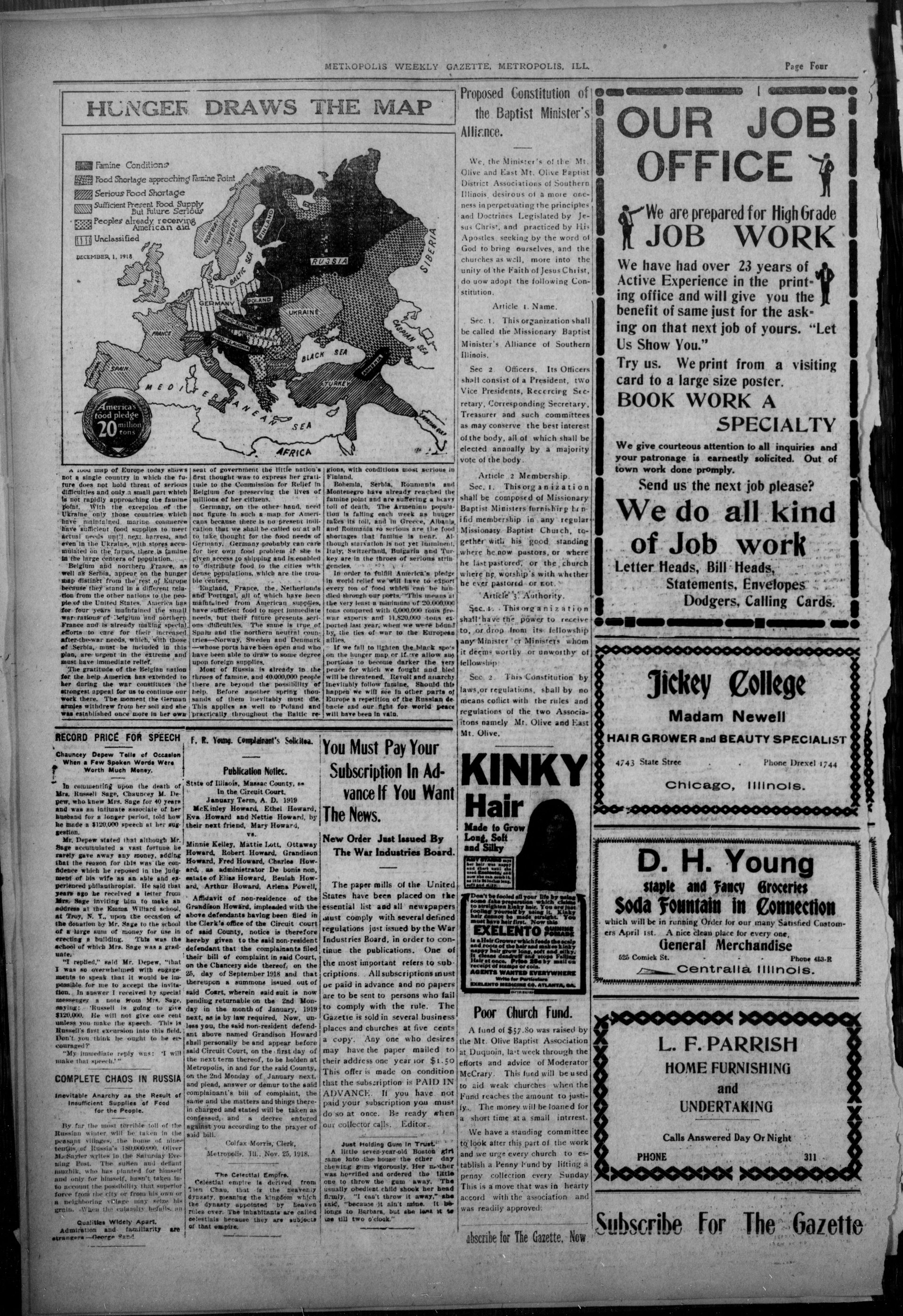
Famine Conditions
Food Shortage approching Famine Point
Serious Food Shortage
Sufficient Present Food Supply
But future Serious
Peoples already receiving
American aid
Unclassified
DECEMBER 1, 1918
GERMANY POLAND UKRAINE
SECHO-SLOWAIA AUSTRIA-HUNGARY
JUBO-SLAVONIA
BLACK SEA
TURKEY
MEDIERMANEAN SEA
AFRICA
America's food pledge
20 million tons
A food map of Europe today shows not a single country in which the future does not hold threat of serious difficulties and only a small part which is not rapidly approaching the famine point. With the exception of the Ukraine only those countries which have maintained marine commerce have sufficient food supplies to meet actual needs until next harvest, and even in the Ukraine, with stores accumulated on the farms, there is famine in the large centers of population.
Belgium and northern France, as well as Serbia, appear on the hunger map distinct from the rest of Europe because they stand in a different relation from the other nations to the people of the United States. America has for four years maintained the small war-rations of Belgium and northern France and is already making special efforts to care for their increased after-the-war needs, which, with those of Serbia, must be included in this plan, are urgent in the extreme and must have immediate relief.
The gratitude of the Belgian nation for the help America has extended to her during the war constitutes the strongest appeal for us to continue our work there. The moment the German armies withdrew from her soil and she was established once more in her own
RECORD PRICE FOR SPEECH
Chauncey Depew Tells of Occasion When a Few Spoken Words Were Worth Much Money.
In commenting upon the death of Mrs. Russell Sage, Chauncey M. Depew, who knew Mrs. Sage for 40 years and was an intimate associate of her husband for a longer period, told how he made a $120,000 speech at her suggestion.
Mr. Depen stated that although Mr. Sage accumulated a vast fortune he rarely gave away any money, adding that the reason for this was the confidence which he reposed in the judgment of his wife as an able and experienced philanthropist. He said that years ago he received a letter from Mrs. Sage inviting him to make an address at the Emma Wiltard school, at Troy, N. Y., upon the occasion of the donation by Mr. Sage to the school of a large sum of money for use in erecting a building. This was the school of which Mrs. Sage was a graduate.
"I replied," said Mr. Depew, "that I was so overwhelmed with engagements to speak that it would be impossible for me to accept the invitation. In answer I received by special messenger a note from Mrs. Sage, saying; 'Russell is going to give $120,000. He will not give one cent unless you make the speech. This is Russell's first excursion into this field. Don't you think he ought to be encouraged?'
"My immediate reply was: 'I will make that speech.'"
COMPLETE CHAOS IN RUSSIA
Inevitable Anarchy as the Result of Insufficient Supplies of Food for the People.
By far the most terrible toll of the Russian winter will be taken in the peasant villages, the home of nineteenth, of Russia's 380,000,000, Oliver McSayler writes in the Saturday Evening Post. The softer and defiant muzhik, who has planted for himself and only for himself, hasn't taken into account the possibility that superior force from the city or from his own or a neighboring village may seize his grain. When the calamity hefalls, an Qualities Widely Apart. Admiration and familiarity are strangers—George Sand.
seat of government the little nation's first thought was to express her gratitude to the Commission for Relief in Belgium for preserving the lives of millions of her citizens. Germany, on the other hand, need not figure in such a map for Americans because there is no present indication that we shall be called on at all to take thought for the food needs of Germany. Germany probably can care for her own food problem if she is given access to shipping and is enabled to distribute food to the cities with dense populations, which are the trouble centers.
England, France, the Netherlands and Portugal, all of which have been maintained from American supplies, have sufficient food to meet immediate needs, but their future presents serious difficulties. The same is true of Spain and the northern neutral countries—Norway, Sweden and Denmark—whose ports have been open and who have been able to draw to some degree upon foreign supplies.
Most of Russia is already in the throes of famine, and 40,000,000 people there are beyond the possibility of help. Before another spring thousands of them inevitably must die. This applies as well to Poland and practically throughout the Baltic re-
F. R. Young. Complainant's Solicitea.
Publication Notiec.
State of Illinois, Massac County, se
In the Circuit Court.
January Term, A. D. 1919
McKinley Howard, Ethel Howard,
Eva Howard and Nettie Howard, by
their next friend, Mary Howard,
vs.
Minnie Kelley, Mattie Lott, Ottaway
Howard, Robert Howard, Grandison
Howard, Fred Howard, Charles
Howard, as administrator De bonis non,
estate of Elias Howard, Beulah Howard,
Arthur Howard, Arlene Powell,
Affidavit of non-residence of the Grandison Howard, impleaded with the above defendants having been filed in the Clerk's office of the Circuit court of said County, notice is therefore hereby given to the said non-resident defendant that the complainants filed their bill of complaint in said Court, on the Chancery side thereof, on the 25, day of September 1918 and that thereupon a summons issued out of said Court, wherein said suit is now pending returnable on the 2nd Monday in the month of January, 1919 next, as is by law required. Now, unless you, the said non-resident defendant above named Grandison Howard shall personally be and appear before said Circuit Court, on the first day of the next term thereof, to be holden at Metropolis, in and for the said County, on the 2nd Monday of January next, and plead, answer or demur to the said complainant's bill of complaint, the same and the matters and things therein in charged and stated will be taken as confessed, and a decree entered against you according to the prayer of said bill.
The Celestial Empire.
The Celestial Empire.
Celestial empire is derived from Tien Chau, that is the heavenly dynasty, meaning the kingdom which the dynasty appointed to heaven rules over. The inhabitants are called celestials because they are subjects of that empire.
METROPOLIS WEEKLY GAZETTE, METROPOLIS, ILL
glions, with conditions most serious in Finland.
Bohemla, Serbia, Roumania and Montenegro have already reached the famine point and are suffering a heavy toll of death. The Armenian population is falling each week as hunger takes its toll, and in Greece, Albania and Roumania so serious are the food shortages that famine is near. Although starvation is not yet imminent, Italy, Switzerland, Bulgaria and Turkey are in the throes of serious stringencies.
In order to fulfill America's pledge in world relief we will have to export every ton of food which can be handled through our ports. This means at the very least a minimum of 20,000,000 tons compared with 6,000,000 tons pre-war exports and 14,820,000 tons exported last year, when we were bound by $y_1$ the ties of war to the European allies.
If we fall to lighten the black spots on the hunger map or if we allow any portions to become darker the very peace for which we fought and bleed will be threatened. Revolt and anarchy inevitably follow famine. Should this happen we will see in other parts of Europe a repetition of the Russian debacle and our fight for world peace will have been in vain.
You Must Pay Your Subscription In Advance If You Want The News.
New Order Just Issued By The War Industries Board.
The paper mills of the United States have been placed on the essential list and all newspapers must comply with several defined regulations just issued by the War Industries Board, in order to continue the publications. One of the most important refers to subscriptions. All subscriptions must be paid in advance and no papers are to be sent to persons who fail to comply with the rule. The Gazette is sold in several business places and churches at five cents a copy. Any one who desires may have the paper mailed to their address one year ior $1.50 This offer is made on condition that the subscription is PAID IN ADVANCE. If you have not paid your subscription you must do so at once. Be ready when our collector calls. Editor.
Just Holding Gum in Trust.
A little seven-year-old Boston girl came into the house the other day chewing gum vigorously. Her mother was horrified and ordered the little one to throw the gum away. "The usually obedient child shook her head firmly. "I can't throw it away," she said, "because it ain't mine. It belongs to Barbara, but she lost it to me till two o'clock."
Page Four
Proposed Constitution of the Baptist Minister's Alliance.
OUR JOB OFFICE
We, the Minister's of the Mt. Olive and East Mt. Olive Baptist District Associations of Southern Illinois, desirous of a more oneness in perpetuating the principles and Doctrines Legislated by Jesus Christ, and practiced by His Apostles, seeking by the word of God to bring ourselves, and the churches as well, more into the unity of the Faith of Jesus Christ, do now adopt the following Constitution.
We have had over 23 years of Active Experience in the printing office and will give you the benefit of same just for the asking on that next job of yours. "Let Us Show You."
Article 1. Name.
Sec.1. This organization shall be called the Missionary Baptist Minister's Alliance of Southern Illinois.
Try us. We print from a visiting card to a large size poster. BOOK WORK A
Sec 2. Officers. Its Officers shall consist of a President, two Vice Presidents, Recercing Secretary, Corresponding Secretary, Treasurer and such committees as may conserve the best interest of the body, all of which shall be elected annually by a majority vote of the body.
We give courteous attention to all inquiries and your patronage is earnestly solicited. Out of town work done promptly.
Sec.1. This organization shall be composed of Missionary Baptist Ministers furnishing benefited membership in any regular Missionary Baptist Church, together with his good standing where he now pastors, or where he last pastored, or the church where he worships with whether he ever pastored or not.
Letter Heads, Bill Heads. Statements, Envelopes Dodgers, Calling Cards.
Sec. 1. This organization shall have the power to receive to, or drop from its fellowship any Minister or Ministers whom it deems worthy or unworthy of fellowship.
Sec. 2. This Constitution by laws, or regulations, shall by no means conflict with the rules and regulations of the two Associations namely Mt. Olive and East Mt. Olive.
Madam Newell
HAIR GROWER and BEAUTY SPECIALIST
4743 State Stree Phone Drexel 1744
Chicago, Illinois.
KINKY
Hair
Made to Grow
Long, Soft
and Silky
4743 State Stree
Phone Drexel 17
Chicago, Illinois.
D. H. Young
staple and Fancy Groceries
D. H. Young
staple and Fancy Groceries
Soda Fountain in Connection
which will be in running Order for our many Satisfied Customers April 1st. A nice clean place for every one.
General Merchandise
525 Comick St. Phone 453-R
Centralla Illinois.
Don't be fooled all your life by using some fake preparation, which claims to straighten kinky hair. You are just fooling yourself by using it. Kinky hair makes straighten. You must have hair first before you EXELENTO GUMINE POMADE is a Hair Grower which feeds the scalp and roots of the hair and makes kinky nappy hair grow long, soft and silky. It cleans dandruff and stops Fulling Hair at once. Price 25s by mail on receipt or coin. AGENTS WANTED EVERYWHERE EXELENTO MEDICAL CO., ATLANTA, GA.
Poor Church Fund.
L. F. PARRISH
HOME FURNISHING
and
UNDERTAKING
Calls Answered Day Or Night
PHONE 311
A fund of $57.80 was raised by the Mt. Olive Baptist Association at Duquoin, last week through the efforts and advice of Moderator McCrary. This fund will be used to aid weak churches when the Fund reaches the amount to justify. The money will be loaned for a short time at a small intrrest. We have a standing committee to look after this part of the work and we urge every church to establish a Penny Fund by lifting a penny collection every Sunday This is a move that was in hearty accord with the association and was readily approved:
Subscribe For The Gazette
subscribe for The Gazette. Now.