Muskogee Cimeter
Saturday, November 4, 1916
Muskogee, Oklahoma
Page text (machine-generated)
The Muskogee Cimeter.
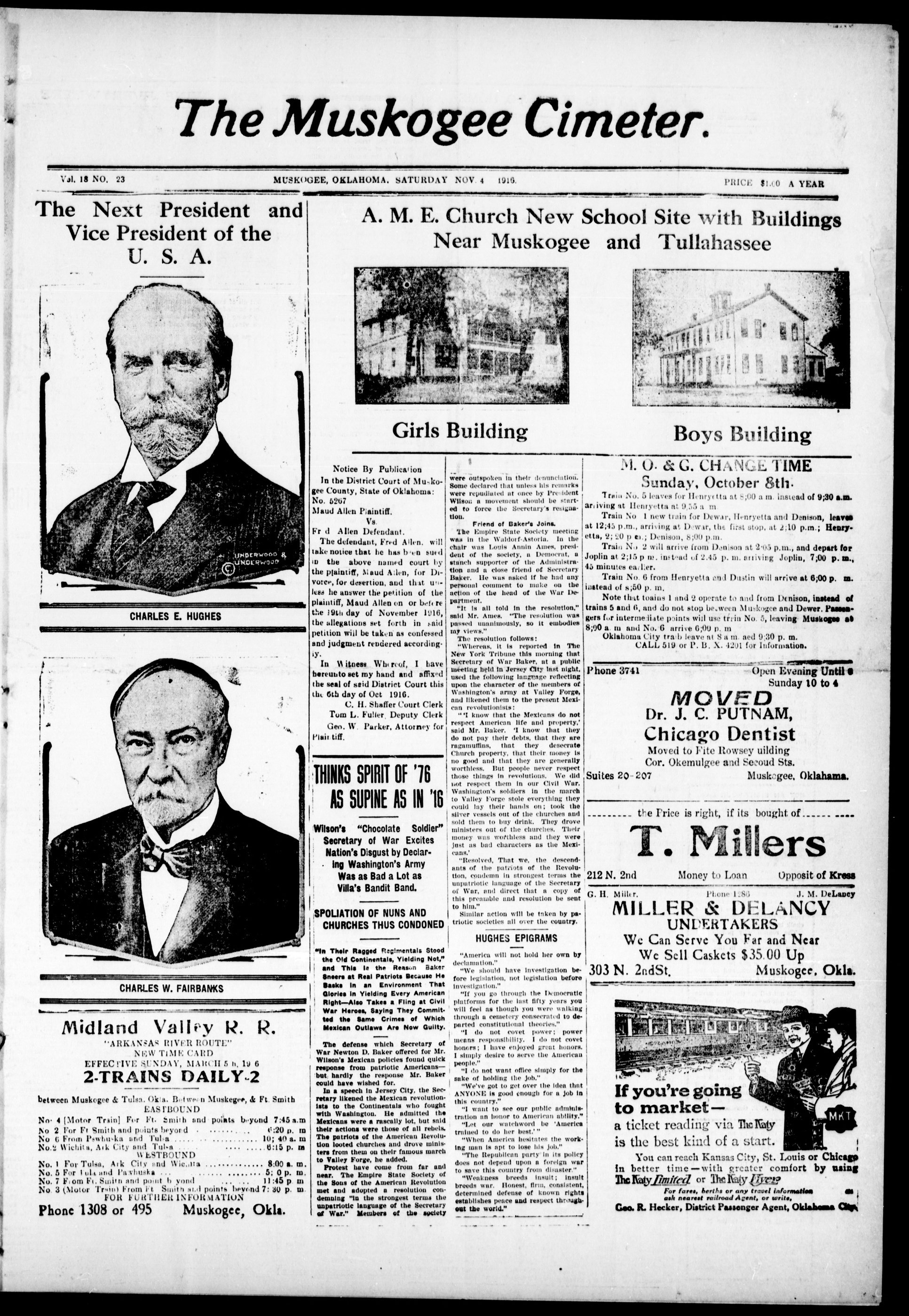
The Next President and Vice President of the U. S. A.
UNDERWOOD & UNDERWOOD
J.
Midland Valley R. R.
"ARKANSAS RIVER ROUTE"
NEW TIME CARD
EFFECTIVE SUNDAY, MARCH 5 n. 19 6
2-TRAINS DAILY-2
between Muskegee & Tulsa, Okla. Between Muskegee, & Ft. Smith
EASTBOUND
No. 4 [Motor Train] For Ft. Smith and points beyond 7:45 a.m
No. 2 For Ft Smith and points beyond 6:20 p. m
No. 6 From Pawhuska and Tulsa 10; 40 a. m
No. 2 Wichita, Ark City and Tulsa 6:15 p. m
WESTBOUND
No. 1 For Tulsa, Ark City and Wichita 8:00 a. m.
No. 5 For Tulsa and Pawhuska 5; 0 p. m.
No. 7 From Ft. Smith and point beyond 11:45 p. m.
No. 3 (Motor Train) From Ft. Smith and points beyond 7:30 p. m.
FOR FURTHER INFORMATION
Vol. 18 NO. 23
CHARLES E. HUGHES
[Name]
CHARLES W. FAIRBANKS
and Valley
ARKANSAS RIVER ROUTE
MUSKOGEE, OKLAHOMA. SATURDAY NOV. 4 1916.
A. M. E. Church New School Site with Buildings Near Muskogee and Tullahassee
THE HISTORY OF THE MUSEUM
Girls Building
In the District Court of Musko gee County, State of Oklahoma: No. 5267
The defendant, Fred Allen, will take notice that he has been sued in the above named court by the plaintiff, Maud Allen, for Divorce, for desertion, and that unless he answer the petition of the plaintiff, Maud Allen on or before the 19th day of November 1916, the allegations set forth in said petition will be taken as confessed and judgment rendered accordingly.
In Witness Whereof, I have bereunto set my hand and affixed the seal of said District Court this the 6th day of Oct. 1916.
C. H. Shaffer Court Clerk
Tom L. Fuller, Deputy Clerk
Geo. W. Parker, Attorney for Plaintiff.
THINKS SPIRIT OF '76 AS SUPINE AS IN '16
THINKS SPIRIT OF '76 AS SUPINE AS IN '16
Wilson's "Chocolate Soldier"
Secretary of War Excites
Nation's Disgust by Declaring Washington's Army
Was as Bad a Lot as
Villa's Bandit Band.
SPOLIATION OF NUNS AND CHURCHES THUS CONDONED
"In Their Ragged Regimentals Stood the Old Continentalals, Yielding Not," and This Is the Reason Baker Sneers at Real Patriots Because He Basks in an Environment That Glories in Yielding Every American Right—Also Takes a Fling at Civil War Heroes, Saying They Committed the Same Crimes of Which Mexican Outlaws Are Now Guilty.
The defense which Secretary of War Newton D. Baker offered for Mr. Wilson's Mexican policies found quick response from patriotic Americans—but hardly the response Mr. Baker could have wished for.
In a speech in Jersey City, the Secretary likened the Mexican revolutionists to the Continentalists who fought with Washington. He admitted the Mexicans were a rascally lot, but said their actions were those of all rebels. The patriots of the American Revolution looted churches and drove ministers from them on their famous march to Valley Forge, he added.
Protest have come from far and near. The Empire State Society of the Sons of the American Revolution met and adopted a resolution condemning "in the strongest terms the unpatriotic language of the Secretary of War." Members of the society
Maud Allen Plaintiff.
Vs.
Fr d Allen Defendant.
were outspoken in their denunciation. Some declared that unless his remarks were repudiated at once by President Wilson a movement should be started to force the Secretary's resignation.
Friend of Baker's Joins.
The Empire State Society meeting was in the Waldorf-Astoria. In the chair was Louis Amin Ames, president of the society, a Democrat, a stanch supporter of the Administration and a close friend of Secretary Baker. He was asked if he had any personal comment to make on the action of the head of the War Department.
"It is all told in the resolution," said Mr. Ames. "The resolution was passed unanimously, so it embodies my views."
The resolution follows:
"Whereas, it is reported in The New York Tribune this morning that Secretary of War Baker, at a public meeting held in Jersey City last night, used the following language reflecting upon the character of the members of Washington's army at Valley Forge, and likened them to the present Mexican revolutionists:
"I know that the Mexicans do not respect American life and property," said Mr. Baker. "I know that they do not pay their debts, that they are ragamuffins, that they desecrate Church property, that their money is no good and that they are generally worthless. But people never respect those things in revolutions. We did not respect them in our Civil War. Washington's soldiers in the march to Valley Forge stole everything they could lay their hands on; took the silver vessels out of the churches and sold them to buy drink. They drove ministers out of the churches. Their money was worthless and they were just as bad characters as the Mexicans."
"Resolved, That we, the descendants of the patriots of the Revolution, condemn in strongest terms the unpatriotic language of the Secretary of War, and direct that a copy of this preamble and resolution be sent to him."
Similar action will be taken by patriotic societies all over the country.
HUGHES EPIGRAMS
"America will not hold her own by declaration."
"We should have investigation before legislation, not legislation before investigation."
"If you go through the Democratic platforms for the last fifty years you will feel as though you were walking through a cemetery consecrated to departed constitutional theories."
"I do not covet power; power means responsibility. I do not covet honors; I have enjoyed great honors. I simply desire to serve the American people."
"I do not want office simply for the sake of holding the job."
"We've got to get over the idea that ANYONE is good enough for a job in this country."
"I want to see our public administration an honor to American ability."
"Let our watchword be 'America trained to do her best.'"
"When America hesitates the working man is apt to lose his job."
"The Republican party in its policy does not depend upon a foreign war to save this country from disaster."
"Weakness breeds insult; insult breeds war. Honest, firm, consistent, determined defense of known rights establishes peace and respect throughout the world."
PRICE $1.00 A YEAR
School Site with Building
and Tullahassee
te with Building
Tullahassee
THE MUSEUM
Boys Building
M. O. & G. CHANGE T
Sunday, October 8th
Train No. 5 leaves for Henryetta at 8:00 a.m.
at Henryetta at 9:55 a.m.
Train No. 1 new train for Dewar, Henryetta at
5 p.m., arriving at Dewar, the first stop, at
9:20 p.m.; Denison, 8:00 p.m.
Train No. 2 will arrive from Denison at 2:05 p.m.
at 2:15 p.m. instead of 2:45 p.m. arriving
six minutes earlier.
Train No. 6 from Henryetta and Dustin will s
of s;50 p.m.
Note that toains 1 and 2 operate to and from
5 and 6, and do not stop between Muskogee
intermediate points will use tfrin No. 5, lea
m and No. 6 arrive 6:00 p.m.
Oklahoma City train leave at 8 a.m. aed 9:30
CALL 519 or P. B. X. 4201 for Infor
3741 Open
Su
MOVED
Dr. J. C. PUTNAD
Chicago Dentist
Moved to Fite Rowsey uildi
Cor. Okemulgee and Secoud
20-207 Muskogee
the Price is right, if its bought
T. Miller
N. 2nd Money to Loan
Miller. Phone 1286
MILLER & DELA
UNDERTAKERS
We Can Serve You Far and
We Sell Caskets $35.00
N. 2ndSt. Muskogee
If you're going
to market—
R. G. CHANGE TIME
Friday, October 8th.
for Henryetta at 8:00 a.m. instead of 9:00 a.m.
at 9:55 a.m.
train for Dewar, Henryetta and Denison,
at Dewar, the first stop, at 2:10 p.m.; on, 8:00 p.m.
arrive from Denison at 2:05 p.m., and depart at 2:45 p.m. arriving Joplin, 7:00 p.m.
Henryetta and Dustin will arrive at 6:00 p.m.
and 2 operate to and from Denison, instead of stop between Muskogee and Dewer.
points will use ttrin No. 5, leaving Muskogee, arrive 6:00 p.m.
arb leave at 8 a.m. aed 9:30 p.m.
9 or P. B. X. 4201 for Information.
Open Evening U
Sunday 10 t
MOVED
J. C. PUTNAM,
Chicago Dentist
led to Fite Rowsey uilding
Okemulgee and Secoud Sts.
Muskogee, Oklah
ce is right, if its bought of.....
Millers
Money to Loan Opposit of
ER & DELANCY
UNDERTAKERS
Serve You Far and Near
Fell Caskets $35.00 Up
Muskogee, O
are going
market—
M. O. & G. CHANGE TIME
Train No. 5 leaves for Henryetta at 8;00 a.m. instead of 9;30 a.m. arriving at Henryetta at 9:55 a.m.
Train No. 1 new train for Dewar, Henryetta and Denison, leaves at 12;45 p.m., arriving at Dewar, the first stop, at 2;10 p.m.; Henryetta, 2;20 p.m.; Denison, 8;00 p.m.
Train No. 2 will arrive from Denison at 2:05 p.m., and depart for Joplin at 2;15 p.m. instead of 2.45 p.m. arriving Joplin, 7;00 p.m., 45 minutes earlier.
Train No. 6 from Henryetta and Dustin will arrive at 6;00 p. m. instead of s;50 p. m.
Note that toains 1 and 2 operate to and from Denison, instead of trains 5 and 6, and do not stop between Muskogee and Dewer. Passengers for intermediate points will use trin No. 5, leaving Muskogee at 8;00 a.m. and No. 6 arrive 6;00 p.m.
Oklahoma City train leave at 8 a.m. aed 9;30 p.m.
CALL 519 or P. B. X. 4201 for Information.
212 N. 2nd Money to Loan Opposit of Kress
G. H. Miller. Phone 1286 J. M. DeLancy
MILLER & DELANCY
UNDERTAKERS
We Can Serve You Far and Near
We Sell Caskets $35.00 Up
303 N. 2ndSt. Muskogee. Okla.
If you're going
a ticket reading via The Katy is the best kind of a start.
You can reach Kansas City, St. in better time—with greater co The Katy Limited or The Katy Lines
For fares, berths or any travel in ask nearest railroad Agent, or w Geo. R. Hecker, District Passenger Agent
reach Kansas City, St. Louis or C
time—with greater comfort by
United or The Katy River
or fares, berths or any travel information
nearest railroad Agent, or write,
er, District Passenger Agent, Oklahoma
You can reach Kansas City, St. Louis or Chicago in better time with greater comfort by using The Katy Limited or The Katy Lines For fares, berths or any travel information ask nearest railroad Agent, or write Geo. R. Hecker, District Passenger Agent, Oklahoma City
clean state of health to write the increase for 1916 Which kind of was significantly more than the speech of 15
MEMBER
NATIONAL NEGRO PRESS
ASSOCIATION
The Cimice is the only Republican
paper in the City of Muskogee. The
daily Phoenix is sometimes Republican
and sometimes independent but as
the present time it claims to be in-
dependent, such a changing is not worth
three whoops in h — 1 to any political
party and yet Bibby, its editor, got
rich at the Republican pie counter.
What base ingratitude.
The Republican party is the
ship and all else the sea. The
Oklahoma Negro is sure that
from bitter experience.
REPUBLICAN COUNTY
CANDIDATES.
For Congress Second District
Harry Ward.
For Shernir—F. J. Bays.
For County Attorney—H. C.
Whipperman.
For County Judge—Myron
White.
For County Treasurer—A .A.
Coupland.
For County Assessor—J. W.
Hubbard.
For County Clerk—W. S. Harsha.
For Court Clerk—Dr. J. M.
Coon.
For County Superintendent —
Miss Alice M. Robertson.
For County Surveyor—M. A.
Earl.
For County Weigher—F. T.
Swift.
Commissioners.
No. 1.—John L. Cooper, Ft. Gibson.
No. 2—J. C. Rhodes, Webbers Falls.
No. 3—Irvin Blanchard, Haskell.
State Representatives.
John Lieber.
O. E. Cramer.
Geo. Leopold.
SURRENDER TO FORCE
WOULD TEND TO
DISASTER.
"That kind of virus in our life—surrender to force—would bring ua no end of disaster. If we let capitalists or workingmen, any interest, learn that the way to get what is wanted is by applying pressure and if we continue in that course for a few years, democracy will be a failure, and we might as well give up our form of government."—Mr. Hughes in His Speech at Portland, Maine.
NOT AN EIGHT-HOUR LAW.
Recent Hold-Up Legislation Does Not Shorten Workday a Minute.
As a matter of fact, it is not an eight-hour law at all. It does not curtail the trainmen's workday by a single minute. If an engineer has been receiving $5 for working ten hours a day, this law will raise his pay to $6.25; but it will not shorten his workday even the tenth part of a second. This is no more like the true eight-hour principle than chalk is like cheese.
The reason why people call this an eight-hour law is because it says that in the case of railroad trainmen they shall get their day's pay for the first eight hours' work, and all the rest is to be considered overtime.
Do not tell me that this strike could not have been called off or postponed if President Wilson had shown that he meant business. I do not for one minute believe that those four brotherhood leaders started the blaze going without knowing how to put it out. One of them admitted that he could put it out so far as his own brotherhood was concerned, but that his followers would think that he had gone back on them if he were to do so.—Statement of Congressman A. P. Gardner.
---
Irvin S. Cobb is to make campaign speeches for the Democratic party in the West. Irv, you all recall of course, is a humorist, and is peculiarly equipped to do full justice to his subject.
ANSWER: EIGHT HOURS,
NOT EIGHT YEARS.
(Special Dispatch to the N. Y. Herald.)
BAR HARBOR, Me., Monday.
To the Editor of the Herald:—
Maine's answer to Wilson:—
"Eight hours, but not eight
years."—A Former Progressive.
THOUSANDS THROUGH OUT OF EMPLOYMENT
YOUR JOB
THERE'S A JOB, GO FIGHT FOR IT!
PRUMPTION
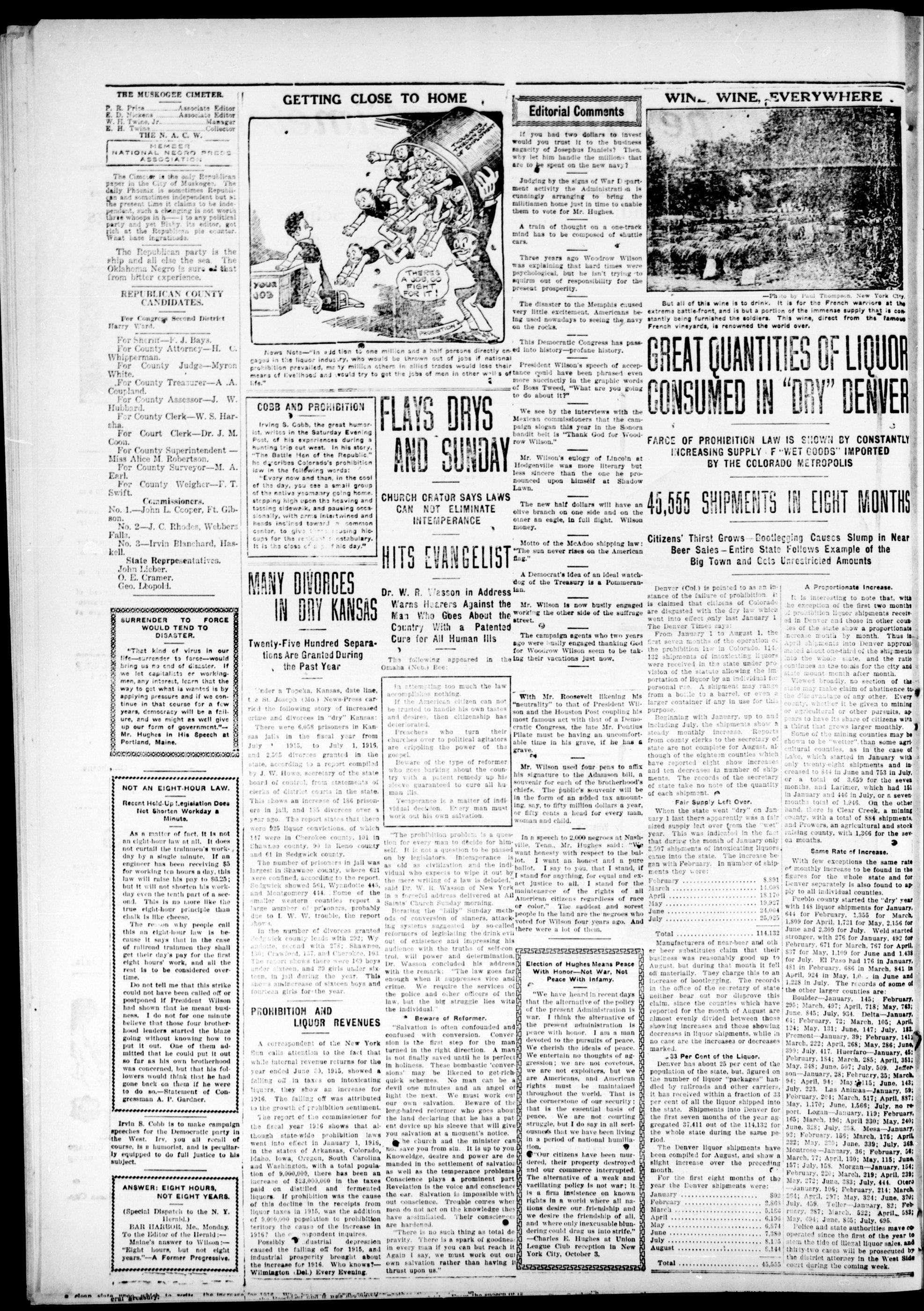
News Note—"In addition to one million and a half persons directly engaged in the liquor industry, who would be thrown out of jobs if national prohibition prevailed, many million others in allied trades would lose their means of livelihood and would try to get the jobs of men in other walls of life."
COBB AND PROHIBITION
Irving S. Cobb, the great humorist, writes in the Saturday Evening Post, of his experiences during a hunting trip out west. In his story, "The Battle Hen of the Republic," he describes Colorado's prohibition law in the following words: "Evary now and then, in the cool of the day, you see a small group of the native yucommian going home, stepping high upon the heaving and tossing sidewalk, and pausing occasionally, with arms intertwined and heads inclined toward in common center, to give them housing hiccups for the resident in instability. It is the close of a profitable day."
MANY DIVORCES IN DRY KANSAS
Twenty-Five Hundred Separations Are Granted During the Past Year
Under a Topeka, Kansas, date line, the St. Joseph (Mo.) News-Press carried the following story of increased crime and divorces in "dry" Kansas: There were 6,058 prisoners in Kansas jails in the fiscal year from July 1, 1915, to July 1, 1915, and 2,505 divorces granted in the state, according to a report compiled by J. W. Howe, secretary of the state board of control, from statements of clerks of district courts in the state. This shows an increase of 186 prisoners in jail, and 135 divorces over a year ago. The report states that there were 925 liquor convictions, of which 147 were in Cherokee county, 101 in Shawnae county, 90 in Keno county and 61 in Sedwick county.
The number of prisoners in jail was largest in Shawnee county, where 621 were confined, according to the report. Sedgwick showed 561, Wyandotte 445, and Montgomery 444. Some of the smaller western counties report a large number of prisoners, probably due to I. W. W. trouble, the report shows.
In the number of divorces granted Sedgwick county leads with 292; Wyandotte, second with 278; Shawnee, 150; Crawfed, 137, and Cherokee, 103. The report shows there were 169 boys under sixteen, and 29 girls under sixteen, in jail during the year. This shows an increase of sixteen boys and fourteen girls for the year.
PROHIBITION AND LIQUOR REVENUES
A correspondent of the New York Sun calls attention to the fact that while internal revenue returns for the year ended June 30, 1915, showed a falling off in taxes on intoxicating liquors, they show an increase for 1916. The failing off was attributed to the growth of prohibition sentiment.
The report of the commissioner for the fiscal year 1916 shows that although state-wide prohibition laws went into effect in January 1, 1916, in the states of Arkansas, Colorado, Idaho, Iowa, Oregon, South Carolina and Washington, with a total population of 9,000,000, there has been an increase of $23,000,000 in the taxes paid on distilled and fermented liquors. If prohibition was the cause of this decline in the receipts from liquor taxes in 1915, was the addition of 9,000,000 population to prohibition territory the cause of the increase in 1916? the respondent inquires. Possibly industrial depression caused the falling off for 1915, and industrial prosperity brought about the increase for 1916. Who knows?—Wilmington (Del.) Every Evening.
FLAYS DRYS AND SUNDAY
CHURCH ORATOR SAYS LAWS
CAN NOT ELIMINATE
INTEMPERANCE
Dr. W. R. Wesson in Address
Warns Heavers Against the
Man Who Gbes About the
Country With a Patented
Cure for All Human Ills
The following appeared in the
Omaha (Neb.) Bee:
In attempting too much the law
accomplishes nothing.
If the American citizen can not
be trusted to handle his own tastes
and desires, then citizenship has
deteriorated.
Preachers who turn their
churches over to political agitators
are crippling the power of the
gospel.
Beware of the type of reformer who goes barking about the country with a patent remedy up his sleeve guaranteed to cure all human ills.
Temperance is a matter of individual decision. Every man must work out his own salvation.
"The prohibition problem is a question for every man to decide for himself. It is not a question to be passed on by legislators. Intemperance is as old as civilization and the individual who expects to wipe it out by the mere writing of a law is deluded," said Dr. W. R Wasson of New York in a forceful address delivered at All Saints' Church Sunday morning.
Bering the "Billy" Sunday methods of conversion of sinners, attacking systems suggested by so-called reformers of legislating the drink evil out of existence and impressing his
audience with the truths of self-control, will power and determination. Dr. Wasson concluded his address with the remark: "The law goes far enough when it suppresses vice and crime. We require the services of the police and other officers of the law, but the big struggle lies with the individual."
Beware of Reformer.
"Salvation is often confounded and confused with conversion. Conversion is the first step for the man turned in the right direction. A man is not finally saved until he is perfect in holiness. These bombastic 'conversions' may be likened to get-rich quick schemes. No man can be a devil one minutes and an angel of light the next. We must work out our own salvation. Beware of the long-hadred reformer who goes about the land declaring that he has a pat ent device up his sleeve that will give you salvation at a moment's notice.
the church and the minister can not save you from sin. It is up to you Knowledge, desire and power are demanded in the settlement of salvation as well as the temperance problems Conscience plays a prominent part Revelation is the voice and conscience the ear. Salvation is impossible with out conscience. Trouble comes when men do not act on the knowledge they have assimilated. Their conscience are hardened.
"There is no such thing as total deprivity. There is a spark of goodness in every man if you can but reach it Again I say, we must work out our own salvation rather than having it thrust upon us."
Editorial Comments
If you had two dollars to invest would you trust it to the business sagacity of Josephus Daniels? Then, why let him handle the millions that are to be spent on the new navy?
Judging by the signs of War Department activity the Administration is cunningly arranging to bring the militiamen home just in time to enable them to vote for Mr. Hughes.
A train of thought on a one-track mind has to be composed of shuttle cars.
Three years ago Woodrow Wilson was explaining that hard times were psychological, but he isn't trying to squirm out of responsibility for the present prosperity.
The disaster to the Memphis caused very little excitement. Americans being used nowadays to seeing the navy on the rocks.
This Democratic Congress has passed into history—profane history.
President Wilson's speech of acceptance could have been phrased even more succinctly in the graphic words of Boss Tweed, "What are you going to do about it?"
We see by the interviews with the Mexican commissioners that the campaign slogan this year in the Sonora bandit belt is "Thank God for Woodrow Wilson."
Mr. Wilson's eulogy of Lincoln at Hodgenville was more literary but less sincere than the one he pronounced upon himself at Shadow Lawn.
The new half dollars will have an olive branch on one side and on the other an eagle, in full flight. Wilson money.
Motto of the McAdoo shipping law: "The sun never rises on the American flag."
A Democrat's idea of an ideal watchdog of the Treasury is a Pommeranian.
Mr. Wilson is now busily engaged working the other side of the suffrage street.
The campaign agents who two years ago were busily engaged thanking God for Woodrow Wilson seem to be taking their vacations just now.
With Mr. Roosevelt likening his "neutrality" to that of President Wilson and the Houston Post coupling his most famous act with that of a Democratic Congress, the late Mr. Pontius Pilate must be having an uncomfortable time in his grave, if he has a grave.
Mr. Wilson used four pens to affix his signature to the Adamson bill, a souvenir for each of the brotherhood's chiefs. The public's souvenir will be in the form of an added tax amounting, say, to fifty million dollars a year, or fifty cents a head for every man, woman and child.
In a speech to 2,000 negroes at Nashville, Tenn., Mr. Hughes said: "We want honesty with respect to the ballot. I want an honest and a pure ballot. I say to you, that I stand, if I stand for anything, for equal and exact justice to all. I stand for the maintenance of the rights of all American citizens regardless of race or color." The saddest and soarest people in the land are the negroes who voted for Wilson four years ago. And there were a lot of them.
```markdown
```
Election of Hughes Means Peace With Honor—Not War, Not Peace With Infamy.
"We have heard in recent days that the alternative of the policy of the present Administration is war. I think the alternative of the present administration is peace with honor. I am a man devoted to the pursuits of peace. We cherish the ideals of peace. We entertain no thoughts of aggression; we are not covetous, we are not exploiters, but we are Americans, and American rights must be maintained throughout the world. That is the cornerstone of our security; that is the essential basis of peace. We are not courting struggle, but I do say in all seriousness that we have been living in a period of national humiliation.
"Our citizens have been murdered, their property destroyed and our commerce interrupted. The alternative of a weak and vacillating policy is not war; it is a firm insistence on known rights in a world where all nations desire our friendship and we desire the friendship of all, and where only inexcusable blundering could drag us into strife." —Charles E. Hughes at Union League Club reception in New York City, October 3.
```markdown
```
But all of this wine is to drink. It is for the French warriors at the extreme battlefront, and is but a portion of the immense supply that is constantly being furnished the soldiers. This wine, direct from the famous French vineyards, is renowned the world over.
GREAT QUANTITIES OF LIQUOR CONSUMED IN "DRY" DENVER
FARCE OF PROHIBITION LAW IS SHOWN BY CONSTANTLY INCREASING SUPPLY F "WET GOODS" IMPORTED BY THE COLORADO METROPOLIS
45,555 SHIPMENTS IN EIGHT MONTHS
Citizens' Thirst Grows-Bootlegging Causes Slump in Near Beer Sales-Entire State Follows Example of the Big Town and Cots Unrestricted Amounts
Denver (Col.) is pointed to as an instance of the failure of prohibition it is claimed that citizens of Colorado are disgusted with the dry law which went into effect only last January 1 The Denver Times says:
From January 1 to August 1, the first seven months of the operation of the prohibition law in Colorado. 114. 132 shipments of intoxicating liquors were received in the state under provision of the statute allowing the importation of liquor by an individual for personal use. A shipment may range from a bottle to a barrel, or even a larger container if any in use for this purpose.
Beginning with January, up to and including July, the shipments show a steady monthly increase. Reports from county clerks to the secretary of state are not complete for August, although of the eighteen counties which have reported eight show increases and ten decreases in number of shipments. The records of the secretary of state take no note of the quantity of each shipment.
Fair Supply Left Over.
When the state went "dry" on January 1 last there apparently was a fair sized supply left over from the "wet" year. This was indicated in the fact that during the month of January only 2,507 shipments of intoxicating liquors came into the state. The increase began with February. In number of shipments they were:
February ..... 8,891
March ..... 14,608
April ..... 18,170
May ..... 19,927
June ..... 24,004
July ..... 25,925
Manufacturers of near-beer and other beer substitutes claim that their business was reasonably good up to August, but during that month it fell off materially. They charge this to an increase of bootlegging. The records in the office of the secretary of state neither bear out nor disprove this claim, since the counties which have reported for the month of August are almost evenly divided between those showing increases and those showing decreases in liquor shipments, while in no case are the increases or decreases marked.
33 Per Cent of the Liquor.
Denver has about 25 per cent of the population of the state, but, figured on the number of liquor "packages" handled by railroads and other carriers, it has received within a fraction of 33 per cent of all the liquor shipped into the state. Shipments into Denver for the first seven months of the year aggregated 37,411 out of the 114,132 for the whole state during the same period.
The Denver liquor shipments have been compiled for August, and show a slight increase over the preceding month.
For the first eight months of the year the Denver shipments were:
January ..... 892
February ..... 2,863
March ..... 5,183
April ..... 6,196
May ..... 6,374
June ..... 7,389
July ..... 8,135
August ..... 8,144
A Proportionate Increase.
It is interesting to note that, with the exception of the first two months of prohibition liquor shipments received in Denver and those in other counties of the state show a proportionate increase month by month. Thus in April shipments into Denver approximated about one-third of the shipments into the whole state, and the ratio continues as the totals for the city and state mount month after month.
Viewed broadly, no section of the state may make claim of abstinence to the disadvantage of any other. Every county, whether it be given to mining or agricultural or other pursuits, appears to have its share of citizens with a thirst that grows larger monthly. Some of the mining counties may be shown to be "wetter", than some agricultural counties, as in the case of Lake, which started in January with only twenty-eight shipments and increased to 844 in June and 753 in July, or a total of 3,659 for the seven months, and Larimer, which had 151 in January and 446 in July, or a seven months total of 1,946. On the other hand, there is Clear Creek, a mining county, with a total of 884 shipments, and Prowers, an agricultural and stock raising county, with 1,366 for the seven months.
Same Rate of Increase.
With few exceptions the same rate of monthly increase to be found in the figures for the whole state and for Denver separately is also found to apply to all individual counties.
Pueblo county started the "dry" year with 148 liquor shipments for January, 644 for February, 1,355 for March, 1,809 for April, 1,721 for May, 2,156 for June and 2,309 for July. Weld started stronger, with 276 for January, 492 for February, 671 for March, 767 for April, 837 for May, 1,109 for June and 1,438 for July. El Paso had 176 in January, 481 in February, 686 in March, 841 in April, 924 in May, 1,001 in June and 1,228 in July. The records of some of the other larger counties are:
Boulder—January, 145; February, 295; March, 497; April, 718; May, 763; June, 845; July, 934. Delta—January, 64; February, 72; March, 105; April, 124; May, 131; June, 147; July, 182. Fremont—January, 39; February, 141; March, 222; April, 268; May, 286; June, 399; July, 417. Huerfano—January, 45; February, 184; March, 285; April, 351; May, 348; June, 507; July, 509. Jefferson—January, 28; February, 35; March, 94; April, 94; May, 115; June, 143; July, 223. Las Animas—January, 59; February, 204; March, 517; April, 887; May, 1,170; June, 1,566; July, no report. Logan—January, 119; February, 165; March, 196; April, 230; May, 240; June, 328; July, 258. Mesa—January, 92; February, 156; March, 175; April, 222; May, 200; June, 339; July, 368. Montrose—January, 36; February, 56; March, 77; April, 130; May, 115; June, 157; July, 158. Morgan—January, 154; February, 202; March, 219; April, 239; May, 272; June, 233; July, 444. Otter—January, 106; February, 214; March, 204; April, 297; May, 324; June, 370; July, 459. Teller—January, 82; February, 287; March, 522; April, 593; May, 694; June, 805; July, 695.
Police and state authorities move co- operated since the first of the year to stem the tide of illegal liquor sales, and thirty-two cases will be prosecuted by the district attorney in the West Side court during the coming week.
Reasons Why Hughes Should Be Elected
BECAUSE he stands for Protection, Prosperity, Preparedness and Patriotism.
BECAUSE he will not permit partisanship to triumph over Patriotism.
BECAUSE his speech of acceptance expresses his desire to co-operate with labor for its advantage, not to exploit it for his own.
BECAUSE he will command the respect of Europe and Asia and win the friendship of Latin-America.
BECAUSE he will never by proclamation deny the right of Americans to pursue their business in other lands under the protection of the American flag.
DECORUM, as Theodore Moore well says, he has high sentiments of justice and dignity, is upright and straightforward, is an incontestable master of judicial matters, and always translates his words into deeds.
BECAUSE he is a strong, sure, courageous man, with a clear-cut program before him and with the courage, intelligence and determination to carry it out and bring to our country self-respecting peace and world-wide respect.
BECAUSE as Governor of New York he has already proved that he dared to do the right thing, and is prepared to further do and dare when called into a wider field.
BECAUSE he is not a dreamer and not a quitter.
BECAUSE he is a firm friend of preparedness for the United States and not for preparedness through political expediency.
BECAUSE he will not burden us with war taxes in time of peace.
BECAUSE we need a tariff not founded upon free trade, nor for "revenue only," but to protect American labor and American industry from the deadly competition of the foreigner.
BECAUSE he is a red-blooded American. His policy will be "America first, America efficient."
BECAUSE he can be depended upon to keep platform pledges.
BECAUSE he will protect this country against being flooded with the cheap manufactures of Europe after the war.
BECAUSE he is the chosen head of a party which has long fathered all great constructive legislation which experience has proved to be wise and which has invariably been opposed by the Democratic party.
BECAUSE a business man is going to be especially needed in the next few years. In consequence of the European war a tremendous readjustment of the world's business is ahead. The United States must be economically prepared. It must not, as now, be left defenseless. It must not have a President with an untrained business mind, ever changing. Mr. Hughes made a remarkable record as a business Governor of New York. He has extraordinary ability to see all sides of a question. Not from him, as from Wilson, will be heard any declaration that he will hang business men "high as Haman" if they do not agree with him.
BECAUSE he is a man of forward vision, of practicability and firmness, not a mere rhetorician and theorist.
BECAUSE he stands for the protection of American lives and property abroad as well as at home.
BECAUSE through him the whole nation will be in the Government. It will not be ruled by one section, nor by one man. BECAUSE he is for an effective, not an unsound and sham system of rural credits to help the farmer and for a wise conservation of natural resources. BECAUSE he is for a Federal workingmen's compensation law suitable for the employees of the Government, and those employees engaged in interstate commerce and subject to the hazard of injury. BECAUSE he favors investigating before legislating.
their cases investigating before registering.
Reasons Why Wilson Should Be Defeated
BECAUSE, to cite Representative Fitzgerald, Democratic Chairman of the Appropriations Committee of the House, during his administration the Democratic Congress has been the most extravagant that has ever met in the capital.
BECAUSE he insists on his shipping bill—an indefensible piece of folly which would destroy such merchant marine as we now have.
BECAUSE, although he says "he kept us out of war," the story of Mexico, San Domingo and Hayti refutes him.
BECAUSE he runs anti-climaxes. He marches in only to march out again.
BECAUSE he signed the seamen's bill, which practically has wiped out shipping on the Pacific Coast.
BECAUSE he attempted to scuttle from the Philippines and was defeated only by twenty patriotic Democrats who voted with the Republicans of the House.
BECAUSE he appointed as Secretary of State William J. Bryan after denouncing him as a pest who should be "knocked into a cocked hat."
BECAUSE he made possible Villa, murderer of men and despoiler of women, and Carranza, the fatuous and futile "First Chief."
BECAUSE Wilson's text book statesmanship and grape-juice diplomacy have made the United States an international laughing stock.
BECAUSE he appointed "deserving Democrats" to the diplomatic corps, displacing experienced men at a time when it was essential to the foreign trade and honor of the United States to retain competent, experienced men.
BECAUSE he is incompetent to lead, and veers like a weather vane whenever a zephyr of public opinion seems to blow against him.
BECAUSE his "one-track mind" has too many turn-tables.
BECAUSE he lifted the embargo of arms so that the Mexican desperadoes have used American ammunition to murder American soldiers and civilians.
BECAUSE the promised "pitiless publicity" has been replaced by private, special, secret negotiations by personal agents and representatives, appointed by President Wilson without "the advice and consent of the Senate."
BECAUSE he reverses himself so rapidly that the entire country is seasick from the motion.
BECAUSE he is for free trade, direct taxes and an empty treasury—the same old Democratic trinity.
BECAUSE if the Payne-Aldrich law had been in operation in the last nine months of 1915 we would have collected $91,656,161 more than we did under the Underwood law. It would have met the treasury deficits and have avoided war taxes. The foreigner selling in our market got the entire benefit of the $91,656,161.
BECAUSE during the first ten months of the Wilson-Underwood law there were more unemployed being fed by charity than during any ten months in our history, excepting under the Wilson-Gorman act.
BECAUSE of his inconsistency on the immigration bill. In his "History of the American People," vol. 5, p. 213, he wrote: "The Chinese were more to be desired as workmen, if not as citizens, than most of the coarse crew that came crowding in every year at the Eastern ports."
BECAUSE he has not reduced, as he promised, the high cost of living, but has actually made it higher.
BECAUSE he was pledged to a single term by the Baltimore convention, but before the type was cold he was building up his fences for another.
WHO IS THE REAL FRIEND OF LABOR?
What Wilson Said About Unions and Workmen When He Did not Want Their Votes.
What Hughes Said About Unions and Workmen
There are some who regard organized labor as a source of strife and menace of difficulty. I regard it as a fine opportunity for the amelioration of the condition of men working with no other purpose than to make the most of themselves and to achieve something for their families.—Speech at dedication of Tuberculosis Pavilion, Albany, New York, Aug. 29, 1908.
I am a fierce partisan of the open shop and of everything that makes for individual liberty.—Speech at open shop banquet, Jan. 12, 1909.
The labor unions reward the shysters and incompetent at the expense of the able and industrious.—Speech People's Forum, New Kochelle, Feb. 25, 1905.
The mission of labor organizations is one of the finest that any association of men could guard. Today we have a realization of what can be accomplished.—Speech at Dedication of Tuberculosis Pavilion Aug. 29, 1908.
We speak too exclusively of the capitalistic class. There is another as formidable an enemy to equality and freedom of opportunity as it is and that is the class formed by the labor organizations and leaders of this country.—Speech, Waldorf Hotel, New York, March 16, 1907.
It is a shocking thought that the wage earners of the country, who by their daily toll make possible the industrial prestige of which we boast, should be subjected through ignorance or indifference to unnecessary peril. The interests of labor are the interests of all the people, and the protection of the wage earner in the security of his life and health by every practical means is one of the most sacred trusts of society.-Speech, Exposition of Safety Devices and Industrial Hygiene, Jan. 28, 1907.
You know what the usual standard of the employee is in our day. It is to give as little as he may for his wages. Labor is standardized by the trade unions, and this is the standard to which it is made to conform. No one is suffered to do more than the average workman can do.—Address to graduating class, Princeton University, June 3, 1909.
The objections I have to labor unions is that they drag the highest man to the level of the lowest. I must demur with the labor unions when they say "you must award the dull the same as you award those with special gifts."—Speech in People's Forum, New Rochelle, Feb. 25, 1905.
I believe in a six-day working week. So do you. But do you know that the men who are making a six-day week a possibility and an eventual fixture, are these men (labor representatives) and their associates? I long ago came to the conclusion that the labor unions are going to solve the Sunday labor question to the best interest of the country. Join hands with them and you will double your results, while halving your labor.—Address to preachers and labor representatives in Executive Chamber, Albany, 1908.
The Chinese were more to be desired as workmen, if not as citizens, than the coarse crew that came crowding in every year at Eastern ports. History of American People.
Negroes will go in the Federal Courts No Begging for assistance of any political party in this fight
With a determination to never cease and to fight on until every election official in Oklahoma is jailed who denies black men their liberty and free access to the voting privilege, the Negroes of Oklahoma have risen up in arms to, with their dollars, slam these scoundrels and rascals into the Federal courts. In most of the counties of this state the Negroes have in large numbers registered unmolested but in McIntosh, Muskogee, Wagoner and Okfuskee counties, the real black belt of Oklahoma, there has been a flagrant violation of the recent Supreme Court decision and Negroes have been intimidated and abused by the minions of Gov. Williams. For instance, at Rentiesville, a Negro town in McIntosh county, where there are 180 electors, four Negroes are registered. At Eufaula, with about 400 black electors, six have been permitted to qualify. In the city of Muskogee, with about 12,000 odd Negroes, their rights have been curtailed and denied with a viciousness unheard of in this state. At Boley, which is situated in Paden District No. 2, with 500 odd electors, not a single Negro is registered save and except three or four who affiliate with the Democratic party. Wagoner county registrars were equally as ruthless in their disregard for the citizenship rights of black men and the time is ripe for a fearless and determined stand against the outrageous encroachment of Southern prejudice. There will be no begging for the assistance of any political party in this fight. It is a problem that belongs solely to black men and they propose to shoulder their own burden and face the enemy with black initiative and intelligence.
In the supplemental registration, which begins the 18th and continues for ten days, the Negroes of the various counties who have not been permitted to register intend to peaceably and lawfully present themselves before the registrar. They propose to have present with them witnesses. On election morning these same Negroes, registered or unregistered, propose to present themselves to vote and have witnesses in this instance. Also, with this record made, they propose to file suits for damages in the Federal courts against every election official who denies black men their Constitutional rights. Backing this move are all of the Negro newspapers of the state, who have started already a campaign for funds. Lawyers will be employed and a vigorous and forceful fight be made to prosecute every cowardly attempt to confiscate the liberty that is justly the right of black men.
A citizens committee has been formed to hold the many dollars that are pouring into this fund, the members of which are Dr. A. B. Whitby, president of the Oklahoma City branch of the Nation-Guillory, president of the Muskogee Negro Business Men's League, al Association for the Advancement of Colored People; Hon. E. N. and Hon. O. W. Gurley, a heavy taxpayer and property owner of Tulsa.
Every loyal member of the race is asked to contribute to this fund, the time is short and the finance is very much needed. Every dollar contributed will be accounted for each week through the columns of the Negro Journals of this state. The move is non-partisan entirely, the guiding spirits of the movement are actuated by but one purpose and that is the desire to effectualize the black man's
right to do anything in Oklahoma, that, under the law, any other man may do. If you love your race—if your race pride is worth a dime or a dollar—cash it now by sending your financial assistance to any of the members of the Finance committee whose addresses follow:
Dr. A. B. Whitby, 3151½ E. Second St., Oklahoma City.
Hon. E. N. Guillory, 207 So. Second St., Muskogee, Okla.
Hon. O. W. Gurley, 114 North Greenwood, Tulsa, Okla.
M. R. S.
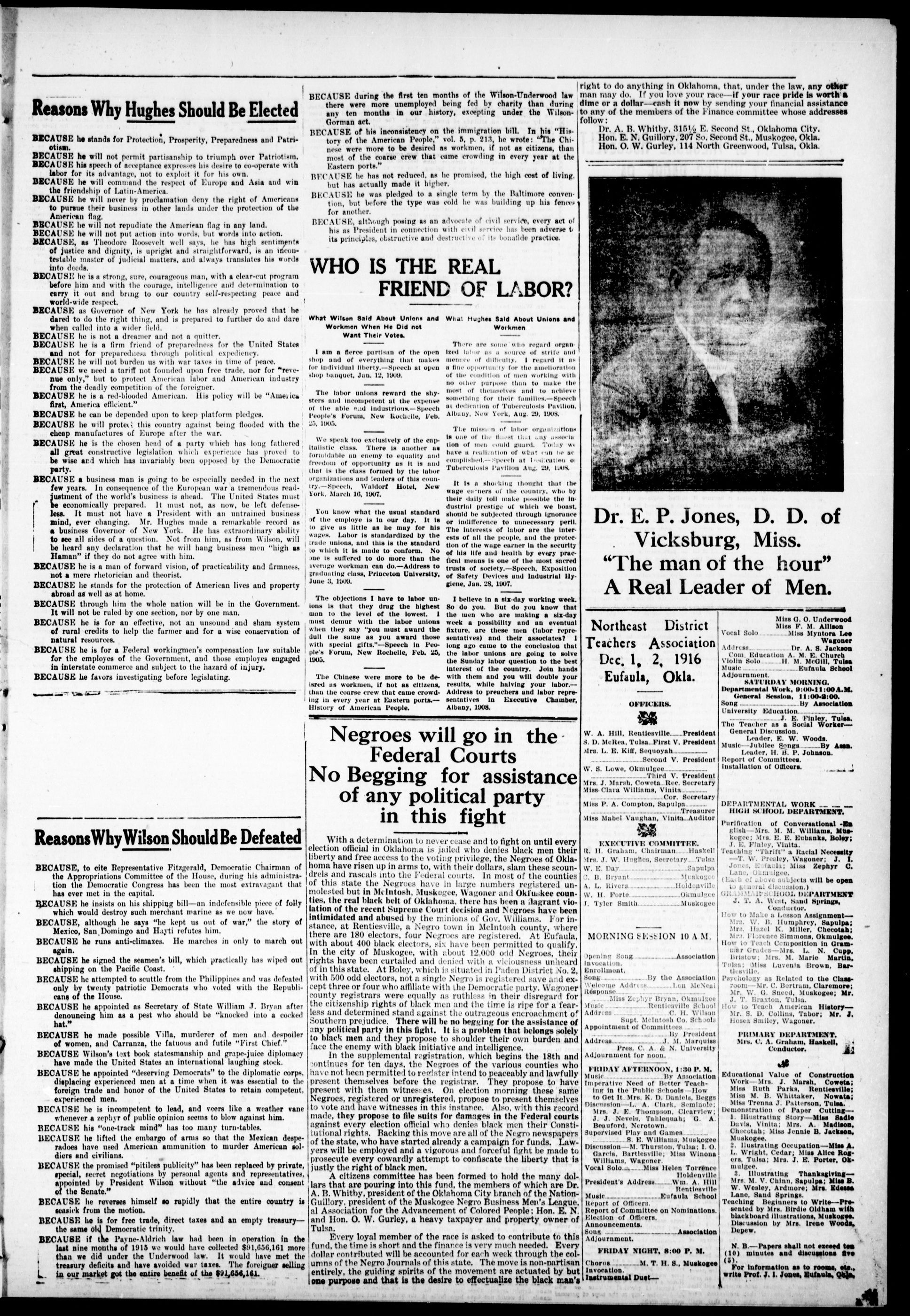
Dr. E. P. Jones, D. D. of Vicksburg, Miss. "The man of the hour" A Real Leader of Men.
Miss G. O. Underwood
Miss F. M. Allison
Vocal Solo.....Miss Mytanta Lee
Wagoner
Address.....Dr. A. S. Jackson
Com. Education A. M. E. Church
Violin Solo.....H. M. McGill, Tulsa
Music.....Eufaula School
Adjournment.
SATURDAY MORNING.
Departmental Work, 9:00-11:00 A.M.
General Session, 11:00-2:00.
Song.....By Association
University Education
J. E. Finley, Tulsa.
The Teacher as a Social Worker—
General Discussion.
Leader, E. W. Woods.
Music—Jubilee Songs.....By Assn.
Leader, H. B. P. Johnson.
Report of Committees.
Installation of Officers.
Northeast District Teachers Association Dec.1, 2, 1916 Eufaula, Okla.
OFFICERS.
W. A. Hill, Rentlesville President
S. D. McRea, Tulsa. First V. President
Mrs. L. E. Kiff, Sequoyah
Second V. President
W. S. Lowe, Okmulgee
Third V. President
Mrs. J. Marsh, Coweta. Rec. Secretary
Miss-Clara Williams, Vinita
Cor. Secretary
Miss P. A. Compton, Sapulpa
Treasurer
Miss Mabel Vaughan, Vinita Auditor
Purification of Conversational - English—Mrs. M. M. Williams, Muskogee; Mrs. E. E. Eubanks, Boley; J. E. Finley, Vinita.
Teaching "Thrift" a Racial Necessity
—T. W. Presley, Wagoner; J. I. Jones, Eufaula; Miss Zephyr C. Lane, Okmulgee.
(Each of above subjects will be open to general discussion.)
GRAMMATICAL SCHOOL DEPARTMENT
J. T. A. West, Sand Springs, Conductor.
How to Make a Lesson Assignment—Mrs. W. B. Humphry, Sapulpa; Mrs. Hazel K. Miller, Checotah; Mrs. Florence Simmons, Okmulgee.
MORNING SESSION 10 A.M.
mar Grades—Mrs. L. N. Cupp,
Bristow; Mrs. M. Marie Martin,
Tulsa; Miss Luvena Brown, Bart-
ville.
Opening Song.....Association
Invocation.
Enrollment.
Song.....By the Association
Welcome Address.....Lon McNeal
Response.....
Psychology as Related to the Class-
room—Mr. C. Bertram, Claremore;
Mr. W. G. Sneed, Muskogee; Mr.
J. T. Braxton, Tulsa.
Miss Zephyr Bryan, Okmulgee
Music
Rentiesville School
Address
C. H. Wilson
Supt. McIntosh Co. Schools
Appointment of Committees
How to Teach American History
Mr. S. D. Collins, Tabor; Mr. J.
Hosea Smiley, Wagoner.
PRIMARY DEPARTMENT.
Mrs. C. A. Graham, Haskell,
Conductor.
32
FRIDAY AFTERNOON, 1:30 P. M.
Music ..... By Association
Imperative Need of Better Teach-
Educational Value of Construction
Work—Mrs. J. Marsh, Coweta;
Miss Ruth Parks, Rentieville;
Miss M. B. Whittaker, Nowata;
Miss Trenna J. Patterson, Tulsa.
to Get It. Mrs. K. D. Daniels, Beggs Discussion—L. A. Clark, Seminole; Mrs. J. E. Thompson, Clearview; J. J. Nevels, Tablequah; G. A Beauford, Nerotown.
Demonstration of Paper Cutting—
1. Illustrating Story—Miss Sadie
Davis, Vinita; Mrs. A. Madison,
Cheetah; Miss Jennie B. Jackson,
Muskogee.
Supervised Play and Games
S. E. Williams, Muskogee
Discussion, M. Thompson, Tina; I. O.
Garcia, Bartlesville; Miss Winona
Williams, Wagoner.
2. Illustrating Occupation—Miss A. L. Wright, Cedar; Miss Alice Rogers, Tulsa; Mrs. J. E. Porter, Okmuglee.
3. Illustrating Thanksgiving—Mrs. M. V. Chinn, Sapulpa; Miss B. W. Wesley, Ardmore; Mrs. Edessa Lane, Sand Springs.
Teaching Beginners to Write—Presented by Mrs. Birdie Oldham with blackboard illustrations, Muskogee. Discussion by Mrs. Irene Woods, Depew.
N. B.—Papers shall not exceed ten (10) minutes and discussions five (5).
FRIDAY NIGHT, 8:00 P. M.
Chorus.....M. T. H. S., Muskogee
Invocation.
Instrumental Duet—
For information as to rooms, etc.
write Prof. J. I. Jones, Eufaula, OK.
SPEECH OF THEODORE ROOSEVELT AT WILKES-BARRE, PA.
SATURDAY, OCTOBER 14, 1916
I have accepted the invitation to come to Wilkes-Barre to discuss the Adamson law, because Wilkes-Barre is the headquarters of the great industry in connection with which I myself as president was brought into close and intimate touch with the labor movement in this country. If what I have to say is of any value it must be not only because it represents what in the abstract is right, but also because in the concrete I apply, in actual practice, when I had power, the principles which I criticize Mr. Wilson for not applying now. Therefore, I wish to recapitulate to you just what occurred in connection with the anthracite coal strike and to contrast it with what Mr. Wilson has done in connection with the law for the increase of wages on railroads.
At the outset, I wish to express my very hearty admiration for the Brotherhoods. I am proud of the fact that I am an honorary member of one of them. I have usually been in entire sympathy with them. While I held public office I found myself in the vast majority of cases able to support them in their demands, because these demands were right. But now they have demanded legislation raising their wages to be taken without investigation and without the exercise of that form of judgment shown by a competent arbitration commission; and such a demand is wrong, and I stand against it because it is wrong, exactly as I have stood against the demands of bankers and lawyers, and mine-owners and railroad presidents when they were wrong. I believe in labor unions. I am proud that I am myself an honorary member of a labor union. But I believe first of all in the union to which all of us belong, the union of all the people of the whole United States.
In the case of the settlement of the anthracite coal strike, the action I took was of precisely the kind which President Wilson now says the law should make obligatory in all similar cases in the future. But Mr. Wilson himself admits that his own action was so bad that it ought never to be repeated, for he has assured the public that although Congress has adjourned without doing anything, it is his intention when Congress meets to see that it does something to render it impossible for another President ever to repeat exactly what he has just done. In other words, I stood and stand by my action as the proper action, constituting the proper precedent for future action. Mr. Wilson himself confesses that his action was wrong and that the precedent thereby set is so evil that legislation must be enacted rendering it impossible for another President ever to repeat, the action.
There is another point of difference and a vital point. The action I took was intended to meet the situation at once. The action that Mr. Wilson took has been deferred so that it shall not take place until considerably after election.
Fourteen years ago the great anthracite coal strike had occurred in this region. From the beginning I put the governmental agents in touch with the situation and kept myself thoroughly informed so that I should be able to act immediately if it became necessary for me to act. I hoped that it would not be necessary, and that the parties themselves would come to an agreement; for I was very bounty to interfere if it could be avoided. But cold weather approached, a coal famine menaced the entire eastern section of the United States, and there was not the slightest symptom of an agreement being reached by the contending parties. I felt that the time had come for me to act. On the one side were the greatest and wealthiest mine owners of the country, intimately connected with the wealthiest and most powerful industrial and railroad corporations in the country. The financial strength of Wall Street was behind them. These men absolutely refused to arbitrate. They said there was nothing to arbitrate, that I had no power under the Constitution to act, and that the public could not interfere, nor the representatives of the public, with the way in which they managed their business. The representatives of the mine workers, of labor, on the contrary, expressed their entire willingness to arbitrate and demanded nothing except that as one of the conditions of arbitration there should be some representative of organized labor to sit together with the representatives of capital and of the public at large. I made every effort to get the two sides to agree. When I failed, I decided that I would act myself. I held that where the public necessity was national and imperative it became the duty of the Chief of the Nation to act. I held that in any such gigantic controversy between labor and capital, containing such a threat to the welfare of the great body of our people, there were three parties in interest: viz., the capitalist, the working men, and the people as a whole; and that where the public need was vital that need must control.
I held, moreover, that in any case of such importance and such interest we must have full knowledge before final action on any of the points at issue was taken, and that this knowledge must be obtained by an unbiased body of arbitrators after a thorough study of the situation. I held that the power of Government must be used to make effective the findings of this body, and that pending the findings the work of mining must go on because the public need demanded it. Therefore, I decided that I would use the entire power of the nation to see that there was an arbitration by dispassionate expert, and that the conclusions of that arbitration were accepted by both sides, and that until
their decision was rendered the work of mining should go on in the interests of the people as a whole. When the mine owners, backed by and representing the most powerful financial interests of the country, positively refused to arbitrate, I proceeded to appoint an arbitration commission without regard to them; securing the consent of a political opponent, ex-President Grover Cleveland, to serve at the head of that commission I saw the Lieutenant General of the Army and arranged with him that if necessary I would put the army in possession of the mines and would treat him as a receiver to run the mines, and see that neither side interfered with the running. When it became evident that I meant what I said, that both sides could count on my endeavor to do strict justice, and that they could also count on my insisting that the public needs be immediately met, the capitalists yielded and the commission was appointed.
You know the rest, you miners here! Work was resumed in the mines immediately, on the old terms, which continued until the commission reported. The Commission consisted of as able and as impartial men as there were in the country, including the head of the Order of Railway Conductors, Mr. Clark. It also included among others, a Federal Judge, a skilled engineer, a trained labor expert and a beloved friend of mine, Archibishop Spaulding, of Illinois, whose interest in the welfare of the workingmen was genuine and sympathetic, and also understood with entire clearness that in the long run justice to the workingmen could be permanently secured, only if it was made part of a scheme to secure justice for everybody concerned.
The arbitration was successful. I understand that with slight modifications, you have continued to operate the mines under its terms up to the present day. More important still, it set the precedent for the course that ought to be followed in all disputes of this nature hereafter. Mr. Wilson, on the contrary, has set a precedent which he himself admits must never hereafter be followed if justice is to be done. This is a vital point of difference between the conduct of the Chief Executive in one case and in the other. When fourteen years ago, I acted, there was no precedent for me to follow, and no established instrumentalities through which to work. I had to establish the precedent in order to meet a great crisis. I had to create my own instrument, the arbitration commission. Mr. Wilson had before him the precedent I had created, and he had as instruments ready to hand the Arbitration Board, and the Interstate Commerce Commission, with its enlarged powers. But he failed to follow the precedent, or to use the instruments which were ready to his hand. I, although lacking the agencies of law for the application of the principle, nevertheless applied it, and established arbitration in the settlement on their merits of industrial disputes. Mr. Wilson, with all the agencies of law subject to his command, ignored them, destroyed the principle of arbitration in the settlement of industrial disputes, and put a premium or securing this settlement by threat and duress.
President Wilson in his speech of August 29th and September 23d has furnished his own condemnation out of his own mouth. In them he explicitly condemns exactly what he has done and actually demands legislation which will make impossible the repetition of such a proceeding! This is so extraordinary an attitude that I quote his own words. He said he wished "to provide" against "the recurrence of such unhappy situations in the future" by securing "the calm and fair arbitration of all industrial disputes in the days to come." This is an explicit assertion that arbitration of all industrial disputes is the right method of action; and therefore that he had adopted the wrong method of action—although in the case of the anthracite coal strike he had an exact precedent in point, by following which he would have enforced the right method.
President Wilson further says, "This is assuredly the best way of vindicating a principle, namely, having failed to make certain of its observance in the present to make certain of its observance in the future." On the contrary, this is the very worst way of vindicating a principle. Indeed, it is impossible to devise a worse way of vindicating a principle, than to finch ignominiously from enforcing it in the case at issue and at the same time to seek to cover the ignominy by vociferous protestations about applying it in the melodious future. The same paper, the New York Times, from which I quote the above sentences, contained statements from the leaders of the Brotherhoods whom he was befriending, in which they said that they would never consent to the legislation providing for future arbitration for which President Wilson asked; and President Wilson kept a weak and nervous silence about this defence. He did not get the legislation which he declared was essential to "vindicate the principle" in the future. All that he accomplished was the violation of the principle in the present, in the concrete case at issue. The only law he secured established the precedent of violation of the principle. All that he did was to establish the most evil of all precedents for a democracy, the precedent of violating a principle under the duties of threat and menace. It is a precedent which will happen to it throughout all future time whenever we have the threat of physical violence or who subordinates duty to the hope of persons
President Wilson further said, while trying to gloss-over his timidity in the present by assuming an attitude of frowning defiance as regards the nobulous future, that the American people must be made "a partner in the settlement of disputes that interrupt the life of the nation," that it must "enforce the partnership and see to it that no organization is stronger than that organization to which we all belong, our own Government," and that we, the people, must say to any outside organization that it "must not interrupt the National life without consulting us." These are fine words about the future. They are intended to cover up, but as a matter of fact, they furnish the strongest condemnation of Mr. Wilson's deed in the present. In these words Mr. Wilson exactly describes what he ought to have done with the Brotherhoods, and explicitly condemns the action which he in fact took. If the principles he laid down were good for the future, they were good for the present. Do it now, Mr. Wilson! Do not use fine words about what somebody else ought to do in the future in order to cover your own shameful abandonment of duty in the present.
Mr. Wilson has adroitly maintained that the question at issue was the eight-hour day. This is not all fact. The question at issue was the question of wages. The law does not say that there shall be an eight hour day. It says that eight hours shall "be made the measure of a day's work for the purpose of receiving compensation." In other words, it was primarily an increase of wages and not a diminution of hours that was aimed at.
I believe in the eight-hour day. It is the ideal toward which we should trend. But I believe that there must be common sense as well as common honesty in achieving the ideal. Mr. Wilson has laid down the principle that there is something sacred about the eight-hour day which makes it improper even to discuss it. If this is so, if it is applied universally, then Mr. Wilson is not to be excused for not applying it immediately where he has complete power, and that is in his own household. If the principle of the eight-hour day is sacred and not to be changed under any circumstances, then the housemaid, who in Mr. Wilson's house arises at seven must be left off at three in the afternoon; and if Mr. Wilson's butter is kept up after a State dinner until ten, he must not come on until two of the following afternoon, and no hired man on a farm must get up to milk the cows in the morning unless he quits work before milking time arises that same evening. Of course, the simple truth is that under one set of conditions an eight-hour law may be too long or at least may represent the very maximum of proper work; whereas there may be other conditions under which a man working more than eight hours one day gets one or two days of complete leisure following or where the work is intermittent through out the day, or is of so easy or varied a type that no exhaustion accompanies it, or where a rush of work for a few days will be compensated by complete leisure on certain other days. It is ridiculous to say that an engineer of a high-speed train under especially difficult conditions, an engineer of a low-speed train, under very much easier conditions, a farm laborer in harvest time, a man engaged as a watch man through the quiet work of the night or a man engaged in the exhausting work of a steel puddler in a continuous seven-days-a-week, night and day industry, should be governed by precisely the same rule, or by the same rigid application in detail of a sound general principle.
I heartily believe in a proper limitation by law of hours of work in the railroad service, and I recommended legislation to that effect when I was President. I believe in the wages in any industry being just as high as it is possible to make them without injustice to the capital invested and to the public which is served. But it is a mere truism to say that it is impossible to get this ideal achieved unless an honest and dispassionate effort is first made by the proper commission to ascertain the full facts in the particular case. As regards the railroads, we have to consider the wages paid to the different classes of employees, the interest on the investment, the earning power of the road, and the kind of service that must be rendered to the public. It is impossible to secure a proper solution of the problem unless all these factors are considered. Mr. Wilson absolutely declined to consider any of them. He declined even to ask what they were. We have not at this moment one particular of trustworthy information which will enable us to decide whether the demands of the men were just or not. I wish it distinctly understood that I am not trying to pass judgment upon the justice of the case. I regard the engineers, firemen and engineers and trainmen generally as doing peculiarly responsible and arduous work, and entitled to particular consideration as regards both hours of labor and pay. I hope that they are fully entitled as a matter of justice to what they will receive under the Adamson bill and if it so appears I shall heartily support it. But I protest against the far-reaching evil of the precedent set in the method which has been followed. We are denied knowledge. We see Congress forced to act under threats. I protest against any law passed under such duress. I protest against the case being decided without giving each party its day in court, and above all with out giving the public its day in court. I hope the demands of the men were just, and would have been proved so to be, if investigated before a competent body. But I explicitly protest against any action by the Government when no investigation has been held to see whether the claims are or are not just, and when they are granted through fear and not as a matter of right.
Remember it is the public that in the end will pay. You do not have to take my assertion for this. Take the assertion of Mr. Wilson's master in this matter. The Union leaders, through their Chairman, Mr. Garretson, announced that "they would steadily refuse to arbitrate and that in their action they were supported by the President of the United States." They stated their case in a nutshell as follows: "In times like this, men go back to primal instinct—to the day of the caveman with his half-gnawed bone, snarling at the over caveman who wanted to take his bone away. We leaders are fighting for our men. The railroads are fighting for their stockholders; and the shippers for themselves. And the public will pay." Mr. Garretson is right—the public will pay. And it will pay without having had the chance to know whether it ought or ought not to pay. Mr. Wilson betrayed the public when he refused to insist that the contest should be decided on principles of justice, and when he permitted it to be decided in deference to greed and fear. Mr. Wilson announced that it was "futile" to stand firmly against these improper demands. It would have been fatal if
a democrat of the stamp of Andrew Jackson or Grover Cleveland had been President. The futility inherited solely in Mr. Wilson himself. If President Wilson had stood by the honor and the interests of the United States in this matter; if he had insisted upon a full investigation before action; if he had insisted upon arbitration and had announced that if there was any attempt to tie up the traffic of the United States he would use the entire power of the United States to keep the arteries of traffic open. I would have applauded him and supported him. But, to take such action needed courage. It needed disinterestedness. It was necessary that the man taking it should put duty to the nation first and political and personal considerations last. What President Wilson did was to permit the overriding of justice by appeals to brute force.
He says that it would have been "tutile" to show courage and stand up to the right. From the standpoint of the nation, the worst type of futility in a President is to fail to stand up for the right. President Wilson felt it was futile to oppose these men, exactly as President Buchanan, his spiritual forbear, felt in 1800, that it was futile, to oppose secession. That type of futility gives the real measure of the man who practises it. What Buchanan considered futile Lincoln made heroic.
I champion Mr. Hughes as against Mr. Wilson because in every such crisis Mr. Wilson, by his public acts, has shown that he will yield to fear, that he will not yield to justice; whereas the public acts of Mr. Hughes have proved him to be incapable of yielding in such a crisis to any threat, whether made by politicians, corporations or inborn leaders.
I have always stood for the rights of labor. You miners before me know that: I stood for you, and I incurred the hostility of the greatest financial powers of the land by so doing, and I have felt that hostility in public life ever since. But I did not care, because I knew that my course was right. I stood by you because I believed you were right. If I had been the type of man who was willing to stand by you when you were wrong, I would never have dared to stand by you when you were right, against such opposition as at that time I encountered. I have stood for shorter hours of labor. I have stood for a better wage for the laborer, for better housing conditions; for giving the laboring wage worker better living conditions and better and safer working conditions. I have stood to give him and his wife and children the chance to make of themselves all that American citizens should make of themselves. I have stood, and always shall stand, for everything in the interest of justice for the laboring man. But I have always stood, and always shall stand, against yielding anything through fear or because of threats. I believe in the great principle of arbitration. I believe in invoking the action of the government to help labor; but I also believe to invoke such action will in the end be ruminous to labor, as well as to the country, if it is not exercised with wisdom and fearlessness and the spirit of exact justice to all the parties concerned. If these questions are not settled right, then some time they will have to be unsettled, and infinite trouble is thereby laid up for us in the future. The only way we can settle them right is by deliberation, after all the facts have been put before a disinterested and competent body, and the judgment of that body obtained thereon. This is the course that even now ought to be pursued as regards the Adamson bill. Its operation has been deferred until after Congress assembles. Congress should hold it up until a proper commission shall investigate the entire subject; and then the Adamson bill should be enacted either unchanged, or with whatever changes and additions the report of such dispassionate commission may show to be desirable and necessary.
If it is alleged that President Wilson has been actuated only by principle in connection with the Adamson law, then I ask why he has failed to apply the same principle to the railway postal clerks, where he has full power. Estimating six days to the week, these postal clerks, operating between New York and Pittsburgh, are required to run 205 miles per day (for the present administration has reduced the number of crews from six to five), whereas the present traimmers' agreement requires only 155 miles per day, which is to be reduced still further by the Adamson law. The only possible explanation of Mr. Wilson's action in one case and inaction in the other is that only 600 men are affected
in that case where the government has full control of the hours of labor, whereas 600,000 men are supposed to be affected by the Adamson bill.
Mr. Gompers has recently established himself as the especial champion of Mr. Wilson, and claims joint credit with Mr. Wilson for their joint conduct of our foreign affairs so far as Mexico is concerned. He asks labor to support Mr. Wilson specifically on the ground of Mr. Wilson's attitude in Mexico, which, he states, he has helped to secure. He says, for example, that he was largely instrumental in securing the recognition of Carranza in Mexico, because of Carranza's sympathy with the labor movement there. For the details of what I speak, I refer you to Senator Fall's recent speeches, where the exact quotations are given. Mr. Gompers states that when all other agencies failed in the effort to secure the recognition of Carranza by President Wilson, Gompers intervened on September 22d, 1935, and Mr. Wilson's recognition of Carranza immediately followed. Mr. Gompers continues by saying that Carranza was recognized as the friend of the working people in Mexico. On September 2d, 1936, Mr. Gompers appealed for the support of laboring men for Mr. Wilson on the ground of Mr. Wilson's policy as regards Mexico. He thus tied himself up with Messrs. Wilson and Carranza as one of the triumvirate which exercises supreme control in Mexican matters. This makes it worth while for the workers to whom Mr. Gompers especially appeals to study what Carranza, the favored friend and ally of Messrs. Gompers and Wilson, has done to laboring men in Mexico—not to speak of what he has done to Americans in Mexico. Mr. Gompers states that when Carranza refused to surrender the American soldiers taken prisoner at Carrizal, in response to President Wilson's request, he, Mr. Gompers, telegraphed on June 28th last to Carranza appealing to him upon the ground of "patriotism and love" for the release of the American soldiers; and that immediately Carranza responded on June 29th to Mr. Gompers saying that he had ordered the release of the prisoners. The telegram closed with "Salute, very affectionally. V. Carranza." Thereupon Samuel Gompers, in the name of the Federation of Labor, on June 30th, thanked General Carranza for releasing the American soldiers.
I really question whether we have ever in our history known anything as extraordinary as the President of the United States playing second fiddle in such manner to the head of a private organization when dealing with international matters. I wish to call your attention especially to two foes in connection with the incident. Neither Mr. Wilson nor Mr. Gompers, neither of the two anatome diplomats who thus acted on a footing of fraternal equality in their joint conduct—and misconduct—of American foreign relations made any appeal or demand for atonement for the death of American soldiers treacherously slain by Carranza's troops. They did nothing about the killing of Boyd and Adair and their troopers. All that they ventured to do was to ask that the American soldiers who had been taken prisoner when their comrades were slain be returned. That was the only request that the joint committee of supplicants for safety, composed of President Wilson and President Gompers, ventured to demand of their master, Mr. Carranza.
The welfare of the laboring man and the welfare of the farmer taken together represent the foundation of the national welfare. I have always conscientiously am
oovered to do everything in my power for the wageworker who worked with his hands and for the farmer. I will do every thing that in me lies for their permanent good, except anything that is wrong, and that I will do for no man. I speak out of my deepest convictions and as consciously as it is in my power to speak when I say to you that I believe that Mr. Wilson's action in connection with the Adamson bill is deeply prejudicial to the real and permanent interests of the laboring man. I say to you with deepest conviction that if you yourself will look back you will find that on the average, the wageworker has prospered more when this country has been under a protective tariff, than when the protective tariff has been so low as not to give protection to our immense and varied industries; and above all, to the men working in those industries. As you know, I have always stood for the tariff only to the degree in which the benefit was reasonably shared between the men in the front office and the men who receive the pay envelopes. I stand for that division now. But there must be something to divide, or nobody will get anything.
I ask you to look back only two short years. Mr. Wilson was inaugurated as President three years ago last spring. He and his party immediately passed a low tariff law. Under it Government receipts fell off so alarmingly that there was a great deficit whib had to be met by a special tax. This was later called a war tax; but it was not due to the war at all; the decrease in receipts was prior to the war, it was a deficiency tax pure and simple. As some one pointed out at the time, Canada had a war with no tax; whereas we had a tax with no war. It was purely a deficiency tax.
During the first eighteen months of this Administration the national business went to pieces, the silings on the railroads were jammed with empty cars, and the number of employees in every great industry grew to appalling dimensions. I speak here of what I personally know; for less than two years ago I had to take an active part in New York in measures to relieve the unemployed. I then saw municipal lodging houses crowded to overflowing with people desirous of working, who could not get any work, and who did not have enough money to pay for the poorest lodging or the cheapest meals. The unemployed were numbered not by the thousands, but the scores of thousands; and I was in active correspondence with men and women in other cities, Chicago, Detroit and Philadelphia, where the conditions were just as bad as in New York. Every kind of provision had to be made, by private charities and by the public authorities, in order to care for the multitude of people who wished to work but who were in dire want because there was no work. The misery was widespread. For instance, the Board of Health of New York, had to pass a special resolution allowing the cating of horse meat (I think the exact phraseology gave permission to fatten old horses for slaughter and food), because every effort had to be made to give to those out of work the cheapest food that would sustain life. Remember that those times were normal. There was then no war. We were at peace. We were simply experiencing the normal results of legislative action under Mr. Wilson and the Democratic administration.
The suffering was widespread throughout this country. Suddenly the war came. At one stroke this country was granted a measure of protection greater than any it had ever received under any tariff in its history. Moreover, the demand for munitions of war was stimulated to such an enormous degree as to completely reverse trade conditions. For example, comparing the fiscal years ending June 30, 1914, and June 30, 1916, that is the year before the war and the year that has just elapsed, the losses in ordinary exports during the last year, compared to the former, were over two hundred million dollars; whereas there was a gain in exports of war material of nearly two billion dollars. If it were not for these artificial conditions, the suffering from unemployment in this country at this time would in all probability be as great as it was in 1914, and we would have seen two or three years of an industrial crisis at least as bad as any we have ever known in our history. The present stimulus is artificial. It will cease with the war conditions coming to an end. It will then be difficult to avoid some suffering anyhow. If Mr. Wilson is kept in office, this suffering will doubtless be prolonged and unease.
In short, you miners of Pennsylvania, I appeal to you, and I appeal to all wage-workers of the United States, both in the name of sound American citizenship, and also in the name of our real and permanent self interest. No American citizen afford to put the stamp of his approval on any law supposed to be passed for the benefit of anybody without investigation, under duress of threats or for fear of the loss of political power. I ask any men who are tempted to approve of the politician, big or little, whom they think has helped them by doing wrong in their interest, to remember that the man who for his profit does wrong in your interest will just as unhesitatingly do wrong against your interest, if ever he thinks it to his profit to do so.
In the old days, thirty years ago, when I lived on a cow ranch in the short-grass country, the branding iron and the cowboy took the place of fences, and our herds were managed by branding each calf with the brand of the cow it followed. If the calf was not branded the first year, then the next year when it was an unbranded yearling, it was called a maverick. By range law we were supposed to brand each maverick with the brand of the ranch on which it was found. One day I was riding across a neighbor's ranch with a puncher I had just hired, and we came across a maverick. We got down our ropes, threw the maverick, and built a little fire of sage brush to heat one of the cinch rings, and the puncher started to run on the ring. I said: "Put on the thistle brand"—the brand of the range we were on. He answered: All right, boss, I know my business;" and in an another minute he had put on my brand, remarking: "I always put on the boss" brand." I answered: "Well—go back to the ranch and get your time." He jumped up and said: "What's that for? I was putting on your brand, wasn't I?" I answered: "Yes, my friend; you were putting on my brand, and if you will steal for me you will steal from me!"
This is a good rule to remember, for laboring men, farmers, professional men, business men, for all citizens of the United States, in dealing with their public servants. If a public servant will do wrong to please any particular class, it may be taken as absolutely certain that he will do wrong against the interest of that particular class whenever it becomes to his own profit to do so.