The National Forum
Saturday, September 24, 1910
Washington, D.C.
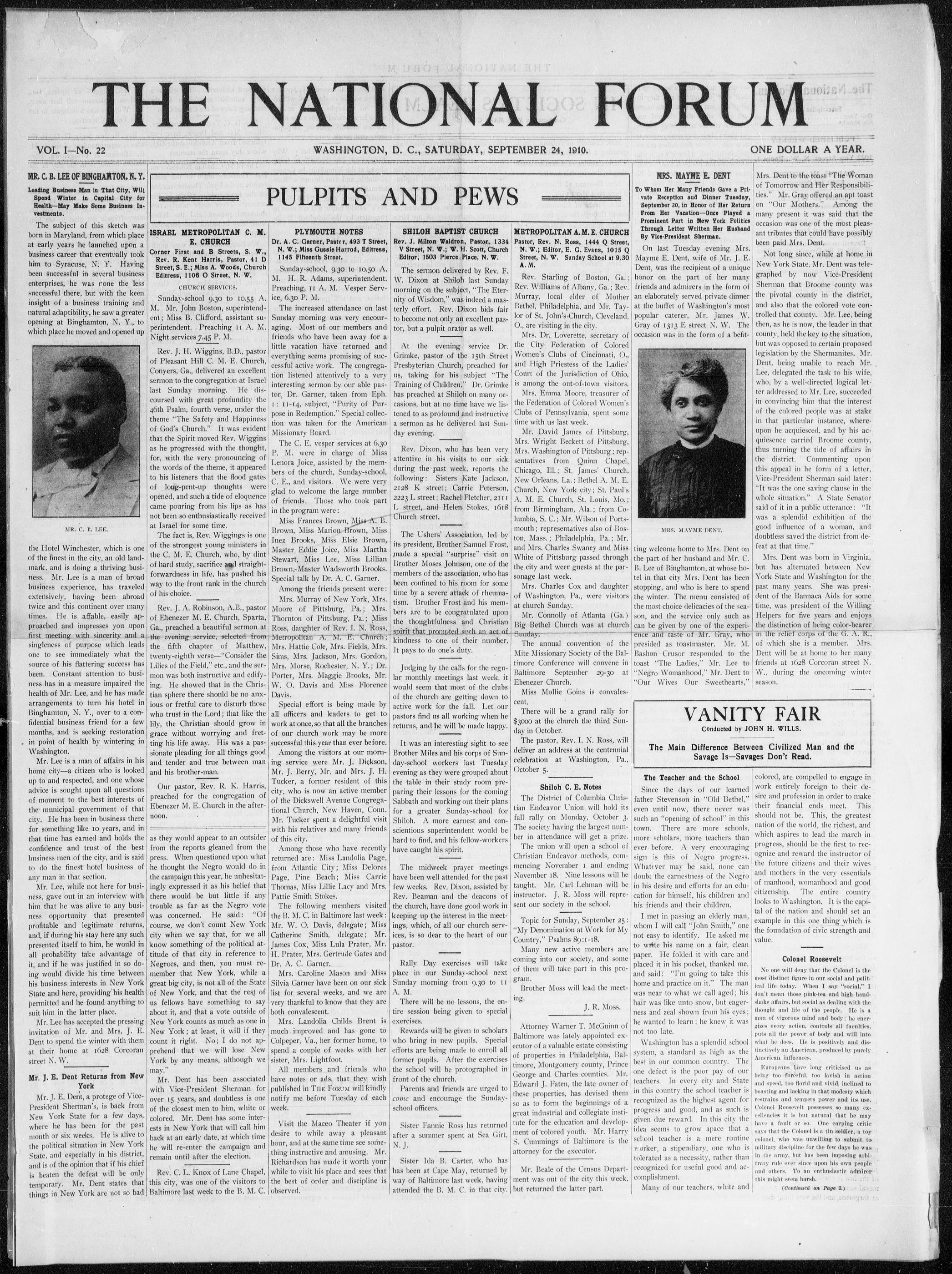
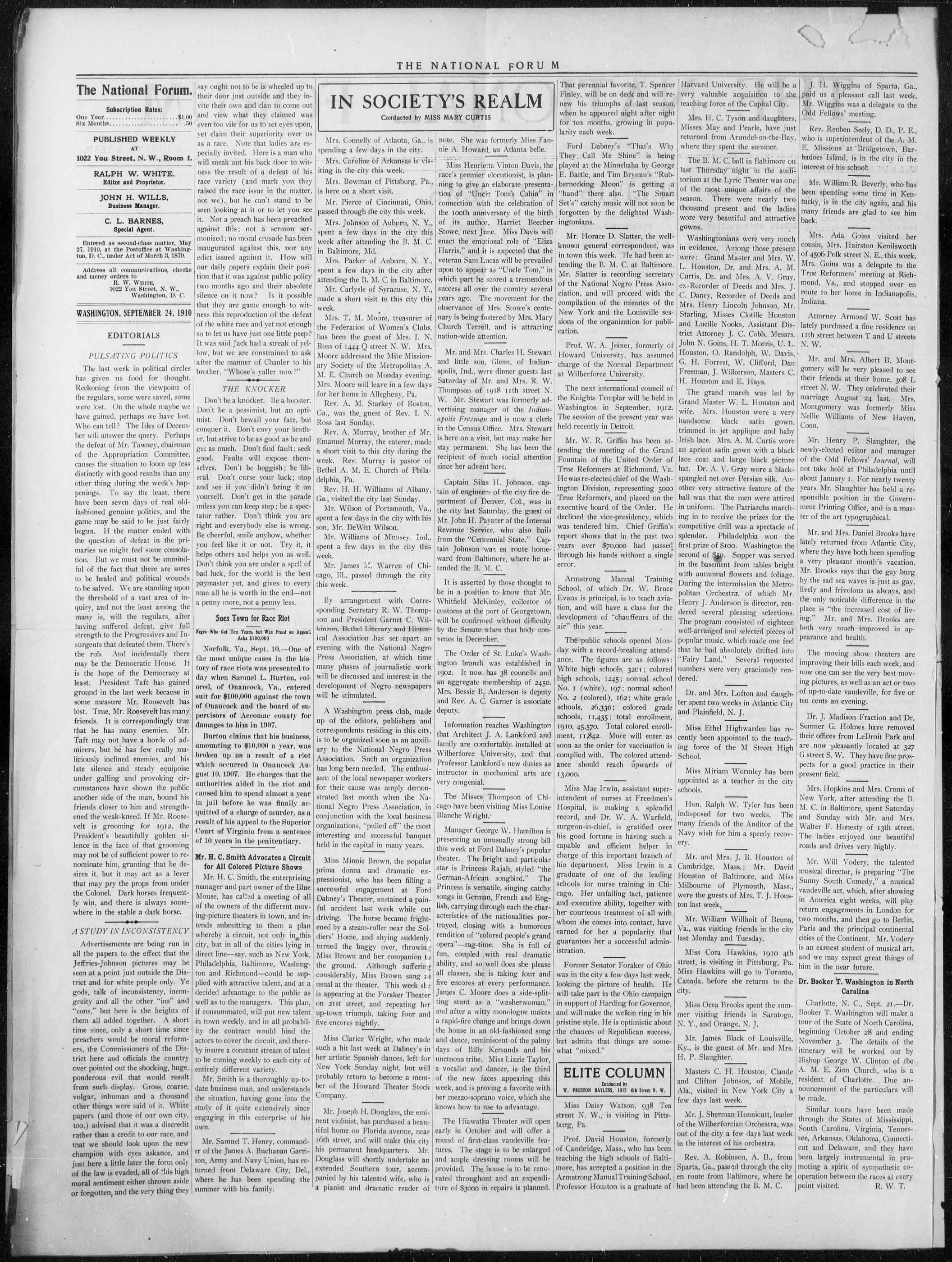
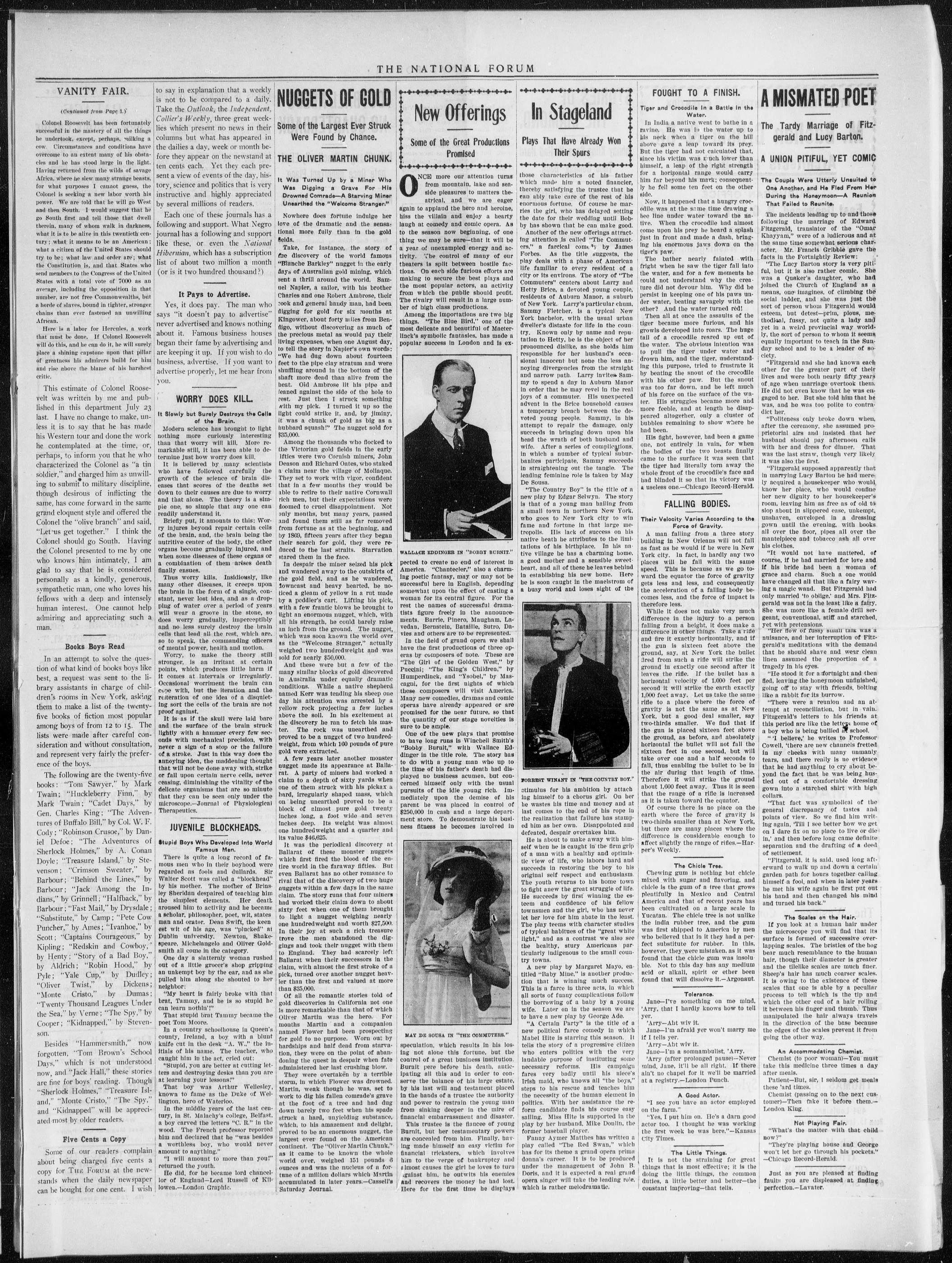
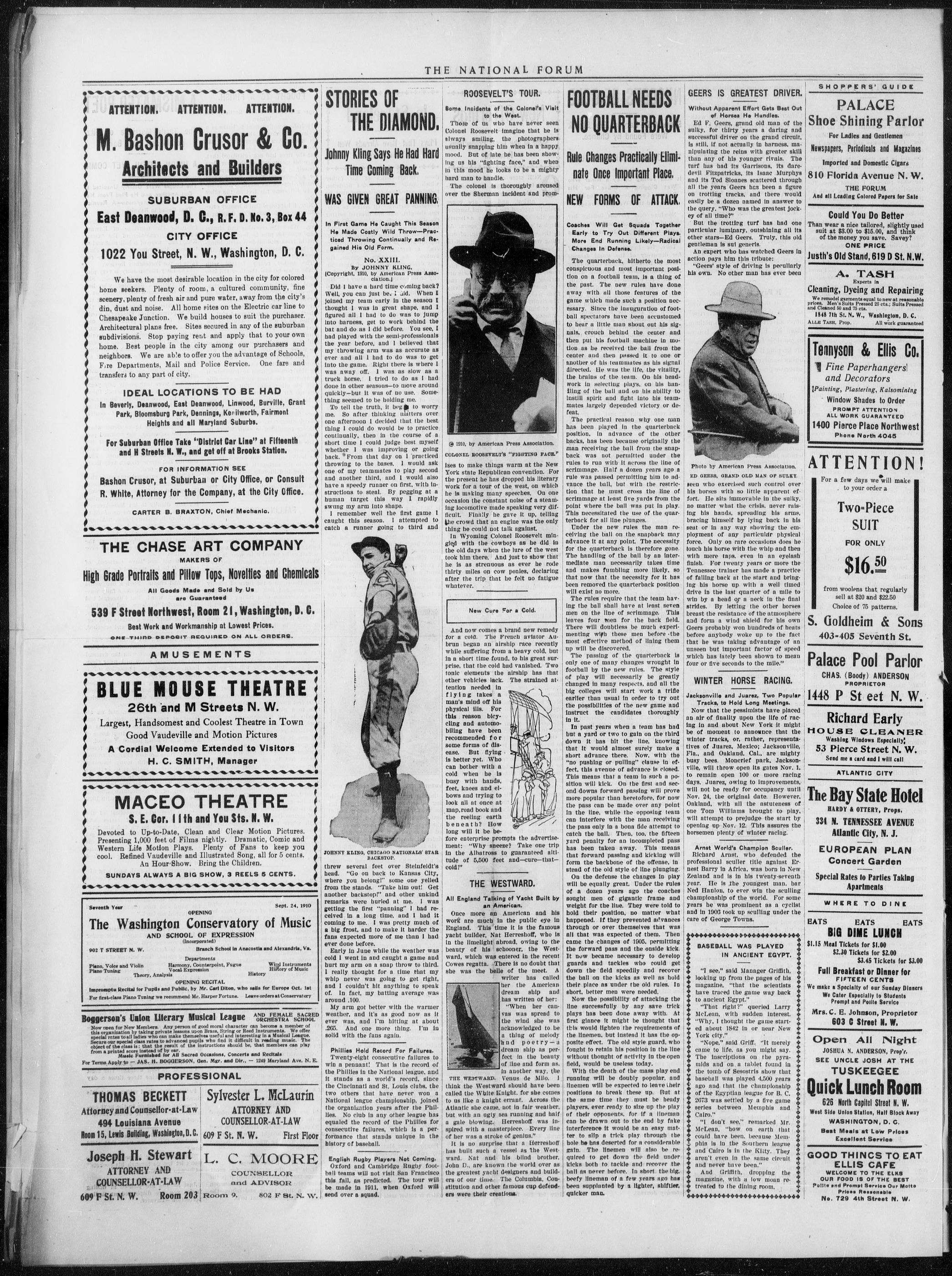
Page text (machine-generated)
THE NATIONAL FORUM
VOL. I-No. 22
MR. C. B. LEE OF BINGHAMTON, N. Y.
Leading Business Man in That City, Will Spend Winter in Capital City for Health—May Make Some Business Investments.
The subject of this sketch was born in Maryland, from which place at early years he launched upon a business career that eventually took him to Syracuse, N. Y. Having been successful in several business enterprises, he was rone the less successful there, but with the keen insight of a business training and natural adaptibility, he saw a greater opening at Binghamton, N. Y., to which place he moved and opened up
[Picture of a man in a suit].
MR. C. B. LEE.
the Hotel Winchester, which is one of the finest in the city, an old landmark, and is doing a thriving business. Mr. Lee is a man of broad business experience, has traveled extensively, having been abroad twice and this continent over many times. He is affable, easily approached and impresses you upon first meeting with sincerity and a singleness of purpose which leads one to see immediately what the source of his flattering success has been. Constant attention to business has in a measure impaired the health of Mr. Lee, and he has made arrangements to turn his hotel in Binghamton, N. Y., over to a confidential business friend for a few months, and is seeking restoration in point of health by wintering in Washington.
Mr. Lee is a man of affairs in his home city—a citizen who is looked up to and respected, and one whose advice is sought upon all questions of moment to the best interests of the municipal government of that city. He has been in business there for something like 10 years, and in that time has earned and holds the confidence and trust of the best business men of the city, and is said to do the finest hotel business of any man in that section.
Mr. Lee, while not here for business, gave out in an interview with him that he was alive to any business opportunity that presented profitable and legitimate returns, and, if during his stay here any such presented itself to him, he would in all probability take advantage of it, and if he was justified in so doing would divide his time between his business interests in New York State and here, providing his health permitted and he found anything to suit him in the latter place.
Mr. Lee has accepted the pressing invitation of Mr. and Mrs. J. E. Dent to spend the winter with them at their home at 1628 Corcoran street N. W.
Mr. J. E. Dent Returns from New York
Mr. J. E. Dent, a protege of Vice-President Sherman's, is back from New York State for a few days, where he has been for the past month or six weeks. He is alive to the political situation in New York State, and especially in his district, and is of the opinion that if his chief is beaten the defeat will be only temporary. Mr. Dent states that things in New York are not so bad
ISRAEL METROPOLITAN C. M.
E. CHURCH
Corner First and B Streets, S. W., Rev. R. Kent Harris, Pastor, 41 D Street, S. E.; Miss A. Woods, Church Editress, 1106 O Street, N. W.
CHURCH SERVICES.
Sunday-school 9.30 to 10.55 A. M. Mr. John Boston, superintendent; Miss B. Clifford, assistant superintendent. Preaching 11 A. M. Night services 7.45 P. M.
Rev. J. H. Wiggins, B.D., pastor of Pleasant Hill C. M. E. Church, Conyers, Ga., delivered an excellent sermon to the congregation at Israel last Sunday morning. He discussed with great profundity the 46th Psalm, fourth verse, under the theme "The Safety and Happiness of God's Church." It was evident that the Spirit moved Rev. Wiggins as he progressed with the thought, for, with the very pronouncing of the words of the theme, it appeared to his listeners that the flood gates of long-pent-up thoughts were opened, and such a tide of eloquence came pouring from his lips as has not been so enthusiastically received at Israel for some time.
The fact is, Rev. Wiggings is one of the strongest young ministers in the C. M. E. Church, who, by dint of hard study, sacrifice and straight-forwardness in life, has pushed his way to the front rank in the church of his choice.
Rev. J. A. Robinson, A.B., pastor of Ebenezer M. E. Church, Sparta, Ga., preached a beautiful sermon at the evening service, selected from the fifth chapter of Matthew, twenty-eighth verse—"Consider the Lilies of the Field," etc., and the sermon was both instructive and edifying. He showed that in the Christian sphere there should be no anxious or fretful care to disturb those who trust in the Lord; that like the lily, the Christian should grow in grace without worrying and fretting his life away. His was a passionate pleading for all things good and tender and true between man and his brother-man.
Our pastor, Rev. R. K. Harris, preached for the congregation of Ebenezer M. E. Church in the afternoon.
as they would appear to an outsider from the reports gleaned from the press. When questioned upon what he thought the Negro would do in the campaign this year, he unhesitatingly expressed it as his belief that there would be but little if any trouble as far as the Negro vote was concerned. He said: "Of course, we don't count New York city when we say that, for we all know something of the political attitude of that city in reference to Negroes, and then, you must remember that New York, while a great big city, is not all of the State of New York, and that the rest of us fellows have something to say about it, and that a vote outside of New York counts as much as one in New York; at least, it will if they count it right. No; I do not apprehend that we will lose New York by any means, although we may."
Mr. Dent has been associated with Vice-President Sherman for over 15 years, and doubtless is one of the closest men to him, white or colored. Mr. Dent has some interests in New York that will call him back at an early date, at which time he will re-enter the campaign and remain until after the election.
Rev. C. L. Knox of Lane Chapel, this city, was one of the visitors to Baltimore last week to the B. M. C.
WASHINGTON, D. C., SATURDAY, SEPTEMBER 24, 1910.
PULPITS AND PEWS
PLYMOUTH NOTES
Dr. A. C. Garner, Paster, 493 T Street,
N. W.; Miss Gussie Harrod, Editress,
1145 Fifteenth Street.
Sunday-school, 9.30 to 10.50 A.
M. H. R. Adams, superintendent.
Preaching, 11 A. M. Vesper Service,
6.30 P. M.
The increased attendance on last Sunday morning was very encouraging. Most of our members and friends who have been away for a little vacation have returned and everything seems promising of successful active work. The congregation listened attentively to a very interesting sermon by our able pastor, Dr. Garner, taken from Eph. 1: 11-14, subject, "Purity of Purpose in Redemption." Special collection was taken for the American Missionary Board.
The C. E. vesper services at 6,30 P. M. were in charge of Miss Lenora Joice, assisted by the members of the church, Sunday-school, C. E., and visitors. We were very glad to welcome the large number of friends. Those who took part in the program were:
Miss Frances Brown, Miss A. B. Brown, Miss Marion Brown, Miss Inez Brooks, Miss Elsie Brown, Master Eddie Joice, Miss Martha Stewart, Miss Lee, Miss Lillian Brown, Master Wadsworth Brooks. Special talk by Dr. A. C. Garner.
Among the friends present were: Mrs. Murray of New York, Mrs. Moore of Pittsburg, Pa.; Mrs. Thornton of Pittsburg, Pa.; Miss Ross, daughter of Rev. I. N. Ross, Metropolitan A. M. E. Church; Mrs. Hattie Cole, Mrs. Fields, Mrs. Sims, Mrs. Jackson, Mrs. Gordon, Mrs. Morse, Rochester, N. Y.; Dr. Porter, Mrs. Maggie Brooks, Mr. W. O. Davis and Miss Florence Davis.
Special effort is being made by all officers and leaders to get to work at once, so that all the branches of our church work may be more successful this year than ever before. Among the visitors at our morning service were Mr. J. Dickson, Mr. J. Berry, Mr. and Mrs. J. H. Tucker, a former resident of this city, who is now an active member of the Dickswell Avenue Congregational Church, New Haven, Conn. Mr. Tucker spent a delightful visit with his relatives and many friends of this city.
Among those who have recently returned are: Miss Landolia Page, from Atlantic City; Miss Delores Page, Pine Beach; Miss Carrie Thomas, Miss Lillie Lacy and Mrs. Pattie Smith Stokes.
The following members visited the B. M. C. in Baltimore last week: Mr. W. O. Davis, delegate; Miss Catherine Smith, delegate; Mr. James Cox, Miss Lula Prater, Mr. H. Prater, Mrs. Gertrude Gates and Dr. A. C. Garner.
Mrs. Caroline Mason and Miss Silvia Garner have been on our sick list for several weeks, and we are very thankful to know that they are both convalescent.
Mrs. Landolia Childs Brent is much improved and has gone to Culpeper, Va., her former home, to spend a couple of weeks with her sister, Mrs. Lightfoot.
All members and friends who have notes or ads, that they wish published in THE FORUM will kindly notify me before Tuesday of each week.
Visit the Maceo Theater if you desire to while away a pleasant hour, and at the same time see something instructive and anusing. Mr. Richardson has made it worth your while to visit his place and sees that the best of order and discipline is observed.
SHILOH BAPSTIST CHURCH
Rev. J. Milton Waldron, Pastor, 1334
V Street, N. W.; W. H. Scott, Church
Editor, 1503 Pierce Place, N. W.
The sermon delivered by Rev. F. W. Dixon at Shiloh last Sunday morning on the subject, "The Eternity of Wisdom," was indeed a masterly effort. Rev. Dixon bids fain to become not only an excellent pastor, but a pulpit orator as well.
At the evening service Dr. Grimke, pastor of the 15th Street Presbyterian Church, preached for us, taking for his subject "The Training of Children." Dr. Grimke has preached at Shiloh on many occasions, but at no time have we listened to as profound and instructive a sermon as he delivered last Sunday evening.
Rev. Dixon, who has been very attentive in his visits to our sick during the past week, reports the following: Sisters Kate Jackson, 2128 K street; Carrie Peterson, 2223 L street; Rachel Fletcher, 2111 L street, and Helen Stokes, 1618 Church street.
The Ushers' Association, led by its president, Brother Samuel Frost, made a special "surprise" visit on Brother Moses Johnson, one of the members of the association, who has been confined to his room for some time by a severe attack of rheumatism. Brother Frost and his members are to be congratulated upon the thoughtfulness and Christian spirit that prompted such an act of kindness to one of their number. It pays to do one's duty.
Judging by the calls for the regular monthly meetings last week, it would seem that most of the clubs of the church are getting down to active work for the fall. Let our pastors find us all working when he returns, and he will be made happy.
It was an interesting sight to see Brother Miles and his corps of Sunday-school workers last Tuesday evening as they were grouped about the table in their study room preparing their lessons for the coming Sabbath and working out their plans for a greater Sunday-school for Shiloh. A more earnest and conscientious superintendent would be hard to find, and his fellow-workers have caught his spirit.
The midweek prayer meetings have been well attended for the past few weeks. Rev. Dixon, assisted by Rev. Beaman and the deacons of the church, have done good work in keeping up the interest in the meetings, which, of all our church services, is so dear to the heart of our pastor.
Rally Day exercises will take place in our Sunday-school next Sunday morning from 9.30 to 11 A.M.
There will be no lessons, the entire session being given to special exercises.
Rewards will be given to scholars who bring in new pupils. Special efforts are being made to enroll all former pupils. After the exercises the school will be protographed in front of the church.
Parents and friends are urged to come and encourage the Sunday-school officers.
Sister Fannie Ross has returned after a summer spent at Sea Girt, N. J.
Sister Ida B. Carter, who has has been at Cape May, returned by way of Baltimore last week, having attended the B. M. C. in that city.
METROPOLITAN A.M.E. CHURCH
Pastor, Rev. N. Ross, 1444 Q Street,
N. W.; Editor, E. G. Evans, 1015 Q
Street, N. W. Sunday School at 9.30
A.M.
Rev. Starling of Boston, Ga.;
Rev. Williams of Albany, Ga.; Rev.
Murray, local elder of Mother
Bethel, Philadelphia, and Mr. Taylor
of St. John's-Church, Cleveland,
O., are visiting in the city.
Mrs. Dr. Loverette, secretary of the City Federation of Colored Women's Clubs of Cincinnati, O., and High Priestess of the Ladies' Court of the Jurisdiction of Ohio, is among the out-of-town visitors. Mrs. Emma Moore, treasurer of the Federation of Colored Women's Clubs of Pennsylvania, spent some time with us last week.
Mr. David James of Pittsburg; Mrs. Wright Beckett of Pittsburg; Mrs. Washington of Pittsburg; representatives from Quinn Chapel, Chicago, Ill.; St. James' Church, New Orleans, La.; Bethel A. M. E. Church, New York city; St. Paul's A. M. E. Church, St. Louis, Mo.; from Birmingham, Ala.; from Columbia, S. C.; Mr. Wilson of Portsmouth; representatives also of Boston, Mass.; Philadelphia, Pa.; Mr. and Mrs. Charles Swaney and Miss White of Pittsburg passed through the city and weer guests at the parsonage last week.
Mrs. Charles Cox and daughter of Washington, Pa., were visitors at church Sunday.
Mr. Connolly of Atlanta (Ga.) Big Bethel Church was at church Sunday.
The annual convention of the Mite Missionary Society of the Baltimore Conference will convene in Baltimore September 29-30 at Ebenezer Church.
Miss Mollie Goins is convalescent.
There will be a grand rally for $3000 at the church the third Sunday in October.
The pastor, Rev. I. N. Ross, will deliver an address at the centennial celebration at Washington, Pa.. October 5.
Shiloh C. E. Notes
The District of Columbia Christian Endeavor Union will hold its fall rally on Monday, October 3. The society having the largest number in attendance will get a prize. The union will open a school of Christian Endeavor methods, commencing November 1 and ending November 18. Nine lessons will be taught. Mr. Carl Lehman will be instructor. J. R. Moss will represent our society in the school.
Topic for Sunday, September 25: "My Denomination at Work for My Country." Psalms 80:1-18.
Many new active members are coming into our society, and some of them will take part in this program. Brother Moss will lead the meeting.
Attorney Warner T. McGuinn of Baltimore was lately appointed executor of a valuable estate consisting of properties in Philadelphia, Baltimore, Montgomery county, Prince George and Charles counties. Mr. Edward J. Faten, the late owner of these properties, has devised them so as to form the beginnings of a great industrial and collegiate institute for the education and development of colored youth. Mr. Harry S. Cummings of Baltimore is the attorney for the executor.
Mr. Beale of the Census Department was out of the city this week, but returned the latter part.
MRS. MAYME E. DENT
To Whom Her Many Friends Gave a Private Reception and Dinner Tuesday, September 20, in Honor of Her Return From Her Vacation—Once Played a Prominent Part in New York Politics Through Letter Written Her Husband By Vice-President Sherman.
On last Tuesday evening Mrs. Mayme E. Dent, wife of Mr. J. E. Dent, was the recipient of a unique honor on the part of her many friends and admirers in the form of an elaborately served private dinner at the buffet of Washington's most popular caterer, Mr. James W. Gray of 1313 E street N. W. The occasion was in the form of a befit-
Mary Ann
MRS. MAYME DENT.
ting welcome home to Mrs. Dent on the part of her husband and Mr. C. B. Lee of Binghamton, at whose hotel in that city Mrs. Dent has been stopping, and who is here to spend the winter. The menu consisted of the most choice delicacies of the season, and the service only such as can be given by one of the experience and taste of Mr. Gray, who presided as toastmaster. Mr. M. Bashon Crusor responded to the toast "The Ladies," Mr. Lee to "Negro Womanhood," Mr. Dent to "Our Wives Our Sweethearts,"
VANITY FAIR Conducted by JOHN H. WILLS.
The Main Difference Between Civilized Man and the Savage Is-Savages Don't Read.
The Teacher and the School
Since the days of our learned father Stevenson in "Old Bethel," even until now, there never was such an "opening of school" in this town. There are more schools, more schools, more teachers than ever before. A very encouraging sign is this of Negro progress. Whatever may be said, none can doubt the earnestness of the Negro in his desire and efforts for an education for himself, his children and his friends and their children.
I met in passing an elderly man, whom I will call "John Smith," one not easy to identify. He asked me to write his name on a fair, clean paper. He folded it with care and placed it in his pocket, thanked me, and said: "I'm going to take this home and practice on it." The man was near to what we call aged; his hair was like unto snow, but eagerness and zeal shown from his eyes; he wanted to learn; he knew it was not too late.
Washington has a splendid school system, a standard as high as the best in our common country. The one defect is the poor pay of our teachers. In every city and State in this country the school teacher is recognized as the highest agent for progress and good, and as such is given due reward. In this city the idea seems to grow apace that a school teacher is a mere routine worker, a stipendiary, one who is tolerated as a necessity, rather than recognized for useful good and accomplishment. Many of our teachers, white and
ONE DOLLAR A YEAR.
Mrs. Dent to the toast "The Woman of Tomorrow and Her Responsibilities." Mr. Gray offered an apt toast on "Our Mothers." Among the many present it was said that the occasion was one of the most pleasant tributes that could have possibly been paid Mrs. Dent.
Not long since, while at home in New York State, Mr. Dent was telegraphed by now Vice-President Sherman that Broome county was the pivotal county in the district, and also that the colored vote controlled that county. Mr. Lee, being then, as he is now, the leader in that county, held the key to the situation, but was opposed to certain proposed legislation by the Shermanites. Mr. Dent, being unable to reach Mr. Lee, delegated the task to his wife, who, by a well-directed logical letter addressed to Mr. Lee, succeeded in convincing him that the interest of the colored people was at stake in that particular instance, whereupon he acquiesced, and by his acquiescence carried Broome county, thus turning the tide of affairs in the district. Commenting upon this appeal in he form of a letter, Vice-President Sherman said later: "It was the one saving clause in the whole situation." A State Senator said of it in a public utterance: "It was a splendid exhibition of the good influence of a woman, and doubtless saved the district from defeat at that time."
Mrs. Dent was born in Virginia, but has alternated between New York State and Washington for the past many years. She was president of the Bannaca Aids for some time, was president of the Willing Helpers for five years and enjoys the distinction of being color-bearer in the relief corps of the G. A. R., of which she is a member. Mrs. Dent will be at home to her many friends at 1628 Corcoran street N. W., during the oncoming winter season.
colored, are compelled to engage in work entirely foreign to their desire and profession in order to make their financial ends meet. This should not be. This, the greatest nation of the world, the richest, and which aspires to lead the march in progress, should be the first to recognize and reward the instructor of the future citizens and their wives and mothers in the very essentials of manhood, womanhood and good citizenship. The entire country looks to Washington. It is the capital of the nation and should set an example in this one thing which is the foundation of civic strength and value.
Colonel Roosevelt
No one will deny that the Colonel is the most distinct figure in our social and political life today. When I say "social," I don't mean those pink-tea and high hand-shake affairs, but social as dealing with the thought and life of the people. He is a man of vigorous mind and body; he energizes every action, controls all faculties, puts all the power of body and will into what he does. He is positively and distinctively an American, produced by purely American influences.
Europeans have long criticised us as being too forceful, too lavish in action and speed, too florid and vivid, inclined to boasting and lacking in that modesty which restrains and tempers power and its use. Colonel Roosevelt possesses so many excellencies it is but natural that he may have a fault or so. One carping critic says that the Colonel is a tin soldier, a toy colonel, who was unwilling to submit to military discipline for the few days he was in the army, but has been imposing arbitrary rule ever since upon his own people and others. To an enthusiastic admirer this might seem harsh.
(Continued on Page 3.)
The National Forum.
Subscription Rates:
RALPH W. WHITE,
Editor and Proprietor.
JOHN H. WILLS,
Business Manager.
C. L. BARNES,
Special Agent.
Entered as second-class matter, May
27, 1910, at the Postoffice at Washington,
D. C., under Act of March 3, 1879.
Address all communications, checks
and money orders to
R. W. WHITE,
1022 You Street, N. W.,
Washington, D. C.
WASHINGTON, SEPTEMBER 24, 1910
EDITORIALS
The last week in political circles has given us food for thought. Reckoning from the viewpoint of the regulars, some were saved, some were lost. On the whole maybe we have gained, perhaps we have lost, Who can tell? The Ides of December will answer the query. Perhaps the defeat of Mr. Tawney, chairman of the Appropriation Committee, causes the situation to loom up less distinctly with good results than any other thing during the week's happenings. To say the least, there have been seven days of real old-fashioned genuine politics, and the game may be said to be just fairly begun. If the matter ended with the question of defeat in the primaries we might feel some consolation. But we must not be unmindful of the fact that there are sores to be healed and political wounds to be salved. We are standing upon the threshold of a vast area of inquiry, and not the least among the many is, will the regulars, after having suffered defeat, give full strength to the Progressives and Insurgents that defeated them. There's the rub. And incidentally there may be the Democratic House. It is the hope of the Democracy at least. President Taft has gained ground in the last week because in some measure Mr. Roosevelt has lost. True, Mr. Roosevelt has many friends. It is correspondingly true that he has many enemies. Mr. Taft may not have a horde of admirers, but he has few really maliciously inclined enemies, and his late silence and steady equipoise under galling and provoking circumstances have shown the public another side of the man, bound his friends closer to him and strengthened the weak-kneed. If Mr. Roosevelt is grooming for 1912, the President's beautifully golden silence in the face of that grooming may not be of sufficient power to renominate him, granting that he desires it, but it may act as a lever that may pry the props from under the Colonel. Dark horses frequently win, and there is always somewhere in the stable a dark horse.
Advertisements are being run in all the papers to the effect that the Jeffries-Johnson pictures may be seen at a point just outside the District and for white people only. Ye gods, talk of inconsistency, incongruity and all the "ins" and "cons," but here is the heights of them all added together. A short time since, only a short time since preachers are moral reformers, the Commissioners of the District here and officials the country over pointed out the shocking, huge, ponderous evil that would result from such display. Gross, coarse, vulgar, inhuman and a thousand other things were said of it. White papers (and those of our own city, too,) advised that it was a discredit rather than a credit to our race, and that we should look upon the new champion with eyes askance, and just here a little later the form only of the law is evaded, all of this high moral sentiment either thrown aside or forgotten, and the very thing they
say ought not to be is wheeled up to their door just outside and they invite their own and clan to come out and view what they claimed was even too vile for us to set eyes upon, yet claim their superiority over us as a race. Note that ladies are especially invited. Here is a man who will sneak out his back door to witness the result of a defeat of his race variety (and mark you they raised the race issue in the matter, not we), but he can't stand to be seen looking at it or to let you see it. Not a preach has been preached against this; not a sermon sermonized; no moral crusade has been inaugurated against this, nor any edict issued against it. How will our daily papers explain their position that it was against public policy two months ago and their absolute silence on it now? Is it possible that they are game enough to witness this reproduction of the defeat of the white race and yet not enough so to let us have just one little peep? It was said Jack had a streak of yellow, but we are constrained to ask after the manner of Chanler to his brother, "Whose's valler now?"
THE KNOCKER
Don't be a knocker. Be a booster. Don't be a pessimist, but an optimist. Don't bewail your fate, but conquer it. Don't envy your brother, but strive to be as good as he and get as much. Don't find fault; seek good. Faults will expose themselves. Don't be hoggish; be liberal. Don't curse your luck; stop and see if you didn't bring it on yourself. Don't get in the parade unless you can keep step; be a spectator rather. Don't think you are right and everybody else is wrong. Be cheerful, smile anyhow, whether you feel like it or not. Try it, it helps others and helps you as well. Don't think you are under a spell of bad luck, for the world is the best paymaster yet, and gives to every man all he is worth in the end—not a penny more, not a penny less.
Sues Town for Race Riot
Negro Who Got Ten Years, but Was Freed on Appeal
Aka $100,000
Norfolk, Va., Sept. 10.—One of the most unique cases in the history of race riots was presented today when Samuel L. Burton, colored, of Onancock, Va., entered suit for $100,000 against the town of Onancock and the board of supervisors of Accomac county for damages to him in 1907.
Burton claims that his business, amounting to $10,000 a year, was broken up as a result of a riot which occurred in Onancock August 10, 1907. He charges that the authorities aided in the riot and caused him to spend almost a year in jail before he was finally acquitted of a charge of murder, as a result of his appeal to the Superior Court of Virginia from a sentence of 10 years in the penitentiary.
Mr. H. C. Smith Advocates a Circuit
Mr. H. C. Smith, the enterprising manager and part owner of the Blue Mouse, has called a meeting of all of the owners of the different moving-picture theaters in town, and intends submitting to them a plan whereby a circuit, not only in this city, but in all of the cities lying in direct line—say, such as New York, Philadelphia, Baltimore, Washington and Richmond—could be supplied with attractive talent, and at a decided advantage to the public as well as to the managers. This plan, if consummated, will put new talent in town weekly, and in all probability the contract would bind the actors to cover the circuit, and thereby insure a constant stream of talent to be coming weekly to each city of entirely different variety.
Mr. Smith is a thoroughly up-to-date business man, and understands the situation, having gone into the study of it quite extensively since engaging in this enterprise of his own.
Mr. Samuel T. Henry, commander of the James A. Buchanan Garrison, Army and Navy Union, has returned from Delaware City, Del., where he has been spending the summer with his family.
THE NATIONAL FORUM
IN SOCIETY'S REALM Conducted by MISS MARY CURTIS
Mrs. Connelly of Atlanta, Ga., is spending a few days in the city.
Mrs. Caroline of Arkansas is visiting in the city this week.
Mrs. Bowman of Pittsburg, Pa., is here on a short visit.
Mr. Pierce of Cincinnati, Ohio, passed through the city this week.
Mrs. Johnson of Auburn, N. Y., spent a few days in the city this week after attending the B. M. C. in Baltimore, Md.
Mrs. Parker of Auburn, N. Y., spent a few days in the city after attending the B. M. C. in Baltimore.
Mr. Carlyle of Syracuse, N. Y., made a short visit to this city this week.
Mrs. T. M. Moore, treasurer of the Federation of Women's Clubs has been the guest of Mrs. I. N. Ross of 1444 Q street N. W. Mrs. Moore addressed the Mite Missionary Society of the Metropolitan A. M. E. Church on Monday evening Mrs. Moore will leave in a few days for her home in Allegheny, Pa. Rev. A. M. Starkey of Boston, Ga., was the guest of Rev. I. N. Ross last Sunday. Rev. A. Murray, brother of Mr. Emanuel Murray, the caterer, made a short visit to this city during the week. Rev. Murray is pastor of Bethel A. M. E. Church of Philadelphia, Pa.
Rev. H. H. Williams of Albany, Ga., visited the city last Sunday. Mr. Wilson of Portsmouth, Va., spent a few days in the city with his son, Mr. DeWitt Wilson. Mr. Williams of Munsey, Ind., spent a few days in the city this week. Mr. James M. Warren of Chicago, Ill., passed through the city this week.
By arrangement with Corresponding Secretary R. W. Thompson and President Garnet C. Wilkinson, Bethel Literary and Historical Association has set apart an evening with the National Negro Press Association, at which time many phases of journalistic work will be discussed and interest in the development of Negro newspapers will be stimulated.
A Washington press club, made up of the editors, publishers and correspondents residing in this city, is to be organized soon as an auxiliary to the National Negro Press Association. Such an organization has long been needed. The enthusiasm of the local newspaper workers for their cause was amply demonstrated last month when the National Negro Press Association, in conjunction with the local business organizations, "pulled off" the most interesting and successful banquet held in the capital in many years.
Miss Minnie Brown, the popular prima donna and dramatic expressionist, who has been filling a successful engagement at Ford Dabney's Theater, sustained a painful accident last week while out driving. The horse became frightened by a steam-roller near the Soldiers' Home, and shying suddenly, turned the buggy over, throwing Miss Brown and her companion to the ground. Although suffering considerably, Miss Brown sang as usual at the theater. This week she is appearing at the Foraker Theater on 21st street, and repeating her up-town triumph, taking four and five encores nightly.
Miss Clarice Wright, who made such a hit last week at Dabney's in her artistic Spanish dances, left for New York Sunday night, but will probably return to become a member of the Howard Theater Stock Company.
Mr. Joseph H. Douglass, the eminent violinist, has purchased a beautiful home on Florida avenue, near 16th street, and will make this city his permanent headquarters. Mr. Douglass will shortly undertake an extended Southern tour, accompanied by his talented wife, who is a pianist and dramatic reader of
note. She was formerly Miss Fannie A. Howard, an Atlanta belle.
Miss Henrietta Vinton Davis, the race's premier elocutionist, is planning to give an elaborate presentation of "Uncle Tom's Cabin" in connection with the celebration of the 100th anniversary of the birth of its author, Harriet Beecher Stowe, next June. Miss Davis will enact the emotional role of "Eliza Harris," and it is expected that the veteran Sam Lucas will be prevailed upon to appear as "Uncle Tom," in which part he scored a tremendous success all over the country several years ago. The movement for the observance of Mrs. Stowe's centenary is being fostered by Mrs. Mary Church Terrell, and is attracting nation-wide attention.
Mr. and Mrs. Charles H. Stewart and little son, Glenn, of Indianapolis, Ind., were dinner guests last Saturday of Mr. and Mrs. R. W. Thompson of 1918 11th street N. W. Mr. Stewart was formerly advertising manager of the Indianapolis Freeman and is now a clerk in the Census Office. Mrs. Stewart is here on a visit, but may make her stay permanent. She has been the recipient of much social attention since her advent here.
Captain Silas H. Johnson, captain of engineers of the city fire department of Denver, Col., was in the city last Saturday, the guest of Mr. John H. Payter of the Internal Revenue Service, who also hails from the "Centennial State." Captain Johnson was en route homeward from Baltimore, where he attended the B. M. C.
It is asserted by those thought to be in a position to know that Mr. Whitfield McKinley, collector of customs at the port of Georgetown, will be confirmed without difficulty by the Senate when that body convenes in December.
The Order of St. Luke's Washington branch was established in 1902. It now has 38 councils and an aggregate membership of 2450. Mrs. Bessie B. Anderson is deputy and Rev. A. C. Garner is associate deputy.
Information reaches Washington that Architect J. A. Lankford and family are comfortably, installed at Wilberforce University, and that Professor Lankford's new duties as instructor in mechanical arts are very congenial.
The Misses Thompson of Chicago have been visiting Miss Louise Blanche Wright.
Manager George W. Hamilton is presenting an unusually strong bill this week at Ford Dabney's popular theater. The bright and particular star is Princess Rajah, styled "the German-African songbird." The Princess is versatile, singing catchy songs in German, French and English, carrying through each the characteristics of the nationalities portrayed, closing with a humorous rendition of "colored people's grand opera"—rag-time. She is full of fun, coupled with real dramatic ability, and so well does she please all classes, she is taking four and five encores at every performance. James C. Moore does a side-splitting stunt as a "washerwoman," and after a witty monologue makes a rapid-fire change and brings down the house in an old-fashioned song and dance, reminiscent of the palmy days of Billy Kersands and his unctuous tribe. Miss Lizzie Taylor, a vocalist and dancer, is the third of the new faces appearing this week, and is proving a favorite with her mezzo-soprano voice, which she knows how to use to advantage.
The Hiawatha Theater will open early in October and will offer a round of first-class vaudeville features. The stage is to be enlarged and ample dressing rooms will be provided. The house is to be renovated throughout and an expenditure of $3000 in repairs is planned.
That perennial favorite, T. Spencer Finley, will be on deck and will renew his triumphs of last season, when he appeared night after night for ten months, growing in popularity each week.
Ford Dabney's "That's Why They...Call Me Shine" is being played at the Minnehaha by George E. Battle, and Tim Brymm's "Rubbernecking Moon" is getting a "hand" there also. "The Smart Set's" catchy music will not soon be forgotten by the delighted Washingtonians.
Mr. Horace D. Slatter, the well-known general correspondent, was in town this week. He had been attending the B. M. C. at Baltimore. Mr. Slatter is recording secretary of the National Negro Press Association, and will proceed with the compilation of the minutes of the New York and the Louisville sessions of the organization for publication.
Prof. W. A. Joiner, formerly of Howard University, has assumed charge of the Normal Department at Wilberforce University.
The next international council of the Knights Templar will be held in Washington in September, 1912. The session of the present year was held recently in Detroit.
Mr. W. R. Griffin has been attending the meeting of the Grand Fountain of the United Order of True Reformers at Richmond, Va. He was re-elected chief of the Washington Division, representing 5000 True Reformers, and placed on the executive board of the Order. He declined the vice-presidency, which was tendered him. Chief Griffin's report shows that in the past two years over $70,000 had passed through his hands without a single error.
Armstrong Manual Training School, of which Dr. W. Bruce Evans is principal, is to teach aviation, and will have a class for the development of "chauffeurs of the air" this year.
The public schools opened Monday with a record-breaking attendance. The figures are as follows: White high schools, 3201; colored high schools, 1245; normal school No. 1 (white), 197; normal school No. 2 (colored), 162; white grade schools, 26,330; colored grade schools, 11,435; total enrollment, 1910, 45,570. Total colored enrollment, 11,842. More will enter as soon as the order for vaccination is complied with. The colored attendance should reach upwards of 13,000.
Miss Mae Irwin, assistant superintendent of nurses at Freedmen's Hospital, is making a splendid record, and Dr. W. W. Warfield, surgeon-in-chief, is gratified over his good fortune in having such a capable and efficient helper in charge of this important branch of his department. Miss Irwin is a graduate of one of the leading schools for nurse training in Chicago. Her unfailing tact, patience and executive ability, together with her courteous treatment of all with whom she comes into contact, have earned for her a popularity that guarantees her a successful administration.
Former Senator Foraker of Ohio was in the city a few days last week, looking the picture of health. He will take part in the Ohio campaign in support of Harding for Governor, and will make the welkin ring in his pristine style. He is optimistic about the chances of Republican success, but admits that things are somewhat "mixed."
ELITE COLUMN
Conducted by
W. PRESTON BAYLLESS, 1915 6th Street N. W.
Miss Daisy Watson, 938 Tea street N. W., is visiting in Pittsburg, Pa.
Prof. David Houston, formerly of Cambridge, Mass., who has been teaching the high schools of Baltimore, has accepted a position in the Armstrong Manual Training School. Professor Houston is a graduate of
Harvard University. He will be a very valuable acquisition to the teaching force of the Capital City. Mrs. H. C. Tyson and daughters, Misses May and Pearle, have just returned from Arundel-on-the-Bay, where they spent the summer. The B. M. C. ball in Baltimore on last Thursday night in the auditorium at the Lyric Theater was one of the most unique affairs of the season. There were nearly two thousand present and the ladies wore very beautiful and attractive gowns.
Washingtonians were very much in evidence. Among those present were: Grand Master and Mrs. W. L. Houston, Dr. and Mrs. A. M. Curtis, Dr. and Mrs. A. V. Gray, ex-Recorder of Deeds and Mrs. J. C. Dancy, Recorder of Deeds and Mrs. Henry Lincoln Johnson, Mr. Starling, Misses Clotile Houston and Lucille Nooks, Assistant District Attorney J. C. Cobb, Messrs. John N. Goins, H. T. Morris, U. L. Houston, O. Randolph, W. Davis, G. H. Forrest, W. Clifford, Dan Freeman, J. Wilkerson, Masters C. H. Houston and E. Hays.
The grand march was led by Grand Master W. L. Houston and wife. Mrs. Houston wore a very handsome black satin gown, trimmed in jet applique and baby Irish lace. Mrs. A. M. Curtis wore an apricot satin gown with a black lace coat and large black picture hat. Dr. A. V. Gray wore a black-spangled net over Persian silk. Another very attractive feature of the ball was that the men were attired in uniform. The Patriarchs marching in to receive the prizes for the competitive drill was a spectacle of splendor. Philadelphia won the first prize of $100. Washington the second of $50. Supper was served in the basement from tables bright with autumnal flowers and foliage. During the intermission the Metropolitan Orchestra, of which Mr. Henry J. Anderson is director, rendered several pleasing selections. The program consisted of eighteen well-arranged and selected pieces of popular music, which made one feel that he had absolutely drifted into "Fairy Land." Several requested numbers were very graciously rendered.
Dr. and Mrs. Lofton and daughter spent two weeks in Atlantic City and Plainfield, N. J.
Miss Ethel Highwarden has recently been appointed to the teaching force of the M Street High School.
Miss Miriam Wormley has been appointed as a teacher in the city schools.
Hon. Ralph W. Tyler has been indisposed for two weeks. The many friends of the Auditor of the Navy wish for him a speedy recovery.
Mr. and Mrs. J. B. Houston of Cambridge, Mass.; Mr. David Houston of Baltimore, and Miss Milbourne of Plymouth, Mass., were the guests of Mrs. T. J. Houston last week.
Mr. William Willhoit of Beuna, Va., was visiting friends in the city last Monday and Tuesday.
Miss Cora Hawkins, 1910 4th street, is visiting in Pittsburg, Pa. Miss Hawkins will go to Toronto, Canada, before she returns to the city.
Miss Ocea Brooks spent the summer visiting friends in Saratoga, N. Y., and Orange, N. J.
Mr. James Black of Louisville, Ky., is the guest of Mr. and Mrs. H. P. Slaughter.
Masters C. H. Houston, Claude and Clifton Johnson, of Mobile, Ala., visited in New York City a few days last week.
Mr. J. Sherman Hunnicutt, leader of the Wilberforcian Orchestra, was out of the city a few days last week in the interest of his orchestra.
Rev. A. Robinson, A. B., from Sparta, Ga., passed through the city en route from Baltimore, where he had been attending the B. M. C.
J. H. Wiggins of Sparta, Ga., paid us a pleasant call last week. Mr. Wiggins was a delegate to the Odd Fellows' meeting.
Rev. Reuben Seely, D. D., P. E., who is superintendent of the A. M. E. Missions at Bridgetown, Barbadoes Island, is in the city in the interest of his school.
Mr. William R. Beverly, who has been spending some time in Kentucky, is in the city again, and his many friends are glad to see him back.
Mrs. Ada Goins visited her cousin, Mrs. Hairston Kenilsworth of 4506 Polk street N. E., this week. Mrs. Goins was a delegate to the True Reformers' meeting at Richmond, Va., and stopped over en route to her home in Indianapolis, Indiana.
Attorney Armond W. Scott has lately purchased a fine residence on 11th street between T and U streets N. W.
Mr. and Mrs. Albert B. Montgomery will be very pleased to see their friends at their home, 308 L street N. W. They celebrated their marriage August 24 last. Mrs. Montgomery was formerly Miss Nellie Williams of New Haven, Conn.
Mr. Henry P. Slaughter, the newly-elected editor and manager of the Odd Fellows' Journal, will not take hold at Philadelphia until about January 1. For nearly twenty years Mr. Slaughter has held a responsible position in the Government Printing Office, and is a master of the art typographical.
Mr. and Mrs. Daniel Brooks have lately returned from Atlantic City, where they have both been spending a very pleasant month's vacation. Mr. Brooks says that the gay burg by the sad sea waves is just as gay, lively and frivolous as always, and the only noticeable difference in the place is "the increased cost of living." Mr. and Mrs. Brooks are both very much improved in appearance and health.
The moving show theaters are improving their bills each week, and now one can see the very best moving pictures, as well as an act or two of up-to-date vaudeville, for five or ten cents an evening.
Dr. J. Madison Fraction and Dr. Summer G. Holmes have removed their offices from LeDroit Park and are now pleasantly located at 327 G street S. W. They have fine prospects for a good practice in their present field.
Mrs. Hopkins and Mrs. Croms of New York, after attending the B. M. C. in Baltimore, spent Saturday and Sunday with Mr. and Mrs. Walter F. Honesty of 13th street. The ladies enjoyed our beautiful roads and drives very highly.
Mr. Will Vodery, the talented musical director, is preparing "The Sunny South Comedy," a musical vaudeville act, which, after showing in America eight weeks, will play return engagements in London for two months, and then go to Berlin, Paris and the principal continental cities of the Continent. Mr. Vodery is an earnest student of musical art, and we may expect great things of him in the near future.
Dr. Booker T. Washington in North Carolina
Charlotte, N. C., Sept. 21.—Dr. Booker T. Washington will make a tour of the State of North Carolina, beginning October 28 and ending November 3. The details of the itinerary will be worked out by Bishop George W. Clinton of the A. M. E. Zion Church, who is a resident of Charlotte. Due announcement of the particulars will be made.
Similar tours have been made through the States of Mississippi, South Carolina, Virginia, Tennessee, Arkansas, Oklahoma, Connecticut and Delaware, and they have been largely instrumental in promoting a spirit of sympathetic cooperation between the races at every point visited. R.W.T.
VANITY FAIR.
(Continued from Page 1.)
Colonel Roosevelt has been fortunately successful in the mastery of all the things he undertook, except, perhaps, wailing a cow. Circumstances and conditions have overcome to an extent of his obstacles and he has stood large in the light. Having returned from the wilds of savage Africa, where he saw many strange beasts, for what purposes I cannot guess, the Colonel is seeking a new labor worth his power. We are told that he will go West and then South. I would suggest that he go South first and tell those that dwell therein, many of whom walk in darkness, what it is to be alive in this twentieth century; what it means to be an American; what a citizen of the United States should try to be; what law and order are; what the Constitution is, and that States who send members to the Congress of the United States with a total vote of 7000 as an average, including the opposition in that number, are not free Commonwealths, but a harde of slaves, bound in tighter, stronger chains than ever fastened an unwilling African.
Here is a labor for Hercules, a work that must be done. If Colonel Roosevelt will do this, and he can do it, he will surely place a shining capstone upon that pillar of greatness his admirers build for him and rise above the blame of his harshest critic.
This estimate of Colonel Roosevelt was written by me and published in this department July 23 last. I have no change to make, unless it is to say that he has made his Western tour and done the work he contemplated at the time, or, perhaps, to inform you that he who characterized the Colonel as "a tin soldier," and charged him as unwilling to submit to military discipline, though desirous of inflicting the same, has come forward in the same grand eloquent style and offered the Colonel the "olive branch" and said, "Let us get together." I think the Colonel should go South. Having the Colonel presented to me by one who knows him intimately, I am glad to say that he is considered personally as a kindly, generous, sympathetic man, one who loves his fellows with a deep and intensely human interest. One cannot help admiring and appreciating such a man.
Books Boys Read
In an attempt to solve the question of what kind of books boys like best, a request was sent to the library assistants in charge of children's rooms in New York, asking them to make a list of the twenty-five books of fiction most popular among boys of from 12 to 15. The lists were made after careful consideration and without consultation, and represent very fairly the preference of the boys.
The following are the twenty-five books: "Tom Sawyer," by Mark Twain; "Huckleberry Finn," by Mark Twain; "Cadet Days," by Gen. Charles King; "The Adventures of Buffalo Bill," by Col. W. F. Cody; "Robinson Crusoe," by Daniel Defoe; "The Adventures of Sherlock Holmes," by A. Conan Doyle; "Treasure Island," by Stevenson; "Crimson Sweater," by Barbury; "Behind the Lines," by Barbury; "Jack Among the Indians," by Grimell, "Halfback," by Barbury; "Fast Mail," by Drysdale; "Substitute," by Camp; "Pete Cow Puncher," by Ames; "Ivanhoe," by Scott; "Captains Courageous," by Kipling; "Redskin and Cowboy," by Henty; "Story of a Bad Boy," by Aldrich; "Robin Hood," by Pyle; "Yale Cup," by Dudley; "Oliver Twist," by Dickens; "Monte Cristo," by Dumas; "Twenty Thousand Leagues Under the Sea," by Verne; "The Spy," by Cooper; "Kidnapped," by Stevenson.
Besides "Hammersmith," now forgotten, "Tom Brown's School Days," which is not understood now, and "Jack Hall," these stories are fine for boys' reading. Though "Sherlock Holmes," "Treasure Island," "Monte Cristo," "The Spy," and "Kidnapped" will be appreciated most by older readers.
Five Cents a Copy
Some of our readers complain about being charged five cents a copy for THE FORUM at the newstands when the daily newspaper can be bought for one cent. I wish
to say in explanation that a weekly is not to be compared to a daily. Take the Outlook, the Independent, Collier's Weekly, three great weeklies which present no news in their columns but what has appeared in the dailies a day, week or month before they appear on the newstand at ten cents each. Yet they each present a view of events of the day, history, science and politics that is very instructive and highly appreciated by several millions of readers.
Each one of these journals has a following and support. What Negro journal has a following and support like these, or even the National Hibernian, which has a subscription list of about two million a month (or is it two hundred thousand?)
It Pavs to Advertise.
Yes, it does pay. The man who says "it doesn't pay to advertise" never advertised and knows nothing about it. Famous business houses began their fame by advertising and are keeping it up. If you wish to do business, advertise. If you want to advertise properly, let me hear from you.
WORRY DOES KILL
It Slowly but Surely Destroys the Cells of the Brain.
Modern science has brought to light nothing more curiously interesting than that worry will kill. More remarkable still, it has been able to determine just how worry does kill.
It is believed by many scientists who have followed carefully the growth of the science of brain diseases that scores of the deaths set down to their causes are due to worry and that alone. The theory is a simple one, so simple that any one can readily understand it.
Brieft put, it amounts to this: Worry injures beyond repair certain cells of the brain, and, the brain being the nutritive center of the body, the other organs become gradually injured, and when some diseases of these organs or a combination of them arises death finally ensues.
Thus worry kills. Insidiously, like many other diseases, it creeps upon the brain in the form of a single, constant, never lost idea, and as a dropping of water over a period of years will wear a groove in the stone, so does worry gradually, imperceptibly and no less surely destroy the brain cells that lead all the rest, which are, so to speak, the commanding officers of mental power, health and motion.
Worry, to make the theory still stronger, is an irritant at certain points, which produces little harm if it comes at intervals or irregularly. Occasional wormment the brain can cope with, but the iteration and the reiteration of one idea of a disquieting sort the cells of the brain are not proof against.
It is as if the skull were laid bare and the surface of the brain struck lightly with a hammer every few seconds with mechanical precision, with never a sign of a stop or the failure of a stroke. Just in this way does the annoying idea, the maddening thought that will not be done away with, strike or fall upon certain nerve cells, never ceasing, diminishing the vitality of the delicate organisms that are so minute that they can be seen only under the microscope—Journal of Physiological Therapeutics.
JUVENILE BLOCKHEADS.
Stupid Boys Who Developed Into World Famous Men.
There is quite a long record of famous men who in their boyhood were regarded as fools and dullards. Sir Walter Scott was called a "blockhead" by his mother. The mother of Brinsley Sheridan despaired of teaching him the simplest elements. Her death aroused him to activity and he became a scholar, philosopher, poet, wits, statesman and orator. Dean Swift, the keen est wif of his age, was "plucked" at Dublin university. Newton, Shakespeare, Michelangelo and Oliver Goldsmith all come in the category.
One day a slatternly woman rushed out of a little grocery's shop gripping an unkempt boy by the ear, and as she pulled him along she shouted to her neighbor:
"My heart is fairly broke with that brat, Tammy, and he is so stupid he can learn nothin!"
That stupid brat Tammy became the poet Tom Moore.
In a country schoolhouse in Queen's county, Ireland, a boy with a blunt knife cut in the desk "A. W." the initials of his name. The teacher, who caught him in the act, cried out:
"Stupid, you are better at cutting letters and destroying desks than you are at learning your lessons!"
That boy was Arthur Wellesley, known to fame as the Duke of Wellington, hero of Waterloo.
In the middle years of the last century, in St. Malachy's college, Belfast, a boy carved the letters "C. R." in the wood. The French professor reported him and declared that he "was besides a worthless boy, who would never amount to anything."
"I will amount to more than you!" returned the youth.
He did, for he became lord chancellor of England—Lord Russell of Killowen—London Graphic.
NUGGETS OF GOLD
Some of the Largest Ever Struck
Were Found by Chance.
THE OLIVER MARTIN CHUNK.
It Was Turned Up by a Miner Who
Was Digging a Grave For His
Drowned Comrade—A Starving Miner
Unearthed the "Welcome Stranger."
Nowhere does fortune indulge her
love of the dramatic and the sensational
more fully than in the gold
fields.
Take, for instance, the story of the discovery of the world famous "Blanche Barkley" nugget in the early days of Australian gold mining, which sent a thrill around the world. Samuel Napier, a sailor, with his brother Charles and one Robert Ambrose, their cook and general handy man, had been digging for gold for six months at Kingower, about forty miles from Bendigo, without discovering as much of the precious metal as would pay their living expenses, when one August day, to tell the story in Napier's own words: "We had dug down about fourteen feet to the pipe clay stratum and were shuffling around in the bottom of the shaft more dead than alive from the heat. Old Ambrose lit his pipe and leaned against the side of the hole to rest. Just then I struck something with my pick. I turned it up so the light could strike it, and, by jimmy, it was a chunk of gold as big as a mubbard squash!" The nugget sold for $25,000.
Among the thousands who flocked to the Victorian gold fields in the early Ifties were two Cornish miners, John Deason and Richard Oates, who staked a claim near the village of Mollaua. They set to work with vigor, confident that in a few months they would be able to retire to their native Cornwall rich men, but their expectations were doomed to cruel disappointment. Not only months, but many years, passed and found them still as far removed from fortune as at the beginning, and by 1869, fifteen years after they began their search for gold, they were reduced to the last straits. Starvation stared them in the face.
In despair the miner seized his pick and wandered away to the outskirts of the gold field, and as he wandered, downcast and heavy hearted, he noticed a gleam of yellow in a rut made by a peddler's cart. Lifting his pick, with a few frantic blows he brought to light an enormous nugget, which, with all his strength, he could barely raise an inch from the ground. The nugget, which was soon known the world over as the "Welcome Stranger," actually weighed two hundredweight and was sold for nearly $50,000.
And these were but a few of the many similar blocks of gold discovered in Australia under equally dramatic conditions. While a native shepherd named Kerr was tending his sheep one day his attention was arrested by a yellow rock projecting a few inches above the soil. In his excitement at the discovery he ran to fetch his master. The rock was unearthed and proved to be a nugget of two hundred-weight, from which 100 pounds of pure gold were extracted.
A few years later another monster nugget made its appearance at Balaarat. A party of miners had worked a claim to a depth of sixty yards when one of them struck with his pickax a hard, irregularly shaped mass, which on being unearthed proved to be a block of almost pure gold twenty inches long, a foot wide and seven inches deep. Its weight was almost one hundredweight and a quarter and its value $46.625.
It was the periodical discovery at Ballarat of these monster nuggets which first fired the blood of the entire world in the faraway fifties. But even Ballarat has no other romance to rival that of the discovery of two huge nuggets within a few days in the same claim. The story runs that four miners had worked their claim down to about sixty feet when one of them brought to light a nugget weighing nearly one hundredweight and worth $27,500. In their joy at such a rich treasure trove the men abandoned the diggings and took their nugget with them to England. They had scarcely left Ballarat when their successors in the claim, with almost the first stroke of a pick, turned over another nugget heavier than the first and valued at more than $35,000.
Of all the romantic stories told of gold discoveries in California not one is more remarkable than that of which Oliver Martin was the hero. For months Martin and a companion named Flower had been prospecting for gold to no purpose. Worn out by hardships and half dead from starvation, they were on the point of abandoning the quest in despair when fate administered her last crushing blow.
They were overtaken by a terrible storm, in which Flower was drowned. Martin, weak though he was, set to work to dig his fallen comrade's grave at the foot of a tree and had dug down barely two feet when his spade struck a hard, unyielding substance, which, to his amazement and delight, proved to be an enormous nugget, the largest ever found on the American continent. The "Oliver Martin Chunk," as it came to be known the whole world over, weighed 151 pounds 8 ounces and was the nucleus of a fortune of a million dollars which Martin accumulated in later years—Cassell's Saturday Journal.
THE NATIONAL FORUM
New Offerings
Some of the Great Productions Promised
ONCE more our attention turns from mountain, lake and seaside pleasures to matters theatrical, and we are eager again to applaud the hero and heroine, hiss the villain and enjoy a hearty laugh at comedy and comic opera. As to the season now beginning, of one thing we may be sure—that it will be a year of unexamplied energy and activity. The control of many of our theaters is split between hostile factions. On each side furious efforts are making to secure the best plays and the most popular actors, an activity from which the public should profit. The rivalry will result in a large number of high class productions.
Among the importations are two big things. "The Blue Bird," one of the most delicate and beautiful of Masterlack's symbolic fantasies, has made a popular success in London and is ex-
P
WALLACE EDDINGER IN "BOBBY BURNIT."
pected to create no end of interest in America. "Chanteceler," also a charming poetic fantasy, may or may not be successful here in English, depending somewhat upon the effect of casting a woman for its central figure. For the rest the names of successful dramatists figure freely in the announcements. Barrie, Pinero, Maugham, Lavenan, Bernstein, Bataille, Sutro, Davies and others are to be represented. In the field of grand opera we shall have the first productions of three operas by composers of note. These are "The Girl of the Golden West," by Puccini; "The King's Children," by Humperdinck, and "Syobel," by Mascagni, for the first nights of which these composers will visit America. Many new comedies, dramas and comic operas have already appeared or are promised for the near future, so that the quantity of our stage novelties is sure to be ample.
One of the new plays that promise to have long runs is Winchell Smith's "Bobby Burnit," with Wallace Eddinger in the title role. The story has to do with a young man who up to the time of his father's death had displayed no business acumen, but concerned himself only with the usual pursuits of the idle young rich. Immediately upon the demise of his parent he was placed in control of $250,000 in cash and a large department store. To demonstrate his business fitness he becomes involved in
THE WORLD'S FIRST WOMEN'S TENNIS GAME
MAY DE SOUSA IN "THE COMMUTERS." speculation, which results in his losing not alone this fortune, but the control of a great business institution. Burnit pere before his death, anticipating all this and in order to conserve the balance of his large estate, by his last will and testament placed in the hands of a trustee the authority and power to restrain the young man from sinking deeper in the mire of financial embarrassment and disaster. This trustee is the fliancee of young Burnit, but her testamentary powers are concealed from him. Finally, having made himself an easy victim for financial tricksters, which involves him to the verge of bankruptcy and almost causes the girl he loves to turn against him, he outwits his enemies and recovers the money he had lost. Here for the first time he displays
---
In Stageland
Plays That Have Already Won Their Spurs
those characteristics of his father which made him a noted financier, thereby satisfying the trustee that he can ably take care of the rest of his enormous fortune. Of course he marries the girl, who has delayed setting the date for their wedding until Boby has shown that he can make good. Another of the new offerings attracting attention is called "The Commuters," a farcical com. 47 by James Forbes. As the title suggests, the play deals with a phase of American life familiar to every resident of a city or its environs. The story of "The Commuters" centers about Larry and Hetty Brice, a devoted young couple, residents of Auburn Manor, a suburb of New York. Larry's particular chum, Sammy Fletcher, is a typical New York bachelor, with the usual urban dweller's distaste for life in the country. Known only by name and reputation to Hetty, he is the object of her pronounced dislike, as she holds him responsible for her husband's occasional innocent but none the less annoying divergencies from the straight and narrow path. Larry invites Sammy to spend a day in Auburn Manor in order that he may revel in the real joys of a commuter. His unexpected advent in the Brice household causes a temporary breach between the devoted young people. Sammy, in his attempt to repair the damage, only succeeds in bringing down upon his head the wrath of both husband and wife. After a series of complications, in which a number of typical suburbanites participate, Sammy succeeds in straightening out the tangle. The leading feminine role is taken by May Dew Sousa.
"The Country Boy" is the title of a new play by Edgar Selwyn. The story is that of a young man hailing from a small town in northern New York, who goes to New York city to win fame and fortune in that large metropolis. His lack of success on his native heath he attributes to the limitations of his birthplace. In his native village he has a charming home, a good mother and a sensible sweetheart, and all of these he leaves behind in establishing his new home. Here he is soon caught in the maelstrom of a busy world and loses sight of the
THEATRE
FORBEST WINANT IN 'THE COUNTRY BOY.' stimulus for his ambition by attaching himself to a chorus girl. On her he wastes his time and money and at last comes to the end of his rope in the realization that failure has stamped him as her own. Disappointed and defeated, despair overtures him.
He is about to make away with himself when he is caught in the firm grip of a man with a healthy and optimistic view of life, who labors hard and succeeds in restoring the boy to his original self respect and enthusiasm. The youth returns to his home town to fight anew the great struggle of life. He succeeds by first winning the esteem and confidence of his fellow townsmen and the girl, who has never let her love for him abate in the least. The play teems with character studies of typical habitues of the "great white light," and as a contrast we also see the healthy, stury Americans particularly indigenous to the small country towns.
A new play by Margaret Mayo, entitled "Baby Mine," is another production that is winning much success. This is a farce in three acts, in which all sorts of funny complications follow the borrowing of a baby by a young wife. Later on in the season we are to have a new play by George Ade.
"A Certain Party" is the title of a new political farce comedy in which Mabel Hite is starring this season. It tells the story of a progressive citizen who enters politics with the very laudable purpose of instituting some necessary reforms. His campaign fares very badly until his niece's Irish maid, who knows all "the boys," steps to his rescue and teaches him the necessity of the human element in politics. With her assistance the reform candidate finds his course easy sailing. Miss Hite is supported in the play by her husband, Mike Donlin, the former baseball player.
Fanny Amyer Matthes has written a play called "The Red Swan," which has for its theme a grand opera prima donna's career. It is to be produced under the management of John B. Doris, and it is expected a real grand opera singer will take the leading role, which is rather melodramatic.
FOUGHT TO A FINISH.
Tiger and Crocodile In a Battle in the Water.
In India a native went to bathe in a ravine. He was to the water up to his neck when a tiger on the hill above gave a leap toward its prey. But the tiger had not calculated that, since his victim was much lower than himself, a leap of the right strength for a horizontal range would carry him far beyond his mark; consequently he fell some ten feet on the other side.
Now, it happened that a hungry crocodile was at the same time drawing a bee line under water toward the native. When the crocodile had almost come upon his prey he heard a splash just in front and made a dash, bringing his enormous jaws down on the tiger's paw.
The bather nearly fainted with fright when he saw the tiger fall into the water, and for a few moments he could not understand why the creature did not devour him. Why did he persist in keeping one of his paws under water, beating savagely with the other? And the water turned red! Then all at once the assaults of the tiger became more furious, and his growls developed into roars. The huge tail of a crocodile reared up out of the water. The obvious intention was to pull the tiger under water and drown him, and the tiger, understanding this purpose, tried to frustrate it by beating the snout of the crocodile with his other paw. But the snout was too far down, and he left much of his force on the surface of the water. His struggles became more and more feeble, and at length he disappeared altogether, only a cluster of bubbles remaining to show where he had been.
His fight, however, had been a game one, not entirely in vain, for when the bodies of the two beasts finally came to the surface it was seen that the tiger had literally torn away the whole front of the crocodile's face and had blinded it so that its victory was a useless one—Chicago Record-Herald.
FALLING BODIES.
Their Velocity Varies According to the Force of Gravity.
A man falling from a three story building in New Orleans will not fall as fast as he would if he were in New York city. In fact, in hardly any two places will he fall with the same speed. This is because as we go toward the equator the force of gravity gets less and less, and consequently the acceleration of a falling body becomes less, and the force of impact is therefore less.
While it does not make very much difference in the injury to a person falling from a height, it does make a difference in other things. Take a rifle and fire it exactly horizontally, and if the gun is sixteen feet above the ground, say, at New York the bullet fired from such a rifle will strike the ground in exactly one second after it leaves the rifle. If the bullet has a horizontal velocity of 1,000 feet per second it will strike the earth exactly 1,000 feet away. Let us take the same rifle to a place where the force of gravity is not the same as at New York, but a good deal smaller, say two-thirds smaller. We find that if the gun is placed sixteen feet above the ground, as before, and absolutely horizontal the bullet will not fall the sixteen feet in one second, but will take over one and a half seconds to fall, thus enabling the bullet to be in the air during that length of time. Therefore it will strike the ground about 1,000 feet away. Thus it is seen that the range of a rifle is increased as it is taken toward the equator.
Of course there is no place on the earth where the force of gravity is two-thirds smaller than at New York, but there are many places where the difference is considerable enough to affect slightly the range of rides.—Harper's Weekly.
The Chicle Tree
Chewing gum is nothing but chicle mixed with sugar and flavoring, and chicle is the gum of a tree that grows plentifully in Mexico and Central America and that of recent years has been cultivated on a large scale in Yucatan. The chicle tree is not unlike the india rubber tree, and the gum was first shipped to America by men who believed that in it they had a perfect substitute for rubber. In this, however, they were mistaken, as it was found that the chicle gum was insoluble. Not to this day has any medium acid or alkali, spirit or ether been found that will dissolve it. -Argonaut
Tolerance.
Jane—I've something on me mind, Arry, that I hardly knows how to tell yer.
'Arry—Aht wiv it.
Jane—I'm afraid yer won't marry me
if I tells yer.
'Arry—Abt wlv it.
Jane—I am a sommambulist, 'Arry.
'Arry (after prolonged pause)—Never mind, Jane, it'll be all right. If there ain't no chapel for it we'll be married at a registry.—London Punch.
A. Good Actor:
"I see you have an actor employed on the farm."
"Yes, I put him on. He's a darn good actor too. I thought he was working the first week he was here."—Kansas City Times.
The Little Things
It is not the straining for great things that is most effective; it is the doing the little things, the common duties, a little better and better—the constant improving—that tells.
A MISMATED POET
The Tardy Marriage of Fitzgerald and Lucy Barton.
A UNION PITIFUL, YET COMIC
The Couple Were Utterly Unsuited to One Another, and He Fled From Her During the Honeymoon—A Reunion That Failed to Reunite.
The incidents leading up to and those following the marriage of Edward Fitzgerald, translator of the "Omar Khayam," were of a ludicrous and at the same time somewhat serious character. Mr. Francis Gribble gave the facts in the Fortnightly Review:
"The Lucy Barton story is very pitiful, but it is also rather comic. She was a Quaker's daughter, who had joined the Church of England as a means, one imagines, of climbing the social ladder, and she was just the sort of person whom Fitzgerald would esteem, but detest—prim, plous, methodical, fussy, not quite a lady and yet in a weird provincial way worldly, the sort of person to whom it seems equally important to teach in the Sunday school and to be a leader of society.
"Fitzgerald and she had known each other for the greater part of their lives and were both nearly fifty years of age when marriage overtook them. He did not even know that he was engaged to her. But she told him that he was, and he was too polite to contradict her.
"Politeness only broke down when, after the ceremony, she assumed proprietorial airs and insisted that her husband should pay afternoon calls with her and dress for dinner. That was the last straw, though very likely it was also the first.
"Fitzgerald supposed apparently that in marrying Lucy Barton he had merely acquired a housekeeper who would know her place, who would confine her new dignity to her housekeeper's room, leaving him as free as of old to stop about in slipped case, unkempt, unshaven, enveloped in a dressing gown until the evening, with books all over the floor, pipes all over the mantelpiece and tobacco ash all over his clothes.
"It would not have mattered, of course, if he had married for love and if his bride had been a woman of grace and charm. Such a one would have changed all that like a fairy waving a magic wand. But Fitzgerald had only married 'to oblige', and Mrs. Fitzgerald was not in the least like a fairy. She was more like a female drill sergeant, conventional, stiff and starched, yet with pretensions.
"Her flow of russy small talk was a nuisance, and her interruption of Fitzgerald's meditations with the demand that he should shave and wear clean linen assumed the proportion of a tragedy in his eyes.
"He stood it for a fortnight and then fled, leaving the honeymoon unfinished, going off to stay with friends, bolting like a rabbit for its burrow.
"There were a reunion and an attempt at reconciliation, but in vain. Fitzgerald's letters to his friends at this period are like the letters home of a boy who is being bullied in school.
"I believe," he writes to Professor Cowell, "there are new channels fretted in my cheeks with many unmanly tears, and there really is no evidence that he had anything to cry about beyond the fact that he was being hustled out of a comfortable dressing gown into a starched shirt with high collars.
"That fact was symbolical of the general discrepancy of tastes and points of view. So we find him writing again, 'Till I see better how we get on I dare fix on no place to live or die in,' and then before long came definite separation and the drafting of a deed of settlement.
"Fitzgerald, it is said, used long afterward to walk up and down a certain garden path for hours together calling himself a fool, and when in later years he met his wife again he first put out his hand and then changed his mind and turned his back."
The Scales on the Hair
The Scales on the Hair.
If you look at a human hair under the microscope you will find that its surface is formed of successive overlapping scales. The bristles of the hog bear much resemblance to the human hair, though their diameter is greater and the tilelike scales are much finer. Sheep's hair has much coarser scales. It is owing to the existence of these scales that one is able by a peculiar process to tell which is the tip and which the other end of a hair rolling it between his finger and thumb. Thus manipulated the hair always travels in the direction of the base because the edges of the scales prevent it from going the other way.
An Accommodating Chemist.
Chemist (to poor woman)—You must take this medicine three times a day after meals.
Patient—But, sir, I seldom get meals these 'ard times.
Chemist (passing on to the next customer)—Then take it before them.—London King.
Not Playing Fair
"What's the matter with that child now?"
"They're playing house and George won't let her go through his pockets."
-Chicago Record-Herald.
Just as you are pleased at finding faults you are displeased at finding perfection-Lavater.
ATTENTION. ATTENTION. ATTENTION.
M. Bashon Crusor & Co. Architects and Builders
SUBURBAN OFFICE
East Deanwood, D.
CITY OF
1022 You Street, N.
We have the most desirable
home seekers. Plenty of roo
scenery, plenty of fresh air and
din, dust and noise. All hom
Chesapeake Junction. We bu
Architectural plans free. Sites
subdivisions. Stop paying re
home. Best people in the c
neighbors. We are able to off
Fire Departments, Mail and
transfers to any part of city.
IDEAL LOCATION
In Beverly, Deanwood, East De
Park, Bloomsburg Park, De
Heights and all
For Suburban Office Take " "
and N Streets N. W., and
FOR INFOR
Bashon Crusor, at Suburb
R. White, Attorney for the
Deanwood, D. C., R. F. D. No. 3.
CITY OFFICE
At You Street, N. W., Washington.
Have the most desirable location in the city, in the parks. Plenty of room, a cultured community of fresh air and pure water, away from land and noise. All home sites on the Electric Lake Junction. We build houses to suit the natural plans free. Sites secured in any of the lots. Stop paying rent and apply that the best people in the city among our purpose. We are able to offer you the advantage of departments, Mail and Police Service. On to any part of city.
DEAL LOCATIONS TO BE HAVENY, Deanwood, East Deanwood, Linwood, Burke, Bloomsburg Park, Dennings, Kenilworth, Fair Heights and all Maryland Suburbs.
Suburban Office Take "District Car Line" at N Streets N. W., and get off at Brooks St.
FOR INFORMATION SEE Crusor, at Suburban or City Office, or Attorney for the Company, at the C
East Deanwood, D. C., R.F. D. No. 3, Box 44
CITY OFFICE
1022 You Street, N. W., Washington, D. C.
We have the most desirable location in the city for colored home seekers. Plenty of room, a cultured community, fine scenery, plenty of fresh air and pure water, away from the city's din, dust and noise. All home sites on the Electric car line to Chesapeake Junction. We build houses to suit the purchaser. Architectural plans free. Sites secured in any of the suburban subdivisions. Stop paying rent and apply that to your own home. Best people in the city among our purchasers and neighbors. We are ab'e to offer you the advantage of Schools, Fire Departments, Mail and Police Service. One fare and transfers to any part of city.
IDEAL LOCATIONS TO BE HAD
In Beverly, Deanwood, East Deanwood, Linwood, Burville, Grant
Park, Bloomsburg Park, Dennings, Kenilworth, Fairmont
Heights and all Maryland Suburbs.
For Suburban Office Take "District Car Line" at Fifteenth
and H Streets M. W., and get off at Brooks Station.
Bashon Crusor, at Suburban or City Office, or Consult R. White, Attorney for the Company, at the City Office.
CARTER B. BRAXTON, Chief Mechanic.
THE CHASE ART COMPANY
MAKERS OF
High Grade Portraits and Pillow Tops, Novelties and Chemi
THE CHASE ART COMP
MAKERS OF
High Grade Portraits and Pillow Tops, Novelties a
All Goods Made and Sold by Us
are Guaranteed
539 F Street Northwest, Room 21, Washin
Best Work and Workmanship at Lowest Price
ONE-THIRD REPORT REQUIRED ON ALL OF
Street Northwest, Room 21, Washington
Best Work and Workmanship at Lowest Price
THIRD REPOSIT REQUIRED ON ALL OF
539 F Street Northwest, Room 21, Washington, D. C. Best Work and Workmanship at Lowest Prices. ONE THIRD REPOSITORY ON ALL ORDERS.
AMUSEMENTS
BLUE MOUSE
26th and M
Largest, Handsomest and
Good Vaudeville a
A Cordial Welcome
H. C. SMIT
MACEO T
S. E. Cor. 11th a
Devoted to Up-to-Date, Class
Presenting 1,000 feet of Films
Western Life Motion Plays.
cool. Refined Vaudeville and
An Hour-Show.
SUNDAYS ALWAYS A BIG
Seventh Year
OPEN
The Washington Co
AND SCHOOL
(Incorporated)
902 T STREET N. W.
Depart
Piano, Voice and Violin
Harmony, Co.
Piano Tuning
Vocal Express
Theory, Analysis
OPENING
Impromptu Recital for Pupils and Public, by
For first-class Piano Tuning we recommend Mr.
Boggerson's Union Literary Mus
Now open for New Members. Any person of
this organization by taking private lessons up
special rates to all ladies who can make thems
Secure our special class rates to advanced pupi
object of the class is: that the result of the
from a principal score, instead of by any
Music Furried for All Sacred
For Terms Apply to - JAS. H. BOGGERSON,
THE MOUSE THEATRE
26th and M Streets N. W.
Handsomest and Coolest Theatre in
Good Vaudeville and Motion Picture
Cardial Welcome Extended to Vi-
l H. C. SMITH, Manager
ACEO THEATRE
S. E. Cor. 11th and You Sts. N. W.
to Up-to-Date, Clean and Clear Motion
1,000 feet of Films nightly. Dramatic,
Life Motion Plays. Plenty of Fans to
defined Vaudeville and Illustrated Song, all
An Hour-Show. Bring the Children.
LAYS ALWAYS A BIG SHOW, 3 REELS 5
OPENING
Washington Conservatory of
AND SCHOOL OF EXPRESSION
(Incorporated)
N. W.
Branch School in Anacostia in
Departments
Violin
Harmony, Counterpoint, Fugue
Vocal Expression
Theory, Analysis
History
OPENING RECITAL
for Pupils and Public, by Mr. Carl Diton, who calls for
and Tuning we recommend Mr. Harper Fortune. Leave order.
Union Literary Musical League
AND ORCHE
New Members. Any person of good moral character can be
by taking private lessons upon Brass, String or Reed Instruments
indies who can make themselves useful and interesting in re-
class rates to advanced pupils who find it difficult in re-
sults; that the result of the instructions should be, that r
ricicile Furnished for All Sacred Occasions, Concerts and Re-
JAS. H. BOGGERSON, Gen. Mgr. and Dir., — 1249
BLUE MOUSE THEATRE
26th and M Streets N. W.
Largest, Handsomest and Coolest Theatre in Town
Good Vaudeville and Motion Pictures
A Cordial Welcome Extended to Visitors
H. C. SMITH, Manager
MACEO THEATRE
S. E. Cor. 11th and You Sts. N. W.
Devoted to Up-to-Date, Clean and Clear Motion Pictures. Presenting 1,000 feet of Films nightly. Dramatic, Comic and Western Life Motion Plays. Plenty of Fans to keep you cool. Refined Vaudeville and Illustrated Song, all for 5 cents. An Hour-Show. Bring the Children. SUNDAYS ALWAYS A BIG SHOW, 3 REELS 5 CENTS.
improptem Recital for Pupils and Public, by Mr. Carl Dillon, who calls for Europe Oct. 1st. For first-class Piano Tuning we recommend Mr. Harper Fortune. Leave orders at Conservatory
New open for New Members. Any person of good moral character can become a member of this organization by taking private lessons upon Brass, String or Reed Instruments. We offer special rates to all ladies who can make themselves useful and interesting in a Musical League. Secure our special class rates to advanced pupils who find it difficult in reading music. The object of these classes is the instruction of the instructions should be, that members can play from a printed score instead of by ear.
Music Furnished for All Sacred Occasions, Concerts and Recitals
For Terms Apply to - JAS. H. BOGGERSON, Gen. Mgr. and Dir., - 1249 Maryland Ave. N. E.
PROFESSIONAL
THOMAS BECKETT
Attorney and Counsellor-at-Law
494 Louisiana Avenue
Room 15, Lewis Building, Washington, D.C.
Joseph H. Stewart
ATTORNEY AND
COUNSELLOR-AT-LAW
609 F St. N. W. Room 203
H. Stewart
BURNEY AND
LLOR-AT-LAW
W. Room 203
L. C. Mc
COUNSEE
and ADV
Room 9. 800
C., R.F. D. No. 3, Box 44
OFFICE
W., Washington, D. C.
The location in the city for colored
men, a cultured community, fine
pure water, away from the city's
sites on the Electric car line to
d houses to suit the purchaser.
secured in any of the suburban
t and apply that to your own
y among our purchasers and
or you the advantage of Schools,
Police Service. One fare and
INS TO BE HAD
Linwood, Linwood, Burville, Grant
nings, Kenilworth, Fairmont
Maryland Suburbs.
District Car Line" at Fifteenth
get off at Brooks Station.
INFORMATION SEE
on or City Office, or Consult
Company, at the City Office.
RT COMPANY
RS OF
Tops, Novelties and Chemicals
Room 21, Washington, D. C.
Ownship at Lowest Prices.
QUIRED ON ALL ORDERS.
BE THEATRE
Streets N. W.
The Coolest Theatre in Town
and Motion Pictures
Extended to Visitors
H, Manager
THEATRE
And You Sis. N. W.
and Clear Motion Pictures.
Nightly. Dramatic, Comic and
Plenty of Fans to keep you
illustrated Song, all for 5 cents.
Ring the Children.
SHOW, 3 REELS 5 CENTS.
Conservatory of Music
OF EXPRESSION
(arented)
Branch School in Anacostia and Alexandria, Va.
ments
Interpoint, Fugue
ion
Wind Instruments
History of Music
History
RECITAL
Dr. Carl Dillon, who sails for Europe Oct. 1st
Harper Fortune. Leave orders at Conservatory
Musical League
AND FEMALE SACRE
ORCHESTRA SCHOOL
good moral character can become a member of
Brass, String or Reed Instruments. We offer
uses useful and interesting in a Musical League.
who find it difficult in reading music. The
instructions should be, that members can play
Occasions, Concerts and Recitals
n. Mgr. and Dir., -- 1249 Maryland Ave. N. E.
Sylvester L. McLaurin
ATTORNEY AND
COUNSELLOR-AT-LAW
609 F St. N. W. First Floor
L. C. MOORE
COUNSELLOR
and ADVISOR
Room 9. 802 F St. N. W.
Sept. 24, 1910
STORIES OF THE DIAMOND.
Johnny Kling Says He Had Hard Time Coming Back.
WAS GIVEN GREAT PANNING
In First Game He Caught This Season He Made Costly Wild Throw—Practiced Throwing Continually and Regained His Old Form.
BY JOHNNY KLING.
[Copyright, 1910, by American Press Association.]
Did I have a hard time coming back?
Well, you can just be. I did. When I joined my team early in the season I thought I was in great shape, and I figured all I had to do was to jump into harness, get to work behind the bat and as I did before. You see, I had played with the semi-professionals the year before, and I believed that my throwing arm was as accurate ever and all I had to do was to get into the game. Right there is where I was away off. I was as slow as a truck horse. I tried to do as I had done in other seasons—to move around quickly—but it was of no use. Something seemed to be holding me.
To tell the truth, it begins to worry me. So after thinking matters over one afternoon I decided that the best thing I could do would be to practice continually, then in the course of a short time I could judge best myself whether I was improving or going back. From that day on I practiced throwing to the bases. I would ask one of my teammates to play second and another third, and I would also have a speedy runner on first, with instructions to steal. By pegging at a human target this way I rapidly swung my arm into shape. I remember well the first game I caught this season. I attempted to catch a runner going to third and
C
JOHNNY KLING, CHICAGO NATIONALS' STAR BACKSTOP.
JOHNNY KLING, CHICAGO NATIONALS' STAR BACKSTOP.
threw several feet over Stelinfeld's head. "Go on back to Kansas City, where you belong!" some one yelled from the stands. "Take him out! Get another backstop!" and other unkind remarks were hurled at me. I was getting the first "panning" I had received in a long time, and I had it coming to me. I was pretty much of a big frost, and to make it harder the fans expected more of me than I had ever done before.
Early in June while the weather was cold I went in and caught a game and hurt my arm on a snap throw to third. I really thought for a time that my whip never was going to get right, and I couldn't hit anything to speak of. In fact, my batting average was around .100.
My arm got better with the warmer weather, and it's as good now as it ever was, and I'm biting at about 205. And one more thing. I'm in solid with the fans again.
Phillies Hold Record For Failures. Twenty-eight consecutive failures to win a pennant! That is the record of the Phillies in the National league, and it stands as a world's record, since the Cincinnati and St. Louis clubs, the two others that have never won a National league championship, joined the organization years after the Phillies. No club in any other league has equaled the record of the Phillies for consecutive failures, which is a performance that stands unique in the history of baseball.
English Rugby Players Not Coming.
Oxford and Cambridge Rugby football teams will not visit San Francisco this fall, as predicted. The tour will be made in 1911, when Oxford will send over a squad.
THE NATIONAL FORUM
ROOSEVELT'S TOUR.
Some Incidents of the Colonel's Visit to the West.
Those of us who have never seen Colonel Roosevelt imagine that he is always smiling, the photographers usually snapping him when in a happy mood. But of late he has been showing us his "fighting face," and when in this mood he looks to be a mighty hard man to handle.
The colonel is thoroughly aroused over the Sherman incident and prom-
A. H.
COLONEL BOOSEVELT'S "FIGHTING FACE"
Ises to make things warm at the New
York state Republican convention. For
the present he has dropped his literary
work for a tour of the west, on which
he is making many speeches. On one
occasion the constant noise of a steaming
locomotive made speaking very difficult.
Finally he gave it up, telling
the crowd that an engine was the only
thing he could not talk against.
In Wyoming Colonel Roosevelt mingled
with the cowboys as he did in
the old days when the lure of the west
took him there. And just to show that
he is as strenuous as ever he rode
thirty miles on cow ponies, declaring
after the trip that he felt no fatigue
whatever.
New Cure For a Cold.
And now comes a brand new remedy for a cold. The French aviator Auburn began an airship race recently while suffering from a heavy cold, but in a short time found, to his great surprise, that the cold had vanished. Two tonic elements the airship has that other vehicles lack. The strained at-
tention needed in flying takes a man's mind off his physical lilies. For this reason bicycling and automobiling have been recommended for some forms of disease. But flying is better yet. Who can bother with a cold when he is busy with hands, feet, knees and elbows and trying to look all at once at map, road book and the reeling earth beneath? How long will it be be-
(1)
fore enterprise prompts the advertisement: "Why sneeze? Take one trip in the Albatross to guaranteed altitude of 5,500 feet and—cure—that—cold!"
THE WESTWARD.
All England Talking of Yacht Built by an American.
Once more an American and his work are much in the public eye in England. This time it is the famous yacht builder, Nat Herreshoff, who is in the limelight abroad, owing to the beauty of his schooner, the Westward, which was entered in the recent Cowes regatta. There is no doubt that she was the belle of the meet. A
writer has called her the American dream ship and has written of her: "When her canvas was spread to the wind she was acknowledged to be a thing of melody and poetry—a dream ship as perfect in the beauty of line and form as in another way, the
her the American dream ship and has written of her: "When her canvas was spread to the wind she was acknowledged to be a thing of melody and poetry—a dream ship as perfect in the beauty of line and form as, in another way, the Westward. Venus de Milo. I think the Westward should have been called the White Knight. for she comes to us like a knight errant. Across the Atlantic she came, not in fair weather, but with an ugly sea running and half a gale blowing. Herreshoff was inspired with a masterpiece. Every line of her was a stroke of genius."
It is no surprise that a Herreshoff has built such a vessel as the Westward. Nat and his blind brother, John D., are known the world over as the greatest yacht designers and builders of our time. The Columbia, Constitution and other famous cup defenders were their creations.
FOOTBALL NEEDS NO QUARTERBACK
Rule Changes Practically Eliminate Once Important Place.
NEW FORMS OF ATTACK.
Coaches Will Get Squads Together Early to Try Out Different Plays. More End Running Likely—Radical Changes In Defense.
The quarterback, litherto the most conspicuous and most important position on a football team, is a thing of the past. The new rules have done away with all those features of the game which made such a position necessary. Since the inauguration of football spectators have been accustomed to hear a little man shout out his signals, crouch behind the center and then put his football machine in motion as he received the ball from the center and then passed it to one or another of his teammates as his signal directed. He was the life, the vitality, the brains of the team. On his headwork in selecting plays, on his handling of the ball and on his ability to instill spirit and fight into his teammates largely depended victory or defeat.
The practical reason why one man has been played in the quarterback position, in advance of the other backs, has been because originally the man receiving the ball from the snapback was not permitted under the rules to run with it across the line of scrimmage. Half a dozen years ago a rule was passed permitting him to advance the ball, but with the restriction that he must cross the line of scrimmage at least five yards from the point where the ball was put in play. This necessitated the use of the quarterback for all line plunges.
Under the new rules the man receiving the ball on the snapback may advance it at any point. The necessity for the quarterback is therefore gone. The handling of the ball by an intermediate man necessarily takes time and makes fumbling more likely, so that now that the necessity for it has been removed the quarterback position will exist no more.
The rules require that the team having the ball shall have at least seven men on the line of scrimmage. This leaves four men for the back field. There will doubtless be much experimenting with these men before the most effective method of lining them up will be discovered. The passing of the quarterback is only one of many changes wrought in football by the new rules. The style of play will necessarily be greatly changed in many respects, and all the big colleges will start work a trifle earlier than usual in order to try out the possibilities of the new game and instruct the candidates thoroughly in it.
In past years when a team has had but a yard or two to gain on the third down it has hit the line, knowing that it would almost surely make a short advance there. Now, with the "no pushing or pulling" clause in effect, this avenue of advance is closed. This means that a team in such a position will kick. On the first and second downs forward passing will prove more popular than heretofore, for now the pass can be made over any point in the line, while the opposing team can interfere with the man receiving the pass only in a bona fide attempt to catch the ball. Then, too, the fifteen yard penalty for an incomplete pass has been taken away. This means that forward passing and kicking will form the backbone of the offense, in stead of the old style of line plunging.
On the defense the changes in play will be equally great. Under the rules of a dozen years ago the coaches sought men of gigantic frame and weight for the line. They were told to hold their position, no matter what happened. If they prevented advances through or over themselves that was all that was expected of them. Then came the changes of 1005, permitting the forward pass and the onside kick. It now became necessary to develop guards and tackles who could get down the field speedily and recover the ball on the kicks as well as hold their place as under the old rules. In short, better men were needed.
Now the possibility of attacking the line successfully by any save trick plays has been done away with. At first glance it might be thought that this would lighten the requirements of the linemen, but instead it has the opposite effect. The old style guard, who fought to retain his position in the line without thought of activity in the open field, would be useless today.
With the death of the mass play end running will be doubly popular, and linemen will be expected to leave their positions to break these up. But at the same time they must be heady players, ever ready to size up the play of their opponents, for if a lineman can be drawn out to the end by fake interference it would be an easy matter to slip a trick play through the hole he has deserted for a considerable gain. The linemen will also be required to get down the field under kicks both to tackle and recover the ball as never before. In short, the big, beefy lineman of a few years ago has been supplanted by a lighter, shiftier, quicker man.
GEERS IS GREATEST DRIVER.
Without Apparent Effort Gets Best Out of Horses He Handles.
Ed F. Geers, grand old man of the sulky, for thirty years a daring and successful driver on the grand circuit, is still, if not actually in harness, manipulating the reins with greater skill than any of his younger rivals. The turf has had its Garrisons, its daredevil Flitzpatrick, its Isaac Murphys and its Tod Sloanes scattered through all the years Geers has been a figure on trotting tracks, and there would easily be a dozen named in answer to the query. "Who was the greatest jockey of all time?"
But the trotting turf has had one particular luminary, outshining all its other stars—Ed Geers. Truly, this old gentleman is suit generis.
An expert who has watched Geers in action pays him this tribute: "Geers' style of driving is peculiarly his own. No other man has ever been
P.
ED GERKS, GRAND OLD MAN OF SULKY. been who exercised such control over his horses with so little apparent effort. He sits immovable in the sulky, no matter what the crisis, never raising his hands, spreading his arms, bracing himself by lying back in his seat or in any way showing the employment of any particular physical force. Only on rare occasions does he touch his horse with the whip and then with mere taps, even in an eyelash finish. For twenty years or more the Tennessee trainer has made a practice of falling back at the start and bringing his horse up with a well timed drive in the last quarter of a mile to win by a head or a neck in the final strides. By letting the other horses breast the resistance of the atmosphere and form a wind shield for his own Geers probably won hundreds of heats before anybody woke up to the fact that he was taking advantage of an unseen but important factor of speed which has lately been shown to mean four or five seconds to the mile."
WINTER HORSE RACING
Jacksonville and Juarez, Two Popular
Towns in North Carolina. Mattings
Tracks, to Hold Long Meetings.
Now that the pessimists have placed an air of finality upon the life of racing in and about New York it might be of moment to announce that the winter tracks, or, rather, representatives of Juaréa, Mexico; Jacksonville, Fla, and Oakland, Cal., are mighty busy bees. Moncrief park, Jacksonville, will throw open its gates Nov. 1. to remain open 100 or more racing days. Juaréa, owing to improvements, will not be ready for occupancy until Nov. 24, the original date. However, Oakland, with all the astuteness of one Tom Williams brought to play, will attempt to prejudge the start by opening up Nov. 12. This assures the horsemen plenty of winter racing.
Arnst World's Champion Sculler. Richard Arnst, who defended the professional sculler title against Ernest Barry in Africa, was born in New Zealand and is in his twenty-seventh year. He is the youngest man. bar Ned Hauon, to ever win the sculling championship of the world. For some years he was prominent as a cyclist and in 1903 took up sculling under the care of George Towns.
"I see," said Manager Griffith, looking up from the pages of his magazine, "that the scientists have traced the game way back to ancient Egypt." "That right?" queried Larry McLean, with sudden interest. "Why, I thought the game started about 1842 in or near New York city." "Nope," said Griff. "It merely came to life, as you might say. The inscriptions on the pyramids and on a tablet found in the tomb of Sesostris show that baseball was played 4,500 years ago and that the championship of the Egyptian league for B. C. 2073 was settled by a five game series between Memphis and Cairo."
"I don't see," remarked Mr. McLean, "how on earth that could have been, because Memphis is in the Southern league and Cairo is in the Kitty. They aren't even in the same circuit and never have been."
And Griffith, dropping the magazine, with a low moan retreated to the dining room.
SHOPPERS' GUIDE
PALACE
Shoe Shining Parlor
For Ladies and Gentlemen
Newspapers, Periodicals and Magazines
Imported and Domestic Cigars
810 Florida Avenue N. W.
THE FORUM
And all Leading Colored Papers for Sale
Could You Do Better
Than wear a nice tailored, slightly used
suit at $3.00 to $15.00, and think
of the money you save. Savey?
ONE PRICE
Justh's Old Stand, 619 D St. N.W.
A. TASH
Experts in
Cleaning, Dyeing and Repairing
We remodel garments equal to new at reasonable prices. More than 500 cts. Suits Pressed and Cleaned 50 and 75 cts.
18 48 St. N. W., Washington, D. C.
ALLLE TASH, Prop. All work guaranteed
Tennyson & Ellis Co.
Fine Paperhangers
and Decorators
Painting, Plastering, Kalsomining
Window Shades to Order
PROMPT ATTENTION
ALL WORK GUARANTEED
1400 Pierce Place Northwest
Phone North 4045
ATTENTION!
For a few days we will make
to your order a
Two-Piece
SUIT
FOR ONLY
$16.50
from woolens that regularly
sell at $20 and $22.50
Choice of 75 patterns.
S. Goldheim & Sons
403-405 Seventh St.
Palace Pool Parlor
CHAS. (Boody) ANDERSON
PROPRIETOR
1448 P Street N. W.
Richard Early
HOUSE CLEANER
Washing Windows Especially!
53 Pierce Street N. W.
Send me a card and I will call
ATLANTIC CITY
The Bay State Hotel
HARDY & OTTERY, Props.
334 N. TENNESSEE AVENUE
Atlantic City, N. J.
EUROPEAN PLAN
Concert Garden
Special Rates to Parties Taking
Apartments
WHERE TO DINE
EATS EATS EATS
BIG DIME LUNCH
$1.15 Meal Tickets for $1.00
$2.30 Tickets for $2.00
$3.45 Tickets for $3.00
Full Breakfast or Dinner for
FIFTEEN CENTS
We make a Specialty of our Sunday Dinners
We Cater Especially to Students
Prompt and Poite Service
Mrs. C. E. Johnson, Proprietor
603 C Street N. W.
Open All Night
JOSHUA N. ANDERSON, Prop'te.
SEE UNCLE JOSH AT THE
TUSKEEGEE
626 North Capitol Street N. W.
West Side Union Station, Half Block Away
WASHINGTON, D. C.
Best Meals at Low Prices
Excellent Service
GOOD THINCS TO EAT
ELLIS CAFE
WELCOME TO THE ELKS
OUR FOOD IS OF THE BEST
Polite and Prompt Service Our Motto
Prices Reasonable
No. 729 4th Street N. W.