The National Forum
Saturday, October 8, 1910
Washington, D.C.
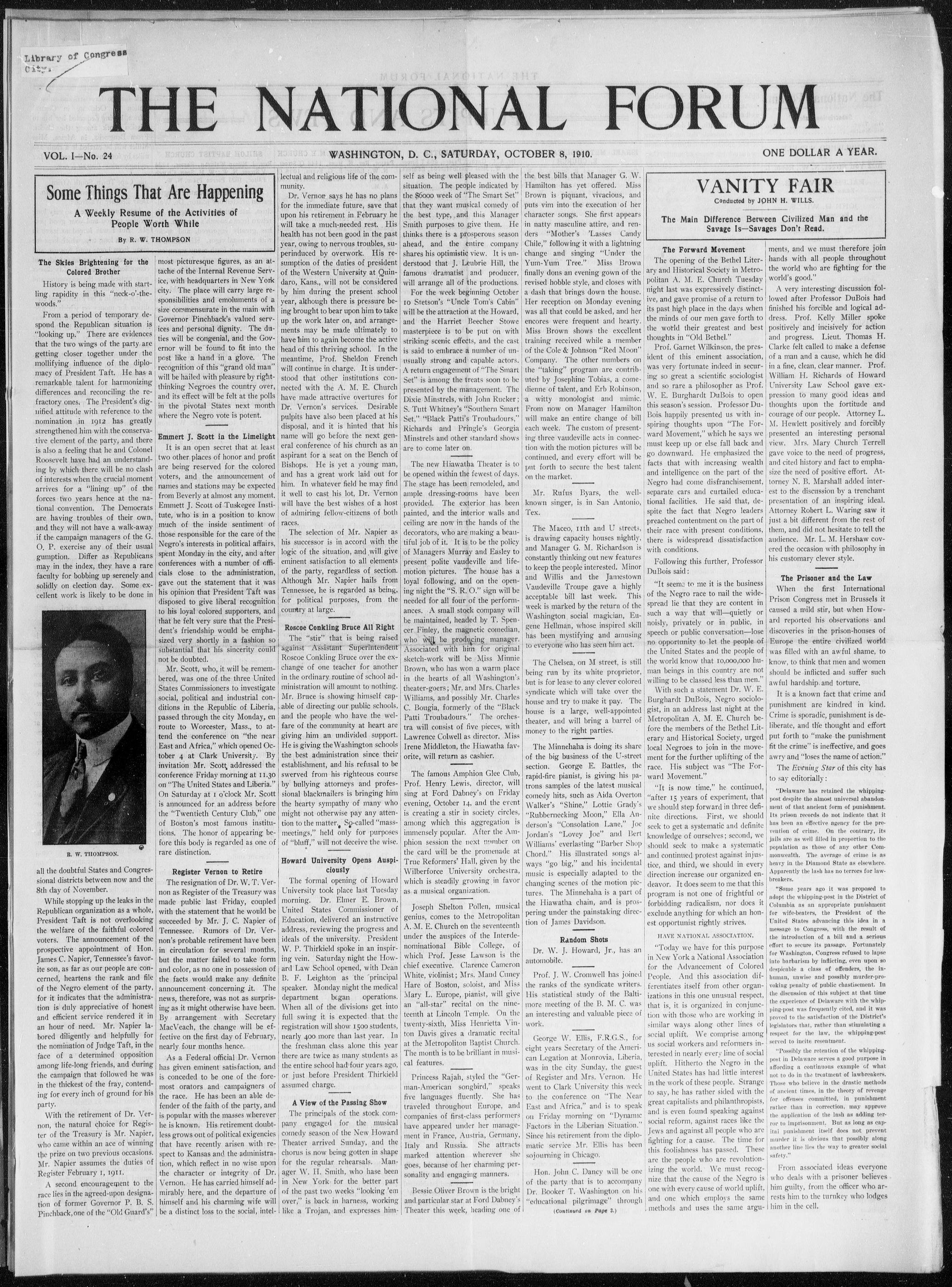
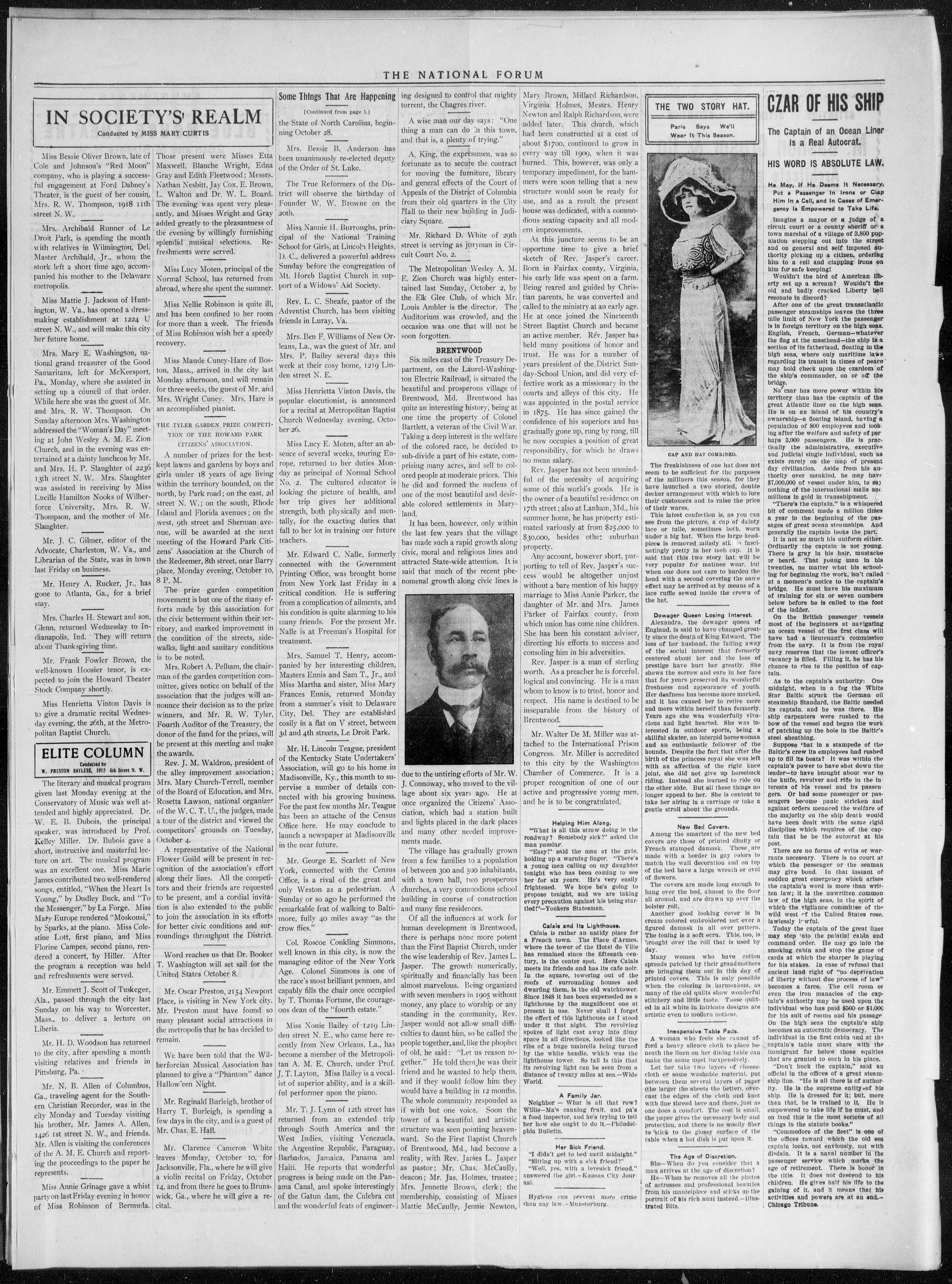
Page text (machine-generated)
THE NATIONAL FORUM
TH
Some Things That
A Weekly Resume
People We
By R. W. T
By R. W. THOMPSON
The Skies Brightening for the Colored Brother
History is being made with start ling rapidity in this "neck-o'the-woods."
From a period of temporary despond the Republican situation is "looking up." There are evidences that the two wings of the party are getting closer together under the mollifying influence of the diplomacy of President Taft. He has a remarkable talent for harmonizing differences and reconciling the refractory ones. The President's dignified attitude with reference to the nomination in 1912 has greatly strengthened him with the conservative element of the party, and there is also a feeling that he and Colonel Roosevelt have had an understanding by which there will be no clash of interests when the crucial moment arrives for a "lining up" of the forces two years hence at the national convention. The Democrats are having troubles of their own, and they will not have a walk-away if the campaign managers of the G.O. P. exercise any of their usual gumption. Differ as Republicans may in the index, they have a rare faculty for bobbing up serenely and solidly on election day. Some excellent work is likely to be done in
PETER H. BURKE
all the doubtful States and Congressional districts between now and the 8th day of November.
While stopping up the leaks in the Republican organization as a whole, President Taft is not overlooking the welfare of the faithful colored voters. The announcement of the prospective appointment of Hon. James C. Napier, Tennessee's favorite son, as far as our people are concerned, heartens the rank and file of the Negro element of the party, for it indicates that the administration is duly appreciative of honest and efficient service rendered it in an hour of need. Mr. Napier labored diligently and helpfully for the nomination of Judge Taft, in the face of a determined opposition among life-long friends, and during the campaign that followed he was in the thickest of the fray, contending for every inch of ground for his party.
With the retirement of Dr. Vernon, the natural choice for Register of the Treasury is Mr. Napier, who came within an ace of winning the prize on two previous occasions. Mr. Napier assumes the duties of Register February 1, 1911.
A second encouragement to the race lies in the agreed-upon designation of former Governor P. B. S. Pinchback, one of the "Old Guard's"
Library of Congress
VOL. I-No. 24
R. W. THOMPSON.
most picturesque figures, as an attachment of the Internal Revenue Service, with headquarters in New York city. The place will carry large responsibilities and enoluments of a size commensurate in the main with Governor Pinchback's valued services and personal dignity. The duties will be congenial, and the Governor will be found to fit into the post like a hand in a glove. The recognition of this "grand old man" will be hailed with pleasure by right-thinking Negroes the country over, and its effect will be felt at the polls in the pivotal States next month where the Negro vote is potent.
Emmert J. Scott in the Limelight
Emmert J. Scott in the Limelight It is an open secret that at least two other places of honor and profit are being reserved for the colored voters, and the announcement of names and stations may be expected from Beverly at almost any moment, Emmett J. Scott of Tuskegee Institute, who is in a position to know much of the inside sentiment of those responsible for the care of the Negro's interests in political affairs, spent Monday in the city, and after conferences with a number of officials close to the administration, gave out the statement that it was his opinion that President Taft was disposed to give liberal recognition to his loyal colored supporters, and that he felt very sure that the President's friendship would be emphasized very shortly in a fashion so substantial that his sincerity could not be doubted.
Mr. Scott, who, it will be remembered, was one of the three United States Commissioners to investigate social, political and industrial conditions in the Republic of Liberia, passed through the city Monday, en route to Worcester, Mass., to attend the conference on "the near East and Africa," which opened October 4 at Clark University. By invitation Mr. Scott addressed the conference Friday morning at 11.30 on "The United States and Liberia." On Saturday at 1 o'clock Mr. Scott is announced for an address before the "Twentieth Century Club," one of Boston's most famous institutions. The honor of appearing before this body is regarded as one of rare distinction.
Register Vernon to Retire
The resignation of Dr. W. T. Vernon as Register of the Treasury was made public last Friday, coupled with the statement that he would be succeeded by Mr. J. C. Napier of Tennessee. Rumors of Dr. Vernon's probable retirement have been in circulation for several months, but the matter failed to take form and color, as no one in possession of the facts would make any definite announcement concerning it. The news, therefore, was not as surprising as it might otherwise have been. By arrangement with Secretary MacVeach, the change will be effective on the first day of February, nearly four months hence.
As a Federal official Dr. Vernon has given eminent satisfaction, and is conceded to be one of the foremost orators and campaigners of the race. He has been an able defender of the faith of the party, and is popular with the masses wherever he is known. His retirement doubtless grows out of political exigencies that have recently arisen with respect to Kansas and the administration, which reflect in no wise upon the character or integrity of Dr. Vernon. He has carried himself admirably here, and the departure of himself and his charming wife will be a distinct loss to the social, intel-
lectual and religious life of the community. self as being well pleased with the situation. The people indicated by the best bills that Hamilton has yet
Dr. Vernon says he has no plans for the immediate future, save that upon his retirement in February he will take a much-needed rest. His health has not been good in the past year, owing to nervous troubles, superinduced by overwork. His resumption of the duties of president of the Western University at Quindaro, Kans., will not be considered by him during the present school year, although there is pressure being brought to bear upon him to take up the work later on, and arrangements may be made ultimately to have him to again become the active head of this thriving school. In the meantime, Prof. Sheldon French will continue in charge. It is understood that other institutions connected with the A. M. E. Church have made attractive overtures for Dr. Vernon's services. Desirable pulpits have also been placed at his disposal, and it is hinted that his name will go before the next general conference of his church as an aspirant for a seat on the Bench of Bishops. He is yet a young man, and has a great work laid out for him. In whatever field he may find it well to cast his lot, Dr. Vernon will have the best wishes of a host of admiring fellow-citizens of both races.
The selection of Mr. Napier as his successor is in accord with the logic of the situation, and will give eminent satisfaction to all elements of the party, regardless of section. Although Mr. Napier hails from Tennessee, he is regarded as being, for political purposes, from the country at large.
Roscoe Conkling Bruce All Right
The "stir" that is being raised against Assistant Superintendent Roscoe Conkling Bruce over the exchange of one teacher for another in the ordinary routine of school administration will amount to nothing. Mr. Bruce is showing himself capable of directing our public schools, and the people who have the welfare of the community at heart are giving him an undivided support. He is giving the Washington schools the best administration since their establishment, and his refusal to be swerved from his righteous course by bullying attorneys and professional blackmailers is bringing him the hearty sympathy of many who might not otherwise pay any attention to the matter. So-called "massmeetings," held only for purposes of "bluff," will not deceive the wise.
Howard University Opens Auspiciously
The formal opening of Howard University took place last Tuesday morning. Dr. Elmer E. Brown, United States Commissioner of Education, delivered an instructive address, reviewing the progress and ideals of the university. President W. P. Thirkield spoke in an inspiring vein. Saturday night the Howard Law School opened, with Dean B. F. Leighton as the principal speaker. Monday night the medical department began operations. When all of the divisions get into full swing it is expected that the registration will show 1500 students, nearly 400 more than last year. In the freshman class alone this year there are twice as many students as the entire school had four years ago, or just before President Thirkield assumed charge.
A View of the Passing Show
The principals of the stock company engaged for the musical comedy season of the New Howard Theater arrived Sunday, and the chorus is now being gotten in shape for the regular rehearsals. Manager W. H. Smith, who has been in New York for the better part of the past two weeks "looking 'em over," is back in harness, working like a Trojan, and expresses him-
self as being well pleased with the situation. The people indicated by the $6000 week of "The Smart Set" that they want musical comedy of the best type, and this Manager Smith purposes to give them. He thinks there is a prosperous season ahead, and the entire company shares his optimistic view. It is understood that J. Leubrie Hill, the famous dramatist and producer, will arrange all of the productions. For the week beginning October 10 Stetson's "Uncle Tom's Cabin" will be the attraction at the Howard, and the Harriet Beecher Stowe masterpiece is to be put on with striking scenic effects, and the cast is said to embrace a number of unusually strong and capable actors. A return engagement of "The Smart Set" is among the treats soon to be presented by the management. The Dixie Minstrels, with John Rucker; S. Tutt Whitney's "Southern Smart Set," "Black Patti's Troubadours," Richards and Pringle's Georgia Minstrels and other standard shows are to come later on.
The new Hiawatha Theater is to be opened within the fewest of days. The stage has been remodeled, and ample dressing-rooms have been provided. The exterior has been painted, and the interior walls and ceiling are now in the hands of the decorators, who are making a beautiful job of it. It is to be the policy of Managers Murray and Easley to present polite vaudeville and life-motion pictures. The house has a loyal following, and on the opening night the "S. R. O." sign will be needed for all four of the performances. A small stock company will be maintained, headed by T. Spencer Finley, the magnetic comedian, who will be producing manager. Associated with him for original sketch-work will be Miss Minnie Brown, who has won a warm place in the hearts of all Washington's theater-goers; Mr. and Mrs. Charles Williams, and possibly Mr. Charles C. Bougia, formerly of the "Black Patti Troubadours." The orchestra will consist of five pieces, with Lawrence Colwell as director. Miss Irene Middleton, the Hiawatha favorite, will return as cashier.
The famous Amphion Glee Club, Prof. Henry Lewis, director, will sing at Ford Dabney's on Friday evening, October 14, and the event is creating a stir in society circles, among which this aggregation is immensely popular. After the Amphion session the next number on the card will be the promenade at True Reformers' Hall, given by the Wilberforce University orchestra, which is steadily growing in favor as a musical organization.
Joseph Shelton Pollen, musical genius, comes to the Metropolitan A. M. E. Church on the seventeenth under the auspices of the Interdenominational Bible College, of which Prof. Jesse Lawson is the chief executive. Clarence Cameron White, violinist; Mrs. Maud Cuney Hare of Boston, soloist, and Miss Mary L. Europe, pianist, will give an "all-star" recital on the nineteenth at Lincoln Temple. On the twenty-sixth, Miss Henrietta Vinton Davis gives a dramatic recital at the Metropolitan Baptist Church. The month is to be brilliant in musical features.
Princess Rajah, styled the "German-American songbird," speaks five languages fluently. She has traveled throughout Europe, and companies of first-class performers have appeared under her management in France, Austria, Germany, Italy and Russia. She attracts marked attention wherever she goes, because of her charming personality and engaging manners. Bessie Oliver Brown is the bright and particular star at Ford Dabney's Theater this week, heading one of
the best bills that Manager G. W. Hamilton has yet offered. Miss Brown is piquant, vivacious, and puts vim into the execution of her character songs. She first appears in natty masculine attire, and renders "Mother's Lasses Candy Chile," following it with a lightning change and singing "Under the Yum-Yum Tree." Miss Brown finally dons an evening gown of the revised hobble style, and closes with a dash that brings down the house. Her reception on Monday evening was all that could be asked, and her encores were frequent and hearty. Miss Brown shows the excellent training received while a member of the Cole & Johnson "Red Moon" Company. The other numbers on the "taking" program are contributed by Josephine Tobias, a comedienne of talent, and Erb Robinson, a witty monologist and mimic. From now on Manager Hamilton will make an entire change of bill each week. The custom of presenting three vaudeville acts in connection with the motion pictures will be continued, and every effort will be put forth to secure the best talent on the market.
Mr. Rufus Byars, the well-known singer, is in San Antonio, Tex.
The Maceo, 11th and U streets, is drawing capacity houses nightly, and Manager G. M. Richardson is constantly thinking out new features to keep the people interested. Minor and Willis and the Jamestown Vaudeville Troupe gave a highly acceptable bill last week. This week is marked by the return of the Washington social magician, Eugene Hellman, whose inspired skill has been mystifying and amusing to everyone who has seen him act.
The Chelsea, on M street, is still being run by its white proprietor, but is for lease to any clever colored syndicate which will take over the house and try to make it pay. The house is a large, well-appointed theater, and will bring a barrel of money to the right parties.
The Minnehaha is doing its share of the big business of the U-street section. George E. Battles, the rapid-fire pianist, is giving his patrons samples of the latest musical comedy hits, such as Aida Overton Walker's "Shine," Lottie Grady's "Rubbernecking Moon," Ella Anderson's "Consolation Lane," Joe Jordan's "Lovey Joe" and Bert Williams' everlasting "Barber Shop Chord." His illustrated songs always "go big," and his incidental music is especially adapted to the changing scenes of the motion pictures. The Minnehaha is a part of the Hiawatha chain, and is prospering under the painstaking direction of James Davidson.
Random Shots
Dr. W. J. Howard, Jr., has an automobile.
Prof. J. W. Cromwell has joined the ranks of the syndicate writers. His statistical study of the Baltimore meeting of the B. M. C. was an interesting and valuable piece of work.
George W. Ellis, F.R.G.S., for eight years Secretary of the American Legation at Monrovia, Liberia, was in the city Sunday, the guest of Register and Mrs. Vernon. He went to Clark University this week to the conference on "The Near East and Africa," and is to speak on Friday morning on "Dynamic Factors in the Liberian Situation." Since his retirement from the diplomatic service Mr. Ellis has been sojourning in Chicago.
Hon. John C. Dancy will be one of the party that is to accompany Dr. Booker T. Washington on his "educational pilgrimage" through
VANITY FAIR Conducted by JOHN H. WILLS.
VANITY FAIR Conducted by JOHN H. WILLS.
The Main Difference Between Civilized Man and the Savage Is—Savages Don't Read.
The Forward Movement
The opening of the Bethel Literary and Historical Society in Metropolitan A. M. E. Church Tuesday night last was expressively distinctive, and gave promise of a return to its past high place in the days when the minds of our men gave forth to the world their greatest and best thoughts in "Old Bethel."
Prof. Garnet Wilkinson, the president of this eminent association, was very fortunate indeed in securing so great a scientific sociologist and so rare a philosopher as Prof. W. E. Burghardt DuBois to open this season's session. Professor DuBois happily presented us with inspiring thoughts upon "The Forward Movement," which he says we must keep up or else fall back and go downward. He emphasized the facts that with increasing wealth and intelligence on the part of the Negro had come disfranchisement, separate cars and curtailed educational facilities. He said that, despite the fact that Negro leaders preached contentment on the part of their race with present conditions, there is widespread dissatisfaction with conditions.
Following this further, Professor DuBois said:
"It seems to me it is the business of the Negro race to nail the widespread lie that they are content in such a way that will—quietly or noisly, privately or in public, in speech or public conversation—lose no opportunity to let the people of the United States and the people of the world know that 10,000,000 human beings in this country are not willing to be classed less than men."
With such a statement Dr. W. E. Burghardt DuBois, Negro sociologist, in an address last night at the Metropolitan A. M. E. Church before the members of the Bethel Literary and Historical Society, urged local Negroes to join in the movement for the further uplifting of the race. His subject was "The Forward Movement."
"It is now time," he continued, "after 15 years of experiment, that we should step forward in three definite directions. First, we should seek to get a systematic and definite knowledge of ourselves; second, we should seek to make a systematic and continued protest against injustice, and third, we should in every direction increase our organized endeavor. It does seem to me that this program is not one of frightful or forbidding radicalism, nor does it exclude anything for which an honest opportunist rightly strives.
HAVE NATIONAL ASSOCIATION.
"Today we have for this purpose in New York a National Association for the Advancement of Colored People. And this association differentiates itself from other organizations in this one unusual respect, that is, it is organized in conjunction with those who are working in similar ways along other lines of social uplift. We comprise among us social workers and reformers interested in nearly every line of social uplift. Hitherto the Negro in the United States has had little interest in the work of these people. Strange to say, he has rather sided with the great capitalists and philanthropists, and is even found speaking against social reform, against races like the Jews and against all people who are fighting for a cause. The time for this foolishness has passed. These are the people who are revolutionizing the world. We must recognize that the cause of the Negro is one with every cause of world uplift, and one which employs the same methods and uses the same argu-
ONE DOLLAR A YEAR.
ments, and we must therefore join hands with all people throughout the world who are fighting for the world's good."
A very interesting discussion followed after Professor DuBois had finished his forcible and logical address. Prof. Kelly Miller spoke positively and incisively for action and progress. Lieut. Thomas H. Clarke felt called to make a defense of a man and a cause, which he did in a fine, clean, clear manner. Prof. William H. Richards of Howard University Law School gave expression to many good ideas and thoughts upon the fortitude and courage of our people. Attorney L. M. Hewlett positively and forcibly presented an interesting personal view. Mrs. Mary Church Terrell gave voice to the need of progress, and cited history and fact to emphasize the need of positive effort. Attorney N. B. Marshall added interest to the discussion by a trenchant presentation of an inspiring ideal. Attorney Robert L. Waring saw it just a bit different from the rest of them, and did not hesitate to tell the audience. Mr. L. M. Hershaw covered the occasion with philosophy in his customary clever style.
The Prisoner and the Law
When the first International Prison Congress met in Brussels it caused a mild stir, but when Howard reported his observations and discoveries in the prison-houses of Europe the entire civilized world was filled with an awful shame, to know, to think that men and women should be inflicted and suffer such awful hardship and torture. It is a known fact that crime and punishment are kindred in kind. Crime is sporadic, punishment is deliberate, and the thought and effort put forth to "make the punishment fit the crime" is ineffective, and goes awry and "loses the name of action."
The Evening Star of this city has to say editorially:
"Delaware has retained the whipping-post despite the almost universal abandonment of that ancient form of punishment. Its prison records do not indicate that it has been an effective agency for the prevention of crime. On the contrary, its jails are as well filled in proportion to the population as those of any other Commonwealth. The average of crime is as heavy in the Diamond State as elsewhere. Apparently the lash has no terrors for lawbreakers.
"Some years ago it was proposed to adopt the whipping-post in the District of Columbia as an appropriate punishment for wife-beaters, the President of the United States advancing this idea in a message to Congress, with the result of the introduction of a bill and a serious effort to secure its passage. Fortunately for Washington, Congress refused to lapse into barbarism by inflicting, even upon so despicable a class of offenders, the inhuman, unwise and possibly murder-provoking penalty of public chastisement. In the discussion of this subject at that time the experience of Delaware with the whipping-post was frequently cited, and it was proved to the satisfaction of the District's legislators that, rather than stimulating a respect for the law, the whipping-post served to incite resentment.
"Possibly the retention of the whipping-post in Delaware serves a good purpose in affording a continuous example of what not to do in the treatment of lawbreakers. Those who believe in the drastic methods of ancient times, in the theory of revenge for offenses committed, in punishment rather than in correction, may approve the application of the lash as adding terror to imprisonment. But as long as capital punishment itself does not prevent murder it is obvious that possibly along another line lies the way to greater social safety."
From associated ideas everyone who deals with a prisoner believes him guilty, from the officer who arrests him to the turnkey who lodges him in the cell.
The National Forum.
Subscription rates
One Year. $1.00
Six Months. 50
PUBLISHED WEEKLY
1022 You Street, N. W., Room 1.
RALPH W. WHITE,
Editor and Proprietor.
JOHN H. WILLS,
Business Manager.
C. L. BARNES,
Special Agent.
Entered as second-class matter, May
27, 1910, at the Postoffice at Washington,
D. C., under Act of March 3, 1879.
Address all communications, checks
and money orders to
R. W. WHITE,
1022 You Street, N. W.,
Washington, D. C.
WASHINGTON, OCTOBER 8, 1910
EDITORIALS
Let the people rule.
Journalistic vandalism is on the wane.
Collector of Customs Whitefield McKinley will be confirmed "hands down."
There is no disgrace in being a barber, bootblack, porter or laborer —unless you are a poor one.
The administration has awakened to the fact that the Negro is still a member, in good standing, of the Republican party.
Business men, professional men, industrialists, journalists, agriculturists, educators, religious teachers, agitators—yes, we need them all.
Charles W. Anderson was a conspicuous figure in the Saratoga convention, dividing honors with the Colonel. Mr. Anderson is a leader who leads.
Newspaper fights are to be deplored, and we do not engage in them as a rule. But, if any bully persists in "getting gay," the jolt that will be handed him will make a second jab unnecessary.
The whole-souled manner in which the people of Washington are rallying to the support of THE NATIONAL FORUM indicates that they know a good thing when they see it.
The leaders in the race in the various localities should get into close touch with the representatives of the Associated Press—a local application of a common-sense remedy for misrepresentation, as it were.
The colored business man who fails to advertise need not be surprised to find himself out of business before long. If you have anything the people ought to buy, take them into your confidence in the matter. Advertising is not an expense; it is an investment.
The authorities of Western University will make a grievous error should they fail to retain the services of William Teucmseh Vernon as president, and they should "grab him quick." No man as useful as the retiring Register has proven himself to be will long be without a field in which to work.
With the elimination of the disturbing factors, there seems to be no good reason why the local Negro Business League and Commercial Council may not unite and give the nation's capital a banner organization for the stimulation of the commercial spirit of the race. Let our real business men get together and stir things up!
"Mass-meetings," held by impeccunious shysters to bolster up a decadent law practice, will not deceive the substantial citizen of Washington into any movement to cripple our splendid public school system or to break down the influence of its official head. The people sturdily refuse to enact the role of catspaw to professional grafters.
The "jackleg" preacher who got so terribly worked up over the exhibition of the Johnson-Jeffries
fight pictures out at Bladensburg manages to keep his shirt on mighty well over the daily record of lynchings in the South, and does not permit the wholesale disfranchisement of law-abiding and thrifty citizens to disturb his peace of mind. Consistency, thou art indeed a jewel!
The generous recognition of former Governor P. B. S. Pinchback is a feather in the cap of the Taft administration. The way to inspire young men to work is to see to it that the old are not neglected when their best days are over. There is a lot of vim in this picturesque remnant of the "Old Guard," and the party will feel the revivifying effect of placing the genial ex-Governor again in the harness.
The Western Globe is the name of a sprightly daily newspaper which was launched Monday at East St. Louis, Ill., by the Monarch Publishing Co., composed of enterprising colored men of that city, David V. Bohannon is president and I. E. Foster is secretary of the organization. R. W. Thompson has been engaged as the Western Globe's Washington correspondent. THE NATIONAL FORUM welcomes this admirable addition to the cause, and wishes it abundant success.
Booker T. Washington's educational pilgrimage through the State of North Carolina, beginning October 28, will be a potent agency for the promotion of good feeling between the races along intellectual and commercial lines. With Bishop Clinton and such sterling representatives of the business interests of the "old North State" as John Merrick, C. C. Spaulding, Dr. J. E. Shepard, Dr. A. M. Moore and others, the forthcoming tour will take rank in effectiveness with the best of its predecessors. The personnel of the party and the itinerary will be announced shortly.
George L. Knox is doing the race an inestimable service in keeping a live ad. spreading the wholesome doctrine of self-helpfulness through the Indianapolis Freeman. He has succeeded where whining doctrinaries have failed, and where bluffers have been broken on the wheel because of their unworthiness. Without blackmailing, bulldozing or violating the laws of the land, he has made for himself a permanent place among the leaders of his day and generation. If he has made his barber shop the means of giving to the race its most influential moulder of advanced thought in the country, the title of "tonsorialist" is not a disgrace; it is a decoration of honor.
News Article
The first meeting of the season of the Christian Endeavor Society of the Fifteenth Street Presbyterian Church was held last Sunday. The meeting was largely attended, and means and ways were dvised for increasing the weekly attendance at the Sunday meetings. Two committees were appointed—one known as the lookout committee and the other a music committee. A pianist and treasurer were appointed to fill vacancies. The officers are: Miss M. Penn, president; Miss Edith Savoy, vice-president and pianist; Miss Ellen Lee, secretary; Miss Ida Freeman, treasurer. The elders of the church have pledged their support toward increasing the regular attendance.
Miss Minnie Brown and T. Spencer Finley are packing the Foraker at every performance. The uptown friends of these versatile artists are following them down to 20th street, and their reception is, if anything, more cordial there than at any other house in which they have appeared. Their teamwork is the talk of the West End, and Managers Brown and Payne say: "Brown and Finley can stay here all season, if they will just say the word." And these hard-headed men of business are not given to emitting "hot air" when contracts are to be signed. The Foraker is proving to be the "gold mine" of the old first ward.
THE NATIONAL FORUM
ISRAEL METROPOLITAN C. M.
E. CHURCH
Corner First and B Streets, S. W., Rev. R, Kent Harris, Pastor, 41 D Street, S. E.; Miss A. Woods, Church Editress, 1106 O Street, N. W.
So many men miss their vocation. Listening last Sunday morning to our presiding elder, Rev. Long, we felt that he had not mistaken his calling; we knew, rather, that he was the very man for it. Rev. Long's subject was "The Good Land," taken from that portion of the Scripture according to Romans, which treats of the tremendous sayings of Jesus Christ. Rev. Long's Christian spirit seemed to gather marvelous strength as he so markedly contrasted this land with that other, and so vividly pictured to us in a clear, strong voice "that good land"—that land of pure delight, "where generous fruits that never fail on trees immortal grow, where rocks and hills and brooks and vales with milk and honey flow." As he continued some meek and blessed influence seemed to steal in upon us, helping us to realize that there is religion in everything around us here, a calm, holy religion in the unbreathing things of nature which man would do well to imitate, but more fully did we realize that there is another land—a heaven, a sweet heaven, the home of the blest, where we may all go when life's mission is ended, glory-crowned, through the jeweled gates, to be forever with our Saviour, if we but live the life here.
We were greatly benefited and uplifted by such a sermon.
The morning collection was $43.62.
In the evening, on the occasion of the fall opening of the Epworth League, presided over by Miss Fannie Costin, we entered, for the first time since the completion of the renovation therein, the lecture-room. By the improved lights we were enabled to fully appreciate the enhanced beauty of the room. The harmonious coloring of the walls, together with the refreshened wainscoting and new carpet along the aisles, were indeed pleasant to the sight.
We enjoyed an elaborate program, beginning with a few extemporaneous remarks from Rev. Long, followed by a short edifying speech from Mr. Bush, well known in the Christian Endeavor work of Lincoln Temple. Then, for a change, we listened with rapt attention to a recitation in a soft, low, exquisite voice by Miss Flossie Barker. Mr. McGowan, an ardent teacher of the truth, and a prospective worker in the league, closed the program with an urgent admonition to the officers and members of the same to convert the youths who are to be so prominent in this work in the near future.
Without exception, the services of the day were most enjoyable.
In the midst of the growing congregation were Mrs. Josephine Atkinson Davis and husband, who are spending a while with the "old folks at home."
Miss Ada Dalton Thomas of 5th street S. E. is visiting her mother in Upper Marlboro, Md. While there she will attend the Southern Maryland Fair. Miss Thomas has as her guest Miss Lillian Vandalia Clarke.
Mr. A. R. Moxley and son, a member and officers of Israel C. M. E. Church, have now a stall in the seventh wing of the Center Market. Please do not forget that on market days.
Prof. William Jenifer of the Census Office, a prominent factor in the educational and religious life in the District, is pretty generally favored for the position of probation officer, which is to be filled shortly by the court officials. Professor Jenifer is very heavily endorsed by leading citizens of Washington, and will fill the bill to a nicety.
PULPITS AND PEWS
PLYMOUTH NOTES
Dr. A. C. Garner, Pastor, 493 T Street,
N. W.; Miss Gussie Harrod, Editress,
1145 Fifteenth Street.
Our services last Sunday were
especially interesting, as our pastor,
Dr. Garner, was about to leave the
city for a few weeks on Sunday
evening. The subject of his sermon
in the morning was "The Fire of the
Gospel of Love."
Dr. Garner is making special efforts to bring about an unusual spiritual awakening among his members, so that they might be prepared to fight bravely in the campaign against sin, vice and misery. This campaign is to be a united special effort, made by several churches, in November, for several weeks, and the plan is to hold union evangelistic meetings at each of the churches for one week. The pastors will be assisted by Rev. George Moore, the well-known former pastor of Lincoln Temple Congregational Church, and special music will be rendered each evening by a grand union choir, conducted by Mr. C. Radcliff, director of the Shiloh Baptist choir. Plymouth is one of this number, and it is the desire and earnest appeal of our pastor that every member and friend of our church catch the spirit of the meetings and work faithfully to make them what such a grand effort should be.
Dr. and Mrs. Garner, with their two younger sons, left the city last Sunday evening for their former home, Knoxville, Tenn., to attend the Knoxville Exhibition. They expect to remain about three weeks. Dr. Garner served as Commissioner of the District for the exhibition.
The annual meeting of the I. O. St. Luke was held at Plymouth Church last Friday night, September 30, 1910, for the purpose of electing the district deputy and the associate deputy for the ensuing year. Dr. Garner presided; Miss Mattie Bowen conducted the Echo meeting, which preceded the election. Miss Bowen appeared with her usual wit and humor, and made a grand address, which was followed by an address by Dr. Garner, giving brief report of the annual convention of the Grand Council held in Richmond, Va., in August.
Mrs. Bessie B. Anderson read her report for the year's work, which was well prepared and elegantly delivered.
Miss Bowen then conducted what was termed an experience meeting, in which many members took part enthusiastically.
Mrs. Bessie Anderson was re-elected district deputy, and Dr. A. C. Garner was re-elected associate district deputy.
A surprise party was tendered Miss Martha Lee Friday evening, and was a most enjoyable affair.
Music, merriment and refreshments were the features of the occasion, and were most heartily appreciated by those present. In the party were Dr. and Mrs. Smith; Misses Dorsey, Shorter, Joice; Mesdames B. L. Joice, Sims, Saunders, Murray, Thomas, Thornton, Douglass, A. Joice; Misses Sussie Harrod, L. Joice, and Messrs. J. E. Joice, L. H. Neill, R. W. Johnson, H. R. Adams and Edwards. Nearly all of these "surprised" Mrs. Smith and Miss Dorsey the previous week.
During Dr. Garner's absence the pulpit will be filled by Rev. Wiseman of the 9th Street Lutheran Church on Sunday morning, October 9; by Prof. Clark of Howard University on Sunday morning, October 16. Dr. Grimka of the 15th Street Presbyterian Church will preach at the evening service both Sundays.
Dr. J. Bentley Cherry, the well-known young surgeon-dentist, has returned to this city and established an office at 1022 U street N. W., where he will be pleased to have his friends call to see him.
METROPOLITAN A. M. E. CHURCH
Pastor, Rev. N. Ross, 1444 Q Street,
N. W.; Editor, E. G. Evans, 1015 Q
Street, N. W. Sunday School at 9.30
A. M.
Our Sunday-school put on her
new fall suit last Sunday and
strolled out before the public in
grand style. The professional and
literary students were out in large
numbers. Our orchestra has been
reorganized, and several new faces
with their instruments were present.
Mr. Leo English of Florida takes
the place made vacant by Mr. William Giles as one of the cornetists.
The Sunday-school choir will be
reorganized in a week or two.
The following teachers and officers have returned from their vacations and are at their Sunday-school posts; Mr. H. D. Woodson, teacher of No. 5 N. M. Bible Class; Miss Addie Hall, president of the Young Women's N. M. Bible Class, and second assistant superintendent of the Sunday-school; the Misses Chainey and Emma Patterson, teachers of the second and third Bible Classes, respectively; Miss C. E. Martin, teacher of the fourth Bible Class and assistant pianist; Miss Charity, pianist. Mr. G. C. Thompson has charge of Prof. Williams' N. M. Bible Class until next Sunday.
The morning services were inspiring and strengthening. The pastor preached a powerful sermon to a crowded house. Many visitors were present. Drs. Watson and Arnold assisted with the communion. Four hundred and seven bowed at the altar and partook of the Lord's Supper.
The evening services were equally fruitful, and a large number were out early. Mrs. Clara Jarvis and Miss Catharine Craig joined the church at morning service, and several joined at the evening service. The senior choir resumed its place Sunday morning, relieving the junior choir.
The W. M. M. Society of the Baltimore Conference held its annual convention in Baltimore last week, and the following of our members were elected: Mrs. Anna Welch, president; Miss Mary Curtis, editor of the Missionary Herald, and Mrs. I. N. Ross and Julia Hamilton members of the board.
Rev. I. N. Ross left the city last Monday night for Washington, Pa., where he has been invited by the officers of that city to make the address at the centennial anniversary of the city. He will spend two weeks on vacation before returning. The Bonded Debt Club of the church gave a series of entertainments this week. Rev. Dr. Clair made the principal address at Wednesday night's entertainment, and an excellent musical program was carried out Thursday night by our young people, who received many commendations from the large house. The series was quite successful. Mrs. Anna Hopkins is president and Mrs. L. Thomas is secretary of the club.
Bethel Historical and Literary Association began its fall and winter work last Tuesday evening auspiciously. President G. C. Wilkinson should see success written upon the walls if a very grand beginning indicates success. The literary discussion was opened by Prof. W. E. B. DuBois, the peerless leader of our race and the uncompromising advocate of human liberty. The large church was crowded with Washington's literary people to hear and to do honor to the man of the hour. Having been introduced by the president of the society, the professor took up the great subject, "The New Forward Movement," and, true as the title he opened many eyes to the many needs for such a movement, and clearly explained the best method to bring about the best result. Prof. Kelly Miller opened the discussion, which became carnest
SHILOH BAPSTIST CHURCH
Rev. J. Milton Waldron, Pastor, 1334
V Street, N. W.; W. H. Scott, Church
Editor, 1603 Pierce Place, N. W.
A large and appreciative congregation greeted our pastor, Dr. Waldron, last Sunday morning on his return from a month's vacation. He has greatly improved, and spoke with his usual vigor. His sermon to parents drew forth many warm expressions of approval. It would indeed do much good if at this season of the year a special sermon to parents and children could be preached from every puplit in the city, but especially do we need to be reminded of what the Bible has to say of the parents' duty to children and their duty to parents.
Professor Brawley of Howard University took charge of the Adult Bible Class last Sunday. Everymember expressed himself as pleased with the lesson and the method of the teacher in drawing out from each the best there was in him. The class is rich in teachers—Dr. Waldron, Professor Brawley and brother Hiram Ball—each one a Bible scholar. Young men or young women, if you would have your minds enriched, become a member of our Adult Class, which meets at 10 A.M. in the main auditorium every Sunday.
There was much regret at the announcement made at the morning service of the indisposition of Rev. Dixon. He was to be present to welcome Dr. Waldron on his return, but illness prevented. We wish for his speedy recovery.
Among our members who returned to the city during the week were: Brother and sister Manzo, sister Laura Thornley and sister Fannie Williams.
Brother John Washington of 936 S street, one of our aged members, was greatly missed at our communion last Sunday. We received word from him that he was quite ill, having been confined to his home for some time. He has the sympathy of the entire church, who prays for his recovery.
Brother William Saunders is at the Washington Asylum Hospital, being unable to walk and having to be kept almost continually in a rolling chair. If you cannot go to see him, then remember him in prayer.
We were pleased to welcome brother Moses Johnson back to church last Sunday morning. He has improved very much, but still finds it difficult to walk. With all his suffering, he still maintains his pleasant smile.
If there is anything needed to increase our interest in missions, then certainly the following news note and the extract taken from the letter of Dr. Murff, giving actual experience in the field, will do so. It is difficult to believe that such conditions as he relates really exist, especially so under the influence of one of the greatest civilized nations of the world:
CARRIED 250 MILES IN A CHAIR.
In the annals of religious missions there are few cases of self-sacrificing devotion to the spread of Christianity so remarkable as that of Miss Jeannette E. Miller, the handsome and accomplished daughter of Geo. M. Miller, 336 Commonwealth avenue, who left Monday afternoon for Quebec, from whence she will em-
and spirited at all times. Prof. Miller was followed by Prof. W. H. Richards, Mr. T. Clarke, Prof. Henshaw, Judge Hewlet, N. M. Marshall, Esq., Mrs. Terrel, Prof. Jesse Lawson, Calvin Chase, Esq., and several others. All highly complimented the speaker upon his able paper, and in the main agreed with him fully.
The society tendered Prof. Du Bois a hearty note of thanks for his able paper and the choir for its excellent music rendered.
bark for the fever-stricken mission station of Ochileso, in Central Africa, having dedicated her life to mission work among the blacks. From Benguelia, in Africa, Miss Miller will be carried in a chair 250 miles by four men to the scene of her trying work.—Detroit News.
Cape Town, South Africa,
September 7, 1910.
Dear Brother Waldron:
I am sorry to make it so very long writing to you and your good people. But I was forced to leave in June for a long trip, which kept me away from home until August, and on my return I was taken sick and compelled to go to bed. My illness was caused by the exposure and hardship on the trip.
It put me in a very distressed condition for money on which to live. The expense of the journey was $160, and I was forced by the Government to do so to save our standing.
You do not know what a hard time the natives in some parts of South Africa have to serve the Lord. They must carry passes, and if caught without them they are flogged or imprisoned, or fined. They must get a pass to look for work. If in three days they cannot find any, they must get another pass for two days; then if no work has been found they are imprisoned. In these places our members are not allowed to hold meetings unless a white man says so, and no colored minister is allowed to visit them. * * *
It is this kind of thing with which we have to battle that makes the work so trying. Today I should be on the road. That is why we need much prayer, and money to be used when we least expect it.
I am glad to be up again, and to say that the health of Mrs. Murff and myself is much better.
Won't you remember us and pray much?
Sister Elizabeth Johnson, who is still at New London, Conn., where she has been during the summer, continues steadily at work at her self-appointed task. She has shown the good qualities of the Christian soldier, especially that of persistency. For some time, as the following extract will show, she has been trying to hold a prayer meeting, at last being successful. We are sure the Endeavorers feel proud of her. The following letter was recently received from her:
"Dear Pastor:
"I am much encouraged in this little branch of Zion here, for we had a prayer meeting for the first time since I have been here this summer. Every Sunday it would be announced that a meeting would be held during the week, but no one seemed interested enough to come. I was present at the appointed hour, but would find the church dark and no one present. But I continued to announce the meeting. Special mention was made at the Endeavor meeting and at the evening service. Several promised to come, and on Thursday evening we had a good prayer meeting, with 14 present. Everyone felt the need of it, and expressed themselves as being benefited by coming. We hope to continue by the help of the Lord.
"There have been no converts here this year, but a few of the careless members have returned and united with the church. * * *
"The members are glad to have strangers come in and take part. Some have told me that they felt discouraged, as they seemed to be standing still. Prayer is needed here, and I believe it will be the means of building up this community.
"Your sister in Christ,
"ELIZAETH M. JOHNSON."
New London, Conn., Sept. 29.
Mr. James C. Waters, Jr., of the Depot Quartermaster's Office, has returned to his desk, after a pleasant stay in New York city. He has resumed his studies with the senior class of title Howard Law School. In New York he was the guest of Capt. and Mrs. W. H. Jackson, 241 W. 143d street.
IN SOCIETY'S REALM
Miss Bessie Oliver Brown, late of Cole and Johnson's "Red Moon" company, who is playing a successful engagement at Ford Dabney's Theater, is the guest of her cousin, Mrs. R. W. Thompson, 1918 11th street N. W.
Mrs. Archibald Runner of Le Droit Park, is spending the month with relatives in Wilmington, Del. Master Archibald, Jr., whom the stork left a short time ago, accompanied his mother to the Delaware metropolis.
Miss Mattie J. Jackson of Huntington, W. Va., has opened a dressmaking establishment at 1224 U street N. W., and will make this city her future home.
Mrs. Mary E. Washington, national grand treasurer of the Good Samaritans, left for McKeesport, Pa., Monday, where she assisted in setting up a council of that order. While here she was the guest of Mr. and Mrs. R. W. Thompson. On Sunday afternoon Mrs. Washington addressed the "Woman's Day" meeting at John Wesley A. M. E. Zion Church, and in the evening was entertained at a dainty luncheon by Mr. and Mrs. H. P. Slaughter of 2236 13th street N. W. Mrs. Slaughter was assisted in receiving by Miss Lucille Hamilton Nooks of Wilberforce University, Mrs. R. W. Thompson, and the mother of Mr. Slaughter.
Mr. J. C. Gilmer, editor of the Advocate, Charleston, W. Va., and Librarian of the State, was in town last Friday on business.
Mr. Henry A. Rucker, Jr., has gone to Atlanta, Ga., for a brief stay.
Mrs. Charles H. Stewart and son, Glenn, returned Wednesday to Indianapolis, Ind. They will return about Thanksgiving time.
Mr. Frank Fowler Brown, the well-known Hoosier tenor, is expected to join the Howard Theater Stock Company shortly.
Miss Henrietta Vinton Davis is to give a dramatic recital Wednesday evening, the 26th, at the Metropolitan Baptist Church.
ELITE COLUMN
Conducted by
W. PRESTON BAYLESS, 1915 Gb Street N. W.
The literary and musical program given last Monday evening at the Conservatory of Music was well attended and highly appreciated. Dr W. E. B. Dubois, the principal speaker, was introduced by Prof. Kelley Miller. Dr. Bubois gave a short, instructive and masterful lecture on art. The musical program was an excellent one. Miss Marie James contributed two well-rendered songs, entitled, "When the Heart Is Young," by Dudley Buck, and "To the Messenger," by La Forge. Miss Mary Europe rendered "Moskousi," by Sparks, at the piano. Miss Colleen Lott, first piano, and Miss Florine Campes, second piano, rendered a concert, by Hiller. After the program a reception was held and refreshments were served.
Mr. Emmett J. Scott of Tuskegee, Ala., passed through the city last Sunday on his way to Worcester, Mass., to deliver a lecture on Liberia.
Mr. H. D. Woodson has returned to the city, after spending a month visiting relatives and friends in Pittsburgh, Pa.
Mr. N. B. Allen of Columbus, Ga., traveling agent for the Southern Christian Recorder, was in the city Monday and Tuesday visiting his brother, Mr. James A. Allen, 1426 1st street N. W., and friends. Mr. Allen is visiting the conferences of the A. M. E. Church and reporting the proceedings to the paper he represents.
Miss Annie Grinage gave a whist party on last Friday evening in honor of Miss Robinson of Bermuda.
Those present were Misses Etta Maxwell, Blanche Wright, Edna Gray and Edith Fleetwood; Messrs. Nathan Nessbitt, Jay Cox, E. Brown, L. Walton and Dr. W. L. Board. The evening was spent very pleasantly, and Misses Wright and Gray added greatly to the pleasantness of the evening by willingly furnishing splendid musical selections. Refreshments were served.
Miss Lucy Moten, principal of the Normal School, has returned from abroad, where she spent the summer.
Miss Nellie Robinson is quite ill, and has been confined to her room for more than a week. The friends of Miss Robinson wish her a speedy recovery.
Miss Maude Cuney-Hare of Boston, Mass., arrived in the city last Monday afternoon, and will remain for three weeks, the guest of Mr. and Mrs. Wright Cuney. Mrs. Hare is an accomplished pianist.
THE TYLER GARDEN PRIZE COMPETITION OF THE HOWARD PARK CITIZENS' ASSOCIATION.
A number of prizes for the best-kept lawns and gardens by boys and girls under 18 years of age living within the territory bounded, on the north, by Park road; on the east, 2d street N. W.; on the south, Rhode Island and Florida avenues; on the west, 9th street and Sherman avenue, will be awarded at the next meeting of the Howard Park Citizens' Association at the Church of the Redeemer, 8th street, near Barry place, Monday evening, October 10, 8 P.M.
The prize garden competition movement is but one of the many efforts made by this association for the civic betterment within their territory, and marked improvement in the condition of the streets, sidewalks, light and sanitary conditions is to be noted. Mrs. Robert A. Pellham, the chairman of the garden competition committee, gives notice on behalf of the association that the judges will announce their decision as to the prize winners, and Mr. R. W. Tyler, Fourth Auditor of the Treasury, the donor of the fund for the prizes, will be present at this meeting and make the awards.
Rev. J. M. Waldron, president of the alley improvement association; Mrs. Mary Church-Terrell, member of the Board of Education, and Mrs. Rosetta Lawson, national organizer of the W. C. T. U., the judges, made a tour of the district and viewed the competitors' grounds on Tuesday, October 4.
A representative of the National Flower Guild will be present in recognition of the association's effort along their lines. All the competitors and their friends are requested to be present, and a cordial invitation is also extended to the public to join the association in its efforts for better civic conditions and surroundings throughout the District.
Word reaches us that Dr. Booker T. Washington will set sail for the United States October 8.
Mr. Oscar Preston, 2154 Newport Place, is visiting in New York city. Mr. Preston must have found so many pleasant social attractions in the metropolis that he has decided to remain.
We have been told that the Wilberforcian Musical Association has planned to give a "Phantom" dance Hallow'een Night.
Mr. Reginald Burleigh, brother of Harry T. Burleigh, is spending a few days in the city, and is a guest of Mr. Chas. E. Hall.
Mr. Clarence Cameron White leaves Monday, October 10, for Jacksonville, Fla., where he will give a violin recital on Friday, October 14, and from there he goes to Brunswick, Ga., where he will give a recital.
Some Things That Are Happening
[Continued from page 1.]
the State of North Carolina, beginning October 28.
Mrs. Bessie B. Anderson has been unanimously re-elected deputy of the Order of St. Luke.
The True Reformers of the District will observe the birthday of Founder W. W. Browne on the 20th.
Miss Nannie H. Burroughs, principal of the National Training School for Girls, at Lincoln Heights, D. C., delivered a powerful address Sunday before the congregation of Mt. Horeb Baptist Church in support of a Widows' Aid Society.
Rev. L. C. Sheafe, pastor of the Adventist Church, has been visiting friends in Luray, Va.
Mrs. Ben F. Williams of New Orleans, La., was the guest of Mr. and Mrs. P. Bailey several days this week at their cosy home, 1219 Linden street N. E.
Miss Henrietta Vinton Davis, the popular elocutionist, is announced for a recital at Metropolitan Baptist Church Wednesday evening, October 26.
Miss Lucy E. Moten, after an absence of several weeks, touring Europe, returned to her duties Monday as principal of Normal School No. 2. The cultured educator is looking the picture of health, and her trip gives her additional strength, both physically and mentally, for the exacting duties that fall to her lot in training our future teachers.
Mr. Edward C. Nalle, formerly connected with the Government Printing Office, was brought home from New York last Friday in a critical condition. He is suffering from a complication of ailments, and his condition is quite alarming to his many friends. For the present Mr. Nalle is at Freeman's Hospital for treatment.
Mrs. Samuel T. Henry, accompanied by her interesting children, Masters Ennis and Sam T., Jr., and Miss Martha and sister, Miss Mary Frances Ennis, returned Monday from a summer's visit to Delaware City, Del. They are established cosily in a flat on V street, between 3d and 4th streets, Le Droit Park.
Mr. H. Lincoln Teague, president of the Kentucky State Undertakers' Association, will go to his home in Madisonville, Ky., this month to supervise a number of details connected with his growing business. For the past few months Mr. Teague has been an attache of the Census Office here. He may conclude to launch a newspaper at Madisonville in the near future.
Mr. George E. Scarlett of New York, connected with the Census Office, is a rival of the great and only Weston as a pedestrian. A Sunday or so ago he performed the remarkable feat of walking to Baltimore, fully 40 miles away "as the crow flies."
Col. Roscoe Conkling Simmons, well known in this city, is now the managing editor of the New York Age. Colonel Simmons is one of the race's most brilliant penmen, and capably fills the chair once occupied by T. Thomas Fortune, the courageous dean of the "fourth estate."
Miss Nonie Bailey of 1219 Lincoln street N. E., who came here recently from New Orleans, La., has become a member of the Metropolitan A. M. E. Church, under Prof J. T. Layton, Miss Bailey is a vocalist of superior ability, and is a skillful performer upon the piano.
Mr. T. J. Lynn of 12th street has returned from an extended trip through South America and the West Indies, visiting Venezuela, the Argentine Republic, Paraguay, Barbados, Jamaica, Panama and Haiti. He reports that wonderful progress is being made on the Panama Canal, and spoke interestingly of the Gatun dam, the Culebra cut and the wonderful feats of engineer-
Opening ing designed to control that mighty torrent, the Chagres river.
A wise man our day says: "One thing a man can do in this town, and that is, a plenty of trying."
A. King, the expressmen, was so fortunate as to secure the contract for moving the furniture, library and general effects of the Court of Appeals of the District of Columbia from their old quarters in the City Hall to their new building in Judiciary Square.
Mary Virginia Newton added had be about every burned tempers structu use, a house dious.
Mr. Richard D. White of 29th street is serving as juryman in Circuit Court No. 2. The Metropolitan Wesley A. M. E. Zion Church was highly entertained last Sunday, October 2, by the Elk Glee Club, of which Mr. Louis Ambler is the director. The Auditorium was crowded, and the occasion was one that will not be soon forgotten.
BRENTWOOD
Six miles east of the Treasury Department, on the Laurel-Washington Electric Railroad, is situated the beautiful and prosperous village of Brentwood, Md. Brentwood has quite an interesting history, being at one time the property of Colonel Bartlett, a veteran of the Civil War. Taking a deep interest in the welfare of the colored race, he decided to sub-divide a part of his estate, comprising many acres, and sell to colored people at moderate prices. This he did and formed the nucleus of one of the most beautiful and desirable colored settlements in Maryland.
It has been, however, only within the last few years that the village has made such a rapid growth along civic, moral and religious lines and attracted State-wide attention. It is said that much of the recent phenomenal growth along civic lines is
M. B.
due to the untiring efforts of Mr. W. J. Connoway, who moved to the village about six years ago. He at once organized the Citizens' Association, which had a station built and lights placed in the dark places and many other needed improvements made. The village has gradually grown from a few families to a population of between 300 and 500 inhabitants, with a town hall, two prosperous churches, a very commodious school building in course of construction and many fine residences.
Of all the influences at work for human development in Brentwood, there is perhaps none more potent than the First Baptist Church, under the wise leadership of Rev. James L. Jasper. The growth numerically, spiritually and financially has been almost marvelous. Being organized with seven members in 1905 without money, any place to worship or any standing in the community, Rev. Jasper would not allow small difficulties to daunt him, so he called the people together, and, like the philosopher of old, he said: "Let us reason together." He told them, he was their friend and he wanted to help them, and if they would follow him they would have a building in 12 months. The whole community responded as if with but one voice. Soon the tower of a beautiful and artistic structure was seen pointing heavenward. So the First Baptist Church of Brentwood, Md., had become a reality, with Rev. James L. Jasper as pastor; Mr. Chas. McCaully, deacon; Mr. Jas. Holmes, trustee; Mrs. Jennette Brown, clerk; the membership, consisting of Misses Mattie McCaully, Jennie Newton,
Mary Brown, Millard Richardson, Virginia Holmes, Messrs. Henry Newton and Ralph Richardson, were added later. This church, which had been constructed at a cost of about $1700, continued to grow in every way till 1909, when it was burned. This, however, was only a temporary impediment, for the hammers were soon telling that a new structure would soon be ready for use, and as a result the present house was dedicated, with a commodious seating capacity and all modern improvements.
At this juncture seems to be an opportune time to give a brief sketch of Rev. Jasper's career. Born in Fairfax county, Virginia, his early life was spent on a farm. Being reared and guided by Christian parents, he was converted and called to the ministry at an early age. He at once joined the Nineteenth Street Baptist Church and became an active member. Rev. Jasper has held many positions of honor and trust. He was for a number of years president of the District Sunday-School Union, and did very effective work as a missionary in the courts and alleys of this city. He was appointed in the postal service in 1875. He has since gained the confidence of his superiors and has gradually gone up, rung by rung, till he now occupies a position of great responsibility, for which he draws no mean salary.
Rev. Jasper has not been unmindful of the necessity of acquiring some of this world's goods. He is the owner of a beautiful residence on 17th street; also at Lanham, Md., his summer home, he has property estimated variously at from $25,000 to $30,000, besides other suburban property.
Any account, however short, purporting to tell of Rev. Jasper's success would be altogether unjust without a bare mention of his happy marriage to Miss Annie Parker, the daughter of Mr. and Mrs. James Parker of Fairfax county, from which union has come nine children. She has been his constant adviser, directing his efforts to success and consoling him in his adversities.
Rev. Jasper is a man of sterling worth. As a preacher he is forceful, logical and convincing. He is a man whom to know is to trust, honor and respect. His name is destined to be inseparable from the history of Brentwood.
Mr. Walter De M. Miller was attached to the International Prison Congress. Mr. Miller is accredited to this city by the Washington Chamber of Commerce. It is a proper recognition of one of our active and progressive young men, and he is to be congratulated.
Helping Him Along
"What is all this straw doing in the roadway? Somebody sick?" asked the man passing. "Easy!" said the man at the gate, holding up a warning finger. "There's a young man calling on my daughter tonight who has been coming to see her for six years. He's very easily frightened. We hope he's going to propose tonight, and we are taking every precaution against his being started!"—Yonkers Statesman.
Calais and Its Lighthouse.
Calais is rather an untidy place for a French town. The Place d'Armes, where the tower of the Hotel de Ville has remained since the fifteenth century, is the center spot. Here Calais meets its friends and has its cafe noir. In the square, towering out of the roofs of surrounding houses and dwarfing them, is the old watchtower. Since 1848 it has been superseded as a lighthouse by the magnificent one at present in use. Never shall I forget the effect of this lighthouse as I stood under it that night. The revolving spokes of light cast away into filmy space in all directions, looked like the ribs of a huge umbrella being turned by the white handle, which was the lighthouse tower. So tall is this that its revolving light can be seen from a distance of twenty miles at sea. Wide World.
A Family Jar.
Neighbor — What is all that row? Willie—Ma's canning fruit, and pa's a food inspector, and he's trying to tell her how she ought to do it.—Philadelphia Bulletin.
Her Sick Friend
"I didn't get to bed until midnight."
"Sitting up with a sick friend?"
"Well, yes, with a lovesick friend."
answered the girl.—Kansas City Journal.
Hygiene can prevent more crime than any law.—Munsterburg.
Paris Says We'll Wear It This Season.
THE FASHION OF THE TWENTIETH CENTURY
CAP AND HAT COMBINED.
The freakishness of one hat does not seem to be sufficient for the purposes of the milliners this season, for they have launched a two storied, double decker arrangement with which to lure their customers and to raise the price of their wares.
This latest confection is, as you can see from the picture, a cap of dainty lace or tulle, sometimes both, worn under a big hat. When the large headpiece is removed milady still, it fascinately pretty in her mob cap, it is said that this two story hat will be very popular for matinee wear, but when one does not care to burden the head with a second covering the same effect may be arrived at by means of a lace ruffle sewed inside the crown of the hat.
Dowager Queen Losing Interest. Alexandra, the dowager queen of England, is said to have changed greatly since the death of King Edward. The loss of her husband, the falling away of the social interest that formerly centered about her and the loss of prestige have hurt her greatly. She shows the sorrow and care in her face that for years preserved its wonderful freshness and appearance of youth. Her deafness has become more marked, and it has caused her to retire more and more within herself than formerly. Years ago she was wonderfully vivacious and light hearted. She was interested in outdoor sports, being a skillful skater, an interpid horsewoman and an enthusiastic follower of the hounds. Despite the fact that after the birth of the princess royal she was left with an affection of the right knee joint, she did not give up horseback riding. Instead she learned to ride on the other side. But all these things no longer appeal to her. She is content to take her airing in a carriage or take a gentle stroll about the grounds.
New Bed Covers.
Among the smartest of the new bed covers are those of printed dimity or French stamped damask. These, are made with a border in gay colors to match the wall decoration and on top of the bed have a large wreath or oval of flowers.
The covers are made long enough to hang over the bed, almost to the floor all around, and are drawn up over the bolster roll.
Another good looking cover is in cream colored embroidered net over a figured damask in all over pattern.
The toning is a soft cern. This, too, is brought over the roll that is used by day.
Many women who have cotton spreads patched by their grand mothers are bringing them out in this day of printed covers. This is only possible when the coloring is harmonious, as many of the old quilts show wonderful stitchery and little taste. Those quilted in all white in intricate designs are artistic even to modern notions.
Inexpensive Table Pads
A woman who feels she cannot afford a heavy silence cloth to place beneath the linen on her dining table can make the same most luxuriously. Let her take two layers of cheesecloth or some washable material, put between them several layers of paper (the larger the sheets the better), overcast the edges of the cloth and knot with fine thread here and there, just as one does a comfort. The cost is small, the paper gives the necessary body and protection, and there is no woolly fiber to stick to the glossy surface of the table when a hot dish is put upon it.
The Age of Discretion.
She—When do you consider that a man arrives at the age of discretion?
He—When he removes all the photos of actresses and professional beauties from his mantepiece and sticks up the portrait of his rich aunt instead.—Illustrated Bits.
CZAR OF HIS SHIP
The Captain of an Ocean Liner is a Real Autocrat.
HIS WORD IS ABSOLUTE LAW.
He May, if He Deems It Necessary,
Put a Passenger In Irons or Clap
Him in a Cell, and in Cases of Emergency is Empowered to Take Life.
Imagine a mayor or a judge of a circuit court or a county sheriff or a town marshal of a village of 3,800 population stepping out into the street and on general and self imposed authority picking up a citizen, ordering him to a cell and clapping irons on him for safe keeping!
Wouldn't the bird of American liberty set up a scream? Wouldn't the old and badly cracked Liberty bell resonate in discord?
After one of the great transatlantic passenger steamships leaves the three mile limit of New York the passenger is in foreign territory on the high seas. English, French, German—whatever the flag at the masthead—the ship is a section of its fatherland, floating in the high seas, where only maritime laws regarding its transit in times of peace may hold check upon the czardom of the ship's commander, on or off the bridge.
No 'czar has more power within his territory than has the captain of the great Atlantic liner on the high seas. He is on an island of his country's ownership—a floating island, having a population of 800 employees and looking after the welfare and safety of peraps 3,000 passengers. He is practically the administrative, executive and judicial single individual, such as exists rarely on the map of present day civilization. Aside from his authority over mankind, he may have $7,000,000 of vessel under him, to say nothing of the international malls and millions in gold in transshipment.
"There's the captain," is a whispered bit of comment made a million times a year in the beginning of the passages of great ocean steamships. And generally the captain looks the part.
It is not so much his uniform either. Ordinarily the captain is not young. There is gray in his hair, mustache or beard. That young man in his twenties, no matter what his schooling for beginning the work, isn't called at a moment's notice to the captain's bridge. He must have his maximum of training for six or seven numbers below before he is called to the foot of the ladder.
On the British passenger vessels most of the beginners at navigating an ocean vessel of the first class will have had a leeantant's commission from the navy. It is from the royal navy reserves that the lowest officer's vacancy is filled. Filling it, he has his chance to rise to the position of captain.
As to the captain's authority: One midnight, when in a fog the White Star Baltic struck the German oil steamship Standard, the Baltic needed its captain, and he was there. His ship carpenters were rushed to the bow of the vessel and began the work of patching up the hole in the Baltic's steel sheathing.
Suppose 'that in a stampede of the Baltic's crew its employees had rushed up to fill its boats? It was within the captain's power to have shot down the leader—to have brought about war to the knife, revolver and rifle in the interests of his vessel and its passengers. Or had this passenger or passengers become panic stricken and against orders menaced the welfare of the majority on the ship death would have been dealt with the same rigid discipline which requires of the captain that he be the autocrat at his post.
There are no forms of writs or warrants necessary. There is no court at which the passenger or the seaman may give bond. In that instant of sudden great emergency which arises the captain's word is more than written law; it is the unwritten common law of the high seas, in the spirit of which the vigilance committee of the wild west of the United States rose, lawlessly lawful.
Today the captain of the great liner may step into the palatial cabin and command order. He may go into the smoking cabin and stop the game of cards at which the sharper is playing for his stakes. In case of refusal that ancient land right of "no deprivation of liberty without due process of law" becomes a farce. The cell room or even the iron manacles of the captain's authority may be used upon the individual who has paid $500 or $1,000 for his suit of rooms and his passage. On the high seas the captain's ship becomes an autocratic democracy. The individual in the first cabin and at the captain's table must share with the immigrant far below those equities that are granted to each in his place.
"Don't buck the captain," said an official in the offices of a great steamship line. "He is all there is of authority. He is the supreme entity of his ship. He is dressed for it; but, more than that, he is trained to it. He is empowered to take life if he must, and on land this is the most serious of all things in the statute books." "Commodore of the feet" is one of the offices toward which the old sea captain looks, not enviously, not with disdain. It is a naval number in the passenger service which marks the age of retirement. There is honor in the title. It does not descend to his children. He gives half his life to the gaining of it, and it means that his activities and powers are at an end.—Chicago Tribune.
Bashon Crusor & architects and Builders
M. Bashon G
Architects
M. Bashon Crusor & Co. Architects and Builders
SUBURBAN OFFICE
East Deanwood, D. C.
CITY OF
1022 You Street, N.
We have the most desirable home seekers. Plenty of room scenery, plenty of fresh air and din, dust and noise. All home Chesapeake Junction. We build Architectural plans free. Sites subdivisions. Stop paying rent home. Best people in the city neighbors. We are able to off Fire Departments, Mail and transfers to any part of city.
IDEAL LOCATION
In Beverly, Deanwood, East Dean Park, Bloomsburg Park, Den Heights and all N.
For Suburban Office Take "D and H Streets N. W., and
FOR INFOR
Bashon Crusor, at Suburban R. White, Attorney for the
Deanwood, D. C., R. F. D. No. 3.
CITY OFFICE
At You Street, N. W., Washington
Have the most desirable location in the city of makers. Plenty of room, a cultured community of fresh air and pure water, away from land noise. All home sites on the Electric Junction. We build houses to suit the rural plans free. Sites secured in any of the towns. Stop paying rent and apply that to least people in the city among our purchase. We are able to offer you the advantage departments, Mail and Police Service. One to any part of city.
DEAL LOCATIONS TO BE HAUNTED, Deanwood, East Deanwood, Linwood, Burke, Bloomsburg Park, Dennings, Kenilworth, Fair Heights and all Maryland Suburbs.
Urban Office Take "District Car Line" at 11 H Streets N. W., and get off at Brooks St.
FOR INFORMATION SEE Crusor, at Suburban or City Office, or Attorney for the Company, at the City
East Deanwood, D. C., R. F. D. No. 3, Box 44
CITY OFFICE
1022 You Street, N. W., Washington, D. C.
We have the most desirable location in the city for colored home seekers. Plenty of room, a cultured community, fine scenery, plenty of fresh air and pure water, away from the city's din, dust and noise. All home sites on the Electric car line to Chesapeake Junction. We build houses to suit the purchaser. Architectural plans free. Sites secured in any of the suburban subdivisions. Stop paying rent and apply that to your own home. Best people in the city among our purchasers and neighbors. We are ab'e to offer you the advantage of Schools, Fire Departments, Mail and Police Service. One fare and transfers to any part of city.
IDEAL LOCATIONS TO BE HAD
In Beverly, Deanwood, East Deanwood, Linwood, Burville, Grant
Park, Bloomsburg Park, Dennings, Kenilworth, Fairmont
Heights and all Maryland Suburbs.
For Suburban Office Take "District Car Line" at Fifteenth
and H Streets N. W., and get off at Brooks Station.
FOR INFORMATION SEE
Bashon Crusor, at Suburban or City Office, or Consult
R. White, Attorney for the Company, at the City Office.
CARTER B. BRAXTON, Chief Mechanic.
Howard U
WASHING
Wilbur P. Thirkle
Howard University
WASHINGTON, D. C.
Tibur P. Thirkleld, LL. D., Pre
Howard University WASHINGTON, D. C.
Located in Capital of the Nation. Campus of over twenty acres. Advantages unsurpassed. Modern scientific and general equipment. New Carnegie Library. New Science Hall. Faculty of over one hundred. 1252 students from 35 States and 11 other countries. Unusual opportunities for self-support. No young man or woman of energy or capacity need be deprived of its advantages.
THE COLLEGE OF ARTS AND SCIENCES.
Devoted to liberal studies. Courses in English, Mathematics, Latin, Greek, French, German, Physics, Chemistry, Biology, History, Philosophy and the Social Sciences, such as are given in the best approved colleges. 16 professors. Kelly Miller, A.M. Dean.
tion combined. George W. Dean.
SCHOOL OF MANUAL APPLIED SCIENCE.
Furnishes through course structures. Offers two-year life in Mechanical and Civil Eng.
PROFESSIONAL SCIENCE.
THE SCHOOL OF THE Interdenominational. Fine and thorough courses of connection with the university. Students' Aid. Isaac Clark, D.D., Dean.
THE TEACHERS' COLLEGE.
Special opportunities for teachers.
Regular college courses in Psychology,
Psychology Education, etc., with degree
of A.B.; Pedagogical courses leading to
Ph.B. degree. High-grade courses in
Normal Training, Music, Manual Arts
and Domestic Sciences. Graduates helped
to positions. Lewis B. Moore, A.M.
Ph.D. Dean.
Faculty of 13. Three courses of four years each. High-grade preparatory school. George J. Cummings, A.M. Dean.
THE COMMERCIAL COLLEGE.
Courses in Bookkeeping, Stenography, Commercial Law, History, Civics, etc.
Business and English high-school educa-
THE CHASE A
MAKE
High Grade Porraits and Pillow
All Goods Made
are Guaranteed
539 F Street Northwest, I
Best Work and Workman
ONE-THIRD DEPOSIT RE
WHERE
CHASE ART COMP
MAKERS OF
Portraits and Pillow Tops, Novelties a
All Goods Made and Sold by Us
are Guaranteed
Street Northwest, Room 21, Washin
Best Work and Workmanship at Lowest Price
THIRD DEPOSIT REQUIRED ON ALL O
WHERE TO DINE
EATS EATS EATS
BIG DIME LUNCH
$1.15 Meal Tickets for $1.00
$2.30 Tickets for $2.00
$3.45 Tickets for $3.00
Full Breakfast or Dinner for
FIFTEEN CENTS
We make a Specialty of our Sunday Dinners
We Cater Specially to Students
Prompt and Poite Service
Mrs. C. E. Johnson, Proprietor
603 C Street N. W.
GOOD THINCS TO EAT
ELLIS CAFE
WELCOME TO THE ELKS
OUR FOOD IS OF THE BEST
Poite and Prompt Service Our Motto
Prices Reasonable
No. 729 4th Street N. W.
---
```markdown
```
ATTENTION.
rusor & Co. and Builders
C., R. F. D. No. 3, Box 44
OFFICE
W., Washington, D. C.
The location in the city for colored men, a cultured community, fine pure water, away from the city's sites on the Electric car line to old houses to suit the purchaser. It secured in any of the suburban but and apply that to your own city among our purchasers and offer you the advantage of Schools, Police Service. One fare and
INS TO BE HAD
Linwood, Linwood, Burville, Grant Linings, Kenilworth, Fairmont Maryland Suburbs.
District Car Line" at Fifteenth get off at Brooks Station.
MATION SEE
on or City Office, or Consult Company, at the City Office.
University
TON, D. C.
eid, LL. D., Pres.
tion combined. George W. Cook, A.M.
Dean.
SCHOOL OF MANUAL ARTS AND
APPLIED SCIENCES.
Furnishes through courses. Six instructors. Offers two-year limited courses in Mechanical and Civil Engineering.
THE SCHOOL OF THEOLOGY.
Interdenominational. Five professors.
Broad and thorough courses. Advantages of connection with a great University. Students' Aid. Low expenses. Isaac Clark, D.D., Dean.
THE SCHOOL OF MEDICINE.
Medical, Dental and Pharmaceutical
Colleges.
Forty-nine professors. Modern laboratories and equipment. Connected with new Freedmen's Hospital, costing half million dollars. Clinical facilities not surpassed in America. Post-graduate School and Polytechnic. Edward A. Bailoch, M.D., Dearn, 5th and W streets N. W. W. C. McNeill, M.D., Secretary, 901 R Street N. W.
THE SCHOOL OF LAW.
Faculty of eight. Courses of three years, giving a thorough knowledge of theory and practice of law. Occupies own building opposite the courthouse. Benjamin F. Leighton, LLB, Dean, 420 5th Street N. W. For catalog and special information address Dean of Department.
ART COMPANY
ERS OF
Tops, Novelties and Chemicals
and Sold by Us
Guaranteed
Room 21, Washington, D. C.
Enscription at Lowest Prices.
REQUIRED ON ALL ORDERS.
TO DINE
Open All Night
JOSHUA N. ANDERSON, Prop. r.
SEE UNCLE JOSH AT THE
TUSKEEGEE
626 North Capitol Street N. W.
West Side Union Station, Half Block Away
WASHINGTON, D. C.
Best Meals at Low Prices
Excellent Service
A CLEAN PLACE TO EAT OPEN DAY AND NIGHT
THE WALDORF CAFE
Frank T. Waddell, Prop.
15c. and 25c. Meals at All Hours
FIRST-CLASS DAIRY LUNCH SERVICE
643 Florida Ave. N.W. Washington, D.C.
ATTENTION.
FINDS OF 1910 BASEBALL YEAR
Newcomers Who Have Made Themselves Solid With Fans.
COLE AND FORD GREATEST
Clever Young Pitchers of Chicago and New York Teams Are Best of Lot Developed This Season—Campbell of Pittsburg and Lewis of Boston.
If as many good youngsters are unearthed next season as there have been this major league magnates will have little cause to complain. In all fifty-seven candidates were brought into the best circuits. A great many more were hauled in, of course, but after the weeding the net total depreciated materially.
Last year may have been exceptional in the number of men produced by the minor leagues. Fifty-seven tolerable ball players, with a star here and there, is an abnormal harvest for any one season. Yet it was not enough to fill the hiatus made by the departure of veterans.
Many Twirlers Make Good.
The choicest recruits to enter in last year's influx for 1910 duty were pitchers. The Cubs secured Cole of Bay City, Southern Michigan league club, a
1
RUSSELL FORD, GREATEST AMERICAN LEAGUE FIND OF 1910 SEASON.
young man who kept Chance's outfit going when all the veterans were having a hard time of it.
Russell Ford is the sensation of the American league this season. Many critics say he will be the best in the junior organization next year.
Cleveland was lucky in procuring good pitching talent. There are Harkness, Koestner, Fanwell and Mitchell.
In Stroud and Pernoll Detroit has a pair of very passable shooters. There have been no pyrrotechnics connected with their performances, but Jennings appears to be hanging on to them, and Huzhey has a reputation of knowing baseball and its actors. Evans hasn't been given much of a chance by Manager Lake of the Boston Doves, but his record shows he is pretty fair. Larry Gardner, second baseman of the Boston Red Sox, is one of the best infielders to break in this year. He is a finished fielder, shows finesse in putting the ball on the runner and can hit and run bases. Gardner's namesake, Earl, with the Yankees, is another very fair second sacker.
Of the third basemen, Bert Daniels, another of Stallings' selections, seems to be the star. Pittsburgh obtained a stable youngster in McKetchie, third baseman with Wheeling last year. The central leaguer isn't fracturing the fences or anything of the sort, but he makes an occasional hit when it counts and he can field like Wagner. Sharpe, traded by Dreyfuss to Boston, is the premier first sacker. Jake Daubert, who evaded both the Naps and Giants, finally landing with Brooklyn, is a close second. Flynn of the Pirates is following at Daubert's heels. Newam, the Texas boy with the St Louis Browns, gives promise.
Lewis and Campbell Are Good.
Duffy Lewis of the Red Sox and Campbell of Pittsburgh are the two best outfielders developed. These two will probably be wonders next year. Great things are also expected of Jack Dalton, the Des Moines gardener, with Brooklyn. Jack Graney of the Naps has proved himself a Class A man. Roach of the Yankees is undoubtedly a better short fielder than Russell Blackburne of the White Sox. In fact, Blackburne has been pretty much of a fizzle, but Comiskey has hopes that the former Providence wonder may yet earn his purchase price.
As usual, catchers have been mighty scarce this year. The only one worth speaking about is big Ed Sweeney of the Highlanders. My, how this boy can hit and throw and pick up bunts! He's not far from being the best in the league behind the bat.
All in all, Duffy Lewis and Russell Ford are the stars of the American youngsters, while the bright lights of the newcomers in the National league are Cole and Campbell.
THE NATIONAL FORUM
A CASK OF GLYCERIN.
The Admiral Had to Prove That It Was Harmless.
Life in Ireland is never devoid on the humorous, and when Admiral, then Captain, John Moresby was stationed at Queenstown, in 1860, he had his full share. He narrates in "Two Admirals" that it became his duty to survey a damaged ship inden with casks of glycerin. For purpose of repair he directed a portion of the cargo to be landed and stored and thought no more about it.
What was my astonishment next day, he says, to find the whole town in a panic and to be informed that every life was in danger from the deadly compound stored under one of the principal offices of the place.
The town council assembled and sent their health officer to stop all discharge of cargo and to remove the vessel to the outer anchorage, and the people gathered at the street corners in agitated crowds to meet their doom in comfortable companionship.
I vainly contended that it could be nothing but pure glycerin.
"Pure glycerin, is it?" said the chairman. "Well, there's mighty little difference between pure glycerin and impure glycerin, and the ship must be off before we have the place blown about our ears."
All I could say was: "Well, gentlemen, if it is nitroglycerin a blow will explode it. I propose that a cask should be put in a field, and I will fire a shot at it. Will this satisfy you?"
After much deliberation this handsome offer was accepted. I shall never forget that procession nor the agonized countenances of the bearers who lifted the cask to a cart as softly padded for its reception as if it had been an invalid in the last stages of disease.
"Patsy and Jim Dempsey had great courage entirely," was the comment of the crowd as they followed at what they believed to be a safe distance.
We wended our way into the country attended by the prayers and blessings of all the old women of both sexes whom we met en route, and the gilded pinnacle was put on the terror when in lifting the cask into the field, far from all human habitation, one of the bearers stumbled and almost fell. He turned a face of war appeal to heaven as he recovered himself.
But we got it there. I can still recall the town council crouchling among the brambles of a distant hedge and watching with expectant eyes and manifest intention of instant flight. The shot hit the cask fair and square, and amid an awful silence a few slow tears of glycerin oozed out and trickled down its side. That was all.
A MAN AGAINST A NATION.
The Most Curious European War That Was Ever Waged.
The most curious European war ever waged was that which in the sixteenth century, the period of the reformation and the renaissance, was carried on single handed for between five and six years between a bankrupt grocer of Berlin and the elector of Saxony, who was the most powerful German prince of the period. The grocer's name was Hans Kohlhase, and the immediate cause of the quarrel was the arresting of two of his horses in the elector's territory, he being a subject of the elector of Brandenburg. Failing to get redress, he adopted what was then a perfectly legal expedient and declared formal war on the realm of Saxony. The declaration was accepted in due form, and the war began.
The extraordinary part of the story is that the grocer kept the war up for nearly six years practically single handed and even went to the extremity of declaring war on his own sovereign in the meantime before he was caught. He burned farms and even villages, employed mercenaries after the fashion of the times and made himself the terror of the district. He was finally influenced to stop hostilities by Luther, and after he had taken the sacrament from his hands he was betrayed into a further act of hostility by treachery and, being captured, suffered death on the wheel after refusing an act of grace which granted him the painless and honorable death of the sword. The story is perhaps the strongest of all the romances of that romantic age. Westmister Gazette
For Body and Soul.
Here is a curious advertisement, republished in the Cornhill Magazine from an eighteenth century paper: "Wanted—For a family who have bad health, a sober, steady person, in the capacity of a doctor, surgeon and apothecary. He must occasionally act in the capacity of butter and dress hair and wigs. He will be required to read prayers occasionally and to preach a sermon every Sunday. The reason of this advertisement is that the family cannot any longer afford the expense of the physical tribe and wish to be at a certain expense for their bodies and souls. A good salary will be given."
Truth Will Out.
Hubby (with irritation)—Why is it that you women insist upon having the last word?
Wifey (calmly)—We don't. The only reason we get it is because we always have a dozen arguments left when you stupid men are all run out.—Ladies' Home Journal.
The Difference.
A fool is unable to see his own faults.
A wise man, seeing his own faults, is able to keep other people from noticing them.—Chicago Record-Herald.
Loving kindness is greater than laws, and the charities of life are more than all ceremonies.—Talmud.
HISTORY OF WORLD'S SERIES
The world's series will be staged in October, and it will be the sixth clash between American and National league champions.
The Boston Americans won the first series from Pittsburgh in 1903. The New York Nationals beat the Philadelphia Americans in 1905.
The Chicago Americans scored over the Chicago Nationals in 1906. The Chicago Nationals then turned in and redeemed themselves by whipping the Detroit Americans twice. Last year the Pittsburg Nationals beat the Detroit Americans.
This makes four wins for National league teams and two for American league representatives.
The Chicago team of 1910 is practically the same ball club that lost the world's championship to the Chicago Americans in 1906 and won it twice from the Detroit Americans in 1907 and 1908.
BIG FOOTBALL SCORE SURE.
Rule Allowing Players to Return to Game Helps Large Universities.
Are we about to revive the days of big football scores, similar to those made when "Hurry Up" Vost of the University of Michigan was in his prime? It certainly looks so. One year it was the boast of Michigan that her team had scored a total of more than 500 points in a single season, one game alone netting something in excess of 130 points. There is small likelihood that the present season will witness anything so extraordinary as this, but the new rules are conducive to big scores.
The particular rule which is likely to produce this condition of affairs is that which permits a team to remove a player in one period and then allow him to return to the game once during the succeeding period.
The big college elevenes are the gainers by the new rule regarding substitution. It takes a lot of scurrying by the minor colleges to get together a football squad of more than a dozen ablebodied young men. The new rule regarding substitution will bring little relief to them, because they won't have the men to substitute. One of the games on Franklin field last year furnished an illustration of this. The University of West Virginia was the opponent. Two of the southerners' players fell by the wayside during the game, and, as there were only thirteen men in the squad, this used up the available supply of substitutes. In the second half two more players, one of them a substitute himself, had to quit the game. West Virginia was in a quandary and in its dilemma sought aid of Pennsylvania by making the unusual request that the players previously removed from the game be allowed to return. The request was granted and the incident published far and wide as an example of good sportsmanship.
The amendment will, of course, aid the small colleges, but not in the same proportion that it will their big rivals. Under the new dispensation the coaches of the big colleges will use from two to three eleven during a game. They will not be afraid to make substitutions, because they will know that if a new player fails to make good he can speedily be removed and replaced either by another man or the veteran who has already been in the game.
BASKETBALL GAMES IN EAST.
National A. A. U. Championships to Be Played in Oswego, N. Y.
Western aspirants for the national Amateur Athletic union basketball title will be forced to travel a thousand miles or more in order to compete in the 1911 championships, the series that was held in Chicago last year being slated for the Oswego (N. Y.) floor Jan. 5, 6 and 7.
Western basketball fans will have an opportunity to see the stars in a title match, however, as the central Amateur Athletic union tournament, which attracts fives from Minnesota, Iowa, Michigan, Illinois, Indiana, Wisconsin and Ohio, will be held in Chicago in March.
COMING SPORT EVENTS
Montreal is about to open a new race track.
St. Louis will hold the annual American bowling congress in the Coliseum Jan. 21 to Feb. 6.
Buffalo, which will hold the fifth annual National Bowling association tourney next year, will revive low men team matches.
George Slosson has challenged Willie Hoppe for the world's billiard championship at 18.1 balk line, 500 points up, for a purse of $1,000.
Ottawa has raised $5,000 to send a champion eight oared shell crew to the royal English regatta next year to try to lift the grand challenge cup.
Emilio Lunghi, the Italian runner, who made such a hit in this country, is running with great success in South America. He expects to visit New York again in the near future.
When the horse racing season opens in Mexico there will be four tracks in operation—one each at Juarez, Cueravaca, Guadalajara and Chihuahua—giving the country twelve months of continuous racing. Over $3,000,000 is now invested in horses and tracks in Mexico.
AMUSEMENTS
BLUE MOUSE
26th and M
Largest, Handsomest and
Good Vaudeville and
A Cordial Welcome
H. C. SMIT
MACEO T
S. E. Cor. 11th a
Devoted to Up-to-Date, Clea
Presenting 1,000 feet of Films
Western Life Motion Plays.
cool. Refined Vaudeville and
An Hour Show.
SUNDAYS ALWAYS A BIG
MOUSE THEATRE
North and M Streets N.
Handsomest and Coolest Theatres
Vaudeville and Motion P
Welcome Extended to
H. C. SMITH, Manager
CEO THEATRE
Cor. 11th and You Sts.
Up-to-Date, Clean and Clear
10 feet of Films nightly. Dram
Motion Plays. Plenty of Fari
Vaudeville and Illustrated Songs
in Hour Show. Bring the Childr
ALWAYS A BIG SHOW, 3 REE
BLUE MOUSE THEATRE
Devoted to Up-to-Date, Clean and Clear Motion Pictures. Presenting 1,000 feet of Films nightly. Dramatic, Comic and Western Life Motion Plays. Plenty of Fans to keep you cool. Refined Vaudeville and Illustrated Song, all for 5 cents. An Hour Show. Bring the Children. SUNDAYS ALWAYS A BIG SHOW, 3 REELS 5 CENTS.
FORD DABNEY'S THEATER Palace Pool Parlo
Visit Them for a Pleasant Hour's Amusement
Corner 9th and You Streets N. W.
Seventh Year
OPEN
The Washington Co.
AND SCHOOL
(Increase)
902 T STREET N. W.
B
Depart
Piano, Voice and Violin
Piano Tuning
Harmony, Cote
Vocal Express
Theory, Analysis
OPENING
Impromptu Recital for Pupils and Public, by
For first-class Piano Tuning we recommend Mr.
Doggerson's Union Literary Mus
Now open for New Members. Any person of
this organization by taking private lessons up
special rates to all ladies who can make them.
Secure our special class rates to advanced pupi
object of the class is: that the result of the
from a printed score instead of by any
Music Furnished for All Sacred
For Terms Apply to - JAS. H. BOGGERSON, G.
OPENING
Bingham Conservator
AND SCHOOL OF EXPRESSION
(Incorporated)
Branch School in Anac
Departments
Harmony, Counterpoint, Fugue
Vocal Expression
Analysis
OPENING RECITAL
Pupils and Public, by Mr. Carl Diton, who
we recommend Mr. Harper Fortune. L.
In Literary Musical League
members. Any person of good moral character
in private lessons upon Brass, String or Reel
who can make themselves useful and interest
to admire a pupil who find it difficult
at the result of the instructions should be
bred of by ear.
Missed for All Sacred Occasions, Concerts
s. H. BOGERSON, Gen. Mgr. and Dir.
OPENING
The Washington Conservatory of Music
AND SCHOOL OF EXPRESSION
(Incorporated)
902 T STREET N. W.
Branch School in Anacostia and Alexandria, Va.
Departments
Piano, Voice and Violin
Piano Tuning
Harmony, Counterpoint, Fugue
Vocal Expression
History
Wind Instruments
History of Music
OPENING RECITAL
Impromptu Recital for Pupils and Public, by Mr. Carl Diton, who sails for Europe Oct. 1st
For first-class Piano Tuning we recommend Mr. Harper Fortune. Leave orders at Conservatory
Now one for New Members. Any person of good moral character can become a member of this organization by taking private lessons upon Brass, String or Reed Instruments. We offer special rates to all ladies who can make themselves useful and interesting in a Musical League. Special rates are available for public pupils. The object of the class is that: that the result of the instructions should be, that members can play from a printed score instead of by card. All Sacred Occasions, Concerts and Recitals For Terms apply to — JAS. H. BOGGERSON, Gen. Mgr. and Dir., — 1249 Maryland Ave. N. E.
SHOPPERS GUIDE
Subject: THE CUCUMBER—Rev. L. C. Moore
PALACE Shoe Shining Parlor
For Ladies and Gentlemen
Newspapers, Periodicals and Magazines
Imported and Domestic Cigars
810 Florida Avenue N. W.
THE FORUM
And all Leading Colored Papers for Sale
Could You Do Better
Than wear a nice tailored, slightly used
suit at $3.00 to $15.00, and think
of the money you save, Savey?
ONE PRICE
Justh's Old Stand, 619 D St. N.W.
A. TASH
Experts in
Cleaning, Dyeing and Repairing
We removed garments equal to new at reasonable price. M. W. had 25 cts.; Suita Pressed and Cleaned 60 and 75 cts.
18 48 st. N. W., Washington, D. C.
ALLE TASH, Prop. All work required.
Tennyson & Ellis Co.
Fine Paperhangers and Decorators
Painting, Plastering, Kalsomining
Window Shades to Order
PROMPT ATTENTION
ALL WORK GUARANTEED
1400 Pierce Place Northwest
Phone North 4045
ATTENTION
For a few days we will make
to your order a
Two-Piece
SUIT
FOR ONLY
$16.50
from woolens that regularly
sell at $20 and $22.50.
Choice of 75 patterns.
S. Goldheim & Sons
403-405 Seventh St.
Richard Early
HOUSE CLEANER
Washing Windows Especially
53 Pierce Street N. W.
Send me a card and I will call
---
THE THEATRE
Streets N. W.
The Coolest Theatre in Town
and Motion Pictures
Extended to Visitors
H, Manager
THEATRE
And You Sts. N. W.
and Clear Motion Pictures.
Nightly. Dramatic, Comic and
Plenty of Fans to keep you
Illustrated Song, all for 5 cents.
Bring the Children.
SHOW, 3 REELS 5 CENTS.
Palace Pool Parlor
CHAS. (Boody) ANDERSON
PROPRIETOR
1448 P Street N. W.
Conservatory of Music
OF EXPRESSION
(arized)
Branch School in Anacostia and Alexandria, Va.
Elements
Interpoint, Fugue
Union
Wind Instruments
History of Music
History
RECITAL
Mr. Carl Diton, who sails for Europe Oct. 1st
Harper Fortune. Leave orders at Conservatory
Musical League AND FEMALE SACRED
ORCHESTRA SCHOOL
Good moral character can become a member of
Brasa, String or Reed instruments. We offer
a useful and interesting in a Musical League,
who find it difficult in reading music. The
instructions should be, that members can play
Occasions, Concerts and Recitals
En. Mgr. and Dir., — 1249 Maryland Ave. N, E.
Subject: THE CUCUMBER—Rev. L. C. Moore
The National Sunday School Mission Worker and
Counselor, Ex-Member of the Mississippi Legislature,
Ex-Town Marshal, Ex-Department Sheriff, Ex-U. S.
Enumerator, Ex-Constable, Ex-U. S. Watchman,
Ex-U. S. Messenger, Ex-Jailor, Orton and
Entertainment at Mt. Carmel Baptist Church, Fourth
and L. N. W. 3 P. M. Sunday, Oct. 2, 1900.
All Sunday-Schools invited to host their Friend.
REV. W. P. GIBBONS, Pastor.
SWEEDISH MASSAGE
MISS LaPOINT ROBBINS
Late of New York
MORNING AND EVENING AT
1113 13th Street N. W.
GIVE HER A CALL IT'S WORTH THE TRIAL
Subscribe to
The National Forum
The Bay State Hotel
HARDY & OTTERY, Props.
334 N. TENNESSEE AVENUE
Atlantic City, N. J.
EUROPEAN PLAN
Concert Garden
Special Rates to Parties Taking
Apartments
PROFESSIONAL
THOMAS BECKETT
Attorney and Counsellor-at-Law
494 Louisiana Avenue
Room 15, Lewis Building, Washington, D.C.
Joseph H. Stewart
ATTORNEY AND
COUNSELLOR-AT-LAW
609 F St. N. W. Room 203
Sylvester L. McLaurin
ATTORNEY AND
COUNSELLOR-AT-LAW
609 F St. N. W. First Floor
L. C. MOORE
COUNSELLOR
and ADVISOR
Room 9. 802 F St. N. W.
Sept. 24, 1910
$1.00 a Year
ATLANTIC CITY