The New Age (Butte)
Saturday, September 20, 1902
Butte, Montana
Page text (machine-generated)
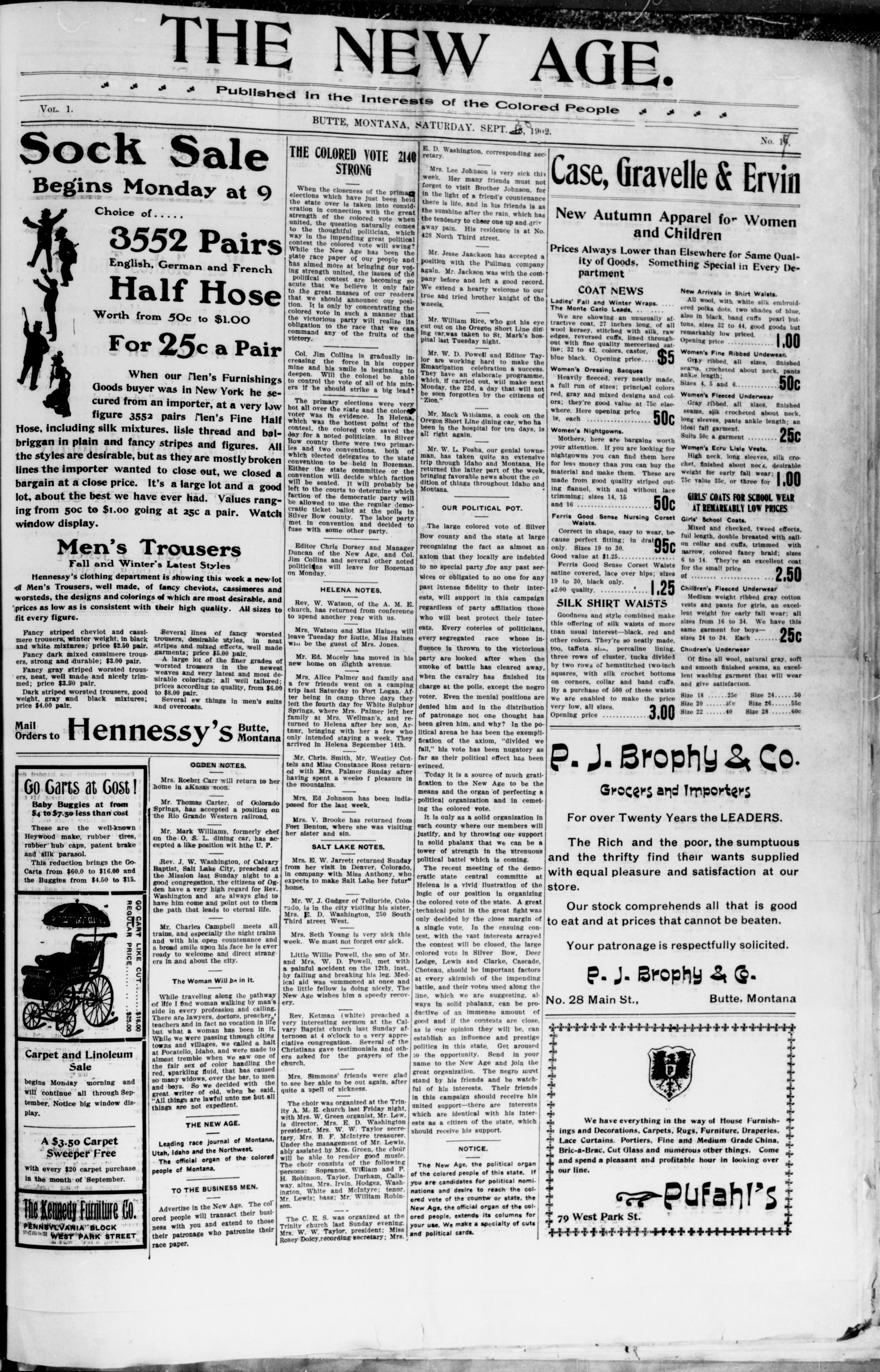
Sock Sale Begins Monday at 9
3552 Pairs English, German and French Half Hose
Worth from 5Oc to $1.00
For 25c a P
When our Men's Furniture Goods buyer was in New York he cured from an importer, at a very figure 3552 pairs Men's Fine silk mixtures. lisle thread and in and fancy stripes and figures desirable, but as they are mostly larger wanted to close out, we close price. It's a large lot and a best we have ever had. Values to $1.00 going at 25c a pair.
Men's Trousers and Winter's Latest Styles
nothing department is showing this week as well made, of fancy cheviots, cassimens and colorings of which are most desirable consistent with their high quality. All
For 25c a Pair When our Men's Furnishings Goods buyer was in New York he secured from an importer, at a very low figure 3552 pairs Men's Fine Half
Hose, including silk mixte-
brigan in plain and fancy
the styles are desirable, buil-
lines the importer wanted
bargain at a close price.
lot, about the best we hav-
ing from 50c to $1.00 gold
window display.
Men's T
Fall and Winter
Hennessy's clothing department
of Men's Trousers, well made, o
worsteds, the designs and coloring
prices as low as is consistent with
fit every figure.
Hose, including silk mixtures, lisle thread and balbriggan in plain and fancy stripes and figures. All the styles are desirable, but as they are mostly broken lines the importer wanted to close out, we closed a bargain at a close price. It's a large lot and a good lot, about the best we have ever had. Values ranging from 50c to $1.00 going at 25c a pair. Watch window display.
Men's Trousers Fall and Winter's Latest Styles
Hennessy's clothing department is showing this week a new lot of Men's Trousers, well made, of fancy cheviots, cassimeres and worsteds, the designs and colorings of which are most desirable, and prices as low as is consistent with their high quality. All sizes to fit every figure.
Fancy striped cheviot and cassimere trousers, winter weight, in black and white mixtures; price $2.50 pair.
Fancy dark mixed cassimere trousers, strong and durable; $3.00 pair.
Fancy gray striped worsted trousers, neat, well made and nicely trimmed; price $3.50 pair.
Dark striped worsted trousers, good weight, gray and black mixtures; price $4.00 pair.
Several lines of fancy worsted trousers, desirable styles, in neat stripes and mixed effects, well made garments; price $5.00 pair.
A large lot of the finer grades of worsted trousers in the newest weaves and very latest and most desirable colorings; all well tailored; prices according to quality, from $6.00 to $8.00 pair.
Several ew things in men's suits and overcoats.
Mail Orders to Henn Go Garts at Gost!
ennessy's
Baby Buggies at from $4 to $7.50 less than cost
These are the well-known Heywood make, rubber tires, rubber 'hub caps, patent brake and silk parasol.
This reduction brings the Go-Carts from $60.0 to $16.00 and the Buggies from $4.50 to $15.
GO CART LIKE CUT $16.00
REGULAR PRICE $25.00
Carpet and Linoleum
Sale
begins Monday morning and will continue all through September. Notice big window display.
with every $20 carpet purchase
in the month of September.
The Kennedy Furniture Co.
PENNSYLVANIA BLOCK
WEST PARK STREET
---
Vol. 1.
```markdown
```
A $3.50 Carpet
Sweeper Free
25c a Pair
when our Men's Furnishings
er was in New York he se-
an importer, at a very low
2 pairs Men's Fine Half
ures, lisle thread and bal-
ly stripes and figures. All
it as they are mostly broken
al to close out, we closed a
it's a large lot and a good
we ever had. Values rang-
ing at 25c a pair. Watch
Trousers
er's Latest Styles
ent is showing this week a new lot
of fancy cheviots, cassimeres and
ings of which are most desirable, and
in their high quality. All sizes to
Several lines of fancy worsted trousers, desirable styles, in neat stripes and mixed effects, well made garments; price $5.00 pair.
A large lot of the finer grades of worsted trousers in the newest weaves and very latest and most desirable colorings; all well tailored; prices according to quality, from $6.00 to $8.00 pair.
Several ew things in men's suits and overcoats.
essy's Butte, Montana
OGDEN NOTES.
Mrs. Roebelt Carr will return to her home in a knsas soon.
Mr. Thomas Carter, of Colorado Springs, has accepted a position on the Rio Grande Western railroad.
Mr. Mark Williams, formerly chef on the O. S. L. dining car, has accepted a like position wit hthe U. P.
Rev. J. W. Washington, of Calvary Baptist, Salt Lake City, preached at the Mission last Sunday night to a good congregation, the citizens of Ogden have a very high regard for Rev. Washington and are always glad to have him come and point out to them the path that leads to eternal life.
Mr. Charles Campbell meets all trains, and especially the night trains and with his open countenance and a broad smile upon his face he is ever ready to welcome and direct strangers in and about the city.
The Woman Will be in It.
While traveling along the pathway of life I find woman walking by man's side in every profession and calling. There are lawyers, doctors, preacher, teachers and in fact no vocation in life but what a woman has been in it. While we were passing through cities towns and villages, we called a halt at Pocatello, Idaho, and were made to almost tremble when we saw one of the fair sex of color handling the red, sparkling fluid, that has caused so many widows, over the bar, to men and boys. So we decided with the great writer of old, when he said, "All things are lawful unto me but all things are not expedient.
THE NEW AGE.
Leading race journal of Montana, Utah, Idaho and the Northwest. The official organ of the colored people of Montana.
TO THE BUSINESS MEN.
Advertise in the New Age. The coloured people will transact their business with you and extend to those their patronage who patronize their race paper.
BUTTE, MONTANA, SATURDAY. SEPT. 13, 1902.
THE COLORED VOTE 2140 STRONG
When the closeness of the primary elections which have just been held the state over is taken into account in connection with the great strength of the colored vote when united, the question naturally comes to the thoughtful politician, which way in the impending great political contest the colored vote will swing? While the New Age has been the state race paper of our people and has aimed more at bringing our voting strength united, the issues of the political contest are becoming so acute that we believe it only fair to give great masses of our readers that we should announce our position. It is only by concentrating the colored vote in such a manner that the victorious party will realize its obligation to the race that we can command any of the fruits of the victory.
Col. Jim Collins is gradually increasing the force in his copper mine and his smile is beginning to deepen. Will the colonel be able to control the vote of all of his miners if he should strike a big lead?
The primary elections were very hot all over the state and the color of voter was in evidence. In Helena, which was the hottest point of the contest, the colored vote saved the Bay for a noted politician. In Silver Bay county there were two primaries and two conventions, both of which elected delegates to the state convention to be held in Bozeman. Either the state committee or the convention will decide which faction will be seated. It will probably be left to the courts to determine which faction of the democratic party will be allowed to use the regular democratic ticket ballot at the polls in Silver Bay county. The labor party met in convention and decided to fuse with some other party.
Editor Chris Dorsey and Manager Duncan of the New Age, and Col Jim Collins and several other noted politicians will leave for Bozeman on Monday.
HELENA NOTES
Rev. W. Watson, of the A. M. E. church, has returned from conference to spend another year with us.
Mrs. Watson and Miss Haines will leave Tuesday for Eutte, Miss Haines will be the guest of Mrs. Jones.
Mr. Ed. Mosely has moved in his new home on Eighth avenue.
Mrs. Alice Palmer and family and a few friends went on a camping trip last Saturday to Fort Logan. After being in camp three days they left the fourth day for White Sulphur Springs, where Mrs. Palmer left her family at Mrs. Wellman's, and returned to Helena after her son, Artur, bringing with her a few who only intended staying a week. They arrived in Helena September 14th.
Mr. Chris. Smith, Mr. Westley Cottsel and Miss Constance Ross returned with Mrs. Palmer Sunday after having spent a week f pleasure in the mountains.
Mrs. Ed Johnson has been indi-
posed for the last week.
Mrs. V. Brooke has returned from
Fort Benton, where she was visiting
her sister and sin.
SALT LAKE NOTES.
Mrs. E. W. Jarrett returned Sunday from her visit in Denver, Colorado, in company with Miss Anthony, who expects to make Salt Lake her futur* home.
Mr. W. J. Gudger of Telluride, Colorado, is in the city visiting his sister, Mrs. E. D. Washington, 250 South Third street West.
Mrs. Seth Young is very sick this week. We must not forget our sick.
Little Willie Powell, the son of Mr. and Mrs. W. D. Powell, met with a painful accident on the 12th. inst., by falling and breaking his leg. Medical aid was summoned at once and the little fellow is doing nicely. The New Age wishes him a speedy recovery.
Rev. Ketman (white) preached a very interesting sermon at the Calvary Baptist church last Sunday afternoon at 4 o'clock to a very appreciative congregation. Several of the Christians gave testimonials and others asked for the prayers of the church.
Mrs. Stimmons' friends were glad to see her able to be out again, after quite a spell of sickness.
The choir was organized at the Trinity A. M. E. church last Friday night with Mrs. W. Green organist, Mr. Lew is director, Mrs. E. D. Washington president, Mrs. W. W. Taylor secretary, Mrs. B. F. McIntyre treasurer, Under the management of Mr. Lewis ably assisted by Mrs. Green, the choir will be able to render good music. The choir consists of the following persons: Sopranos, William and P. H. Robinson, Taylor, Durham, Callaway, altos, Mrs. Irvin, Hodges, Washington, White and McIntyre; tenor, Mr. Lewis; bass; Mr. William Robinson.
The C. E. S. was organized at the Trinity church last Sunday evening. Mrs. W. W. Taylor, president; Miss Rosey Dolly, recording secretary; Mrs.
E. D. Washington, corresponding secretary.
Mrs. Lee Johnson is very sick this week. Her many friends must not forget to visit Brother Johnson, for in the light of a friend's countenance there is life, and in his friends is as the sunshine after the rain, which has the tendency to cheer one up and drive away pain. His residence is at No. 428 North Third street.
Mr. Jesse Jaackson has accepted a position with the Pullman company again. Mr. Jackson was with the company before and left a good record. We extend a hearty welcome to our true and tried brother knight of the wneels.
Mr. William Rice, who got his eye cut out on the Oregon Short Line dining car, was taken to St. Mark's hospital last Tuesday night.
Mr. W. D. Powell and Editor Taylor are working hard to make the Emanciipation celebration a success. They have an elaborate programme, which, if carried out, will make next Monday, the 22d, a day that will not be soon forgotten by the citizens of "Zlon."
Mr. Mack Williams, a cook on the Oregon Short Line dining car, who has been in the hospital for ten days, is all right again.
Mr. W. L. Fosha, our genial townman, has taken quite an extensive trip through Idaho and Montana. He returned the latter part of the week, bringing favorable news about the co-edition of things throughout Idaho and Montana.
OUR POLITICAL POT.
The large colored vote of Silver Bow county and the state at large recognizing the fact as almost an axiom that they locally are indebted to no special party for any past services or obligated to no one for any past intense fidelity to their interests, will support in this campaign regardless of party affiliation those who will best protect their interests. Every coteries of politicians, every segregated race whose influence is thrown to the victorious party are looked after when the smoke of battle has cleared away, when the cavalry has finished its charge at the polls, except the negro voter. Even the menial positions are dented him and in the distribution of patronage not one thought has been given him, and why? In the political arena he has been the exemplification of the axiom, "divided we fall," his vote has been nugatory as far as their political effect has been evinced.
Today it is a source of much gratification to the New Age to be the means and the organ of perfecting a political organization and in cemeting the colored vote. It is only as a solid organization in each county where our members will justify, and by throwing our support in solid phalanx that we can be a tower of strength in the strenuous political battel which is coming.
The recent meeting of the democratic state central committee at Helena is a vivid illustration of the logic of our position in organizing the colored vote of the state. A great technical point in the great fight was only decided by the close margin of a single vote. In the ensuing contest, with the vast interests arrayed the contest will be closed, the large colored vote in Silver Bow, Deer Lodge, Lewis and Clarke, Cascade, Choteau, should be important factor at every skirmish of the impending battle, and their votes used along the line, which we are suggesting, always in solid phalanx, can be productive of an immense amount of good and if the contests are close, as is our opinion they will be, can establish an influence and prestige politics in this state. Get aroused to the opportunity. Send in your name to the New Age and join the great organization. The negro must stand by his friends and be watchful of his interests. Their friends in this campaign should receive his united support—there are interests which are identical with his interests as a citizen of the state, which should receive his support.
NOTICE.
The New Age, the political organ of the colored people of this state. If you are candidates for political nominations and desire to reach the colored vote of the countw or state, the New Age, the official organ of the colored people, extends its columns for your use. We make a specialty of cuts and political cards.
AGE.
red People
1902.
Case, Grave
New Autumn Ap
and C
Prices Always Lower than
ity of Goods. Some
department
No. 16.
Gravelle & Ervin
Autumn Apparel for Women
and Children
is Lower than Elsewhere for Same Qual-
ioods. Something Special in Every De-
Case, Gravelle & Ervin
Prices Always Lower than Elsewhere for Same Quality of Goods. Something Special in Every Department
Ladies' Fall and Winter Wraps. ...
The Monte Carlo Leads. ...
We are showing an unusually attractive coat, 27 inches long, of all wool kersey, stitched with silk, raw edges, reversed cuffs, lined throughout with fine quality mercerized satine; 32 to 42, colors, castor, blue black. Opening price. $5
Women's Dressing Sacques
Heavily fleeced, very neatly made, a full run of sizes; principal colors red, gray and mixed designs and colors; they're good value at 75c elsewhere. Here opening price is, each. $50c
Mothers, here are bargains worth your attention. If you are looking for nightgowns you can find them here for less money than you can buy the material and make them. These are made from good quality striped outing flannel, with and without lace trimming; sizes 14, 15 and 16. 50c
Correct in shape, easy to wear, because perfect fitting; in draint only. Sizes 19 to 30. 95c Good value at $1.25. Ferris Good Sense Corset Waists satine covered, lace over hips; sizes 19 to 30, black only. 1.25 2.20 quality.
SILK SHIRT WAISTS
Goodness and style combined make this offering of silk waists of more than usual interest—black, red and other colors. They're so neatly made, too, taffeta silk, percale lining, three rows of cluster, tucks divided by two rows of hemstitched two-inch squares, with silk crochet bottoms on corners, collar and band cuffs. By a purchase of 500 of these waists we are enabled to make the price very low, all sizes. 3.00 Opening price
P. J. Brop
Grocers and
For over Twenty Y
The Rich and the
and the thrifty find
with equal pleasure a
store.
Our stock comprehen
to eat and at prices tha
Your patronage is r
P. J. Brop
Brophy & Co.
procers and Importers
Twenty Years the LEADERS.
ch and the poor, the sumptuous
rifty find their wants supplied
pleasure and satisfaction at our
k comprehends all that is good
t prices that cannot be beaten.
tronage is respectfully solicited.
J. Brophy & Co.
P. J. Brophy & Co.
For over Twenty Years the LEADERS.
The Rich and the poor, the sumptuous and the thrifty find their wants supplied with equal pleasure and satisfaction at our store.
Our stock comprehends all that is good to eat and at prices that cannot be beaten.
Your patronage is respectfully solicited.
P. J. Brophy & Co.
e everything in the way of House Furnish-
rations, Carpets, Rugs, Furniture, Draperies,
Portiers, Fine and Medium Grade China,
but Glass and numerous other things. Come
peasant and profitable hour in looking over
We have everything in the
ings and Decorations, Carpets,
Lace Curtains. Portiers, Fine
Bric-a-Brac, Cut Glass and num-
and spend a pleasant and profi-
our line.
We have everything in the way of House Furnishings and Decorations, Carpets, Rugs, Furniture, Draperies, Lace Curtains. Portiers, Fine and Medium Grade China, Bric-a-Brac, Cut Glass and numerous otber things. Come and spend a pleasant and profitable hour in looking over our line. Pufahl's
79 West Park St.
rk St.
COAT NEWS
Women's Nightgowns.
No.28 Main St.,
No. 18.
New Arrivals in Shirt Waists.
All wool, with white silk embroidered polka dots, two shades of blue,
also in black, band cuffs pearl buttons,
sizes 32 to 44, good goods but remarkably low priced.
Opening price 1,00
Women's Fine Ribbed Undewear.
Gray ribbed, all sizes, finished seams, crocheted about neck, pants ankle length;
Sizes 4, 5 and 6. 50c
Women's Fleeced Underwear.
Gray ribbed, all sizes, finished seams, silk crocheted about neck, long sleeves, pants ankle length; an ideal fall garment.
Suits 50c a garment 25c
High neck, long sleeves, silk crochet, finished about neck, desirable weight for early fall wear; 1.00 75c value 35c, or three for
GIRLS' COATS FOR SCHOOL WEAR AT REMARKABLY LOW PRICES
Girl's School Coats.
Mixed and checked, tweed effects,
full length, double breasted with sail-
on collar and cuffs, trimmed with
narrow, colored fancy braid; sizes
6 to 14. They're an excellent coat
for the small price
of ..... 2.50
Children's Fleeced Underwear
Medium weight ribbed gray cotton
veats and pants for girls, an exe-
cellent weight for early fall wear; all
sizes from 16 to 34. We have this
same garment for boys—
sizes 24 to 34. Each ..... 25c
Children's Underwear
Of fine all wool, natural gray, soft and smooth finished seams, an excellent washing garment that will wear and give satisfaction.
Size 18 ..... 25c Size 24 ..... 50
Size 20 ..... 30c Size 26 ..... 55c
Size 22 ..... 40 Size 28 ..... 60c
Butte, Montana
P
2
THE NEW AGE
published weekly by the New Age Publishing Company, office, 220 South Idaho street.
Subscription price, $2.00 a year. Six months. $1.10. Three months, 60 cents, invariably in advance. Telephone 862-B.
Application made for entry at the postoffice at Butte as second-class matter.
SATURDAY, SEPTEMBER 20, 1902
Things in a political way are beginning to show up for a hot contest and the colored voters should not fail to band themselves and vote solidly—for the maintenance of good government and support only such men who will not, when in office, be handled by corrupt corporation. It has been a source of much regret, when we look back upon the past and see our great error, by not uniting ourselves and demand some recognition from the hands of the state government. We have in the state some able and competent colored citizens who would do credit to the race and honor to some position of trust. We know of no position under a county or state jurisdiction, held by a colored man. We have never demanded or seeked to gain any favors from the hands of either democrat or republican party, and now the only redeeming chance that we have is to closely unite our working forces in one solid phalanx, select some competent and honorable colored citizen for a position and demand that our race be represented by having one or more of the race in some kind of office. To our great demand we have tried repeatedly with no avail to influence and gain some small favor, but when the election was over our poor colored brethren was still on the outside with his empty promise. The New Age today is the only avenue of social communication and keeps in touch and fresh in the minds of our people, our error and mistake of many years we are daily in receipt of letters from eminent deceiving citizens congratulating the New Age upon its mission and they stand ever ready to foster and assist us in bringing the race in one solid band. And it will be our aim to endorse only the policies and platforms that will recognize our race and give us the proper consideration by allowing us one or more representatives in some state office. The negro vote in this state in many others, holds the balance of power, and should they throw their support in one direction this would, without a doubt, decide and carry victory to the policy of their choice. It is the intention and purpose of the New Age to send a representative in the field and work throughout th state in bringing the colored citizens of this great common wealth together upon the one platform upon which shall be justice to all and special privileges to none.
We would like to know what luck the committee had with the petition that was circulated last week to have the Inter Mountain stop writing up the colored people in such a disgraceful manner, for such a high-class paper. We are daily being asked as to what success, and in short the final outcome of the undertaking. For the benefit of the signers and our readers we promised to give a complete account of the proceedings. The New Age endorses the step taken in this direction and if carried out to the proper end will have the necessary influence upon our contemporary, and they will see their folly—through the loss of all their colored supporters.
Do not be contented and too willing to accept some small consideration for laboring with your personal influence. Consult others and get the opinion of others, and should it be decided that you are right, ask and seek the full support of your brothers
Should Southern Whites Aid Negro Schools?—A Southerners' View.
From several counties of the Black belt of the North Carolina within the last few months there have come rumors of a pauular demand for some plan for dividing the school fund between the races in the proportion of the amount of taxes paid by each—the withdrawal of white support from nego schools. Against this suggested policy Governor Aycock, ex-Governor James, and other educational leaders' have squarely set their faces, risking their own popularity in some degree in defense of what they regard as right. For it cannot be denied that there is an element, not too small to deserve consideration, that does not approve of universal education. Just now these men are laying the greatest stress on the fact that our newly adopted constitutional amendment provides an educational qualification for voters, and that the education of the negro means his return to political power—the virtual undoing of the amendment." They say. More now the expense of their own public schools and more than two-thirds of the cost of the negro schools: it is asserted that the entire amount is needed for the education of white boys and girls.
Quite plausible and rather alluring arguments are these; it must be admitted that they possess considerable force. And yet a careful study of the problem will show that, even from an ultra southern standpoint, there as good grounds for Governor Aycock's position—good reasons for the belief that to abandon our time-honored policy for the one now proposed would work injury to both races.
In the first place, it is probable that the scheme is a willo-the wisp; that it could not be put into execution even it its advocates were able to secure une appeal of those provisions of our state constitution that now conflict with it. For learned lawyers, believe that the Fourteenth amendment to the
constitution of the United States presents obstacles that could not be overcome.
The righteousness of the measure may also e questioned—as it was questioned by an honored judge and democratic leader who said to the writer recently: "It would not be right, it would be unworthy a strong Christian people, to withhold the light from this weak and needy race."
It appears, therefore, that in the consideration of this scheme three questions demand attention:
Is it constitutional?
Is it righteous;
Is it expedient?
In this article only the last of these interrogatories shall have attention.
We believe that the proposed change is inexpedient because—1. It would destroy the foundation of our public-school system.
of our parents.
2. I would aggravate, not alleviate
the Southern, race, problem.
viate, the Southern race problem.
As to the first of these propositions: The great bed-rock on which our scheme of public education is based is that (the rank and power of peoples being in proportion to their intelligence) ignorance, wherever found, without regard to sex or race or condition, is infiltrated to the peace, progress, and prosperity of the commonwealth; that it is, like crime, the common enemy of all the people, and that all men work together for its suppression; that as the state can no one class the punishment of the criminals of that class, but must itself assume the task of warring against crime whose presence injures all, so the state must war against illiteracy, allowing the indifference or incompetence of no class to foster this enemy of the general welfare.
Suppose we should allow the rich to say to the poor, or the whites to the blacks, "Build your own jails, pay your own judges, punish your own criminals; what have we to do with crime in your ranks?" By that act we should abandon the principle that crime is the common enemy of all the people, to be controlled and punished by the state as the representative of all the people, and pave the way for virtual anarchy. So, when we allow one race to say to another, "Build your own school-houses, pay your own teachers, educate your own children; what have we to do with ignorance in your ranks? we uproot the foundation of our public-school system and pave the way for anarchy in educational matters. For if ignorance is not the common enemy of white and black, how are we to prove that it is the common enemy of rich and poor, or of Catholic or Protestant, or of Baptist and Methodist, townsman and countryman? To illustrate: Suppose we let the wealthier race now say to the poorer race. "We are tired of having to pay taxes to educate your children. Take what your own and educate your children; we use our money on our children." As Gov. Aycock suggested to the writer a few days ago—if ten years later the old aristocratic idea should show itself by the rich white man saying to the poor white man. "If it is not right to compel a rich race to aid the education of a poor race, neither is it right to compel a rich class to aid the education of a poor class. I am tired of paying taxes to educate your children: educate your own and I will educate mine."
Positively inevitable is the conclusion that the adoption of the proposed policy would mean the breaking up of the foundation principle of our educational system. Who can say what the end would be
In the second place, as I have said, the proposed change is inexpedient because "it would aggravate, not alleviate, the Southern race problem." To put it more plainly, it would produce a result exactly contrary to that predicted by the extremists who advocate it—just as shortsighted extremists in the North have seen their policy of wholesale negro enfranchisement make the South solidly democratic, instead of solidly republican as they expected.
For nearly four decades the Southern white man has borne the burden of Negro education. When he came home from the war with little left save hope and nonor, he assumed it. The carpetbagger came, and the negro was instrumental in forcing on the South the most vicious and corrupt government that this country has seen; yet I believe that the white people of no Southern state, coming to their own again, attempted to withdraw aid from negro schools. To abandon now, in our day of greater strength and prosperity, the policy that we have maintained through all these years of trial and tempest, would widen the breach between the races, would break the most patent tie by which we may properly guide and influence the negro, and would endanger the Southern policy of suffrage restriction which we regard as best for both races.
"The negroes are a child race," as Dr. Felix Adler says, and both races would suffer if the guiding hand of the white man were removed from the educational work of this child race. The negro would suffer because of his inability to choose wise leaders; the white man would suffer because of the improper training of this people whose destiny is to be somehow interwoven with that of the South, whether or not we shut our eyes to this fact. As it is now, the white people pay the taxes; they control the government. Supporting and managing the negro schools, it is in our power to adapt the negro's education to nis needs, and select the worthiest and safest black men to direct the education and influence the principles of the young negroes. Of all the methods of leading the negro in right paths, of all the methods of promoting right relations between the races this is the most practicable and powerful. If we have not heretofore improved the opportunity, the fault is our own; we have intelligence enough for the task, and the machinery is at our command.
On the other hand, were we to withdraw aid from negro schools, we should at the same time withdraw control over them; and in our stead wou-come perhaps new and unworthy leaders, allied with misguided, long,range philanthropists: For the negro school's would not be closed if the southern
THE NEW AGE.
whites should refuse to aid them longer. They would be maintained by offended blacks and by negro sympathizers in all parts of the country. So far from promoting peace, as they may now be made to do, it is not hard to believe that the negro schools, supported by such combination of elements would become instruments of strife and disorder throughout the south. For the spirit of the new era would say to the negro: "You are now under' no obligations to the southern white people because you are not to be educated not by his aid, but in spite of him, and his influence should count for nothing in your schools. You're friends are in the north; keep yourself in sympathy with them rather than with the people among whom you are to live and work."
The real result of the suggested change in the division of the school fund would be, not fewer educated negroes, but fewer negroes educated under proper influences, and a vastly larger number educated beyond the control of the southern white man and in an atmosphere calculated to produce constant friction between the races and between the sections
In yet another and hardly less important way would this proposed change injuriously affect the south. It would seriously endanger the new suffrage relations of the southern states. It would result in a hostile northern attitude toward them, possibly in unfavorable action by congress and the supreme court. So long as the southern white, show their friendship for the negro by providing liberal school facilities for the race whose illiterates they disfranchise, so long may our "grandfather clauses" and "understanding clauses" pass unassailed. But if the less conservative element of the southern people should ever succeed in forcing the abandonment of negro education, it would be regarded as having a different bearing on our education and suffrage question, longer disregarded of an intention to violate the fifteenth amendment to the constitution. What wayfaring man cannot see that this agitation by the more violent element of our population may cause the new and untried structure so plainly wrought out by the south to sway and totter and collapse.
Aside from the matter of injury to the school system, therefore, it is easy to meet on their own ground the advocates of the proposed change, for there is enough to show that the Black Peril of the south would gain new terrors, not lose old ones, by turning over the education of the negroes to fanatics and foreigners, and knocking out the most substantial prop by which our suffrage regulations are to be enforced. As a result, which it is "better to bear those ills we have than fly to others that we know not of."
It will be very easy for some one to say that I have not taken high ground in this article. Let me repeat, therefore, that I have discussed only the expediency of the question under consideration. The Outlook, adding to its other merits that of fairness to the south, has won perhaps a larger circulation among southern leaders of thought than any other national journal of like character, and my object has been to see before, these lead up to the triumph of this old beaver threatening scheme, perils that as yet have gone practically unnoticed by a larger number of southern editors and southern educators.
Nothing beats a good wife but a bad husband.
The thief that steals an harness is not apt to leave a trace.
Most everything but coal goes to take the buyer and it goes to the seller.
The Kentuckian who drowned himself in a barrel of whiskey evidently died in good spirits.
Promise a man a hundred dollars and if you give him ninety-nine of it he will kick.
No woman on earth would appreciate a husband more than a four-year-old widow.
If ever there is an automobile hearse invented people will be dieing to ride in it.
The burglar, who was killed by a policeman, while in the act of robbing a bank evidently died loving a lot of money.
'Citizens' Coal Co., dealers in Kemmer Rock Springs, Rock Fort and Trail Rock, rock wood, dry wood and fir wood. We give 2,000 pounds to the ton. No. 4 East Broadway, telephone 538.
Dance at Columbia Gardens.
Last Monday evening about thirty five couple went to the gardens and engaged in the light fantastic toe. Although the evening was cold, which had a tendency to detract the interest of the dance-goers, at the same time quite a large crowd assembled to avil themselves of an evening's pleasure. One notable feature was several couple that have not been seen on a ball room floor for several seasons. This incident added much interest to the gathering. The party danced from 9 until 11:30, when all returned to the city on a special car. The only complaint that was registered was the ice cream man had closed his doors, thinking, no doubt, that the unfavorable weather would result in a small attendance. The music was furnished by the celebrated orchestra that has played for the managers of the dance hall all the season. Mrs. Chas. P. Smith and Mrs. J. I. Jacobs were the promotors of the affair, and they exerted every effort to make it a success. Everything passed off lovely and the two leaders of the enterprise are to be congratulated.
Republicans Held First White Convention.
Birmingham, Ala. Sept. 16.—The republican state convention met here to
APHORISMS.
day with a large attendance. The convention is composed exclusively of white men, being the first white republican state convention ever held in Alabama. Before the convention met the state executive committee unseated all the negro delegates. A number of prominent negroes are on hand to protest against this action, but it is not expected their protests will be heeded.[] United States Senator Pritchard, of North Carolina, will address the convention and it is expected that he will indorse the white movement. Former State Senator McEllery, of Talladega, is to be slated for the nomination for governor, and it is stated that a complete state ticket will be put up.
Dropped Dead In a Saloon.
Anaconda, Sept 17.—Frank Thomas, colored, residing at No. 222 West Commercial avenue, dropped dead in Bruno Mainville's saloon about 1 o'clock yesterday morning. Heart failure is supposed to have been the cause. An inquest was held at Tuttle's undertaking parlor yesterday afternoon at which a number of those who were present testified to seeing the man come into the room and also to seeing him fall to the floor. He was picked up at once and life was found to be extinct. The jury returned a verdict of death from natural causes.
NOTICE OF ELECTION, CONSTITUTIONAL AMENDMENT.
House Bill No. 55.
An act providing for the submission to the qualified electors of the state of Montana of an Amendment to Section 4 of Article XVI, of the Constitution, relating to County Commissioners.
Be it enacted by the Legislative Assembly of the State of Montana: Section 1. There shall be submitted to the qualified electors of the state of Montana at the next general election to be held in said state, the following amendment to Section 4, of Article XVI of the constitution, relating to county commissioners.
That Section 4 of Article XVI of the constitution of the state of Montana, be amended so as to read as follows:
"Section 4. In each county there shall be elected three county commissioners, whose terms of office shall be six years; provided, that the term of office of those elected on November 6th, 1900, shall expire on the first Monday in January, 1907; provided further, that at the general election to be held in November, 1902, (in counties where commissioners are to be elected that year), three commissioners shall be elected whose terms shall expire on the first Monday in January, 1907; provided further, that at the general election to be held in November, 1906, one commissioner shall be elected for a term of four years, and one commissioner shall be elected for a term of six years, whose term of office shall commence on the said first Monday of January, 1907; and provided further, that at each general election thereafter commencing with the general election to be held in November, 1908, one commissioner shall be elected for a term of six years. A vacancy in the board of county commissioners shall be filled by appointment by the judge of the judicial district in which the vacancy occurs."
Section 2. The vote upon this amendment shall be counted and canvassed by such officials and in such manner as is provided by law for the counting and canvassing of the votes for member of congress, and if a majority of all votes cast at said election for and against said amendment shall be in favor of the amendment, the governor of the state shall immediately so declare by public proclamation, and said amendment shall be in full force and effect as a part of the constitution from and after the date of said proclamation.
Section 3. The official ballots to be used at the next general election to be held in this state shall have printed thereon the following words in such manner as to allow every elector an opportunity to indicate thereon by proper marks, his preference to-wit: "For the Amendment to the Constitution relating to County Commissioners," and "Against the Amendment to the Constitution relating to County Commissioners." Approved February 26, 1901. United States of America, State of Montana, ss.;
I. George Hays, secretary of state of the State of Montana, do hereby certify that the above is a true and correct copy of an act entitled "An Act Providing for the submission to the Qualified Electors of the State of Montana of an Amendment to Section 4 of Article XVI of the Constitution, Relating to County Commissioners," enacted by the Seventh session of the legislative assembly of the State of Montana and approved on the 26th day of February, 1901. In testimony whereof, I have hereunto set my hand and affixed the great seal of said state. Done at the City of Helena, the capital of said state, this 15th day of July, A. D. 1902.
The best place to buy Loaf, Layer and Fruit Cakes, Nut Cookies, Macaroons, Lady Fingers, Cream Puffs and all the other kinds of delicious pastry goods.
Our Ice Cream Factory is the largest and best in the Northwest and we make the kind of Cream you like. Our Ice Cream Sodas are simply grand. The only place in town you can get Fresh Candies every day.
Wear Clothes That Fit
A man can save money and feel more comfortable by wearing clothes that fit.
The Connell Clothes
are all made expressly for us. They fit well, look well and wear well. Prices are little, if any, higher than you pay for "trashy" wholesale clothing.
M. J. Connell Company
TUTTLE JEWELRY CO.
NORTH MAIN STREET
A New House of Our Day and Time, with
Diamonds a Specialty Watch Gut Co.
Manufacturing and Repair Department
Men of exceptional ability in charge
Cresent C
Milk, Cream a
Butter and N
Wholesale
Uptown Store: 61 West Broadway.
Telephone 65.
A New House of Our Day and Time, with the only New and Desirable Lines of
Manufacturing and Repair Departments with 1902 Equipment. Men of exceptional ability in charge. We invite comparison of our prices.
Cresent Creamery
Untown Store: 61 West Broadway. Depot: 401 S. Wyoming. Telephone
Telephone 65. 548.
The Dora Studio
122 N. MAIN ST.
PHOTOS BY EVERY PROCESS
Butte's Leading Theater.
'Phone 25. D. P. SUTTON, Mgr.
SEPTEMBER 21, 22, 23.
Messrs. Nixon & Zimmerman Present
THE MARGUERITA SYLVA COMIC
OPERA CO.
OF 80 PEOPLE
Headed by the Brilliant and Talented Artiste.
Marguerita Sylva
In Geo. W. Lederer's Musical Success
"THE STROLLERS"
Originally produced at the Knickerbocker Theater, New York, June 24, 1901, for 10 weeks.
Music by Ludwig, Englander, composer of "Half a King, "The Casino Girl," "The Rounders."
Book by Harry B. Smith, author of "Robin Hood."
Costumes by Madame Siedler.
Scenery by Messrs, Dodge & Albert
Under the personal direction of W. D. Mann.
Prices 25c to $1.00. Seats on sale today.
It is stated that President Roosevelt will have the manuscript of a new book ready for publication in the near future. It is to be an exhaustive study of the deer family, and its title is "The Deer of North America." This seems to indicate that the strenuous duties of the chief executive do not engross all his time. So long as he doesn't write a historical novel the country will not object to the president's putting in some spare moments on literature.
There is something almost pathetic in Lord Rosebery's calling on the Glasgow university students to sing "Soldiers of the King" just at a time when a lot of the said soldiers were being chased for miles over the veldt by a handful of Boer farmers.
---
'PHONE 75.
es That Fit
and feel more comfortable by
hes that fit.
Well Clothes
us. They fit well, look
are little, if any, higher
wholesale clothing.
Well Company
WELRY CO.
with the only New and Desirable Lines of
Bles, Jewelry
Glass, Bric=a=Brac
tits with 1902 Equipment.
We invite comparison of our prices.
Creamery
And Ice Cream
Ranch Eggs.
and Retail.
Depot: 401 S. Wyoming. Telephone
548.
Family tradition has handed down the following anecdote regarding the babyhood of a gentleman, now a grandfather, who is noted among his many friends and acquaintances for his marked decision of character: When he was two or three years old, he was taken very ill, and his family in alarm sent for the village doctor. That worthy came and prepared a powerful dose after the custom of those days, which the small sufferer was forced to take in spite of much kicking and squalling. The next day the doctor came again and once more fixed up the cup of good old fashioned medicine and set it before the fireplace to warm. The baby watched proceedings intently up to this point, then suddenly slid from his mother's lap and, toddling unsteadily to the fire, kicked the cup under the backlog.
"Confound him," said the doctor "he'll live." He did.-New York Times.
For the Rich Only.
Uncle and Aunt Melcher went to town to buy a new clock. "Now," said the dealer, "here is something very atractive in the way of clocks. When the hour begins, a bird comes out from the top and sings 'Cuckoo.' For instance, I turn this hand to 3 o'clock and the bird comes out and sings 'Cuckoo!' three times.
"Don't that beat all!" cried Uncle Melcher enthusiastically. "Mother, let's have one."
"No, no," said his wife hastily. "That sort of a clock might do for folks that have got lots of time, but it'd take me half the foreonow every day to take care of that bird."-Youth's Companion.
An Artist's Mustache.
The mustache was not viewed with favor in England in the middle of the last century. An anecdote is told of the late Thomas Cooper, the English artist, to illustrate it. He was brought before a magistrate in 1846 on some minor charge and was described in the police report as being "fashionably dressed, with large mustaches." The Art Journal of the date, commenting on it, said that "no member of the Royal academy perpetrates the atrocity of mustaches, a most un-English affectation." Mr. Cooper became a member of the academy a few years later.
```markdown
```
Sure to Live.
For the Rich Only:
An Artist's Mustache
a ee Sea 3, pig Oy Set " r
J. P. MONDLOGK
GARPENTER
Jobbing, mere aad ome Fixtures
216 WEST BROADWAY
~~ = 9PB+Seaeesos
> His Just . :
; ore:
; Reward “s*:
. By M. Macl. Helliwell 4
> «
© Copyrighe, x02, ‘
OPO SOC erecosececa’
danslea en iver bag whieh had
angled trom her tet when abe we
out some hours earlier was now
Sone and with it all her money, he
‘wateb, the ke; sor
peng *¥ of her trunk and vari-
a” Odds and ends dear to her
Stranded on the exhibition ground:
tnlles from her hotel and her chaperont
This was her punishment for flying in
Phe face of conventionality as persont.
fled by Aunt Urania, She did not at.
tempt to retrace her steps in search of
It. She knew it would be useless,
A sudden realization came to bi
that she was d i.
- jeadly tired and horribly
and hungry. She rose with the
sudden, impetuous little movement so
characteristic of ber.
At that moment a man wi
ten wu ar a
rose also and
her, hat in hand. seen
As she wis thus suddenly bro
face to face with im ave secre ge
Ward impulsively with outstretched
hand, but almost immediately her hand
fell to her side as with a cold half
bow she turned away.
it the man was not
ane 10 be 0 easily
“Good morning.” he said pleasantly.
“Surely even mere acquaintances may
exchange a few words when they hap-
en to meet by ehance in a place like
this. Is Miss Carson with you?” And
he fell into step beside her, apparently
unconscious of her frigid bearing.
A direct question cannot be ignored
by any one with the least pretensions
to good breeding; therefore Mildred,
after a second’s hesitation, was con.
strained to answer coldly:
“Aunt Urania is at the falls, But 1
must ask you to excuse me. Good
morning!”
She half turned, but the man laid a
detaining hand upon her arm and,
dropping bis half bantering tone, said
seriously:
“Look here, Milly—yes, 1 may cali
you that by right of old friendship, so
don't biaze! Iam here by myself, and
1 am deuced lonely. When we last
parted, you said you had wiped out all
memory of that—that other business,
but you said nothing of our good fel-
lowship of a year ago. Let us go back
to where we were last January—jolly
good chums—and let’s put in our day
together.”
Mildred hesitated. She, too, if she
would but confess it, was “deuced
lonely” and tired and hot and bungry
into the bargain. Still, some things,
despite what one may say to the con-
‘trary, are not wiped out of remem-
branee by a word.
“I think that would be impossible,”
she said freezingly. “I am going to re-
turn to the falls now. Good morning!”
“Well, you're not going to shake me
lke that anyway?” he cried cheerfully.
“Lam going to put you on your car at
least.”
But Mildred, in the awful conscious
ness of her'genniless condition, flushed
scarlet. If he insisted upon putting
her on the car, the conductor would
Just as firmly insist upon putting her
off when he came to collect the fares.
In her desperation and exhaustion she
dropped down upon a bench they bap-
pened to be passing.
“I'm tired,” she sald, digging lttle
holes with her umbrella in the gravel
at her fect. “I must take a rest first.
I don't want to be rude, Mr. Gaveston.
but I think 1 wished you good morning
yome time ago.”
‘The man, undaunted, seated himself
peside her with a stile.
“Look here, Milly,” he said decidedly.
“You are too tired to start on that long
journey. As your brother's closest
rriend I cannot permit it, 1 em ex:
seedingly hungry. May I have the
pleasure of your company to luncheon?
| would greatly enjoy it, and if you
Ind it so distasteful to eat at my ex
yense—why, you may liquidate your
hare. Only let us have it together.”
Mildred’s face was burning. She was
eized with a strong desire to shake
he aggravating smile from the teasing
ace beside her.
“[-1 don’t care for anything to et.”
be fibbed detiantly. “The only thing |
jesire at present Is solitude.”
“Lam really not asking much, Mil
red. You lunch without a thought
vith dozens of other fellows. Why uot
rith me?”
“L must draw the line somewhere,
be answered coldly
“So you draw it Just in front of ronr
other's chum! Poor old Tow! He'll be
ut up when I tell bim, for be asked
ne particularly to have an eye on you
oO you remember when be first |
rought me home with him at the end
four freshman year? You bad short
kirts and curls then, and I ealled soc
filly as 2 matter of course, You rath
r liked to luneb with me in those days. |
{ildred.”
Mildred flushed uncomfortably. '
*Well, if you insist upon my leaving |.
ou"—he rose as he spoke—"ot course |
‘must, but I'll be writing to Tom to- |,
ight, and I'm afraid he'll take it bard |
men be bears that you have shaken |
ve this way. 1 never told of that—|
ther basiness, but be may as well
now now.” I
{ildred arose. |
ice if you'll promise not to ao
t. why, PiI-I'N take Iunebeon with |
ba idcyou may pay for it.” She ||
;
ONY i
BF
BY SOS SU) Y)
Y Ri ——
y -
The Whiskey of Montana °
EE BR Be RRR beefed foc foode oe oe oe oe ooo foo es
i THE :
7 :
* ,
7 r
"
: Will call for and Deliver ,
_ that Laundry. 7
; «Ring Up ’Phone 2... |
4 :
: {Remember ’
: TROY LAUNDRY :
* *Phone 2. 232 South Main Street °
EE EEE EEEEEEEEERE TEER EREREM
de doroeboe Be ke Behe feodeefeedeodoofer eed deo ood oe of Qe of feo Qoceroodoed
*
CG. ;
utte Floral bo.:
o%
a The Leading Decorators and 3
ts Florists of Montana me
5 3
: Cut Flowers and Plants 4
7 Decorations and Designs a Specialty 3
ie Salesroom, 107 West Broadway f
Z Green Houses at Gregson Springs. Telephore ai
A large supply of beautiful carnations and roses and other *
flowers are always carried. All orders receive prompt attention. *
$
EE EE PEERED EEEEE EE EELEEED
For a real swell, up-to-date
suit of clothes, at very moder-
ate prices, call on |
Tine Fashionable Tailor |
305 North Main St., - Butte!
os] rarer
Gity Steam Dye Works
101 W. Granite St., Cor. Alaska
Ladies’ and Gents’ Garments Cleaned, Dyed]
Pressed and Repaired, Equal to New |
Goods Called for and ae. ae ~ ALBERT BARCLAY. |
Telephone 826M. Proprietor.
Se a ES ——*™
Now that the warm days are here,
Drink only Butte Brewing Co.’s
nace
PHONE... jf YOU WANT A COOL
w:252 INVIGORATING STIMUMANT
‘Girection of the Midway, but
eal gravely pSpdgdiyns
“Thank you very much. T account it
an honor to do so."
Under the combined influences of
wuch needed refreshment and a thor,
@ashly congenial companion she re.
Yived rapidly, and before she was
aware of it all her chilly constraint
‘Was gone, and they were laughing and
eha(fing each other Just as in the dear
old days of bon camaraderie
When they left the restaurant, they
Srolied down to the lake, where they
rested luxuriously on the
_ y soft, grassy
“I really should go now,” said Mt.
Gred regretfully at last. “Aunt Urania
will be distracted.”
‘Then suddenly she remembered what
for the last two hours she had merc!
folly been permitted to forget. She
flushed scarlet, but with a light laugh
paid carelessly, with her eyes on the
lake:
“11 met with a little mishap this
morning, Mr. Gaveston. I wonder if
You would do me a great favor for
Tom's sake. I lost my purse, and un-
Jess you can lend me a dollar 1 am
Afraid 1 shall have to stay here all
night.”
“Why, what a shame!” said Gaves.
ton gravely. “I happened to find some
money today, and I shall be delighted
to pass it on.”
As he spoke he plunged his hand into
one of his many pockets and drew
forth a silver belt bag. Mildred seized
Mt with a little ery. “Why, it's mine!”
‘Then, fixing him suddenly with a stern,
Accusing, indignant eye, she went on
Fapidiy: “And you knew it, for it's the
one Tom commissioned you to buy for
me, and when you said I might pay my
share of the luncheon you knew that
T had not one cent with me! Just to
humiliate me you deliberately invel-
gled me into accepting charity at your
bands when"—
And she jumped to her feet and turn-
4 away, ber eyes brimming with tears.
But Gaveston was at her side in an in:
stant and, laying a gentle hand on her
‘arm, sald plerdingly:
“Wait a minute, Milly. I did know it
was sours, I'll confess, dear. I saw it
fall, but just as it reached the ground
It opened, and something popped out of
It—something that encouraged me to
think that perhaps if I could get you
to speak to me and to let me speak to
you it might help to plead my cause
Again, for we haven't forgotten, elther
of us. and it is absurd to pretend that
We have, But, if you don't really care,
even & little, why do you still carry
this?” And be opened his hand, in
which lay a little silver rimmed por-
trait of bimself.
Mildred made a last attempt at frigid
dignity. “I carry it”— she began, with
her head in the air.
“Look at me while you tell me, dear,”
he said, turning her face to him as
they stood in the screening shadow of
a friendly tree. Her dignity vanished
suddenly.
“Because 1 do care," she finished
weakly, With a little eateh in her voice,
“have eared ever since I first saw you,
do care still—and—always shall!”
Poor Richard's Almanac,
Dr. Franklin himself in one of the
last numbers of the almanac gathered
together all the best sayings of Poor
Richard, which for twenty-five years
had amused and edified the country.
‘These sayings are in constant use at
this day.
For example: “Early to bed and early
to rise makes a man healthy, wealthy
and wise" “Drive thy business; let it
not drive thee;” “Help hands, for I
have no lands; “No gains without
pains;" “Constant dropping wears away
stones;" “Three removes are as bad as
a fire;* “He that by the plow would
thrive himself must either hold or
drives? “A fat kitchen makes a lean
will" “Experience keeps a dear school,
but fools will learn in no other.”
It was such homely maxims as these
Inserted in all the little gaps of the al-
manae that made it so popular. Franke
ln said he sometimes sold 10,000 copies
in a year, a wonderful sale for that
day. ‘The first number of Poor Rich
ard’s Almanac appeared In 1732,
Ghia.
Woman, the gentlest of all creatures,
fs apt to become masterful and even
tyrannical, this because she is a crea-
ture in whose composition emotion dom
Inates, and emotion, when highly stim
tulated, becomes passion, and passion
spurns all reasonable litnitation and be-
comes tyrannical, Besides, there are
women with more than ordinary firm
will and persistent purpose; these, when
winged by the passion which is natural
to the sex, become intolerant, masterful
and more tsraunicai than men, (Quali
fication to the intense action of the im:
passioned soul is treachery, and con:
tradiction is treason, Like a stormy
wind they will have thelr sweep and
fgnore ail coutraries, And from this
predominance of the emotional element
it seems plain that, though she may ty
mony things and succeed In most, she
ix, with ber normal outfit, materially
incapacitated from being a statesman
or a judge.—Daybook of John Stuart
Blackie.
a ia ial
It was to the moon the farmer looked
for indications of the weather. If the
new moon lay well on its back, it was
‘a sign of dry weather, but if it tipped
to such an extent that a shot pouch
wouldn't bang on the lower born you
might depend upou the water pouring
out.
‘The time of chanzing had a good
deal to do with the weather, but there
was a lack of agreement upon this
point; but it was generally conceded
that a change before noon or before
midnight indicated fair weather. A
circle or hale around the moon was «
sure sign of rain, and the number of
stars visible within the cirele indiented
the number of days before the rain
renlé coast.
: WE DESIRE TO CALL ATTENTION |
| TO OUR STOCK OF
| :
CARPETS, LACE CURTAINS and ;
: DRAPERIES |
: ALSO OUR SILK AND DRESS GOODS 7
COUNTER, AND
LADIES’ READY-TO-WEAR DE. |
| PARTMENT
| NEW YORK STORE
MAIN STREET HELENA, MONT,
GeNINNMIAIntntatatetatatatetetetetenn nee neeeecse
PACKAGE EXPRESS
WORLD ssssecss=:,
—SSSSS——
TELEPHONE 200
{sts tnInISINIAINMInIsiainin sis nisin eis AISA
rome
A certain Boston hotel man tells this
Rood story at his own expense:
When a small boy on the farm, his
folks often sent him to the neighbors
to buy a dozen eggs when their hens
failed to tay enough.
He noticed that the old farmer al-
ways held each egg before a lighted
candle and examined it carefully. In
his innocence of Yankee shrewdness
the, boy supposed that this was prompt
ed ‘more by honesty and intention to
detect whether the eggs were bad or
not.
One day, however, when be counted
his eggs, according to custom, there
were oaly eleven in the basket.
With a determination not to be cheat-
€d, the lad trudged proudly back to the
house and quickly made known bis
discovery.
“Ob,” said the old farmer, “that's all
right, my boy. One of them has a dou-
ble yolk."—Roston Record.
Oxford Market
Family Groceries,
Fruits and Vegetables
| HELENA PACKING
| PROVISION CO.
f Fish and Poultry :
Gate - City - Club
roe
Wa, Hammons »»+ President
Criss. Hint Vice-President
L.N. Owstry : Secretary
Cans. THowrsox Treasurer
LN. Owsiry.... Gen, Manager
DIRECTORS
Wer Hannes Cus. Hint
LN. Owstey Cans. Waesba:
‘Cuca, Senavee ;
3
‘The Usual Thing,
“Wasn't that an odd thing for the
minister to say Just as we were leav-
ing?” asked the Chicago bridegroom of
his bride.
“I don't think 1 noticed what he
said.” replied the bride. “What was
itr"
“He invited us to come again.”
“Ob, that was just ordivary polite
ness. ‘He always does my marrying.”—
Detroit Free Press,
Plant Trees,
It adds to the howelike character of
a city to embower its houses in maples
and elms, to give hiding places for the
Dirds, and tt adds to coolness and sa-
lubrity ax well as beauty to provide
shade against the blistering days of
summer.—Brooklyn Eagle.
No Way to Wealth,
Short—If I had as much money as|
you have, 1 wouldn't be so blamed stin |
gy with ft
Long—My dear boy, that Is the very|
reason you will never have it-—Chicago|
News.
ae
‘Wher Abhabam Lincoln was a young)
man, bis prodigious strength and
kilt In wrestling were matters of
throughout central Miinols, Few In
teed were the men who could boast
having laid bim on his back,
‘Somewhere along in the thirties there
was a case on trial In one of the cireult
courts in that section in which an ef
fort was made to Itmpeach the testimo-
ny of ove of the witnesses. ‘The ev
ence was conflicting. Some would
believe the witness on oath and others
would not.
At last a middle aged men with a de
termined expression of countenance
was called to the stand. The usual
question was put touching the reputa-
tion of the witness for truth and verae.
ity:
“Would yon believe him on onth?* *
“No, F wouldn't” be answered, and
before the Inwyer on the opposite side
could byerpose he gave bis reason:
“1 beerd lbw braggin’ onct that he'd
throwed Abe Lincoln in @ fair an’
square rassie.”
‘No other witnesses were called. The
pttempt to impeach was suceensful—
Youth's Companion,
GoodKind Bros.
WHOLESALE
LIQUOR, TOBACCO AND
CIGAR DEALERS j
aeom
pYVINE LIQUORS
F AND CIGARS
ced
- Helena, Mont.
4
ELLIS PAINT GO
17 East Quertz
Wall Paper, Paint
and Glass
Contracting Painters and
Paperhangers
PACIFIC STUDIO
PHOTOGRAPHS AND KODAK
WORK
FLASH LIGHT WORK AND PHOTO
BUTTONS.
221 South Arizona Street.
PHONE 845-B
BUTTTE.....MONTANA
LOCAL NOTES
Mr. Sam Hall was in the city this week disposing of vegetables and fine fruit.
You will do us a favor by sending us in your subscription due for the Age.
Mr. and Mrs. Jones, of Anaconda, were in the city this week. They were entertained by Miss Ella Lewis and Mrs. J. A. Williams.
We will pay five cents a copy for issues of the New Age of June 13th. We want six copies for our file.
Mr. E. R. Hatfield, of Salt Lake, was in the city this week. For the few hours that he was in the city last Sunday he was looking up old friends'
Mrs. Frank Mason recently of Pocatello, but now of Dillon, was in the city this week, the guest of Mrs. J. E. Wilds. She left for Anacnoda, but will return to Butte again in a few days.
Mrs. Mary Phelps spent last Sunday in Jefferson valley, where she went to bring her little son home for school. He has been visiting his grand parents for several weeks.
Mrs. Lucas returned last Thursday from a few days visit to Anaconda, where she went for mental recreation She stated when interviewed by an Age reporter, that the trip was of great benefit to her, as her mental capacities were being overtaxed. Mrs. Lucas is a palmist and card reader of renown, and her over taxer mentality is due to the many callers at her place of business on South Idaho street.
Mrs. J. A. Williams and sister, Miss Ella Lewis, entertained a few friends in honor of Mr. Williams, who left the first of the week for Los Angeles, Cal., where he expects to remain during the winter. Mrs. Williams will follow later. The guests present are as follows: Mr. and Mrs. Jones of Anaconda, Mr. and Mrs. Black of Big Timber, Mr. Frank Lewis of Anaconda, Mrs. Lewis, Miss Ella Lewis and Mr. and Mrs. Prior.
Read the New Age and keep posted as to what the colored people are doing in the way of affecting a political organization.
Mr. C. P. Smith, of Anaconda, was in the city Thursday, visiting his wife and attending to business. Mr. Smith conducts a restaurant in Anaconda under the name of the Gearonne, which is favorably known to many Butteletes who visit the Smelter City.
The New Age can be had at the residence of their correspondent, Mr. C. H. Wagner. Subscriptions taken for three months, six months or a year.
At the Grand this week, Thursday, Friday and Saturday nights will be presented "Wante a Wife."
Hon. C. F. Jones, the mining king, has been kept quite busy this week looking after the interest of his mines and is somewhat mixed up in politics.
Mrs. Sadle A. Smith, who has been visiting her mother, Mrs. W. C. Cass, returned to her home in Butte, Mont. Mrs. Smith has made many friends during her stay and they sincerely regret her leaving Seattle Republican.
A paper social was given at the A. M. e. church last Thursday evening. Many attended and it was a success. Mrs. Frisby had charge of the entertainment and a good dinner was assured.
An entertainment was given at the residence of Mrs. S. Scott on the west side last Friday evening, for the purpose of raising money to finish payin' for the elder suits. The novel feature of the entertainment was the sewing contest: Miss Gladys Brown wow first prize; Mrs. M. E. Davis second. Everything was successful socially as well as financially.
"Wanted a Wife" was presented to a large and appreciative audience at the Grand last Thursday evening, to witness the opening performance of a three nights' engagement 'everyone should avail themselves of the opportunity to witness this play. There is not a dull moment from start to finish. The singing and dancing are worth the price of admission.
Mr. John D. Gainey, our genial mail clerk, was among us in our literary meeting last Tuesday evening, and was among the several ones that made addresses in behalf of the or-
organization. He is a lover of such enterprises. In his address he stated that it would be a great pleasure to him to meet with the society upon every available opportunity. We appreciate the presence of such eminent visitors and always extend the hearty welcome of our meeting.
Mrs. Ella Simington has moved from 116 Idaho to 212 West Mercury street.
Mrs. Belle Miller has moved again this week. We were unable to secure her new address. We understand it is on East Iron street.
Mr. Frisby will again be in line with ner famous chicken dinner next Thursday evening at Shaner's caup el.
Mr. C. H. Burnside, a rancher from Colorado, arrived in the city last Thursday evening and is visiting his mother, Mrs. Lettie Burnside.
We had our nirst snow of the season last Wednesday morning. This was warning enough for us to lay aside our straw hat and dig up our heavy clothes.
The colored people should be careful. Before buying anything consult the New Age and see who is advertising with us. Patronize those who patronize our race paper.
There will be a special programme at the Silver Leaf Literary Society next Tuesday evening at Bethel Baptist church. Everybody is invited to attend.
The New Age collector will be around this week renewing subscriptions and collecting for those that are in arrears. Be prepared to receive him, as we must make close collections to keep up our reputation in issuing a high-class newspaper.
Quite a number of the society swells attended the theatre last Friday evening to witness the performance of Warde and James. Among those that passed our notice were Mrs. J. I. Jacobs, in company with Mrs. Sadie Smith, as guest, and Mrs. W. W. Birthright, Mr. C. A. Davies in company with Miss Fannie Binum, also Mra. and Mrs. Fletcher attended the same performance.
Rev. Francis Wilson, of Kansas City, chief grand mentor, set up a lodge of Knights of the Temple last Friday evening at Odd Fellows' hall. He will also instruct the daughters next Friday evening; in addition to this there will be a grand lecture and ball at the Auditorium Wednesday, October 1. Admission, 75 cents a couple.
Mrs. John F. Davies, who is now visiting in Missouri, sent a bunch of Missouri popys. She is visiting relatives and friends, with her husband, in Kansas and Missouri. Those who received pieces of the fruit wish to thank them through the New Age.
Mr. J. R. Jackson, of Salt Lake, surprised many of his old-time friends by suddenly showing up in Butte, after an absence of three years. He is now back with the Pullman company, which position he resigned to go to the gold fields in the frozen north. We are glad to see him again on the run from Zion to this city.
We are sorry to see the absence of a colored maid at Grand theatre. This position has been occupied by a colored woman ever since the reopening of the Grand, until recently under the management of Messrs, Marks & Howe. The season promises to be an auspicious one. At this house many September dates have been left unaccount on account of the lateness of the season. Under the management of Stair & Fine, whose great theatrical circuit the Grand forms the Butte link, many grand attractions have been secured and this house after October first will run for months almost without a dark nrhltl.
Warde and James, in "The Tempest."
One of the big theatrical events of the year will be the joint appearance of Lewis James and Frederick Warde at the Broadway next Friday and Saturday evenings and Saturday matinee in Wagenhals and Kemper's lavishly praised spectacular production of "The Tempest." The fame and ability of the thes celebrating players is too firmly established to be determent, suffice it to say that Mr. James appears as the semi-human monster, Caliban and Mr. Warde as Prospero, the philosopher and magician.
The first scene of "The Tempest" represents the storm and shipwreck raised by Prospero's magic art and of his marvelous magic is illustrated, and ends with the advent of the spirit, with the assistance of his fairy servant, Ariel. The audience is requested to be seated before the rise of the curtain, not only because this scene involves one of the most wonderful transformations yet attempted, but next scene represents Caliban's cave near Prospero's cell, which is followed by a magnificent perspective of the yellow sands. The second act presents two scenes, one in the forest jungle and the other picturing the rocky shore of the island where Caliban meets two survivors of the wreck and tastes wine for the first time, with the usual result. The third again shows the yellow sands which, by seeming magic, gradually melts into a picture of the mystic rocks, and the finale to the same representing a magic banquet and the dance of the demona. The scene changes to Prospero's cell, where the power and a grand tableau, assisted by a chorus and a ballet. The last scene represents the great triumph of Prospero, in winning the love of his mates and forgiving them their injustice. The final tableau represents the ship safe and sound after all, and all characters on board bound for Naples.
Mr. Norman Hackett 'will be seen as Ferdinand, Miss Teresa Maxwell as Miranda, Miss Edith Fassett as anel and Wadsworth Harris as Alonzo.
THE NEW AGE.
MANY MEN of MANY MINDS
```markdown
```
In the northwestern part of Chicago, not far east of the river, in a place of silent streets and empty lots, stand several large frame houses, with picket fences, built before the fire. Tall poplar and cottonwood trees hang clouds of pale, glimmering foliage over the wooden sidewalks. An occasional electric car with one or two passengers shrills past under the rustling shade, and cows are sometimes pastured on the frequent brown lots. In one of the houses of this place there lived two American gentlemen, different as the poles, Judge Amos Parker and Mr. Paul Haviland. Judge Parker, the house owner, an old settler, was a plain man, the father of a large family.
His wife had died when the children were little. His sons were gone into business in distant towns, and his daughters, combining piety and flirtation in a neighboring church, had sported actively through their respective courtships till they were all married and gone, and their father was left alone with Edna, the servant girl, and Nick, her brother, who had accompanied the family when they moved from Indiana forty years ago.
Judge Parker was a ponderous, easy going man, of tremendous legal information, with a long, white face and almost no nerves. He scarcely perceived the loneliness of his remote house, and he did not miss his family too sensitively, as when they were with him he had been only very slightly acquainted with them.
His taste was not for men as individuals, but in bulk. He loved the public and public life, and he would have preferred almost any discomfort out of doors or in a hault to sitting in a parlor through an evening.
The judge could not for an instant bear exclusive society. Indeed, the only moment when he experienced uneasiness was when he was forced into the presence of a group of people selected by a delicate social tact instead of by the rude hand of chance or political organization. If he had no lecture, no Republican rally or G. A. R. meeting to attend, he would go out and sit on the fence of his grass plot to smoke and to talk to Nick or to any casual loafer.
Paul Haviland, on the other hand, enjoyed almost no society but that of his betrothed, Margaret Alden, and a literary friend, Richard Ellott.
He read law in the law office of Judge Parker's former law firm for three winters. It was during this time that he lived with the judge, to get far away, he said, from the grime and sordidness of the city, and in the evenings, while the judge was off with the public in the grime and sordidness, he sat in the old Parker house and wrote long introspective letters to Margaret Alden and composed verses called "Retrospect," "Circumstance" or "If," which gave its name to his volume of collected verse.
But, never mind—it's gone and past.
What does it matter now?
Had you but spoken or I not stayed
There on the lawn with her
This clematis had been, I wis,
A degree in English.
Perhaps—heigh ho! The play is done—
And you in Peshawar.
Bah! What's the odds? Or rose or rue—What is the odds to me?
Richard Ellott wrote a preface almost entirely of margins for the book, commenting favorably on the restraint, suggestiveness and perfect good breeding of Mr. Haviland's lines, and Paul had great fun in his own way in writing them in the evenings, while the judge had great fun in his own way in seconding motions and introducing politicians in long, heavy addresses at club clubs.
It was a curious circumstance of Paul's art that, while he himself, was of a very sensitive and impressible nature, the attitude he chose to assume in his verse, one described by Richard Ellott in a magazine article on "Haviland and Indifferentism," was exactly Judge Parker's attitude, and that gentleman might have asked with far more sincerity:
Bah! What's the odds? Or rose or rue—What is the odds to me?
In the spring of Paul Havland's stay at the old Parker house Margaret Alden came to visit Chicago, and at the time of her visit she and her lover passed through a long period of mental suffering.
Their trouble arose on the day of a heavy spring rain. They were to have met in the Art institute and Paul Havland, supposing that Margaret Alden would not keep her tryst in the worst storm of the year, had not kept his.
He was overwhelmed with contrition at his mistake when he visited her in the evening.
But when he said, "It never occurred to me that you would be there," and she replied, "Where there is a question I always do the more strenuous thing," he was wounded. He dialiked being less strenuous than any one, even than Margaret Alden. He did not enjoy himself in her presence as he ordinarily did, and he began thinking that the first beauty of their feeling had vanished and wrote verses called
By EDITH WYATT
Copyright, 1901, by S. S.
If I had known—bah—there it is!
What does it matter now?
Yet this pressed spray of clematis
Again rounds me how-
If they had told me what was true
Or I, had even, to see.
Or I had eyes to see.
Earnest been gone or it been you
"The Lost, Treasure," "Ashes" and "Disillusionment."
Meanwhile Margaret wrote in her diary:
"April 14.
"Paul was here today, but not the Paul of yesterday. Something is gone between us—just what I cannot say, but something.
"He has, of course, failed me and can never be again to me what he was before his inconsideration of today.
"Do I really love him when I cannot any longer perfectly admire him? Must question myself further on this point.
Paul Haviland, too, was disturbed and in doubt, and it was while he was in this mood that he went one morning to the law office and found, with astonishment, that a blow had fallen on Judge Parker.
He had been responsible for a brother living in Wisconsin, a bank cashier, who, after a long probity, had absconded with the bank funds, leaving behind enough debts to ruin the judge.
The men in the office said that if such a thing had to happen to some one it might as well happen to Judge Parker, as he never took anything hard.
Paul felt the incident, an instance of the injustice of life, already symbolized to him in his own wrongs. He mentioned his friend's disaster to Margaret in the evening, considering it an episode in keeping with the melancholy tone of their meeting, but they talked very little about it, being still too occupied with their own delicate, moral and temperamental problems.
However, when Paul went home that night and saw the judge sitting on the front steps with his hat on the back of his head talking to Nick as he had before his house was disgraced and his fortunes ruined, he felt among his own troubles a sense of sympathy for a fellow sufferer.
As he passed he touched the judge's coat sleeve lightly, as a subtle sign of regret, but his intention was evidently quite imperceptible to the judge, for the next morning at breakfast he observed ruminatively with an air of intelligent, judicial interest:
"Well, Paul, d'year hear about Brother Will?"
Paul stared at his plate and then said delicately, "In life we cannot always account for everything."
"That's what the bank directors think," returned the judge jocosely. "Well, it's a queer thing—a mighty queer thing. I knew a man who did something like it here—and he resembled Brother Will too."
This was the only allusion the judge ever made to the matter. Everything in the old Parker house remained as it was before Brother Will's lapse. The judge had never been extravagant. He was not obliged to change in any way his domestic or social customs, and it will be seen that his spirits and life had been less affected by his ruin than had Paul Haviland's by the remotest shadow of adverse criticism. Perhaps this sketch will be supposed too decided in its contrasts to be a thing of facts. On the other hand, it may be truthfully said that it is a very moderate presentation of the vivid variety of persons, perhaps in the world; certainly on the north side of Chicago.
Pins In England.
In England the ordinary domestic pin had become in the fifteenth century an article of sufficient importance to warrant legislative notice. An act of parliament passed in 1483 prohibited the importation of pins. As a necessity of the toilet pins were introduced into England in the latter part of the fifteenth century by Catherine Howard, queen of Henry VIII., who received them from France.
Very good pins of brass were made at this period, but a large portion of them were made of iron, which was blanched and sold for brass pins. In order to prevent this imposition upon the good people of England perillement in 1543 passed an act providing that "no person shall put to sale any pins but such as shall be double headed and have the heads soldered fast to the shanks of the pins, well smoothed, the shanks well shapen, the points well rounded, filed, canted and sharpened."
England continued to depend upon France for its supply of pins till the year 1626, when John Tilsby introduced the manufacture into Gloucestershire. In 1636 the manufacture was introduced into Bristol and Birmingham, the latter place ultimately becoming the great center of the industry.
A Matter of Sex.
"A man trimmed that window," remarked a dealer in women's headgear, passing a millinery establishment on Twenty-third street in which all the hats and bonnets faced squately toward the sidewalk, "and a woman fixed up the windows in that store," continued the man milliner as he came to the next store, in which the women's hats showed their backs, with their bows, pendent ribbons and streamers.
"You see," he said, "a man looks at a woman's face, and so it is only the front of the hat that he sees, and he doesn't know any better than to show the fronts when he is exhibiting hats for sale.
"But it is women, not men, who are the buyers, and they know that their women friends when they meet them smile sweetly as they pass and then turn and critically inspect their hats from the rear.
So women select hats with stunning hind effects, and the woman millimeter cludiously shows the rear elevation when she puts a hat on exhibition. New York Times.
Nothing better illustrates the dullness of society in the middle ages than the custom used by all high placed and wealthy persons of keeping a professional jester, nor was it confined to Christendom, for we read that Cortes found an individual of this profession at the court of Montezuna. Our modern clowns, though very different from the licensed jesters of old, owe to them, of course, their origin; but, so far as I know, the female jester, who was in vogue before the male, has no present representative.
We are told by Erasmus that in all the great inns on the continent there was in his time a female official of this description who enlivened the company as she waited at table by witticism and repartee. It should be added, however, that she was generally young and pretty. So late as 1858 we read in Mrs. Hornby's "Travels" that she found a female jester at Constantinople who was exceedingly amusing.
Animals That Do Not Drink
Animals That Do Not Drink.
Darwin states in his "Voyage of a naturalist" that unless the guanacos, or wild llamas, of Patagonia drink salt water in many localities they must drink none at all. The large and interesting group of sioths are alike in never drinking. A parrot is said to have lived in the zoological gardens, Regent park, for fifty-two years without a drop of water.
Geology and Biology.
Geology is the complement of biology. As soon as one has mastered the rudiments of botany and zoology and of the distribution of life forms in space the range of his thoughts should be extended to take in the orderly succession of life in past ages and the evolution of modern specialized plants and animals from the earlier generalized types.
Smokers' Articles, Cigars
Telephone 491
Julius Fried
23 East Broadway
BUTTE
BUTTE
Cigarettes and Tobaccos
Smith &
Mattingly's
HIGH CLASS
SUMMER
Shirts In All the New Fabrics of the Season Now on Sale.
Smith & Mattingly
The Hatters and
Furnishers
117 NORTH MAIN.
JOHN STRASSER
GUN AND LOCKSMITH
Dealer in Guns and
Ammunition.....
20 West Broadway, BUTTE, MONT.
DRINK
CENTENNIAL BEER
The Beer that Made Butte
Famous
Centennial Brewing Company
ALWAYS OPEN. WE NEVER SLEEP
Telephone and Telegraph Orders
Promptly Answered.
NOTARY PUBLIC
Secretary Mount Moriah Cemetery
Association.
JOSEPH RICHARDS
THE BUTTE UNDERTAKER
Practical Embalmers and Funeral
Directors
140 WEST PARK STREET
TELEPHONE 307.
Residence. 409 South Montana Street.
Telephone 708-M.
---
The Finest Equipped Cigar Store
West of New York.
I. A. Heilbronner
The Leading
Tobaccoist.
23 East Broadway, Butte, Mont
Goods delivered all over the state Free
of Charge.
Reed Gab & Transfer Co. QUIGKEST AND BEST.
Adolph Wetzstein & Co.
Fine
Liquors
and
Glgars
A Specialty
116 North Main Street,' Butte.
Dr. A. D. Galbraith
Dentist
Offices—304 and 305, Goldberg
Block, Butte, Montana.
Hawthorne Social Club
24 WEST GALENA,
Just refitted with all social conveniences for pleasant evenings. A new Brunswick-Balke pool table just put in. Earl Dunne ..... President Jim Jefferson ..... Vice President Sam Harden. Secretary and Treasurer Visitors in the city are invited to drop in. AETNA SAVINGS AND TRUST COMPANY HOTEL MORTANA
Under state supervision. Five
per cent interest, payable quarter-
ly, paid on deposits.
Money to Loan on Real Estate
F AUG. HEINZE, - President
CHAS. R. LEONARD, - Vice Pres.
A. B. CLEMENTS, - Cashier
State Savings Bank
John A. Creighton.....President
G. W. Stapleton.....Vice President
T. M. Hodgens.....Cashier
J. O. Hodgens.....Assistant Cashier
R. B. Nuckolls.....Assistant Cashier
Under state supervision and jurisdiction. Interest paid on deposits. Sells exchange available in all the principal cities of the United States and Europe. Collections promptly attended to.
Transact general banking business.
Directors: J. A. Creighton, Omaha; G. W. Stapleton, A. H. Barret, E. D. Levitt, S. V. Kemper, T. M. Hodgens, J. O. Hodgens.
CORNER MAIN and PARK streets, Butte
DALY BANK & TRUST
CO. OF BUTTE
CAPITAL $100,000.00.
John D. Ryan.....President
John R. Toole.....Vice President
C. C. Swinborne.....Cashier
R. A. Kunkel.....Assistant Cashier