The Monitor
Saturday, August 14, 1915
Omaha, Nebraska
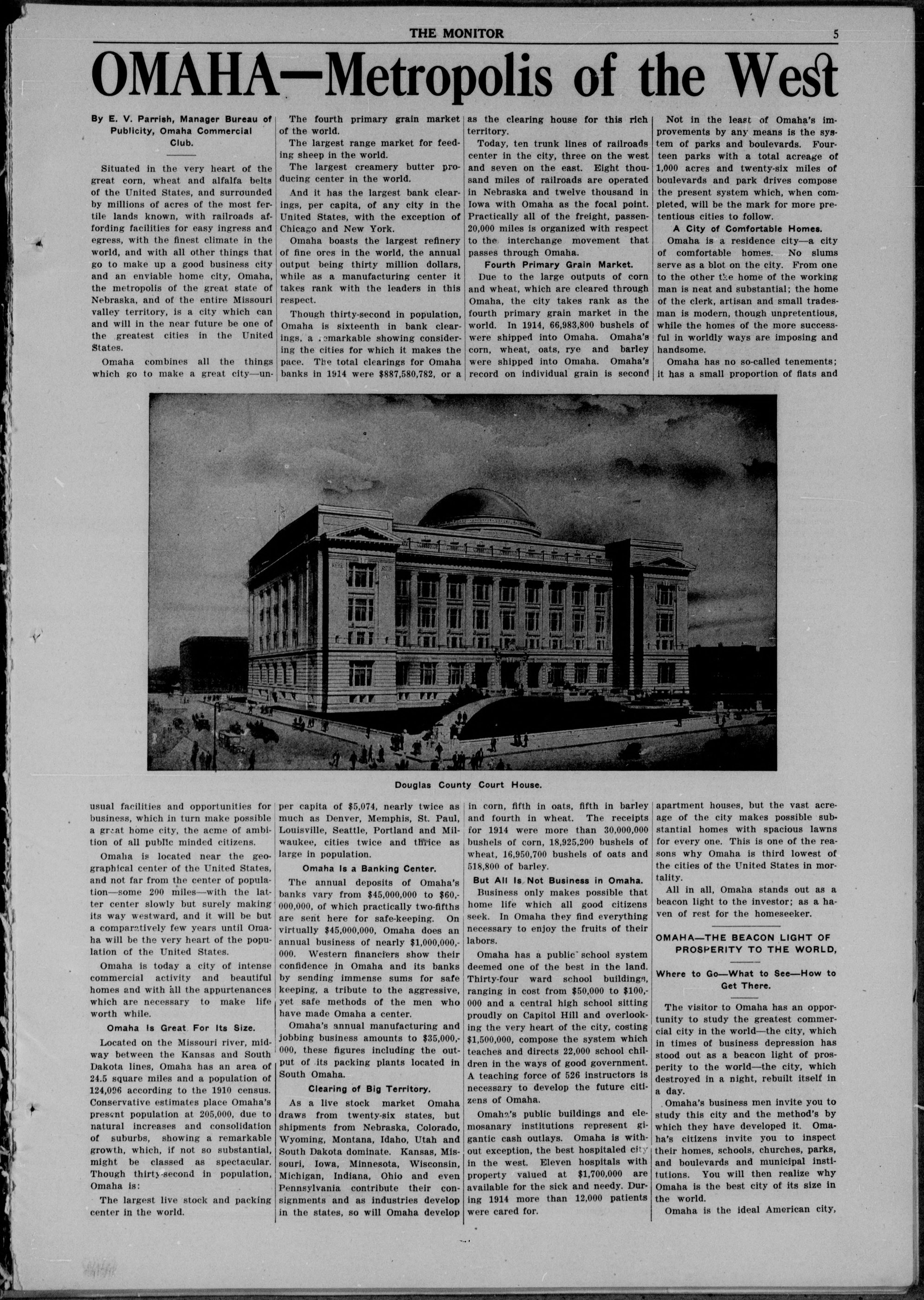
Page text (machine-generated)
THE MONITOR
A Weekly Newspaper Devoted to the Interests of the Eight Thousand Colored People in Omaha and Vicinity, and to the Good of the Community The Rev. JOHN ALBERT WILLIAMS, Editor
$1.00 a Year. 5c a Copy.
Negro Civilization In World's History
No Racial Characteristics Which Indicate Inferiority or Superiority.
HISTORY OF ANCIENT AFRICA
Notable Speech Delivered at Tuskegee Summer School.
Tuskegee Institute, Ala., Aug. 10. Among the many notable addresses to the Summer School for Teachers, which closed Friday, July 23, was the address of Monroe N. Work of the Department of Research and compiler of the Negro Year Book on the subject, "Africa in Ancient and Medieval History."
Mr. Work declared that the current geographies, histories and encyclopedias characterized the so-called true Negro as having black skin, wooly hair, protuberant lips and receding forehead, claiming that these so-called racial characteristics stamped the race, per se, as inferior. This has given rise to the belief that for the Negro to attain superiority he must become like the white man in color, achievements and along all lines. This view, said Mr. Work, is detrimental to the progress of the Negro and he said the Negro must make his own special contributions to world progress. This can be done through music, art, history, science and mechanical developments, and a number of facts have arisen in the field of science and in the annals of history which justify this possibility.
No Racial Inferiority.
Said the speaker: "Leading scientists in the field of anthropology are telling us that while there are differences of race, there are no characteristics which, per se, indicate that one race is inferior or superior to another. The differences are in kind, not in value. On the other hand, whatever superiority one race has attained over another has been largely due to environment.
"A German writer in a discussion some time ago of the origin of African civilization said, 'What bold investigators, great pioneers, still find to tell us in civilizations nearer home, proves more and more clearly that we are ignorant of hoary Africa. Somewhat of its present, perhaps, we know, but of its past little. Open an illustrated geography and compare the bluish-black fellow of the protuberant lips, the flattened nose, the stupid expression and the short curly hair, with the tall bronze figures from Dark Africa with which we have of late become familiar, their almost fine-cut features, slightly arched nose, long hair, and you have an example of the problems pressing for solution. In other respects, too, the genuine African of the interior bears no resemblance to the accepted Negro type as it figures on drug and cigar store signs, wearing a shabby stove-
Omaha, Nebraska, August 14, 1915
Think on These Things
BROTHE
When the golden links of Fri
And the Love that is eterna
And the Truth that came from
May the Master say to Bro
BROTHERHOOD.
the golden links of Friendship are severed here
the Love that is eternal still lives on,
the Truth that came from Heaven returns again
the Master say to Brotherhood, "WELL DON
When the golden links of Friendship are severed here on earth, And the Love that is eternal still lives on, And the Truth that came from Heaven returns again from earth, May the Master say to Brotherhood, "WELL DONE."
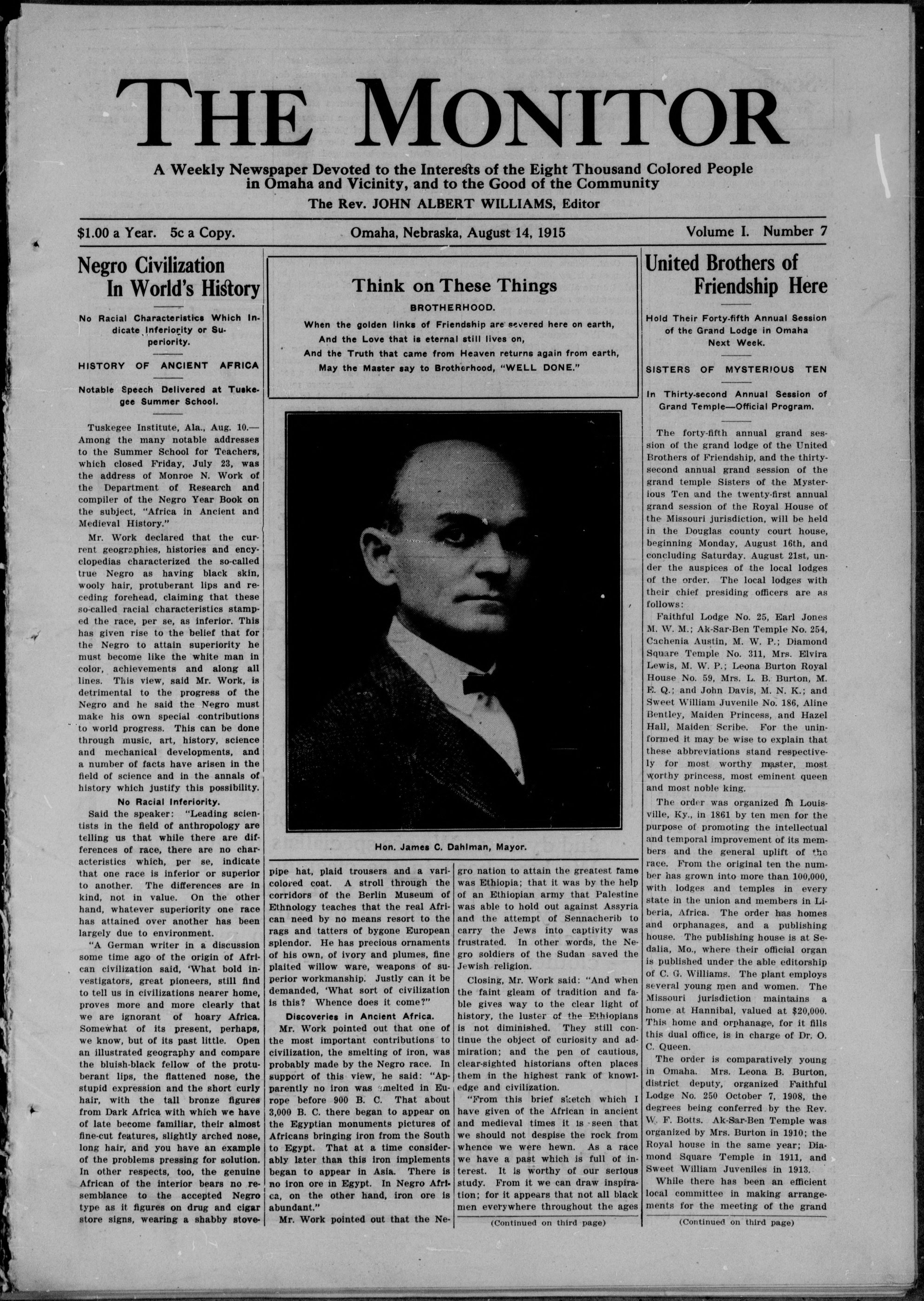
[Picture of a man in a suit and bow tie].
pipe hat, plaid trousers and a varicolored coat. A stroll through the corridors of the Berlin Museum of Ethnology teaches that the real African need by no means resort to the rags and tatters of bygone European splendor. He has precious ornaments of his own, of ivory and plumes, fine plaited willow ware, weapons of superior workmanship. Justly can it be demanded, 'What sort of civilization is this? Whence does it come?' gro nation to a was Ethiopia; of an Ethiopia was able to he and the attend carry the Jew frustrated. In gro soldiers of Jewish religion Closing, Mr. the faint gleable gives way
Discoveries in Ancient Africa. Mr. Work pointed out that one of the most important contributions to civilization, the smelting of iron, was probably made by the Negro race. In support of this view, he said: "Apparently no iron was smelted in Europe before 900 B. C. That about 3,000 B. C. there began to appear on the Egyptian monuments pictures of Africans bringing iron from the South to Egypt. That at a time considerably later than this iron implements began to appear in Asia. There is no iron ore in Egypt. In Negro Africa, on the other hand, iron ore is abundant." Mr. Work pointed out that the Ne-
---
---
RHOOD.
andship are severed here on earth,
I still lives on,
Heaven returns again from earth,
herhood, "WELL DONE."
gro nation to attain the greatest fame was Ethiopia; that it was by the help of an Ethiopian army that Palestine was able to hold out against Assyria and the attempt of Sennacherib to carry the Jews into captivity was frustrated. In other words, the Negro soldiers of the Sudan saved the Jewish religion.
Closing, Mr. Work said: "And when the faint gleam of tradition and fable gives way to the clear light of history, the luster of the Ethiopians is not diminished. They still continue the object of curiosity and admiration; and the pen of cautious, clear-sighted historians often places them in the highest rank of knowledge and civilization.
"From this brief sketch which I have given of the African in ancient and medieval times it is seen that we should not despise the rock from whence we were hewn. As a race we have a past which is full of interest. It is worthy of our serious study. From it we can draw inspiration; for it appears that not all black men everywhere throughout the ages
(Continued on third page)
Volume I. Number 7
United Brothers of Friendship Here
Hold Their Forty-fifth Annual Session of the Grand Lodge in Omaha Next Week.
SISTERS OF MYSTERIOUS TEN In Thirty-second Annual Session of Grand Temple-Official Program.
The forty-fifth annual grand session of the grand lodge of the United Brothers of Friendship, and the thirty-second annual grand session of the grand temple Sisters of the Mysterious Ten and the twenty-first annual grand session of the Royal House of the Missouri jurisdiction, will be held in the Douglas county court house, beginning Monday, August 16th, and concluding Saturday. August 21st, under the auspices of the local lodges of the order. The local lodges with their chief presiding officers are as follows:
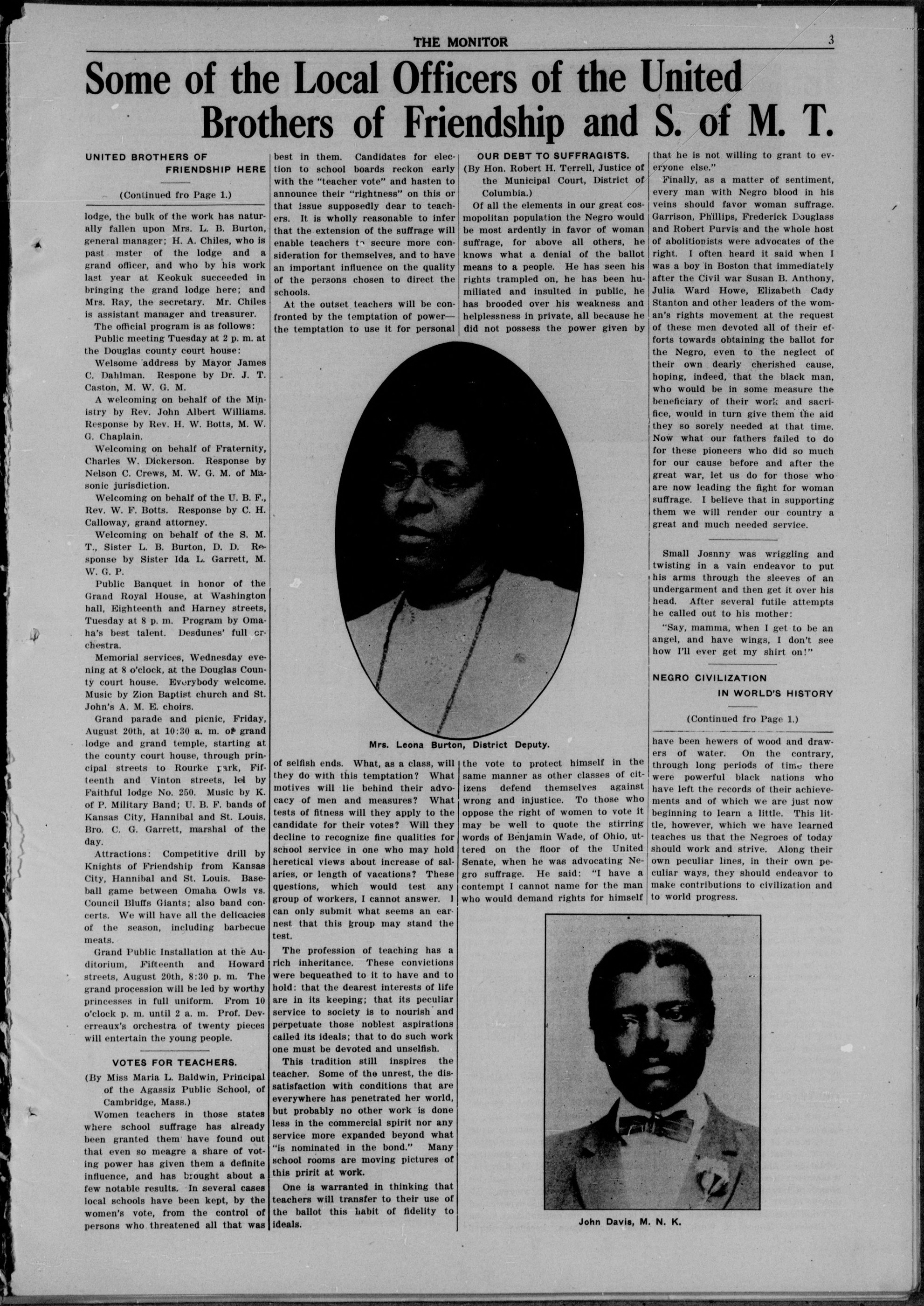
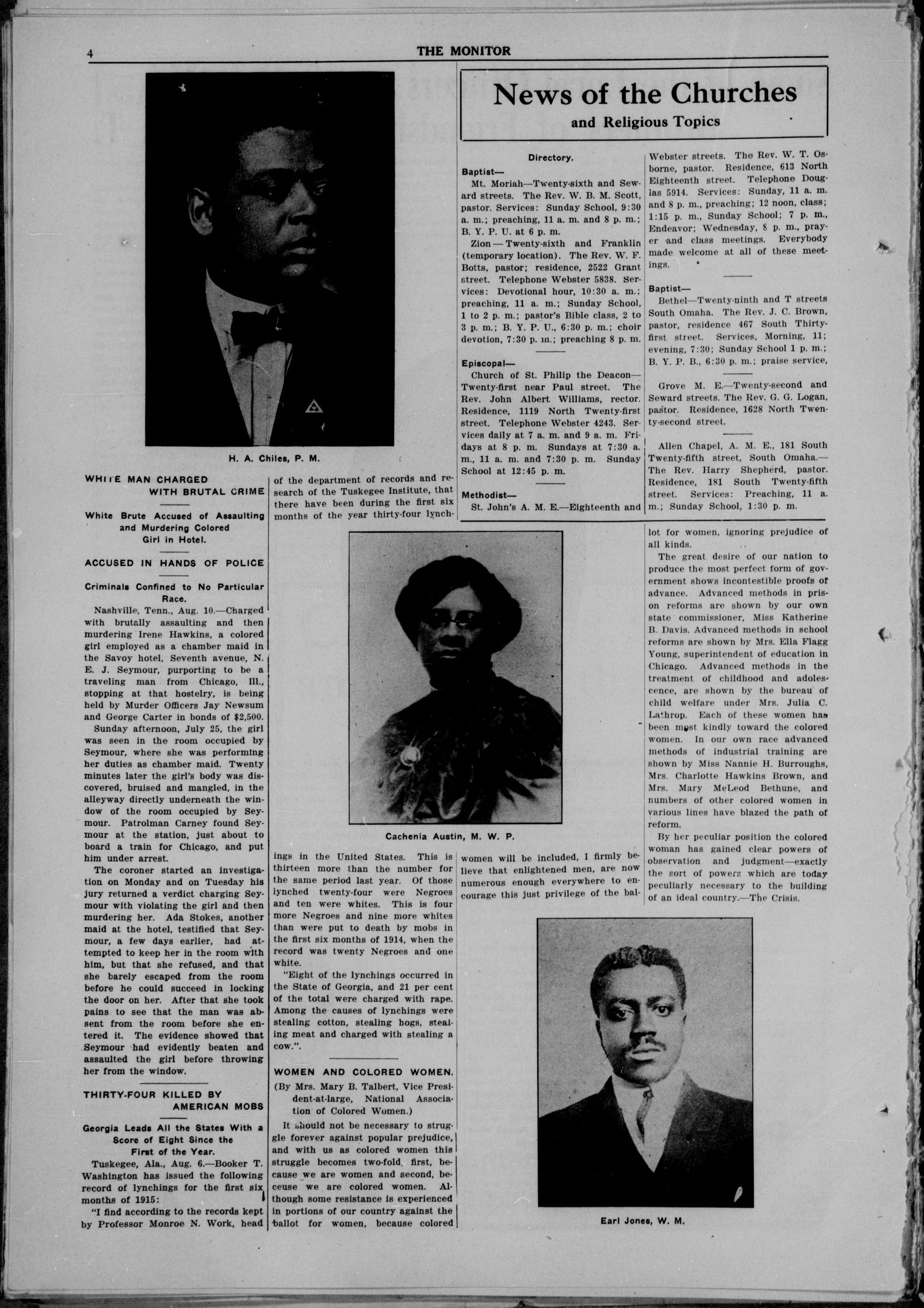
Faithful Lodge No. 25, Earl Jones M. W. M.; Ak-Sar-Ben Temple No. 254, Cachenia Austin, M. W. P.; Diamond Square Temple No. 311, Mrs. Elvira Lewis, M. W. P.; Leona Burton Royal House No. 59, Mrs. L. B. Burton, M. E. Q.; and John Davis, M. N. K.; and Sweet William Juvenile No. 186, Aline Bentley, Maiden Princess, and Hazel Hall, Maiden Scribe. For the uninformed it may be wise to explain that these abbreviations stand respectively for most worthy master, most worthy princess, most eminent queen and most noble king.
The order was organized in Louisville, Ky., in 1861 by ten men for the purpose of promoting the intellectual and temporal improvement of its members and the general uplift of the race. From the original ten the number has grown into more than 100,000, with lodges and temples in every state in the union and members in Liberia, Africa. The order has homes and orphanages, and a publishing house. The publishing house is at Sedalia, Mo., where their official organ is published under the able editorship of C. G. Williams. The plant employs several young men and women. The Missouri jurisdiction maintains a home at Hannibal, valued at $20,000. This home and orphanage, for it fills this dual office, is in charge of Dr. O. C. Queen.
The order is comparatively young in Omaha. Mrs. Leona B. Burton, district deputy, organized Faithful Lodge No. 250 October 7, 1908, the degrees being conferred by the Rev. W. F. Botts. Ak-Sar-Ben Temple was organized by Mrs. Burton in 1910; the Royal house in the same year; Diamond Square Temple in 1911, and Sweet William Juveniles in 1913. While there has been an efficient local committee in making arrangements for the meeting of the grand (Continued on third page)
ia bk iain sapiens
A Weekly Newspaper devoted to the civic, social and religious
interests of the Colored People of Omaha and vicinity, with the desire
to contribute something to the general good and upbuilding of the
community.
Published Every Saturday.
Entered as Second-Class Mail Matter July 2, 1915, at the Post-
office at Omaha, Neb., under the act of March 3, 1879.
THE REV. JOHN ALBERT WILLIAMS, Editor and Publisher.
Lucille Skaggs Edwards, William Garnett Haynes and Ellsworth W.
Pryor, Associate Editors.
Joseph LaCour, Jr., Advertising and Circulation Manager.
- SUBSCRIPTION RATES, $1.00 per year.
Advertising rates, 25 cents an inch per issue.
Address, The Monitor, 1119 North Twenty-first street, Omaha.
10
ANIMALISM INDIVIDUAL AND
CORPORATE.
It is an exceedingly hopeful sign
of an awakening righteous national
consciousness when a great paper like
the Chicago Tribune, which has not
always been frankly outspoken in its
condemnation of racial prejudice and
its attendant ills and injustices, con-
demns so unscathingly, as it does in
its editorial of August 3rd, the re-
cent lynching atrocity at Temple,
Texas. At heart the United States is
too sound to permit such atrocities to
be. If animalism runs riot in some
degenerate, black or white, which
causes him to commit a heinous and
revolting crime, which no right-think-
ing human being can or does con-
done, what possible justification can
there be for hundreds of seemingly
sane and normal human beings to
let animalism and brutishness run
riot in them and place them in the
same category of degenerates? None.
The press must protest against,
the pulpit must preach against ani-
malism and degeneracy in the mob
if we would eliminate animalism and
degeneracy in the individual. Our
national safety lies in strict enforce
ment and observance of the law. The
press can do much to roll away the
reproach that rests upon the nation
The Tribune says:
A terrible crime in Temple, Texas
has just been followed by one stil
more atrocious.
Neither crime is a stranger to the
district of the South in which it was
perpetrated, The first occurs ir
every part of the world. The second
a substitution of burning by a mol
for execution after fair trial and con
demnation under the law, is one
which does not occur among any non
barbarous people except in the
American South.
This fact is the darkest stain or
the good name of America. It burn:
red across the world. Whereve:
news travels, the horror of Temple
Texas, will be known, as the horro:
years ago of Paris, Texas, was known
The murder or ravishing of womer
is an offense that stirs emotion:
deeper, perhaps, than any other ir
our nature. That justice should fol
low swiftly and terrible is right. Bu
what followed in Temple, and wha
has followed too often in the South
is an offense more heinous, more de
moralizing and vicious in its influence
than that which it was assumed t
punish.
Not-only is this true beyond de
bate, but it is also true that since
the latter offense is recurrent as wel
as the former, the guilt of it, the
shame of it, falls upon the communii)
which tolerates its repretition. Texas
is disgraced by it, and the South anc
the United States. All America suf
THE MONITOR
fers from it, as any one knows who
has read or heard the frequent’ ref-
erence to the offense in the foreign
press, in books, in the mouths of
men and women famous or obscure.
It is one of the outstanding phenom-
ena of American society, a reproach
against our social intelligence, our
respect for law or justice, our hu-
manity, our self-control. Against the
noble rhetoric of our leaders, the en-
lightenment of our aims, the reality
of our institutions, this red blotch of
unreasoning and unrestrained animal-
ism flames, ominous and unescapable.
How can Texas, a proud common-
wealth, how can America, with any
shadow of self-respect, permit this
crime to go on as it has, year by
year, until it is advertised the world
over as an American institution? Is
Texas so unable to cope with the
dregs of its own people that it must
permit this unspeakable thing to
shame her and America again and
again? Is Texas unable or unwilling
to cope with it by legisiation and by
efficient police administration?
Other communities have in their
care subject or backward races or
classes. They do not tolerate such
outbreaks of the abysmal brute. What
has Texas done to protect her women
‘better and to protect herself better?
What is she going to do?
A European of distinction recently
remarked to an American traveler:
“Is it possible that these communities
think less of the offense against your
women than of the pleasure of the
punishment? How else can a civil-
ized people permit these burnings and
lynchings to occur?”
It was a terrible indictment. How
are we to face it? But; more impor.
tant still, how are we to face our
own conscience, our own self-respect,
while this “American institution” en-
dures? *
WELCOME TO OUR GUESTS. may serve to demonstrate to you that folk
We bid most cordial welcome to the | we are anxious to make The Monitor] M4 sets them free aga
hundreds of our. Tace who as dete- an emicient s9pes in the life of the Yes, ‘tis he that helps his br
gates and visitors to the sessions of | community, working with other pub Whose prayers ascend to
the Grand Lodge and Chapter of the | lications along progressive lines. We} or to orphans’ cries an
United Brothers of Friendship and believe that in our efforts to do this sighs
the Sisters of the Mysterious Ten are| we will be heartily supported. We Is God’s attention given
to spend a week in our city. We in-| are frank to say that we hope by this] Why then pelt the Power
dulge the hope that so pleasant will issue to secure many subscribers and __ above t
3 ne so ; : a With your rattling blow
be your stay that you will be reluc- friends for the paper. We are sure] ,, ea
Wor the only prayers for
tant to leave and anxious to return. | that scores of our readers will buy ad. cares
We trust that your deliberations may ditional copies and send them to their Are the prayers that m¢
| ji a f A isi
ee en ee
HE ae > : rsa] ithe \ ie
Bt ; ‘ A | a: Pa oe
Li 1 eet ya! Sf il hee» ae)
mi = ae é ] Se Loe Fi
| eet os oe ee * ge pon
t aes a a nn 7} gate,
eS Ny a a ag iy ae =
ae? re s en - rds oe dest 7"
make for the advancement of your or-
der, which we have been advised has
as its cardinal principles the advo-
cacy of justice, mercy and truth, prin-
ciples to which all men should most
heartily subscribe, even though they
| may not deem it necessary to be
initiated into your fraternity or to
have your grip and password,
Fraternalism, as exemplified by
your, and similar organizations, bears
| witness to the social instinct and the
‘laudable desire for mutual helpfulness
| which is such a strong and commend-
| able characteristic of our people. May
ae trait of character remain with us
a permanent possession. As your or-
| der seeks the upbuilding of character
| and the cultivation of brotherliness, in
|absolute sincerity: we can wish you
abundant success. :
You will find Omaha a delightful
city of more than 200,000 inhabitants.
dwelling in peace, generally speaking.
and happiness together. You will find
us very human, with the faults and
frailties of common humanity, and
yet with warm hearts and the desire
at least to be broad-minded, justice-
loving and kindly. You will find us a
-home-loving people, A good index of
the character of a community is the
‘tone of the press. You will find the
press of Omaha sympathetic, liberal-
‘minded and fair. You will find our
merchants and business men cour-
teous, We speak of the rule in all
‘these matters, not of the exceptions
| that you may find. You will find our
ae and boulevards, our public
buildings beautifully artistic and
‘sightly, inviting your inspection. Be
sure to see as much of the city as
you can. Our excellent street car sys-
tem will take you to nearly all parts
of the city. To aid you in finding your
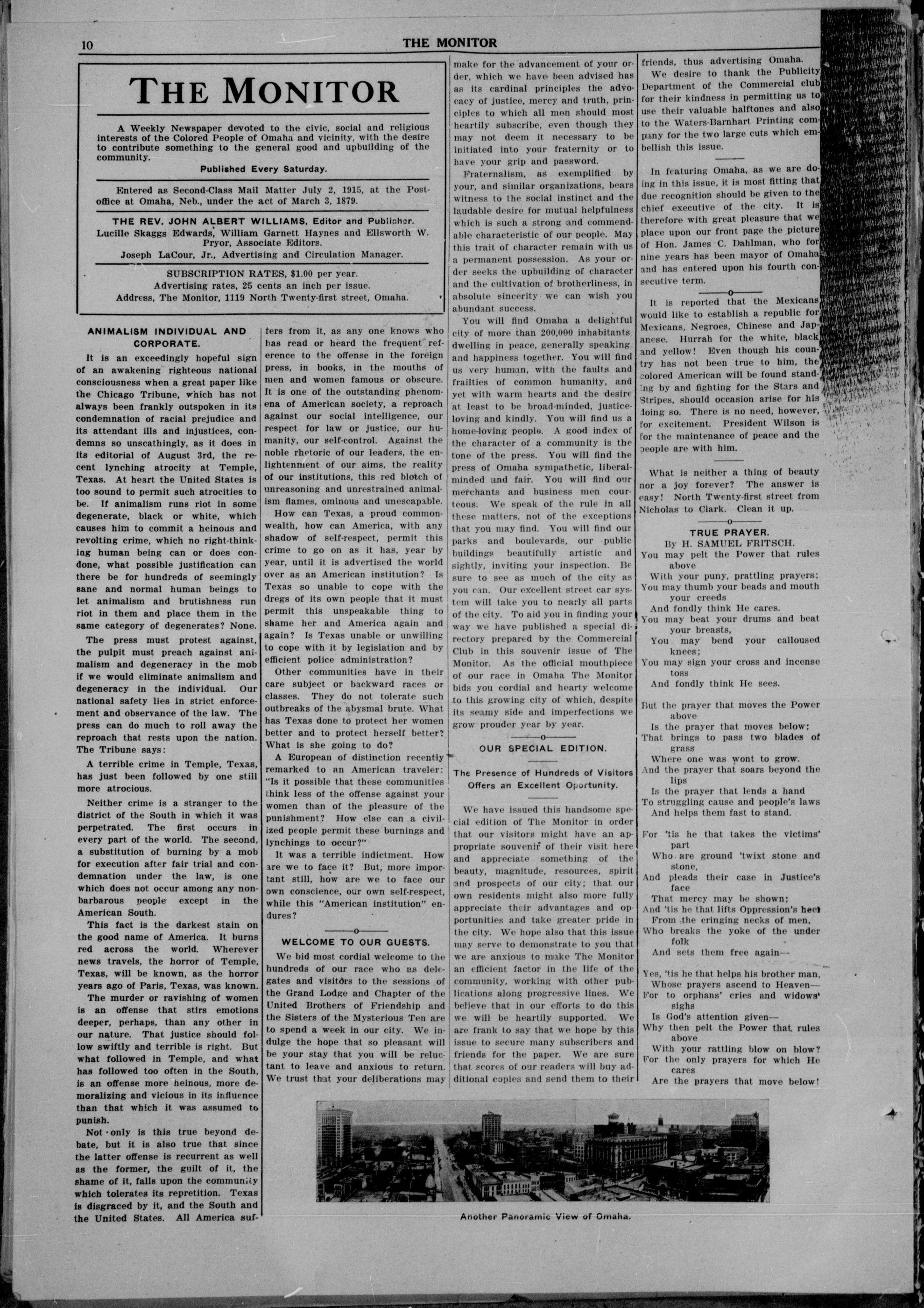
way we have published a special di-
rectory prepared by the Commercial
(Club in this souvenir issue of The
_ Monitor. As the official mouthpiece
of our race in Omaha The Monitor
| bids you cordial and hearty welcome
|to this growing city of which, despite
\its seamy side and imperfections we
| grow prouder year by year.
; OUR SPECIAL EDITION.
The Presence of Hundreds of Visitors
Offers an Excellent Oportunity.
We have issued this handsome spe-
cial edition of The Monitor in order
that our visitors might have an ap-
propriate souvenir of their visit here
and appreciate something of the
beauty, magnitude, resources, spirit
and prospects of our city; that our
own residents might also more fully
appreciate their advantages and op-
portunities and take greater pride in
the city. We hope also that this issue
may serve to demonstrate to you that
we are anxious to make The Monitor
an efficient factor in the life of the
community, working with other pub-
lications along progressive lines. We
believe that in our efforts to do this
we will be heartily supported. We
are frank to say that we hope by this
issue to secure many subscribers and
friends for the paper. We are sure
‘that scores of our readers will buy ad-
ditional copies and send them to their
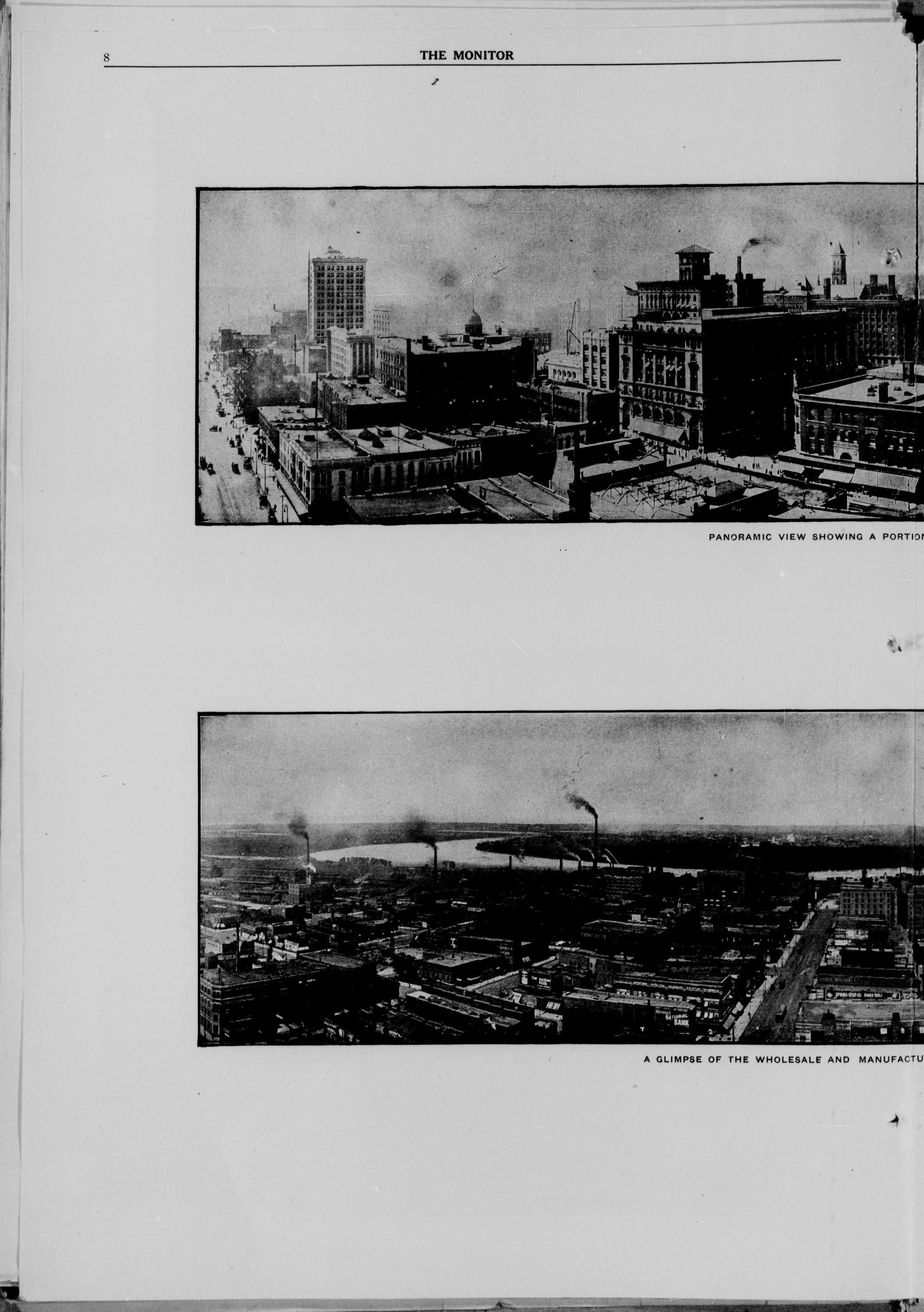
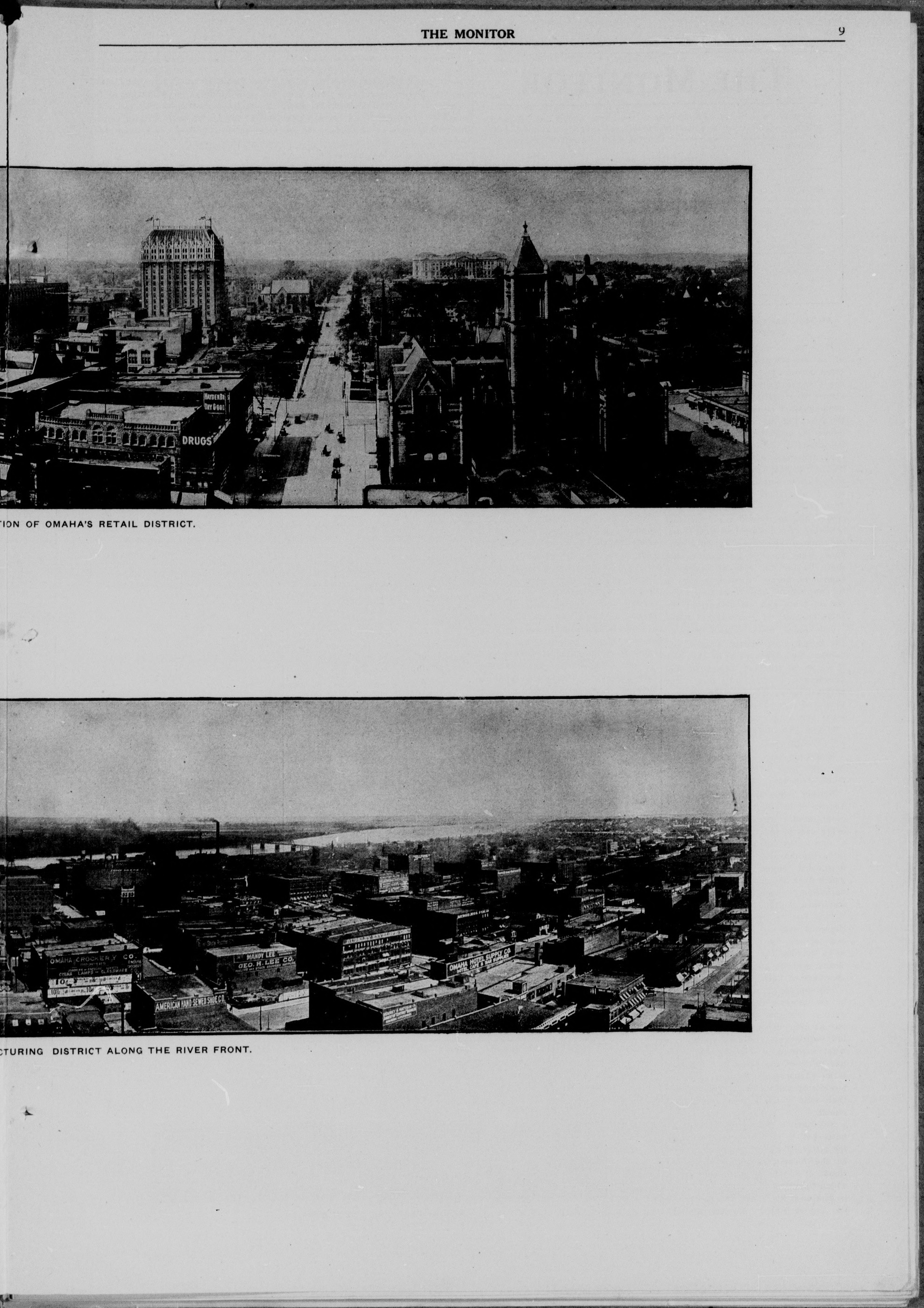
Atiother Panoramic View of Omaha.
friends, thus advertising Omaha,
We desire to thank the Publicity
Department of the Commercial clut
for their kindness in permitting us te
use their valuable halftones and alsc
to the Waters-Barnhart Printing com
pany for the two large cuts which em
bellish this issue.
In featuring Omaha, as we are do
ing in this issue, it is most fitting that
due recognition should be given to the
chief executive of the city. It Is
therefore with great pleasure that we
place upon our front page the picture
of Hon. James C. Dahlman, who fot
nine years has been mayor of Omaha
and has entered upon his fourth con
secutive term. ‘
| It is reported that the Mexicans
would like to establish a republic for
arsipana: Negroes, Chinese and Jap~
‘anese. Hurrah for the white, black;
and yellow! Even though his bedi
‘try has not been true to him, the:
colored American will be found stand-,
ing by and fighting for the Stars and
Stripes, should oceasion arise for his
doing so. There is no need, however,
for excitement. President Wilson is
for the maintenance of peace and the
oeople are with him.
What is neither a thing of beauty
nor a joy forever? The answer is
easy! North Twenty-first street from
Nicholas to Clark. Clean it up.
eects
TRUE PRAYER.
By H. SAMUEL FRITSCH.
You may pelt the Power that rules
above
With your puny, prattling prayers;
You may thumb your beads and mouth
your creeds
And fondly think He cares.
You may beat your drums and beat
your breasts,
You may bend your calloused
knees;
You may sign your cross and incense
toss
And fondly think He sees.
But the prayer that moves the Power
above
Is the prayer that moves below;
That brings to pass two blades of
grass
Where one was wont to grow.
And the prayer that soars beyond the
lips
Is the prayer that lends a hand
To struggling cause and people’s laws
And helps them fast to stand.
For ‘tis he that takes the victims’
part
Who. are ground ’twixt stone and
stone,
And pleads their case in Justice’s
face
That mercy may be shown;
And tis he that lifts Oppression’s hee?
From the cringing necks of men,
Who breaks the yoke of the under
folk .
_ And sets them free again—-
Yes, ’tis he that helps his brother man,
Whose prayers ascend to Heaven—
For to orphans’ cries and widows'
sighs
Is God's attention given—
‘Why then pelt the Power that, rules
above
With your rattling blow on blow?
Wor the only prayers for which He
cares
Are the prayers that move below!
PRE AL
5 PPR HL.
at a LoL f
ie
2 SOY |
‘vag
a |
Y wae me Val
vt cw il
Aes ih
BATT keh
Pe
Ren a
WOOT Lp
ay Roya
Re
Be
a a ef
PU: ma ,
ern li: |
Lie it A
can A Ma
, RY i {
aa MT ad
AY RUR PG
a ual
EN DAVE Aye tt |
i ine ake |
NN avlettin oval?
ror |
Rows gi uate
THE MUSEUM OF THE WORLD'S FINE ARTS
THE BANK OF THE UNITED STATES
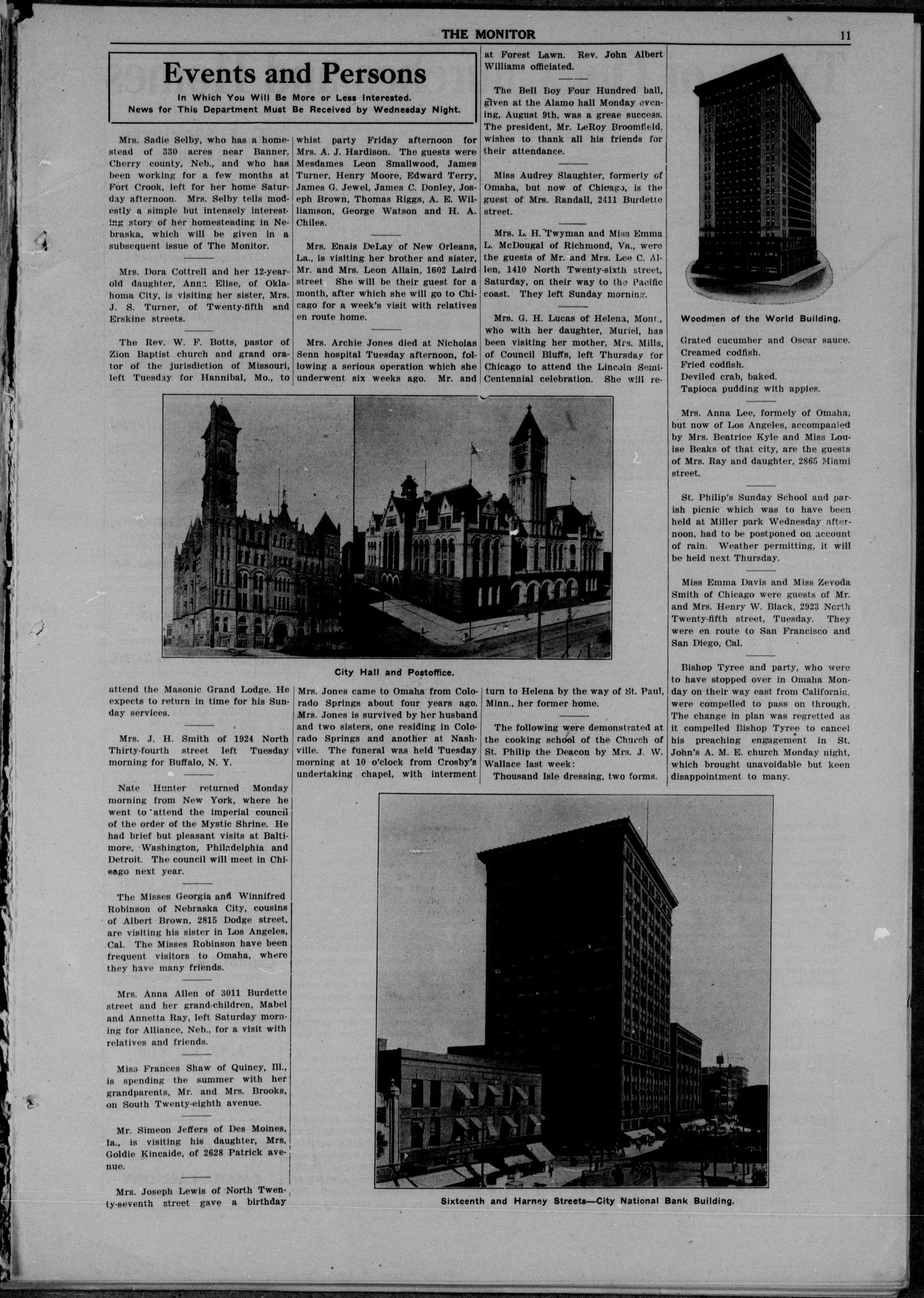
Sixteenth and Harney Streets—City National Bank Building.
Events and Persons
In Which You Will Be More or Less Interested. News for This Department Must Be Received by Wednesday Night.
Mrs. Sadie Selby, who has a homestead of 330 acres near Banner, Cherry county, Neb., and who has been working for a few months at Fort Crook, left for her home Saturday afternoon. Mrs. Selby tells modestly a simple but intensely interesting story of her homesteading in Nebraska, which will be given in a subsequent issue of The Monitor.
Mrs. Dora Cottrell and her 12-year-old daughter, Anna Elise, of Oklahoma City, is visiting her sister, Mrs. J. S. Turner, of Twenty-fifth and Erskine streets.
The Rev. W. F. Botts, pastor of Zion Baptist church and grand orator of the jurisdiction of Missouri, left Tuesday for Hannibal, Mo., to
THE BANK OF THE UNITED STATES
attend the Masonic Grand Lodge. He expects to return in time for his Sunday services.
Mrs. J. H. Smith of 1924 North Thirty-fourth street left Tuesday morning for Buffalo, N. Y.
Nate Hunter returned Monday morning from New York, where he went to attend the imperial council of the order of the Mystic Shrine. He had brief but pleasant visits at Baltimore, Washington, Philadelphia and Detroit. The council will meet in Chicago next year.
The Misses Georgia and Winnifred Robinson of Nebraska City, cousins of Albert Brown, 2815 Dodge street, are visiting his sister in Los Angeles, Cal. The Misses Robinson have been frequent visitors to Omaha, where they have many friends.
Mrs. Anna Allen of 3011 Burdette street and her grand-children, Mabel and Annetta Ray, left Saturday morning for Alliance, Neb., for a visit with relatives and friends.
Mis3 Frances Shaw of Quincy, Ill., is spending the summer with her grandparents, Mr. and Mrs. Brooks, on South Twenty-eighth avenue.
Mr. Simeon Jeffers of Des Moines, Ia., is visiting his daughter, Mrs. Goldie Kincaide, of 2628 Patrick avenue.
Mrs. Joseph Lewis of North Twenty-seventh street gave a birthday
THE MONITOR
whist party Friday afternoon for Mrs. A. J. Hardison. The guests were Mesdames Leon Smallwood, James Turner, Henry Moore, Edward Terry, James G. Jewel, James C. Donley, Joseph Brown, Thomas Riggs, A. E. Williamson, George Watson and H. A. Chiles.
Mrs. Enais DeLay of New Orleans, La., is visiting her brother and sister, Mr. and Mrs. Leon Allain, 1602 Laird street. She will be their guest for a month, after which she will go to Chicago for a week's visit with relatives en route home.
Mrs. Archie Jones died at Nicholas Senn hospital Tuesday afternoon, following a serious operation which she underwent six weeks ago. Mr. and
THE HALL OF THE COURT
Mrs. Jones came to Omaha from Colorado Springs about four years ago. Mrs. Jones is survived by her husband and two sisters, one residing in Colorado Springs and another at Nashville. The funeral was held Tuesday morning at 10 o'clock from Crosby's undertaking chapel, with interment
---
City Hall and Postoffice.
at Forest Lawn. Rev. John Albert Williams officiated.
The Bell Boy Four Hundred ball, given at the Alamo hall Monday evening, August 9th, was a greae success. The president, Mr. LeRoy Broomfield, wishes to thank all his friends for their attendance.
Miss Audrey Slaughter, formerly of Omaha, but now of Chicago, is the guest of Mrs. Randall, 2411 Burdette street.
Mrs. L. H. Twyman and Miss Emma L. McDougal of Richmond, Va., were the guests of Mr. and Mrs. Lee C. Allen, 1410 North Twenty-sixth street, Saturday, on their way to the Pacific coast. They left Sunday morning.
Mrs. G. H. Lucas of Helena, Mont., who with her daughter, Muriel, has been visiting her mother, Mrs. Mills, of Council Bluffs, left Thursday for Chicago to attend the Lincoln Semi-Centennial celebration. She will re-
2
turn to Helena by the way of St. Paul, Minn., her former home.
The following were demonstrated at the cooking school of the Church of St. Philip the Deacon by Mrs. J. W. Wallace last week:
Thousand Isle dressing, two forms.
THE BANK OF THE UNITED STATES
11
THE BANK
Woodmen of the World Building.
Grated cucumber and Oscar sauce.
Creamed codfish.
Fried codfish.
Deviled crab, baked.
Tapioca pudding with apples.
Mrs. Anna Lee, formally of Omaha, but now of Los Angeles, accompanied by Mrs. Beatrice Kyle and Miss Louise Beaks of that city, are the guests of Mrs. Ray and daughter, 2865 Miami street.
St. Philip's Sunday School and parish picnic which was to have been held at Miller park Wednesday afternoon, had to be postponed on account of rain. Weather permitting, it will be held next Thursday.
Miss Emma Davis and Miss Zevoda Smith of Chicago were guests of Mr. and Mrs. Henry W. Black, 2923 North Twenty-fifth street, Tuesday. They were en route to San Francisco and San Diego, Cal.
Bishop Tyree and party, who were to have stopped over in Omaha Monday on their way east from California, were compelled to pass on through. The change in plan was regretted as it compelled Bishop Tyree to cancel his preaching engagement in St. John's A. M. E. church Monday night, which brought unavoidable but keen disappointment to many.
Types of Our Churches and Homes
THE CHURCH
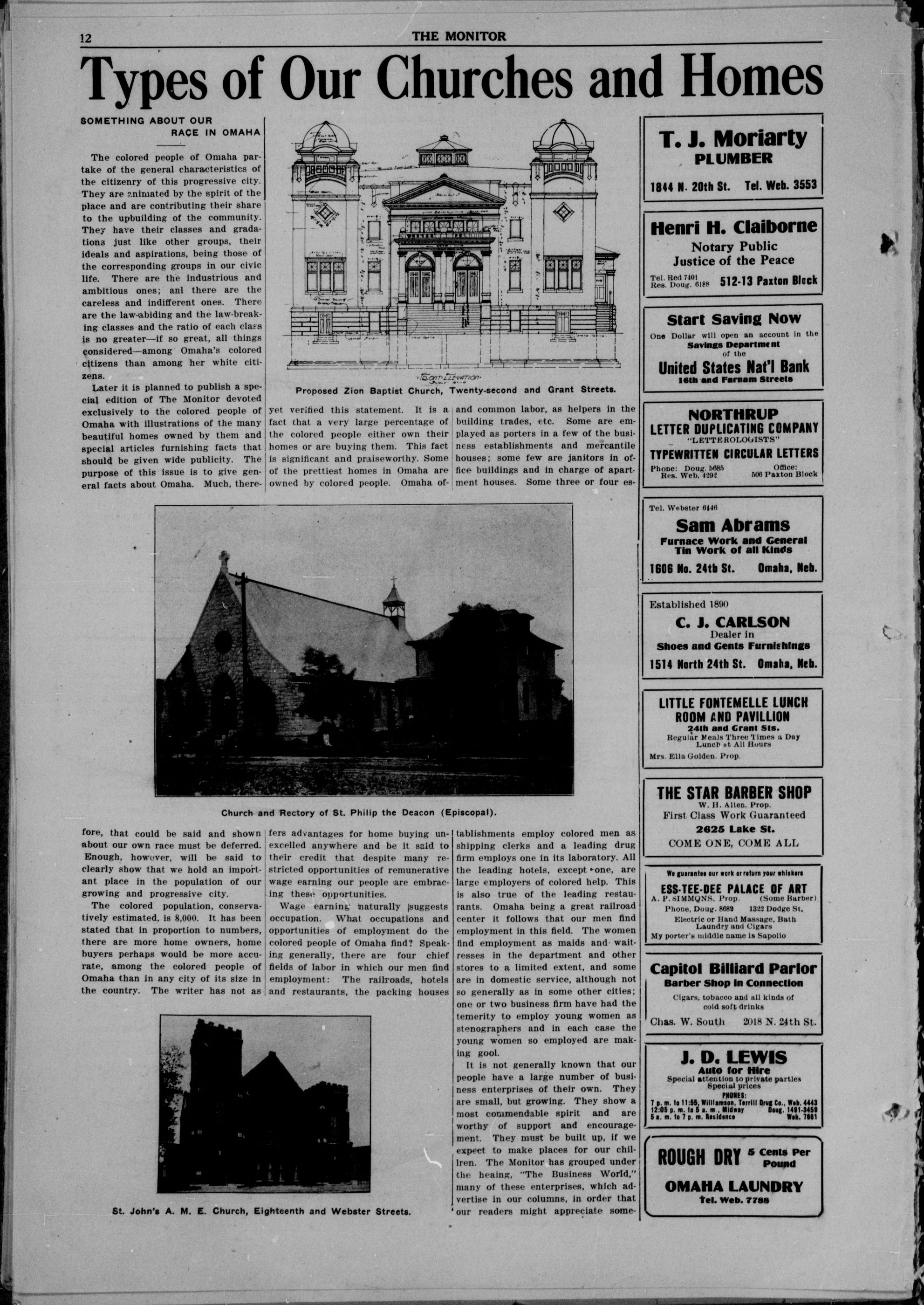
Church and Rectory of St. Philip the Deacon (Episcopal).
SOMETHING ABOUT OUR RACE IN OMAHA
The colored people of Omaha partake of the general characteristics of the citizenry of this progressive city. They are animated by the spirit of the place and are contributing their share to the upbuilding of the community. They have their classes and gradations just like other groups, their ideals and aspirations, being those of the corresponding groups in our civic life. There are the industrious and ambitious ones; and there are the careless and indifferent ones. There are the law-abiding and the law-breaking classes and the ratio of each class is no greater—if so great, all things considered—among Omaha's colored citizens than among her white citizens.
Later it is planned to publish a special edition of The Monitor devoted exclusively to the colored people of Omaha with illustrations of the many beautiful homes owned by them and special articles furnishing facts that should be given wide publicity. The purpose of this issue is to give general facts about Omaha. Much, there-
Church a
fore, that could be said and shown about our own race must be deferred. Enough, however, will be said to clearly show that we hold an important place in the population of our growing and progressive city. The colored population, conservatively estimated, is 8,000. It has been stated that in proportion to numbers, there are more home owners, home buyers perhaps would be more accurate, among the colored people of Omaha than in any city of its size in the country. The writer has not as
THE MUSEUM
St. John's A. M. E. Church, E
St. John's A. M. E. Church, Eighteenth and Webster Streets.
12
FONT ELEVATION
yet verified this statement. It is a fact that a very large percentage of the colored people either own their homes or are buying them. This fact is significant and praiseworthy. Some of the prettiest homes in Omaha are owned by colored people. Omaha of and common labor, as helpers in building trades, etc. Some are played as porters in a few of the business establishments and mercant houses; some few are janitors in fice buildings and in charge of am ment houses. Some three or four
nd Rectory of St. Philip the Deacon (E
fers advantages for home buying unexcelled anywhere and be it said to their credit that despite many restricted opportunities of remunerative wage earning our people are embracing these opportunities. Wage earning naturally suggests occupation. What occupations and opportunities of employment do the colored people of Omaha find? Speaking generally, there are four chief fields of labor in which our men find employment: The railroads, hotels and restaurants, the packing houses
eighteenth and Webster Streets.
THE MONITOR
hurc
TONT. ELEVATION
Church, Twenty-seco
eacon (Episcopal).
---
and common labor, as helpers in the building trades, etc. Some are employed as porters in a few of the business establishments and mercantile houses; some few are janitors in office buildings and in charge of apartment houses. Some three or four es-
(piscopal).
tablishments employ colored men as shipping clerks and a leading drug firm employs one in its laboratory. All the leading hotels, except one, are large employers of colored help. This is also true of the leading restaurants. Omaha being a great railroad center it follows that our men find employment in this field. The women find employment as maids and waitresses in the department and other stores to a limited extent, and some are in domestic service, although not so generally as in some other cities; one or two business firm have had the temerity to employ young women as stenographers and in each case the young women so employed are making gool.
It is not generally known that our people have a large number of business enterprises of their own. They are small, but growing. They show a most commendable spirit and are worthy of support and encouragement. They must be built up, if we expect to make places for our chilren. The Monitor has grouped under the heaing, "The Business World," many of these enterprises, which advertise in our columns, in order that our readers might appreciate some-
---
T. J. Moriarty
PLUMBER
1844 N. 20th St. Tel. Web. 3553
Henri H. Claiborne
Notary Public
Justice of the Peace
Tel. Red 7401
Res. Doug. 6188
512-13 Paxton Block
Start Saving Now
One Dollar will open an account in the
Savings Department
of the
United States Nat'l Bank
16th and Farnam Streets
NORTHRUP
LETTER DUPLICATING COMPANY
"LETTEROLOGISTS"
TYPEWRITTEN CIRCULAR LETTERS
Phone: Doug. 5685 Office:
Res. Web. 4292 506 Paxton Block
Tel. Webster 6446
Sam Abrams
Furnace Work and General
Tin Work of all Kinds
1606 No. 24tb St. Omaha, Neb.
Established 1890
C. J. CARLSON
Dealer in
Shoes and Gents Furnishings
1514 North 24th St. Omaha, Neb.
LITTLE FONTEMELLE LUNCH ROOM AND PAVILLION 24th and Grant Sts. Regular Meals Three Times a Day Lunch at All Hours Mrs. Ella Golden. Prop.
THE STAR BARBER SHOP
W. H. Allen, Prop.
First Class Work Guaranteed
2625 Lake St.
COME ONE, COME ALL
ESS-TEE-DEE PALACE OF ART
A. P. SIMMQNS, Prop. (Some Barber
Phone, Doug. 8689 1322 Dodge St.
Electric or Hand Massage, Bath
Laundry and Cigars
My porter's middle name is Sapolio
Capitol Billiard Parlor Barber Shop in Connection Cigars, tobacco and all kinds of cold soft drinks Chas. W. South 2018 N. 24th St.
J. D. LEWIS
Auto for Hire
Special attention to private parties
Special prices
PHONES:
7 p. m. to 11:55, Williamson, Terrill Drug Co., Web. 4443
12:05 p. m. to 5 a. m., Midway Doug. 1491-3459
5 a. m. to 7 p. m. Residence Web. 7661
ROUGH DRY 5 Cents Per Pound
OMAHA LAUNDRY
Tel. Web. 7788
THE HOME OF THE MAYOR
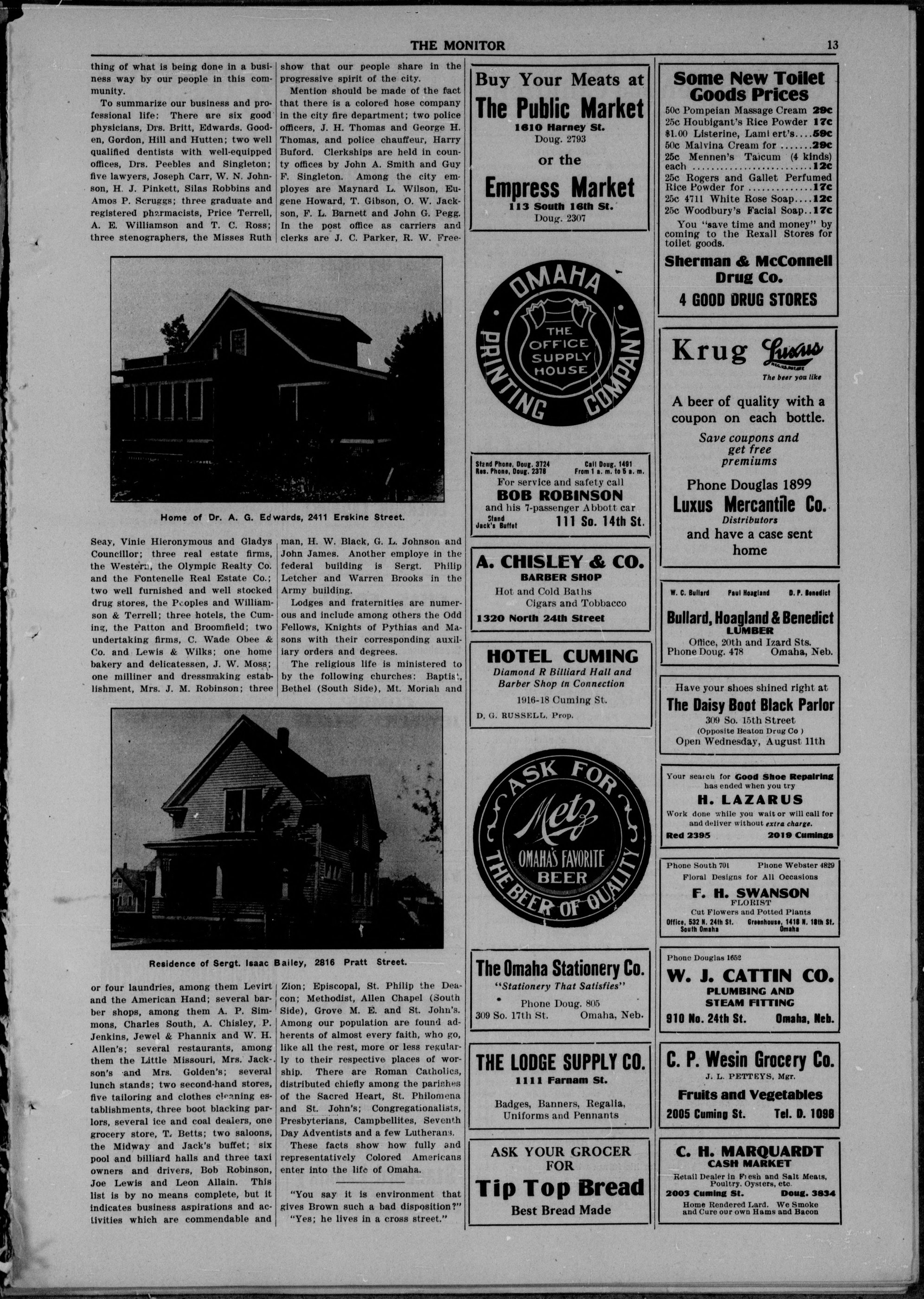
Home of Dr. A. G. Edwards, 2411 Erskine Street.
THE HOME OF THE MAYOR OF MIDDLEBURG
Residence of Sergt. Isaac Bailey, 2816 Pratt Street.
thing of what is being done in a business way by our people in this community. To summarize our business and professional life: There are six good physicians, Drs. Britt, Edwards. Gooden, Gordon, Hill and Hutten; two well qualified dentists with well-equipped offices, Drs. Peebles and Singleton; five lawyers, Joseph Carr, W. N. Johnson, H. J. Pinkett, Silas Robbins and Amos P. Scruggs; three graduate and registered pharmacists, Price Terrell, A. E. Williamson and T. C. Ross; three stenographers, the Misses Ruth
Home of Dr. A. G. Ed
Seay, Vinie Hieronymous and Gladys Councillor; three real estate firms, the Western, the Olympic Realty Co. and the Fontenelle Real Estate Co.; two well furnished and well stocked drug stores, the Peoples and Williamson & Terrell; three hotels, the Cuming, the Patton and Broomfield; two undertaking firms, C. Wade Obee & Co. and Lewis & Wilks; one home bakery and delicatessen, J. W. Moss; one milliner and dressmaking establishment, Mrs. J. M. Robinson; three
Residence of Sergt. Isaac
or four laundries, among them Levirt and the American Hand; several barber shops, among them A. P. Simmons, Charles South, A. Chisley, P. Jenkins, Jewel & Phannix and W. H. Allen's; several restaurants, among them the Little Missouri, Mrs. Jackson's and Mrs. Golden's; several lunch stands; two second-hand stores, five tailoring and clothes cleaning establishments, three boot blacking parlors, several ice and coal dealers, one grocery store, T. Betts; two saloons, the Midway and Jack's buffet; six pool and billiard halls and three taxi owners and drivers, Bob Robinson, Joe Lewis and Leon Allain. This list is by no means complete, but it indicates business aspirations and activities which are commendable and
---
show that our people share in the progressive spirit of the city.
Mention should be made of the fact that there is a colored hose company in the city fire department; two police officers, J. H. Thomas and George H. Thomas, and police chauffeur, Harry Buford. Clerkships are held in county offices by John A. Smith and Guy F. Singleton. Among the city employes are Maynard L. Wilson, Eugene Howard, T. Gibson, O. W. Jackson, F. L. Barnett and John G. Pegg. In the post office as carriers and clerks are J. C. Parker, R. W. Free-
wards, 2411 Erskine Street.
man, H. W. Black, G. L. Johnson and John James. Another employe in the federal building is Sergt. Philip Letcher and Warren Brooks in the Army building.
Lodges and fraternities are numerous and include among others the Odd Fellows, Knights of Pythias and Masons with their corresponding auxiliary orders and degrees.
The religious life is ministered to by the following churches: Baptist, Bethel (South Side), Mt. Moriah and
Bailey, 2816 Pratt Street.
Zion; Episcopal, St. Philip the Deacon; Methodist, Allen Chapel (South Side), Grove M. E. and St. John's. Among our population are found adherents of almost every faith, who go, like all the rest, more or less regularly to their respective places of worship. There are Roman Catholics, distributed chiefly among the parishes of the Sacred Heart, St. Philomena and St. John's; Congregationalists, Presbyterians, Campbellites, Seventh Day Adventists and a few Lutherans.
These facts show how fully and representatively Colored Americans enter into the life of Omaha.
"You say it is environment that gives Brown such a bad disposition?"
"Yes; he lives in a cross street."
Buy Your Meats at
The Public Market
1610 Harney St.
Doug. 2793
or the
Empress Market
113 South 16th St.
Doug. 2307
OMAHA
PRINTING COMPANY
THE
OFFICE
SUPPLY
HOUSE
Stand Phone, Doug. 3724
Res. Phone, Doug. 2378
Call Doug. 1491
From 1 a.m. to 6 a.m.
For service and safety call
BOB ROBINSON
and his 7-passenger Abbott car
Stand
Jack's Buffet
111 So. 14th St.
A. CHISLEY & CO.
BARBER SHOP
Hot and Cold Baths
Cigars and Tobacco
1320 North 24th Street
HOTEL CUMING
Diamond R Billiard Hall and
Barber Shop in Connection
1916-18 Cuming St.
D. G. RUSSELL, Prop.
ASK FOR
Metz
OMAHA'S FAVORITE
BEER
THE BEER OF QUALITY
The Omaha Stationery Co.
"Stationery That Satisfies"
Phone Doug. 805
309 So. 17th St. Omaha, Neb.
THE LODGE SUPPLY CO.
1111 Farnam St.
Tip Top Bread
Best Bread Made
Badges, Banners, Regalia Uniforms and Pennants
ASK YOUR GROCER FOR
13
Some New Toilet Goods Prices
50c Pompeian Massage Cream 29c
25c Houbigant's Rice Powder 17c
$1.00 Listerine, Lamlert's.....59c
50c Malvina Cream for .....29c
25c Mennen's Taicum (4 kinds)
each .....12c
25c Rogers and Gallet Perfumed
Rice Powder for .....17c
25c 4711 White Rose Soap.....12c
25c Woodbury's Facial Soap..17c
You "save time and money" by
coming to the Rexall Stores for
toilet goods.
Sherman & McConnell
Drug Co.
4 GOOD DRUG STORES
Krug Lusus
The beer you like
A beer of quality with a coupon on each bottle.
Save coupons and
get free
premiums
Phone Douglas 1899
Luxus Mercantile Co.
Distributors
and have a case sent
home
W. C. Bullard Paul Hoagland D. P. Benedict
Bullard, Hoagland & Benedict
LUMBER
Office, 20th and Izard Sts.
Phone Doug. 478 Omaha, Neb.
Have your shoes shined right at The Daisy Boot Black Parlor 309 So.15th Street (Opposite Beaton Drug Co) Open Wednesday, August 11th
Your search for Good Shoe Repairing has ended when you try
H. LAZARUS
Work done while you wait or will call for and deliver without extra charge.
Red 2395 2019 Cumings
Phone South 701 Phone Webster 4829
Floral Designs for All Occasions
F. H. SWANSON
FLORIST
Cut Flowers and Potted Plants
Office, 532 N. 24th St.
South Omaha Greenhouse, 1418 N. 18th St.
Omaha
W. J. CATTIN CO.
PLUMBING AND
STEAM FITTING
910 No. 24th St. Omaha, Neb.
C. P. Wesin Grocery Co.
J. L. PETTEYS, Mgr.
Fruits and Vegetables
2005 Cuming St. Tel. D. 1098
C. H. MARQUARDT
CASH MARKET
Retail Dealer in Fresh and Salt Meats,
Poultry, Oysters, etc.
2003 Cuming St. Doug. 3834
Home Rendered Lard. We Smoke
and Cure our own Hams and Bacon
Our Women and Children
Conducted by Lucille Skaggs Edwards.
MENTALLY "WHITE."
We use the word "white" in our heading in a sense that it is often, though erroneously, used—meaning superiority.
A cultured white woman who is really interested in colored people but has little real knowledge of us, wanted to know if superior training, with existing prejudice, did not make the colored woman unhappy. She said she often wondered how we felt and of what we were thinking, believing that training made us expect too much in life. We took delight in telling her that we were no more constantly conscious of our complexion than were the women of other races; that the color of our skin did not affect our imaginations, or aims, or hopes; that we dreamed and planned; knew joy and sorrow, love and hate, success and failure, even as they. What individual does not expect too much of life? Half the lives of all men are lived in hopes, in dreams, in fancy—if we did not perhaps we could not live at all.
In his "Essay on History," Emerson says:
"It is remarkable that involuntarily we always read as superior beings. Universal history, the poets, the romances do not in their stateliest pictures—in the imperial palaces, in the triumphs of will and of genius—anywhere lose our ear, anywhere make us feel that we intrude, that this is for better men; but rather it is true that in their grandest stroke we feel most at home. All that Shakespeare says of the king, yonder slip of a boy that reads in the corner feels to be true of himself."
The illuminating truth of Emerson's words comes home with force to every reader. "We always read as superior beings." In other words, there is something in us all that is superior to our physical selves, superior to our surroundings. Our intellectual selves, by instinct, respond to the best and highest—"in their grandest strokes we feel most at home."
Where is the boy, black or white, rich or poor, who has not lived over and over again the life of Robinson Crusoe or been a Robin Hood or some gallant knight or brave soldier? What girl in her dreaming has not clothed herself in the radiant dress of a princess or fairy queen?
Fundamentally, "all men are created equal." If "white" may be termed superiority—allow the expression—the Negro dreams, reads, hopes and lives "white" to the same degree as do all men, measured only by intellectual attainment.
Yo Rufus, cum in heah dis instep, I say;
Now, what I done tole yo 'bout runnin' away?
Yo's makin' mud pies, wuz yo, out in de street?
Jes look at dem hans an' yor face and dose feet!
I bet yo'll fin' me dat strap bye an' bye
An' gib yo a sure-enough reason to cry.
What's dat? Yo is cryin' cause yo stubbed yor toe?
Yo poor li'l lam', what yor mammy lubs so.
SUBSCRIBE FOR THE MONITOR
14
LITLLE LAMB.
YOUR MOTHER.
But your mother's life has not been easy. Your father was a poor man. and from the day she married him she stood by his side fighting the wolf from the door with her naked hands, as a woman must fight.
She worked not the eight or ten hour day of the union, but the twenty-four-hour day of the poor wife and mother.
She cooked and cleaned and scrubbed and patched and nursed from dawn until bedtime, and in the night was up and down getting drinks for thirsty lips, covering restless little sleepers, listening for croupy coughs.
She had time to listen to your stories of boyish fun and frolic and triumph.
She had time to say the things that spurred your ambition on.
She never forgot to cook the little dishes you liked.
She did without the dress she needed that you might not be ashamed of your clothes before your fellows.
Remember this now while there is yet time, while she is living, to pay back to her in love and tenderness some of the debt you owe her. You can never pay it all, but pay down something on account this very night. —Exchange.
Those who know and love children and try to understand them will appreciate the following:
I'm not a-scared o' horses ner street cars ner anyfing,
Ner automobiles ner th' cabs; an' once, away last spring,
A grea' big hook an' ladder fing went alspty bangin' by
An' I was purtnear in th' way, an' didn't even cry;
'Cause when. I'm down tome I go 'round wif papa—un'erstand,
An' I'm not 'fraid o' nuffin' when my papa holds my hand.
* * * *
Sometimes my papa holds on like I maybe helped him, too,
And makes me feel most awful good puttendin' like I do.
An' papa says—w'y papa says—w'y somepin like 'at we
An' God 'ist keep a holdin' hands the same as him and me.
He says some uvver fings 'at I 'ist partly un'erstand,
But I know this—I'm not afraid when papa holds my hand.
Strickland W. Gillilan.
WHAT THEY CALL "LIBERTY."
In our large cities girls in their teens claim what they call their liberty as soon as they become wageearners. They come home to supper, dress, and go out night after night, as regularly as their brothers do. They have no interest in the home, no domestic tastes, no regard for their parents. The "gentleman friend" is the engrossing thought—even though he may be neither a gentleman nor a friend. A real man does not take young girls to dance halls and questionable theaters, nor will he persuade them to jeopardize honor and life in night rides and revels. The man who is worth marrying will seek for his future wife in her home. That is the place for a girl to shine in. Parents who teach their children the value of a good home, as the dearest place on earth, are safeguarding them
---
THE MONITOR
in the best and most practical way: Their plans for the welfare of their daughters do not include promiscuous lodging round with school friends, office associates, or even with relatives. Quarterly Reminder.
Thomas
Kilpatrick & Co.
sell
Good Dry Goods
and
Ready-to-wear Clothes
priced according
to quality
Courteous Service Always
EMERSON LAUNDRY
CHAS. EDERER FLORIST Plants, Cut Flowers, Designs, Decorations Greenhouses, 30th and Bristol Sts. Phone Webster 1795
JEWELRY STORE
is just the
Right Kind
of a Jewelry Store for
Merchandise or Repairs of
any kind
1520 Douglas Street
YES---ICE CREAM
any style, for any occasion
J. A. DALZELL
Quality First
1824 Cuming St. Tel. Doug. 616
---
J. A. Edholm E. W. Sherman
Standard Laundry
24th, Near Lake Street
Phone Webster 130
F. S. MOREY, Proprietor
1303-05 North 24th Street
Phone Webster 820
COMBS'
H. GROSS
Lumber and Wrecking
21st and Paul Streets
CLASSIFIED ADVERTISING
If you have anything to dispose of, a Want Ad in The Monitor will sell it.
WANTED—Correspondents and subscription solicitors for The Monitor in Nebraska cities and towns.
Possession Monday. Rent will be applied on purchase price if you buy later. Six-room house near Sherman Ave. and Lake St. Another 6-room, 27th near Davenport. Both have city water and electric light; first has gas in kitchen, new paint and paper; $14 to $17. Also a 3-room and 4 lots for trucking and poultry, $7.50. CHAS. E. WILLIAMSON CO. Paxton Block, Omaha, Neb. Douglas 2107.
FURNISHED ROOMS FOR RENT.
Clean, modern, furnished rooms, with hot and cold water. On Dodge and Twenty-fourth car lines, walking distance business center. Mrs. A. Banks, 912 North 20th Street. Douglas 4379.
Mrs. L. M. Bentley-Webster, first class modern furnished rooms, 1702 S. 26th St. Phone Webster 4769.
Nicely furnished rooms, $1.50 and up per week. Mrs. Hayes, 1823 No. 23rd St. Webster 5639.
Six room house, $12.50; 1434 So. 16th St. H. A. Wolfe, 512 Ware Blk.
CORSETS made to measure, $3.50 and up. Mrs. Hayes, 1823 No. 23rd St.
HAIR GOODS, all kinds. Fine line straightening combs. Mrs. Hayes, 1823 No. 23rd St.
SHOES made like new with our rapid
shoe repair methods, one-fifth the
cost. Sold uncalled-for shoes. We
have a selection; all sizes, all prices.
Men's half soles.....75c
Ladies' half soles.....50c
FRIEDMAN BROS.
211 South 14th St., Omaha.
No. 9 South Main St., Council Bluffs.
Your account is solicited in our checking and savings department
Interest paid on savings
City National Bank
16th and Harney Streets
Tel. Douglas 840 2109 Cuming St.
KING HARDWARE CO.
KIRKLAND
BRAMBLETT ENGRAVING CO.
Acid blast
ETCHING
1311 Howard St. Omaha.Neb.
Pleatings Buttons Buftonholes
Braiding Stamping Hemstitching
Picoting Pinring Shirring Tucking
Patterns Drafted and Fitted
"THE VOGUE"
FOR
Dressmaking Accessories
Telephone Douglas 3324
Room 403, Karbach Block
General Race News
OMAHA PARTY ARRIVES, BUT
NOT IN AUTOMOBILE
Harry Buford and Charles Joiner Get
as Far as Clinton, la, But Have
Accident on Way to Chicago.
Mr. Harry Buford, Omaha, Neb., is
at the Chateau with Charles Joiner
for a week’s vacation. They started
from their home in a touring car.
They motored through the impassable
state, Iowa, and upon reaching Clin-
ton met with an accident by the
breaking of a hand-made bridge. There
had been a flood and the main bridge
was down. The farmers made a
bridge, but it could not hold the 4,500-
pound machine. In removing it, the
crank shaft was broken and the ma-
chine was shipped to their home. Not
to be outdone, they came on to Chi-
cago with credentials from the mayor
of the city of Omaha, and presented
to Dr. H. H. Boger and the editor of
the Chicago Defender. Mr. Buford has
charge of the police machines of Oma-
ha, and has been with the city govern-
ment for seven years. He has a va-
cation of twenty-one days and will re-
main a week in Chicago. He says he
is greatly pleased with the big city
and proud to know the race has such
a splendid place of amusement as the
Chateau.—Chicago Defender, Aug. 7.
MORE DISORDERS OCCUR
IN HAITIEN REPUBLIC
One Quelled by American Forces and
the Leader Imprisoned on
Cruiser.
Port Au Prince, Aug. 8.—Today’s
presidential election to fill the place
of General Vilburn Guillaume, who
was removed from the French lega-
tion by a mob of Haitiens July 28 and
shot to death, has been postponed in-
definitely. +
The American naval forces today
at Croix-Des Bouquets, near Port Au
Prince, repressed some disorder on
the part of a band of brigands. The
chief of the band was taken prisoner
and placed on board the United States
cruiser Washington,
Other disorders are reported to
have occurred at St. March and Aux
Capes, Details are lacking.
DEATH OF PROMINENT
BAPTIST MINISTER
Rev. Elijah J. Fisher, pastor of
Olivet Baptist church, Chicago, died
at his late residence, 2940 8, Park
avenue, Saturday, July 81, at 3:30
p. m. The noted divine died as a
result of a complication of diseases
which resulted in an affection of the
brain. For the last four or six weeks
he was ill at his residence. Previous
to that time he was a patient at
Provident hospital.
Rev. Mr. Fisher was one of the
most noted divines in Chicago, He
came to the city about twelve years
ago from La Grange, Ga., and took
charge of the church, and his friends
claim that during that period he ac-
complished a most wonderful work.
The deceased was born in La Grange,
Ga., 58 years ago and is survived by
a wife, three sons, two daughters and
a daughter-in-law.
A granddaughter of the late Bishop
Holly of Haiti was graduated this
year from St. Paul’s School, Law-
renceville, Va.
THE MONITOR
HOWARD DREW WILL LEAVE THE
RACING GAME.
Springfield, Mass., Aug. 12.—How-
ard P. Drew of this city, the track ath-
lete, announced his intention to retire
from racing in a signed statement
published here.
Telegraphing from the Panama-Pa-
cific exposition field, where last week
he was beaten in the 100-yard dash
event of the Amateur Athletic union
track and field meet, Drew said:
“I was bothered with my legs a
great deal today in the race, so that
I pulled up lame at the finish. 1 have
been in poor physical condition, for
I now weigh only 150 pounds, and that
is much below my normal. I want
to say right here that I am through
with open competition after this
year,”
UNION GIANTS.WIN AT CARNIVAL
Luverne, Minn., Aug. 8.—The Union
Giants won first money at the Sibley,
Iowa, earnival by defeating the All
Nations and Luverne. Score:
R.H.E.
Giants 100300200610 1
A Nations 001000000—1 3 1
Batteries: Burch and Coleman;
Smith and Durham.
R.H.E.
Giants ....000101001—3 8 1
Luverne ....000010000—1 4 2
Batteries: Simpson and Coleman;
Weidel and Toullfson.
WILL BUILD COSTLY TEMPLE.
Little Rock, Ark. Aug. 12.—The
grand lodge of the Knights and Daugh-
ters of Tabor will erect a $60,000 tem-
ple in Little Rock, according to an-
nouncement made. A committee will
be appointed to have plans made to
to select a site in Little Rock. The
members have been paying an assess-
ment for the temple, and there is a
large fund in the treasury.
Reports of the grand officers show
the total collection from all sources
during the lodge year just closed is
$125,000.
On the twenty-fifth anniversary of
their marriaye, Mr. ané Mrs. Julius
Rosenwald, of Chicago, sent $5,000 to
Tuskegee to be distributed among the
teachers there. Mr. Rosenwald is
president of the Sears- Roebuck Com-
pany, and an influential member of
the National Association for the Ad-
prescemeny of Colored People. He has
given $25,000 to several cities on con-
dition that the city so benefited will
Taise $75,000 for a Young Men’s Chris-
‘tian Association building for colored
‘men. Chicago and Kansas City are
among the cities which have accepted
this offer and now have well-equipped
buildings of this character.
One of the most prominent speak-
ers of the Women’s Political Union,
New York City, the organization of
prominent women working to secure
the right of franchise for women, is
Miss Sarah Mays, a talented young
colored woman who is preparing to
study law at the New York university
this fall. Miss Mays addresses ‘arge
crowds on the East Side and nearly
every night she is a speaker at the
suffrage van stationed at One Hun-
dred and Tenth street and Fifth ave-
nue,
In the Devonshire town of Exeter,
the Exeter Oratorio Society gave a
concert for the war fund of England,
at which the first two parts of the
Hiawatha Trilogy were the cantatas
presented. During the same month,
at Bournemouth, England, the pro-
gram of the Pop Concert, illustrating
nationalistic tendencies, gave S. Cole-
ridge-Taylor’s tone-poem for orches-
tra, “Bamboula,” as an example of
British music.
In Denver, Colo., Valaurez B. Sprat-
lin, a 17-year-old student, was among
the honor men in a class of 264 grad-
uates of the Denver East Side High
School. Spratlin pursued his whole
course with his body encased in plas-
ter of paris on account of an attack
of spinal meningitis. Spratlin is also
a brilliant pianist.
A Negro Folk Song Festival with
500 voices under the direction of
Mme. Lincolnia Haynes-Morgan was
given at the Texas Normal Industrial
Institute at Dallas, Texas. Over fif-
teen hundred persons attended.
In the Museum of Fine Arts School,
Boston, Mass., Miss Susan P. V. Gos-
9 ae
Omaha’s Greatest
Furniture Store
Extends a cordial welcome and a
hearty invitation to all visiting U. B.
F’s. and S. M. T’s. to call and visit
this big daylight store. }
You are doubly welcome whether
you wish to buy or not.
Furniture, Carpets, Rugs,
Draperies, Stoves, etc.
Union Outfitting Co.
16th and Jackson Streets
Across Street from Hotel Rome
We Print the
e |
Monitor
WATERS
sce ringed
P= FF
522-24 South Thirteenth St.
Telephone Douglas 2190
i
sin, of St. Louis, Mo. a great grand-
daughter of John B. Vashon and
great-great granddaughter of the Rev.
Thomas Paul, has been awarded a
special scholarship for excellence in
the department of design.
Miss Sarah M. Talbert of Buffalo,
N. Y., daughter of Mrs. Mary B. Tal-
bert, president of the New York State
Federation of Clubs, was a graduat-
ing member of the piano class of
1915, of the New England Conserva-
‘tory, Boston, Mass.
Omaha, Neb., Aug. 7th, 1915.
Rev. John Albert Williams,
1119 North 21st Street, City.
Please find enclosed $1.v/ for one
year’s subscription for the Monitor.
Wishing you the greatest success,
Respectfully,
MRS. SADIE BLUE.
1919 Vinton Street.
If you have anything to dispose of,
a Want Ad in The Monitor will sell it.
16
News of the Lodges
and Fraternities
Masonic.
. Rough Ashler Lodge No. 74, A. F.
& A. M., Omaha Neb. Meetings, first
and third Tuesdays in each month.
J. H. Wakefield, W. M.; E. C. Under-
wood, Secretary.
Excelsior Lodge, A. F. & A. M.,
Omaha, Neb. Meetings first and third
Thursdays in each month.
Zaha Temple No. 52, A. E. A. O. U.
M. S.. Omaha, Neb. Meetings the
fourth Wednesday in each month. N.
Hunter, Ill. Potentate; Charles W.
Dickerson, Ill. Recorder,
Shaffer Chapter No. 42, O. E. S.,
Omaha, Neb. Meetings first and third
Friday in each month. Maggie Ran-
som, R. M. Elnora Obee, Secretary.
Rescue Lodge No. 25, A. F. & A. M.,
Omaha, Neb. Meetings first and third
Monday in each month. Lodge rooms,
Twenty-fourth and Charles streets.
William Burrell, W. M.; H. Warner,
Secretary.
Keystone Lodge No. 4, K. of P.,
Omaha, Neb. Meetings first and third
Thursday in each month. N. Hunter,
Cc. C.; Edward Turner, K. of R. 8.
Omaha Lodge No. 2226, Grand Unit-
ed Order of Odd Fellows. Meeting
nights, the first and third Thursdays
of each month. Lodge rooms, 2522%
Lake street. C..M. Johnson, N. G.; J.
C. Belcher, Cor. Secretary. |
A LEGEND OF ST. BERNARD.
Once it befell that as holy Bernard
was at prayer with his brethren a
vision was granted him, and he saw
standing by each kneeling figure an
angel with scroll and pen in hand,
writing down the prayers. Some were
written in water, some in ink, some
in silver, a few in gold. Then said
Bernard to the angel next him: “Sir,
I pray thee, tell me the meaning of
the divers records.” And the angel
made answer: “The prayers recited
without care for words or meaning
are written in water. Ink is for those
who are heeding the words, but the
words only. The prayers of those
who are minding the meaning as well
are written in silver. Gold is for
those whose prayers have carried
them to the realization of the Pres-
ence of God.”
(By Jessie Andrews.)
To dream a dream,
To flash along the radiance of the
gleam,
May light a star,
One groping in the dark shall see
from far.
To sing a song
Of love of right, and hatred of the
wrong,
May comfort bring,
And make the sorrowful of heart to
sing.
To live a life
Triumphant after suffering and strife,
May point the way
Of light, that leads to everlasting day.
If you have anything to dispose of,
a Want Ad in The Monitor will sell it.
Mr. U. Buckner, a colored man, is
trainer for the Chicago White Sox.
It pays to advertise in The Monitor.
THE MONITOR
Obee & Co., Undertakers. The old,
competent and reliable firm. 2518 Lake
St. Webster 248.—Ady.
Satisfaction always in handling your
dead, whether shipped in or out of the
city. G. Wade Obee & Co., the Race
Undertakers, 2518 Lake St. Web. 248.
—Ady.
The Progressive Age Printing Co.
(A Race enterprise.) Guarantees first
class work in printing cards, circulars,
bills and invitations. 2518 Lake St.
Web. 248.—Adv.
Not more of light I ask, O God,
But eyes to see what is.
Not sweeter songs, but ears to heat
The present melodies.
Not more of strength, but how to use
The power that I possess.
Not more of love, but skill to turn
A frown to a caress.
Not more of joy, but how to feel
Its kindly presence near.
To give to others all I have
Of courage and of cheer.
No other gifts, dear God, I ask,
But only sense to see
How best those precious gifts to use
Thou hast bestowed on me.
—Selected.
Mary and Tommy had been to hear
a missionary talk at Sunday School.
“Did he tell you about the poor
heathen?” father inquired at the din-
ner table.
“Yes, sir,” answered Mary. “He
said that they were often hungry, and
when they beat on their tum-tums it
could be heard for miles.”—New York
Evening Post.
Have your voice trained by a singer
MR. J. A. HILL
Teacher
Studio Phone
2606 Seward St. Webster 4490
J. W. MOSS
HOME BAKERY and DELICATESSEN
Strictly home made bread, pies, cakes, etc.
Discount to churches, lodges or
special parties
OUR SPECIALTY: Pure home made ice cream
and all kinds of salads and sandwiches.
Phone Web. 6507
2530 Lake Street Omaha, Neb.
LEWIS AND POLK, Props.
Ladies’ and children’s fine dress-
es and clothes given special at-
tention. Bundle washing. Work
called for and delivered. Get our
prices.
Phone Web. 6118, 1809 N. 24th St.
Res. Phone Web. 4831 Office Doug. 4287
AMOS P. SCRUGGS
Attorney-at-Law
220 South 13th Street
(Over Pope's Drug Store) Omaha, N~b.
| Patton Hotel and Cafe
| N. P. PATTON, Prop.
48 modern and neatly furnished
rooms
Meals served at all hours
1014-1016-1018 South 11th Street
Phone Douglas 4445
‘e
A PRAYER.
Savage Hunger.
The Business World
Business Enterprisés Conducted by Colored People—Help Them to
Grow by Your Patronage.
. . .
Lewis & Wilks Undertaking Co.
1914 Cuming St. Phone Douglas 2069
SAFETY FIRST
It pays to investigate before employing an undertaker; just get his
; prices—then get ours. Shipping to any point our specialty.
Open Day and Night.
Dr. A. G. Edwards
Physician and Surgeon
Residence and Office, %411 Erskine St.
Phone Web. 71
Levirt's Hand Laundry
Phone Douglas 4582
1323 Howard Street
: George Hansett
Dealer in ICE and COAL
Will appreciate your. patronage
1119 N. 20th St. Phone Web. 2854
(THE RIGHT KIND)
By
Dan Desdunes Orchestra
2516 Burdette St. Web. 710
WILLIAMSON & TERRELL
Drugygists
Free Delivery Excellent Service
Web. 4443 24th and Grant
Repairing and Storing Orders Promptly Filled
North Side
Second-Hand Store
R. B. RHODES
Dealer in
New and Second Hand Furniture
and Stoves
Household Goods Bought and Sold
Rentals and Real Estate
2522 Lake St. Omaha, Neb.
Milliner and Dressmaker
All Work Strictly First Class
2524 Lake St. Omaha, Neb.
alice alaiSiaasieioabige priate
MADAM LEVER
Manufactures
The World’s Wonderful Hair
Grower and Shampoo
Hair Dressing and Manicuring
913 N. 27th Ave. — Phone Harney 1497
F. J. THOMPSON'S
We also save you 30 per cent on
laundry. After August 1st, manu-
facturers and jobbers of boot black
supplies and everything pertaining
to the trade. Wholesale and retail.
Free employment agency for bar-
ber shop porters. Special attention
to all kinds of ladies’ shoes, Give
us a trial
103 South Fourteenth St.
The Peoples Drug Store
109 South 14th St.
Drugs, Cigars and Sodas
Toilet and Rubber Goods
' Special attention
to prescriptions
We appreciate your patronage
Phone Douglas 1446
Phone Doug. 3304
OPEN DAY AND NIGHT
LITTLE MISSOURI
Restaurant and
Lunch Counter
CYRUS TERRELL, Prop.
1120-22-24 Dodge Street
OMAHA, NEB.
It is economy to have your clothes Custom
Tailored individually, where you not alone
get a perfect fit, but get superior quality in
both the material and in the tailoring Your
garment lasts longer and looks better. Let
us make your summer suit.
H. LIVINGSTON
103 South Fourteenth Street
The
*
Broomfield Hotel
116-118 South Ninth St.
Strictly modern and up-to-date
Prices moderate
Phone Douglas 2378
Cleaning is an Art and We Are the Artists
WHEN YOU have eye trouble you go to a specialist, naturally. He makes a study of eyes and eye troubles. Now the same applies to clothes cleaning and dyeing. We are specialists in our line. We have been in the cleaning and dyeing business for so many years that we absolutely know the art of bringing the bloom back to your clothes. We can make old clothes look new. Try us---then you will come again.
Telephone Douglas 1521--Ask for Service Dept.
Twin City Dye and Cleaning Works Co. ESTABLISHED 1889
2
BY WILLIAM G. HAYNES.
The Unsolved Mystery of Why the Stomach Does Not Digest Itself.
It has often been questioned why the stomach does not digest itself. Proteids in the shape of tissues of other animals rapidly dissolve when introduced into the gastric juice but the stomach tissue itself is never attacked by its own gastric juice. Among the various reasons that have been suggested are the protective influence of the mucous secreted along the digestive canal, and the existence of anti-enzymes, which counteract the activity of the digestive juices. Neither of these theories has, however, been accepted as capable of explaining the complete and continued immunity of the digestive tract to digestion. It cannot even be asserted that it is simply because these tissues are alive that they are thus protected, since the living mucous membrane of the urinary bladder, for example, is dissolved by the pancreatic or gastric juice of an animal of the same species. Even the living mucous membrane of the intestine is apparently digested by the gastric juice of the animal to which it belongs if food is not introduced at the same time. The protection of living tissues to digest fluids is thus limited. On the other hand, however, some aquatic forms of life, such as protozoans, worms, crustaceans and insects have been kept alive at times for a month, in a solution of trypsin that would quickly have dissolved a mass of dead protein.
So a correspondent to the Journal of the American Medical Association for July 18, 1914, concludes that the stomach is an active gastric secretion and of the intestinal mucous membrane to pancreatic juice still remains a mystery. Some unknown protective power of adaptation under certain circumstances must be admitted as one of the innumerable factors of evolution of which we are still ignorant.—H. W. S. in Science Conspectus.
Limits of Experimental Investigation. The problem as to where the limits accessible to experimental investigation are reached has ever been one appealing to the human mind. While it would be premature to answer the question in an absolute manner, assigning to scientific work a boundary never to be exceeded, the limits corresponding to the present state of science can be ascertained with a high degree of accuracy.
The lowest temperature obtainable by artificial means, until twenty years ago was —87 deg. Cent., liquid carbonic acid being used for its production. When then Prof. Linde, by the construction of his refrigerating machine, opened up new fields to cold storage scientists succeeded in working at temperatures as low as —190 to —200 deg. Cent. Since hydrogen does not boil above a temperature of, say, —253 deg. Cent. the use of this liquefied gas allowed even lower temperatures to be reached, while helium, the boiling point of which lies at —269 deg. Cent., quite recently enabled Dr. Kamerlingh-Onnes nearly to reach the temperature of absolute zero.
As pointed out by Prof. Kurt Ardnt, in a lecture held at the Society of German Chemists, the temperature of the electric arc forms a counterpart to this lowest temperature reached by artificial means. It is true that the
THE MONITOR
temperature of the electric arc is anything but uniform, 3,000 to 4,000 deg. Cent., being recorded at some places, while others show temperatures as low as 1,000 deg. Cent. Whenever constant temperatures are to be used for purposes of scientific investigation they must therefore be produced by means of electric radiators. Thin nickel wires traversed by electric currents will be sufficient in this connection up to 1,000 degrees, while Heraeus' platinum furnaces are used above this limit, and iridium metal (which it is true, cannot be drawn out into wires or hammered) between 1,500 and 2,000 deg. Cent. Since the melting point of tungsten is as high as 3,000 deg. Cent., its use allows even higher temperatures to be reached, though on account of its sensitiveness to atmospheric oxygen, this element must be kept in the vacuum. The highest temperatures (up to 2,700 deg. Cent.) tehorefore are preferably produced by the aid of carbon resistances used in connection with several types of electric furnaces.
The most varied instruments are used to gauge the low and high temperatures thus produced. Degrees of cold can be determined with mercury thermometers only as far as -38 deg. Cent., which is the freezing point of mercury. Liquid thermometers, filled with liquids, such as pentane, will suffice down to temperatures of, say, -100 deg. Cent., when pentane becomes plastic. Resistance themometers, designed by William Siemens
Clean and We
WHEN to a
a stu
Now the sam
and dyeing.
We have be
business for
lutely know
back to you
clothes look
come again.
Telephone D
---
Phone Douglas 1521
(and based on the increasing electrical conductivity of platinum with decreasing temperatures) serve for the measuring of temperatures still lower. The relation between temperature and the resistance of platinum being known, temperatures above 1,000 deg. Cent. can be gauged by this means. Thermo-electric pyrometers (based on the production of electric currents by heating the contact between certain metals and metal alloys) are used in determining temperatures between 500 and 1,500 degrees, while optical pyrometers—in connection with which the surface brightness of incandescent bodies is determined by an optical process—must be resoted to in the case of temperatures even higher than 1,500 degrees. The greater the brightness of an incandescent body, the higher, of course, will be its temperature.
As regards, next, the measuring of time, stop watches will be sufficient for intervals of, say, one-fifth of a second as a minimum. Any more rapid phenomena must be allowed to record themselves of their own accord. In the case, for instance, of explosive phenomena, the pressure of explosion is made to displace a minute mirror, whence a reflected beam of light falls on a revolving drum coated with photographic paper. The displacement of the mirror, as produced by the pressure of explosion, is thus recorded photographically, intervals of, say, 1-50,000 second being gauged in this way.
While ordinary chemical scales, of cause, insure an accuracy of 1-10 milligramme, extra-sensitive weighing machines, such as those used in comparing standards of weight, allow differences as small as 1-500 milligramme to be ascertained.
Especially sensitive, however, are the processes used in determining lengths, the interferometer allowing the three-hundredth part of a millionth of a millimeter to be gauged, a length far too small to be conceived by the human mind. The ultra-my-croscope, finally, enables the one-hundred-thousandth part of a millimeter to be visualized in gold solutions. Scientific American Supplement.
GETTEN IT AT GETTEN'S
Saves You Money All the Time
35c Castoria.....21c
50c Laxative Fig Syrup.....29c
25c Sloan's Liniment.....17c
25o Packers Tar Soap.....16c
35o Daggert & Ransdell's Cold Cream.....24c
25c Palmer's Skin Success.....19c
50c Getten's Bitter Monic.....39c
We serve and deliver double whipped cream ice cream and we are Getten famous on account of this famous delicacy.
GETTEN
Cut Price
Drug Store
16th and Howard Phone D. 846
Free Delivery
an Art
Artists
double you go
by. He makes
eye troubles.
whes cleaning
in our line.
g and dyeing
hat we abso-
g the bloom
an make old
hen you will
Service Dept.
407 South 15th St. Opposite the Orpheum
---
Some of the Local Officers of the United Brothers of Friendship and S. of M. T.
UNITED BROTHERS OF FRIENDSHIP HERE
(Continued fro Page 1.)
lodge, the bulk of the work has naturally fallen upon Mrs. L. B. Burton, general manager; H. A. Chiles, who is past mster of the lodge and a grand officer, and who by his work last year at Keokuk succeeded in bringing the grand lodge here; and Mrs. Ray, the secretary. Mr. Chiles is assistant manager and treasurer.
The official program is as follows:
Public meeting Tuesday at 2 p. m. at the Douglas county court house:
Welsome address by Mayor James C. Dahlman. Respone by Dr. J. T. Caston. M. W. G. M.
A welcoming on behalf of the Ministry by Rev. John Albert Williams. Response by Rev. H. W. Botts, M. W. G. Chaplain.
Welcoming on behalf of Fraternity, Charles W. Dickerson. Response by Nelson C. Crews, M. W. G. M. of Masonic jurisdiction.
Welcoming on behalf of the U. B. F., Rev. W. F. Botts. Response by C. H. Calloway, grand attorney.
Welcoming on behalf of the S. M. T., Sister L. B. Burton, D. D. Response by Sister Ida L. Garrett, M. W. G. P.
Public Banquet in honor of the Grand Royal House, at Washington hall, Eighteenth and Harney streets, Tuesday at 8 p. m. Program by Omaha's best talent. Desdunes' full orchestra.
Memorial services, Wednesday evening at 8 o'clock, at the Douglas County court house. Everybody welcome. Music by Zion Baptist church and St. John's A. M. E. choirs.
Grand parade and picnic, Friday, August 20th, at 10:30 a.m. of grand lodge and grand temple, starting at the county court house, through principal streets to Rourke park, Fifteenth and Vinton streets, lel by Faithful lodge No. 250. Music by K. of P. Military Band; U. B. F. bands of Kansas City, Hannibal and St. Louis. Bro. C. G. Garrett, marshal of the day.
Attractions: Competitive drill by Knights of Friendship from Kansas City, Hannibal and St. Louis. Baseball game between Omaha Owls vs. Council Bluffs Giants; also band concerts. We will have all the delicacies of the season, including barbecue meats.
Grand Public Installation at the Auditorium, Fifteenth and Howard streets, August 20th, 8:30 p. m. The grand procession will be led by worthy princesses in full uniform. From 10 o'clock p. m. until 2 a. m. Prof. Deverreaux's orchestra of twenty pieces will entertain the young people.
VOTES FOR TEACHERS.
(By Miss Maria L. Baldwin, Principal of the Agassiz Public School, of Cambridge, Mass.)
Women teachers in those states where school suffrage has already been granted them have found out that even so meagre a share of voting power has given them a definite influence, and has brought about a few notable results. In several cases local schools have been kept, by the women's vote, from the control of persons who threatened all that was
THE MONITOR Officers of Friendship
best in them. Candidates for election to school boards reckon early with the "teacher vote" and hasten to announce their "rightness" on this or that issue supposedly dear to teachers. It is wholly reasonable to infer that the extension of the suffrage will enable teachers to secure more consideration for themselves, and to have an important influence on the quality of the persons chosen to direct the schools. At the outset teachers will be confronted by the temptation of power—the temptation to use it for personal
THE WOMEN'S HISTORY MUSEUM
Mary Ann
P.
Mrs. Leona Burton. District Deputy.
of selfish ends. What, as a class, will they do with this temptation? What motives will lie behind their advocacy of men and measures? What tests of fitness will they apply to the candidate for their votes? Will they decline to recognize fine qualities for school service in one who may hold heretical views about increase of salaries, or length of vacations? These questions, which would test any group of workers, I cannot answer. I can only submit what seems an earnest that this group may stand the test.
The profession of teaching has a rich inheritance. These convictions were bequeathed to it to have and to hold: that the dearest interests of life are in its keeping; that its peculiar service to society is to nourish and perpetuate those noblest aspirations called its ideals; that to do such work one must be devoted and unselfish.
This tradition still inspires the teacher. Some of the unrest, the dissatisfaction with conditions that are everywhere has penetrated her world, but probably no other work is done less in the commercial spirit nor any service more expanded beyond what "is nominated in the bond." Many school rooms are moving pictures of this pririt at work.
One is warranted in thinking that teachers will transfer to their use of the ballot this habit of fidelity to ideals.
---
---
OUR DEBT TO SUFFRAGISTS. (By Hon. Robert H. Terrell, Justice of the Municipal Court, District of Columbia.) Of all the elements in our great cosmopolitan population the Negro would be most ardently in favor of woman suffrage, for above all others, he knows what a denial of the ballot means to a people. He has seen his rights trampled on, he has been humiliated and insulted in public, he has brooded over his weakness and helplessness in private, all because he did not possess the power given by
The image provided is too blurry to accurately recognize any text or details. It appears to be a grayscale photograph of a person's face, but no identifiable features or text can be discerned.
the vote to protect himself in the same manner as other classes of citizens defend themselves against wrong and injustice. To those who oppose the right of women to vote it may be well to quote the stirring words of Benjamin Wade, of Ohio, uttered on the floor of the United Senate, when he was advocating Negro suffrage. He said: "I have a contempt I cannot name for the man who would demand rights for himself
---
John Davis, M. N. K.
that he is not willing to grant to everyone else."
Finally, as a matter of sentiment, every man with Negro blood in his veins should favor woman suffrage. Garrison, Phillips, Frederick Douglass and Robert Purvis and the whole host of abolitionists were advocates of the right. I often heard it said when I was a boy in Boston that immediately after the Civil war Susan B. Anthony, Julia Ward Howe, Elizabeth Cady Stanton and other leaders of the woman's rights movement at the request of these men devoted all of their efforts towards obtaining the ballot for the Negro, even to the neglect of their own dearly cherished cause, hoping, indeed, that the black man, who would be in some measure the beneficiary of their work and sacrifice, would in turn give them the aid they so sorely needed at that time. Now what our fathers failed to do for these pioneers who did so much for our cause before and after the great war, let us do for those who are now leading the fight for woman suffrage. I believe that in supporting them we will render our country a great and much needed service.
Small Josnny was wriggling and twisting in a vain endeavor to put his arms through the sleeves of an undergarment and then get it over his head. After several futile attempts he called out to his mother:
"Say, mamma, when I get to be an angel, and have wings, I don't see how I'll ever get my shirt on!"
NEGRO CIVILIZATION IN WORLD'S HISTORY
(Continued fro Page 1.)
have been hewers of wood and drawers of water. On the contrary, through long periods of time there were powerful black nations who have left the records of their achievements and of which we are just now beginning to learn a little. This little, however, which we have learned teaches us that the Negroes of today should work and strive. Along their own peculiar lines, in their own peculiar ways, they should endeavor to make contributions to civilization and to world progress.
3
4 : THE MONITOR
+ -
&.
eS
=e
coal
e
r ff
a AN
a
H. A, Chiles, P. M.
WHITE MAN CHARGED
WITH BRUTAL CRIME
White Brute Accused of Assaulting
and Murdering Colored
Girl in Hotel.
ACCUSED IN HANDS OF POLICE
Criminals Confined to No Particular
Race.
Nashville, Tenn., Aug. 10.—Charged
with brutally assaulting and then
murdering Irene Hawkins, a colored
girl employed as a chamber maid in
the Savoy hotel, Seventh avenue, N.
E. J. Seymour, purporting to be a
traveling man from Chicago, IIL,
stopping at that hostelry, is being
held by Murder Officers Jay Newsum
and George Carter in bonds of $2,500.
Sunday afternoon, July 25, the girl
was seen in the room occupied by
Seymour, where she was performing
her duties as chamber maid. Twenty
minutes later the girl’s body was dis-
covered, bruised and mangled, in the
alleyway directly underneath the win-
dow of the room occupied by Sey-
mour. Patrolman Carney found Sey-
mour at the station, just about to
board a train for Chicago, and put
him under arrest.
The coroner started an investiga-
tion on Monday and on Tuesday his
jury returned a verdict charging Sey-
mour with violating the girl and then
murdering her. Ada Stokes, another
maid at the hotel, testified that Sey-
mour, a few days earlier, had at-
tempted to keep her in the room with
him, but that she refused, and that
she barely escaped from the room
before he could succeed in locking
the door on her. After that she took
pains to see that the man was ab-
sent from the room before she en-
tered it. The evidence showed that
Seymour had evidently beaten and
assaulted the girl before throwing
her from the window.
THIRTY-FOUR KILLED BY
AMERICAN MOBS
Georgia Leads All the States With a
Score of Eight Since the
First of the Year.
Tuskegee, Ala., Aug. 6.—Booker T.
Washington has issued the following
record of lynchings for the first six,
months of 1915: |
“] find according to the records kept
by Professor Monroe N. Work, head
of the department of records and re-
search of the Tuskegee Institute, that
there have been during the first six
months of the year thirty-four lynch-
ings in the United States. This is
thirteen more than the number for
the same period last year. Of those
lynched twenty-four were Negroes
and ten were whites. This is four
more Negroes and nine more whites
than were put to death by mobs in
the first six months of 1914, when the
record was twenty Negroes and one
white.
“Eight of the lynchings occurred in
the State of Georgia, and 21 per cent
of the total were charged with rape.
Among the causes of lynchings were
stealing cotton, stealing hogs, steal-
ing meat and charged with stealing a
cow.”.
WOMEN AND COLORED WOMEN.
(By Mrs. Mary B. Talbert, Vice Presi-
dent-at-large, National Associa-
tion of Colored Women.)
It should not be necessary to strug:
gle forever against popular prejudice,
and with us as colored women this
struggle becomes two-fold, first, be-
cause we are women and second, be-
ceuse we are colored women. Al-
though some resistance is experienced
in portions of our country against the
ballot for women, because colored
g
—- =
RV ~~
Cachenia Austin, M. W. P.
News of the Churches
and Religious Topics .
Baptist—
Mt. Moriah—Twenty-sixth and Sew-
ard streets. The Rev. W. B. M. Scott,
pastor. Services: Sunday School, 9:30
a. m.; preaching, 11 a. m. and 8 p. m.;
B. Y. P. U. at 6 p. m.
Zion — Twenty-sixth and Franklin
(temporary location). The Rev. W. F.
Botts, pastor; residence, 2522 Grant
street. Telephone Webster 5838. Ser-
vices: Devotional hour, 10:30 a. m.;
preaching, 11 a. m.; Sunday School,
1 to 2 p. m.; pastor’s Bible class, 2 to
3 p.m; B. Y. P. U., 6:30 p. m.; choir
devotion, 7:30 p. 1n.; preaching 8 p. m.
Episcopal—
Church of St. Philip the Deacon—
Twenty-first near Paul street. The
Rey. John Albert Williams, rector.
Residence, 1119 North Twenty-first
street. Telephone Webster 4243. Ser.
vices daily at 7 a. m. and 9 a. m. Fri-
days at 8 p. m. Sundays at 7:30 a.
m., 11 a. m. and 7:30 p. m. Sunday
School at 12:45 p. m.
na tals ca
Methodist—
St. John’s A. M. E.—Highteenth and
women will be included, I firmly be
lieve that enlightened men, are now
numerous enough everywhere to en-
courage this just privilege of the bal-
a 2
Earl Jones, W. M.
Directory.
Webster streets. The Rev. W. T. Os-
borne, pastor. Residence, 613 North
Fighteenth street. Telephone Doug-
las 5914. Services: Sunday, 11 a. m.
and 8 p. m., preaching; 12 noon, class;
1:15 p. m., Sunday School; 7 p. m.,
Endeavor; Wednesday, § p. m., pray-
er and class meetings. Everybody
made welcome at all of these meet-
ings. s
Baptist—
Bethel—Twenty-ninth and T streets
South Omaha. The Rev. J. C. Brown,
pastor, residence 467 South Thirty-
first street. Services, Morning, 11;
evening, 7:30; Sunday School 1 p. m.;
B. Y. P. B., 6:30 p. m.; praise service,
Grove M. E.—Twenty-second and
Seward streets. The Rey. G, G. Logan,
pastor. Residence, 1628 North Twen-
ty-second street.
| Allen Chapel, A. M. E., 181 South
‘twenty-fifth street, South Omaha.—
The Rev. Harry Shepherd, pastor.
Residence, 181 South Twenty-fifth
street. Services: Preaching, 11 a.
m.; Sunday School, 1:30 p. m.
| lot for women, ignoring prejudice of
| all kinds, 44)
The great desire of our nation to
F oeotina the most perfect form of gov-
Lretiaate shows incontestible proofs of
| advance. Advanced methods in pris-
}on reforms are shown by our own
| state commissioner, Miss Katherine
|B. Davis. Advanced methods in school
| reforms are shown by Mrs. Ella Flagg
Young, superintendent of education in
| Chicago. Advanced methods in the
treatment of childhood and adoles-
/cence, are shown by the bureau of
‘child welfare under Mrs. Julia C.
|Lathrop. Each of these women has
_been mest kindly toward the colored
| women. In our own race advanced
methods of industrial training are
‘shown by Miss Nannie H. Burroughs,
Mrs. Charlotte Hawkins Brown, and
‘Mrs. Mary MeLeod Bethune, and
‘numbers of other colored women in
various lines have blazed the path of
reform.
_ By her peculiar position the colored
'woman has gained clear powers of
‘observation and judgment—exactly
the sort of powers which are today
peculiarly necessary to the building
‘of an ideal country.—The Crisis.
OMAHA- Metropolis of the West
THE LIBRARY
By E. V. Parrish, Manager Bureau of Publicity, Omaha Commercial Club.
Situated in the very heart of the great corn, wheat and alfalfa belts of the United States, and surrounded by millions of acres of the most fertile lands known, with railroads affording facilities for easy ingress and egress, with the finest climate in the world, and with all other things that go to make up a good business city and an enviable home city, Omaha, the metropolis of the great state of Nebraska, and of the entire Missouri valley territory, is a city which can and will in the near future be one of the greatest cities in the United States.
Omaha combines all the things which go to make a great city—un-
The image shows a large, modern building with a flat roof and a series of columns. The building is surrounded by a street filled with pedestrians and vehicles, suggesting an urban environment. The sky is overcast, and the overall atmosphere appears calm and quiet.
usual facilities and opportunities for business, which in turn make possible a great home city, the acme of ambition of all public minded citizens. Omaha is located near the geographical center of the United States, and not far from the center of population—some 200 miles—with the latter center slowly but surely making its way westward, and it will be but a comparatively few years until Omaha will be the very heart of the population of the United States.
Omaha is today a city of intense commercial activity and beautiful homes and with all the appurtenances which are necessary to make life worth while.
Omaha Is Great. For Its Size.
Located on the Missouri river, midway between the Kansas and South Dakota lines, Omaha has an area of 24.5 square miles and a population of 124,096 according to the 1910 census. Conservative estimates place Omaha's present population at 205,000, due to natural increases and consolidation of suburbs, showing a remarkable growth, which, if not so substantial, might be classed as spectacular. Though thirty-second in population, Omaha is: The largest live stock and packing center in the world.
```markdown
```
THE MONITOR
The fourth primary grain market of the world.
The largest range market for feeding sheep in the world.
The largest creamery butter producing center in the world.
And it has the largest bank clearings, per capita, of any city in the United States, with the exception of Chicago and New York.
Omaha boasts the largest refinery of fine ores in the world, the annual output being thirty million dollars, while as a manufacturing center it takes rank with the leaders in this respect.
Though thirty-second in population, Omaha is sixteenth in bank clearings, a remarkable showing considering the cities for which it makes the pace. The total clearings for Omaha banks in 1914 were $887,580,782, or a
1924
Douglas County Court House.
per capita of $5,074, nearly twice as much as Denver, Memphis, St. Paul, Louisville, Seattle, Portland and Milwaukee, cities twice and thrice as large in population.
Omaha Is a Banking Center.
The annual deposits of Omaha's banks vary from $45,000,000 to $60,- 000,000, of which practically two-fifths are sent here for safe-keeping. On virtually $45,000,000, Omaha does an annual business of nearly $1,000,000,- 000. Western financiers show their confidence in Omaha and its banks by sending immense sums for safe keeping, a tribute to the aggressive, yet safe methods of the men who have made Omaha a center.
Omaha's annual manufacturing and jobbing business amounts to $35,000,-000, these figures including the output of its packing plants located in South Omaha.
Clearing of Big Territory.
As a live stock market Omaha draws from twenty-six states, but shipments from Nebraska, Colorado, Wyoming, Montana, Idaho, Utah and South Dakota dominate. Kansas, Missouri, Iowa, Minnesota, Wisconsin, Michigan, Indiana, Ohio and even Pennsylvania contribute their consignments and as industries develop in the states, so will Omaha develop
---
as the clearing house for this rich territory. Today, ten trunk lines of railroads center in the city, three on the west and seven on the east. Eight thousand miles of railroads are operated in Nebraska and twelve thousand in Iowa with Omaha as the focal point. Practically all of the freight, passen 20,000 miles is organized with respect to the interchange movement that passes through Omaha.
Fourth Primary Grain Market.
Fourth Primary Grain Market. Due to the large outputs of corn and wheat, which are cleared through Omaha, the city takes rank as the fourth primary grain market in the world. In 1914, 66,983,800 bushels of were shipped into Omaha. Omaha's corn, wheat, oats, rye and barley were shipped into Omaha. Omaha's record on individual grain is second
THE BARRINGTON LIBRARY
in corn, fifth in oats, fifth in barley and fourth in wheat. The receipts for 1914 were more than 30,000,000 bushels of corn, 18,925,200 bushels of wheat, 16,950,700 bushels of oats and 518,800 of barley.
But All Is Not Business in Omaha.
Business only makes possible that home life which all good citizens seek. In Omaha they find everything necessary to enjoy the fruits of their labors.
Omaha has a public school system deemed one of the best in the land. Thirty-four ward school buildings, ranging in cost from $50,000 to $100,000 and a central high school sitting proudly on Capitol Hill and overlooking the very heart of the city, costing $1,500,000, compose the system which teaches and directs 22,000 school children in the ways of good government. A teaching force of 526 instructors is necessary to develop the future citizens of Omaha.
Omaha's public buildings and elemosanary institutions represent gigantic cash outlays. Omaha is without exception, the best hospitaled city in the west. Eleven hospitals with property valued at $1,700,000 are available for the sick and needy. During 1914 more than 12,000 patients were cared for.
5
Not in the least of Omaha's improvements by any means is the system of parks and boulevards. Fourteen parks with a total acreage of 1,000 acres and twenty-six miles of boulevards and park drives compose the present system which, when completed, will be the mark for more pretentious cities to follow.
A City of Comfortable Homes.
Omaha is a residence city—a city of comfortable homes. No slums serve as a blot on the city. From one to the other the home of the working man is neat and substantial; the home of the clerk, artisan and small tradesman is modern, though unpretentious, while the homes of the more successful in worldly ways are imposing and handsome. Omaha has no so-called tenements; it has a small proportion of flats and
The image provided is too blurry to accurately recognize any text. It appears to be a grayscale photograph of a building with a classical architectural style, featuring a prominent pediment and columns. The sky is overcast, and the building is partially obscured by clouds.
apartment houses, but the vast acreage of the city makes possible substantial homes with spacious lawns for every one. This is one of the reasons why Omaha is third lowest of the cities of the United States in mortality. All in all, Omaha stands out as a beacon light to the investor; as a haven of rest for the homeseeker.
OMAHA—THE BEACON LIGHT OF PROSPERITY TO THE WORLD.
Where to Go—What to See—How to Get There.
The visitor to Omaha has an opportunity to study the greatest commercial city in the world—the city, which in times of business depression has stood out as a beacon light of prosperity to the world—the city, which destroyed in a night, rebuilt itself in a day.
Omaha's business men invite you to study this city and the method's by which they have developed it. Omaha's citizens invite you to inspect their homes, schools, churches, parks, and boulevards and municipal institutions. You will then realize why Omaha is the best city of its size in the world. Omaha is the ideal American city,
---
combining unusual facilities for business and ideal surroundings for perfect home life. Health, wealth and happiness are supreme in Omaha. These points of interest are given as suggestions that you may spend your time in Omaha profitably and enjoyably. Any further information will be cheerfully given by the Bureau of Publicity, seventeenth floor Woodmen of the World Building; phone Tyler 1234—at your service while in Omaha.
If you have one, two, three hours or days, you will find interesting points. These excursions will permit you to make the most of your time.
A run to Riverview Park, over the Boulevard to Hanscom Park, to the West Farnam residence district, and then over Sixteenth to any hotel or depot. A run to Miller park, over the boulevard, through the wholesale and manufacturing and retail sections and return. To the American Smelting & Refining Company or to the Union Pacific Shops, or both.
Take Farman street car, get off at 40th street and walk south through the Farnam district, across to Leavenworth street car lines, returning to hotels and depots.
Take Farnam car, transfer to Hanscom Park car south, ride to the Park, then walk west on Woolworth Avenue through resident district and return by Hanscom Park car.
Take Riverview Park car, ride to entrance of Park.
Two Hours Required.
By auto run to Riverview Park, then to south Omaha Live Stock Market, then return over boulevards through West Farnam resirence district and over Farnam street to hotels and depots.
Run to Miller Park through business districts, then to Florence, visiting route or varied routes, following suggestions of the driver.
Run out Dodge street and return. By Street Car.
Take Farnam car, transfer to Dundee car, returning to Hanscom Park car and ride to Hanscom Park, or continue to Riverview Park.
Take Dodge or Farnam car, visit Union Pacific Shops and Smelter.
Three Hours Required.
A run to any of the historical points and
The image shows a serene landscape with a calm body of water surrounded by dense vegetation. The water reflects the sky and the trees, creating a tranquil atmosphere. The area appears to be a natural park or a rural setting, with no visible human activity or man-made structures.
The image provided is too blurry to accurately recognize any text. It appears to be a grayscale photograph of a natural landscape, possibly a park or a riverbank, with trees and a curved road.
THE PARK
Boulevard Scene in Omaha.
---
6
EXCURSIONS
One Hour Required.
By Street Car—
By Auto.
of interest, which will include many of the commercial and municipal points of interest.
A trip over the boulevards and through the parks, going to Riverview park and then going north to Miller park, west to Elmwood or Fontenelle, or both, then to hotel or depot.
A trip to South Omaha, giving ample time to visit the packing plants and the stock yards.
The image provided is too blurry to accurately recognize any text. It appears to be a grayscale photograph of a forested area with a winding road.
---
THE MONITOR
Rose At
One of Orchids
View Park
Rose Arthur Johnson Park. An Inner Park View.
Omaha
One of Omaha County Parks
Parks
Scene in Riverview Park
View in Miller Park
F T
BY STREET CAR
A trip to South Omaha live stock market. Take South Omaha car on Twenty-fourth street car south, which will land you at the Exchange building.
A visit to the Omaha water works plant, Florence. Take Florence car on Sixteenth street, get off at the terminus in Florence.
A visit to Fontenelle, Elmwood or Riverview parks. Three of the prettiest parks in the world. Take Dodge car for Fontenelle park; Leavenworth for Elmwood; Riverview park car for Riverview park.
A visit to Lake Manawa. Take car on Twelfth or Fourteenth street marked Lake Manawa. A delightful ride across the river into Iowa.
A visit to Krug park. Take Benson car on Thirteenth street going north.
James Marshall of Colorado Springs who was called to the city by the death of his aunt, Mrs. Archie J. Jones, left for home today.
THOMPSON, Howard and
Coming in every day to every section of the store
REMEMBER—That the firms who advertise in this paper expect and appreciate YOUR PATRONAGE. Advertising is a BUSINESS, not a charitable proposition. If you wish to boost The Monitor—if you wish to help make it the best Race Paper in the country—patronize these firms and tell them that you saw their advertisement in The Monitor.
Patronize Our Advertisers
L. O. GREGORY ICE CO.
IS AT YOUR SERVICE
Phone Webster 6421
BELDEN & CO. Sixteenth Sts.
1910
KINGW
DRUG CO.
MENNE
SWANSON
Sweetbreads.
The real sweetbreads are the soft, white, delicate, milky glands in the throat of a sucking calf. They are the most delicate in texture of all meats, and on account of their delicacy they have become the object of particular attention of good cuisiniers, because, in a fresh state and with proper preparation they can be made into a most delightful and palatable dish.
They are found in the throat of all very young, sucking animals, but are most considerable in the throat of a young calf, and at the largest are seldom bigger than a man's fist doubled over.
The real sweetbreads are the soft white, delicate, milky glands used by the calf in sucking, and are only found during the period when it is fed on its mother's milk.
When a calf is turned out to grass the delicate, milky glands or sweetbreads begin to grow smaller and in four or five days disappear and no longer stand out in a mass of delicate flesh, but hanging long and flabby.
It is really surprising how few persons, if the question is put directly, can tell you what a sweetbread is, and they can scarcely be blamed, because large canning factories have, therefore, made it a practice to take the gland of the stomach of the calf, or pancreas, and prepare it in such a way by canning that it partakes somewhat, of the nature of a sweetbread; and as so very little is known as to what the real sweetbread is the pancreas is passed off as such and accepted by the most fastidious epicureans.
If you compare the soft, white, milky sweetbreads with the great big sweetbreads, as large as a man's hand spread out to the full extent and width that come in cans labeled sweetbreads, you will readily agree with me that no sucking calf in the world, unless it had the enlargement of the thyroid gland could have such glands.
Valuable Hints.
Asparagus—Is eaten with the fingers when cooked, whether hot or cold; for this reason asparagus on toast is dished with the heads only in the butter or sauce; the toast holding up the white ends dry.
Celery can be kept for a week or longer, by first rolling it up in brown
THE MONITOR
THE
paper, then in a towel, and keeping it in a dark, cool place. Before preparing for the table, place it in a pan of cold water and let it remain for an hour. This will make it crisp and cool.
How to prevent boiled ham from getting dry: If, when cooking it be allowed to remain in the water until cold, it will be found to keep nice and moist for any length of time.
A cracked egg can be safely boiled if wrapped in a piece of greased paper.
Boiled tomatoes, sprinkled with a little cheese while cooking, are relished by many.
How to tell good bacon: Good bacon is red in the lean and the fat is white and firm.
BIG EAR
RICHARD'S DRUG CO.
A Glimpse of the Wholesale District
---
"The Canyon," Omaha's Jobbing Dist rict.
The American Negro cannot but feel a keen interest in the fate of Haiti. We of this country are always more than anxious to see the island republic prosperous and maintaining a proper place among the nations. We long to see Haiti demonstrate to the world the capacity of the Negro for self-government and self-improvement, and each time that she suffers from revolution and lawlessness we experience a feeling of almost personal disappointment over it.
Conditions in the Negro republic seem more deplorable at present than they have been for many years, and the country now faces a crisis, perhaps, the most important since its independence. Both the United States and France have landed forces and taken military control; just what the outcome will be depends upon the wisdom and real patriotism displayed by the leading Haitians.
HAITI.
7
That the United States has landed forces in Haiti is no indication of designs upon the independence of that republic. This government has before now landed naval forces in various Latin-American countries under similar conditions. There is no doubt that this country would prefer to have Haiti manage its own affairs.
The state in which Haiti now finds itself is discouraging; yet, in the face of what is going on in the older and richer republic of Mexico, no blame for the breakdown of representative government can be placed on the Haitians because of their race. The trouble with Haiti is not a matter of race, it is a matter of political heritage. Haiti is a co-heir with Mexico, Guatemala, Honduras, Nicaragua and some of the South American countries, to the same political heritage.
Some of the Latin-American states have reached the plane of stable government; so there is still abundant hope for Haiti. The island is rich in resources and the people are generally peaceable and industrious; what is needed is a wise and unselfish patriotism among Haitian leaders and a brotherly hand and sympathetic cooperation from the United States. The New York Age.
Up to Date.
"Oh, yes," said Mrs. Noovowe, fanning herself vigorously, "Jim and me tries always to be strictly up to date. In place of a cook we have a chef to run our kitchen for us; and we've had a taximeter_put on to our car to show us how much we save by runnin' our own, and on top o' that, Jim has employed one o' the best artichokes in the country to draw plans for remodelin' our old stable into a first-class garbage."
SUBSCRIBE FOR THE MONITOR
THE MONITOR
8
PANORAMIC VIEW SHOWING A PORTION
NATIONAL BANK
A GLIMPSE OF THE WHOLESALE AND MANUFACTU