The Monitor
Friday, January 7, 1927
Omaha, Nebraska
Page text (machine-generated)
---
$2.00 a Year—5 Cents a Copy
ONLY COLORED POLICE CAPTAIN WEST OF CHICAGO RESIGNS FROM POST
Voluntarily Retires After Twenty-three Years of Service—Receives Half Pay for Life
Los Angeles, Cal.—The West, and Los Angeles in particular, has lost its only Colored police captain. Captain of Detectives William W. Glenn has handed in his resignation that took effect the night of December 31, 1926, ending twenty-three years of faithful service.
At the time of his retirement, Captain Glenn commanded the detective division of Newton Station, and white, as well as colored detectives of the Newton division, were assigned to their duties by the very capable officer.
Captain Glenn worked his way up from a beat walking patrolman and was the oldest Negro officer in point of service on the Los Angeles police force.
The Captain was eligible for retirement at the end of twenty years, but stayed with his duties three more years, this past year reaching the rank of captain, and he will receive half of a captain's salary for the balance of his life. As a token of appreciation the retiring officer was presented with a diamond studded badges by his many friends, Los Angeles citizens and members of the Los Angeles police department.
Race Officer Will Not Succeed Him
Although Los Angeles has several lieutenant detectives of the Race it will probably be some time before any of them will have enough time to take the examination for captain. In Los Angeles the position is gained through a certain period of actual experience and a civil service examination. Lieutenant McDuff, exalted ruler of the local Elks, is next in line for captaincy.
WHITE MOOSE SUE BLACK
MOOSE
New Orleans, La.—A suit for injunction to prevent members of the Paramount Progressive Order of Moose from wearing the emblem or using the word Moose has been filed in the civil district court by Nat W. Bond, dictator of the white organi-
KNOO
We met a gentleman the otto to our city and occupies a pro In the course of our very pleas lie in being a booster and n This gentleman has the rig viewpoint. What almost ever today, and this is especially tr our group of people, is knockit term the knocking fever, like
We met a gentleman the other day who has recently come to our city and occupies a prominent and influential position. In the course of our very pleasant conversation he said, "I believe in being a booster and not a knocker."
This gentleman has the right philosophy of life, the right viewpoint. What almost every community is suffering from today, and this is especially true of our own community and of our group of people, is knockitis, if we may coin an expressive term, the knocking fever. Like most fevers it is infectious.
This is a malady which afflicts many newcomers from Podunkville and Squash Center. Those from the more metropolitan centers are not quite so easily affected by it, because as a rule they are broader-minded, perhaps more politic than those from the rural and smaller centers. And yet some of them have this disease. As soon as they strike the town, they begin to knock and find fault with everything and everybody. Without knowing what difficulties have been overcome, what problems have been solved or their solution honestly attempted or what progress has been made they begin to knock. They have no constructive program to offer but plenty of fault to find.
Nor is this malady confined to newcomers. Many of us older folk seem to take delight in knocking the young, their visions, their aspirations and undertakings. Nor do we stop at knocking the young, for knockitis robs us of fair-mindedness and impartiality, we become crabid and cranky faultfinders with every undertaking and constantly impute sinister and selfish motives to others. Victims of knockitis have a grudge against the city in which they live and earn their daily bread, against its various organization, against lodges, churches and like organizations. Knock, knock, knock! never at quiet. Knockitis is a disease to be dreaded.
There is a difference between honest-to-goodness, well-intended, constructive criticism, which is intended to help and should be cordially welcomed by all sensible people and simon-poor cussedness which takes delight in knocking simply for the pleasure of knocking and fault-finding.
Too many of our people are afflicted with knockitis with reference to racial matters and racial welfare and that is why we suffer many handicaps of our own making. There is a powerful antidote for this socially dangerous disease, which palsies worth-while efforts and causes much heart aches and that is BOOST-ITIS, the fever for boosting.
Boostitis is contagious, too. But unlike knockitis, it is stimulating, inspiring and health-giving, not weakening, dejecting and sickening. Let us become inoculated with this germ. Let us begin boosting our neighbor, our city, our school, our lodge, our church, our newspaper, our leaders, our business ventures. Boost, boost, boost, and see if this will not make for your happiness and the prosperity of the community in which you live and every institution that looks towards social betterment.
"I believe in being a booster and not a knocker" is a good creed to which all of us should most heartily subscribe and not only profess it with our lips but manifest it in our lives.
LIFTING
LIFT TOO
THE MONITOR
State Historical Society
NEWSPAPER
NATIONAL NEGRO INSURANCE ASSOCIATION
INSURANCE
TOILET GOODS
BANK
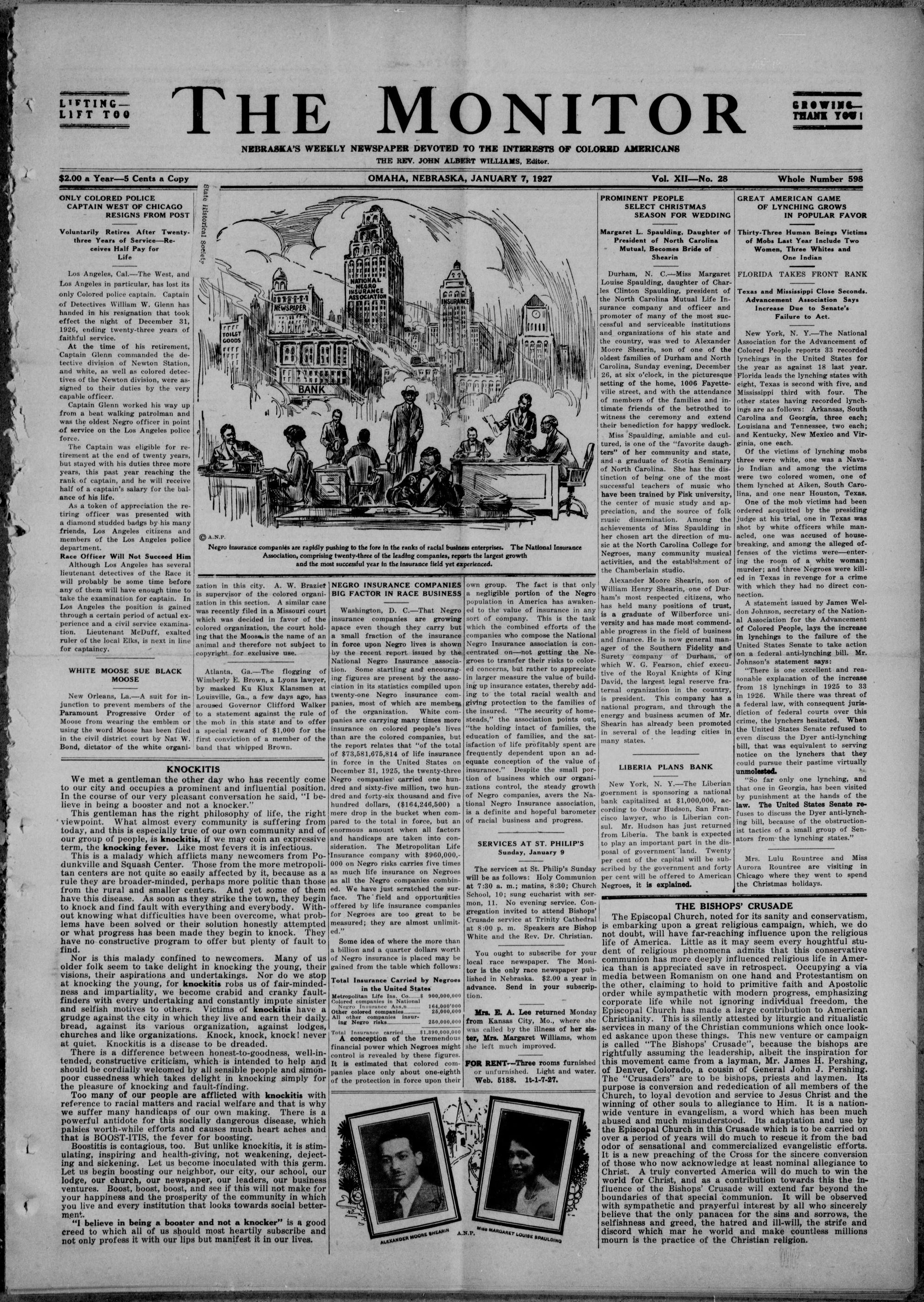
Negro insurance companies are rapidly pushing to the fore in the ranks of racial business enterprises. The National Insurance Association, comprising twenty-three of the leading companies, reports the largest growth and the most successful year in the insurance field yet experienced.
ization in this city. A. W. Brazier is supervisor of the colored organization in this section. A similar case was recently filed in a Missouri court which was decided in favor of the colored organization, the court holding that the Moose is the name of an animal and therefore not subject to copyright for exclusive use.
Atlanta, Ga.—The flogging of Wimberly E. Brown, a Lyons lawyer, by masked Ku Klux Klansmen at Louisville, Ga., a few days ago, has aroused Governor Clifford Walker to a statement against the rule of the mob in this state and to offer a special reward of $1,000 for the first conviction of a member of the band that whipped Brown.
NEGRO INSURANCE COMPANIES BIG FACTOR IN RACE BUSINESS
Washington, D. C.—That Negro insurance companies are growing space even though they carry but a small fraction of the insurance in force upon Negro lives is shown by the recent report issued by the National Negro Insurance association. Some startling and encouraging figures are present by the association in its statistics compiled upon twenty-one Negro insurance companies, most of which are members of the organization. White companies are carrying many times more insurance on colored people's lives than are the colored companies, but the report relates that "of the total own group. The fact is that on a negligible portion of the Negro population in America has awarded to the value of insurance in sort of company. This is the way which the combined efforts of the companies who compose the National Negro Insurance association is concentrated on—not getting the groves to transfer their risks to coed concerns, but rather to appreciate in larger measure the value of buying insurance estates, thereby aiding to the total racial wealth giving protection to the families the insured. "The security of hot steads," the association points "the holding intact of families, education of families, and the isfaction of life profitably spent."
KNOCKITIS
NEBRASKA'S WEEKLY NEWSPAPER DEVOTED TO THE INTERESTS OF COLORED AMERICANS THE REV. JOHN ALBERT WILLIAMS, Editor. OMAHA, NEBRASKA, JANUARY 7, 1927 Vol. X
ALEXANDER MOORE SHEARIN
A.N.P.
MISS MARGARET LOUISE BPAULDING
NEGRO INSURANCE COMPANIES
BIG FACTOR IN RACE BUSINESS
Washington, D. C.—That Negro insurance companies are growing apace even though they carry but a small fraction of the insurance in force upon Negro lives is shown by the recent report issued by the National Negro Insurance association. Some startling and encouraging figures are present by the association in its statistics compiled upon twenty-one Negro insurance companies, most of which are members of the organization. White companies are carrying many times more insurance on colored people's lives than are the colored companies, but the report relates that "of the total of $73,581,675,814 of life insurance in force in the United States on December 31, 1925, the twenty-three Negro companies' carried one hundred and sixty-five million, two hundred and forty-six thousand and five hundred dollars, ($164,246,500) a mere drop in the bucket when compared to the total in force, but an enormous amount when all factors and handicaps are taken into consideration. The Metropolitan Life Insurance company with $960,000,000 on Negro risks carries five times as much life insurance on Negroes as all the Negro companies combined. We have just scratched the surface. The field and opportunities offered by life insurance companies for Negroes are too great to be measured; they are almost unlimited."
Some idea of where the more than a billion and a quarter dollars worth of Negro insurance is placed may be gained from the table which follows:
Total Insurance Carried by Negroes in the United States
Metropolitan Life Ins. Co. $ 900,000,000
Colored companies in National Negro Insurance Asn. $ 164,000,000
Other colored companies $ 25,000,000
All other companies insuring Negro risks $ 250,000,000
Total Insurance carried $1,390,000,000
A conception of the tremendous financial power which Negroes might control is revealed by these figures.
It is estimated that colored companies place only about one-eighth of the protection in force upon their
own group. The fact is that only a negligible portion of the Negro population in America has awakened to the value of insurance in any sort of company. This is the task which the combined efforts of the companies who compose the National Negro Insurance association is concentrated on—not getting the Negroes to transfer their risks to colored concerns, but rather to appreciate in larger measure the value of building up insurance estates, thereby adding to the total racial wealth and giving protection to the families of the insured. "The security of homesteads," the association points out, "the holding intact of families, the education of families, and the satisfaction of life profitably spent are frequently dependent upon an adequate conception of the value of insurance." Despite the small portion of business which our organizations control, the steady growth of Negro companies, avers the National Negro Insurance association, is a definite and hopeful barometer of racial business and progress.
SERVICES AT ST. PHILIP'S
Sunday, January 9
The services at St. Philip's Sunday will be as follows: Holy Communion at 7:30 a. m.; matins, 8:30; Church School, 10; sung eucharist with sermon, 11. No evening service. Congregation invited to attend Bishops' Crusade service at Trinity Cathedral at 8:00 p. m. Speakers are Bishop White and the Rev. Dr. Christian.
You ought to subscribe for your local race newspaper. The Monitor is the only race newspaper published in Nebraska. $2.00 a year in advance. Send in your subscription.
Mrs. E. A. Lee returned Monday from Kansas City, Mo., where she was called by the illness of her sister, Mrs. Margaret Williams, whom she left much improved.
FOR RENT—Three rooms furnished or unfurnished. Light and water. Web. 5188. 1-1-7-27.
Vol. XII—No. 28
PROMINENT PEOPLE
SELECT CHRISTMAS
SEASON FOR WEDDING
Margaret L. Spaulding, Daughter of
President of North Carolina
Mutual, Becomes Bride of
Shearin
Durham, N. C.—Miss Margaret Louise Spaulding, daughter of Charles Clinton Spaulding, president of the North Carolina Mutual Life Insurance company and officer and promoter of many of the most successful and serviceable institutions and organizations of his state and the country, was wed to Alexander Moore Shearin, son of one of the oldest families of Durham and North Carolina, Sunday evening, December 26, at six o'clock, in the picturesque setting of the home, 1006 Fayetteville street, and with the attendance of members of the families and intimate friends of the betrothed to witness the ceremony and extend their benediction for happy wedlock.
Miss Spaulding, amiable and cultured, is one of the "favorite daughters" of her community and state, and a graduate of Scotia Seminary of North Carolina. She has the distinction of being one of the most successful teachers of music who have been trained by Fisk university, the center of music study and appreciation, and the source of folk music dissemination. Among the achievements of Miss Spaulding in her chosen art the direction of music at the North Carolina College for Negroes, many community musical activities, and the establishment of the Chamberlain studio.
Alexander Moore Shearin, son of William Henry Shearin, one of Durham's most respected citizens, who has held many positions of trust, is a graduate of Wilberforce university and has made most commendable progress in the field of business and finance. He is now general manager of the Southern Fidelity and Surety company of Durham, of which W. G. Fearson, chief executive of the Royal Knights of King David, the largest legal reserve fraternal organization in the country, is president. This company has a national program, and through the energy and business acumen of Mr. Shearin has already been promoted in several of the leading cities in many states.
LIBERIA PLANS BANK
New York, N. Y.—The Liberian government is sponsoring a national bank capitalized at $1,000,000, according to Oscar Hudson, San Francisco lawyer, who is Liberian consul. Mr. Hudson has just returned from Liberia. The bank is expected to play an important part in the disposal of government land. Twenty per cent of the capital will be subscribed by the government and forty per cent will be offered to American Negroes, it is explained.
THE BISHOPS' CRUSADE
The Episcopal Church, noted for its sanity and conservatism, is embarking upon a great religious campaign, which, we do not doubt, will have far-reaching influence upon the religious life of America. Little as it may seem every thoughtful student of religious phenomena admits that this conservative communion has more deeply influenced religious life in America than is appreciated save in retrospect. Occupying a via media between Romanism on one hand and Protestantism on the other, claiming to hold to primitive faith and Apostolic order while sympathetic with modern progress, emphasizing corporate life while not ignoring individual freedom, the Episcopal Church has made a large contribution to American Christianity. This is silently attested by liturgic and ritualistic services in many of the Christian communions which once looked askance upon these things. This new venture or campaign is called "The Bishops' Crusade", because the bishops are rightfully assuming the leadership, albeit the inspiration for this movement came from a layman, Mr. James H. Pershing, of Denver, Colorado, a cousin of General John J. Pershing. The "Crusaders" are to be bishops, priests and laymen. Its purpose is conversion and rededication of all members of the Church, to loyal devotion and service to Jesus Christ and the winning of other souls to allegiance to Him. It is a nationwide venture in evangelism, a word which has been much abused and much misunderstood. Its adaptation and use by the Episcopal Church in this Crusade which is to be carried on over a period of years will do much to rescue it from the bad odor of sensational and commercialized evangelistic efforts. It is a new preaching of the Cross for the sincere conversion of those who now acknowledge at least nominal allegiance to Christ. A truly converted America will do much to win the world for Christ, and as a contribution towards this the influence of the Bishops' Crusade will extend far beyond the boundaries of that special communion. It will be observed with sympathetic and prayerful interest by all who sincerely believe that the only panacea for the sins and sorrows, the selfishness and greed, the hatred and ill-will, the strife and discord which mar he world and make countless millions mourn is the practice of the Christian religion.
GREAT AMERICAN GAME OF LYNCHING GROWS IN POPULAR FAVOR
Thirty-Three Human Beings Victims of Mobs Last Year Include Two Women, Three Whites and One Indian
FLORIDA TAKES FRONT RANK
Texas and Mississippi Close Seconds. Advancement Association Says Increase Due to Senate's Failure to Act.
New York, N. Y.—The National Association for the Advancement of Colored People reports 33 recorded lynchings in the United States for the year as against 18 last year. Florida leads the lynchings with eight, Texas is second with five, and Mississippi third with four. The other states having recorded lynchings are as follows: Arkansas, South Carolina and Georgia, three each; Louisiana and Tennessee, two each; and Kentucky, New Mexico and Virginia, one each.
Of the victims of lynching mobs three were white, one was a Navajo Indian and among the victims were two colored women, one of them lynched at Aiken, South Carolina, and one near Houston, Texas. One of the mob victims had been ordered acquitted by the presiding judge at his trial, one in Texas was shot by white officers while manacled, one was accused of housebreaking, and among the alleged offenses of the victims were—entering the room of a white woman; murder; and three Negroes were killed in Texas in revenge for a crime with which they had no direct connection.
A statement issued by James Weldon Johnson, secretary of the National Association for the Advancement of Colored People, lays the increase in lynchings to the failure of the United States Senate to take action on a federal anti-lynching bill. Mr. Johnson's statement says:
"There is one excellent and reasonable explanation of the increase from 18 lynchings in 1925 to 33 in 1926. While there was threat of a federal law, with consequent jurisdiction of federal courts over this crime, the lynchers hesitated. When the United States Senate refused to even discuss the Dyer anti-lynching bill, that was equivalent to serving notice on the lynchers that they could pursue their pastime virtually unmolested.
"So far only one lynching, and that one in Georgia, has been visited by punishment at the hands of the law. The United States Senate refuses to discuss the Dyer anti-lynching bill, because of the obstructionist tactics of a small group of Senators from the lynching states."
Mrs. Lulu Rountree and Miss Aurora Rountree are visiting in Chicago where they went to spend the Christmas holidays.
GROWING
THANK YOU
Whole Number 598
PERSONALS
Ed. F. Morearty, Lawyer, 700 Peters Trust Building, JAckson 3841 or Harney 2156.
Furnished House For Rent
A six-room furnished house with piano, all modern. — 2881 Miami Street. $30 a month. Call Web. 1931 after 9 p. m.
Mr. Silas Kellis went to Keokuk, Ia., to spend New Years with his parents, Mr. and Mrs. George Kellis. He returned Monday morning.
Mr. Walter P. Ervin, an employee at the Federal building, who has been confined to his home, 1702 North Twenty-sixth street, for the past three weeks by sickness, is convalescing.
Mr. Jesse C. Hutten, who has been spending his vacation with his mother, Mrs. Grace M. Hutten, 2414 Maple street, left Friday for Washington, D. C., to resume his studies at Howard University.
Miss Constance B. Singleton entertained at a delightful dancing party Saturday night at the home of her grandparents, Mr. and Mrs. M. F. Singleton, 2865 Corby street.
A. P. SCRUGGS, Lawyer. Large experience. Handles all law cases. 2310 North Twenty-second street. Webster 4162.
The Misses Thelma and Madeline Shipman were the charming hostesses of a most enjoyable dancing party for the younger set, at their home, 2724 North Thirtieth street, New Years Eve.
Mrs Otis Shipman entertained at a tea Saturday afternoon at her home, 2724 North Thirtieth street, from 3 to 5 o'clock, complimentary to Mesdames Mary Burns, Anna Burns and Edison Spears of Battle Creek, Mich., sisters and niece of Mrs. T. P. Mahammitt, of whom they were holiday guests.
The Rev. John Albert Williams returned Monday morning from Keokuk, Ia., where he delivered an address New Years night at the Emancipation celebration, under the auspices of the N. A. A. C. P., celebrated early Mass and preached at the late service at the Church of St. Mary the Virgin, of which the Rev. Elmer M. M. Wright is rector, Sunday morning.
FOR RENT—Seven room house, all modern. Hot water, heat. Half-block from carline. $25.00 per month. WE. 4810. tf.-12-10-26.
Miss Maxine Holmes, who was the holiday guest of Miss Ione Pinkett, left for her home at Lincoln, Friday morning.
Mrs. T. P. Mahammitt was at home Sunday evening from 5 to 10, complimentary to her sisters, Mesdames Burns and Burns, and her niece, Mrs. Edessa Spears, of Battle Creek, Mich., her holiday house guests.
Messrs. John and Harold Adams, sons of the Rev. and Mrs. John Adams, students at Nebraska University, after spending their vacation with their parents, have returned to Lincoln.
FOR RENT — Properly furnished warm rooms. Web. 4541.
T. Trago Mac Williams, jr., of Lincoln, Neb., was a holiday visitor in Omaha.
The Rev. George W. Day, pastor of Mt. Moriah Baptist church, Twenty-fourth and Ohio streets, leaves this week for Fort Madison, Ia., to conduct a revival.
John Chinn, the blind man who sells pencils and shoestrings on Sixteenth and Farnam streets, and who was run down and injured by an automobile some weeks ago, has recovered from his injuries and is able to be out again.
Miss Ireta Walker, 3124 Maple street, has returned home after a six months' visit with her aunt in St. Louis, Mo.
FOR RENT—Furnished and unfurnished rooms. Web. 1177.
The Misses Hilda May and Esther Woods, eldest daughters of Mr. James Woods, were hostesses at a Dutch luncheon at their home, 3212 Emmett street, Saturday evening, January 1. Twenty guests were present.
Mrs. Bessie Prestage, who has been quite ill at the Nicholas Senn hospital for a month, has been removed to her home on Pinkney street. She is very little improved.
FOR RENT—All modern neatly furnished room. Webster 6498.
Mrs. Lottie Wade has returned to Atchison, Kan., after spending the holidays with her daughter, Mrs. J. C. Jones, 2123 Clark street.
Mrs. W. Wade, 2640 Binney street, has returned home after a very pleas- ane three months' visit with relatives and friends in Fort Smith, Ark.
Mrs. Georgia E. White, 2317 Charles street, has been confined to her home the past week with the grip.
Mrs. Jasper E. Brown was hostess for the Elite Whist club at her residence, 2883 Miami street, Monday, January 3. Mesdames William Burns, David Burns, Clarence Spears, of Battle Creek, Mich., and Mrs. Bert Johnson of Omaha were guests of the club. A delightful afternoon was enjoyded by all.
Mrs. Russel Taylor, wife of the Rev. Russel Taylor, has been ill the past week.
Mr. Hallowell of Chicago is the house guest of Mr. and Mrs. N. R. Newman, 2436 Grant street, for the holidays.
Mrs. Josephine Metcalfe passed away December 30 in Lincoln, Neb. She was buried Monday afternoon from the J. D. Lewis new funeral home.
Mrs. James Bell, 2622 Grant street, who was quite ill during the holidays, is somewhat improved.
Mrs. J. C. Jones, who has been quite ill at her home, 2123 Clark street, is able to be out again.
Mrs. Frankie Redd entertained at a dinner party at her residence, 6613 Railroad avenue, Saturday, December 25, when her guests were Mr. and Mrs. Rose and Mr. and Mrs. Anders.
Miss Ollie Redd entertained at a dinner party Sunday, December 26,
at her home, 6613 Railroad avenue,
in honor of Miss Gladys Reynolds,
Messrs. John and Harold Adams and
Jesse Hutten, students who were
spending their Christmas holidays at
home. Miss Corinne Ferguson of
Lincoln was an out-of-town guest.
Fourteen other guests were present.
Mr. Perry Johnson is on the sick list.
Mrs. Aquila Wilson, who has been
quite ill, is able to be out again.
Mrs. Idola Stallworth has returned
to her home in Minneapolis after
spending the holidays with her mother,
Mrs. Hattie Brewer.
Mrs. M. C. Sands, 2122 North Twenty-fifth street, was hostess at a New Years Eve party in honor of members of Friendship Temple. About thirty-five members were present and enjoyed one of the most beautiful parties of the holidays. A three-course luncheon was served. Mrs. Sands was assisted by Mrs. Josephine Merritt. At a late hour all exchanged best wishes with each other and then went to church to help usher in the new year.
Ernest Matthews of Missouri Valley, Ia., was the week-end guest of William Peebles, jr. His brother, Frank, also came to attend several of the holiday parties.
INTERDENOMINATIONAL S. S.
The Interdenominational Sunday School Association held its last monthly meeting at the North Side Y. W. C. A. December 10. The Association's door is open to all denominations. All are welcome.
The next meeting will be held on January 14, at the regular meeting place, at 7:30 p. m., with the following program:
Devotions, Rev. F. S. Goodlett.
Duet, the Misses Zenobia Walker and Florence Mosely, of Mount Moriah Baptist church.
Address, Rev. Mr. Hamlin of Cleve Temple.
Trio, Mrs. C. W. Woodson, L. A. Crumbly and Viola Wright, of Mount Moriah church.
Summary of the Lesson, Mr. J. C. Parker.
OLD FOLKS HOME
Open doors New Years Day was largely attended. Many thanks to those who came and made the day so pleasant. We also wish to thank Mr. Thomas for entertaining the inmates with old-time melodies.
Mrs. Simpson, our president, who fell and injured her arm, is improving nicely, we are glad to state.
The donations during the month were:
Mrs. Vawter, one jar fruit jelly.
Mrs. Lawry, one jar fruit-spaghetti jelly.
Mrs. Anderson, 23 jars tomatoes.
Mr. S. H. Dorsey, $5.00.
THE MONITOR
The Shady Rest club held a wild game dinner New Years day at the home of Mr. and Mrs. James Dean, 1018 Rose street. Covers were laid for seventeen. The evening was spent playing bridge and five hundred.
The work at the Center is making excellent progress. Volunteer workers from South and North Omaha are giving much of their time and experienced leadership to make the work a success.
All of the clubs and classes have done good work for the last three weeks, leading up to Christmas, the attendance was 1,036 for the three days.
Clubs and Classes
The eleven music pupils who are given piano lessons once each week by Misses Dorothy Allen and Elaine Smith are making rapid progress and expect to give a recital before the class the first of January.
The Boys' Civic club has as its director Lawyer Oliver who finds it quite interesting in organizing all the boys of the center into cities and states.
Mr. George Payne's toy-making classes, with their newly awakened interest, made magazine stands, book racks, bird houses, ice wagons, aeroplanes and several other toys which were displayed at the Camp Fire girls' bazaar Monday, December 20. Some of the toys were sold and proceeds went to the Camp Fire treasurer.
Sewing and cooking classes and Camp Fire groups were kept busy making Christmas candies, dressing dolls, doing embroidery work, etc., for the bazaar. Miss Mitchell of the domestic science department finds pleasure in preparing and serving meals with her class of eight.
The night school which was opened recently is meeting each Monday and Wednesday evenings. Dr. Craig Morris and Mrs. Grace Hutten, who have charge of the school of 28, see the need of more volunteer workers.
Boys' tumbling classes have as instructor Mr. T. Dixon, a student of Technical High school.
The Jolly Ten Cooking club found it impossible to pull the icy hills
New LAKE THEATRE 24th AND LAKE STS. Always in the Lead
Sunday, Monday, January 9-10
Critics say this is one of the ten best of the year.
SUNDAY ONLY
Added Attraction
RANDALL'S
Kidland Follies of 1927
14 Clever Kiddies in a Jazz-Mad Revue
TUESDAY ONLY
Lila Lee
In
"The Midnight Girl"
Wednesday, Thursday
Marie Prevost
In
"His Jazz Bride"
Adapted from the famous
Omaha Daily News serial
"The Flapper Wife."
Friday, Saturday
Lon Chaney
In
"The Phantom of
the Opera"
NO ADVANCE IN PRICE
BUSINESS IS GREAT!
THANK YOU
Bill Bergmann
Manager.
Lincoln, Nebr.
CULTURAL CENTER
2915 R Street
Clubs and Classes
"The Return of Peter Grimm"
With
Janet Gaynor
Alec B. Francis
from Albright and asked to drop their club until spring.
Special Functions
A rummage sale was given by the parents and teachers which was quite successful.
The bazaar given by the Camp Fire group was very successful and closed with the feeling that next Christmas will find them prepared to give a much larger and better exhibit.
Christmas trees and parties were given for all groups, an excellent program was rendered at each party which included Christmas carols, stories, vocal and instrumental music, folk dancing, etc. Gifts were given to all children present.
Each Friday evening all the older groups of the center meet for chorus singing under the direction of Rev. Russel Taylor.
Neighborhood Contacts
Toys, condies, dolls, books, etc., were sent from clubs and Camp Fire groups to bring sunshine and gladness to the hearts of the poor children of the community. These gifts were distributed to the houses on Christmas morning by Parent-Teachers and Camp Fire girls.
We extend to all citizens of Omaha an invitation to visit clubs and classes any afternoon or evening, at the hours of 3:30 to 5:30 and 7:30 to 10:00. "Come and receive a cordial welcome."
WASHINGTON PASTOR DIES
Washington, D. C.-The Rev. M.
W. D. Norman, 58, pastor for the
past 21 years of the Metropolitan
Baptist church, died at his residence
this week after an illness of several
months. He was one of the most
widely known colored preachers in
the United States.
BUSINESS IS GOOD
THANK YOU
at the
LINCOLN MARKET
1406 No. 24th We. 1411
EMERSON'S LAUNDRY
The Laundry That Suits All
1301 No. 24th St. Web. 0620
I. Levy
DRUGGIST
PRESCRIPTIONS
Our
SPECIALTY
24th & Decatur—We. 5082
While BACON is 50c a Pound,
Why Not
EAT RABBIT
Tflll Bacon Comes Down?
Massey's
Little Grocery
27th and Ohio Streets
HOTEL CUMING
1916 Cuming Street
Rooms by day — 50c, 75c, $1.00
By the week — $2.00 to $4.00
UNDER NEW MANAGEMENT
Mrs. Mayme Mason
D. G. Russell, Prop. — Omaha
Phone JA. 2466
Reid-Duffy
PHARMACY
FREE DELIVERY
Phone Web. 0609
24th and Lake Streets
OMAHA, NEB.
WATERS
BARNHART
PRINTING CO.
OMAHA
L. L. Patrick, Director.
Twice Daily 2:20 p. m. and 8:20 p. m.
SAM MORRIS' Big Parade of Burlesque
STEREO
Positively
Show Tha
ee Ag
"QUEEN G
The
Two-i
THE BR
Ext
All N
Victor
(M)
61
STEP ALONG
positively the Fastest, Peppie
know That Omaha Ever Has
Agnes Nick
QUEEN OF SYNCOPATION
The Only Original
two-in-One G
THE BRANDEIS STO
SINCE 1881
Extra Special!
All New RED SEAL
Actor Records
(Mechanically Made)
60% off
Red Seal
Records Now
80c
$1.50 Red
Records
60c
Us Red Seal Records by the world
artists. THE FIRST TIME EVER
DOWN PRICES.
Brandeis Phonographs—Main Floor
STUART'S ART SHOP
ART, MUSIC AND LITERATURE
Picture Framing and Enlarging
1803 North Twenty-ourth Street
WANTED
MILLION MEN AND WOMEN
IN THE HAMITIC LEAGUE OF THE WORLD
nothing. Enclose stamp for application
wish, you may also enclose one dime (coi
our new magazine, THE HAMITE, which
on in January. It will awaken you as you
en awakened before.
THE HAMATIC LEAGUE
Suite H, 4707 Calumet Avenue
CHICAGO
endable Family Ser
Cleaning of Ladies' and Gents' Wear
Apparel and Household Furnishings
SOFT WATER LAUNDERING
et Wash - - - 4c per
frifty Wash - - 5c per
Dry Wash—Rough Dry—Family Fin
Linen—Curtains—Blankets, Etc.
HOLM & SHERM
Positively the Fastest, Peppiest Show That Omaha Ever Had! See Agnes Nichols "QUEEN OF SYNCOPATION" The Only Original
THE BRANDEIS STORE SINCE 1881
Extra Special!
All New RED SEAL
Victor Records
(Mechanically Made)
60% off
$2.00 Red Seal Records Now
80c
Famous Red Seed
ed artists. THE
SEE LOW PRICE
Brandt
STUART
ART, MUSIC
Picture
1803 N
ONE MILLION
TO JOIN THE HA
costs nothing.
you wish, you may
pay of our new m
publication in Janu
ever been awakened
THE HA
Suite B
dependable
Dry Cleaning
Apparel a
SOFT W
Wet Wash
Thrifty W
Dry Wash—
Linen—
DHOLM
The famous Red Seal Records by the world's most renowned artists. THE FIRST TIME EVER SOLD AT THESE LOW PRICES.
STUART'S ART SHOP
ART, MUSIC AND LITERATURE
Picture Framing and Enlarging
1803 North Twenty-ourth Street
TO JOIN THE HAMITIC LEAGUE OF THE WORLD
It costs nothing. Enclose stamp for application blank.
If you wish, you may also enclose one dime (coin) for a
copy of our new magazine, THE HAMITE, which begins
publication in January. It will awaken you as you have
never been awakened before.
"Dependable Family Service"
Dry Cleaning of Ladies' and Gents' Wearing
Apparel and Household Furnishings
0----0
SOFT WATER LAUNDERING
0----0
Wet Wash - - - 4c per lb.
Thrifty Wash - - 5c per lb.
Dry Wash—Rough Dry—Family Finish
Linen—Curtains—Blankets, Etc.
EDHOLM & SHERMAN
LAUNDERERS AND CLEANERS
24th Near Lake Street
PHONE WE. 6055
RONIZE MONITOR ADVER
NIZE MONITOR ADVER
PATRONIZE MONITOR ADVERTISERS
TY ESQUE nd 8:20 p.m.
ONG"
Peppiest
ever Had!
Nichols
PATION"
mal
e Girl
STORE
ial!
SEAL
cords
(e)
ff
$1.50 Red Seal Records Now 60c
the world's most re-
LIE EVER SOLD AT
Floor
SHOP
ERATURE
arging
Street
AND WOMEN
OF THE WORLD
application blank.
dime (coin) for a
MITE, which begins
in you as you have
LEAGUE
venue
My Service"
Gents' Wearing
urnishings
ERING
£c per lb.
£c per lb.
Family Finish
sets, Etc.
HERMAN
ADVERTISERS
PAGE THREE
PAGE FOUR
The
Doom
Trail
— By —
Arthur D. Howden Smith
Author of PORTO BELLO GOLD, Etc.
(@ by Brentano's.) WNU Service
THE STORY
CHAPTER I.—Harry Ormerod, proscribed traitor to King George as a Stuart partisan, returning from France to England, and Juggins from a band of assassins. Juggins proves to be the grandson of a former steward of Ormerod's father, to whom Juggins feels himself indebted for Juggins' help he has abandoned the Stuart cause.
CHAPTER II.—Juggins tells Ormerod of a Jacobite plot in the American colonies to weaken England by forwarding French interests. Their aim is the return of King James the Second to England, at Andrew Murray, a Scottsman, and a Frenchman. De Veuille, deadly enemy of Ormerod. The two are in London, and they see them. Anticipating the plotters early return to America, Juggins arranges for Ormerod to go there with them. Ormerod is attacked by Juggins, and wears tooll Murray.
CHAPTER III.—Disgüised as Juggins' servant, Ormerod takes passage to America. He meets a Scottish girl at the Museum of Art and adopts obite. De Veulue recognizes him, and their enmity flames. The Frenchman denounces Ormerod to the girl as a slave, and he repulses him, he repulses Ormerod's proffer of friendship. He is thrown into the sea by an unseen assailant.
CHAPTER IV.—Ormerod, regaining the deck, has recognized his assailant as Murray's servant. Tom, giant negro, has been sent to Ormerod, negro to assassinate him, but a truce is arranged. At New York Ormerod stresses an Indian from insult. The Indian, an Indian from insult, is Ta-wan-ears, Seneca chie
CHAPTER V.—Governor Burnet welcomes Ormerod as a friend of Juggins, and tells him Murray's aims. By what smuggles turs, which should come to New York, to the French in Canada. With Ta-wan-ne-ars and a gigantic Dutchman, Peter Niagara. Ormerod greets to Peter Niagara, French outpost, and spy out the secrets of the Doom Trail. He of course speaks French. De Veuille has won Ga-ha-no. Ta-wan-ne-ars afflianced wife, now the wife of the man he seeks revenge. Ta-wan-ne-ars saves Ormerod's life in an attack on him by Murray's henchman, Bolling.
CHAPTER VI.—Accusing Murray, without avail, of inciting Bolling, Ormerod learns the girl's name is Marjory. With his two companions he begins the journey.
"The road stops here." I said to Ta-wan-ne-ars. "How shall we go on?"
"The road of the white man stops—yes," he answered. "But the road of the Ho-de-nau-nee begins."
He made no answer, but kept on his way until we were under the bole of the first of the forest trees.
There at my feet was a deep, narrow slot in the earth, a groove some eighteen inches wide and perhaps twelve inches deep, that disappeared into the gloom which reigned under the interlacing boughs overhead. If did not go straight, but crookedly like a snake, curving and twisting as it chanced to meet a mossy boulder or a tree too big to be readily felled or uprooted. As I stooped over it I saw that its bottom and steeply sloping sides were hard-packed, beaten down by continual pressure, the relentless pressure of countless human feet for generations and centuries.
Ta-wan-ne-ars instantly led the way into the groove of the trail, and as if instinctively swung into an easy loping trot. I followed him and the Dutchman brought up the rear.
It was cool under the trees, for the sun seldom penetrated the foliage, dense already although it was only the fag-end of spring. And it was very silent—terribly, oppressively silent. The crack of a stick underfoot was like a musket shot. The padding of our feet on the resilient leaf-mold was like the low rolling of muffled drums. The timorous twittering of birds seemed to set the echoes flying.
Yet I was amazed when Ta-wan-nears halted abruptly in mid-afternoon, and inclined his ear toward the trail behind us.
"What is it?" I asked, and so completely had the spirit of the forest taken possession of me that I whispered the words.
"Something is following us," he answered.
Corlaar put his ear to the bottom of the trail, and a curious expression crossed his face.
"Ya," was all he said.
CHAPTER VII
Along the Great Trail
"Shall we return and face them?" I asked eagerly.
Ta-wan-ne-ars permitted himself a smile of friendly sarcasm.
"If we can hear them, surely they can hear us," he said. "No, we will keep on. There is a place farther along the trail from which we can look back upon them. Come, Ormerod, you and I will run ahead. Peter will follow us."
Ta-wan-ne-ars shifted his musket to his shoulders, and broke into a long, looping stride. I followed him.
Half a mile up the trail he stopped.
"Walk in my tracks, brother," he
said. "And be certain that you do no bruise a twig." With the utmost caution he parted the screen of underbrush on our right hand, and revealed a tunnel through the greenery into which he led the way, hesitating at each step until he had gently thrust aside the intervening
"WALK IN MY
TRACKS, BROTHER
HE SAID
foliage. Once in the tunnel, however his cure was abandoned, and he ran quickly to the trunk of a huge plum which soared upward like a monumental column, high above the sun rounding trees. He leaned his musket against the pitchy bole.
"The symbol of the Long House," he said tapping the swelling girth of it. "Strength and symmetry and grandeur. We will climb, brother."
He swung himself up into the branches, which formed a perfect ladder, firm under foot, behind the screen of the pine needles. When the other treetops were beneath us, he straddled a bough and cleared a loophole from which we might look out over the forest we had traversed.
We looked for so long, without anything happening that my eyeballs ached. But at last there was a movement like the miniature upheaval which is caused by an ant in breaking ground. Boughs quivered, and a figure appeared in the open. Twas Corlaer. He glanced around him and strode on. In a moment he had passed the clearing and disappeared in the forest.
Ta-wan-ne-ars hitched forward and peered through the loophole with tense muscles. And again there was a wait which seemed endless. My eyelids blinked from the strain of watching.
The desolation and loneliness of the wilderness were so complete that it seemed inconceivable another human being could be within view. And whilst this thought occupied my mind a dark figure crawled on hands and knees from the mouth of the trail. At that distance all we could see of his costume was the clump of feathers that bristled from his scalpblock.
He followed Peter into the trail on our side of the clearing, and there was a second and briefer pause. Then as silently as ghosts a string of figures fitted into the clearing. There were six of them, each with musket in the hollow of his arm, each with bristling feather headdress.
Ta-wan-ne-ears emitted a guttural grunt, quite unlike his usual rather musical utterances.
"Down!" he rasped. "Down! The time is scant!"
At the foot of the pine he snatched up his musket without a word, and turned into the green tunnel that debouched upon the screen of the trail.
As we stepped into the worn slot Peter came into view.
"Well?" he said phlegmatically.
"Cahnuaga dogs! They dare to invade territory of the Long House."
"We can cross der Mohawk to der south branch of der trail," proposed Corlaer. "They wouldnt dare to follow us there."
"No," snarled Ta-wan-ne-ars; "we shall not step aside for them. We will attend to them ourselves. They will not attack unless they have to for we are still near the Mohawk castle, although 'tis upon the opposite bank of the river. They will leave us alone until night."
"But why cannot we attack them?" A look of ferocity which was almost demoniac changed his usually pleasant features into an awful mask. "In an ambuscade one might escape. No, my brother Ormerod, we will wait until they attack us. Then—" He paused significantly. "Not one of the Keepers shall return to tell Murray how his brothers died." We took up the march. "Twas already mid-afternoon, and shortly the dimness of twilight descended upon the trail, as the level rays of the setting sun were turned aside by the interlacing masses of vegetation.
Twilight faded into dusk and still we kept on. Ta-wan-ne-ars had eyes like a cat's, and I, too, accustomed myself to perception of hanging branches and the unexpected turns and twists in the groove of the path. The stars were out in the sky overhead when we stepped from the shelter of the forest into a rocky dell divided by a tiny brook.
"We will camp here," said Ta-wan-ne-ars.
He rested his musket on a boulder and began to collect firewood.
"Why a fire?" I asked.
"The trailers must not think we suspect them," he replied curtly. "If we lift no fire they would know for certain that we were suspicious."
THE MONITOR
I helped him, whilst Gerner crouched by the opening of the trail on watch. We soon had a respectable pile of wood, but before kindling it the Seneca bade us strip off our leathern shirts and stuffed them with underbrush into a semblance of human shapes. A third figure to represent himself he contrived out of the packs and several branches.
The three dummies were then disposed to the satisfaction of Ta-wanne-ars and, striking flint and steel to some rotten wood, a bright blaze sent the shadows chasing each other around the confines of the glade.
"Peter," he said, "you had best take post by that boulder on the other side of the fire. Omerod and Ta-wanne-ars will lie together upon this side."
"You need not think it necessary to keep me by your side," I said indignantly. " "Tis not the first time I shall have heard musketry."
A gleam of humorous intelligence chased the gloomy ferocity from the Seneca's face.
"Ta-wan-ne-ars does not doubt the valor of his brother," he said, "but Ormerod has never fought with Cahmugas. They are dogs, but they are skilled in forest war."
He sank down behind a boulder next to the one by which I stood. Corner had been swallowed by the dancing shadows beyond the fire.
I dropped beside Ta-wan-ne-ars, and like him dusted powder into the pin of my ma-ket, drew tomahawk and knife from their sheaths and laid them on the ground within reach.
It must have been at least two hours after we had taken cover that Ta wain ears touched my arm, and the light from the glowing bed of coals revealed a feathered head crouching forward where the trail entered the glue. It hovered around the edge of the firelight like a monstrous reptilian fland, body bent nearly double, a glint of steel showing whenever the hands moved. Presently it withdrew into the trail, and it seemed that two more hours dragged by on leaden feet, although it was probably less than half that time.
The fire was lower, but Ta-wan-nears did not need to warn me when the keepers reappeared. It was as if a mist of evil preceded them. My senses were alert, and I saw the first feathered head emerge from the trail and each one of the six who followed their leader. I counted every step of their approach until the yellow paint which streaked the ribs of the one nearest to me glimmered in the light of the embers.
"Hah-yah-yah-eee-eee-eee-e!" Ta-wan-nears sounded the warwhoop as he fired, and instinctively I aimed my piece at those ocher-tinted ribs and pressed the trigger. The report of my musket carried on the echoes which had been roused by the Seneca's. Corlaer's discharged as I bounded to my feet.
The Cahnuagas yelled in surprise; three of them were thrashing out their lives on the rocks. But the four survivors did not hesitate. They fought like the devils they really were.
One of them was on me immediately, bounding over the boulders with screeches that split the night. His knife and hatchet cut circles around my head—then chopped at my bowels. His activity was extraordinary, and he fought better than I, for he knew his weapons and they were strange to me.
It was the realization of this which saved me. Fending awkwardly with knife or hatchet against a foe whose handling of them was the result of lifelong training. I was at a disadvantage.
So I changed the tomahawk to my left hand, and grasped the knife by the hilt as if it it were a sword, thrusting with it point first instead of slashing as the Indian did. And now my skill at fence was in my favor.
The Cahnuaga's knife was no longer than mine. We were on equal terms—or rather the advantage inclined toward me. Bewilderment showed in the Indian's face. He did not understand this fighting with passes and parries and swift, stabbing assaults.
My chance came the next time he charged me, goaded into desperation by these strange tactics. I aimed a smashing blow at his head with the tomahawk, and, as he lifted his own hatchet to guard, I thrust for his belly, parried his knife and ripped him open.
His death yell was in my ears as I leaped over his body and looked to see how my comrades were doing. Ta-wan-ne-ars had just killed his man and was running to the help of Peter, who had two assailants on his hands. As Ta-wan-ne-ars came up, the Dutchman closed with one, dashed the defending weapons aside and grasped the struggling savage in his powerful arms. The last Cahnnuaga turned to flee, but Ta-wan-ne-ars did not even attempt to pursue him. Without any appearance of haste the Seneca balanced his tomahawk, drew back his arm and hurled it after the fugitive. The keen blade crushed the man's skull before he had passed from the circle of firelight, and Ta-wan-ne-ars sauntered across and scaled him.
"That time Ta-wan-ne-ars did not miss, brother," he observed to me as I watched with fascinated horror the bloody neatness with which he dispatched his task.
Peter brought up his captive and tossed the man down in front of us.
"Oof, that was a goodt fight!" he commented placidly.
"Why a prisoner, Peter?" asked Tawan-ne-ars.
"We will ask him of der Doom Trail," returned Corlaer.
He jerked the man to his feet.
"Where is der Doom Trail?" he demanded.
The Cahnuaga, badly shaken though he was, drew himself erect and folded
his arms across his painted chest.
"The Rat can go to the torture-stake and not answer that question. Corlaer," he said quite simply.
"We will take you to the nearest village and let you make good your boast," threatened Ta-wan-ne-ars.
The Cahmunga smiled.
"If I told you, none the less should I suffer at the stake," he said, "for the Ga-go-sa Ho-nun-as-tase-ta (Mistress of the False, Faces) knows-all. Do your worst, Chief of the Long House."
A tinge of mockery colored his voice.
"Be sure that whatever you do you cannot equal the ingenuity of the Gago-sa. Yes, I think you will come to know more about them some day, Iroquois. I seem to see pictures in the firelight of a stake, and a building with a tower and a bell that rings, and many of the Gago-sa dance around you, and your pain is very great. Aye, you are shrieking like a woman; you—"
He sparang, not at the Seneca but at me. "His hand: were around my throat before I could move. His eye-blazed into mine. His teeth gnashed at my face. A gout of blood, thick and warm, deluged me. The next thing I remember it was seeing Ta-wan-nears bending over me.
"My brother is whole?" he asked anxiously.
"Yes," I said, sitting up and rubbing a very sore throat, "except that I shall not be able to swallow for a time."
"You were choked, brother."
"And the Cahnuaga?"
"That dog is dead. Do you sleep now, for the dawn grows near and we must be upon our way."
I stirred to wakefulness when the first pink light of morning was in the eastern skies. A pungent whiff of wood smoke filed my nostrils, and I turned over to watch Corlaer frying bacon and maize cakes.
After eating, I fell into my place between the Dutchman and Ta-wan-nears. In five minutes the forest had closed around us. The glade of last night's adventure was shut off as completely as if it existed in another world. There remained no more than the bare groove of the trall and the encompassing walls of underbrush and overhead the roof of tree boughs.
That afternoon we forded the Mohawk to the southern side some distance above Ga-ne-ga-ha-ga (near Danube, N. Y.), the Upper Mohawk castle. And now for the first time we began to meet other travelers. Several Mohawk families shifting their abodes on account of poor crop conditions in their old villages; a party of Oneladas of the Turtle clan journeying on a visit of condolence to the Mohawk Turtles, one of whose roy-an-ehs had just died; a band of Mohawk hunters returning from the spring hunt. By these latter Ta-wan-ne-ars sent word to So-a-wa-ah, the senior roy-an-eh of the Mohawk Wolf clan, charged with the warding of the Eastern Door, of our encounter with the Cahinnagus and its result.
The evening of the third day we camped in the Onelda country at the base of a hill, which the trail encircles and which for that reason was called Nun-da-da-sis ("Around the Hill;" present site of Utica, N. Y.). Here we had a stroke of what turned out afterward to be rare good luck. Whilst we were making camp a group of five canoes of the birch-bark which is used by other nations than the Iroquois approached from upstream, and their occupants camped beside us. These Indians were Messescagues, whose country lay between the two great inland seas, the Erie and Huron lakes. They were on their way to Fort Orange or Albany to trade their winter catch of furs, which lay baled in the canoes.
They told Ta-wan-ne-ars they had had trouble with the Sieur de Tonty, commander of the French trading post of Le De Troit (Detroit, Mich.), which had been established in their country; and that in consequence De Tonty had been obliged to flee and they had decided to shift their trade to the English. Ta-wan-ne-ars encouraged them in this design and described to them the high quality and quantity of the goods they might expect to get in exchange for their furs at Albany.
On the fourth day the trail abandoned the headwaters of the Mohawk, fast shallowing in depth, and headed westward across the mile-wide divide of land which separates the waters flowing into the Mohawk and Hudson river from those flowing into Lake Ontario and the St. Lawrence river of Canada.
I had my first view of the long houses of the Iroquois at the Onelia Castle, Ga-no-a-lo-hale ("A head on a pole"), which was situated on the Onelia lake. They were impressive buildings, sixty, eighty, one hundred and sometimes one hundred and twenty feet in length and from twelve to fifteen or twenty feet wide. We went as a matter of course to the lodgings of the Onelia Wolves, of whom Tawan-ne-ars, according to the Iroquois code, was a blood-brother; and they placed at our disposal a guest chamber, the first next to the entrance of the Ga-no-sote (Bark house), together with all the firewood and food which we required and an aged squaw to cook and wait upon us.
(Continued Next Week.)
Pine Bluff, Ark.-Five colored persons, three women, a girl and a man, were saved from drowning by L. W. Quattlebaum of this city, after a car in which they were riding had plunged into a deep ditch by the side of the Pine Bluff-Sherrill highway near Plum bayou.
C. H. HALL, stand, 1403 No. 24th. Baggage and express hauling to all parts of the city. Phones, stand, WE. 7100; Res., WE. 1056.
Harry Brown. Express and Transfer. Trunks and Baggage checked. Try us for your moving and hauling. Also, coal and ice for sale at all times. Phone Webster 2973. 2013 Grace street.
DRUG STORES
ROSS DRUG STORE, 2306 North 24th Street. Two phones, WEbster 2770 and 2771. Well equipped to supply your needs. Prompt service.
THE PEOPLES' DRUG STORE, 24th and Erskine Streets. We carry a full line. Prescriptions promptly filled. WEbster 6328.
PHONES—Res., WEbster 0949
PH D. LEWIS
CASKETS, ROBES, SUITS and Dresses
on display.
BALMING, $25.00
Street Omaha, Nebraska
W. WARE
ATTORNEY AT LAW
The Street, Omaha, Nebraska
Webster 6616-Athantic 8192.
THE STATE FURNITURE CO.
Bridge Streets Tel. JACKSON 1317
BRUNSWICK
Phonographs
and Records
Office, WEbster 4030——PHONES——Res., WEbster 0949
JOSEPH D. LEWIS
UNDERTAKER AND FUNERAL DIRECTOR
With a full line of Caskets, Robes, Suits and Dresses on display.
EMBALMING, $25.00
2018 North 24th Street Omaha, Nebraska
PATRONIZE THE STATE FURNITURE CO.
Corner 14th and Dodge Streets Tel. JACKSON 1317
Agents for BRUNSWICK Phonographs and Records
Fistula: Pay when cured
MANY YEARS OF SUCCESS.
PERMANENTLY CURED by Dr. E. R. Tarry's
meeted method of curing Plies, Fistula and
lesions.
UNT WITHOUT SEVERE SURGICAL OPERA-
FOROFORM or other general anaesthetic used.
Services. Patients working about daily.
FEED in any case accepted. No hospital.
FREE. DR. TARRY'S GUARANTEED METHOD
drawn patients from many states. Ask for FRES
names and testimonials of thousands of
patients.
published over a Quarter of a Century
SANATORIUM Peters Trust Bldg
QMAHANER.
THOUSANDS PERMANENTLY CURED by Dr. E. R. Tarry's time-tried guaranteed method of curing Piles, Fistula and other Rectal Diseases.
MILD TREATMENT WITHOUT SEVERE SURGICAL OPERATION. NO CHLOROFORM or other general anaesthetic used.
Pleasant service. Patients walking about daily.
CURE GUARANTEED in any case accepted. No hospital.
EXAMINATION FREE. DR. TARRY'S GUARANTEED METHOD
treatment has drawn patients from many states. Ask for FREE BOOKS containing names and testimonials of thousands of permanently-cured patients.
Established over a Quarter of a Century
DR. E. R. TARRY SANATORIUM Peters Trust Bldg
OMAHA NEB
FOR RENT—Two light housekeeping rooms. Furnished. WE. 6126. 2t. 12-10-26.
FOR RENT—Two rooms for light housekeeping, furnished or un-furnished. Also one single room suitable for two gentlemen, or man and wife.
FOR RENT—Three furnished rooms in modern home with kitchen privilege. WE. 5488. Call before noon or after 6 p. m. 1t-12-24-26.
FOR RENT—Furnished room in strictly modern home. One block from Dodge carline. Call during business hours, WE. 7126, evenings, WE. 2480. tf-12-10-26.
Do you like The Monitor? Do you want it to continue? Then you MUST PAY UP NOW.
FOR RENT—945 and 947 North Twenty-fifth street. 6 room house and flat. Modern but heat. Rent, $20. Harney 0586. 2T—12-3-26.
For rent. Four room modern apartments, 1547-1551 North Seventeenth street $15.00 per month. At. 6863. tf.
BEAUTY PARLORS
MADAM Z. C. SNOWDEN. Scientific scalp treatment. Hair dressing and manufacturing. 1154 No. 20th St. WEbster 6194
RESTAURANTS
PEATS RESTAURANT, 1405 North 24th Street. Where those who desire good home cooking at reasonable prices go. WEbster 0530.
SHOE REPAIRING
BENJAMIN & THOMAS always give satisfaction. Best material, reasonable prices. All work guaranteed 1415 North 24th St. WEbster 5084.
UNDERTAKERS
JONES & COMPANY, Undertakers
24th and Grant Sts. WEbster 1100
Satisfactory service always.
LAWYERS
W. B. BRYANT, Attorney and Counselor-at-Law. Practices in all courts. Suite 19, Patterson Block, 17th and Farnam Sts. AT. 9344 or WE. 2502.
W. G. MORGAN—Phones ATlantic 9344 and JAckson 0210.
H. J. PINKETT, Attorney and Counselor-at-Law. Twenty years' experience. Practices in all courts. Suite 19, Patterson Block, 17th and Farnams Sts. AT. 9344 or WE. 3180.
Office, WEbster 4030——PH
JOSEPH D
UNDERTAKER AND
With a full line of Caskets
on o
EMBALM
# 1000
J. A. GARDNER'S TRANSFER. Baggage, express, moving, light and heavy hauling. Reliable and competent. Six years in Omaha. 2622 Maple Street. Phone WEBster 4120.
PLUMPERS
NEBRASKA PLUMBING CO. J. F.
Allison, manager. Estimates furnished.
3025 Evans St. Phone
KE. 6848.
PAINTERS AND PAPER HANGERS
A. F. PEOPLES. Painting and decorating, wall paper and glass. Plastering, cement and general work. Sherwin-Williams paints. 2419 Lake St. Phone Webster 6366.
Chas. Ederer
2904 Bristol Street
CUT FLOWERS,
DESIGNS,
BOUQUETS
WE bster 1795
Why Is the Lincoln Market
Always Crowded?
ASK YOUR NEIGHBOR
1406 No. 24th St. Web. 1411