The Pioneer Press
Saturday, July 3, 1915
Martinsburg, West Virginia
Page text (machine-generated)
The Pioneer Press.
"HERE SHALL THE PRESS, THE PEOPLE'S RIGHTS MAINTAIN, UNAWED BY INFLUENCE AND UNBRIBED BY GAIN"
ESTABLISHED 1882
WEATHERCOCKS.
They Were Known Before Our Era and Were Then Called Tritons.
The weathercock had its origin at a very early date. Marcus Virtruvius Pollia, a noted Roman architect and engineer, who was born about 80 B. C., in his works calls a vane a triton, probably because in his time it had the form of a triton. The usual form on towers, castles and secular buildings was that of a banner, but on ecclesiastical buildings it was a representation of the male of the barnyard fowl.
There have been other forms of vane. The one over St. Peter's, Cornhill, London, is in the shape of a key; that over St. Mildreth's church is a gilt ship under full sail. The grasshopper of the Royal Exchange, London, is the vane that formerly surmounted the former exchange. The dragon on the spire of Bow church, Cheapside, is another celebrated vane.
One of Mother Shipton's prophecies was that when the dragon of Bow church and the grasshopper of the Royal Exchange should meet the streets of London would be deluged with blood. In what way they should meet the old dame did not explain, but it is known that at one time these two vanes were side by side in the yard of a stonemason in Old Street road, yet there was no shedding of blood.—London Answers.
SAVED BY POETRY
Plaintive Plea That Moved Lysander to Spare Athens.
When, B. C. 404, after a heroic struggle, Athens, the "City of the Violet Crown," was captured by Lysander there were not wanting clamorous voices to urge that the city whose lust for empire had brought such woes on Greece ought to be laid level with the ground.
The Spartan general at first lent a willing ear to his powerful allies, but while the council was still debating this momentous issue a plaintive voice was heard from the city walls chanting those noble lines from the "Electra" of Euripides, that most human of the poets of Greece, in which the heroine contrasts her fallen lot with the splendid exploits of her father, who had dismantled the towers of Troy.
Lysander bent his head and pondered on fortune's cruel reverses. Triumphant as Agamemnon, who could tell but that he might be reserved for a fate as cruel? The lesson of moderation was accepted. Athens was saved. Milton has immortalized this dramatic event in one of his best known sonnets: The repeated air
The repeated air
Of sad Electra's poet had the power
To save the Athenian walls from ruin
bare.
An East Indian Crime.
The occidental reader who shrugs his shoulders deploringly over the evils of Indian caste has little conception of what suffering the custom involves. Its tragedies extend even to the humble, commonplace matters of everyday life. A little incident witnessed by Prince Bojidar Karageorgevitch and chronicled in his "Enchanted India" needs no comment. Stones and flying sticks were thrown at a little pariah girl whose shadow as she passed defiled the food of a Brahman.
He merely threw away the rice, which the dogs soon finished. But the bystanders who witnessed the girl's insolence in going so near a holy man—she, so base and unworthy—flew at the unhappy creature, who ran away screaming and dropping the load of wood she was carrying on her back.
Holland's Colonies.
Holland, with a population numbering only a little more than 6,000,000 and with an area only about one-fourth the size of the state of New York, ranks third among the countries of the earth in the number of its colonials and fifth among them in the area of its colonies. Only Great Britain and France have greater colonial populations, and only Great Britain, France, Germany and Portugal have greater colonial areas. The Dutch rule six times as many people—38,000,000—outside of Holland as there are within its boundaries.—Argonaut.
ENGLISH ROYAL NAMES.
The Present Reign, the House of Hanover, Started With George I. The use of surnames was introduced into England by the Normans and for a long time were used only by the nobility. The earlier kings, therefore, had no claim of any sort to a family name, but are often designated by some quality, as Alfred the Great, Edgar the Peaceable, Edward the Martyr, etc.
Kings do not have family names which exactly agree with those of common people, their titles or estates more often giving them what corresponds to a surname. The kings from William the Conqueror to Stephen (1066-1154) were of the Norman line. The Plantagenets received their name from the adoption by Geoffrey, Count of Anjou, of the broom (plante de genet) as an insignia. This name was borne by the kings from Henry II, to Richard II, (1154-1485).
The Tudor line, which includes the rulers from Henry VII. to Elizabeth (1485-1603), received their name from Owen Tudor, a Welshman, who married the widowed queen of Henry V. and whose grandson was Henry VII.
The Stuart line includes the rulers from James I. to Anne (1603-1702). The name is derived from the important office of steward to the royal household of Scotland.
The house of Hanover, whose family name is often given as Guelph, started with George L., of whom George V. is a direct descendant.—Philadelphia Press.
SONG OF THE SWAN.
A Vocal Dirge About Which Poets and Naturalists Disagree.
There is an air of legendary mystery about the swan. Some swans are mute, but most have sonorous voices of surprising power and reach. Poetic tradition declares that the swan sings in dying, and so we have the familiar phrase to indicate the last effort of a poet—"swan song." Othello exclaims, "I will play the swan and die in music." And Portia says in "The Merchant of Venice," "He makes a swan-like end, fading in music."
A hundred other poets have used similar expressions, and yet naturalists declare that the swan does not make any music in dying, though it may make a noise. And these same naturalists aver that the great vocal powers of swans are due to a special sounding apparatus formed by "the coiling of the long trachea (windpipe) within the sternum" (breast bone). The crane, whose trumpet call, when a flock is setting off for a long, high flight, can be heard from above the clouds after the birds are out of sight, is furnished with a similar vocal instrument.
The swan is famous for its longevity. It is said to live a hundred years, and there is at least one recorded instance of a bird in captivity living seventy years. It is longer lived than the raven.—Garrett P. Serviss in Washington Post.
Flimsy Finance.
"I started in life on borrowed capital," said Mr. Cassius Chex.
"And now you have no debts whatever?"
"On the contrary, I expanded my credit so that I could go on borrowing more and more."—Washington Star.
Taking Her Seriously.
"Ive begun to think that fellow is really seriously in love with me."
"What makes you think so?"
"He's taken me to the theater three times now, and not once has he ever tried to kiss me good night."—Detroit Free Press.
A Paying Well
Bill—Why, he has a well on his place.
Jill—Yes, he's way behind the times.
"Behind nothing! It's an oil well!"—Yonkers Statesman.
First and Last.
Sunday School Teacher—Johnny, who were your first parents? New Pupil—Same as now—Mr. and Mrs. John Henry Jones!—Puck.
Winter finds out what summer laps
up—Anderson.
JUSTICE VERSUS LAW.
And a Judge Who Had No Patience With Legal Quibbling.
The Central Law Journal says that Theophilus Harrington, a Vermont judge in the early part of the last century, was a man who loved the right and cared little for mere legal quibbling. "If justice controls your verdict," he would often say to the jury, "you will not miss the general principles of the law." At one trial when the possession of a farm was in question the defendant offered a deed of the premises to which the plaintiff's lawyer, Daniel Chipman, objected because it had no seal.
"But your client sold the land, was paid for it and signed the deed, did he not?" asked the judge.
"That makes no difference," said Chipman. "The deed has no seal and cannot be admitted to evidence."
"Is anything else the matter with the deed?" asked the judge.
"I don't know that there is."
"Mr. Clerk," said the judge, "give me a wafer and a three cornered piece of paper."
"The clerk obeyed, and the judge deliberately made and affixed the seal."
"There, Brother Chipman," said he, "the deed is all right now. It may be put in evidence. A man is not going to be cheated out of his farm in this court when there is a whole box of wafers on the clerk's desk."
ORIENTAL MENDACITY.
A Little Thing Like the Truth Is of No Account In Egypt.
If orientals have one fault more than another it is a disregard for truth. In the early days of the English occupation of India, the English judges were astounded at the conflicting stories told by witnesses, and they soon learned to set them all down as unworthy of credence.
In American courts it is also well known that the Chinese are very penurious of the truth, and that no oath will prevent them from giving false witness. In Egypt it is also very easy to get native witnesses to swear to anything, true or untrue.
For instance: Ahmed, a native of Cairo, had a slave who peeped over a wall into Suleiman's harem, and the ladies considered themselves insulted. Suleiman wanted revenge, but he could not bring his wives into court to testify, so it was agreed that Suleiman should accuse Ahmed's camel of walking on Suleiman's land. A crowd of witnesses came forward and for two days testified about the camel and the land, until the English judge decided in favor of Suleiman.
It was not until a week afterward that the judge discovered to his great surprise that Suleiman had no ground and Ahmed had no camel—Exchange.
Shakespeare's House
The house in which the master bard was born is located in Henley street, Stratford-on-Avon, England. Washington Irving said of this famous abode of genius; "It is a small, mean looking edifice of wood and plaster, a true nestling place of genius, which seems to delight in hatching its offspring in bycorners. The walls of its squalid chambers are covered with names and inscriptions in every language of pilgrimage of all nations, ranks and conditions, from the prince to the peasant, and present a simple but striking instance of the spontaneous and universal homage of mankind to the great poet of nature."
Several years ago the house was purchased by subscription with a view to the careful preservation of it and of its contents for the inspection of future generations.
The Moth and the Flame.
The moth plunges headlong into the flames because of the way its body is constructed. There are two symmetrical points, exactly alike chemically, on the moth's body—namely, its eyes. If the rays of light modify the chemical condition of one side more than the other, then the moth's power of movement is affected. There is a stronger muscular tension on one side than on the other, and the moth is forced to move toward the source of light. If, however, one of the eyes is removed the chemical symmetry is destroyed, and instead of plunging into the flame it moves about in a circle.
ELECTRIC LIGHT BULBS.
Why the Delicate Filament Becomes Heated to Incandescence.
In the bulb of the ordinary electric lamp used chiefly for house light there is a thin filament of metal wound on what is called an arbor. This filament is so prepared that it offers high resistance to the passage of the current of electricity, and because of this it is heated to incandescence when a current passes through it. All the air having been extracted from the bulb in its making, this prevents the metal from burning up, as it would do if oxygen were present.
Vegetable fiber was used for the filament of the first incandescent lamps. The next development was the cellulose process, which is still used in carbon and metalized lamps, although a number of processes are used now to improve the filament. The discovery that tungsten metal could be used for this filament in incandescent lamps was made as recently as 1906, and the first tungsten lamp was made in this country in 1907.
At first the tungsten filaments were composed of what was called tungsten paste that made an extremely fragile wire. The new process now used produces a strong wire under pressure, finer than the finest human hair. They run up to 5,000 candle power.—Boston Herald.
A SKELETON IN THE CLOSET
The Legend From Which the Well Known Saying Was Taken. The origin of that singular and widely quoted saying, "A skeleton in the closet," which is found in almost every language in Europe, is found in one of those curious collections of stories that have come down from the middle ages. In one of these collections, compiled by an unknown hand about the middle of the tenth century, there is a story of a wealthy lady who, having a secret grief, confided it to a friend who was apparently a perfectly happy woman. She was the wife of a nobleman who lived in his castle in the south of France. She and her husband were outwardly on the most loving terms. Not a care cloud seemed to cast a shadow on her path.
After hearing the story of her afflicted friend the noble lady took her by the hand and ied her to a secret chamber adjoining her bedroom, there opened the door of a closet and exposed a skeleton. "Know, my friend," she said, "no one is happy. Every day I am forced by my husband to kiss this grinning death head, which is that of a gentleman who was my husband's rival and whom I would have married had not my parents willed otherwise."
On the Moon.
The question "Could a man live on the moon?" has been put to an eminent astronomer, who replied: "I am afraid not. A man transplanted to the moon would find himself the lone inhabitant of a perfectly lifeless orb in which eternal silence reigns. He would have to manage without air, water or fire. He would not need to put windows in his house, for there is no wind, no rain, no dust, upon the moon. It has been truly and practically observed that the moon is apparently abandoned to death, nourishing no inhabitants, producing nothing resembling trees, flowers or beautiful things of any kind—useless, in short, except as a mass of extinct volcanic rubbish, which drags the sea into tides and reflects the sunbeams in moonlight."
A Curious Trail
All sorts of devices have been used to mark a line of march. A unique method of "blazing the trail" is still to be seen in Africa. Arthur J. Hayes mentions the subject in his "Source of the Blue Nile."
In 1889, after a fierce battle with the Abyssinians, the dervishes pursued their foes as far as the lake district. The mahdi's men had small knowledge of geography and little topographical intelligence. So the advance party, in order to mark the route for those who came after and also to guide the force on their return journey, twisted the saplings along the way into living knots. The war ended, but the tied up trees grew and flourished, but uncoathly twisted and distorted, and are now the only reminders of that uprising of the dervishes.
MILLET AND BARBIZON.
The Great Painter's "Visit" to the Hamlet He Immortalized. In an article on Millet in "Sketches of Great Painters," by Edwin Watts Chubb, there is an interesting account of how this famous French painter happened to be forever associated with the hamlet of Barbizon.
"In 1819 a Norman peasant," writes Mr. Chubb, "with his wife and three children, drove to a footpath leading to the little hamlet of Barbizon. They were near the great and beautiful forest of Fontainebleau, but at this moment they had little interest in the magnificent forest, for it was raining, and they had to abandon the highway and their vehicle to enter the pathway that led to the hamlet. The man was well built and with a good and notable head. His shoulders were the strong shoulders of a man of thirty-five, so he placed thereon his two little girls, while his wife followed with an infant in her arms. By her side walked a servant carrying a basket of provisions. Together the little party trudged through the rain, the mother raising her skirt to protect the little one from the rain. A peasant woman thought a band of strolling players was arriving.
"The sturdy father of the family was Millet, the man destined to immortalize the little village of Barbizon. He had come down from Paris the day before with his friend Jacque to find a quiet little hamlet on the edge of the forest. Jacque had learned of this ideal spot, but had forgotten the name, except that it ended in 'zon.' They had found it at last, and there Millet intended to remain 'for a time.' He remained for twenty-seven years—that is, to the end of his life."
JUST TAKING A NAP.
Never Lie Down Dressed Without a Covering Over You.
When dropping down on a couch for a nap during the day many persons seem to feel that, because they are fully dressed, it is not at all necessary to add extra covering.
While we are awake we are constantly in motion of some sort. Every movement, no matter how slight it is, brings into action some muscles. Every time an effort is made the blood rushes forward to deluge those moving muscles. The heart beats more quickly following effort, and the air streams in greater abundance into the lungs.
All of this means that action, and the consequent effort creates and keeps up what we call normal bodily heat.
Now during what we call sleep all these conditions are changed. The muscles rest as well as the brain. The heart beats more slowly, and the breathing is, in consequence, more quietly done—all of which tends to bring about the lowering of the body's temperature, and the sleeping person loses some of this heat. He senses or feels this loss readily and often, if he has lain uncovered, such a person is heard to complain of feeling cold upon awakening. Therefore to enable one to keep in or retain the normal bodily heat while sleeping, even if the sleeping is done in a warm room, one should not fail to have a covering of some sort ready at hand.—St. Louis Post Dispatch.
The Spinal Column
The spinal column, or backbone, is the most ingenious engineering structure ever constructed. It contains within its center the spinal canal, injury to which would produce in us immediate paralysis or death. The separate bones of the spinal column are fitted and adjusted so nicely that there is little danger of this, and, besides being provided with cushions, it is elastic and strong.
Making Progress.
"Is the girl you love beginning to smile on you?"
"Well, no," replied Cholly Litebrane veraciously. "She hasn't gone quito that far, but every time I say anything she smiles at me."—Richmond Times-Dispatch.
Unanswered.
"Say, pop, may I ask you a question?"
"Yes, Teddy. What is it?"
"When a man's finished milkin' a sow, how does he turn off the milk?"
Pay for all advertisements is due in advance unless advertising is run by yearly contract, in which case the advertiser pays every three months.
Entered in Post Office at Martinsburg, W. Va., as Second Class Matter, J. Lt. Clifford, Editor and Proprietor, Drawer 869, and Bell 'Phone 60K, Martinsburg, W. Va.
SATURDAY, JULY 3. 1915.
It would be a thousand times better if America had a standing army, and did not have so many mobs.
Neither crowns of thorns nor any other highly flowered words will nominate a democrat who can pull himself and his party to victory in 1916.
If President Wilson, who has joined the brick layer's union, can lay brick no better than he can care for this nation, his membership will be of little consequence.
From indications the Allies are in a terrible fix. Short of ammunition, and other provisions and strategically at sea, with the Teutons stronger than at the start, makes the old adage true—"Brag is a good dog, but Holdfast is better." It's first class trained brain against bombast, and as it looks now, Germany is going to whip the world.
The Pioneer Press don't believe the electorate send me to Congress to secretly legislate for this country. The people, for whom men are elected to serve, should know what is being done. True the lawmakers no doubt consider the electorate ignorant after they get into office, but the time is rapidly coming and is not far off when the tables are going to change and every lawmaker will be compelled to play his cards face-up.
8,831,000 is the shocking record of the European war. Had it only been the hot-heads who forced the war on millions of hard working and peaceful men, the number would have been but few, the world blessed and the millions who had homes, farms and families they loved to care for, the world would have been better off. Why should this vast number of men killed be? Because and only because Archduke Francis Ferdinand and wife were murdered.
Many thousands of our horses and mules are being shipped to Europe for war, and our own Wright the world's famous air-bird-builder of flying machines is wanted by the Allies, and great inducements are being offered him. Mr. Wright and our horses and mules should be kept here. Suppose the time comes, and come it will, should Germany conquer, that all we have will be needed, what then?
None other than soulless persons could help feeling for the 29 Americans who were killed by a German submarine that struck the liner Armenian. However, the important question is, what right had Americans on that vessel? If a certain party had been killing Americans—all warned to stay off vessels carrying means of war, is it not their own fault? Suppose parties are blasting, and others are going toward them and they holler "fire! fire!! fire!!! and they keep on going and get killed, whose to blame?
If the New York Constitutional Convention will so change its laws that murderers can be sent to prison or electrocuted when convicted, instead of playing with the law to live out their natural lives, a great good will have been done.
If the darker skinned family of this country would think as much of and work as hard for the benefits to them of true religion as they do for the scores of denominational titles some good might be done. As it is, the name they serve is the single thing they worship, work and fight for. They ought to be like thousands of flowing streams silently,but constantly going back to their great source without friction and although differently named, they are all water.
"Madam, the Greeks are at your own door—meaning her slaves. Why he said it, was because she was crying about the way they were being treated. It brings us forcibly to our mind as it did to Jefferson's, that, Americans who are shedding crocodile tears over the frightful slaughter in their "holy" war, have more to cry for at home. For the 9,000,000 by this time killed over there, is not as horrible in God's sight as the burning, lynching, shooting, hanging, beating and working to death, thousands and thousands of innocent darker in color people.
Thousands of them killed were the sons of the mothers who nursed from their breasts the children of the paler faced peoples and took care by unceasing toil of the master class's women when they were fighting to keep them in slavery. Failing to do so by war, the South has ever since enforced it. Think of the two peoples eating, sleeping, mixing and mingling together then, now jimerowing, segregating and refusing us lots in their cemeteries. O! God, what a reckoning is to come. No wonder Henry Watterson said: "Many a white man will beg his dark skinned brother to stand between him and God and beg for him mercy."
EFFICACY OF UNITY.
Again the race is afforded an opportunity to witness the grandeur of unity and race co-operation. Again this great example comes from the Hebrew. In the case of Leo. M. Frank, we see the most recent evidence of what unity will do. These people certainly stick together in a manner that our race might well imitate. Incidentally this was a criminal case but it shows that they never give up where one of their people is concerned, even though it be murder.
Few people would have continued to work for one of its own like the Hebrews of the United States worked for Leo Frank, even when there seemed to be absolutely no hope and certainly no people with the possible exception of the Italians and Germans are so well organized that their efforts can be almost unanimously mustered in favor of such an issue. The Jewish people felt that in this particular case Frank was being persecuted because of his race and they determined to show every bit of strength that their people in America possessed to keep him from the gallows—and they succeeded because of the great power of co-operation, race pride and unity.
The colored Americans might well note this great evidence of unity and once more heed the one point upon which all our race leaders agree "get together-stick together.-Detroit Leader.
Roscoe Heathman, Phar. Phc., a graduate of Rhode Island College of Pharmacy, and of Howard University, was appointed a few days ago as a member of the staff of pure food and drug experts, better known as the pure food and drug commission of the state of Rhode Island. This is the first position of this kind ever held in this state by a colored man. - Detroit Leader.
I have the time, yet there is but little to write about or talk about, other than Mr. Bryan and the great European War, and this we can only refer to as over there, for we know but little about European history.
As to Mr. Bryan, he seems to have us all guessing and it is to be hoped that his plans for ending the war without bloodshed so far as this Country is concerned may hold good, even if the people have to call him to the White House in 1916, as the next President of the United States and under whatever name he designates the party he stands for, so long as he believes in the Fatherhood of God and the Brotherhood of man.
The schools here are having a busy time in their closing hours. I attended the class exercises of the Armstrong Technical High School on last Thursday night in the Armstrong School Building on P. street Northwest at 8 P. M., under the direction of Prof. Garnet C. Wilkerson.
The exercises were well attended by the School and patrons as well as friends of the school and faculty. There were about forty graduates of the graded school course, who presented a beautiful appearance on the platform. The following program was rendered:
1st., Salutatory by Simeon Cunningham; 2nd., Class history by Miss Rena Bernadetta Burrell; 3rd., Class Journal by Robert Oscar Powell; 4th., Vocal Solo by Miss Maude Gibson; 5th., Alphabet by Miss Anna Louise Cornish; 6th., Oration: "Victory" by Melvin Reid Davis; 7th., Giflatory by Miss Addiq M. Minter, and music by Bernard Hill; 12th, Remarks by principal, Prof. Garnet C. Wilkerson were to the point.
Supt. R. C. Bruce made a few remarks appropriate to the occasion, and Dr. Childs also spoke in glowing terms of the progress of the school since last year.
I see that the "Equal Rights" bill has passed both houses in Harrisburg, Pa., prohibiting under a penalty of a fine not exceeding $100, the proprietor of any hotel, cafe, place of amusement or restaurant from excluding any person from his establishment because of race or color. What has become of the same kind of a bill, I see a copy of which was published in the Pioneer Press some time ago? I hear that one of your prominent Judges is very much opposed to such a bill and says if it ever should become a law and he would ever have occasion to pass on it he would declare it unconstitutional. Nix.
READ NEGRO PAPERS
Charles H. Herudon and Francis H. Warren are giving some colored man who purchased property out on Macomb St., near Chene the laugh. They advertised this property for $2000 and $200 down and remainder like rent in the Leader. The white agent advertised the same in the daily paper for $2,600, and the failure of the colored man to read his own paper thoroughly cost him $600 that should be as good to him as the other man. Detroit Leader.
ICELAND'S EIDER FARMS
How the Ducks Are Guarded and Are Robbed of Their Down.
The down of the older duck is more highly esteemed and brings a higher price than any other down. In Iceland and the Vetnamnoyjar islands, where the duck nests, it is rigidly protected by law and by public sentiment. These ducks make their nests of down from their own breasts. They pluck it out with their bills and form it into a circular mound which has the property of retaining heat to an extraordinary degree. If this down be removed the duck supplies a second and even a third lot from the same source.
The eider farms in Iceland are frequently situated on little islands off the coast, covered with low hummocks. To protect the brooding ducks from the elements the icelanders construct small shelters of rough stones. On these farms, it is said, the ducks become so tame that any one with whom they are familiar may handle them without frightening them.
Separate buildings on the leelandic eider farms are devoted to the cleaning of the product. Down clings tenaciously to anything on which it is thrown, a circumstance that is utilized in cleaning it. There are a number of frames of oblong shape, and along these numbers of strings are stretched loosely. The down is cast on these near one end, and a piece of wood is drawn rapidly backward and forward over the other end. The down clings to the strings, but all impurities, such as grass and seaweed, fall to the ground.—Every Week.
MODES OF BURIAL.
Customs Vary Vastly In the Matter of Posture and Direction.
The modes of burial differ widely among various peoples, from the rudest ceremonies and methods of the wandering tribes to the orate, impressive, reverent services of "the heir of all the ages in the foremost files of time."
Among some the dead are buried lying, others sitting, as is the case with several of the Indian tribes, and instances are related where warriors or leaders in the nations have been buried seated upon their favorite war horses, as was done with the famous Blackbird, the chief of the once powerful Omahas.
But there is a remarkable agreement of custom for the practice of placing the body east and west. Sometimes the body is placed with the head to the east and sometimes to the west. It is held by certain writers that this custom is due to solar symbolism, and the head is placed to the east or to the west according as the dead are thought of in connection with the sunrise, the reputed home of the diety, or the sunset, the reputed home of the dead.
There are, however, some tribes that lay their dead north and south, and others bury men with the face to the north and women with the face to the south, while among some of the African tribes, if one happens to die away from his home, he is buried facing his native village.—St. Louis Globe-Democrat.
A Ludicrous Experiment.
Holmes was one of the many eminent men who have attempted to solve the riddle of the universe. In his case the result was ludicrous. From the sublime thoughts that came to him while under the influence of chloroform he thought he might arrive at some solution. Placing himself in his armchair, with pen, ink and paper at hand, he inhaled the anaesthetic. As drowsiness stole over him the nature of things seemed revealed. By a vigorous effort he seized his pen and wrote—he knew not what, for before he had finished he fell back unconscious. When he recovered he turned with trembling anxiety to the sheet of paper, on which, written in scrawling characters, but quite legible, he found the awful revelation. "A strong smell of turpentine pervades the whole"—Exchange.
Those Impudent Sages!
Mrs. Eddy had suddenly become wealthy through the death of an old uncle and had begun to climb into society. She endervowed to create the impression that her new manner of living was nothing unusual to her.
One afternoon she became engaged in conversation with a pre-ment woman.
"Are you familiar with the Norwegian sagas, Mrs. Eddy?" queried the woman.
"Indeed, no; not the least bit!" replied Mrs. Eddy hastily. "I always make the servants know their places."
— New York Times.
1.
Attorney At Law
MARTINSBURG. WEST VIRGINIA
Practices in all the Courts of West Virginia, the Supreme Court of Appeals and the United States Courts.
A Queen Wooden Flower.
A queer wooden flower is to be found in Guatemala. This flower is called the rose of heil from the fact that it grows on the sides of Mount Agua and round the scared edges of the volcano of Fuego. It has four distinct petals, the outsides of which are covered with bark like that of a tree. The stem, usually about a foot high, is of solid wood covered with bark. The flower measures nearly a foot across.
Well Up.
"Now, in the course of this play," said the manager, "you are expected to do several funny falls. How are you on falls?" "I come next to Niagara," responded the other, with that confidence not unnecessary to a comedian of rank.—Puck.
By violence none have governed long. It is the firm but gentle rule that is testing.—Seneca.
Rules on the Clermont
At the head of regulations for Fulton's "North river steamboat" (Clermont) was this paragraph: "The rules which are made for order and neatness in the boat, are not to be abused. Judgment shall be according to the letter of the law. Gentlemen wilfing well to fo public and useful an eftabliffment, will fee the propriety of frict justice, and the impropriety of the leaft impofigian on the purfe or feelings of any individual."
One of the rules on the Clermont read: "It is not permitted for any person to lie down in a berth with their boots or shoes on under a penalty of one dollar and a half and half a dollar for every half hour they may offend against this rule."
Doing Her Best.
Mrs. Lambert laid down the evening paper, looked across the library table at her husband and remarked:
"Really, some of the things you read seem almost incredible. After all, one-half the world doesn't know how the other half lives."
"Never mind," replied the brute, "that's certainly no fault of yours."—New York Times.
Lofty Expectations
"Is your husband all you thought he was?"
"Just about. But he doesn't come close to being all he thought he was."
Mean Hint.
Nell-I could tell you of a lot of men who wanted my hand. Belle-You must have fared well in the deal.-Baltimore American.
Miss Katie Simmons, of Falls Church, Va., is spending a few days in our city as the guest of Miss Edna Ross.
HOTEL
POWHATAN
WASHINGTON
D.C.
HOTEL OF AMERICAN IDEALS
In a city where good hotels abound, the Powhatan heads the list.
It is first in the hearts of its countrymen.
The Powhatan is refined, exclusive, and restful. Its excellent location on Pennsylvania Avenue, 18th and H Streets, makes it a desirable headquarters for bridal couples, tourist parties, conventions, Schools and colleges.
The Powhatan attracts the people of culture and education. Its proximity to State, War and Navy Departments, also to many points of historical interest, makes this hotel especially attractive to a discriminating public.
The Powhatan offers rooms with detached bath at $1.50, $2.00 and up. Rooms with private bath, $2.50, $3.00 and up.
Write for booklet with map.
E. C. OLEN,
MANAGER
THE NEW VISION.
Since it has taken almost a half century to get a fair and square judgment from the Supreme Court of the United States sustaining the Fifteenth Amendment, it is hardly to be expected that there will be an immediate change in the voting conditions at the South. The value of the decree annulling the "grandfather" device for the restriction of the ballot is to be found in the fact that it once more proclaims the equality of men before the law.
Long years of terrorism, supplemented by long years of discriminating laws, have deprived the Negro in many places not only of the opportunity but of the desire to vote. A generation of black men have come upon the scene unacquainted with the ballot and trained from birth to regard the duties and privileges of citizenship as pertaining only to white men. Unless a decided change in public opinion takes place in several Southern States, there will be no increase in the colored vote even now.
Yet the judgment loses nothing of importance by reason of these considerations. It re-establishes an ideal. It is a proclamation from the highest judicial authority that black men are to be denied the ballot because they are poor or ignorant, white men similarly situated must suffer the same disqualification. The state will find no difficulty in disfranchising illiterates. They cannot by evasion and trickery on these grounds exclude the blacks alone.
We expect to see this judgment honestly observed presently in all places. There was a time when conscious Southern men revolted against the criminal practices in which elections in the period after the Reconstruction were carried. Schooled in the Civil war and race hatred, they had done things that they could not commend to their sons. So now, the Supreme Court having spoken, thousands of the Americans will be called back to political standards which they know are correct and which ultimately must prevail.
How the problem is to be worked out is a question that may properly be left to the enlightened and patriotic inhabitants of the South. The court has set before them the old vision of the Declaration. In that aspiration, never fully realized by all men of any race, lies the one hope of a true republic. It should be an incentive for white men as well as to black men.
The highest privileges of citizenship belong by right to those who are worthy of them. If restrictions there must be, they can apply hereafter only to those who are indifferent and regardless of race or color. No grandfather can save them. No favoring law can supply their short comings. No prejudice can elevate them above men better equipped for self-government.—New York World.
MRS. IDA PARKER DEAD.
Mrs. Ida Parker died at her home on Henry St., Monday, June the 28th. at 8.30 P. M. If there be a reward for those who toil, and await the Master's call, she has come into her own, for her pathetic career won her the esteem of the entire neighborhood in which she resided. Mr. and Mrs. A. M. Gilbert, in whose employ she had given 9 years of her life looked after her wants during her last illness. Four children survive her, two sons and two daughters. The children are deeply grateful to Mrs. Maggie Hall, their very kind friend for her help and goodness to their mother and them during her sickness and death.
PAINTED POST.
Story of the Incident That Gave the Place Its Name.
There's not a drummer between New York and San Francisco who hasn't at some stage of his drumming career made game of the name of the town of Painted Post. And after everybody laughs you may hear the query, "But I wonder where it did get its name?" Here is the story:
In the summer of 1779 the English and Indians under a loyalist, McDonald, and Hlakatoo, a renowned Seneca war chief, returned north from a raid by way of Pine creek, the Thoga and the Conhocton. They brought with them their own wounded and some prisoners taken at Freely's fort.
Under the elms at the confluence of the Tioga and Conhocton Captain Montour, a half breed and a noted war chief, died of his wounds. He was the son of Frontenac by the famous Indian Queen Catherine. He was buried by the river side, and above his grave was placed a post on which were painted various symbols and devices. This monument became known as the painted post and was a landmark often visited by the braves and chieftains of the Six Nations.
The post stood for many years after the settlement of the country. Finally it rotted down at the butt and was preserved in the barroom of a tavern until 1810, when it disappeared. Some say it was swept away during a freshet.—New York Sun.
CURIOUS COBRA TRAP.
And a Queer Snake Theory Held by the Natives of India.
A naturalist tells us of an odd kind of snake trap that caught its victim securely. It was a biscuit can, and in the bottom of it were some macaroons. A cobra spied the can, but a mouse was ahead of the cobra. The little thief was having a good time regaling himself on the macaroons, all unconscious that a snake was preparing to regale itself on mouse. Into the can went the head of the snake, but the head that went in was destined to come out less easily. The rough edges of the can irritated the cobra, and involuntarily it dilated its hood. That made it a prisoner. With the hood dilated the head could not be withdrawn, and the cobra remained in its tin prison until morning, when it was easily captured and killed.
Stradling, who knows the natives of India as well as he knows the snakes of that land, tells of an interesting theory held by these people. They are firmly convinced that for every human being a snake bites it loses one joint. When the number of deaths the snake has caused equals the number of its joints the venomous head alone remains. The snake has now reached the height of its wicked desires, and at this point it develops wings and triumphantly disappears. — Washington Star.
The Clock's Hands.
"Come, hurry up!" said the second hand of a clock to the minute hand. "You'll never get around in time if you don't. See how fast I'm going," continued the fussy little monitor as it fretted round on its pivot.
"Come, hurry up," said the minute hand to the hour hand, utterly oblivious of being addressed by the second hand. "If you don't be quick you'll never be in at the stroke of 1."
"Well, that's just what our young friend there has been saying to you."
At this point the clock pealed forth the hour as the hour hand continued:
"You see, we're in time, not one of us behind. You take my advice, do your own work in your own way and leave others alone."
Moral.—Mind your own business.— Philadelphia Press.
Iceland and Ireland.
Iceland was once very near to becoming a part of the British empire. Uninhabited until the middle of the ninth century, it was first discovered by a little company of Irish monks, who had fled their own land to escape the ravages of the pagan Norsemen. They built themselves a home in the new land, and seemingly intended to stay when, after a few years, the Norsemen also discovered Iceland, and the monks fled back to Ireland. Not a few Scotch and Irish emigrants, however, found their way to Iceland in later times.—London Express.
A Chilly Spot.
"You'll have to change my place on the bill," declared the lady acrobat. "I find the audience too cold."
"How will a shift help that any?" demanded the vaudeville manager.
"Why, I come on just after a fellow who is lecturing on the arctic."—Louisville Courier-Journal.
Rome's Agueducts.
The eight aqueducts of ancient Rome brought 40,000,000 gallons of water a day into the city. Had the Romans been aware that water always rises to its own level these huge erections on arches seventy feet high need never have been built.
WHAT is beer? It may be said in a few words—beer is a beverage prepared from malted barley, rarely from malted wheat. Rice or corn or their products are often used in addition to barley.
The art of brewing is one of the oldest arts of which we have any knowledge, and brewers consequently represent one of the oldest guilds. Brewing was known and practiced by the Egyptians perhaps 1,000 years before the beginning of the Christian era. It was practiced by the Greeks, Romans and ancient Gauls. Herodotus, 450 B. C. tells us how Egyptians made wine from grain. Pliny repeats the same statement and many others of those early writers refer to it. Tacitus states in the first century A. D. that it was the usual beverage among the Germans, and further the art of malting and brewing was probably introduced into Great Britain by the Romans. Even the Kallirs, a race in Africa, make beers from millet seed.
As early as the year 1585 there were twenty-six breweries in London with
A.
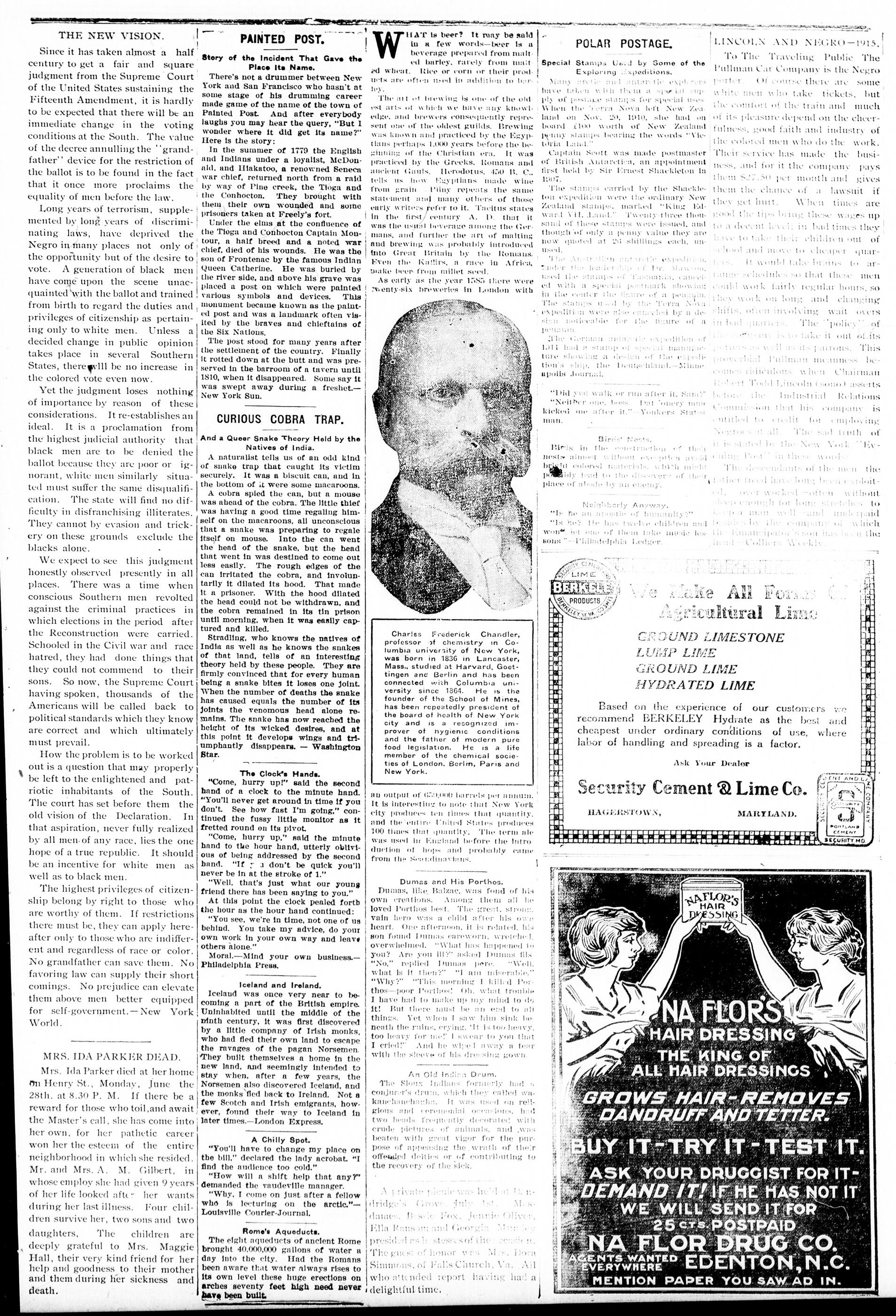
Charles Frederick Chandler, professor of chemistry in Columbia university of New York, was born in 1836 in Lancaster, Mass., studied at Harvard, Goottingen and Berlin and has been connected with Columbia university since 1864. He is the founder of the School of Mines, has been repeatedly president of the board of health of New York city and is a recognized improver of hygienic conditions and the father of modern pure food legislation. He is a life member of the chemical societies of London, Berlin, Paris and New York.
an output of 620,000 barrels per annum. It is interesting to note that New York city produces ten times that quantity, and the entire United States produces 100 times that quantity. The term ale was used in England before the introduction of hops and probably came from the Scandinavians.
Dumas and His Porthos.
Dumas, like Balzae, was fond of his own creations. Among them all he loved Porthos best. The great, strong, vain hero was a child after his own heart. One afternoon, it is related, his son found Dumas careworn, wretched, overwhelmed. "What has happened to you? Are you ill?" asked Dumas files. "No," replied Dumas pere. "Well, what is it then?" "I am miserable." "Why?" "This morning I killed Porthos—poor Porthos! Oh, what trouble I have had to make up my mind to do it! But there must be an end to all things. Yet when I saw him sink beneath the ruins, crying. 'It is too heavy, too heavy for me!' I swear to you that I cried!" And he wipe I away a tear with the sleeve of his dressing gown.
An Old Indian Drum.
The Sioux Indians formerly had a conjurer's drum, which they called wakanchanchagha. It was used on religious and ceremonial occasions, had two heads frequently decorated with crude pictures of animals, and was beaten with great vigor for the purpose of appeasing the wrath of their offended deities or of contributing to the recovery of the sick.
A private picnic was held at D. nrdridge's Grove, July 1st. Misdannes. Bessie Fox, Jennie Oliver, Ella Ranson and Georgia Munley presided as stesses of the session. The guest of honor was Mrs. Dora Simmons, of Falls Church, Va. All who attended report having had a delightful time.
Based on the experience of our customers we recommend BERKELEY Hydrate as the best and cheapest under ordinary conditions of use, where labor of handling and spreading is a factor.
```markdown
```
NA FLOR'S
HAIR
DRESSING
THE KING OF
ALL HAIR DRESSINGS
GROWS HAIR-REMOVES
DANDRUFF AND TETTER.
BUY IT-TRY IT-TEST IT.
ASK YOUR DRUGGIST FOR IT-
DEMAND IT! IF HE HAS NOT IT
WE WILL SEND IT FOR
25 CTS. POSTPAID
NA FLOR DRUG CO.
AGENTS WANTED
EVERYWHERE
EDENTON, N.C.
MENTION PAPER YOU SAW AD IN.
POLAR POSTAGE
Special Stamps Used by Some of the Exploring Expeditions.
Many arctic and antarctic explorers have taken with them a special supply of postage stamps for special uses. When the 'berra Nova left New Zealand on Nov. 20, 1910, she had on board £100 worth of New Zealand penny stamps bearing the words "Victoria Land."
Captain Scott was made postmaster of British Antarctica, an appointment first held by Sir Ernest Shackleton in 1907.
The stamps carried by the Shackleton expedition were the ordinary New Zealand stamps, marked "King Edward VII, Land." Twenty-three thousand of these stamps were issued, and though of only a penny value they are now quoted at 26 shillings each, unused.
The Australian antarctic expedition under the leadership of Dr. Mawson used the stamps of Tasmania, cancelled with a special postmark showing in the center the figure of a penguin. The stamps used by the Terra Nina expedition were also cancelled by a design noticeable for the figure of a penguin.
The German antarctic expedition of 1814 had a stamp of special manufacture showing a design of the expedition's ship, the Deutschland.—Minneapolis Journal.
"Did you walk or run after it, Sam?"
"Neither one, boss. Put 'onery mute kicked me after it.'—Yonkers States man.
Birds' Nests.
Birds in the construction of their nesties almost without exception avoid bright colored materials, which might possibly lead to the discovery of their place of abode by an enemy.
Neighborly Anyway.
"Is he an apostle of humanity?"
"Is he? He has twelve children and
won" let one of them take music less
sons "—Philadelphia Ledger.
LINCOLN AND NEGRO-1915. To The Traveling Public The Pullman Car Company is the Negro porter. Of course there are some white men who take tickets, but the comfort of the train and much of its pleasure depend on the cheerfulness, good faith and industry of the colored men who do the work. Their service has made the business, and for it the company pays them $27.50 per month and gives them the chance of a lawsuit if they get hurt. When times are good the tips bring these wages up to a decent level; in bad times they have to take their children out of school and move to cheaper quarters. It would take brains to arrange schedules so that these men could work fairly regular hours, so they work on long and changing shifts, often involving wait overs in bad quarters. The "policy" of the company is to take it out of its partners as well as its patrons. This proverbial Pullman meanness becomes ridiculous when Chairman Robert Todd Lincoln (sono) asserts before the Industrial Relations Commission that his company is entitled to credit for employing Negroes at all. The sad truth of it is stated by the New York "Evening Post" in these woods:
The descendants of the men the father treed have long been exploited, over worked-often without sleep enough for long stretches to keep a man well-and underpaid besides by the company of which the Emancipator's son has been the head-Colliers Weekly.
The All Forces of
Cultural Lime
LIMESTONE
LIME
LIME
D LIME
ence of our customers we
hydrate as the best and
conditions of use, where
leading is a factor.
Our Dealer
SECURITY COMPANY
SECURITY
PORTLAND
CEMENT
SECURITY MD
TILOR'S
HAIR
ESSING
"Stop that headache! it's stopping your work"
BUY IT TODAY
FOR PICTURES
250
PAGES
ARTICLES
POPULAR
MECHANICS
MAGAZINE
For Father and Son
AND ALL THE FAMILY
Two and a half million readers find it of absorbing interest. Everything in it is written so You Can Understand It.
Written So You Can Understand It.
Every month without limitation.
Any man can read it without limitation.
The publication will do business as a copy under Mechanics Magazine
CITY, W. CHICAGO
Are You a Woman?
Take Cardui
The Woman's Tonic
FOR SALE AT ALL DRUGISTS
SALESMEN Wanted to sell
Our West Virginia Grown NURSERY STOCK Fine canvassing outfit FREE. Cash Commissions Paid Weekly. Write for terms.
The Gold Nursery Co.
Mason City, W. Va.
The Star Hair Grower
FARE 0.22
DAILY BETWEEN
CLEVELAND &
BUFFALO
The Great Ship "CLEANDBEE"
The largest and most reliable cleaner on any island water of the world. Sleeping accommodations
"CITY OF BUFFALO"
3 Magnificent Steamers
"CITY OF BUFFALO"
LEAVEN
CLEVELAND—Daily, May 1st to Dec. 1st—BUFFALO
Leave Cleveland • 8:00 P.M. Leave Buffalo • 8:00 P.M.
Arrive Buffalo • 6:30 A.M. Arrive Cleveland • 6:30 A.M.
Central Standard Time)
Connections at Buffalo for Niagara Falls and all Eastern and Canadian points. Railroad tickets reading between Cleveland and Buffalo are good for transportation on our steamers. Ask your ticket agent for tickets via C. & B. Lines.
Beautifully colored sectional puzzle chart, showing both exterior and interior of The Great Ship "CLEANDBEE" sent on receipt of five cents to cease postage and mailing. Also ask for our 24-page pictorial and descriptive booklet free.
THE CLEVELAND & BUFFALO TRANSIT CO., Cleveland, Ohio
HENRY FARNHAM,
Spring Valley, Minn.
300 PICTURES
250 MILES
360 PAGES
ARTICLE
OPULA
ECHANIC
MAGAZINE
for Father and Sons
AND ALL THE FAMILY
and a half million readers finding interest. Everything in
new So You Can Understand
of the world every month we
are able to help you understand
the world in a more intimate way.
A YEAR
The A C
Motor Mechanics Maga
600 W. 25th St., Chicago, IL 60601
The Star
A Wonderful Ha
*
ARE $542
Pain and Ill Health rob you of all your efficiency. DR. MILES'
ANTI-PAIN PILLS
quickly relieve Pain, but at the same time, when over-work or nervousness is the cause.
Restorative Nervine
should be used to relieve the cause. IF FIRST BOX, OR BOTTLE, FAILS TO BENEFIT YOU, YOUR MONEY WILL BE REFUNDED.
Are You a Woman?
Take Cardui
The Woman's Tonic
FOR SALE AT ALL DRUOIMSTS
SALESMEN Wanted to sell
Our West Virginia Grown NURSERY STOCK Fine canvassing outfit FREE. Cash Commissions Paid Weekly. Write for terms.
The Gold Nursery Co.
Mason City, W. Va.
Hair Grower
r Dressing and Grower.
One thousand agents wanted. Good money made. We want agents in every city and village to sell THE STAR HAIR GROWER. This is a wonderful preparation. Can be used with or without straightening irons. Sells for 25c per box-one 25c box will prove its value. Any person that will use a 25c box will be convinced. No matter what has failed to grow your hair, just give THE STAR HAIR GROWER a trial and be convinced. Send 25c for full size box. If you wish to be an agent send $1.00 and we will send you a full supply that you can begin work with at once; also agents' terms. Send all money by money order to The Star Hair Grower Mfr.
113 Clark Street,
EVANSTON, ILLINOIS.
DAILY BETWEEN
CLEVELAND &
BUFFALO
SIR. "SLEANDBEEF"
any island water of the world. Sleeping accommodation
Workers in porcelain factories are literally baked, but by some miracle they remain sufficiently undone to live. At least if they are not quite baked they endure a stronger heat than that which browns the Sunday sirloin. The furnaces wherein porcelain is finished are kept at the fiercest heat used in any industry. A chain of workmen, their heads and bodies swathed in fireproof garments, take the finished pieces from the fire one at a time and pass them to the cooling room. The man at the head of this chain—he who stands nearest the furnace—can only work in five minute shifts. In his interims of rest he lies on a mattress, drinking glass after glass of ice water from the hands of a small boy.
Dean Swift's Complaint.
It is no new thing, this complaint which one hears of the high cost of living. Writing to Stella from London in the year 1710, Dean Swift remarks: "I lodge in Bury street, St. James, where I removed a week ago. I have the first floor, the dining room and bedchamber at 8 shillings a week; plague deep, but I spend nothing for eating; never go to a tavern and very seldom in a coach, yet, after all, it will be expensive."
Making Him Pay
Lawyer (to kicking client) — Well, have you at last decided to take my advice and pay this bill of mine? Client—Yes. Lawyer—Very well. "To clerk) "William, add 85 to Mr. Smith's bill for further advice."—Boston Transcript.
"What is it?" inquired the pessimistic citizen. "Opportunity to subscribe to some worthy cause, or a chance to invest?"—Louisville Courier-Journal.
How They Do It.
Steve—They say that waiters can always size a man up. Lillian—I suppose they measure him from tip to tip. Judge.
Wealth is not his that has it, but his that enjoys it.
Crawford—How can he make money out of short stories if he never sold one?
Crabshaw—Why, man, he's teaching others how to write them.—Life.
Deserved Tribute.
"You see, we have done everything possible to preserve Plymouth Rock." "And I don't blame ye. New England owes a heap to that breed of hen." —Kansas City Journal.
Some mothers teach their babies to talk—and then expect them to keep still.—Indianapolis Star.
Frohman's Shyness.
When David Belasco and Charles Frohman made their joint production of "A Celebrated Case" they sat together among the audience the first night. After the third act the audience called for them.
"You take the call," said C. F., shrinking back.
"Not without you," was Belasco's reply.
"But I have never gone before the curtain in my life."
"But I can't without you."
"I am the proprietor of this theater." returned Mr. Frohman, "and you must do as I tell you."—New York World.
ch
mo
ast
adv
not give your boy and girl an opportunity to make their home study easy and effective? Give them the same chances to win promotion and success as the lad having the advantage of
WEBSTER'S NEW INTERNATIONAL
Dictionary in his home. This new creation answers with final authority all kinds of puzzling questions in history, geography, biography, spelling, pronunciation, sports, arts, and sciences.
500,000 Vocabulary Terms. 2700 Pages.
Over 6000 Illustrations. Colored Plates.
The only dictionary with the Divided Page.
The type matter is equivalent to that
of a 15-volume encyclopedia.
More Scholarly. Accurate. Convenient,
and Authoritative than any other Eng-
lish Dictionary.
REGULAR
AND
INDIAPAPER
EDITIONS.
WRITE for
specimen pages,
illustration pages,
FREE, a set of Pocket
Maps if you name this
paper.
G. & C. MERRIAM CO.,
SPRINGFIELD, MASS.
THE VERIBEST STRAIGHTENER YET. KONGOLENE PRODUCTS CO., Dept. No. 31 A Marvelous Discovery. 1215 WYLIE AVE PITTSBURG, PA. It is what you have been dreaming of for years. To discover an article that would actually straighten colored folks' hair, without the use of Hot Irons or Heated Combs. KONGOLENE does it and more too. It makes Coarse, Harsh, Stubborn, Nappy-looking hair SCF2 and SILKV.
be been dreaming of for year. To discover an article
lighten colored folks' hair, with the use of Hot
s. KONGOLENE does it not more too. It makes
burn, Nappy-looking hair SCOT and SILKY.
a preparation that makes the hair STRAIGHT, and
y so. Simply spread Kongolene on like butter, comb
WASH IT OUT, and the hair is straight.
straight, not for a day or week, but for 2 or 3 months.
need to do what we say or money is refunded.
Oil, a necessary adjunct to Kongolene gives that
KONGOLENE is a preparation that makes the hair STRAIGHT, and makes it look naturally so. Simply spread Kongolene on like butter, comb it for a few minutes, WASH IT OUT, and the hair is straight. It keeps the hair straight.
SCARCELY
COULD SCARCELY
WALK ABOUT
And For Three Summers Mrs. Vincent Was Unable to Attend to Any of Her Housework.
Pleasant Hill, N. C.—"I suffered for three summers," writes Mrs. Walter Vincent, of this town, "and the third and last time, was my worst.
I had dreadful nervous headaches and prostration, and was scarcely able to walk about. Could not do any of my housework.
I also had dreadful pains in my back and sides and when one of those weak, sinking spells would come on me, I would have to give up and lie down, until it wore off.
I was certainly in a dreadful state of health, when I finally decided to try Cardui, the woman's tonic, and I firmly
WAR!
HAS any whole world gone stu-
quation? Are swords ruthi-
glitening just because Russia wa-
brother—Servi
R! What Is It All About?
world gone stark mad over a very foolish and trivial swords rattling, cannon rumbling, mailed armour use Russia wanted to show her love for the little brother—Servia?
WAR! What Is It All About?
14. What whole world some stalk mad over a very foolish and trivial question? Are swords rattling, cannon rumbling, mailed armour glittering just because Russia wanted to show her love for the little brother—Servia?
Then aside the curtain of Europe's politics and see the grim and shister game of chess that is being played. See upon what a slim, yet desperate, excuse the sacred lives of millions may be sacrificed. Read the history of the past one hundred years, as written by one of the greatest authorities the world has ever known, and learn the naked, shameful truth. Just to get you started as a Review of Reviews subscriber, we make you this extraordinary offer. We will give to you
Duruy*
Four portraits
Today is the Read in this time ONLY CONDEMNED 2,000,000 copies taken place in the hundred years.
has for years crafted to get a year-round Read how German latent strength, have they have printed all
The L
THIS master of the period and the grandeur that Middle Ages, the picture we through the Renaissance up Grosvenor completes in brilliant life the secrets of today. And you get the Review of Review views will give you a same interior with such rapidity. It is reports. Your ability to comprehend rationally depends on a true interest "lesson why" of events. In your out of chaos—and the Review of Review
Get the REVIEW of REVIEW for a Year
Duruy's History of the World
Four splendid cloth volumes, full of
portraits, sketches, maps, diagrams
Today is the climax of a hundred years of preparation.
Read in this timely, authoritative, complete, AND THE
ONLY CONDENSED classic world history—of which over
2,000,000 copies have been sold in France alone—just what has
taken place in the inner councils of Europe during the past one
hundred years.
Read in these entrancing pages how Russia
as for years craftily been trying to escape from her darkness—
get a year-round open port, with its economic freedom.
Read how Germany and Austria, fearful of the monster's
ent strength, have been trying to checkmate her and how
we have pinned all in this last, supreme stake.
Today is the climax of a hundred years of preparation. Read in this timely, authoritative, complete, AND THE ONLY CONDENSED classic world history—of which over 2,000,000 copies have been sold in France alone—just what has taken place in the inner councils of Europe during the past one hundred years. Read in these entrancing pages how Russia has for years craftily been trying to escape from her darkness—to get a year-round open port, with its economic freedom. Read how Germany and Austria, fearful of the monster's latent strength, have been trying to checkmate her and how they have pinned all in this last, supreme stake.
THIS master of the pen shows you the glory that was Groves, and the grandeur that was Rome's. He guides you through the Middle Ages, the pictureque old days of feudalism and the crusades; through the Renaissance up to contemporaneous history, which Pool, Groveson complains in brilliant manance. In the story of the past he recents of today. And you will understand them better when you review of Reviews for a year—for the Review of Reviews will give you the interpretation of the event that are taking place with such tapacity, enough to read the daily news. Send me, on ap-proval reports. Your ability to comprehend and to discuss them rationally depends on a true interpretation of the story and the reason why" of events. In your mind you must bring the stories of the World in 4 out of chaos—and the Review of Reviews will do it for you.
IS master of the pen shows you the glory that was Greene's and the grandeur that was Rome's. He guides you through the Ages, the pictureque old days of feudalism and the crises; in the Renaissance up to contemporaneous history, which Poof, our compilers in brilliant manner. In the story of the past events of today. And you will understand them better when Review of Reviews for a year—for the Review of Review will give you the interpretation of the events that are taking such rapidity. It is enough to read the daily news your ability to comprehend it, and to discuss the depends on a true interpretation of the meaning and the history" of events. In your mind you must bring order and the Review of Reviews will do it for you.
Get theIEW of REVIESFor a Year
Send the coupon only. It brings the whole set—four volumes—charges prepaid—absolutely free. All we ask is that—after you get the books
Review of Reviews 30 Irving Pl. New York:
Send me, on ap proximal charges paid Your way, Duruy's World in 4 volumes bound in cloth. Also once your name for the Review of Reviews for one year. If I keep the books, I will remit in 10 days 25 cents for shipping and $1 per month for three months for the magazine and retain the History of the World without charge. Otherwise I will, within 10 days, return the books at your expense.
for shipping and $1,000 a month for thir-
to pay for the Review of Reviews. If thie-
aren't worth more than you pay for books and magaz-
gether, send them back at our expense. But be prompt,
world-wide fame of Durry will make these 5,000 sets
appear from our stock room at once. Send your coup-
today—and be in time.
Review of Reviews Co., 30 Irving Pl., N.Y.
SENIOR'S CINEMAS
$1.00 a month for three months
for Reviews. For books and magazine to-
pense. But be prompt. The
make these 5,000 sets dis-
ence. Send your coupon
ORIGINATION
For cash with order send only $3.00 and we
will pay shipping charges.
The beautiful 34 inch set costs only a few cents
more. For a set of 5,500 binding, change 3
months above tr 5 months, or send $5.00 cash in full
```markdown
```
for a Year
KONGO PRODUCTS
CO., Dept. No. 33
1215 WYLIE AVE
PITTSBURG, PA.
Send $125 for trial jars, use it
then write for Agency
believe I would have died if I hadn't taken it.
After I began taking Cardui, I was greatly helped, and all three bottles relieved me entirely.
I fattened up, and grew so much stronger in three months, I felt like another person altogether."
Cardui is purely vegetable and gentle-acting. Its ingredients have a mild, tonic effect, on the womanly constitution.
Cardui makes for increased strength, improves the appetite, tones up the nervous system, and helps to make pale, sallow cheeks, fresh and rosy.
Cardui has helped more than a million weak women, during the past 50 years. It will surely do for you, what it has done for them. Try Cardui today.
Write for: Chattanooga Medicine Co., Ladies' Advisory Dept., Chattanooga, Tenn., for Special Instructions on your case and 61-page book, "Home Treatment for Women," sent in plain wrapper. I-65
FREE!
The Lesson of the Past