The Pioneer Press
Saturday, August 12, 1916
Martinsburg, West Virginia
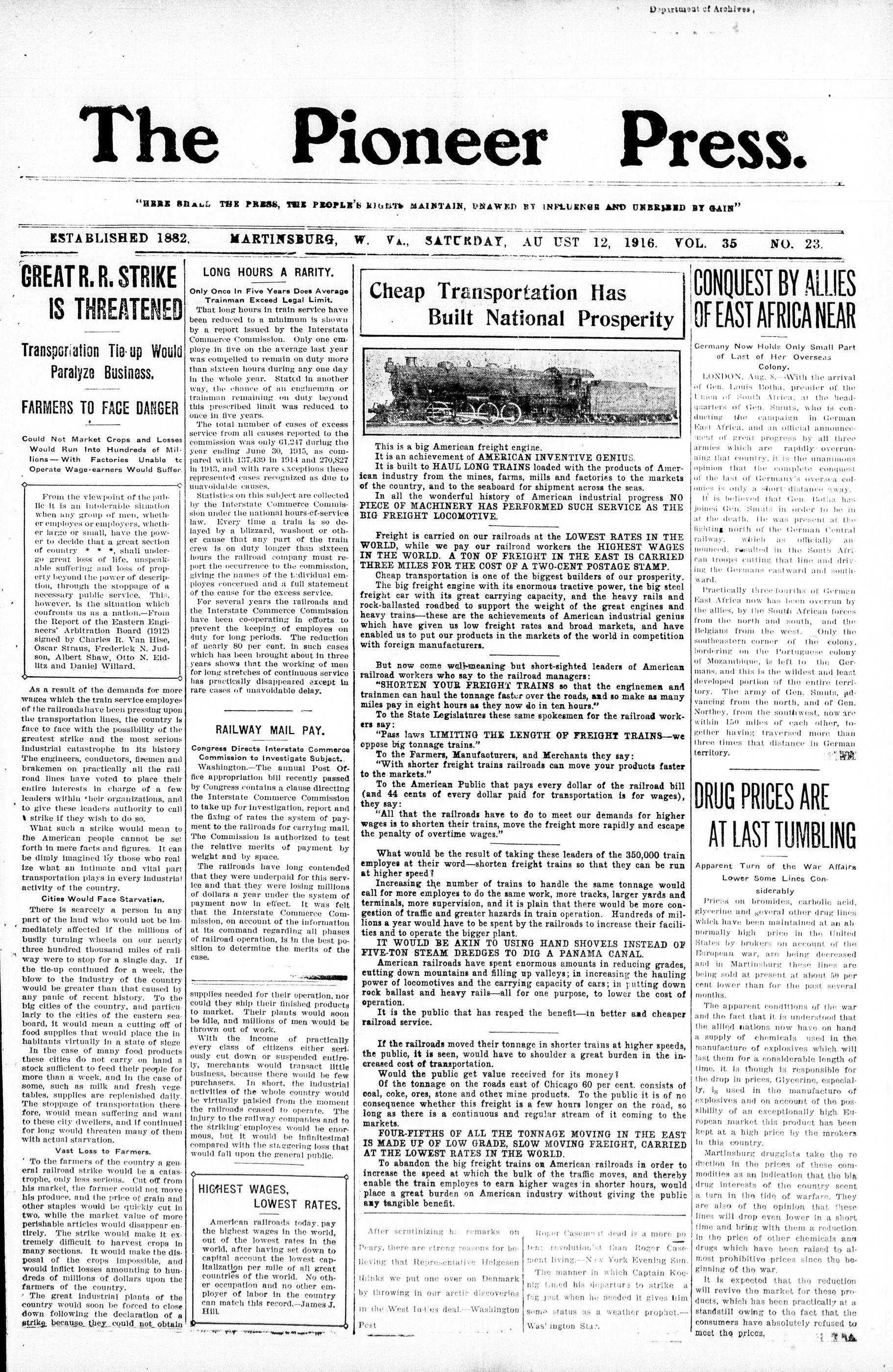
Page text (machine-generated)
The Pioneer Press.
"HERE SHALL THE PRESS, THE PEOPLE'S RIGHTS MAINTAIN, UNAWED BY INFLUENCE AND UNBELIEED BY GAIN"
ESTABLISHED 1882.
GREAT R.R. STRIKE IS THREATENED
GREAT R.R. STRIKE IS THREATENED
Transportation Tie-up Would Paralyze Business.
FARMERS TO FACE DANGER
Could Not Market Crops and Losses Would Run Into Hundreds of Millions—With Factories Unable to Operate Wage-earners Would Suffer
From the viewpoint of the public it is an intolerable situation when any group of men, whether employees or employers, whether large or small, have the power to decide that a great section of country * * * *, shall undergo great loss of life, unspeakable suffering and loss of property beyond the power of description, through the stoppage of a necessary public service. This, however, is the situation which confronts us as a nation.—From the Report of the Eastern Engineers' Arbitration Board (1912) signed by Charles R. Van Hise, Oscar Straus, Frederick N. Judson, Albert Shaw, Otto N. Eldlitz and Daniel Willard.
As a result of the demands for more wages which the train service employees of the railroads have been pressing upon the transportation lines, the country is face to face with the possibility of the greatest strike and the most serious industrial catastrophe in its history. The engineers, conductors, firemen and brakemen on practically all the railroad lines have voted to place their entire interests in charge of a few leaders within their organizations, and to give these leaders authority to call strike if they wish to do so.
What such a strike would mean to the American people cannot be set forth in mere facts and figures. It can be dimly imagined by those who realize what an intimate and vital part transportation plays in every industrial activity of the country.
Cities Would Face Starvation.
There is scarcely a person in any part of the land who would not be immediately affected if the millions of busily turning wheels on our nearly three hundred thousand miles of railway were to stop for a single day. If the tie-up continued for a week, the blow to the industry of the country would be greater than that caused by any panic of recent history. To the big cities of the country, and particularly to the cities of the eastern seaboard, it would mean a cutting off of food supplies that would place the inhabitants virtually in a state of siege
In the case of many food products these cities do not carry on hand a stock sufficient to feed their people for more than a week, and in the case of some, such as milk and fresh vegetables, supplies are replenished daily. The stoppage of transportation therefore, would mean suffering and want to these city dwellers, and if continued for long would threaten many of them with actual starvation.
Vast Loss to Farmers.
To the farmers of the country a general railroad strike would be a catastrophe, only less serious. Cut off from his market, the farmer could not move his produce, and the price of grain and other staples would be quickly cut in two, while the market value of more perishable articles would disappear entirely. The strike would make it extremely difficult to harvest crops in many sections. It would make the disposal of the crops impossible, and would inflict losses amounting to hundreds of millions of dollars upon the farmers of the country. The great industrial plants of the country would soon be forced to close down following the declaration of a strike because they could not obtain
LONG HOURS A RARITY.
Only Onco In Five Years Does Average Trainman Exceed Legal Limit.
That long hours in train service have been reduced to a minimum is shown by a report issued by the Interstate Commerce Commission. Only one employee in five on the average last year was compelled to remain on duty more than sixteen hours during any one day in the whole year. Stated in another way, the chance of an engineer or trainman remaining on duty beyond this prescribed limit was reduced to once in five years. The total number of cases of excess service from all causes reported to the commission was only 61,247 during the year ending June 30, 1915, as compared with 137,439 in 1914 and 270,827 in 1913, and with rare exceptions these represented cases recognized as due to unavoidable causes.
Statistics on this subject are collected by the Interstate Commerce Commission under the national hours-of-service law. Every time a train is so delayed by a blizzard, washout or other cause that any part of the train crew is on duty longer than sixteen hours the railroad company must report the occurrence to the commission, giving the names of the Individual employees concerned and a full statement of the cause for the excess service.
For several years the railroads and the Interstate Commerce Commission have been co-operating in efforts to prevent the keeping of employees on duty for long periods. The reduction of nearly 80 per cent. in such cases which has been brought about in three years shows that the working of men for long stretches of continuous service has practically disappeared except in rare cases of unavoidable delay.
RAILWAY MAIL PAY.
Congress Directs Interstate Commerce Commission to Investigate Subject. Washington.-The annual Post Office appropriation bill recently passed by Congress contains a clause directing the Interstate Commerce Commission to take up for investigation, report and the fixing of rates the system of payment to the railroads for carrying mail. The Commission is authorized to test the relative merits of payment by weight and by space.
The railroads have long contended that they were underpaid for this service and that they were losing millions of dollars a year under the system of payment now in effect. It was felt that the Interstate Commerce Commission, on account of the information at its command regarding all phases of railroad operation, is in the best position to determine the merits of the case.
supplies needed for their operation, nor could they ship their finished products to market. Their plants would soon be idle, and millions of men would be thrown out of work.
With the income of practically every class of citizens either seriously cut down or suspended entirely, merchants would transact little business, because there would be few purchasers. In short, the industrial activities of the whole country would be virtually palsied from the moment the railroads ceased to operate. The injury to the railway companies and to the striking employees would be enormous, but it would be infinitesimal compared with the staggering loss that would fall upon the general public.
HIGHEST WAGES,
LOWEST RATES.
American railroads today, pay the highest wages in the world, out of the lowest rates in the world, after having set down to capital account the lowest capitalization per mile of all great countries of the world. No other occupation and no other employer of labor in the country can match this record. James J. Hill.
Cheap Transportation Has Built National Prosperity
Cheap Transportation Has Built National Prosperity
```markdown
```
It is an achievement of AMERICAN INVENTIVE GENIUS.
It is built to HAUL LONG TRAINS loaded with the products of American industry from the mines, farms, mills and factories to the markets of the country, and to the seaboard for shipment across the seas.
In all the wonderful history of American industrial progress NO PIECE OF MACHINERY HAS PERFORMED SUCH SERVICE AS THE BIG FREIGHT LOCOMOTIVE.
Freight is carried on our railroads at the LOWEST RATES IN THE WORLD, while we pay our railroad workers the HIGHEST WAGES IN THE WORLD. A TON OF FREIGHT IN THE EAST IS CARRIED THREE MILES FOR THE COST OF A TWO-CENT POSTAGE STAMP.
Cheap transportation is one of the biggest builders of our prosperity. The big freight engine with its enormous tractive power, the big steel freight car with its great carrying capacity, and the heavy rails and rock-ballasted roadbed to support the weight of the great engines and heavy trains—these are the achievements of American industrial genius which have given us low freight rates and broad markets, and have enabled us to put our products in the markets of the world in competition with foreign manufacturers.
But now come well-meaning but short-sighted leaders of American railroad workers who say to the railroad managers:
"SHORTEN YOUR FREIGHT TRAINS so that the enginemen and trainmen can haul the tonnage faster over the roads, and so make as many miles pay in eight hours as they now do in ten hours."
To the State Legislatures these same spokesmen for the railroad workers say:
"Pass laws LIMITING THE LENGTH OF FREIGHT TRAINS—we oppose big tonnage trains."
To the Farmers, Manufacturers, and Merchants they say:
"With shorter freight trains railroads can move your products faster to the markets."
To the American Public that pays every dollar of the railroad bill (and 44 cents of every dollar paid for transportation is for wages), they say:
"All that the railroads have to do to meet our demands for higher wages is to shorten their trains, move the freight more rapidly and escape the penalty of overtime wages."
What would be the result of taking these leaders of the 350,000 train employes at their word—shorten freight trains so that they can be run at higher speed?
Increasing the number of trains to handle the same tonnage would call for more employees to do the same work, more tracks, larger yards and terminals, more supervision, and it is plain that there would be more congestion of traffic and greater hazards in train operation. Hundreds of millions a year would have to be spent by the railroads to increase their facilities and to operate the bigger plant.
IT WOULD BE AKIN TO USING HAND SHOVELS INSTEAD OF FIVE-TON STEAM DREDGES TO DIG A PANAMA CANAL.
American railroads have spent enormous amounts in reducing grades, cutting down mountains and filling up valleys; in increasing the hauling power of locomotives and the carrying capacity of cars; in putting down rock ballast and heavy rails—all for one purpose, to lower the cost of operation.
It is the public that has reaped the benefit—in better and cheaper railroad service.
If the railroads moved their tonnage in shorter trains at higher speeds, the public, it is seen, would have to shoulder a great burden in the increased cost of transportation.
Would the public get value received for its money?
Of the tonnage on the roads east of Chicago 60 per cent. consists of coal, coke, ores, stone and other mine products. To the public it is of no consequence whether this freight is a few hours longer on the road, so long as there is a continuous and regular stream of it coming to the markets.
FOUR-FIFTHS OF ALL THE TONNAGE MOVING IN THE EAST IS MADE UP OF LOW GRADE, SLOW MOVING FREIGHT, CARRIED AT THE LOWEST RATES IN THE WORLD. To abandon the big freight trains on American railroads in order to increase the speed at which the bulk of the traffic moves, and thereby enable the train employees to earn higher wages in shorter hours, would place a great burden on American industry without giving the public any tangible benefit.
This is a big American freight engine.
It is an achievement of AMERICAN INDUSTRY. It is built to HAUL LONG TRAINS local industry from the mines, farms, miles of the country, and to the seaboard for shipment. In all the wonderful history of AMERICAN INDUSTRY HAS PERFORMED BIG FREIGHT LOCOMOTIVE.
Freight is carried on our railroads at WORLD, while we pay our railroad wages IN THE WORLD. A TON OF FREIGHT THREE MILES FOR THE COST OF A TWO-HEAVY TRAINS—these are the achievements which have given us low freight rates, enabled us to put our products in the market with foreign manufacturers.
But now come well-meaning but short railroad workers who say to the railroad:
"SHORTEN YOUR FREIGHT TRAINmen can haul the tonnage faster over miles pay in eight hours as they now do in To the State Legislatures these same workers say:
"Pass laws LIMITING THE LENGTH of oppose big tonnage trains."
To the Farmers, Manufacturers, and
"With shorter freight trains railroads to the markets."
To the American Public that pays even (and 44 cents of every dollar paid for they say:
"All that the railroads have to do the wages is to shorten their trains, move them the penalty of overtime wages."
What would be the result of taking the employees at their word—shorten freight at higher speed?
Increasing the number of trains to call for more employees to do the same work terminals, more supervision, and it is plain gestion of traffic and greater hazards in tractors a year would have to be spent by the ties and to operate the bigger plant.
IT WOULD BE AKIN TO USING FIVE-TON STEAM DREDGES TO DIGGER.
American railroads have spent enormous cutting down mountains and filling up a power of locomotives and the carrying car rock ballast and heavy rails—all for one operation.
It is the public that has reaped the railroad service.
If the railroads moved their tonnage in the public, it is seen, would have to shortcreased cost of transportation.
Would the public get value received?
Of the tonnage on the roads east of coal, coke, ores, stone and other mine consequences whether this freight is a few long as there is a continuous and regular markets.
FOUR-FIFTHS OF ALL THE TONNAGE IS MADE UP OF LOW GRADE, SLOW AT THE LOWEST RATES IN THE WORLD.
To abandon the big freight trains on increase the speed at which the bulk of enable the train employees to earn higher place a great burden on American industry any tangible benefit.
After scrutinizing his remarks on Peary, there are strong reasons for believing that Representative Helgesen thinks we put one over on Denmark by throwing in our arctic discoveries in the West Indies deal.—Washington Post
Roger Casement dead is a more potent revolution'st than Roger Casement living.—New York Evening Sun. The manner in which Captain Koenig timed his departure to strike a fog just when he needed it gives him some status as a weather prophet.—Washington Star.
CONQUEST BY ALLIES OF EAST AFRICA NEAR
CONQUEST BY ALLIES OF EAST AFRICA NEAR
Germany Now Holds Only Small Part of Last of Her Overseas Colony.
LONDON, Aug. 8.—With the arrival of Gen. Louis Botha, premier of the Union of South Africa, at the headquarters of Gen. Smuts, who is conducting the campaign in German East Africa, and an official announcement of great progress by all three armies which are rapidly overrunning that country, it is the unanimous opinion that the complete conquest of the last of Germany's overseas colonies is only a short distance away.
It is believed that Gen. Botha has joined Gen. Smuts in order to be in at the death. He was present at the fighting north of the German Central railway, which as officially announced, resulted in the South African troops cutting that line and driving the Germans eastward and southward.
Practically three fourths of German East Africa now has been overrun by the allies, by the South African forces from the north and south, and the Belgians from the west. Only the southeastern corner of the colony, bordering on the Portuguese colony of Mozambique, is left to the Germans, and this is the wildest and least developed portion of the entire territory. The army of Gen. Smuts, advancing from the north, and of Gen. Northey, from the southwest, now are within 150 miles of each other, together having traversed more than three times that distance in German territory.
DRUG PRICES ARE AT LAST TUMBLING
Apparent Turn of the War Affairs Lower Some Lines Con-
siderably
Prices on bromides, carbolic acid, glycerine and several other drug lines which have been maintained at an abnormally high price in the United States by brokers on account of the European war, are being decreased and in Martinsburg these lines are being sold at present at about 50 per cent lower than for the past several months.
The apparent conditions of the war and the fact that it is understood that the allied nations now have on hand a supply of chemicals used in the manufacture of explosives which will last them for a considerable length of time, it is though is responsible for the drop in prices, Glycerine, especially, $ ^{i}_{8} $ used in the manufacture of explosives and on account of the possibility of an exceptionally high European market this product has been kept at a high price by therokers in this country.
Martinsburg druggists take the reduction in the prices of these commodities as an indication that the big drug interests of the country scent a turn in the tide of warfare. They are also of the opinion that these lines will drop even lower in a short time and bring with them a reduction in the price of other chemicals and drugs which have been raised to almost prohibitive prices since the beginning of the war. It is expected that the reduction will revive the market for these products, which has been practically at a standstill owing to the fact that the consumers have absolutely refused to meet the prices.
for all advertisements close in
and unless advertising is closed by
3 early contract, in which case the ad-
dition pays every three months.
Advertising 1 inch one time 75c.
Standing ..... 50c
Arrived Rates to Clubs.
Sent for Sample Copies.
Entered in Post Office at Martins-
ouis, W. Va., as Second Class Matter.
Cifftord, Editor and Proprietor.
Drawer 869, and Bell 'Phone 80K.
Martinsburg, W. Va.
SATURDAY, AUGUST 12 1916
America first and America efficient. Charles E. Hughes.
After November the Prohibition party will better know what the voters think of it.
It Charles Evans Hughes keeps on as he started he will keep the Dems busy begging to retract.
More, decidedly more is known of Mrs. Susan Sandridge than appears on the surface, and it may spring a great many surprises. Cautious.
We have there will be no railroad strike from the fact the poor people have suffered for every one we have not by paying the costs. It put ail up and it has never gone down.
Children should be kept from all the movies, taken and kept on the best play-grounds where pools are plentiful to dabble in. If we had small children and lived in a place infected with so dreadful a disease as is scourging New York City,sulphur would be our remedy and freely used
Cha.1.2 Evans Hughes, whose declaration on his stand and feeling for that class of American citizens for whom the war of the rebellion caused the addition of three amendments to our national constitution, backed up by his Oklahoma decision leaves no room for doubt as to his sincerity. Judge, we believe every word in its fullest meaning you have spoken and shall urge every living Negro to vote for you.
After carefully reading the next President's acceptance, we are constrained to say it is the best of its kind we ever read. Bryan and no other dead cock in the pit can gain-say it. Theodore Roosevelt foresaw, excepting himself that Charles Evans Hughes was the best man in America to nominate. Hughes is the honest embodiment of progressivism, and in accepting him, every principle of the Progressive party was endorsed.
If the two advocated national gatherings of Negroes are to meet for the sole purpose of waging war on wrongs in this great country of ours, and it finally will grow manly manhood, let both be held—the one to be held in Washington, D. C., August 23rd. to 26th, 1916, in the Metropolitan Church, and the one that used to be called—"National Independent Political League," changed by selfish intrigues for which no person can give himself credit. Nevertheless let it meet and we shall meet with them both and do our best in har-
---
mony for the good of a suffering cause that has been battered and bruised more by Negroes than white foes.
The Pioneer Press has been hammered at as much if not more than any other Negro paper in America for standing firmly by Theodore Roosevelt. It has without reservation declared, and still declares he is not only the finest reasoner and the greatest living American, but the greatest living man. He is the one man who stood up like the rocks of Gibraltar, fought and put to flight the bosses who had trodden down our constitutional rights and allowed them to be scorned and spat on. We will go back with him to the once grand old party, and will tread the wine-press again with him if he calls for volunteers. Not because he is our boss, for no man is that, but because we believe he is right.
What a shame on America after burying the colored and white soldiers of Carrizal with National honors, and on the back of it, turn down and out a colored man who is educated and highly respected who belonged to a white regiment of South Dakota. It has stirred up a fuss in that state that will wipe out such a devilish order. What would this country have been in tillable territory, and war without Negroes? What would the South have done without their labor? There would not be a wealthy white man who boasts of being a Southerner, had it not been for Negroes and all of the South's boasted scholarship the Negroes labored for, and do what you please time is going to give them their rights.
So ripe is strife toward colored people in this Wilson democratic administration, that even Northern regiments can't take South with them their colored cooks.
One thing every colored man can and must do, vote Wilson out and Hughes in. Then see to it, that every living 21 years old colored man in America, be given every legal right given and vouchsafed by the constitution of the United States Surely this country's prosperity along with the South's butchery of Negroes, is enough to arouse a complete change when the Republican-Progressive party gets in power. Let both of our coming conventions, tiptoe in defense of these rights.
UNWASHED HANDS SHOULD BE WATCHED
Never Use Them With Which to Con-
Disease germs lead a hand to mouth existence. If the human race would learn to keep the unwashed hand away from the mouth many human diseases would be greatly diminished. We handle infectious matter more or less constantly and we continually carry the hands to the mouth. If the hand has recently been in contact with infectious matter the germs of disease may in this way be introduced into the body Many persons wet their fingers with saliva before counting money, turning the pages of a book, or performing similar acts. In this case the process is reversed, the infection being carried to the object handled, there to await carriage to the mouth of some other careless person. In view of these facts the U. S. Public Health Service has formulated the following simple rules of personal hygiene and recommend their adoption by every person in the United States:
"AMERICA FIRST AND AMERICA EFFICIENT."
We come to state in a plain and direct manner our faith, our purpose and our pledge. This representative gathering is a happy augury. It means the strength of reunion. It means that the party of Lincoln is restored, alert, effective. It means the unity of a common perception of paramount national needs. It means that we are neither deceived nor benumbed by abnormal conditions. We know that we are in a critical period, perhaps more critical than any period since the civil war. We need a dominant sense of national unity, the exercise of our best constructive powers, the vigor and resourcefulness of a quickened America. We desire that the Republican party as a great liberty party shall be the agency of national achievement, the organ of the effective expression of dominant Americanism. What do I mean by that? I mean America conscious of power, awake to obligation, erect in self respect, prepared for every emergency, devoted to the ideals of peace, instinct with the spirit of human brotherhood, safeguarding both individual opportunity and the public interest, maintaining a well ordered constitutional system adapted to local self government without the sacrifice of essential national authority, appreciating the necessity of stability, expert knowledge and thorough organization as the indispensable conditions of security and progress; a country loved by its citizens with a patriotic fervor permitting no division in their allegiance and no rivals in their affection—I mean America first and America efficient. It is in this spirit that I respond to your summons.—From Mr. Hughes' speech of acceptance.
Brief Sentences Featuring the Speech of Acceptence of Charles E. Hughes.
America First and America Efficient.
We are too great a country to require of our citizens who are engaged in peaceful vocations the sort of military service to which they are now called.
We cherish no illusions. We know that the recurrence of war is not to be prevented by pious wishes.
We denounce all plots and conspiracies in the interest of any foreign nation.
Adequate preparedness is not militarism.
During this critical period the only danger of war has lain in the weak course of the administration.
The nation has no policy of aggression toward Mexico. We have no desire for any part of her territory.
We propose that in the competitive struggle that is about to come the American workingman shall not suffer.
This representative gathering is a happy augury. It means the strength of reunion. It means that the party of Lincoln is restored, alert, effective.
The dealings of the administration with Mexico constitute a confused chapter of blunders. It is a record which cannot be examined without a profound sense of humiliation.
We must take Vera Cruz to get Huerta out of office and trust to other nations to get our own citizens out of peril. What a travesty of international policy!
Destroying the government of Huerta, we left Mexico to the ravages of revolution.
I stand for adequate federal workmen's compensation laws.
The administration was to seize and punish Villa for his outrage on our soil. It has not punished any one; we went in only to retire.
I favor the vote for women.
Evidently we shall have to avoid "the next war" until the railroads prepare a sufficient number of Pullman palace cars.—Rochester Herald.
President W. H. P. Faunce of Brown university is a pretty live wire who keeps abreast of the times, has keen powers of observation and knows a good man when he sees him. Here is what he lies to say about the Republican candidate for the presidency:
"I have known Justice Hughes intimately since we were students together at Brown and have seen him a thousand times at work and at play. No man of our generation has a finer combination of character and intellect. Absolutely fearless, unselfish, loyal to American ideals, he is worthy of a nation's trust.
"All his friends know that behind the dignity of bearing is a rich fund of humor and good fellowship. Whether he is climbing a mountain, reading novels, playing with his children, resisting a political lobby or delivering the opinion of the supreme court, he is ever the same rugged, democratic, fair minded American. His varied experience has given him wide horizon and sympathy with every aspect of American life.
"He possesses two qualities rarely found together—the judicial temper and the capacity for swift and resolute action. Under his administration the fog which now besets many public questions would be cleared away
"His penetrating mind goes to the heart of any subject he selects and strips off the irrelevant at once. Such a mind is peculiarly needed amid the intricate problems that now confront Amor in. "We need more than good intentions. We need clear vision, sound judgment, strong will, unrestraining decision. In short, we need Charles E. Hughes."
JUDGE WOODS AGAIN REMOVES PHILLIPS FROM COUNTY COURT
OPINION WAS HANDED DOWN AT SPECIAL TERM AT BERKELEY SPRINGS MONDAY.
THIS THE SECOND TIME SUCH ACTION WAS TAKEN—DEFENDANT WILL APPEAL.
BALTIMORE AND OHIO RAILROAD WINS SUIT—COURT CONSTRUES A WILL.
At a special term of circuit court held yesterday at Berkeley Springs Judge J. M. Woods handed down an opinion in the case of B. E. Dawson vs. John A. Phillips, in which the former sought to have the latter removed as a member of the county court.
Several months ago Mr. Dawson instituted proceedings against Mr. Phillips, charging him with official misconduct. Judge Woods decided the case against the defendant, and an appeal was taken to the supreme court, which body entered a reversal order.
Following the action of the supreme court, Mr. Dawson again pressed his case, and Judge Woods Monday removed Mr. Phillips. The defendant at once served notice of appeal and was granted thirty days in which to take such action. Mr. Phillips is president of the Morgan county court
In the case of Yost vs. the Baltimore and Ohio Railroad Company, the court gave an opinion favorable to the latter. This suit was instituted by the widow of the deceased, who alleged that she was entitled to recover $500 from the relief department of the company, but the court held that the evidence showed that at the time of her husband's death he was numbered among the furloqued men. The court found for the defendant in the cause of Vanosdale vs. Spring and Fisher, the case having been submitted for the construction of a will
Webster once asked his party, "What is to become of me?" But it was not the Progressive leader who was asking that question at Indianapolis yesterday.—New York Evening Post.
HIGH WAGES ON AMERICAN ROADS
Railroad Payroll Records Made Public by the Carriers.
NATIONAL INQUIRY URGED
Managers Offer to Leave Question of $100,000,000 Wage Demands to an Impartial Federal Tribunal to Prevent Disaster of a Nation-wide Strike.
New York.—What is probably the most elaborate study of wages ever made in any industry has just been completed by the National Conference Committee of the railways.
For six months railway accountants throughout the country have been engaged in collecting the payroll records to show the actual wage payments to every individual employ among the 300,000 engineers, conductors, firemen and brakemen now voting on a national strike for a new wage scale.
That these employees are one of the highest paid groups of workers in any industry is disclosed by the summary made public today by the railroad managers.
The average yearly wage payments to all Southern train employees (including those who worked only part of the year), as shown by the 1915 payrolls, were:
Passenger. Freight. Yard.
Engineers ..... $2,144 $1,712 $1,313
Conductors ..... 1,723 1,488 1,157
Firemen ..... 1,006 805 688
Drakesmen ..... 1,013 845 868
Three-quarters of these men (including those who put in a full year's service), earned these wages:
Engineers (road), $1,455 to $3,083;
(yard), $1,156 to $2,424.
Conductors (road), $1,353 to $2,696;
(yard), $1,055 to $1,749.
Firemen (road), $649 to $1,652; (yard),
$406 to $1,302.
Brakemen (road), $755 to $1,854;
(yard), $754 to $1,405.
For the whole country the average
wages of three-quarters of the employ-
es were:
Passenger. Freight. Yard.
Engineers ..... $2,067 $1,892 $1,526
Conductors ..... 1,850 1,719 1,316
Firemen ..... 1,203 1,117 924
Brakemen ..... 1,095 1,013 1,075
The railroads have considered every man whose name appears on the January and December payrolls as an employee for a year, no matter how little service he performed in the other ten months. It is pointed out by the managers that these averages are, in consequence, an understatement of the earning power of these employees.
An Appeal to the Public.
The National Conference Committee, in making these wage figures public, says:
"Do you believe in arbitration or industrial warfare?"
"The train employees on all the railroads are voting whether they will give their leaders authority to tie up the commerce of the country to enforce their demands for a $100,000,000 wage increase.
"The railroads are in the public service—your service. This army of employees is in the public service—your service.
"You pay for rail transportation $3,000,000,000 a year, and 44 cents out of every dollar from you goes to the employees.
"A $100,000,000 wage increase for men in freight and yard service (less than one-fifth of all employees) is equal to a 5 per cent advance in all freight rates.
"The managers of the railroads, as trustees for the public, have no right to place this burden on the cost of transportation to you without a clear mandate from a public tribunal speaking for you.
"The railroads have proposed the settlement of this controversy either under the existing national arbitration law, or by reference to the Interstate Commerce Commission This offer has been refused by the employees' representatives.
"Shall a nation wide strike or an investigation under the government determine this issue?"
According to Mr. Hughes, his principal reason for favoring woman suffrage is that woman suffrage is inevitable. Following the same reasoning, he should favor the re-election of Woodrow Wilson, as that is an inevitability which will arrive considerably sooner than woman suffrage.—Louisville Courier Journal.
---
"I want to tell you what wonderful benefit I have received from the use of Thedford's Black-Draught," writes Mrs. Sylvania Woods, of Clifton Mills, Ky.
"It certainly has no equal for la grippe, bad colds, liver and stomach troubles. I firmly believe Black-Draught saved my little girl's life. When she had the measles, they went in on her, but one good dose of Thedford's Black-Draught made them break out, and she has had no more trouble. I shall never be without
THEDFORD'S
BLACK-DRAUGHT
in my home." For constipation, indigestion, headache, dizziness, malaria, chills and fever, billiousness, and all similar ailments, Thedford's Black-Draught has proved itself a safe, reliable, gentle and valuable remedy.
If you suffer from any of these complaints, try Black-Draught. It is a medicine of known merit. Seventy-five years of splendid success proves its value. Good for young and old. For sale everywhere. Price 25 cents.
CLEVELAND-Daily, May 1st to Nov. 15th-BUFFALO
Leave Cleveland • • 8:00 P.M. Leave Buffalo • • 8:00 P.M.
Arrive Buffalo • • 8:00 A.M. Arrive Cleveland • • 8:00 A.M.
Thompson and Thompson have the most attractive stock of men's ready made clothing to be found in the city, and the nobbiest and nattiest stock of hats, shirts and summer wear you ever saw. Give them a call-144 North Queen Street.
CAMPMEETING A woods meeting will be held at Douglass Grove, near Martinsburg, August 17, inst. Every body is cordially invited.
Mrs. Henry Hopewell and Miss Hilda, her daughter, are surging and ducking the waves at Atlantic City.
Go to John W. Dean Co., for everything in the clothing line. They have it, and insist you call and look it over. Prices reasonable and anxiety on tiptoe to please you Every new buyer brings another
Mrs. Tessie Williams, whose little babe, Virginia, was buried yesterday, the 9th., today, the 10th. in herself sleeping in death with her dear little one? Do they know each other? is the unsolved problem.
Rev. S. H. Norwood is circulating among friends in Staunton, Va. It must have been a sad scene, only recently married, to have words so soon and part.
WASH THE HANDS IMMEDIATELY
Before eating.
Before handling, preparing or serv
ing food.
After using the toilet.
After attending the sick, and
After handling anything dirty.
Saved G
"I want to tell you what
celved from the use of The
Mrs. Sylvania Woods, of Clif
"It certainly has no eq
liver and stomach troubles.
saved my little girl's life.
they went in on her, but
Black-Draught made them b
more trouble. I shall never
THED
BLACK-
in my home." For constipati
ness, malaria, chills and few
ailments, Thedford's Black-D
reliable, gentle and valuable
If you suffer from any o
Draught. It is a medicine
years of splendid success
young and old. For sale ev
FARE $300
C&B
LINE
The Great Ship
The largest and most costly steamer on any in-
tations for 150 passengers.
"CITY OF ERIE" — 3 Magnificent
CLEVELAND-Daily, May
Leave Cleveland • • 8:00 P.M.
Arrive Buffalo • • 6:00 A.M.
(Central St)
Connections at Buffalo for Niagara Falls and
sites reading between Cleveland and Buffalo are
your ticket agent for tickets via C. & B. Lines.
Beautifully colored rectional puzzle chart.
Ship "SHEANDBEE" sent on receipt of five
for our 21-page pictorial and descriptive be-
THE CLEVELAND & BUFFALO
SUBMARINE BREMEN IS REPORTED SUNK
Dispatch Says Accident Happened to Machinery and the Sub Went Down.
BERNE, Aug. 8—The Berlin newspaper Tageblatt announces that the submarine Bremen, which was to have arrived in an American port, was sunk through an accident to her machinery, according to a dispatch received here this afternoon.
CARRANZA FORCES DISPERSE BANDITS
CARRANZA FORCES DISPERSE BANDITS
Cabriel Valdivieso, Villa General, Captured in Chihuahua; Alabarran Surrenders. MEXICO CITY, Aug. S.—Reports to the War Department announce successes for the Government forces over bandits and apata forces in small engagements, including the capture in Chihuahua of the Villa General Gabriel Valdivieso and the surrender and acceptance of amnesty of Gen. Malejo Alabarran with 150 Zapata adherents in the State of Mexico.
A call for a special municipal election throughout the State of Queretaro was issued today by the Governor. The date of the election is fixed for the first Sunday in September. The registration of voters will extend to Aug. 12 and the list be made public on Aug. 14. Each party can designate its candidate at any time up to Aug. 20. The candidates elected will take office or: Oct. 1 and hold their official positions throughout the year, 1917. Election contests will be adjudicated by the governor and two others appointed by him.
COMMITTEE BEGINS WORK OF CAMPAIGN
Another Very Enthusiastic Meeting Was Held Last Night at the Y. M. C. A.
Another very enthusiastic meeting of the executive committee of the union evangelistic campaign was held last night at the Y. M. C. A.
This committee now consists of "In reference to the fighting in the Katia district," says today's official report, "the general officer commanding in chief in Egypt (Gen. Sir Archibald Murray) reports that our artillery, rifle and machine gun fire was most effective and that the Turkish losses in killed and wounded appear to have been very heavy.
"Late in the evening of Aug. 5 territorial infantry gallantly carried a strong rearguard position. Our pursuit of the Turks has been continued for a distance of eighteen miles and they are now well clear of the Katia-Umaisha basin. The number of unwounded prisoners taken by us now amounts to 45 officers and 3,100 men, and they are a very fine body of men.
"Labor Leaders Growing Arrogant," says a headline. This being the year that they are codied by the politicians—Rochester Herald.
If the United States is at "the preciice of bankruptcy," Senator Penrose must be credited with wonderful disccement.—Springfield Republican. States' Rights are not quite dead yet, as the Republican party is likely to find out.—Charleston News and Corlier.
CARRANZA WANTS MILITARY STATUS
CARRANZA WANTS MILITARY STATUS
Determined Before Any Other Questions are Discussed at the Coming Conference. WASHINGTON, Aug. 8.—Ambassador Arredondo today told Acting Secretary of State Polk, in a conversation relative to the coming conference, that the de facto government merely desires that the military status be determined ahead of other questions because it is "more pressing" than the army question.
To Discuss the Threatened Strikes of the Railroad Men and Prevent Tie-Up
Washington, August 3. President Wilson has requested a conference with Commissioner Chambers, and the United States Board of Mediation and Conciliation, presumably to discuss the threatened strike of the Big Four Brotherhoods of railway men, which would cause a nation-wide tie-up of transportation.
Mme. L.C. Parrish Hair Culturing Scaip Treatment
M.
Largest Mail Order House of its kind in America.
America. All kinds of Toilet Articles for sale. Human Hair Goods of the finest quality. Our Hair Food and Skin Food never fail. If the trouble is with the hair, sealp or skin, we have the remedy. We guarantee a remedy to make hair grow on bald spots and bare temples. Send 10c. for a sample and catalogue.
FEDERAL INQUIRY IN WAGE DISPUTE
Railroad Managers Submit Plans to Avoid Great Strike.
ARBITRATION IS OFFERED.
Agree to Refer Demands of Men For More Pay to the Interstate Commerce Commission or to Accept Settlement Under Newlands Act.
New York.—The announcement that the strike vote which has been in progress among the train service employees of American railroads for the past several weeks has been completed, and that the final demands by the union leaders are soon to be presented to the railroad managers here, indicates that the public will soon know whether the controversy between the railroad workers and their employers is to be settled peaceably, or whether a nation wide strike is to be initiated upon the country.
Thus far the leaders of the four unions—the Brotherhood of Locomotive Engineers, the Brotherhood of Locomotive Firemen and Enginemen, the Order of Railway Conductors and the Brotherhood of Railroad Trainmen have refused to consider any proposal for an arbitration of the questions in dispute, or for settlement of the controversy by the Interstate Commerce Commission.
Would Cost $100,000,000.
The demands of the train service men for an increase in wages, which, it is estimated, would cost the railroads of the country $100,000,000 a year, were originally presented last March. At that time the representatives of the unions asked for a conference with a committee of railroad managers representing the various railroad lines of the country.
This conference began here in New York on June 1st, and continued for two weeks. The railroads were represented by a committee of nineteen managers, and the brotherhoods by the heads of their various national and local organizations—some eight hundred men in all.
Choice of Methods Offered.
The conference failed to reach a decision owing to the refusal of the union leaders to consider any modification of their demands, or any proposal for arbitration. At the conclusion of the meetings the railroad managers submitted a proposal to refer the whole question to the Interstate Commerce Commission, or to arbitration under the provision of the federal statute covering this matter.
The alternative suggestions which they advanced for adjusting the controversy were as follows:
"1. Preferably by submission to the Interstate Commerce Commission, the only tribunal which, by reason of its accumulated information bearing on railway conditions and its control of the revenues of the railways, is in a position to consider and protect the rights and equities of all the interests affected, and to provide additional revenue necessary to meet the added cost of operation in case your proposals are found by the Commission to be just and reasonable; or, in the event the Interstate Commerce Commission cannot, under existing laws, act in the premises, that we jointly request Congress to take such action as may be necessary to enable the Commission to consider and promptly dispose of the questions involved; or
"2. By arbitration in accordance with the provisions of the Federal law, entitled, "An Act Providing for Mediation, Conciliation and Arbitration in Controversies between Certain Employers and their Employees," approved July 15, 1913, and commonly known as the Newlands Act."
Unions Refuse Offer.
The union leaders declined to consider the suggestion of the railroad managers, and announced that they would seek a vote of the members of the unions asking that they be given authority to declare a strike on all the railroad lines of the country. This strike vote has been in progress for the past six weeks, and according to reports which have been received here from time to time, will result in giving the four union leaders the authority which they asked for to halt every railroad train from one end of the country to the other.
Meanwhile a resolution has been introduced into Congress at the request of the Chamber of Commerce of the United States directing the Interstate Commerce Commission to investigate the whole question of railway wages and their relation to railway earnings. The commercial interests, the newspa-
pers, and public men of the nation have gone on record as demanding that the dispute be settled peaceably.
What the Public Fays
Out of every dollar the public pays the railroads for transportation the railroad employees receive 44 cents. The traveler who spends $100 a year for his tickets is paying $44 for railroad labor. The merchant whose freight bills amount to $1,000 contributes $440 to the railroad payroll. The merchant gets the money from his customers in the prices he charges for his wares. The public pays every dollar of the railroad bill.
TRAINMEN'S HIGH WAGES.
When I note from the reports made to the Intersate Commerce Commission that these men receive average yearly wages 50 per cent higher than those of all other railway employees, and practically double those of the average American wage-worker, it occurs to me that they at least have less cause for complaint than most others. When I consider that the average locomotive engineer has an income of over $2,000 a year, and that most of the engineers who have been long in service make from $2,000 to $3,000 a year, and when I compare their hours, labor and responsibilities with those of the average small merchant, farmer or doctor, whose income is far less, it seems that in all fairness they are well paid.—John V. Farwell, Chicago Merchant.
Hughes Points the Way
The speech of the Republican candidate for president was a keynote speech indeed. Not one person in the great audience at the Carnegie hall meeting was in doubt for one moment as to just what he meant by everything he said.
His address was comprehensive, logical, clear and all sufficient for the occasion. There can be no dispute as to this. Plainly Mr. Hughes is a man who "knows what he wants when he wants it," and it is the opinion of political authorities who heard him and who have since read his remarks that he knows also how to get it.
It was incumbent upon the Republican candidate to confine the scope of his remarks to the limitations of the occasion, but his crushing analysis of the shortcomings of the present administration of the government is merely an earnest of what the tone and the contents of his speeches will be when he gets on the stump.
At Carnegie hall Mr. Hughes adverted to every general question that is apt to be a serious issue in the campaign and in language that will be absolutely clear to every man or woman able to read he stated his opinions, his convictions and his purposes. On the stump he will argue those points in detail. As an orator he is eloquent, his personality attractive, and his marshalling of facts so cohesive that he holds his audience to the end. He makes it easy for them to follow him, and his points are not lost.
There was nothing equivocal, nothing apologetic in the Republican candidate's speech of acceptance. He called a spade a spade, and the unanimous opinion of those who heard him was that he shot to the center and rang the bell. The Republican campaign is now open, and those who will speak and write and work for the success of the Republican ticket can wish for no more adequate campaign document, no more satisfactory statement of issues than are found in the candidate's salutatory.
GOVERNMENT SHOULD REGULATE WAGES
If a set of conditions have arisen which oblige the government to regulate rates, then it is equally obliged, on the basis of economic analysis, to regulate wages accordingly. Having taken one step, it must take the other. The logic of events is forcing this dilemma on the government. It is the public which sooner or later must pay for the increased expenses of transportation.—Professor J. Laurence Laughlin, University of Chicago.
"Cyclone" Davis, of Texas, and "Alfalfa Bill" Murray, of Oklahoma, have both been defeated for renomination at the Democratic primaries. One term was enough to convince constituents that they want a different kind of advertising. - New York World.
eae aaa a SEER Dee te eet init) bt hae tt tt eee eae:
TAPS ey ee fabled) Sk So! cle av Ee a idee ae ihe Sc. SU Maen ai lhc ob ea ad
BUSINESS MEN TRY
TO AVERT STRIKE
‘Ask Gongress to iret U.S.
Inquiry Into R. R. Wages,
FOR PEACEFUL SETTLEMENT
Members of United States Chamber of
Commerce Vote Overwhelmingly In
Favor of Letting Intorstate Commerce
Commission Adjust Controveray.
Washington.-In order to ascertain
the position of the busfiess men of
the nation on the controversy between
the railroads of the country and the
unions of train service cimployes, whieh
was precipitated by the demand of the
latter for an increase in wages that
would amount to $100,000,000 a yeur,
the United States Chamber of Com-
merce recently submitted the mat-
ter to a vote of all its members, ‘They
were asked to express their opinion as
to whether the dispute should be al-
lowed to take its course with the pos-
sibility of a great strike that would
tle up all the transportation lines
throughout the country and paralyze
all business, or whether they would
favor the adoption to a joint resolu-
tion by the two branches of congress
directing the Interstate Commerce
Commission to investigate and pass
upon the matter.
‘The vote received was a very large
one and represented business organ-
izations in every part of the coun-
try. The result was overwhelmingly
in favor of placing the matter in the
hands of the Interstate Commerce
Commission, 984% votes being cast in
favor of this course and only 28%
against 1t. The result showed clearly
that the business interests of the
country are unalterably against per-
mitting the transportation lines to be
tied up by a national railroad strike
that would paralyze the commerce of
the country and inflict enormous losses
on all classes of citizens,
Chairman Wheeler of the Commit.
tee in charge of the matter for
the Chamber of Commerce appear.
ed before the representatives of the
railroads and their employes at thelr
conference in New York tn June. Ie
announced the result of the Com.
mittee's inquiry among the business
men of the country and urged both
parties to the dispute to get together
and adopt the course suggested. As a
result the committee of managers rep.
resenting the railroads submitted a
Proposal that the whole subject be
Placed before the Interstate Commerce
Commission as requested by the repre.
sentatives of the business interests.
As an alternative they offered to sub-
mit the demands to arbitration unde:
the Federal law. Both offers were
refused by the union leaders, who an.
nounced that they would go back te
their unions and get authority to de
clare a strike. This they have since
been doing.
Meanwhile a resolution has been in
troduced in Congress directing the In
terstate Commerce Commission t
make an investigation of raflroad
wages. This resolution Is now await
ing action. It is belleved here that {1
nothing further ts done by Congress o1
by the parties to the wage dispute tc
bring about a peaceful settlement the
business interests of the country
through the United States Chamber
of Commerce, or some other organiza.
tion, will appeal to the Government
to take some direct and decisive actior
to prevent the destruction of national
prosperity by a strike on all the rail
Toad lines.
DEMANDS OF R. R. TRAINMEN.
Wage Increase of §100,000,000 = Yoar
Would Have to Be Borne by Public,
Be NE Ce. oe RE ee Oe:
The train service cmployes of all
railroad lines in the United States have
united in a demand for a new basis of
pay for all men engaged in operating
trains, except those in passenger serv-
ice. At the present time they are pald
on the basis of ten hours of time or
100 miles of distance, whichever gives
them the higher pay; and every man
receives a full day's pay, no matter
how short a time he works.
The trainmen now demand that, in
all but passenger service, (1) the pres-
ent ten hours pay shall be given for
eight hours, or less, with a guarantee
of a full day’s pay, no matter how lit-
tle service is performed; (2) overtime
to begin after eight hours, instead of
after ten hours, and to be paid for at
one and one-half times the hourly rate.
These demands would increase the
hourly rate of pay 25 per cent, and the
overtime rate 87% per cent.
‘They also insist that all special extra
pay provisions In the 10-hour schedules
gball be included in the proposed
8-hour schedule,
These special rules frequently give
double pay for the same service, and
enable the employes to ear two and
three days’ pay in a single day of
ordinary working hours.
As the increase for all the Ines ts es-
timated to umount to $100,000,000 a
year the rallroads say that they cannot
pay it unless they are allowed to in-
crease freight and passenger rates.
The average wages of the men en.
gaged in train service are already very
much higher than those of other em-
ployegs and they receive 28 per cent of
the total payroll although constituting
qnly 16 per cent of the whole number
of railroad workers.
Sheriff Makes Two Journeys
To Get Persistent
Bootlegger
The Bingham Canyon (Utah) Press.
Bulletin, in a recent issue reported
raids of officials upon bootleggers op.
erating in “dry” territory. ‘The re-
sults of these raids showed the per-
sistency with which these outlaws
work and the magnitude of their oper-
ations.
The Press-Bulletin said:
Under the direction of the county
sheriff the upper end of Carr Fork
known as the Highland Boy district,
was raided last week and large quan-
titles of booze taken.
This week Deputy Sheriff Joe Ra-
leigh, made another raid and gathered
another lot of liquor that was held in
place where no license could be grant
ed for its vale.
The officers state that there will be
no let up on vigilance until all the
blind pigs and bootleggers are driven
out of the district. The claim is fur-
ther made that the greater portion of
all the trouble which comes from the
district comes directly or indirectly
from the places where the Illicit sale
of liquor Is made.
| In addition to these arrests that
yhave been shade the -officers have
taken into custody, Joe Wells and
Mike Padgen on charges of delivering
boore in dry territory,
It fs claimed that Wells had a car
load of the contraband stuff in his
Possession and that a great portion of
it was recovered during the raid last
week, but that he had gucceeded in
getting a portion of it Into wet terri.
tory where it was safe from seizure.
Mike Padgen had just made the
delivery of the last of three wagon
loads of wet goods in dry territory
when he was arrested Wednesday and
caught with the goods on him.
INEBRIETY
CONTINUES
MANY NEW. cases
lowa Hospital Physician Quoted
as Saying “Dry” Legislation
Has Not Succeeded In Curbing
Ills Resulting From Excess,
While Incipient Drunkards In-
crease
The Des Moines (1a.) Capital recent-
ly printed the following item over tho
signature of Mildred Marquette, show-
ing the failure of Prohibition laws to
curb. inebriety:
The state inebriate hospital at
Knoxville presents the same scene
with Iowa dry that it did a year ago or
previously. ‘The hospital ts full of pa-
tients and the immigration thero
across the alcoholic sea continues
without abatement.
Dr. Mackin, who has been at the in-
ebriate hospital for a little over a
yoar, talked about prohibition and its
effect on Iowa inebriacy.
“The first few months after the new
rogime went into effect, I was very
hopeful. The newspapers printed sto-
ries to the effect that the inebriate
hospital would not be needed much
longer, and I presume that in a way
I was responsible for that impres-
ston. S
“Ea January we only recetved eleven
patients. In February we only had
seventeen, and in March eighteen. |
felt sure a change had come. But
after that we jumpod back to the old
record, and it has stayed the same
ever since.”
“What is the average number of new
patients per month?”
“Between thirty-two and thirty-five,”
Dr. Mackin replied.
New Cases Increase.
“It is an unexpected fact that a
far greater per cent of the new cases
are first time cases than ever before.
I don’t know whether that is coincl-
dence or not.
“Even though this is true, it still re.
mains that we do not get nearly as
many cases in their incipiency as 1
wish we would get. In fact, there
seems to be an increasing tendency
in many communities to let the young
men off. Jt saves the administration
money. They are getting so they send
only the old inebriates whom there
is no chance of curing. They want us
to work on them, or their idea is to got
the chronics out of their way.
“I wish they had more realizat’sn of
what a valuable thing it would be to
‘their communities to put the young
drinkers through the treatment and
discipline we give them. In the end
{t would save money and morals as
well.”
“DRY” (7) GEORGIA BARS
MATCHING FOR DRINKS
Finding her first prohibition law
a failure, Georgia has enacted a
second and more stringent statute.
But even it does not prohibit, as
the ensulng article from the Atlan-
ta Georgian testifies:
“Matching” for drinks will be
made a misdemeanor in Georgia,
under a bill introduced in the
House Wednesday by Representa-
tive Beck, of Murray, directed
against all classes of petty gaming.
This would apply to all classes of
drinks, alcoholic, soft and ice tea.
Shooting “heads or talls,” play-
Ing “crackaloo” or “matching”
when drinks are not at stake would
be put under the ban also. The
measure was referred to a Judi-
clary Comruittee.
DEAT NOTIGE—
PRONIBITION PARTY
The Prohibitionists have held their
convention and will proceed with their
eleventh effort to give their party a
political importance that 40 years of
trying has never achieved.
Starting in 1876 with fewer than
10,000 the party grew slowly until in
1892 there were 264,000 votes cast for
the presidential candidate of that year.
Five national elections have been held
since then and the party has not equal-
ed that record, though the population
has increased by 25,000,000.
Besides their main issue the Prohi-
bitionists have adopted many side is-
sues, some of them admirable, in the
hope of attracting votes, but the plan
atweys failed. They are trying the
same thing this year when they at-
tempt to meke their party take the
Place of the wrecked Progressive
party, but there is no reason to sup-
pose they will succeed.
The leading candidates before the
convention this year were a discredit-
ed Democrat and a Republican states-
man out of a job. That is the best
the party can do for leadership, for it
has developed no leaders ‘of its own.
Such a record of persistence in the
face of unrelieved failure is without
parallel in American politics.
Perhaps the campaign will teach
the members of the Prohibition party
that their organization is in a state
of irremediable living death. That
has been its condition for a long while
and everybody outside of the party
knows it.—St. Louis Republic,
THI€ 18 UNKIND.
TButte (Mont.) Miner?
Having finished with its national
convention, the prohibition party is
about through once more for the year.
WORSE’N SLEEPING,
(2scanaba (Mich.) Press.)
Our idea of nothing to do {s to fight
for the presidential nomination on the
Prohibition ticket, particularly on a
hot day. i
PRORIBITION
WORKS HARM
Ex-Mayor of Butte (Mont.) Dis-
cusses Effect of “Dry” Law
Upon Property Owners. In
North Yakima (Wash.) and
Declares Hotels and Farmers
Suffer
The effect of prohibition upon prop-
erty values is manifested in the follow-
ing Interview which appeared in the
columns of the Butte (Mont.) Miner:
“I am speaking from an owner's
standpoint, when [ say that since the
Institution of prohibition in Washing.
ton, the earning capacity of my prop-
erty has decreased nearly one-third,
while the property valuation has de-
creased proportionately,” said Pat Mul-
lens, former mayor of Butte.
Three hotels, the Washington, Mich-
igan and Montana, comprise his major
holding in that city. Mr. Mullens
stated that property owners in all
parts of Washington are suffering
since prohibition went into effect,
Will Sell Cheap.
“I was offered $150,000 for the Wash-
ington hotel on three different ocea-
sions,” said Mr. Mullens. “I would sell
the property now for $125,000. ‘The
Montana hotel cost me $60,000. I
would sell it for $45,000. The Mich.
igan cost me $91,000. I would take
$70,000 for the property now. The
original valuation of the three hotels
totals $301,000, the valuation since pro-
hibition went into effect totals $240,-
000, a loss of $61,000, due to the de-
crease in property valuation.
“I also have the figures to back up
my statement that the earning power
of my properties has decreased. Be-
fore prohibition, the total rentals per
month on the Washington building
were $1,735. I am now getting $1,100,
or a deficit of $535 per month from
this one building.
Rentals Go Down.
“In the Montana hotel my total rent.
als were $610. Now I receive $310, a
decrease of $300 per month, almost
half of what I received previously.
The Michigan hotel formerly brought
me $700 per month. Now I get $475,
a decrease of $225 per month.
“At the first of the present year a
new rating of valuation for taxes was
wade for two years. Prior to this
valuation the taxes on my three prop-
erties amounted to $4,250. The new
rate for the same three properties is
2 per cent on $495,000 or 4 per cent on
one-half of the valuation.
“One of the main agricultural in-
dustries in Washington was hop grow-
ing. This industry has been practical-
ly ruined. The grape raising industry,
which was one of the prominent pur-
suits, is also almost ruined. It cost
the farmers nearly $100 per acre to
start the hops and no returns could
be made until the second year. Now
they must use this land for other pur-
Poses at a depreciation of one-third.”
GOSH ALL HEMLOCK, SHERIFF'S
PINCHED!
The Atlanta Journal states:
Deputy Sheriff N. M. Jones, of or
sytk county, is in the Fulton county
tower following his arrest by the coun
ty police Wednesday afternoon when
he was discovered driving toward At
lanta with twelve gallons of “moon.
shine” whisky. The county is holding
the deputy sheriff to face a charge of
violating the state prohibition law.
Government officials are endeavoring
to have his case transferred to the
federal court on charge of illicit dis.
tilling.
[Chicavo Newa?
Prohibition leaders predict that they
will olect a president of the United
States within five years, this being
the open season for political predic
tions.
THE GOLD DUST TWINS,
{Minneapolls Tribune.j
J. Frank Hanly, Prohibition candi-
date for president, is said to have been
drawing $500 a week as head of the
party’s flying squadron. Meet Mr.
Bryan, Mr. Hanly, Mr. Hanly, Mr.
Bryan. Baeble il eC ni 5./y
NEW ARTICLES OF WAR, MAIN
POINT IN DISPUTE, REMAIN
IN THE BILL,
BILL WAS REPORTED TO THE
SENATE TODAY BY SENATOR
CHAMBERLAIN,
MUCH IS APPROPRIATED FoR
AVIATION PURPOSES—CON-
FEREES SPLIT. £
)
:
:
|
| WASHINGTON, Aug. 8.—After be-
| ug in session for more than a week,
| he conferees on the Army Appro-
ee Bill reached an agreement
yesterday and the conference report
'was reported to the senate today by
Chairman Chamberlain of the Senate
‘Military Affairs Committee. AS
[signed by the members of the confer-
ence the measure carries a total ap-
propriation of $267,590,000 for the sup-
port of all branches of the army.
which is $85,590,000 more than the
‘bill contained when it came to the
‘Senate from the House. The bill as
it passed the Senate called for $312,-
900,000 .
— One of the main points of dispute
between the Senate and House mem:
bers of the conference were the pro
visions in the articles of war which
gave lo a retired officer the right to
criticise cither his superior officers or
the department in matters affecting
the management of the army. ‘The
Senate conferees were in favor of
striking this provision from the bill,
but Chairman Hay of the House Com-
mittee, who had a conference witie
the President yesterday morning, in-
sisted that it should remain a part of
the legislation.
It is said the articles of war were
framed in the interest of Major Gen,
Fred C. Ainsworth, retired, former
adjutant’ general of the army. — It
will be recalled that some years ago
Gen. Ainsworth got into a econtro-
versy with Major Gen, Leonard Wood
while the latter was chief of staff,
which resulted in the retirement of
Gen. Ainsworth trom the active list.
Tl is understood Gen. Ainsworth has
been working upon a book whigh hn
will publish shortly, giving his side
of this controversy and exposing the
methods which were in vogue in the
army at the time. By yesterday's ac-
tion of the conferrees he is permitted *
to go about as far as he likes with-
out fear of court-martial or having
his name removed from the govern-
ment pay-roll.
$13,281,666 for Aviation.
‘The dill carries a total of $13,281,
666 for aviation. It is provided that
$900,000, or as much as may be neces-
sary, shall be available for paying
and otherwise providing for officers
and enlisted men of the reserve corns
of the aviation section of the signal
corps called into active service. In a
letter to the conference committee,
Scerctary Paker said this legislation
was asked in order to call into active
service for the purpose of instruction
Tor a period of about six montis
suitable reserve officers and enlisted
men, with a view to supplying tne
country with an cflicient reserve of
ilying men in case of need. The sec-
retary pointed out that the number
of officers and men in the regular
army trained in flying is so small it is
considered desirable to obtain a re-
serve by giving suitable instruction
to civilians who have some knowledge
of aviation.
Navy Conferees Split.
The conferees on the naval appro:
Priation bill reported a disagreement
insofar as the building program is
concerned and as to the number of the
personnel of that branch of the serv: ’
ice. The senate conferees held out
for eight capital ships—tour battle-
ships and four battle ertivers ‘The
house members contended for five bat-
He cruisers, Chairman Padgett of the
House Naval Affairs committee will
report to the House on Tuesday, Aug.
15, and ask for instructions,
Beriin officially denies that the Aus-
trians are thinking of making a sep-
arate peace. Of course, they are not
Austria is not privileged to think
of anything without Prussia’s permis
sion—Providence Journal,