The Pioneer Press
Saturday, August 26, 1916
Martinsburg, West Virginia
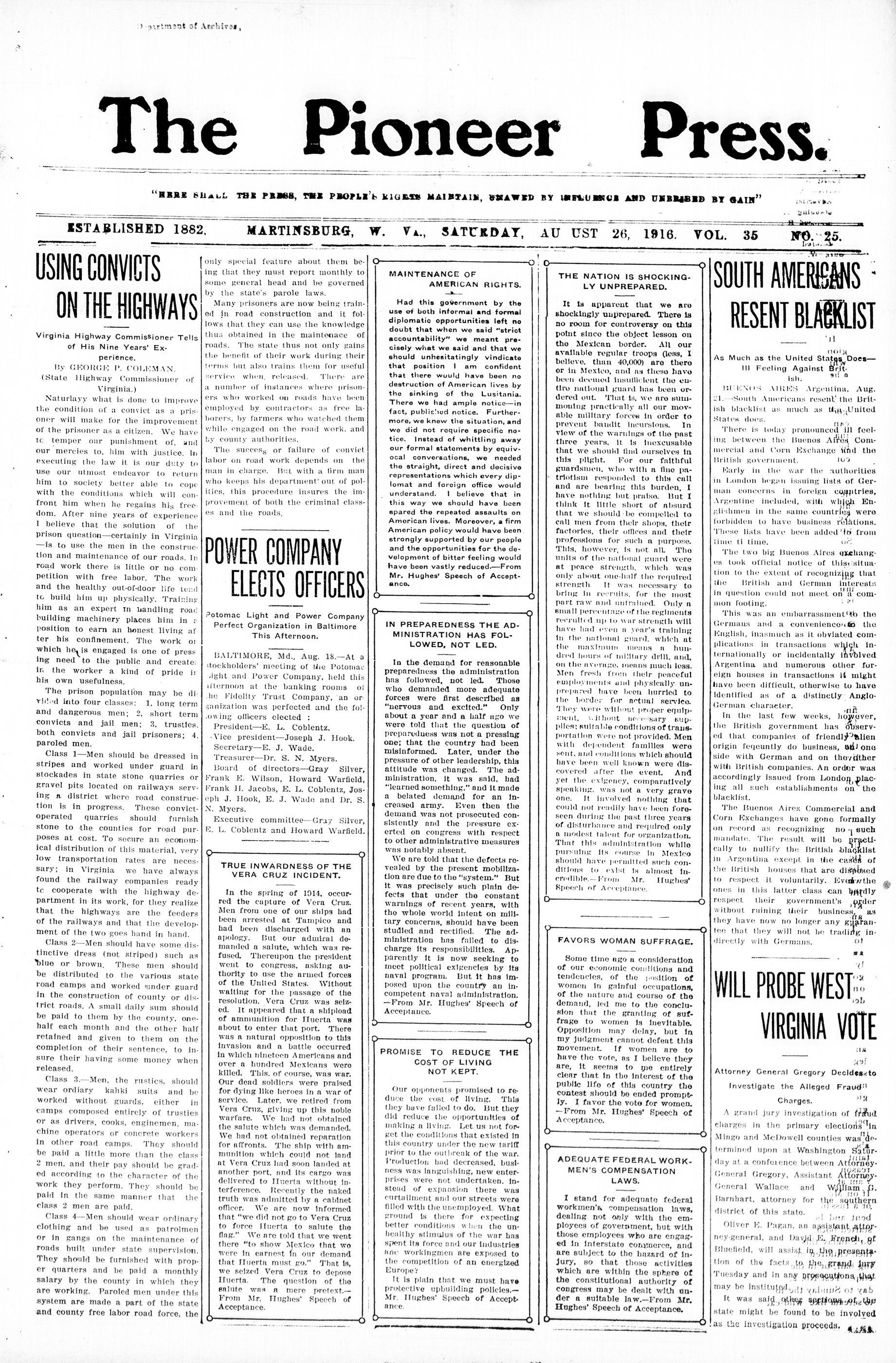
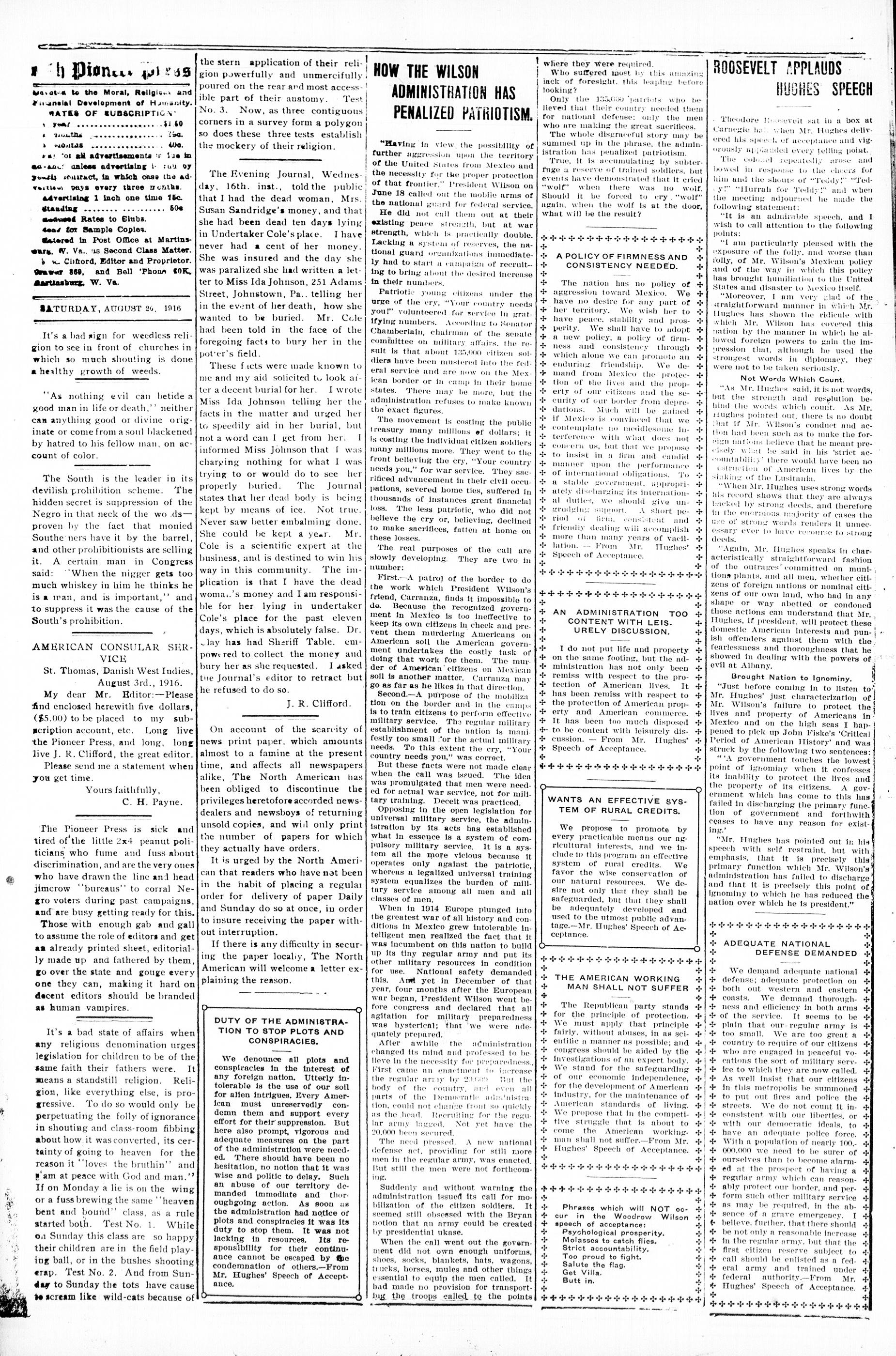
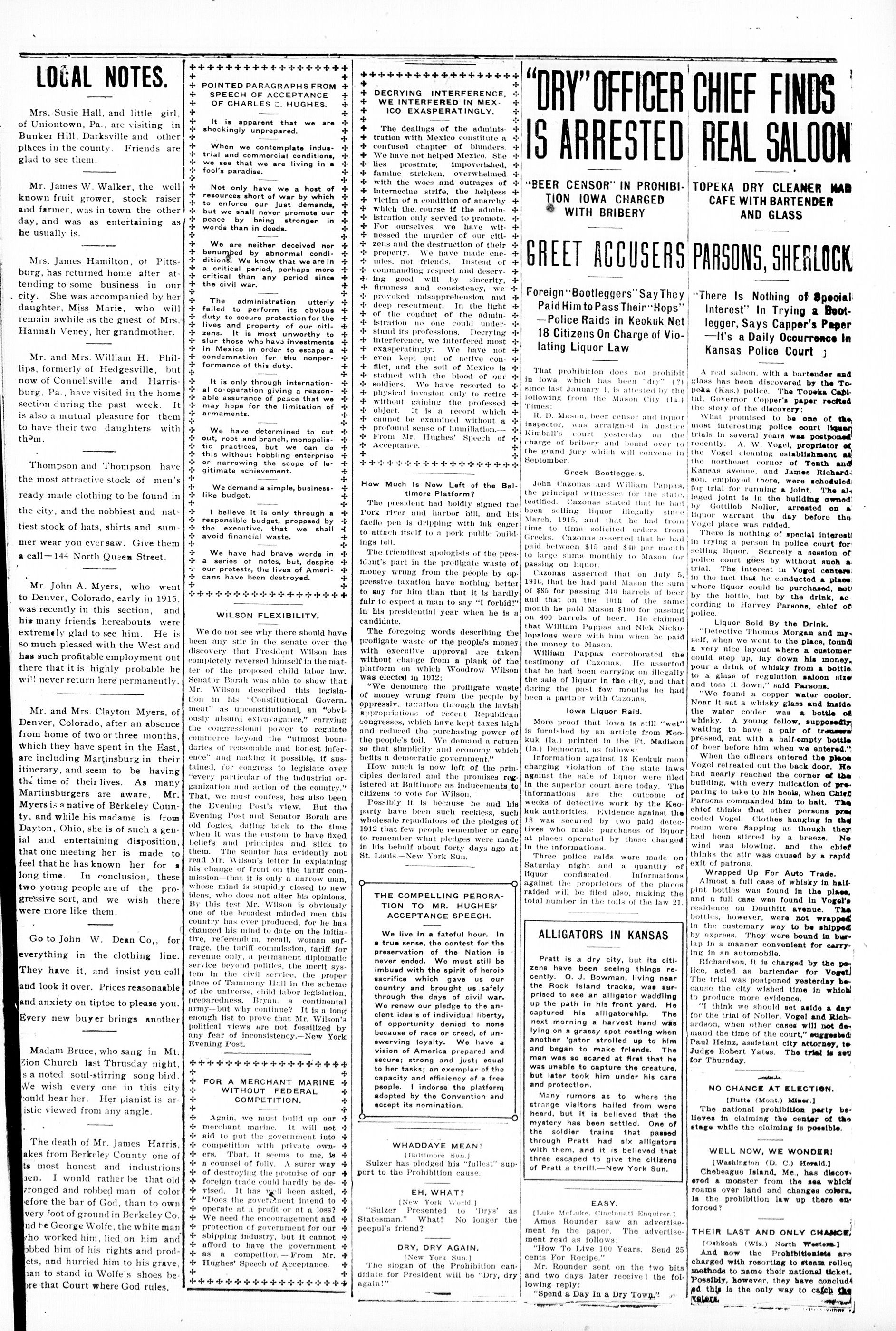
Page text (machine-generated)
The Pioneer Press.
"HERE SHALL THE PRESS, THE PEOPLE'S KIGHTS MAINTAIN, SNAWED BY INFLUENCE AND UNBRIBED BY GAIN"
Department of Archives.
USING CONVICTS ON THE HIGHWAYS
USING CONVICTS ON THE HIGHWAYS
Virginia Highway Commissioner Tells of His Nine Years' Experience.
By GEORGE P. COLEMAN.
(State Highway Commissioner of Virginia.)
Naturlayy what is done to improve the condition of a convict as a prisoner will make for the improvement of the prisoner as a citizen. We have to temper our punishment of, and our mercies to, him with justice. In executing the law it is our duty to use our utmost endeavor to return him to society better able to cope with the conditions which will confront him when he regains his freedom. After nine years of experience I believe that the solution of the prison question—certainly in Virginia—is to use the men in the construction and maintenance of our roads. In road work there is little or no competition with free labor. The work and the healthy out-of-door life tend to build him up physically. Training him as an expert in handling road building machinery places him in a position to earn an honest living after his confinement. The work or which he is engaged is one of pressing need to the public and create in the worker a kind of pride in his own usefulness.
The prison population may be divided into four classes: 1. long term and dangerous men; 2. short term convicts and jail men; 3. trustless both convicts and jail prisoners; 4. paroled men.
Class 1—Men should be dressed in stripes and worked under guard in stockades in state stone quarries or gravel pits located on railways serving a district where road construction is in progress. These convict operated quarries should furnish stone to the counties for road purposes at cost. To secure an economical distribution of this material, very low transportation rates are necessary; in Virginia we have always found the railway companies ready to cooperate with the highway department in its work, for they realize that the highways are the feeders of the railways and that the development of the two goes hand in hand.
Class 2—Men should have some distinctive dress (not striped) such as blue or brown. These men should be distributed to the various state road camps and worked under guard in the construction of county or district roads. A small daily sum should be paid to them by the county, one half each month and the other half retained and given to them on the completion of their sentence, to insure their having some money when released.
Class 3.—Men, the rustics, should wear ordinary kahki suits and be worked without guards, either in camps composed entirely of trusties or as drivers, cooks, enginemen, machine operators or concrete workers in other road camps. They should be paid a little more than the class 2 men, and their pay should be graded according to the character of the work they perform. They should be paid in the same manner that the class 2 men are paid.
Class 4—Men should wear ordinary clothing and be used as patrolmen or in gangs on the maintenance of roads built under state supervision. They should be furnished with proper quarters and be paid a monthly salary by the county in which they are working. Paroled men under this system are made a part of the state and county free labor road force, the
only special feature about them being that they must report monthly to some general head and be governed by the state's parole laws. Many prisoners are now being trained in road construction and it follows that they can use the knowledge thus obtained in the maintenance of roads. The state thus not only gains the benefit of their work during their terms but also trains them for useful service when, released. There are a number of instances where prisoners who worked on roads have been employed by contractors as free laborers, by farmers who watched them while engaged on the road work, and by county authorities.
The success $ _{s} $ or failure of convict labor on road work depends on the man in charge. But with a firm man who keeps his department out of politics, this procedure insures the improvement of both the criminal classes and the roads.
POWER COMPANY ELECTS OFFICERS
POWER COMPANY ELECTS OFFICERS
Potomac Light and Power Company Perfect Organization in Baltimore This Afternoon.
BALTIMORE, Md., Aug. 18.—At a stockholders' meeting of the Potomac Light and Power Company, held this afternoon at the banking rooms of the Fidelity Trust Company, an organization was perfected and the following officers elected :
President—E. L. Coblentz.
Vice president—Joseph J. Hook.
Secretary—E. J. Wade.
Treasurer—Dr. S. N. Myers.
Board of directors—Gray Silver, Frank E. Wilson, Howard Warfield, Frank H. Jacobs, E. L. Coblentz, Joseph J. Hook, E. J. Wade and Dr. S. N. Myers. Executive committee—Gray Silver, E. L. Coblentz and Howard Warfield.
TRUE INWARDNESS OF THE VERA CRUZ INCIDENT.
In the spring of 1914, occurred the capture of Vera Cruz. Men from one of our ships had been arrested at Tampico and had been discharged with an apology. But our admiral demanded a salute, which was refused. Thereupon the president went to congress, asking authority to use the armed forces of the United States. Without waiting for the passage of the resolution, Vera Cruz was selized. It appeared that a shipload of ammunition for Huerta was about to enter that port. There was a natural opposition to this invasion and a battle occurred in which nineteen Americans and over a hundred Mexicans were killed. This, of course, was war. Our dead soldiers were praised for dying like heroes in a war of service. Later, we retired from Vera Cruz, giving up this noble warfare. We had not obtained the salute which was demanded. We had not obtained reparation for affronts. The ship with ammunition which could not land at Vera Cruz had soon landed at another port, and its cargo was delivered to Huerta without interference. Recently the naked truth was admitted by a cabinet officer. We are now informed that "we did not go to Vera Cruz to force Huerta to salute the flag." We are told that we went there "to show Mexico that we were in earnest in our demand that Huerta must go." That is, we seized Vera Cruz to depose Huerta. The question of the salute was a mere pretext.—From Mr. Hughes' Speech of Acceptance.
MAINTENANCE OF AMERICAN RIGHTS.
Had this government by the use of both informal and formal diplomatic opportunities left no doubt that when we said "strict accountability" we meant precisely what we said and that we should unhesitatingly vindicate that position I am confident that there would have been no destruction of American lives by the sinking of the Lusitania. There we had ample notice—in fact, published notice. Furthermore, we knew the situation, and we did not require specific notice. Instead of whittling away our formal statements by equivocal conversations, we needed the straight, direct and decisive representations which every diplomat and foreign office would understand. I believe that in this way we should have been spared the repeated assaults on American lives. Moreover, a firm American policy would have been strongly supported by our people and the opportunities for the development of bitter feeling would have been vastly reduced.—From Mr. Hughes' Speech of Acceptance.
IN PREPAREDNESS THE ADMINISTRATION HAS FOLLOWED, NOT LED.
In the demand for reasonable preparedness the administration has followed, not led. Those who demanded more adequate forces were first described as "nervous and excited." Only about a year and a half ago we were told that the question of preparedness was not a pressing one; that the country had been misinformed. Later, under the pressure of other leadership, this attitude was changed. The administration, it was said, had "learned something," and it made a belated demand for an increased army. Even then the demand was not prosecuted consistently and the pressure exerted on congress with respect to other administrative measures was notably absent.
We are told that the defects revealed by the present mobilization are due to the "system." But it was precisely such plain defects that under the constant warnings of recent years, with the whole world intent on military concerns, should have been studied and rectified. The administration has failed to discharge its responsibilities. Apparently it is now seeking to meet political exigencies by its naval program. But it has imposed upon the country an incompetent naval administration. From Mr. Hughes' Speech of Acceptance.
PROMISE TO REDUCE THE COST OF LIVING NOT KEPT.
Our opponents promised to reduce the cost of living. This they have failed to do. But they did reduce the opportunities of making a living. Let us not forget the conditions that existed in this country under the new tariff prior to the outbreak of the war. Production had decreased, business was languishing, new enterprises were not undertaken. Instead of expansion there was curtailment and our streets were filled with the unemployed. What ground is there for expecting better conditions when the unhealthy stimulus of the war has spent its force and our industries are workingmen are exposed to the competition of an energized Europe?
It is plain that we must have protective upbuilding policies.—Mr. Hughes' Speech of Acceptance.
THE NATION IS SHOCKINGLY UNPREPARED.
It is apparent that we are shockingly unprepared. There is no room for controversy on this point since the object lesson on the Mexican border. All our available regular troops (less, I believe, than 40,000) are there or in Mexico, and as these have been deemed insufficient the entire national guard has been ordered out. That is, we are summoning practically all our movable military forces in order to prevent bandit incursions. In view of the warnings of the past three years, it is inexcusable that we should find ourselves in this plight. For our faithful guardsmen, who with a fine patriotism responded to this call and are bearing this burden, I have nothing but praise. But I think it little short of absurd that we should be compelled to call men from their shops, their factories, their offices and their professions for such a purpose. This, however, is not all. The units of the national guard were at peace strength, which was only about one-half the required strength. It was necessary to bring in recruits, for the most part raw and untrained. Only a small percentage of the regiments recruited up to war strength will have had even a year's training in the national guard, which at the maximum means a hundred hours of military drill, and, on the average, means much less. Men fresh from their peaceful employments and physically unprepared have been hurried to the border for actual service. They were without proper equipment, without necessary supplies; suitable conditions of transportation were not provided. Men with dependent families were sent, and conditions which should have been well known were discovered after the event. And yet the exigency, comparatively speaking, was not a very grave one. It involved nothing that could not readily have been foreseen during the past three years of disturbance and required only a modest talent for organization. That this administration while pursuing its course in Mexico should have permitted such conditions to exist is almost incredible.—From Mr. Hughes' Speech of Acceptance.
FAVORS WOMAN 8UFFRAGE.
Some time ago a consideration of our economic conditions and tendencies, of the position of women in gainful occupations, of the nature and course of the demand, led me to the conclusion that the granting of suffrage to women is inevitable. Opposition may delay, but in my judgment cannot defeat this movement. If women are to have the vote, as I believe they are, it seems to me entirely clear that in the interest of the public life of this country the contest should be ended promptly. I favor the vote for women. From Mr. Hughes' Speech of Acceptance.
ADEQUATE FEDERAL WORK-MEN'S COMPENSATION
I stand for adequate federal workmen's compensation laws, dealing not only with the employees of government, but with those employees who are engaged in interstate commerce, and are subject to the hazard of injury, so that those activities which are within the sphere of the constitutional authority of congress may be dealt with under a suitable law.—From Mr. Hughes' Speech of Acceptance.
NO. 25.
SOUTH AMERICANS RESENT BLACKLIST
As Much as the United States Does
Ill Feeling Against British.
BUENOS AIRES Argentina, Aug.
21.—South Americans resent the British blacklist as much as the United States does.
There is today pronounced ill feeling between the Buenos Aires Commercial and Corn Exchange and the British government.
Early in the war the authorities in London began issuing lists of German concerns in foreign countries, Argentine included, with which Englishmen in the same countries were forbidden to have business relations. These lists have been added to from time ti time.
The two big Buenos Aires exchanges took official notice of this situation to the extent of recognizing that the British and German interests in question could not meet on a common footing.
This was an embarrassment to the Germans and a convenience to the English, inasmuch as it obviated complications in transactions which internationally or incidentally involved Argentina and numerous other foreign houses in transactions it might have been difficult, otherwise to have identified as of a distinctly Anglo-German character.
In the last few weeks, however, the British government has observed that companies of friendly allen origin frequently do business, all one side with German and on the other with British companies. An order was accordingly issued from London placing all such establishments on the blacklist.
The Buenos Aires Commercial and Corn Exchanges have gone formally on record as recognizing no such mandate. The result will be practically to nullify the British blacklist in Argentina except in the cases of the British houses that are disposed to respect it voluntarily. Even the ones in this latter class can hardly respect their government's order without ruining their business, as they have now no longer any guarantee that they will not be trading indirectly with Germans.
WILL PROBE WEST VIRGINIA VOTE
Attorney General Gregory Decides to Investigate the Alleged Fraud Charges.
A grand jury investigation of fraud charges in the primary election in Mingo and McDowell counties was determined upon at Washington Saturday at a conference between Attorney-General Gregory, Assistant Attorney-General Wallace and William G. Barnhart, attorney for the southern district of this state.
Oliver E. Pagan, an assistant attorney-general, and David E. French, of Bluefield, will assist in the presentation of the facts to the grand jury Tuesday and in any prosecutions that may be instituted without vab. It was said other sentiments of the state might be found to be involved as the investigation proceeds.
oi Ve Piet as Set ssi Pe KE
eh Dionas wirss
———
Warat-a to the Moral, Religic.» and
Fivanelal Cevelopment of Hamsnity.
MATES OF &UBSCRIPTIC\:
V VOL cercseccccesenenee $1 60
A MUM sees seee eee eens L8G
DY WONTDB Loeeeseseseeees » WO.
va! ‘ot all advertisements ‘1 10 in
@c-an.: anless advertising |) :uu oy
Fonsi) :eurract, in which case the ad-
«eit pays every three menths.
@4vertising 1 inch one time 15c.
Standing -....... -e-eeeee 508
aecused Rates to Elubs.
4ens for Sample Copies.
Extered in Post Office at Martins-
wears, W. Va., 18 Second Class Matter.
> Chtord, Editor and Proprietor.
Qrawer 869, and Boll ‘Phons ¢0K,
@arttasburg, W. Va.
BATURDAY, AUGUST 24, 1916
It's a bad aign for wecdless reli-
gion to see in front of churches in
which so much shouting is done
ahealthy growth of weeds.
“As nothing evil can betide a
ood man in life or death,’’ neither
can anything good or divine orig-
inate or come froma soul blackened
by hatred to his fellow man, on ac-
count of color.
The South is the leader in its
devilish prohibition scheme. ‘The
hidden secret is suppression of the
Negro in that neck of the wo .ds—
proven by the fact that monied
Southe ners have it by the barrel,
and other prohibitionists are selling
it. A certain man in Congress
said: “‘When the nigger gets too
much whiskey in him he thinks he
is a wan, and is important,’”? and
to suppress it was the cause of the
South’s prohibition.
AMERICAN CONSULAR SER-
VICE
St. Thomas, Danish West Indies,
August 3rd., 1916.
My dear Mr. Hditor:—Please
find enclosed herewith five dollars,
($5.00) to be placed to my sub-
acription account, etc. Long live
the Pioncer Press, and long, long
live J. R. Clifford, the great editor.
Please send me a statement when
you get time.
Yours faithfully,
C. H. Payne.
The Pioneer Press is sick and
tired of'the little 2x4 peanut poli-
ticians who fume and fuss about
discrimination, and are the very ones
who have drawn the linc and head
jimcrow “‘bureaus’’ to corral Ne-
aro voters during past campaigns,
and are busy getting ready for this.
Those with enough gab and gall
to assume the role of editors and get
aa already printed sheet, editorial-
ly made up and fathered by them,
go over the state and gouge every
one they can, making it hard on
decent editors should be branded
as human vampires.
It's a bad state of affairs when
any religious denomination urges
legislation for children to be of the
same faith their fathers were. It
means a standstill religion. Reli-
gion, like everything else, is pro-
aressive. ‘To do so would only be
perpetuating the folly of ignorance
in shouting and class-room fibbing
about how. it was converted, its cer-
tainty of going to heaven for the
reason it ‘‘loves the bruthin’’ and
p'am at peace with God and man.”?
If on Monday a lie is on the wing
or a fuss brewing the same ‘‘heaven
bent and bound’ class, as a rule
started both. ‘Test No. i. While
oa Sunday this class are so happy
their children are in the field play-
ing ball, or in the bushes shooting
erap. Test No. 2, And from Sun-
day to Sunday the tots have cause
te scream like wild-cats because of
the stern application of their reli-
gion powerfully and unmercifully
poured on the rear ard most access
ible part of their anatomy. Test
No. 3. Now, as three contiguous
corners in a survey form a polygon
so does these three tests establish
the mockery of their religion.
‘The Evening Journal, Wednes-
day, 16th. inst., toldthe public
that I had the dead woman, Mrs
Susan Sandridge’s money, and that
she had been dead ten days lying
in Undertaker Cole's place. I have
never had a cent of her money.
She was insured and the day she
was paralized she had written a let-
ter to Miss Ida Johnson, 251 Adanis
Street, Johnstown, Pa.. telling her
in the event of herdeath, how she
wanted to be buried. Mr. Cole
had been told in the face of the
foregoing facts to bury her in the
potver’s field.
These ficts were made known to
me and my aid solicited tu look at
ter adecent burial for her. I wrote
Miss Ida Johnsou telling her the
facts in the matter and urged her
to speedily aid in her burial, but
not a word can I get from her. 1
informed Miss Johnson that [ was
charying nothing for what I was
trying to or would do to see her
properly buried. ‘The Journal
states that her dead body is being
kept by means of ice. Not true.
‘Never saw better embalming done.
She could be kept a year. Mr.
Cole is a scientific expert at the
business, and is destined to win his
a in this community. The im-
plication is that I have the dead
woma..’s money and I am responsi-
ble for her lying in undertaker
Cole's place for the past eleven
days, which is absolutely false. Dr.
clay has had Sheriff Table. em-
powcred to collect the money and
bury her as she requested. I asked
tne Journal's editor to retract but
he refused to do so.
J. R. Clifford.
On account of the scarcity of
news print paper, which amounts
almost to a famine at the present
time, and affects all newspapers
alike, The North American has
been obliged to discontinue the
privileges heretofore accorded news-
dealers and newsboys of returning
unsold copies, and wiil only print
the number of papers for which
they actually have orders.
It is urged by the North Ameri-
can that readers who have not been
in the habit of placing a regular
order for delivery of paper Daily
and Sunday do so at once, in order
to insure receiving the paper with-
out interruption.
If there is any difficulty in secur-
ing the paper locally, The North
American will welcome a letter ex-
plaining the reason.
DUTY OF THE ADMINISTRA-
TION TO STOP PLOTS AND
CONSPIRACIES,
We denounce all plots and
conspiracies in the taterest of
any foreign nation, Utterly in-
tolerable is the use of our soil
for alien intrigues, Every Amer-
ican must unreservedly con-
demn them and support every
effort for their suppression. But
here also prompt, vigorous and
adequate measures on the part
of the administration were necd-
ed. There should have been no
hesitation, no notion that it was
wise and politic to delay. Such
an abuse of our territory de-
manded immodiate and thor:
oughgoing action. As soon us
the administration had notice of
plots and conspiracies it was its
duty to stop them. It was not
lacking in resources, Its re
sponsibility for their continu-
ance cannot be escaped by the
condemnation of others.—From
Mr. Hughes’ Speech of Accept-
ance,
HOW THE WILSON
ADMINISTRATION HAS
PENALIZED PATRIOTISM,
Beye ee aaa ey Ra eens ae Oe ne
of the United States trom Mexico and
the necessity for tke proper protection
of that frontier,” President Wilson on
Jane 18 called out the mobiic arms of
the national jusrd for federal service.
He did not cull them out at their
existing peace streacth, but at war
strength, which ts practically double.
Lacking a syste of reserves, the na-
tonal guard oreanizations immediate-
ly had to start a cunpaign of recruit
Ang to bring about the desired increase
in thelr numbers.
Patriotic young citizens under the
urge of the ery, “Your country needs
you!” volunteered for service jn ygrat-
{fying numbers. According to Senator
Chamberlain, chairman of the senate
cominittee on military atfairs, the re.
sult is that about 125,000 citizen sol
Aiers have been mustered into the fod-
eral service and xre now on the Mex
jean border or in camp tn their home
states. ‘There may be more, but the
administration refuses to make known
the exact figures.
The movement ss costing the public
treasury many millions ef dollars; it
{s costing the Individual citizen soldiers
many millions more. ‘They went to the
front believing the cry, “Your country
needs you," for war service. They sne-
rificed advancement tn thelr elvil occu.
patlons, severed home ties, suffered in
thousands of instances great financtal
loss. ‘Phe lesy patriotic, who did not
believe the cry or, believing, declined
to make sacrifices, fatten at home on
these losses.
The real purposes of the call are
slowly developing. They are two in
number:
First.—A patro} of the border to do
the work which President Wilson’s
friend, Carranza, finds it impossible to
do. Because the recognized govern-
ment In Mexico ts too ineffective to
keep its own citizens in check and pre-
vent them murdering Americans on
American soll the American goyern-
ment undertakes the costly task of
doing that work for them. ‘The mur.
der of American’ citizens on Mexican
soll {9 another matter, Carranza may
Bo as far ay he likes in that direction.
Second.—A purpose of the mobiliza
tion on the border and in the exmps
is to train citizens to perform effective
military service. Tho regular military
establishment of the nation is mani
festly too small “or the actual military
needs. To this extent the ery, “Your
country needs you,” was correct.
But these facts were not made clear
when the call was issued. ‘The idea
was promulgated that men were need-
ed for actual war service, not for mill-
tary training. Decelt was practiced,
Opposing In the open legislation for
universal military service, the admin-
istration by its acts has established
what in essence is a system of com-
pulsory military service. It is a sys-
tem all the more vicious because ft
operates only against the patriotic,
whereas a legalized universal training
system equalizes the burden of mill.
tary service among all men and all
classes of men,
When in 1914 Europe plunged into
the greatest war of all history and con-
ditions in Mexico grew intolerable in-
telligent men realized the fact that it
| Was Incumbent on this nation to build
up Sts tiny regular army and put its
other military resources in condition
for use. National safety demanded
this, Amt yet in December of that
‘year, four months after the European
war began, President Wilson went be-
fore congress and declared that all
agitation for military preparedness
was hysterical; that we were ade-
quately prepared.
| After awhile the aéministration
changed fts mind and professed to be
Heve in the necessity for preparedness.
First came an enactment to increase
the regular aray by 20609 Bat the
body of the country, and even all
parts of the Democrathe adevnistra
(lon, contd not chine front so quiekly
as the head. Recruiting for the regu
lar army Iageed, Not yet have the
20,000 been secured
The need pressed, A new national
defense act, providing for still more
men in the regular army, was enacted.
where they were required.
Who suffered most hy this amezins
jack of foresight. this leaping before
looking?
Only the 135,000 ‘patriots who be
Hieved that their country needed them
for national defense: only the men
who are making the great sacrifices.
The whole diseraceful story may be
summed up in the phrase, the admin-
istration las penalized patriotism.
True, it is accumulating by) subter-
fge a reserve of trained soldiers, but
events have demonstrated that it cried
“wolf? when there was no wolf,
Should it be forced to ery. “wolf”
again, when the wolf is at the door,
what will be the result?
A POLICY OF FIRMNESS AND.
CONSISTENCY NEEDED.
The nation has no policy of +
% aggression toward Mexico. We -
% have no desire for any part of. +
+ her territory. We wish her to -
tb have peace. stability and pros -
perity, We shall have to adopt -
‘Fo a new policy, a policy of firm. +
ness and consistency through -
* which alone we can promote an -
endurins friendship. We de- +
*F mand from Mexico the protee- +
tion of the lives and the prop- +
erty of our citizens and the se- +
+ curity of our border from depre-
dations. Much will be Hained +
+ if Mexico is convinced that we.
+ contemplate no meddiesoine ine +
Fo terference with what docs not. +
convern us, but that we propose
‘eto insist in a firm and eandid 4
+ manner upon the performance
+ of international obligations, ‘To.
Soa stable government, appropri- 4
ately discharzing its internation- 4
eal duties, we should give une 4
osrudging: snpoort, A short pe- 4
oriod us dirt. consistont and ¢
e friendiy dealing wili xccomplish 4
+ more than many years of vacll-
e lation. -- From) Mr. TMusthest 4
+ Speech of Acceptance. :
+ 4
she Te oe ole ole ole le ode ote le ode fe fe te ope ote tea
+ AN ADMINISTRATION TOO
CONTENT WITH LEIS.
- URELY DISCUSSION.
- ae
Ido not put life and property
+ on the same footing, but the nd-
+ ministration has not only been
% remiss with respect to the pro-
% tection of American lives. It
+ has been remiss with respect to
© the protection of American prop-
% erty and American commerce.
It has been too much disposed
i+ to be content with leisurely dis-
+ cussion. — From Mr. Tughes’
* Speech of Acceptance.
- :
He fe ole fe afe ofe ale oe ale fe fe ele ole ofe ote ote ope.
WANTS AN EFFECTIVE sys-
TEM OF RURAL CREDITS.
We propose to promote by
every practicable means our ag:
rieultural interests, and we in-
clude iv this program an effective
system of rural credits. We
favor the wise conservation of
our natural resources. We de-
sire not only that they shall be
safeguarded, but that they shall
be adequately developed and
used to the utmost public advan-
tage.—Mr. Hughes’ Specch of Ac-
ceptance.
+ THE AMERICAN WORKING
* MAN SHALL NOT SUFFER
, i
- = The Republican party stands
F for the principle of protection. »
' We must apply that principle |
+ fairly, without abuses, in as sei
+ entific a manner as possible; and
F congress should be aided by tlie
+ investigations of an expert body.
* We stand for the safeguarding
* of our economic independence,
* for the development of American
+ industry, for (he maintenance of -
- American standards of living. |
+ We propose that in the competi-
F tive struggle that is about to
- come the American working
* man shall not suffer—From Mr.
! Hughes’ Speech of Acceptance.
l.
So ode ole ole ofr ode fe fe he ole of fe ole fe of ope ote.
Phrases which will NOT oc-
/ cur in the Woodrow Wilson
/ spooch of acceptance:
/ Psychological prosperity.
/ Molasses to catch flies,
/ Strict accountability,
| Too proud to fight.
/ Salute the flag.
Get Villa.
Butt in,
ROOSEVELT APPLAUDS =
HUGHES SPEECH
Theodore Howeveit sat in a box at
Carnegio he when Mr. ILughes deliv
ered bis specter acceptance and vig:
orously ap puroded every telling point.
The colucel repeatedly arose and
bowed Hn respacse ty the choers for
him aud the sbouts of Pecdy!" “Ted:
yEo“ifurral for ‘Feddy!" and when
the meeting adjourned he made. the
following statement:
“It is an admirable speceh, and 1
wish to call attention to the following
points:
“Lum particularly pleased with the
exposure of the folly, and worse than
folly, of Mr, Wilson's Mexican policy
and of the way in which this policy
has brought humiliation to the United
Stites and disaster to Mexico itself
“Moreover, Tam very slat of the
straightforward manner in which Mr.
Hughes hus shown the ridicule with
Which Mr. Wilson his covered this
sation by the manner in whieh he al-
lowed foreign powers to gain the Im-
pression that, although he used. the
Strongest words in diplomacy, they
were not to be taken seriously.
Not Words Which Count.
“As Mr. Uuches said, it is net words,
but the strensth and resplution be-
hind the words which count. As Mr.
Hughes pointed out, there is no doubt
hat if Mr. Wilson's conduct and ac.
tien had been such as to make the for-
sin nations believe that he meant pre-
cisely What he said in his ‘strict ae:
vountubilics” there would have been no
Gstruction of American lives by. the
siokine of the Lusitania,
“When Mr. Huzhes uses strong words
his record shows that they are always
backed by stron deods, and therefore
fr the enormous majority of cases the
ue of stron words renders it unnee-
essary ever to have recourse to strong
deeds.
“Again, Mr. {Hughes speaks in char-
acteristically straightforward fashion
of the outrases” committed on munt-
tions plants, and all men, whether citi
zeus of foreign nations or nominal citl-
zens of our own land, who had in any
shape or way abetted or condoned
those actions ean understand that Mr. ,
Hughes, if president. will protect these
domestic American Interests and pun- |
ish offenders against them with the
fearlessness und thoroughness that he
showed in dealing with the powers of
evil at Albany, {
Brought Nation to Ignominy, 4
“Just before coming in to listen to%
Mr. Hughes’ just characterization of |
Mr. Wilson's failure to protect the!
lives and property of Americans in!
Mexico and on the high seas 1 hap-!
pened to plck up John Fiske’s ‘Critical
Period of American History’ and was
struck by the following two sentences:
“*A government touches the lowest |
point of ignominy when it confesses |
its inability to protect the lives and {
the property of its citizens. A goy-
ernment which has come to this has
failed In discharging the primary func.
tion of government and forthwith
ceases to have any reason for exist-
ing?
“Mr. Hughes has pointed out in his
speech with self restraint, but with
emphasis, that it is precisely this
primary function which Mr. Wilson's
ndministration has failed to discharge
und that it is precisely this point of
ignominy to which he has reduced the
nation over which he 1s president.”
ADEQUATE NATIONAL
DEFENSE DEMANDED
We demand adequate national
+ defense; adequate protection on
+ both out western and eastern
+ coasts. We demand thorough-
ness and eflicieney in both arms
of the service. It seems to be
+ plain that our regular army is
+ too small. We are too great a
+ country to require of our citizens
+ who are engaged in peaceful vo-
+ cations the sort of military sery-
+ ice to which they are now called.
‘+ As well insist that our citizens
+ in this metropolis be summoned
+ to put out fires and police the
+ streets. We do not count 4t in-
+ consistent with our liberties, or
+ with our democratic ideals, to
+ have an adequate police force,
4 With a population of nearly 100,-
4 000,000 we need to be surer of |
+ ourselves than to heeome alarm:
toed at the prospect of having a.
regular army which ean reason-
4 ably protect our border, and por-
* form such other military service
+ as may be required, in the ab.
+ sence of a grave emergency. 1
& believe, further, that there should
+ be not only a reasonable increase
in the regular army, but that the
+ first citizen reserve subject to
+ call should be enlisted as a fed.
+ eral army and trained under
+ federal authority.—From Mr. »
4% Ilughes’ Speech of Acceptance. «
es .
fe ofe of ofe ofe ake ole ske ale ate ole ofe ofe ole cle ole cle,
LOCAL NOTES.
Mrs. Susie Hall, and little girl, of Uniontown, Pa., are visiting in Bunker Hill, Darksville and other places in the county. Friends are glad to see them.
Mr. James W. Walker, the well known fruit grower, stock raiser and farmer, was in town the other day, and was as entertaining as he usually is.
Mrs. James Hamilton, of Pittsburg, has returned home after attending to some business in our city. She was accompanied by her daughter, Miss Marie, who will remain awhile as the guest of Mrs. Hannah Veney, her grandmother.
Mr. and Mrs. William H. Phillips, formerly of Hedgesville, but now of Connellsville and Harrisburg, Pa., have visited in the home section during the past week. It is also a mutual pleasure for them to have their two daughters with them.
Thompson and Thompson have the most attractive stock of men's ready made clothing to be found in the city, and the nobbiest and nattiest stock of hats, shirts and summer wear you ever saw. Give them a call-144 North Queen Street.
Mr. John A. Myers, who went to Denver, Colorado, early in 1915, was recently in this section, and his many friends hereabouts were extremely glad to see him. He is so much pleased with the West and has such profitable employment out there that it is highly probable he will never return here permanently.
Mr. and Mrs. Clayton Myers, of Denver, Colorado, after an absence from home of two or three months, which they have spent in the East, are including Martinsburg in their itinerary, and seem to be having the time of their lives. As many Martinsburgers are aware, Mr. Myers is a native of Berkley County, and while his madame is from Dayton, Ohio, she is of such a genial and entertaining disposition, that one meeting her is made to feel that he has known her for a long time. In conclusion, these two young people are of the progressive sort, and we wish there were more like them.
Go to John W. Dean Co., for everything in the clothing line. They have it, and insist you call and look it over. Prices reasonaable and anxiety on tiptoe to please you. Every new buyer brings another
Madam Bruce, who sang in Mt. Zion Church last Thrusday night, is a noted soul-stirring song bird. We wish every one in this city could hear her. Her pianist is artistic viewed from any angle.
The death of Mr. James Harris, takes from Berkeley County one of its most honest and industrious men. I would rather be that old wronged and robbed man of color before the bar of God, than to own very foot of ground in Berkeley Co. and be George Wolfe, the white man who worked him, lied on him and robbed him of his rights and products, and hurried him to his grave, man to stand in Wolfe's shoes before that Court where God rules.
POINTED PARAGRAPHS FROM SPEECH OF ACCEPTANCE OF CHARLES E. HUGHES.
It is apparent that we are shockingly unprepared.
When we contemplate industrial and commercial conditions, we see that we are living in a fool's paradise.
Not only have we a host of resources short of war by which to enforce our just demands, but we shall never promote our peace by being stronger in words than in deeds.
We are neither deceived nor benumbed by abnormal conditions. We know that we are in a critical period, perhaps more critical than any period since the civil war.
The administration utterly failed to perform its obvious duty to secure protection for the lives and property of our citizens. It is most unworthy to slur those who have investments in Mexico in order to escape a condemnation for the nonperformance of this duty.
It is only through international co-operation giving a reasonable assurance of peace that we may hope for the limitation of armaments.
We have determined to cut out, root and branch, monopolistic practices, but we can do this without hobbling enterprise or narrowing the scope of legitimate achievement.
We demand a simple, business-like budget.
I believe it is only through a responsible budget, proposed by the executive, that we shall avoid financial waste.
We have had brave words in a series of notes, but, despite our protests, the lives of Americans have been destroyed.
WILSON FLEXIBILITY.
We do not see why there should have been any stir in the senate over the discovery that President Wilson has completely reversed himself in the matter of the proposed child labor law. Senator Borah was able to show that Mr. Wilson described this legislation in his "Constitutional Government" as unconstitutional, an "obviously absurd extravagance," carrying the congressional power to regulate commerce beyond the "utmost boundaries of reasonable and honest inference" and making it possible, if sustained, for congress to legislate over "every particular of the industrial organization and action of the country." That, we must confess, has also been the Evening Post's view. But the Evening Post and Senator Borah are old fogies, dating back to the time when it was the custom to have fixed beliefs and principles and stick to them. The senator has evidently not read Mr. Wilson's letter in explaining his change of front on the tariff commission—that it is only a narrow man, whose mind is stupidly closed to new ideas, who does not alter his opinions. By this test Mr. Wilson is obviously one of the broadest minded men this country has ever produced, for he has changed his mind to date on the initiative, referendum, recall, woman suffrage, the tariff commission, tariff for revenue only, a permanent diplomatic service beyond politics, the merit system in the civil service, the proper place of Tammany Hall in the scheme of the universe, child labor legislation, preparedness. Bryan, a continental army—but why continue? It is a long enough list to prove that Mr. Wilson's political views are not fossilized by any fear of inconsistency.—New York Evening Post.
FOR A MERCHANT MARINE WITHOUT FEDERAL COMPETITION.
Again, we must build up our merchant marine. It will not aid to put the government into competition with private owners. That, it seems to me, is a counsel of folly. A surer way of destroying the promise of our foreign trade could hardly be devised. It has well been asked, "Does the government intend to operate at a profit or at a loss? We need the encouragement and protection of government for our shipping industry, but it cannot afford to have the government as a competitor.—From Mr. Hughes' Speech of Acceptance.
DECRYING INTERFERENCE WE INTERFERED IN MEXICO EXASPERATINGLY.
The dealings of the administration with Mexico constitute a confused chapter of blunders. We have not helped Mexico. She lies prostrate, impoverished, famine stricken, overwhelmed with the woes and outrages of internecine strife, the helpless victim of a condition of anarchy which the course if the administration only served to promote. For ourselves, we have witnessed the murder of our citizens and the destruction of their property. We have made enemies, not friends. Instead of commanding respect and deserving good will by sincerity, firmness and consistency, we provoked misapprehension and deep resentment. In the light of the conduct of the administration no one could understand its professions. Decrying interference, we interfered most exasperatingly. We have not even kept out of active conflict, and the soil of Mexico is stained with the blood of our soldiers. We have resorted to physical invasion only to retire without gaining the professed object. It is a record which cannot be examined without a profound sense of humiliation.—From Mr. Hughes' Speech of Acceptance.
---
How Much Is Now Left of the Baltimore Platform?
The president had boldly signed the Pork river and harbor bill, and his facile pen is dripping with ink eager to attach itself to a pork public buildings bill.
The friendliest apologists of the president's part in the profligate waste of money wrung from the people by oppressive taxation have nothing better to say for him than that it is hardly fair to expect a man to say "I forbid!" in his presidential year when he is a candidate.
The foregoing words describing the profligate waste of the people's money with executive approval are taken without change from a plank of the platform on which Woodrow Wilson was elected in 1912:
"We denounce the profligate waste of money wrung from the people by oppressively taxation through the lavish appropriations of recent Republican congresses, which have kept taxes high and reduced the purchasing power of the people's toil. We demand a return so that simplicity and economy which befits a democratic government."
How much is now left of the principles declared and the promises registered at Baltimore as inducements to citizens to vote for Wilson.
Possibly it is because he and his party have been such reckless, such wholesale repudiators of the pledges of 1912 that few people remember or care to remember what pledges were made in his behalf about forty days ago at St. Louis.—New York Sun.
THE COMPELLING PERORATION TO MR. HUGHES' ACCEPTANCE SPEECH.
We live in a fateful hour. In a true sense, the contest for the preservation of the Nation is never ended. We must still be imbued with the spirit of heroic sacrifice which gave us our country and brought us safely through the days of civil war. We renew our pledge to the ancient ideals of individual liberty, of opportunity denied to none because of race or creed, of unswerving loyalty. We have a vision of America prepared and secure; strong and just; equal to her tasks; an exemplar of the capacity and efficiency of a free people. I indorse the platform adopted by the Convention and accept its nomination.
WHADDAYE MEAN?
Sulzer has pledged his "fullest" sup port to the Prohibition cause.
"Sulzer Presented to 'Drys' as Statesman." What! No longer the peepul's friend?
The slogan of the Prohibition candidate for President will be "Dry, dry again!"
"DRY"OFFICER IS ARRESTED
"BEER CENSOR" IN PROHIBITION IOWA CHARGED WITH BRIBERY
GREET ACCUSERS
Foreign"Bootleggers"Say They Paid Him to Pass Their"Hops"
—Police Raids in Keokuk Net 18 Citizens On Charge of Violating Liquor Law
That prohibition does not prohibit in Iowa, which has been "dry" (?) since last January 1, is attested by the following from the Mason City (la.) Times:
R. D. Mason, beer censor and liquor inspector, was arraigned in Justice Kimball's court yesterday on the charge of bribery and bound over to the grand jury which will convene in September.
Greek Bootleggers.
John Cazonas and William Pappas, the principal witnesses for the state, testified. Cazonas stated that he had been selling liquor illegally since March, 1915, and that he had from time to time solicited orders from Greeks. Cazonas asserted that he had paid between $15 and $40 per month to large sums monthly to Mason for passing on liquor. Cazonas asserted that on July 5, 1916, that he had paid Mason the sum of $85 for passing 340 barrels of beer and that on the 10th of the same month he paid Mason $100 for passing on 400 barrels of beer. He claimed that William Pappas and Nick Nickolopalous were with him when he paid the money to Mason.
William Pappas corroborated the testimony of Cazonas. He asserted that he had been carrying on illegally the sale of liquor in the city, and that during the past few months he had been a partner with Cazonas.
Iowa Liguor Raid.
More proof that Iowa is still "wet" is furnished by an article from Keokuk (la.) printed in the Ft. Madison (la.) Democrat, as follows:
Information against 18 Keokuk men charging violation of the state laws against the sale of liquor were filed in the superior court here today. The informations are the outcome of weeks of detective work by the Keokuk authorities. Evidence against the 18 was secured by two paid detectives who made purchases of liquor at places operated by those charged in the informations.
Three police raids were made on Saturday night and a quantity of liquor confiscated. Informations against the proprietors of the places raided will be filed also, making the total number in the tolls of the law 21.
ALLIGATORS IN KANSAS
Pratt is a dry city, but its citizens have been seeing things recently. O. J. Bowman, living near the Rock Island tracks, was surprised to see an alligator waddling up the path in his front yard. He captured his alligatorship. The next morning a harvest hand was lying on a grassy spot roasting when another 'gator strolled up to him and began to make friends. The man was so scared at first that he was unable to capture the creature, but later took him under his care and protection.
Many rumors as to where the strange visitors hailed from were heard, but it is believed that the mystery has been settled. One of the soldier trains that passed through Pratt had six alligators with them, and it is believed that three escaped to give the citizens of Pratt a thrill—New York Sun.
EASY.
[Luke McLuke, Cincinnati Enquirer.]
Amos Rounder saw an advertisement in the paper. The advertisement read as follows:
Mr. Rounder sent on the two bits and two days later receive! the following reply:
TOPEKA DRY CLEANER MAR CAFE WITH BARTENDER AND GLASS
PARSONS, SHERLOCK
"There Is Nothing of Special Interest" In Trying a Bootleger, Says Capper's Paper It' s a Daily Occurrence In Kansas Police Court A real saloon, with a bartender and glass has been discovered by the Topeka (Kas.) police. The Topeka Capital, Governor Copper's paper recited the story of the discovery:
What promised to be one of the most interesting police court liquor trials in several years was postponed recently. A. W. Vogel, proprietor of the Vogel cleaning establishment at the northeast corner of Teeth and Kansas avenue, and James Richardson, employed there, were scheduled for trial for running a joint. The alleged joint is in the building owned by Gottlob Noller, arrested on a liquor warrant the day before the Vogel place was raided.
There is nothing of special interest in trying a person in police court for selling liquor. Scarcely a session of police court goes by without such a trial. The interest in Vogel centers in the fact that he conducted a place where liquor could be purchased, not by the bottle, but by the drink, according to Harvey Parsons, chief of police.
Liquor Sold By the Drink.
"Detective Thomas Morgan and myself, when we went to the place, found a very nice layout where a customer could step up, lay down his money, pour a drink of whisky from a bottle to a glass of regulation saloon size and toss it down," said Parsons.
"We found a copper water cooler. Noar it sat a whisky glass and inside the water cooler was a bottle of whisky. A young fellow, supposedly waiting to have a pair of treasurs pressed, sat with a half-empty bottle of beer before him when we entered."
When the officers entered the place Vogel retreated out the back door. He had nearly reached the corner of the building, with every indication of preparing to take to his heels, when Chief Parsons commanded him to halt. The chief thinks that other persons preceded Vogel. Clothes hanging in the room were flapping as though they had been stirred by a breeze. No wind was blowing, and the chief thinks the stir was caused by a rapid exit of patrons.
Almost a full case of whisky in half-pint bottles was found in the place, and a full case was found in Vogel's residence on Douthitt avenue. The bottles, however, were not wrapped in the customary way to be shipped by express. They were bound in burlap in a manner convenient for carrying in an automobile. Richardson, it is charged by the police, acted as bartender for Vogel. The trial was postponed yesterday because the city wished time in which to produce more evidence. "I think we should set aside a day for the trial of Noller, Vogel and Richardson, when other cases will not demand the time of the court," suggested Paul Heinz, assistant city attorney, to Judge Robert Yates. The trial is set for Thursday.
محمد حسن
NO CHANCE AT ELECTION.
The national prohibition party believes in claiming the center of the stage while the claiming is possible.
Chebeague Island, Me., has discovered a monster from the sea which roams over land and changes colora. Is the prohibition law up there enforced?
THEIR LAST AND ONLY CHANCE
[Oshkosh (Wis.) North Western.]
And now the Prohibitionists are charged with resorting to steam roller methods to name their national ticket. Possibly, however, they have concluded this is the only way to catch the voters.
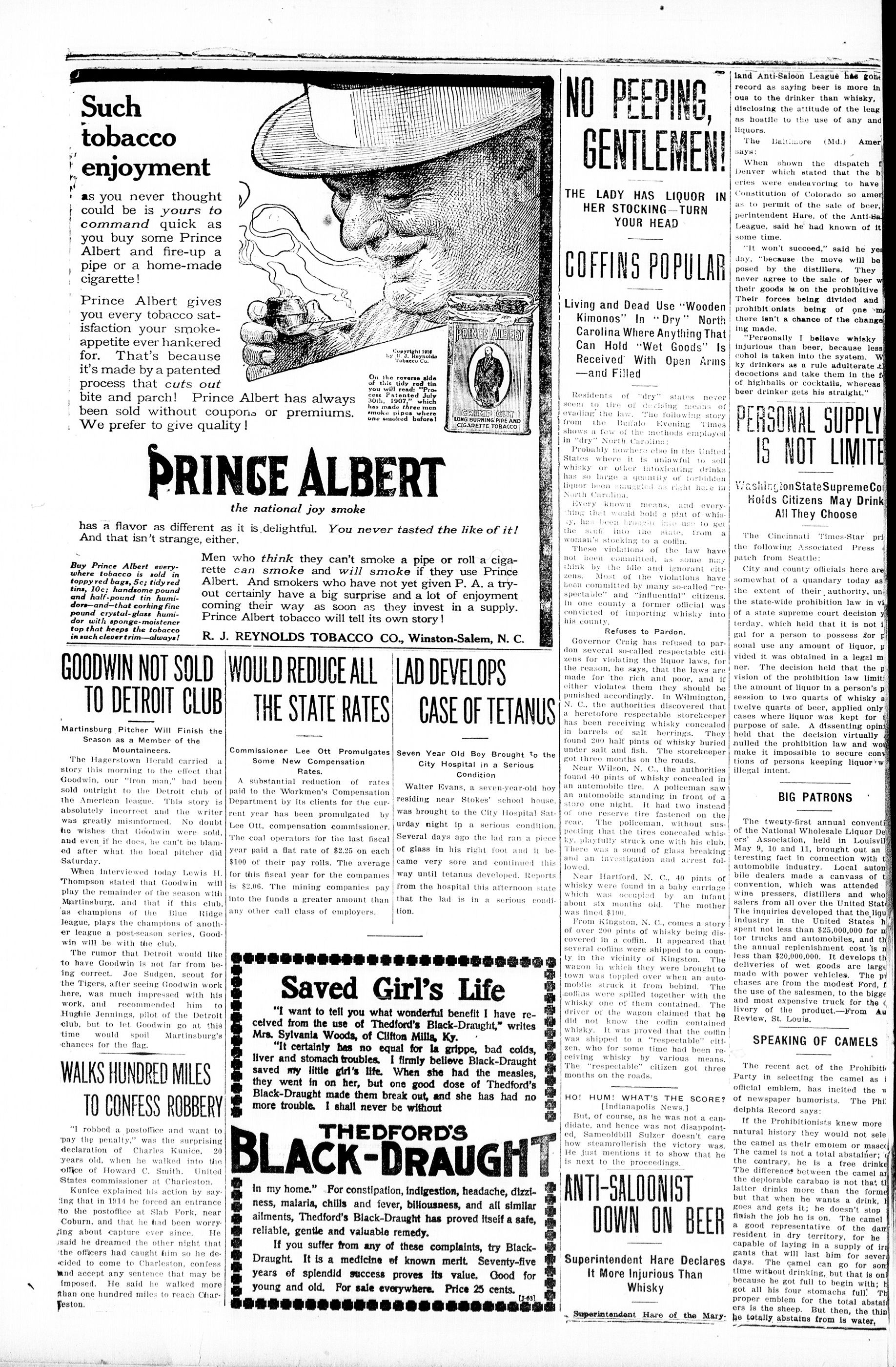
bite and parch! Prince Albert has always been sold without coupons or premiums. We prefer to give quality!
PRINGE ALBERT
has a flavor as different as it is delightful. You never tasted the like of it! And that isn't strange, either.
Such tobacco enjoyment
as you never thought could be is yours to command quick as you buy some Prince Albert and fire-up a pipe or a home-made cigarette!
Prince Albert gives you every tobacco satisfaction your smoke-appetite ever hankered for. That's because it's made by a patented process that cuts out
bite and parch! Prince been sold without cou We prefer to give qua PRII has a flavor as different And that isn't strange, either
Buy Prince Albert everywhere tobacco is sold in toppy padded bags, 5c; tidy red tins, 10c; handsome pound and half-pound tin humidors—and that corking fine pound crystal-glass humidor with sponge-moistener top that keeps the tobacco in such clever trim—always!
GOODWIN NOT SOLD TO DETROIT CLUB
Martinsburg Pitcher Will Finish the Season as a Member of the Mountaineers.
The Hagerstown Herald carried a story this morning to the effect that Goodwin, our "iron man," had been sold outright to the Detroit club of the American league. This story is absolutely incorrect and the writer was greatly misinformed. No doubt he wishes that Goodwin were sold, and even if he does, he can't be blamed after what the local pitcher did Saturday.
When Interviewed today Lewis H. Thompson stated that Goodwin will play the remainder of the season with Martinsburg, and that if this club, as champions of the Blue Ridge league, plays the champions of another league a post-season series, Goodwin will be with the club.
The rumor that Detroit would like to have Goodwin is not far from being correct. Joe Sudgen, scout for the Tigers, after seeing Goodwin work here, was much impressed with his work, and recommended him to Hughie Jennings, pilot of the Detroit club, but to let Goodwin go at this time would spoil Martinsburg's chances for the flag.
WALKS HUNDRED MILES TO CONFESS ROBBERY
"I robbed a postoffice and want to pay the penalty," was the surprising declaration of Charles Kunice, 20 years old, when he walked into the office of Howard C. Smith, United States commissioner at Charleston. Kunice explained his action by saying that in 1914 he forced an entrance to the postoffice at Slab Fork, near Coburn, and that he had been worrying about capture ever since. He said he dreamed the other night that the officers had caught him so he decided to come to Charleston, confess and accept any sentence that may be imposed. He said he walked more than one hundred miles to reach Charleston.
---
Copyright 1916
by R. J. Reynolds
Tobacco Co.
On the reverse side
of this tidy red tin
you will read: "Process Patented July
Albert has always
as it is delightful. You never ever.
who think they can't smoke can smoke and will smoke art. And smokers who have not certainly have a big surprise in their way as soon as the vice Albert tobacco will tell its o. REYNOLDS TOBACCO CO
Men who think they can't smoke a pipe or roll a cigarette can smoke and will smoke if they use Prince Albert. And smokers who have not yet given P. A. a tryout certainly have a big surprise and a lot of enjoyment coming their way as soon as they invest in a supply. Prince Albert tobacco will tell its own story!
R. J. REYNOLDS TOBACCO CO., Winston-Salem, N. C.
WOULD REDUCE ALL THE STATE RATES
Commissioner Lee Ott Promulgates Some New Compensation Rates. A substantial reduction of rates paid to the Workmen's Compensation Department by its clients for the current year has been promulgated by Lee Ott, compensation commissioner. The coal operators for the last fiscal year paid a flat rate of $2.25 on each $100 of their pay rolls. The average for this fiscal year for the companies is $2.06. The mining companies pay into the funds a greater amount than any other call class of employers.
---
Saved Girl's Life
"I want to tell you what wonderful benefit I have received from the use of Thedford's Black-Draught," writes Mrs. Sylvania Woods, of Clifton Mills, Ky.
"It certainly has no equal for la gripe, bad colds, liver and stomach troubles. I firmly believe Black-Draught saved my little girl's life. When she had the measles, they went in on her, but one good dose of Thedford's Black-Draught made them break out, and she has had no more trouble. I shall never be without
in my home." For constipation, indigestion, headache, dizziness, malaria, chills and fever, billiousness, and all similar ailments, Thedford's Black-Draught has proved itself a safe, reliable, gentle and valuable remedy.
If you suffer from any of these complaints, try Black-Draught. It is a medicine of known merit. Seventy-five years of splendid success proves its value. Good for young and old. For sale everywhere. Price 25 cents.
the national joy smoke
On the reverse side of this tidy red tin you will read: "Process Patented July 30th, 1907," which has made three men smoke pipes where one smoked before!
LAD DEVELOPS CASE OF TETANUS
Seven Year Old Boy Brought to the City Hospital in a Serious Condition
Walter Evans, a seven-year-old boy residing near Stokes' school house, was brought to the City Hospital Saturday night in a serious condition. Several days ago the lad ran a piece of glass in his right foot and it became very sore and continued this way until tetanus developed. Reports from the hospital this afternoon state that the lad is in a serious condition.
NO PEEPING, GENTLEMEN!
THE LADY HAS LIQUOR IN HER STOCKING-TURN YOUR HEAD
COFFINS POPULAR
Living and Dead Use "Wooden Kimonos" In "Dry" North Carolina Where Anything That Can Hold "Wet Goods" Is Received With Open Arms—and Filled
Residents of "dry" states never seem to tire of devising means of evading the law. The following story from the Buffalo Evening Times shows a few of the methods employed in "dry" North Carolina:
Probably nowhere else in the United States where it is unlawful to sell whisky or other intoxicating drinks has so large a quantity of forbidden liquor been smuggled as flight here in North Carolina. Every known means, and everything that would hold a pint of whisky, has been brought into use to get the stuff into the state, from a woman's stocking to a coffin. These violations of the law have not been committed, as some may think by the idle and ignorant citizens. Most of the violations have been committed by many so-called "respectable" and "influential" citizens. In one county a former official was convicted of importing whisky into his county.
Refuses to Pardon.
Governor Craig has refused to pardon several so-called respectable citizens for violating the liquor laws, for the reason, he says, that the laws are made for the rich and poor, and if either violates them they should be punished accordingly. In Wilmington, N. C., the authorities discovered that a heretofore respectable storekeeper has been receiving whisky concealed in barrels of salt herrings. They found 200 half pints of whisky buried under salt and fish. The storekeeper got three months on the roads.
Near Wilson, N. C., the authorities found 40 pints of whisky concealed in an automobile tire. A policeman saw an automobile standing in front of a store one night. It had two instead of one reserve tire fastened on the rear. The policeman, without suspecting that the tires concealed whisky, playfully struck one with his club. There was a sound of glass breaking and an investigation and arrest followed.
Near Hartford, N. C., 40 pints of whisky were found in a baby carriage which was occupied by an infant about six months old. The mother was fined $100.
From Kingston, N. C., comes a story of over 200 pints of whisky being discovered in a coffin. It appeared that several coffins were shipped to a county in the vicinity of Kingston. The wagon in which they were brought to town was toppled over when an automobile struck it from behind. The coffins were spilled together with the whisky one of them contained. The driver of the wagon claimed that he did not know the coffin contained whisky. It was proved that the coffin was shipped to a "respectable" citizen, who for some time had been receiving whisky by various means. The "respectable" citizen got three months on the roads.
HO! HUM! WHAT'S THE SCORE?
[Indianapolis News.]
But, of course, as he was not a candidate, and hence was not disappointed, Sameoldbill Sulzer doesn't care how steamrollerish the victory was. He just mentions it to show that he is next to the proceedings. ANTI-SALOONIST DOWN ON BEER
Superintendent Hare Declares It More Injurious Than Whisky
Superintendent Hare of the Mary-
land Anti-Saloon League has gone record as saying beer is more inous to the drinker than whisky, disclosing the attitude of the leag as hostile to the use of any and liquors.
The Baltimore (Md.) Amer says:
When shown the dispatch f Denver which stated that the beries were endeavoring to have Constitution of Colorado so amer as to permit of the sale of beer, perintendent Hare, of the Anti-Sal League, said he had known of it some time.
"It won't succeed," said he yes day, "because the move will be posed by the distillers. They never agree to the sale of beer we their goods is on the prohibitive. Their forces being divided and prohibit onists being of one m there isn't a chance of the changing made.
"Personally I believe whisky injurious than beer, because less cohol is taken into the system. Wky drinkers as a rule adulterate decoctions and take them in the f of highballs or cocktails, whereas beer drinker gets his straight."
PERSONAL SUPPLY IS NOT LIMITE
WashingtonStateSupremeCo Holds Citizens May Drink All They Choose
The Cincinnati Times-Star print the following Associated Press patch from Seattle;
City and county officials here are somewhat of a quandary today as the extent of their authority, un the state-wide prohibition law in vi of a state supreme court decision yesterday, which held that it is not legal for a person to possess for personal use any amount of liquor, provided it was obtained in a legal merger. The decision held that the provision of the prohibition law limiti the amount of liquor in a person's session to two quarts of whisky a twelve quarts of beer, applied only cases where liquor was kept for purpose of sale. A dissenting opinion held that the decision virtually a nulled the prohibition law and womake it impossible to secure convictions of persons keeping liquor*w illegal intent.
BIG PATRONS
The twenty-first annual convention of the National Wholesale Liquor Dealers' Association, held in Louisville May 9, 10 and 11, brought out an interesting fact in connection with the automobile industry. Local automobile dealers made a canvass of the convention, which was attended by wine pressers, distillers and wholesalers from all over the United States. The inquiries developed that the liquor industry in the United States has spent not less than $25,000,000 for motor trucks and automobiles, and that the annual replenishment cost is no less than $20,000,000. It develops the deliveries of wet goods are large made with power vehicles. The purchases are from the modest Ford, f the use of the salesmen, to the bigger and most expensive truck for the delivery of the product.—From Au Review, St. Louis.
SPEAKING OF CAMELS
The recent act of the Prohibition Party in selecting the camel as its official emblem, has incited the w of newspaper humorists. The Philadelphia Record says:
If the Prohibitionists knew more natural history they would not select the camel as their emblem or mascot. The camel is not a total abstainer; of the contrary, he is a free drinker. The difference between the camel and the deplorable carabao is not that the latter drinks more than the former but that when he wants a drink, he goes and gets it; he doesn't stop to finish the job he is on. The camel is a good representative of the dam resident in dry territory, for he is capable of laying in a supply of irrigants that will last him for several days. The camel can go for some time without drinking, but that is only because he got full to begin with; he got all his four stomachs full. The proper emblem for the total abstainers is the sheep. But then, the thin he totally abstains from is water.