The Pioneer Press
Saturday, February 10, 1917
Martinsburg, West Virginia
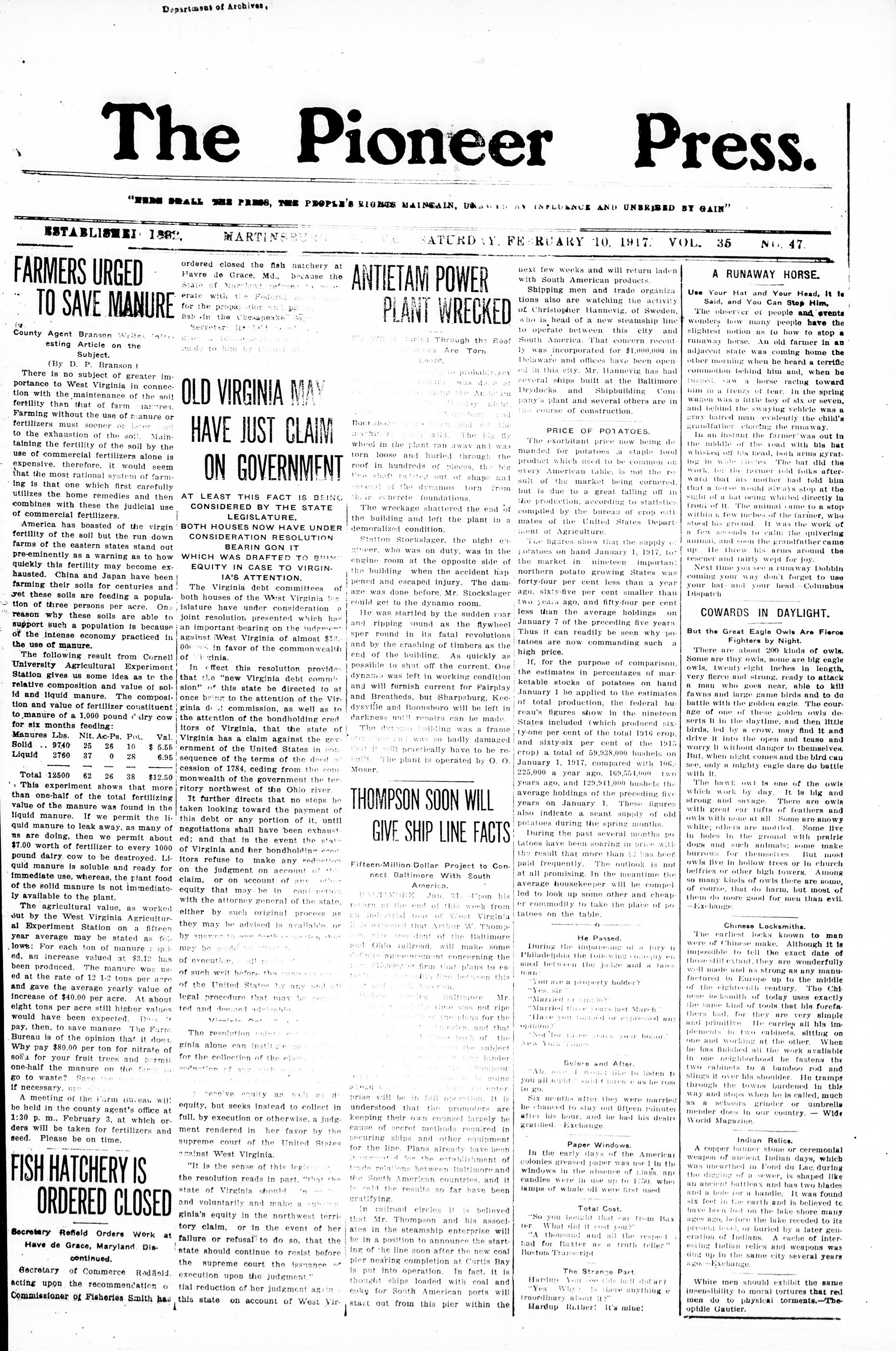
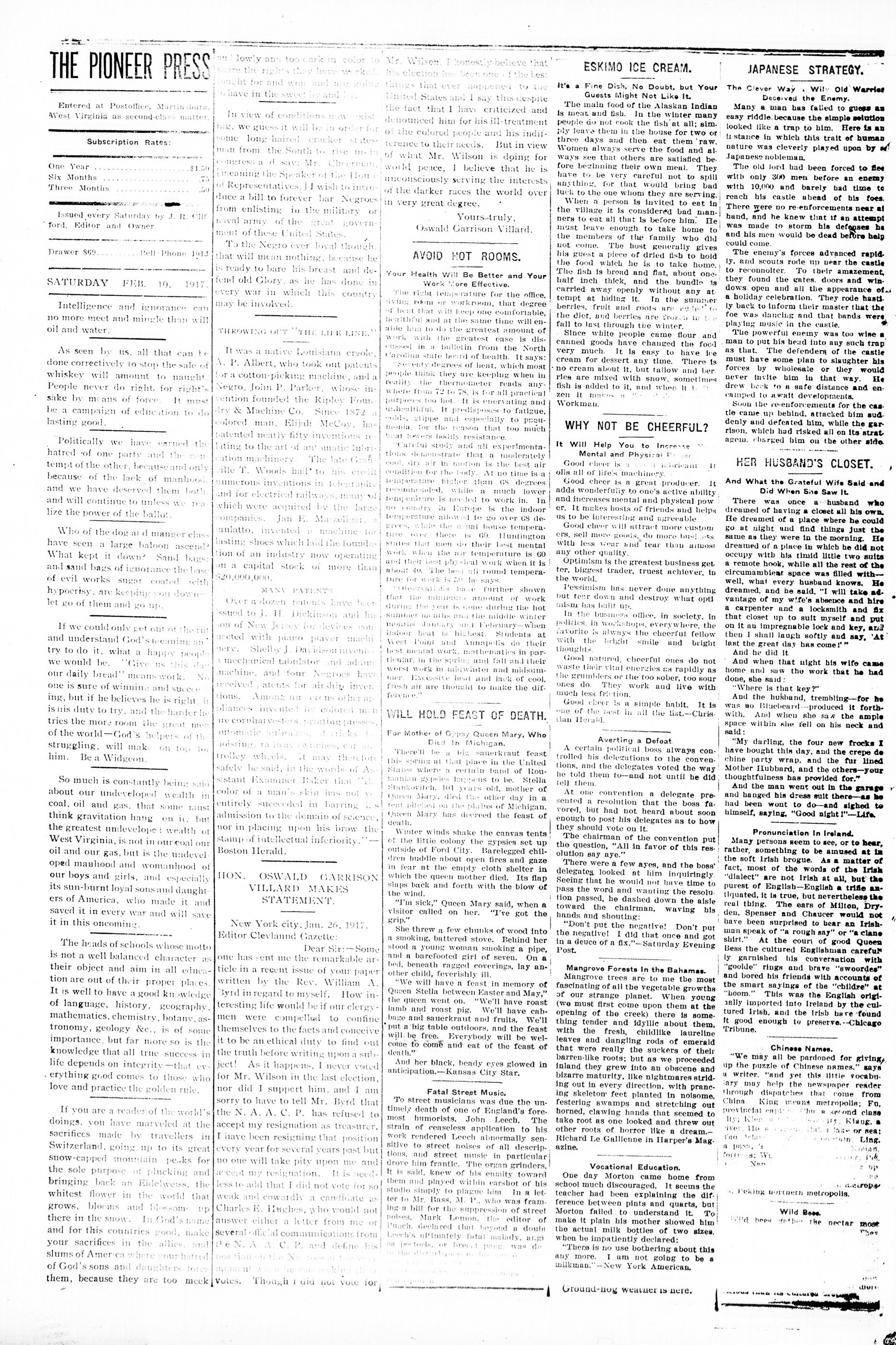
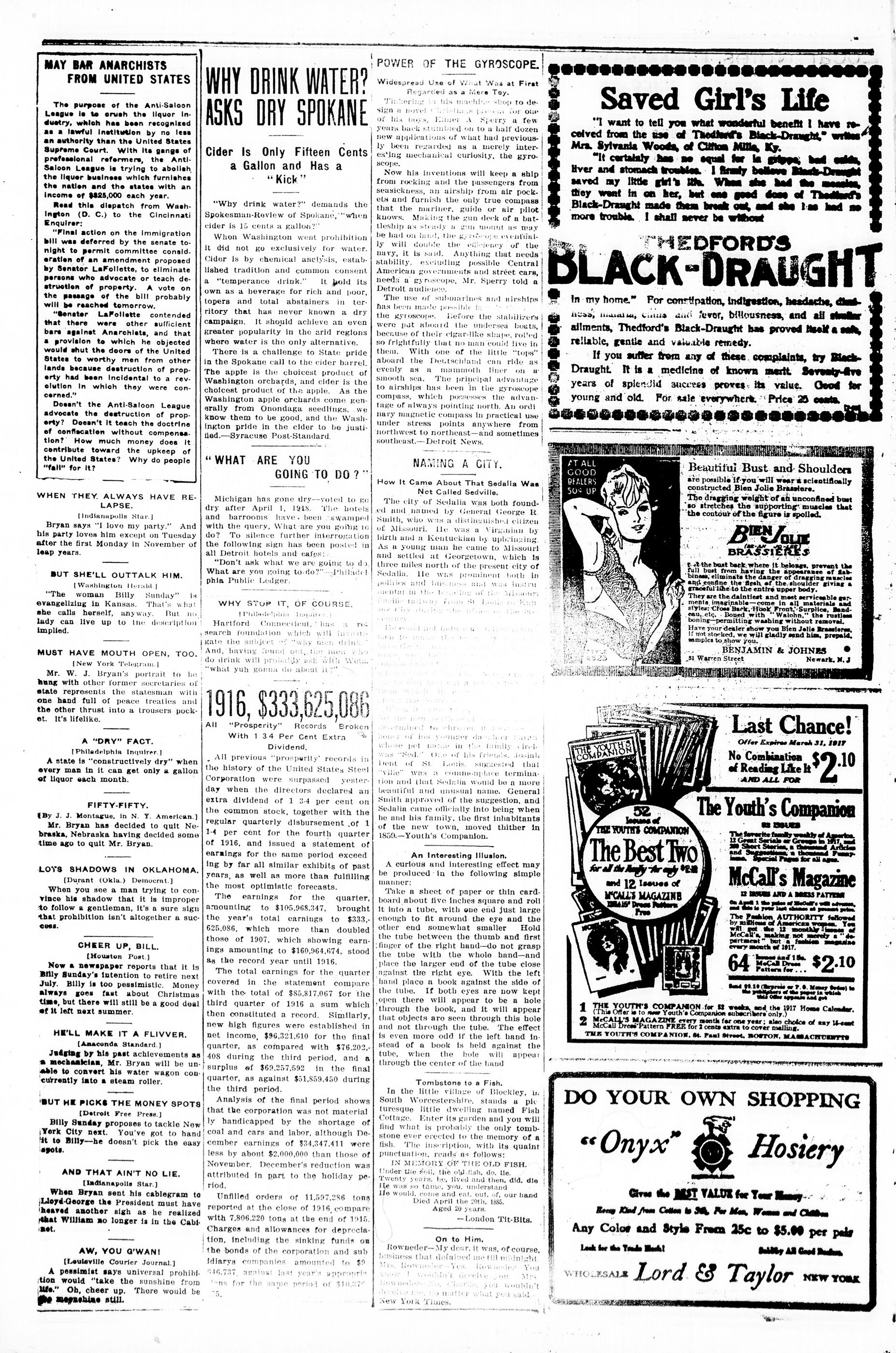
Page text (machine-generated)
The Pioneer Press.
"WHERE SHALL THE PRESS, THE PEOPLE'S RIGHTS MAINTAIN, DRAWED BY INFLUENCE AND UNBRIBED BY GAIN"
ESTABLISHED 1882.
FARMERS URGED TO SAVE MANURE
County Agent Branson writes interesting Article on the Subject.
(By D. P. Branson.)
There is no subject of greater importance to West Virginia in connection with the maintenance of the soil fertility than that of farm varieties. Farming without the use of manure or fertilizers must sooner or later lead to the exhaustion of the soil. Maintaining the fertility of the soil by the use of commercial fertilizers alone is expensive, therefore, it would seem that the most rational system of farming is that one which first carefully utilizes the home remedies and then combines with these the judicial use of commercial fertilizers.
America has boasted of the virgin fertility of the soil but the run down farms of the eastern states stand out pre-eminently as a warning as to how quickly this fertility may become exhausted. China and Japan have been farming their soils for centuries and yet these soils are feeding a population of three persons per acre. On reason why these soils are able to support such a population is because of the intense economy practiced in the use of manure.
The following result from Cornell
University Agricultural Experiment
Station gives us some idea as to the
relative composition and value of solid
and liquid manure. The composition and value of fertilizer constituent
to manure of a 1,000 pound dairy cow
for six months feeding:
Manures Lbs. Nit. Ac-Ps. Pot. Val.
Solid . 9740 25 26 10 $ 5.55
Liquid 2760 37 0 28 6.95
Total 12500 62 26 38 $12.50
This experiment shows that more than one-half of the total fertilizing value of the manure was found in the liquid manure. If we permit the liquid manure to leak away, as many of us are doing, then we permit about $7.00 worth of fertilizer to every 1000 pound dairy cow to be destroyed. Liquid manure is soluble and ready for immediate use, whereas, the plant food of the solid manure is not immediately available to the plant.
The agricultural value, as worked out by the West Virginia Agricultural Experiment Station on a fifteen year average may be stated as follows: For each ton of manure applied, an increase valued at $3.12 has been produced. The manure was used at the rate of 12 1-2 tons per acre and gave the average yearly value of increase of $40.00 per acre. At about eight tons per acre still higher values would have been expected. Does it pay, then, to save manure. The Farro Bureau is of the opinion that it does. Why pay $80.00 per ton for nitrate of soya for your fruit trees and permit one-half the manure on the farm to go to waste? Save the manure if necessary.
A meeting of the Farm Bureau will be held in the county agent's office at 1:30 p. m., February 3, at which orders will be taken for fertilizers and seed. Please be on time.
FISH HATCHERY IS ORDERED CLOSED
Secretary Refield Orders Work at Have de Grace, Maryland. Discontinued. Secretary of Commerce Redfield acting upon the recommendation of Commissioner of Fisheries Smith has
Department of Archives
he P
DRALL THE PRESS, THE PEOPLE
1882. MARTINSBURG
ordered closed the fish hatchery at Havre de Grace, Md., because the State of Maryland refused to cooperate with the Federal government for the propagation and prize fish in the Chesapeake Bay. Secretary Reed Baldwin upon a subsequent order to him by United States
OLD VIRGINIA MAY HAVE JUST CLAIM ON GOVERNMENT
OLD VIRGINIA MAY HAVE JUST CLAIM ON GOVERNMENT
AT LEAST THIS FACT IS BEING CONSIDERED BY THE STATE LEGISLATURE.
BOTH HOUSES NOW HAVE UNDER CONSIDERATION RESOLUTION BEARIN GON IT
WHICH WAS DRAFTED TO BRING EQUITY IN CASE TO VIRGINIA'S ATTENTION.
The Virginia debt committees of both houses of the West Virginia legislature have under consideration a joint resolution presented which has an important bearing on the judgment against West Virginia of almost $13,000 in favor of the commonwealth of Virginia.
In effect this resolution provides that the "new Virginia debt commission" of this state be directed to at once bring to the attention of the Virginia debt commission, as well as to the attention of the bondholding creditors of Virginia, that the state of Virginia has a claim against the government of the United States in consequence of the terms of the deed of cession of 1784, ceding from the commonwealth of the government the territory northwest of the Ohio river.
It further directs that no steps be taken looking toward the payment of this debt or any portion of it, until negotiations shall have been exhausted; and that in the event the state of Virginia and her bondholding creditors refuse to make any reduction on the judgment on account of the claim, or on account of any other equity that may be in connection with the attorney general of the state, either by such original process as they may be advised is available, or by answer to any further question that may be good for the state.
of execution. will result in
of such writ before the supreme
of the United States by any and all
legal procedure that may be per-
tended and deemed admissible.
Virginia, C. S. C.
The resolution points out
ginia alone can institute per-
for the collection of the claim
reduction of any such matter.
to receive equity as well as de equity, but seeks instead to collect in full, by execution or otherwise, a judgment rendered in her favor by the supreme court of the United States against West Virginia.
"It is the sense of this legislation the resolution reads in part, "that the state of Virginia should in order and voluntarily and make a subjuginia's equity in the northwest territory claim, or in the event of her failure or refusal to do so, that the state should continue to resist before the supreme court the issuance of execution upon the judgment."
tial reduction of her judgment again this state on account of West Vir-
ANTIETAM POWER PLANT WRECKED
Fly Whist Murled Through the Roof and dynamics Are Torn Loose, coming to probably, seven hundred dollars was done at and Borrowed to, along the Anbetrum on the Monday night, at Sharpburg and Bootsbore, are down and set the machinery going wild. The big fly wheel in the plant ran away and was torn loose and hurled through the roof in hundreds of pieces, the big line shaft twisted out of shape and several of the dynamics torn from their concrete foundations.
The wreckage shattered the end of the building and left the plant in a demoralized condition. Station Stockslager, the night engineer, who was on duty, was in the engine room at the opposite side of the building when the accident happened and escaped injury. The damage was done before. Mr. Stockslager could get to the dynamo room.
He was startled by the sudden roar and ripping sound as the flywheel sper round in its fatal revolutions and by the crashing of timbers as the end of the building. As quickly as possible to shut off the current. One dynamo was left in working condition and will furnish current for Fairplay and Breatheds, but Sharpsburg, Keedysville and Boonsboro will be left in darkness until repairs can be made. The dynamo building was a frame structure and was so badly damaged that it will practically have to be rebuilt. The plant is operated by O. O. Moser.
THOMPSON SOON WILL GIVE SHIP LINE FACTS
Fifteen-Million-Dollar Project to Connect Baltimore With South America.
BALTIMORE. Jan. 31.—Upon his return at the end of this week from an industrial tour of West Virginia it is expected that Arthur W. Thompson, vice president of the Baltimore and Ohio railroad, will make some definite announcement concerning the firm that plans to establish a membership line between this state and South America.
In railroad circles it is believed that Mr. Thompson and his associates in the steamship enterprise will be in a position to announce the starting of the line soon after the new coal pier nearing completion at Curtis Bay is put into operation. In fact, it is thought ships loaded with coal and coke for South American ports will start out from this pier within the
next few weeks and will return laden with South American products. Shipping men and trade organizations also are watching the activity of Christopher Hannevig, of Sweden, who is head of a new steamship line to operate between this city and South America. That concern recently was incorporated for $1,000,000 in Delaware and offices have been opened in this city. Mr. Hannevig has had several ships built at the Baltimore Drydocks and Shipbuilding Company's plant and several others are in the course of construction.
PRICE OF POTATOES.
The exorbitant price now being demanded for potatoes a staple food product which used to be common on every American table, is not the result of the market being cornered, but is due to a great falling off in the production, according to statistics compiled by the bureau of crop estimates of the United States Department of Agriculture.
The figures show that the supply of potatoes on hand January 1, 1917, for the market in nineteen important northern potato growing States was forty-four per cent less than a year ago, sixty-five per cent smaller than two years ago, and fifty-four per cent less than the average holdings on January 7 of the preceding five years. Thus it can readily be seen why potatoes are now commanding such a high price.
If, for the purpose of comparison, the estimates in percentages of marketable stocks of potatoes on hand January 1 be applied to the estimates of total production, the federal bureau's figures show in the nineteen States included (which produced sixty-one per cent of the total 1916 crop, and sixty-six per cent of the 1915 crop) a total of 59,938,000 bushels on January 1, 1917, compared with 106,225,000 a year ago, 169,554,000 two years ago, and 129,941,000 bushels the average holdings of the preceding five years on January 1. These figures also indicate a scant supply of old potatoes during the spring months.
During the past several months potatoes have been soaring in price with the result that more than $2 has been paid frequently. The outlook is not at all promising. In the meantime the average housekeeper will be compelled to look up some other and cheaper commodity to take the place of potatoes on the table.
He Passed.
During the impaneing of a jury in Philadelphia the following colleague ensured between the judge and a tales man:
"You are a property holder?"
"Yes, sir."
"Married or single?"
"Married three years last March."
"Have you tortured or expressed any opinion?"
"Not for three years, your honor."
New York Times
Before and After
"Ah, love! I would like to listen to you all night!" said Clarence as he rose to go.
Six months after they were married he chanced to stay out fifteen minutes after his hour, and he had his desire gratified.—Exchange.
Paper Windows
In the early days of the American colonies greased paper was used in the windows in the absence of glass, and candles were in use up to 150, when lamps of whale oil were first used.
Total Cost.
"So you bought that car from Baxter. What did it cost you?"
"A thousand and all the respect bad for Baxter as a truth teller."
Boston Transcript
The Strange Part
Hardip: You see this half dollar?
"Yes. Why? Is there anything else
troubiliary about it?"
Hardup Rather! It's mine!
A RUNAWAY HORSE
Use Your Hat and Your Head, It Is Said, and You Can Stop Him.
The observer of people and events wonders how many people have the slightest notion as to how to stop a runaway horse. An old farmer in an adjacent state was coming home the other morning when he heard a terrific commotion behind him and, when he turned, saw a horse racing toward him in a frenzy of fear. In the spring wagon was a little boy of six or seven, and behind the swaying vehicle was a gray haired man—evidently the child's grandfather, chasing the runaway.
In an instant the farmer was out in the middle of the road with his hat whiskered off his head, both arms gyrating in wide circles. The bat did the work, for the farmer told folks afterward that his mother had told him that a horse would always stop at the sight of a hat oeing whirled directly in front of it. The animal came to a stop within a few inches of the farmer, who stood his ground. It was the work of a few seconds to calm the quivering animal, and soon the grandfather came up. He threw his arms around the rescuer and fairly wept for joy.
Next time you see a runaway Dobbin coming your way don't forget to use your hit- and your head.—Columbus Dispatch
COWARDS IN DAYLIGHT.
But the Great Eagle Owls Are Fierce Fighters by Night.
There are about 200 kinds of owls. Some are tiny owls, some are big eagle owls, twenty eight inches in length, very fierce and strong, ready to attack a man who goes near, able to kill fawns and large game birds and to do battle with the golden eagle. The courage of one of these golden owls deserts it in the daytime, and then little birds, led by a crow, may find it and drive it into the open and tease and worry it without danger to themselves. But, when night comes and the bird can see, only a mighty eagle dare do battle with it.
The hawk owl is one of the owls which work by day. It is big and strong and savage. There are owls with great ear tufts of feathers and owls with none at all. Some are snowy white; others are mottled. Some live in holes in the ground with prairie dogs and such animals; some make burrows for themselves. But most owls live in hollow trees or in church belfries or other high towers. Among so many kinds of owls there are some, of course, that do harm, but most of them do more good for men than evil. —Exchange.
Chinese Locksmiths
The earliest locks known to man were of Chinese make. Although it is impossible to tell the exact date of those still extant, they are wonderfully well made and as strong as any manufactured in Europe up to the middle of the eighteenth century. The Chinese locksmith of today uses exactly the same kind of tools that his forefathers had, for they are very simple and primitive. He carries all his implements in two cabinets, sitting on one and working at the other. When he has finished all the work available in one neighborhood he fastens the two cabinets to a bamboo rod and slings it over his shoulder. He tramps through the towns burdened in this way and stops when he is called, much as a scissors grinder or umbrella mender does in our country. — Wide World Magazine.
Indian Relica.
A copper batter stone or ceremonial weapon of ancient Indian days, which was unearthed in Fond du Lac, during the digging of a sewer, is shaped like an ancient battleax and has two blades and a hole for a handle. It was found six feed in the earth and is believed to have been lost on the lake shore many ages ago, before the lake receded to its present level, or buried by a later generation of Indians. A cache of interesting Indian reliies and weapons was dig up in the same city several years ago.—Exchange.
White men should exhibit the same insensibility to moral tortures that red men do to physical torments.—Theophile Gautier.
THE PIONEER PRESS
Entered at Postoffice, Martin'sburg
West Virginia as second-class matter
Subscription Rates:
One Year ..... $1.50
Six Months ..... 75
Three Months ..... 50
Issued every Saturday by J. R. Clifford, Editor and Owner.
Drawer $69. Bell-Phone 191J
SATURDAY FEB. 10. 1917.
Intelligence and ignorance can no more meet and mingle than will oil and water.
As seen by us, all that can be done correctly to stop the sale of whiskey will amount to naught. People never do right, for right's sake by means of force. It must be a campaign of education to do lasting good.
Politically we have earned the hatred of one party and the contempt of the other, because and only because of the lack of manhood and we have deserved them both and will continue to unless we realize the power of the ballot.
Who of the dog and manger class have seen a large baloon ascend? What kept it down? Sand bags and sand bags of ignorance the base of evil works sugar coated with hypocrisy, are keeping you down—let go of them and go up.
---
If we could only get out of the rut and understand God's meaning an" try to do it, what a happy people we would be. "Give us this day our daily bread" means work. No one is sure of winning and succeeding, but if he believes he is right, it is his duty to try, and the harder he tries the more room the great men of the world—God's helpers of the struggling, will make on top for him. Be a Widgeon.
So much is constantly being said about our undeveloped wealth in coal, oil and gas, that some must think gravitation hang on it, but the greatest undeveloped wealth of West Virginia, is not in our coal our oil and our gas, but is the undeveloped manhood and womanhood of our boys and girls, and especially its sun-burnt loyal sons and daughters of America, who made it and saved it in every war and will save it in this oncoming.
The heads of schools whose motto is not a well balanced character as their object and aim in all education are out of their proper places. It is well to have a good knowledge of language, history, geography, mathematics, chemistry, botany, astronomy, geology &c., is of some importance, but far more so is the knowledge that all true success in life depends on integrity—that everything good comes to those who love and practice the golden rule.
If you are a reader of the world's doings, you have marveled at the sacrifices made by travellers in Switzerland, going up to its great snow-capped mountain peaks for the sole purpose of plucking and bringing back an Ridelweiss, the whitest flower in the world that grows, blooms and blossoms up there in the snow. In God's name and for this countries good, make your sacrifices in the allies, and slums of America where your hatred of God's sons and daughters force them, because they are too meek
---
an lowly and too dark in color to share the rights they have worked, fought for and won and are going to have in the sweet by and by.
In view of conditions now existing, we guess it will be in order for some long-haired cracker statesman from the South to rise up in congress and say: Mr. Cheerman, [meaning the Speaker of the House of Representatives], I wish to introduce a bill to forever bar Negroes from enlisting in the military or naval army of the great government of these United States.
To the Negro ever loyal though, that will mean nothing, because he is ready to bare his breast and defend old Glory, as he has done in every war in which this country may be involved.
THROWING OUT "THE LIFE LINE."
It was a native Louisiana crgole, A. P. Albert, who took out patents for a cotton-picking machine, and a Negro, John P. Parker, whose invention founded the Ripley Foundry & Machine Co. Since 1872 a colored man, Elijah McCoy, has patented nearly fifty inventions relating to the art of automatic lubrication machinery. The late Granville T. Woods had* to his credit numerous inventions in telegraphy and for electrical railways, many of which were acquired by the large companies. Jan E. Matzeliger, a mulatto, invented a machine for lasting shoes which laid the foundation of an industry now operating on a capital stock of more than $20,000,000.
MANY PATENTS
Over a dozen patents have been issued to J. H. Dickinson and his son of New Jersey for devices connected with piano player machinery. Shelby J. Davidson invented a mechanical tabulator and adding machine, and four Negroes have received patents for airship inventions. Among numerous other appliances invented by colored men are cornharvesters, printing presses, automatic airbrakes, drills for hoisting, ra iway switches, car and trotley wheels. It may therefore safely be said, in the words of Assistant Examiner Baker that "the color of a man's skin has not yet entirely succeeded in barring his admission to the domain of science, nor in placing upon his brow the stamp of intellectual inferiority." — Boston Herald.
HON. OSWALD GARRISON
VILLARD MAKES
STATEMENT.
New York city, Jan. 26, 1917.
Editor Clevland Gazette:
Dear Sir: Some one has sent me the remarkable article in a recent issue of your paper written by the Rev. William A. Byrd in regard to myself. How interesting life would be if our clergymen were compelled to confine themselves to the facts and conceive it to be an ethical duty to find out the truth before writing upon a subject! As it happens, I never voted for Mr. Wilson in the last election, nor did I support him, and I am sorry to have to tell Mr. Byrd that the N. A. A. C. P. has refused to accept my resignation as treasurer. I have been resigning that position every year for several years past but no one will take pity upon me and accept my resignation. It is needless to add that I did not vote for so weak and cowardly a candidate as Charles E. Hughes, who would not answer either a letter from me or several official communications from the N. A. A. C. P. and define his position on the New roos at the very moment when he was seeking their votes. Though I did not vote for
Mr. Wilson, I honestly believe that his election has been one of the best things that ever happened to the United States and I say this despite the fact that I have criticized and denounced him for his ill-treatment of the colored people and his indifference to their needs. But in view of what Mr. Wilson is doing for world peace, I believe that he is unconsciously serving the interests of the darker races the world over in very great degree.
Yours-truly,
Oswald Garrison Villard.
AVOID HOT ROOMS.
Your Health Will Be Better and Your Work More Effective.
The right temperature for the office, living room or workroom, that degree of heat that will keep one comfortable, healthful and at the same time will enable him to do the greatest amount of work with the greatest case is discussed in a bulletin from the North Carolina state board of health. It says:
"Seventy degrees of heat, which most people think they are keeping when in reality the thermometer reads anywhere from 72 to 78, is for all practical purposes too hot. It is enervating and unhealthful. It predisposes to fatigue, colds, grippe and especially to pugmonia, for the reason that too much heat lowers bodily resistance.
"Careful study and all experimentations demonstrate that a moderately cool, dry air in motion is the best air condition for the body. At no time is a temperature higher than 68 degrees recommended, while a much lower temperature is needed to work in. In no country in Europe is the indoor temperature allowed to go over 68 degrees, while the usual house temperature over there is 60. Huntington states that men do their best mental work when the air temperature is 60 and their best physical work when it is about 40. The best all round temperature for work is 50. he says.
"Observations have further shown that the minimum amount of work during the year is done during the hot summer months and the middle winter months January and February—when indoor heat is highest. Students at West Point and Annapolis do their best mental work, mathematics in particular, in the spring and fall and their worst work in midwinter and midsummer. Excessive heat and lack of cool, fresh air are thought to make the difference."
WILL HOLD FEAST OF DEATH.
For Mother of Gypsy Queen Mary, Who Died in Michigan.
There'll be a big sauerkraut feast this spring at that place in the United States where a certain band of Roumanian gypsies happens to be. Stella Stankowitch, 101 years old, mother of Queen Mary, died the other day in a tent pitched on the plains of Michigan. Queen Mary has decreed the feast of death.
Winter winds shake the canvas tents of the little colony the gypsies set up outside of Ford City. Barelegged children huddle about open fires and gaze in fear at the empty cloth shelter in which the queen mother died. Its flap slaps back and forth with the blow of the wind.
"Im sick," Queen Mary said, when a visitor called on her. "I've got the grip."
She threw a few chunks of wood into a smoking, battered stove. Behind her stood a young woman smoking a pipe, and a barefooted girl of seven. On a bed, beneath ragged coverings, lay another child, feverishly ill.
"We will have a feast in memory of Queen Stella between Easter and May," the queen went on. "We'll have roast lamb and roast pig. We'll have cabbage and sauerkraut and fruits. We'll put a big table outdoors, and the feast will be free. Everybody will be welcome to come and eat of the feast of death."
And her black, beady eyes glowed in anticipation.—Kansas City Star.
Fatal Street Music.
To street musicians was due the untimely death of one of England's foremost humorists, John Leech. The strain of ceaseless application to his work rendered Leech abnormally sensitive to street noises of all descriptions, and street music in particular drove him frantic. The organ grinders, it is said, knew of his enmity toward them and played within earshot of his studio simply to plague him. In a letter to Mr. Bass, M. P., who was framing a bill for the suppression of street noises, Mark Lemon, the editor of Punch, declared that beyond a double Leech's ultimately fatal malady, angi on pectoris, or breast pung, was due to the disturbance of his voice.
ESKIMO ICE CREAM.
It's a Fine Dish, No Doubt, but Your Guests Might Not Like it.
The main food of the Alaskan Indian is meat and fish. In the winter many people do not cook the fish at all; simply leave them in the house for two or three days and then eat them raw. Women always serve the food and always see that others are satisfied before beginning their own meal. They have to be very careful not to spill anything, for that would bring bad luck to the one whom they are coming
When a person is invited to eat in the village it is considered bad manners to eat all that is before him. He must leave enough to take home to the members of the family who did not come. The host generally gives his guest a piece of dried fish to hold the food which he is to take home. The fish is broad and flat, about one half inch thick, and the bundle is carried away openly without any attempt at hiding it. In the summer berries, fruit and roots are edible to the diet, and berries are frozen in the fall to last through the winter.
Since white people came flour and canned goods have changed the food very much. It is easy to have ice cream for dessert any time. There is no cream about it, but tallow and berries are mixed with snow, sometimes fish is added to it, and when it Zen it makes a delicious Workman
WHY NOT BE CHEERFUL?
It Will Help You to Increase Mental and Physical Power
Good cheer is a very important Itolis all of life's machinery.
Good cheer is a great producer. It adds wonderfully to one's active ability and increases mental and physical power. It makes hosts of friends and helps us to be interesting and agreeable.
Good cheer will attract more customers, sell more goods, do more business with less wear and tear than almost any other quality.
Optimism is the greatest business getter, biggest trader, truest achiever, in the world.
Pessimism has never done anything but tear down and destroy what optimism has built up.
In the business office, in society, in politics, in workshops, everywhere, the favorite is always the cheerful fellow with the bright smile and bright thoughts. Good natured, cheerful ones do not waste their vital energies as rapidly as the grumblers or the too sober, too sour ones do. They work and live with much less friction. Good cheer is a simple habit. It is one of the best in all the list.-Christian Herald.
Averting a Defeat
A certain political boss always controlled his delegations to the conventions, and the delegates voted the way he told them to—and not until he did tell them.
At one convention a delegate presented a resolution that the boss favored, but had not heard about soon enough to post his delegates as to how they should vote on it.
The chairman of the convention put the question, "All in favor of this resolution say aye."
There were a few ayes, and the boss' delegates looked at him inquiringly. Seeing that he would not have time to pass the word and wanting the resolution passed, he dashed down the aisle toward the chairman, waving his hands and shouting:
"Don't put the negative! Don't put the negative! I did that once and got in a deuce of a fix."—Saturday Evening Post.
Mangrove Forests In the Bahamas.
Mangrove trees are to me the most fascinating of all the vegetable growths of our strange planet. When young (we must first come upon them at the opening of the creek) there is something tender and idyllic about them, with the fresh, childlike laureline leaves and dangling rods of emerald that were really the suckers of their barren-like roots; but as we proceeded inland they grew into an obscene and bizarre maturity, like nightmares striding out in every direction, with prancing skeleton feet planted in nolsome, festering swamps and stretching out horned, clawing hands that seemed to take root as one looked and threw out other roots of horror like a dream.—Richard Le Gallienne in Harper's Magazine.
Vocational Education.
One day Morton came home from school much discouraged. It seems the teacher had been explaining the difference between plints and quarts, but Morton failed to understand it. To make it plain his mother showed him the actual milk bottles of two sizes, when he impatiently declared:
"There is no use bothering about this any more. I am not going to be a milkman." - New York American.
Ground-nog weather is here.
JAPANESE STRATEGY.
The Clever Way. Willy Old Warrier
Deceived the Enemy.
Many a man has failed to guess an
easy riddle because the simple solution
looked like a trap to him. Here is an
instance in which this trait of human
nature was cleverly played upon by a
Japanese nobleman.
The old lord had been forced to flee
with only 300 men before an enemy
with 10,000 and barely had time to
reach his castle ahead of his foes.
There were no re-enforcements near at
hand, and he knew that if an attempt
was made to storm his defenses he
and his men would be dead before help
could come.
The enemy's forces advanced rapidly, and scouts rode up near the castle to reconnoiter. To their amazement, they found the gates, doors and windows open and all the appearance of a holiday celebration. They rode hastily back to inform their master that the foe was dancing and that bands were playing music in the castle.
The powerful enemy was too wise a man to put his head into any such trap as that. The defenders of the castle must have some plan to slaughter his forces by wholesale or they would never invite him in that way. He drew back to a safe distance and encamped to await developments.
Soon the re-enforcements for the castle came up behind, attacked him suddenly and defeated him, while the garrison, which had risked all on its strata agem, charged him on the other side
HER HUSBAND'S CLOSET.
And What the Grateful Wife Said and Did When She Saw It.
There was once a husband who dreamed of having a closet all his own. He dreamed of a place where he could go at night and find things just the same as they were in the morning. He dreamed of a place in which he did not occupy with his timid little two suits a remote hook, while all the rest of the circumambient space was filled with—well, what every husband knows. He dreamed, and he said, "I will take advantage of my wife's absence and hire a carpenter and a locksmith and fix that closet to suit myself and put on it an impregnable lock and key, and then I shall laugh softly and say, 'At last the great day has come!'" And he did it.
And when that night his wife came home and saw the work that he had done, she said:
"Where is that key?"
And the husband, trembling—for he was no Bluebeard—produced it forthwith. And when she saw the ample space within she fell on his neck and said:
"My darling, the four new frocks I have bought this day, and the crepe de chine party wrap, and the fur lined Mother Hubbard, and the others—your thoughtfulness has provided for."
And the man went out in the garage and hanged his dress suit there—as he had been wont to do—and sighed to himself, saying, "Good night!"—Life.
Pronunciation In Ireland
Many persons seem to see, or to hear, rather, something to be amused at in the soft Irish brogue. As a matter of fact, most of the words of the Irish "dialect" are not Irish at all, but the purest of English—English a trifle antiquated, it is true, but nevertheless the real thing. The ears of Milton, Dryden, Spenser and Chaucer would not have been surprised to hear an Irishman speak of "a rough say" or "a clane shirt." At the court of good Queen Bess the cultured Englishman carefully garnished his conversation with "goolde" rings and brave "swoordes" and bored his friends with accounts of the smart sayings of the "childre" at "hoom." This was the English originally imported into Ireland by the cultured Irish, and the Irish have found it good enough to preserve.--Chicago Tribune.
Chinese Names.
"We may all be pardoned for giving
up the puzzle of Chinese names," says
a writer. "and yet this little vocabu-
lary may help the newspaper reader
through dispatches that come from
China. King mounts metropolis; Fu,
provincial capitals; Chu a second class
city; Kien a third class city; Klang, a
river. Ho a fourth class city; lae or sea;
Dao, Teh a mountain; Ling,
a pass, a
fortress; We
New
MAY BAR ANARCHISTS FROM UNITED STATES
The purpose of the Anti-Saloon League is to crush the liquor Industry, which has been recognized as a lawful institution by no less an authority than the United States Supreme Court. With its gangs of professional reformers, the Anti-Saloon League is trying to abolish the liquor business which furnishes the nation and the states with an income of $825,000 each year.
Read this dispatch from Washington (D. C.) to the Cincinnati Engulrer:
"Final action on the immigration bill was deferred by the senate tonight to permit committee consideration of an amendment proposed by Senator LaFollette, to eliminate persons who advocate or teach destruction of property. A vote on the passage of the bill probably will be reached tomorrow.
"Senator LaFollette contended that there were other sufficient bars against Anarchists, and that a provision to which he objected would shut the doors of the United States to worthy men from other lands because destruction of property had been incidental to a revolution in which they were concerned."
Doesn't the Anti-Saloon League advocate the destruction of property? Doesn't it teach the doctrine of confiscation without compensation? How much money does it contribute toward the upkeep of the United States? Why do people "fall" for it?
WHEN THEY. ALWAYS HAVE RE-
LAPSE.
[Indianapolis Star.]
Bryan says "I love my party." And his party loves him except on Tuesday after the first Monday in November of leap years.
"The woman Billy Sunday" is evangelizing in Kansas. That's what she calls herself, anyway. But no lady can live up to the description implied.
MUST HAVE MOUTH OPEN, TOO.
[New York Telegram.]
Mr. W. J. Bryan's portrait to be hung with other former secretaries of state represents the statesman with one hand full of peace treaties and the other thrust into a trousers pocket. It's lifelike.
A "DRY" FACT.
A state is "constructively dry" when every man in it can get only a gallon of liquor each month.
FIFTY-FIFTY.
[By J. J. Montague, in N. Y. American.]
Mr. Bryan has decided to quit Nebraska, Nebraska having decided some time ago to quit Mr. Bryan.
LOYS SHADOWS IN OKLAHOMA.
[Durant (Okla.) Democrat.]
When you see a man trying to convince his shadow that it is improper to follow a gentleman, it's a sure sign that prohibition isn't altogether a success.
CHEER UP, BILL.
[Houston Post.]
Now a newspaper reports that it is Billy Sunday's intention to retire next July. Billy is too pessimistic. Money always goes fast about Christmas time, but there will still be a good deal of it left next summer.
Judging by his past achievements as a mechanician, Mr. Bryan will be unable to convert his water wagon concurrently into a steam roller.
BUT HE PICKS THE MONEY SPOTS
[Detroit Free Press.]
Billy Sunday proposes to tackle New York City next. You've got to hand it to Billy—he doesn't pick the easy spots.
AND THAT AIN'T NO LIE.
When Bryan sent his cablegram to Lloyd-George the President must have heaved another sigh as he realized that William no longer is in the Cabinet.
AW. YOU G'WAN!
A possimist says universal prohibition would "take the sunshine from life." Oh, cheer up. 'There would be the magnshine still.
G
WHY DRINK WATER? ASKS DRY SPOKANE
Cider Is Only Fifteen Cents a Gallon and Has a "Kick"
"Why drink water?" demands the Spokesman-Review of Spokane, "when cider is 15 cents a gallon?"
When Washington went prohibition it did not go exclusively for water. Cider is by chemical analysis, established tradition and common consent a "temperance drink." It hold its own as a beverage for rich and poor, toppers and total abstainers in territory that has never known a dry campaign. It should achieve an even greater popularity in the arid regions where water is the only alternative.
There is a challenge to State pride in the Spokane call to the cider barrel. The apple is the choicest product of Washington orchards, and cider is the choicest product of the apple. As the Washington apple orchards come generally from Onondaga seedlings, we know them to be good, and the Washington pride in the cider to be justified.—Syracuse Post-Standard.
"WHAT ARE YOU
GOING TO DO?"
Michigan has gone dry—voted to go dry after April 1, 1948. The hotels and barrooms have been swamped with the query, What are you going to do? To silence further interrogation the following sign has been posted in all Detroit hotels and cafes:
"Don't ask what we are going to do. What are you going to do?"—Philadelphia Public Ledger.
Hartford Connecticut, has a research foundation which will investigate the subject of "why men drink." And, having found out, the men who do drink will probably ask with Wetm. "what yuh gonna do about it?"
1916, $333,625,086
All previous "prosperity" records in the history of the United States Steel Corporation were surpassed yesterday when the directors declared an extra dividend of 1 3-4 per cent on the common stock, together with the regular quarterly disbursement of 1 1-4 per cent for the fourth quarter of 1916, and issued a statement of earnings for the same period exceeding by far all similar exhibits of past years, as well as more than fulfilling the most optimistic forecasts.
The earnings for the quarter, amounting to $105,968,347, brought the year's total earnings to $333,625,086, which more than doubled those of 1907, which showing earnings amounting to $160,964,674, stood as the record year until 1916.
The total earnings for the quarter covered in the statement compare with the total of $85,817,067 for the third quarter of 1916 a sum which then constituted a record. Similarly, new high figures were established in net income, $96,321,610 for the final quarter, as compared with $76,202,408 during the third period, and a surplus of $69,257,592 in the final quarter, as against $51,859,450 during the third period.
Analysis of the final period shows that the corporation was not materially handicapped by the shortage of coal and cars and labor, although December earnings of $34,347,411 were less by about $2,000,000 than those of November. December's reduction was attributed in part to the holiday period.
Unfilled orders of 11,597,286 tons reported at the close of 1916 compare with 7,806,220 tons at the end of 1915. Charges and allowances for depreciation, including the sinking funds on the bonds of the corporation and subsidiary companies amounted to $9,646,737, against last year's appropriations for the same period of $10,376,75.
POWER OF THE GYROSCOPE.
Widespread Use of What Was at First Regarded as a Mere Toy.
Thinking in his machine shop to design a novel Christmas present for one of his boys, Eminer A. Sperry a few years back stumbled on to a half dozen new applications of what had previously been regarded as a merely interesting mechanical curiosity, the gyroscope.
Now his inventions will keep a ship from rocking and the passengers from seasickness, an airship from air pockets and furnish the only true compass that the mariner, guide or air pilot knows. Making the gun deck of a battleship as steady a gun mount as may be had on land, the gyroscope eventually will double the efficiency of the navy, it is said. Anything that needs stability, excluding possible Central American governments and street cars, needs a gyroscope. Mr. Sperry told a Detroit audience.
The use of submarines and airships has been made possible in the gyroscope. Before the stabilizers were put aboard the undersea boats, because of their cigar-like shape, roiled so frightfully that no man could live in them. With one of the little "tops" aboard the Deutschland can ride as evenly as a mammoth liner on a smooth sea. The principal advantage to airships has been in the gyroscope compass, which possesses the advantage of always pointing north. An ordinary magnetic compass in practical use under stress points anywhere from northwest to northeast—and sometimes southeast—Detroit News.
NAMING A CITY.
How It Came About That Sedalia Was Net Called Sedville.
The city of Sedalia was both founded and named by General George R. Smith, who was a distinguished citizen of Missouri. He was a Virginian by birth and a Kentuckian by upbringing. As a young man he came to Missouri and settled at Georgetown, which is three miles north of the present city of Sedalia. He was prominent both in politics and business and was instrumental in the building of the Missouri Pacific railway from St. Louis to Kansas City during the times of the nineteenth century.
a have trust of the book
that they can prove
from which in
have the book
determined to cherish it for the honor of his younger daughter birth whose pet name in the family circle was "Sed." One of his friends, Josiah Dent of St. Louis, suggested that "ville" was a commonplace termination and that Sedalia would be a more beautiful and unusual name. General Smith approved of the suggestion, and Sedalia came officially into being when he and his family, the first inhabitants of the new town, moved thither in 1859.—Youth's Companion.
An Interesting Illusion.
A curious and interesting effect may be produced in the following simple manner:
Take a sheet of paper or thin cardboard about five Inches square and roll it into a tube, with one end just large enough to fit around the eye and the other end somewhat smaller. Hold the tube between the thumb and first finger of the right hand—do not grasp the tube with the whole hand—and place the larger end of the tube close against the right eye. With the left hand place a book against the side of the tube. If both eyes are now kept open there will appear to be a hole through the book, and it will appear that objects are seen through this hole and not through the tube. The effect is even more odd if the left hand instead of a book is held against the tube, when the hole will appear through the center of the hand.
Tombstone to a Fish.
In the little village of Blockley, in South Worcestershire, stands a picturesque little dwelling named Fish Cottage. Enter its garden and you will find what is probably the only tombstone ever erected to the memory of a fish. The inscription, with its quaint punctuation, reads as follows:
IN MEMORY OF THE OLD FISH.
Under the soil, the old fish, do. He.
Twenty years, he, lived and then, did, die.
He was so tame, you, understand.
He would, come and eat, out of, our hand.
I come and eat, out, of, our hand
Died April the 29th, 1885.
On to Him.
Rowneder—My dear, it was, of course, business that defained me till midnight.
Mrs. Rowneder—Yes. Rowneder. You know I wouldn't deceive you. Mrs. Rowneder—No. Girtlie, you wouldn't deceive me, no matter what you said.
New York Times.
Saved Girl's Life
"I want to tell you what wonderful benefit I have received from the use of Theodard's Black-Draught," writes Mra. Sylvania Wooda, of Clifton Milla, Ky.
"It certainly has no equal for in girlpea, bad edits, liver and stomach troubles. I firmly believe Black-Draught saved my little girl's life. When she had the mension, they went in on her, but one good dose of Theodard's Black-Draught made them break out, and she has had no more trouble. I shall never be without
BLACK-DRAUGHT
in my home." For constipation, indigestion, headache, diathe-
ness, malaria, chills and fever, billousness, and all similar
allments, Thedford's Black-Draught has proved itself a soft,
reliable, gentle and valuable remedy.
If you suffer from any of these complaints, try Black-
Draught. It is a medicine of known merit. Seventy-five
years of splendid success proves its value. Good for
young and old. For sale everywhere. Price 25 cents.
Last Chance!
Offer Expires March 31, 1917
No Combination
of Reading Like It
AND ALL FOR
The Youth's Companion
82 ISSUES
The favorite family weekly of Amarita,
12 Great Serials or Groups in 1917, and
200 Short Stories, a thousand Articles
and Suggestions, a thousand Pam-
y-issue. Special Pages for all ages.
McCall's Magazine
12 ISSUES AND A DRESS PATTERN
On April 1 this价是McCall's will advance,
and this is your last chance at present price.
The Fashion AUTHORITY followed
by millions of American women. You
will get the 12 monthly issues of
McCall's, making not merely a "de-
partment" but a fashion magazine
every month of 1917.
64 Issues and 18th McCall's Dress
Pattern for ....
Send $2.10 (Burpress or P.O. Money Order) to
the publisher of the paper in which
this Offer appears and get
1 THE YOUTH'S COMPANION for 32 weeks, and the 1917 Home Calendar.
(This Offer is to new Youth's Companion subscribers only.)
2 McCALL'S MAGAZINE every month for one year; also choice of any 16-count
McCall Dress Pattern FREE for 2 cents extra to cover mailing.
THE YOUTH'S COMPANION, 64. Paul Street, BOSTON, MASSACHUSETTS
DO YOUR OWN SHOPPING
"Onyx" Hosiery
Gives the BEST VALUE for Your Money.
Beezy Kind from Cotton to Silk, For Men, Women and Children
Any Colos and Styles From 25c to $5.00 per pair
Look for the Trade Market!
Sold by All Good Bodies.
WHOLESALE Lord & Taylor NEW YORK
AT ALL
GOOD
BEALERS
50¢ UP
Beautiful Bust and Shoulders are possible if you will wear a scientifically constructed Bien Jolie Brassiere. The dragging weight of an unconfined bust so stretches the supporting muscles that the contour of the figure is spolled.