Plaindealer
Friday, January 19, 1900
Topeka, Kansas
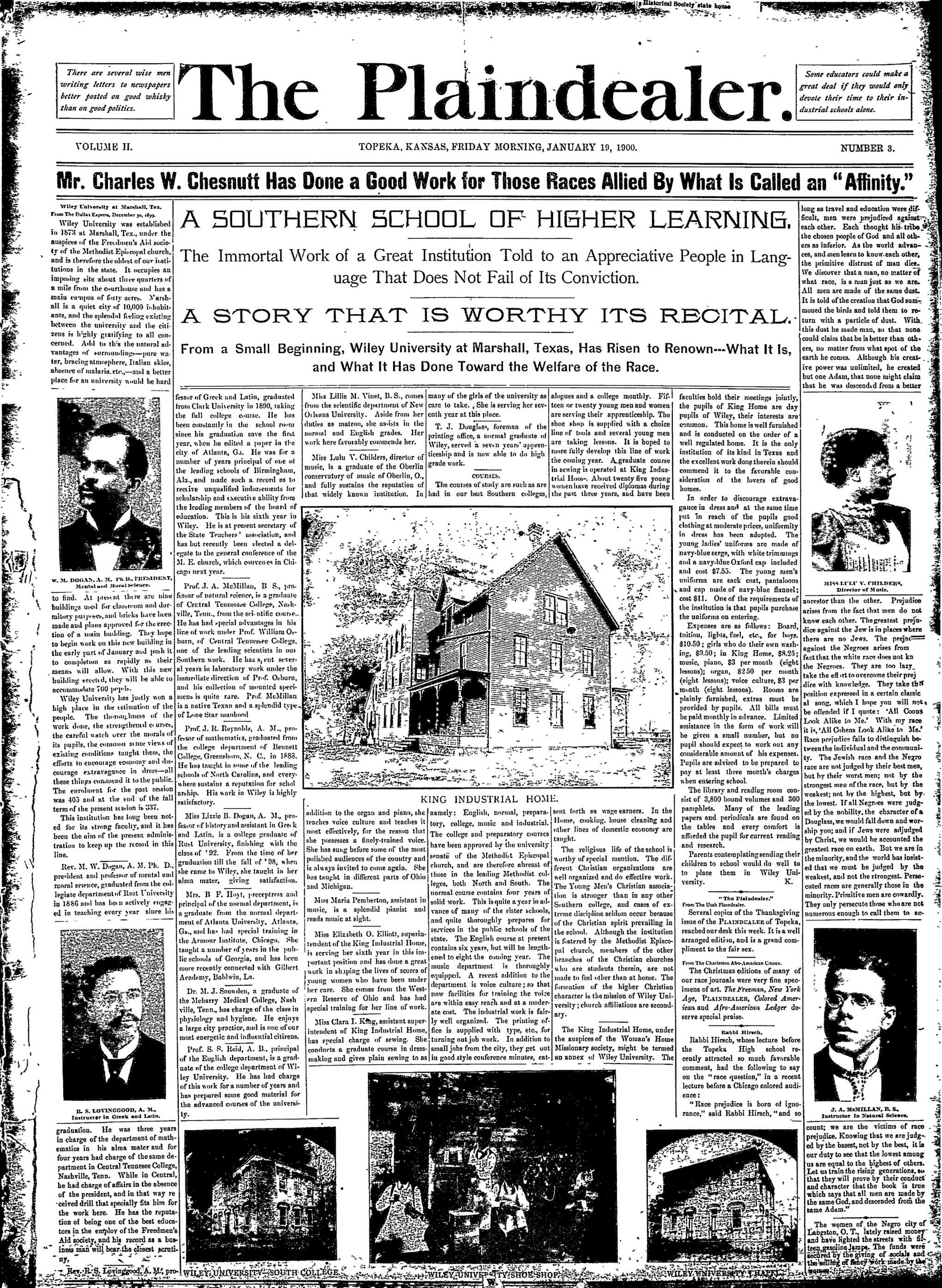
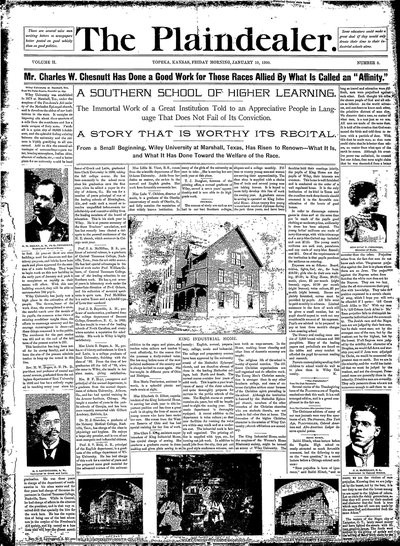
Page text (machine-generated)
Mr. Charles W. Chesnutt Has Done a Good Work for Those Races Allied By What Is Called an "Affinity."
There are several wise men writing letters to newspapers better posted on good whisky than on good politics.
VOLUME II.
Wiley University at Marshall, Tex.
From The Dallat Decree, December 18, 1890.
Wiley University was established in 1873 at Marshall, Tex., under the auspices of the Freedmen's Aid society of the Methodist Episcopal church, and is therefore the oldest of our institutions in the state. It occupies an imposing site about three quarters of a mile from the courthouse and has a main campus of forty acres. Marshall is a quiet city of 10,000 inhabitants, and the splendid feeling existing between the university and the citizens is highly gratifying to all concerned. Add to this the natural advantages of surroundings—pure water, bracing atmosphere, Italian skies, absence of malaria, etc.,—and a better place for an university would be hard
JOHN H.
W. M. DOGAN, A. M. P. D. PRESIDENT,
Mental and Moral Science.
to find. At present there are nine buildings used for classroom and dormitory purposes, and bricks have been made and plains approved for the erection of a main building. They hope to begin work on this new building in the early part of January and push it to completion as rapidly as their means will allow. With this new building erected, they will be able to accommodate 700 pupils.
Wiley University has justly won a high place in the estimation of the people. The thoroughness of the work done, the strengthened courses, the careful watch over the morals of its pupils, the common sense views of existing conditions taught them, the efforts to encourage economy and discourage extravagance in dress—all these things commend it to the public. The enrolment for the past session was 405 and at the end of the fall term of the present session is 337. This institution has long been noted for its strong faculty, and it has been the aim of the present administration to keep up the record in this line.
Rev. M. W. Dogan, A. M. Ph. D. president and professor of mental and moral science, graduated from the collegiate department of Rust University in 1886 and has been actively engaged in teaching every year since his
M.
R. S. LOVINGGOOD, A. M. Instructor in Greek and Latin.
graduation. He was three years in charge of the department of mathematics in his alma mater and for four years had charge of the same department in Central Tennessee College, Nashville, Tenn. While in Central, he had charge of affairs in the absence of the president, and in that way he received drill that specially fits him for the work here. He has the reputation of being one of the best educators in the employ of the Freedmen's Aid society, and his record as a business man will bear the closest scrutiny.
The Plaindealer.
A SOUTHERN SCHOOL OF HIGHER LEARNING.
The Immortal Work of a Great Institution Told to an Appreciative People in Language That Does Not Fail of Its Conviction.
A STORY THAT IS WORTHY ITS RECITAL.
From a Small Beginning, Wiley University at Marshall, Texas, Has Risen to Renown---What It Is, and What It Has Done Toward the Welfare of the Race.
Miss Lillie M. Vinet, B. S., comes from the scientific department of New Orleans University. Aside from her duties as matron, she asists in the normal and English grades. Her work here favorably commends her.
Miss Lulu V. Childers, director of music, is a graduate of the Oberlin conservatory of music of Oberlin, O., and fully sustains the reputation of that widely known institution. In
K
H
addition to the organ and piano, she teaches voice culture and teaches it most effectively, for the reason that she possesses a finely-trained voice. She has sung before some of the most polished audiences of the country and is always invited to come again. She has taught in different parts of Ohio and Michigan.
Miss Maria Pemberton, assistant in music, is a splendid pianist and reads music at sight.
Miss Elizabeth O. Elliott, superintendent of the King Industrial Home, is serving her sixth year in this important position and has done a great work in shaping the lives of scores of young women who have been under her care. She comes from the Western Reserve of Ohio and has had special training for her line of work.
Miss Clara I. King, assistant superintendent of King Industrial Home, has special charge of sewing. She conducts a graduate course in dressmaking and gives plain sewing to as
```markdown
```
111
fessor of Greek and Latin, graduated from Clark University in 1890, taking the full college course. He has been constantly in the school room since his graduation save the first year, when he edited a paper in the city of Atlanta, Ga. He was for a number of years principal of one of the leading schools of Birmingham, Ala., and made such a record as to receive unqualified endorsements for scholarship and executive ability from the leading members of the board of education. This is his sixth year in Wiley. He is at present secretary of the State Teachers' association, and has but recently been elected a delegate to the general conference of the M. E. church, which convenes in Chicago next year.
Prof. J. A. McMillan, B S., professor of natural science, is a graduate of Central Tennessee College, Nashville, Tenn., from the scientific course. He has had special advantages in his line of work under Prof. William Osburn, of Central Tennessee College, one of the leading scientists in our Southern work. He has spent several years in laboratory work under the immediate direction of Prof. Osburn, and his collection of mounted specimens is quite rare. Prof. McMillan is a native Texan and a splendid type of Lone Star manhood
Prof. J. R. Reynolds, A. M., professor of mathematics, graduated from the college department of Bennett College, Greensboro, N. C., in 1888. He has taught in some of the leading schools of North Carolina, and everywhere sustains a reputation for school arship. His work in Wiley is highly satisfactory.
Miss Lizzie B. Dogan, A. M., professor of history and assistant in Greek and Latin, is a college graduate of Rust University, finishing with the class of '92. From the time of her graduation till the fall of '98, when she came to Wiley, she taught in her alma mater, giving satisfaction.
Mrs. B F. Hoyt, preceptress and principal of the normal department, is a graduate from the normal department of Atlanta University, Atlanta, Ga., and has had special training in the Armour Institute, Chicago. She taught a number of years in the public schools of Georgia, and has been more recently connected with Gilbert Academy, Baldwin, La. Dr. M. J. Snowden, a graduate of the Meharry Medical College, Nashville, Tenn., has charge of the class in physiology and hygiene. He enjoys a large city practice, and is one of our most energetic and influential citizens.
Prof. S. S. Reid, A. B., principal of the English department, is a graduate of the college department of Wiley University. He has had charge of this work for a number of years and has prepared some good material for the advanced courses of the university.
TOPEKA, KANSAS, FRIDAY MORNING, JANUARY 19, 1900.
```markdown
```
many of the girls of the university as care to take. She is serving her seventh year at this place.
T. J. Douglas, foreman of the printing office, a normal graduate of Wiley, served a seven years' apprenticeship and is now able to do high grade work.
COURSES.
The courses of study are such as are had in our best Southern colleges.
1860
KING INDUSTRIAL HOME.
namely: English, normal, preparatory, college, music and industrial. The college and preparatory courses have been approved by the university senate of the Methodist Episcopal church, and are therefore abreast of those in the leading Methodist colleges, both North and South. The normal course contains four years of solid work. This is quite a year in advance of many of the sister schools, and quite thoroughly prepares for services in the public schools of the state. The English course at present contains six years, but will be lengthened to eight the coming year. The music department is thoroughly equipped. A recent addition to the department is voice culture; so that now facilities for training the voice are within easy reach and at a moderate cost. The industrial work is fairly well organized. The printing office is supplied with type, etc., for turning out job work. In addition to small jobs from the city, they get out in good style conference minutes, cat-
```markdown
```
THE MUSEUM
alogues and a college monthly. Fifteen or twenty young men and women are serving their apprenticeship. The shoe shop is supplied with a choice line of tools and several young men are taking lessons. It is hoped to more fully develop this line of work the coming year. A graduate course in sewing is operated at King Industrial Home. About twenty five young women have received diplomas during the past three years, and have been
E.
sent forth as wage earners. In the Home, cooking, house cleaning and other lines of domestic economy are taught.
The religious life of the school is worthy of special mention. The different Christian organizations are well organized and do effective work. The Young Men's Christian association is stronger than in any other Southern college, and cases of extreme discipline seldom occur because of the Christian spirit prevailing in the school. Although the institution is fostered by the Methodist Episcopal church, members of the other branches of the Christian churches who are students therein, are not made to feel other than at home. The formation of the higher Christian character is the mission of Wiley University; church affiliations are secondary.
The King Industrial Home, under the auspices of the Woman's Home Missionary society, might be termed an annex of Wiley University. The
faculties hold their meetings jointly, the pupils of King Home are day pupils of Wiley, their interests are common. This home is well furnished and is conducted on the order of a well regulated home. It is the only institution of its kind in Texas and the excellent work done therein should commend it to the favorable consideration of the lovers of good homes.
In order to discourage extravagance in dress and at the same time put in reach of the pupils good clothing at moderate prices, uniformity in dress has been adopted. The young ladies' uniforms are made of navy-blue serge, with white trimming and a navy-blue Oxford cap included and cost $7.55. The young men's uniforms are sack coat, pantaloons and cap made of navy-blue flannel; cost $11. One of the requirements of the institution is that pupils purchase the uniforms on entering.
Expenses are as follows: Board, tuition, lights, fuel, etc., for boys. $10.50; girls who do their own washing. $9.50; in King Home, $8.25; music, piano, $3 per month (eight lessons); organ, $2.50 per month (eight lessons); voice culture, $3 per month (eight lessons). Rooms are plainly furnished, extras must be provided by pupils. All bills must be paid monthly in advance. Limited assistance in the form of work will be given a small number, but no pupil should expect to work out any considerable amount of his expenses. Pupils are advised to be prepared to pay at least three month's charges when entering school.
The library and reading room consist of 3,800 bound volumes and 300 pamphlets. Many of the leading papers and periodicals are found on the tables and every comfort is afforded the pupil for current reading and research. Parents contemplating sending their children to school would do well to place them in Wiley University. K.
Several copies of the Thanksgiving issue of the PLAINDEALER of Topeka, reached our desk this week. It is a well arranged edition, and is a grand compliment to the fair sex.
From The Charleston Afro-American Citizen.
The Christmas editions of many of our race journals were very fine specimens of art. The Freeman, New York Age, PLAINDEALER, Colored American and Afro-American Ledger deserve special praise.
Rabbi Hirsch.
Rabbi Hirsch, whose lecture before the Topeka High school recently attracted so much favorable comment, had the following to say on the "race question," in a recent lecture before a Chicago colored audience: "Race prejudice is born of ignorance," said Rabbi Hirsch, "and so
Some educators could make a great deal if they would only devote their time to their industrial schools alone.
NUMBER 3.
long as travel and education were difficult, men were prejudiced against each other. Each thought his tribe the chosen people of God and all others as inferior. As the world advances, and men learn to know each other, the primitive distrust of man dies. We discover that a man, no matter of what race, is a man just as we are. All men are made of the same dust. It is told of the creation that God summoned the birds and told them to return with a particle of dust. With this dust he made man, so that none could claim that he is better than others, no matter from what spot of the earth he comes. Although his creative power was unlimited, he created but one Adam, that none might claim that he was descended from a better
A.
MISS LULU V. CHILDERS,
Director of Music.
ancestor than the other. Prejudice arises from the fact that men do not know each other. The greatest prejudice against the Jew is in places where there are no Jews. The prejudice against the Negroes arises from fact that the white race does not kn the Negroes. They are too lazy take the effort to overcome their prejudice with knowledge. They take this position expressed in a certain classic al song, which I hope you will not be offended if I quote: 'All Coons Look Alike to Me.' With my race it is, 'All Cohens Look Alike to Me.' Race prejudice fails to distinguish between the individual and the community. The Jewish race and the Negro race are not judged by their best men, but by their worst men; not by the strongest men of the race, but by the weakest; not by the highest, but by the lowest. If all Negroes were judged by the nobility, the character of a Douglass, we would fall down and worship you; and if Jews were adjudged by Christ, we would be accounted the greatest race on earth. But we are in the minority, and the world has insisted that we must be judged by the weakest, and not the strongest. Persecuted races are generally those in the minority. Primitive men are cowardly. They only persecute those who are not numerous enough to call them to ac
THE MASTER
count; we are the victims of race prejudice. Knowing that we are judged by the basest, not by the best, it is our duty to see that the lowest among us are equal to the highest of others. Let us train the rising generations, so that they will prove by their conduct and character that the book is true which says that all men are made by the same God, and descended from the same Adam."
The women of the Negro city of Langston, O. T., lately raided money and have lighted the streets with fifteen gasoline lamps. The funds were secured by the giving of socials and the selling of fancy work made by the women.
a, = a - a aN DS ae ere 9 >: . Fl ar i
Es se ees ca . * : .
b *
a ES
: black slave-wife to an intelligent 7
: Plaindealer. |Pstise He bas stvars been 2 CHARLES W. CHESNUTT. oa tle ie the om | CHILDREN’S DEPARTMENT !
: Che *__|careful student of human nature, and z f stances; it would have been discov- ai
~ “Fopinned ac Topexa, Kenan shan aoe comty, [his travels in foreign countries have t ered that he had grown corns on bis! (We take great pleasore in a [literary gems from ove best authors
+ _qesg ray moraiog. be 70e Pilsdealer TU>-| given added opportunities of study- 7 7 + conscience. nouncing the organization of a detwill appear during the year. Every
{ Tantng evpanss 114 Seventh HT*t_Jing those characteristics of all races iY 2 pee Le and Fane aes as te partment devoted to our boys and|means will be used to make this &
Teen axche poutbbice ak wget, Bus | WE é to ridi uglass is said to have been, itis|?isi. ‘This department is plosed inact ed ten
Le postotice at Topeka, Ex0ss%/ which lay them baré to ridicule or f 4 a «_ {girls. is department is placed injuseful and interesting department.
eaetsconagean eos mall ater, | oa emathed of Mim cist the wife of Fislcharge of Mite Olive A. Henderson,| Tae Puaispzaner wante from its
ee ——_—_— \ ; youth was a s 2 Cleveland Terrace, Leavenworth, Kes, first contribution from its young
: SOBSCRIFTION RATES: | WHILE we beg to acknowledge the Bes % od ic apparatus, to be brought into se a Indy competent in every way to|readera, a youd description of the
Bee i ouuanacie Te|generous compliment passed to the Ren wer vies scan automatic machine. cay enlighten and interest the young. In|city iu which you live. Meution ita
‘Three months, by mallsnewwver~~ Negroes of Topeka, as the best Sa when bis distinguished guests ae this department will appear from time} natural advantayes, the principal
ame Meuager (dressed, best looking, etc, we _ ae ed hot rolls and coffee for breakfast.) time, matter of interest to the! streets, cation of its important build
Mrox Curiae, - - BosinersManoger|®1! NU’ erred it to have | Marre ud However, Charles W.Chesoutt de-| nitdren, short. stories of what ourlioge, manufuctores, ete. The best
3.H.Carpsss, - - - Editor.jwould much pre! : ee serves much respectful consideration lho, and girls are doing. The}descriptions from each town will be
Wot Hanns, - Managing Editor./heen the most frugal, economical oan , for the short stories he has written. otitdren are requested to write to Miss! published. Competition clases Febru-
SRIDAY, JAN. 19, 1900. and rapid acquirers of property of ae Witt Harets. | Henderson at any time, and upon| ary 15, 1900. Wishing you a Happy
FRIDAY, JAN. 19, 1900. |. ctass of our citizens. ‘The com- pai tis Depiuiea Bomeets auy subject, and they will receive| New Year, and a useful busy year,
——— [ing of Williams and Walker cost the : apes From The Muscogee (1. T3 Searchlight. their replies through Tite PLats-jwe conclude with Tennyson's “Ring
Aways try to settle your cases Negroes, of Tepeka, five-hundred i Asa rule, it is the degraded clasees|pearer. It was our intention to) Out, Wild Bells:
ott cf cout: Seee eee ee eee eee a eee of With Keak th dis GG mI a
Tuts paper has no time to}
waste on drunken scalawags.
Let this be understood.
Tue man who sets himself up
as a reformer of the bad men
of the race, should be careful,
keep his mouth free from foul
and filthy expressions. Such
utterances place him on a par
with the evils he presumes to
correct.
TuosE who failed to hear
Rabbi Hirsch, the celebrated
Jewish lecturer, in his lecture on
“The Jews in Fact and Factor,”
at the High school, Tuesday
evening of last week, missed the
best number of the season's
lecture course. His talk was a
revelation te those who base
their race prejudice on rumor:
and not on facts.
Our genial and affable friend,
Editor Jeltz, of The State Ledger,
after enjoying a Christmas full of
exciting incidents, issues the fol-
lowing proclamation to his many
admiring friends: ‘+ We feel
happy. Why (?). Because we
have a good circulation.” It i
to be presumed that this presiding
genius has been taking on a lo
— Hood's Sarsaparilla.
uré CHARLES W. CHESNUTT.
to It is hardlylto be expected, in view
Ksf the long periods of development
itamong othersaces, that in less than
Tthe lifetime of the slaves of 1860,
the Negro would reach that point in
intellectual development, were his
literary productions would command
more than a passing notice. The
world has seen, with increasing as-
tonishment, the great strides by
which the untutored Negro slave,
of yesterday, has become a conspic-
uons figure in the literary, political
and social life of the nation. The
matchless eloquence of Frederick
Douglass and Robert Brown Elliot
is still pleading the cause of the Ne-
gro, though they have long since
gone to join the great majority.
From the humble beginning of Rus-
wurm, a thousand Negro journals
and magazines are enjoyed in read-
ing the story of our daily life and
fearlessly advocating our rights. Be-
hind all these, is rising a school of
authors whose future influence on
the race is unmeasurable. In a
philosophical discussion, Hon. Ed-
ward W. Blyden, of Liberia, leads
the race as a profound thinker ; in
poetry, Mr. Paul Lawrence Dunbat
is making fame for himself and the
race. Itis an exceedingly difficult
and delicate task to discuss, in z
critical way, the habits, and, espe-
cially, short-comings of the people
Mr. Charles W. Chesnutt seems tc
have an especial knack of lampoon
‘ing the foibles of the racc ina man
mer calculated to render them un.
popular. Mr. Chesnutt is an Ohic
man, and a native of Cleveland
where he obtained much of his ed
ucation, He taught school a num
ber of yearsin North Carolina. At th
age of twenty-five, with his wife anc
children, he settled in New York
city for the purpose of studying
Jaw. His “Wall Street Notes,’
in The Mail and Express, attractec
- gnuch attention. During the starva-
tion periodof his law practice, he
spent ptime in reporting cases in
” which he acquired great facility. At
‘the age of fourteen, he began his
<Etesary career by a carefully. pre
spared story, dealing with the baleful
Bk gh ce ‘of bens.
reading. He has always been a
careful student of human nature, and
his travels in foreign countries have
given added opportunities of study-
ing those characteristics of all races
which lay them baré to ridicule or
aversion.
Wuite we beg to acknowledge the
generous compliment passed to the
Negroes of Topeka, as the best
dressed, best looking, etc., we
would much preferred it to have
been the most frugal, economical
and rapid acquirers of property of
any class of our citizens. The com-
ing of Williams and Walker cost the
Negroes, of Tepeka, five-hundred
dollars for two hours-amusement.
| Will the colored people of this city
as willingly contribute five-hundred
dollars to reduce the indebtedness
on St. John A. M. E, church any
'|Sunday between uow and February
1142 We doubt it very much.
Awnent the-article of Mr. Edward
Stephens in The Daily Capital eA
day this week, we would say that
some men are born fools, and we
are inclined to catalogue Mr. Ste-
phens ¢f ai. in the gang. In his let
ter he assumed to inaugurate the
same kind of political tactics that
characterized the carpetbag Negro
who so willingly exchanged slavery
of one kind for another equally as
shameful. Mr, Stephens is, before
anything else, a “white man’s nig-
ger,” who openly boasts that he has
no need for Negro assistance. His
knowledge of the political needs of
the Negroes of Shawnee county, is
about as extensive as to be expected
from acitizen who has absolutely
no connection with the race except
the very few children who attend
his school. We are not surprised
that the others connected with the
letter should be so ambiguously rep-
resented. They exist only in the
imagination of the parties who dictal-
ed the letter, Now, as. general prop-
osition, the Negroes of Shawnee
county, as citizens and tax-payers,
have a perfect right to take such
steps as they deem proper to retain
positions in the city, county and
state governments. Thereisnothing
dishonorable in organizing and de-
manding a share in the county offi
ces which they pay taxes to main-
tain. White peopledo it, why no!
the Negro? In making up party
councils and parceling out the va
rious offices, the Irish, Dutch, Sweec
and Pole are duly considered, be
cause they present an unbroker
front in their demands for 2 part in
the party spoils. The Negro shoul
do the same thing, The failure t
succeed is due to a servile, truculen
class of Negroes (of whom Edwar
| Stephens and others are splendic
|types) hoping to curry favor with
the white man, hastening to destro}
|the good results of the organization
‘The Negroes of Topeka should or
ganize to retain every position now
held by men of our race.
For Sale.
Real Estate.
Have a good two story
house, 5 rooms, 1 lot, $375,
East Seventh street.
1 lot, 2 rooms and base-
ment, (fair condition) $160.
East Thirteenth street, over
2 hundred good residences.
Properties in all parts of the
city ranging from 300to $3,000,
North Topeka lots $25 to
$75-
Lowman Hill lots $35 to $50.
Washburn College lots $100
each. Small cash payments
and balance on popular month-
ly plan.
18 acres, good 3 room cot-
tage, $500, 214 miles North of
city.
We have good large farms
and ranches to*sell or trade.
Tye
RO. Hilliard,
413 Kansas Ave., Room 4.
THE FREEMAN 222"
Ushed 7 the race in the work. No. i
27 (NDIANAPOLIS, §:
Eetieaea More cal ones
CHARLES W. CHESNUTT.
ne
i a oe
AN
°
‘le Rhort Stories. ries are good and. al
TR TRE SROEE SOMES OF Mer ee Ts
Chesnutt that makes a strong im-|
pression upon the reader as he ve
ruses them. It is seen at once that
a new star has arisen in a hitherto
unoccupied field, and one destined
to grow brighter as the years go on.
That Mr, Chesnutt is a man of re-
fined literary tastes, goes without
saying : his diction is as smooth and
easy-flowing as the meadow brook.
Coutact with the best authors, forti-
fied by an intimate acquaintanceship
with both races and an intuitive
knowledge of human nature and
character, has resulted in giving us a
little volume that is a thing of beau
ty and a joy forever.
The reading public is jaded with
the stereotyped love-tale and dialect
stories whose chief mission evident-
ly is to expose the mutilating skill of
literary butcher. While love is the
the greatest thing in the world, ac-
cording to Drummond a man cannot
live by love alone; it tires and palls
upon the taste, We want new sensa-
tions, new thoughts, new ides and
new stories. ‘The sighing lover and
languishing maid are as old as Ma-
thusale; we know what they have
said and what they are going to say,
and that they are going to live hap-
pily ever after, unless Mr. Howells
or Tolstoi or James gets hold of
them, and then they eithes,.don't
marry or else get a divorce’after
they do, Whole armies of maids
and lovers have gazed at the moon,
clasped hands, hissed, and charged
so often upon a helpless public that
its legs have developed wonderful
muscular ability through hopeiess
retreating; this muscular activity is
taking the direction of the mule's de-
fense, and a new order of things,
consequently, is demanded.
Mr. Chesnutt springs into the
breach recognizing the opportunity,
and being the man; the result is
something entirely new in the line of
|| stories, and is cagerly caught at by
| discriminating clientele.
|| ‘The life of the colored race in
| slavery, and its toilsome and oftimes
{weary journey up the heights of free-
"|dom, is a prolific source from which
to draw literary inspiration; that it
| has been so long neglected is a won-
der. Now comes Charles W. Ches-
,|nutt, with a keen dramatic insight in-
‘to the possibilities of this material,
Jand weaves stories of wonderful in-
‘| terest and great power from it.
| “The Wife of His Youth” is his
latest bid for popular favor and is,
‘|meritoriously, met with instant fa-
vor.
Back of the entertaining features
of his stories is the powerful thongh
well-concealed appeal for a fairer
and more just treatment of the color-
'|race; this appeal is negative and in
|direct, necessarily, and calls upon
that inner latent sense which, when
once aroused, puts in play the strong
moral force behind all good move-
|ments. Mr. Chesnntt recognizes the
full value of this powertul agency and
'|s0, back of each story, is that subtle
*|something which arouses the better
{instincts in all men.
'| After all is said and done, revolu-
tions must hegin from within; the
-] plummet which sounds the depths of
J all good movements must be quiet-
sly dropped in the proper way and
-|manner; its encircling waves must
stir the intangible spirit of real hu-
.|man feeling and sympathy, and then
t|its proper work will be accomplish-
ed. The white man is all-powerful
|here—this fact cannot be gainsaid,
"| He is peculiar, The Negro has cost
him much blood and treasure; his
memory is tenacious of this fact, and
so he can be led but not successfully
driven. What the Negro wants is
not exactly an enforced and reluct-
"] ant acquiescence of the white man in
his natural and logical rights, but a
|| fall. recognition of the justness of his
:|plea for them and the proper educa-
{| tion of the Caucasian’s, moral side to
necord'them. 3
ries are good and all good stories
must illustrate one of the numerous
sides of the eternal principle of right.
Speeches and editorials full of sound
and fury, of threatenings and cyclon-
ic thunder, have failed to drive away
the encircling gloom; bonfires of pas:
sion and bitterness will not relieve
the situation, Let us reason togeth:
er. There are two sides to every
question; we think there is but one
to this, Dunbar and Chesnutt sec
both sides, and"they have done and
are doing more to lead us into th
Promised Land, out of darkness inte
light, than any other two men inth
country.
“The Bouquet” and “The Web o
Circumstance," by Mr. Chesnutt
will do far more to bring into view 0
the white man the hateful and bane
ful effect of color-prejudice than al
the political speeches of all the col
cored politicians of all times.
“Sometime, we are told, when th
cycle of years has rolled around
there is to be another golden-age
when all men will dwell together it
love and harmony, and when peac
and righteousness shall prevail for :
thousand years. God speed the day
and let not the shining thread o
hope become so enmeshed in th
web of circumstance that we los
sight of it: but give us here an
there, and now and then, some littl
foretaste of this golden age, that w
may the more patiently and hopeful
ly await its coming.”
JoHN Lancston Harrison.
“The Wife of His Youth.”
|. Another real “Negro” star has be-
gun to scintillate in the literary fir-
mament so resplendently that one is
not driven to the adoption of specta-
cles as an interpreter of pussible
dark passages in several cleverly
written productions. “Charles W.
Chesnutt is a strong writer of short
stories; all his characters in every
one of his stories are in the flesh;
you see them with your eyes wide
open; you don’t dream them; they
are dark facts, not midday dreams.
In “The Wife of His Youth,”
with one particular defect, Mr. Ches-
nutt tells the story of a mulatto slave
named Sam., who, immediately after
the Civil War, came North, to a
well-known city in Ohio, lost his
identity to the South, became edu-
cated, refined and wealthy, and the
leader of a society called the Blue
Veins which then existed in this cer-
tain city in Ohio, the surging of
whose blood is still quite pronounc-
ed. the “principle” of the society
was that those persons who could
not show blue veins were not eligible
to membership; and the deep irony
and rich sarcasm which Mr. Ches-
nutt (who, by-the-way, is an octo-
roon) exerts against the Blue Veins
would serve to make his principals
stronger did he not.make “Sam.” do
an unnatural thing in the sequel of
his story; this is the one particular
defect to which we have referred :
after “Sam.” has lived a bachelor,
amid culture and refinement and op-
ulence for possibly a quarter of a
century, a black woman, his “wife”
by the ceremonial forms of common
law, turns up, and, having failed to
identify him, relates a story to him
in his yard of her long, faithful and
fruitless search for him, baving plod-
ded alorg from one end of the foun-
try tothe other looking for her
“Sam.” whom she had not seen
since the war, the breaking up of the
greater part of slavery scattering its
wards.
In concluding paragraphs of the
story, “Sam.”—Ar. Ryder, the rec-
ognized head of the Blue Vein socie-
ty,—is made to recognize in this
black ex-slave the wife of his youth,
and, during a banquet given at his
house the night following the after-
noon of the recital of the ex-slave’s
Jong-lost-husband narrative, he in-
troduces hk us such before the Blue
Veins, amétig whom was a female
‘guest, from Washington on whom he
had marital designs !
‘In a, book {t fs alright, perhaps,
step 2eontchdth rspinialtio
soe geass aie eewraat aor
black slave-wife to an intelligent
multitude under the same circum-
stances; it would have been discov-
ered that he had grown corns on his
conscience.
‘As good and grand a man as Fred.
Douglass is said to have been, it is
remarked of him that the wife of his
youth was a sort of kitchen-mechan
ic apparatus, to be brought into ser-
vice as an automatic machine only
when his distinguished guests desir-
ed hot rolls and coffee for breakfast.
However, Charles W. Chesnutt de-
serves much, respectful consideration
for the short stories he has written.
Witt Harris.
‘The Degraded Elements,
From The Muscogee (1. T3 Searchlight.
Asa rule, it is the degraded clases
of both races that bring on race
troubles between the two races. The
respectable Negro an the respectable
white man have no trouble with eact
other, When “Greek and Greek
meet, then comes the tug of war.” Sx
when the degraded classes of black
and whites meet, the race troubles be
From The Dallas (ex) Express,
It was thirty seven years Monday,
the Jet. inet. since 1863, when Lin-
coln carried into effect hisgreat eman-
cipation proclamation, setting free
race of slaves numbering 4,000,000
souls, It has been a long time since
then, and time’s record is replete with
the immortal deeds of the black he
roes and hervines who have been
steadily climbing the Iadder of fume
In every department of human en
deavor advancement has been made
and if the great emancipator could
have lived until now, he would bave
been made ty rejoice and be glad
Truly, God moves in mysteriou
ways.
Wietébraant Taarnidic Hes Bi
Wnenreas, It becomes my solemn
duty to record the passing away o
Daughters Sallie Cousin and Lucy
Yancey. Daughter Cousin died De
cember 6, 1899, and Daughter Yances
December 23, 1899. Truly in the
midst of life weure in death; the
strong as also the weak, yield te
death. The palace of the king bean
emblems of mourning without, while
tears from surrowing hearts are she¢
within. We submit to the will o
an all merciful God in whose hand:
are life and death,
Inthe death of Daughter Cousin
the Christian church bas lust a faith
fal member, also in the death o
Daughter Yancey the Shiloh churcl
bas lost a true worker, and the
Tabernacle a devoted member.
In Daughters Yancey and Cousi
were to be fourd many good morals
Resoleed, That our Joss is but at
addition to the band in Heaven.
‘The day is pasted and gone,
“The evening shades appear
0, may neal remember well,
Susie Bf. SLUR,
paki Be oe
The Lending Literary ody of St. Joseph.
Sr. Josern, Mo., January 16.—The
Scientific and Literary club more
neaily approaches erudition than sy
literary body known, because of the
work accomplished, the class of work
and ulso the amount of brilliant
and telliug productious. This is due
particularly to the personnel.
Dr. Preston M. Edwards, a deep
thinker, a brilliant orator, a schular
in every sense of the word, whose
thesis, “ Cause and Effect,” before the
Interstate Literary at Kaneas City,
Kas., was by far the most echolarly
production of the occasion, was the
founder of this institution which wae
organized Octeber, 1895. The organi-
zation members were Prof. W. H.
Jones, principal of the tolored High
school, a fine teacher, the most
brilliant mathematican in the state
of Missouri and a Mason of the high-
est rank and prominence; J. H.
Simms, assistant principal and profie
sor of science in the High school ;
Rey. F. J. Peck, who now pastors
the largest A. M. E. church in
Kansas City, and who built Ebenezer
Chapel, of St. Joseph; Rev. E. M.
Cohron, pastor of Francis street
church, the leading Baptist church of
St. Joseph; J. A. Endicott, principal
of Lincoln school, the most modern
school building in the city; R. L.
‘Scott, principal of the Eighteenth
‘street school and W. M. Wilkerson
Lodge No. 2; T. P. Langon, the
erstwhile pedagogue editor, politican
‘and shoemaker; latterly, the Hon. J
H. Kelly, who hax practiced law in
our courts for several years,a gradu.
ate of Ann Arbor, BMich., and Milton
Webster, the valedictorian, of the
class of 98, of the St. Joseph High
lachool, an exceedingly bright young
man, who carried off the Greek,
science and mathematical honors cf
that year, were added to the member.
ship. .
‘The Scientific and Literary, club
during this entire period, has‘ beea
pursuing ‘= carefuly eeecie (ae
cy
of reading and stadyé: Tho follomiag
CHILDREN’S DEPARTMENT!
M . .
| = 1ssouyl
2 Pacific
~ paclF (om
I ee Route
SOUTHWEST SYSIEM,
Traveling the States of Kansas, Missouri, Nebraska,
Colorado,Cansas, and the Indian Territory. |
Five (5) Daily Passenger Trains are run on thisline |
inleach direction, between Kansas City and St. Louis.
| The Famous
Hot Springs
Of Arkansas
'
Are reached ONLY by this INE=—=====
H.C. TOWNSEND, G.P.&T.A.,
‘ST. LOUIS, MO. |
| F.E, NIPPS, Agent,
| TOPEKA, KAS.
(We take great pleasure in an-
nouncing the organization of a de
partment devoted to our boys and
girls. This department is placed in
charge of Mies Olive A. Henderson,
Cleveland Terrace, Leavenworth, Kas.,
a lady competent in every way to
enlighten and interest the young. In
this department will appear from time
to time, matter of interest to the
children, short stories of what our
boys and girls are doing. The
children are requested to write to Mis
Henderson at any time, and upon
any subject, and they will receive
their replies through Tue Puats
DEALER. It was our intention to
have opened this department with ow
first iseue, but we found it impossible
and herewith present Miss Hender
son’s first contribution to the children
It will be noted that a prize is t
be given for the best letter writter
by boy or girl. We earnestly re
quest the parents of children to urg
them to take an interest in this con
test. It will give them something t
think about and increase thei
knowledge of their surroundings
Tar Eprror.]
With this iseue of Tue Prary-
DEALER, begins a new department for
our youthful readers. In order to
encourage mental growth, and as an
incentive to our young people, a space
in these columns will be devoted
especially to them. We trust the
opportunities and advantages it offers,
will interest and meet with hearty
responses. Interesting subjects will
be mentioned at various times on
which those who desire, are requested
to write for publication. Choice
‘thoroughly ventilated: Geology, As-
tronomy, Political Econumy aud Civil
Government. The subject now under
discussion is Ancient History. One-
half of the session is devoted to
current events—each member reads
one of the leading magaziues, namely :
The North American Review, Review
of Reviews, Century, etc.,and brings
before the club the digest of his
readings.
Hon. J. F. Wheaton, the lead-
ing Negro lawyer in Minneapolis,
and member of the Legislature of
‘Minnesota, when he visited St. Joreph
last spring, the guest of his friend,
Prof. J. H. Simms, addressed the
club and was made an honorsry
member.
‘The mode of procedure heretofore
waa tohave a member read a paper
on the subject assigned, and then
tit was discussed, but this has been
changed, and questiors covering the
whole subject read will be written
and passed to each member, thus
accomplishing much more work.
At the last meeting, Prof. E. B.
Branch, one of the brightest instruct-
ors of Doniphan county, Kansas, a
first-honor graduate of the scientific
‘and claseical departments of Howard
University, Washington, D. C.,of the
class of °97, and the present vice
president of the Interstate Literary
association, was elected a member.
Of this distinguished literary body,
Dr. Preston M. Edwards was re:
elected president at the last meeting
and 'T. P. Langon, secretary and
treasurer.
WL sees
me aie
ANY Seer h
SUN auscnoni vate, 7.
iterary gems from our best authors
will appear during the year. Every
means will be used to make this
useful and interesting department.
Tae PLatNpEALER wauts from its
fret contribution from ite young
readers, a goud description of the
city in which you live. Meution its
natural acvantayes, the principal
atrvets, lucatiun of its important build-
ings, manufactor.es, etc. The best
descriptions from each town will be
published. Competition closes Febru-
ary 15,1900. Wishing you a Happy
New Year, and a useful busy year,
we conclude with Tennyson’s “ Ring
Out, Wild Bells:”
Ring out, wild bells to the wild sky,
“The fying cloud, the frosty yh;
‘The year ws dying in the might;
Ring out wild bella, and fet him die.
Ring out the ol, sing ia the new—
Ring. happy bella, across the snow;
‘The sear gomg, let him go:
Ring out the fase, rng ia the crue.
Rong out the pref that saps the mind
Forthose that are here we ce no more
Ring out the feud of rch and yoors
Ring ia redress to all mankind.
Ring outa slowly dye cause,
‘And ancient fora of party stfes
Ruogia the nsbler modes of bie,
Wath sweeter manners, purer Laws
Rivg out the want, the care, the in,
‘The faubless coldnessof the umes:
Ring out. nog out, my mournful hymns,
‘But ring the faller minstrel in.
Ring out false pride ia place and blood,
‘The ewic slander and the sptes
Ring in the love of rath and right,
|] Ringin the coramon love af good.
Ring out the old shapes of foul disease,
| Ring out the narrowing lust of gold =
Ring out the thousand wars of old,
|| Ring ia the thousand years of peace.
|| Ring in he valiant maa and free,
|| The larger heart, the Fiodler band :
Ring out the darkness of the land,
{Ring io the Chnst that isto be.
OFFICE HOURS:
7 09Mm
2702 Fr. am.
I. A. SHIELDS, M. D.
Office, 1331 Van Buren.
Special Attention to Ladies.
J. M. KNIGHT,
UNDERTAKER AND EMBAI MER.
9.
Sp _~7 ea
(anak oe
Yee sya Pa
406 Kansas Avenue. ‘Phone 52.
Wonderful Discovery
‘alii “3
q B
a
2
AeeZ, An
CLES serv Leer
OZONIZED OX MARROW
SO ean
we ely ale SUTEATEE ES hg vr tat
ae ee CSG Meee
ever inte ‘Mute stir Oy the, Guemined x
Bier on tamanterncerer aces
EP Sees bocticn, express paid. Alwars 1nclose,s)
eemiatig erase Aeares,
Sore te, as age se
ox aidsow cory 14 WAsMIseTOS 8T., CHICSOO.
The Chief Charm of Beauty t2' arte
se eooiierteceroumeneateioitee
Eisgiagatizschon. Tyour alee losing
pasivagetteegton, Hiisuclen foseige
our lect Mufrow Huir Pouiade, ® hich has
oer ae ea toa eae we
invigorate It, produciogabundance of sft,
Erplbvrate i prodsciowekeneiaces cated
SOE ee ee Reena
‘COUCIG® BAIR PUSIDE CO. 171 Aberdeen St, Chirazo, iL
FOR RENT—Unfurnished rooms at 112, 114 East Seventh street. Call at THE PLAINDEALER office.
The Dyson restaurant, located at 440 Minnesota avenue, Kansas City, Kas., is the best restaurant in that city.
The Dyson restaurant, located at 440 Minnesota avenue, Kansas City, Kas., is the best restaurant in that city.
NOTICE—All correspondents for THE PLAINDEALER will kindly collect all subscriptions in their respective cities, and kindly remit same to the office.
Mrs. Warner, 1324 Van Buren street, is reported sick.
Mrs. Albert Link has returned from Oklahoma. She buried her father.
Walter Brown's memorial services will be held at St. Simon Guild next Sunday afternoon.
Rev. W. P. Greene, of Great Bend, was among the guests registered at the Chiles Hotel yesterday.
Al. Walker and 'Gene Rector, two Kansas City vaudeville performers, were at the Crawford recently.
A strong Curtis club was organized in the Third ward Monday night. We need one in every ward.
Miss Lena Tolbert is home taking a much needed rest. She is studying music in Haskell Indian school, Lawrence.
The report that Quindaro College would close during the small-pox scare, is denied by Prof. Vernon, who says the college is crowded, and the industrial department opened Thursday.
There will be a meeting at Tom. Weddington's, on Spruce street, next Friday night, of the voters of South end of the Sixth ward for the purpose of discussing matters in reference to a city councilman.
A Curtis club was organized in the Second ward this week with the following officers: A. Kuykendall, president; F. M. Stonestreet, vicepresident; R. M. Frazier, secretary; B. F. Adams, assistant secretary; J. Scales, treasurer.
Sir S. H Thompson, of Kansas City, Kas., and Sirs J L. Miner and Scott, of Kansas City, Mo., were in the city Sunday in conference with local Sir Knights, arranging for the next annual conclave of the Missouri Valley Templars association to be held in Topeka next Thanksgiving.
Mr. J. T. Small, who about two months ago, bought the property on the corner of B and Tyler streets, North Topeka, has now bought a nice little farm of 18 acres, eight miles North of the city. Mr. Small said to one of our reporters that he intends to start a stock and poultry farm in short. It will be known as Small Bros.' stock farm. Miner Small, who is now in Manhattan, will manage the business. We wish them much success.
The third of the series of monthly meetings of the three Masonic lodges, was held in the rooms of Mt. Moriah No. 5, last Friday night, with Right Worshipful Sol. G. Watkins, deputy grand master, presiding. It was a very pleasant and instructive meeting. A select degree team conferred the fellow-craft degree. The degree team is deserving of praise, especially Worshipful J. W. Edmunds. Refreshments were served. These meetings are doing much to develop the local lodges. The next meeting will be with Euclid lodge No. 2, on the 19th of February, when a special program will be rendered.
The Good Samaritan lodge of this city had a great time at its meeting last Friday evening. Fifteen members were initiated into the order, among them being some of the best people in the city. The following officers were elected for the term beginning in February: Chief, Dr. W. E. Jackson; presiding daughter, Miss Eliza Britt; vice chief, Prof. W. J. Johnson; daughter of fount, Mrs. Lizzie Cooley; recording secretary, Miss Alice Lawson; financial secretary, Mrs. W. J. John-
daughter of lessons, Mrs. Ella Brown; conductress, Miss Anna Danforth; sentinels, Mrs. E. McNary and Wm. Thompson.
A Surprise Party.
On Thursday evening, Jan. 11, while the Arden club was in session at the residence of Mr. and Mrs. C. F. Clinkscale, Mrs. Vernella and Mr. and Mrs. J. H. Guy "happened in." The object of this "happening" was disclosed later in the evening, when Mrs. Vernella, in a few well chosen words, presented the host and hostess with a handsome set of table linens, the gift of the ladies who attended Mrs. Clinkscale's reception on the 27th of December. These ladies were ignorant of the fact that this date was the twelfth anniversary of the marriage of their hostess, and in order that her "silk and linen wedding" might be remembered in some fitting manner, presented her with the linens—to her great surprise and pleasure. The pleasure was the greater, because it was so entirely unexpected. The following contributed toward the linens, viz.: Mesdames J. M. Brown, R. J. Buckner, J. H. Childers, E. Clinkscale, H. W. Dillard, B. F. Foster, E. Freeman, W. L. Grant, G. W. Guy, J. H. Guy, M. Johnson, A. Kuykendall, D. Merritt, C. Mukes, N. Sawyer, O. A. Taylor, S. Vernella, S. G. Watkins, M. E. Youug; Misses H. Freeman, S. N. Sexton, L. Thompson.
Winfield.
Harry Solomon, who has been butchering with his brother, Guy, in Perry, Okla., came up Monday night to visit friends and relatives. D. E. Douglass has removed his barber shop one door North of its former location. Mrs. Roxie Work and daughter, Mrs. Will Bass, and son, Rufus Work, came up from Sumner county Saturday, to visit friends and relatives. Rev. Ross went to Arkansas City Monday, to assist Rev. Clark in his revival.
Mrs. George Nichols had an operation performed last week. James Johnson and wife were up from Arkansas City Sunday, visiting friends. The Tennessee Jubilee Singers passed through here Monday.
Friday afternoon of last week Judge McBride sentenced John Reddy, C. C. Van Dament and George Banks, each, five years in the penitentiary, and George Mack ten Reddy and Van Dament are the men who robbed Mrs. Harker one night, some time ago, while she was on her way home. They both pleaded guilty to robbery in the second degree. Banks was guilty of rape and Mack of murder. Reddy and Banks are colored and the others are white. Banks and Mack are residents of this place, and Reddy and Van Dament live in Ottawa. Lou. Keller, of Arkansas City, was in town last week.
The St. James club gave a ball last week.
"Nick Chiles has made THE PLAINDEALER what it is." Let us make it more than it is, by subscribing for it, thereby increasing its circulation.
Miss Mary Faust is very sick.
The W. V. lodge received the minutes of the Grand Lodge this week.
When In Emporia Stop at
The Blue Front Restaurant. We have opened a first-class restaurant and lodging house and offer the following rates: Board per day $1,
per week $3, normal students $2;
two in a room, meals 15 cents and lodging 25 cents per night. Call on or address P. B. Moore or Mrs. P.
B. Moore, 711 Campbell street,
Emporia, Kansas.
You wish to see a beautiful display of Fine ewelry, look into J. A. Wilson's show window,
AND If you want bargains in WATCHES, CLOCKS or JEWELRY of any sort for your own use or to make Christmas presents of, step inside and buy at prices to suit your pocket.
E
AND
REMEMBER
That J. A. Wilson is Kansas City's Pioneer Negro Jeweler, is known as 'The Reliable Jeweler' and is found at 116 West Ninth Street, Kansas City, Mo. Opposite old Cable Power House Two blocks from Armour's Packing House. Watches, Clocks and Jewelry Repaired Correctly. BARGAINS IN EVERYTHING. Persons from a distance will have their car fare refunded if purchase is made.
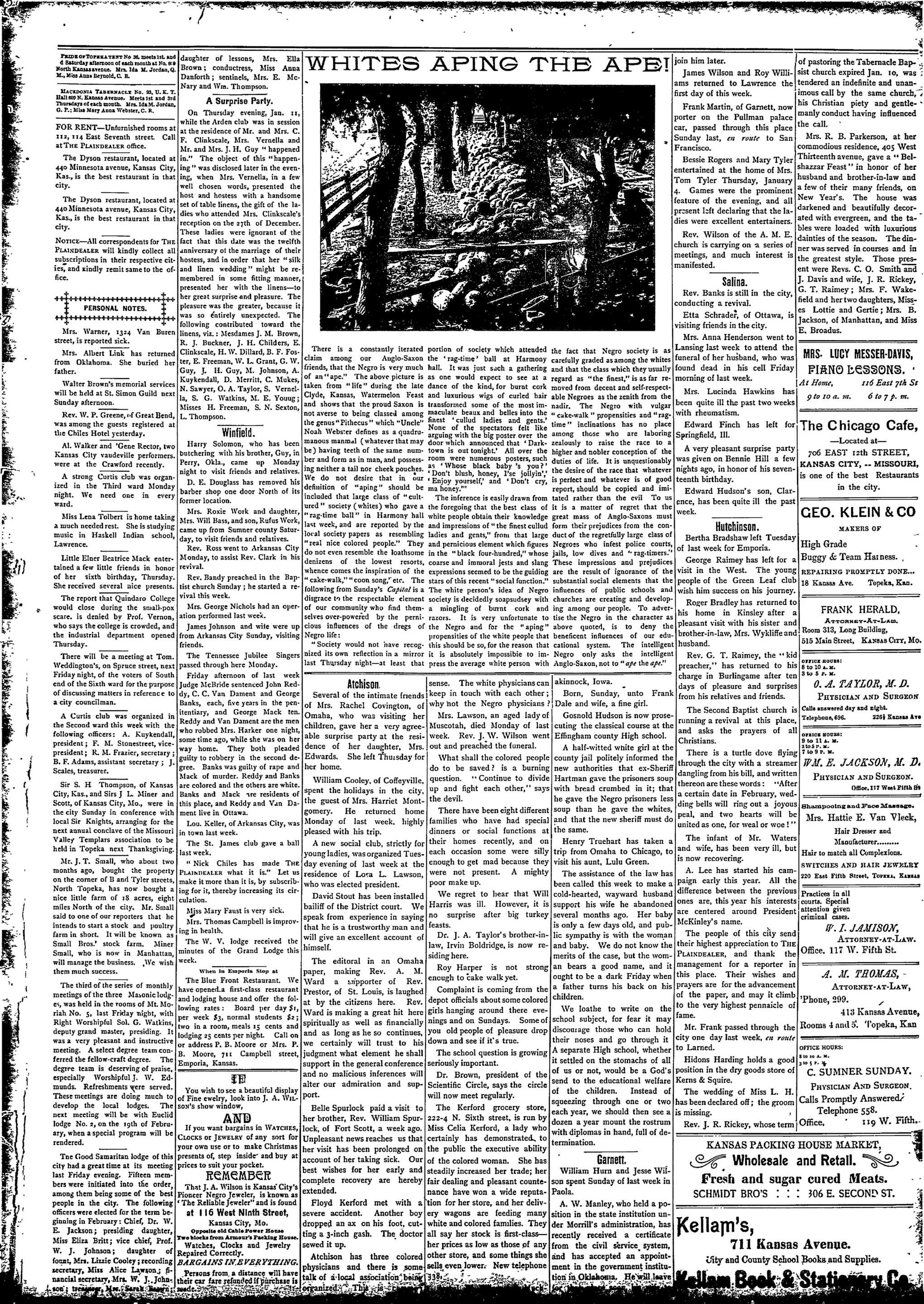
WHITES APING THE APE!
```markdown
```
There is a constantly iterated claim among our Anglo-Saxon friends, that the Negro is very much of an "ape." The above picture is taken from "life" during the late Clyde, Kansas, Watermelon Feast and shows that the proud Saxon is not averse to being classed among the genus "Pithecus" which "Uncle" Noah Webster defines as a quadrumanous mammal (whatever that may be) having teeth of the same number and form as in man, and possessing neither a tail nor cheek pouches. We do not desire that in our definition of "aping" should be included that large class of "cultured" society (whites) who gave a "rag-time ball" in Harmony hall last week, and are reported by the local society papers as resembling "real nice colored people." They do not even resemble the loathsome denizens of the lowest resorts, whence comes the inspiration of the "cake-walk," "coon song," etc. The following from Sunday's Capital is a disgrace to the respectable element of our community who find themselves over-powered by the pernicious influences of the dregs of Negro life:
"Society would not have recognized its own reflection in a mirror last Thursday night—at least that
Atchison.
Several of the intimate friends of Mrs. Rachel Covington, of Omaha, who was visiting her children, gave her a very agreeable surprise party at the residence of her daughter, Mrs. Edwards. She left Thursday for her home.
William Cooley, of Coffeyville, spent the holidays in the city, the guest of Mrs. Harriet Montgomery. He returned home Monday of last week, highly pleased with his trip.
A new social club, strictly for young ladies, was organized Tuesday evening of last week at the residence of Lora L. Lawson, who was elected president. David Stout has been installed bailiff of the District court. We speak from experience in saying that he is a trustworthy man and will give an excellent account of himself.
The editorial in an Omaha paper, making Rev. A. M. Ward a supporter of Rev. Prestor, of St. Louis, is laughed at by the citizens here. Rev. Ward is making a great hit here spiritually as well as financially and as long as he so continues, we certainly will trust to his judgment what element he shall support in the general conference and no malicious inferences will alter our admiration and support.
Belle Spurlock paid a visit to her brother, Rev. William Spurlock, of Fort Scott, a week ago. Unpleasant news reaches us that her visit has been prolonged on account of her taking sick. Our best wishes for her early and complete recovery are hereby extended. Floyd Kerford met with a severe accident. Another boy dropped an ax on his foot, cutting a 3-inch gash. The doctor sewed it up.
portion of society which attended the 'rag-time' ball at Harmony hall. It was just such a gathering as one would expect to see at a dance of the kind, for burnt cork and luxurious wigs of curled hair transformed some of the most immaculate beaux and belles into the finest 'cullud ladies and gents.' None of the spectators felt like arguing with the big poster over the door which announced that 'Darktown is out tonight.' All over the room were numerous posters, such as 'Whose black baby 's you?' 'Don't blush, honey, I'se jollyin', 'Enjoy yourself', and 'Don't cry, ma honey.'
The inference is easily drawn from the foregoing that the best class of white people obtain their knowledge and impressions of "the finest cullud ladies and gents," from that large and pernicious element which figures in the "black four-hundred," whose coarse and immoral jests and slang expressions seemed to be the guiding stars of this recent "social function." The white person's idea of Negro society is decidedly soapsudsey with a mingling of burnt cork and razors. It is very unfortunate to the Negro and for the "aping" propensities of the white people that this should be so, for the reason that it is absolutely impossible to impress the average white person with
sense. The white physicians can keep in touch with each other; why not the Negro physicians Mrs. Lawson, an aged lady of Muscotah, died Monday of last week. Rev. J.W. Wilson went out and preached the funeral. What shall the colored people do to be saved? is a burning question. "Continue to divide up and fight each other," says the devil.
There have been eight different families who have had special dinners or social functions at their homes recently, and on each occasion some were silly enough to get mad because they were not present. A mighty poor make up.
We regret to hear that Will Harris was ill. However, it is no surprise after big turkey feasts.
Dr. J. A. Taylor's brother-in-law, Irvin Boldridge, is now residing here.
Roy Harper is not strong enough to cake walk yet.
Complaint is coming from the depot officials about some colored girls hanging around there evenings and on Sundays. Some of you old people of pleasure drop down and see if it's true.
The school question is growing seriously important.
Dr. Brown, president of the Scientific Circle, says the circle will now meet regularly.
The Kerford grocery store, 222-4 N. Sixth street, is run by Miss Celia Kerford, a lady who certainly has demonstrated, to the public the executive ability of the colored woman. She has steadily increased her trade; her fair dealing and pleasant countenance have won a wide reputation for her store, and her delivery wagons are feeding many white and colored families. They all say her stock is first-class—her prices as low as those of any other store, and some things she sells even lower. New telephone 338.
the fact that Negro society is as carefully graded as among the whites and that the class which they usually regard as "the finest," is as far removed from decent and self-respectable Negroes as the zenith from the nadir. The Negro with vulgar "cake-walk" propensities and "rag-time" inclinations has no place among those who are laboring zealously to raise the race to a higher and nobler conception of the duties of life. It is unquestionably the desire of the race that whatever is perfect and whatever is of good report, should be copied and imitated rather than the evil To us it is a matter of regret that the great mass of Anglo-Saxons must form their prejudices from the conduct of the regretfully large class of Negroes who infest police courts, jails, low dives and "rag-timers." These impressions and prejudices are the result of ignorance of the substantial social elements that the influences of public schools and churches are creating and developing among our people. To advertise the Negro in the character as above quoted, is to deny the beneficent influences of our educational system. The intelligent Negro only asks the intelligent Anglo-Saxon, not to "ape the ape."
Gosnold Hudson is now prosecuting the classical course at the Effingham county High school. A half-witted white girl at the county jail politely informed the new authorities that ex-Sheriff Hartman gave the prisoners soup with bread crumbed in it; that he gave the Negro prisoners less soup than he gave the whites, and that the new sheriff must do the same. Henry Truehart has taken a trip from Omaha to Chicago, to visit his aunt, Lulu Green.
The assistance of the law has been called this week to make a cold-hearted, wayward husband support his wife he abandoned several months ago. Her baby is only a few days old, and public sympathy is with the woman and baby. We do not know the merits of the case, but the woman bears a good name, and it ought to be a dark Friday when a father turns his back on his children.
We loathe to write on the school subject, for fear it may discourage those who can hold their noses and go through it A separate High school, whether it settled on the stomachs of all of us or not, would be a God's send to the educational welfare of the children. Instead of squeezing through one or two each year, we should then see a dozen a year mount the rostrum with diplomas in hand, full of determination.
Garnett.
William Hurn and Jesse Wilson spent Sunday of last week in Paola. A. W. Manley, who held a position in the state institution under Morrill's administration, has recently received a certificate from the civil service system, and has accepted an appointment in the government institution in Oklahoma. He will leave for
KANSAS PACKING HOUSE MARKET Wholesale and Retail. Fresh and sugar cured Meats. SCHMIDT BRO'S : : : 306 E. SECOND ST.
James Wilson and Roy Williams returned to Lawrence the first day of this week.
Frank Martin, of Garnett, now porter on the Pullman palace car, passed through this place Sunday last, en route to San Francisco.
Bessie Rogers and Mary Tyler entertained at the home of Mrs. Tom Tyler Thursday, January 4. Games were the prominent feature of the evening, and all present left declaring that the ladies were excellent entertainers.
Rev. Wilson of the A. M. E. church is carrying on a series of meetings, and much interest is manifested.
Salina.
Rev. Banks is still in the city, conducting a revival.
Etta Schrader, of Ottawa, is visiting friends in the city.
Mrs. Anna Henderson went to Lansing last week to attend the funeral of her husband, who was found dead in his cell Friday morning of last week.
Mrs. Lucinda Hawkins has been quite ill the past two weeks with rheumatism.
Edward Finch has left for Springfield, Ill.
A very pleasant surprise party was given on Bennie Hill a few nights ago, in honor of his seventeenth birthday.
Edward Hudson's son, Clarence, has been quite ill the past week.
Salina.
Hutchinson.
Bertha Bradshaw left Tuesday of last week for Emporia.
George Raimey has left for a visit in the West. The young people of the Green Leaf club wish him success on his journey.
Roger Bradley has returned to his home in Kinsley after a pleasant visit with his sister and brother-in-law, Mrs. Wykliffe and husband.
Rev. G. T. Raimey, the "kid preacher," has returned to his charge in Burlingame after ten days of pleasure and surprises from his relatives and friends.
The Second Baptist church is running a revival at this place, and asks the prayers of all Christians.
There is a turtle dove flying through the city with a streamer dangling from his bill, and written thereon are these words: "After a certain date in February, wedding bells will ring out a joyous peal, and two hearts will be united as one, for weal or woe!"
The infant of Mr. Waters and wife, has been very ill, but is now recovering.
A. Lee has started his campaign early this year. All the difference between the previous ones are, this year his interests are centered around President McKinley's name.
The people of this city send their highest appreciation to THE PLAINDEALER, and thank the management for a reporter in this place. Their wishes and prayers are for the advancement of the paper, and may it climb to the very highest pennaicle of fame.
Mr. Frank passed through the city one day last week, en route to Larned.
Hidons Harding holds a good position in the dry goods store of Kerns & Squire.
The wedding of Miss L. H. has been declared off; the groom is missing.
Rev. J. R. Rickey, whose term
Kellam's,
711 Kansas
City and County School
Kellam Book &
of pastoring the Tabernacle Bapist church expired Jan. 10, was tendered an indefinite and unanimous call by the same church, his Christian piety and gentlemanly conduct having influenced the call.
Mrs. R. B. Parkerson, at her commodious residence, 405 West Thirteenth avenue, gave a "Belshazzar Feast" in honor of her husband and brother-in-law and a few of their many friends, on New Year's. The house was darkened and beautifully decorated with evergreen, and the tables were loaded with luxurious dainties of the season. The dinner was served in courses and in the greatest style. Those present were Revs. C. O. Smith and J. Davis and wife, J. R. Rickey, G. T. Raimey; Mrs. F. Wakefield and her two daughters, Misses Lottie and Gertie; Mrs. B. Jackson, of Manhattan, and Miss E. Broadus.
MRS. LUCY MESSER-DAVIS,
PIANO LESSONS.
At Home, 116 East 7th St
9 to 10 a. m. 6 to 7 p. m.
The Chicago Cafe,
—Located at—
706 EAST 12th STREET,
KANSAS CITY, -- MISSOURI,
is one of the best Restaurants
in the city.
GEO. KLEIN & CO
High Grade
Buggy & Team Harness.
REPAIRING PROMPTLY DONE...
18 Kansas Ave. Topeka, Kan.
FRANK HERALD,
ATTORNEY-AT-LAW.
Room 313, Long Building,
515 Main Street, KANSAS CITY, Mo.
OFFICE HOURS:
8 to 10 A.M.
3 to 5 P.M.
O. A. TAYLOR, M. D.
PHYSICIAN AND SURGEON
Calls answered day and night.
Telephone, 696. 226$ Kansas Ave
OFFICE HOURS:
9 to 11 A.M.
3 to 5 P.M.
7 to 9 P.M.
WM. E. JACKSON, M. D.
PHYSICIAN AND SURGEON.
Office, 117 West Fifth St
Shampooing and Face Massage.
Mrs. Hattie E. Van Vleck,
Hair Dresser and
Manufacturer.....
Hair to match all Complexes.
SWITCHES AND HAIR JEWELRY
220 East Fifth Street, TOPKEA, KANSAS
Practices in all
courts. Special
attention given
criminal cases.
W. I. JAMISON,
ATTORNEY-AT-LAW.
Office. 117 W. Fifth St.
A. M. THOMAS,
ATTORNEY-AT-LAW,
'Phone, 299.
413 Kansas Avenue,
Rooms 4 and 5. 'Topeka, Kan
OFFICE HOURS:
8 to 10 A.M.
3 to 5 P. 1/2
C. SUMNER SUNDAY.
PHYSICIAN AND SURGEON.
Calls Promptly Answered.
Telephone 558.
Office, 119 W. Fifth.
HOUSE MARKET,
and Retail.
r cured Meats.
: 306 E. SECOND ST.
s Avenue.
l Books and Supplies.
Stationery Co.
Thomas Slaughter came home week before last, from Oklahoma City, quite sick, but is some better now. George Slaughter is also improving.
Charlie Chiles went to Pratt Center Thursday of week before last on a business trip; he is employed in the People's Grocery, W. E. Grove, proprietor.
Rev. W. Brannigan, of Kansas City, Kas., pastor of the Baptist church, corner Fourth and Virginia avenue, has resigned and is now at home, this city, on a furlough.
P. W. Barnett, of Atchison, was in town Friday of week before last on business, and met with an old friend of his, Rev. W. H. Garnett.
Mrs. Joseph Hart is very sick again, and is confined to her bed.
A swell party was given by Joe Richardson and wife Tuesday evening of last week, which was very great and one long to be remembered by those who were present. The rooms were nicely decorated with flowers and potted plants, and in every way proved themselves equal to the emergency. Games of various kinds were the principal feature of the evening. Partners for luncheon were chosen by slips of paper. The ladies' slips had the names of the capitals of different state on them, while the gents' slips had the names of different states written on them, and each gentleman accompanied his lady to lunch, which was served in a beautiful, three-course style. First, oyster soup; second, sandwiches and coffee; third, pineapples, served by two young men, dressed in white jackets and long aprons. Those in attendance were C. R. Lee and wife, W. J. Ramsey and wife, A. L. Farmer and wife, Ed. Mason and wife, J. M. Gross and wife, George Washington and wife, Robert Jones and wife, Charles Miller and wife; Mesdames J. R. Scott, J. W. Anderson, A. J. Tandy; Messrs. John Parthena, N. Rickman, Pat. Rickman, Charles Robinson, W. H. Paige, C. Rickman, C. Paige, W. Carrill.
Charlie Miller and wife gave a great entertainment on the 4th inst., in honor of Mrs. J. R. Scott, of Colorado Springs, Colo. The evening was spent with games of various kinds and other amusements. When the hour had arrived for luncheon, there was a new game took place on them—the ladies were all excused from the room and a large curtain was drawn across the double door which came down to the floor, then the ladies thrust the toes of their shoes under the curtain, and the one guessing the lady's name who wore the shoe, would accompany her to lunch. This proved to be a fun-maker for true, and no one knows how little attention their foot-wear was noticed until then. They retired to a dining room where a luxurious two-course lunch was served. Those present were Messrs. Joseph Rickman, Robert Jones, A. L. Farmer, C. R. Lee, Ed. Mason, J. M. Gross; Mesdames G. Washington, J. W. Anderson, A. J. Tandy; Messrs. N. Rickman Charles Robinson, W. H. Paige
J. M. Gross and wife entertained Tuesday of last week at dinner at their home, 702 East Fourth street, Rev. Goree and mother, Mrs. M. Childs. e trio arrived at 11:15, and e sitting room was thrown open to them. They amused themselves with good books and papers, among which was THE PLAINDEALEP, and on which were many comments. At 2:10 a nice two-course dinner was served, including fruits and candies. After dinner, the evening was spent with discussing the lesson of the "First Quarter," the "Birth of Christ" and other subjects. Rev. Goree is a bright young
Wichita.
Enid, O. T.
The holidays have come and gone, and with them have gone many fond recollections; the wish, with all is that we may live with the same prosperity and good will toward each other this year as in the past.
Mrs. Joe Sharpe served an elegant dinner New Year's Day. The table was loaded with all the luxuries that one could wish; needless to say, "turkey, was the leading question." Those present were Mr. Fogg and wife, Mr. Hill and wife, Mr. Thomas and wife, Lawyer D. L. F. Banks; Mrs. Kirk; Miss Elliott; Mrs. Warner; P. Weir, Rev. Molly and Miss Smotherman.
Miss Carrington has been visiting friends in the city.
Rev. Ross spent Sunday before last with his family, and preached an elegant sermon in the Baptist church Sunday night.
Quite a surprise was tendered a few friends of Rev. Molly, when on New Year's evening they were invited to the home of Mrs. Smotherman. A few moments after the friends had assembled, and all were quiet, a tap was heard at the door. Upon opening, Judge Beaucamp stepped in, and from the opposite door came Rev. Molly with Mrs. Smotherman leaning on his arm. They stepped to the center of the room and were pronounced husband and wife before one could realize what was happening. Needless to say, after the friends came to to their senses, a very pleasant evening was spent, and at a late hour departed to their respective homes, wishing Rev. and Mrs. Molly a long and happy life.
Mrs. Lena Fogg returned from her holiday visit Sunday
count of the small-pox scare not having abated, school did not begin until the 8th. Mrs. Fogg reports a very pleasant meeting of the teachers in Perry, resulting in a permanent organization.
Miss Elliott, our popular dressmaker, is kept so busy that she found it necessary to employ a seamstress.
Mrs. Helm and A. B. Sawyer were quietly married at the home of the former, Tuesday evening, the 8th inst.
Mrs. Campbell, of Pond Creek, is visiting friends in the city.
Will Harris, the popular cook at the Hubbard House, is taking a two-weeks "lay off."
Will Fogg has added to his shop four incandescent lights, which certainly adds to his already fine shop quite an improvement. To say the least, he has the finest shop in the city, and judging from his large patronage, he is considered the finest manipulator.
The Ladies' F. T. T. L. E. club re-organized Thursday evening, the 9th inst., and made Mesdames Lena Fogg, president; Hill, secretary; Yates, treasurer.
Kansas City, Kas.
The A. M. E. church is making rapid progress under the pastorate of Rev. G. A. Griffith. They had a special meeting Sunday night of last week, and five souls were snatched from the jaws of hell and returned to the fold.
We are having a controversy among the learned doctors, as to whether we are having an epidemic of small-pox or measles.
Six pupils of Lincoln school, who live in the infested district, were sent home Monday.
The Columbian Literary society was organized Monday night of last week, and the future of the society is hopeful. The first regular program was rendered January 15.
Bishop B. T. Tanner and family left Tuesday of last week, for their home in Philadelphia.
Alpha Brooks is on the sick list.
Western University has reopened with all the old pupils and a great many new ones.
Rev. W. E. Brooks, presiding elder, Fort Scott distrtct, is spending a few days with his family at 2027 Water street.
Emporia.
Archie Ray is sick with what is supposed to be the small-pox, at his home on Exchange street. Verbal Duncan, who has been sick with the same disease, is now fully recovered.
Rev. Braxton was here Sunday, assisting Rev. Barr in the quarterly meeting at the A. M. E. church.
Alex. Reeves and wife spent New Year's in Topeka, Lawrence and Kansas City. They report a good time.
Albert Green, of Chetopa, is home on account of his father's illness.
There are several cases of scarlet fever and diphtheria in the city.
Ottawa.
Rev. W. H. Scott was called to Chanute on the account of the illness of his sister, Mrs. Reece.
Alex. Strodder is on the sick list.
Dixon, who has been staying with his sister in Kansas City the last three months, returned home Satürdday of last week.
Charles Wright, of Chicago, came in Thursday of last week to visit his aunt, Mrs. Anna Gray.
Walter Payne, who has been quite ill the last two weeks, is recovering.
Father Daniels, of the East Side, is reported to be quite sick.
At the masquerade entertainment given Thursday evening of last week, the prize was awarded George Anderson.
Emporia.
Ottawa.
Mrs. B. Hudson returned from Independence last week, where she has been visiting the last two
Garden City.
Carrie Kinkade Price, after spending a few weeks with her parents, returned to Colorado Springs.
Rev. J. A. Wright reorganized the B. Y. P. U. in the Second Baptist church Sunday before last.
Deacon Robert Johnson was on the sick list last week.
Ed. Jackson will leave in a few days for Texas, to look after property, the inheritance of his grandfather, who departed this life last week.
Rev. C. C. Wood held quarterly meeting on the 15th inst., and the attendance was good.
Rev. J. C. Wright will begin a series of meetings next week, and expects Rev. Scott, of Ottawa, to assist him.
Messrs. Eagleson and Bush, of Dodge City, were recently the guests of Ed. Jackson.
Joseph Johnson, James Goodwin and his daughter, Miss. Viola, have returned from Great Bend, at which place they spent Christmas.
Manhattan.
There was quite an excitement here Sunday over vaccination. Everybody had a sore arm Sunday night, but this had nothing to do with diminishing the great crowds that met at the Second Baptist church to hear those heart-stirring sermons preached by Rev. A. L. Voorhies. Rev. Voorhies is conducting his revival services now at Manhattan with a success not known before in the history of the town. The Second.l Baptist church has been blessed with such an able pastor as Rev. Voorhies, and it is a mystery to some, considering his general deportment and manners, why he should stay in so small a place as Manhattan; but his great delight is to build up the church. We think some large church in a larger city would do well to employ his services in the cause of Christ.
We have lately had the state missionary of woman's missions work, Ella Schrader, with us. She made an interesting address at our church one evening last week under the auspices of Mrs. Lang, president of missions work at Manhattan. Notwithstanding the missionary was not expected at the time, Rev. Voorhies, with Mrs. Lang, did everything possible to help her. We had an excellent meeting.
Rev. Voorhies, speaking of THE PLAINDEALER, thinks it a friend to the race. THE PLAINDEALER, he said, was not at all nick-named, though its editor is named Nick; he also said he is personally acquainted with Mr. Chiles, a fine fellow, whose paper deals plainly for and principally with the race. Several of our people have signified their intention of taking and paying for the paper. We shall see if they live up to their word.
Miss Schrader left our town the 15th for parts unknown, in the interests of Christ and THE PLAINDEALER.
North Topeka.
There was an ecclesiastical council called at the B street Baptist church Sunday afternoon for the purpose of ordaining E. C: Stoner, which consisted of pastors and delegates from all the city churches. Rev. W. L. Grant was chosen moderator. H
whom E. C. Stoner was examined and passed a fair examination. It being late, the council adjourned till Tuesday evening at 8 o'clock when the ordination sermon was preached by Rev. W. W. Stewart, D. D., of St. Joseph, Mo., after which he was ordained and set apart for the ministry. Rev. E. C. Stoner is a member of the B street Baptist church, having lived principally in Topeka, and attended the Baptist Institute at Macon City, Mo.
Mrs. Jones and Sadie Barker made a hurried trip to Rossville the first of the week.
Rev. P. W. Barker is somewhat better. He has been able to walk up town twice.
Rev. Wooten has returned from filling the appointments of Presiding Elder Ransom. He has been preaching in the various cities of Kansas.
Rev. W. W. Stewart, of St. Joseph, is visiting Rev. Barker. Rev. Stewart preached two sermons at the B street Baptist church Sunday, which were very commendable.
John Birdwhistle and wife have returned from Salina.
Mitchell Pennington, of Western avenue, is suffering from small-pox.
Mrs. Sneed, son and daughter have arrived from Salina.
James Anderson, living on Curtis street, is sick from the small-pox.
John Jordan, Topeka avenue, is suffering from chicken-pox.
Fort Scott.
Miss Belle Guy is seriously ill. The A. B. C. club gave an entertainment in Red Men's hall last Wednesday. Little Vera, daughter of Maj. Ford, has been quite sick with pneumonia, but is now improving. The efforts of Prof. Wilson have resulted in an appropriation by the school board for an industrial department in the colored school. A 5-year-old son of J. C. Brown, died last Saturday of tonsilitis, after a short illness, and was buried Monday.
Mrs. Dollason, an aged lady, died Sunday and was buried Monday. The services were held at the Shiloh Baptist church.
Mrs. Parks and daughter, Sallie Hall, of Wichita, arrived Sunday, to attend the funeral of her little grandson.
The Social Hour club met at Mrs. A. L. Ewing's last Friday evening. It was opened by quotations from Longfellow. Mrs. Carr recited, "The Day Is Done," and Mrs. G. W. Ford read a paper on "The Life and Character of Longfellow." All reported a good time. They will meet next time with Mrs. G. W. Ford.
Leavenworth.
Rev. Father Williams, of Omaha, delivered an excellent sermon Wednesday evening of last week at the Episcopal church, corner of Fifth and Arch streets. Father Williams preached again Wednesday evening, January 17. John Edmonds and wife, of Duluth, Minn., are visiting their parents, H. C. Fouse and wife, on Pennsylvania and Second avenues. B. Sharp and wife are rejoicing over the arrival of a 10-pound girl.
Jennie Jones, who is visiting her brother, S. T. Jones, on Fifth avenue, has been very ill, but is now convalescent. Harry Wood has entered the training class, and is observing in Prof. A. H. Walton's building. Mrs. Francis, of Mount Bayou, Miss., visited her cousin, Mrs. T. Finley, last week It is a town of 1,500 inhabitants, all of whom are colored. This is the only town in the United States which is governed entirely by Negroes.
$200,000 Worth of Property
$200,000 Worth of Property
Has been placed in my hand for disposal, for sale; and of which part has bee n taken under foreclosure. It principally is owned by Eastern Firms who are very anxious to sell on reasonable terms. I have beautiful houses and lots in all parts of the city, which can be bought almost at your own price. As this property has been placed in my hands for sale recently, I wish to wind it up in short order. Houses range from $500. to $1,000. each on easy terms; also I have beautiful residences ranging from $1,000 to $7,000 situated in the most beautiful part of the city, residences which you might desire.
We have a number of large and small farms near the city of Topeka, and farms to dispose of in all parts of the state.
e
PHONE NO. 680.
George Thomas, of Topeka, was in the city last week, and Miss L. J. A. was about the happiest soul in town.
Richmond, Mo.
The colored citizens, of Richmond, Mo., believing in fostering the principles of their fathers, met at the C. M. E. church Jan. 1, 1900, to pay homage to that immortal proclamation, whereby millions of Negroes were set at liberty. Well might we, as a race, assemble once each year to teach the present generation and generations that are to be, that the fathers hold one day in the year as a day of rejoicing and speech-making. Following is the program: Song, congregation; invocation, Rev. Dorsey; welcome address, Rev. Lee; "Lynch Law," Messrs. King and Kingsbrough; song, "My Country," Tis of Thee; "The Status of the Negro," Rev. Carter; "The Negro in the School House," Wm. Jacobs; song, "John Brown:" recitation, Miss Maria Cary; song, "Silver Tongued" Quartette; "Thirty-six Years of Freedom." J. F. Bruce.
Arkansas City.
Rev. A. E. Clark's protracted meeting is growing in interest, and many additions are being made to the church.
Rev. Ross, of Winfield, came down to assist in the revival meetings. May God bless us!
Bro. Allen and Sister Will West are still on the sick list.
John Wilson was up on a visit from Ponca City, O. T.
James Johnson and wife made a hurried trip to Winfield last Sunday.
We are having spring-like weather and the wheat is fine.
Mr. Bennett is putting out onions for the spring market.
We look for a new railroad, running from here to the Southeast.
The Negroes of this city are looking in the right direction by securing homes and paying for same. We are here in Kansas to stay, and make the best of it, for we know he that helps himself shall receive help.
The Masonic Lodge No. 32 will give another social in their hall February 7th, for the benefit of the lodge.
There will be a banquet given in the Masonic hall, February 7, 1900. Good music will be furnished by the string band. All Massons in good standing in this lodge are cordially invited and all others will be admitted on special invitations given by committee. The refreshments will consist of oyster stew, oysters fried, oyster loaf, potato salad, baked chicken with brown bread, fried chicken and light rolls. Refreshments of the season will be served.—Committee: A. Work, A. A. Bass, D. S. Scott.
The company of colored specialty people of which Bert A. Williams and Geo. W. Walker are the inspiring geniuses entertained a standing-room only house at the Crawford last night. It was a high order of a show. Perhaps
KIRK PINKSTO
TOPEKA, KANSAS.
the only fault was the great length of the program. The costumes were pretty and clean, and the scenery was better than that carried by the so called scenic productions. A pleasing feature of the show was the singing by Miss Mattie Wilkes, a soprano. Colored society turned out in great numbers. They composed two-thirds of the audience. The women wore their best gowns and the men their dress suits. There were two box parties of colored people. In this connection it might not be out of place to state that Topeka has the reputation of having the best looking, best dressed and best educated colored people of any city in the West.—Wednesday's Capital
Bert A. Williams and George W. Walker, the two shining lights of "The Policy Players," commenced their theatrical career in San Francisco in the spring of 1893. Their first appearance was with a show composed of white and black performers, or, theatrically speaking, a checkered show, known as Martin & Selig's wandering minstrels. The company traveled from place to place in wagons and had to double in brass besides doubling in the productions put on by the management. This lasted 14 weeks and for which they received two weeks' salary in all. They jumped the company in Bakersfield, Cal., and secured an engagement at the only theater in the town. This engagement lasted eight weeks, but the "ghost" failed to walk and the wandering comedians started it again.
Their next engagement was with the owner of a hog ranch and who dabbled in the theatrical business as a side issue. When salaries came due, and the box office receipts were not enough to pay salaries, the owner of the ranch would write his son, who was in charge of the hog business, and order enough hogs sold so as to keep the company from becoming stranded. This lasted until the ranch owner had about 20 hogs left when the show closed, and Williams and Walker were again looking for work. They met with reverse after reverse and knocked about from place to place and finally drifted into Chicago. Here the pair met with their first success. Thomas Canary, of Canary & Lederer, of the New York Casino fame, met them, and after seeing their turn, decided to engage them for the elaborate production of "The Gold Bug," which opened in New York, September 14, 1894. Their act was the feature of the show and in a short time offers began to pour in tendering engagements at leading theaters in the country.
Their next success was with Peter Daley in "A Good Thing," and then came their banner engagement of their career—thirty-six consecutive weeks at Koster & Bial's, New York, at $300 a week. Next the team crossed the Atlantic and showed for eight weeks at the Empire Theater London. A return American date at Koster & Bial's lasted five weeks, when Hartig, Seamon & Tuck placed them at the head of a company, where they have been and are still changing the play each season.
When playing in different cities they stop at the leading hotels, taking their meals in private apartments to avoid remarks by white guests who might object to their presence. Both are possessed of a pleasing personality and avoid the white people as much as possible. Lottie Thompson, who plays the old maid in "Th, Policy Players," in private life is Mrs. Bert A. Williams, and Ada Overton, who plays Kioka, is Mrs. George W. Walker.