Plaindealer
Friday, February 2, 1900
Topeka, Kansas
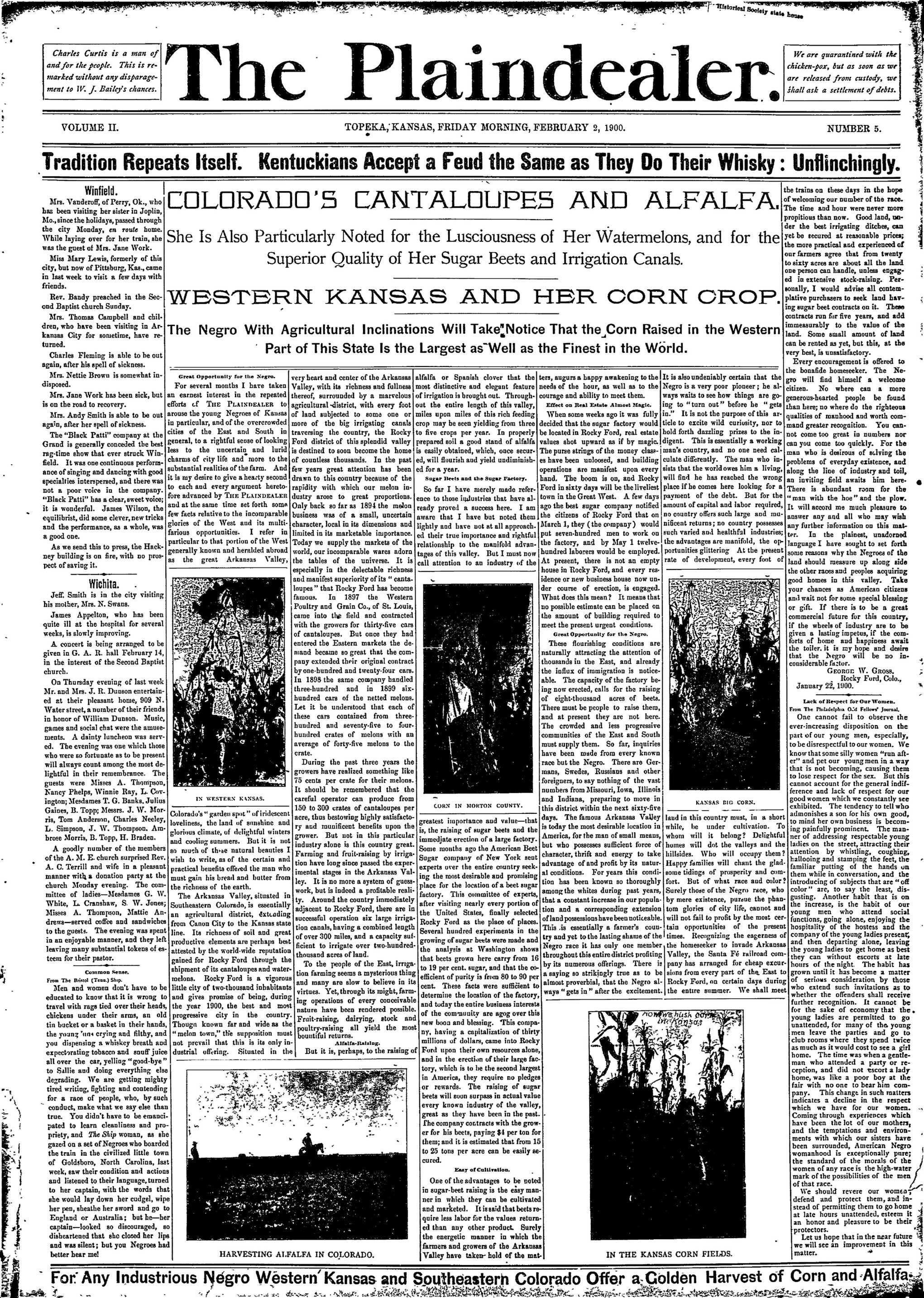
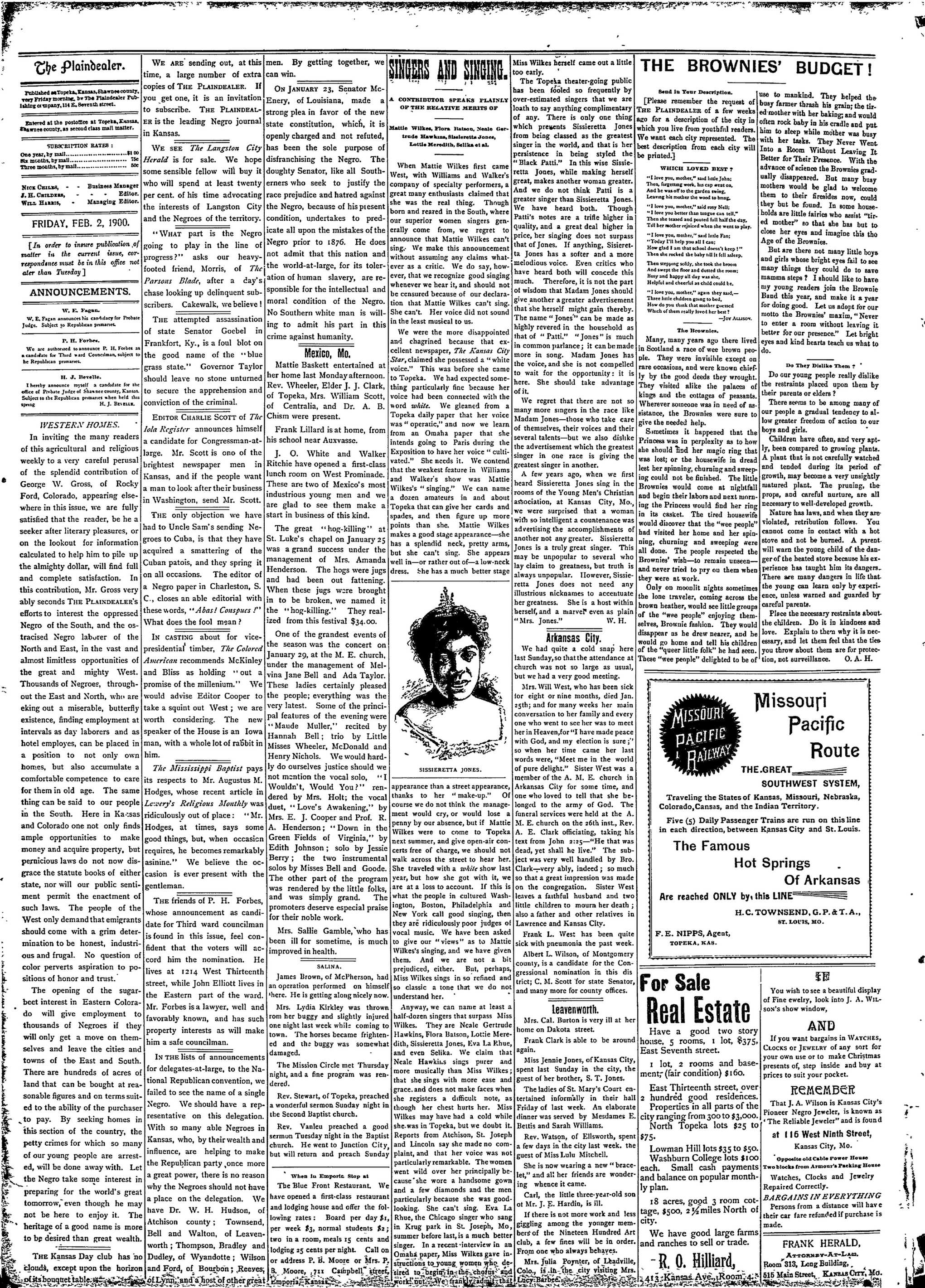
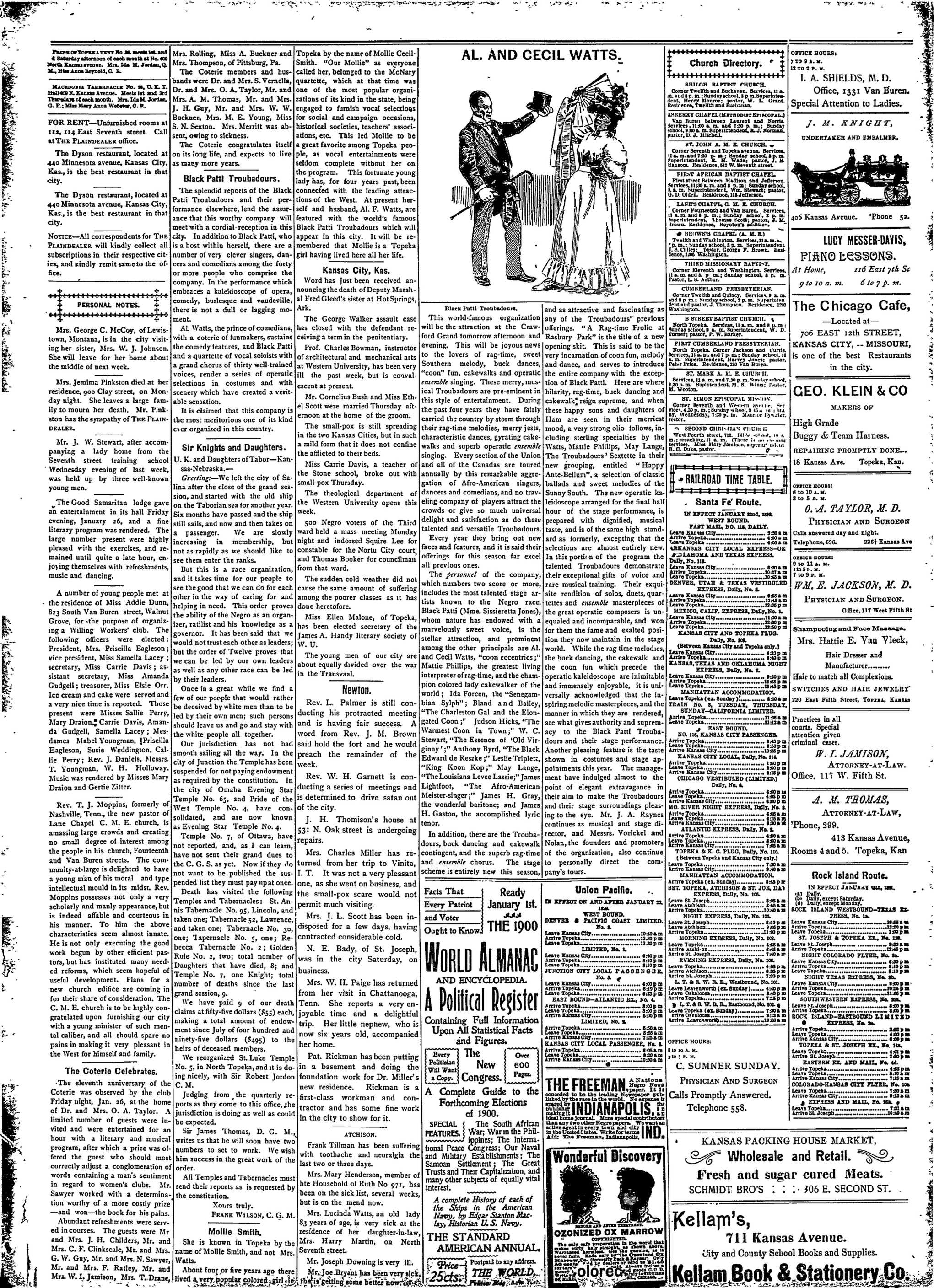
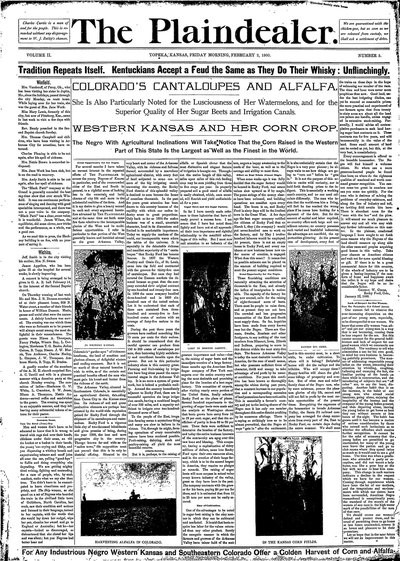
Page text (machine-generated)
Tradition Repeats Itself. Kentuckians Accept a Feud the Same as They Do Their Whisky: Unflinchingly.
Charles Curtis is a man of and for the people. This is remarked without any disparagement to W. J. Bailey's chances.
VOLUME II.
Winfield.
Mrs. Vanderoff, of Perry, Ok., who has been visiting her sister in Joplin, Mo., since the holidays, passed through the city Monday, en route home. While laying over for her train, she was the guest of Mrs. Jane Work.
Miss Mary Lewis, formerly of this city, but now of Pittsburg, Kas., came in last week to visit a few days with friends.
Rev. Bandy preached in the Second Baptist church Sunday.
Mrs. Thomas Campbell and children, who have been visiting in Arkansas City for sometime, have returned.
Charles Fleming is able to be out again, after his spell of sickness.
Mrs. Nettie Brown is somewhat indisposed.
Mrs. Jane Work has been sick, but is on the road to recovery.
Mrs. Andy Smith is able to be out again, after her spell of sickness.
The "Black Patti" company at the Grand is generally conceded the best rag-time show that ever struck Winfield. It was one continuous performance of singing and dancing with good specialties interspersed, and there was not a poor voice in the company. "Black Patti" has a clear, sweet voice; it is wonderful. James Wilson, the equilibrist, did some clever, new tricks and the performance, as a whole, was a good one.
As we send this to press, the Hackney building is on fire, with no prospect of saving it.
Wichita.
Jeff. Smith is in the city visiting his mother, Mrs. N. Swans. James Appelton, who has been quite ill at the hospital for several weeks, is slowly improving. A concert is being arranged to be given in G. A. R. hall February 14, in the interest of the Second Baptist church.
On Thursday evening of last week Mr. and Mrs. J. R. Dunson entertained at their pleasant home, 909 N. Water street, a number of their friends in honor of William Dunson. Music, games and social chat were the amusements. A dainty luncheon was served. The evening was one which those who were so fortunate as to be present will always count among the most delightful in their remembrance. The guests were Misses A. Thompson, Nancy Phelps, Winnie Ray, L. Covington; Mesdames T. G. Banks, Julius Gaines, B. Topp; Messrs. J. W. Morris, Tom Anderson, Charles Neeley, L. Simpson, J. W. Thompson, Ambrose Morris, B. Topp, H. Braden.
A goodly number of the members of the A. M. E. church surprised Rev. A. C. Terrill and wife in a pleasant manner with a donation party at the church Monday evening. The committee of ladies—Meadames G. W. White, L. Cranshaw, S. W. Jones, Misses A. Thompson, Mattie Andrews—served coffee and sandwiches to the guests. The evening was spent in an enjoyable manner, and they left leaving many substantial tokens of esteem for their pastor.
Common Sense.
From The Bristol (Tenn.) Ship.
Men and women don't have to be educated to know that it is wrong to travel with rags tied over their heads, chickens under their arms, an old tin bucket or a basket in their hands, the young'un crying and filthy, and you dispensing a whiskey breath and expectrating tobacco and snuff juice all over the car, yelling "good-bye" to Sallie and doing everything else degrading. We are getting mighty tired writing, fighting and contending for a race of people, who, by such conduct, make what we say else than true. You didn't have to be emancipated to learn cleanliness and propriety, and The Ship woman, as she gazed on a set of Negroes who boarded the train in the civilized little town of Goldsboro, North Carolina, last week, saw their condition and actions and listened to their language, turned to her captain, with the words that she would lay down her cudgel, wipe her pen, sheathe her sword and go to England or Australia; but he—her captain—looked so discouraged, so disheartened that she closed her lips and was silent; but you Negroes had better hear me!
---
The Plaindealer.
She Is Also Particularly Noted for the Lusciousness of Her Watermelons, and for the Superior Quality of Her Sugar Beets and Irrigation Canals.
WESTERN KANSAS AND HER CORN CROP.
The Negro With Agricultural Inclinations Will Take Notice That the Corn Raised in the Western Part of This State Is the Largest as Well as the Finest in the World.
Great Opportunity for the Negro.
For several months I have taken an earnest interest in the repeated efforts of THE PLAINDEALER to arouse the young Negroes of Kansas in particular, and of the overcrowded cities of the East and South in general, to a rightful sense of looking less to the uncertain and lurid charms of city life and more to the substantial realities of the farm. And it is my desire to give a hearty second to each and every argument heretofore advanced by THE PLAINDEALER and at the same time set forth some few facts relative to the incomparable glories of the West and its multifarious opportunities. I refer in particular to that portion of the West generally known and heralded abroad as the great Arkansas Valley,
A
IN WESTERN KANSAS.
Colorado's "garden spot" of iridescent loveliness, the land of sunshine and glorious climate, of delightful winters and cooling summers. But it is not so much of three natural beauties I wish to write, as of the certain and practical benefits offered the man who must gain his bread and butter from the richness of the earth.
The Arkansas Valley, situated in Southeastern Colorado, is essentially an agricultural district, extending from Canon City to the Kansas state line. Its richness of soil and great productive elements are perhaps best attested by the world-wide reputation gained for Rocky Ford through the shipment of its cantaloupes and watermelons. Rocky Ford is a vigorous little city of two-thousand inhabitants and gives promise of being, during the year 1900, the best and most progressive city in the country. Though known far and wide as the "melon town," the supposition must not prevail that this is its only in dustrial offering. Situated in the
e y g h n
e d n
at d
at e o
er so
d
THE CROSSING
HARVESTING ALFALFA IN COLORADO.
TOPEKA, KANSAS, FRIDAY MORNING, FEBRUARY 2, 1900.
very heart and center of the Arkansas Valley, with its richness and fullness thereof, surrounded by a marvelous agricultural district, with every foot of land subjected to some one or more of the big irrigating canals traversing the country, the Rocky Ford district of this splendid valley is destined to soon become the home of countless thousands. In the past few years great attention has been drawn to this country because of the rapidity with which our melon industry arose to great proportions. Only back so far as 1894 the melon business was of a small, uncertain character, local in its dimensions and limited in its marketable importance. Today we supply the markets of the world, our incomparable wares adorn the tables of the universe. It is especially in the delectable richness and manifest superiority of its "cantaloupes" that Rocky Ford has become famous. In 1897 the Western Poultry and Grain Co., of St. Louis, came into the field and contracted with the growers for thirty-five cars of cantaloupes. But once they had entered the Eastern markets the demand became so great that the company extended their original contract by one-hundred and twenty-four cars. In 1898 the same company handled three-hundred and in 1899 six hundred cars of the netted melons. Let it be understood that each of these cars contained from three hundred and seventy-five to four hundred crates of melons with an average of forty-five melons to the crate.
During the past three years the growers have realized something like 75 cents per crate for their melons. It should be remembered that the careful operator can produce from 150 to 300 crates of cantaloupes per acre, thus bestowing highly satisfactory and munificent benefits upon the grower. But not in this particular industry alone is this country great. Farming and fruit-raising by irrigation have long since passed the experimental stages in the Arkansas Valley. It is no more a system of guesswork, but is indeed a profitable reality. Around the country immediately adjacent to Rocky Ford, there are in successful operation six large irrigation canals, having a combined length of over 300 miles, and a capacity sufficient to irrigate over two-hundred thousand acres of land.
To the people of the East, irrigation farming seems a mysterious thing and many are slow to believe in its virtues. Yet, through its might, farming operations of every conceivable nature have been rendered possible. Fruit-raising, dairying, stock and poultry-raising all yield the most bountiful returns. Alfalfa-Raising. But it is, perhaps, to the raising of
THE CROSSING
alfalfa or Spanish clover that the most distinctive and elegant feature of irrigation is brought out. Throughout the entire length of this valley, miles upon miles of this rich feeding crop may be seen yielding from three to five crops per year. In properly prepared soil a good stand of alfalfa is easily obtained, which, once secured, will flourish and yield undiminished for a year.
So far I have merely made reference to those industries that have already proved a success here. I am aware that I have but noted them lightly and have not at all approached their true importance and rightful relationship to the manifold advantages of this valley. But I must now call attention to an industry of the
```markdown
```
CORN IN MORTON COUNTY.
greatest importance and value—that is, the raising of sugar beets and the immediate erection of a large factory. Some months ago the American Beet Sugar company of New York sent experts over the entire country seeking the most desirable and promising place for the location of a beet sugar factory. This committee of experts, after visiting nearly every portion of the United States, finally selected Rocky Ford as the place of places. Several hundred experiments in the growing of sugar beets were made and the analysis at Washington shows that beets grown here carry from 16 to 19 per cent. sugar, and that the coefficient of purity is from 80 to 90 per cent. These facts were sufficient to determine the location of the factory, and today the entire business interests of the community are agog over this new boon and blessing. This company, having a capitalization of thirty millions of dollars, came into Rocky Ford upon their own resources alone, and in the erection of their large factory, which is to be the second largest in America, they require no pledges or rewards. The raising of sugar beets will soon surpass in actual value every known industry of the valley, great as they have been in the past. The company contracts with the grower for his beets, paying $4 per ton for them; and it is estimated that from 15 to 25 tons per acre can be easily secured.
Easy of Cultivation.
One of the advantages to be noted in sugar-beet raising is the easy manner in which they can be cultivated and marketed. It is said that beets require less labor for the values returned than any other product. Surely the energetic manner in which the farmers and growers of the Arkansas Valley have taken-hold of the mat-
ters, augurs a happy awakening to the needs of the hour, as well as to the courage and ability to meet them.
Effect on Real Estate Almost Magic.
When some weeks ago it was fully decided that the sugar factory would be located in Rocky Ford, real estate values shot upward as if by magic. The purse strings of the money classes have been unloosed, and building operations are manifest upon every hand. The boom is on, and Rocky Ford in sixty days will be the liveliest town in the Great West. A few days ago the best sugar company notified the citizens of Rocky Ford that on March 1, they (the company) would put seven-hundred men to work on the factory, and by May 1 twelve-hundred laborers would be employed. At present, there is not an empty house in Rocky Ford, and every residence or new business house now under course of erection, is engaged. What does this mean? It means that no possible estimate can be placed on the amount of building required to meet the present urgent conditions.
These flourishing conditions are naturally attracting the attention of thousands in the East, and already the influx of immigration is noticeable. The capacity of the factory being now erected, calls for the raising of eight-thousand acres of beets. There must be people to raise them, and at present they are not here. The crowded and less progressive communities of the East and South must supply them. So far, inquiries have been made from every known race but the Negro. There are Germans, Swedes, Russians and other foreigners, to say nothing of the vast numbers from Missouri, Iowa, Illinois and Indiana, preparing to move in this district within the next sixty-five days. The famous Arkansas Valley is today the most desirable location in America, for the man of small means, but who possesses sufficient force of character, thrift and energy to take advantage of and profit by its natural conditions. For years this condition has been known so thoroughly among the whites during past years, that a constant increase in our population and a corresponding extension of land possessions have been noticeable. This is essentially a farmer's country and yet to the lasting shame of the Negro race it has only one member throughout this entire district profiting by its numerous offerings. There is a saying so strikingly true as to be almost proverbial, that the Negro always "gets in" after the excitement.
how we hush corn
in Kansas
IN THE KANSAS CORN FIELDS.
It is also undeniably certain that the Negro is a very poor pioneer; he always waits to see how things are going to "turn out" before he "gets in." It is not the purpose of this article to excite wild curiosity, nor to hold forth dazzling prizes to the indigent. This is essentially a working man's country, and no one need calculate differently. The man who insists that the world owes him a living, will find he has reached the wrong place if he comes here looking for a payment of the debt. But for the amount of capital and labor required, no country offers such large and munificent returns; no country possesses such varied and healthful industries, the advantages are manifold, the opportunities glittering. At the present rate of development, every foot of
```markdown
```
KANSAS BIG CORN.
laud in this country must, in a short while, be under cultivation. To whom will it belong? Delightful homes will dot the valleys and the hillsides. Who will occupy them? Happy families will chant the gladsome tidings of prosperity and comfort. But of what race and color? Surely those of the Negro race, who by mere existence, pursue the phantom glories of city life, cannot and will not fail to profit by the most certain opportunities of the present times. Recognizing the eagerness of the homeseeker to invade Arkansas Valley, the Santa Fe railroad company has arranged for cheap excursions from every part of the East to Rocky Ford, on certain days during the entire summer. We shall meet
We are quarantined with the chicken-pox, but as soon as we are released from custody, we shall ask a settlement of debts.
NUMBER 5.
the trains on these days in the hope of welcoming our number of the race. The time and hour were never more propitious than now. Good land, under the best irrigating ditches, can yet be secured at reasonable prices; the more practical and experienced of our farmers agree that from twenty to sixty acres are about all the land one person can handle, unless engaged in extensive stock-raising. Personally, I would advise all contemplative purchasers to seek land having sugar beet contracts on it. These contracts run for five years, and add immeasurably to the value of the land. Some small amount of land can be rented as yet, but this, at the very best, is unsatisfactory.
Every encouragement is offered to the bonafide homeseeker. The Negro will find himself a welcome citizen. No where can a more generous-hearted people be found than here; no where do the righteous qualities of manhood and worth command greater recognition. You cannot come too great in numbers nor can you come too quickly. For the man who is desirous of solving the problems of everyday existence, and along the line of industry and toil, an inviting field awaits him here. There is abundant room for the "man with the hoe" and the plow. It will accord me much pleasure to answer any and all who may wish any further information on this matter. In the plainest, unadorned language I have sought to set forth some reasons why the Negroes of the land should measure up along side the other races and peoples acquiring good homes in this valley. Take your chances as American citizens and wait not for some special blessing or gift. If there is to be a great commercial future for this country, if the wheels of industry are to be given a lasting impetus, if the comforts of home and happiness await the toiler, it is my hope and desire that the Negro will be no in considerable factor.
GEORGE W. GROSS.
Rocky Ford, Colo.
January 22, 1900.
Lack of Respect for Our Women.
From The Philadelphia Ocd Fellow's Journal.
One cannot fail to observe the ever-increasing disposition on the part of our young men, especially, to be disrespectful to our women. We know that some silly women "run after" and pet our young men in a way that is not becoming, causing them to lose respect for the sex. But this cannot account for the general indifference and lack of respect for our good women which we constantly see exhibited. The tendency to tell who admonishes a son for his own good, to mind her own business is becoming painfully prominent. The manner of addressing respectable young ladies on the street, attracting their attention by whistling, coughing, hallooping and stamping the feet, the familiar putting of the hands on them while in conversation, and the introducing of subjects that are "off color" are, to say the least, disgusting. Another habit that is on the increase, is the habit of our young men who attend social functions, going alone, enjoying the hospitality of the hostess and the company of the young ladies present, and then departing alone, the young ladies to get home as best they can without escorts at late hours of the night. The habit has grown until it has become a matter of serious consideration by those who extend such invitations as to whether the offenders shall receive further recognition. It cannot be for the sake of economy that the young ladies are permitted to go unattended, for many of the young men leave the parties and go to club rooms where they spend twice as much as it would cost to see a girl home. The time was when a gentleman who attended a party or reception, and did not escort a lady home, was like a poor boy at the fair with no one to bear him company. This change in such matters indicates a decline in the respect which we have for our women. Coming through experiences which have been the lot of our mothers, and the temptations and environments with which our sisters have been surrounded, American Negro womanhood is exceptionally pure; the standard of the morals of the women of any race is the high-water mark of the possibilities of the men of that race.
We should revere our women, defend and protect them, and instead of permitting them to go home at late hours unattended, esteem it an honor and pleasure to be their protectors.
Let us hope that in the near future we will see an improvement in this matter.
ANNOUNCEMENTS
WESTERN HOMES.
In inviting the many readers of this agricultural and religious weekly to a very careful perusal of the splendid contribution of George W. Gross, of Rocky Ford, Colorado, appearing elsewhere in this issue, we are fully satisfied that the reader, be he a seeker after literary pleasures, or on the lookout for information calculated to help him to pile up the almighty dollar, will find full and complete satisfaction. In this contribution, Mr. Gross very ably seconds THE PLAINDEALER'S efforts to interest the oppressed Negro of the South, and the ostracised Negro laborer of the North and East, in the vast and almost limitless opportunities of the great and mighty West. Thousands of Negroes, throughout the East and North, who are eking out a miserable, butterfly existence, finding employment at intervals as day laborers and as hotel employes, can be placed in a position to not only own homes, but also accumulate a comfortable competence to care for them in old age. The same thing can be said to our people in the South. Here in Kansas and Colorado one not only finds ample opportunities to make money and acquire property, but pernicious laws do not now disgrace the statute books of either state, nor will our public sentiment permit the enactment of such laws. The people of the West only demand that emigrants should come with a grim determination to be honest, industrious and frugal. No question of color perverts aspiration to positions of honor and trust.
The opening of the sugar-beet interest in Eastern Colorado will give employment to thousands of Negroes if they will only get a move on themselves and leave the cities and towns of the East and South. There are hundreds of acres of land that can be bought at reasonable figures and on terms suited to the ability of the purchaser to pay. By seeking homes in this section of the country, the petty crimes for which so many of our young people are arrested, will be done away with. Let the Negro take some interest in preparing for the world's great tomorrow, even though he may not be here to enjoy it. The heritage of a good name is more to be desired than great wealth.
THE Kansas Day club has no clouds, except upon the horizon of its bouquet table.
WE ARE sending out, at this time, a large number of extra copies of THE PLAINDEALER. If you get one, it is an invitation to subscribe. THE PLAINDEALER is the leading Negro journal in Kansas.
WE SEE The Langston City Herald is for sale. We hope some sensible fellow will buy it who will spend at least twenty per cent. of his time advocating the interests of Langston City and the Negroes of the territory.
"What part is the Negro going to play in the line of progress?" asks our heavy-footed friend, Morris, of The Parsons Blade, after a day's chase looking up delinquent subscribers. Cakewalk, we believe! The attempted assassination of state Senator Goebel in Frankfort, Ky., is a foul blot on the good name of the "blue grass state." Governor Taylor should leave no stone unturned to secure the apprehension and conviction of the criminal.
EDITOR CHARLIE SCOTT of The Iola Register announces himself a candidate for Congressman-at-large. Mr. Scott is one of the brightest newspaper men in Kansas, and if the people want a man to look after their business in Washington, send Mr. Scott.
THE only objection we have had to Uncle Sam's sending Negroes to Cuba, is that they have acquired a smattering of the Cuban patois, and they spring it on all occasions. The editor of a Negro paper in Charleston, S. C., closes an able editorial with these words, "Abas! Conspues!" What does the fool mean?
IN CASTING about for vicepresidential timber, The Colored American recommends McKinley and Bliss as holding "out a promise of the millenium." We would advise Editor Cooper to take a squint out West; we are worth considering. The new speaker of the House is an Iowa man, with a whole lot of rabbit in him.
The Mississippi Baptist pays its respects to Mr. Augustus M. Hodges, whose recent article in Levery's Religious Monthly was ridiculously out of place: "Mr. Hodges, at times, says some good things, but, when occasion requires, he becomes remarkably asinine." We believe the occasion is ever present with the gentleman.
THE friends of P. H. Forbes, whose announcement as candidate for Third ward councilman is found in this issue, feel confident that the voters will accord him the nomination. He lives at 1214 West Thirteenth street, while John Elliott lives in the Eastern part of the ward. Mr. Forbes is a lawyer, well and favorably known, and has such property interests as will make him a safe councilman.
IN THE lists of announcements for delegates-at-large, to the National Republican convention, we failed to see the name of a single Negro. We should have a representative on this delegation. With so many able Negroes in Kansas, who, by their wealth and influence, are helping to make the Republican party once more a great power, there is no reason why the Negroes should not have a place on the delegation. We have Dr. W. H. Hudson, of Atchison county; Townsend, Bell and Walton, of Leavenworth; Thompson, Bradley and Dudley, of Wyandotte; Wilson and Ford, of Bourbon; Reeves, of Lynn, and a host of other great
ON JANUARY 23, Senator McEnery, of Louisiana, made a strong plea in favor of the new state constitution, which, it is openly charged and not refuted, has been the sole purpose of disfranchising the Negro. The doughty Senator, like all Southerners who seek to justify the race prejudice and hatred against the Negro, because of his present condition, undertakes to predicate all upon the mistakes of the Negro prior to 1876. He does not admit that this nation and the world-at-large, for its toleration of human slavery, are responsible for the intellectual and moral condition of the Negro. No Southern white man is willing to admit his part in this crime against humanity.
Mexico. Mo.
Mattie Baskett entertained at her home last Monday afternoon. Rev. Wheeler, Elder J. J. Clark, of Topeka, Mrs. William Scott, of Centralia, and Dr. A. B. Chism were present. Frank Lillard is at home, from his school near Auxvasse. J. O. White and Walker Ritchie have opened a first-class lunch room on West Prominade. These are two of Mexico's most industrious young men and we are glad to see them make a start in business of this kind.
The great "hog-killing" at St. Luke's chapel on January 25 was a grand success under the management of Mrs. Amanda Henderson. The hogs were jugs and had been out fattening. When these jugs were brought in to be broken, we named it the "hog-killing." They realized from this festival $34.00.
One of the grandest events of the season was the concert on January 29, at the M. E. church, under the management of Melvina Jane Bell and Ada Taylor. These ladies certainly pleased the people; everything was the very latest. Some of the principal features of the evening were "Maude Muller," recited by Hannah Bell; trio by Little Misses Wheeler, McDonald and Henry Nichols. We would hardly do ourselves justice should we not mention the vocal solo, "I Wouldn't, Would You?" rendered by Mrs. Holt; the vocal duet, "Love's Awakening," by Mrs. E. J. Cooper and Prof. R. A. Henderson; "Down in the Green Fields of Virginia," by Edith Johnson; solo by Jessie Berry; the two instrumental solos by Misses Bell and Goode. The other part of the program was rendered by the little folks, and was simply grand. The promoters deserve especial praise for their noble work.
Mrs. Sallie Gamble, who has been ill for sometime, is much improved in health.
SALINA.
James Brown, of McPherson, had an operation performed on himself there. He is getting along nicely now.
Mrs. Lydia Kirkley was thrown rom her buggy and slightly injured one night last week while coming to town. The horses became frightened and the buggy was somewhat damaged.
The Mission Circle met Thursday night, and a fine program was rendered.
Rev. Stewart, of Topeka, preached a wonderful sermon Sunday night in the Second Baptist church.
Rev. Vanleu preached a good sermon Tuesday night in the Baptist church. He went to Junction City, but will return and preach Sunday
SALINA.
When in Emporia Stop at
The Blue Front Restaurant. We have opened a first-class restaurant and lodging house and offer the following rates: Board per day $1,
per week $3, normal students $2;
two in a room, meals 15 cents and lodging 25 cents per night. Call on or address P. B. Moore or Mrs. P.
B. Moore, 711 Campbell street,
Emporia, Kansas.
A CONTRIBUTOR SPEAKS PLAINLY OF THE RELATIVE MERITS OF
Mattle Wilkes, Flora Ratson, Neale Gertrude Hawkins, Sisleretra Jones, Lottie Meredith, Selika et al.
When Mattie Wilkes first came West, with Williams and Walker's company of specialty performers, a great many enthusiasts claimed that she was the real thing. Though born and reared in the South, where our superior women singers generally come from, we regret to announce that Mattie Wilkes can't sing. We make this announcement without assuming any claims whatever as a critic. We do say, however, that we recognize good singing whenever we hear it, and should not be censured because of our declaration that Mattie Wilkes can't sing. She can't. Her voice did not sound in the least musical to us.
We were the more disappointed and chagrined because that excellent newspaper, The Kansas City Star, claimed she possessed a "white voice." This was before she came to Topeka. We had expected something particularly fine because her voice had been connected with the word white. We gleaned from a Topeka daily paper that her voice was "operatic," and now we learn from an Omaha paper that she intends going to Paris during the Exposition to have her voice "cultivated." She needs it. We contend that the weakest feature in Williams and Walker's show was Mattie Wilkes's "singing." We can name a dozen amateurs in and about Topeka that can give her cards and spades, and then figure up more points than she. Mattie Wilkes makes a good stage appearance—she has a splendid neck, pretty arms, but she can't sing. She appears well in—or rather out of—a low-neck dress. She has a much better stage
A.
SISSIERETTA JONES.
appearance than a street appearance, thanks to her "make-up." Of course we do not think the management would cry, or would lose a penny by our absence, but if Mattie Wilkes were to come to Topeka next summer, and give open-air concerts free of charge, we should not walk across the street to hear her. She traveled with a white show last year, but how she got with it, we are at a loss to account. If this is what the people in cultured Washington, Boston, Philadelphia and New York call good singing, then they are ridiculously poor judges of vocal music. We have been asked to give our "views" as to Mattie Wilkes's singing, and we have given them. And we are not a bit prejudiced, either. But, perhaps, Miss Wilkes sings in so refined and so classic a tone that we do not understand her.
Anyway, we can name at least a half-dozen singers that surpass Miss Wilkes. They are Neale Gertrude Hawkins, Flora Batson, Lottie Meredith, Sissiertetta Jones, Eva La Rhue, and even Selika. We claim that Neale Hawkins sings purer and more musically than Miss Wilkes; that she sings with more ease and grace, and does not make faces when she registers a difficult note, as though her chest hurts her. Miss Wilkes may have had a cold while she was in Topeka, but we doubt it. Reports from Atchison, St. Joseph and Lincoln say she made no complaint, and that her voice was not particularly remarkable. The women went wild over her principally because she wore a handsome gown and a few diamonds and the men particularly because she was good-looking. She can't sing. Eva La Rhue, the Chicago singer who sang in Krug park in St. Joseph, Mo, summer before last, is a much better singer. In a recent interview in an Omaha paper, Miss Wilkes gave instructions to young women who desired and work out. We frankly admit that
Miss Wilkes herself came out a little too early.
The Topeka theater-going public has been fooled so frequently by over-estimated singers that we are loath to say anything complimentary of any. There is only one thing which prevents Sissieretta Jones from being classed as the greatest singer in the world, and that is her persistence in being styled the "Black Patti." In this wise Sissieretta Jones, while making herself great, makes another woman greater. And we do not think Patti is a greater singer than Sissieretta Jones. We have heard both. Though Patti's notes are a trifle higher in quality, and a great deal higher in price, her singing does not surpass that of Jones. If anything, Sissieretta Jones has a softer and a more melodious voice. Even critics who have heard both will concede this much. Therefore, it is not the part of wisdom that Madam Jones should give another a greater advertisement that she herself might gain thereby. The name "Jones" can be made as highly revered in the household as that of "Patti." "Jones" is much in common parlance; it can be made more in song. Madam Jones has the voice, and she is not compelled to wait for the opportunity: it is here. She should take advantage of it.
We regret that there are not so many more singers in the race like Madam Jones—those who take care of themselves, their voices and their several talents—but we also dislike the advertisement which the greatest singer in one race is giving the greatest singer in another.
A few years ago, when we first heard Sissieretta Jones sing in the rooms of the Young Men's Christian association, at Kansas City, Mo., we were surprised that a woman with so intelligent a countenance was advertising the accomplishments of another not any greater. Sissieretta Jones is a truly great singer. This may be unpopular to several who lay claim to greatness, but truth is always unpopular. However, Sissieretta Jones does not need any illustrious nicknames to accentuate her greatness. She is a host within herself, and a marvel even as plain "Mrs. Jones." W. H.
Arkansas City.
We had quite a cold snap here last Sunday, so that the attendance at church was not so large as usual, but we had a very good meeting.
Mrs. Will West, who has been sick for eight or nine months, died Jan. 25th; and for many weeks her main conversation to her family and every one who went to see her was to meet her in Heaven, for "I have made peace with God, and my election is sure;" so when her time came her last words were, "Meet me in the world of pure delight." Sister West was a member of the A. M. E. church in Arkansas City for some time, and one who loved to tell that she belonged to the army of God. The funeral services were held at the A. M. E. church on the 26th inst., Rev. A. E. Clark officiating, taking his text from John 2:25—"He that was dead, yet shall he live." The subject was very well handled by Bro. Clark—very ably, indeed; so much so that a great impression was made on the congregation. Sister West leaves a faithful husband and two little children to mourn her death; also a father and other relatives in Lawrence and Kansas City.
Frank L. West has been quite sick with pneumonia the past week. Albert L. Wilson, of Montgomery county, is a candidate for the Congressional nomination in this district; C. M. Scott for state Senator, and many more for county offices.
leavenworth.
Mrs. Cal. Burton is very ill at her home on Dakota street.
Frank Clark is able to be around again.
Miss Jennie Jones, of Kansas City, spent last Sunday in the city, the guest of her brother, S. T. Jones.
The ladies of St. Mary's Court entertained informally in their hall Friday of last week. An elaborate dinner was served by Mesdames E. Bettis and Sarah Williams.
Rev. Watson, of Ellsworth, spent a few days in the city last week. the guest of Miss Lulu Mitchell.
She is now wearing a new "bracelet," and all her friends are wondering whence it came.
Carl, the little three-year-old son ot Mr. J. E. Hardin, is ill.
If there is not more work and less giggling among the younger members of the Nineteen Hundred Art club, a few fines will be in order. From one who always behaves.
Mrs. Julia Poynter, of Leadville, Colo., is in the city visiting Mrs. Lucy Barbee.
[Please remember the request of THE PLAINDEALER of a few weeks ago for a description of the city in which you live from youthful readers. We want each city represented. The best description from each city will be printed.]
WHICH LOVED BEST?
"I love you, mother," said little John;
Then, forgetting work, his cap went on.
And he was off to the garden swing.
Leaving his mother the wood to bring.
"I love you, mother," said rosy Nell;
Then she tailed and pouted full half the day.
Till her mother rejoiced when she went to play
"I love you, mother," said little Fan;
"Today I will help you all I can;
How glad I am that school doesn't keep!"
Then she rocked the baby till it fell asleep.
Then stepping soleep, she took the broom
And swept the floor and dusted the room;
Busy and happy all day was she.
Helpful and cheerful as child could be.
"I love you, mother," again they said,
Three little children going to bed.
How do you think that mother guessed
Which of them really loved her best?
The Brownies.
Many, many years ago there lived in Scotland a race of wee brown people. They were invisible except on rare occasions, and were known chiefly by the good deeds they wrought. They visited alike the palaces of kings and the cottages of peasants. Wherever someone was in need of assistance, the Brownies were sure to give the needed help.
Sometimes it happened that the Princess was in perplexity as to how she should find her magic ring that was lost; or the housewife in dread lest her spinning, churning and sweeping could not be finished. The little Brownies would come at nightfall and begin their labors and next morning the Princess would find her ring in its casket. The tired housewife would discover that the "wee people" had visited her home and her spinning, churning and sweeping were all done. The people respected the Brownies' wish—to remain unseen—and never tried to pry on them when they were at work.
Only on moonlit nights sometimes the lone traveler, coming across the brown heather, would see little groups of the "wee people" enjoying themselves, Brownie fashion. They would disappear as he drew nearer, and he would go home and tell his children of the "queer little folk" he had seen. These "wee people" delighted to be of
MISSOURI
PACIFIC
RAILWAY
Traveling the States of K
Colorado, Cansas, and the I
Five (5) Daily Passenger
in each direction, between
The Famous
Hot
Are reached ONLY by,
H. C. T
F. E. NIPPS, Agent,
TOPEKA, KAS.
For Sale Real Estate
Have a good two story house, 5 rooms, 1 lot, $375, East Seventh street.
1 lot, 2 rooms and basement (fair condition) $160.
East Thirteenth street, over 2 hundred good residences.
Properties in all parts of the city ranging from 300 to $3,000.
North Topeka lots $25 to $75.
Lowman Hill lots $35 to $50.
Washburn College lots $100 each. Small cash payments and balance on popular monthly plan.
18 acres, good 3 room cottage, $500, 2 1/2 miles North of city.
-R. O. Hilliard,
use to mankind. They helped the busy farmer thrash his grain; the tired mother with her baking; and would often rock baby in his cradle and put him to sleep while mother was busy with her tasks. They Never Went Into a Room Without Leaving It Better for Their Presence. With the advance of science the Brownies gradually disappeared. But many busy mothers would be glad to welcome them to their fireside now, could they but be found. In some households are little fairies who assist "tired mother" so that she has but to close her eyes and imagine this the Age of the Brownies.
But are there not many little boys and girls whose bright eyes fail to see many things they could do to save mamma steps? I should like to have my young readers join the Brownie Band this year, and make it a year for doing good. Let us adopt for our motto the Brownies' maxim, "Never to enter a room without leaving it better for our presence." Let bright eyes and kind hearts teach us what to do.
Do our young people really dislike the restraints placed upon them by their parents or elders?
There seems to be among many of our people a gradual tendency to allow greater freedom of action to our boys and girls.
Children have often, and very aptly, been compared to growing plants. A plant that is not carefully watched and tended during its period of growth, may become a very unsightly matured plant. The pruning, the props, and careful nurture, are all necessary to well-developed growth.
Nature has laws, and when they are violated, retribution follows. You cannot come in contact with a hot stove and not be burned. A parent will warn the young child of the danger of the heated stove because his experience has taught him its dangers. There are many dangers in life that the young can learn only by experience, unless warned and guarded by careful parents. Place the necessary restraints about the children. Do it in kindness and love. Explain to them why it is necessary, and let them feel that the ties you throw about them are for protection, not surveillance. O. A. H.
Missouri Pacific Route
THE.GREAT
SOUTHWEST SYSTEM,
Kansas, Missouri, Nebraska,
the Indian Territory.
Other Trains are run on this line
in Kansas City and St. Louis.
At Springs
Of Arkansas
on this LINE
T. TOWNSEND, G.P. & T.A.,
ST. LOUIS, MO.
FE
You wish to see a beautiful display of Fine ewelry, look into J. A. Wilson's show window,
AND
If you want bargains in WATCHES,
CLOCKS or JEWELRY of any sort for
your own use or to make Christmas
presents of, step inside and buy at
prices to suit your pocket.
REMEMBER
That J. A. Wilson is Kansas City's Pioneer Negro Jeweler, is known as 'The Reliable Jeweler" and is found
Opposite old Cable Power House
Two blocks from Armour's Packing House
Watches, Clocks and Jewelry
Repaired Correctly.
BARGAINS IN EVERYTHING
Persons from a distance will have
their car fare refunded if purchase is
made.
FRANK HERALD,
ATTORNEY-AT-LAM.
Room 313, Long Building,
615 Main Street, KANSAS CITY, Mo.
100
FREES OV FORWARD No 26 motte lot, and
a Saturday afternoon of each month at No 60.
North Kansai avenue. Mrs. Ida M. Jordan, Q,
M. Miss Anna Reynold, C. R.
FOR RENT—Unfurnished rooms at 112, 114 East Seventh street. Call at THE PLAINDEALER office.
The Dyson restaurant, located at 440 Minnesota avenue, Kansas City, Kas., is the best restaurant in that city.
The Dyson restaurant, located at 440 Minnesota avenue, Kansas City, Kas., is the best restaurant in that city.
NOTICE—All correspondents for THE PLAINDEALER will kindly collect all subscriptions in their respective cities, and kindly remit same to the office.
PERSONAL NOTES.
Mrs. George C. McCoy, of Lewistown, Montana, is in the city visiting her sister, Mrs. W. J. Johnson. She will leave for her home about the middle of next week.
Mrs. Jemima Pinkston died at her residence, 900 Clay street, on Monday night. She leaves a large family to mourn her death. Mr. Pinkston has the sympathy of THE PLAIN-DEALER.
Mr. J. W. Stewart, after accompanying a lady home from the Seventh street training school Wednesday evening of last week, was held up by three well-known young men.
The Good Samaritan lodge gave an entertainment in its hall Friday evening, January 26, and a fine literary program was rendered. The large number present were highly pleased with the exercises, and remained until quite a late hour, enjoying themselves with refreshments, music and dancing.
A number of young people met at the residence of Miss Addie Dunn, 823 South Van Buren street, Walnut Grove, for the purpose of organizing a Willing Workers' club. The following officers were elected: President, Mrs. Priscilla Eagleson; vice president, Miss Samella Lacey; secretary, Miss Carrie Davis; assistant secretary, Miss Amanda Gudgell; treasurer, Miss Elsie Orr. Ice cream and cake were served and a very nice time is reported. Those present were Misses Sallie Perry, Mary Draion, Carrie Davis, Amanda Gudgell, Samella Lacey; Mesdames Mabel Youngman, [Priscilla Eagleson, Susie Weddington, Callie Perry]; Rev. J. Daniels, Messrs. T. Youngman, W. H. Holloway. Music was rendered by Misses Mary Draion and Gertie Zitter.
Rev. T. J. Moppins, formerly of Nashville, Tenn., the new pastor of Lane Chapel C. M. E. church, is amassing large crowds and creating no small degree of interest among the people in his church, Fourteenth and Van Buren streets. The community-at-large is delighted to have a young man of his moral and type intellectual mould in its midst. Rev. Moppins possesses not only a very scholarly and manly appearance, but is indeed affable and courteous in his manner. To him the above characteristics seem almost innate. He is not only executing the good work begun by other efficient pastors, but has instituted many needed reforms, which seem hopeful of useful development. Plans for a new church edifice are coming in for their share of consideration. The C. M. E. church is to be highly congratulated upon furnishing our city with a young minister of such mental caliber, and all should spare no pains in making it very pleasant in the West for himself and family.
The Coterie Celebrates
The eleventh anniversary of the Coterie was observed by the club Friday night, Jan. 26, at the home of Dr. and Mrs. O. A. Taylor. A limited number of guests were invited and were entertained for an hour with a literary and musical program, after which a prize was offered the guest who should most correctly adjust a conglomeration of words containing a man's sentiment in regard to women's clubs. Mr. Sawyer worked with a determination worthy of a more costly prize—and won—the book for his pains
Abundant refreshments were served in courses. The guests were Mr and Mrs. J. H. Childers, Mr. and Mrs. C. F. Clinkscale, Mr. and Mrs. G. W. Guy, Mr. and Mrs. N. Sawyer, Mr. and Mrs. F. Ratley, Mr. and Mrs. W. J. Jamison, Mrs. T. Drane
Mrs. Thompson, of Pittsburg, Pa.
The Coterie members and husbands were Dr. and Mrs. S. Vernella,
Dr. and Mrs. O. A. Taylor, Mr. and Mrs. A. M. Thomas, Mr. and Mrs.
J. H. Guy, Mr. and Mrs. W. W.
Buckner, Mrs. M. E. Young, Miss
S. N. Sexton. Mrs. Merritt was absent, owing to sickness.
The Coterie congratulates itself on its long life, and expects to live as many more years.
Black Pattl Troubadours.
The splendid reports of the Black Patti Troubadours and their performance elsewhere, lend the assurance that this worthy company will meet with a cordial-reception in this city. In addition to Black Patti, who is a host within herself, there are a number of very clever singers, dancers and comedians among the forty or more people who comprise the company. In the performance which embraces a kaleidoscope of opera, comedy, burlesque and vaudeville, there is not a dull or lagging moment.
AL Watts, the prince of comedians, with a coterie of funmakers, sustains the comedy features, and Black Patti and a quartette of vocal soloists with a grand chorus of thirty well-trained voices, render a series of operatic selections in costumes and with scenery which have created a veritable sensation.
It is claimed that this company is the most meritorious one of its kind ever organized in this country.
Sir Knights and Daughters.
U. K. and Daughters of Tabor—Kansas-Nebraska—
Greeting:We left the city of Salina after the close of the grand session, and started with the old ship on the Taborian sea for another year. Six months have passed and the ship still sails, and now and then takes on a passenger. We are slowly increasing in membership, but not as rapidly as we should like to see them enter the ranks.
But this is a race organization, and it takes time for our people to see the good that we can do for each other in the way of caring for and helping in need. This order proves the ability of the Negro as an organizer, ratilist and his knowledge as a governor. It has been said that we would not trust each other as leaders; but the order of Twelve proves that we can be led by our own leaders as well as any other race can be led by their leaders.
Once in a great while we find a few of our people that would rather be deceived by white men than to be led by their own men; such persons should leave us and go and stay with the white people all together.
Our jurisdiction has not had smooth sailing all the way. In the city of Junction the Temple has been suspended for not paying endowment as required by the constitution. In the city of Omaha Evening Star Temple No. 65, and Pride of the West Temple No. 4, have consolidated, and are now known as Evening Star Temple No. 4. Temple No. 7, of Ottawa, have not reported, and, as I can learn, have not sent their grand dues to the C. G. S. as yet. Now if they do not want to be published the suspended list they must pay up at once.
Death has visited the following Temples and Tabernacles: St. Annis Tabernacle No. 95, Lincoln, and taken one; Tabernacle 52, Lawrence, and taken one; Tabernacle No. 30, one; Tapernacle No. 5, one; Rebecca Tabernacle No. 2; Golden Rule No. 2, two; total number of Daughters that have died, 8; and Temple No. 7, one Knight; total number of deaths since the last grand session, 9.
We have paid 9 of our death claims at fifty-five dollars ($55) each, making a total amount of endowment since July of four hundred and ninety-five dollars ($495) to the heirs of deceased members.
We reorganized St. Luke Temple No. 5, in North Topeka, and it is doing nicely, with Sir Robert Jordon C. M.
All Temples and Tabernacles must send their reports as is requested by the constitution.
Mollie Smith.
She is known in Topeka by the name of Mollie Smith, and not Mrs. Watts.
Topeka by the name of Mollie Cecil-Smith. "Our Mollie" as everyone called her, belonged to the McNary quartette, which at that time was one of the most popular organizations of its kind in the state, being engaged to furnish vocal selections for social and campaign occasions, historical societies, teachers' associations, etc. This led Mollie to be a great favorite among Topeka people, as vocal entertainments were seldom complete without her on the program. This fortunate young lady has, for four years past, been connected with the leading attractions of the West. At present herself and husband, Al. F. Watts, are featured with the world's famous Black Patti Troubadours which will appear in this city. It will be remembered that Mollie is a Topeka girl having lived here all her life.
Kansas City, Kas.
Word has just been received announcing the death of Deputy Marshal Fred Gleed's sister at Hot Springs, Ark.
The George Walker assault case has closed with the defendant receiving a term in the penitentiary.
Prof. Charles Bowman, instructor of architectural and mechanical arts at Western University, has been very ill the past week, but is convalescent at present.
Mr. Cornelius Bush and Miss Ethel Scott were married Thursday afternoon at the home of the groom.
The small-pox is still spreading in the two Kansas Cities, but in such a mild form that it does not confine the afflicted to their beds.
Miss Carrie Davis, a teacher of the Stone school, broke out with small-pox Thursday.
The theological department of the Western University opens this week.
500 Negro voters of the Third ward held a mass meeting Monday night and indorsed Squire Lee for constable for the Nortu City court, and Thomas Booker for councilman from that ward.
The sudden cold weather did not cause the same amount of suffering among the poorer classes as it has done heretofore.
The young men of our city are about equally divided over the war in the Transvaal.
Newton.
Rev. L. Palmer is still conducting his protracted meeting and is having fair success. A word from Rev. J. M. Brown said hold the fort and he would preach the remainder of the week.
Rev. W. H. Garnett is conducting a series of meetings and is determined to drive satan out of the city.
J. H. Thomison's house at 531 N. Oak street is undergoing repairs.
Mrs. Charles Miller has returned from her trip to Vinita, I. T. It was not a very pleasant one, as she went on business, and the small-pox scare would not permit much visiting.
Mrs. J. L. Scott has been indisposed for a few days, having contracted considerable cold.
N. E. Bady, of St. Joseph, was in the city Saturday, on business.
Mrs. W. H. Paige has returned from her visit in Chattanooga, Tenn. She reports a very enjoyable time and a delightful trip. Her little nephew, who is now six years old, accompanied her home. Pat. Rickman has been putting in a basement and doing the foundation work for Dr. Miller's new residence. Rickman is a first-class workman and contractor and has some fine work in the city to show for it.
ATCHISON.
Frank Tillman has been suffering with toothache and neuralgia the last two or three days.
Mrs. Mary Henderson, member of hte Household of Ruth No 971, has been on the sick list, several weeks, but is on the mend now.
Mrs. Lucinda Watts, an old lady 83 years of age, is very sick at the residence of her daughter-in-law, Mrs. Harry Martin, on North Seventh street.
A man in a suit holding a top hat and a cane stands facing a woman in a long dress with a large fan.
Black Pattl Troubadours.
This world-famous organization will be the attraction at the Crawford Grand tomorrow afternoon and evening. This will be joyous news to the lovers of rag-time, sweet Southern melody, buck dances, "coon" fun, cakewalks and operatic ensemble singing. These merry, musical Troubadours are pre-eminent in this style of entertainment. During the past four years they have fairly carried the country by storm through their rag-time melodies, merry jests, characteristic dances, gyrating cakewalks and superb operatic ensemble singing. Every section of the Union and all of the Canadas are toured annually by this remarkable aggregation of Afro-American singers, dancers and comedians, and no traveling company of players attract the crowds or give so much universal delight and satisfaction as do these talented and versatile Troubadours. Every year they bring out new faces and features, and it is said their offerings for this season far excel all previous ones.
The personnel of the company, which numbers two score or more, includes the most talented stage artists known to the Negro race. Black Patti (Mme. Sissieretta Jones), whom nature has endowed with a marvelously sweet voice, is the stellar attraction, and prominent among the other principals are Al. and Cecil Watts, "coon eccentrics"; Mattie Phillips, the greatest living interpreter of rag-time, and the champion colored lady cakewalker of the world; Ida Forcen, the "Senegambian Sylph"; Bland and Bailey, "The Charleston Gal and the Elongated Coon"; Judson Hicks, "The Warmest Coon in Town;" W. C. Stewart, "The Essence of 'Old Virginia'"; Anthony Byrd, "The Black Edward de Reske"; Leslie Triplett, "King Koon Kop;" May Lange, "The Louisiana Levee Lassie"; James Lightfoot, "The Afro-American Meister-singer;" James H. Gray, the wonderful baritone; and James H. Gaston, the accomplished lyric tenor.
In addition, there are the Troubadours, buck dancing and cakewalk contingent, and the superb rag-time and ensemble chorus. The stage scheme is entirely new this season,
and as attractive and fascinating as any of the Troubadours' previous offerings. "A Rag-time Frolic at Rasbury Park" is the title of a new opening skit. This is said to be the very incarnation of coon fun, melody and dance, and serves to introduce the entire company with the exception of Black Patti. Here are where hilarity, rage-time, buck dancing and cakewalk, reign supreme, and when these happy sons and daughters of Ham are seen in their merriest mood, a very strong olio follows, including sterling specialties by the Watts, Mattie Phillips, May Lange, The Troubadours' Sextette in their new grouping, entitled "Happy Ante-Bellum", a selection of classic ballads and sweet melodies of the Sunny South. The new operatic kaleidoscope arranged for the final half hour of the stage performance, is prepared with dignified, musical taste, and is of the same high standard as formerly, excepting that the selections are almost entirely new. In this portion of the program the talented Troubadours demonstrate their exceptional gifts of voice and rare musical training. Their exquisite rendition of solos, duets, quartettes and ensemble masterpieces of the great operatic composers is unequaled and incomparable, and won for them the fame and exalted position they now maintain in the stage world. While the rag time melodies, the buck dancing, the cakewalk and the coon fun which precede the operatic kaleidoscope are inimitable and immensely enjoyable, it is universally acknowledged that the inspiring melodic masterpieces, and the manner in which they are rendered, are what gives authority and supremacy to the Black Patti Troubadours and their stage performance. Another pleasing feature is the taste shown in costumes and stage appointments this year. The management have indulged almost to the point of elegant extravagance in their aim to make the Troubadours and their stage surroundings pleasing to the eye. Mr. J. A. Raynes continues as musical and stage director, and Messrs. Voelckel and Nolan, the founders and promoters of the organization, also continue to personally direct the company's tours.
Wonderful Discovery
PRICES AND AFTER TREATMENT.
OZONIZED OX MARROW
COFFEEIZED.
The only safe preparation in the world that makes curly hair straight, for the gustine, as it never fails. Made only by the Opened OX MARROW. 40 ounces. 4.4 by dealers or send as B. 4.4 for three.
Good goods C. O. D.
Write by J. H. B.
KANSAS PACKING HOUSE MARKET. Wholesale and Retail. Fresh and sugar cured Meats. SCHMIDT BRO'S : : : 306 E. SECOND ST.
ST JOHN A. M. K. CHURCH
Corner Seventh and Teopena avenue. Services.
R. H. Wade; J. K. Hasson;
Superintendent, R. H. Wade; J. K. Hasson. Residence, B13 W. Seventh street.
FIRST AFRICAN BAPTIST CHAPEL
First street between Madison and Jefferson.
s. a. m. superintendent, Wm. Stewart; pastor,
G. D. Olden, Residence, 118 Jefferson.
OFFICE HOURS:
8 to 10 A. M.
3 to 5 P. M.
C. SUMNER SUNDAY.
PHYSICIAN AND SURGEON
Calls Promptly Answered.
Telephone 558.
KANSAS PACKING
Wholesale
Fresh and sugar
SCHMIDT BRO'S : : :
Kellam's,
711 Kansas
City and County Scho
Kellam Book &
OFFICE HOURS:
7 TO 9 A. M.
12 TO 2 P. M.
I. A. SHIELDS, M. D.
Office, 1331 Van Buren.
Special Attention to Ladies.
J. M. KNIGHT,
UNDERTAKER AND EMBALMER.
406 Kansas Avenue. 'Phone 52.
LUCY MESSER-DAVIS,
PIANO LESSONS.
At Home, 116 East 7th St
9 to 10 a. m. 6 to 7 p. m.
The Chicago Cafe,
—Located at—
706 EAST 12th STREET,
KANSAS CITY, -- MISSOURI,
is one of the best Restaurants
in the city.
GEO. KLEIN & CO
High Grade
Buggy & Team Harness.
REPAIRING PROMPTLY DONE...
18 Kansas Ave. Topeka, Kan.
OFFICE HOURS:
8 to 10 A.M.
3 to 5 P.M.
O. A. TAYLOR, M. D.
PHYSICIAN AND SURGEON
Calls answered day and night.
Telephone, 696. 226† Kansas Ave
OFFICE HOURS:
9 to 11 A.M.
1 to 5 P.M.
7 to 9 P.M.
WM. E. JACKSON, M. D.
PHYSICIAN AND SURGEON.
Office, 117 West Fifth St
Shampooing and Face Massage.
Mrs. Hattie E. Van Vleck,
Hair Dresser and
Manufacturer.....
Hair to match all Complexions.
SWITCHES AND HAIR JEWELRY
220 East Fifth Street, TOPXXA, KANSAS
Practices in all
courts. Special
attention given
criminal cases.
W. I. JAMISON,
ATTORNEY-AT-LAW.
Office. 117 W. Fifth St.
A. M. THOMAS,
ATTORNEY-AT-LAW,
'Phone, 299.
413 Kansas Avenue,
Rooms 4 and 5. 'Topeka, Kan
HOUSE MARKET,
and Retail.
r cured Meats.
306 E. SECOND ST.
---
Miss Lucy Bledsoe graduated from the High school Friday night of last week. The members of B street Baptist church and Sunday school feel proud of her perseverance through thirteen years she has spent in school. She possesses an excellent musical talent, and will spend the remainder of this term in music in Washburn College.
Lucy is a jolly girl—
Full of grit and full of grace,
Full of wit and learning, too—
Always a smile upon her face.
Her friends of B street Baptist church presented her a music cabinet and a handsome gold ring. Those who donated were Messrs. W. T. Turner, E. C. Stoner, A. E. King, R. Norman, Joseph Small, L. Bledsoe, Frank Tunley, C. H. Barker, R. Turner, S. Trotter, S. Taylor, A. Parks, Mack Overton, Rev. P. W. Barker; Misses S. A. Barker, W. Mayweather, E. Watson, N. Thomas, A. Jackson, Ollie Stull; Mesdames M. D. Jones, M. Matheny, L. Stoner, R. Buford, Katie Teat, Laura Woods. Miss Bledsoe is the third graduate of North Topeka; Belle Fort and W. M. King are the graduates of this side of the Kaw.
Coffeyville.
Protracted meeting is being conducted by Rev. D. D. Payne, of Humboldt, Kas. We have several mourners, but no converts as yet. Still, we are not discouraged, for God is with His people. Noah preached 120 years and did not get a mourner, yet he still kept the command of God, and was saved. So after Moses had led the Children of Israel so far into the Wilderness, he was permitted to go no farther. He said to Joshua, "God will not permit me to go over this Jordan, and you are to take charge and lead these people over Jordan into the Land of Promise—a Land that flows with Milk and Honey. Be of good courage, and God will bless you." So we find no room for discouragement, but still do what God commands us to do, and wait for the salvation of the Lord, as the disciples did when Jesus told them to tarry in Jerusalem until the Holy Ghost should come. Our sons and daughters must be "born again," and it is our duty to wait on the Lord, and we will be filled with a blessing from Heaven.
Argentine.
The small-pox epidemic is partly dying out. Rev. J. W, Braxton held quarterly meeting at the A. M. E. church Sunday.
It will soon be time for the white man to come around and put some molasses on the Negro's bread for the spring election. Look out, boys; it stingeth like an adder and biteth like a serpent. Mr. Rhodes is very ill at his home on Ruby Ave. The members of the Second Baptist church, after passing through a process of law, are at last living in peace and harmony with each other.
Since Hon. James Jones has taken to himself a better half, each Sunday evening finds him at church in his pew, with a face all decorated with smiles. Take notice, young ladies and gents, and follow suit.
Rev. J. W. Braxton received a sensational inquiry through the mail recently asking about the death of Rev. Biggers. Other inquiries have also come to him upon the same subject. Rev. Biggers wishes to announce to
...Crosby Bros...
Half Price Sale
...OF...
Atchison.
St. Joseph, Mo.
Salina.
Lucinda Hawk is very rapidly Oda Curtis is a few weeks. Etta Schrader is resting lecture men's Home and Work," Sund the St. John Annie Henderen to Lansing arrival of her hus visit friends in to her home and to sorry to sayung men of the the reform scho. Amanda Clark's ned Tuesday ni out 12 o'clocked but her tr poor, homeles as Parker has noneumonia the out is now imp
Kingman.
have been have
resent weather.
in warm and
every one has en-
tle. Woods's lion
who has been
one of his eye
was again
Saturday of wi
we examined by
Martin, who
to his bed th
eyes, is very
e King, formerly
s., but recent
was located in
serely hope h
with his new loc
lad to see him
e.
Ida King, of
has visiting friend
k before last.
Father, G. King
few weeks.
Neal, who has
father, Rev. M.
returned to h
ings, Okla., a
Hutchinson.
Leavenworth.
Clark is very Second avenue it that such has taken place since the 22nd opened, boys,
Walton, who her parents, re
Has been placed in my hand for disposal, for sale; and of which part has be $e_n$ taken under foreclosure. It principally is owned by Eastern Firms who are very anxious to sell on reasonable terms. I have beautiful houses and lots in all parts of the city, which can be bought almost at your own price. As this property has been placed in my hands for sale recently, I wish to wind it up in short order. Houses range from $500. to $1,000, each on easy terms; also I have beautiful residences ranging from $1,000 to $7,000 situated in the most beautiful part of the city, residences which you might desie.
We have a number of large and small farms near the city of Topeka, and farms to dispose of in all parts of the state.
Garden City.
There are a few of our church members on the sick list.
Mrs. Miner Bradford was quite sick last week, but is improving. Mrs. Lewis is reported as being quite sick, but is improving slowly.
W. Carley has been quite ill, but is now able to ride his wheel.
W. P. Berry has a very bad cold.
William Berry is repainting his house. We think he has a strange notion in his head.
John Walker, while ont driving last week, his horse became frightened and upset the buggy. He escaped with little or no injuries.
The B. Y. P. U. is progressing nicely with Lillian Nelson as president.
Best wishes to THE PLAINDEALER.
Rev. J. A. Wright is doing a good work here. He has succeeded in getting the church out of debt and in adding a great many new members.
[Parties who eulogize themselves through the columns of this paper, must pay for it; this applies to our correspondents as well as to anyone else. We want the news, but do not care for personal eulogies without a money order accompanies them. Please remember this, and govern yourself accordingly.—MANAGING EDITOR.]
ttawa.
Rev. B. R. Guy closed the revival meetings at the A. M. E. church Wednesday night.
Mrs. Anna Gray has been quite sick the past week.
Rev. G. Burdette, of Lawrence, preached at the Second Baptist church Wednesday evening.
Porter Holbert is able to be out again and will resume work soon.
Presiding Elder Tucker, of the Indian Territory, preached in the
TOPEKA, KANSAS.
A. M. E. church Thursday evening.
Little Marguerite Brier is visiting in the country.
The young converts' prayer meeting Sunday evening was a success. There was a large attendance and a good meeting.
Walter Payne will start for Pueblo, Colo., Tuesday.
It is reported that the wedding bells will soon be ringing in Ottawa.
Addie Bradshaw died Wednesday, January 24, of consumption. She had been lingering nearly a year. Last Wednesday morning she passed away, to try the realms of an unknown world. Deceased leaves a mother, father, eight sisters and one brother to mourn her demise.
Paul Schrader will leave for Pueblo, Colo., this week.
Bert. Canada has returned from Kansas City.
The members of the Second Baptist church are preparing for a "jubilee meeting," which will be held here in February, beginning the 24th and lasting until the 26th.
Henry Booker, of the East Bottoms, died Thursday, January 25, after an illness of one week.
Fort Scott.
Mr. Clark, an old man, died Monday, after a short illness.
Ruby, the little daughter of Thomas Hunter, has been very sick, but is now improving.
The Weatherspoon brothers gave a ball in Red Men's hall Wednesday night of last week. It was well attended and quite a success.
Of the many contestants at the Queens' Daughters' entertainment on the 17th ult., for grace and beauty, Josie Wilkerson took the prize.
The industrial department of the Plaza school is progressing nicely, under the instructions of Prof. A. M. Wilson.
It is said that James Carr will shortly remove his family to Kansas City. Their friends regret to see them leave this city, where they have lived the past three years.
The Social Hour club met with Mrs. Ford on the evening of the 27th ult. A paper was read by Mrs. Ella Wilson on the "Life and Character of Emerson," and each recited a quotation from Emeron. Afther which charades were introduced, each member representing a different author. This was a very interesting feature of the program, as some of the characters represented were very difficult of solution. At a late hour supper was served. Those present were Mesdames Ewing, Carr, Oliver; Dr. McLemore and wife, Messrs. Wilson and wife, Johnson and wife, Tidwell and wife, Moore and wife.
Holliday.
Luada Mitchell entertained her friends, Saturday evening, January 27. Those present were Misses Addie and Bettie McCallop, Mary Strong; Messrs D. J. and C. H. McCallop. A very delightful time is reported.
E. H. Graves is quite ill.
Wamego.
The revival at the A. M. E. church is quite interesting. Rev. I. S. Wilson is expecting Rev. J. M. Pope to assist him this week.
Rev. J. M. Pope, of Hiawatha, Rev. B. R. Ross, of White Cloud, and Rev. Watson, of Manhattan, were in the city this week assisting Rev. Wilson in his revival. They are men of no mean ability.
aE:
4