Plaindealer
Friday, February 2, 1912
Topeka, Kansas
Page text (machine-generated)
THE TOPEKA PLAINDEALER
State House
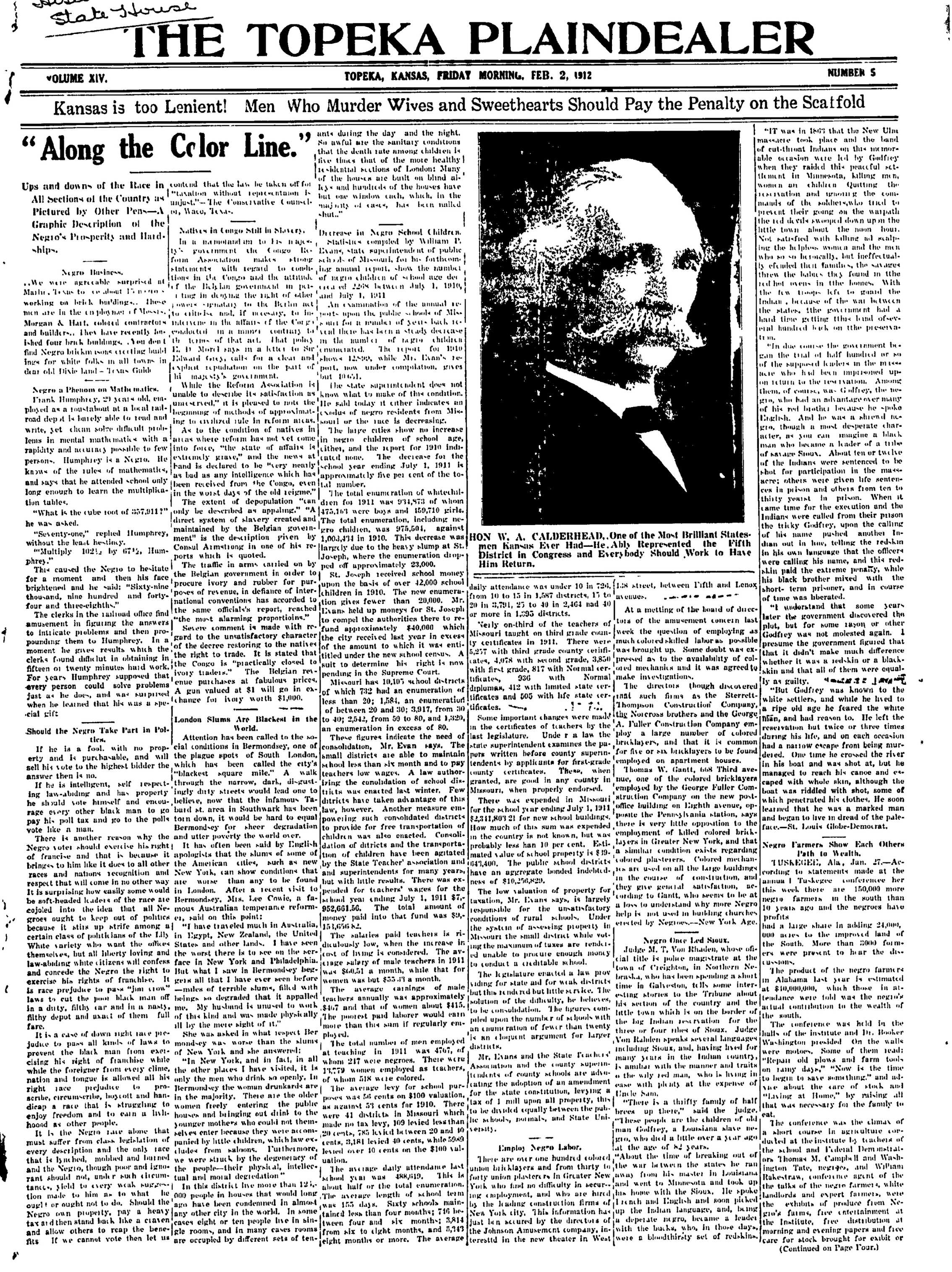
"Along the Color Line."
"Along the Color Line."
VOLUME XIV.
Ups and downs of the Race in All Sections of the Country as Pictured by Other Pens-A Graphic Description of the Negro's Prosperity and Hardships.
Negro Business.
We were agreeable surprised at Mathur, Texas to go about 15 percent working on brick buildings. These men are in the employ of Messis, Morgan & Hart, colored contractors and builders. They have recently finished four brick buildings. You don't find Negro brick masonry building buildings for white folks in all towns in dear old Dixie land - Texas Guide
---
Frank Humphrey, 29 years old, employed as aroustabout at a local railroad depot is barely able to read and write, yet chain solve difficult problems in mental mathematics with a rapidity and accuracy possible to few persons. Humphrey is a Negro. He knows of the rules of mathematics, and says that he attended school only long enough to learn the multiplication tables.
"What is the cube root of 357,911?" he was asked.
"Seventy-one," replied Humphrey, without the least hesitacy.
"Multiply 10212 by 6712, Humphrey."
This caused the Negro to hesitate for a moment and then his face brightened and he said: "Sixty-nine thousand, nine hundred and forty-four and three-eighths."
The clerks in the railroad office find amusement in figuring the answers to intricate problems and then propounding them to Humphrey. In a moment he gives results which the clerks found difficult in obtaining in fifteen or twenty minutes hard work. For years Humphrey supposed that every person could solve problems just as he does, and was surprised when he learned that his was a special gift
Should the Negro Take Part in Politics.
If he is a fool, with no property and is purchasable, and will sell his vote to the highest bidder the answer then is no. If he is intelligent, self respecting law-abiding and has property he should vote himself and encourage every other black man to go pay his poll tax and go to the polls vote like a man.
There is another reason why the Negro voter should exercise his right of francise and that is because it brings to him like it does to all other races and nations recognition and respect that will come in no other way. It is surprising how easily some would be soft-headed leaders of the race are cojoined into the idea that all Negroes ought to keep out of politics because it stirs up strife among a certain class of politicians of the Lily White variety who want the offices themselves, but all liberty loving and law-abiding white citizens will confess and concede the Negro the right to exercise his rights of franchise. It is race prejudice to pass "jim crow" laws to cut the poor black man off in a duty, filthy car and in a nasty, filthy depot and exact of them full fare.
It is a case of down right race prejudice to pass all kinds of laws to prevent the black man from exercising his right of franchise while while the foreigner from every clime, nation and tongue is allowed all his right race prejudice to proscripte, circumscripte, boycott and handicap a race that is struggling to enjoy freedom and to earn a livelihood as other people.
It is the Negro race alone that must suffer from class legislation of every description and the only race that is lynched, mobbed and burned and the Negro, though poor and ignorant should not, under such circumstances, yield to every weak suggestion made to him as to what he ought or ought not to do. Should the Negro own property, pay a heavy tax and then stand back like a craven and allow others to reap the benefits. If we cannot vote then let us
contend that the law be taken off for "taxation without representation is unjust."-The Conservative Counsel, Waco, Texas.
In a memorandum to his majesty's government the Congo Reform Association makes strong statements with regard to conditions in the Congo and the attitude of the Belgian government in pertaining in denying the right of other powers signatory to the Berlin act to criticise and, if necessary, to intervene in the affairs of the Congo conducted in a manner contrary to the terms of that act. That policy E. D. Morlays says in a letter to Sir Edward Grey, calls for a clear and explicit repudiation on the part of his majesty's government.
While the Reform Association is unable to describe its satisfaction as unserved," it is pleased to note the beginning of methods of approximating to civilized rule in reform areas. As to the condition of natives in areas where reform has not yet come into force, "the state of affairs is extremely grave," and the news at hand is declared to be "very nearly as bad as any intelligence which has been received from the Congo, even in the worst days of the old regime." The extent of depopulation "can only be described as appaling." "A direct system of slavery created and maintained by the Belgian government" is the description given by Consul Armstrong in one of his reports which is quoted.
The traffic in arms carried on by the Belgian government in order to procure ivory and rubber for purposes of revenue, in defiance of international conventions has accorded to the same officials's report, reached "the most alarming proportions."
Severe comment is made with regard to the unsatisfactory character of the decree restoring to the natives the right to trade. It is stated that the Congo is "practically closed to ivory traders." The Belgian revenue purchases at fabulous prices. A gun valued at $1 will go in exchange for ivory worth $1,000.
London Slums Are Blackest in the World.
Attention has been called to the social conditions in Bermondsey, one of the plague spots of South London, which has been called the city's "blackest square mile." A walk through the narrow, dark, disgustingly duty streets would lead one to believe, now that the infamous Tabard st. area in Southwark has been torn down, it would be hard to equal Bermondsey for sheer degradation
and utter poverty the world over. It has often been said by English apologists that the slums of some of the American cities, such as new New York, can show conditions that are worse than any to be found in London. After a recent visit to Bermondsey, Miss. Lee Cowie, a famous Australian temperance reformer, said on this point:
"I have traveled much in Australia, in Egypt, New Zealand, the United States and other lands. I have seen the worst there is to see on the surface in New York and Philadelphia. But what I saw in Bermondsey begs all that I have ever seen before—miles of terrible slums, filled with beings so degraded that it appalled me. My husband is unused to work of this kind and was made physically ill by the mere sight of it."
She was asked in what respect Bermondsey was worse than the slums of New York and she answered:
"In New York, and in fact, in all the other places I have visited, it is only the men who drink so openly. In Bermondsey the woman drunkards are in the majority. There are the older women freely entering the public houses and bringing out drink to the younger mothers who could not themselves enter because they were accompanied by little children, which law excludes from saloons. Furthermore, we were struck by the degeneracy of the people—their physical, intellectual and moral degradation."
In this district live more than 12,000 people in houses that would long ago have been condemned in almost any other city in the world. In some cases eight or ten people live in single rooms, and in many cases rooms are occupied by different sets of ten-
TOPEKA, KANSAS, FRIDAY MORNING, FEB. 2, 1912
ants during the day and the night. So awful are the sanitary conditions that the death rate among children is five times that of the more healthy residential sections of London: Many of the houses are built on blind alley and hundreds of the houses have but one window each, which, in the majority of cases, has been mailed shut."
Direase in Negro School Children. Statistics compiled by William P. Evans, state superintendent of public schools of Missouri, for his forthcoming annual report, show the number of negro children of school age decrased 2268 between July 1, 1910, and July 1, 1911.
An examination of the annual reports upon the public schools of Missouri for a number of years back reveal there has been a steady decrease in the number of negro children commerated. The report for 1910 shows 12,999, while Mr. Evans's report, now under compilation, gives out 10,651.
The state superintendent does not know what to make of this condition. He said today it either indicates an exodus of negro residents from Missouri or the race is decreasing. The large cities show no increase in negro children of school age, either, and the report for 1910 indicated none. The decrease for the school year ending July 1, 1911 is approximately five per cent of the total number.
The total enumeration of whitechildren for 1911 was 934,773 of whom 475,163 were boys and 159,710 girls. The total enumeration, including negro children, was 975,504, against 1,003,434 in 1910. This decrease was largely due to the heavy slump at St. Joseph, where the enumeration dropped off approximately 23,000.
St. Joseph received school money upon the basis of over 42,000 school children in 1910. The new enumeration gives fewer than 20,000. Mr. Evans held up moneys for St. Joseph to compel the authorities there to refund approximately $40,000 which the city received last year in excess of the amount to which it was entitled under the new school census. A suit to determine his right is now pending in the Supreme Court. Missouri has 10,105 school districts of which 732 had an enumeration of less than 20; 1,584, an enumeration of between 20 and 30; 3,917, from 30 to 40; 2,542, from 50 to 80, and 1,320, an enumeration in excess of 80.
These figures indicate the need of consolidation, Mr. Evan says. The small districts are able to maintain school less than six month and to pay teachers low wages. A law authorizing the consolidation of school districts was enacted last winter. Few districts have taken advantage of this law, however. Another measure empowering such consolidated districts to provide for free transportation of children was also enacted. Consolidation of districts and the transportation of children have been agitated by the State Teacher' association and superintendents for many years, but with little results. There was expended for teachers' wages for the school year ending July 1, 1911 $7,952,661.56. The total amount of money paid into that fund was $9,151,656.87.
The salaries paid teachers is ridiculously low, when the increase in cost of living is considered. The average salary of male teachers in 1911 was $60.51 a month, while that for women was but $55.33 a month. The average earnings of male teachers annually was approximately $407 and that of women about $415. The poorest paid laborer would earn more than this sum if regularly employed. The total number of men employed at teaching in 1911 was 4767, of whom 217 were negroes. There were 13,779 women employed as teachers, of whom 518 were colored.
The average levy for school purposes was 56 cents on $100 valuation, as against 53 cents for 1910. There were 41 districts in Missouri which made no tax levy, 109 levied less than 20 cents, 785 levied between 20 and 10 cents, 3,181 levied 40 cents, while 5989 levied over 40 cents on the $100 valuation.
The average daily attendance last school year was 488,619. This is about half or the total enumeration. The average length of school term was 155 days. Sixty schools maintained less than four months; 716 between four and six months; 3,814 from six to eight months, and 5,343 eight months or more. The average
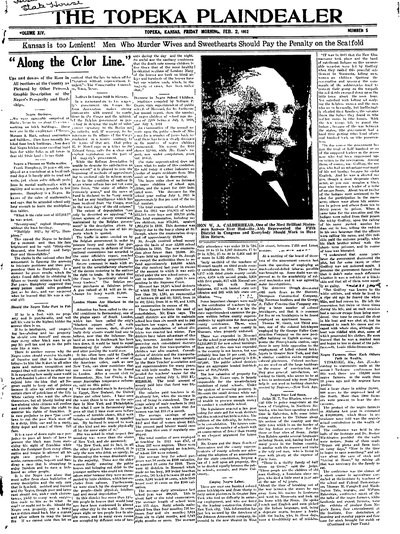
[Portrait of a man with a mustache and a bow tie, wearing a suit and a hat.]
HON W. A. CALDERHEAD., One of the Most Brilliant Statesmen Kansas Ever Had—He, Ably Represented the Fifth District in Congress and Everybody Should Work to Have Him Return.
daily attendance was under 10 in 726, from 10 to 15 in 1,587 districts, 15 to 20 in 3,791, 25 to 40 in 2,464 had 40 or more in 1,395 districts.
128 street, between Fifth and Leno avenues.
At a metting of the board of directors
Nerly on-third of the teachers of Missouri taught on third grade county certificates in 1911. There were 5,257 with third grade county certificates, 4,078 with second grade, 3,850 with first grade, 817 with Normal certificates, 936 with Normal diplomas, 412 with limited state certificates and 505 with life state cer-
ificates. Some important changes were made in the certificates of teachers by the last legislature. Under a law the state superintendent examines the papers written before county superintendents by applicants for first-grade county certificates. Thea, when granted, are good in any county in Missouri, when properly endorsed.
There was expended in Missouri for the school year ending July 1, 1911 $2,341,80321 for new school buildings. How much of this sum was expended in the country is not known, but was probably less than 10 per cent. Estimated value of school property is $19,643,400. The public school districts have an aggregate bonded indebtedness of $10,256,829.
The low valuation of property for taxation, Mr. Evans says, is largely responsible for the unsatisfactory conditions of rural schools. Under the system of assessing property in Missouri the small district while voting the maximum of taxes are rendered unable to procure enough money to conduct a creditable school. The legislature enacted a law providing for state and for weak districts but this rendered but little service. The solution of the difficulty, he believes, to be consolidation. The figures compiled upon the number of schools with an enumeration of fewer than twenty is an eloquent argument for larger districts.
Mr. Evans and the State Teachers Association and the county superintendents of county schools are advocating the adoption of an amendment for the state constitution, levying a tax of 1 mill upon all property, this to be divided equally between the public schools, normals, and State University.
Employ Negro Labor.
There are over one hundred colored union bricklayers and from thirty to forty union plasterers in Greater New York who find no difficulty in securing employment, and who are hired by the leading construction firms of New York city. This information has just been secured by the directors of the Johnson Amusement company, interestd in the new theater in West
128 street, between Fifth and Lenox avenues.
At a meeting of the board of directors of the amusement concern last week the question of employing as much colored skilled labor as possible was brought up. Some doubt was expressed as to the availability of colored mechanics and it was agreed to make investigations.
The directors though discovered that such firms as the Sterrett- Thompson Construction Company, the Norcross brothers and the George A. Fuller Construction Company employ a large number of colored bricklayers, and that it is common for five or six bricklayers to be found employed on apartment houses.
Thomas W. Gantt, 608 Third avenue, one of the colored bricklayers employed by the George Fuller Construction Company on the new post-office building on Eighth avenue, opposite the Pennsylvania station, says there is very little opposition to the employment of killed colored brick-layers in Greater New York, and that a similar condition exists regarding colored plasterers. Colored mechanics are used on all the large buildings in the course of construction, and they give general satisfaction, according to Gantt, who seems to be at a loss to understand why more Negro help is not used in building churches erected by Negroes.—New York Age.
Negro Once Led Stoux.
Judge M. T. Von Rhaden, whose official title is police magistrate at the town of Creighton, in Northern Nebraska, who has been spending a short time in Galveston, tells some interesting stories to the Tribune about his section of the country and the little town which is on the border of the big Indian reservation for the three or four tribes of Sioux. Judge Von Rahden speaks several languages including Sioux, and, having lived for many years in the Indian country, is amuhar with the manner and traits of the wily red man, who is living in ease with plenty at the expense of Uncle Sam.
"There is a thirty family of half breas up there," said the judge. "These people are the children of old man Godfrey, a Louisiana slave negro, who died a little over a year ago at the age of 82 years. "About the time of breaking out of the war between the states he ran away from his master in Louisiana and went to Minnesota and took up his home with the Sioux. He spoke French and English and soon picked up the Indian language, and, being a deperate negro, became a leader with the bucks, who, in those days, were a bloodthirsty set of redskins.
NUMBER S
"It was in 1863 that the New Ulm massacre took place and the band of cut-throat Indians on this memorable occasion were led by Godfrey when they raided this peaceful settlement in Minnesota, killing men, women and children. Quitting the reservation and ignoring the commands of the soldiers, who tried to prevent their going on the warpath the red devils swooped down upon the little town about the noon hour. Not satisfied with killing ad scalping the helpless women and the men who so heroically, but ineffectually escaped their families, the savages threw the babies they found in the red hot ovens in the homes. With the few troops left to guard the Indian, because of the war between the states, the government had a hard time getting this band of several hundred back on the preserva-
"In due course the government began the trial of half hundred or so of the supposed leaders in the massacre who had been imprisoned upon return to the reservation. Among them, of course, was Goffrey, the negro, who had an advantage over many of his red brother because he spoke English. And he was a shrewd negro, though a most desperate character, as you can imagine a black man who became a leader of a tribe of savage Sioux. About ten or twelve of the Indians were sentenced to be shot for participation in the massacre; others were given life sentences in prison and others from ten to thirty years in prison. When it came time for the execution and the Indians were called from their prison the tricky Goffrey, upon the calling of his name pushed another Indian out in line, telling the red-skin in his own language that the officers were calling his name, and this red-skin paid the extreme penalty, while his black brother mixed with the short-term prisoner, and in course of time was liberated.
"I understand that some years later the government discovered the plot, but for some reason or other Godfrey was not molested again. I presume the government figured that that it didn't make much difference whether it was a red-skin or a black-skin and that all of them were equally as guilty.
"But Godfrey was known to the white settlers, and while he lived to a ripe old age he feared the white Man, and had reason to. He left the reservation but twice or three times during his life, and on each occasion had a narrow escape from being murdered. One time he crossed the river in his boat and was shot at, but he managed to reach his canoe and escaped with whole skin, although the boat was riddled with shot, some of which penetrated his clothes. He soon learned that he was a marked man and began to live in dread of the palace.—St. Louis Globe-Democrat.
Negro Farmers Show Each Others Path to Wealth.
TUSKEGEE, Ala. Jan. 27.—According to statements made at the annual Tuskegee conference her this week there are 150,000 more negro farmers in the south than 10 years ago and the negroes have profits had a large share in adding 24,000, 000 acres to the improved land of the South. More than 3000 farmers were present to hear the discussions. The product of the negro farmers in Alabama last year is estimated at $10,000,000, which those in attendance were told was the negro's actual contribution to the wealth of the south.
The conference was held in the halls of the institute and Dr. Booker Washington presided. On the walls were motoes. Some of them read; "Repair old plows and farm tools on many days," "Now is the time to begin to save something," and advice about the care of stock and "Living at Home," by raising all that was necessary for the family to eat.
The conference was the climax of a short course in agriculture conducted at the institute by teachers of the school and Federal Demonstrators Thomas M. Campbell and Washington Tate, negroes, and William Rakestraw, conference agent of the talks of the negro farmers, white landlords and expert farmers, were the exhibits of produce from Negro's farms, free entertainment at the Institute, free distribution at morning and evening papers and free care for stock brought for exhibit or
(Continued on Page Four.)
WICHITA ADS ROUTE SIGNALS
Charges in routing have necessitated a slight rearrange of the colored lights indicating the rhute of cars. These signals will hereafter be as follows: S. Main-Stock Yards Line, Red and Blue College Hill-W. Side Line, White 2 lights Patte-Waco Line Green and White Cleveland Line Red and White Riverside-S. Emporia Green 2 lights Fairmount Line Red 2 lights Mt, Cvrmel Line Red and Green Extra Cars Red White and Blue,
If you have a complaint on your service or a suggestion for its betterment, we would appreciate a letter from you about it. We desire to do all we can consistently, to make our service satisfactory and you can help us in this manner. The Wichita Railroad and Light Co.
Karsas Gas & Electric Co.
Howard Mills Co.'s Flour
The J. W. METZ Lumber Co.,
Wants to Figure on Your Next Bill. Phone 196. OFFICE AND YARD, 101-21 N. MAIN, WICHITA, KAN.
The Best Meats
Otto Weiss Kaffir Flour
It can be used by itself, or mixed with wheat flour.
It can be used by itself, or mixed with wheat flour.
We do not think it necessary to give any special recipes, but believe every cook will have better results using for own recipes, adding enough kaffir flour to suit the case.
We recommend mixing from one heif to three-fourth kaffir flour with wheat flour for pancakes, muffins and gums, and for doughnuts, cakes, fruit cakes, or any other kind of pastry from one-third kaffir flour.
It has a sweet, rich and delicious flavor, is easy to taste, and every time you eat it, you will use it better.
We use the correct system of milling and only the best selected white kaffir corn. It is cheaper and far more sanitary than common Indian corn, which is full of rotten grains and pieces of cob. We predict that 'OFFO WEISS KAFFIR HOUR' will be a staple food product and outsell corn meal in very short time.
THE OTTO WEISS ALFALFA STOCK FOOD CO. WICHITA, KANSAS.
.
WICHITA Use the Howa
Made in WICHITA, U. S. A.
The Lun
Wants to Fi
OFFICE AND YAR
The
Whit
Both Phones 298.
DELICIOUS!
Otto W
It can be used by its
We do not think it
Price Make
Easy.
Hard Mills
Flour
J. E. HO
C R. HO
The J. W. ME
mber
Figure on Your Next Bill.
ARD, 101-21 N. MAIN,
illsCo.'s
J. E. HOWARD, President
C R. HOWARD, Secretary
METZ
er Co.,
Bill. Phone 196.
N. WICHITA, KAN.
THE GREATEST VARIETY OF
Best Me
IN THE CITY.
WE KEEP THEM CLEAN.
tlock B
198. 216 East
Meats
LEAN.
Bros.,
216 East Douglas Ave.
SUGGESTIONS FOR USING
Weiss Kaffir
at itself, or mixed with wheat flour.
It is not necessary to use any special
cake letter result using her or
to suit the case.
mixing from one sheaf to two
our for pancakes, muffins and gums,
kies, or any other kind of pastry.
such and delicate flavor, is easy to
will any it tolerer.
direct system of rolling and only
It is cheaper and far more sanitary
full of rotten grains and pieces of
S KAFFIR HOUR will be a staple
very shortly.
affir Flour eat flour. y special recipes, eat below for own recipes, eating
WEISS ALFALFA STOC WICHITA, KANSAS.
LIGHT,
HEAT,
POWER,
EVERYBODY
CAN
HAVE AN
IDEAL HOME
Manufactured Only By
U. S. A.
HEALTHFUL
NATIONAL BANK OF COMMERCE
Wichita, Kansas.
Statement of Condition December 5th,
1911.
Capital. $100,000.00
Surplus. 175,000.00
Net profits 42,000.00
RESOURCES.
Loans and Discounts. $1,077,181.29
Overdrafts. 3,071.87
United States Bonds to
Secure Circulation (at
par) 75,000.00
Banking House, Furni-
tures. 52,050.84
Cash and Sight
Exchange $1,140,547.30
U. S. and Other
High Grad.
Bonds (market value) 216,770.50 1,957,217.80
Capital. *, .....
Sarplus, .....
Undivided Profits
Circulation . . .
Reserved for Taxes
Deposits, .....
Capital, *.....
Barplus, *.....
Individual Profits
Circulation *.....
Reserved for Taxes
Deposits, *.....
The above statement is correct.
N.A. RUSSELL, Cashier.
OFFICERS.
C. W. CARRY, President.
J. H. BLACK, Vice President.
J. H. STEWART, Vice President.
N. A. RUSSELL, Cashier.
R. S. Vermilion, S. W. Cooper, J
H. Black, M. C. Campbell, J H
Stewart, C. W. Catey, Wm. L. Otis
Winfield, Kan; W. R. Brown, Aug
gusta, Kan.
THE KANSAS NATIONAL BANK
Wichita, Kansas.
Official Statement (Condense) to the Comptroller of the Currency, December 5, 1911.
RESOURCES.
Loans and Discounts...$1,746,075.49 Overdrafts. ..... 730.52
U. S. Bonds (at par)... 51,000.00 Banking Hour, Furniture and Fixures... 55,000.00 Bonds and Stocks (bonds (only).. .$ 241,292.67 Cash and Exchange 1,402,599.37 1,643,892.04
LIABILITIES.
Capital Stock. $ 200,000 00
Surplus. 100,000 00
Undivided Profits. 30,388 15
Circulation. 50,000 00
Reserved for Taxes. 3,412 15
DEPOSITS
Individual $1,226,370 34
Government 1,000,00
Banks and
The above statement is correct. ELSBERRY MARTIN, Cashier.
OFFICERS AND DIRECTORS.
C. Q. CHANDLER, President.
E E. MASTERMAN, Vice President
J. W. BERRYMAN, 2d Vice President
ELSBERRY MARTIN, Cashier.
CHARLES TESTARD, Asst. Cashier
C. W. SOUTHARD, C. H. PROOKS
W. R. DULANEY, A. S. PARKS.
W. S. HENRION, Drugs
Cor. Central Ave. and Main St.,
Wichita, Kan.
When You Go To
Springfield
STOP AT THE
DUNBAR CAFE
Services Strictly Alacuart.
SANUEL H. COX, Prop.
Phone J, 2968
FORD'S
HAIR POMADE
MAKES HAIR, KUNKY OR CURLY HAIR
GLASSY SOFTEN AND MORE PLIABLE,
EASY TO COMB AND PUT UP IN ANY STYLE
THE LENGTH WILL PERMIT BREAKDOWN
FOR PREVENTING HAIR FROM FALLING OUT BANDWIDTH AND RICKING
OF SCALE BEWARE OF INITIATIONS, GET THE GUIDE, PUT UP IN
25+ AND 50+ BOTTLES WITH CHARLES FORD'S MAKE OR
EVERY PACKAGE
TRY FORD'S ROYAL WHITE
SKIN LOTION FOR THE COMPLEXION
MAKES THE SKIN WHITER IMEDIATELY
UPON APPLICATION. WILL NOT IRRITATE
THE MOST DELICATE SKIN. UNEXCELED
FOR ECZEMA, SALT RHEUM, PIMPLES,
ROUGH SKIN AND PRECKLES.
SOLD BY DRUGGISTS IF YOUR DRUGGIST CANNOT
SUPPLY YOU WILL SEND IT TO YOU INJECT AS THE
FOLLOWING PRESS, SMALL SIDE BOTTLES, LAKE SIDE BOTTLES
SAIL THE OZORIZED OX MARROW CO.
802 LAKE ST. DEPT. 310
CHICAGO, IL
AGENTS WANTED
JOPLIN, MO.
Trinity Methodist Episcopal church will observe the anniversary of Abraham Lincoln's birth. Trinity choir outlined the program to be rendered on Sunday, February 11. The choir will be assisted by Principal Charles Bronsky and the senior and intermediate classes of Lincoln school, under the instruction of Miss V. Willen Jackson, the intermediate teacher, and who is also instructor of the choir.
The young people of Handy chapel A. M. E. church deserve much credit for their in trest shown in church work. The entertainments given by Miss Maggie Brown, Tuesday night, the 23d. and Mrs. Estella Fluellen, Mrs. Cora Pearson and Mrs. T. A. Harvey, Thursday night, tho 25th, were a great success on the occasion of the beginning of a big rally at the A. M. E. church.
On account of a shortage in funds, the public schools of Joplin may be closed to an eight month session. in Lincoln school is one of the best the Southwest. Charles Brooks, auate of Lincoln Institute, Jefferson City, Mo. is the principal; Miss V. Willett Jackson, a graduate of George R. Smith College, Sedalia, Mo. is the intermediate teacher, and Miss Melissa Duell a graduate of Lincoln Institute, is the primary teacher.
Laudh's Club, of the Trinity A. M. P. church, of which Mrs. Mela Holt is captain, will be hostesses Wednesday evening to their many friends.
Mr. and Mrs. Lowe are both on the sick list and we hope they may soon be restored to their usual health and be out among their many friends.
Mrs. J. W. Prowell met with a painful accident by stepping on a nail, which inflicted a wound about an inch deep. She is confined to her bed and under the care of Dr. J. H. Williams, G. M. R.
The Abram Grant Literary Society of Handy Chapel A. M. E. church will render the following program Tuesday evening, January 30: Song, society; invocation, chaplain; opening address. J. C. Jackson; instrumental solo, Miss F. Caraham; address, "Good Citizenship," J. A. Jones; vocal solo, A. Young; recital, Miss Maud Elmore; vocal solo, Mr. McMahan; recital. Helen Fleming; instrumental solo, James Little; solo, L. M. Clark.
It seems as thuogh the real estate business will progress under our real estate man, Rev. J. N. Brownlee, in the Ipsco building.
Mr. and Mrs. Hurt are sparing no pains to make things pleasant for those who drop in their well fitted restaurant, on Second street.
Rev. Curtis seems well pleased with the nice weather, as it is better on the barber business.
One Alice Scalen last night shot and seriously wounded Dick Hughes. She used a large 45-caliber Colt's revolver. Rev. C. S. Webster, pastor of Trinity Chapel A. M. E. church, is making preparation for his conference, which convenes in St. Louis.
DAVENPORT, IOWA.
Rev. Saunders of Des Moires filled the Third Baptist pulpit last Sunday.
Mrs. L. F. Phillips preached the community sermon at Wayn an chapter for Rev. Saunders.
Those on the sick list are Mrs Volkly, F. Howard and Mrs. Conc.
The E. L. D. club will meet at the residence of Mrs. Kate Green Monday.
The economy committee of the Colored Women's club has a very interesting program Tuesday, the 23d, at the home of Mrs. Christina Das. The meeting was opened by the chairman, Mrs. I. A. Potter. Those on the program were Mrs. Marshall, paper on child welfare, quarrette by four ladies, reading by Mrs. M. Bishop of Moline, closing remarks from all members. Mrs. Richard entertain the A. I. club Thursday.
The club is doing good work in Bayport.
Mme. Porta returned from Chicago Monday, where she has been taking lessons in the latest Landmuseum at E. Batham, also stocking up for the spring.
NOTICE TO AGENTS AND CORRESPONDENTS.
Please send cut or photograph that we may use during the year. Have correspondence in by Wednesday. We have installed our new linetype machine and paper will be out regularly.
Endorsed By Every House Wife
The New Method of washing Clothes without the aid of a wash board has been found in
COBB'S
NO RUBBING
SOAP
Bar of this Soap is Gu
to do as represented and the
only soap in the world backed
by a patent from the United
States Government . . .
Manufactured by
Kansas City Soap Company
Fetters Bro., Props.
COBB'S
NO RUBBING
SOAP
Every Bar of this Soap is Guaranteed to do as represented and the only soap in the world backed by a patent from the United States Government . . .
Manufactured by
Kansas City Soap Company
Fetters Bros., Props.
Mme. T. D. PERKINS,
Scientific Scalp Specialist
SCIENTIFIC SCALP SPECIALIST
1630 W. 35th Avenue, Denver, Colo.
.D. Perkins of Denver, Colo., who ha
of the scalp, is now interesting wom
are of the hair and scalp. No matter h
from Perkins' matchless scalp preparation
of treatment for cultivating, beautifyin
will grow your hair if there is no phy
er treatments have been successful wh
Madam T.J.D. Perkins of Denver, Colo., who has spent five years in study of the scalp, is now interesting women all over the globe in the care of the hair and scalp. No matter how dark your skin is, Madam Perkins' matchless scalp preparations and scientific method of treatment for cultivating, beautifying and growing the hair will grow your hair if there is no physical ailment to prevent. Her treatments have been successful where all others have failed. Have you written her? If not, and you want hair like her own, write her today. Be sure to enclose a 4-cent stamp and write your name and address very plain if you expect a reply. Don't write unless you mean business.
If a woman have long hair, itis a glory to her. I Cor., 11-15. Every Woman Can Have that Glory if She Wishes It.
This is for you. No more ironed hair, but soft, long, beautiful hair that need not be put on the dresser on retiring. Do you want this kind of hair? If so, write for particulars to Madam T. D. Perkins, the Scientific Scalp Specialist of Denver, Colo., who is astonishing the world with her wonderful art of growing hair. My own hair is my best advertisement. With these treat-
THIS TELLS THE STORY
COPYRIGHTED-ISIO.
ments my hair grew 17 inches in two years. It had remained one length (four inches) for 15 years. What I did for my hair I am doing for hundreds of others, and will do for you with my Matchless Scientific Scalp Preparations. My treatment stops falling hair or Breaking off, cuts split ends, removes dandruff and scalp scurf, causes the hair to grow long, no matter how short; soft, no matter how harsh; thick, no matter how thin; straight from the blubs, no matter how kinky. First treatment will show wonderful improvement. Do not wait if you are interested in your hair. I give treatments all over the United States by mail. Write me at once. I send booklet concerning the care of the hair, and testimonials of those taking my treatments when 4-cent stamp is enclosed. I do not have agents. I need a personal history of your hair and scalp and your physical condition.
All mail promptly answered when lecent stamp is enclosed. I am the only woman of the race growing hair today who can show the public the real length my hair was when I first began treating it. Send for booklet if you mean business. You can secure these preparations only from me. None like them made in the world. The T. D. P. Scientific Scalp Preparation, Madam Perkins, sole agent.
Stop, Wait Listen Read.
Col. J. D. Norton, Shawnee's popular sheriff, will ask for a second term, because it has been the policy of the voters of this county to give a faithful servant the second term. He has filled the office faithfully and honorably. The Supreme Court, the highest tribunal of Kansas, like Paul of old, said they find no fault in him, his office or anything that is connected with it. His books and accounts are square. Therefore he is justly entitled to go before the people for a second term. He is polite, courteous and attentive to the duties of the office.
The Dover Weekly Herald says:
"Sheriff Notton is announced as a candidate for sheriff for the second time, which will probably be his last appearance in public life officially.
"Sheriff Notton has dignified the office, and by his strict attention to business and his gentlemanly deportment has merited the favor and esteem of every citizen of Shawnee county.
"Sheriff Notton is much better qualified for the duties of the office than he was two years ago. He is entitled to a second election by all rules of custom and fair pay."
"From reports that are being received from all over the country in his favor, his friend feel justified in claiming 11 nomination by a large majority."
The Paul Jones Monthly Magazine pays this high tribute to his undiring ability.
"A public official is generally estimated by the record he has made in his official capacity. That the record of Col. J. D. Norton and his conduct of the sheriff's office has been pre-eminently satisfactory to the people of Shawnee county is evidenced by the fact that, having been appointed by the Governor to fill out an unexpired term, he was, in 1910, nominated by the Republican and elected by a large majority, which indicates his great popularity with the people. When Col. Norton took the oath of office to faithfully execute and discharge the duties thereof and to uphold the majesty of the law, he was conscientious and meant it, and during the last two years he has been sheriff it has been his aim and purpose to uphold the dignity and supremacy of the law, so far as it lies in his power. We do not exaggerate when we say that Col. Norton has been one of the best sheriffs Shawnee county has ever had. He is a quiet, yet an energetic and untiring worker, who believes that success among any line can only be obtained by indistinguishable energy and hard work. Col. Norton is an ardent progressive Republican, who believes in the cardinal principles of the Republican party and the doctrine of equal rights and privileges to all. He is a comprehensive, liberal minded, broad-gauged man, who as a public official, has always been just and fair in his treatment of everybody. The colore people of Shawnee county are especially grateful to Col. Norton for the consideration he has given them in the appointment of Mr. Charles Lytle and Mr. H. I. Monroe, deputies, two most efficient and capable men, and he has rest assured that the colored people will show their appreciation whenever an opportunity presents itself. Col. Norton is a genial and affable gentleman of the highest integrity."
HUGH MAC FARLAND FOR PROBATE JUDGE
Prorgressive Young Shawnee County Lawyer Presents a Money Saving Plan to Taxpayers—Would Cut Out All Fees.
Hugh MacFarland is a candidate for Probate Judge at the Republican primaries August 6, 1912, to succeed W. F. Schoch, who is now serving his second term, having been twice elected.
MacFarland is the first candidate to advocate putting all county officers on a fixed salary and have all fees go to the county. It has been estimated that fifteen or twenty thousand dollars could be saved the taxpayers of this county each year by this plan.
The office of Probate Judge pays in the neighborhood of ten thousand dollars a year, under the fee system, which means that a man who has held that office for four years has been paid in the neighborhood of $40,000 for his services by the people of this county.
Mr. MacFarland is a Shawnee county man—born, reared, educated and admitted to practice law in the city of Topeka. He is making a thorough campaign and will see each voter before election. He is very popular with the people who know him and has a large following in the county. Mr. MacFarland has printed his platform, from which we quote:
"Dear Sir:I am making a campaign for the office of Probate Judge on the platform of 'All Officers on a
Fixed Salary and All Fees to the County Treasurer.' In my first announcement, made November 17th, 1911, I advocated this policy and promised to lend my support towards having a salary bill passed at the next legislature, and to have the same put into effect at once. Since that time there has been considerable agitation on this question. It seems to me that there can be but one side to this controversy—put all officers on a fixed salary and save the taxpayers of this county fifteen or twenty thousand dollars a year.
"It is not generally known that the Probate Judge of Shawnee county is not governed in the amount he receives, by the same law which governs other Probate Judges in this state. The amount received by the Probate Judge in this county is governed by a special law, which applies only to Shawnee county. Under this special law he is compelled to make no report and gives no account of any kind in reference to his fees. He keeps as compensation for his services all fees collected by him.
"Several candidates for county offices have, since my announcement expressed themselves as being satisfied to accept a stipulated salary and no fees. Some have done this because they see the fairness and justice to the people of this county in this system. Others have done so because they were forced to, under the stress of public opinion, after the salaries received under the fee system had been made known to the public.
"If you see to it that every man you vote for is sincerely in favor of a salary law and has pledged himself to support it, there will be no organized lobby next year, as there was last, to defeat this measure.
"Yours very truly,
"HUGH MAC FARLAND."
CORONER.
Dr. J. H. Rinchart, whose office is in the Mills building, announces himself as a candidate for coroner on the Republican ticket at the next primary election. He is a man who stands well in the community, and says a physician should be elected to the office, for the reason if, in a case of accident or suicide and a coroner is called, if life should not be extinct, in several cases men holding that position who are not practicing physicians would not be able to revive them. Therefore, to insure and prevent such accident, a physician should be elected to this office. He has practiced in Topeka for several years and has a host of friends and has a good practice. He is a member of the Masonic, K. of P., Red Men and several other organizations for the betterment of mankind.
ROHLFING & CO.
WHOLESALE GROCERS Corner Third and Cherokee Streets LEAVENWORTH, KANSAS
So Different From the Rest CAFE
RESTAURANT and ICE CREAM
PARLOR
B. F. SAMUELS Proprietor.
220 Delware Leavenworth, Kan.
HARRIS LAUNDRY
Go to Harris's laundry to get neat first class work.
C. T. HARRIS, Prop. Both Phones 3027
1123 Kansas Avenue
MIDLAND MEAT MARKET
GEO. HAMPEL, Prop.
FRESH AND SMOKED MEATS
AND POULTRY OF ALL KINDS
Bell Phone 136 Peoples Phone 1
408 Shawnee St. Leavenworth, Kan.
DR. J. M. JAMISON
Physician and Surgeon
assuming Physician of the rights and
of Protection
special attention to diseases
of women and private diseases
100 and Holdenness
7 / Made in America
DOPKKA, N.
DR. W. E. JACKSON,
Physician & Surgeon
40 Karner Ave
Ind. Phone 918 612764
Dr. W. Roger Russell,
DENTIST
All Work Guaranteed to
Give Satisfaction
DR. THADDEUS P. MARTIN,
Physician and Surgeon
432 Kansas Ave.
Residence 1110 West Tenth St
IND. HELL'PHONE NO. 2, 2000-800
The cost of living is
Cheap if you trade at
Wegley's
Where you will find a clean store will stocked with
Our Goods are the
Best in Quality and
Right in Price
Your Patronage Solicited.
WEGELEY'S,
1135 Kansas Avenue.
DAVIS FUEL CO.,
Hax All Kin'x of
.Coal.
Bell Pho'nè
1698
Human Hair Goods
Switches and Pomps...50c
...Transformation..... $1.50
Wigs from 25c to$5.00
MRS. M. L. FIELD,
Kallithrix Parlor
833 Kansas Avenue, Topeka, Kan
The Ideal Bakery
Heil & Schafer, Proprietor
Manufacture the best bread in the city . . .
Member N. A. M. B.
The Place That's Diffet at
121 W. 6th St.
Topeka Kansas
M. J. Thompson Geo Gabler
The Pearl Steam Laundry
THOMPSON & GABLER
Proprietors
'Phones 222
105 W. 11th St.
COFFLEYVILLE KANSAS
K. C. FRENCH
Cleaners & Dyers
A'l Kinda of Cleaning,
Preening and Dying for
Ladies and Gentlemen . .
Mrs. Effie Arnett
Ind. Phone 1095
LOS ANGELES, CALI.
One of the swellest affairs that has ever been given in California for a number of years was the twenty-fifth wedding anniversary of Mr. and Mrs. C. A. Bruce at their beautiful home, 1024 Santa Fe avenue, Jan. 12.
1912. The rooms were beautifully decorated with California mid-winter flowers, pointsets and smilax. The bride was becomingly dressed in the same wedding gown and slippers that she married in twenty-five years ago, which was a beautiful pink brocade satin with a grey chiffon tunic, long white gloves and pink slippers. The groom was also neatly attired in his wedding suit of the same years. About two hundred invited guests were in attendance.
WEIR, KAN.
The A. M. E. church closed then meeting on the 28th inst. with several added to the church.
Miss Della M. Smiley, the assistant teacher in the schools, is ill and Miss Sessie Stewart is substituting in her place.
We are sorry to hear of the illness of our old friend, Mrs. Eliza Jones of Pittsburg.
Messrs. Geo. Jackson, A. C. Gladcox and E. W. Derington went to Cherokee Sunday on business.
Born, to Mr. and Mrs. Jas. Anderson, January 28, a boy; to Mr. and Mrs. Jas. Reed, January 30, a boy. Mothers and babies are doing nicely.
Robt. Field was injured by a bad cut on a barb wire fence, January 29.
Mrs. Bimmy Roberson left Saturday, January 20, for Cowsburg to visit her son and daughter.
The entertainment given at the St. John church was a success. Over $8 was realized.
Mr. and Mrs. T. S. Berry have moved into their new home on West Main street.
Mrs. Emma People returned to Kansas City Tuesday after settling up her business here.
James Stewart was injured in the mines Monday.
From Feb. 26th, to March 9th, 1912 Combining the Colonists and Tourist Out-Fitting Exhibition
J. C. O'KEEFE
Kentucky and Tennessee Whose Own Specialty All Star Videos Promptly Attended To
THE BEST FLOUR ON EARTH
MADE IN OKLAHOMA
Acme
FLOUR
GUARANTEED
TO MAKE THE MAXIMUM
NUMBER OF FULL SIZED
FLAKEY LOAVES OF UNEXCELLED FLAVOR
FOR SALE BY
ALL GROCERS
ACME
MILLING COMPANY
OUR GIESTEST
Acme
PATENT FLOUR
OKLAHOMA CITY, OKLAHOMA
ACMB
HIGHEST PATENT
THE MAGIC SHAMPOO DRIER
AND HAIR-STRAIGHTENER
MAILED ANYWHERE IN U.S. POSTAGE PAID.
BEND MONEY BY POST OFFICE MONEY ORDER.
LADIES LOOK!
Every lady can have a beautiful and luxuriant head of hair if she uses a MAGIC. After a shampoo or bath the Magic dries the hair, removing the dandruff; and it will straighten the corriest head of hair.
The Magic will not burn or injure the hair, because the comb is never heated. The steel bead base which heats the hair, is alone, put into the flame off the alcohol or gas heater.
The Aluminum Comb is easily detached from the heating bar, then, after the bar is heated the comb goes back into place and is held by a turn of the handle.
The Magic Heater is also suitable for curling irons, has a cover and can be carried in a handbag.
Magic Shampoo Drier $1.00. Magic Alcohol Heater $0.50. Liberal terms to agents. Write for literature today.
Magic Shampoo Drier Co.
Minneapolis, Minnesota.
Prize High Patent
We do Job Work.
1060 UNION AVENUE
Opposite Union Depot
THE BEST F
MADE
Acme
FLOU
GUARANTEED
TO MAKE THE MAX
NUMBER OF FUL
FLAKEY LOAVES
FOR
ALL
THE MAGIC IS TWO TIMES LARGER THAN P
STEEL HEATING MAR
ALUMINUM COMB
LADIES LOOK!
The Magic will not burn or injure the a
ting bar which leans the hair, is alone. put
The Aluminum Comb is easily deta
ed the comb goes back into place and
The Magic Heater is also suitable
handbag.
Magic Shampoo Drier $1.00. Magic
for literature today.
Magic Shampoo Drier Co.
Prize H
OKLAHOMA MILLS
U.S.
Kingfisher, 10c The Vie
KANSAS CITY, MO
Telefone 661 Main
IT FLOUR ON EARTH
DE IN OKLAHOMA
OUR
SEED
MAXIMUM
FULL SIZED
HAVES OF UNEXCELLED FLOUR
FOR SALE BY
L GROCERS
ACM
WILLING CO
OUR SIGNEST
Acme
PATENT
OKLAHOMA CO
ACM
HIGHEST PATENT
THE MAGIC
AND HAIR STR
MAILED ANYWHERE
POSTAGE
SIMO MONLY IN POST OFFICE
Every lady can have, beautiful and
hair if she uses a MAGIC. After shampoo
Magic dries the hair, removing the dand
straighten the curliest head of hair.
Before the hair, because the comb is serer heated,
none, put into the flame of the alcohol or gas
fully detached from the heating bar, then, after
and is held by a turn of the handle.
usable for curling irons, has a cover and can
Magic Alcohol Heater $0.80. Liberal terms to
er Co. Minneapolis, M
High Pat
ON EARTH
OKLAHOMA
ACME
WILLING COMPANY
OUR HIGHEST
Acme
PATENT FLOUR
OKLAHOMA CITY, OKLAHOMA
ACMB
HIGHEST PATENT
EXCELLED FLAVOR
BY
CERS
THE MAGIC SHAMPOO
DRIER
AND HAIR: STRAIGHTENER
FILED ANYWHERE IN U.S. POSTAGE PAID.
MAN ON POST OFFICE MONEY ORDER.
Make a beautiful and luxurious head of hair.
After a shampoo or bath the removing the dandruff; and it will end of hair.
Acme is silver heated. The steel head the alcohol or gasheater, the bar, then, after the bar is heated the handle.
0. Liberal terms to agents. Write Minneapolis, Minnesota.
Patent
Daily capacity
100 Barrels Flour
100 Barrels Meal
Cable Address
"Ruth"
klahoma Mil
Manufacturers of
High-Grade Flour
:- Okl
a Mill Co.
turers of
ade Flour
Oklahoma
HOT & COLD
SODAS, CANDIES, Etc.
The BIG NEW DRUG
STORE
Cor. 3d and Kansas Avenue
Jas. White & J. H. Harris
Sole Owners
Social and Other Topeka Happenings
Mrs. Lucy Shields is sick this week with tonsilitis at the home of her sister, Mrs. H. D. Monroe.
Mr. Henry Thompson is in the city for a few days' visit with his parents.
Mrs. Reed Taylor was called to Missouri on account of the illness of her father.
Miss Arnicholas Chiles is indisposed this week and is unable to be in the office.
Mrs. Marie North, who has been very ill, is improving nicely.
Miss Maggie Moss gave a birthday dinner Monday evening in honor of her mother, Mrs. Clarence Moss. The guests included Mr. and Mrs. Benj. Buckner, Mr. and Mrs. Green Scales and Mr. and Mrs. M. J. Owens.
Rev. Ransom is sick this week with rheumatism. It is to be remembered that he is a prominent candidate for national financial secretary of the A. M. E. church.
Mr. and Mrs. Edward Dickerson are visiting in the city, the guests of Mrs. Dickerson's parents, Mr. and Mrs. James Monroe.
Memorial services for Sister Eliza Merriam will be held at St. John's A. M. E. church Sunda yF'eb. 4, at 3 o'clock under the auspices of the Ladies Sewing Circle. A short programme will be rendered.—Mrs. P. Atkinson, Pres., Maym eJohnson, Secretary.
Mrs. W. H. Radford and Mrs. John Parker returned from Chicago, where they attended a party complimentary to their mother's 72nd birthday.
A new club sprang into existence this week when a few met at Mrs. Charles Porter's residence on South Tenth street. The club will be a small social one. The officers a reMrs. Fred Jackson, president; Mrs. Richard Nunn, vice president; Mrs. secretary; Mrs. Roy, S. See, and Mrs. Thomas Brown, treasurer, Games were played and Mrs. Ed. Brown captured the prize. A dandy repast followed and the club adjourned to meet next week with Mrs. Fred Jackson.
The Clinging Rose of the Mt. Campbell Baptist church gave a surprise party Saturday night, January 20, at the residence of Mrs. Fannie Williams, corner of Center and Washington streets, in honor of the pastor, Rev. Geo. W. McAdoo. Refreshments were evening was spent. Those present were Mrs. Ethel Steel, Mr. Squire Howard, Mrs. Ella Graves, Mrs. James, Mrs. Fannie Williams, Mr. Isaac Williams, Mrs. Emma Goodbar, Mrs. Dora Gunther, Mrs. Green, Mrs. Noble, Mrs. Minnie Thomas, Mrs. Janie Chiles, Mrs. G. A. Jackson, Mrs. Biggar, Mrs. Evans, Rev. and Mrs. G. W. McAdoo.
Related.
We carne-ly thank our many friends for their kindness to us in the sickness and death of our beloved brother, Noah Henderson, and for the beautiful floral offering.—Mr. L. Henderson, Nora V. Alexander, Lizzie Tolbert, A. H. Henderson,
The Go Forward club met with Mr. and Mrs. Richard N. Jordan, 1903 North Western avenue Tuesday evening, January 30. Twenty-two were present.—Mrs. Ida M. Jordan, President, Mrs. C. Duncan, Sec.
Mr. Ed. Ramney died Sunday at the home of his daughter in Omaha. He had been ill for a long time and was carried to Omaha recently by his daughter. He has lived for many years at his home on East Mound street, and was kind and an agreeable neighbor. Funeral was held Wednesday from A. M. E. church. Rev. W. T. Biggers officiated. Interment at Mt. Vernon.
J. G. Wiley, secretary of the colored department of the Wichita Y. M. C. A., will address the men's meeting at the Kansas avenue Y. M. C. A. Sunday afternoon. Mr. Wiley is on his way to Evansville, Ind., where he has recently been called to take charge of the work for colored men.
Mrs. Charles Porter was hostess for the Sunflower Art club Monday. A short programme was rendered and in an apple contest Mrs. T. Blake won the prize, a beautiful fruit plate. The club is doing good charity work. Each week a sum is raised and given to some worthy person. The hostess, assisted by Mrs. R. Nunn and Mrs. Perre Allen, served a tempting repast.
Mr. Henry Blue died Thursday at his home on Second street. He had been ill only a few days. He has reared a family here and lived in this city for many years. He was widely known as a good and thrifty old gentleman. He was very industrious at the time of his death. He had a bank account of $4000 and a valuable home. He leaves two sons, two daughters and a granddaughter to mourn his loss.
One of the latest achievements of Topeka and the West is two young colored girls operating an elevator—the Coleman sisters at the Commerce building, 611 Kansas avenue. Misces Eunice and Cornelia. They are experts and handle the elevator with great care. They take turns about, which gives them plenty of test. They are the only females we have ever seen or heard of operating an elevator. They are the elevator girls of the West.
Rev. John Hurst of Washington. D.C. financial secretary of the A. M. E. church, preached at St. John A. M. E. church last Sunday morning and addressed the Loyal Legion at night. He is closing up the affairs of the late Bishop Grant's estate, of which he is the administrator. He will be elected a bishop of the A. M. E. church at the next general conference at Kansas City, Mo., next May.
CARD OF THANKS.
We are thankful to our many friends and to the public at large for the deep sympathy, their prayers, flowers for the sick, and food, during the long illness of our beloved wife, daughter and sister, Dr. Callie Holmes Walker. We are deeply grateful to those who, at his death and in the hour of our grief and dis-
tress, assumed full charge of her remains, our home and the funeral ceremonies; for their sweet words of consolation, the reexquisite floral contributions, their excellently arranged program relieved us of most of the horrors of death and its sting. The latch-string' shall ever hang on the out-side of our door for you. We will always cherish and love you in our hearts. Faithfully yours.
Mrs. Adele M. Brown. Kansas City, Mo., Jan. 30.
ED PILLOW MURDERS
SICK WIFE.
Young Colored Man Languishes in Jail Charged With Murder in First Degree-Dear Woman's Sister Tells a Pitiful Tale of Husband's Cruelty.
Edward Pillow, a Negro, and killed his wife, the home of her brother, Ethel Caldwell, at 123 Con Street, about 11 o'clock Sunday night. Pillow and his wife have had considerable trouble during the last few months and she had threatened to petition for a divorce. He called on her Sunday afternoon and they had a quarrel, but he returned about 11 o'clock at night and crawled through the window into her room. After a few words he pulled out his revolver and shot her.
Pillow had begged his wife to return to live with him on a number of different occasions and they have lived together at intervals during the last two or three months. Pillow called at the home of Mrs. Caldwell to visit his wife about 1 o'clock Sunday and appeared to have been drinking. He left and returned late at night. On this occasion he demanded that she permit him to take a quantity of furniture which belonged to them. She remonstrated with him and told him to return Monday and then she would allow him to take the furniture. With that he said he would have a shooting fatch. He pulled his gun out of his pocket, and in doing so the gun was discharged. The bullet took effect in his left heel. He raised the gun and fired at his wife, the bullet taking effect just above the heart. It killed her almost instantly. Mrs. Caldwell, sister of the dead woman, was the only other witness.
Sergeant Lon Saul, with Police Officers Wyatt, Otto Anderson and Frank Summers, went to the house and placed Pillow under arrest. He was taken to the police station and is booked on the charge of murder. A surgical examination revealed the bullet in the flesh of his heel. This was removed and is not considered dangerous.
Pillow and his wife had been married about two years. Mrs. Pillow has been making her home with her sister, Mrs. Caldwell, since their domestic troubles resulted in a separation. She was sitting on the side of the bed when the trouble occurred. While she had been living with her sister, she spent most of the time during the day at work or at other places, but was at the home of her sister at night.
Pillow is a cement worker and has not been known as a trouble-ome character.
DEE W1LTIAMS'
UNTIMELY END!
Dee Williams, who was shot in Kansas City on Tuesday of last week, only lived sixteen hours after the shooting. He was shot by young J. B. Jennings, at the home of Jennings on Walker street.
The story goes that Dee had an altercation with Jennings and his family a few days previous to the shooting, at the Jennings home, for which Jennings had Dee arrested. Some of Dee's friends wanted to tie the matter up, so they went to Jennings' home, when Jennings' wife became enraged and Jennings went in the house, returning with a rattle, and began shooting. The crowd ran. Dee was shot in the left side, the batlet missing his heart a quarter of an inch.
Dae was one of the professional base ball players in the Kansas City league. His funeral was held from the Shiloh Baptist church Sunday, of which his father is an honored member, and a good, hard-working man.
Rev. C. G. Fishback preached a soul-stirring sermon, having the subject and his friends where he could elaborate on everything that would tend to uplift those who are transgressors of the laws of God and man. His text was: "Is the young man Absalom safe?" David being an upright man and a good father had done everything to make Absalom a good citizen, but he turned a deaf ear, so his end was bad. The Reverend said: "Young men, you who were friends and associates of this young man, take warning. Stop gambling. Stay away from the dens of iniquity. No man who is your friend would invite you to such places. Too many young men are living a riotous life; too many loading and loitering around. Get into the church. Join the Y. M. C. A. Go to work. Get in good society." He also admonished the two brothers of Dee to not die with their boots on; try and emulate the life of their father. That he could not say anything good for the deceased because he had left no evidence of his good work on earth. The Reverend's sermon was the topic of Topeka. It was timely and helpful. We heard one of the toughest characters in Topeka say that he was through, after hearing that sermon on the life am an should live; that he was going to straighten up, and that if he lived such a life, don't take his body to the church for Rev. Fishback will certainly "put the fixings on you."
It was indeed sad to witness the untiltimely fate of this young man. He could have been useful had he only tried, being one of the best base ball players in the league. He was the idol of the fans and had many friends among them.
Prof. W. T. Vernon was in the city this week on business.
Mrs. Betty Chiles is sick at her home on East Twelfth St.
Mr. Harry Ferguson is somewhat indisposed this week.
Mr. Lilburn Bailey of Lincoln Neb., is in the city visiting friends.
Miss Pearl McNeal was in Kansas City last Friday and Sunday visiting her sister, Mrs. Robert Defrantz.
Mrs. R. M. Scott has completed a nice six-room cottage at 213 East Twelfth street, Mr. Charles Whitney, the contractor, is doing fine work. She will have a couple of nice rooms for transient.
Mrs. Elizabeth Hunter, aged 31 years, died January 24, at her home, 820 Morris street. The funeral services were held at Stone street & Gaines undertaking rooms. Burial at Mt. Auburn cemetery. She was the wife of Mr. Sherman Hunter.
Fred Williams, aged 41 years, died January 29, at his residence, 428 Lawrence street. Funeral services were held at the home. Burial in Mt. Auburn cemetery.
Mr. Louis Ransom attended the debut and birthday dinner of Miss Amela Gleed at Lawrence January 27.
Mr. Troy Ritchie of Emporia Kansas, received a marriage license this morning to marry Miss Mable Berry of this city.
Mrs. Aquilla Brooks left last week for her home in Oklahoma, after a visit with her son, Arthur.
The members of St. Simon Episcopal church presented the pastor, H. B. Brown, a gold headed cane Tuesday evening. Rev. Brown has been pastor of St. Simon for the past six years and will be greatly missed. He left Thursday for Denver to take charge of the Episcopal church in that city.
The many friends of G. M. C. H. M. Collins were glad to see him in Topeka this week, and all gave him the glad hand. The jurisdiction is working nicely, although there were more deaths than in previous years. He has charge of the mail cars from Kansas City to La Junta and is one of the best men in the railroad service running out of Kansas City. His friends are legion and he is one of the leading men of the west and has one of the best grand lodges.
Mr. George K. Williams of Kansas City, Kansas, was in the city Sunday, the guest of Miss A. Chiles.
Mis Ida Groves of Edwardsville, Kan., spent Saturday and Sunday in the city visiting Mr. and Mrs. J. H. Guy.
For Rent—Four room house, 723 Lime street. Address Mrs. A. L. Stoner. Call Bell phone 3901—F5.
Mr. Pud Newman was in Kansas City this week attending the Executive Board of the House Hold of Ruth. She reports a splendid meeting and says the Ladies of the House Hold deserve much credit for their manner of entertaining the Board.
The B. Y. P. U. of Shiloh Baptist church will give a valentine party at the residence of H. L. Monroe, 156 Clay street, February 1, for the benefit of the Missionary fund. Everyone is invited to come.
The funeral of Mrs. Elizabeth Pallow, who was shot by her husband last Sunday night, was held at her home, 928 Center street, yesterday. Interment in Mt. Auburn cemetery.
Dr. John Hurst, financial secretary of A. M. E. Extension Board of Washington, D. C., delivered an eloquent and very instructive sermon at St. John A. M. E. church Sunday, January 28. While in the city he was the guest of Hon. Nick Chiles.
THE KANSAS LINCOLN DAY CLUB.
Many Negroes of Note Will Be in Attendance on What Promises to Be the Greatest Gathering Ever Assembled in Topeka—The Negroen Place in State Politics Will Be the Principal Topic Under Consideration
The Kansas Lincoln Day club will give its exercises at the Metropolitan Hall, 404-406 Kansas avenue, Monday evening, Feb. 12th. The club has done much for the moral elevation of the Negro. It has managed to give the exercises free to the great host that joins in the celebration. It has always been very careful to select the very best talent that could be secured by the Club, such able men as Dr. M. O. Rickett of St. Joe, Mo., formerly of Omaha, Neb., and who seconded the nomination of Senator Thurston for United States Senator, while he was a representative from an Omaha district; also the Hon. J. C. Ranson of Chicago, a noted "silver-tongued" orator, and the Hon. Nelson Crews of Kansas City, Mo., who possesses national fame and he Right Rev. Dr. Caldwell the scholarly A. M. E. minister, and Hon. W. T. Vernon, formerly president of the Western University, and Ex-Register of the treasury, and the last speaker was Prof. Kealing, president of the Western University, who proved to be a master Philanthropist, made one of the ablest speeches in the Club's history. The Club was organized in 1891 by J. H. B. Taylor, J. B. Hass, James J. Roundtree and Nathaniel Sawyers. Ever since its organization Mr. Taylor has been the prime promoter of all its gatherings, being Chairman of the Executive Committee, where it has taken much energy and courage, and he deserves much credit of using such exceptional good judgment.
Hon. James Page was the first president. He is now practicing medicine in Pittsburg, Penn. The Hon. Elick Reaves of Emporia was the second president. The Hon. Mr. Shelby of Paola was the third president and the Hon. W. T. Vernon was the fourth president and succeeded himself for the second term, when Ex-President Rosevelt appointed him Registrar of the Treasury. Then contact Prof. N. Sawyer of Topica, who served one term and Corwine Patterson of Kansas City, Kan., was elected president; he served one year and was re-elected to succeed himself the second term. Prof. Fred Roundtree of Topica succeeded him, then the Hon. W. W. Fisher, Fiscal Agent of the Western University, was elected president and is now serving the time.
During the twelve years J. H. B. Taylor has succeeded himself as chairman of the Executive Committee and is now Chairman. He has made a good, efficient officer.
Jackson's 23rd Regimental Band has made a very conspicuous mark in the history of the Club, it has always rendered its best selectors and deserves much credit of putting sim
and life and inspiration of enthusiasm to the Club.
The columns of this paper have always been open for the elevation of good progressive institutions and we highly recommend the Lincoln Day Club for keeping spirit and memory of the martyred Lincoln, the Great Emancipator.
The following is a partial part of the programme.
Music.....Jackson' 23d Reg. Band Song.....Shiloh Imperial Quartette Invocation
Music.....Jackson' 23d Reg. Band Vocal Solo. Miss Potter of K.C. Ks. President's Annual Address by W. W. Fisher.
PLAINDEALER-FHTEEN
Inst. Solo.....Miss Alberta Guy
Song.....T. L. D. Glee Club
Inst. Solo.....Dude Simpson
Principal Address"The Emancipation,"by Prof. R. H. Brown
OFFICERS.
Pres., W. W. Fisher, Kansas City,
Kansas.
See., John M. Wright, Topeka,
Kansas.
Treas., Conwine Patterson, Kansas
City, Kansas.
Vice Pres., M. A. G. Martin, Holton,
Kansas.
See., Vice Pres., L. F. Bradley, Kansas
City, Kansas.
Third Vice Pres., Poster Williams,
Coffeyville, Kansas.
Fourth Vive Pies, A. L. Armstead,
Gamble, Kansas.
Sixth Vice Press, Samuel Cary,
Topch, Kansas
Judge A. C. Clark, Lawrence, Kansas.
Dr. G. C. Brown, Wichita, Kansas.
H. I. Monroe, Topeka, Kansas.
Prof. Fred Roundtree, Topeka, Kansas.
J. M. Harrison, Hutchinson, Kansas.
Chas. C. Lytle, Topeka, Kansas.
N. Sawyt, Topeka, Kansas.
RECEPTION COMMITTEE.
Chairman, Thedde P. Martin, Prof.
C. F. Clinkescales, W. T. McKnight,
Judge W. I. Jamison, Judge A. M.
Thomas, C. W. Bradshaw, Dr. D. A.
Taylor, Dr. W. E. Jackson, J. M. Ferguson, Earl Beck, Richard Hightower, G. W. Charles, Frank Wilson, Kirk Pingston, M. C. Cunningham, Fred M. Ware, F. M. Stonestreet, Dr. Russell.
USHERS. . . .
Chairman, James Nevels, Harry Dillard,, Arthur Hardy, Charles Scott, Albert Garret, Arthur Tresvon, Richard Bass, BenJ. Perkins, Ralph Ogleslie, Emmon Sims.
HUTCHINSON, KAN.
The Imperial Art club met January 25, with Mrs. L. Collins at the residence of Mrs. M. P. Johnson. The meeting was called to order by Mrs. S. Carrol, vice president. Roll call was responded to with household hints and some very useful ones were given, after which the regular routine of business for the afternoon was taken up. This being over with, the club took up their fancy work for one hour. Mrs. H. Callendar read an original poem dedicated to the Imperial Art club, which was greatly enjoyed by all. After the work was laid aside the hostess served a dainty and delicious lunch. The club adjourned to meet with Mrs. M. P. Johnson February 1.
Mrs. B. M. Crowe entertained January 14 with a most elaborate and sumptuous turkey dinner. Those present were Mrs. Harrrison, Allison, M. P. Johnson, Bell, Perkeson, Gothard, Collins, Neely, Parkersonn.
CHANUTE, KAN.
Miss Joella Johnson entertained the Busy Bee club last week at her home. The evening was spent in a debate, after which a two course lunch was served. The next meeting will be at the home of Miss Beulah Gaston.
We are glad to know that little Arthur Bradley, who has been very sick with diphtheria, is improving.
Miss Lillie Richie returned to for home at Emporia Tuesday, after spending a week with Miss Beulah Gaston.
Mrs. Rbena Richie spent last week the guest of her parents, Mr. and Mrs. Ewell of Iola.
Miss Hazel Winslow' of Rocky Forb Colo., is the guest of her aunt,Mr. and Mrs Ollie Groomer. Among the visitors to our city Ewell of Iola, Miss LacieBrigham of Thayer, Mrs. Jordan Allon, of Cherry Vale and Dr. Dial. We are glad to hear that Rev. Watson of the A. M E. church is some better.
The Lopoka Plantsuit
CONTRIBUTIONS TO THE MUNDI PRICE INCH
# 6 + 11118
SUBJECTED IN THE YEAR
YEAR BY MILL
A. 11.30
A. 11.07
A. 11.00
A. 11.00
A. 11.00
A. 11.00
The Kansas Day Club, composed of Republicans, met in annual feast last Monday. The Hon. W. A. Calderhead and the Hon. Charles F. Scott were the attractions. They are statesmen and are for Taft, and say no better man ever filled the Presidential chair. We see no other way out than to renominate President. Taft. He is standing for what his party pledged him to in 1908 and is trying to carry out every pledge made. Taft will be the nominee at Chicago. Opposers get ready to eat crow or get in the Democratic party.
The people of the Fifth Congressional district should reminisce and re-elect ex-Congressman W. A. Calderhead. He is a statesman. A man who understands national laws; a safe man on all questions pertaining to the American people. Just as he was beginning to shed his effulgent rays of light on what he had done and what he was going to do in Congress, a few galinippers got together one hot summer evening and put him out of business. Now, we hope their fangs have been clipped so they will not be able to overcome the sane and sound minds of those creatures in the Fifth district who believe in having brains and energy to represent them at Washington.
Mr. Calderhead's friends are seeing ahead and will have him sent back. He is a loyal, upright citizen, soldier and statesman. He has no equal in Kansas. Send W. A. Calderhead back to Congress, then Kansans may stand up and look the country over and be proud to say we have a man who knows what is best to do and has the backbone to stand up and do it regardless of consequences.
The Pillow Murder.
The killing of Elizabeth Pillow by her husband, Ed Pillow, last Sunday night, on Central street, across the Shunganunga creek, about 11 o'clock, was quite a surprise, as Pillow was considered a peaceful fellow when sober. But it is the same old story. Those who live a tough life will have a tough ending. It is disgusting to see so many loud-mouthed, ragged young men of the race iding around, and who will not work or have ambition to do something that will make them good citizens. And it is also disgusting to see them nile out of the court house and city jail after these big trials and killings. They seem to hanker for excitement. We hope there will be no lack of work this year for those who claim they can not find work. Too many young boys are allowed to "play hookey" from school. Give us a probation officer who is able to find ungoverned boys who turn out like Pillow.
Mrs. Pillow's funeral was held from the home of her sister last Thursday afternoon. Rev. Davis of Brown Chapel officiated. She leaves five sisters, two of whom live at Parville, Mo., and one in Kansas City. All were at the funeral. She died in the arms of Mrs. Caldwell, the only one in the home at the time of the killing. He returned to kill her, but she shut the door and made her escape through the window in the front room, to an neighbor's noise, where he followed her. Deceased was 33 years of age and was born in Clay county, Missouri. Interment was in Mount Auburn cemetery.
There have been several murders of this nature committed in this city in the past three years and we suggest that the laws of Kansas be made like those of New York and be enforced. The sooner a few of these wife killers are hung or electrocuted the sooner these crimes will be reduced. There is too much lenency shown this class of criminals. A special law saying that all men who deliberately murder their wives or sweethearts shall be executed would pass if prop-
Let Kansas move up on criminal law.
Miss. Pillow's sister said she was sick nad confined to her bed at the time of the killing; that she asked him to buy a duck. He brought a chicken. He got meal, cooked the chicken, took it away and burned up all the foodstuff that was in the safe and left the house on Saturday night before the killing.
ALONG THE COLOR LINE.
as motive power of the visitor. The classed as one of the best ever held in the South.
But the real feature was the heart to heart talk of the negro farmers to each other. Many of them told how they had started in a swamp with nothing and subsisted on a hop and corn meal while preparing their land for cultivation and how they now own their own homes and and—and while very few referred to totals, it is known that a number of them could have said with accuracy that their holdings are listed for tausation with five figures.
Principal Washington in his opening address dwelt chiefly upon the white and black farmers and honesty between tenant and landlord, and he scouted the negroes who rent land and move away before the crop is made, or who sell all their cotton when they have pledged to pay rent in the staple. W. W. Thompson, a white planter, proved conditions on his estate since he offered prizes for the best kept homes, the most productive gardens, the best kept ditches, and the biggest yield of cotton from a one-horse farm.
The need of better school buildings was a prominent topic and farmers who could not read the newspapers given them advised their neighbors to ship in and build a school in your neighborhood, to be sure of a teacher sent there." Reports indicate that the negro farmers are spending thousands of dollars annually building school houses in the rural districts. The last day's session was devoted to "How we can save." "Buy more land" was the burden of the reply. It was stated that the negroes of the south were earning $500,000,000 annually and of this they would save $15,000,000 or $20,000,000. "Stick to the soil" was the advice.
$20,000,000 in Real Estate Owned by
.....Colored,
Between $15,000,000 and $25,000,000
000 worth of real estate in Pennsylvania
is owned by negroes, according to
the forthcoming annual report of John
L. Rockey, chief of the bureau of
industrial statistics in the department
of internal affairs.
In the 47 wards of Philadelphia
negroes own a total of 1,080 parcels
of taxable real estate, and exclusive
of non-taxable property, with a total
tax valuation of $2,801,275.
Among the places in which the largest number of properties tee held with the market value of each, are Williamport, 93, $70,000, Washington, 95, 327,050; Carlisle, 81, $309,500; Dauby, 69, $119,500; Scranton 11, $165,000; Meadsville, 27, $38,100; Lewiston, 22, $38,750; Franklin, 20, $31,700; Uniontown 21, $33,325; Ardmore, 24, $96,400; Harrisbrrg (two wards), 41, 66,800; Langhorne, 26, $22,400; Lancaster 25, $73,000; Norwood, 8, $115,100; Chester, (two wards), 14, $28,000; Bristol 17, $11,77 Sewickley,11, $32,500; Braddock, 35, $16,000; Reading, 18, $62,750; Reading 18, $62,750; Greensburg 13, $27,900; Three Tuns 32, $4,500; Elizabeth, 28, $32,900.
Governor Cole L. Blease, who has been repeatedly invigilated against spending the white people's taxes to educate Negroes, goes a step further in his annual message to the legislature and urges a law to prevent
Ju lgeHook is the Man
Kansas and Every Fair Minded divid Man and Woman in the West Are Praying that President Tatt Appoint Him.
We hope President Taft will appoint the Hon. Judge W. C. Hook to the Supreme bench without delay. Kansas and her citizens are for him, not because he is a Kansan, but a just man who can be depended upon to decide great questions between nations, citizens, individuals and anybody that pertains to the welfare of the country. We want a man who will give the corporations fair treatment and the individuals the same. We do not want men on the bench who will confiscate the property of corporations nor in-
white persons from teaching Negro pres. the governor declares a hat one white woman in South Carolina was seen showing affectionate familiarity to Negro children, het pupils, and fears it portends the breaking down of the color line. With reference to this matter the governor says "It is recommended that you pass an act prohibiting any white person from teaching in Negro schools or teaching Negro children.
"We boast that we have no social equality in South Carolina, yet white people are teaching in Negro's schools, who are associating with the pupils and teaching them that they are as good as white people and are instilling in their heads ideas of social equality. Not long ago a white woman—and a good-looking one—was seen walking on a Negro school ground, with one arm around a Negro girl. What do you expect to be the outcome of this kind of conduct? Stop it, and stop it now!
With reference to lynching the governor says that when a Negro assaults a white woman "just so long will lynching he had, regardless of how much the newspapers may howl and rage, or who is governor."
The governor recommends the adoption of a law prohibiting Negroes from belonging to secret societies. He says:
"Much annoyance is being caused in various parts of the state by the organization of such lodges. Negroes who commit crime are given assistance in escaping, money is raised to pay lawyers if the one charge with a crime is a member of the lodge; therefore such lodges should be disbanded."
Negroes outnumbering the white population in South Carolina.
Mrs. Gilbert Moore is all at her home on Cue street.
The Pallas Literary Society will give an entertainment at High school auditorium, Friday evening, February 2, enclaiion school pupils will sing two choruses and the rest of the program will be rendered by J. Mord Allen and Madam J. M. Wright of Topeka. Everyone knowing Mr. Allen and Mrs. Wright can say the affair will be a rare treat to the people of Atchison.
Mr. and Mrs. Gaino of Muskogee, Okla., are in the city for an indefinite stay and have taken a suite of rooms with Mr. and Mrs. C. G. Alexander on Sixth street.
A series of meeting began Sunday at Campbell Chapel church. Rev. Biggers will be assisted by other ministers. A successful meeting is looked for and all are cordially invited to atten deach and every evening. Mrs. Perre Allen is again having trouble with her eyes. Mrs. Lizzie Taylor gave a very pretty luncheon at her home on North Sixth street Wednesday afternoon. Games were played as the afternoon amusements and Mrs. Richard Nunn was the prize winner.. An elaborate luncheon was served by the hostess, followed by punch. An enjoyable afternoon was spent.
Mr. John Crump is in a serious condition at his home west of town. He was stricken recently with paralysis and is suffering very much. His wife is also ill with rheumatism. Mrs. Harvey Potter is visiting her granddaughter, Roberta Churchill in Monrovia. Mr. Robert Martin of Topeka recently visited Miss Emma Matthews on Walnut street. knowing Mr. Allen and Mrs.
knowing Mr. Allen and Mrs. Wright can say the affair will be a rare treat to the people attending. Mr. and Mrs. Gaines of Muskogee, Okla., are in the city for an indefinite stay and have taken a suite of rooms with Mr.
dividuals because they are successful. All have got to exist. The gentlemen from Oklahoma who are protesting are nothing more than nullifiers of the Constitution, confiscators of property and leopardizers of human rights. The laws of that state prove it. Judge Hook is the kind of a man that is needed on the bench to measure unto everyone equal justice. He is a whole-souled perfect Christian jurist, sober and thoughtful on every proposition. He is a man of dignity whom God has sent to do the right thing between man and man.
Let President Taft act at once. His opponents are of the same blood that seceded from the Unig.
ATCHISON
and Mrs. C. G. Alexander, on Sixth st.
Mrs. Florence Lettis is still making good with her ladies' beauty parlor on Commercial street. She has various hair and face preparations on hand at all times.
Rev. W. T. Bigger and Rev. William smothers were in their respective pulpit Sunday after their recent illness. Their congregations are glad to see them on the improving list.
LEAVESWORTH
Dr. E. S. Lee of Kansas City, Mo. spent Monday here on business.
Mrs. Walter Jackson left Tuesday for Lawrence to visit her parents.
Mr. W. R. Jackson left Tuesday for Topcka.
Mrs. Alma Bright, who has been quite ill for some time, is much better.
PARSONS.
Rev. J. D. Edwards, the evangelist, is assisting Rev. A. H. Brooks, pastor of the A. M. E. church, in a series of meetings. The Reverend is highly recommended by both the Missouri and Kansas conferences and by his power and persistence he is making a great success.
The members of the Brown's Chapel A. M. E. church must be congratulated for their remarkable financial management of this quarter. The second quarterly meeting closed January 30 with the total receipts of $501.73.
The B. Y. P. U. of the Mount Pleasant Baptist church is doing a glorious work for the young men and women of this city. Its success is due, in a great measure, to the untiring persistence of the president, Mrs. Walton.
Mrs. Robt. Moore is seriously ill at her home on North Seventeenth street. Her physician reported slight hopes for recovery.
Mrs. Sam Allen has been the guest of Mr. and Mrs. Eugene Johnson of Muskogee for the past week.
Everybody is discussing the marvelous work of Rev. J. D. Edwards at the A. M. E. church.
For all notary work see E. P. Roberson, notary public, 1201 Clark avenue.
OLATHE
Alma Booker left for his home, Trenton, Mo., Monday, after spending a month here visiting his sister, Mrs. G. V. Golden.
Miss Amelia Davis spent the weekend with her parents in Kansas City.
Mr. and Mrs. George Williams have moved into their new home on North Chestnut street.
Mr. Famon and family of Kansas City have moved to Olathe and are at home to their friends on Willis street.
George Golden, who underwent a serious operation the first of January, is able again to be at his place of business. "The Wardrobe."
Mrs. M. Baker, who has been sick for the past two months, is able to be out.
The A. A. S. elected the following officers on Monday evening: President, Mrs. K. A. Beasley; vice president, Mrs. L. Young; financial secretary, Susie Rolling; recording secretary, Lillian Pratt, treasurer, Mrs. M. E. Ross. The installation will be held in the Masonic hall Monday evening, February 12, after which refreshments will be served by the society.
The many friends of Geo. Young are sorry to learn of his misfortune at Iola, Kan, as he was raised in Pathe, and is well known by everyone. This being his first experience in this kind of trouble, we hope the matter will be settled and that he will again be at home with us. George is a good boy and did not deserve the punishment that was placed upon him, but, like other boys away from home, he fell into bad company and, being among strangers, without money or friends, he had to accept the punishment that was assigned to him. Ray Bates will fill the pulpit at the Baptist church Sunday.
Quarterly meeting at the A.M.B. Church Friday night.
JOPLIN
We are glad to note that Mrs. Stover is wearing her usual sweet smile and giving kind and coursing words. She has been the victim of a severe cold, but her usual good health is almost restored. Rev. T. A. Harvey, Jr., pastor of Handy Chapel A. M. H. church, is greatly pleased with the prospects of his good people in their efforts for his approaching rally.
BE WISE: STICK TO FARM.
It Stands For Everything Attractive,
Wholesome and Profitable.
For the restless buy or gift who
wants to go away from the farm and
get out into the big world to do some
thing, no better lot of earnest reading
can be found than this extract from
the New York Independent.
"The new farm children," it says,
"live a third district life. The sciences
began to take hold of the land at least
fifty years ago but there was an off-
clearing necessary. The transition
period was protracted mainly because
the land was already in possession of
a range of farms that must die off.
"The agricultural college applied the sciences to tillage and to crops and to animal life on the farm twenty five years ago. It was slow work, not only to waken the farmer, but to investigate, discover, and then to apply. The age is now rapidly falling into the hands of men who are alive to the great fact that production has never yet approached its maximum. The orchard has all this while, thanks to moths and caterpillars, become more and more an anatomical laboratory. Gradually it has come about that not a thing can be grown on the land without a night. This has not by any means been a permanent loss, but has wakened a spirit of scientific examination and determination to master conditions. The microscope and the crucible are as necessary today as the plow and the hoe. The farm boy is not without stimulus, nor is he without interesting conditions; rather it will now take the brighter boys to do the farming.
"The development of farm machinery and the application of new forces on the land have come out at the same time. In every department of the home, in the house as well as in the barn, machinery takes the place of men, and the help problem is now driving us to a still more complete age of mechanism.
"There is no lot on earth so invivable today as that of an American farm boy or girl. They have room, fresh air, beautiful surroundings, while the arts and sciences are involved in their work, and isolation is absolutely abolished."
"Nothing can be gained any longer by quitting the farm. It stands for everything that is attractive, whose some and profitable; but at the same time it stands for the new and the stimulating Country life cannot be made dull, unless it wilfully revers itself from advantages that are freely offered."
WILD MUSTARD GREAT PEST.
Not Useful Like Its Eatable Cousins,
but an Indefatigable Menace.
About an troublesome a weed as
the farmer the world over has to deal
with in the charlock or wild mustard.
It is prolific in the extreme and, unlike
its black and white cousins, is not only
wortless, but harmful. About the
only way to control it is to use a spray
BRASSER TO DEFROY WELDS.
made up of either a 2 per cent solution of copper sulphate or a 15 per cent solution of iron sulphate. The quantity needed is from fifteen to twenty gallons to the acre, and American grain growers go after it with a sort of watering cart.
It is particularly obvious in when fields, not only thinking growth but making the harvesting of the crop a matter of great difficulty.
Creek an Ideal Farm Hand.
A widensake farmer noticed that his creek, if dammed at a certain place would produce a six foot waterfall. He built a dam and put in a water wheel—a $300 turbine that yielded twenty-five horsepower. Over the water wheel he built a powerhouse in which he placed a dam into for the water wheel to run. The electricity was wired 1,700 feet to the farm buildings. Then he put his electricity to work in every power place about the premises. He hewed and tugged the house did the cooking and the washing and ironing, did the washing and dusting heat eggs—did three different speeds too—did the cream freezer and in all it animated the house with fans.
can save animal. At
it's ready to do con-
trol and will from
makes a profit over
its food and expense
of his labor and
it's be growing
until four or five
which age he will
too of the market
The muil
two years
adversible
that age
and above
bill in the
at the as
more value
year old,
command
in his age.
---
Farm and Garden
STORED CORN SHRINKAGE.
A 147 Day Test Shows Loss of 1,870 Pounds in 500 Bushels.
To those engaged in the handling of grain the natural shrinkage of shelled corn while in storage and in transit is a matter of prime importance and often a source of dispute because of shortage reported at time of receipt at warehouse and a further loss at date of final sale.
In order to determine the amount of shrinkage or loss of weight occurring in shelled corn containing various percentages of moisture while in storage in elevators or during transit in cars the department of agriculture, in cooperation with the Baltimore and Ohio Railroad company and the Baltimore chamber of commerce, has conducted an experiment with 500 bushels of shelled corn, the test beginning Jan. 5, 1910, and lasting 117 days.
The coin used was taken from regular car receipts and was left in the wooden hanger of a 20(8) pound scale at Elevator 11 of the Baltimore and Ohio system at Locust Point, Baltimore. At the time of storage the moisture content was 155 per cent and at close of the last 117 per cent, or a loss of 41 per cent. The weight per bushel had decreased from 517 pounds to 50 pounds, and the total loss of weight was 1570 pounds, or slightly more than 1 per cent.
ALWAYS USE PIECE GATE.
Little Morn Trouble to Make, but It's Handy and It Lasts.
Mr C A Thomas in the Homestead gives an idea for an up to date two gate that should be carefully skilled by every entertaining farmer. It is made wide enough to allow a bar rack to pass through. The small section of the gate makes the handling easier when a person wishes to pass through, besides lessening the strain that would come on the gate were it made in one way.
The larger section of the gate shuts against a short post, which is set in
CHAP BUT INVALUABLE GATE
the ground and sawed in such a manner as to leave a back for the gate to shut against, as illustrated. The short 2 by 4 is held in place by strap iron clips and holds the gate rigid. In doing choren, when passing through it, the 2 by 4 is slipped back on the larger gate and the hook used to keep the gate closed.
A farmer bought a sow and eight pigs over a year ago for $40. He wintered her mainly on alfalfa, and tast spring she produced eleven pigs. He sold the pigs, two litters, when fat for $14.14, which wasn't all profit, of course. The sow after a summer on alfalfa and blue grass has twelve pigs now. Next!
Lee Childre Make Money.
Why not give the boys-yes, and the girls, too-n little spending money patty? Let them have all they raise on it and you help them to dispose of their crop. This kind of treatment goes a long way toward content and happiness.
Live Stock Notes.
Nine times out of ten "slobbering" is caused by rough or sharp edges of the teeth irritating the sides of the mouth. Many horses after reaching fifteen years are bothered by their teeth.
An English remedy to prevent horses from gnawing mangers and feed troughs is to give the wood a coat of tar, put on with an old brown white bat. It is claimed that this is a sure cure for an annoying and destructive build.
Horses and girls should be taught to milk the cows, separate the cream and claw. It is a great handkap to children to rear them ignorant of such necessary work around the home. Let them have care of the cows and teach them to treat the animals kindly.
The mysterious actions of a horse which whirls and bites himself savagely are due undoubtedly to the presence of worms in unusual numbers. The rubbing of the tail is another symptom. A wise course of treatment is to give a pint of raw oil or four drums of nitrous in a bull. After it has caused to not give a vermifuge. The milk house or milk room should be separate from the barn so that nodders from the barn will penetrate it. It need not be expensive, but should be built so that sunlight and ventilation are not obstructed. It should be provided with plenty of cold water and, also with some method of providing hot water or steam for cleaning the stamina. It should have smooth walls and cottings such as can easily be kept clean. The milk house should not be used as a general stormroom.
Douglass' Place in History By Dennis S. Thompson Bethel, Kansas
```markdown
```
HOME OF THE LATE FREDERICK DOUGLASS, WASHINGTON D. C.
In summing up the life of Frederick Douglass, it must be borne in mind that he was the first colored man to gain any considerable notoriety in the affairs of the American people. It is true that he came forward at a time that afforded great opportunities for one of his race who had more than ordinary ability, and much that he accomplished was due to this fact. He was a natural product of his age and was largely developed by the peculiar circumstances by which he was surrounded. That he was, seemingly, the right man in the right place, and he arose to the emergency, accomplishing where ordinary men would have failed with like opportunities, because he was made of the right material.
In the most reliable information obtainable, it seems that Mr. Douglass was born in Tuckahoe, Md. durha. February, 1817, on the thirteenth of the month, according to historian and the year 1912 there are mark the ninety-fifth anniversary of his birth.
At the age of ten years Mr. Dugliss was sent to Baltimore, where he learned to read a write. He was asked to attend a school a week by William Lord Gannon. During the summer of 1811 he attended an anti-slavery convention at Nantucket, and make a speech which was so well received that he was called the age of the Massachusetts And Slave Society. In this capacity he travelled and lectured through the New England states for four years. Large audiences were attracted by his graphic description of slavers and his eloquence of speech. At this time he published his first book, "Narrative of My Experience in Slavey."
He went abroad in 1815 and lectured on slavery to enthusiastic audiences in all the prominent cities of Europe. In 1816 his friends in England raised a purse of $750 to purchase his freedom in due form of law.
He remained two years in Great Britain and in 1817 began the publication of "Frederick Douglass' Paper," at Rochester, N. Y., whose title was afterward changed to the "North Star"
"My L: Lage and Free n." was published in 1855.
When the John Brown riots took place in Virginia in 1859, he was supposed to be implicated in these and Governor Wise made requisition for his arrest upon the Governor of Mich gan, in which state he then was. To avoid arrest Mr. Douglass went to England, where he remained for eight months. He afterward returned to Rochester and resumed the publication of his paper. In 1861, at the beginning of the Civil War, he urged upon President Lincoln the employment of Negro troops and the issuance of an emancipation proclamation.
In 1836, when the President had finally decided to employ such troops, he gave his assistance in enlisting men for such regiments, especially the Fifty-fourth and Fifty-ninth Massachusetts.
Following close upon the abolition of slavery, he discontinued the publication of his paper and applied himself to the preparation and delivery of lyric lectures. During the latter part of 1873, he again engaged in news work, becoming editor of the National Era, in Washington, of which the publication was later continued by his sons, Lewis and Perdierick.
The following year Mr. Douglas was appointed assistant secretary to be commission to San Domingo, and upon his return President Grant appointed him one of the territorial councils for the District of Columbia. In 1872 he was elected presidential
THE LEGEND OF THE WORLD'S FINEST MUSICIAN
THE LATE FREDERICK DOUG-LASS, Orator, Statesman, Diplomat and one of the Foremost Men in American History—His Birth February 11th. Should be Celebrated Throughout the Nation.
THE LATE FREDERICK DOUG-LASS, Orator, Statesman, Diplomat and one of the Foremost Men in American History—His Birth February 11th. Should be Celebrated Throughout the Nation.
elector-at-large for the state of New York, and was appointed to carry the electoral vote of the state to Washington.
In 1871 he was appointed United States marshal for the District of Columbia. After this he became Recorder of Deeds for the district, from which office he was removed by President Cleveland in 1886. In the autumn of that year he revisited England to inform the friends he he made while a fugitive slave of the progress of the African tax in America.
Upon his return to this country President Harrison appointed him mini- tor to Haytn in 1854. He was sent to Havtirin United States man- of war arriving at Haytn on the 5th of October, 1854, just as the coun- tries was creatin from one of the worst rebellions dat- ing in history for years.
The government created upon his arrival was simply provisor and even after the new President to de-
THE LATE FREDERICK DOUG-L and one o fthe Foremost Men in Aary Lith. Should be Celebrated.
there was some delay in the arrival and presentation of his credentials. These circumstances gave rise in the United States to persistent rumors that the Haytiun government had refused to receive Mr. Douglass on account of his color. They were dented, however, and Mr. Douglass was finally warmly received. The Haytiun ministry was the last position in the gift of the United States held by Mr. Douglass.
The Havtien government made an appropriation of money in 1892 for the Columbian exposition and appointed Mr. Douglass the senior of her two commissioners to the exposition. After its close he held no other office, but lived quietly in Washington up to the time of his death.
No other Negro had been so prominent in public affairs as Mr. Douglass up to the time of his death and there is no probability at this time of any other reaching the place
```markdown
```
he occupied in political and public life. There are few students of today who really comprehend the value and magnitude of the life work of this grand patriot of the Negro race. Many are wont to condemn him for his marriage to a white woman, but long before this incident in his life the fruits of his untiring efforts had shown themselves in the rapid progress of his people throughout the length and breadth of the country.
There were many underlying principles in Mr. Douglas' make-up that impelled him to choose the life that was so well spent. There were very few people of any nationality at the time of his boyhood possessed of that degree of acumen with which fortune favored him. As a boy he was diligent and persevering, for he knew that industry would enable the poorest to achieve honor, if not distinct.
It was the man of young Douglas to make a reputation not only for himself, but for the man as well.
LASS, Orator, Statesman, Diplomat
American History—His Birth February
Throughout the Nation.
and he reasoned that the two most precious things this side of the grave were a man's reputation and life. But he lamented the fact that the most contemptible whisper could deprive a man of his reputation, and the weakest weapon of his life. In view of this fact, he was always more anxious to deserve a good name than to possess it, as it taught him to so live as not to be afraid to die.
As Mr. Douglass grew into manhood he realized that character was one of the greatest motive powers in the world; in its noblest embodiments it exemplifies human nature in its highest form, because it exhibits man at his best.
Commonplace though it may appear, this doing of one's duty embodies the highest ideal of life and character, and Mr. Douglass felt at all times that the highest and most solemn duty of the citizen was the support of those principles that tend to
```markdown
```
make the world better. It is hardly probable that Frederick Douglass will ever be given the credit due him by the members of his race, for the invaluable service he rendered it; in the minds of all American citizens he built a monument of perpetual interest that will be handed down from generation to generation.
Generations may come and go, but the name of Douglass will live for all time; along with the leading statesmen, builders and leaders of America not only, but of the world, his name will take front rank in history, because his life was an incentive and encouragement to all downtroceden and unfortunate human beings.
It is possible to trace the evolution of social organization and the progress of mankind along many differing paths. The battles of progress have been fought on many different lines, and under many names. One historian traces the rise of civilization in the "progress of religious ideas."
Another follows the gains made in the direction of personal liberty, the enlarging opportunity and security of the individual under the law. There is an economic interpretation of history and a growth illustrated in letters and the arts. There are great times of progress now, before which the world makes obeyance to service in advance, attainments, each along his own path of wide recourse to his own power. Douglas' place, however, was in none of these categories.
His is not the work of a Moses,
nor a man a Montfort or a Hampden,
a Cobden, a Shakespeare, or a
Midday, or so. To find his historical
place we must turn to still another
phase of human society and its expanding life.
To Douglas longs much of the honor of the solving of the many intricate problems that obtained at the time of his rise in life, and when Providence saw fit to call him from his earthly labors it were as if every wheel of industry had ceased to roll.
The great Douglas had gone. The Negro race knew not which way to turn for a lead, such as he had seen, and what the race had within its ranks about, of men and women of talent that were, and are yet, accomplishing along many lines, none have ever been brought forward to fill the space left vacant by Douglas. He had filled a space peculiarly only to himself. He was or born to lead; broad in his views and of liberal thought, he was able to understand the world and its people; he knew what it required to go on in the world. Rightly did he consider when he said: "Men do not live by bread alone; so with nations, they are not saved by art, but by honesty; not by the gilded splendors of wealth, but by the hidden treasures of many virtues; not by the multiplication of great incations of the flesh, but by the celestial guidance of the spirit."
Frederick Douglass was one of a trio of the greatest Negroes the world has ever produced. The others are Toussaint L'Overture and Richard Allen. The monument to L'Overture is the black republic which he founded and consecrated with his blood. Richard Allen's monument is the great African Methodist church, with its thousands of communicants and schools of learning.
The monument to Frederick Douglass is the new citizen—the Negro.
Shall we not strive to emulate the splendid example of Mr. Douglass?
MAPLE HILL
John Oliver, aged 20, and Miss Helen Bradley, aged 16, were married Tuesday. She invited a few of her friends to her home and a nice lunch was served and she received a number of nice presents. Mr. Bob Bradley and sister Lillian of Paxico were invited, and other friends from Paxico were there. Their many friends wish them much joy and happiness through life.
Mr. and Mrs. Frank Allen of Paxico were in town Tuesday calling on Thomas Bolton and family and other friends.
Jeff Stanley was trying to drive a colt in the yard while on horseback. The horse slipped and fell and hurt Mr. Stanley's right leg very badly, although no bones were broken
Rev. B. C. Duke has taken up the work here again. His many friends were glad to see and hear him preach again. He will be with us again February 11.
Miss Irene Davis of Keen was the guest of Miss Geneva Martin and friends last week.
The party given at Ed Farrar's Saturday evening was well attended. A nice lunch was served. All reported a nice time.
Muskogee, Okla.,
Just South of the Matchless Metropolitan City of Muskogee, the wonder city of the Southwest today.
Clean cut Agents, we want to talk to you, write us today for particulars and we will show you through the fastest selling and best town proposition for white and colored poople there is now on the market All you who are thinking of changing your residence, write us today.
South Muskogee Town Com
South Muskogee Town Company,
GEO. EYSELL DRUG
Union Depot Drug St
Mail Orders Prompily Attended
All the Best Brand of Whiskey—Bottled in Bo
1036 Union Avenue. KANSAS
Opposite Waiting Room.
GEO. EYSELL DRUG CO. Union Depot Drug Store
This Is Great Sausage Weat
This Is Great Sausage Weather
Wolff's Banque
Made from pure pork from little pigs whodied happy der the strict and rigid government inspection, in the packing house in the country.
It is put up in links in one pound packages or in bu pound cloth bags.
Made from pure pork from little pigs whodied happy and under the strict and ridic government inspection in the cleanest packing house in the country. It is put up in links in one pound packages or in bulk in two pound cloth bags.
A clean pure wholesome Topeka made product.
The Chas. Wo
Packing
TOPEKA
"American Eagle'
Topeka's Popular Flour
For best
Visitors welcome at
Holzmark Furniture
Carpets, Draper and Furniture
for the Office and the Home
The best Goods for the Least M
We sell for cash or credit
024-026 MINN. AVE. KANSAS
"American Eagle" Topeka's Popular Flour For best Result
Carpets, Draper and Furniture for the Office and the Home The best Goods for the Least Me We sell for cash or credit
DO YOU WANT TO SAVE MONEY? Palace Mark
Palace Market
Palace Market
Carries a Full Line of FRESH and CURED MEAT Save You Money by calling and purchasing your we make no delivery. Can save you 10 per cent Markets.
Carries a Full Line of FRESH and CURED MEATS and will Save You Money by calling and purchasing your Meats, as we make no delivery. Can save you 10 per cent over other Markets.
WILL R. WHIG, President and Manager.
Home Phone West 360
BETTER ORDER SOME OF
Always Use
IS THE BEST PLACE
Company,
RUG CO.
ing Store
Attended.
Bottled in Bond.
KANSAS CIT
om.
Bell Phone West 6608
weather
nquet
modied happy and un-
tition in the cleanest
ges or in bulk in two
Wolff
ng Co.,
agle"
Flour
for best Result
iture Co.
furniture
home
M
KANSAS CITY, KAN
arket
TE
LED MEATS and will
using your Meats, as
per cent over other
Convenience, Economy?
Just as the click of the reaper means bread, the tick of the clock means time and the purr of sweing machine means clothes, so the ring of the Bell Telephone means unity and organization. A BELL TELEPHONE not only insures perfect local service but also Long Distance service which is invaluable.
The Bell Telephone
Remember one in your home is worth two at your Neighbor's.
MISSOURI AND KANSAS TELEPHONE COMPANY
ONE DISTANCE
TELEPHONE
BELL SYSTEM
AMERICAN TELEPHONE & TELEGRAPH CO.
SCHILLER CUTS
PRICE OF BEER
THE WEALTHY WHISKEY WHOLESALERS
BUY BREWERY OUTPUT AND
ENGAGE BREWERY TRUST IN
BEER WAR
KANSAS CITY, Mo. - June, 1911. With the beer season just opening comes the sensational news that Schiller Bros., the wealthy whiskey wholesalers of this city, have secured control of the brewery output and are cutting prices in order
12 Pints of E
24 Trade Pints
36 " " "
60 " " "
120 " " "
12 " Quart
72 " " "
We all trade pints
opposite
and 120
for
Sun
4 Full
8 Full
12 Full
24 Full
48 Full
SCH
A CASE OF
SATISFACTION
Stonestreet
```markdown
```
THE MISSOURI AND KANSAS TELEEHONE CO.
to boost business and fight the beer trust. Schiller] Bros. do a mail order whiskey business and are therefore well equipped to handle mail orders for beer. They should get most of this business as it is believed their prices cannot be met by the trust. It is alleged that members of the trust are in an ironclad agreement to maintain present high prices. Schiller Bros. promise on the other hand to keep their cut prices in force all summer.
Schiller Bros. give handsome and valuable premiums to customers free of all charge. These premiums range from small articles like a fishing reel, to large ones like a piano. A catalog describing and illustrating over a thousand of these premiums will be sent free on request. Such low prices as 12 pints for $1.00; 24 pints for $1.90; 36 pints for $2.70; 60 pints for $4.25 and 120 pints for $7.90 are announced by Schiller Brothers.
Beer $1.00
Ships Beer $1.90
2.70
4.25
7.90
1.75
7.90
We ship quantities of 12, 24 and 36
pints in cases like that shown
here. We ship 60 full pints in drums
120 full pints in casks. No charges
for empties.
Sunny Times Whiskey
full Quarts, Express Prepaid, $2.95
full Quarts, Express Prepaid, 5.50
full Quarts, Express Prepaid, 8.25
full Pints, Express Prepaid, 9.50
full ½ Pints, Express Prepaid, 8.75
CHILLER BROS.,
KANSAS CITY, MO.
Be Sure To Address
Dept. 33
@ Gaines
We carry one of the Finest Lines of Undertaking Goods in the State. We never sleep. Three Licensed Kimbalmers in A.
```markdown
```
eaper means bread, th
so the ring of the K
not only insures perf
, Have You
e is worth two at you
MISSOURI
TELEEH
(First published January 19, 1912, in
the Topeka Plaindealer.)
In the District Court of Shawnee
County, Kansas:
No. 27149.
Illannah E. Davis, Plaintiff, vs. Martha Collins, Defendant.
PUBLICATION NOTICE.
State of Kansas, County of Shawnee, ss:
The State of Kansas to Martha Collins, defendant above named, greeting:
You are hereby notified that the above named plaintiff did, on January 16th, 1912, file her petition asking that her title in and to lots 30 and 32 on West 8th Ave., and 79 on East 10th Ave., Topeka, Kansas, be quieted as to you and that you be barred from claiming or attempting to claim any right, title or interest in or to said premises; and you are further notified that unless you appear and answer said petition of the plaintiff nced herein on or before the 6th day of March, A. D. 1912, that the alterations of said petition will be taken as true, and judgment rendered accordingly against you and in favor of said plaintiff forever barring you from claiming or attempting to claim any right in or to said described premises adverse to the plaintiff. Hereof take due notice.
ARTHUR J. LOLINGER,
Attorney for Plantt.
Attent: R. L. THOMAS,
(Seal) Clock District Com*
By Josie M. Curtis, Ocquity.
(First published in the Topeka Plain-
dealer, January 19, 1912)
PUBLICATION NOTICE.
Cora E. Pendry will take notice that she has been sued by her husband, H. E. Pendry, case No. 27001, in the District Court of Shawnee County, State of Kansas, for an absolute divorce, and that she must answer his petition on file in said court and cause on or before the 29th day of February, 1912, or said petition will be taken as true, and judgment rendered accordingly, divorcing plaintiff from the defendant, and quiring defendant to take her mat on name.
H. F. FENDRY.
Fisher & Lock, Attorneys for Plant
tiff.
Attest: R. L. THOMAS.
(Seal) Clerk District Court.
Dated January 11, 1912.
the tick of the clock
Bell Telephone means
fect local service bu
ou a Bell
ur Neighbor's.
I AND KA
ONE CO.
(First published in the Topka Plain-
dealer, January 12, 1912.)
In the District Court of Shawnee
County, Kansas.
No. 27141.
Rosa Maze, Plaintiff, vs. Louis Maze, Defendant.
State of Kansas, Shawnee county, ss:
PUBLICATION NOTICE
The State of Kansas to Louis Maze, defendant above named, greeting:
The above name Louis Maze is hereby notified that he has been sued for divorce and that unless he appears and answers the plaintiff's petition in or before the 22rd day of February, A. D. 1912, that the matters set out in plaintiff's petition will be taken as true and judgment rendered accordingly divorcing her from you and barring you from any participation to the property of said plaintiff.
ARTHUR J. BOLINGER,
Attorney for Plaintiff
Attest: R. L. THOMAS.
(Seal) Clerk District Court.
By Jesse M. Curtis, Deputy
Miss Alice May Bar has entertained the Coffee Club Friday afternoon. At real time was had until 1.00, when the meeting was called to order by the president. After the transaction of the is all in place, the table was laid with tea to eat. The table was very neatly arranged, the cups kept with the reed green. It seemed that the applite was served with Miss Bar.
from the Coffee Club every Fri.
Mrs. The Gender, who has been
pick, is up again
A the South a Harvard He
you went to Highland Thursday on a
hunting tour.
Joe and Mrs. Barbay entertained
a few of their friends at law, Jan-
ary 14, in honor of their prede-
lder, Rev. King. An elaborate
luncheon was served. It was in se-
cond quarterly meeting here. The
presiding elder said he wished he
could stay a little longer and sit
down to such a feast again
The Coffee Club has elected officers for the ensuing year, as follows: Mrs. Josie Patrick, president; Mrs. Molle Brown, vice president; Mrs. Cartle Walker, treasurer; Mrs.
The Bell Telephone
FLWOOD, KAN.
The Knights and Ladic of the ORIFNT
A Fraternal Beneficiary Society Will issue policies for yourself and children paying Partial life, Sick Funeral and Death Benefits in case of death. No one living man can afford to be with Life Insurance. THE NIGHT and ORIENT is duly authorized by the laws of the State of Kansas, and is under the Superintendent of Insurers of Kansas. Its officers are bended in a reliable Suity Company. Literal terms to agents For information address.
OUR MOTTO: "Prompt Payment of Claims"
J.C.N.M. WRIGHT
National President
PEARL MNEAL
National Secretary
Peerless CLOTHING CO.
E. J. ALLISON, Proprietor The correct styles in Clothing, Furnishing Goods, Hats Classy Shirts, and Hosiery a Neckwear
The ladies of the A. M. E. church will give a valentine entertainment Wednesday, February 14.
Wilmeta Crimes is on the sick list.
Service of the A. M. E. church or very well attended Sunday ing the Lad weather an amount of salaries.
Rev. T. B. I. Barclay will go to Atkinson Tuesday to run a ten days meeting for Rev. Biggers.
WAN KD - A good woman for
women Old Folks Home, Lowvale
with Karam Adhrotu
MISSOURI AND KANSAS TELEPHONE CORPORATION
DISTANCE
TELEPHONE
BELL SYSTEM
AMERICAN TELEPHONE & TELEGRAPH CO.
---
MISSOURI
PACIFIC
IRON
MOUNTAIN
Through Train Service Between Topeka and
Fort Scott, Pittaburg, Carthage, Webb City and Joplin.
Leave Topkea at 9 a. m.
F. E. NIPPS,
Ticket Agent.
TELEPHONE 975
and Ladic ORIFNT
Takhoma Biscuit
Takhoma Biscuit.
Loose-Willis Biscuit Co.
Tne - Loose Wiles Biscuit Company
TROLLEY TO Kansas City 17 Trains Daily
Meadow Gold Butter
is an every day delicacy that all can afford.
A few cents a month covers the difference between ordinary butter and "Meadow Gold." Butter is one of those "big little things"—a poor quality can leave a feeling of dissatisfaction with an entire meal, while good butter lends an additional charm.
The delicious flavor of "Meadow Gold" Butter is particularly enticing. Its rare richness appeals to the most fastidious palate.
Sold by all dealers who are butter particular.
Its Flavor Wins Favor
Cain's No.1 Flour
The Race's Redeemer The
EMPLOYER ORDER OF CRYPTISM AND PRINCIPLES OF HONOR
EMPLOYED ORDER OF CRYPTISM AND PRINCESS OF HONOR
A Federal Movement of Mitoe Product of the Twentieth Century. No dying to win! All benefits this side the grave.
Nothing like it; nothing to equal it! Provide School for Orphans Home for Aged Mothers and Fathers. Commercial stores opened in every city, town, village, hamlet and community where the Order is established. Our stores in Missouri, Georgia, Arkansas and Texas talk. County and State Deputies are making from $75 to $100 per month. Write today! Don't delay! Only a postal card will secure you terms and big information folder. Address: PROF, WM, M. PATTON, S. G. M., 1311 Wash Street, St. Louis, Mo., U. S. A.
ATCHISON.
Where you will, you will find few flours EQUALING and none SURPASSING
n's No. 1 Flo
GUARANTEED at the top in color, flavour yield
The Cain Mill Company
ONDERFUL RESULTS
ON SHORT NOTICE
I have used your Pomade. Its the best thing I ever used for making curly hair lie smooth. I have not finished my first bottle, but can see wonderful results, writes Mrs. Louise E. Hayes of Pineville, S. C.
Try Ford's Hair Pomade for harsh stubborn and unruly hair and Ford's Royal White Skin Lotion for the complexion, ask your druggist for them. He sure and get the genuine (Ford's) manufactured by the Ozonized Marrow Company, Chicago, Ill.
Race's Redeemer
ORDER OF CRAFTSMEN AND PRINCIPLES
OTHER CITIES.
LAWRENCE.
Miss Geneva Adams of Salina is here visiting her brother, Cugar Adams.
Mrs. Bessie Creecy of Zatich, Mo. visited her father, Emanuel Jackson, last week.
Russell S. Brown left Monday for Topeka, where he will visit relatives and friends a few days.
Dr. J. J. Banner was called to St. Louis to work on account of the care of illness of his mother.
Be Russell S Brown left Thursday for his first change at Baitrice. Neb His friends regret his departure as he will greatly missed from the church and especially the Sunday look of which he has been the superintendent so long. Also he will be missed socially, as he is a congenial young man and is well liked by both old and young. Green Karth, who has been quite ill, very much improved.
The Kansas State Board Association not in executive session in Manhattan Kane, January 25 and 26. Mrs. Park Carson and Rev. N. G. Lackow were in attendance.
Prof. F. C. West of Leavenworth as a pleasant visitor in Lawrence last Saturday.
Miss Corn Crutchfield is somewhat disposed this week.
Mrs. Rosa Anderson spent a few days in Eubala with her mother, who is all with tonsilitis.
Dr. Cynal M Kane was in the city last week and attended Miss Amelia Gladys party.
Miss Flossie Mason, who is a student of Western University, was brought home quite ill last Wednesday. Her friends wish her a speedy recovery.
Mrs. Harvey, mother of Dr. F. D. 11 Harvey, is quite ill.
Miss Amelia Gleed made her debut and celebrated her eighteenth birthday January 27, at the home of her parents, Mr. and Mrs. Frederick Gleed. The spacious parlor was beautifully decorated in lavender and white. Miss Gleed was dressed in lavender chiffon over messy lace. She wore white shoes and looked very pretty indeed. The color scheme, lavender and white, was carried out in the confections. There were fourteen couple seated at the table Mr. Homer Williburn acted in the capacity of tastmaster and he and several others paid tribute to the guest of honor, to which she made an appropriate response. The following menu was served and program rendered:
Menu: Cream of oyster, roast gray goose, sage dressing, ox potipois, pomes au natural, fruit salad, Long Branch wafers, brick ice cream, assorted cake, chocolate en tases.
Program: Instrumental solo, Miss Lois Wilson, Lawrence, Kan.; reading, Miss Claudia Jenkins, Kansas City, Mo.; instrumental, Miss Hazel Schloss, Atchison, Kan.; vocal solo, Mr. Homer Wilburn, Sringfield, Mo.; reading, Miss Laura Rawles, Wichita, Kan.; violin solo, Mr. Edward Baker, Kansas City, Mo.; reading, Miss Amela Gleed, Lawrence, Kan.; vocal solo, Miss Cattie Joseph, Denver, Colo.
The following out of town guests were present: Misses Katherine Barker, Topka; Ruth Bradley, Kansas City, Kan; Cattie Joseph, Denver, Col Messis, Roy Barker, Louis Ranson, Topka, Franklin Bradley, Kansas City, Kan; Dr. C. M. Kane, Kansas City, Mo.
Many beautiful gifts were presented Miss Amcha. The elaborate costumes worn by the ladies and the gentlemen dressed in full dress, bright lights and music made the occasion a grand one which is hard to be surpassed, and which was highly appreciated by all who attended.
Charles Brown is doing nicely in his grocery. He is sole propitator
4.12.15 4.12.16
A pretty wedding was that of Miss Ihe Gant, one of our best pianists and a popular young lady, to Mr. Frank Richards, Sunday, January 28, at the residence of her aunt, on Minnesota avenue, Rav Bowren of the First Baptist church officiated. Their many friends wish them a prosperous life.
Dr. Dowdell Davis of Independence Isa, visited Mrs. B. Carroll, his sister, recently.
The Rev. Mr. Berry, who was pastorm together at Argentine, died Saturday, January 27, of pneumonia. His funeral was preached at King Solomon Baptist church Wednesday January 21. He was an active member of Widow's Son Masonic lodge. A large concourse of people attended
his funeral and many ministers and
friends paid their respects to this
good man. He leave a wife and two
sons and many friends to mourn his
death.
The members of Sheba Chapter
have invited Mrs. M. C. Matthews to
set up a star drill and one of her
musical programs for February 14
or February 22.
The Mysterious 14.1 of 150 member
have engaged Mrs. Matthews to
drill them for their entertainments.
Mrs. Alma Gatter-Ballance of
Walton was visiting u. the city.
CHASLE.
Nelson Howard port a day in Iola last week
The sewing circle of the A M E. church met with Mrs I Mosee, on North Central, last Wednesday
The Easy Bye club held its meeting last Thursday at the home of Miss Rudolph Gaston
The Mission Circle of the Hope Baptist church met last Thursday with R. and Mrs. Hammond
Mrs. Paul Boone and Miss Ethel Butler of Nevada, Mo. are here visiting their uncle, William Hale
Bet M. Cornack and family have moved from Oklahoma
Swain Rose of Iola has taken a positive role at the Manhattan hotel. Mrs. Johnson entertained a few fitter and day evening in honor of her son Roy's birthday. Miss Hat is Brown left Sunday for Newhoo and Independence. A dance was given Tuesday evening at the Star link.
VIVA ONLY
Andy Riller spent several days hunting at his ranch on Lightning Creek.
One of the greatest society events of the season was the reception given at the Rider hotel, Monday, from 3 to 5:00, for Mrs. Dr. Williams, who recently arrived from Kansas City. The reception was given by the ladies of the Art and Study Club. Music was furnished by
the graphophone, beautiful decoration being ferns and other potted and cut flowers. Those were good in line with Mrs. Williams were Meadames E. Hudley, Reed, Thompson and Rider. Miss Plossie Hill presided at the large punch bowl, where she served punch, lovely brick ice cream, cake and mints. The guests were all sorry when the hour came for them to go.
T. H. Pinkley left Saturday morning for Silver City, N. M., where he will devote his time in the interest of his mines. His family will remain here.
Mrs. Maggie Williams, who has been very sick for some time, is able to be out, though still under treatment by Dr. Sudduth.
The W. H. M. society of Bethel A. M. E. church had a very large attendance Monday afternoon at the home of Mrs. Wm. Martin.
The Art and Study club had a delightful meeting Tuesday afternoon with Mrs. James Reed, on South Second street. Two new names were added to the roll. The next meeting will be with Mrs. Webber, on North Third street.
Prof. J. E. Finley left Thursday for Lenapah to attend the Reading Circle, which was in session three days.
Wednesday afternoon at 3 o'clock the Baptist Women's H. M. society met with Mrs. T. H. Finley, on North Second street. There was a large attendance and much enthusiasm shown over work in contemplation Mrs. E. Pulsom gave one of her soul-stirling lectures, which was highly enjoyed. Several visitors were present and the session was conceded by all to be the most delightful in many weeks. After the business period refreshments were served. The next meeting will be with Mrs. Amanda Martin, January 31.
Youths and maidens with hearts quite gay. From the class room joyfully past Out on life's stage their roll to play With the world's most noble cast. But little is thought on seriously. The world seems blank and small. And they strive with each other realously. To answer to life's great call. Little is thought of real life. With its woes and toil and care.
Ard lightly they think on the strife In this great world of duty and care. Hark! They hear the voice of a speaker. Who welcomes them out into life.
They picture the future as present. And the world of the present as past. Then he lowers his voice in praises. To the good and the brave and the fair. Who have climbed the ladder of
WHO HAVE CUMBED THE NURDER ON
T. H. S.
And reached life's purest air,
"List! This world is yours, so
come to light,
We cannot live for aye,
So push to the front with all
your might,
For there's not one moment
to play."
The future awaits them at the
door.
The present is by their side.
And as they step to the other
shade.
on the due.
Parewell, most noble T. H. S.
Oh! may you in thy days of
rest.
Remember "January One
Two" (1912)
LINCOLN, NER
The Knights of Pythias lodge initiated five members last Monday night.
The Newman church has a roaring literary society which meets every Thursday night. I just week the program consisted of quotations from various authors, recitations, music and a debate, and all were fairly enjoyed by those present.
A number of Master Masons are expecting to go to Omaha next Sunday and take the Consistory degree.
Mrs. Margaret Brown is continued with thematism.
Mrs. Goldie Dickinson has joined her husband here.
Messis, Wilt Harding, Frank Williams and C. C. Christman are numbered among the sick.
Miss. Julia Stewart is on the sick list this week.
Miss. Elma Ford returned to Kansas City last week after a stay here as the guest of Miss. Clara Shipman.
Miss. Anna Blake, mother of Miss. J. Stewart, was among last week.
The Forum had a housing meeting last Sunday afternoon. Quite a crowd was present and listened to a musical title by Mrs. Lettia Malone, Miss Frances Harding and Mr. Otis Murry; reading from Paul Lawrence Dunbar by Mrs. R. L. Edwards; recitation by Miss Bradley; an address by Rev. George W. Hollinger, who gave his hearers some very encouraging remarks. A very excellent program is announced for next Sunday. All are welcome.
Rev. A. Haynes was in Omaha this week on business.
Readers of the Plaindealer: I wish to state that anyone having news they wish published should see the correspond and he will gladly send it in.
OBITUARY.
Mr. Theodore Seals was born in Lexington, Layette county, Kentucky, October 4, 1837, and died January 23, 1912, at his home in Lawrence, Kan. He came to Clay county, Missouri, in 1851, and later moved to Lawrence, Kan, in 1862, where he remained until his death. He was married to Miss Elizabeth Ellis December 17, 1861. He professed a hope in Christ thirty-two years ago, united with the Warren Street Baptist church, and has lived a Christian life since. He was also a member of the Masonic order. He was afflicted for several years, but was a patient sufferer. His son Lloyd was faithful to his father all through his illness. He leaves a wife, one son, six daughters and many relatives and friends to mourn his untimely demise.
ARILESE
Mrs. G. T. Raimey is the guest of her parents.
B. F. Gary and grandson, Herbert Gary, departed Wednesday for Rosebud, South Dakota, where the child will join his parents.
Rev. Wm. Conquest of Chicago preached an able sermon at the Mt. Zion Baptist church Sunday.
Mrs. M. Gibson and Mrs. Jane Simpson are on the sick list this week.
A number of young people of Salina were here Thursday to join the young folks here on the skating rink.
FORT SCOTT.
Mrs. Lucy Morton spent a few days in Kansas City last week the guest
A. Hawkins of Chicago is in the city for a few day visiting relatives. The funeral of Mr. Colbert, who died Thursday, was held Sunday afternoon from the A. M. E. church, conducted by Rev. J. M. Brown. Mrs. Pearl Witherspoon of Kansas City was in the city last week, the guest of her parents, Mr. and Mrs. J. Terry. Rev. J. M. Brown made a business trip to Kansas City the first of the week.
The funeral of the late Mrs. Beusly, wife of Rev. Beusky, pastor of Mt. Zion Baptist church, was held Saturday afternoon from that church and was quite largely attended.
The revival services which are being held at the A. M. E. church, conducted by Rev. Brown, will be continued throughout this week. The attendance is rapidly increasing and much good is being done.
HAWAII.
Revival meetings are in progress at the A.M. E. church.
There will be commotion at the Second Baptist church Sunday night, February 1. On the afternoon of the 10th Rev. Ritchey will preach a charitable sermon for the Eastern Star.
John Haghes is able to be out again after having been confined to to his back with chills and fever.
Porter Barnett is seriously ill with typhoid pneumonia.
John Calvin is sick with chopsy at the ome of Milton Ellington, 1112 Iowa street.
Mrs. James Hann was called to Kansas City on account of the serious illness of her daughter, Mrs. McLinden.
John Saunders, who works in Falls City, Neb., spent Sunday with his family.
Miss Louise Mavey and Mr. Geo. Newland of Falls City spent Sunday in Atchison.
Miss Mayme Green spent a day in Popeka last week.
Mrs. Amelia Maxey is able to be out again after an attack of the grip. An entertainment will be given at the Second Baptist church February 12 in honor of Lincoln's birthday. Henry Greene, Manager.
GRANBY, MO.
Prof. G. W. Woods, founder and president of the business college at Boley, Okla, lectured here Friday night to a large audience. He lectured on "The Progress of the Negro Race," and the Negroes of years ago. He has been from the Atlantic to the Pacific coast, and has taught school in the Philippine islands. Prof. Chas. Wallace of Neosho introduced him to the audience.
Samuel Taylor has returned from Galena, Kan, where he has been visiting his sister, Mrs. Arthur Brown.
Misses Ina and Mina Howland and W. Howland of Newtonia attended the lecture Friday night.
Mr. and Mrs. D. D. Garvin spent Sunday in Neosho visiting the latter's mother, Mrs. M. Johnson.
Prof. Chas. Wallace of Neosho attended the lecture Friday night.
C. J. Jefferson went to Joplin the first of week on business.
Funnie and Elton Garvin spent Sunday in Neosho visiting Lillian and Melvin Hatcher of that city.
HELMICK, KAN.
Saturday January 27, the hospitable home of Mr. and Mrs. Jacob Welcher was throw open to relatives, children and grandchildren, and a few intimate friends, the occasion being the family reunion, which usually takes place during holiday week, but was postponed on account of Mrs. Welcher visiting in Kansas City and Lawrence. All present did ample justice to the three course luncheon.
Menu—Roast turkey, peas, cranberries, salad, potatoes, pickle, bread, tomatoes, gravy, coffee, pie, preserves, fruit, banana sherbet, Minnehaha cake.
After supper the guests were entertained by music, both instrumental and vocal. A couple of selections were rendered by Master Carl Moore, which were greatly enjoyed by all. Miss Lois Moore presided at the Instrument. Those present were; Mr. and Mrs. John McHenry and two sons, Ralph and Clyde; Mr. and Mrs. J. W. Palls and little daughter, Gwendolyn; Mr. and Mrs. Alfred Moore and five children, Misses Iantha, Lois and Hattie, and Masters Welcher and Carl; Mr. and Mrs. Chas, Harness and granddaughter, Miss Etta Bridges; Mrs. Chas, P. Lacy and little niece, Christina Taylor of Topka; Mr. and Mrs. Jacob Welcher.
All departed at a late hour, having thoroughly enjoyed themselves and voting Mrs. Welcher an ideal hostess.
0
=
==